Article

Emulsion Prepared with Auricularia polytricha (Mont.) Sacc. As a Direct Emulsifier for β-Carotene Encapsulation: Stability and Digestibility

1
School of Food Science and Engineering, Shandong Agricultural Engineering University, Jinan 250100, China
2
Institute of Dietary Nutrition and Health Food, Shandong Agriculture and Engineering University, Jinan 250100, China
*
Authors to whom correspondence should be addressed.
These authors contributed equally to this work.
Processes 2026, 14(6), 1017; https://doi.org/10.3390/pr14061017
Submission received: 2 March 2026 / Revised: 18 March 2026 / Accepted: 20 March 2026 / Published: 22 March 2026
(This article belongs to the Topic Sustainable Food Processing: 2nd Edition)

Abstract

β-Carotene is widely utilized in food systems due to its biological activities, but exhibits poor chemical stability and low bioavailability. This study utilized whole Auricularia polytricha (Mont.) Sacc. powder as a direct emulsifier to establish a natural emulsion-based delivery system designed to enhance the stability of β-carotene. Under optimal conditions, using 7% Auricularia polytricha (Mont.) Sacc. powder (120 μm) and 1% oil phase fraction, microscopic analysis revealed that emulsion droplets were small and uniformly distributed, resulting in excellent long-term stability. After UV irradiation, the degradation rate of β-carotene in the emulsion was significantly lower than that of β-carotene directly dispersed in the oil phase. In vitro simulated digestion indicated that β-carotene retention in the intestinal phase reached 9.2% in the emulsion system, 1.2 ± 0.23% higher than in the conventional oil-dissolved system. This strategy offers a practical approach for the high-value utilization of this fungal resource, streamlining industrial processes and reducing production costs.

1. Introduction

Emulsions are widely used dispersed systems with applications in the food [1], pharmaceutical [2], and cosmetic [3] industries. Conventional emulsions consist of one liquid dispersed as droplets within another immiscible liquid. Their kinetic stability is typically achieved through the use of surfactants or amphiphilic polymers, which reduce interfacial tension and create electrostatic repulsion or steric hindrance between droplets [4]. However, the use of surfactants has raised environmental concerns, including water pollution, persistent residues, and interference with enzymatic activity [5]. In recent years, emulsions stabilized by natural solid colloidal particles have garnered increasing attention as alternatives to conventional surfactants [6,7]. Stabilization by solid particles confers these systems with enhanced resistance to destabilization mechanisms such as creaming, coalescence, flocculation, and Ostwald ripening, as well as to degradation induced by heat, freeze–thaw cycles, or oxidation [8].
Auricularia polytricha (Mont.) Sacc., a gelatinous edible fungus widely distributed in subtropical and tropical regions of China, has garnered considerable attention due to its abundance of bioactive compounds, including polysaccharides, proteins, and dietary fiber [9,10]. Isolated polysaccharide and protein fractions have been reported to confer excellent emulsifying properties to the fungus, effectively reducing oil–water interfacial tension and facilitating the formation of stable oil-in-water (O/W) emulsions [11,12], demonstrating that these approaches are technically feasible. However, such methods require the separation and purification of specific components, resulting in complex processing steps and incomplete utilization of the raw material. Notably, research on the construction of emulsion systems using the whole fungus remains limited. Therefore, the direct use of the whole Auricularia polytricha (Mont.) Sacc. as an emulsifier, rather than relying on isolated fractions, represents a promising and sustainable strategy for future development.
β-carotene, a key fat-soluble precursor of vitamin A [13], is converted to retinol in the body to support vision and epithelial integrity. In addition, it exerts multiple physiological effects, including antioxidant, immunomodulatory, anti-inflammatory, and chronic disease-preventive activities [14]. However, its molecular structure, characterized by multiple conjugated double bonds, renders it highly susceptible to environmental stressors such as light, heat, and oxygen [15]. This instability promotes isomerization and oxidative degradation, thereby reducing its bioactivity [16]. Additionally, β-carotene exhibits extremely low water solubility, which limits its dissolution and absorption in the gastrointestinal tract and restricts its direct application in foods and dietary supplements [17]. To address these limitations, encapsulation within emulsion-based delivery systems has emerged as an effective strategy to enhance both the physicochemical stability and bioavailability of β-carotene [18]. Emulsion systems, including O/W and multilayer formulations, can encapsulate β-carotene within the oil phase or at interfacial layers, protecting it from light and oxygen and reducing degradation. Furthermore, emulsions can modulate lipid digestion and release dynamics, enhancing micellar solubilization and intestinal absorption of β-carotene, improving its overall bioaccessibility.
In this study, O/W emulsions were prepared directly using Auricularia polytricha (Mont.) Sacc. powder as an emulsifier, with emphasis on their emulsifying properties and application in β-carotene encapsulation. Optimal preparation conditions were identified by systematically evaluating the effects of particle size and emulsifier concentration, oil phase volume fraction, pH, and ionic strength on emulsion stability. Under the optimized conditions, β-carotene-loaded emulsions were further characterized in terms of physicochemical stability, textural properties, β-carotene retention, and in vitro digestion behavior. This study introduces the innovative use of whole Auricularia polytricha (Mont.) Sacc. powder as a direct emulsifier, providing theoretical support for the development of natural emulsion-based delivery systems with enhanced stability and functionality. Additionally, it provides a practical approach for the high-value utilization of this crop, facilitating simpler industrial processes and lowering production costs.

2. Materials and Methods

2.1. Chemicals and Apparatus

Auricularia polytricha (Mont.) Sacc. was obtained from Yutai, Jining Province, China (4°59′52.0″ N, 116°38′27.9″ E). The oil used in this study was purchased from the local market in Jinan, China. Proteinase, α-amylase, and amyloglucosidase were purchased from Yuanye Chemical Reagent (Beijing, China). Dodecyl sodium sulfate (SDS) and maleic acid were obtained from Sinopharm Chemical Reagent Co., Ltd. (Shanghai, China). All other reagents were purchased from Shanghai Aladdin Bio-Chem Technology Co., Ltd. (Shanghai, China). Purified water obtained from a water purification system (Sartorius, Bremen, Germany) was used throughout the experiments. An Ultra Turrax (IKA, Bremen, Germany) was used to mix the oil and aqueous phases. A V-5600 ultraviolet spectrophotometer (Yuanxi, Shanghai, China) was used to determine index values. Micrographs of the emulsions were obtained using DMi8 microscope (Leica, Thuringia, Germany). Emulsion droplet size was measured using dynamic light scattering (DLS, Zetasizer Nano-ZS, Nottingham, UK). The texture properties of the emulsions were analyzed using a texture analyzer (TA. XT Plus, Stable Micro System, Nottingham, UK).

2.2. Preparation of the Emulsion

The O/W emulsions were prepared following a previously described method with slight modifications [19]. Fresh Auricularia polytricha (Mont.) Sacc. was dried in an oven (GZX-9240MBE, Beijing, China) at 60 °C for 6–8 h and subsequently ground into powder with particle sizes ranging from 60 to 180 μm using a pulverizer (200T, Wuyi, China). Briefly, the Auricularia polytricha (Mont.) Sacc. solution, oil, and Proclin-300 (Beyotime technology, Shanghai, China) (0.05%, v/v) were subjected to ultrasonication (200 W, 60 °C) followed by homogenization at 15,000 rpm for 5 min. For β-carotene-loaded emulsions, β-carotene was dissolved in the oil phase at 1.0 mg/L before homogenization. Emulsions with different oil-to-aqueous phase ratios were prepared by adjusting the proportion of oil to the Auricularia polytricha (Mont.) Sacc. solution. The particle size of the Auricularia powder was initially optimized over a range of 60–180 μm while keeping the oil volume and Auricularia solution concentration constant. Once the optimal particle size was determined, further experiments were conducted to evaluate the effects of oil volume fraction and Auricularia polytricha (Mont.) Sacc. concentration on the properties of the emulsions.

2.3. Stability Assessment of the Emulsion

2.3.1. Emulsifying Activity Index (EAI) and Emulsifying Stability Index (ESI)

Emulsions were stored for at least 20 days to monitor phase separation and visually evaluate stability at 4 °C (low temperature) and 25 °C (room temperature). The EAI and ESI were determined following a previously described method with slight modifications [20]. Briefly, the emulsion was uniformly diluted (1:200) with 0.1% (m/v) SDS solution. The absorbance of the diluted emulsion (A0) was measured at 500 nm using the SDS solution as a blank. After 10 min, the absorbance (A10) was recorded under the same conditions. EAI and ESI were then calculated using Equations (1) and (2):
A   =   2   ×   2.303   ×   A 0   ×   DF c   ×   φ   ×   b   ×   10000
B = A 0   ×   10 |   A 0 A 10 |
where A (m2/g) and B (min) represent the emulsion activity and emulsion stability, respectively, and c and φ represent the concentration of Auricularia and the volume fraction of oil in the emulsion, respectively. DF and b were set to 200 and 1 cm, respectively.

2.3.2. Effects of pH

The stability of the emulsions was evaluated under different pH values and ionic strengths [21]. Emulsions were exposed to pH levels of 3, 5, 7, 9, and 11, adjusted using 0.1 M HCl or 0.1 M NaOH. The effect of ionic strength was assessed by adding NaCl solutions at concentrations of 50, 100, 200, 300, 400, and 500 mM, with the emulsions stirred at 1300 r/m.

2.4. Texture Determination of the Emulsion

The texture profile of the emulsions, including hardness, resilience, cohesiveness, springiness, and gumminess, was measured using a PLUS-42589 texture analyzer (Chaoji, Beijing, China). Measurements were performed in strain-controlled mode with a P/36R probe. Test parameters were set as follows: target strain of 80%, trigger force of 5.00 g, and a uniform speed of 1.00 mm/s for pretest, test, and posttest movements.

2.5. Determination of the Retention Rate of β-Carotene

The retention rate of β-carotene in the emulsions was evaluated under different storage conditions [22]. β-carotene-loaded emulsions were stored at 4 °C and 25 °C for at least 20 days or exposed to a UV light source (254 nm, 25 W) at a distance of 5 cm for 5 days. For analysis, 1 mL of the treated emulsion was combined and thoroughly mixed with 2 mL of n-hexane and 1 mL of ethanol. The mixture was centrifuged at 1000 rpm, and the upper n-hexane layer was collected for measurement. The β-carotene content was determined at 450 nm using n-hexane as the blank control using a standard curve (y = 0.0103x, R2 = 0.9974). The retention rate of β-carotene was calculated using Equation (3):
R = C C 0
where C0 (μg/mL) and C (μg/mL) represent the concentrations of β-carotene in the initial and treated emulsions, respectively.

2.6. In Vitro Static Gastrointestinal Digestion Simulation

Prepared emulsion samples were subjected to in vitro digestion following a consensus static digestion model. Simulated gastric fluid (SGF) and simulated intestinal fluid (SIF) were prepared following the standardized INFOGEST protocol [23,24]. Briefly, emulsion samples were equilibrated at 37 °C for 10 min in a water bath. Preheated SGF (37 °C) was then added at a ratio of 37:63 (SGF: emulsion), and the pH of the mixture was adjusted to 5.3 using 5 M HCl. Gastric digestion was performed at 37 °C for 1 h. A portion of the gastric digest was collected, the pH was adjusted to 7 with 1 M NaOH, and the sample was heated at 95 °C for 5 min to inactivate the enzymes. The remaining gastric digest was mixed with preheated SIF (37 °C), and the pH was adjusted to 6.6. Before intestinal digestion, 3 mM CaCl2 was added, followed by digestive enzymes and bile salts. Intestinal digestion was conducted at 37 °C, after which the digest was heated at 95 °C for 5 min to terminate enzymatic activity. Microstructural changes in the emulsions after gastric and intestinal digestion were examined using optical microscopy.
After in vitro digestion, the digest was centrifuged at 13,000 rpm for 25 min to obtain a clear intermediate layer, which was considered the micellar phase. The concentration of β-carotene in both the micellar phase and the upper digestive fraction was determined using the method described in Section 2.5. The bioavailability and digestive stability were calculated using Equations (4) and (5):
A B i o = C m i c e l l a r   p h a s e / C d i g e s t i o n   f r a c t i o n
A s t e = C m i c e l l a r   p h a s e / C o r i g i n
where Cmicellar phase, and Cdigestion fraction represent the concentrations of β-carotene in the micellar phase and the total digest, respectively.

3. Results and Discussion

3.1. Optimization of Emulsion Preparation for the Particle Size

The effects of particle size (60, 75, 90, 120, and 180 µm) of Auricularia polytricha (Mont.) Sacc. on the EAI and ESI are shown in Figure 1a. The EAI initially decreased gradually as particle size increased, with the smallest particles (60 µm) exhibiting the highest EAI (8 m2/g), while the largest particles (180 µm) indicated a significantly lower EAI of approximately 4 m2/g. In contrast, ESI increased with droplet size, with larger particles (180 µm) exhibiting the highest stability. This phenomenon may be attributed to a higher degree of oil droplet adsorption at the oil–water interface for larger particles compared to smaller ones [25]. Notably, emulsions prepared with 150 μm and 180 μm particles, which exhibited excellent emulsification (Figure 1b(i–iii)), showed negligible differences in EAI and ESI compared to emulsions prepared with 120 μm particles. Similarly, the visual appearance of these emulsions remained indistinguishable from that of the 120 μm samples, even after 20 days of storage. Therefore, to balance performance and economic efficiency, rather than focusing solely on particle size optimization, a particle size of 120 μm was selected for subsequent experiments.

3.2. Optimization of Emulsion Preparation for the Concentration

The effect of Auricularia polytricha (Mont.) Sacc. concentration on EAI and ESI was further evaluated, as shown in Figure 1c. Increasing the concentration generally led to a slight decrease in the EAI, which stabilized at approximately 5%. However, the ESI increased steadily with concentration, showing a steady increase from 40 to over 150 as the concentration increased from 1% to 7%. As shown in Figure 1d(i–iii), the emulsion prepared with a 7% concentration of Auricularia polytricha (Mont.) Sacc. exhibited the smallest droplet size, consistent with the stability results. This observation indicates that a 7% concentration provides an optimal balance between emulsification capacity and stability. Indeed, increasing the concentration of emulsifier markedly reduces the oil–water interfacial tension, allowing droplets to break more easily under shear. At the same time, it facilitates the rapid formation of a dense interfacial film, which effectively prevents the recoalescence of small droplets, thereby producing and maintaining smaller droplet sizes [19,26]. Moreover, the inset images show that emulsions prepared at lower concentrations displayed distinct phase separation, whereas those prepared at 7% maintained a homogeneous appearance over 20 days.

3.3. Optimization of Emulsion Preparation for the Oil Proportion

As shown in Figure 1e,f, the effects of corn oil proportion, ranging from 1% to 6%, on the EAI and ESI of the emulsions were evaluated using the previously optimized conditions of 120 μm particle size and 7% Auricularia polytricha (Mont.) Sacc. concentration. A clear inverse correlation between oil proportion and EAI was observed, with the EAI decreasing from approximately 15 m2/g to below 5 m2/g as the oil content increased. The highest emulsifying stability was observed at the lowest oil proportion (1%), while the ability of the emulsion to form and maintain a stable interface decreased as the oil proportion increased. Similarly, the ESI decreased as the oil content approached 6%. These results indicate that an oil fraction of 1% yields the most stable emulsion, likely because higher oil content increases interfacial tension and viscosity, which promotes phase separation, as shown in the inset images [27]. Additionally, the effect of pH on emulsion stability was evaluated to determine the system’s resilience under extreme conditions encountered during simulated digestion. As shown in Figure 1g, emulsions prepared under the optimized conditions exhibited the highest stability at pH 7. These results may be because the emulsions are relatively stable under moderate pH conditions, mainly for the depolarization of the droplets and emulsifier, but become more susceptible to destabilization at extreme pH values, resulting in a more restricted and less homogeneous system due to the electrostatic repulsion and steric hindrance (Figure 1h) [28].

3.4. Optimization of Emulsion Preparation for the Oil Species

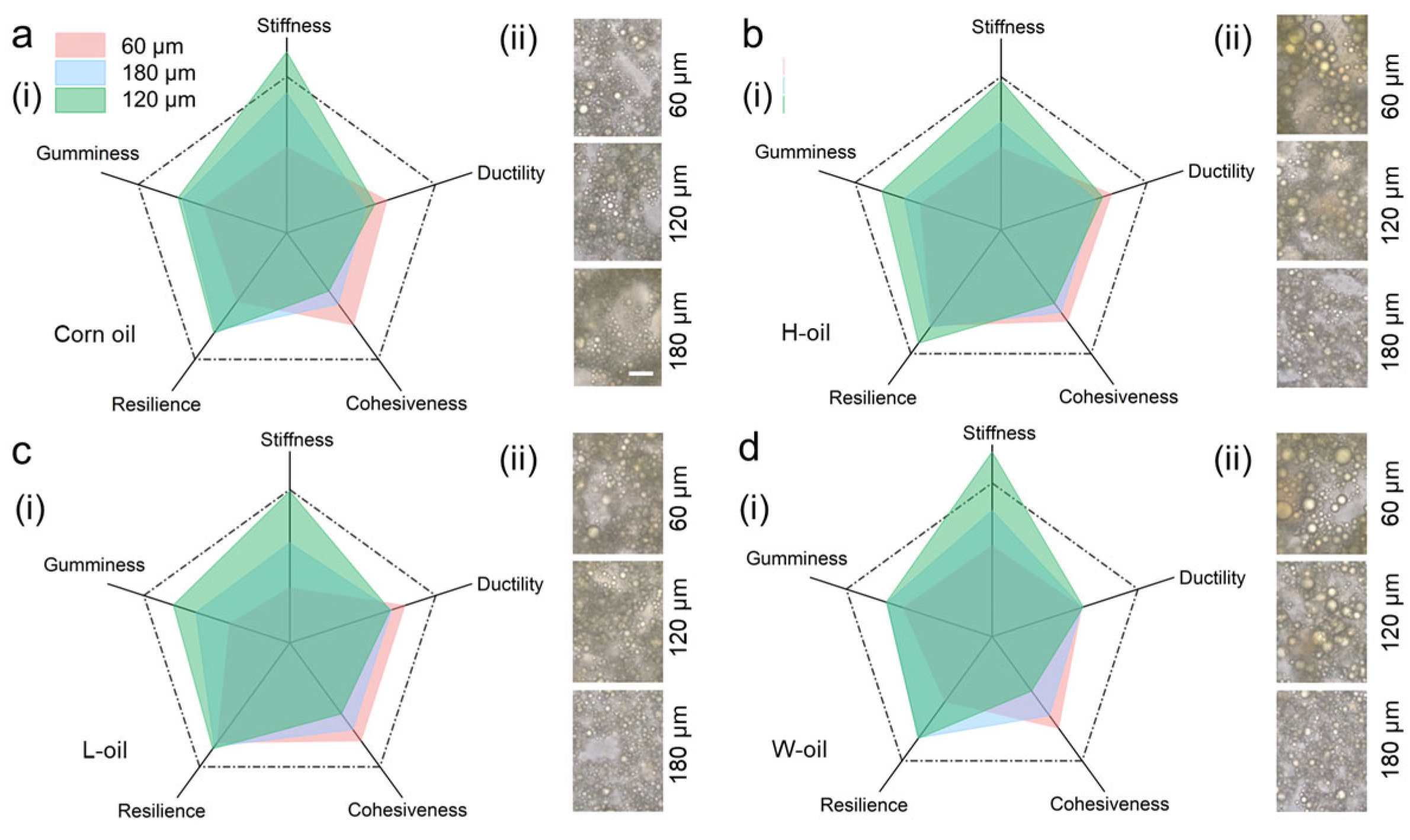
Sesame oil, an edible oil derived from Chinese oilseed crops with a long history of consumption, contains more than 85% unsaturated fatty acids, making it an ideal carrier for β-carotene. Common production methods for sesame oil include mechanical pressing (H-oil), water-assisted extraction (W-oil), and low-temperature pressing (L-oil). Figure 2 compares the textural properties, including stiffness, gumminess, resilience, cohesiveness, and springiness, of emulsions prepared with different particle sizes (60, 120, and 180 µm) and various oils, including corn oil, H-oil, L-oil, and W-oil. As shown in Figure 2a,b, emulsions prepared with corn oil and 120 µm Auricularia polytricha (Mont.) Sacc. exhibited the highest resilience, gumminess, and cohesiveness. In contrast, emulsions with 60 µm or 180 μm particles exhibited higher stiffness but lower ductility and resilience. A similar trend is present in Figure 2b–d, indicating that the type of oil phase is not a key factor affecting the texture of the emulsions.

3.5. Stability of β-Carotene-Loaded Emulsions

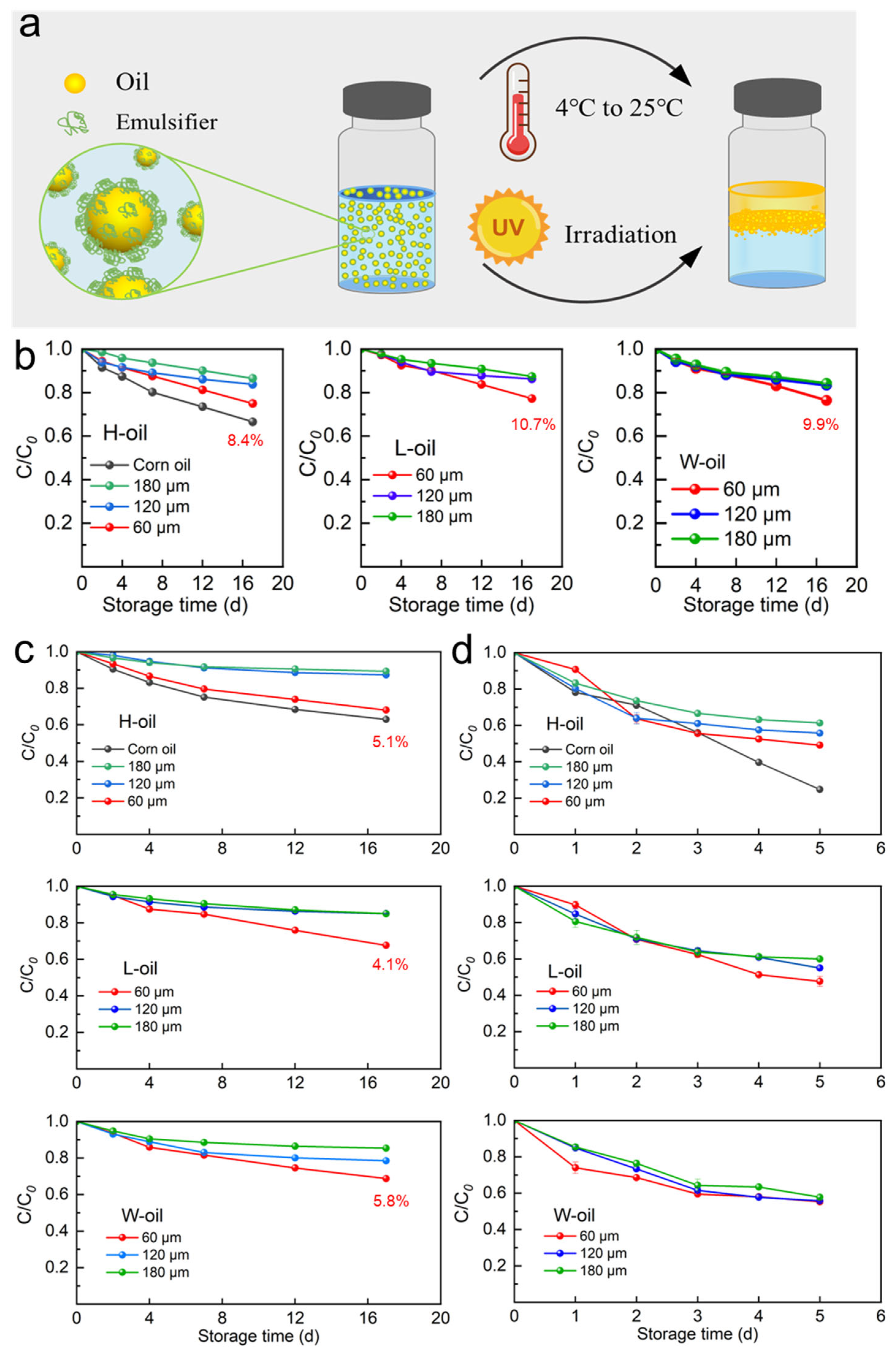
Figure 3a shows the overall experimental design. Oil droplets were emulsified with the emulsifier to form stable emulsions, which were subsequently stored under different temperature conditions and subjected to UV irradiation. Changes in β-carotene concentration were monitored over time to assess storage and biological stability. The experimental conditions included temperatures ranging from 4 °C to 25 °C and UV exposure to simulate environmental factors that may influence the stability of emulsions. As shown in Figure 3b, β-carotene-loaded emulsions prepared with corn oil and stored at 25 °C exhibited the poorest stability across all particle sizes, with a significant decrease in β-carotene concentration during the first few days. This phenomenon indicates accelerated β-carotene degradation in this formulation. In contrast, emulsions formulated with H-oil, L-oil, and W-oil maintained higher stability throughout 20 days of storage. Among the tested particle sizes, emulsions prepared with 120 µm particles generally showed the highest β-carotene retention, as indicated by their relatively stable C/C0 ratios. Emulsions prepared with 180 µm particles exhibited slightly lower stability than those prepared with 120 µm particles but retained more β-carotene than the 60 µm emulsions. The 60 µm emulsions showed the lowest stability, characterized by a more rapid decrease in β-carotene concentration. This phenomenon may be attributed to the larger surface area of smaller particles, which can accelerate oxidative degradation [29]. Under simulated room-temperature storage conditions (25 °C), emulsions prepared using 120 μm particles in combination with L-oil exhibited the highest β-carotene retention.
Lower temperatures generally slow down the rate of degradation reactions. Corn oil emulsions continued to show the lowest stability. However, the degradation rate at 4 °C was slower than at 25 °C (Figure 3c). These results indicate that lower temperatures help preserve β-carotene. However, emulsions containing corn oil remain more susceptible to degradation compared to those formulated with other oils. Emulsions prepared with H-oil, L-oil, and W-oil show further improvements in stability at 4 °C compared with their performance at 25 °C, with significantly reduced β-carotene degradation. Across all formulations, emulsions prepared with 120 µm particles of Auricularia polytricha (Mont.) Sacc. consistently exhibited the highest retention of β-carotene, followed by those prepared with 180 µm particles. In contrast, emulsions prepared with 60 µm particles of Auricularia polytricha (Mont.) Sacc. showed the greatest β-carotene degradation. Nevertheless, their degradation proceeded more slowly than at 25 °C. Overall, storage at 4 °C extended the stability of the emulsions and enhanced β-carotene retention.
UV light is a common environmental factor that accelerates the degradation of sensitive compounds such as β-carotene. Therefore, the stability of β-carotene-loaded emulsions under UV irradiation was examined over 5 days (Figure 3d). The results showed that UV exposure accelerated β-carotene degradation in all emulsions, particularly during the initial days. Specifically, corn oil emulsions exhibited the lowest stability under UV irradiation, with a rapid decline in β-carotene concentration. In contrast, emulsions prepared with H-oil, L-oil, and W-oil demonstrated greater resistance to UV-induced degradation. Consistent with previous results, emulsions prepared with 120 µm Auricularia polytricha (Mont.) Sacc. particles showed the highest β-carotene retention after 5 days of UV irradiation, highlighting the importance of optimal emulsifier particle size in protecting against oxidative and light-induced stress. Overall, the 120 µm particle size provided superior protection against both temperature fluctuations and UV irradiation, resulting in slower degradation of β-carotene. Among the tested formulations, emulsions prepared with L-oil at lower temperatures (4 °C) exhibited the best retention of β-carotene. These findings offer valuable insights for optimizing emulsion formulations to enhance the stability of bioactive compounds, including β-carotene, under diverse environmental conditions.

3.6. Digestive Stability of β-Carotene-Loaded Emulsions

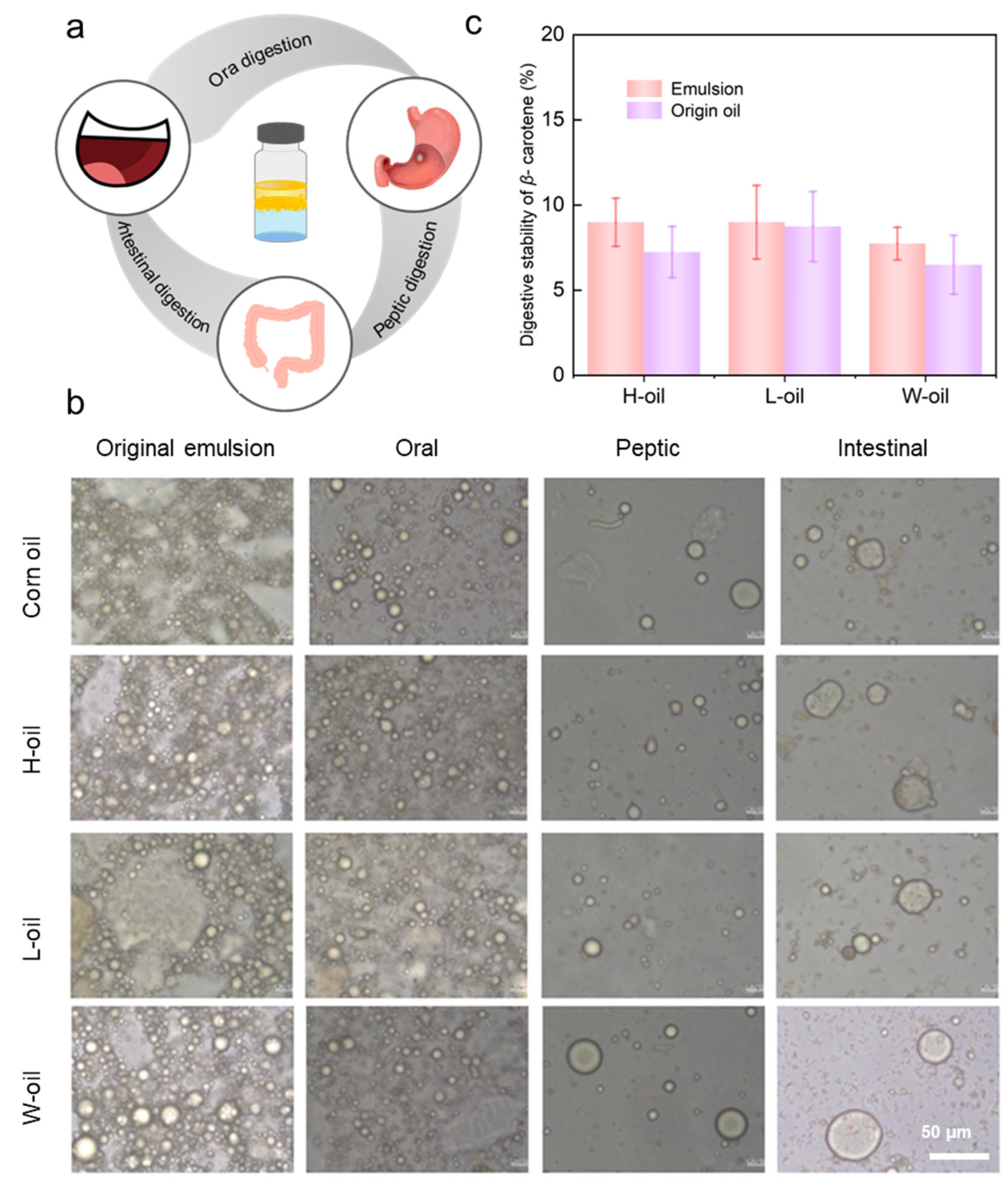
The digestive stability of β-carotene was evaluated using in vitro simulated digestion experiments, comparing emulsions with their corresponding oils (Figure 4a). As shown in Figure 4b, the initial emulsions exhibited small, uniformly distributed droplets, except for those prepared with corn oil. The oral phase had minimal effect on droplet size across all four oil types, whereas significant changes occurred during gastric and intestinal digestion. Exposure to simulated gastric and intestinal conditions induced partial droplet aggregation, resulting in increased droplet size and reduced droplet density and uniformity, likely due to destabilization under low pH and ionic conditions in the digestive environment [30]. Notably, droplet emulsions prepared with L-oil remained detectable even after intestinal digestion, possibly due to the higher unsaturated fatty acid content of the oil [31]. Further experiments are needed to confirm this hypothesis.
Digestive stability was primarily assessed by the proportion of β-carotene recovered in the micellar layer after digestion. As shown in Figure 4c, β-carotene-loaded emulsions consistently exhibited higher digestive stability than β-carotene directly dissolved in oil, with emulsions prepared using L-oil showing the highest recovery (9.2%). This improvement likely arises from dispersing β-carotene within a water-oil-emulsifier matrix, which enhances its dispersibility and facilitates digestion and absorption. Upon entering the small intestinal phase, emulsion droplets undergo hydrolysis, releasing the encapsulated β-carotene [32]. During the first 10 min of digestion, pancreatic lipase rapidly adsorbs onto droplet surfaces, facilitated by bile salts, which enhances enzyme access to hydrophobic lipid regions and promotes rapid β-carotene release [33]. Furthermore, Auricularia polytricha (Mont.) Sacc. powder interacts with β-carotene to form stable complexes, providing additional protection against degradation. In contrast, β-carotene dissolved directly in oil is susceptible to degradation and aggregation during digestion, resulting in lower bioavailability. Therefore, incorporating β-carotene into an emulsion system with L-oil effectively enhances its digestive stability.

4. Conclusions

In this study, Auricularia polytricha (Mont.) Sacc. powder was used as a direct emulsifier to successfully prepare emulsion systems incorporating different oil phases for the delivery of β-carotene. The emulsifying performance improved as the powder particle size decreased. Under optimal conditions, with 120 μm powder at a concentration of 7% and an oil phase fraction of 1%, microstructural analysis revealed small, uniformly distributed emulsion droplets, resulting in significantly enhanced long-term stability. Moreover, the degradation rate of β-carotene encapsulated in the emulsion was significantly lower than that of β-carotene directly dispersed in the oil phase under UV irradiation. In vitro simulated digestion experiments showed that the retention rate of β-carotene in the intestinal phase reached 9.2% in the emulsion group, significantly higher than that observed in the conventional oil-dissolved system. These findings provide theoretical support for developing novel natural emulsion systems with improved stability and functionality and suggest a potential strategy for streamlining industrial processes and reducing production costs.

Author Contributions

J.F. and J.W.: supervision, writing—review and editing. T.Y. and X.Z.: data curation. Z.H. and Y.C.: conceptualization, funding acquisition, and project administration. All authors have read and agreed to the published version of the manuscript.

Funding

This research was funded by the PhD Foundation of Shandong Agriculture and Engineering University grant number BSQJ202314, and Shandong Agriculture and Engineering University Start-Up Fund for Talented Scholars grant number 2024GCCZR-26 and 2025GCCZR-35. And The APC was funded by 2025GCCZR-35.

Data Availability Statement

The original contributions presented in this study are included in the article. Further inquiries can be directed to the corresponding authors.

Conflicts of Interest

The authors declare no conflicts of interest.

References

  1. Shen, Z.; Ding, Y.; Xu, Y. Recent advances of protein modification strategies to enhance the freezing stability of food emulsions: Principles, applications, and prospects. Compr. Rev. Food Sci. Food Saf. 2025, 24, e70135. [Google Scholar] [CrossRef]
  2. Wang, S.; Wang, X.; Luo, Y.; Liang, Y. A comprehensive review of conventional and stimuli-responsive delivery systems for bioactive peptides: From food to biomedical applications. Adv. Compos. Hybrid Mater. 2024, 8, 12. [Google Scholar] [CrossRef]
  3. Bai, L.; Huan, S.; Rojas, O.J.; McClements, D.J. Recent Innovations in Emulsion Science and Technology for Food Applications. J. Agric. Food Chem. 2021, 69, 8944–8963. [Google Scholar] [CrossRef]
  4. Herminghaus, S.; Maass, C.C.; Krüger, C.; Thutupalli, S.; Goehring, L.; Bahr, C. Interfacial mechanisms in active emulsions. Soft Matter 2014, 10, 7008–7022. [Google Scholar] [CrossRef]
  5. Badmus, S.O.; Amusa, H.K.; Oyehan, T.A.; Saleh, T.A. Environmental risks and toxicity of surfactants: Overview of analysis, assessment, and remediation techniques. Environ. Sci. Pollut. Res. 2021, 28, 62085–62104. [Google Scholar] [CrossRef]
  6. Pinto, R.T.; Feu, K.S.; Dalmaschio, C.J.; Nascimento, A.; Lacerda, V., Jr. Oil Recovery Improvements Based on Pickering Emulsions Stabilized by Cellulose Nanoparticles and Their Underlying Mechanisms: A Review. ACS Omega 2025, 10, 3262–3281. [Google Scholar] [CrossRef]
  7. Velandia, S.F.; Marchal, P.; Sadtler, V.; Arnoux, P.; Bonn, D.; Roques-Carmes, T. Globular proteins as Pickering emulsion stabilizers: Particles or surfactants? Colloids Surf. A Physicochem. Eng. Asp. 2025, 704, 135469. [Google Scholar] [CrossRef]
  8. Neu, B.; Meiselman, H.J. The Role of Macromolecules in Stabilization and De-Stabilization of Biofluids. In Bioengineering in Cell and Tissue Research; Artmann, G.M., Chien, S., Eds.; Springer: Berlin/Heidelberg, Germany, 2008; pp. 393–414. [Google Scholar]
  9. Du, P.; Cui, B.-K.; Dai, Y.-C. High genetic diversity in wild culinary-medicinal wood ear mushroom, Auricularia polytricha (Mont.) Sacc., in tropical China revealed by ISSR analysis. Int. J. Med. Mushrooms 2011, 13, 289–298. [Google Scholar] [CrossRef] [PubMed]
  10. Wang, W.; Wang, Y.; Gong, Z.; Yang, S.; Jia, F. Comparison of the Nutritional Properties and Transcriptome Profiling Between the Two Different Harvesting Periods of Auricularia polytricha. Front. Nutr. 2021, 8, 771757. [Google Scholar] [CrossRef] [PubMed]
  11. Dai, L.; Wang, Q.; Wang, L.; Huang, Q.; Hu, B. Using Commercial Bio-Functional Fungal Polysaccharides to Construct Emulsion Systems by Associating with SPI. Foods 2025, 14, 215. [Google Scholar] [CrossRef] [PubMed]
  12. Qayum, A.; Rashid, A.; Liang, Q.; Wu, Y.; Cheng, Y.; Kang, L.; Liu, Y.; Zhou, C.; Hussain, M.; Ren, X.; et al. Ultrasonic and homogenization: An overview of the preparation of an edible protein–polysaccharide complex emulsion. Compr. Rev. Food Sci. Food Saf. 2023, 22, 4242–4281. [Google Scholar] [CrossRef]
  13. Vašková, J.; Stupák, M.; Vidová Ugurbaş, M.; Židzik, J.; Mičková, H. Therapeutic Uses of Retinol and Retinoid-Related Antioxidants. Molecules 2025, 30, 2191. [Google Scholar] [CrossRef] [PubMed]
  14. Tufail, T.; Bader Ul Ain, H.; Noreen, S.; Ikram, A.; Arshad, M.T.; Abdullahi, M.A. Nutritional Benefits of Lycopene and Beta-Carotene: A Comprehensive Overview. Food Sci. Nutr. 2024, 12, 8715–8741. [Google Scholar] [CrossRef] [PubMed]
  15. Zhao, T.; He, X.; Yan, X.; Xi, H.; Li, Y.; Yang, X. Recent advances in the extraction, synthesis, biological activities, and stabilisation strategies for β-carotene: A review. Int. J. Food Sci. Technol. 2024, 59, 2136–2147. [Google Scholar] [CrossRef]
  16. Roy, S.; Dora, K.C.; Kumar, S.; Saklani, P.; Muthukumar, A.; Ozogul, F.; Harisankar, K.C.; Mutum, R.D.; Mary, S.C.H.; Surasani, V.K.R.; et al. A critical review on technical advances and multifaceted role of carotenoids in human health with special emphasis on metabolic diseases. Phytochem. Rev. 2025, 25, 1067–1092. [Google Scholar] [CrossRef]
  17. Iddir, M.; Vahid, F.; Merten, D.; Larondelle, Y.; Bohn, T. Influence of Proteins on the Absorption of Lipophilic Vitamins, Carotenoids and Curcumin—A Review. Mol. Nutr. Food Res. 2022, 66, 2200076. [Google Scholar] [CrossRef]
  18. Sun, Y.; Tang, W.; Pu, C.; Li, R.; Sun, Q.; Wang, H. Improved stability of liposome-stabilized emulsions as a co-encapsulation delivery system for vitamin B2, vitamin E and β-carotene. Food Funct. 2022, 13, 2966–2984. [Google Scholar] [CrossRef]
  19. Li, Y.; Fu, J.; Peng, L.; Sun, X.; Wang, G.; Wang, Y.; Chen, L. A sustainable emulsion for separation and Raman identification of microplastics and nanoplastics. Chem. Eng. J. 2023, 469, 143992. [Google Scholar] [CrossRef]
  20. Zhao, L.; Li, J.; Yin, K.; Ding, Y.; Sun, L. Emulsion gels prepared from Longzhua mushroom polysaccharides with self-gelling properties as β-carotene carriers: Stability and in vitro digestibility of β-carotene. Int. J. Biol. Macromol. 2024, 276, 134110. [Google Scholar] [CrossRef]
  21. Tian, L.; Roos, Y.H.; Gómez-Mascaraque, L.G.; Lu, X.; Miao, S. Tremella fuciform Polysaccharides: Extraction, Physicochemical, and Emulsion Properties at Different pHs. Polymers 2023, 15, 1771. [Google Scholar] [CrossRef] [PubMed]
  22. Shao, P.; Qiu, Q.; Xiao, J.; Zhu, Y.; Sun, P. Chemical Stability and in vitro release properties of β-carotene in emulsions stabilized by Ulva fasciata polysaccharide. Int. J. Biol. Macromol. 2017, 102, 225–231. [Google Scholar] [CrossRef] [PubMed]
  23. Wang, S.; Qiao, F.; He, J.; Fu, J.; Liu, T.; Yi, H.; Sheng, Q.; Zhang, L.; Lin, K. Phospholipid Remodeling and Tri-Layer Membrane Reconstruction Mediate Cognitive Effects of Humanized Milk Fat Globules in Neonatal Rats. Adv. Sci. 2025, 12, e07926. [Google Scholar] [CrossRef]
  24. Brodkorb, A.; Egger, L.; Alminger, M.; Alvito, P.; Assunção, R.; Ballance, S.; Bohn, T.; Bourlieu-Lacanal, C.; Boutrou, R.; Carrière, F.; et al. INFOGEST static in vitro simulation of gastrointestinal food digestion. Nat. Protoc. 2019, 14, 991–1014. [Google Scholar] [CrossRef]
  25. Ma, H.; Zhang, L.; Niu, X.; Zhang, Y.; Yang, X.; Li, L. Soy protein-gellan gum noncovalent complexes stabilized emulsion: Effect of heating and pH on emulsion stability. Int. J. Biol. Macromol. 2025, 301, 140067. [Google Scholar] [CrossRef]
  26. Li, X.; Yue, X.a.; Wang, Z.; Yan, R.; Guo, Y. Role of Emulsification and Interfacial Tension of a Surfactant for Oil Film Displacement. Energy Fuels 2021, 35, 3032–3041. [Google Scholar] [CrossRef]
  27. Shafiei, M.; Kazemzadeh, Y.; Martyushev, D.A.; Dai, Z.; Riazi, M. Effect of chemicals on the phase and viscosity behavior of water in oil emulsions. Sci. Rep. 2023, 13, 4100. [Google Scholar] [CrossRef]
  28. Xu, H.; Tian, H.; Deng, J.; Zhuo, Q.; Cui, J.; Wang, J.; Yin, Y.; Yu, P. Review of influence of steric effect on aggregation behavior of fine particles. Miner. Eng. 2023, 203, 108304. [Google Scholar] [CrossRef]
  29. Fu, Y.; McClements, D.J.; Luo, S.; Ye, J.; Liu, C. Degradation kinetics of rutin encapsulated in oil-in-water emulsions: Impact of particle size. J. Sci. Food Agric. 2023, 103, 770–778. [Google Scholar] [CrossRef] [PubMed]
  30. Anjali, T.G.; Basavaraj, M.G. Influence of pH and Salt Concentration on Pickering Emulsions Stabilized by Colloidal Peanuts. Langmuir 2018, 34, 13312–13321. [Google Scholar] [CrossRef]
  31. Álvarez, R.; Giménez, B.; Mackie, A.; Torcello-Gómez, A.; Quintriqueo, A.; Oyarzun-Ampuero, F.; Robert, P. Influence of the particle size of encapsulated chia oil on the oil release and bioaccessibility during in vitro gastrointestinal digestion. Food Funct. 2022, 13, 1370–1379. [Google Scholar] [CrossRef]
  32. Chen, L.; Yokoyama, W.; Liang, R.; Zhong, F. Enzymatic degradation and bioaccessibility of protein encapsulated β-carotene nano-emulsions during in vitro gastro-intestinal digestion. Food Hydrocoll. 2020, 100, 105177. [Google Scholar] [CrossRef]
  33. Wilde, P.J.; Chu, B.S. Interfacial & colloidal aspects of lipid digestion. Adv. Colloid Interface Sci. 2011, 165, 14–22. [Google Scholar] [CrossRef] [PubMed]
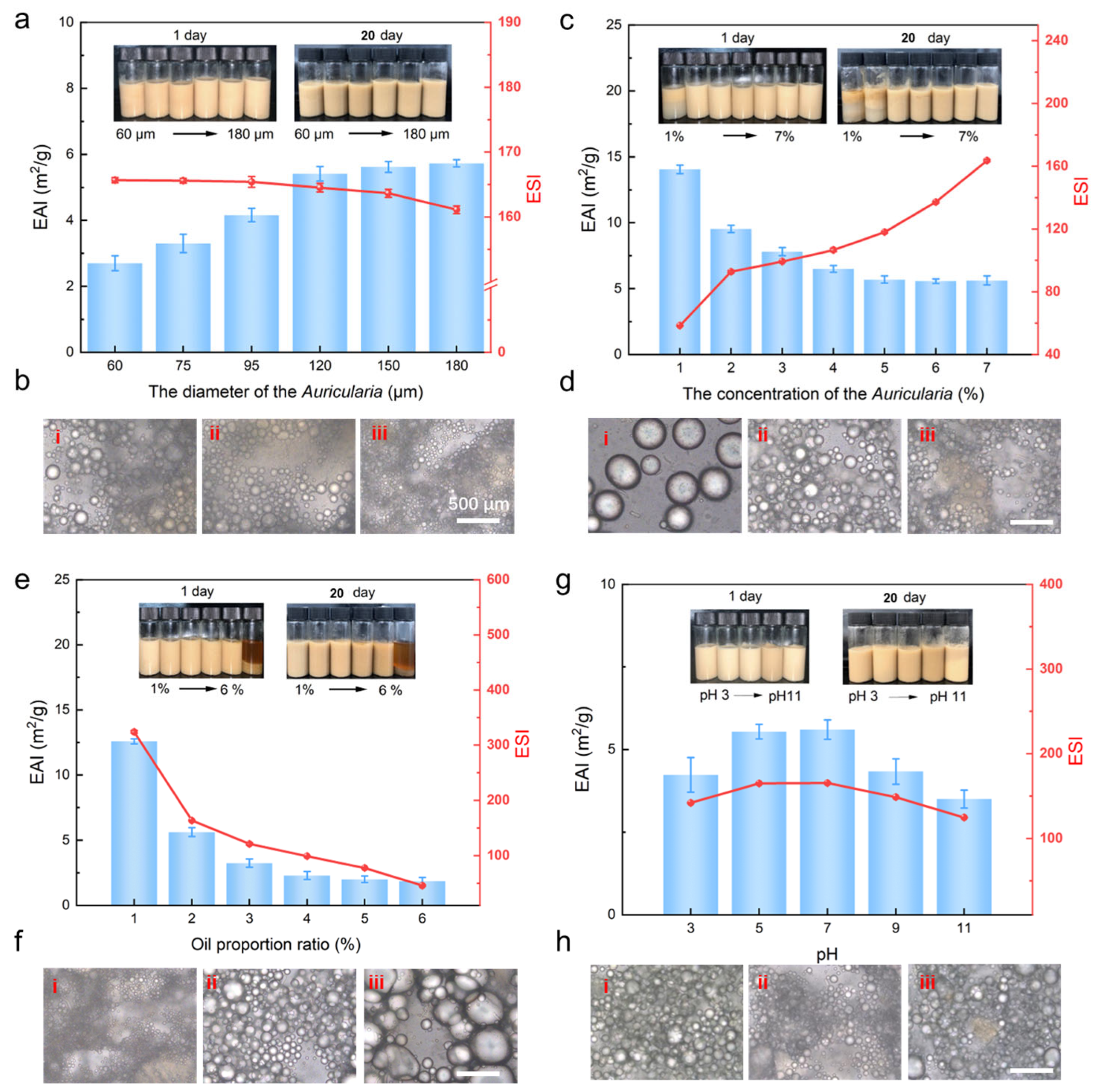
Figure 1. Microscopic observation of β-carotene-loaded emulsions prepared under different conditions. (a) Effect of the diameter of Auricularia polytricha (Mont.) Sacc. on the EAI and ESI of emulsion. (b) The microscopic images of the diameter of Auricularia polytricha (Mont.) Sacc. for 60 μm (i), 120 μm (ii) and 180 μm (iii). (c) Effect of the concentrations of Auricularia polytricha (Mont.) Sacc. on the EAI and ESI of emulsion. (d) The microscopic images of the concentrations of Auricularia polytricha (Mont.) Sacc. for 1% (i), 4% (ii) and 7% (iii). (e) Effect of the oil proportion ratio of corn oil (Jinlongyu, Shanghai, China) on the EAI and ESI of emulsion. (f) The microscopic images of the oil proportion of corn oil for 1% (i), 4% (ii) and 6% (iii). (g) Effect of the various pH on the EAI and ESI of emulsion. (h) The microscopic images of the emulsion under different pH at 3 (i), 7 (ii), and 11 (iii). Above inset images showed the visual view of the emulsions. All the scale bars are 500 μm.
Processes 14 01017 g001
Figure 2. Texture properties of the emulsions. (ad) Texture properties of the emulsions prepared with various of oil phases including corn oil (a), H-oil (b), L-oil (c), and W-oil (d). All the data of (i) and (ii) represented texture properties and microscopic images in each figure, respectively. All the scale bars are 250 μm.
Processes 14 01017 g002
Figure 3. Stability of β-carotene-loaded emulsions under UV irradiation and different temperatures. (a) Schematic illustration of the β-carotene-loaded emulsions. (b,c) Stability of β-carotene-loaded emulsions under 25 °C (b) and 4 °C (c). The inset figure shows a decrease in β-carotene concentration of 60 μm compared to corn oil at day 17. (d) Stability of β-carotene-loaded emulsions under UV irradiation.
Processes 14 01017 g003
Figure 4. The assessment of digestive stability for the β-carotene-loaded emulsions in vitro. (a) Schematic illustration of the simulated digestion for the β-carotene-loaded emulsions in vitro. (b) Microscopic observation of the emulsions during the different digestion processes. The scale bars are 50 μm. (c) The digestive stability of the emulsions with different oil phases.
Processes 14 01017 g004
Disclaimer/Publisher’s Note: The statements, opinions and data contained in all publications are solely those of the individual author(s) and contributor(s) and not of MDPI and/or the editor(s). MDPI and/or the editor(s) disclaim responsibility for any injury to people or property resulting from any ideas, methods, instructions or products referred to in the content.