Article

Process Differences in Phosphorus Release Between Wetland and River Sediments in a Plain River Network

1
National Engineering Laboratory for Lake Pollution Control and Ecological Restoration, Chinese Research Academy of Environmental Sciences, Beijing 100012, China
2
State Key Laboratory of Environmental Criteria and Risk Assessment, Chinese Research Academy of Environmental Sciences, Beijing 100012, China
3
Institute of Environmental Information, Chinese Research Academy of Environmental Sciences, Beijing 100012, China
*
Author to whom correspondence should be addressed.
Processes 2026, 14(5), 877; https://doi.org/10.3390/pr14050877
Submission received: 19 January 2026 / Revised: 2 March 2026 / Accepted: 6 March 2026 / Published: 9 March 2026
(This article belongs to the Section Environmental and Green Processes)

Abstract

The release process of endogenous phosphorus (P) in the sediments of large ecological wetlands and their connected rivers in the plain river network area shows temporal and spatial differences. This study investigated P dynamics of the sediments in a large ecological wetland and its connected rivers in a plain river network area. Sample collection occurred across three periods (October 2024, March 2025, and July 2025). P source-sink characteristics and microbial regulatory mechanisms were analyzed to clarify differences in the P release processes between wetland (SS) and river (SH) sediments. The results showed that the total phosphorus (TP) concentration in overlying water was highest in July (0.16 mg/L), while the TP content in SS was relatively low, with a mean value of 514.1 mg/kg. SS generally acted as a P sink, with its zero equilibrium P concentrations (EPC0) significantly lower than those of river sediments (SH), reaching a minimum of 0.01 mg/L, and its maximum P sorption capacity (Qmax) higher, with a maximum value of 1.413 mg/g. In contrast, SH mainly served as a P source, with a particularly high release risk in spring and summer. Seasonal changes significantly influenced P behavior, and sorption capacity was highest in spring (March), while the high EPC0 of SH still facilitated P release under actual water conditions. In autumn, elevated microbial diversity enhanced organic matter mineralization to increase EPC0 and P release risk (p < 0.05), while in summer, specific functional phyla (Proteobacteria and Bacteroidota) simultaneously regulated both adsorption capacity (Qmax) and release threshold (EPC0) through organic matter mineralization, iron reduction, and competitive sorption (p < 0.05). This study provides scientific support for internal pollution control in ecological wetlands and watershed phosphorus management in plain river network areas.

1. Introduction

Human activities, such as industrial and agricultural wastewater, domestic sewage, and agricultural non-point source pollution, are the primary causes of eutrophication in rivers and lakes [1,2]. In recent years, as efforts to control point source pollution have intensified, the contribution of internal phosphorus (P) pollution has become increasingly prominent and has emerged as a key factor sustaining eutrophication in water bodies [3,4]. Sediments in large ecological wetlands act as both a “sink” and a “source” of P [5,6]. Once external inputs are brought under control, the P release from these sediments into the overlying water—driven by physical, chemical, and biological processes—exerts a continuous and profound impact on water environmental quality [7,8,9]. Compared to the overlying water, sediments store vast reserves of nitrogen and phosphorus nutrients, and their interfacial exchange processes profoundly influence the ecological recovery of water bodies.
Several studies have used the EPC0 (equilibrium phosphorus concentration at zero) value obtained from sediment phosphorus (P) isothermal sorption experiments to assess the P release status of sediments. A previous study compared the EPC0 of eleven streams with riverine soluble reactive P (SRP) and revealed the decoupling between sediment and water, which limits phosphorus buffering mechanisms in agricultural streams [10]. Different sediments had various EPC0 values in Lake Dianchi, and they had different sediment P release statuses [11]. The researchers observed that sediments in the western Florida Bay, with high EPC0 and low Kf (the sorption coefficient), served as P sources, whereas sediments in the eastern bay, with low EPC0 and high Kf, acted as P sinks [12]. Some studies found that the differences between EPC0 and SRP concentrations of pore water (δ) were mostly negative in Jiaozhou Bay and that the EPC0 was significantly higher than the overlying water dissolved inorganic phosphorus (DIP) concentration, indicating a high ecological risk in the bay [13]. In addition, studies observed distinctly different EPC0 and δ values for suspended particulate matter in the Miju River and Erhai Lake (China), suggesting that terrestrial detrital particles in the Miju River mainly acted as P sinks, while endogenous phytoplankton particles in Erhai Lake primarily served as P sources [14]. Microbial communities are also the core biological driving factors regulating P release from sediments, and their mechanisms of action exhibit significant spatiotemporal specificity. For instance, in autumn, higher microbial diversity promotes organic matter mineralization, thereby increasing EPC0 and the risk of phosphorus release. In summer, key functional bacterial groups (such as Proteobacteria and Bacteroidota) simultaneously regulate adsorption capacity through organic matter mineralization, iron reduction, and competitive sorption, intensifying the endogenous phosphorus release from river sediments.
Currently, most research focuses on the internal nutrient loads and nitrogen-phosphorus release mechanisms in sediments of large shallow lakes, while relatively less attention has been paid to large ecological wetland basins in plain river network areas, which possess both pollution assimilation and ecological purification functions [15,16,17]. Unlike isolated, closed or semi-closed lakes, large ecological wetland basins typically feature dense river networks, complex hydrological connectivity, diverse land-use types, and dual influences from natural processes and human activities. This makes the migration, transformation, and spatiotemporal variations of endogenous nutrients, and the conclusions from traditional lake studies may not fully apply.
The Tongxiang Western Drinking Water Source Ecological Wetland (30°31′0″–30°33′0″ N and 120°18′0″–120°21′0″ E) is situated in a plain river network area (southeastern part of Taihu Basin, China), with a total water area of approximately 1,332,000 m2 (core area). The ecological wetland project extends to 359 hectares. The water depth generally exceeds 2 m, and the surrounding environment boasts favorable natural conditions with an abundant water supply. The wetland receives surface water from the river network, primarily accepting inflows from eight rivers in the surrounding area. This study focuses on the large ecological wetland and its connected rivers in this region, investigating the P spatiotemporal distribution characteristics in the wetland and rivers across three periods (October 2024, March 2025, and July 2025). Simultaneously, the P source-sink status of the sediments in the river and wetland is assessed, and the mechanisms that influence microbial communities on sediment phosphorus release processes are further determined. The aim is to provide crucial scientific evidence and data support for the assessment of aquatic ecological health, the precise management of internal pollution, and the formulation of ecological restoration strategies for this wetland and its basin.

2. Methods and Materials

2.1. Sampling Sites and Physicochemical Analysis

Seven sampling sites were established in the ecological wetland (S1–S7), and eight sampling sites were set in the surrounding connected rivers (H1–H8), resulting in a total of 15 sampling points across the entire basin (Figure 1). Water and sediment samples were collected in October 2024, March 2025, and July 2025. Surface water samples were collected at 0.5 m below the water surface at all 15 points using a plexiglass water sampler (Loobo, China). The water samples were placed into transparent PET plastic bottles, sealed, stored in a constant-temperature insulated box (Esky, China) immediately after collection, and transported back to the laboratory.
At the same time as collecting overlying water samples in the study area, surface sediment samples were obtained from the 15 sites using a Peterson grab sampler (SS denotes sediments from wetlands, and SH denotes sediments from rivers). Each sampling site was marked. When collecting sediment samples, three parallel samples (n = 3) were collected consecutively (starting from the center of the marked point and within a radius of 2 m). Then, the sediment samples from each site were mixed together and used as the collected samples. The fresh sediment samples were placed into sealed ziplock bags, stored in a constant-temperature insulated box after collection, and transported back to the laboratory.
A 30 cm high sediment core sample was collected at each site using a columnar sampler. On-site, the cores were sectioned at 10 cm intervals using a sediment divider (bottom, middle, and surface), placed into clean ziplock bags, and sealed, resulting in a total of 45 layered sediment samples. After being brought back to the laboratory, the sediments were freeze-dried using a freeze dryer, then ground, sieved (100 mesh), and stored in clean ziplock bags for subsequent use. The sediment samples for microbial analysis were stored in a refrigerator at −80 °C after being transported back to the laboratory. The moisture content of the sediments in each layer ranged from 41.2% to 83.7%, and the organic matter content was between 2.1% and 9.5%.
Total phosphorus (TP, mg/L) in overlying water and soluble reactive P (SRP) in pore water concentrations (obtained by centrifugation) from surface sediment were determined (bottom sediment was not measured) using the potassium persulfate oxidation spectrophotometric method and the molybdenum blue acid method [18]. Dissolved oxygen (DO, mg/L) levels and pH were assessed using a fully automatic portable chemical analyzer. TP content in sediments was determined according to the SMT protocol [19].

2.2. Experimental Methods

Batch experiments were carried out to obtain the P sorption experiments. Sediment samples (1 g) from different sampling sites were added to 50 mL centrifuge tubes, and 40 mL of P (0, 1, 2, 5, 10, 20 mg/L, KH2PO4 formulation) solution with different concentration gradients was added. The samples were then shaken at 180 r/min on a constant-temperature (25 ± 2 °C) shaker (Heyteck, China) for 18 h [18,20]. The pH of the solution was controlled to range from 7.1 to 7.8 using NaOH and HCl. Temperature and DO were maintained at normal levels, and experimental gradients were not conducted. After centrifugation and filtration through a 0.45 μm polyethersulfone filter (Jinteng, China), the supernatant was analyzed for TP concentration.

2.3. Data Analysis

The sorption isotherms of P on sediments were investigated using modified Langmuir and Freundlich equations. The zero equilibrium P concentrations using the modified Freundlich models was EPC0 [20,21,22]. The KF (L/g) sorption coefficient was calculated by the modified Freundlich models. The measurements for all the related indicators were repeated three times. The methods and calculation equations are shown in the Supplementary Materials.
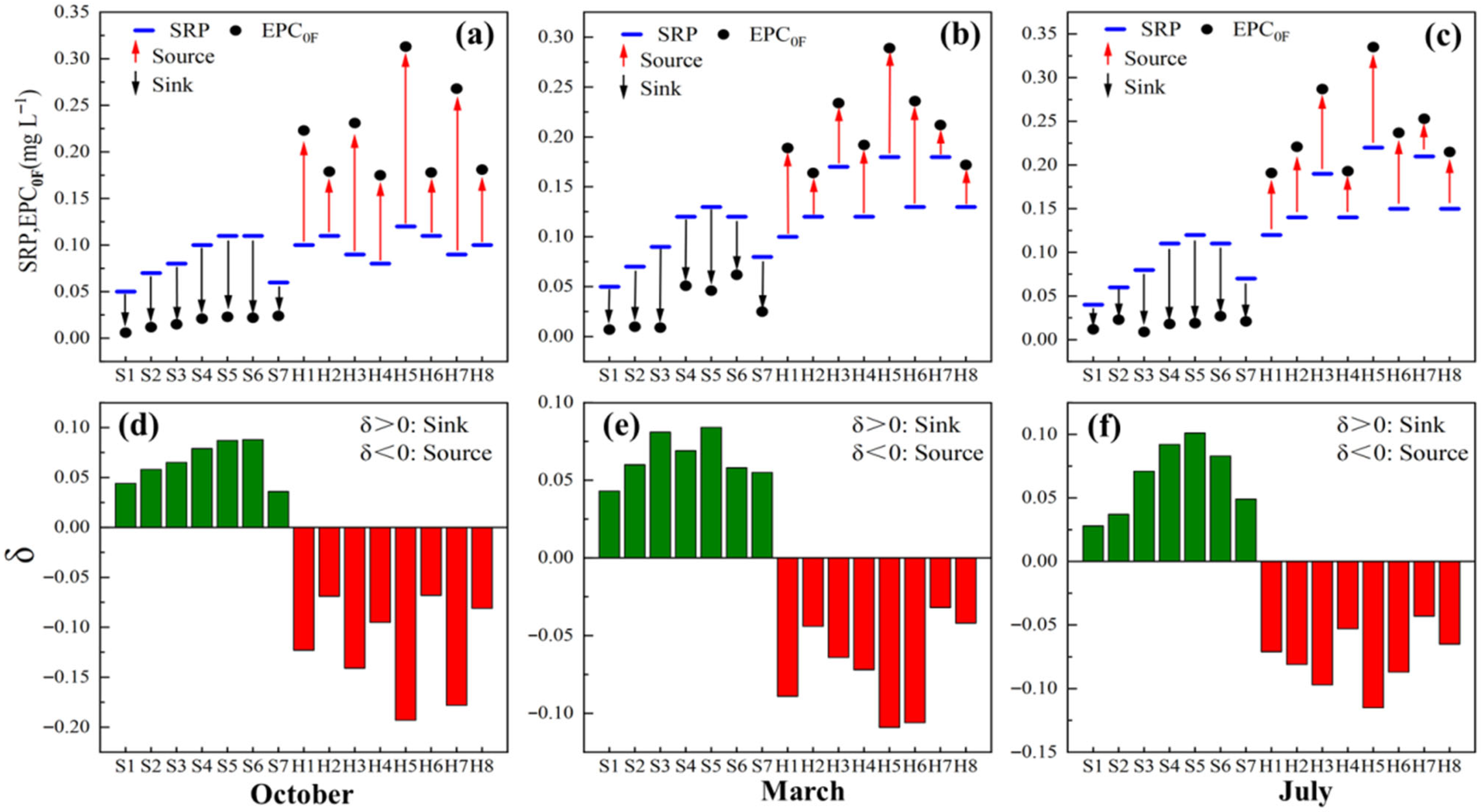
The sediment source or sink state of P was determined by the difference between P (EPC0) and the SRP concentration in pore water [14,23,24]. The equations were as follows:
δ = EPC 0 C SRP .
where CSRP is the SRP concentration in pore water and δ is the difference between EPC0 and CSRP. When δ > 0, the sediment serves as the source of P (P source); when δ < 0, the sediment serves as the pool of phosphorus (P sink).

2.4. Microbial Sequencing and Data Analysis

The bacterial 16S rRNA gene region was amplified using the primers 799F (AACMGGATTAGATACCCKG) and 1193R (ACGTCATCCCCACCTTCC). Experimental data were processed in Excel and plotted using Origin 2022, and Pearson correlation analysis was carried out for each physicochemical parameter using IBM SPSS Statistics 25.

3. Results and Discussion

3.1. P Spatiotemporal Distribution Characteristics of the Overlying Water and Sediments from Wetlands and Rivers

The results show that during the study period, the average pH of the river water ranged from 7.41 to 7.91, indicating weakly alkaline characteristics (Table S1). On a temporal scale, although fluctuations in pH values were observed between July 2025 (the highest) and October 2024 (the lowest), the overall difference was not significant. Spatially, a clear regional pattern emerged: the pH in the advanced treatment zone of the wetland (S1) consistently remained at a relatively high level, while the northern river network area (H5) was identified as a spatial low-value zone. The higher pH in S1 (the advanced treatment zone of the wetland) is primarily attributed to significant CO2 consumption due to vegetation photosynthesis and the release of alkaline substances from the substrate. Conversely, the lower pH in H5 (the northern river network area) is associated with respiration from organic matter degradation and the direct discharge of domestic sewage.
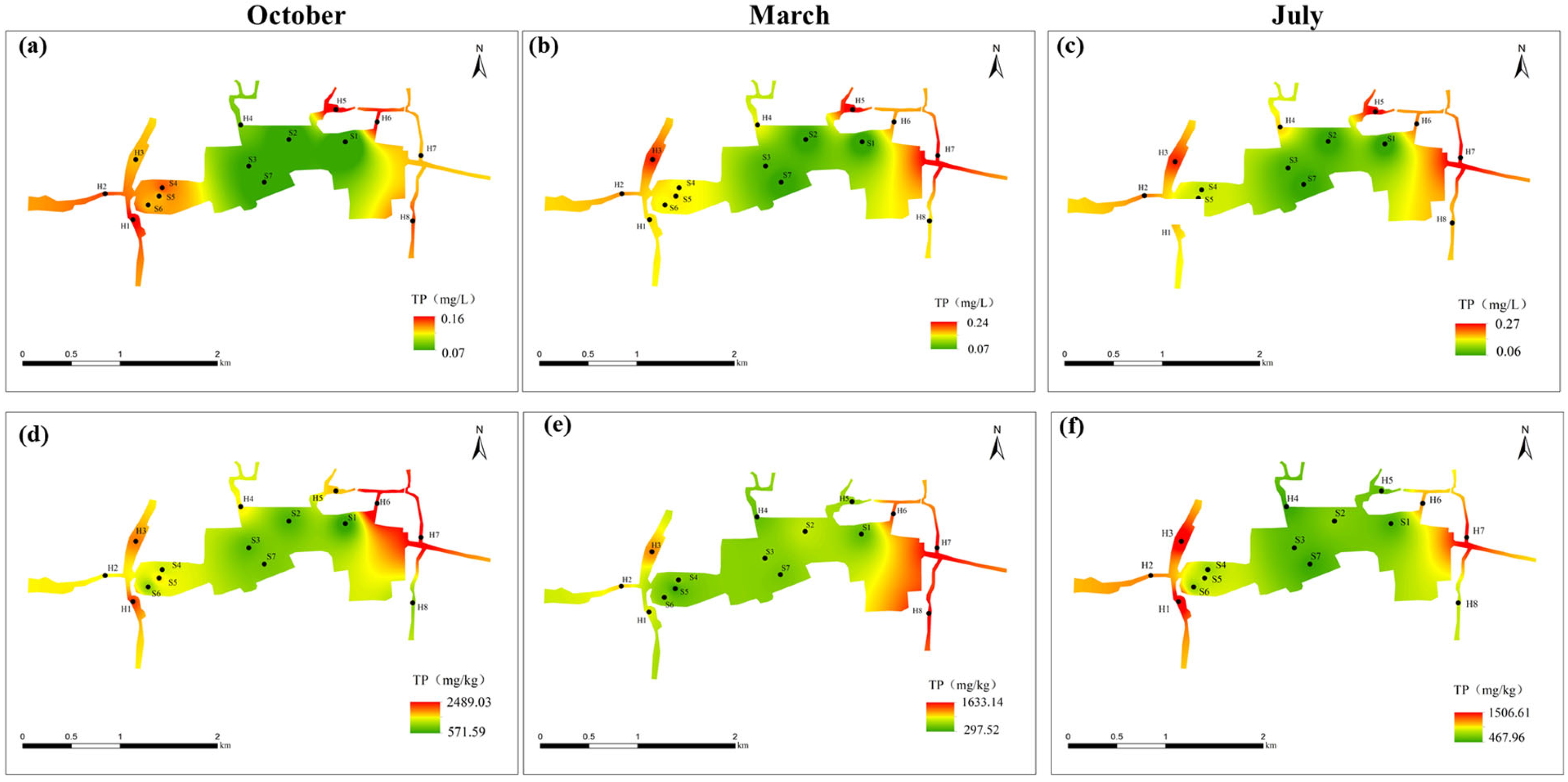
The results indicated that the average TP concentration in the overlying water in the study area fluctuated between 0.12 and 0.16 mg/L, with the peak value (0.16 mg/L) occurring in July 2025 and the trough value (0.12 mg/L) in October 2024 (Figure 2). Spatially, TP concentrations of overlying water in wetlands were significantly lower (p < 0.05) than in rivers. The distribution of TP content in sediments exhibited distinct spatiotemporal patterns. The advanced treatment zone (S1) consistently represented a “depression” for P accumulation across all months (mean value approximately 514.1 mg/kg), reflecting the wetland’s ultimate interception function for P inputs. Temporally, the widespread increase in TP in July suggested the combined effects of external runoff and biological P sedimentation under high summer temperatures. The tributaries at the outlet rivers (H7, H8) showed a certain risk of P accumulation in October, which may be related to the settlement of fine particulate P due to the relatively enclosed conditions and longer hydraulic retention time in these tributaries.

3.2. P Sorption Characteristics of the Sediments from Wetland and Rivers

This study utilized modified Langmuir and Freundlich models to investigate the P sorption characteristics of sediments. The results indicated that both the modified Langmuir (R2 ranging from 0.877 to 0.996) and Freundlich (R2 ranging from 0.867 to 0.999) models effectively simulated the P sorption behavior of the sediments, and the sorption parameters are shown in Tables S2–S4. Under zero initial P concentration, the sorption capacities calculated by both models were negative. This suggested that the sediments were in a P release state, with P diffusing from the solid phase to the liquid phase. As the equilibrium concentration increased, the sorption capacity also rose. This phenomenon was primarily driven by diffusion gradients [25]. When the initial P content increased, the concentration gradient at the interface between the overlying water and the sediment intensified, accelerating the mass transfer of P into sediment pores and active sites, thereby causing a rapid increase in sorption capacity. However, due to the limited availability of effective sorption sites on the sediment surface, as the initial concentration continued to rise, these sites gradually became occupied and approached saturation, leading to a subsequent slowdown in the adsorption rate [26,27].
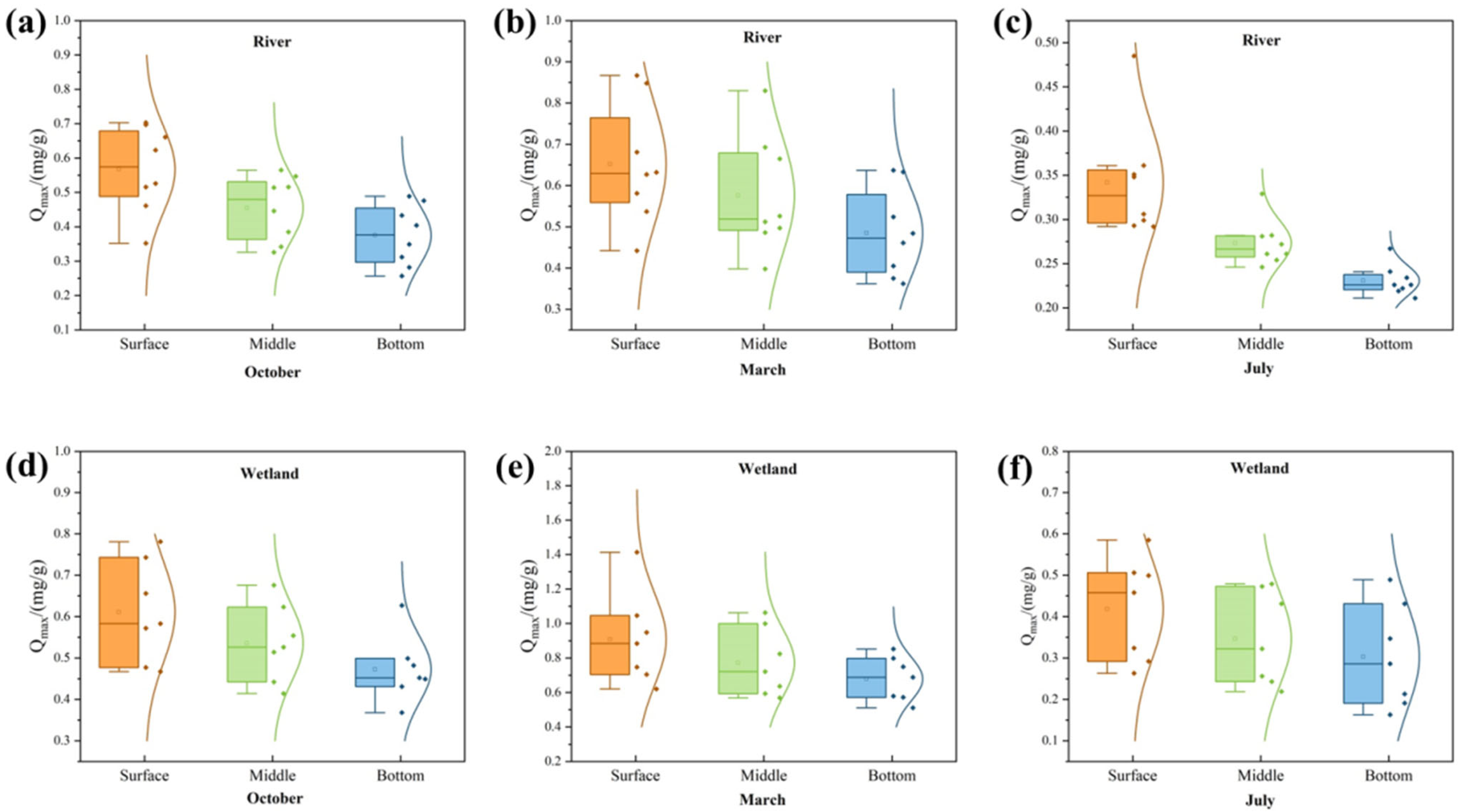
Overall, across the three periods, the Qmax of SS was greater than that of SH. Among these, the surface SS in March exhibited the highest Qmax value of 1.413 mg/g (Figure 3). In the vertical profile, the Qmax values followed the order: surfacer > middle > bottom. This indicated that the surface sediments had a high P sorption capacity. Surface sediments were directly exposed to the overlying water column and received continuous inputs of freshly deposited particulate matter. These materials typically had a higher specific surface area, more abundant amorphous minerals (e.g., amorphous iron/aluminum oxides), and less-aged organic matter, all of which provided abundant and highly reactive P sorption sites. In contrast, bottom sediments underwent physical compaction and diagenetic aging, which reduced porosity, specific surface area, and the reactivity of mineral phases. Temporally, the surface SH in October and March showed relatively high Qmax values, with the surface SS in March recording the highest Qmax. In contrast, both SH and SS exhibited the lowest Qmax values in July, with the minimum value being 0.219 mg/g. The Qmax of sediments in the study area displayed significant seasonal fluctuations, with an overall ranking of March (spring) > October (autumn) > July (summer). The high P sorption potential observed in spring was reflected in the results, showing that the P sorption capacities of sediment in all layers in March 2025 reached their annual peaks. Among them, the average Qmax of SS was as high as 0.909 mg/g, significantly exceeding the values from the other two periods. This was primarily due to lower water temperatures in spring. Since phosphorus adsorption is an exothermic reaction, the low-temperature habitat thermodynamically favors the spontaneous progression of the adsorption process [28]. Additionally, following the dormant winter period, active sites on the sediment surface were relatively abundant, with physical adsorption dominating, thus demonstrating strong purification and buffering potential [29,30].
By July, the P sorption capacities of both SS and SH showed a substantial decline, with the average Qmax of surface SS decreasing to 0.418 mg/g, only about 46% of the March value. Two main factors contributed to this phenomenon: first, high temperatures in summer increased molecular thermal motion, inhibiting the shift in adsorption equilibrium toward the solid phase; second, biological activity in the wetland peaked during summer, with microbial metabolites and organic acids competing with phosphate for adsorption, occupying a large number of active sites. Furthermore, sediments in summer were prone to reducing conditions, and the reductive dissolution of iron oxides also disrupted some sorption structures [31].
On the spatial distribution scale, the Qmax values of SS and SH exhibited stability characteristics. Although the values fluctuated significantly over time, the spatial pattern demonstrated strong stability. Across the three periods, whether for surface, middle, or bottom sediments, the mean Qmax values of SS consistently surpassed those of SH. This indicated that through plant root systems and specific substrate environments, the wetland established a more efficient P interception system compared to natural river channels, and this advantage was maintained across different seasons [32]. In the vertical direction, the amplitude of fluctuations caused by temporal factors gradually decreased with increasing depth. This reflected that surface sediments, as the first barrier at the water–sediment interface, were most sensitive to seasonal environmental changes, while deeper sediments, due to physical compaction and relatively isolated habitats, exhibited more stable adsorption properties [16].

3.3. P Source and Sink in SS and SH

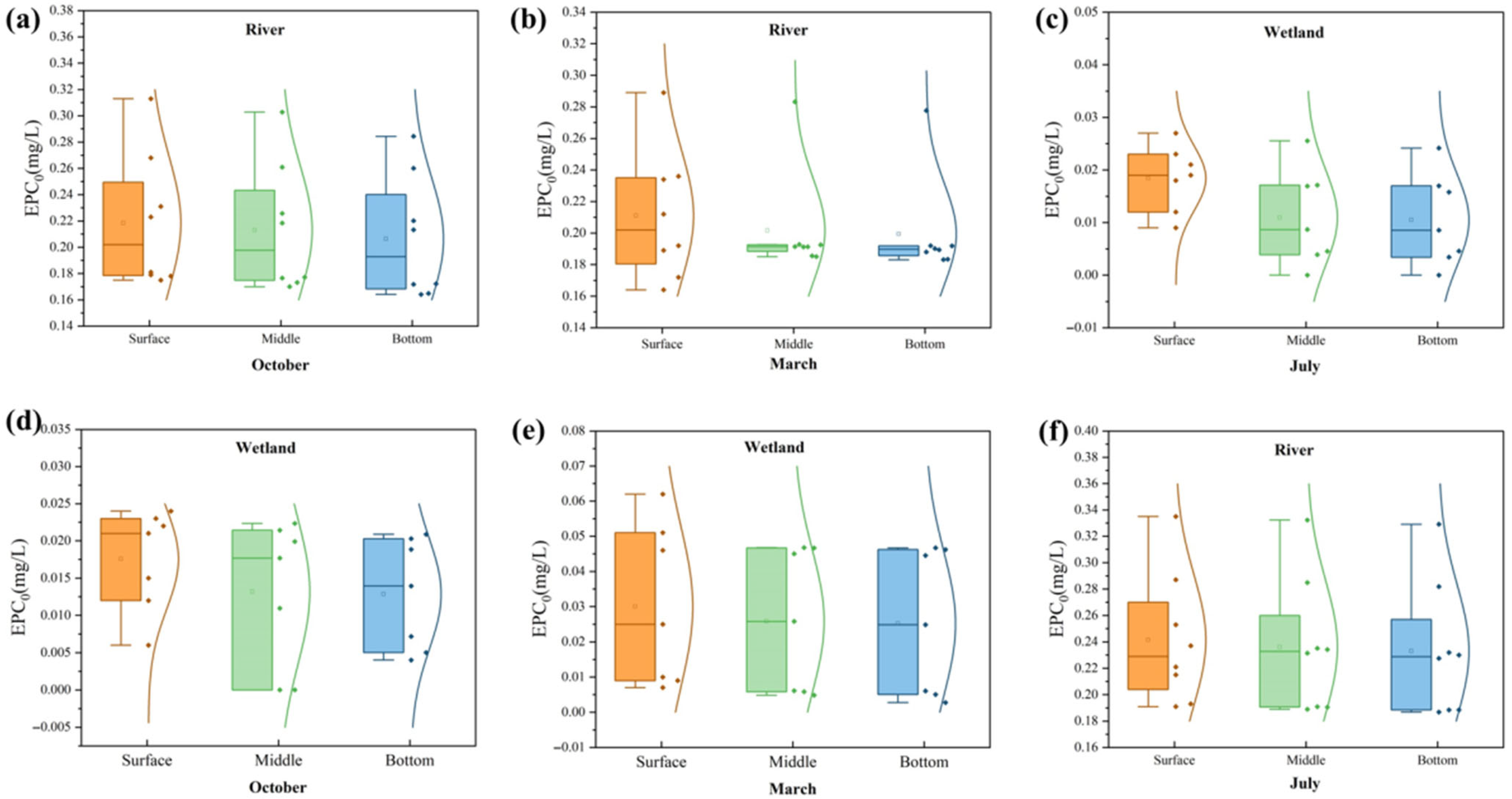
EPC0 serves as a core evaluation parameter for distinguishing the source and sink status of endogenous P in sediments. The discrimination logic is based on the dynamic relationship between the EPC0 of surface sediments and the SRP concentration in pore water: when EPC0 > SRP, sediments act as a source; conversely, they function as a sink. Figure 4 showed that, overall, the EPC0 values of SS were significantly lower than those of SH, with medians concentrated in the range of 0.01–0.02 mg/L, while the medians of EPC0 values of SH were mostly between 0.16 and 0.21 mg/L. This suggested that under the same P concentration of the overlying water, SS tended to adsorb P, playing the role of a sink, while SH were more prone to releasing P, acting as a source. This difference reflected the strong P retention and purification capacity of the wetland, whereas SH might contribute significantly to endogenous P release, especially during spring and summer, when water temperatures rise and microbial activity intensifies, further increasing the P release risk.
From a temporal perspective, in October 2024, with declining autumn water temperatures and reduced biological activity, the sediment system transitioned from the active summer state toward winter dormancy. The relatively high EPC0 values of SH might indicate partial recovery of sorption sites or changes in external input patterns. The wetland, however, continued to maintain its efficient sink function. Although low temperatures in spring favored sorption thermodynamically (resulting in higher Qmax for SH, as shown in Figure 3), the abundance of vacant sorption sites after winter dormancy, coupled with potential increases in interfacial P concentration due to external inputs or endogenous mineralization in spring, leads to a requirement for a high overlying water P concentration (high EPC0) to achieve sorption equilibrium. Consequently, when the actual P concentration in the water was lower than this high threshold, SH in spring were more likely to act as strong P sources, posing a significant release risk. In contrast, SS, with their extremely low EPC0 (0.02 mg/L), stably functioned as a sink during this season. In July 2025, the EPC0 values of SH dropped sharply, while SS showed a relatively larger increase (maximum 0.33 mg/L). This might be attributed to the lush growth of wetland plants during summer, where plants and microbial activity endow SS with a powerful P sink capacity.
Additionally, the relatively high EPC0 values of surface SS and SH were fundamentally due to their location in the interface zone with the highest energy and material fluxes. Intense biological activity, dynamic redox cycling, continuous external inputs, and interference from competitive substances collectively weakened their ability to stably retain P, leading to a requirement for higher overlying water P concentrations to achieve sorption equilibrium. Therefore, when assessing endogenous P release risks, surface sediments were the primary focal layer, and the dynamic changes in their EPC0 served as a key indicator for predicting eutrophication trends in water bodies.
The difference between EPC0 and SRP can reflect the strength of P sources and sinks. Overall, SS consistently exhibited a P sink status, while SH generally displayed a P source status. In wetland areas, water flow was slow, and the hydraulic retention time was long, which facilitated the sedimentation and accumulation of suspended particulate matter and the particulate P attached to it. In contrast, river systems had stronger hydrodynamic conditions, especially in faster-flowing sections where SH was prone to scouring and resuspension, leading to the P re-release originally deposited in the sediments into the water column, manifesting as endogenous release [33]. Additionally, exogenous P carried during river sediment transport was prone to desorption under flowing conditions after deposition, enhancing its characteristics as a source. Moreover, in wetland ecosystems, particularly in areas with abundant aquatic vegetation, plant roots could secrete substances such as organic acids, altering the microenvironment of SS and promoting P sorption and precipitation. Plant growth also absorbed dissolved P and, through litter deposition, fixed P within the sediments. River systems typically had lower aquatic plant coverage, lacking such biological P fixation mechanisms, and P exchange at the sediment–water interface was dominated more by physicochemical processes [34,35].
Comparing the three periods, SH in October exhibited a stronger P source status compared to the other two periods, with larger absolute δ values (Figure 5d–f). This was primarily due to: (1) river systems often receiving more point and non-point source pollution inputs (e.g., domestic sewage, agricultural runoff), resulting in higher exogenous P loads; even when some P was deposited in river sections, it was often resuspended and released during flood periods or under artificially regulated water flows [36,37]; and (2) a large amount of aquatic vegetation in river systems withers and senesces, reducing the system capacity of P fixation.

3.4. Response Mechanism of the Microbial Community in P Source and Sink Status

Analysis of the microbial community at the phylum level revealed that Proteobacteria, Chloroflexota, Bacteroidetes, Bacillota, and Firmicutes were the dominant bacterial phyla in both SS and SH. In March, the relative abundances of Proteobacteria, Chloroflexota, and Bacteroidetes were relatively high, with mean values reaching 41.26 ± 2.21%, 16.21 ± 2.54%, and 8.13 ± 1.59%, respectively. The phylum-level community structures in July 2025 and October 2024 were similar, with Proteobacteria, Bacillota, and Firmicutes comprising larger proportions, accounting for approximately 39.61 ± 2.89%, 13.23 ± 0.92%, and 4.57 ± 0.37%, respectively. A comparison between SS and SH showed that the relative abundance of Firmicutes in SS was consistently higher than in SH across all three periods, primarily due to alternating wet and dry conditions in certain areas of the wetland.
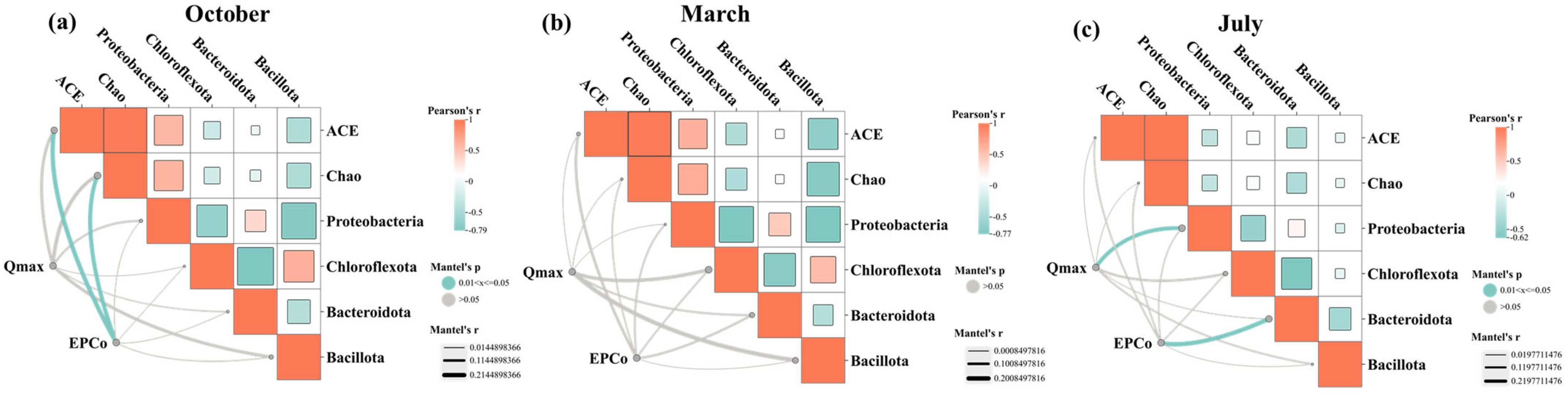
Correlation analysis was conducted between Qmax and EPC0 and microbial diversity indices (ACE and Chao), as well as between the dominant phyla (Figure 6). The results indicated a close relationship between the P sorption capacity of sediments in the plain river network area and the microbial community. Specifically, in October, EPC0 showed a significant positive correlation with microbial diversity indices (p < 0.05). In July, both Qmax and EPC0 exhibited significant positive correlations with Proteobacteria and Bacteroidota (p < 0.05). In March, the microbial community had little influence on the P sorption characteristics of the sediments. Overall, in autumn (October), a higher microbial diversity primarily elevated EPC0 by promoting organic matter degradation and P release, thereby increasing the potential risk of phosphorus release [38,39]. In summer (July), high temperatures inhibited sorption, leading to a decrease in Qmax, while active key functional phyla (such as Proteobacteria and Bacteroidota) simultaneously raised EPC0 through intense organic matter mineralization, iron reduction, and competition for adsorption sites, exacerbating the risk of endogenous P release in SH. Although SS was also affected, the plant and substrate systems in the wetland buffered the intensity of release [40,41]. Spatially, wetlands established an efficient and stable P interception system through plant-root oxygen release, specialized substrates, and differentiated microbial communities. In contrast, due to strong hydrodynamic disturbances and a lack of biological phosphorus fixation mechanisms, river systems exhibited more fragile sediment phosphorus behaviors that are predominantly influenced by microbial activity [42,43].

4. Conclusions

This study analyzed the P source and sink characteristics of SS, SH, and microbial communities. The process differences and influencing factors of P release in sediments from the wetland and its connected rivers in a plain river network area were elucidated. Spatially, SS primarily functioned as a P sink, while SH acted as a potential P source. The P source–sink status of sediment exhibited significant seasonal variation. In spring (March), river sediments acted as a strong P source; in summer (July), high temperatures combined with microbial activity inhibited sorption and promoted P release; in autumn (October), mineralization driven by microbial diversity elevated EPC0, increasing the P release risk. Although SS consistently acted as a P sink across all three seasons, the sink strength weakened in March and July, indicating that these sediments also carry a P release risk. Microbial community characteristics were one of the key factors influencing the P source–sink. Dominant microbial groups (Proteobacteria, Chloroflexota, Bacteroidetes, Bacillota, Firmicutes, etc.) and their metabolic functions in different seasons regulated EPC0 and Qmax. The diversity of microbial communities had a significant correlation with EPC0 in autumn, and the relative abundance of Proteobacteria and Bacteroidota had a significant correlation with EPC0 and Qmax. The microbial community may determine P release risk in sediments.
Future basin P management should integrate external source control with internal source regulation, incorporating the response mechanisms of microbial communities to develop seasonal and differentiated ecological restoration strategies.

Supplementary Materials

The following supporting information can be downloaded at: https://www.mdpi.com/article/10.3390/pr14050877/s1. SI Data analysis: Table S1. Mean values of pH and DO in overlying water from three periods; Table S2. P sorption parameters using modified Langmuir and Freundlich models in October 2024; Table S3. P sorption parameters using modified Langmuir and Freundlich models in March 2025; Table S4. P sorption parameters using modified Langmuir and Freundlich models in July 2025.

Author Contributions

Y.L.: Preparation, creation and presentation of the published work, specifically writing the initial draft (including substantive translation). J.C. and D.T.: Application of statistical, mathematical, computational, or other formal techniques to analyze or synthesize study data. S.Z.: Provision of study materials, reagents, materials, laboratory samples, instrumentation, computing resources, and other analysis tools. X.X.: Preparation, creation and presentation of the published work to those from the original research group, specifically critical review, commentary and revision in pre- and postpublication stages. All authors have read and agreed to the published version of the manuscript.

Funding

This study was supported by the National Natural Science Foundation (52209039).

Data Availability Statement

The datasets used and/or analyzed in the study are available from the corresponding author upon reasonable request.

Conflicts of Interest

The authors declare no conflicts of interest.

References

  1. Yang, H.; Chang, Y.; Dong, X.; Wang, S.; Che, F.; Huang, W. The coupled effect of sediment resuspension and microbiota on phosphorus release and transformation in a simulated aquatic ecosystem. J. Water Process Eng. 2024, 57, 104653. [Google Scholar] [CrossRef]
  2. Wang, S.; Chang, Y.; Yang, D.; Huang, W.; Che, F. Driving effects of dissolved organic carbon on cadmium release of the sediments by cyanobacterial decomposition. J. Water Process Eng. 2024, 59, 105058. [Google Scholar] [CrossRef]
  3. Chang, Y.; Dong, X.; Yang, X.; Chen, H.; Yang, H.; Huang, W. Temporal and Spatial Characterization of Sediment Bacterial Communities from Lake Wetlands in a Plain River Network Region. Separations 2023, 10, 535. [Google Scholar] [CrossRef]
  4. Tu, C.; Jin, Z.; Che, F.; Cao, X.; Song, X.; Lu, C.; Huang, W. Characterization of phosphorus sorption and microbial community in lake sediments during overwinter and recruitment periods of cyanobacteria. Chemosphere 2022, 307, 135777. [Google Scholar] [CrossRef]
  5. Wang, K.; Yang, H.; Chang, Y.; Huang, W.; Jiang, X. Phosphorus release and distribution in sediment resuspension systems under disturbing conditions. Chemosphere 2024, 359, 142386. [Google Scholar] [CrossRef]
  6. Huang, Y.; Jiang, L.; Wu, B.; Liu, J.; Liu, Y.; Xie, L.; Zhou, M.; Deng, L.; Wang, W.; Wang, L. Effect of suspended solids from anaerobic digested wastewater on performance and microbial community of autotrophic nitrogen removal process. J. Clean. Prod. 2024, 450, 141973. [Google Scholar] [CrossRef]
  7. Dong, X.; Chen, H.; Chang, Y.; Yang, X.; Yang, H.; Huang, W. Exploration of Phosphorus Release Characteristics in Sediments from the Plains River Network: Vertical Distribution and the Response of Phosphorus and Microorganisms. Water 2025, 17, 2196. [Google Scholar] [CrossRef]
  8. Hou, X.; Huang, W.; Song, X.; Liu, Y.; Xiao, Y.; Zhao, X.; An, D. Enhancing manganese redox-driven nitrogen removal by integrating manganese ore with microelectrolysis into constructed wetlands. Bioresour. Technol. 2025, 429, 132467. [Google Scholar] [CrossRef]
  9. Xing, J.; Zhou, Y.; He, D.; Guo, F.; Li, P.; Zhang, Y.; Lv, R.; Xue, R.; Liu, C.; Xiao, Y. Sediment amplifies organic matter cycling and nutrients feedback in eutrophic lake zones. Water Res. 2025, 286, 124164. [Google Scholar] [CrossRef] [PubMed]
  10. Weigelhofer, G.; Ramião, J.P.; Pitzl, B.; Bondar-Kunze, E.; O’Keeffe, J. Decoupled water-sediment interactions restrict the phosphorus buffer mechanism in agricultural streams. Sci. Total Environ. 2018, 628–629, 44–52. [Google Scholar] [CrossRef]
  11. Huang, W.; Lu, Y.; Li, J.H.; Zheng, Z.; Zhang, J.; Jiang, X. Effect of ionic strength on phosphorus sorption in different sediments from eutrophic plateau lake. RSC Adv. 2015, 5, 79607–79615. [Google Scholar] [CrossRef]
  12. Huang, X.L.; Zhang, J.Z. Spatial Variation in Sediment-Water Exchange of Phosphorus in Florida Bay: AMP As a Model Organic Compound. Environ. Sci. Technol. 2010, 44, 7790–7795. [Google Scholar] [CrossRef]
  13. Zhang, H.; Xin, M.; Wang, B.D.; Wang, J.; Lin, C.; Gu, X.; Ouyang, W.; Liu, X.; He, M. Spatiotemporal variations in phosphorus concentrations in the water and sediment of Jiaozhou Bay and sediment phosphorus release potential. Sci. Total Environ. 2022, 806, 150540. [Google Scholar] [CrossRef]
  14. Ningning, J.; Yong, L.; Shengrui, W.; Zhihao, W.; Hong, L. Buffering effect of suspended particulate matter on phosphorus cycling during transport from rivers to lakes. Water Res. 2022, 216, 118350. [Google Scholar] [CrossRef]
  15. Yu, W.; Wang, L.; Ma, X.; Li, J.; Li, Z.; Wang, H.; Li, D.; Fan, S.; Liu, C.; Yu, D. Restoration of submerged vegetation modulates microbial communities to decrease nitrogen and phosphorus loads in sediment-water systems. Water Res. 2025, 269, 122835. [Google Scholar] [CrossRef]
  16. Yin, H.; Yang, P.; Kong, M. Effects of different chemical agents on changes in sediment phosphorus composition and the response of sediment microbial community. J. Environ. Manage 2023, 342, 118321. [Google Scholar] [CrossRef]
  17. Mauro, B.d.T.; Helen, M.B. Variability of sedimentary phosphorus composition across Canadian lakes. Environ. Res. 2023, 236, 116654. [Google Scholar] [CrossRef]
  18. Huang, W.; Dong, X.; Tu, C.; Yang, H.; Chang, Y.; Yang, X.; Chen, H.; Che, F. Response mechanism of sediment endogenous phosphorus release to functional microorganisms and its cyanobacterial growth and disappearance effects. Sci. Total Environ. 2024, 906, 167676. [Google Scholar] [CrossRef]
  19. Ruban, V.; Lopez-Sanchez, J.F.; Pardo, P.; Rauret, G.; Muntau, H.; Quevauviller, P. Harmonized protocol and certified reference material for the determination of extractable contents of phosphorus in freshwater sediments—A synthesis of recent works. Fresenius J. Anal. Chem. 2001, 370, 224–228. [Google Scholar] [CrossRef]
  20. Liu, B.; Liu, Z.; Wu, H.; Pan, S.; Sun, Y.; Xu, Y. Insight into simultaneous selective removal of nitrogen and phosphorus species by lanthanum-modified porous polymer: Performance, mechanism and application. Chem. Eng. J. 2021, 415, 129026. [Google Scholar] [CrossRef]
  21. Majd, M.M.; Kordzadeh-Kermani, V.; Ghalandari, V.; Askari, A.; Sillanpää, M. Adsorption isotherm models: A comprehensive and systematic review (2010–2020). Sci. Total Environ. 2022, 812, 151334. [Google Scholar] [CrossRef]
  22. Chang, Y.; Wang, S.; Feifei, C.; Xiaoshuang, D.; Xixi, Y.; Haojie, C.; Wei, H. Arsenic source-sink dynamics under phosphorus competition in sediments from river-lake connected systems. Environ. Sci. Process. Impacts 2025, 27, 706. [Google Scholar] [CrossRef]
  23. Kreiling, R.M.; Perner, P.M.; Breckner, K.J.; Williamson, T.N.; Bartsch, L.A.; Hood, J.M.; Manning, N.F.; Johnson, L.T. Watershed- and reach-scale drivers of phosphorus retention and release by streambed sediment in a western Lake Erie watershed during summer. Sci. Total Environ. 2023, 863, 160804. [Google Scholar] [CrossRef]
  24. Huang, W.; Yang, X.; Chen, H.; Lu, C.; Che, F. Promoting effect of submerged plants on phosphorus source and sink in sediments: Response of phosphorus release and microbial community to Vallisneria natans and Potamogeton malaianus growth. Environ. Technol. Innov. 2024, 36, 103899. [Google Scholar] [CrossRef]
  25. Song, C.; Cao, X.; Zhou, Y.; Azzaro, M.; Monticelli, L.S.; Maimone, G.; Azzaro, F.; La Ferla, R.; Caruso, G. Nutrient regeneration mediated by extracellular enzymes in water column and interstitial water through a microcosm experiment. Sci Total Environ. 2019, 670, 982–992. [Google Scholar] [CrossRef]
  26. Wang, T.; Zhu, B.; Zhou, M.H. Ecological ditch system for nutrient removal of rural domestic sewage in the hilly area of the central Sichuan Basin, China. J. Hydrol. 2019, 570, 839–849. [Google Scholar] [CrossRef]
  27. Xu, X.G.; Zhou, Y.W.; Han, R.M.; Song, K.; Zhou, X.H.; Wang, G.X.; Wang, Q.L. Eutrophication triggers the shift of nutrient absorption pathway of submerged macrophytes: Implications for the phytoremediation of eutrophic waters. J. Environ. Manag. 2019, 239, 376–384. [Google Scholar] [CrossRef]
  28. Chao, Y.; Rui, X.; Yan, C.; Lixin, J.; Xiaoyu, L.; Yingze, Y.; Qiang, H.; Kai, Z.; Lina, L.; Hao, L. Endogenous phosphorus release from plateau lakes responds significantly to temperature variability over the last 50 years. J. Environ. Manag. 2024, 371, 123259. [Google Scholar] [CrossRef]
  29. Qu, Y.H.; Zhao, L.; Jin, Z.H.; Yang, H.R.; Tu, C.Q.; Che, F.F.; Russel, M.; Song, X.S. Study on the management efficiency of lanthanum/iron co-modified attapulgite on sediment phosphorus load. Chemosphere 2023, 313, 137315. [Google Scholar] [CrossRef]
  30. Samanta, S.; Debnath, D.; Maitra, N.; Banerjee, M.; Chowdhury, A.N.; Sharma, A.P.; Manna, S.K. Sediment phosphorus forms and levels in two tropical floodplain wetlands. Aquat. Ecosyst. Health 2015, 18, 467–474. [Google Scholar] [CrossRef]
  31. Yang, C.; Yang, P.; Geng, J.; Yin, H.; Chen, K. Sediment internal nutrient loading in the most polluted area of a shallow eutrophic lake (Lake Chaohu, China) and its contribution to lake eutrophication. Environ. Pollut. 2020, 262, 114292. [Google Scholar] [CrossRef] [PubMed]
  32. Zhan, Q.; Teurlincx, S.; van Herpen, F.; Raman, N.; Lürling, M.; Waajen, G.; de Senerpont Domis, L. Towards climate-robust water quality management: Testing the efficacy of different eutrophication control measures during a heatwave in an urban canal. Sci. Total Environ. 2022, 828, 154421. [Google Scholar] [CrossRef] [PubMed]
  33. Li, M.; Liang, Z.L.; Callier, M.D.; d’Orbcastel, E.R.; Sun, G.X.; Ma, X.N.; Li, X.; Wang, S.K.; Liu, Y.; Song, X.F. Nutrients removal and substrate enzyme activities in vertical subsurface flow constructed wetlands for mariculture wastewater treatment: Effects of ammonia nitrogen loading rates and salinity levels. Mar. Pollut. Bull. 2018, 131, 142–150. [Google Scholar] [CrossRef] [PubMed]
  34. Yin, H.; Yan, X.; Gu, X. Evaluation of thermally-modified calcium-rich attapulgite as a low-cost substrate for rapid phosphorus removal in constructed wetlands. Water Res. 2017, 115, 329–338. [Google Scholar] [CrossRef]
  35. Chen, X.; Jiang, X.; Huang, W. Evaluation and mechanism of ammonia nitrogen removal using sediments from a malodorous river. R. Soc. Open Sci. 2018, 5, 172257. [Google Scholar] [CrossRef]
  36. Cai, O.; Xiong, Y.; Yang, H.; Liu, J.; Wang, H. Phosphorus transformation under the influence of aluminum, organic carbon, and dissolved oxygen at the water-sediment interface: A simulative study. Front. Environ. Sci. Eng. 2020, 14, 12. [Google Scholar] [CrossRef]
  37. O’Day, P.A.; Nwosu, U.G.; Barnes, M.E.; Hart, S.C.; Berhe, A.A.; Christensen, J.N.; Williams, K.H. Phosphorus Speciation in Atmospherically Deposited Particulate Matter and Implications for Terrestrial Ecosystem Productivity. Environ. Sci. Technol. 2020, 54, 4984–4994. [Google Scholar] [CrossRef]
  38. Pant, H.K.; Reddy, K.R. Phosphorus sorption characteristics of estuarine sediments under different redox conditions. J. Environ. Qual. 2001, 30, 1474–1480. [Google Scholar] [CrossRef]
  39. Schafer, H.; Bernard, L.; Courties, C.; Lebaron, P.; Servais, P.; Pukall, R.; Stackebrandt, E.; Troussellier, M.; Guindulain, T.; Vives-Rego, J.; et al. Microbial community dynamics in Mediterranean nutrient-enriched seawater mesocosms: Changes in the genetic diversity of bacterial populations. FEMS Microbiol. Ecol. 2001, 34, 243–253. [Google Scholar] [CrossRef]
  40. Vezzulli, L.; Fabiano, M. Sediment biochemical and microbial variables for the evaluation of trophic status along the Italian and Albanian continental shelves. J. Mar. Biol. Assoc. UK 2006, 86, 27–37. [Google Scholar] [CrossRef]
  41. Li, Y.H.; Zhao, S.H.; Wang, Y.Q. Microbial desulfurization of ground tire rubber by Thiobacillus ferrooxidans. Polym. Degrad. Stab. 2011, 96, 1662–1668. [Google Scholar] [CrossRef]
  42. Sun, Z.; Li, G.; Wang, C.; Jing, Y.; Zhu, Y.; Zhang, S.; Liu, Y. Community dynamics of prokaryotic and eukaryotic microbes in an estuary reservoir. Sci. Rep. 2014, 4, 6966. [Google Scholar] [CrossRef] [PubMed]
  43. Huang, W.; Jiang, X. Profiling of Sediment Microbial Community in Dongting Lake before and after Impoundment of the Three Gorges Dam. Int. J. Environ. Res. Public Health 2016, 13, 617. [Google Scholar] [CrossRef] [PubMed]
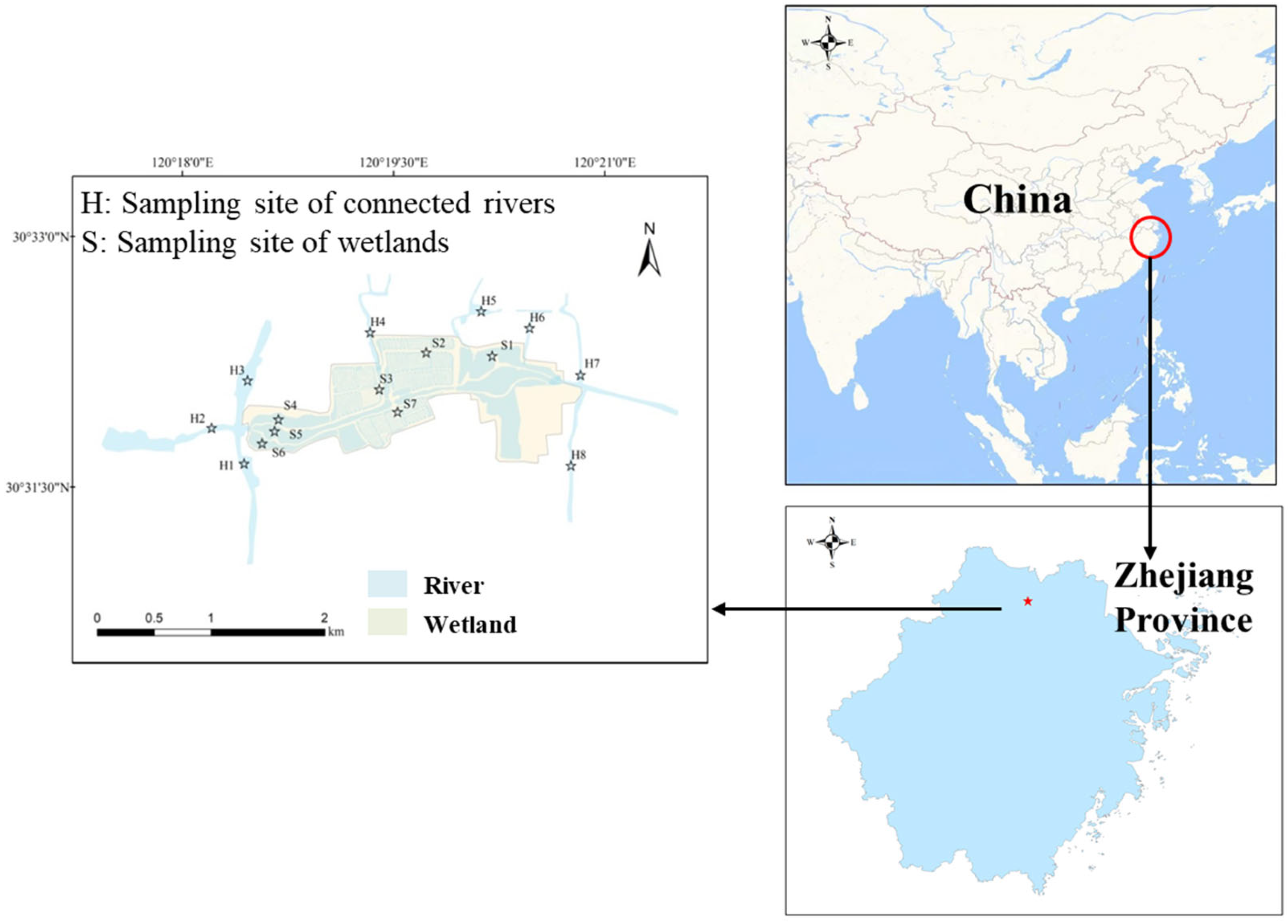
Figure 1. Sampling sites. H indicates sampling sites in connected rivers, and S indicates sampling sites in wetlands.
Processes 14 00877 g001
Figure 2. P spatiotemporal distribution (ac) for P concentration in overlying water from October, March, and July, respectively, and (df) for P contents in sediments from October, March, and July, respectively.
Processes 14 00877 g002
Figure 3. Qmax values of different sediments from three periods (ac) for SH and (df) SS.
Processes 14 00877 g003
Figure 4. EPC0 values of sedimentss from different layers (ac) for river sediments from October, March, and July, respectively, and (df) for wetland sediments from October, March, and July, respectively.
Processes 14 00877 g004
Figure 5. (ac) P source and sink status of the sediments from three periods, and (df) δ values of the sediments from three periods.
Processes 14 00877 g005
Figure 6. Relationship between Qmax, EPC0 and microbial communities in sediments, (ac) for October, March, and July, respectively.
Processes 14 00877 g006
Disclaimer/Publisher’s Note: The statements, opinions and data contained in all publications are solely those of the individual author(s) and contributor(s) and not of MDPI and/or the editor(s). MDPI and/or the editor(s) disclaim responsibility for any injury to people or property resulting from any ideas, methods, instructions or products referred to in the content.