Article

Study on the Impact of Viscoelastic Surfactants on the Reaction-Retarding Performance of Carbonate Reservoir Acidizing

National Key Laboratory of Oil and Gas Reservoir Geology and Exploitation, Southwest Petroleum University, Chengdu 610500, China
*
Author to whom correspondence should be addressed.
Processes 2026, 14(5), 873; https://doi.org/10.3390/pr14050873
Submission received: 3 February 2026 / Revised: 28 February 2026 / Accepted: 4 March 2026 / Published: 9 March 2026
(This article belongs to the Topic Advanced Technology for Oil and Nature Gas Exploration)

Abstract

Conventional hydrochloric acid (HCl) acidizing in carbonate reservoirs is often limited by excessively rapid acid–rock reactions and preferential flow through high-permeability paths, resulting in shallow penetration and inefficient stimulation. Viscoelastic surfactant (VES)-based diverting acids have been widely applied to address these challenges; however, the intrinsic relationship between reaction retardation and diversion efficiency, particularly under varying shear conditions, remains insufficiently clarified. In this study, a VES-based diverting acid system formulated with erucamidopropyl hydroxysultaine (EH50) was systematically investigated through multiscale experiments, including rotating disk reaction kinetics, rheological characterization, porous core flooding, and fracture-scale plate flow tests. The results reveal a pronounced shear-dependent transition in the governing mechanism of the system. Under low-shear conditions, the VES system significantly reduces the apparent acid–rock reaction rate, with a maximum reduction of 77.3%, and exhibits a synergistic retardation effect in the presence of Ca2+, indicating mass transfer limitation. However, under high-shear porous media flow, the intrinsic retarding effect is substantially weakened due to partial disruption of the viscoelastic structure. Despite this attenuation of chemical retardation, effective diversion performance persists under dynamic flow conditions, manifested by pressure plateau behavior, enhanced flow redistribution, more distributed wormhole networks, and greater overall dissolution. Fracture-scale experiments further demonstrate that the diversion acid suppresses excessive inlet etching and promotes spatially distributed etching patterns favorable for fracture conductivity maintenance. These findings clarify that reaction retardation and diversion are distinct yet dynamically coupled mechanisms, whose relative dominance depends on shear intensity and ionic environment. The proposed shear-responsive mechanism framework provides new insight into the design and optimization of VES diverting acid systems for carbonate reservoir stimulation.

1. Introduction

Carbonate reservoirs play a crucial role in global oil and gas resources due to their wide distribution and abundant reserves, and have therefore become a major focus in petroleum exploration and development [1]. However, owing to their complex geological structures and strong heterogeneity, the recovery factor of carbonate reservoirs is generally much lower than that of sandstone reservoirs, which severely constrains their efficient development [2]. Matrix acidizing is one of the most important stimulation techniques for carbonate reservoirs. By dissolving near-wellbore damage or creating new flow channels (acid-etched wormholes) to bypass damaged zones, matrix acidizing can significantly enhance the connectivity between the reservoir and the wellbore.
Nevertheless, conventional hydrochloric acid (HCl) acidizing suffers from inherent limitations. Due to the extremely fast reaction rate between HCl and carbonate rock, the acid is rapidly consumed near the wellbore, making deep penetration difficult to achieve [3]. Meanwhile, governed by the principle of minimum flow resistance, the injected acid preferentially enters high-permeability or weakly damaged zones to form dominant wormholes, further enlarging permeability contrasts within the reservoir. As a result, low-permeability or severely damaged zones cannot be effectively stimulated [4]. Therefore, fluid thickening is regarded as a key approach to achieving reaction retardation and effective diversion.
The emergence of viscoelastic surfactant diverting acid (VEDA) provides a promising solution to the above challenges. In this system, small-molecule viscoelastic surfactants (VESs) are used as the primary thickening agents. Compared with conventional polymer-based thickeners, VES systems cause little or no formation damage [3,5]. VES molecules can self-assemble into spherical micelles or wormlike micelles (WLMs), which entangle with each other to form a three-dimensional network structure with high viscoelasticity. This structure can temporarily block high-permeability zones, forcing subsequent acid to divert into low-permeability regions and thereby achieving more uniform acidizing [6]. In addition, the high-viscosity state can reduce the mass transfer coefficient of H+ ions, leading to a lower acid–rock reaction rate [7].
At present, research on VES diverting acid systems has mainly focused on the development and performance evaluation of diverting agents, including cationic, zwitterionic, and gemini surfactants [8]. For example, zwitterionic surfactants (such as betaine-type surfactants) exhibit different ionic characteristics under varying pH conditions: at low pH, they behave predominantly as cationic species and show relatively low viscosity [9,10]; as the pH increases during acid–rock reactions, they exhibit zwitterionic behavior and strongly interact with reaction products such as Ca2+ and Mg2+ through electrostatic attraction, forming network structures and resulting in a sharp increase in viscosity [11]. Erucamidopropyl hydroxysultaine (EH50), a typical zwitterionic surfactant, has attracted considerable attention due to its excellent viscoelastic properties and environmental friendliness.
Although VES diverting acid technology has been widely investigated and applied, most existing studies have primarily focused on viscosity enhancement, diversion performance, or static reaction retardation under limited shear conditions [8,10,12]. The intrinsic relationship between reaction retardation and diversion efficiency, particularly under dynamic shear environments representative of porous media flow, remains insufficiently clarified [13,14].
In practical acidizing operations, the injected fluid experiences significantly different shear regimes, ranging from relatively low shear in fractures to high shear within pore–throat networks. Whether the retarding effect observed under low-shear laboratory conditions can be sustained under high-shear porous media flow, and how this affects overall diversion performance, have not yet been systematically examined [15,16].
Therefore, it is necessary to distinguish between the intrinsic chemical retardation behavior and the physically driven diversion behavior of VES systems across varying shear environments. A clearer mechanistic differentiation between these two effects would help resolve inconsistencies observed between static reaction tests and dynamic flow experiments, and provide a more comprehensive understanding of VES-based diverting acid performance [17].
In this study, a VES-EH50 diverting acid system based on the zwitterionic surfactant EH50 was investigated. The reaction kinetics, rheological behavior, and acidizing performance of the system were systematically studied [7,18]. Rotating disk experiments were conducted to determine acid–rock reaction rates under different temperatures, acid concentrations, and CaCl2 concentrations; rheological tests were performed to characterize the shear stability and temperature responsiveness of the system [8] and porous core flooding as well as rock plate flow experiments were carried out to evaluate the diversion performance and acid etching morphology of the diverting acid under simulated reservoir conditions [19]. This study aims to reveal the condition dependence of the reaction-retarding behavior of VES diverting acids, clarify the distinction and linkage between the “retardation” and “diversion” mechanisms, and provide a theoretical basis for the optimization and field application of VES diverting acid systems.

2. Materials and Methods

2.1. Materials

Artificial cores were prepared by cementing high-purity calcite particles with a grain size of 40–80 mesh (purity > 98%). The cores had a diameter of 2.54 cm and a length of 5.0 cm, with measured liquid permeabilities ranging from 3.54 to 9.77 × 10⁻³ μm2. Analytical-grade concentrated hydrochloric acid (HCl, 37 wt%), calcium chloride (CaCl2, AR), and sodium salicylate (SS, AR) were purchased from Chengdu Kelong Chemical Co., Ltd., Chengdu, China. The diversion agent, erucamidopropyl hydroxysultaine (EH50), and the corrosion inhibitor (oil-based imidazoline) were supplied by Chengdu Ansde Petroleum Technology Development Co., Ltd., Chengdu, China.
The natural carbonate cores and plates that were used in the experiments were limestone samples from the Permian Maokou Formation, with a calcium carbonate purity higher than 98%. To mitigate corrosion of the experimental equipment, a corrosion inhibitor with a mass fraction of 1% was added to all acid systems. Standard core plugs with a diameter of 2.54 cm were used, and the dimensions of the limestone plates were 17.8 cm × 3.8 cm × 2.5 cm.
The main experimental apparatus included an acid–rock reaction kinetics setup, an electronic balance, a rotational rheometer (MCR 302, Anton Paar GmbH, Graz, Austria), a core flooding system (Chengdu Core Technology Co., Ltd., Chengdu, China), a fracture conductivity testing cell, and a three-dimensional surface scanning system.

2.2. Methods

2.2.1. Acid–Rock Reaction Rate Test

The acid–rock reaction rate was measured using a rotating disk reactor. During the experiments, N2 was injected into the reactor and the pressure was maintained at 7 MPa to suppress CO2 evolution during carbonate dissolution. The rotational speed of the disk was set to 300 rpm. Prior to each test, the acid solution was heated to the target temperature, and the reaction was initiated and maintained for 10 min. After completion, the reaction was immediately terminated by rapidly replacing the acid solution in the reactor with cooling water. The reaction rate was determined based on the mass loss of the rock sample before and after the test, following calculation procedures reported in the literature [20].
(1)
Effect of temperature and acid concentration
Two base systems, namely 20 wt% HCl and 20 wt% HCl + 6 wt% EH50 + 0.5 wt% SS, were first prepared. Residual acid solutions with different initial acid concentrations (15 wt%, 10 wt%, and 5 wt%) were then obtained by gradually adding different amounts of calcium carbonate to each base system, resulting in six residual-acid formulations: 15 wt%, 10 wt%, and 5 wt% HCl, and 15 wt%, 10 wt%, and 5 wt% HCl + 6 wt% EH50 + 0.5 wt% SS. The acid–rock reaction rates of these eight acid systems were measured at temperatures of 40, 60, and 80 °C.
(2)
Effect of CaCl2 concentration
Four acid systems—10 wt% HCl, 10 wt% HCl + 6 wt% EH50 + 0.5 wt% SS, 15 wt% HCl + 6 wt% EH50 + 0.5 wt% SS, and 20 wt% HCl + 6 wt% EH50 + 0.5 wt% SS—were prepared. Calcium chloride was then added to each system at different mass fractions (0, 1, 2, 3, and 6 wt%). The corresponding acid–rock reaction rates were measured at 40 and 60 °C.
The selected CaCl2 concentration range (0–6 wt%) was designed to simulate the progressive accumulation of Ca2+ ions generated during the acid–rock reaction process. Since CaCO3 dissolution inevitably produces CaCl2 in solution, varying the CaCl2 content enables evaluation of the ionic environment influence on reaction kinetics and rheological behavior under conditions representative of different stages of acid–rock interaction.

2.2.2. Shear Resistance Test

Changes in the apparent viscosity of acid systems influence H+ mass transfer to the rock surface and thus regulate the acid–rock reaction rate. Viscosity is also a key parameter controlling acid diversion behavior during acidizing treatments. Based on standard shear resistance testing procedures used for fracturing fluids, the rheological properties of the diversion acid systems were measured using a rotational rheometer. The prepared diversion acid was loaded into a concentric cylinder geometry, and the shear rate was fixed at 170 s−1.
The shear rate of 170 s−1 was selected based on commonly adopted rheological evaluation conditions for acid and fracturing fluids, providing a representative and comparable assessment of shear stability under dynamic flow environments. Although actual shear conditions in the reservoir may vary depending on flow geometry and injection rate, this shear rate allows consistent comparison of viscosity evolution and structural stability of the diversion acid system under controlled laboratory conditions.
(1)
Effect of Ca2+ on the viscosity of diversion acid
Diversion acid systems with HCl concentrations of 2, 4, 6, 8, 10, 12, 14, 16, 18, and 20 wt% (all containing 6 wt% EH50 and 0.5 wt% SS) were prepared. For each formulation, an additional system containing 1 wt% CaCl2 was prepared, forming two groups for comparison (without CaCl2 and with 1 wt% CaCl2). The acid solutions were heated to 60 °C, and shear tests were conducted. The apparent viscosity after 10 min of continuous shearing was recorded.
(2)
Effect of shear time on the viscosity of diversion acid
Two systems—8 wt% HCl + 6 wt% EH50 + 0.5 wt% SS and 8 wt% HCl + 6 wt% EH50 + 0.5 wt% SS + 1 wt% CaCl2—were tested under continuous shearing at 60 °C for 30 min. The evolution of apparent viscosity with shear time was recorded.
(3)
Effect of temperature on the viscosity of diversion acid
The same two diversion acid systems (8 wt% HCl + 6 wt% EH50 + 0.5 wt% SS, with and without 1 wt% CaCl2) were used to investigate the temperature dependence of viscosity. After loading the acid solution into the rheometer, a temperature ramp of 1 °C every 30 s was applied under continuous shearing, and the apparent viscosity was recorded over a temperature range of 20–110 °C.

2.2.3. Acid Flow Experiment Test

(1)
Porous core flow experiment
To ensure comparability among different acid systems, artificial cores with similar structural properties were selected for the flow experiments. Core flooding tests were conducted using a core flooding apparatus at 60 °C with a constant injection rate of 2 mL/min for 11 min. The injection pressure was continuously recorded during the tests, and the mass loss of the core before and after acidizing was measured to quantify dissolution. The acid systems tested included 5, 10, 15, and 20 wt% HCl, as well as 20 wt% HCl + 6 wt% EH50 + 0.5 wt% SS. After the experiments, the inlet faces of the cores were scanned to characterize the acid-etched features.
(2)
Wormhole and fracture-scale flow experiments
A fracture conductivity testing cell was used to simulate acid flow and reaction behavior in wormhole structures and fractures. To represent wormhole-scale flow, limestone plates were machined with a central square channel of 1 mm × 1 mm, and acid flow experiments were conducted using this configuration.
To simulate acid flow during acid fracturing, flat limestone plates were used, and silicone spacers with a thickness of 0.5 mm were placed around the plates to control the fracture aperture. The plates were then mounted in the fracture conductivity cell. Acid solutions were injected at a constant flow rate of 5 mL/min at 60 °C for 50 min. The acid systems used in these experiments were 15 wt% HCl and 15 wt% HCl + 6 wt% EH50 + 0.5 wt% SS.
After completion of the experiments, the acid-etched channels and fracture surfaces were scanned using a three-dimensional surface scanning system. Qualitative and quantitative analyses of the etched morphologies were performed, and the fracture etching parameters were quantified following the methodology proposed by Liu and Du [20,21].
All the above experiments were performed in triplicate, and the reported data represent the average values of three parallel measurements.

3. Results and Discussion

3.1. Acid–Rock Reaction Rate Test

The acid–rock reaction rates of conventional hydrochloric acid systems (20, 15, 10, and 5 wt% HCl) and the corresponding diversion acid systems (20, 15, 10, and 5 wt% HCl + 6 wt% EH50 + 0.5 wt% SS) were systematically measured at different temperatures (40, 60, and 80 °C).

3.1.1. Reaction Rate Characteristics of Conventional Hydrochloric Acid

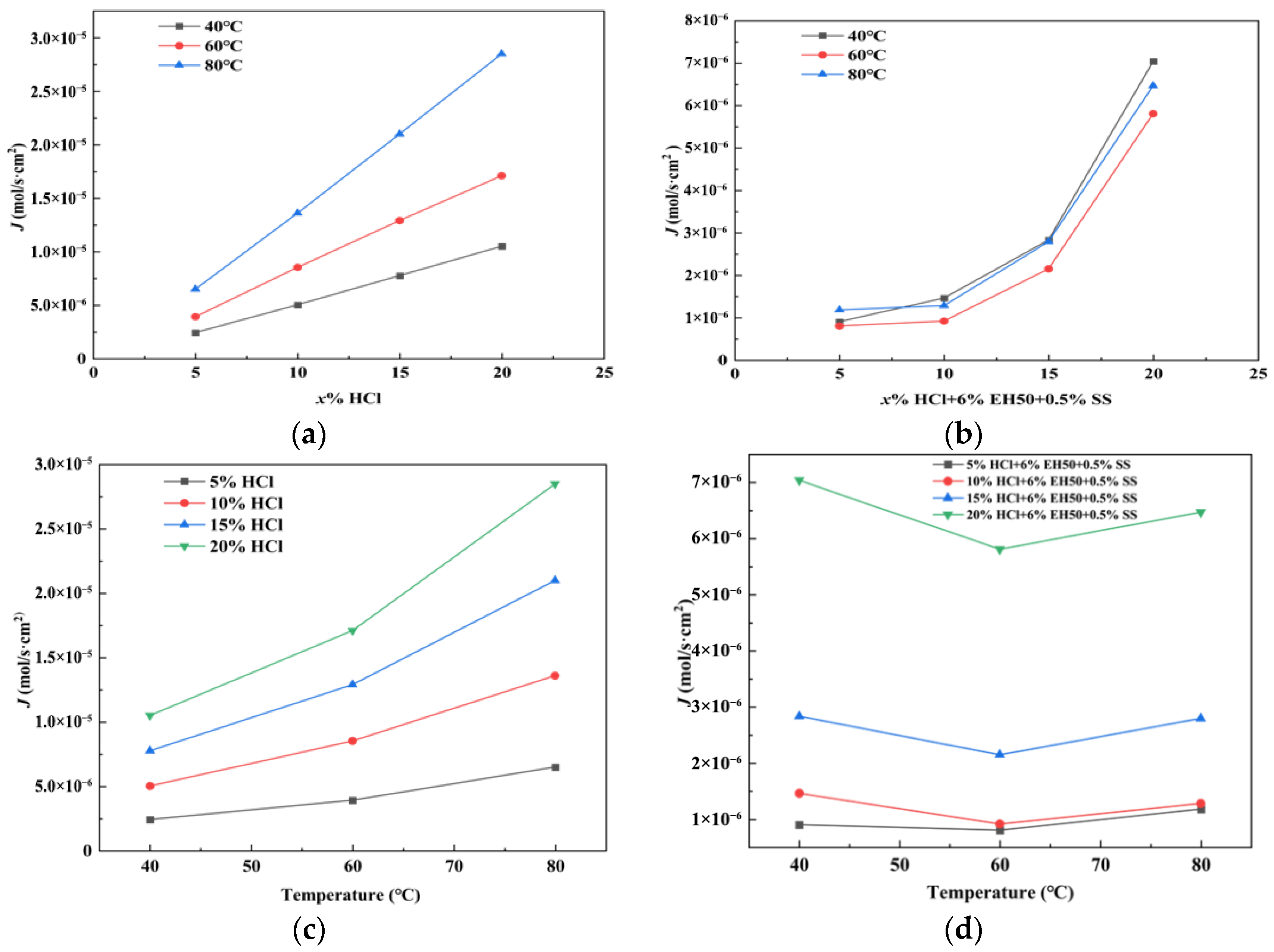
For conventional hydrochloric acid systems, the acid–rock reaction rate increased significantly with both increasing acid concentration and temperature. Taking 20 wt% HCl as an example, the reaction rate at 80 °C reached 2.85 × 10⁻⁵ mol/(s·cm2), which is approximately 4.4 times higher than that of 5 wt% HCl at the same temperature. These results indicate that, within the tested range, acid concentration is a primary factor controlling the reaction rate of HCl with carbonate rock, while elevated temperature further enhances reaction kinetics and accelerates rock dissolution.

3.1.2. Retarding Effect of the Diversion Acid System

After the introduction of the diversion agent EH50 and the synergistic additive SS into the hydrochloric acid system, the acid–rock reaction rate of the diversion acid was markedly reduced. For instance, at an acid concentration of 10 wt% HCl and a temperature of 80 °C, the reaction rate decreased from 2.85 × 10⁻⁵ mol/(s·cm2) for conventional HCl to 6.47 × 10⁻⁶ mol/(s·cm2), corresponding to a reduction of 77.3%. Similar retarding trends were consistently observed across all tested acid concentrations, demonstrating that the diversion acid system effectively suppresses the acid–rock reaction rate over a wide range of temperatures and concentrations, thereby exhibiting a pronounced retarding effect.
Notably, the diversion acid system shows a non-monotonic temperature dependence under certain conditions, where the apparent reaction rate at 40 °C can be higher than that at 80 °C. This behavior differs from conventional HCl systems and indicates that the measured rate in the diversion acid is an apparent rate jointly affected by acid concentration and the viscosity response of the VES system. With increasing temperature, the viscosity of the diversion acid and the stabilizing effect associated with Ca2+ may change, which can alter H+ mass transfer to the rock surface and lead to a non-Arrhenius trend in the apparent reaction rate.

3.1.3. Effects of Acid Concentration and Temperature on Reaction Kinetics

For conventional hydrochloric acid systems, a clear power law relationship was observed between the acid concentration and reaction rate at different temperatures. Linear correlations were obtained between lg c and lg J, indicating that the reaction kinetics follow an elementary-rate expression of the form J = Kcm. In addition, at a fixed acid concentration, a linear relationship between lg J and 1/T was observed, consistent with the Arrhenius equation. These results confirm that the HCl–carbonate reaction is a typical thermally activated process.
The corresponding kinetic fitting results can be expressed as Table 1.
The apparent activation energy was determined to be 22,806 J/mol, and the overall kinetic expression can be written as:
J = 0.0147 e 22806 / ( R T ) C 1.065
The reaction rate variation curves are shown in Figure 1. In contrast, for the diversion acid system, the reaction rate could not be adequately described by a single elementary-rate expression when acid concentration was used as the independent variable. Likewise, within the temperature range of 40–80 °C, a stable apparent activation energy could not be obtained using the Arrhenius model. The decrease in apparent reaction rate at a higher temperature in the diversion acid system suggests that, under certain conditions, the viscosity response of the VES system may impose additional mass transfer resistance, leading to a non-monotonic temperature dependence distinct from conventional HCl systems. This further suggests that the diversion acid system cannot be described by a single Arrhenius-type expression within the tested conditions. Nevertheless, since the intrinsic chemical reaction in both systems is governed by the HCl–carbonate reaction, these differences indicate that the introduction of the diversion agent significantly reduces the apparent reaction rate and alters the macroscopic kinetic response of the system.

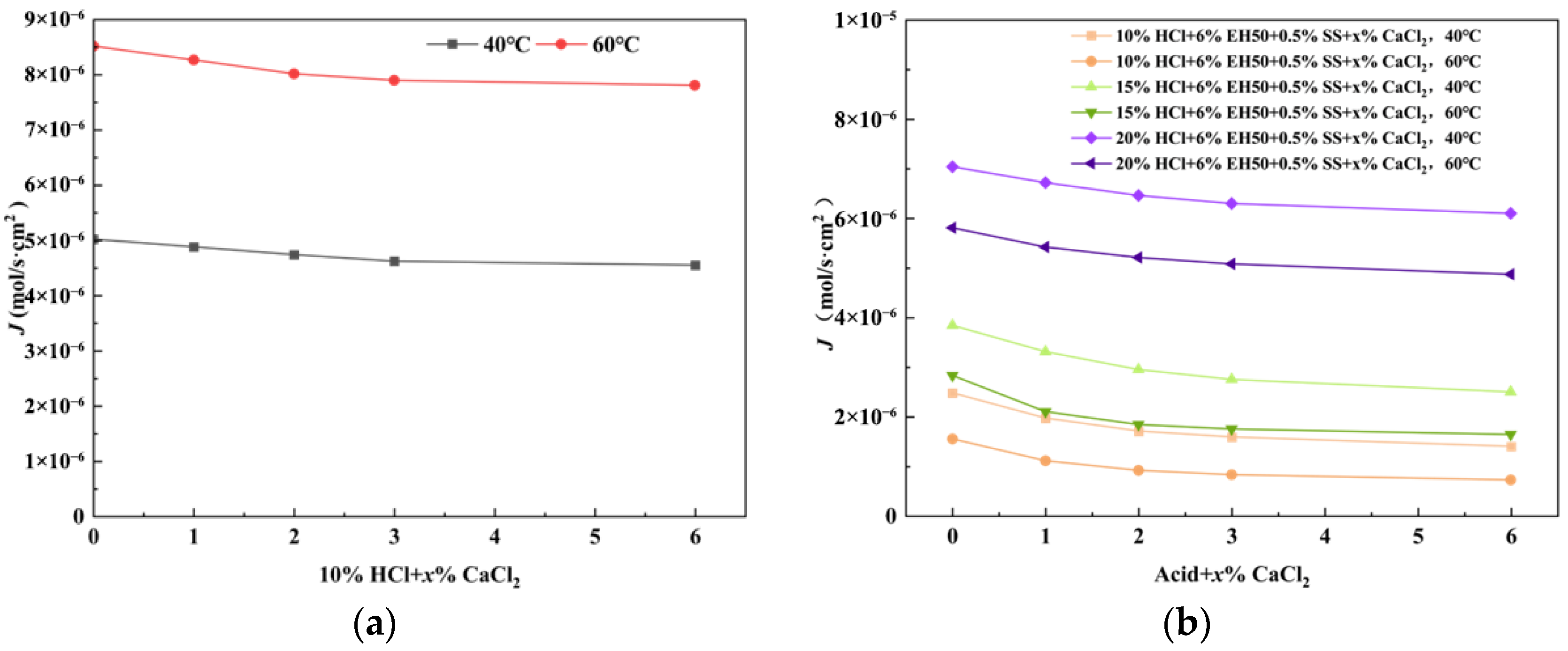
3.1.4. Effects of CaCl2 Concentration on the Acid–Rock Reaction Rate

Based on the rotating disk experimental results, the acid–rock reaction rates of the diversion acid systems were significantly lower than those of the corresponding conventional hydrochloric acid systems over the temperature range of 40–80 °C. Considering that CaCO3 dissolution during acidizing inevitably generates CaCl2, it is necessary to further investigate the influence of CaCl2 concentration on the acid–rock reaction rate. The experimental results are shown in Figure 2. The experimental results indicate that CaCl2 exerts an inhibitory effect on the acid–rock reaction, and the magnitude of this effect strongly depends on the base acid composition, acid concentration, and temperature.
(1)
Effect of CaCl2 on the reaction rate of conventional hydrochloric acid
In the pure 10 wt% HCl system, the acid–rock reaction rate exhibited a slight but consistent decrease with increasing CaCl2 concentration. For example, at 60 °C, when the CaCl2 concentration was increased to 6 wt%, the reaction rate decreased from 8.52 × 10⁻⁶ to 7.81 × 10⁻⁶ mol/(s·cm2), corresponding to a reduction of approximately 8.3%.
This behavior can be attributed to a common-ion effect induced by the increased concentrations of Ca2+ and Cl ions in the reaction system. The accumulation of dissolution products partially suppresses further dissolution of CaCO3, thereby exerting a weak thermodynamic inhibition on the reaction rate. However, the overall magnitude of this effect is limited, indicating that, in conventional hydrochloric acid systems, the acid–rock reaction rate is still primarily governed by acid concentration and temperature, while the common ion effect plays a secondary role.
(2)
Effect of CaCl2 on the reaction rate of diversion acid systems
In contrast to conventional hydrochloric acid, CaCl2 exhibited a much more pronounced enhancement of the retarding effect in diversion acid systems containing EH50. Taking the 10 wt% HCl diversion acid system as an example, at 60 °C, increasing the CaCl2 concentration to 6 wt% resulted in a substantial decrease in the reaction rate from 1.55 × 10⁻⁶ to 7.23 × 10⁻⁷ mol/(s·cm2), corresponding to a reduction of 53.4%.
This pronounced enhancement suggests a synergistic interaction between CaCl2 and the diversion agent within the system. Based on the experimental observations, it can be reasonably inferred that, on the one hand, Ca2+ ions may promote the adsorption or ordered arrangement of EH50 molecules on the rock surface, thereby improving the compactness and stability of the interfacial protective layer. On the other hand, the introduction of Ca2+ may alter the microstructural characteristics of the diversion acid system, leading to an increase in apparent viscosity and, consequently, a reduction in the mass transfer rate of H+ toward the rock surface.
The synergistic retarding effect was more pronounced at lower acid concentrations (10 and 15 wt% HCl), whereas the extent of retardation was relatively limited in the 20 wt% HCl system. This trend is consistent with the viscosity variation observed in the subsequent rheological measurements of the diversion acid.
In addition, the retarding effect of CaCl2 became more significant at elevated temperatures. For instance, in the 15 wt% HCl diversion acid system, the addition of 6 wt% CaCl2 led to reaction rate reductions of 34.9% and 42.0% at 40 and 60 °C, respectively. These results further indicate that increasing temperature may enhance the structural response of the diversion acid system, thereby strengthening its inhibitory effect on the acid–rock reaction.

3.2. Shear Resistance Test

To further elucidate the intrinsic causes of the retarding behavior of the diversion acid system, the rheological properties of the diversion acid were systematically investigated under different acid concentrations, CaCl2 addition conditions, shear durations, and temperatures. The main results are summarized as follows.

3.2.1. Effects of Acid Concentration and CaCl2 on the Viscosity of Diversion Acid

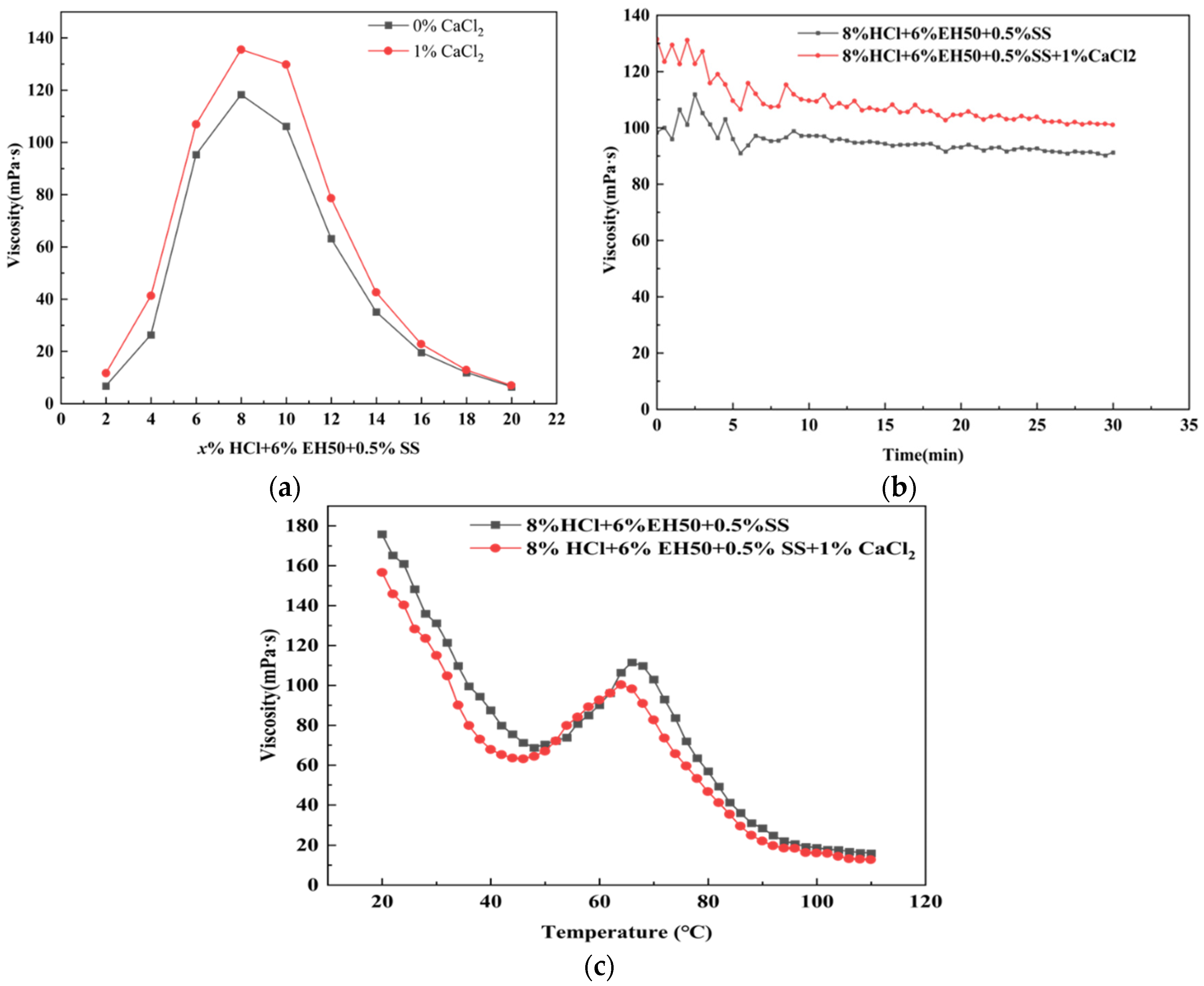
The apparent viscosity of the diversion acid system exhibited a pronounced hump-shaped dependence on hydrochloric acid concentration, characterized by an initial increase followed by a decrease. In the absence of CaCl2, the viscosity reached a maximum value of 118.27 mPa·s at approximately 8 wt% HCl. In contrast, at both high acid concentration (20 wt% HCl) and low acid concentration (2 wt% HCl), the viscosity decreased significantly, with similar values of approximately 6 mPa·s.
After the addition of 1 wt% CaCl2, the overall trend of viscosity variation with acid concentration remained unchanged; however, the viscosity at each acid concentration increased to varying extents. This viscosity-enhancing effect remained stable during both the 30 min continuous shearing tests and the temperature ramp shearing tests conducted over the range of 20–110 °C. For example, in the 8 wt% HCl system, the viscosity increased from 118.27 to 135.52 mPa·s after CaCl2 addition, corresponding to an enhancement of approximately 14.6%.
These results indicate that the diversion agent is capable of forming a relatively stable structural network within a specific acid concentration window, resulting in an optimal viscosity state. When the acid concentration is excessively high, the strong electrolyte environment may compress the electrical double layer and weaken micellar stability, leading to a reduction in system viscosity.

3.2.2. Effects of Shear Time on the Viscosity Stability of Diversion Acid

Using the 8 wt% HCl diversion acid system as a representative example, continuous shearing tests were conducted for 30 min. The results show that, regardless of whether CaCl2 was added, no abrupt viscosity drop or pronounced thixotropic behavior was observed during the shearing process. Specifically, the viscosity of the system without CaCl2 remained within the range of 90.8–111.9 mPa·s, whereas that of the system containing CaCl2 was maintained between 101.1 and 131.5 mPa·s.
These observations demonstrate that the prepared diversion acid system possesses good shear stability, and its internal structure exhibits strong resistance to shear-induced degradation as well as effective reorganization capability under continuous shearing. Such characteristics are favorable for maintaining stable viscosity levels and diversion performance during acid flow through the wellbore, perforations, and formation.

3.2.3. Effects of Temperature on the Viscosity of Diversion Acid

Temperature sweep experiments conducted over the range of 20–110 °C show that the viscosity of the diversion acid system generally decreased with increasing temperature, consistent with the typical thermal response of fluids. However, a noticeable viscosity rebound was observed in the temperature interval of approximately 60–65 °C. This rebound may be related to a temperature-responsive change in the viscoelastic micellar structures of the VES system, and similar non-monotonic temperature responses have been reported for certain surfactant-based systems [10]. Direct microscopic evidence specifically linking the viscosity rebound at 60–65 °C to a molecular-level structural change was not obtained in this study; therefore, the explanation is based on rheological observations.

3.2.4. Correlation Between Rheological Properties and Retarding Behavior

By integrating the viscosity variations of the diversion acid system under different acid concentrations, CaCl2 contents, shear durations, and temperatures, the experimental results are shown in Figure 3, it can be concluded that the retarding performance of the diversion acid is jointly governed by acid concentration and apparent viscosity. Since the system viscosity is simultaneously influenced by acid concentration, temperature, and Ca2+ content, the acid–rock reaction rate of the diversion acid cannot be adequately described by a single elementary kinetic equation. This conclusion is in good agreement with the results obtained from the acid–rock reaction rate tests discussed in Section 3.1.

3.3. Acid Flow Experiment Test

(1)
Porous core flow experiment
To evaluate the dynamic flow and reaction behavior of the diversion acid under porous-formation conditions, porous core flow experiments were conducted at 60 °C. The injection pressure evolution during acid flooding was continuously recorded, and the mass loss of the cores before and after the experiments was measured to comparatively analyze the flow response and dissolution characteristics of different acid systems.
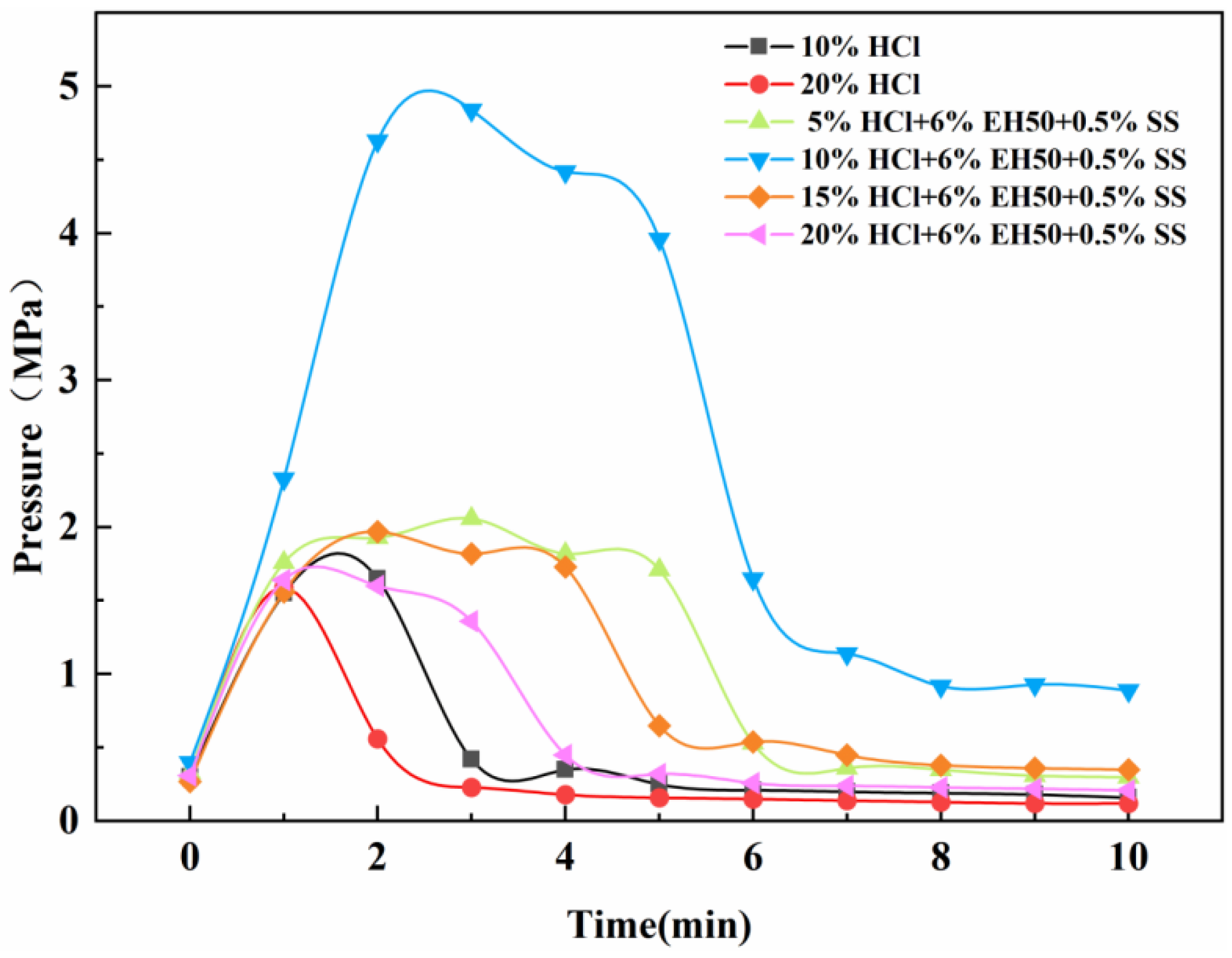
The injection pressure curves for different acid systems exhibited similar overall evolution patterns, as shown in Figure 4, which can be generally divided into three stages: rapid pressure increase–high-pressure maintenance–rapid or gradual pressure decline. The rapid pressure rise observed in the initial stage is mainly associated with the generation of CO2 during the acid–rock reaction, which temporarily increases flow resistance. In addition, differences in acid viscosity also contribute to the pressure response during this stage.
For conventional hydrochloric acid systems, both 20 wt% HCl and 10 wt% HCl rapidly reached their peak injection pressures within the initial 1–2 min, with peak values ranging from 1.59 to 1.65 MPa. The pressure then decreased rapidly to levels close to the initial pressure (0.12–0.16 MPa). This behavior indicates that conventional HCl is characterized by rapid reaction and rapid breakthrough in porous cores, where the acid preferentially flows through dominant high-permeability pathways without forming a sustained pressure maintenance stage.
In contrast, the diversion acid systems exhibited distinctly different pressure responses. After injection, the pressure rapidly increased to a peak within 1–3 min and was subsequently maintained at a relatively high level for several minutes, forming a pronounced high-pressure plateau, before gradually declining. For example, the 15 wt% diversion acid maintained pressures in the range of 1.56–1.97 MPa from 1 to 4 min. The high-pressure plateau was even more prominent for the 10 wt% diversion acid, with pressures reaching 3.96–4.84 MPa between 2 and 5 min and persisting for a longer duration.
The observed high-pressure plateau indicates that the diversion acid significantly increased flow resistance during porous core flooding and delayed rapid acid breakthrough. Considering the rheological characteristics of the diversion acid, it is reasonable to infer that the diversion agent formed transient viscoelastic structures at the pore- and throat-scale, which temporarily plugged high-permeability channels and forced the subsequent acid to redistribute toward previously under-reacted regions.
The core mass loss results before and after flooding further reflect the dissolution behavior of different acid systems, the mass loss results are shown in Table 2. In conventional HCl systems, the dissolution mass of 20 wt% HCl (0.671 g) was slightly higher than that of 15 wt% HCl (0.622 g), consistent with the general trend of enhanced reaction capability at higher acid concentrations. However, under identical experimental durations, the dissolution mass of the diversion acid systems was significantly greater than that of the corresponding conventional HCl systems. Specifically, the dissolution mass of 15 wt% diversion acid reached 1.255 g, which is markedly higher than that of both 15 wt% and 20 wt% HCl, while the 10 wt% diversion acid achieved a dissolution mass of 1.013 g, which is also substantially higher than the 0.622 g obtained with 10 wt% HCl.
It should be noted that the highest pressure plateau observed for the 10 wt% diversion acid system does not correspond to the maximum dissolution mass. This indicates that the diversion intensity reflected by pressure response and the overall effective dissolution are not linearly correlated. In the 10 wt% system, a stronger temporary plugging behavior may increase flow resistance and delay breakthrough, but it may also restrict fluid mobility in certain preferential pathways and restrict the continuous availability of fresh acid to some reactive surfaces. In contrast, the 15 wt% diversion acid system maintains effective diversion while providing a higher acid concentration, which contributes to a higher overall dissolution mass under the same injection duration. Therefore, the optimal stimulation performance results from a balance between diversion-induced flow redistribution and the intrinsic dissolution capacity associated with acid concentration.
These results demonstrate that, although the diversion acid exhibits a lower intrinsic acid–rock reaction rate under static or quasi-steady conditions, under dynamic flow conditions it effectively alters the flow and reaction pathways by increasing system viscosity and inducing transient flow resistance. As a result, the acid is able to contact and react with the rock matrix over a larger volume, thereby significantly improving acid utilization efficiency.
From an overall dissolution perspective, the effective dissolution capacity of the diversion acid was not weakened by its retarding characteristics; instead, under flow conditions, it exhibited a higher effective dissolution extent. This observation indicates that the engineering advantage of the diversion acid primarily lies in rheology-induced flow redistribution and reaction path optimization, rather than in enhancing the intrinsic acid–rock reaction rate.
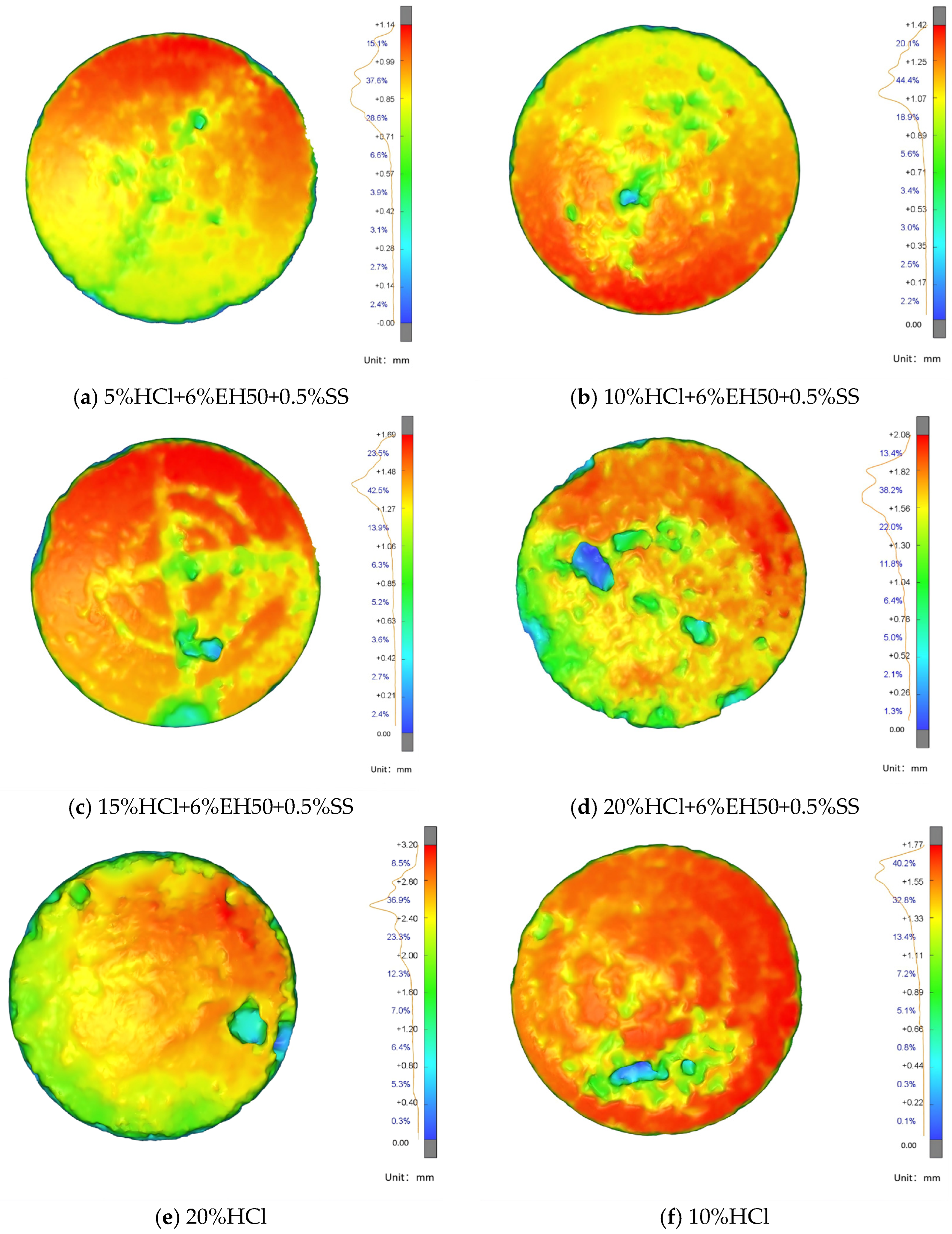
The acid-etched morphologies at the inlet faces of the cores after acid injection are shown in Figure 5. A comparison of the six experimental cases indicates that distinct acid-etched wormhole structures were formed at the inlet face in all systems; however, pronounced differences were observed in wormhole morphology and spatial distribution among different acid formulations.
For conventional hydrochloric acid systems, both 20 wt% HCl and 10 wt% HCl exhibited typical wormhole-type dissolution features. The dissolution channels rapidly propagated from the inlet toward the interior of the core, but the affected volume was relatively limited, characterized mainly by the rapid breakthrough of one or a few dominant channels. This morphological feature is in good agreement with the pressure response observed during the core flooding experiments, namely the rapid pressure spike followed by a sharp decline, indicating that highly reactive hydrochloric acid tends to quickly open preferential flow paths at the early stage. Subsequent acid then predominantly flows through these established channels, resulting in a low overall sweep efficiency.
In contrast, diversion acid systems with concentrations ranging from 5 to 20 wt% exhibited markedly different etching morphologies. The wormholes were more widely distributed, and the dissolution patterns gradually transitioned from single penetrating channels to multi-branch, network-like structures. In particular, the 10 wt% diversion acid system showed a representative morphology in which the etched region propagated more uniformly from the inlet face toward the core interior, forming a surface-type dissolution or uniform expansion pattern. This dissolution mode facilitates more extensive contact between the acid and the rock matrix over a larger volume, which is consistent with the greater core mass loss observed in the corresponding flow experiments.
At lower acid concentrations (5 wt% diversion acid), multiple wormholes were still formed; however, their sizes were relatively small and the overall dissolution intensity was limited, consistent with the lower intrinsic reaction driving force of the system. Overall, conventional hydrochloric acid systems tend to form single wormholes with relatively large apertures, whereas diversion acid systems favor the development of multiple wormholes in parallel, thereby expanding the acid-etched sweep volume.
It should be noted that, from the perspective of individual wormhole size and localized etching intensity, high-concentration acid solutions still exhibit stronger instantaneous dissolution capability. In comparison, the intrinsic retarding effect of the diversion acid under static conditions is not particularly pronounced. Therefore, to further distinguish the structural regulation effect of the diversion acid under flow conditions from its intrinsic reaction kinetics, parallel plate flow experiments were subsequently introduced to investigate acid flow and etching behavior at the fracture-scale.
(2)
Pre-perforated plate flow experiment: pore-scale reaction characteristics
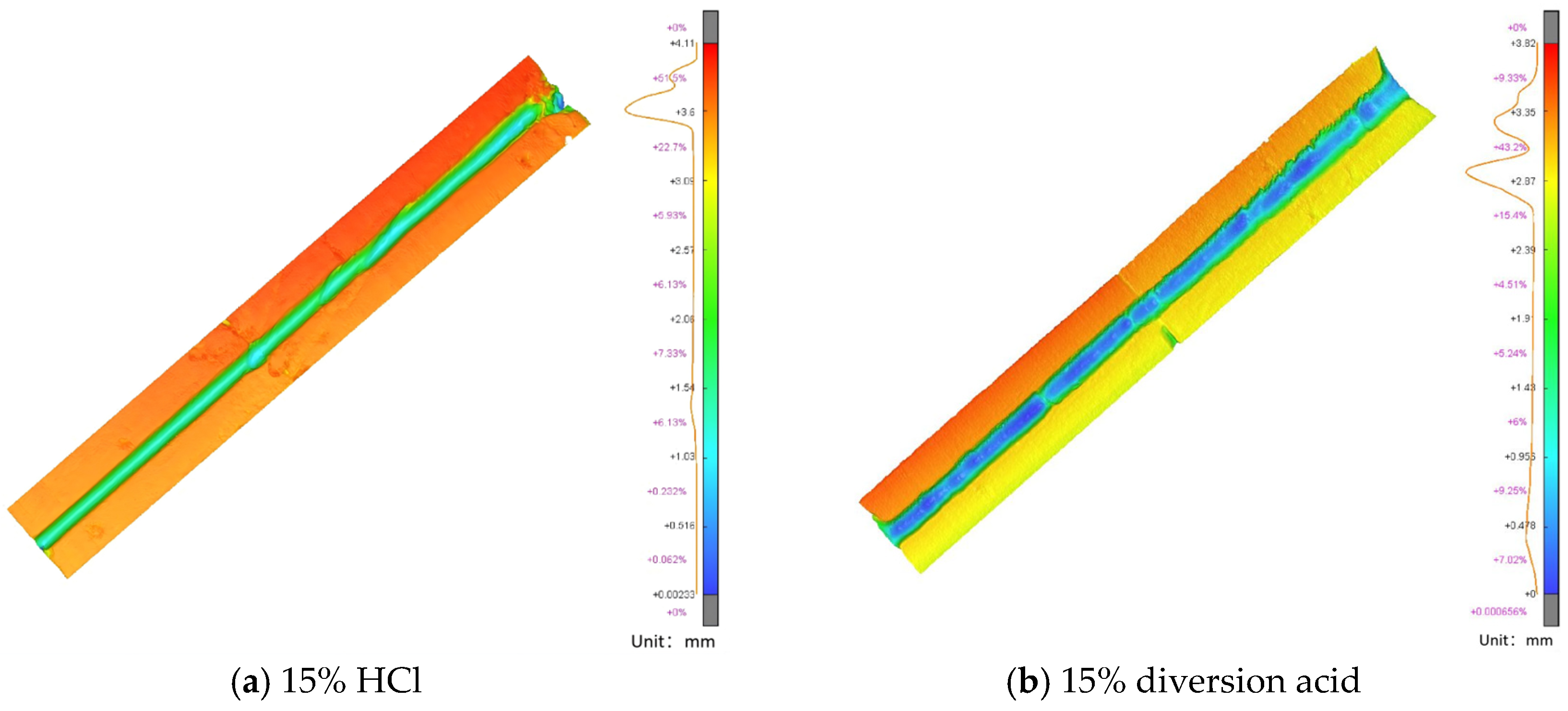
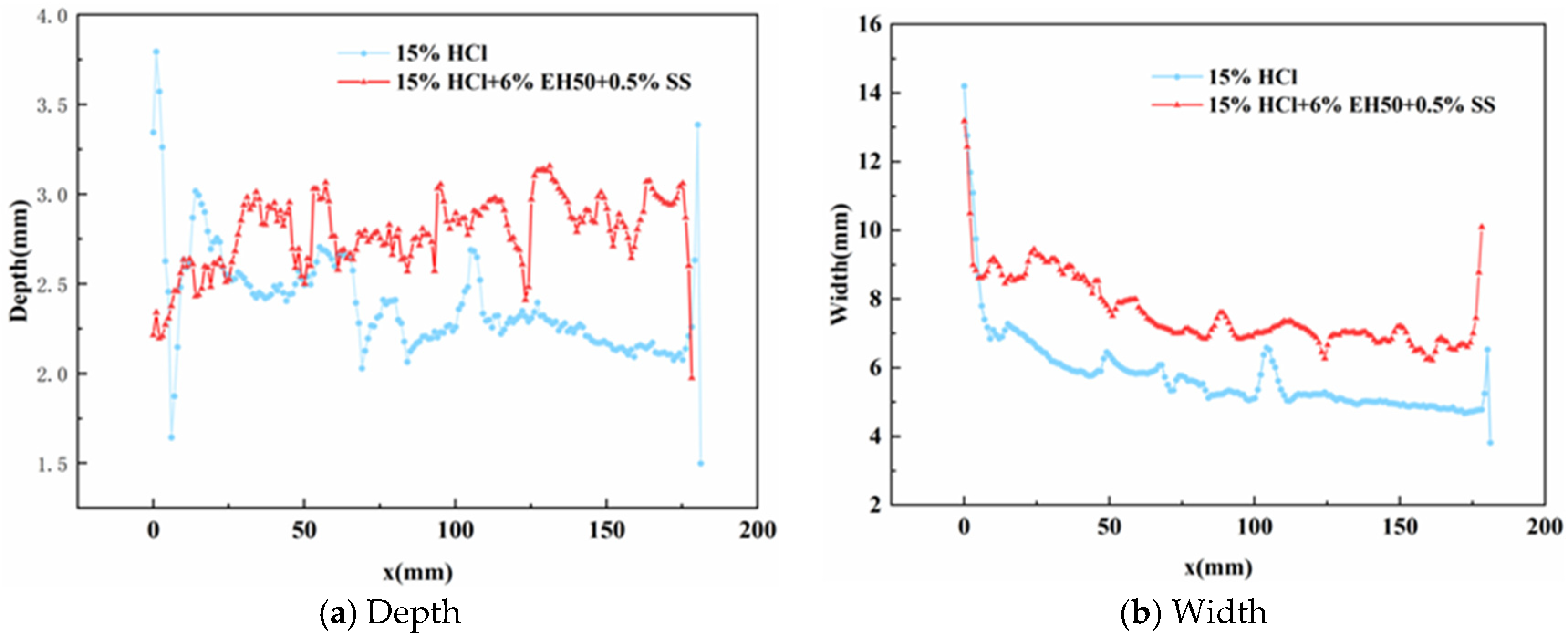
To directly characterize the flow and reaction behavior of acid at the pore-scale, acid etching experiments were conducted using pre-perforated limestone plates. The resulting etched morphologies and the corresponding variations in channel width and depth are shown in Figure 6 and Figure 7. Based on the observed etching features and geometric parameters, it can be seen that, under pore-scale conditions, the 15 wt% diversion acid did not exhibit a pronounced retarding advantage compared with the 15 wt% conventional hydrochloric acid.
Specifically, for the diversion acid, the etching depth along the flow direction increased from approximately 2.2 mm at the inlet to about 3.0 mm at the outlet, whereas for conventional HCl, the etching depth decreased from approximately 2.7 mm to 2.0 mm. In terms of etching width, the diversion acid showed a gradual reduction from about 9 mm to 7 mm, while the corresponding width for conventional HCl decreased from approximately 7 mm to 5 mm. Overall, the dissolution extent and etching intensity of the diversion acid at this experimental scale were not significantly weaker than those of conventional hydrochloric acid, exhibiting behavior that is not fully consistent with the strong retarding characteristics observed in the rotating disk experiments.
These results indicate that, under pore-scale local flow conditions, the reaction behavior of the diversion acid system is governed not only by its intrinsic reaction rate, but also strongly influenced by local flow velocity, pore geometry, and instantaneous acid–rock contact time. Based on these observations, it is necessary to further examine the capability of the diversion acid to regulate flow paths and etching morphology at the fracture-scale.
(3)
Parallel plate flow experiment: fracture-scale etching characteristics
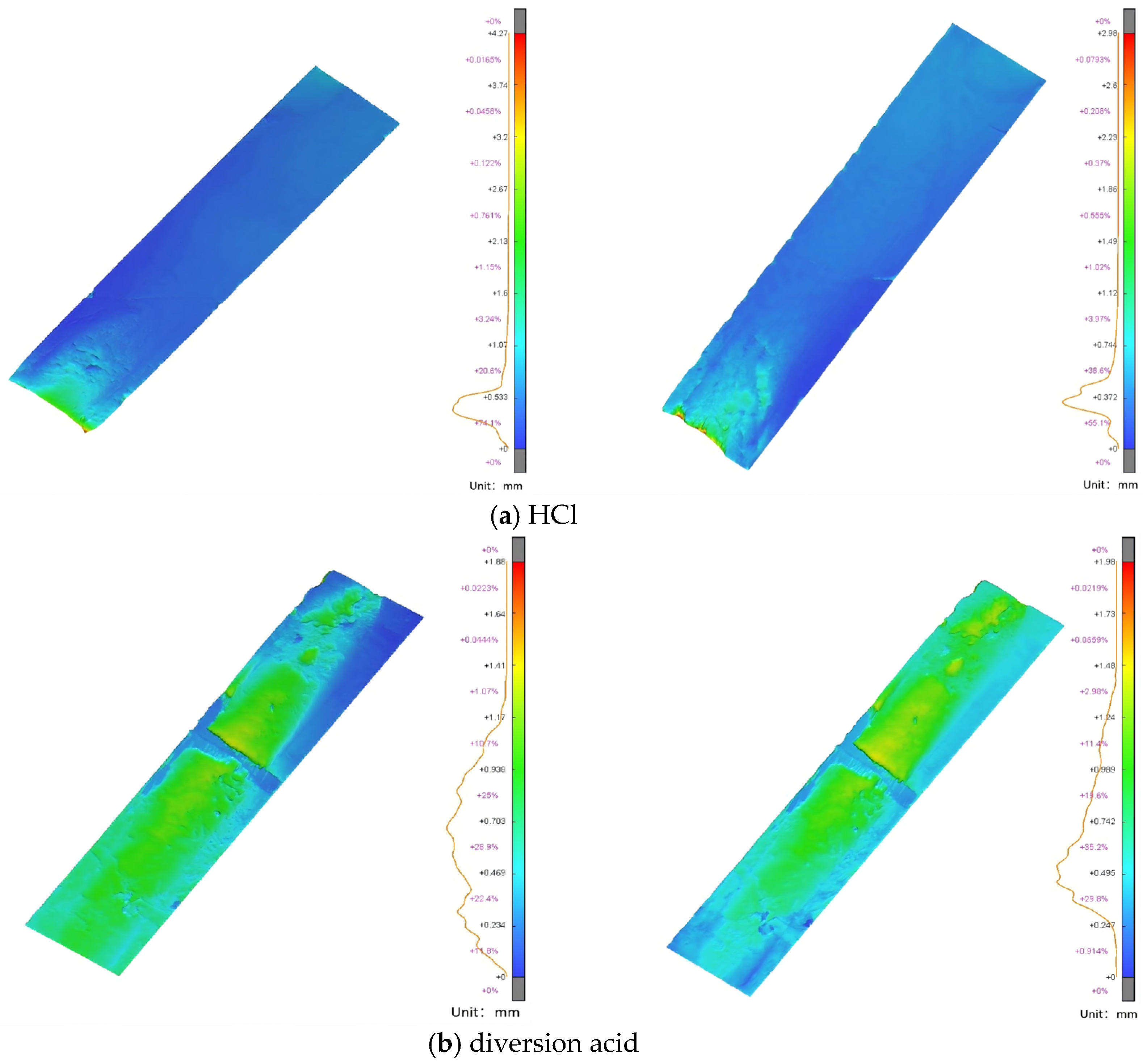
To simulate acid flow and reaction behavior within fractures, parallel plate acid etching experiments were conducted with a fracture aperture of 0.5 mm. The resulting etched morphologies, roughness parameters, and etching depth distributions are presented in Figure 8 and Table 3 and Table 4.
From the overall surface morphology of the plates, it can be clearly observed that the plates treated with the diversion acid exhibited much stronger non-uniform etching characteristics, whereas the etching induced by conventional hydrochloric acid was mainly concentrated near the acid inlet and rapidly attenuated along the flow direction. These fracture-scale results demonstrate that the diversion acid effectively delayed the rapid consumption of acid near the inlet, allowing the acid to participate in etching reactions over a larger fracture area and thereby exhibiting favorable retarding and diversion performance under flow conditions.
Quantitative roughness analysis further supports these observations. The arithmetic mean roughness (Sa) of the plates treated with diversion acid (upper surface: 0.1961 μm; lower surface: 0.1880 μm) was higher than that of the plates treated with conventional hydrochloric acid (upper surface: 0.1256 μm; lower surface: 0.1863 μm). Similarly, the root mean square roughness (Sq) values of the diversion acid-treated plates (upper surface: 0.2397 μm; lower surface: 0.2328 μm) were generally higher than those obtained with conventional hydrochloric acid (upper surface: 0.1944 μm; lower surface: 0.2812 μm). The relatively high Sq value observed on the lower surface in the conventional HCl case is mainly attributed to the formation of extremely deep localized etching pits near the inlet, which amplifies the statistical result.
With respect to etching depth distribution, conventional hydrochloric acid produced deeper localized etching pits, with maximum etching depths reaching 2.9751 cm on the upper surface and 4.2700 cm on the lower surface, which are significantly greater than those observed for the diversion acid system (upper surface: 1.8751 cm; lower surface: 1.9788 cm). However, in terms of mean etching depth, the diversion acid system exhibited higher average values (upper surface: 0.5954 cm; lower surface: 0.6677 cm) than the corresponding conventional HCl treatments (upper surface: 0.4081 cm; lower surface: 0.4980 cm).
These results indicate that, by suppressing excessive localized dissolution near the inlet, the diversion acid redistributes the etching action over a broader fracture surface, resulting in a more spatially uniform yet heterogeneous etching morphology. Such etching characteristics are beneficial for providing more effective contact points under fracture closure stress and increasing flow resistance along the fracture surface, which is expected to facilitate the formation and long-term maintenance of higher fracture conductivity from an engineering perspective.
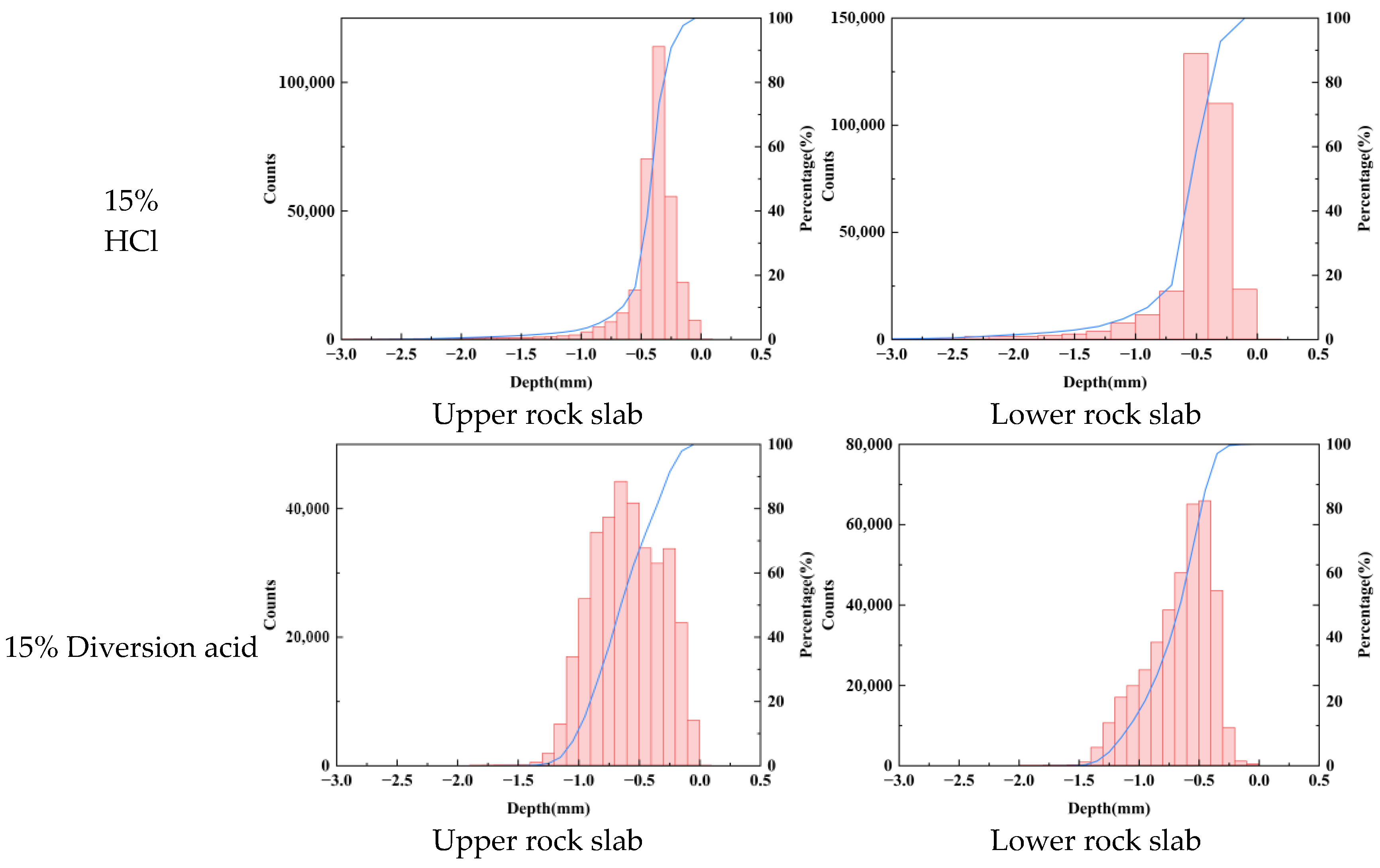
The cumulative distribution curves of etching depth for limestone plates treated with different acid systems are shown in Figure 9. Both the histogram distributions and the corresponding cumulative curves indicate pronounced differences in etching depth distribution between conventional hydrochloric acid and diversion acid systems. These differences are consistently observed on both the upper and lower plates.
For the 15 wt% hydrochloric acid system, the etching depth distributions of both the upper and lower plates exhibit a clear concentrated characteristic. The etching depths are mainly confined within a relatively narrow range, and the cumulative distribution curves show a rapid rise at intermediate etching depths, resulting in a steep S-shaped profile. This behavior indicates the presence of dominant reaction zones during hydrochloric acid etching, where the acid is rapidly consumed in localized regions, producing deep but spatially limited etching features, while the remaining surface areas experience relatively weak dissolution. Such a distribution reflects the strong selectivity and fingering tendency of conventional hydrochloric acid during fracture etching.
In contrast, the 15 wt% diversion acid system exhibits a much more dispersed etching depth distribution. The corresponding histograms span a wider range of etching depths, and the cumulative distribution curves are smoother overall, without a distinct steep rise segment. This indicates that, under diversion acid treatment, the degree of etching varies substantially across different surface locations, and the dissolution process does not concentrate in a single preferential region. Instead, etching progresses simultaneously over a broader area, forming a multiscale and non-uniform etching structure. This feature is consistently observed on both the upper and lower plates, demonstrating good stability of the diversion acid in regulating the spatial distribution of etching.
A further comparison between the upper and lower plates shows that, for the hydrochloric acid system, the cumulative distribution curves are relatively similar, suggesting that etching is primarily controlled by rapid acid consumption near the inlet, and that flow direction exerts a limited influence on the overall etching distribution. In contrast, although minor differences exist between the upper and lower plates treated with diversion acid, the overall distribution patterns remain similar. This implies that acid redistribution within the fracture space is more effective, which helps suppress rapid breakthrough along a single preferential flow path.
From an engineering perspective, although the concentrated etching depth distribution produced by hydrochloric acid can generate large local etching depths, its effective action area is limited. Such localized features are prone to premature contact under fracture closure stress, leading to rapid degradation of fracture conductivity. Conversely, the broadly distributed and non-uniform etching depth characteristics generated by the diversion acid promote the formation of more spatially distributed support points on fracture surfaces, thereby enhancing fracture resistance to closure and providing favorable conditions for the development of higher and more stable fracture conductivity.
Based on the above experimental results obtained under different test configurations, it can be observed that the VES-EH50 system exhibits distinct behaviors under varying shear conditions. In rotating disk tests and fracture-scale experiments with relatively low shear, a significant reduction in the apparent acid–rock reaction rate is observed. In contrast, under porous core flooding conditions where higher shear intensity is present, the reduction in intrinsic reaction rate becomes less pronounced, while pressure plateau behavior and flow redistribution effects remain evident.
These observations indicate that reaction retardation and diversion behavior do not necessarily vary in a strictly coupled manner, and their relative manifestation depends on the flow environment. Therefore, a clearer differentiation between these two aspects is necessary to interpret the pressure response, dissolution extent, and wormhole morphology observed in the experiments.

3.4. Mechanism Analysis on VES EH50 Diversion Acid

Based on the multiscale experimental results obtained from rotating disk reaction tests, rheological measurements, core- and plate-scale flow experiments, and acid-etched morphology characterization, the behavior of the VES-EH50 diversion acid system under different physicochemical environments was systematically evaluated. The results demonstrate that both the retarding and diversion performance of this system are highly sensitive to shear conditions, ionic environment, and flow scale. To elucidate the intrinsic relationships among the above experimental observations, a mechanistic framework is proposed as follows.
From a reaction-process perspective, the acid–rock reaction can be simplified into three consecutive steps:
(1)
Mass transfer of H+ ions toward the rock surface;
(2)
Interfacial chemical reaction between H+ and the rock surface;
(3)
Transport of reaction products from the interface into the bulk solution.
For the diversion acid system, the intrinsic interfacial reaction mechanism (Step 2) is essentially identical to that of conventional hydrochloric acid. Therefore, the differences in macroscopic reaction behavior between the two systems mainly originate from the regulation of H+ mass transfer (Step 1) and the efficiency of acid–rock interfacial contact.

3.4.1. Retarding and Diversion Mechanisms Under Low-Shear Conditions (Rotating Disk and Wide-Aperture Plates)

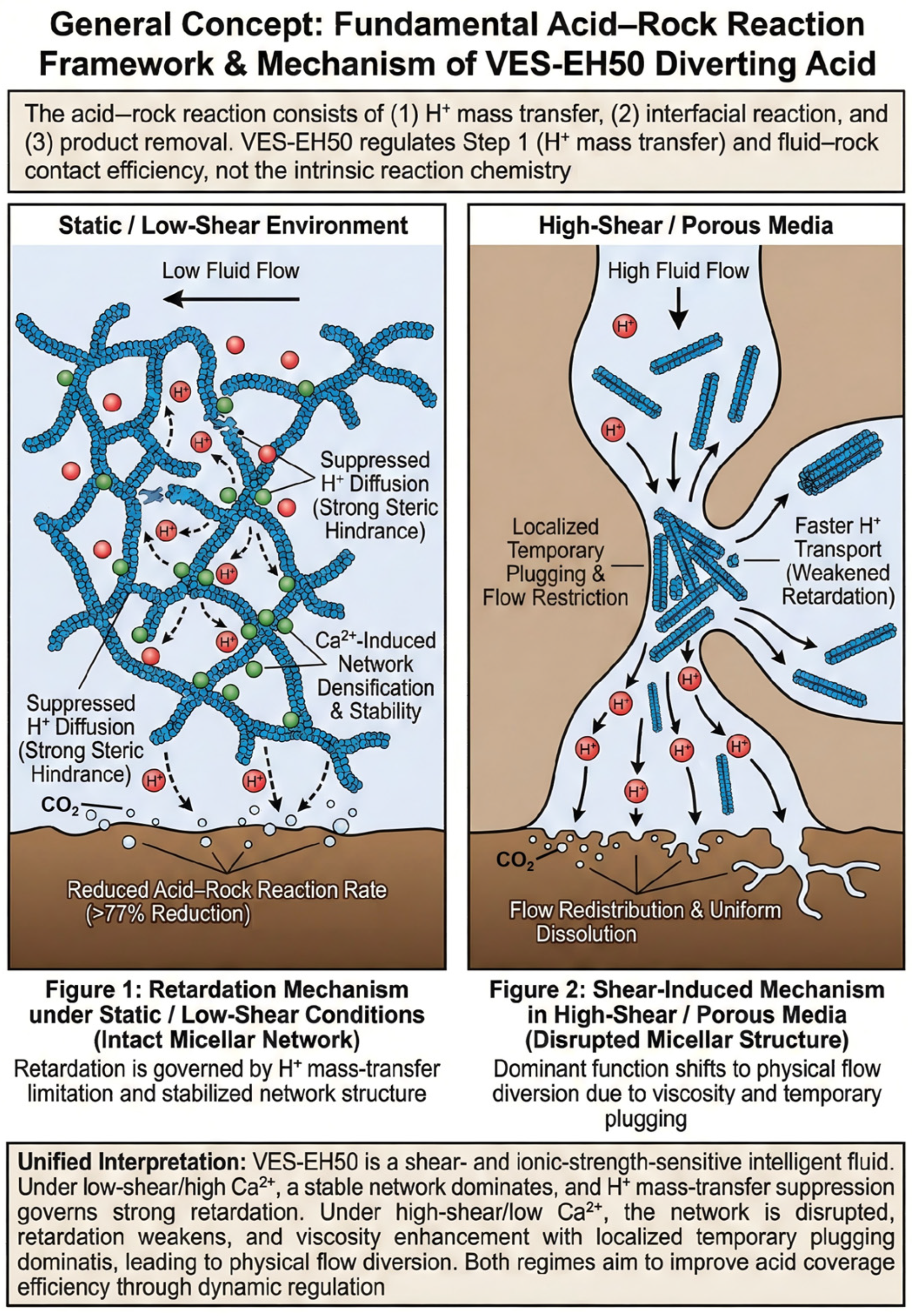
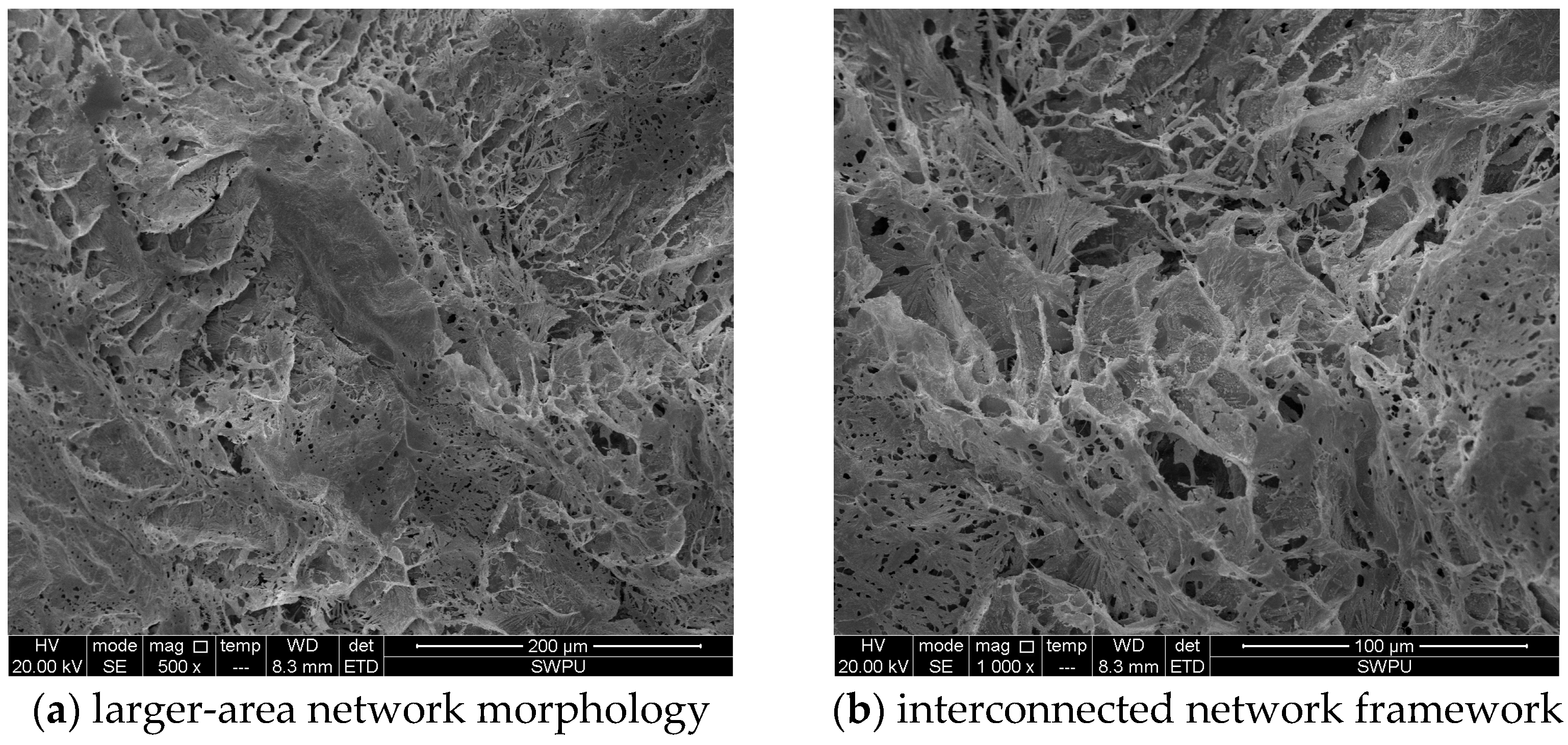
Under the conditions of the rotating disk experiments and wide-aperture plate flow, the applied shear is relatively weak. In acidic solutions, VES-EH50 molecules can associate through intermolecular interactions, such as hydrophobic association, to form dynamic and reversible viscoelastic micellar network structures. The viscoelastic micellar network exhibits a network-like skeletal morphology at the micrometer scale, as shown in Figure 10. These networks can remain relatively stable under low-shear conditions and impose physical constraints on the diffusion of H+ ions.
Meanwhile, the viscoelastic micellar network endows the acid with a relatively high apparent viscosity. During flow through fractures or pores, a high-viscosity acid tends to generate increased flow resistance in high-permeability pathways. When Ca2+ ions produced in situ during the acid–rock reaction locally accumulate, the micellar structure may be transiently reinforced, forming temporary high-resistance zones as shown in Figure 11. This process significantly elevates local injection pressure and induces flow diversion. The high-pressure plateau observed in the flow experiments represents the macroscopic manifestation of this mechanism.
At the fracture-scale, plate flow experiments show that diversion acid treatment results in larger mean etching depths and higher surface roughness, reflecting a more spatially uniform acid action. This non-selective, volumetric dissolution pattern provides more effective support points under subsequent fracture closure stress and is therefore favorable for the formation and maintenance of high fracture conductivity from an engineering perspective.

3.4.2. Mechanism Transition Under High-Shear and Porous Media Conditions (Porous Cores)

In porous core flooding experiments, the acid must flow through narrow and highly tortuous pore–throat structures, where the local shear intensity is significantly higher than that at the fracture-scale. Under such strong shear conditions, the long-range ordered micellar networks formed by VES molecules are prone to disruption, transforming from continuous structures into discrete micellar fragments or short-chain aggregates.
Although rheological tests indicate that the system possesses a certain degree of shear recovery capability, under rapid flow conditions, the micellar structures undergo a dynamic cycle of disruption–transport–reconstruction. This process substantially weakens their long-term ability to restrain H+ transport. Consequently, the H+ mass transfer rate approaches, or is only slightly lower than, that of conventional hydrochloric acid, leading to a pronounced attenuation or even the disappearance of the intrinsic retarding effect at the pore-scale.
Nevertheless, even under conditions where the micellar network is partially disrupted, the system can still exert diversion effects through two mechanisms. First, the residual micellar fragments or short-chain aggregates contribute to an elevated initial apparent viscosity, establishing flow resistance at pore–throat entrances. Second, and more importantly, the combined effects of flow restriction and reaction product accumulation induce localized temporary plugging, which alters acid flow distribution at the pore-scale. The experimentally observed high-pressure plateaus and more uniformly distributed wormhole networks represent the macroscopic outcomes of this diversion mechanism as being dominated by physical plugging and flow redistribution rather than by classical chemical reaction retardation.
It should be noted that the highest pressure plateau observed for the 10 wt% diversion acid does not directly correspond to the maximum dissolution mass. This indicates that excessively strong temporary plugging may restrict overall fluid mobility and reduce effective acid–rock contact time in certain regions. Therefore, diversion intensity and effective dissolution capability are not linearly correlated, and an appropriate balance between reaction rate and flow redistribution is required to achieve optimal stimulation performance.

3.4.3. Summary of the Mechanistic Model

Based on the above analysis, the VES-EH50 diversion acid system can be regarded as a shear- and ion-responsive intelligent fluid. Its core mechanism lies in the dynamic micellar structures formed by VES molecules, which adaptively respond to the flow environment:
(1)
Under low-shear and high Ca2+ concentration conditions, the micellar network remains relatively stable. Reduction in H+ mass transfer rate is the dominant mechanism, resulting in pronounced reaction retardation and effective acid diversion.
(2)
Under high-shear conditions and in pore–throat regions with limited Ca2+ accumulation, the micellar network is partially disrupted, weakening the retarding effect. In this case, diversion is mainly achieved through enhanced apparent viscosity and localized temporary plugging, leading to physically driven flow redistribution and a more uniform acid etching profile.
Although the dominant mechanism varies dynamically with environmental conditions, the common objective of both regimes is to reconstruct acid flow and reaction pathways, thereby improving acid sweep efficiency and overall engineering effectiveness.


4. Conclusions

In this study, the reaction kinetics, rheological behavior, and acidizing performance of a VES-EH50 diversion acid system were systematically investigated through a series of multiscale experiments, including rotating disk tests, rheological measurements, core flooding experiments, fracture-scale plate flow tests, and surface morphology characterization. The main conclusions can be summarized as follows:
(1)
The retarding performance of the VES-EH50 diversion acid is strongly condition-dependent.
Under low-shear conditions, such as those encountered in rotating disk experiments, the diversion acid significantly reduced the acid–rock reaction rate, with a maximum reduction of up to 77.3%. A pronounced synergistic retarding effect induced by Ca2+ was also observed, indicating that the formation of viscoelastic micellar networks effectively suppresses H+ mass transfer. However, under high-shear conditions representative of porous media flow, the stability of the micellar network is weakened, resulting in a substantial attenuation of the intrinsic retarding effect.
(2)
The diversion capability of the VES-EH50 system is robust and mechanistically consistent across different flow regimes.
Regardless of shear conditions, the system exhibited strong diversion behavior. The primary diversion mechanism involves the initial viscosity enhancement provided by VES-induced viscoelastic structures, followed by localized thickening or temporary plugging in preferential flow paths triggered by in situ-generated Ca2+ during acid–rock reactions. This process leads to the development of transient pressure barriers, forcing subsequent acid to redistribute toward low-permeability or previously uncontacted regions. The pressure plateau phenomenon, the formation of more uniformly distributed wormhole networks, and the increased total core dissolution observed in flow experiments collectively confirm the effectiveness of this diversion mechanism.
(3)
The diversion acid significantly improves the acid etching profile at the fracture-scale.
Compared with conventional hydrochloric acid, the VES-EH50 diversion acid produced fracture surfaces with higher average roughness (Sa) and a more uniformly distributed mean etching depth, while effectively suppressing localized over-etching near the inlet. This etching pattern—characterized by enhanced surface roughness, deeper average etching, and mitigated fingering behavior—is favorable for the generation of highly conductive and mechanically stable acid-etched fractures, which is beneficial for sustained post-acidizing productivity.
(4)
Engineering implications and application scope.
The results indicate that, during formation flow, the VES-EH50 diversion acid primarily enhances acidizing performance through flow redistribution and profile control rather than through sustained intrinsic reaction retardation. Therefore, for applications where delayed reaction and ultra-deep acid penetration are the dominant objectives, the diversion acid is recommended to be combined with additional retarding strategies, such as gelled acids, organic acids, or self-generating acids, to achieve synergistic performance.

Author Contributions

Conceptualization, W.T.; methodology, W.T. and J.D.; software, Y.L.; validation, W.T., J.D. and J.L.; investigation, W.T. and J.L.; data curation, J.L.; writing—original draft, W.T.; writing—review and editing, W.T. and J.D.; visualization, Y.L.; supervision, J.D.; project administration, W.T.; funding acquisition, J.D. All authors have read and agreed to the published version of the manuscript.

Funding

This research received no external funding.

Data Availability Statement

The original contributions presented in this study are included in the article. Further inquiries can be directed to the corresponding author.

Conflicts of Interest

The authors declare no conflict of interest.

References

  1. Yousufi, M.M.; Mohyaldinn Elhaj, M.E.; Dzulkarnain, I.B. A Review on Use of Emulsified Acids for Matrix Acidizing in Carbonate Reservoirs. ACS Omega 2024, 9, 11027–11049. [Google Scholar] [CrossRef] [Scilit] [PubMed]
  2. Xu, Z.-X.; Li, S.-Y.; Li, B.-F.; Chen, D.-Q.; Liu, Z.-Y.; Li, Z.-M. A review of development methods and EOR technologies for carbonate reservoirs. Pet. Sci. 2020, 17, 1013. [Google Scholar] [CrossRef] [Scilit]
  3. Chacon, O.G.; Pournik, M. Matrix Acidizing in Carbonate Formations. Processes 2022, 10, 174. [Google Scholar] [CrossRef] [Scilit]
  4. Keihani Kamal, M.; Mahdavi Kalatehno, J.; Daneshfar, P.; Yousefmarzi, F. A comprehensive analysis of carbonate matrix acidizing using viscoelastic diverting acid system in a gas field. Sci. Rep. 2024, 14, 1499. [Google Scholar] [CrossRef] [Scilit]
  5. Liu, C.; Du, J.; Lan, X.; Hu, K.; Zhang, L.; Gao, S.; Liu, P. Experimental Study on the Diversion Characteristic of a Viscous Fluid in a Heterogeneous Reservoir. ACS Omega 2022, 7, 46475–46485. [Google Scholar] [CrossRef] [Scilit]
  6. Gao, X.; Wang, M.; Shi, X.; Li, B.; Mao, J.; Valerievich, P.V. A clean self-diverting acid for carbonate reservoir in deep wells at high temperatures and its performance evaluation. Sci. Rep. 2025, 15, 23628. [Google Scholar] [CrossRef] [Scilit]
  7. Wang, D.; Wang, Y.; Feng, P.; Li, Y.; Zhang, K.; Zhou, F.; Li, F.; Gao, Y. Numerical Simulation of Acid Diversion and Wormhole Propagation Mechanism of Nanoparticle VES Acid in High-Temperature Carbonate Reservoirs. Processes 2025, 13, 608. [Google Scholar] [CrossRef] [Scilit]
  8. ManzariTavakkoli, M.; Sedaee, B.; Mahmoodi, A. Numerical investigation of acid diversion using viscoelastic surfactant (VES) under single and two-phase flow conditions. J. Pet. Explor. Prod. Technol. 2025, 15, 37. [Google Scholar] [CrossRef] [Scilit]
  9. Zheng, N.; Zhu, J.; Yang, Z.; Li, X.; Chen, H.; Su, H.; Qiao, L. Molecular dynamics simulation and key performance study of VES self-diverting acid system for deep carbonate reservoirs. J. Mol. Liq. 2024, 401, 124645. [Google Scholar] [CrossRef] [Scilit]
  10. Naderi Salem, H.; Kandowjani, A.E.; Sedaee, B.; Mansouri, M.; Shariati, M. Evaluation of New Zwitterionic Viscoelastic Surfactant in Carbonate Acidizing by Novel Injection Sequence: An Experimental Study. SPE J. 2025, 30, 1177–1189. [Google Scholar] [CrossRef] [Scilit]
  11. Du, J.; He, Y.; Liu, P.; Guo, J.; Zhao, L. Experimental study of acidizing diversion effect on different permeability of heterogeneity sandstone reservoirs. J. Pet. Explor. Prod. Technol. 2019, 9, 2716. [Google Scholar] [CrossRef] [Scilit]
  12. Liu, M.; Zhang, S.; Mou, J.; Zhou, F.; Shi, Y. Diverting mechanism of viscoelastic surfactant-based self-diverting acid and its simulation. J. Pet. Sci. Eng. 2013, 105, 91–99. [Google Scholar] [CrossRef] [Scilit]
  13. Chang, H.-Y.; Huang, C.-W.; Chen, Y.-F.; Chen, S.-Y.; Sheng, Y.-J.; Tsao, H.-K. Assembly of Lock-and-Key Colloids Mediated by Polymeric Depletant. Langmuir 2015, 31, 13085–13093. [Google Scholar] [CrossRef] [Scilit]
  14. Abdelgawad, K.Z.; Mahmoud, M.; Elkatatny, S.; Abdulraheem, A.; Patil, S. Reaction Kinetics and Coreflooding Study of High-Temperature Carbonate Reservoir Stimulation Using GLDA in Seawater. Energies 2019, 12, 3407. [Google Scholar] [CrossRef] [Scilit]
  15. Li, N.; Feng, Y.; Liu, P.; Luo, Z.; Zhao, L. Study of Acid–Rock Reaction Kinetics Under High Temperature and Pressure Conditions Based on the Rotating Disk Instrument. Arab. J. Sci. Eng. 2015, 40, 142. [Google Scholar] [CrossRef] [Scilit]
  16. Li, X.-S.; Qi, N.; Zhang, Z.-H.; Liu, L.; Li, X.-Q.; Su, X.-H. Acid-rock reaction kinetics in a two-scale model based on reaction order correction. Pet. Sci. 2024, 21, 2089–2101. [Google Scholar] [CrossRef] [Scilit]
  17. Zhao, Z.; LÜ, G. Visco-elastic Properties of VES Diverting Acid for Carbonate Reservoirs. Chin. J. Chem. Eng. 2010, 18, 511–514. [Google Scholar] [CrossRef] [Scilit]
  18. Liu, N.; Liu, M. Simulation and analysis of wormhole propagation by VES acid in carbonate acidizing. J. Pet. Sci. Eng. 2016, 138, 57–65. [Google Scholar] [CrossRef] [Scilit]
  19. Mo, W.; Li, Y. Simulation study on acidizing of self-diverting acid and conventional acid in fractured carbonate rocks. Geoenergy Sci. Eng. 2026, 257, 214236. [Google Scholar] [CrossRef] [Scilit]
  20. Liu, P.; Wang, G.; Zhang, H.; Du, J.; Chen, X.; Zhang, X.; Wang, C.; Liu, J.; Tian, W.; Gu, H. Reaction between in-situ generated acid and carbonate rock at ultra-high temperatures: A fusion of kinetic mechanisms and experiments. Geothermics 2025, 131, 103357. [Google Scholar] [CrossRef] [Scilit]
  21. Du, J.; Li, J.; Liu, J.; Liu, P.; Xiong, G.; Chen, P.; Li, Y.; Tian, W.; Zuo, Z. Evaluation of comprehensive acid fracturing performance of a new environmentally friendly acid for high-temperature carbonate reservoirs. Geoenergy Sci. Eng. 2025, 254, 214020. [Google Scholar] [CrossRef] [Scilit]
Figure 1. Reaction rate variation curves. (a) Relationship curve between different hydrochloric acid concentrations and reaction rates; (b) relationship curve between different acid concentrations and reaction rates; (c) the relationship between different temperatures and reaction rates in hydrochloric acid system; (d) relationship curve between different temperatures and reaction rates in the steering acid system.
Processes 14 00873 g001
Figure 2. Reaction rate variation curves. (a) Influence of CaCl2 concentration on reaction rate in the hydrochloric acid system; (b) Influence of CaCl2 concentration on reaction rate in the diverting acid system.
Processes 14 00873 g002
Figure 3. Viscosity variation curves. (a) Viscosity variation curves at different acid concentrations; (b) viscosity–time curve; (c) viscosity–temperature curve.
Processes 14 00873 g003
Figure 4. Injection pressure variation during acid displacement.
Processes 14 00873 g004
Figure 5. 3D morphology of the core inlet face after acid flooding.
Processes 14 00873 g005
Figure 6. Etched fracture morphology on rock plates.
Processes 14 00873 g006
Figure 7. Fracture width and depth variation curves.
Processes 14 00873 g007
Figure 8. Etched fracture morphology on rock plates.
Processes 14 00873 g008
Figure 9. Etching height distribution of the rock slab.
Processes 14 00873 g009
Figure 10. Micrometer-scale network-like skeletal morphology of the viscoelastic micellar structure. Under such conditions, the formation of viscoelastic structures may reduce the effective H+ mass transfer rate through steric hindrance and physical encapsulation, which manifests macroscopically as a pronounced retarding effect. The substantial reduction in reaction rate observed in the rotating disk experiments (exceeding 70% in some cases) indicates that the system exhibits strong mass transfer limitation under low-shear environments. In addition, the presence of Ca2+ may further enhance the stability and compactness of the micellar network through charge screening or weak cross-linking effects, thereby amplifying the retarding behavior. This interpretation is consistent with the experimentally observed further decrease in reaction rate in the presence of CaCl2.
Processes 14 00873 g010
Figure 11. Schematic illustration of the diversion mechanism and high-shear failure of the diversion acid.
Processes 14 00873 g011
Table 1. Fitting equation between acid concentration and reaction rate.
Temperature °CFitted Equation
40J = 1.7298 × 10⁻⁶C1.061
60J = 2.8333 × 10⁻⁶C1.066
80J = 4.6366 × 10⁻⁶C1.068
Table 2. Core mass loss results before and after displacement.
Acid SystemsLoss Weight g
20% HCl + 6% EH50 + 0.5% SS0.768
15% HCl + 6% EH50 + 0.5% SS1.255
10% HCl + 6% EH50 + 0.5% SS1.013
5% HCl + 6% EH50 + 0.5% SS0.369
20% HCl0.671
15% HCl0.622
Table 3. Rock plate surface roughness.
Treatment MethodRock Slab IDArithmetic Mean Roughness SaRoot Mean Square Roughness Sq
HClUp0.12560.1944
Down0.18630.2812
Diversion acidUp0.19610.2397
Down0.18800.2328
Table 4. Surface etching depth of rock plates.
Treatment MethodRock Slab IDAverage Etching DepthMaximum Etching Depth
HClUp0.40812.9751
Down0.49804.2700
Diversion acidUp0.59541.8751
Down0.66771.9788
Disclaimer/Publisher’s Note: The statements, opinions and data contained in all publications are solely those of the individual author(s) and contributor(s) and not of MDPI and/or the editor(s). MDPI and/or the editor(s) disclaim responsibility for any injury to people or property resulting from any ideas, methods, instructions or products referred to in the content.