1. Introduction
As a critical protective and control device in power systems, the reliable operation of high-voltage circuit breakers (HVCBs) is essential for ensuring grid safety and stability. During long-term service, the operating mechanism and control circuit are among the most failure-prone components of HVCBs [
1,
2,
3]. Factors such as spring fatigue, iron core jamming, and coil degradation during switching operations may lead to malfunction, potentially causing severe disturbances or even cascading failures in the power system. Mechanical vibration signals generated during HVCB operation contain abundant condition-related information, including action timing, amplitude, and frequency characteristics, which reflect the health status of mechanical components. In particular, vibration signals with a high signal-to-noise ratio provide valuable insight into the mechanical behavior of circuit breakers [
4]. Therefore, timely and accurate fault diagnosis based on vibration analysis is essential for ensuring reliable power system operation [
5,
6,
7].
Mechanical faults in HVCBs, such as iron core adhesion, loose base bolts, and transmission mechanism looseness, typically manifest as variations in structural resonance modes and impact response characteristics. These changes are primarily reflected in the frequency domain through shifts in dominant frequency components and energy redistribution across spectral bands. Alterations in stiffness, damping, and contact conditions produce distinct spectral signatures, making frequency-domain features physically interpretable indicators of mechanical degradation. With the advancement of artificial intelligence, fault diagnosis methods have evolved toward data-driven approaches. Machine learning techniques, including artificial neural networks and support vector machines (SVMs), have been widely applied to HVCB fault identification [
8,
9]. Neural networks offer strong nonlinear mapping and self-learning capabilities, enabling the extraction of complex fault features from data [
10]. However, their application is often limited by slow convergence, susceptibility to local optima, reliance on large training datasets, and challenges in network structure design and generalization control. In contrast, SVMs construct an optimal separating hyperplane based on a limited number of support vectors and exhibit strong generalization performance, particularly in small-sample, nonlinear, and high-dimensional problems [
11]. Nevertheless, SVM performance is highly sensitive to hyperparameter selection, especially the penalty factor
C and kernel parameter
g. Improper parameter settings may degrade classification accuracy and increase computational cost [
12,
13]. Therefore, effective hyperparameter optimization is crucial for improving SVM-based fault diagnosis.
To address this issue, various intelligent optimization algorithms have been introduced for SVM parameter tuning. Zhao et al. [
14] combined vibration–current features with a gray wolf optimization (GWO)–SVM framework for circuit breaker energy storage fault diagnosis. Li et al. [
15] employed wavelet packet decomposition for feature extraction and optimized SVM parameters using particle swarm optimization (PSO). Bie et al. [
16] proposed a bearing fault diagnosis method based on adaptive noise-assisted empirical mode decomposition and PSO-SVM. Yang et al. [
17] utilized principal component analysis and the whale optimization algorithm for SVM parameter tuning in circuit breaker fault diagnosis. Yang et al. [
18] applied a genetic algorithm to enhance SVM-based dissolved oxygen fault classification. Although swarm intelligence algorithms demonstrate effective global search capability and ease of implementation, they often suffer from premature convergence, limited population diversity, and an imbalance between global exploration and local exploitation. These issues may compromise optimization accuracy and robustness, particularly in complex engineering applications. Metaheuristic optimization algorithms provide a practical solution for such problems by iteratively evaluating candidate parameter sets using measured data and objective performance metrics. Unlike analytical optimization methods that rely on simplified assumptions, metaheuristic approaches operate within explicitly defined parameter ranges and use classification performance as the optimization criterion. This ensures that the resulting parameter configuration reflects realistic diagnostic conditions and avoids unreal or idealized solutions.
The dung beetle optimization (DBO) algorithm, proposed by Jiankai Xue and Bo Shen, is a recent metaheuristic inspired by dung beetle foraging and reproductive behaviors [
19]. Owing to its flexible search mechanism and fast convergence, DBO has shown promising performance in various optimization tasks [
20,
21]. However, the original DBO has several structural limitations. Random population initialization may lead to uneven distribution and insufficient early-stage exploration. The position update mechanism lacks adaptive regulation, making it difficult to maintain an effective exploration–exploitation balance. In addition, the absence of a mutation mechanism increases the risk of premature convergence in later iterations. Although several improved DBO variants have been reported [
22,
23], these methods typically focus on isolated enhancement strategies, such as chaotic initialization, adaptive weighting, or mutation-based perturbation, applied independently at specific optimization stages. As summarized in
Table 1, most existing improved DBO approaches enhance only a single component of the algorithm without establishing a coordinated optimization framework that simultaneously improves population initialization quality, adaptive exploration–exploitation balance, and convergence robustness. Consequently, their performance improvements remain limited in complex engineering optimization tasks, particularly in sensitive hyperparameter optimization problems such as SVM-based fault diagnosis. Furthermore, existing studies rarely provide a systematic analysis of how multiple enhancement strategies interact to influence convergence stability, optimization accuracy, and diagnostic performance. This lack of an integrated multi-strategy optimization mechanism limits the practical applicability and reliability of existing DBO-based SVM optimization methods for HVCB fault diagnosis.
Specifically, the following limitations constrain the effectiveness, robustness, and reliability of optimization-based SVM fault diagnosis methods for HVCBs: (1) Existing swarm intelligence algorithms for SVM hyperparameter optimization often exhibit premature convergence, insufficient population diversity, and unstable optimization performance, which reduce optimization reliability and diagnostic consistency. (2) The original dung beetle optimization (DBO) algorithm lacks coordinated enhancement mechanisms to jointly improve population initialization quality, adaptive exploration–exploitation balance, and convergence robustness throughout the optimization process. (3) Most existing improved DBO variants focus on isolated optimization mechanisms rather than establishing a unified multi-strategy adaptive optimization framework. (4) The coordinated impact of multiple adaptive enhancement strategies on DBO convergence behavior and SVM diagnostic performance has not been systematically investigated.
To overcome the above limitations, this study proposes a multi-strategy adaptive dung beetle optimization (MIDBO) algorithm and integrates it with an SVM classifier for optimal hyperparameter selection, aiming to enhance population diversity, improve convergence stability, and increase diagnostic accuracy, while systematically evaluating the optimization capability and fault diagnosis performance of the proposed MIDBO–SVM framework through comprehensive comparative experiments. Specifically, an optimal point set combined with circle chaotic mapping is employed to improve initialization quality. A sine–cosine search mechanism with adaptive inertia weight regulates exploration and exploitation during optimization. A Cauchy–Gaussian mutation strategy perturbs elite individuals to mitigate premature convergence. By integrating these coordinated enhancement strategies, the proposed MIDBO algorithm achieves improved optimization accuracy, convergence speed, and robustness. The optimized MIDBO is further combined with an SVM classifier to construct an effective fault diagnosis framework for HVCBs. Extensive experimental results demonstrate the superior performance and practical applicability of the proposed method. The research objectives of this study are summarized as follows.
- (1)
A multi-strategy adaptive dung beetle optimization (MIDBO) algorithm is proposed to enhance population diversity, strengthen adaptive exploration–exploitation balance, and improve convergence stability and optimization reliability.
- (2)
A MIDBO–SVM-based mechanical fault diagnosis framework is developed, in which the proposed MIDBO algorithm is employed to achieve optimal hyperparameter selection, thereby improving diagnostic accuracy, generalization capability, and model robustness.
- (3)
A comprehensive experimental evaluation is conducted to systematically analyze the convergence behavior, optimization performance, and diagnostic effectiveness of the proposed MIDBO–SVM framework through comparative studies with conventional optimization algorithms, demonstrating its superiority and practical applicability.
The remainder of this paper is organized as follows.
Section 2 introduces the theoretical foundations of SVM and the original DBO algorithm.
Section 3 presents the proposed MIDBO algorithm and the MIDBO–SVM framework.
Section 4 describes the experimental setup and vibration data acquisition.
Section 5 reports and analyzes the experimental results.
Section 6 concludes the paper and outlines future work.
3. The Proposed Method
3.1. Overall Framework and Flowchart of the Proposed MIDBO-SVM Method
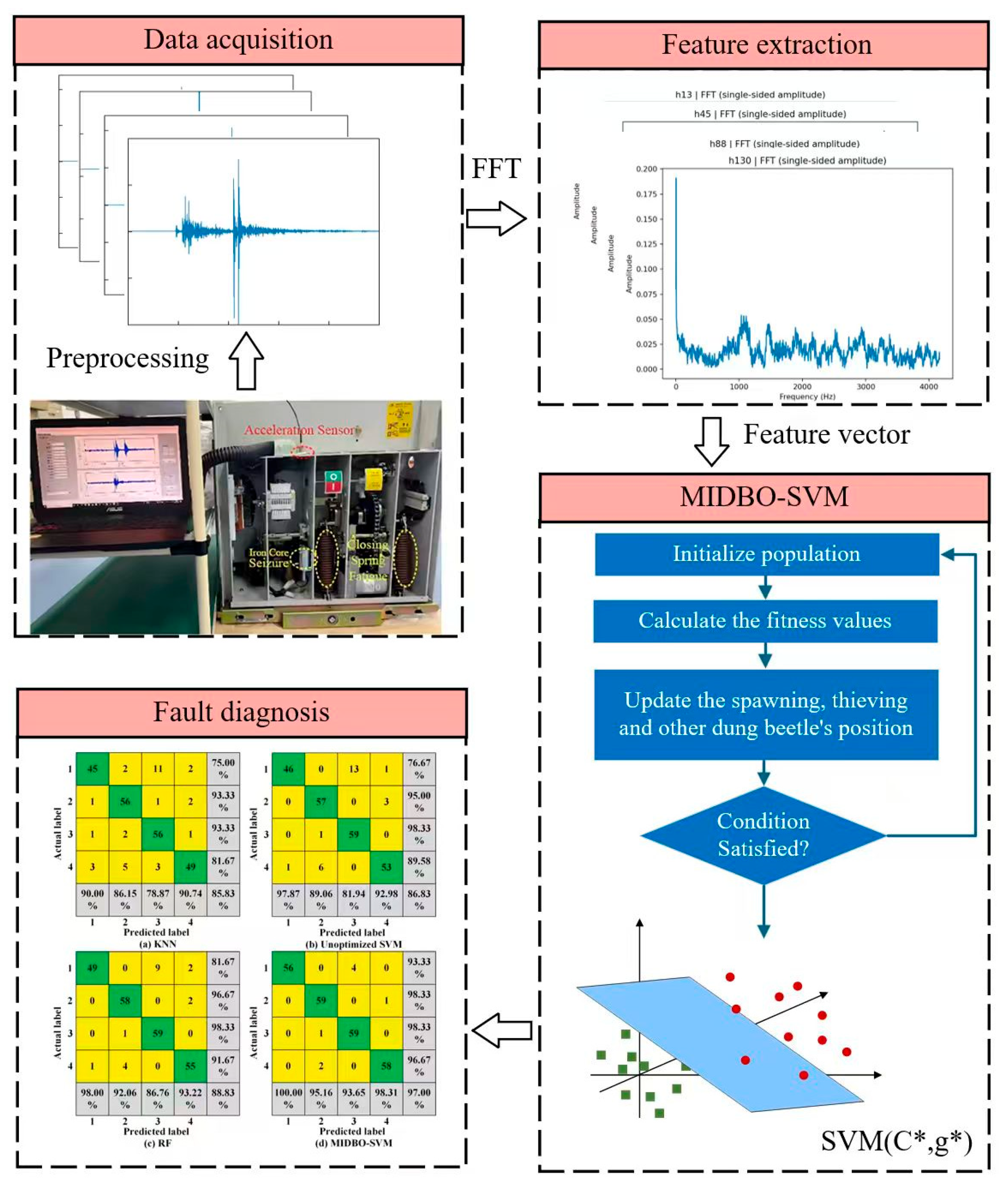
The overall framework of the proposed mechanical fault diagnosis method for HVCBs is illustrated in
Figure 2. The framework integrates vibration signal processing, feature extraction, intelligent parameter optimization, and classification into a unified data-driven diagnostic pipeline. Its primary objective is to achieve accurate and robust fault identification by leveraging discriminative frequency-domain features and adaptive parameter optimization. As shown in
Figure 2, the framework consists of four main stages: vibration signal acquisition and preprocessing, frequency-domain feature extraction, MIDBO-based SVM parameter optimization, and fault classification.
First, mechanical vibration signals are collected from HVCBs under different operating conditions. Before feature extraction, the raw signals undergo a structured preprocessing procedure. Specifically, (1) DC offset removal is applied to eliminate baseline drift; (2) a band-pass finite impulse response (FIR) filter is used to suppress low-frequency mechanical interference and high-frequency electrical noise outside the effective vibration bandwidth; (3) the effective operation interval is segmented from the 1-s recording based on the energy envelope to isolate the valid mechanical action period; and (4) amplitude normalization is performed to reduce the influence of sensor installation and measurement variability. These steps ensure that the retained signals primarily reflect intrinsic mechanical characteristics rather than environmental or measurement noise.
Second, frequency-domain features are extracted from the preprocessed vibration signals using the fast Fourier transform (FFT) [
28,
29]. The FFT converts time-domain signals into spectral representations, revealing dominant frequencies and energy distribution patterns associated with different mechanical conditions. Mechanical faults in HVCBs primarily affect structural vibration modes and resonance characteristics, which are directly reflected in the frequency domain. Compared with time–frequency and entropy-based methods, FFT provides a compact representation with lower computational cost while preserving essential fault-related information.
Third, to address the sensitivity of SVM performance to hyperparameter selection, the multi-strategy improved dung beetle optimization (MIDBO) algorithm is employed to optimize the penalty parameter C and kernel parameter g. Each MIDBO individual encodes a candidate parameter pair (C, g), and its fitness is evaluated using cross-validation classification accuracy. By integrating enhanced population initialization, adaptive search strategies, and mutation mechanisms, MIDBO efficiently explores the parameter space and converges toward an optimal solution. Since no deterministic relationship exists between SVM hyperparameters and classification performance in nonlinear fault diagnosis, metaheuristic optimization provides an effective data-driven solution. Moreover, the parameter search is constrained within predefined feasible ranges, ensuring physically meaningful and practically applicable solutions.
From a methodological perspective, the proposed MIDBO–SVM framework offers several advantages. The multi-strategy optimization improves convergence efficiency and reduces sensitivity to initial parameter settings. FFT-based features provide a compact and computationally efficient representation suitable for practical implementation. Furthermore, the data-driven optimization ensures that parameter selection is directly guided by measured vibration characteristics. However, the iterative optimization process introduces additional computational overhead compared with manually tuned models. In addition, performance may depend on the availability of representative training data, and re-optimization may be required for different breaker types or operating conditions. Despite these limitations, the proposed framework provides an effective and practical solution for mechanical fault diagnosis.
3.2. Multi-Strategy Improved DBO Algorithm
Although the original DBO algorithm demonstrates competitive global optimization capability, it may still suffer from premature convergence, insufficient population diversity, and stagnation in local optima when applied to complex problems. To address these limitations, this study proposes a MIDBO framework. Specifically, three complementary strategies are introduced: (1) a best point set-based circular chaotic mapping strategy to enhance population diversity during initialization; (2) a sine–cosine search mechanism with random inertia weight to dynamically balance global exploration and local exploitation during the iterative process; and (3) a Cauchy–Gaussian mutation strategy to mitigate population stagnation and improve convergence accuracy in later iterations. Unlike existing variants that apply isolated improvements, MIDBO integrates these strategies into a coordinated framework, improving optimization robustness and convergence performance throughout the evolutionary process.
3.2.1. Best Point Set—Circular Chaotic Mapping Technique
In swarm intelligence algorithms, the initial population significantly affects search efficiency and convergence performance [
30]. Conventional random initialization may produce uneven population distributions, reducing diversity and increasing the risk of premature convergence. To address this issue, a chaotic mapping-based initialization strategy is adopted [
31]. Chaotic maps exhibit ergodicity, randomness, and sensitivity to initial conditions, which enhance population diversity and search space coverage.
Common chaotic maps include logistic and tent maps. However, logistic maps may exhibit nonuniform distributions, while tent maps may produce unstable periodic behavior. Therefore, this study adopts a circular chaotic map combined with best point set theory to generate a high-quality initial population.
Assume that
denotes a unit cube in an
-dimensional Euclidean space, i.e.,
, where
. If
, the corresponding best point set
is defined as
and its deviation can be expressed as shown in Equation (2).
where
is a constant related to parameters
and
, where
is referred to as the favorable point, defined as in Equation (3). The prime number
is the smallest integer satisfying
, and
denotes the fractional part.
The circle chaotic map is formulated as:
where
and
. Compared with random initialization, the circle chaotic map significantly enhances the uniformity and spatial diversity of the population, thereby enlarging the coverage of the initial solution space and improving optimization efficiency.
Based on the above principles, the population mapping strategy adopted in this paper is described by Equation (5):
where
denotes a uniformly distributed random number in the interval
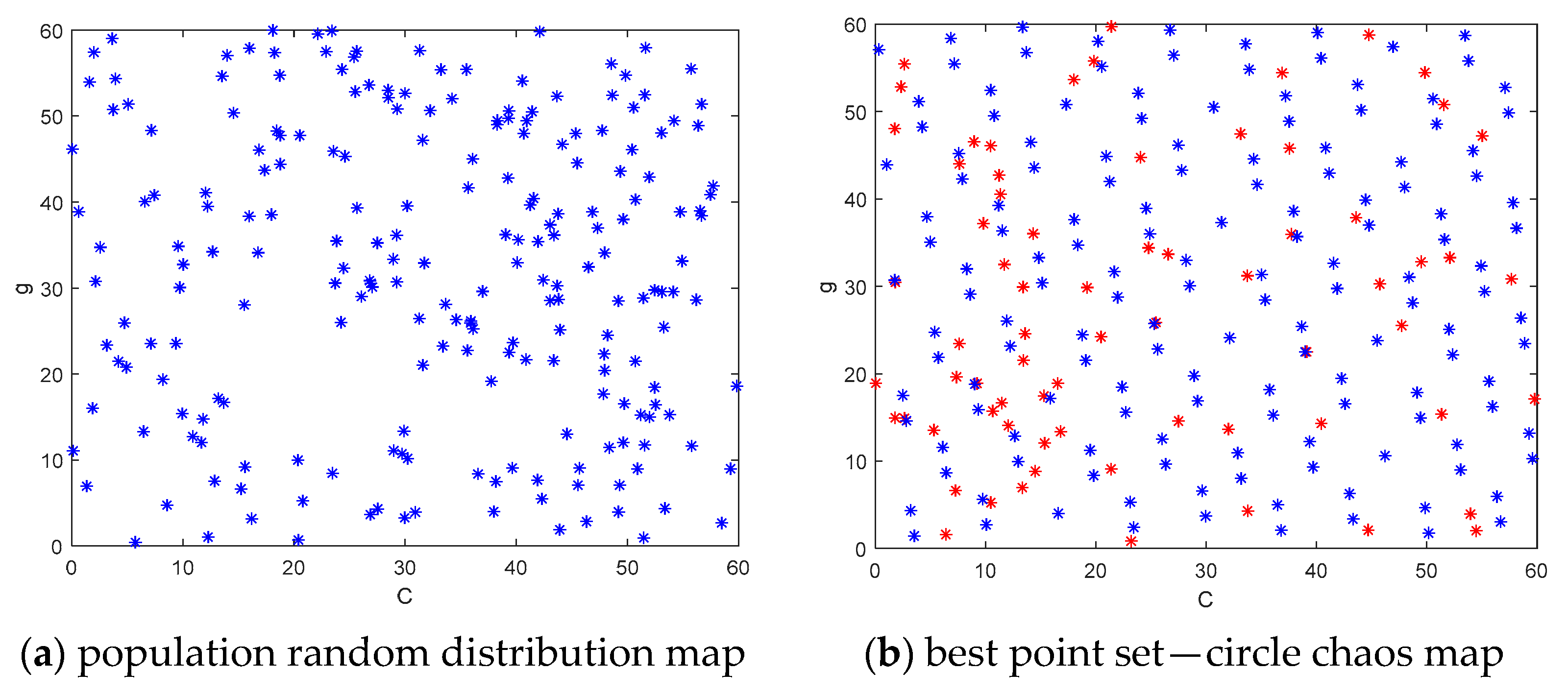
. A visual comparison between random initialization and the proposed best point set–circle chaotic mapping is presented in
Figure 3, demonstrating the superior distribution characteristics of the proposed method.
is the lower bound and
is the upper bound.
3.2.2. Sine and Cosine Search Strategy Based on Random Inertia Weight
The inertia weight controls the balance between exploration and exploitation. Conventional linear-decreasing inertia weight strategies may reduce exploration capability prematurely. To overcome this limitation, a sine–cosine search strategy with random inertia weight is introduced [
32]. The sine–cosine mechanism enables oscillatory convergence toward optimal regions, while random inertia weight enhances adaptability.
The position update formulas are given by Equations (6) and (7):
where
and
denote the upper and lower bounds of the inertia weight, respectively. The function
generates a uniformly distributed random number in
, while
represents a standard normal random variable. The parameter
quantifies the deviation between the stochastic inertia weight and its expected value and is set to 0.3 in this study.
represents the strength of Gaussian perturbation.
This strategy improves convergence stability and reduces premature convergence.
3.2.3. Cauchy–Gaussian Mutation Strategy
Population stagnation may occur during later iterations. To address this issue, a Cauchy–Gaussian mutation strategy is introduced [
33]. Gaussian mutation provides fine local search capability, while Cauchy mutation enables larger perturbations to escape local optima. The Gaussian distribution with mean
and variance
is defined as:
In contrast, the Cauchy distribution, whose probability density function is shown in Equation (9), exhibits heavier tails and can generate larger perturbations, which are particularly beneficial for escaping local optima:
In this study, the Cauchy–Gaussian mutation strategy is applied to the best-performing individuals. A competitive selection mechanism is employed to retain the solution with superior fitness after mutation. The corresponding update rules are defined in Equations (10)–(12), where
represents the mutated best position,
denotes the original global best individual, and
is the updated optimal solution. The parameter
is the standard deviation of the mutation, while
and
are adaptive coefficients that vary with iteration count.
where
t is the current iteration step, and
T is the maximum iteration step.
is the Cauchy distribution and
is the Gaussian distribution.
At the early stage of optimization, larger values of amplify the influence of Cauchy mutation, facilitating extensive global exploration. As iterations proceed, gradually decreases and increases, shifting the mutation behavior toward Gaussian perturbation to enhance local refinement and convergence precision. Through this adaptive mechanism, the complementary advantages of Cauchy and Gaussian distributions are effectively exploited, achieving a robust balance between exploration and exploitation.
3.3. MIDBO–SVM Parameter Optimization Modeling
SVM has demonstrated strong generalization ability and robustness in small-sample and nonlinear classification problems, making it well suited for mechanical fault diagnosis of HVCBs. However, the diagnostic performance of SVM is highly sensitive to its hyperparameters, particularly the penalty parameter
C and the kernel parameter
g of the RBF [
34]. Inappropriate parameter settings may lead to overfitting, underfitting, or poor generalization capability. Therefore, an efficient and reliable parameter optimization strategy is essential for fully exploiting the classification potential of SVM. The objective of employing a metaheuristic optimization method is to identify the optimal SVM hyperparameters in a complex and nonlinear search space where conventional analytical or gradient-based methods are not applicable. The optimization process is entirely driven by measured vibration feature data and classification performance, ensuring that parameter selection is based on actual diagnostic effectiveness rather than theoretical idealization. In addition, explicit parameter bounds are imposed to guarantee that all candidate solutions remain feasible and applicable to real-world fault diagnosis scenarios.
In nonlinear classification problems, the kernel function is selected based on its ability to map the original feature space into a higher-dimensional space where classes become linearly separable. In this study, the RBF kernel is adopted due to its strong nonlinear mapping capability, universal approximation property, and effectiveness in modeling complex decision boundaries. Compared with linear, polynomial, and sigmoid kernels, the RBF kernel requires fewer hyperparameters and provides greater flexibility for representing nonlinear relationships in vibration feature data.
The effectiveness of the kernel configuration is quantitatively evaluated using k-fold cross-validation accuracy. Specifically, the kernel parameter γ and penalty parameter C are determined by maximizing cross-validation accuracy, which reflects the separability of transformed feature representations and the generalization capability of the resulting decision boundary. This fitness-based criterion provides a direct and reliable measure for selecting kernel parameters, ensuring effective nonlinear-to-linear separability and robust classification performance.
3.3.1. Optimization Objective and Fitness Function Design
The goal of MIDBO–SVM parameter optimization is to identify the optimal hyperparameter pair:
which maximizes the classification performance of the SVM model on mechanical vibration feature data.
To ensure robust performance evaluation and avoid overfitting, k-fold cross-validation accuracy is adopted as the fitness function. For each candidate solution
, the fitness value is defined as:
where
denotes the classification accuracy obtained on the
-th validation fold, and
represents the number of folds. This fitness formulation provides a reliable estimate of generalization ability and ensures fair comparison among candidate solutions. This fitness-based evaluation serves as the quantitative criterion for kernel effectiveness, as higher cross-validation accuracy indicates improved class separability in the transformed feature space and a more reliable decision boundary. By directly optimizing classification accuracy, the MIDBO algorithm ensures that the selected kernel parameter enables effective nonlinear-to-linear separability while maintaining strong generalization performance. This data-driven evaluation mechanism ensures that the metaheuristic optimization process directly reflects real diagnostic performance. Candidate parameter sets are selected solely based on measured classification accuracy, which prevents unrealistic or idealized parameter configurations and ensures the practical reliability of the optimized SVM model.
The optimization problem can thus be formulated as:
subject to
where
and
define the feasible search ranges.
3.3.2. Encoding Strategy and Search Space Construction
Within the MIDBO framework, each dung beetle individual represents a candidate SVM parameter solution, encoded as a two-dimensional position vector:
The initial population is generated using the best point set–circle chaotic mapping strategy introduced in
Section 3.2.1, ensuring uniform coverage of the parameter search space and enhanced population diversity. This initialization mechanism allows MIDBO to explore a wide range of parameter combinations from the early stage, reducing sensitivity to initial conditions.
3.3.3. MIDBO-Driven Evolutionary Optimization Process
During the optimization process, the MIDBO algorithm iteratively updates the positions of dung beetle individuals based on the multi-strategy enhancement mechanisms described in
Section 3.2. Specifically: (1) Global exploration stage: the sine–cosine search strategy with random inertia weight guides individuals to explore the parameter space in an oscillatory and adaptive manner, preventing premature convergence and encouraging exploration of promising regions. (2) Adaptive transition stage: as iterations proceed, the adaptive inertia mechanism dynamically balances exploration and exploitation, allowing the population to gradually concentrate around high-fitness regions in the parameter space. (3) Local refinement stage: the Cauchy–Gaussian mutation strategy is applied to elite individuals to introduce controlled perturbations. Cauchy mutation enhances the ability to escape local optima, while Gaussian mutation improves fine-grained local search precision, leading to stable convergence.
At each iteration, the fitness of all candidate solutions is evaluated using cross-validation accuracy, and the global best solution is updated accordingly. The iterative process continues until the termination condition—maximum number of iterations or convergence criterion—is satisfied.
3.3.4. Optimal SVM Model Construction and Fault Classification
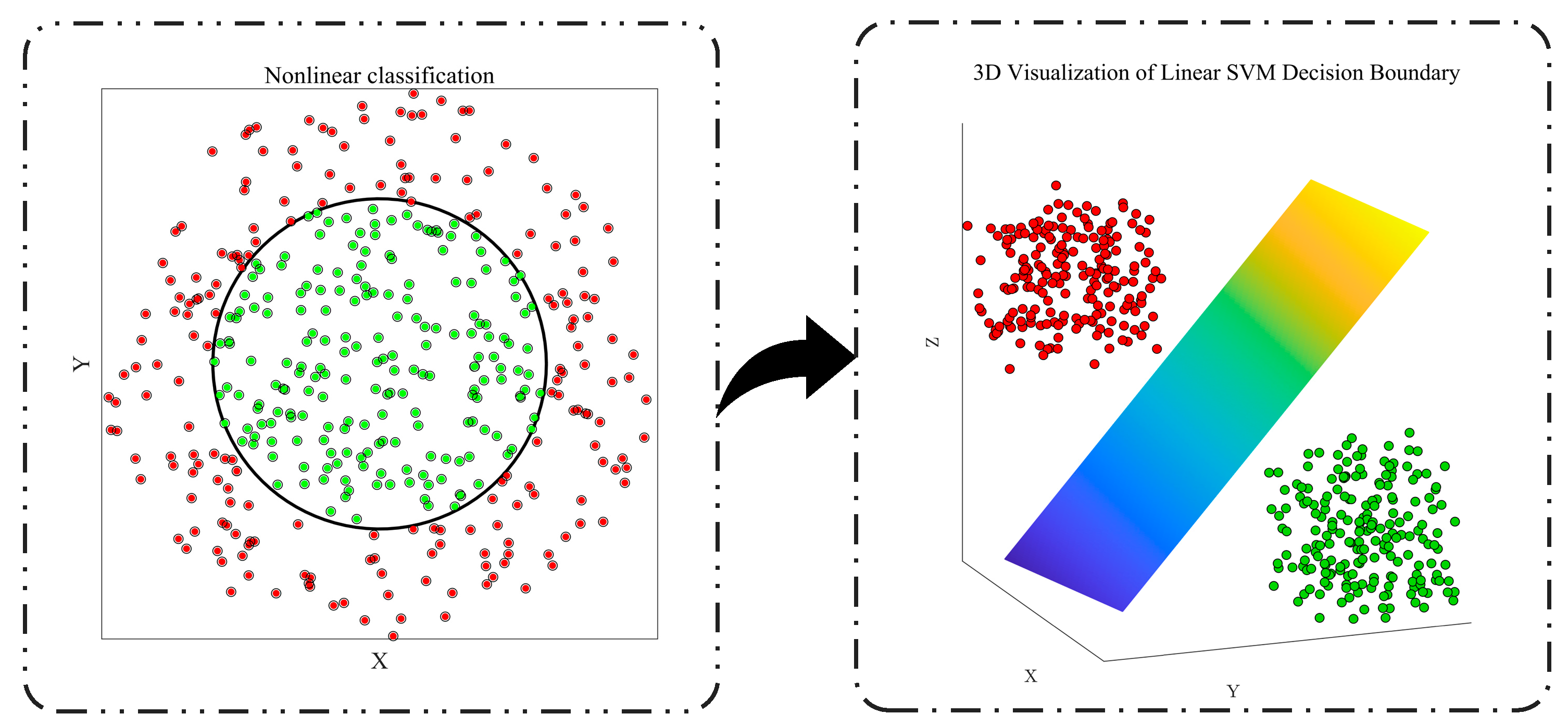
Upon completion of the MIDBO optimization process, the optimal parameter set is obtained. These parameters are then used to construct the final SVM classifier. By using the optimized RBF kernel parameters, the original nonlinear vibration feature space is transformed into a higher-dimensional space where fault categories can be effectively separated using a linear hyperplane, enabling accurate and reliable fault classification.
The optimized SVM model is trained using the FFT-based frequency-domain feature vectors extracted from mechanical vibration signals and subsequently applied to identify the operating states and fault types of HVCBs. As shown in
Figure 1, this process completes the full diagnostic pipeline, from signal acquisition and feature extraction to intelligent optimization and fault decision-making. By tightly coupling MIDBO with SVM parameter tuning, the proposed method significantly enhances classification accuracy, convergence stability, and robustness under unbalanced sample conditions, thereby providing a reliable and efficient solution for mechanical fault diagnosis of HVCBs.
The proposed MIDBO–SVM modeling strategy demonstrates several practical strengths. The adaptive optimization mechanism enables reliable parameter selection without requiring manual tuning or prior empirical knowledge, improving model robustness in nonlinear and small-sample scenarios. In addition, the structured multi-strategy enhancement improves convergence stability and reduces the risk of premature convergence, resulting in more consistent diagnostic performance. Nevertheless, the proposed approach requires iterative fitness evaluation through cross-validation, which increases computational complexity compared with conventional SVM models. Furthermore, although the optimized model exhibits strong performance under the evaluated operating conditions, its effectiveness depends on the availability of representative vibration data for parameter optimization. These limitations highlight the importance of balancing optimization accuracy and computational efficiency in practical implementations.
3.4. MIDBO–SVM Fault Diagnosis Procedure
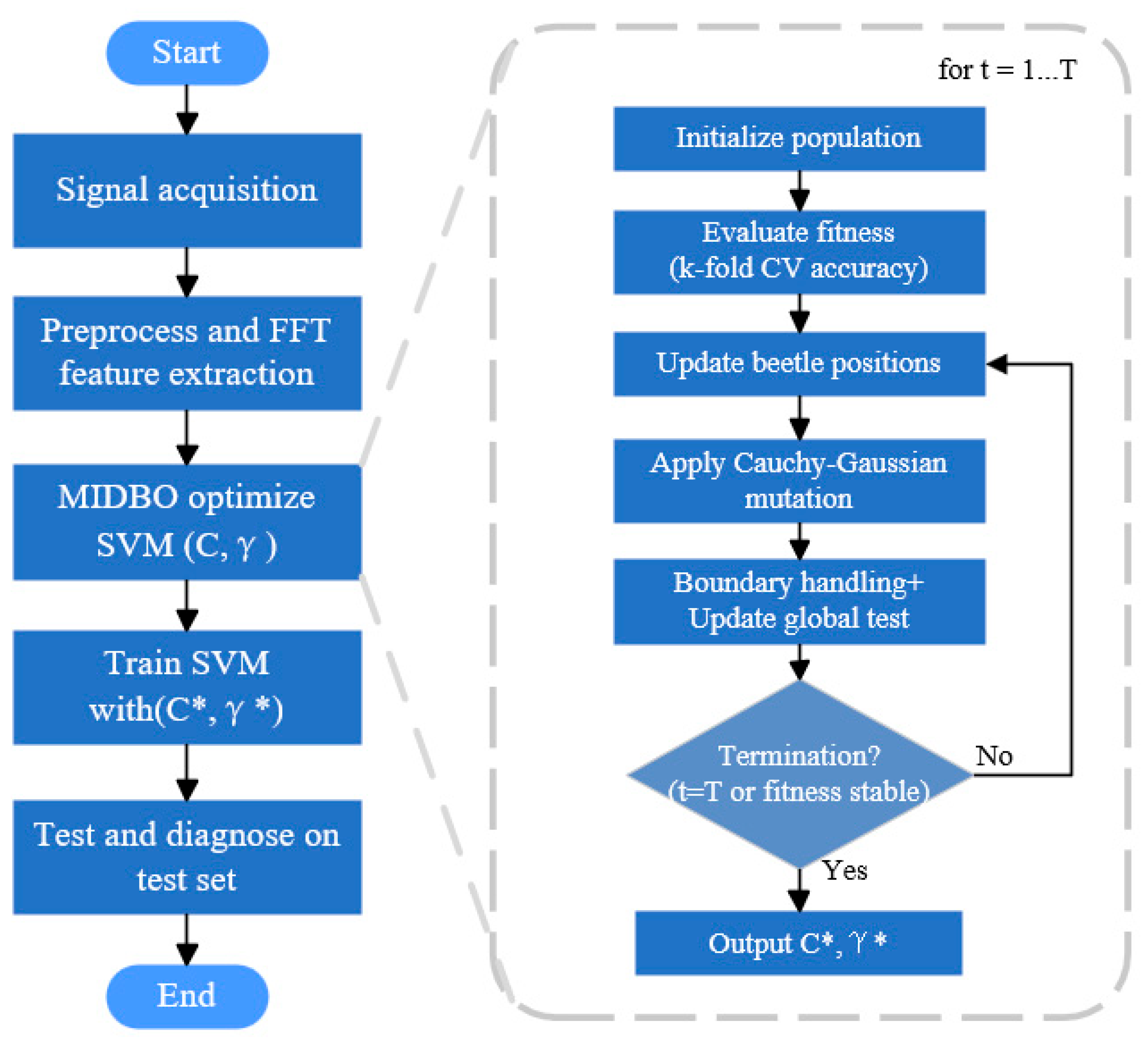
To fully exploit the parameter optimization capability of the proposed MIDBO algorithm, a structured MIDBO–SVM fault diagnosis procedure is established for HVCBs. The overall workflow of the proposed method is illustrated in
Figure 4, where vibration signal processing, evolutionary parameter optimization, and fault classification are tightly integrated.
The detailed fault diagnosis procedure is described as follows:
- (1)
Initialization of Algorithm Parameters
The initial settings of the MIDBO–SVM framework are defined, including the maximum number of iterations, population size, search dimension, search ranges of the SVM hyperparameters C and g, inertia weight parameters, and mutation-related coefficients. These settings determine the search boundaries and evolutionary dynamics of the MIDBO algorithm.
- (2)
Population Initialization and Fitness Evaluation
The initial population is generated using the best point set–circle chaotic mapping strategy according to Equation (6), ensuring a uniform and diverse distribution of candidate solutions within the parameter space.
Each dung beetle individual encodes a candidate SVM hyperparameter pair (C, g). For each individual, an SVM classifier is constructed and evaluated using cross-validation accuracy on the extracted frequency-domain features. The fault diagnosis error rate is adopted as the fitness criterion. Based on the fitness values, the individual best solutions and the global best solution are identified and recorded. The input dataset used for fitness evaluation consists of feature vectors extracted from measured vibration signals, where each feature vector represents the spectral characteristics of one actual mechanical operation. Cross-validation accuracy is computed using these real feature vectors and their corresponding labels, ensuring that parameter optimization is directly driven by experimentally measured data.
- (3)
Evolutionary Update and Global Best Tracking
During each iteration, the positions of dung beetle individuals are updated according to the MIDBO evolutionary rules described in
Section 3.2. The fitness of the updated population is re-evaluated, and the historical best positions as well as the global optimal solution are updated through fitness comparison. This process guides the population toward high-quality parameter regions while maintaining an effective balance between global exploration and local exploitation.
- (4)
Cauchy–Gaussian Mutation and Competitive Selection
To prevent premature convergence and enhance population diversity, the Cauchy–Gaussian mutation strategy is applied to elite individuals following Equation (11). The fitness values before and after mutation are compared, and the solution with superior fitness is retained as the optimal candidate for the current iteration. This competitive selection mechanism ensures that beneficial perturbations are preserved in the evolutionary process.
- (5)
Termination Judgment and Optimal Parameter Output
The algorithm evaluates whether the maximum iteration number has been reached. If the termination condition is not satisfied, the iteration index is updated (t = t + 1), and the procedure returns to Step 2. Otherwise, the optimization process terminates, and the optimal SVM hyperparameter combination (C∗, g∗) is obtained.
- (6)
Fault Classification Using Optimized SVM
Finally, the optimized SVM classifier constructed with (
C∗,
g∗) is employed to identify the operating conditions and mechanical fault types of HVCBs. This step completes the fault diagnosis workflow illustrated in
Figure 3.
4. Data Acquisition
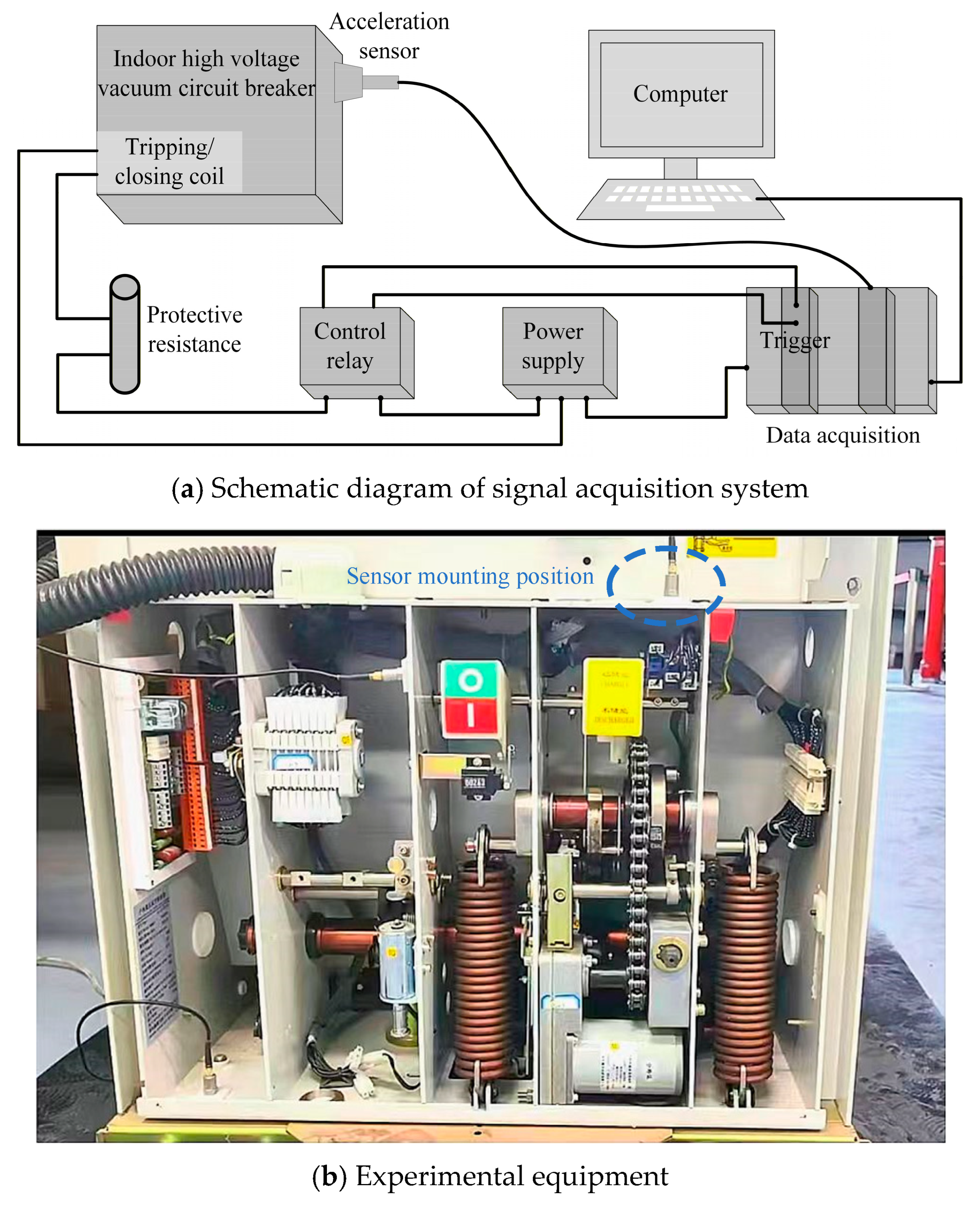
To evaluate the effectiveness and engineering applicability of the proposed MIDBO–SVM fault diagnosis method, an experimental fault simulation platform was established using a VS1 HVCB as the test object. The training and testing datasets were obtained by simulating typical operating conditions and representative mechanical fault scenarios. The schematic diagram and physical configuration of the data acquisition system are shown in
Figure 5 [
35]. It should be noted that the dataset was collected from a single VS1 circuit breaker under controlled laboratory conditions. Therefore, the dataset serves as a representative benchmark for validating the proposed optimization and classification framework, rather than for establishing universally transferable model parameters.
During the experiments, mechanical vibration signals generated by the operating mechanism were measured using acceleration sensors and transmitted to an industrial computer through a high-speed data acquisition card. The signals were stored and monitored in real time for subsequent analysis. Each recorded vibration segment was treated as an independent sample. After preprocessing and FFT transformation, spectral amplitudes at selected frequency bins were extracted and organized into feature vectors. Thus, the dataset consists of multiple feature vectors, each corresponding to a measured vibration event under a specific operating condition.
The VS1 HVCB Is an Indoor vacuum circuit breaker widely used in 12-kV power distribution systems. It integrates a spring-operated mechanism and operates at a rated frequency of 50 Hz with a rated current of 1600 A. During switching operations, the rapid release of spring energy produces strong mechanical impacts among internal components. These impacts generate broadband vibration signals with significant frequency components extending beyond 20 kHz, particularly during closing operations. Therefore, sensors with sufficient high-frequency response are required to accurately capture the vibration characteristics associated with mechanical conditions.
In this study, a CT1000L piezoelectric acceleration sensor with a sensitivity of 5 mV/g was used to measure transient vibration signals. To ensure reliable signal transmission, the sensor was mounted on the beam of the operating mechanism, where vibration transmission is pronounced. The sensor was firmly fixed using industrial adhesive and mechanical bolts to ensure stable installation and reduce signal attenuation and external interference. Vibration signals were acquired using an NI USB-6002 data acquisition card with a maximum sampling rate of 50 kS/s and 16-bit resolution. Under no-load closing conditions, the operating mechanism typically completes its motion within 35–70 ms. To ensure complete capture of transient vibration characteristics while maintaining computational efficiency, the acquisition duration was set to 1 s and the sampling frequency to 10 kHz.
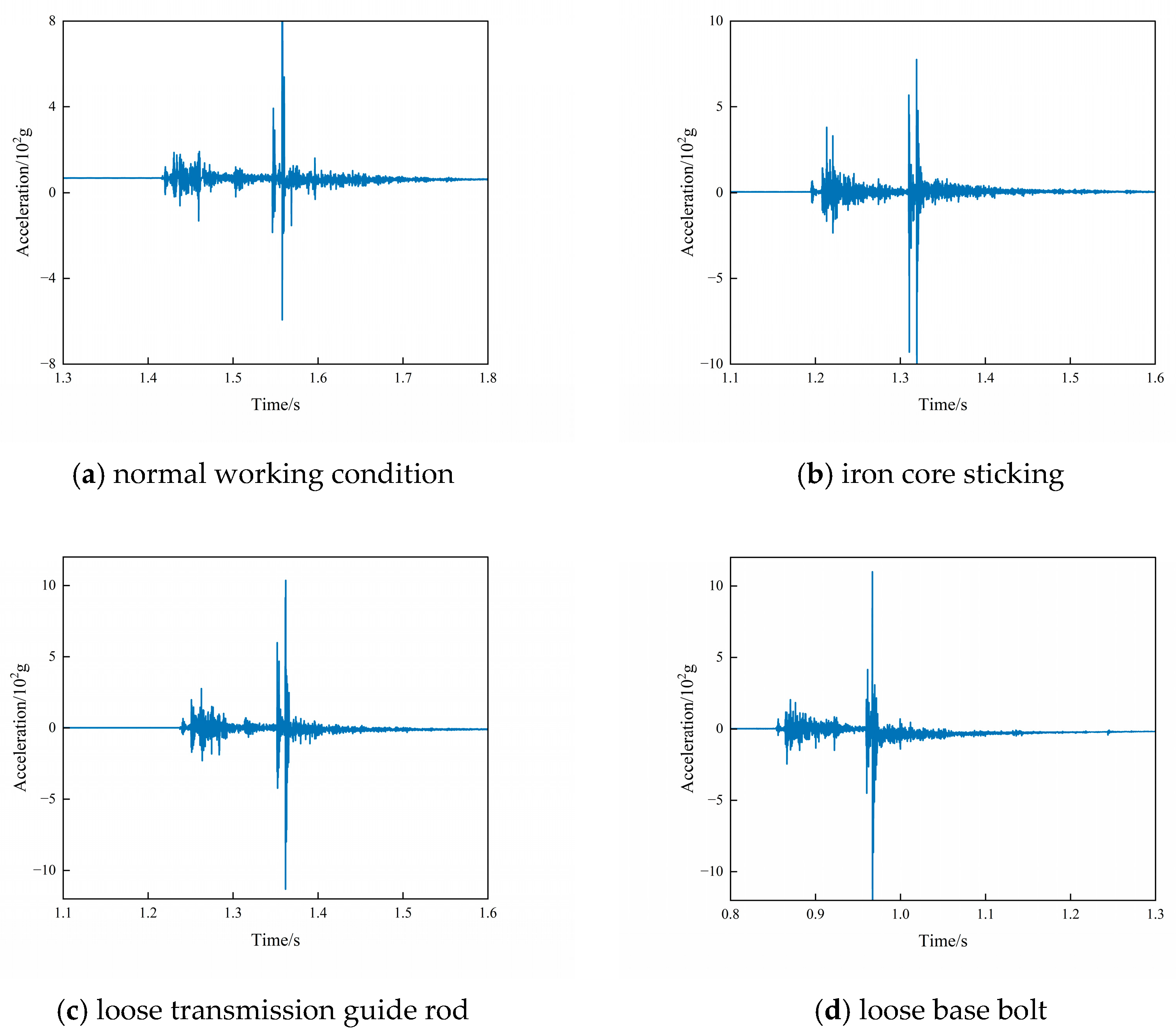
Four typical operating conditions under no-load closing were investigated, including one normal condition and three representative mechanical faults: iron core sticking, loose transmission guide rod, and loose base bolt. The iron core sticking fault was simulated by inserting a spring into the iron core to increase contact resistance, representing adhesion caused by contamination or wear. The loose transmission guide rod fault was reproduced by loosening the transmission mechanism screw by approximately 3 mm, simulating mechanical degradation during long-term operation. The loose base bolt fault was simulated by loosening the four mounting bolts at the circuit breaker base, reducing structural stability and altering vibration transmission characteristics.
For each operating condition, vibration signals were repeatedly collected to ensure statistical reliability. Each operation event was segmented and treated as an independent sample. After preprocessing and FFT transformation, selected spectral amplitudes were organized into feature vectors and labeled according to operating condition. The vibration signals under normal and faulty conditions are shown in
Figure 6. These labeled feature vectors constitute the dataset used to train and evaluate the MIDBO–SVM model. Each collected signal sample is independently transformed into a feature vector and labeled according to its operating condition. These labeled feature vectors form the input dataset for training and evaluating the MIDBO–SVM model, ensuring that the diagnostic model is constructed entirely based on experimentally measured vibration characteristics. Because vibration characteristics are influenced by circuit breaker type, mechanical structure, installation conditions, and operating environment, the trained MIDBO–SVM model and its optimized hyperparameters are not assumed to be directly transferable to other circuit breakers or field conditions. In practical applications, the pro-posed MIDBO optimization procedure can be applied to newly collected vibration data to retrain the SVM classifier and identify optimal hyperparameters specific to the target equipment, thereby ensuring reliable fault diagnosis performance.
5. Results and Analysis
All experiments were conducted on a desktop computer equipped with an Intel Core i7-12700 CPU (2.10 GHz) and 16 GB RAM using MATLAB R2022b. For fair comparison, the population size and maximum number of iterations were both set to 30 for all optimization algorithms. In this study, FFT was used to extract frequency-domain features from both training and testing samples, which were then used as inputs to the SVM classifier. To reduce the sensitivity of SVM performance to hyperparameter selection, the proposed MIDBO algorithm was employed to optimize the penalty factor
C and kernel parameter
g. All optimization-based classifiers were trained and evaluated using the same datasets, feature extraction procedure, and parameter search ranges. Specifically,
C ∈ [0,60] and
g ∈ [0,60]. To verify that the MIDBO–SVM framework is not dependent on a specific feature representation, additional experiments were conducted using three commonly used feature types: FFT frequency-domain features, wavelet packet energy features, and sample entropy features. All feature sets were evaluated using identical datasets, MIDBO parameter settings, and training and testing protocols.
Table 2 presents the diagnostic performance of MIDBO–SVM with different feature representations.
As shown in
Table 2, FFT-based features achieved the highest diagnostic accuracy of 96.67% and the lowest standard deviation of 0.94%, indicating superior discriminative capability and stability. Wavelet packet energy features also achieved strong performance, with an accuracy of 94.58%, but remained 2.09% lower than FFT features. In contrast, sample entropy features achieved the lowest accuracy of 91.25%, indicating limited effectiveness when used alone. These results demonstrate that the MIDBO–SVM framework performs consistently across different feature representations. The superior performance of FFT features suggests that the mechanical faults considered in this study are primarily characterized by distinct spectral variations, making frequency-domain features particularly suitable for this diagnosis task.
To provide a qualitative comparison with representative methods,
Table 3 summarizes the characteristics of different approaches in terms of optimization capability, convergence speed, stability, robustness to local optima, and diagnostic reliability. Unlike conventional SVM and metaheuristic-based SVM models such as PSO–SVM, WOA–SVM, and DBO–SVM, the proposed MIDBO–SVM incorporates multiple enhancement strategies, including chaotic initialization, adaptive search regulation, and mutation-based diversity enhancement. These mechanisms improve the balance between global exploration and local exploitation, resulting in more reliable convergence and improved classification robustness. In addition, MIDBO–SVM exhibits faster convergence and greater stability, making it more suitable for practical mechanical fault diagnosis.
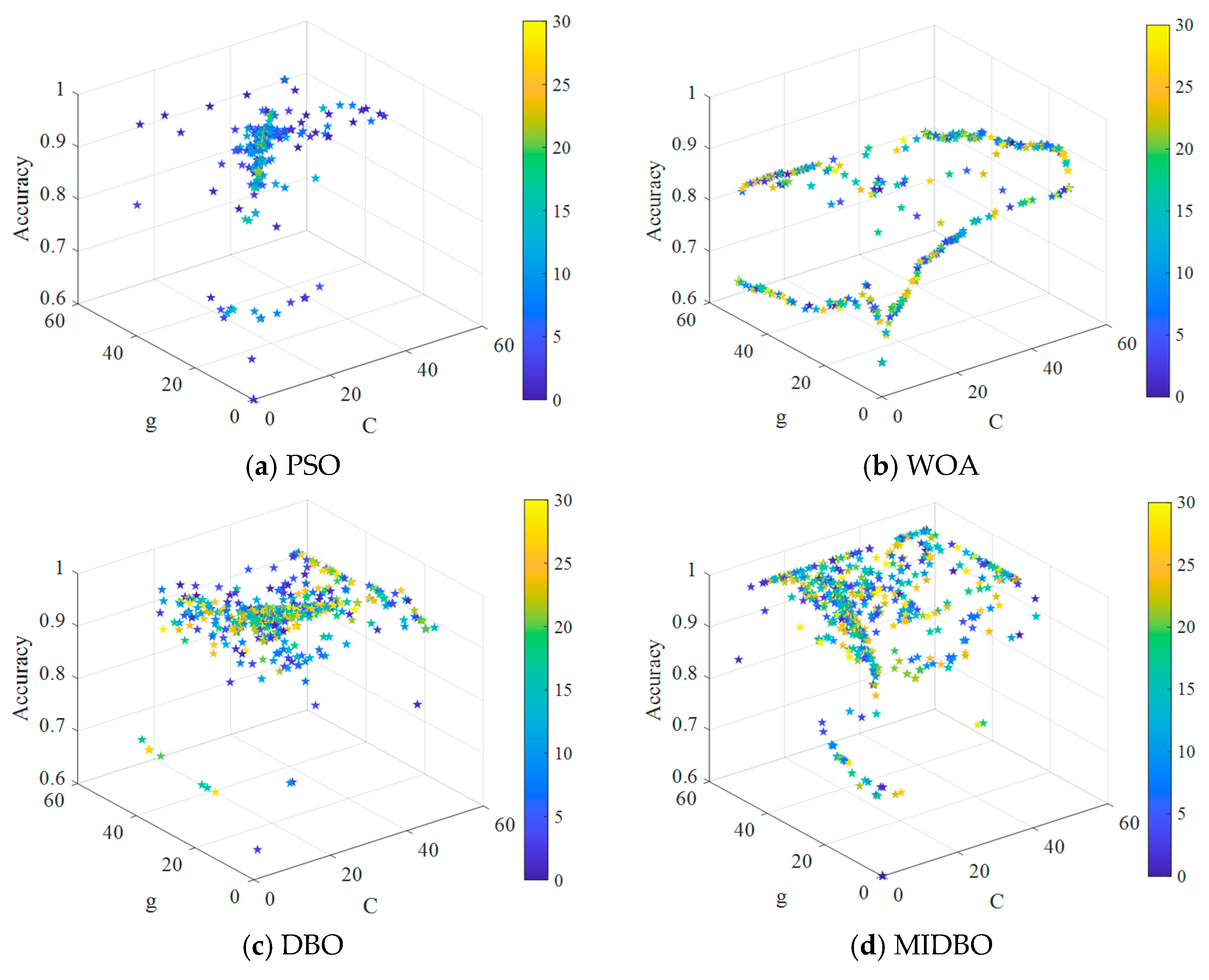
The population evolution processes of different optimization methods are illustrated in
Figure 7. The whale optimization algorithm (WOA) exhibits reduced population diversity during the later stages of optimization, leading to premature convergence. Although WOA converges relatively quickly, its limited global search capability restricts further performance improvement. The PSO method shows strong stochastic behavior, with rapidly decreasing population diversity, which increases the risk of convergence to local optima. As a result, PSO–SVM often requires multiple runs to obtain satisfactory solutions and exhibits slower convergence and lower optimization accuracy. Compared with PSO and WOA, the DBO algorithm demonstrates a more uniform population distribution and improved global exploration capability. However, its local exploitation ability remains limited, which may result in convergence to suboptimal solutions. In contrast, the proposed MIDBO algorithm effectively addresses these limitations. Through improved population initialization and adaptive parameter regulation, MIDBO achieves a better balance between global exploration and local exploitation, resulting in faster convergence and improved optimization accuracy.
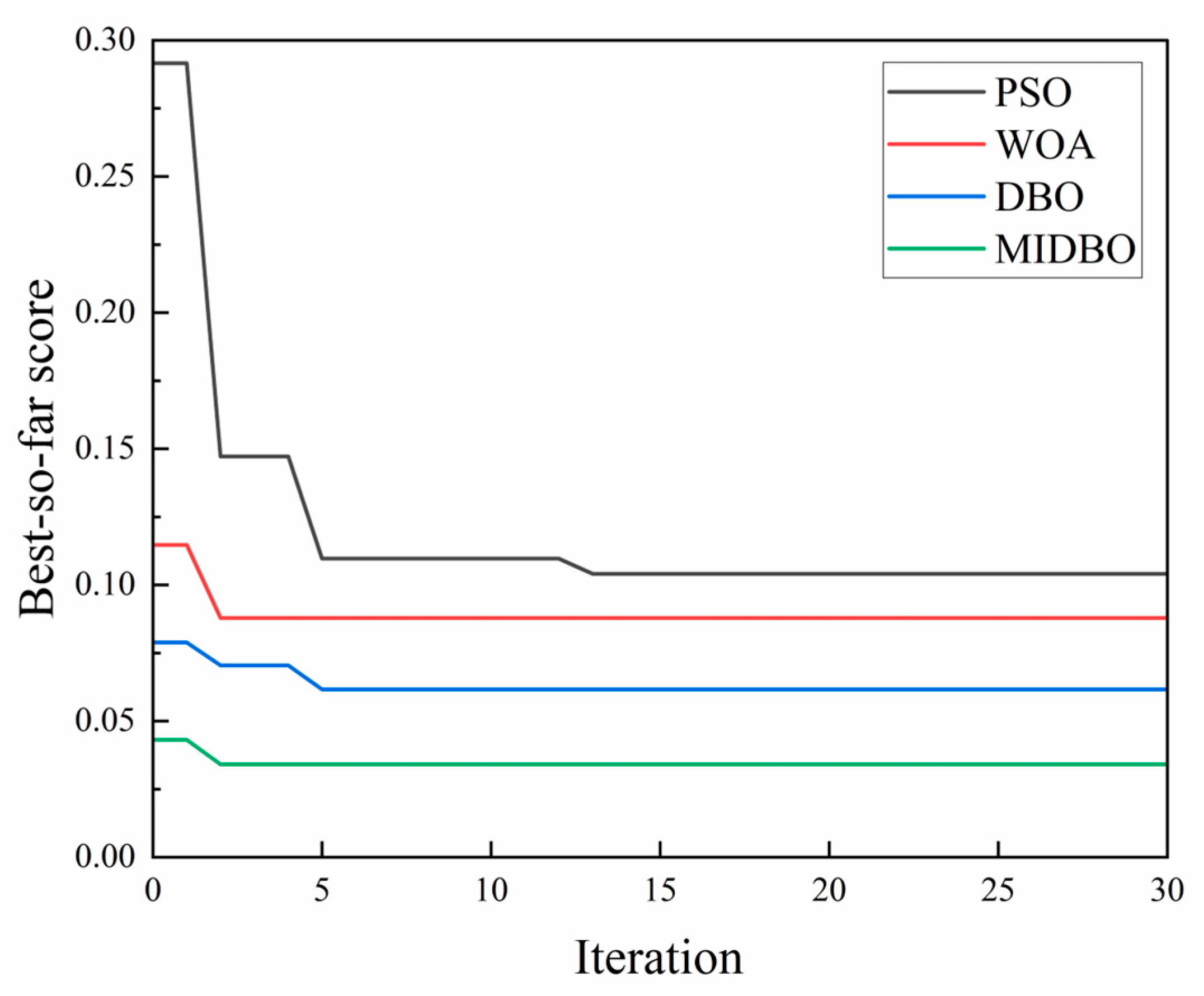
The convergence behaviors of the four optimization algorithms are further compared in
Figure 8. The PSO–SVM model exhibits stagnation during optimization and converges to an error value of 0.1042 after 14 iterations, indicating limited optimization performance. Although WOA–SVM converges faster than PSO–SVM, its final accuracy improvement is limited, suggesting insufficient local search refinement. The DBO–SVM model achieves improved convergence accuracy and speed, but its exploration and exploitation balance remains suboptimal. In contrast, the proposed MIDBO–SVM reaches an error rate of 0.0333 within only three iterations, achieving the highest convergence accuracy with the fewest iterations. This result demonstrates the effectiveness of MIDBO in improving optimization efficiency and robustness.
The diagnostic performance of different optimized SVM models is summarized in
Table 4. The four operating conditions—normal condition, iron core adhesion, loose transmission guide rod, and loose base bolts—correspond to Classes 1–4, respectively. Among all methods, MIDBO–SVM achieves the highest overall diagnostic accuracy of 96.67%. For Classes 2 and 3, all optimized methods achieve accuracies above 95%, indicating clear feature separability. However, for Class 1 and Class 4, which exhibit greater similarity, MIDBO–SVM demonstrates superior performance. Specifically, the accuracy for Class 1 reaches 93.3%, exceeding WOA–SVM, PSO–SVM, and DBO–SVM by 15.0%, 17.0%, and 8.3%, respectively. For Class 4, MIDBO–SVM achieves 96.7%, outperforming the other methods by 6.7%, 11.7%, and 3.4%, respectively. These results indicate that MIDBO–SVM provides improved discriminative capability and optimization performance. It should be emphasized that the generalization capability demonstrated here refers to robustness across feature representations within the same equipment and operating conditions. When applied to different circuit breaker types or field environments, the MIDBO optimization process should be performed using representative vibration data from the target system to retrain the classifier and determine appropriate hyperparameters. This data-driven retraining ensures that the diagnostic model adapts to equipment-specific vibration characteristics.
To evaluate the contribution of each enhancement strategy, an ablation study was conducted under identical experimental conditions. Four variants were considered: the original DBO, DBO-C with chaotic initialization, DBO-CS with chaotic initialization and adaptive sine–cosine search, and the complete MIDBO with Cauchy–Gaussian mutation. Each algorithm optimized SVM parameters using the same dataset, and all experiments were repeated 30 times. The results are summarized in
Table 5. As shown in
Table 5, diagnostic accuracy improves consistently as enhancement strategies are introduced. Compared with the original DBO, DBO-C increases accuracy from 93.75% to 94.83% and reduces convergence error and standard deviation. DBO-CS further improves accuracy to 95.83% and reduces average iterations from 11.6 to 7.3. The complete MIDBO achieves the best performance, with an accuracy of 96.67%, convergence error of 0.0333, and standard deviation of 0.94%, while reducing average iterations to 3.8. These results confirm the effectiveness of the proposed enhancement strategies.
Additional comparisons were conducted with conventional classifiers, including unoptimized SVM, k-nearest neighbors (KNN), and random forest (RF). All classifiers used identical FFT-based features and training/testing partitions. As shown in
Table 6, unoptimized SVM achieves an accuracy of 86.25%, significantly lower than MIDBO–SVM, indicating the importance of proper hyperparameter selection. KNN shows the lowest accuracy and highest standard deviation, reflecting limited stability. RF improves performance compared with KNN and unoptimized SVM but remains inferior to MIDBO–SVM. MIDBO–SVM achieves the highest accuracy and lowest standard deviation, indicating superior robustness and consistency.
The accuracy exceeding 96% achieved by MIDBO–SVM is primarily attributed to its enhanced hyperparameter optimization capability, which enables the SVM to construct a more discriminative decision boundary in the feature space. Specifically, the chaotic initialization strategy improves the diversity and coverage of candidate solutions during the early search stage, increasing the probability of locating globally optimal hyperparameters. The adaptive search regulation mechanism dynamically balances exploration and exploitation, allowing the algorithm to efficiently refine promising regions while avoiding premature convergence. In addition, the mutation-based diversity reinforcement prevents population stagnation and improves local search precision. These coordinated strategies enable MIDBO to identify hyperparameter combinations that maximize class separability in the transformed feature space, particularly for classes with partially overlapping spectral characteristics, such as normal conditions and loose base bolt faults. As a result, the optimized SVM achieves more compact and well-separated decision regions, leading to significantly improved classification accuracy and reduced misclassification. This is further supported by the ablation study in
Table 4, where the progressive introduction of the proposed enhancement strategies consistently improves diagnostic accuracy from 93.75% (original DBO) to 96.67% (MIDBO), confirming the effectiveness of the proposed optimization framework.
To further clarify the model performance, both training accuracy and testing accuracy were analyzed, as shown in
Table 7. Training accuracy refers to the classification accuracy obtained on the training dataset used to construct the model, reflecting how well the classifier learns the underlying patterns of the training samples. Testing accuracy, in contrast, is computed using unseen samples that are not involved in the training process and therefore provides a direct measure of the model’s generalization capability. In this study, a k-fold cross-validation protocol was adopted, where the dataset was partitioned into mutually exclusive training and testing subsets. The classifier was trained on the training subset and evaluated on the testing subset in each fold, and the reported accuracy represents the average testing accuracy over all folds. For the proposed MIDBO–SVM, the average training accuracy reached 98.12%, while the corresponding testing accuracy was 96.67%. The small difference between training and testing accuracy indicates that the optimized SVM model achieves strong generalization performance without overfitting. This high testing accuracy further confirms that the improvement is not caused by overfitting but by the ability of MIDBO to identify hyperparameters that maximize the intrinsic separability of real vibration feature vectors. By ensuring a better alignment between the decision boundary and the underlying data distribution, MIDBO enables the SVM to more accurately distinguish subtle differences among mechanical operating conditions, resulting in consistently superior diagnostic performance. In contrast, the unoptimized SVM exhibited a larger discrepancy between training accuracy (92.38%) and testing accuracy (86.25%), suggesting that improper hyperparameter selection leads to suboptimal decision boundaries and reduced generalization capability. These results confirm that the MIDBO optimization process effectively identifies hyperparameter configurations that enable the classifier to learn discriminative feature representations while maintaining robust performance on unseen data.
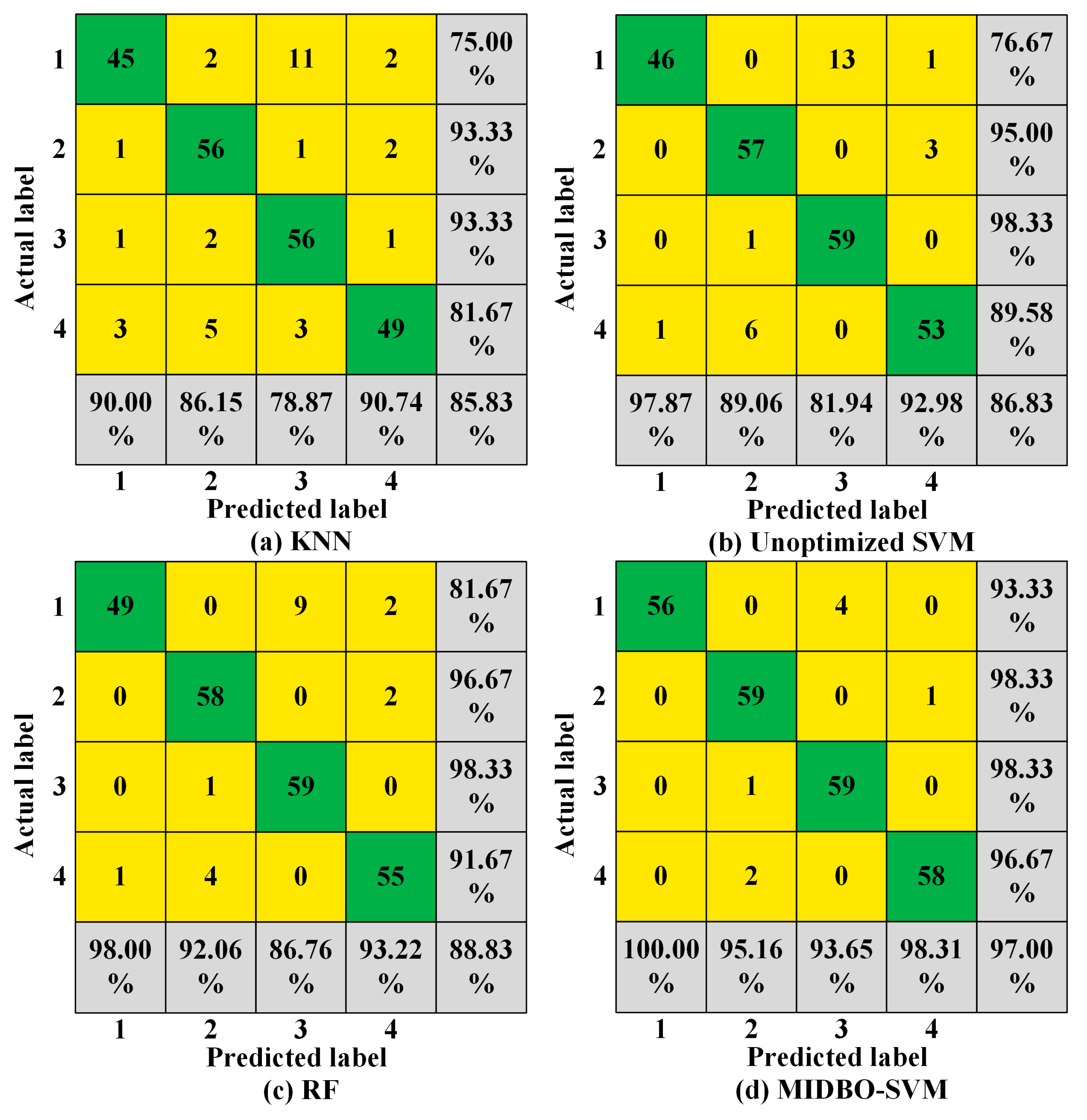
Confusion matrix analysis was conducted to evaluate misclassification behavior. The confusion matrices of the representative classifiers are reported in
Figure 9, where Class 1 corresponds to normal operation and Class 4 represents the loose base bolt fault, which exhibits feature characteristics partially overlapping with normal conditions. The confusion matrix results reveal that conventional classifiers, particularly the unoptimized SVM and RF, tend to misclassify normal operating samples as loose base bolt faults. This misclassification arises from overlapping vibration frequency features between healthy states and early-stage mechanical looseness, leading to blurred decision boundaries. Such false alarms are highly undesirable in real-world applications, as they may trigger unnecessary maintenance actions and reduce system reliability. In contrast, the proposed MIDBO-SVM significantly reduces the misclassification of normal samples, achieving the highest true positive rate for Class 1 while simultaneously maintaining high precision for fault categories. This improvement indicates that the MIDBO-optimized SVM constructs a more discriminative and compact decision boundary, effectively separating normal conditions from fault states with similar spectral characteristics. Overall, the confusion matrix analysis confirms that MIDBO-SVM not only enhances overall diagnostic accuracy but also substantially improves reliability by minimizing false fault alarms under normal operating conditions, which is essential for practical deployment in high-voltage circuit breaker condition monitoring systems.
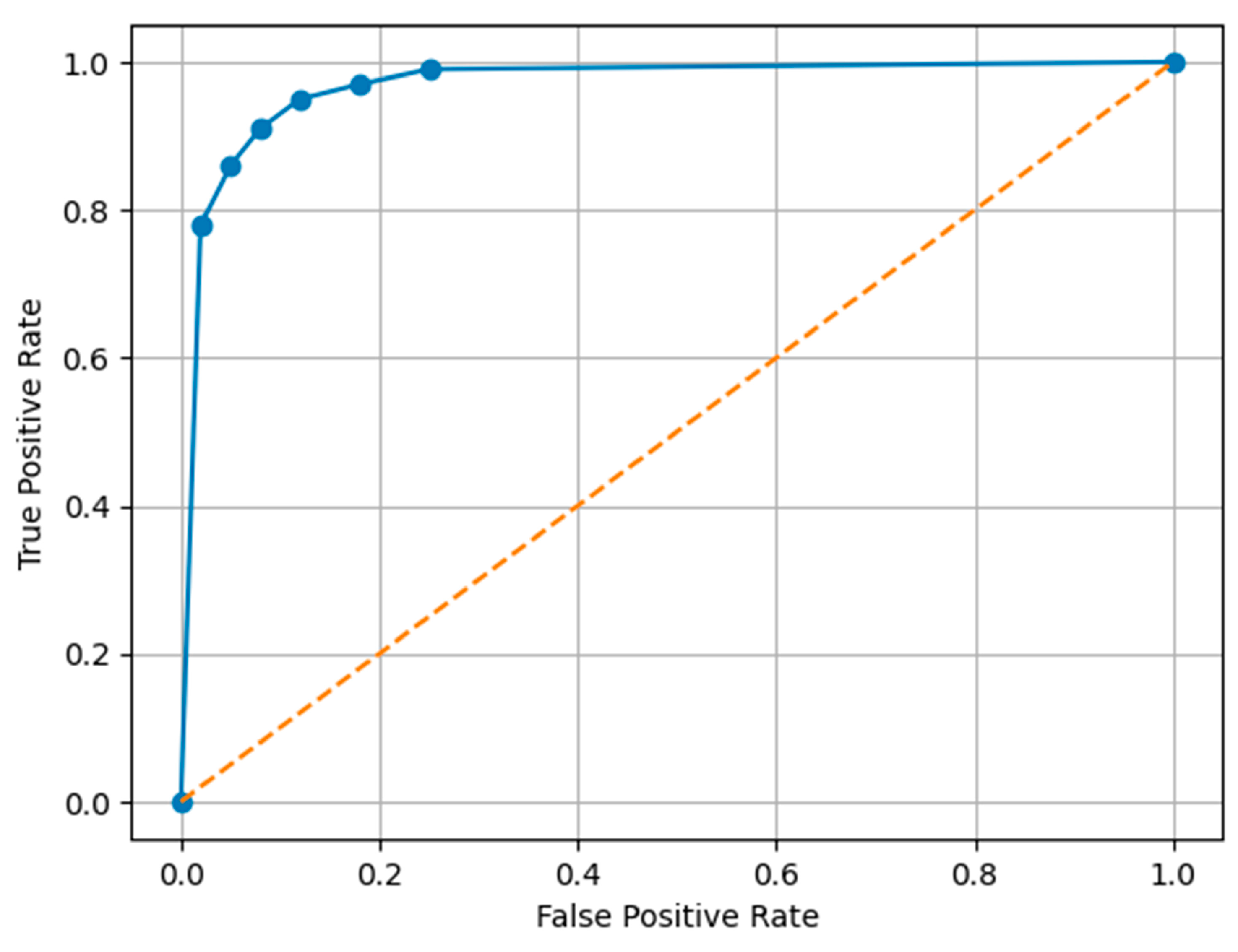
To complement the confusion matrix evaluation, receiver operating characteristic (ROC) curves were further analyzed to assess the discrimination capability of different classifiers from a threshold-independent perspective. For multi-class evaluation, a one-versus-rest strategy was adopted, and ROC curves were generated for each class. The corresponding area under the curve (AUC) values are summarized in
Table 8. The ROC analysis shows that MIDBO–SVM consistently achieves the highest AUC values across all classes, indicating superior separability between normal and fault conditions as well as among different fault categories. In particular, for Class 1 (normal condition) and Class 4 (loose base bolts), which exhibit partial feature overlap, MIDBO–SVM demonstrates noticeably improved discrimination compared with the other methods. The larger AUC values confirm that the proposed optimization strategy enhances the robustness of the decision boundary and reduces the likelihood of false alarms. For reproducibility and visualization purposes, representative ROC coordinate values for MIDBO–SVM (Class 1 vs. Rest) are provided in
Figure 10. Similar trends were observed for the remaining classes, with MIDBO–SVM consistently maintaining steeper ROC trajectories and larger enclosed areas. Overall, the ROC analysis further verifies that the proposed MIDBO–SVM framework achieves not only higher classification accuracy but also stronger threshold-independent discrimination capability, reinforcing its suitability for reliable condition monitoring applications.
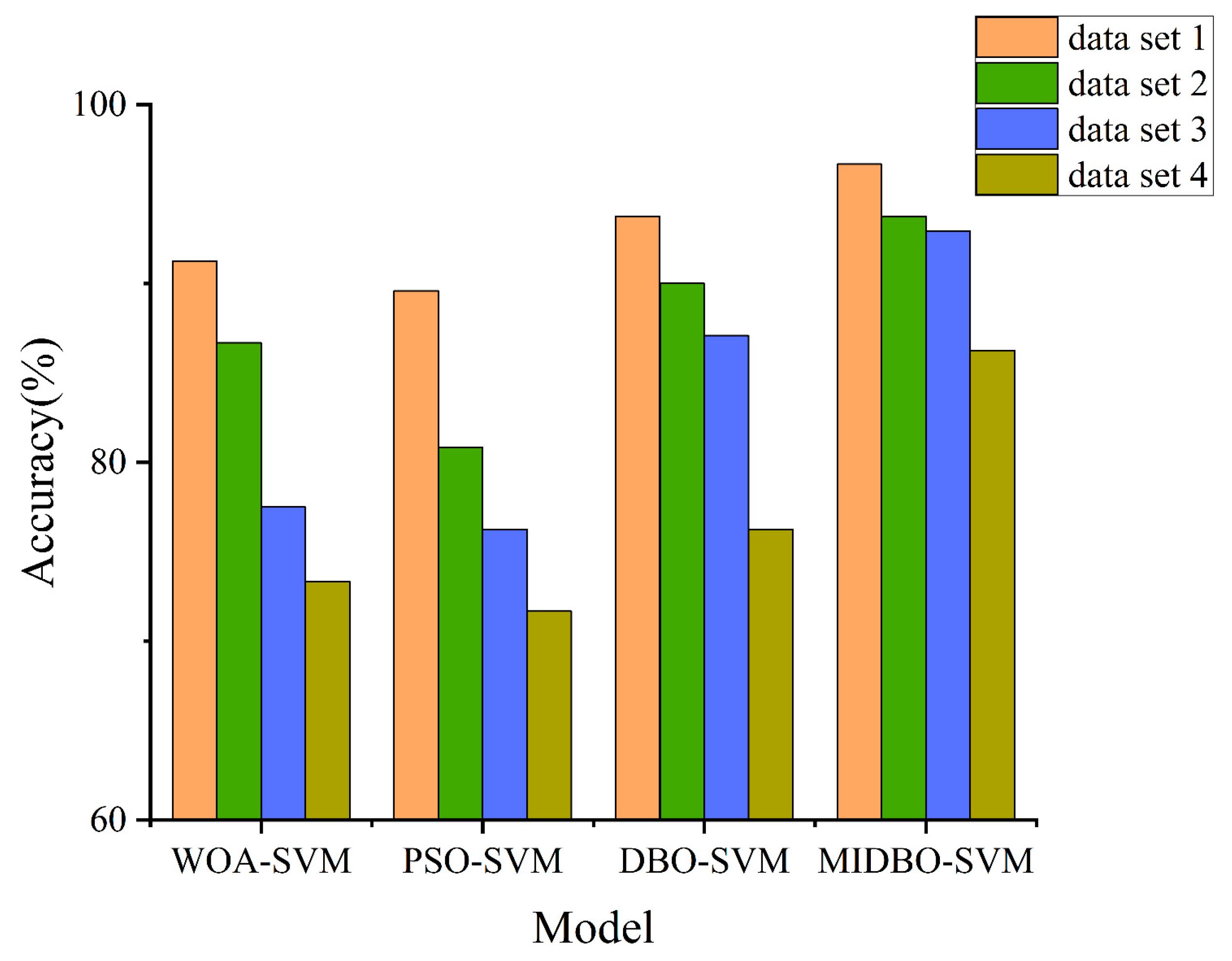
In practical applications, HVCBs operate predominantly under normal conditions, and fault samples are scarce. To simulate this realistic scenario, unbalanced datasets were constructed, as shown in
Table 9, by gradually reducing the sample sizes of Classes 1 and 4. The diagnostic results under unbalanced conditions are illustrated in
Figure 11. As the degree of imbalance increases, the diagnostic accuracy of all models decreases, with PSO-SVM and WOA-SVM exhibiting particularly severe performance degradation due to their susceptibility to local optima under limited data conditions. In contrast, MIDBO-SVM consistently maintains high diagnostic accuracy, remaining above 86.25% even under severely unbalanced sample distributions. This robustness demonstrates that the optimized hyperparameters obtained by MIDBO endow the SVM classifier with strong generalization ability, making it more suitable for practical fault diagnosis scenarios characterized by limited and imbalanced data.
From a computational perspective, the overall complexity of the proposed MIDBO-SVM framework is dominated by the optimization-based hyperparameter search and SVM training process. Let
denote the population size,
denote the number of iterations, and
denote the training cost of a single SVM model. The computational complexity of MIDBO-SVM can be approximated as
, which is comparable to that of PSO-SVM, WOA-SVM, and DBO-SVM. However, due to its faster convergence behavior, MIDBO requires significantly fewer effective iterations to reach optimal solutions. In practice, MIDBO-SVM converges within only three iterations, whereas the other methods require more than ten iterations to stabilize. Consequently, the actual time cost of MIDBO-SVM is lower despite similar theoretical complexity. Moreover, once the optimal hyperparameters are obtained, the online fault diagnosis stage involves only standard SVM inference, which incurs negligible computational overhead. Therefore, the proposed MIDBO-SVM achieves a favorable trade-off between diagnostic accuracy and computational efficiency, demonstrating strong potential for real-time condition monitoring and fault diagnosis of HVCBs.
Table 10 reports the average optimization runtime over 30 independent runs.
Although the theoretical complexity is similar across methods, MIDBO–SVM achieves substantially lower runtime due to faster convergence. Compared with DBO-SVM, the optimization time is reduced by approximately 65%. The reported runtime corresponds to the offline hyperparameter optimization stage. Once the optimal parameters are obtained, online diagnosis requires only feature extraction and SVM inference, with an average inference time of approximately 0.004 s per sample. Overall, the optimization completes within a few seconds, and the online stage satisfies near-real-time requirements, demonstrating the practical feasibility of the proposed MIDBO–SVM framework.
Despite the encouraging diagnostic performance, several limitations should be acknowledged. First, the experiments were conducted using vibration data collected from a specific type of high-voltage circuit breaker under controlled laboratory conditions. Although the proposed MIDBO–SVM framework demonstrated robustness across different feature representations and sample imbalance scenarios, its performance in diverse field environments with varying equipment structures, installation conditions, and noise characteristics requires further validation using large-scale industrial datasets. Second, the feature extraction process in this study relies primarily on frequency-domain representations obtained via FFT, which may not fully capture complex time–frequency characteristics associated with certain fault types. Incorporating multi-domain or adaptive feature learning methods could further improve diagnostic capability. Finally, the metaheuristic optimization procedure is performed offline, and its effectiveness depends on the availability of representative labeled samples. Future work will focus on validating the proposed method using field-acquired datasets from different circuit breaker types and exploring adaptive or online optimization strategies to enhance practical deployment flexibility.