1. Introduction
Heavy metal contamination of aquatic environments remains a persistent global problem due to the high toxicity, non-biodegradability, and long environmental residence times of many metal species [
1,
2]. Elements such as chromium readily dissolve in water, accumulate in sediments and biota, and propagate through food chains, posing significant risks to ecosystems and human health. These ions are classified as carcinogenic or potentially carcinogenic, with toxicity strongly dependent on oxidation state and chemical form [
3,
4,
5]. In semi-enclosed marine systems, such as the Baltic Sea, these risks are exacerbated by limited water exchange, strong anthropogenic pressure, and prolonged pollutant retention [
6].
Maritime activity represents an important but often underestimated source of heavy metal input into coastal waters [
7]. Modern shipping relies on large volumes of ballast water to ensure vessel stability and maneuverability, with global annual ballast water transport estimated at 10–12 billion tons [
8]. Although ballast water management systems are designed primarily to prevent biological invasions, they do not explicitly address dissolved heavy metal contamination. Corrosion of ship tanks, pipelines, and filtration screens—typically fabricated from chromium- and nickel-containing stainless steels—can release metal ions directly into ballast water, which may then be discharged into port environments. In heavily trafficked regions such as the Baltic Sea, where shipping intensity continues to increase, ballast water therefore represents a potential pathway for sustained heavy metal loading.
One promising approach to mitigate this problem is the development of filtration materials capable of removing dissolved heavy metal ions through electrostatic and surface-mediated interactions [
9]. Because dissolved metal species are charged, their retention during percolation through granular beds is strongly influenced by surface electrical potential, defect structure, and near-surface electronic properties of the filtration medium. In aqueous environments, charged solid surfaces form an electric double layer that can promote electrostatic retention of oppositely charged species; in packed beds this manifests as a net decrease in dissolved concentration after percolation rather than equilibrium adsorption capacity. The strength and stability of this interaction depend on both the ionic species and the electronic structure of the solid surface, particularly the availability of localized electronic states and surface polarization.
Quartz sand is an attractive material for such applications due to its abundance, low cost, environmental compatibility, and mechanical stability. In addition, sand-based media are operationally attractive for maritime settings because the material is naturally abundant in coastal regions and can be used in simple packed-bed formats without introducing novel synthetic sorbents into the marine environment. Silica (SiO
2) is a wide-bandgap insulating material with a bandgap of approximately 8–9 eV and a moderate dielectric constant, allowing charge screening over micrometer-scale depths [
10]. The surface and near-surface regions of quartz can host a variety of electronic trap states arising from oxygen vacancies, non-bridging oxygen configurations, impurity centers, and structural disorder [
11,
12]. These defects play a central role in charge trapping, surface polarization, and electron–ion exchange processes at the solid–liquid interface. However, the electronic properties of natural sands are highly sensitive to their geological origin and environmental history, and untreated sands often exhibit limited and poorly controlled ion-removal performance under percolation. Although quartz sand has a relatively low specific surface area compared with engineered sorbents, it remains attractive for ballast-water treatment as a mechanically robust, low-cost, environmentally benign granular medium compatible with packed-bed operation. In such systems, performance is governed not only by surface area but also by interfacial electrostatic interactions, surface defect chemistry, bed depth, and residence time during percolation. The goal of this work is therefore not to position quartz sand as a high-capacity filtration medium, but to test whether physical (electron-beam) tuning of native SiO
2 surface states can produce measurable improvements in single-pass percolation removal without chemical reagents or secondary waste.
Physical surface modification offers a route to enhance the electronic functionality of sand without introducing chemical reagents or generating secondary waste streams. In particular, MeV-range electron irradiation is known to generate electrically active defects and trapped charge in SiO
2 and related oxide systems, including oxygen-related centers and interface states that modify surface potential and electronic emission behavior [
13,
14]. Electron-beam irradiation can generate oxygen vacancies, alter Si–O bonding environments, and promote surface reconstruction. When irradiation is performed in ambient atmosphere, these processes are often accompanied by re-oxidation and the formation of oxygen-rich surface configurations, potentially increasing surface polarity and percolation retention of oxyanions. Although radiation effects in model SiO
2 (glasses, wafers, and synthetic powders) are widely reported, much less is known about how irradiation modifies natural quartz-rich sands with site-dependent impurity/defect populations, and whether those electronic changes translate into measurable improvements in packed-bed percolation removal.
This study aims to investigate the effect of electron-beam irradiation on the surface electronic and chemical properties of quartz sands collected from four coastal locations along the Latvian Baltic Sea coast. The study links irradiation-induced electronic signatures to single-pass percolation performance across multiple natural sand provenances, which has been scarcely reported for ballast-water-relevant granular media. This work systematically examines how irradiation dose influences electron work function, photoemission behavior, and surface chemical states, and how these changes translate into the removal efficiency of chromium ions from aqueous solutions. In the present work, chromium was introduced as K2CrO4 in deionized water, and filtration performance is therefore discussed in terms of Cr(VI) chromate/dichromate species. By correlating electronic structure modification with filtration performance, this work aims to clarify the mechanisms governing radiation-enhanced chromate removal and to assess whether physical tuning of natural sands can produce measurable improvements in single-pass chromate removal relevant to ballast-water-representative granular filtration, motivating follow-up studies under realistic multi-pass and long-term operating conditions.
2. Materials and Methods
2.1. Sand Sampling and Preparation
Quartz-rich sand was selected as a baseline granular filtration medium because it is abundant, mechanically robust, and environmentally compatible for packed-bed filtration in maritime contexts. The objective of this work is not to maximize adsorption capacity via high surface area, but to test whether electron-beam irradiation can tune native SiO2 near-surface electronic/defect states and thereby measurably affect single-pass percolation retention. Accordingly, the study emphasizes correlating PEES/XPS signatures with percolation removal, rather than measuring adsorption isotherms or capacity metrics.
Quartz-rich sand samples were collected from four coastal locations along the Latvian Baltic Sea coast: Riga (central Gulf of Riga), Salacgriva (northern Gulf of Riga), Ventspils (north-western open Baltic Sea), and Liepaja (south-western open Baltic Sea). These sites were selected to represent distinct hydrodynamic and depositional environments within the Baltic Sea region.
Sampling was performed within the active swash zone at each location. A surface area of approximately 1 m2 was delineated at ~1 m from the waterline, and material was collected to a depth of approximately 30 cm. Two replicate samples were taken at each site, separated by ~5 m, to account for local variability. Immediately after collection, samples were sealed in plastic containers to minimize contamination during transport.
In the laboratory, all samples underwent identical preparation protocols to ensure comparability. The sand was dry sieved through a calibrated 0.8 mm stainless steel mesh to remove coarse fragments and loose fines. Detailed granulometry and specific surface area are not reported in the current study and are treated as a limitation. The retained fraction was dried at 105 °C for 24 h in a laboratory oven SNOL 58/350 (SNOL Therm, Utena, Lithuania) to minimize moisture-related variability. After cooling to ambient temperature, the samples were stored in sealed glass containers (laboratory grade, no specific manufacturer) under laboratory ambient conditions until further processing. To focus on irradiation effects, all comparisons are presented dose-wise within each sand relative to its own 0 Gy baseline under identical bed mass and percolation geometry.
The same batch of prepared sand was used for all subsequent irradiation, characterization, and filtration experiments.
2.2. Electron-Beam Irradiation of Sand Samples
Electron-beam irradiation was applied to modify the surface and near-surface electronic properties of the sand samples. Irradiation was performed using a high-energy electron linear accelerator TrueBeam (Varian Medical Systems, Palo Alto, CA, USA) operating at an electron energy of 6 MeV. An electron energy of 6 MeV was selected to ensure high penetration and relatively uniform energy deposition across the ≤0.8 mm sieved fraction in a single-layer geometry, while the 0–100 Gy dose range provides detectable defect-related electronic changes without macroscopic heating or visible grain damage and allows non-monotonic dose response to be resolved. No visual grain fragmentation, discoloration, or mass loss was observed after irradiation, indicating that dose-dependent trends are unlikely to originate from macroscopic physical surface changes.
For each sampling location, sand samples were irradiated at absorbed doses of 20, 40, 60, 80, and 100 Gy, while non-irradiated samples (0 Gy) were used as references. Twenty Gy increments were used to map dose response and capture potential non-monotonic behavior. During irradiation, sand was distributed in a thin, single-particle layer to ensure uniform exposure across the material volume. At this electron energy, the penetration depth is large compared with the characteristic grain dimensions used here, so surface–core dose gradients are expected to be smaller than for lower-energy irradiation, although micro-scale heterogeneity in energy deposition cannot be fully excluded. All irradiations were performed under ambient atmospheric conditions at room temperature.
Following irradiation, samples were stored in sealed containers and allowed to equilibrate under laboratory ambient conditions prior to characterization and filtration experiments. No additional chemical or thermal treatment was applied after irradiation.
2.3. Photoelectron Emission Spectroscopy (PEES)
Photoelectron emission spectroscopy (PEES) was employed to evaluate changes in surface electronic properties induced by electron-beam irradiation, including electron work function and near-edge electronic contributions.
Measurements were performed using a custom-built PEES system developed at Riga Technical University. The system operated under a vacuum of approximately 10−5 mmHg to minimize electron scattering. UV excitation was provided by a 30 W deuterium lamp (Hamamatsu Photonics K.K., Hamamatsu City, Shizuoka, Japan), and photon energies in the range of 4.2–6.2 eV were selected using an MDR-2 monochromator. Emitted photoelectrons were collected under an acceleration voltage of approximately 3000 V and detected using a secondary electron multiplier.
The photocurrent was recorded as a function of photon energy and corrected for wavelength-dependent photon flux. For each irradiation dose and sampling location, measurements were performed on 5 independent subsamples.
Electron work function (EWF) values were extracted from the near-threshold region of the PEES spectra. To enhance the visibility of weak electronic features, spectra were smoothed using a 7-point moving average filter and numerically differentiated (dI/dE).
2.4. X-Ray Photoelectron Spectroscopy (XPS)
The elemental composition of the collected sand was characterized using X-ray photoelectron emission spectroscopy (XPS). The measurements were performed with a Thermo Fisher Scientific (Waltham, MA, USA) ESCALAB Xi+ spectrometer. The base pressure in the analytical chamber was less than 2 × 10⁻⁷ Pa. No sputtering/etching was performed. The raster size was 1 × 1 mm. This study focuses on surface-sensitive composition: under identical XPS conditions all samples show Si–O dominated spectra, consistent with quartz-rich sand, and the discussion therefore emphasizes relative dose-dependent trends rather than full mineralogical phase quantification. Survey spectra were used to estimate surface atomic concentrations; O 1s and Si 2p were quantified for all locations, while remaining signal was dominated by adventitious carbon with minor trace elements. No XRD-based phase identification or quantitative mineralogical analysis was performed in the present study. Accordingly, peak-apex positions are reported and their dose-dependent shifts acquired under identical settings, rather than multi-component fitting, to maintain a conservative interpretation for insulating, naturally heterogeneous grains. Peak fitting on insulating, heterogeneous grains is strongly model-dependent due to differential charging and variable adventitious carbon coverage; therefore peak-apex shifts acquired under identical conditions are reported only as a robust comparative metric. Component-resolved O 1s/Si 2p analysis (with charge referencing strategy and replicated fits) is not in the scope of current work.
2.5. Filtration
The filtration performance of irradiated and non-irradiated sand samples was evaluated using two solutions—Deionized water (reference), and Chromium-containing solution prepared from K2CrO4 (predominantly containing Cr(VI) chromate species) at a concentration of 0.125 mg/L.
All filtration tests were performed under identical gravity-driven conditions with the same sand mass and solution volume, using custom-made filtration units. For each experiment, 7.85 g of sand was placed in a filtration unit, and 10 mL solution was passed through the sand-filled 20 mL syringes. All experiments were conducted at room temperature. Filtrates were collected immediately after filtration and analyzed without further treatment. The pH of the K2CrO4 feed solution was 6.80 ± 0.03 (measured at room temperature), and no pH adjustment was performed. Each experiment was repeated 6 times to ensure reproducibility.
Throughout the manuscript, “removal” refers to the net decrease in dissolved Cr(VI) after gravity-driven percolation through the sand bed; adsorption capacity and isotherms were not measured.
2.6. UV–Vis Spectrophotometric Analysis
The concentration of Cr(VI) species in the filtrates was quantified using the UV–Vis spectrophotometer Helios Gamma (Thermo Fisher Scientific, Cambridge, UK) in the wavelength range of 310–800 nm, specifically, the absorbance at ~373 nm as characteristic for Cr(VI) and the most prominent and reproducible feature. Accordingly, the filtration results are reported as changes in dissolved Cr(VI) concentration after percolation, and total chromium mass balance/speciation was not quantified in this work. No additional UV-VIS bands attributable to Chromium were identified.
Calibration curves were constructed using standard solutions of known concentrations prepared from the same salts used in filtration experiments. Changes in absorbance before and after filtration were used to assess the removal efficiency of heavy metal ions. All UV–Vis spectra were baseline-corrected using deionized water as the reference and were performed in quartz cuvettes with an optical path length of 1 cm.
2.7. Computational Methods
To support interpretation of irradiation-driven changes in filtration performance, a simplified computational/phenomenological model was used to estimate the order of magnitude of radiation-induced defect generation in SiO2 sand grains. The approach treats sand particles as predominantly quartz-rich SiO2 with approximate spherical geometry and assumes homogeneous energy deposition at the particle scale under 6 MeV electron irradiation.
The absorbed energy per particle was estimated from the particle volume, SiO2 mass density, and the delivered dose (Gy, J kg−1). Defect formation was considered in terms of dominant point-defect families reported for irradiated silica, including oxygen vacancies (E′ centers) and oxygen-related hole centers (non-bridging oxygen hole centers, NBOHC). Because the feed contains Cr(VI) oxyanions, the model focuses on irradiation-induced oxygen-related defect populations (including NBOHC-type sites) as a proxy for changes in surface reactivity and interfacial interactions that can affect anion retention.
The number of irradiation-induced defects was estimated by balancing absorbed energy with an effective defect formation energy, yielding an approximate relationship between dose and defect concentration. In addition, the track-density concept was used to obtain a qualitative estimate of whether defect tracks overlap at the studied doses and grain sizes.
3. Results
3.1. Photoelectron Emission Measurements
3.1.1. Electron Work Function as a Function of Dose
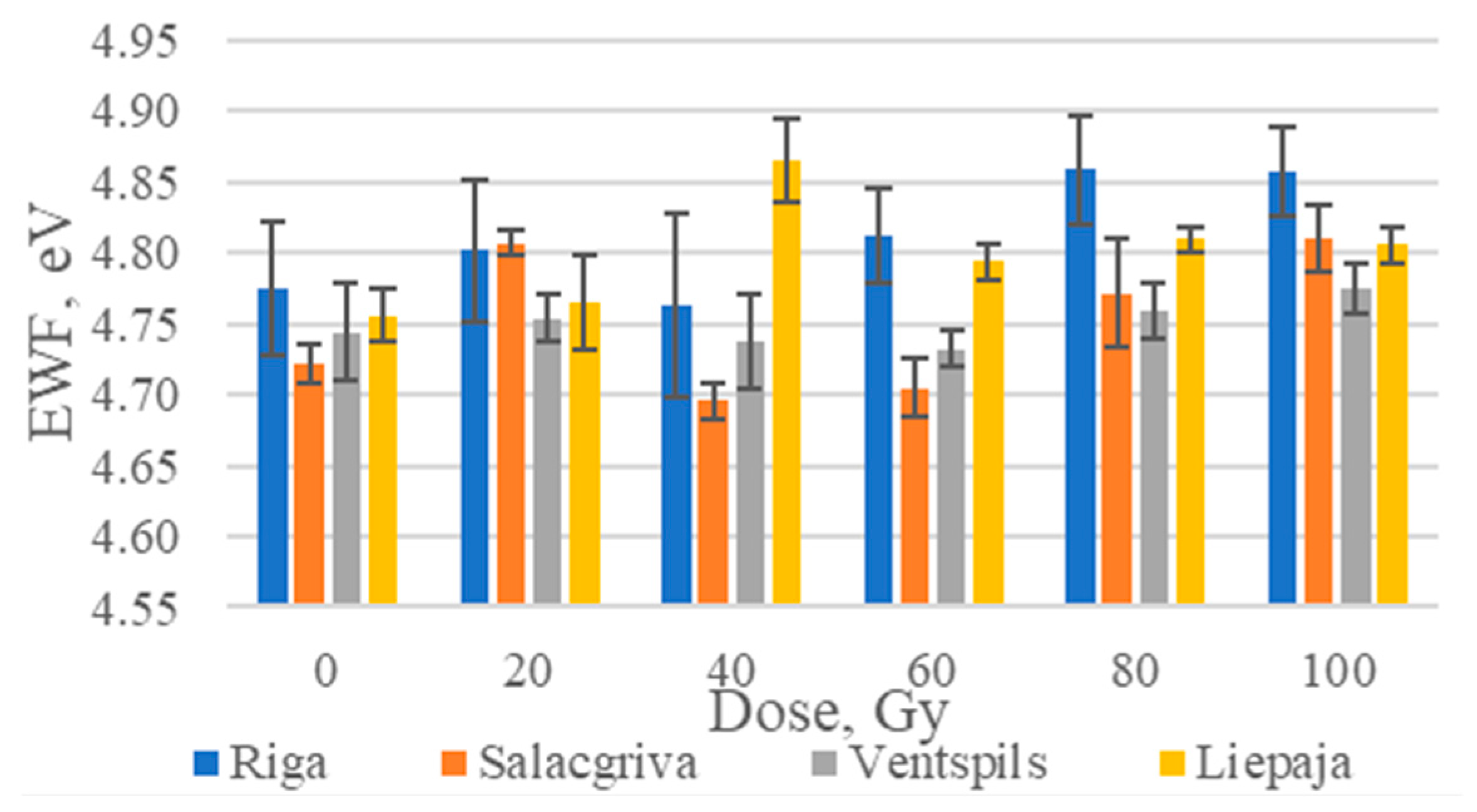
Near-threshold photoelectron emission spectroscopy (PEES) was employed to evaluate the effect of electron-beam irradiation on the electron work function (EWF) of quartz-rich sands from the four coastal locations. Mean EWF values and corresponding standard deviations as a function of irradiation dose are summarized in
Table 1 and graphically in
Figure 1.
Across all investigated samples and irradiation doses, the measured EWF values fall within a relatively narrow range of approximately 4.7–4.9 eV, consistent with the expected surface electronic properties of quartz-dominated silica materials. Nevertheless, systematic and site-dependent trends are observed upon irradiation.
Sands from Riga and Ventspils exhibit comparatively weak EWF variations with increasing dose. In both cases, changes are gradual and largely monotonic, remaining within or close to the experimental uncertainty over the full dose range from 0 to 100 Gy. This behavior suggests a limited sensitivity of the surface electron emission barrier to electron irradiation for these materials.
In contrast, Salacgriva sand shows a more pronounced dose dependence. While the initial EWF at 0 Gy is the lowest among all locations, a decrease is observed at intermediate doses (40–60 Gy), followed by a clear increase at higher irradiation doses, reaching values comparable to the other sites at 100 Gy. This trend may indicate irradiation-induced modification of the surface electronic environment, although without abrupt transitions.
The most distinctive response is observed for Liepaja sand. While its initial EWF is comparable to Riga and Ventspils, a pronounced increase occurs at an irradiation dose of 40 Gy, where the EWF reaches the highest value measured among all samples and is statistically significant (Welch’s
t-test,
p < 0.001). The increase at 40 Gy is larger than the within-condition variability (
Table 1), indicating a reproducible deviation relative to the other doses for this location. At higher doses, the EWF decreases slightly and stabilizes at an elevated level relative to the non-irradiated state. This non-monotonic behavior, featuring a sharp deviation at intermediate dose, clearly distinguishes Liepaja from the other sampling locations.
3.1.2. Differentiated PEES Spectra
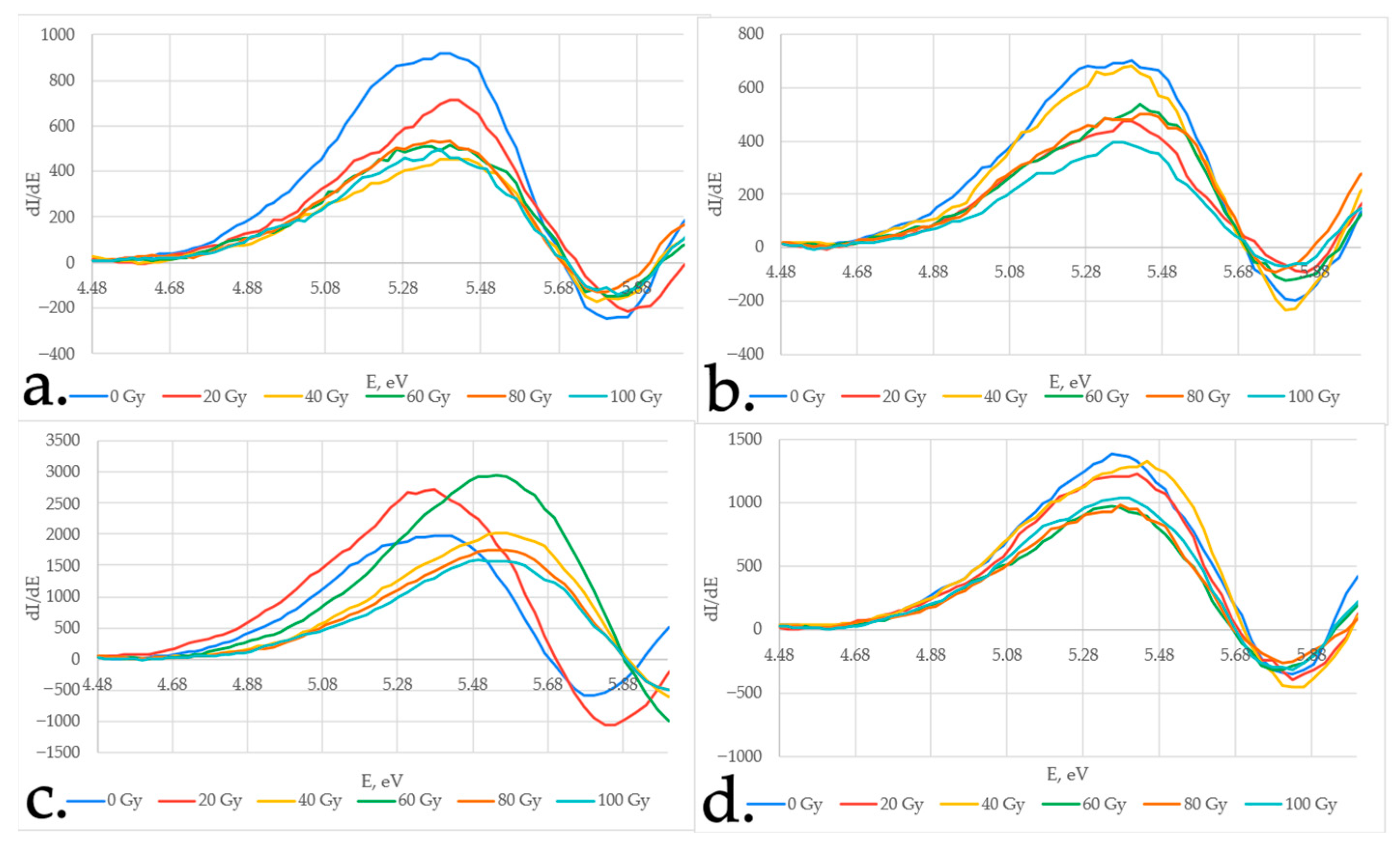
PEES spectra were numerically differentiated with respect to photon energy. The resulting first-derivative spectra enhance weak inflection points associated with near-edge electronic contributions and defect-related states. All differentiated PEES spectra were processed using identical smoothing, differentiation, and integration limits to allow direct comparison of integrated intensities. Representative differentiated spectra for each sampling location at different irradiation doses are presented in
Figure 2.
For all four sampling locations, the differentiated spectra of the non-irradiated and low-dose samples (0–20 Gy) are characterized by a dominant feature centered at approximately 5.4 eV, corresponding to the onset of photoemission from near-edge electronic states typical of quartz-rich silica. For Riga, Salacgriva, and Ventspils, this peak position remains essentially unchanged across the entire investigated dose range, indicating that electron irradiation does not significantly alter the energetic position of the dominant near-edge electronic transitions in these materials. In contrast, Liepaja sand exhibits a distinct evolution of the differentiated spectra with increasing irradiation dose. While the dominant feature remains centered near 5.4 eV at low doses, a clear shift toward higher photon energies (approximately 5.6 eV) is observed at irradiation doses of 40 Gy and above. This shift indicates a modification of the near-edge electronic structure and suggests irradiation-induced reorganization of surface or subsurface electronic states specific to this material.
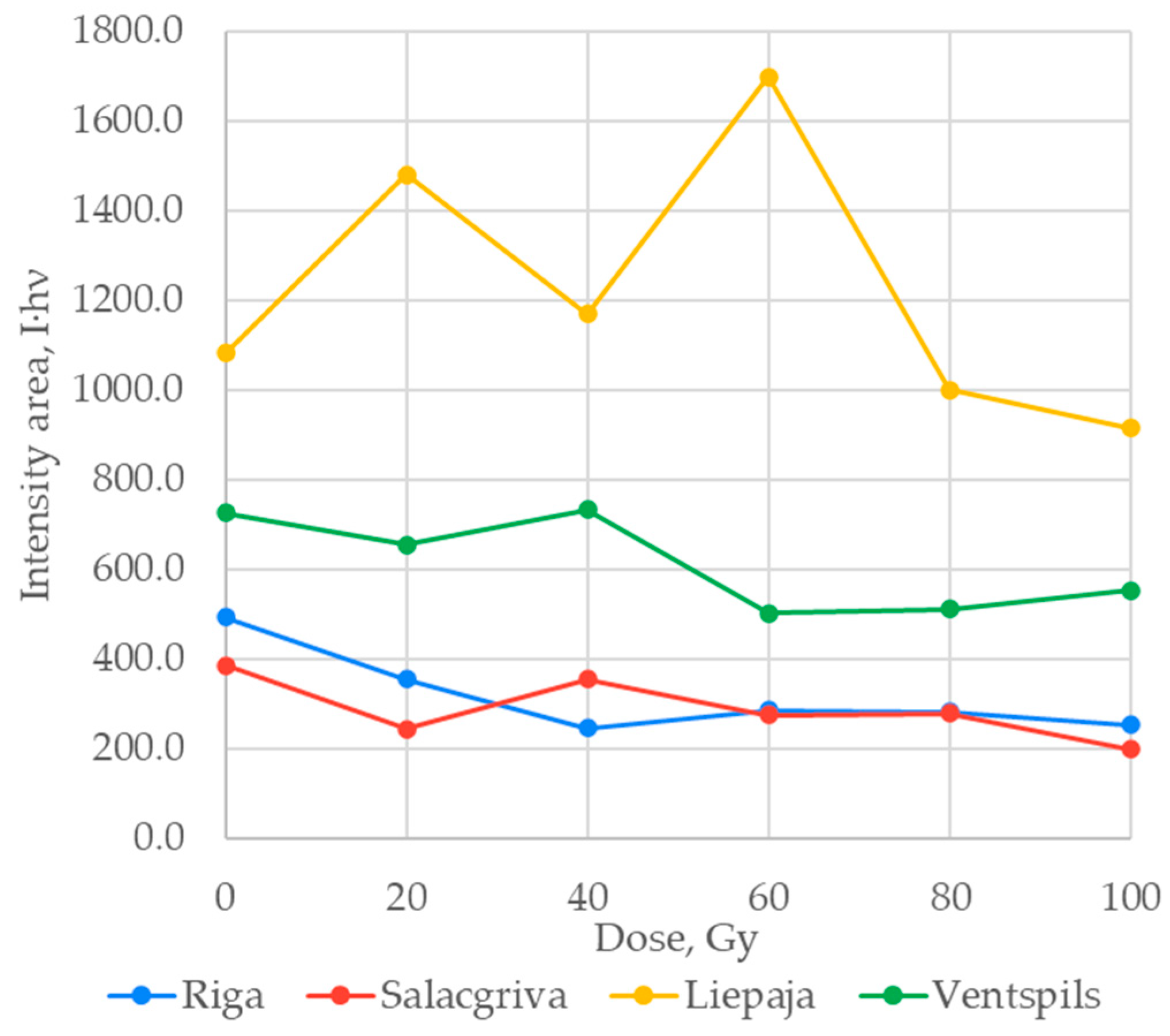
Quantitative analysis of the differentiated spectra further reveals substantial differences in the integrated photoemission intensities. Areas under the differentiated spectra were calculated and are presented in
Table 2 and graphically in
Figure 3.
For all irradiation doses, Liepaja sand exhibits the largest integrated area under the differentiated spectra, exceeding those of Riga, Salacgriva, and Ventspils by a significant margin. This observation may indicate a consistently stronger near-threshold photoemission response under the present measurement conditions in Liepaja sand. Moreover, the integrated intensity for Liepaja shows a pronounced, non-monotonic dependence on irradiation dose, with strong enhancement at intermediate doses and a gradual decrease at higher doses. In contrast, the integrated intensities for Riga, Salacgriva, and Ventspils are lower and display either weak dose dependence or a general decreasing trend with irradiation. These results indicate that, while electron irradiation affects all samples to some extent, its impact on the near-threshold photoemission response and its dose-dependent evolution is markedly stronger for Liepaja sand. The integrated differentiated PEES area is used here only as a comparative indicator derived from the location–dose averaged differentiated spectra under identical acquisition, normalization, and processing conditions. Because the integration was performed on averaged spectra rather than replicate-wise integrations, no error bars are shown for these areas. The values may be influenced by background subtraction, photon-flux correction, and surface morphology/roughness, and are therefore not interpreted as an absolute density of states.
3.2. X-Ray Photoelectron Spectroscopy
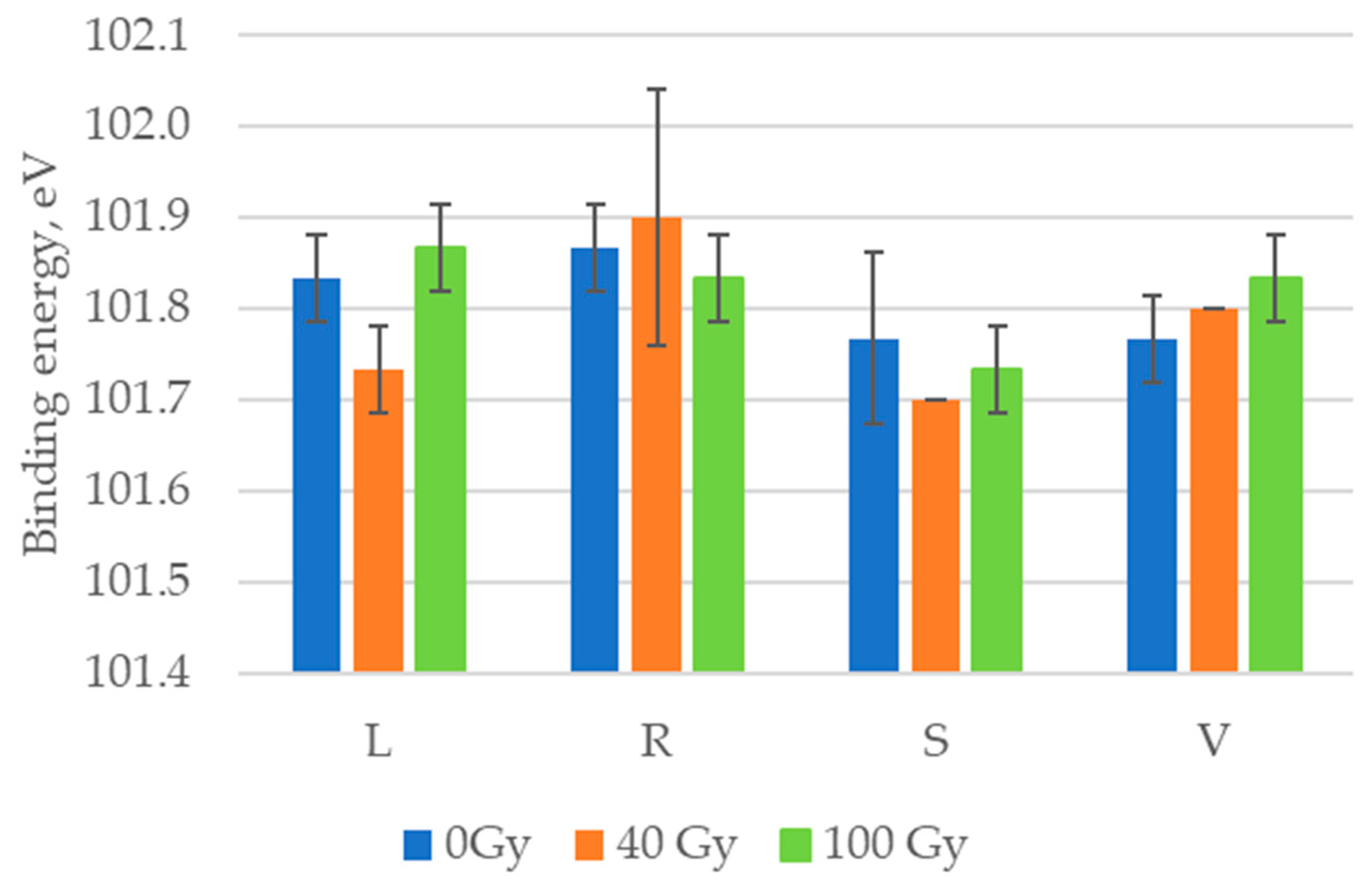
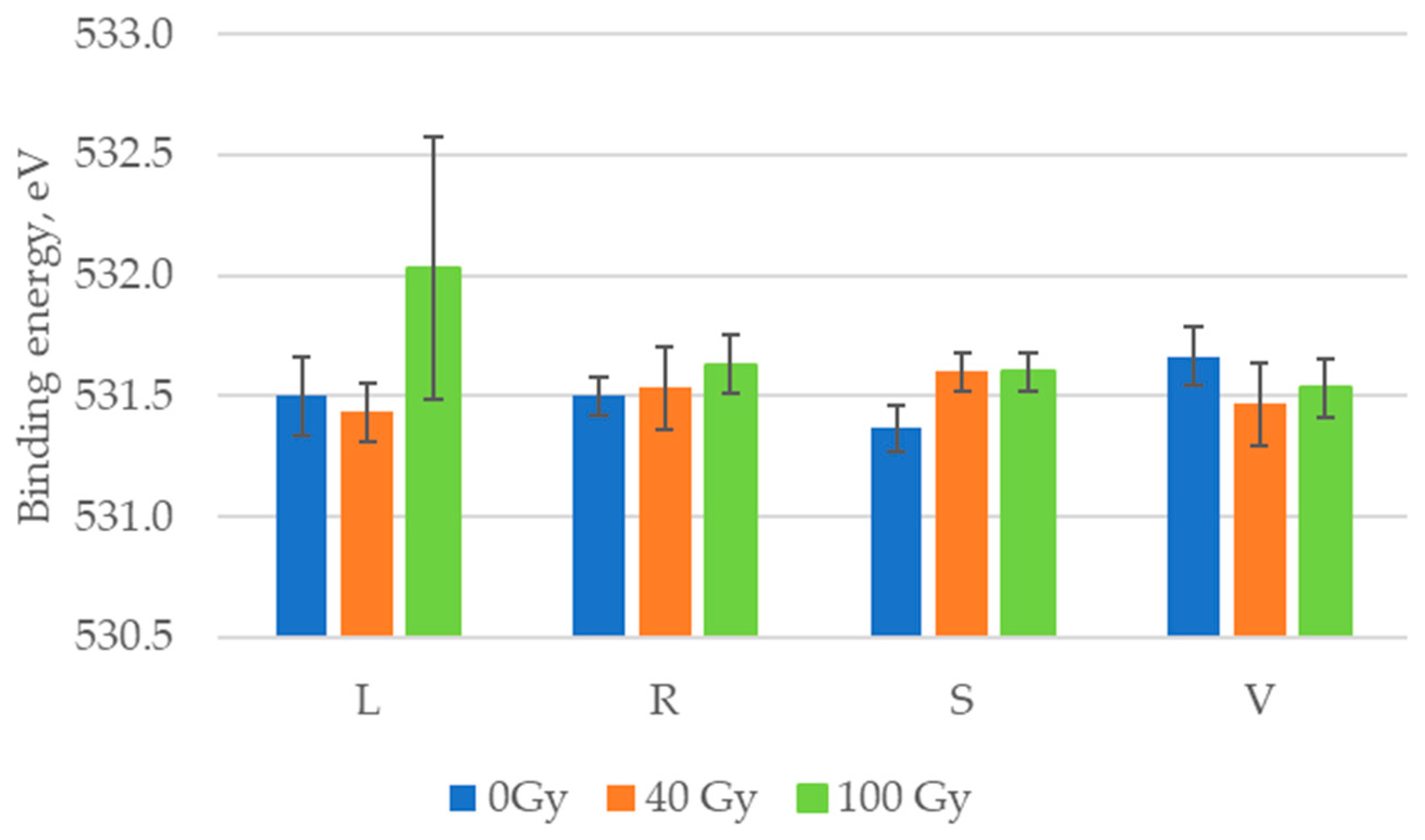
XPS was used to evaluate irradiation-associated changes in the near-surface chemical environment of the quartz-rich sands. Survey XPS indicated that all sands were Si–O dominated with a substantial adventitious carbon contribution. The surface atomic concentrations (at%) of O 1s and Si 2p were: Liepaja 58.74 ± 0.78 (O) and 22.99 ± 0.47 (Si); Riga 57.70 ± 1.31 (O) and 21.87 ± 0.29 (Si); Salacgriva 52.95 ± 0.50 (O) and 22.99 ± 0.29 (Si); Ventspils 55.15 ± 0.99 (O) and 22.15 ± 0.06 (Si). The remaining ~20 at% was dominated by adventitious carbon, with traces of N, Ca, Mn, K, Fe, Cl, and Na. Because the samples are insulating and were analyzed without sputtering, the discussion below focuses primarily on relative dose-dependent trends in Si 2p and O 1s peak positions measured under identical conditions. Bar charts with mean values of binding energies at doses of 0, 40 and 100 Gy are shown on
Figure 4 for Si 2p and
Figure 5 for O 1s.
Overall, the Si 2p binding energies for Riga, Salacgriva, and Ventspils remain within a narrow interval (~101.7–101.9 eV) across the investigated dose conditions, with overlapping dispersions between 0, 40, and 100 Gy. Similarly, the O 1s peak-apex energies for these three sites remain largely stable (approximately 531.4–531.7 eV), again showing substantial overlap across irradiation doses. Within the resolution of the present peak-apex analysis, these results indicate that electron irradiation up to 100 Gy does not produce strong, systematic shifts in the dominant Si–O chemical environment for these sands. In contrast, Liepaja sand exhibits the clearest irradiation-dependent changes. For Si 2p, Liepaja shows a reproducible decrease in the mean binding energy at 40 Gy (from ~101.83 eV at 0 Gy to ~101.73 eV at 40 Gy), followed by recovery toward the initial value at 100 Gy (~101.87 eV). Such a transient negative shift is consistent with a temporary modification of the silicon local electronic environment at the surface (e.g., altered bonding configuration or defect-related electronic redistribution) at intermediate dose, followed by partial reversal or further restructuring at higher dose.
For O 1s, Liepaja shows comparatively stable values at 0 and 40 Gy (~531.5 eV and ~531.4 eV, respectively), but a clear increase in the mean binding energy at 100 Gy (mean ~532.0 eV, with increased dispersion). An upward shift and broadening of O 1s is commonly associated with a larger contribution from non-equivalent oxygen environments at the surface (i.e., a broader distribution of oxygen bonding states). While definitive peak-component assignment is beyond the scope of the present simplified peak-apex approach, the observed O 1s behavior suggests that high-dose irradiation induces a more heterogeneous oxygen-related surface chemistry for Liepaja sand compared to the other locations.
3.3. Modeling Estimates of Defect Track Density
To support interpretation of irradiation-driven changes in filtration performance, semi-empirical modeling was used to estimate the order of magnitude of defect generation in irradiated SiO
2 sand grains. The absorbed dose of ionizing radiation in these experiments varied in the range between 0 and 100 Gy, and the filtration process was performed after a post-irradiation time interval (up to several hours) which allows some part of radiation-induced defects to relax and modify. Sand particles consist mainly of silicon dioxide (crystalline or amorphous SiO
2), and the particles have round shapes. Assuming that all particles are homogeneously irradiated (as electrons with energy of 6 MeV should go through more than one particle of the sand sample before they completely lose their kinetic energy), the energy absorbed by one particle of radius r is
where
DOSE is the dose of ionized radiation in Gy, and
is the mass density of SiO
2 (2500 kg/m
3 for crystalline quartz).
A fraction of the absorbed energy is assumed to contribute to the formation of point defects in SiO
2, mainly oxygen vacancies (E’ centers) and non-bridging oxygen hole centers (NBOHCs), which alter optical and electrical properties, causing absorption bands, luminescence (blue, UV, red), and interface traps (Pb centers) at Si/SiO
2 interfaces. E’ centers are usually formed as Frenkel pairs where an oxygen atom leaves its normal lattice site, creating an oxygen vacancy and moving to an interstitial position, forming an interstitial oxygen. NBOHC in SiO
2 is a crucial radiation-induced point defect, essentially an oxygen atom with an unpaired electron (≡Si–O•), forming a dangling bond that significantly affects silica’s optical properties, causing red luminescence and UV absorption, important for fiber optics and laser damage resistance. These defects form when Si–O bonds break, e.g., when strained Si–O–Si bonds are cleaved. Therefore,
where
EFr and
ENBOHC are the formation energies for Frenkel pairs and NBOHC defects, while
NFr and
NNBOHC are the numbers of the same defects formed in a single particle by irradiation.
The formation energy for a Frenkel pair in silica varies significantly by defect type (e.g., oxygen or silicon vacancy), charge state, and oxide structure (amorphous vs. crystalline), but generally falls in the range of several electron volts, often cited around 4–8 eV for oxygen Frenkel pairs, with specific oxygen vacancy-interstitial pairs having formation energies around 4–5 eV or higher, depending on binding and charge, while electron injection can create them at lower energy, e.g., around 2–3 eV for oxygen interstitials. The formation energy of a non-bridging oxygen hole center is not a single fixed value, as it depends heavily on the specific formation mechanism, the local atomic environment (amorphous vs. crystalline, wet vs. dry silica), and the presence of other defects. Computational and experimental studies have reported values in a range. First-principles calculations suggest that the energy required for NBOHC formation from a strained precursor defect site (after initial bond breaking) can range from approximately 1.11 eV to 4.54 eV, depending on the specific interatomic distances of the surrounding network.
It would be natural to assume that Cr(VI) oxyanions may interact preferentially with specific oxygen-terminated or hydroxylated surface motifs rather than with oxygen vacancies alone during the filtration process. To estimate the number of the radiation induced defects, we suggest that most of defects are the NBOHC centers and ignore the E’ centers. In this case, the number of created NBOHC centers may be calculated using Formula (3).
These defects should be positioned along the tracks, i.e., the paths of concentrated damage caused by a single high-energy electron as it passes through the material, creating a localized trail of defects and trapped charge along its trajectory. The extent and nature of this damage depend heavily on the type and energy of the radiation. The number of defects along the track should be proportional to the ratio between the linear size of the particle (in this case, to its radius,
r) and a characteristic interatomic distance (e.g., the average Si–Si distance,
, which is about 3.2 Å in quartz. Therefore, the number of tracks coming across the particle is proportional to
i.e., is proportional to the cross section of the particle which is expected.
For a sand particle of r = 1 mm, DOSE = 100 Gy = 100 J/kg, and ENBOHC = 4 eV this gives Ntracks ~ 5∙108, and the average distance between tracks is about 0.2 µm = 2000 Å, suggesting limited track overlap at the order-of-magnitude level, and each track may be considered independent of others. These estimates are order-of-magnitude and depend on the assumed representative grain radius and effective defect-formation energy; they are used only to support qualitative discussion of defect spatial separation. Also, it appears that in the system with these parameters defects are concentrating mainly near the tracks, i.e., the estimates suggest that defect tracks may remain spatially separated at the studied dose range.
3.4. Filtration Performance: Chromium Ion Removal as a Function of Irradiation Dose
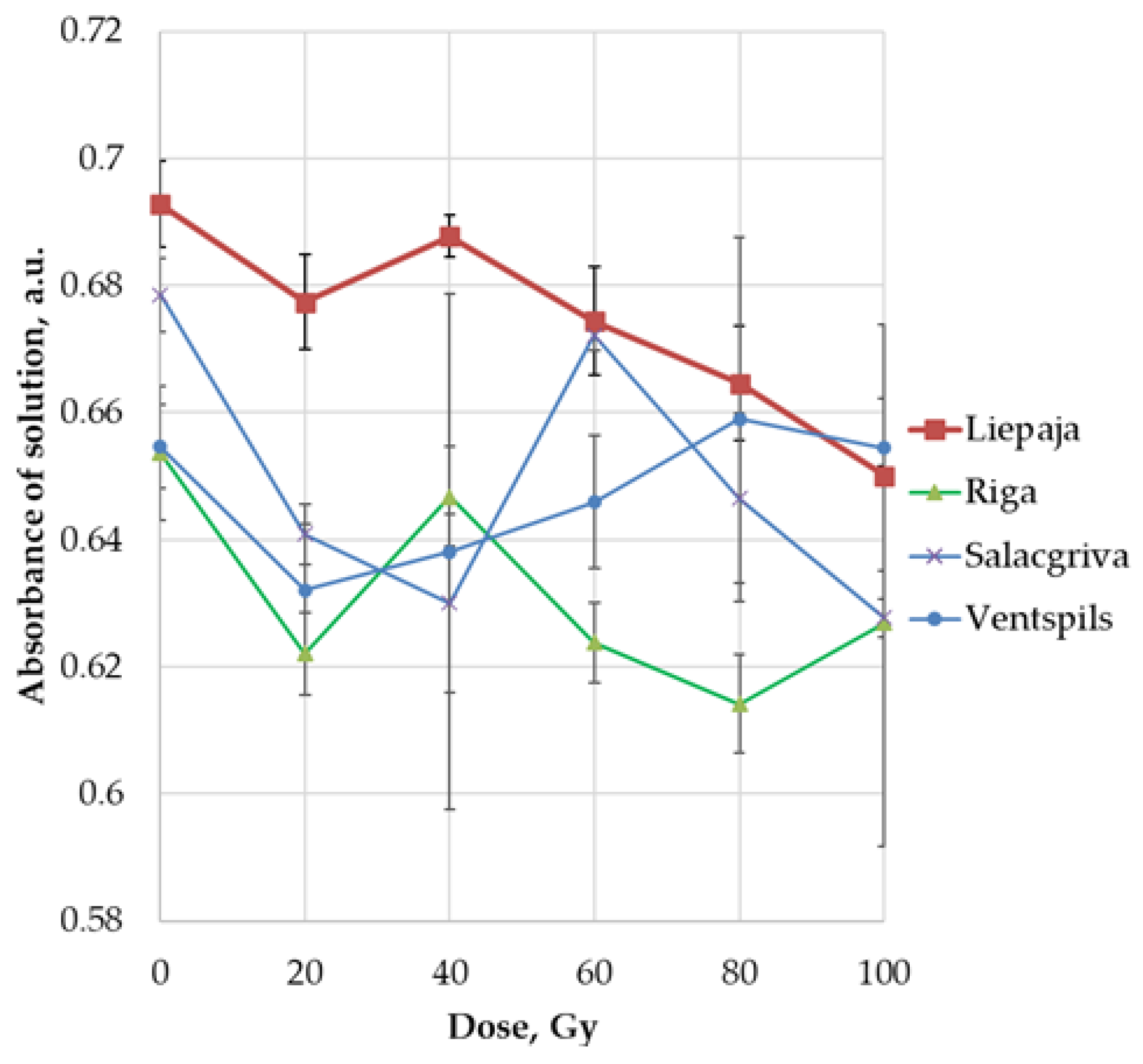
The filtration performance of irradiated sands was evaluated using aqueous solutions containing heavy metal ions, with Cr(VI) used as representative species. The percolation removal performance was assessed via UV–Vis absorbance measurements of the filtrates, where lower absorbance corresponds to lower residual ion concentration and therefore more effective filtration. Solution absorbance as a function of electron irradiation dose for sands from the four sampling locations is presented in
Figure 6 for K
2CrO
4 solution.
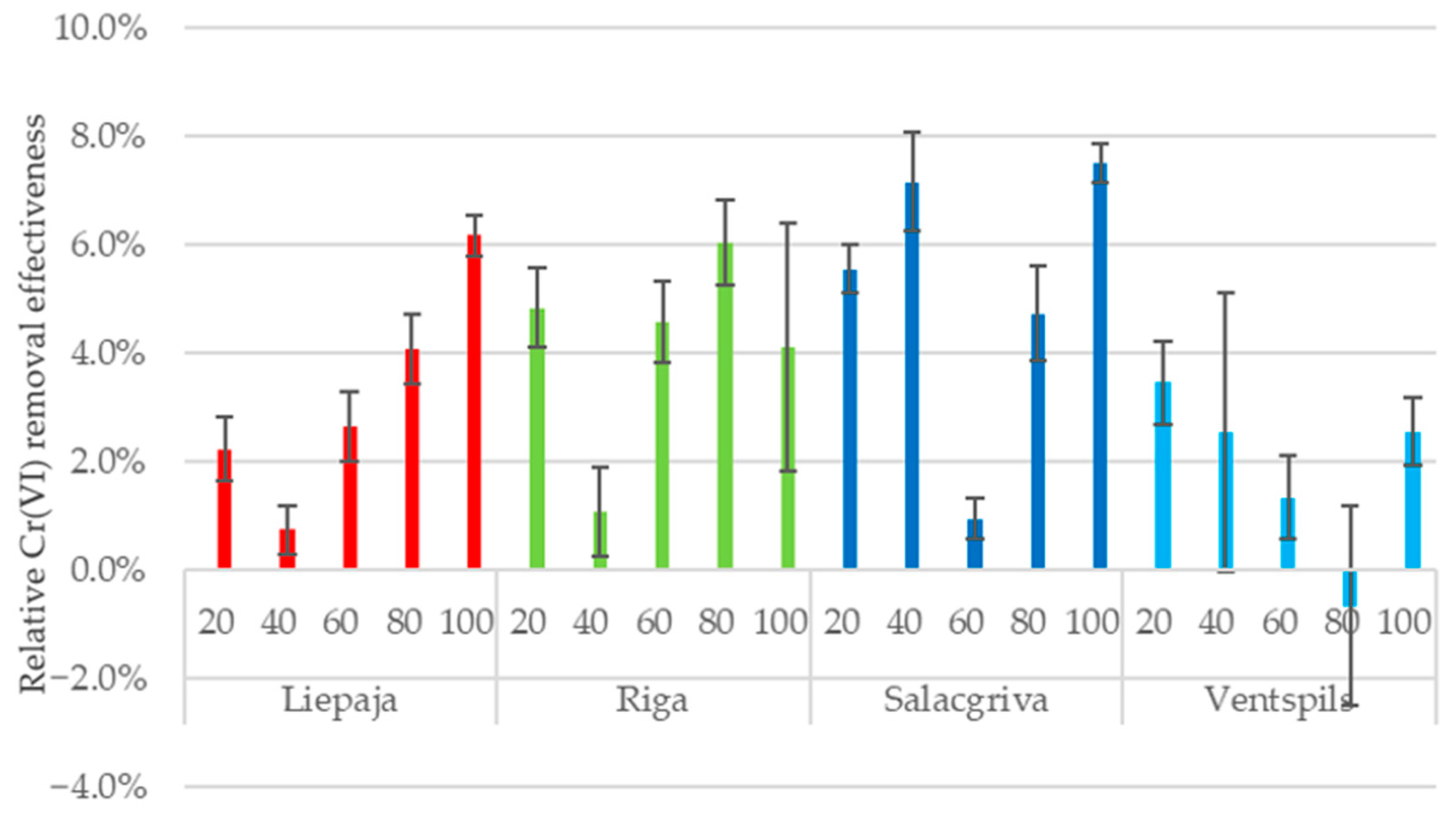
To enable direct comparison of irradiation effects across different sampling locations, the chromium removal performance was expressed as a relative filtration effectiveness
R (removal improvement), calculated from the UV–Vis absorbance values as:
where
Adose is the mean absorbance of the filtrate after filtration through sand irradiated at a given dose, and
A0 is the mean absorbance of the filtrate obtained using the corresponding non-irradiated (0 Gy) sand. Because the aim of this study is to evaluate irradiation as a surface-modification method, filtration performance is expressed quantitatively as removal improvement relative to the corresponding non-irradiated sand, which directly measures the irradiation-induced enhancement under otherwise identical conditions. In this representation, positive values of
R indicate improved chromium removal relative to the non-irradiated reference, whereas negative values correspond to slightly reduced removal efficiency. The uncertainty of
R was estimated by standard error propagation assuming independent measurements of
Adose and
A0, with standard errors calculated from six replicate filtrations per condition. The resulting dose-dependent effectiveness trends are summarized in
Figure 7.
Across all sites, the irradiation-induced changes were modest (typically within ~−1% to 8% relative to 0 Gy), but Liepaja showed the most consistent improvement with dose. With increasing irradiation dose, the absorbance of the filtered chromate solution generally decreases, indicating progressively enhanced Cr(VI) removal. This behavior suggests that electron irradiation modifies the sand surface in a way that increases its apparent affinity for Cr(VI) species. A notable feature in the Liepaja dataset is the presence of a local increase in absorbance at an intermediate dose (40 Gy), interrupting the otherwise decreasing trend. This non-monotonic behavior indicates that competing irradiation-induced processes occur at intermediate doses, temporarily reducing removal efficiency before higher doses restore and further enhance chromate removal. Despite this local maximum, Liepaja sand shows the clearest overall improvement in filtration performance with increasing dose, reaching the lowest absorbance values at the highest irradiation levels.
In contrast, sands from Riga, Salacgriva, and Ventspils exhibit weaker and less systematic changes in chromate removal efficiency as a function of irradiation dose. While reductions in absorbance are observed at certain dose levels, the absorbance–dose relationships for these locations display substantial fluctuations and overlapping values across doses. As a result, no clear monotonic trend or uniquely optimal irradiation dose can be identified within the investigated range for these sands.
4. Discussion
The combined PEES, XPS, and filtration results demonstrate that electron-beam irradiation induces site-dependent modifications of the surface electronic structure of Baltic coastal sands, which in turn govern their efficiency in heavy metal ion removal. While differences in sand samples could influence absolute removal between locations, the dose-dependent trends reported here are evaluated relative to each sand’s own non-irradiated baseline and are interpreted primarily through their coupled dose-dependent PEES/XPS changes. Among the investigated sites, Liepaja sand shows the clearest coupled response across PEES, XPS, and filtration metrics (Results,
Section 3.1,
Section 3.2,
Section 3.3 and
Section 3.4), and is therefore used as the primary case for mechanistic interpretation. Notably, Liepaja sand exhibits a substantially larger near-threshold photoemission response already in the non-irradiated state (
Table 2, 0 Gy), indicating a higher initial population of photoemission-active and/or trapping-related states under identical acquisition and processing. This elevated initial electronic activity provides a plausible basis for the stronger irradiation sensitivity of Liepaja, consistent with the larger PEES spectral changes and the clearer dose-dependent filtration response observed for this location. Inter-site differences in mineralogy (e.g., quartz fraction) could affect absolute baseline removal; however, the irradiation effect is evaluated within each sand relative to its own 0 Gy reference (Equation (5)), so the reported dose-dependent trends cannot be attributed solely to between-site composition differences.
PEES provides a direct probe of near-threshold photoemission behavior and surface electronic barrier changes, while XPS reflects accompanying modifications in the near-surface Si–O chemical environment. Considered together, PEES and XPS provide complementary indicators of irradiation-driven changes that are relevant to aqueous percolation retention. In insulating SiO2, irradiation-generated trapped charge and oxygen-related defect configurations can modify surface potential and local polarization, thereby altering the electric double layer and the electrostatic component of chromate retention during flow-through contact. In this framework, EWF shifts from PEES report changes in the effective near-surface emission barrier consistent with altered surface potential/trapped-charge state, while XPS binding-energy shifts reflect changes in local electronic environment and oxygen-related surface chemistry (e.g., hydroxylation/oxygen-rich configurations) under identical measurement conditions. The co-variation in PEES/XPS signatures with dose-dependent filtration behavior (most clearly for Liepaja) supports a shared defect-mediated origin rather than random experimental scatter. Additionally, PEES/EWF measurements were performed on dry stored sands after ~2 months; the trends were not systematic across sites/doses and are therefore not included, highlighting the need for dedicated aqueous-aging and multi-cycle filtration studies. Evaluating persistence under submerged conditions and repeated percolation cycles therefore remains an important next step for practical translation.
The filtration experiments using chromium-containing solutions show a corresponding non-monotonic dependence of removal efficiency on irradiation dose for Liepaja sand. At low doses (0–20 Gy), irradiation leads to a decrease in optical absorbance of the filtered solution, indicating enhanced Cr ion removal. This behavior can be attributed to irradiation-driven modification of oxygen-related surface defects and surface hydroxylation (including NBOHC-type centers), which can alter the interfacial chemistry and local electrostatic environment governing retention of Cr(VI) oxyanions. Such centers may form via radiolysis-driven transformation of silanol (Si–OH) groups and strained Si–O–Si bonds, increasing surface reactivity toward chromate/dichromate species. Under the present conditions (DI water, pH ~6.8, no added reductants/catalysts, and short percolation contact time), Cr(VI) reduction to Cr(III) is not expected to dominate, thus the data is discussed in terms of Cr(VI) decrease measured by the 373 nm UV–Vis signal. As Cr(III) was not independently quantified, a partial contribution from reduction cannot be excluded and is left for future work.
At an intermediate dose of 40 Gy, a local increase in solution absorbance is observed, indicating reduced removal efficiency. This nonlinearity suggests competing irradiation-induced processes that temporarily decrease the population of oxygen-terminated surface sites favorable for Cr(VI) retention. One possible route is further irradiation-driven transformation of oxygen-related centers (including NBOHCs) into oxygen interstitials and/or peroxy-type linkages (Si–O–O–Si), leaving silicon-centered dangling bonds at the surface. Such silicon-centered defects are expected to be less favorable for chromate/dichromate retention during percolation, which would reduce removal efficiency and increase the residual Cr(VI) concentration. The XPS results for Liepaja sand are consistent with a transient modification of the silicon local environment at 40 Gy, as evidenced by the decrease in the Si 2p binding energy, suggesting changes in surface bond polarity or coordination at this dose.
At higher irradiation doses (≥60–100 Gy), the removal efficiency improves again, as reflected by a renewed decrease in solution absorbance. This behavior may reflect cumulative defect accumulation and near-surface restructuring. Higher irradiation doses may increase near-surface defect heterogeneity and oxygen-related configurations, leading to changes in interfacial reactivity. These changes are expected to increase the density and heterogeneity of near-surface reactive/trapping states and modify surface potential, enhancing electrostatic retention during percolation. The increase in O 1s binding energy observed for Liepaja sand at 100 Gy is consistent with a modified oxygen chemical environment and is suggestive of irradiation-induced restructuring followed by interaction with atmospheric oxygen. In contrast, sands from Riga, Salacgriva, and Ventspils show significantly weaker and less systematic responses to irradiation. Their electron work functions, photoemission intensities, and XPS binding energies remain largely unchanged across the investigated dose range, indicating a lower sensitivity to defect formation and reconstruction. This behavior is consistent with their weaker PEES response (lower integrated intensities and minimal peak shifts) and correspondingly smaller irradiation-induced changes in the near-surface electronic barrier within the studied dose range.
High-energy irradiation of SiO
2 is well known to generate and transform several defect families, including oxygen-vacancy-related E′ centers, non-bridging oxygen hole centers (NBOHC), and peroxy-type configurations, as established by optical, EPR, and theoretical studies [
15,
16,
17,
18]. These oxygen- and silicon-related defects are electronically and chemically active and can modify surface polarity and interfacial reactivity; their mutual transformation and partial annealing under ambient conditions have also been reported [
19,
20]. Within this established framework, the non-monotonic behavior observed here (local maximum at 40 Gy) can be interpreted in the context of competing processes: formation of oxygen-terminated, retention-favorable surface sites at low dose, partial conversion or passivation into less favorable configurations at intermediate dose, and renewed defect accumulation and restructuring at higher doses, possibly accompanied by irradiation-induced lattice disorder and microstructural expansion effects [
21,
22,
23]. Because defect identities were not resolved directly in the present measurements, these assignments are used as a literature-guided interpretation consistent with the observed PEES/XPS trends and the dose-dependent filtration response.
Overall, the results answer the research question by showing that electron-beam irradiation can measurably modify the surface electronic/chemical state of natural quartz sands and, for specific sands, translate these changes into improved chromate removal from aqueous solution. The effect is strongly site-dependent: Liepaja sand exhibits the clearest coupling between irradiation-driven changes in PEES/XPS signatures and enhanced filtration performance, while Riga, Salacgriva, and Ventspils show comparatively minor electronic shifts and correspondingly weaker filtration response. The enhancement is modest (≈−1% to +8%) and was evaluated for single-pass filtration only. Because the observed enhancement is modest and was evaluated only in single-pass tests, the present results are best interpreted as a proof-of-principle for irradiation-tunable filtration behavior; engineering relevance will depend on scale-up parameters (bed depth, residence time/flow, reuse and aging) that were not evaluated here. Specific surface area and detailed mineralogical phase quantification (e.g., BET/SEM/XRD) were not performed in this study; the design focus is on correlating irradiation-induced electronic/chemical surface signatures (PEES/XPS) with single-pass percolation removal performance. The observed non-monotonic behavior with a local maximum at 40 Gy is consistent with competition between the formation of retention-favorable oxygen-related centers and their transformation into less retention-favorable configurations, rather than experimental instability. Taken together, the PEES, XPS, and UV–Vis filtration data support the conclusion that irradiation-enhanced Cr(VI) removal is governed primarily by defect-mediated surface reactivity, with the magnitude of enhancement determined by the initial defect population and its dose-dependent evolution.





 ,
,