Article

Economic Analysis of Nuclear Power Peak Shaving Based on AEL Hydrogen Production

1
State Key Laboratory of Nuclear Power Safety Technology and Equipment, China Nuclear Power Engineering Co., Ltd., Shenzhen 518116, China
2
Department of Electrical Engineering, North China Electric Power University, Baoding 071003, China
*
Author to whom correspondence should be addressed.
Processes 2026, 14(4), 725; https://doi.org/10.3390/pr14040725
Submission received: 31 December 2025 / Revised: 8 February 2026 / Accepted: 18 February 2026 / Published: 23 February 2026
(This article belongs to the Special Issue Optimal Design, Control and Simulation of Energy Management Systems)

Abstract

Under high renewable energy penetration, nuclear power units face significant challenges in peak regulation and market clearing due to constraints on minimum technical output and ramping capability. To address this issue, a long-term power system of Guangdong Province in 2035 is taken as the study case, and an energy–reserve co-clearing simulation framework based on Security-Constrained Unit Commitment (SCUC) and Security-Constrained Economic Dispatch (SCED) is established to systematically evaluate the clearing performance of nuclear power and the formation mechanism of residual electricity under multiple market scenarios. On this basis, a nuclear power-coupled Alkaline Electrolysis (AEL) hydrogen production pathway is proposed as a peak-shaving utilization option, and an economic assessment model for nuclear-based hydrogen production is developed to quantify the investment performance under different hydrogen production capacities and operating modes. The results indicate that the integration of an AEL hydrogen production system can effectively alleviate the rigidity of nuclear power output. Under the “12-3-48-3” flexible peak-shaving mode, the residual electricity available for hydrogen production increases by approximately 30% compared with a typical peak-shaving strategy. Under scenarios with low electricity prices and green hydrogen prices, when the hydrogen production capacity is configured at 50–100 MW, the investment payback period is approximately six years, and the project exhibits strong economic robustness against variations in the discount rate. These findings demonstrate that nuclear-based hydrogen production is economically feasible in future power systems with high renewable penetration, providing quantitative support for nuclear flexibility enhancement and the coordinated development of low-carbon energy systems.

1. Introduction

Under the guidance of the “carbon peaking and carbon neutrality” strategy, China’s energy system is accelerating its transition toward a clean and low-carbon structure. It is projected that by 2035, the installed capacity of wind and photovoltaic power will exceed 3 billion kW [1], leading to increasingly prominent system regulation requirements. As a clean baseload power source with high safety and low carbon emissions, nuclear power plays a critical role in ensuring power supply security and achieving the dual-carbon targets. However, constrained by operational characteristics such as high minimum technical output and limited ramping capability, nuclear power units face challenges including clearing difficulties, insufficient deep peak-shaving capability, and declining market competitiveness under high renewable penetration [2,3]. Consequently, flexible operation pathways that balance system operation and economic performance need to be explored.
Existing studies have mainly focused on two aspects: technical retrofitting and market mechanisms. On the one hand, several studies employ unit commitment and dispatch optimization models to evaluate the dispatch feasibility and economic performance of nuclear power in systems with high renewable penetration, where Security-Constrained Unit Commitment (SCUC) and Security-Constrained Economic Dispatch (SCED) models are commonly used to characterize market clearing processes. The SCUC model is typically applied at the day-ahead market level to optimize unit on/off status, output ranges, and reserve capacity under system security constraints, while the SCED model performs continuous dispatch based on a given commitment schedule by incorporating real-time load and renewable generation deviations, thereby determining energy and reserve clearing results. However, such studies are largely concentrated on European and North American electricity markets, with a primary focus on existing power systems [4,5]. On the other hand, domestic studies mainly emphasize nuclear flexibility retrofitting schemes under current system conditions, with greater attention paid to technical feasibility or single operating scenarios. In terms of specific pathways, in addition to hydrogen production, some studies explore the enhancement of nuclear peak-shaving capability through various industrial loads and energy storage options. For example, several studies investigate the coupled operation of nuclear power with district heating and thermal storage systems, where thermal energy storage or industrial steam loads are introduced to shift and smooth nuclear output over time, thereby alleviating peak-shaving pressure during low-load periods [6,7,8]. Other studies focus on electrochemical energy storage, analyzing the potential role of long-duration storage technologies, including flow batteries, in absorbing off-peak nuclear electricity and enhancing system flexibility [9,10,11].
At the modeling level, in addition to SCUC/SCED-based market clearing models, various alternative approaches have been adopted to analyze flexible nuclear operation. Production cost simulation models (e.g., UC/ED) are widely used to represent the chronological operation and dispatch costs of power systems under a given generation mix [12,13]. Capacity Expansion Models (CEMs) focus on long-term generation mix and technology configuration decisions and are commonly applied to evaluate system costs and emission reduction effects under different nuclear and renewable development pathways [14,15,16]. Furthermore, multi-energy system or energy hub models explicitly describe the coupling relationships among electricity, heat, and hydrogen systems, thereby exploring the potential of nuclear power in cross-energy coordinated operation [17,18,19].
However, the above studies primarily emphasize technical feasibility or long-term system structure, while relatively limited attention has been paid to the hourly clearing behavior of nuclear power under power market environments and the formation mechanism of peak-shaving residual electricity when system security constraints are satisfied. In particular, under future scenarios with high renewable penetration, significant changes may occur in generation structure, price formation mechanisms, and system regulation constraints. As a result, the scale, duration, and temporal characteristics of residual electricity formed through nuclear peak-shaving may differ substantially from those of existing systems, yet systematic characterization within a unified market clearing framework remains insufficient [20].
Against this background, the potential scale, temporal characteristics, and relationship between nuclear peak-shaving residual electricity and system regulation resource allocation require further quantitative investigation. To address these issues, the long-term power system of Guangdong Province in 2035 is selected as the study case. Based on forecasts of load demand and installed capacities of various generation types, an energy–reserve co-optimization SCUC/SCED clearing model is established to systematically characterize the clearing behavior of nuclear power and the level of residual electricity under multiple market scenarios. On this basis, considering the operational characteristics of nuclear peak-shaving residual electricity, alkaline water electrolysis (Alkaline Electrolysis, AEL) technology, which is well matched with baseload nuclear operation and hourly peak-shaving characteristics, is selected as the energy conversion pathway [20]. An economic evaluation model for nuclear-based hydrogen production is further developed to quantify the investment performance under different hydrogen production capacities and operating modes. Unlike existing conclusions on nuclear flexibility that are largely derived from current systems or static operating assumptions, this study quantitatively reveals the utilization boundary and economic value of nuclear peak-shaving residual electricity from a market clearing perspective under future high-renewable scenarios, thereby extending and refining the applicability of existing findings on nuclear peak-shaving potential and hydrogen production capacity configuration.

2. Methods: Power Market Clearing and Economic Analysis for Nuclear Hydrogen Production

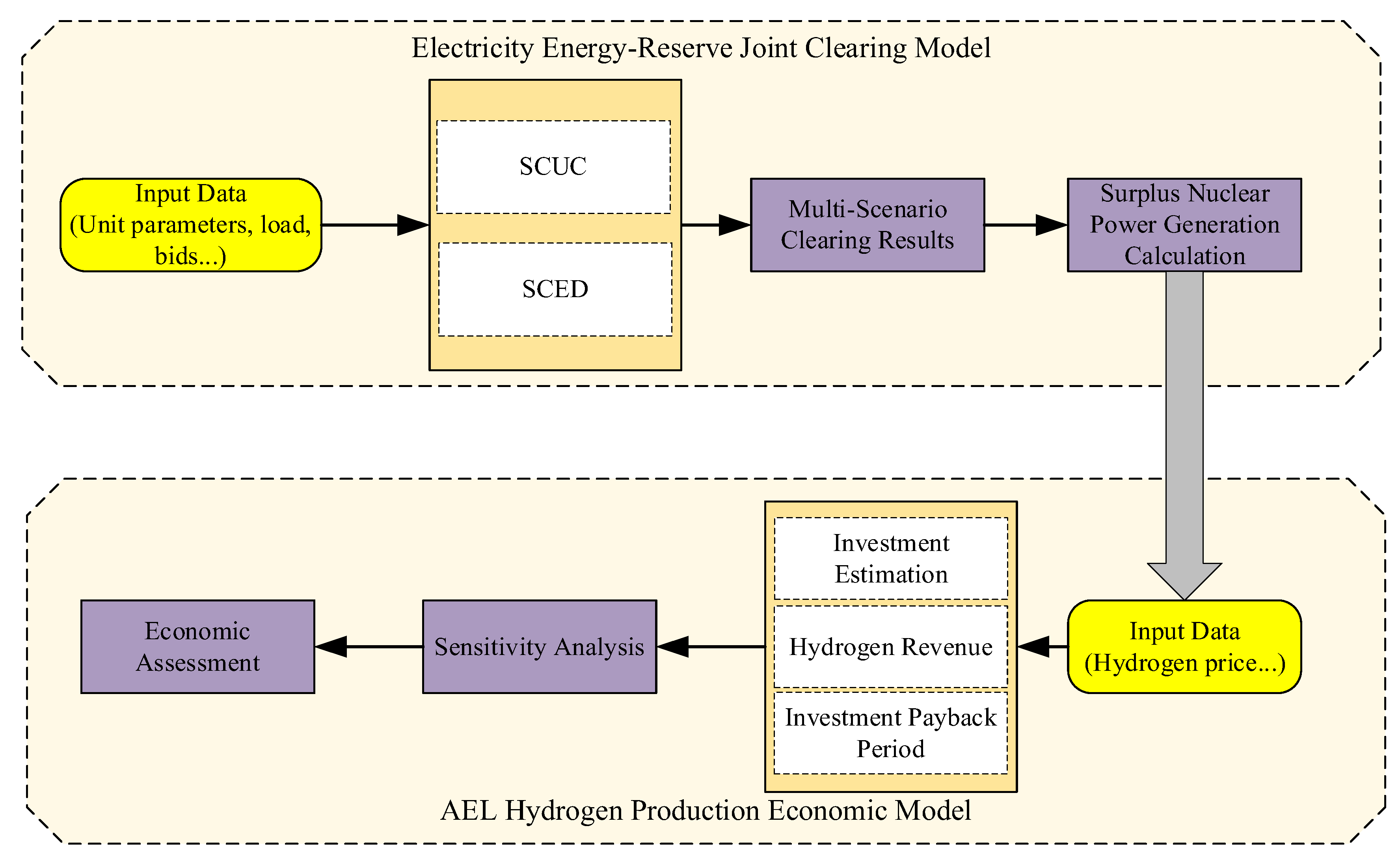
To provide a clearer illustration of the research logic and technical route adopted in this study, Figure 1 presents the overall research framework. First, based on the projected unit parameters, load profiles, bidding data, and other inputs of the Guangdong power system in 2035, an energy–reserve co-optimized SCUC/SCED clearing model is established to simulate power market operation and to obtain the hourly clearing results of nuclear power units under different operating scenarios. On this basis, the operational peak-shaving residual electricity formed by nuclear units during low-load periods, constrained by minimum technical output, ramping limits, and market clearing conditions, is identified, with its magnitude and temporal characteristics endogenously determined by the market clearing results. Subsequently, in accordance with the operational characteristics of the identified residual electricity, an economic evaluation model for AEL-based hydrogen production is developed to characterize hydrogen output and operating behavior under different hydrogen production capacity configurations, combined with investment and operating parameters. Finally, sensitivity analyses with respect to key parameters, including electricity prices, hydrogen prices, and capacity levels, are conducted to evaluate economic feasibility under different scenarios, and corresponding conclusions and policy implications are derived.

2.1. Energy–Reserve Joint Clearing Model

At present, multiple provinces in China, including Guangdong Province, are establishing electricity spot market mechanisms centered on a two-stage clearing structure consisting of day-ahead and real-time markets [21]. Within this market framework, the day-ahead market is primarily cleared using the SCUC model to optimize unit commitment schedules, output limits, and reserve capacity allocation, while the real-time market applies the SCED model based on day-ahead commitment decisions. By incorporating deviations in actual load and renewable generation, the SCED model optimizes unit dispatch and determines locational marginal prices.
In the SCUC–SCED co-clearing model developed in this study, the SCED formulation is implemented on an hourly time scale, with a 1 h interval adopted as the minimum dispatch time step to characterize the hour-by-hour clearing behavior of nuclear power units during intraday peak-shaving operation. Within this framework, both energy prices and reserve prices are endogenously determined through the market clearing process. Specifically, the energy price corresponds to the marginal relaxation value of the system power balance constraint at each node in the SCED optimization problem, namely the locational marginal price (locational marginal price, LMP), while the reserve price reflects the marginal value of reserve constraints under system security requirements. From the perspective of optimization theory, these prices can be interpreted as the dual variables associated with the corresponding constraints in the Lagrangian function, with their physical meaning representing the minimum change in total system operating cost induced by a unit increase in energy or reserve capacity, ceteris paribus.
Based on the above SCUC–SCED co-dispatch simulation framework, the market clearing process of Guangdong Province in 2035 under typical load and electricity price scenarios is simulated, providing data support for the subsequent economic analysis.

2.1.1. SCUC

Objective Function
The regional electricity spot market SCUC model aims to minimize the total system operating cost, comprehensively considering generation costs, startup/shutdown costs, and reserve costs. The model is formulated as follows:
min A M { t = 1 T i = 1 N G A ρ i , t A ( P g , i , t A ) + C i , t U , A + C i , t D , A + ρ u , i A P u , i , t A + t = 1 T n = 1 N W A ρ w , j A P w , j , t A + t = 1 T ( ρ t H C , o u t P e , t H C , o u t + ρ u , t H C P u , t H C ) }
ρ i , t A ( P g , i , t A ) = C i , t A ( P g , i , t A ) + ( δ t e , l P g , i , t A C i , t A ( P g , i , t A ) ) ζ i
ρ u , i A = C u , i A + ( δ t u , l C u , i A ) ζ i
ρ u , i A = C w , j A + ( δ t e , l C w , j A ) ζ j
C i , t A ( P g , i , t A ) = a i A ( P g , i , t A ) 2 + b i A P g , i , t A + c i A
C i , t U , A = c i U , A α i , t A ( 1 α i , t 1 A )
C i , t D , A = c i D , A α i , t 1 A ( 1 α i , t A )
where A is the province index; M is the set of provinces within the region; T is the total number of scheduling periods for the power transmission plan; N G A represents the total number of thermal power units in province A; N W A represents the total number of renewable energy stations in province A; N D A represents the total number of load nodes in province A;  ρ i , t A denotes the energy price bid of thermal power unit i; ρ u , i A denotes the reserve price bid of thermal power unit i; ρ w , j A denotes the energy price bid of renewable station j; ζ i represents the probability density function corresponding to the bidding strategy of unit i; δ t e , l is the average energy price at time t over the past 30 trading days; δ t u , l is the average reserve price at time t over the past 30 trading days; C i , t A ( P g , i , t A ) , C i , t U , A , C i , t D , A respectively represent the operation cost, startup cost, and shutdown cost of thermal unit i in province A during period t; P g , i , t A is the active power output of thermal unit i in province A during period t; C i , t U , A is the reserve cost coefficient of thermal unit i in province A; C w , j A is the energy cost coefficient of renewable station j in province A during period t; P w , j , t A is the active power output of renewable station j in province A during period t; P u , i , t A is the reserve capacity provided by thermal unit i in province A during period t; P e , t H C , o u t is the awarded power of nuclear-thermal storage in the energy market; P u , t H C is the awarded capacity of nuclear-thermal storage in the reserve market; a i A , b i A , c i A are the coal consumption cost coefficients of thermal unit i in province A; c i U , A , c i D , A are the startup and shutdown cost coefficients of thermal unit i in province A, respectively; α i , t A is the startup/shutdown state of thermal unit i in province A during period t, where 0 indicates shutdown and 1 indicates startup. Equations (6) and (7) represent the unit startup/shutdown mutual exclusivity constraint.
The start-up and shut-down time as well as the associated start-up and shut-down cost parameters of coal-fired and gas-fired units are specified according to capacity classes, with the corresponding value ranges summarized in Table 1.
Constraints
(1)
Regional power balance constraint:
i = 1 N G A P g , i , t A + j = 1 N W A P w , j , t A + z = 1 N T A P T , z , t A + P e , t H C , o u t = n = 1 N D A P n , t A , A , t
where P T , z , t A represents the transmission power of tie-line z connected to Province A, with the direction defined as positive when power flows into Province A; N T A represents the total number of interconnection lines connected to province A; P n , t A represents the net load of node n in province A during period t (excluding independent energy storage and pumped storage charging/discharging curves).
(2)
Minimum local reserve capacity constraint
During actual dispatch operations, when an emergency occurs in a province, the system will first utilize a portion of the local reserve capacity up to its minimum local reserve limit. If this minimum local reserve capacity proves insufficient to meet the demand, additional reserve capacity from the same province or other provinces through a reserve-sharing mechanism will then be activated. This approach safeguards the interests of local generation units and facilitates the initial development of electricity markets.
i = 1 N G A P u , i , t A + P u , t H C P t u , A , A , t
where: P t u , A represents the minimum reserve capacity of province A.
(3)
Renewable generation output constraint:
0 P w , j , t A P w , j , t , max A , A , j , t
(4)
Unit generation output limit constraint:
α i , t A P g , i , min A P g , i , t A α i , t A P g , i , max A , A , i , t
α t H C P e , min H C P e , t H C , o u t α t H C P e , max H C , t
where P g , i , max A , P g , i , min A represent the maximum and minimum technical output of thermal power unit i in province A; P e , min H C , P e , max H C represent the maximum and minimum technical output of nuclear-storage; α t H C represents the on/off status of nuclear-storage at time t.
(5)
Unit ramping constraint:
P g , i , t A P g , i , t 1 A Δ P i U , A α i , t 1 A + P g , i , max A ( 1 α i , t A ) + P g , i , min A ( α i , t A α i , t 1 A ) , A , i , t
P g , i , t 1 A P g , i , t A Δ P i D , A α i , t A + P g , i , max A ( 1 α i , t 1 A ) P g , i , min A ( α i , t A α i , t 1 A ) , A , i , t
P e , t H C , o u t P e , t 1 H C , o u t Δ P U , H C α t 1 H C + P e , max H C ( 1 α t H C ) + P e , min H C ( α t H C α t 1 H C ) , t
P e , t 1 H C , o u t P e , t H C , o u t Δ P D , H C α t H C + P e , max H C ( 1 α t 1 H C ) P e , min H C ( α t H C α t 1 H C ) , t
where Δ P i U , A represents the ramp-up limit per unit time of thermal power unit i in province A; Δ P i D , A represents the ramp-down limit per unit time of thermal power unit i in province A; Δ P U , H C represents the ramp-up limit per unit time of nuclear-storage; Δ P D , H C represents the ramp-down limit per unit time of nuclear-storage.
(6)
Minimum unit up/down time constraint:
T i , t 1 on , A T i , min on , A α i , t 1 A α i , t A 0 , A , i , t
T i , t 1 off , A T i , min off , A α i , t A α i , t 1 A 0 , A , i , t
T i , t on , A = k = t T i , min on , A t 1 α i , k A
T i , t off , A = k = t T i , min off , A t 1 ( 1 α i , k A )
T t 1 on , H C T min on , H C α t 1 H C α t H C 0 , t
T t 1 off , H C T min off , H C α t H C α t 1 H C 0 , t
T t on , H C = k = t T min on , H C t 1 α k H C
T t off , H C = k = t T min off , H C t 1 ( 1 α k H C )
where T i , min on , A , T i , min off , A represent the minimum continuous operating time and minimum continuous downtime of thermal power unit i in province A; T i , t on , A , T i , t off , A represent the accumulated continuous operating time and downtime of thermal power unit i at time t; T min on , H C , T min off , H C represent the minimum continuous operating time and minimum continuous downtime of nuclear-storage; T t on , H C , T t off , H C represent the accumulated continuous operating time and downtime of nuclear-storage at time t.
(7)
Reserve capacity limit constraint:
At each time period, the reserve provision from each unit is simultaneously constrained by its ramping capability and generation output limits.
0 P u , i , t A min { Δ P i U , A , α i , t A P g , i , max A P g , i , t A } , A , i , t
0 P u , t H C min { Δ P U , H C , α t H C P e , max H C P e , t H C , o u t } , t
(8)
Nuclear-storage operational constraints:
0 P t c h b t c h R c h , t
0 P t d i s b t d i s R d i s , t
b t c h + b t d i s 1 , t
S O C t = S O C t 1 + P t c h e c h P t d i s / e d i s Δ t , t
0 S O C t E max E S
P e , t H C , o u t = P e , t H + P t d i s P t c h
where b t c h represents the charging state of energy storage at time slot t (0 means charging, 1 means not charging); R c h represents the upper limit of charging power; b t d i s represents the discharging state of energy storage at time slot t (0 means discharging, 1 means not discharging); R d i s represents the upper limit of discharging power; S O C t represents the energy stored at time slot t; E max E S represents the maximum capacity of energy storage; P e , t H represents nuclear power output.
It should be noted that no actual independent energy storage devices are configured in the study scenarios considered. To preserve the completeness of the SCUC/SCED co-clearing model and to remain consistent with the general modeling framework of energy–reserve joint clearing, nuclear-coupled storage–related variables and constraints are retained in the model formulation. In the specific case studies, both the installed capacity of nuclear-coupled storage and the upper limits of its charging and discharging power are set to zero; therefore, the corresponding variables do not participate in the energy or reserve market clearing. Their inclusion serves solely to maintain model structural consistency and does not affect the nuclear power clearing results or the subsequent economic analysis of hydrogen production.

2.1.2. SCED

Objective Function
The regional electricity spot market SCED model refines the generation dispatch schedule based on the predetermined unit commitment plan from the SCUC model. Consequently, the SCED objective function excludes unit startup/shutdown costs compared to the SCUC objective function.
min A M { t = 1 T i = 1 N G A C i , t A ( P g , i , t A ) + C u , i A P u , i , t A + t = 1 T n = 1 N W A C w j A P w j , t A + t = 1 T n = 1 N D A C d A Δ P n , t A + t = 1 T ( ρ t H C , o u t P e , t H C , o u t + ρ u , t H C P u , t H C ) }
Constraints
The SCED model’s constraints exclude the minimum unit up/down time requirements, while modifying the ramping constraints. All other constraints remain consistent with the SCUC model. The revised ramping constraints can be expressed as:
P g , i , t A P g , i , t 1 A Δ P i U , A , A , t
P g , i , t 1 A P g , i , t A Δ P i D , A , A , t
Based on the objective function and constraint set of the above security-constrained economic dispatch model, the corresponding Lagrangian function can be constructed. From the perspective of optimization theory, the Lagrange multipliers associated with the system power balance constraints and reserve capacity constraints represent the marginal values of energy and reserve capacity, respectively.
Accordingly, the energy prices and reserve prices formed during the SCED clearing process can be theoretically interpreted as the dual variables of the corresponding constraints under the Karush–Kuhn–Tucker (KKT) conditions. Their physical meaning lies in the minimum change in total system operating cost induced by a unit increase in energy or reserve capacity, ceteris paribus. It should be noted that the KKT conditions of the SCED model are not explicitly derived; instead, the price signals implicitly obtained from the model solution are directly adopted to ensure consistency between price signals, market clearing outcomes, and system operating constraints.

2.2. Bidding of Units in the Energy–Reserve Joint Clearing Model

By 2035, Guangdong is expected to have the following thermal and nuclear units in operation: 162 coal-fired units, 147 gas-fired units, and 26 nuclear units. Hydropower and renewable energy (PV and wind) are represented by their expected output profiles rather than unit counts. The bidding strategies are described below.

2.2.1. Stepwise Bidding Model for Thermal Units

Thermal units adopt the following bidding model:
ρ m ( i ) = ρ m ¯ ε
where m = 1–5, denotes steps 1 to 5; ρ m ¯ is the mean bid price of step m. To reflect heterogeneity across units, a random factor ε uniformly sampled from 0.9 to 1.1 is introduced. The actual bid of unit i at step m is ρ m ( i ) . The output interval from minimum to maximum is evenly divided to determine the output range corresponding to each step.

2.2.2. Bid Parameter Settings for Different Units

Based on Guangdong spot market average clearing prices, the mean bids for coal-fired units from step 1 to step 5 are: 240, 308, 375, 637, and 900 CNY/MWh. For gas-fired units, the corresponding values are: 440, 500, 580, 800, and 1000 CNY/MWh. Nuclear unit bid price is set to 334 CNY/MWh. Hydropower bid is 190 CNY/MWh. PV bid is 110 CNY/MWh. Wind bid is 120 CNY/MWh.

2.3. Economic Evaluation Method for Nuclear + Storage Coupled AEL Hydrogen Production

2.3.1. Nuclear Market Clearing Characteristics and the Rationale for AEL Hydrogen Technology Selection

Based on the SCUC/SCED-based electricity market clearing simulations, under conditions of high renewable energy penetration, nuclear power units are constrained by minimum technical output and ramping capabilities and often cannot be fully dispatched during low-load periods. The surplus electricity available for hydrogen production therefore mainly originates from output limitations and uncleared market energy. The clearing results indicate that this type of surplus electricity exhibits stepwise temporal variations with an hourly time resolution, with power levels changing between adjacent periods according to peak-shaving operating strategies, rather than behaving as a high-frequency, rapidly oscillating power source.
Further analysis shows that surplus electricity generated through nuclear peak-shaving typically maintains a relatively stable output level over several consecutive hours, with step-like adjustments occurring during transitions between different peak-shaving stages. This characteristic is particularly pronounced under holiday conditions and flexible peak-shaving operation modes. Such operational features imply that the utilization of this surplus electricity is more suited to continuous, energy-oriented consumption rather than power-oriented regulation resources that rely on second- or minute-level fast responses. Accordingly, hydrogen production systems designed to absorb this surplus electricity should possess hourly scale load regulation and start–stop capabilities while maintaining stable operation over extended running periods.
It should be noted that although the SCUC/SCED joint optimization model can quantitatively identify the magnitude and temporal characteristics of surplus electricity resulting from nuclear peak-shaving from the perspectives of dispatch and market clearing, the results essentially reflect the operating state of the power system under predefined constraints. The model does not explicitly determine feasible technological pathways or economic utilization ranges for this surplus electricity. Therefore, introducing appropriate energy conversion pathways on the basis of clearing analysis and conducting economic evaluations of surplus nuclear electricity utilization are essential for extending dispatch-level clearing results toward feasibility-oriented assessments.
In light of the above clearing characteristics, alkaline water electrolysis (AEL) hydrogen production technology is selected as the conversion pathway for surplus electricity from nuclear peak-shaving. On the one hand, AEL technology is technologically mature and supported by extensive engineering experience, offering relatively low unit investment costs under medium- to large-scale deployment. On the other hand, its operational characteristics are compatible with hourly scale load variations and start–stop requirements, making it well suited to application scenarios characterized by relatively slow power ramping rates and an emphasis on energy absorption. From a system economic perspective, the nuclear-powered hydrogen production scheme examined in this study focuses on key indicators such as annual utilization hours, levelized hydrogen production cost, and investment payback period, for which AEL technology demonstrates strong applicability.
Based on these considerations, AEL hydrogen production technology is adopted in the subsequent economic assessment to construct investment and operational models, and the economic performance of different hydrogen production capacity configurations is systematically evaluated under the surplus electricity boundaries determined by nuclear power clearing results.

2.3.2. Technical Parameters of AEL Hydrogen Production Systems

This study adopts alkaline water electrolysis (AEL) technology for hydrogen production. It features a mature process, simple structure, and high safety and is suitable for large-scale absorption of nuclear electricity. Based on domestic 50 MW-class project parameters, a single hydrogen production system has a rated hydrogen production of ~1000 Nm3/h, a system efficiency of about 65–70%, and an electricity consumption of 45 kWh per kg H2.
The system efficiency values adopted in this study are derived from engineering test data obtained under stable operating conditions of alkaline water electrolysis (AEL) hydrogen production systems near their rated power. These tests are typically conducted with electrolyzer load factors in the range of 80–100% of rated capacity, ambient temperatures of approximately 20–30 °C, and system cooling and deionized water supply conditions meeting the design specifications. Within this operating window, AEL-based hydrogen production systems exhibit relatively high electrical-to-hydrogen conversion efficiency and operational stability, making them well suited for long-term continuous operation.
With respect to dynamic operating characteristics, although AEL hydrogen production systems are not designed to provide millisecond-level fast regulation, their start–stop and power modulation capabilities are sufficient to meet the time-scale requirements associated with surplus nuclear power from load-following operation. Engineering practice indicates that the cold start-up time of AEL electrolyzers from shutdown to stable hydrogen production is typically 10–30 min and can be further reduced under hot-start conditions; similarly, normal shutdown procedures can be completed within several minutes. Consequently, under electricity market dispatch and load-following scenarios characterized by an hourly time resolution, AEL hydrogen production systems are capable of achieving hourly flexible start–stop operation. This enables effective utilization of surplus electricity generated during low-load periods of nuclear power operation and facilitates efficient conversion of electrical energy into hydrogen without inducing significant additional equipment degradation.
The equipment lifetime is assumed to be 20 years. Referring to the ChinaCoal Ordos wind–solar hydrogen-to-green-ammonia demonstration project, a 2 MPa medium-pressure hydrogen storage system is configured.

2.3.3. Engineering Investment Estimation

It is necessary to clarify the modeling logic adopted for handling cost time scales in this study. Although the analyzed system corresponds to a long-term power system scenario in 2035, the engineering investment and operating cost parameters of the hydrogen production system are primarily derived from the publicly available literature and engineering case data from 2024 to 2025 and are uniformly treated as the price base year for the economic evaluation.
(i) Alkaline water electrolysis (AEL) technology has reached a mature stage of commercial deployment, and the composition of its core equipment as well as its cost structure have remained relatively stable in recent years. In the absence of reliable projections for hydrogen production equipment costs in 2035, adopting recent engineering data as a representative baseline helps avoid the introduction of highly uncertain long-term cost assumptions.
(ii) The economic analysis focuses on comparing the relative economic performance of different nuclear operating modes and hydrogen production capacity configurations, rather than forecasting the absolute cost level of hydrogen production systems in 2035. The temporal discrepancy between the base-year costs and the long-term system is consistently reflected through the discount rate within a discounted cash flow analysis framework, an approach that is widely adopted in long-term energy system economic assessments.
Therefore, the treatment of cost time scales in this study aims to establish a consistent and comparable economic analysis framework for evaluating the economic feasibility of nuclear-based peak-shaving hydrogen production schemes under different operating conditions.
Equipment Procurement Cost
Equipment procurement is a major expenditure in hydrogen projects. Main equipment includes: hydrogen power supply, electrolyzer system, purified water production system, hydrogen storage tanks, hydrogen compressors, and other mechanical piping, instrumentation, cables, and electrical/control systems. The China Renewable Energy Engineering Cost Management Report 2024 (PPT) indicates that a 1000 Nm3/h (5 MW) alkaline electrolyzer package system costs close to 6 million CNY per set (excluding power supply, including gas–liquid separation and purification), corresponding to a unit cost of about 1.2 CNY/W [21].
Referring to the equipment cost estimation tables and alkaline electrolyzer technical specification tables in [22,23], taking 2025 as an example, the equipment list and cost for a 50 MW hydrogen plant are shown in Table 2.
Operating and Maintenance Costs
Operating and maintenance costs (OPEX) constitute a critical component in the economic evaluation of nuclear-based peak-shaving hydrogen production systems. Considering the engineering characteristics of AEL hydrogen production systems and the long-term study context, OPEX is modeled in an equivalent manner to ensure both modeling rationality and computational tractability. The operating and maintenance costs mainly include electricity consumption for hydrogen production, hydrogen compression and purification costs, electrolyzer degradation and replacement costs, labor and consumables costs, as well as potential penalty costs associated with start-up, shut-down, and cyclic operation.
Among these components, the electricity cost for hydrogen production represents the dominant share of OPEX and is directly determined by the residual electricity from nuclear peak-shaving and the corresponding electricity price scenarios. Hydrogen compression and purification costs depend on the required hydrogen pressure level and purity specifications, while labor and consumables costs mainly cover routine operation and maintenance activities, water treatment, and chemical consumables. Given that these costs are strongly influenced by technology choices, engineering configurations, and operating strategies under future scenarios, and that reliable long-term projections are not available, an equivalent modeling approach is adopted to simplify the analysis and maintain comparability across scenarios. Specifically, electricity consumption costs, compression and purification costs, and water costs are uniformly incorporated into the economic model as variable costs on a per-unit hydrogen basis.
With respect to performance degradation and stack replacement requirements of electrolyzers during long-term operation, as well as the additional operation and maintenance and equipment wear induced by start-up, shut-down, and power cycling, an equivalent treatment is applied by aggregating these effects into fixed operating and maintenance costs. In particular, the annual costs associated with electrolyzer degradation, stack replacement, and start-up and cycling operation are assumed to be 3% of the initial equipment investment cost per year [23] and are included as fixed annual OPEX in the project cash flow analysis. This assumption is based on engineering practice and values commonly adopted in the literature for mature water electrolysis systems. A detailed breakdown of the operating and maintenance cost components is provided in Table 3.
Land Cost for Hydrogen Production and Storage
Land for a hydrogen station can be divided into: (1) Hydrogen workshop area (electrolyzers, hydrogen power supply, filling compressors, trailer parking); (2) Supporting facilities (control room, offices, warehouses, etc.); (3) Safety spacing area (reserved safety distance per codes, occupying area).
For a 50 MW water electrolysis hydrogen station, the land area is estimated at 47,700 m2; the composition is shown in Table 4 [22].
In the hydrogen capacity sensitivity analysis, for 100–600 MW hydrogen plants, land area can be approximated as linearly proportional to capacity. Therefore, when hydrogen capacity exceeds 150 MW, the estimated land area exceeds 200 mu, making construction infeasible.
Under the current national territorial spatial planning framework and the regulations governing land-saving and intensive land use for industrial projects, the land area of a single new-energy supporting facility is typically constrained to within 200 mu. When the hydrogen production capacity exceeds 150 MW, land requirements increase markedly, approaching or even exceeding the upper limit commonly permitted for general industrial projects, thereby substantially increasing the difficulty of project implementation. Consequently, hydrogen production plants with land occupation exceeding 200 mu are considered to lack construction feasibility.
Considering a hydrogen production facility sited near the Yangjiang Nuclear Power Plant, and referring to recent public land-transfer transaction records for industrial land in Yangjiang City, the transaction prices of general industrial land in the vicinity of the nuclear site are predominantly in the range of 0.55–0.70 million CNY per mu. Taking the median value of 0.63 million CNY per mu as the unit land price for the hydrogen production facility, the total land cost of the hydrogen plant is estimated to be approximately 44.73 million CNY.
Civil Construction Cost
Civil construction cost refers to the cost required to build permanent buildings and structures, including hydrogen workshop, control room, offices, warehouses, guard house, canteen and living facilities, garage, factory walls and gates, roads, and greening. For a 50 MW hydrogen project, the civil construction cost is 33.15 million CNY, as detailed in Table 5 [23].
Installation Cost
Installation cost generally includes installation costs for mechanical/electrical equipment and special equipment (power, lifting, transportation, transmission, instrumentation, etc.), and also covers process utilities such as heating, power supply, water supply and drainage, HVAC, purification and dust removal, automation, telecom, as well as pipelines, cables (materials and installation), insulation, anti-corrosion, internal fillers, etc. In authoritative documents such as Methods and Parameters for Economic Evaluation of Construction Projects (issued by NDRC and the Ministry of Housing and Urban-Rural Development) and Guidelines for Feasibility Studies of Investment Projects, installation cost is often estimated as a certain ratio of equipment procurement cost and civil construction cost.
For this project, installation cost refers to a Shenhua Group hydrogen energy project and is set to 5% of the sum of civil construction and equipment procurement costs [14]. Thus, the installation cost for the 50 MW hydrogen project is 8.0355 million CNY.

2.3.4. Hydrogen Price Assumptions

Hydrogen product price is a key parameter in evaluating hydrogen production economics. According to China Energy News (2024) [24] and the Medium- and Long-Term Plan for the Development of the Hydrogen Energy Industry (2021–2035), with declining electrolyzer costs and large-scale renewable electricity development, the terminal price of green hydrogen in China is expected to stabilize at about 25 CNY/kg after 2030. By setting two price scenarios—green hydrogen (25 CNY/kg) and gray hydrogen (12 CNY/kg)—a reasonable interval is provided for subsequent revenue analysis of nuclear hydrogen production under different market positioning and policy contexts.

2.3.5. Hydrogen Production Benefit Model

Annualized Hydrogen Production Revenue
In the scenario of interest, the electricity for hydrogen production comes from surplus nuclear electricity during peak shaving, which is volatile and uncertain. In Guangdong, because renewable curtailment probability is relatively low, nuclear units must undertake peak shaving during low-load periods, and part of the energy cannot be delivered to the grid. Therefore, the electricity price and cost structure under a fluctuating power source background should be treated appropriately to construct a revenue model consistent with realistic operation.
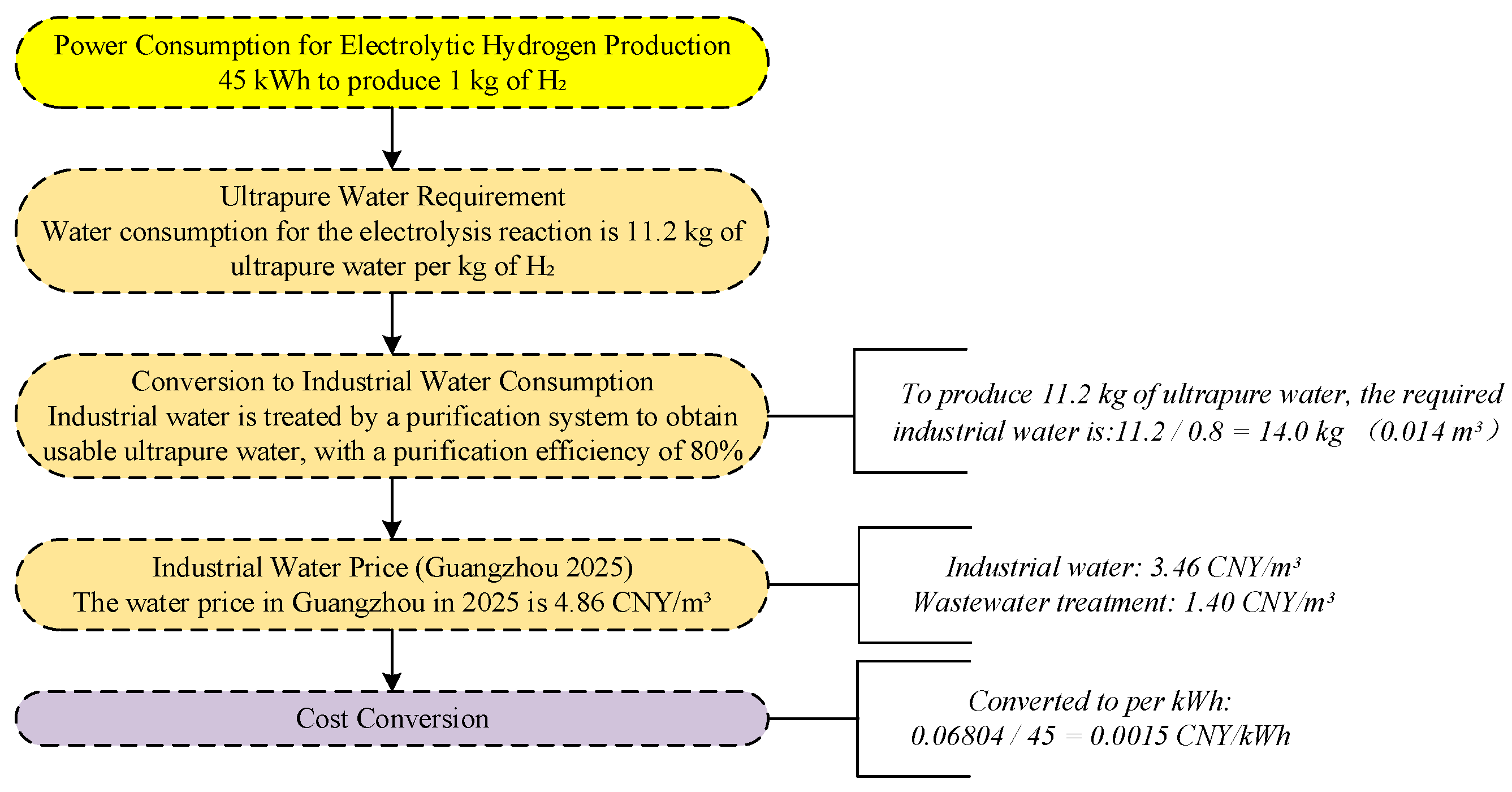
For electricity cost, instead of using a single on-grid tariff as nuclear electricity cost, price differences between low and high load conditions are considered to reflect marginal opportunity cost: a low electricity price of 0.215 CNY/kWh and a high electricity price of 0.32 CNY/kWh. For water cost, water consumption is included in the revenue model. Producing 1 kg hydrogen requires about 11.2 kg purified water. Purified water is produced from industrial water with an assumed purification efficiency of about 80%. Based on the 2025 industrial water price in Guangzhou (3.46 CNY/m3) and sewage treatment fee (1.40 CNY/m3), the total is 4.86 CNY/m3. Using these data, the corresponding water cost per kWh electricity consumed in hydrogen production is calculated, and the calculation process is shown in Figure 2.
In this study, the annualized revenue from hydrogen production is calculated by summing the product of the “typical-day revenue” and the corresponding “day-weighting factor.” Based on representative operating conditions, three typical daily scenarios are constructed: a summer weekday, a winter weekday, and a generic holiday. As the load characteristics and electricity price structures in spring and autumn are relatively similar, their revenues are approximated by the average values of the summer and winter cases to simplify the model.
By accounting for the numbers of weekdays and holidays across the four seasons, the annual weighting factors of the three typical-day scenarios are determined as follows: 120.5 days for summer weekdays, 112.5 days for winter weekdays, and 132 days for generic holidays. In addition, given the pronounced intra-day variability of surplus nuclear power available for peak shaving, which makes the actual daily electricity consumption and water usage difficult to predict accurately, the associated electricity and water costs are incorporated uniformly into the hydrogen production revenue formulation.
Accordingly, the annualized hydrogen production revenue is expressed in Equation (37):
R y e a r = 1000 k w , s , h t = 1 24 P t , k p H 2 p r i c e W H 2 p E p r i c e p H 2 O p r i c e W H 2 O w k
where R year denotes the annual revenue from hydrogen production (CNY); k w , s , h denotes the type of typical day, where w represents a summer weekday, s represents a winter weekday, and h represents a general holiday; t denotes the hourly index within a typical day, with t = 1 , 2 , , 24 ; P t , k denotes the hydrogen production power of the electrolyzer at hour t on typical day k (MW); p H 2 - price denotes the hydrogen selling price (CNY·kg−1); W H 2 denotes the specific electricity consumption per unit hydrogen production (kWh·kg−1); p E - price denotes the nuclear electricity price (CNY·kWh−1); p H 2 O - price denotes the industrial water price (CNY·kg−1); W H 2 O denotes the electricity consumption associated with industrial water usage per unit hydrogen production (kWh·kg−1); w k denotes the annual day-weighting factor of typical day k (days) and the coefficient 1000 is used to convert the power unit from MW to kW to ensure consistency with electricity consumption expressed in kWh.
Annualized Hydrogen Production Profit
In the economic evaluation of hydrogen production systems, the annualized profit serves as a key indicator for assessing financial feasibility and is defined as the difference between the annualized revenue and the annualized cost. Among these components, the annualized cost systematically accounts for the total economic burden incurred over the system’s entire life cycle. It consists of two parts: one is the annual operation and maintenance (O&M) expenditure required to sustain system operation, and the other is the annualized allocation of equipment investment that incorporates the time value of capital, referred to as the annual depreciation cost. The annualized cost is formulated in Equation (38):
C y e a r = C inv α + C inv r ( 1 + r ) n ( 1 + r ) n 1
where C year denotes the annualized cost of the hydrogen production system (CNY), and C inv denotes the equipment investment cost of the hydrogen production system (CNY); α is the operation and maintenance (O&M) cost ratio (set to 3%), r is the discount rate, and n represents the economic lifetime of the hydrogen production system (set to 20 years).
In Equation (38), the first term, C inv α , represents the annual O&M cost, while the second term, C inv r ( 1 + r ) n ( 1 + r ) n 1 denotes the annualized depreciation cost that accounts for the time value of capital.
By combining Equations (37) and (38), the annualized profit of hydrogen production can be obtained, as expressed in Equation (39).
π y e a r = 1000 k w , s , h t = 1 24 P t , k p H 2 p r i c e W H 2 p E p r i c e p H 2 O p r i c e W H 2 O w k C inv α + r ( 1 + r ) n ( 1 + r ) n 1

2.3.6. Discounted Payback Period

The payback period is a core indicator of project economics. This paper uses the discounted payback period method:
n = ln 1 P V r π y e a r ln ( 1 + r )
where PV represents the initial investment; π y e a r is annual net revenue; r represents the discount rate; n represents the payback period (years).
Considering the impact of discount rate on future cash flows, by substituting the investment and annualized revenue of a 50 MW AEL hydrogen-production unit, the payback period under typical scenarios can be obtained. This method reflects the dynamic profitability of nuclear hydrogen production under different electricity price and hydrogen selling price assumptions.
The selection of the discount rate r has a direct impact on the estimation of the investment payback period. By jointly considering the benchmark rates of return for energy infrastructure projects in China, the long-term financing costs of nuclear and renewable energy projects, and the relatively stable cash-flow characteristics of hydrogen production facilities, a discount rate of 5.5% is adopted as the baseline scenario in this study. This value is consistent with the commonly used discount rate range of 5–8% in domestic feasibility studies for energy-related engineering projects and reasonably reflects the project’s capital cost and risk profile.
On this basis, to examine the sensitivity of the economic assessment results to variations in capital costs, two higher discount rate scenarios of 6.5% and 7.5% are further considered in the sensitivity analysis, and the corresponding investment payback periods are compared.

3. Simulation and Results

3.1. Basic Profiles of Typical Scenarios for the Guangdong Power Grid in 2035

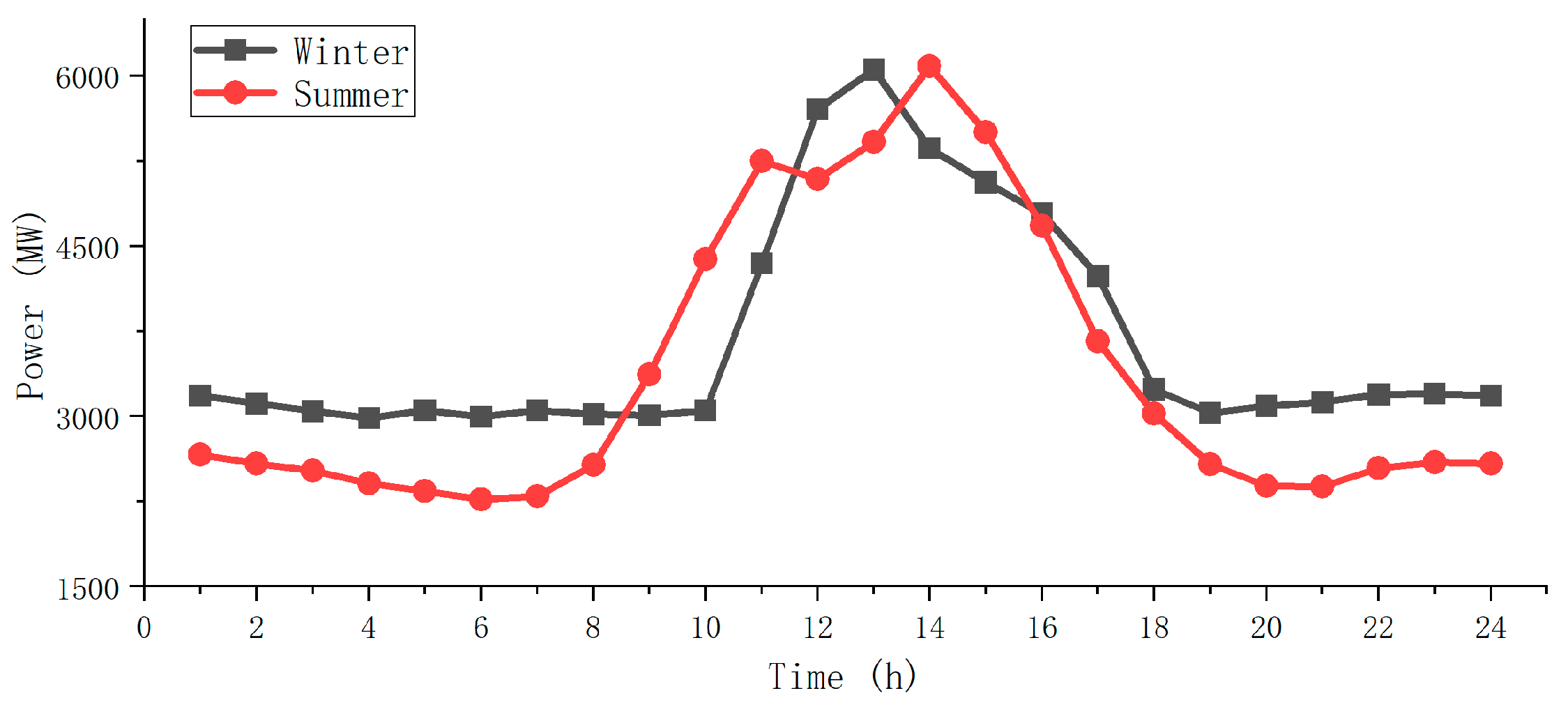
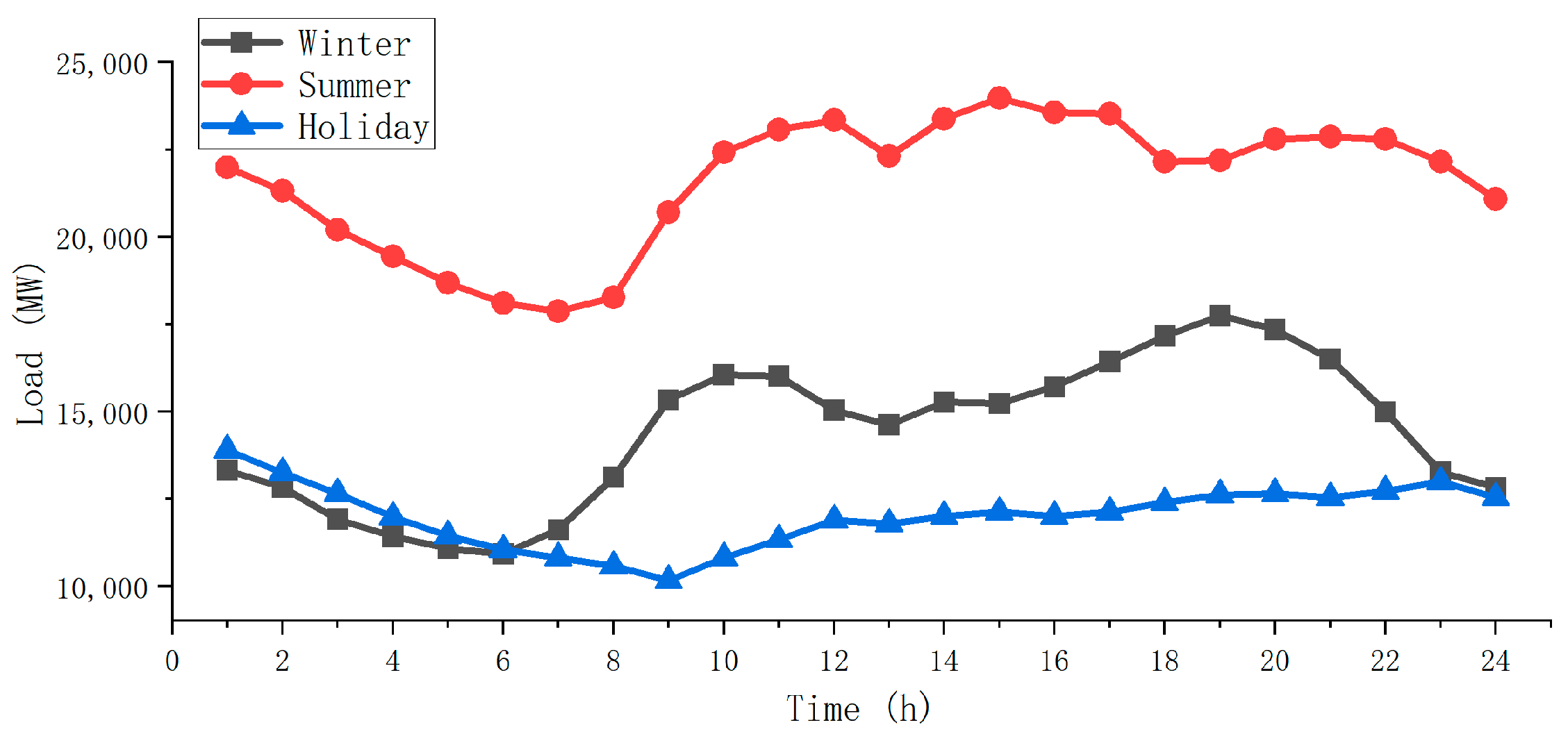
The load demand and renewable energy generation profiles of the Guangdong power grid under typical daily scenarios in 2035 are illustrated in Figure 3 and Figure 4, respectively.

3.2. Operation of Nuclear Power Units Under Typical Scenarios of the Guangdong Power Grid in 2035

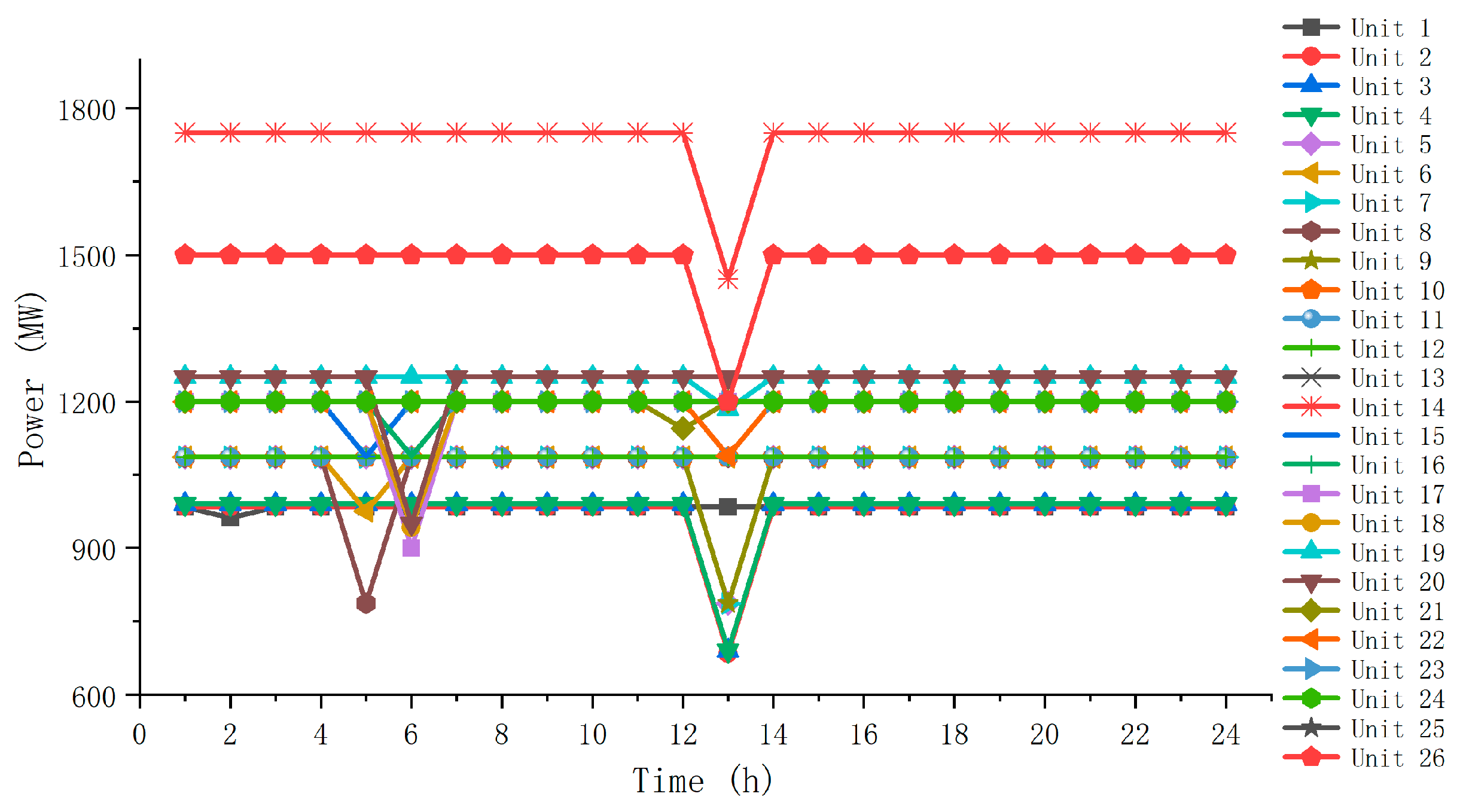
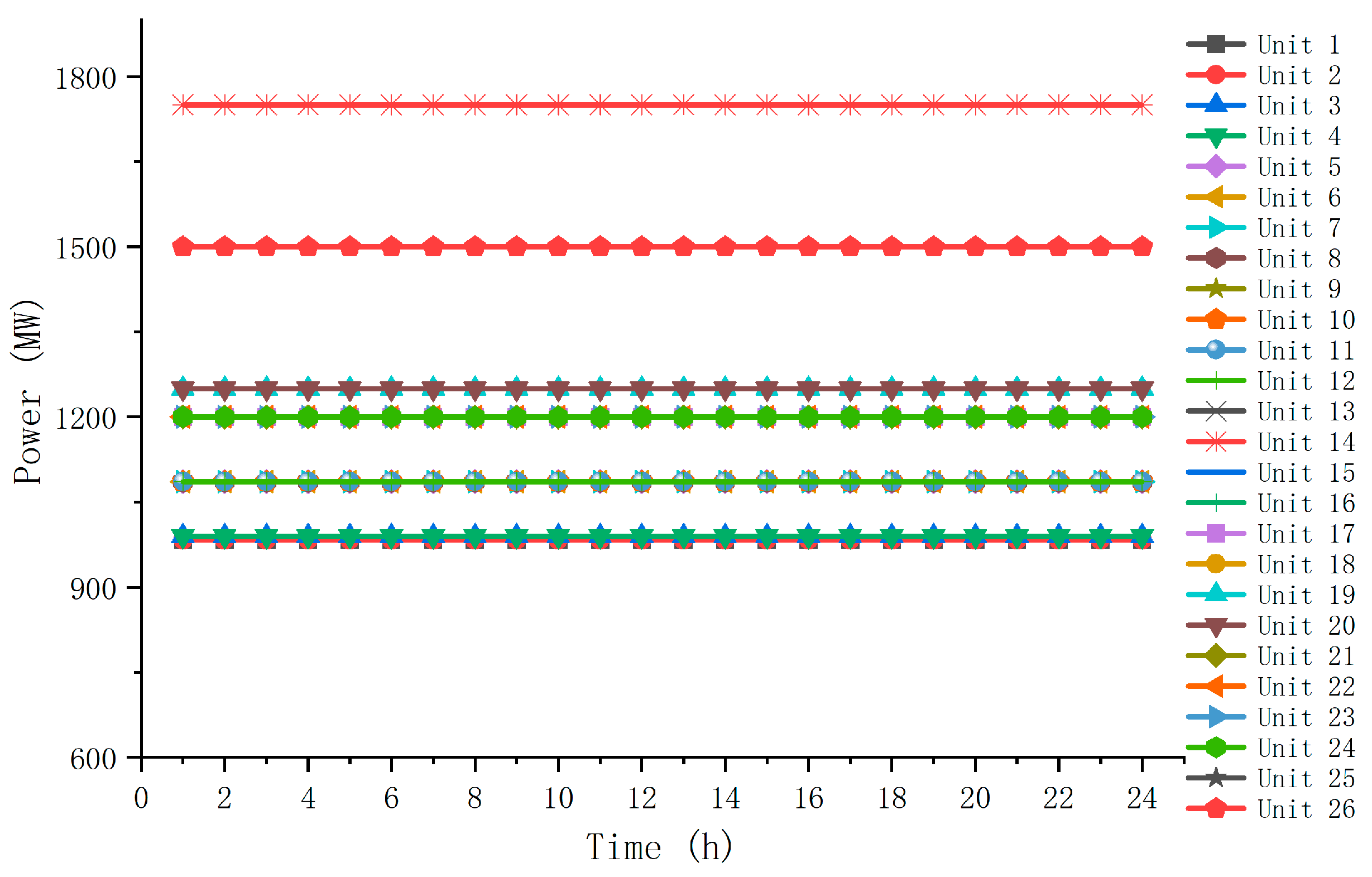
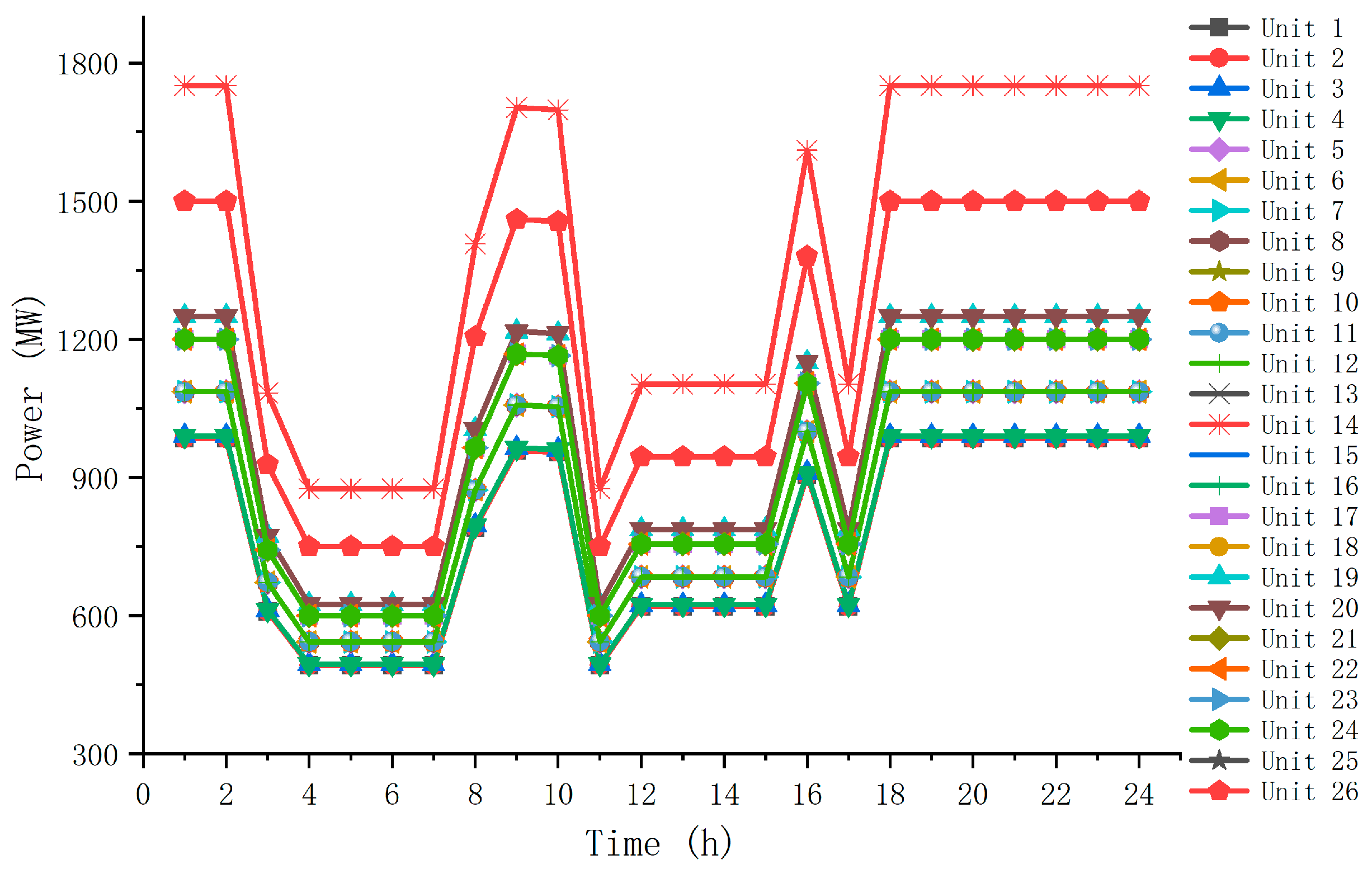
The SCUC/SCED simulation results of the 26 nuclear power units under three typical daily scenarios of the Guangdong power grid in 2035 are presented in Figure 5, Figure 6 and Figure 7.
It should be emphasized that the purpose of the sensitivity analysis is to characterize the overall impacts of hydrogen production capacity, electricity price, and hydrogen price variations on project economics, rather than to compare individual differences among nuclear power units. Given that the long-term power system of Guangdong Province in 2035 comprises 26 nuclear power units, which differ in installed capacity, minimum technical output, and peak-shaving operating characteristics, directly adopting parameters from a single unit could introduce case-specific bias.
Therefore, in the sensitivity analysis, key operating parameters and peak-shaving clearing results of the 26 nuclear power units are statistically processed, and their average values are adopted as representative nuclear unit parameters to characterize the system-level features of nuclear peak-shaving residual electricity.

3.3. Analysis of Nuclear Power Plant Operation and Peak-Shaving Characteristics

3.3.1. Typical Nuclear Peak-Shaving Mode

In this study, the “typical nuclear peak-shaving mode” refers to the nuclear power operating state that naturally emerges from the SCUC/SCED co-clearing model without imposing additional artificial operating rules or predefined peak-shaving paths. This mode reflects the baseline clearing outcome of nuclear power units under given market mechanisms and system conditions while satisfying system security constraints and market clearing rules, and it serves as a reference case for subsequent analyses of extended peak-shaving strategies.
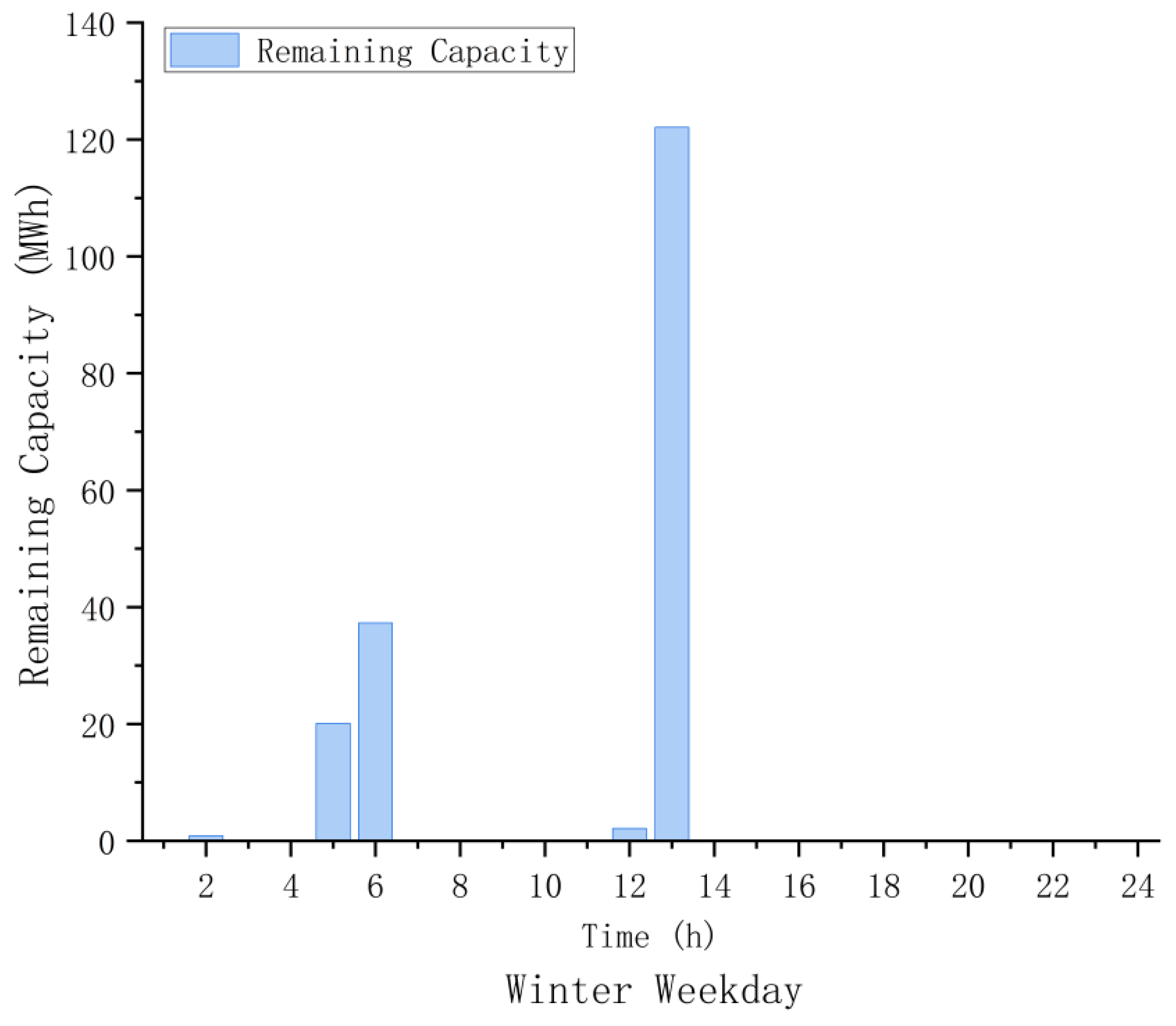
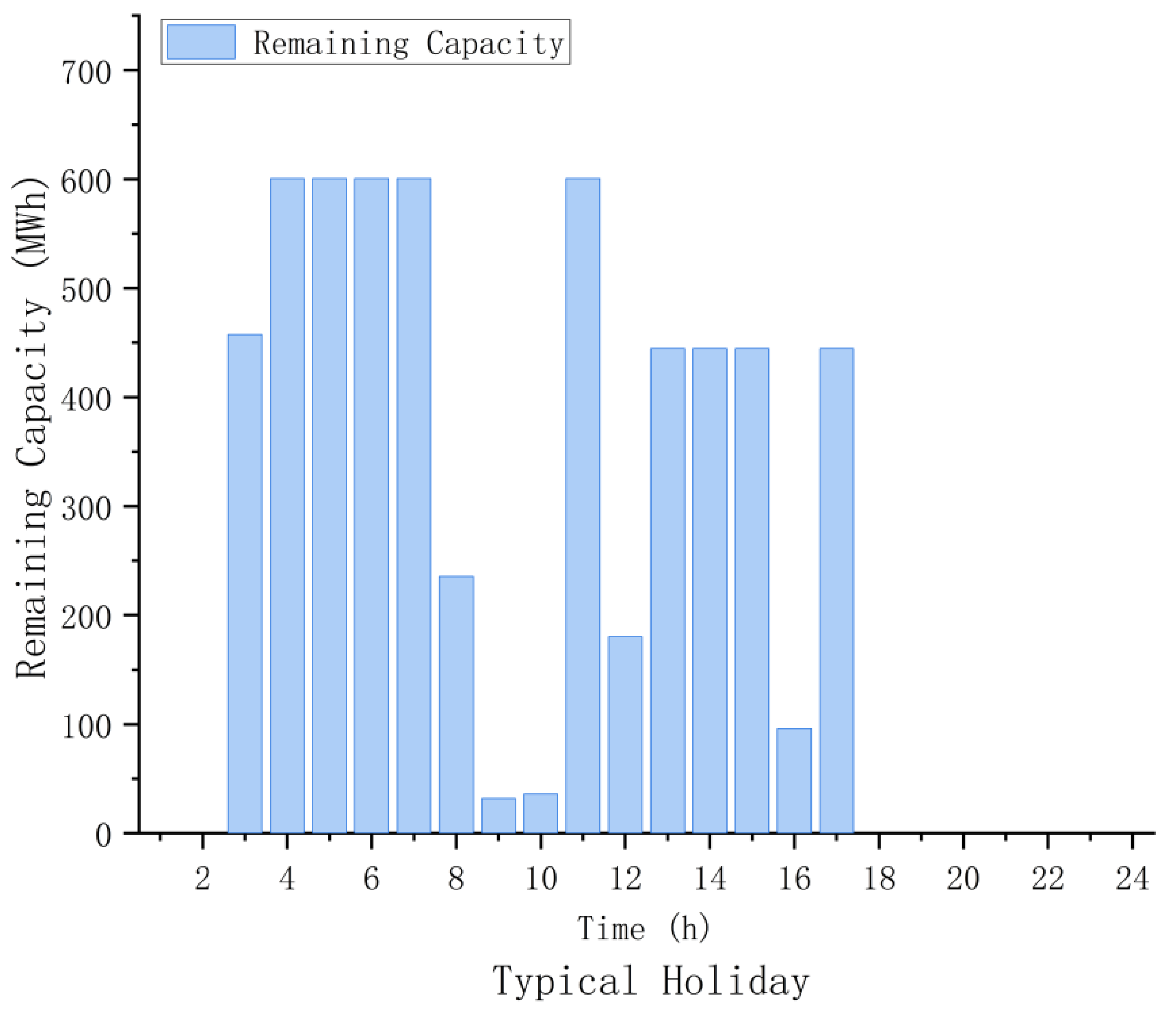
Simulation results indicate that nuclear power units operate at full output during summer periods, while peak-shaving is mainly undertaken during winter weekdays and holidays. Based on the SCUC/SCED clearing simulations, the hourly residual electricity of nuclear power in Guangdong Province during winter weekdays and holidays is obtained, as illustrated in Figure 8 and Figure 9, respectively.
Overall, the residual electricity of nuclear power is mainly concentrated during low-load periods and forms relatively stable power levels over several consecutive hours, exhibiting stage-wise variations on an hourly time scale. Compared with winter weekdays, the overall load level during holidays is lower, resulting in a substantial increase in both the magnitude and duration of nuclear residual electricity, with more pronounced low-output plateau characteristics. These results indicate that the residual electricity formed through nuclear peak-shaving is not a high-frequency, rapidly fluctuating power source, but is closer to a continuous, energy-type resource. Its temporal characteristics are therefore well aligned with energy conversion pathways requiring continuous operation, such as hydrogen production.

3.3.2. The “12-3-48-3” Nuclear Peak-Shaving Mode

In the Guangdong region, due to the generally low electricity demand during holidays, nuclear power units typically possess considerable peak-shaving potential under high renewable energy penetration. Analysis of the SCUC/SCED clearing results indicates that during holidays and prolonged low-load scenarios, nuclear units tend to maintain low-power plateau operation for several consecutive hours, constrained by minimum technical output, ramping limits, and reserve requirements. Concentrated output reductions and subsequent ramp-up processes are mainly observed during load transition periods.
It should be noted that the “12-3-48-3” peak-shaving operating mode introduced in this study is not a direct optimization outcome of the SCUC/SCED model, nor is it imposed as an exogenous constraint on the market clearing process. Instead, this mode is derived as a representative engineering-oriented operating pattern based on statistical analysis of hourly SCUC/SCED clearing results across multiple scenarios. It is used to provide an abstract representation of nuclear peak-shaving behavior under typical holiday scenarios, thereby facilitating subsequent comparative analyses of residual electricity utilization and hydrogen production economics.
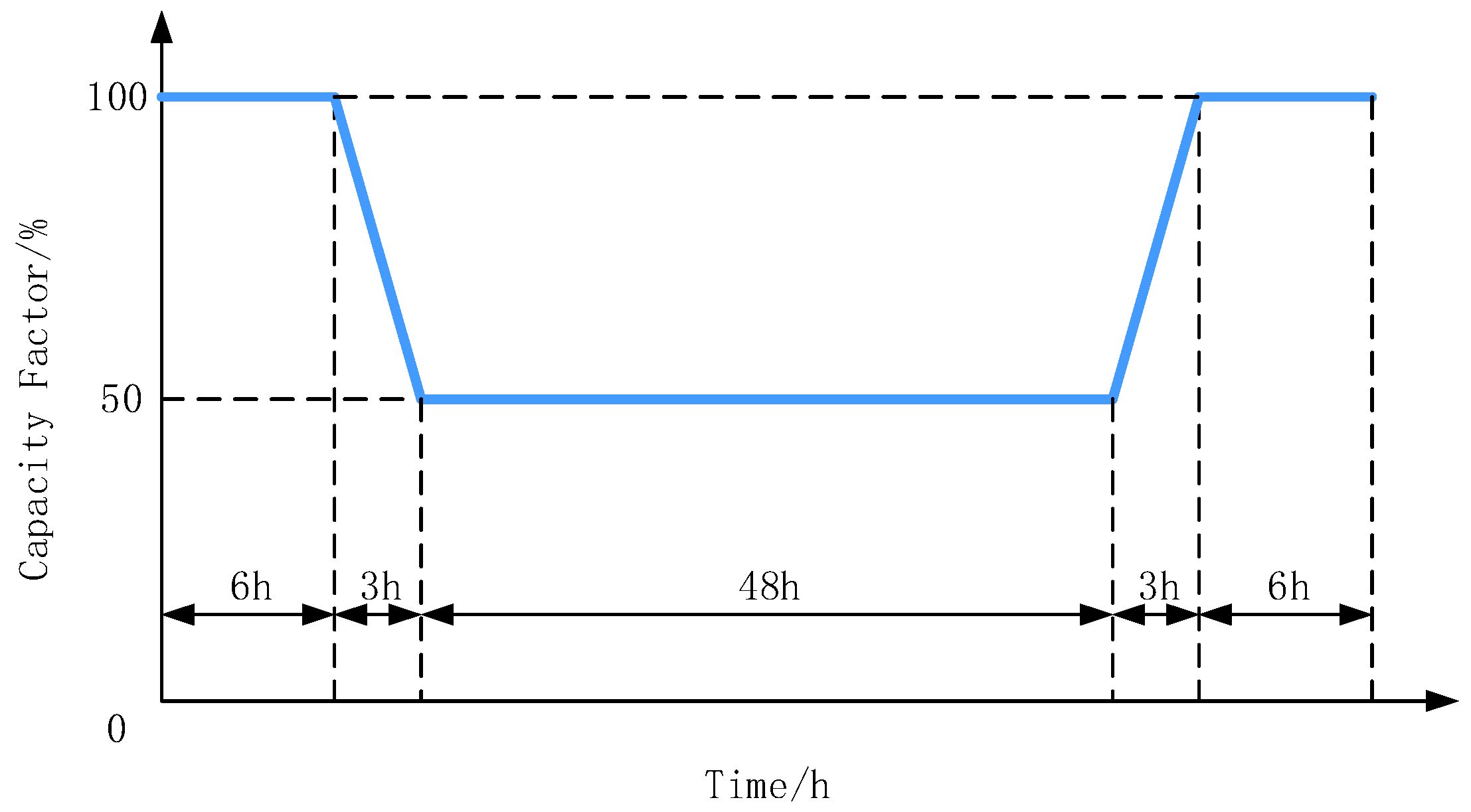
Specifically, under the “12-3-48-3” peak-shaving mode, nuclear power units operate at full output for 12 h during peak load periods, followed by a gradual ramp-down over 3 h to a low-power plateau. The units then remain at the low-power level for 48 h (taking a typical weekend as an example, covering the entire holiday period). After the holiday ends, the units ramp back to full output over an additional 3 h. The corresponding operating characteristics are illustrated in Figure 10.
Based on the holiday operating characteristics revealed by the SCUC/SCED clearing results, the “12-3-48-3” peak-shaving mode extends the duration of low-power plateau operation of nuclear power units, thereby concentrating peak-shaving residual electricity over the time dimension and providing a power supply with longer duration and smoother power variations for water electrolysis–based hydrogen production. Simulation results indicate that, under this operating mode, the residual electricity available for hydrogen production increases by approximately 30% compared with the case where residual electricity is directly utilized based on hourly clearing results.
These results suggest that, within the feasible clearing region determined by SCUC/SCED, a systematic abstraction of the operational characteristics embedded in hourly nuclear clearing trajectories and their expression through engineering-oriented operating strategies can effectively enhance the utilization of nuclear peak-shaving residual electricity and its economic potential in hydrogen production applications.

3.4. Sensitivity Analysis of Nuclear Peak Shaving

Based on the two nuclear load-following operating modes, this section builds upon the previously obtained market clearing results and the hydrogen production economic model to systematically examine the impacts of hydrogen production capacity on project economics under different electricity and hydrogen price scenarios. The analysis focuses on the variation patterns of annualized profit and investment payback period. Electricity price, hydrogen price, and hydrogen production capacity are selected as the key variables for sensitivity analysis.
Among these factors, the electricity price directly determines the level of electricity cost in the hydrogen production process and is a critical parameter affecting marginal hydrogen production profitability. The hydrogen price defines the upper bound of sales revenue for hydrogen products and reflects both the hydrogen market environment and the intensity of policy support. Meanwhile, the hydrogen production capacity simultaneously influences the initial investment scale and the ability to absorb off-peak nuclear electricity, serving as the core decision variable linking technical operation with economic returns. All of these variables constitute fundamental determinants in the economic evaluation of hydrogen production projects.
The capacity of the hydrogen production system directly determines both the utilization of off-peak nuclear electricity and the required investment scale, thereby affecting overall economic performance. Insufficient capacity may lead to underutilization of surplus nuclear electricity, whereas excessive capacity can result in diminished returns due to high capital expenditure or low utilization rates.
In view of these considerations, and under fixed modeling assumptions and technical parameters, a sensitivity analysis is first conducted for different hydrogen production capacity configurations to identify the optimal capacity range and associated constraints of nuclear-based hydrogen systems under different load-following modes. In addition, two electricity price levels (0.215 CNY/kWh and 0.32 CNY/kWh) and two hydrogen market price scenarios (25 CNY/kg for green hydrogen and 12 CNY/kg for grey hydrogen) are considered to assess the effects of market price variations on project revenues and investment payback periods. Furthermore, variations in the discount rate are introduced for scenarios that meet investment recovery conditions, enabling a comprehensive evaluation of the economic feasibility of nuclear-based hydrogen projects under multiple sources of uncertainty, including operating modes, market conditions, and capital costs.

3.4.1. Sensitivity Under the Typical Nuclear Peak-Shaving Mode

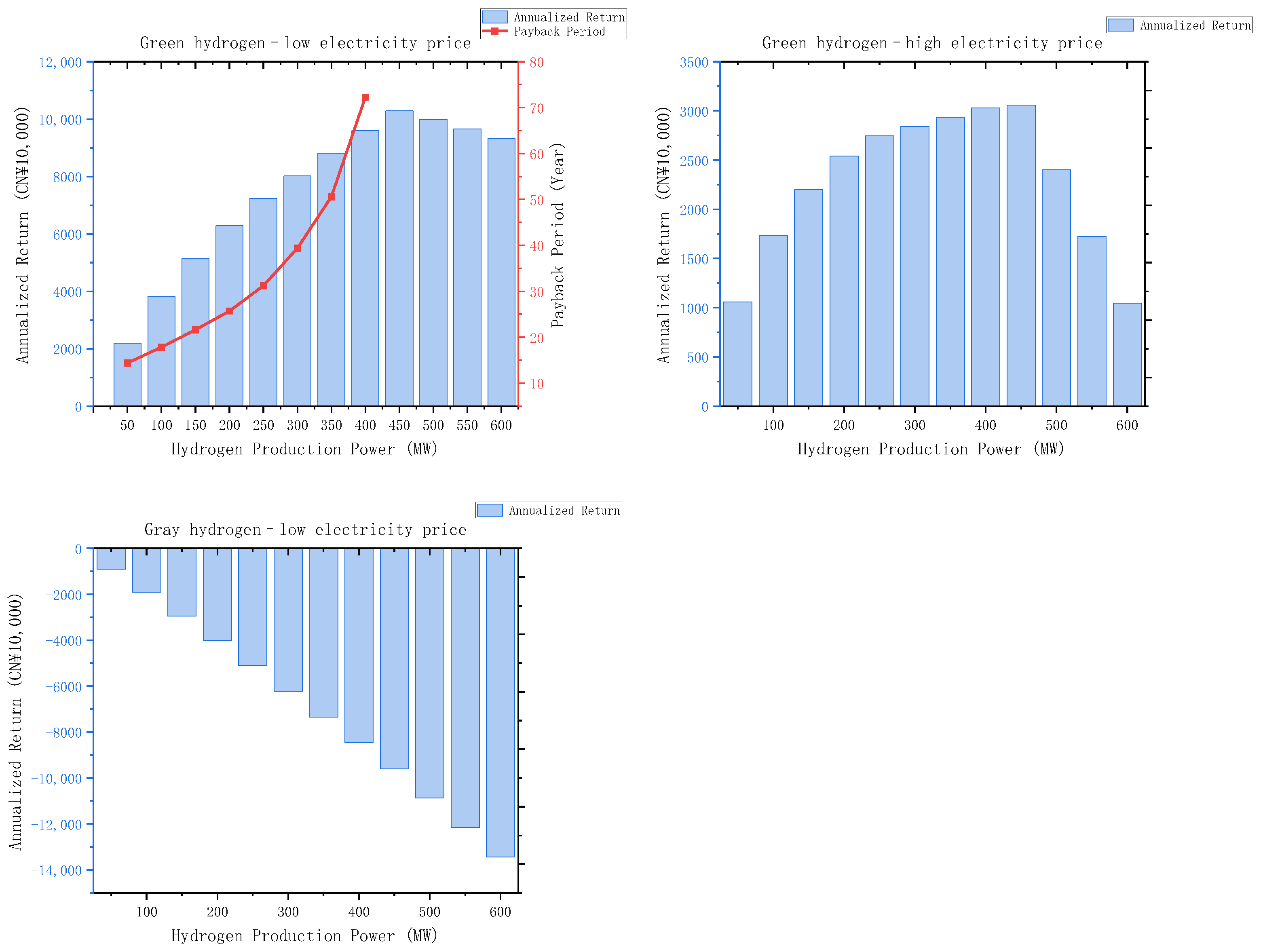
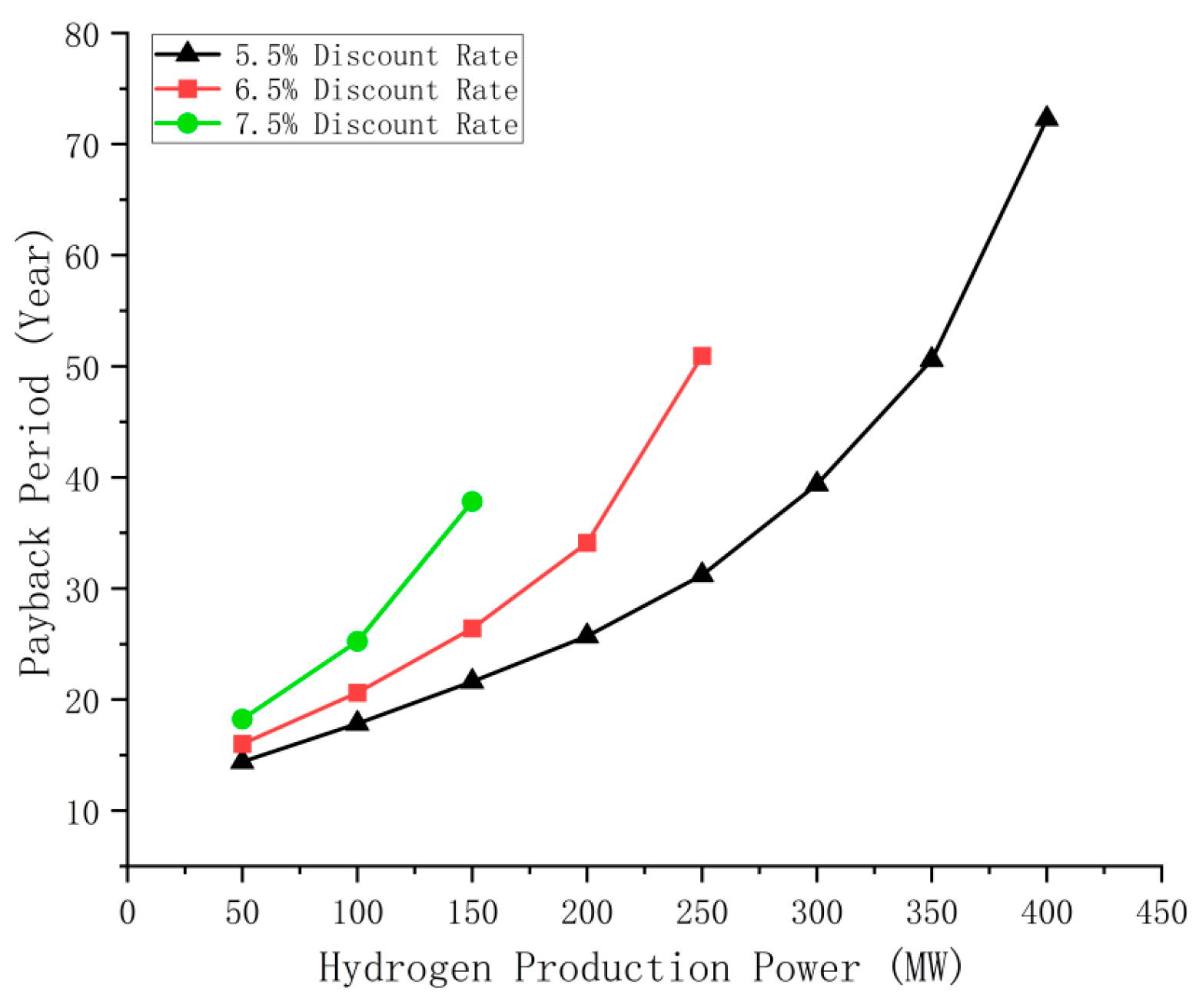
Under the typical nuclear peak-shaving mode, the impacts of hydrogen production capacity variation on project economics under different combinations of electricity prices and hydrogen prices are analyzed, as illustrated in Figure 11.
The analysis results indicate that, under low electricity price conditions, the annual net revenue of green hydrogen initially increases and then decreases with increasing hydrogen production capacity, reaching a peak at approximately 450 MW. However, due to the high capital investment required, the payback period remains relatively long. When the hydrogen production capacity exceeds 100 MW, the payback period surpasses the theoretical service life of the equipment, implying that cost recovery cannot be achieved within the lifecycle and that the economic performance is inadequate. Under high electricity price conditions, the overall system revenue is significantly constrained, as the increase in electricity costs weakens hydrogen production profitability. Although hydrogen output continues to increase with capacity expansion, the investment payback period cannot be further improved. By contrast, the grey hydrogen scenario exhibits negative returns across all capacity levels, indicating substantially lower economic performance than that of green hydrogen production and an inability to achieve profitability under current market price conditions.

3.4.2. Sensitivity Under the “12-3-48-3” Peak-Shaving Mode

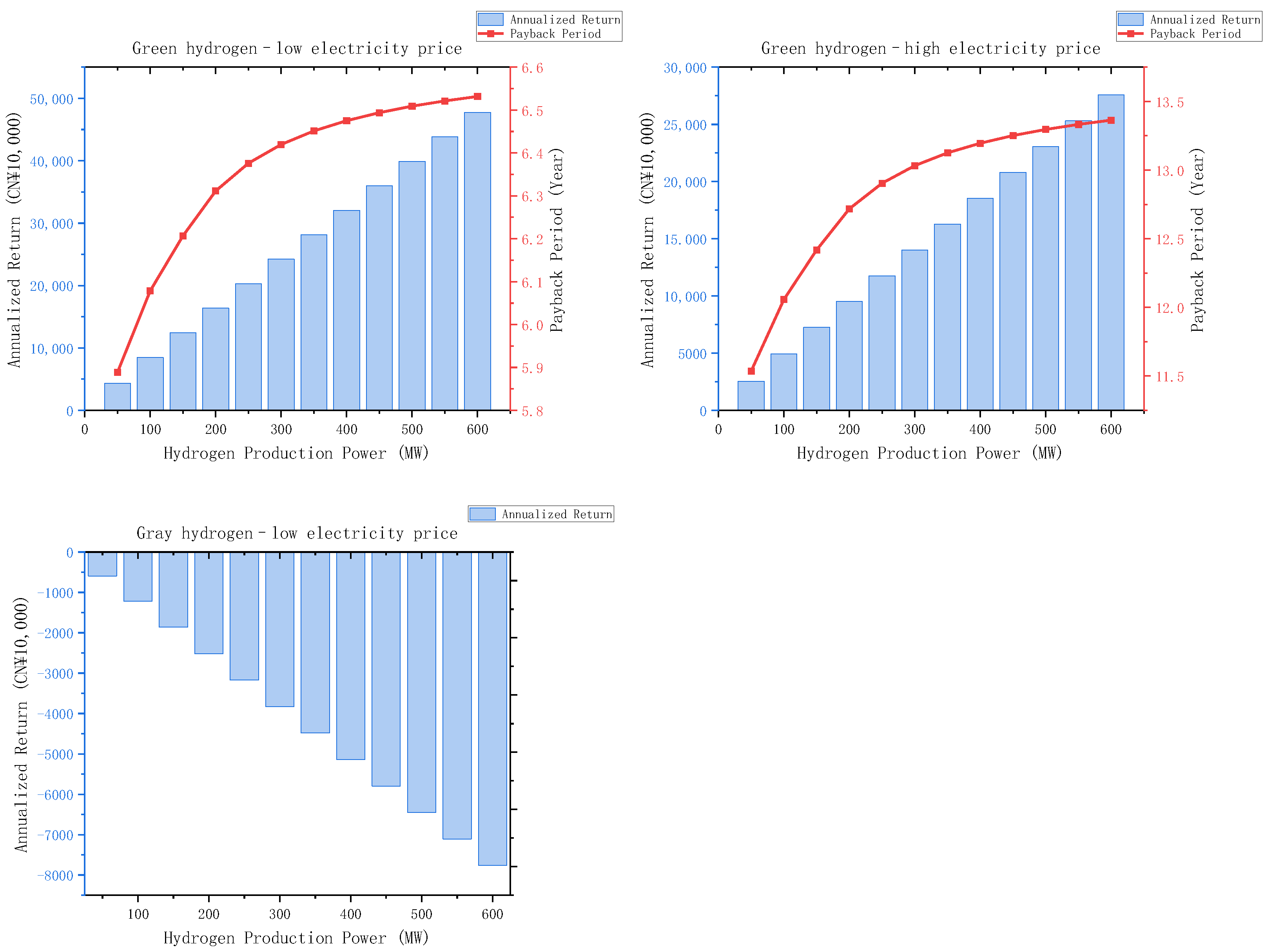
Under the “12-3-48-3” flexible peak-shaving mode, the impacts of hydrogen production capacity variation on project economics under different combinations of electricity prices and hydrogen prices are analyzed, as illustrated in Figure 12.
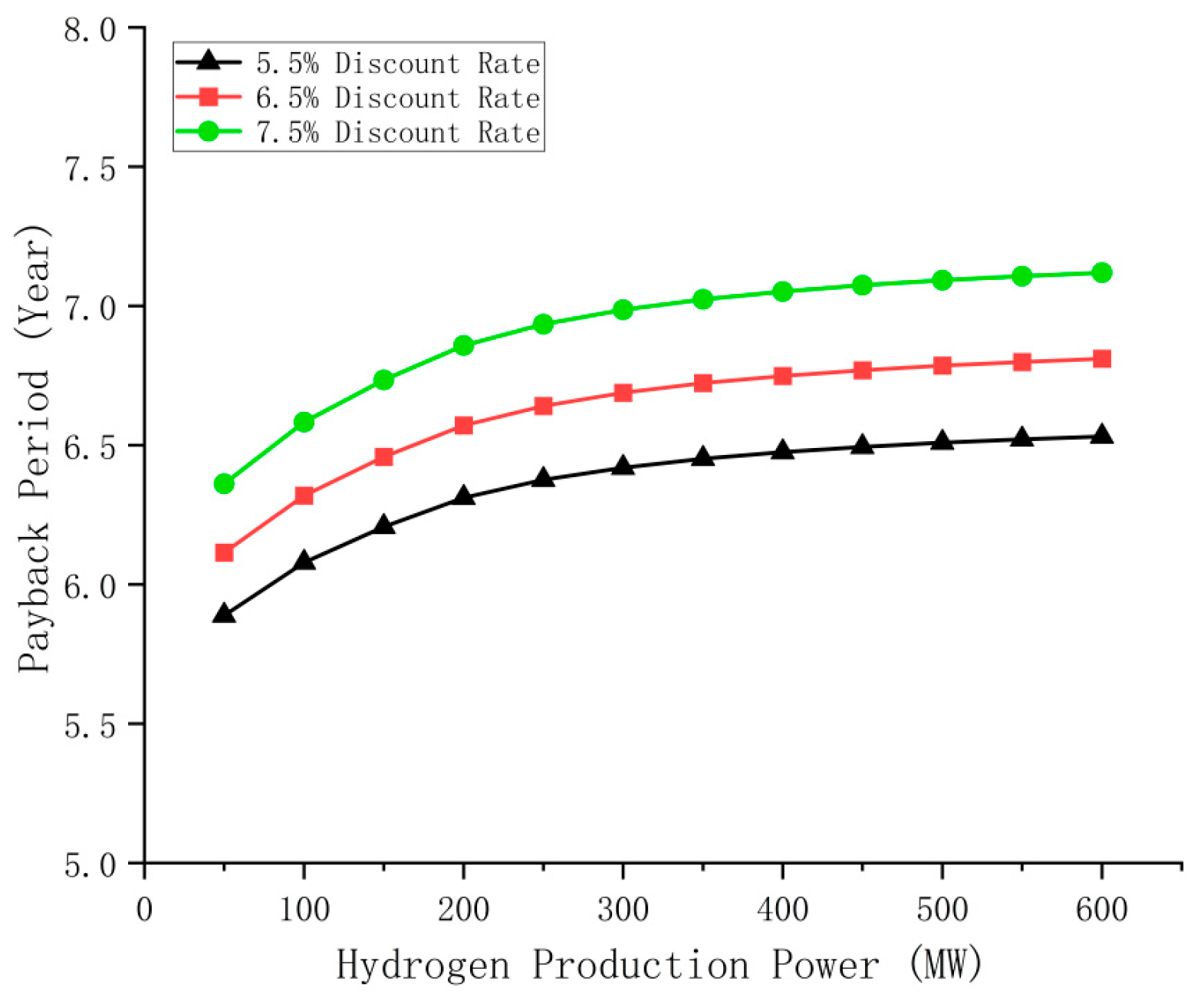
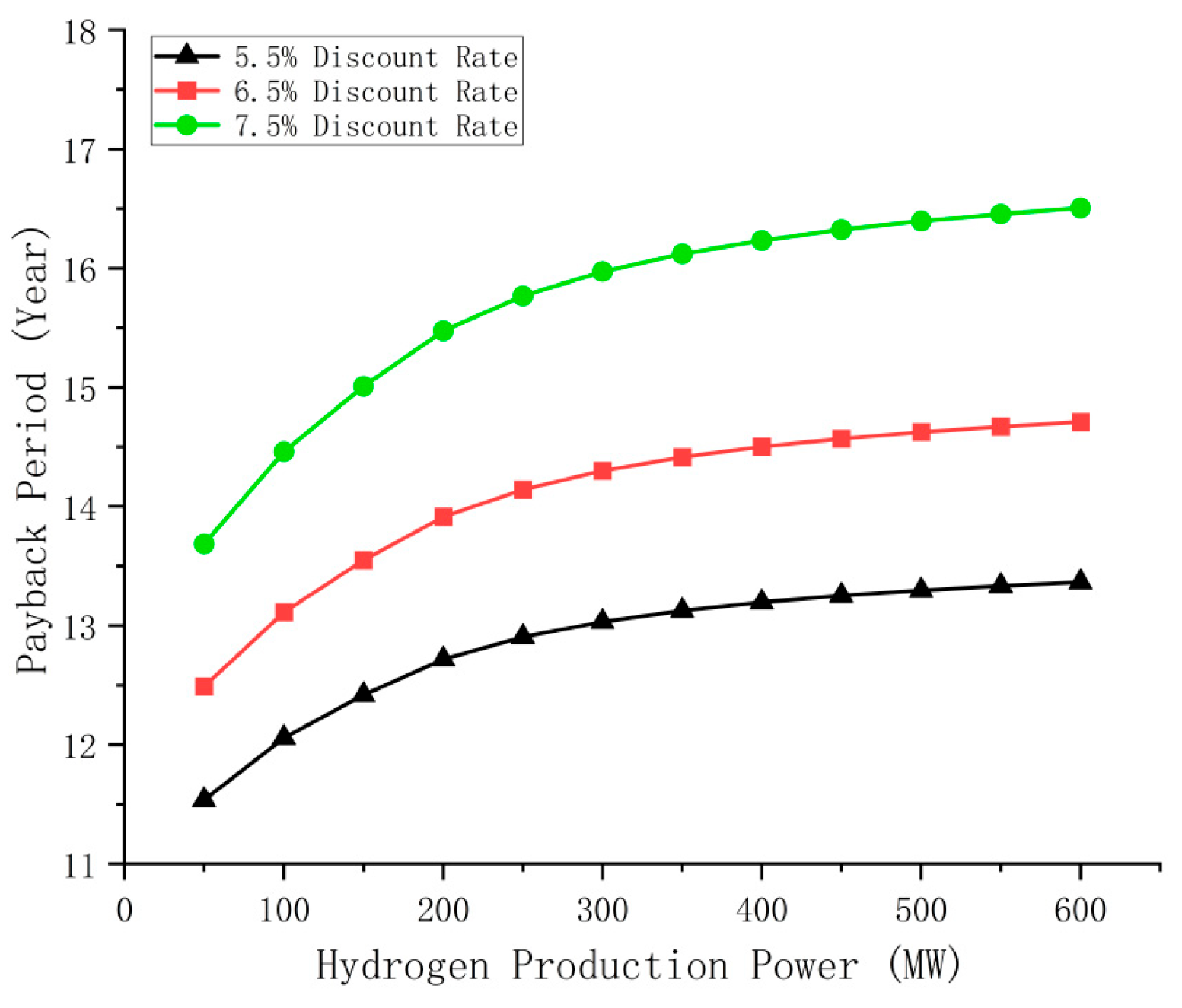
The results indicate that, compared with the typical peak-shaving mode, flexible operation significantly improves the utilization of off-peak nuclear electricity, leading to an overall enhancement in hydrogen production revenues and a further reduction in the investment payback period. Under low electricity price conditions, the green hydrogen scenario exhibits a stable growth trend in economic performance. As hydrogen production capacity increases, the annual net revenue continues to rise, while the payback period remains at approximately six years, indicating high feasibility over a wide range of capacities. Under high electricity price conditions, although electricity costs increase, the flexible peak-shaving mode effectively extends the duration of low-load nuclear operation and improves hydrogen utilization, thereby maintaining economic advantages, with the payback period stabilizing at around 13 years. By contrast, the grey hydrogen scenario still fails to achieve positive returns; however, the magnitude of losses is noticeably reduced compared with the typical peak-shaving mode, suggesting that flexible peak-shaving operation partially mitigates economic disadvantages.
Overall, low electricity price scenarios show strong investment potential, and rational hydrogen capacity control is key to achieving economic optimality. The results indicate that nuclear hydrogen economic feasibility depends strongly on the matching between electricity market price and hydrogen terminal price; a combination of low electricity price and high hydrogen price may become the main breakthrough for future nuclear hydrogen development. Meanwhile, the “12-3-48-3” mode increases peak-shaving depth and extends valley periods, enabling high-efficiency utilization of nuclear valley electricity and significantly enhancing economic potential. Therefore, improving nuclear peak-shaving capability and operational flexibility is crucial for promoting nuclear–hydrogen synergy and is of great significance for renewable integration and hydrogen industry development.

3.4.3. Sensitivity Analysis of Investment Payback Period with Respect to Discount Rate Under the “12-3-48-3” Mode

Based on the preceding analyses of different nuclear load-following operating modes and various electricity and hydrogen price scenarios, this subsection further examines the impact of changes in capital costs on project economics. The discount rate, as a key parameter reflecting project financing costs and risk levels, directly determines the calculated discounted payback period. To assess the sensitivity of the aforementioned economic conclusions to variations in the discount rate, two additional scenarios with discount rates of r = 6.5 % and r = 7.5 % are considered in addition to the baseline value of r = 5.5 % , and the investment payback periods of nuclear-coupled AEL hydrogen production projects are comparatively analyzed.
It should be noted that the calculation of the investment payback period is predicated on the project’s ability to achieve cumulative discounted cash flows over its entire life cycle that fully offset the initial investment. Under certain combinations of electricity and hydrogen prices, the annualized net profit of the project is negative or insufficient to recover the initial investment. In such cases, the project fails to achieve investment recovery even without discounting, and the discounted payback period is therefore not defined in a mathematical sense.
Based on the above principles, only scenarios in which an investment payback period can be calculated are considered in the discount rate sensitivity analysis. These scenarios include the low electricity price case for green hydrogen under the typical nuclear peak-shaving mode, as well as the low and high electricity price cases for green hydrogen under the “12-3-48-3” peak-shaving mode. The corresponding results are illustrated in Figure 13, Figure 14 and Figure 15. Other scenarios are excluded from the discount rate sensitivity analysis because they do not meet the conditions required for investment payback.
The results indicate that, under different load-following operating modes and hydrogen production capacity configurations, increases in the discount rate lead to varying degrees of extension in the discounted investment payback period. Moreover, the magnitude of this extension becomes more pronounced as the hydrogen production capacity increases. This is because a higher discount rate reduces the present value of future cash flows, thereby prolonging the time required for cumulative discounted revenues to offset the initial investment. Under typical nuclear load-following modes, the payback periods of certain hydrogen capacity configurations approach or even exceed the design lifetime of the equipment, resulting in significantly constrained economic performance.
By contrast, under the “12-3-48-3” flexible load-following mode, the extended duration of low-power nuclear operation and the substantially increased annual utilization hours of the hydrogen production system lead to higher overall annualized net revenues. As a result, projects exhibit stronger resilience to changes in the discount rate. Even under higher discount rate scenarios, the investment payback periods of most medium-scale hydrogen production capacity options remain well below the design lifetime of the hydrogen production system, and the overall economic feasibility of the projects remains stable.
Overall, variations in the discount rate primarily affect the payback period by altering the time value of capital but do not change the relative economic ranking among different load-following modes. Nuclear-based hydrogen production schemes operating under low electricity price conditions and the “12-3-48-3” load-following mode demonstrate robust economic performance across a relatively wide range of discount rates. In contrast, under higher electricity price scenarios or excessively large hydrogen production capacities, project economics become more sensitive to changes in the discount rate.

3.5. Discussion on the Impacts of Macroeconomic Parameters and Policy Factors

Although the economic analysis of nuclear-based hydrogen production is conducted based on the projected load demand, generation mix, and market clearing results of the Guangdong power system in 2035, the corresponding conclusions are inevitably influenced by changes in macroeconomic parameters and the policy environment. Therefore, it is necessary to further discuss the applicability and robustness of the results from the perspectives of electricity prices, hydrogen prices, and policy incentive mechanisms.
With respect to electricity prices, a single fixed feed-in tariff is not adopted. Instead, high and low electricity price scenarios are introduced to characterize the potential opportunity costs of nuclear peak-shaving residual electricity under different operating conditions. Electricity consumption for hydrogen production is exclusively sourced from residual electricity generated through nuclear peak-shaving, and sensitivity analysis is conducted to examine the response of hydrogen production economics to electricity price variations, rather than to predict specific market settlement mechanisms or future electricity price trajectories. Consequently, electricity price changes primarily affect the economic performance of the project, while the formation mechanism of nuclear peak-shaving residual electricity and its utilization potential for hydrogen production remain unchanged.
Regarding hydrogen prices, multiple price scenarios are considered in the economic evaluation, and sensitivity analysis is employed to examine variations in investment payback periods across different price levels. The results indicate that hydrogen prices exert a significant influence on project economics; however, within a reasonable price range, the nuclear–hydrogen coupled system exhibits relatively strong risk resilience. This suggests that the conclusions of this study maintain a certain degree of applicability across different hydrogen price scenarios.
In terms of policy incentive mechanisms, explicit policy parameters such as carbon subsidies, electricity price subsidies, or dedicated hydrogen incentives are not incorporated into the analysis. Instead, the endogenous economic value of nuclear peak-shaving residual electricity is evaluated within the current market-based clearing framework. It should be noted that the introduction of additional incentive policies targeting low-carbon power sources or green hydrogen production in the future would be expected to further improve project economics. Nevertheless, such policy developments would not alter the fundamental conclusions regarding the formation mechanism of nuclear peak-shaving residual electricity and its utilization boundary identified in this study.

4. Conclusions

This study addresses the constrained peak-shaving capability of nuclear power under conditions of high renewable energy penetration by developing an SCUC/SCED clearing model with joint optimization of energy and reserve markets. Taking the Guangdong Province power system in the 2035 target year as the study object, the clearing characteristics of nuclear power units and the formation mechanism of peak-shaving surplus electricity under different operating scenarios are systematically analyzed. On this basis, an economic evaluation model for a nuclear-coupled AEL hydrogen production system is further established to quantify the investment return characteristics under different hydrogen production capacities and operating modes.
The results indicate that, under typical peak-shaving operating conditions, the introduction of flexible operating strategies can significantly enhance the utilization of surplus electricity generated by nuclear peak-shaving. Under the “12-3-48-3” peak-shaving mode, the surplus nuclear electricity available for hydrogen production increases by approximately 30% compared with conventional peak-shaving strategies. Under low electricity price and green hydrogen price scenarios, when the hydrogen production capacity is configured at 50–100 MW, the project payback period is approximately six years and maintains strong economic robustness even as the discount rate increases. In contrast, under high electricity price or grey hydrogen price scenarios, the economic performance of hydrogen production projects is substantially constrained, indicating that the feasibility of nuclear-powered hydrogen production is highly dependent on electricity market prices and the hydrogen market environment.
From a system-level perspective, coupling electricity market clearing results with hydrogen production economic analysis enables the identification of the exploitable boundaries and economically feasible ranges of surplus electricity from nuclear peak-shaving. This provides a quantitative analytical framework for flexible nuclear operation and cross-energy synergies in power systems with high shares of renewable energy. The findings offer useful references for optimizing nuclear peak-shaving operating strategies, configuring hydrogen production capacities, and supporting related policy formulation.
It should be noted that this study has several limitations. First, the proposed clearing model primarily focuses on the electricity market and does not fully capture the coupling between hydrogen production systems and hydrogen markets, thereby neglecting the dynamic impacts of hydrogen price fluctuations and demand-side uncertainty on project revenues. For instance, a 10% decline in hydrogen prices could extend the payback period by approximately 2–3 years. In addition, hydrogen transportation and storage costs are not considered; for nuclear plants located far from major consumption centers, such costs may substantially erode project profitability. Second, the operational simulations rely mainly on rule-based strategies and do not fully integrate the temporal optimization of hydrogen production into a unified dispatch framework. Extreme weather events (e.g., prolonged heatwaves or cold spells) that may induce sharp load fluctuations, as well as scheduled or unexpected nuclear outages, are also not explicitly considered, all of which could result in lower actual operational efficiency than that predicted by simulations. Finally, as the hydrogen industry remains in an early development stage, uncertainties associated with hydrogen pricing mechanisms, green hydrogen certification, and policy incentives may exert significant influences on the economic viability of nuclear-based hydrogen projects.
From the perspective of environmental feasibility, the nuclear-based peak-shaving hydrogen production scheme examined in this study utilizes residual electricity from nuclear power as its energy input, without introducing additional fossil energy consumption. The hydrogen production process itself generates no direct carbon emissions, thereby enhancing the overall utilization efficiency of low-carbon electricity resources. Moreover, by absorbing nuclear peak-shaving residual electricity under high renewable penetration, the proposed scheme indirectly reduces renewable curtailment and the substitution of fossil-fueled generation, contributing positively to the reduction of overall power system carbon emissions. Consequently, without imposing additional environmental burdens, the proposed approach demonstrates favorable environmental feasibility.
Future research may be extended in several directions. First, hydrogen production systems could be jointly modeled with electricity and hydrogen markets to establish a coordinated optimization framework across multiple energy markets. Second, by incorporating different nuclear plant locations and regional load characteristics, the adaptability and flexibility of the proposed pathway under multi-regional representative scenarios can be explored. Third, ongoing developments in policies such as green hydrogen subsidies, carbon-reduction incentives, capacity payments, and ancillary service markets should be closely tracked and dynamically integrated into economic evaluation models. Finally, by explicitly incorporating carbon market price signals, future studies could quantify the emission-reduction value and system flexibility benefits of nuclear-based hydrogen production, thereby providing more comprehensive and systematic decision-making support for the coupled development of nuclear power and hydrogen energy.

Author Contributions

Conceptualization, J.X.; Resources, G.Q.; Data curation, C.Z. and B.D.; Writing—original draft, C.Z., B.D., J.L. and H.R.; Writing—review and editing, J.L. and H.R.; Supervision, D.L., J.L. and H.R.; Project administration, G.Q.; Funding acquisition, J.X. and D.L. All authors have read and agreed to the published version of the manuscript.

Funding

This research received no external funding.

Data Availability Statement

The original contributions presented in this study are included in the article. Further inquiries can be directed to the corresponding author.

Conflicts of Interest

Authors Jiaoshen Xua, Ge Qina and Dongyuan Lia are employed by China Nuclear Power Engineering Co., Ltd. The remaining authors declare that the research was conducted in the absence of any commercial or financial relationships that could be construed as potential conflicts of interest.

References

  1. Abhyankar, N.; Lin, J.; Kahrl, F.; Yin, S.; Paliwal, U.; Liu, X.; Khanna, N.; Luo, Q.; Wooley, D.; O’Boyle, M.; et al. Achieving an 80% carbon-free electricity system in China by 2035. iScience 2022, 25, 105180. [Google Scholar] [CrossRef] [PubMed]
  2. Jenkins, J.D.; Zhou, Z.; Ponciroli, R.; Vilim, R.; Ganda, F.; de Sisternes, F.; Botterud, A. The benefits of nuclear flexibility in power system operations with renewable energy. Appl. Energy 2018, 222, 872–884. [Google Scholar] [CrossRef]
  3. IAEA. Non-Baseload Operation in Nuclear Power Plants: Load Following and Frequency Control Modes of Flexible Operation; Nuclear Energy Series No. NP-T-3.23; IAEA: Vienna, Austria, 2018; Available online: https://www-pub.iaea.org/MTCD/Publications/PDF/P1756_web.pdf (accessed on 25 September 2025).
  4. Zhang, S. Optimal Operation Strategy of Nuclear Power Units Under Electricity Market Environment; Shenyang University of Technology: Shenyang, China, 2023. [Google Scholar]
  5. Lin, Y.; Pan, X.; Lin, Z.; Ai, X. Review of peak regulation for power system with a high penetration of nuclear power. Mod. Electr. Power 2020, 37, 51–58. [Google Scholar]
  6. Sepulveda, N.A.; Jenkins, J.D.; de Sisternes, F.J.; Lester, R.K. The role of firm low-carbon electricity resources in deep decarbonization of power generation. Joule 2018, 2, 2403–2420. [Google Scholar] [CrossRef]
  7. Romanos, P.; Al Kindi, A.A.; Pantaleo, A.M.; Markides, C.N. Flexible nuclear plants with thermal energy storage and secondary power cycles: Virtual power plant integration in a UK energy system case study. E-Prime—Adv. Electr. Eng. Electron. Energy 2022, 2, 100027. [Google Scholar] [CrossRef]
  8. Zakeri, B.; Syri, S. Electrical energy storage systems: A comparative life cycle cost analysis. Renew. Sustain. Energy Rev. 2015, 42, 569–596. [Google Scholar] [CrossRef]
  9. Aneke, M.; Wang, M. Energy storage technologies and real-life applications—A state of the art review. Appl. Energy 2016, 179, 350–377. [Google Scholar] [CrossRef]
  10. Faizan, M.; Alkaabi, A.K.; Nie, B.; Afgan, I. Thermal energy storage integration with nuclear power: A critical review. J. Energy Storage 2024, 96, 112577. [Google Scholar] [CrossRef]
  11. Wood, A.J.; Wollenberg, B.F. Power Generation, Operation, and Control, 2nd ed.; Wiley: Hoboken, NJ, USA, 2012; ISBN 978-1118585955. [Google Scholar]
  12. Morales, J.M.; Conejo, A.J.; Madsen, H.; Pinson, P.; Zugno, M. Integrating Renewables in Electricity Markets: Operational Problems; Springer: Berlin, Germany, 2014. [Google Scholar] [CrossRef]
  13. Jenkins, J.D.; Sepulveda, N.A. Enhanced Decision Support for a Changing Electricity Landscape: The GenX Configurable Electricity Resource Capacity Expansion Model. MIT Energy Initiative Working Paper (MITEI-WP-2017-10). Massachusetts Institute of Technology: Cambridge, MA, USA, 2017. Available online: https://energy.mit.edu/wp-content/uploads/2017/10/Enhanced-Decision-Support-for-a-Changing-Electricity-Landscape.pdf (accessed on 19 November 2025).
  14. Loulou, R.; Goldstein, G.; Noble, K. Documentation for the TIMES Model. In Energy Technology Systems Analysis Programme (ETSAP); International Energy Agency: Paris, France, 2004; Available online: https://iea-etsap.org/index.php/documentation (accessed on 25 November 2025).
  15. Keppo, I.; Strubegger, M. Capacity expansion planning under uncertainty. Energy Econ. 2017, 63, 235–246. [Google Scholar]
  16. Geidl, M.; Andersson, G. Optimal power flow of multiple energy carriers. IEEE Trans. Power Syst. 2007, 22, 145–155. [Google Scholar] [CrossRef]
  17. Mancarella, P. MES (multi-energy systems): An overview of concepts and evaluation models. Energy 2014, 65, 1–17. [Google Scholar] [CrossRef]
  18. Kyriakopoulos, G.L.; Aravossis, K.G. Literature review of hydrogen energy systems and renewable energy sources. Energies 2023, 16, 7493. [Google Scholar] [CrossRef]
  19. Gao, X.; Zheng, K.; Cai, C. Economic analysis of hydrogen energy storage for nuclear peak shaving. South. Energy Constr. 2021, 8, 1–8. [Google Scholar]
  20. National Energy Administration. Guangdong Electricity Market Operation Rules; South China Regulatory Bureau of NEA: Guangzhou, China, 2022. Available online: https://nfj.nea.gov.cn/xwzx/tzgg/202402/t20240208_245723.html (accessed on 13 September 2025).
  21. Hydropower and Water Resources Planning and Design General Institute. China Renewable Energy Engineering Cost Management Report. 2024. Available online: https://h2.in-en.com/html/h2-2442668.shtml (accessed on 11 September 2025).
  22. Xu, J.; Ding, X.; Gong, Y. Economic analysis of water electrolysis hydrogen production stations. Energy Storage Sci. Technol. 2022, 11, 2374–2385. [Google Scholar]
  23. Qi, Y.; Gao, D.; Zheng, X. Industrialization economics of SPE hydrogen production technology in China. Energy Storage Sci. Technol. 2022, 11, 4038–4047. [Google Scholar]
  24. China Energy News. Technological Innovation Drives Cost Reduction in the Hydrogen Energy Industry. 2024. Available online: https://paper.people.com.cn/zgnybwap/html/2024-06/10/content_26063866.htm (accessed on 11 November 2025).
Figure 1. Overall research framework.
Processes 14 00725 g001
Figure 2. Conversion of water cost for hydrogen production.
Processes 14 00725 g002
Figure 3. Typical daily load curves for winter, summer, and holiday in the Province of Guangdong in the target year.
Processes 14 00725 g003
Figure 4. Typical daily renewable energy output curves for summer and winter in the Province of Guangdong in the target year.
Processes 14 00725 g004
Figure 5. Operation of nuclear power units on a typical winter weekday in the long-term Guangdong power system.
Processes 14 00725 g005
Figure 6. Operation of nuclear power units on a typical summer weekday in the long-term Guangdong power system.
Processes 14 00725 g006
Figure 7. Operation of nuclear power units on a typical holiday in the long-term Guangdong power system.
Processes 14 00725 g007
Figure 8. Nuclear peak-shaving demand on a typical winter weekday in Guangdong (prospective year).
Processes 14 00725 g008
Figure 9. Nuclear peak-shaving demand on a typical holiday in Guangdong (prospective year).
Processes 14 00725 g009
Figure 10. Schematic of the “12-3-48-3” peak-shaving mode.
Processes 14 00725 g010
Figure 11. Sensitivity analysis under the typical nuclear peak-shaving mode (three scenarios).
Processes 14 00725 g011
Figure 12. Sensitivity analysis under the “12-3-48-3” peak-shaving mode (three scenarios).
Processes 14 00725 g012
Figure 13. Sensitivity analysis of the investment payback period under the green hydrogen–low electricity price scenario for typical load-following modes.
Processes 14 00725 g013
Figure 14. Sensitivity analysis of the investment payback period under the green hydrogen–low electricity price scenario for the “12-3-48-3” load-following mode.
Processes 14 00725 g014
Figure 15. Sensitivity analysis of the investment payback period under the green hydrogen–high electricity price scenario for the “12-3-48-3” load-following mode.
Processes 14 00725 g015
Table 1. Start-up and shut-down time and cost parameters of typical thermal power units.
No.Unit TypeInstalled Capacity
(MW)
Start-Up/Shut-Down
Time (h)
Start-Up Cost
(104 CNY)
Shut-Down Cost
(104 CNY)
1Coal-fired unit3004.0128
26004.513.710
36604.51410
410005.01812
5Gas-fired unit60–1500.5205
6150–2700.5306
7270–3900.5408
8390–5000.5509
9500–6000.56010
Table 2. Estimated equipment procurement cost for a 50 MW hydrogen production plant.
No.EquipmentTechnical SpecificationUnitprice (10,000 CNY)QuantitySubtotal
(10,000 CNY)
1Hydrogen power supply5.5 MW170101700
2Electrolyzer hydrogen system1000 Nm3/h (5 MW)600106000
3Purified water production system1 m3/h3010300
4Hydrogen storage tank2 MPa, 2000 m340041600
5Hydrogen compressor600 Nm3/h, 20 MPa discharge68171156
6Otherspiping, instruments,
electrical, control, etc.
200102000
Total12,756
Table 3. Composition of operating and maintenance costs of the hydrogen production system.
No.O&M Cost ItemTreatment in the Economic Model
1Electricity costIncorporated into hydrogen revenue modeling as a variable cost per unit of hydrogen
2Hydrogen compression and purification cost
3Water cost
4Electrolyzer degradation and replacementIncluded as fixed O&M cost, calculated as 3% of equipment investment per year
5Start-up, shut-down, and cycling penalty cost
Table 4. Land occupation of water electrolysis hydrogen production facilities.
No.Main LayoutArea (m2)
1Electrolyzers and hydrogen purification equipment1500
2Hydrogen storage tank, purified water system, air compressor system, chiller1200
3Hydrogen compressor, manifold2100
4Substation system, hydrogen power supply2000
5Cooling tower, heat exchanger4000
6Tube trailer filling and storage2400
7Cylinder group filling and storage900
8Control room1800
9Duty room and other public areas
10Safety distance area, public land, etc.Calculated as twice the actual used area
Total47,700
Table 5. Estimated civil construction cost.
No.Building/StructureUnit Price (CNY/m2)Quantity
(m2)
Subtotal
(10,000 CNY)
1Electrolyzers and hydrogen purification equipment18001500270
Hydrogen storage tank, purified water system, air compressor system, chiller18001200216
Hydrogen compressor, manifold18002100378
Substation system, hydrogen power supply18002000360
Cooling tower, heat exchanger18004000720
Tube trailer filling and storage18002400432
Cylinder group filling and storage1800900162
2Control room12001500180
3Office1200900108
4Warehouse10001500150
5Guard house100024024
6Canteen and living facilities10001500150
7Garage100060060
8Factory wall and gate200120024
9Factory road120300036
10Factory greening50900045
Total 3315
Disclaimer/Publisher’s Note: The statements, opinions and data contained in all publications are solely those of the individual author(s) and contributor(s) and not of MDPI and/or the editor(s). MDPI and/or the editor(s) disclaim responsibility for any injury to people or property resulting from any ideas, methods, instructions or products referred to in the content.