Review

A Comprehensive Analysis of Reactor Modeling Studies for the Methanation of Carbon Oxides

1
Centro de Investigación en Ciencia Aplicada y Tecnología Avanzada, Unidad Legaria, Instituto Politécnico Nacional, Legaria 694, Col. Irrigación, Mexico City 11500, Mexico
2
Escuela Superior de Ingeniería Química e Industrias Extractivas, Instituto Politécnico Nacional, Unidad Profesional Adolfo López Mateos, Zacatenco, Mexico City 07738, Mexico
3
School of Natural Sciences, Tyumen State University, 625003 Tyumen, Russia
*
Author to whom correspondence should be addressed.
Processes 2026, 14(4), 659; https://doi.org/10.3390/pr14040659
Submission received: 16 January 2026 / Revised: 30 January 2026 / Accepted: 11 February 2026 / Published: 14 February 2026
(This article belongs to the Section Chemical Processes and Systems)

Abstract

This work presents a comprehensive analysis of reactor modeling studies for the methanation of COx, with the aim of identifying trends, evaluating modeling strategies, and suggesting a generalized modeling framework. The analysis spans a wide range of configurations, including packed/fixed-bed reactors (immobilized catalyst pellets/particles), fluidized-bed reactors, and structured catalyst reactors, as well as membrane and slurry/bubble-column configurations when applicable. This highlights the diversity of modeling approaches used, ranging from simple 1D pseudo-homogeneous models to complex 2D heterogeneous simulations. Emphasis is placed on the governing assumptions, dimensional formulations, transport phenomena, and kinetic models employed across studies. By systematically comparing these models, this work identifies the most critical modeling assumptions and parameters that govern the prediction reliability of reactor performance (e.g., conversion and temperature profiles) and inform reactor design. The proposed reactor model integrates insights from the literature, balancing model fidelity and computational feasibility, and serves as a foundational tool for future modeling efforts and industrial applications. This work contributes to the field by offering a unified perspective that links model complexity to physical realism, providing valuable guidance in the development of predictive tools for COx methanation systems.

1. Introduction

Given the need for new, clean fuels to reduce environmental damage, hydrogen production through the methanation of COx gases coupled with the carbon capture technology (CCT)—commonly referred to as blue hydrogen—has gained significant attention in recent years. From a modeling perspective, reactor simulations for COx methanation have evolved in identifiable stages: early foundational engineering treatments (pre-2000), followed by predominantly steady-state 1D fixed/packed-bed reactor models (≈2000–2014) oriented to design calculations; then an expansion toward transient/dynamic modeling and improved transport/thermal descriptions to address hot-spot control and intermittent PtG/PtM operation (≈2015–2019); and more recently (≈2020–present), the growing use of CFD/multiscale tools and 2D heterogeneous reactor formulations to better represent heat and mass transfer limitations and reactor–catalyst coupling [1,2,3,4,5].
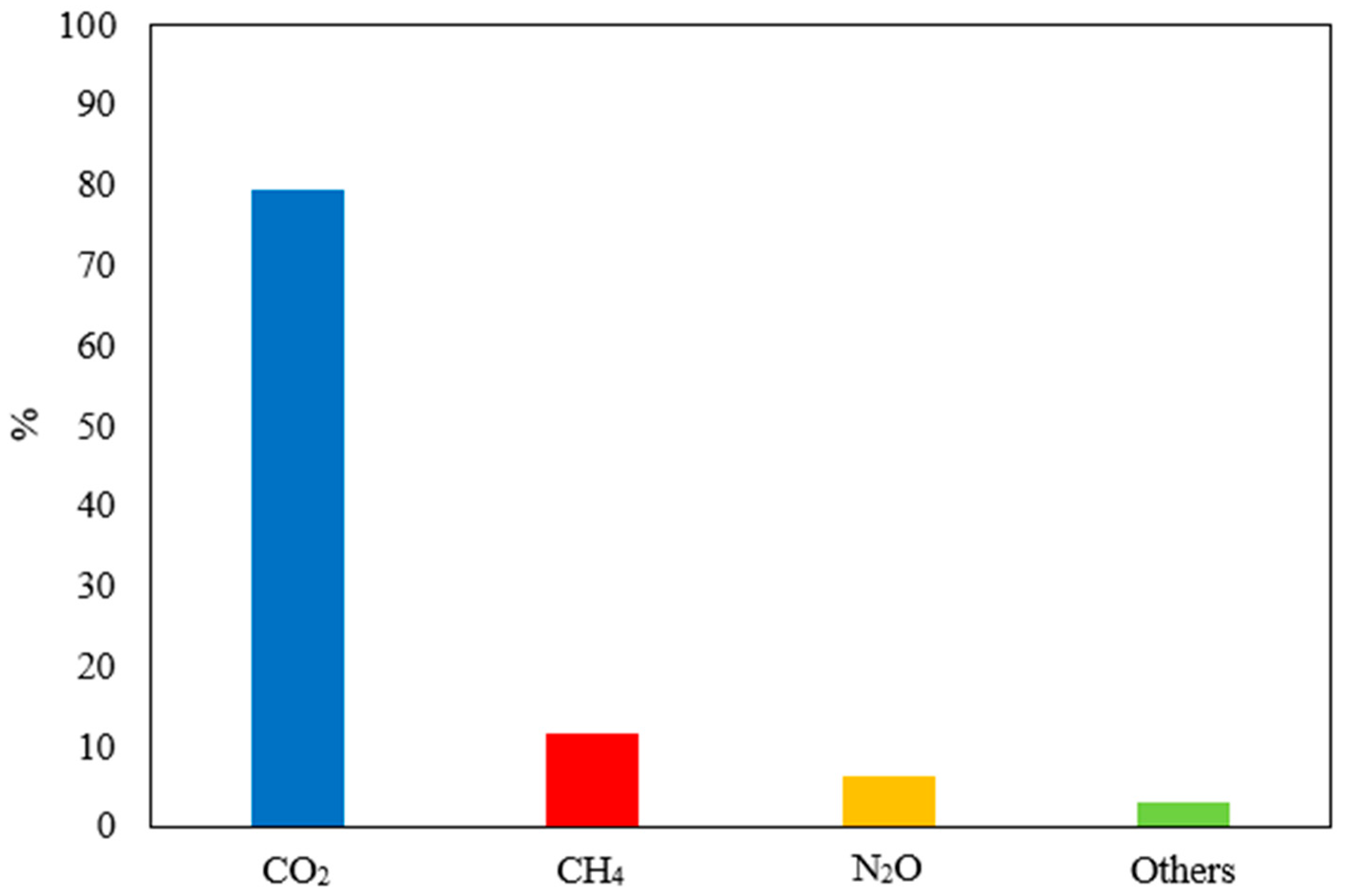
This technological approach represents a sustainable path to lower COx emissions while producing a high-value fuel [6,7,8,9]. A representation of the impact of greenhouse gases (GHG) on the atmosphere is shown in Figure 1. Methanation of COx gases can contribute to reducing the COx gases emissions by converting them into methane by means of the hydrogenation reactions depicted in Table 1.
Not only for COx methanation, but also for any other reaction, the proper design of reactors to conduct such reactions requires an appropriate reactor model incorporating a validated kinetic rate expression and parameters, indicating a kinetic formulation consistent with the reactor assumptions (e.g., transport limitations, phase resolution, and thermal coupling). The use of reactor modeling can provide crucial information on COx conversion and yields and methane selectivity among other byproducts. It can also be used for catalyst screening, determining reactor temperature profiles, and, depending on the model complexity, it can predict the axial and radial dispersion concentration and temperature profiles. All these parameters are essential for the proper design, simulation, and optimization of commercial reactors [11,12,13,14].
Various works regarding reactor modeling for COx methanation have been found in the literature. For instance, Giglio et al. [15] conducted a modeling study with a dynamic 1D model for multi-tubular cooled fixed-bed reactors (FBR) performing the methanation of CO2 to evaluate two cases occurring during the power-to-gas (PtG) system operated in intermittent mode: (1) start-up from reactor hot standby, and (2) system operated at partial load. They discovered that avoiding hot spots in transient operations within the reactors while maintaining the catalyst properties can provide significant information for the design of a methanation section involving multitube cooled FBRs. Gruber et al. [16] reported an analysis of experimental data using a 1D cooled FBR for CO2 methanation to derive a method for utilizing experimental axial temperature profiles in a reactor and outlet reactant conversions to determine the effective heat conductivity of a fixed bed (FB) and effective reaction rate. The authors found that the main challenges were due to binary bi-disperse FBs with industrial–scale dimensions of reactor and catalyst.
Krammer et al. [17] developed a 2D heterogeneous axisymmetric model of a polytropic fixed-bed methanation reactor and validated it against experimental temperature and composition data for the specific reactor geometry (including inlet/outlet piping effects) and the tested operating window (e.g., pressures 1.3–10.1 bar and representative space velocities such as GHSV ≈ 4000 h−1). Therefore, the reported agreement should be interpreted within the experimental conditions used for model calibration/validation, rather than as a general validity over arbitrary conditions. Bremer et al. [18] established a 2D dynamic model of an FB tubular reactor for the methanation of CO2, with optimal start-up control focused on the Sabatier reaction. Here, 2D denotes axial–radial dependence (z–r) in a cylindrical domain (i.e., variables depend on r and z, with no azimuthal variation), while dynamic denotes transient operation during start-up. The authors discretized the resulting 2D transient balances via a finite-volume method using n_z = 16 axial and n_r = 5 radial finite volumes (non-uniform axial spacing, uniform radial spacing), and discretized the start-up time horizon using 40 finite elements with three collocation points per element for the dynamic optimization.
Using the 2D axial–radial dynamic model discretized by a finite-volume method, and a start-up time discretization of 40 finite elements with three collocation points per element, the authors demonstrated that hot-spot formation in the catalyst bed can be controlled during start-up, supporting the feasibility of dynamic CO2 methanation operation.
The modeling studies for COx methanation reactions have also been performed for fluidized bed reactors. Hervy et al. [19] modeled a catalytic isothermal fluidized bed reactor to analyze the influence of changes in operating conditions related to Power-to-Methane (PtM) units. Ich Ngo et al. [20] performed an experiment and numerical analysis for the CO2 methanation reaction to investigate the hydrodynamics, kinetics, and transfer effects of a bubbling fluidized bed (BFB) reactor. They found the hydrodynamics and kinetics effects successfully by using the BFB reactor.
Jia et al. [21] focused on the investigation of the performance of a NiMgW catalyst, which has shown to be superior to previously tested catalysts in terms of kinetics and selectivity, for CO2 methanation in a 1D steady state operated fluidized bed reactor. The results showed that the catalyst used leads to faster reduction in reactants and then high concentrations of CH4.
Nam et al. [22] reported a work where CO2 methanation was performed in a BFB reactor. The study focused on investigating different operating effects, such as temperature, gas velocity, and H2/CO2 ratio, on the conversion of CO2, and on methane purity and selectivity. They discovered that among all operating variables, temperature and H2/CO2 ratio were the most influential parameters. The highest CO2 conversion and CH4 purity reached were 98% and 81.6, respectively.
In summary, reactor models reported in the literature range from 1D pseudo-homogeneous models to 2D heterogeneous models operating under either steady-state or dynamic conditions. Typically, the reactors used for performing modeling studies for COx gases methanation at experimental or bench scales are primarily FBRs and fluidized-bed reactors. From these, various configurations such as isothermal, adiabatic, or cooled FBRs can be derived. In some cases, structured reactors or membrane reactors are employed, depending on the overall process structure, the catalysts used, or the established operating conditions. Although various reactor models for the methanation of COx have been reported so far, it should be clarified that more efforts must be made to develop rigorous models that consider all the phenomena involved. Therefore, this work aims to provide a structured and comparative overview of the most representative reactor models for COx methanation reported in the literature. Particular attention is given to the underlying assumptions, the level of detail (dimensionality, transport effects, and kinetic descriptions), and the trade-offs between model complexity and computational efficiency.
Recent advances in CFD for PBRs span from porous-media RANS formulations to particle-resolved CFD (PRCFD), which explicitly resolves the geometry of individual pellets and interstitial channels [23]. PRCFD captures wall effects at low tube-to-particle ratios, local maldistribution, and particle–scale heat/mass transfer under reacting conditions, and it is increasingly used to derive trustworthy closures for engineering models (e.g., effective radial conductivity, wall heat-transfer coefficients, axial dispersion) and to validate scale-bridging assumptions. However, these benefits come with substantial computational costs, nontrivial packing/meshing workflows, and practical limits on reactor length scales and kinetic complexity, which constrain its routine use for design-space exploration or plant-scale scenarios.
Complementary multiscale strategies mitigate this gap by linking pellet-scale reaction-diffusion to bed-scale CFD. For instance, Cao et al. [24] compute pellet effectiveness factors for key reactions and embed them in fixed-bed simulations, enabling more faithful reactor predictions without fully resolving every pore everywhere. However, demonstrated for CO2-to-methanol, the same logic applies to COx methanation, where strong exothermicity and diffusion-affected kinetic demand require consistent treatment across scales.
Unlike previous reports that focus on catalytic mechanisms or experimental setups, this work emphasizes the modeling strategies and mathematical formulations used across different reactor configurations. The novelty lies in its integrative approach to classify and evaluate reactor models under a unified framework, offering insights that are valuable for both new research activities and industrial reactor design.
Although several reviews have addressed methanation from a catalytic or process viewpoint, including reactor-scale discussions [25], these works do not provide a comparative assessment of the mathematical structures, assumptions, transport formulations, and computational implications of the reactor models currently used in COx methanation. The present work fills this gap by offering a model-centered, systematic analysis of reactor modeling strategies—from 1D pseudo-homogeneous ODE models to 2D heterogeneous PDE formulations and multiscale CFD approaches—highlighting their capabilities, limitations, and applicability. Furthermore, a generalized reactor-model framework is proposed based on the trends identified in the literature, which distinguishes this review from previous studies and provides actionable guidance for developing predictive and scalable methanation reactor models.
Therefore, the objectives of this work are to classify COx methanation reactor models by their mathematical structure (independent variables, phase resolution, and balance-equation set), compare kinetic formulations and fitted parameter sets as used in reactor-scale simulations, explicitly stating their calibration domains, contrast transport/closure choices (heat transfer, dispersion, pressure drop) and their impact on predicted temperature/conversion field, and translate these comparison into design-relevant guidance while clarifying where each model is intended for performance assessment versus design decisions.

2. Description of Reactor Models

For reactor modeling purposes, the models are usually focused on mass and energy balances in different phases. In some cases, when a more rigorous model is desired, momentum balance and pressure drop are terms that must be contemplated. A reactor model should involve mass and energy balances, the transfer resistance between gas–solid, intraparticle diffusion, axial and radial diffusion, accumulation, convection, and generation terms of the species involved [26].
For reactor modeling purposes, the governing equations are typically written as mass and energy balances (pseudo-homogeneous or heterogeneous gas–solid). In these balances, the transformation (reaction) term is introduced as a source of each species, commonly expressed as
R i = j v i j r j
where v i j is the stoichiometric coefficient of species i in reaction j , and r j is the reaction rate law. The choice of r j constitutes the kinetic sub-model and is one of the main differentiators across studies. Literature mainly reports empirical power-law expressions (often used in early works or when limited datasets are available), and mechanistically motivated LHHW-type expressions including adsorption/inhibition terms and, when needed, equilibrium corrections; in some studies, the overall scheme is represented by coupled steps such as RWGS plus methanation. When transport effects are not negligible, the intrinsic rate may be corrected by an effectiveness factor (or a reaction–diffusion pellet sub-model) before being embedded into the reactor-scale balances, ensuring consistency between kinetic assumptions and the reactor model.
Otherwise, a rigorous reactor model requires significant data about the phenomena in the system. For example, in an FBR, the mass radial dispersion is usually discarded if the ratio of reactor-to-particle diameter (dT/dP) value is higher than 25. Also, the effect of fluid flow axial dispersion in an FBR can be ignored if the gas and liquid velocities are high enough. In general, the establishment of a reactor model depends on the complexity and results desired. If the model is too simple (e.g., it neglects key transport/closure terms such as dispersion, interphase transfer, intraparticle diffusion/effectiveness factors, or realistic heat removal), it may be able to reproduce trends only in narrow windows but can fail to match experimental datasets that contain multiple operating points and spatial information (e.g., axial temperature/composition profiles), leading to systematic deviations and large errors. For instance, experimental validation in the literature may involve axial temperature profiles measured across several pressures at fixed space velocity (e.g., 1.3–10.1 bar at 4000 h−1), which demands a model structure consistent with the governing physics [27]. For the methanation of COx gases in packed/fixed beds, two phases are typically sufficient (gas and solid catalyst). In heterogeneous formulations, both media are coupled through explicit interphase transfer terms (gas–solid heat and mass transfer), and intraparticle diffusion is commonly represented via an effectiveness factor or a pellet-scale submodel; in pseudo-homogeneous models, these interactions are embedded into effective properties and global transfer resistances.
This section is focused on the description of reactor models in the literature used for performing COx gases methanation reactions classified by type of reactor, which depends on the performance required, and model used (whether 1D or 2D, homogeneous, pseudo-homogeneous, or heterogeneous).
This section compares reactor models based on their mathematical structure (independent variables, balance-equation set, kinetic sub-model, and transport/closure coefficients) and on the operating windows used for calibration/validation. Reported profiles (e.g., T(z), yi(z)) are referenced only as validation evidence within the conditions tested by the original authors, not as standalone simulation case studies.

2.1. Fixed-Bed Reactors

Bremer et al. [18] conducted a study employing an optimization approach for identifying control trajectories for the start-up of a reactor, aiming at preventing the generation of distinct hot spots in CO2 methanation. The authors developed a 2D dynamic model for an FBR to carry out the reaction. This reactor model comprises a single tube filled with Ni catalyst particles to facilitate the reaction. The reaction scheme for CO2 methanation is described by the following equations:
C O + 3 H 2 C H 4 + H 2 O                         Δ H R = 206.3   kJ/mol
C O 2 + H 2 C O + H 2 O                       Δ H R = 41.1   kJ/mol
C O 2 + 4 H 2 C H 4 + 2 H 2 O               Δ H R = 164.9   kJ/mol
Enthalpy of Equation (3), known as the Sabatier reaction, describes the formation of CH4 from H2 and CO2 [1,4,10,28,29,30,31,32]. The reaction’s exothermic nature leads to substantial heat generation, which can provoke thermal deactivation of the catalyst or a rupture of the materials. Other studies [33] have reported important carbon generation when starting at high temperatures (up to 496 °C), resulting in a notable reduction in catalyst activity. To address these issues, the authors proposed a temperature control system for the outer reactor wall to ensure stable operation.
To conduct a rigorous evaluation of the dynamics across the entire spatial domain, the authors developed a dynamic 2D pseudo-homogeneous reactor model. The following assumptions were made:
  • Momentum balance was not considered since pressure drop due to friction dominates for packed-bed reactors (PBRs) [34].
  • Ergun equation to account for the friction term [35].
  • A constant value for superficial gas velocity v z and ideal gas behavior.
  • v z is taken as the mean velocity due to the Sabatier reaction (Equation (3)) mechanism, which is non-equimolar and could lead to an increasing gas velocity in the axial direction.
After taking into consideration these assumptions, the mass and energy balances result in the following partial differential equation (PDE) system:
  • Mass balance:
ρ α t = v z ε f ρ α z + D r , α e f f ε f 2 ρ α r 2 + 1 r ρ α r + 1 ε f ε f M α β v α , β r ~ β
  • Energy balance:
T t = 1 ρ c p e f f α ρ α C p , α v z T z + λ r e f f 2 T t 2 + 1 r T t 1 ε f α Δ R H ~ β r ~ β
The established boundary conditions are as follows:
ρ α | z = 0 = ρ α , i n         ρ α r | r = 0 = 0         ρ α r | r = R = 0                                                                            
T | z = 0 = T i n                 T r | r = 0 = 0             T r | r = R = k w λ r e f f | r = R T c o o l T | r = R
Chein et al. [36] developed a fixed-bed reactor model for CO2 methanation reaction to obtain synthetic natural gas (SNG) and solved the coupled conservation equations numerically. A tubular FBR was employed as a model. CO2 and H2 were the reactants, N2 represented the inert gas and was introduced at the reactor inlet. The pressure, temperature, and inlet flow rate of the reactants are denoted as p i n , T i n , and Q i n , respectively. The following assumptions were contemplated:
  • Ideal gases behavior for all species.
  • Spherical catalyst particles, and the catalyst bed with homogeneous porosity ε and permeability κ.
  • Local thermal equilibrium between the catalyst bed and the gas mixture.
Considering these assumptions the authors established the following equations for mass, fluid flow, energy transport, and species transport balances:
· ε ρ V = 0
1 ε 2 · ρ V V = p I + μ m ε V + V T 2 μ m 3 I · V μ m κ V p C F κ V V
· ε ρ C p V T = · λ e T + q c
· ε ρ V m i ρ m i j = 1 N G D i j x i + x i m i p p D i T T T = r i
Equation (6) is the Brinkman–Darcy–Forchheimer model. The ρ term stands for mass-weighted density as follows:
ρ = p R T i = 1 N G x i M i
The permeability coefficient (κ) and Forchheimer drag coefficient C F with spherical particles are as follows [37]:
K = d p 2 ε 3 150 1 ε 2 ,   C F = 1.75 150 ε 3 / 2
The term C p in Equation (7) represents the mass-weighted specific heat established as:
C p = i = 1 N G m i C p i
λ e is the effective thermal conductivity of the catalyst bed:
λ e = ε λ m + 1 ε λ c a t
Costamagna et al. [38] reported a study of an evaluation of two experimental setups for performing the steam methane reforming and the methanation of CO2. For this task, a steady-state pseudo-homogeneous 1D non-isothermal PBR model was established. Simulations carried out employing the model proposed enable the finding of thermal effects in the catalytic zone. Each reactor was simulated as three tubular reactors: PBR, P-R1, and P-R2.
For the PBR, the adopted a One-dimensional steady-state pseudo-homogeneous plug-flow formulation (independent variable z), assuming negligible axial dispersion and external transport limitations under their laboratory-scale operating window. 1D along the reactor axis and pseudo-continuum were the assumptions for the reactor.
The following assumptions were established to develop the reactor model:
  • Thiele modulus < 1, since the catalyst particles are small.
  • Intraporous mass and energy transport resistances were not contemplated.
  • Effectiveness factor (η) of 1 for all reactions.
  • External transport limitations are also neglected.
  • Axial dispersion is not considered.
The assumption of an effectiveness factor close to unity, frequently adopted in the reviewed fixed-bed reactor models, deserves particular attention. In most laboratory- and bench-scale methanation studies, Ni-based catalysts are employed in the form of relatively small pellets, typically in the sub-millimeter to millimeter range. Under such conditions, intraparticle diffusion resistances are often negligible when compared to intrinsic reaction rates, resulting in Thiele moduli below unity and, consequently, effectiveness factors close to one. This assumption is therefore reasonable for small catalyst particles operated under moderate reaction rates, as commonly reported in the literature reviewed herein.
Nevertheless, the effectiveness factor is strongly influenced by both catalyst pellet size and reaction rate. As pellet diameter increases or reaction rates become significantly higher (such as under highly exothermic conditions, elevated pressures, or high space velocities), internal mass and heat transfer limitations may become relevant, leading to effectiveness factors significantly lower than unity. In such cases, simplified pseudo-homogeneous models may no longer be adequate, and heterogeneous or multiscale modeling approaches explicitly accounting for intraparticle transport phenomena are required. This highlights that the assumption of an effectiveness factor close to one should be regarded as condition-dependent and carefully evaluated when extrapolating reactor models beyond laboratory-scale conditions.
The mass balance corresponds to the following expression:
d F i d V = r i = j v i j r j
The gas and solid temperatures are the same in the energy balance. The energy balance contemplates terms such as the convective along the axial coordinate, the enthalpy, and heat transfer between the furnace and the reactor.
i F i C p i d T d V = j Δ H j r j + U a T f u r n a c e T
The two balances form a system of ordinary differential equations (ODEs). At the reactor inlet, both the temperature of the furnace and the temperature of the gaseous mixture are considered to be equal.
The model used by the authors (Brooks et al. [39]) consists of a 1D heterogeneous FBR. The governing equations of the model are:
ρ t + ρ u z = P c A c k = 1 K g s ˙ k W k
ρ Y k t + ρ Y k u z + j k z = w k ˙ + P c A c s ˙ k W k
ρ u t + ρ u 2 z = ρ z + P h A c τ w
ρ e t + T g z = q ˙ g w
The governing equations reported by Di Nardo et al. [40] are:
ρ f t + x i ρ f U i = 0
t ρ f Y k + x j ρ f U i Y k = J j k x j + R k
t ρ f E f + 1 ε ρ s E s + x i U i ρ E + ρ = x j k e f f T x j i h i j i + U i τ i j + S k
The set of partial differential equations used consists of continuity (Equation (19)), mass balance (Equation (20)), and energy balance (Equation (21)) equations, which were solved using computational resources from the ENEA-CRESCO supercomputer, specifically a Lenovo SD530 with Intel Xeon Platinum 8160 24C 2.1 GHz processors, employing 512 cores. The simulations were considered converged when the energy residual was below 10−8, the residuals of other variables were below 10−4, and no further variations in conversion or maximum temperature were observed.
In the work published by Farsi et al. [41], the reactor was modeled as a non-isothermal, pseudo-homogeneous FBR. The mathematical model was based on a steady-state balance, with no consideration of axial dispersion. Additionally, the momentum balance was neglected due to the pressure drop was below 10% of the total pressure.
Although the neglect of the momentum balance is often justified when the pressure drop remains below a small fraction of the total operating pressure, the role of pressure drop in fixed-bed methanation reactors deserves further consideration. According to the Ergun equation, for a fixed inlet mass flow rate, the pressure drop due to friction is strongly dependent on the inlet pressure, as lower pressures result in higher superficial gas velocities and, consequently, larger pressure gradients along the reactor. Under such conditions, particularly when operating below approximately 10 bar, pressure drop effects may become non-negligible [42].
In addition, reactor configuration plays a critical role. In multi-tubular fixed-bed reactors, the distribution of the total mass flow among a large number of parallel tubes significantly reduces the superficial velocity within each tube, thereby mitigating pressure losses. Conversely, an insufficient number of parallel tubes or operation at low pressures may lead to substantial pressure decreases along the reactor length, potentially affecting conversion, temperature profiles, and overall reactor performance. Therefore, while neglecting the momentum balance is reasonable for the operating conditions and reactor configurations considered in several of the reviewed studies, this assumption should be carefully re-evaluated for low-pressure operation or alternative reactor designs.
This simplified approach allowed the focus to remain on the thermal and chemical processes within the reactor while assuming that the flow dynamics were not significantly affected by pressure changes.
The equations for mass and energy balances are:
n ˙ m c a t = r m , i = j v j r m , j
T ˙ m c a t = 1 i n ˙ i C P , i j r m , j Δ R H j U L b e d m c a t T T C
The heat transfer coefficient U contemplates all transfer resistances. The temperature is contemplated to be gradient-free in the width and height directions. The mathematical system was solved by using Matlab applying the “ode15s” function.
Fisher et al. [43] reported a work based on the dynamic behavior of a wall-cooled methanation FBR. The authors used eight reactor models to analyze the temperature behavior of the model mentioned above.
The first model tested was a 2D dynamic heterogeneous model contemplating balance equations for the gas phase and the catalyst phase. The mass and heat, radial mass dispersion, and effective radial heat transport, as well as mass and heat axial convective transport balances, were considered.
ε b e d w α G t = 1 r r r D α , r w α G r v z w α G z + β G P ρ G S v ρ α P | y = d / 2 ρ α P
ρ G c P G ε b e d T t = 1 r r r λ r e f f T G r v z ρ G c P G T G z + α G P S v T P | y = d / 2 T g
The second type of reactor model employed and tested by the authors is the pseudo-homogeneous model. In this model, the phase properties are depicted as pseudo-homogeneous, where all transfer resistances are not taken into account. Hence, the model robustness is significantly lower compared with the heterogeneous model.
ε b e d w α t = 1 r r r D α , r w α r v z w α z + M α 1 ε b e d ρ c a t ρ ¯ i = 1 n R v α , i r i
ρ ¯ c ¯ P ε b e d + ρ c a t c P , c a t 1 ε b e d T t = 1 r r r λ r e f f T r v z ρ ¯ c ¯ P T z + 1 ε b e d ρ c a t i = 1 n R Δ H R , i r i
The boundary conditions are given below for all t in (0, t f ]:
w α | z = 0 = w α , i n , w α r | r = 0 = 0 , w α r | r = R = 0 ,
T | z = 0 = T i n , T r | r = 0 = 0 ,
T r | r = R = α w λ r e f f | r = R T C T | r = R
As these models operate in dynamic regime, the initial conditions are also required for z in [0, L] and r in [0, D/2]:
ρ α G t = 0 , z , r = ρ α , 0 G , ρ α P t = 0 , z , r , y = ρ α , 0 P ,
T G t = 0 , z , r = T 0 G , T P t = 0 , z , r , y = T 0 P ,
T C t = 0 , z = T C , 0
Giglio et al. [15] focused on the dynamic modeling of methanation reactors during start-up and regulation in intermittent PtG applications. To this end, a transient 1D pseudo-homogeneous model was used to perform the simulations. The model contemplates axial heat and mass dispersion, with all properties depending on temperature. The mass and energy balances for the bed compartment in the reactor are presented below. The model also incorporates the effect of temperature on the heat transfer coefficient, assuming a constant coolant temperature.
ε f C i t = k D · 2 C i x 2 u · C i x + v i · 1 ε f · ρ S · r
C m T t = k L · 2 T x 2 ρ g · c g · u · T x + 1 ε f · ρ S · Δ h r · r A · U V · T T C
Equations (28) and (29) represent a system of nonlinear PDEs, which is commonly referred to as a convection-diffusion-reaction problem. From a geometric perspective, each balance equation is categorized as a hyperbolic-parabolic PDE. To solve this problem, the method of lines (MOL) is employed. Consequently, an initial value problem (IVP) system of ODEs is formed by substituting the original PDE system, and this new system can then be solved using numerical methods for ODEs, for instance, the nth-order Runge–Kutta method.
Gruber et al. [16] investigated experiments from a catalytic FBR for CO2 methanation. The study utilized the reaction scheme of the general Sabatier reaction system (Equations (1)–(3)). To numerically analyze the results, the authors employed Comsol Multiphysics® software. The FBR model considered temperature radial profiles, velocity, and composition of gases. No artificial heat transfer coefficient was required. The mass and energy balances are as follows:
Ψ r · ρ f · w i t = 1 r · r · D r . i r , z · r · w i r + ρ f · D a x . i r , z · 2 w i z 2 ρ f · u 0 r , z · w i z + 1 Ψ r · ρ c a t · r m , e f f · v i · M i
Ψ r · ρ f · c p , f + 1 Ψ r · ρ s · c p , s · T t = 1 r · r · Δ r r , z · r · T r + Δ a x r , z · 2 T z 2 u 0 r , z · ρ f · c p , f · T z + 1 Ψ r · ρ c a t · j = 1 N r m , e f f , j · Δ H R , j
In Equation (31), the axial and radial dispersion coefficients ( D a x . i , D r . i ) and the effective radial and axial thermal conductivity ( Δ r , Δ a x ) were calculated according to the literature [1,15,16,17,22,33]. In addition, the momentum balances are established, which were determined employing the Navier–Stokes equations:
ρ f Ψ u t + 1 Ψ u · u = · η f Ψ u + u T 2 3 · u η f K f 1 · η f + f 2 · u u
The momentum balance does not consider volume forces like gravitation.
In the study by Kang and Lee [44], the influence of different parameters on the methanation to produce synthetic natural gas was evaluated. Temperature, pressure, and feed composition were parameters assessed for their impact on the methanation performance using an equilibrium model and dynamic numerical procedures. These simulations were carried out using a catalytic 1D pseudo-homogeneous shell and tube heat exchanger reactor. The catalytic methanation of CO2 was modeled, including the methanation of both CO2 and CO, and the reverse water–gas shift (RWGS) reaction (Equations (1)–(3)).
To develop the reactor model, the authors made the following assumptions:
  • The reactor presents an ideal behavior.
  • There is instantaneous thermal equilibrium between phases inside the reactor.
  • Axial dispersion and pressure drop are neglected.
The following set of equations represents the transient and mass balances, and the energy balance contemplating heat transfer from the shell side to the tube side at any time:
N o u t A = N i n A ρ b V s t a g e i j r i , j d n i d t
d Y j d t = 1 n t N i n A Y j i n Y j + ρ b V s t a g e j r i , j Y j ρ b V i j R i , j
η ρ b V c p s d T d t = N i n A c p g T i n T ρ b V i Δ H i r i + π d c z U o T w T
The equations corresponding to the above system were solved simultaneously using the ODE23s solver in Matlab® software. This solver is based on numerical differentiation formulas. The methanation performance was evaluated by analyzing the CO conversion, the CO to CH4 conversion, and the CH4 mole fraction in the product gas.
Kiewidt and Thöming [3] investigated the CO2 methanation in a single-stage FBR, with a focus on predicting optimal temperature profiles. To analyze this reaction, the authors employed a pseudo-homogeneous FBR model, which is based on balance equations for mass, momentum, concentration, and energy. The interfacial heat and mass transfer were neglected as the model treats the phases as a single effective. The balance equations are as follows:
d G d z = 0
d p d z = μ K G ρ ρ c p G ρ 2
G d w i d z = M i j = 1 n r v i j η j r j
G c p d T d z = j = 1 n r Δ H R j η j r j + 4 U w e f f D R T T c
Subject to the following Dirichlet boundary conditions:
G z = 0 = G 0
p z = 0 = p 0
w i z = 0 = w i 0
T z = 0 = T 0
The set of differential equations described earlier was solved by implementing a Python code and numerically integrating it along the reactor length, using the inlet boundary conditions.
Krammer et al. [17] presented a study where a 2D heterogeneous model of a polytropic methanation FBR was developed. For the simulations, a 2D axisymmetric model was created using Comsol Multiphysics® simulation software. Various factors were considered in the simulation, including the reactor’s main dimensions to accurately formulate the original reactor form. Additionally, the inclusion of inlet and outlet gas pipes with their actual dimensions was crucial, as the high gas velocity entering through a small 4 mm diameter inlet significantly affects the gas distribution within the catalyst bed and, consequently, the simulations.
The governing equations that represent the reactor model are:
· j i + ρ u · w i = R i
u · · T g a s + · λ g a s · T g a s = Q s o l i d g a s
· λ s o l i d · T s o l i d = Q s o l i d g a s + Q R e a c t i o n
The reaction heat term is absent in the inert bulk domains, where no catalytic reaction takes place.
In another paper, Krammer et al. [45] reported a work based on an analysis of oil-cooled and ambient air-cooled FBR for methanation. The reaction scheme considered for the reactor model was based on the methanation of COx gases (Equations (1)–(3)).
A 1D stationary homogeneous methanation PBR model was developed using the commercial software MATLAB® and the numerical solver ODE23. The following assumptions were considered in the model:
  • Axial mass and heat transport occur solely by convection, with dispersion and conduction effects being neglected.
  • No significant gradients of temperature or concentration occur between the packed bed and the gas (homogeneous model)
  • Constant velocity and cooling oil temperature were assumed.
The mass balance and energy balance are:
δ δ z v   c i = ρ b e d v i , C O M   r C O M + v i , r W G S   r r C O M
δ δ z T ρ g a s c p v = ρ b e d r e f f , C O M Δ H C O M + r e f f , w g s Δ H r W G S 4 d r , i k w e f f T T c o o l q r a d i a t i o n
The reaction rate for CO methanation r C O M and the RWGS reaction r e f f , w g s are determined from an adapted version of intrinsic kinetics.
Lefebvre et al. [46] reported a modeling of the behavior of a 1D cooled SBC (Slurry Bubble Column) PBR, analyzing the performance for both steady-state and transient PtG operations. In establishing a reactor model, the assumptions considered were as follows:
  • The gas phase is considered ideal, and Raoult’s law is applicable.
  • Gas and liquid mass transfer resistance exists only in the liquid phase.
  • Gas/liquid equilibrium is contemplated to be achieved for each gas species.
  • Mass transfer resistance between the liquid phase and the solid phase is not contemplated.
  • Absence of radial concentration or temperature gradients.
  • Energy balance does not contemplate the gas phase.
With these assumptions, the mass and energy balances are:
  • Mass balance for species in the gas phase in the large bubbles:
t ε G , l a r g e · c i , G , l a r g e = z ε G , l a r g e · D G , a x , l a r g e · c i , G , l a r g e z z u G , l a r g e · c i , G , l a r g e k L a i , l a r g e · c i , G , l a r g e H i , c c c i , L
  • Mass balance for species in the gas phase in the small bubbles:
t ε G , s m a l l · c i , G , s m a l l = z ε G , s m a l l · D G , a x , s m a l l · c i , G , s m a l l z z u G , s m a l l · c i , G , s m a l l k L a i , s m a l l · c i , G , s m a l l H i , c c c i , L
  • Mass balance for species in gas phase in the slurry phase:
t ε S L · c i , L = z ε S L · D S L , a x · c i , L z k L a i , l a r g e · c i , G , l a r g e H i , c c c i , L + k L a i , s m a l l · c i , G , s m a l l H i , c c c i , L + v i · η c a t · φ S · ρ S · r 3 P M
  • Slurry phase energy balance:
ρ S L · c p , S L · ε S L · T t = z ε S L · λ S L , e f f · T z + η c a t · φ S · ρ S · r 3 P M · Δ h r α e f f · α c o o l · T T c o o l
The balance Equations (45)–(48) contemplate the terms: accumulation, axial dispersion, advection, G/L mass transfer, reaction, reaction heat, and cooling.
Schlereth and Hinrichsen [2] reported a work on the evaluation of the methanation of CO2 by means of reactor modeling using multiple FBRs. The authors analyzed various reactor models for the design of FBRs, including: a 1D pseudo-homogeneous PFR model, a 2D pseudo-homogeneous PFR model, a 1D heterogeneous PFR model, and a 1D pseudo-homogeneous model for a membrane FBR.
The simplest model employed was the 1D pseudo-homogeneous FBR model. The mass and energy balances are as follows:
u c i z = ρ b e d j = 1 3 v i , j r j
u c t o t c p T z = ρ b e d j = 1 3 r j Δ R H j 4 d t u b e U A T T c
The pressure drop is not considered, and the partial pressures of components are determined by contemplating an ideal gas behavior.
With the objective of considering radial temperature and gas composition profiles, 2D models were established. Hence, a 2D pseudo-homogeneous model was implemented, and the following equations correspond to the mass and heat balances:
u c i z = ρ b e d j = 1 3 v i , j r j + D r e f f 2 c i r 2 + 1 r c i r
u c t o t c p T z = ρ b e d j = 1 3 r j Δ R H j + Λ r e f f 2 T r 2 + 1 r T r
The extended Brinkman equation is solved as a momentum balance. The superficial velocity field can be modeled as is depicted in Equation (53).
p z = f 1 u r f 2 u 2 r + μ e f f r r r u r r
To assay the impact of transport phenomena on the reactor performance, the previous model evaluated is transformed into a heterogeneous model. The resultant equations for the effective rection rates are depicted as follows:
d Ω j d y = y 2 r j   j = 1,2 , 3
d x i d y = 1 y 2 j = 1 1 Ω j k = 1 5 v k , j F i k   i = 1,2 , 3,4
d p d y = 1 y 2 R T w i = 1 5 1 D i e f f j = 1 3 v j , i F i k Ω j
2 y λ p d T d y + λ p d 2 T d y 2 + ρ c a t j = 1 3 r j Δ R H j = 0
The final model tested by the authors was a 1D pseudo-homogeneous FBR for a membrane reactor. In this membrane reactor, a component was introduced into the reactor through a membrane. The flux density across the membrane introduces an extra term in both the mass and energy balance equations. It was contemplated that the pressure drop across the membrane is much larger than in the FB and central tube. The heat transfer from the annular space to the central tube was also considered.
The ODEs and PDEs in 1D models evaluated were solved by using the MATLAB® software. For the ODEs, the function ode15s was employed. For the 2D model, the PDEs were converted into ODEs through the application of the orthogonal collocation method. The boundary value problem (BVP) was solved using the bvp4c solver.
Tauer et al. [47] performed a study to assay transient effects during the dynamic operation of a wall-cooled FBR for CO2 methanation. An ideal 1D FBR was selected as the reactor model. The pressure drop across the FBR was considered negligible, as well as radial and axial dispersion effects and gradients of concentration and temperature. The mass balance for each component is then represented by the following equation:
ε c i t = u s c i x + c i u s x + v i ρ b e d r m
The change in gas velocity results from the non-stoichiometric reaction between CO2 and H2 and depends on the reaction rate r m and stoichiometric coefficients. Velocity changes due to variations in axial temperature are minimal and were neglected.
The energy balance employed is depicted as follows:
ε ρ g c p , g + ρ b e d c p , b e d T t = ρ g c p , g u s T x + T u s x + 4 d r U b e d T c o o l T + λ a x 2 T x 2 Δ R ρ b e d r m
The gas density ρ g was determined by employing the reactor cooling temperature as a reference. The thermal conductivity and viscosity of the gas were determined employing as a reference the Wassiljewa relation and the Mason Saxena modification [48]. To calculate the radial heat conduction and the heat transfer, a heat transfer coefficient is used. U b e d was established. Mass transfer limitations were neglected, as demonstrated by an approximation of the Thiele modulus.
Try et al. [49] performed a study on the dynamic modeling and simulation of the behavior of an FBR exchanger for CO2 methanation. The corresponding model was a heterogeneous and dynamic model based on mass, energy, and momentum balances for the gas and catalyst phases, with the exception of excluding the momentum balance in the catalyst phase.
To determine the temperature in the liquid phase and the mass concentration of components, the balances are as follows:
  • Mass balance of the component i :
ρ i t + · ρ f w i u = · j i + s i
  • Energy balance:
ρ f C p f T f t + ρ f C p f u · T f = · λ e q T f + Q
The momentum balance is solved by employing Darcy’s equation. The extensions of Forchheimer and Brinkman are not contemplated, as their impacts are considered minimal.
P = μ f K u
The mass and energy balances in the catalyst phase are depicted in the following equations:
  • Mass balance of component i :
C i , s t + · D i , K C i , s = ρ s j v i , j · r j
  • Energy balance:
ρ s C p s T s t + · λ s T s = ρ s j Δ r H j · r j
Zimmermann et al. [50] performed a series of experimental procedures to analyze the impact of the activity, permeability, and heat conductivity of particles on reactor performance by employing a 1D heterogeneous FBR. This approach was chosen to maintain the optimization task simple while capturing key physical conditions within the reaction system. The mass and energy balance equations are represented as follows:
y G , i t = u 0 L ε y G , i ζ a p k i ε y G , i y P , i
ρ G C P , G T G t = u 0 ρ G C P , G L ε T G ζ a p h ε T G T P 4 U D ε T G T C
In this case, all variables are contemplated to be constant in the radial direction and axial dispersion, and axial heat conduction is not considered for simplicity. Gas mixture ideal behavior was assumed, as pressure drop was not contemplated.
To solve this problem, the equations were discretized using the finite-volume method. The harmonic mean was employed to average the transport coefficients between the finite volumes. This procedure results in a nonlinear ODE system. This system of equations was implemented within the CasADi framework in MATLAB.

2.2. Fluidized-Bed Reactors

Ich Ngo et al. [20] conducted both experimental and numerical assays on different phenomena of the CO2 methanation employing a bubbling fluidized-bed (BFB) reactor.
The focus for the reactor was confined to the fluid region of the reactor. The gas–solid model within this 3D domain incorporated the conservation equations for mass, momentum, and energy. The boundary conditions established for the model were implemented to match the experimental conditions.
The continuity equation, the momentum balance, and the energy balance at the gas and solid phases, are:
ρ q α q t + · ρ q α q u q = 0   w h e r e   q = g   o r   s   p h a s e s
ρ g α g u g t + · ρ g α g u g u g = α g P + · τ = g + ρ g α g g + K g s u g u s  
ρ s α s u s t + · ρ s α s u s u s = α s P + · τ = s + ρ s α s g + K g s u g u s
t ρ g α g h g + · ρ g α g u g h g = · α g κ g T g + τ = g · u g + S R + Q g s
t ρ s α s h s + · ρ s α s u s h s = α s d P s d t + · α s κ s T s + τ = s · u s Q g s
It was contemplated an incompressible behavior for the gas phase, while continuous behavior for the solid phase. The gas density ρ g was determined by employing the Soave–Redlich–Kwong (SRW) equation of state. Laminar flow was contemplated for the gas in the EE-CFD model, which is due to the inertial energy loss primarily resulting from local changes in flow direction.
Jia et al. [21] presented a fluidized-bed model utilizing a NiMgW catalyst for CO2 methanation. The study was focused on investigating the impact of operating parameters on CO2 methanation employing a fluidized-bed reactor. Initially, authors evaluated kinetics using the aforementioned catalyst, which has been recognized for its excellent catalytic performance. For the purposes of the modeling, the authors assumed steady-state conditions and no spatial variation.
The mass balance equations for both reactor phases are:
0 = d n b , i ˙ d z K G , i a A C b , i C e , i N v c x b , i ˙
0 = d n e , i ˙ d z K G , i a A C b , i C e , i + N v c x b , i ˙ + 1 ε b 1 ε m f ρ p A R i
The boundary and initial conditions of Equations (72) and (73) are:
n b , i ˙ | z = 0 = n b , f e e d ˙
n e , i ˙ | z = 0 = n e , f e e d ˙
The mass transfer rate is calculated as the product of the mass-transfer coefficient and the concentration variation, considering the convective mass transfer effect. Additionally, since the CO2 conversion is significantly below the thermodynamic limit within the temperature range studied, thermodynamic effects are neglected.
Liu and Hinrichsen [51] conducted a study on the methanation reactions employing a fluidized-bed reactor for synthetic natural gas generation by means of CFD simulations. These models were implemented using OpenFOAM software v2.1.1, and the grid resolution was examined through both 2D and 3D meshes.
The governing equations for both the gas and solid phases are as follows:
α g ρ g t + · α g ρ g U g = R g
α s ρ s t + · α s ρ s U s = R s
The momentum balance equations for both phases are:
α g ρ g U g t + · α g ρ g U g U g = α g p + · α g τ g + α g ρ g g + β U s U g
α s ρ s U s t + · α s ρ s U s U s = α s p p s + · α s τ s + α s ρ s g + β U g U s
Energy conservation equations were not considered for the solution, as isothermal conditions were contemplated in the BFB reactor.

2.3. Structured Reactors

Sudiro et al. [52] conducted simulation studies for a structured catalytic reactor for the methanation of CO2. The authors proposed a steady-state 1D heterogeneous model for representing an externally cooled reactor tube. The equations of the model encompassed mass and energy balances for both gas and solid phases, and the momentum balance for the same phase. Two reactions were contemplated in the study: CO2 methanation and CO methanation. The reactor’s behavior is modeled by using a 1D dynamic heterogeneous model of a multi-tubular FBR, packed with honeycomb catalysts. The mass, energy, and momentum balances for the gas phase are as follows:
ε w i , g t = W t ρ g · w i , g z K m , i a ρ g · w i , g w i , s
ε ρ c p T g t = W t c p · T g z h a · T g T s
1 ρ g + w t ρ g 2 P P z W t 2 ρ g 2 T T g z = 1 2 W t 2 ρ g 2 a f
The initial conditions considered are:
w i , g z , t = 0 = w i , f e e d
T g z , t = 0 = T C o o l a n t
T s z , t = 0 = T C o o l a n t
While the boundary conditions established are:
  • At the reactor inlet:
w i , g | z = 0 = w i , f e e d
T g | z = 0 = T f e e d
P | z = 0 = P f e e d
k s , a x T s z | z = 0 = σ · ε s · T g 4 T s 4 | z = 0
  • At the reactor outlet:
k s , a x T s z | z = 0 = σ · ε s · T g 4 T s 4 | z = L
Thermal properties, including specific heat and heat of reaction, were calculated using the correlations from CHEMKIN, while gas properties (conductivity, viscosity, and diffusivity) were determined based on the literature correlations. The software gProms® was employed for solving the system of differential equations, with 200 grid points applied along the axial direction.
Türks et al. [53] presented a study on CO2 methanation employing a Ni/Al2O3 catalyst in a structured FBR. The objective was to eliminate severe temperature hot spots in a tube reactor by optimizing the catalyst bed structure configuration.
In the small bench-scale reactor design, the catalyst bed was positioned at the vertical center of the tube, while quartz sand layers were equipped with a thermocouple that could be moved vertically along the reactor. The authors conducted tests using an Al-supported Ni catalyst (18 wt.%) from bench-scale to a reactor diameter more relevant to industrial applications. This scaling-up significantly reduced hot spots within the reactor by nearly −173.15 °C. This adjustment also demonstrated the potential to increase the catalyst’s specific productivity, as it could operate under thermodynamically more favorable conditions.
Although this study does not provide equations for reactor design, it is important to note that there is the existing literature that adopts a structured reactor model approach. This is the reason why this work is discussed here.

2.4. Other Types of Reactors

Lim et al. [54] conducted a kinetic study on CO2 methanation by using a Ni/γ-Al2O3 catalyst in a batch reactor. The reaction was assessed in a broad range of partial pressures for all components involved, utilizing a gradientless, spinning-basket reactor operated in batch mode.
Methanation of CO2 (Equation (3)) was identified as the primary reaction, as low levels of CO were found in the bulk phase, making it negligible, and the reaction was discovered to be at least 99% selective for CH4. Consequently, the reactor model developed was based on the stoichiometry of the simple CO2 methanation reaction. Intraparticle and extraparticle were neglected for temperature and concentration in the catalyst pellets. As a result, the following set of ODEs was derived:
d p C O 2 d t = m c a t R T V × 10 5 r
d p H 2 d t = 4 m c a t R T V × 10 5 r
d p C H 4 d t = m c a t R T V × 10 5 r
d p H 2 O d t = 2 m c a t R T V × 10 5 r
Initial conditions where the experiments were carried out are:
  • For t = 0
p i = p i , 0
Equations (81)–(84) can be solved numerically using commercial software and standard numerical methods, such as the nth-order Runge–Kutta method. In this study, the authors used MATLAB® software, employing the “ode45” solver to compute the variation in the partial pressures of the components over time, allowing for comparison with experimental results.
To enable a consistent and transparent comparison across the reviewed reactor modeling works, Table 2 consolidates, for each reference, the equation set (as numbered in this work), model classification (1D/2D/3D; pseudo-homogeneous/heterogeneous; steady/dynamic), the independent variables used in calibration/validation (e.g., z, t, r–z), the numerical solution strategy (ODE/PDE handling and software), and the calibrated coefficients/parameters when parameter estimation is reported; otherwise, entries are marked “not reported” to avoid overinterpretation. The table also identifies the experimental observables used by the original authors (e.g., T(z), yi(z), outlet composition, conversion), so the reader can immediately assess (1) what constitutes the “solution” of each model (profiles/fields derived from the differential equations), and (2) the application window and evidential basis supporting each model’s use for design-oriented comparisons.

3. Results of Reactor Modeling Studies

This section is focused on the discussion and comparison of the different works previously discussed that propose reactor models for the methanation of COx. Kinetic models used, reactor operating conditions established to carry out the reactions, as well as the simulation results reported by the authors, are analyzed.

3.1. Kinetic Models

The kinetic model is the main aspect when performing reactor modeling studies. The results obtained from the simulations are focused on the reaction established and how the reactor behaves. The kinetics for methanation of COx gases has been a topic of study recently [55,56,57,58,59,60], most works reported the use of the type of Langmuir–Hinshelwood–Hougen–Watson (LHHW) kinetic model; however, sometimes different approaches are followed depending on the results expected. The kinetic models used by the works described in Chapter 2 are summarized in Table 3.
Kinetics constitutes a cornerstone in the modeling of methanation reactors, as it directly governs the accuracy of predicted conversion, temperature profiles, and heat release along the reactor. Beyond the mere reporting of kinetic parameters, a critical understanding of the underlying reaction mechanisms and their mathematical representation is essential for the formulation of reliable mass and energy balances.
The methanation of CO and CO2 over Ni-based catalysts is commonly described through surface reaction mechanisms involving adsorption, surface reaction, and desorption steps. Two main mechanistic pathways have been widely discussed in the literature: the CO methanation pathway, typically following a dissociative adsorption of CO leading to surface carbon species, and the CO2 methanation pathway, which may proceed either via direct hydrogenation of adsorbed CO2 or through an intermediate reverse water–gas shift (RWGS) step producing CO as a reactive intermediate. The relative contribution of these pathways depends strongly on catalyst formulation, operating temperature, pressure, and feed composition [42].
From a modeling perspective, these mechanistic insights are commonly translated into kinetic rate expressions using LHHW formulations. Such expressions explicitly account for competitive adsorption of reactants and products on the catalyst surface and are therefore well suited for reactor-scale simulations. Typical LHHW rate equations describe the reaction rate as a function of partial pressures of CO, CO2, H2, CH4, and H2O, combined with adsorption equilibrium constants and Arrhenius-type temperature dependence of intrinsic rate constants. These formulations allow a consistent coupling of reaction kinetics with mass and energy balances in fixed-bed reactor models [2,3,41,52,53].
Alternatively, simpler power-law kinetic expressions have also been reported, particularly in early studies or when limited experimental data are available. While these models may adequately reproduce conversion trends within narrow operating windows, they lack mechanistic rigor and often fail to capture inhibition effects, equilibrium constraints, or the influence of water formation, which are critical for accurately predicting reactor behavior under highly exothermic conditions. Consequently, their applicability in detailed reactor simulations and scale-up studies is limited.
When implementing kinetic models within reactor mass and energy balances, particular attention must be paid to the consistency between kinetic assumptions and reactor modeling hypotheses. Intrinsic kinetic expressions derived under differential or isothermal conditions implicitly assume negligible transport limitations, which justifies their direct use only when effectiveness factors are close to unity. Moreover, the strong temperature sensitivity of methanation kinetics amplifies the coupling between reaction rates and the energy balance, making accurate kinetic representation essential for predicting hot spots and thermal stability of the reactor.
Overall, the literature indicates that mechanistically based LHHW kinetic models provide the most robust framework for methanation reactor modeling, especially when combined with detailed mass and energy balances. However, the choice of kinetic formulation must always be aligned with the intended modeling scope, reactor configuration, and operating conditions, highlighting the need for a critical evaluation of kinetic assumptions in reactor-scale simulations.

3.2. Heat Transfer Modeling in Methanation Reactors

Heat transfer is a central aspect in the modeling and design of methanation reactors due to the strongly exothermic nature of CO and CO2 hydrogenation reactions. The accurate prediction of temperature profiles is essential not only to evaluate reactor performance but also to assess thermal stability, hot spot formation, catalyst deactivation risks, and mechanical integrity of the reactor. Consequently, the formulation of the energy balance must be complemented by appropriate heat transfer correlations, whose selection depends on reactor configuration, model dimensionality, and the level of phase resolution adopted [61,62].
In cooled or polytropic fixed-bed reactors, heat removal is commonly achieved through convective heat transfer between the reacting gas mixture and the reactor wall, which is typically in contact with an external cooling medium such as oil, molten salt, or boiling water. In one-dimensional reactor models, this heat exchange is usually incorporated through an overall heat transfer coefficient, combining internal convective resistance, wall conduction, and external heat transfer. The internal gas–wall convective heat transfer coefficient is often evaluated using empirical correlations expressed in terms of Nusselt, Reynolds, and Prandtl numbers, which account for the influence of gas velocity, thermophysical properties, and tube geometry. Such correlations have been widely reported for packed beds and tubular reactors and are routinely employed in reactor-scale simulations of methanation systems [63].
However, the assumption of purely axial heat transport implicit in one-dimensional models may become insufficient under certain conditions. In particular, for large tube diameters, high reaction rates, or intensified operating conditions, significant radial temperature gradients may develop within the catalytic bed. To address this limitation, two-dimensional reactor models introduce radial heat transport, typically described through an effective radial thermal conductivity. This effective property accounts for the combined contributions of solid conduction through the catalyst particles, gas-phase conduction, and convective heat transport induced by flow tortuosity and local mixing within the packed bed. Experimental and numerical studies have shown that this effective radial thermal conductivity is not a purely material property, but depends on particle size, bed porosity, gas velocity, and operating pressure, making its proper estimation critical for reliable temperature predictions [5,22].
The relevance of radial heat transport becomes particularly pronounced in highly exothermic reactions such as methanation, where local heat generation can exceed the capacity of axial heat removal mechanisms. Several authors have demonstrated that neglecting radial heat diffusion may lead to an underestimation of peak temperatures and an inaccurate prediction of hot spot location, especially in industrial-scale reactors or when scaling up laboratory data. As a result, two-dimensional energy balances combined with effective radial thermal conductivity correlations have been increasingly adopted in advanced methanation reactor models [64,65].
In heterogeneous reactor models, an additional level of heat transfer complexity arises from the explicit distinction between gas and solid phases. In such formulations, heat exchange between the gas phase and the catalyst particles must be explicitly accounted for through gas–solid heat transfer coefficients. These coefficients are typically derived from correlations developed for packed beds, where the Nusselt number is correlated with Reynolds and Prandtl numbers and depends strongly on particle diameter and superficial gas velocity. Incorporating gas–solid heat transfer enables the resolution of temperature differences between the reacting gas and the catalyst surface, which may become significant under conditions of high reaction rates or when intraparticle heat transport limitations are present.
The choice between pseudo-homogeneous and heterogeneous heat transfer formulations is closely linked to the assumptions adopted for mass transfer and reaction kinetics. While pseudo-homogeneous models implicitly assume thermal equilibrium between gas and solid phases, heterogeneous models relax this assumption and allow a more detailed description of local thermal effects. This distinction becomes increasingly important when coupling intrinsic kinetic expressions with reactor-scale energy balances, as the strong temperature sensitivity of methanation kinetics amplifies the impact of even moderate thermal gradients.
Overall, the literature highlights that the selection of heat transfer correlations and modeling approaches must be consistent with the intended application of the reactor model. Simplified heat transfer descriptions may be sufficient for laboratory-scale systems or preliminary assessments, whereas detailed convective, radial, and interphase heat transfer formulations are required for intensified designs, scale-up studies, and industrial applications. Consequently, heat transfer modeling should be regarded as an integral component of methanation reactor simulations rather than a secondary closure problem.

3.3. Reactor Modeling Studies

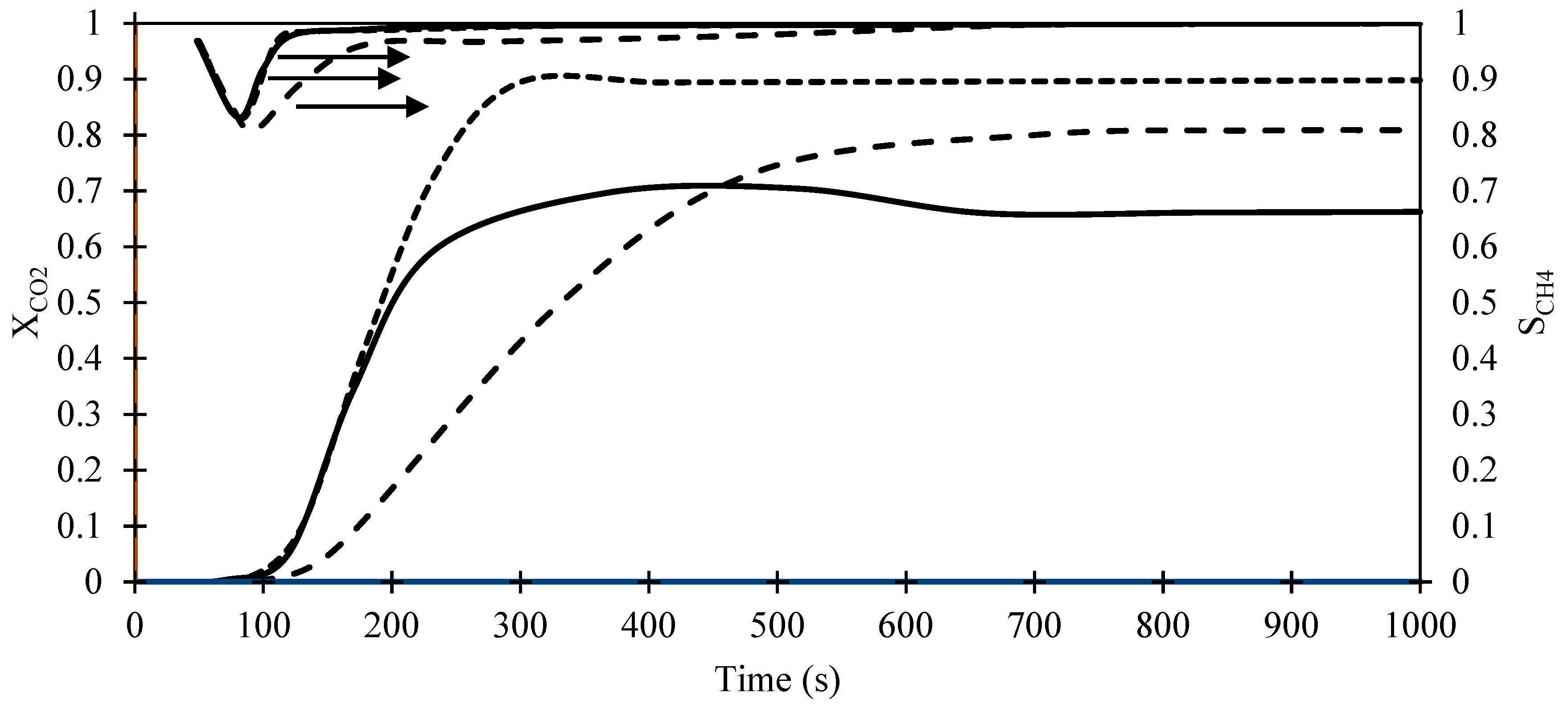
Bremer et al. [18] conducted a simulation-based study to evaluate and identify trajectories of control for time-optimal start-up of a reactor. As shown in Figure 2, the behavior of CO2 conversion and CH4 selectivity is presented as a function of time for different scenarios: with optimal steady-state control, and without optimal control. The results demonstrate that, without optimal control, a higher CO2 conversion was achieved around 220 s, reaching peak conversion faster than the other scenarios. Additionally, it is observed that after 100 s, the optimal control scenario shows a reduction in the CO2 conversion that can be attributed to the decrement in the inlet-side cooling temperature.
Otherwise, no significant variation was identified in CH4 selectivity, as similar results were found across all scenarios. Methane selectivity remained close to 1.0, as CO generation, thanks to chemical equilibrium, primarily happens above 525 °C at high pressures. However, at lower temperatures, the reaction rates for CO dominate, leading to a low level of CH4 selectivity in the first 100 s. Therefore, this early selectivity is also influenced by the small initial amounts of CH4 and CO present.
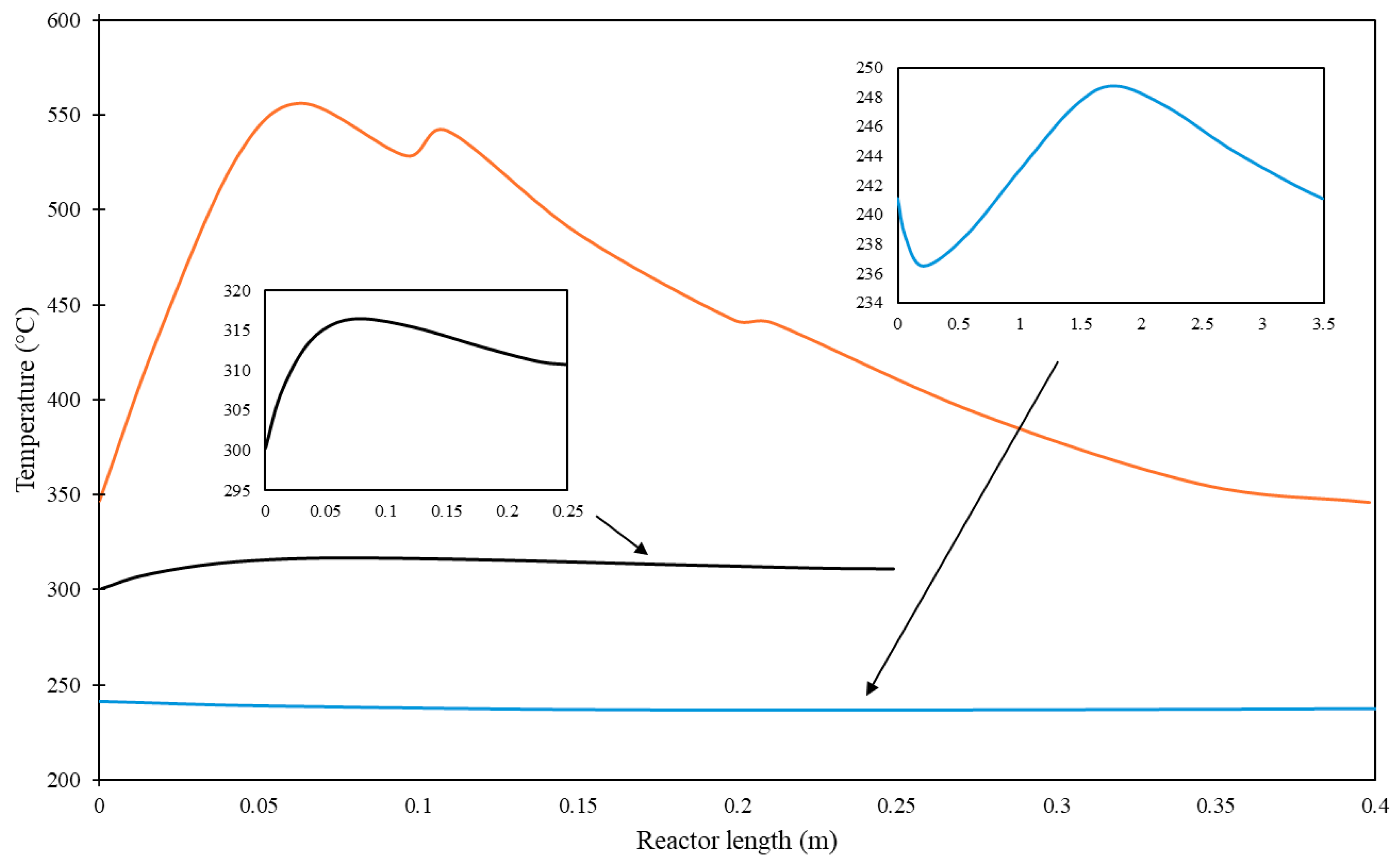
Chein et al. [36] reported numerical simulation results for CO2 methanation in an FBR for CH4 production. The performance of the reaction was analyzed by CO2 conversion using various operating conditions, with temperature variation along the reactor axis evaluated at an inlet temperature (Tin) of 300 °C. The increment of temperature is attributed to the exothermic nature of the reaction, and the temperature drop results from heat removal by external heat transfer. Similarly, for Di Nardo et al. [40] work, in comparison with the previous study, their simulations were also carried out at Tin = 300 °C. Fisher et al. [43] carried out dynamic simulations for CO2 methanation using a wall-cooled FBR. The temperature profiles obtained from these three studies are shown in Figure 3 as a function of reactor length. The non-monotonic behavior observed in the orange temperature profile, with local minima and maxima, illustrates the thermal effects arising from competing exothermic reactions and non-uniform heat removal. This type of temperature distribution is commonly reported in FBR operating under high space velocities and insufficient cooling. The results reveal that the temperature fluctuates within a narrow range (~20 °C), with no severe hot spot formation observed.
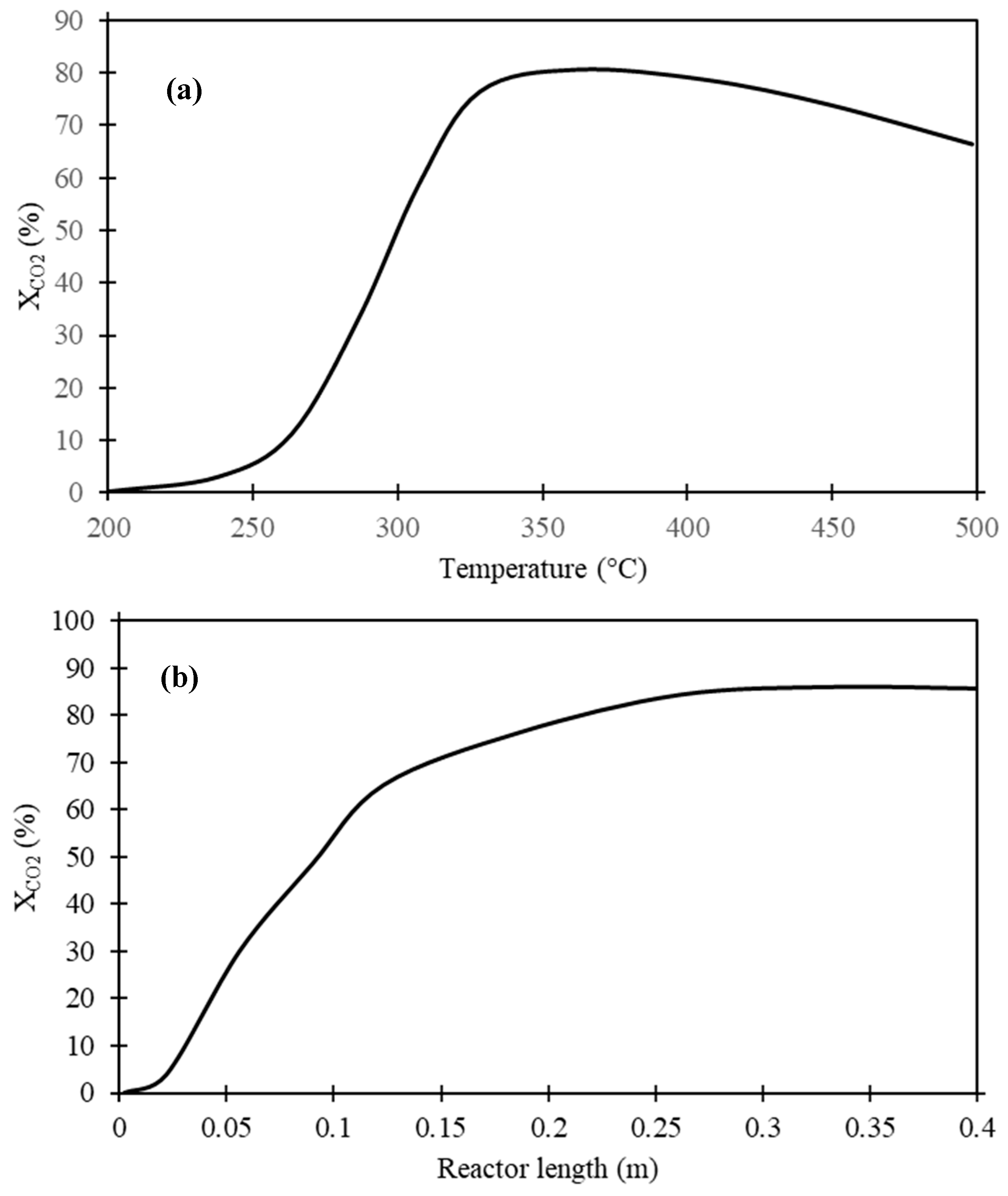
Figure 4 illustrates the behavior of the CO2 conversion with respect to temperature and reactor length. CO2 conversion was evaluated in Chein et al. [36] work, which revealed a reaction threshold around 200 °C. As the temperature increases, CO2 conversion rises quickly, reaching the highest point at approximately 350 °C. Beyond this point, further increases in temperature lead to a decrease in CO2 conversion. This behavior reflects the thermodynamic equilibrium limitation of the methanation reaction at high temperatures. It is important to note that these trends correspond to isothermal reactor models with fixed catalyst mass, and do not include kinetic or transport effects.
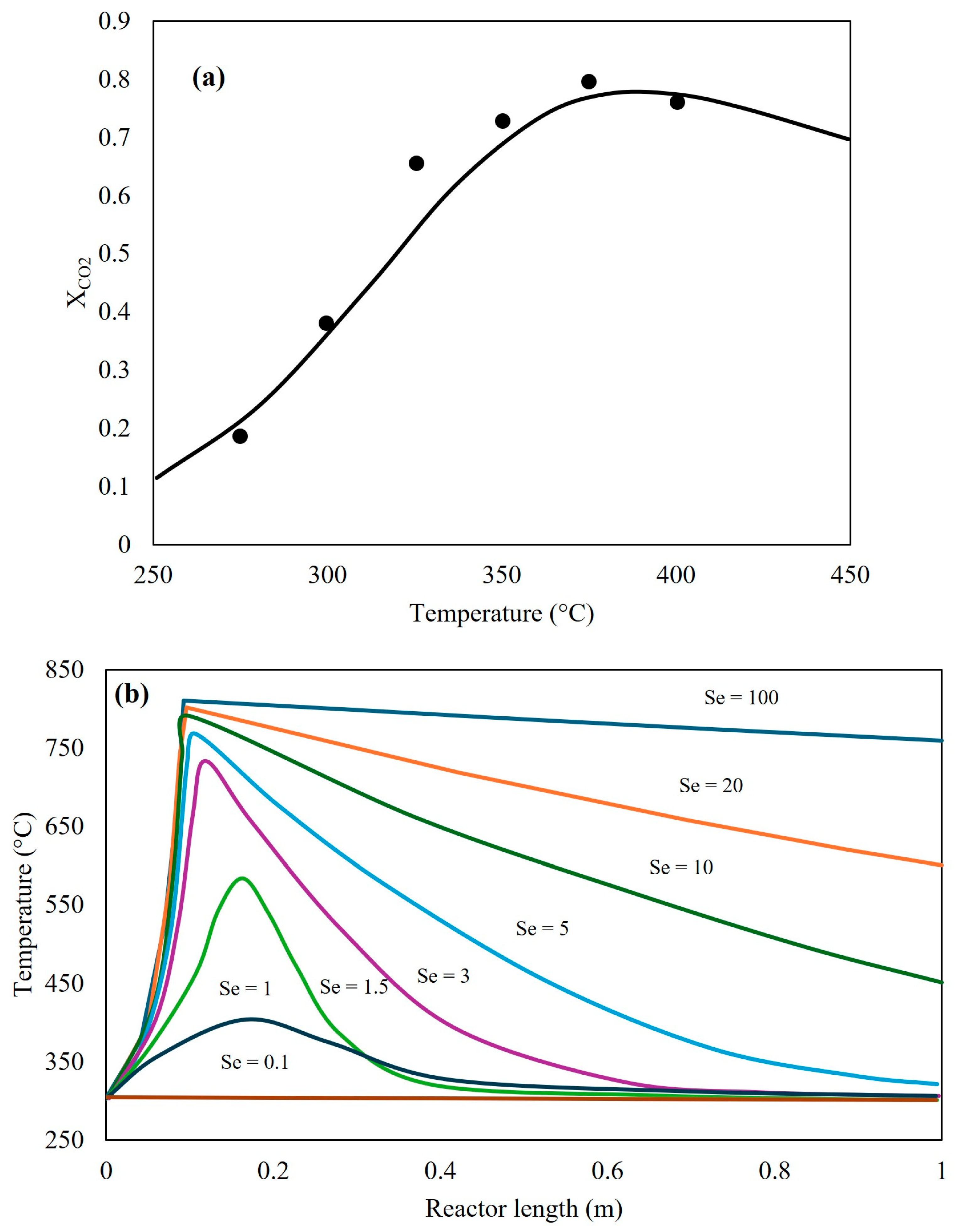
Kiewidt and Thöming [3] performed simulations to predict optimal temperature profiles. Figure 5 presents the conversion profile with respect to temperature (Figure 5a) and the temperature profile as a function of reactor length (Figure 5b). In Figure 5a, the conversion profile shows that the reactor model is suitable, as it closely matches the experimental data. It is observed that the highest CO2 conversion is approximately 78% at 375 °C, after which the conversion begins to decrease as the temperature continues to rise.
Otherwise, Figure 5b illustrates the axial temperature profiles for different Semenov numbers under the following conditions: P = 1 MPa, H2/CO2 = 4:1, and gas-hourly space-velocity (GHSV) = 15,500 h−1. Semenov number (Se) is a key parameter for thermal optimization, as it gives an illustrative representation of the reactor’s thermal behavior. A low Semenov number (Se → 0) corresponds to high cooling rates or low heat production rates, indicating an isothermal reactor. Conversely, high Semenov numbers (Se → ∞) are associated with low cooling rates or high heat production rates, describing an adiabatic reactor behavior. As a concept, the Semenov number represents a dimensionless parameter that compares the rate of heat generation by reaction with the rate of heat removal from the system. It is commonly expressed as the following equation:
S e = Δ H r r h T w T
where r is the reaction rate, Δ H r is the reaction enthalpy, h is the heat-transfer coefficient, and T w T represents the temperature driving force between the wall and the reacting medium.
Low Semenov numbers (Se = 0) correspond to near-isothermal operation where heat removal dominates, while high Se values indicate conditions approaching adiabatic behavior, with heat generation exceeding heat dissipation. This makes the Semenov number particularly useful for analyzing thermal sensitivity in highly exothermic systems such as CO2 methanation.
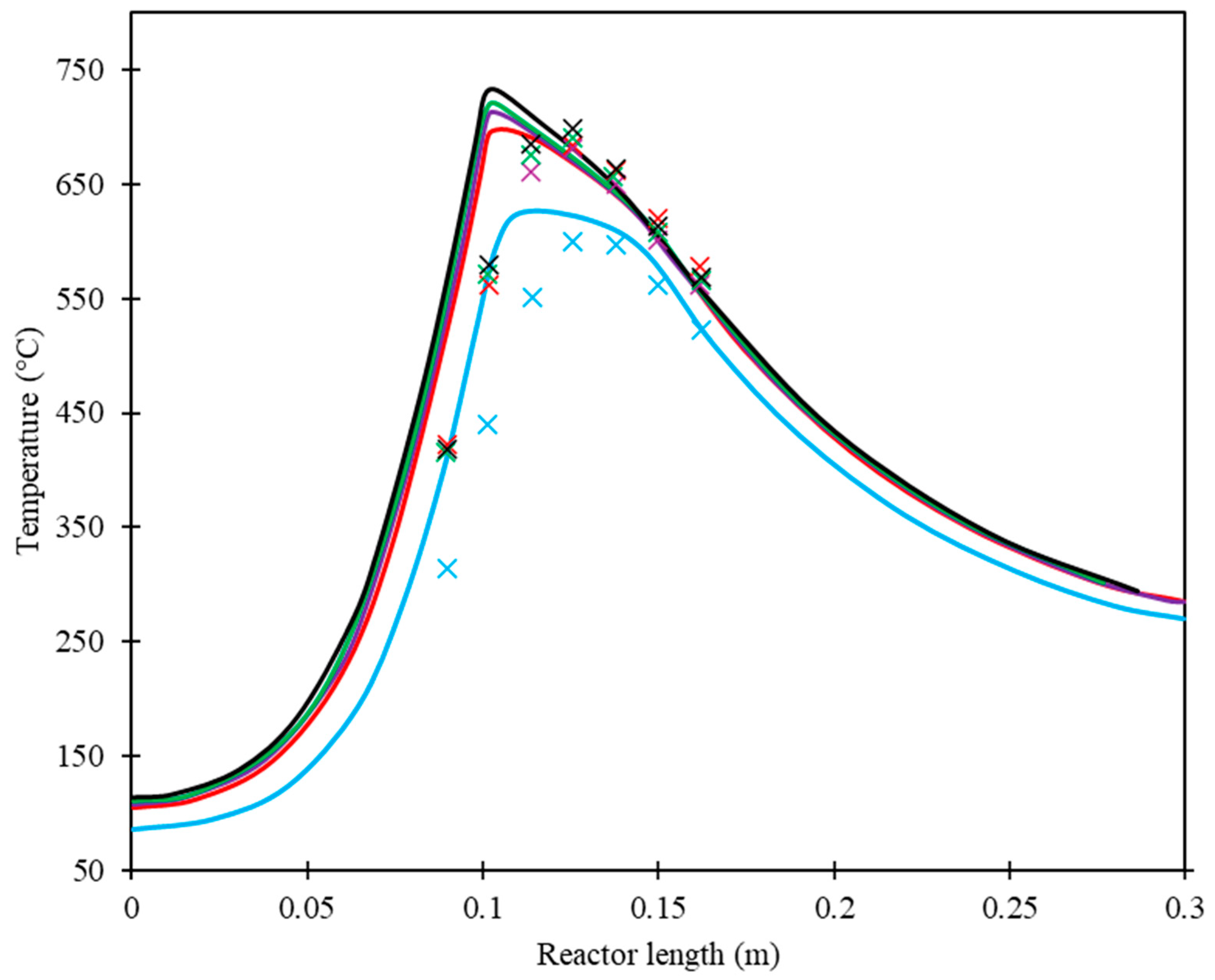
From Krammer et al. [17] results, in Figure 6, the characteristics of the axial temperature profiles at a GHSV of 4000 h−1 are illustrated. The experimental temperature curves were determined at the following pressures: 1.3, 4.1, 6.3, 8.0, and 10.1 bar. It can be noted that all profiles show a quick temperature increment, rising from 100 °C at the entrance to more than 600 °C, reaching 735 °C in the initial catalyst zone due to the exothermic heat release from the reaction. A steep axial temperature gradient near the interface between the lower inert bed and the catalyst bed of about 14 K/mm indicates a significant reaction rate in the catalyst zone. The highest point of temperature occurs at 1 mm or less at 10 bar and 11 mm at 1.3 bar, followed by a temperature decrement.
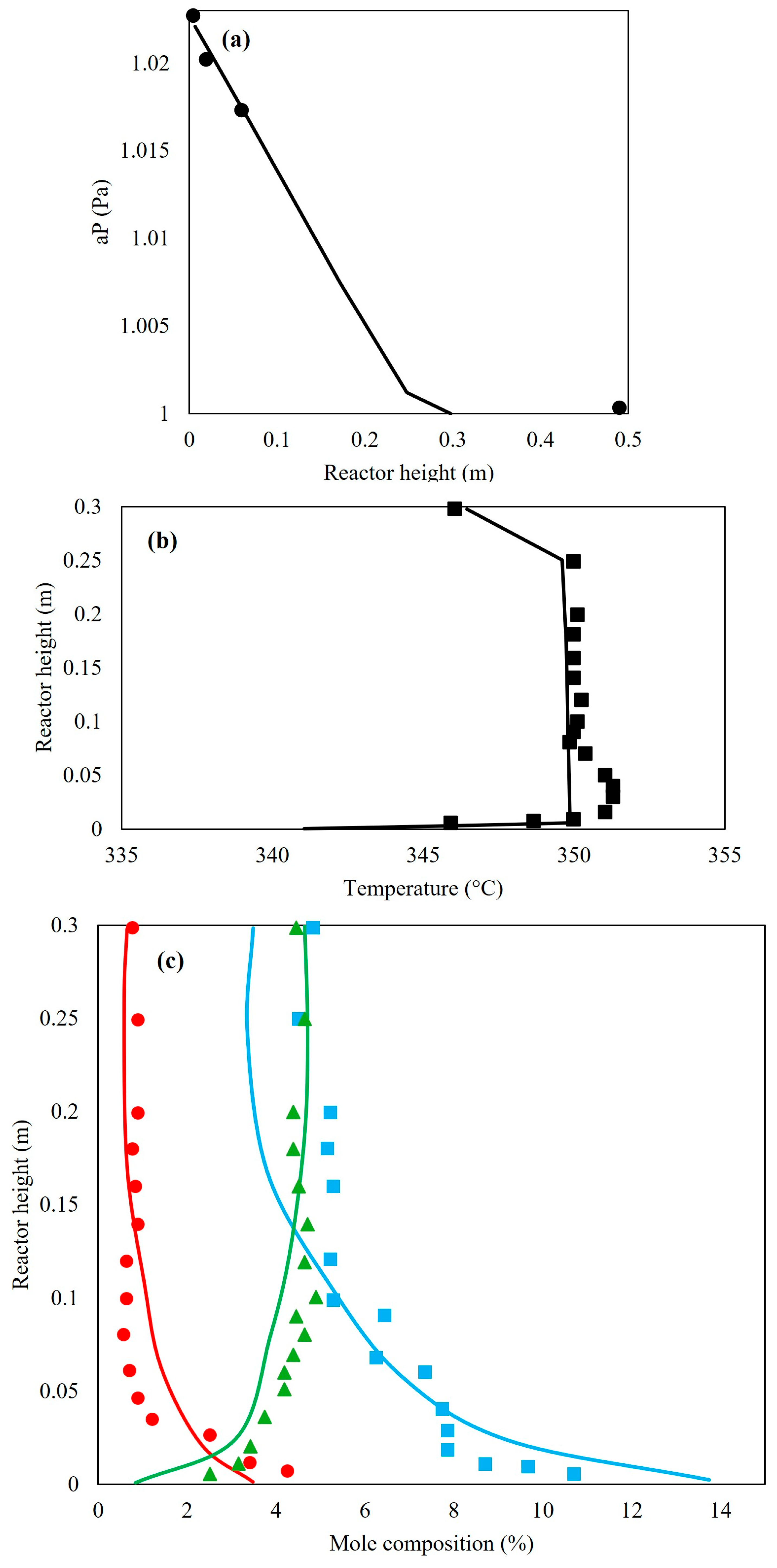
Ich Ngo et al. [20] conducted a study involving both experimental and numerical analysis of the catalytic methanation of CO2 in a BFB reactor. The authors compared the results from CFD simulations with experimental data, temperature, and species mole fractions as a function of the BFB reactor, as shown in Figure 7. In Figure 7a, the pressures evaluated at the gas inlet are presented. The pressure profile is observed to vary from the distributor to the bed surface.
The gas temperature rises sharply from the inlet temperature of 340 °C to 350 °C at around 0.015 m of the reactor length, and then stabilizes at around 349 °C until 0.25 m. The reactor demonstrates good uniformity in axial temperature. As Figure 7b depicts, the gas temperature profile obtained from CFD results aligns closely with the experimental data along the reactor height (h), indicating that the model, including the wall boundary conditions, accurately predicts the reaction heat formation and heat loss at the wall.
In Figure 7c, the values of the calculated mole fractions show a good adjustment with experimental data for the 77.5% inlet N2. The CO mole fraction in the dried product gas zone was close to zero, and the rest was N2, varying from 77.5% to 91%. The CO2 conversions from experiments and CFD simulations were 82% and 87%. The temperature profile is in good agreement with the experiments; a low deviation of the CFD results from the experimental data is noted, but this is not the case for H2.
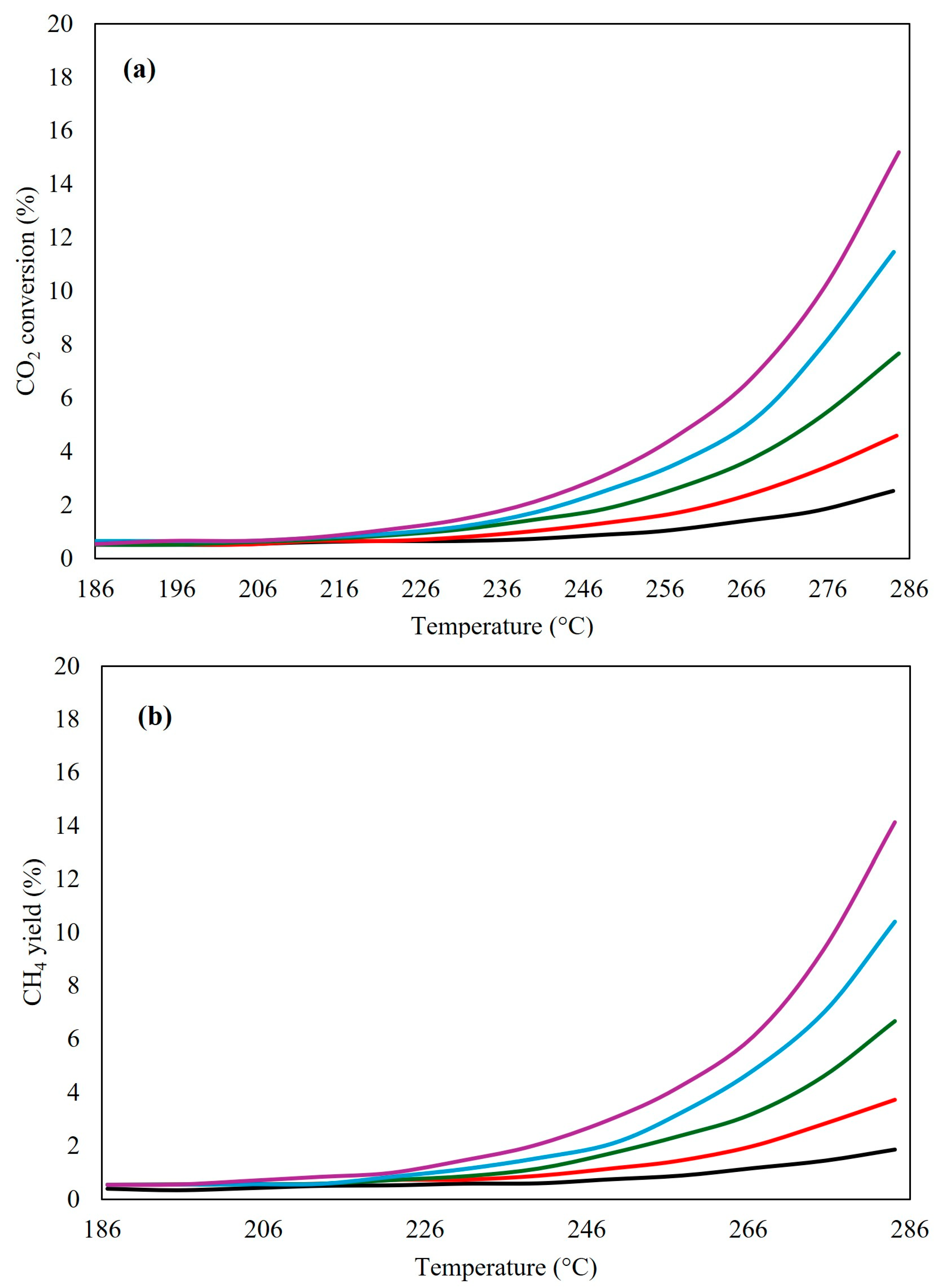
Jia et al. [21] evaluated the impact of operating conditions on CO2 methanation using a highly efficient fluidized-bed reactor. Figure 8 illustrates the CO2 conversion and CH4 yield at varying temperatures and feed compositions. It is evident from the results that both the CO2 conversion and CH4 yield increased with higher temperatures and a higher H2/CO2 ratio.
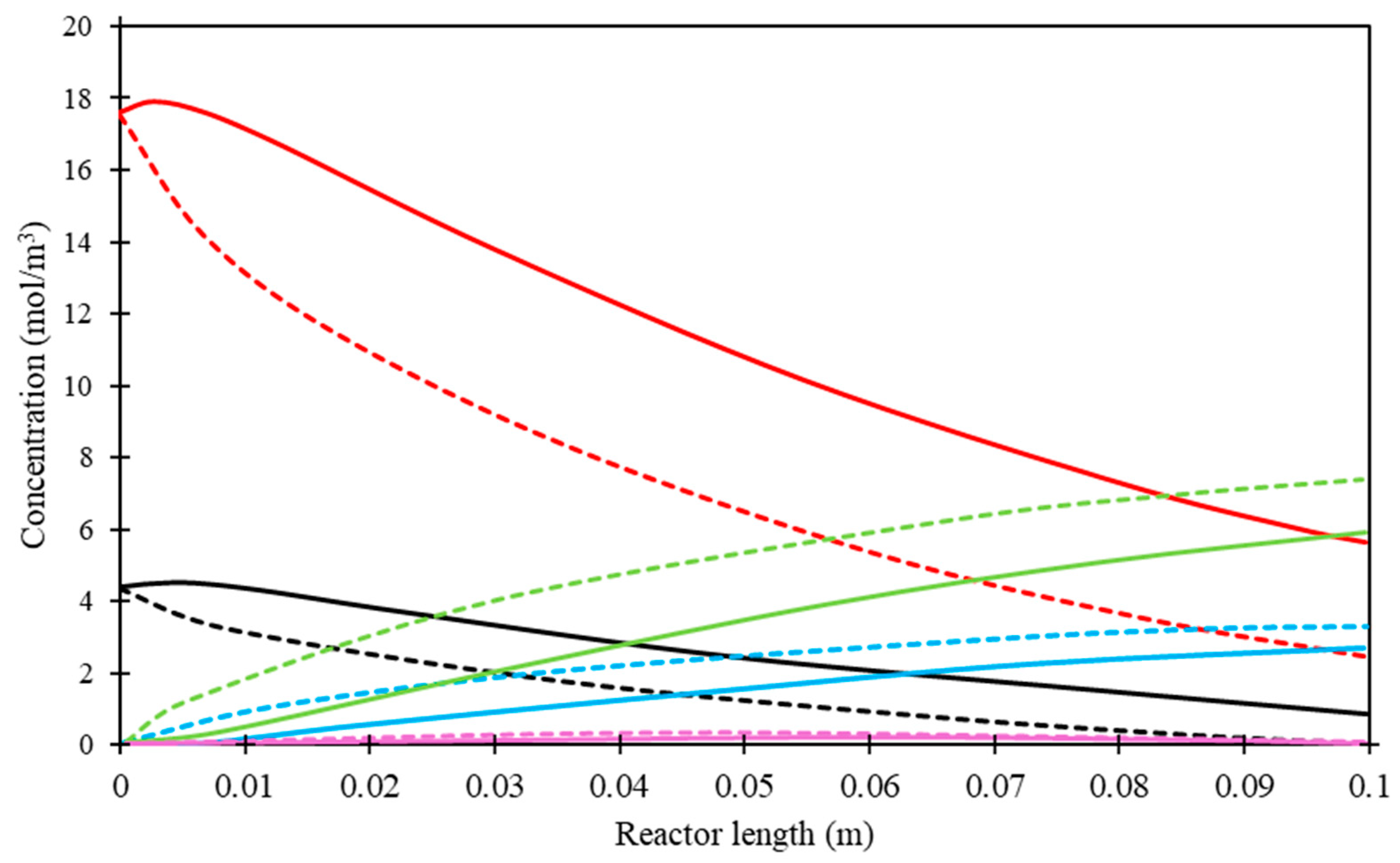
Figure 9 shows the concentrations of different gas species in the bubble and emulsion phases during the CO2 methanation process, as a function of the fluidized-bed reactor height. It is evident that the concentration of CO remains low along the entire reactor, which aligns with the high selectivity of the NiMgW catalyst used for CH4 formation. Additionally, CO, which represents the final product of the RWGS reaction, behaves as an intermediate in the CO2 methanation process. CO consumption in the methanation reaction further reduces the amount of CO measured in the reactor.
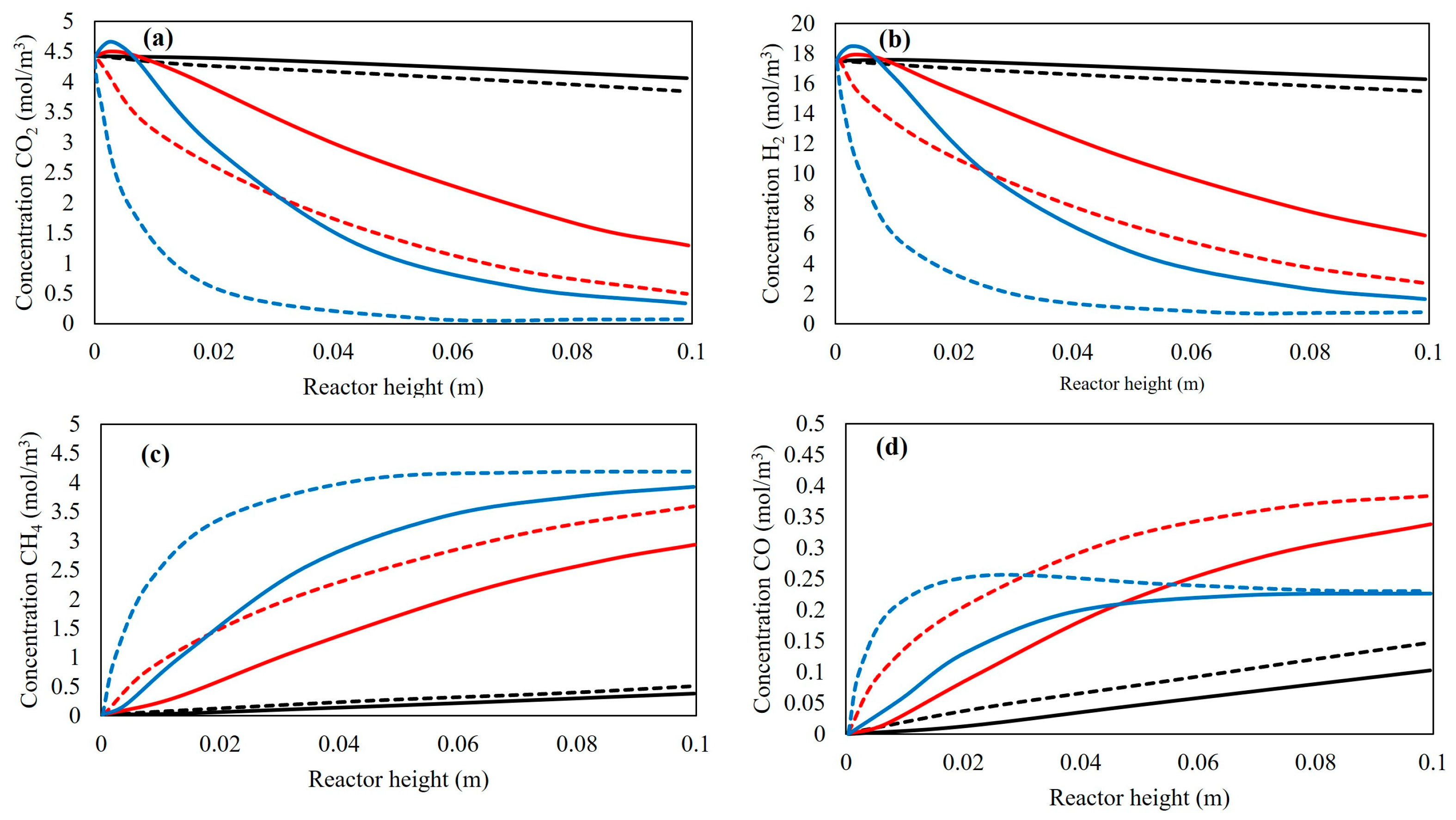
Otherwise, the reactor demonstrates good heat and mass transfer, leading to close isothermal conditions. Figure 10 illustrates the impact of temperature, ranging from 227 to 327 °C, on the reactant and product concentrations, as well as on the reaction rates. Figure 10a,b depicts that the reactants conversion increases with temperature, as expected according to the Arrhenius law. Regarding the products, since the concentration of CH4 (Figure 10c) increases monotonically with temperature throughout the fluidized bed height, the effect of temperature on CO concentration (Figure 10d) is more complex. Specifically, at the highest temperature of 327 °C, the CO concentration rises sharply in the lower part of the bed and then levels off at the bed height, reaching lower concentrations than at 287 °C. This behavior occurs due to the CO2 methanation having a higher activation energy than the RWGS and becomes the dominant reaction at 327 °C. The increased rate of the methanation reaction reduces the CO concentration in the upper half of the fluidized bed at 327 °C compared to 287 °C, due to the lower reactant concentrations.
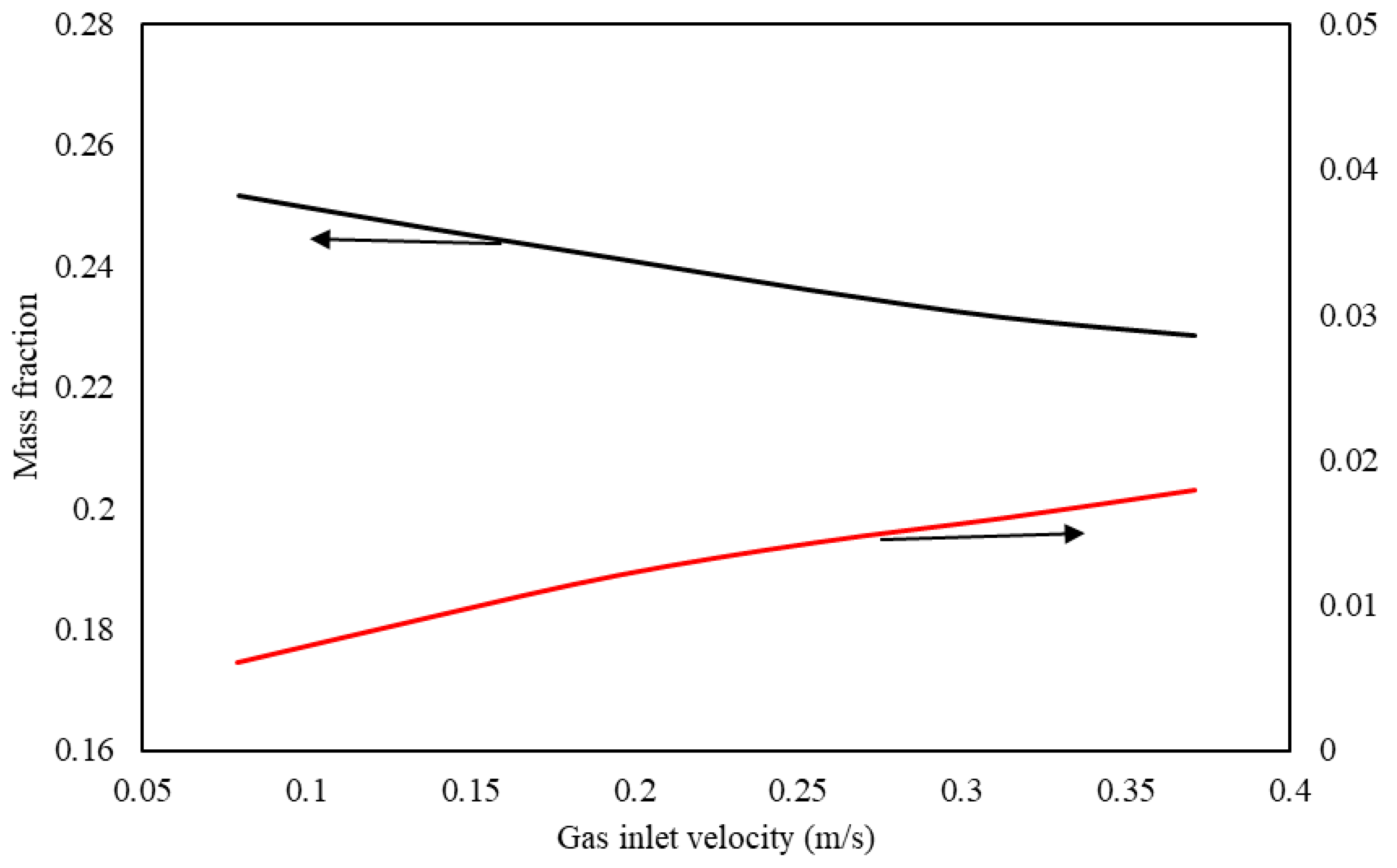
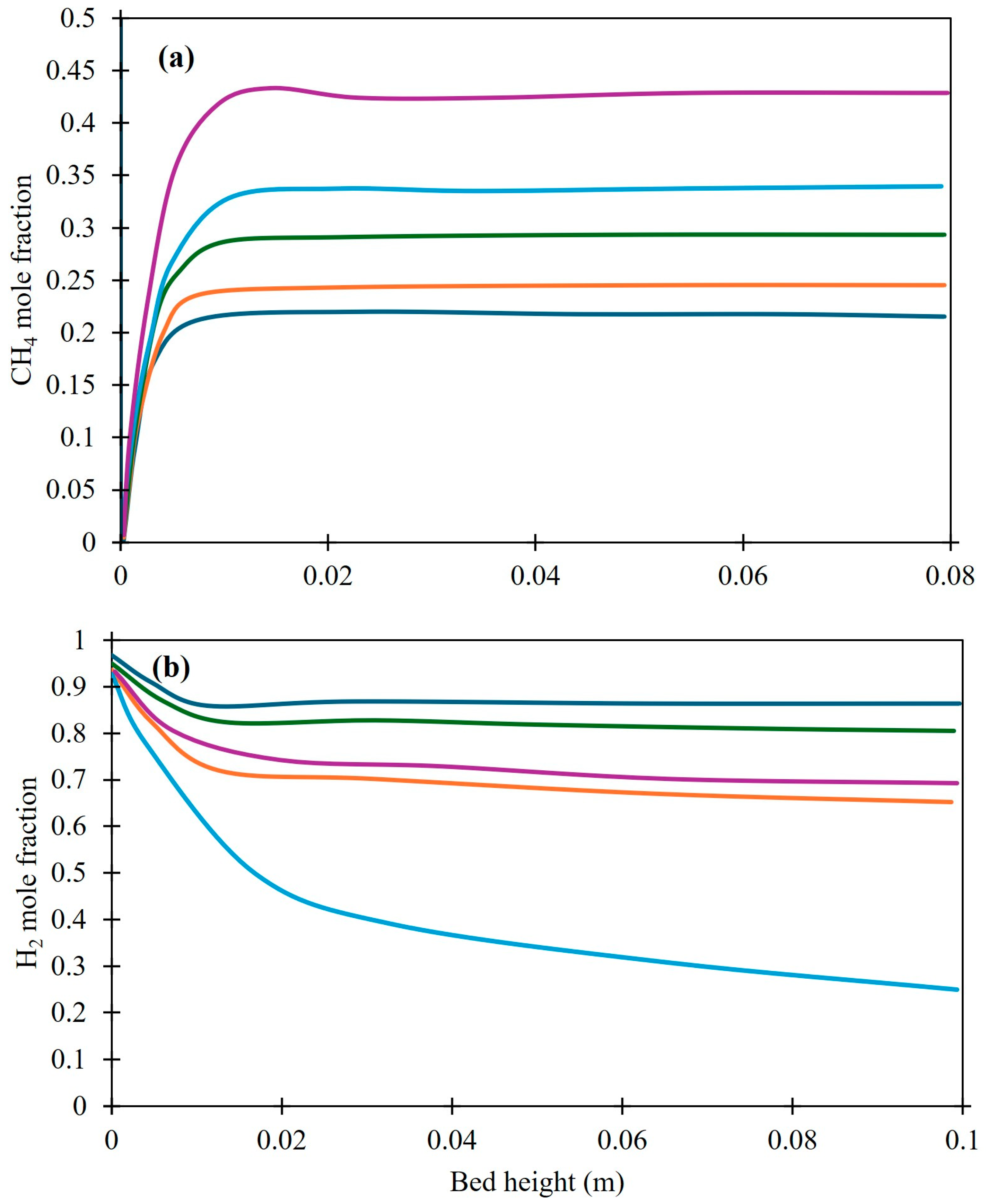
In the work by Liu and Hinrichsen [51], CFD simulations were performed. The effect of gas velocity on CH4 and H2 mass fractions is shown in Figure 11. It is evident that the concentration of CH4 presents a decrease as the gas velocity rises, and the residual H2 concentration increases. Figure 12 illustrates the impact of water addition to the feeds on CH4 and H2 concentrations. It is observed that a decrease in the H2/CO feed ratio results in lower concentrations of both CH4 and H2. By the addition of water to the feed, the CH4 mole fraction increases approximately 38%. The RWGS reaction generates additional H2, which is then used in the methanation. Compared with the CH4 mole fraction, the increment in H2 mole fraction is more pronounced. For instance, in a gas feed containing 30 vol % H2 and 30 vol % CO, H2 is entirely consumed, while a significant quantity of CO remains unreacted. However, when 20 vol % H2O is added to the gas feed, the residual CO reacts with the H2O to generate a much higher amount of H2.
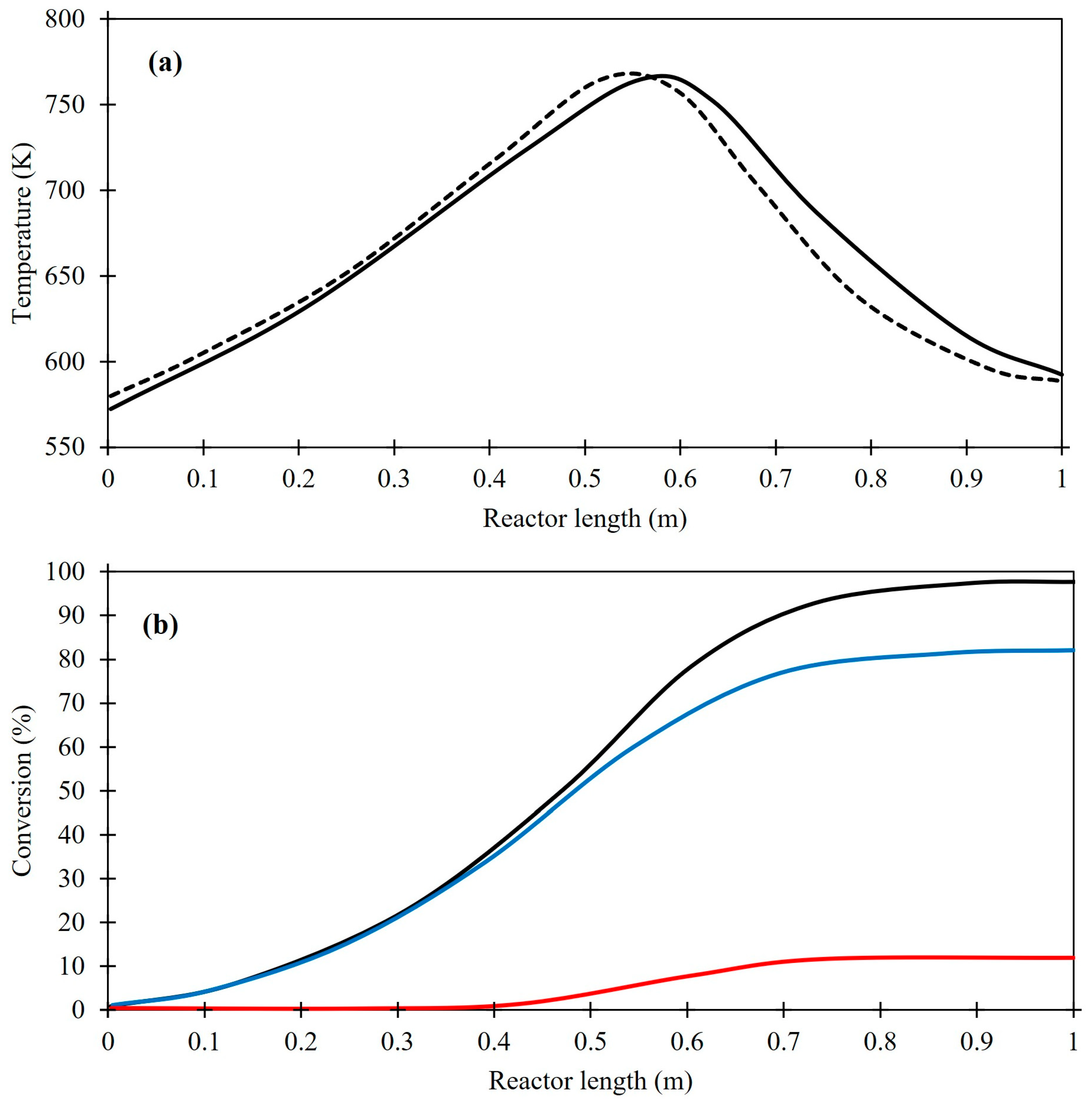
Results from Sudiro et al. [52] depict several conclusions. Figure 13 presents the determined axial profiles of temperature and H2, CO, and CO2 conversion. The coolant temperature was 300 °C, as reactions begin at temperatures higher than 240 °C. The feed composition was assumed to consist of 60 mol% H2, 20 mol% CO, and 20 mol% CO2, with an H2/CO molar ratio of 3, and a GHSV of 15,000 h−1. The inlet pressure was kept at 6.9 bar. The results indicated that high conversions of hydrogen and carbon monoxide (98% and 83%, respectively), could be achieved using a single monolithic reactor, with a moderate and acceptable temperature increase along the reactor. This approach helps avoid catalyst deactivation compared to existing methanation processes.
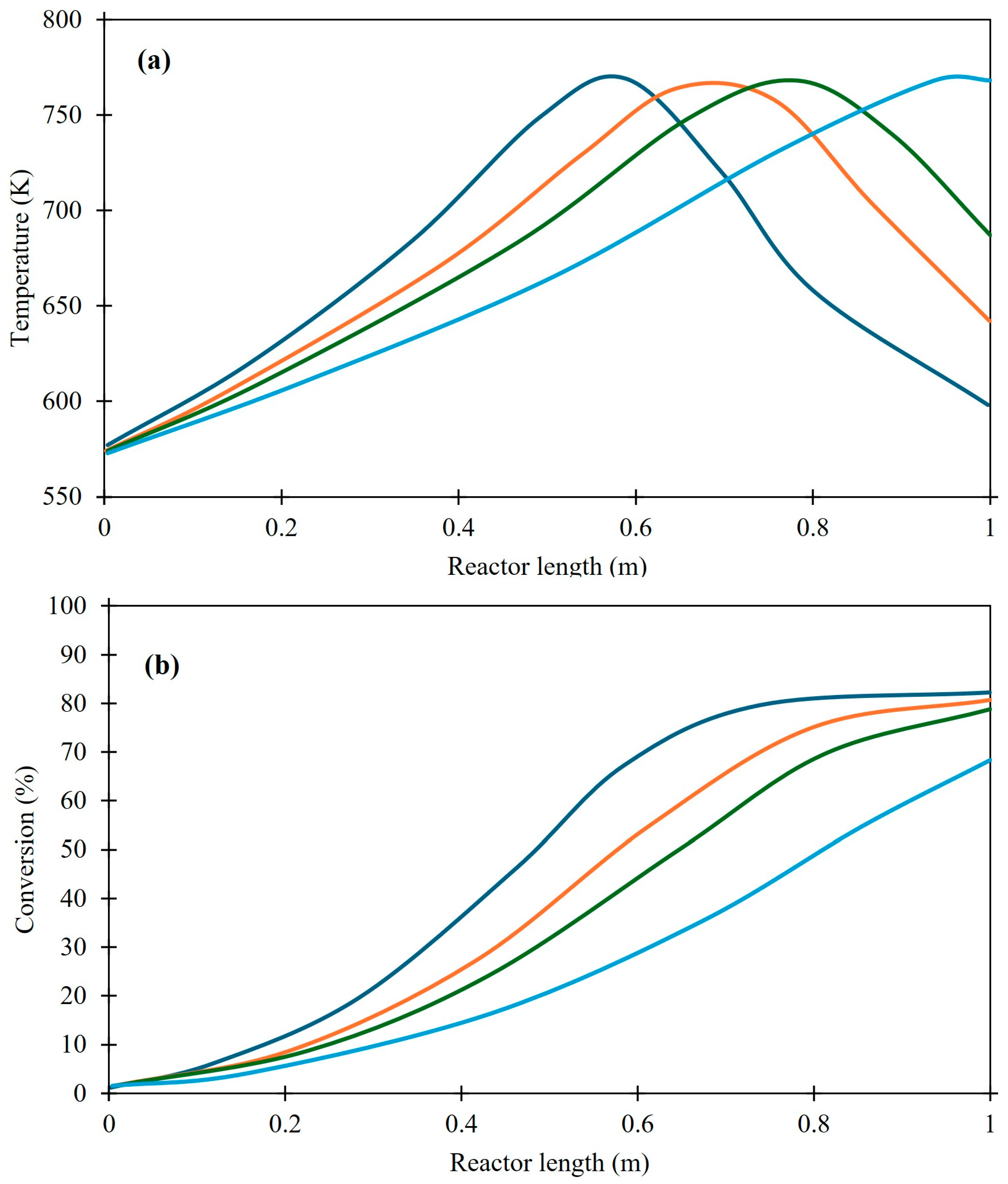
Otherwise, the effect of different GHSVs on the gas temperature and CO conversion along the reactor length is analyzed and depicted in Figure 14a and Figure 14b, respectively. The analysis focuses on the impact of progressively increasing the flow rate to enhance productivity. A higher gas flow rate, and thus a higher GHSV, causes the hot spot to shift towards the bed outlet. This is because the increased gas flow rate enhances convective heat removal, which reduces the temperature increment provoked by the reaction heat. As a result, the lower temperature reduces the reaction rate, leading to a decrement in CO conversion at high space velocities.
To support an evidence-based comparison of the reviewed reactor models, Table 2 consolidates, for each study, the calibrated parameters/coefficients (if reported) and the experimental observables used to assess agreement between observations and model predictions. Where the original sources provide statistical indicators (e.g., RSS, r2), Table 2 identifies the corresponding calibration basis; otherwise, entries are marked “not reported” to avoid overinterpretation. This table therefore provides the traceability required to discuss the quality of model adjustment across the literature without introducing additional computations beyond the reported information.

3.4. Suggestion of a Generalized Reactor Model for Methanation of COx

The general reactor model proposed in this section was constructed after analyzing the main modeling approaches reported in the literature for FBR and fluidized-bed reactors. The selection of terms was guided by the need to balance physical fidelity with computational efficiency. Key effects such as axial dispersion, reaction heat release, and interfacial mass transfer were considered based on their reported impact on simulation accuracy under industrial conditions. Radial gradients and catalyst deactivation were excluded in this version to maintain a tractable set of equations; however, can be added modularly depending on the application.
It is known that proposing a reactor model valid for all cases is in fact a difficult task; however, modifications and adjustments can take place to adapt the model to the corresponding case study employed. Therefore, after a deep analysis and consideration of all the reactor modeling studies discussed in this work, the following fundamental equations for the reactor model are recommended to be considered to start performing simulations for the methanation of COx gases to achieve accurate predictions of experimental data, simulate commercial reactors, and carry out upscaling studies:
The generalized model proposed in this work is the result of synthesizing the common structural elements observed across the fixed-bed and fluidized-bed reactor models analyzed in the literature. Although the reviewed models differ in dimensionality, level of detail, and treatment of transport phenomena, they share a consistent mathematical backbone derived from the fundamental conservation laws. For this reason, the formulation presented herein adopts a modular structure in which the convective, dispersive, interfacial-transfer, and reaction terms can be activated or neglected depending on the reactor configuration, scale, and operating regime.
This unified formulation is further justified by the observation that most deviations between simplified and rigorous reactor models arise from the same physical mechanism: axial dispersion at intermediate Peclet numbers, strong reaction-driven heat release, and non-equimolar effects on momentum balance. By expressing the governing equations in their full generality, the proposed framework preserves the ability to incorporate such mechanisms without forcing unnecessary complexity when they are negligible, an aspect highlighted throughout the reactor studies summarized in this manuscript. Moreover, this structure allows seamless transition between pseudo-homogeneous and heterogeneous descriptions, as additional interphase mass- and heat-transfer terms can be introduced while maintaining consistency with the conservation principles. Therefore, the equations presented below offer a physically grounded yet flexible starting point capable of adapting to different reactor types, kinetic schemes, and scales, while ensuring that the model remains computationally tractable for both steady-state and dynamic simulations.
  • Mass balance
ρ α t = v z ε ρ α z + D r , α e f f ε 2 ρ α r 2 + 1 r ρ α r + 1 ε ε M α β v α , β r ~ β
  • Energy balance
T t = 1 ρ c p e f f α ρ α C p , α v z T z + λ r e f f 2 T t + 1 r T t 1 ε α Δ R H ~ β r ~ β
  • Momentum balance
Radial component:
ρ f Ψ u r t + 1 Ψ u r u r r + u z u r z = p r + η f Ψ 1 r r r u r r + 2 u r z 2 u r r 2 f 1 · η f + f 2 · u u
Axial component:
ρ f Ψ u z t + 1 Ψ u r u z r + u z u z z = p z + η f Ψ 1 r r r u z r + 2 u r z 2 f 1 · η f + f 2 · u u
Equations (86)–(89) represent a general modeling framework for reactive systems and are based on the fundamental conservation laws of mass, energy, and momentum. These equations are formulated under the assumption of axisymmetric operation in a tubular fixed-bed reactor, which is representative of the reactor configurations commonly employed in COx methanation studies. Accordingly, cylindrical coordinates ( r , z ) are adopted, with no angular dependence, allowing the explicit representation of axial and radial transport phenomena while maintaining a compact mathematical formulation. Expressing the momentum balance in radial and axial components allows the explicit representation of flow redistribution and pressure gradients in tubular fixed-bed reactors, ensuring full consistency with axisymmetric mass and energy balances and enabling the analysis of coupled transport and reaction phenomena.
The mass and energy balances are written in pseudo-homogeneous form, accounting for axial convection and radial dispersion or heat conduction within the catalytic bed. For consistency with this axisymmetric framework, the momentum balance, originally expressed in vector form for porous media, is expanded into its radial and axial components. This formulation preserves the physical content of the original Brinkman–Darcy–Forchheimer equation while enabling a direct and transparent coupling with the axisymmetric mass and energy balances. The resulting set of equations provides a coherent and unified description of transport and reaction phenomena in fixed-bed methanation reactors.
Their generality lies in the fact that they are not tied to a specific reactor configuration or operating regime. Each term can be adapted to reflect the characteristics of different reactor types. For example, the convective and dispersive terms in the mass balance can be modified to represent plug flow, axial dispersion, or mixing in fluidized beds. The energy balance can include external heat exchange or intra-phase heat conduction, and the momentum equation can account for pressure drop correlations appropriate to packed beds or fluidized systems. Also, while the current formulation corresponds to a pseudo-homogeneous model, it can be extended to a heterogeneous framework by defining separate mass and energy balances for the gas and solid phases, along with interphase transfer terms. As such, this set of equations provides a flexible starting point for constructing detailed reactor models across various configurations.
The model can be implemented employing standard ODE solvers (e.g., ode15s or ode23s in MATLAB) for steady-state plug flow simulations, or converted into PDE form for dynamic 1D simulations. For stiff systems, DAE solver or implicit integration schemes are recommended.
Most of the literature reports carry out reactor simulations employing FBR; however, fluidized-bed reactors are also useful, as recommended in the literature. Whichever option is chosen, the adjustments of these equations and the addition or removal of parameters depend on the type of reactor selected. Nevertheless, for better results and for a better description of the phenomena occurring during the methanation of COx gases reactions, robust models with all the information possible and parameters for describing the effects involved are necessary for obtaining relevant information.

4. Perspectives on Reactor Modeling for Methanation of COx

The comparative analysis presented throughout this review highlights both the progress achieved in modeling COx methanation reactors and the significant gaps that remain in the current literature. Although the collected studies address relevant aspects of mass, energy, and momentum transport, they do so in a fragmented manner, lacking a unified modeling framework that consistently connects reactor-scale phenomena with kinetics, heat management, and transport limitations. The generalized formulation proposed in this work attempts to fill this gap by extracting the common structural elements identified across the diverse modeling approaches and synthesizing them into a single, modular framework. The insights gained from this synthesis yield several perspectives for advancing the field.
From the kinetic standpoint, most works rely on well-established rate expressions for CO and CO2 methanation, yet a large portion of the literature applies these kinetics under idealized conditions or without explicitly reporting the origin, validity range, or uncertainties of the kinetic parameters. Different studies have provided valuable, mechanistically motivated expressions, but even within these works, intrinsic kinetics are often coupled with assumptions of negligible diffusion limitations, uniform pellet temperature, or simplified adsorption terms. This limits the predictive capability of reactor models when extrapolated beyond laboratory conditions. A more rigorous incorporation of intraparticle diffusion effects, thermodynamic corrections, and uncertainty quantification would significantly advance model fidelity.
Regarding reactor-scale phenomena, the reviewed literature reveals a strong dichotomy between simplified pseudo-homogeneous models and more complex two-dimensional or heterogeneous descriptions. Pseudo-homogeneous models [36,39] effectively capture general trends and allow rapid parametric studies; however, their simplifying assumptions—such as perfect radial mixing, negligible radial temperature gradients, and constant physical properties—restrict their ability to accurately predict hot spots, axial dispersive effects, or catalyst-scale transport limitations. Heterogeneous models [3,47,63] incorporate these effects more faithfully, yet their computational cost and high sensitivity to parameter values make them less accessible for large parametric sweeps or industrial reactor design. Future advances must bridge these two approaches, ideally via reduced-order models or multiscale closures derived from detailed CFD simulations but implemented in tractable 1D or 2D frameworks.
Thermal management emerges as the most critical challenge for CO2 methanation reactor modeling. Several studies correctly emphasize the exothermicity of the reaction and the risk of thermal runaway, but the thermal treatments employed vary widely. Works such as Kiewidt and Thöming [3] accurately show how local heating intensifies selectivity and conversion patterns, whereas microchannel studies like Brooks et al. [39] highlight how reactor architecture dramatically alters heat removal and apparent ignition temperature. However, many studies oversimplify the energy balance by assuming constant heat capacities, neglecting axial heat conduction, or avoiding explicit treatment of wall heat transfer. These omissions can significantly affect predictions of ignition/extinction behavior, optimal tube diameter, or maximum allowable conversion. More comprehensive energy-balance formulations—including variable thermophysical properties, explicit wall heat transfer, and coupling to coolant dynamics—are essential for future reactor modeling efforts.
The treatment of the momentum balance remains inconsistent across the literature. Several authors neglect pressure drop under the justification of small reactor size or low superficial velocity, yet this assumption becomes invalid for industrially relevant Power-to-Gas (PtG) conditions, as pressure drops above 1 bar directly influence equilibrium constraints and reaction rates. As shown in this review, only a minority of studies include the pressure-drop contribution explicitly, despite its strong interaction with mass and heat transport. Considering the non-equimolar nature of methanation, ignoring momentum effects can lead to significant deviations in predicted conversion and hot-spot location. Future reactor models should incorporate at least simplified pressure-drop correlations (e.g., Ergun or Darcy–Forchheimer), ensuring consistency with realistic PtG operation.
Across all reviewed studies, a general trend emerges: the main limitations are not the lack of advanced modeling tools, but the lack of integration among scales (kinetic, pellet, reactor), phenomena (mass, heat, momentum), and numerical approaches (ODEs, PDEs, CFD). Each work contributes valuable isolated insights—be it the kinetic richness of Krammer, the thermal analysis of Kiewidt, or the structural innovation of microchannel reactors—but none provides a holistic framework capable of guiding reactor design across scales and operating regimes. The generalized model proposed in this manuscript represents one step toward this integration, offering a flexible structure where complexity can be selectively added depending on the system requirements. However, further work is needed to formalize multiscale coupling strategies, validate reduced models against high-fidelity simulations, and assess uncertainties in both kinetic and transport parameters.
In conclusion, the current state of COx methanation reactor modeling is characterized by valuable but fragmented advances. To move toward predictive, transferable, and industrially relevant models, studies must pursue:
  • Standardized kinetic parameter reporting and uncertainty evaluation.
  • Systematic integration of intraparticle diffusion and multiscale thermal effects.
  • Consistent inclusion of pressure-drop effects, especially for PtG operation.
  • Reduced-order models informed by CFD data but suitable for reactor-scale optimization.
  • Rigorous validation across multiple reactor geometries and scales.
Only through this integrative, multiscale, and thermodynamically consistent approach will the field achieve reactor models capable of supporting robust PtG design, optimization, and scale-up.
Overall, the literature surveyed suggests that future progress in COx methanation reactor modeling will depend less on introducing ever more complex numerical tools and more on integrating scales and phenomena within transparent, modular frameworks whose applicability ranges are clearly stated. The generalized reactor formulation proposed in this work, informed by the comparative evidence summarized in Table 2, provides a foundation for such developments. However, further efforts are required to formalize multiscale coupling strategies, harmonize parameter reporting practices, and evaluate uncertainty propagation from kinetics to reactor performance metrics.

5. Conclusions

After a comprehensive analysis of the literature about reactor modeling studies for the methanation of COx gases, the following conclusions are derived:
  • During reactor modeling to produce methane by COx gases methanation, mass and heat transfer, as well as pressure drop, temperature, feed inlet velocity, and H2/COx feed ratio are aspects that must be considered, providing that these reactions tend to be exothermic and prone to form hot spots.
  • Most studies adopt LHHW-type kinetic formulations to represent CO and CO2 hydrogenation; however, the applicability of such kinetics is often limited by insufficient reporting of calibration ranges and uncertainties. Explicit documentation of fitted parameters and experimental domains is essential for reliable reactor-scale extrapolation.
  • In general, reactor modeling studies reported in the literature consider the mass and energy balances; however, some of them do not use the momentum balance. It is of high importance to include all the balances as they describe and predict significant information regarding the transport phenomena occurring within the reactor. This is particularly relevant in COx methanation systems operating at high GHSV, which are often employed to control temperature rise in highly exothermic conditions. Under such circumstances, the pressure drop across the reactor bed can become significant, affecting both conversion and operational stability. Therefore, accurate momentum balances are essential for realistic performance predictions and reactor design.
  • The two principal types of reactors used for modeling studies are the FBR and the fluidized-bed reactor. Moreover, some works adopt detailed 2D heterogeneous models to capture spatial and phase-specific effects, while others prefer simpler 1D pseudo-homogeneous formulations for computational efficiency. Both steady-state and dynamic simulations are reported depending on the study objectives.
  • From simulation results, it is shown that the highest CO2 conversion is obtained (around 80–90%) at temperatures in the range of 350 to 400 °C under elevated pressures (typically ≈ 6 to 10 bar, or up to 1 MPa, depending on the study).
  • Evidence compiled in Table 2 shows that only a subset of published works report full parameter calibration and statistical indicators of model-data agreement, whereas many rely on the literature parameters or qualitative validation. This heterogeneity underscores the need for standardized reporting practices in future reactor modeling studies.
  • For proper simulations of a reactor for methanation of COx gases, the more robust and sophisticated the model, the more significant the results it would provide; nevertheless, as model complexity increases, for instance, by including detailed kinetics, multidimensional effects, or transport limitations, the computational burden also rises due to larger equation systems and the need for advanced solvers. This can significantly increase solution times and convergence requirements.

Author Contributions

Conceptualization, J.J.R. and J.A.; Methodology, J.J.R. and J.A.; Software, J.J.R.; Validation, J.A., A.M., A.E. and A.Z.; Formal analysis, J.J.R. and J.A.; Investigation, J.J.R. and J.A.; Resources, J.A., A.E. and A.Z.; Writing—original draft preparation, J.J.R.; Writing—review and editing, J.A., A.M., A.E. and A.Z.; Visualization, J.J.R. and J.A.; Supervision, J.J.R., J.A., A.M., A.E. and A.Z.; Project administration, J.A., A.E. and A.Z. All authors have read and agreed to the published version of the manuscript.

Funding

The research was supported by the Ministry of Science and Higher Education of the Russian Federation within the state assignment for the University of Tyumen (Project No. 22-73-10015-П, https://rscf.ru/project/22-73-10015-П).

Data Availability Statement

Data will be available on request to the authors.

Acknowledgments

Juan José Ríos thanks Secretaría de Ciencia, Humanidades, Tecnología e Innovación (SECIHTI) for the PhD scholarship grant.

Conflicts of Interest

The authors declare no conflicts of interest.

Abbreviations

BFBBubbling fluidized bed
BVPBoundary value problem
CCTCarbon capture technology
CFDComputational fluid dynamics
DAEDifferential algebraic equation
FBRFixed-bed reactor
GHGGreenhouse gases
GHSVGas hourly space velocity
IVPInitial value problem
LHHWLangmuir-Hinshelwood-Hougen-Watson
MOLMethod of lines
ODEOrdinary differential equation
PBRPacked-bed reactor
PDEPartial differential equation
PRCFDParticle-resolved Computational Fluid Dynamic
PtGPower-to-Gas
PtMPower-to-Methane
RWGSReverse water gas shift
SBCSlurry bubble column
SeSemenov number
SNGSynthetic natural gas
SRKSoave-Redlich-Kwong
Symbols
A c Cross-sectional flow
C F Forchheimer drag coefficient
C P Specific heat
D a x i Axial dispersion coefficient
D i T Thermal   diffusion   coefficient   of   species   i
D i j Binary molecular diffusion coefficient
D r , i Radial dispersion coefficient
D r , α e f f Effective radial dispersion coefficient
dT/dPRatio of reactor-to-particle diameter
F i Molar   flow   rate   of   component   i
k D Axial diffusion coefficient
k L Axial equivalent conductivity
k w Wall heat transfer coefficient
M α Molar mass of component α
n t Total number of moles
P h Hydrodynamic perimeter
T c o o l Cooling temperature
T f u r n a c e Furnace temperature
t Time
N Total gas flux
q c Energy source
R Gas constant
r β Reaction   rate   for   reaction   β
U Global heat transfer coefficient
V Reactor volume
v z , β Stoichiometric   coefficient   of   component   α   in   reaction   β
v z Superficial gas velocity in axial direction
z Reactor length
Greek symbols
Δ H j Enthalpy variation
Δ R H β Reaction   heat   for   reaction   β
ε f Void fraction
λ e Thermal conductivity of catalyst particle coefficient
λ m Thermal conductivity of gas mixture coefficient
λ r , α e f f Effective radial heat conductivity
ρ S Catalyst density
ρ g Gas mixture density
ρ α Mass concentration of component α
ε Porosity coefficient
η Effectiveness factor
κ Permeability coefficient
ρ Mass density

References

  1. Rönsch, S.; Schneider, J.; Matthischke, S.; Schlüter, M.; Götz, M.; Lefebvre, J.; Prabhakaran, P.; Bajohr, S. Review on Methanation—From Fundamentals to Current Projects. Fuel 2016, 166, 276–296. [Google Scholar] [CrossRef]
  2. Schlereth, D.; Hinrichsen, O. A Fixed-Bed Reactor Modeling Study on the Methanation of CO2. Chem. Eng. Res. Des. 2014, 92, 702–712. [Google Scholar] [CrossRef]
  3. Kiewidt, L.; Thöming, J. Predicting Optimal Temperature Profiles in Single-Stage Fixed-Bed Reactors for CO2-Methanation. Chem. Eng. Sci. 2015, 132, 59–71. [Google Scholar] [CrossRef]
  4. Zhang, J.; Yang, Y.; Liu, J.; Xiong, B. Mechanistic Understanding of CO2 Hydrogenation to Methane over Ni/CeO2 Catalyst. Appl. Surf. Sci. 2021, 558, 149866. [Google Scholar] [CrossRef]
  5. Zhang, W.; Machida, H.; Takano, H.; Izumiya, K.; Norinaga, K. Computational Fluid Dynamics Simulation of CO2 Methanation in a Shell-and-Tube Reactor with Multi-Region Conjugate Heat Transfer. Chem. Eng. Sci. 2020, 211, 115276. [Google Scholar] [CrossRef]
  6. Bauer, C.; Treyer, K.; Antonini, C.; Bergerson, J.; Gazzani, M.; Gencer, E.; Gibbins, J.; Mazzotti, M.; McCoy, S.T.; McKenna, R.; et al. On the Climate Impacts of Blue Hydrogen Production. Sustain. Energy Fuels 2022, 6, 66–75. [Google Scholar] [CrossRef]
  7. Riemer, M.; Duscha, V. Carbon Capture in Blue Hydrogen Production Is Not Where It Is Supposed to Be—Evaluating the Gap between Practical Experience and Literature Estimates. Appl. Energy 2023, 349, 121622. [Google Scholar] [CrossRef]
  8. Paulista, L.O.; Ferreira, A.F.P.; Rodrigues, A.E.; Martins, R.J.E.; Boaventura, R.A.R.; Vilar, V.J.P.; Silva, T.F.C.V. Solar Thermo-Photocatalytic Methanation Using a Bifunctional RuO2:TiO2/Z13X Photocatalyst/Adsorbent Material for Efficient CO2 Capture and Conversion. J. Environ. Chem. Eng. 2024, 12, 112418. [Google Scholar] [CrossRef]
  9. Wang, W.; Gong, J. Methanation of Carbon Dioxide: An Overview. Front. Chem. Eng. China 2011, 5, 2–10. [Google Scholar] [CrossRef]
  10. Yarbaş, T.; Ayas, N. A Detailed Thermodynamic Analysis of CO2 Hydrogenation to Produce Methane at Low Pressure. Int. J. Hydrog. Energy 2024, 49, 1134–1144. [Google Scholar] [CrossRef]
  11. Faria, A.C.; Trujillano, R.; Rives, V.; Miguel, C.V.; Rodrigues, A.E.; Madeira, L.M. Cyclic Operation of CO2 Capture and Conversion into Methane on Ni-Hydrotalcite Based Dual Function Materials (DFMs). J. CO2 Util. 2023, 72, 102476. [Google Scholar] [CrossRef]
  12. Cimino, S.; Cepollaro, E.M.; Frusteri, F.; Lisi, L. Effect of Li-Na Sorbent Phase in Ru/Al2O3 Dual Function Materials for the Integrated CO2 Capture and Methanation. Sep. Purif. Technol. 2025, 354, 129101. [Google Scholar] [CrossRef]
  13. Kopyscinski, J. Production of Synthetic Natural Gas in a Fluidized Bed Reactor Understanding the Hydrodynamic, Mass Transfer, and Kinetic Effects. Ph.D. Thesis, Swiss Federal Institute of Technology Zurich, Zurich, Switzerland, 2010. [Google Scholar]
  14. Ríos, J.J.; Ancheyta, J.; Samano, V. Reactor Modeling to Evaluate the Effect of Reactions Mass Balances on Sulfur Removal in Gasoil HDT. Chem. Eng. Technol. 2025, 48, e70064. [Google Scholar] [CrossRef]
  15. Giglio, E.; Pirone, R.; Bensaid, S. Dynamic Modelling of Methanation Reactors during Start-up and Regulation in Intermittent Power-to-Gas Applications. Renew. Energy 2021, 170, 1040–1051. [Google Scholar] [CrossRef]
  16. Gruber, M.; Wiedmann, D.; Haas, M.; Harth, S.; Loukou, A.; Trimis, D. Insights into the Catalytic CO2 Methanation of a Boiling Water Cooled Fixed-Bed Reactor: Simulation-Based Analysis. Chem. Eng. J. 2021, 406, 126788. [Google Scholar] [CrossRef]
  17. Krammer, A.; Peham, M.; Lehner, M. 2D Heterogeneous Model of a Polytropic Methanation Reactor. J. CO2 Util. 2022, 62, 102059. [Google Scholar] [CrossRef]
  18. Bremer, J.; Rätze, K.H.G.; Sundmacher, K. CO2 Methanation: Optimal Start-up Control of a Fixed-Bed Reactor for Power-to-Gas Applications. AIChE J. 2017, 63, 23–31. [Google Scholar] [CrossRef]
  19. Hervy, M.; Maistrello, J.; Brito, L.; Rizand, M.; Basset, E.; Kara, Y.; Maheut, M. Power-to-Gas: CO2 Methanation in a Catalytic Fluidized Bed Reactor at Demonstration Scale, Experimental Results and Simulation. J. CO2 Util. 2021, 50, 101610. [Google Scholar] [CrossRef]
  20. Ngo, S.I.; Lim, Y.-I.; Lee, D.; Won Seo, M.; Kim, S. Experiment and Numerical Analysis of Catalytic CO2 Methanation in Bubbling Fluidized Bed Reactor. Energy Convers. Manag. 2021, 233, 113863. [Google Scholar] [CrossRef]
  21. Jia, C.; Dai, Y.; Yang, Y.; Chew, J.W. A Fluidized-Bed Model for NiMgW-Catalyzed CO2 Methanation. Particuology 2020, 49, 55–64. [Google Scholar] [CrossRef]
  22. Nam, H.; Kim, J.H.; Kim, H.; Kim, M.J.; Jeon, S.G.; Jin, G.T.; Won, Y.; Hwang, B.W.; Lee, S.Y.; Baek, J.I.; et al. CO2 Methanation in a Bench-Scale Bubbling Fluidized Bed Reactor Using Ni-Based Catalyst and Its Exothermic Heat Transfer Analysis. Energy 2021, 214, 118895. [Google Scholar] [CrossRef]
  23. Dixon, A.G.; Partopour, B. Computational Fluid Dynamics for Fixed Bed Reactor Design. Annu. Rev. Chem. Biomol. Eng. 2020, 11, 109–130. [Google Scholar] [CrossRef] [PubMed]
  24. Cao, H.S.; Zhang, X.B.; Luo, Z.H. Multiscale CFD Simulations of CO2 Hydrogenation to Methanol from Single Catalyst Pellet to Fixed-Bed Reactor. Chem. Eng. Sci. 2025, 315, 121883. [Google Scholar] [CrossRef]
  25. Ghaib, K.; Nitz, K.; Ben-Fares, F.Z. Chemical Methanation of CO2: A Review. ChemBioEng Rev. 2016, 3, 266–275. [Google Scholar] [CrossRef]
  26. Tirado, A.; Ancheyta, J.; Trejo, F. Kinetic and Reactor Modeling of Catalytic Hydrotreatment of Vegetable Oils. Energy Fuels 2018, 32, 7245–7261. [Google Scholar] [CrossRef]
  27. Mederos, F.S.; Ancheyta, J.; Chen, J. Review on Criteria to Ensure Ideal Behaviors in Trickle-Bed Reactors. Appl. Catal. A Gen. 2009, 355, 1–19. [Google Scholar] [CrossRef]
  28. Su, X.; Xu, J.; Liang, B.; Duan, H.; Hou, B.; Huang, Y. Catalytic Carbon Dioxide Hydrogenation to Methane: A Review of Recent Studies. J. Energy Chem. 2016, 25, 553–565. [Google Scholar] [CrossRef]
  29. Quatorze, I.F.; Gonçalves, L.P.L.; Kolen’ko, Y.V.; Soares, O.S.G.P.; Pereira, M.F.R. CO2 Methanation over Ni Supported on Carbon–ZrO2: An Optimization of the Composite Composition. Catal. Today 2023, 422, 114215. [Google Scholar] [CrossRef]
  30. Dong, X.; Jin, B.; Cao, S.; Ding, Q.; Wei, Y.; Chen, T. COx Co-Methanation over Coal Combustion Fly Ash Supported Ni-Re Bimetallic Catalyst: Transformation from Hazardous to High Value-Added Products. J. Hazard. Mater. 2020, 396, 122668. [Google Scholar] [CrossRef]
  31. Ashok, J.; Pati, S.; Hongmanorom, P.; Tianxi, Z.; Junmei, C.; Kawi, S. A Review of Recent Catalyst Advances in CO2 Methanation Processes. Catal. Today 2020, 356, 471–489. [Google Scholar] [CrossRef]
  32. Edwards, J.H.; Maitra, A.M. FUEL The Chemistry of Methane Reforming with Carbon Dioxide and Its Current and Potential Applications. Fuel Process. Technol. 1995, 42, 269–289. [Google Scholar] [CrossRef]
  33. Jürgensen, L.; Ehimen, E.A.; Born, J.; Holm-Nielsen, J.B. Dynamic Biogas Upgrading Based on the Sabatier Process: Thermodynamic and Dynamic Process Simulation. Bioresour. Technol. 2015, 178, 323–329. [Google Scholar] [CrossRef]
  34. Adams, T.A.; Barton, P.I. A Dynamic Two-Dimensional Heterogeneous Model for Water Gas Shift Reactors. Int. J. Hydrogen Energy 2009, 34, 8877–8891. [Google Scholar] [CrossRef]
  35. Scott Fogler, H. The Grid: Elements of Chemical Reaction Engineering, 4th ed.; Prentice Hall: Hoboken, NJ, USA, 2016. [Google Scholar]
  36. Chein, R.Y.; Chen, W.Y.; Yu, C.T. Numerical Simulation of Carbon Dioxide Methanation Reaction for Synthetic Natural Gas Production in Fixed-Bed Reactors. J. Nat. Gas Sci. Eng. 2016, 29, 243–251. [Google Scholar] [CrossRef]
  37. Phanikumar, M.S.; Mahajan, R.L. Non-Darcy Natural Convection in High Porosity Metal Foams. Int. J. Heat Mass Transf. 2002, 45, 3781–3793. [Google Scholar] [CrossRef]
  38. Costamagna, P.; Pugliese, F.; Cavattoni, T.; Busca, G.; Garbarino, G. Modeling of Laboratory Steam Methane Reforming and CO2 Methanation Reactors. Energies 2020, 13, 2624. [Google Scholar] [CrossRef]
  39. Brooks, K.P.; Hu, J.; Zhu, H.; Kee, R.J. Methanation of Carbon Dioxide by Hydrogen Reduction Using the Sabatier Process in Microchannel Reactors. Chem. Eng. Sci. 2007, 62, 1161–1170. [Google Scholar] [CrossRef]
  40. Di Nardo, A.; Calchetti, G.; Bassano, C.; Deiana, P. CO2 methanation in a shell and tube reactor CFD simulations: High temperatures mitigation analysis. Chem. Eng. Sci. 2021, 246, 116871. [Google Scholar] [CrossRef]
  41. Farsi, S.; Olbrich, W.; Pfeifer, P.; Dittmeyer, R. A Consecutive Methanation Scheme for Conversion of CO2—A Study on Ni3Fe Catalyst in a Short-Contact Time Micro Packed Bed Reactor. Chem. Eng. J. 2020, 388, 124233. [Google Scholar] [CrossRef]
  42. Giglio, E.; Bianco, M.; Zanardi, G.; Catizzone, E.; Giordano, G.; Migliori, M. Direct Biogas Methanation via Renewable-Based Power-to-Gas: Techno-Economic Assessment Based on Real Industrial Data. Energy Convers. Manag. 2025, 332, 119775. [Google Scholar] [CrossRef]
  43. Fischer, K.L.; Langer, M.R.; Freund, H. Dynamic Carbon Dioxide Methanation in a Wall-Cooled Fixed Bed Reactor: Comparative Evaluation of Reactor Models. Ind. Eng. Chem. Res. 2019, 58, 19406–19420. [Google Scholar] [CrossRef]
  44. Kang, W.R.; Lee, K.B. Effect of Operating Parameters on Methanation Reaction for the Production of Synthetic Natural Gas. Korean J. Chem. Eng. 2013, 30, 1386–1394. [Google Scholar] [CrossRef]
  45. Krammer, A.; Salbrechter, K.; Lehner, M. High-Capacity CO/CO2 Methanation Reactor Design Strategy Based on 1D PFR Modelling and Experimental Investigation. J. CO2 Util. 2024, 80, 102661. [Google Scholar] [CrossRef]
  46. Lefebvre, J.; Bajohr, S.; Kolb, T. Modeling of the Transient Behavior of a Slurry Bubble Column Reactor for CO2 Methanation, and Comparison with a Tube Bundle Reactor. Renew. Energy 2020, 151, 118–136. [Google Scholar] [CrossRef]
  47. Tauer, G.; Kern, C.; Jess, A. Transient Effects during Dynamic Operation of a Wall-Cooled Fixed-Bed Reactor for CO2 Methanation. Chem. Eng. Technol. 2019, 42, 2401–2409. [Google Scholar] [CrossRef]
  48. Poling, B.E.; Prausnitz, J.M.; O’connell, J.P.; York, N.; San, C.; Lisbon, F.; Madrid, L.; City, M.; Delhi, M.N.; Juan, S. The Properties of Gases and Liquids, 5th ed.; Mcgraw-Hill, Ed.; Mcgraw-Hill: New York, NY, USA, 2001; Volume 5. [Google Scholar]
  49. Try, R.; Bengaouer, A.; Baurens, P.; Jallut, C. Dynamic Modeling and Simulations of the Behavior of a Fixed-Bed Reactor-Exchanger Used for CO2 Methanation. AIChE J. 2018, 64, 468–480. [Google Scholar] [CrossRef]
  50. Zimmermann, R.T.; Bremer, J.; Sundmacher, K. Optimal Catalyst Particle Design for Flexible Fixed-Bed CO2 Methanation Reactors. Chem. Eng. J. 2020, 387, 123704. [Google Scholar] [CrossRef]
  51. Liu, Y.; Hinrichsen, O. CFD Simulation of Hydrodynamics and Methanation Reactions in a Fluidized-Bed Reactor for the Production of Synthetic Natural Gas. Ind. Eng. Chem. Res. 2014, 53, 9348–9356. [Google Scholar] [CrossRef]
  52. Sudiro, M.; Bertucco, A.; Groppi, G.; Tronconi, E. Simulation of a Structured Catalytic Reactor for Exothermic Methanation Reactions Producing Synthetic Natural Gas. Comput. Aided Chem. Eng. 2010, 28, 691–696. [Google Scholar] [CrossRef]
  53. Türks, D.; Mena, H.; Armbruster, U.; Martin, A. Methanation of CO2 on Ni/Al2O3 in a Structured Fixed-Bed Reactor—A Scale-up Study. Catalysts 2017, 7, 152. [Google Scholar] [CrossRef]
  54. Yang Lim, J.; McGregor, J.; Sederman, A.J.; Dennis, J.S. Kinetic Studies of CO2 Methanation over a Ni/γ-Al2O3 Catalyst Using a Batch Reactor. Chem. Eng. Sci. 2016, 141, 28–45. [Google Scholar] [CrossRef]
  55. Ríos, J.J.; Ancheyta, J.; Mantilla, Á.; Elyshev, A.; Zagoruiko, A. Kinetic Models for the Methanation of COx Gases to Produce Methane: A Critical Analysis. Int. J. Hydrogen Energy 2024, 93, 387–402. [Google Scholar] [CrossRef]
  56. Lefebvre, J.; Bajohr, S.; Kolb, T. A Comparison of Two-Phase and Three-Phase CO2 Methanation Reaction Kinetics. Fuel 2019, 239, 896–904. [Google Scholar] [CrossRef]
  57. Quindimil, A.; Onrubia-Calvo, J.A.; Davó-Quiñonero, A.; Bermejo-López, A.; Bailón-García, E.; Pereda-Ayo, B.; Lozano-Castelló, D.; González-Marcos, J.A.; Bueno-López, A.; González-Velasco, J.R. Intrinsic Kinetics of CO2 Methanation on Low-Loaded Ni/Al2O3 Catalyst: Mechanism, Model Discrimination and Parameter Estimation. J. CO2 Util. 2022, 57, 101888. [Google Scholar] [CrossRef]
  58. Marocco, P.; Morosanu, E.A.; Giglio, E.; Ferrero, D.; Mebrahtu, C.; Lanzini, A.; Abate, S.; Bensaid, S.; Perathoner, S.; Santarelli, M.; et al. CO2 Methanation over Ni/Al Hydrotalcite-Derived Catalyst: Experimental Characterization and Kinetic Study. Fuel 2018, 225, 230–242. [Google Scholar] [CrossRef]
  59. Lefebvre, J.; Trudel, N.; Bajohr, S.; Kolb, T. A Study on Three-Phase CO2 Methanation Reaction Kinetics in a Continuous Stirred-Tank Slurry Reactor. Fuel 2018, 217, 151–159. [Google Scholar] [CrossRef]
  60. Ríos, J.J.; Ancheyta, J.; Mantilla, A.; Elyshev, A.; Zagoruiko, A. Enhancing the Prediction Capability of a Literature COx Methanation Kinetic Model. Fuel 2026, 410, 137834. [Google Scholar] [CrossRef]
  61. Wang, J.; Shen, L.; Wang, L.; Liu, Z. Study of a Novel Methane Steam Reforming Membrane Reactor with Enhanced Heat and Mass Transfer for Waste Heat Recovery. Int. Commun. Heat Mass Transf. 2025, 165, 109084. [Google Scholar] [CrossRef]
  62. Vandewalle, L.A.; Van de Vijver, R.; Van Geem, K.M.; Marin, G.B. The Role of Mass and Heat Transfer in the Design of Novel Reactors for Oxidative Coupling of Methane. Chem. Eng. Sci. 2019, 198, 268–289. [Google Scholar] [CrossRef]
  63. Meynet, N.; Kara, Y.; Maheut, M.; Hervy, M.; Brito, L.; Maistrello, J. Numerical and Experimental Investigation of Bed Fluidization and Heat Transfer within a Methanation Reactor at Demonstration Scale. Therm. Sci. Eng. Prog. 2023, 44, 102021. [Google Scholar] [CrossRef]
  64. Yuan, Q.; Ding, J.; Lu, J.; Yu, T.; Wang, W. Heat Transfer and Energy Storage Performance of Methane Reforming with Carbon Dioxide in Semi-Cavity Reactor. Procedia Eng. 2016, 157, 365–373. [Google Scholar] [CrossRef][Green Version]
  65. Gu, R.; Ding, J.; Wang, Y.; Yuan, Q.; Wang, W.; Lu, J. Heat Transfer and Storage Performance of Steam Methane Reforming in Tubular Reactor with Focused Solar Simulator. Appl. Energy 2019, 233–234, 789–801. [Google Scholar] [CrossRef]
Figure 1. General overview of the principal contributors to worldwide greenhouse gas emissions. Others = HFCs, PFCs, SF6, and NF3 [7].
Processes 14 00659 g001
Figure 2. CO2 conversion and CH4 selectivity for controlling hot-spot formation (––), and uncontrolled hot-spot formation (– –), (- - - -).
Processes 14 00659 g002
Figure 3. Temperature (°C) profile as a function of reactor length (m). (–) Chein et al. [36], () Di Nardo et al. [40], and () Fischer et al. [43].
Processes 14 00659 g003
Figure 4. CO2 conversion profiles as a function of temperature (a) and reactor length (b).
Processes 14 00659 g004
Figure 5. (a) CO2 conversion profile as a function of temperature. (–) prediction and (●) experimental data. (b) Temperature profiles as a function of reactor length at various Semenov numbers.
Processes 14 00659 g005
Figure 6. Experimental (symbols) and predictions (lines) of temperature profiles as a function of reactor length for a lab-scale packed bed methanation reactor at 4000 h−1 GHSV and different pressures. (–) and (×) 10 bar, () and (×) 8.03 bar, () and (×) 6.31 bar, () and (×) 4.1 bar, and () and (×) 1.3 bar.
Processes 14 00659 g006
Figure 7. Experimental data (symbols) and predictions (lines) for the CFD results for (a) time-average pressure, (b) gas temperature, and (c) species mole fractions (yi). () and () H2, () and () CO2, and () and () CH4.
Processes 14 00659 g007
Figure 8. CO2 methanation from 460 to 563 K and different H2/CO2 ratios at ambient pressure for: (a) CO2 conversion as a function of temperature and (b) CH4 yield as a function of temperature. (–) H2/CO2 of 0.29, () H2/CO2 of 1.0, () H2/CO2 of 2.0, () H2/CO2 of 4.4, and () H2/CO2 of 6.6.
Processes 14 00659 g008
Figure 9. Concentration profiles of compounds along the fluidized bed height reactor in the bubble phase (solid lines) and emulsion phase (dotted lines). (–) CO2, () H2, () CH4, () H2O, and () CO.
Processes 14 00659 g009
Figure 10. Effect of temperature on species concentrations along the fluidized bed height reactor: (a) CO2, (b) H2, (c) CH4, and (d) CO. (–) 227 °C, () 287 °C, and () 327 °C.
Processes 14 00659 g010
Figure 11. Effect of gas inlet velocity on the mass fractions of CH4 (–) and H2 ().
Processes 14 00659 g011
Figure 12. Effect of the feed composition on concentrations of components along the reactor bed height. (a) CH4 concentration: () 30% H2, 30% CO, 20% H2O, () 30% H2, 30% CO, () 40% H2, 20% CO, 20% H2O, () 40% H2, 20% CO, and () 60% H2, 20% CO. (b) H2 concentration: () 60% H2, 20% CO, () 40% H2, 20% CO, () 40% H2, 20% CO, 20% H2O, () 30% H2, 20% CO, and () 30% H2, 30% CO, 20% H2O.
Processes 14 00659 g012
Figure 13. Profiles of temperature and compounds conversions along the reactor length: (a) (–) gas temperature, (---) monolith temperature, (b) (–) H2, () CO, and () CO2.
Processes 14 00659 g013
Figure 14. Effect of different GHSV on the profiles of (a) temperature and (b) CO conversion along with the reactor length. () 15,000 GHSV, () 18,000 GHSV, () 20,000 GHSV, () 25,000 GHSV.
Processes 14 00659 g014
Table 1. Principal reactions for COx gases hydrogenation [10].
DefinitionReactionEnthalpy, kJ/mol
RWGS C O 2 + H 2 C O + H 2 O 41.2
CO methanation C O + 3 H 2 C H 4 + H 2 O −206.3
CO2 methanation C O 2 + 4 H 2 C H 4 + 2 H 2 O −165.1
CH4 cracking C H 4 C + 2 H 2 74.9
Boudouard reaction 2 C O C O 2 + C −172.5
CH4 reverse dry reforming 2 C O + 2 H 2 C H 4 + C O 2 −247.3
CO reduction C O + H 2 C + H 2 O 131.3
CO2 reduction C O 2 + 2 H 2 C + H 2 O −90.1
Table 2. Summary of model specifications for the reviewed COx methanation reactor models.
ReferenceEquation RangeModel TypeIndependent Variable(s) Used in CalibrationNumerical Solution MethodCalibrated Parameters/
Coefficients
Calibration
Observables
Farsi et al. [41]Equations (22) and (23)Steady-state 1D pseudo-homogeneous, non-isothermal PFR/PBR; PFR assumptions (no axial dispersion; ΔP neglected if <10%).T setpoint 300–450 °C; pressure (example shown 4 bar); contact/space time; feed composition (CO2/CO/CH4 yields).MATLAB ode15s; parameter estimation with lsqnonlin (Levenberg–Marquardt) minimizing RSS.Fitted kinetic parameters for tested LHHW models; overall heat transfer coefficient term (αc) tuned vs. thermocouple data.Carbon-containing species yields (CO2, CO, CH4); RSS and adjusted r2; temperature profile used to tune αc.
Giglio et al. [15]Equations (28) and (29)Transient 1D pseudo-homogeneous convection–diffusion–reaction PDE (DAE after BCs).Not reported (no parameter calibration described).Method of lines + finite differences; convection with 5th-order WENO; diffusion with central differences; MATLAB ode15s for stiff DAEs.Not reported.Not reported as calibration (study reports dynamic profiles/metrics for operating scenarios).
Kiewidt and Thöming [3]Equations (36)–(39)Steady-state 1D pseudo-homogeneous fixed-bed reactor; used for optimal temperature-profile design.Not reported (optimization study; not parameter calibration).Python; axial integration using ODEPACK; optimization with BFGS (and a constrained algorithm as reported).Not reported.Not calibration; objective/constraints: maximize CH4 yield with Tmax ≤ Tlim.
Krammer et al. [45]Equations (40)–(42)Two-dimensional axisymmetric heterogeneous polytropic fixed-bed reactor model (implemented in COMSOL).Not reported (model validation discussed; calibration not explicitly described).COMSOL Multiphysics; FEM with triangular mesh (mesh settings reported).Not reported.Validation against temperature profiles and outlet composition/COx conversion (as reported by authors).
Schlereth and Hinrichsen [2]Equations (49)–(57)Comparative reactor modeling: 1D pseudo-homogeneous; 2D pseudo-homogeneous; 1D heterogeneous; membrane variant.Not reported in this work.MATLAB ode15s (ODEs); orthogonal collocation (PDE→ODE); bvp4c (particle BVP); COMSOL for radial effectiveness (γ(r)) model.Not reported (kinetic parameters sourced from the literature).Not calibration: model-comparison metrics (temperature/yield/runaway behavior) reported.
Zimmermann et al. [50]Equations (65) and (66)1D–1D heterogeneous reactor–particle model used for optimization of particle design (property profiles).Not calibration: decision variables include particle activity, permeability, and heat conductivity profiles; operating parameters include coolant T, inlet velocity, and pressure.Finite Volume discretization (150 axial, 40 catalyst); CasADi (MATLAB) with CVodes; Newton steady-state solve; IPOPT optimizer.Not reported (kinetics taken from the literature; optimization variables are material property profiles).Not calibration; objective/constraints: conversion/yield with Tmax constraint (e.g., Tmax ≤ 775 K).
Sudiro et al. [52]Equations (78)–(80)One-dimensional dynamic heterogeneous structured-reactor model (gas + solid mass/energy + momentum).Not reported.gPROMS; 200 grid points along the axial coordinate.Not reported.Not reported as calibration; model assessment based on simulated reactor behavior.
Lim et al. [54]Equations (81)–(84)Batch reactor kinetic model; ODE system for species/temperature.Time (t) with varying initial partial pressures (pCO2, pH2) and temperature.MATLAB ode45; parameter fitting via least-squares as reported.Fitted kinetic parameters (e.g., bI–bV and temperature-dependence terms).Fit to measured CO2/CH4 flow rates and pressure/time behavior (as reported).
Table 3. Reactor models employed in the literature for the methanation of COx gases.
Reactor TypeReactor ModelKinetic Model ApproachRef
FBRTwo-dimensional dynamic FBRLHHW model[18]
FBROne-dimensional tubular FBRHougen–Watson type model[35]
FBRSteady-state pseudo-homogeneous 1D non-isothermal PBRLHHW model[37]
FBROne-dimensional heterogeneous plug-flow microchannel reactorEmpirical rate expression[38]
FBRShell and tube FBRModified Lunde and Kester model[39]
FBRNon-isothermal pseudo-homogeneous PBRLHHW model[40]
FBRWall-cooled FBRLHHW model[61]
FBROne-dimensional catalytic cooled FBRLHHW model[16]
FBROne-dimensional pseudo-homogeneous cooled FBRHougen–Watson type model[15]
FBROne-dimensional pseudo-homogeneous shell and tube type heat exchanger reactorPower-law model[44]
FBRPseudo-homogeneous cooled PBRLunde and Kester model[3]
FBRTwo-dimensional heterogeneous polytropic FBRCombination of Power-law and LHHW model[17]
FBROne-dimensional homogeneous PBRCombination of Power-law and LHHW model[45]
Fluidized-bed reactorBFB reactorLHHW model[50]
Fluidized-bed reactorHeterogeneous fluidized bed reactorLHHW model[51]
Fluidized-bed reactorTwo-phase heterogeneous fluidized bed reactorKopyscinski model[52]
Structured reactorOne-dimensional dynamic heterogeneous cooled multi-tubular FBRWeatherbee model[53]
Other types of reactorsBatch reactorPower-law model[54]
Disclaimer/Publisher’s Note: The statements, opinions and data contained in all publications are solely those of the individual author(s) and contributor(s) and not of MDPI and/or the editor(s). MDPI and/or the editor(s) disclaim responsibility for any injury to people or property resulting from any ideas, methods, instructions or products referred to in the content.