1. Introduction
The Geological Strength Index (GSI) is a fundamental measure for estimating the mechanical properties of jointed rock masses. To understand the necessity of GSI quantification, it is essential to first distinguish between the physical behavior of a rock mass and the methodological limitations pertaining to its evaluation [
1]. From a physical perspective, the mechanical behavior (strength and deformability) of a rock mass is objectively governed by two primary factors: the degree of block interlocking determined by the fracture network (structure) and the shear strength of the discontinuity surfaces (surface conditions). The GSI system was theoretically designed to map these physical realities into a numerical index. However, in terms of evaluation methodology, traditional methods of applying the GSI heavily rely on visual, qualitative comparison with standard charts.
However, in terms of evaluation methodology, traditional methods of applying the GSI heavily rely on visual, qualitative comparison with standard charts. This creates a disconnect: while the physical behavior is definite, the visual evaluation is inherently subjective and ambiguous. This limitation often leads to significant inconsistencies where the assigned GSI value fails to accurately reflect the true physical state of the rock mass [
2,
3,
4,
5,
6,
7,
8].
In the field of rock engineering, accurately characterizing rock masses is critical for diverse applications, including mining operations, ground control, and slope engineering [
9,
10]. To achieve these goals, it is essential to determine the mechanical parameters of the rock masses, including the deformation modulus and strength parameters. Although the mechanical parameters of rock masses, such as the deformation modulus and strength, can ultimately be determined through field testing, access to engineering rock masses for such testing is often limited during the preliminary design phase. An effective method for obtaining these mechanical parameters is to employ rock mass classification systems to describe the masses’ characteristics and estimate their mechanical properties. Over the years, scholars both domestically and internationally have developed numerous rock mass classification systems to assess the mechanical properties of these masses, with each system tailored to specific geological conditions and engineering requirements [
11]. For example, the Rock Quality Designation (RQD) [
12] quantifies the degree of jointing or fracturing in rock masses by measuring the percentage of solid core pieces longer than 10 cm in total core length. This index is particularly useful in assessing the quality of the rock for tunneling and foundation purposes. The Rock Mass Rating (RMR) [
13] further integrates multiple parameters, including uniaxial compressive strength, rock quality, spacing of discontinuities, the condition of discontinuities, and groundwater conditions. This system provides a more comprehensive assessment and has been extensively used to determine support requirements in underground excavations. Barton et al. [
14] introduced the Q-system, which evaluates rock mass stability through parameters such as the RQD, joint set number, joint water reduction factor, joint orientation, and joint roughness [
15,
16]. This system is particularly favored in tunneling and mining due to its ability to guide the design of tunnel support systems based on quantitative data. Finally, unlike the aforementioned systems, the GSI, introduced by Hoek [
17], does not require detailed quantitative measurements, instead relying on visual qualitative assessments of rock mass surface conditions and the structure of the rock block. The GSI is unique in that it directly links geological observations to the mechanical properties of the rock masses, making it particularly relevant for adapting the Mohr–Coulomb and Hoek–Brown criteria to local conditions [
18].
The GSI is a metric based on visual assessment that integrates the geological features of rock materials with their quality of formation to predict parameters related to the strength and deformation characteristics of rock masses. It is the only rock mass classification system directly linked to engineering parameters such as the Mohr–Coulomb and Hoek–Brown strength parameters as well as the rock mass modulus.
However, the application of the existing GSI system presents certain challenges due to its subjective nature, requiring engineers to possess extensive field experience. Selecting appropriate index ranges to represent rock masses under various conditions remains challenging. In rock engineering, factors such as the size and anisotropy of rock masses, significant burial depth, the presence of groundwater, discontinuities due to porosity and fillings, and weathered or soft rock must all be considered. Consequently, detailed analysis and discussions of the quantification of GSI are necessary. For smaller rock masses, a higher GSI value may be assigned because the number and scale of joints are typically smaller, and the GSI can effectively represent these joint characteristics. For anisotropic rock masses, the orientation and spatial distribution of joints must be considered. At significant depths, GSI values may be lower as joints in the rock masses tend to close under high stress. In the presence of groundwater, the effects of water must be considered; for discontinuities due to porosity and fillings, the type and granularity distribution of the fillings should be analyzed; and for weathered or soft rocks, the strength and deformation characteristics of the rocks need to be assessed [
19,
20,
21].
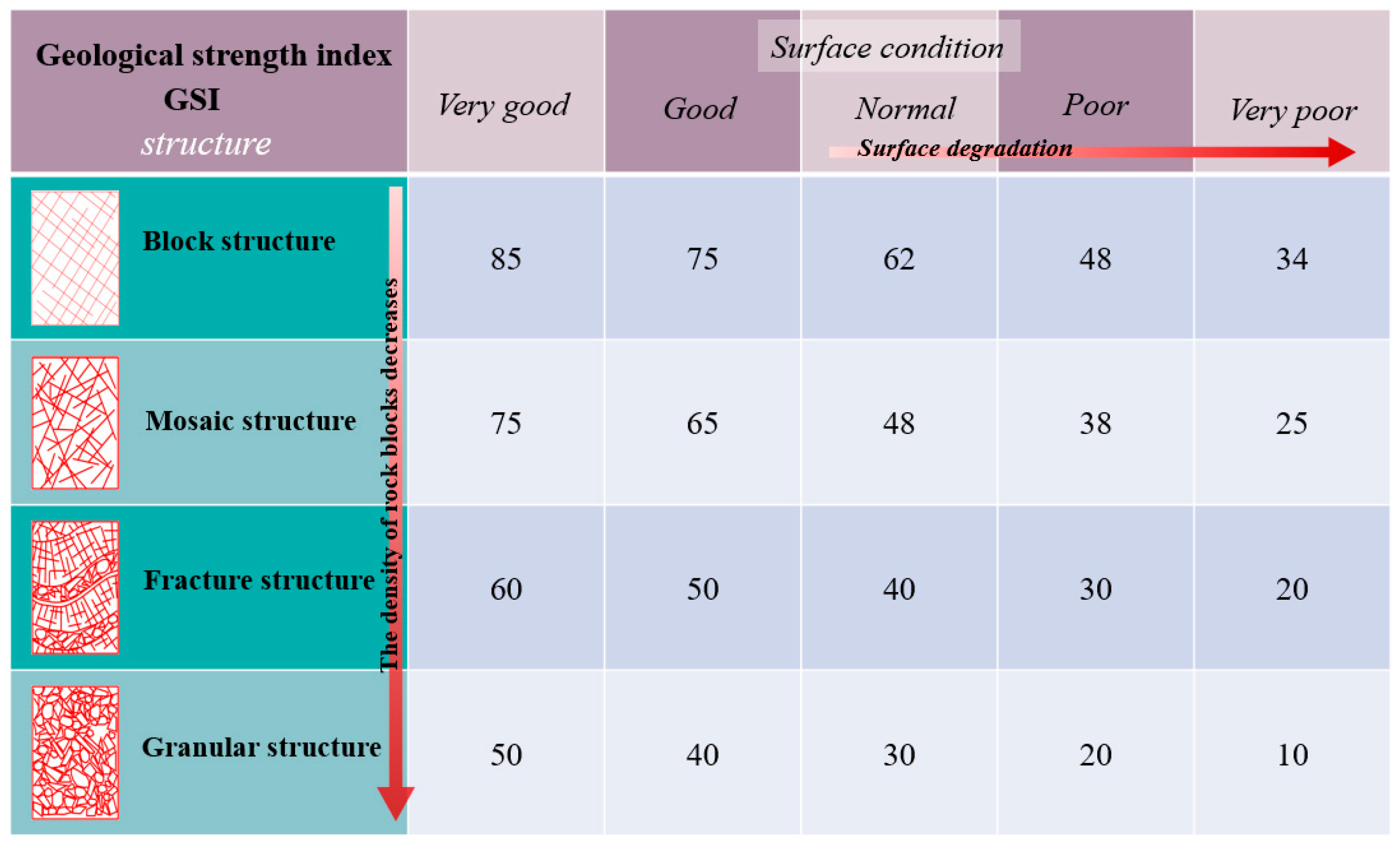
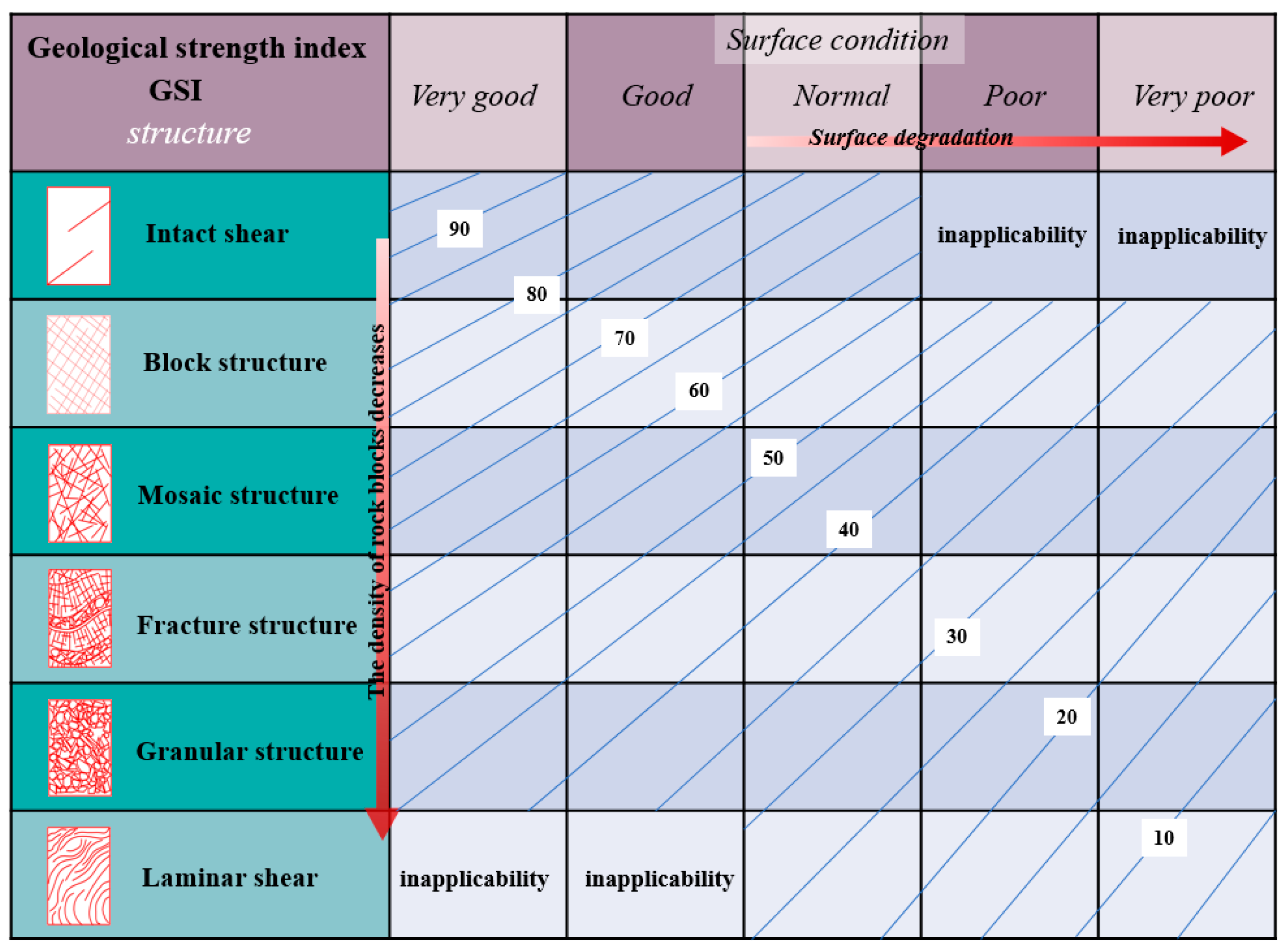
Figure 1 illustrates the original GSI chart, with GSI values ranging from 10 to 85. The categories of rock mass structures—such as ‘disintegrated’, ‘fractured’, ‘mosaic’ and, to a lesser extent, ‘blocky’—generally align with the fundamental objectives of the GSI system when applied in tandem with the Hoek–Brown criterion for isotropic rock masses. Moreover, the simplicity of this chart clearly conveys the approximate nature of the GSI system.
To mitigate subjectivity, several “parallel methods” for quantifying the GSI have been established, yet they have distinct methodological limitations [
21,
22,
23,
24]. Hoek et al. [
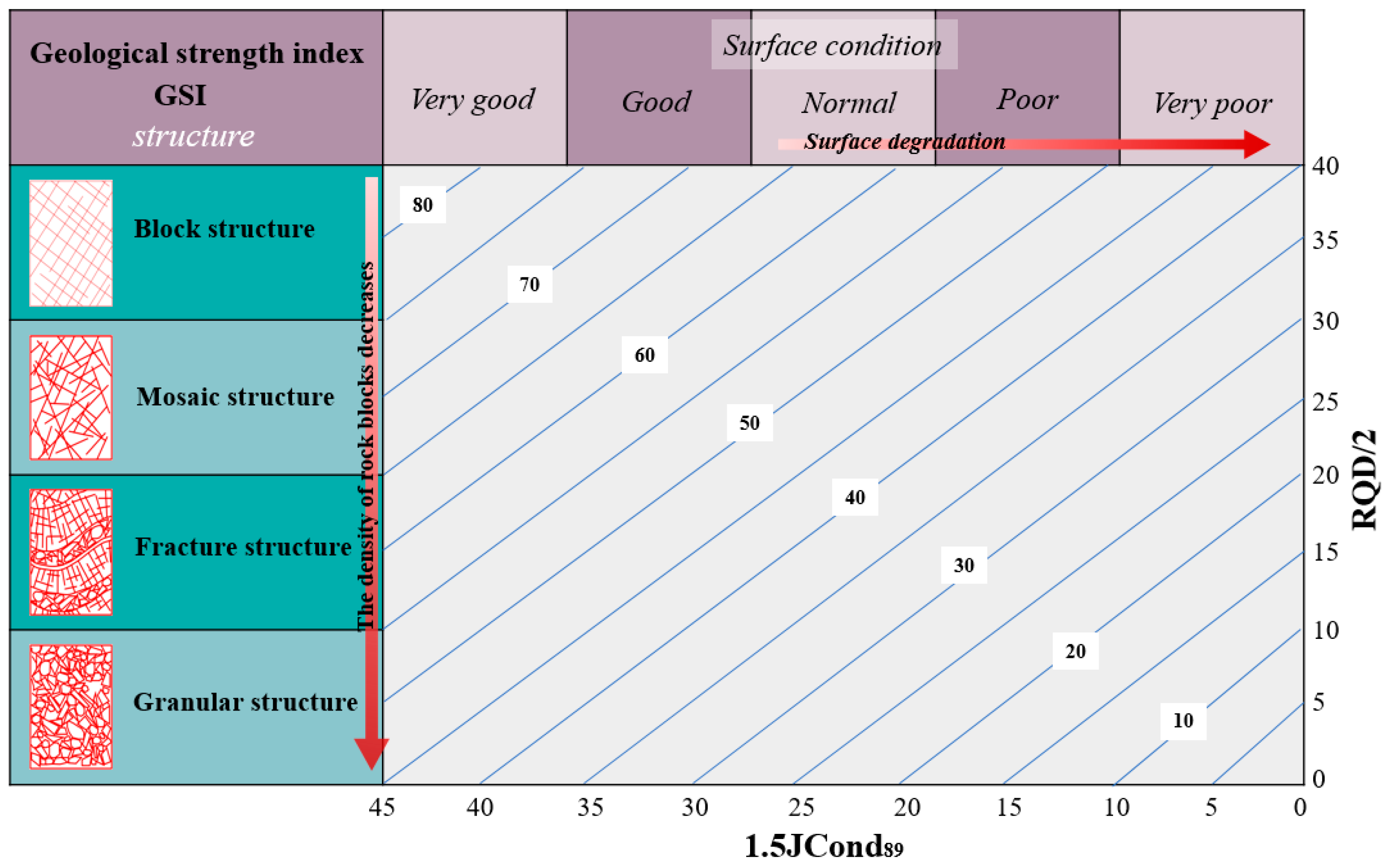
19] proposed quantifying the GSI using RQD and joint conditions. However, this approach relies heavily on core recovery data, which are often unavailable in tunnel excavations, and RQD itself is insensitive to block volume variations in different directions (
Figure 2 and
Figure 3).
Hoek et al. [
19] utilized RQD and
to represent the Structural Rating (SR) and SCR of rock masses, respectively. The value of GSI is expressed as follows:
In Equation (1),
represents the rating value for discontinuity conditions from the 1989 edition of the RMR system. Hoek et al. [
19] recommend using 1.3
from the 1976 edition of the RMR system or (35
∕
)∕(1 +
∕
) from the Q system
12 to approximate
. When it is not possible to directly calculate the RQD from rock cores, they also recommended using empirical equations based on the average joint frequency and volumetric joint count [
23] to estimate RQD.
More importantly, intact or massive rock bodies, as well as those previously altered significantly by shearing, transport, or other disturbances, fall outside the application scope of the Hoek–Brown criterion. Therefore, the top and bottom rows of the extended GSI chart (
Figure 2) have been removed, resulting in a reversion to the four rock mass structure categories of the original GSI chart (
Figure 1).
Cai et al. [
22] utilized block volume (
) to represent rock structures. While theoretically sound, accurately measuring
in rock masses with irregular joint sets remains practically challenging and prone to measurement errors during field surveys. Furthermore, Sonmez and Ulusay [
24] advanced quantification by introducing the Surface Condition Rating (SCR) to evaluate joint surface quality. However, a critical gap remains in their methodology: their formula, (
), implicitly assigns equal weight coefficients to roughness, weathering, and infilling. This assumption often contradicts rock mechanics principles, where infilling materials typically exercise more dominant control over shear strength than minor roughness variations. Taking these relative size factors into account, Hoek et al. [
19] noted that their quantitative GSI chart is suitable for tunnels with spans of approximately 10 m and slopes not exceeding 20 m, while lower GSI values should be considered for larger scales.
These existing quantitative approaches exhibit fundamental limitations when directly applied to high-resolution 3D point cloud data. Firstly, regarding structural characterization, methods relying on the block volume (
) (e.g., that presented by Cai et al. [
22]) are often computationally unstable for surface-based LiDAR data. The inevitable occlusion effects in point clouds—where internal fractures are invisible—complicate the precise geometric reconstruction of enclosed blocks compared to traditional core analysis. Secondly, regarding surface conditions, Sonmez and Ulusay’s SCR equation (
) [
24] relies on equal weighting coefficients designed for manual visual rating. This formulation fails to exploit the radiometric data (intensity and color) made available through modern laser scanning, which can provide quantitative proxies for weathering and infilling. Consequently, there is a critical need for a new framework that is not only mechanically rigorous but also specifically tailored to the geometric and radiometric attributes of 3D point clouds.
Recent advancements in remote sensing technologies, particularly 3D laser scanning, have provided new opportunities to overcome data acquisition limitations by enabling the direct and highly accurate measurement of rock mass features. Despite the potential of point cloud data, a significant research gap persists in the interpretation phase. The current literature focuses primarily on extracting geometric parameters (like orientation and roughness) individually. There is a lack of a systematic framework that effectively converts these high-precision point clouds into GSI values using a mechanically rigorous weighting system, rather than relying on simple empirical correlations or unweighted indices.
Therefore, this study powerfully establishes its novelty by addressing these specific gaps through a unified quantitative framework. Unlike previous empirical approaches, in this study, we propose a novel methodology that integrates 3D laser scanning with an improved GSI calculation model. The contributions are threefold. (1) Structural Characterization: The method replaces the scale-limited RQD with the Rock Block Index (RBI) coupled with joint spacing to better characterize structural integrity directly from point clouds. (2) Algorithmic Optimization: The Analytic Hierarchy Process (AHP) is used to scientifically determine the varying weights of roughness, weathering, and infilling, thereby correcting the “equal-weight” flaw inherent in traditional SCR methods. (3) Automated Integration: The approach directly couples these improved indices with 3D laser-scanning data to provide an automated, objective, and data-driven workflow for geotechnical parameter estimation.
2. Quantification of the SR of Rock Masses
Building upon the foundational rationale and objectives outlined in both the Abstract and Introduction, we aim to enhance the accuracy and diminish the subjectivity traditionally associated with the GSI by integrating the RBI and the AHP. The primary objective was to develop a quantifiable and reliable method for classifying rock mass properties, particularly in complex geological settings where conventional methodologies may be inadequate. This section details the methodology employed to quantify the SR using the RBI, providing a comprehensive explanation of the procedures and calculations involved. In this way, we aim to foster a comprehensive understanding of how these methodological enhancements strengthen the GSI system and improve the precision of rock mass evaluations.
The SR is one of the two determinative parameters within the GSI system, representing the compactness of rock blocks within a rock mass. Compactness quantifies the interlocking of rock blocks, reflecting the influence of rock structure on mechanical properties. Numerous methods for quantifying the SR have been proposed in both domestic and international research. These methods are designed to standardize the evaluation of rock masses’ structural integrity, which is critical for accurate geotechnical analyses and engineering applications. Cai et al. [
22] suggested using block volume as a quantitative representation factor for SR. Block volume is a crucial indicator for assessing the quality of a rock mass. It is determined by joint spacing, joint orientation, the number of joint sets, and joint connectivity. When there are three or more joint sets with persistent joints, the volume can be calculated as follows:
In Equation (2),
and
represent the joint spacing and the angle between joint sets, respectively. Generally, joint spacing typically follows a negative exponential distribution. For parallelepiped blocks, the volume of the block is usually greater than that of a cubic block with the same joint spacing. However, compared to the variability in joint spacing, the impact of the angles between joints is relatively minor. Therefore, for practical applications, the block volume
can be simplified to
Determining the block volume requires a comprehensive assessment of various uncertain factors, including joint distribution, orientation, and spacing. This task is challenging, particularly in regard to rock masses featuring irregular joint distributions, complicating the measurement of the angles between joints. Consequently, the application and widespread adoption of this method in practical geotechnical engineering can be problematic because of these complexities.
The volumetric joint count,
, defined as the total number of joints intersecting per unit volume of a rock mass, is a key parameter recommended by the International Society for Rock Mechanics (ISRM) for measuring the degree of jointing. Palmstrom [
28], Hoek [
29] and Hoek and Brown [
30] established a correlation between the volumetric joint count
and the GSI quantification chart for classifying rock mass structures. The values for
are calculated as follows:
In Equations (4) and (5),
(
i = 1,2,…,
n) denotes the number of joints in a specific direction,
(
i = 1,2,…,
n) is the length of the scan line (m),
is the spacing between joints in a set of in meters, and
n is the number of joint sets. Determining joint spacing in rock masses with multiple joint sets is challenging. To address this challenge, Sonmez and Ulusay [
24] proposed a modified equation for estimating the
in a cubic meter of rock mass. The equation is expressed as follows:
In Equation (6),
, and
represent the number of joints measured along mutually perpendicular scan lines, while
,
and
are the lengths of these scan lines, respectively. The SR of the rock masses is quantified using the volumetric joint count
. The equations for determining
and thereby calculating SR are provided below [
31]:
(1) For intact or blocky rock masses, Equation (7) applies:
(2) When the rock mass is blocky, mosaic, fragmented, or disintegrated, Equation (8) applies:
(3) When the rock mass is layered or within a shear zone, Equation (9) applies:
However, in geological surveys of rock mass structural surfaces at engineering sites, it is quite challenging to investigate and measure the conditions of joint surfaces along three mutually perpendicular survey lines.
RQD is the most widely used indicator for characterizing the structural features of rock masses due to its simplicity and clarity. It is extensively employed in engineering construction and incorporated into various standards. However, as our understanding of rock mass structures has advanced, skepticism has grown regarding the ability of RQD to accurately represent structural characteristics. The RBI, introduced by Hu et al. [
32], classifies measured core lengths into five categories: 3–10 cm, 10–30 cm, 30–50 cm, 50–100 cm, and >100 cm. The occurrence rates for each category are weighted and averaged to provide a comprehensive characterization of rock masses’ blockiness and structural types. The RBI is calculated as follows:
where
,
,
, and
represent the core recovery rates for core lengths of 3–10 cm, 10–30 cm, 30–50 cm, 50–100 cm, and >100 cm, respectively. The RBI serves as a comprehensive indicator of a rock block’s size and structural type, reflecting the dimensions of constituent rock blocks and their interlocking relationships. However, the RBI solely accounts for a rock block’s size and arrangement, neglecting the critical influence of joint spacing on rock masses’ compactness. Agliardi et al. [
33] proposed using joint spacing as the sole criterion for characterizing the SR in their study on rock core classification via high-resolution acoustic waves. Although this approach significantly simplifies SR assessment, it provides only a partial measurement, capturing a single aspect of the structural plane system’s spatial geometric features.
To address the limitations of previous methods for quantifying SR, we introduce a new approach based on the RBI and the RMR systems. In this methodology, two key parameters are employed: the RBI and joint spacing. The proposed method characterizes SR through these parameters, which are directly linked to rock masses’ compactness, enabling a more holistic assessment of rock-mass characteristics. The SR is defined as follows:
where
denotes the joint-spacing score derived from the RMR89 classification system. The adoption of a direct summation implies an equal contribution of both parameters to the structural rating. This formulation is justified by two factors:
(1) Numerical Compatibility: As shown in
Table 1 and
Table 2, the value ranges for RBI (typically 10–30 for blocky structures) and
(typically 10–20 for moderate spacing) are of comparable magnitudes, ensuring that neither parameter disproportionately dominates the final SR value without the need for artificial weighting coefficients. It must be explicitly stated that the direct summation in Equation (11) represents a simplifying methodological assumption. While theoretically, the specific contributions of block volume (RBI) and linear spacing (
) to rock mass integrity might vary depending on the geological context, determining exact regression coefficients would require a massive dataset that is currently unavailable. Therefore, an equal-weight approach was adopted as a practical heuristic. This simplification is justified by the numerical compatibility of the two indices (as shown in
Table 1 and
Table 2, both typically range from 10 to 30), which ensures that neither parameter disproportionately dominates the final SR value. However, this is a limitation of the current study. We recommend that future studies, based on expanded datasets, investigate the potential for optimizing this formula into a weighted expression (e.g.,
) to further enhance precision.
(2) Geometric Complementarity: The RBI quantifies “volumetric” blockiness based on core recovery, while measures the “linear” spatial frequency of joints. By combining them with equal weights, the SR index provides a comprehensive characterization of the rock mass integrity that accounts for both the size of the constituent blocks and their spatial arrangement.
The methodology and practical applications of the RBI and the for SR enhancement have been comprehensively investigated. The discussion now progresses to the SCR—an equally essential parameter for comprehensively analyzing the behavior of rock masses. The subsequent section will delve into the integration of the AHP, focusing on its application in systematically evaluating the factors affecting SCR, such as joint roughness, weathering extent, and infill characteristics.
3. Quantification of SCR for Rock Masses
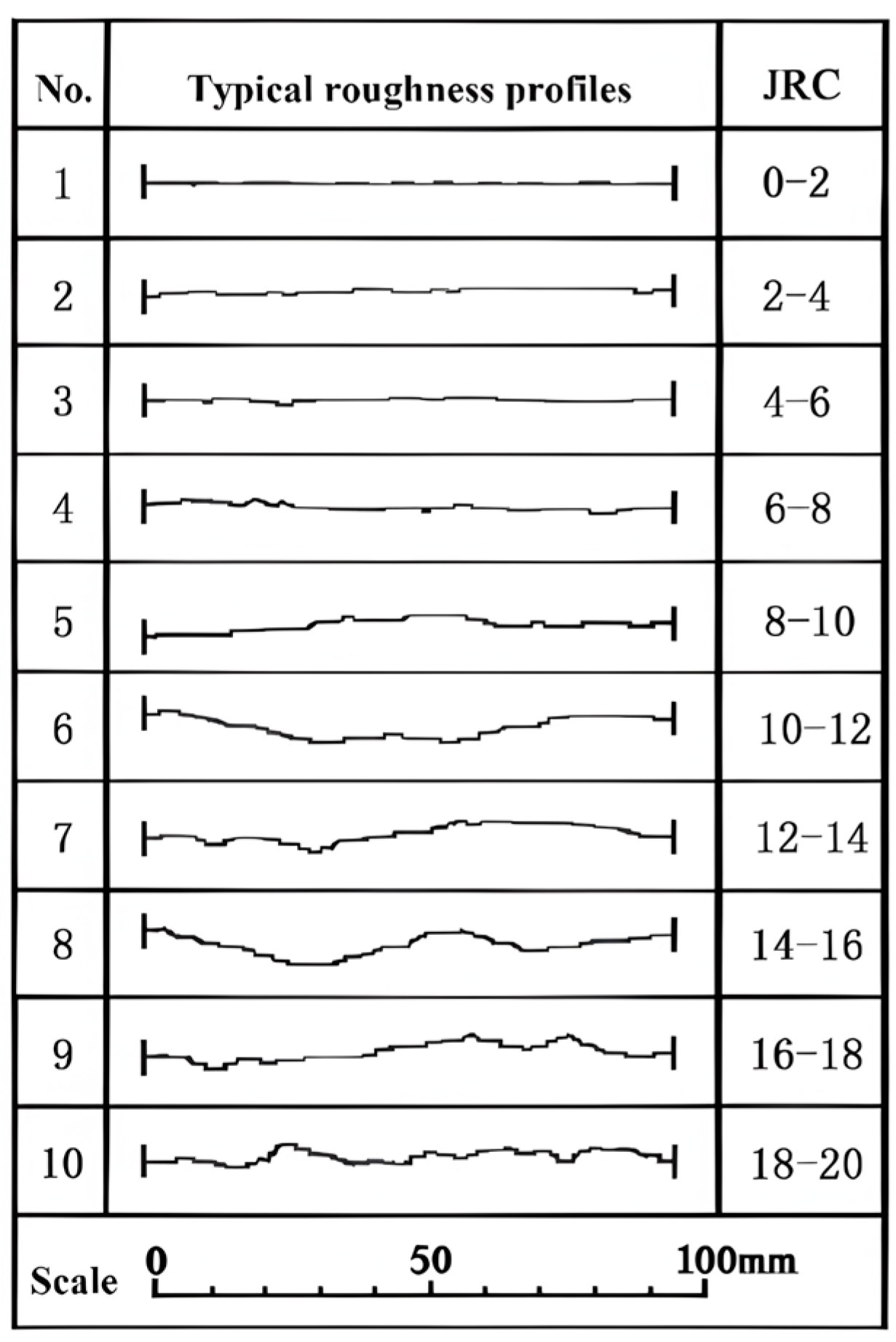
In the GSI system, structural surface conditions are characterized by three parameters: surface roughness, weathering degree, and infill material properties. An integrated evaluation of these parameters provides an indirect measure of a structural surface’s shear strength. Numerous studies have proposed methods of quantifying these conditions within the GSI framework, improving the precision and applicability of this critical geotechnical parameter. Sonmez and Ulusay [
24] proposed a novel quantification method based on the RMR system, termed the SCR. The SCR is calculated as follows:
where
represent the ratings for surface roughness, weathering degree, and infill material characteristics, respectively. The detailed scoring rules for
,
, and
can be found in
Table 3. However, this method assigns a coefficient of 1 to
,
, and
, implicitly assuming that the roughness, weathering degree, and filling conditions are of equal importance in determining the condition of structural surfaces, which is clearly inappropriate.
Cai et al. [
22] introduced a quantitative approach to SCR characterization using the joint characteristic parameter
in the Rock Mass Index (RMi) system. The joint characteristic parameter
is defined as follows:
where
represents the macro-waviness coefficient of the joint,
is the micro-smoothness coefficient of the joint, and
denotes the alteration coefficient of the joint. Kang et al. [
34] developed a method of quantifying the influence of groundwater by introducing a reduction factor to the GSI under dry conditions. The modified
is calculated as follows:
where
is the GSI adjustment parameter,
is the score for the structural face orientation,
is the groundwater score, and
is the adjusted GSI value. However, this method imposes a proportional reduction on both structural surface conditions and rock masses’ structural characteristics, conflating two distinct aspects. While rock masses’ structural characteristics are governed by discontinuities, groundwater exclusively influences structural surface conditions. Therefore, previous studies have demonstrated the feasibility of quantifying structural surface conditions in the GSI system through parameters derived from established rock-mass classification systems.
Building on the SCR quantification equation proposed by Sonmez and Ulusay [
24], we assign weights to
, and
based on their relative contributions to the GSI value. This approach is designed to reflect the varying contributions of joint surface roughness, the degree of weathering, and filling to the SCR. The AHP is employed to analyze the three factors and their five-level rating weights.
The AHP is a decision-making analysis method introduced by American mathematician Saaty [
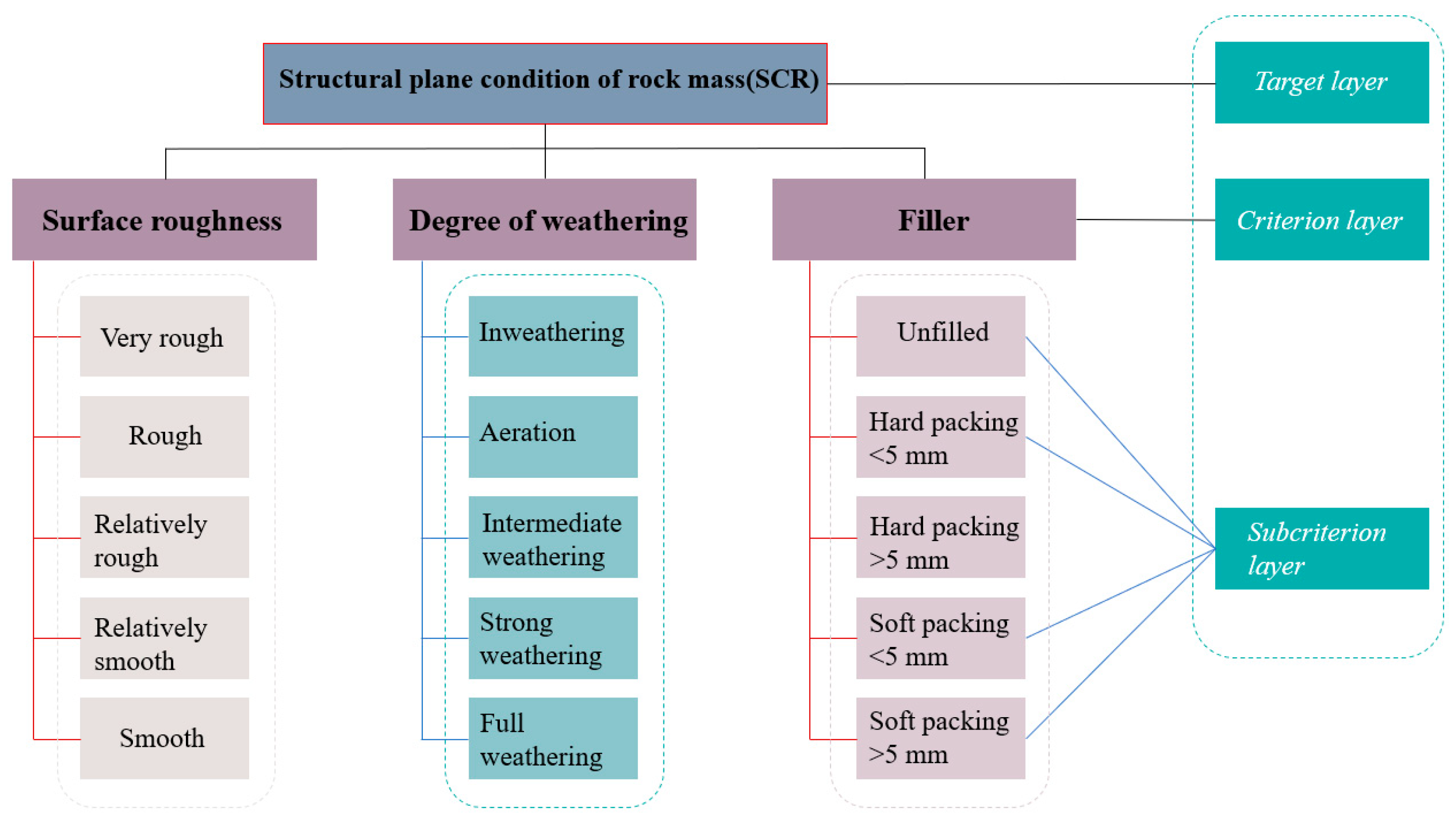
35] in the early 1970s. By constructing a hierarchical model, the AHP facilitates integrated quantitative and qualitative analyses, enabling systematic evaluation of competing alternatives. Then, the relative importance of each element within the hierarchy is determined through pairwise comparisons. Finally, the optimal decision is derived by comparing the comprehensive evaluation values of the hierarchical elements. Typically, the AHP model consists of three levels: the goal, criterion, and alternative layers. In this study, the focus is on examining three key factors—roughness, filling, and weathering degree—and their weighting factors across five distinct intensity levels (
Figure 4). To address this challenge, we employed the pairwise comparison method within the AHP framework. The primary advantage of this approach is its ability to independently assign weights to each factor within a hierarchical level, ensuring objective weight allocation. This methodology facilitates a quantitative assessment of the relative contributions of each factor across intensity levels, enabling a systematic analysis of their impacts on structural surface conditions. Following the concept of single-ranking hierarchy, the analytic hierarchy process can be conducted in the following steps:
(1) Define the Objective: Clearly identify the ultimate goal of the decision-making problem; which, in this study, is to determine the weighting coefficients for rock surface conditions. The objective is to use the AHP to establish the relative importance of roughness, filling, and the degree of weathering on the rock surface conditions and allocate corresponding weight coefficients for each factor at different levels. This helps to better understand the influencing factors on rock surface conditions and their relative contributions.
(2) Construct the Hierarchical Structure: Based on the decision-making problem, arrange the factors and levels into an organized hierarchical structure. In this study, the hierarchy could include one level consisting of the three factors—roughness, filling, and weathering degree—and their corresponding five levels. The structure will visually represent these factors as the main criteria, with each factor having multiple sub-levels that reflect the various degrees or intensities, as illustrated in the diagram below.
(3) Pairwise Comparison: Pairwise comparison is a crucial step in the Analytic Hierarchy Process. It is used to determine the relative importance of different levels of each factor. During the pairwise comparisons, each level of a factor is compared with every other level, and a weight ratio is assigned based on a given level’s relative importance. This is typically performed using a scale from 1 to 9, where 1 indicates that two levels are equally important and 9 signifies that one level is significantly superior to the other. The weight ratios between each pair of levels can be determined based on expert judgment or analysis of experimental data. According to rock mechanics principles (e.g., Barton [
36]), the presence of infilling materials typically exerts the most significant control over shear strength, as thick infilling prevents rock-wall contact, rendering roughness secondary. Therefore, the order of importance for the factors affecting rock surface conditions is as follows: filling > degree of weathering > roughness. A pairwise comparison of the three factors is shown in
Table 4.
From the proportional scaling and factor two-by-two comparison results in
Table 4, the SCR comparison judgment matrix can be determined (
Table 5).
In this way, a comparative judgment matrix for the SCR of the rock masses can be constructed:
(4) Calculating weights: Calculating weights is an important step in the hierarchical analysis method. It determines the weight of each factor level based on the results of pairwise comparisons.
The weights are calculated via the sum-product method through the following steps.
Step 1: Normalize each column of the pairwise comparison matrix.
Table 6 presents the normalized pairwise comparison matrix.
Step 2: Compute the row-wise sums of the normalized matrix (
Table 7).
Step 3: Normalize the eigenvector
to obtain the final weight vector.
The normalized eigenvector
= (0.1061, 0.2605, 0.6334) represents the weight coefficients derived from the pairwise comparison matrix (
Table 8).
(5) Consistency Check: The consistency check is a critical component of the AHP, ensuring the logical validity and reliability of pairwise comparison results. This step minimizes the influence of subjective biases, thereby enhancing the credibility of the decision-making process.
Within the AHP framework, consistency is evaluated through the Consistency Ratio (CR), a widely accepted metric for quantifying judgment coherence. The CR is used to measure the level of consistency within a judgment matrix, and it is calculated based on the eigenvalue obtained from the eigenvector method.
The CR is calculated as follows:
① Calculate the maximum eigenvalue of the judgment matrix (
):
② Judgment Matrix Consistency Indicator (CI):
In the equations mentioned, the Average Random Consistency Index (RI) is introduced. According to
Table 9, when the judgment matrix is a 3 × 3 matrix, the RI equals 0.58. A CR less than 0.10 is considered acceptable, indicating that the judgment matrix has satisfactory consistency. A CR exceeding 0.1 suggests poor consistency in the comparison results, necessitating a reevaluation or adjustment of the comparisons.
The results of the Analytic Hierarchy Process indicate that filling has the most significant impact on joint surface conditions, followed by the degree of weathering, with roughness having a relatively lower influence. Thus, the proposed equation for SCR is
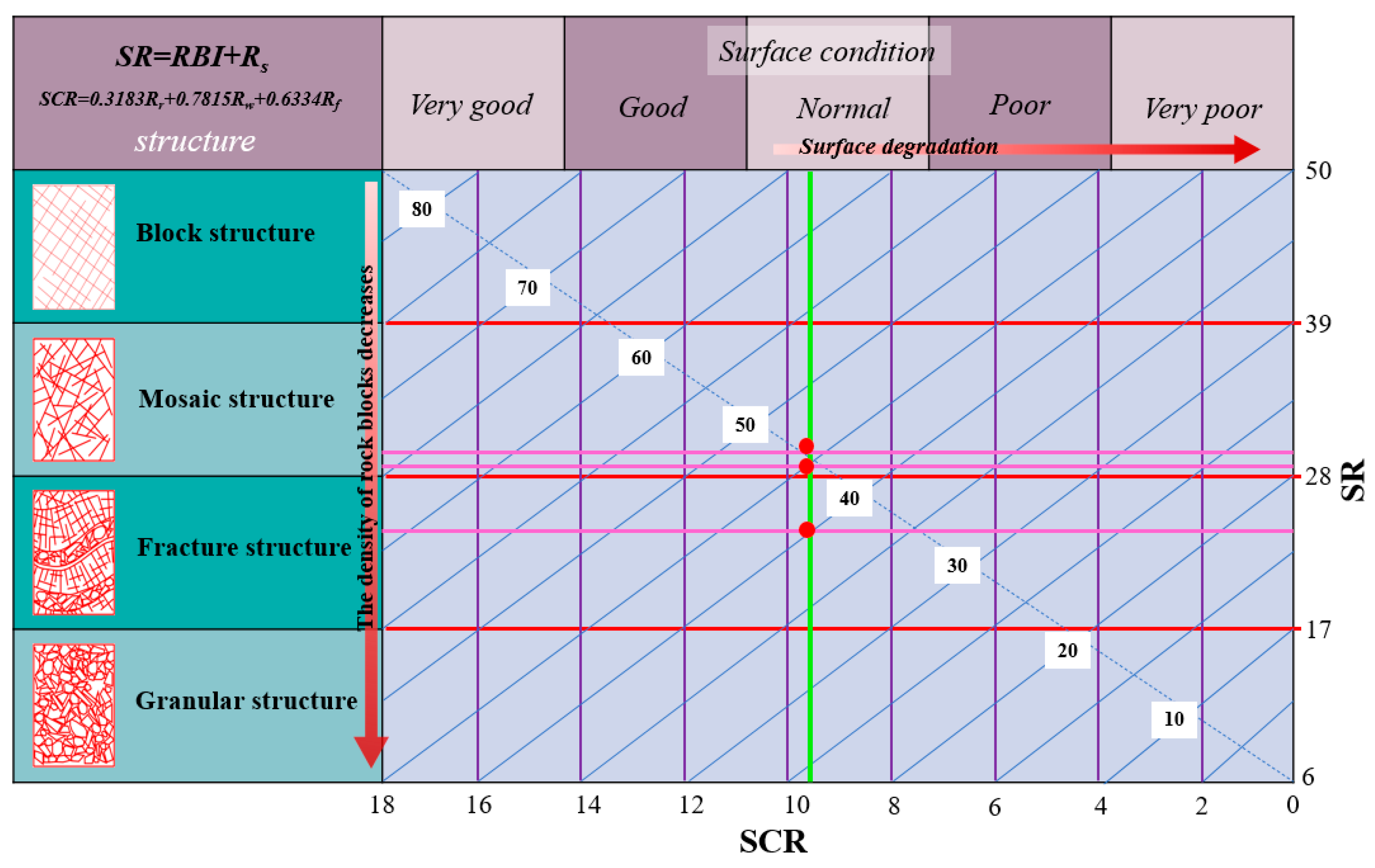
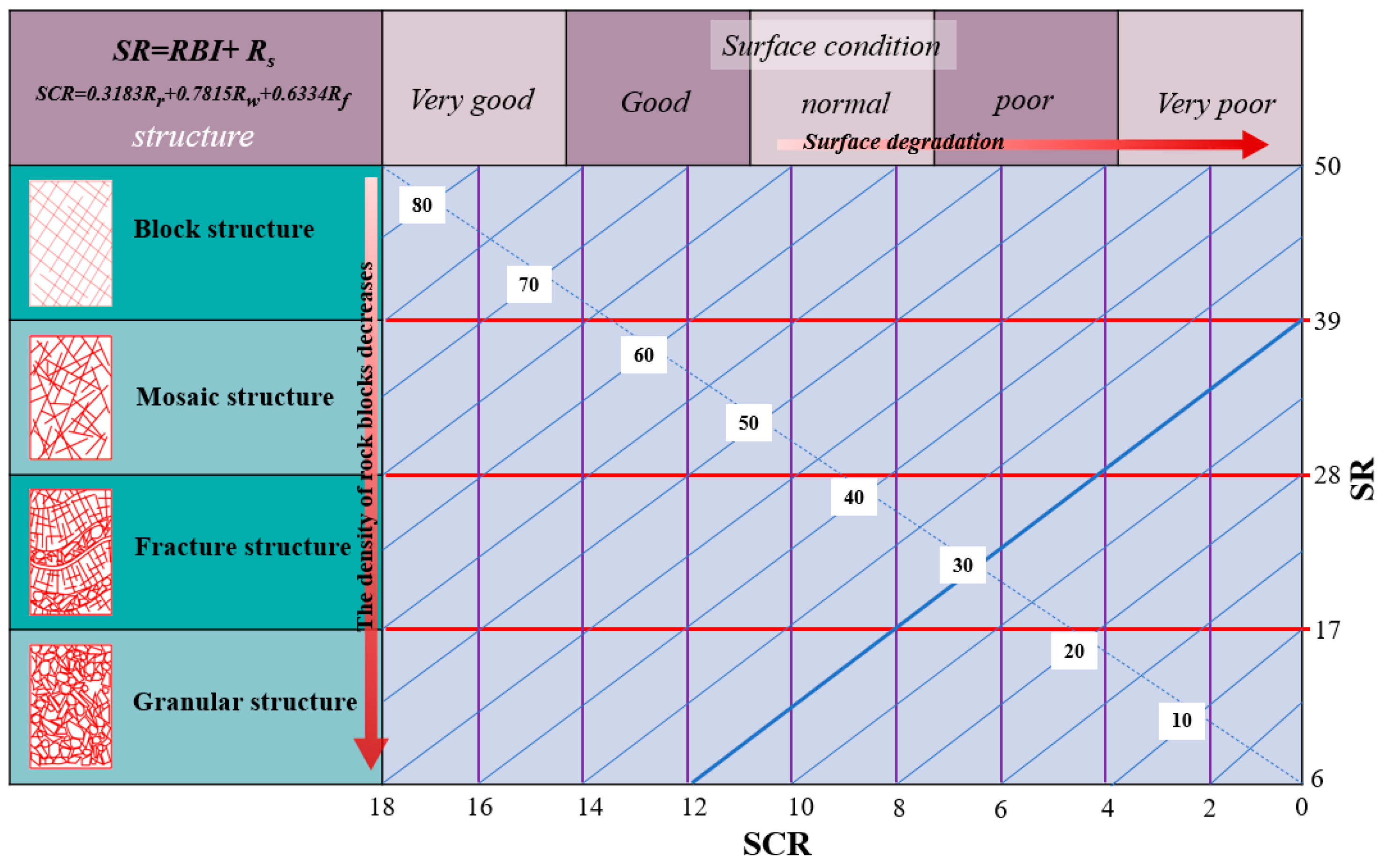
We use the parameters SR and SCR to quantify interval values for structural surface features in the GSI system. The improved GSI quantification table is shown in
Figure 5.
5. Case Study Analysis: Applying the Enhanced GSI Methodology at the Sanshandao Gold Mine
5.1. Engineering Geology
The proposed method was applied to calculate the GSI of the Sanshandao Gold Mine roadway, located in Laizhou City, Shandong Province, China. The mine is situated on the coast of the Bohai Sea. The region falls under the Warm Temperate Continental Monsoon Climate (Köppen classification: Dwa), characterized by hot, humid summers and cold, dry winters. These climatic and hydrological conditions contribute to the specific weathering ($R_w$) and infilling ($R_f$) characteristics of the rock masses in the area. Field data acquisition and 3D laser scanning campaigns were conducted from [06, 2023] to [07, 2023]. For the engineering project between depths of −915 m and −960 m, the mechanical parameters of the ore body and surrounding rock masses were determined. The industrial ore body of the deposit is mainly located in the fracture zone, and the lithology is dominated by pyrrhotite serpentinized fractured rock, pyrrhotite serpentinized granite fractured rock, and serpentinized granite, and the lithology of the upper and lower plates of the deposit consists of serpentinized granite, serpentinized granite fractured rock, etc. The engineering geological conditions of the deposit depend on the degree of rock tectonics development. The fracture tectonics of the deposit is more developed in this area, and the local rocks in the alteration zone near the main fault plane are more fragmented, with more intense alterations, more developed fissures, and less stable rock cores. In the area, the fracture structure is more developed, the local rocks in the alteration zone near the main fault are more broken, the alteration zone is more intense, the fissure is more developed, the core is more broken, and the degree of solidity is relatively poor. The intensity of mineralization is closely related to the degree of fragmentation of altered rocks and the degree of development of metallogenic fissures, and the higher-grade and thicker portions of the ore body constitute the areas where most metallogenic fissures develop and rocks are greatly fragmented. The scale and intensity of the alteration of the surrounding rocks of the deposit depend on the scale and nature of the fracture structure and the degree of rock fragmentation, and the types of alteration include potassium feldsparization, pyrrhotite serpentinization, carbonatization, chloritization, silica, hematite, and other alterations. The ore body is mainly distributed below the main cleavage surface. Above the main cleavage surface, there are a few single-engineered control areas of the lenticular small ore body, and the ore lithology corresponds to pyrrhotite serpentinized fractured rock, pyrrhotite serpentinized granite fractured rock, and serpentinized granite. The surrounding rocks of the ore body are pyrite serpentinized fractured rock, pyrite serpentinized granodiorite fractured rock, and serpentinized granite.
5.2. Rock Chamber Tests and Structural Surface Investigations of the Mine’s Surrounding Rock Bodies
To determine the fundamental mechanical properties of the rock in the mining area, such as compressive strength, tensile strength, cohesion, internal friction angle, elastic modulus, and the Poisson’s ratio, typical drill core samples were collected from the −915 m and −960 m sections. Laboratory rock mechanics tests were conducted to determine the basic mechanical parameters of the rocks, and the results are presented in
Table 10.
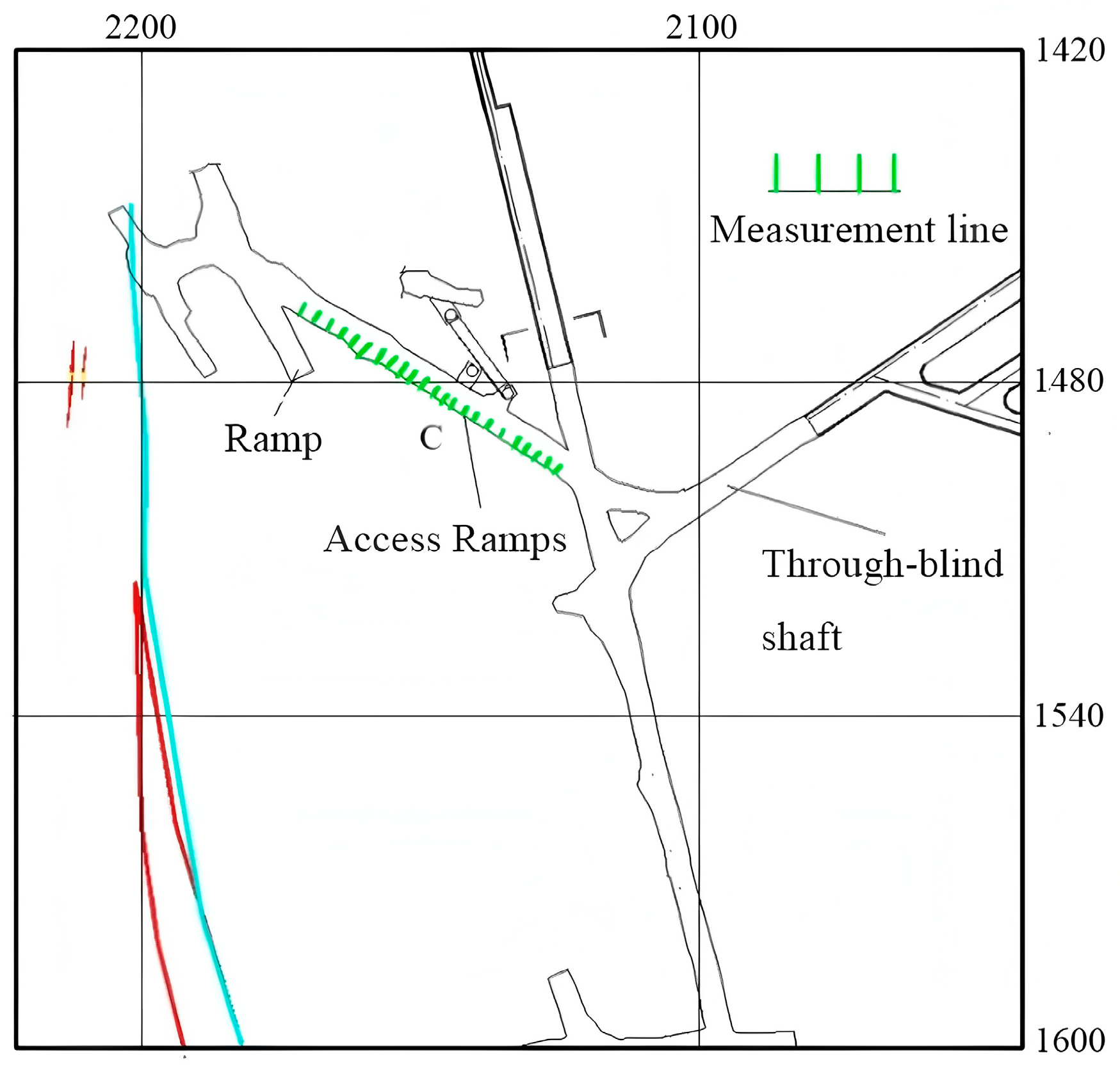
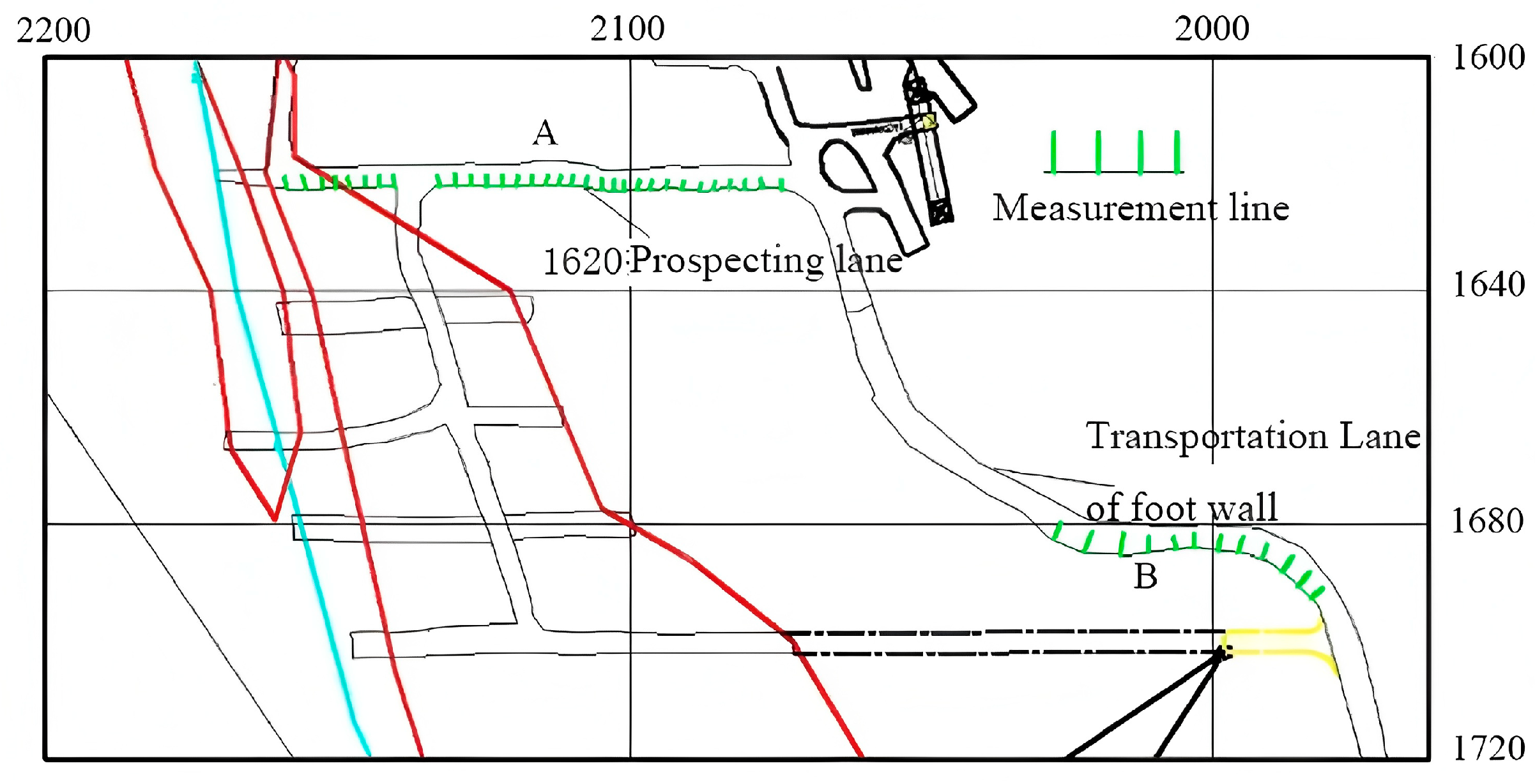
To investigate the structural characteristics of the rock masses in the mining area, geological surveys were conducted in the representative −915 m section—including in exploration and transport tunnels—and the sloped section at −960 m. Tools such as a geological compass, tape measure, drawing ruler, geological hammer, geological knife, and camera were used for the survey. The measurement points are shown in
Figure 8 and
Figure 9, and the joint measurement statistics are presented in
Table 11.
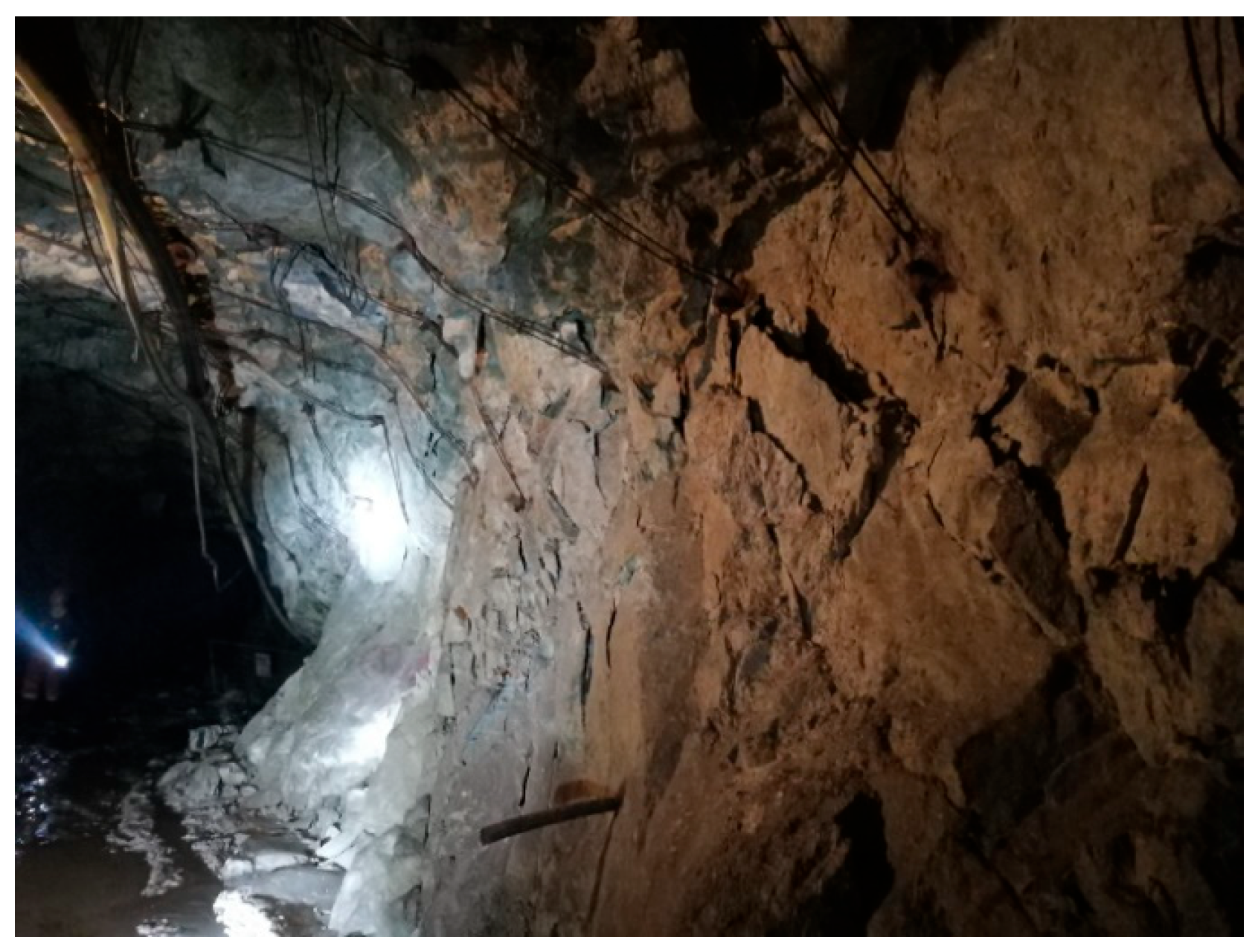
Figure 10 shows photographic records obtained during the field engineering geological survey. The specific steps involved starting measurements from the 0 m mark of the tape measure towards the other end, using the geological compass to measure the orientation of all joints intersecting the measuring line, and recording the trace length of each joint. Observations and records of joint conditions and groundwater presence were also made for data compilation and analysis.
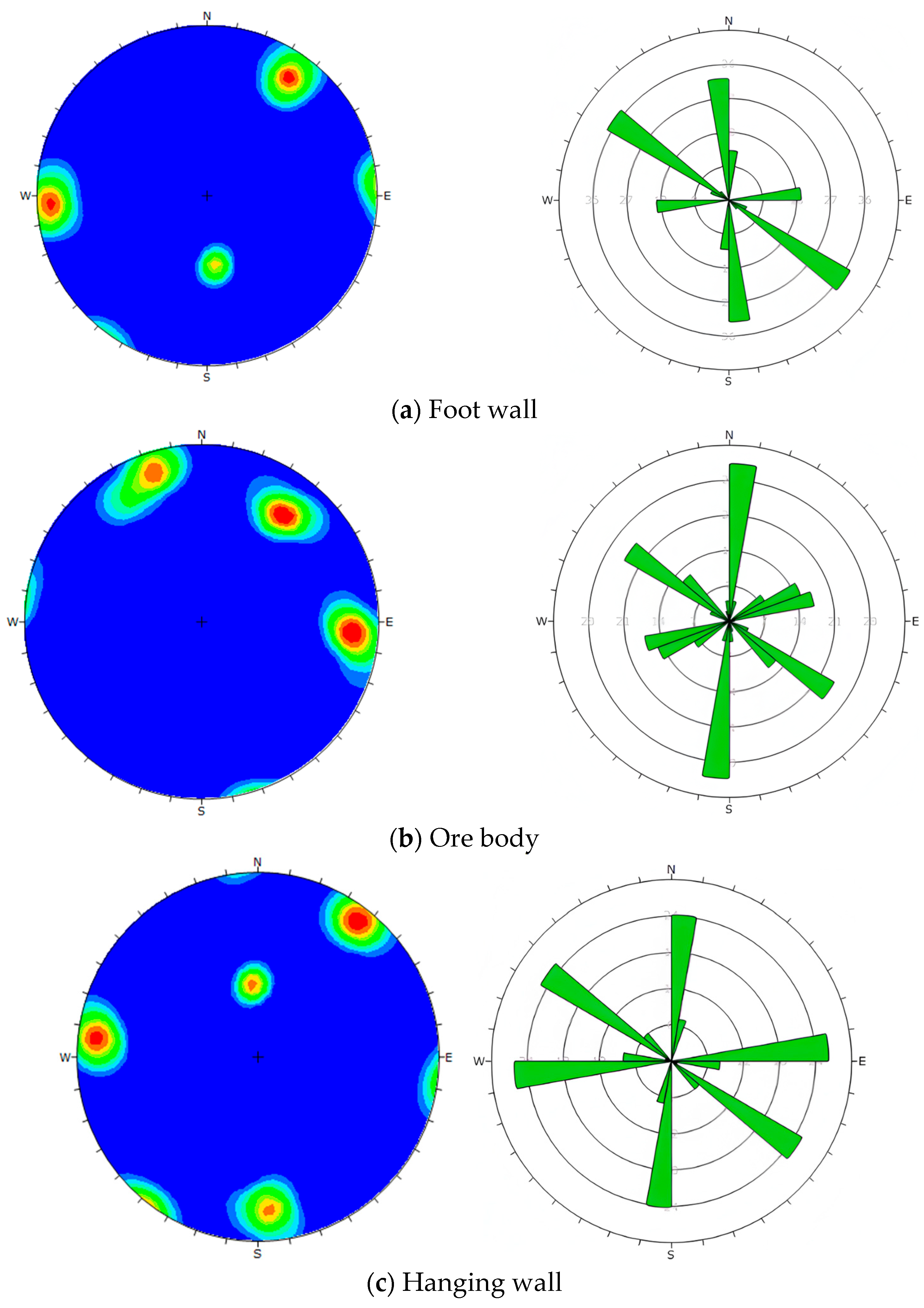
The surveyed joints were analyzed using the DIPS 5.1 software, which outputs the number of joint sets, their orientations, and development characteristics at each level in the form of strike or dip rose diagrams. Additionally, equal-area stereonet projections were used to represent the orientation of joint planes, and density maps of joint poles were created. These maps quantitatively reflect the density and predominant orientations of the development of joints and fractures. The density maps and dip rose diagrams for the joints and fractures in the hanging wall, the ore body, and the foot wall are shown in
Figure 11.
5.3. Quantification of GSI Values for Mineral Rocks in the Study Area
(1) Quantification of SR for the rock masses
Based on the field geological survey and utilizing data from
Table 1,
Table 2 and
Table 12, the RBI and
for each measurement point could be accurately determined. The detailed results are presented in
Table 12.
(2) Quantification of SCR for the rock masses
To quantify the conditions of the rock masses’ structural surfaces, specific scores for roughness, degree of weathering, and the presence of fillings were derived based on the results of the geological survey and the scoring details provided in the
RMR89 system. Subsequently, using Equation (23), the SCR was calculated. The results are shown in
Table 13.
Based on
Table 12 and
Table 13, the SR values and SCR values for the foot wall, ore body, and hanging wall were determined. Utilizing the new GSI quantification table proposed in this study, the GSI values for the rock masses in the foot wall, ore body, and hanging wall were calculated to be 38.5, 33.8, and 37.8, respectively (
Figure 12).
5.4. Determination and Validation of Rock Mechanics Parameters
At each measurement point (within the ore body and the surrounding rock masses), 30 rock samples were collected. Based on laboratory triaxial tests and field observations, the uniaxial compressive strength (
), the intact rock material constant (
), and the rock mass disturbance parameter (D) for each interval were estimated. The
value, which is a constant for intact rock materials, was obtained by fitting data from triaxial tests. According to the charts proposed by Marinos and Hoek [
27], the estimated
value for sericitized granite is 32, and the value is the same for the ore body consisting of sericitized ferruginous schist. The rock mass disturbance coefficient (D) was considered based on the use of controlled blasting with large charges per delay, a practice that has localized impacts on the surrounding rock and ore body. Hence, a D value of 0.8 was employed. The specific results are shown in
Table 14.
The GSI values were obtained according to the proposed GSI quantification table, and the mechanical parameters of the jointed rock masses were obtained from the rock mechanical parameters (
Table 15).
GSI values were obtained according to the proposed new GSI quantification table, while the jointed rock mass mechanical parameters can be obtained from the rock mechanical parameters (
Table 15).
To validate the practical reliability of the proposed method, the calculated GSI values were compared with traditional visual assessments conducted by experienced geologists during the field survey. As visual assessment inherently involves subjectivity, it typically yields a range of values rather than a specific number. The comparison is presented in
Table 16.
As shown in
Table 16, the quantitative GSI values derived from 3D point clouds are consistent with the visual judgments of on-site geologists. The significant improvement lies in the reduction in uncertainty: whereas traditional methods leave an ambiguity of approximately 10 points (e.g., 35–45), the proposed method converges this into a specific parameter (e.g., 38.5) based on objective geometric data.
In order to verify the accuracy of the GSI quantification method proposed in this section, the deformation modulus of the lower disk rock masses was studied and estimated using the GSI quantification method proposed by Sonmez and Ulusay [
24] and Cai et al. [
22]. The deformation modulus and GSI values of the ore body determined via the different methods are shown in
Table 17.
The results given above reveal that the method proposed in this paper, compared with the other two quantitative methods, has a maximum relative difference of 1.5 for the GSI and a maximum relative difference of 0.227 MPa for the calculated deformation modulus, verifying that our method is more accurate in estimating the mechanical parameters of rock masses.
To further contextualize the proposed method, it is essential to compare the findings with those of existing quantitative frameworks.
Firstly, regarding the SCR, the traditional method by Sonmez and Ulusay implicitly assigns equal weights to roughness, weathering, and infilling. However, our AHP analysis revealed that infilling materials (weight 0.6334) exert a dominant influence on stability compared to roughness (0.1061). This finding aligns with the physical mechanics observed in the Q-system by Barton, where thick infilling effectively prevents rock–wall contact, rendering roughness a secondary factor. Therefore, the discrepancy of 1.5 GSI units between our method (38.5) and Sonmez’s method (36) in
Table 17 is not merely a numerical deviation but a theoretical correction that better reflects the mechanical reality of filled joints.
Secondly, compared to Cai et al.’s approach, which relies on block volume ()—a parameter often prone to measurement errors in irregular outcrops—our integration of the Rock Block Index (RBI) extracted via virtual scanlines offers a more robust and automatable alternative for characterizing rock structures.
While previous studies focused on extracting geometric parameters individually, this study contributes a unified workflow that bridges the gap between high-precision 3D laser scanning and mechanical weighting systems. The results demonstrate that automated methods can achieve high consistency with expert visual assessments (
Table 16) while eliminating the subjective ambiguity of the
point range typically associated with manual surveys.
6. Discussion and Conclusions
In this investigation, the inherent subjectivity associated with the GSI system was addressed through the development of a quantitative methodology that incorporates the RBI and the AHP. This novel approach significantly enhances the precision and reliability of rock mass classification.
(1) The results substantiate the hypothesis that a quantitative enhancement can reduce variability. Unlike in previous studies that relied on equal-weighting assumptions (e.g., those by Sonmez and Ulusay [
24]), we utilized the AHP to assign specific weights (infilling 0.63 > weathering 0.26 > roughness 0.10). To explicitly bridge the gap between the theoretical aim of GSI and its practical application, in this study, we transform the evaluation process from an implicit cognitive judgment to an explicit algorithmic framework. Theoretically, traditional visual assessments operate as a ‘black box’, with the weighting of geological features (roughness vs. infilling) varying subjectively among engineers. In contrast, the proposed method explicitly externalizes these weights through the AHP. By quantifying that infilling (weight 0.6334) exerts a dominance factor of approximately 6:1 over roughness (0.1061), the process is not merely automated, but the ‘equal-weight’ error inherent in previous empirical formulas is also mechanically rectified. This shift ensures that the resulting GSI value is a derivative of measurable geometric data rather than an artifact of observer bias. To determine the significance of this enhancement, we conducted a comparative analysis with existing methods (
Table 16), revealing specific quantitative indicators: The proposed method yielded a GSI of 38.5, differing by only 1.5 units from Sonmez’s method (GSI = 36) and 1.0 unit from Cai’s method (GSI = 39.5). The corresponding deformation modulus (
) estimated via this method (2.011 GPa) showed a deviation of 0.227 GPa (approximately 11%) compared to Sonmez’s approach [
24]. These specific unit numbers demonstrate that the proposed method achieves high consistency with established empirical charts while providing a more mechanically rigorous derivation process. “Enhancement” is thus defined as the ability to automate parameter extraction with a deviation remaining within the acceptable engineering tolerance (
2–3 GSI units) of traditional expert assessments.
(2) Traditional methods rely heavily on manual compass measurements and visual estimation of GSI values. Although accessible, they were prone to high subjectivity and safety risks in unstable excavations. This study presents the “present” state of the art, providing a quantitative bridge. By integrating 3D laser scanning with the RBI-AHP framework, we offer a method that is practically feasible for geotechnical engineers. It reduces manual labor intensity and removes human bias from weight assignment, making it a “user-friendly” tool for direct parameter estimation.
(3) Despite the encouraging outcomes, in this study, we relied on the accuracy of point cloud data. Future research must focus on validation standards. We propose a standard of tolerance for future validation: the calculated GSI should be verified against back-analysis of in situ displacements (e.g., convergence monitoring). A method is considered validated if the derived rock mass modulus falls within a relative error margin of 10% compared to field monitoring data, or if the GSI value deviates by less than 5 points from the statistical average of multiple expert ratings. This criterion is expected to serve as a robust benchmark for evaluating the “reliability” of automated classification systems in complex geological frameworks.