
Article

Release of Dissolved Organic Matter from Sludge Biochar and Its Spectral Characteristics in Different Environmental Media

1
Zhongshan Public Torch Water Environment Treatment Co., Ltd., Zhongshan 528437, China
2
School of Civil and Transportation Engineering, Guangdong University of Technology, Guangzhou 510006, China
3
National-Regional Joint Engineering Research Center for Soil Pollution Control and Remediation in South China, Guangdong Key Laboratory of Integrated Agro-Environmental Pollution Control and Management, Institute of Eco-Environmental and Soil Sciences, Guangdong Academy of Sciences, Guangzhou 510650, China
*
Authors to whom correspondence should be addressed.
Processes 2026, 14(4), 595; https://doi.org/10.3390/pr14040595
Submission received: 10 January 2026 / Revised: 29 January 2026 / Accepted: 1 February 2026 / Published: 9 February 2026
(This article belongs to the Special Issue Application of Biochar in Environmental Research)

Abstract

The widespread use of biochar in soil remediation has heightened interest in the role of its derived dissolved organic matter (DOM) in soil nutrient dynamics. However, how pyrolysis temperature shapes the characteristics of DOM released from sludge biochar remains unclear. The study examined variations in the composition and properties of DOM extracted from sludge biochar under two different solutions—ultrapure water (UP) and artificial root exudates (ARE)—across a range of pyrolysis temperatures. Results indicate that the dissolved organic carbon (DOC) content did not differ significantly between extraction environments. In contrast, pyrolysis temperature markedly influenced both the content and composition of DOM. DOM in sludge biochar was primarily composed of humic-like (C1, C2, C3) and tyrosine-like (C4) components. Specifically, DOM from low-temperature biochar was dominated by C2, C3, and C4, whereas high-temperature biochar contained mainly C2 and C4.

1. Introduction

The widespread use of biochar in soil remediation has highlighted the role of its derived dissolved organic matter (DOM) in soil nutrient dynamics. As a key component, DOM is integral to carbon cycling, pollutant transport and transformation, and nutrient bioavailability [1,2]. In recent years, with the advancement of sludge resource recovery, sludge-derived biochar has attracted attention as a soil amendment and carbon sequestration vehicle. Biochar DOM is a critical determinant of environmental behavior, affecting the adsorption and desorption of heavy metals and organic contaminants, while also participating in microbial metabolism and regulating soil fertility [3,4,5].
Most current studies have focused on the effects of biochar preparation conditions, such as pyrolysis temperature and feedstock type, on its adsorption performance and stability. However, the release behavior and compositional evolution of biochar-derived dissolved organic matter (DOM) under different environmental conditions remain poorly understood. Critically, simple extractants like ultrapure water do not represent the complex biochemical conditions of the rhizosphere. In the rhizosphere, root exudates actively interact with soil amendments. This gap is especially relevant in natural soil systems, where active biochemical processes (e.g., root exudation of organic acids and sugars) interact with biochar surfaces, potentially altering DOM solubility and composition [6,7,8]. Furthermore, most research has focused on plant-derived biochar. As a result, the behavior of waste-derived biochar (e.g., sludge biochar) in root-influenced environments remains largely unexplored. Pyrolysis temperature, a key preparation parameter, controls the pore structure, surface functionality, and extent of organic transformation in biochar, thereby shaping the release potential and chemical nature of DOM [9,10,11]. Nevertheless, the response mechanisms of DOM from sludge biochar under root-simulated conditions at different pyrolysis temperatures are still poorly understood. Specifically, the micro-interface processes by which root exudates regulate DOM release, such as through ligand exchange or complexation, are not clear. Furthermore, additional research is needed to clarify the relationship between the evolution of DOM components and their environmental behavior.
To address these knowledge gaps, this study specifically investigates the medium-dependent release dynamics of DOM from sludge-derived biochar. This work hypothesizes that: (1) Artificial root exudates (ARE), compared to ultrapure water, will significantly alter the composition and chemical properties of released DOM by promoting the solubilization of specific components through complexation and ligand exchange. (2) The pyrolysis temperature will critically modulate this medium-dependent effect, with low-temperature biochar exhibiting greater compositional shifts in ARE due to its higher abundance of labile fractions and complexed metals. (3) Sludge biochar will demonstrate distinct DOM release patterns in ARE, characterized by enhanced humification and metal-complexing features, which are not evident in plant-derived biochar or in simple aqueous extracts.
Following these hypotheses, this study selected sludge-derived biochar as the research object. Biochar samples were prepared at two pyrolysis temperatures (300 °C and 700 °C), and DOM was extracted using both ultrapure water and an artificial root exudate (ARE) solution to simulate rhizosphere and non-rhizosphere conditions. The released DOM was characterized using ultraviolet-visible (UV-Vis) absorption spectroscopy, Fourier transform infrared (FTIR) spectroscopy, and three-dimensional excitation-emission matrix (3D-EEM) fluorescence spectroscopy. These techniques were combined with two-dimensional correlation spectroscopy (2D-COS) and parallel factor analysis (PARAFAC), to determine the DOM’s chemical composition and structural features across different environmental media. This study aims to clarify the mechanisms by which pyrolysis temperature and environmental factors influence the properties of DOM in sludge biochar, with a specific focus on the medium-dependent release behavior and interface processes mediated by root exudates. The findings aim to provide a theoretical and empirical basis for assessing its practical application and potential ecological risks in real-world scenarios.

2. Materials and Methods

2.1. Sludge Source and Biochar Preparation

The sludge used in this study was obtained from a wastewater treatment plant in Zhongshan, China. After collection, the sludge was washed, air-dried at room temperature, and stored. A portion of the dried sludge was ground mechanically and sieved through a 100-mesh sieve to ensure homogeneity. Pyrolysis was performed in a muffle furnace under a nitrogen atmosphere at 300 °C (Low-temperature pyrolysis) and 700 °C (High-temperature pyrolysis). Once the target temperature was reached, it was held for 2 h before allowing the furnace to cool to room temperature. The resulting biochar was stored in brown glass bottles for subsequent use. For comparative purposes, the original, non-pyrolyzed raw sludge (designated as WB0) was included as a reference material.

2.2. Preparation of Extraction Solutions

As the content and composition of dissolved organic matter (DOM) released from biochar can vary depending on the environmental conditions, this study simulated DOM release under two scenarios: soil pore water and the soil root zone, represented by ultrapure water (UP) and an artificial root exudate (ARE) solution, respectively. The ARE solution was prepared to contain (in g/L): glucose (3.31 g/L), fructose (3.31 g/L), sucrose (3.15 g/L), citric acid (1.77 g/L), lactic acid (1.66 g/L), succinic acid (1.63 g/L), alanine (0.74 g/L), serine (0.97 g/L), and glutamic acid (0.81 g/L). The prepared ARE solution had a total organic carbon (TOC) concentration of 6 mg/L and a pH of 4.4. The used analytical grade chemicals were obtained from Sinopharm Chemical Reagent Co., Ltd., Shanghai, China without any purification.

2.3. DOM Extraction Experiment

DOM was extracted from biochar using a method adapted from Li et al. [1]. Briefly, biochar was mixed with the extraction solution at a solid-to-liquid ratio of 1:20 (w/v) and reacted for 2 h. Specifically, 1.5 g of sludge biochar was added to a 40 mL brown glass bottle containing 30 mL of extraction solution. The mixture was shaken in the dark at 150 rpm for 2 h and then centrifuged at 3000 rpm for 10 min. The supernatant was collected and filtered through a 0.45 μm membrane filter (Millipore, Billerica, MA, USA) to obtain the DOM extract. All extracts were stored in 30 mL brown bottles at 4 °C prior to analysis. All experiments were conducted in quintuplicate.

2.4. Analytical Method

The dissolved organic carbon (DOC) content of the extracts, representing the concentration of released DOM, was measured using a total organic carbon analyzer (TOC-L CPN, Shimadzu, Kyoto, Japan). UV-visible absorption spectra of the DOM samples were recorded using a UV-visible spectrophotometer. Two-dimensional correlation spectroscopy (2D-COS) enhances spectral resolution by extending spectral variables into a second dimension. The signs and presence of cross-peaks in synchronous and asynchronous spectra facilitate the identification of functional groups. In this study, 2D-COS analysis was performed on the FTIR spectra of DOM, with pyrolysis temperature as the external perturbation. Calculations were performed using 2D-shige software Version 1.3 (Waseda University, Tokyo, Japan) [12]. Fluorescence measurements were conducted using a fluorescence spectrophotometer (RF5301PC, Shimadzu, Japan). Excitation-emission matrix (EEM) spectra were collected by scanning emission wavelengths from 250 nm to 600 nm at 1 nm intervals, with excitation wavelengths ranging from 220 nm to 400 nm at 5 nm increments. To minimize inner-filter effects, all samples were adjusted to a standard DOC concentration of 1 mg/L prior to EEM analysis [13]. Parallel factor (PARAFAC) analysis was performed in MATLAB R2010b using the DOM Fluor toolbox [14]. The number of components was validated through residual analysis, split-half validation, and core consistency diagnostics. The model was run under non-negativity constraints, and no outliers were detected. Several optical indices were derived: the specific UV absorbance at 254 nm (SUVA254) was calculated as the ratio of the absorbance at 254 nm (a254) to the DOC concentration; the spectral slope ratio (SR) was determined by dividing the spectral slope in the 275–295 nm range by that in the 350–400 nm range; the humification index (HIX), fluorescence index (FI), and biological index (BIX) were calculated from the EEM data. The relative concentration of each PARAFAC component was assessed using its maximum fluorescence intensity (Fmax) [15].

2.5. Statistical Analysis

Statistical analysis was performed using SPSS software Version 25.0, with results presented as means and standard deviations. Data were analyzed by one-way ANOVA. Significant differences were further examined using the LSD post hoc test. Differences were considered statistically significant at p < 0.05. In terms of the significance of differences for the data, letters and asterisks were used for representation. Specifically, letters were used for the significant differences in the same extract liquid but at different pyrolysis temperatures, while asterisk was used for the significant differences between different extract liquids at the same temperature.

3. Results and Discussion

3.1. Release and Characteristic Indices of DOM in Sludge Biochar at Different Pyrolysis Temperatures

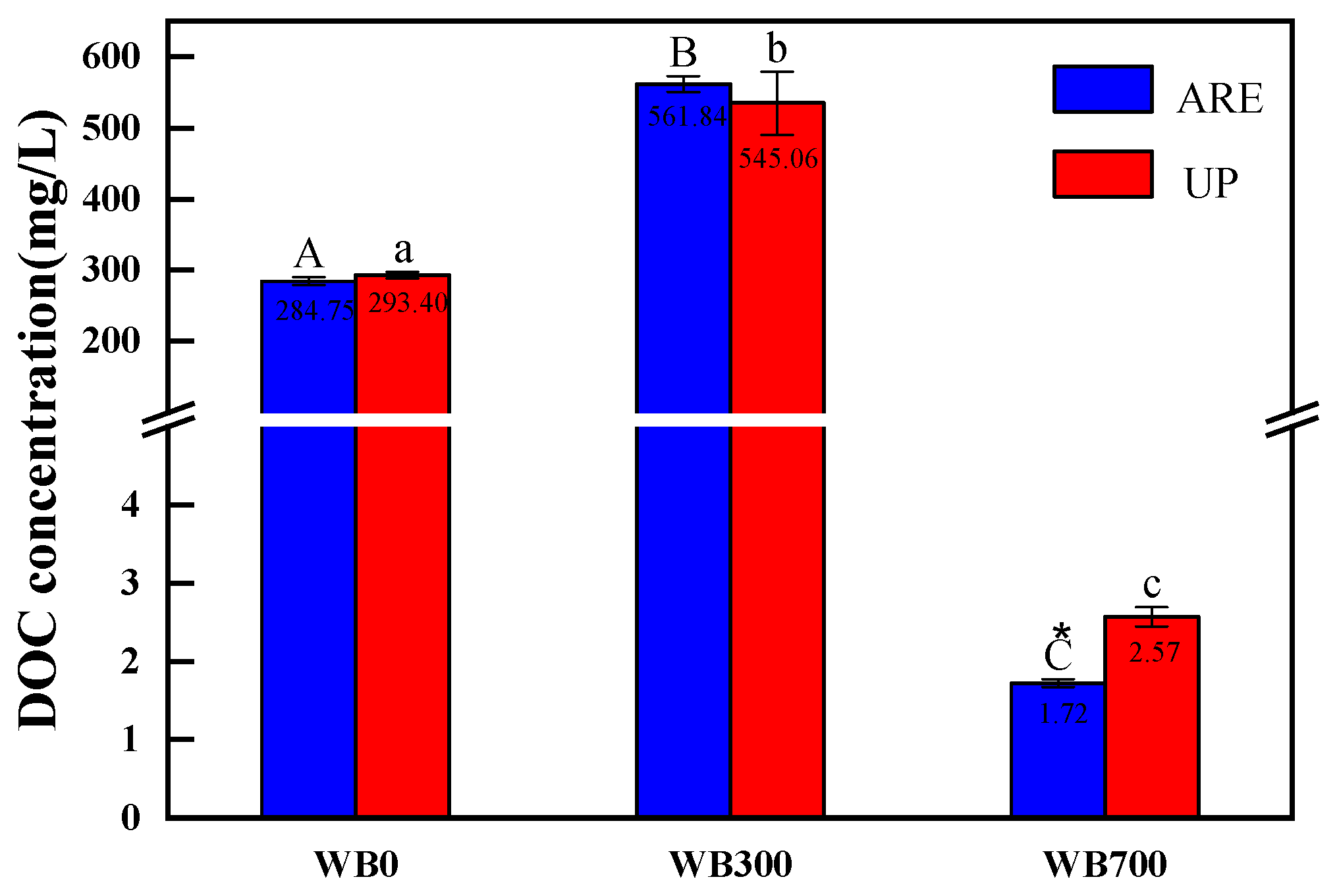
Figure 1 presents the amounts of DOM released from sludge biochar produced at different pyrolysis temperatures under two simulated environments: soil pore water and the plant root zone. The results indicate that the dissolved organic carbon (DOC) content extracted from the sludge-derived biochar did not differ significantly (p < 0.05) when using artificial root exudates (ARE) compared to ultrapure water (UP) as the extraction solution. This result diverges from the findings of Li et al. [11], which reported a significant difference (p < 0.05) in DOC released from rice straw biochar extracted with 0.1 mol/L HCl versus UP water. In the present study, however, a difference in DOC content was observed between extractions with HCl and ARE at the same pH, a result potentially attributable to the organic constituents in the ARE solution. This phenomenon may be explained by the complexation of metal cations with functional groups on organic molecules. These cation bridges can then form bridges between biochar and DOM [16,17,18]. In contrast, low-molecular-weight organic acids (e.g., citric acid) present in root exudates can bind to these metal cations, dissolving them and thereby disrupting the bridges between biochar particles and surface-bound DOM [19]. This process promotes the release of DOM into solution [20,21]. Consistently, Sun et al. also observed that such organic acids significantly increase the concentration of metal cations in soil solution [22]. Furthermore, Figure 1 illustrates a pronounced effect of pyrolysis temperature on the DOC released from sludge biochar. Biochar produced at 300 °C exhibited the highest DOC release in both extraction media, while DOC from the 700 °C biochar decreased significantly. This indicates that pyrolysis temperature substantially influences the DOM content of sludge-derived biochar. Specifically, biochar produced at lower pyrolysis temperatures releases a higher amount of DOC, whereas biochar generated at higher temperatures releases less. This trend can be attributed to the progressive reduction in volatile matter and the corresponding increase in fixed carbon content as pyrolysis temperature rises. These changes consequently lead to a decline in DOC release [23,24]. This is mainly due to the key role of pyrolysis temperature. Pyrolysis temperature controls two important processes of thermal cracking and condensation reactions. These processes then determine the physicochemical structure of the biochar. At lower temperatures (e.g., 300 °C), pyrolysis is incomplete. The biochar matrix keeps many aliphatic structures and labile organic matter. Therefore, the DOM released from this biochar usually has certain characteristics. It has a larger molecular weight. It also has lower aromaticity and a higher degree of humification. In contrast, high-temperature pyrolysis (e.g., 700 °C) works differently. It promotes deep condensation of aromatic clusters. It also causes volatilization of aliphatic components. This results in a biochar that is more aromatized and stable. However, the DOM released from such high-temperature biochar is different. It is mainly made of small-molecular-weight organics with low aromaticity. There are two reasons for this. First, potential larger humic substances may be decomposed during the high-temperature pyrolysis. Second, they may become tightly adsorbed within the biochar’s well-developed pore structure. This prevents their release into the solution. Additionally, with increasing pyrolysis temperature, DOM may undergo secondary reactions, such as decomposition, condensation, cyclization, and polymerization [25,26].
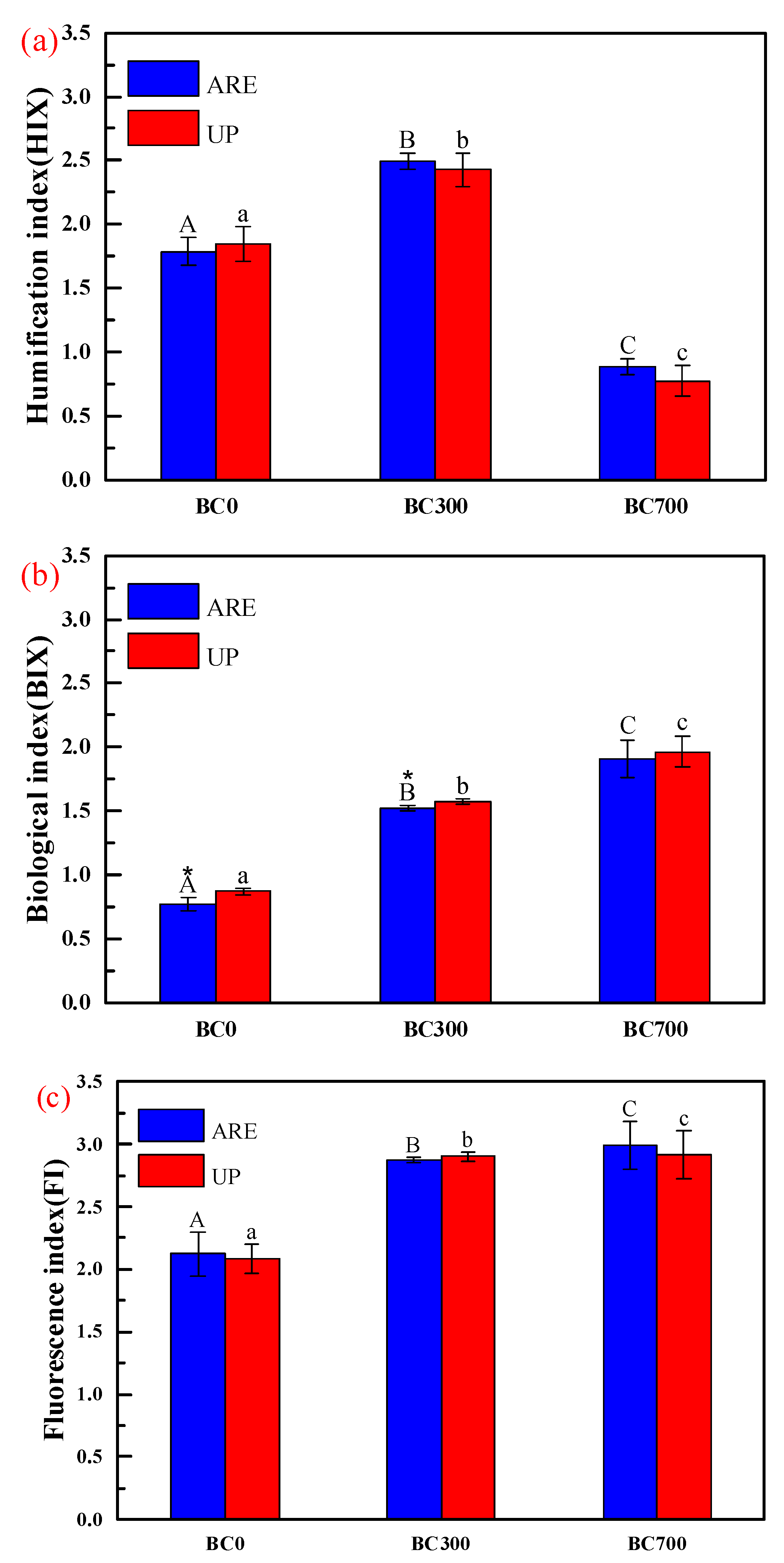
Figure 2 presents three characteristic indices of DOM: the humification index (HIX), biological index (BIX), and fluorescence index (FI). HIX reflects the degree of DOM humification; a higher HIX value indicates greater humification and a more complex DOM structure [27,28,29]. In both extraction solutions, DOM from the 700 °C biochar exhibited relatively low HIX values (0.71–0.81). In contrast, DOM extracted from the 300 °C biochar showed higher HIX values (2.22–2.29). This suggests that low-temperature pyrolysis released a greater proportion of humic-like substances [30]. Furthermore, HIX values were higher in the artificial root exudate (ARE) than in ultrapure water (UP), indicating a greater degree of humification in ARE-extracted DOM, a finding consistent with the SUVA254 results. The FI values of DOM extracted with ARE and UP ranged from 2.12–3.00 and 2.09–2.92, respectively. These values increased gradually with pyrolysis temperature, implying enhanced degradation of DOM at higher temperatures [31]. Additionally, in both extraction solutions, BIX values for DOM derived from the raw (unpyrolyzed) sludge were below 1, indicating insignificant autochthonous characteristics [32]. However, at pyrolysis temperatures of 300 °C and 700 °C, the BIX values exceeded 1, reflecting higher bioavailability compared to the raw sludge. This suggests that high-temperature pyrolysis likely decomposed larger-molecular-weight DOM components in the sludge biochar into smaller, more bioavailable fractions, a trend consistent with the observed changes in the spectral slope ratio (SR) [33].

3.2. Fluorescence Characteristics of DOM in Sludge Biochar at Different Pyrolysis Temperatures

3.2.1. Released DOM Components Analysis of Biochar

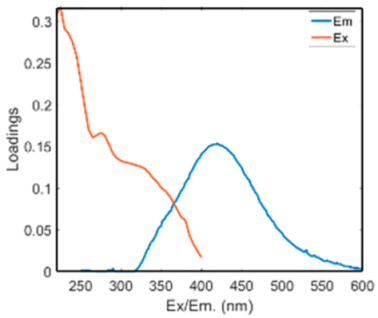
Fluorescence excitation-emission matrix (EEM) combined with parallel factor analysis (PARAFAC) was applied to characterize the DOM components released from biochar under different pyrolysis temperatures and in two extraction environments. The identified PARAFAC components are consistent with those identified in previous DOM fluorescence studies, which were matched to reported components based on spectral features. PARAFAC analysis of all sample EEMs revealed four fluorescent components (C1–C4). The probable sources and properties of these components are summarized in Table 1. The resolved components consist of three humic-like substances (C1, C2, C3) and one protein-like (tyrosine) substance (C4). Component C1, which has emission peaks at 235/275 nm and excitation at 416 nm, is identified as a humic acid-like material. It shows spectral features typical of terrestrial humic substances and resembles humic-like components extracted from marine sediments [34]. Component C2, with peaks at 225/320 nm and emission at 390 nm, is characteristic of a humic-like substance representing stable, aliphatic-rich biogenic organic matter. Component C3, with excitation at 225/365 nm and a distinct emission maximum at 438 nm, corresponds to a UVA humic substance—a widely distributed fluorescent group of yellow humic acid. Component C4, exhibiting excitation maxima at 225/280 nm and emission at 304 nm, is assigned to a tyrosine-like compound [35]. The observed variations in DOM composition and release across pyrolysis temperatures can be explained at the molecular level. DOM released from 300 °C biochar is characterized by larger molecular weight and greater hydrophobicity, which leads to weaker adsorption onto the biochar surface and, consequently, higher release into solution. In contrast, DOM derived from 700 °C biochar consists of smaller molecules. These smaller molecules can be more strongly retained by the highly aromatic biochar matrix, likely through mechanisms such as pore-filling, resulting in reduced release.

3.2.2. Distribution of DOM Components in Biochar at Different Pyrolysis Temperatures

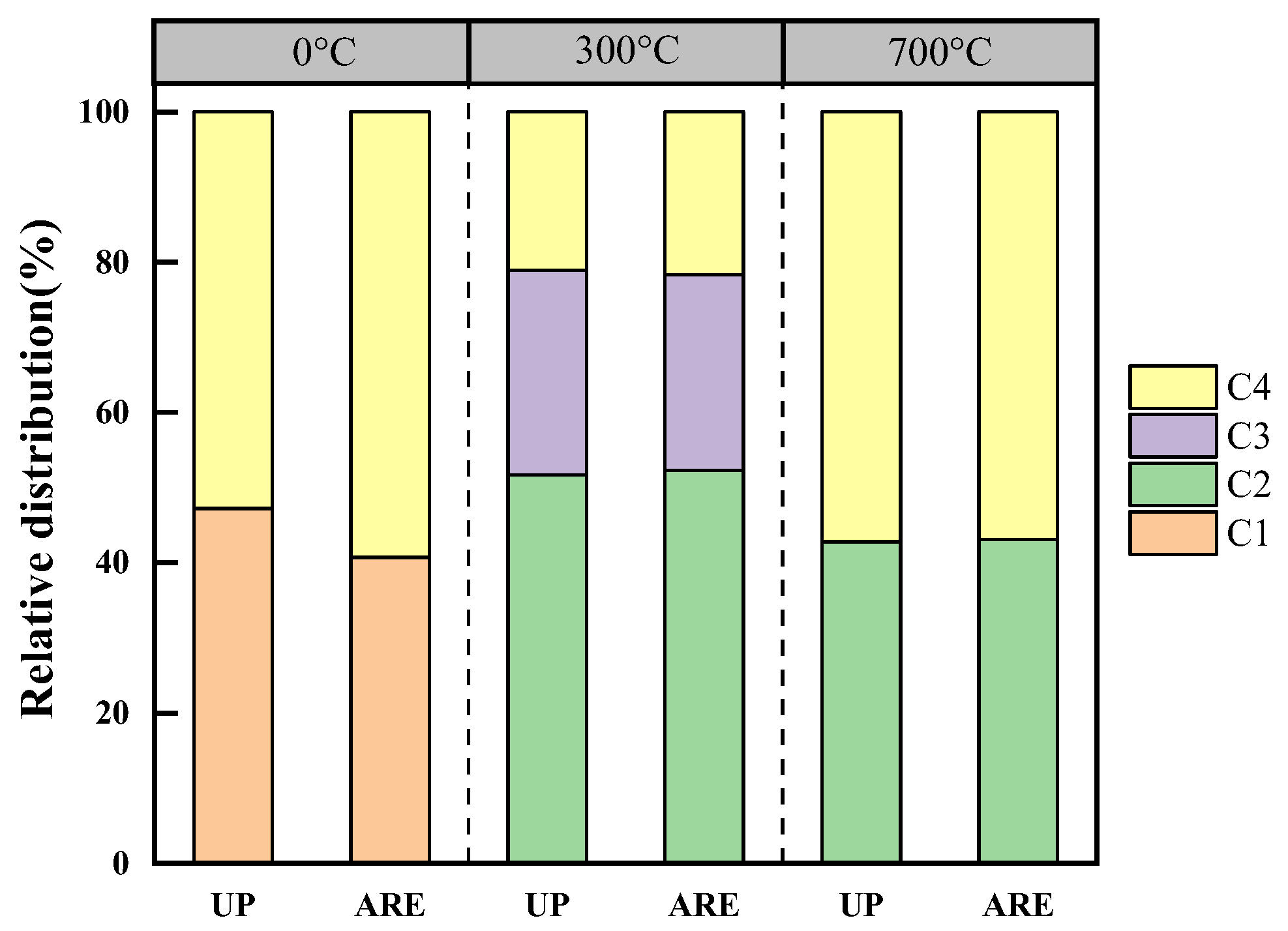
To evaluate the influence of pyrolysis temperature on the release of DOM from biochar, the distribution of fluorescent components was assessed based on fluorescence intensity. Figure 3 shows the relative abundance of DOM components released from sludge-derived biochar. The biochar was prepared at different pyrolysis temperatures and extracted in two environments (ARE and UP). Overall, the distribution of the four DOM components varied considerably with pyrolysis temperature, while only minor differences were observed between the two-extraction media—a trend consistent with the DOC results presented in Figure 1. In the raw (unpyrolyzed) sludge, two components (C1 and C4) were identified in both ARE and UP extracts. Their relative abundances were C1: 40.79% (ARE) and 47.25% (UP), and C4: 59.21% (ARE) and 52.75% (UP). C4 was the dominant component in ARE, whereas the difference was less pronounced in UP. As the pyrolysis temperature increased to 300 °C and 700 °C, the DOM composition changed markedly. At 300 °C, component C1 was absent in both extracts, component C4 decreased, and new components C2 and C3 emerged as the dominant fractions. At 700 °C, component C3 disappeared, leaving only C2 and C4 in both extracts, with C4 remaining the major constituent. This pattern may be attributed to secondary reactions such as decomposition, condensation, cyclization, and polymerization that DOM can undergo as pyrolysis temperature increases [25,36]. In summary, pyrolysis temperature significantly altered the distribution of DOM components in biochar, with low-temperature pyrolysis (300 °C) promoting the substantial release of humic acid-like DOM.

3.3. FTIR Spectroscopy and 2D-COS Analysis

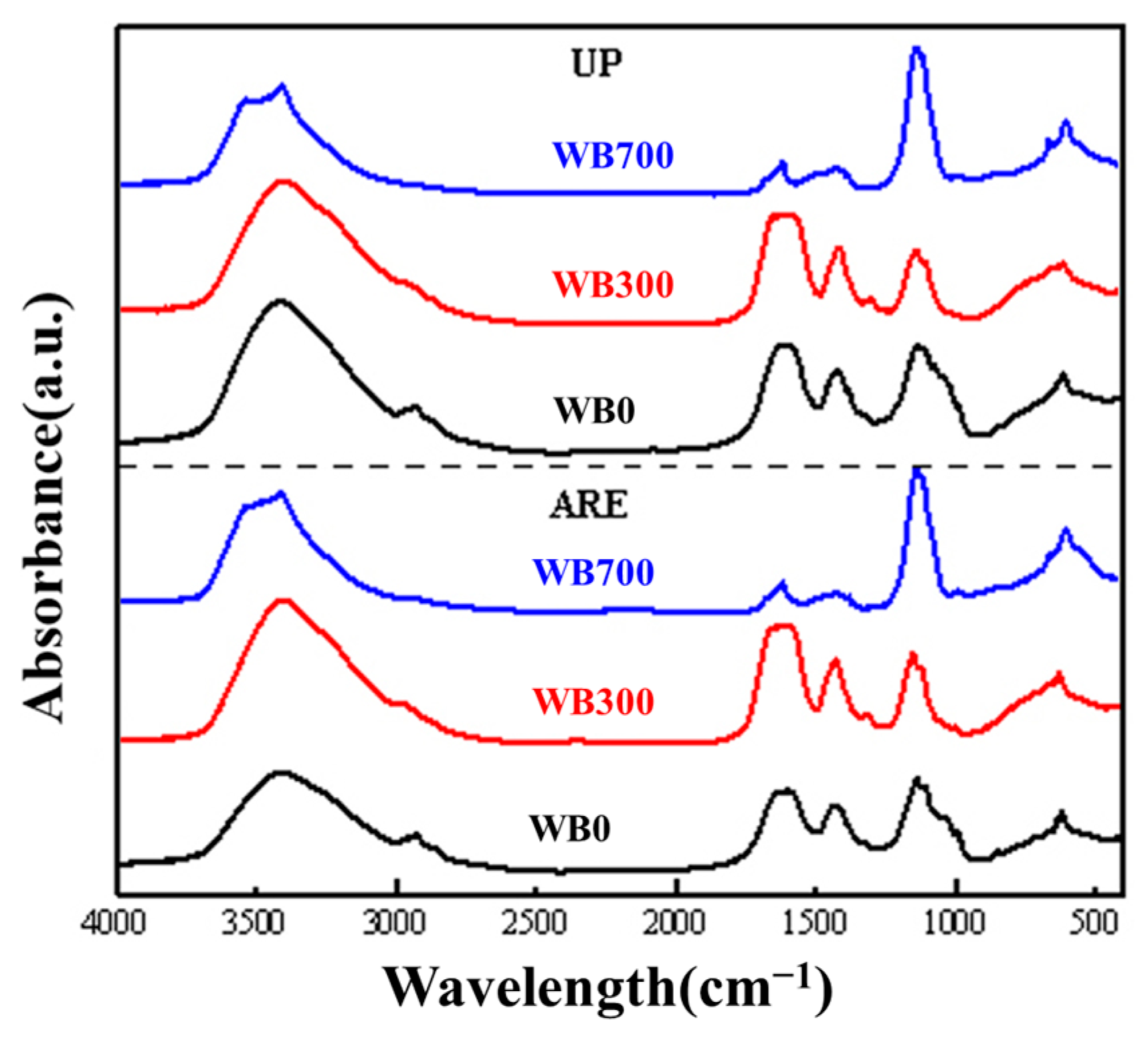
Figure 4 shows the infrared spectrum of DOM, with notable changes observed mainly in the 3600–2800 cm−1 and 1800–800 cm−1 regions. Compared to the raw sludge, the sludge biochar attenuated -OH vibration under high-temperature pyrolysis. This is likely attributed to the dehydration of cellulose, hemicellulose, and lignin during heating. The aliphatic C-H absorption peaks in the 2850–2950 cm−1 range progressively diminished and eventually disappeared as pyrolysis temperature increased. This is likely due to the decomposition of organic aliphatic hydrocarbons in the biochar at elevated temperatures, or their conversion into condensed aromatic structures. Additionally, the absorption peak for the aromatic C=C skeletal vibration intensified with rising temperature but weakened at 700 °C. This suggests that pyrolysis initially promotes aromatization before high-temperature decomposition of larger molecules reduces aromaticity. This observation aligns with the SUVA254 trends. Meanwhile, the C=O vibrations from carbonyl/carboxyl groups gradually weakened, indicating carbonate decomposition. The peak near 1260 cm−1, corresponding to a C-O/C-C stretch, also decreased in intensity at higher temperatures, likely a result of the thermal decomposition of carbon-containing compounds. In summary, the intensities of aliphatic -CH, C-O, and C=O groups in DOM from sludge biochar pyrolyzed at 300 °C and 700 °C decreased with increasing temperature, which can be attributed to the breakdown of macromolecular substances into smaller units under high-temperature conditions. No clear differences in functional groups were evident between DOM extracted with ARE and UP, possibly due to the resolution of the infrared analysis.
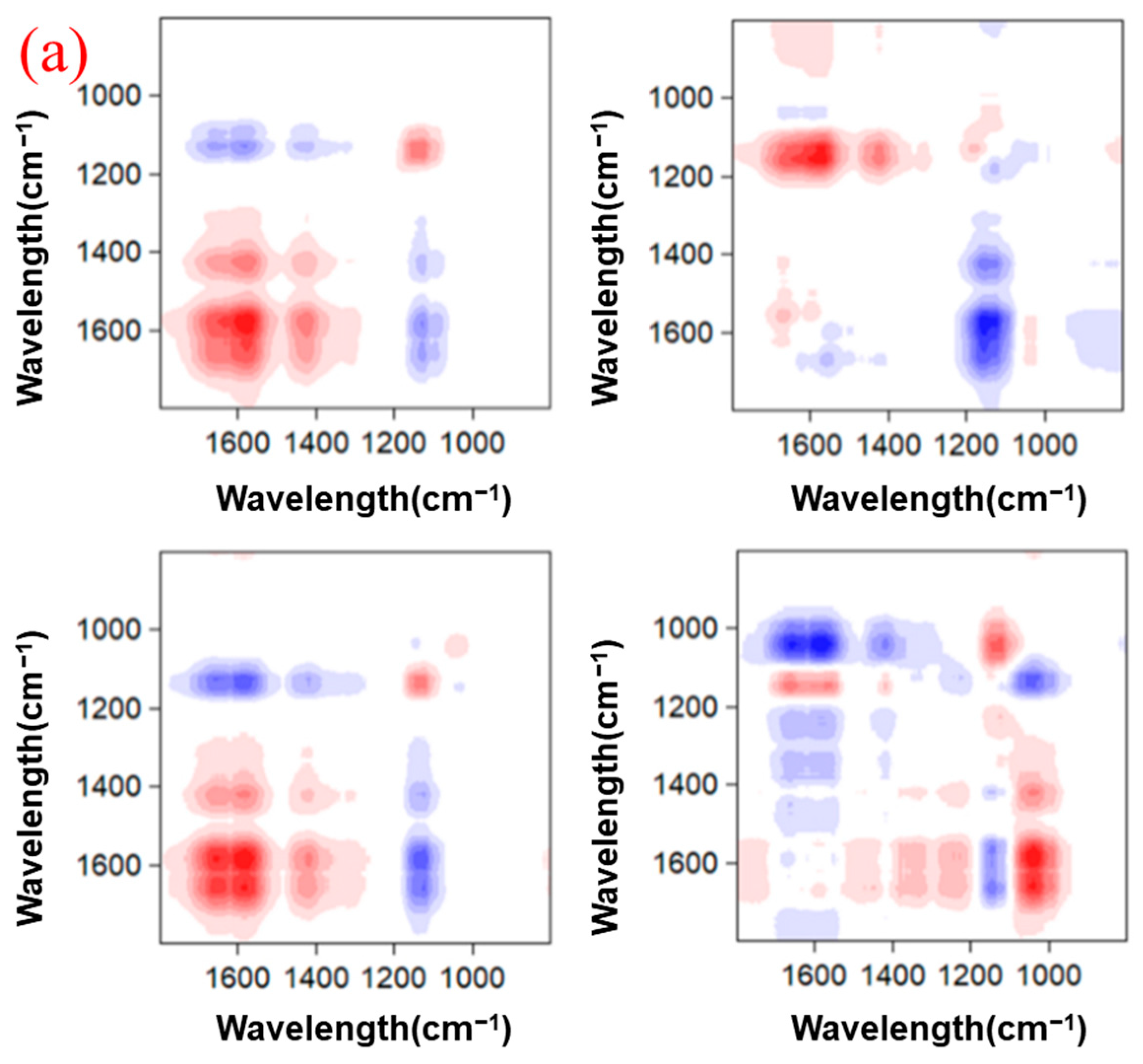
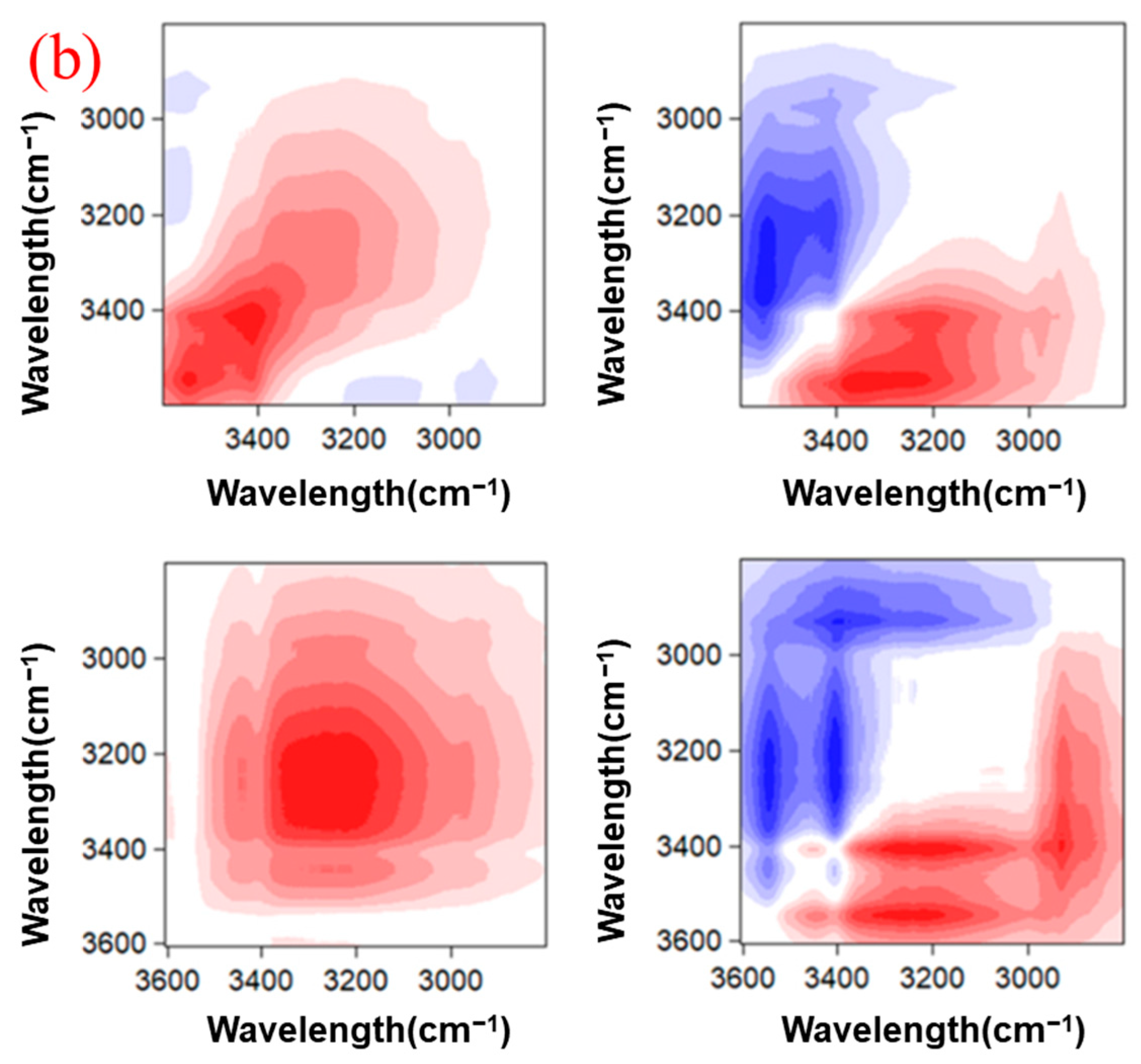
To elucidate the evolution of DOM functional groups as a function of pyrolysis temperature, the FTIR spectral data were analyzed using two-dimensional correlation spectroscopy (2D-COS). The synchronous and asynchronous maps in the 1800–800 cm−1 region are presented in Figure 5a. In the ARE extracts, three main autopeaks were observed at approximately 1600, 1400, and 1150 cm−1, ordered by intensity. Based on Noda’s rule, the sequence of spectral changes was determined as follows: C-O of polysaccharides > C-N/C=N > aromatic ring C=C > aromatic C-H > ester C=O > aliphatic C-H > carboxyl C=O. These results indicate that the molecular structure of DOM undergoes distinct changes as pyrolysis temperature increases. The autopeaks of DOM are concentrated in the 3600–3000 cm−1 region, corresponding to O-H groups. In the synchronous map, the positive cross-peaks for both ARE and UP indicate that the O-H groups respond to temperature changes in a similar manner. In the asynchronous map, the cross-peak sign is negative for CB but positive for SB and DB. This pattern reveals that changes in CH2 precede those of O-H in CB and SB, whereas the sequence is reversed in DB.

3.4. Ultraviolet-Visible Spectroscopy Analysis of DOM in Sludge Biochar

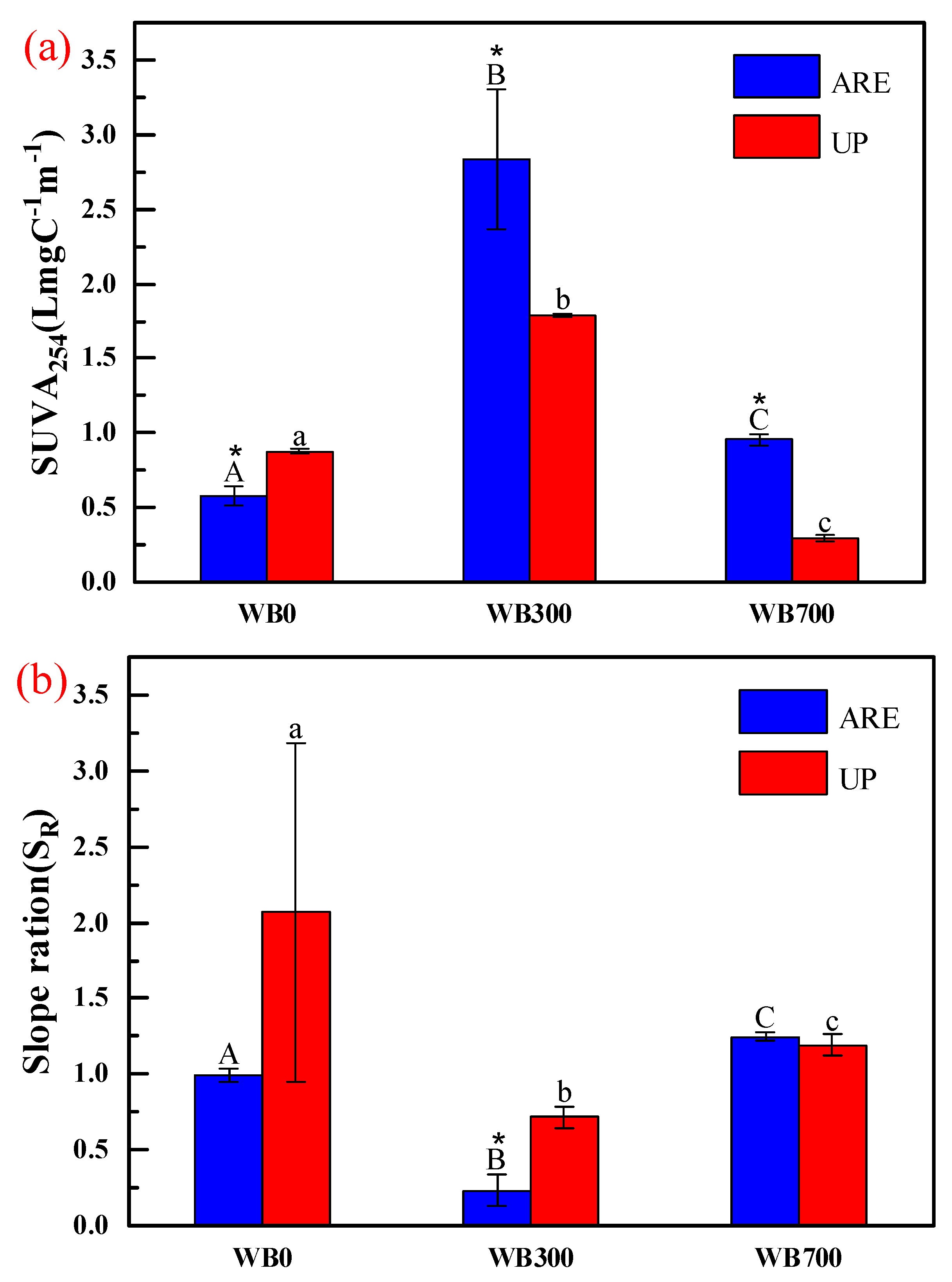
Furthermore, the chemical properties of DOM in sludge biochar were examined using the SUVA254 index and spectral slope ratio (SR) analysis (Figure 6). In both extraction environments, the SUVA254 values of DOM ranged from 0.29 to 2.84 L·mg C−1·m−1, indicating overall low aromaticity. For the raw sludge, the SUVA254 of DOM extracted with ARE was significantly lower than that with UP (p < 0.05). As the pyrolysis temperature increased, however, the SUVA254 of the ARE extract became significantly higher than that of the UP extract (p < 0.05). This suggests that DOM in ARE attained relatively higher aromaticity under elevated temperatures. The SR value, an indicator of DOM molecular weight (higher SR corresponding to larger molecular size) [1,37], varied as follows: for raw sludge, it was 0.99 (ARE) and 2.08 (UP); for 300 °C biochar, 0.23 (ARE) and 0.73 (UP); and for 700 °C biochar, 1.25 (ARE) and 1.20 (UP). The higher SUVA254 combined with lower SR observed for DOM released from 300 °C biochar indicates that DOM at this temperature possesses a higher molecular weight and a greater degree of humification compared to both raw sludge and 700 °C biochar. According to previous studies, smaller, aliphatic DOM molecules are more strongly adsorbed onto biochar surfaces than larger aromatic molecules [25,38]. Therefore, the more aliphatic, higher molecular weight DOM in 300 °C biochar is more readily released. This aligns with the relatively higher DOC content detected at this temperature. As pyrolysis temperature rises, large aromatic components in biochar gradually decompose into smaller fragments. This leads to reduced aromaticity and molecular weight of DOM [31,39]. Thus, pyrolysis temperature influences both the size and humification degree of DOM molecules, thereby modulating DOM release from the biochar matrix.

4. Conclusions

This study systematically investigated sludge biochar under two extraction environments—ultrapure water (UP) and artificial root exudates (ARE)—and at different pyrolysis temperatures (300 °C and 700 °C). The release behavior, chemical composition, and structural characteristics of DOM across different environmental media were examined, leading to the following main conclusions. The DOC content released from the sludge biochar did not differ significantly between the two extraction environments. This suggests that in the root-simulating (acidic) environment, DOM release from biochar is not inhibited by the lower pH. This can be attributed to the presence of organic acids, which enhance DOM solubility. Pyrolysis temperature significantly influences the content and composition of dissolved organic matter (DOM) in sludge-derived biochar. Biochar produced at lower temperatures contains a greater diversity of DOM components and exhibits a higher DOM release potential. This is likely due to the larger molecular size and higher degree of humification of low-temperature DOM, which reduces its adsorption affinity to the biochar matrix and facilitates desorption. In contrast, at higher pyrolysis temperatures, DOM undergoes thermal decomposition, producing smaller molecular fragments that adsorb more strongly to biochar surfaces, thereby limiting its overall release. The DOM released from sludge-derived biochar comprised four main components. At lower pyrolysis temperatures, the composition was dominated by components C2, C3, and C4. As the temperature increased, the composition shifted towards a predominance of C2 and C4. The ecological effects of sludge-derived biochar are strongly influenced by pyrolysis temperature. Low-temperature biochar releases diverse dissolved organic matter (DOM), which can stimulate soil microbial activity and enhance short-term nutrient cycling. Due to its stable structure and strong adsorption capacity, high-temperature biochar releases less DOM but is more effective for long-term carbon sequestration and contaminant immobilization. Simulated root exudates did not inhibit DOM release, suggesting that in real root-soil systems, plant activity may interact with biochar DOM, influencing biochar aging and the fate of nutrients and pollutants. In terms of practical applications, low-temperature biochar can serve as a soil amendment or biostimulant to quickly improve fertility and support microbial degradation of organic pollutants. High-temperature biochar is more suitable for long-term stabilization of heavy metals and organic contaminants, soil carbon storage, or as an adsorbent material. It should be noted that DOM release may also mobilize adsorbed pollutants, so biochar produced from contaminated sludge requires careful risk assessment. Matching biochar type to specific goals and conducting systematic risk evaluations are essential to maximize benefits and control potential risks.

Author Contributions

B.L. (Bowen Li): investigation, software, formal analysis, writing—original draft preparation; J.L.: investigation, data curation, writing—original draft preparation; H.W.: investigation, visualization; L.M.: investigation, software; B.L. (Bin Li): investigation, visualization, software; W.S.: Conceptualization, methodology, funding acquisition, supervision, writing—review and editing; C.F.: funding acquisition, supervision, writing—review and editing. All authors have read and agreed to the published version of the manuscript.

Funding

The authors are grateful for the financial support from the GDAS’ Project of Science and Technology Development (2024GDASZH-2024010101), National Natural Science Foundation of China (52200088), Research Project of Zhongshan Public Utility Urban Drainage Co., Ltd. (ZPC-2024-A (Drainage/Pipeline)-275).

Data Availability Statement

The original contributions presented in this study are included in the article. Further inquiries can be directed to the corresponding authors.

Conflicts of Interest

Authors Bowen Li, Hao Wen and Lincheng Ma were employed by Zhongshan Public Torch Water Environment Treatment Co., Ltd. The remaining authors declare that the research was conducted in the absence of any commercial or financial relationships that could be construed as a potential conflict of interest.

References

  1. Li, M.; Zhang, A.F.; Wu, H.M.; Liu, H.; Lv, J.L. Predicting potential release of dissolved organic matter from biochars derived from agricultural residues using fluorescence and ultraviolet absorbance. J. Hazard. Mater. 2017, 334, 86–92. [Google Scholar] [CrossRef]
  2. Bolan, N.S.; Adriano, D.C.; Kunhikrishnan, A.; James, T.; McDowell, R.; Senesi, N. Dissolved organic matter: Biogeochemistry, dynamics, and environmental significance in soils. In Advances in Agronomy; Sparks, D.L., Ed.; Elsevier Academic Press Inc.: San Diego, CA, USA, 2011; Volume 110, pp. 1–75. [Google Scholar]
  3. Zhang, S.Q.; Wang, M.X.; Liu, J.; Tian, S.Y.; Yang, X.L.; Xiao, G.Q.; Xu, G.M.; Jiang, T.; Wang, D.Y. Biochar affects methylmercury production and bioaccumulation in paddy soils: Insights from soil-derived dissolved organic matter. J. Environ. Sci. 2022, 119, 68–77. [Google Scholar] [CrossRef]
  4. Li, J.E.; Li, Q.A.; Liang, S.Q.; Zhang, B.Y.; Wang, J.Z.; Yu, Y.X.; Xia, L.Z.; Zhang, Y.; Wang, Y.F. Aging mechanism of biochar based on fluorescence spectroscopy: Assessing soil dissolved organic matter (DOM) dynamics and Cd bioavailability. Chem. Eng. J. 2025, 505, 11. [Google Scholar] [CrossRef]
  5. Sun, Y.Q.; Xiong, X.N.; He, M.J.; Xu, Z.B.; Hou, D.Y.; Zhang, W.H.; Ok, Y.S.; Rinklebe, J.; Wang, L.L.; Tsang, D.C.W. Roles of biochar-derived dissolved organic matter in soil amendment and environmental remediation: A critical review. Chem. Eng. J. 2021, 424, 14. [Google Scholar] [CrossRef]
  6. Kim, H.B.; Kim, J.G.; Alessi, D.S.; Baek, K. Mechanistic understanding of copper (Cu) mobility in aged biochar: Influence of dissolved organic matters release and oxygen-containing groups. J. Hazard. Mater. 2025, 495, 10. [Google Scholar] [CrossRef]
  7. Zimmerman, A.R.; Ouyang, L. Priming of pyrogenic C (biochar) mineralization by dissolved organic matter and vice versa. Soil Biol. Biochem. 2019, 130, 105–112. [Google Scholar] [CrossRef]
  8. Devault, M.; Jing, L.; Arkoun, M.; Bauerle, T.; Kessler, A.; Lehmann, J. Biochar shifts balance between hydrophilic and lipophilic molecules in root exudates. Bioresour. Technol. 2025, 427, 5. [Google Scholar] [CrossRef]
  9. He, C.J.; He, X.W.; Li, J.J.; Luo, Y.; Li, J.C.; Pei, Y.; Jiang, J.Y. The spectral characteristics of biochar-derived dissolved organic matter at different pyrolysis temperatures. J. Environ. Chem. Eng. 2021, 9, 9. [Google Scholar] [CrossRef]
  10. Intani, K.; Latif, S.; Kabir, A.; Müller, J. Effect of self-purging pyrolysis on yield of biochar from maize cobs, husks and leaves. Bioresour. Technol. 2016, 218, 541–551. [Google Scholar] [CrossRef] [PubMed]
  11. Li, Y.R.; Chen, W.P.; Fang, S.; Xu, Z.H.; Weng, H.F.; Zhang, X.D. The Influence of Pyrolysis Temperature and Feedstocks on the Characteristics of Biochar-Derived Dissolved Organic Matter: A Systematic Assessment. Clean Technol. 2024, 6, 1314–1325. [Google Scholar] [CrossRef]
  12. Hur, J.; Lee, B.M. Characterization of binding site heterogeneity for copper within dissolved organic matter fractions using two-dimensional correlation fluorescence spectroscopy. Chemosphere 2011, 83, 1603–1611. [Google Scholar] [CrossRef]
  13. Lin, H.; Guo, L.D. Variations in Colloidal DOM Composition with Molecular Weight within Individual Water Samples as Characterized by Flow Field-Flow Fractionation and EEM-PARAFAC Analysis. Environ. Sci. Technol. 2020, 54, 1657–1667. [Google Scholar] [CrossRef]
  14. He, W.; Hur, J. Conservative behavior of fluorescence EEM-PARAFAC components in resin fractionation processes and its applicability for characterizing dissolved organic. Water Res. 2015, 83, 217–226. [Google Scholar] [CrossRef]
  15. Cui, H.Y.; Xie, L.N.; Zhang, G.G.; Zhao, Y.; Wei, Z.M. Revealing the Inner Changes of Component Composition Derived from DOM PARAFAC Based on Two-Dimensional Correlation Spectroscopy. Molecules 2022, 27, 7316. [Google Scholar] [CrossRef]
  16. Saison, C.; Perrin-Ganier, C.; Amellal, S.; Morel, J.L.; Schiavon, M. Effect of metals on the adsorption and extractability of 14C-phenanthrene in soils. Chemosphere 2004, 55, 477–485. [Google Scholar] [CrossRef]
  17. Yan, C.X.; Wang, W.Y.; Nie, M.H.; Ding, M.J.; Wang, P.; Zhang, H.; Huang, G.X. Characterization of copper binding to biochar-derived dissolved organic matter: Effects of pyrolysis temperature and natural wetland plants. J. Hazard. Mater. 2023, 442, 13. [Google Scholar] [CrossRef] [PubMed]
  18. Song, F.H.; Li, T.T.; Shi, Q.; Guo, F.; Bai, Y.C.; Wu, F.C.; Xing, B.S. Novel Insights into the Molecular-Level Mechanism Linking the Chemical Diversity and Copper Binding Heterogeneity of Biochar-Derived Dissolved Black Carbon and Dissolved Organic Matter. Environ. Sci. Technol. 2021, 55, 11624–11636. [Google Scholar] [CrossRef]
  19. Xing, J.; Li, L.C.; Li, G.B.; Xu, G.R. Feasibility of sludge-based biochar for soil remediation: Characteristics and safety performance of heavy metals influenced by pyrolysis temperatures. Ecotox. Environ. Safe. 2019, 180, 457–465. [Google Scholar] [CrossRef] [PubMed]
  20. Ling, W.T.; Ren, L.L.; Gao, Y.Z.; Zhu, X.Z.; Sun, B.Q. Impact of low-molecular-weight organic acids on the availability of phenanthrene and pyrene in soil. Soil Biol. Biochem. 2009, 41, 2187–2195. [Google Scholar] [CrossRef]
  21. Vause, D.; Heaney, N.; Lin, C.X. Differential release of sewage sludge biochar-borne elements by common low-molecular-weight organic acids. Ecotox. Environ. Safe. 2018, 165, 219–223. [Google Scholar] [CrossRef]
  22. Sun, Y.H.; Guan, F.; Yang, W.W.; Wang, F.Y. Removal of Chromium from a Contaminated Soil Using Oxalic Acid, Citric Acid, and Hydrochloric Acid: Dynamics, Mechanisms, and Concomitant Removal of Non-Targeted Metals. Int. J. Environ. Res. Public Health 2019, 16, 2771. [Google Scholar] [CrossRef]
  23. McBeath, A.V.; Wurster, C.M.; Bird, M.I. Influence of feedstock properties and pyrolysis conditions on biochar carbon stability as determined by hydrogen pyrolysis. Biomass Bioenerg. 2015, 73, 155–173. [Google Scholar] [CrossRef]
  24. Murtaza, G.; Usman, M.; Iqbal, J.; Hyder, S.; Solangi, F.; Iqbal, R.; Okla, M.K.; Al-Ghamdi, A.A.; Elsalahy, H.H.; Tariq, W.; et al. Liming potential and characteristics of biochar produced from woody and non-woody biomass at different pyrolysis temperatures. Sci. Rep. 2024, 14, 12. [Google Scholar] [CrossRef]
  25. Wu, H.M.; Qi, Y.S.; Dong, L.; Zhao, X.; Liu, H. Revealing the impact of pyrolysis temperature on dissolved organic matter released from the biochar prepared from Typha orientalis. Chemosphere 2019, 228, 264–270. [Google Scholar] [CrossRef] [PubMed]
  26. Du, Z.L.; Hu, A.B.; Wang, Q.D.; Ai, J.; Zhang, W.J.; Liang, Y.; Cao, M.X.; Wu, H.J.; Wang, D.S. Molecular composition and biotoxicity effects of dissolved organic matters in sludge-based carbon: Effects of pyrolysis temperature. J. Hazard. Mater. 2022, 424, 11. [Google Scholar] [CrossRef]
  27. Wang, Y.L.; Yang, C.M.; Zou, L.M.; Cui, H.Z. Spatial Distribution and Fluorescence Properties of Soil Dissolved Organic Carbon Across a Riparian Buffer Wetland in Chongming Island, China. Pedosphere 2015, 25, 220–229. [Google Scholar] [CrossRef]
  28. Zhang, A.F.; Zhou, X.; Li, M.; Wu, H.M. Impacts of biochar addition on soil dissolved organic matter characteristics in a wheat-maize rotation system in Loess Plateau of China. Chemosphere 2017, 186, 986–993. [Google Scholar] [CrossRef] [PubMed]
  29. Cai, X.L.; Lei, S.H.; Li, Y.M.; Li, J.Z.; Xu, J.; Lyu, H.; Li, J.D.; Dong, X.Z.; Wang, G.L.; Zeng, S. Humification levels of dissolved organic matter in the eastern plain lakes of China based on long-term satellite observations. Water Res. 2024, 250, 14. [Google Scholar] [CrossRef]
  30. Fan, J.X.; Duan, T.; Zou, L.; Sun, J.X. Characteristics of dissolved organic matter composition in biochar: Effects of feedstocks and pyrolysis temperatures. Environ. Sci. Pollut. Res. 2023, 30, 85139–85153. [Google Scholar] [CrossRef] [PubMed]
  31. Gui, X.Y.; Liu, C.; Li, F.Y.; Wang, J.F. Effect of pyrolysis temperature on the composition of DOM in manure-derived biochar. Ecotox. Environ. Safe. 2020, 197, 10. [Google Scholar] [CrossRef]
  32. Yang, L.; Chang, S.W.; Shin, H.S.; Hur, J. Tracking the evolution of stream DOM source during storm events using end member mixing analysis based on DOM quality. J. Hydrol. 2015, 523, 333–341. [Google Scholar] [CrossRef]
  33. Helms, J.R.; Stubbins, A.; Ritchie, J.D.; Minor, E.C.; Kieber, D.J.; Mopper, K. Absorption spectral slopes and slope ratios as indicators of molecular weight, source, and photobleaching of chromophoric dissolved organic matter. Limnol. Oceanogr. 2008, 53, 955–969. [Google Scholar] [CrossRef]
  34. Osburn, C.L.; Stedmon, C.A. Linking the chemical and optical properties of dissolved organic matter in the Baltic-North Sea transition zone to differentiate three allochthonous inputs. Mar. Chem. 2011, 126, 281–294. [Google Scholar] [CrossRef]
  35. Chen, M.L.; Price, R.M.; Yamashita, Y.; Jaffé, R. Comparative study of dissolved organic matter from groundwater and surface water in the Florida coastal Everglades using multi-dimensional spectrofluorometry combined with multivariate statistics. Appl. Geochem. 2010, 25, 872–880. [Google Scholar] [CrossRef]
  36. Zhang, X.X.; Xu, Z.B.; Sun, Y.Q.; Mohanty, S.K.; Lei, H.W.; Khan, E.; Tsang, D.C.W. Implications of Pyrolytic Gas Dynamic Evolution on Dissolved Black Carbon Formed During Production of Biochar from Nitrogen-Rich Feedstock. Environ. Sci. Technol. 2025, 59, 2699–2710. [Google Scholar] [CrossRef] [PubMed]
  37. Gao, J.K.; Shi, Z.Y.; Wu, H.M.; Lv, J.L. Fluorescent characteristics of dissolved organic matter released from biochar and paddy soil incorporated with biochar. RSC Adv. 2020, 10, 5785–5793. [Google Scholar] [CrossRef]
  38. Smebye, A.; Ailing, V.; Vogt, R.D.; Gadmar, T.C.; Mulder, J.; Cornelissen, G.; Hale, S.E. Biochar amendment to soil changes dissolved organic matter content and composition. Chemosphere 2016, 142, 100–105. [Google Scholar] [CrossRef]
  39. Zhang, H.Y.; Ni, J.Z.; Qian, W.; Yu, S.H.; Xiang, Y.; Yang, L.M.; Chen, W.F. Pyrolysis atmospheres and temperatures co-mediated spectral variations of biochar-derived dissolved organic carbon: Quantitative prediction and self-organizing maps analysis. Molecules 2023, 28, 2247. [Google Scholar] [CrossRef] [PubMed]
Figure 1. DOC released from the biochar in different pyrolysis temperatures (WB0: Raw sludge; WB300: 300 °C of Sludge Biochar; WB700: 700 °C of Sludge Biochar) at different Environment (ARE: root exudate and UP: ultrapure water). All values are given as mean ± s.d. from five replicates. Letters indicate significant differences between different pyrolysis temperatures treatments (p < 0.05) (A and a for WB0; B and b for WB300; C and c for WB700; A, B, and C for ARE; a, b, and c for UP). Asterisks indicate statistical differences between different Environment (p < 0.05).
Processes 14 00595 g001
Figure 2. Characteristic parameters (HIX: Humification index for (a), BIX: Autochthonous index for (b), FI: Fluorescence index for (c)) of DOM derived from Sludge biochars produced at different pyrolysis temperatures (300 and 700 °C) and different Environment (ARE: root exudate and UP: ultrapure water). Letters in figure indicate significant differences between different pyrolysis temperatures treatments (p < 0.05) (A and a for BC0; B and b for BC300; C and c for BC700; A, B, and C for ARE; a, b, and c for UP). Asterisks indicate statistical differences between different Environment (p < 0.05).
Processes 14 00595 g002
Figure 3. Relative distribution of EEM-PARAFAC analysis components in DOM released from the biochar in different pyrolysis temperatures (WB0: Raw sludge; WB300: 300 °C of Sludge Biochar; WB700: 700 °C of Sludge Biochar) at different Environment (ARE: root exudate and UP: ultrapure water).
Processes 14 00595 g003
Figure 4. The FTIR of DOM that released from the biochar in different pyrolysis temperatures (WB0: Raw sludge; WB300: 300 °C of Sludge Biochar; WB700: 700 °C of Sludge Biochar) at different Environment (ARE: root exudate and UP: ultrapure water). All values are given as mean ± s.d. from five replicates.
Processes 14 00595 g004
Figure 5. Two-dimensional correlation analysis of FTIR (a): 1800–800 cm−1 synchronous (left) and asynchronous (right) diagrams of ARE, UP; (b): 3600–2800 cm−1 synchronous (left) and asynchronous (right) diagrams of ARE, UP. (ARE: root exudate and UP: ultrapure water).
Processes 14 00595 g005aProcesses 14 00595 g005b
Figure 6. (a) Specific UV absorbance (SUVA254) and (b) slope ratio (SR) from UV absorbance of DOM released from the biochar in different pyrolysis temperatures (WB0: Raw sludge; WB300: 300 °C of Sludge Biochar; WB700: 700 °C of Sludge Biochar) at different Environment (ARE: root exudate and UP: ultrapure water). All values are given as mean ± s.d. from five replicates. Letters in figure indicate significant differences between different pyrolysis temperatures treatments (p < 0.05) (A and a for BC0; B and b for BC300; C and c for BC700; A, B, and C for ARE; a, b, and c for UP). Asterisks indicate statistical differences between different Environment (p < 0.05).
Processes 14 00595 g006
Table 1. Three-dimensional fluorescence spectral positions, contour distribution and spectral load information of the five components identified through fluorescence-PARAFAC analysis.
ComponentEEM Wavelength
(nm)
EEM Equipotential SurfaceSpectrum Characteristic
C1Ex: 235/275
Em: 416
Processes 14 00595 i001Processes 14 00595 i002
C2Ex: 225/320
Em: 390
Processes 14 00595 i003Processes 14 00595 i004
C3Ex: 225/365
Em: 438
Processes 14 00595 i005Processes 14 00595 i006
C4Ex: 225/280
Em: 304
Processes 14 00595 i007Processes 14 00595 i008
Disclaimer/Publisher’s Note: The statements, opinions and data contained in all publications are solely those of the individual author(s) and contributor(s) and not of MDPI and/or the editor(s). MDPI and/or the editor(s) disclaim responsibility for any injury to people or property resulting from any ideas, methods, instructions or products referred to in the content.