Article

HER and OER Activity of Ti4O7@Ti Mesh—Fundamentals Behind Environmental Application
by
Maja Ranković
1,
Lazar Rakočević
2,
Anka Jevremović
1,
Bojana Nedić Vasiljević
1,
Aleksandra Janošević Ležaić
3,
Danica Bajuk-Bogdanović
1,*,
Maja Milojević-Rakić
1 and
Nemanja Gavrilov
1
1
University of Belgrade-Faculty of Physical Chemistry, Studentski Trg 12-16, 11158 Belgrade, Serbia
2
University of Belgrade-VINČA Institute of Nuclear Sciences—National Institute of the Republic of Serbia, Mike Petrovica Alasa 12–14, 11000 Belgrade, Serbia
3
University of Belgrade-Faculty of Pharmacy, Vojvode Stepe 450, 11221 Belgrade, Serbia
*
Author to whom correspondence should be addressed.
Processes 2026, 14(3), 518; https://doi.org/10.3390/pr14030518
Submission received: 30 December 2025 / Revised: 21 January 2026 / Accepted: 26 January 2026 / Published: 2 February 2026
(This article belongs to the Special Issue Advances in Electrocatalysts for the OER, HER and Biomass Conversion)

Abstract

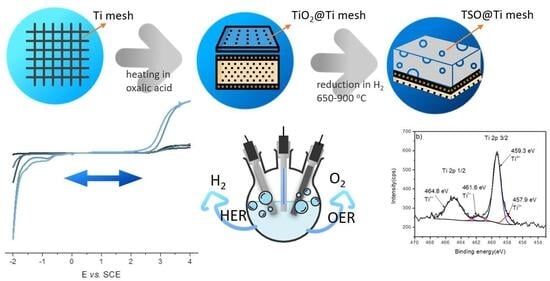
Titanium suboxide (TSO) catalysts offer remarkable activity toward pollutant degradation due to their stability at positive potentials, which enables the formation of reactive oxygen species. Herein, TSOs are prepared directly on the surface of Ti mesh, which also serves as the current collector. The evolution of different TSO surface species during temperature treatment is monitored using micro-Raman spectroscopy. The electrochemically active surface area is determined using cyclic voltammetry (CV) and shows a decrease from 9.3 cm2 to 1.1 cm2 upon increasing temperature, corresponding to the transformation of TSO as seen in micro-Raman spectroscopy. Impedance spectroscopy revealed nearly identical values (≈29 Ohm) for the charge transfer resistance during OER, indicating the presence of the same active centers on the surface. The electrode potential window toward water splitting is examined using oxygen and hydrogen evolution reactions (OER and HER). The Tafel slopes are in the range 400–600 mV dec−1 for OER and 340–440 mV dec−1 for HER, with higher values being desirable in pollutant degradation applications. Onset potential shifted to slightly more negative values with increasing temperature treatment, with samples treated at 850 °C and 950 °C enabling almost tenfold higher currents at the same potential values. The hydrogen evolution potential lies within the optimal region for H* radical formation around −1.2 V vs. RHE. Surface-formed TSOs represent promising biofunctional materials for pollutant degradation.

Graphical Abstract

1. Introduction

Water pollution caused by chemical contaminants represents a major environmental challenge due to the toxicity, persistence, and complex structure of organic pollutants, with significant implications for ecosystems, human health, and industrial sustainability. Among different degradation methods, electrocatalysis remains particularly attractive due to its operational tunability, scalability, and direct integration with renewable electrical energy sources [1,2,3]. However, in parallel with electrocatalytic approaches, several green alternatives have recently been explored, including TiO2- and Cu-based photocatalytic systems for hydrogen-related reactions and pollutant degradation [4,5], as well as thermochemical and catalytic pathways for carboxylic acid oxidation [6,7].
Electrochemical advanced oxidation processes (EAOPs) have emerged as a highly effective method for wastewater treatment, offering non-selective degradation and environmental compatibility [8,9,10]. Electrochemical oxidation relies on the generation of highly reactive radical species (OH*, SO4*, and related oxidants) [11,12] to drive the degradation of persistent environmental pollutants. Under standard aqueous conditions, oxygen evolution (OER) and hydrogen evolution (HER) occur within a relatively narrow potential window between 0 and 1.23 V vs. RHE. However, when electrochemical methods are applied for pollutant degradation, the working potential must be significantly increased, typically to 1.7–1.8 V, and for extremely resistant compounds such as perfluoroalkyl and polyfluoroalkyl substances (PFAS), even up to 2.4–2.6 V [13]. At these anodic overvoltages, oxygen evolution dominates the current, and continuous gas formation envelops the electrode surface, cyclically blocking electrolyte contact and destabilizing the reaction. Similar challenges reported across environmental electrochemistry studies have led many authors to raise potentials to 3–4 V in an attempt to achieve measurable degradation, despite the inherently low energy efficiency of such an approach [13].
A central challenge, therefore, is to expand the electrochemical stability window before the onset of OER, thereby decreasing the fraction of energy wasted on gas evolution and redirecting it toward radical generation.
Although HER is often treated as inconsequential in this context, it can influence pollutant degradation because molecular hydrogen is a reducing agent capable of participating in the modification of the pollutant degradation mechanism. Therefore, it is necessary to evaluate materials that can act both as anodes and cathodes, as well as to determine their accessible potential window under operational conditions. Extending the positive side of the water potential window serves as a valuable descriptor for predicting pollutant degradation capacity. This, in turn, can enable rapid screening of candidate materials without relying on immediate degradation experiments or LC/MS detection, which requires analytical equipment that is not available in every laboratory.
One promising strategy in the search for materials involves tailoring the surface chemistry of Ti-based electrodes through controlled thermal or reductive treatment to form stable Magnéli phases, which exhibit more positive OER onset potentials and higher Tafel slopes. In the search for materials that have the potential to suppress oxygen release, improve anodic stability, and enhance the overall oxidative power of EAOPs, oxygen-deficient titanium suboxides (TinO2n−1) must be assessed thoroughly. These reduced TiO2 phases exhibit semi-metallic to metallic behaviors [14,15] and combine high electrical conductivity with chemical and thermal stability. Their conductivity is dependent on the index n, reaching its maximum for n = 3−5 [15,16]. Among them, Ti4O7 has high ambient conductivity [17] and oxygen evolution potential (up to +2.5 V vs. Ag/AgCl), which enables the generation of radicals prior to OER during electrochemical oxidation. Magnéli phases have been increasingly investigated as electrode materials [18,19,20], offering advantages over conventional electrodes such as carbon-based materials and noble metals, which face challenges related to stability, corrosion, and cost [21,22,23]. Additionally, Ti4O7 is primarily synthesized from TiO2, making it a low-cost and environmentally friendly material [24,25,26]. These features make Ti4O7 a promising, low-cost, durable, and efficient electrode for electrochemical and environmental applications [15,17,27,28].
Magnéli phases can be produced by heating TiO2 with metallic Ti in an inert atmosphere or by high-temperature reduction of TiO2 with a reducing agent [29]. This reduction requires temperatures above 1270 K and a hydrogen atmosphere [15,17]. Another approach is to prepare Ti4O7 using a molten salt [30]. Spark plasma sintering (SPS) produces highly conductive bulk MPs, while SPS combined with the sol–gel method results in nano-MPs [31]. Although Ti4O7 powders can be almost fully densified by SPS, they may oxidize to Ti5O9 [32].
In this work, we report, for the first time, to the best of our knowledge, the possibility of obtaining a Magnéli phase directly on the surface of a titanium mesh, intended for use as an electrode.

2. Materials and Methods

2.1. Materials

The substrate used was a Ti-mesh of 99.0% purity with a thickness of 0.5 mm. Oxalic acid (C2H2O4) was purchased from Univerzal M-BEE plus, Šabac, Serbia. Sodium sulfate (Na2SO4) was purchased from Merck (Darmstadt, Germany). All reagents were of analytical grade and used without further purification.

2.2. Sample Preparation

Titanium mesh was cut into uniform rectangular strips (30 mm × 10 mm) and subjected to a three-step pretreatment process. Initially, the Ti mesh was mechanically polished using SiC sandpaper. In the degreasing step, the strips were ultrasonicated for 10 min in acetone and rinsed with distilled water. Finally, a chemical treatment was performed in 10% (w/v) oxalic acid solution at 80 °C for 2 h, followed by thorough rinsing with distilled water. This sample is labeled as TiOx@Ti.
Titanium mesh substrates were placed in a tubular furnace and thermally treated under a controlled reducing atmosphere consisting of 5% H2 and 95% Ar for 2 h. The reduction was performed at four different temperatures: 630, 750, 850, and 950 °C. After cooling to room temperature under a protective atmosphere, the obtained samples were denoted as TSO630@Ti, TSO750@Ti, TSO850@Ti, and TSO950@Ti, respectively.

2.3. Methods

A Phenom ProX scanning electron microscope (Thermo Fisher Scientific, Waltham, MA, USA) was used to examine the surface morphology of the Ti mesh and derived samples. Imaging was performed at magnifications of 10,000× using a backscattered electron detector (BSD Full) operated at 15 kV in Map mode.
Raman spectroscopy was performed using a DXR Raman microscope (Thermo Scientific, Waltham, MA, USA). Spectra were acquired with a 532 nm excitation laser. Laser focusing and sample visualization were achieved using an Olympus microscope equipped with a 10× objective lens. Scattered light was dispersed using 900 lines/mm diffraction grating. The laser power was set to 10.0 mW, and each spectrum was recorded with a 10 s exposure time over 10 accumulations. The presented spectra were obtained by averaging 10 spectra recorded at randomly selected spots on the surface of the sample.
X-ray photoelectron spectroscopy (XPS) was performed using a SPECS instrument consisting of an XP50M X-ray source, a Focus 500 monochromator, and a PHOIBOS 100/150 hemispherical analyzer. Monochromatic Al Kα radiation (1486.74 eV) was utilized, produced from an aluminum anode operated at 12.5 kV and 32 mA. Survey scans covering the 1000–0 eV binding energy range were collected in fixed analyzer transmission (FAT) mode. Detailed chemical information was obtained from a high-resolution scan of the Ti 2p region and O 1s region. Measurements were conducted under ultra-high vacuum, with the chamber pressure maintained at 9 × 10⁻⁹ mbar. All binding energies were referenced to the adventitious carbon C 1s signal set at 284.5 eV.

2.4. Electrochemical Measurements

A IVIUM VO1107 potentiostat/galvanostat (IVIUM Technologies, Eindhoven, The Netherlands) was used to apply the potential and record the resulting current. Electrochemical measurements were performed in a standard three-electrode setup with SCE and Pt serving as the reference and counter, respectively, and TSO@Ti mesh as the working electrode. OER and HER were tested in 1 M Na2SO4 by performing Linear sweep voltammetry (LSV) in the respective potential window, each conducted in triplicate to ensure reproducibility.
Potentiostatic measurements were performed for the most active material to ensure its stability under oxygen evolution conditions. The high positive potentials of 3.7 V and 5.5 V vs. RHE were applied for 4 h under constant solution stirring (1000 rpm). Electrochemical impedance measurements were performed to estimate charge transfer resistance for OER (at 3.7 V) and HER (at −1.2 V). The determination of the electrochemically active surface area (ECSA, S) was performed by successive cycling at different sweep rates in a narrow potential window where no Faradaic processes occur. Stored charge (Cdl,sample) is extracted from the slope of I vs. ν and then normalized to establish the specific charge storage of a metal/metal oxide surface of 60 µF cm−2 (Cdl,theoretical) to arrive at the ECSA values according to S ( c m 2 ) = C d l ,   s a m p l e C d l ,   t h e o r e t h i c a l . All potentials are expressed vs. RHE according to ERHE = ESCE + 0.242 V + 0.059 pH. All CVs were corrected for the IR drop.

3. Results and Discussion

3.1. Characterization of TSO@Ti Mesh

The SEM images of freshly oxidized Ti mesh (TiOx@Ti) and reduced TSO@Ti mesh at 630, 750, 850, and 950 °C are presented in Figure 1. After initial treatment, the surface is smooth with only short cracks. Reduction in H2 at 630 °C induces a ripple-covered surface on the initially flat surface, with the same short surface cracks present. It is reasonable to assume partial reduction of the oxide on the surface. Treatment at 750 °C induced progressive cracking on the surface, accompanied by a loss of the fine ripple-like surface morphology. Increasing the temperature to 850 °C induced the formation of grooves with retention of fine surface features. At 950 °C, the groove structure is much finer with a few deep cracks, a uniform surface, and a predominantly fine sponge-like surface structure.
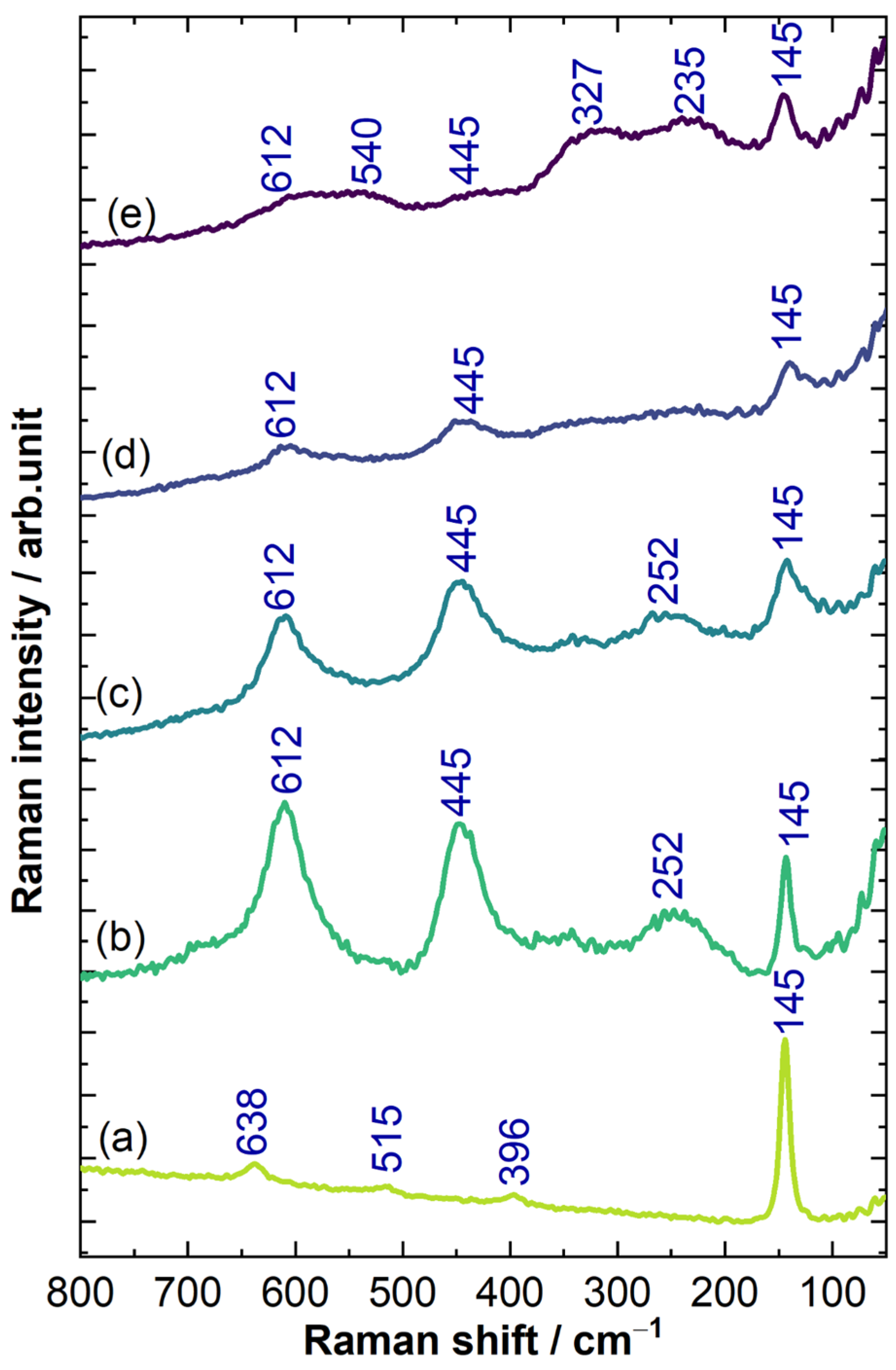
The formed Magnéli phases are confined to only a few surface layers and, as it constitutes only a fraction of the volume, do not appear in standard XR(P)D. Therefore, although XRD is the method of choice for identifying Ti oxide phases, in this specific case, the oxide layer formed on the surface of the Ti mesh is more suitably characterized using micro-Raman spectroscopy. Under the applied experimental conditions, the Raman laser spot size was only about 2 µm. Therefore, the spectra shown in Figure 2 were recorded at ten randomly selected spots and subsequently averaged to obtain more representative results, since the thickness of the formed oxide layer is not necessarily uniform across the sample.
As is well known, Ti, Ti2O, and TiO are generally Raman inactive, and the phases themselves do not exhibit any distinguishable Raman bands. On the other hand, TiO2, in all its polymorphic forms (anatase, rutile, and brookite), shows well-defined Raman bands in the spectra. Anatase exhibits six allowed vibrational modes that appear at 145 (Eg), 197 (Eg), 396 (B1g), 515 (A1g), 519 (B1g), and 638 cm−1 (Eg) [33]. All these bands are clearly visible in the averaged spectrum of the TiOx@Ti sample. Thermal treatment at 630 °C in 5% H2/Ar results in a decrease of the anatase peak intensities, leaving only the strongest peak at 145 cm−1 detectable, while new peaks appear at 612, 445, and 252 cm−1. Bulk anatase typically begins to transform irreversibly into rutile in air at temperatures ranging from 400 °C to 1200 °C, depending on the measurement methods, raw materials, and processing conditions. The anatase-to-rutile transformation is reconstructive, meaning it involves the breaking and reforming of bonds, and is therefore time dependent [34].
Rutile exhibits four Raman-active fundamental modes: B1g at 143 cm−1, Eg at 447 cm−1, A1g at 612 cm−1, and B2g at 826 cm−1. The B1g mode is very weak and nearly overlaps with the strong Eg mode of anatase at 144 cm−1, but the characteristic rutile peaks at 447 cm−1 and 612 cm−1 are well separated from anatase signals and can be clearly identified. In addition, a broad band around 237 cm−1 appears in the rutile spectrum, arising from a second-order Raman effect. Therefore, the Raman spectrum of the TSO630@Ti surface indicates that the phase transformation from anatase to rutile has occurred. With increasing treatment temperature, there is a notable decrease in the intensity of the peaks characteristic of rutile. At 950 °C, the rutile peaks almost disappear, and new peaks of low intensity at 540, 327, and 235 cm−1 appear. Interestingly, the peak at 145 cm−1 retains a similar intensity at temperatures between 750 and 950 °C. According to the literature, the Magnéli phase Ti4O7 exhibits a characteristic prominent peak at 138 cm−1, along with several additional peaks of lower intensity [35]. Therefore, heating in a reducing atmosphere leads to the formation of Magnéli phases at temperatures above 750 °C, appearing alongside the rutile phase, whose contribution gradually decreases with increasing temperature.
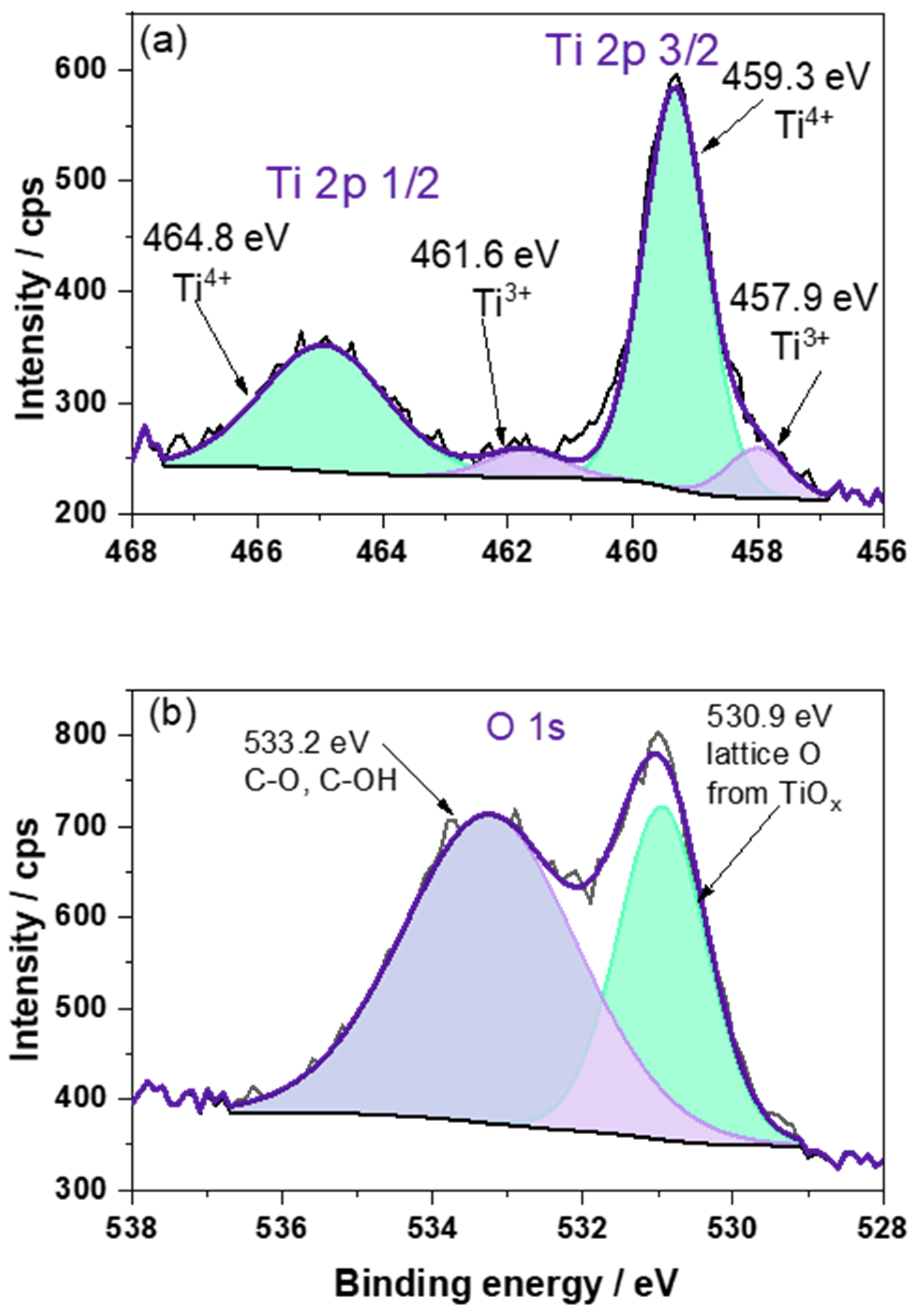
XPS measurements were conducted to identify atomic states at the surface of TSO950@Ti (Figure 3). Oxygen and titanium signals confirm the presence of Ti-containing species on the surface, consistent with the expected composition of treated materials. Importantly, no signals corresponding to other elements were observed, suggesting the absence of detectable impurities.
The high-resolution Ti 2p spectrum, which displays a characteristic spin–orbit doublet, can be deconvoluted into four peaks belonging to two distinct chemical states. The peaks at 459.3 eV (Ti 2p 3/2) and 464.9 eV (Ti 2p 1/2) are assigned to Ti4+, while the peaks at 457.9 eV (Ti 2p 3/2) and 461.6 eV (Ti 2p 1/2) correspond to Ti3+ species [36,37]. Quantitative analysis indicates that the surface titanium is mainly present as Ti4+ (88.8% of total Ti signal), with a smaller contribution from Ti3+ (11.2% of total Ti signal). The detection of a Ti3+ component points to partial reduction of titanium, commonly linked to oxygen deficiency or non-stoichiometric oxide phases. These Ti3+ species are known to introduce localized states near the conduction band, which can improve charge transport and/or catalytic activity [38]. The simultaneous presence of Ti4+ and Ti3+ thus reveals a mixed valence surface chemistry, suggesting that the material is oxygen deficient rather than perfectly stoichiometric [39], a further indication for the T4O7 formation at 950 °C, as concluded from micro-Raman measurements. Ti3+ formation can be further supported by the broadening of the Raman peak at 145 cm−1 [40]. Fitting of the O1s signal indicated two dominant peaks at 530.9 eV and 533.2 eV, corresponding to lattice-bound oxygen (Ti-O) and surface-bound oxygen in hydroxyl groups, respectively, with the latter formed during storage in air before XPS measurements [41,42].

3.2. Electrochemistry of TSO@Ti Mesh

Quantification of the surface area available for reaction, whose geometric surface area cannot be accurately measured, was performed by estimating the ECSA. The ECSA values are given in Table 1.
The obtained surface values decrease with increasing reduction treatment temperature from 9.3 cm2 for the sample with freshly oxidized surface (TiOx@Ti) to just over 1.1 cm2 for the two TSO@Ti samples obtained at the highest temperatures of 850 and 950 °C (Table 1). The results seem to quantify what is seen in SEM images, i.e., going from a rippled surface to a smooth one, which is associated with the reduction in thickness of the oxygen-rich layer and formation of the thin new phase.
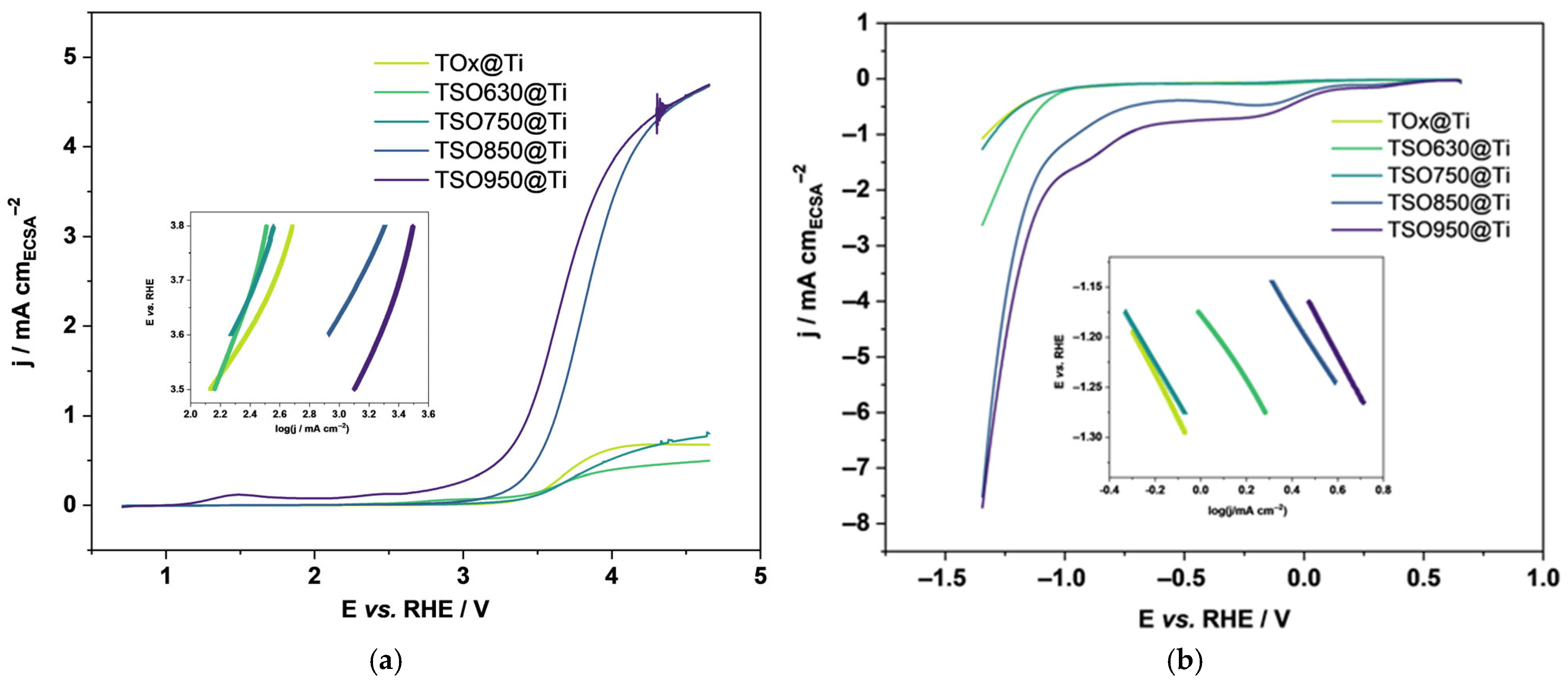
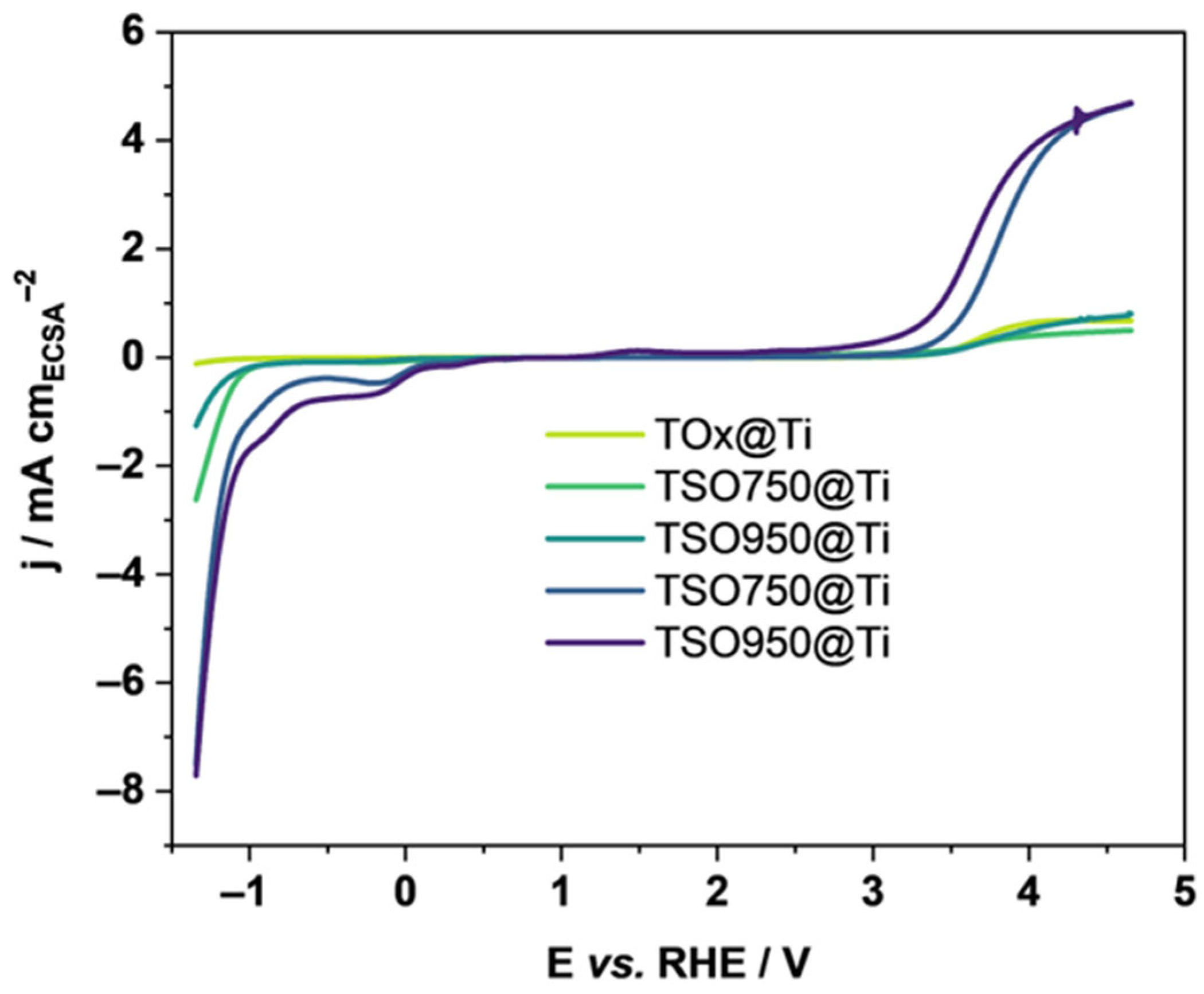
With the intent of using the prepared samples in pollutant degradation, measurements were focused on their properties in neutral aqueous solution (1 M Na2SO4), as this is the closest to a probable, scalable, real scenario. To obtain meaningful results, the currents were normalized to the ECSA obtained from CV measurements. Linear sweep voltammetry from 0.6–4.6 V vs. RHE was used to assess the OER activity, as shown in Figure 4. Onset potentials for OER are listed in Table 1 and show a slight positive shift of 100 mV in total upon high-temperature reduction, changing from 3.40 to 3.30 V vs. RHE. The shift is indicative of the formation of a more active phase for oxygen evolution. Higher activity is also followed by sevenfold higher current densities, which is of utmost importance in pollutant degradation. Concurrently, potentials for OER are above those needed for OH* radical (2.8 vs. RHE) [43] and sulfate radical SO4* (2.5–3 V vs. RHE) formation [39], indicating that the materials studied here should have high efficiency because parallel water splitting should be minimized.
Tafel slopes were calculated for OER (Figure 4a, Table 1) to estimate material activity toward these dominant, but essentially side reactions, in pollutant treatment. For OER, an increase in temperature from 630 °C to 850 °C led to a decrease in Tafel slope, which equates to more undesired oxygen evolution, which is not ideal, but with Tafel slope values that are still sufficiently high to avoid excessive OER. Treatment at 950 °C yielded a reversal in this trend with a higher Tafel slope, which indicates a lower current rise with increasing potential. This is in line with environmental application and prompted us to focus on TSO950@Ti as a best candidate for pollutant degradation. Still, the increase in the slope could also be explained by excessive oxygen evolution over the surface [44,45]. Theoretical work [46] rationalizes high Tafel slope values through a strong metal-oxygen bond and low values of transfer coefficient (b). It is reasonable to expect strong metal–oxygen bonding in our catalyst, especially at high overpotential values of 2.5–4.5 V vs. RHE, as well as low transfer coefficients due to the resistance of the metal oxide layer.
Different materials for pollutant degradation that are also based on titanium or Boron-doped diamond (BDD) show similarly high Tafel slope values [44,45,47,48] attributed to the surface redox couples/functional groups, which act as barriers for OER. Electrochemical impedance spectroscopy was employed to ascertain charge transfer resistances at these positive potentials, with results given in Table 1. Almost identical values of charge transfer resistances are seen for samples treated at higher temperatures, fitting well with the LSV data and reiterating that samples treated at 850 and 950 °C present interesting candidates for pollutant degradation or as a support role for other catalysts.
Cathodic hydrogen evolution (Figure 4b) occurs in parallel to pollutant degradation and/or OER, which can be used as a source of clean H2, but might also be adding to the degradation of pollutants [49,50]. At sufficient negative potentials, strongly reducing H* forms, which can dehalogenate pollutants and aid the cleaning process [50], are often overlooked in electro-degradation analysis. The TSO examined here can also serve to generate H* as the hydrogen reduction potential lies in the ideal range, between −0.2 and −1.2 V vs. RHE and 0.5–5 mA cm−2 [50], which is sufficiently negative to favor H* formation but not so negative as to favor H2 evolution. Similarly, in the case of OER, samples treated at 850 and 950 °C also exhibit five- to sevenfold higher current densities in HER, indicating higher activity of the TSO phase formed at these temperatures. Tafel slopes for HER (Table 1) are in the range of 340–380 mV dec−1 for all high-temperature-treated samples, which is close to those reported for titanium-based electrodes [51,52]. High Tafel slope values can be partially attributed to the surface rearrangement, as the surface is not potential independent [53], and limited diffusion due to gas bubble formation.
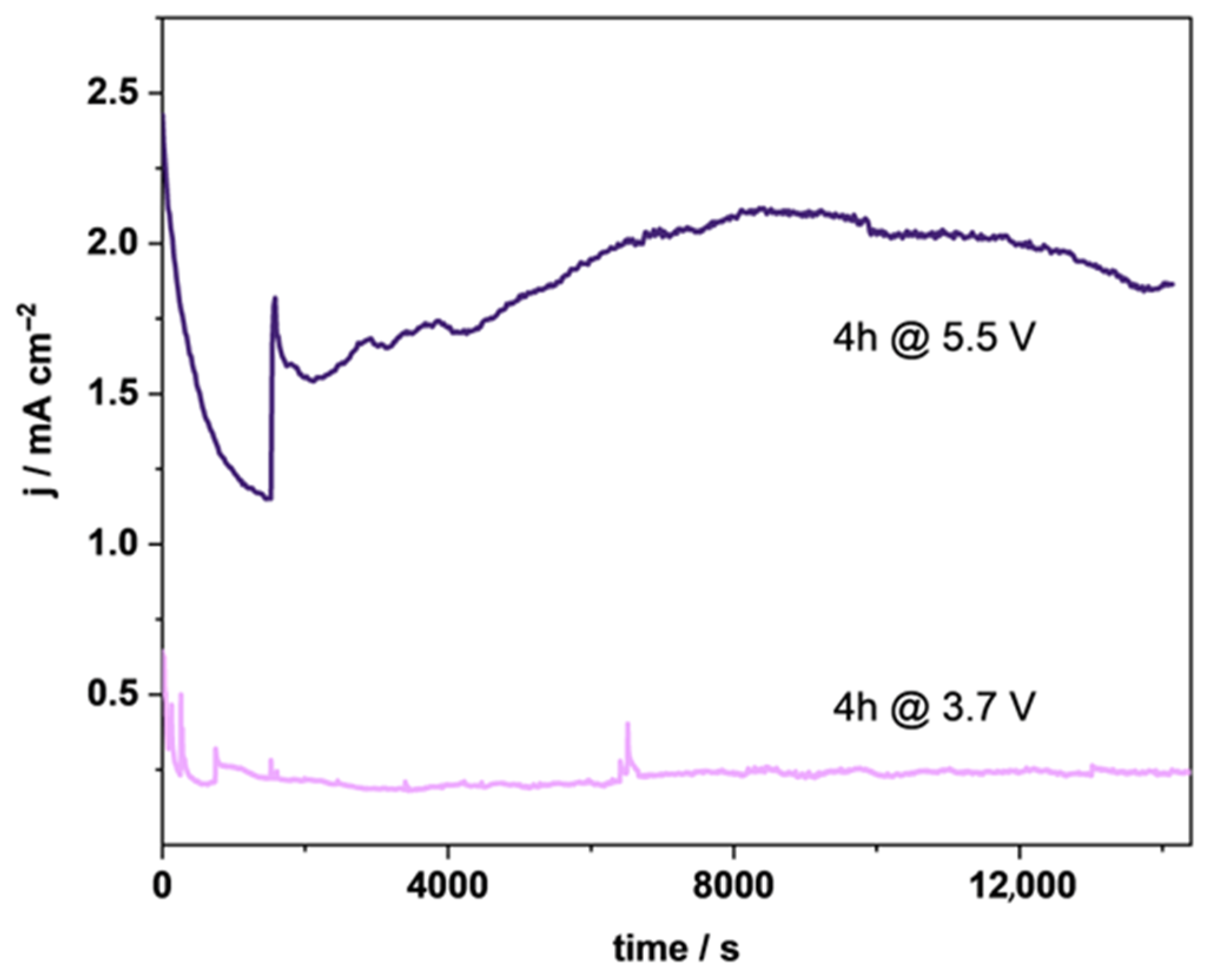
The stability of TSO950@Ti under oxygen evolution conditions was tested at two potential values (3.7 V and 5.5 V vs. RHE), as shown in Figure 5. After the initial current drop (≈0.3j0), the electrode current leveled off around 0.25 mA/cm2 (at 3.7 V) and around 2 mA/cm2 (at 5.5 V) with intermittent current spikes. This is attributed to the expulsion of larger bubbles from the mesh, resulting in an increase in surface availability for the reaction. The absence of a decrease in current within 4 h of measurements points to the good stability of the surface TSO layer and its stability to catalyze oxygen evolution without structural change, as known to occur at higher potential, which leads to a decrease in activity [54,55].
A wide potential window, above 4 V (Figure 6), shows that TSO950 and TSO850@Ti can fulfil both roles, i.e., H* generation at the cathode and OH* and SO4* generation at the anode, which is essential in modern and efficient systems. High Tafel slope and good stability of surface modified titanium mesh suggest that it can serve as an excellent anode for pollutant degradation as measured for similar materials [42,56]. The ease of electrode preparation and their bifunctionality put them forward as promising materials for wastewater treatment.

4. Conclusions

Surface oxidation of Ti mesh followed by high-temperature reduction successfully produced surface titanium suboxide with positively shifted activity toward OER. Micro-Raman and XPS spectroscopies confirmed the formation of a thin Ti4O7 layer on the titanium surface for meshes treated at 850 and 950 °C. Onset potentials for OER (≈3.3 V vs. RHE) were close to those for OH* and SO4* formation, indicating potentially lower unwanted current usage for side reactions. Hydrogen evolution potentials and current densities (≈−1.2 V vs. RHE and 2–3 mA cm−2) lie in the ideal potential range for H* radical formation, which is known to be essential for dehalogenation of pollutant molecules. TSO prepared at 850 and 950 °C presents bifunctional behavior, functioning as both cathode/anode in pollutant degradation due to its activity, stability, and the ability to form both OH*/SO4* at the anode and H* at the cathode.

Author Contributions

Conceptualization, M.M.-R. and N.G.; methodology, M.R. and A.J.; software, B.N.V.; validation, A.J.L. and N.G.; formal analysis, M.R. and A.J.L.; investigation, M.R., A.J., L.R., D.B.-B. and N.G.; writing—original draft preparation, M.M.-R., D.B.-B. and N.G.; writing—review and editing, M.M.-R., D.B.-B. and N.G.; visualization, N.G.; project administration, B.N.V.; funding acquisition, M.M.-R. All authors have read and agreed to the published version of the manuscript.

Funding

This research was funded by the Science Fund of the Republic of Serbia (Grant No 17990, Advanced electrochemical treatment of PFAS contaminated water: Novel Materials and Mechanisms–ALTER) and supported by the Ministry of Science, Technological Development and Innovation of the Republic of Serbia (Grant Nos 451-03-137/2025-03/200146, 451-03-136/2025-03/200146, 451-03-137/2025-03/200161, and 451-03-136/2025-03/200017).

Institutional Review Board Statement

Not applicable.

Informed Consent Statement

Not applicable.

Data Availability Statement

The original data presented in the study are openly available at https://doi.org/10.5281/zenodo.18303945.

Conflicts of Interest

The authors declare no conflicts of interest.

References

  1. Hou, J.; Ning, Y.; Guo, K.; Jiao, W.; Chen, C.; Zhang, B.; Wu, X.; Zhao, J.; Lin, D.; Sun, S. Application of Metal-Organic Framework Materials in Supercapacitors. J. Energy Storage 2025, 113, 115535. [Google Scholar] [CrossRef]
  2. Mondaca-Medina, E.; García-Carrillo, R.; Lee, H.; Wang, Y.; Zhang, H.; Ren, H. Nanoelectrochemistry in Electrochemical Phase Transition Reactions. Chem. Sci. 2023, 14, 7611–7619. [Google Scholar] [CrossRef] [PubMed]
  3. Ranković, M.; Gavrilov, N.; Jevremović, A.; Janošević Ležaić, A.; Rakić, A.; Bajuk-Bogdanović, D.; Milojević-Rakić, M.; Ćirić-Marjanović, G. Highly Efficient Electrochemical Degradation of Dyes via Oxygen Reduction Reaction Intermediates on N-Doped Carbon-Based Composites Derived from ZIF-67. Processes 2025, 14, 130. [Google Scholar] [CrossRef]
  4. Impemba, S.; Provinciali, G.; Filippi, J.; Caporali, S.; Muzzi, B.; Casini, A.; Caporali, M. Tightly Interfaced Cu2O with In2O3 to Promote Hydrogen Evolution in Presence of Biomass-Derived Alcohols. ChemNanoMat 2024, 10, e202400459. [Google Scholar] [CrossRef]
  5. Impemba, S.; Provinciali, G.; Filippi, J.; Salvatici, C.; Berretti, E.; Caporali, S.; Banchelli, M.; Caporali, M. Engineering the Heterojunction between TiO2 and In2O3 for Improving the Solar-Driven Hydrogen Production. Int. J. Hydrogen Energy 2024, 63, 896–904. [Google Scholar] [CrossRef]
  6. Diglio, M.; Contento, I.; Impemba, S.; Berretti, E.; Della Sala, P.; Oliva, G.; Naddeo, V.; Caporali, S.; Primo, A.; Talotta, C.; et al. Hydrogen Production from Formic Acid Decomposition Promoted by Gold Nanoparticles Supported on a Porous Polymer Matrix. Energy Fuels 2025, 39, 14320–14329. [Google Scholar] [CrossRef]
  7. Mancuso, A.; Diglio, M.; Impemba, S.; Venditto, V.; Vaiano, V.; Buonerba, A.; Sacco, O. Dual-Function Bare Copper Oxide (Photo)Catalysts for Selective Phenol Production via Benzene Hydroxylation and Low-Temperature Hydrogen Generation from Formic Acid. Catalysts 2025, 15, 866. [Google Scholar] [CrossRef]
  8. Oturan, M.A.; Aaron, J.-J. Advanced Oxidation Processes in Water/Wastewater Treatment: Principles and Applications. A Review. Crit. Rev. Environ. Sci. Technol. 2014, 44, 2577–2641. [Google Scholar] [CrossRef]
  9. Schaefer, C.E.; Andaya, C.; Burant, A.; Condee, C.W.; Urtiaga, A.; Strathmann, T.J.; Higgins, C.P. Electrochemical Treatment of Perfluorooctanoic Acid and Perfluorooctane Sulfonate: Insights into Mechanisms and Application to Groundwater Treatment. Chem. Eng. J. 2017, 317, 424–432. [Google Scholar] [CrossRef]
  10. Martínez-Huitle, C.A.; Panizza, M. Electrochemical Oxidation of Organic Pollutants for Wastewater Treatment. Curr. Opin. Electrochem. 2018, 11, 62–71. [Google Scholar] [CrossRef]
  11. Mousset, E.; Oturan, N.; Oturan, M.A. An Unprecedented Route of OH Radical Reactivity Evidenced by an Electrocatalytical Process: Ipso-Substitution with Perhalogenocarbon Compounds. Appl. Catal. B 2018, 226, 135–146. [Google Scholar] [CrossRef]
  12. Salazar, R.; Ureta-Zañartu, M.S.; González-Vargas, C.; do Nascimento Brito, C.; Martinez-Huitle, C.A. Electrochemical Degradation of Industrial Textile Dye Disperse Yellow 3: Role of Electrocatalytic Material and Experimental Conditions on the Catalytic Production of Oxidants and Oxidation Pathway. Chemosphere 2018, 198, 21–29. [Google Scholar] [CrossRef] [PubMed]
  13. Duinslaeger, N.; Doni, A.; Radjenovic, J. Impact of Supporting Electrolyte on Electrochemical Performance of Borophene-Functionalized Graphene Sponge Anode and Degradation of per- and Polyfluoroalkyl Substances (PFAS). Water Res. 2023, 242, 120232. [Google Scholar] [CrossRef] [PubMed]
  14. Arif, A.F.; Balgis, R.; Ogi, T.; Iskandar, F.; Kinoshita, A.; Nakamura, K.; Okuyama, K. Highly Conductive Nano-Sized Magnéli Phases Titanium Oxide (TiOx). Sci. Rep. 2017, 7, 3646. [Google Scholar] [CrossRef]
  15. Walsh, F.C.; Wills, R.G.A. The Continuing Development of Magnéli Phase Titanium Sub-Oxides and Ebonex® Electrodes. Electrochim. Acta 2010, 55, 6342–6351. [Google Scholar] [CrossRef]
  16. Gusev, A.A.; Avvakumov, E.G.; Medvedev, A.Z.H.; Masliy, A.I. Ceramic Electrodes Based on Magneli Phases of Titanium Oxides. Sci. Sinter. 2007, 39, 51–57. [Google Scholar] [CrossRef]
  17. Smith, J.R.; Walsh, F.C.; Clarke, R.L. Electrodes Based on Magnéli Phase Titanium Oxides: The Properties and Applications of Ebonex® Materials. J. Appl. Electrochem. 1998, 28, 1021–1033. [Google Scholar] [CrossRef]
  18. Ioroi, T.; Senoh, H.; Yamazaki, S.; Siroma, Z.; Fujiwara, N.; Yasuda, K. Stability of Corrosion-Resistant Magnéli-Phase Ti4O7-Supported PEMFC Catalysts at High Potentials. J. Electrochem. Soc. 2008, 155, B321. [Google Scholar] [CrossRef]
  19. Tao, X.; Wang, J.; Ying, Z.; Cai, Q.; Zheng, G.; Gan, Y.; Huang, H.; Xia, Y.; Liang, C.; Zhang, W.; et al. Strong Sulfur Binding with Conducting Magnéli-Phase TinO2n−1 Nanomaterials for Improving Lithium–Sulfur Batteries. Nano Lett. 2014, 14, 5288–5294. [Google Scholar] [CrossRef]
  20. Pang, Q.; Kundu, D.; Cuisinier, M.; Nazar, L.F. Surface-Enhanced Redox Chemistry of Polysulphides on a Metallic and Polar Host for Lithium-Sulphur Batteries. Nat. Commun. 2014, 5, 4759. [Google Scholar] [CrossRef]
  21. Scialdone, O.; Randazzo, S.; Galia, A.; Filardo, G. Electrochemical Oxidation of Organics at Metal Oxide Electrodes: The Incineration of Oxalic Acid at IrO2–Ta2O5 (DSA-O2) Anode. Electrochim. Acta 2009, 54, 1210–1217. [Google Scholar] [CrossRef]
  22. Radjenovic, J.; Sedlak, D.L. Challenges and Opportunities for Electrochemical Processes as Next-Generation Technologies for the Treatment of Contaminated Water. Environ. Sci. Technol. 2015, 49, 11292–11302. [Google Scholar] [CrossRef] [PubMed]
  23. Wang, Z.; Qiu, K. Electrocatalytic Oxidation of Formic Acid on Platinum Nanoparticle Electrode Deposited on the Nichrome Substrate. Electrochem. Commun. 2006, 8, 1075–1081. [Google Scholar] [CrossRef]
  24. Nayak, S.; Chaplin, B.P. Fabrication and Characterization of Porous, Conductive, Monolithic Ti4O7 Electrodes. Electrochim. Acta 2018, 263, 299–310. [Google Scholar] [CrossRef]
  25. Guo, L.; Jing, Y.; Chaplin, B.P. Development and Characterization of Ultrafiltration TiO2 Magnéli Phase Reactive Electrochemical Membranes. Environ. Sci. Technol. 2016, 50, 1428–1436. [Google Scholar] [CrossRef]
  26. Xu, B.; Sohn, H.Y.; Mohassab, Y.; Lan, Y. Structures, Preparation and Applications of Titanium Suboxides. RSC Adv. 2016, 6, 79706–79722. [Google Scholar] [CrossRef]
  27. Miller-Folk, R.R.; Noftle, R.E.; Pletcher, D. Electron Transfer Reactions at Ebonex Ceramic Electrodes. J. Electroanal. Chem. Interfacial Electrochem. 1989, 274, 257–261. [Google Scholar] [CrossRef]
  28. Toyoda, M.; Yano, T.; Tryba, B.; Mozia, S.; Tsumura, T.; Inagaki, M. Preparation of Carbon-Coated Magneli Phases TinO2n−1 and Their Photocatalytic Activity under Visible Light. Appl. Catal. B 2009, 88, 160–164. [Google Scholar] [CrossRef]
  29. Vojnović, V.; Ranković, M.; Jevremović, A.; Mijailović, N.R.; Nedić Vasiljević, B.; Milojević-Rakić, M.; Bajuk-Bogdanović, D.; Gavrilov, N. Doping of Magnéli Phase—New Direction in Pollutant Degradation and Electrochemistry. Molecules 2025, 30, 4282. [Google Scholar] [CrossRef]
  30. Wang, G.; Liu, Y.; Ye, J.; Qiu, W. Synthesis, Microstructural Characterization, and Electrochemical Performance of Novel Rod-like Ti4O7 Powders. J. Alloys Compd. 2017, 704, 18–25. [Google Scholar] [CrossRef]
  31. Portehault, D.; Maneeratana, V.; Candolfi, C.; Oeschler, N.; Veremchuk, I.; Grin, Y.; Sanchez, C.; Antonietti, M. Facile General Route toward Tunable Magnéli Nanostructures and Their Use As Thermoelectric Metal Oxide/Carbon Nanocomposites. ACS Nano 2011, 5, 9052–9061. [Google Scholar] [CrossRef] [PubMed]
  32. Zhang, X.; Liu, Y.; Ye, J.; Zhu, R. Fabrication of Ti4O7 Electrodes by Spark Plasma Sintering. Mater. Lett. 2014, 114, 34–36. [Google Scholar] [CrossRef]
  33. Ohsaka, T. Temperature Dependence of the Raman Spectrum in Anatase TiO2. J. Phys. Soc. Jpn. 1980, 48, 1661–1668. [Google Scholar] [CrossRef]
  34. Hanaor, D.A.H.; Sorrell, C.C. Review of the Anatase to Rutile Phase Transformation. J. Mater. Sci. 2011, 46, 855–874. [Google Scholar] [CrossRef]
  35. Pichon, L.; Rekik, H.; Arab, H.; Drogui, P.; El Khakani, M.A. High Photothermal Conversion Efficiency of RF Sputtered Ti4O7 Magneli Phase Thin Films and Its Linear Correlation with Light Absorption Capacity. Sci. Rep. 2024, 14, 30981. [Google Scholar] [CrossRef]
  36. Malik, H.; Sarkar, S.; Mohanty, S.; Carlson, K. Modelling and Synthesis of Magnéli Phases in Ordered Titanium Oxide Nanotubes with Preserved Morphology. Sci. Rep. 2020, 10, 8050. [Google Scholar] [CrossRef]
  37. Li, X.; Zhu, A.L.; Qu, W.; Wang, H.; Hui, R.; Zhang, L.; Zhang, J. Magneli Phase Ti4O7 Electrode for Oxygen Reduction Reaction and Its Implication for Zinc-Air Rechargeable Batteries. Electrochim. Acta 2010, 55, 5891–5898. [Google Scholar] [CrossRef]
  38. Yu, X.; Wang, K.; Wang, X. Electrochemical Oxidation of Phenol in Chloride Containing Electrolyte Using a Carbon-Coated Ti4O7 Anode. Electrochim. Acta 2023, 449, 142233. [Google Scholar] [CrossRef]
  39. Biesinger, M.C.; Lau, L.W.M.; Gerson, A.R.; Smart, R.S.C. Resolving Surface Chemical States in XPS Analysis of First Row Transition Metals, Oxides and Hydroxides: Sc, Ti, V, Cu and Zn. Appl. Surf. Sci. 2010, 257, 887–898. [Google Scholar] [CrossRef]
  40. Cai, J.; Zhou, M.; Pan, Y.; Du, X.; Lu, X. Extremely Efficient Electrochemical Degradation of Organic Pollutants with Co-Generation of Hydroxyl and Sulfate Radicals on Blue-TiO2 Nanotubes Anode. Appl. Catal. B 2019, 257, 117902. [Google Scholar] [CrossRef]
  41. Kim, M.; Choi, J.; Lee, W.; Ahn, Y.-Y.; Lee, H.; Cho, K.; Lee, J. Performance of Magnéli Phase Ti4O7 and Ti3+ Self-Doped TiO2 as Oxygen Vacancy-Rich Titanium Oxide Anodes: Comparison in Terms of Treatment Efficiency, Anodic Degradative Pathways, and Long-Term Stability. Appl. Catal. B 2023, 337, 122993. [Google Scholar] [CrossRef]
  42. Zhao, L.; Wei, F.; Chen, T.; Tang, J.; Yang, L.; Jia, H.; Li, J.; Yao, J.; Liu, B. A Novel Synthetic Strategy of Mesoporous Ti4O7-Coated Electrode for Highly Efficient Wastewater Treatment. Ceram. Int. 2024, 50, 26503–26512. [Google Scholar] [CrossRef]
  43. Brillas, E.; Sirés, I. Electro-Fenton Process for the Degradation of Organic Pollutants in Water. In Encyclopedia of Applied Electrochemistry; Springer: New York, NY, USA, 2014; pp. 696–702. [Google Scholar]
  44. Beck, F.; Krohn, H.; Kaiser, W.; Fryda, M.; Klages, C.P.; Schäfer, L. Boron Doped Diamond/Titanium Composite Electrodes for Electrochemical Gas Generation from Aqueous Electrolytes. Electrochim. Acta 1998, 44, 525–532. [Google Scholar] [CrossRef]
  45. Kaluđerović, M.; Savić, S.; Bajuk-Bogdanović, D.; Jovanović, A.Z.; Rakočević, L.; Vlahović, F.; Milikić, J.; Stanković, D. Samarium-Doped PbO2 Electrocatalysts for Environmental and Energy Applications: Theoretical Insight into the Mechanisms of Action Underlying Their Carbendazim Degradation and OER Properties. Processes 2025, 13, 1459. [Google Scholar] [CrossRef]
  46. Antipin, D.; Risch, M. Calculation of the Tafel Slope and Reaction Order of the Oxygen Evolution Reaction between PH 12 and PH 14 for the Adsorbate Mechanism. Electrochem. Sci. Adv. 2023, 3, e2100213. [Google Scholar] [CrossRef]
  47. García-Osorio, D.A.; Jaimes, R.; Vazquez-Arenas, J.; Lara, R.H.; Alvarez-Ramirez, J. The Kinetic Parameters of the Oxygen Evolution Reaction (OER) Calculated on Inactive Anodes via EIS Transfer Functions: OH Formation. J. Electrochem. Soc. 2017, 164, E3321–E3328. [Google Scholar] [CrossRef]
  48. Kapałka, A.; Fóti, G.; Comninellis, C. Determination of the Tafel Slope for Oxygen Evolution on Boron-Doped Diamond Electrodes. Electrochem. Commun. 2008, 10, 607–610. [Google Scholar] [CrossRef]
  49. Zhao, Z.; Yao, X.; Zhang, L.; Yu, R.; Xu, Y.; Chu, Y.; Mao, X.; Zheng, H. Electrocatalytic Dehalogenation in the Applications of Organic Synthesis and Environmental Degradation. EcoEnergy 2024, 2, 83–113. [Google Scholar] [CrossRef]
  50. Guo, Y.; Li, Y.; Wang, Z. Electrocatalytic Hydro-Dehalogenation of Halogenated Organic Pollutants from Wastewater: A Critical Review. Water Res. 2023, 234, 119810. [Google Scholar] [CrossRef]
  51. Li, X.; Xue, Y.; Dehoff, R.; Tsouris, C.; Taboada-Serrano, P. Hierarchically-Structured Ti/TiO2 Electrode for Hydrogen Evolution Synthesized via 3D Printing and Anodization. J. Energy Power Technol. 2020, 2, 007. [Google Scholar] [CrossRef]
  52. Łukasik, N.; Roda, D.; de Oliveira, M.A.; Silva Barros, B.; Kulesza, J.; Łapiński, M.; Świątek, H.; Ilnicka, A.; Klimczuk, T.; Szkoda, M. Hydrogen Evolution Reaction Catalyzed by Co-Based Metal-Organic Frameworks and Their Derivatives. Int. J. Hydrogen Energy 2024, 92, 90–101. [Google Scholar] [CrossRef]
  53. Wan, C.; Ling, Y.; Wang, S.; Pu, H.; Huang, Y.; Duan, X. Unraveling and Resolving the Inconsistencies in Tafel Analysis for Hydrogen Evolution Reactions. ACS Cent. Sci. 2024, 10, 658–665. [Google Scholar] [CrossRef]
  54. Chen, G.; Bare, S.R.; Mallouk, T.E. Development of Supported Bifunctional Electrocatalysts for Unitized Regenerative Fuel Cells. J. Electrochem. Soc. 2002, 149, A1092–A1099. [Google Scholar] [CrossRef]
  55. Wei, W.; Yuan, T.; Ye, J. Recent Progress in Electrochemical Application of Magnéli Phase Ti4O7-Based Materials: A Review. J. Mater. Sci. 2023, 58, 14911–14944. [Google Scholar] [CrossRef]
  56. Kislyi, A.; Moroz, I.; Guliaeva, V.; Prokhorov, Y.; Klevtsova, A.; Mareev, S. Electrochemical Oxidation of Organic Pollutants in Aqueous Solution Using a Ti4O7 Particle Anode. Membranes 2023, 13, 521. [Google Scholar] [CrossRef]
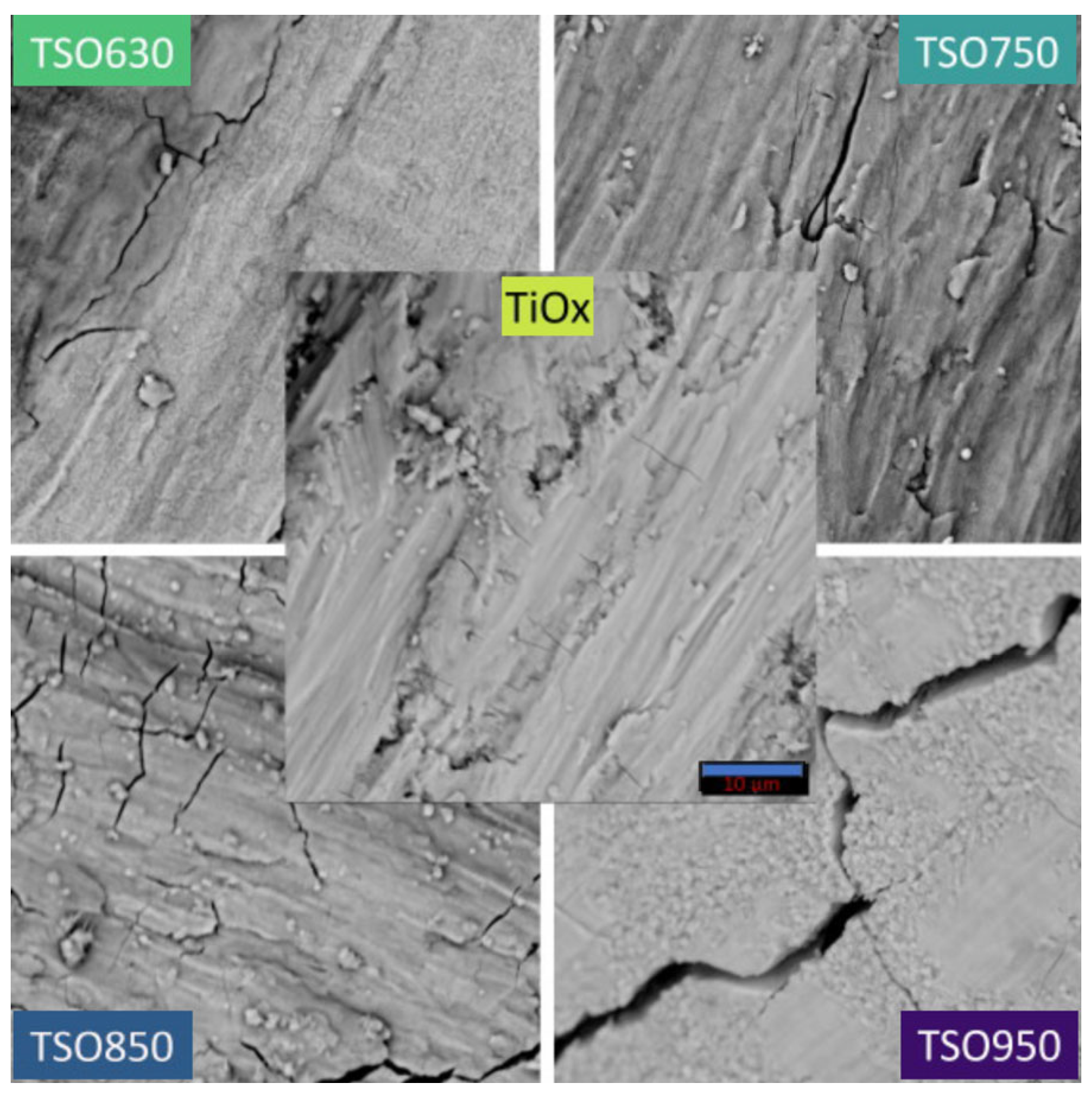
Figure 1. SEM images of titanium mesh, treated with oxalic acid (TiOx@Ti) and reduced in 5% H2 in Ar (TSO@Ti) at 630–950 °C. The scale bar in the central panel applies to all images.
Processes 14 00518 g001
Figure 2. Raman spectra of (a) TiOx@Ti, (b) TSO630@Ti, (c) TSO750@Ti, (d) TSO850@Ti, and (e) TSO950@Ti.
Processes 14 00518 g002
Figure 3. Deconvoluted high-resolution XPS spectra of TSO950@Ti: (a) Ti 2p and (b) O 1s.
Processes 14 00518 g003
Figure 4. (a) OER and (b) HER activity with inserted Tafel slopes for TSO@Ti electrodes.
Processes 14 00518 g004
Figure 5. Stability testing of TSO950@Ti for the OER process at different potentials.
Processes 14 00518 g005
Figure 6. Potential window of studied materials in 1M Na2SO4.
Processes 14 00518 g006
Table 1. ECSA values and Tafel slopes for electrodes applied in OER and HER, with corresponding onset potentials and equivalent circuit resistances.
SampleECSA/
cm2
Tafel SlopesOnset
Potential/V
Rct (EIS)/Ohm
OER/mV dec−1HER/mV dec−1
TSO950@Ti1.15577 ± 6370 ± 33.1829.1
TSO850@Ti1.10418 ± 7361 ± 23.2029.4
TSO750@Ti5.22630 ± 7385 ± 23.2529.0
TSO630@Ti7.35794 ± 3341 ± 23.2927.9
TiOx@Ti9.30640 ± 8439 ± 63.2846.0
Disclaimer/Publisher’s Note: The statements, opinions and data contained in all publications are solely those of the individual author(s) and contributor(s) and not of MDPI and/or the editor(s). MDPI and/or the editor(s) disclaim responsibility for any injury to people or property resulting from any ideas, methods, instructions or products referred to in the content.