Article

The Evolution Law of Molecular Structure of Vitrain and Durain During Low–Medium Coalification
1
College of Geology and Environment, Xi’an University of Science and Technology, Xi’an 710054, China
2
Research Institute of Exploration and Development, Changqing Oilfield Company, PetroChina, Xi’an 710018, China
3
National Key Laboratory of Coal and CBM Co-Mining Technology, Jincheng 048000, China
4
Shaanxi No. 131 Coalfield Geology Corporation Ltd., Hancheng 715400, China
*
Authors to whom correspondence should be addressed.
Processes 2026, 14(3), 401; https://doi.org/10.3390/pr14030401
Submission received: 31 December 2025 / Revised: 16 January 2026 / Accepted: 21 January 2026 / Published: 23 January 2026
(This article belongs to the Special Issue Phase Behavior Modeling in Unconventional Resources)

Abstract

Molecular structural disparities between maceral components are intrinsic factors governing their reactivity and physicochemical behaviors during storage and transportation. To investigate the molecular structural differentiation between vitrain and durain in low- to medium-rank coals (Ro,max = 0.65–1.71%), this study selected samples of long-flame coal and gas coal from the Huanglong Coalfield, coking coal from the Hedong Coalfield, and fat coal from the Weibei Coalfield. The microstructural variations in macroscopic coal components during coalification were analyzed using Fourier transform infrared spectroscopy (FTIR), 13C nuclear magnetic resonance (13C-NMR), and X-ray photoelectron spectroscopy (XPS). The results indicated that the aromatic structures of vitrain are predominantly trisubstituted, with their proportion consistently exceeding that in durain. In contrast, durain exhibits a progressive transition from trisubstituted to pentasubstituted aromatics with increasing coal rank, accompanied by higher aromaticity, condensation degree, and aromatic carbon content. The d002 size of the vitrain decreased from 3.82 to 3.47, while that of the durain decreased from 3.52 to 3.40. Both values showed a gradual decline, with the vitrain exhibiting a larger reduction than the durain. This indicates that the lateral extension of the microcrystalline structure in the durain is more developed, resulting in tighter molecular connections. 13C-NMR analysis further reveals that durain possesses higher falH/fal* and bridge carbon ratios (XBP), along with a lower faS/fa ratio, reflecting a greater degree of aromatic ring condensation. XPS analysis revealed that durain generally contains a higher oxygen-functional group content but lower C-C/C-H content compared to vitrain. Collectively, these findings confirm significant structural divergence between vitrain and durain during coalification, with durain exhibiting more developed aromaticity, structural condensation, and organizational order.

1. Introduction

During the transition away from fossil fuels, China’s relatively abundant coal reserves mean that its energy structure, dominated by coal [1], will not change in the short term. The country will continue to depend heavily on coal as its primary energy source. Therefore, it is crucial to leverage coal’s role as a primary energy source and a safety net in the process of achieving the dual carbon goals [2,3,4]. Efforts should focus on promoting the clean and efficient utilization of coal, advancing its conversion technologies, and innovating coal-based energy systems to support the development of a new energy landscape. From a chemical perspective, coal is composed of two main components: inorganic and organic matter. The organic component, which makes up the majority of coal, consists of high-molecular-weight compounds primarily made of elements such as carbon (C), oxygen (O), hydrogen (H), nitrogen (N), and sulfur (S). The molecular structural variations within coal are the primary determinants of its diverse physical and chemical properties, which, in turn, significantly influence the dynamics of coalbed methane production [5,6]. A comprehensive understanding of coal at the molecular level is thus essential for optimizing the extraction and utilization of coalbed methane, advancing both theoretical and practical applications in the field [7,8].
With the advent of technological advances, a broad spectrum of modern analytical techniques has been employed to unravel the molecular structural characteristics of coal, among which are 13-carbon nuclear magnetic resonance (13C-NMR), Fourier transform infrared spectroscopy (FTIR), X-ray photoelectron spectroscopy (XPS), and X-ray diffraction (XRD), notably including methods that provide complementary insights into both the chemical bonding environment and the microstructural organization. Li Xia et al. [9] investigated the variation in microcrystalline parameters in relation to coal rank, with a specific focus on the coalification leap transition. Their findings reveal that, in general, the microcrystalline parameters exhibit a clear trend: both Lc and La increase, whereas the d002 spacing decreases. This pattern suggests that, as coalification progresses, there is a significant enhancement in both the size and degree of condensation of the aromatic layers, reflecting a more advanced state of structural ordering. These results highlight the critical role of coal rank in influencing the structural evolution of coal during the coalification process. Yu Chun Mei et al. used FTIR to analyze bituminous coals, revealing that as coal rank increased, the relative abundance of aromatic hydrogen rose while aliphatic hydrogen content decreased [10]. Additionally, the number of aromatic rings in the coal structure increased, indicating a direct relationship between coal rank and the degree of aromaticity, shedding light on the structural evolution of coal during maturation. Li Wu et al. further demonstrated that with increasing vitrinite reflectance, the abundance of C-H groups and aliphatic/oxygenated functionalities in the vitrinite fraction progressively decreases, while the CH2/CH3 ratio initially declines and subsequently increases [11]. Zhou He et al. employed Fourier transform infrared spectroscopy, Raman spectroscopy, and X-ray diffraction to investigate the microstructural components of coal [12]. Their findings revealed that the aromatic structural parameters (fa, I, DOC) of the vitrinite fraction were consistently lower than those of the inertinite fraction. In contrast, the aliphatic side chain content was higher in the vitrinite fraction compared to inertinite. These observations suggest that the vitrinite fraction exhibits lower maturity and aromaticity relative to the inertinite fraction, yet it possesses a higher hydrocarbon potential. Vitrain is rich in vitrinite components, while durain is rich in inertinite components. Vitrinite/inertinite components belong to the microscopic components, while vitrain/durain belong to the macroscopic level. While much of the current research focuses on the influence of metamorphic grade on the molecular structure of coal, studies addressing the molecular characteristics of different macroscopic coal components remain relatively sparse [13,14].
The macroscopic components of coal-rock significantly affect methane adsorption and desorption behavior [15]. This influence arises from variations in coal surface properties and pore characteristics, which are fundamentally driven by the distinct molecular structures at the microscopic level [16,17]. In this study, coal samples representing different metamorphic grades were selected, and the separation of various macroscopic coal-rock components was subsequently performed to assess their individual contributions. By integrating FTIR, XRD, 13C NMR, and XPS analyses, this study performs a comprehensive molecular-level investigation of the elemental composition and structural heterogeneity of coal. Such an approach enables the elucidation of structure–property relationships and the characterization of associated kinetic behaviors, thereby deepening the fundamental understanding of coal molecular architecture. These insights provide a robust theoretical basis for advancing coalbed methane exploration and utilization strategies.

2. Materials and Methods

2.1. Coal Sample Preparation

The Huanglong Coalfield is situated in the Ordos Basin, characterized by a monoclinal structure inclined toward the northwest. The Liulin Shaqu No. 1 Coal Mine is located in the central section of the Hedong Coalfield and the southwestern part of the Liulin Mining District, featuring abundant resources and high-quality coal. The Hancheng area is situated in the eastern segment of the Weibei Uplift Zone at the southeastern margin of the Ordos Basin. The terrain in Hancheng is uneven, with slightly higher elevations in the northwest and slightly lower elevations in the southeast. The region exhibits diverse landforms, including mountains, plains, and river floodplains.
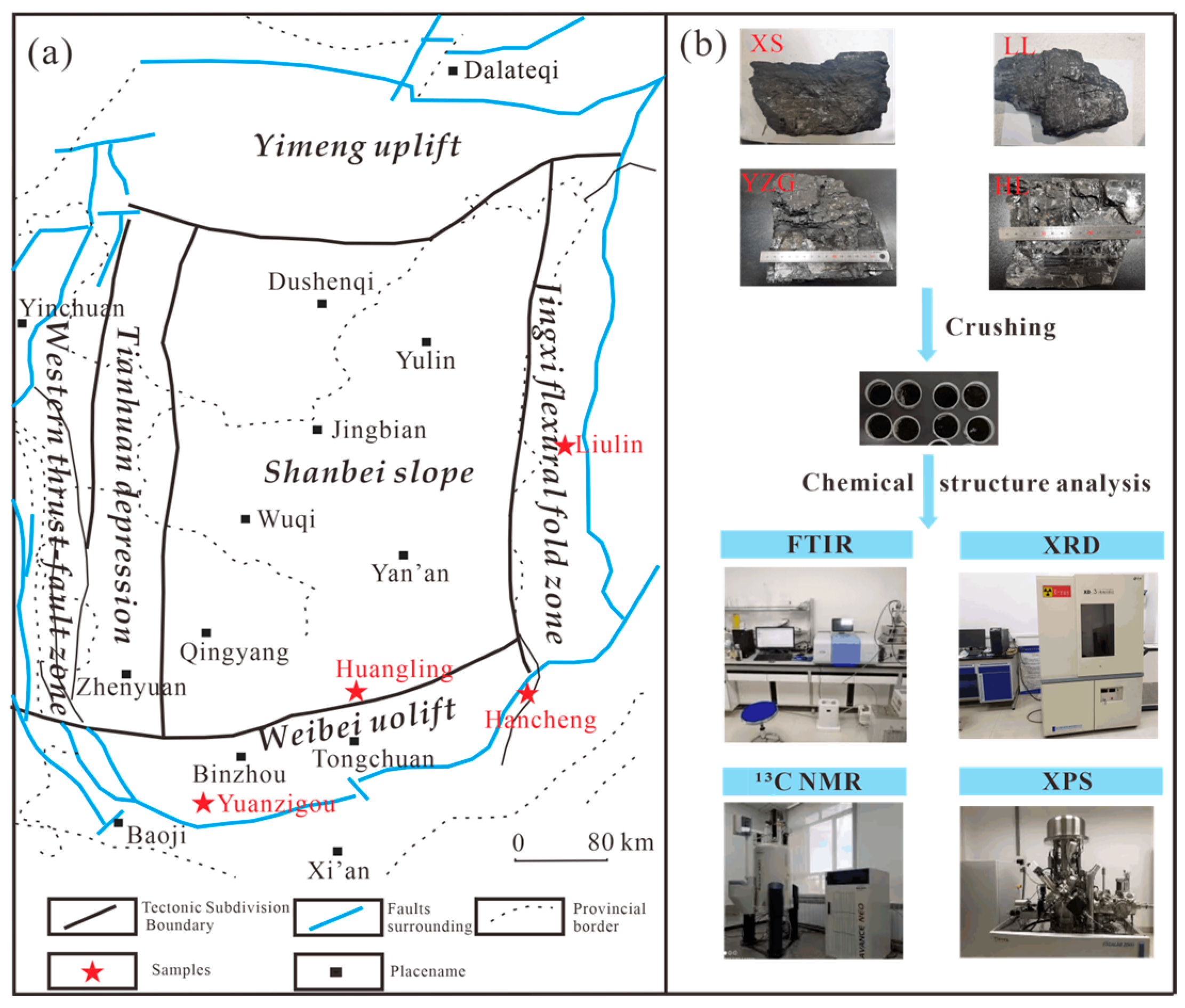
This study investigates long-flame coal and gas-producing coal from the Huanglong Coalfield, coking coal from the Hedong Coalfield, and fat coal from the Weibei Coalfield. Representative coal samples were collected from the Yuanzigou Mine in the Yonglong District and the Huangling No. 2 Mine in the Huangling District of the Huanglong Coalfield, the Liulin Shaqu No. 1 Mine in the Liliu District of the Hedong Coalfield, and the Xiangshan Mine in the Hancheng District of the Weibei Coalfield. The four coalfields under investigation exhibit distinct metamorphic stages corresponding to the various ranks of low- to medium-rank coals. At the working face of the coal mine in the sampling area, a geological hammer is employed to collect bulk coal samples of appropriate size. Based on the differences in color, luster, and fracture structure between vitrain and durain, the wire-cutting method is applied to the vitrain-rich bands and durain regions, labeled as YZG-VC, YZG-DC, HL-VC, HL-DC, LL-VC, LL-DC, XS-VC, and XS-DC, with their respective sampling locations depicted in Figure 1. Industrial analyses, elemental composition assessments, and vitrinite reflectance measurements were performed in accordance with the standards outlined in GB/T 212-2008 [18] (“Methods for Industrial Analysis of Coal”), GB/T 31391-2015 [19] (“Elemental Analysis of Coal”), and GB/T 6948-2008 [20] (“Microscopic Determination of Vitrinite Reflectance of Coal”).

2.2. Construction of References

2.2.1. Fourier Transform Infrared Spectroscopy Testing

The Fourier Transform Infrared spectroscopy (FTIR) analysis was conducted using a Bruker INVENIOS infrared spectrometer (Bruker Corporation, Karlsruhe, Germany), with a scanning range of 4000–400 cm−1 and a spectral resolution of 4.0 cm−1. Mineral-depleted semi-coke samples were dried with KBr in a vacuum oven (DZF-6050E, Wuxi Marite Technology Co., Ltd., WuXi, China) at 353 K for 8 h [21], followed by grinding in a mortar to achieve a 1:100 sample-to-KBr ratio. The resulting mixture was then compacted into circular pellets using the standard potassium bromide (KBr) pellet technique. Infrared spectra were subjected to peak fitting analysis utilizing dedicated software, with the corresponding peak positions presented in Table 1.

2.2.2. X-Ray Diffraction Testing

The X-ray diffraction (XRD) analysis was conducted using a Bruker D8 Advance X-ray diffractometer (Bruker Corporation, Karlsruhe, Germany), equipped with a copper (Cu) target generating K radiation. The instrument was operated at a voltage of 40 KV and a current of 40 mA. Data acquisition was performed with a step size of 0.025°, covering a 2θ range from 5° to 80°. The scanning rate was set to 5°/min (ω), and intensity was recorded in counts per second (CPS). Peak fitting was applied to the diffraction patterns for precise analysis [22]. Key parameters, including the diffraction angles of the 002 (2θ002) and 100 (2θ100) peaks, along with the corresponding band areas (A002 and Aγ), were extracted. From these data, the interlayer spacing (d002), the layer stacking order (Lc), the in-plane crystallite size (La), and the number of layers (Nave) were calculated based on the full-width at half-maximum (FWHM) of the peaks.
d 002 = λ 2 s i n   θ 002
L c = 0.94 λ β 002 c o s   θ 002
L a = 1.84 λ β 100 c o s   θ 100
N a v e = L c d 002
In this formula, λ ≈ 1.54 nm denotes the X-ray wavelength; θ002 and θ100 correspond to the diffraction angles of the (002) and (100) planes, respectively, expressed in degrees; β002 and β100 refer to the full width at half maximum (FWHM) of the (002) and (100) reflections, also in degrees; and the constants 0.94 and 1.84 are employed as shape factors in the microcrystalline size estimation [23,24].

2.2.3. Nuclear Magnetic Resonance Carbon-13 Spectroscopy Testing

The 13C CP/MS NMR experiment was conducted using a Bruker AVANCE III 600 NMR spectrometer (Bruker Corporation, Karlsruhe, Germany). A high-resolution 3.2 mm dual-resonance MAS probe was employed, with a rotor frequency of 4100 Hz. The 13C resonance was detected at 25.152 MHz, utilizing a 4 μs pulse width and a 1 s pulse delay. Peak fitting was carried out with structural assignments based on the chemical shifts of carbon nuclei, as detailed in Table 2 [25,26].

2.2.4. X-Ray Photoelectron Spectroscopy Testing

X-ray photoelectron spectroscopy (XPS) measurements were carried out on an ESCALAB 250 (Thermo Fisher Scientific, Wilmington, DE, USA) spectrometer. The base pressure during analysis was maintained at 10−4 kPa. High-resolution spectra were acquired with a pass energy of 20 eV, while survey scans were recorded at 150 eV, using an energy step size of 0.05 eV. All binding energies were calibrated against the C 1s peak at 284.6 eV.

3. Results and Discussion

With increasing coal rank, the ash yield of the four samples exhibits a progressive increase, whereas the volatile matter content shows a corresponding decline. For a given coal sample, the vitreous (specular) lithotype consistently contains higher levels of moisture and volatile matter than the dull lithotype, while the latter is characterized by a greater ash yield (Table 3) [27]. With increasing carbon content, heteroatoms such as oxygen and hydrogen, together with thermally labile structural moieties, are progressively eliminated [28,29]. Concomitantly, the organic macromolecular network of coal undergoes densification and develops a more ordered orientation. Compared with dull coal, vitreous coal exhibits lower concentrations of carbon and oxygen, whereas its hydrogen and nitrogen contents are relatively enriched. Vitrain is rich in vitrinite, while durain is rich in inertinite, with durain containing a higher proportion of inorganic minerals [30].

3.1. FTIR Analysis

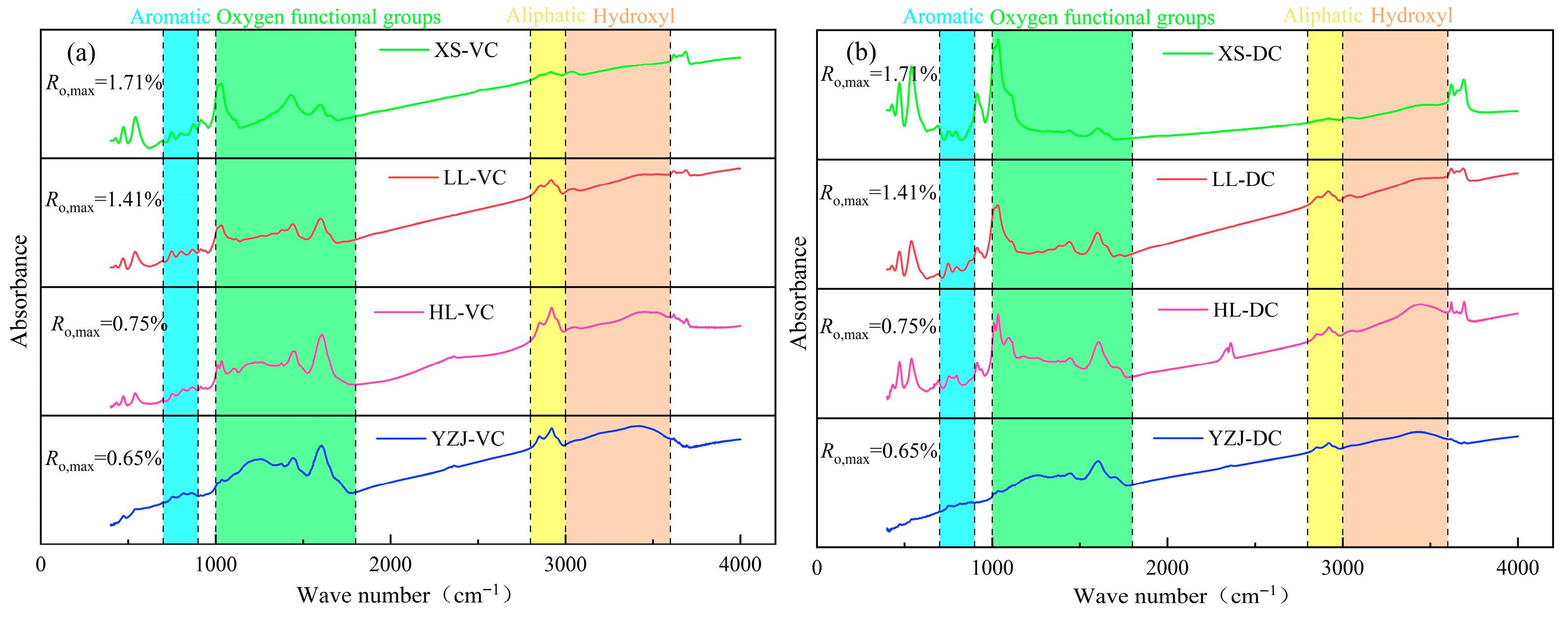
Fourier Transform Infrared Spectroscopy is widely employed to identify the presence and elucidate the structural characteristics of functional groups within the molecular framework of coal [31]. As illustrated in Figure 2, the baseline-corrected infrared spectrum reveals that the absorption peak corresponding to the aromatic hydrocarbon structures (900–700 cm−1) becomes progressively more distinct with advancing coalification, evolving from a broad and diffuse profile into a sharper and well-defined band, accompanied by a concomitant enhancement in absorption intensity. The intensity of absorption peaks corresponding to oxygen functional groups (1000–1800 cm−1) diminishes with increasing coal rank, although these functional groups remain a significant component in all coal samples, albeit at reduced concentrations. Similarly, the intensity of the absorption peak associated with the aliphatic hydrocarbon structure (3000–2800 cm−1) decreases as the degree of coal alteration increases, indicating a progressive loss of aliphatic C-H bonds [32].
Notably, the absorption peak for aliphatic hydrocarbons is more pronounced in vitrain compared to durain, with low- to medium-rank light coal exhibiting a higher proportion of aliphatic structures. The absorption peak of coal in the 3600–3000 cm−1 region progressively diminishes with increasing Ro, where vitrain consistently exhibits greater peak intensity than durain. These observations suggest that, during coalification, the abundance of hydroxyl groups progressively declines owing to a concomitant loss of oxygen-bearing functional groups, thereby reducing the inherent moisture content of the samples [33].

3.1.1. Aromatic Structural Changes

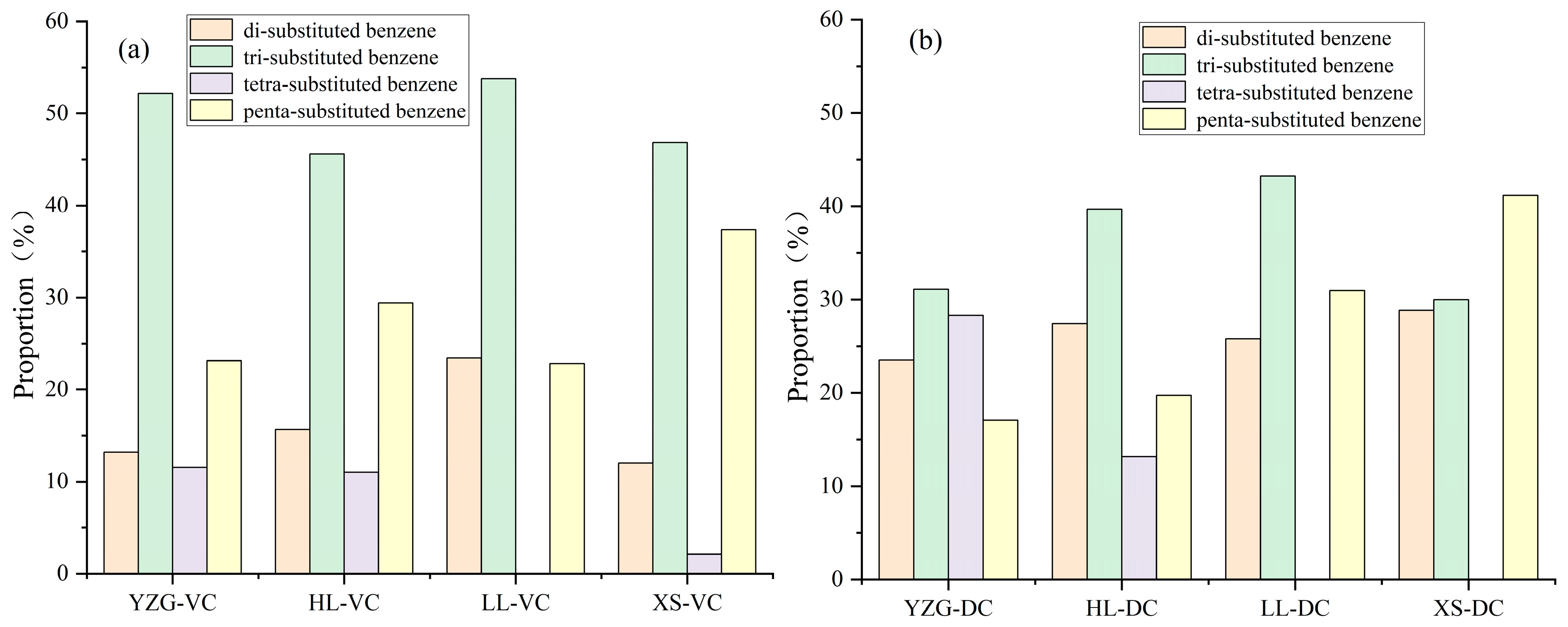
By analyzing peak splitting, distinct substitution patterns on the benzene ring can be resolved [34]. The identification of these substitution patterns offers valuable structural insights, aiding in the reconstruction of the primary aromatic framework. In coal, four primary substitution patterns are observed on aromatic rings: di-substituted benzene (characterized by peaks in the 750–730 cm−1 range), tri-substituted benzene (peaks between 810 and 750 cm−1), tetra-substituted benzene (peaks in the 850–810 cm−1 range), and penta-substituted benzene (peaks from 900 to 850 cm−1). In coal, the trisubstituted aromatic configuration predominates (Figure 3a,b) [35,36], with the proportion of trisubstituted aromatics in vitrain consistently surpassing that in durain. The proportion of di-substituted benzene in vitrain gradually increased before declining, while that in durain showed a fluctuating upward trend. The proportion of tetra-substituted benzene gradually decreased until it disappeared, with both vitrain and durain exhibiting consistent trends. During the low-rank coal stage, the concentration of pentasubstituted aromatics in vitrain exceeds that in durain. Conversely, at the medium-rank coal stage, durain exhibits a higher proportion, indicating a more pronounced cyclization of aliphatic side chains and dehydrogenation–aromatization processes of naphthenic hydrocarbons in durain.
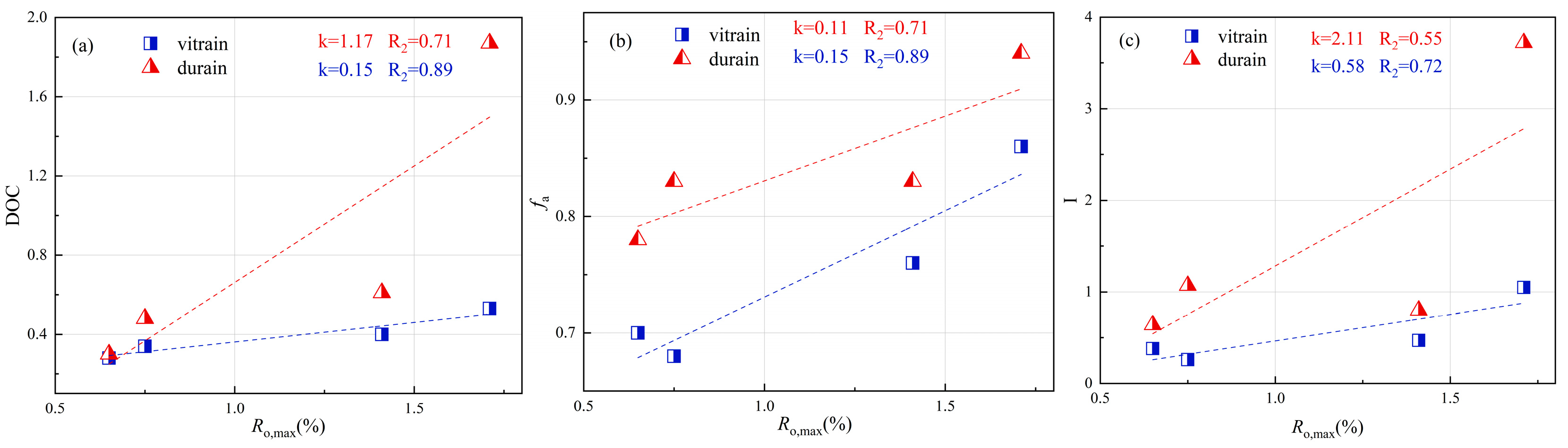
To quantitatively characterize the aromatic structures, the parameters fa, I, and DOC were employed, and a correlation analysis was conducted to elucidate the evolutionary patterns of the aromatic structural parameters (Figure 4) [37].The aromaticity (I) and degree of condensation (DOC) represent the ratio of the out-of-plane deformation vibrations (900–700 cm−1) of aromatic ring CH to the peak areas of aliphatic hydrocarbons (3000–2800 cm−1) and aromatic C=C (1600 cm−1). The aromatic carbon ratio (fa) refers to the proportion of aromatic carbon relative to the total carbon content (Figure 4a). During coal evolution, fa, I, and DOC display fluctuating yet overall increasing trends. Notably, at equivalent Ro,max values, the aromatic indices of durain are consistently higher than those of vitrain. This pattern suggests that the progressive cleavage of aliphatic side chains promotes an enrichment of aromatic structures, thereby enhancing the degree of aromatization in durain relative to vitrain.

3.1.2. Aliphatic Structural Changes

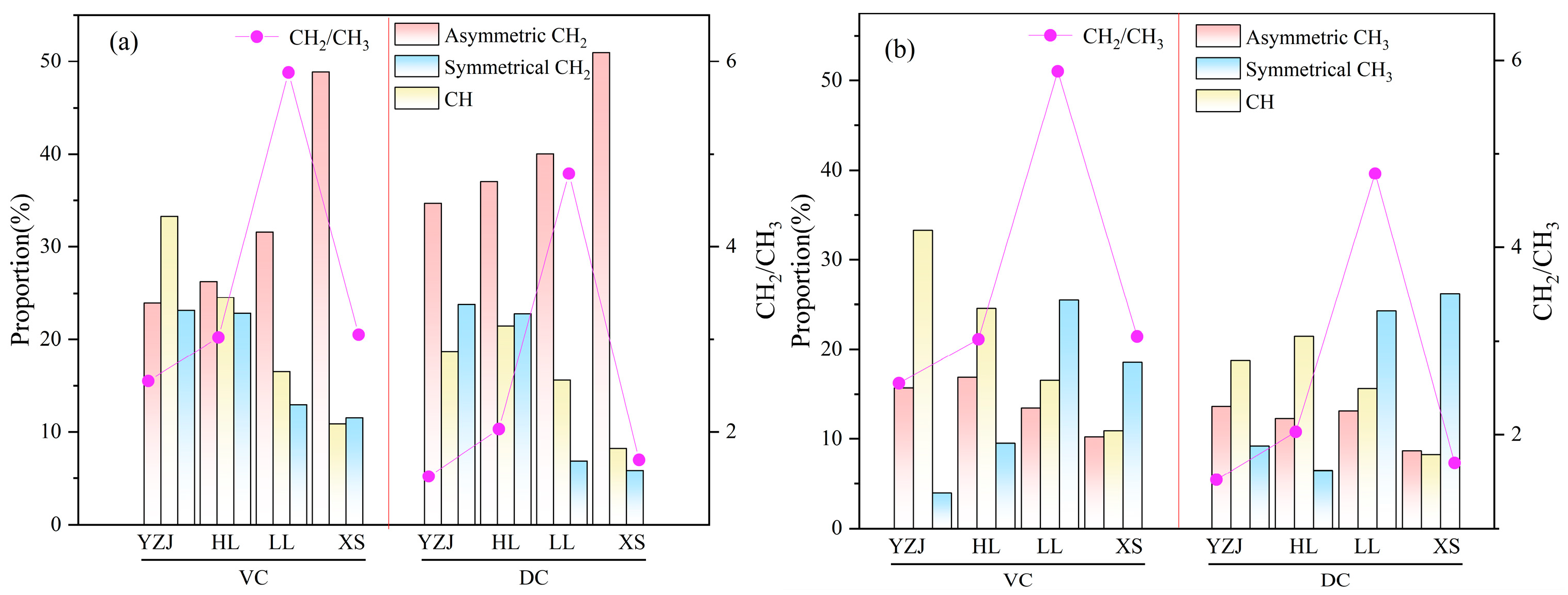
The infrared spectral wavenumbers within the range of 3000 to 2800 cm−1 are predominantly associated with the symmetric and asymmetric stretching vibrations of aliphatic hydrocarbon groups (-CHₓ) embedded within the coal matrix [38]. Notably, two distinct peaks are observed at approximately 2860 cm−1 and 2920 cm−1, which correspond to the symmetric stretching mode of CH3 groups and the asymmetric stretching mode of CH2 groups, respectively. The peak intensity at 2920 cm−1 is notably more pronounced than that at 2860 cm−1, suggesting the presence of longer aliphatic chains within the sample. The symmetric CH2 stretch appears at 2840 cm−1, while the CH stretch is observed near 2900 cm−1. Additionally, the asymmetric CH3 stretch is discernible around 2940 cm−1, as depicted in Figure 2.
As the Ro,max value of coal samples gradually increases, the proportion of symmetric CH2 in both vitrain and durain decreases, while the proportion of asymmetric CH2 gradually increases [39]. Moreover, the growth trend of asymmetric CH2 exceeds that of symmetric CH2, indicating that CH2 remains the most abundant aliphatic hydrocarbon in coal samples (Figure 5a). The proportion of symmetric CH3 groups progressively increases, while the proportion of asymmetric CH3 groups exhibits a gradual decline with minimal variation (Figure 5b). In vitrain, the content of CH species initially decreases before undergoing an increase, whereas in durain, the CH content consistently decreases over time.
The aliphatic structural parameter CH2/CH3, which denotes the ratio of methylene to methyl groups in the coal molecular structure, serves as a key indicator of the length and evolution of the aliphatic side chains [40,41]. Variations in this ratio provide insights into the degree of maturation of the coal’s aliphatic components. Notably, the CH2/CH3 ratio exhibits a characteristic trend: it initially increases with the degree of metamorphism before subsequently decreasing at higher ranks of coal maturation (Figure 5). This phenomenon can be principally attributed to the substantial degradation of aliphatic structures during the lower coal rank stages, which subsequently results in an increase in associated aliphatic species, such as methylene groups. In contrast, as coal samples progress into higher metamorphic stages within the medium-rank coal category, the continued loss of aliphatic components becomes pronounced, leading to the progressive polymerization of aromatic structures into increasingly complex polyaromatic systems. The CH2/CH3 ratio in vitrain consistently surpasses that of durain throughout the coalification process. This discrepancy is primarily influenced by the coalification environment, wherein aliphatic hydrocarbons in vitrain exhibit enhanced preservation, resulting in relatively longer aliphatic chain lengths with minimal degradation. In contrast, durain undergoes substantial fragmentation and loss of aliphatic chain structures, leading to the retention of shorter residual chains.

3.1.3. Oxygen Functional Group Changes

The spectral region between 1000 and 1800 cm−1 predominantly encompasses oxygenated functional groups. This range also captures contributions from inorganic ash components, alongside deformation vibrations of aliphatic CH2 and CH3 groups, as well as the C=C stretching modes characteristic of aromatic hydrocarbons [42]. In lower maturity stages, the spectrum exhibits broad, well-defined peaks with relatively smooth profiles, indicative of substantial molecular connectivity. As maturation progresses, a discernible trend emerges, marked by a reduction in peak areas and the development of isolated spectral features, suggesting the breakdown of molecular integrity. This trend is particularly evident in the diminishing intensities of aromatic C-O, aromatic C=C, and aliphatic CH2 and CH3 vibrations. Notably, the C-O stretching bands (associated with phenols, alcohols, ethers, and esters) become increasingly sharper and more distinct within the 1000–1300 cm−1 range as the material undergoes metamorphism. Furthermore, the spectral bands corresponding to durain consistently surpass those of vitrain, reflecting the greater fibrous carbon content and the heightened compositional complexity inherent in durain.
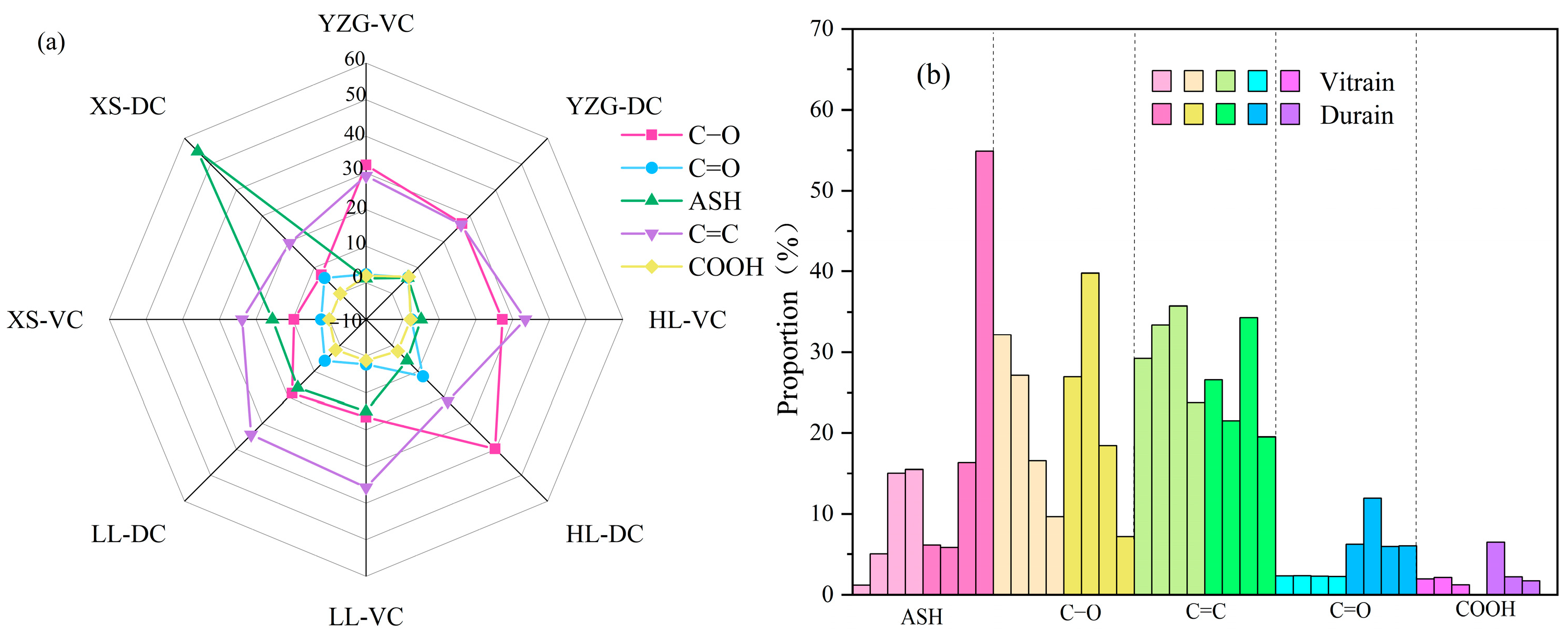
The proportion of oxygen functional groups is higher in lower-rank coals, with samples from Yuanzigou and Huangling showing significantly greater oxygen content than those from Liulin and Xiangshan. Among the three oxygen functional groups C-O, C=O, and COOH, C-O is dominant, while both C=O and COOH contribute less than 10%. In highly mature coals, the COOH group is absent. Additionally, a comparison of vitrain and durain across coal ranks (Figure 6) reveals that ash content increases progressively with higher metamorphic grade.
Coal at higher metamorphic grades exhibits intensified interactions with the external environment, thereby incorporating additional ash. With increasing maturity, most oxygen-containing functional groups diminish or vanish; however, ether oxygen bonds persist at relatively high levels owing to their structural linking role, particularly in vitrain and durain [43,44]. As maturation proceeds, ash content in durain surpasses that in vitrain, reflecting its formation in a weakly oxidizing environment enriched in fibrous carbonaceous components, which facilitates impurity assimilation and yields a more complex depositional setting. In vitrain, C-O bonds progressively decline, while C=C bonds become dominant. In contrast, durain displays a non-monotonic decrease in C-O bonds, accompanied by an initial rise and subsequent fall in C=C content. The transient increase likely stems from molecular weight reduction through the loss of unstable moieties and concurrent condensation reactions, whereas the later decrease is attributable to high-temperature pyrolysis at advanced coal maturity.

3.1.4. Hydroxyl Functional Group Changes

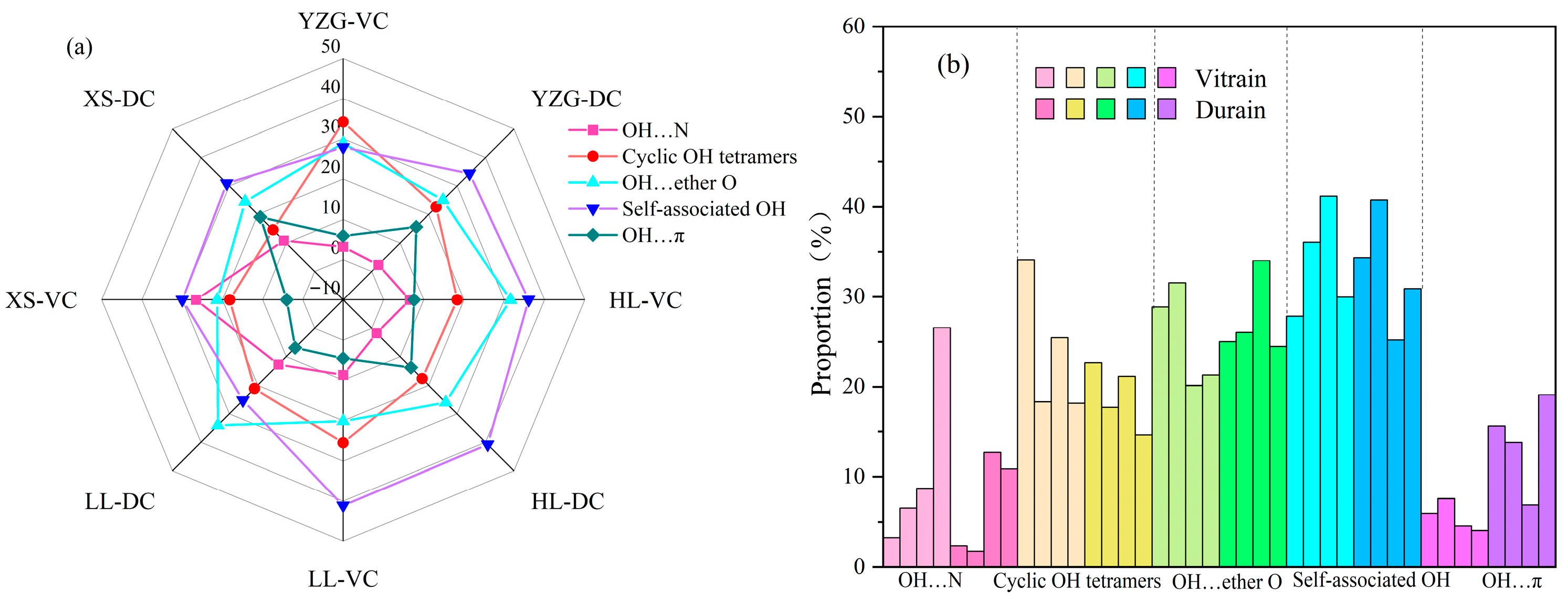
The following bonds are observed at approximately 3170 cm−1, 3200 cm−1, 3300 cm−1, 3400 cm−1, and 3516 cm−1: hydroxyl–nitrogen hydrogen bonds (OH…N), cyclic hydroxyl tetramers (Cyclic OH tetramers), hydroxyl–ether bonds (OH…ether O), self-associated hydroxyl bonds (Self-associated OH), and hydroxyl–π (OH…π) interactions. Among these, self–associated hydroxyl bonds are the most prevalent, followed by hydroxyl–ether interactions, while hydroxyl–π and hydroxyl–nitrogen hydrogen bonds are less abundant. In the low-rank coal stage, hydroxyl–ether bonds are more abundant in vitrain than in durain, whereas in higher-rank coal, durain exhibits a higher proportion of these bonds compared to vitrain (Figure 7). The proportions of hydroxyl cyclic tetramers and hydroxyl–π bonds are inversely related between vitrain and durain. Vitrain contains a greater proportion of hydroxyl cyclic tetramers and fewer hydroxyl–π bonds than durain. The abundance of hydroxyl–nitrogen bonds generally increases with coal rank in both vitrain and durain, except for XS-DC, which exhibits fluctuations. Hydroxyl cyclic polymers and ether oxygen bonds exhibit a declining trend in both vitrain and durain, which is attributed to the high oxygen functional group content in low-rank coals. As metamorphism progresses, these groups, particularly hydroxyls, are progressively lost. In contrast, the proportion of self-assembled hydroxyl bonds in vitrain increases gradually, reflecting the enhanced aromatic ring condensation and tighter molecular packing. This spatial reorganization fosters the formation of self-assembled hydroxyl bonds, underscoring their central role in vitrain. As durain matures, the hydroxyl group in the hydroxyl–π bond undergoes charge transfer with the aromatic ring, thereby amplifying the influence of the hydroxyl–π interaction.

3.2. XRD Analysis

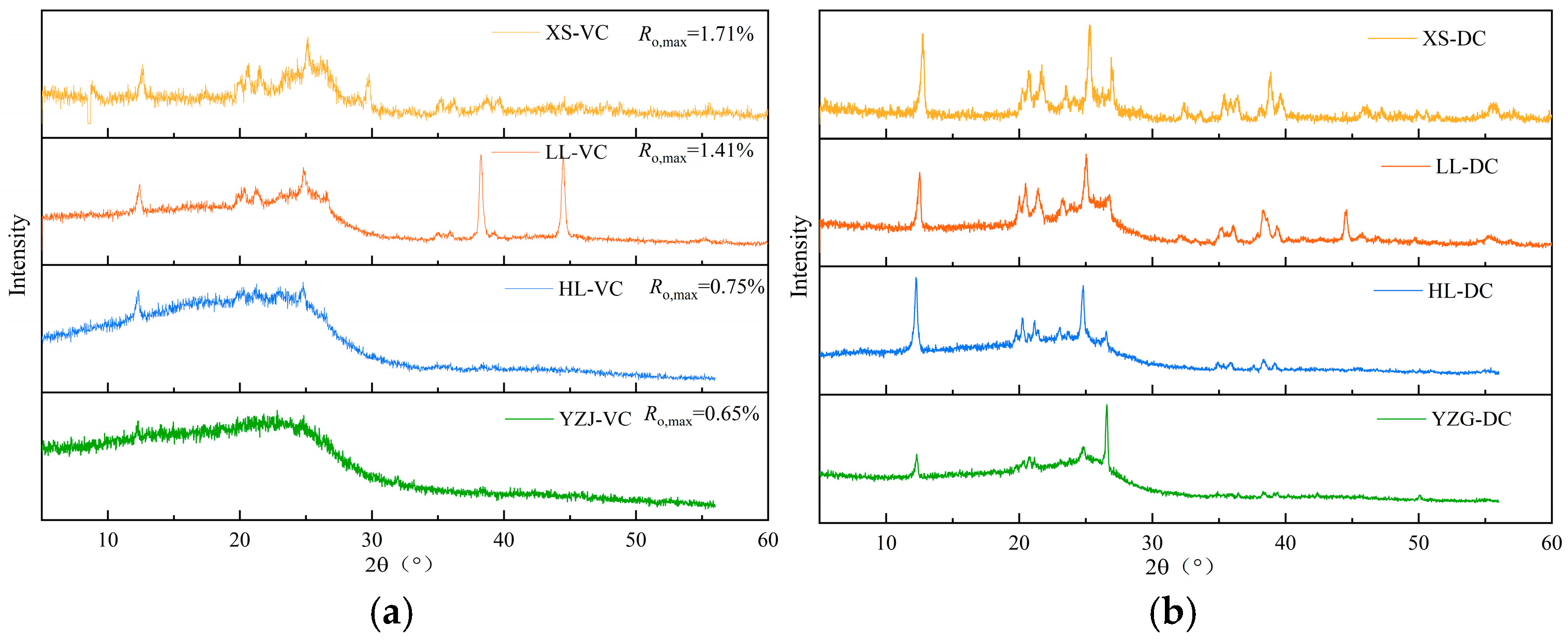
X-ray diffraction (XRD) analysis is widely employed to determine the size, stacking arrangement, and microcrystalline features of aromatic domains. The diffraction peak at approximately 24° 2θ (002) originates from the condensation of aromatic layers, whereas the peak near 44° 2θ (100) is associated with the lateral dimensions of the aromatic carbon layers [45]. As shown in the XRD patterns (Figure 8), increasing Ro,max leads to a progressive sharpening and enhanced symmetry of the 002 reflection, accompanied by a rightward shift in its peak position, while the 100 reflection becomes increasingly distinct. Compared with vitrain, which exhibits broader and more diffuse diffraction features, durain displays relatively sharper and less well-resolved peaks. This contrast arises from the distinct depositional environments: durain is primarily formed under oxidizing conditions that are mineralogically more heterogeneous, thereby imparting greater structural disorder to the carbon matrix.
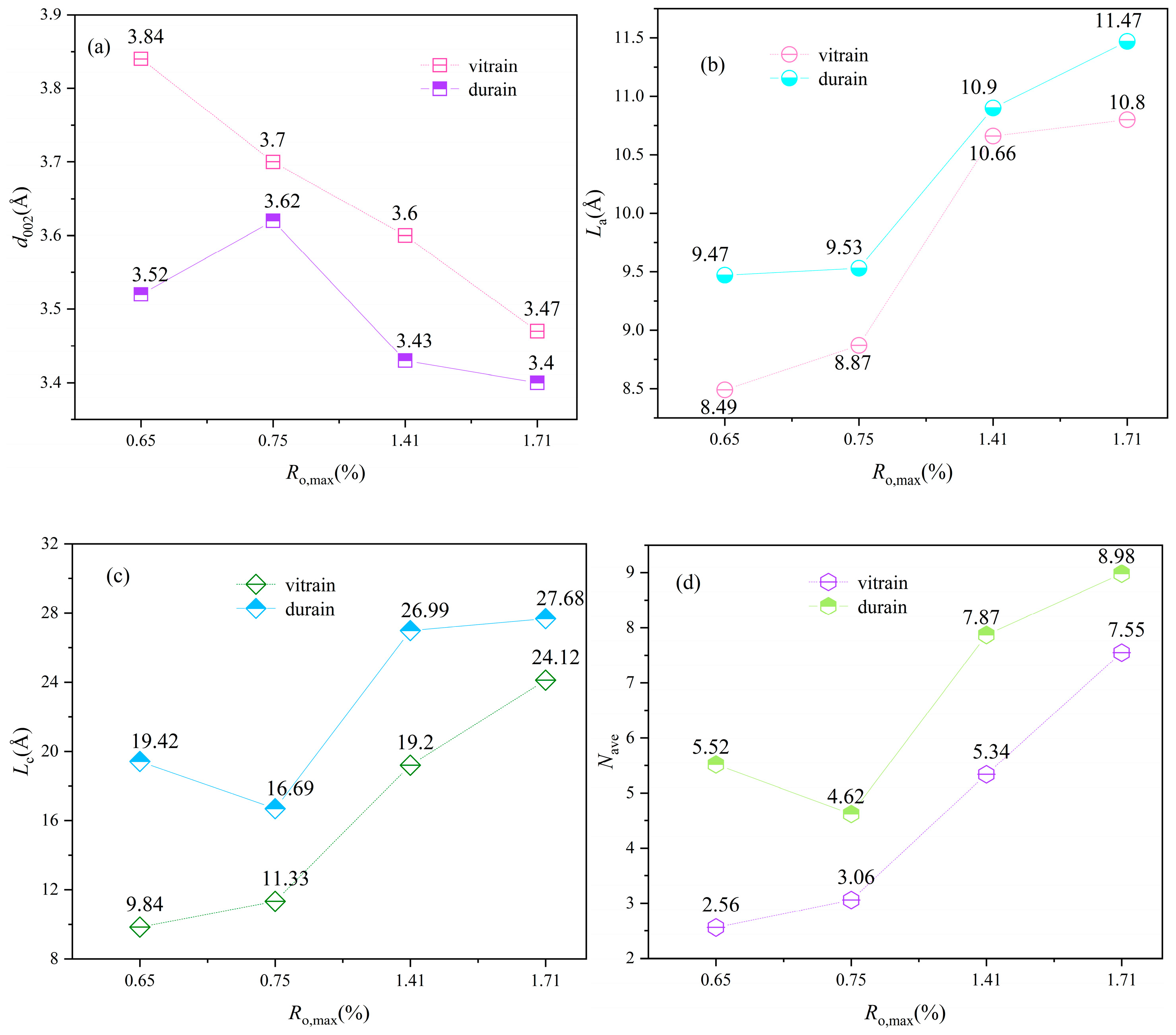
The d002 size of the vitrain decreased from 3.82 to 3.47, while the d002 size of the durain decreased from 3.52 to 3.40 (Figure 9a). The vitrain is larger than the durain. The decrease in d002 represents a reduction in the interlayer spacing of the coal molecular structure. As the degree of coal metamorphism increases, the polymerization of the coal molecular structure intensifies, causing the aromatic layers to become more tightly packed [46]. The relationship between Lc, La, Nave, and metamorphic grade is opposite to that of d002, showing an increasing trend. The values of Lc, La, and Nave are all larger for durain than for vitrain (Figure 9b–d). The observed increase in these parameters suggests that the intensification of condensation reactions promotes the formation of more compact aromatic ring structures and intricate stacking arrangements, which correlates with the observed rise in the average layer number, Nave (Figure 9d). These findings underscore a higher degree of aromatic ring condensation in durain relative to vitrain. Furthermore, the aromatic layer arrangement in durain is markedly more orderly and tightly packed compared to vitrain, with a more pronounced orientation of aromatic stripes. This suggests that durain exhibits a higher level of molecular ordering and structural integrity within its aromatic framework than vitrain.

3.3. 13C-NMR Analysis

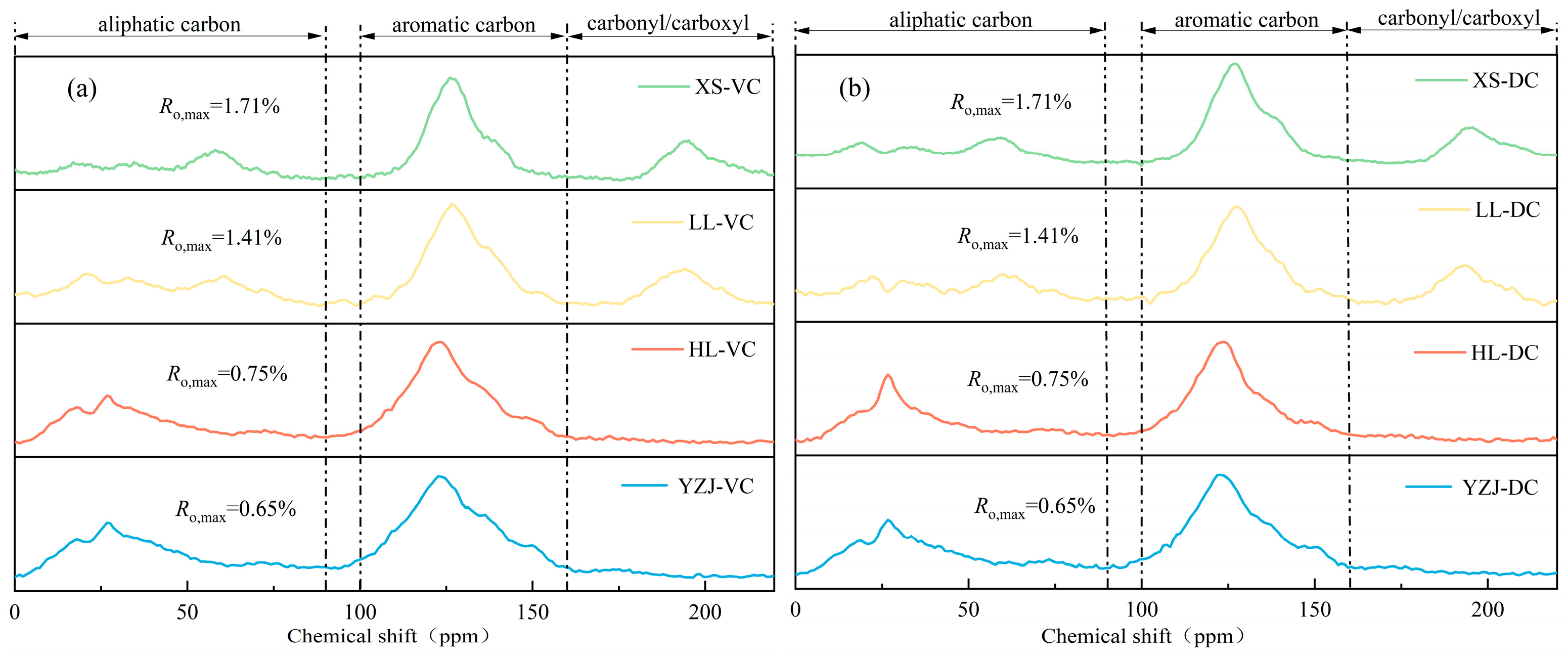
The NMR carbon spectrum typically exhibits three distinct regions: the aliphatic carbon (0–90 ppm), aromatic carbon (100–160 ppm), and carbonyl/carboxyl carbon (160–220 ppm) (Figure 10) [47]. The carbon distribution patterns of vitrain and durain within a single coal sample are found to be essentially consistent. At lower coal ranks, the peak intensities and areas associated with the aliphatic structures are notably high, often comparable to those of the aromatic components. As coal undergoes increasing metamorphism, the intensity of the aliphatic region diminishes sharply. During the Middle Coal Stage, the aliphatic peak almost completely vanishes, signifying a substantial reduction in the content of aliphatic structures within the coal sample. Concurrently, as the vitrinite reflectance (Ro,max) value rises, there is a progressive increase in both the peak area and intensity of the aromatic region. Additionally, the aromatic peak narrows, with the full width at half maximum (FWHM) decreasing from an initial range of 100–160 ppm to 110–140 ppm.
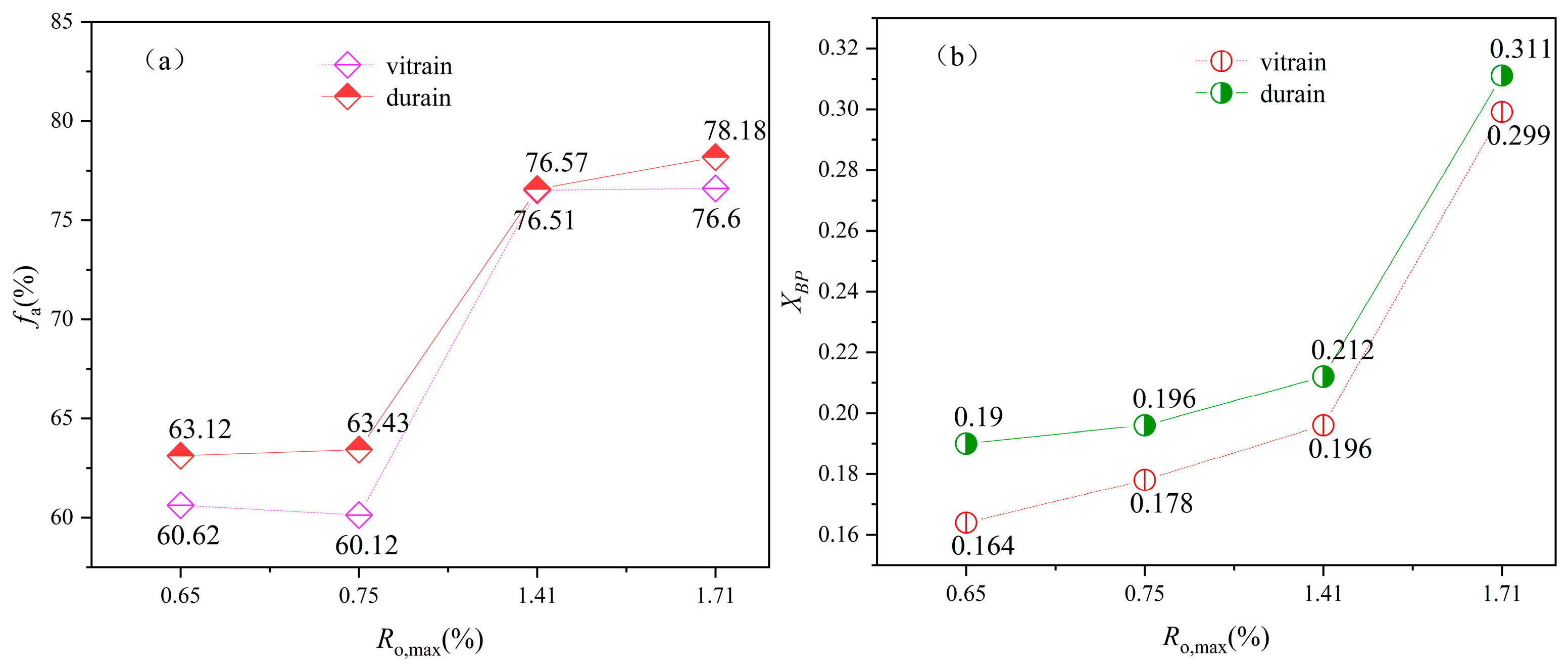
The structural parameters derived from 13C -NMR provide insight into the molecular structural characteristics and evolutionary trajectories of coal [48,49]. These parameters, determined through peak fitting analysis, are summarized in Table 4. Within the molecular framework of coal, carbon functional groups predominantly manifest as aromatic and aliphatic carbons. Notably, the aromatic carbon ratio (fa) exhibits a positive correlation with the degree of metamorphism (Figure 11a). Specifically, the aromatic carbon ratio in vitrinite is consistently lower than that observed in inertinite. The aliphatic structure parameter, defined as the aliphatic ratio (fa), exhibits an inverse correlation with the aromatic carbon ratio, progressively decreasing in tandem. Among aromatic carbon species, the contribution of protonated aromatic carbon (faH) is predominant, while the proportion of bridged aromatic carbon (faB) demonstrates a rising trend, suggesting a more compact molecular connectivity. Notably, the relative proportion of carbonyl and carboxyl carbons (faC) in durain exceeds that observed in vitrain, implying that during geological maturation, aliphatic acid side chains are progressively eliminated.
The ratio of methylene groups to the sum of aliphatic and aromatic methyl groups (falH/fal*) serves as an indicator of the length of aliphatic side chains and the degree of branching in the molecular structure [50]. Higher values of this ratio suggest longer aliphatic side chains and reduced branching. In contrast, the durain fraction typically exhibits higher values compared to vitrain, implying that vitrain possesses a greater degree of structural branching. The ratio of side-chain aromatic carbon to total aromatic carbon (faS/fa) reflects the proportion of aromatic carbon in the side chains. A higher value of this ratio is indicative of weaker bonds within the aromatic structure, signifying a lower degree of structural stability in the coal matrix. Vitrain generally displays higher values than durain, although durain is characterized by enhanced stability. The bridge carbon ratio (XBP) (Figure 11b), which quantifies the proportion of bridge carbon to peripheral carbon, increases progressively with rising reflectance (Ro,max). Throughout the metamorphic process, the condensation of aromatic rings intensifies, accompanied by a rise in the number of aromatic rings. Notably, the bridge carbon ratio of durain consistently surpasses that of vitrain, suggesting a slightly greater degree of metamorphism in durain compared to vitrain.

3.4. XPS Analysis

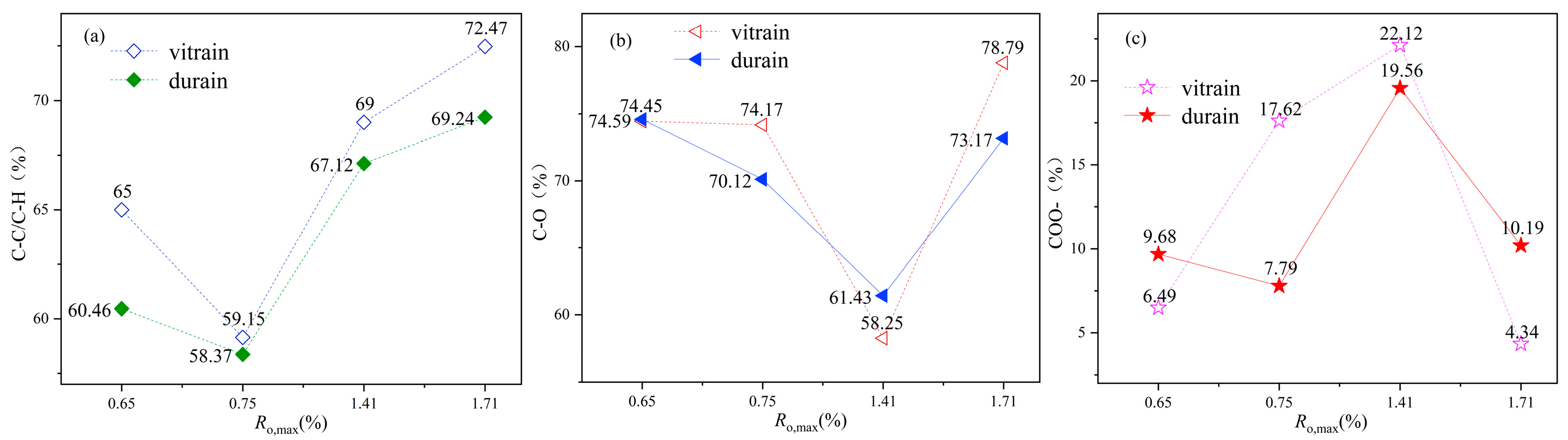
X-ray photoelectron spectroscopy (XPS) is a widely employed surface-sensitive technique that enables quantitative analysis of elemental composition and chemical states [51]. The predominant forms of carbon bonding are C–C and C–H, followed by C–O, with carboxyl groups occurring in the lowest abundance (Table 5) [52]. Deconvolution of the C 1s spectra reveals that both C–O functionalities and carboxyl groups progressively decline during coalification. In contrast, the C–C/C–H ratio exhibits a non-monotonic trend, decreasing initially and then increasing with advancing coal rank (Figure 11). The C-C/C-H ratios are predominantly influenced by the presence of aromatic carbon and alkyl side chains (Figure 12a). As coalification progresses, the shedding of aliphatic side chains during the early stages results in an increase in carbon content, accompanied by a heightened degree of aromatization in the later stages. Durain, characterized by a lower carbon content than vitrain, also exhibits a reduced abundance of alkyl side chains, a finding that aligns with previous infrared spectroscopy observations. Oxygen functional groups are the principal manifestations of oxygen in coal (Table 6), with C-O bonds comprising the majority, followed by C=O and COO- functionalities. During the initial stages of coal maturation, the proportion of C-O bonds in vitrain and durain progressively decreases. However, as aromatization begins to dominate, an increase in C-O content is observed (Figure 12b). Notably, the COO- groups initially rise in concentration before subsequently declining (Figure 12c). This trend suggests that pyrolysis is more likely to occur in the later stages of coal evolution, as the structural instability of the COO- functionality leads to a gradual reduction in its relative abundance.

3.5. Evolution of the Coalification Stage

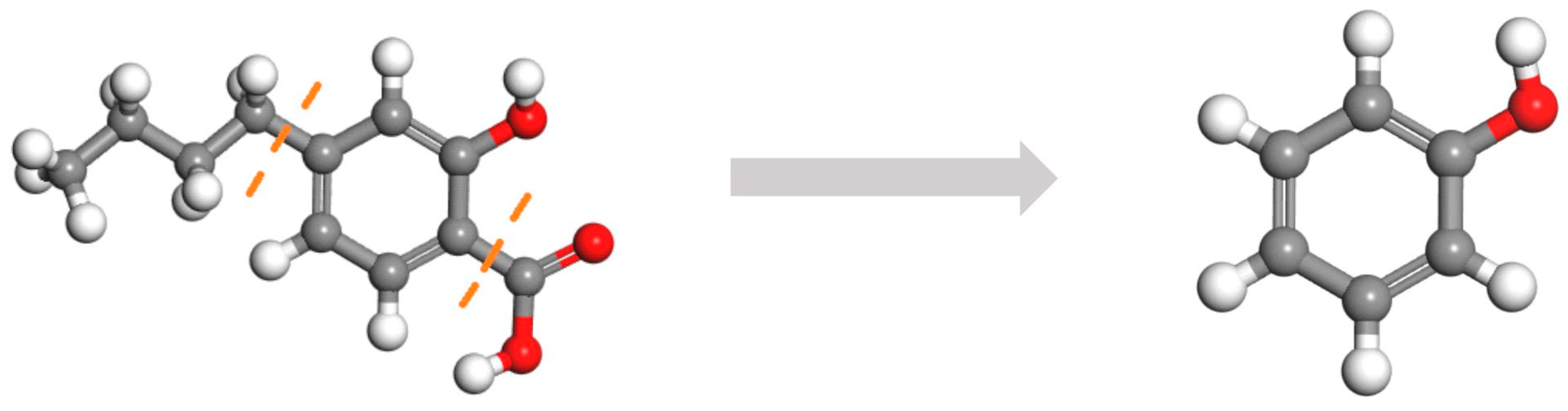
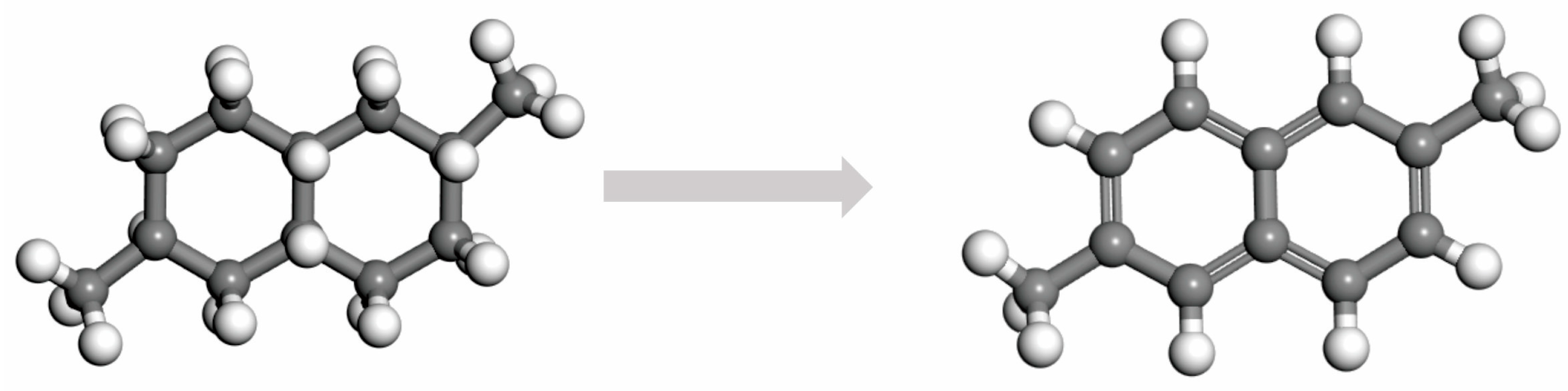
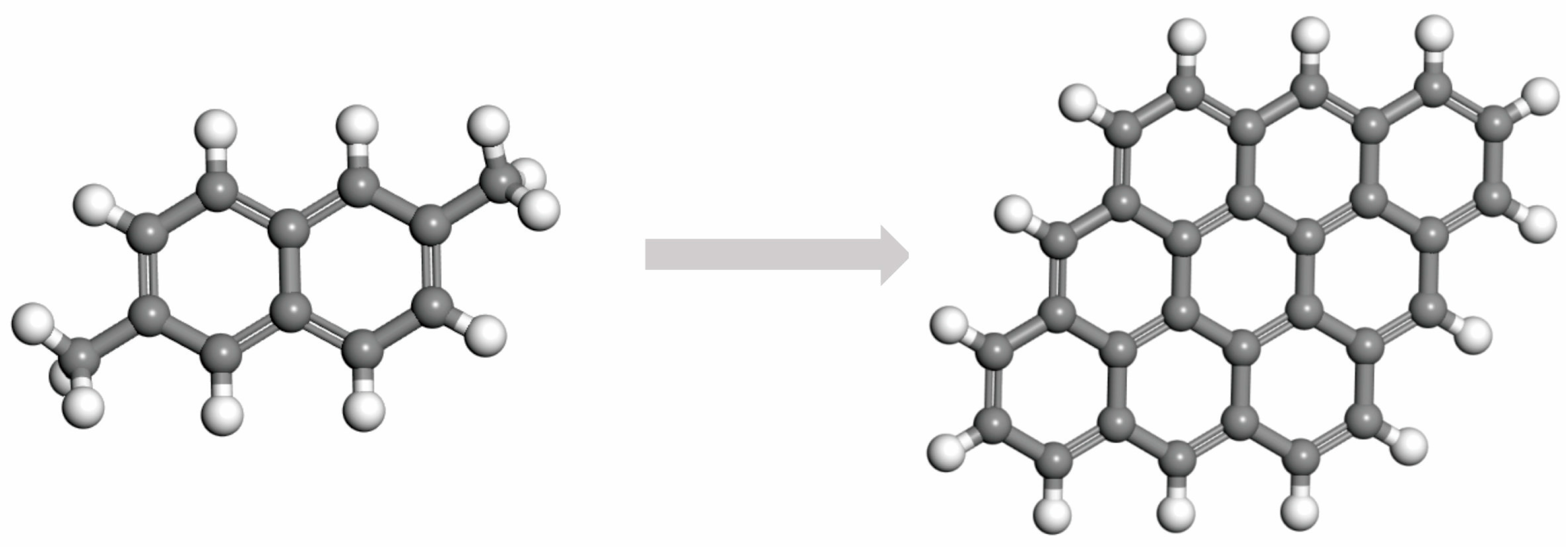
The coalification process is characterized by a progressive increase in carbon content, accompanied by a decrease in hydrogen, oxygen, nitrogen, and sulfur. Structurally, it transitions from peat, which contains diverse functional groups, toward anthracite, dominated by condensed aromatic rings, ultimately evolving into a graphite-like structure. This evolution involves the loss of aliphatic side chains and oxygen functional groups, coupled with enhanced aromatization and polycondensation. Coalification occurs in distinct stages: In the initial stage, aliphatic side chains and oxygen-containing functional groups are gradually removed (Figure 13). A decrease in the peak intensity at the 13C-NMR spectrum position of 0–90 ppm, and a reduction in the peak intensity at 2800–3000 cm−1 in the infrared spectrum. During the second stage, further shedding of aliphatic structures takes place, while aromatic structures undergo aromatization (Figure 14) and condensation (Figure 15), primarily forming three-ring aromatic hydrocarbons such as naphthalene, anthracene, and phenanthrene. The increased bridge carbon ratio in 13C NMR and the gradual increase in structural parameters such as condensation degree and aromaticity in Fourier transform infrared spectroscopy both corroborate this finding. In the final stage, aromatic condensation intensifies, with higher-maturity medium-rank coals exhibiting tetracyclic aromatic hydrocarbons. While the overall evolutionary trends in vitrain and durain are similar, durain shows greater microstructural complexity and a slightly higher degree of coalification than vitrain within the same sample.

4. Conclusions

This study examines long-flamed coal and gas coal from the Huanglong Coalfield, coking coal from the Hedong Coalfield, and fat coal from the Weibei Coalfield, focusing on both vitrain and durain coal samples. Through material characteristic and molecular structure testing experiments, it analyzes the evolutionary patterns of microstructures in different macroscopic coal components during the coalification process. The research yields the following primary conclusions:
(1)
Vitrain predominantly exhibits trisubstitution, with trisubstituted aromatics comprising a larger proportion than in durain. In contrast, durain transitions from trisubstitution to pentasubstitution. Among oxygen functional groups, C–O bonds are the most abundant, while C=O and COOH groups are less common. Durain generally contains a higher concentration of oxygen functional groups compared to vitrain. The CH2/CH3 ratio in vitrain is consistently higher than in durain. Durain also displays greater aromaticity, higher condensation, and increased aromatic carbon content, suggesting that vitrain contains longer alkyl side chains, while durain is characterized by more extensively developed aromatic structures.
(2)
The d002 size of the vitrain decreased from 3.82 to 3.47, while that of the durain reduced from 3.52 to 3.40. Both exhibited a progressive decline, with the vitrain showing a more pronounced reduction compared to the durain. These findings suggest that the lateral extension of the microcrystalline structure in durain is more developed, indicative of a denser network of molecular interactions and tighter interconnections.
(3)
During the structural evolution of the carbon skeleton, progressive coal metamorphism leads to a marked reduction in the aliphatic peak area, accompanied by a gradual increase in both the area and intensity of the aromatic peak. Concurrently, the bridging carbon ratio (XBP) exhibits a systematic rise with increasing metamorphic rank. As a result, the proportion of aromatic carbon in the coal matrix steadily increases, whereas the contribution of aliphatic carbon diminishes as coal maturity advances.
(4)
The X-ray photoelectron spectroscopy (XPS) analysis of carbon (C), nitrogen (N), and oxygen (O) revealed that carbon predominantly exists in C-C/C-H bonding configurations, followed by C-O groups, with carboxyl groups (–COOH) being the least abundant. Notably, the content of C-C/C-H bonds in durain is typically lower than that in vitrain.

Author Contributions

Conceptualization, K.M.; methodology, P.W.; software, P.G. validation, H.W.; formal analysis, C.J.; resources, visualization, L.W.; data curation, L.D.; writing—original draft preparation, Y.C.; writing—review and editing, Z.L. All authors have read and agreed to the published version of the manuscript.

Funding

This work is supported by the National Natural Science Foundation of China (Grant No. 41902175), the Open Funding Project of the National Engineering Laboratory for Exploration and Development of Low-Permeability Oil and Gas Fields (Grant No. KFKT2024-02), and the Shanxi Province Science and Technology Major Special Funding Project (Grant No. 20201101002).

Data Availability Statement

The original contributions presented in this study are included in the article. Further inquiries can be directed to the corresponding authors.

Conflicts of Interest

Author Huaichang Wang was employed by the Changqing Oilfield Company, PetroChina and author Liya Wang was employed by the Shaanxi No. 131 Coalfield Geology Corporation Ltd. The remaining authors declare that the research was conducted in the absence of any commercial or financial relationships that could be construed as a potential conflict of interest.

Abbreviations

The following abbreviations are used in this manuscript:
Ro,maxMaximum Reflectance of Vitrinite
MadMoisture in the Air-Dried Basis
AadAsh in the Air-Dried Basis
VadVolatile Matter in the Air-Dried Basis
FCadFixed Carbon in the Air-Dried Basis
CdafCarbon in the Dry Ash-Free Basis
HdafHydrogen in the Dry Ash-Free Basis
OdafOxygen in the Dry Ash-Free Basis
NdafNitrogen in the Dry Ash-Free Basis

References

  1. Wang, T.; Liu, F.; Zhao, X.; Deng, X.; Yuan, T.; Ren, S. Reflection on China’s coal resource guarantee capacity and exploration work under the background of “double carbon”. Coal Sci. Technol. 2023, 51, 1–8. [Google Scholar] [CrossRef]
  2. Özgen, K.C.; Ruiz, F.A.; Cotè, M.; Phipps, S.J.I.J.o.C.G. Coal mine methane: A review of capture and utilization practices with benefits to mining safety and to greenhouse gas reduction. Int. J. Coal Geol. 2011, 86, 121–156. [Google Scholar] [CrossRef]
  3. Qin, Y.; Moore, T.A.; Shen, J.; Yang, Z.; Shen, Y. Resources and geology of coalbed methane in China: A review. Int. Geol. Rev. 2017, 60, 777–812. [Google Scholar] [CrossRef]
  4. Zou, C.; Li, S.; Liu, H.; Feng, M.J.P.E. Revolution and significance of “Green Energy Transition” in the context of new quality productive forces: A discussion on theoretical understanding of “Energy Triangle”. Pet. Explor. Dev. 2024, 51, 1611–1627. [Google Scholar] [CrossRef]
  5. Tao, G.; Wang, Z.; Jin, Y.; Wang, H.; Xia, D.; Pan, J. Multiscale Pore–Fracture Structure Characteristics of Deep Coal Reservoirs in the Eastern Margin of the Ordos Basin, China. Nat. Resour. Res. 2025, 34, 1557–1584. [Google Scholar] [CrossRef]
  6. Wang, Z.; Xiong, J.; Zhang, Y.; Tao, G.; Pan, J.; Niu, Q. Investigation of Permeability Stress Induced Damage Evolution of Shallow and Deep Coal Reservoirs in the Junggar Basin, China. Rock Mech. Rock Eng. 2025. [Google Scholar] [CrossRef]
  7. Li, S.K.; Zhu, Y.M.; Wang, Y.; Liu, J. The Chemical and Alignment Structural Properties of Coal: Insights from Raman, Solid-State 13C NMR, XRD, and HRTEM Techniques. Acs Omega 2021, 6, 11266–11279. [Google Scholar] [CrossRef]
  8. Zheng, C.; Ma, D.M.; Chen, Y.; Gao, Z.; Teng, J.X. Pore structure of different macroscopically distinguished components within low-rank coals and its methane desorption characteristics. Fuel 2021, 293, 120465. [Google Scholar] [CrossRef]
  9. Li, X.; Zeng, F.G.; Wang, W.; Dong, K.; Cheng, L.Y. FTIR characterization of structural evolution in low-middle rank coals. J. China Coal Soc. 2015, 40, 2900–2908. [Google Scholar] [CrossRef]
  10. Yu, C.M.; Zhang, N.; Teng, H.P. Investigation of Different Structures of Coals Through FTIR and Raman Techniques. Spectrosc. Spectr. Anal. 2021, 41, 2050–2056. [Google Scholar]
  11. Li, W.; Zhu, Y.M. Structural Characteristics of Coal Vitrinite during Pyrolysis. Energy Fuels 2014, 28, 3645–3654. [Google Scholar] [CrossRef]
  12. Zhou, H.; Wu, C.F.; Pan, J.N.; Wang, Z.Z.; Niu, Q.H.; Du, M.Y. Research on Molecular Structure Characteristics of Vitrinite and Inertinite from Bituminous Coal with FTIR, Micro-Raman, and XRD Spectroscopy. Energy Fuels 2021, 35, 1322–1335. [Google Scholar] [CrossRef]
  13. Wang, Q.; Zhang, J.P.; Li, H.N.; Zhang, H.; Bai, H.C.; Guo, Q.J. Exploring molecular structure characteristics and chemical index of Qinghua bituminous coal: A comprehensive insight from single molecule of macerals to particles with various sizes. Powder Technol. 2022, 396, 36–49. [Google Scholar] [CrossRef]
  14. Yang, Z.Q.; Liu, Y.; Zhu, G.W.; Liu, J.H.; Xu, R.; Shi, D.J. Molecule structure and ultrasonic wave velocity of different ranking coals: An experimental perspective. Fuel 2022, 312, 122913. [Google Scholar] [CrossRef]
  15. Chen, Y.; Ma, D.M.; Guo, C.; Yang, F.; Mu, T.; Gao, Z. An Experimental Study on the Conductivity Changes in Coal during Methane Adsorption-Desorption and their Influencing Factors. Acta Geol. Sin.-Engl. Ed. 2019, 93, 704–717. [Google Scholar] [CrossRef]
  16. Jia, J.Z.; Wang, D.M.; Li, B. Study on molecular structure characteristic and optimization of molecular model construction of coal with different metamorphic grade. J. Mol. Struct. 2024, 1295, 136655. [Google Scholar] [CrossRef]
  17. Yin, T.T.; Liu, D.M.; Cai, Y.D.; Liu, Z.H.; Gutierrez, M. A new constructed macromolecule-pore structure of anthracite and its related gas adsorption: A molecular simulation study. Int. J. Coal Geol. 2020, 220, 103415. [Google Scholar] [CrossRef]
  18. GB/T 212-2008; Proximate Analysis of Coal. Standardization Administration of the People’s Republic of China: Beijing, China, 2008.
  19. GB/T 31391-2015; Ultimate Analysis of Coal. Standardization Administration of the People’s Republic of China: Beijing, China, 2015.
  20. GB/T 6948-2008; Method of Determining Microscopically the Reflectance of Vitrinite in Coal. National Technical Committee on Coal Standardization of China: Xi’an, China, 2008.
  21. Zhao, J.; Shi, Q.M.; Wang, S.M.; Mi, Y.C.; Zhao, H.C.; Ji, R.J. Study on molecular structural heterogeneity of tar-rich coal based on micro-FTIR. Spectrochim. Acta Part A-Mol. Biomol. Spectrosc. 2025, 330, 125749. [Google Scholar] [CrossRef]
  22. Gao, F.; Jia, Z.; Cui, Z.; Li, Y.D.; Jiang, H. Evolution of macromolecular structure during coal oxidation via FTIR, XRD and Raman. Fuel Process. Technol. 2024, 262, 108114. [Google Scholar] [CrossRef]
  23. Xu, C.; Li, H.; Lu, J.; Lu, Y.; Shi, S.; Ye, Q. An investigation into the modification of microwave-assisted oxidation in the macromolecular structure of coal via XRD and Raman spectroscopy. Fuel 2023, 338, 127192. [Google Scholar] [CrossRef]
  24. Feng, B.; Bhatia, S.K.; Barry, J.C. Structural ordering of coal char during heat treatment and its impact on reactivity. Carbon 2002, 40, 481–496. [Google Scholar] [CrossRef]
  25. Lv, T.; Fang, M.X.; Zeng, X.; Yan, J.Q.; Huang, Y.; Cen, J.M. Carbon Structure of Coal from the CP/MAS 13C NMR Spectra: Effect of Contact Time and Potential Quantitative Modification. Energy Fuels 2024, 38, 3740–3754. [Google Scholar] [CrossRef]
  26. Baysal, M.; Yürüm, A.; Yildiz, B.; Yürüm, Y. Structure of some western Anatolia coals investigated by FTIR, Raman, 13C solid state NMR spectroscopy and X-ray diffraction. Int. J. Coal Geol. 2016, 163, 166–176. [Google Scholar] [CrossRef]
  27. Zhuo, X.Y.; Su, J.S.; Xu, H.L.; Wang, L.; Wang, W.F.; Zhang, B. Synergistically effective flotation enrichment of vitrinite by Na removal for high-Na high-inertinite low-rank Zhundong coal. J. Clean. Prod. 2023, 428, 139433. [Google Scholar] [CrossRef]
  28. Ping, A.; Xia, W.C.; Peng, Y.L.; Xie, G.Y. Comparative filtration and dewatering behavior of vitrinite and inertinite of bituminous coal: Experiment and simulation study. Int. J. Min. Sci. Technol. 2021, 31, 233–240. [Google Scholar] [CrossRef]
  29. Liu, Y.; Zhu, Y.M.; Liu, S.M.; Chen, S.B.; Li, W.; Wang, Y. Molecular structure controls on micropore evolution in coal vitrinite during coalification. Int. J. Coal Geol. 2018, 199, 19–30. [Google Scholar] [CrossRef]
  30. Shan, C.A.; Zhang, T.S.; Liang, X.; Zhang, Z.; Wang, M.; Zhang, K. On the fundamental difference of adsorption-pores systems between vitrinite- and inertinite-rich anthracite derived from the southern Sichuan basin, China. J. Nat. Gas Sci. Eng. 2018, 53, 32–44. [Google Scholar] [CrossRef]
  31. Dwivedi, A.; Dwivedi, A.; Kumar, A. Qualitative surface characterization of Indian Permian coal using XPS and FTIR. Int. J. Coal Prep. Util. 2023, 43, 1152–1163. [Google Scholar] [CrossRef]
  32. Ju, Y.W.; Jiang, B.; Hou, Q.I.; Wang, G.I. FTIR spectroscopic study on the stress effect of compositions of macromolecular structure in tectonically deformed coals. Guang Pu Xue Yu Guang Pu Fen Xi Guang Pu 2005, 25, 1216–1220. [Google Scholar]
  33. Li, J.Z.; Guo, X.; Panchal, B.; Wang, J.X.; Guo, W.M.; Liu, B.J. Quantitative analysis of molecular structure characterization of different liptinite-rich coals using FTIR spectroscopy. Infrared Phys. Technol. 2024, 141, 105458. [Google Scholar] [CrossRef]
  34. Xu, C.F.; Hu, S.; Xiang, J.; Zhang, L.Q.; Sun, L.S.; Shuai, C. Interaction and kinetic analysis for coal and biomass co-gasification by TG-FTIR. Bioresour. Technol. 2014, 154, 313–321. [Google Scholar] [CrossRef]
  35. Chen, A.K.; Zhai, C.; Yu, X.; Xu, J.Z.; Zheng, Y.F.; Zhu, X.Y. Quantitative Analysis of the Effect of NaClO Stimulation in Anthracite and Bituminous Coal with FTIR and LF-NMR. Energy Fuels 2024, 38, 2018–2032. [Google Scholar] [CrossRef]
  36. Dong, T.; Murata, S.; Miura, M.C.; Nomura, M.; Nakamura, K.T. Computer-aided molecular design study of coal model molecules. 3. Density simulation for model structures of bituminous Akabira coal. Energy Fuels 1993, 7, 1123–1127. [Google Scholar] [CrossRef]
  37. Shukla, A.; Prasad, A.K.; Mishra, S.; Vinod, A.; Varma, A.K. Rapid Estimation of Sulfur Content in High-Ash Indian Coal Using Mid-Infrared FTIR Data. Minerals 2023, 13, 634. [Google Scholar] [CrossRef]
  38. Isah, U.A.; Rashid, M.I.; Lee, S.; Kiman, S.; Iyodo, H.M. Correlations of coal rank with the derived Fourier Transform Infra-Red (FTIR) spectroscopy structural parameters: A review. Infrared Phys. Technol. 2024, 141, 105456. [Google Scholar] [CrossRef]
  39. Bin, L.; Wei, Z.; Xie, Z.H.; Chen, X.J.; Yong, C. FTIR and XRD microscopic characterisation of coal samples with different degrees of metamorphism. J. Mol. Struct. 2024, 1309, 138270. [Google Scholar] [CrossRef]
  40. Chang, H.Z.; Zeng, F.G.; Li, W.Y.; Li, J.; Jia, J.B.; Xie, K.C. Micro-FTIR study on structure of macerals from Jurassic coals in Northwestern China. Spectrosc. Spectr. Anal. 2008, 28, 1535–1538. [Google Scholar] [CrossRef]
  41. Domazetis, G.; James, B.D.; Liesegang, J. Computer molecular models of low-rank coal and char containing inorganic complexes. J. Mol. Model. 2008, 14, 581–597. [Google Scholar] [CrossRef]
  42. Zhou, Y.; Albijanic, B.; Wang, Y.L.; Yang, J.G. Characterizing surface properties of oxidized coal using FTIR and contact angle measurements. Energy Sources Part A-Recovery Util. Environ. Eff. 2018, 40, 1559–1564. [Google Scholar] [CrossRef]
  43. Xia, W.; Zhang, W. Characterization of surface properties of Inner Mongolia coal using FTIR and XPS. Energy Sources Part A-Recovery Util. Environ. Eff. 2017, 39, 1190–1194. [Google Scholar] [CrossRef]
  44. Zhu, H.Q.; Zhao, H.R.; Wei, H.Y.; Wang, W.; Wang, H.R.; Li, K. Investigation into the thermal behavior and FTIR micro-characteristics of re-oxidation coal. Combust. Flame 2020, 216, 354–368. [Google Scholar] [CrossRef]
  45. Rautenbach, R.; Matjie, R.H.; Strydom, C.A.; Bunt, J.R.; Ward, C.R.; French, D. Evaluation of mineral matter transformations in low-temperature ashes of South African coal feedstock samples and their density separated cuts using high-temperature X-ray diffraction. Int. J. Coal Prep. Util. 2020, 40, 320–347. [Google Scholar] [CrossRef]
  46. Boral, P.; Varma, A.K.; Maity, S. X-ray diffraction studies of some structurally modified Indian coals and their correlation with petrographic parameters. Curr. Sci. 2015, 108, 384–394. Available online: https://www.jstor.org/stable/24216565 (accessed on 30 December 2025).
  47. Yan, J.C.; Lei, Z.P.; Li, Z.K.; Wang, Z.C.; Ren, S.B.; Kang, S.G. Molecular structure characterization of low-medium rank coals via XRD, solid state 13C NMR and FTIR spectroscopy. Fuel 2020, 268, 117038. [Google Scholar] [CrossRef]
  48. Ping, A.; Xia, W.C.; Peng, Y.L.; Xie, G.Y. Construction of bituminous coal vitrinite and inertinite molecular assisted by 13C NMR, FTIR and XPS. J. Mol. Struct. 2020, 1222, 128959. [Google Scholar] [CrossRef]
  49. Lu, Y.; Kang, Y.L.; Ramakrishna, S.; You, L.J.; Hu, Y. Enhancement of multi-gas transport process in coalbed methane reservoir by oxidation treatment: Based on the change of the interaction force between coal matrix and gas molecules and knudsen number. Int. J. Hydrogen Energy 2023, 48, 478–494. [Google Scholar] [CrossRef]
  50. Sun, Z.; Li, K.J.; Bu, Y.S.; Liang, Z.; Jiang, C.H.; Zhang, J.L. Molecular insights into bituminous coals pyrolysis: A combined study using spectroscopic techniques, thermogravimetric-mass spectrometry and ReaxFF molecular dynamics simulations. Energy 2025, 315, 134442. [Google Scholar] [CrossRef]
  51. Xia, W.C.; Yang, J.G.; Liang, C. Investigation of changes in surface properties of bituminous coal during natural weathering processes by XPS and SEM. Appl. Surf. Sci. 2014, 293, 293–298. [Google Scholar] [CrossRef]
  52. Jing, Z.H.; Rodrigues, S.; Strounina, E.; Li, M.R.; Wood, B.; Underschultz, J.R. Use of FTIR, XPS, NMR to characterize oxidative effects of NaClO on coal molecular structures. Int. J. Coal Geol. 2019, 201, 1–13. [Google Scholar] [CrossRef]
Figure 1. (a) Coal Sample Collection Sites; (b) Sample Analysis Flowchart.
Processes 14 00401 g001
Figure 2. FTIR spectra of the Samples: (a) Vitrain; (b) Durain.
Processes 14 00401 g002
Figure 3. Variation characteristics of aromatic substituents: (a) Vitrain; (b) Durain.
Processes 14 00401 g003
Figure 4. Relationship between FTIR structural parameters and Ro,max: (a) DOC; (b) fa; (c) I.
Processes 14 00401 g004
Figure 5. Multifactor columnar dot-and-line diagram of aliphatic side chains in coal samples: (a) -CH3; (b) -CH2.
Processes 14 00401 g005
Figure 6. (a) Radar chart comparing oxygen functional groups; (b) Bar chart of oxygen functional groups.
Processes 14 00401 g006
Figure 7. (a) Hydroxyl Structure Comparison Radar Chart; (b) Hydroxyl Structure Comparison Bar Chart.
Processes 14 00401 g007
Figure 8. XRD pattern of coal sample: (a) Vitrain; (b) Durain.
Processes 14 00401 g008
Figure 9. Microcrystalline Structure Parameter Evolution Trend Chart: (a) d002; (b) La; (c) Lc; (d) Nave.
Processes 14 00401 g009
Figure 10. 13C-NMR pattern of coal sample: (a) Vitrain; (b) Durain.
Processes 14 00401 g010
Figure 11. Structural Parameter Evolution Diagram (a) fa; (b) XBP.
Processes 14 00401 g011
Figure 12. Evolutionary trend Chart: (a) C-C/C-H; (b) C-O; (c) COO-.
Processes 14 00401 g012
Figure 13. Evolutionary characteristics of aliphatic side chains.
Processes 14 00401 g013
Figure 14. Evolutionary Characteristics of Aromatization.
Processes 14 00401 g014
Figure 15. Evolutionary characteristics of polycondensation.
Processes 14 00401 g015
Table 1. Functional Groups in Infrared Spectra and Relative Peak Areas.
Absorption Peak AssignmentPosition (cm−1)Absorption Peak AssignmentPosition (cm−1)
di-substituted benzene ring750 cm−1Symmetric CH3 stretching vibration of alkanes2860 cm−1
tri-substituted benzene ring800 cm−1CH stretching vibration in alkanes2900 cm−1
tetra-substituted benzene ring840 cm−1Asymmetric CH2 stretching vibration in alkanes2920 cm−1
penta-substituted benzene ring860 cm−1Asymmetric CH3 stretching vibration in alkanes2940 cm−1
Ash content1100 cm−1Hydroxyl–nitrogen hydrogen bonding3100~2800 cm−1
C-O in phenols, alcohols, ethers, and esters1100~1300 cm−1Cyclic tightly associated hydroxyl hydrogen bonding3200 cm−1
CH3 and CH2 asymmetric deformation vibration1440 cm−1Hydroxyl–ether oxygen hydrogen bonding3300 cm−1
aromatic nucleus C=C1600 cm−1Self-associated hydroxyl hydrogen bonding3400 cm−1
C=O stretching vibration1650 cm−1Hydroxyl-π hydrogen bonding3516 cm−1
COOH stretching vibration1700 cm−1Free hydroxyl group3611 cm−1
Symmetric CH2 stretching vibration in alkanes2840 cm−1
Table 2. Assignment Table of 13C-NMR Chemical Shifts for Coal Samples.
Chemical Shift (ppm)Primary AffiliationSymbol
0~16aliphatic methyl, terminal methylfal*
16~23methyl connected to aromatic ring
23~36methylene, methylidene, methylene group in saturated cycloalkanefalH
36~50the α-position carbon on aliphatic and aromatic carbons
50~75methoxy group, phenoxy group, oxygen-connected methylene carbon, oxygen-connected secondary methylene carbonfalO
75~90ring-in oxygen bonded to fatty carbon
100~129protonated aromatic carbonfaH
129~137inter-ring bridging aromatic carbonfaB
137~148alkyl-substituted aryl carbon (side-chain aryl carbon)faS
148~165oxygen-substituted aromatic carbonfaP
165~188carboxyl carbonfaC
188~220carbonyl carbonfaN
129~165deprotonated carbonfa
100~165sp2 hybridization in aromatic ringsfa
100~220aromatic carbon ratiofal
0~90fat-to-carbon ratiofaH
It should be noted that all parameters reported in the table are expressed as percentages. The individual components are defined as follows: faN = faB + faS + faP;fa’ = faH + faN; fa = fa’ + faC; fal = fal* + falH + falO; fa + fal = 100%.
Table 3. Results of Coal Sample Quality Analysis.
SampleRo,max
(%)
Mad
(%)
Aad
(%)
Vad
(%)
FCad
(%)
Cdaf
(%)
Hdaf
(%)
Odaf
(%)
Ndaf
(%)
Vitrinite
(%)
Inertinite
(%)
Exinite
(%)
Mineral
(%)
YZG-VC0.655.210.3635.5758.8676.604.8017.471.1268.327.82.21.7
YZG-DC4.311.6824.9769.0576.674.2918.031.0239.454.12.14.4
HL-VC0.753.933.4530.9561.6776.854.9816.851.3272.822.81.13.3
HL-DC3.877.2424.7064.1977.414.1217.451.0213.374.67.34.8
LL-VC1.410.7518.2913.6067.3683.464.539.251.7673.024.00.03.0
LL-DC0.2721.3312.3566.0585.574.029.091.3226.767.32.23.8
XS-VC1.710.8410.4522.7265.9989.383.985.271.3773.919.20.06.9
XS-DC0.7926.6517.6354.9491.363.913.591.1418.273.52.65.7
Table 4. 13C-NMR Structural Parameters of Coal Samples.
SamplefaHfaNfaCfaBfaSfaPfafafal*falHfalOfalXBP
YZG-VC39.1917.863.588.055.644.1657.0460.628.9220.1210.3539.380.164
YZG-DC41.5616.385.189.244.362.7757.9463.128.2418.799.8636.880.190
HL-VC40.0717.622.438.745.243.6457.6960.129.7421.358.7839.880.178
HL-DC43.5516.133.769.83.572.7659.6763.438.7219.828.0336.570.196
LL-VC39.6217.4419.469.793.444.2057.0676.515.965.8111.7223.490.207
LL-DC42.8817.7215.9710.594.562.5860.6076.573.757.7211.9523.430.212
XS-VC32.2822.3219.0112.577.452.3057.6076.606.808.2911.3123.400.299
XS-DC38.3718.6021.2113.542.612.4456.9778.184.785.3111.7321.820.311
Table 5. Distribution of Carbon Elements in Samples.
SampleC-C,C-HC-OC=OCOOH
YZG-VC65.0023.089.672.25
YZG-DC60.4627.2910.052.20
HL-VC59.1529.6210.081.15
HL-DC58.3732.818.830.00
LL-VC69.0018.2311.511.26
LL-DC67.1221.6310.051.20
XS-VC72.4717.968.800.77
XS-DC69.2413.5811.100.61
Table 6. Distribution of Oxygen Elements in Samples.
SampleC-OC=OCOO-
YZG-VC74.4515.776.49
YZG-DC74.5914.079.68
HL-VC74.177.6817.62
HL-DC70.1216.427.79
LL-VC58.2510.7922.12
LL-DC61.4311.7019.56
XS-VC78.7911.144.34
XS-DC73.177.5710.19
Disclaimer/Publisher’s Note: The statements, opinions and data contained in all publications are solely those of the individual author(s) and contributor(s) and not of MDPI and/or the editor(s). MDPI and/or the editor(s) disclaim responsibility for any injury to people or property resulting from any ideas, methods, instructions or products referred to in the content.