Article

A Pore-Scale Experimental Study on the Gas-Trapping Mechanisms of Reservoirs Under Water Encroachment

1
College of Petroleum Engineering, China University of Petroleum-Beijing, Beijing 102249, China
2
PetroChina Qinghai Oilfield Company, Dunhuang 736202, China
3
China Petroleum Engineering Technology Research Institute Co., Ltd., Beijing 102200, China
*
Author to whom correspondence should be addressed.
Processes 2026, 14(3), 397; https://doi.org/10.3390/pr14030397
Submission received: 14 November 2025 / Revised: 17 January 2026 / Accepted: 19 January 2026 / Published: 23 January 2026
(This article belongs to the Section Petroleum and Low-Carbon Energy Process Engineering)

Abstract

Low gas recovery in the Sebei-2 gas field is linked to residual gas trapping under water encroachment. This study investigates the pore-scale trapping behaviour of residual gas in three types of layer: conventional, low-resistivity, and low-acoustic high-resistivity. High-fidelity pore structures were reconstructed by integrating mercury intrusion porosimetry with thin-section data and microfluidic models were designed using the Quartet Structure Generation Set method and fabricated by wet etching. Visualized displacement experiments were performed under different wettability conditions and water invasion rates, and image analysis was used to quantify the distribution of trapped gas. Results show that the low-resistivity gas layer exhibits the highest residual gas saturation (30.57%), followed by the low-acoustic high-resistivity gas layer (20.20%), while the conventional gas layer has the lowest (15.29%). These values correspond to apparent pore-scale gas recoveries of about 48.95%, 65.01%, and 72.14% for the low-resistivity, low-acoustic high-resistivity and conventional gas layers, respectively. In hydrophilic systems, wetting-film thickening and flow diversion are the main trapping processes, whereas in hydrophobic systems, flow diversion dominates and residual gas decreases markedly. Increasing the water invasion rate reduces trapped gas in the conventional and low-resistivity layers, whereas in the strongly heterogeneous low-acoustic high-resistivity layer, higher invasion intensity strengthens preferential channelling/viscous fingering, leading to a non-monotonic residual gas response. These findings clarify the differentiated pore-scale trapping mechanisms of gas under water encroachment and highlight that mitigating water film-controlled trapping in low-resistivity layers and flow diversion trapping in low-acoustic high-resistivity layers is essential for mobilizing trapped gas, improving dynamic reserves, and ultimately enhancing the economic recovery of water-bearing gas reservoirs similar to the Sebei-2 gas field.

1. Introduction

Unconsolidated sandstone gas reservoirs represent a significant type of natural gas resource in China and their efficient development is crucial for ensuring national energy security. However, these reservoirs commonly face issues with active formation water and susceptibility to water invasion, leading to a rapid decline in gas well productivity or even water flooding and shutdown, which severely constrains the recovery efficiency of gas fields [1,2,3,4,5]. During water invasion, some natural gas becomes trapped within pores, forming water-trapping residual gas. The formation and occurrence mechanisms of this gas are key factors affecting the ultimate recovery of gas reservoirs. Therefore, an in-depth study at the pore scale into the formation conditions, occurrence states, and dominant controlling mechanisms of water-trapping gas holds significant theoretical value and practical importance for revealing water flooding patterns in gas reservoirs, formulating water control and gas enhancement measures, and improving recovery efficiency.
Currently, research on water–gas two-phase seepage and the formation mechanism of residual gas has achieved a series of advancements [6,7,8,9,10,11,12]. Macro-scale core flooding experiments [7,8] can reveal seepage patterns, but struggle to directly observe the internal microscopic dynamic processes within pores. While modern imaging techniques such as CT and nuclear magnetic resonance (NMR) enable non-invasive 3D observation of multiphase flow, their limited spatiotemporal resolution and relatively high operating costs make systematic parametric studies at the pore scale difficult [13,14,15,16,17,18,19]. In contrast, microfluidic technology can precisely replicate complex porous media structures and allows high-throughput, real-time visualization of displacement processes, providing complementary pore-scale information to CT/NMR-based core experiments [20,21,22,23]. Keming Z et al. [24], through flooding experiments on uniform pore and fracture-pore-type visual models, revealed significant differences in the formation mechanisms of water-trapping gas in homogeneous and heterogeneous models. YU et al. [25], based on microscopic visual models and 3D seepage experiments, found that pore blind ends and poor throat connectivity easily cause flow diversion and snap-off, which are important mechanisms for water-trapping gas formation. Dengwei L et al. [26] pointed out that under low displacement pressure differentials, capillary forces dominate fluid migration, making water-trapping gas prone to forming in large pores; whereas under high displacement pressure differentials, hydrodynamic forces are enhanced, making water sealing more likely in small pores. Qian L et al. [27] employed CT scanning and laser etching technology to construct visual models and conducted gas-displacing water experiments under conditions of high temperature and high pressure, systematically revealing water invasion mechanisms and characteristics in different reservoir types. Lu W [28] observed trapping gas formed by wetting-film thickening, snap-off, and blind end/corner trapping in fractured, vuggy, and fracture–vuggy carbonate cores. Shilai H [29] used NMR technology to analyze the microscopic distribution characteristics of water-trapping gas, finding that gas-bearing pores and throats with smaller apertures are more prone to forming water seals. Jing L et al. [30], using a microscopic visual experimental apparatus, clarified the influence patterns of different water invasion energies on gas saturation in conventional sandstone gas reservoirs. These previous works demonstrate that gas trapping in hydrophilic, hydrophobic and heterogeneous media, as well as the use of microfluidic models, has been extensively studied. However, most microfluidic investigations have focused on idealized homogeneous pore structures or a single lithology and wettability and have rarely considered logging-defined reservoir types from a specific water-drive gas field in a unified framework. In contrast, the present study is motivated by the development issues of the Sebei-2 gas field and systematically compares three typical gas layer types—the conventional gas layer, the low-resistivity gas layer, and the low-acoustic high-resistivity gas layer—under a controlled wettability and water invasion rate. By combining multi-scale pore structure characterization with pore-scale visualization, this work attempts to bridge pore-scale trapping mechanisms with field-scale dynamic reserve evaluation in a water-bearing unconsolidated sandstone gas reservoir. Recent pore-scale and microfluidic studies on residual gas trapping and water invasion in sandstone and carbonate reservoirs provide a solid foundation for the present work. However, systematic comparative studies on the differential occurrence mechanisms of water-trapping gas during water invasion, particularly for different types of unconsolidated sandstone gas reservoirs, especially those with special logging responses like low-resistivity and low-acoustic high-resistivity gas layers [31], are still insufficient. There is a particular lack of quantitative characterization and mechanistic analysis of water-trapping gas formed during the water invasion process. In particular, there is a lack of unified pore-scale studies that treat logging-defined layer types from a specific water-drive gas field and quantitatively link their trapping behaviour to dynamic reserve loss.
In water-drive gas reservoirs, the effective invasion intensity arises from the coupled effects of pressure drawdown, aquifer strength, and multi-scale heterogeneity, rather than from an operational water-injection strategy. Stronger invasion is frequently associated with earlier water breakthrough, accelerated decline, and significant dynamic reserve loss due to residual gas immobilization in invaded zones. Yet, for Sebei-2-type unconsolidated sandstones, three gaps persist: (i) systematic pore-scale comparisons across logging-defined layer types are scarce; (ii) the contributions of film-related trapping versus diversion-controlled stranded gas remain poorly quantified under controlled wettability; and (iii) rate-dependent non-monotonic behaviour under strong heterogeneity lacks a unified capillary–viscous interpretation linked to dynamic reserve loss. Accordingly, we conduct an integrated pore structure reconstruction and microfluidic invasion study.
In water-drive gas reservoirs, gas production performance is highly sensitive to the strength of water advance, which is often discussed in the literature using “water injection/invasion intensity” as an experimental or analogue descriptor. Field- and production-dynamic studies commonly report that stronger water advance is associated with earlier water breakthrough, rapidly increasing the water–gas ratio and accelerating production decline because two-phase flow reduces effective gas mobility and promotes the bypassing of gas in poorly swept zones. Moreover, water advance can immobilize a portion of gas as residual gas within invaded regions, leading to a marked loss of recoverable (dynamic) reserves; therefore, linking invasion intensity to residual gas trapping is essential for understanding post-invasion recovery potential and for justifying pore-scale investigations in heterogeneous water-drive systems.
Similar fluid–structure interaction problems [32,33] have also been investigated in other engineering fields. For example, recent studies on the diffusion evolution of grouting slurry in mining-induced cracks and on the determination of rational positions for working-face entries have revealed how fluid injection can modify fracture networks and in turn feedback to flow pathways. Although the geological settings are different, these works highlight the importance of dynamically coupled transport and structural evolution, which is conceptually consistent with the pore-scale trapping processes examined in this study. In addition, recent experimental studies have highlighted the importance of fluid stability, interfacial behaviour, and fluid–solid interactions in determining pore-scale displacement patterns. For example, Soomro et al. [34,35] investigated the stability and transport characteristics of water-based fluids with modified chemical compositions and demonstrated that variations in fluid properties can significantly influence flow behaviour and interaction with porous media. These findings, although derived from different experimental contexts, further emphasize that pore-scale displacement and trapping phenomena are sensitive to fluid characteristics, reinforcing the need to carefully interpret microfluidic observations when extrapolating to reservoir conditions.
The Sebei-2 gas field is a typical unconsolidated sandstone water-drive gas reservoir with prominent water invasion issues. The gas-bearing interval shows strong internal heterogeneity and can be subdivided into three typical layer types according to logging response and core data: (i) conventional gas layers dominated by clean quartzose sandstones with moderate porosity and relatively large pore throat radii; (ii) low-resistivity gas layers with higher shale content, abundant micro-pores and thin water films, which lead to reduced apparent resistivity; and (iii) low-acoustic high-resistivity gas layers characterized by strong heterogeneous and hydrophobic sandstones with significant carbonate cement, low sonic velocity, and very high resistivity. These types show significant differences in pore structure, wettability, and fluid distribution, potentially leading to distinctly different formation mechanisms and occurrence states of water-trapping gas during water invasion. These material differences imply distinct water invasion behaviours and gas-trapping mechanisms, which have not yet been systematically compared at the pore scale.
For Sebei-2, macroscopic heterogeneity determines the reservoir-scale invasion pathway and breakthrough chronology, but the recoverable fraction after invasion is ultimately constrained by pore-scale trapping and remobilization difficulty within the invaded zone. In other words, macroscopic heterogeneity explains where and when water arrives, whereas microscopic heterogeneity governs how much gas becomes immobilized as residual gas and therefore translates directly into dynamic reserve loss. Accordingly, the primary focus of this work is microscopic heterogeneity (pore throat size distribution, wettability, and local connectivity) and its layer-dependent control on trapping styles and residual gas saturation.
Addressing the above issues, this paper takes the unconsolidated sandstone gas reservoir of the Sebei-2 gas field as the research object. Specifically, this work aims to: (i) reconstruct representative pore structures for the conventional, low-resistivity, and low-acoustic high-resistivity gas layers based on combined mercury intrusion porosimetry (MIP) and thin-section data; (ii) perform controlled microfluidic water invasion experiments under different wettability and invasion rates; and (iii) quantify residual gas saturation and the relative contributions of distinct trapping mechanisms for each layer type. Based on MIP results and cast thin-section images, multi-scale data fusion is used to construct high-fidelity pore networks. The Quarter Structure Generation Set (QSGS) technique is employed to design micro-model channel patterns. Experimental microfluidic models are fabricated using wet etching methods combined with surface modification techniques. Microscopic water invasion experiments simulating actual formation conditions are conducted. Microfluidic experimental technology is used to visually reproduce the microscopic dynamics of water invasion processes in different gas layer types. From both qualitative and quantitative perspectives, comparative analysis via image processing means is used to evaluate the microscopic occurrence state and proportion of water-trapping gas in different gas layer types. The influence patterns of gas layer type, wettability, and water invasion rate on the formation and occurrence of water-trapping gas are systematically studied. This aims to provide a solid theoretical basis for the effective mobilization of water-trapping residual gas and the optimization of development strategies for this type of gas reservoir. Compared with 3D CT/NMR imaging, the present two-dimensional, rigid glass micro-models neglect grain rearrangement and out-of-plane connectivity, so the results should be viewed as complementary pore-scale insights rather than direct substitutes for CT/NMR measurements.
Although the present study focuses on pore-scale observations, the measured residual gas saturations can be conceptually linked to field-scale dynamic reserve loss. In water-driven unconsolidated sandstone gas reservoirs, residual gas trapped during water invasion represents a portion of gas that becomes temporarily or permanently immobile and therefore does not contribute to dynamic reserves. Previous core-scale and field studies in similar reservoirs report residual gas saturations ranging from approximately 15.00% to over 30.00% under strong water invasion, which are associated with significant declines in effective recovery efficiency. In this context, the pore-scale residual gas saturations reported here should be interpreted as indicators of relative dynamic reserve loss potential. In the Sebei-2 gas field, macroscopic heterogeneity governs the overall water invasion pattern, whereas microscopic heterogeneity controls the ultimate occurrence state and mobility of residual gas within invaded zones. The present study specifically targets the latter, providing pore-scale mechanistic insights that complement reservoir-scale heterogeneity analysis.

2. Experimental and Image Analysis Methods

2.1. Pore Structure Characterization of Sandstone Gas Reservoirs

Based on an integrated interpretation of logging responses, core analysis, and long-term production performance data from the Sebei-2 gas field, the gas-bearing intervals are classified into three representative types: conventional gas layers, low-resistivity gas layers, and low-acoustic high-resistivity gas layers.
Based on the analysis of the Sebei-2 gas field, three distinct types of gas layers are identified, each with unique characteristics. Conventional gas layers are characterized by high gas saturation and hydrophilic wettability. Their reservoirs feature low shale content, are predominantly sandstone with good properties, and contain no free water. In contrast, low-resistivity gas layers exhibit relatively lower gas saturation while also being hydrophilic. These layers have high shale content, with a water film coating rock particles, small pore throat radii, and the presence of dead pores. This results in high bound-water saturation, coupled with high formation water salinity and the existence of free water within the reservoir. Conversely, low-acoustic, high-resistivity gas layers show low gas saturation and hydrophobic wettability. Their reservoirs are marked by high carbonate content, poor physical properties, and also contain free water. These differences in water-retention characteristics are consistent with observed production behaviour, where low-resistivity gas layers typically show earlier water breakthrough and higher water–gas ratios, while conventional gas layers maintain relatively stable gas production with limited water production.
Rock pore structure characterizes the spatial configuration features of the internal pore system of the rock, including the geometry, size distribution, spatial arrangement, and connectivity of pores and throats. It reflects the configuration relationship between different pore types and throats in the storage space and is a comprehensive manifestation of the development degree of the rock’s microscopic pore network. Methods for characterizing rock pore structure mainly include optical microscopy, scanning electron microscopy, CT scanning, MIP, gas (CO2/N2) adsorption, and nuclear magnetic resonance (NMR). Combining MIP and cast thin-section images for multi-scale data joint modelling integrates the statistical representativeness of MIP and the local authenticity of thin sections, enabling the construction of a 3D pore network closer to the real rock.
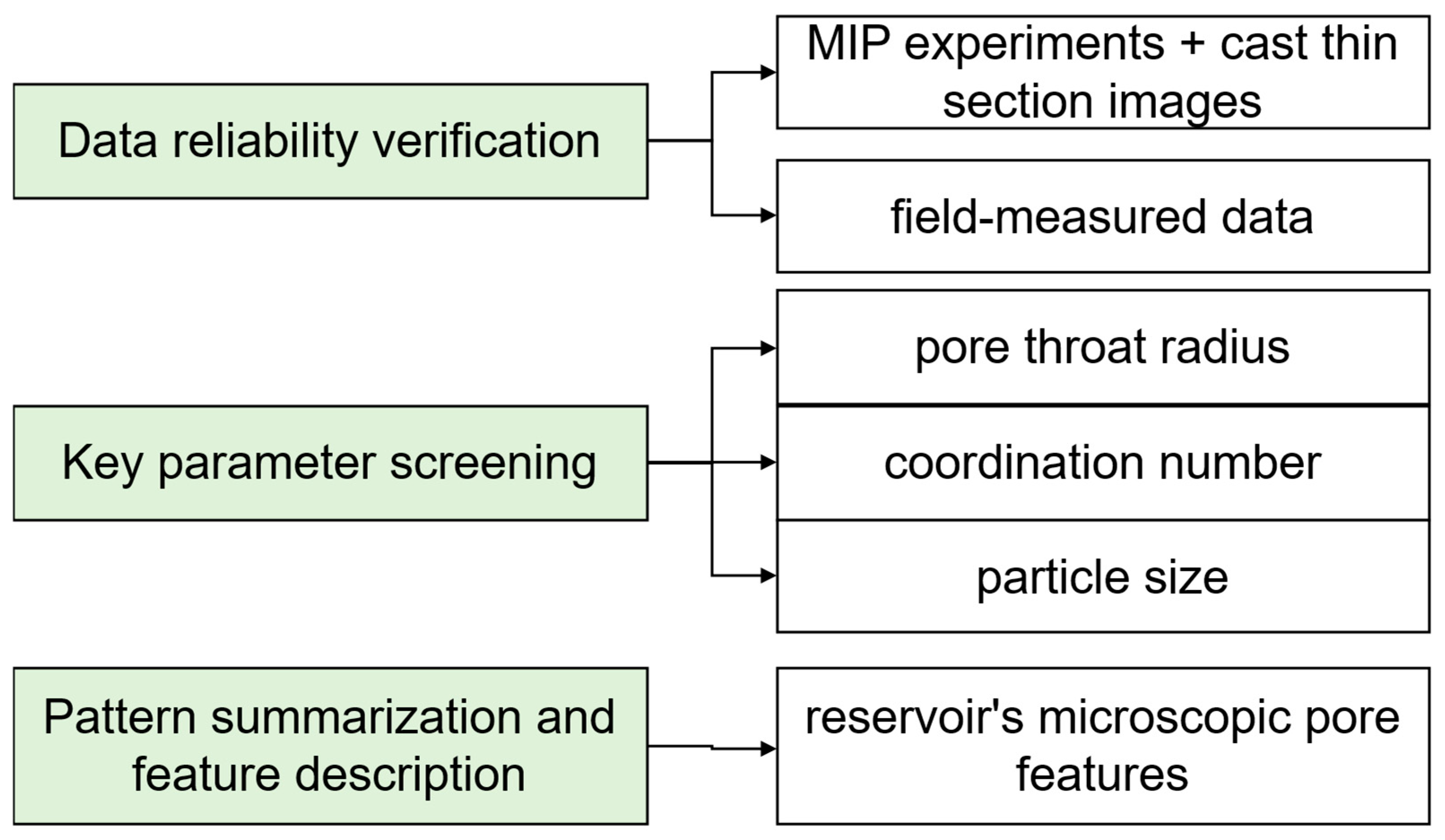
Based on MIP data and cast thin-section images, the characteristic parameters of the pore throat structure were statistically analyzed. Relevant parameters include porosity, absolute permeability, pore throat size distribution, coordination number distribution, and network connectivity characteristics. This study employs a three-step progressive analysis method to systematically characterize the pore structure features (Figure 1).
The specific process is as follows: (i) Data reliability verification. By comparing the differences between the pore structure parameters obtained from MIP experiments and the field-measured data, the standardization of experimental operations and the reasonableness of the data results were assessed to ensure the reliability of subsequent analysis. (ii) Key parameter screening. Based on characteristic parameters such as the pore throat radius distribution extracted from MIP tests combined with statistical methods, the dominant factors causing differences in pore structure among different gas layer cores were identified. (iii) Pattern summarization and feature description. By cross-analyzing the variation trends of key parameters, the development patterns of pore structure for each gas layer were summarized, ultimately achieving accurate characterization of the reservoir’s microscopic pore features.
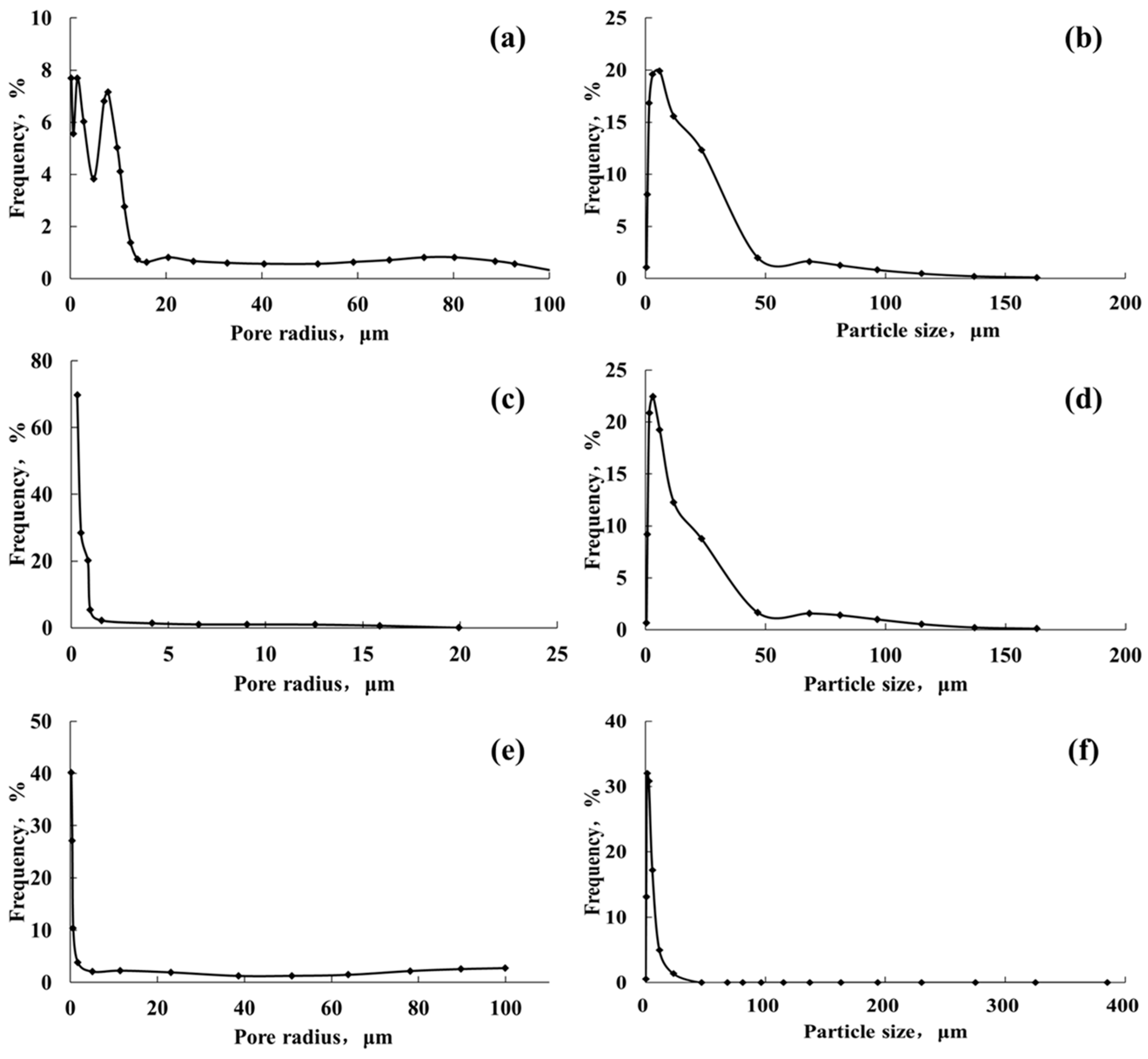
Addressing the needs of gas layer pore structure evaluation, MIP curves and cast thin-section images were used for dual verification. Frequency distribution curves for pore throat radius, throat length, coordination number, and particle size were plotted. By comparing the distribution ranges and fluctuation characteristics of these parameters across different gas layers, pore radius and particle size were screened out as core evaluation indicators. Based on the frequency distribution characteristics of key parameters for the three gas layer types, the differential characteristics of reservoir pore structure were deeply analyzed.
Figure 2 shows that the pore radius distribution of the conventional gas layer is concentrated around 2 μm (Figure 2a), whereas the low-resistivity gas layer is dominated by pores of about 0.15 μm (Figure 2c) and the low-acoustic high-resistivity gas layer by pores around 0.10 μm (Figure 2e). The corresponding particle size distributions (Figure 2b,d,f) indicate relatively coarse and well-sorted grains in the conventional gas layer and finer, more concentrated grains in the other two layers. By comparing the median pore throat radii of the three gas layer types (Table 1), the differential characteristics of their microscopic pore structures can be clearly identified. These statistical results not only provide a quantitative basis for reservoir classification but also serve as a reference standard for parameter design in microscopic seepage experiment models, ensuring the rationality of the simulation.
Although the particle size distributions of the conventional and low-resistivity gas layers appear similar, their pore size distributions differ markedly due to differences in clay content, cementation, and pore-filling materials. In the low-resistivity gas layer, higher shale content and dispersed clay minerals partially occupy intergranular pores and throats, significantly reducing effective pore and throat radii without substantially altering grain size. This leads to a decoupling between particle size distribution and pore size distribution.
Based on the MIP data and cast thin-section images, pore and throat radii, lengths, and coordination numbers for the three gas layer types were extracted by image analysis. The equivalent pore and throat radii were obtained from capillary pressure curves, while pore and throat lengths and coordination numbers were calculated from skeletonized thin-section images. Particle size distributions were derived from grain-size analysis of the same samples. These parameters were statistically described by their median or mean values and dominant ranges, providing quantitative constraints for reconstructing the pore networks of the conventional, low-resistivity, and low-acoustic high-resistivity gas layers.
Overall, the conventional gas layer is characterized by relatively large and well-connected pores and throats, the low-resistivity gas layer by abundant micro-pores and small throats with high bound-water saturation, and the low-acoustic high-resistivity gas layer by most heterogeneous pore throat system. These material differences among the three gas layer types are expected to exert a first-order control on water invasion paths, water-trapping gas types and the preferred locations where water-trapping gas is formed.

2.2. Experimental Materials and Procedures

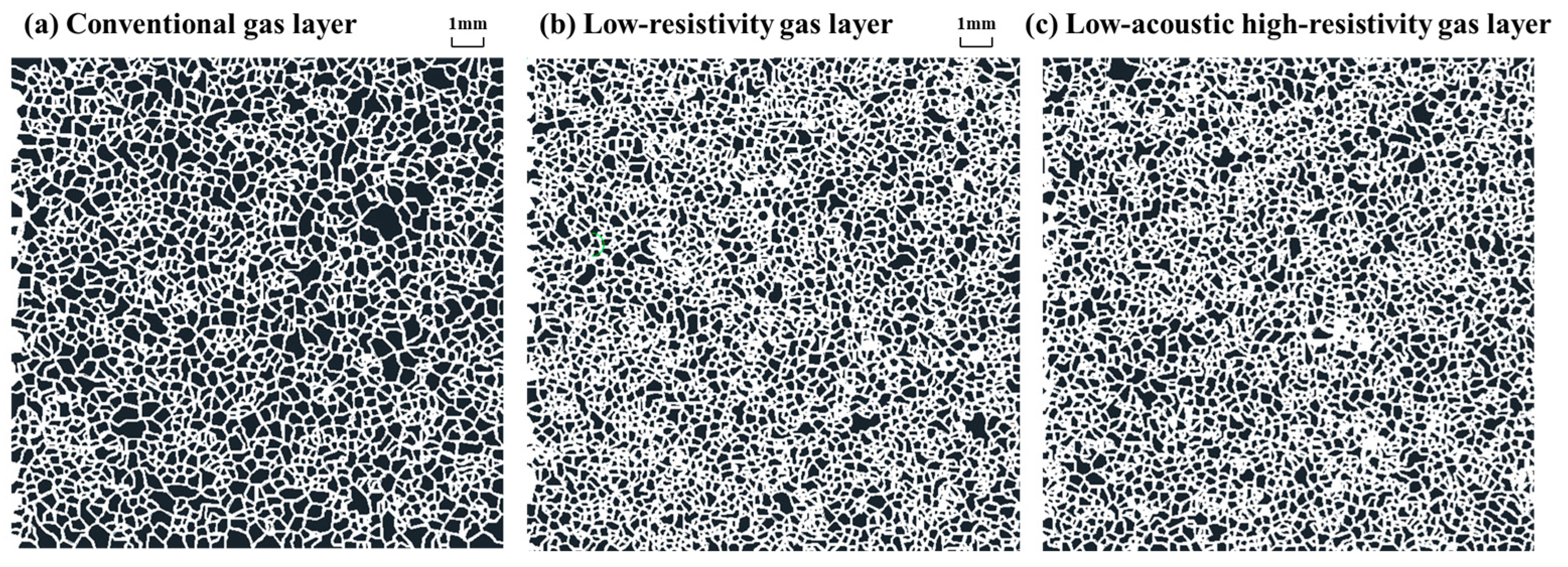
This study used the aforementioned pore structure parameters as the basis for model design. The QSGS technique was employed to generate model patterns consistent with the characteristics of the conventional, low-resistivity, and low-acoustic high-resistivity gas layers. Typical parameters such as porosity, pore radius distribution, throat radius distribution, and coordination number distribution were selected. Through four operational steps—basic parameter setting, input of typical parameter data, random generation of model patterns, and comparative analysis of parameter values—model channel patterns conforming to the data characteristics of each gas layer were generated, as shown in Figure 3.
In addition to pore throat radius distributions, the representativeness of the reconstructed pore networks was further supported by coordination number statistics and thin-section topology analysis. Coordination number distributions derived from skeletonized thin-section images indicate clear differences in pore connectivity among the three gas layer types, which are consistent with their observed heterogeneity and flow behaviour. Moreover, the spatial arrangement and clustering of pores observed in the cast thin sections were qualitatively preserved in the reconstructed micro-model patterns. Therefore, although MIP provides a primary quantitative constraint to the representation of pore size distribution, the combined use of MIP, thin-section topology, and coordination number analysis enhances the structural realism of the reconstructed pore networks.
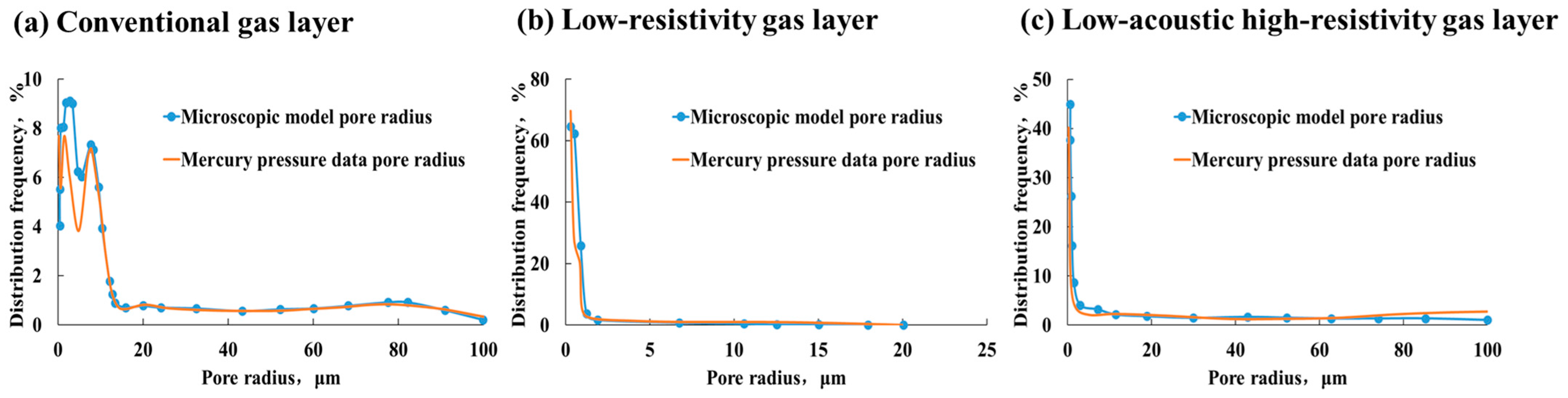
The pore throat radius distribution of the model channel patterns was statistically analyzed and compared with the actual pore structure. Variation curves were plotted (Figure 4), indicating a good degree of conformity between the two. This agreement between the micro-model and MIP pore throat radius distributions was taken as the primary validation criterion for the geometric realism of the reconstructed pore networks. Therefore, the model channel design results can reasonably characterize the pore throat structures of the three gas layers.
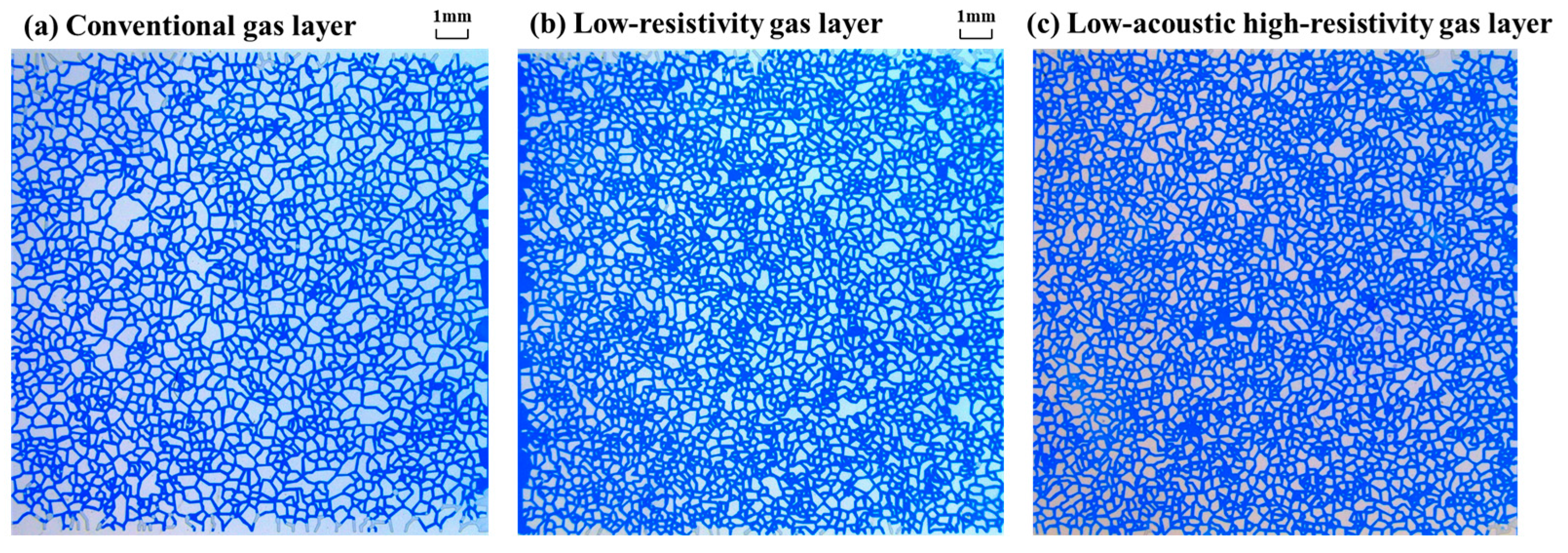
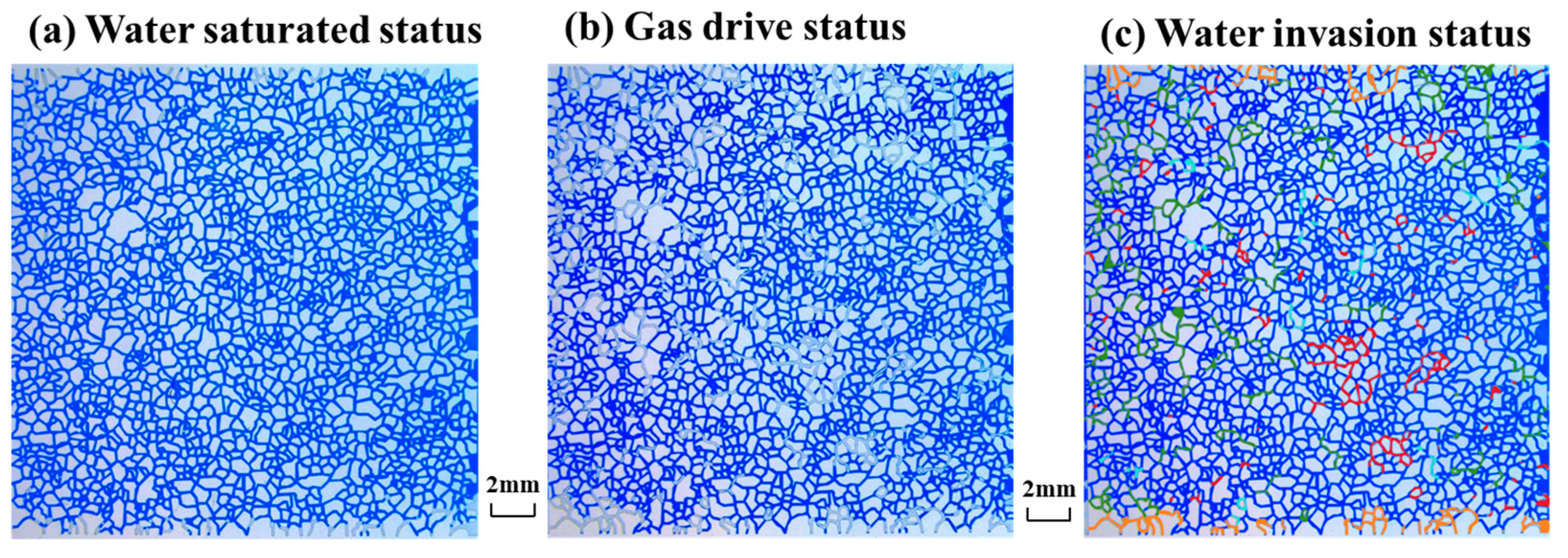
The patterns of microscopic models were converted into vector files using CAD software and the channel design graphics files were printed into masks. Using the wet etching method, through a series of operations including “developing—chrome removal—etching—resist stripping—chrome removal,” part of the etched material was stripped from the substrate via chemical reactions between the etching solution and the material, creating transparent glass micro-model substrates etched with the designed channels. Subsequent processes such as drilling, bonding, sealing, and firing were performed to finally produce complete glass micro-models usable for microfluidic experiments. Images of the fabricated glass micro-models in the water-saturated state are shown in Figure 5.
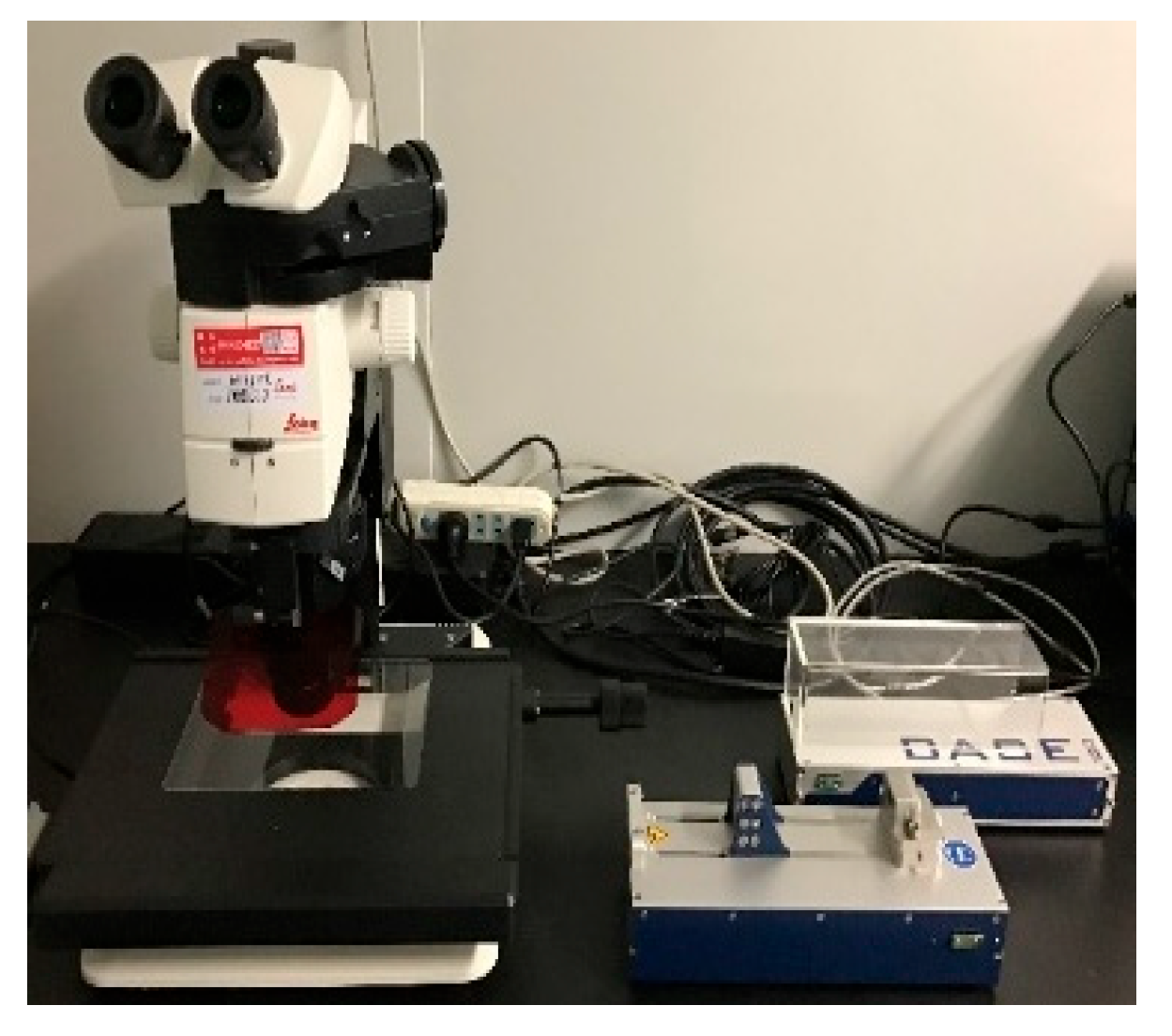
The experimental equipment mainly included a Leica M165FC stereomicroscope (Leica Microsystems, Wetzlar, Germany), a Leica DFC450 camera (100 fps, 2560 pixels × 1920 pixels), a Fluigent MFCS-EZ flow-control system, and Harvard constant-flow syringe pumps. A schematic of the microfluidic experimental set-up, including the positions of the micro-model, microscope, camera, and flow-control units, is shown in Figure 6. The formation temperature was simulated at 45 °C. The experimental water was deionized water, dyed blue with methylene blue. Before starting the experiments, the models were repeatedly flushed with propanol and deionized water. Some models required adjusting the wall surface to hydrophobic conditions by injecting a wettability modification solution prepared by mixing trimethylchlorosilane and methanol.
The specific experimental scheme is shown in Table 2. For the rate effect analysis, the same set of invasion rates (0.05, 0.10, and 0.20 μL/min) was applied to each layer type to form parallel water invasion conditions, enabling cross-layer comparison of residual gas distribution patterns under identical invasion intensities. The operational steps were as follows: (i) Model water saturation: a constant-pressure pump was used to inject methylene-blue-dyed water into the micro-model channels. The injection pressure was controlled at about 1.00 bar and in some runs the pressure was cycled up and down to obtain uniform water saturation. (ii) Constant-rate gas injection: a constant-flow pump was then used to inject air into the water-saturated models at 0.10 μL/min, displacing the movable water until no more water was produced at the outlet; at this point the model contained gas and irreducible water. (iii) Constant-rate water invasion: finally, methylene-blue-dyed water was injected again at the prescribed flow rate until the overall gas–water distribution in the model no longer changed. The entire water invasion process and the final distributions were recorded as video and still images for subsequent analysis.
It should be emphasized that the two-dimensional rigid glass micro-models employed in this study reproduce pore throat geometry and two-phase flow patterns but do not account for out-of-plane connectivity, grain rearrangement, compaction, or stress-induced deformation that may occur in unconsolidated sandstone reservoirs. As a result, certain trapping mechanisms, particularly snap-off and wetting-film thickening, may be somewhat exaggerated compared with three-dimensional deformable pore systems, where additional flow pathways and structural adjustment can partially relieve local capillary blockage. Nevertheless, the relative dominance of different trapping mechanisms among the three gas layer types is primarily controlled by pore size distribution, wettability, and heterogeneity, and these first-order controls are expected to remain valid even in more realistic three-dimensional systems.
In this study, the term “water invasion rate” refers to the imposed constant flow rate in the microfluidic models, which is adopted as a mechanistic proxy for effective water-encroachment intensity in field water-drive gas reservoirs. It does not imply operational water injection in the Sebei-2 gas field. Rate-dependent trends are therefore discussed in terms of the transition from capillary-dominated trapping to viscous-dominated channelling under strong heterogeneity.

2.3. Image Analysis Method

Quantitative characterization was performed on the visual images at different time points. All experiments were captured by a Leica DFC450 camera at a resolution of 2560 × 1920 pixels. The raw colour images were first converted into 8-bit grey-scale images, and a 3 × 3 median filter was applied to suppress random noise while preserving the edges of the gas–water interfaces. Subsequently, contrast and brightness were adjusted using a linear grey-scale stretch to fully utilize the dynamic range of the images.
The gas phase was then separated from the solid matrix and water by threshold segmentation. The global threshold value was determined from the grey-scale histogram using Otsu’s method and was further checked against manually interpreted images for several representative frames. After segmentation, isolated objects smaller than 5 pixels were removed as noise and a morphological closing operation was used to smooth the gas–water interfaces without altering their overall geometry. The segmentation parameters (filter size, threshold, and area cut-off) were calibrated such that the automatically extracted gas regions matched the manually outlined gas phase with an accuracy better than 95.00% for the test images. Therefore, the preprocessing mainly reduces noise and improves contrast and does not remove meaningful gas-trapping features.
To evaluate the robustness of the trapping-type classification, sensitivity checks were performed by varying the segmentation threshold and morphological parameters within reasonable ranges. The resulting variations in the area fractions of the four trapping types were generally within ±5.00%. Manual interpretation of representative frames was used as a benchmark and the automated classification achieved an agreement exceeding 95.00%. These tests indicate that the reported proportions of flow diversion, snap-off, blind end/corner, and wetting-film-thickening trapping gas are not overly sensitive to image resolution or threshold selection.
For each recorded frame, the gas and water saturations were obtained by counting the number of pixels occupied by the gas phase and normalizing by the total number of pore pixels. The water-trapping gas was further classified into four types (flow diversion, snap-off, blind end/corner, and wetting-film-thickening) according to their spatial morphology and evolution. The area fraction of each trapping type was calculated by counting the corresponding gas-phase pixels and dividing by the total gas-phase area.


3. Results and Discussion

3.1. The Microscopic Occurrence States of Water-Trapping Gas in Different Types of Gas Layers

Microscopic experiments on water-induced gas-trapping behaviour were conducted using micro-models of the three gas layer types. In the images, the blue areas represent the water phase and the injection direction in all images is from right to left. Based on different formation scales and mechanisms, the water-trapping gas is classified into flow diversion trapping gas, snap-off trapping gas, blind end and corner trapping gas, and wetting-film-thickening trapping gas.

3.1.1. Conventional Gas Layer

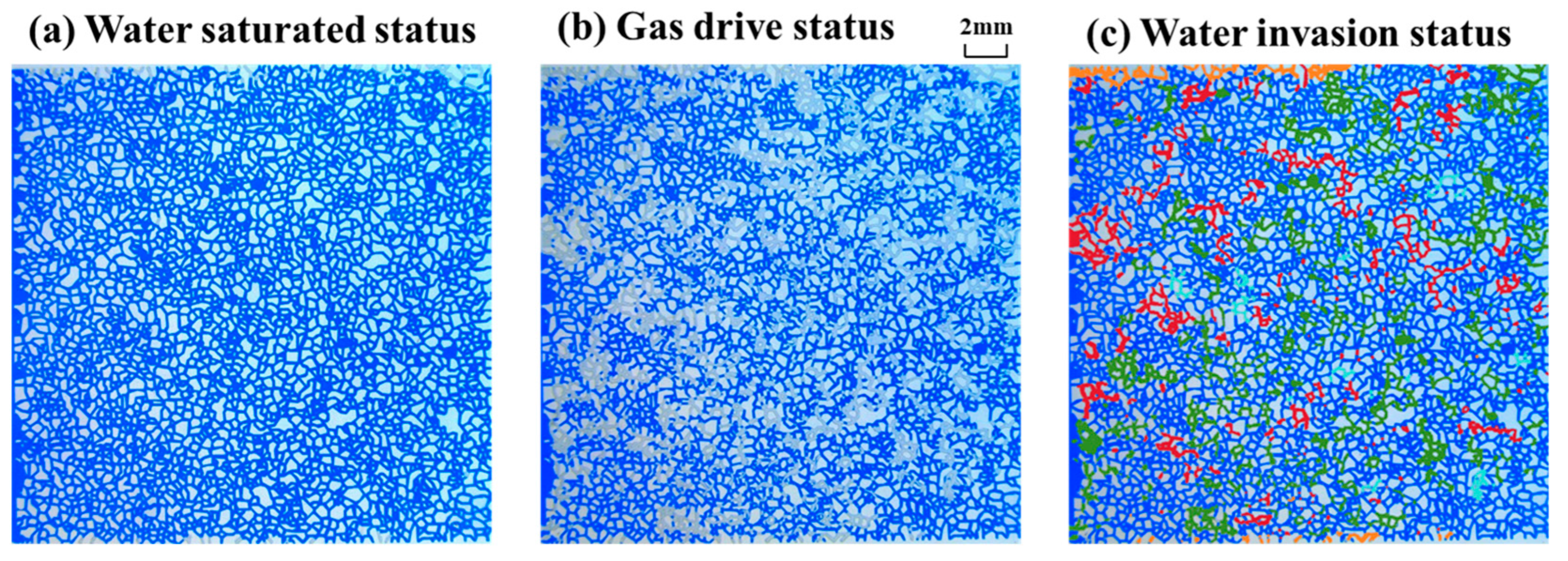
In the hydrophilic microfluidic model established for the conventional gas layer, due to the strong hydrophilicity of the pore wall surfaces, the water phase forms a continuous water film along the pore walls during flow, as shown in Figure 7. Among them, red indicates flow diversion-induced gas, cyan indicates snap-off trapping gas, orange indicates blind end and corner trapping gas, and green indicates wetting-film-thickening trapping gas (Table 3).
As the water invasion process continues, the water film gradually thickens. Combined with the heterogeneous characteristics of the pore throat spatial structure, this leads to obstruction of gas migration paths, thereby forming a large amount of water-trapping residual gas. The final residual gas saturation in the model reached 15.29%. In terms of the distribution of trapping gas types, flow diversion trapping gas and wetting-film-thickening trapping gas are the main occurrence forms, accounting for 27.77% and 45.61%, respectively. This indicates that in hydrophilic pores, the dynamic evolution of the water film combined with the pore throat structure plays a dominant role in gas trapping. Additionally, snap-off trapping gas accounted for 7.23%, reflecting the impact of the Jamin effect at local throats on intermittent gas entrapment. These percentage values are calculated from the pixel-based area fractions defined in the image analysis method.

3.1.2. Low-Resistivity Gas Layer

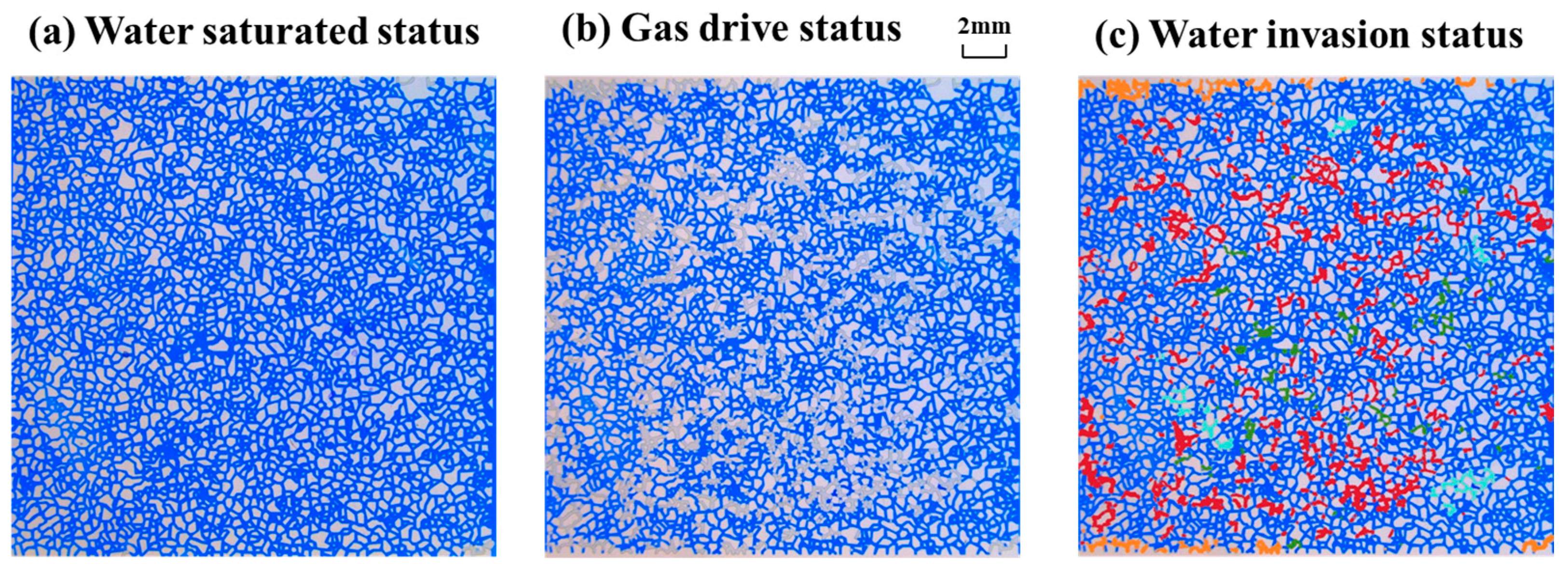
In the micro-model of the low-resistivity gas layer, due to the generally small pore sizes, capillary resistivity increases significantly, causing gas to more easily accumulate at narrow throats during migration. Simultaneously, based on the strong hydrophilicity of the model surface, the water phase preferentially spreads along the pore wall surfaces during seepage and gradually invades both sides of the gas seepage channels, effectively compressing and trapping the gas phase. This ultimately generates a large amount of immovable water-trapping residual gas, with a residual gas saturation as high as 30.57%, as shown in Figure 8.
Regarding the distribution of trapping gas types, wetting-film-thickening trapping gas dominates, accounting for approximately 59.78%. This reflects the critical role of dynamic water film development in gas trapping within hydrophilic pores. Flow diversion trapping gas accounts for 30.35%, indicating that the flow diversion effect caused by the complexity of the pore throat structure is also an important occurrence mechanism. Snap-off trapping gas and blind end and corner trapping gas account for 4.03% and 5.84%, respectively, suggesting that the Jamin effect and pore blind ends contribute relatively limitedly to the formation of residual gas.

3.1.3. Low-Acoustic High-Resistivity Gas Layer

Such hydrophobic behaviour has been reported in reservoirs with high carbonate content, organic coatings, or wettability alteration induced by long-term gas–water–rock interactions. In the hydrophobic micro-model representing the low-acoustic high-resistivity gas layer, the wettability of the pore wall surfaces is hydrophobic, making it difficult for the water phase to form a stable water film. Instead, it invades the pore throats in the form of discrete water columns, and the displacement process exhibits characteristics approximating piston-like advance, as shown in Figure 9.
Influenced by this displacement mode and the significant differences in reservoir pore sizes, gas is efficiently stripped and trapped within the complex pore throat network, resulting in a final residual gas saturation of 20.20%. In terms of the distribution of trapping gas types, flow diversion trapping gas absolutely dominates, accounting for up to 72.14%. This reflects that in strongly heterogeneous pore structures, the water phase preferentially advances through dominant channels, causing a large amount of gas to be trapped by flow diversion. The proportions of snap-off trapping gas, blind end and corner trapping gas, and wetting-film-thickening trapping gas are relatively low, at 6.44%, 11.77%, and 9.65%, respectively. This indicates that in hydrophobic environments, the Jamin effect, blind end trapping, and water film action contributed relatively limitedly to gas entrapment.

3.1.4. Comparison of Three Types of Gas Layers

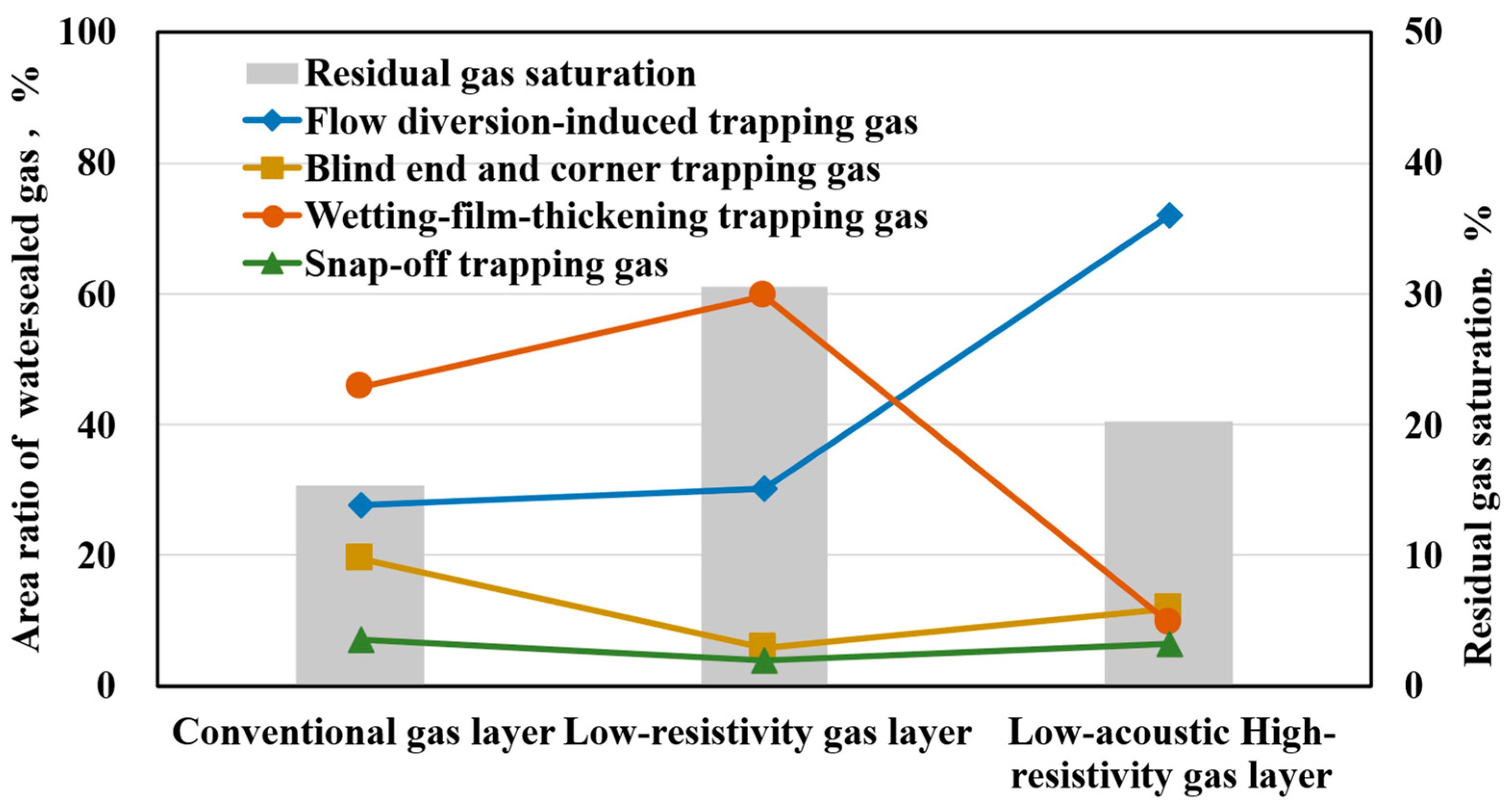
Through comparative analysis of the classification results of trapping gas after water invasion experiments in the three gas layer types (Figure 10), it is found that the low-resistivity gas layer has the highest residual gas saturation, significantly higher than the conventional and low-acoustic high-resistivity gas layers, reflecting its stronger gas entrapment capacity.
In terms of the composition of trapping gas types, both the conventional and low-resistivity gas layers are dominated by wetting-film-thickening trapping gas, which is consistent with their strong hydrophilicity and occurrence mechanism wherein water films easily form and are maintained on pore throat surfaces. In the low-acoustic high-resistivity gas layer, flow diversion trapping gas becomes the most predominant form, its proportion far exceeding other types. This indicates that due to the strong hydrophobicity and significant pore throat structure heterogeneity, the water phase is prone to fingering, bypassing the gas and forming flow diversion trapping gas. Furthermore, the proportion of snap-off trapping gas is at the lowest level among the three gas layer types, suggesting that the Jamin effect has a relatively limited overall contribution to the formation of water-trapping gas in various gas layers.
These results clearly reveal significant differences in the dominant formation mechanisms of water-trapping gas among different gas layer types: the high residual gas saturation in the low-resistivity gas layer is mainly controlled by water films, the conventional gas layer also relies primarily on water film trapping, while the low-acoustic high-resistivity gas layer is dominated by flow diversion trapping mechanisms. This understanding provides an important basis for formulating targeted strategies for water invasion management and enhanced recovery in different gas reservoirs.
Linking the pore structure characteristics with the microscopic observations shows that the strong gas-trapping capacity of the low-resistivity gas layer originates from its fine pore throat system and high bound-water saturation, which favour the development of continuous wetting films and severe flow-path constriction. In the conventional gas layer, larger pores and throats restrict film growth and thus limit residual saturation. In contrast, the low-acoustic high-resistivity gas layer combines a fine but highly heterogeneous pore network with hydrophobic surfaces, so that invading water preferentially advances through a few dominant channels; the resulting severe flow diversion leaves a large volume of gas stranded in poorly accessed regions. Although the residual gas saturation in the low-resistivity gas layer (~30%) appears high in Figure 10, it is comparable to values reported for unconsolidated sandstone gas reservoirs with strong water invasion. The moderate residual gas saturation in the low-acoustic high-resistivity gas layer (~20%) also falls within the range of pore-scale and core-scale measurements in reservoirs.
From a reservoir-development perspective, the observed differences in residual gas saturation imply markedly different dynamic reserve loss tendencies among the three gas layer types. The high residual gas saturation in the low-resistivity layer suggests a large fraction of gas becoming immobilized during water invasion, which is consistent with its commonly observed low effective recovery in the Sebei-2 gas field. In contrast, the conventional gas layer retains a higher proportion of mobile gas, while the low-acoustic high-resistivity layer exhibits intermediate behaviour. These pore-scale trends provide a mechanistic explanation for the differentiated production performance of the three layer types under water-drive conditions.

3.2. The Microscopic Formation Mechanism of Water-Trapping Gas in Different Types of Gas Layers

The use of air and dyed deionized water as proxy fluids inevitably introduces differences in viscosity ratio, density ratio, and interfacial tension compared with reservoir gas–water systems. These differences may affect the absolute values of residual gas saturation. However, the dominant trapping mechanisms identified here are primarily governed by wettability contrast, pore throat geometry, and heterogeneity, rather than by specific fluid properties. Therefore, while the magnitude of trapping may vary under reservoir-representative conditions, the observed trends in mechanism dominance among different gas layer types are expected to remain qualitatively valid.

3.2.1. Effect of Wettability

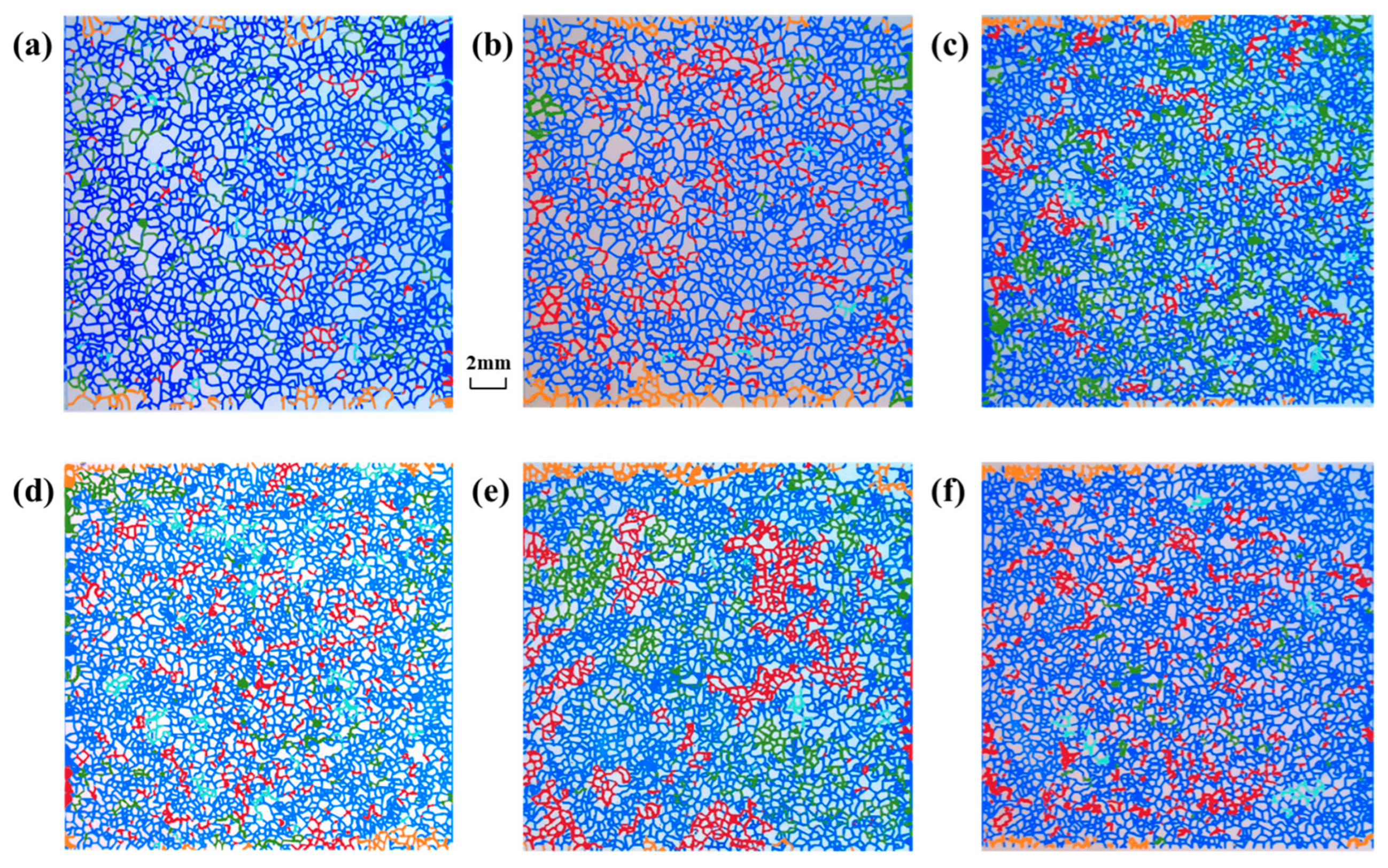
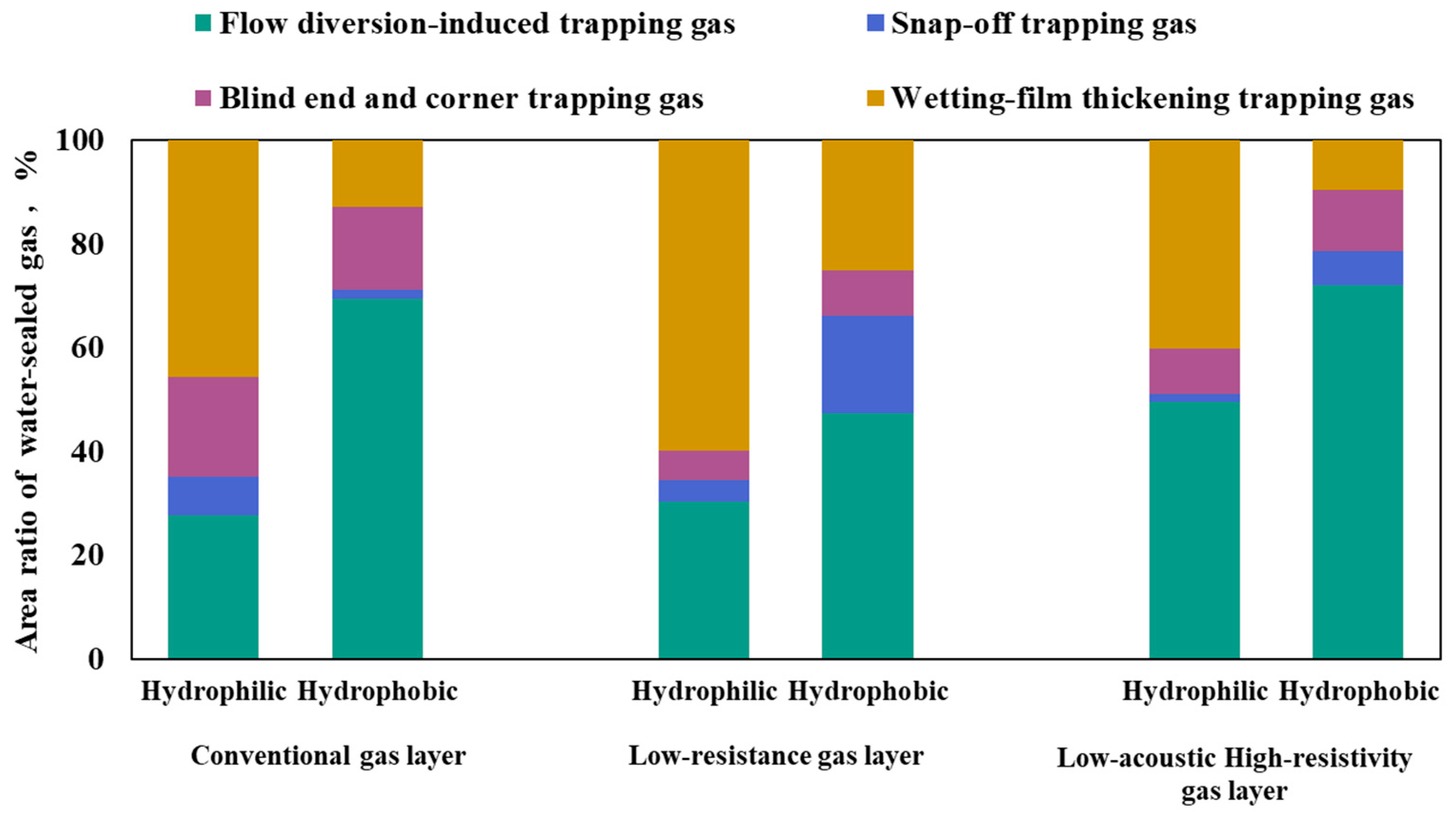
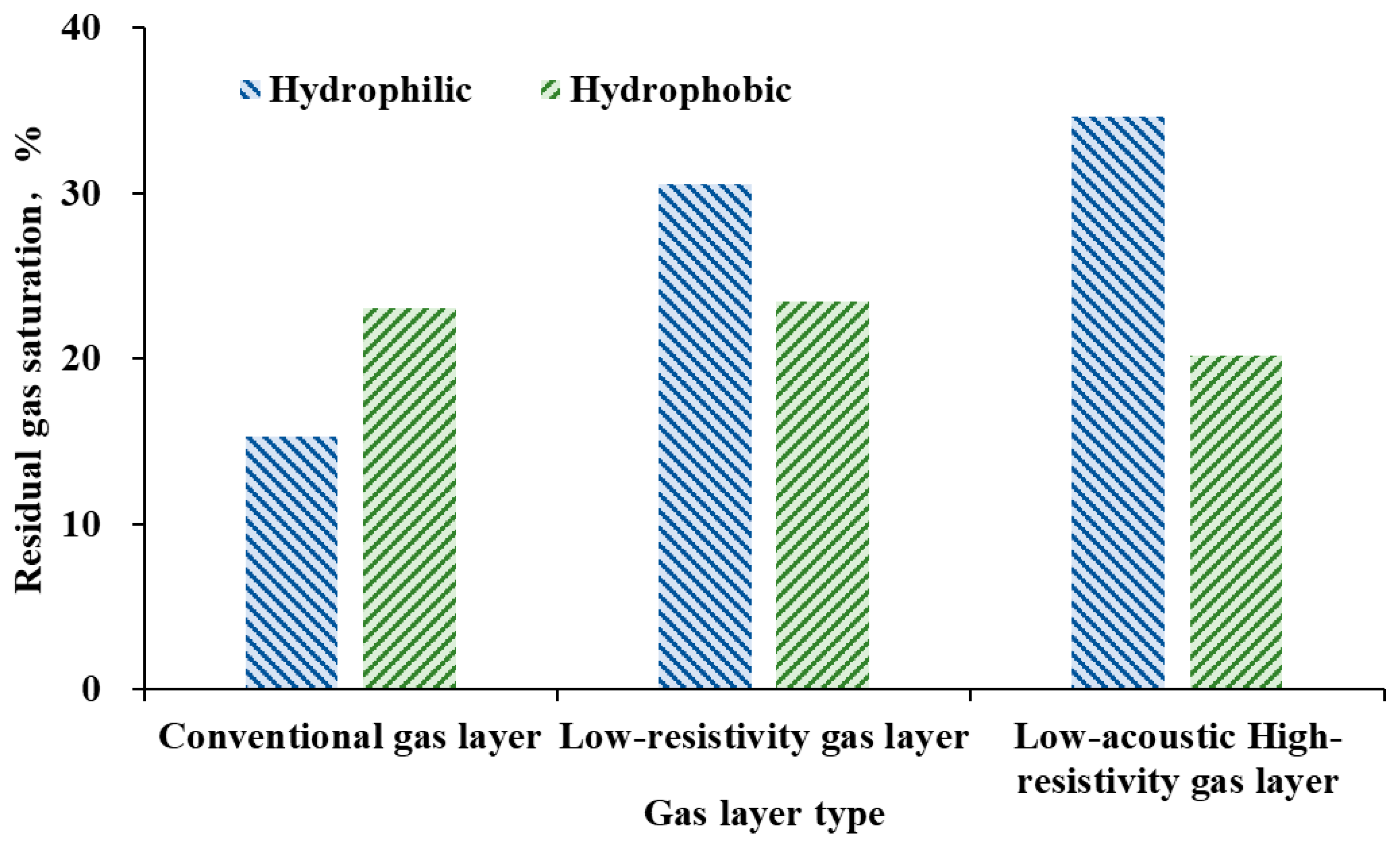
Wettability primarily affects the morphology of water-trapping gas by influencing the spreading and displacement behaviour of water within the pores. The experimental results were quantitatively analyzed using image processing software. Figure 11 shows the classification results of water-trapping gas after water invasion under different wettability conditions for different gas layer types. The proportion of the areas of different types of water-trapping gas and the residual gas saturation data under the influence of different wettability for the different gas layer types were statistically analyzed. Numerical variation curves were plotted as shown in Figure 12 and Figure 13 to further analyze the microscopic formation mechanisms of water-trapping gas under the influence of wettability.
By comparing image differences and numerical differences, it is evident that wettability affects the amount of water-trapping gas formed during water invasion and the proportion of different types of water-trapping gas. This is because when the rock is strongly water-wet, water forms a film on the surfaces of pores and throats, reducing the effective seepage channel radius for gas and thereby increasing its seepage resistivity. Under hydrophilic conditions, water spreading is strong. The morphology of water-trapping gas involves water first spreading along the pore throat walls, followed by subsequent water displacing the gas phase from the centre of the pores. After water finishes spreading within a pore, it continues to spread into the surrounding connected pore throats along the main flow direction; thus, the sweep morphology appears “sheet-like.” Most of the formed water-trapping gas is wetting-film-thickening trapping gas and flow diversion trapping gas. Under hydrophobic conditions, the spreading effect of water is much weaker than the displacement effect. The morphology of water-trapping gas involves water displacing the gas phase from the pores and then continuing to displace into the connected pores with the least displacement resistivity. The morphology of the water phase in the porous media region appears “branch-like,” in its occupation of the pore throat space, primarily forming flow diversion trapping gas.
From the perspective of residual gas saturation, the conventional gas layer exhibits the highest residual gas saturation under hydrophobic conditions, reflecting that gas is more easily retained in hydrophobic environments. In contrast, the low-resistivity and low-acoustic high-resistivity gas layers show higher residual gas saturation under hydrophilic conditions, indicating that strongly hydrophilic surfaces are more conducive to water film formation and gas entrapment in these gas layers. Regarding the area proportion of trapping gas types, under hydrophilic conditions, the proportions of flow diversion trapping gas and wetting-film-thickening trapping gas are relatively high in all three gas layers. Particularly, wetting-film-thickening trapping gas is significantly prominent in the hydrophilic model of the low-resistivity gas layer, which is closely related to the continuous spreading of the water phase and the reduction in the effective flow radius in hydrophilic pore throats. Under hydrophobic conditions, flow diversion trapping gas becomes the most predominant occurrence type, ranking first in proportion among the three gas layers. This indicates that in hydrophobic environments, the water phase is more prone to fingering, advancing along dominant channels, resulting in gas being trapped by flow diversion.
For the conventional gas layer, changing wettability mainly modifies the balance between wetting-film-thickening and snap-off trapping gas. In the low-resistivity gas layer, increased hydrophilicity greatly enhances film continuity in the micro-pore throat system, leading to the highest residual gas saturation. In the low-acoustic high-resistivity gas layer, the impact of wettability is superposed on strong heterogeneity, so that water invasion is always dominated by preferential channels and flow diversion trapping remains the main mechanism.

3.2.2. Effect of Water Invasion Rate

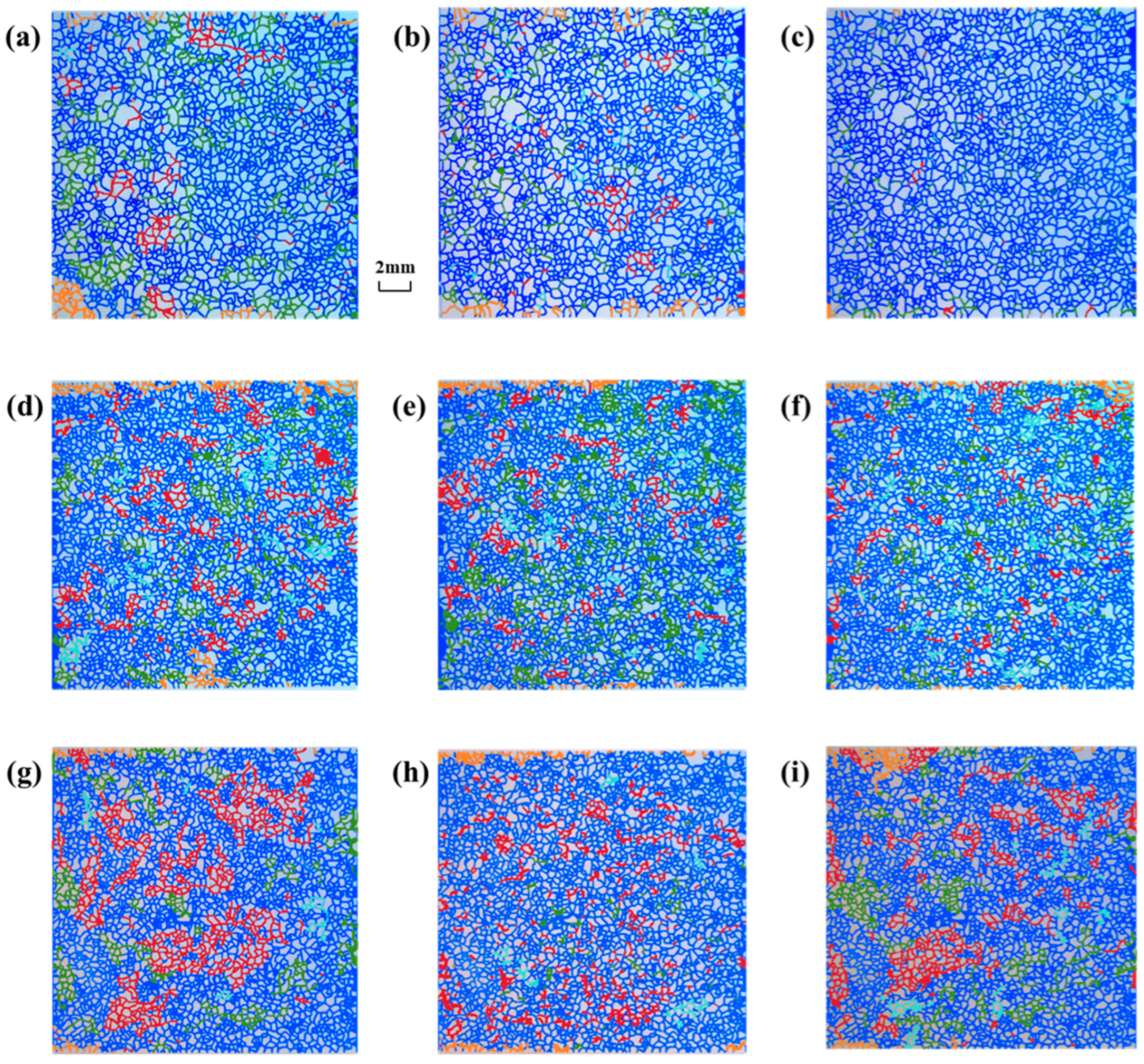
To enable a parallel comparison among different gas layer types, residual gas distributions were analyzed at identical water invasion rates (0.05, 0.10, and 0.20 μL/min) for the three micro-models, while keeping the representative wettability of each layer type consistent with its typical reservoir behaviour (hydrophilic for the conventional and low-resistivity layers, and hydrophobic for the low-acoustic high-resistivity layer). The water invasion rate primarily affects the formation of water-trapping gas by influencing the selection of water flow pathways within the channels. The results of various stages of water invasion experiments in porous media models with different water invasion rates for different gas layer types are shown in Figure 14. Images a, b, and c, respectively, represent conventional gas layer models with 0.05 μL/min, 0.1 μL/min, and 0.2 μL/min water invasion rates. The images d, e, and f, respectively, represent low-resistivity gas layer models with 0.05 μL/min, 0.1 μL/min, and 0.2 μL/min water invation rates. The images g, h, and i, respectively, represent low-acoustic high-resistivity gas layer models with 0.05 μL/min, 0.1 μL/min, and 0.2 μL/min water invasion rates.
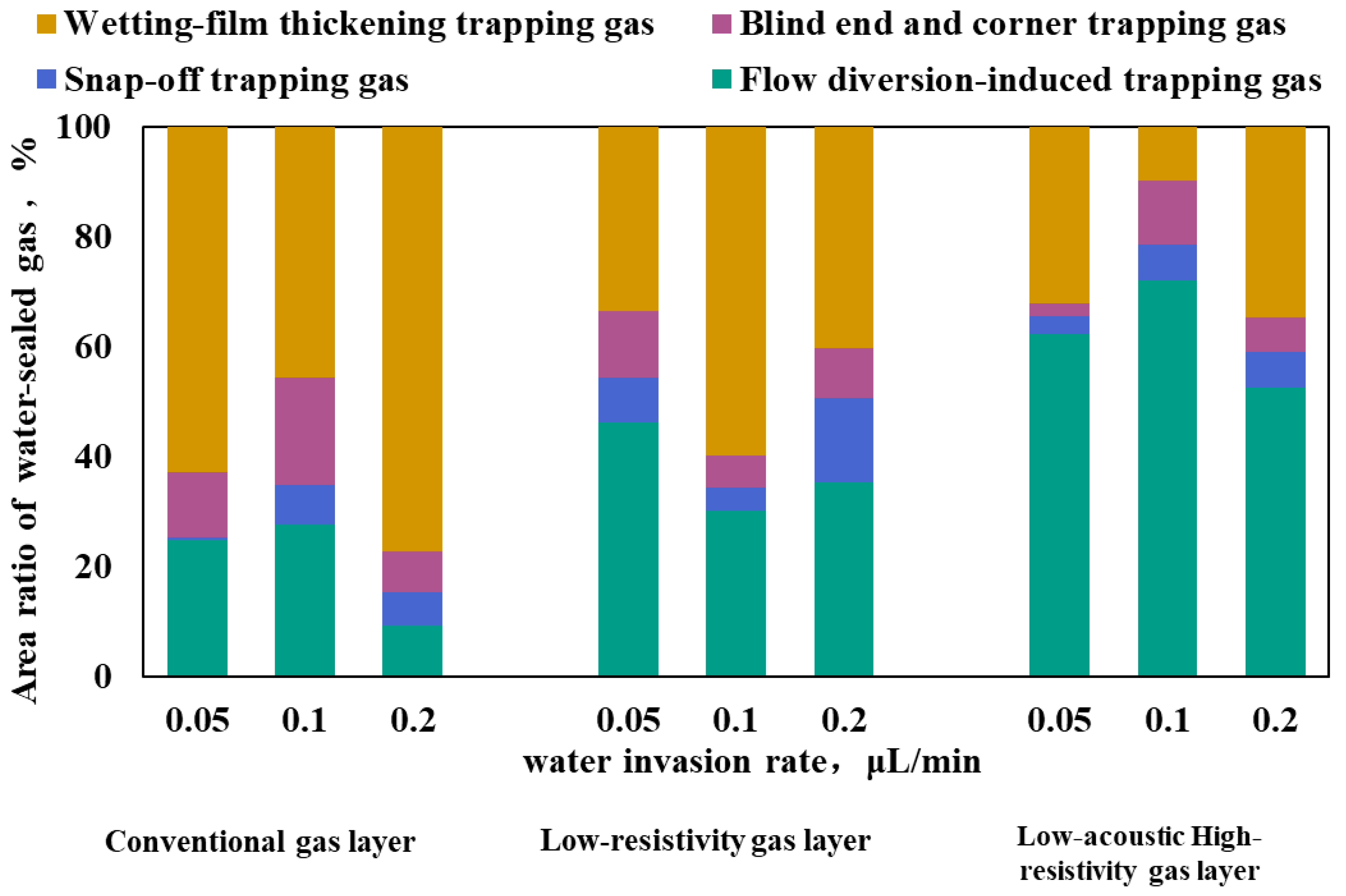
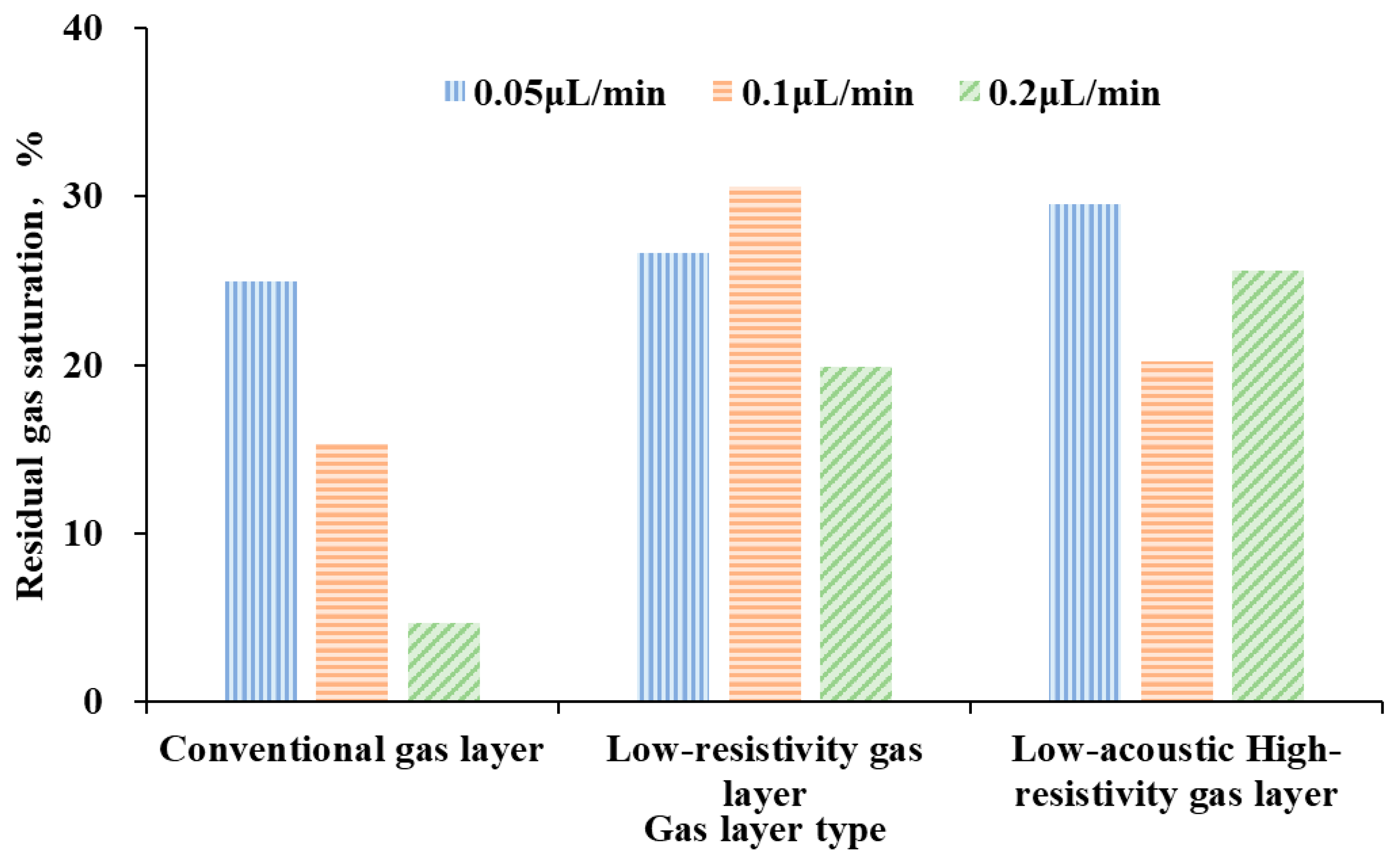
The experimental results were quantitatively analyzed using image processing software. Figure 15 shows the classification results of water-trapping gas after water invasion under the influence of different water invasion rates for different gas layer types. The variation data of gas saturation for different gas layer types under different water invasion rates were statistically analyzed and numerical variation curves were plotted as shown in Figure 16 to further analyze the microscopic formation mechanisms of water-trapping gas under the influence of water invasion rate.
At an invasion rate of 0.05 μL/min, the conventional and low-resistivity layers show predominantly capillary-controlled displacement, where residual gas is mainly associated with film-related trapping and local flow diversion. In contrast, the low-acoustic high-resistivity layer exhibits pronounced preferential flow paths even at low rate, resulting in an apparent diversion-dominated stranded-gas pattern.
At 0.10 μL/min, the conventional and low-resistivity layers display improved sweep and reduced trapped gas due to the stronger driving force overcoming capillary resistance in part of the pore throat network, whereas the low-acoustic high-resistivity layer still maintains channelized invasion with limited access to poorly connected regions.
At 0.20 μL/min, trapped gas further decreases in the conventional and low-resistivity layers, but the low-acoustic high-resistivity layer shows intensified channelized fingering and a strengthened diversion effect, leading to a rebound of residual gas saturation. This cross-layer comparison under parallel invasion rates highlights that the rate sensitivity of residual gas trapping is strongly layer-type dependent.
Through image and quantitative data analysis of the microscopic visualization experiment results under different water invasion rate conditions, it is found that the water invasion rate significantly affects the residual gas saturation and the occurrence proportion of various types of water-trapping gas. Overall, appropriately increasing the water invasion rate helps reduce the total content of trapping gas. The reason is that a higher water invasion rate provides stronger driving force, effectively overcoming capillary resistivity and promoting gas flow and production. However, for the low-acoustic high-resistivity gas layer with strong pore throat structure heterogeneity, the amount of water-trapping gas shows a trend of first decreasing and then increasing with increasing water invasion rate. This reflects that dominant fingering channels are more easily formed in its complex pore network under high flow rate conditions, leading to an enhanced flow diversion effect and consequently an increase in gas entrapment under high flow rate conditions.
The water invasion rate differentially affects the formation mechanisms and occurrence structure of water-trapping gas in different gas layer types by altering the driving force and flow path selection. From the distribution of trapping gas types, under low-rate conditions, wetting-film-thickening trapping gas dominates in the conventional gas layer, reflecting the characteristic stable development of water films in hydrophilic fine channels. The low-resistivity and low-acoustic high-resistivity gas layers mainly exhibit flow diversion trapping gas, indicating that structural heterogeneity already causes obvious uneven displacement at low rates. Under high-rate conditions, wetting-film-thickening trapping gas remains the dominant type in the conventional gas layer, suggesting its water film mechanism is relatively less affected by flow rate. Flow diversion trapping gas further increases in the low-resistivity and low-acoustic high-resistivity gas layers, especially in the low-acoustic high-resistivity gas layer where it accounts for the highest proportion. This reflects that strongly heterogeneous reservoirs are more prone to fingering under high-flow-rate conditions, leading to a significantly increased probability of gas being trapped by flow diversion.
From a force-balance perspective, increasing the water invasion rate increases the capillary number, thereby enhancing viscous forces relative to capillary forces. At moderate capillary numbers, this promotes more uniform displacement and reduces residual gas saturation. However, in the highly heterogeneous low-acoustic high-resistivity gas layer, further increases in capillary number amplify viscous fingering and preferential channelling. As a result, flow diversion becomes more pronounced at high invasion rates, leading to a rebound in residual gas saturation. This non-monotonic behaviour reflects the combined effects of viscous–capillary force balance and strong pore-scale heterogeneity.
The present results for the three gas layer types should be interpreted as flow-dominated trapping patterns under fixed pore geometry, and future work will couple microfluidic observations with deformable or particle-based models to evaluate the additional effects of structure damage. For field applications in the Sebei-2 gas field, these trends suggest that water invasion control and gas-mobilization measures should be tailored by layer type, with particular attention to limiting water film development in low-resistivity layers and mitigating high-rate fingering in low-acoustic high-resistivity layers. It should be noted that the variation in water invasion rate discussed here does not imply active water invasion control in field gas reservoirs, but rather represents different effective invasion intensities associated with reservoir heterogeneity, pressure drawdown, and aquifer strength. Therefore, the observed rate-dependent trapping behaviour should be interpreted as a mechanistic analogue for field-scale water invasion scenarios rather than as a direct operational guideline.

4. Conclusions

This study was motivated by the low gas recovery in the Sebei-2 gas field and the lack of quantitative understanding of how different logging-defined gas layer types trap gas during water invasion. Using reconstructed pore structures and controlled microfluidic experiments, we addressed three objectives: (i) to link the pore structure characteristics of the conventional, low-resistivity, and low-acoustic high-resistivity gas layers to their gas-trapping behaviour; (ii) to quantify how wettability and water invasion rate regulate residual gas saturation and trapping styles in each layer; and (iii) to infer the implications of these pore-scale mechanisms for recovery strategies. This study employed microfluidic experiments combined with quantitative image analysis to examine the pore-scale mechanisms and occurrence of trapped gas during water invasion in the conventional, low-resistivity, and low-acoustic high-resistivity gas layers of the Sebei-2 gas field. The main findings are as follows:
  • Gas layer type strongly influences gas trapping. Residual gas saturation is highest in the low-resistivity layer, followed by the low-acoustic high-resistivity layer, and lowest in the conventional layer. In hydrophilic systems, gas is mainly retained by wetting-film thickening and flow diversion in the conventional and low-resistivity layers. Under hydrophobic conditions, the low-acoustic high-resistivity layer is dominated by flow diversion, and the overall residual gas decreases noticeably;
  • Wettability affects both trapping style and saturation. In hydrophilic models, continuous wetting films develop and gas is mainly trapped by film thickening. In hydrophobic models, the invading water forms “branch-like” fingers and gas is trapped mainly through flow diversion.
  • The rate of water invasion regulates residual gas. A moderate increase in invasion rate reduces trapped gas in hydrophilic layers. In contrast, in the highly heterogeneous low-acoustic high-resistivity layer, rapid invasion promotes channel-like fingering, leading to more flow diversion trapping and a residual gas saturation that first declines and then rises.
  • Trapping mechanisms differ across gas layer types. The conventional and low-resistivity layers are controlled largely by wetting films, while the low-acoustic high-resistivity layer is dominated by flow diversion. These conclusions for the conventional, low-resistivity, and low-acoustic high-resistivity gas layers are obtained from rigid glass microfluidic models and should be further verified under coupled hydro-mechanical conditions that allow for structural damage of unconsolidated sandstones.
  • The microfluidic models used in this work are two-dimensional rigid glass replicas of the pore throat geometry and therefore neglect out-of-plane connectivity, grain rearrangement, compaction, and fracture development. As a result, the absolute values of residual gas saturation and trapping fractions should be interpreted as pore-scale trends rather than direct field-scale saturations and they may differ from 3D measurements obtained by CT/NMR. Nevertheless, the relative differences between the three gas layer types and the identified dominant trapping mechanisms are robust and provide guidance on which intervals are most susceptible to dynamic reserve loss during water invasion.
  • Future research should (i) couple microfluidic observations with 3D CT/NMR imaging and pore network or continuum simulations to upscale the pore-scale findings; (ii) incorporate deformable or particle-based models that capture sand production and stress-induced structure damage in unconsolidated sandstones; and (iii) evaluate chemical and engineering measures, such as targeted wettability modification or selective water control operations, that specifically address the dominant trapping mechanisms in each gas layer type.

Author Contributions

Methodology, Q.H.; software, Q.H.; validation, Q.H. and J.L. (Junqing Lu); formal analysis, J.L. (Junqing Lu).; investigation, Y.Z.; resources, Y.Z. and J.L. (Junjian Li); data curation, Y.Z.; writing—original draft preparation, X.Z. and J.L. (Junjian Li); writing—review and editing, X.Z.; visualization, Y.M.; supervision, Y.M.; project administration, J.L. (Junjian Li). All authors have read and agreed to the published version of the manuscript.

Funding

This research received no external funding.

Data Availability Statement

The original contributions presented in this study are included in the article. Further inquiries can be directed to the corresponding author.

Acknowledgments

The authors thank China University of Petroleum (Beijing) for the support. The authors have reviewed and edited the output and take full responsibility for the content of this publication.

Conflicts of Interest

Qijun Huang, Junqing Lu, Yuqin Zhao, Xiangyu Zhang, Yinman Ma were affiliated from PetroChina Qinghai Oilfield Company. Qijun Huang also was affiliated from China Petroleum Engineering Technology Research Institute Co., Ltd. The other authors state that there was no conflict of interest.

Abbreviations

The following abbreviations are used in this manuscript:
QSGSQuarter Structure Generation Set
MIPMercury Intrusion Porosimetry
NMRNuclear Magnetic Resonance

References

  1. Li, H.; Jia, A.; He, D.; Ji, G.; Guo, J. Technical progress and outlook of natural gas development for the PetroChina. Nat. Gas Ind. 2010, 30, 5–7+133–134. [Google Scholar] [CrossRef]
  2. Song, W.; Kui, M.; Li, J.; Wang, X.; Liu, J.; Sun, Y.; Wen, Z.; Yang, G.; Tan, X. Stable production technologies and development strategies for the Sebei gas pool with severe water intrusion in the Qaidam Basin. Nat. Gas Ind. 2023, 43, 37–45. [Google Scholar] [CrossRef]
  3. Li, J.; Xiang, Y.; Chen, F.; Deng, C.; Xu, X.; Cheng, X.; Yang, H.; Xie, M.; Tang, Q.; Wang, H. Key technologies and prospect of EGR in the Sebei Gas Field in the Qaidam Basin. Nat. Gas Ind. 2023, 43, 141–152. [Google Scholar] [CrossRef]
  4. Zou, C.; Lin, M.; Ma, F.; Liu, H.; Yang, Z.; Zhang, G.; Yang, Y.; Guan, C.; Liang, Y.; Wang, Y.; et al. Development, challenges and strategies of natural gas industry under carbon neutral target in China. Pet. Explor. Dev. 2024, 51, 418–435. [Google Scholar] [CrossRef]
  5. Peng, X.; Hu, Y.; Zhang, F.; Zhang, R.; Zhao, H. A Review on the Water Invasion Mechanism and Enhanced Gas Recovery Methods in Carbonate Bottom-Water Gas Reservoirs. Processes 2024, 12, 2748. [Google Scholar] [CrossRef]
  6. Lu, J.; Lu, X.; Wang, W.; Xie, K.; Hu, Y. Visual Test of Gas-Water Distribution in Tight Sandstone Pores. Spec. Oil Gas Reserv. 2019, 26, 136–141. [Google Scholar] [CrossRef]
  7. Zhao, W.; Wu, K.; Jiang, L.; He, M.; Wen, Z.; Jia, C. Charging and microscopic gas–water occurrence characteristics of tight sandstone gas based on pore network model. Nat. Gas Ind. 2022, 42, 69–79. [Google Scholar] [CrossRef]
  8. Zhu, Q.; Wu, K.; Zhang, S.; Cheng, S.; Wang, T.; Liu, Q.; Li, J.; Chen, Z. Microscopic mechanism of CO2 injection to enhance gas recovery in tight sandstone gas reservoirs. Nat. Gas Ind. 2024, 44, 135–145. [Google Scholar] [CrossRef]
  9. Amirsardari, M.; Afsari, K. Pore-to-field scale modeling of residual gas trapping in tight carbonate underground gas reservoirs. Energy 2024, 298, 131305. [Google Scholar] [CrossRef]
  10. Wang, M.; Li, Y.; Wu, K.; Chen, Z.; Li, J.; Feng, D.; Zhu, Q.; Guo, S. Quantitative characterization of microscopic pore structure and oil recovery evaluation in porous carbonate reservoirs. Pet. Geol. Recovery Effic. 2024, 31, 96–107. [Google Scholar] [CrossRef]
  11. Fang, F.; Shen, W.; Li, X.; Gao, S.; Liu, H.; Li, J. Experimental study on water invasion mechanism of fractured carbonate gas reservoirs in Longwangmiao Formation, Moxi block, Sichuan Basin. Environ. Earth Sci. 2019, 78, 316. [Google Scholar] [CrossRef]
  12. Zhou, M.; Li, X.; Hu, Y.; Xu, X.; Jiang, L.; Li, Y. Physical Simulation Experimental Technology and Mechanism of Water Invasion in Fractured-Porous Gas Reservoir: A Review. Energies 2021, 14, 3918. [Google Scholar] [CrossRef]
  13. Deng, Y.; Du, Z.; Chen, C. Influential factors of primitive distribution of gas and water in loose sand gas reservoir. Pet. Geol. Recovery Effic. 2009, 16, 73–75+116. [Google Scholar] [CrossRef]
  14. Chen, Z.; Xie, Y.; Deng, Y. Experiment of Microscopic Displacement of Gas and Water in Loose Sandstone Gas Reservoir of Sebei. J. Southwest Pet. Univ. (Sci. Technol. Ed.) 2013, 35, 139–144. [Google Scholar] [CrossRef]
  15. Xie, Y.; Chen, Z. Experiment study on permeability sensitivity in loose sandstone gas reservoir. Fault-Block Oil Gas Field 2013, 20, 488–491. [Google Scholar] [CrossRef]
  16. Zhang, T.; Sun, T.; Chen, W.; Zhu, G.; Wang, X. Pore-scale Simulation of Gas-water Two Phase Flow in CarbonateReservoir with Different Combinations of Pore, Network and Hole. J. Southwest Pet. Univ. (Sci. Technol. Ed.) 2023, 45, 88–96. [Google Scholar] [CrossRef]
  17. Hu, Y.; Li, X.; Jiang, L.; Wan, Y.; Guo, C.; Jiao, C.; Chai, X.; Jing, W.; Xu, X.; Zhou, M.; et al. Production experiment of multi-layer edge-water loose sandstone gas reservoir in Qaidam Basin. Nat. Gas Geosci. 2022, 33, 1499–1508. [Google Scholar] [CrossRef]
  18. Wang, F.; Zhang, Z.; Zhang, W.; Zhu, H.; Wang, L.; Liao, L. Ternary wetting modification technology: A remedy for water blockage and prevention sand in unconsolidated sandstone gas reservoirs. Gas Sci. Eng. 2024, 122, 205223. [Google Scholar] [CrossRef]
  19. Hu, J.; Yang, S.; Jiang, Y.; Deng, H.; Wang, M.; You, L.; Li, Q.; Bai, H.; Shen, B. Experimental Study on Edge Water Invasion of Strongly Heterogeneous Carbonate Gas Reservoirs Based on NMR Technology. Processes 2024, 12, 1361. [Google Scholar] [CrossRef]
  20. Li, J.; Liu, Y.; Gao, Y.; Cheng, B.; Meng, F.; Xu, H. Effects of microscopic pore structure heterogeneity on the distribution and morphology of remaining oil. Pet. Explor. Dev. 2018, 45, 1112–1122. [Google Scholar] [CrossRef]
  21. Wang, C.; Jiang, H.; Ma, M.; Xu, F.; Yu, F.; Zhao, Y.; Li, J. Study of the Variation of Pore-Scale Residual Oil Flow Based on a Microfluidic Model. Pet. Sci. Bull. 2020, 5, 376–391. [Google Scholar] [CrossRef]
  22. Wang, Y.; Jiang, H.; Guo, C.; Zhao, X.; Diwu, P.; Li, J. Microfluidics experimental investigation of water channeling control strategy after degassing in fractured carbonate reservoirs. China Offshore Oil Gas 2023, 35, 78–88. [Google Scholar] [CrossRef]
  23. Ning, B.; Ren, D.; Wang, H.; Zhang, H.; Guo, J.; Fu, N.; Li, J.; Li, T.; Li, Q. Multi-scale combination characterization of micropore structure of tight sandstone gas reservoirs. Fault-Block Oil Gas Field 2024, 31, 34–41. [Google Scholar]
  24. Zhou, K.; Li, N.; Zhang, Q.; Tang, X. Experimental research on gas-water two phase flow and confined gas formation mechanism. Nat. Gas Ind. 2002, 22, 122–125+1. [Google Scholar]
  25. Xiong, Y.; Fu, X.T.; Feng, P.X.; Zhao, Z.H.; Jiang, J.; Fu, H.H. Microscopic occurrence of primary water in carbonate gas reservoirs with fractures and vugs and its effect on water invasion mechanism. J. Hydrol. 2024, 635, 131087. [Google Scholar] [CrossRef]
  26. Li, D.; Zhang, L.; Zhou, K.; Guo, L. Gas-water two-phase flow mechanism in visual microscopic pore model. J. China Univ. Pet. (Nat. Sci. Ed.) 2008, 32, 80–83. [Google Scholar] [CrossRef]
  27. Li, Q.; Yang, Y.; Peng, X. Research on Water Intrusion Mechanism and Water Control Countermeasures of Water-Bearing Gas Reservoirs in Sichuan Basin. In Proceedings of the 2018 National Natural Gas Academic Conference, Fuzhou, China, 14 November 2018. [Google Scholar] [CrossRef]
  28. Wang, L.; Yang, S.; Liu, Y.; Wang, Y.; Meng, Z.; Han, W.; Qian, K. Visual experimental investigation of gas-water two phase micro seepage mechanisms in fracture-cavity carbonate reservoirs. Pet. Sci. Bull. 2017, 2, 364–376. [Google Scholar] [CrossRef]
  29. Hu, S.; Li, J.; Jiang, N.; Yuan, Y.; Wan, X. Experimental Study on Dynamic Reserves Loss by Water Invasion in Water-driven Gas Reservoirs. Spec. Oil Gas Reserv. 2017, 24, 146–149. [Google Scholar] [CrossRef]
  30. Liu, J.; Du, J.; Ou, B.; Jiang, Y.; Kang, R.; Liao, L.; Wu, F. Occurrence characteristics and formation mechanism of water invaded residual gas in sandstone gas reservoir. Nat. Gas Ind. 2024, 44, 83–93. [Google Scholar] [CrossRef]
  31. Gu, D.; Dou, W.; Ding, F.; Yan, L.; Lyu, H. Research on the genesis and identification of low resistivity gas reservoirs in unconsolidated sandstone gas reservoirs: A case study of the Sebei gas field, Qaidam Basin. Geophys. Geochem. Explor. 2020, 44, 649–655. [Google Scholar] [CrossRef]
  32. Li, X.; Huan, H.; Lin, H.; Li, Z.; Du, F.; Cao, Z.; Fan, X.; Ren, H. Determination method of rational position for working face entries in coordinated mining of section coal pillars and lower sub-layer. Sci. Rep. 2025, 15, 29440. [Google Scholar] [CrossRef] [PubMed]
  33. Cao, Z.; Xiong, Y.; Xue, Y.; Du, F.; Li, Z.; Huang, C.; Wang, S.; Yu, Y.; Wang, W.; Zhai, M.; et al. Diffusion Evolution Rules of Grouting Slurry in Mining-induced Cracks in Overlying Strata. Rock Mech. Rock Eng. 2025, 58, 6493–6512. [Google Scholar] [CrossRef]
  34. Soomro, N.A.; Ansari, U.; Shams, B.; Memon, M.K.; Bhutto, D.K.; Rui, Z.; Pan, Y. Experimental assessment of the stability and impact of water-based fracturing fluid with and without Triethanolamine (TEA). Fuel Commun. 2025, 23, 100137. [Google Scholar] [CrossRef]
  35. Soomro, N.A.; Ansari, U.; Shams, B.; Memon, M.K. Experimental Investigation of Proppant-Based Fluid for Fracture Propagation in Various Rock Samples. Spec. Top. Rev. Porous Media 2024, 2024, 1944. [Google Scholar] [CrossRef]
Figure 1. The three-step progressive pore structure analysis workflow.
Processes 14 00397 g001
Figure 2. Frequency variation diagram of key parameter distribution. (a) represents pore radius distribution frequency curve in Conventional gas layer. (b) represents frequency variation of particle size distribution in Conventional gas layer. (c) represents pore radius distribution frequency curve in Low-resistivity gas layer. (d) represents frequency variation of particle size distribution in Low-resistivity gas layer. (e) represents pore radius distribution frequency curve in Low-acoustic High-resistivity Gas Layer. (f) represents frequency variation of particle size distribution in Low-acoustic High-resistivity Gas Layer.
Processes 14 00397 g002
Figure 3. Channel patterns of microscopic models of three types of gas layers. White represents pore channels and black represents the matrix.
Processes 14 00397 g003
Figure 4. Comparison of the distribution of pore throat radius in the microscopic model with the results of the mercury pressure experiments.
Processes 14 00397 g004
Figure 5. Images of saturated water state in microscopic models of three types of gas layers.
Processes 14 00397 g005
Figure 6. Images of Leica M165FC stereomicroscope.
Processes 14 00397 g006
Figure 7. Images of each stage of the microscopic experiment on the formation and occurrence of water-trapping gas in conventional gas layers.
Processes 14 00397 g007
Figure 8. Images of each stage of the microscopic experiment on the formation and occurrence of water-trapping gas in low-resistivity gas layers.
Processes 14 00397 g008
Figure 9. Images of each stage of the microscopic experiment on the formation and occurrence of water-trapping gas in low-acoustic high-resistivity gas layers.
Processes 14 00397 g009
Figure 10. Diagram of the classification results of water-trapping gas in the water invasion experiment of three types of gas layers.
Processes 14 00397 g010
Figure 11. Microscopic water invasion experiment images of water-trapping gas in porous media models with different types of gas layers and different wettability. (a) Represents the conventional gas layer hydrophilic model. (b) Represents the conventional gas layer hydrophobic model. (c) Represents the low-resistivity gas layer hydrophilic model. (d) Represents the low-resistivity gas layer hydrophobic model. (e) Represents the low-acoustic high-resistivity gas layer hydrophilic model. (f) Represents the low-acoustic high-resistivity gas layer hydrophobic model.
Processes 14 00397 g011
Figure 12. Microscopic experiments on water-trapping gas with different wettability in different gas layers show the classification results of water-trapping gas.
Processes 14 00397 g012
Figure 13. Comparison chart of residual gas saturation after water invasion with different wettability in different gas layers.
Processes 14 00397 g013
Figure 14. Microscopic experiments of water-trapping gas in porous medium models with different water invasion rates of different types of gas layers and water invasion images. (a), (b) and (c) respectively represent Conventional gas layer model with 0.05 μL/min, 0.1 μL/min and 0.2 μL/min. (d), (e) and (f) respectively represent Low-resistivity gas layer model with 0.05 μL/min, 0.1 μL/min and 0.2 μL/min. (g), (h) and (i) respectively represent Low-acoustic High-resistivity gas layer model with 0.05 μL/min, 0.1 μL/min and 0.2 μL/min.
Processes 14 00397 g014
Figure 15. Microscopic experiments on water-trapping gas with different water invasion rates in different gas layers and classification results of water-trapping gas.
Processes 14 00397 g015
Figure 16. Diagrams of changes in gas saturation at different water invasion rates in different types of gas layers.
Processes 14 00397 g016
Table 1. Pore throat dimensions of different types of gas layers.
ParameterConventional Gas LayerLow-Resistivity Gas LayerLow-Acoustic High-Resistivity Gas Layer
Median pore radius, μm2.000.150.10
Median throat radius, μm1.000.100.05
Pixel size1626 × 16311736 × 17371646 × 1665
Physical dimensions of micro-model area, mm219.44 × 19.4320.69 × 20.7518.46 × 18.56
Average porosity, %33.0029.0035.00
Median particle size, μm5.905.003.10
Median coordination number2.002.003.00
Table 2. Experimental matrix of microfluidic runs for water invasion in the three gas layer types.
Exp. No.WettabilityInvasion Rate μL/minExperimental Model
1Hydrophilic0.10Conventional gas layer
2Low-resistivity gas layer
3Low-acoustic high-resistivity gas layer
4Hydrophobic0.10Conventional gas layer
5Low-resistivity gas layer
6Low-acoustic high-resistivity gas layer
7Hydrophilic0.05Conventional gas layer
80.20Conventional gas layer
9Hydrophilic0.05Low-resistivity gas layer
100.20Low-resistivity gas layer
11Hydrophobic0.05Low-acoustic high-resistivity gas layer
120.20Low-acoustic high-resistivity gas layer
Table 3. Microscopic distribution and main formation mechanisms of different types of water-trapping gas.
TypeForm ScaleMain Influencing FactorsMicroscopic Distribution
Flow diversion-induced trapping gasTwo flow channelsCapillary force and displacement pressureProcesses 14 00397 i001
Snap-off trapping gasA single pore or throatJamin effectProcesses 14 00397 i002
Blind end and corner trapping gasBlind endChannel connectivityProcesses 14 00397 i003
Wetting-film-thickening trapping gasSingle seepage channelHydrophilicityProcesses 14 00397 i004
Disclaimer/Publisher’s Note: The statements, opinions and data contained in all publications are solely those of the individual author(s) and contributor(s) and not of MDPI and/or the editor(s). MDPI and/or the editor(s) disclaim responsibility for any injury to people or property resulting from any ideas, methods, instructions or products referred to in the content.