1. Introduction
As key adjustable resources on the demand side, flexible loads can alleviate power supply–demand contradictions and improve system accommodation capacity through transfer and curtailment. However, under the new power system, high penetration of distributed energy and fluctuations of diverse loads make distribution networks exhibit complex features like variable topology and bidirectional power flow. Independent load dispatch and network reconfiguration fail to adapt to real-time control, posing greater challenges to grid flexibility and economy. Integrating flexible demand response (DR) regulation with dynamic adjustment of distribution network structure is thus a core issue.
Existing studies on distribution network reconfiguration mostly optimize network loss and voltage quality within a 24 h cycle [
1,
2,
3], but struggle to effectively integrate load-side resources. Some studies incorporate DR, yet still have limitations: Reference [
4] optimizes topology via energy-storage life level sets and convex approximation, but treats loads as passive parameters; Reference [
5] focuses on network security and load balance for reconfiguration, with no time-dimensional regulation or user response; Reference [
6] integrates new energy into reconfiguration, but only focuses on single-type load transfer; Reference [
7] uses load classification and island division as static constraints, lacking dynamic response; Reference [
8] characterizes load voltage characteristics via the ZIP model, but relies on passive adjustment. Additionally, while References [
9,
10,
11,
12,
13] study DR scheduling, e.g., linear combination for load characterization [
9], bi-level programming [
10], clustering and integer programming [
11,
12,
13], most adopt linear models, which cannot reflect the nonlinear relationship between response quantity and cost or user sensitivity differences—easily causing no response at low electricity prices or over-response at high prices—and ignore the joint optimization of DR and network structure.
Recent advancements in metaheuristic optimization algorithms have further enriched the toolbox for solving complex power system optimization problems. For instance, sophisticated algorithms enhance search capabilities and convergence properties for high-dimensional, nonlinear spaces. However, while these algorithmic improvements boost computational efficiency, the core challenge of formulating a holistic model that seamlessly integrates nonlinear user behavior (DR), real-time network topology adaptation, and quantifiable power quality (voltage) with user satisfaction remains. Most existing applications of advanced metaheuristics still treat DR models as simplified linear constraints or separate the network reconfiguration problem from the nuanced economic incentives of demand-side resources.
Furthermore, with the advancement of optimization theory, various optimization methods have been applied to the coordinated optimization of distribution networks and demand response. Traditional mathematical programming approaches, such as Mixed-Integer Linear Programming (MILP) [
14] and Second-Order Cone Programming (SOCP) [
15], rely on commercial solvers like CPLEX and Gurobi, which guarantee global optimality and model rigor, especially for problems with clear structures and linearizable constraints. However, these methods often face challenges in modeling complexity and computational scalability when dealing with high-dimensional, nonlinear, and multi-stage coupled problems. In contrast, intelligent optimization algorithms, due to their lower requirements on problem continuity and convexity, are more suitable for practical engineering optimization problems that are structurally complex, multimodal, and nonlinear. For instance, Genetic Algorithm (GA) [
16], Particle Swarm Optimization (PSO) [
17], and Whale Optimization Algorithm (WOA) [
18] have been widely used in distribution network reconfiguration and load scheduling. In recent years, novel meta-heuristic algorithms have continuously emerged, further improving search efficiency and convergence performance. For example, the Grey Wolf Optimizer (GWO) proposed by Mirjalili et al. has attracted attention due to its simple structure, few parameters, and ease of implementation [
19]; while the Polar Fox Optimization Algorithm (PFOA) proposed by Gharesifard et al. achieves a good balance between global exploration and local exploitation by simulating the hunting behavior of arctic foxes, making it particularly suitable for high-dimensional complex optimization problems [
20]. Although these algorithms perform well in solving single problems, when dealing with multi-stage, multi-objective coordinated optimization of “source-grid-load,” they often simplify the demand response model into linear constraints or price incentive functions, failing to fully couple the intrinsic relationship between nonlinear user behavior and dynamic adjustment of network topology.
Nevertheless, despite the continuous improvement in the computational performance of advanced meta-heuristic algorithms, the core challenge remains in constructing a holistic model that seamlessly integrates nonlinear user behavior (demand response), real-time network topology adaptability, and the quantifiable relationship between power quality (voltage) and user satisfaction. Most existing studies still simplify DR models as linear constraints or decouple the network reconfiguration problem from the economic incentive mechanisms of demand-side resources [
21,
22]. For example, Reference [
23] employed deep reinforcement learning for topology optimization, focusing solely on the restoration of physical topology without concurrently considering economic incentives on the demand side; Reference [
24] significantly improved the response model, but failed to integrate it with the topology reconfiguration problem of the distribution network.
Addressing the dual gaps of oversimplified DR modeling and decoupled optimization frameworks, this paper proposes a novel two-stage coordinated optimization method. Its novelty lies not merely in the sequential structure but in the deep coupling mechanisms under a unified economic objective. The first stage proposes a Marginal Cost-based Demand Response Model (MCDRM) that intrinsically models the nonlinear elasticity and differentiated response willingness of users through a “base compensation + increasing marginal cost” mechanism, effectively suppressing irrational response behaviors. The second stage develops a dynamic reconfiguration model that incorporates a segmented voltage deviation compensation mechanism. This mechanism explicitly quantifies the economic impact of power quality on user satisfaction, translating voltage limits into flexible, cost-based optimization objectives rather than rigid constraints. Crucially, the two stages are co-designed within a synergistic framework: the load profile adjusted by the MCDRM in Stage 1 provides the input for Stage 2, while the voltage quality outcome (and its associated compensation cost) from Stage 2’s reconfiguration is incorporated into the overall economic evaluation. This forms a tightly coupled co-optimization of “load adjustment—topology—power quality—cost”, where both stages contribute jointly to minimizing the total system cost. This integrated approach distinguishes itself from mere sequential application of DR and reconfiguration or isolated algorithmic improvements, aiming to achieve a practicable balance between system economy, operational feasibility, and user-centric service quality. Focusing on 24 h day-ahead scheduling (1 h intervals), it aims to enhance the efficient economy of distribution networks.
2. Demand Response Optimization Model
Traditional DR models often employ linear cost functions, leading to either complete load transfer or reduction during high electricity prices, or no response during low prices, which contradicts the actual elasticity of user behavior [
25]. This paper proposes the MCDRM with a “basic compensation + marginal cost” mechanism. By establishing a convex function between load adjustments and costs, it suppresses excessive responses and rationalizes electricity usage behavior [
26].
2.1. Objective Function
This function aims to minimize the combined cost of power procurement and DR.
where F
1 is the total cost of the first stage, i.e., the total cost of the marginal cost-based DR model,
T is the set of dispatch periods (
T ∈ 24 h,
),
ΩDR represents the set of user nodes participating in demand response (
).
denote the actual active power demand, the transfer active power, and the curtailed active power at node
i in period
t, respectively.
The time-of-use pricing scheme employs high and low Ce(t) during peak and off-peak periods to, respectively, curb consumption and encourage load shifting. λshift,t, λcut,t are the base compensation coefficients for active load transfer and reduction in period t, μshift,t, μcut,t are the marginal cost coefficients for active load transfer and reduction in period t. These four compensation coefficients are all positively correlated with Ce(t).
α and k are the base compensation proportional coefficients for load transfer and reduction, respectively. Specifically, α ∈ (0, 1) is the coefficient for transfer compensation. Since shifted loads still consume electricity (only at a different time), the compensation should be lower than the current electricity price to avoid over-incentivization. Thus, λshift,t = αCe(t) with α < 1. k > 1 is the coefficient for curtailment compensation. Because curtailed loads represent a complete loss of utility for the user, the compensation must exceed the current electricity price to motivate participation. Thus, λcut,t = kCe(t) with k > 1.
β and
γ are the marginal cost coefficients for load transfer and reduction, respectively. They are positive but relatively small, typically in the order of 10
−3 to 10
−2. Fundamentally, they serve as aggregate indicators of demand elasticity by quantifying the increasing psychological or operational resistance—or the diminishing marginal willingness—of users towards larger load adjustments. This design prevents the extreme “all-or-nothing” responses characteristic of linear models, where β and γ would be zero, thereby smoothing the load adjustment curve to enhance behavioral realism. The values of these coefficients, along with α and k, are not arbitrary but can be informed by analyzing historical demand response event data, such as the relationship between incentive levels and actual load adjustment quantities, or through aggregated user surveys that reveal willingness to adjust consumption for compensation. This establishes a tangible link between the model’s parameters and observable, population-level user behavior. The precise determination of these parameters is achieved through a systematic process that combines these behavioral insights with parametric sensitivity analysis, as detailed in
Section 4.2.1.
The terms μshift,tP2 and μcut,tP2 represent the marginal costs of DR. These costs increase quadratically with larger transfers or reductions, effectively curbing excessive load changes. Together with the base compensation terms λshift,tP and λcut,tP, this framework establishes a dual mechanism combining base compensation with marginal cost. The convex cost-adjustment relationship serves to limit large load fluctuations and guide users toward rational consumption patterns.
2.2. Constraints
To ensure the model’s rationality and operability, the following constraints are imposed in the marginal cost-based DR model:
2.2.1. Power Balance Constraint
where
is the original active power of node
i in period
t;
is the active power transferred into node
i in period
t.
2.2.2. Demand Response Constraints
Treating all users as a single entity for load response may cause dissatisfaction among sensitive users while under-utilizing the potential of others. To enable precise management, this study sets differentiated maximum percentage limits for transferable and reducible loads relative to their original values at each node and time period, based on individual consumption patterns and demand elasticity.
where
η1,i,t,
η2,i,t denote the transferable and reducible load ratios at node
i in period
t, respectively; y and z are global constant parameters representing the system-wide maximum allowable percentages for load transfer and reduction relative to the original load at any node and in any period. For this case study, these constants are set to y = 50% and z = 20%.
2.2.3. Transfer Conservation Constraint
The total load shifted out must equal the total load shifted in:
2.3. Linearization and Solution of the First-Stage Model
The first-stage optimization model is a mixed-integer quadratic programming model. After being linearized into a mixed-integer linear programming model via the big M method, it is efficiently solved using the CPLEX 22.1.1 (IBM Corporation, Armonk, New York, USA) [
27]; CPLEX has excellent performance in handling such problems and can obtain the global optimal solution within a reasonable time.
2.4. User Satisfaction Quantification Mechanism
While an explicit, generic utility function for user satisfaction is challenging to construct and calibrate, the proposed MCDRM incorporates user satisfaction indirectly through the marginal cost coefficients β and γ. These coefficients are fundamentally designed to characterize the users’ marginal disutility or psychological resistance to load adjustments. A higher value of β or γ indicates a greater perceived inconvenience or cost for the user per unit of load transfer or reduction, thereby reflecting a higher sensitivity of user satisfaction to such interventions. In this way, the convex cost function not only suppresses extreme “all-or-nothing” responses from a system perspective but also internalizes the incremental user dissatisfaction associated with larger load adjustments. The calibration of these coefficients can be informed by historical “response-rate vs. incentive-price” data or aggregated surveys that capture user willingness to adjust load for varying compensation levels, thereby linking model parameters to observable behavior.
4. Case-Study Analysis
4.1. Parameter Setting
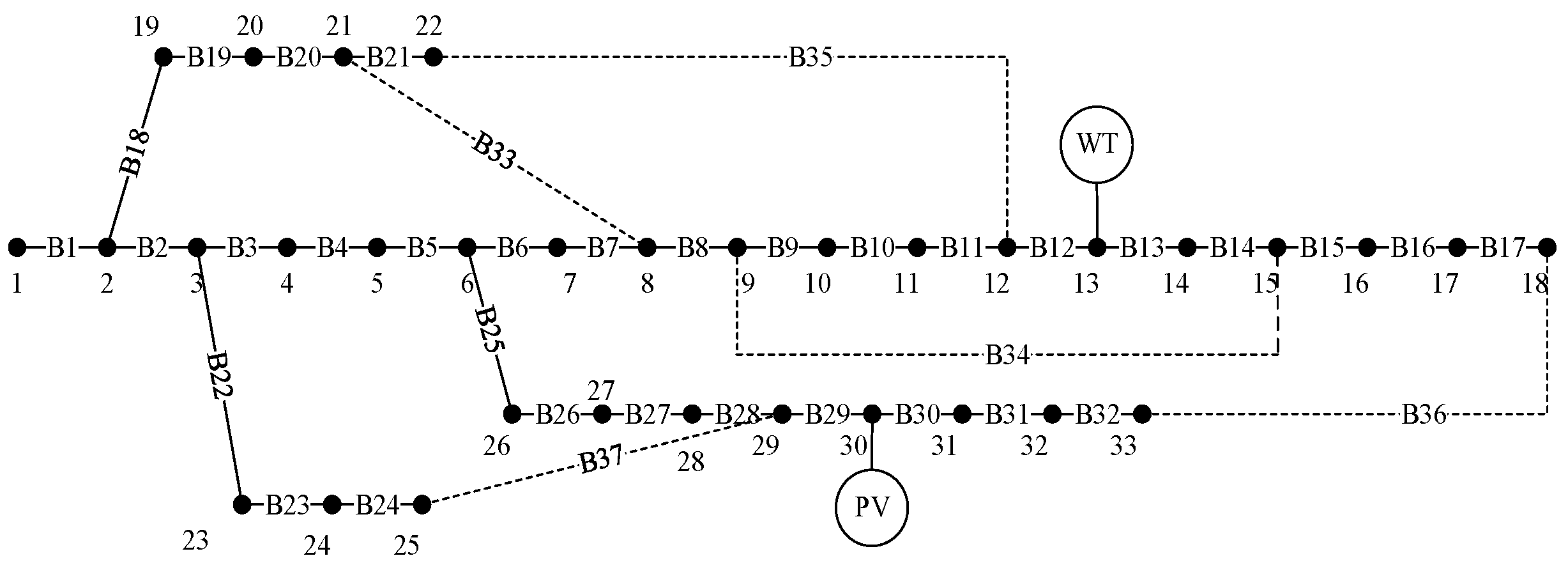
This study adopts the IEEE-33 bus system for verification and analysis, whose network structure and relevant optimized nodes are shown in
Figure 2; specifically, a 500 kW WT is integrated into node 13, and a 1 MW PV system is integrated into node 30. The first-stage optimization model is solved using the CPLEX solver, while the second-stage optimization model is solved using IGWO proposed in this paper.
4.2. Analysis of the Impact of Demand Response Incentive Mechanism
4.2.1. Parameter Sensitivity Analysis of Marginal Cost Demand Response Model
To verify the rationality of the marginal cost DR model, comparative experiments with multiple sets of marginal cost proportional coefficients β and γ were designed to analyze their impact on load adjustment behavior. To avoid extreme situations of complete load transfer or excessive reduction, set y = 50%, z = 20%.
Scenario 1: Fix
β = 0.02, set
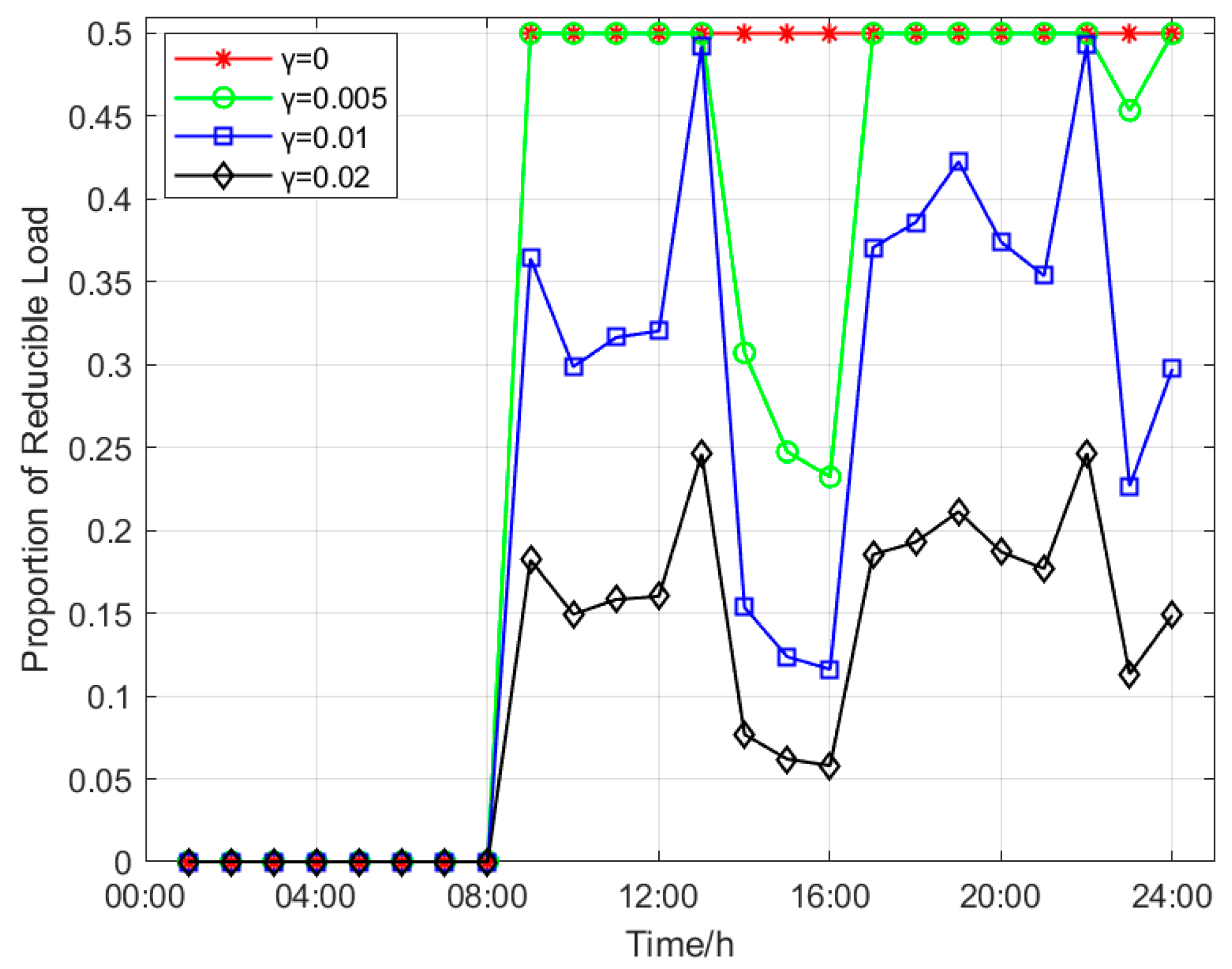
γ values to 0, 0.005, 0.01, and 0.02, and test the impact of
γ on the reducible load quantity, as shown in
Figure 3.
Scenario 2: Fix
γ = 0.01, set
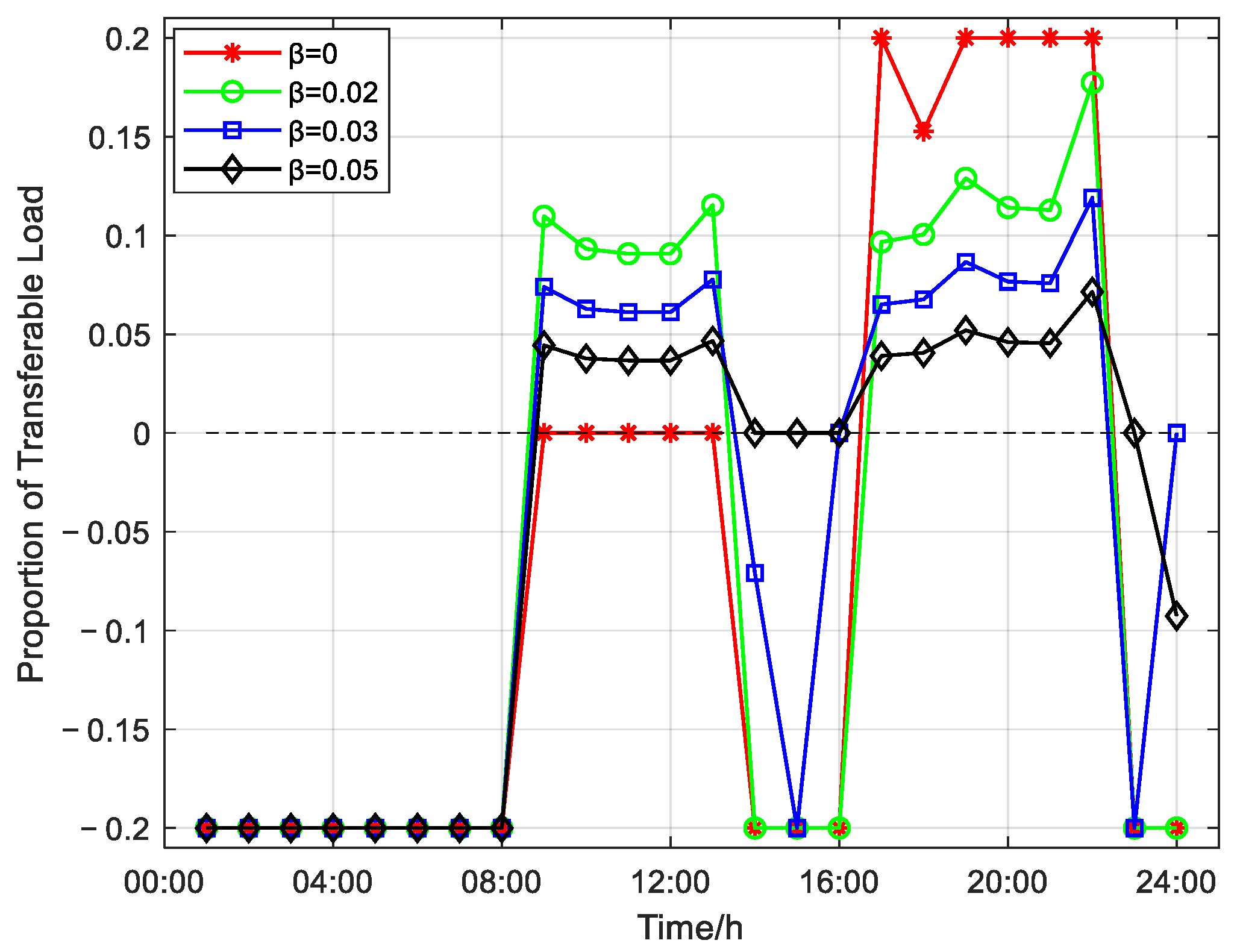
β values to 0, 0.02, 0.03, and 0.05, and test the impact of
β on the transferable load quantity, as shown in
Figure 4.
It can be seen from
Figure 3 that when
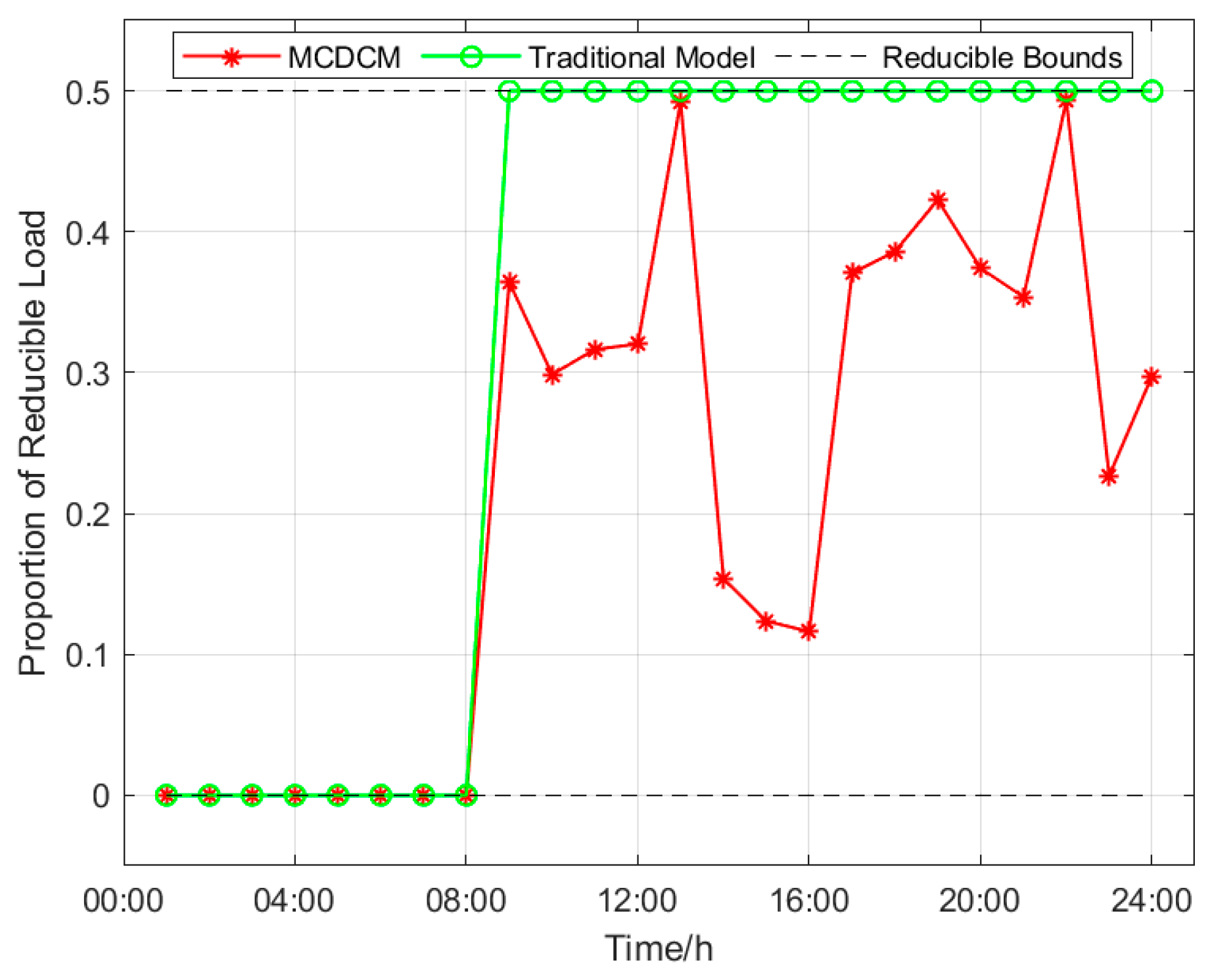
γ = 0, the marginal cost of reducible load is 0, and only the basic compensation for load curtailment is considered, which is the traditional DR model. At this time, there are two extreme situations: before 8:00, the reducible load has no response at all; after 8:00, the curtailment ratio reaches the upper limit of 50%. This indicates the unavoidable extreme response phenomenon/inherent response imbalance problem of the traditional DR model, i.e., insufficient response at low electricity prices and over-response at high electricity prices. When
γ is small, users have low resistance to load curtailment, accept large-scale load curtailment, and respond actively under the incentive of high electricity prices; as
γ increases, users’ resistance to load curtailment gradually increases, they reduce the response of reducible load due to high resistance.
It can be seen from
Figure 4 that when
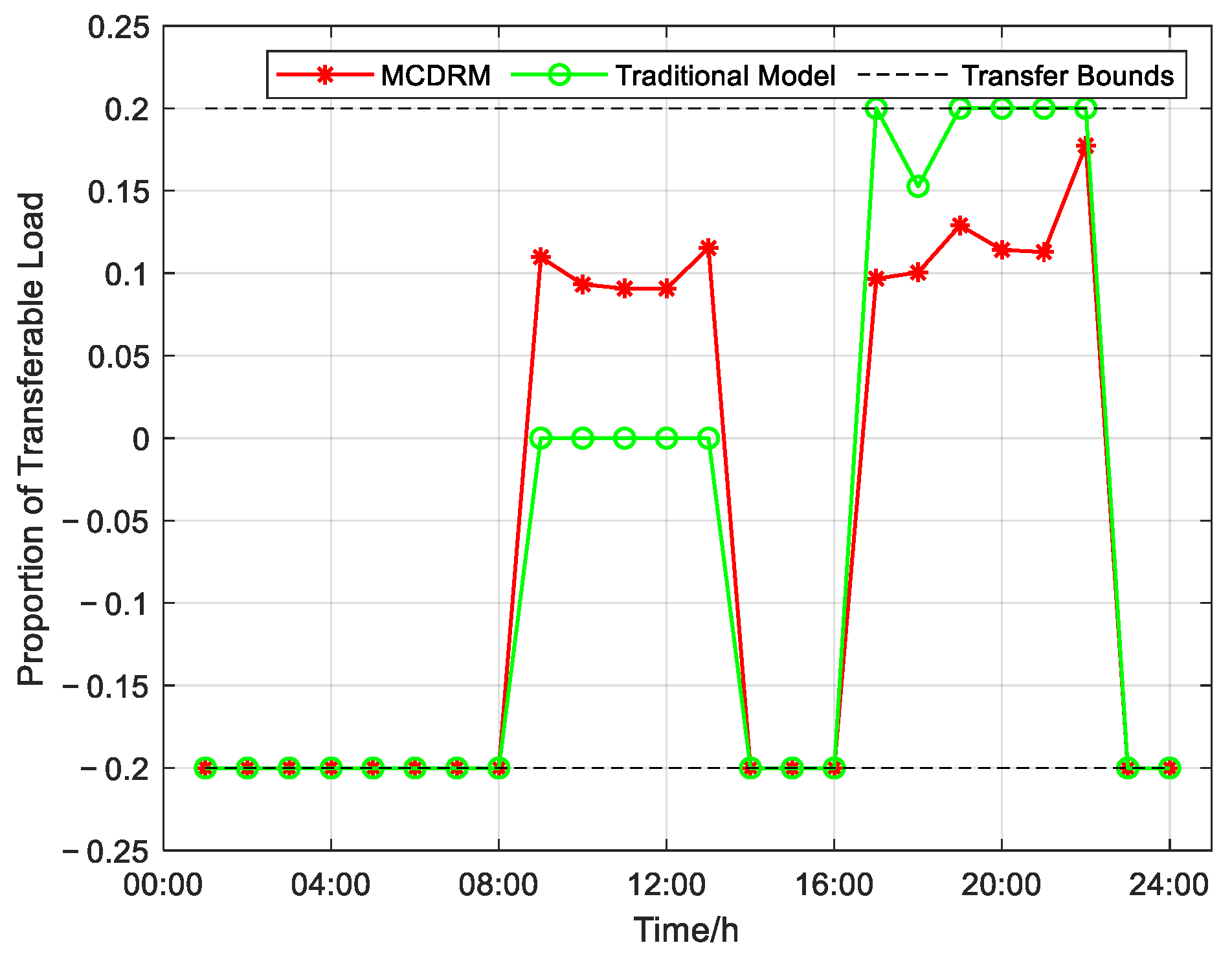
β = 0, the marginal cost of transferable load is 0, and only the basic compensation for load transfer is considered, which is the traditional DR model. At this time, irrational response occurs: the transferable load ratio reaches the upper limit of 20% in both peak and valley periods, showing the extreme characteristic of full transfer. When
β is small, users have low resistance to load transfer, a large amount of load is transferred, showing flexible and active response ability; as
β increases, users’ resistance to load curtailment gradually increases, and they reduce the response due to high resistance to load transfer. The system needs to balance user satisfaction and load adjustment needs by increasing basic compensation or adjusting electricity price incentives.
Analysis shows that the larger β and γ are, the higher users’ resistance to load response is, and the MCDRM proposed in this paper can reduce the load adjustment quantity to ensure high user satisfaction. By adjusting the proportion coefficient of marginal cost based on users’ electricity usage habits and reaction behaviors, and implementing differentiated compensation, extreme reactions can be suppressed, which is the key to improving the operational resilience of the distribution network.
The optimal values of the marginal cost coefficients β and γ are determined through a systematic parameter adjustment process, which balances economic efficiency, user satisfaction, and grid operation goals. We employ a grid search method within a predefined parameter space: β ∈ [0, 0.05] and γ ∈ [0, 0.03], with a step size of 0.005, covering the range from negligible to significant marginal cost impacts. For each candidate combination of β and γ, a complete two-stage optimization is performed, and the total system cost (F1 + F2) is recorded as the primary performance metric. Additionally, other secondary indicators are monitored, including voltage deviation compensation cost reflecting power quality and user satisfaction, and total load adjustment reflecting the utilization of demand-side flexibility.
The parameter search space for
β and
γ was defined based on plausible ranges for marginal disutility, informed by the concept of diminishing marginal satisfaction, where a value of zero corresponds to a traditional linear model with no increasing resistance and higher values reflect greater user sensitivity. Although a direct one-to-one mapping to a specific survey score is not employed here due to aggregation, the selection criteria prioritize parameter combinations that minimize the total system cost while maintaining voltage quality within an acceptable range. Specifically, keeping the voltage deviation compensation cost below the 50 yuan threshold set in this study. This process determined
β = 0.02 and
γ = 0.01 as the optimal configuration. This combination yields a response profile that avoids extreme behaviors, as shown in
Figure 3 and
Figure 4, effectively representing a user cohort with moderate and rational sensitivity to load adjustments. It thereby suppresses extreme “all-or-nothing” reaction patterns without overly restricting demand-side flexibility, achieving the best balance between reducing peak purchase costs and maintaining user satisfaction—an outcome aligned with the typical goal of DR programs to achieve significant load shaping while ensuring high participant satisfaction and long-term engagement. The grid search ensures the robustness of the selected parameters, which can be adapted to different network configurations or user behavior characteristics by appropriately adjusting the search space and evaluation criteria.
4.2.2. Parameter Behavioral Interpretation and Calibration
The marginal cost coefficients β and γ are not merely mathematical parameters for curve smoothing; they function as aggregate behavioral indicators. Their magnitudes provide insight into the modeled user cohort’s intrinsic flexibility and sensitivity to load adjustments. Interpreting different value ranges in relation to typical user profiles enhances the model’s behavioral plausibility:
Lower values, for instance β, γ < 0.01, suggest a user base with high flexibility. This profile often corresponds to industrial or certain commercial users with energy-intensive, schedulable processes.
Moderate values, approximately in the range of 0.01 to 0.02, likely represent a mixed or typical aggregate of residential and commercial users. This group balances a reasonable load-shifting capability with comfort and operational constraints.
Higher values, such as β, γ > 0.02, indicate a user cohort with lower inherent flexibility or higher sensitivity. This may include sensitive residential loads or specialty commercial operations where disruptions are more costly.
In this study, the identified optimal values of β = 0.02 and γ = 0.01 characterize a user group exhibiting moderate and rational sensitivity. This profile represents a realistic and desirable target for broad-based demand response programs, which seek to deliver substantial grid benefits while concurrently maintaining high levels of participant satisfaction and fostering long-term engagement.
A principal contribution of this work lies in establishing a modeling framework explicitly designed to accommodate such behavioral differentiation. The parameter values presented herein are derived as system-optimal solutions and are deemed behaviorally plausible for the examined test case. It is acknowledged, however, that their precise calibration for a specific real-world application constitutes a necessary subsequent step. This step would involve fitting the model to localized datasets on user response patterns, representing a clear and valuable direction for future applied research.
4.2.3. Comparative Analysis of Different Demand Response Incentive Mechanisms
Under the two-stage model framework, the optimization effects of the traditional model and the marginal cost DR model proposed in this paper are compared, as shown in
Figure 4 and
Figure 5.
It can be seen from
Figure 5 that during off-peak hours with lower electricity prices, neither model requires load reduction; while during peak hours with higher electricity prices, the traditional model fully reduces the load to obtain high compensation. After 8:00, the reducible load ratio continuously remains at the upper limit of 50%. However, highly sensitive users have strict requirements for power quality, so this may harm their electricity comfort, indicating that the traditional model does not fully consider user satisfaction. In contrast, the model proposed in this paper dynamically adjusts the reducible load ratio for each period from 8:00 to 24:00.
It can be seen from
Figure 6 that both DR models reach the upper limit of 20% for transfer load ratio during off-peak hours with lower electricity prices. The traditional model reaches the 20% upper limit during the peak hours of 19:00–22:00, while the marginal cost DR model maintains a stable transfer ratio of 8% to 18% during peak hours, only reaching the 20% upper limit during off-peak hours. This indicates that the marginal cost model can dynamically adjust the peak response level according to user electricity demand, fitting the actual electricity consumption scenario better and effectively improving the experience of users with higher electricity demand.
The marginal cost DR model, through the two-layer incentive mechanism of “base compensation + marginal cost”, suppresses excessive reduction or transfer and guides users to adjust loads reasonably: the base compensation coefficient guarantees the user’s basic response income, and the marginal cost coefficient avoids the resistance of highly sensitive users caused by large-scale load reduction, significantly improving the rationality and controllability of user response behavior. The optimization results of comparing different DR models are shown in
Table 1.
As shown in
Table 1, compared to the traditional fixed-compensation model, the proposed marginal cost-based DR model effectively suppresses irrational response behavior, reducing the load adjustment by 522.74 kWh. Although the electricity purchase cost increases slightly, the load transfer and reduction costs decrease significantly, leading to a total cost reduction of 148.66 yuan in the first stage while ensuring service quality for sensitive users. These results validate the efficacy of the proposed model in characterizing user response behavior, offering a solution that balances economic efficiency and user experience for efficient demand-side resource utilization in modern power systems.
4.3. Analysis of Second-Stage Distribution Network Reconfiguration Results
Based on the first stage, the IEEE 33-node system is used to implement the second-stage distribution network reconfiguration. To verify the effectiveness of the proposed second-stage model, the comparison of distribution network optimization before and after reconfiguration is shown in
Table 2.
As shown in
Table 2, the dynamic reconfiguration requires seven switching operations. The optimization results, including the number of switch operations, effectively demonstrate the ‘operational probability’ of each switch in the dynamic context. This is not a prior probability but an ex-post measure of how frequently the topology requires adjustment under the optimized schedule, directly derived from the sequence of binary state variables α
ij,t. Although this incurs corresponding switching costs, it reduces system network losses by 209.55 kWh, resulting in a cost reduction of 232.61 yuan. The voltage deviation compensation cost decreases by 256.21 yuan, representing a 100% reduction. The total operating cost is lowered by 348.82 yuan, demonstrating that optimizing the network topology effectively improves power flow distribution and validates the effectiveness of the second-stage model.
4.4. Comparative Analysis of Different Reconfiguration Schemes
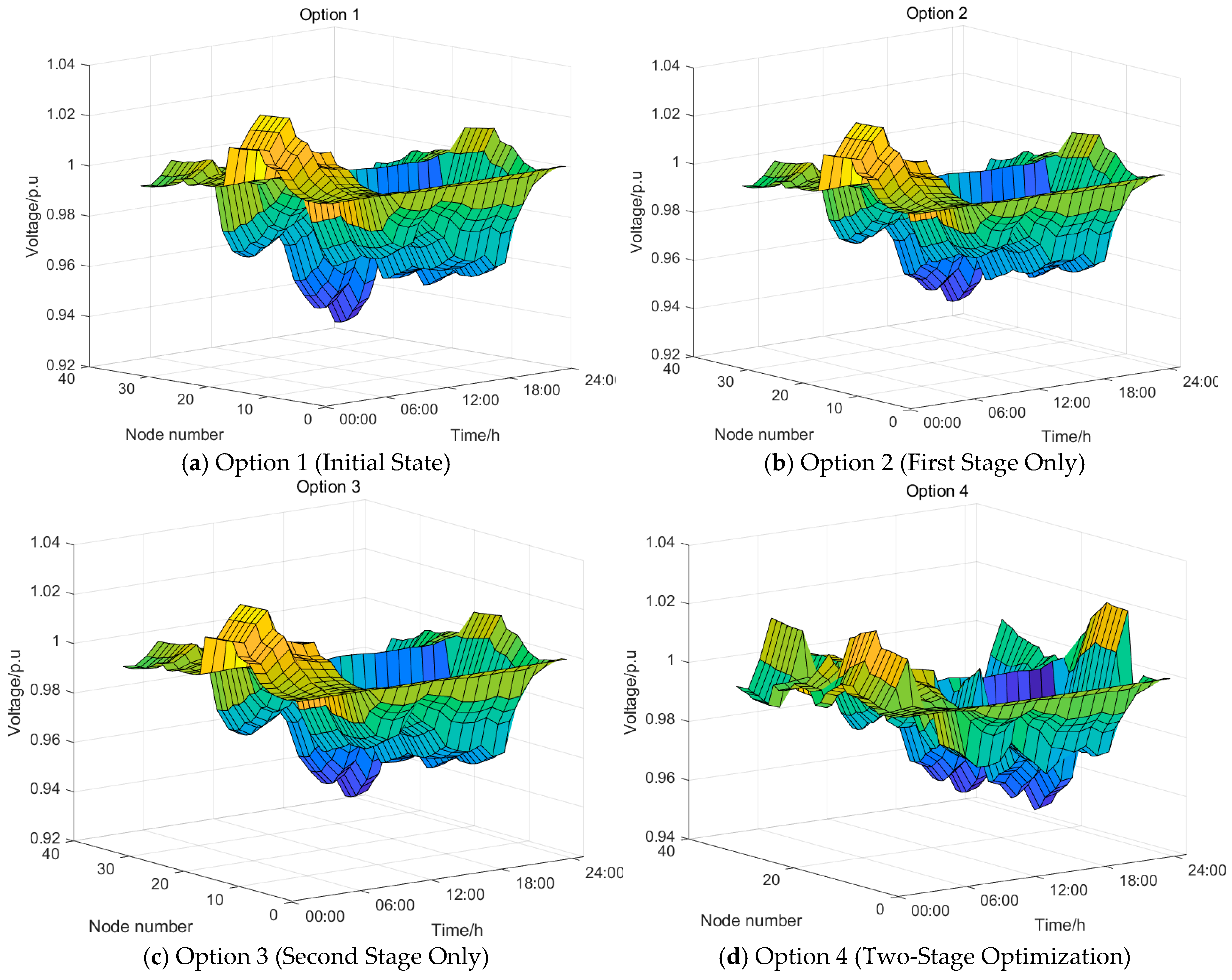
To study the impact of DR and dynamic reconfiguration on the optimal operation results of distribution networks, four distribution network operation schemes are compared and analyzed: Option 1, the initial state of the distribution network; Option 2, distribution network optimization with only the first-stage DR; Option 3, distribution network optimization with only the second-stage dynamic reconfiguration; Option 4, the two-stage distribution network optimization proposed in this paper. Under the four operation schemes, the operating costs and reconfiguration-related parameters of the distribution network are shown in
Table 3 and
Table 4, and the voltage distribution of each node in the IEEE 33-node distribution network with DG is shown in
Figure 6,
Figure 7,
Figure 8 and
Figure 9.
As presented in
Table 3 and
Table 4, Option 1 has not undergone optimization. The highest total network loss is 1077.87 kWh, corresponding to a loss cost of 1248.56 yuan. The electricity purchase cost remains at the original value of 43,907.31 yuan without any load adjustment, resulting in zero DR cost.
Figure 7a shows the most severe voltage deviation in this option, with maximum and minimum values of 1.1232 p.u. and 0.8533 p.u, respectively, yielding the highest compensation cost of 301.25 yuan. The total cost is 45,457.12 yuan, set as the benchmark. No switching operations occur since network reconfiguration is not implemented.
Compared to Option 1, Option 2 reduces total network losses by 84.62 kWh, decreasing loss costs by 116.6 yuan. By shifting peak load through DR, the electricity purchase cost drops by 1644.05 yuan, albeit with an additional DR compensation cost of 884.39 yuan. As depicted in
Figure 7b, the voltage ranges from 0.8679 p.u. to 1.1175 p.u., with voltage deviation compensation costs reduced by 44.52 yuan. Peak shaving elevates voltages during high-load periods, while valley filling suppresses over-voltage during low-load and high-DG generation periods, indirectly improving voltage quality. Without reconfiguration, switching costs remain zero. The total cost decreases by 1805.17 yuan, demonstrating that the first stage primarily reduces electricity purchase costs while moderately enhancing voltage quality.
Option 3 optimizes the network topology through dynamic reconfiguration, significantly reducing line losses. Compared to Option 1, it achieves a total loss reduction of 217.84 kWh with a cost saving of 243.64 yuan, demonstrating superior improvement over Option 2. Distribution network reconfiguration adjusts switch states in real time to alter topology, optimizing power flow for lower losses. As shown in
Figure 7c, voltage quality is notably enhanced, maintaining a range of 0.9354–1.0247 p.u., while the voltage deviation compensation cost decreases by 287.65 yuan, indicating that voltage improvement primarily relies on topological optimization. Without DR, the first-stage cost remains unchanged. The reconfiguration involves 16 switching operations at a cost of 320 yuan. The total cost is reduced by 211.29 yuan relative to Scenario 1, confirming that the second stage effectively reduces losses and improves voltage quality, though it does not affect electricity purchase costs.
Option 4 implements the proposed two-stage optimization method, reducing network losses by 294.17 kWh and corresponding costs by 349.21 yuan compared to Option 1, demonstrating superior improvement over both Options 2 and 3. As shown in
Figure 7d, the voltage quality is effectively controlled with maximum and minimum values of 1.0206 p.u. and 0.9463 p.u, respectively, while the voltage deviation compensation cost decreases to 0.52 yuan. With only seven switching operations at a cost of 140 yuan, it significantly reduces maintenance requirements compared to Option 3. Comparative analysis reveals that Option 4 achieves a total cost reduction of 2153.99 yuan, substantially exceeding the sum of individual improvements from Options 2 and 3. The model successfully reduces electricity purchase costs while simultaneously decreasing network losses and improving power quality through the synergistic mechanism of “temporal load optimization followed by spatial topology reconfiguration”, achieving a dual enhancement of economic efficiency and operational reliability.
Table 5 presents the statistical results of the two-stage optimization costs under four different operational schemes, based on multiple independent runs. The following observations can be made:
Scheme 1 (Initial State) serves as the baseline, with a total cost of 45,457.12 yuan. No optimization is applied in either stage; hence, all costs are deterministic and exhibit zero variance.
Scheme 2 (First Stage Only) applies demand response optimization using the CPLEX solver. Since CPLEX is a deterministic algorithm for the given mixed-integer linear programming model, it converges to the same optimal solution in every run. Therefore, the Stage 1 cost (F1) and the resulting total cost show no variability. The total cost is reduced to 43,651.95 yuan, demonstrating the economic benefit of DR alone.
Scheme 3 (Second Stage Only) implements only network reconfiguration using the proposed IGWO algorithm. The Stage 1 cost remains at the baseline value (no DR), but the Stage 2 cost (F2) now reflects the stochastic nature of the metaheuristic solver. Over 50 independent runs, the average total cost is 45,245.83 yuan with a standard deviation of 3.12 yuan, indicating a consistent and reliable performance of the IGWO in minimizing network losses and voltage deviation costs.
Scheme 4 (Two-Stage Optimization) combines both stages, using CPLEX for DR and IGWO for reconfiguration. The Stage 1 cost is identical to that of Scheme 2, as it is solved deterministically. The Stage 2 cost, however, is subject to the stochastic optimization process. The results show an average total cost of 44,187.54 yuan with a standard deviation of 2.89 yuan—the lowest among all schemes. This not only confirms the economic superiority of the coordinated two-stage approach but also highlights the robustness of the IGWO, as evidenced by the small variance in outcomes.
The absence of standard deviations for Schemes 1 and 2 is intentional and meaningful: it underscores the deterministic nature of the baseline and the CPLEX-solved DR stage. In contrast, the reported standard deviations for Schemes 3 and 4 provide a transparent measure of the stochastic solver’s reliability. The low values (3.12 yuan and 2.89 yuan) further validate that the proposed IGWO consistently converges to high-quality solutions, reinforcing its suitability for practical deployment in distribution network optimization.
4.5. Impact Analysis of Different Voltage Deviation Schemes
During distribution network operation, to ensure power supply quality meets standards, this paper sets node voltages V1 = 0.95, V2 = 1.05, and the target range is 0.95~1.05 p.u. To verify the effectiveness of the demand response model proposed in this paper, two schemes with different voltage constraint handling mechanisms are set up for simulation experiments.
Scheme 1 employs a strict voltage limit interruption mechanism. Upon detecting nodal voltage deviations beyond the 0.95–1.05 p.u. range, the system performs automatic reconfiguration to eliminate violations. Scenarios with persistent deviations are deemed infeasible, resulting in simulation termination. This scheme requires complete elimination of all voltage limit violations.
Scheme 2 adopts the proposed voltage deviation compensation cost model, which permits moderate deviations from the 0.95–1.05 p.u. range. This model classifies voltage deviations into three tiers with differentiated compensation coefficients K1 and K2, quantifying the relationship between user satisfaction and voltage quality while prioritizing the mitigation of severe deviations. The compensation costs are incorporated as penalty terms in the total cost objective function, enabling global cost optimization through trade-off analysis while maintaining full utilization of electric energy. This approach avoids simulation interruption due to voltage limit violations.
As shown in
Table 6, Scheme 1, which employs a strict voltage limit interruption mechanism, requires frequent topology adjustments to eliminate all violations. This results in 15 switching operations at a cost of 300 yuan, network losses of 869.55 kWh, and a total voltage-related cost of 1330.56 yuan. In contrast, Scheme 2, which adopts the proposed compensation model with
K1 = 5 yuan/kVh and
K2 = 20 yuan/kVh, achieves a dramatically superior outcome. It reduces switching operations to seven with a cost of 140 yuan and total voltage-related cost to 1039.87 yuan, despite a network loss of 783.70 kWh and a voltage deviation of 1.31% compared to 1.05% in Scheme 1.
This significant improvement is directly driven by the tiered compensation structure of Scheme 2. By assigning explicit, differentiated costs (K1 for general deviation, K2 for severe deviation), the optimizer is allowed to perform a global economic trade-off. It can now balance a controlled amount of voltage deviation, incurring a known compensation cost, against the costs of frequent switching and higher network losses. The significant reduction in switch operations from 15 (Scheme 1) to 7 (Scheme 2) illustrates how the proposed voltage deviation compensation model alters the “effective switching probability” across the network by allowing for flexible voltage bounds, thereby reducing the need for frequent topology interventions. The choice of K2≫K1 effectively creates a soft-but-steep penalty boundary. This ensures that severe deviations are avoided almost as strictly as in Scheme 1, while minor deviations can be tolerated if they lead to significant savings elsewhere, thereby altering the “effective switching probability” and reducing the need for frequent topology interventions.
Consequently, Scheme 2 demonstrates how the calibrated values of K1 and K2 enable the model to navigate the trade-off between perfect voltage quality and overall economic efficiency, achieving a Pareto-superior outcome. In essence, the analysis reveals a fundamental difference in philosophy: Scheme 1 ensures feasibility through a rigid “violation-reconfiguration-verification” loop under hard constraints, whereas Scheme 2 establishes an optimization model with flexible economic boundaries, placing greater emphasis on global cost minimization and operational practicality.
4.6. Comparison of Different Algorithms
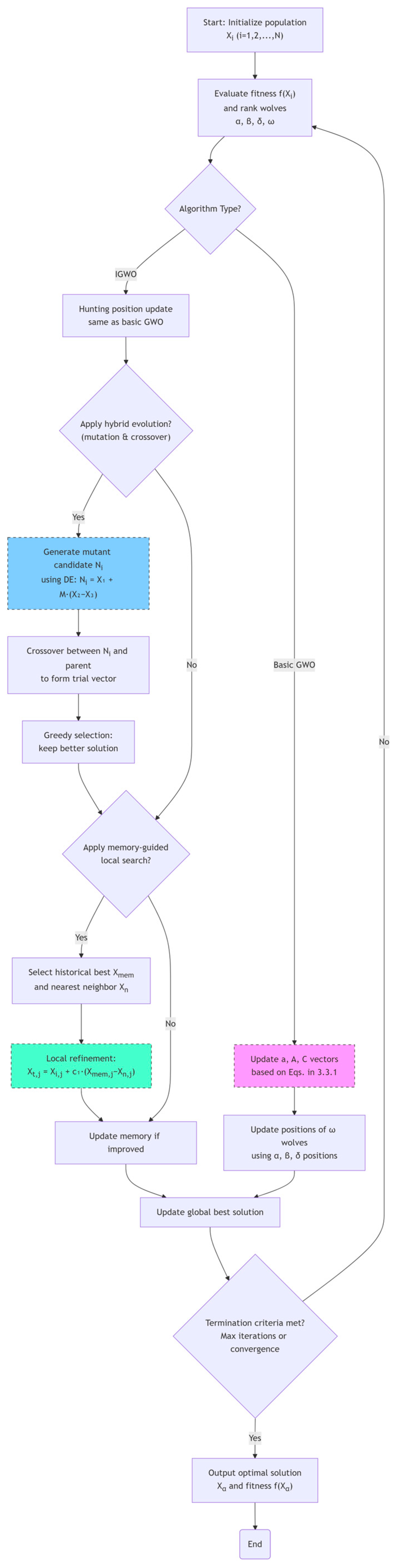
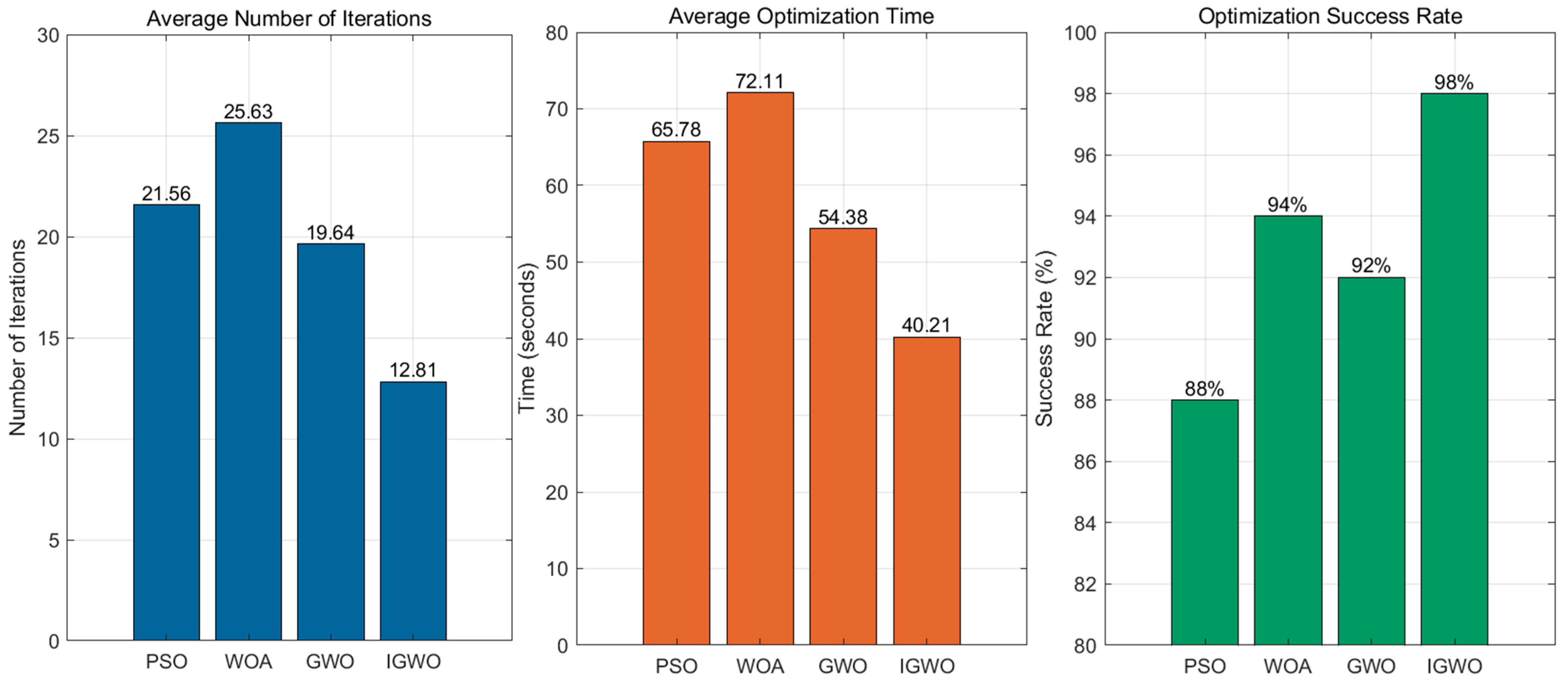
To further illustrate the performance of the algorithm proposed in this paper, the IGWO is compared with the Particle Swarm Optimization (PSO), Whale Optimization Algorithm (WOA), and the basic GWO. Each algorithm aims to minimize the second-stage total cost F2. To ensure an equitable and replicable benchmark, all algorithms were executed under identical experimental conditions: a population size of 50 and a maximum of 50 iterations. The specific parameters for each algorithm were carefully chosen according to their standard formulations or common practices in the literature. For PSO, an inertia weight ω of 0.7298 was adopted, and the cognitive coefficient and social coefficient were set to be equal, with c1 = c2 = 1.4962. Both WOA and the basic group optimization algorithm GWO used a convergence parameter a, which decreased linearly from 2 to 0 during the iteration process. The proposed IGWO was configured with a mutation factor M of 0.5, a crossover rate CR of 0.7, and an acceleration coefficient c1 of 0.5. To rigorously evaluate the performance, each algorithm was independently run 50 times on the IEEE 33-node test system. The main objective was to evaluate and compare their convergence behavior, the quality of the obtained solutions, and the overall robustness. The best solution found in all these runs was regarded as the benchmark optimal result for this comparative study.
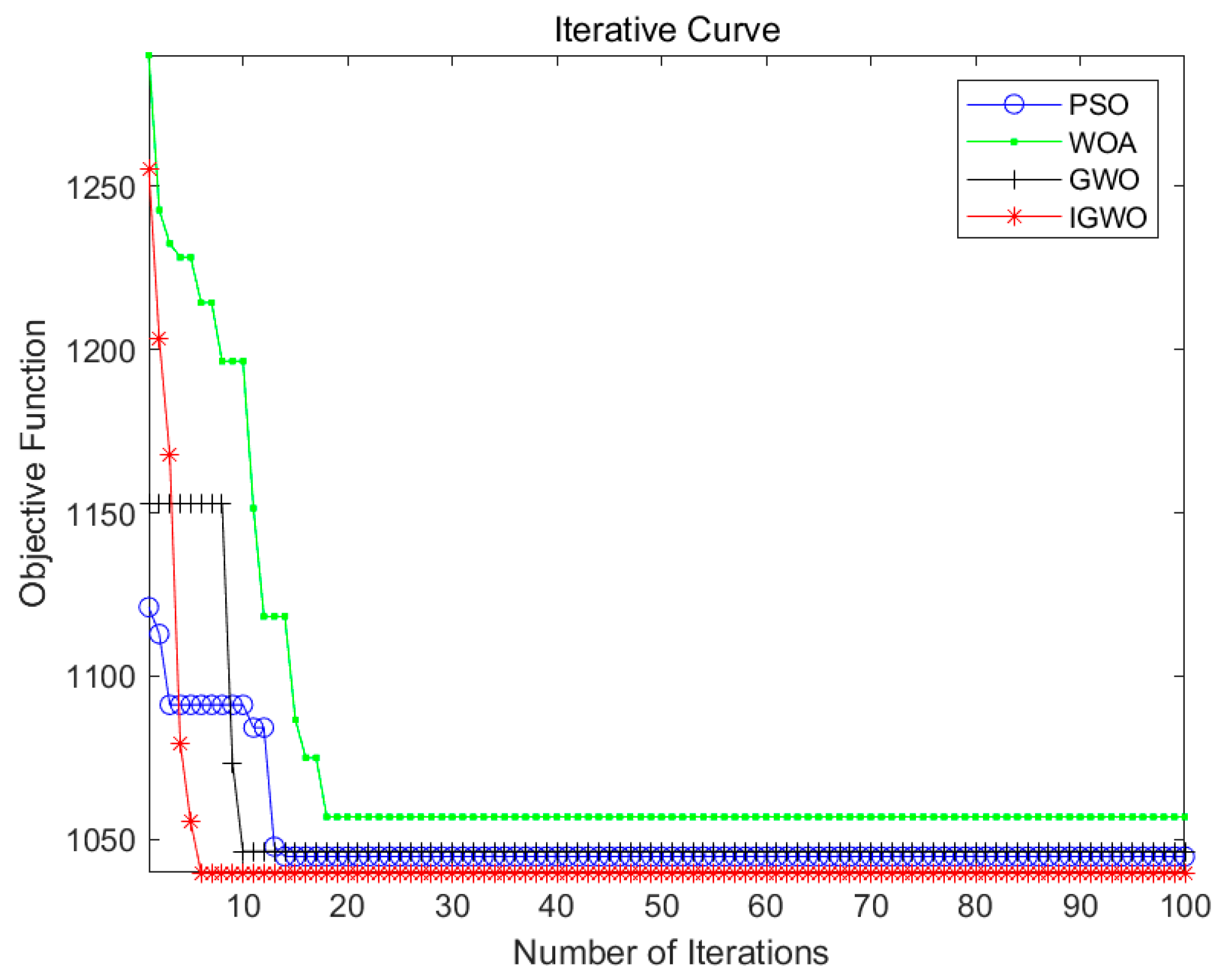
As shown in
Figure 8, the PSO, WOA, GWO, and the proposed IGWO algorithms can all effectively solve this problem. However, there are significant differences in their convergence efficiency and solution quality. The IGWO algorithm can obtain the optimal solution in 50 experiments and converges to the global optimal solution after only 6 iterations. Compared with other algorithms, the number of iterations is reduced by more than 40%, thus demonstrating stronger global search ability and convergence speed. Specifically, WOA has the slowest convergence speed, requiring 18 iterations; PSO is prone to getting stuck in local optimal solutions due to its fixed inertia weight, requiring 15 iterations; while GWO converges only at the 10th iteration due to insufficient initial population diversity. The results are shown in
Figure 9.
Figure 8.
Comparison of convergence curves for different algorithms.
Figure 8.
Comparison of convergence curves for different algorithms.
Figure 9.
Algorithm performance comparison.
Figure 9.
Algorithm performance comparison.
In 50 independent repeated experiments, the optimized value obtained by the algorithm after each run is recorded. If the relative error between the target function value (the cost F2 in the second stage) obtained in a certain run and the global optimal solution in all experiments does not exceed 3%, then this run is judged to be “successful”. The formula for calculating the success rate of optimization is:
where
Nsuccess is the number of times the algorithm successfully found the global optimal solution (or reached within the preset tolerance range of the optimal solution) in the set of multiple independent repeated experiments;
Ntotal is the total number of independent repeated trials for the algorithm’s operation; optimization success rate represents the probability that the algorithm successfully finds the global optimal solution. The higher this value is, the stronger the stability and robustness of the algorithm will be. This indicator is used to evaluate the stability and robustness of the algorithm over multiple runs. A high success rate indicates that the algorithm has good global convergence and repeatability. The proposed IGWO consistently achieves superior solutions compared to PSO, WOA and GWO across all trials. As shown in
Figure 9, it attains a 98% optimization success rate, significantly higher than other algorithms, demonstrating enhanced robustness and global convergence capability. Additionally, IGWO converges in just 40.21 s and 12.81 iterations on average, with significantly fewer iterations than other algorithms, confirming its high efficiency.
5. Conclusions
This paper proposes a two-stage distribution network optimization model with staged optimization: In the first stage, a marginal cost demand response model is proposed, which uses a “base compensation + marginal cost” two-layer mechanism to suppress irrational responses under extreme electricity prices in traditional models, balance compensation costs and load adjustment effects, and reduce power purchase costs during peak hours. In the second stage, a dynamic distribution network reconfiguration model is constructed, with network loss, voltage deviation, and switch operation cost as optimization objectives, solved using an improved Grey Wolf Optimizer, and introducing a segmented voltage deviation compensation mechanism to quantify the relationship between user satisfaction and voltage quality, optimizing the network topology. Case studies verify that the proposed coordinated two-stage optimization framework can effectively reduce network loss, decrease voltage deviation, lower power purchase costs and system operating costs, thereby enhancing the economy and flexibility of the distribution network.
More fundamentally, this work provides a practical and quantifiable framework for integrating user-centric considerations into grid operational decisions. In the first stage, user satisfaction related to usage autonomy is safeguarded through the marginal cost mechanism that models increasing disutility. In the second stage, satisfaction related to power quality is directly internalized as an economic cost via the segmented voltage deviation compensation mechanism. This dual approach to quantifying “satisfaction” allows system operators to explicitly navigate the trade-offs between economic efficiency, operational feasibility, and service quality within a single, cost-minimizing optimization paradigm.
The core innovation of this model, therefore, lies in breaking the traditional separation of load management and network optimization by establishing this unified economic ground for their co-optimization, where user behavior and grid physics are reconciled through explicit cost mappings. This provides a theoretically grounded and practical solution for coordinating demand-side resources with distribution network structures in new power systems.
Finally, while the proposed framework inherently accommodates differentiated user behavior through parameters like β and γ, their precise calibration is context-dependent. Future work will focus on refining this calibration using detailed regional user response data, transitioning the model from a validated methodological framework to a tailored tool for specific distribution network operators.