Research on the Effectiveness of Gas Control in Low-Permeability Coal Seams Based on Microbial Gas Dissolution

 ,
,
Abstract
1. Introduction
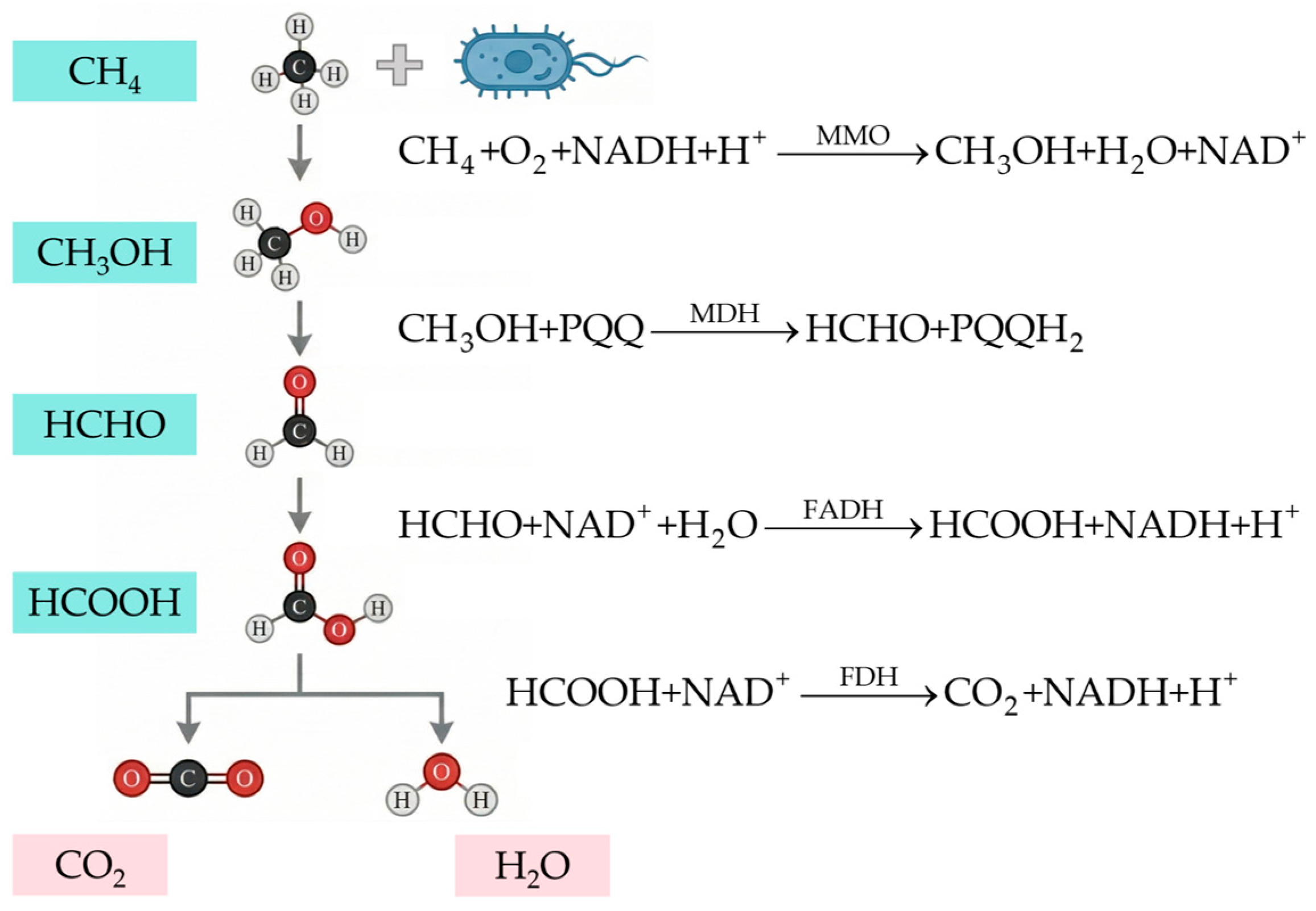
2. Technical Principles
3. Experimental Site and Program
3.1. Experimental Site
3.1.1. Overview of the Mine
3.1.2. Coal Seam Characteristics
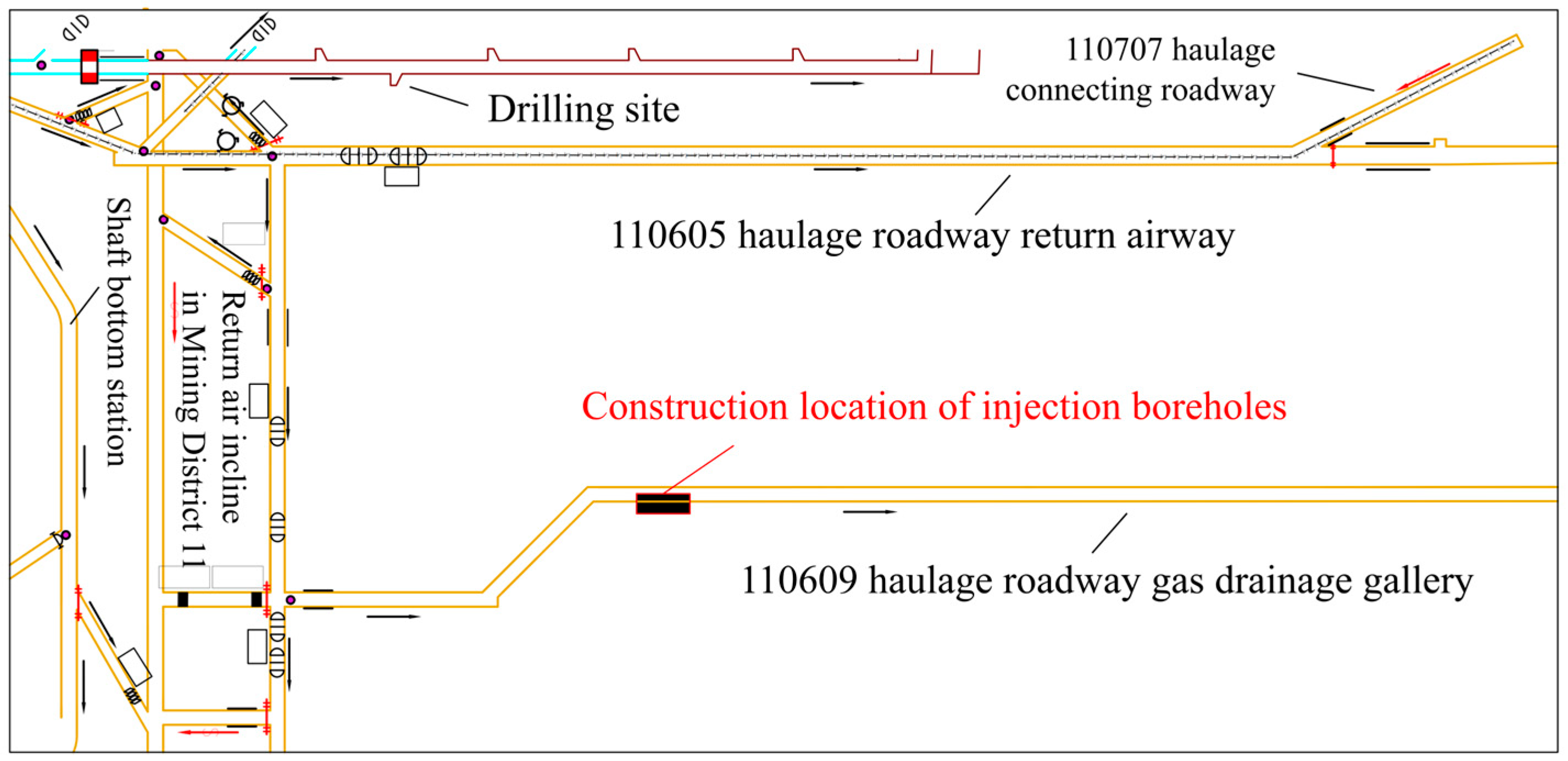
3.1.3. Field Implementation Site
3.2. Experimental Program
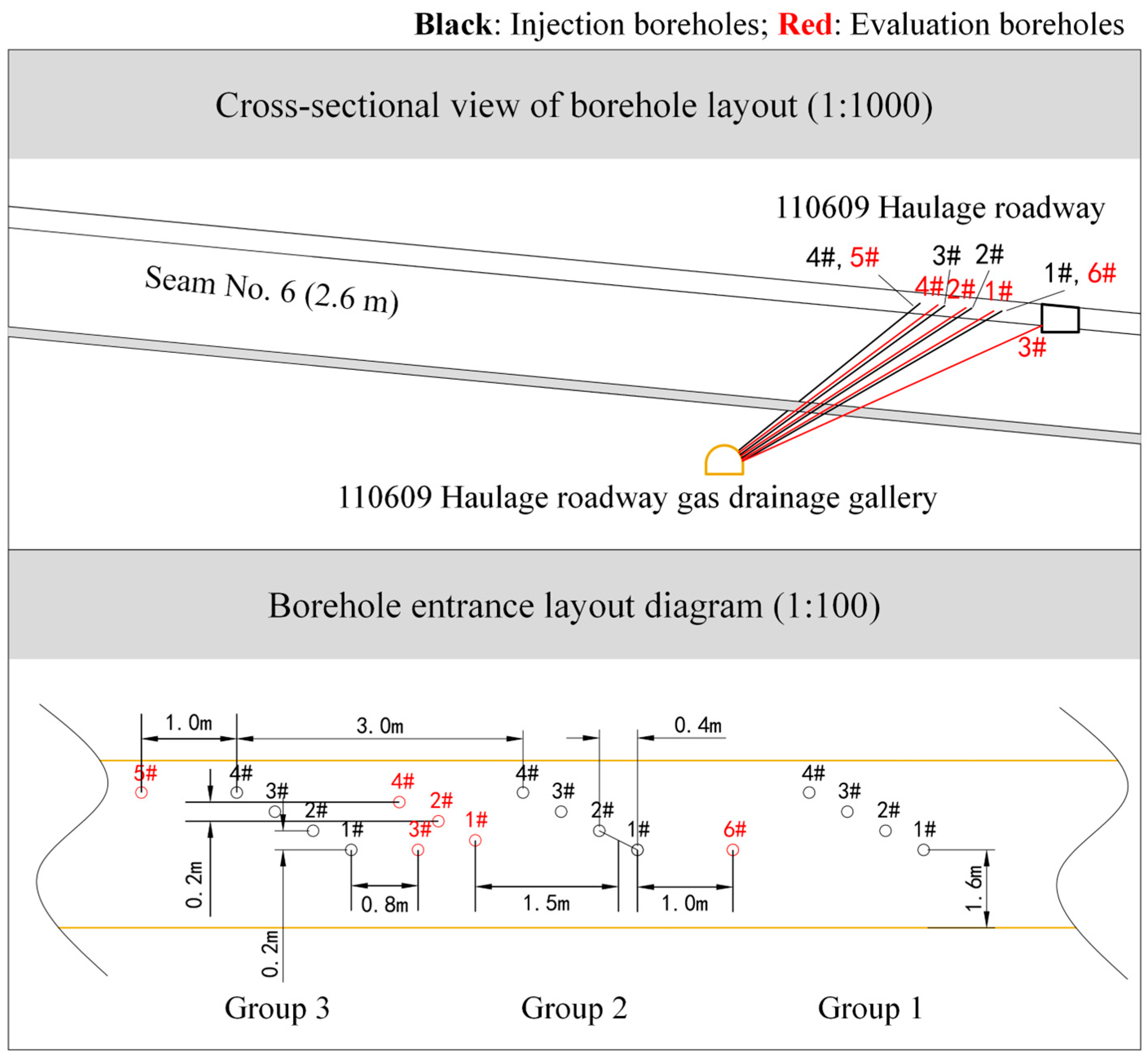
3.2.1. Borehole Layout Scheme
3.2.2. Equipment and Procedures
- •
- Borehole construction: Injection boreholes were constructed, and coal samples were collected to determine the baseline gas content and gas pressure. Subsequently, the boreholes were sealed with a sealing length of 20 m.
- •
- Pump station installation: The pump station was positioned at the entrance of the 110609 haulage roadway gas drainage gallery, approximately 100 m from the injection site.
- •
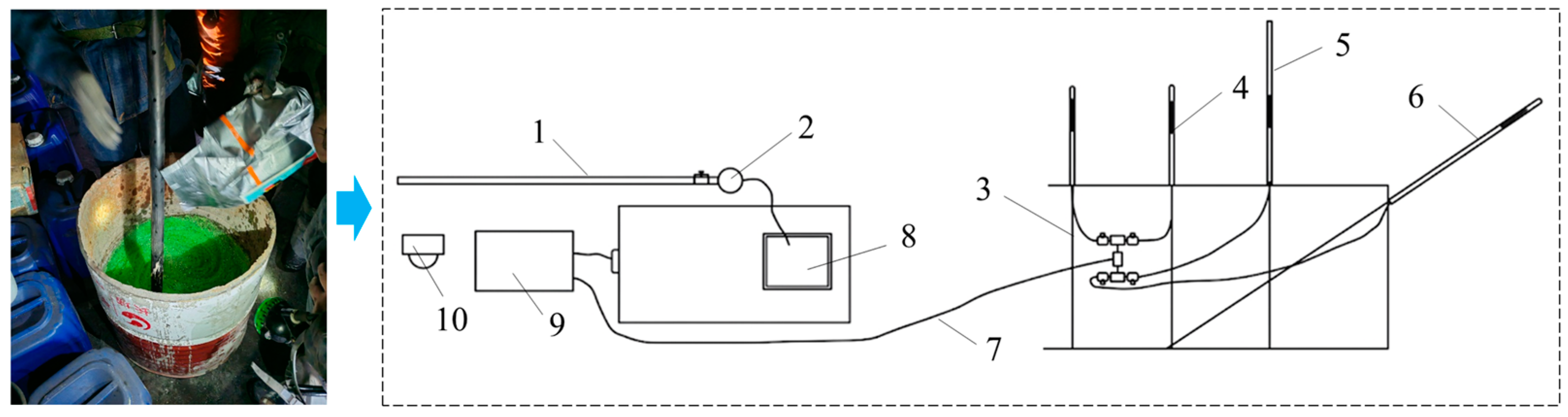
- Pipeline connection: The equipment was connected in the following sequence: emulsion pump → high-pressure steel pipe → high-pressure hose → control box → high-pressure hose → four-way joint → high-pressure hose → stop valve → injection pipe.
- •
- Preparation of gas dissolvent: The gas dissolvent and additives were first added to a mixing barrel according to the specified ratio and stirred until uniform. The mixture was then transferred to the water tank of the emulsion pump.
- •
- Emulsion pump operation: Following an equipment inspection, the emulsion pump was activated, and the pressure was adjusted to 7 MPa. The valves were then opened to facilitate sequential injection into the boreholes.
- •
- Injection operation: Dynamic pressure injection was employed. Once the pump pressure reached the design specifications and remained stable, the pump was stopped upon the observation of “sweating” or seepage on the roadway walls, or when the water level in the tank ceased to decrease significantly under continuous pressure. Finally, the pressure relief valve was closed, concluding the injection procedure.
4. Numerical Simulation of Conventional Gas Extraction
4.1. Governing Equations
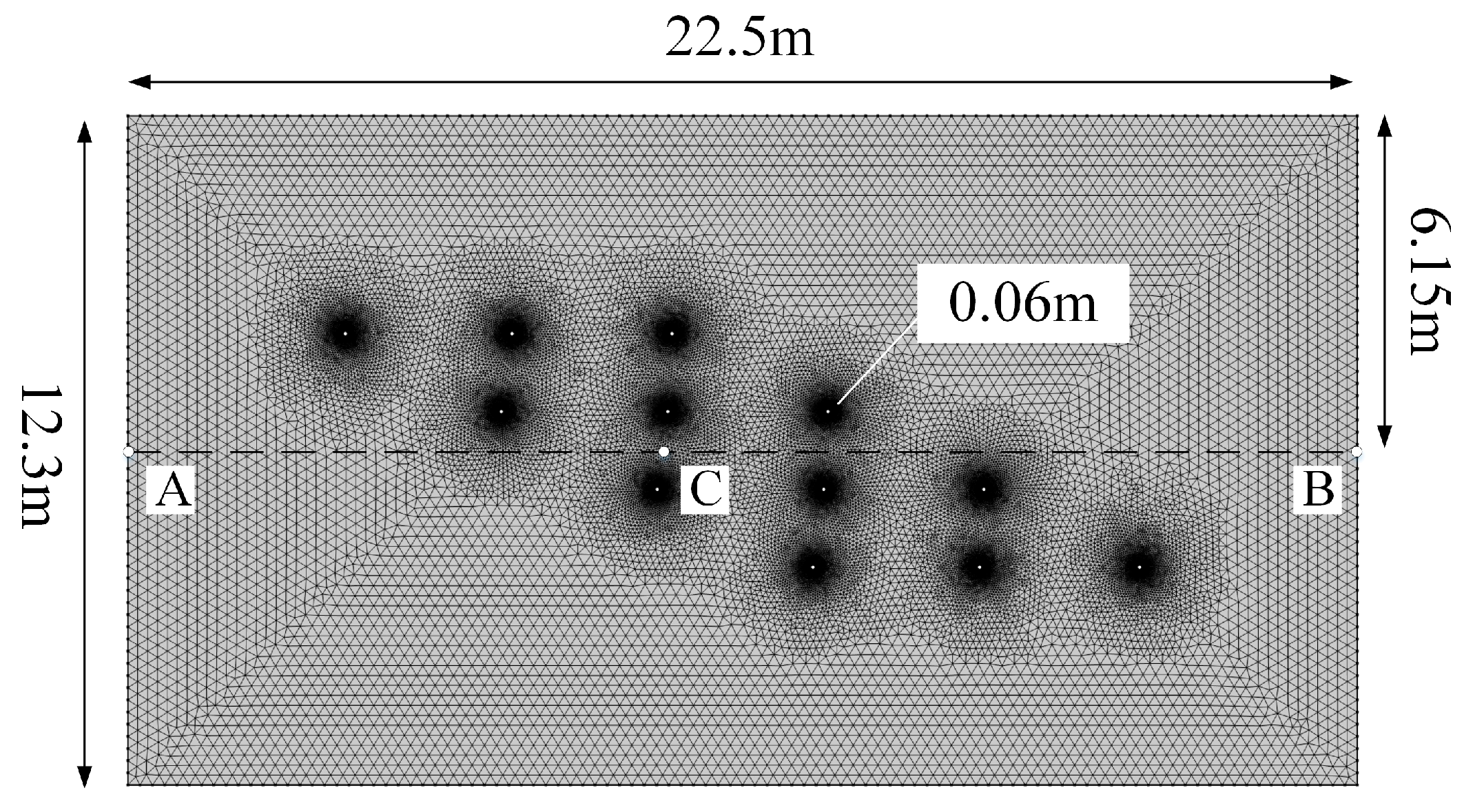
4.2. Model Establishment and Parameter Setting
5. Results and Discussion
5.1. Effectiveness of Gas Dissolution Treatment
5.2. Effectiveness of Conventional Borehole Gas Drainage
5.3. Comparative Analysis
6. Conclusions
Author Contributions
Funding
Data Availability Statement
Acknowledgments
Conflicts of Interest
References
- Wang, E.; Zhang, G.; Zhang, C.; Li, Z. Research progress and prospect on theory and technology for coal and gas outburst control and protection in China. J. China Coal Soc. 2022, 47, 297–322. [Google Scholar]
- Zhang, L.; Zhang, H.; Guo, H. A case study of gas drainage to low permeability coal seam. Int. J. Min. Sci. Technol. 2017, 27, 687–692. [Google Scholar] [CrossRef] [Scilit]
- Jia, L.; Peng, S.; Xu, J.; Yan, F.; Chen, J.; Wu, B.; Chen, Y. On the evolution mechanism of permeability during gas drainage: Insights from deformation field, gas pressure field and temperature field. Process Saf. Environ. Prot. 2022, 162, 825–836. [Google Scholar] [CrossRef] [Scilit]
- Zhang, Y.; Zou, Q.; Guo, L. Air-leakage model and sealing technique with sealing–isolation integration for gas-drainage boreholes in coal mines. Process Saf. Environ. Prot. 2020, 140, 258–272. [Google Scholar] [CrossRef] [Scilit]
- Zheng, C.; Kizil, M.; Chen, Z.; Aminossadati, S. Effects of coal damage on permeability and gas drainage performance. Int. J. Min. Sci. Technol. 2017, 27, 783–786. [Google Scholar] [CrossRef] [Scilit]
- Jia, J.; Ge, J.; Zhen, W.; Zhao, D. Research and application of anti-reflection technology of hydraulic fracturing. China Saf. Sci. J. 2020, 30, 63–68. [Google Scholar]
- Liu, Y.; Zhang, W.; Chen, C.; Wei, J.; Xu, X.; Zhang, H.; Nan, Q.; Xiao, P. Prospects for the development of the theory and technology of non-hydration penetration enhancement in soft coal seams. J. China Coal Soc. 2025, 50, 2123–2146. [Google Scholar]
- Guo, H.; Zhu, L. Research on mechanism of energy release and permeability improvement in coal strata by static blasting. China Saf. Sci. J. 2020, 30, 60–65. [Google Scholar]
- Zhang, J. Key technologies for collaborative mining of high gas and low permeabilitycoal seams in deep mining areas. Coal Sci. Technol. 2020, 48, 66–74. [Google Scholar]
- Lou, Z.; Wang, K.; Kang, M.; Zhao, W.; Wei, G.; Yue, J.; Yao, H. Plugging methods for underground gas extraction boreholes in coal seams: A review of processes, challenges and strategies. Gas Sci. Eng. 2024, 122, 205225. [Google Scholar] [CrossRef] [Scilit]
- Xie, J.; Sun, X.; Xu, S.; Hu, H. Feasibility analysis and research status of microbial treatment of mine gas. Min. Saf. Environ. Prot. 2023, 50, 119–122. [Google Scholar]
- Wang, X.; Song, P.; Zhang, Z. New breakthroughs on coal-gas outburst control by using gas ablation agent. Coal Technol. 2009, 28, 116–118. [Google Scholar]
- Jiang, H.; Chen, Y.; Jiang, P.; Zhang, C.; Smith, T.J.; Murrell, J.C.; Xing, X.-H. Methanotrophs: Multifunctional bacteria with promising applications in environmental bioengineering. Biochem. Eng. J. 2010, 49, 277–288. [Google Scholar] [CrossRef] [Scilit]
- Kelly, D.P.; Wood, A.P. Isolation and Characterization of Methanotrophs and Methylotrophs: Diversity of Methylotrophic Organisms and of One-Carbon Substrates. In Handbook of Hydrocarbon and Lipid Microbiology; Timmis, K.N., Ed.; Springer: Berlin/Heidelberg, Germany, 2010; pp. 3827–3845. [Google Scholar]
- Zhou, S.; Tao, X.; Zhu, H.; Hou, T.; Xu, N. Isolation and culture conditions optimizing of a strain of methanotrophic bacterium from coal soil. Clean Coal Technol. 2008, 14, 98–100. [Google Scholar]
- Deng, Y.; Wang, C.; Deng, J.; Wang, N. Microbial extraction and growth metabolic characteristics of microorganisms metabolizing CH4 and CO gases in coal mine. J. Xi’an Univ. Sci. Technol. 2024, 44, 688–698. [Google Scholar]
- Yu, H. Studies on Bio-Oxidizing Methane in Coal Mines with Microbial Technology. Ph.D. Thesis, Zhejiang University, Hangzhou, China, 2007. [Google Scholar]
- Chen, D.; Wang, L.; Jin, L.; Xia, C.; Zhang, J. The preliminary research on coal-bed gas degradation by microorganism. J. China Coal Soc. 2006, 31, 607–609. [Google Scholar]
- Zhang, R.; Cui, X. Experiment study on anaerobic microbial degrading methane adsorbed by raw coal. Coal Sci. Technol. 2016, 44, 155–159. [Google Scholar]
- Yu, H.; Cui, X.; Zhang, R. Experimental study on degradation of adsorbed methane in simulated raw coal environment by microorganism. China Saf. Sci. J. 2018, 28, 158–163. [Google Scholar]
- Pan, S. Degradation of coal and adsorption of methane by methanotrophs in simulated row coal occurrence environment. Min. Saf. Environ. Prot. 2018, 45, 26–29. [Google Scholar]
- Zhao, S.; Zhang, R.; Wang, S.Z.; Zhou, Y.B.; Tian, K.; Gong, W. Growth characteristics and efficiency of methane oxidation mixed bacteria under different pH conditions. Min. Res. Dev. 2024, 44, 110–115. [Google Scholar]
- Xue, S.; Zhang, X.; Liu, B.; Chen, R.; Jiang, X.; Zhou, T.; Cheng, K. Evolution of pore structure in bituminous coal and mechanism of methane promotion during microbial degradation under the synergy of static magnetic field. J. China Coal Soc. 2026, 51, 448–460. [Google Scholar]
- Gao, D.; Guo, H.; Guo, B.; Tan, K.; Ren, H. Impact of microbially enhanced coalbed methane on the pore structure of coal. Front. Earth Sci. 2022, 10, 869917. [Google Scholar] [CrossRef] [Scilit]
- Bao, Y.; Li, Z.; Meng, J.; Chen, X.; Liu, X. Reformation of coal reservoirs by microorganisms and its significance in CBM exploitation. Fuel 2024, 360, 130642. [Google Scholar] [CrossRef] [Scilit]
- Wang, K.; Guo, L.; Xu, C.; Wang, W.; Yang, T.; Lin, S.; Cai, Y. Multiscale characteristics of pore-fracture structures in coal reservoirs and their influence on coalbed methane (CBM) transport: A review. Geoenergy Sci. Eng. 2024, 242, 213181. [Google Scholar] [CrossRef] [Scilit]
- Han, Y.; Xu, L.; Zhang, R.; Lv, J.; Yang, F.; Ma, C. Study on methane degradation by microbial agents based on chelating wetting agent carriers. Sci. Rep. 2024, 14, 15420. [Google Scholar] [CrossRef] [Scilit] [PubMed]
- Zhou, Y.; Zhang, R.; Tian, K.; Zhao, S.; Shi, H.; Gong, W.; Lei, Q. Characteristics of the methanotroph used in coalbed methane emission reduction: Methane oxidation efficiency and coal wettability. Fuel 2023, 349, 128596. [Google Scholar] [CrossRef] [Scilit]
- Xie, J.; Wang, Y.; Chen, D.; Du, H. Biological characteristics of methane-oxidizing bacteria under the influence of SDBS/RL and their effects on coal. Chem. Eng. Sci. 2026, 321, 122794. [Google Scholar] [CrossRef] [Scilit]
- Jiang, H. Enrichment Culture of Mixed Methanotrophic Community and Its Application in Coal Mine Gas Control. Ph.D. Thesis, Tsinghua University, Beijing, China, 2010. [Google Scholar]
- Mao, F. Research on the Theory and Application of Gas Control by Microorganism in the Coal Seam. Ph.D. Thesis, Chongqing University, Chongqing, China, 2013. [Google Scholar]
- Guo, A.; Linghu, J.; Zhao, Q.; Cao, D. Application of microbial gas ablation agent in gas control in Sijiazhuang coal mine. Coal Technol. 2018, 37, 128–130. [Google Scholar]
- Guo, K.; Tian, S.; Li, P.; Lin, H.; Xu, S.; Jiang, Z. Study and application of gas ablating agent for gas control at coal face. Miner. Eng. Res. 2022, 37, 62–67. [Google Scholar]
- Zhou, A.; Xu, Z.; Wang, K.; Wang, Y.; An, J.; Shi, Z. Coal mine gas migration model establishment and gas extraction technology field application research. Fuel 2023, 349, 128650. [Google Scholar] [CrossRef] [Scilit]
- Zhang, H.; Cheng, Y.; Deng, C.; Shu, L.; Pan, Z.; Yuan, L.; Wang, L.; Liu, Q. A Novel In-Seam Borehole Discontinuous Hydraulic Flushing Technology in the Driving Face of Soft Coal Seams: Enhanced Gas Extraction Mechanism and Field Application. Rock Mech. Rock Eng. 2022, 55, 885–907. [Google Scholar] [CrossRef] [Scilit]
- Saber, E.; Qu, Q.; Aminossadati, S.M.; Zhu, Y.; Chen, Z. Horizontal borehole azimuth optimization for enhanced stability and coal seam gas production. Rock Mech. Bull. 2024, 3, 100100. [Google Scholar] [CrossRef] [Scilit]
- Liu, Q.; Cheng, Y.; Dong, J.; Liu, Z. A Concise Course on the Theory of Coal Seam Gas Flow; China University of Mining and Technology Press: Xuzhou, China, 2017. [Google Scholar]
- Guo, X.; Chen, S.; Yan, X.; Zhang, X.; Yu, J.; Zhang, Y.; Mahgerefteh, H.; Martynov, S.; Collard, A.; Brown, S. Flow characteristics and dispersion during the leakage of high pressure CO2 from an industrial scale pipeline. Int. J. Greenh. Gas Control 2018, 73, 70–78. [Google Scholar] [CrossRef] [Scilit]
- Liu, W.; Han, D.; Guo, M.; Li, R.; Zhong, W. Evaluation of adsorbed and free gas in the coal matrix during desorption processes: Insights from experimental and numerical methods. Fuel 2024, 376, 132739. [Google Scholar] [CrossRef] [Scilit]
- Yao, Y.; Wang, F.; Liu, D.; Sun, X.; Wang, H. Quantitative characterization of the evolution of in-situ adsorption/free gas in deep coal seams: Insights from NMR fluid detection and geological time simulations. Int. J. Coal Geol. 2024, 285, 104474. [Google Scholar] [CrossRef] [Scilit]







| Coal Seam | Measurement Location | Borehole No. | Burial Depth (m) | Gas Pressure (MPa) | Gas Content (m3·t−1) | Permeability Coefficient (m2·MPa−2·d−1) | Borehole Flow Decay Coefficient (d−1) |
|---|---|---|---|---|---|---|---|
| Seam No. 6 | Pedestrian walkway, district 11 | A6-1 | 132.2 | 0.96 | 13.66 | 0.4144 | 0.2534 |
| Return air drift, district 11 | A6-3 | 185.3 | 1.15 | 14.45 |
| Borehole No. | Azimuth (°) | Inclination (°) | Depth (m) |
|---|---|---|---|
| 1, 2, 3-1# | 315 | 30 | 37 |
| 1, 2, 3-2# | 315 | 33 | 34 |
| 1, 2, 3-3# | 315 | 36 | 31 |
| 1, 2, 3-4# | 315 | 39 | 29 |
| Borehole No. | Azimuth (°) | Inclination (°) | Depth (m) |
|---|---|---|---|
| 1# | 315 | 30 | 37 |
| 2# | 315 | 33 | 34 |
| 3# | 315 | 24 | 43 |
| 4# | 315 | 36 | 31 |
| 5# | 315 | 39 | 29 |
| 6# | 315 | 30 | 37 |
| Parameter | Value | Parameter | Value |
|---|---|---|---|
| 0.012 | 8.4135 J/(mol·K) | ||
| 60 cm−2 | 293 K | ||
| 0.06 | 1.08 × 10⁻⁵ Pa·s | ||
| 0.01 mD | 0.004 | ||
| 8139 MPa | 1 MPa | ||
| 2713 MPa | 0.02 m3/kg | ||
| 0.339 | 0.0224 m3/mol | ||
| 0.016 kg/mol | 1250 kg/m3 |
| Injection Borehole No. | Gas Content (m3·t−1) | Gas Pressure (MPa) |
|---|---|---|
| 1-1# | 11.69 | 1.74 |
| 1-3# | 16.32 | 7.29 |
| 1-4# | 16.99 | 8.74 |
| 2-1# | 13.33 | 2.85 |
| 2-4# | 14.69 | 4.42 |
| 3-1# | 13.38 | 2.90 |
| 3-2# | 14.32 | 3.92 |
| 3-3# | 12.98 | 2.56 |
| Evaluation Borehole No. | Gas Content (m3·t−1) | Gas Pressure (MPa) |
|---|---|---|
| 1# | 9.00 | 0.85 |
| 2# | 8.61 | 0.77 |
| 3# | 12.79 | 2.41 |
| 4# | 9.41 | 0.95 |
| 5# | 11.35 | 1.58 |
| 6# | 8.44 | 0.74 |
Disclaimer/Publisher’s Note: The statements, opinions and data contained in all publications are solely those of the individual author(s) and contributor(s) and not of MDPI and/or the editor(s). MDPI and/or the editor(s) disclaim responsibility for any injury to people or property resulting from any ideas, methods, instructions or products referred to in the content. |
© 2026 by the authors. Licensee MDPI, Basel, Switzerland. This article is an open access article distributed under the terms and conditions of the Creative Commons Attribution (CC BY) license.
Share and Cite
Li, Q.; Zhang, W.; Heng, X.; Zhang, S.; Duan, Z.; Feng, D.; Shen, Z. Research on the Effectiveness of Gas Control in Low-Permeability Coal Seams Based on Microbial Gas Dissolution. Processes 2026, 14, 2999. https://doi.org/10.3390/pr14182999
Li Q, Zhang W, Heng X, Zhang S, Duan Z, Feng D, Shen Z. Research on the Effectiveness of Gas Control in Low-Permeability Coal Seams Based on Microbial Gas Dissolution. Processes. 2026; 14(18):2999. https://doi.org/10.3390/pr14182999
Chicago/Turabian StyleLi, Qingsong, Wei Zhang, Xianwei Heng, Shujin Zhang, Zhengpeng Duan, Dan Feng, and Zhenhua Shen. 2026. "Research on the Effectiveness of Gas Control in Low-Permeability Coal Seams Based on Microbial Gas Dissolution" Processes 14, no. 18: 2999. https://doi.org/10.3390/pr14182999
APA StyleLi, Q., Zhang, W., Heng, X., Zhang, S., Duan, Z., Feng, D., & Shen, Z. (2026). Research on the Effectiveness of Gas Control in Low-Permeability Coal Seams Based on Microbial Gas Dissolution. Processes, 14(18), 2999. https://doi.org/10.3390/pr14182999