Article

Research on the Effectiveness of Gas Control in Low-Permeability Coal Seams Based on Microbial Gas Dissolution


1
Guizhou Energy Group Corporation Limited, Guiyang 550081, China
2
Guizhou Provincial Laboratory of Intelligent Development and Efficient Utilization of Energy, Guiyang 550081, China
3
Guizhou Mine Safety Science Research Institute Corporation Limited, Guiyang 550025, China
4
Guizhou Province Laboratory Branch, Guizhou Energy Group Corporation Limited, Guiyang 550081, China
5
School of Safety Science and Engineering, Anhui University of Science and Technology, Huainan 232001, China
6
School of Applied Economics, Guizhou University of Finance and Economics, Guiyang 550025, China
*
Authors to whom correspondence should be addressed.
Processes 2026, 14(18), 2999; https://doi.org/10.3390/pr14182999 (registering DOI)
Submission received: 13 August 2026 / Revised: 9 September 2026 / Accepted: 17 September 2026 / Published: 20 September 2026
(This article belongs to the Special Issue Experimental and Numerical Simulation of Coal Mining)

Abstract

To shorten the gas control period in low-permeability coal seams, the effectiveness of microbial gas dissolution technology for gas control was investigated through a combination of field tests and numerical simulations. First, three groups of injection boreholes were constructed, and the microbial gas-dissolving solution was injected into the coal seam, followed by an evaluation of the treatment effect after three days. Furthermore, based on a multiphysics-coupled modeling framework, the conventional borehole drainage process was simulated using the Partial Differential Equation (PDE) module of COMSOL Multiphysics to compare the evolution of coal seam gas pressure under conventional drainage with the field performance of the gas dissolution treatment. The results showed that the injected bioactive solution promoted methane oxidation and rapidly reduced the gas content and pressure in the treated region. After 3 days of gas dissolution treatment, the average gas content and gas pressure within the overlapping influence zones between the injection borehole groups decreased by 38.0% and 80.7%, respectively, relative to their initial values. However, the treatment effect gradually weakened with increasing distance from the injection zone, indicating spatial attenuation of the effective influence of the bioactive solution in the low-permeability coal seam. Comparatively, conventional drainage required approximately 68 days to reduce the gas pressure to the same level achieved by the gas dissolution treatment within 3 days, demonstrating that gas dissolution technology can drastically accelerate the gas control cycle. Nevertheless, further large-scale application requires consideration of economic feasibility and continued optimization of injection parameters and field implementation procedures.

1. Introduction

Coal and gas outbursts are among the most hazardous and catastrophic dynamic disasters encountered in coal mining in China, posing a major constraint on the efficient and intensive exploitation of deep coal resources. For gas hazard prevention and control, protective seam mining and pre-drainage of coal seam gas are widely adopted as the primary engineering strategies [1]. Conventional borehole drainage mainly relies on the pressure gradient generated by negative drainage pressure to drive free and desorbed methane through the pre-existing pore–fracture network toward the drainage boreholes. Its effectiveness is therefore strongly constrained by coal seam permeability, fracture connectivity, and the effective influence radius of the boreholes [2,3]. In low-permeability coal seams, methane desorption, diffusion, and seepage are relatively slow, often resulting in low single-borehole drainage rates, small effective influence radii, rapid declines in gas concentration and flow rate, and prolonged periods required to meet drainage targets [2,3,4]. Moreover, as drainage proceeds, gas pressure decreases progressively in the vicinity of the boreholes, whereas methane replenishment from regions farther away remains limited. This results in pronounced spatial heterogeneity in gas depletion, making it difficult to effectively remove methane from deeper coal regions and zones with poor pore–fracture connectivity [5]. Consequently, conventional borehole drainage alone often fails to achieve rapid, efficient, and spatially uniform gas reduction in low-permeability coal seams.
During conventional borehole drainage, various physical permeability enhancement techniques have been widely employed to overcome the inherently low permeability of coal seams, including hydraulic fracturing [6], waterless fracturing (e.g., CO2 fracturing) [7], and blasting-induced permeability enhancement [8]. However, statistical data indicate that more than 95% of outburst-prone coal seams in China are typical low-permeability reservoirs characterized by complex pore structures and poor connectivity [9]. In such coal seams, conventional physical stimulation methods often encounter limitations such as long drainage periods, rapid declines in single-borehole gas flow rates, and restricted site-specific applicability [10]. These limitations may disrupt the coordination between coal extraction and roadway development and can even adversely affect mine production scheduling. Therefore, the development of an in situ gas control technology that goes beyond conventional physical permeability enhancement approaches and offers the dual potential for “chemical degradation” and “physical permeability enhancement” has become an important scientific challenge in the field of coal mine gas control.
In recent years, microbial gas dissolution technology has attracted increasing attention as a promising, environmentally friendly, and efficient approach to gas control [11,12]. The fundamental principle of this technology is to inject a bioactive solution enriched with methane-oxidizing bacteria (MOB) into deep coal seams through dedicated boreholes. Driven by injection pressure, the microbial solution migrates through the coal pore–fracture network and promotes the in situ biochemical oxidation of methane, converting it into stable products such as H2O and CO2 [13], thereby reducing coal seam gas content and reservoir pressure. Depending on their metabolic pathways, methane-oxidizing microorganisms can be broadly classified as aerobic or anaerobic and are widely distributed in natural environments such as wetlands, marshes, and rice paddies. They can also be obtained through isolation and enrichment cultivation [14,15,16]. In laboratory studies, Yu [17] demonstrated through a series of experiments that common mine gases, including CO, H2S, and SO2, exert no significant toxic or inhibitory effects on these microorganisms within their typical concentration ranges. Chen et al. [18] introduced bacterial solutions into coal samples containing adsorbed methane and found that MOB achieved an average methane degradation efficiency of approximately 44%. Zhang et al. [19] employed a triaxial stress–seepage testing system to investigate the degradation of adsorbed methane by anaerobic microorganisms and found that elevated stress facilitated methane degradation. Yu et al. [20] experimentally demonstrated that a specific type of methane-oxidizing bacteria achieved degradation efficiencies exceeding 43.3% for methane adsorbed in raw coal samples with different Protodyakonov coefficients. Pan [21] investigated the effects of temperature, injection pressure, and injection volume on anaerobic methane-oxidizing microorganisms and found that degradation efficiency increased with increasing pressure and injection volume, with 30 °C identified as the optimum temperature. Zhao et al. [22] examined degradation efficiency under different pH conditions and found that pH 6.75 provided the most favorable acid–base environment for microbial activity. Xue et al. [23] further demonstrated that the synergistic action of microorganisms and a static magnetic field could enhance methane desorption and improve pore connectivity in coal samples.
Recent studies have also shown that microbial treatment can improve the average pore size, pore volume, and pore connectivity of coal to varying degrees. Some initially closed or poorly connected pores may be transformed into effectively connected pores, thereby providing more favorable pathways for methane desorption, diffusion, and seepage [24,25,26]. Studies focusing specifically on MOB have further demonstrated that the wettability and adsorption behavior of bacterial solutions on coal surfaces can affect their migration into the coal matrix. The introduction of appropriate wetting agents or chelating agents can reduce the coal–water contact angle, enhance coal hydrophilicity, and promote pore enlargement and interconnection, thereby increasing the effective contact between MOB and coal seam methane [27,28]. In addition, the synergistic interaction between MOB and surfactants can further improve pore connectivity and gas–liquid–solid interfacial mass transfer, facilitating methane migration through coal pores and its transfer into the liquid phase [29]. Overall, existing studies indicate that MOB and their associated bioactive solutions not only oxidize and consume methane but may also improve effective gas flow and mass transfer conditions in coal seams by enhancing coal wettability, modifying pore structure, and increasing pore connectivity. Nevertheless, direct quantitative measurements of intrinsic coal permeability before and after MOB treatment remain relatively limited, and the magnitude and long-term evolution of permeability enhancement require further systematic investigation.
Regarding preliminary field applications, Jiang [30] conducted microbial solution injection tests in three coal mines in Henan Province and demonstrated, based on changes in borehole gas concentration, that methane-oxidizing bacteria could be used for coal-mine gas control. Mao [31] verified the feasibility of microbial gas control through comparative surface and underground injection tests, showing varying degrees of reduction in gas content, gas pressure, and drill-cuttings gas desorption indices. Guo et al. [32] conducted a gas dissolution field test at the 15205 working face of Sijiazhuang Coal Mine, where the coal seam gas content decreased by 32.3% within 24 h. In another field test at the 11703 working face of Qingcaitang Coal Mine, Guo et al. [33] reported reductions of 64.3% in coal seam gas pressure and 63.8% in gas content after application of the gas dissolving agent, further demonstrating the effectiveness of this technology for coal mine gas control.
Although the biochemical mechanisms underlying microbial methane degradation have been increasingly elucidated, systematic investigations of the spatiotemporal evolution and engineering applicability of this technology under the specific conditions of low-permeability coal seams remain insufficient. Therefore, the No. 6 low-permeability coal seam of a mine in Guizhou Province was selected as the representative study site. By integrating in situ field tests with numerical simulations, this study systematically investigates the gas mitigation performance and temporal–spatial evolution characteristics of microbial gas dissolution technology under low-permeability conditions. The results are expected to provide a sound scientific basis and engineering guidance for the targeted application and large-scale implementation of microbial gas control technology under complex geological conditions.

2. Technical Principles

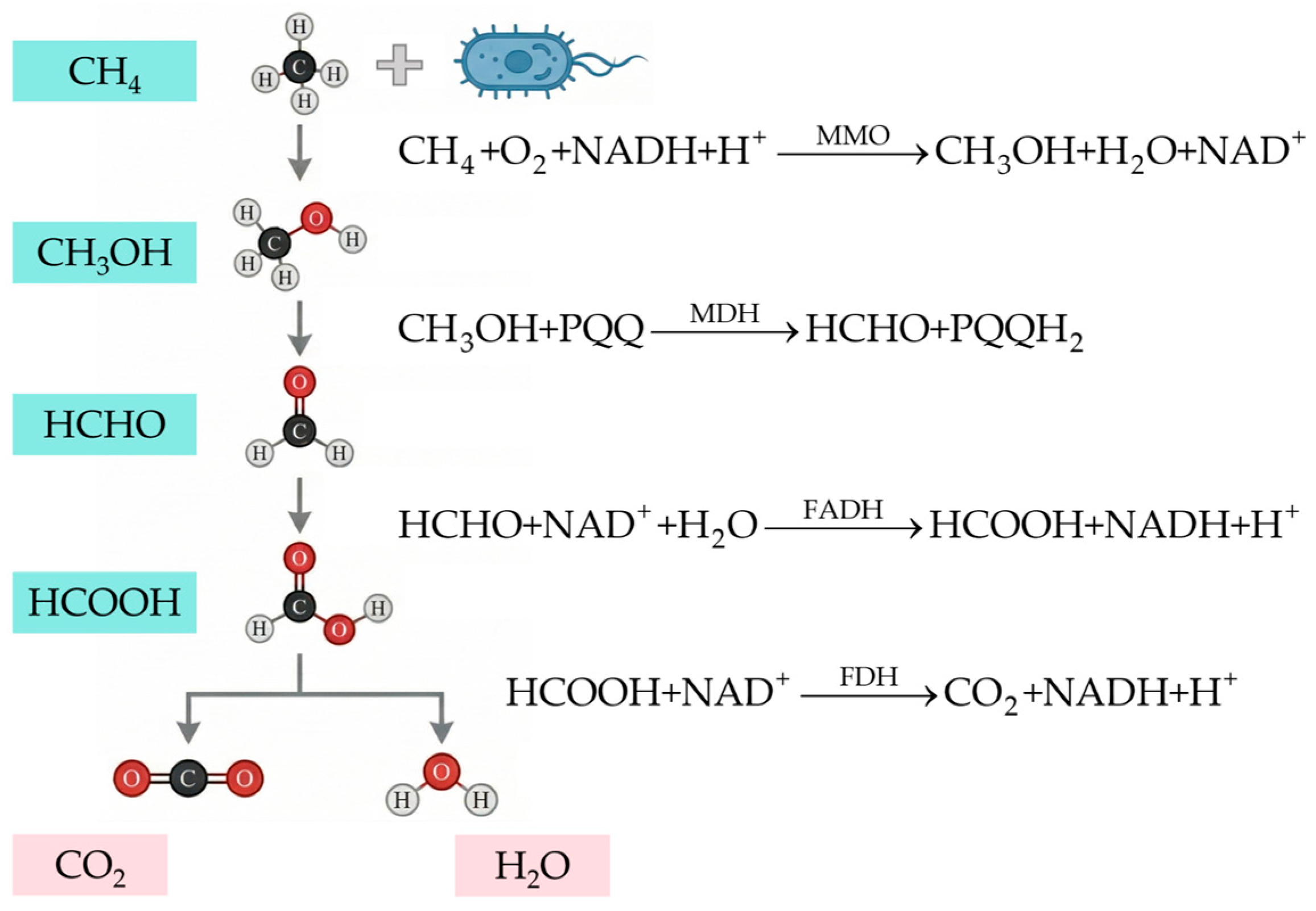
The core mechanism of gas dissolution technology is to use a specifically formulated biochemical solution as a carrier to deliver aerobic methane-oxidizing bacteria (MOB) and their associated enzymatic systems into coal seam microfractures and the interior of the coal matrix, thereby promoting the in situ biochemical oxidation of methane. These MOB utilize methane as their primary carbon and energy source, and their metabolic activity requires the participation of molecular oxygen. As shown in Figure 1, at the molecular level, CH4 is first oxidized to methanol (CH3OH) by methane monooxygenase (MMO) in the presence of molecular oxygen. Subsequently, CH3OH is dehydrogenated to formaldehyde (HCHO) by methanol dehydrogenase (MDH). HCHO is then further oxidized to formic acid (HCOOH) through the catalytic action of formaldehyde dehydrogenase (FADH). Finally, HCOOH is further oxidized to carbon dioxide (CO2) by formate dehydrogenase (FDH). Although deep coal seams are generally characterized by oxygen-deficient conditions, the bioactive solution carries a certain amount of dissolved oxygen during its preparation and injection. In addition, the injection process can introduce a limited amount of oxygen into the pores and fractures of the coal matrix. These oxygen sources can provide the conditions necessary to sustain the aerobic metabolism of MOB within a limited spatial range and for a certain period of time. Through the above microbially mediated enzymatic oxidation process, methane in the coal seam is progressively consumed, thereby contributing to a reduction in coal seam gas content and mitigating the potential risk of coal and gas outbursts.
Representative aerobic methanotrophic bacteria capable of promoting methane oxidation and conversion into stable end products include Methylococcus capsulatus, Methylosinus trichosporium, Methylomonas methanica, and Methylocystis parvus. These bacteria can utilize methane as a carbon source and oxidize it through MMO-mediated metabolic pathways.

3. Experimental Site and Program

3.1. Experimental Site

3.1.1. Overview of the Mine

The coal seams of Coal Mine A in the Guizhou Province are characterized by significantly high gas content, high gas pressure, and low permeability. There are over 60 faults within the mining area, and the mine field is topographically structured as an synclinal unit with a northeastward dip. The coal-bearing strata in the mine field are primarily composed of the Permian Longtan Formation, which is divided into upper, middle, and lower members. The area contains 24 to 38 coal seams, of which 7 are mineable. Coal Mine A employs a rising-and-dipping mining method for development, with longwall retreating mining along the strike adopted at the working faces, and a district-exhausting ventilation system utilized throughout the mine.

3.1.2. Coal Seam Characteristics

The test coal seam is Seam No. 6 of Coal Mine A, which is the uppermost mineable seam within the mine field. The seam is generally stable in occurrence, has a relatively simple geological structure, and is mineable throughout the study area. It is predominantly a medium-thick coal seam, with an average coal thickness of 2.60 m. The number of partings ranges from 0 to 3 layers, and the average dip angle is 17°. The roof consists mainly of marl and sandstone, whereas the floor is predominantly mudstone. The coal is classified as Type III according to the degree of structural damage and is not prone to coal-dust explosion. The basic gas parameters of Seam No. 6 are summarized in Table 1.

3.1.3. Field Implementation Site

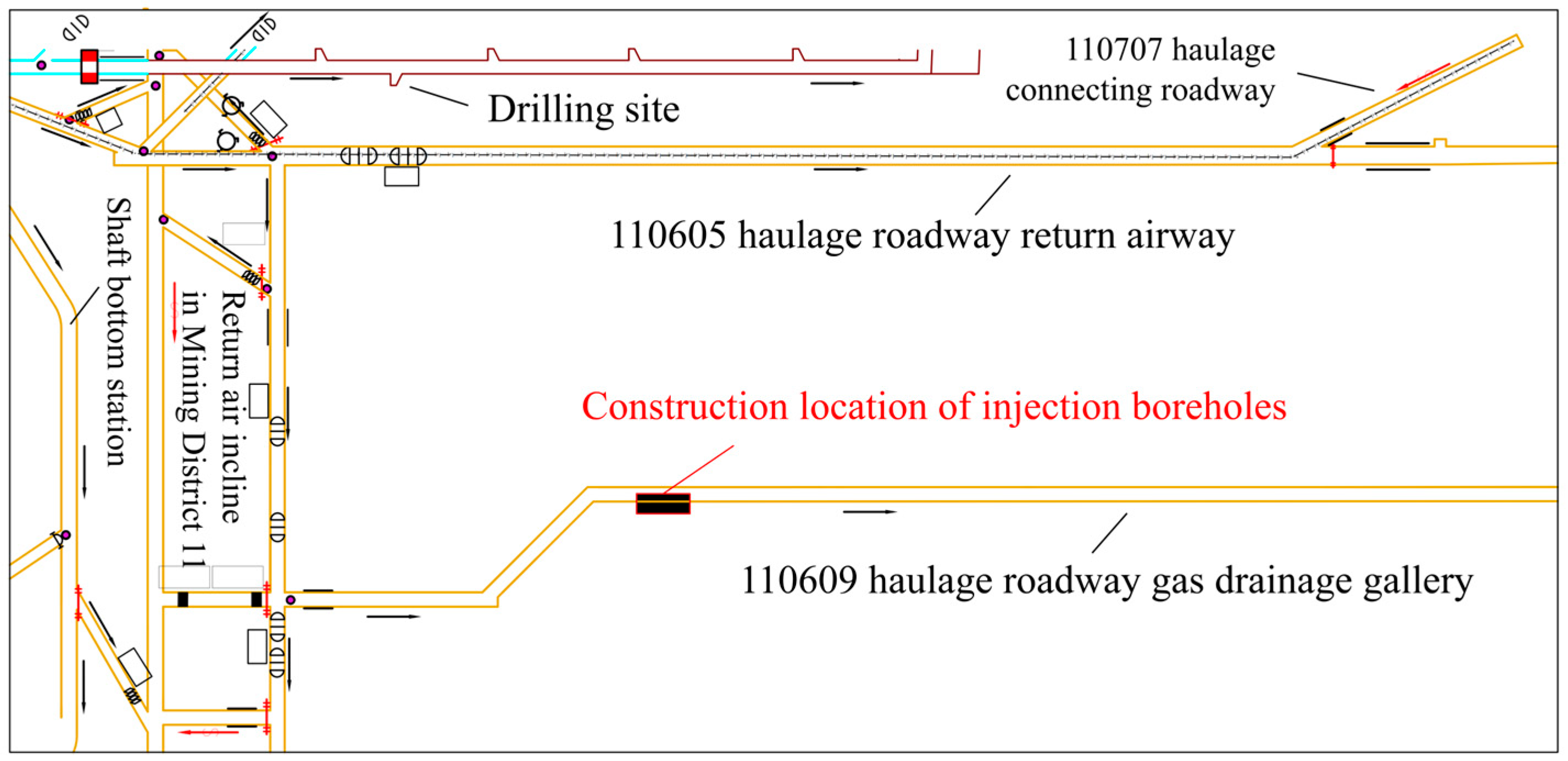
The experimental site was established in the gas drainage roadway associated with the 110609 haulage roadway, beneath Seam No. 6. The test section was located approximately 135 m from the roadway entrance. No other boreholes had been constructed in the surrounding area prior to the test, as shown in Figure 2.

3.2. Experimental Program

In this study, gas content and gas pressure were selected as the primary indicators for evaluating the treatment effectiveness. Initially, injection boreholes were constructed to collect coal samples for the determination of baseline gas parameters prior to the application of the gas dissolvent. Three days after the injection was completed, evaluation boreholes were drilled to remeasure the gas content and gas pressure and assess the treatment effect.

3.2.1. Borehole Layout Scheme

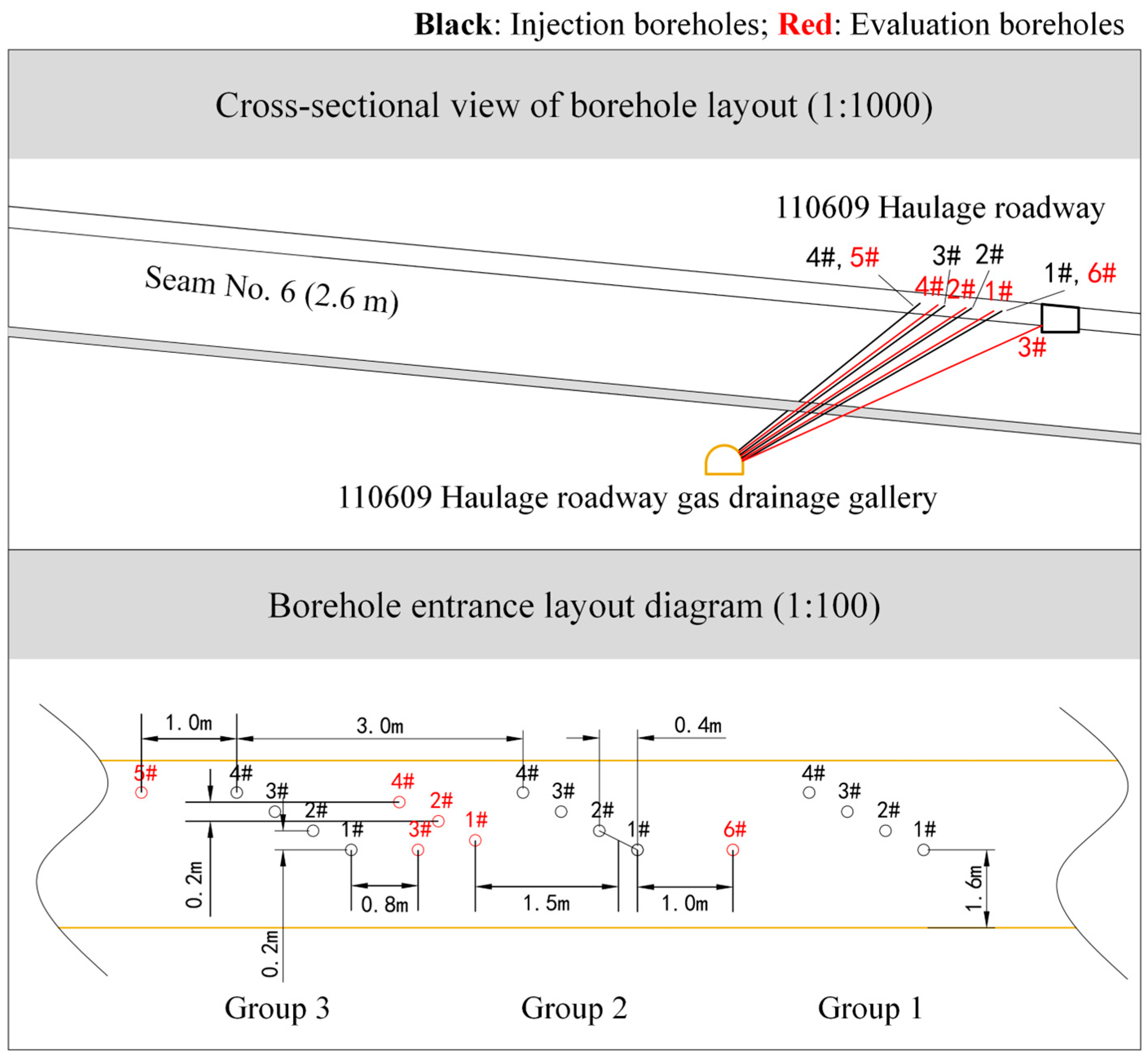
Three groups of injection boreholes, comprising 12 boreholes in total with four boreholes in each group, were constructed in the sidewall of the gas drainage roadway associated with the 110609 haulage roadway. The spacing between the borehole groups was 3.0 m. Within each group, the horizontal and vertical spacings between boreholes were 0.4 m and 0.2 m, respectively. After 3 days of treatment, six effectiveness evaluation boreholes were constructed in the same area, with boreholes arranged between the second and third injection groups and on both sides of the injection zone. The designed positions and spacings of the injection boreholes (indicated in black) and the evaluation boreholes (indicated in red) are illustrated in Figure 3. The design and construction parameters of the injection and evaluation boreholes are summarized in Table 2 and Table 3, respectively.

3.2.2. Equipment and Procedures

(1) Gas dissolving solution and its injection system
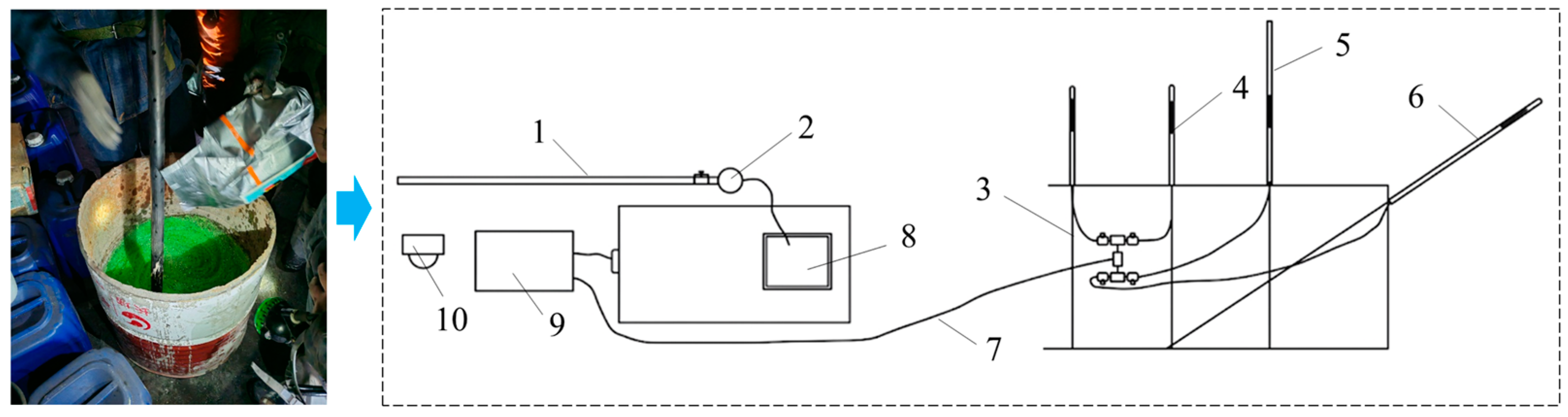
The microbial gas dissolving solution is primarily composed of a base microbial culture, bio-enzymes, and an aqueous phase. Considering the geological characteristics of the target coal seam and the requirements of field operation, 2 t of the base microbial culture was mixed uniformly with 5 t of water to prepare 7 t of working solution. Subsequently, the solution was then injected into the coal seam through dedicated injection boreholes using a pressurized injection system at a constant pressure of 7 MPa, as shown in Figure 4.
The ancillary engineering equipment and auxiliary materials required for field operations also included an emulsion pump station and associated water reservoirs, high-pressure grouting pumps, high-pressure delivery pipelines, globe valves, galvanized steel pipes, ball valves, industrial mixing tanks, sealing packers, and expansive cement.
(2) Experimental procedures
Borehole construction: Injection boreholes were constructed, and coal samples were collected to determine the baseline gas content and gas pressure. Subsequently, the boreholes were sealed with a sealing length of 20 m.
Pump station installation: The pump station was positioned at the entrance of the 110609 haulage roadway gas drainage gallery, approximately 100 m from the injection site.
Pipeline connection: The equipment was connected in the following sequence: emulsion pump → high-pressure steel pipe → high-pressure hose → control box → high-pressure hose → four-way joint → high-pressure hose → stop valve → injection pipe.
Preparation of gas dissolvent: The gas dissolvent and additives were first added to a mixing barrel according to the specified ratio and stirred until uniform. The mixture was then transferred to the water tank of the emulsion pump.
Emulsion pump operation: Following an equipment inspection, the emulsion pump was activated, and the pressure was adjusted to 7 MPa. The valves were then opened to facilitate sequential injection into the boreholes.
Injection operation: Dynamic pressure injection was employed. Once the pump pressure reached the design specifications and remained stable, the pump was stopped upon the observation of “sweating” or seepage on the roadway walls, or when the water level in the tank ceased to decrease significantly under continuous pressure. Finally, the pressure relief valve was closed, concluding the injection procedure.

4. Numerical Simulation of Conventional Gas Extraction

Numerical simulation techniques based on multiphysics coupling frameworks have been widely used to characterize the dynamic evolution of underground gas drainage and have shown good agreement with field measurements in previous studies [34,35,36]. In this study, the Partial Differential Equation (PDE) module of COMSOL Multiphysics 6.2 was used to simulate the spatiotemporal evolution of gas pressure during conventional borehole drainage. The resulting conventional drainage scenario provides a reference for comparison with the field performance of the gas dissolution technology.

4.1. Governing Equations

Coal is a representative dual-porosity (pore–fracture) medium. It is assumed that the coal skeleton behaves as a linearly elastic solid, with gas transport in the coal matrix governed by Fick’s law of diffusion and gas flow through the fracture system governed by Darcy’s law. Gas drainage is a complex multiphysics-coupled process involving interactions among multiple physical fields. The governing processes include gas diffusion in the coal matrix, gas seepage through the fracture system, deformation of the coal skeleton, and the associated evolution of coal permeability. The governing equations for these coupled processes are presented below [37].
(1) Gas diffusion field
p m t = σ c D V M p m p f ( p m + P L ) 2 V L R T P L ρ c + ϕ m V M ( p m + P L ) 2
(2) Gas seepage field
ϕ f p f t + p f ϕ f t = k e μ p f p f + σ c D 1 ϕ f p m p f
(3) Coal deformation field
G u i , j j + G 1 2 ν u j , j i β f p f , i β m p m , i + F i = 0
(4) Permeability equation
k e = k 0 1 + β f M ϕ f 0 p f p 0 + β m M ϕ f 0 p m p 0 + ε L ϕ f 0 K M 1 p m p m + P L p 0 p 0 + P L 3
where p m is the gas pressure in the coal pores (MPa); V M is the molar volume of methane under standard conditions (m3/mol); p f is the gas pressure in the fractures (MPa); P L and V L represent the Langmuir pressure (MPa) and Langmuir volume (m3/kg), respectively; R is the ideal gas constant (J/(mol·K)); T is the coal seam temperature (K); ρ c is the apparent density of the coal (kg/m3); ϕ m is the matrix porosity of the coal (%); M is the molar mass of methane of the coal (kg/mol); σ c is the matrix shape factor (m−2); D is the diffusion coefficient; ϕ f is the fracture porosity of the coal (%); G denotes the shear modulus of the coal (MPa); ν is the Poisson’s ratio of the coal, F i is the body force (N); k e and k 0 signify the permeability and initial permeability (mD); μ is the dynamic viscosity of the gas (Pa·s); K is the bulk modulus of the coal (MPa), ϕ f 0 is the initial fracture porosity (%); ε L is the Langmuir volumetric strain; β f and β m are the effective stress coefficients for the fractures and pores, respectively, defined as β f = 1 K K m and β m = K K m K K s , where K , K m and K s are the bulk modulus of the coal mass, the coal matrix, and the coal skeleton (MPa), respectively; the relationships are given as K = E 3 1 2 ν , K m = E m 3 1 2 ν and K s = K m 1 3 ϕ m 1 ν 2 1 2 ν , where E is the elastic modulus of the coal (MPa) and E m is the elastic modulus of the coal matrix (MPa).
It should be noted that the gas transport model adopted in this study was based on a previously validated mathematical and numerical modeling framework [37]. The purpose of the simulation was not to reproduce the field gas dissolution process, but rather to establish a conventional borehole drainage reference scenario under the same geological and initial conditions as the field test. Because both gas dissolution treatment and conventional drainage alter the original gas pressure field of the coal seam, it is difficult to conduct the two field tests at the same location under identical initial conditions. Therefore, numerical simulation was employed to obtain the evolution of gas pressure under conventional drainage conditions.

4.2. Model Establishment and Parameter Setting

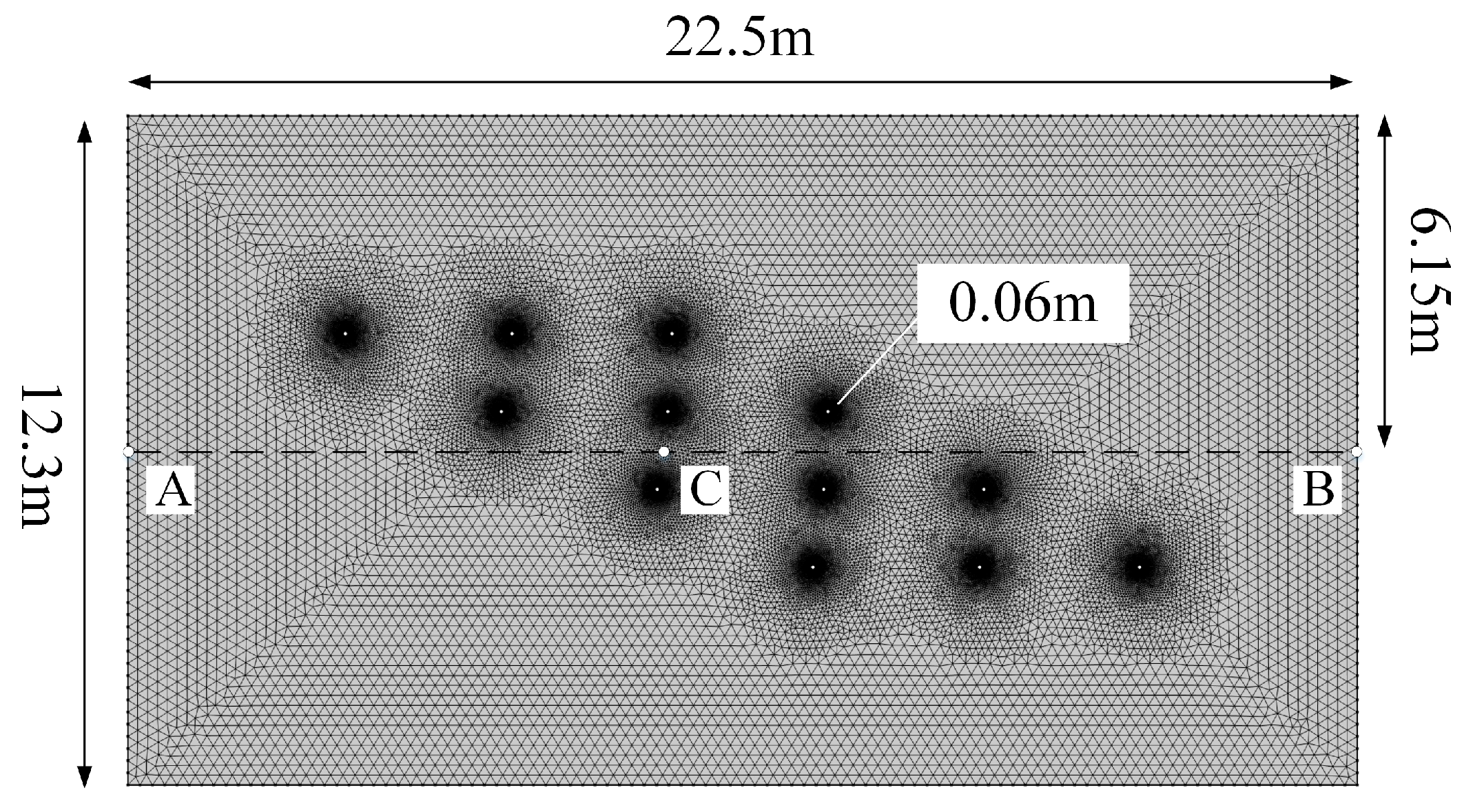
Based on the basic parameters of Seam No. 6 in Coal Mine A and the design specifications of the injection boreholes, a geometric model measuring 22.5 m in length and 12.3 m in height was established. Twelve boreholes with a radius of 0.06 m were incorporated into the model; the resulting geometry and mesh generation are illustrated in Figure 5. Regarding boundary conditions, the bottom of the model was designated as a fixed boundary, while roller supports were applied to the lateral boundaries. The top boundary was subjected to a vertical in situ stress load. The initial gas pressures for both the matrix and the fractures were set at 4.30 MPa, with a drainage negative pressure of 85 kPa applied within the boreholes. To analyze the spatial and temporal evolution of gas pressure, a horizontal monitoring line, AB, was established at the mid-height of the model, with monitoring point C located at the position corresponding to field Evaluation Borehole No. 2. The specific physical parameters used for the numerical simulation are summarized in Table 4.

5. Results and Discussion

5.1. Effectiveness of Gas Dissolution Treatment

As presented in Table 5, the initial gas content within the experimental area of Seam No. 6 ranged from 11.69 to 16.99 m3/t, with a mean of 14.31 m3/t; these results are consistent with the baseline gas parameters detailed in Table 1. Additionally, the initial gas pressure was found to range from 1.74 to 8.74 MPa, with an average value of 4.30 MPa.
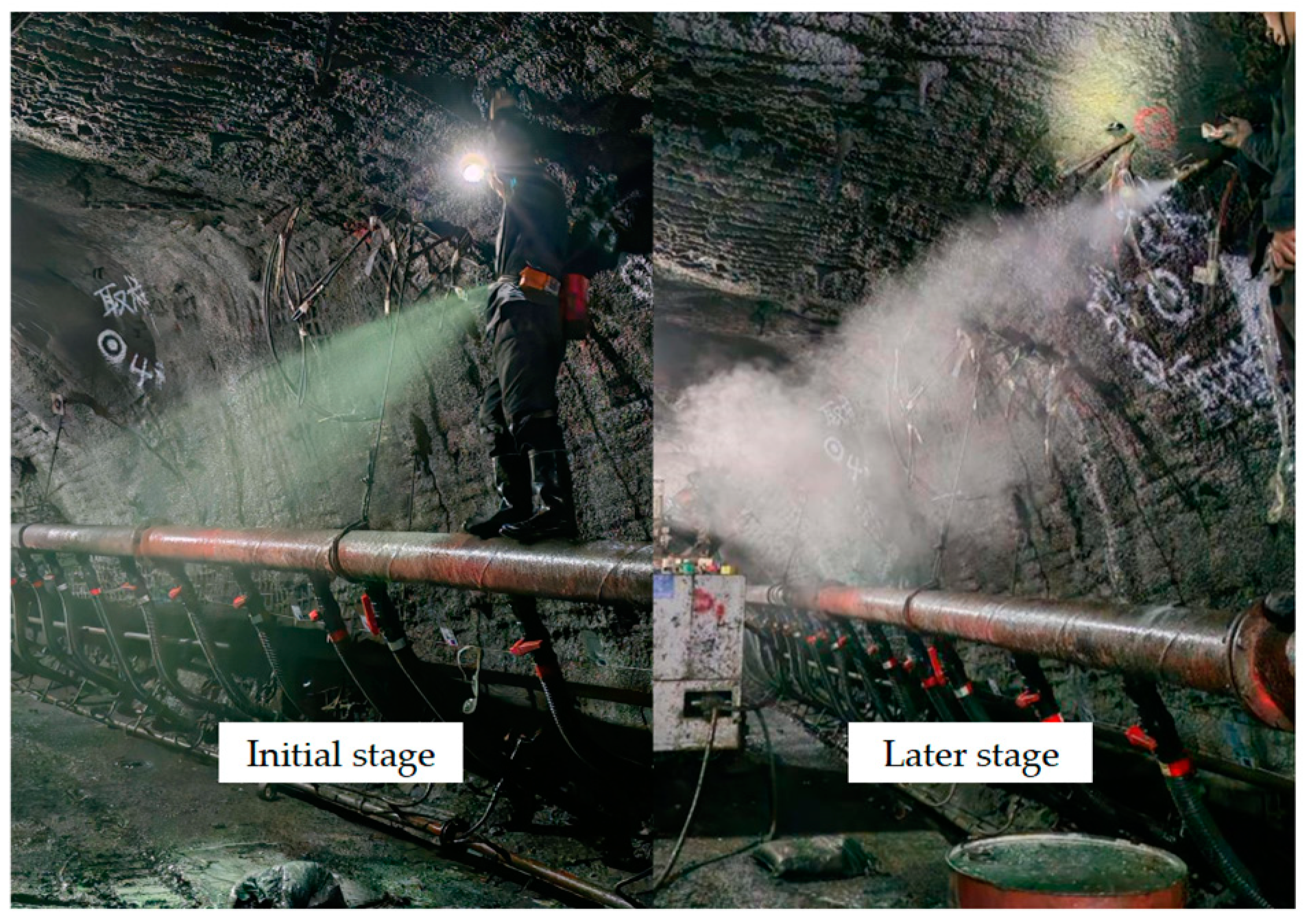
Figure 6 presents the field observations during the initial and later stages of depressurization and gas discharge from the injection borehole. During the initial discharge stage (within 1 min), a small amount of green mist was instantaneously discharged from the borehole. Its color and appearance were generally consistent with those of the original gas-dissolving solution shown in Figure 4, indicating that this liquid mainly consisted of residual solution retained within the borehole cavity and the near-borehole region. Subsequently, the borehole entered a sustained and stable gas discharge stage, accompanied by a distinct white mist. An intrinsically safe portable CO2 gas analyzer was used on-site to analyze the gas discharged from the borehole outlet, and the measurements confirmed the presence of a substantial amount of CO2 in the discharged gas. It should be noted that CO2 itself is colorless; therefore, the observed white mist does not represent the color of CO2. According to previous high-pressure CO2 release experiments [38], rapid depressurization and expansion of high-pressure gas can produce a pronounced cooling effect and promote the condensation of water vapor into fine droplets, thereby forming a visible white cloud. Therefore, the white mist observed in the present test was mainly associated with liquid atomization and water vapor condensation during depressurization, whereas the presence of CO2 was confirmed by the on-site instrumental measurements. Considering the biochemical methane-oxidation mechanism of MOB together with the field measurement results, it can be inferred that the bioactive solution injected into the coal interacted with coal seam methane through oxidative reactions.
The gas content and gas pressure measured within the experimental area after microbial solution injection are summarized in Table 6. Evaluation boreholes Nos. 1, 2, 4, and 6 were located within the overlapping influence zones of the three groups of injection boreholes. In these regions, both gas content and gas pressure decreased markedly, with average values of 8.87 m3/t and 0.83 MPa, respectively, indicating a pronounced superimposed treatment effect resulting from multiple injection groups.
In contrast, evaluation borehole No. 3 was located farthest from the concentrated injection zone and was therefore less directly affected by the microbial solution. Its gas content and gas pressure remained the highest among all evaluation boreholes, at 12.79 m3/t and 2.41 MPa, respectively. It should be noted that the reduction in gas pressure at borehole No. 3 was substantially greater than the reduction in gas content. This difference is mainly associated with the occurrence state and mass transfer behavior of methane in coal. Coal seam gas content consists of both free and adsorbed methane. Gas pressure primarily reflects the pressure state of free gas within the pore–fracture system and therefore responds relatively rapidly to pressure disturbances, whereas a large proportion of methane is stored in the coal matrix in an adsorbed state. Its release requires successive desorption and diffusion processes, resulting in a delayed response to external disturbances [39,40]. For borehole No. 3, which is located relatively far from the injection zone, pressure disturbances can propagate rapidly through the fracture network, whereas the adsorbed methane has not yet been fully desorbed or involved in subsequent migration and oxidation processes. Consequently, the gas pressure exhibits a relatively pronounced decrease, while the reduction in total gas content remains comparatively limited.
Evaluation borehole No. 5 was located to the left of the third injection borehole group and was mainly influenced by a single injection group. Accordingly, the reductions in gas parameters were smaller than those observed in the overlapping treatment zones represented by boreholes Nos. 1, 2, 4, and 6.
Based on the comparative analysis of the above data, the average gas content and gas pressure in the coal seam after gas dissolution treatment decreased by 38.0% and 80.7%, respectively, relative to their initial values. These results indicate that, under high-pressure injection, the bioactive dissolving solution can migrate into the coal through the pre-existing pore and fracture network and promote gas reduction through MOB-mediated methane oxidation, thereby substantially reducing the gas parameters within the treated zone over a 3-day period. Meanwhile, the treatment effects at different evaluation boreholes exhibited clear spatial variations: boreholes located within the overlapping influence zones of multiple injection groups showed greater reductions in gas content and gas pressure, whereas boreholes farther from the concentrated injection zone exhibited relatively smaller reductions. This indicates that the effective influence of the bioactive solution gradually decreases with increasing distance from the injection zone. Such spatial attenuation may be associated with poor pore–fracture connectivity, high resistance to liquid migration, and the limited mass transfer range of the bioactive solution in low-permeability coal seams. It should be noted that the spatial distribution of MOB activity and the residual concentration of the dissolving solution were not directly measured in this study. Therefore, the spatial influence range was inferred indirectly from the variations in gas parameters measured at evaluation boreholes located at different positions. In future studies, the effective treatment radius can be further quantified through direct measurements of microbial activity.

5.2. Effectiveness of Conventional Borehole Gas Drainage

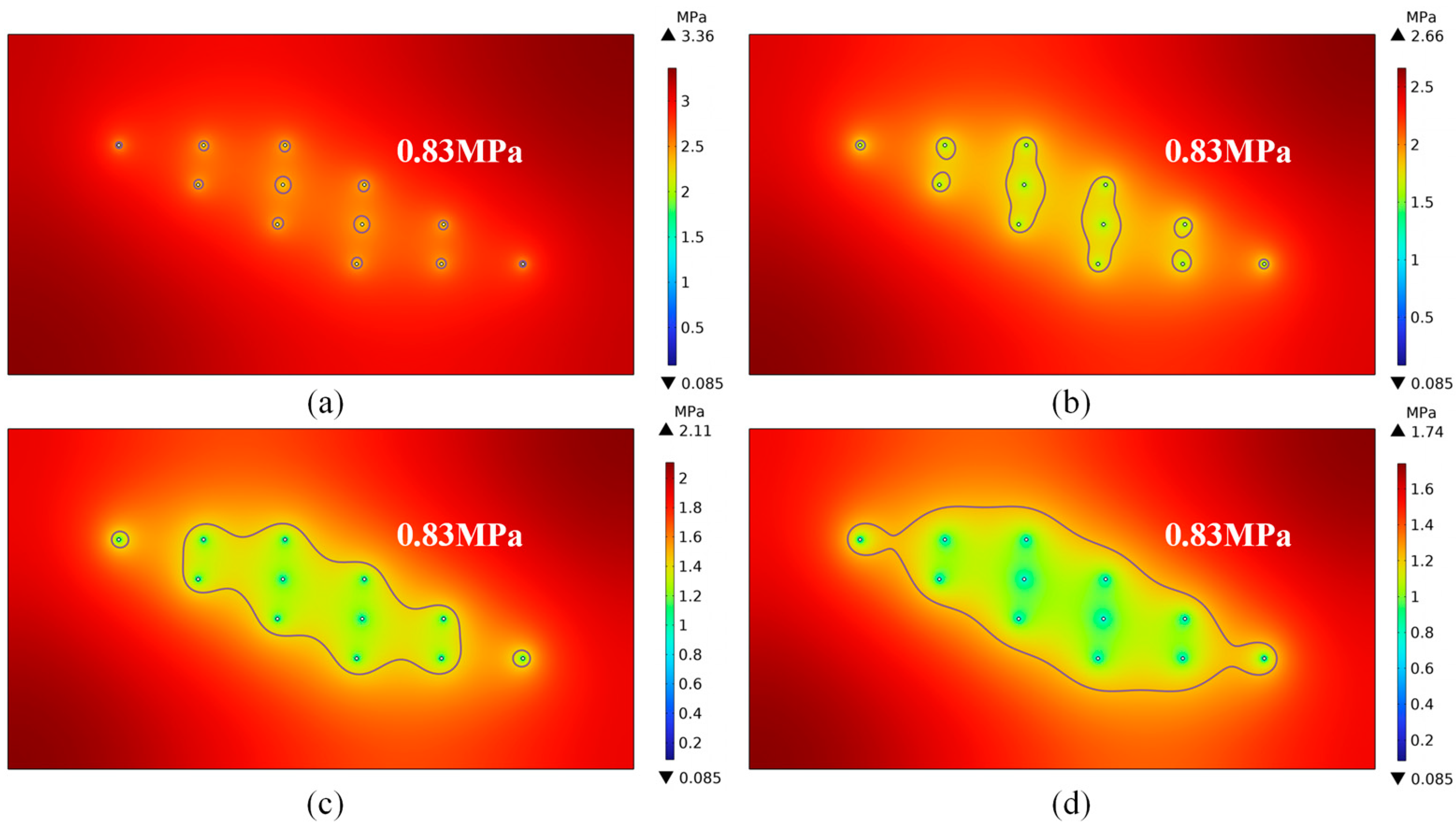
According to the field results of the gas dissolution tests, the gas pressure between the borehole groups decreased to the critical threshold of 0.83 MPa within only 3 days. Using 0.83 MPa as the target pressure, Figure 7 illustrates the spatial evolution of the gas-pressure field under conventional drainage at four representative drainage durations: 30 days, 70 days, 130 days, and 200 days. The simulated pressure contours reveal pronounced spatial heterogeneity in gas pressure attenuation, with the pressure reduction rate increasing as the distance to the drainage boreholes decreases. After approximately 70 days of drainage (Figure 7b), the low-pressure zones surrounding adjacent boreholes began to overlap in regions with relatively dense borehole spacing due to the superposition of their drainage influence. However, the interconnected regions between the borehole groups did not fully reach the target pressure of <0.83 MPa until approximately 130 days of drainage (Figure 7c). The results therefore indicate a pronounced time lag under conventional drainage. In comparison, the gas dissolution treatment reduced the gas pressure between the borehole groups to the same threshold within only 3 days, demonstrating its substantial advantage in shortening the gas control period.
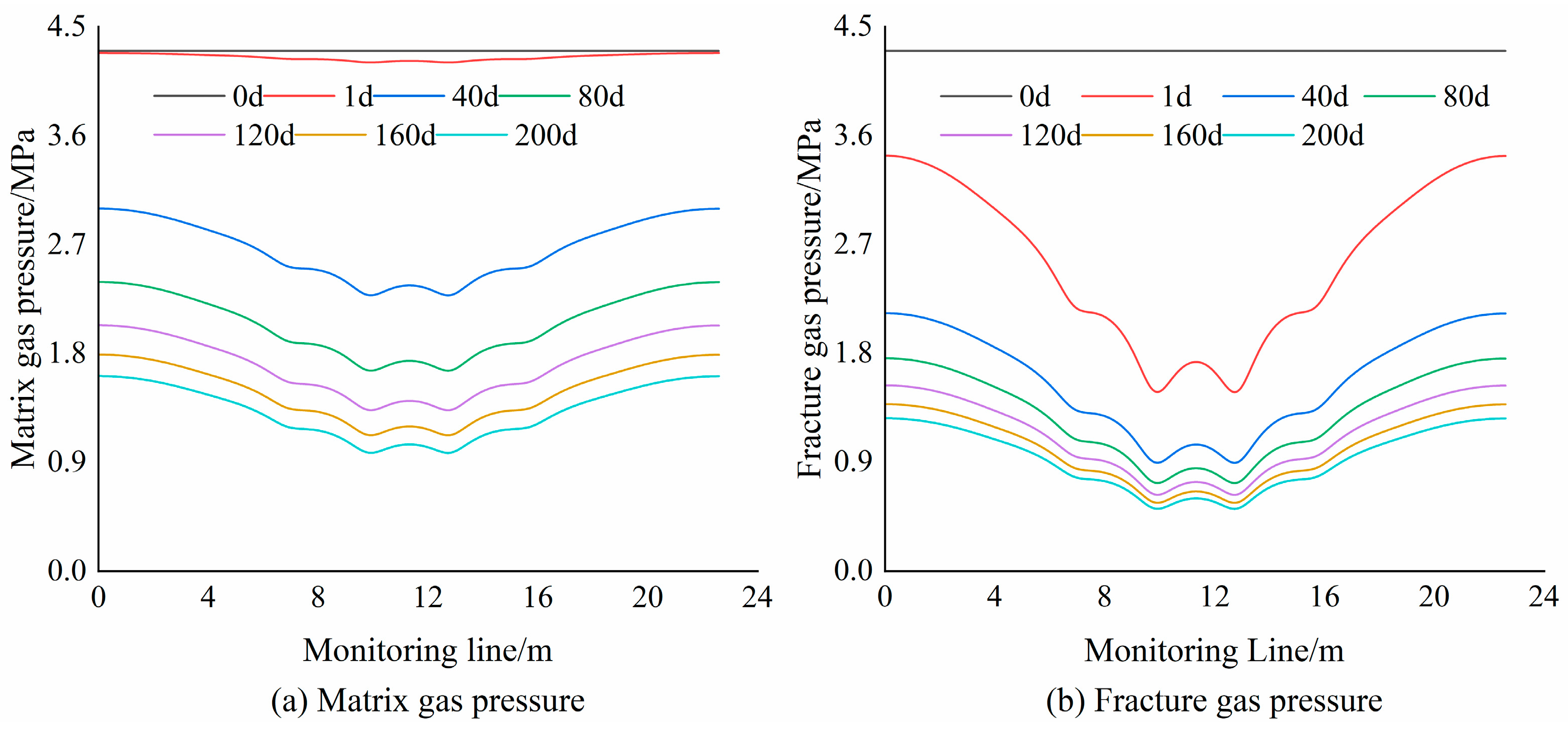
Figure 8 illustrates the spatiotemporal evolution of gas pressure in the coal matrix and fracture system along monitoring line AB, further elucidating the gas drainage response mechanism within a dual-porosity medium. The results reveal a pronounced asynchronicity in the pressure attenuation rates between the matrix and fracture systems. Within the initial 1 day of drainage, the fracture gas pressure in the superposition zone plummeted from the baseline of 4.30 MPa to approximately 1.48 MPa (about 34.4% of its initial value), forming a distinct “funnel-shaped” pressure sink. In contrast, the matrix gas pressure showed only a slight change during the same period. This difference is attributable to the relatively high permeability of the fracture system, which provides preferential pathways for gas flow. Driven by the large pressure gradient between the coal seam and the drainage boreholes, free gas in the fractures flows rapidly toward the boreholes. As drainage continues, the sustained decrease in fracture gas pressure increases the pressure difference between the coal matrix and fracture system, thereby promoting gas diffusion from the matrix into the fractures. As this interporosity mass transfer continues, the matrix gas pressure gradually decreases and eventually exhibits a pressure evolution trend similar to that of the fracture system, with the two systems progressively approaching dynamic equilibrium.

5.3. Comparative Analysis

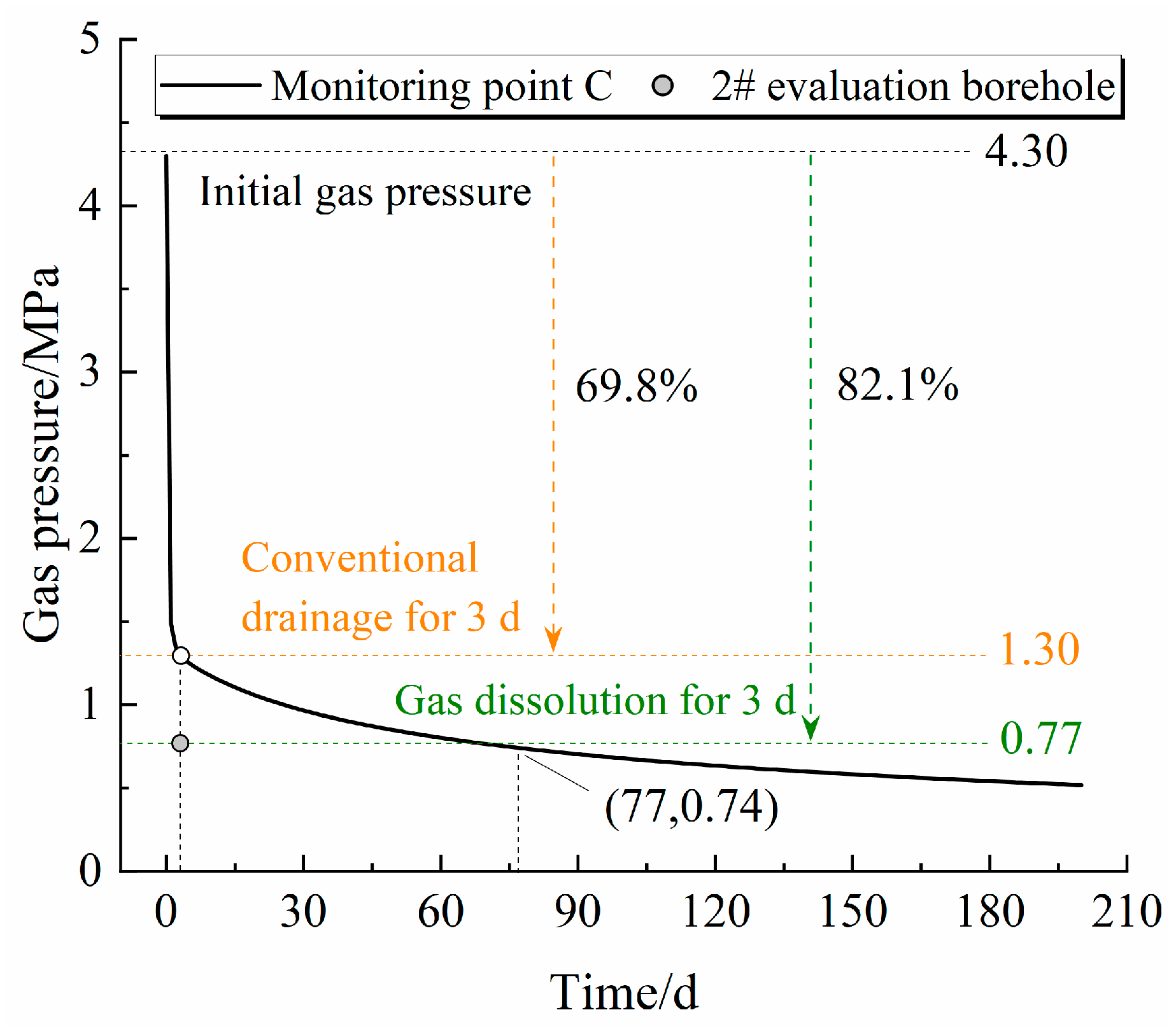
Monitoring point C corresponds to the No. 2 effectiveness evaluation borehole used in the field application of the gas dissolution technology. Figure 9 shows the temporal evolution of gas pressure at monitoring point C and compares the pressure reduction performance of conventional gas drainage with that of the gas dissolution technology. The results show that after 3 days of treatment, the gas pressure under conventional drainage decreased from 4.30 MPa to 1.30 MPa, corresponding to a reduction of 69.8%. In contrast, under the gas dissolution treatment, the gas pressure decreased to 0.77 MPa over the same period, corresponding to a reduction of 82.1%. These results indicate that the gas dissolution technology achieved a faster pressure decline and a more pronounced pressure reduction effect within the same treatment period.
The observed difference is mainly attributable to the distinct methane transport and removal mechanisms of the two technologies. Conventional gas drainage primarily relies on the pressure gradient generated by negative pressure in the borehole to drive methane migration through the pre-existing pores and fractures of the coal toward the drainage borehole, and its effectiveness is therefore strongly constrained by the intrinsic permeability of the coal seam. By contrast, the gas dissolution technology uses high-pressure injection to deliver a bioactive solution enriched with MOB into the pores and fractures of the coal matrix. Previous studies have shown that microbial treatment can improve the coal pore structure by converting some closed or poorly connected pores into effectively connected pores, while also increasing the average pore size and porosity and enhancing pore connectivity to a certain extent. These changes provide more favorable pathways for coal seam gas desorption, diffusion, and migration [24,25,26]. Meanwhile, MOB can further biologically oxidize methane that enters the liquid phase or comes into contact with the bacterial solution. Therefore, the more rapid gas pressure decline observed in Figure 9 should be attributed to the combined effects of improved pore structure and mass transfer conditions and microbial oxidation and consumption of methane.
Further analysis of Figure 9 reveals a distinct two-stage evolution during conventional gas drainage: an initial rapid attenuation phase (0–3 days) followed by an asymptotic slow-decline phase (after 3 days), indicating that the rate of pressure reduction progressively decreases with drainage time. Notably, it requires 68 days of conventional drainage to achieve the same pressure reduction (0.77 MPa) attained by dissolution technology in only 3 days. To reach the regulatory threshold of 0.74 MPa, conventional drainage requires approximately 77 days, whereas the gas dissolution treatment can reach this threshold within a much shorter period with additional solution injection. Therefore, compared with conventional borehole drainage, the gas dissolution technology can shorten the gas control period by approximately two months, substantially shortening the gas control cycle and enhancing the operational efficiency in low-permeability coal seams.

6. Conclusions

Through field experiments and numerical simulations, this study evaluated the gas control performance and engineering applicability of microbial gas dissolution technology in a low-permeability coal seam. The main conclusions are as follows:
(1) Field tests demonstrated that microbial gas dissolution technology can achieve rapid gas mitigation. After 3 days of treatment, the average gas content and gas pressure within the overlapping treatment zone decreased by 38.0% and 80.7%, respectively, indicating that this technology can rapidly reduce both gas pressure and gas content in low-permeability coal seams.
(2) Unlike conventional borehole drainage, which mainly relies on pressure-gradient-driven methane migration through the pre-existing pore–fracture network, microbial gas dissolution technology actively delivers a MOB-enriched bioactive solution into the coal matrix under injection pressure and promotes the in situ oxidative reduction of methane through microbial activity. Numerical simulation results showed that conventional drainage required approximately 130 days for the interconnected region between the borehole groups to reach the target pressure of <0.83 MPa, whereas the gas dissolution treatment achieved the same pressure threshold within only 3 days. This active in situ methane reduction mechanism represents the principal innovation of the technology compared with conventional drainage and can substantially shorten the gas control period.
(3) The results indicate that microbial gas dissolution technology can serve as a promising supplementary approach for rapid gas control in low-permeability coal seams, particularly where conventional drainage is constrained by low permeability and slow methane transport. For large-scale application, further work is needed to optimize injection parameters, the effective treatment radius, and the spatial distribution of the bioactive solution, as well as to systematically evaluate its long-term effectiveness and economic feasibility.

Author Contributions

Conceptualization, Q.L.; funding acquisition, Q.L.; writing—review and editing, Q.L., X.H. and Z.S.; formal analysis, W.Z.; visualization, W.Z.; writing—original draft preparation, W.Z.; resources, X.H.; methodology, S.Z.; supervision, S.Z. and D.F.; investigation, Z.D. and D.F.; project administration, Z.D.; validation, W.Z. All authors have read and agreed to the published version of the manuscript.

Funding

This research was funded by the Department of Science and Technology of Guizhou Province through the Guizhou Provincial Hundred-Level Innovative Talents Program (Grant No. QKH Platform Talents—GCC [2023] 102), the Guizhou Provincial Science and Technology Innovation Talent Team Program (Grant No. QKH Talents—CXTD [2025] 017), the Guizhou Provincial Science and Technology Support Program for the Industrial and Service Sectors (General Project) (Grant No. QKH Support—[2026] General 88), the Guizhou Provincial Science and Technology Support Program (Grant No. QKH Support—[2024] General 025), and the Guizhou Provincial Special Fund for Innovation Capacity Building of Scientific Research Institutions (Grant No. QKHFQ—[2024] 006).

Data Availability Statement

The data presented in this study are available upon request from the corresponding author due to reasonable reasons.

Acknowledgments

The authors would like to thank the Guizhou Provincial Postdoctoral Research (Mobile) Station Program (QKH Platform Talents—BSH [2023] 009) and the Guizhou Provincial Routine Funding for Postdoctoral Researchers for their support of postdoctoral researchers and their research activities.

Conflicts of Interest

Authors Qingsong Li and Wei Zhang were employed by the company Guizhou Energy Group Corporation Limited, Guiyang 550081, China. Authors Qingsong Li, Xianwei Heng and Zhenhua Shen were employed by the company Guizhou Mine Safety Science Research Institute Corporation Limited, Guiyang 550025, China. Authors Wei Zhang, Shujin Zhang and Zhengpeng Duan were employed by the company Guizhou Province Laboratory Branch, Guizhou Energy Group Corporation Limited, Guiyang, 550081, China. The remaining author declares that the research was conducted in the absence of any commercial or financial relationships that could be construed as potential conflicts of interest.

References

  1. Wang, E.; Zhang, G.; Zhang, C.; Li, Z. Research progress and prospect on theory and technology for coal and gas outburst control and protection in China. J. China Coal Soc. 2022, 47, 297–322. [Google Scholar]
  2. Zhang, L.; Zhang, H.; Guo, H. A case study of gas drainage to low permeability coal seam. Int. J. Min. Sci. Technol. 2017, 27, 687–692. [Google Scholar] [CrossRef] [Scilit]
  3. Jia, L.; Peng, S.; Xu, J.; Yan, F.; Chen, J.; Wu, B.; Chen, Y. On the evolution mechanism of permeability during gas drainage: Insights from deformation field, gas pressure field and temperature field. Process Saf. Environ. Prot. 2022, 162, 825–836. [Google Scholar] [CrossRef] [Scilit]
  4. Zhang, Y.; Zou, Q.; Guo, L. Air-leakage model and sealing technique with sealing–isolation integration for gas-drainage boreholes in coal mines. Process Saf. Environ. Prot. 2020, 140, 258–272. [Google Scholar] [CrossRef] [Scilit]
  5. Zheng, C.; Kizil, M.; Chen, Z.; Aminossadati, S. Effects of coal damage on permeability and gas drainage performance. Int. J. Min. Sci. Technol. 2017, 27, 783–786. [Google Scholar] [CrossRef] [Scilit]
  6. Jia, J.; Ge, J.; Zhen, W.; Zhao, D. Research and application of anti-reflection technology of hydraulic fracturing. China Saf. Sci. J. 2020, 30, 63–68. [Google Scholar]
  7. Liu, Y.; Zhang, W.; Chen, C.; Wei, J.; Xu, X.; Zhang, H.; Nan, Q.; Xiao, P. Prospects for the development of the theory and technology of non-hydration penetration enhancement in soft coal seams. J. China Coal Soc. 2025, 50, 2123–2146. [Google Scholar]
  8. Guo, H.; Zhu, L. Research on mechanism of energy release and permeability improvement in coal strata by static blasting. China Saf. Sci. J. 2020, 30, 60–65. [Google Scholar]
  9. Zhang, J. Key technologies for collaborative mining of high gas and low permeabilitycoal seams in deep mining areas. Coal Sci. Technol. 2020, 48, 66–74. [Google Scholar]
  10. Lou, Z.; Wang, K.; Kang, M.; Zhao, W.; Wei, G.; Yue, J.; Yao, H. Plugging methods for underground gas extraction boreholes in coal seams: A review of processes, challenges and strategies. Gas Sci. Eng. 2024, 122, 205225. [Google Scholar] [CrossRef] [Scilit]
  11. Xie, J.; Sun, X.; Xu, S.; Hu, H. Feasibility analysis and research status of microbial treatment of mine gas. Min. Saf. Environ. Prot. 2023, 50, 119–122. [Google Scholar]
  12. Wang, X.; Song, P.; Zhang, Z. New breakthroughs on coal-gas outburst control by using gas ablation agent. Coal Technol. 2009, 28, 116–118. [Google Scholar]
  13. Jiang, H.; Chen, Y.; Jiang, P.; Zhang, C.; Smith, T.J.; Murrell, J.C.; Xing, X.-H. Methanotrophs: Multifunctional bacteria with promising applications in environmental bioengineering. Biochem. Eng. J. 2010, 49, 277–288. [Google Scholar] [CrossRef] [Scilit]
  14. Kelly, D.P.; Wood, A.P. Isolation and Characterization of Methanotrophs and Methylotrophs: Diversity of Methylotrophic Organisms and of One-Carbon Substrates. In Handbook of Hydrocarbon and Lipid Microbiology; Timmis, K.N., Ed.; Springer: Berlin/Heidelberg, Germany, 2010; pp. 3827–3845. [Google Scholar]
  15. Zhou, S.; Tao, X.; Zhu, H.; Hou, T.; Xu, N. Isolation and culture conditions optimizing of a strain of methanotrophic bacterium from coal soil. Clean Coal Technol. 2008, 14, 98–100. [Google Scholar]
  16. Deng, Y.; Wang, C.; Deng, J.; Wang, N. Microbial extraction and growth metabolic characteristics of microorganisms metabolizing CH4 and CO gases in coal mine. J. Xi’an Univ. Sci. Technol. 2024, 44, 688–698. [Google Scholar]
  17. Yu, H. Studies on Bio-Oxidizing Methane in Coal Mines with Microbial Technology. Ph.D. Thesis, Zhejiang University, Hangzhou, China, 2007. [Google Scholar]
  18. Chen, D.; Wang, L.; Jin, L.; Xia, C.; Zhang, J. The preliminary research on coal-bed gas degradation by microorganism. J. China Coal Soc. 2006, 31, 607–609. [Google Scholar]
  19. Zhang, R.; Cui, X. Experiment study on anaerobic microbial degrading methane adsorbed by raw coal. Coal Sci. Technol. 2016, 44, 155–159. [Google Scholar]
  20. Yu, H.; Cui, X.; Zhang, R. Experimental study on degradation of adsorbed methane in simulated raw coal environment by microorganism. China Saf. Sci. J. 2018, 28, 158–163. [Google Scholar]
  21. Pan, S. Degradation of coal and adsorption of methane by methanotrophs in simulated row coal occurrence environment. Min. Saf. Environ. Prot. 2018, 45, 26–29. [Google Scholar]
  22. Zhao, S.; Zhang, R.; Wang, S.Z.; Zhou, Y.B.; Tian, K.; Gong, W. Growth characteristics and efficiency of methane oxidation mixed bacteria under different pH conditions. Min. Res. Dev. 2024, 44, 110–115. [Google Scholar]
  23. Xue, S.; Zhang, X.; Liu, B.; Chen, R.; Jiang, X.; Zhou, T.; Cheng, K. Evolution of pore structure in bituminous coal and mechanism of methane promotion during microbial degradation under the synergy of static magnetic field. J. China Coal Soc. 2026, 51, 448–460. [Google Scholar]
  24. Gao, D.; Guo, H.; Guo, B.; Tan, K.; Ren, H. Impact of microbially enhanced coalbed methane on the pore structure of coal. Front. Earth Sci. 2022, 10, 869917. [Google Scholar] [CrossRef] [Scilit]
  25. Bao, Y.; Li, Z.; Meng, J.; Chen, X.; Liu, X. Reformation of coal reservoirs by microorganisms and its significance in CBM exploitation. Fuel 2024, 360, 130642. [Google Scholar] [CrossRef] [Scilit]
  26. Wang, K.; Guo, L.; Xu, C.; Wang, W.; Yang, T.; Lin, S.; Cai, Y. Multiscale characteristics of pore-fracture structures in coal reservoirs and their influence on coalbed methane (CBM) transport: A review. Geoenergy Sci. Eng. 2024, 242, 213181. [Google Scholar] [CrossRef] [Scilit]
  27. Han, Y.; Xu, L.; Zhang, R.; Lv, J.; Yang, F.; Ma, C. Study on methane degradation by microbial agents based on chelating wetting agent carriers. Sci. Rep. 2024, 14, 15420. [Google Scholar] [CrossRef] [Scilit] [PubMed]
  28. Zhou, Y.; Zhang, R.; Tian, K.; Zhao, S.; Shi, H.; Gong, W.; Lei, Q. Characteristics of the methanotroph used in coalbed methane emission reduction: Methane oxidation efficiency and coal wettability. Fuel 2023, 349, 128596. [Google Scholar] [CrossRef] [Scilit]
  29. Xie, J.; Wang, Y.; Chen, D.; Du, H. Biological characteristics of methane-oxidizing bacteria under the influence of SDBS/RL and their effects on coal. Chem. Eng. Sci. 2026, 321, 122794. [Google Scholar] [CrossRef] [Scilit]
  30. Jiang, H. Enrichment Culture of Mixed Methanotrophic Community and Its Application in Coal Mine Gas Control. Ph.D. Thesis, Tsinghua University, Beijing, China, 2010. [Google Scholar]
  31. Mao, F. Research on the Theory and Application of Gas Control by Microorganism in the Coal Seam. Ph.D. Thesis, Chongqing University, Chongqing, China, 2013. [Google Scholar]
  32. Guo, A.; Linghu, J.; Zhao, Q.; Cao, D. Application of microbial gas ablation agent in gas control in Sijiazhuang coal mine. Coal Technol. 2018, 37, 128–130. [Google Scholar]
  33. Guo, K.; Tian, S.; Li, P.; Lin, H.; Xu, S.; Jiang, Z. Study and application of gas ablating agent for gas control at coal face. Miner. Eng. Res. 2022, 37, 62–67. [Google Scholar]
  34. Zhou, A.; Xu, Z.; Wang, K.; Wang, Y.; An, J.; Shi, Z. Coal mine gas migration model establishment and gas extraction technology field application research. Fuel 2023, 349, 128650. [Google Scholar] [CrossRef] [Scilit]
  35. Zhang, H.; Cheng, Y.; Deng, C.; Shu, L.; Pan, Z.; Yuan, L.; Wang, L.; Liu, Q. A Novel In-Seam Borehole Discontinuous Hydraulic Flushing Technology in the Driving Face of Soft Coal Seams: Enhanced Gas Extraction Mechanism and Field Application. Rock Mech. Rock Eng. 2022, 55, 885–907. [Google Scholar] [CrossRef] [Scilit]
  36. Saber, E.; Qu, Q.; Aminossadati, S.M.; Zhu, Y.; Chen, Z. Horizontal borehole azimuth optimization for enhanced stability and coal seam gas production. Rock Mech. Bull. 2024, 3, 100100. [Google Scholar] [CrossRef] [Scilit]
  37. Liu, Q.; Cheng, Y.; Dong, J.; Liu, Z. A Concise Course on the Theory of Coal Seam Gas Flow; China University of Mining and Technology Press: Xuzhou, China, 2017. [Google Scholar]
  38. Guo, X.; Chen, S.; Yan, X.; Zhang, X.; Yu, J.; Zhang, Y.; Mahgerefteh, H.; Martynov, S.; Collard, A.; Brown, S. Flow characteristics and dispersion during the leakage of high pressure CO2 from an industrial scale pipeline. Int. J. Greenh. Gas Control 2018, 73, 70–78. [Google Scholar] [CrossRef] [Scilit]
  39. Liu, W.; Han, D.; Guo, M.; Li, R.; Zhong, W. Evaluation of adsorbed and free gas in the coal matrix during desorption processes: Insights from experimental and numerical methods. Fuel 2024, 376, 132739. [Google Scholar] [CrossRef] [Scilit]
  40. Yao, Y.; Wang, F.; Liu, D.; Sun, X.; Wang, H. Quantitative characterization of the evolution of in-situ adsorption/free gas in deep coal seams: Insights from NMR fluid detection and geological time simulations. Int. J. Coal Geol. 2024, 285, 104474. [Google Scholar] [CrossRef] [Scilit]
Figure 1. Basic mechanism of methane degradation by methanotrophic bacteria.
Processes 14 02999 g001
Figure 2. Construction site for gas dissolution technology.
Processes 14 02999 g002
Figure 3. Schematic diagram of the layout of injection and evaluation boreholes.
Processes 14 02999 g003
Figure 4. Preparation of the gas dissolving solution and its injection system. 1. Water pipeline; 2. Water flow meter; 3. Support rod; 4. Borehole sealer, 5. Injection borehole, 6. High-pressure liquid delivery hose; 7. High-pressure water delivery hose; 8. Water tank; 9. Spray pump; 10. Control valve.
Processes 14 02999 g004
Figure 5. Geometric model and mesh generation.
Processes 14 02999 g005
Figure 6. Comparison of the initial and later stages of gas discharge from the injection borehole.
Processes 14 02999 g006
Figure 7. Contours of gas pressure distribution at different drainage times: (a) 30 d; (b) 70 d; (c) 130 d; (d) 200 d.
Processes 14 02999 g007
Figure 8. Evolution patterns of gas pressure along monitoring line AB.
Processes 14 02999 g008
Figure 9. Comparison of gas pressure after gas dissolution treatment and borehole drainage.
Processes 14 02999 g009
Table 1. Fundamental gas parameters of Seam No. 6.
Coal SeamMeasurement LocationBorehole No.Burial Depth (m)Gas Pressure (MPa)Gas Content (m3·t−1)Permeability Coefficient (m2·MPa−2·d−1)Borehole Flow Decay Coefficient (d−1)
Seam No. 6Pedestrian walkway, district 11A6-1132.20.9613.660.41440.2534
Return air drift, district 11A6-3185.31.1514.45
Table 2. Design parameters of the injection boreholes.
Borehole No.Azimuth (°)Inclination (°)Depth (m)
1, 2, 3-1#3153037
1, 2, 3-2#3153334
1, 2, 3-3#3153631
1, 2, 3-4#3153929
Table 3. Design parameters of the evaluation boreholes.
Borehole No.Azimuth (°)Inclination (°)Depth (m)
1#3153037
2#3153334
3#3152443
4#3153631
5#3153929
6#3153037
Table 4. Basic physical parameters for numerical simulation.
ParameterValueParameterValue
ϕ f 0 0.012 R 8.4135 J/(mol·K)
σ c 60 cm−2 T 293 K
ϕ m 0 0.06 μ 1.08 × 10⁻⁵ Pa·s
k e 0 0.01 mD ε L 0.004
E m 8139 MPa P L 1 MPa
E 2713 MPa V L 0.02 m3/kg
ν 0.339 V M 0.0224 m3/mol
M 0.016 kg/mol ρ c 1250 kg/m3
Table 5. Initial gas content and pressure of the coal seam.
Injection Borehole No.Gas Content (m3·t−1)Gas Pressure (MPa)
1-1#11.691.74
1-3#16.327.29
1-4#16.998.74
2-1#13.332.85
2-4#14.694.42
3-1#13.382.90
3-2#14.323.92
3-3#12.982.56
Table 6. Gas content and pressure of the coal seam after dissolution.
Evaluation Borehole No.Gas Content (m3·t−1)Gas Pressure (MPa)
1#9.000.85
2#8.610.77
3#12.792.41
4#9.410.95
5#11.351.58
6#8.440.74
Disclaimer/Publisher’s Note: The statements, opinions and data contained in all publications are solely those of the individual author(s) and contributor(s) and not of MDPI and/or the editor(s). MDPI and/or the editor(s) disclaim responsibility for any injury to people or property resulting from any ideas, methods, instructions or products referred to in the content.