Research Progress on Intelligent Color-Sorting Equipment for Post-Harvest Chili Peppers: Machine Vision, Pneumatic Actuation, and System Integration



Abstract
1. Introduction
1.1. Research Background and Industrial Needs
1.2. Definitions and Scope of Post-Harvest Color Sorting and Intelligent Color-Sorting Equipment for Peppers
1.3. Research Progress, Limitations of Existing Reviews, and the Perspective Adopted in This Review
1.4. Research Questions, Technical Framework, and Organization of the Review
2. Literature Search, Screening, and Evidence Synthesis Methods
2.1. Literature Search Strategy
2.2. Inclusion and Exclusion Criteria for Literature
2.2.1. Inclusion Criteria
2.2.2. Exclusion Criteria
2.3. Literature Screening and Quality Assessment
2.4. Evidence Classification and Synthesis Rules
3. Post-Harvest Online Intelligent Color-Sorting Tasks and System Requirements
3.1. Post-Harvest Processing Flow and Online Color-Sorting Tasks for Peppers
3.2. Pepper Variety, Color, Maturity, and Color-Grade Characteristics
3.3. Visible Color Abnormalities and Their Relationship to Overall Color Assessment
3.4. Perception Reliability Under Pose Variation, Occlusion, and Complex Imaging Conditions
3.5. Functional Requirements and System-Level Performance Metrics for Intelligent Color-Sorting Equipment
4. Technological Evolution and System Architecture of Color-Sorting Equipment
4.1. Human-Integrated Color Perception and Experience-Based Decision-Making
4.2. Rule-Based Photoelectric and 2D Machine Vision
4.3. Data-Driven Intelligent Machine Vision
4.4. Comparison of Sorting Principles, Processes, and Performance Across Technical Paradigms
4.5. Overview of Intelligent Color-Sorting Equipment: Components, Information Flow, and Closed-Loop Architecture
5. Machine Vision Perception and Chili Color Recognition Technologies
5.1. Image Acquisition, Illumination Control, and the Optical Imaging Environment of Color Sorting Equipment
5.2. Traditional Methods Based on Color Spaces, Color Differences, Color Ratios, and Thresholding
5.3. Machine Learning- and Deep Learning-Based Recognition of Ripeness and Color Grades
5.4. Methods for Detecting and Classifying Visible Color Abnormalities
5.5. Multispectral and Multimodal Color Perception Methods
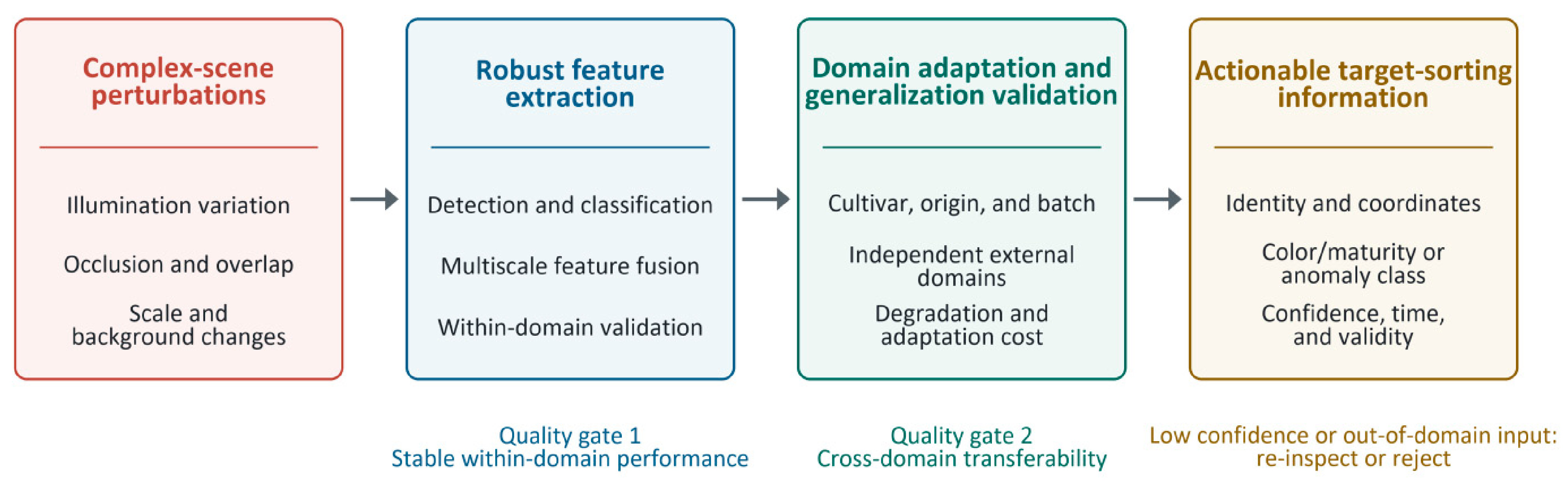
5.6. Robustness, Generalization, and the Generation of Target Information for Color Sorting in Complex Scenarios
6. Temporal and Spatial Coordination of Material Conveyance, Target Localization, and Pneumatic Rejection
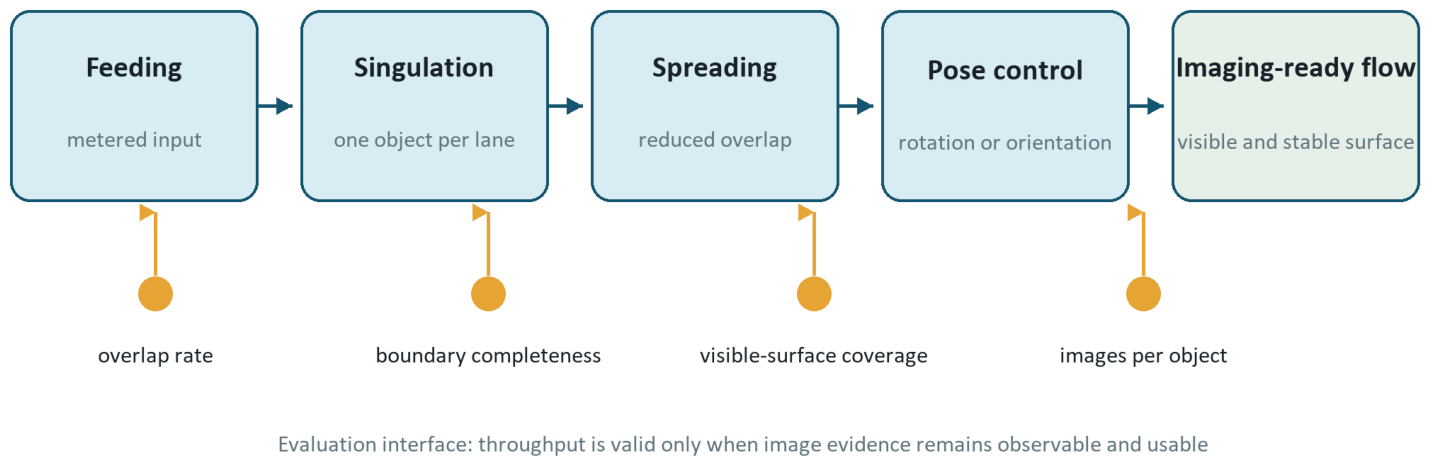
6.1. Feeding, Spreading, Flattening, and Posture Regulation
6.2. Surface Cleaning, Material Conditioning, and Imaging Standardization
6.3. Conveyor Speed, Material Spacing, and Multi-Channel Processing Capacity
6.3.1. Conveyor Speed Has an Operating-Condition-Dependent Effective Range
6.3.2. Material Spacing Translates Spatial Configuration into a System-Level Time Budget
6.3.3. Multi-Channel Processing Capacity Depends on the Technical Route and Shared Bottlenecks
6.3.4. System-Level Discrimination Framework for Intelligent Chili Color Sorting Equipment
6.4. Target Localization, Identity Maintenance, and Arrival Time Prediction
6.4.1. Target Localization: From Detection to Executable Position Generation
6.4.2. Trajectory Prediction: Divergence Between Explicit State Estimation and Implicit Motion Assumptions
6.4.3. Multimodal Perception: Trade-Offs Among Environmental Adaptability, Calibration, and Latency Cost
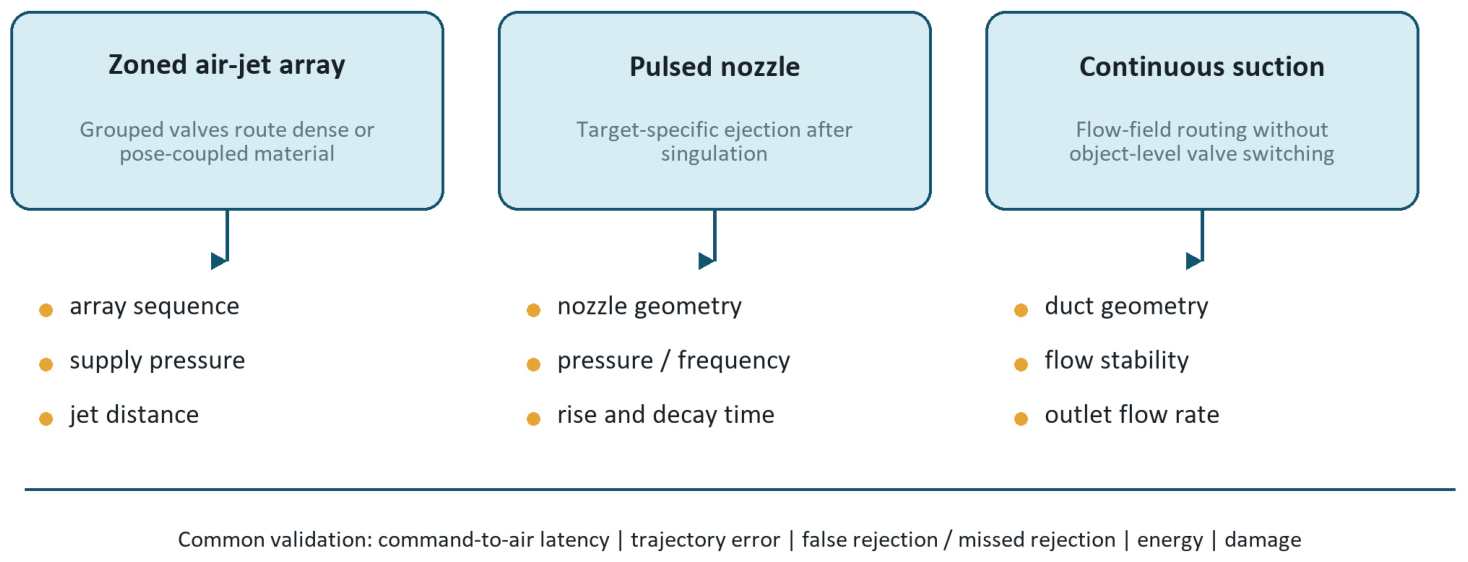
6.5. Pneumatic Jet Mechanisms, Nozzle Arrangement, and Valve-Control Response
6.6. Perception–Execution Timing Alignment, Diversion Accuracy, and Material-Damage Control
6.7. Summary: From Component Performance to System-Level Evaluation
7. Vision–Execution Closed Loop and Intelligent Color-Sorting System Integration
7.1. Interface Design for Vision, Conveying, Control, and Pneumatic Units
7.2. Real-Time Coordination of Color Recognition, Communication, Localization, and Rejection
7.3. Edge Computing, Model Deployment, and Mechatronic–Optical System Integration
7.4. Evaluation of Sorting Accuracy, System Missed-Rejection Rate, System False-Rejection Rate, and Throughput
7.5. Evaluation of System Latency, Energy Consumption, Material Damage, and Reliability
7.5.1. Evaluation Boundaries and Indicator Hierarchy
7.5.2. System Latency, Speed Effects, and Throughput Capacity
7.5.3. Energy Consumption and Material Damage: Limited Engineering Quantification
7.5.4. Reliability: The Gap Between Recognition Stability and Equipment Availability
7.5.5. Evidence-Based Integrated Evaluation and the Absence of Cross-System Rankings
7.6. System Observability, Data Traceability, and Production-Line Validation
7.6.1. From Output-Based Assessment to System Observability
7.6.2. From Individual Predictions to Traceable Data Chains
7.6.3. Hierarchical Deployment Models for Production Lines
7.6.4. Comparison of Evidence from Representative Studies
7.6.5. Research Gaps and a Verifiable Pathway for Production-Line Validation
8. Key Challenges and Development Trends in Intelligent Color-Sorting Equipment for Chili Peppers
8.1. Robustness of Color Recognition Under Complex Illumination and Operating Conditions
8.2. Model Generalization Across Cultivars, Origins, and Batches
8.3. Vision–Execution Timing Errors and Compensation in High-Speed Color Sorting
8.4. Multi-Objective Co-Optimization of Accuracy, Efficiency, Energy Consumption, and Material Damage
8.5. Lightweight Models, Edge Deployment, and Online Adaptation
8.6. Multispectral Sensing, Data Standards, and Industrial Validation
8.7. Research Priorities and a Phased Validation Pathway
9. Conclusions and Outlook
9.1. Evidence-Based Key Conclusions
9.2. Boundaries of the Existing Evidence
9.3. Priorities for Industrial Validation
Author Contributions
Funding
Data Availability Statement
Acknowledgments
Conflicts of Interest
References
- Amna; Akram, M.W.; Li, G.Q.; Akram, M.Z.; Faheem, M.; Omar, M.M.; Hassan, M.G. Machine vision-based automatic fruit quality detection and grading. Front. Agric. Sci. Eng. 2025, 12, 274–287. [Google Scholar] [CrossRef] [Scilit]
- Tai, S.; Tang, Z.; Li, B.; Wang, S.; Guo, X. Intelligent Recognition and Automated Production of Chili Peppers: A Review Addressing Varietal Diversity and Technological Requirements. Agriculture 2025, 15, 1200. [Google Scholar] [CrossRef] [Scilit]
- Mohi-Alden, K.; Omid, M.; Soltani Firouz, M.; Nasiri, A. A machine vision-intelligent modelling based technique for in-line bell pepper sorting. Inf. Process. Agric. 2023, 10, 491–503. [Google Scholar] [CrossRef] [Scilit]
- Mohi-Alden, K.; Omid, M.; Soltani Firouz, M.; Nasiri, A. Design and evaluation of an intelligent sorting system for bell pepper using deep convolutional neural networks. J. Food Sci. 2022, 87, 289–301. [Google Scholar] [CrossRef] [Scilit]
- Lestari, H.A.; Kurniawan, A.; Wahab, L. Automated Conveyor System of Sorting and Grading for Red Chili Pepper (Capsicum annum L.) using Image Processing and Artificial Neural Network. J. Tek. Pertan. Lampung (J. Agric. Eng.) 2024, 13, 1320–1333. [Google Scholar] [CrossRef] [Scilit]
- Seiphepi, G.; Zungeru, A.M.; Gaboitaolelwe, J.; Lebekwe, C.; Mtengi, B. Automatic Bell Pepper Colour Detector and Sorting Machine. Int. J. Eng. Res. Technol. 2020, 13, 3156–3166. [Google Scholar] [CrossRef] [Scilit]
- Zhu, Y.; Zhang, S.; Tang, S.; Gao, Q. Research Progress and Applications of Artificial Intelligence in Agricultural Equipment. Agriculture 2025, 15, 1703. [Google Scholar] [CrossRef] [Scilit]
- Jiang, C.; Miao, K.; Hu, Z.; Gu, F.; Yi, K. Image Recognition Technology in Smart Agriculture: A Review of Current Applications Challenges and Future Prospects. Processes 2025, 13, 1402. [Google Scholar] [CrossRef] [Scilit]
- Villaseñor-Aguilar, M.J.; Bravo-Sánchez, M.G.; Padilla-Medina, J.A.; Vázquez-Vera, J.L.; Guevara-González, R.G.; García-Rodríguez, F.J.; Barranco-Gutiérrez, A.I. A Maturity Estimation of Bell Pepper (Capsicum annuum L.) by Artificial Vision System for Quality Control. Appl. Sci. 2020, 10, 5097. [Google Scholar] [CrossRef] [Scilit]
- Muñoz-Postigo, J.; Valero, E.M.; Martínez-Domingo, M.A.; Lara, F.J.; Nieves, J.L.; Romero, J.; Hernández-Andrés, J. Band selection pipeline for maturity stage classification in bell peppers: From full spectrum to simulated camera data. J. Food Eng. 2024, 365, 111824. [Google Scholar] [CrossRef] [Scilit]
- Wang, Y.; Ouyang, C.; Peng, H.; Deng, J.; Yang, L.; Chen, H.; Luo, Y.; Jiang, P. YOLO-ALW: An Enhanced High-Precision Model for Chili Maturity Detection. Sensors 2025, 25, 1405. [Google Scholar] [CrossRef] [Scilit]
- Wang, C.; Liu, S.; Wang, Y.; Xiong, J.; Zhang, Z.; Zhao, B.; Luo, L.; Lin, G.; He, P. Application of Convolutional Neural Network-Based Detection Methods in Fresh Fruit Production: A Comprehensive Review. Front. Plant Sci. 2022, 13, 868745. [Google Scholar] [CrossRef] [Scilit]
- Blasco, J.; Munera, S.; Aleixos, N.; Cubero, S.; Molto, E. Machine Vision-Based Measurement Systems for Fruit and Vegetable Quality Control in post-harvest. In Advances in Biochemical Engineering/Biotechnology; Springer: Berlin/Heidelberg, Germany, 2017; pp. 71–91. [Google Scholar] [CrossRef] [Scilit]
- Patel, K.K.; Kar, A.; Jha, S.N.; Khan, M.A. Machine vision system: A tool for quality inspection of food and agricultural products. J. Food Sci. Technol. 2012, 49, 123–141. [Google Scholar] [CrossRef] [Scilit]
- Khan, Z.; Shen, Y.; Liu, H. ObjectDetection in Agriculture: A Comprehensive Review of Methods, Applications, Challenges, and Future Directions. Agriculture 2025, 15, 1351. [Google Scholar] [CrossRef] [Scilit]
- Rasekh, M.; Karami, H.; Fuentes, S.; Kaveh, M.; Rusinek, R.; Gancarz, M. Preliminary study nondestructive sorting techniques for pepper (Capsicum annuum L.) using odor parameter. LWT 2022, 164, 113667. [Google Scholar] [CrossRef] [Scilit]
- Lu, J.; Zhang, M.; Hu, Y.; Ma, W.; Tian, Z.; Liao, H.; Chen, J.; Yang, Y. From Outside to Inside: The Subtle Probing of Globular Fruits and Solanaceous Vegetables Using Machine Vision and Near-Infrared Methods. Agronomy 2024, 14, 2395. [Google Scholar] [CrossRef] [Scilit]
- Wang, C.; Li, X.; Zhang, Z.; Luo, X.; Cai, J.; Wang, A. Nondestructive Quality Detection of Characteristic Fruits Based on Vis/NIR Spectroscopy: Principles, Systems, and Applications. Agriculture 2025, 15, 2167. [Google Scholar] [CrossRef] [Scilit]
- Saldaña, E.; Siche, R.; Luján, M.; Quevedo, R. Review: Computer vision applied to the inspection and quality control of fruits and vegetables. Braz. J. Food Technol. 2013, 16, 254–272. [Google Scholar] [CrossRef] [Scilit]
- Huang, Y.; Li, Z.; Bian, Z.; Jin, H.; Zheng, G.; Hu, D.; Sun, Y.; Fan, C.; Xie, W.; Fang, H. Overview of Deep Learning and Nondestructive Detection Technology for Quality Assessment of Tomatoes. Foods 2025, 14, 286. [Google Scholar] [CrossRef] [Scilit]
- Yu, K.; Zhong, M.; Zhu, W.; Rashid, A.; Han, R.; Virk, M.S.; Duan, K.; Zhao, Y.; Ren, X. Advances in Computer Vision and Spectroscopy Techniques for nondestructive Quality Assessment of Citrus Fruits: A Comprehensive Review. Foods 2025, 14, 386. [Google Scholar] [CrossRef] [Scilit]
- Tiamiyu, Q.O.; Adebayo, S.E.; Ibrahim, N. Recent advances on post-harvest technologies of bell pepper: A review. Heliyon 2023, 9, e15302. [Google Scholar] [CrossRef] [Scilit]
- Wang, D.; Zhang, M.; Mujumdar, A.S.; Yu, D. Advanced Detection Techniques Using Artificial Intelligence in Processing of Berries. Food Eng. Rev. 2022, 14, 176–199. [Google Scholar] [CrossRef] [Scilit]
- Jun, Q.; Sasao, A.; Shibusawa, S.; Kondo, N. Extracting External Features of Sweet Peppers Using Machine Vision System on Mobile Fruits Grading Robot. Int. J. Food Eng. 2012, 8, 1. [Google Scholar] [CrossRef] [Scilit]
- Zhu, L.; Spachos, P.; Pensini, E.; Plataniotis, K.N. Deep learning and machine vision for food processing: A survey. Curr. Res. Food Sci. 2021, 4, 233–249. [Google Scholar] [CrossRef] [Scilit]
- Mohammadi Baneh, N.; Navid, H.; Kafashan, J. Mechatronic components in apple sorting machines with computer vision. J. Food Meas. Charact. 2018, 12, 1135–1155. [Google Scholar] [CrossRef] [Scilit]
- Han, B.; Zhang, J.; Almodfer, R.; Wang, Y.; Sun, W.; Bai, T.; Dong, L.; Hou, W. Research on Innovative Apple Grading Technology Driven by Intelligent Vision and Machine Learning. Foods 2025, 14, 258. [Google Scholar] [CrossRef] [Scilit]
- Huang, X.; Zhang, D.; He, Y. An intelligent surface quality detection method for defect identification and classification based on YOLOv5 model. R. Soc. Open Sci. 2025, 12, 1–20. [Google Scholar] [CrossRef] [Scilit]
- Khuriyati, N.; Pamungkas, A.P.; Pambudi, A.A. The Sorting and Grading of Red Chilli Peppers (Capsicum annuum L.) Using Digital Image Processing. Int. J. Agric. Environ. Sci. 2019, 6, 17–23. [Google Scholar] [CrossRef] [Scilit]
- Hou, L.; Liu, Z.; You, J.; Liu, Y.; Xiang, J.; Zhou, J.; Pan, Y. Tomato Sorting System Based on Machine Vision. Electronics 2024, 13, 2114. [Google Scholar] [CrossRef] [Scilit]
- Liang, Z.; Zhu, T.; Teng, G.; Zhang, Y.; Gu, Z. YOLO-RGDD: A Novel Method for the Online Detection of Tomato Surface Defects. Foods 2025, 14, 2513. [Google Scholar] [CrossRef] [Scilit]
- Berry, H.M.; Rickett, D.V.; Baxter, C.J.; Enfissi, E.M.A.; Fraser, P.D. Carotenoid biosynthesis and sequestration in red chilli pepper fruit and its impact on colour intensity traits. J. Exp. Bot. 2019, 70, 2637–2650. [Google Scholar] [CrossRef] [Scilit]
- Li, Z.; Zhao, H.; Jing, Z.; Zhao, Z.; Wang, M.; Gong, M.; Wu, X.; He, Z.; Liao, J.; Liu, M.; et al. Recent Advances in Pepper Fruit Glossiness. Genes 2025, 16, 1319. [Google Scholar] [CrossRef] [Scilit]
- Sihombing, Y.F.; Septiarini, A.; Kridalaksana, A.H.; Puspitasari, N. Chili Classification Using Shape and Color Features Based on Image Processing. Sci. J. Inform. 2022, 9, 42–50. [Google Scholar] [CrossRef] [Scilit]
- Azzahra, T.; Rahmadan, R.; Abi Maulana, F.; Asmita, I.; Rahayu, E.; Erwis, F. Classification of Capsicum Varieties Using Color Analysis with Convolutional Neural Network. J. ICT Apl. Syst. 2024, 3, 66–74. [Google Scholar] [CrossRef] [Scilit]
- Arinal, V.; Sarimole, F.M.; Sugeng, S.; Julianda, R. Chili Pepper Variety Detection System Using the Principal Component Analysis Method. Int. J. Mech. Electr. Civ. Eng. 2024, 1, 72–87. [Google Scholar] [CrossRef] [Scilit]
- Barbosa, M.D.O.; Aguiar, F.P.L.; Sousa, S.D.S.; Cordeiro, L.D.S.; Nääs, I.D.A.; Okano, M.T. YOLOv8m for Automated Pepper Variety Identification: Improving Accuracy with Data Augmentation. Appl. Sci. 2025, 15, 7024. [Google Scholar] [CrossRef] [Scilit]
- Kasampalis, D.S.; Tsouvaltzis, P.; Ntouros, K.; Gertsis, A.; Gitas, I.; Moshou, D.; Siomos, A.S. Nutritional composition changes in bell pepper as affected by the ripening stage of fruits at harvest or post-harvest storage and assessed non-destructively. J. Sci. Food Agric. 2022, 102, 445–454. [Google Scholar] [CrossRef] [Scilit]
- Ignat, T.; Alchanatis, V.; Schmilovitch, Z.E. Maturity prediction of intact bell peppers by sensor fusion. Comput. Electron. Agric. 2014, 104, 9–17. [Google Scholar] [CrossRef] [Scilit]
- Kasampalis, D.S.; Tsouvaltzis, P.; Ntouros, K.; Gertsis, A.; Gitas, I.; Siomos, A.S. The use of digital imaging, chlorophyll fluorescence and Vis/NIR spectroscopy in assessing the ripening stage and freshness status of bell pepper fruit. Comput. Electron. Agric. 2021, 187, 106265. [Google Scholar] [CrossRef] [Scilit]
- Kim, S.; Youl Ha, T.; Park, J. Characteristics of pigment composition and colour value by the difference of harvesting times in Korean red pepper varieties (Capsicum annuum L.). Int. J. Food Sci. Technol. 2008, 43, 915–920. [Google Scholar] [CrossRef] [Scilit]
- Santos, M.B.D.C.; Melo, R.D.S.; Sousa, V.E.D.C.; Medeiros, A.M.; Pessoa, A.M.D.S.; Silva, S.D.C.; do Nascimento, A.M.M.; Barroso, P.A. A Computer Vision-Based Methodology to Estimate Fruit Colour Diversity in Ornamental Pepper (Capsicum spp.). Plant Breed. 2024, 143, pbr.13237. [Google Scholar] [CrossRef] [Scilit]
- Fatchurrahman, D.; Castillejo, N.; Hilaili, M.; Russo, L.; Fathi-Najafabadi, A.; Rahman, A. A Novel Damage Inspection Method Using Fluorescence Imaging Combined with Machine Learning Algorithms Applied to Green Bell Pepper. Horticulturae 2024, 10, 1336. [Google Scholar] [CrossRef] [Scilit]
- Faqeerzada, M.A.; Kim, Y.N.; Kim, H.; Akter, T.; Kim, H.; Park, M.S.; Kim, M.S.; Baek, I.; Cho, B.K. Hyperspectral imaging system for pre- and post-harvest defect detection in paprika fruit. Postharvest Biol. Technol. 2024, 218, 113151. [Google Scholar] [CrossRef] [Scilit]
- Huang, Z.; Takemoto, T.; Omwange, K.A.; Saito, Y.; Kuramoto, M.; Kondo, N. Macroscopic and microscopic characterization of fluorescence properties of multiple sweet pepper cultivars (Capsicum annuum L.) using excitation-emission matrix and UV induced fluorescence imaging. Spectrochim. Acta Part A Mol. Biomol. Spectrosc. 2023, 288, 122094. [Google Scholar] [CrossRef] [Scilit]
- Ma, S.; Li, Y.; Peng, Y.; Nie, S.; Wang, W.; Zhang, Y. Fusion of visible and fluorescence imaging through deep neural network for color value prediction of pelletized red peppers. J. Food Sci. 2024, 89, 7410–7421. [Google Scholar] [CrossRef] [Scilit]
- Schmilovitch, Z.E.; Ignat, T.; Alchanatis, V.; Gatker, J.; Ostrovsky, V.; Felföldi, J. Hyperspectral imaging of intact bell peppers. Biosyst. Eng. 2014, 117, 83–93. [Google Scholar] [CrossRef] [Scilit]
- Al-Mallahi, A.; Kataoka, T.; Okamoto, H.; Shibata, Y. An image processing algorithm for detecting in-line potato tubers without singulation. Comput. Electron. Agric. 2010, 70, 239–244. [Google Scholar] [CrossRef] [Scilit]
- Hemming, J.; Ruizendaal, J.; Hofstee, J.; Van Henten, E. Fruit Detectability Analysis for Different Camera Positions in Sweet-Pepper. Sensors 2014, 14, 6032–6044. [Google Scholar] [CrossRef] [Scilit]
- Gupta, H.; Lilienthal, A.J.; Andreasson, H.; Kurtser, P. NDT-6D for color registration in agri-robotic applications. J. Field Robot. 2023, 40, 1603–1619. [Google Scholar] [CrossRef] [Scilit]
- Li, A.; Wang, C.; Wang, A.; Sun, J.; Gu, F.; Zhang, T. YOLO-MSRF: A Multimodal Segmentation and Refinement Framework for Tomato Fruit Detection and Segmentation with Count and Size Estimation Under Complex Illumination. Agriculture 2026, 16, 277. [Google Scholar] [CrossRef] [Scilit]
- Tasneem, Z.; Oka, K.; Tada, N. Sweet pepper detection in day and night greenhouse environments using thermal and depth imaging. ROBOMECH J. 2025, 12, 29. [Google Scholar] [CrossRef] [Scilit]
- Zhao, H.; Deng, W.; Xie, S.; Zhao, Z. Performance Optimization and Experimental Study of Small-Scale Potato-Grading Device. Agriculture 2024, 14, 822. [Google Scholar] [CrossRef] [Scilit]
- Feng, Z.; Zhu, L.; Zhou, R.; Ntakirutimana, T.; Wei, B.; Wang, D. Transforming Apple Grading: Standards Survey and Deep Learning Insights. Food Bioprocess Technol. 2025, 18, 5954–5969. [Google Scholar] [CrossRef] [Scilit]
- Xiang, P.; Pan, F.; Duan, X.; Yang, D.; Hu, M.; He, D.; Zhao, X.; Huang, F. A Method for Sorting High-Quality Fresh Sichuan Pepper Based on a Multi-Domain Multi-Scale Feature Fusion Algorithm. Foods 2024, 13, 2776. [Google Scholar] [CrossRef] [Scilit]
- Masum, A.A.; Himel, M.M.H.; Salehin, M.M.; Rahman, K.S.; Ahamed, S.; Kabir, M.; Bhuiyan, M.G.K.; Rahman, A. Development of automated real-time mango grader using machine vision technique. Discov. Agric. 2025, 3, 104. [Google Scholar] [CrossRef] [Scilit]
- Dewi, T.; Risma, P.; Oktarina, Y. Fruit sorting robot based on color and size for an agricultural product packaging system. Bull. Electr. Eng. Inform. 2020, 9, 1438–1445. [Google Scholar] [CrossRef] [Scilit]
- Al Ohali, Y. Computer vision based date fruit grading system: Design and implementation. J. King Saud Univ. —Comput. Inf. Sci. 2011, 23, 29–36. [Google Scholar] [CrossRef] [Scilit]
- Dhakshina Kumar, S.; Esakkirajan, S.; Bama, S.; Keerthiveena, B. A microcontroller based machine vision approach for tomato grading and sorting using SVM classifier. Microprocess. Microsyst. 2020, 76, 103090. [Google Scholar] [CrossRef] [Scilit]
- Cubero, S.; Aleixos, N.; Moltó, E.; Gómez-Sanchis, J.; Blasco, J. Advances in Machine Vision Applications for Automatic Inspection and Quality Evaluation of Fruits and Vegetables. Food Bioprocess Technol. 2011, 4, 487–504, Erratum in Food Bioprocess Technol. 2011, 4, 829–830. https://doi.org/10.1007/s11947-011-0585-8. [Google Scholar] [CrossRef] [Scilit]
- Bratu, A.M.; Popa, C.; Bojan, M.; Logofatu, P.C.; Petrus, M. Nondestructive methods for fruit quality evaluation. Sci. Rep. 2021, 11, 7782. [Google Scholar] [CrossRef] [Scilit]
- Toylan, H.; Kuscu, H. A Real-Time Apple Grading System Using Multicolor Space. Sci. World J. 2014, 2014, 292681. [Google Scholar] [CrossRef] [Scilit]
- Elwakeel, A.E.; Mazrou, Y.S.A.; Tantawy, A.A.; Okasha, A.M.; Elmetwalli, A.H.; Elsayed, S.; Makhlouf, A.H. Designing, Optimizing, and Validating a Low-Cost, Multi-Purpose, Automatic System-Based RGB Color Sensor for Sorting Fruits. Agriculture 2023, 13, 1824. [Google Scholar] [CrossRef] [Scilit]
- Hoshino, H.; Shindo, T.; Hiraguri, T.; Itoh, N. RGB Color Space-Enhanced Training Data Generation for Cucumber Classification. J. Imaging 2025, 11, 120. [Google Scholar] [CrossRef] [Scilit]
- Wang, J.; Xia, D.; Wan, J.; Hou, X.; Shen, G.; Li, S.; Chen, H.; Cui, Q.; Zhou, M.; Wang, J.; et al. Color grading of green Sichuan pepper (Zanthoxylum armatum DC.) dried fruit based on image processing and BP neural network algorithm. Sci. Hortic. 2024, 331, 113171. [Google Scholar] [CrossRef] [Scilit]
- Chakraborty, S.K.; Subeesh, A.; Dubey, K.; Jat, D.; Chandel, N.S.; Potdar, R.; Rao, N.R.N.V.G.; Kumar, D. Development of an optimally designed real-time automatic citrus fruit grading–sorting machine leveraging computer vision-based adaptive deep learning model. Eng. Appl. Artif. Intell. 2023, 120, 105826. [Google Scholar] [CrossRef] [Scilit]
- Abubeker, K.M.; Abhijit; Akhil, S.; Akshat Kumar, V.K.; Jose, B.K. Computer Vision Assisted Real-Time Bird Eye Chili Classification Using YOLO V5 Framework. J. Artif. Intell. Technol. 2024, 4, 265–271. [Google Scholar] [CrossRef] [Scilit]
- Xu, B.; Cui, X.; Ji, W.; Yuan, H.; Wang, J. Apple Grading Method Design and Implementation for Automatic Grader Based on Improved YOLOv5. Agriculture 2023, 13, 124. [Google Scholar] [CrossRef] [Scilit]
- Moya, V.; Guerra, M.; Pazmiño, K.; Abedrabbo, F.; Chicaiza, F.A.; Pozo-Espín, D. Tomato classification with YOLOv8: Enhancing automated sorting and quality assessment. Smart Agric. Technol. 2025, 12, 101221. [Google Scholar] [CrossRef] [Scilit]
- Cong, P.; Wang, K.; Liang, J.; Xu, Y.; Li, T.; Xue, B. TQVGModel: Tomato Quality Visual Grading and Instance Segmentation Deep Learning Model for Complex Scenarios. Agronomy 2025, 15, 1273. [Google Scholar] [CrossRef] [Scilit]
- Rybacki, P.; Bahcevandziev, K.; Jarquin, D.; Kowalik, I.; Osuch, A.; Osuch, E.; Niemann, J. Three-Dimensional Convolutional Neural Networks (3D-CNN) in the Classification of Varieties and Quality Assessment of Soybean Seeds (Glycine max L. Merrill). Agronomy 2025, 15, 2074. [Google Scholar] [CrossRef] [Scilit]
- Hu, G.; Zhang, E.; Zhou, J.; Zhao, J.; Gao, Z.; Sugirbay, A.; Jin, H.; Zhang, S.; Chen, J. Infield Apple Detection and Grading Based on Multi-Feature Fusion. Horticulturae 2021, 7, 276. [Google Scholar] [CrossRef] [Scilit]
- Xu, J.; Lu, Y. Design and Preliminary Evaluation of Automated Sweetpotato Sorting Mechanisms. AgriEngineering 2024, 6, 3058–3069. [Google Scholar] [CrossRef] [Scilit]
- Huynh, H.X.; Lam, B.H.; Le, H.V.C.; Le, T.T.; Duong-Trung, N. Design of an IoT ultrasonic-vision based system for automatic fruit sorting utilizing size and color. Internet Things 2024, 25, 101017. [Google Scholar] [CrossRef] [Scilit]
- Haggag, M.; Abdelhay, S.; Mecheter, A.; Gowid, S.; Musharavati, F.; Ghani, S. An Intelligent Hybrid Experimental-Based Deep Learning Algorithm for Tomato-Sorting Controllers. IEEE Access 2019, 7, 106890–106898. [Google Scholar] [CrossRef] [Scilit]
- You, J.; Wang, B.; Qin, C.; Wang, D.; Jin, N.; Zhao, X.; Li, F.; Dou, G.; Bai, H. Development of tomato nondestructive measurement system based on machine vision. J. Food Meas. Charact. 2025, 19, 3507–3525. [Google Scholar] [CrossRef] [Scilit]
- Wang, W.; Li, C. A multimodal machine vision system for quality inspection of onions. J. Food Eng. 2015, 166, 291–301. [Google Scholar] [CrossRef] [Scilit]
- Bharadwaj, S.; Arora, V.; Mulaveesala, R. Subsurface Bruise Detection in Fruits Using Active Infrared Imaging. Appl. Fruit Sci. 2025, 67, 472. [Google Scholar] [CrossRef] [Scilit]
- Huang, Y.; Xiong, J.; Li, Z.; Hu, D.; Sun, Y.; Jin, H.; Zhang, H.; Fang, H. Recent Advances in Light Penetration Depth for post-harvest Quality Evaluation of Fruits and Vegetables. Foods 2024, 13, 2688. [Google Scholar] [CrossRef] [Scilit]
- Romano, G.; Argyropoulos, D.; Nagle, M.; Khan, M.T.; Müller, J. Combination of digital images and laser light to predict moisture content and color of bell pepper simultaneously during drying. J. Food Eng. 2012, 109, 438–448. [Google Scholar] [CrossRef] [Scilit]
- Unay, D.; Gosselin, B.; Kleynen, O.; Leemans, V.; Destain, M.F.; Debeir, O. Automatic grading of Bi-colored apples by multispectral machine vision. Comput. Electron. Agric. 2011, 75, 204–212. [Google Scholar] [CrossRef] [Scilit]
- Gangadhar, B.H.; Mishra, R.K.; Pandian, G.; Park, S.W. Comparative Study of Color, Pungency, and Biochemical Composition in Chili Pepper (Capsicum annuum) Under Different Light-emitting Diode Treatments. HortScience 2012, 47, 1729–1735. [Google Scholar] [CrossRef] [Scilit]
- Peng, Y.; Sun, J.; Wu, Z.; Shi, L.; Ji, X.; Jia, Y.; Xie, Y. Apple maturity quantification based on fine-grained coloration analysis using deep learning and computer vision. J. Food Meas. Charact. 2025, 19, 9637–9653. [Google Scholar] [CrossRef] [Scilit]
- Campos, M.T.; Maia, L.F.; Edwards, H.G.M.; Cappa de Oliveira, L. Raman Analysis of Natural Pigments During the Ripening Process in Different Types of Peppers. J. Braz. Chem. Soc. 2025, 36, e-20250101. [Google Scholar] [CrossRef] [Scilit]
- Viveros Escamilla, L.D.; Gómez-Espinosa, A.; Escobedo Cabello, J.A.; Cantoral-Ceballos, J.A. Maturity Recognition and Fruit Counting for Sweet Peppers in Greenhouses Using Deep Learning Neural Networks. Agriculture 2024, 14, 331. [Google Scholar] [CrossRef] [Scilit]
- Appe, S.N.; Arulselvi, G.; Balaji, G.N. CAM-YOLO: Tomato detection and classification based on improved YOLOv5 using combining attention mechanism. PeerJ Comput. Sci. 2023, 9, e1463. [Google Scholar] [CrossRef] [Scilit]
- Legner, R.; Voigt, M.; Servatius, C.; Klein, J.; Hambitzer, A.; Jaeger, M. A Four-Level Maturity Index for Hot Peppers (Capsicum annum) Using Non-Invasive Automated Mobile Raman Spectroscopy for On-Site Testing. Appl. Sci. 2021, 11, 1614. [Google Scholar] [CrossRef] [Scilit]
- Ye, R.; Shao, G.; Gao, Q.; Zhang, H.; Li, T. CR-YOLOv9: Improved YOLOv9 Multi-Stage Strawberry Fruit Maturity Detection Application Integrated with CRNET. Foods 2024, 13, 2571. [Google Scholar] [CrossRef] [Scilit]
- Zhang, Z.; Wang, Y.; Chai, S.; Tian, Y. Detection and Maturity Classification of Dense Small Lychees Using an Improved Kolmogorov–Arnold Network–Transformer. Plants 2025, 14, 3378. [Google Scholar] [CrossRef] [Scilit]
- Zhao, S.; Fang, C.; Hua, T.; Jiang, Y. Detecting the Maturity of Red Strawberries Using Improved YOLOv8s Model. Agriculture 2025, 15, 2263. [Google Scholar] [CrossRef] [Scilit]
- Nithya, R.; Santhi, B.; Manikandan, R.; Rahimi, M.; Gandomi, A.H. Computer Vision System for Mango Fruit Defect Detection Using Deep Convolutional Neural Network. Foods 2022, 11, 3483. [Google Scholar] [CrossRef] [Scilit]
- Chen, J.; Fu, H.; Lin, C.; Liu, X.; Wang, L.; Lin, Y. YOLOPears: A novel benchmark of YOLO object detectors for multi-class pear surface defect detection in quality grading systems. Front. Plant Sci. 2025, 16, 1483824. [Google Scholar] [CrossRef] [Scilit]
- Xue, S.; Li, Z.; Wang, D.; Zhu, T.; Zhang, B.; Ni, C. YOLO-ALDS: An instance segmentation framework for tomato defect segmentation and grading based on active learning and improved YOLO11. Comput. Electron. Agric. 2025, 238, 110820. [Google Scholar] [CrossRef] [Scilit]
- Agarla, M.; Napoletano, P.; Schettini, R. Quasi Real-Time Apple Defect Segmentation Using Deep Learning. Sensors 2023, 23, 7893. [Google Scholar] [CrossRef] [Scilit]
- Gao, X.; Li, S.; Su, X.; Li, Y.; Huang, L.; Tang, W.; Zhang, Y.; Dong, M. Application of Advanced Deep Learning Models for Efficient Apple Defect Detection and Quality Grading in Agricultural Production. Agriculture 2024, 14, 1098. [Google Scholar] [CrossRef] [Scilit]
- Qiu, D.; Guo, T.; Yu, S.; Liu, W.; Li, L.; Sun, Z.; Peng, H.; Hu, D. Classification of Apple Color and Deformity Using Machine Vision Combined with CNN. Agriculture 2024, 14, 978. [Google Scholar] [CrossRef] [Scilit]
- Zhang, J.; Ma, L.; Gou, Y.; Xia, W.; Chang, X.; Liu, H.; An, T. Detection of green pepper impurities based on hyperspectral imaging technology. Spectrochim. Acta Part A Mol. Biomol. Spectrosc. 2025, 338, 126170. [Google Scholar] [CrossRef] [Scilit]
- Luo, J.; Yang, Z.; Cao, Y.; Wen, T.; Li, D. RT-DETR-MCDAF: Multimodal Fusion of Visible Light and Near-Infrared Images for Citrus Surface Defect Detection in the Compound Domain. Agriculture 2025, 15, 630. [Google Scholar] [CrossRef] [Scilit]
- Cordeiro, L.D.S.; Nääs, I.D.A.; Okano, M.T. Smart post-harvest Management of Strawberries: YOLOv8-Driven Detection of Defects, Diseases, and Maturity. AgriEngineering 2025, 7, 246. [Google Scholar] [CrossRef] [Scilit]
- Zhu, H.; Wang, D.; Wei, Y.; Wang, P.; Su, M. YOLOV8-CMS: A high-accuracy deep learning model for automated citrus leaf disease classification and grading. Plant Methods 2025, 21, 88. [Google Scholar] [CrossRef] [Scilit]
- Li, H.; Wang, X.; Bu, Y.; David, C.C.; Chen, X. YOLOv8-Orah: An Improved Model for post-harvest Orah Mandarin (Citrus reticulata cv. Orah) Surface Defect Detection. Agronomy 2025, 15, 891. [Google Scholar] [CrossRef] [Scilit]
- Singh, R.; Nisha, R.; Naik, R.; Upendar, K.; Nickhil, C.; Deka, S.C. Sensor fusion techniques in deep learning for multimodal fruit and vegetable quality assessment: A comprehensive review. J. Food Meas. Charact. 2024, 18, 8088–8109. [Google Scholar] [CrossRef] [Scilit]
- Yang, C.; Guo, Z.; Fernandes Barbin, D.; Dai, Z.; Watson, N.; Povey, M.; Zou, X. Hyperspectral Imaging and Deep Learning for Quality and Safety Inspection of Fruits and Vegetables: A Review. J. Agric. Food Chem. 2025, 73, 10019–10035. [Google Scholar] [CrossRef] [Scilit]
- Pham, Q.T.; Lu, S.E.; Liou, N.S. Development of sorting and grading methodology of jujubes using hyperspectral image data. Postharvest Biol. Technol. 2025, 222, 113406. [Google Scholar] [CrossRef] [Scilit]
- Ukwuoma, C.C.; Zhiguang, Q.; Bin Heyat, M.B.; Ali, L.; Almaspoor, Z.; Monday, H.N. Recent Advancements in Fruit Detection and Classification Using Deep Learning Techniques. Math. Probl. Eng. 2022, 2022, 1–29. [Google Scholar] [CrossRef] [Scilit]
- Dang, M.; Wang, H.; Li, Y.; Nguyen, T.H.; Tightiz, L.; Xuan-Mung, N.; Nguyen, T.N. Computer Vision for Plant Disease Recognition: A Comprehensive Review. Bot. Rev. 2024, 90, 251–311. [Google Scholar] [CrossRef] [Scilit]
- Wang, L.; Ye, R.; Chen, Y.; Li, T. YOLOv10-LGDA: An Improved Algorithm for Defect Detection in Citrus Fruits Across Diverse Backgrounds. Plants 2025, 14, 1990. [Google Scholar] [CrossRef] [Scilit]
- Zhang, W.; Chen, K.; Wang, J.; Shi, Y.; Guo, W. Easy domain adaptation method for filling the species gap in deep learning-based fruit detection. Hortic. Res. 2021, 8, 119. [Google Scholar] [CrossRef] [Scilit]
- Kumar Pothula, A.; Zhang, Z.; Lu, R. Evaluation of a new apple in-field sorting system for fruit singulation, rotation and imaging. Comput. Electron. Agric. 2023, 208, 107789. [Google Scholar] [CrossRef] [Scilit]
- Moallem, P.; Serajoddin, A.; Pourghassem, H. Computer vision-based apple grading for golden delicious apples based on surface features. Inf. Process. Agric. 2017, 4, 33–40. [Google Scholar] [CrossRef] [Scilit]
- Costa, C.; Antonucci, F.; Pallottino, F.; Aguzzi, J.; Sun, D.W.; Menesatti, P. Shape Analysis of Agricultural Products: A Review of Recent Research Advances and Potential Application to Computer Vision. Food Bioprocess Technol. 2011, 4, 673–692. [Google Scholar] [CrossRef] [Scilit]
- Li, Z.; Li, Y.; Zhao, H.; Huang, L.; Zhao, Z.; Liao, J.; Wang, M.; Wu, X.; Gong, M.; He, Z.; et al. A Deep Learning Model for Chili Pepper Fruit Shape Classification Using DenseNet-121 and CBAM. Plants 2026, 15, 2103. [Google Scholar] [CrossRef] [Scilit]
- Alonso, J.; Aranda, M.; Córdoba, M.G.; Ruiz-Moyano, S.; Velázquez, R.; Aranda, E.; Martín, A. VIS–SWIR hyperspectral imaging for campaign-year verification and moisture screening in smoked paprika (Capsicum annuum L.). J. Food Compos. Anal. 2026, 153, 109097. [Google Scholar] [CrossRef] [Scilit]
- Rahman, A.; Faqeerzada, M.A.; Joshi, R.; Lohumi, S.; Kandpal, L.M.; Lee, H.; Mo, C.; Kim, M.S.; Cho, B.K. Quality Analysis of Stored Bell Peppers Using Near-Infrared Hyperspectral Imaging. Trans. ASABE 2018, 61, 1199–1207. [Google Scholar] [CrossRef] [Scilit]
- Zsom, T.; Zsom-Muha, V.; Le Nguyen, L.P.; Nagy, D.; Hitka, G.; Polgári, P.; Baranyai, L. Nondestructive detection of low temperature induced stress on post-harvest quality of kápia type sweet pepper. Prog. Agric. Eng. Sci. 2021, 16, 173–186. [Google Scholar] [CrossRef] [Scilit]
- Mei, M.; Li, J. An overview on optical nondestructive detection of bruises in fruit: Technology, method, application, challenge and trend. Comput. Electron. Agric. 2023, 213, 108195. [Google Scholar] [CrossRef] [Scilit]
- Aktaş, H.; Karagöz, Ö. Sorting and counting of almond kernels on conveyor belt using computer vision and deep learning techniques. Postharvest Biol. Technol. 2025, 228, 113654. [Google Scholar] [CrossRef] [Scilit]
- Sofu, M.M.; Er, O.; Kayacan, M.C.; Cetişli, B. Design of an automatic apple sorting system using machine vision. Comput. Electron. Agric. 2016, 127, 395–405. [Google Scholar] [CrossRef] [Scilit]
- Zhou, W.; Song, C.; Song, K.; Wen, N.; Sun, X.; Gao, P. Surface Defect Detection System for Carrot Combine Harvest Based on Multi-Stage Knowledge Distillation. Foods 2023, 12, 793. [Google Scholar] [CrossRef] [Scilit]
- Elkaoud, N.S.M.; Mahmoud, R.K. Design and implementation of sequential fruit size sorting machine. Rev. Bras. Eng. Agrícola E Ambient. 2022, 26, 722–728. [Google Scholar] [CrossRef] [Scilit]
- Chen, Y.; An, X.; Gao, S.; Li, S.; Kang, H. A Deep Learning-Based Vision System Combining Detection and Tracking for Fast On-Line Citrus Sorting. Front. Plant Sci. 2021, 12, 622062. [Google Scholar] [CrossRef] [Scilit]
- Liu, W.; Wang, S.; Gao, X.; Yang, H. A Tomato Recognition and Rapid Sorting System Based on Improved YOLOv10. Machines 2024, 12, 689. [Google Scholar] [CrossRef] [Scilit]
- Mendez, E.; Escobedo Cabello, J.A.; Gómez-Espinosa, A.; Cantoral-Ceballos, J.A.; Ochoa, O. Capsicum Counting Algorithm Using Infrared Imaging and YOLO11. Agriculture 2025, 15, 2574. [Google Scholar] [CrossRef] [Scilit]
- Sa, I.; Lehnert, C.; English, A.; McCool, C.; Dayoub, F.; Upcroft, B.; Perez, T. Peduncle Detection of Sweet Pepper for Autonomous Crop Harvesting—Combined Color and 3-D Information. IEEE Robot. Autom. Lett. 2017, 2, 765–772. [Google Scholar] [CrossRef] [Scilit]
- Jiang, D.; Gu, S.; Chu, Q.; Yang, Y.; Gu, M.; Yang, Y. Pneumatic separation system for collected seedlings using subdivided air streams. Int. J. Agric. Biol. Eng. 2022, 15, 84–92. [Google Scholar] [CrossRef] [Scilit]
- Cao, M.; Zhang, J.; Sun, Y.; Zhu, J.; Hu, Y. A novel air-suction classifier for fresh sphere fruits in pneumatic bulk grading. J. Food Meas. Charact. 2023, 17, 3390–3402. [Google Scholar] [CrossRef] [Scilit]
- Cardona, C.I.; Tinoco, H.A.; Perdomo-Hurtado, L.; Duque-Dussán, E.; Banout, J. Optimizing Harvesting Efficiency: Development and Assessment of a Pneumatic Air Jet Excitation Nozzle for Delicate Biostructures in Food Processing. Foods 2024, 13, 1458. [Google Scholar] [CrossRef] [Scilit]
- Hu, C.; Liu, D.; Ji, J.; Zheng, S.; Li, Y.; Li, J. Design and Simulation of an Underactuated End-Effector for Low-Damage Sweet Pepper Harvesting. INMATEH Agric. Eng. 2025, 77, 502–513. [Google Scholar] [CrossRef] [Scilit]
- Hui, Y.; Liao, Y.; Wang, D.; Li, X.; Lu, Z.; You, Y.; Jia, H. Design and Experiment of an End-Effector for Harvesting Sweet Pepper in Compliant Obstacle Environment. INMATEH Agric. Eng. 2023, 71, 271–281. [Google Scholar] [CrossRef] [Scilit]
- Xie, S.; Mei, J.; Liu, H.; Wang, Y. Hysteresis modeling and trajectory tracking control of the pneumatic muscle actuator using modified Prandtl–Ishlinskii model. Mech. Mach. Theory 2018, 120, 213–224. [Google Scholar] [CrossRef] [Scilit]
- Tian, Z.; Wei, Z.; Liu, Y.; Su, G.; Cui, Z.; Wang, F.; Zhang, X.; Wang, X.; Cheng, X.; Wang, X.; et al. Experimental study on flow field distribution and material separation characteristics in a pneumatic potato impurity removal device based on CFD-DEM coupling. Comput. Electron. Agric. 2026, 253, 112163. [Google Scholar] [CrossRef] [Scilit]
- Zournatzis, I.; Kalaitzakis, S.; Polygerinos, P. SoftER: A Spiral Soft Robotic Ejector for Sorting Applications. IEEE Robot. Autom. Lett. 2023, 8, 7098–7105. [Google Scholar] [CrossRef] [Scilit]
- Maier, G.; Pfaff, F.; Pieper, C.; Gruna, R.; Noack, B.; Kruggel-Emden, H.; Langle, T.; Hanebeck, U.D.; Wirtz, S.; Scherer, V.; et al. Experimental Evaluation of a Novel Sensor-Based Sorting Approach Featuring Predictive Real-Time Multiobject Tracking. IEEE Trans. Ind. Electron. 2021, 68, 1548–1559. [Google Scholar] [CrossRef] [Scilit]
- Zhang, R.; Lu, W.; Jian, X.; Luo, H. Intelligent sorting method for assembly line based on visual positioning and model predictive control of robotic arm. Int. J. Agric. Biol. Eng. 2023, 16, 206–214. [Google Scholar] [CrossRef] [Scilit]
- Arad, B.; Balendonck, J.; Barth, R.; Ben-Shahar, O.; Edan, Y.; Hellström, T.; Hemming, J.; Kurtser, P.; Ringdahl, O.; Tielen, T.; et al. Development of a sweet pepper harvesting robot. J. Field Robot. 2020, 37, 1027–1039. [Google Scholar] [CrossRef] [Scilit]
- Polic, M.; Tabak, J.; Orsag, M. Pepper to fall: A perception method for sweet pepper robotic harvesting. Intell. Serv. Robot. 2022, 15, 193–201. [Google Scholar] [CrossRef] [Scilit]
- Song, Z.; Du, C.; Chen, Y.; Han, D.; Wang, X. Development and test of a spring-finger roller-type hot pepper picking header. J. Agric. Eng. 2024, 55, 1562. [Google Scholar] [CrossRef] [Scilit]
- Nuño-Maganda, M.A.; Dávila-Rodríguez, I.A.; Hernández-Mier, Y.; Barrón-Zambrano, J.H.; Elizondo-Leal, J.C.; Díaz-Manriquez, A.; Polanco-Martagón, S. Real-Time Embedded Vision System for Online Monitoring and Sorting of Citrus Fruits. Electronics 2023, 12, 3891. [Google Scholar] [CrossRef] [Scilit]
- Hemamalini, V.; Rajarajeswari, S.; Nachiyappan, S.; Sambath, M.; Devi, T.; Singh, B.K.; Raghuvanshi, A. Food Quality Inspection and Grading Using Efficient Image Segmentation and Machine Learning-Based System. J. Food Qual. 2022, 2022, 5262294. [Google Scholar] [CrossRef] [Scilit]
- Mukhiddinov, M.; Muminov, A.; Cho, J. Improved Classification Approach for Fruits and Vegetables Freshness Based on Deep Learning. Sensors 2022, 22, 8192. [Google Scholar] [CrossRef] [Scilit]
- Schmitt, J.; Bönig, J.; Borggräfe, T.; Beitinger, G.; Deuse, J. Predictive model-based quality inspection using Machine Learning and Edge Cloud Computing. Adv. Eng. Inform. 2020, 45, 101101. [Google Scholar] [CrossRef] [Scilit]
- Pasache, H.; Tuesta, C.; Inga, C. Design of an Automated System for Classifying Maturation Stages of Erythrina edulis Beans Using Computer Vision and Convolutional Neural Networks. AgriEngineering 2025, 7, 277. [Google Scholar] [CrossRef] [Scilit]
- Ireri, D.; Belal, E.; Okinda, C.; Makange, N.; Ji, C. A computer vision system for defect discrimination and grading in tomatoes using machine learning and image processing. Artif. Intell. Agric. 2019, 2, 28–37, Erratum in Artif. Intell. Agric. 2021, 5, 301–302. https://doi.org/10.1016/j.aiia.2020.12.001. [Google Scholar] [CrossRef] [Scilit]
- Du, P.; Han, W.; Xu, Y.; Hu, W.; Xiang, Y. Real-time monitoring of pepper harvesting loss using a lightweight vision model. Smart Agric. Technol. 2026, 14, 102197. [Google Scholar] [CrossRef] [Scilit]
- Lu, L.; Lei, J.; Cheng, C.; Wang, S.; Wang, C.; Qin, X. Impurity rates detection for pepper harvesting based on YOLOv8n-Seg-ASB and random forest. Smart Agric. Technol. 2025, 12, 101224. [Google Scholar] [CrossRef] [Scilit]
- Wang, J.; Huo, Y.; Wang, Y.; Zhao, H.; Li, K.; Liu, L.; Shi, Y. Grading detection of “Red Fuji” apple in Luochuan based on machine vision and near-infrared spectroscopy. PLoS ONE 2022, 17, e0271352. [Google Scholar] [CrossRef] [Scilit]
- Ji, W.; Wang, J.; Xu, B.; Zhang, T. Apple Grading Based on Multi-Dimensional View Processing and Deep Learning. Foods 2023, 12, 2117. [Google Scholar] [CrossRef] [Scilit]
- Zhang, L.; Luo, P.; Ding, S.; Li, T.; Qin, K.; Mu, J. The grading detection model for fingered citron slices (citrus medica ‘fingered’) based on YOLOv8-FCS. Front. Plant Sci. 2024, 15, 1411178. [Google Scholar] [CrossRef] [Scilit]
- Xu, J.; Lu, Y. Development and systematic evaluation of an innovative multispectral vision-based sweetpotato grading and sorting system. Smart Agric. Technol. 2026, 14, 102204. [Google Scholar] [CrossRef] [Scilit]
- Romaniello, R.; Barrasso, A.E.; Perone, C.; Tamborrino, A.; Berardi, A.; Leone, A. Optimisation of an Industrial Optical Sorter of Legumes for Gluten-Free Production Using Hyperspectral Imaging Techniques. Foods 2024, 13, 404. [Google Scholar] [CrossRef] [Scilit]
- Wang, J.; Guo, Z.; Zou, C.; Jiang, S.; El-Seedi, H.R.; Zou, X. General model of multi-quality detection for apple from different origins by Vis/NIR transmittance spectroscopy. J. Food Meas. Charact. 2022, 16, 2582–2595. [Google Scholar] [CrossRef] [Scilit]
- Liu, Y.; Han, X.; Ren, L.; Ma, W.; Liu, B.; Sheng, C.; Song, Y.; Li, Q. Surface Defect and Malformation Characteristics Detection for Fresh Sweet Cherries Based on YOLOv8-DCPF Method. Agronomy 2025, 15, 1234. [Google Scholar] [CrossRef] [Scilit]
- Ortenzi, L.; Figorilli, S.; Costa, C.; Pallottino, F.; Violino, S.; Pagano, M.; Imperi, G.; Manganiello, R.; Lanza, B.; Antonucci, F. A Machine Vision Rapid Method to Determine the Ripeness Degree of Olive Lots. Sensors 2021, 21, 2940. [Google Scholar] [CrossRef] [Scilit]
- Zhang, Z.; Cheng, H.; Chen, M.; Zhang, L.; Cheng, Y.; Geng, W.; Guan, J. Detection of Pear Quality Using Hyperspectral Imaging Technology and Machine Learning Analysis. Foods 2024, 13, 3956. [Google Scholar] [CrossRef] [Scilit]
- Liu, Z.; Zhao, J.; Zheng, W.; Song, Q.; Zhang, X.; Liu, W.; Shan, F.; Xu, R.; Li, Z.; Dong, J.; et al. Machine vision-based detection of browning maturity in shiitake cultivation sticks. Front. Plant Sci. 2025, 16, 1676977. [Google Scholar] [CrossRef] [Scilit]
- Zhang, J.; Pu, J.; An, T.; Wu, P.; Zhou, H.; Niu, Q.; Li, C.; Wang, L. Monitoring of impurities in green peppers based on convolutional neural networks. Signal Image Video Process. 2024, 18, 63–69. [Google Scholar] [CrossRef] [Scilit]
- Soltani Firouz, M.; Sardari, H. Defect Detection in Fruit and Vegetables by Using Machine Vision Systems and Image Processing. Food Eng. Rev. 2022, 14, 353–379. [Google Scholar] [CrossRef] [Scilit]
- Sun, C.; Zhang, L.; Zhai, L.; Shen, T.; Cai, J.; Zou, X.; Guo, Z. Automatic early bruise detection in strawberry fruit by hyperspectral imaging and deep learning techniques. Postharvest Biol. Technol. 2026, 232, 113966. [Google Scholar] [CrossRef] [Scilit]
- Li, Q.; Chen, K.; Wang, Q.; Wang, F.; Deng, W. Enhanced YOLOv11n: A Method for Potato Peel Damage Detection. Food Sci. Nutr. 2025, 13, e70576. [Google Scholar] [CrossRef] [Scilit]
- Li, J.; Luo, W.; Han, L.; Cai, Z.; Guo, Z. Two-wavelength image detection of early decayed oranges by coupling spectral classification with image processing. J. Food Compos. Anal. 2022, 111, 104642. [Google Scholar] [CrossRef] [Scilit]
- Ren, J.; Xiong, Y.; Chen, X.; Hao, Y. Comparative Analysis of Machine Learning and Deep Learning Algorithms for Assessing Agricultural Product Quality Using NIRS. Sensors 2024, 24, 5438. [Google Scholar] [CrossRef] [Scilit]
- Garillos-Manliguez, C.A.; Chiang, J.Y. Multimodal Deep Learning and Visible-Light and Hyperspectral Imaging for Fruit Maturity Estimation. Sensors 2021, 21, 1288. [Google Scholar] [CrossRef] [Scilit]
- Guo, Z.; Xiao, H.; Dai, Z.; Wang, C.; Sun, C.; Watson, N.; Povey, M.; Zou, X. Identification of apple variety using machine vision and deep learning with Multi-Head Attention mechanism and GLCM. J. Food Meas. Charact. 2025, 19, 6540–6558. [Google Scholar] [CrossRef] [Scilit]
- Wu, X.; Wu, B.; Sun, J.; Li, M.; Du, H. Discrimination of Apples Using Near Infrared Spectroscopy and Sorting Discriminant Analysis. Int. J. Food Prop. 2016, 19, 1016–1028. [Google Scholar] [CrossRef] [Scilit]
- Wu, X.; Wu, B.; Sun, J.; Yang, N. Classification of Apple Varieties Using Near Infrared Reflectance Spectroscopy and Fuzzy Discriminant C-Means Clustering Model. J. Food Process Eng. 2017, 40, e12355. [Google Scholar] [CrossRef] [Scilit]
- Behera, S.K.; Rath, A.K.; Sethy, P.K. Maturity status classification of papaya fruits based on machine learning and transfer learning approach. Inf. Process. Agric. 2021, 8, 244–250. [Google Scholar] [CrossRef] [Scilit]
- Li, H.; Zhu, Q.; Huang, M.; Guo, Y.; Qin, J. Pose Estimation of Sweet Pepper through Symmetry Axis Detection. Sensors 2018, 18, 3083. [Google Scholar] [CrossRef] [Scilit]
- Guo, L.; Gao, Q.; Wang, Y.; Bao, Y.; Liu, Z.; Liu, H.; Huang, J.; Zheng, M.; Wang, L.; Yu, J.; et al. Design, optimization, and validation of a high-speed delta parallel system for soft fruit sorting. Smart Agric. Technol. 2026, 14, 102031. [Google Scholar] [CrossRef] [Scilit]
- Ma, P.; Sun, J.; Cong, S.; Dai, C.; Cai, Z.; Yao, K.; Zhou, X.; Wu, X.; Liu, J. Detection of Early Damage in Kiwifruit Based on Near-Infrared Technology. J. Food Process Eng. 2025, 48, e70130. [Google Scholar] [CrossRef] [Scilit]
- Naqvi, L.H.; Balasubramaniam, B.; Li, J.; Liu, L.; Li, B. Four-Dimensional Hyperspectral Imaging for Fruit and Vegetable Grading. Agriculture 2025, 15, 1702. [Google Scholar] [CrossRef] [Scilit]
- Rahman, K.S.; Rakib, M.R.I.; Rahman, A.; Khaled, A.A.; Salehin, M.M.; Amin, A.; Rahman, A. Rapid Assessment of Fruits and Vegetables Quality Using Spectroscopy and Imaging Techniques: Recent Advances and Perspectives. Food Eng. Rev. 2025, 17, 777–808. [Google Scholar] [CrossRef] [Scilit]
- Batista, C.B.; Soldateli, F.J.; Fehndrich, S.P.; Bittencourt, M.N.; Silva, L.S.; Ethur, L.Z. Maturation and determination of the harvest point of Capsicum chinense Jacq. (‘biquinho’ pepper). Rev. Bras. Ciências Agrárias—Braz. J. Agric. Sci. 2022, 17, e161. [Google Scholar] [CrossRef] [Scilit]
- Chu, Y.; Feng, D.; Liu, Z.; Zhao, Z.; Wang, Z.; Xia, X.G.; Quek, T.Q.S. Hybrid-Learning-Based Operational Visual Quality Inspection for Edge-Computing-Enabled IoT System. IEEE Internet Things J. 2022, 9, 4958–4972. [Google Scholar] [CrossRef] [Scilit]
- Li, J.; He, L.; Liu, M.; Chen, J.; Xue, L. Hyperspectral dimension reduction and navel orange surface disease defect classification using independent component analysis-genetic algorithm. Front. Nutr. 2022, 9, 993737. [Google Scholar] [CrossRef] [Scilit]
- Lun, Z.; Wu, X.; Dong, J.; Wu, B. Deep Learning-Enhanced Spectroscopic Technologies for Food Quality Assessment: Convergence and Emerging Frontiers. Foods 2025, 14, 2350. [Google Scholar] [CrossRef] [Scilit]
- Sun, H.; Chu, H.Q.; Qin, Y.M.; Hu, P.; Wang, R.F. Empowering Smart Soybean Farming with Deep Learning: Progress, Challenges, and Future Perspectives. Agronomy 2025, 15, 1831. [Google Scholar] [CrossRef] [Scilit]
- Li, X.; Wang, F.; Guo, Y.; Liu, Y.; Lv, H.; Zeng, F.; Lv, C. Improved YOLO v5s-based detection method for external defects in potato. Front. Plant Sci. 2025, 16, 1527508. [Google Scholar] [CrossRef] [Scilit]
- Aline, U.; Bhattacharya, T.; Faqeerzada, M.A.; Kim, M.S.; Baek, I.; Cho, B.K. Advancement of nondestructive spectral measurements for the quality of major tropical fruits and vegetables: A review. Front. Plant Sci. 2023, 14, 1240361. [Google Scholar] [CrossRef] [Scilit]
- Lorente, D.; Aleixos, N.; Gómez-Sanchis, J.; Cubero, S.; García-Navarrete, O.L.; Blasco, J. Recent Advances and Applications of Hyperspectral Imaging for Fruit and Vegetable Quality Assessment. Food Bioprocess Technol. 2012, 5, 1121–1142. [Google Scholar] [CrossRef] [Scilit]
- Wieme, J.; Mollazade, K.; Malounas, I.; Zude-Sasse, M.; Zhao, M.; Gowen, A.; Argyropoulos, D.; Fountas, S.; Van Beek, J. Application of hyperspectral imaging systems and artificial intelligence for quality assessment of fruit, vegetables and mushrooms: A review. Biosyst. Eng. 2022, 222, 156–176. [Google Scholar] [CrossRef] [Scilit]
- Walsh, K.B.; Blasco, J.; Zude-Sasse, M.; Sun, X. Visible-NIR ‘point’ spectroscopy in post-harvest fruit and vegetable assessment: The science behind three decades of commercial use. Postharvest Biol. Technol. 2020, 168, 111246. [Google Scholar] [CrossRef] [Scilit]
- Shu, Z.; Li, X.; Liu, Y. Detection of Chili Foreign Objects Using Hyperspectral Imaging Combined with Chemometric and Target Detection Algorithms. Foods 2023, 12, 2618. [Google Scholar] [CrossRef] [Scilit]
- Shao, Y.; Ji, S.; Shi, Y.; Xuan, G.; Jia, H.; Guan, X.; Chen, L. Growth period determination and color coordinates visual analysis of tomato using hyperspectral imaging technology. Spectrochim. Acta Part A Mol. Biomol. Spectrosc. 2024, 319, 124538. [Google Scholar] [CrossRef] [Scilit]
- Zhao, P.; Wang, X.; Zhao, Q.; Xu, Q.; Sun, Y.; Ning, X. Nondestructive Detection of External Defects in Potatoes Using Hyperspectral Imaging and Machine Learning. Agriculture 2025, 15, 573. [Google Scholar] [CrossRef] [Scilit]
- Chaudhary, R.K.; Neupane, A.; Wang, Z.; Walsh, K. Mango Quality Assessment Using Near-Infrared Spectroscopy and Hyperspectral Imaging: A Systematic Review. Agronomy 2025, 15, 2271. [Google Scholar] [CrossRef] [Scilit]





| Evidence Type | Research Object/ Question | Main Technical Route | Common Evaluation Endpoint | Value and Limitation for This Review |
|---|---|---|---|---|
| [E4] Cross-crop machine-vision reviews [1,13,14,19] | Appearance detection, grading, and quality control | RGB imaging, image processing, and machine learning | Detection or classification performance; scope of application | Define general methods, but do not directly demonstrate applicability to peppers or whole-system performance. |
| [E4] Post-harvest reviews of sweet pepper [2,22] | Post-harvest management, intelligent identification, and production needs | Nondestructive detection, artificial intelligence, and automation | Technology coverage and research trends | Provide crop-specific context, but address online closed-loop operation and standardized equipment metrics only to a limited extent. |
| [E2] Pepper maturity/color studies [9,10,11] | Maturity stages and color grades | RGB imaging, wavelength selection, and deep learning | Classification accuracy, F1 score, mAP, or confusion matrix | Directly support pepper perception routes, but usually do not evaluate final product diversion. |
| [E2] Studies of pepper external traits and nondestructive information [16,24] | External traits or non-visual sorting information | Machine vision and odor/sensor information | Feature extraction or class discrimination | Broaden the information sources, but online speed, actuator interfaces, and cross-batch evidence still require verification. |
| Pepper/sweet-pepper sorting studies: [3,4,5] (E1); [6] (E4) | Online grading and automatic diversion | Vision, conveying, control, and actuation | Reported sorting accuracy or physical throughput [3,4,5]; simulated circuit operation [6] | Refs. [3,4,5] provide physical-system evidence under differing conditions; Ref. [6] is a simulation-only design and does not validate physical sorting. |
| [E4] Reviews of tomato, citrus, berry, and other crops [20,21,23] | Quality detection or processing of other crops | Vision, spectroscopy, and data fusion | Predictive performance, quality dimensions, or process coverage | Offer comparable technical routes, but conclusions require validation for pepper-specific objects and operating conditions. |
| Item | Details |
|---|---|
| Web of Science Core Collection (Clarivate) | |
| Date searched | 22–25 July 2026; last search/update: 25 July 2026 |
| Coverage period | 1 January 2008 to 25 July 2026 |
| Complete search string | Main query: TS = ((“chili” OR “pepper” OR “bell pepper” OR capsicum) AND (“color sorting” OR sorting OR grading OR maturity OR defect OR impurity) AND (“machine vision” OR “hyperspectral imaging” OR “multispectral imaging” OR “deep learning” OR “sensor fusion”) AND (“online sorting” OR conveyor OR singulation OR positioning OR tracking OR “pneumatic rejection” OR “system integration”)) Supplementary query: TS = ((“chili” OR “pepper” OR “bell pepper” OR capsicum) AND (“color recognition” OR “visual perception” OR “material handling” OR conveying OR positioning OR tracking OR “pneumatic actuation” OR “pneumatic rejection” OR “system integration”)) |
| Search fields | Topic (TS), comprising title, abstract, author keywords, and Keywords Plus |
| Language restriction | English |
| Publication/document type restriction | No publication/document-type filter was applied during database retrieval. Peer-reviewed journal articles and reviews were prioritized during eligibility screening; eligible full-text conference papers and doctoral dissertations were retained only as supplementary evidence. |
| Other filters | English-language core evidence; duplicate removal and predefined eligibility screening were performed after export to EndNote. |
| Scopus (Elsevier) | |
| Date searched | 22–25 July 2026; last search/update: 25 July 2026 |
| Coverage period | 1 January 2008 to 25 July 2026 |
| Complete search string | Main query: TITLE-ABS-KEY((“chili” OR “pepper” OR “bell pepper” OR capsicum) AND (“color sorting” OR sorting OR grading OR maturity OR defect OR impurity) AND (“machine vision” OR “hyperspectral imaging” OR “multispectral imaging” OR “deep learning” OR “sensor fusion”) AND (“online sorting” OR conveyor OR singulation OR positioning OR tracking OR “pneumatic rejection” OR “system integration”)) AND PUBYEAR > 2007 AND PUBYEAR < 2027 AND LIMIT-TO(LANGUAGE, “English”) Supplementary query: TITLE-ABS-KEY((“chili” OR “pepper” OR “bell pepper” OR capsicum) AND (“color recognition” OR “visual perception” OR “material handling” OR conveying OR positioning OR tracking OR “pneumatic actuation” OR “pneumatic rejection” OR “system integration”)) AND PUBYEAR > 2007 AND PUBYEAR < 2027 AND LIMIT-TO(LANGUAGE, “English”) |
| Search fields | Title, abstract, and author/indexed keywords (TITLE-ABS-KEY) |
| Language restriction | English (LIMIT-TO(LANGUAGE, “English”)) |
| Publication/document type restriction | No publication/document-type filter was applied during database retrieval. Peer-reviewed journal articles and reviews were prioritized during eligibility screening; eligible full-text conference papers and doctoral dissertations were retained only as supplementary evidence. |
| Other filters | English-language core evidence; duplicate removal and predefined eligibility screening were performed after export to EndNote. |
| Agricultural & Environmental Science Collection (AESC; ProQuest) | |
| Date searched | 22–25 July 2026; last search/update: 25 July 2026 |
| Coverage period | 1 January 2008 to 25 July 2026 |
| Complete search string | Main query: NOFT((“chili” OR “pepper” OR “bell pepper” OR capsicum) AND (“color sorting” OR sorting OR grading OR maturity OR defect OR impurity) AND (“machine vision” OR “hyperspectral imaging” OR “multispectral imaging” OR “deep learning” OR “sensor fusion”) AND (“online sorting” OR conveyor OR singulation OR positioning OR tracking OR “pneumatic rejection” OR “system integration”)) AND YR(2008–2026) AND LA(English) Supplementary query: NOFT((“chili” OR “pepper” OR “bell pepper” OR capsicum) AND (“color recognition” OR “visual perception” OR “material handling” OR conveying OR positioning OR tracking OR “pneumatic actuation” OR “pneumatic rejection” OR “system integration”)) AND YR(2008–2026) AND LA(English) |
| Search fields | Anywhere except full text (NOFT), including bibliographic and indexing fields |
| Language restriction | English (LA(English)) |
| Publication/document type restriction | No publication/document-type filter was applied during database retrieval. Peer-reviewed journal articles and reviews were prioritized during eligibility screening; eligible full-text conference papers and doctoral dissertations were retained only as supplementary evidence. |
| Other filters | English-language core evidence; duplicate removal and predefined eligibility screening were performed after export to EndNote. |
| PubMed (National Library of Medicine) | |
| Date searched | 22–25 July 2026; last search/update: 25 July 2026 |
| Coverage period | 1 January 2008 to 25 July 2026 |
| Complete search string | Main query: (“chili”[Title/Abstract] OR “pepper”[Title/Abstract] OR “bell pepper”[Title/Abstract] OR capsicum[Title/Abstract]) AND (“color sorting”[Title/Abstract] OR sorting[Title/Abstract] OR grading[Title/Abstract] OR maturity[Title/Abstract] OR defect[Title/Abstract] OR impurity[Title/Abstract]) AND (“machine vision”[Title/Abstract] OR “hyperspectral imaging”[Title/Abstract] OR “multispectral imaging”[Title/Abstract] OR “deep learning”[Title/Abstract] OR “sensor fusion”[Title/Abstract]) AND (“online sorting”[Title/Abstract] OR conveyor[Title/Abstract] OR singulation[Title/Abstract] OR positioning[Title/Abstract] OR tracking[Title/Abstract] OR “pneumatic rejection”[Title/Abstract] OR “system integration”[Title/Abstract]) AND 2008/01/01:2026/07/25[Date-Publication] AND English[Language] Supplementary query: (“chili”[Title/Abstract] OR “pepper”[Title/Abstract] OR “bell pepper”[Title/Abstract] OR capsicum[Title/Abstract]) AND (“color recognition”[Title/Abstract] OR “visual perception”[Title/Abstract] OR “material handling”[Title/Abstract] OR conveying[Title/Abstract] OR positioning[Title/Abstract] OR tracking[Title/Abstract] OR “pneumatic actuation”[Title/Abstract] OR “pneumatic rejection”[Title/Abstract] OR “system integration”[Title/Abstract]) AND 2008/01/01:2026/07/25[Date-Publication] AND English[Language] |
| Search fields | Title/Abstract field tags for concepts; Publication Date and Language tags for limits |
| Language restriction | English (English[Language]) |
| Publication/document type restriction | No publication/document-type filter was applied during database retrieval. Peer-reviewed journal articles and reviews were prioritized during eligibility screening; eligible full-text conference papers and doctoral dissertations were retained only as supplementary evidence. |
| Other filters | English-language core evidence; duplicate removal and predefined eligibility screening were performed after export to EndNote. |
| Dimension | Score 1: Criterion Met | Score 0: Criterion Not Met | Evaluation Basis |
|---|---|---|---|
| Study design and operational context | The research object, task, study setting, experimental or operating conditions, and comparison or validation design were all described sufficiently to interpret the findings. | One or more essential elements were absent or too unclear to determine how the study was designed or under which conditions the findings were obtained. | Study design, materials and methods, and reported operating conditions |
| Sample size and independence of experimental units | The sample size and experimental unit were reported, and sampling, replication, or data partitioning preserved independence between training, validation, and test observations where applicable. | Sample size or the experimental unit was not reported, or non-independence, pseudoreplication, or leakage between data subsets could not be ruled out. | Sample description, replication structure, and dataset-partitioning procedure |
| Replication or validation | The study reported repeated trials, independent batches, temporally or spatially separate validation, an independent test set, or a clearly defined continuous-operation test appropriate to its design. | Only a single unreplicated trial was reported, or the duration, number of repetitions, validation set, or validation procedure was absent or unclear. | Number and duration of trials, batch structure, and internal or external validation procedure |
| Completeness of methods and results reporting | Acquisition conditions, processing or model procedures, outcome definitions, evaluation metrics, and quantitative results were reported sufficiently to understand and assess the study. | Essential methodological information, endpoint definitions, evaluation metrics, or quantitative results were missing or incomprehensible. | Methods, parameter descriptions, endpoint definitions, tables, figures, and reported results |
| Overall decision rule | Unweighted total = sum of the four binary scores (range 0–4). Total 3–4: eligible for core synthesis. Total 0–2: excluded from core synthesis; a study with a unique and clearly defined engineering insight could be retained only as background evidence. Missing or unclear information was scored 0. | ||
| Level | Evidence Definition | Typical Endpoints | Conclusions Supported | Main Limitations |
|---|---|---|---|---|
| E1 | Online complete machines or prototypes for chili or sweet pepper, with classification results linked to physical diversion | Overall final-bin sorting accuracy, system false-rejection rate, system missed-rejection rate, throughput, and end-to-end latency | Supports the feasibility of pepper equipment under the reported objects and operating conditions | Cannot be extrapolated to untested cultivars, batches, speeds, or long-term operation |
| E2 | Pepper or sweet-pepper perception, localization, actuation, or controlled component experiments | Classification, detection, segmentation, localization, or component-response metrics | Supports information separability or local feasibility for a specific module | Cannot independently demonstrate complete-system sorting performance |
| E3 | Original studies of other crops or non-pepper engineering systems, including task-specific offline models, components, and integrated sorting systems | Model, component, or system metrics, with the evaluation endpoint identified separately | Supports transfer hypotheses for task-specific methods, engineering components, and evaluation designs | Requires pepper-specific revalidation; offline or component results do not establish physical sorting performance |
| E4 | General reviews, background quality or mechanism studies, and simulation-only designs without empirical task-level validation | Principle-related parameters, trends, mechanisms, or research boundaries | Used to explain principles, identify risks, and formulate questions requiring validation | Must not be used as direct evidence of pepper-equipment performance |
| Evidence | Object/State | Research Task | Sensing | Operating Condition | Validation Level | Main Boundary |
|---|---|---|---|---|---|---|
| Ref. [5] (E1); Ref. [29] (E2) | Red chili; whole fruit | Color/grading and conveyor sorting | RGB image | Controlled or conveyor-based | Pepper conveyor prototype [5]; offline model [29] | Limited reporting of end-to-end errors |
| [E2] Refs. [9,10] | Bell pepper; maturity stages | Maturity estimation/classification | RGB or hyperspectral | Controlled imaging | Pepper model evidence | Not equivalent to commercial grading |
| [E2] Refs. [43,44,45] | Bell/sweet pepper; damage or fluorescence response | Early damage/defect detection | Fluorescence or hyperspectral | Controlled experiments | Pepper sensing evidence | Online rejection not validated |
| [E2] Refs. [39,40] | Intact bell pepper; maturity/freshness | Sensor comparison or fusion | Image, fluorescence, Vis–NIR | Laboratory/post-harvest | Pepper multimodal evidence | Deployment cost and speed unclear |
| [E3] Refs. [30,31] | Tomato; sorting/surface defects | Online system or defect detection | RGB image | Online/complex background | Cross-crop engineering evidence | Task and error costs differ from pepper |
| Refs. [49,52] (E2); Refs. [48,50,51] (E3) | Potato/tomato/sweet pepper; occlusion or illumination | Detection, registration and visibility | RGB, NIR, thermal, depth | Field/greenhouse/online contexts | Mixed direct and cross-context evidence | Not jointly validated in pepper conveyor flow |
| Functional Level | Functional Requirement | Recommended Metrics | Evidence and Comparisons from the Selected Literature |
|---|---|---|---|
| Functional level | Perform object detection, color/maturity recognition, grade assignment, and sorting actuation | Completeness of the functional closed loop; traceability of class definitions and outputs | Ref. [6] (E4) simulates color sensing, object detection, and rejection; Refs. [3,4] (E1) evaluate integrated pepper sorting with maturity, size, or five-grade outputs. |
| Recognition level | Distinguish visible color defects and adjacent maturity grades | Model classification accuracy, precision, recall, specificity and F1, with the positive class, counting unit and class-averaging rule; separate model and final-bin confusion matrices | Ref. [3] (E1): reported accuracy 93.2%, sensitivity 84.0%. Ref. [4] (E1): five-grade overall accuracy 96.9%; separate accuracy 98.7%, precision 97.0%, sensitivity 96.9%, specificity 99.0%, F1 96.9%. Aggregation is not harmonized. |
| Detection/segmentation level | Localize targets and extract valid regions under complex orientations and backgrounds | Task-specific detection/segmentation metrics, mAP@0.5, and background-separation capability | Ref. [55] (E3) reports segmentation mAP@0.5; however, the study concerns fresh Sichuan pepper (Zanthoxylum), and the result requires validation on Capsicum datasets. |
| Real-time performance level | Enable continuous sensing and decision-making during conveying | Per-sample inference latency, end-to-end latency, camera frame rate, and actuator response time | Refs. [3,4] (E1) report approximately 0.2 s per sample and 4 ms per sample, respectively; the reported times represent different processing scopes and should not be compared without matching end-to-end definitions; both studies report approximately 3000 samples/h. |
| Throughput level | Maintain stable feeding, conveying, and sorting cycles | Measured physical throughput in items/time or mass/time; specify output boundary, channel count, observation window and downtime; report nominal feed capacity separately | Refs. [3,4] (E1) report approximately 3000 samples/h; Ref. [53] (E3) reports 13.95 t/h after optimization, indicating that throughput should be reported separately according to material and sorting mechanism. |
| Actuation level | Accurately map vision-based decisions to material-rejection positions | Actuation success/failure per issued command; separately, final-bin MRsys and FRRsys and induced damage rate (Section 7.4) | Refs. [3,4] (E1) demonstrate online integration, but recognition and actuation errors require separate reporting. Ref. [6] (E4) provides simulated control logic only. |
| Deployment level | Maintain operational performance under limited computing resources and varying operating conditions | Model size, frames per second (FPS), computing/memory requirements, and performance retention across batches and lighting conditions | Ref. [54] (E4) emphasizes multi-view/spectral imaging, lightweight models, and real-time data; Ref. [55] (E3) reports a 5.84 MB model and 98.34% maturity-classification accuracy, but the study concerns Zanthoxylum rather than Capsicum and cannot directly define acceptance criteria for pepper sorting. |
| Paradigm | Decision Basis | Representative Evidence | System Contribution | Principal Engineering Need |
|---|---|---|---|---|
| Human-integrated judgement [E4] | Operator synthesis of color, shape, and visible condition | Manual grading and reference labelling [56,58,59,60,61] | Flexible handling of atypical appearance | Inter-rater agreement and stable grade boundaries |
| Rule-based 2D vision [E3/E4] | Controlled color channels, handcrafted features, and thresholds | Robot and conveyor prototypes [56,57,62,63] | Repeatable sensing and explicit control logic | Robust acquisition and final-bin validation |
| Learned 2D vision [E2/E3] | Data-driven features for grading, detection, and segmentation | Capsicum and related-crop models [64,65,66,67,68,69,70] | Multi-attribute decisions and object localization | Batch generalization and actuator coupling |
| Multispectral sensing [E3/E4] | Selected spectral responses and temporal signatures | Cultivar-dependent measurements [61] | Access to weakly visible quality information | Calibration, acquisition speed, and cultivar transfer |
| Three-dimensional representation [E3] | Learned geometric structure | SB3D-NET soybean study [71] | Shape information beyond projected color | Continuous acquisition and industrial throughput |
| Perception Task | Technical Route | Representative Evidence | Operational Value | Required Validation |
|---|---|---|---|---|
| Maturity and color grade | Visual indices and explicit features | Sweet-pepper and pepper studies [9,83,87] | Interpretable grade thresholds | Mapping to commercial grade and rejection action |
| Maturity and color grade | Deep detection and sensor fusion | Pepper and related-crop studies [10,11,39,40,84,85,88,89,90] | Localization and multi-stage recognition | Independent batches, latency, and final-bin errors |
| Visible anomaly | Image classification | Mango classification [91] | Low-cost fruit-level screening | Fruit-level partitioning and external validation |
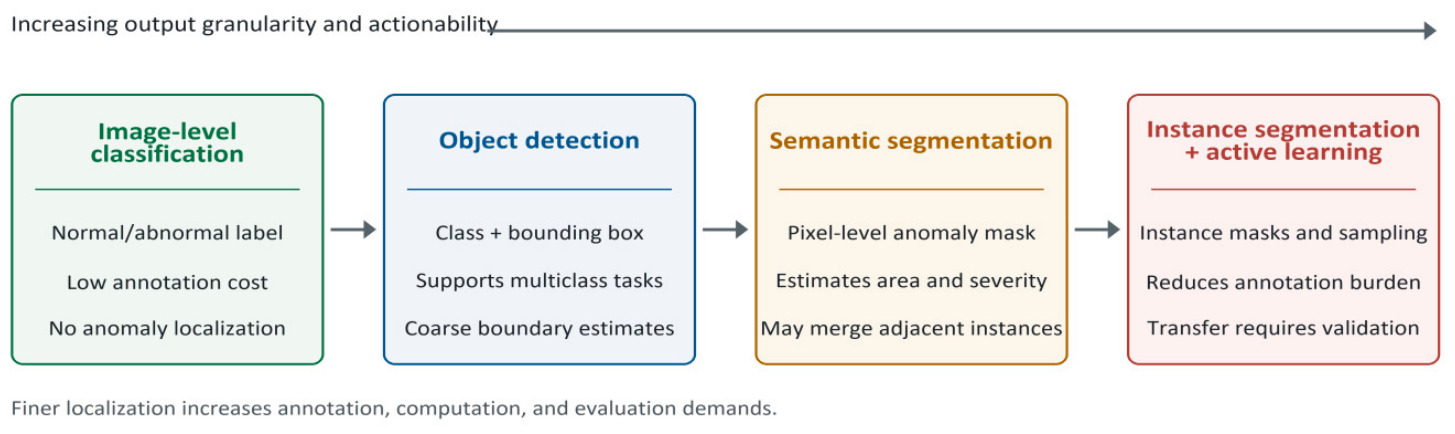
| Visible anomaly | Object detection and active learning | Pear and tomato studies [92,93] | Actionable location with scalable classes | Long-tail recall and annotation benefit |
| Visible anomaly | Semantic or instance segmentation | Apple studies [94,95,96] | Area, boundary, and severity | Label consistency, computation, and multi-view coverage |
| Low-contrast state | Multispectral and multimodal sensing | Pepper, citrus, and related studies [10,39,40,44,46,47,97,98] | Complementary tissue and defect information | Registration, calibration, cycle time, and hardware cost |
| System Stage | Critical Variable | Representative Evidence | Engineering Implication | Priority Endpoint |
|---|---|---|---|---|
| Feeding and pose | Separation, rotation, visible area | Multichannel conveying and shape studies [109,110,111,112] | Throughput reduces images and coverage per target | Separation rate, pose dispersion, coverage, damage |
| Conditioning | Moisture, dust, temperature, surface state | Spectral, multimodal, and thermal studies [40,113,114,115,116] | Input state must be defined before imaging | Residual contamination and post-cleaning image stability |
| Speed and spacing | v, s, Δt = s/v, shared resources | Parallel, edge, and mechanical systems [117,118,119,120] | Local processing speed does not define line capacity | Speed-accuracy curve and sustained per-channel throughput |
| Localization and tracking | Target ID, trajectory, coordinate mapping | Tracking, RGB-D, and execution studies [121,122,123,124] | Visual objects must become executable states | ID switches, localization error, arrival-window error |
| Pneumatic execution | Pressure, geometry, frequency, valve delay | Array, pulse, suction, and CFD evidence [125,126,127,128,129,130,131,132] | Actuation parameters operate as a coupled system | Command-to-impact latency, displacement, and damage |
| Timing and outcome | Prediction, compensation, contact, release | Control and compliant-mechanism studies [133,134,135,136,137] | Errors propagate across the complete chain | Task completion, final-bin outcome, throughput, damage |
| Integration Route | Interface Coverage | Representative Evidence | Deployment Value | Main Unresolved Link |
|---|---|---|---|---|
| Vision workflow | Acquisition to model decision | Food inspection framework [139] | Reusable perception pipeline | No physical-interface validation |
| Online sorting | Vision, controller, conveyor, and actuator | Citrus and pepper systems [3,4,138] | Direct evidence of physical sorting | Complete timing and outcome feedback |
| Mobile-server | Wireless transfer and remote inference | Improved YOLOv4 platform [140] | Assistive identification | Industrial actuation and network jitter |
| Edge-cloud | TCP/IP data, database, and edge inference | Celeron N2930 platform [141] | Data and model management | Actuator closure and end-to-end timing |
| Fully local | Camera, local inference, GPIO/PWM control | Embedded prototype and Sweet Pepper Online [4,142] | Low network exposure and direct actuation | Thermal load, durability, energy, and damage |
| (a) | ||||||
| System or Task | Reported Endpoint | Throughput or Timing | Other System Dimensions | Use in the Synthesis | ||
| Apple, vision + NIR [146] | Reported overall grading accuracy 96.67% | Physical throughput not reported | Final-bin MRsys/FRRsys unavailable | Multi-source discrimination evidence | ||
| Apple, four-lane physical sorting [147] | Final-bin accuracy 282/300 (94.00%) | 32 FPS; four fruits/s; speed-sensitive | Energy, damage, and sustained reliability not reported | Direct speed-accuracy and final-bin evidence | ||
| Fingered citron detector [148] | Precision 96.1%; recall 94.9%; mAP@0.5 98.1% | 130.3 FPS; material throughput not reported | No physical rejection outcome | Model-level timing evidence | ||
| Sweet-pepper online sorter [4] | Five-grade in-line overall accuracy 96.9% | About 3000 samples/h/channel | Complete latency, energy, damage, and availability not reported | Most direct crop-specific system evidence | ||
| Integrated multispectral sorter [149] | Overall accuracy 94.1% to 91.4% across tested speeds | 15–35 cm/s; two items/s/channel | Energy, damage, and long-duration reliability not reported | Dynamic operating-point evidence | ||
| Industrial optical sorter [150] | Source-reported CCR 99.36% to 99.67% | Repeated trials; end-to-end latency not decomposed | Total energy and material damage not reported | Industrial repeatability evidence | ||
| Green-pepper damage detection [43] | Experimentally defined damage classification | No integrated sorting throughput | Sorting-induced damage not measured | Damage-detection method, not equipment damage evidence | ||
| (b) | ||||||
| Evidence Group | Crop/Cultivar and Task/Class | Sample Size and Partition | Illumination and Calibration | Pose, Speed, and Hardware | Endpoint and Reported Performance | Likely Variation, Applicability, and Limitations |
| Traditional RGB/HSV classification [34] | Chili; five image categories; commercial reject mapping NR | 210 training and 90 test images; fruit-level independence, balance, and external batch NR | Controlled background; light source, calibration, and pose NR | Offline images; conveyor speed and hardware NR | Image-level accuracy 90/90; precision and recall 1.0; averaging NR | Stable background and bounded classes reduce within-domain variation. Useful as a low-cost baseline, but not evidence of cultivar, batch, or line transfer. |
| Active and multispectral evidence [43,45,61] | Green or sweet pepper damage and apple cultivar response; class boundaries vary by task | Sample size and partitioning NR in the present synthesis | UV fluorescence or multispectral acquisition; signals depend on pigmentation, geometry, isolation, and calibration | Static or line speed and processing hardware NR | Damage separability or cultivar-dependent spectral overlap; no common endpoint | Additional channels help when RGB contrast is weak, but cultivar overlap, calibration, and acquisition time limit transfer and online use. |
| Integrated apple and 3D model evidence [71,72] | Apple multi-feature grading and soybean five-cultivar classification; task and crop differ | Sample size or partition details NR here; [71] reports training and validation endpoints | Three-camera imaging [72]; lighting details NR; cultivar overlap and geometric coverage remain relevant | 1.2 s per fruit with a bottom blind area [72]; system hardware NR; [71] has no line throughput | 95.49% mean multi-feature and 94.12% field accuracy [72]; 95.54% training and 90.74% validation [71] | Differences reflect crop morphology, surface coverage, cultivar diversity, validation level, and endpoint. Neither value supports a direct route ranking. |
| Classification, detection, segmentation, and active learning [91,92,93,94] | Mango, pear, apple, and tomato anomaly tasks; image, box, and pixel labels are not equivalent | Sample size, fruit-level partitioning, and external batches NR in this synthesis | RGB or selected RGB-NIR bands; detailed lighting and calibration conditions vary or are NR | Primarily model-level tests; conveyor speed and deployment hardware NR | Accuracy/AUC, mAP@0.5, F-score, and annotation reduction are retained in source-defined forms | Metric variation mainly reflects output granularity, label structure, class difficulty, and annotation design. Choose the route by the actuator information required. |
| Architecture optimization and domain adaptation [107,108] | Citrus disease detection and orange-to-apple/tomato transfer; chili classes not tested | Within-task validation [107] and cross-crop transfer [108]; cross-batch and cross-device evidence NR | Complex backgrounds or translated domains; matched illumination and calibration NR | Conveyor speed and hardware platform NR | Within-domain metric gains [107] and target-domain mAP gains [108] | Architecture changes address within-domain representation, whereas adaptation addresses domain shift. Neither establishes chili line generalization without independent deployment tests. |
| Material presentation and edge-speed evidence [109,119] | Multi-view material handling and edge sorting; class definitions differ | Sample composition and partitioning NR | Motion imaging; calibration details NR; pose and surface coverage change with feeding | One to three targets/s reduced views from 24 to 9 [109]; 0.6 m/s and 100 mm spacing give an ideal 0.167 s interval [119] | Views per fruit and derived arrival interval; sustained final-bin output NR | Speed reduces coverage and timing margin. Edge computation helps processing latency but cannot remove motion blur, overlap, or actuator recovery limits. |
| Tracking and geometric localization [121,122,123,124] | Identity tracking, weak-light counting, RGB-D localization, and grasping; state outputs differ | Eight to twenty targets [121] and 70 targets [123]; broader partitioning NR | Visible, infrared, or RGB-D sensing; weak-light and geometric conditions differ | 23 ms/frame [121]; conveyor integration, processor, and full timing boundary NR | MOTA/MOTP, target counts, 2D tracks, or 3D action points; no common final-bin endpoint | Infrared favors weak-light continuity, while RGB-D supplies geometry. Calibration, synchronization, reconstruction, and latency constrain online use. |
| Online and industrial sorting systems [4,147,149,150] | Sweet pepper, apple, multispectral, and industrial optical sorting; grades and positive classes differ | Apple final-bin test 282/300 [147]; other sample and partition details vary or are NR | Optical configurations differ; calibration and pose reporting are incomplete | About 3000 samples/h/channel [4]; four fruits/s [147]; 15–35 cm/s and two items/s/channel [149]; hardware details incomplete | 96.9% five-grade in-line accuracy [4], 94.00% final-bin accuracy [147], 94.1% to 91.4% across speeds [149], and source-defined CCR [150] | Variation combines class definition, speed, channel count, hardware, and endpoint. These systems support operating-point evidence, not an overall ranking of technical routes. |
| Study and Task | Route | Key Evidence | Boundary and Value for Pepper Sorting |
|---|---|---|---|
| [E3] [161] Agricultural-product quality assessment | NIRS; machine learning vs. deep learning | Deep models had higher accuracy and lower spectral-noise sensitivity. | Noise robustness was tested, not cross-origin or cross-batch transfer; domain-held-out validation is required. |
| [E3] [162,166] Papaya maturity classification | Visible-light and hyperspectral fusion | Best F1 ≈ 0.90; top-2 error ≈ 1.45%. | Random splitting cannot establish domain robustness; test modality complementarity on identical held-out domains. |
| [E3] [163] Eleven-cultivar apple identification | RGB, MobileNetV2, GLCM texture and attention | Best reported cultivar-classification accuracy was 98.25% (aggregation not verified); one attention variant underperformed the texture model. | Shows within-dataset separability, not transfer; complexity does not ensure generalization. |
| [E3] [164] Two-cultivar apple discrimination | NIR with discriminant projection | Class-oriented projection improved separation of the tested cultivars. | A useful baseline, but controlled two-cultivar evidence cannot support broad transfer. |
| [E3] [165] Four-cultivar apple classification | NIR, PCA and fuzzy clustering | Reported four-cultivar classification accuracy ≈ 97%; aggregation not verified. | Supports screening of known classes; external cultivar and batch validation remains necessary. |
| Sensing Route | Comparative Evidence | Deployment Advantage | Decision Boundary for Chili Sorting |
|---|---|---|---|
| [E4] Full-spectrum HSI discovery [179,180] | Rich spatial-spectral information supports maturity, pigment and visible-defect analysis; 601–950 nm is common. | Suited to band discovery and failure analysis. | Data and calibration burdens limit line deployment. |
| Compact multispectral imaging: [180] (E4); [184] (E3) | Selected bands can retain task-specific discrimination with fewer variables. | Reduces optical, data and inference complexity while retaining spatial localization. | Compare with full HSI on the same samples and held-out domains. |
| [E4] Point Vis–NIR sensing [181] | Commercial systems integrate optical geometry, calibration and multi-lane line-speed operation. | Strong operational maturity and maintainability evidence. | Weak spatial localization may miss local defects; geometry must match chili size and pose. |
| [E4] AI and data-standardization support [180,185] | Shared metadata, domain-aware splits and real-time validation recur across routes. | Supports reproducible comparison, calibration transfer and controlled updating. | Deployment claims require external-domain tests, hardware latency and system metadata. |
| Proposed staged hybrid pathway; synthesis of [179,180,181,185] (E4) and [184] (E3) | Laboratory information richness and commercial maturity come from different routes. | Proposes linking HSI discovery, multispectral localization and selective point sensing. | The combined pathway has not been validated as a complete system; select modules by tested marginal benefit. |
Disclaimer/Publisher’s Note: The statements, opinions and data contained in all publications are solely those of the individual author(s) and contributor(s) and not of MDPI and/or the editor(s). MDPI and/or the editor(s) disclaim responsibility for any injury to people or property resulting from any ideas, methods, instructions or products referred to in the content. |
© 2026 by the authors. Licensee MDPI, Basel, Switzerland. This article is an open access article distributed under the terms and conditions of the Creative Commons Attribution (CC BY) license.
Share and Cite
Cao, J.; Wu, Y.; Zhang, L.; Zhang, Y.; Tang, Z. Research Progress on Intelligent Color-Sorting Equipment for Post-Harvest Chili Peppers: Machine Vision, Pneumatic Actuation, and System Integration. Processes 2026, 14, 2991. https://doi.org/10.3390/pr14182991
Cao J, Wu Y, Zhang L, Zhang Y, Tang Z. Research Progress on Intelligent Color-Sorting Equipment for Post-Harvest Chili Peppers: Machine Vision, Pneumatic Actuation, and System Integration. Processes. 2026; 14(18):2991. https://doi.org/10.3390/pr14182991
Chicago/Turabian StyleCao, Junhao, Yapeng Wu, Liming Zhang, Yu Zhang, and Zhong Tang. 2026. "Research Progress on Intelligent Color-Sorting Equipment for Post-Harvest Chili Peppers: Machine Vision, Pneumatic Actuation, and System Integration" Processes 14, no. 18: 2991. https://doi.org/10.3390/pr14182991
APA StyleCao, J., Wu, Y., Zhang, L., Zhang, Y., & Tang, Z. (2026). Research Progress on Intelligent Color-Sorting Equipment for Post-Harvest Chili Peppers: Machine Vision, Pneumatic Actuation, and System Integration. Processes, 14(18), 2991. https://doi.org/10.3390/pr14182991