Machine-Learning-Based Analysis of Printing-Parameter Effects on Surface Roughness in FDM-Printed ULTEM 1010 Parts


Abstract
1. Introduction

| Ref. | Material | Printing Parameters | Models Tested | Model Performance | Surface Roughness Findings |
|---|---|---|---|---|---|
| Kandananond [24] | PLA | Bed temp Layer height Print speed | ANN; two resilient backpropagation methods | ANN with GCRB, MSE = 0.147 | N/A |
| Kaplan et al. [25] | TPU | Infill pattern Layer height Nozzle temp | ANN; BiLSTM; BiLSTM with Bayesian optimization | ANN: R2 = 0.6078 MAPE = 10.3351% BiLSTM-BO: R2 = 0.9983 MAPE = 0.6292% | Layer thickness: p < 0.001; F = 1196.86. |
| Ulkir et al. [26] | PLA PETG | Infill density Infill pattern Layer height Material type Wall thickness | ANN; Levenberg–Marquardt training | R2 = 0.9923 | ANOVA: Layer thickness and material type (p-val < 0.001) |
| Sharma et al. [27] | PLA | Infill density Extrusion temp Number of layers Raster angle | ANN; Box–Behnken design | R2 = 0.9225 Error percentage = 0.83% to 1.04% | 0 or 90 deg raster angle best for SR. Higher infill density. |
| Ozer et al. [28] | PLA | Build angle Post-print polishing | ANN; RF; GPR | ANN: R2 = 0.9425; MAPE = 9.753%. RF: R2 = 0.7864; MAPE = 24.85%. GPR: R2 = 0.931; MAPE = 9.997%. | N/A |
| Chinchanikar et al. [29] | ABS | Infill density Layer height Print speed Nozzle temperature | ANN; two hidden layers | ANN: R2 = 0.875 | Higher infill density improves SR. |
| Savran et al. [30] | PLA | Build orientation Infill pattern Layer height Extrusion temp | Stepwise nonlinear ANN regression | SNAR-TON: R2 = 0.98 | ANOVA: Build orientation p-val = 0.037. Combined effects found with layer thickness and orientation (p = 0.002) |
| Malleswari et al. [31] | PLA | Bed temp Layer thickness Print speed Raster angle | ANN; response surface methodology | ANN: R2 = 0.99353, RMSE = 0.25753 and MAE = 0.14574. RSM: R2 = 0.99272, RMSE = 0.27385, MAE = 0.22093. | N/A |
| Ulkir et al. [32] | PA12-CF | Infill density Infill pattern Layer height Nozzle temp Print speed | ANN; RF | ANN: R2 = 0.9912; MAPE = 11.35%; MAE = 2.658. RF: R2 = 0.9862; MAPE = 23.49%; MAE = 3.957. | Layer thickness |
| Ulkir et al. [33] | ABS PLA PLA-CF | Infill density Infill pattern Layer height Print speed | ANN; RF; GPR | ANN: R2 = 0.9972. RF: R2 = 0.9962. GPR: R2 = 0.9965. | ANOVA: Layer thickness, print speed, then infill pattern. |
| Tran et al. [34] | ABS PLA | Bed temp Fan speed Infill density Infill pattern Layer height Material type Nozzle temp Print speed Wall thickness | Linear regression; RF; stacked regression | RF: R2 = 0.71, MAPE = 15.28%, MSE = 1358.35 | ANOVA: Layer height, material type |
| Gao et al. [35] | PLA | Bed temp Extrusion temp Flow rate Infill density Layer height | RF; quadratic polynomial regression | RF: R2 = 0.9583 | ANOVA: Infill density, extrusion rate, bed temp |
| Mishra et al. [36] | PLA | Bed temp Fan speed Infill density Infill pattern Nozzle temp Print speed Wall thickness | Genetic algorithm with GBR, DT, RF, or ANN | GA-RF: R2 = 0.8987. GA-ANN: R2 = −0.2966; MSE = 1.786. | Correlation matrix: Layer height (+), wall thickness (=), print speed (−), infill density (−) |
| Liu et al. [37] | ABS/ graphene | Extrusion temp Layer height Print speed | GPR; Matérn kernel; Bayesian optimization | R2 = 0.84 MAPE = 0.13 RMSE = 2.66 | ANOVA: Layer height, print speed, extrusion temp |
| Chitnis et al. [38] | PLA PVA TPU | Extrusion temp Flow rate Infill density Print speed | GPR; squared exponential kernel | R2 = 0.8783 |
2. Experimental Methods
2.1. Material and Part Fabrication
2.2. Surface Roughness Analysis
2.3. Machine-Learning Algorithms
2.3.1. Artificial Neural Network
2.3.2. Random Forest
2.3.3. Gaussian Process Regression
2.4. Statistical Analysis and Model Interpretation
3. Results
3.1. Exploratory Printing Parameter Associations
3.2. Model Performances
3.2.1. ANN Results
3.2.2. RF Results
3.2.3. GPR Results
3.2.4. Condition Grouped Validation and Sensitivity Analysis
4. Discussion
5. Conclusions
Supplementary Materials
Author Contributions
Funding
Data Availability Statement
Conflicts of Interest
Appendix A. Validation and Sensitivity Results
| n | Factor | Sa | Sz | Sq | Ssk | Sku |
|---|---|---|---|---|---|---|
| 103/102 | Annealing | 0.9340 | 0.6728 | 0.9340 | 0.7386 | 0.6261 |
| 103/102 | Infill Pattern | 0.7827 | 0.6261 | 0.6851 | 0.9340 | 0.9340 |
| 103/102 | Infill Density | 0.2977 | 0.1102 | 0.2977 | 0.9340 | 0.4919 |
| 103/102 | Body Thickness | 0.6453 | 0.7527 | 0.6453 | 0.0105 | 0.6453 |
| 103/102 | Raster Angle | 0.6145 | 0.9340 | 0.6145 | 0.6453 | 0.8530 |
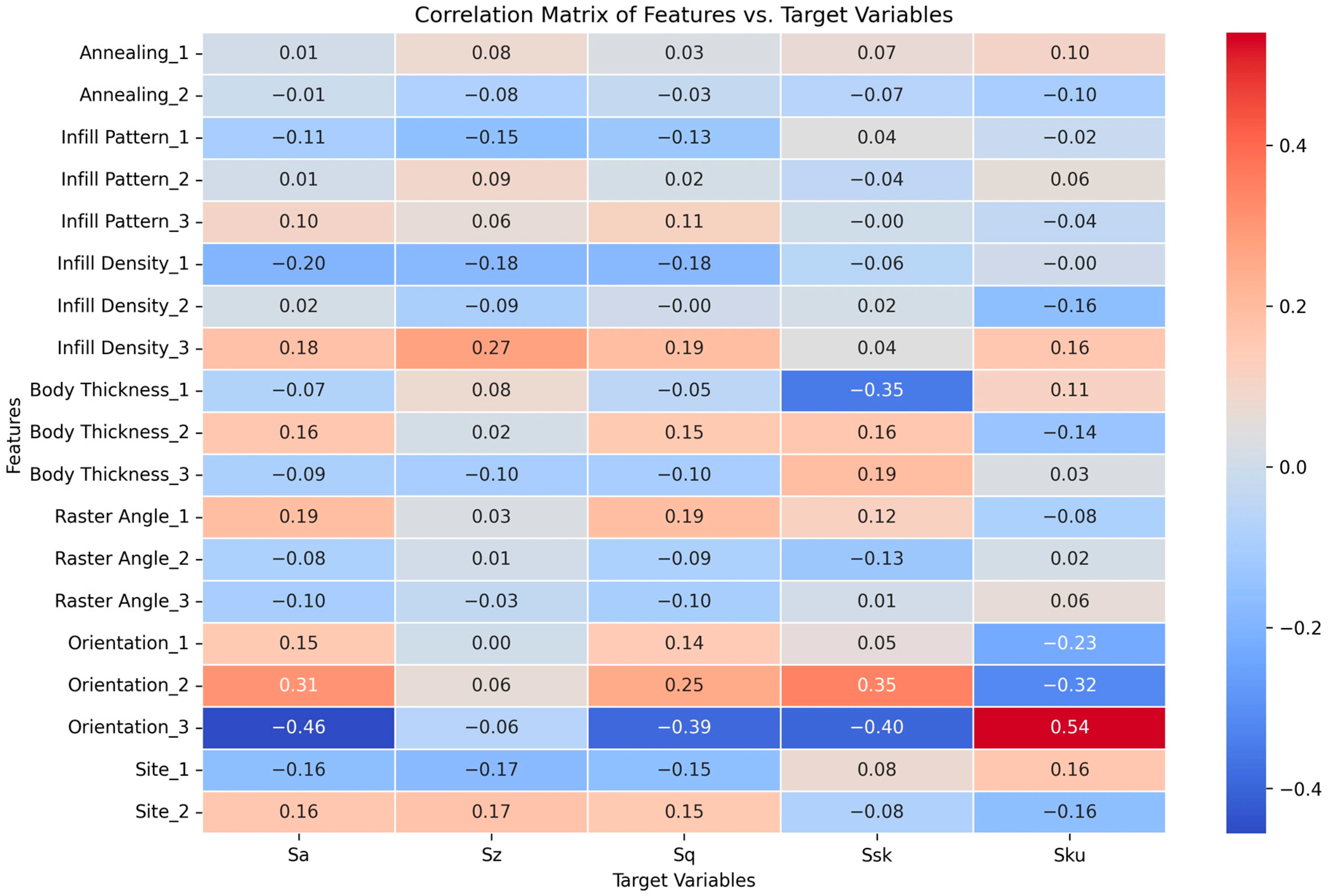
| 103/102 | Orientation | <0.0001 | 0.9261 | 0.0011 | 0.0004 | <0.0001 |
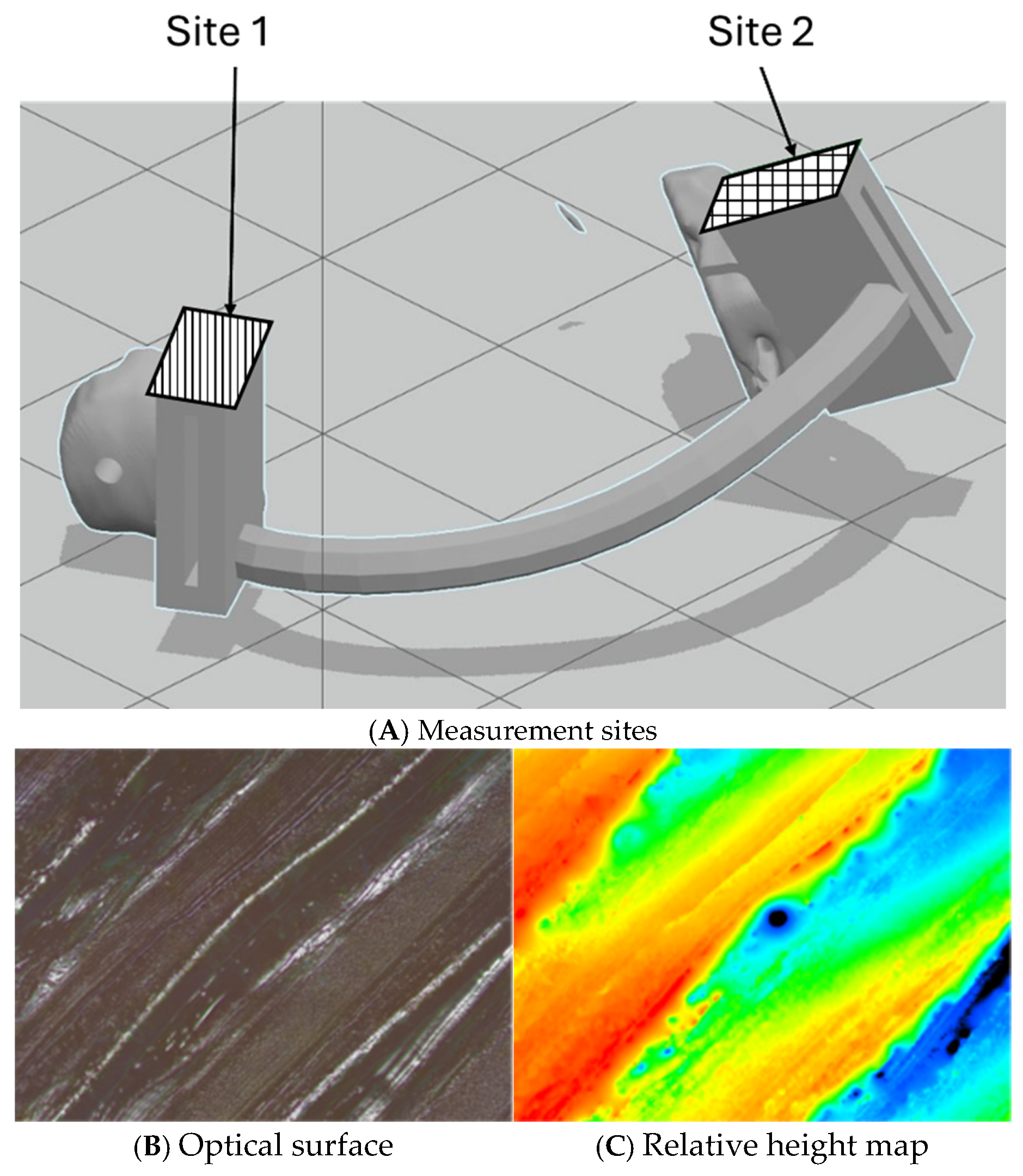
| 103/102 | Site | 0.2977 | 0.2977 | 0.3140 | 0.6851 | 0.3145 |
| Model | Response | Test R2 | RMSE | MAE |
|---|---|---|---|---|
| ANN | Sa | −0.614 ± 0.150 | 24.489 ± 2.992 | 19.037 ± 2.201 |
| ANN | Sz | −0.790 ± 0.730 | 147.338 ± 26.543 | 124.209 ± 25.963 |
| ANN | Sq | −0.453 ± 0.273 | 29.224 ± 4.406 | 23.281 ± 3.402 |
| ANN | Ssk | −1.033 ± 1.168 | 0.669 ± 0.102 | 0.528 ± 0.089 |
| ANN | Sku | −0.804 ± 1.298 | 1.133 ± 0.365 | 0.843 ± 0.185 |
| RF | Sa | −0.335 ± 0.482 | 21.725 ± 3.096 | 18.569 ± 2.800 |
| RF | Sz | −0.448 ± 0.262 | 137.322 ± 26.830 | 114.883 ± 28.075 |
| RF | Sq | −0.494 ± 0.649 | 28.572 ± 2.553 | 24.811 ± 3.272 |
| RF | Ssk | −0.308 ± 0.564 | 0.549 ± 0.117 | 0.436 ± 0.093 |
| RF | Sku | −0.167 ± 0.328 | 0.983 ± 0.357 | 0.784 ± 0.289 |
| GPR | Sa | −0.608 ± 0.862 | 23.737 ± 5.132 | 19.246 ± 5.220 |
| GPR | Sz | −0.143 ± 0.148 | 121.771 ± 21.622 | 99.077 ± 24.805 |
| GPR | Sq | −0.591 ± 0.891 | 29.354 ± 4.420 | 23.879 ± 5.253 |
| GPR | Ssk | −0.588 ± 1.109 | 0.579 ± 0.101 | 0.482 ± 0.082 |
| GPR | Sku | −0.666 ± 1.331 | 1.080 ± 0.378 | 0.824 ± 0.156 |
| Observation | Condition | Six Factor Codes | Rows Retained in Condition (of 6) |
|---|---|---|---|
| ULTEM_S16_SITE1 | 6 | 1, 2, 3, 3, 1, 1 | 5 |
| ULTEM_S20_SITE1 | 7 | 1, 3, 1, 2, 1, 3 | 5 |
| ULTEM_S22_SITE1 | 8 | 1, 3, 2, 3, 2, 1 | 5 |
| ULTEM_S26_SITE1 | 9 | 1, 3, 3, 1, 3, 2 | 5 |
| ULTEM_S40_SITE1 | 14 | 2, 2, 2, 3, 1, 2 | 4 |
| ULTEM_S42_SITE1 | 14 | 2, 2, 2, 3, 1, 2 | 4 |
| Dataset | Response | Test R2 | RMSE | MAE |
|---|---|---|---|---|
| 108 | Sa | −3.198 ± 4.920 | 33.129 ± 14.277 | 26.847 ± 10.858 |
| 108 | Sz | −1.675 ± 2.073 | 167.311 ± 67.883 | 137.975 ± 51.532 |
| 108 | Sq | −4.167 ± 7.632 | 40.658 ± 16.835 | 32.869 ± 12.997 |
| 108 | Ssk | −1.684 ± 2.860 | 0.550 ± 0.292 | 0.464 ± 0.263 |
| 108 | Sku | −2.268 ± 3.734 | 1.119 ± 0.665 | 0.925 ± 0.534 |
| 102 | Sa | −1.813 ± 3.726 | 21.180 ± 6.743 | 18.111 ± 6.778 |
| 102 | Sz | −1.311 ± 3.491 | 117.883 ± 29.243 | 99.057 ± 25.892 |
| 102 | Sq | −1.128 ± 2.606 | 25.644 ± 8.402 | 21.941 ± 8.035 |
| 102 | Ssk | −2.264 ± 4.226 | 0.534 ± 0.223 | 0.450 ± 0.216 |
| 102 | Sku | −4.072 ± 8.495 | 0.997 ± 0.537 | 0.832 ± 0.459 |
| Model | Dataset | Training R2 | Outer Test R2 |
|---|---|---|---|
| ANN | 108 | 0.462 ± 0.023 | −0.253 ± 0.306 |
| ANN | 102 | 0.464 ± 0.051 | −0.739 ± 0.505 |
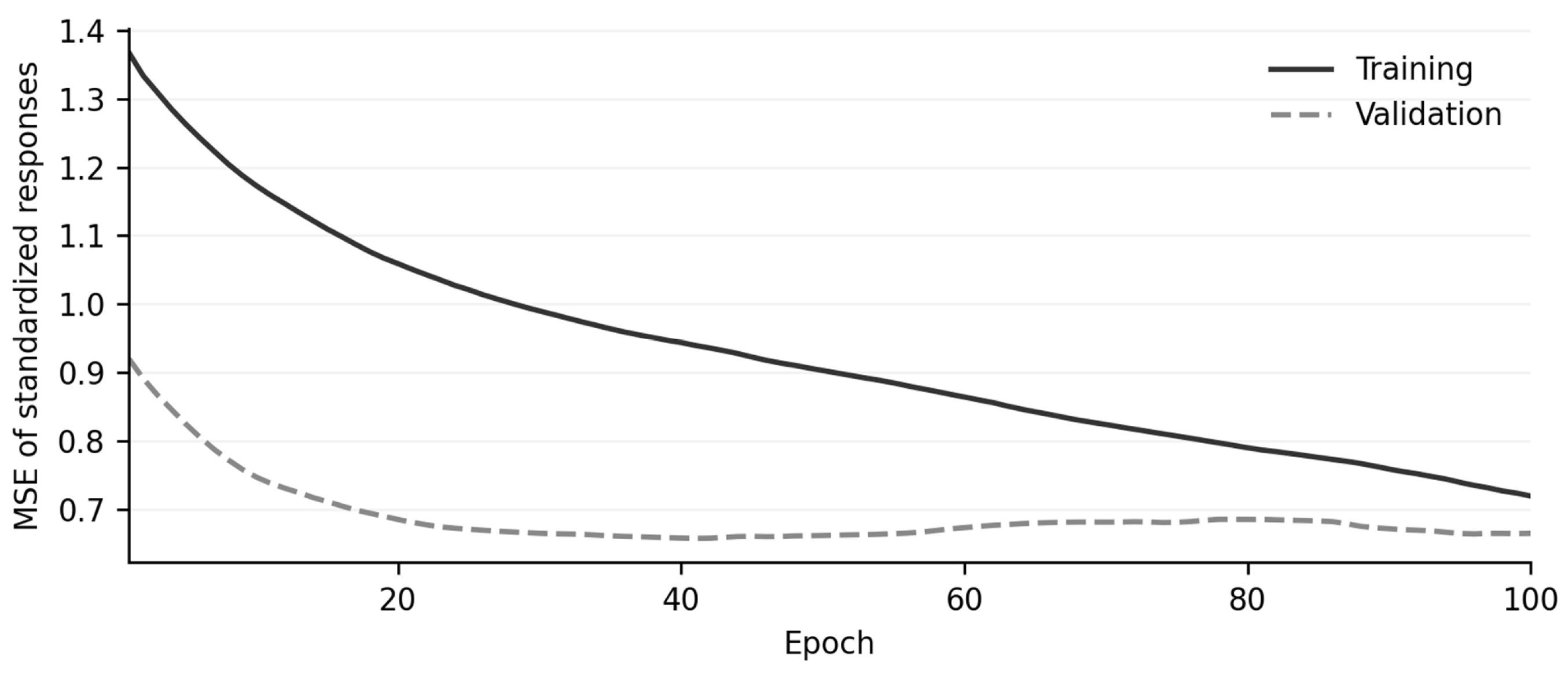
References
- Ahn, S.H.; Montero, M.; Odell, D.; Roundy, S.; Wright, P.K. Anisotropic material properties of fused deposition modeling ABS. Rapid Prototyp. J. 2002, 8, 248–257. [Google Scholar] [CrossRef] [Scilit]
- Nelson, J.W.; Atkins, D.; Gottstine, M.L.; Yang, J.; Garapic, G.; Jaminion, S.; Nelson, A.; Wilson, K. Generalized models for unidirectional anisotropic properties of 3D printed polymers. Rapid Prototyp. J. 2020, 26, 1453–1462. [Google Scholar] [CrossRef] [Scilit]
- Zou, R.; Xia, Y.; Liu, S.; Hu, P.; Hou, W.; Hu, Q.; Shan, C. Isotropic and anisotropic elasticity and yielding of 3D printed material. Compos. Part B Eng. 2016, 99, 506–513. [Google Scholar] [CrossRef] [Scilit]
- Aktepe, E.; Ergün, U. Machine learning approaches for FDM-based 3D printing: A literature review. Appl. Sci. 2025, 15, 10001. [Google Scholar] [CrossRef] [Scilit]
- Jakupi, K.; Dukovski, V.; Hodolli, G. Surface roughness modeling of material extrusion PLA flat surfaces. Int. J. Polym. Sci. 2023, 2023, 8844626. [Google Scholar] [CrossRef] [Scilit]
- Sherif, M.; Mekhiel, S.; Elmesalamy, A.S.; Mahmoud, H. Investigation of FDM process parameters and their interactions on surface roughness of PLA 3D printed parts. J. Phys. Conf. Ser. 2025, 3058, 012017. [Google Scholar] [CrossRef] [Scilit]
- Yuan, Q.; Kim, M.; Tien, T.T.; Fang, Y.; Duan, Z.; Zhang, Y.; Suhr, J. Investigation of contour-related parameters’ effects on anisotropic mechanical properties and surface roughness of FDM-printed parts. Int. J. Adv. Manuf. Technol. 2025, 137, 381–395. [Google Scholar] [CrossRef] [Scilit]
- Amiri, A.; Zolfaghari, A.; Shakeri, M. 3D printing of glass fiber reinforced acrylonitrile butadiene styrene and investigation of tensile, flexural, warpage and roughness properties. Polym. Compos. 2022, 43, 6287–6299. [Google Scholar] [CrossRef] [Scilit]
- Raffic, N.M.; Babu, K.G.; Kumar, S.D.; Parrthipan, B.K. Surface roughness and printing time minimization in 3D printed aramid fiber reinforced polyamide parts through Taguchi-CoCoSo-Machine learning techniques. J. Mater. Eng. Perform. 2025, 34, 9654–9680. [Google Scholar] [CrossRef] [Scilit]
- Ukwaththa, J.; Herath, S.; Meddage, D.P.P. A review of machine learning (ML) and explainable artificial intelligence (XAI) methods in additive manufacturing (3D Printing). Mater. Today Commun. 2024, 41, 110294. [Google Scholar] [CrossRef] [Scilit]
- Dong, H.; Gao, X.; Wei, M. Quality prediction of fused deposition molding parts based on improved deep belief network. Comput. Intell. Neurosci. 2021, 2021, 8100371. [Google Scholar] [CrossRef] [Scilit] [PubMed]
- Panico, A.; Corvi, A.; Collini, L.; Sciancalepore, C. Multi objective optimization of FDM 3D printing parameters set via design of experiments and machine learning algorithms. Sci. Rep. 2025, 15, 16753. [Google Scholar] [CrossRef] [Scilit] [PubMed]
- Ulkir, O.; Ersoy, S. Hybrid experimental–machine learning study on the mechanical behavior of polymer composite structures fabricated via FDM. Polymers 2025, 17, 2012. [Google Scholar] [CrossRef] [Scilit] [PubMed]
- Vyavahare, S.; Teraiya, S.; Kumar, S. FDM manufactured auxetic structures: An investigation of mechanical properties using machine learning techniques. Int. J. Solids Struct. 2023, 265, 112126. [Google Scholar] [CrossRef] [Scilit]
- Seid Ahmed, Y.; Hassanin, H.; Nazir, A.; Khan, S. A machine learning–integrated framework for mechanical property prediction of FDM–printed PLA. Int. J. Adv. Manuf. Technol. 2025, 139, 5791–5817. [Google Scholar] [CrossRef] [Scilit]
- Khan, I.; Al Rashid, A.; Koç, M. Machine Learning Prediction of Raster Angle Effects on Mechanical Properties of Extrusion-Based Additively Manufactured Conductive Thermoplastic Polyurethane Composites. Macromol. Mater. Eng. 2026, 311, e00248. [Google Scholar] [CrossRef] [Scilit]
- Özkül, M.; Kuncan, F.; Ulkir, O. Predicting mechanical properties of FDM-produced parts using machine learning approaches. J. Appl. Polym. Sci. 2025, 142, e56899. [Google Scholar] [CrossRef] [Scilit]
- Cerro, A.; Romero, P.E.; Yiğit, O.; Bustillo, A. Use of machine learning algorithms for surface roughness prediction of printed parts in polyvinyl butyral via fused deposition modeling. Int. J. Adv. Manuf. Technol. 2021, 115, 2465–2475. [Google Scholar] [CrossRef] [Scilit]
- Molero, E.; Fernández, J.J.; Rodríguez-Alabanda, O.; Guerrero-Vaca, G.; Romero, P.E. Use of data mining techniques for the prediction of surface roughness of printed parts in polylactic acid (PLA) by fused deposition modeling (FDM): A practical application in frame glasses manufacturing. Polymers 2020, 12, 840. [Google Scholar] [CrossRef] [Scilit] [PubMed]
- Soundararajan, R.; Sathishkumar, A.; Aathil, S.A.; Chandran, N.G. Evaluating machine learning methods for predicting surface roughness of FDM printed parts using PLA plus material. Int. J. Interact. Des. Manuf. (IJIDeM) 2025, 20, 5299–5312. [Google Scholar] [CrossRef] [Scilit]
- Huang, M.; Jin, S.; Tang, Z.; Chen, Y.; Qin, Y. A method for predicting surface finish of polylactic acid parts printed using fused deposition modeling. Processes 2023, 11, 1820. [Google Scholar] [CrossRef] [Scilit]
- Qin, J.; Hu, F.; Liu, Y.; Witherell, P.; Wang, C.C.L.; Rosen, D.W.; Simpson, T.W.; Lu, Y.; Tang, Q. Research and application of machine learning for additive manufacturing. Addit. Manuf. 2022, 52, 102691. [Google Scholar] [CrossRef] [Scilit]
- Deokar, S.; Kumar, N.; Singh, R.P. A comprehensive review on smart manufacturing using machine learning applicable to fused deposition modeling. Results Eng. 2025, 26, 104941. [Google Scholar] [CrossRef] [Scilit]
- Kandananond, K. Surface roughness prediction of FFF-fabricated workpieces by artificial neural network and Box–Behnken method. Int. J. Metrol. Qual. Eng. 2021, 12, 17. [Google Scholar] [CrossRef] [Scilit]
- Kaplan, K.; Ulkir, O.; Kuncan, F. Optimization and prediction of mechanical properties of TPU-Based wrist hand orthosis using Bayesian and machine learning models. Measurement 2025, 252, 117405. [Google Scholar] [CrossRef] [Scilit]
- Ulkir, O.; Bayraklılar, M.S.; Kuncan, M. Taguchi-ANN Hybrid Approach for Evaluating Unsupported Overhang Structures in FDM-Printed Polymers. J. Polym. Sci. 2025, 63, 5185–5207. [Google Scholar] [CrossRef] [Scilit]
- Sharma, V.; Singh, J.; Sharma, R.C.; Singh, A. Machine learning-based prediction and optimization of surface roughness in FDM-printed PLA using ANN and box-behnken design. Mater. Sci. Technol. 2025, 41, 1153–1173. [Google Scholar] [CrossRef] [Scilit]
- Özer, M. Surface Roughness Prediction of Laser-Polished 3D-Printed Polylactic Acid Parts: A Combined Experimental and Machine Learning Approach. Colloids Surf. A Physicochem. Eng. Asp. 2025, 729, 138916. [Google Scholar] [CrossRef] [Scilit]
- Chinchanikar, S.; Shinde, S.; Gaikwad, V.; Shaikh, A.; Rondhe, M.; Naik, M. ANN modelling of surface roughness of FDM parts considering the effect of hidden layers, neurons, and process parameters. Adv. Mater. Process. Technol. 2024, 10, 22–32. [Google Scholar] [CrossRef] [Scilit]
- Savran, M. Experimental analysis and a novel stepwise nonlinear hybrid ANN-based machine learning approach for optimizing the mechanical and surface performance of 3D-printed PLA. Measurement 2025, 259, 119648. [Google Scholar] [CrossRef] [Scilit]
- Malleswari, V.N.; Manaswy, G.K.; Pragvamsa, P.G. Prediction of surface roughness for fused deposition in fabricated work pieces by RSM and ANN technique. Mater. Today Proc. 2023. [Google Scholar] [CrossRef] [Scilit]
- Ulkir, O.; Kuncan, F.; Alay, F.D. Experimental study and ANN development for modeling tensile and surface quality of fiber-reinforced nylon composites. Polymers 2025, 17, 1528. [Google Scholar] [CrossRef] [Scilit] [PubMed]
- Ulkir, O.; Karadağ, A. Sustainable additive manufacturing with FDM: Taguchi-based parameter optimization and AI-driven prediction of mechanical and environmental metrics. J. Thermoplast. Compos. Mater. 2026, 39, 08927057261415795. [Google Scholar] [CrossRef] [Scilit]
- Tran, N.H.; Phan, N.D.M. Analyzing the impact of process parameters on surface roughness and mechanical properties in FDM 3D printing using machine learning. Int. J. Interact. Des. Manuf. (IJIDeM) 2025, 19, 8709–8728. [Google Scholar] [CrossRef] [Scilit]
- Gao, J.; Huang, S.; Zhang, T.; Zhou, X.; Liu, F. FDM 3D printing surface quality optimisation: Multi-objective parameter control based on hybrid machine learning and response surface methodology. Nondestruct. Test. Eval. 2025, 1–38. [Google Scholar] [CrossRef] [Scilit]
- Mishra, A.; Jatti, V.S. Novel coupled genetic algorithm–machine learning approach for predicting surface roughness in fused deposition modeling of polylactic acid specimens. J. Mater. Eng. Perform. 2024, 33, 6136–6145. [Google Scholar] [CrossRef] [Scilit]
- Liu, J.; Ye, J.; Momin, F.; Zhang, X.; Li, A. Nonparametric bayesian framework for material and process optimization with nanocomposite fused filament fabrication. Addit. Manuf. 2022, 54, 102765. [Google Scholar] [CrossRef] [Scilit]
- Chitnis, K.; Lu, Y.; Rhoads, B.; Chakka, L.R.J.; Choudhury, S.; Maniruzzaman, M. Optimization of print parameters for batch and continuous manufacturing of three-dimensional (3D) printed dosage forms using artificial intelligence and machine learning. Drug Deliv. Transl. Res. 2026, 16, 2073–2088. [Google Scholar] [CrossRef] [Scilit] [PubMed]
- Min, K.E.; Jang, J.W.; Shin, J.; Kim, C.; Yi, S. Development of Prediction Method for Dimensional Stability of 3D-Printed Objects. Appl. Sci. 2023, 13, 11027. [Google Scholar] [CrossRef] [Scilit]
- Lu, J.; Zhang, Z.; Yuan, X.; Ma, J.; Hu, S.; Xue, B.; Liao, X. Effect of machining parameters on surface roughness for compacted graphite cast iron by analyzing covariance function of Gaussian process regression. Measurement 2020, 157, 107578. [Google Scholar] [CrossRef] [Scilit]
- Nagarjun, J.; Saravanakumar, N.; Thirumalai Kumaran, S.; Anto Dilip, A.; Balasuadhakar, A. Empirical study and machine learning prediction of tensile strength in 3D printed eco-friendly polylactic acid. Prog. Rubber Plast. Recycl. Technol. 2026, 42, 234–256. [Google Scholar] [CrossRef] [Scilit]
- Nasrin, T.; Pourali, M.; Pourkamali-Anaraki, F.; Peterson, A.M. Active learning for prediction of tensile properties for material extrusion additive manufacturing. Sci. Rep. 2023, 13, 11460. [Google Scholar] [CrossRef] [Scilit] [PubMed]
- Alsakarneh, A.; Obaidat, S.; Mumani, A.A.; Tamimi, M.F. Predicting the dynamic tensile response of FDM materials using machine learning. Discov. Appl. Sci. 2026, 8, 51. [Google Scholar] [CrossRef] [Scilit]
- Qayyum, H.; Saqib, K.; Hussain, G.; Alkahtani, M. Predicting flexural properties of 3D-printed composites: A small dataset analysis using multiple machine learning models. Mater. Today Commun. 2025, 42, 111135. [Google Scholar] [CrossRef] [Scilit]
- Vidakis, N.; Petousis, M.; David, C.; Nasikas, N.K.; Sagris, D.; Mountakis, N.; Spiridaki, M.; Moutsopoulou, A.; Stratakis, E. Critical quality indicators of high-performance polyetherimide (ULTEM) over the MEX 3D printing key generic control parameters: Prospects for personalized equipment in the defense industry. Def. Technol. 2025, 43, 150–167. [Google Scholar] [CrossRef] [Scilit]
- Halevi, S.; Tulpan, I.; Shirizly, A.; Katarivas Levy, G. A design framework for multi-thermal optimization of ULTEM 1010 using open-source FDM: Unlocking its additive manufacturing potential. Mater. Des. 2025, 257, 114407. [Google Scholar] [CrossRef] [Scilit]
- Petousis, M.; David, C.; Sagris, D.; Spyridaki, M.; Mountakis, N.; Stratakis, E.; Vidakis, N. Interpreting the effect of critical control settings on the quality metrics of thermoplastic polyimide in extrusion based additive manufacturing. Int. J. Adv. Manuf. Technol. 2026, 142, 5827–5846. [Google Scholar] [CrossRef] [Scilit]
- Jonckers, D.; Gundlach, C.; Hartwig, S.; Thakur, A. Characterisation of high-performance polymer parts produced by low-pressure additive manufacturing. CEAS Space J. 2026, 18, 849–869. [Google Scholar] [CrossRef] [Scilit]
- Vakharia, V.S.; Leonard, H.; Singh, M.; Halbig, M.C. Multi-material additive manufacturing of high temperature polyetherimide (PEI)–based polymer systems for lightweight aerospace applications. Polymers 2023, 15, 561. [Google Scholar] [CrossRef] [Scilit] [PubMed]
- Stratasys. ULTEM™ 1010 Resin: Material Data Sheet; Stratasys: Minnetonka, MN, USA, 2025; Available online: https://www.stratasys.com/contentassets/cf5233651e104c96a9298560bc831e5a/mds_fdm_ultem-1010-resin_0625a.pdf (accessed on 10 September 2026).
- Pandelidi, C.; Maconachie, T.; Bateman, S.; Kelbassa, I.; Piegert, S.; Leary, M.; Brandt, M. Parametric study on tensile and flexural properties of ULTEM 1010 specimens fabricated via FDM. Rapid Prototyp. J. 2021, 27, 429–451. [Google Scholar] [CrossRef] [Scilit]
- Pressly, A.; Simsiriwong, J.; May, G. Machine learning based evaluation of surface roughness of additively manufactured Nylon 12 surgical guides. In Proceedings of the 36th Annual International Solid Freeform Fabrication Symposium, Austin, TX, USA, 10–13 August 2025. [Google Scholar]
- Omer, M.A.; Shaban, I.A.; Mourad, A.H.; Hegab, H. Advances in interlayer bonding in fused deposition modelling: A comprehensive review. Virtual Phys. Prototyp. 2025, 20, e2522951. [Google Scholar] [CrossRef] [Scilit]
- Yilmaz, M.; Yilmaz, N.F.; Kalkan, M.F. Rheology, crystallinity, and mechanical investigation of interlayer adhesion strength by thermal annealing of polyetherimide (PEI/ULTEM 1010) parts produced by 3D printing. J. Mater. Eng. Perform. 2022, 31, 9900–9909. [Google Scholar] [CrossRef] [Scilit]
- de Bruijn, A.C.; Gómez-Gras, G.; Fernández-Ruano, L.; Farràs-Tasias, L.; Pérez, M.A. Optimization of a combined thermal annealing and isostatic pressing process for mechanical and surface enhancement of Ultem FDM parts using Doehlert experimental designs. J. Manuf. Processes 2023, 85, 1096–1115. [Google Scholar] [CrossRef] [Scilit]
- Butt, J.; Afsharnia, H.; Khan, M.A.A.; Mohaghegh, V. Effect of different annealing methods on ULTEM 9085 parts manufactured by material extrusion. J. Manuf. Mater. Process. 2024, 8, 258. [Google Scholar] [CrossRef] [Scilit]
- Nguyen, K.Q.; Vuillaume, P.Y.; Hu, L.; Vachon, A.; Diouf-Lewis, A.; Marcoux, P.L.; Robert, M.; Elkoun, S. Effect of in situ thermal treatment on interlayer adhesion of 3D printed polyetherimide (PEI) parts produced by fused deposition modeling (FDM). Mater. Today Commun. 2024, 39, 108588. [Google Scholar] [CrossRef] [Scilit]
- Ouassil, S.E.; El Magri, A.; Vanaei, H.R.; Vaudreuil, S. Investigating the effect of printing conditions and annealing on the porosity and tensile behavior of 3D-printed polyetherimide material in Z-direction. J. Appl. Polym. Sci. 2023, 140, e53353. [Google Scholar] [CrossRef] [Scilit]


| Parameters | Level Values | ||
|---|---|---|---|
| 1 | 2 | 3 | |
| Infill Pattern | Solid | Hexagonal | Cross (thick) |
| Infill Density | Max | Mean | Min |
| Body Thickness | Max | Mean | Min |
| Raster Angle | 15 | 45 | 75 |
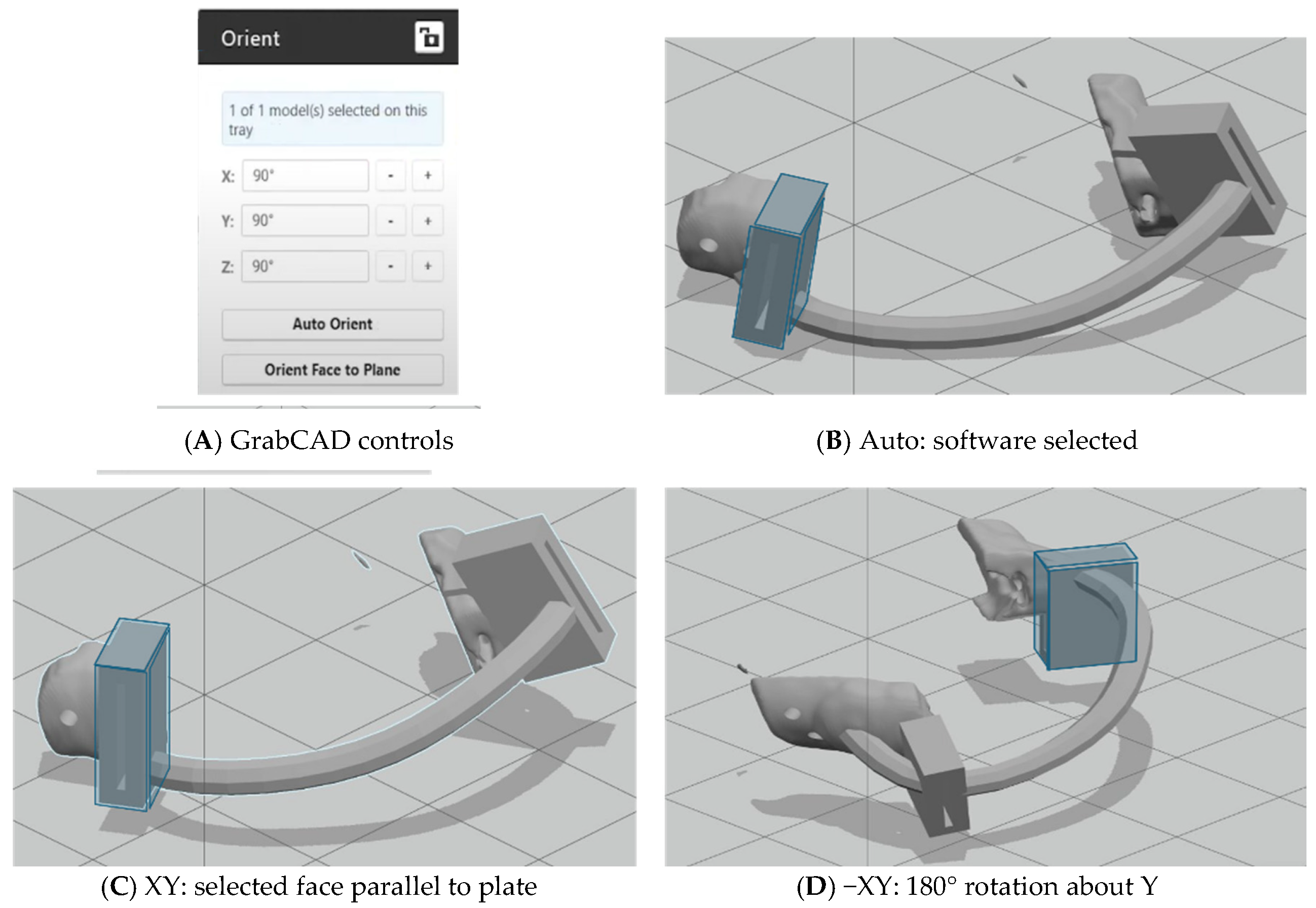
| Print Orientation | Auto | XY | −XY |
| Annealing | Yes | No | — |
| Infill Pattern | Infill Density | Body Thickness | |||
|---|---|---|---|---|---|
| Maximum | 1 | Maximum | 1 | ||
| Mean | 2 | Mean | 2 | ||
| Minimum | 3 | Minimum | 3 | ||
| Solid | 1 | Solid | Solid | ||
| 100% | 1 | 0.18 | 1 | ||
| 100% | 2 | 0.10 | 2 | ||
| 100% | 3 | 0.02 | 3 | ||
| Hexagonal | 2 | Hexagonal | Hexagonal | ||
| 60% | 1 | 0.18 | 1 | ||
| 53% | 2 | 0.12 | 2 | ||
| 46% | 3 | 0.06 | 3 | ||
| Cross-thick | 3 | Cross | Cross | ||
| 80% | 1 | 0.18 | 1 | ||
| 54% | 2 | 0.12 | 2 | ||
| 28% | 3 | 0.06 | 3 | ||
| Factor | Response | F | Unadjusted p | Adjusted p | n |
|---|---|---|---|---|---|
| Infill Density | Sz | 4.1310 | 0.0189 | 0.1102 | 103 |
| Body Thickness | Ssk | 6.9421 | 0.0015 | 0.0105 | 103 |
| Orientation | Sa | 14.6292 | <0.0001 | <0.0001 | 103 |
| Orientation | Sq | 9.8903 | 0.0001 | 0.0011 | 103 |
| Orientation | Ssk | 11.4039 | <0.0001 | 0.0004 | 103 |
| Orientation | Sku | 20.6377 | <0.0001 | <0.0001 | 102 |
| Response | Standardized MSE | Standardized MAE | R2 |
|---|---|---|---|
| Sa | 0.4142 | 0.4951 | 0.4419 |
| Sz | 0.8029 | 0.7511 | −0.8464 |
| Sq | 0.3261 | 0.4443 | 0.4702 |
| Ssk | 0.7844 | 0.6306 | 0.2006 |
| Sku | 0.5988 | 0.5943 | 0.1111 |
| Response | Standardized MSE | Standardized MAE | R2 |
|---|---|---|---|
| Sa | 0.4798 | 0.5617 | 0.3535 |
| Sz | 0.9215 | 0.8064 | −1.1190 |
| Sq | 0.5353 | 0.5803 | 0.1302 |
| Ssk | 0.6284 | 0.4946 | 0.3596 |
| Sku | 0.3364 | 0.4674 | 0.5006 |
| Response | Standardized MSE | Standardized MAE | R2 |
|---|---|---|---|
| Sa | 0.5254 | 0.5918 | 0.2922 |
| Sz | 0.7391 | 0.7423 | −0.6995 |
| Sq | 0.5325 | 0.6125 | 0.1348 |
| Ssk | 0.9840 | 0.7043 | −0.0027 |
| Sku | 0.3935 | 0.5388 | 0.4159 |
| Model | Response | Test R2 | RMSE | MAE |
|---|---|---|---|---|
| ANN | Sa | −0.272 ± 0.649 | 30.080 ± 2.314 | 22.625 ± 1.821 |
| ANN | Sz | −0.572 ± 0.533 | 180.774 ± 28.131 | 139.614 ± 14.428 |
| ANN | Sq | −0.213 ± 0.551 | 36.638 ± 5.832 | 29.708 ± 5.074 |
| ANN | Ssk | −0.278 ± 0.588 | 0.622 ± 0.185 | 0.502 ± 0.136 |
| ANN | Sku | 0.069 ± 0.228 | 1.125 ± 0.175 | 0.806 ± 0.058 |
| RF | Sa | −0.136 ± 0.620 | 28.349 ± 3.770 | 21.380 ± 1.273 |
| RF | Sz | −0.288 ± 0.352 | 164.098 ± 23.458 | 126.057 ± 17.145 |
| RF | Sq | −0.100 ± 0.462 | 34.654 ± 2.920 | 27.206 ± 2.979 |
| RF | Ssk | −0.053 ± 0.155 | 0.573 ± 0.099 | 0.465 ± 0.089 |
| RF | Sku | −0.222 ± 0.552 | 1.231 ± 0.107 | 0.914 ± 0.082 |
| GPR | Sa | −0.105 ± 0.164 | 30.402 ± 8.781 | 21.888 ± 3.280 |
| GPR | Sz | −0.119 ± 0.203 | 157.772 ± 40.328 | 118.185 ± 26.422 |
| GPR | Sq | −0.085 ± 0.130 | 36.702 ± 9.360 | 27.091 ± 4.330 |
| GPR | Ssk | −0.023 ± 0.020 | 0.562 ± 0.077 | 0.445 ± 0.079 |
| GPR | Sku | −0.005 ± 0.068 | 1.192 ± 0.245 | 0.875 ± 0.149 |
Disclaimer/Publisher’s Note: The statements, opinions and data contained in all publications are solely those of the individual author(s) and contributor(s) and not of MDPI and/or the editor(s). MDPI and/or the editor(s) disclaim responsibility for any injury to people or property resulting from any ideas, methods, instructions or products referred to in the content. |
© 2026 by the authors. Licensee MDPI, Basel, Switzerland. This article is an open access article distributed under the terms and conditions of the Creative Commons Attribution (CC BY) license.
Share and Cite
Pressly, A.; May, G.; Simsiriwong, J. Machine-Learning-Based Analysis of Printing-Parameter Effects on Surface Roughness in FDM-Printed ULTEM 1010 Parts. Processes 2026, 14, 2985. https://doi.org/10.3390/pr14182985
Pressly A, May G, Simsiriwong J. Machine-Learning-Based Analysis of Printing-Parameter Effects on Surface Roughness in FDM-Printed ULTEM 1010 Parts. Processes. 2026; 14(18):2985. https://doi.org/10.3390/pr14182985
Chicago/Turabian StylePressly, Addison, Gokan May, and Jutima Simsiriwong. 2026. "Machine-Learning-Based Analysis of Printing-Parameter Effects on Surface Roughness in FDM-Printed ULTEM 1010 Parts" Processes 14, no. 18: 2985. https://doi.org/10.3390/pr14182985
APA StylePressly, A., May, G., & Simsiriwong, J. (2026). Machine-Learning-Based Analysis of Printing-Parameter Effects on Surface Roughness in FDM-Printed ULTEM 1010 Parts. Processes, 14(18), 2985. https://doi.org/10.3390/pr14182985