1. Introduction
The transition from fossil resources to renewable carbon feedstocks has become increasingly important because of fossil fuel depletion, greenhouse gas emissions, and environmental concerns associated with carbon-intensive utilization [
1,
2,
3]. Biomass is a renewable carbon resource that can be converted into fuels, chemicals, and materials, and has, therefore, attracted considerable attention in the development of sustainable biorefineries [
4]. Biomass resources include forestry residues, agricultural byproducts, municipal solid waste, domestic sewage and industrial organic wastewater, and livestock manure [
5]. They can be upgraded through thermochemical routes, such as combustion, pyrolysis, gasification, and liquefaction [
6,
7,
8,
9], catalytic routes, such as hydrogenolysis, oxidation, and hydrodeoxygenation [
10], and biochemical routes, such as anaerobic digestion and fermentation [
11,
12]. Among these resources, lignocellulosic biomass is particularly attractive because it is mainly derived from non-food agricultural and forestry residues, thereby avoiding direct competition with food production and arable land.
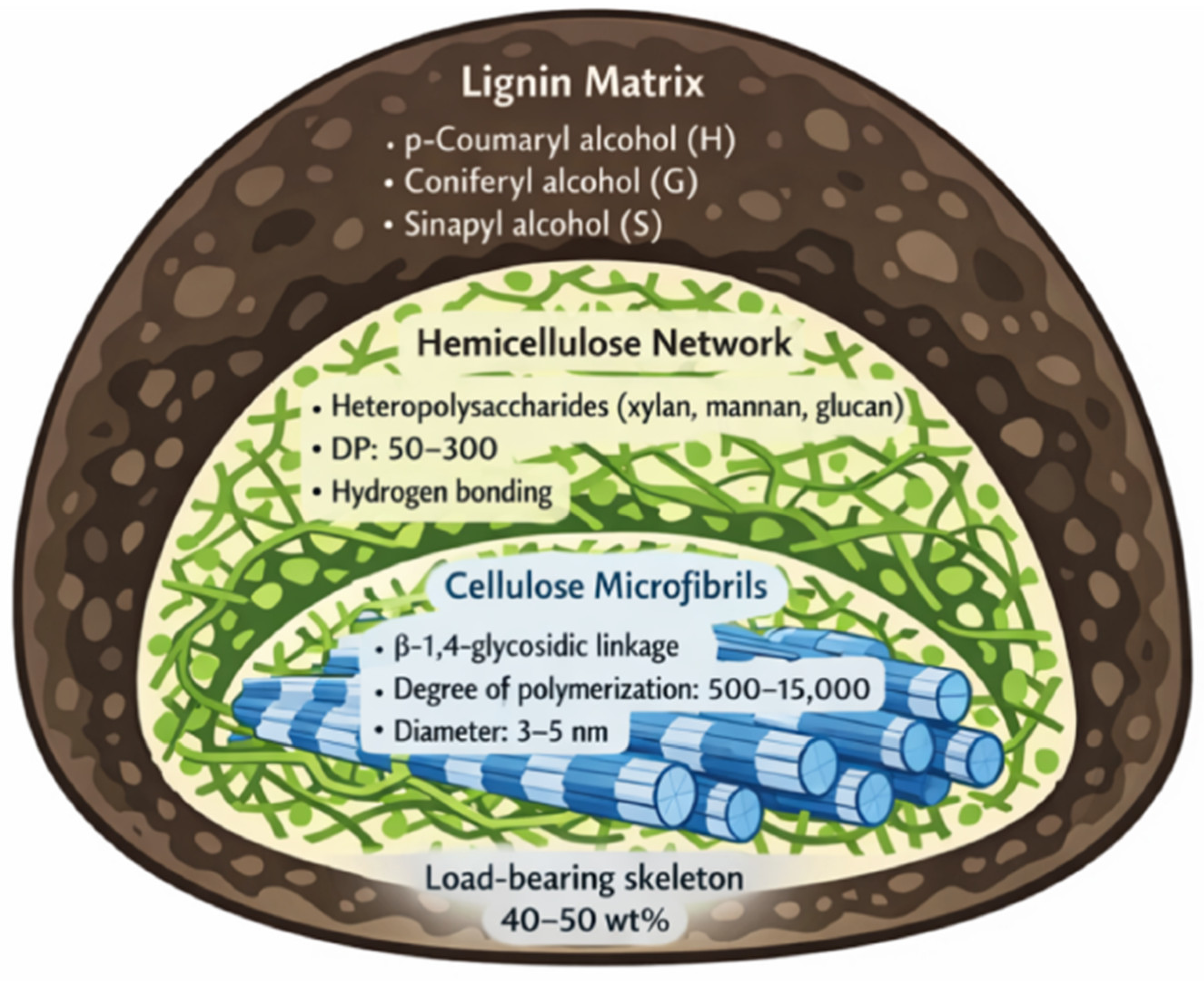
Lignocellulosic biomass is mainly composed of cellulose, hemicellulose, and lignin, which are closely associated in plant cell walls and form a hierarchical structure [
13]. Cellulose provides the main structural framework, hemicellulose connects the polysaccharide network with lignin, and lignin fills and reinforces the matrix, thereby improving the mechanical strength and environmental resistance of the cell wall. As illustrated in
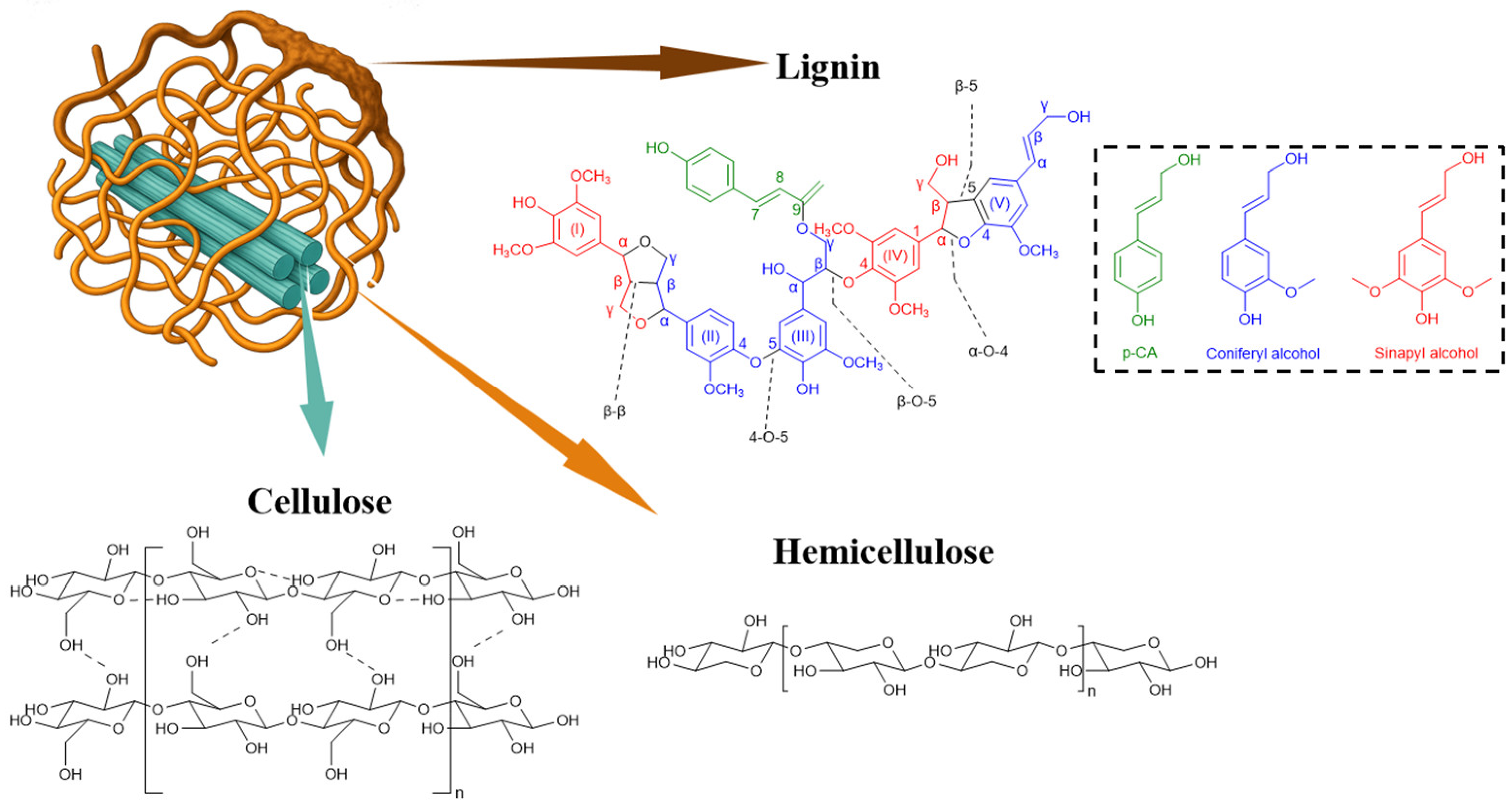
Figure 1, among these three components, lignin is the most resistant to degradation and valorization because of its structural heterogeneity and highly crosslinked aromatic network. Lignocellulosic biomass accounts for more than 90% of terrestrial biomass, and its efficient utilization is therefore central to the development of sustainable biorefineries. As shown in
Figure 2, the lignin network contains various interunit linkages, including β-O-4 ether bonds as the dominant linkage, together with β-β, α-O-4, 4-O-5, and 5-5 linkages [
14,
15]. These bonds are formed through enzyme-mediated radical coupling reactions, mainly involving peroxidases and laccases, resulting in a robust polymer matrix that resists enzymatic and chemical depolymerization. Therefore, developing efficient strategies for lignin depolymerization and valorization is essential for achieving full-component utilization of lignocellulosic biomass.
Because of lignin’s complex and recalcitrant structural network, conventional biorefining strategies have largely followed a cellulose-first approach, focusing on the production of pulp, sugars, bioethanol, and biofuels from the carbohydrate fraction [
16,
17]. However, this strategy has clear limitations. During conventional pretreatment and pulping processes, lignin often undergoes severe structural modification and undesirable condensation, generating industrial lignin streams that are difficult to further valorize. As a result, lignin is commonly treated as a low-value by-product and is often burned for heat or energy recovery [
18]. This practice fails to fully utilize lignin’s high aromatic content and energy density of approximately 22–29 kJ/g [
19]. As the most abundant renewable aromatic polymer on Earth [
20], lignin represents an important but underutilized resource for the circular bioeconomy.
To overcome the limitations of cellulose-first processing, the lignin-first approach has been developed as a strategy for full-component valorization of lignocellulosic biomass [
21]. Unlike traditional processes that prioritize carbohydrate utilization and leave lignin as a degraded residue, lignin-first biorefining aims to stabilize and convert native lignin at an early stage, while preserving the carbohydrate-rich pulp for subsequent upgrading. Several strategies have been proposed to implement lignin-first fractionation, including Formaldehyde-assisted Fractionation [
22], Diol Auxiliary Fractionation, Oxidative Catalytic Fractionation [
23,
24,
25], and Reductive Catalytic Fractionation. Formaldehyde-assisted fractionation and diol-assisted fractionation are effective in stabilizing reactive lignin fragments and suppressing condensation, but both approaches rely on additional stabilizing agents and, therefore, introduce extra separation and recovery requirements. Oxidative catalytic fractionation offers another route by promoting oxidative cleavage of lignin linkages and producing oxygenated aromatic compounds; however, controlling the oxidation degree remains challenging, as overoxidation can reduce product selectivity and negatively affect carbohydrate preservation. Compared with these strategies, reductive catalytic fractionation (RCF) has received particular attention because it combines lignin extraction, depolymerization, and reductive stabilization in a single process. This enables phenolic monomer production under relatively mild conditions while retaining a carbohydrate-rich pulp for subsequent valorization.
The development of RCF is closely related to earlier studies on catalytic lignin conversion and organosolv pulping. Organosolv processes use organic solvents to fractionate biomass and recover relatively pure lignin after solvent removal and precipitation [
26]. However, their primary objective is usually pulp production rather than direct lignin valorization. RCF further advances this concept by integrating lignin extraction, depolymerization, and reductive stabilization into a single lignin-first process. In 2015, the research groups of Bert Sels and Abu Omar proposed representative RCF strategies that transformed lignin from a low-value residue into a source of high-value aromatic chemicals [
27,
28]. A typical RCF process involves three coupled steps: solvent-assisted extraction of native lignin from lignocellulose, depolymerization of lignin into smaller fragments, and catalytic stabilization of reactive intermediates under hydrogen or hydrogen-donor conditions to suppress condensation [
29]. The resulting phenolic monomers can serve as important building blocks for chemicals, polymers, fuels, and pharmaceutical intermediates.
Compared with conventional biomass conversion routes, RCF is not only a lignin depolymerization reaction. It connects lignin extraction, catalytic stabilization, carbohydrate preservation, solvent management, catalyst recovery, and downstream upgrading within one process. Its performance is, therefore, affected not only by feedstock composition, solvent choice, and catalyst activity, but also by heat and mass transfer, residence-time distribution, catalyst placement, solvent recycling, and reactor configuration. These factors become particularly important when RCF is developed from batch screening toward semi-continuous, flow-through, or continuous-flow operation.
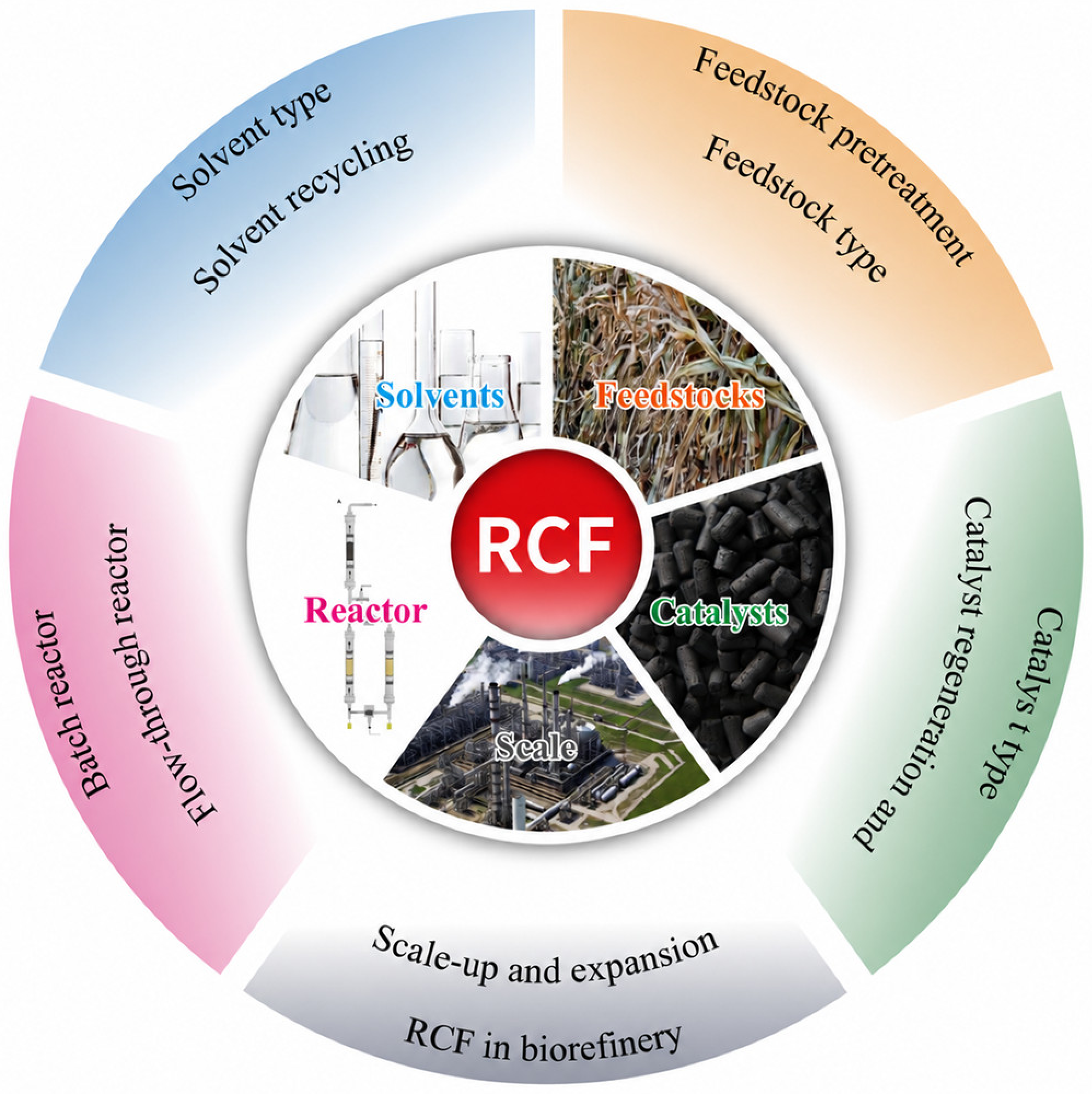
This review summarizes recent progress in RCF from five connected aspects: feedstock characteristics, solvent systems, catalyst design, reactor configuration, and scale-up potential, as outlined in
Figure 3. Unlike earlier reviews that mainly discuss RCF according to single variables, such as feedstock type, solvent choice, or catalyst performance, this review focuses on how these factors interact at the process level. Particular attention is given to the links among feedstock structure, solvent-assisted lignin extraction, catalytic stabilization, reactor design, and scale-up feasibility. Representative studies are compared using several performance indicators, including monomer yield, delignification efficiency, carbohydrate retention, catalyst recovery, solvent recycling, and reactor operability, rather than monomer yield alone. In addition, batch and continuous-flow RCF systems are discussed in relation to heat and mass transfer, residence-time control, catalyst placement, and scalability. By further considering techno-economic analysis, life-cycle assessment, solvent-loop design, lignin-oil upgrading, and reporting requirements, this review aims to identify the main engineering issues that must be addressed before RCF can move from laboratory demonstration to industrial lignin-first biorefinery practice.
2. Effects of Feedstock Selection and Pretreatment on Monomer Yield
2.1. Effects of Different Feedstock Types on RCF
Feedstock type is a major factor affecting monomer yield in RCF, but its effect cannot be understood from lignin content alone. Biomass feedstocks differ in lignin content, syringyl-to-guaiacyl ratio (S/G ratio), β-O-4 linkage abundance, degree of condensation, lignin-carbohydrate complex structure, and tissue anatomy. Together, these factors influence lignin extractability, solvent accessibility, contact between lignin fragments and the catalyst, and ultimately phenolic monomer formation. Therefore, a feedstock with higher lignin content may provide a larger theoretical source of monomers, but condensed lignin structures or limited solvent penetration can still reduce the actual monomer yield.
Representative studies further show that RCF performance depends strongly on feedstock type and origin. Klein et al. [
30] compared birch, poplar, and eucalyptus under the same methanol/Ni/C conditions and reported monomer yields of 20%, 6%, and 16%, respectively. The higher yield obtained from birch suggests that even among hardwood feedstocks, differences in lignin structure and biomass anatomy can lead to clear changes in monomer formation. Galkin et al. [
31] also showed that geographic origin can affect RCF performance. In an ethanol/water system with Pd/C, Swedish birch gave a monomer yield of up to 40%, whereas Finnish birch gave about 20% under comparable conditions. The catalyst-free controls in the Galkin study are useful for distinguishing solvent-driven fractionation from catalytic depolymerization. The comparison with Pd/C shows that ethanol/H
2O treatment alone can promote lignin extraction to some extent, whereas the catalyst is necessary for efficient stabilization of lignin fragments and monomer formation. These results indicate that RCF performance is affected not only by biomass type, but also by structural differences related to growth conditions and feedstock origin.
A higher syringyl-to-guaiacyl ratio is commonly considered favorable for RCF because syringyl-rich lignin generally contains more β-O-4 linkages and fewer condensed C-C linkages than guaiacyl-rich lignin. This relationship partly explains why many hardwood feedstocks, which usually have higher S/G ratios, often give higher monomer yields than softwoods. However, this correlation is not universal. E. M. Anderson et al. [
32] examined natural poplar variants with S/G ratios ranging from 1.41 to 3.60. Under flow-through RCF conditions, the cumulative monomer yields of most samples remained close to 23%, with only one sample giving a slightly lower yield of about 20%. Batch RCF in supercritical methanol also produced broadly comparable monomer yields of approximately 30–34%. These results suggest that the S/G ratio may be useful for a preliminary comparison among broad feedstock categories, but it is insufficient as a single predictor for structurally similar biomass samples. Monomer formation is instead jointly governed by β-O-4 linkage abundance, condensed linkage content, molecular weight, lignin-carbohydrate connectivity, tissue structure, and solvent accessibility.
Tissue-level heterogeneity further complicates the relationship between lignin content and monomer yield. In 2019, T. Vangeel et al. [
33] compared bark and wood from Robinia and found that bark, despite its higher lignin content, exhibited lower carbohydrate retention and lower monomer yield than wood. This result suggests that a higher lignin content does not necessarily translate into a higher recoverable monomer yield when the lignin structure is dense or highly condensed. Subsequent studies on different tree barks further confirmed that anatomical heterogeneity and cell-wall organization influence solvent penetration and catalytic accessibility [
34]. Similarly, Van Aelst et al. [
35] showed that softwood-derived lignin oils retain a higher fraction of condensed interunit linkages, reflecting the intrinsic recalcitrance of softwood lignin during RCF.
Recent catalyst development has partly expanded the feedstock scope of RCF, but native lignin structure remains decisive. Su et al. [
36] reported that a carbon nanotube-supported Ru catalyst showed broad applicability toward hardwoods, herbaceous biomass, and softwoods under the same reaction conditions. The highest monomer yield reached 46 wt% for birch, while eucalyptus and beech also gave high yields of 45 wt% and 40.5 wt%, respectively. In contrast, herbaceous feedstocks such as corn stalks gave about 15 wt%, and softwoods such as spruce and pine gave only 16 wt% and 12 wt%, respectively. The hierarchy of hardwood > herbaceous biomass > softwood can be explained by differences in native lignin structure and biomass matrix complexity. Hardwood lignin is usually richer in syringyl units and contains a higher proportion of β-O-4 linkages, which are more readily cleaved during RCF. In contrast, softwood lignin is dominated by guaiacyl units and contains a higher fraction of condensed C-C linkages, such as 5-5 and β-5 structures, which are resistant to reductive depolymerization. Herbaceous biomass occupies an intermediate position, but its lignin is often associated with hydroxycinnamates, ester linkages, lignin-carbohydrate complexes, ash, and inorganic minerals. These features can hinder solvent penetration, promote side reactions, or accelerate catalyst fouling. Therefore, even highly active catalysts may improve lignin depolymerization but cannot fully eliminate the structural limitations imposed by the native lignin network and biomass architecture.
Feedstock selection for RCF should be based on multiple structural and compositional factors rather than lignin content alone. Lignin content defines the theoretical monomer potential, but the actual monomer yield also depends on β-O-4 abundance, condensed linkage content, lignin-carbohydrate complex structure, tissue anatomy, and solvent accessibility. Future feedstock screening should therefore combine compositional analysis, structural characterization, and RCF performance evaluation to build more reliable structure-performance relationships.
Representative reaction conditions and key performance metrics reported in the above RCF studies are summarized in
Table 1.
2.2. Pretreatment of Raw Materials
Pretreatment can affect RCF efficiency by changing biomass accessibility, lignin structure, and impurity distribution [
37]. Suitable pretreatment improves solvent penetration and contact between lignin and the catalyst, thereby promoting lignin extraction and monomer formation. However, overly severe pretreatment may cause lignin condensation or carbohydrate loss, which is unfavorable for full-component valorization.
Physical pretreatment mainly improves mass transfer by opening the lignocellulosic matrix. Mechanical milling can reduce particle size, increase surface area, and expose more lignin to solvents and catalysts. Lin et al. [
38] showed that ball milling combined with Fenton-like treatment reduced the lignin content to 18.2% and generated a porous structure, with the average pore diameter and total pore volume increasing by 292.5% and 44.2%, respectively. Ultrasonic pretreatment can also improve biomass accessibility through cavitation effects. Prabhudesai et al. [
39] reported that ultrasonic pretreatment of pine wood followed by Pd/ACC-catalyzed RCF achieved 82.4% delignification and 95% carbohydrate retention, indicating that this method can promote lignin removal while preserving carbohydrates.
Chemical pretreatment directly alters lignin-carbohydrate interactions and lignin reactivity. Alkaline pretreatment is effective for lignin removal, but strong alkaline conditions may cause lignin depolymerization followed by repolymerization, producing highly modified lignin with limited valorization potential. Dilute acid pretreatment can remove hemicellulose and partially solubilize lignin, but batch operation may lead to recondensation and redeposition of lignin fragments. In contrast, continuous dilute acid pretreatment can rapidly remove dissolved fragments from the heating zone, thereby reducing secondary condensation.
Organic solvent pretreatment is closely related to RCF because it can extract lignin while retaining part of its reactive structure. Alcohols, polyols, cyclic ethers, organic acids, and ketones have been used for lignin extraction. Among them, low-boiling alcohols such as methanol and ethanol are often used because of their low cost and recyclability. However, solvent acidity, temperature, and residence time need to be controlled to limit lignin condensation and carbohydrate degradation. Deep eutectic solvents have also been explored as greener pretreatment media. For example, Jia et al. [
40] used a ternary deep eutectic solvent to pretreat corn stover and achieved 90.60% lignin removal at 150 °C for 3 h.
Biological pretreatment provides a mild approach for lignin isolation and can better preserve native lignin structures. However, its long processing time and low throughput limit its direct use in large-scale RCF. Biomass impurities, including ash, metal ions, and extractives, can also poison catalysts, block active sites, or change reaction pathways. Therefore, impurity removal methods such as Soxhlet extraction are often needed to improve catalytic reliability and reproducibility.
In RCF, β-O-4 linkages provide the main cleavable sites for monomer formation, so pretreatment should be assessed beyond delignification efficiency alone. A useful pretreatment should open the biomass structure and improve solvent accessibility, while retaining as much native-like lignin structure as possible. Mild physical or solvent-based pretreatments are, therefore, often more compatible with downstream catalytic hydrogenolysis. By contrast, severe acid, alkaline, or thermal treatments may remove lignin effectively, but they can also cleave β-O-4 linkages, promote lignin condensation, degrade carbohydrates, or cause dissolved lignin fragments to redeposit on the solid residue. These changes reduce the amount of reactive lignin available for selective depolymerization and may ultimately lower monomer yield. Thus, pretreatment for RCF should be designed to balance lignin accessibility, β-O-4 retention, carbohydrate preservation, impurity removal, and compatibility with the subsequent catalytic stabilization step. The effects of representative pretreatment methods on β-O-4 linkages are summarized in
Table 2. Overall, pretreatment should be designed to enhance lignin accessibility while avoiding excessive structural degradation. Future pretreatment strategies for RCF should be evaluated not only by delignification efficiency, but also by β-O-4 retention, carbohydrate preservation, catalyst compatibility, and process scalability.
3. Application of RCF in Solvents
3.1. Recycling of Solvents
Solvent recycling is a critical factor for improving the economic and environmental feasibility of RCF, particularly in flow-through and continuous-flow systems where solvent consumption can be substantial. Although high solvent-to-biomass ratios are often beneficial for lignin extraction and intermediate stabilization at laboratory scale, they increase the energy demand and operating cost associated with solvent recovery during scale-up. Therefore, recent studies have increasingly focused on reducing fresh solvent input through solvent reuse, solvent blending, and reaction-liquor recycling. For example, Jang et al. [
41] developed a multi-pass flow-through RCF strategy in which the lignin-rich solvent stream obtained after the first FT-RCF step was directly reused in subsequent cycles without intermediate lignin oil recovery. This approach reduced the solvent-to-biomass ratio from 48 L/kg to 1.9 L/kg while maintaining delignification efficiency and monomer yield, demonstrating that solvent circulation can substantially reduce solvent demand without compromising RCF performance.
Different solvent recycling strategies have been explored depending on solvent type and process configuration. Li et al. [
42] investigated the reuse of an ethylene glycol/choline chloride solvent system and obtained a solvent recovery rate of 72.7 wt% after the first cycle, although the monomer yield decreased to 30.6 wt% because of changes in solvent composition and reduced hydrogen-donor capacity. After a second cycle, the monomer yield further decreased to 23.6 wt%. However, blending the recovered solvent with fresh solvent significantly restored the monomer yield to 45.1 wt%, with a G/S-3 selectivity of 91.5% at a 1:1 solvent ratio. Similarly, Arts et al. [
43] proposed a methanol-based solvent recovery system in which the recycled reaction liquor contained methanol, methyl acetate, acetic acid, water, and lignin oil. This mixed solvent maintained high lignin extraction efficiency of 90–95% and enabled high monomer yields, indicating that industrial RCF may not require complete solvent purification after each cycle. Instead, controlled recycling of reaction-derived solvent mixtures may reduce distillation load, fresh solvent demand, and environmental impact.
Organic acid solvents and lignin-oil-assisted systems provide further opportunities for solvent-efficient RCF. Cai et al. [
44] evaluated the recyclability of maleic acid solution for lignin extraction and found that, after three recycling cycles, the lignin extraction rate from birch powder remained at 54.3%, while the purity of extracted lignin was maintained at approximately 92%. The gradual decline in extraction efficiency was mainly attributed to the accumulation of carbohydrate-derived degradation products, suggesting that impurity management is essential for long-term recycling. More recently, Jang et al. [
45] demonstrated that lignin oil itself can function as an effective co-solvent in RCF. Solvent systems containing up to 80 wt% lignin oil achieved 83–93% delignification, and ten consecutive RCF reactions led to a final lignin oil concentration of 11 wt% without adverse effects on lignin extraction, lignin oil molar-mass distribution, aromatic monomer selectivity, or cellulose retention. This supports the concept that lignin-derived oil can participate in lignin solubilization based on the principle of “like dissolves like”.
Overall, solvent recycling is more than a downstream separation step in scalable RCF. It also affects solvent use, reaction efficiency, separation load, and process economics. Flow-through recycling can reduce the solvent-to-biomass ratio, recovered high-boiling solvents can be reused after proper rejuvenation, reaction-liquor recycling can lower separation demand, and lignin oil may act as a functional co-solvent. Repeated recycling may also lead to carbohydrate loss, solvent deactivation, or impurity accumulation, but these problems can be partly controlled through solvent blending, impurity removal, catalyst replacement, and optimized recycle loops. Therefore, solvent recycling should be integrated into reactor and process design rather than treated only as a solvent-recovery step.
3.2. Use of Conventional Solvents
Conventional solvents used in RCF mainly include polar protic alcohols and organic acid-based systems. Alcohols such as methanol, ethanol, and ethylene glycol are widely used because they can dissolve lignin, stabilize reactive intermediates, and in some cases act as hydrogen donors. Song, et al. [
46] showed that methanol, ethanol, and ethylene glycol were effective for lignin conversion, giving monomer yields of 54%, 48%, and 50%, respectively. Isotope-labeling experiments further confirmed that alcohols can participate in hydrogen-transfer reactions, suggesting that they function not only as reaction media but also as active components in lignin stabilization.
The influence of solvent properties on RCF performance has been systematically evaluated. Schutyser et al. [
47] introduced the concept of lignin-preferential delignification efficiency (LFDE), which combines lignin conversion and carbohydrate retention to assess solvent performance. Their study showed that solvent polarity, Lewis acidity, and hydrogen-bond donor ability strongly affect lignin extraction and fractionation efficiency. Among the tested solvents, methanol and ethylene glycol exhibited the highest LFDE with corresponding monomer yields of 28.1% and 26.9%. In the solvent screening reported by Schutyser et al., water gave a higher phenolic monomer yield than methanol, mainly because its high polarity and hydrogen-bond donating ability promoted lignocellulose swelling, lignin extraction, and lignin fragmentation. However, water also caused substantial carbohydrate solubilization, so methanol and ethylene glycol were considered more balanced solvents when both delignification and carbohydrate retention were evaluated. These results suggest that an effective RCF solvent should balance lignin solubilization with carbohydrate preservation. In addition, Zhang et al. [
48] showed that methanol was an effective solvent for Pd/C-catalyzed RCF of bamboo and wood sawdust, enabling relatively high monomer yield while retaining carbohydrate-rich solid residues.
In addition to alcohols, organic acid-based solvents have also shown strong potential for lignin extraction under mild conditions. Guo et al. [
49] used a formic acid/hydrochloric acid solution in a continuous-flow reactor for eucalyptus fractionation. Compared with pure formic acid, the mixed acid system achieved a lignin removal rate of 79.4% at 95 °C and produced lignin with low molecular weight, narrow distribution, and good thermal stability. Cai et al. [
44] further introduced maleic acid into flow-through lignin extraction. A 50 wt% maleic acid aqueous solution extracted approximately 60% of lignin from birch at 120 °C under atmospheric pressure, while retaining more than 80% of β-O-4 linkages in the extracted lignin. Subsequent catalytic hydrogenolysis afforded monomer yields above 30%, and the cellulose-rich residue could be efficiently converted to glucose with yields exceeding 90%. These results indicate that organic acids can provide mild, pressure-reducing, and structurally protective solvent environments for lignin-first fractionation.
However, acidic solvent systems also face the challenge of lignin condensation caused by reactive carbocation intermediates. To address this issue, Zhou et al. [
50] developed an L-cysteine-assisted acidic cosolvent system to stabilize lignin during extraction. At 80–90 °C, this system removed 82.6% of lignin while retaining 84.5% of β-O-4 linkages. The nucleophilic L-cysteine helped suppress condensation and degradation by trapping reactive Cα intermediates. Overall, conventional alcohols remain important RCF solvents because of their hydrogen-transfer ability and process compatibility, while organic acid-based systems are useful for mild lignin extraction and β-O-4 preservation. Future solvent design should further balance delignification efficiency, carbohydrate retention, lignin structural preservation, solvent recyclability, and compatibility with continuous-flow operation.
Representative reaction conditions and key performance metrics reported in the above RCF studies are summarized in
Table 3.
3.3. The Application of the Synergistic Application of Solvents and Additives in RCF
Solvents and additives can be used together to regulate lignin extraction, intermediate stabilization, and product selectivity in RCF. Compared with single-solvent systems, solvent-additive combinations can adjust acidity or alkalinity, promote hydrogen transfer, change lignin solubility, and affect the balance between lignin depolymerization and carbohydrate preservation. Additives, therefore, act not only as auxiliary components, but also as regulators of reaction pathways and product distribution.
Acidic and alkaline additives can lead to different fractionation behaviors. Renders et al. [
51] investigated the effects of H
3PO
4 and NaOH on Pd/C-catalyzed RCF of poplar wood in methanol. Adding a small amount of H
3PO
4 promoted lignin depolymerization and hemicellulose alcoholysis, increasing the monomer yield from 36% to 40–42%. In contrast, NaOH improved delignification but inhibited effective lignin depolymerization, resulting in lower monomer yields and partial cellulose loss. These results show that acid additives may promote lignin fragmentation and stabilization, whereas alkaline additives can enhance lignin removal at the expense of monomer production and carbohydrate retention.
Water is an important additive in alcohol-based RCF systems, but its effect depends strongly on concentration. Chen et al. [
52] showed that adding water to methanol enhanced lignin etherification and hydrogenolysis over a Ni-based catalyst, increasing the monomer yield from 39.3% in pure methanol to 45.7% and 51.4% at optimized methanol/water ratios. Ouyang et al. [
53] also reported a clear solvent-composition effect in Pt-catalyzed lignin conversion. The phenolic monomer yield increased from 19% in pure methanol to 36%, 43%, and 49% after adjusting the methanol/water ratio, but decreased sharply to 6% in pure water. These results suggest that a suitable amount of water can promote lignin hydrolysis, in situ acid formation, and hydrogen transfer, whereas excessive water may reduce hydrogen availability and lower stabilization efficiency.
Hydrogen-donor and hydrogen-bonding additives can further regulate RCF reaction pathways. Rautiainen et al. [
54] used formic acid and sodium formate as hydrogen donors in Co-catalyzed fractionation of birch wood. When used separately, formic acid and sodium formate gave monomer yields of 17% and 18%, respectively. Their combined use increased the yield to 34%, corresponding to 76% of the theoretical maximum yield. Li et al. [
42] introduced choline chloride (ChCl) into an ethylene glycol/Ru/C system to modify the hydrogen-transfer process. With 10 wt% ChCl, the propylphenol monomer yield reached 59.2 wt%, with 97.3% selectivity. However, excessive ChCl shifted the selectivity toward allylphenols and promoted carbohydrate degradation, indicating that additive concentration needs to be controlled.
Overall, solvent-additive effects in RCF should be considered in terms of delignification, monomer stabilization, hydrogen supply, and carbohydrate preservation. Acid additives can promote lignin fragmentation, water can improve hydrolysis and mass transfer, hydrogen donors can support reductive stabilization, and hydrogen-bonding additives can adjust product selectivity. However, excessive acidity, alkalinity, water content, or additive loading may lead to lignin condensation, carbohydrate degradation, or catalyst inhibition. Future solvent-additive design should, therefore, focus on controlled acidity, suitable water content, renewable hydrogen donors, and compatibility with catalyst stability and continuous-flow operation.
Representative reaction conditions and key performance metrics reported in the above RCF studies are summarized in
Table 4.
3.4. Summary
Solvent effects in RCF reflect a balance between lignin extraction and carbohydrate preservation. Highly polar or acidic solvent environments can promote biomass swelling, delignification, and β-O-4 cleavage, but they may also increase hemicellulose dissolution or carbohydrate degradation. Alcohol-rich systems usually provide better carbohydrate retention and intermediate stabilization but often require high solvent loading and energy-intensive recovery. Therefore, solvent systems should not be evaluated only by monomer yield, but also by their effects on lignin oil quality, pulp value, solvent recyclability, and downstream separation.
Current studies on solvent effects in RCF have mainly focused on the early fractionation stage, particularly efficient delignification and preservation of reactive lignin structures. Delignification efficiency, carbohydrate retention, and β-O-4 linkage preservation are key indicators because they directly affect subsequent catalytic hydrogenolysis and the yield of lignin-derived monophenols. In this context, green solvents, organic acid systems, deep eutectic solvents, and hydrogen-donor additives have been developed to improve lignin extraction while suppressing condensation and maintaining product selectivity.
4. Application of Catalyst in RCF
4.1. Application of Supported Catalysts in RCF
Supported metal catalysts are among the most widely used heterogeneous catalysts in RCF because they combine high metal dispersion, tunable metal-support interactions, and convenient separation from the solid carbohydrate-rich residue. In a typical supported catalyst, active metals such as Ru, Pd, Pt, Ni, Co, Mo, or Cu are dispersed on high-surface-area supports, including activated carbon, mesoporous carbon, nitrogen-doped carbon, metal oxides, and alumina. The support not only improves the dispersion and stability of metal nanoparticles or clusters, but also regulates pore accessibility, acidity, electronic structure, hydrogen activation, and the adsorption of lignin-derived intermediates. Therefore, catalyst performance in RCF depends not only on the intrinsic activity of the metal, but also on the combined effects of support structure, metal loading, particle size, acidity, and mass-transfer properties.
Carbon-supported noble metal catalysts represent the classical catalyst family in RCF. Van den Bosch et al. [
27] used commercial Ru/C for the RCF of switchgrass, birch, pine, and poplar, obtaining monomer yields of 27%, 50%, 21%, and 44%, respectively, demonstrating both the high activity of Ru/C and the strong feedstock dependence of monomer production. Other studies have also shown that carbon-supported catalysts generally outperform oxide-supported catalysts in lignin monomer production. For example, Renders et al. [
55] compared C- and γ-Al
2O
3-supported metal catalysts and found that carbon-supported catalysts gave higher monomer yields. Similarly, Brienza et al. [
56] reported that Ru/C performed better than Ru/Al
2O
3 in wheat straw RCF, affording approximately 25 wt% phenolic monomers and suppressing the formation of high-molecular-weight lignin fragments. These results suggest that carbon supports are particularly suitable for stabilizing lignin-derived intermediates and promoting hydrogenolysis under RCF conditions.
The catalytic performance can be further improved by tailoring the pore structure and acidity of the support. Van den Bosch et al. [
57] showed that Ni/Al
2O
3 catalysts could promote lignin hydrogenolysis, with the powder catalyst giving a monomer yield up to 44%. Qiu et al. [
58] developed Ru/CMK-3, in which ordered mesoporous carbon provided weak acidity and high mesoporosity, improving lignin depolymerization compared with conventional Ru/C. Mo-based carbon catalysts have also been explored as lower-cost alternatives to noble-metal catalysts. For example, Mo
xC/CNT catalysts prepared at different temperatures gave monomer yields of 32–42% from apple wood, while MoO
2/C showed high delignification and carbohydrate retention for several herbaceous feedstocks. Gong et al. [
59] reported delignification above 85% and monomer yields of 14.6–26.4% over MoO
2/C. These results suggest that Mo-based catalysts can support lignin removal while preserving carbohydrates, although their monomer yields are generally lower than those obtained with highly active noble-metal catalysts.
Beyond conventional nanoparticles, catalyst architecture has become an important factor in improving activity, selectivity, and metal utilization. Nitrogen-doped and heteroatom-doped carbon supports can strengthen metal-support interactions, stabilize ultrasmall metal species, and introduce additional acid or defect sites. Park et al. [
60] developed a low-Pd-loading Pd/CN
x catalyst with ultrasmall Pd clusters and isolated Pd atoms supported on N-functionalized carbon. In birch RCF, this catalyst gave a phenolic monomer carbon yield of 52.7 wt% and a cellulose recovery of 84.2 wt%, showing that high catalytic performance can be achieved even with very low noble-metal loading. Ding et al. [
61] further showed that N,P-co-doped carbon-supported Ru catalysts enhanced Ru dispersion and introduced weak-to-medium acid sites, giving monomer yields of 57.98 wt% from poplar and 17.53 wt% from pine. These results highlight the importance of support engineering in regulating both hydrogenolysis activity and feedstock adaptability.
Non-noble and low-loading catalysts are increasingly attractive for scalable RCF because they reduce catalyst cost and improve economic feasibility. Sulfided CoMo and NiMo catalysts supported on Al
2O
3 have been investigated for lignin depolymerization, giving moderate monomer yields of approximately 17–18 wt% [
62,
63]. Copper-based catalysts such as CuO/C also show potential for processing different feedstocks under hydrogen pressure [
64]. More recently, atomically dispersed catalysts have offered a route to maximize metal utilization. Li et al. [
56] reported an ultra-low-loading Co
0.15/N-C catalyst that achieved a monomer yield of 48.3% from birch wood with high selectivity and good stability. Such results suggest that rationally designed single-atom, cluster, or highly dispersed non-noble metal catalysts may provide a promising compromise between catalytic efficiency and process cost.
Supported catalysts also need to be evaluated in relation to reactor configuration. In batch RCF, catalysts are usually mixed directly with biomass, which facilitates contact but complicates catalyst recovery and may promote contact between the carbohydrate-rich pulp and the catalyst. In flow-through RCF, the physical separation of biomass and catalyst enables better control over lignin extraction, stabilization, and catalyst lifetime. Brandner et al. [
65] used Ni/C in a flow-through system and obtained monomer yields of 36.8% and 31.6% at 200 and 225 °C, respectively. Brandi et al. [
66] further applied a 35Ni/N-doped carbon catalyst in FT-RCF of beech wood, reaching 37 wt% monomer yield based on extracted lignin, close to the theoretical maximum of 40 wt%. These studies indicate that catalyst design should be coupled with reactor architecture rather than considered only as an isolated material variable.
Overall, supported catalysts remain central to RCF because they determine lignin depolymerization efficiency, intermediate stabilization, product selectivity, and catalyst recoverability. Ru/C, Pd/C, Pt/C, and Ni-based catalysts have demonstrated high activity, while Mo-, Co-, Cu-, and doped-carbon-supported systems provide more cost-effective alternatives. Future catalyst development should focus on lowering noble-metal loading, improving resistance to deactivation, enhancing compatibility with recycled solvents, and integrating catalyst placement with continuous-flow reactor design. In this sense, the next generation of RCF catalysts should be evaluated not only by monomer yield, but also by stability, recyclability, feedstock tolerance, and process scalability.
Representative reaction conditions and key performance metrics reported in the above RCF studies are summarized in
Table 5.
4.2. The Application of Core-Shell Catalysts in RCF
Core-shell catalysts are a type of catalyst with a core-shell structure, typically consisting of an inner core and an outer shell that envelops the core. These catalysts possess a multilayer architecture in which the chemical composition and physical properties of the core and shell can differ significantly. The core-shell structure can markedly enhance the performance of the catalyst by increasing catalytic activity, improving selectivity, and enhancing stability and durability. Compared with conventional supported catalysts, core-shell catalysts offer a more controlled microenvironment around the active metal sites. In conventional supported catalysts, metal nanoparticles are often directly exposed to lignin fragments, oligomers, inorganic impurities, and acidic components, which may accelerate metal leaching, particle sintering, pore blockage, and coke formation. In contrast, the shell layer in core-shell catalysts can act as a protective and selective barrier. It can restrict metal nanoparticle migration, improve resistance to sintering, and regulate the diffusion of bulky lignin-derived oligomers toward active sites. This confined structure also helps control the contact between reactive lignin intermediates and metal sites, thereby reducing non-selective condensation and surface fouling. Therefore, core-shell catalysts are particularly attractive for RCF, where catalyst stability, product selectivity, and compatibility with complex biomass-derived streams are all important.
Park et al. [
67] prepared a highly dispersed core-shell Ni@Al
2O
3 catalyst supported on activated carbon for the hydrogen-free or hydrogen-transfer RCF of different lignocellulosic biomass feedstocks. The Ni core and Al
2O
3 shell structure provided both catalytic activity and structural protection, enabling lignin depolymerization under relatively mild conditions. Using a formic acid/ethanol/water solvent system at 190 °C, oak conversion afforded 23.4 wt% lignin-derived phenolic monomers while maintaining high carbohydrate retention. This result suggests that core-shell catalysts can improve the compatibility between lignin valorization and carbohydrate preservation, especially in systems using internal hydrogen donors instead of external hydrogen. Chen et al. [
68] designed Rh nanoparticles confined within hollow porous carbon nanospheres (Rh@HCS). The hollow carbon shell allowed lignin-derived fragments to diffuse into the confined space, while Rh nanoparticles promoted the hydrogenation of reactive monomeric intermediates into more stable products. Using methanol and ethylene glycol as solvents, Rh@HCS achieved monomer yields of 47% and 41%, respectively. These results indicate that the metal catalyst mainly stabilizes lignin-derived monomers after solvent-assisted lignin extraction and cleavage, while the porous shell contributes to selective diffusion and controlled catalytic contact.
Representative reaction conditions and key performance metrics reported in the above RCF studies are summarized in
Table 6.
4.3. Application of Zeolite and Modified Zeolite Catalysts in RCF
Zeolite-based catalysts have attracted increasing attention in RCF because of their tunable acidity, ordered pore structure, high thermal stability, and ability to host metal active sites. Unlike conventional carbon-supported catalysts, zeolites can provide Brønsted and Lewis acid sites that promote lignin depolymerization, dehydration, and rearrangement reactions. Meanwhile, their pore structure can regulate the diffusion and adsorption of lignin-derived intermediates. However, the relatively large size and structural complexity of lignin fragments also require careful optimization of zeolite pore accessibility, acidity, and metal dispersion [
69].
Modification of zeolite catalysts is, therefore, mainly aimed at improving accessibility and constructing bifunctional catalytic sites. Common strategies include ion exchange, metal impregnation, introduction of transition-metal species, acidity adjustment, and the creation of hierarchical or mesoporous structures. These modifications can improve the contact between lignin-derived fragments and active sites while coupling acid-catalyzed cleavage or dehydration with metal-catalyzed hydrogenation. As a result, modified zeolites are particularly suitable for designing bifunctional catalysts in which acid sites and metal sites operate cooperatively during RCF [
70].
Sun et al. [
71] reported a mesoporous zeolite-supported molybdenum oxide catalyst that participated in both lignin separation and catalytic conversion. The mesoporous zeolite support improved the accessibility of lignin-derived intermediates, while molybdenum oxide promoted their conversion into phenolic alcohols and ethers. Under methanol, 260 °C, and 30 bar H
2, the catalyst afforded a maximum monomer yield of 43.4%. This result indicates that combining mesoporosity with metal oxide active sites can effectively improve lignin-first catalytic fractionation.
β-Zeolite has also been explored in hydrogen-free or flow-through lignin-first processes. Kramarenko et al. [
72] investigated hydrogen-free one-step catalytic fractionation of birch, spruce, and walnut shells in a flow-through reactor using β-zeolite. This work emphasized the influence of catalyst packing, bed porosity, and reactor configuration on monomer formation, suggesting that zeolite catalysts should be evaluated not only by their intrinsic acidity but also by their behavior in structured reactor beds. Although earlier batch studies had shown the feasibility of β-zeolite-assisted lignin-first conversion [
73], its application in flow-through systems still requires further understanding of catalyst stability, pore blockage, and the role of acid sites in complex biomass-derived reaction networks. More recently, Pd/β-zeolite bifunctional catalysts have been developed to integrate acid-catalyzed dehydration with metal-catalyzed hydrogenation. Kramarenko et al. [
74] prepared Pd/β-zeolite through ion exchange and applied it in a two-step lignin-first catalytic fractionation process in a flow-through reactor. In this system, the acidic zeolite framework promoted dehydration and transformation of lignin-derived intermediates, while Pd sites facilitated hydrogenation and product stabilization. The combined action of acid and metal sites enabled more efficient lignin depolymerization and stabilization under both hydrogen and non-hydrogen conditions. This study demonstrates the potential of zeolite-based bifunctional catalysts for coupling fractionation chemistry with downstream monomer stabilization.
For zeolite-based catalysts, the pore structure and acidity determine how lignin-derived fragments enter, react, and leave the catalyst. Unlike small model compounds, lignin-derived oligomers are bulky and structurally diverse, so a purely microporous zeolite may restrict their diffusion and make pore blockage more likely. Introducing mesopores or hierarchical porosity can shorten diffusion paths and expose more accessible acid and metal sites. Acid type also matters. Brønsted acid sites can promote C-O bond cleavage, dehydration, and rearrangement, while Lewis acid sites may help stabilize oxygen-containing intermediates through coordination. However, too many acid sites or overly strong acidity can also promote condensation and coke formation. Therefore, zeolite catalysts used in RCF need to combine sufficient pore accessibility with suitable Brønsted/Lewis acidity and well-dispersed metal sites, so that lignin depolymerization and intermediate stabilization can proceed without excessive secondary reactions.
Representative reaction conditions and key performance metrics reported in the above RCF studies are summarized in
Table 7.
4.4. The Stability, Reusability, and Deactivation Mechanisms of Catalysts
Catalyst deactivation remains a critical challenge for the scale-up of RCF. Unlike model-compound hydrogenolysis, catalysts in real RCF systems are simultaneously exposed to lignin fragments, carbohydrate-derived degradation products, inorganic ash, metal ions, extractives, water, acidic components, and recycled solvent streams. Therefore, the deactivation pathways are more complex. Common deactivation mechanisms include metal leaching, nanoparticle sintering, coke or carbon deposition, pore blockage by lignin-derived oligomers, surface fouling, poisoning by inorganic impurities, and the loss or transformation of acid sites. Anderson et al. [
75] identified metal leaching, particle sintering, and surface poisoning as important causes of catalyst deactivation in flow-through RCF. Ebikade et al. [
76] further showed that Ru/Al
2O
3 catalyst particles could be reused for three cycles, but monomer yields gradually decreased, especially for high-ash feedstocks such as sugarcane bagasse and wheat straw. This suggests that feedstock-derived ash, metal ions, and inorganic impurities can accelerate catalyst fouling and active-site deactivation.
For acid-containing or bifunctional catalysts, stability is more complex because both metal sites and acid sites may change during reaction. Kramarenko et al. [
74] found that spent Pd/β-zeolite catalysts suffered from carbon deposition, aluminum leaching, acid-site loss, and Pd particle sintering during repeated use. Different Pd/β-zeolite samples showed different stability: β-Z1Pd deactivated rapidly, whereas β-Z3Pd maintained relatively stable performance. These results indicate that zeolite-based catalysts must be designed with balanced acid strength, acid-site density, pore structure, and hydrothermal stability. Excessive acidity may promote lignin condensation and coke formation, whereas insufficient acidity may limit lignin fragmentation and intermediate stabilization.
Catalyst regeneration is another important strategy for extending catalyst lifetime. For Ni/Al
2O
3 catalysts, Van den Bosch et al. showed that coking was the main cause of deactivation, but catalytic activity could be restored by thermal treatment under hydrogen. Mo-based catalysts also exhibit relatively good stability. Maisterra et al. [
77] reported that β-Mo
2C/AC maintained stable activity and selectivity over 15 consecutive flow-through runs, although slight Mo leaching was observed. CoMoS/Al
2O
3 also retained partial activity after coking, suggesting that sulfided metal catalysts may tolerate harsh lignin conversion environments to some extent [
62]. These studies indicate that regeneration strategies, such as hydrogen treatment, controlled oxidation-reduction cycles, solvent washing, and removal of deposited carbon species, should be evaluated together with catalyst activity and selectivity.
Recent catalyst-architecture design also provides opportunities to suppress deactivation. Stronger metal-support interactions can reduce metal leaching and nanoparticle sintering, while heteroatom-doped carbon supports, oxide-modified supports, and defect-engineered supports can stabilize highly dispersed metal species. In addition, core-shell, encapsulated, or confinement-based catalyst architectures are promising. A protective shell or porous overlayer can physically restrict metal nanoparticle migration, reduce sintering, and regulate the diffusion of bulky lignin-derived oligomers to active sites, thereby decreasing pore blockage and coke formation. Such architectures may also spatially regulate hydrogenation sites and acid sites, reducing excessive condensation and coke formation. However, shell thickness, pore size, and surface chemistry must be carefully designed to ensure the diffusion and conversion of lignin-derived fragments while avoiding mass-transfer limitations. Overall, catalyst reusability in RCF should not be evaluated only by the initial monomer yield. Multiple criteria should be considered, including metal leaching, particle sintering, coke formation, acid-site retention, monomer-yield stability, resistance to feedstock impurities, and ease of physical recovery. Future catalyst design should focus on stronger metal-support interactions, anti-fouling surfaces, controlled acidity, hydrothermal stability, regenerability, core-shell or confinement structures, and compatibility with fixed-bed or flow-through reactor configurations. These factors are essential for moving RCF catalysts from laboratory screening toward continuous and economically viable lignin-first biorefinery processes.
4.5. Application of Acid Promoters in RCF
Acid promoters are often introduced into RCF systems to enhance lignin extraction, cleave lignin-carbohydrate linkages, promote β-O-4 bond cleavage, and improve the accessibility of lignin fragments to metal catalytic sites. Depending on their acidity and coordination ability, acid promoters can be divided into Brønsted acids, Lewis acids, acidic supports, and metal salt additives. Their function is not limited to accelerating delignification; they can also regulate lignin depolymerization pathways and product selectivity. However, excessive acidity may promote carbohydrate degradation, lignin condensation, or catalyst deactivation. Therefore, the use of acid promoters requires a balance between lignin removal, monomer formation, and carbohydrate preservation.
Brønsted acid promoters can substantially improve lignin extraction and monomer yield, but often at the expense of carbohydrate retention. Anderson et al. [
78] investigated corn stover RCF over Ru/C and Ni/C in methanol with H
3PO
4 or acidified carbon as co-catalysts. At 200 °C, Ni/C alone gave 58% lignin extraction and 28% monomer yield while retaining more than 95% of carbohydrates. The use of acidified carbon increased the monomer yield to 32% with 90% carbohydrate retention, whereas H
3PO
4 enabled complete lignin extraction and a higher monomer yield of 38%, but reduced carbohydrate retention to 45%. These results clearly show the dual role of acid promoters: they enhance lignin removal and monomer formation, but excessive acidity can severely compromise carbohydrate preservation. Similarly, Brienza et al. [
79] showed that H
3PO
4 promoted wheat straw fractionation, increasing lignin oil yield to 83% and monophenol yield to 18% after 6 h, but it also caused substantial hemicellulose removal, with C
5 polysaccharide recovery decreasing to 10%.
Lewis acid additives provide another effective route for promoting lignin depolymerization and selective monomer formation. Huang et al. [
80] developed a tandem catalytic system combining Pd/C with metal triflates. In this system, metal triflates cleaved ether and ester bonds between lignin and carbohydrates and reduced the molecular weight of liberated lignin chains, while Pd/C promoted hydrogenolysis and stabilization of lignin fragments. Among the tested systems, Pd/C + Al(OTf)
3 gave a monomer yield of 45% from birch wood. However, the ratio between Pd/C and the Lewis acid was critical; excessive Pd relative to Al reduced monomer yield because Pd/C could remove α-OH groups required for Lewis-acid-assisted ether bond cleavage. Liu et al. [
81] further showed that Fe(OTf)
3 effectively promoted hydrogen-free conversion of microwave-pretreated birch sawdust over Pt/C, increasing the monophenol yield from 10.5 wt% without Lewis acid to 32.9 wt%.
Other solid or inorganic acid promoters have also been used to enhance lignin-first conversion. Jia et al. [
82] combined Ru/C with H
2WO
4 for the depolymerization of native lignin under mild conditions. The Ru/C-H
2WO
4 system afforded a monophenol yield of 40.4% from birch lignin at 200 °C, which was 2.5 times higher than that obtained with Ru/C alone and 7.5 times higher than that obtained with H
2WO
4 alone. This improvement was attributed to the ability of H
2WO
4 to promote solvent-mediated lignin depolymerization within the biomass matrix, while Ru/C facilitated subsequent reductive depolymerization and stabilization. This example highlights the importance of coupling acid-catalyzed lignin extraction with metal-catalyzed stabilization.
Overall, acid promoters have a dual effect in RCF. Moderate acidity can improve delignification, promote cleavage of lignin-carbohydrate linkages and β-O-4 bonds, and increase monomer yield. Excessive acidity, however, may cause hemicellulose hydrolysis, carbohydrate loss, lignin condensation, furan formation, or catalyst instability. Future acid-promoted RCF systems should, therefore, focus on controllable acid strength, spatial separation of acid and metal sites, compatibility with carbohydrate preservation, and recyclability of acid additives. An effective acid promoter should not only enhance lignin extraction but also support selective lignin depolymerization while retaining the carbohydrate fraction for downstream utilization.
Representative reaction conditions and key performance metrics reported in the above RCF studies are summarized in
Table 8.
Overall, acid-assisted catalysts used in RCF can precondition the lignin structure by cleaving β-O-4 linkages, modulate the electron density on metal catalyst surfaces, and lower the energy barrier for C-O bond cleavage, while simultaneously suppressing undesired condensation side reactions and reducing recondensation of lignin fragments. Acid co-catalysts can also act as hydrogen donor solvents, supplying protons to enhance the deoxygenation capability of metal catalysts; certain organic acids, such as formic acid, can thermally decompose into H2 and CO2, enabling hydrogenolysis under mild conditions. H3PO4 and H2WO4 can modify the surface of catalyst supports, optimizing the distribution of active sites and improving mass transfer efficiency.
In addition, acid strength can influence the distribution of guaiacyl- and syringyl-derived monomers. Jastrzebski et al. [
83] showed that stronger Lewis acids promote decarbonylation products, whereas weaker acids or lower acid loadings favor 4-(1-propenyl)phenols. They also observed that guaiacyl-derived products tend to form decarbonylation products more rapidly, while syringyl-derived products are more likely to form 4-(1-propenyl)phenols. However, it is important to consider that acid co-catalysts can impact carbohydrate retention and may pose a risk of reactor corrosion, which must be carefully managed in process design and operation.
4.6. Hydrogen-Free and Transfer-Hydrogen RCF Systems
Hydrogen-free or transfer-hydrogen RCF has attracted increasing attention because it avoids the use of high-pressure external H2, thereby improving operational safety, reducing equipment requirements, and lowering process costs. In these systems, lignin-derived intermediates are stabilized by hydrogen supplied from solvents or in situ hydrogen donors rather than compressed hydrogen gas. Alcohols, diols, formic acid, and acidified solvent systems can therefore act not only as reaction media but also as hydrogen-transfer participants. However, compared with conventional H2-assisted RCF, hydrogen-free systems require more careful matching of catalyst, solvent, and additives to maintain monomer yield and product selectivity.
Atmospheric-pressure RCF represents an important route toward safer and milder lignin-first processing. Ren et al. [
84] developed atmospheric-pressure RCF in acidified ethylene glycol at 185 °C using Ru/C as catalyst. Across different biomass feedstocks, the highest monomer yield reached 23.3%, and the products were dominated by propylguaiacol and propylsyringol, which accounted for 95.6 wt% of lignin-derived monomers. Acid addition promoted lignin dissociation and biomass structural breakdown, thereby improving overall monomer formation. Although the total monomer yield was lower than that of conventional pressurized RCF, atmospheric operation offers advantages in process simplicity, safety, and potential semi-continuous operation. The study also showed that Pd/C, commonly used in conventional RCF, was not suitable for this atmospheric-pressure system, highlighting the importance of catalyst selection under hydrogen-free conditions.
Catalyst identity strongly determines product formation in hydrogen-free RCF. Kenny et al. [
85] compared supported metal catalysts for poplar RCF in methanol under both 30 bar H
2 and hydrogen-free conditions. Ru/C and Ni/C showed relatively low monomer yields without H
2, whereas Pt/C and Pd/C gave comparable monomer yields under both atmospheres. More importantly, the reaction atmosphere changed product selectivity: under H
2, Pt/C and Pd/C favored hydrogenation to ethyl-substituted products, whereas under hydrogen-free conditions they promoted hydrogenolysis pathways leading to propanol-type products. This indicates that catalysts in hydrogen-free RCF should be evaluated not only by monomer yield but also by their ability to regulate side-chain hydrogenation and hydrogenolysis selectivity.
Solvent selection is equally important because the solvent can act as a hydrogen donor under hydrogen-free conditions. Facas et al. [
86] showed that high-boiling diols can lower reaction pressure while maintaining moderate aromatic monomer yields. Diols with secondary alcohol groups, such as 1,2-propanediol and 2,3-butanediol, were effective hydrogen donors over Ru/C, Pt/C, and Ni/C catalysts. Compared with ethylene glycol, these solvents provided better control of aromatic monomer selectivity and favored products with saturated propyl side chains. These results indicate that hydrogen-free RCF depends on the combined effects of solvent and catalyst, where solvent hydrogen-donating ability, catalyst hydrogenation activity, and lignin extraction efficiency need to be optimized together.
Overall, hydrogen-free and transfer-hydrogen RCF systems offer a route to safer and potentially lower-cost lignin-first biorefining. Their main advantage is that they replace external high-pressure H2 with hydrogen supplied by solvents or additives. This approach, however, also brings several limitations, including lower hydrogen availability, stronger dependence on solvent choice, changes in product selectivity, and possible decreases in monomer yield. Future work should focus on developing effective hydrogen-donor solvents, designing catalysts with high hydrogen-transfer activity, improving acid-assisted lignin extraction, and adapting these systems to continuous-flow reactors. With these improvements, hydrogen-free RCF could develop from a laboratory alternative into a practical low-pressure process for lignin valorization.
Representative reaction conditions and key performance metrics reported in the above RCF studies are summarized in
Table 9.
4.7. Effect of Catalyst Addition Timing on Monomer
The timing of catalyst addition is an important but often overlooked factor in RCF, because lignin-derived intermediates are highly reactive and can undergo rapid recondensation if they are not stabilized in time. Qiu et al. [
87] systematically investigated how delayed catalyst addition affects lignin depolymerization and monomer formation. Their results showed that immediate catalytic stabilization is critical for achieving high monomer yields, particularly at elevated temperatures where lignin fragments recondense rapidly. Using an online catalyst addition system in a high-pressure batch reactor, the authors added Ru/C after different delignification times at 250 °C. When the catalyst was added after 0.5, 1, and 2 h, the corresponding monomer yields were 18.8 wt%, 14.5 wt%, and 14.5 wt%, respectively. In contrast, the control experiment without catalyst addition gave a much lower monomer yield of only 5.4 wt%. These results demonstrate that the catalyst is not only responsible for hydrogenation but also plays a key role in stabilizing reactive lignin intermediates before they undergo irreversible condensation.
This discussion also links catalyst addition timing with continuous-flow reactor design. Delayed catalyst addition or spatial separation between biomass and catalyst can be translated into flow-through systems by placing biomass extraction and catalytic stabilization in different zones or separate beds. Such a design may reduce direct catalyst contamination by solid pulp, improve catalyst recovery, and allow better control over lignin-fragment residence time.
4.8. Summary
Overall, catalyst design remains a key part of RCF, but a high initial monomer yield does not necessarily mean that a catalyst is suitable for scale-up. Ru/C, Pd/C, Pt/C, and Ni-based catalysts are still the most commonly used systems because they can effectively promote lignin depolymerization and stabilize reactive intermediates. However, noble-metal catalysts also bring practical concerns, including high cost, possible metal leaching, difficult recovery, and uncertain long-term stability. Non-noble metal catalysts, such as Ni-, Co-, Mo-, and Cu-based systems, are more attractive from a cost perspective, but their activity, selectivity, and resistance to deactivation still need further improvement for practical RCF operation.
Recent studies also show that the support and catalyst architecture can be as important as the active metal. Carbon supports, doped carbons, zeolites, core-shell structures, encapsulated catalysts, and atomically dispersed catalysts can affect metal dispersion, pore accessibility, acidity, diffusion, and metal-support interactions. These structural features can improve metal utilization and product selectivity, but they also involve trade-offs. For example, confined or microporous structures may help protect active sites and reduce sintering, but they may also slow the diffusion of bulky lignin-derived oligomers. Acid sites can promote C-O bond cleavage and dehydration, but excessive acidity may also increase lignin condensation, carbohydrate degradation, coke formation, and catalyst deactivation.
Therefore, future catalyst studies should not focus only on increasing monomer yield. More attention should be paid to catalyst lifetime, resistance to leaching and coke deposition, tolerance to ash and inorganic impurities, compatibility with recycled solvents, ease of separation from the pulp, regenerability, and suitability for fixed-bed or continuous-flow operation. Catalyst design also needs to be considered together with solvent composition, hydrogen source, acid promotion, catalyst placement, temperature profile, and residence time. Only in this way can RCF catalysts move from laboratory screening toward more practical lignin-first biorefinery applications.
5. Reactor Configurations in RCF
At present, the vast majority of RCF processes are conducted in batch reactors, where lignocellulosic feedstock, solvent, and heterogeneous catalysts are loaded into a high-temperature, high-pressure autoclave and heated to a target temperature for a set duration under hydrogen or hydrogen-donor conditions. After the reaction, the resulting soluble lignin oil is obtained by filtration and solvent evaporation, while the insoluble fraction-containing catalysts and carbohydrates-is separated by sieving or solvent settling.
Currently, research on lignin-first depolymerization is shifting from batch processes toward semi-continuous processes, which is a necessary step toward industrial scale-up. However, this transition still faces several challenges that require targeted optimization and adjustments to existing reaction protocols. In fact, a truly continuous process is the ultimate industrial goal for this system. Discussing the feasibility of continuous processing can better guide the design of semi-continuous lignin-first depolymerization systems. Only by achieving continuous production of lignocellulosic feedstock can the full potential of lignin-first depolymerization be realized, enabling efficient utilization of all biomass components and minimizing resource waste.
5.1. Optimized Design of Batch Reactor
The traditional lignin-first depolymerization batch process is typically conducted in high-pressure autoclaves, with the reactor size selected based on factors such as feedstock throughput and operational convenience.
In 2015, Van den Bosch et al. [
27] first demonstrated that RCF could efficiently fractionate birch sawdust via simultaneous solvolysis and catalytic hydrogenolysis using a carbon-supported ruthenium catalyst (Ru/C) under high-temperature methanol and hydrogen atmosphere, achieving highly effective delignification. The process generated a carbohydrate pulp and lignin oil containing over 50% phenolic monomers. In their experiments, a 100 mL stainless steel stirred batch reactor was used. For a typical catalytic hydrogenolysis experiment, 2 g of birch sawdust, 0.3 g of Ru/C catalyst, and 40 mL of methanol were loaded into the reactor. The reactor was then sealed, purged with nitrogen, and pressurized with hydrogen to 30 bar at room temperature. Stirring was set at 700 rpm, and the temperature was raised to 250 °C (with a heating rate of approximately 10 K/min), at which point the pressure reached around 120 bar (approximately 65 bar at 200 °C), and the reaction commenced. After completion, the reactor was cooled in water and depressurized at room temperature. They also reported a scale-up experiment in a 600 mL batch reactor, using 60 g of birch sawdust and 240 mL of methanol under similar conditions, demonstrating the method’s potential for larger-scale application. In 2017, S. Van den Bosch et al. [
57] optimized the reactor design for RCF and demonstrated that, at 250 °C with methanol as the solvent, using a Ni-Al
2O
3 catalyst achieved over 90% delignification, producing lignin oil containing more than 40% phenolic monomers, with 70% of those being 4-propylguaiacol and 4-propylsyringol. The study featured an upgraded batch reactor design: recognizing that solid–solid interactions are not essential for stabilizing dissolved lignin products, the researchers introduced a catalyst basket to confine catalyst particles inside the reactor. This approach facilitated catalyst recovery and the production of a clean pulp. By addressing mass transfer limitations during the optimization process, they consistently achieved >90% delignification and lignin oil containing >40% phenolic monomers. Importantly, this reactor configuration enabled the convenient recovery of catalyst particles and produced a catalyst-free pulp, making the pulp suitable for subsequent biological or chemical upgrading. In 2018, T. Renders et al. [
55] conducted a study using a one-pot process to treat lignocellulosic biomass (eucalyptus sawdust) in a mixed solvent system of n-butanol and water. The RCF process was performed in a 100 mL batch reactor, where 2 g of pre-extracted eucalyptus sawdust, 0.2 g of catalyst powder (Ru/C or others), and 40 mL of solvent mixture (1:1
v/
v n-butanol and water) were loaded together. After sealing, the reactor was purged three times with nitrogen and pressurized to 30 bar hydrogen at room temperature. The mixture was stirred at 750 rpm and heated to 200 °C, holding this temperature for 2 h before cooling and depressurizing to ambient conditions. The reactor contents were quantitatively collected by rinsing with water and n-butanol. The goal of the study was to convert lignocellulosic biomass into: (i) phenolic monomers derived from lignin, (ii) polyols derived from hemicellulose, and (iii) a cellulose-rich pulp. This approach successfully extracted lignin phenolic monomers from eucalyptus sawdust at yields near the theoretical maximum, demonstrating the catalyst’s high efficiency in converting lignin into phenolic monomers. The catalytic system was also applicable to softwood and herbaceous biomass, not only hardwood feedstocks, suggesting a relatively broad feedstock scope. In 2019, Qiu [
87] used a high-pressure batch reactor equipped with an online catalyst-addition system to examine how catalyst addition timing affects monomer yield during RCF. Inspired by catalyst-basket designs, the reactor combined mechanical stirring with a valve-based injection unit, allowing the catalyst to be introduced at different reaction stages without releasing the system pressure. The injection unit consisted of a top needle valve, a central ball valve, and a bottom ball valve. In a typical experiment, biomass and methanol were first loaded into the reactor, and the catalyst was then added at selected time points by adjusting the valve configuration. This design enabled controlled catalyst addition and helped clarify the need for timely stabilization of lignin fragments before rapid recondensation occurred at elevated temperatures. The results provided valuable insights into optimal reaction temperature management for continuous-flow RCF, and the reactor design itself offered a novel approach that could inform future designs of flow-through catalytic reactors and contribute to scaling up RCF processes for industrial application.
5.2. Optimal Design of Continuous Flow Reactor
Compared with batch reactors, continuous-flow reactors offer a key advantage in that lignin solubilization, and subsequent catalytic stabilization can be spatially and temporally decoupled. This configuration shortens the residence time of reactive lignin intermediates under high-temperature conditions, suppresses condensation side reactions, and brings the process closer to a scalable engineering operation mode. In recent years, reactor optimization in RCF has, therefore, largely focused on the development of continuous-flow systems.
In 2017, Anderson et al. [
75] were the first to implement a flow-through reactor configuration for RCF, conducting experiments in a flowing dual-bed reactor (FDBR) system. The system consisted of an upstream biomass bed connected in series with a downstream catalyst bed, allowing the solvent to first extract lignin from the biomass and then transfer the solubilized intermediates to the catalyst bed for hydrogenolysis and stabilization. The cumulative phenolic monomer yield reached 17.2 wt% at high catalyst loading and 14 wt% at lower catalyst loading, whereas only 3.2 wt% was obtained in the absence of catalyst. These results demonstrate that a dual-bed flow-through configuration can enhance intermediate stabilization efficiency while enabling physical separation of extraction and catalytic steps at the reactor level.
In 2017, Kumaniaev et al. [
88] also developed a flow-through system for the conversion of lignin into monophenolic compounds. In this process, lignin was first selectively extracted, and the resulting intermediates were subsequently directed into a catalytic zone for reductive treatment. The study showed that approximately 21 wt% monophenols could still be obtained even without hydrogenolysis or an additional hydrogen-donating solvent. After hydrogenolysis, the monophenol yield increased to 37 wt%, while the enzymatic digestibility of the carbohydrate pulp reached approximately 87 wt%. These findings indicate that the value of flow-through systems lies not only in continuous operation, but also in their ability to regulate residence time and thereby reduce polymerization of lignin intermediates under high-temperature conditions.
In 2019, J. Pu et al. [
62] modified a conventional batch reactor into a semi-continuous device with continuous hydrogen supply and continuous product removal. By continuously feeding hydrogen and removing light products and water, the reaction environment could be maintained in a relatively stable state. Kramarenko et al. [
74] developed a continuous-flow hydrogen-free RCF setup based on β-zeolite. The device consisted of a biomass bed and a zeolite bed connected in series and operated in an ethanol/water medium, demonstrating that continuous-flow RCF is not limited to conventional metal-catalyzed hydrogenation modes, but can be extended to broader catalytic scenarios through bed-specific functions and process decoupling. In 2023, Brandi et al. [
66] further advanced the application of continuous-flow RCF to the processing of real wood waste. Their system employed two continuously operated packed-bed reactors, with the first bed responsible for extraction and the second for catalytic hydrogenation. This work suggests that continuous-flow reactors are gradually approaching engineering-relevant process configurations in terms of RCF decoupling, catalyst recovery, and continuous operation.
Another reactor design strategy deserving attention is the use of mild continuous-flow extraction as an upstream module for RCF. Zijlstra et al. [
89] developed a continuous-flow system for mild solvent extraction, achieving more than 55% lignin extraction at only 120 °C while effectively preserving β-O-4 linkages. A similar concept was reflected in the rapid flow-through reactor proposed by Xu et al. [
90] in 2021. Using aqueous formic acid under mild conditions, this reactor rapidly fractionated wheat straw, achieving a lignin yield of 76.3% and a sugar yield of 69.8% within only 20 min, while preserving up to 76.4% of aryl ether linkages. Guo et al. [
49] employed a formic acid/hydrochloric acid solution to fractionate eucalyptus powder in a continuous-flow device in 2022, achieving a delignification rate of 79.4% at 95 °C and producing lignin with low molecular weight and a narrow molecular-weight distribution. In 2023, Cai et al. [
44] introduced maleic acid into continuous-flow lignin extraction for the first time, extracting approximately 60% of lignin from birchwood at 120 °C under atmospheric pressure while preserving more than 80% of β-O-4 linkages. Subsequent catalytic hydrogenolysis afforded a monophenol yield exceeding 30%. Brandner et al. [
91] further examined lignin extraction and condensation in a flow-through solvolysis reactor by varying temperature, residence time, and solvent composition. Hybrid poplar was treated in a fixed biomass bed using methanol or methanol/water at 175–250 °C, with residence times of 9, 18, and 36 min. The results showed that total delignification was mainly controlled by temperature, whereas lignin condensation was more sensitive to residence time. In methanol, delignification reached 60.4 wt% at 250 °C, and the extracted lignin remained relatively stable at residence times up to 18 min when the temperature was no higher than 225 °C. Methanol/water increased delignification to 92.7 wt% at 250 °C but also promoted stronger condensation. At 200 °C, the extent of condensation in methanol/water increased from 75.1% to 82.5% and 87.6% as the residence time increased from 9 to 18 and 36 min, respectively. Together, these studies indicate that rapid extraction followed by prompt removal from the high-temperature zone is a key design principle for preserving lignin reactivity and limiting condensation in flow-through systems. It should be distinguished from full continuous-flow RCF systems. Mild continuous-flow extraction mainly aims to extract lignin or lignin-like fragments from biomass under controlled flow conditions, often without completing catalytic depolymerization and reductive stabilization in the same continuous unit. In contrast, full continuous-flow RCF requires the integration of lignin extraction, catalytic C-O bond cleavage, hydrogenation or hydrogen-transfer stabilization, catalyst management, and solvent recycling within a continuous reactor configuration. Therefore, mild flow extraction can be regarded as an important intermediate strategy between batch pretreatment and fully integrated continuous-flow RCF.
Overall, the optimization of continuous-flow reactors is fundamentally aimed at rapidly removing solubilized lignin intermediates from the biomass bed and enabling their contact with catalytic sites at appropriate temporal and spatial scales, thereby reducing the likelihood of repolymerization. In this context, the reactor is no longer merely a vessel that accommodates the reaction; rather, it becomes a key process unit that governs the sequence of lignin extraction, transport, stabilization, and product removal.
5.3. Comparative Study of Continuous Flow RCF and Batch RCF
As RCF research moves from mechanistic validation toward process intensification and scale-up, the differences between batch and continuous-flow reactor configurations have become more relevant. Batch reactors remain useful for catalyst screening and feasibility studies because of their simple operation and flexible condition control. Continuous-flow systems, in contrast, can offer advantages in residence-time control, catalyst recovery, and kinetic analysis, especially when lignin extraction and catalytic stabilization need to be separated or better controlled.
Sahayaraj et al. [
92] systematically compared batch and continuous-flow reactors for the depolymerization of corn stover lignin in methanol and ethanol under subcritical and supercritical conditions. In most cases, the continuous-flow reactor afforded higher yields of monomers and solvent-soluble products than the batch reactor. This improvement was attributed to the continuous removal and rapid cooling of lignin-derived intermediates, which reduced lignin repolymerization. For example, at 170 °C and 30 bar, methanol in the continuous-flow system produced a monomer yield of approximately 10 wt%, whereas the batch system gave only about 4 wt%. Under ethanol conditions at 250 °C and 85 bar, the monomer yield in the continuous-flow reactor reached 14.45 wt%. These results indicate that continuous extraction and rapid cooling are not merely operational advantages, but critical process factors that directly influence monomer production.
Brandner et al. [
65] further compared batch and continuous-flow RCF in both in situ and ex situ modes. Using hybrid poplar and a Ni/C catalyst, monomer yields of 36.8% and 31.6% were obtained in batch RCF and continuous-flow RCF, respectively, after re-action at 225 °C for 3 h, indicating that the difference between the two configurations was not substantial under in situ catalytic stabilization conditions. However, in an ex situ batch solubilization experiment conducted without catalyst and under hydrogen protection, subsequent hydrogenolysis afforded only 18.6% monomer yield, which was significantly lower than that obtained in the in situ process. This result suggests that severe condensation occurred when lignin was exposed to high-temperature conditions without immediate catalytic stabilization. In contrast, lignin samples obtained from ex situ continuous-flow extraction still afforded monomer yields close to those of in situ RCF even after being stored at room temperature for one week prior to hydrogenolysis. This finding demonstrates that lignin fragments generated in continuous-flow systems can be effectively preserved once they leave the high-temperature bed and are rapidly cooled.
Reactor configuration affects more than the physical scale of the RCF process. It also changes how lignin fragments contact the catalyst, how long reactive intermediates remain in the hot reaction zone, and how easily the catalyst and pulp can be separated. Batch reactors are convenient for catalyst screening and condition optimization, but lignin extraction, depolymerization, stabilization, and repolymerization all occur in the same vessel. This makes it difficult to control the residence time of reactive intermediates. Flow-through and continuous-flow systems can partly overcome this limitation by separating biomass extraction from catalytic stabilization. However, they also bring practical challenges, including pressure drop, bed clogging, heat transfer, and stable long-term operation. Therefore, reactor design should be considered together with catalyst form, solvent circulation, biomass particle size, and downstream product separation.
The experimental comparisons discussed above show that the advantages and limitations of batch and continuous-flow RCF are closely linked to specific process outcomes. The Sahayaraj et al. study highlights the role of continuous extraction and rapid cooling in suppressing repolymerization and improving monomer production. The Brandner et al. study further shows that continuous-flow extraction can preserve lignin fragments by removing them from the high-temperature zone before severe condensation occurs. The Maisterra et al. study demonstrates that flow-through operation can maintain reasonable activity and selectivity even under hydrogen-free conditions, although the absolute monomer yield may be lower than that in hydrogen-assisted batch RCF. Based on these experimental observations, the relative advantages and limitations of different reactor configurations are summarized in
Table 10.
5.4. Summary
From the perspective of reactor development, the evolution of RCF technology essentially reflects a transition from closed batch systems toward staged, decoupled, and continuous process configurations. Early high-pressure batch reactors provided a crucial experimental foundation for establishing the lignin-first depolymerization concept and enabled researchers to identify the basic relationships among catalysts, solvents, and feedstock structures. With the development of continuous-flow reactors, lignin intermediates can be stabilized within a more controllable time scale, thereby reducing condensation losses and making catalyst recovery, solvent recycling, and kinetic studies more feasible [
88]. In addition, continuous-flow systems are moving toward milder operating modes, such as using high-boiling solvents to reduce system pressure, employing acidic or hydrogen-free systems to decrease dependence on external hydrogen, and preserving more intact lignin structures through continuous-flow extraction.
From an engineering scale-up perspective, the development goals of RCF reactors can therefore be summarized as follows: minimizing the residence time of unstabilized reactive lignin fragments under high-temperature conditions, achieving a higher degree of spatiotemporal separation among extraction, stabilization, and product removal, and constructing continuous and scalable reactor systems in which solvents and catalysts can be recovered or reused. Based on these objectives, future RCF process development should further promote the transition from batch operation toward continuous-flow systems.
6. Research on Scale-Up of Biorefineries-Expanded RCF
As reductive catalytic fractionation (RCF) moves from laboratory proof-of-concept studies toward integrated biorefinery applications, its research focus is also changing. The field is no longer concerned only with the selective production of lignin-derived monomers, but also with how lignin-first processing can be intensified, expanded, and integrated into complete biomass valorization platforms. In this context, “expanded RCF” refers not only to improvements in lignin depolymerization efficiency, but also to the integration of RCF with feedstock logistics, continuous reactor operation, solvent and catalyst recovery, carbohydrate pulp utilization, downstream upgrading of lignin oil, and techno-economic and environmental assessment. Therefore, the scale-up of RCF-based biorefineries should be understood as a system-level engineering challenge rather than a simple enlargement of laboratory reactors.
From the perspective of value-chain construction, the significance of RCF scale-up first lies in its ability to reshape the product logic of conventional lignocellulosic biorefineries. Adler et al. [
93] proposed an RCF-centered biorefinery route using Nordic-adapted poplar as the feedstock, aiming to integrate textile fiber production with biofuel generation. Their study showed that lignin-first biorefining can not only produce dissolving pulp suitable for regenerated fiber production but also generate lignin-derived oil that can be further upgraded into gasoline-, aviation-fuel-, and diesel-range fractions. The authors reported that hybrid poplar adapted to marginal Nordic land could provide a sustainable annual biomass yield of approximately 11 t ha
−1 yr
−1. Under a scaled biorefinery scenario, this biomass could be converted into about 2.4 t ha
−1 yr
−1 of textile-grade dissolving pulp and 1.1 m
3 ha
−1 yr
−1 of biofuels. Furthermore, within the temperate Nordic region considered in the study, approximately 4.6 M ha of marginal land was estimated to be available for such poplar cultivation, corresponding to an annual biomass growth of about 44.6 Mt, which could be further converted into 11.0 Mt of dissolving pulp and approximately 5.2 million m
3 of biofuels. These results indicate that RCF scale-up is no longer merely a matter of reactor enlargement; rather, it has begun to enter a system-level stage that connects regional biomass supply, product-market substitution, and land-use optimization.
The economic and environmental implications of RCF scale-up have also become increasingly clear. Bartling et al. [
94] developed a biorefinery model in which RCF was used as the main pretreatment step, followed by saccharification and fermentation of the carbohydrate pulp to produce ethanol. The process was evaluated using techno-economic analysis (TEA), life-cycle assessment (LCA), and air-emission analysis. In the baseline scenario, the plant processed 2000 dry metric tons of biomass per day, with methanol as the solvent and externally supplied hydrogen as the reductant. Under these assumptions, the minimum selling price (MSP) of crude RCF oil was estimated to be 1.13 USD kg
−1, based on an ethanol selling price of 2.50 USD per gallon of gasoline equivalent. The RCF section accounted for 57% of the installed capital cost of the whole biorefinery, as well as 77% of the positive contribution to life-cycle global warming potential and 43% of the positive contribution to cumulative energy demand. The high capital share of the RCF section directly affects the commercial feasibility of the process. This cost mainly comes from the high-pressure reactor system, solvent handling, and the related safety and integration requirements. Therefore, improving RCF economics requires more than increasing monomer yield. Lower operating pressure, lower solvent-to-biomass ratio, more efficient solvent recovery, longer catalyst lifetime, and better use of the full RCF oil stream are all important for reducing cost and improving process value. Further analysis showed that high-pressure reactors were the main contributor to capital expenditure, while the heat demand for solvent recovery and dehydration distillation was a major source of operating cost. In contrast, hydrogen cost and catalyst recycling had smaller effects on the overall economics. These findings indicate that the feasibility of RCF scale-up depends not only on catalytic activity, but also on reducing operating pressure, lowering solvent loading, and improving separation and recovery pathways.
Consistent with this view, Arts et al. [
43] provided a process-level example showing how solvent recycling can improve the economics and environmental performance of RCF. They simulated an RCF biorefinery processing 150 kt birch wood per year, with four parallel reactors integrated with reaction liquor recycling and crude oil purification. In the baseline experiment, birch RCF in methanol at 220 °C and 30 bar H
2 for 2 h removed 63% of lignin while retaining almost all cellulose. Based on 100 kg wet birch wood, the process produced about 65 kg pulp, 17 kg crude lignin oil, 5.3 kg methyl acetate, and 15 kg water, with only 0.12 kg H
2 consumed. Increasing the liquor recycling ratio reduced both energy demand and cost. When liquor recycling increased from 0% to 70%, fuel demand decreased from 2305 to 607 kg H
2 h
−1; at 90% recycling, it further dropped to 13 kg H
2 h
−1. The total capital expenditure decreased from 163 to 103 M€, while the operational expenditure decreased from 67 to 40 M€ per year. As a result, the minimum selling price of refined lignin oil decreased from 2261 € t
−1 to below 1000 € t
−1 at high recycling, and GWP-RLO decreased from 4.42 to 0.71 kg CO
2 kg
−1 RLO. Laboratory experiments further confirmed that recycle-enriched solvent mixtures could improve lignin extraction to 90–95% and give S-monomer yields above 20%. These results show that solvent-loop design directly affects both RCF reaction performance and process economics, making it a key factor in scale-up.
From the perspective of laboratory-to-larger-scale validation, Cooreman et al. [
95] further examined the practical scalability of RCF by comparing three batch RCF variations from 100 mL to 2 L and 50 L scale. The study used beech wood as the feedstock and evaluated n-butanol/water RCF with Ru/C powder, n-butanol RCF with Ni-Al
2O
3 catalyst pellets, and n-butanol RCF with Ni-Al
2O
3 pellets placed in a Robinson–Mahoney basket. For the n-butanol/water system, delignification remained high across scales, with values of 84 ± 1.5 wt% at 100 mL, 88 ± 3.9 wt% at 2 L, and 78 wt% at 50 L. The monomer yield was also largely maintained, changing only from 36 ± 2 wt% at 100 mL to 34 ± 2 wt% at 2 L and 36 wt% at 50 L. For the n-butanol system using Ni-Al
2O
3 pellets, the monomer yield remained close to 20–21 wt% from 100 mL to 50 L, while delignification increased from 67 ± 3 wt% at 100 mL to 75 ± 4 wt% at 2 L and 72 wt% at 50 L. When the catalyst pellets were placed in a Robinson–Mahoney basket, the monomer yield was slightly lower, about 15–18 wt%, but the main lignin-oil features and pulp properties were still broadly retained across scales. These results indicate that increasing reactor volume did not strongly alter the quality of lignin oil, soluble carbohydrate products, or pulp within the same RCF variation. The minor differences observed during scale-up were mainly related to heating and cooling profiles, longer total residence times, and reactor mixing behavior. Therefore, this study provides one of the few experimental demonstrations that RCF can be transferred from small laboratory reactors to larger batch reactors while largely maintaining its characteristic fractionation behavior and product quality.
In parallel, the continuous-flow lignin depolymerization study by Kumaniaev et al. [
88] further demonstrated that RCF scale-up does not necessarily require proportional enlargement of traditional batch reactors. Instead, it may be achieved through reorganization of the process configuration. By separating pulping and transfer hydrogenolysis in time and space, the authors obtained lignin-derived monophenol yields as high as 37 wt%, while preserving a pulp that could be efficiently enzymatically hydrolyzed into glucose. This process avoided several limitations commonly associated with conventional RCF, including difficult catalyst recovery, the need for externally added hydrogen or scavengers, solid-liquid mass-transfer limitations, and catalyst contamination of the pulp. These results suggest that future industrial RCF is more likely to evolve into a modular continuous biorefinery system rather than a simple scaled-up version of laboratory batch operation.
Overall, current research on RCF scale-up has established a relatively clear framework. The work of Adler et al. demonstrates that RCF can be integrated with textile fibers, biofuels, and land-use optimization to construct regionally oriented value chains targeting end-product markets. The studies by Bartling et al. and Arts et al. show that high-pressure reactors and solvent-recycling systems are key units controlling process economics and environmental performance, indicating that future optimization should increasingly focus on process conditions and separation strategies. The scale-up validation by Cooreman et al. confirms that RCF can maintain product quality and overall fractionation behavior across the 100 mL to 50 L scale range. Meanwhile, continuous-flow and process-decoupled routes highlight the advantages of catalyst separation and modular process organization, further suggesting that industrial RCF is more likely to develop as a continuous system.
The next stage of RCF development should, therefore, go beyond demonstrating technical feasibility. The main challenge is to build a scalable process that can balance feedstock supply, operating cost, solvent and catalyst recycling, downstream product utilization, and whole-process environmental performance. RCF can move from a lignin-first laboratory strategy toward a practical biorefinery platform only when these factors are considered together in process design.
7. Discussion
Although lignin-first strategies, including RCF, have been widely studied, many reviews still discuss the field mainly from the perspectives of feedstock type, solvent system, catalyst selection, and monomer yield. Process-related issues, such as reactor configuration, solvent recycling, process economics, and scale-up toward integrated biorefineries, have received less attention. The composition of lignin oils, the influence of hydrogen-assisted and hydrogen-free conditions on monomer selectivity, the effect of catalyst loading, and the combined roles of feedstock and solvent properties also require further discussion. Reactor design is important because it affects process severity, lignin depolymerization control, and the preservation of valuable structural motifs [
96]. Solvent recycling is also closely related to process feasibility, as it can reduce operating cost, lower environmental impact, and support the transition from bench-scale studies to larger-scale applications.
Several issues still need to be addressed before RCF can be applied more reliably at larger scales. Feedstock variability remains a major source of uncertainty. Lignin content, S/G ratio, β-O-4 abundance, condensed linkages, ash content, and biomass anatomy all affect RCF performance, but none of these parameters alone can reliably predict monomer yield across different biomass types. Solvent selection is also closely linked to both reaction chemistry and downstream separation. Alcohols, alcohol/water mixtures, and recycled solvent streams can improve lignin extraction and stabilization, but high solvent-to-biomass ratios and energy-intensive solvent recovery still limit process efficiency. Catalyst evaluation also needs to go beyond initial activity. Metal leaching, sintering, coke deposition, poisoning by ash or inorganic impurities, and catalyst recovery become more important when the system moves from model compounds or small batch tests to real biomass streams. Reactor design is another key issue. Batch reactors are useful for screening, whereas flow-through and continuous-flow systems provide better control over residence time, separation of extraction and stabilization, catalyst contamination, and catalyst recovery. However, these systems still face practical challenges, including bed clogging, pressure control, heat management, and long-term operational stability.
For industrial implementation, RCF should be viewed as part of an integrated biorefinery rather than as a separate lignin depolymerization reaction. This requires lower operating pressure where possible, reduced solvent loading, solvent-loop design, improved catalyst recovery and regeneration, and coordinated use of lignin oil and carbohydrate pulp. Lignin oil should also be evaluated as a whole product stream, not only as a source of selected monomers, because oligomeric phenolics and partially upgraded aromatic mixtures may also contribute to process value. Meanwhile, the carbohydrate pulp needs to retain sufficient quality for enzymatic hydrolysis, fermentation, fiber production, or materials applications.
Taken together, the field is now at a transition point. RCF is technically promising and increasingly supported by process-level studies, but it has not yet become a mature industrial technology. Future work should, therefore, focus less on isolated yield improvement and more on standardized reporting, complete mass balances, catalyst durability, solvent recycling, continuous operation, downstream product use, and TEA/LCA-guided process design. Only by addressing these issues together can RCF progress from a successful lignin-first laboratory strategy to a practical platform for next-generation biorefineries.
8. Outlook
Driven by continuous advancements in flow chemistry technologies [
97,
98], RCF research is steadily shifting towards continuous-flow processes. However, significant optimization opportunities remain for improving the continuous production of phenolic monomers from lignin, with the primary goal of achieving both high monomer yields and high product selectivity.
From the perspective of feedstock selection, different biomass types exhibit distinct lignin contents, interunit linkage distributions, and β-O-4 abundances, all of which directly influence phenolic monomer yields [
99]. Beyond conventional feedstock screening, lignin engineering offers a promising route to improve RCF performance. For example, genetically modified plants incorporating C-lignin could enable selective production of valuable catechol derivatives during RCF [
100], while modified lignin structures may also improve the processing behavior of lignocellulosic feedstocks [
101]. Although RCF has been applied to hardwoods, softwoods, and herbaceous biomass, its performance with mixed biomass feedstocks is still not well understood. Future studies should examine how biomass blending affects lignin extraction, intermediate stabilization, monomer distribution, and carbohydrate retention. This would help improve feedstock flexibility and make RCF more adaptable to industrial biomass supply.
Solvent systems remain an important factor in RCF design. Higher solvent polarity can improve delignification, but it may also reduce carbohydrate preservation. Alcohol-water mixtures, for example, can promote lignin removal and improve biomass accessibility, whereas excessive water may lower polysaccharide recovery and reduce the quality of carbohydrate-rich pulps. Future work should, therefore, identify solvent compositions that can balance delignification, lignin stabilization, monomer selectivity, and carbohydrate retention. In addition to conventional alcohol solvents, non-traditional solvent systems, acid co-catalysts, and recyclable solvent formulations may help maintain lignin removal while limiting carbohydrate degradation. Solvent reuse and recycling are also important for reducing process cost and supporting scale-up. Future studies should examine how recycled solvent streams containing lignin oil, oligomers, water, organic acids, and degradation products affect monomer yield and selectivity over repeated cycles. They should also evaluate whether catalyst replacement or solvent rejuvenation can reduce performance loss during solvent recycling.
Catalyst development also remains central to RCF innovation. In addition to discovering new metal catalysts, future research should place greater emphasis on catalyst architecture, active-site accessibility, metal utilization efficiency, and long-term stability under realistic process conditions. Porous nanocatalysts [
102], single-atom catalysts [
103,
104,
105,
106], and atomically dispersed multi-site catalysts [
107,
108] offer promising platforms for improving the selective cleavage of lignin interunit linkages and the stabilization of reactive intermediates. Catalyst performance should be evaluated together with the solvent and reactor environment. A better understanding of how catalysts interact with different solvent systems, hydrogen sources, lignin intermediates, and biomass-derived impurities is needed to improve monomer yield and product selectivity. Future catalyst design should therefore go beyond activity screening and include stability, regenerability, resistance to poisoning, compatibility with recycled solvents, and suitability for continuous operation as evaluation criteria.
Reactor design is also important for efficient and scalable RCF of lignocellulosic biomass. Most current RCF studies still use batch reactors because they are simple and flexible, but batch operation has several limitations, including less effective control of heat and mass transfer, difficult catalyst separation and recovery, and limited throughput. One key reactor-engineering challenge is to separate delignification from catalytic stabilization in space or time. Modular flow-through reactors can, for example, continuously extract lignin fragments and then stabilize them rapidly over the catalyst, thereby reducing secondary reactions such as recondensation and repolymerization. These configurations may also improve heat and mass transfer, residence-time control, catalyst recovery, and reaction selectivity.
Future reactor designs also need to address practical issues related to biomass heterogeneity, solid-liquid handling, bed compaction, catalyst fouling, and reactor blockage, especially under high-solid-loading conditions or when feedstocks contain large amounts of inorganic components or extractives. Fixed-bed and trickle-bed configurations, together with improved hydrodynamic control, may help improve solid handling while maintaining sufficient contact among biomass, solvent, catalyst, and hydrogen phases. Catalyst baskets or confined catalyst zones can also simplify catalyst recovery and reduce the burden of downstream separation. Continuous-flow RCF reactors should also allow flexible operation under hydrogen or inert atmospheres, particularly for systems that rely on hydrogen-donor solvents or hydrogen-lean conditions. Quasi-continuous reactors with reconfigurable bed structures may allow biomass and catalyst beds to be replaced or regenerated during operation. Computational tools, including computational fluid dynamics, can further support the design of reactor geometry, flow distribution, heat management, and pressure-drop control, thereby improving operational stability while limiting energy input.
Post-RCF processing is equally important for the practical implementation of lignin-first biorefineries. Efficient methods for fractionating and purifying phenolic monomers from lignin oils, such as selective solvent extraction protocols for separating monomers, dimers, and oligomers [
109], are essential for downstream utilization. At the same time, the valorization of lignin-derived monomers into pharmaceuticals [
110,
111,
112], antioxidants [
113,
114,
115,
116], adhesives [
117,
118,
119], bioplastics [
120], concrete admixtures [
121], and waterborne coatings [
122] is emerging as a major research direction. Effective integration of upstream RCF with downstream upgrading pathways will be necessary to transform lignin oil from a complex product mixture into a reliable platform for high-value chemicals.
Overall, lignin is a renewable aromatic resource with substantial untapped potential for green chemistry and sustainable development. However, its complex, heterogeneous, and recalcitrant structure continues to challenge efficient conversion into bio-based chemicals, materials, and fine products. Looking beyond RCF itself, future lignocellulosic biorefineries should adopt full-component valorization strategies in which lignin, cellulose, and hemicellulose are all directed toward high-value product streams. Achieving this goal will require interdisciplinary collaboration across biomass genetics, catalysis, solvent design, reaction engineering, separation science, process modeling, and sustainability assessment. With continued advances in these areas, RCF has the potential to evolve from a promising lignin-first strategy into a scalable platform technology for renewable aromatic chemicals within a circular bioeconomy.