1. Introduction
Blast furnace (BF) ironmaking remains the dominant process for hot metal production in the iron and steel industry because of its high productivity, stable operation, and mature technological system [
1]. The internal operation of a blast furnace involves complex multiphase flow, heat transfer, mass transfer, and chemical reactions under high-temperature conditions [
2,
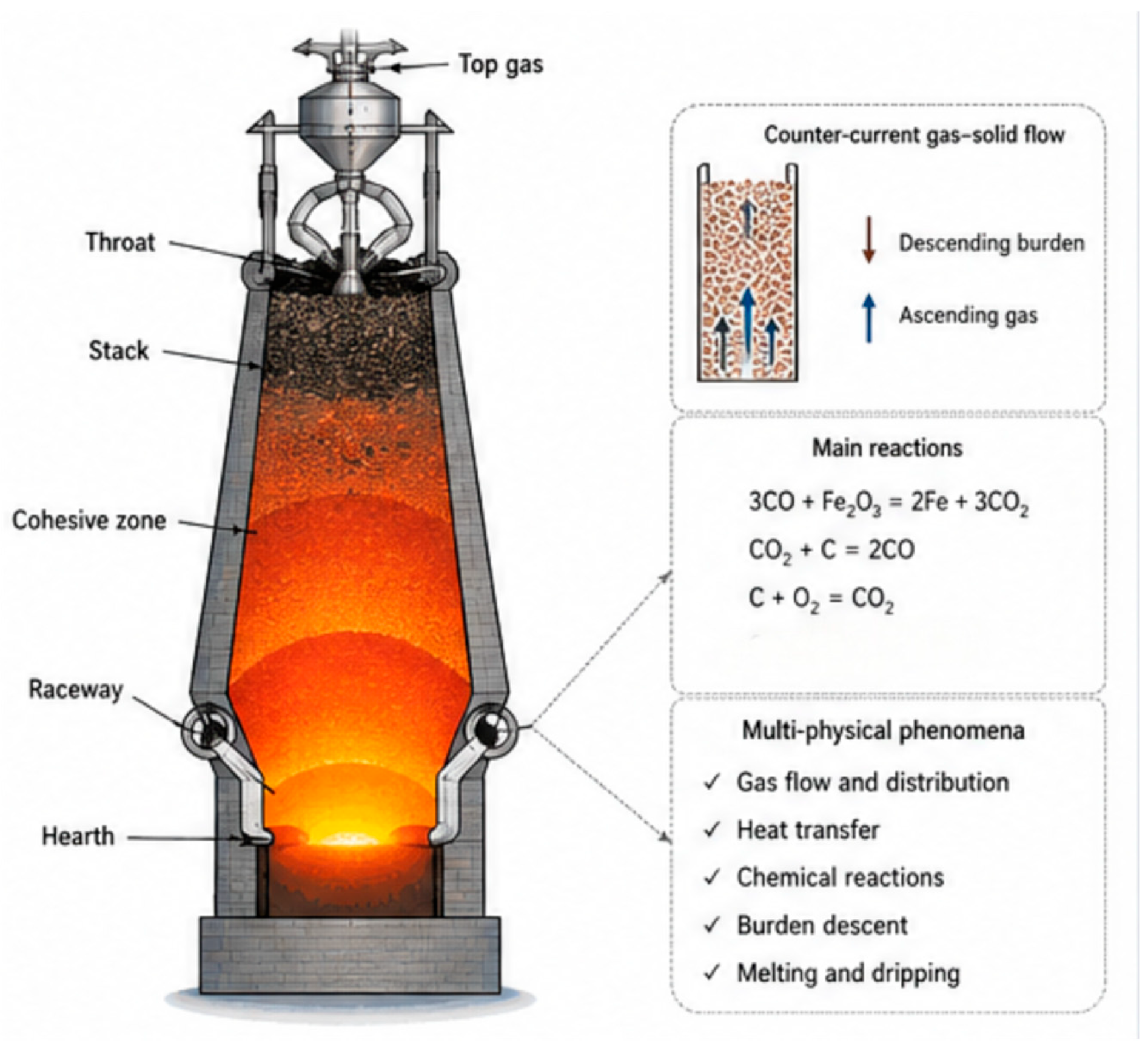
3]. However, due to the harsh operating environment and the limitations of existing measurement techniques, many critical internal phenomena, including gas flow distribution, cohesive zone morphology, and liquid flow behavior, remain difficult to observe directly during blast furnace operation. The typical internal structure and reaction zones of a blast furnace are shown in
Figure 1. Therefore, numerical simulation and mathematical modeling have become important methods for understanding blast furnace internal phenomena and optimizing operational parameters [
1,
4].
Early blast furnace studies mainly focused on packed bed flow and burden permeability. Ergun [
4] proposed the classical packed bed pressure drop equation, which provided an important theoretical basis for subsequent gas flow simulations in blast furnaces. Based on this theory, many researchers investigated the effects of burden distribution and cohesive zone structure on gas flow behavior and furnace operation [
5,
6,
7]. Later, with the development of computational methods, one-dimensional, two-dimensional, and three-dimensional mathematical models were gradually developed to describe the internal flow, heat transfer, and reaction behaviors inside blast furnaces [
3,
8,
9,
10,
11,
12].
Recent advances in computational fluid dynamics (CFD), the discrete element method (DEM), and multiphase flow simulation have significantly promoted the development of blast furnace numerical models [
13]. Recent advances in blast furnace modeling have driven a transition from simplified steady-state approaches toward high-resolution multidimensional simulations that can more realistically represent burden distribution, cohesive zone evolution, particle motion, thermochemical processes, and multiphase transport phenomena [
14,
15,
16,
17,
18,
19]. In particular, three-dimensional CFD models and CFD–DEM coupled approaches have emerged as powerful tools for investigating asymmetric internal states, burden permeability, raceway dynamics, and the effects of operational parameters under industrial blast furnace conditions [
14,
15,
18].
At the same time, the increasing demand for intelligent manufacturing and digital transformation in the ironmaking industry has promoted the development of data-driven and hybrid modeling methods [
20]. Compared with traditional mechanism models, digital twin and intelligent prediction approaches provide new possibilities for real-time blast furnace monitoring, operational optimization, and internal state prediction. In addition, recent studies have also focused on special metallurgical phenomena, such as silicon transfer behavior, titanium-related viscosity changes, and permeability evolution under different burden conditions [
14,
16,
21].
Although considerable progress has been made in the numerical simulation of blast furnace ironmaking, most existing studies are limited to specific physical phenomena or individual modeling methodologies. A systematic review covering the evolution of blast furnace mathematical models, internal state reconstruction methods, and recent intelligent hybrid simulation approaches is still limited [
13,
22]. Therefore, it is necessary to summarize the recent development trends and compare the characteristics of different modeling approaches.
This paper reviews the development of blast furnace numerical simulation and internal state reconstruction methods. The evolution of blast furnace mathematical models, including traditional mathematical models, multiphase CFD models, and recent intelligent hybrid approaches, is summarized and discussed. The characteristics and limitations of different methods are also briefly compared, and future development trends of blast furnace simulation technology are discussed.
2. Reconstruction Methods of Blast Furnace Internal States
Blast furnace ironmaking is a complex process involving gas flow, burden descent, heat transfer, chemical reactions, softening and melting, and liquid flow at high temperatures. Because the internal state of a blast furnace cannot be directly measured during operation, understanding and reconstructing furnace inner states have become important topics in blast furnace research and operation.
2.1. Gas Flow and Packed Bed Permeability Models
Gas flow distribution in a blast furnace directly affects reduction efficiency, heat transfer, burden permeability, and cohesive zone formation. As a result, gas flow has been one of the most extensively studied subjects in blast furnace numerical simulation.
Ergun [
4] established the classical packed-bed pressure drop equation based on fluid flow through granular materials, which provided the theoretical basis for subsequent blast furnace gas flow simulation studies. Based on the packed-bed theory, Nath [
5] investigated the influence of burden distribution and cohesive zone shape on gas flow distribution inside the blast furnace. Delebarre and Molodtsof [
23] studied gas–solid flow behavior under blast furnace conditions and analyzed the influence of pulverized coal injection on flow characteristics. Gong et al. [
8] further developed a blast furnace flow field simulation model and applied it to industrial blast furnace operation.
Later studies gradually coupled gas flow behavior with thermal and burden distribution analysis. Chen and Pan [
9] analyzed the relationship between the flow field and temperature field inside the blast furnace through mathematical simulation. Shi et al. [
10] further introduced multiphase flow concepts into blast furnace numerical simulation to improve the description of internal transport phenomena. Zhu and Cheng [
6] numerically investigated gas flow distribution in the cohesive zone and discussed its influence on permeability distribution. Kaushik and Fruehan [
7] experimentally investigated softening and melting phenomena of mixed burden materials and analyzed their effects on gas permeability in the cohesive zone.
With the development of multidimensional simulation methods, blast furnace research has gradually expanded from simplified gas flow analysis to the investigation of permeability evolution and three-dimensional flow behavior under complex burden conditions. Recent studies have shown that burden structure, particle size, and burden distribution have a significant influence on gas utilization efficiency and pressure drop within the furnace [
15,
18,
21]. Numerical investigation indicated that the decreases in coke and ore sizes could improve thermochemical utilization efficiency, but excessive reduction in particle size may increase pressure drop and flooding tendency inside the furnace [
18]. In addition, permeability evolution under alternative burden materials such as iron ore briquettes has also attracted increasing attention due to the demand for low-carbon ironmaking processes [
21].
Although packed-bed and permeability models can effectively describe gas flow behavior in blast furnaces, many simplified models still rely on empirical assumptions regarding burden structure and permeability distribution. In addition, accurately coupling permeability evolution with burden degradation, cohesive zone variation, and multiphase transport behavior remains a challenge for modern blast furnace simulation.
2.2. Cohesive Zone and Burden Distribution Reconstruction
The cohesive zone (CZ) is a key region in a blast furnace, as it strongly affects gas flow distribution, reduction reactions, and liquid permeability. Therefore, understanding and reconstructing the cohesive zone and burden distribution have become important topics in blast furnace numerical simulation.
Fuentealba et al. [
24] investigated the determination of cohesive zone morphology in blast furnaces through mathematical analysis. Yu and Chen [
25] numerically studied gas flow behavior in the cohesive zone and analyzed its influence on burden movement. Chen et al. [
26] further investigated the effects of burden distribution patterns on packed-bed gas flow behavior and demonstrated the importance of burden structure on furnace permeability. Jimenez et al. [
12] established a mathematical model for gas flow distribution in a blast furnace shaft and analyzed the relationship between burden distribution and gas flow uniformity. Pandey and Yadav [
27] discussed the influence of burden distribution on overall blast furnace performance under industrial operating conditions.
In practical blast furnace operation, burden charging strategy directly affects burden layer structure and gas flow distribution. Jung et al. [
28] established a mathematical model for burden distribution and estimated gas flow behavior under different charging conditions. Zhou et al. [
29] applied coke collapse theory to burden distribution simulation in bell-type blast furnaces. Liu [
30] analyzed blast furnace charging operation and discussed the importance of burden distribution control for stable furnace operation. Jing and Chen [
31] further developed a burden distribution model for bell-less blast furnaces.
Recent studies have significantly improved the capability of burden distribution reconstruction through three-dimensional CFD simulation and DEM-based analysis [
15,
22]. Modern three-dimensional blast furnace models are capable of describing asymmetric burden distribution, layered burden structures, cohesive zone morphology, and multiphase transport under industrial operating conditions [
15]. In addition, DEM simulation has provided an effective method for studying burden movement and burden surface evolution during charging processes [
22].
Modern studies also showed that circumferential non-uniform burden distribution could significantly influence thermal state distribution, cohesive zone morphology, and liquid flow behavior inside the blast furnace [
15]. These findings demonstrated the importance of accurate burden distribution control for improving blast furnace stability and gas utilization efficiency.
Although significant progress has been made in burden distribution and cohesive zone reconstruction, accurately predicting burden descent and the dynamic evolution of the cohesive zone under industrial conditions remains challenging. In particular, the interactions among burden degradation, particle movement, gas flow redistribution, and cohesive zone evolution still require further study.
2.3. Temperature Field and Intelligent Recognition Methods
Temperature field distribution inside the blast furnace is closely related to gas flow behavior, reduction efficiency, and furnace thermal state. Therefore, many studies attempted to reconstruct blast furnace internal states through temperature monitoring and intelligent recognition methods.
Lueckers et al. [
32] introduced high-performance instrumentation into blast furnace monitoring systems and improved the acquisition capability of operational information. Jiang [
33] designed an intelligent system for gas flow pattern recognition and burden distribution guidance based on blast furnace operational data. Fan [
34] further developed a temperature prediction and burden distribution guidance subsystem for blast furnace operation optimization. Tu [
35] applied neural network methods to recognize blast furnace top gas temperature distribution patterns.
With the rapid development of intelligent manufacturing and digitalization technology, data-driven and intelligent prediction methods have attracted increasing attention in recent years [
20]. Compared with traditional mechanism models, data-driven approaches can provide faster prediction capability and better real-time applicability for industrial operation. Recent digital twin studies demonstrated that mechanism-based models combined with operational data could effectively predict silicon, manganese, and titanium contents in hot metal with relatively high prediction accuracy [
20].
Although intelligent recognition and data-driven methods have shown good potential in blast furnace monitoring and prediction, most current models still strongly depend on industrial data quality and operational stability. In addition, the interpretability and generalization capability of purely data-driven models remain important challenges for industrial application.The comparison summary of the methods for reconstructing and modeling the internal state of the blast furnace is presented in
Table 1.
Table 1.
Comparison of Blast Furnace Internal State Reconstruction and Modeling Approaches.
Table 1.
Comparison of Blast Furnace Internal State Reconstruction and Modeling Approaches.
| Modeling Approach | Main Characteristics | Advantages | Limitations |
|---|
| Packed-bed and permeability models [4,5,6] | Based on gas flow and packed bed theory | Simple structure and low computational cost | Difficult to describe complex multiphase behavior |
| One-dimensional models [1,3] | Steady-state analysis along furnace height | Suitable for global mass and heat balance analysis | Radial and circumferential variations are neglected |
| Two-dimensional models [8,9,10,12,19] | Coupled flow field and temperature field simulation | Improved description of radial distribution | Usually assumes axisymmetric conditions |
| Three-dimensional CFD models [14,15,16,17,18] | Simulation of asymmetric furnace inner states | Capable of describing complex multiphase transport behavior | High computational cost and parameter complexity |
| DEM and burden distribution models [22,29,30,31] | Simulation of burden movement and charging behavior | Effective for burden distribution analysis | Coupling with thermochemical behavior remains difficult |
| Data-driven and hybrid models [20,33,34,35] | Combination of industrial data and intelligent algorithms | Good real-time applicability and prediction capability | Strong dependence on data quality and model generalization |
3. Evolution of Blast Furnace Mathematical Models
Mathematical modeling of blast furnaces has evolved significantly with advances in computational capability and theoretical understanding.
Early blast furnace mathematical models mainly focused on simplified descriptions of furnace operation and overall heat and mass balance analysis [
1]. The earliest blast furnace models were one-dimensional steady-state models developed in the late 1960s. A representative model described chemical reactions and heat transfer along the furnace height [
1]. However, radial uniformity was assumed, limiting accuracy and applicability.
In the 1970s–1980s, two-dimensional models were developed to incorporate flow fields and partial differential equations. Representative models include those by Hatano, Yagi, and the BRIGHT model developed by Sugiyama [
2]. These models were used to analyze operating conditions, cohesive zone behavior, and process optimization. Compared with one-dimensional models, two-dimensional simulations improved the description of radial gas flow distribution and temperature variation inside the furnace.
In the 1990s, the multi-fluid theory was introduced, describing furnace phases as gas, solid, liquid, and dust with inter-phase interactions [
3]. Based on this framework, three-dimensional multi-fluid models were developed, enabling more realistic simulation of furnace behavior. The development of computational fluid dynamics (CFD) further promoted the application of multidimensional numerical simulation in blast furnace research [
13].
Recent studies have gradually shifted from simplified steady-state simulation toward three-dimensional dynamic simulation involving burden distribution, cohesive zone evolution, thermochemical behavior, and multiphase transport phenomena [
14,
15,
16,
17,
18,
19]. Modern three-dimensional models can simulate asymmetric inner states and operational parameter effects under industrial conditions [
15,
18]. In addition, recent studies also introduced digital twin and data-driven approaches to improve real-time prediction capability and operational adaptability of blast furnace simulation [
20].
With the advancement of high-performance computing, three-dimensional dynamic models have become feasible and represent the most comprehensive form of blast furnace simulation currently available. Although modern multidimensional models significantly improve the prediction capability of blast furnace internal states, their industrial application is still limited by computational cost, parameter calibration, and difficulties in real-time implementation.
4. Data-Driven and Hybrid Modeling Trends
In recent years, data-driven approaches have been increasingly integrated into blast furnace modeling. Neural networks have been widely used for cohesive zone prediction, temperature field reconstruction, and gas flow pattern identification [
33,
34,
35]. Genetic algorithms have also been applied to burden distribution optimization.
With the rapid development of intelligent manufacturing and industrial digitalization, data-driven modeling has attracted increasing attention in blast furnace research [
13,
20]. Compared with traditional mechanism-based models, data-driven approaches generally provide faster prediction capability and better real-time applicability for industrial operation.
These approaches indicate a shift toward hybrid modeling frameworks that combine physical mechanisms with data-driven learning methods. Such integration improves adaptability to complex industrial environments and enhances predictive capability under uncertain conditions.
Recent studies demonstrated that digital twin and hybrid modeling approaches can effectively combine mechanism simulation with industrial operational data to improve prediction accuracy and operational adaptability [
20]. In addition, modern CFD, DEM, and intelligent prediction methods are gradually being integrated to achieve more comprehensive blast furnace simulation and operational optimization [
13,
22].
Although data-driven and hybrid approaches have shown good potential in blast furnace monitoring and prediction, their industrial application still depends strongly on data quality, model generalization capability, and long-term operational stability. Therefore, the integration of mechanism models and intelligent algorithms is expected to become an important development direction for future blast furnace simulation technology.
5. Conclusions and Perspectives
This review summarizes recent advances in blast furnace numerical simulation and modeling, with a focus on internal state reconstruction and model development. The reviewed approaches include flow-based physical models, thermal and cohesive zone reconstruction methods, burden distribution-based models, and temperature field reconstruction techniques.
Meanwhile, mathematical models have evolved from one-dimensional steady-state formulations to three-dimensional multi-fluid dynamic systems, significantly improving the capability to describe complex furnace behavior. Recent developments in computational fluid dynamics (CFD), the discrete element method (DEM), and digital simulation technologies have further promoted the application of multidimensional blast furnace models in industrial analysis and operation optimization [
13,
14,
15,
16,
17,
18,
19,
20,
21,
22].
Recent studies also demonstrated that modern blast furnace simulation is gradually evolving toward the integration of mechanism-based modeling, CFD simulation, DEM analysis, and data-driven prediction methods [
13,
20,
22]. Compared with traditional standalone mathematical models, hybrid modeling approaches show better adaptability and potential for real-time industrial application.
Despite these advances, several challenges remain, particularly in achieving accurate, real-time, and industrially applicable simulations. Future work is expected to focus on improving computational efficiency, enhancing multi-source data integration, and strengthening coupling between physical models and data-driven methods.
In addition, future blast furnace simulation studies should further improve the description of multiphase interaction, burden degradation behavior, permeability evolution, and thermochemical coupling mechanisms under complex industrial operating conditions. The development of digital twin and intelligent hybrid simulation frameworks is also expected to provide new opportunities for blast furnace operation optimization and intelligent control [
20]. These efforts will help bridge the gap between theoretical modeling and practical industrial application in blast furnace ironmaking.
Author Contributions
Conceptualization, S.G. and X.G.; methodology, S.G. and X.Z.; software, S.G.; validation, S.G., Z.J. and Z.Z.; formal analysis, S.G.; investigation, S.G. and Y.Z.; resources, S.G. and Y.Z.; data curation, S.G., Z.J. and Z.Z.; writing—original draft preparation, S.G.; writing—review and editing, S.G.; visualization, S.G.; supervision, S.G.; project administration, S.G.; funding acquisition, S.G. All authors have read and agreed to the published version of the manuscript.
Funding
This work was supported by the China Postdoctoral Science Foundation under Grant No. 2025M773597.
Data Availability Statement
The data presented in this study are available from the corresponding author upon reasonable request.
Conflicts of Interest
The authors Shanchao Gao, Xu Geng, Zhe Jiang, Yanhui Zhang, and Zhenghong Zhao are affiliated with the State Key Laboratory of Metal Material for Marine Equipment and Application and with Ansteel Iron & Steel Research Institutes. The author Xiaobo Zhang is affiliated with Bayuquan Branch of Angang Steel Co., Ltd. The authors declare that the research was conducted in the absence of any commercial or financial relationships that could be construed as potential conflicts of interest.
References
- Omori, Y. Blast Furnace Phenomena and Modelling. In ISIJ International; Elsevier: London, UK, 1987. [Google Scholar]
- Bi, X.G. Mathematical Model and Computer Control of Blast Furnace Process; Metallurgical Industry Press: Beijing, China, 1996. (In Chinese) [Google Scholar]
- Yagi, J.I. Mathematical modeling of the flow of four fluids in a packed bed. ISIJ Int. 1993, 33, 619–639. [Google Scholar] [CrossRef]
- Ergun, S. Fluid flow through packed columns. J. Mater. Sci. Chem. Eng. 1952, 48, 89–94. [Google Scholar]
- Nath, N.K. Simulation of gas flow in blast furnace for different burden distribution and cohesive zone shape. Mater. Manuf. Process. 2002, 17, 671–681. [Google Scholar] [CrossRef]
- Zhu, Q.; Cheng, S. Numerical simulation of gas flow distribution in the cohesive zone of blast furnace. In Proceedings of the Chinese Society for Metals, Hangzhou, China, 15–17 April 2006. (In Chinese) [Google Scholar]
- Kaushik, P.; Fruehan, R.J. Mixed burden softening and melting phenomena in blast furnace operation: X-ray observation of ferrous burden. Ironmak. Steelmak. 2006, 33, 507–519. [Google Scholar] [CrossRef]
- Gong, X.; Qiu, J.; Fu, S. Development of blast furnace flow field simulation model and its application in Baosteel No.3 blast furnace. J. Wuhan Univ. Sci. Technol. 1998, 4, 391–396. (In Chinese) [Google Scholar]
- Chen, L.; Pan, G. Mathematical analysis of blast furnace flow field and temperature field. Ironmaking 2004, 23, 32–35. [Google Scholar]
- Shi, Y.; Chen, J.; Zhang, L. Numerical simulation of blast furnace based on multiphase flow. J. Wuhan Univ. Technol. 2005, 27, 4–87. [Google Scholar]
- Kowalski, W.; Bachhofen, H.J.; Kreibich, K. Modelling the inner state of the blast furnace: The Thybas models. Ironmak. Steelmak. 1996, 23, 324–327. [Google Scholar]
- Jimenez, J.; Mochon, J.; Sainz, D.A.J. Mathematical model of gas flow distribution in a scale model of a blast furnace shaft. ISIJ Int. 2004, 44, 518–526. [Google Scholar] [CrossRef]
- Abhale, P.B.; Viswanathan, N.N.; Saxén, H. Numerical modelling of blast furnace–Evolution and recent trends. Miner. Process. Extr. Metall. 2020, 129, 166–183. [Google Scholar] [CrossRef]
- Liu, Y.; Jiao, L.; Yu, A.; Kuang, S. Numerical Simulation of Blast Furnace Ironmaking Process with Consideration of Silica Reduction. Metall. Mater. Trans. B 2026, 57, 642–663. [Google Scholar]
- Jiao, L.; Kuang, S.; Li, Y.; Mao, X.; Xu, H.; Yu, A. Numerical simulation of the 3D asymmetric inner states of an ironmaking blast furnace resulting from circumferential non-uniform burden distribution. Metall. Mater. Trans. B 2023, 54, 734–755. [Google Scholar] [CrossRef]
- Liu, Y.; Kuang, S.; Jiao, L.; Yu, A. Numerical Modeling of Titanium Behavior in the Blast Furnace Ironmaking Process. Metall. Mater. Trans. B 2025, 56, 3730–3748. [Google Scholar] [CrossRef]
- Bian, Z.; Chen, D.; Sun, L.; Wang, L.; Zhao, H.; Zhen, Y.; Qi, T. Numerical simulation of multiphase flow in ironmaking process for oxygen-rich side-blown bath smelting furnace. Metall. Mater. Trans. B 2023, 54, 1352–1367. [Google Scholar] [CrossRef]
- Jiao, L.; Zhang, X.; Kuang, S.; Yu, A. Numerical investigation of particle size on the performance of ironmaking blast furnace. Metall. Mater. Trans. B 2024, 55, 3387–3406. [Google Scholar] [CrossRef]
- Abhale, P.B.; Nag, S.; Bapat, Y.; Kulkarni, A.; Viswanathan, N.N.; Padmapal. Development of 2D steady-state mathematical model for blast furnace using OpenFOAM®. Metall. Mater. Trans. B 2022, 53, 3469–3491. [Google Scholar] [CrossRef]
- Xu, Y.; Yang, C.; Liu, Z. Modelling of blast furnace ironmaking process based on digital twin. Digit. Twins Appl. 2024, 1, 161–168. [Google Scholar] [CrossRef]
- Silva, A.M.B.; Leão, P.M.G.C.; Rodrigues, O.D.O.; Lemos, L.R.; Covcevich Bagatini, M. Physical and numerical modelling permeability of blast furnace shaft zone with iron ore briquettes. Ironmak. Steelmak. 2025, 03019233251357178. [Google Scholar]
- Shao, S.; Huang, Y.; Shi, H.; Sun, M. Review on simulation and practice of blast furnace burden distribution process. Metall. Res. Technol. 2025, 122, 610. [Google Scholar] [CrossRef]
- Delebarre, A.; Molodtsof, Y. Fundamental aspects of gas–solid flow: Complex application to the Circofer process and PCI in blast furnace. In Proceedings of the 2nd International Congress on the Science and Technology of Ironmaking and the 57th Ironmaking Conference, Toronto, ON, Cannada, 22–25 March 1998; pp. 1729–1734. [Google Scholar]
- Fuentealba, C.R.G.; Ametrano, R.C.; Etchevarne, P.R.; Zubimendi, J.L. Determination of the cohesive zone of the blast furnace. In AISTech Conference Proceedings; Association for Iron & Steel Technology: Warrendale, PA, USA, 2004; Volume 1, p. 419. [Google Scholar]
- Yu, H.; Chen, Y. Numerical simulation of gas flow in cohesive zone and its influence on burden movement. J. Baotou Univ. Iron Steel Technol. 2006, 25, 1–4. [Google Scholar]
- Chen, J.; Akiyama, T.; Yagi, J.I. Effect of burden distribution pattern on gas flow in a packed bed. ISIJ Int. 2007, 32, 1259–1267. [Google Scholar]
- Pandey, B.D.; Yadav, U.S. Blast furnace performance as influenced by burden distribution. Ironmak. Steelmak. 2013, 26, 187–192. [Google Scholar]
- Jung, S.K.; Baek, C.Y.; Chung, W.S. Estimation of gas flow in blast furnace by mathematical model for burden distribution. J. Korean Inst. Met. Mater. 2001, 39, 1171–1178. [Google Scholar] [CrossRef] [PubMed]
- Zhou, Y.; Gong, X.; Tu, C. Application of coke collapse theory in burden distribution model of bell-type blast furnace. Steel Res. 2004, 32, 1–4. [Google Scholar]
- Liu, Y.; Zhang, J.; Jiao, K.; Huang, W. The Operation of Contemporary Blast Furnaces; Springer: Singapore, 2021. [Google Scholar]
- Jing, W.; Chen, X. Mathematical model of burden distribution in bell-less blast furnace. Metall. Autom. 2003, 27, 29–31. [Google Scholar]
- Lueckers, J.; Ramelot, D.; Desplanques, C.; Dodet, C. Use of high-performance instrumentation in blast furnace computer monitoring. In Proceedings of the Ironmaking Conference, Dallas, TX, USA, 28–31 March 1993. [Google Scholar]
- Jiang, H. Design and Implementation of Intelligent System for Gas Flow Pattern Recognition and Burden Distribution Guidance. Ph.D. Thesis, Northeastern University, Boston, MA, USA, 2000. (In Chinese) [Google Scholar]
- Fan, K. Design and Implementation of Temperature Prediction and Burden Distribution Guidance Subsystem. Ph.D. Thesis, Northeastern University, Boston, MA, USA, 2003. (In Chinese) [Google Scholar]
- Tu, C. Neural Network Study on Gas Temperature Distribution Pattern Recognition in Blast Furnace Top Gas. Ph.D. Thesis, Wuhan University of Science and Technology, Hubei, China, 2004. (In Chinese) [Google Scholar]
| Disclaimer/Publisher’s Note: The statements, opinions and data contained in all publications are solely those of the individual author(s) and contributor(s) and not of MDPI and/or the editor(s). MDPI and/or the editor(s) disclaim responsibility for any injury to people or property resulting from any ideas, methods, instructions or products referred to in the content. |