Article

A Study on the Thermal Behaviour of Micron-Sized Aluminium Powder in Contact with Water

College of Urban Construction and Safety Engineering, Shanghai Institute of Technology, Shanghai 201418, China
*
Author to whom correspondence should be addressed.
Processes 2026, 14(12), 2007; https://doi.org/10.3390/pr14122007 (registering DOI)
Submission received: 10 May 2026 / Revised: 11 June 2026 / Accepted: 17 June 2026 / Published: 20 June 2026
(This article belongs to the Section Chemical Processes and Systems)

Abstract

Aluminium powder, an energetic material, is prone to thermal runaway upon water exposure under local heat sources, yet the nonadiabatic mechanisms of micron-sized accumulated aluminium powder under localised heating remain unclear. This study employs a proprietary characterisation platform to investigate the effects of particle size, water content, and local heat source power on heat transfer in the dry state and on parameters including induction time, onset temperature, peak heat release rate, and reaction heat during the induction and main reaction phases. In the dry state, decreasing particle size enhances effective thermal conductivity and accelerates temperature rise, whereas elevated local heat source power exacerbates thermal inertia. Under local heating upon water exposure, reduced particle size significantly enhances reactivity; the reaction heat of 2 μm powder reaches 983 J/g, approximately fourfold that of 106 μm powder. Water content exhibits a nonmonotonic effect, with the onset temperature reaching a minimum of 66.4 °C at a water content of 25%, while the reaction heat peaks at 33% water content. Interestingly, increasing local heat source power was found to suppress reaction intensity, and reaction heat at 10 W is one sixth of that at 2.5 W, attributed to rapid product layer densification and the possible steam-film barrier effect shifting the controlling mechanism from chemical to diffusion control. A coupled multifactorial predictive model incorporating the three factors was established with a correlation coefficient R2 of 0.92, providing a theoretical basis and practical guidance for hazard assessment and safe storage of aluminium powder.

1. Introduction

As the non-ferrous metal with the highest global production and consumption, aluminium powder is widely used in fields such as propellants, metal fuels and catalytic systems due to its high energy density (approximately 29 MJ·kg−1), good storage stability and environmentally friendly combustion products [1]. However, during production, processing and storage, aluminium powder may become hydrated due to changes in ambient humidity or accidental water ingress. In the presence of localised heat sources, such as hot equipment surfaces or electrical sparks, this can easily trigger a runaway chain reaction involving the aluminium-water reaction, leading to fire or explosion incidents [2,3]. In particular, the wet aluminium powder explosion that occurred in Shanghai, China, in 2023 demonstrated that, once hydrated, aluminium powder remains in a state of heat accumulation under the influence of internal heat sources. Consequently, in-depth research into the mechanisms governing the thermal behaviour of aluminium powder under the combined influence of local heat sources and water holds significant theoretical and practical importance for the safe storage of aluminium powder and the prevention of accidents.
The heat transfer within the accumulated particles is significantly influenced by the particle size [4]. Studies have shown that particle size exerts a significant influence on the effective thermal conductivity: fine-grained aluminium powder, due to its dense packing and reduced inter-particle spacing, significantly increases the effective thermal conductivity (keff). Conversely, large-particle-size aluminium powder, due to its higher porosity, experiences enhanced natural convection of gas within the pores, leading to easier heat dissipation [5,6]. Regarding the aluminium powder–water reaction system, the reaction between aluminium and water is highly exothermic in thermodynamic terms, with a standard molar enthalpy change of approximately −837.3 kJ/mol. Theoretically, the complete reaction of one gram of aluminium can produce approximately 1.24 L of hydrogen gas [7]. The dense aluminium oxide passivation layer on the surface of aluminium particles prevents direct contact between water molecules and the active aluminium within, resulting in a relatively slow reaction at room temperature [8,9]. Schoenitz et al. [10] and Nie et al. [11] systematically investigated the oxidation behaviour of aluminium particles and the interfacial mass transfer mechanisms in the presence of water. Saceleanu et al. [12] and Wang et al. [13] determined the kinetic characteristics of the aluminium–water reaction using calorimetry, dividing the reaction into three stages: hydrolysis of the aluminium oxide layer, chemically controlled reaction, and diffusion-controlled reaction.
Particle size, content of water, and heat source power are the three key factors affecting the thermal behaviour of aluminium powder when exposed to water. With regard to the particle size effect, Dong et al. [14] reported that decreasing particle size significantly enhanced the hydrogen production rate of aluminium–water reactions. Zhang et al. [15] further demonstrated that smaller aluminium particles provide a larger specific surface area and more active reaction sites for water molecules, and observed substantially faster reaction kinetics for 3 μm aluminium powder compared with 25 μm powder. Razavi-Tousi [16] showed that particle size and structural characteristics strongly influence the corrosion and hydrogen-generation behaviour of aluminium particles in hot water. In addition, Saceleanu et al. [12] directly compared micro-sized and nano-sized aluminium powders and revealed pronounced differences in their reaction behaviour, with nano-aluminium exhibiting significantly faster hydrogen-generation kinetics and higher conversion efficiency than micro-aluminium under similar conditions. These findings indicate that particle size influences not only the available reaction surface area but also the heat and mass transfer processes, thereby playing a critical role in determining the thermal behaviour of aluminium powder upon contact with water [17,18]. The importance of particle size has also been recognised in other particulate systems. For example, studies on kaolin-based palm nanolubricants demonstrated that particle size significantly affects system performance and can serve as an important evaluation parameter in multi-criteria decision-making frameworks for process optimisation [19]. However, the aforementioned studies have primarily focused on the reaction kinetics of dispersed aluminium powder. In the case of packed aluminium powder systems, a reduction in particle size not only increases the specific surface area but also significantly raises the packing density and reduces the porosity [5,6], thereby substantially enhancing the system’s heat transfer efficiency and influencing the thermal behaviour of the aluminium powder’s reaction with water. Regarding the influence of water content, the study by Pang et al. [2] revealed its sensitive effect on the reaction temperature and pressure of aluminium powder, finding that aluminium powder heats up most rapidly at 30% water content, whilst excess water above 50% inhibits violent reactions due to dilution effects and mass transfer hindrances. Regarding the mechanism of action of local heat sources, Arlington et al. [20] systematically reviewed the application characteristics of exothermic reaction formation as a local heat source in the fields of material joining and sealing, revealing the mechanism by which local heat sources achieve rapid local heating through self-propagating reactions. Knecht et al. [21], on the other hand, developed a heat transfer surrogate model to describe the quasi-steady-state thermal distribution characteristics of oscillating flow systems containing local heat sources.
Although considerable progress has been made in understanding the aluminium–water reaction, several important knowledge gaps remain. First, most previous studies have focused on dispersed aluminium particles, whereas industrial accidents more commonly involve accumulated aluminium powder. Second, existing investigations have predominantly been conducted under uniform-heating or near-adiabatic conditions, while the thermal behaviour of aluminium powder exposed to localised heat sources has received limited attention. Third, previous studies have mainly emphasised reaction kinetics, hydrogen generation, or pressure evolution, whereas the coupling relationship between heat transfer characteristics and reaction behaviour during different reaction stages remains insufficiently understood. In particular, the combined influences of particle size, water content, and local heat source power on the induction process and subsequent exothermic behaviour have not yet been systematically clarified. To address these gaps, a proprietary platform for the quantitative characterisation of the thermal behaviour of aluminium powder upon contact with water was employed to systematically investigate the thermal response of accumulated micron-sized aluminium powder under localised heating conditions. Six representative parameters were selected to quantitatively evaluate the thermal behaviour of the system, namely the induction time (tin), onset temperature (Tonset), maximum heat release rate (qr_max), time to reach the maximum heat release rate (Time to qr_max), total reaction heat (Qreaction), and reaction duration (Duration time). Based on these parameters, the influences of particle size, water content, and heat source power on the induction process, reaction intensity, and heat release behaviour were systematically analysed. Furthermore, SEM-EDS characterisation was employed to investigate the evolution of reaction products and elucidate the mechanisms governing the thermal behaviour of aluminium powder upon contact with water. The findings provide fundamental insights into the thermal hazard evolution of aluminium powder during storage and accidental water exposure, and offer technical support for risk assessment and safety management.

2. Experiment and Methods

2.1. Experimental Materials

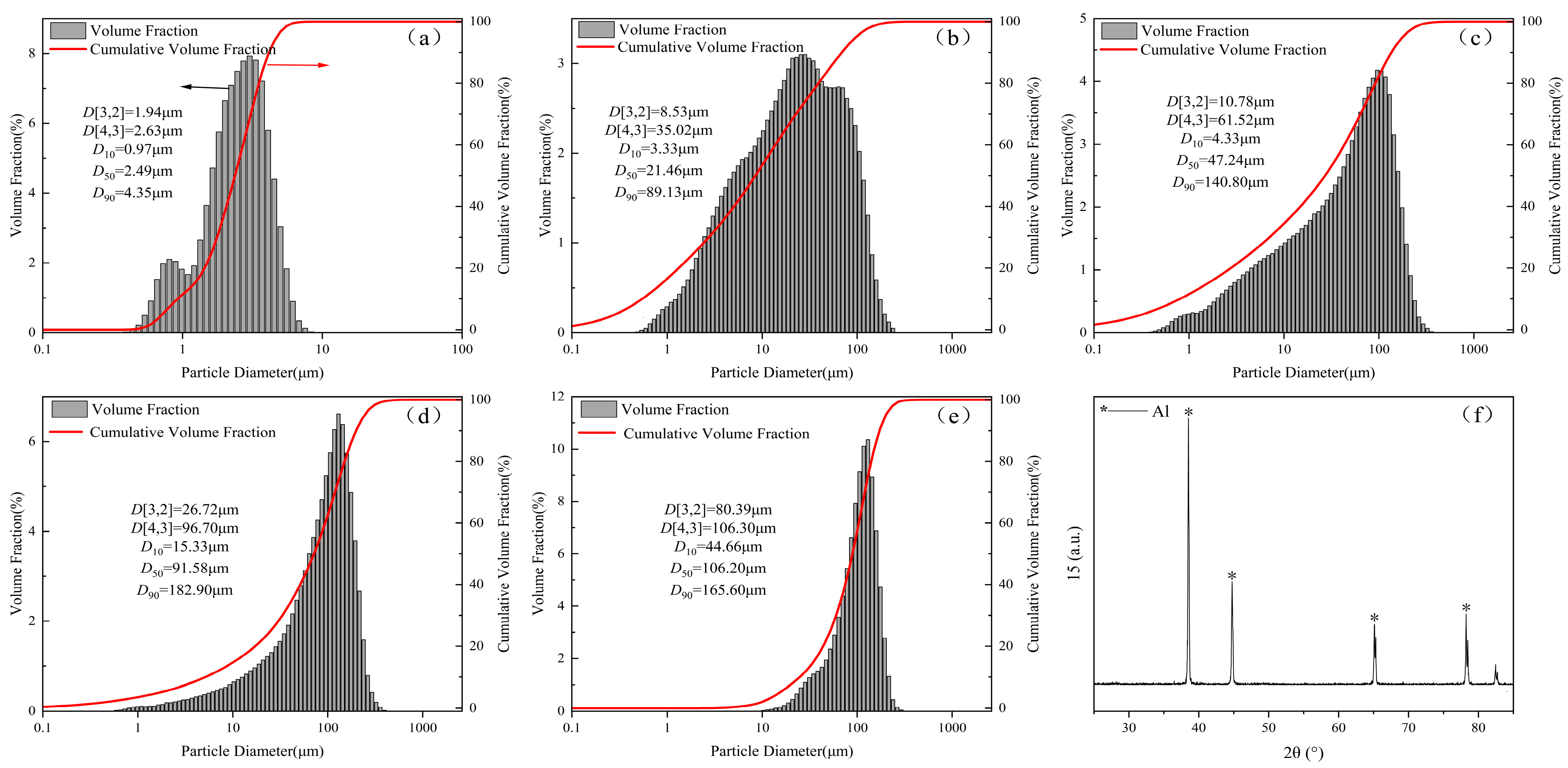
For this experiment, high-purity aluminium powder produced by Sinopharm Group was selected, with a purity of 99%. Deionised water with a stable initial pH of approximately 6.5–7.0 was used throughout all experiments to eliminate interference from dissolved ions and maintain consistent chemical conditions. This prevented potential interference or errors in the reaction results, thereby improving the accuracy and reproducibility of the experimental data. To systematically investigate the influence of aluminium powder particle size on its thermal behaviour upon contact with water, this study selected five aluminium powder samples of different specifications. A Bettersize 2600 laser particle size analyser (Bettersize Instruments Ltd., Dandong, China) was employed to quantitatively characterise the particle size distribution of each sample. The volume mean diameters D[4,3] were 2.63, 35.02, 61.52, 96.70 and 106.30 μm, respectively, while the corresponding median diameters D50 were 2.49, 21.46, 47.24, 91.58 and 106.20 μm. For simplicity, these powders are hereafter referred to as 2, 21, 47, 92 and 106 μm aluminium powders according to their D50 values. Additional particle size distribution parameters, including D[3,2], D10 and D90, are summarised in Figure 1a–e. Since D50 is widely adopted as a representative particle size parameter for metallic powders, it was used in the subsequent analysis and discussion. As shown in Figure 1, the samples predominantly exhibited a unimodal distribution. This indicated that the particle size range was relatively concentrated and that the particle size uniformity was good. In this study, the most frequently used sample was the 106 μm aluminium powder. Figure 1f shows the X-ray diffraction pattern of the 106 μm sample, indicating that it consists primarily of high-purity aluminium. All aluminium powder samples were treated in a vacuum oven at 50 °C for 2 h prior to use. This minimised potential interference from ambient humidity on the reaction system. The morphological characteristics and elemental compositions of the samples were examined using a FEI Quanta 200 scanning electron microscope (Thermo Fisher Scientific, Waltham, MA, USA) equipped with an EDAX TEAM energy dispersive X-ray spectrometer.
The rigorous screening and characterisation of the experimental materials laid a solid foundation for the subsequent precise investigation of the thermal behaviour of aluminium powders upon contact with water in the presence of a local heat source.

2.2. Experimental Setup

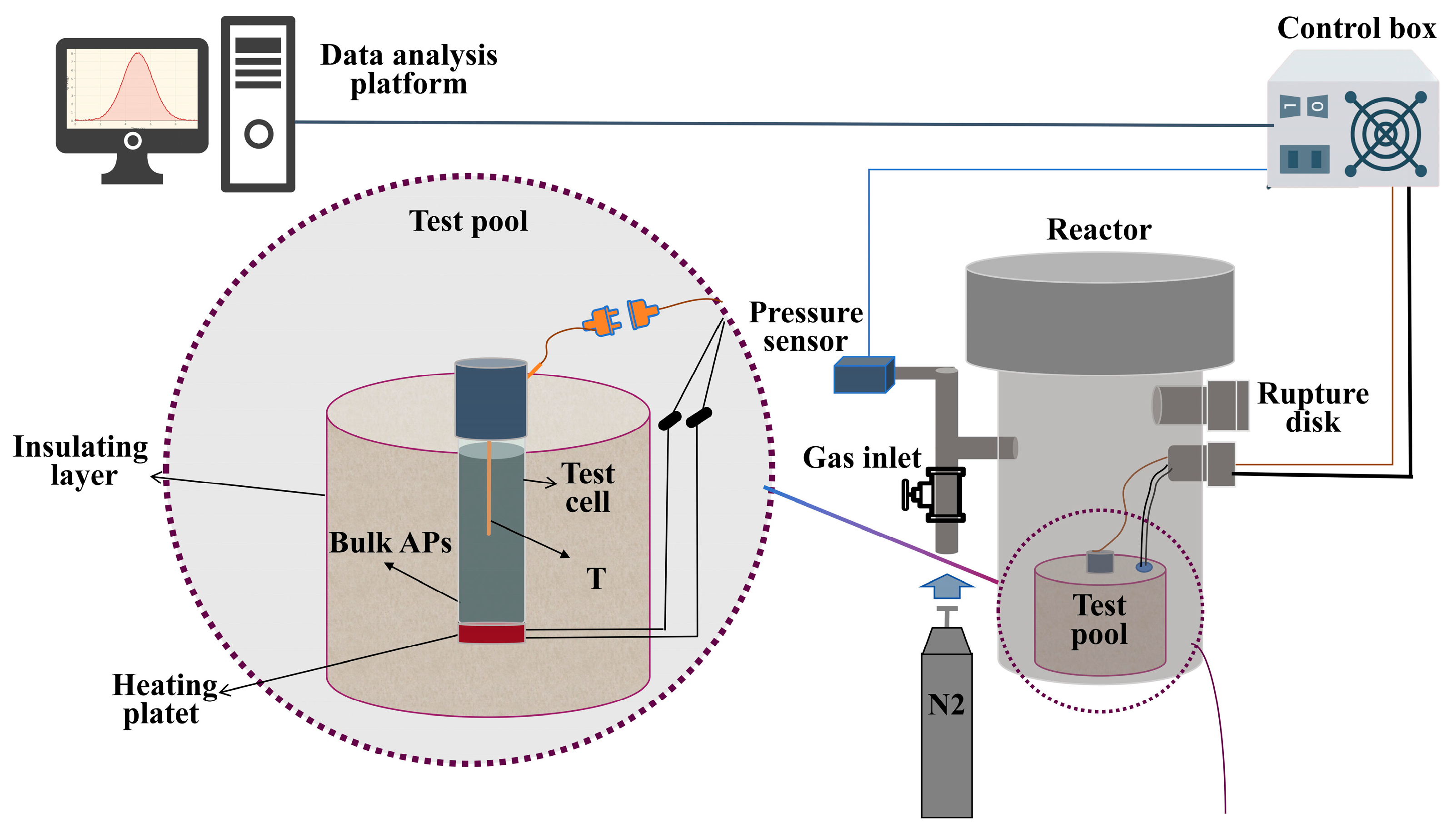
For each experiment, 3.00 g of aluminium powder was first placed into the reaction cell. The required amount of deionised water was then added according to the designated water-to-aluminium ratio. To minimise premature reaction during sample preparation, the deionised water was pre-cooled to around 0 °C, and the reaction cell was continuously immersed in an external ice bath throughout the mixing process. After water addition, the mixture was manually stirred for several minutes using a stainless-steel wire until no visible liquid accumulation or dry powder agglomeration was observed, ensuring a reasonably uniform distribution of water within the powder before testing. The reactor was subsequently sealed and immediately connected to the experimental system for testing. The bottom heating plate is then activated to heat the sample at a constant power, with continuous monitoring until the temperature and pressure stabilise. A proprietary platform designed for the quantitative characterisation of the thermal behaviour of aluminium powder upon contact with water was employed. A schematic diagram of the apparatus is shown in Figure 2. The platform primarily consists of a reaction vessel, a heating and temperature control system, a pressure sensor, a data acquisition and analysis platform, a safety interlock system and a control box. The reaction vessel is a borosilicate glass cylinder with an inner diameter of 13 mm and a height of 45 mm, with an aspect ratio of approximately 3.5. It is covered with a thermal insulation layer to minimise radial heat loss. A 0–10 W controllable heating element is positioned at the base to simulate a local heat source, with the power maintained at a constant level throughout the experiment. A K-type sheathed thermocouple is positioned at the centre of the aluminium–water mixture to monitor temperature changes in real time. In this study, Tonset was defined as the apparent onset temperature measured by the thermocouple located at the geometric centre of the aluminium–water mixture. An additional three-thermocouple experiment was conducted under the representative condition of 5 W heat source power, 20% water content, and 106 μm particle size. As shown in Supplementary Figure S1, axial temperature gradients existed within the powder bed; however, the central thermocouple provided a consistent and reproducible basis for comparing Tonset among different experimental conditions. A pressure sensor and a burst disc are installed at the top of the reactor to serve as overpressure protection devices. The system incorporates an atmosphere control module. Prior to the experiment, the system is purged with 99.9% high-purity N2 for 10 min to eliminate oxygen interference. All experiments were conducted in a laboratory environment with an ambient temperature of approximately 25 °C, a relative humidity of approximately 50%, and an atmospheric oxygen concentration of approximately 20.9 vol.%.
In the experiment, 3.00 g of aluminium powder was weighed and mixed according to a water-to-aluminium ratio ranging from 1:7.5 to 1:1, corresponding to moisture contents of 12%, 17%, 20%, 25%, 33%, and 50% [22]. Five aluminium powders with particle sizes of 2, 21, 47, 92 and 106 μm, as described in Section 2.1, were selected to investigate the effect of particle size on thermal behaviour under a fixed water content of 20% and a heat source power of 2.5 W. Three power settings (2.5, 5 and 10 W) were employed to examine the influence of heat source intensity. Blank control experiments were conducted simultaneously using dried aluminium powder and under low-power heat source conditions during the induction phase.

2.3. Analytical Methods

For both the dry aluminium powder system and the aluminium powder–water system (hereinafter collectively referred to as ‘the system’), prior to the initiation of the reaction, the energy input from the heating element is equal to the sum of the heat stored within the system and the heat lost to the environment [23]. A non-adiabatic thermal model is established based on the law of conservation of energy, and the equilibrium relationship governing energy conservation in the system is shown in Equation (1):
Q heat   =   Q Al   +   Q loss
where Qheat is the energy input per unit time from the local heat source (J); QAl is the energy absorbed by the system for temperature rise (J), and Qloss is the heat dissipated from the system (J).
The heat required to raise the system temperature can be expressed by Equation (2) [24]:
Q Al   =   c m T
The specific heat capacity of a mixture can be expressed using Equation (3) [25]:
c   =   c Al x Al   +   c w x w
where cAl and cw denote the specific heat capacities of aluminium powder and water, respectively, in kJ/(kg·K); cAl = 0.88 kJ/(kg·K) and cw = 4.18 kJ/(kg·K). xAl and xw denote the mass fractions of aluminium powder and water, respectively.
According to Newton’s law of cooling [26], the rate of heat dissipation can be written as Equation (4):
d Q loss d t   =   h A ( T T 0 )
where h is the heat dissipation coefficient of the sample (W·m−2·°C−1), A is the heat dissipation surface area (m2), T is the sample temperature (°C), and T0 is the ambient temperature (°C).
Since the local heat source in this study employs a fixed heating power, differentiating Equation (1) yields Equation (5).
P = c m d T d t + h A ( T T 0 )
where P represents the heat source power (W). A relatively smooth curve from before the reaction is selected, and cm and hA are fitted using this equation. The fitted heat-loss correction parameters (hA) and corresponding fitting intervals for all experimental conditions are summarised in Supplementary Table S1.
Once the induction phase of aluminium powder in contact with water has concluded, the system enters a rapid reaction phase. The energy balance equation for this phase is given by Equation (6).
P + m q r = c m d T d t + h A ( T T 0 )
where qr is the rate of exothermic reaction (W).

3. Results and Discussion

3.1. Effects of Heat Transfer in Powders

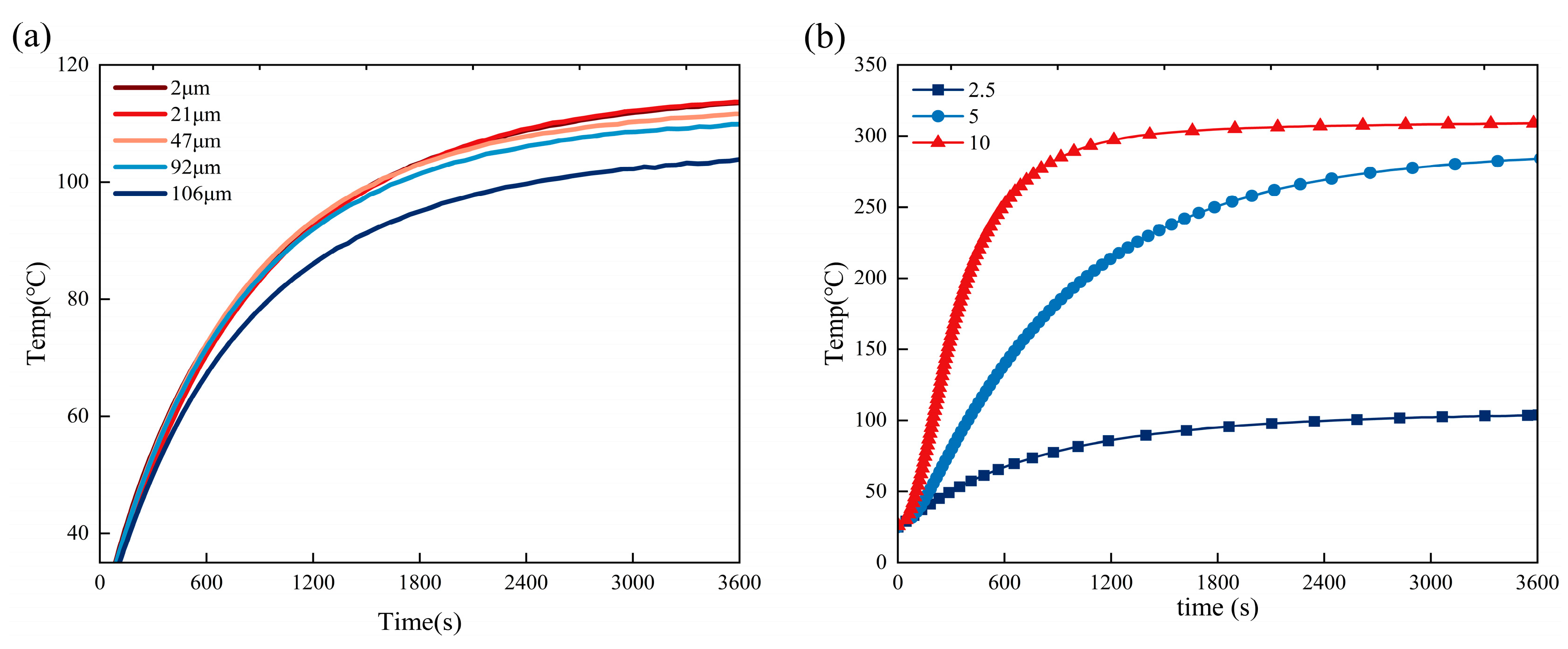
The heat transfer behaviour of piled aluminium powder under the influence of a local heat source forms the physical basis for understanding the mechanisms underlying the evolution of thermal runaway hazards. To eliminate the interference of chemical reactions and establish a baseline reference involving heat transfer processes alone, a systematic study was conducted on the temperature rise characteristics of dry aluminium powder under a constant bottom heat source power of 2.5 W. As shown in Figure 3a, under the influence of a constant local heat source, piled aluminium powder of different particle sizes exhibits distinct temperature rise characteristics. This difference primarily stems from the mechanism by which the particle size effect regulates the effective thermal conductivity of the powder bed. The spacing between particles decreases as particle size decreases. Consequently, the effective thermal conductivity increases as powder particle size decreases [27], thereby enhancing the efficiency of axial heat conduction and resulting in a faster rate of temperature rise and a higher steady-state temperature. Furthermore, the improved heat transfer efficiency in fine-particle powders promotes a more uniform temperature distribution within the bed, thereby exerting a critical influence on the induction time of the aluminium–water reaction system and its subsequent exothermic behaviour.
Figure 3b illustrates the temperature rise characteristics of 106 μm aluminium powder under three different local heat source powers. Both the initial rate of the temperature rise and the steady-state temperature show a significant positive correlation with the heat source power. When the power is increased from 2.5 W to 10 W, the steady-state temperature of the system rises sharply from 100 °C to 308 °C, whilst the time required to reach thermal equilibrium decreases correspondingly with increasing power. This thermal behaviour can be explained by the transient energy balance equation. As shown in Equation (5), during the initial heating phase, the heat dissipation term is negligible and the heating rate is approximately proportional to the power. Consequently, as the heat source power increases, the initial heating rate of the aluminium powder increases significantly. Under high-power conditions, the bottom heat flux density increases significantly, leading to an intensified axial temperature gradient. Heat accumulates rapidly at the bottom of the powder bed, resulting in a pronounced thermal inertia effect [28,29]. As the temperature difference increases, the heat dissipation rate follows an exponential growth curve in accordance with Newton’s law of cooling, until it reaches a steady state when it equals the heat source power. At this point, the steady-state temperature Tss satisfies Equation (7). These power-dependent heat transfer characteristics indicate that compacted aluminium powder exhibits a faster temperature rise response and a higher risk of thermal accumulation under the influence of localised high heat flux densities.
T ss =   T 0 + P h A

3.2. Effects of Water Content

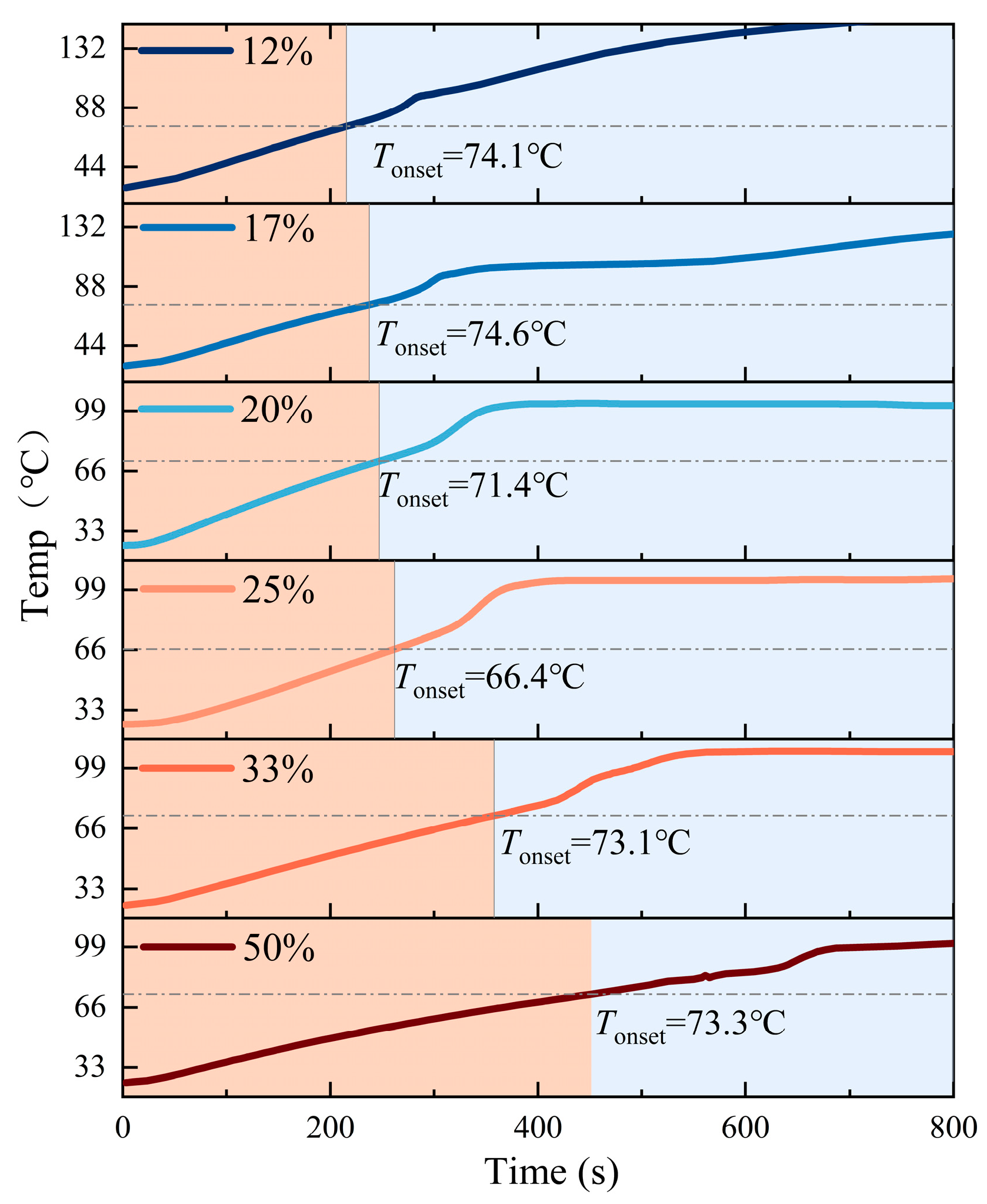
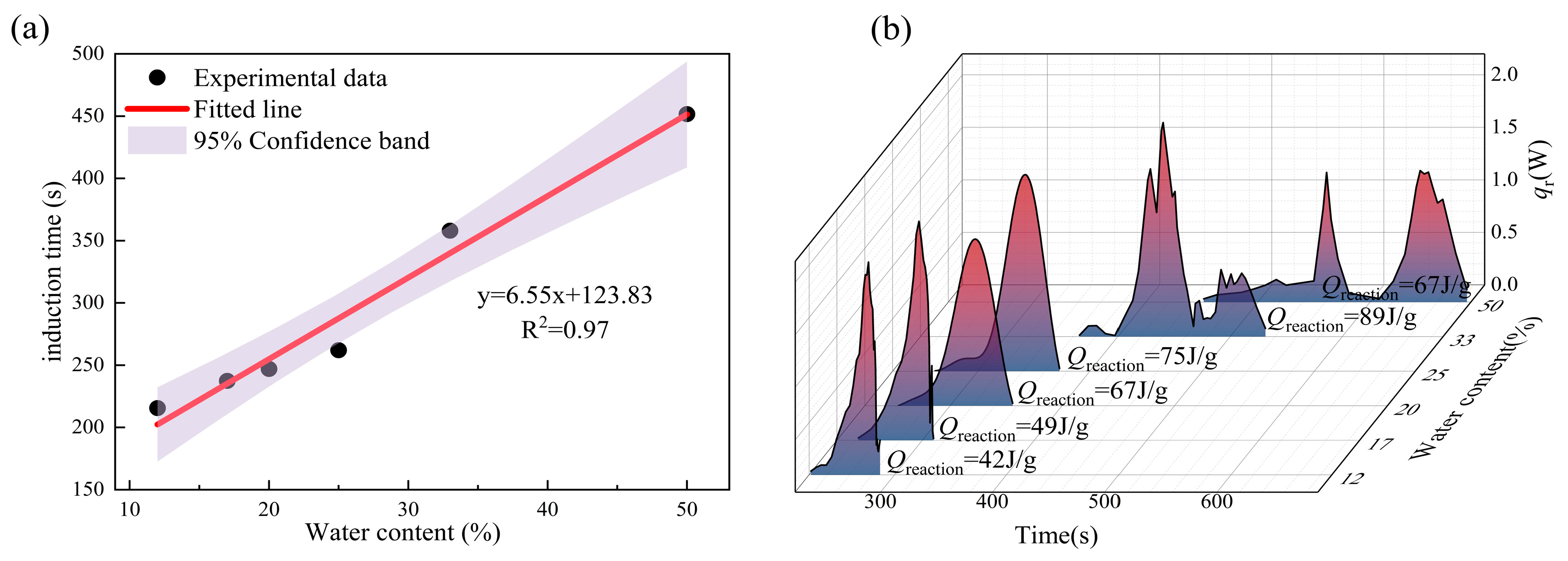
Water content refers to the mass fraction of deionised water used in the reaction within the aluminium powder–water system. To investigate the effect of water content, experiments were conducted on aluminium powder–water systems with water contents of 12%, 17%, 20%, 25%, 33% and 50% under a 5 W local heat source. In this study, 12% and 17% were classified as low water content, 20% and 25% as medium water content, and 33% and 50% as high water content. As shown in Figure 4, the temperature curve of the reaction between aluminium powder and water exhibits phased characteristics. The induction phase involves a slow temperature rise, followed by a rapid reaction phase. After the reaction is complete, water evaporates under the influence of local heat sources, and the temperature rises again after the evaporation is complete. Water content influences the Tonset of the aluminium powder’s reaction with water. When the water content varies within the range of 12% to 50%, Tonset exhibits a trend of first decreasing and then increasing. At a water content of 25%, Tonset is lowest, reaching 66.4 °C. At the same time, tin shows a significant linear increase with increasing water content, and the fitting equation is given by Equation (8).
y = 6.55 x + 123.83
the coefficient of determination for the fitted equation is R2 = 0.97, as shown in Figure 5a. Based on the analysis in the preceding section, this linear relationship stems from the significant increase in the heat capacity of the mixed system. According to Equation (3), when the water content increases from 12% to 50%, the specific heat capacity of the system rises from approximately 1.18 kJ/(kg·K) to 2.53 kJ/(kg·K), and the mass of the system increases accordingly. The high heat capacity significantly delays the time required for the system to reach the critical temperature for oxide layer rupture, thereby linearly extending the reaction induction period [30,31].
The exothermic characteristics of the reaction exhibit a non-monotonic relationship with water content. As shown in Figure 5b, qr_max peaks at 2.1 W/g at a water content of 17%, but drops to 1.3 W/g at a high water content of 50%. More crucially, Qreaction exhibits an inverted U-shaped distribution, rising initially and then decreasing. Specifically, as the water content increases from 12% to 33%, the heat release increases significantly from 42 J/g to 89 J/g, representing a 110% increase. However, upon further increase to 50%, the heat release actually decreases. This non-linear characteristic reflects the competing mechanisms of water playing dual roles as both a heat transfer medium and a reactant within the reaction system [32].
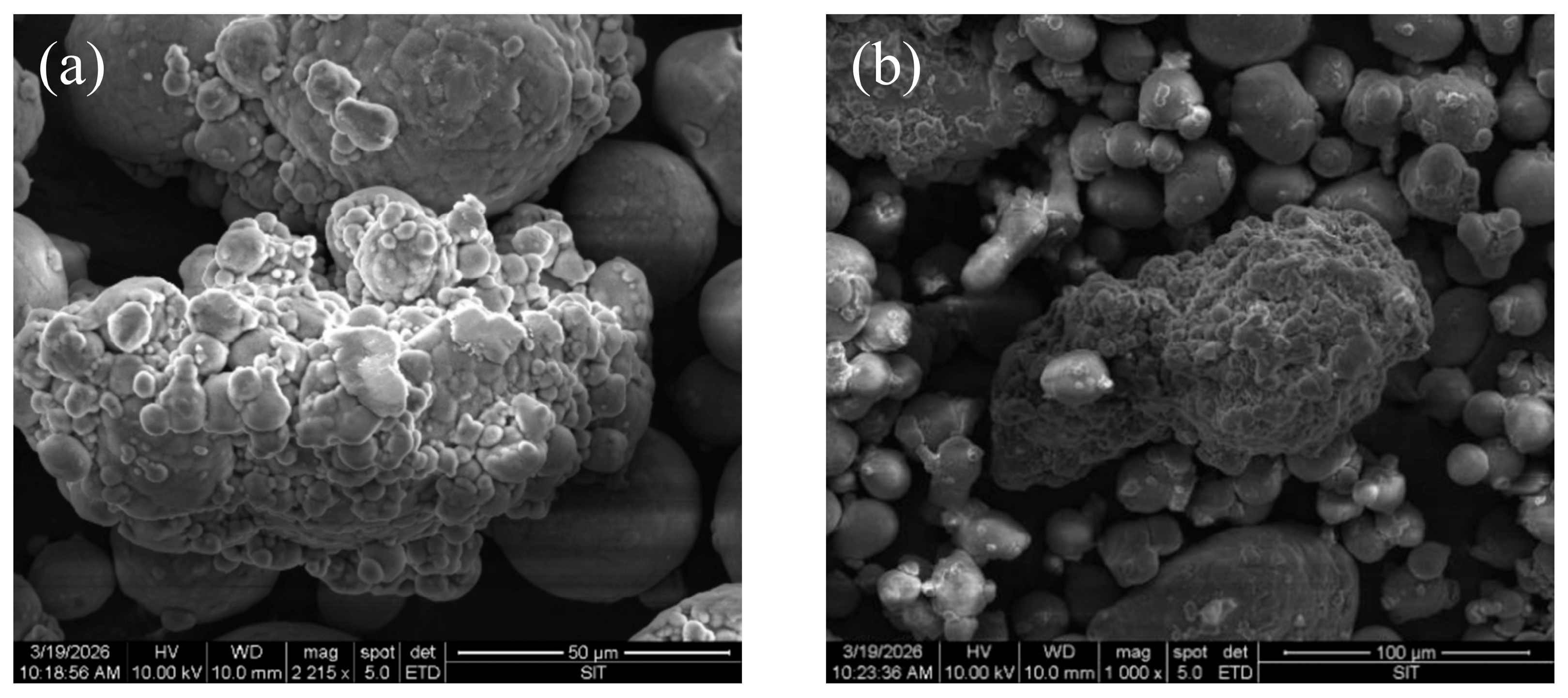
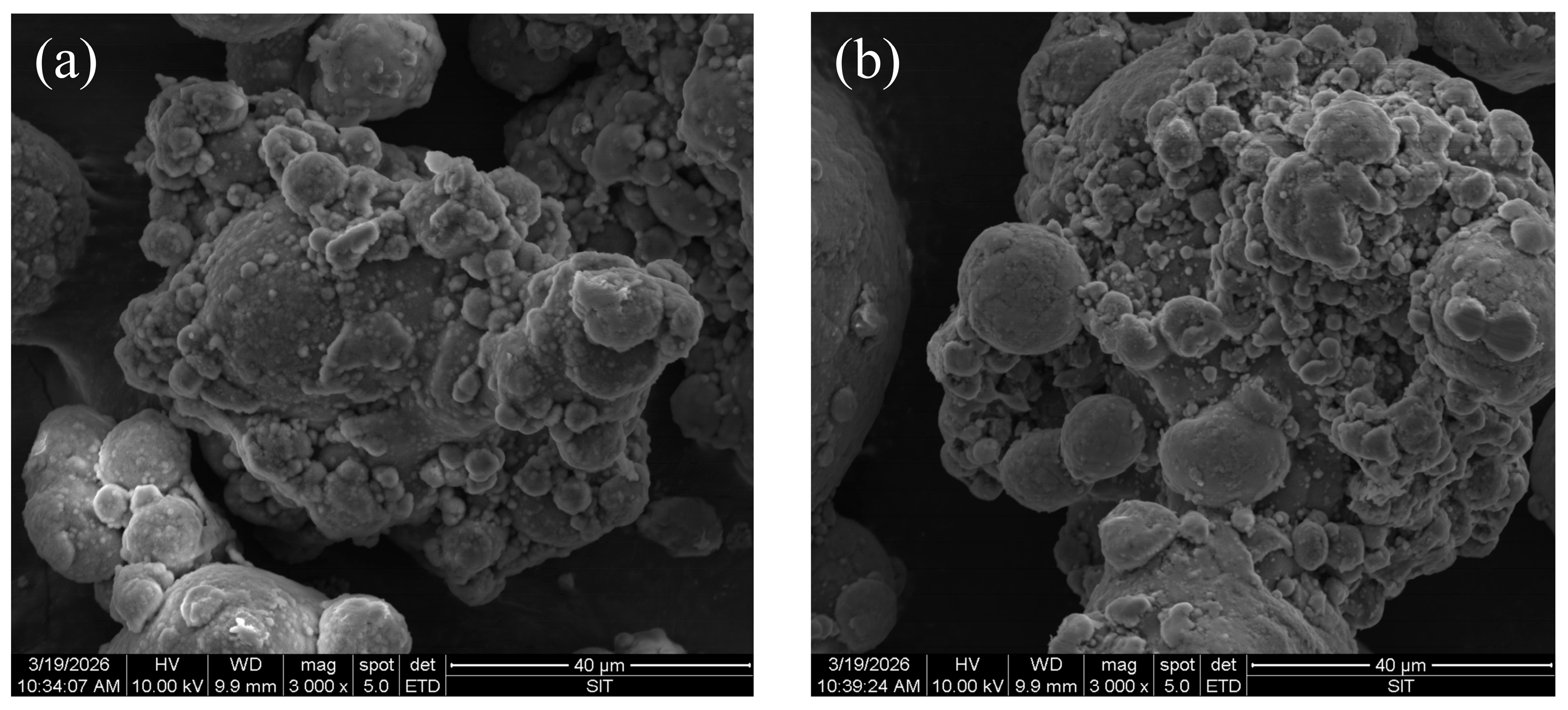
In the low to medium water content range, an appropriate amount of water ensures that exposed aluminium nuclei come into sufficient contact with water molecules, thereby enhancing the reaction conversion rate. However, when the water content is too high, excess liquid water may lead to an excessively large heat capacity of the system and the formation of a thick liquid film, increasing the diffusion resistance of water molecules towards the aluminium nucleus surface [33]. At the same time, the intense endothermic effect of evaporation enhances convective heat transfer losses, limiting the temperature rise in the system [34]. More importantly, under high water content conditions, the layer of aluminium hydroxide produced by the reaction rapidly densifies, hindering the continued diffusion of water molecules towards unreacted aluminium nuclei and causing the reaction to terminate prematurely, as evidenced by a significant reduction in heat release [35,36]. SEM-EDS analysis was conducted on the products of aluminium powder reacting with water under different moisture contents. As shown in Figure 6a, at a water content of 25%, the reaction products exhibited a loose structure with fine particles dispersed and adhering to the surface of the aluminium powder. Simultaneously, the oxygen mass fraction was 40.69%, indicating that the product layer was relatively thin. As depicted in Figure 6b, at a water content of 50%, the products underwent significant agglomeration, forming dense block-like aggregates. The oxygen mass fraction rose to 47.16%, indicating that the product layer had significantly thickened and largely coated the aluminium core. The densification of the product layer at the high water content effectively blocked the diffusion path of water molecules to the unreacted aluminium core, which is consistent with the experimental results showing a significant reduction in heat release.

3.3. Effects of Particle Size

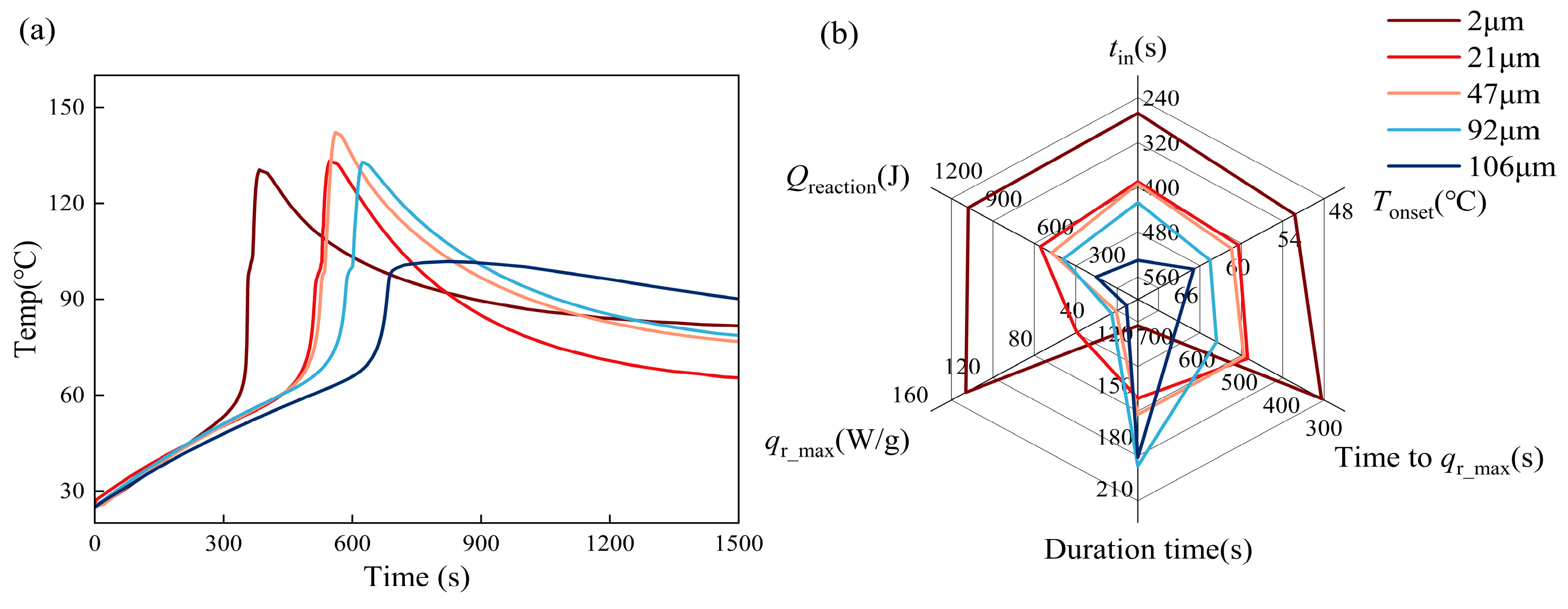
To investigate the reaction characteristics of aluminium powder with different particle sizes, experiments were conducted using aluminium powders with particle sizes of 2 μm, 21 μm, 47 μm, 92 μm and 106 μm, under conditions of 20% water content and a local heat source power of 2.5 W. The reaction parameters and thermal effect parameters were analysed. Figure 7a shows the temperature rise of aluminium powders of different particle sizes upon contact with water, whilst Figure 7b reveals the variation in tin, Tonset, and time to qr-max, duration time, qr-max and Qreaction with particle size. The experimental results indicate that tin increases significantly with increasing particle size. In this experiment, the induction time for 2 μm aluminium powder was 267 s, whereas that for 106 μm aluminium powder increased to 530 s. The induction stage primarily corresponds to the rupture of the oxide film and the formation of the reaction interface. On the one hand, fine aluminium powder particles have low thermal resistance and high heat transfer efficiency [37]. On the other hand, the smaller the aluminium particle size, the greater the surface area in contact with water during the reaction [18]. Consequently, the reaction rate during the induction phase is higher resulting in a significant reduction in tin.
As the particle size of aluminium powder increases, the onset temperature of the reaction gradually rises. When the particle size is 2 μm, the Tonset is 49.8 °C, whereas it rises to 61.5 °C when the particle size is 106 μm. This trend indicates that aluminium powder with a smaller particle size is more readily capable of initiating a reaction with water at lower temperatures. This phenomenon is closely related to the stability of the oxide film on the surface of aluminium particles. A reduction in particle size significantly increases the specific surface area, providing more reaction sites and resulting in a significant energy difference between surface atoms and internal atoms, thereby enhancing reactivity [22,38]. At the same time, the reduction in particle size decreases the thermal inertia of the aluminium powder particles, accelerating the heating and destruction of the oxide film [39].
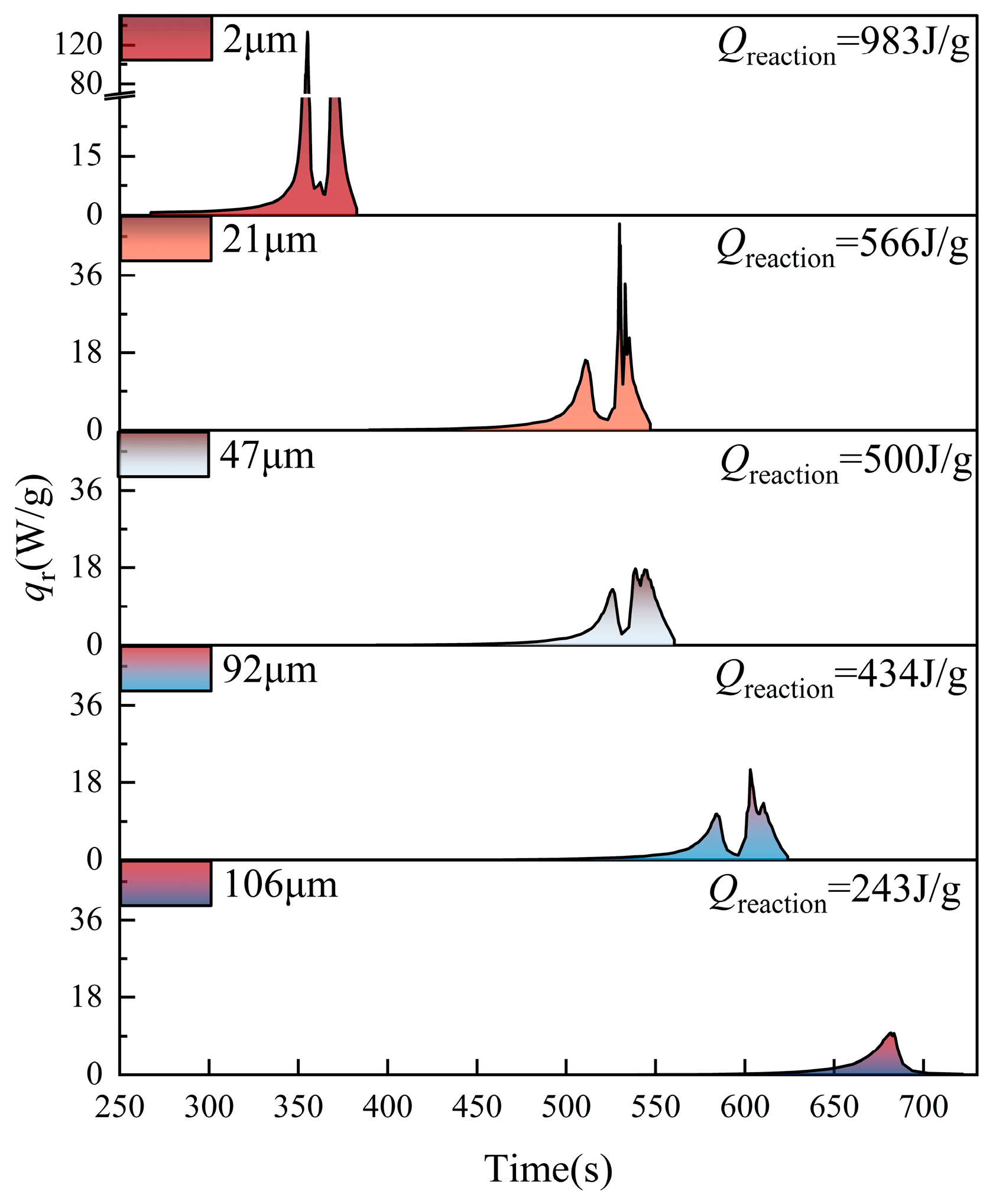
The effect of particle size on qr_max is particularly pronounced. Figure 8 shows that the maximum heat release rate of aluminium powder with a particle size of 2 microns can reach 133.16 W/g, while it is only 9.76 W/g for powder with a particle size of 106 microns, which is about 1/14 of the former. As the particle size increases, the maximum heat release rate shows a significant downward trend. The reaction rate of metal particle hydrolysis is typically closely related to their specific surface area. Smaller aluminium powder particles provide a larger reaction interface, thereby significantly increasing the interfacial reaction rate. At the same time, small-particle sizes shorten the diffusion paths for heat and reaction products, facilitating the formation of a rapid autocatalytic process [40]. Furthermore, the time to qr_max also increases significantly with increasing particle size, rising from 355 s for 2 μm particles to 694 s for 106 μm particles. This result indicates that larger aluminium powder particles not only exhibit a slower reaction initiation but also a slower reaction acceleration phase. This characteristic also explains the phenomenon whereby the duration time increases with increasing particle size.
The Qreaction values for aluminium powders of different particle sizes also show marked differences. The reaction heat for 2 μm aluminium powder is 983 J·g−1; when the particle size increases to 106 μm, the heat generated by the aluminium powder upon contact with water is 243 J·g−1, which is only one-quarter of that for the smaller particles. This phenomenon is primarily due to the higher reaction conversion rate of the smaller particles. As the reaction proceeds, the generated layer of aluminium hydroxide gradually covers the surface of the aluminium particles and hinders further reaction [13]. When the particle size is larger, the dense product layer formed on its surface is more likely to completely encapsulate the aluminium core, effectively blocking the diffusion pathway for water molecules into the interior, causing the reaction to terminate prematurely and resulting in a significant reduction in the conversion rate [41,42].
The reaction of aluminium powder with water involves the rupture of the oxide film, interfacial heat transfer, and the generation and diffusion of hydrogen gas. In the early stages of the reaction, the oxide film on the surface of the aluminium particles ruptures under the influence of rising temperature or stress, thereby creating local reactive sites [43]. As the reaction between aluminium powder and water is exothermic, the heat generated further promotes the rupture of the oxide film and accelerates the reaction, resulting in a self-catalysing exothermic process. Furthermore, the hydrogen gas produced during the reaction forms bubbles on the particle surface. These bubbles alter the mass transfer conditions at the reaction interface, thereby further influencing the reaction rate. Due to their higher specific surface area and thinner oxide film [17] fine-particle-sized particles are more prone to forming the aforementioned autocatalytic reaction process, and consequently exhibit higher reaction activity and exothermic rates.

3.4. Impacts of Heat Sources

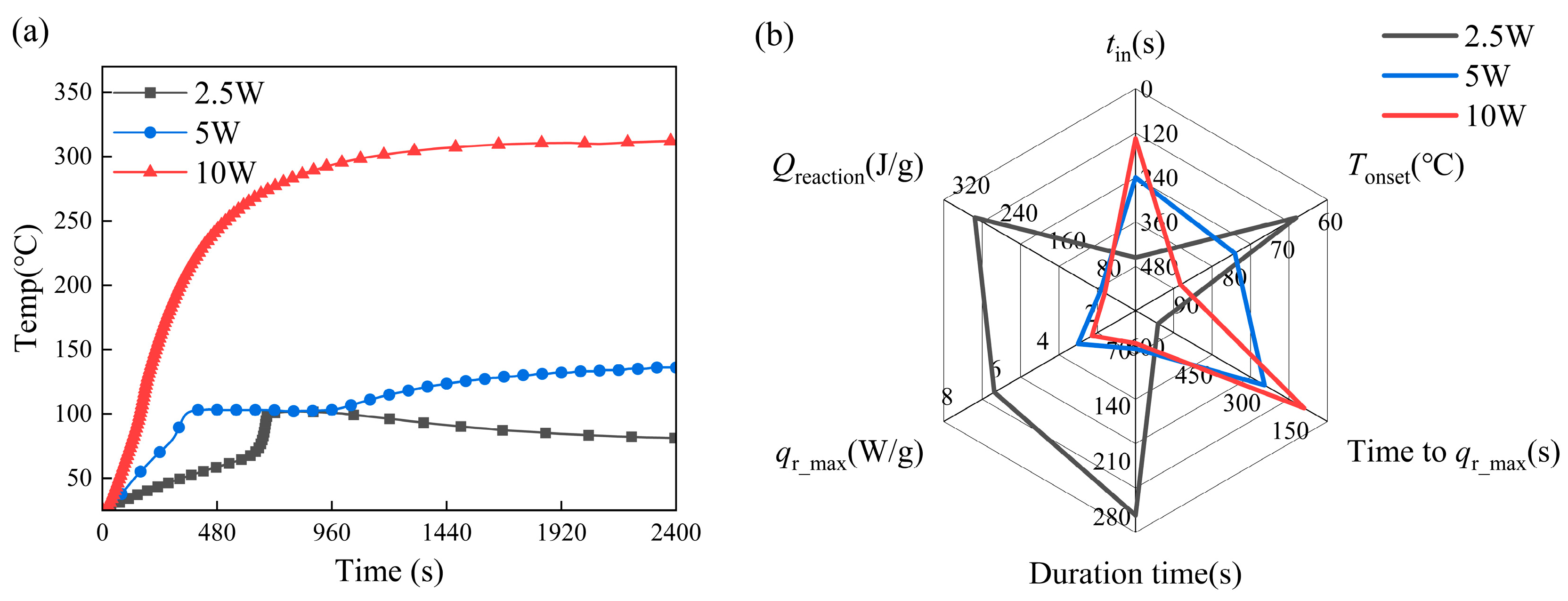
To systematically elucidate the regulatory mechanisms of heat source intensity on reaction kinetics, this study fixed the water content at 20% and the aluminium powder particle size at 106 μm, and conducted a comparative analysis of the initiation characteristics and exothermic behaviour of the aluminium powder’s reaction with water under three heat source powers of 2.5, 5.0 and 10.0 W. The results are shown in Figure 9.
The temperature curve in Figure 9a reveals the significant influence of the heat source power on the system’s temperature rise. When the heat source power was 2.5 W, the system exhibited a gradual temperature rise, with tin lasting 530 s and Tonset at 61.5 °C. As the power was increased to 10.0 W, the initial rate of temperature rise increased significantly, and tin was drastically reduced to 135 s. However, contrary to the trend of decreasing tin content, Tonset rises monotonically with increasing power, reaching 84.6 °C at 10.0 W—an increase of 23.1 °C compared to the 2.5 W condition. The induction time of the aluminium powder–water reaction is influenced by ambient temperature, with the reaction rate exhibiting exponential growth with rising ambient temperature [18,32]. A high-power heat source causes a rapid rise in local temperature and, through heat transfer, leads to a rapid increase in ambient temperature. Compared to a low-power heat source, the reaction rate during the induction phase is accelerated, resulting in a significant reduction in tin. At the same time, the increase in local heat source power increases the system’s heating rate and enhances thermal inertia. The accumulation of heat requires a higher temperature to meet the reaction activation energy requirement, causing Tonset to shift towards higher temperatures [15].
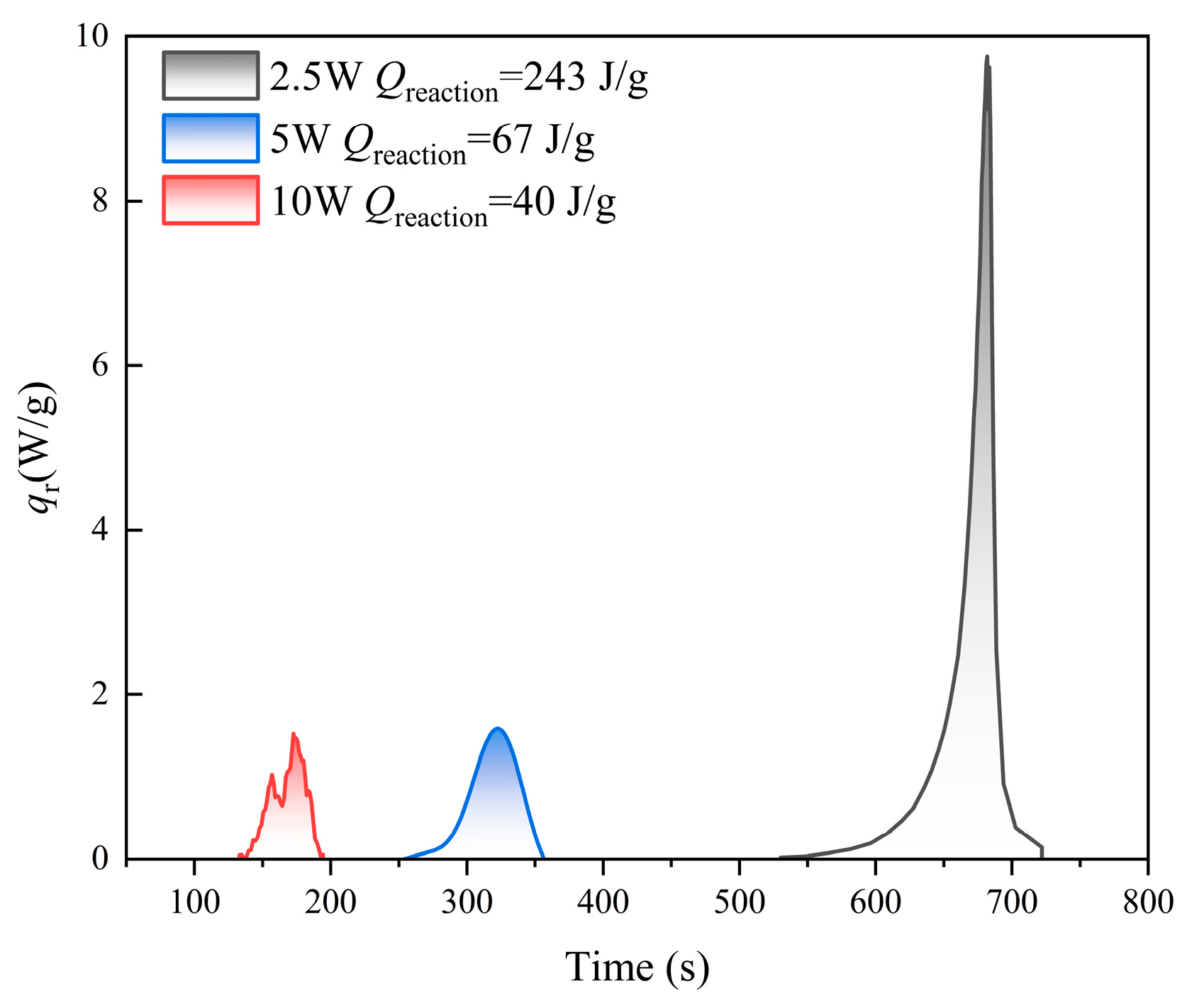
The evolution of thermal behaviour parameters further corroborates the regulatory role of heat source power on the reaction process. In Figure 9b, the time to qr_max decreases from 694 s at 2.5 W to 173 s at 10.0 W, whilst the duration time drops sharply from 192 s to 61 s, indicating that a high-power heat source not only accelerates the reaction but also concentrates the entire reaction process. Analysing the energy balance of a non-adiabatic reaction system, under the 2.5 W condition, the exothermic reaction and external heating form a positive feedback loop, allowing heat to accumulate effectively within the system and driving the reaction towards complete conversion. Under the 10.0 W condition, although the heat input is increased, the rapidly densifying product layer blocks the aluminium–water contact interface, causing the exothermic chemical process to be suppressed prematurely. Consequently, the system fails to fully utilise the chemical potential of the aluminium powder. This mechanism stands in stark contrast to the purely heat transfer-driven relationship observed in dry aluminium powder systems, where higher power leads to higher steady-state temperatures, highlighting the complex evolution of thermal behaviour once chemical reactions are introduced.
As shown in Figure 10, qr_max decreases monotonically with increasing heat source power, falling from 9.76 W/g at 2.5 W to 1.53 W/g at 10.0 W. Qreaction also exhibits a significant downward trend, dropping sharply from 242.8 J·g−1 to 39.6 J·g−1. SEM-EDS analyses provide direct evidence that the 10 W products exhibit a compact, sintered morphology with oxygen content of merely 15.41% compared with 44.07% at 2.5 W, and aluminium content rises to 84.59% versus 55.93% under low power, as shown in Figure 11. This indicates that a dense, sintered product layer encapsulates the core after minimal reaction. This power-dependent suppression differs fundamentally from the water-content effect in Section 3.2. Under 2.5 W, the system stabilises at approximately 100 °C, producing a porous product layer that permits sustained water diffusion. Under 10 W, the rapid temperature rise to approximately 308 °C drives the product layer to undergo rapid densification and sintering, transforming it from a porous, permeable barrier into a diffusion-resistant shell. Concurrently, the reaction duration collapses from 192 s to 61 s, compressing the chemically controlled stage. Buryakovskaya et al. [44] demonstrated that thermal treatment of aluminium at elevated temperatures promotes densification and thickening of the surface oxide layer, substantially impeding subsequent water penetration. The SEM-EDS observation that 10 W products exhibit a dense, sintered morphology with minimal oxygen signal and high residual aluminium content directly confirms that the high-power condition drives rapid product-layer densification, causing premature reaction termination.
These findings have important implications for industrial safety and risk prevention. Low-power local heat sources in the 2.5 W range, such as the surfaces of equipment heating up slowly or poorly insulated pipes, although they delay the initiation of the reaction, are more conducive to the reaction proceeding to completion, which may lead to the accumulation of large amounts of hydrogen and the risk of delayed explosions. Conversely, high-power heat sources of the 10.0 W class, such as electrical sparks or mechanical friction hotspots, although reducing Qreaction, trigger the reaction more rapidly, with tin being approximately 135 s. Moreover, a high Tonset implies that the reaction is triggered whilst the system is in a higher energy state, potentially causing a violent pressure surge. Consequently, in aluminium powder storage environments, differentiated monitoring and control strategies must be established for local heat sources of varying power levels, with particular attention paid to the risk of hydrogen accumulation under conditions of low-power, prolonged exposure.

3.5. Modification of the Thermal Behaviour Model

The thermal behaviour of a bed of aluminium powder under the influence of a local heat source constitutes a system in which non-adiabatic heat transfer is coupled with a chemical reaction. Based on the principle of energy conservation, the temperature evolution of the system can be described by a lumped parameter model [45]. During the induction phase, the system satisfies Equation (5), whilst during the reaction phase it satisfies Equation (6). Integrating Equation (6) yields:
P dt   +   m Q reaction   =   c m Δ T   + h A ( T T 0 ) dt
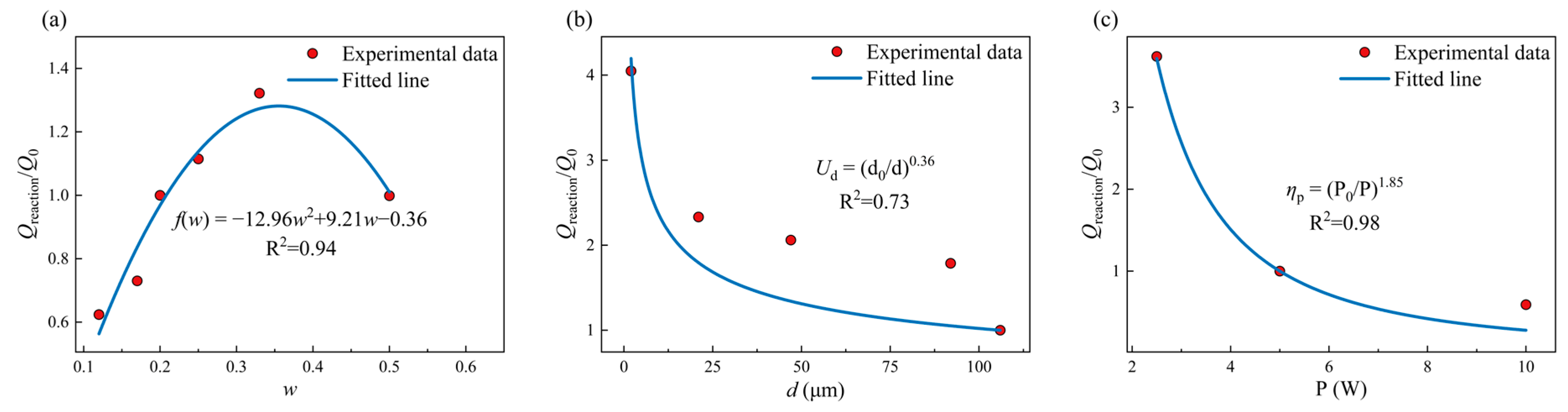
Non-linear regression calibration was performed based on the relative values of the total heat release per unit mass, Qreaction, under various operating conditions, with aluminium powder particle size of 106 μm, water content of 20%, and power of 5 W taken as the reference conditions for normalisation. The experimental results presented earlier indicate that the mass fraction of water exerts a significant non-linear influence on the heat release from the reaction, exhibiting an inverted U-shaped profile. Based on the concept of multi-feature separation modelling [46], a quadratic polynomial regression was first used to fit the moisture correction factor f(w) as shown in the following equation. The fitting results are illustrated in Figure 12a.
f ( w ) = 12.96 w 2 + 9.21 w     0.36
in the equation, w represents the mass fraction of water. The fitted peak is located at w = 0.36, with R2 = 0.94, which is very close to the peak of Qreaction in the experiment, which is at 33%. Taking w = 20% as the reference operating condition, the reaction heat is denoted as Q0, and heat of reaction under the reference operating conditions described below is also denoted as Q0.
In Equation (3), the addition of water also affects the system’s heat capacity:
c m   =   c Al m Al   +   c w m w
Water plays a dual role in governing the thermal behaviour of the aluminium–water system. At low and moderate water contents, water acts as a reaction medium and enhances contact at the solid–liquid interface, thereby exerting a promoting effect. At high water contents, excess water increases the system’s heat capacity, forms a liquid film that impedes mass transfer, and is accompanied by evaporative cooling, thereby exerting an inhibitory effect. These competing mechanisms collectively give rise to a non-monotonic water-control curve.
Particle size influences heat and mass transfer efficiency by modulating effective thermal conductivity and specific surface area. Based on the data in Figure 8, a power-law model [47] was used for fitting, as shown in Figure 12b. The particle size correction factor Ud obtained from the fitting is expressed as follows:
U d   =   d 0 d 0.36
in the equation, d represents the median diameter, in μm; d0 is the reference particle size, taken as 106 μm. R2 = 0.73. The relatively low R2 reflects the complexity of particle size effects on the heat and mass transfer processes of aluminium powder in contact with water. Reducing particle size not only increases the keff of accumulated aluminium powder [4] but also increases the specific surface area and the number of active reaction sites [22,38]. Furthermore, differences in oxide film rupture behaviour and mass-transfer resistance may affect the reaction conversion efficiency [40,41,42]. Therefore, when using a single power-law relationship to represent the particle-size effect, deviations may occur. Nevertheless, this power-law relationship captures the dominant trend: the reaction heat increases monotonically with decreasing particle size.
An increase in the heat source power P did not enhance the reaction rate. On the contrary, it reduced it. The suppression effect is described by introducing the power influence factor ηP, and a power law model is used for fitting, as shown in Figure 12c. The fitted ηP is expressed as follows:
η P   =   ( P 0 P ) 1.85
in the equation, P0 is the reference power, taken as 5 W. R2 = 0.98, indicating a good fit. Under high-power conditions, the rate of temperature rise in the system is too fast, leading to rapid densification of the product layer. This transition from chemical control to diffusion control reduces the effective extent of the reaction.
Combining the above correction functions, the exothermic term of the reaction can be expressed as:
Q reaction   =   Q r , 0 · f ( w ) · U d · η P
in the equation, Qr,0 represents the heat of reaction under reference conditions, which is 67 J/g. Substituting Equations (8)–(12) into Equation (7) yields the multi-factor coupled correction model:
P dt + m Q r , 0 ( 12.96 w 2 + 9.21 w 0.36 ) d 0 d 0.36 ( P 0 P ) 1.85 = ( c Al m Al + c w m w ) T + h A ( T T 0 ) dt
To verify the reliability of the established model, a comparative analysis was conducted between the total heat release predicted by the model and the experimentally measured values. The results indicate that the predicted values show good agreement with the experimental data, with an R2 of 0.92, demonstrating good overall predictive capability. The model can therefore be used for the quantitative prediction of heat release during aluminium powder–water reactions under various operating conditions.
To evaluate the predictive capability of the proposed coupled model and avoid potential circular validation, three additional experimental conditions, including 18% water content, 50 μm particle size, and 15 W heat source power, were reserved as an external validation dataset and excluded from all fitting procedures. The reaction heat predicted by Equation (15) was compared with the corresponding experimental values. As shown in Table 1, the prediction errors were 7.4%, 30.1%, and 18.3%, respectively. Although a relatively larger deviation was observed for the particle-size validation condition, the overall average prediction error was 18.6%. These results indicate that the proposed coupled model possesses reasonable predictive capability under independent experimental conditions and is not merely a regression fit to the original calibration dataset.
Based on the coupled model of non-adiabatic heat transfer and aluminium–water reaction, this section introduces correction terms for water content, particle size and heat source power, constructing a coupled prediction model that captures the observed influence of operational parameters on reaction heat release. Through experimental data fitting, the nonlinear regulation effect of water, the power-law influence of particle size on the heat generation of aluminium powder upon water reaction, and the inhibitory mechanism of heat source power on reaction efficiency are quantified. This model not only enables quantitative prediction of the thermal behaviour of aluminium powder upon water reaction but also provides a theoretical basis for thermal safety assessment during industrial storage and transportation. The coupled model is phenomenological, correlating macroscopic heat release with operational parameters through empirical correction factors. Accordingly, the exponents appearing in Equations (12) and (13) should be interpreted as effective fitting parameters obtained from regression of the experimental dataset. It has been emphasised that the aluminium–water reaction is intrinsically temperature-dependent and generally follows Arrhenius-type behaviour. Although no explicit Arrhenius expression was incorporated into the present model, the temperature dependence of the reaction is indirectly embodied through the experimentally derived correction functions for particle size, water content, and heating power. These factors collectively determine the thermal evolution of the system, influence oxide-layer disruption and mass-transfer processes, and consequently affect the apparent reaction kinetics and heat-release behaviour observed experimentally.


4. Conclusions

Based on a proprietary platform for the quantitative characterisation of the thermal behaviour of aluminium powder upon contact with water, this study systematically reveals the thermal behaviour patterns and multi-factor synergistic regulation mechanisms of micron-sized, accumulated aluminium powder reacting with water under the influence of a local heat source. Reducing particle size significantly shortened tin and lowered Tonset, whilst markedly enhancing Qreaction. The Qreaction of 2 μm powder reached 983 J/g, approximately fourfold that of 106 μm powder, attributed to the larger specific surface area and higher effective thermal conductivity of fine particles promoting rapid oxide film rupture and subsequent autocatalytic exothermic processes. Water content exhibited nonmonotonic regulation of the reaction thermal behaviour, with Tonset minimising at 25% water content (66.4 °C) and Qreaction following an inverted U-shaped distribution peaking at approximately 33%. Excess water reduced the conversion rate due to increased heat capacity and pronounced evaporative cooling effects that limited system temperature rise. Elevated heating power paradoxically suppressed reaction intensity, with Qreaction decreasing sharply from 242.8 J/g to 39.6 J/g as power increased from 2.5 W to 10.0 W, owing to rapid product layer densification forming a continuous passivation layer and the possible steamfilm barrier effect, which collectively shifted the rate-controlling mechanism from chemical control to diffusion control and caused premature reaction termination. A coupled multifactorial predictive model incorporating particle size, water content and heating power was established and rigorously validated against experimental data, achieving R2 = 0.92 and demonstrating robust predictive capability for total reaction heat, thereby providing a theoretical basis for quantitative thermal safety risk assessment and hazard prevention during aluminium powder industrial storage and transport.

Supplementary Materials

The following supporting information can be downloaded at: https://www.mdpi.com/article/10.3390/pr14122007/s1, Table S1: Fitted heat-loss correction parameters under different experimental conditions; Figure S1: Temperature profiles measured at the bottom (T1), centre (T2), and top (T3) positions of the aluminium–water mixture under the representative condition of 5 W heat source power, 20% water content, and 106 μm particle size.

Author Contributions

Conceptualization, X.Z.; methodology, H.C.; software, H.C.; validation, J.F.; data curation, L.W.; writing—original draft preparation, H.C.; writing—review and editing, H.C.; visualisation, J.Z.; supervision, X.Z. All authors have read and agreed to the published version of the manuscript.

Funding

This research was funded by the National Natural Science Foundation of China (Grant No. 22308018).

Data Availability Statement

The original contributions presented in this study are included in the article. Further inquiries can be directed to the corresponding author.

Acknowledgments

We give thanks for the concerted efforts of the co-authors, the dedicated help of the instructors, and the financial support of the National Natural Science Foundation of China (Grant No. 22308018).

Conflicts of Interest

The authors declare no conflicts of interest.

References

  1. Sopha, B.M.; Ma’mun, S. Economic Analysis and Environmental Assessment of Aluminium Debris Power Generator for Deployment to Communal-Scale Disaster Areas. Heliyon 2021, 7, e07264. [Google Scholar] [CrossRef] [PubMed]
  2. Pang, L.; Li, C.; Liu, J.; Sun, S. Study on the Hydrogen Production Law and Reaction Kinetics Mechanism of Aluminium Powder Oxidation under Different Moisture Content Conditions. Int. J. Hydrogen Energy 2025, 100, 319–329. [Google Scholar] [CrossRef]
  3. Kirton, T.; Saceleanu, F.; Salehi Mobarakeh, M.; Kholghy, M.R. Cogeneration of Hydrogen, Alumina, and Heat from Aluminium-Water Reactions. Int. J. Hydrogen Energy 2024, 68, 115–127. [Google Scholar] [CrossRef]
  4. Luo, Y.; Gui, N.; Yang, X.; Jiang, S.; Liu, Z. Analytical Generalized Thermal Resistance Model for Conductive Heat Transfer in Pebble Beds Based on Heat Flux Weighted Temperature Difference. Int. J. Heat Mass Transf. 2025, 236, 126401. [Google Scholar] [CrossRef]
  5. Rodrigues, S.J.; Vorhauer-Huget, N.; Tsotsas, E. Effective Thermal Conductivity of Packed Beds Made of Cubical Particles. Int. J. Heat Mass Transf. 2022, 194, 122994. [Google Scholar] [CrossRef]
  6. Zhao, Y.; Zhang, H.; Cai, J.; Ji, S.; Li, D. A Prediction Model of Effective Thermal Conductivity for Metal Powder Bed in Additive Manufacturing. Chin. J. Mech. Eng. 2023, 36, 41–51. [Google Scholar] [CrossRef]
  7. Wang, L.; Wang, M.; Liu, P.; Liu, J. Combustion Behavior of Ethanol/Ether Molecules-Coated Al Nanoparticles with H2O Vapor by Non-Equilibrium Molecular Dynamics Simulations. ACS Omega 2023, 8, 35800–35808. [Google Scholar] [CrossRef] [PubMed]
  8. Taraba, B.; Maršálek, R.; Podstawka, T. Two Aspects of Water in Self-Heating Risk of Aluminium Powders: Calorimetric Study. J. Therm. Anal. Calorim. 2022, 147, 11671–11677. [Google Scholar] [CrossRef]
  9. Li, Q.Z.; Zhang, G.Y.; Zheng, Y.N.; Liu, J.F.; Li, X.W. Investigation on the Correlations between Thermal Behaviors and Explosion Severity of Aluminium Dust/Air Mixtures. Powder Technol. 2019, 355, 582–592. [Google Scholar] [CrossRef]
  10. Schoenitz, M.; Chen, C.-M.; Dreizin, E.L. Oxidation of Aluminium Particles in the Presence of Water. J. Phys. Chem. B 2009, 113, 5136–5140. [Google Scholar] [CrossRef] [PubMed]
  11. Nie, H.; Zhang, S.; Schoenitz, M.; Dreizin, E.L. Reaction Interface between Aluminium and Water. Int. J. Hydrogen Energy 2013, 38, 11222–11232. [Google Scholar] [CrossRef]
  12. Saceleanu, F.; Vuong, T.V.; Master, E.R.; Wen, J.Z. Tunable Kinetics of Nanoaluminium and Microaluminium Powders Reacting with Water to Produce Hydrogen. Int. J. Energy Res. 2019, 43, 7384–7396. [Google Scholar] [CrossRef]
  13. Wang, X.; Li, G.; Eckhoff, R.K. Kinetics Study of Hydration Reaction between Aluminium Powder and Water Based on an Improved Multi-Stage Shrinking Core Model. Int. J. Hydrogen Energy 2021, 46, 33635–33655. [Google Scholar] [CrossRef]
  14. Dong, R.K.; Mei, Z.; Zhao, F.Q.; Xu, S.Y.; Ju, X.H. Molecular Dynamics Simulation on the Reaction of Nano-Aluminium with Water: Size and Passivation Effects. RSC Adv. 2019, 9, 41918–41926. [Google Scholar] [CrossRef] [PubMed]
  15. Zhang, X.; Wang, L.; Tao, G.; Guo, R.; Fang, J.; Zhang, J.; Mao, H. Hydrogen Production from Aluminium-Water Reactions at Low Temperatures: Based on an in-Situ Two Powders of Different Particle Sizes. Front. Energy Res. 2024, 12, 1441155–1441170. [Google Scholar] [CrossRef]
  16. Razavi-Tousi, S.S.; Szpunar, J.A. Mechanism of Corrosion of Activated Aluminium Particles by Hot Water. Electrochim. Acta 2014, 127, 95–105. [Google Scholar] [CrossRef]
  17. Guo, H.; Zhang, W.; Pang, W. Preparation Technology, Reactivity and Applications of Nano-Aluminium in Explosives and Propellants: A Review. Nanomaterials 2025, 15, 1564. [Google Scholar] [CrossRef] [PubMed]
  18. Yavor, Y.; Goroshin, S.; Bergthorson, J.M.; Frost, D.L.; Stowe, R.; Ringuette, S. Enhanced Hydrogen Generation from Aluminium–Water Reactions. Int. J. Hydrogen Energy 2013, 38, 14992–15002. [Google Scholar] [CrossRef]
  19. Özakın, B.; Gültekin, K. Experimental Evaluation of Particle Size Effect on Kaolin Additive Palm Nanolubricants and Determination of Optimum Production Parameters Using a Multi-Criteria Decision-Making Method. Proc. IMechE Part E: J. Process Mech. Eng. 2025, 1–12. [Google Scholar] [CrossRef]
  20. Arlington, S.Q.; Fritz, G.M.; Weihs, T.P. Exothermic Formation Reactions as Local Heat Sources. Annu. Rev. Mater. Res. 2022, 52, 219–248. [Google Scholar] [CrossRef]
  21. Knecht, S.; Zdravkov, D.; Albers, A. Surrogate Models for Heat Transfer in Oscillating Flow with a Local Heat Source. Fluids 2023, 8, 80. [Google Scholar] [CrossRef]
  22. Chen, H.; Yao, Q.; Liu, Q.; Liu, H.; Zhang, X. Effects of Moisture Content on the Minimum Explosible Concentration of Aluminium Powder and the Related Mechanism. J. Energy 2020, 2020, 1393891–1393900. [Google Scholar] [CrossRef]
  23. Richner, G.; Neuhold, Y.-M.; Papadokonstantakis, S.; Hungerbühler, K. Temperature Oscillation Calorimetry for the Determination of the Heat Capacity in a Small-Scale Reactor. Chem. Eng. Sci. 2008, 63, 3755–3765. [Google Scholar] [CrossRef]
  24. Domen, S.D. Heat Loss Compensated Calorimeter. Nature 1969, 222, 1061. [Google Scholar] [CrossRef]
  25. Grakov, T.; Mateev, V.; Marinova, I. Modeling the Energy and Heating Efficiency of 3d Printing for Composite Materials with Dispersed Volumetric Particles. Electronics 2025, 14, 688. [Google Scholar] [CrossRef]
  26. Zhao, B.; Liu, X. A Transient Formulation of Entropy and Heat Transfer Coefficients of Newton’s Cooling Law with the Unifying Entropy Potential Difference in Compressible Flows. Int. J. Therm. Sci. 2024, 205, 109253. [Google Scholar] [CrossRef]
  27. Persson, B.N.J.; Biele, J. Heat Transfer in Granular Media with Weakly Interacting Particles. AIP Adv. 2022, 12, 105307. [Google Scholar] [CrossRef]
  28. Joshi, K.A.; Raghavan, V.; Rangwala, A.S. An Experimental Study of Coal Dust Ignition in Wedge Shaped Hot Plate Configurations. Combust. Flame 2012, 159, 376–384. [Google Scholar] [CrossRef]
  29. Zhang, J.; Wen, Y.; Wang, X.; Fang, J.; Zhang, X. Investigation of Temperature Gradient Effects and Effective Thermal Inertia During Adiabatic Decomposition of Substances with Varying Exothermic Characteristics. Case Stud. Therm. Eng. 2024, 61, 104896. [Google Scholar] [CrossRef]
  30. Yang, H.-L.; Li, Z.-S.; Ding, Y.-D.; Ge, Q.-Q.; Jiang, L. Hydrolysis Behavior and Kinetics of Aln in Aluminium Dross During the Hydrometallurgical Process. Materials 2022, 15, 5499. [Google Scholar] [CrossRef] [PubMed]
  31. Khezri, A.; Raygan, S.; Amadeh, A.A. Investigating the Incubation Time of the Water Splitting Reaction between Aluminium Powder and Water. Chem. Pap. 2025, 80, 2647–2659. [Google Scholar] [CrossRef]
  32. Trowell, K.; Goroshin, S.; Frost, D.; Bergthorson, J. Hydrogen Production Rates of Aluminium Reacting with Varying Densities of Supercritical Water. RSC Adv. 2022, 12, 12335–12343. [Google Scholar] [CrossRef] [PubMed]
  33. Fukui, T.; Yasuda, M.; Horie, T. Model Analysis of Mass Transfer in Liquid Films in a Taylor Flow Reactor for Gas-Liquid-Solid Three-Phase Reactions. Chem. Eng. Process. Process Intensif. 2025, 209, 110151. [Google Scholar] [CrossRef]
  34. Bustos-Vanegas, J.D.; Martins, M.A.; Corrêa, P.C.; Baptestini, F.M.; de Oliveira, G.H.H. Modeling and Simulation of Coffee Bean Heating During Roasting: Effect of Heat Generation. Front. Food Sci. Technol. 2025, 5, 1603783. [Google Scholar] [CrossRef]
  35. Nie, H.; Schoenitz, M.; Dreizin, E.L. Calorimetric Investigation of the Aluminium–Water Reaction. Int. J. Hydrogen Energy 2012, 37, 11035–11045. [Google Scholar] [CrossRef]
  36. Razavi-Tousi, S.S.; Szpunar, J.A. Modification of the Shrinking Core Model for Hydrogen Generation by Reaction of Aluminium Particles with Water. Int. J. Hydrogen Energy 2016, 41, 87–93. [Google Scholar] [CrossRef]
  37. Mou, X.; Zhou, W.; Bao, Z.; Huang, W. Measurement and Theoretical Analysis of Effective Thermal Conductivity of Lanthanum Pentanickel Powder Beds for Hydrogen Storage in Different Particle Sizes and Bed Porosities. J. Clean. Prod. 2024, 468, 143098–143109. [Google Scholar] [CrossRef]
  38. Mao, H.-F.; Fang, J.-W.; Deng, Y.-K.; Zhang, J.; Zhao, Y.-L.; Feng, Y.; Xiong, M.; Gu, H.-T.; Feng, X.; Fang, J.-H.; et al. Thermal Runaway Behaviour Induced by Localised Aluminium-Water Reaction at Low Temperature. Chem. Eng. J. 2026, 533, 174874–174886. [Google Scholar] [CrossRef]
  39. Li, B.; Liu, H.; Gao, H.; Shu, C.-M.; Bi, M. Experimental Investigation of Moisture Content on Suppressing Ignition of Accumulated Dust. J. Loss Prev. Process Ind. 2024, 87, 105209. [Google Scholar] [CrossRef]
  40. Wang, Y.; Xu, K.; Li, L. Inhibition of the Reaction between Aluminium Dust and Water Based on the Him. RSC Adv. 2017, 7, 33327–33334. [Google Scholar] [CrossRef]
  41. Gao, X.; Wang, C.A.; Bai, W.; Hou, Y.; Che, D. Aluminium-Based Fuels as Energy Carriers for Controllable Power and Hydrogen Generation—A Review. Energies 2022, 16, 436. [Google Scholar] [CrossRef]
  42. Musicco, N.; Gelfi, M.; Iora, P.; Venturelli, M.; Artioli, N.; Montorsi, L.; Milani, M. A Review of Hydrogen Generation Methods Via Aluminium-Water Reactions. Int. J. Thermofluids 2025, 27, 101152–101173. [Google Scholar] [CrossRef]
  43. Mezulis, A.; Richter, C.; Lesnicenoks, P.; Knoks, A.; Varnagiris, S.; Urbonavicius, M.; Milcius, D.; Kleperis, J. Studies on Water–Aluminium Scrap Reaction Kinetics in Two Steps and the Efficiency of Green Hydrogen Production. Energies 2023, 16, 5554. [Google Scholar] [CrossRef]
  44. Buryakovskaya, O.A.; Vlaskin, M.S.; Grigorenko, A.V. Effect of Thermal Treatment of Aluminium Core-Shell Particles on Their Oxidation Kinetics in Water for Hydrogen Production. Materials 2021, 14, 6493. [Google Scholar] [CrossRef] [PubMed]
  45. Csemány, D. Thermal Analysis of Suspended Single Droplet Evaporation Measurements with a Coupled Lumped Parameter Model. Heat Mass Transf. 2023, 59, 2181–2195. [Google Scholar] [CrossRef]
  46. Shi, H.; Wang, S.; Fernandez, C.; Yu, C.; Xu, W.; Dablu, B.E.; Wang, L. Improved Multi-Time Scale Lumped Thermoelectric Coupling Modeling and Parameter Dispersion Evaluation of Lithium-Ion Batteries. Appl. Energy 2022, 324, 119789. [Google Scholar] [CrossRef]
  47. Martínez-Vargas, S.; Flores-Chan, J.-E.; Mandujano-Ramírez, H.-J.; Pérez-Montejo, S.; Calan-Canche, D.; Patino-Carachure, C. A Simple Study of Hydrogen Production from Recycled Aluminium Microparticles in Alkaline Media. Hydrogen 2026, 7, 55. [Google Scholar] [CrossRef]
Figure 1. Characterisation of experimental samples: (ae) particle size distribution of samples with sizes of 2 μm, 21 μm, 47 μm, 92 μm, and 106 μm; (f) composition analysis of the 106 μm sample.
Processes 14 02007 g001
Figure 2. Platform for the quantitative characterisation of the thermal behaviour of aluminium powder upon contact with water.
Processes 14 02007 g002
Figure 3. Curves of aluminium powder temperature varying with (a) particle size and (b) heat source power.
Processes 14 02007 g003
Figure 4. Changes in reaction temperature of aluminium powder at different water content.
Processes 14 02007 g004
Figure 5. The induction time (a) and heat of reaction (b) of aluminium powder reactions under different water contents.
Processes 14 02007 g005
Figure 6. SEM images of reaction products of aluminium powder with water: (a) water content of 25%, (b) water content of 50%.
Processes 14 02007 g006
Figure 7. (a) Temperature changes and (b) thermal behaviour parameters during the reaction of aluminium powder of different particle sizes with water.
Processes 14 02007 g007
Figure 8. The heat of reaction during the reaction of aluminium powder of different particle sizes with water.
Processes 14 02007 g008
Figure 9. The temperature changes (a) and thermal behaviour parameters (b) during the reaction of aluminium powder with water under different heat source powers.
Processes 14 02007 g009
Figure 10. The heat of reaction during the reaction of aluminium powder with water under different heat source powers.
Processes 14 02007 g010
Figure 11. SEM images of the reaction products obtained under heating powers of (a) 2.5 W and (b) 10 W.
Processes 14 02007 g011
Figure 12. Comparison of experimental data with the fitted model. (a) Moisture, (b) Particle size, and (c) Heat source power.
Processes 14 02007 g012
Table 1. External validation results of the coupled model.
Water Content (%)Particle Size (µm)Heat Source (W)Experimental Qreaction (J/g)Predicted Qreaction (J/g)Relative Error (%)
18106555597.4
20502.545631830.1
201061510818.3
Disclaimer/Publisher’s Note: The statements, opinions and data contained in all publications are solely those of the individual author(s) and contributor(s) and not of MDPI and/or the editor(s). MDPI and/or the editor(s) disclaim responsibility for any injury to people or property resulting from any ideas, methods, instructions or products referred to in the content.