1. Introduction
Driven by the ongoing dual carbon goals, the photovoltaic industry has experienced rapid growth due to policy support and lower generation costs, resulting in an explosive growth in installed PV capacity [
1,
2]. The development of a new power system has entered an accelerated phase; however, the inherent randomness and intermittency of PV generation pose serious challenges to grid frequency stability and supply–demand balance. To further promote the development of enterprises in the photovoltaic and energy storage sectors, some policymakers are exploring advanced market designs and regulatory frameworks to encourage renewable energy power plants to participate in spot power trading and ancillary service markets through a photovoltaic–storage integration model by installing energy storage systems, while promoting the improvement of spot market trading and pricing mechanisms. Therefore, PV-storage power plants need to leverage the flexibility of energy storage to coordinate their participation in spot and ancillary service markets within complex market pricing and settlement mechanisms [
3,
4].
Compared to traditional methods that rely solely on thermal power units for regulation or on curtailing solar power and implementing power restrictions, hybrid photovoltaic–storage systems can effectively mitigate power fluctuations thanks to the millisecond-level response speed and precise bidirectional regulation capabilities of energy storage batteries. Their coordinated and optimized operation has become a key technical approach for balancing grid safety and stability while enhancing power plant economic efficiency [
5,
6].
Scholars both domestically and internationally have conducted extensive research on the participation of renewable energy and energy storage hybrid systems in electricity markets and their role in mitigating power fluctuations. Refs. [
7,
8] examine bidding and pricing strategies for renewable energy–energy storage systems participating in spot markets under different market mechanisms. Ref. [
9] developed a time-series coupling framework for wind–solar–storage power plants that balances long-term configuration with day-ahead and real-time short-term clearing. This framework effectively quantifies the impact of multi-time-scale returns on energy storage configuration, thereby enhancing the overall investment returns of energy storage. Ref. [
10] proposes a comprehensive benefit evaluation model for PV-storage projects in incremental distribution networks under a multi-coupled market environment. It constructs an investment decision-making framework incorporating electricity–carbon–green certificate market interactions and shared energy storage mechanisms, significantly improving the project’s net present value and effectively reducing carbon emissions. Ref. [
11] proposes a two-stage bidding strategy for PV-storage hybrid systems based on non-cooperative games. The results indicate that system benefits are improved under the non-cooperative game model compared to cooperative bidding. Ref. [
12] proposes a bidding decision model for PV power generators based on robust optimization, using uncertainty set modeling to characterize random PV output, and derives the optimal bidding strategy for PV power generators under the worst-case day-ahead market price scenario. Ref. [
13] proposed a bilevel optimization trading model for energy storage participation in day-ahead and real-time markets. By establishing a joint market-clearing framework for energy and reserve services and integrating KKT conditions with linearization methods, the model achieved coordinated optimization of energy storage bidding strategies and market revenues, thereby effectively improving energy storage profitability and system operational flexibility.
However, most of the aforementioned studies have limited the use of energy storage systems to tracking planned output or conducting peak-to-off-peak arbitrage, resulting in relatively narrow application scenarios. During periods of stable PV output or when electricity price differentials are small, energy storage resources often remain idle, leading to low equipment utilization rates and a prolonged investment payback period for PV-storage power plants.
With the deepening of the ancillary services market, scholars both domestically and internationally have conducted extensive research on bidding models and control strategies for photovoltaic–storage systems participating in the frequency regulation market. Ref. [
14] addresses the issue of reduced grid frequency regulation capacity caused by the integration of renewable energy sources by proposing a comprehensive control strategy for PV-storage systems to participate in frequency regulation and peak shaving, incorporating output constraints based on SOC feedback to extend the lifespan of the energy storage system. Ref. [
15] proposes a dynamic bidding strategy for hybrid energy storage systems participating in the day-ahead frequency regulation market. It constructs a net profit maximization model considering battery degradation and market performance metrics, obtaining the day-ahead bidding scheme with optimal economic efficiency. Ref. [
16] analyzes control strategies for battery energy storage systems participating in secondary frequency regulation and compares their dynamic response differences with those of conventional power units. Ref. [
17] explores methods for improving the AGC performance of power systems using energy storage systems by introducing a margin of accuracy for regulation response. Ref. [
18] proposes an optimized control strategy for deadband frequency regulation of energy storage systems, constructs a frequency response model, and employs a deadband optimization method with frequency regulation phase partitioning, effectively improving grid frequency quality and reducing the frequency regulation burden. Ref. [
19] proposed a multi-dimensional collaborative optimization strategy for integrated thermal-energy storage systems considering frequency regulation losses. By constructing a battery degradation model incorporating both DOD and C-rate, together with a thermal power loss model, and integrating series-compensation-based coordinated control with an improved particle swarm optimization algorithm, the strategy effectively enhanced system frequency stability while reducing the overall frequency regulation loss cost.
However, the frequency regulation market mechanisms in existing studies are overly idealized and do not account for actual grid frequency fluctuations. Few studies consider the impact of zoned frequency regulation control strategies on model operational decisions, nor do they incorporate multi-timescale rolling optimization frameworks spanning day-ahead and intraday periods. Furthermore, they often overlook the dynamic impact of nonlinear battery degradation on operational costs.
To address the shortcomings of existing research, this paper proposes a day-ahead and intraday coordinated optimization operation strategy for PV-storage power plants considering both the energy market and frequency regulation services. The main contributions of this work are summarized as follows:
(1) An ACE-based dynamic frequency regulation control strategy for energy storage systems is proposed to achieve dynamic power allocation under different frequency regulation zones;
(2) A coordinated day-ahead and intraday multi-timescale optimization model considering SOC feedback constraints and battery degradation costs is established;
(3) Frequency regulation revenue, spot market revenue, and battery lifetime degradation are jointly incorporated into a unified optimization framework to achieve coordinated optimization between system economics and battery lifetime;
(4) Real operational data from a photovoltaic power plant are used to validate the effectiveness of the proposed strategy in improving energy storage utilization and the overall economic benefits of the system.
Furthermore, the proposed optimization operation strategy can improve the utilization rate of the energy storage system and enhance the overall profitability of the power plant while ensuring grid frequency stability and reducing battery lifetime degradation caused by excessive charging and discharging operations. This study can provide theoretical references and practical guidance for the coordinated multi-market operation of PV-storage hybrid power plants, the optimal utilization of energy storage capacity, and the operation of ancillary service markets.
2. Integrated Control Strategies for Photovoltaic–Storage Hybrid Power Plants
2.1. Operation Modes of Photovoltaic–Storage Power Plants
Most energy storage systems co-located with conventional photovoltaic power plants are primarily used for output tracking. Through charging and discharging operations, the actual PV output can more closely track the system’s dispatch schedule, thereby reducing penalty costs. However, under this operation mode, the utilization rate of the ESS is extremely low, failing to fully realize its economic value.
In addition to tracking scheduled output, the ESS can also participate in frequency regulation ancillary services. With its fast response and flexible switching capability between charging and discharging states, the ESS helps maintain grid frequency stability while generating additional frequency regulation revenue.
Compared to conventional frequency regulation resources, the ESS is free from ramp-rate constraints and offers high regulation accuracy, enabling a rapid response to regional emergency frequency regulation demands. Enabling the PV-storage system to assist in grid frequency regulation effectively mitigates the stability issues encountered when a standalone PV plant participates in frequency regulation, while simultaneously improving economic efficiency. To fully leverage the frequency response advantages of the PV-storage system, it is necessary to formulate reasonable charging and discharging strategies based on the ACE interval, allocating and dispatching the frequency regulation signals to the system accordingly.
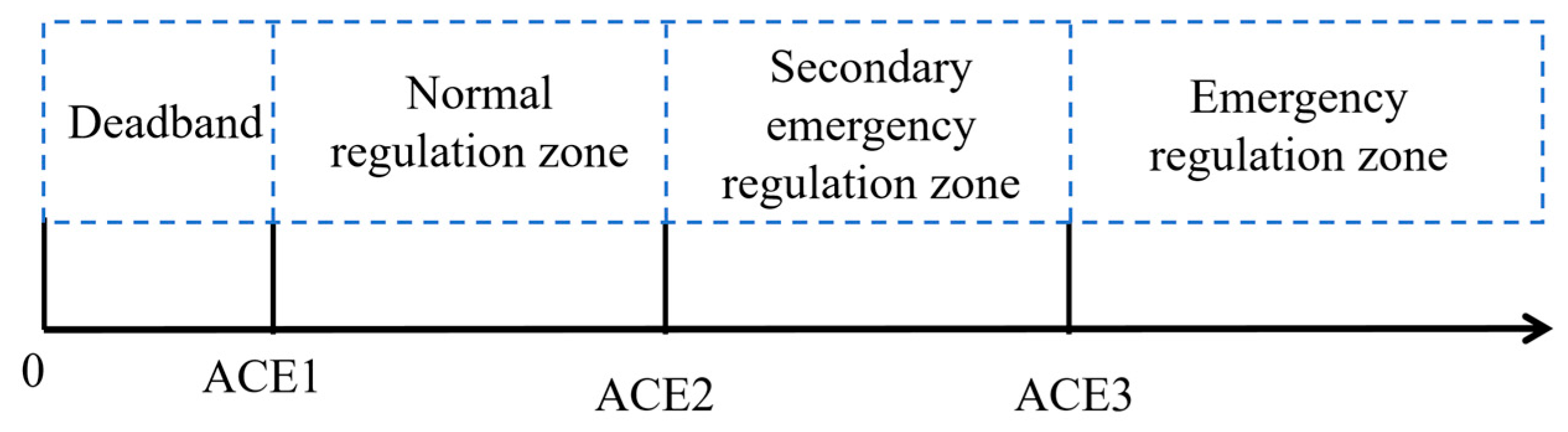
In actual grid operations, the real-time ACE control zones are identified through Wide-Area Monitoring Systems (WAMSs) and Energy Management Systems (EMSs). Typically, the ACE control region is partitioned based on the absolute value of the ACE and predefined static thresholds, resulting in four distinct zones: the emergency regulation zone, the sub-emergency regulation zone, the normal regulation zone, and the deadband [
20], as shown in
Figure 1.
Across different ACE control zones, the dispatch center perceives varying levels of urgency for frequency regulation, leading to distinct control objectives. Based on this premise, this paper formulates a real-time frequency regulation control method for PV-storage systems participating in AGC. This method determines the actual frequency regulation output of the ESS according to the specific ACE zone of the grid frequency. The ACE zone thresholds are determined with reference to relevant NERC standards, based on the inherent grid frequency fluctuations and the region’s most severe single contingency loss.
(1) When , the ACE enters the emergency regulation zone. At this point, the primary control objective is to ensure grid frequency security. To minimize the ACE as rapidly as possible and restore the system to a safe and stable state, the dispatch center commands the ESS to operate at its maximum charge/discharge power, without imposing any boundaries on its SOC.
The removal of SOC constraints in the emergency regulation zone is intended to prioritize grid frequency security under extreme operating conditions. In practical applications, the ESS is still protected by the Battery Management System, which prevents overcharging, over-discharging, overheating, and excessive current operation through embedded protection mechanisms. Therefore, although the ESS is allowed to respond with maximum power in the emergency regulation zone, the actual operating state remains within the safe operating limits of the battery system. Moreover, the duration of emergency regulation events is typically short, which limits the thermal and degradation impacts on the battery.
where
is the difference between the scheduled and actual grid outputs;
is the AGC frequency regulation demand signal;
is the maximum charging and discharging power of the energy storage system; and
is the actual power adjustment of the energy storage system at time t.
(2) When
, the ACE is in the sub-emergency regulation zone. The ESS maintains full-power operation and prioritizes tracking the PV output. It adjusts the deviation between the actual and scheduled PV output through charging and discharging, while taking into account the constraints imposed by its own SOC on the maximum charge/discharge power.
(3) When
, the ACE is in the normal regulation zone. The system remains within its normal operating range, but the ACE has reached the predefined response threshold. At this point, the control objective shifts to maximizing the revenue of the PV-storage system, and the dispatch center allocates power based on the frequency regulation output bid by the PV-storage system in the intraday market.
(4) When
, the ACE is in the regulation deadband. The demand for frequency regulation power within this region is minimal, and the PV-storage system does not participate in grid regulation.
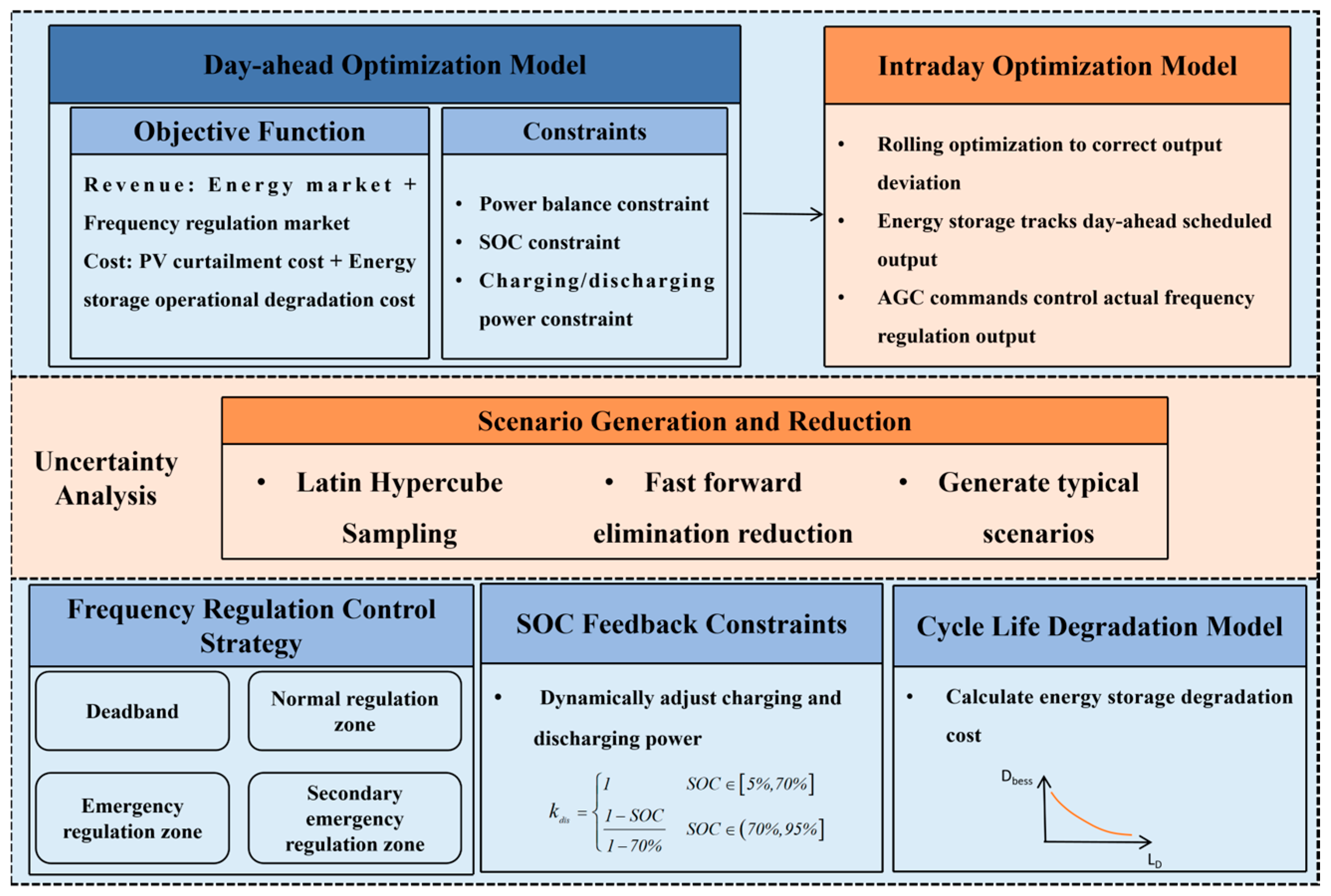
The operational framework of the photovoltaic–storage hybrid power plant is shown in
Figure 2. During the day-ahead phase, the hybrid plant optimizes its operation to maximize daily revenue from participation in the energy market and the frequency regulation market. It generates an aggregated bidding curve for the energy market to achieve low-price charging and high-price discharging. Additionally, it bids its regulating capacity into the frequency regulation market during periods when the storage system is idle. During the intraday rolling phase, due to deviations between the actual and predicted PV output, the energy storage system must adjust its output to track the day-ahead bidding curve in real time. Regarding frequency regulation, the power plant resubmits its bid capacity for the regulation market based on the real-time SOC of the energy storage system. The actual frequency regulation output is governed by the frequency regulation zone control strategy. This paper treats the power plant as a price taker in the market, considering only the capacity bids for the energy and frequency regulation markets [
21], while the clearing results are determined by the market itself.
2.2. Maximum Output Constraints for Energy Storage Batteries Based on SOC Feedback
When energy storage batteries respond to grid frequency regulation demands, charging and discharging at a constant power level prevents the batteries from fully charging or discharging, thereby wasting their capacity and resulting in economic losses. Therefore, a reasonable maximum output constraint factor should be designed to enable the energy storage batteries to participate in grid frequency regulation with varying charging and discharging power levels [
14].
(1) When the energy storage system is in the discharge state, if the SOC of the energy storage battery is high (SOC > 70%), the battery discharges at a certain proportion of its original power, which decreases as the SOC declines. However, when the SOC is less than 0.7, the battery discharges at its original power.
(2) When the energy storage system is in the charging state, if the SOC of the energy storage battery is low (SOC < 30%), the battery charges at a certain proportion of the original power, which decreases as the SOC decreases; when the SOC is greater than 0.7, the battery discharges at the original power.
The corresponding relationships during both states are expressed in Equations (5) and (6).
where
is the discharge regulation coefficient of the energy storage system, and SOC is the state of charge.
where
is the charge regulation coefficient of the energy storage system.
The relationship between the final Ref. power of the energy storage battery and the SOC is as follows:
where
is the final operating power of the energy storage system.
In summary, when the output of the energy storage battery is optimized using the aforementioned maximum output constraint factor, it ensures that the battery can respond quickly while fully utilizing its capacity and avoiding overcharging or over-discharging, thereby extending the battery’s service life.
2.3. Cycle Life Degradation Models for Electrochemical Energy Storage
In actual operation, the capacity of energy storage batteries exhibits an irreversible decline as the number of charge–discharge cycles increases; once this decline reaches a certain level, the battery is decommissioned and replaced. The number of charge–discharge cycles experienced during this process is referred to as the battery’s cycle life, and the depth of discharge is the primary factor affecting the cycle life of energy storage batteries.
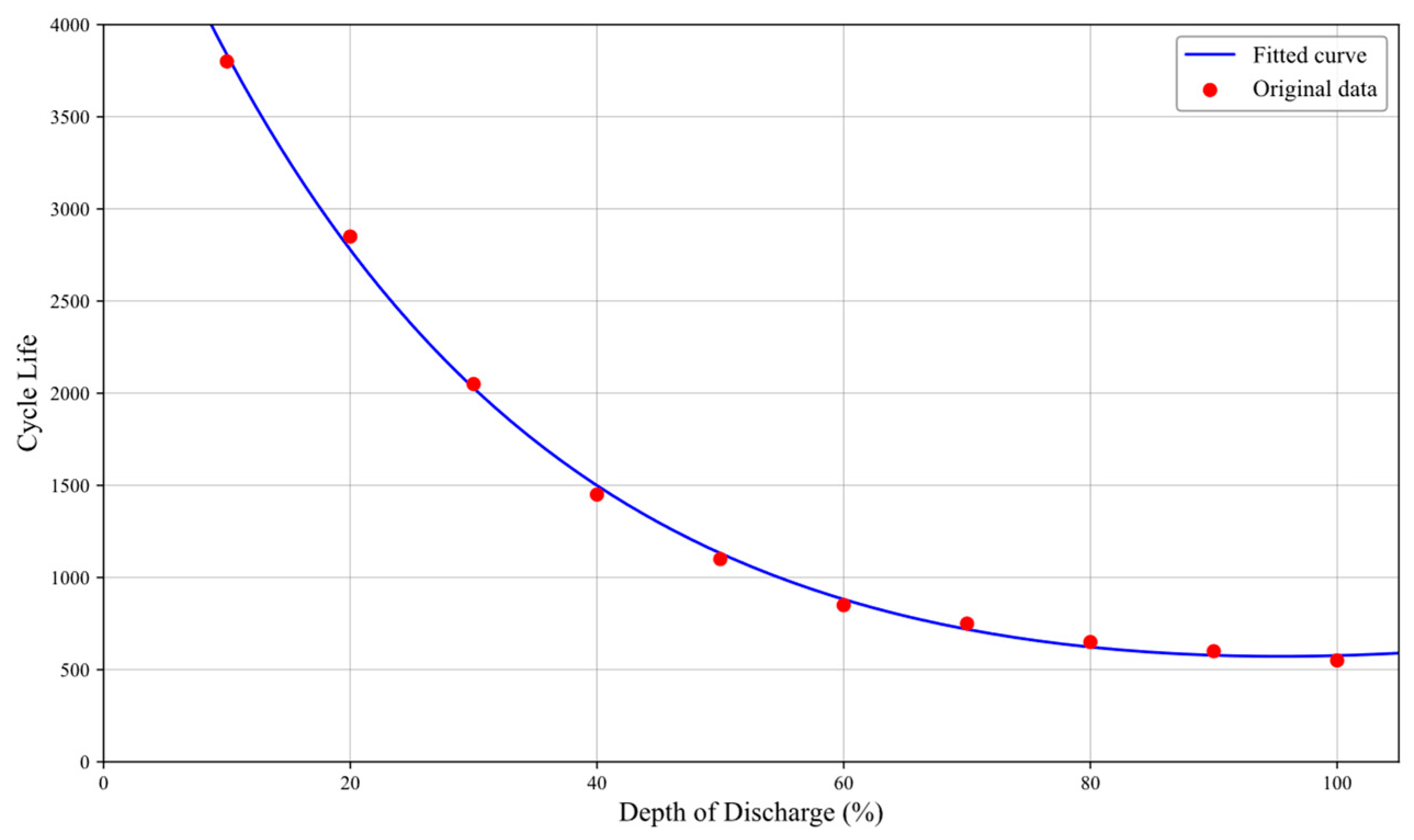
The relationship between the cycle life and depth of discharge for a specific model of lithium iron phosphate battery is shown in
Appendix A. An exponential function was used to fit this data, yielding the relationship between the energy storage battery’s cycle life and depth of discharge, as shown in Equation (8); the fitted curve is shown in
Figure 3.
where
is the cycle life of the energy storage system and
is the depth of discharge of the energy storage system.
The relationship between the depth of discharge and the output power of the ESS can be expressed as:
where
is the charge/discharge efficiency of the ESS and
is the charge/discharge power of the ESS at time
t.
The expression for the operational loss rate of energy storage batteries
is:
The operational degradation cost of the ESS can be formulated as:
where
is the unit capital cost of the ESS (¥/MWh);
is the rated capacity of the ESS (MWh); and
is the degradation rate of the ESS (%).
Battery degradation is influenced not only by the DOD but also by factors such as temperature, charge/discharge rate, and operating conditions. In this study, a DOD-based degradation model is adopted to ensure computational efficiency. Similar simplifications are widely used in energy storage scheduling studies [
22], and future research will further consider multi-factor coupled degradation mechanisms, including temperature and C-rate effects, to improve the accuracy of battery lifetime assessment.
2.4. Model Linearization
To facilitate the incorporation of battery life degradation characteristics into the optimized scheduling model, a piecewise linearization method is employed to linearize the energy storage cycle life degradation model, thereby reducing the computational complexity [
23]. This method has been widely used in battery scheduling studies to approximate nonlinear cycle–life curves efficiently.
First, the energy storage depth of discharge (DOD) range [0, 1] is divided into K subintervals. Within each subinterval, a linear function is used to approximate the function, yielding:
where
and
are obtained by fitting the original curve to the sample points using the least squares method;
and
are the boundary points of the
k-th and (
k − 1)-th intervals, respectively; k is the index of the subinterval.
A binary variable
is introduced to indicate whether the DOD falls within the
k-th interval during time step
t. The linearized cycle life is expressed as follows:
where
K is the total number of segments.
3. Day-Ahead and Intraday Optimization Model
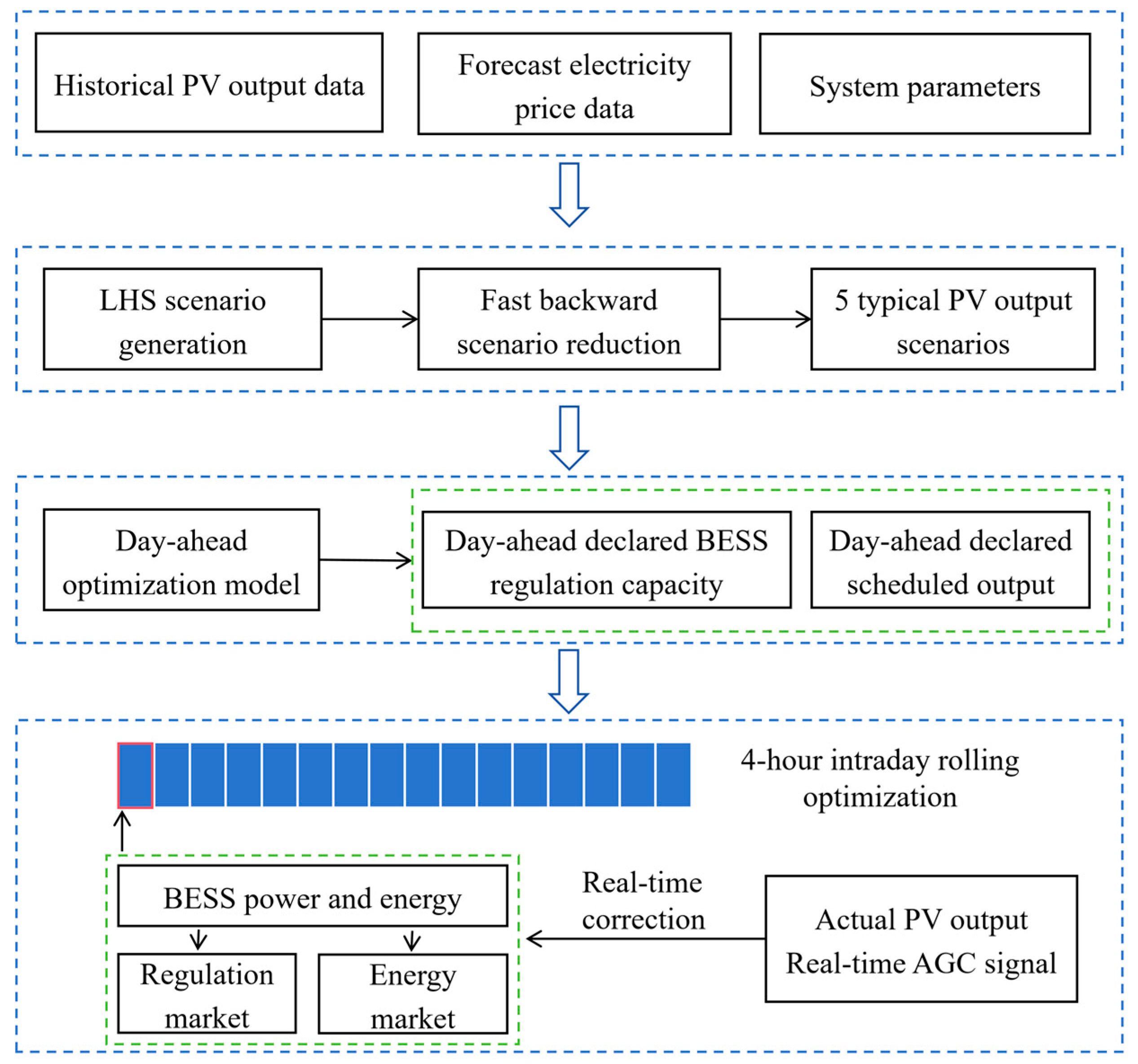
Figure 4 illustrates the overall workflow of the proposed day-ahead and intraday coordinated optimal dispatch strategy for the PV-storage power plant. First, historical PV output data are processed using the Latin Hypercube Sampling (LHS) method to generate scenarios, and typical PV output scenarios are obtained through scenario reduction. Next, a day-ahead optimization model is established to determine the bidding schedules of the PV-storage plant for both the electricity market and the frequency regulation market. Subsequently, intraday rolling optimization is performed, in which the ESS output in the electricity market and frequency regulation market is optimized in real time according to the grid frequency regulation demand signals and actual PV output, thereby obtaining the optimal dispatch strategy for the PV-storage power plant.
Due to the strong intermittency and uncertainty of PV generation, relying solely on day-ahead optimization is prone to causing deviations between the scheduled and actual power output. This increases the financial penalties for deviation settlement and weakens the system’s capability to respond to real-time AGC regulation demands. Furthermore, relying purely on intraday optimization fails to fully capitalize on day-ahead market information and multi-time-scale market opportunities. Therefore, this paper proposes a day-ahead and intraday coordinated optimization framework for hybrid PV-storage systems. Within this framework, the day-ahead stage formulates the optimal market bidding strategy, while the intraday rolling optimization stage dynamically corrects the output deviations caused by forecasting errors and real-time regulation demands, thereby enhancing the operational flexibility and economic profitability of the PV-storage system.
3.1. Generation and Curtailment of Photovoltaic Power Output
Due to the uncertainty inherent in photovoltaic power output, using forecast data directly as known variables in optimization processes may result in significant errors in the final outcomes. Therefore, this paper describes the uncertainty of PV power output using a set of typical scenarios that incorporate probabilistic information.
Scenario generation is one of the key methods for addressing the uncertainty of PV power output. It primarily involves establishing a probabilistic model, generating a scenario set through random sampling, and obtaining representative typical scenarios using scenario reduction algorithms. This paper employs Latin Hypercube Sampling to generate multiple scenarios for PV output. Compared to Monte Carlo random sampling, LHS is a stratified sampling method that ensures all target regions are covered by sample points, thereby mitigating issues such as sample clustering and uneven distribution [
24].
First, it is assumed that the PV output power follows a Beta distribution, Beta(α, β), where the parameters α and β are derived from historical PV generation data using the method of moments, which accurately reflects the probability distribution characteristics of the PV output. Subsequently, the LHS method is employed to generate a large set of PV output scenarios, denoted as set S, that follow this probability distribution. Then, a probability distance-based fast forward elimination technique is applied for scenario reduction [
25]. The basic steps are as follows:
(1) Calculate the geometric distance between each pair of scenes (, ) in the scene set S.
(2) For each scenario in S, find the minimum geometric distance to all other scenarios. Multiply this minimum distance by the scenario’s probability of occurrence to obtain the set .
(3) Find the minimum value in , and let the scene corresponding to this minimum value be .
(4) Select scenario from set S, which has the minimum geometric distance to scenario . Replace with , add the probability of to that of , eliminate scenario , and form a new scenario set S’.
(5) Determine whether the number of remaining scenarios meets the predefined target. If not, repeat Steps (1) through (5); if the target is met, the scenario reduction process is complete.
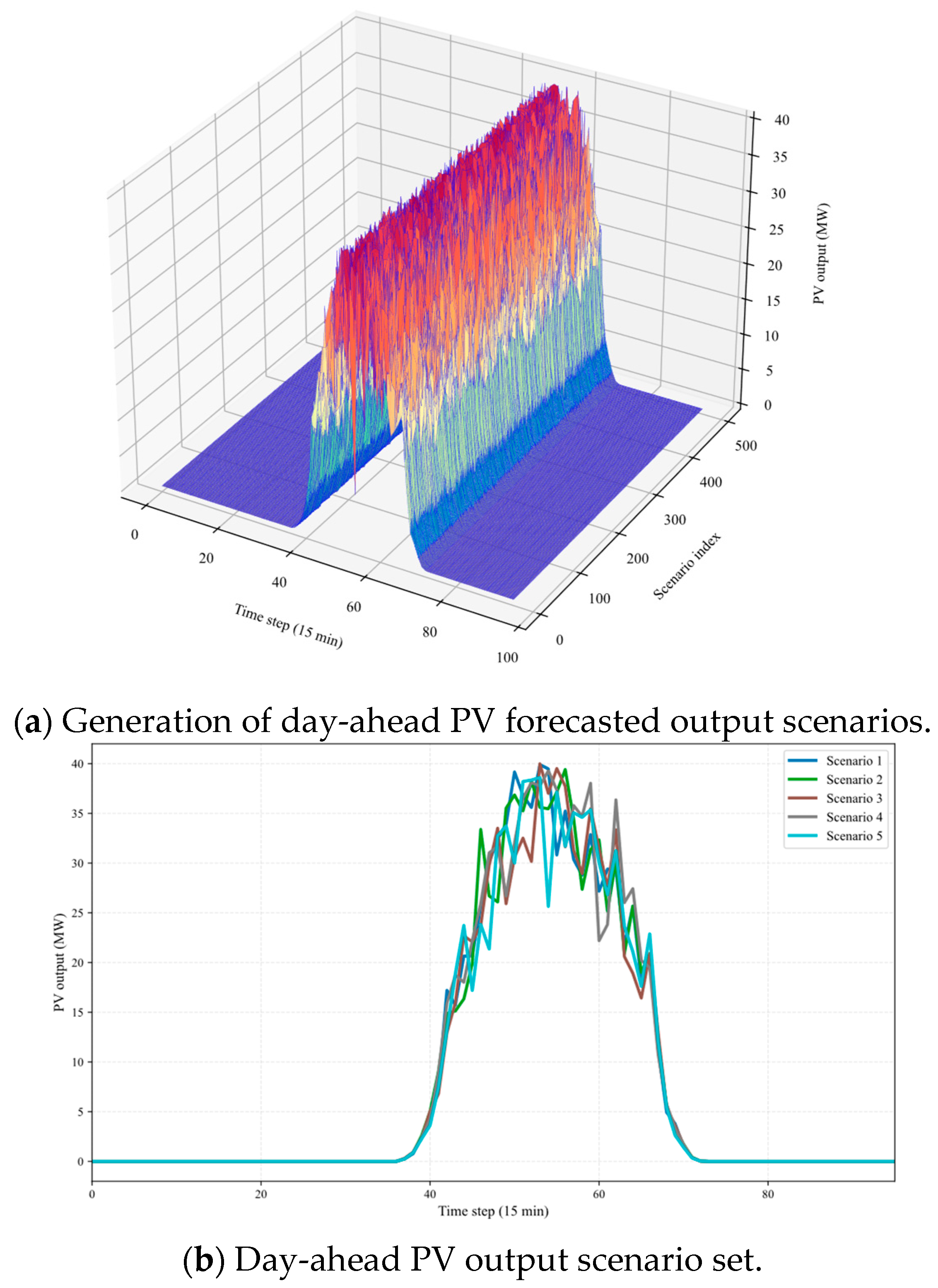
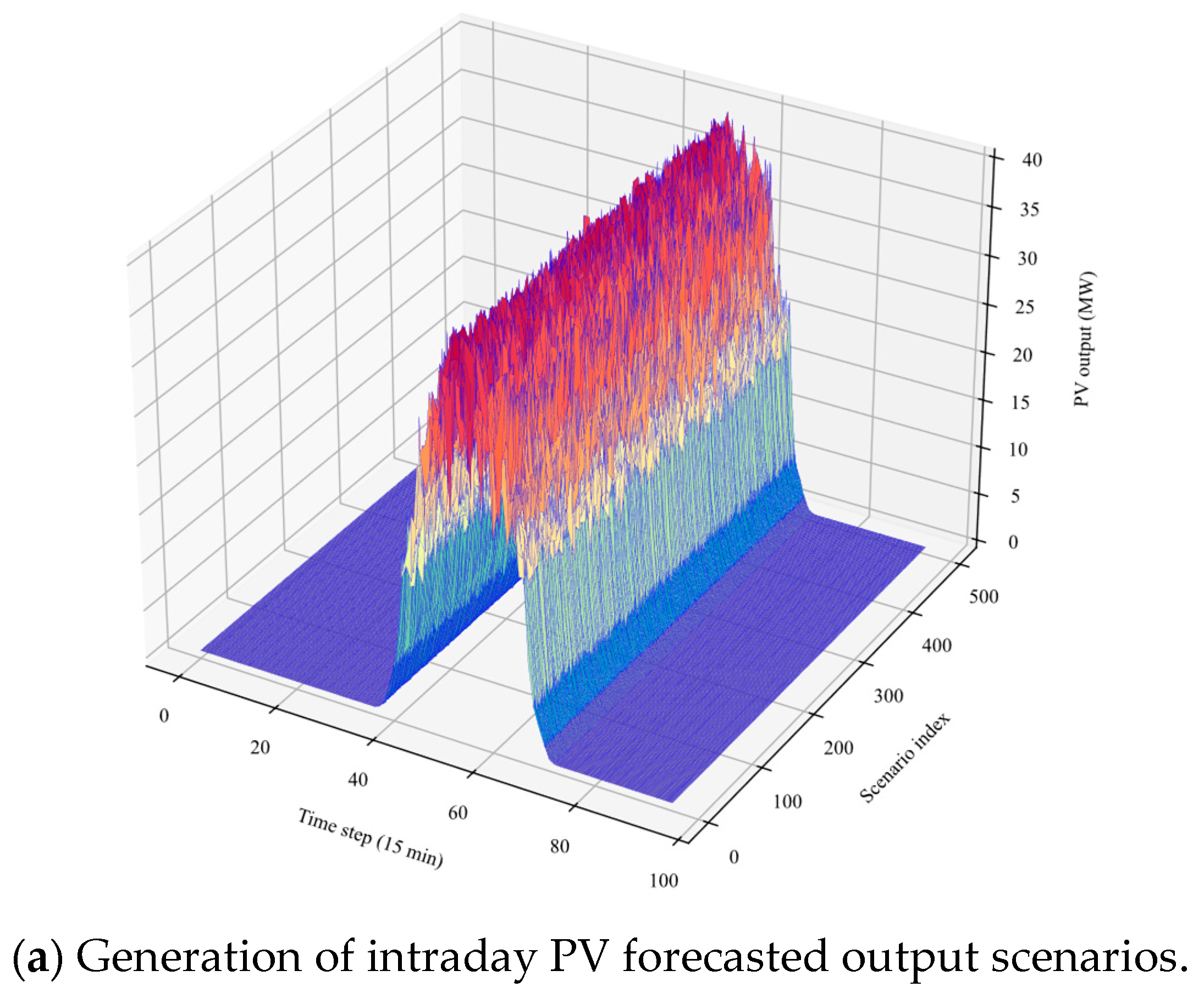
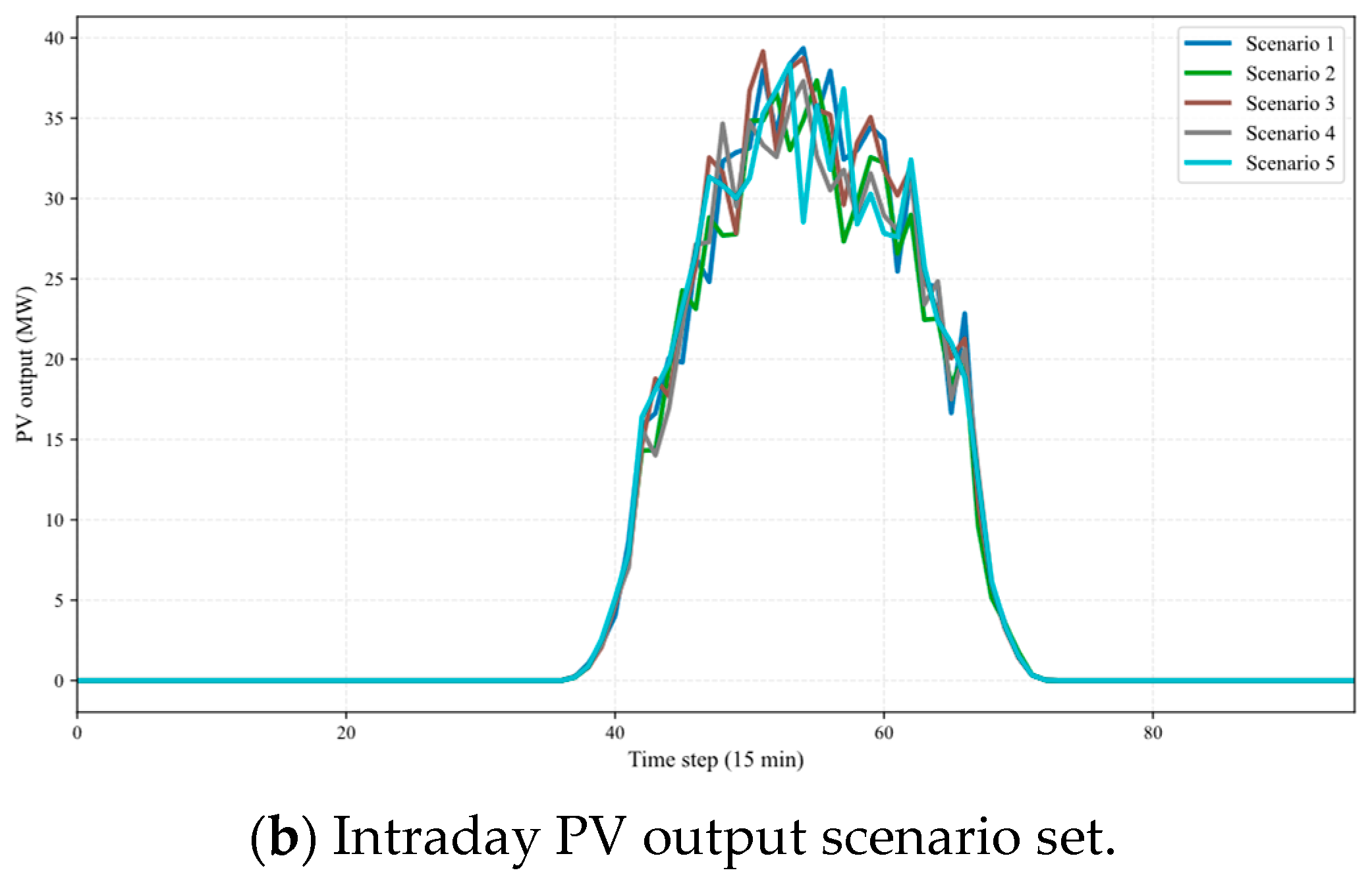
In this paper, LHS is utilized to generate an initial set of 500 PV output scenarios. Finally, through the scenario reduction process, five representative PV generation scenarios and their corresponding probability set P are obtained.
3.2. Day-Ahead Stage Optimization Model
In accordance with relevant policy requirements, photovoltaic power plants must submit their day-ahead reporting curves to the dispatch center one day prior to the dispatch date. Therefore, a day-ahead dispatch model must be established based on day-ahead output forecasts to determine the optimal day-ahead reporting curve. During the day, rolling optimization is performed using ultra-short-term forecasts of PV output for the next 4 h, taking into account the characteristics of PV output, to ensure timely corrections when actual output deviates from the day-ahead forecast.
Day-Ahead and Intraday Operation Mode for PV-Storage Power Plants: Based on short-term PV forecast curves and predicted electricity prices, the PV-storage power plant optimizes, through energy storage dispatch, the day-ahead electricity market bidding curve and the capacity bid for the frequency regulation market. Frequency regulation adopts a two-part tariff structure; the capacity bid for participation in the frequency regulation market generates a fixed return based on the bid capacity, and additional mileage-based returns are earned based on the actual electricity volume used for frequency regulation.
During the day, actual PV output may fluctuate relative to forecasts. The energy storage system first tracks the day-ahead plan curve to optimize dispatch, ensuring that the combined PV-storage output remains within the allowable deviation range of the plan curve. The remaining energy storage capacity participates in the intraday frequency regulation market. Based on the energy storage’s day-ahead bid output in the frequency regulation market for that specific time, the capacity for intraday frequency regulation participation is re-submitted. The actual frequency regulation output is determined by combining the PV-storage plant’s control strategy with the grid’s actual frequency regulation demand.
3.2.1. Objective Function
The day-ahead 24 h optimization model aims to maximize the daily operating profit of the combined PV-storage system. The total daily operating profit is
, which includes: the revenue of the combined PV-storage system from the energy market under scenario s (
), the revenue of the energy storage system from the frequency regulation market under scenario s (
), the daily penalty cost for PV curtailment (
), and the operational degradation cost of the energy storage (
). The objective function of the optimization model is shown in Equation (14):
where
represents the number of scenarios;
represents the probability of the
s-th scenario occurring.
where
is the number of day-ahead dispatch periods, which is set to 96;
is the day-ahead dispatch time interval, which is 15 min;
is the forecasted PV output at time
t under day-ahead scenario s;
and
are the charging and discharging powers of the energy storage;
and
are the capacity price and the mileage price for frequency regulation, respectively;
m is the average mileage;
is the frequency regulation performance constraint [
15];
is the declared power for frequency regulation in period t under day-ahead scenario s;
is the frequency regulation performance factor, as expressed in Equation (17);
is the unit penalty cost for PV curtailment;
is the day-ahead curtailed PV power;
is the unit operational degradation cost of the energy storage.
When the energy storage operates in a medium-energy mode with its SOC around 50%, it has sufficient capacity margin for both upward and downward frequency regulation, resulting in good regulation performance. However, when the SOC approaches its upper or lower limits, the energy storage may fail to respond to AGC commands in a timely manner, leading to poor regulation performance. Therefore, a frequency regulation performance constraint is introduced in this paper.
where
and
are the upper and lower SOC limits of the ESS for secondary frequency regulation, respectively;
h is the percentage deviation of the SOC from its midpoint during secondary frequency regulation.
Every charging and discharging action of the energy storage system affects battery life. Given that grid frequency regulation commands are frequent and difficult to predict accurately, the energy storage system must respond to these signals through charging and discharging operations within each control cycle under actual operating conditions. Therefore, e is defined as the frequency regulation energy coefficient, indicating that for every 1 MW of frequency regulation power provided, the energy storage system will charge (or discharge)
e MWh of energy during actual operation. Since the average frequency regulation signal over a single control cycle is approximately 0, 2
e is used to represent the total charge and discharge energy of the energy storage system participating in frequency regulation [
26].
3.2.2. Constraints
(1) Power Balance Constraint
where
is the power sold by the combined PV-storage system at day-ahead time t.
(2) Energy Storage System Power Constraints
The SOC between adjacent time periods must satisfy the following relationship:
where
is the SOC of the energy storage at time
t;
and
are the charging and discharging efficiencies of the energy storage, respectively;
is the capacity of the energy storage system;
is the grid frequency regulation demand coefficient.
During operation, the SOC of the energy storage system at any time must satisfy the upper and lower limits shown below:
where
and
are the minimum and maximum SOC limits of the energy storage system, respectively.
The SOC of the energy storage at the beginning and the end of the operating day must be equal.
High-power charging and discharging will shorten the lifespan of the energy storage system; therefore, the charging and discharging power must be restricted within a certain range during operation.
where
is a binary variable introduced to indicate the operating state of the energy storage.
= 1 indicates that the system is charging at that time, and
= 0 indicates that it is discharging.
is the maximum charging and discharging power of the energy storage system. This binary variable is used to ensure that charging and discharging do not occur simultaneously.
3.3. Intraday Optimization Dispatch Model
Due to deviations between the real-time and day-ahead PV output forecasts, the combined PV-storage system must participate in the real-time balancing market once the day-ahead trading plan is finalized. This is necessary to correct the mismatch between the real-time forecasted output and the day-ahead contracted electricity volume.
Within the 4 h rolling dispatch cycle, the specific rolling optimization objective function is shown in Equation (23).
where
represents the number of scenarios, and
represents the probability of the s-th scenario occurring;
is the intraday revenue of the combined PV-storage system from the energy market under scenario s;
is the intraday revenue of the energy storage system from the frequency regulation market under scenario
s;
is the intraday operational degradation cost of the energy storage under scenario
s;
is the intraday cost of PV curtailment. Except for the time scale, the specific formulations are identical to Equation (15) and are thus not repeated here.
is the intraday penalty cost incurred by the combined PV-storage system for tracking the day-ahead scheduled curve under scenario s, which is expressed as follows:
where
is the number of intraday periods, which is set to 96;
is the curtailed PV energy in intraday period
t;
and
are the intraday charging and discharging energies of the energy storage system for PV-storage scheduling, respectively;
and
are the intraday charging and discharging energies of the energy storage system for the ancillary service market, respectively;
is the power sold by the combined PV-storage system at the intraday time step;
is the penalty cost for tracking deviation;
and
are the lower and upper limits of the allowable tracking range, respectively;
is the maximum allowable tracking deviation specified by the dispatch center;
is the unit penalty price for the energy exceeding the allowable deviation limit.
After the combined PV-storage system submits its bidding volume for a given period, the dispatch center will issue AGC commands based on the actual grid frequency fluctuations and the power output submitted by the system in the frequency regulation market. Considering that real-time AGC commands alter the energy and power states of the energy storage, thereby affecting the initial conditions for the system’s subsequent market participation, these uncertainties must be corrected at the end of each rolling window.
where
is the operating power of the energy storage after the initial correction;
is the readjusted operating power of the energy storage if the initially corrected power exceeds its limits; the actual power adjustment
of the combined PV-storage system is determined by its control strategy. The remaining constraints are essentially identical to those in the day-ahead optimization model and are therefore omitted for brevity.
4. Case Study Analysis
4.1. Parameter Settings
This paper verifies the feasibility of the proposed combined PV-storage operation strategy based on a PV power plant. The plant has a rated installed capacity of 40 MW and is equipped with a 14 MW/24 MWh ESS. Given the limited capacity of the PV-storage system, its bidding behavior has a minimal impact on market prices. Therefore, this paper treats the power plant as a price taker. It only submits capacity bids in the spot market, and the clearing results are determined by the market. The main parameters of the photovoltaic-storage power plant are listed in
Table 1.
For the studied PV-storage plant in this paper, its installed capacity is relatively small compared with the overall market scale, and thus its market behavior has a limited impact on clearing prices. Therefore, the price-taker assumption is reasonable [
13]. When the scale of market participants increases, their bidding behavior may affect market clearing prices, which could influence optimal bidding strategies and economic performance. Accordingly, the conclusions of this study are primarily applicable to price-taking market environments, while considering the impact of market clearing prices will be addressed in future work.
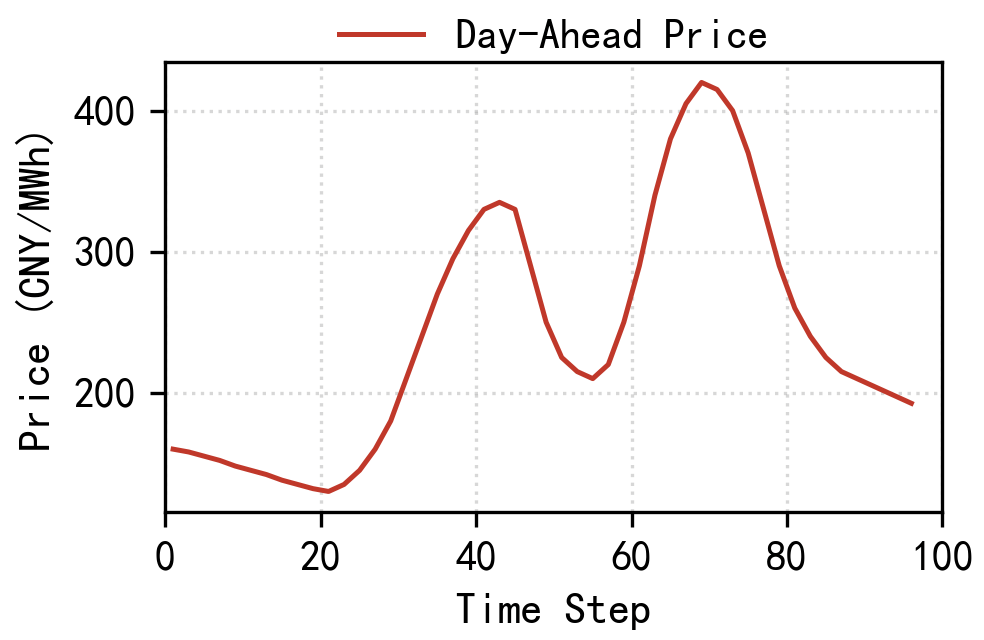
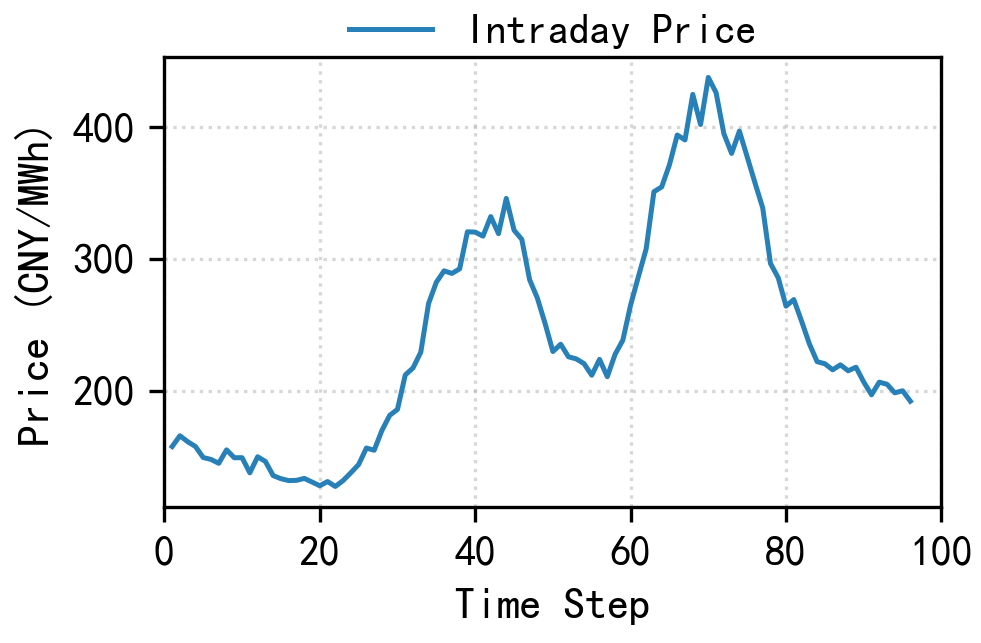
The forecasted spot market prices are based on actual historical data from a specific day in the electricity market. This paper assumes a maximum forecast error of 10% for both day-ahead and intraday market prices. The forecasted clearing prices for the day-ahead and intraday markets are shown in
Appendix B Figure A1.
The upper and lower SOC limits of the ESS are set to 0.9 and 0.1, respectively, which correspond to the standard operational range for ESS configurations. The lower limit of 0.1 is implemented to prevent irreversible battery damage caused by deep over-discharge, while the upper limit of 0.9 avoids safety risks associated with overcharging and simultaneously reserves a sufficient margin to cope with emergency frequency regulation demands. The frequency regulation energy coefficient e and the average frequency regulation mileage m are statistically derived from historical AGC signals. The frequency regulation performance parameter h is set to 0.6, which strikes a balance between the service quality requirements for grid frequency regulation and the protection of battery cycle life. This setting ensures that the ESS avoids high-intensity charging and discharging under extreme SOC conditions, while maintaining excellent frequency regulation response performance within its normal operating range.
The proposed optimization model is solved using the CPLEX solver. To strike a balance between computational efficiency and model accuracy, a finite piecewise linearization method is adopted to linearize the energy storage degradation model. Specifically, the DOD range is divided into 10 segments. Numerical results indicate that the approximation error introduced by this linearization method is minor, with an average error of less than 3%, which does not significantly affect the optimization results or operational decisions. Across all scenarios, the proposed model demonstrates stable convergence performance.
4.2. Scenario Set for Photovoltaic Power Output Uncertainty
This paper analyzes 2020 historical photovoltaic power generation data from a PV power plant, modeling the PV output characteristics with a 15 min time resolution. A Beta distribution is used to describe the random uncertainty of the PV output. The prediction error coefficients for day-ahead and intraday PV output are set at 15% and 10%, respectively, and 500 initial PV output scenarios are generated using Latin Hypercube Sampling (LHS). Based on this, the fast forward elimination algorithm is used to calculate the probability distances between scenarios and perform scenario reduction, ultimately yielding five typical PV output scenarios for both day-ahead and intraday forecasting, as shown in
Appendix B Figure A2 and
Figure A3.
Table 2 presents the probabilities corresponding to each scenario in the typical day-ahead and intraday scenario sets.
4.3. Analysis of Optimization Results Across Multiple Application Scenarios
Based on the parameter settings in
Section 3.1 and the PV output uncertainty scenarios described in
Section 3.2, three scenarios were established to compare their optimization results and verify the effectiveness of the operation strategy proposed in this paper. The scenarios are detailed as follows:
Scenario 1: The combined PV-storage system participates jointly in the energy market and the frequency regulation market, with the actual frequency regulation output of the energy storage determined by the AGC zone control strategy.
Scenario 2: The PV-storage system participates in both the energy market and the frequency regulation market, without considering the AGC zone control strategy.
Scenario 3: The PV-storage system participates only in the energy market and does not participate in the frequency regulation market.
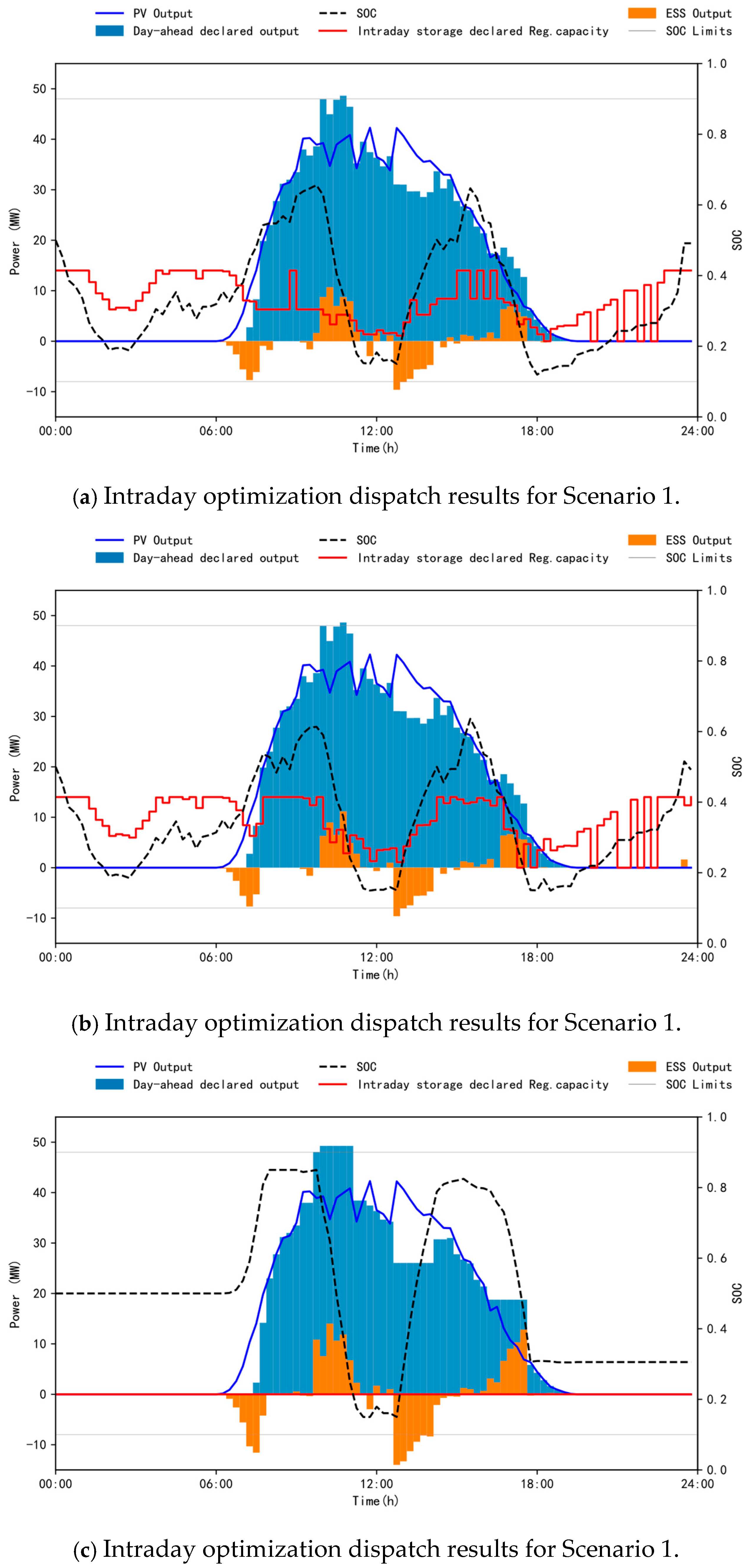
The optimization results for the three scenarios are shown in
Figure 5. Observing the results, during the 0:00–6:00 and 19:00–24:00 periods, the PV system generates no power, making peak–valley arbitrage impossible. Therefore, in Scenarios 1 and 2, the energy storage participates in the frequency regulation market by bidding capacity to generate additional revenue. In contrast, in Scenario 3, where the system participates only in the energy market, the energy storage remains inactive and its SOC remains unchanged.
During the 6:00–7: 00 period, PV generation begins. Because electricity prices are still low, the energy storage system uses part of its capacity to charge in preparation for selling electricity during subsequent high-price periods, resulting in a reduction in the declared capacity for frequency regulation.
During the 10:00–14:00 period, electricity prices fluctuate significantly. Consequently, the energy storage system reduces its declared frequency regulation capacity and allocates it to peak–valley arbitrage in the energy market.
During the 14:00–19:00 period, as electricity price fluctuations are minimal, the optimization model for Scenarios 1 and 2 determines that the benefits of participating in frequency regulation outweigh those of peak–valley arbitrage; therefore, a large frequency regulation capacity is declared. However, in Scenario 3, since the system only participates in the energy market, the energy storage is fully utilized for peak–valley arbitrage during the 7:00–17:00 period.
Compared to Scenario 3, Scenarios 1 and 2 exhibit higher energy storage utilization rates, offering greater flexibility and economic efficiency. The primary difference between Scenarios 1 and 2 lies in the AGC zone-based frequency regulation control. Around 18:00, as the grid’s ACE deviates significantly and enters the emergency regulation zone, the energy storage in Scenario 1 utilizes its full capacity for frequency regulation without SOC constraints. Compared to Scenario 2, this approach enhances grid security and system reliability. A detailed comparative analysis will be presented in the next section.
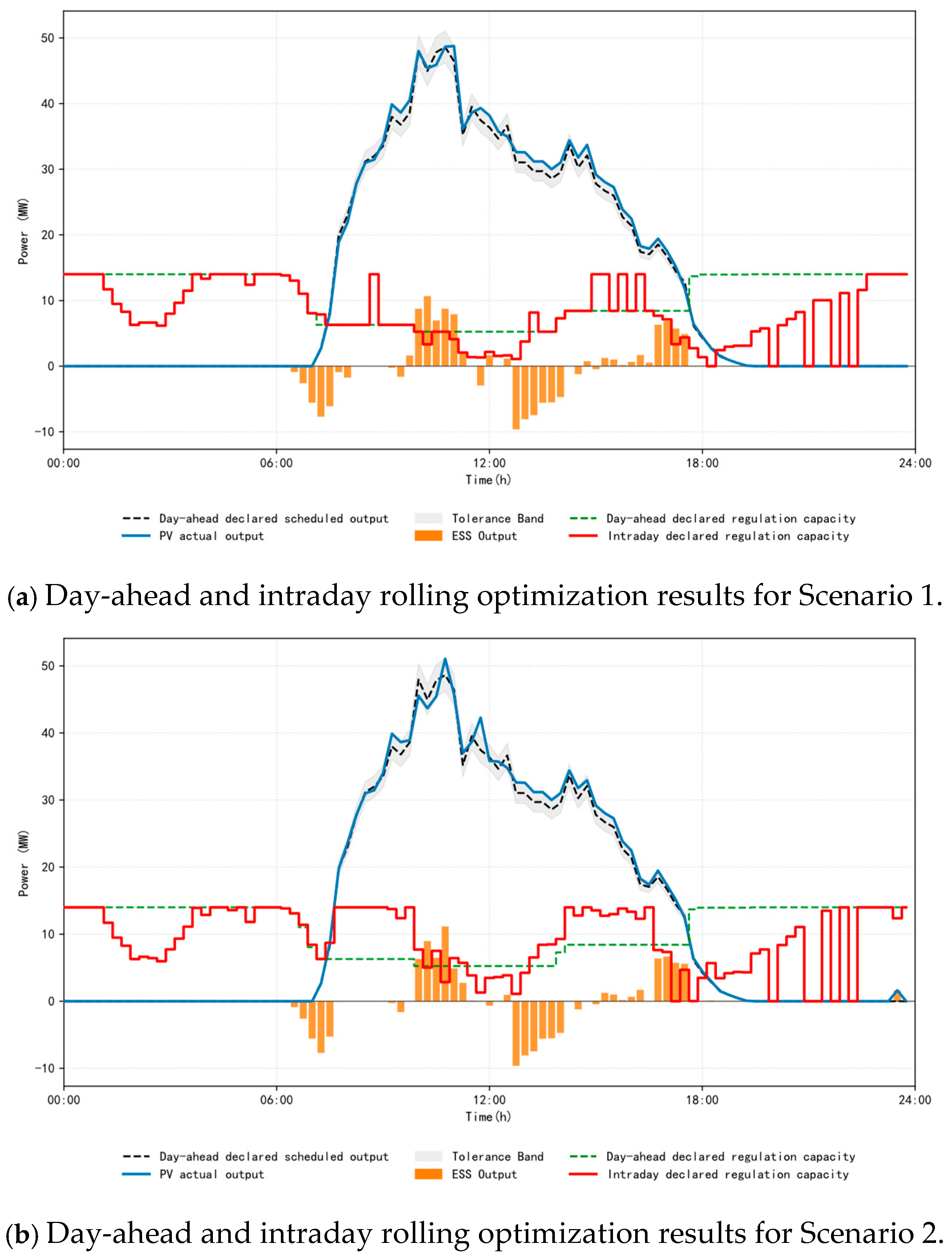
By applying the day-ahead and intraday rolling optimization strategy proposed in this paper to Scenarios 1 and 2, the corresponding optimization results are obtained.
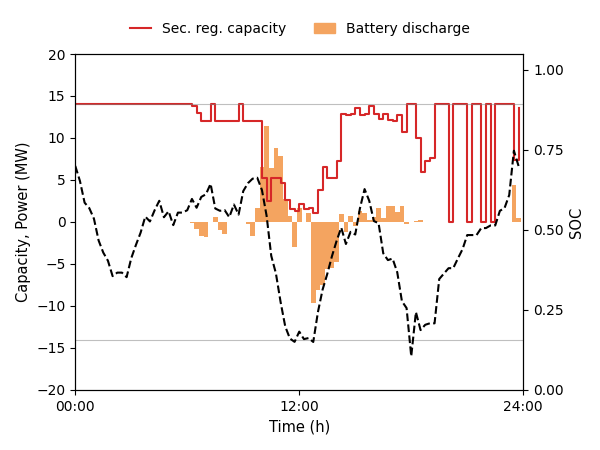
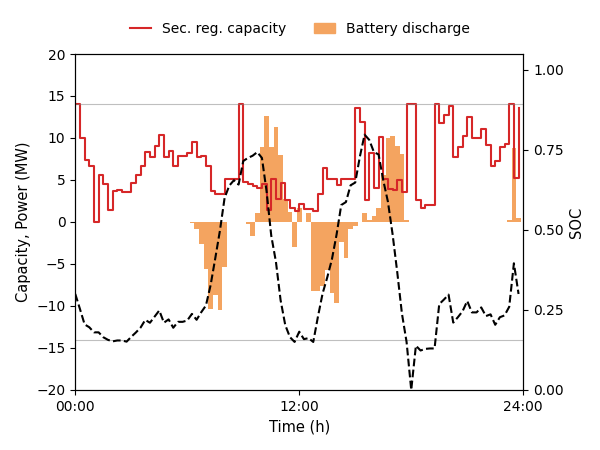
The day-ahead and intraday rolling optimization results are presented in
Figure 6. During the day-ahead periods of 0:00–6:00 and 19:00–24:00, the energy storage system cannot participate in peak–valley arbitrage; therefore, its full capacity is declared for frequency regulation. However, since the intraday PV output deviates from the day-ahead forecast, the frequency regulation capacity must be adjusted in real time based on the SOC of the energy storage. This results in greater fluctuations in the declared frequency regulation capacity compared to the day-ahead plan.
Meanwhile, during periods of PV generation, the intraday output closely tracks the day-ahead scheduled output under rolling optimization. It remains within the allowable deviation range, thereby avoiding severe deviation penalties. This validates that the day-ahead and intraday rolling optimization strategy proposed in this paper can effectively balance deviation penalty constraints with the coordinated allocation of multi-market resources under uncertainties.
4.4. Analysis of the Effectiveness of Frequency-Modulation Zone Control Strategies
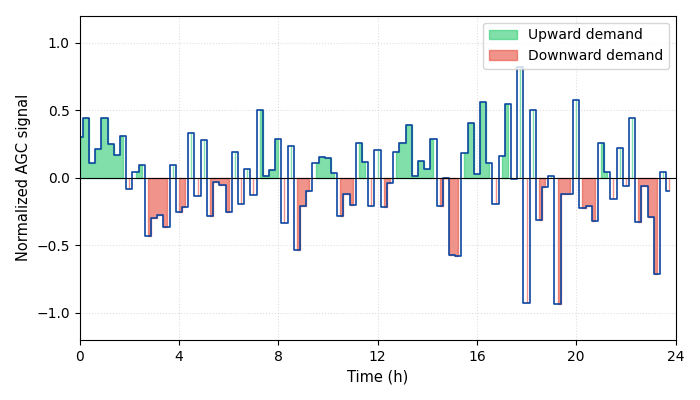
This paper analyzes historical AGC frequency regulation signal data from the U.S. PJM electricity market for the year 2025. First, the raw AGC commands are normalized, mapping their amplitudes to the interval [−1, 1]. Second, considering the stochastic fluctuations of the frequency regulation signals, a Gaussian mixture model (GMM) is employed to fit the probability distribution characteristics of the historical data. Finally, based on the fitted probability model, sampling and reconstruction are performed to generate the AGC frequency regulation demand signal shown in
Figure 7 [
27].
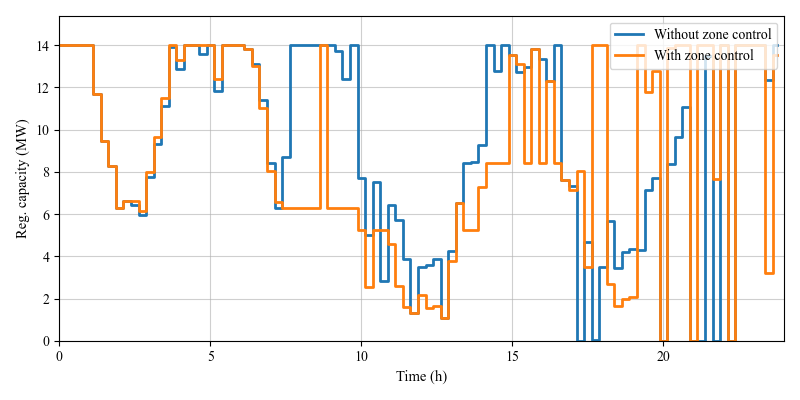
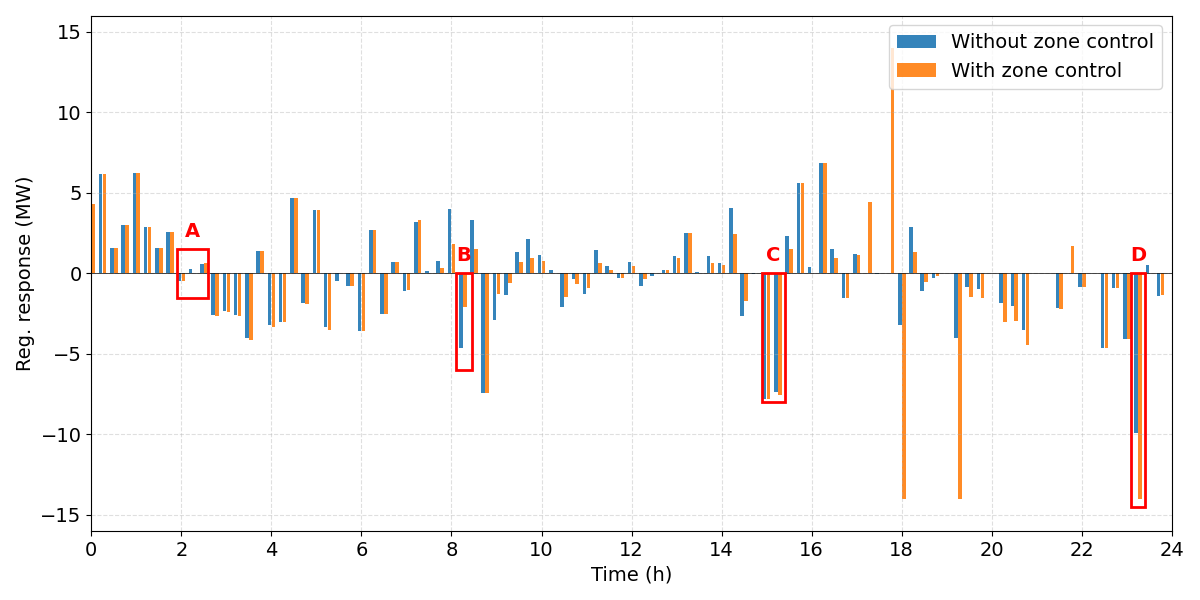
To demonstrate the effectiveness of the proposed zone-based frequency regulation control strategy for energy storage participation in the frequency regulation market, the frequency regulation results under Scenarios 1 and 2 are compared, as shown in
Figure 8.
As shown in
Figure 7, during the 0:00–6:00 period, since there is no PV generation, the energy storage cannot engage in peak–valley arbitrage. Consequently, the energy storage participates in the frequency regulation market at full capacity for most of this period, submitting frequency regulation capacity bids. Additionally, around 3:00, due to the low SOC of the energy storage system and constraints on its frequency regulation performance, the frequency regulation revenue decreases, leading to a gradual reduction in the bid capacity. During the 6:00–18:00 period, the energy storage system more frequently opts to participate in the more profitable energy market for peak–valley arbitrage, resulting in lower and more volatile frequency regulation capacity bids.
As shown in
Figure 8, during Period A, the AGC signal amplitude is relatively small, and grid frequency fluctuations remain within the normal range. At this time, under the non-zoned frequency regulation strategy, the energy storage system performs frequent charging and discharging operations. These operations have limited effectiveness in improving the grid frequency but accelerate the battery’s cycle aging. In contrast, under the zone-based frequency regulation control strategy, when the signal is within the deadband range, the frequency regulation response power is actively reduced to zero. This effectively avoids unnecessary operations of the energy storage system during periods of low frequency regulation demand, thereby helping to maintain the battery’s health.
During Period B, the ACE is in the normal regulation zone. At this time, Scenario 2 derives the actual frequency response power based on the ACE, while Scenario 1 aims to maximize the revenue of the combined PV-storage plant. Scenario 1 determines that participating in peak–valley arbitrage at this time yields higher profits; therefore, its actual frequency response power is lower.
During Period C, the AGC signal amplitude is large, and the ACE is in the secondary emergency regulation zone. At this time, both Scenarios 1 and 2 respond to frequency regulation in accordance with the AGC signal amplitude.
During Period D, the AGC signal amplitude is very high, and the ACE is in the emergency regulation zone. At this point, Scenario 2, constrained by the battery’s SOC and the symmetric capacity bidding rules, significantly reduces its declared capacity. This results in the actual response power remaining at an extremely low level, failing to provide effective power support. In contrast, Scenario 1 determines that the system has entered the emergency regulation zone; its control logic no longer relies solely on linear proportional tracking but instead utilizes the maximum charge and discharge capacity of the energy storage system to respond. The orange bars in the figure show multiple instances of full-power operation during this period, indicating that this strategy can fully mobilize the energy storage system’s regulation potential to rapidly stabilize system frequency fluctuations when the grid urgently requires power support.
In summary, the two strategies exhibit distinct operational characteristics. The non-zoned frequency regulation strategy operates smoothly but lacks flexibility when balancing the economic requirements in the deadband with the regulation demands in the emergency zone. In contrast, the zone-based control strategy exhibits distinct adaptive regulation characteristics. By implementing different frequency regulation output strategies across different AGC zones, it reduces the frequent charging and discharging of the energy storage system during periods of low regulation demand, while increasing output during emergency periods to ensure effective frequency regulation. This approach offers superior overall performance in balancing the operational economy of the energy storage system with grid security and stability.
4.5. Analysis of Operating Revenues Under Multiple Scenarios
The operating revenues of the power plant under different scenarios are shown in
Table 3.
In Scenario 3, the combined PV-storage plant participates exclusively in the energy market, utilizing all energy storage capacity for peak–valley arbitrage. Consequently, its energy market revenue is the highest among the three scenarios. Furthermore, since the energy storage does not need to respond to high-frequency AGC signals, its degradation cost is relatively low. However, by foregoing the frequency regulation market, the energy storage utilization rate remains low, resulting in a total revenue of only 95,075 ¥. The proposed zonal frequency regulation control strategy increases the ESS charging and discharging frequency due to its active participation in the frequency regulation market. Compared with Scenario 3, the battery aging cost increases by 1516.9 yuan, while the net profit rises by 12,401.5 yuan. It can be seen that the strategy achieves higher operating revenue with a moderate increase in battery degradation cost. This indicates that the proposed co-optimization framework effectively balances the trade-off between economic benefits and battery lifespan.
In Scenario 2, the PV-storage system participates in both the energy and frequency regulation markets. Because the energy storage actively engages in frequency regulation, its energy market revenue is lower, and its degradation cost increases. Nevertheless, it earns significantly higher frequency regulation revenue, bringing the total daily revenue to 108,351.6 ¥, the highest among all scenarios.
In Scenario 1, due to the adoption of the zonal frequency regulation control strategy, the ESS does not participate in frequency regulation response within the ACE deadband. This reduces frequent ESS actions and lowers the battery aging cost. Meanwhile, part of the ESS capacity is released for energy market trading, resulting in higher energy market revenue compared with Scenario 2. Although the total profit of Scenario 1 is 107,477 yuan, which is only 0.81% lower than that of Scenario 2, the battery aging cost is reduced by 9.98%. This indicates that the proposed zonal control strategy can effectively suppress battery degradation while maintaining relatively high economic returns, enhance the long-term economy of ESS operation, achieve coordinated optimization between economic performance and battery lifespan, and improve the security and reliability of power grid operation.
4.6. Stochastic Optimization Analysis
To verify the economic advantages of the stochastic optimization method adopted in this paper for the coordinated scheduling of photovoltaic–storage systems, a comparative analysis with the robust optimization method is conducted. Robust optimization aims to maximize the profit under the worst-case photovoltaic output scenario and does not rely on scenario probability distributions, thereby exhibiting an inherently conservative characteristic. In contrast, stochastic optimization formulates the day-ahead scheduling plan by maximizing the expected profit based on typical scenarios and their corresponding probability weights. Both methods employ the same zonal frequency regulation control strategy for intraday rolling adjustment, and the detailed economic performance comparison is presented in
Table 4.
As shown in
Table 4, the total revenue of stochastic optimization is 2213.2 yuan higher than that of robust optimization, an increase of approximately 2.1%. This is because stochastic optimization makes day-ahead decisions based on the probability distribution of typical scenarios, enabling fuller utilization of the energy storage regulation capability and market price fluctuations, thereby achieving higher energy market revenue and frequency regulation revenue. However, stochastic optimization relies more heavily on forecast accuracy; when the actual PV output deviates from the predicted value, it is more prone to schedule deviations, resulting in a tracking penalty cost 71.6 yuan higher than that of robust optimization.
In contrast, robust optimization considers the most adverse scenarios and reserves a certain regulation margin, effectively reducing system operation deviation and the cycling depth of the energy storage system. Consequently, both its degradation cost and tracking penalty cost are lower than those of stochastic optimization. Nevertheless, due to the relatively conservative dispatch strategy, part of the storage regulation capability is not fully utilized, leading to slightly lower energy market revenue and frequency regulation revenue. Overall, stochastic optimization can more fully exploit the economic potential of PV-storage joint dispatch while maintaining system operation security, making it more suitable for actual operation scenarios with high renewable energy forecast accuracy and the objective of profit maximization.
4.7. Sensitivity Analysis
Energy storage systems exhibit significant temporal coupling characteristics, and their initial SOC has a substantial impact on the economic performance of combined PV-storage power plants. Although a higher initial SOC is advantageous for addressing early morning peak loads or emergency upward frequency regulation demands, it may limit the system’s ability to accommodate midday PV generation. Conversely, a lower initial SOC reserves ample charging space, but it may restrict the bidding capacity for upward frequency regulation. Therefore, it is necessary to investigate how the initial SOC affects the revenue of PV-storage systems participating in multiple markets.
This section sets different initial SOC values to study their impact on the economic performance of Scenario 1.
Table 5 presents the various revenues and costs for Scenario 1 under different initial SOC states.
As shown in
Figure 9, during the 0:00–3:00 period, the grid requires the energy storage system to charge to meet upward frequency regulation demands. When the initial SOC is 0.7, there is sufficient margin to bid a higher frequency regulation capacity. In contrast, when the initial SOC is 0.3, the declared frequency regulation capacity gradually decreases.
With an initial SOC of 0.7, the SOC remains relatively stable, fluctuating around 0.5. Under the frequency regulation performance constraints, this stability allows for a higher declared capacity and, consequently, greater frequency regulation revenue. Conversely, when the initial SOC is 0.3, the SOC fluctuates significantly, resulting in lower frequency regulation revenue. Therefore, the energy storage system participates more extensively in the energy market to engage in peak–valley arbitrage.
An analysis of the data in
Table 4 shows that the net profit of the combined PV-storage plant peaks at 108,841.2 ¥ when S0 = 0.7, while it is 96,212.5 ¥ when S0 = 0.3. When the SOC is in the intermediate range, the energy storage system maintains a larger capacity margin to handle emergencies, thereby avoiding substantial tracking penalty costs. Furthermore, because the grid’s demand for upward frequency regulation is slightly greater than that for downward regulation, a higher initial SOC yields slightly higher profits than a lower one. In summary, the optimal initial SOC state lies between 0.3 and 0.7.
5. Conclusions
To address the issues of low utilization rates and long payback periods associated with energy storage systems coupled with traditional PV power plants, and the inadequacy of existing models in accounting for actual grid frequency regulation demands, this paper proposes a day-ahead and intraday coordinated rolling optimization strategy for combined PV-storage plants, considering both the energy market and AGC frequency regulation services. The main conclusions are as follows:
(1) This paper establishes a day-ahead and intraday coordinated optimization framework based on stochastic optimization, which effectively addresses the randomness and uncertainty of PV output and facilitates the coordinated operation of hybrid PV-storage systems in both energy and frequency regulation markets. Case study results demonstrate that the proposed strategy achieves a total daily revenue of 107,477 ¥, representing a 24.6% increase compared to participating solely in the energy market (86,245 ¥). This fully verifies that the proposed strategy can effectively enhance the economic viability of PV-storage power plants.
(2) Furthermore, this paper proposes a dynamic frequency regulation control strategy based on ACE zoning, which dynamically adjusts the ESS output according to the urgency of grid frequency regulation. Specifically, it avoids unnecessary frequent operations within the deadband to reduce energy losses, while fully utilizing the charging and discharging capabilities in the emergency and sub-emergency zones to rapidly support grid frequency stability. Simulation results show that the proposed strategy yields an ESS degradation cost of 1979.8 ¥, an 11.1% reduction compared to the non-zoned frequency regulation strategy. This validates that the proposed approach can extend the service life of the ESS and effectively strike a balance between grid frequency regulation demands and system operational economy.
(3) To address the problem that traditional constant power control is prone to causing battery overcharging and over-discharging, this paper proposes an SOC-based variable power charging/discharging constraint coefficient and an electrochemical energy storage degradation model. The SOC feedback constraint limits the energy storage operation within a safe SOC range. By incorporating the battery degradation model, the optimization decision-making process can effectively balance short-term revenue and long-term lifecycle degradation, thereby reducing the cycling degradation cost of energy storage and extending the service life of the energy storage system.
Although the proposed strategy has achieved favorable economic performance and frequency regulation quality in the case study, certain limitations remain. This paper assumes that the PV-storage plant acts as a price taker in the market, without further considering the impact of its bidding behavior on market clearing prices. In addition, the case study is conducted based on a single PV plant; the applicability of the proposed strategy under different regional climatic conditions, grid topologies, and market mechanisms still requires further validation. In actual engineering deployment, factors such as AGC signal transmission delay and market clearing uncertainty may also affect the performance, and in multi-plant coordinated dispatch scenarios, the computational complexity and the difficulty of coordinated control will further increase. Future research will further integrate delay compensation, robust optimization, and multi-plant coordinated optimization methods to investigate in depth the coordinated operation mechanism of PV-storage systems in coupled multi-market environments, and explore emergency dispatch strategies under extreme weather conditions along with practical engineering verification, so as to enhance the engineering applicability and implementability of the proposed method in large-scale PV plants. Future research will also explore bilevel optimization frameworks that jointly consider market bidding and market clearing processes, thereby improving the adaptability of the proposed strategy to practical market environments.