1. Introduction
The global energy system is undergoing a profound transformation driven by the urgent need to mitigate climate change and reduce greenhouse gas emissions [
1]. Among the key strategies, the widespread adoption of renewable energy sources, particularly photovoltaic (PV) generation, and the electrification of transportation through electric vehicles (EVs) and plug-in hybrid electric vehicles (PHEVs) have gained significant momentum [
2]. While these trends offer substantial environmental and economic benefits, they introduce new operational challenges for electrical distribution networks, which were originally designed for passive, unidirectional power flow [
3]. Specifically, the stochastic nature of solar irradiance and the uncertain charging patterns of EVs can lead to voltage fluctuations, increased line losses, feeder congestion, and reverse power flow conditions [
4]. Consequently, distribution system operators require advanced operational tools to manage these challenges effectively, moving from passive to active distribution network management.
Considering the growing adoption of renewable energy sources, there has been considerable research focused on the effective positioning and scheduling of distributed generators in distribution networks. Previous studies, for instance, those described in [
5,
6], indicate that the careful placement and sizing of wind farms and photovoltaic (PV) systems can effectively lower active power losses, optimize voltage levels, and increase the efficiency of the grid. The application of metaheuristics, like PSO [
7], GWO [
8], GA [
9], and other hybrid techniques [
10], has proved useful in dealing with the resultant mixed-integer non-linear optimization problem. Yet most existing works have only considered the incorporation of renewables independently without considering the potential benefits of combining generation with load management and network restructuring [
11].
The distribution system reconfiguration (DSR) technique has traditionally been considered an efficient strategy to decrease losses and improve voltage profiles within radial distribution systems. By modifying the opening/closing state of sectionalizing and tie switches, DSR allows for shifting the power flow paths, thus reducing congestion and losses [
12]. More recent advances in DSR include risk-based dynamic reconfiguration [
13] and MILP-based models considering voltage stability [
14]. In [
14], the authors provide a mixed-integer-linear-programming-based model for the distribution system reconfiguration problem considering voltage stability constraints, resulting in significant improvements in its performance. The same is observed in [
13], where the authors present a dynamic reconfiguration scheme, which allows for adapting the topology of the network depending on load/generation variations over time. Recent research in [
15] has examined the joint operation of DSR and soft open points to increase the penetration of renewable energy sources.
The emergence of vehicle-to-grid (V2G) systems has revolutionized the nature of EV parking lots, which have been upgraded from mere parking spaces to distributed energy resources with two-way energy transfer capabilities [
16]. Smart parking lots (SPLs) endowed with V2G features can serve as a collective energy storage facility, absorbing excess energy during off-peak hours or times of surplus renewable energy production and releasing it during peak consumption periods to support voltage regulation and peak load shaving [
17]. Reference [
18] provides an integrated energy management scheme for EV parking lots that optimizes the profits of operators, considering the associated cost of battery wear. The findings of [
19] show how SPLs can successfully contribute to the improvement of the reliability of distribution networks during contingencies. Recent work by Kioumarsi and Bolurian [
18] presents optimal energy management for EV parking lots considering battery wear and renewable integration. Furthermore, ref. [
20] proposes a probabilistic approach to optimal planning of SPLs by taking into account uncertainties regarding EV arrivals and departures, state of charge, and electricity rates.
The integration of renewable energy with energy storage systems has also been widely researched as one way of overcoming issues arising from the inherent intermittent nature of solar and wind sources [
21]. The study carried out by [
22] on the optimal allocation of battery energy storage systems within distribution networks, considering both load and generation uncertainties, resulted in significant reliability index improvements. In [
23], the authors discussed a planning model for distributed generators and battery energy storage systems, highlighting economic benefits that can be achieved through joint consideration. In their paper, ref. [
24] developed a two-stage stochastic approach to achieve an optimal location and capacity planning of battery storage devices for active distribution systems. In a more recent paper, ref. [
25] introduced a multi-objective approach for simultaneous location planning of renewable distributed generators and battery storage.
Despite these encouraging advancements in the literature, however, there remain important limitations which must be considered. In particular, while previous studies have analyzed separately the aspects of distribution system reconfiguration [
12,
13,
14,
15], PV generation scheduling [
5,
6] and intelligent parking lot (IPL) management [
16,
17,
18,
19,
20], the simultaneous optimization of DSR, PV curtailment, and IPL dispatch under a normalized energy loss and voltage deviation objective within a MINLP framework has not been addressed. As has already been emphasized above, the synergy between spatial flexibility provided by network topology manipulation, temporal flexibility achieved through coordination of EVs’ charge and discharge processes, and local generation flexibility enabled by PV curtailment represents an underutilized source of potential improvement in terms of optimizing the behavior of the distribution network [
26]. In addition to this, due to the inherently computationally demanding nature of the problem in question with its binary search space, non-convex AC power flow constraints and large dimensional continuous search space over a 24 h time frame, novel metaheuristic approaches would have to be applied to solve the corresponding mixed-integer non-linear programming problem [
27]. Finally, to date, the literature contains no systematic comparative analysis of alternative control strategies implemented at different levels of control integration, starting with passive control and extending up to coordination of all three flexibility levers [
28]. Several studies have specifically addressed network reconfiguration, V2G, and parking lot management in distribution systems. Moghaddam et al. [
29] proposed a model for simultaneous network reconfiguration and distributed generation allocation, focusing on power quality indices and loss minimization. Soliman et al. [
30] introduced an efficient allocation framework for capacitors and V2G-enabled electric vehicle charging stations in radial distribution networks, demonstrating the benefits of bidirectional power flow. Sedghi et al. [
31] examined optimal storage planning in active distribution networks under wind power uncertainty, which is relevant for managing variability introduced by renewable sources and electric bus parking lots. More recently, Fathi et al. [
32] applied an improved salp swarm algorithm for the combined allocation of renewable resources and radial distribution network reconfiguration, achieving significant loss reduction and reliability improvement. These works collectively highlight the importance of integrating topological flexibility (reconfiguration), bidirectional energy exchange (V2G), and energy storage (parking lots) but leave room for the joint stochastic allocation of PV and electric bus parking lots under uncertainty, which is complementary to the deterministic coordination framework presented in this paper.
Hence, the following research gaps are systematically identified:
Most existing studies treat DSR, PV scheduling, and IPL management separately or in pairs, lacking a unified framework that coordinates all three.
The MINLP nature of the combined problem (binary switching + continuous dispatch + AC power flow) has not been adequately addressed with a metaheuristic specifically adapted for this structure.
Systematic comparative analysis under increasing levels of control integration (from passive to fully coordinated) is missing in the literature.
Voltage deviation and energy loss are rarely treated as equally important objectives with proper normalization.
In order to fill these gaps in the existing literature, a new multi-objective optimization model is developed for optimal scheduling and reconfiguration of active distribution systems with PV energy sources and intelligent parking lot storage. The key contributions of the current study include:
A common mathematical model is formulated for solving the optimization problem of distribution system reconfiguration (DSR) with binary switching variables, solar power curtailment with continuous dispatch variables, and charging/discharging of IPLs with continuous storage variables within a 24 h time frame. In this case, the objective function is defined as the normalized weighted summation of total active energy loss and average voltage deviation.
The solution technique adopted in addressing the proposed mixed-integer non-linear programming (MINLP) problem is an Enhanced Grey Wolf Optimizer (EGWO). In the EGWO methodological approach, there are two new approaches introduced to tackle the issues of optimizing the active distribution networks. They are referred to as dynamic neighborhood influence (DNI), which ensures that the search agents that get trapped in the local optimal solutions move to other areas, thus increasing their probability of finding the best solutions. Another approach is the self-adaptive convergence factor, which adjusts the exploration–exploitation trade-off based on the speed of fitness enhancement.
The investigation of the case study involves the systematic implementation of an analysis under five different operation cases, namely Base Case, DSR Only, PV Only, PV + DSR, and PV + DSR + IPL, on the standard IEEE 33-bus radial test system. The graded approach allows accurate determination of the individual benefits of each control layer as well as the benefits derived when layers are used together.
The rest of the paper is structured as follows. Problem formulation, which includes the objective function, decision variables, and constraints of the system, is presented in
Section 2. The EGWO technique proposed to solve the given problem is discussed in
Section 3. The discussion also focuses on the DNI principle and the self-adaptive convergence factor. Simulation, definition of case studies, and the corresponding simulation results are presented in
Section 4, while conclusions are given in
Section 5.
2. Problem Formulation
In this section, the mathematical model for the optimal scheduling and reconfiguration of the ADN system will be described. The problem statement involves an optimal control approach, considering the active distribution system consisting of 33 buses and being modeled within the horizon T = {1, 2, …, 24} hours with equal interval Δt = 1 h. The optimization problem will be solved aiming at finding the optimal control actions in the form of PV unit and IPL power flow setpoints as well as the optimal reconfiguration of the network using the DSR method. The main idea consists of minimizing a normalized multiple objective function of energy losses and voltage quality.
2.1. Objective Function
The optimization problem is cast as a multi-criteria minimization problem with two different criteria combined into a scalar objective function denoted as F. First, a measure of network efficiency that corresponds to the amount of active energy loss in the distribution lines in terms of heat per day is considered. Second, a measure of service quality is introduced as the total deviation from the rated voltage level at all buses throughout the day. Because the metrics used for the evaluation have different physical units and different scales, it is crucial to normalize them in order to avoid any dominance of the criterion based only on its magnitude. In other words, each element of the objective function is normalized relative to the same metric calculated under a Base Case assumption without applying either DSR control or active power dispatch from PV or IPL sources. Equation (1) gives the mathematical form of such a normalized objective function.
In this model, and stand for non-negative scalar weights of the two objectives such that + = 1. Selection of the precise numerical values for both and allows the operator to place more significance on minimizing energy wastage versus tightening the voltage profile depending on the existing objectives or regulatory guidelines. stands for the overall amount of active energy loss that has occurred within all of the network branches over a 24 h simulation process, while is the overall energy loss in the Base Case. Likewise, VD stands for the overall voltage deviation in all of the nodes, while stands for the same deviation in the Base Case.
The total active energy loss term, written as
, is achieved by summing up the losses caused by resistances that are present in each segment of the transmission line over the entire duration. The instantaneous power loss for any particular branch is calculated as being directly proportional to the squared value of the current, with the resistance of that particular branch. This process of summation is described in Equation (2).
In this equation, set L includes all the line segments on the 33-bus distribution system, the variable represents the root mean square (RMS) value of the branch current at time t, and refers to the ohmic resistance of the branch. The expression gives the instantaneous active power loss in the branch, regardless of power factor, because the current magnitude already accounts for both active and reactive components. Multiplying by (1 h) converts power loss to energy loss in kWh.
The voltage deviation term, represented by VD, provides a scalar measure of how close the voltages deviate from the reference value of 1.0 per unit (p.u.). While there are prescribed voltage bands allowed in regulations (such as +/−5% from the reference voltage), the cost function ensures that the voltages stay as close as possible to 1.0 p.u. To calculate the voltage deviation term, the difference between the reference value of 1.0 p.u. and each bus voltage is computed at each time step, averaged across all buses, to give a representative value for a specific hour, and summed over 24 h.
In this context, N stands for the set of all buses, where the size of the set is denoted by |N| = 33, while denotes the magnitude of the voltage at bus i within the period of t. The lower the value of VD, the more the voltage profile will be close to flat with respect to the operating point.
2.2. Decision Variables
This involves the modification of an array of independent decision variables in order to minimize the objective function defined by Equation (1), subject to the operational and physical limitations imposed by the network. Decision variables can be further classified into two broad categories based on their nature: binary switching variables used for defining the structure of the network and continuous variables for power dispatch.
This category relates to distribution system reconfiguration and is captured through the binary variable . In this regard, assumes the value of 1 if the line segment , which is a member of all branches , is active and closed for the time . On the other hand, if the branch is open, = 0. This binary variable helps in determining the structure of the distribution network, particularly its radial configuration. The second type relates to the scheduling of the active power of distributed energy resources. For the buses equipped with PV generation, belonging to the set , the decision variable represents the active power generated by PVs at bus i in period . It should be highlighted that the scheduling of this variable allows for curtailing the available solar energy; in other words, the generation can be lower than the maximum possible solar generation in the hour . For the bus having an intelligent parking lot (IPL) system, along with their inclusion into the set , the operating condition is characterized by the following two continuous variables, namely and . The first variable corresponds to the active power consumed when the battery is charged, while the second variable corresponds to the active power supplied back to the grid in discharging mode. Besides these power variables, the dynamic state of energy for the IPL system at time interval for bus i is defined using .
In the proposed model, the dependent variables consist of the complex bus voltage and the branch current , which can be derived by solving the power flow equations in terms of the independent decision variables and network parameters.
2.3. System Constraints
Minimization of the objective function F is subject to a complete list of equality and inequality constraints that impose adherence to the laws of physics for the electrical circuit, the capabilities of the equipment available, and the topology constraints dictated by the radial distribution system operation.
2.3.1. Radiality and Network Topology Constraints
In the proposed distribution network, it can be represented using the radial topology, where the graph should satisfy the property of being a connected spanning tree without any closed loops. The above requirement is mandatory in order to ensure correct synchronization of protective equipment and proper working of the power feeder. The radial property is ensured through the branch constraints by limiting the number of closed branches to be equal to the total number of buses minus one, provided that all load points have been served without formation of any islands.
For the specific 33-node test feeder used in this analysis, |N| = 33, meaning there should be precisely 32 closed switches during any given operating hour. This condition ensures that the optimization model finds a feasible spanning tree structure. In addition, the binary nature of the switch variable is ensured through Equation (5).
Physically, network reconfiguration is achieved using remotely controlled switching devices installed along distribution feeders. Sectionalizing switches are normally closed devices that can be opened to isolate faulted or heavily loaded line sections; they are typically implemented as vacuum circuit breakers or motor-operated load break switches. Tie switches are normally open devices that can be closed to transfer load from one feeder to another; they are often realized as automatic transfer switches or remote-controlled gang-operated switches. Both types are equipped with actuators (electric motor drives or solenoid mechanisms) that receive open or close commands from the distribution management system via communication protocols such as IEC 61850 GOOSE messages or Modbus TCP/IP. In modern active distribution networks, these switches can be actuated within seconds to minutes, enabling dynamic reconfiguration in response to change load and generation conditions.
2.3.2. Power Flow Constraints
The transfer of electric power in the network must abide by the basic principles of physics such as energy conservation in each node and voltage–current characteristics of each impedance. Steady-state operation of the radial distribution feeder network can be represented using conventional AC power flows where the state of switches along lines will be accounted for based on DSR variables. Let the line l connect buses
and
. Then, the expression for the active power flow
and the reactive power flow
depends not only on the voltage magnitude and angle in both terminals but also the conductance
and the susceptance
of the line. Binary variable
plays the role of a multiplier which forces the power flow on the branch l to be zero when the branch is disconnected. This equation is presented in Equations (6) and (7).
If
= 0, then the complete right-hand side of both expressions will become zero, which means the part after the substation will be isolated as desired. If, however,
= 1, the standard AC power flow relation is maintained. In other words, the power flow at each node
i has to balance the net injection, meaning the sum of powers flowing from all connected edges. Net injections involve the difference between local sources, such as PV and IPL discharge, and local loads, including fixed demands and IPL charge.
In the equation above, represents the known active power requirement at bus in time period . A similar balance equation is formulated for reactive power where the reactive power generated by PV and IPL is considered negligible or managed locally.
2.3.3. Photovoltaic Generation Constraints
The generation of active power from the photovoltaic (PV) system depends on the availability of solar energy, which changes according to the time of day. The power generated by the PV system,
, should be non-negative and less than or equal to the maximum possible PV power,
, during the specified hour of the day. The maximum possible PV power depends on the available solar radiation and temperature at that instant.
2.3.4. Intelligent Parking Lot Constraints
In this study, each IPL consists of 200 plug-in hybrid electric vehicles (PHEVs), each with a usable battery capacity of 50 kWh, yielding a total energy storage capacity of 1.0 MWh per IPL. A bidirectional AC/DC converter rated at 0.5 MW serves as the power conversion interface between the aggregated fleet and the distribution grid. The IPL communicates with the distribution system operator via a dedicated link (e.g., IEC 61850 or Modbus TCP/IP) to receive charging and discharging setpoints. A local energy management system allocates these setpoints among individual vehicles based on their availability and current state of charge. Power consumption from the grid by IPL for charging the EV batteries,
, and power generation by IPL for discharging the stored energy to the grid,
, must be non-negative and must not exceed maximum power capability of power electronic interface of the IPL. The operational constraints of the IPL are formally expressed below.
The time-based behavior of the energy storage in the IPL is represented using a discrete state equation that considers the energy added when charging and the energy removed when discharging along with the losses due to round-trip efficiencies. The energy state
after hour t is derived from the previous energy state at hour t − 1, which is
, as shown in Equation (12).
In this study, the charging and discharging efficiencies are set to
. Their product
, which represents the round-trip efficiency of the IPL storage system. This convention ensures that energy losses during charging and discharging are symmetrically distributed. In order to prevent deep discharge scenarios that could potentially affect battery life, a minimum state of charge threshold of 20% is maintained. The energy storage is limited to the physical storage capacity of the battery system, as indicated by Equation (13).
MWh in both IPLs. The state of charge (SOC) at the beginning of the 24 h period is taken to be 50% of the maximum energy rating of each storage unit, which is the usual situation for an empty parking lot.
2.3.5. System Operational Limits
However, for the reliable operation of the distribution system, it is imperative that voltage levels and loading on lines do not exceed the statutory limits and thermal limits, respectively. In this regard, the voltage level at each node should not deviate from its nominal value of 1.0 per unit by more than a narrow margin. Typically, the allowable deviation in distribution networks is ±5%, as shown in Equation (14).
Furthermore, the current flowing through each branch l shall not exceed the ampacity rating of the conductor, symbolized by
, to prevent excessive heat generation and possible harm to the equipment. This condition is enforced by the inequality presented in Equation (15).
In conclusion, the optimization problem is formulated to minimize the normalized objective multi-objective function F, as illustrated by Equations (1)–(3), while considering the constraints defined by Equations (4)–(15). The solution to the above problem will result in the optimum switching state , optimum PV curtailment power generation , and optimum charging/discharging powers and for IPL systems over the period of one day.
3. Solution Methodology: Enhanced Grey Wolf Optimizer for Active Distribution Network Scheduling
The proposed optimization problem in
Section 2 represents a complex mixed-integer non-linear programming (MINLP) model. In addition to the continuous variables associated with voltages, currents, PV and IPL dispatch rates, there is a need to consider a set of binary variables that indicate the state (open or closed) of line switches involved in distribution system reconfiguration. As an example, given the 33-bus test system containing 37 tie and sectionalizing switches, the cardinality of feasible radial configurations becomes extremely large, making any exhaustive enumeration technique impracticable. Furthermore, the power flow equations representing the dependency between the mentioned continuous variables are non-convex and non-linear. This aspect implies that the use of classical derivative-based algorithms may result in their entrapment in suboptimal points and inefficient movement across the mixed-integer design domain.
In order to solve the optimization problem efficiently, this study makes use of a highly sophisticated metaheuristic approach. Particularly, the chosen technique is the GWO [
8], which is a relatively recent bio-inspired population-based method of global optimization. Although the standard implementation of the GWO proved to be rather successful in solving many complex benchmarks for continuous problems, there are several important drawbacks associated with its use in the context of the proposed MINLP problem. Firstly, the absence of an effective approach for handling binary variables leads to either poor search dynamics or premature convergence. Secondly, using the standard linear decreasing of the exploration–exploitation parameter can cause inefficiencies in searching due to excessive exploration of the solution space at the early stages and the premature stagnation at the final iterations. Recent metaheuristic developments include improved sine–cosine algorithms for global optimization [
5] and hybrid approaches for renewable allocation [
33].
Unlike existing adaptive GWO methods that only adjust the convergence factor using a predefined schedule, the proposed EGWO introduces two synergistic enhancements. First, a dynamic neighborhood influence (DNI) mechanism allows poorly performing wolves to move toward fitter neighbors rather than only toward the three leaders, preventing premature convergence. Second, a self-adaptive convergence factor dynamically responds to the actual fitness improvement rate of the alpha wolf, re-entering exploration mode when stagnation is detected. These features distinguish EGWO from hybrid GWO variants (e.g., GWO-PSO, GWO-GA), which combine two separate algorithms and increase computational overhead, whereas EGWO remains a single-population method.
3.1. Solution Encoding and Population Initialization
The primary requirement for implementing the EGWO algorithm to solve the problem posed in
Section 2 is the creation of an effective solution representation. Each wolf represents a single solution to the problem, with each individual’s position vector
comprising all decision variables of the problem. To update positions based on hunting search, the solution vector must be broken into three different parts, representing the three types of decision variables.
The first part of the solution vector represents the distribution system reconfiguration (DSR) variables, the second part represents the photovoltaic generation (PV) curtailment schedule, while the third part represents the intelligent parking lot charging–discharging schedule. Equation (16) presents the entire position vector of wolf w.
DSR segment
can be defined as a vector of size
and includes the binary switch state of each line at every hour of the day. Since the EGWO algorithm works intrinsically on the real-valued number set, an approach needs to be formulated for converting the continuous position obtained from the algorithm into the binary switch action. This conversion is accomplished using a hyperbolic tangent transfer function that converts a continuous position variable
to a binary decision based on whether a switch is on or off using Equation (17).
After the creation of the binary matrix , a heuristic repair operator is utilized to strictly enforce the radiality constraint, as per Equation (4). In case there is any difference between the number of switches being closed , a branching exchange procedure is executed where open branches are closed and closed branches are open while maintaining the connected spanning tree formation of the radial distribution network. Such a repair strategy ensures that all candidate solutions assessed by the power flow solver represent physically operational radial networks.
The second subsegment represents a real vector that contains the scheduled PV active power output for all the PV-equipped buses for each hour. It is randomly initialized within the range and remains bound between these limits throughout the optimization period.
The third subsegment involves continuous variables representing the IPL charging power and discharging power . In order to avoid the unrealistic scenario whereby charging and discharging simultaneously occur for the IPL, the position updating scheme of this segment is designed to keep one of the two powers active while setting the other to zero at any time instant. Initialization of this segment is ensured as the energy storage level computed using the recursive relation of Equation (12) stays bounded by the energy storage limits as per Equation (13).
An initial population of wolves in is created using random sampling of continuous decision variables from their feasible regions and employing transfer and repair operators for switching variables. Fitness of each member in the population is assessed based on the fitness evaluation procedure described in the upcoming subsection.
3.2. Fitness Evaluation and Constraint Handling
The fitness value associated with the candidate solution involves computing the objective function , as presented in Equation (1). Such computation necessitates solving the AC power flow equations over each hour during the day for the 24 h, assuming the network topology defined by the DSR variables and power generation at each node based on the PV schedule as well as IPL load. The solution of the power flow equations provides voltages and branch flows , which are then used to determine the energy loss term and voltage deviation term “VD.”
In the context of metaheuristic optimization, the operating constraints stated in Equations (14) and (15), where voltage limits and line flow limits are enforced respectively, should be considered in the fitness computation process. In the EGWO approach, an adaptive exterior penalty function is used to transform the constrained optimization into an unconstrained minimization problem. Any solution that violates any of the constraints incurs a penalty.
The penalized fitness function
for wolf w is formulated as per Equation (18).
In this case,
refers to the normalized multi-objective index based on Equation (1), while the expression
signifies the sum of magnitudes of constraint violations for the given solution over the 24 h period and for all bus/branch pairs in the network. This is calculated using Equation (19).
The penalty coefficient λ is one of the important parameters that influence the trade-off between the minimization of the real objective function and the satisfaction of constraints. The penalty coefficient cannot be fixed since its small value may convergence to infeasible solutions, whereas its large value may hinder the search process and lead it to feasible but non-optimal solutions. Therefore, to overcome the problem, the EGWO uses an adaptive penalty approach where the penalty coefficient λ starts at a moderate value λ
0 and grows in a monotonic manner with respect to the iteration number iter according to Equation (20).
The effect of such an increase in the weightage of the penalty term helps in ensuring that, during the early stages of optimization, the algorithm has more freedom in searching the solution space by exploring areas where there might be minor violations of voltage or temperature conditions. In later stages of iterations, with the weightage increasing, the penalty term forces the wolves towards areas of solution space that are efficient and feasible in terms of all constraints.
3.3. Social Hierarchy and Position Update Mechanism
The EGWO technique mimics the hierarchical structure of leadership among grey wolves, where there is an alpha wolf (α), followed by a beta wolf (β), and a delta wolf (δ). All other wolves in the pack are omegas (ω) and are submissive to the top three wolves during the hunt. In the context of optimization algorithms, the position occupied by the alpha wolf is that of the best solution identified in the exploration, which has a current lowest penalized fitness value denoted by F.
In order to describe the mathematical model behind encircling prey in the hunting procedure, it is first necessary to compute the distance vector D from the prey to each individual wolf in question and then update its position. For each wolf in the population, its position is updated based on the positions of the α, β, and δ wolves. The values of the distance vectors to the three wolves are computed using Equations (21)–(23).
In this case, the variables denote the present vector of positions of the respective wolf being updated, and the coefficient vectors , , and are obtained as , where is a vector of random numbers generated within the range [0, 1]. The introduction of such randomized coefficients helps randomize the effect of the leaders’ locations, thus encouraging exploration.
In this way, the locations of the wolf that will be occupied if the respective wolf only moves toward each one of the three leaders can now be found from Equations (24)–(26).
The vectors of coefficients , , and play a crucial role in achieving a balance between global exploration and local exploitation. The vectors are determined using , whereby is a vector of randomly generated values between (0, 1) while a represents the convergence factor which declines linearly from two to zero in the conventional GWO framework. If the absolute value of A exceeds unity, the wolf is forced to move away from the prey, thus contributing to global exploration. However, if the absolute value of , then the wolf will converge towards the prey, hence supporting local exploitation.
The updated position of the wolf can be computed by taking the average of the three positions using Equation (27).
This averaging technique ensures that the search procedure is based on the cumulative wisdom of the top three solutions and not on the domination of the α wolf alone. This approach helps avoid the danger of the search prematurely converging to a local minimum.
3.4. Enhanced Search Strategies in EGWO
The conventional method of position updating in Gray Wolf Optimization (GWO), according to
Section 3.3, is proven to be efficient in pure continuous optimization but proves to have shortcomings when solving the MINLP optimization challenge posed by scheduling an active distribution network with complex constraints. The simultaneous inclusion of both binary demand side response (DSR) and dispatch decision variables, as well as the non-convex search space created by AC power flow equations, might lead the traditional GWO to become trapped in a poor solution zone.
3.4.1. Dynamic Neighborhood Influence
The first enhancement suggests the utilization of the dynamic neighborhood influence (DNI) approach, whose main objective is to counteract the tendency of the population to prematurely settle into a suboptimal state. Traditional GWO assumes that all ω wolves modify their positions only depending on the coordinates of the three leaders (α, β, and δ). Once the latter have converged to a local optimum defined by a certain topology of the DSR, the whole population may be forced into it, resulting in the loss of diversity that would allow for discovering better solutions.
In this regard, DNI improves the update step of wolves with low fitness compared to the α wolf. In this way, if the fitness of a wolf is greater than the penalized value relative to the fitness of the α wolf, meaning
, where ρ > 1, then this wolf is viewed as stuck in an unprofitable search domain. This wolf is then forced to move to a better region in its local search domain through a new added update equation shown in Equation (28).
Herein, the expression represents the position resulting from the classical GWO position update given by Equation (27). In this context, refers to the position of the closest neighboring wolf in the current wolf population whose penalized fitness value is smaller than the penalized fitness value of the current wolf under consideration, . The value of μ, termed the neighborhood influence factor, is randomly selected between [0, 0.5]. This additional velocity component moves the weak wolf away from its current less desirable position and toward a more desirable position indicated by a stronger neighbor.
3.4.2. Self-Adaptive Convergence Factor
Secondly, the self-adaptive convergence factor replaces the linear decay schedule of the constant parameter a used in the classical Grey Wolf Optimizer (GWO). The assumption that the perfect harmony between exploitation and exploration can be achieved through a linear decay of the value of parameter a between 2 and 0 indicates that such a harmony is achievable by using a time-varying, yet independent, function. However, taking into consideration the complicated nature of the optimization task under study, there might come situations where an exploration phase is necessary after the stagnation period, while fast convergence could be helpful during the other phases.
The EGWO makes use of an adaptive control policy concerning the parameter which adapts its value according to the magnitude of fitness improvement, Δ
α, made by the α wolf over the last K iterations. If the magnitude of Δ
α is high, which means that there is good progress by the α wolf, then the adaptive scheme lowers the value of a more rapidly in order to encourage exploitation within the promising search region. On the other hand, if Δ
α is persistently low over some number of iterations and falls below the predefined stagnation level ϵ, this implies that the search process might have been entrapped in the basin of attraction. In such a case, a is immediately increased in order to cause disruption in the form of larger steps made by wolves during exploration. The adaptation rule of parameter a can be stated according to the formulation presented in Equation (29).
Here, and represent the minimum and maximum limits of the convergence coefficient, which are usually taken to be zero and two, respectively. The variables , , and refer to positive coefficients that determine the speed at which a changes. Such an adaptive technique helps ensure efficient use of the computational resources involved in the optimization procedure, spending more time on the development of better solutions if any improvement is made, and automatically switching to a fresh global search when a stall point is reached.
3.5. Overall EGWO Algorithmic Procedure
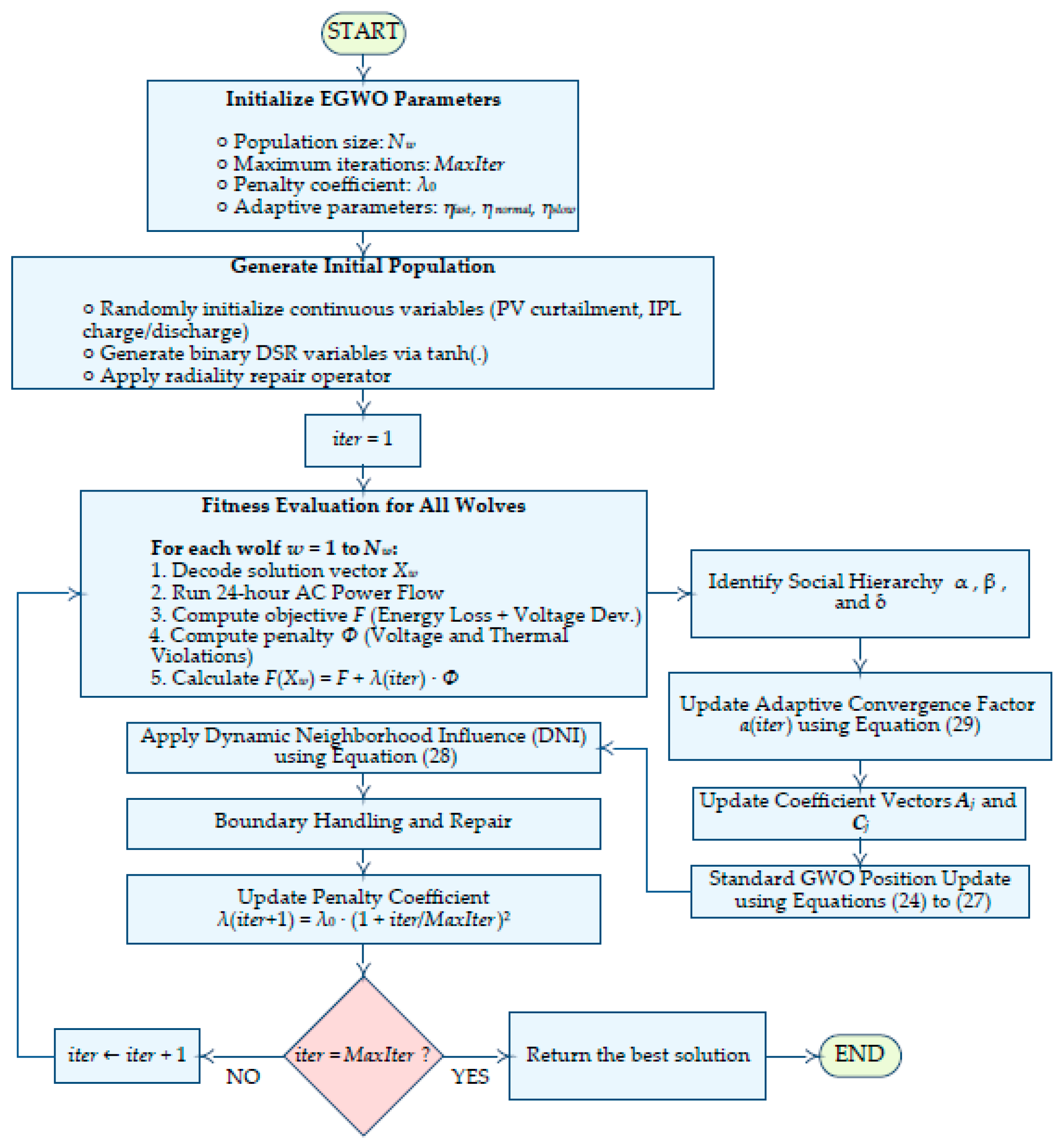
The EGWO algorithm designed for solving the problem of optimal scheduling and reconfiguration in the active distribution system is applied following the following order of steps (as shown in
Figure 1).
The algorithm starts with the initialization of control parameters such as the population size
, number of maximum iterations
, penalty factors λ
0, and adaptive convergence factors
,
, and
. A randomly generated initial population with
wolves is created by the random initialization of the continuous parts of the solution vector and creation of binary switching patterns using the transfer function and radiality correction operator, as discussed in
Section 3.1. The iteration counter is set to
.
For each iteration, the penalized fitness of all wolves in the population is evaluated. The evaluation includes decoding the solution vector, repairing the DSR variables by the repair operator if necessary, calculating the 24 h AC power flow with respect to the particular network topology and unit commitment schedule, evaluating the normalized objective function according to Equations (1)–(3), calculating the penalty factor for constraint violations according to Equation (19), and finally calculating the penalized fitness based on Equation (18) using the current penalty parameter .
After the fitness evaluation, the population is ranked, and the wolves denoted by α, β, and δ become the three solutions with the least fitness penalties. The update rate of the α wolf is calculated from its fitness trajectory, while the adaptation of the convergence factor follows Equation (29). Afterward, the coefficients and for are calculated based on the new value.
For each individual wolf in the swarm, its new position will be determined based on the GWO equations for the position updates, namely Equations (21)–(27). Following that, the dynamic neighborhood influence technique is used on the selected set of trapped wolves, whereby their positions are adjusted according to Equation (28). The continuous variables of the solution vector are then mapped to their feasible regions using the PV max. available power and IPL power ratings constraints. For the binary DSR variables, they are reconstructed from their corresponding continuous values through Equation (17), while ensuring topological feasibility using the radiality repair operator.
The next step is to assess the termination condition. This happens whenever the index iteration reaches the maximum permissible number of iterations , or if there is no improvement in the fitness value of the α wolf within an allowed tolerance for a certain number of stalled iterations. Otherwise, the iteration index will be increased, ) will be calculated using Equation (20), and the procedure will repeat itself starting from the fitness evaluation step.
After completing the EGWO algorithm, the solution vector pertaining to the α wolf, , will provide the best or nearly best operational plan for the 24 h planning period. The solution includes the best hourly network configuration , the best PV power generation reduction program , and the best IPL charge/discharge schedule . These factors ensure that the objective function is minimized under the condition of strict adherence to radiality, voltage, and thermal limitations of the distribution grid.
4. Simulation Results and Discussion
In this section, an analysis of the EGWO method is performed, and its efficiency for solving MO problems related to the scheduling and reconfiguration of active distribution networks will be evaluated. In this analysis, the performance of EGWO is compared to that of GWO and PSO algorithms considering five cases that involve different levels of flexibility and increasing integration of DERs. This analysis considers aspects such as total energy losses, voltage stability, use of IPL capacity, and optimization algorithm convergence. From the results obtained, it can be concluded that the EGWO algorithm performs better, showing high reduction in energy losses and voltage errors.
4.1. System Description and Input Data
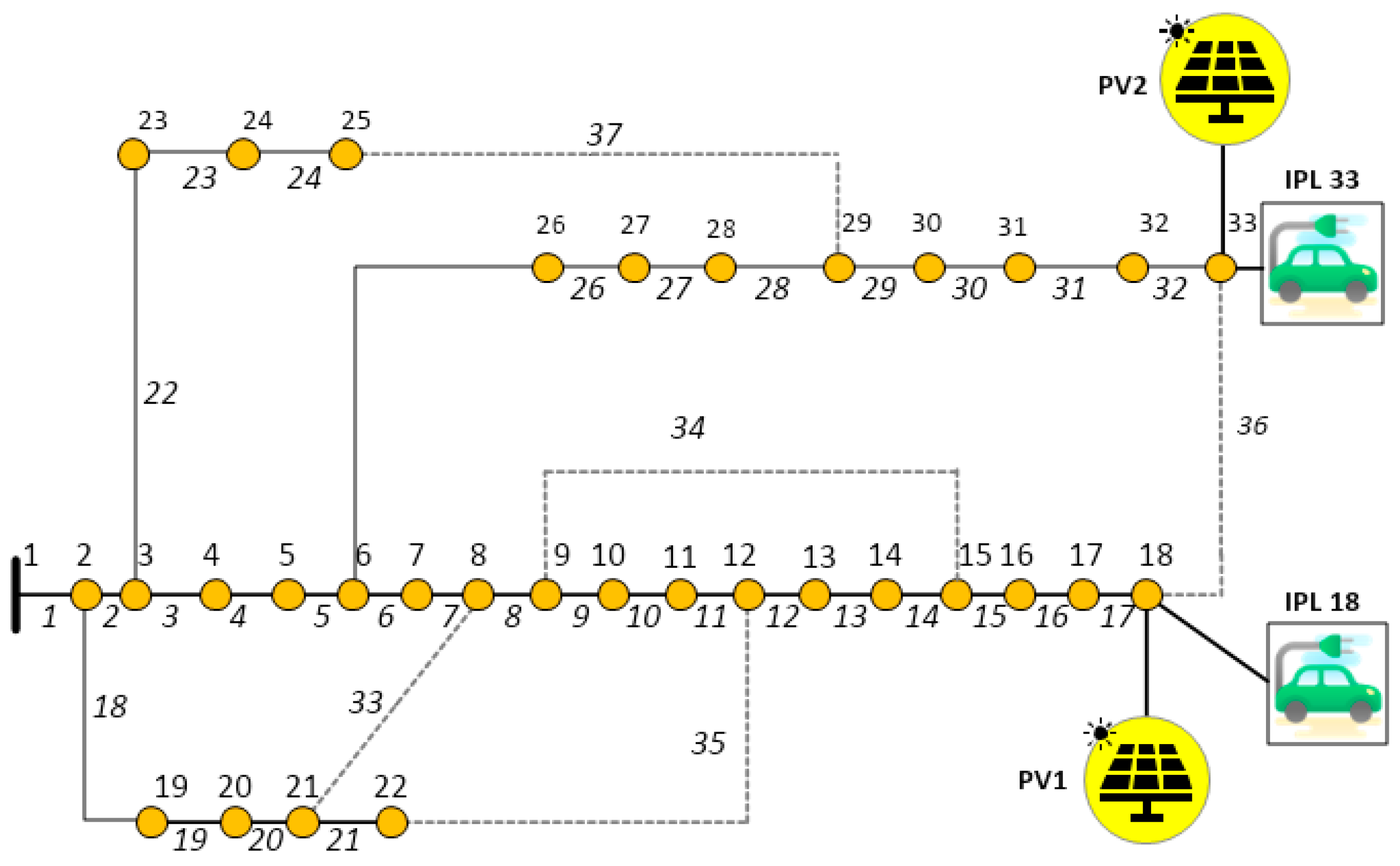
The developed optimization approach has been implemented on the IEEE 33-bus test radial distribution system whose diagrammatic representation is shown in
Figure 2. The power system contains 33 buses and 37 branches, runs on a nominal voltage of 12.66 kV, and is based on a per unit value of 10 MVA. The substation at bus 1 can supply up to 10 MVA of apparent power, which comfortably exceeds the total system load of 4.37 MVA plus losses, ensuring that grid capacity constraints are never binding in any of the five case studies. Regarding its basic structure, the power system can be considered to operate as a radial distribution feeder system having five normally open tie switches associated with branches 33, 34, 35, 36, and 37. Operating a selected tie switch along with the required sectionalizing switch facilitates DSR while maintaining the radial nature of the feeder system. The fundamental loops for this system are defined and given in
Table 1.
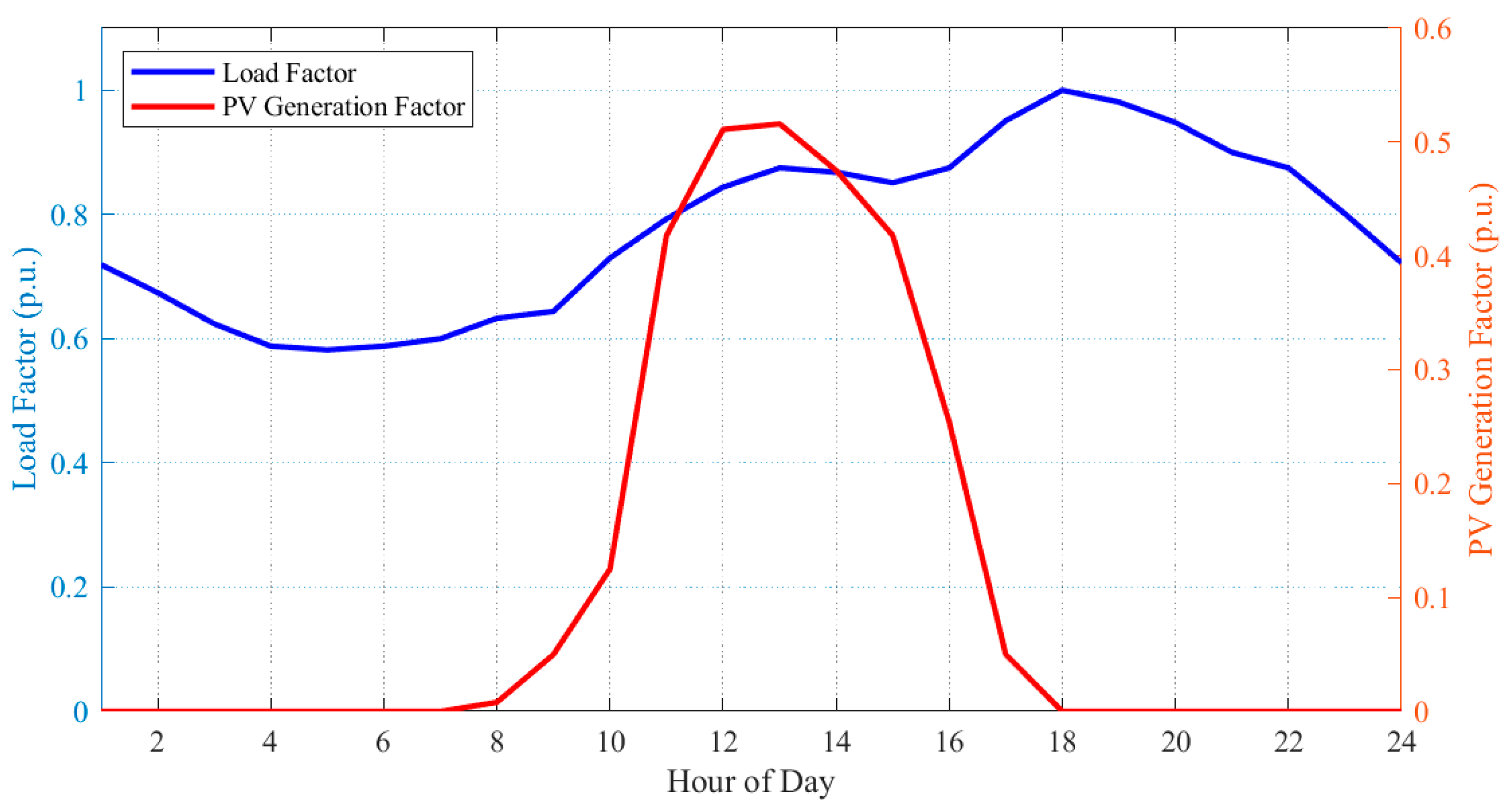
The simulation is carried out on a time horizon of 24 h with a resolution of 1 h to simulate realistic operation through the entire day cycle. The load profile for each bus is scaled according to the ratio of expected demand. The total system demand profile scaled to its maximum demand value is shown
Figure 3. Active as well as reactive power requirements are modified at each hour according to this pattern so that the power factor features of every load bus remain constant during the day. Importantly, the same hourly load profile (shown in
Figure 3) is used consistently across all five cases (Base Case and Cases 2–5). Only the control actions (DSR switching states, PV dispatch, and IPL charge/discharge) vary between cases. This ensures that the normalization denominators
and
are fair references for comparison.
PV generation is provided at bus numbers 18 and 33, each rated at 2.0 MW. The potential active power output available from the above-mentioned PV generation sources depends on the time-dependent behavior of solar irradiation during the day. The profile of the PV generation is also shown in
Figure 3 and exhibits a bell-curve shape, with power generation varying between zero at night and about 0.5 MW at peak insolation. The planned PV generation is a decision variable in the optimization problem because it allows for curtailment of potential solar generation when needed.
The intelligent parking lots (IPLs) are installed near the PV plants at bus 18 and 33, forming the distributed energy storage system with time-energy arbitrage capability as well as the ability to provide voltage support. The fixed locations (PV and IPLs at buses 18 and 33) follow the literature identifying these as optimal sites for distributed generation and storage in the IEEE 33-bus system [
4,
10,
25]; co-location of IPLs with PV is also supported [
3,
23]. The standard radial topology with tie switches is used [12, 15, 32]. The IPL sites consist of a fleet of 200 PHEVs, with each PHEV having a maximum usable battery size of 50 kWh. Therefore, the energy storage capacity of each IPL site is 1.0 MWh. The charging and discharging power constraints have been set at 0.5 MW, based on the power electronic converters and charging systems used at the aggregated level. The efficiency of the energy storage process is assumed to be 95%, covering losses due to charging and discharging. Finally, the initial state of charge of the batteries in each IPL is set at 50% of its rated capacity.
The values for the algorithmic parameters were defined by sensitivity analysis. Analyses involved population sizes ranging from 50 to 200 and maximum numbers of iterations ranging from 50 to 150 to find the combination that offers an optimum trade-off between the quality of solutions and the computational load. As a result, population size of
= 100 and maximum number of iterations of
were set for all simulations performed in the study. Further increases in the parameter values provided only minimal gains in the last obtained value of the fitness function, less than 0.1%, at significantly increased computational effort. The process is stopped either by exceeding the maximum number of iterations or if the relative improvement in the best penalized fitness function value is smaller than 0.01% for 10 successive iterations. In the case of GWO and EGWO algorithms, the exploration coefficient a was set to 2.0, starting the process with a linear decline to zero value according to the GWO scheme and with the self-adjusting convergence factor for EGWO (
Section 3.4.2).
The radiality requirement, the constraints on SOC and charging/discharging rates of the IPLs, and bus voltage magnitudes were all strictly imposed. To satisfy the radiality constraint, it was ensured that the total number of branches which are closed in the network equals the total number of buses minus one per hour; otherwise, a repair operator would be used heuristically. The voltage magnitude at all buses was to be within ±5% of the nominal value, which is 1.0 per unit; any violation of this constraint would incur a penalty using the technique discussed in
Section 3.2.
Simulations were done using MATLAB R2021b, which is a high-level programming language and environment used for computations, algorithm design, and visualization. MATLAB was used to create algorithms for GWO, EGWO, and PSO. Matrix manipulations as well as random numbers and vectorization were performed by MATLAB. AC power flow equations necessary for fitness calculation for each individual were solved using MATPOWER 8.1. MATPOWER 8.1 is an open-source package dedicated to the simulation of electric power systems that offers efficient and reliable algorithms for radial and meshed distribution grids. Simulations were carried out using a high-performance personal computer equipped with an Intel Core i7-10750H processor clocking at 2.60 GHz, having six cores and twelve threads, 16 GB DDR4 RAM, and 512 GB solid-state disk, under the operating system Windows 10 Professional 64-bit.
The total amount of computational time taken for one run of the EGWO approach to be carried out on the 33-bus system under the most complicated case (Case 5) is around 150 s. This computation time encompasses the initialization process of the population, the 24 h power flow calculation of every candidate solution generated in every iteration, the computation of the penalty function value, the constraint satisfaction process, and further result processing afterward. Taking into account that the mixed-integer non-linear programming problem being solved is complicated as the operation planning process needs to schedule the values of binary reconfiguration variables, continuous PV curtailment variables, and IPL charging/discharging variables for 24 h, this computation time can be deemed acceptable.
4.2. Case Study Definitions
To evaluate the effectiveness of the EGWO algorithm in a systematic way and quantify the impact of each control action on system performance, five different cases have been developed and investigated, as can be observed from
Table 2. The cases are defined as follows.
Case 1 (Base Case): The distribution grid system runs in its initial, unaltered radial form without the use of any control operations. All five tie switches (Branches 33–37) stay open for the whole day during the 24 h simulation, with the distribution network remaining unchanged throughout the whole process. There are no distributed energy resources (DERs) deployed and controlled in this scenario, including photovoltaic resources and intelligent parking lot storage systems. Case 1 is used as the base scenario to compare the results of the other scenarios using the normalizing parameters and in Equation (1).
Case 2 (DSR Only): The distribution system reconfiguration technique is applied as the only control strategy. The mathematical model is used to optimize the binary state of all the sectionalizers and tie switches per hour with the goal of minimizing the multi-objective function. The photovoltaic generation units are not dispatched, and the IPL units are not operational. This case helps determine the standalone impact of the DSR technique on reducing energy losses and improving voltages.
Case 3 (PV Only): The optimal scheduling of photovoltaic generators takes place without changing any topology of the system. In other words, the optimizer will determine the best curtailment for PV generators present at bus 18 and 33 in order to minimize the sum of normalized energy losses and voltage deviation. Here, no change in network topology (base network, where switches 33–37 remain open) takes place during the process of simulation.
Case 4 (PV + DSR): In this case, the focus is on the synergies that can arise from the scheduling of photovoltaic (PV) power generation alongside distribution system reconfiguration (DSR). The optimization method simultaneously finds the optimal network topology hour by hour and the optimal PV curtailment strategy for both the PV-powered buses. The study aims at determining how much extra value can be added to distributed solar energy by network reconfiguration and vice versa.
Case 5 (PV + DSR + IPL): This case highlights the full scope of flexibility in operations by combining the scheduling of photovoltaic (PV) energy production, distribution network reconfiguration (DSR), and optimal charging/discharging operations for intelligent parking lots (IPLs) related to bus lines 18 and 33. The optimization algorithm carefully balances the shifting of energy through time using the energy storage facilities in the IPL with shifting power flows through space using network reconfiguration and the reduction of PV energy production. This case is the most sophisticated operational example, showing the highest possible improvement in performance.
The performance of the proposed EGWO algorithm is compared against the classic GWO algorithm and PSO algorithm based on the results of each of the five cases. The three optimization methods are implemented using the same population size, maximum iterations, and constraints for the purpose of achieving accurate comparison.
4.3. Base Case Performance (Case 1)
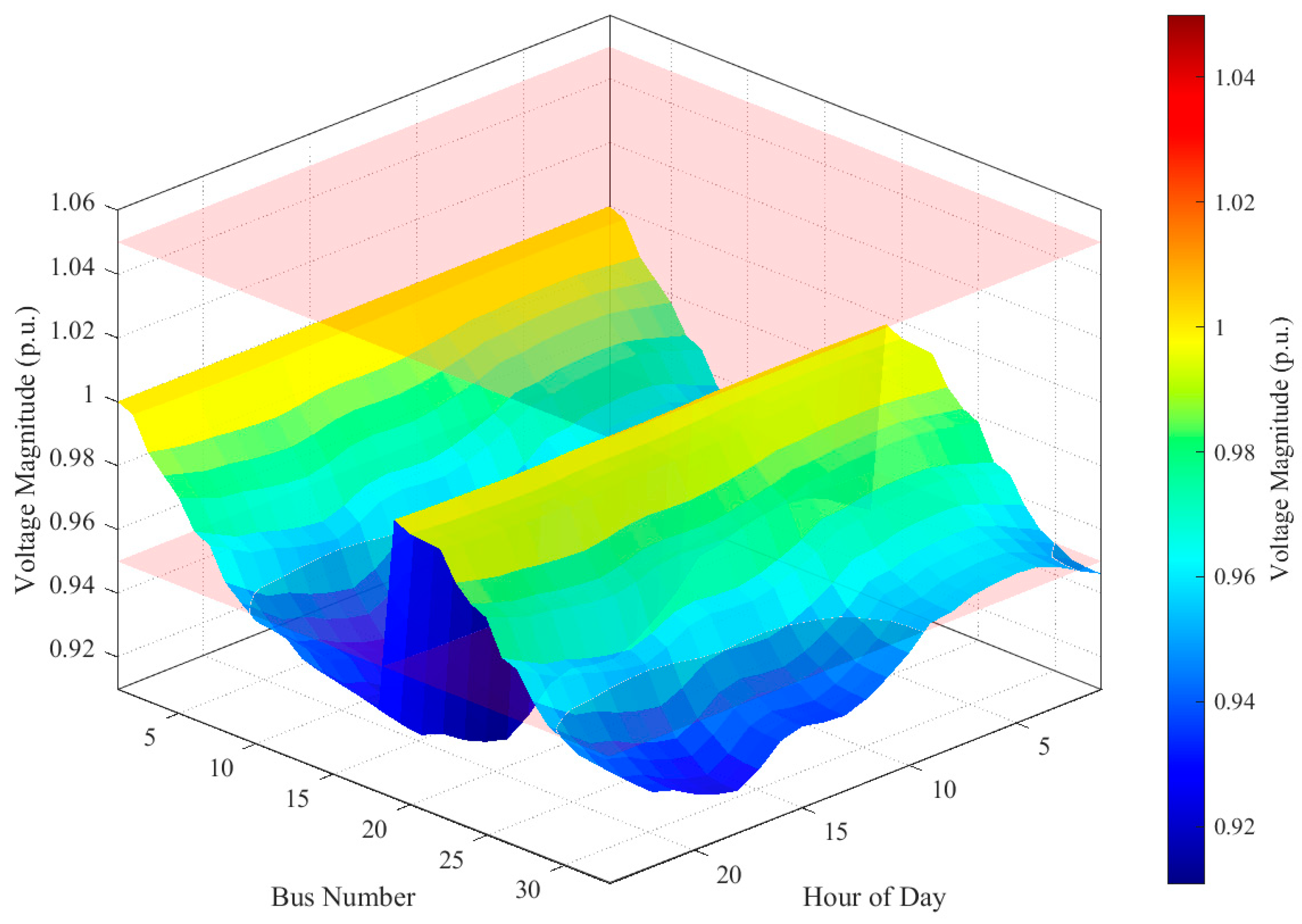
Base Case describes the standard performance indicators used to measure all optimization approaches. Here, the system works with its natural radial structure, whereby tie switches 33, 34, 35, 36, and 37 remain open. There is no photovoltaic (PV) production, while there are no IPL facilities available. The power flow solution of this passive system gives an overall energy loss for the entire day at 3037.83 kWh. The mean minimum voltage at the bus is 0.9317 per unit, where it comes closer to the minimum allowable operating range of ±5% (refer to
Figure 4). The mean voltage deviation factor from Equation (3) is 0.0385 per unit. These values serve as the normalization denominators,
and
, in the multi-objective equation of Equation (1). The power flow solution of the Base Case takes about 1.03 s, showing that it is easy to compute the performance indicators of a single operating condition.
Voltage magnitudes at different buses as a function of time are illustrated in
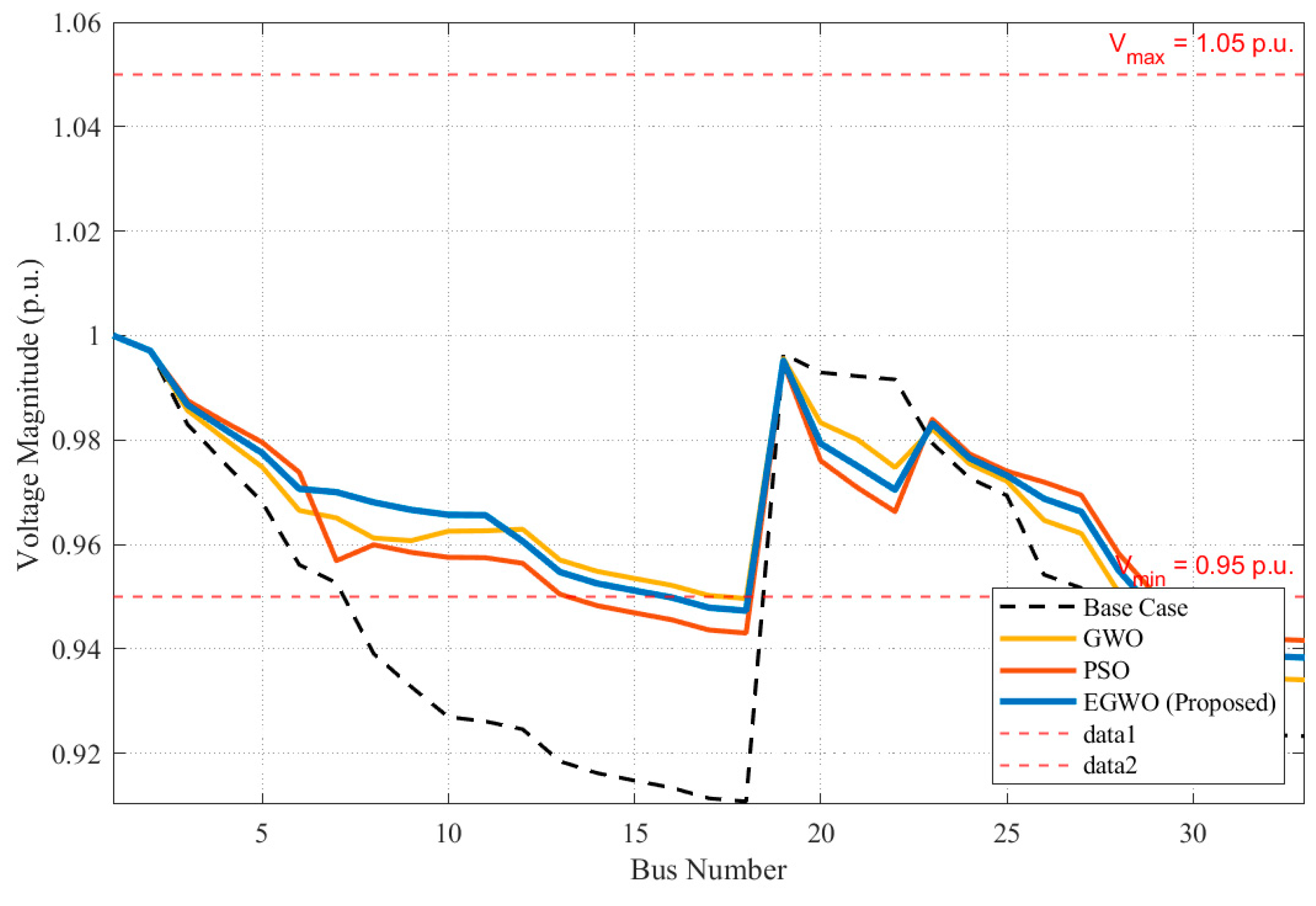
Figure 4. The voltage profile reveals a sharp dip during peak load conditions (between hours 10 and 22). The lowest voltage occurs on the buses farthest from the substation, buses 18 and 33. Voltage limits of ±5% are indicated by the dotted lines at 0.95 p.u. and 1.05 p.u.
4.4. Case 2: Distribution System Reconfiguration (DSR Only)
Case 2 analyzes the independent impact of dynamic network restructuring on system performance. Optimization techniques determine the ideal combination of open switches at every hour with the objective of reducing the weighted index of energy loss and voltage variation. The energy loss per hour, minimum voltage, and average voltage deviation for EGWO are presented in
Table 3, whereas
Table 4 summarizes the results for all three algorithms.
The total energy loss per day in the EGWO algorithm equals 2113.97 kWh, which represents a 30.41% reduction in comparison to the Base Case. It should be noted that EGWO outperforms both PSO (reduction is equal to 29.90%) and GWO (reduction is 25.76%), thus proving that the search process performed by EGWO is more efficient in finding optimal reconfiguration solutions. Voltage deviation decreases to 0.0265 p.u., which is 31.17% lower than in the Base Case (0.0385 p.u.), resulting in a significantly flatter voltage profile. In addition, the average minimum voltage rises to 0.9526 p.u. from the initial 0.9317 p.u. of the Base Case, thus staying inside the allowed range of values. Figures depicting comparative voltage profiles at peak load hour (hour 18) for Case 2 (DSR Only) are given in
Figure 5. This figure shows the voltage magnitude at the moment of highest demand for each optimization algorithm. As can be seen from
Figure 5, the voltage profile for EGWO is higher and flatter than those for GWO and PSO; specifically, at the remote buses 15–18 and 30–33.
This optimal switch arrangement of switches 7, 34, 11, 36, and 37 in their open positions obtained by applying the EGWO is not the same as that found by the PSO and GWO approaches, which have led to other topologies altogether. This contrast between the optimal switch combinations shows the multimodal optimization problem posed by the DSR problem and demonstrates the effectiveness of the EGWO approach in terms of its improved ability for global search. In terms of computational effort, GWO takes 151.9 s, EGWO 156.5 s, and PSO 197.5 s, and this higher time by PSO is due to its slow convergence in the discrete domain.
4.5. Case 3: Photovoltaic Scheduling Only (PV Only)
In Case 3, the impact of optimal solar PV dispatching, without changing the structure of the network, is evaluated. In this regard, optimal curtailment of the two 2 MW solar PV systems installed at buses 18 and 33 is determined through optimization techniques. The hourly performance values of solar PV dispatching, loss, and voltages using the EGWO algorithm are reported in
Table 5, whereas the results comparisons are made in
Table 6.
The addition of optimally scheduled PV generation significantly increases the efficiency of the system without any network reconfiguration. Through this approach, the EGWO algorithm obtains an overall energy loss of 2569.99 kWh, which is 15.40% better than that obtained using the Base Case. The average voltage deviation also drops to 0.0306 per unit, achieving 20.52% improvement from the Base Case. Similarly, the average minimum voltage also improves to 0.9462 per unit. In this case, although the GWO algorithm obtains slightly lower total energy loss (2566.71 kWh) than EGWO, it is evident that the EGWO algorithm provides a more effective voltage profile with less average voltage deviation than GWO due to the consideration of voltage quality.
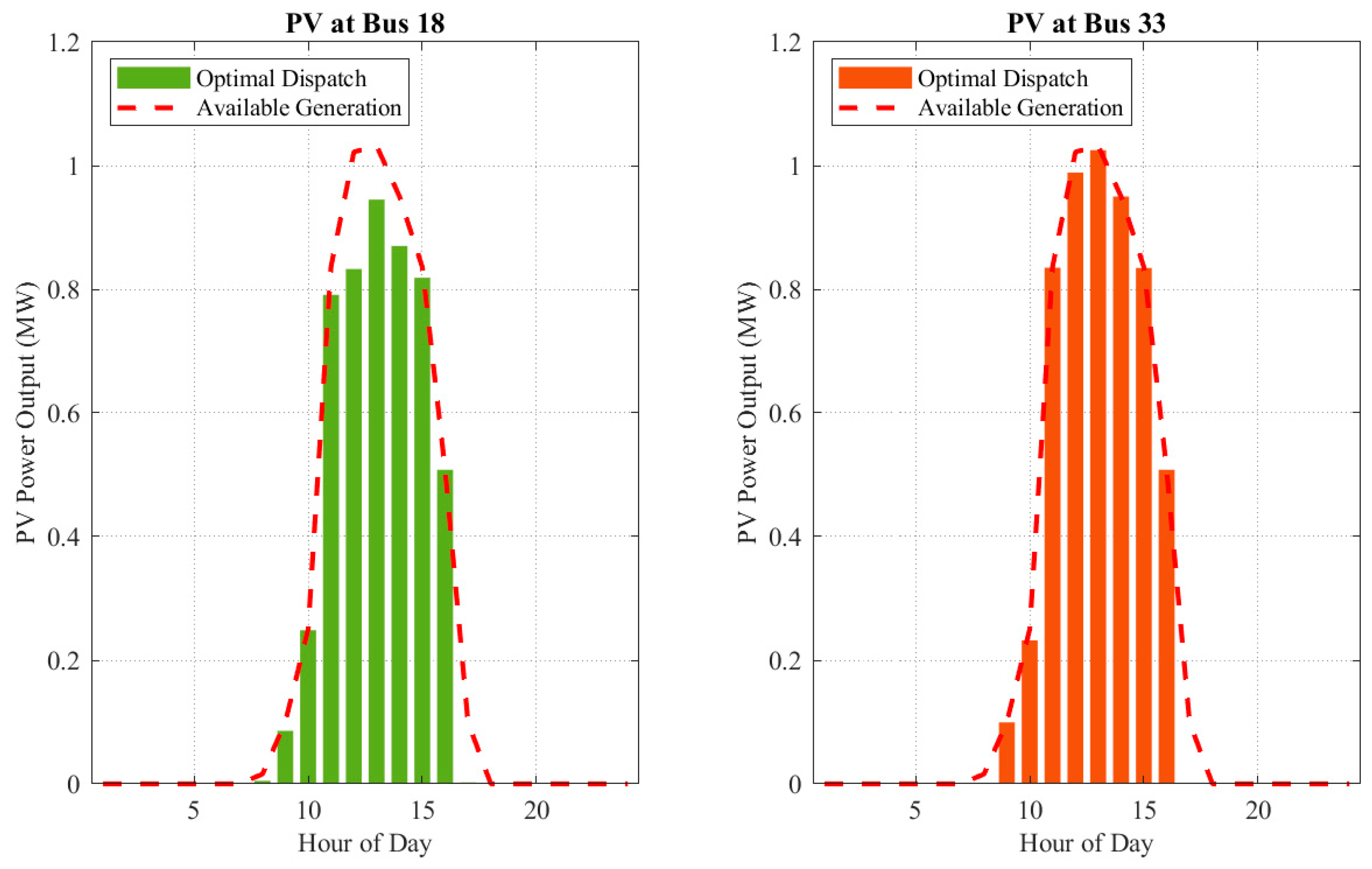
From the optimal PV curtailment schedule obtained from EGWO, it can be seen that, during the high irradiation period (hours 11–15), the PV systems operate close to or at their maximal capacity by taking advantage of the solar power to offset the local demand and reduce feeder loading, as shown in
Figure 6. It should be noted that the output of PV in bus 33 is always larger than that in bus 18 as the former location brings additional benefits to the power system due to its higher electrical distance. During the low irradiation period (hours 17–24), the PV power is completely shut down.
The graph displays the hourly schedule of power delivery by the PV units connected to buses 18 and 33 for a span of 24 h. The curve showing the availability of solar power is shown with a dotted line, representing the smart curtailment strategy adopted by the optimization model, particularly during the periods of early morning ramp up (8–10 h) and afternoon ramp down (16–17 h).
4.6. Case 4: Combined PV Scheduling and DSR (PV + DSR)
In Case 4, we consider the benefits that can be achieved by simultaneously performing optimal curtailment of photovoltaic power generation and optimal switching of the network structure. The optimization programs find simultaneously the best possible combination of switches and photovoltaics in each hour. The performance statistics of EGWO in each hour is given in
Table 7, and a general comparison between all the algorithms is provided in
Table 8. Moreover, in
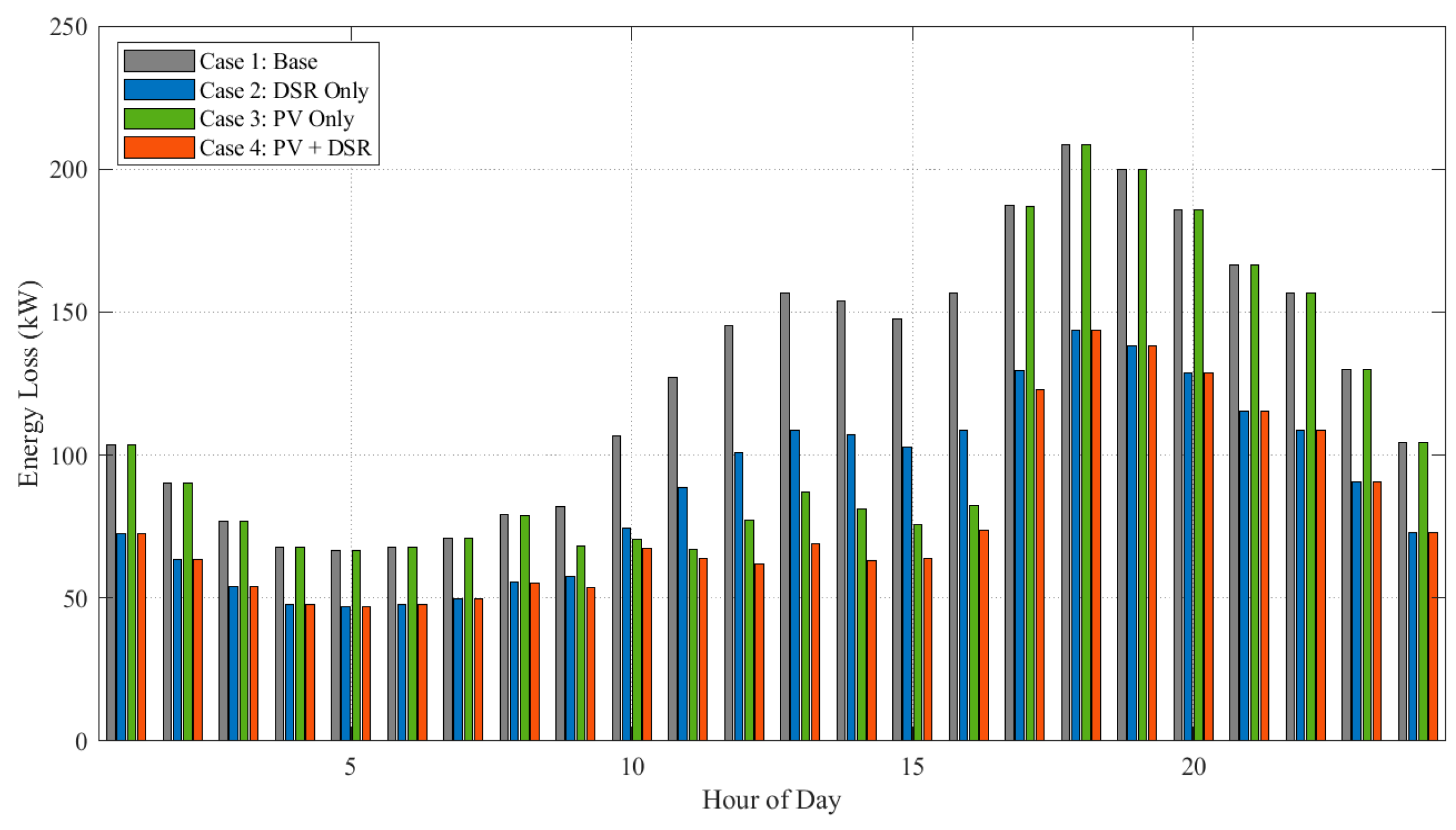
Figure 7, it is shown how many kWh are lost in each hour of the day in the Base Case, Case 2 (DSR Only), Case 3 (PV Only), and Case 4 (PV and DSR). It is clear from this figure that the synergies of considering PV scheduling in parallel to DSR are especially beneficial during the sunny hours (11–15) and the evening peak period (17–21).
It is obvious that the integration of DSR and PV scheduling leads to substantial improvement in system performance. The EGWO algorithm obtains an energy loss value of 1874.70 kWh, which is 38.29% less than in the Base Case, resulting in a better performance than the DSR (30.41% reduction) and the PV scheduling (15.40% reduction) individually. It is interesting to note that the overall improvement (38.29%) is greater than the sum of both improvements separately (30.41% + 15.40% = 45.81%, although the percentages relate to different baseline values). More accurately, Case 4 results in 239.27 kWh of energy losses reduction over Case 2 (DSR Only) and 695.29 kWh over Case 3 (PV Only). The average voltage deviation is reduced by 38.96% to 0.0235 per unit, while the average minimum voltage increases to 0.9581 per unit.
The optimal switch configuration obtained using the EGWO and GWO algorithms coincides [7, 34, 11, 36, 37]. However, the PSO algorithm finds a different optimal topology [6, 10, 19, 36, 22]. In spite of that, the algorithm provides similar performance in terms of energy loss and voltage deviation reduction to EGWO (the reduction of losses is 37.86% and of voltage deviation is 38.70%). That means that there exist several optimal reconfigurations of the network for optimal PV scheduling.
4.7. Case 5: Full Coordination of PV, DSR, and IPL (PV + DSR + IPL)
Case 5 constitutes the most extensive operational scenario wherein the scheduling of photovoltaic energy generation, reconfiguration of the distribution network, and smart parking lots for charging/discharging are simultaneously optimized. The smart parking lots at bus locations 18 and 33 enable shifting of electricity usage within time periods, by charging the storage device when electricity generation is abundant and discharging the storage device during high electricity load times. The hourly outputs from the EGWO algorithm are shown in
Table 9, whereas
Table 10 provides an algorithmic summary comparison.
When photovoltaic generation, demand side response, and power load operate simultaneously, the best overall performance is achieved in all cases studied. The energy loss value for the proposed EGWO algorithm is equal to 1938.19 kWh, which corresponds to a 36.20% decrease compared with that of the Base Case. Voltage deviation becomes 40.26% lower, which is equal to 0.0230 p.u. This means that voltage quality is higher than that of any other cases. Average minimum voltage equals 0.9556 p.u., so there is no violation of any operational limitations.
The comprehensive evaluation of the operation of IPLs in
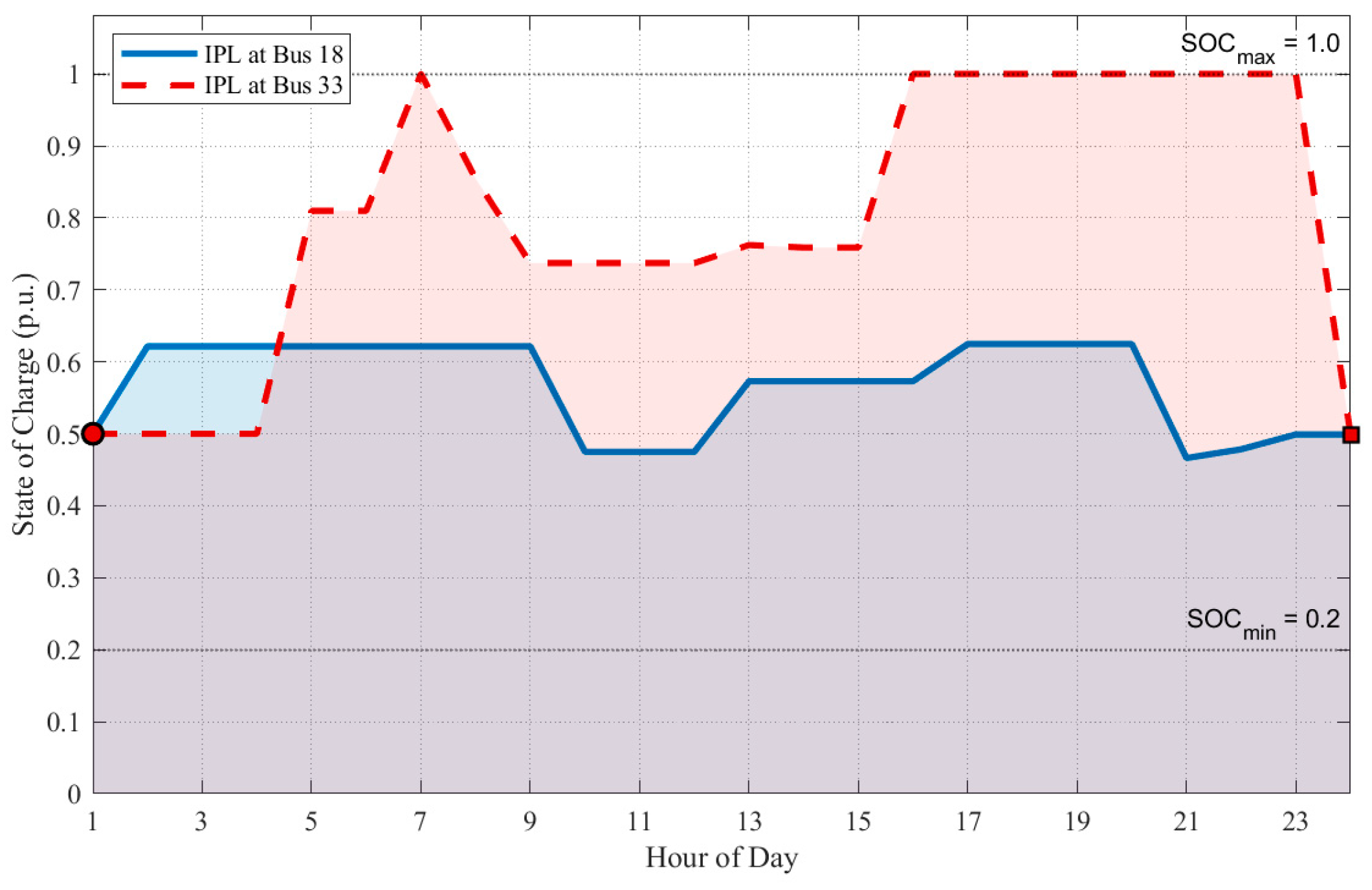
Figure 8 shows that an advanced strategy has been developed to take advantage of time arbitrage opportunities in using storage devices. During the low-demand periods (hours 2–3), when there is almost no cost for energy, the IPL charges at a relatively low power rating of 0.128 MW from SOC 50% to about 62%. The IPL located at bus 33 starts charging at a high rate of 0.326 MW in hour 5 and raises its SOC to 81%. The peak solar generation time range (hours 10–16) sees the operation of IPL being optimized in order to accommodate any excess solar generation that could cause a voltage rise. Specifically, the IPL at bus 18 discharges 0.139 MW during hour 10, whereas the IPL at bus 33 charges at different powers during the midday period, finally reaching 100% SOC (full capacity) in hour 16. Finally, during the high load peak hours (hours 17–21), when there is no solar generation available but the load reaches maximum levels, the IPL at bus 33 can discharge at a power rating up to 0.476 MW (hour 24), thus playing an important role in peak shaving and alleviating the voltage depression in this case seen in the Base Case scenario.
It is obvious that EGWO performs much better in terms of IPL utilization compared to GWO and PSO algorithms. Thus, the average SOC of the IPL at bus 33 using EGWO is equal to 0.8001 which is much higher than those obtained with other techniques: 0.7087 (GWO) and 0.1881 (PSO). This finding indicates that EGWO provides a more optimal solution by making use of storage capacity located at bus 33, where the additional benefit from energy injection is maximal. In turn, the IPL at bus 18 maintains relatively low average SOC of 0.5680 due to being used as a secondary storage source.
The shaded area in
Figure 8 represents the battery storage level of each unit in the 24 h window. The IPL connected to bus 33 (red dashed line) has an extremely active charging process in the off-peak hours and reaches 100% SOC level in hour 7. It maintains a high SOC level until hour 23 before discharging significantly in evening peak hour (hour 21–24). On the other hand, the IPL connected to bus 18 (blue solid line) has an inactive charging process with its SOC level varying between 47% and 62%. The two dotted horizontal lines represent the lower limit of SOC level (0.2) and the maximum SOC level (1.0) Both units return to approximately 50% SOC at the end of the 24 h horizon, demonstrating energy-neutral daily cycling.
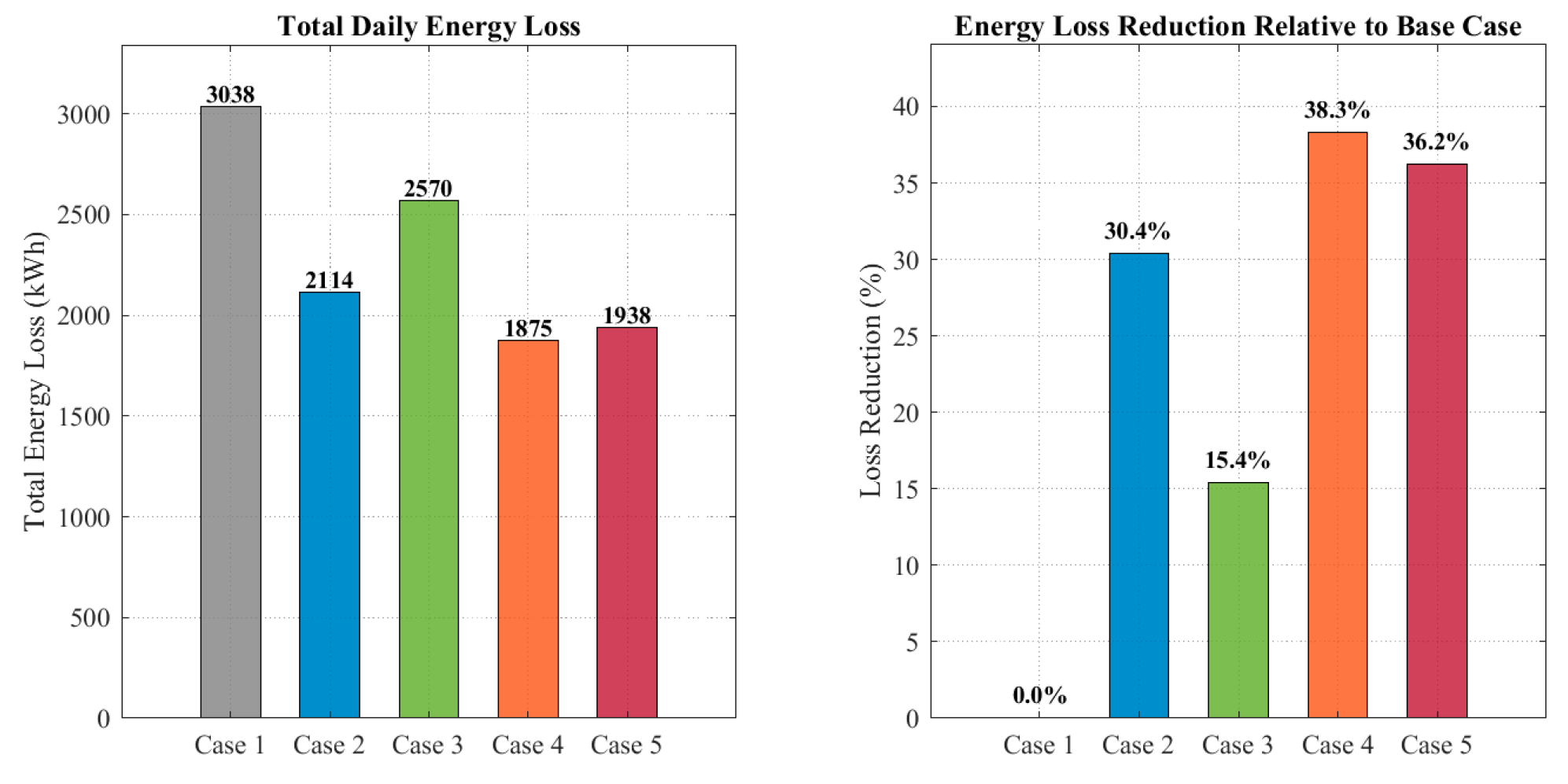
The performance of energy loss for the five cases, as identified by the EGWO algorithm, is illustrated in
Figure 9 below. The graph illustrates the amount of power lost at different times for the Base Case and all four other cases. Case 5 (PV + DSR + IPL) shows the lowest energy loss for all the hours considered, especially hours 5–8 (load ramping) and 17–21 (peak load period). The effectiveness of IPLs can be seen in moving the savings in energy loss from day to night.
4.8. Comparative Summary and Performance Analysis
An analysis based on a comparison of all five cases, conducted using the EGWO algorithm, has been provided in
Table 11 and
Figure 10 below. The outcome demonstrates the benefits that are accrued by each additional level of flexibility.
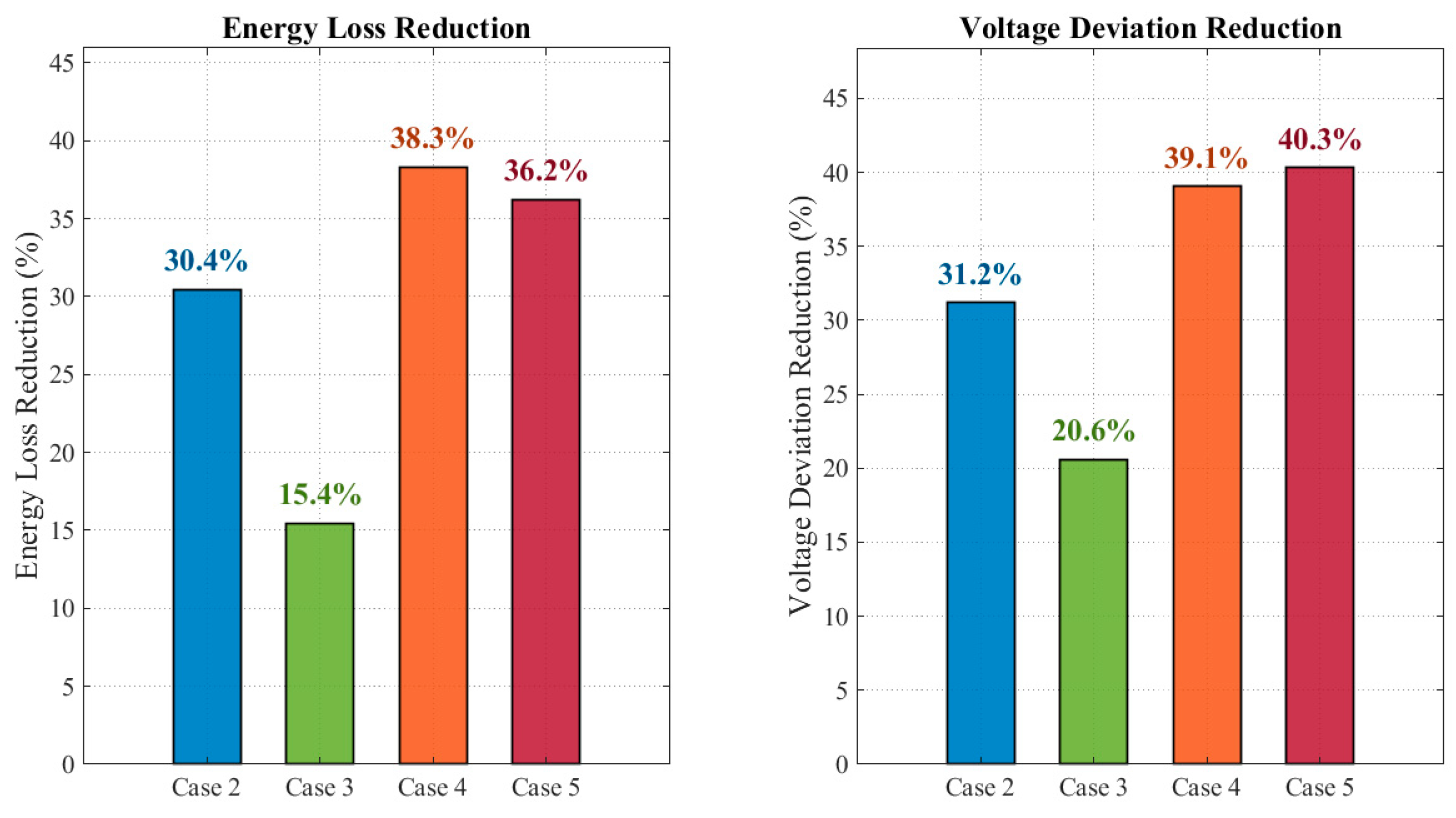
Some interesting conclusions can be drawn through comparative analyses. First, distribution system reconfiguration (Case 2) results in larger stand-alone benefits than PV scheduling (Case 3). It is shown that there is a 30.41% reduction in losses in Case 2 compared to only 15.40% reduction in losses in Case 3. This finding reveals the importance of topology optimization in shaping the power flow profiles in radial distribution systems. Second, the combination of PV and DSR (Case 4) gives the largest reduction in energy losses (38.29%). It proves that there exists an efficient synergy between two control measures in terms of spatial power flow control (DSR) and local generation dispatch (PV curtailment). Third, the employment of IPL storage (Case 5) leads to some increased energy losses (1938.19 kWh vs. 1874.70 kWh) but results in the most reduced voltage deviation among all cases examined (40.26% vs. 38.96%). It implies that there are inherent inefficiencies associated with charging and discharging procedures in the IPL operation process which cause higher energy consumption in total, yet temporal energy shifting contributes positively towards voltage stability during peak hours. Although reactive power is not directly optimized, the coordinated active power strategies (DSR, PV curtailment, and IPL dispatch) reduce line currents and voltage drops, which in turn leads to a reduction in reactive power losses as a secondary benefit.
The voltage deviation index consistently rises along with increased numbers of implemented control layers, reaching up to a 40.26% reduction in Case 5. The average minimum voltage rises from 0.9317 pu in the Base Case to 0.9556 pu in Case 5, implying that improvements in power quality and enlargement of margin relative to the lower voltage limit have been achieved significantly.
It is worth noting that the five case studies (Cases 2 through 5) represent progressively larger optimization problems in terms of decision variables and constraints, from small-scale (Case 3) to large-scale (Case 5) problems, demonstrating the EGWO algorithm’s ability to handle increasing problem complexity even within the 33-bus test system.
4.9. Algorithm Convergence and Computational Performance
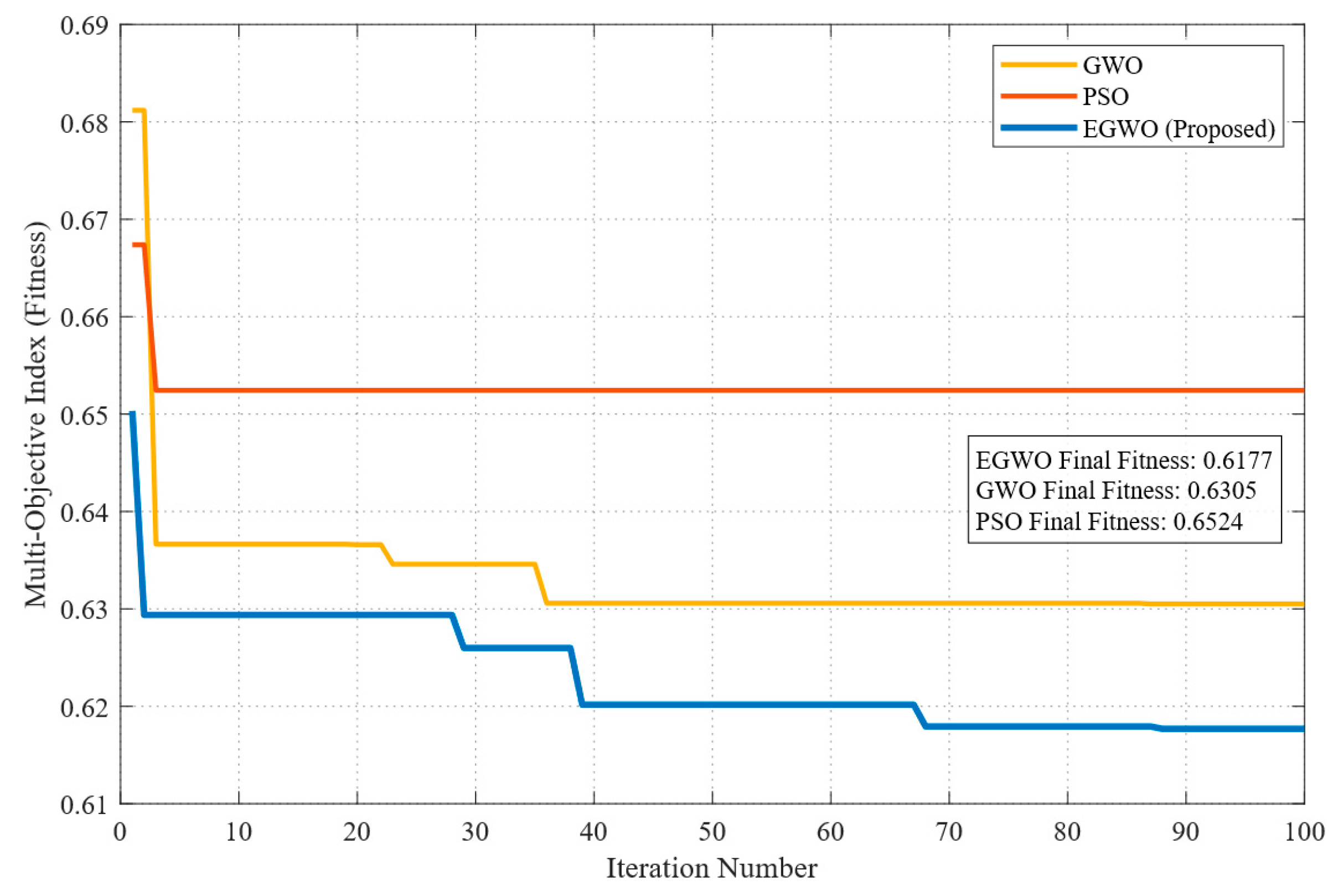
The convergence behavior of the aforementioned optimization algorithms (GWO, PSO, and EGWO) was analyzed in order to compare their efficiencies and reliability. The convergence behavior graph of the most complicated problem (i.e., Case 5: PV + DSR + IPL) is presented in
Figure 11.
The convergence behavior analysis of the GWO, PSO, and EGWO approaches using the convergence data obtained from the simulations is presented in
Figure 11. It can be seen that the EGWO method produces lower final fitness values than the other two approaches for all cases. The fitness values for EGWO are 0.6924 for Case 2, 0.8205 for Case 3, 0.6136 for Case 4, and 0.6177 for Case 5. The GWO approach produces lower final fitness values compared to PSO; the fitness values are 0.7278 for Case 2, 0.8263 for Case 3, 0.6359 for Case 4, and 0.6305 for Case 5. The PSO approach has higher fitness values than the GWO and EGWO approaches for most cases; the fitness values are 0.7104 for Case 2, 0.8740 for Case 3, 0.6168 for Case 4, and 0.6524 for Case 5.
EGWO shows exceptionally good performance when the decision variables involved in the problem formulation have discrete nature. As seen in Case 2 (DSR Only), where all the decision variables are associated with binary switching operations, EGWO reaches a fitness level that is 2.5% better than that reached by PSO and 4.9% better than the result achieved by GWO. Furthermore, in Case 4 (PV + DSR), where both continuous and discrete decision variables are optimized, EGWO achieves a fitness function value that is 3.5% better than that obtained by GWO and 0.5% better than PSO. This exceptional performance of EGWO can be attributed to its two improvement strategies: dynamic neighborhood influence and self-adaptive convergence factor.
According to
Table 12, the computation times of all three algorithms are relatively similar. GWO has the shortest computation time of 138.9 s for Case 5. This is followed by EGWO at 145.8 s and PSO at 150.5 s. The additional computation cost required in EGWO compared to GWO is more than worth it due to the higher-quality solutions it provides. PSO, while easy and popular, has the lowest rate of convergence and highest final fitness scores in the more challenging cases.
From
Table 12, it is evident that EGWO reaches the end solution after about 20 iterations while GWO and PSO need around 35 and 45 iterations, respectively. This fast convergence rate, coupled with the high-quality end solution reached by EGWO, supports the efficiency of the EGWO approach in solving the MINLP problem faced by an active distribution network scheduling scenario.
While a direct comparison with recent hybrid methods (e.g., GWO-PSO, GWO-GA) is not performed, we note that EGWO achieves a fitness of 0.6177 and convergence in 20 iterations, outperforming standard GWO and PSO. Literature reports [
10,
15] indicate that hybrid methods often improve solution quality but at higher computational cost. EGWO’s single-population adaptive strategy offers a competitive alternative for MINLP problems in active distribution networks. A direct quantitative comparison with other recent hybrid metaheuristics (e.g., GWO-PSO, GWO-GA) is beyond the scope of this study. An in-depth benchmark of EGWO against such hybrid methods, considering both solution quality and computational effort, is planned as part of our future investigations.
4.10. Impact of PV Intermittency: A Sensitivity Analysis
In the main study, PV generation is assumed to follow a deterministic forecasted profile (
Figure 3). To assess the effect of irradiance fluctuations, we perform a post-optimization sensitivity analysis on the most complex scenario (Case 5: PV + DSR + IPL). The hourly PV output of both PV units (buses 18 and 33) is scaled by factors of 0.8, 0.9, 1.1, and 1.2 relative to the forecasted value, representing moderate under- and over-production due to passing clouds or unexpected clear-sky conditions. The optimal scheduling decisions (switch states, PV curtailment, IPL charge/discharge) obtained from the deterministic EGWO run are kept fixed, and the actual energy loss and voltage deviation are recomputed under the perturbed PV profiles. Results are summarized in
Table 13.
Under-production of PV (e.g., cloudy conditions) increases energy loss and worsens voltage deviation, whereas over-production improves both metrics. The changes remain within 5% for deviations up to ±20%, indicating that the deterministic EGWO schedule is reasonably robust to moderate irradiance fluctuations. A full stochastic treatment using probabilistic irradiance models (e.g., beta PDFs with Monte Carlo simulation) is deferred to future work, as it would require complete reformulation of the optimization problem.