Article

Numerical Study of Correlation Between Structural Responses of Propeller and Inflow Conditions

1
College of Shipbuilding Engineering, Harbin Engineering University, Harbin 150001, China
2
State Key Laboratory of Maritime Technology and Safety, Shanghai Ship and Shipping Research Institute Co., Ltd., Shanghai 200135, China
3
Key Laboratory of Marine Technology Ministry of Communications, Shanghai Ship and Shipping Research Institute Co., Ltd., Shanghai 200135, China
*
Author to whom correspondence should be addressed.
Processes 2026, 14(12), 1922; https://doi.org/10.3390/pr14121922 (registering DOI)
Submission received: 4 April 2026 / Revised: 24 May 2026 / Accepted: 5 June 2026 / Published: 12 June 2026

Abstract

Loading fluctuations cause structural responses such as deformations and vibrations on the propeller. Structural response of propellers results in vibrations on the shaft system or even the hull. Considering the demand for structural safety, the correlation between structural response of propellers and inflow conditions is numerically studied in the present paper. The interaction between the propeller and turbulence structures and vortex shedding from upstream structures is considered. Loading fluctuations on the propeller blade are obtained by a turbulence model of improved delayed detached eddy simulations (IDDESs). The deformations and vibrations of propeller blades fixed at their roots are captured considering fluid–structure interaction. Results show that the loading fluctuations and vibrations on the propeller contain tonal components occurring at harmonics of shaft frequency and broadband components. Inhomogeneous inflow amplifies pressure fluctuations as a product of space frequency and shaft frequency (SF). Inhomogeneous inflow also results in more intense fluctuations of velocity in the tip vortex at SF and blade wake at blade passing frequency and encounter frequency. As a result of loading fluctuations, the vibration of the blade is a superposition of excited vibrations and natural vibrations. Inhomogeneous inflow amplifies the vibrations at the encounter frequency. Resonance of the blade can be observed when the excited frequency approaches the first natural frequency.

1. Introduction

Propellers operate downstream of the hull, stator or pre-shrouded vanes. The inhomogeneous inflow, inflow turbulence and mutual interaction among blades result in loading fluctuations on the propeller. These loading fluctuations cause blades to have a structural response or even resonance, which results in energy loss and structural damage. Hence, this study aimed to examine the correlation between structural responses of propeller and inflow conditions, which has great significance for propeller design.
As the development of lightweight propellers and application of composite propellers progresses, the hydro-elastic behavior of propellers is being widely investigated by scholars. Ducoin & Young) [1] studied the evolution characteristics of the viscous flow field, hydro-elastic response mechanism, and stability evolution law of hydrofoils, providing a theoretical basis for the research of the viscous hydro-elastic response of propellers. The effect of blade thickness on the hydro-elastic behavior of propellers is examined by the coupled method of finite element method (FEM) and lifting surface theory [2]. Young [3] pointed out the structural responses of pitch, rake and skew on the changing distribution of pressure and cavity in elastic propellers. Hence, the fluid–structure interaction (FSI) and structural response should be considered in studies focused on propellers. Ghassemi et al. [4] pointed out that the deformations on the propeller are more intense under higher skew. On the other hand, performance of composite propellers can be improved via self-adaptive design considering hydro-elastic propellers (Huang et al. [5]. In a study examining the hydro-elastic performance of the surface-piercing propeller, maximum stress was observed at the trailing edge (TE) at the blade root [6,7]. Zhang & Ma [8] established the FSI method for composite propellers based on commercial software. Their research focuses on the basic coupling model of structural characteristics of composite materials and flow field, verifying the feasibility of FSI technology in predicting the performance of composite propellers. Kim et al. [9] researched the structural response of flexible propellers with FEM. Li et al. [10] studied the impact of propeller rotation on the added-mass matrix and added-damping matrix. Tong et al. [11] studied the relationship between the dynamic parameters and random vibrations of propeller-shaft systems. Masoomi & Mosavi [12] proposed a one-way FSI method based on RANS-FEM to predict the performance of open-water propellers under different load conditions, verifying the reliability of this method in calculating hydrodynamic coefficients. This method has good reliability in the calculation of hydrodynamic coefficients, revealing efficient transfer of fluid loads to structural responses and optimization of load distribution. In 2022, Krishna et al. [13] established a two-way FSI calculation framework and accurately captured the dynamic relationship between propeller deformation and flow field parameter changes through hydro-elastic coupling analysis. Their study improved accuracy of structural stress prediction at the level of engineering practicality. An et al. [14] focused on tip clearance and quantified its effect on the hydrodynamic performance and pressure pulsation of composite ducted propellers through a two-way FSI method. They established a quantitative relationship model between blade tip clearance, propulsion efficiency, and vibration amplitude, providing an accurate numerical prediction basis for parameter optimization in engineering design. Bushehri et al. [15] focused on the surface-piercing propeller and revealed the coupling mechanism between structural deformation and hydrodynamic loads in gas–liquid two-phase flow fields. They established an FSI method for surface-piercing propellers, filling the gap in FSI prediction technology for such propulsion devices. The resonance and lock-in process resulted in severe vibrations on the hydrofoil [16,17,18]. A similar phenomenon can also be observed for propellers. In a study aimed at examining the deformations and stresses of blades induced by pressure fluctuations and centrifugal forces, Young [19] pointed out that resonance of blades at lower harmonics amplifies magnitudes of stresses and deformations. Resonance of the propeller blade was also observed by Tian et al. [20] when the excitation frequency was close to the natural frequency. In a study carried out with coupled methods of BEM and FEM, Li et al. [21] pointed out that the approaching blade passing frequency (BPF) compared to the natural frequency amplifies the amplitudes of axial bearing force.
The deformations and vibrations play important roles in the structural safety of propellers, which can be impacted by the inflow conditions. In recent studies, the FSI characteristics of propellers have been researched. Young [3,19] and Li et al. [21] separately proposed coupled methods to predict the FSI response of propellers using the FEM-BEM approach. However, these studies have not yet considered the amplification induced by resonance. In a study carried out by Tian et al. [20], impact of inhomogeneous inflow is considered and the amplification induced by resonance is studied. However, the inhomogeneous inflow is created using different inlet flow velocities. The turbulence structures and vortex shedding from upstream structures are not considered. The distribution of deformations on the blade and superposition characteristics has still not been discussed. The role of the inhomogeneous inflow field in load fluctuations and structural vibrations is still unclear. To investigate the correlation between structural responses of the propeller and inflow conditions, loading fluctuations, evolutions of propeller wake and structural responses on the propeller are synchronously studied with commercial software STAR-CCM+. Inhomogeneous inflow and inflow turbulence structures are generated by hydrofoils installed upstream of the propeller. To accurately simulate the evolution of propeller wake and the interaction between propellers and inflow, the improved delayed detached eddy simulation (IDDES) turbulence model is employed to model the turbulence structures. Empirical mode decomposition (EMD) is used to extract values for the time-domain component of loading. Dynamic mode decomposition (DMD) is employed to obtain modes in the propeller wake. Then the impacts of inflow conditions on pressure fluctuations and fluid modes are studied. The structural responses of propellers under different inflow conditions are studied in the present study. The amplification of structural response on blades induced by resonance is studied. The research results can support the design of propellers.

2. Numerical Model

In the present study, the evolutions of the flow field are obtained by governing equations solved by the finite volume method (FVM); the deformations and stresses of the propeller blade are obtained by governing equations solved by FEM. A fluid–structure interface is established between the fluid domain and structure domain, which transfers fluid loads and structure deformations.

2.1. Governing Equations and Turbulence Model of Fluid Dynamics

The governing equations of the fluid field are listed in Equations (1) and (2):
u = 0 ,
u t + u u = p I + T + f b ,
where u is the velocity, p is the pressure, t is time, T is the stress tensor, I is the identity matrix, and fb is the body force.
In the present study, accurately simulating the flow field around the propeller is a prerequisite for capturing the FSI characteristics of the propeller. There are unsteady and inhomogeneous instantaneous flow structures in the flow field around the propeller, which challenge the RANS turbulence model. The large eddy simulation (LES) model directly simulates most turbulent structures and only models small-scale eddies in the near-wall region. However, this requires an extremely fine mesh size, especially considering high Reynolds number problems. In IDDES, the flow field in the boundary layers is solved with the Reynolds-Averaged Navier–Stokes (RANS) method, and unsteady separated flow is solved using the wall-modeled large eddy simulation (WMLES) method. The IDDES combines the computational efficiency of RANS with the analytical accuracy of LES. Hence, the IDDES turbulence model is used to simulate the turbulence processes in the flow field. The momentum conservation equations of RANS and LES models are shown in Equations (3) and (4):
t u ¯ + ρ u ¯ u ¯ = p ¯ I + T ¯ + T RANS + f b ,
t u ˜ + ρ u ˜ u ˜ = p ˜ I + T ˜ + T SGS + f b ,
where TRANS is the Reynolds stress tensor, TSGS is the sub-grid scale stress tensor, superscripts “—” and “~” represent the time-averaged quantity and filtered quantity, respectively. Equations (3) and (4) can be rewritten in a unified form:
t ρ u ^ + ρ u ^ u ^ = p ^ I + T ^ + T m + f b ,
T m = f Δ Δ l k T RANS ,
where Tm is the modeled stress tensor, Δ is the local measure of the grid size, lk is the turbulent length-scale, and fΔ is a damping function.
In the present study, the SST k-ω turbulence model in the RANS method is employed. Conservation equations of turbulent kinetic energy k and the specific dissipation rate ω are shown in Equations (7) and (8):
t k + k u ¯ = ν + σ k ν t k + P k β * f β * ω k ω 0 k 0 + S k ,
t ω + ω u ¯ = ν + σ ω ν t ω + P ω β f β ω 2 ω 0 2 + S ω ,
where k is the turbulent kinetic energy, and ω is the dissipation rate. In IDDES, the specific dissipation rate ω is placed by ω ˜ as follows:
ω ˜ = k l IDDES β * f β * ,
where fβ* is the free-shear modification factor, and β* is a model coefficient that can be obtained by Equation (10):
β * = F 1 β 1 * + 1 F 1 β 2 * ,
where model coefficients are β1* = 0.09 and β2* =0.09. The length scale ratio lIDDES can be obtained by Equation (11):
l IDDES = f ˜ d 1 + f e l RANS + 1 f ˜ d C DES Δ IDDES ,
where functions f d ˜ and fe are used to enhance the functionality of wall-modeled LES.

2.2. Governing Equations of Structure Dynamics

The governing equation of structure dynamics is listed in Equations (12) and (13):
M = V ρ t d V = V 0 ρ 0 d V ,
ρ u . . + c u ˙ σ b = 0 ,
where u is the displacement of solids, b is the total force per unit volume, σ is the symmetric Cauchy stress tensor, and c u ˙ is the damping term. To damp high-frequency transients induced by dynamic problems, mass proportional damping with values equal to zero and stiffness proportional damping with values equal to the time step are used. Under the principle of conservation of mass, changes in volume cause changes in density. M0 is the mass contained in the volume V0 with a density of ρ0, and the density in the deformation configuration can be obtained as follows:
ρ V , T = M V ( T ) = V 0 ρ 0 d V V ( T ) d V ,
where T is the current temperature.

3. Set-Up and Verification of Simulation

3.1. Set-Up of Simulation

A propeller 5479 was employed to study the vibrations caused by different inflow conditions. Propeller 5479 is a high-skewed propeller that contains six blades [3]. The simulation is carried out under the scale ratio of 1:10. Under this scale ratio, the diameter of the propeller is 304.5 mm. To simulate the inhomogeneous inflow and turbulence structures induced by upstream structures, twelve hydrofoils with an NACA0009 profile were placed upstream of the propeller. The inhomogeneous inflow induced by upstream hydrofoils requires extra excitation components. These hydrofoils have a chord of 90 mm and a span of 250 mm. The distance between the propeller and the leading edge (LE) of the hydrofoil is 1.0D. In simulations aimed at assessing a propeller’s operation in uniform inflow, the hydrofoils are removed while the shaft is retained. The geometries of propellers operating in different inflow conditions are shown in Figure 1a,b.
Only the deformations and vibrations on the blades are considered in the present study; hence, the blades are fixed at their root section. Steel is used as the material for the blades with a density of 7.87 × 10³ kg/m3, Young’s modulus of 2.07 × 10⁵ MPa and Poisson’s ratio of 0.29. The constraint of the propeller blade is shown in Figure 1c.
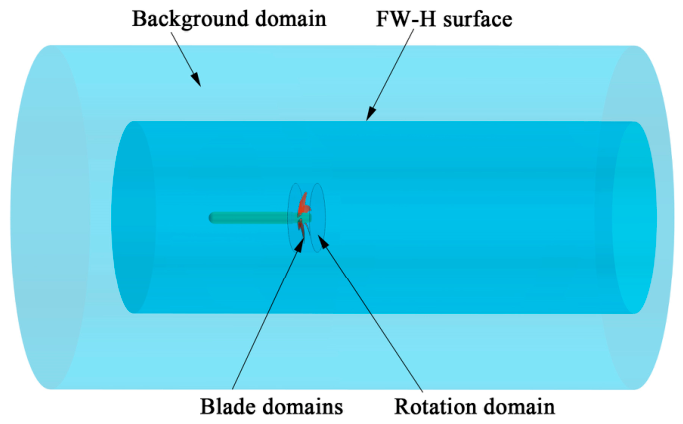
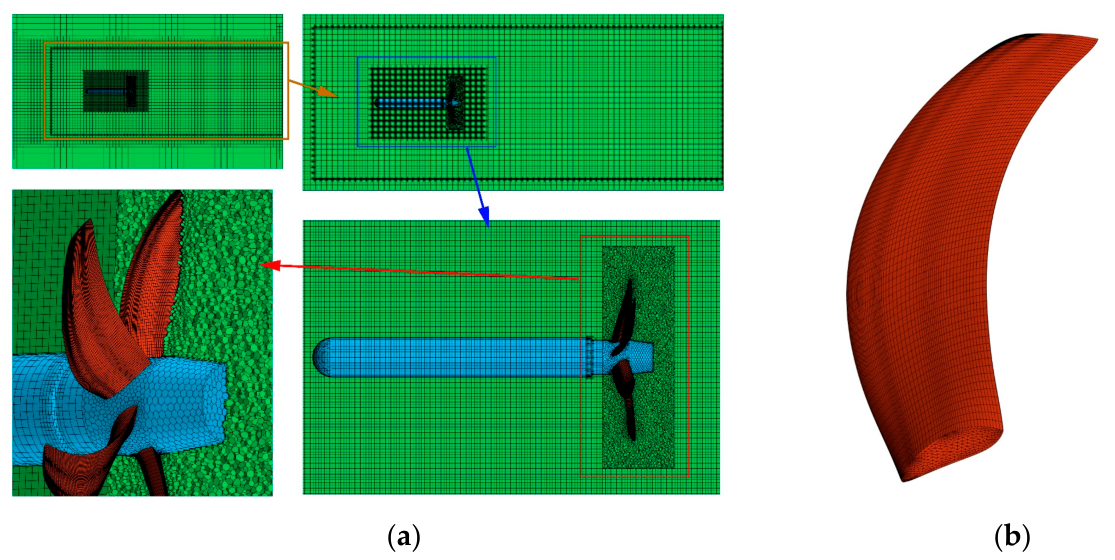
The computational domains employed in the present study are shown in Figure 2. The computational domains contain a background domain, a rotation domain and six blade domains corresponding to six blades. The rotation domain and background domain are fluid domains. These blade domains are solid domains. The FW-H surface was placed in the background domain for a further study assessing noise. To realize two-way FSI, an interface is established between the solid domain and the rotation. Superimposed motion of rotation and deformation is assigned to blade domains and rotation domains. Layouts of computational domains are shown in Figure 2. The rotation domain is meshed with a polyhedral mesh, and the background domain is meshed with a trim mesh. The blade domains are formed by structural grids. There are 25 boundary mesh layers near the wall with a growth rate of 1.2. The first boundary layer mesh on the whole propeller surface is calculated by y+ = 1, and Re is calculated by Equation (15). There are 5.42 M cells in the uniform inflow simulation and 16.58 M cells in the inhomogeneous inflow simulation. The mesh details are shown in Figure 3. The time step corresponding to a propeller rotation of 0.9° was employed.
Re = b 0.75 R V A 2 + 0.75 π n D 2 υ ,

3.2. Uncertainty Analysis and Validation

The uncertainty analysis of the mesh is carried out under uniform inflow and a rotational speed of n = 30 rps. The Coarse, Medium, and Fine grid results are compared in Table 1. The refinement ratio is 1.4. Results show that deviations in the thrust coefficient, torque coefficient of the propeller and axial deformation of the blade tip are convergent as mesh size decreases. Hence, the grid Medium is used for further verification and validation.
The uncertainty analysis of time steps is carried out under uniform inflow and rotational speed n = 40 rps. The results obtained with time steps Δt = 3.125 × 10⁻⁵, 6.25 × 10⁻⁵, and 1.25 × 10⁻⁴ are compared in Table 2. Results show that the deviations are convergent as the time step decreases. The deviations are smaller than 1%. Hence, the time step of Δt = 6.25 × 10⁻⁵ is employed, which corresponds to a propeller rotation of 0.9°.
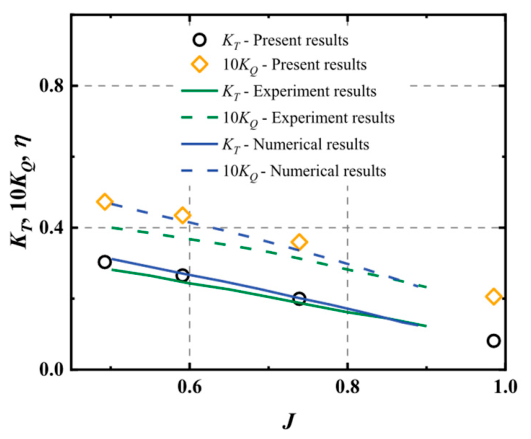
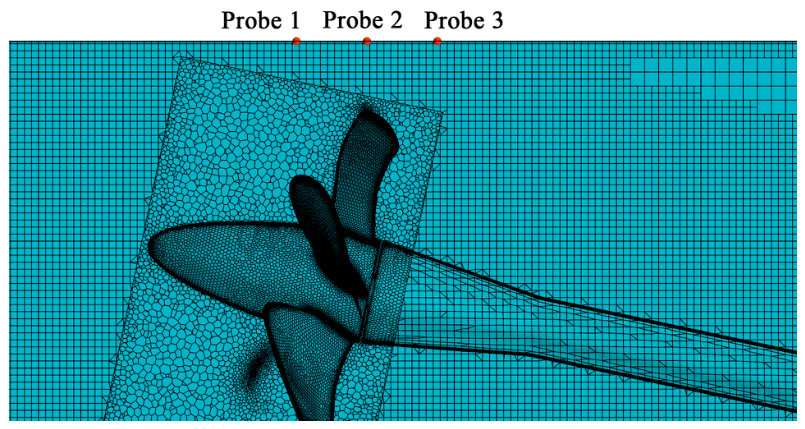
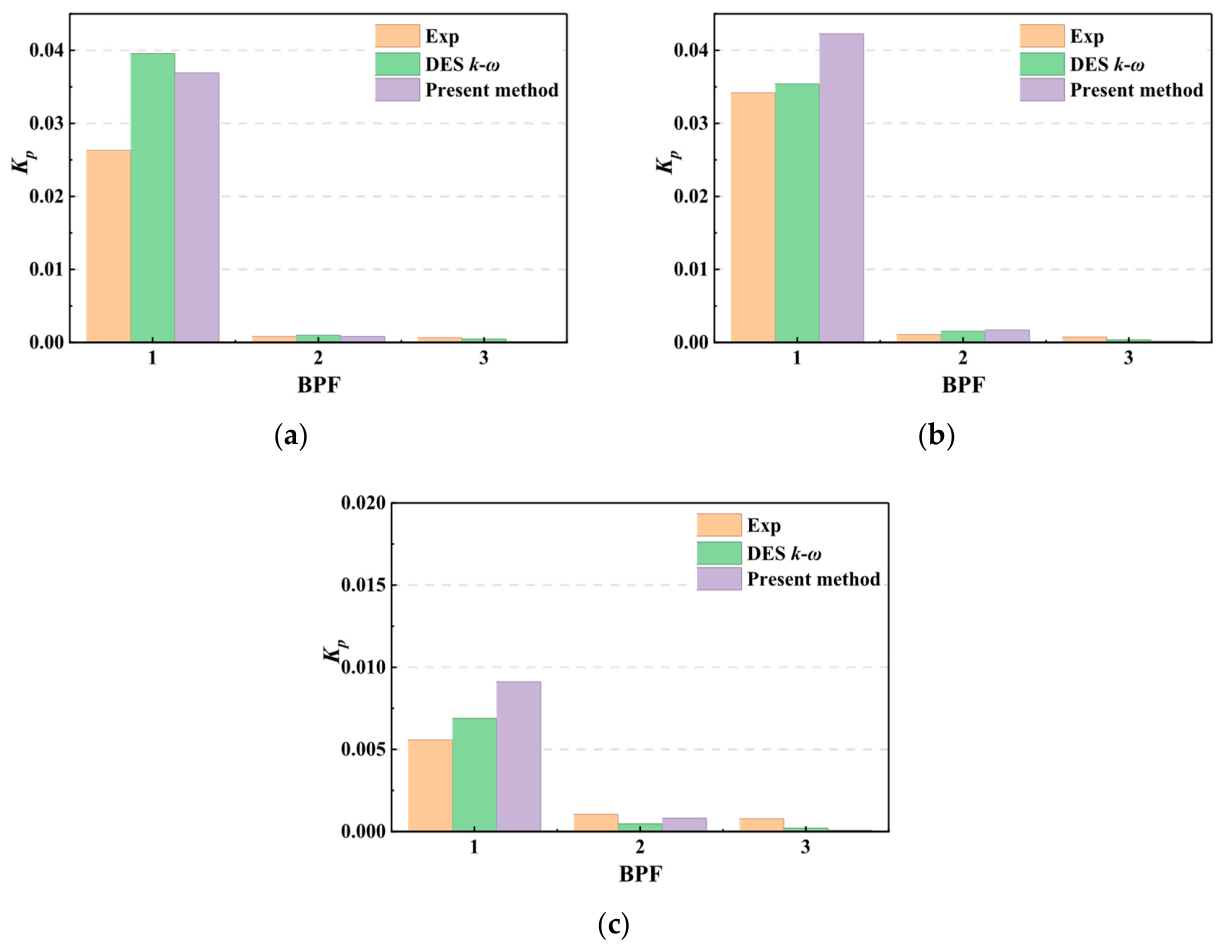
In Figure 4, the hydrodynamic performance obtained with the full-rigid propeller and elastic propeller is compared with experimental results and numerical results obtained by Young [3]. Variable J is an advanced coefficient that can be calculated by J = VA/(nD). Results are obtained with the grid Medium and a time step corresponding to a propeller rotation of 0.9°. The thrust and torque coefficients predicted by the numerical method are close to the results obtained by Young [3]. The thrust coefficient and torque coefficient decrease as the advanced coefficient increases. To validate the ability to capture frequency domain features, the pressure fluctuations excited by the VP1304 propeller are predicted with the present numerical method and a similar grid strategy. The propellers have a 12° tilt angle. The mesh details of the VP1304 propeller and locations of probes are shown in Figure 5. The amplitudes at pressure fluctuations of 1BPF, 2BPF and 3BPF are obtained by FFT. The coefficients of amplitude Kp = 2p/(ρn2D2) obtained under J = 1.268 are shown in Figure 6. Results obtained by the present numerical methods are similar to experimental results and numerical results obtained by Gaggero [22]. Hence, the numerical method employed in the present simulations is reliable.
Due to the high-quality results obtained, propeller FSI tests are rare. The numerical method is further validated with experimental results of the hydrofoil obtained by Zarruk et al. [23]. The lift coefficient CL and structural response are compared in Table 3. The performance of the hydrofoil is also obtained in the free stream at an attack angle of 6°. The simulations are carried out using the same mesh strategy. The non-dimensional deformations of the tip dy′ are obtained using Equation (16). The deviations of CL, dy′, and first natural frequency f1 are 4.18%, 1.59%, and 6.49%, respectively.
d y = d y E I F n s 3 ,
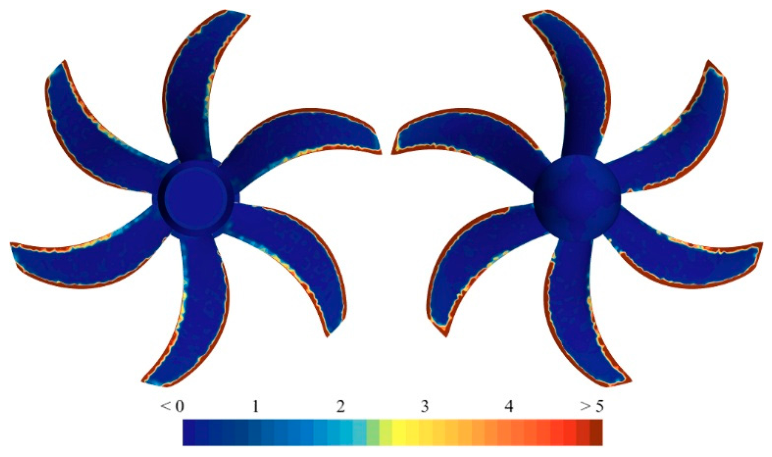
At 40 rps, the time step is 6.25 × 10⁻⁵ s corresponding to a Courant number of 0.49. The distribution of the convective Courant number on the propeller surface is shown in Figure 7. The Courant number on the blade surface is smaller than one near the leading edge and tip. Hence, the time step corresponding to a rotation of 0.9° is satisfied.

4. Hydrodynamic Performance of Propellers Under Different Inflow Conditions

Inhomogeneous flow results in changes to hydrodynamic performance and structural response. Hence, the thrust fluctuations and pressure fluctuations of the propellers are first studied to discuss the influence of inflow conditions on loading fluctuations of propellers. The evolution of the propellers is also studied in the present study.

4.1. Loading Fluctuations of the Propeller

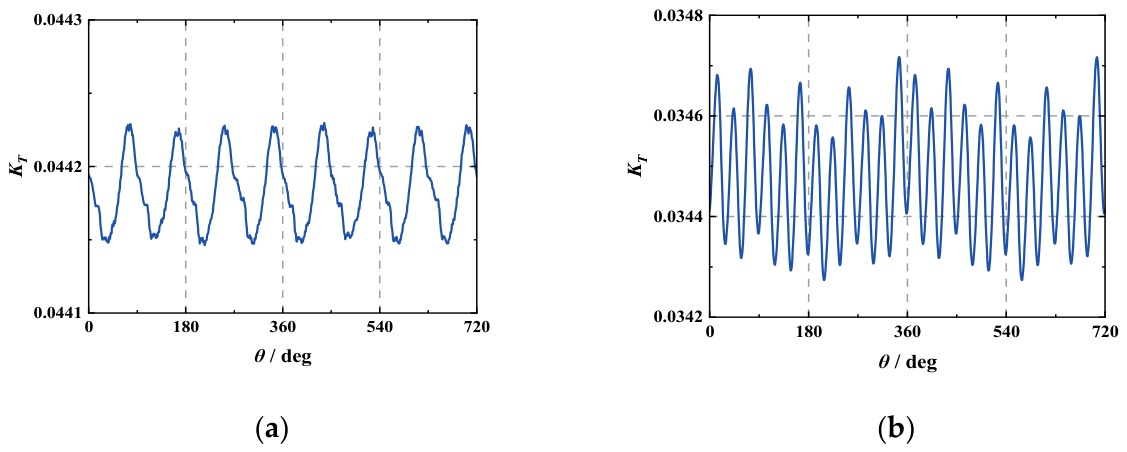
The time-domain characteristics of thrust fluctuations on a single blade are listed in Figure 8. The horizontal axis represents the rotation angle θ of the propeller. Periodicity can be noticed for thrust fluctuations on a single blade. Inhomogeneous inflow results an additional high-frequency component to cause thrust fluctuations on the blade.
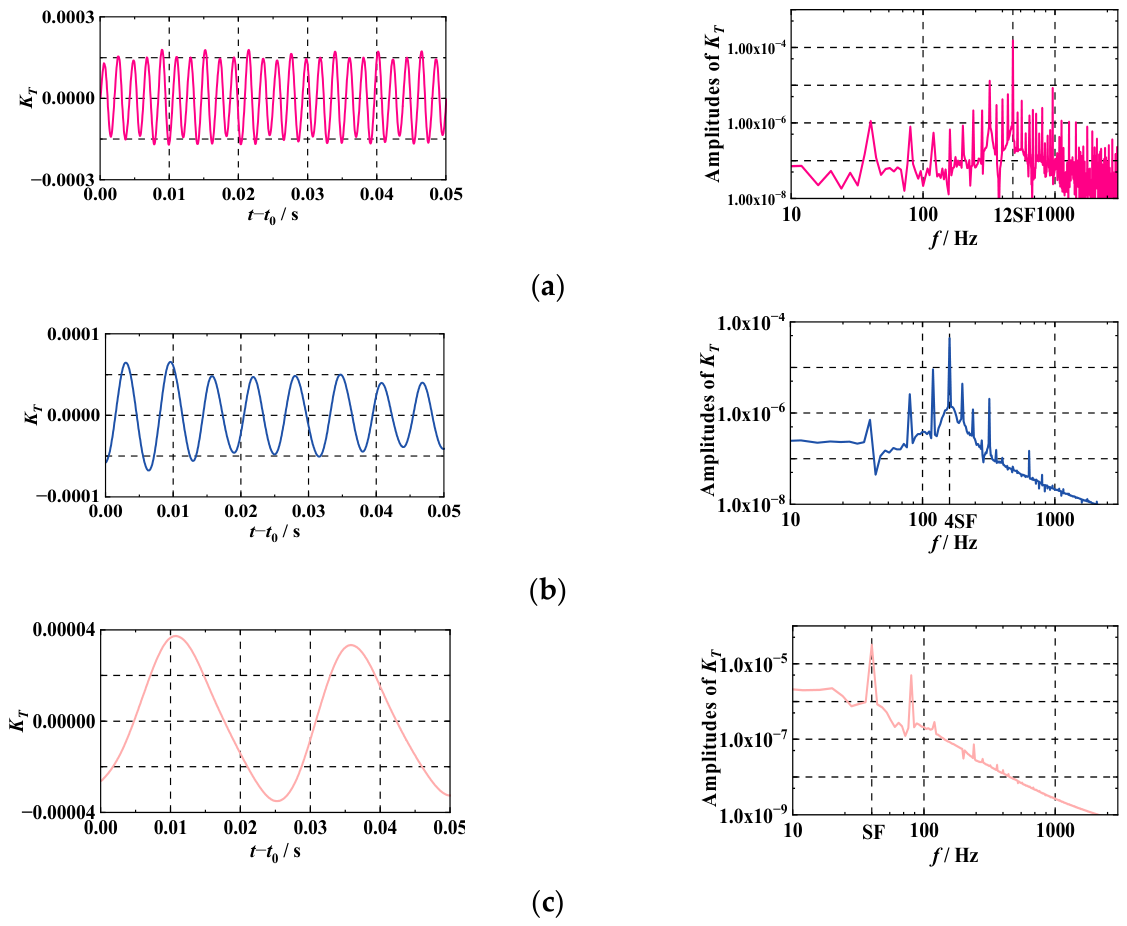
To further explore the influence mechanism of inhomogeneous inflow, the fluctuation components are extracted using the EMD method. The EMD method was proposed by Huang et al. [24] from NASA in 1998. As a time-domain signal processing method, it decomposes complex signal functions into a series of finite intrinsic mode functions (IMF) based on the local characteristic time scale of the signal itself. The present study builds on the code of the EMD method to identify different components of thrust fluctuation on a single blade operating in inhomogeneous inflow. First, the three-order IMFs obtained by EMD and their corresponding frequency domain features are shown in Figure 9. Among them, IMF 1 mainly occurs at 12SF (480 Hz), IMF 2 mainly occurs at 4SF (160 Hz), and IMF 3 mainly occurs at SF (40 Hz). 12SF is the encounter frequency between the rotating blade and the inhomogeneous inflow.
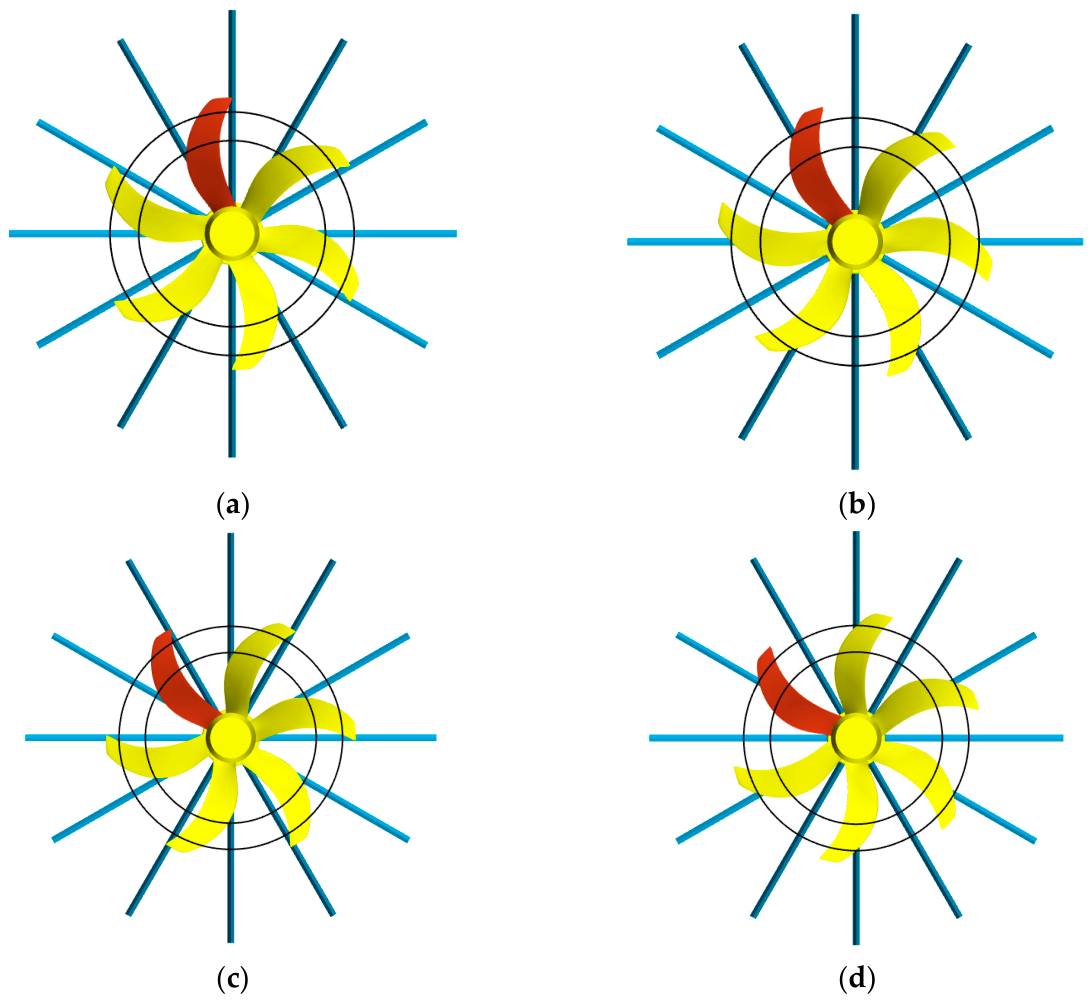
In IMF 1, the thrust component alternates at a frequency of 12SF. Therefore, the timing of the peak and valley of IMF 1 within one propeller rotation period T0 is extracted, and the corresponding angle of the blade is calculated. In Figure 10, the blade angles corresponding to two peaks and two troughs are listed. Two radial positions of r = 0.68R and r = 0.89R are marked with black cycles. The LE at r = 0.68R is located in the wake of the upstream hydrofoil when IMF 1 reaches its peak. The LE at r = 0.68R is located in the wake between the hydrofoils when IMF 1 is at its trough. At the same time, the LE at r = 0.68R is located at the wake of the upstream hydrofoil. Hence, this loading fluctuation at 12SF with an amplitude of 4.4 × 10⁻⁵ can be attributed to the alternating cutting of the blades with inhomogeneous inflow. Amplification of these loading fluctuations at 12SF is dominated by the load at the inner radius of the blade.
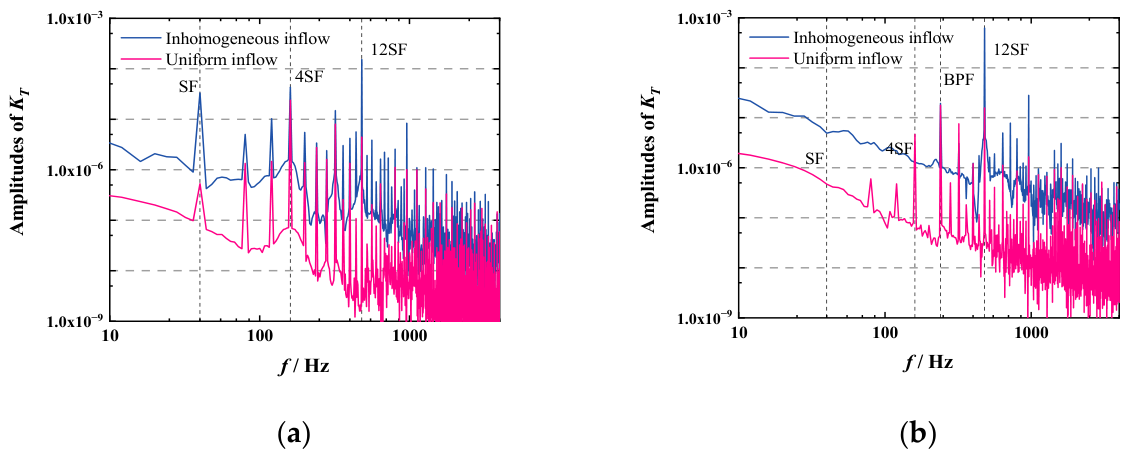
The frequency domain characteristics of thrust fluctuations on the single blade and whole propeller are compared in Figure 11. These frequency domain characteristics are calculated by the Fourier Transform. For thrust fluctuations of the whole propeller, inhomogeneous inflow strengthens thrust fluctuations of single blades at SF, 2SF, and 12SF but weakens thrust fluctuations at 4SF. At 12SF, an amplification of about 40 times is identified. The thrust fluctuation at BPF obtained with uniform inflow is similar to that obtained with inhomogeneous inflow.
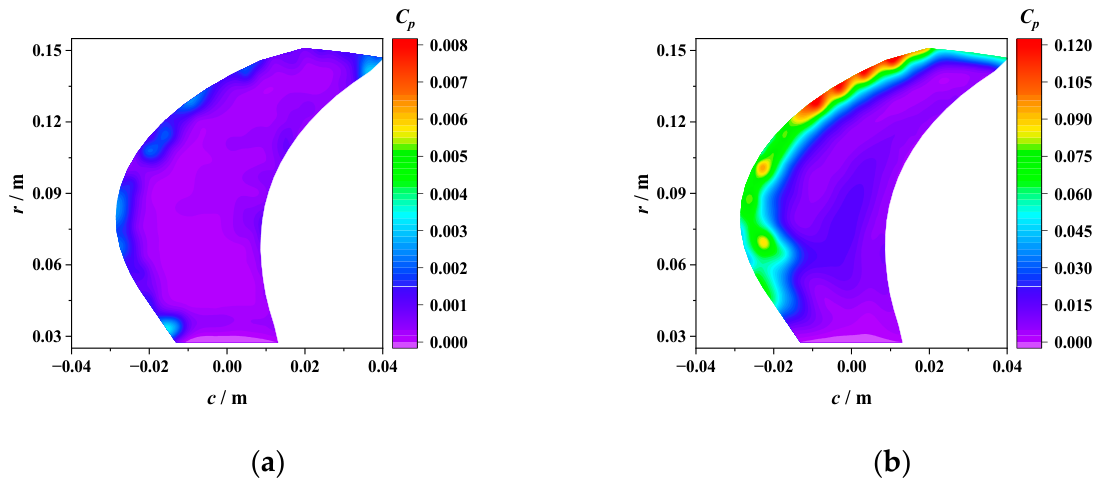
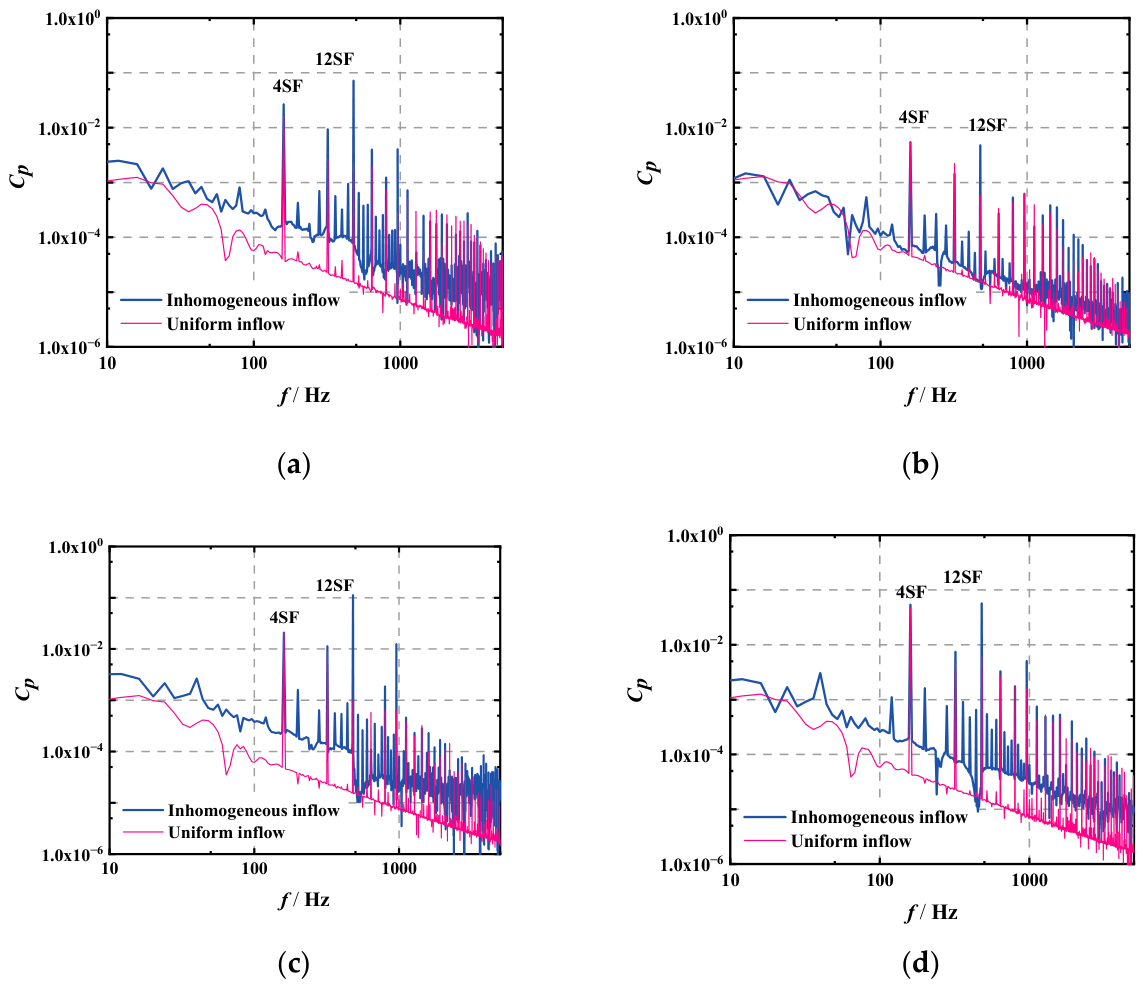
To further explore the source of amplified thrust fluctuations, the frequency domain characteristics of the pressure fluctuations on the propeller blade under n = 40 rps are shown in Figure 12. Pressure fluctuations on the blade contain tonal components at 4SF and 12SF and broadband components at frequencies of 1000–5000 Hz. At 0.8R, LE has more intense pressure fluctuations than TE. At 1.0R, the tonal component at 12SF is more intense at LE than that at TE, while the tonal component at 4SF and broadband components are more intense at TE. Inhomogeneous inflow results in more intense components at 12SF. Hence, the thrust fluctuations at 12SF in Figure 11 can be attributed to the pressure fluctuations induced by inhomogeneous inflow. To further discuss the influence of inhomogeneous inflow on distribution of pressure, pressure fluctuation amplitudes on the suction side are compared in Figure 13. Pressure fluctuation at 12SF is dominant at LE and strengthened by inhomogeneous inflow. Hence, the amplification of loading fluctuations attributed to inhomogeneous inflow is dominant at LE.
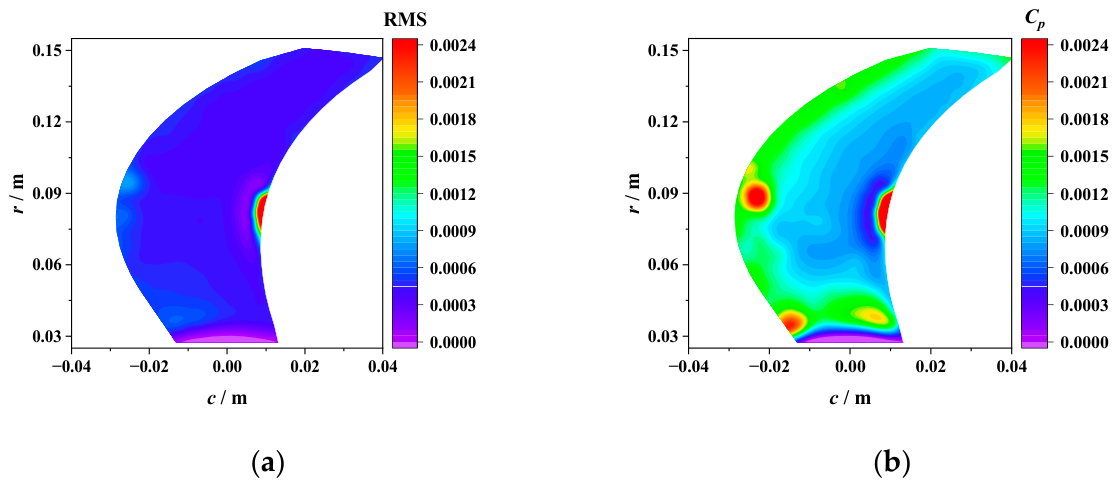
To further study the broadband components of pressure fluctuation, the RMS of pressure fluctuations at 1000–5000 Hz is calculated using Equation (17):
R M S = f = 1000 Hz 5000 Hz A f × Δ f 0.8 ρ V A 2 ,
where Af is the amplitude, and Δf is the frequency resolution. The distributions of RMS are shown in Figure 14. Under uniform inflow, besides LE and TE, broadband pressure fluctuations are uniformly distributed on the entire surface of the blade. The most intense broadband pressure fluctuations can be observed at a mid-radius of TE. Hence, in the uniform inflow condition, the broadband pressure fluctuations can be attributed to the transition at the blade surface and the vortex shedding at TE. Under an inhomogeneous inflow condition, the broadband pressure fluctuations at LE are significantly enhanced. Hence, the broadband pressure fluctuations can be strengthened by the interaction between the inhomogeneous inflow and the rotating blade.
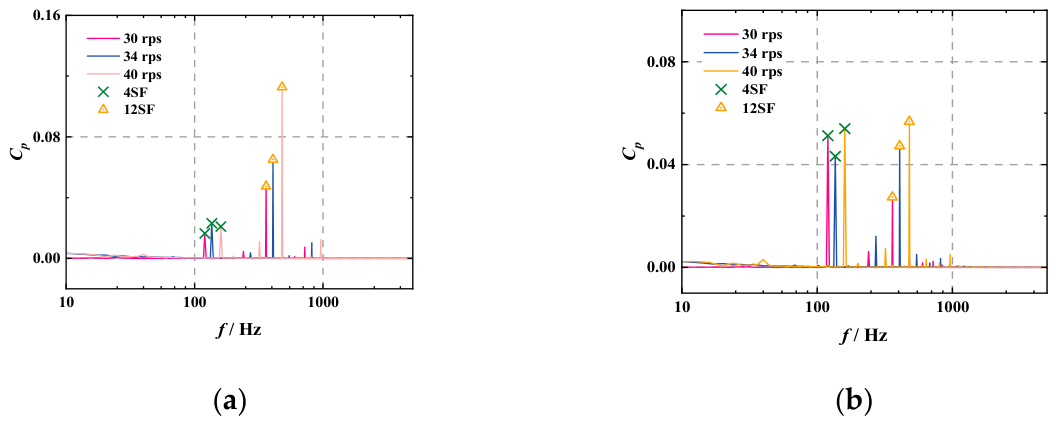
Pressure fluctuation at the blade tip is compared under different rotational speeds in Figure 15. The results are obtained with the propeller operating in an inhomogeneous inflow. At LE, the pressure fluctuations at 12SF are more intense than those at 4SF. However, at TE, the pressure fluctuations at 12SF have similar amplitudes to those at 4SF. Pressure fluctuations at 12SF strengthen as rotational speed increases.

4.2. Evolutions of Propeller Wake

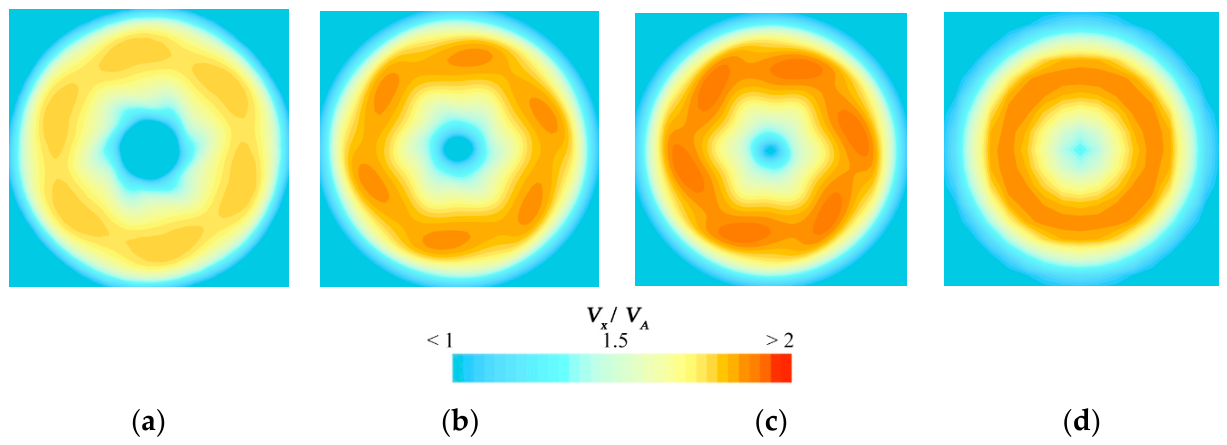
Besides pressure fluctuations on the blade surface, energetic modes in the propeller wake can be influenced by inhomogeneous inflow [25,26]. These energetic modes can also influence structural responses of the propeller. The distributions of axial velocity of the propeller operating in uniform inflow are shown in Figure 16. Axial velocity is accelerated downstream of the propeller wake. There are fluctuations in axial velocity in the axial direction and the circumferential direction.
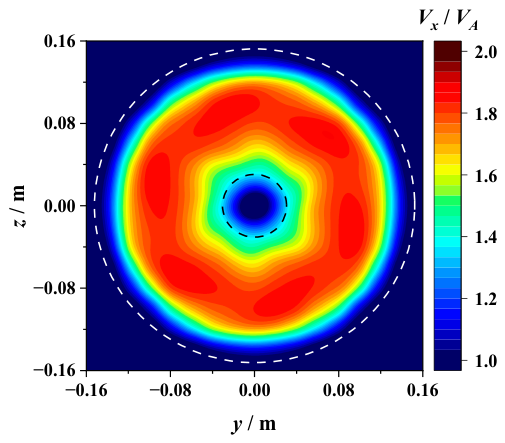
To obtain the modes and corresponding frequencies of velocity fluctuations in the propeller wake, the Fortran codes of DMD are established based on the algorithms listed by Schmid & Sesterhenn [27] and Schmid [28] and employed to analyze axial velocity at x = 0.5D. The instantaneous distributions of axial velocity at x = 0.5D in five cycles are employed as input patterns. The input pattern is obtained by grids of 41 × 41 and a snapshot frequency of fs = 20,000 Hz. These instantaneous distributions are obtained under n = 50 rps. One of the input patterns is shown in Figure 17.
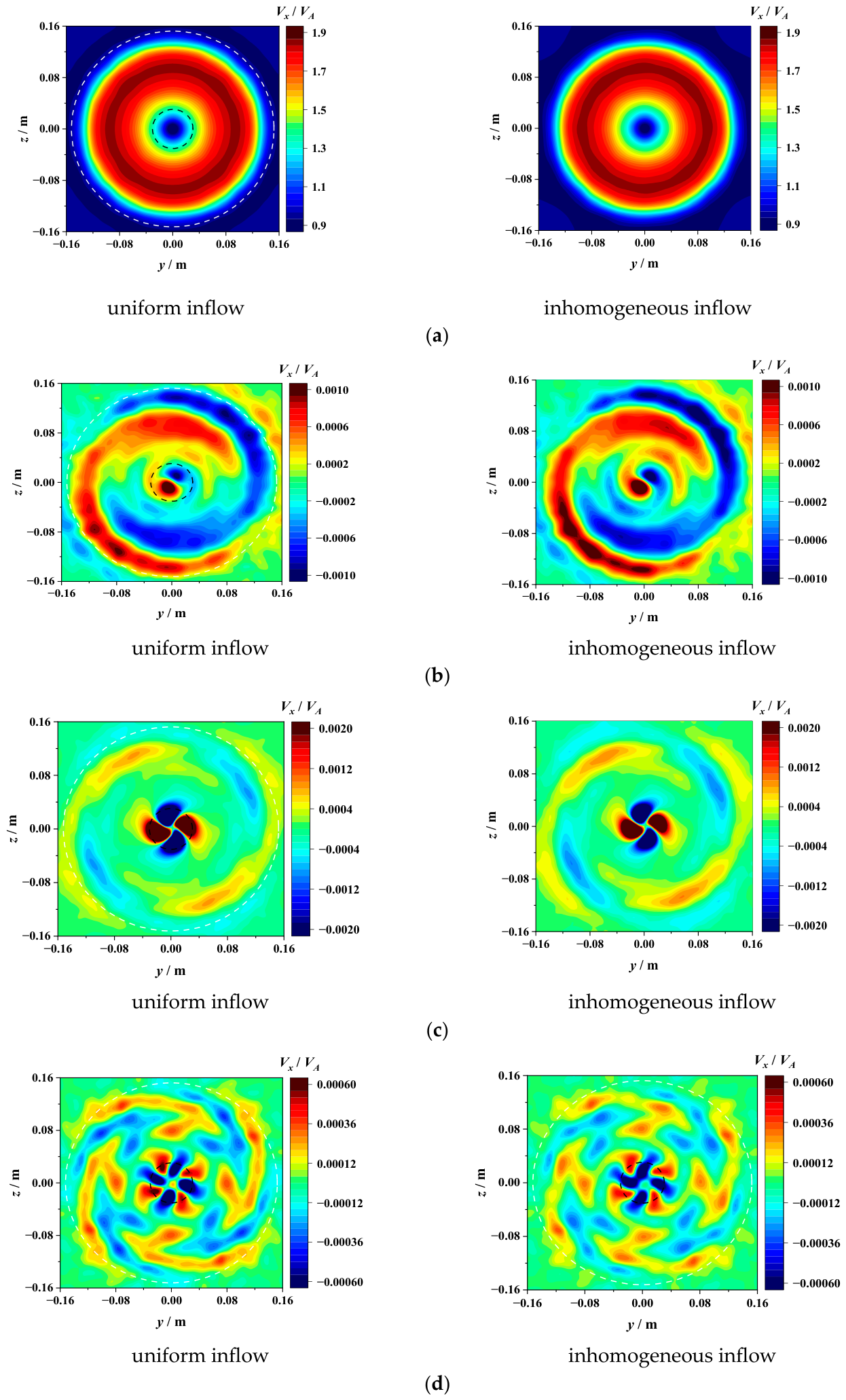
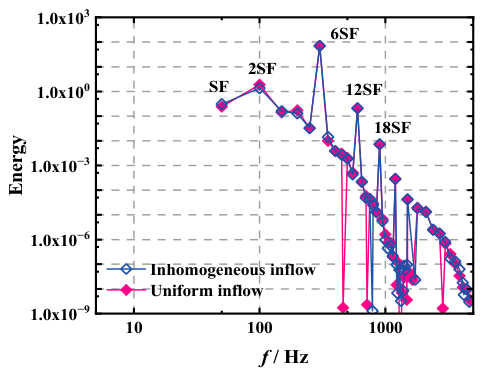
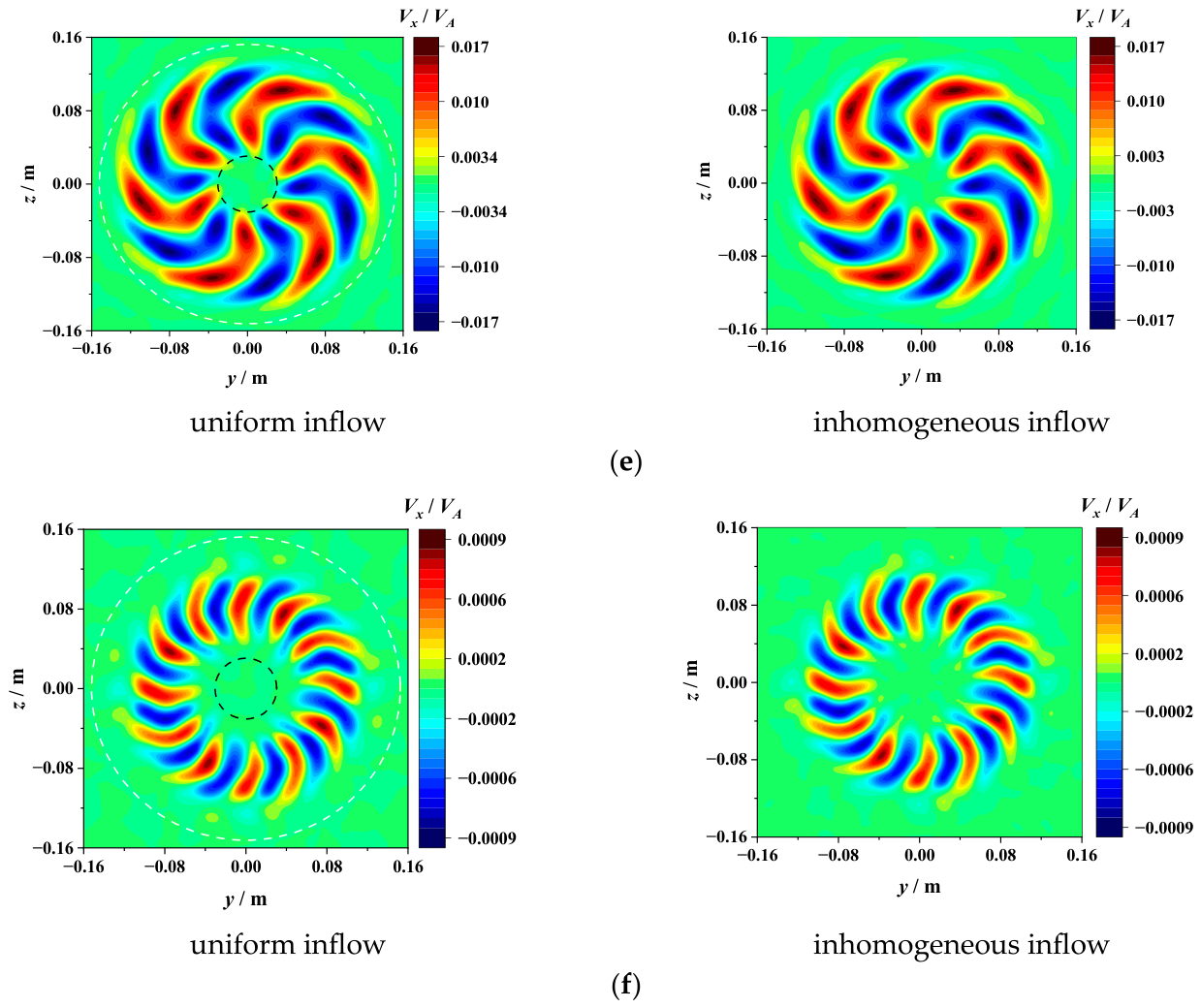
The distributions of energies corresponding to different energetic modes are shown in Figure 18. An exception is the energetic mode, which occurs at 0 Hz and has an energy of around 1 × 10⁷; intense energy can be observed at 300 Hz (BPF), 100 Hz (2SF), 50 Hz (SF), and 600 Hz (12SF). DMD modes at different frequencies are shown in Figure 19. The black dashed line and white dashed line are added to the figures, which indicate diameters of the hub and blade tips, respectively. In Figure 19a, the DMD mode at 0 Hz corresponds to the mean velocity. There is acceleration in the blade wake and deceleration downstream of the hub. In Figure 19b, the fluctuations in axial velocity can be observed in the hub vortex, root vortices, blade wake and tip vortices. Among these, the most intense fluctuations occur in the hub vortex. In the third DMD mode occurring at 2SF, the fluctuations in axial velocity are dominant at the hub vortex and tip vortices. Two periods in the circumferential direction can be observed in the fluctuations in axial velocity. In the fourth mode at 4SF, fluctuations in axial velocity are still dominant at the root vortices, blade wake, and tip vortices. In the fifth DMD mode occurring at BPF, the fluctuations in axial velocity are dominant in the blade wake. There are six periods in the circumferential direction, which correspond to the number of blades. Inhomogeneous inflow requires more intense fluctuation in the blade wake. In the sixth DMD mode occurring at 12SF, the fluctuations in axial velocity are dominant in the wake of the blade.
Fluctuations in axial velocity at SF and 2SF are strengthened by inhomogeneous inflow. This enhancement corresponds to more intense thrust fluctuations at SF and 2SF when obtained under inhomogeneous inflow, as shown in Figure 11b. However, propellers operating in inhomogeneous inflow cause the weaker fluctuation in axial velocity at 4SF, which also corresponds to weaker thrust fluctuations in Figure 11b. At BPF, the impact of inhomogeneous inflow on thrust fluctuations and wake evolution can be ignored.
It can be summarized that different energetic components in the propeller wake have different dominant frequencies. The fluctuations in axial velocity in the hub vortex are dominant at the SF and 2SF. The fluctuations in the blade wake can be observed at SF, 4SF, BPF and 12SF. The energetic modes in the tip vortices are only dominant at SF, 2SF and 4SF. Inhomogeneous inflow results in more intense fluctuations in the tip vortex at SF and 2SF but weaker fluctuations at 4SF. Inhomogeneous inflow also results in more intense fluctuations in the blade wake at 12SF.

5. Deformations and Vibrations of the Propeller Blade

Loading fluctuations on the propeller result in deformations and vibrations on blades or even resonance, which worsens the structural safety of naval vessels. Inhomogeneous inflow gives extra complexity to the vibrations of the propeller. Hence, the influence of inhomogeneous inflow is discussed in this chapter.

5.1. Deformations of the Propeller Blade

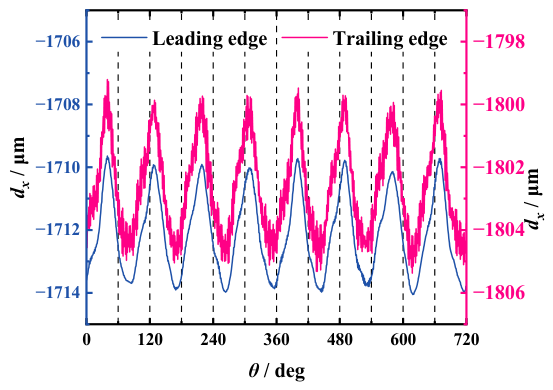
Axial deformation, dx, on the blade tip of the propeller operating in a uniform inflow is shown in Figure 20. The TE has more intense axial deformation than the LE. Periods can be observed in the evolution of deformations on the blade tip. Phase differences between the deformations of LE and TE can be ignored.
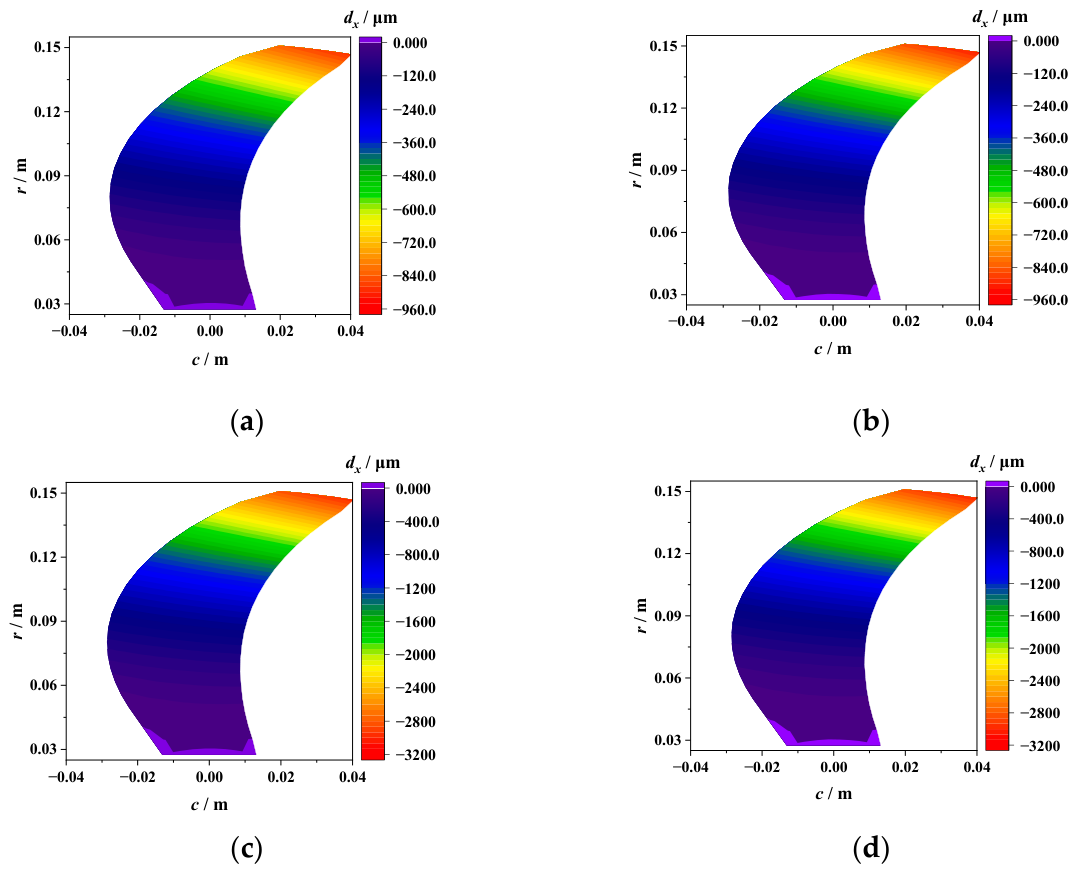
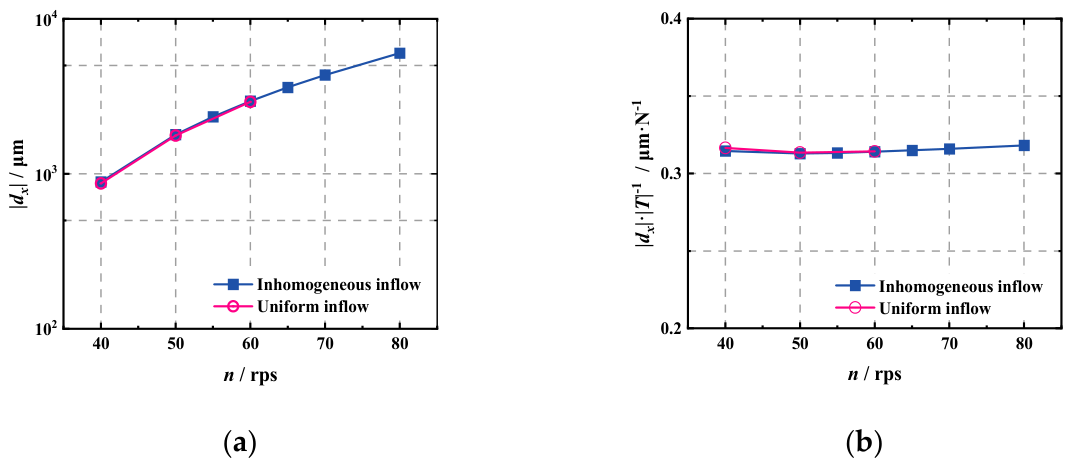
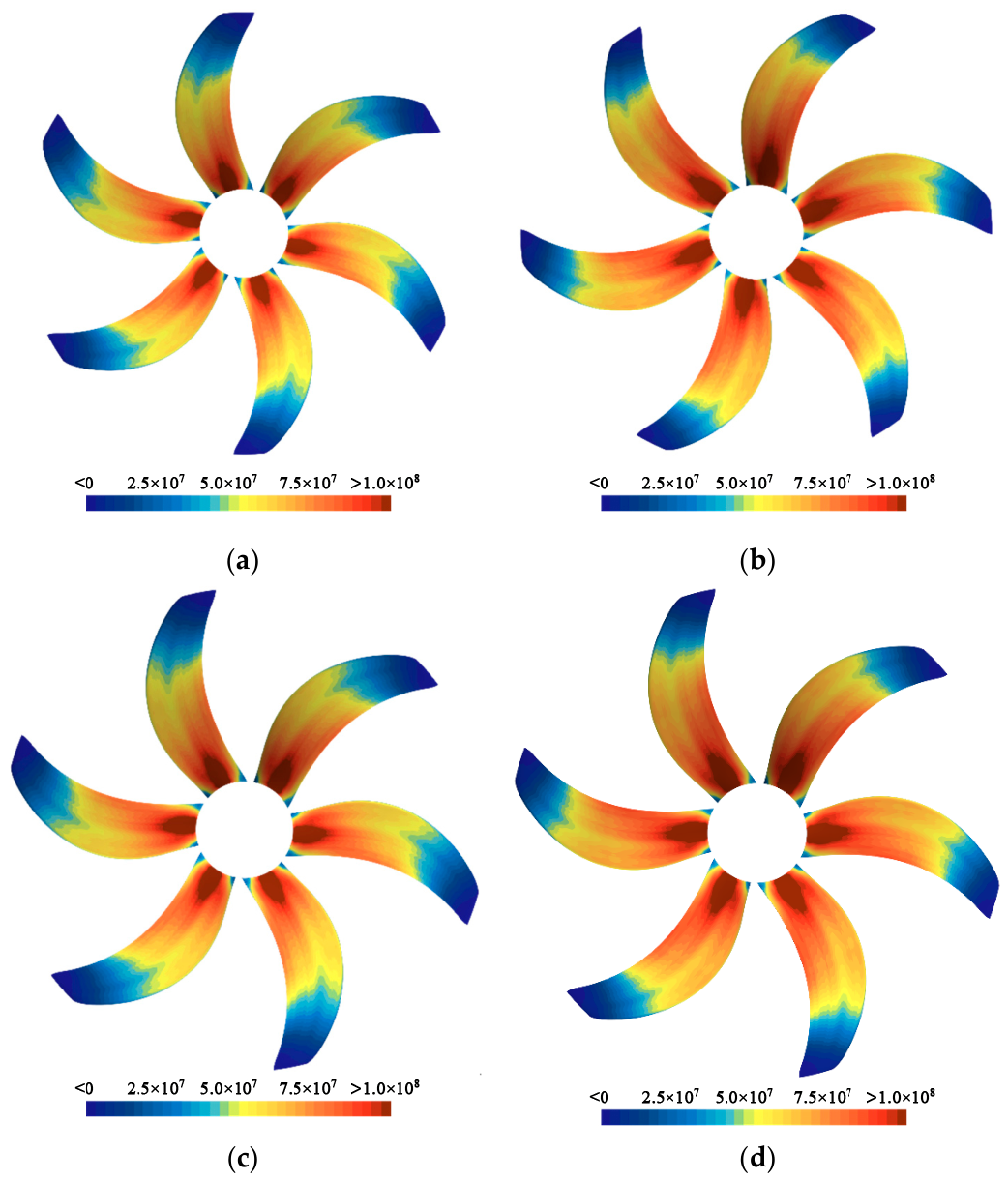
The time-averaged axial deformations of the blade are shown in Figure 21. Axial deformations are more intense at the blade tip. The deformations on the blade strengthen as the rotational speed increases. Distribution of deformations on the blade in inhomogeneous inflow is similar to that for the propeller operating in uniform inflow. The time-averaged axial deformations at the middle line of the blade tip are shown in Figure 22a, and the ratios of axial deformation to load T are shown in Figure 22b. Axial deformations of the blade operating in inhomogeneous inflow are slightly stronger than those operating in uniform inflow. The ratios of axial deformation to load remain unchanged when the rotational speed increases, which results in linear dependence. This phenomenon corresponds to results obtained by Brandner et al. [29] and Zarruk et al. [23]. The distribution of von Mises stress at the pressure side is shown in Figure 23. Maximum stress is concentrated at the root of the blade. The stress on the blade tip is close to zero. A higher rotation speed results in stronger stress at the blade root. Inhomogeneous inflow also strengthens the stress at the inner radius of the blade.

5.2. Vibrations of Propeller Blade

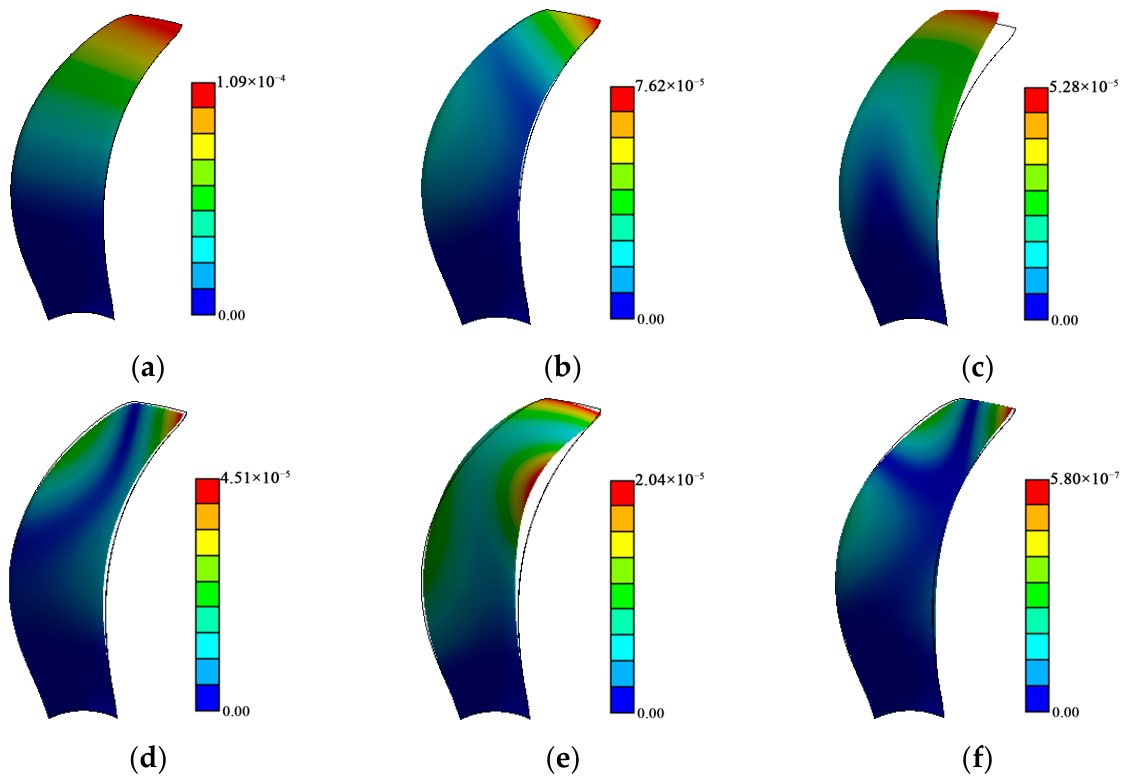
Fully wetted modal analysis is carried out to obtain the natural frequencies and corresponding vibration modes. Results of fully wetted modal analysis are shown in Figure 24. Primary bending in the spanwise direction can be observed in the first natural mode. Secondary-order bending in the spanwise direction can be observed in the second natural mode. In the third natural mode, the blade experiences primary bending in the chord-wise direction. Primary twisting can be observed in the fourth natural mode. Third-order bending in the spanwise direction is observed in the fifth natural mode. Coupled modes can be observed in the sixth natural mode, where the blade experiences superposition of primary twisting and secondary-order bending in the spanwise direction.
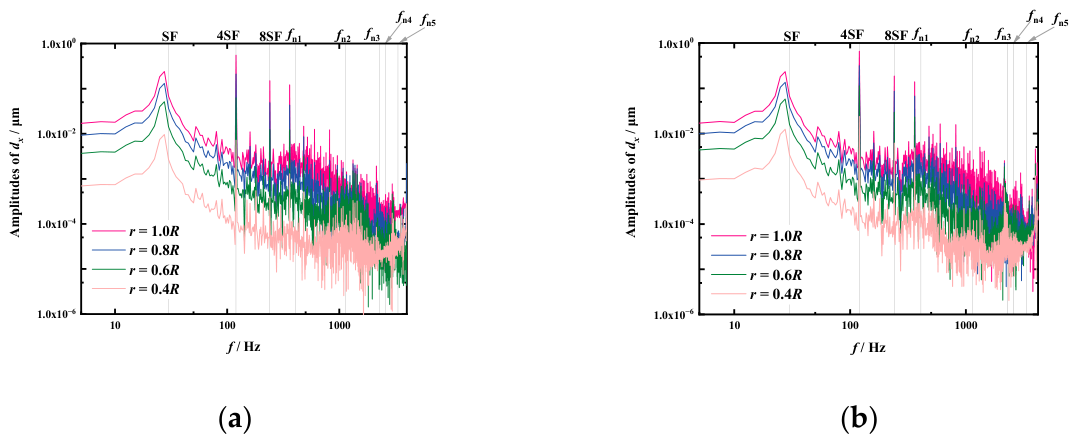
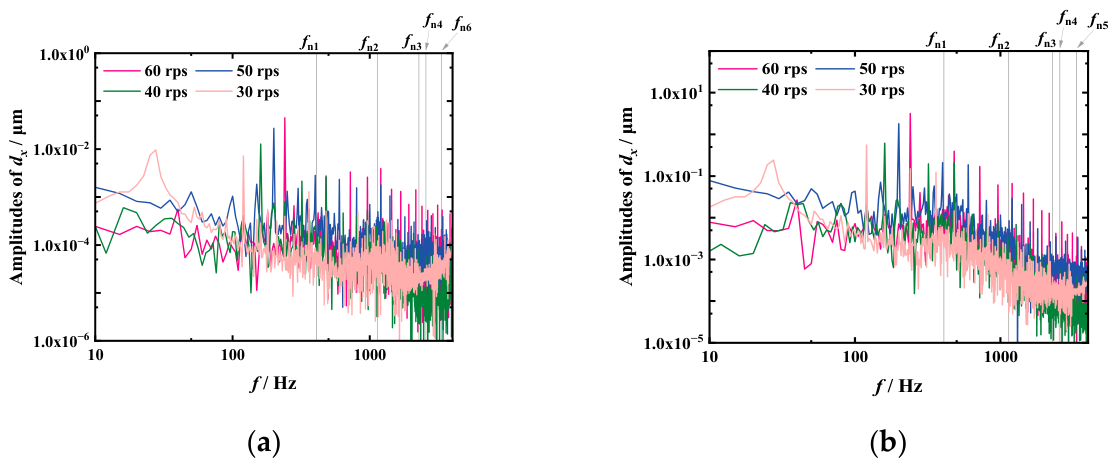
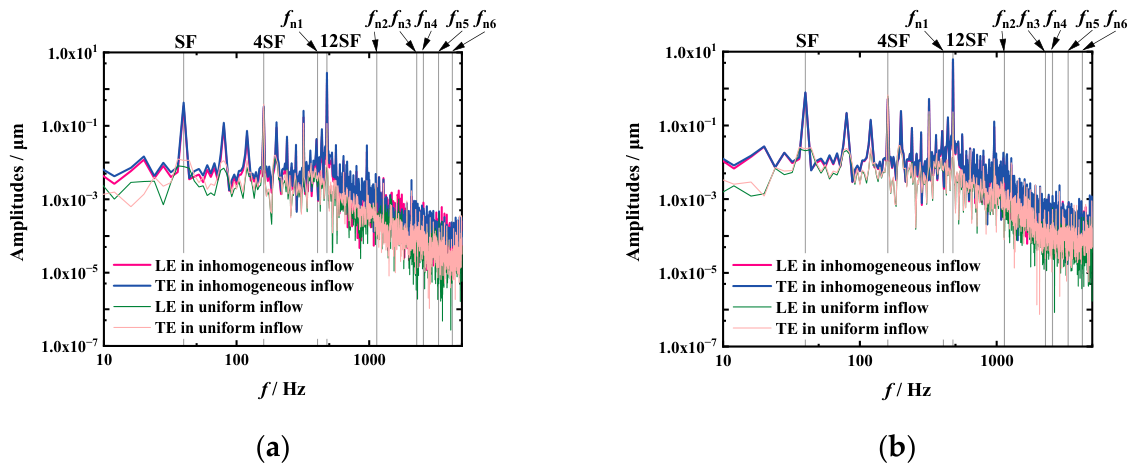
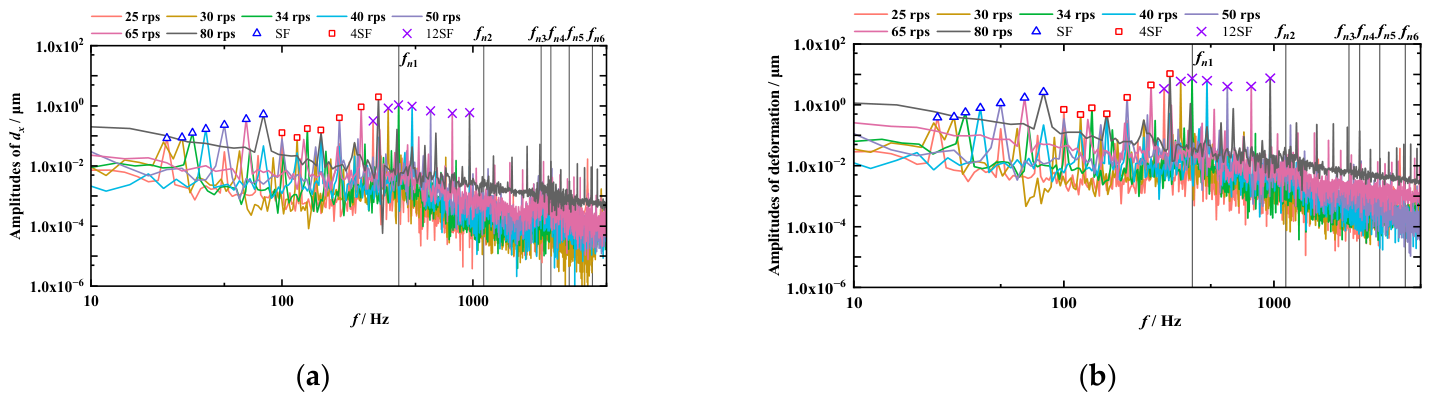
The frequency-domain characteristics of deformations or vibrations at different spanwise positions are shown in Figure 25. There are tonal vibrations and broadband vibrations in the vibration spectrum. Tonal vibrations occur at SF and its harmonics, which correspond to tonal pressure fluctuations. Corresponding to broadband pressure fluctuations, broadband vibrations occur at 1000–4000 Hz. These broadband vibrations are more intense in the vicinity of natural frequencies. Both tonal vibration and broadband vibration strengthen as the spanwise direction increases. At different spanwise positions of the blade, broadband vibrations occur at different center frequencies. Broadband vibration with a center frequency of fn4 on LE is significant at r = 1.0R and r = 0.8R; however, it is weak at r = 0.6R and r = 0.8R. This distribution of broadband vibrations indicates that vibrations of the blade exceed the primary bending. Hence, the distribution of vibrations needs further global discussion considering the whole blade.
The vibration characteristics of the blade under different rotational speeds are compared in Figure 26. Both tonal vibrations and broadband vibrations strengthen as the rotational speed increases. Broadband vibrations occurring in the vicinity of natural frequencies are evident in the results obtained by different rotational speeds.
Vibrations of the blade operating in uniform inflow and inhomogeneous inflow are compared in Figure 27. Inhomogeneous inflow amplifies tonal vibrations at SF and 12SF. Under inhomogeneous inflow, the most intense tonal vibration occurs at 12SF instead of 4SF. However, the impact of inflow conditions on the tonal vibration at 4SF is weak. At TE of the blade tip, amplifying at 12SF is about 27 times greater when induced by inhomogeneous inflow. Inhomogeneous inflow also results in more intense broadband vibrations. Similar to the blade operating in uniform inflow, broadband vibrations are also more intense in the vicinity of natural frequencies.
In the present study, inhomogeneous inflow results in a higher dominant excitation frequency, which is closer to the first natural frequency. Vibrations on TE under inhomogeneous inflow are shown in Figure 28. Tonal vibrations and natural vibrations are marked with symbols and lines. Tonal vibrations occur at SF and 4SF and strengthen as rotational speed increases, while those at 12SF strengthen first and then weaken. Tonal vibration at 12SF reaches its maximum under n = 34 rps. Broadband vibrations at 1000 — 5000 Hz also strengthen as rotational speed increases. Several humps in broadband vibration can be observed at fn2, fn3 and fn5. The vibration hump of fn3 at 0.6R is more intense than that at 1.0R.
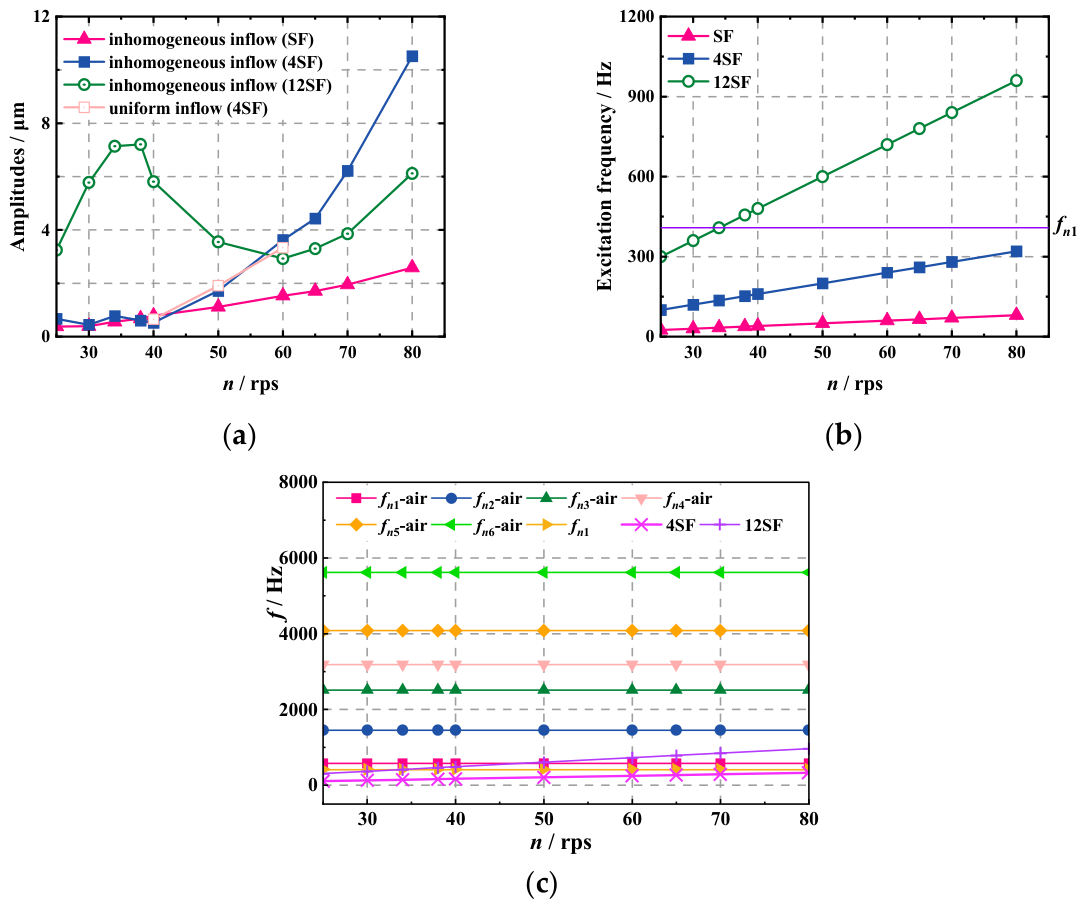
Vibration amplitudes and excitation frequencies at the middle of the blade tip are compared in Figure 29. Excitation frequencies increase as the rotation speed increases. The excitation 12SF approaches the first natural frequency, fn1, at n = 34 rps and 38 rps. The response frequency of the propeller is always consistent with the excitation frequency. The amplitude at 12SF reaches its maximum at n = 34 rps and 38 rps, which is contrary to the trend of pressure fluctuations shown in Figure 15. This inconsistency indicates the enhancement of amplitudes beyond the contributions of amplified pressure fluctuations. At these two rotational speeds, 12SF corresponding to 408 Hz and 456 Hz are close to fn1, which indicates resonance. This phenomenon corresponds with the results obtained by Tian et al. [20]. Vibration amplitudes at different frequencies have different growth rates. Under n = 25 rps–40 rps, vibration amplitudes at SF and 4SF are similar to each other, while vibration amplitudes at 4SF are enhanced faster than those at SF under n = 50 rps–80 rps. Blades operating in uniform inflow and inhomogeneous inflow experience similar vibrations at 4SF, which suggests that vibrations at 4SF are induced by the mutual interaction of blades. The Campbell diagram is shown in Figure 29c. The natural frequency of the blade in the air was obtained by Ansys Workbench. The first natural frequency in the water, fn1, was also added to the diagram. The influence of rotational speed on natural frequencies is weak. The excited frequency 12SF crosses with fn1 at 34 rps and crosses with fn1-air at 50 rps. Results indicate that the damping effect induced by rotating motion is weak, while the damping effect and additional mass induced by water are intense.
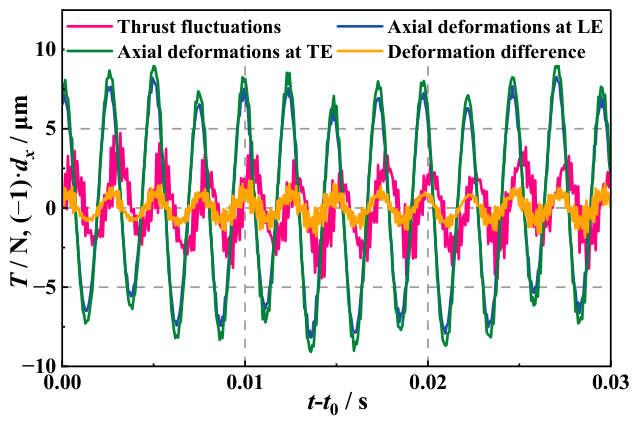
Below, the thrust fluctuations on single blades and axial deformation fluctuations on the same blade are compared in Figure 30. Both the thrust fluctuation and deformation fluctuation are subtracted from the average value. The thrust is positive in the upstream direction. The deformations are positive downstream. The deformation difference is calculated by subtracting the axial deformation of the LE from the axial deformation of the TE. In order to unify the direction, the axial deformation data was multiplied by (−1). In Figure 30, the thrust reaches its peak after the peak of deformation in the upstream direction. However, the fluctuations in thrust and differences in deformations are almost completely synchronized. Hence, amplification of deformations at 34 rps can be attributed to the resonance.

5.3. Distributions of Vibrations on the Blade

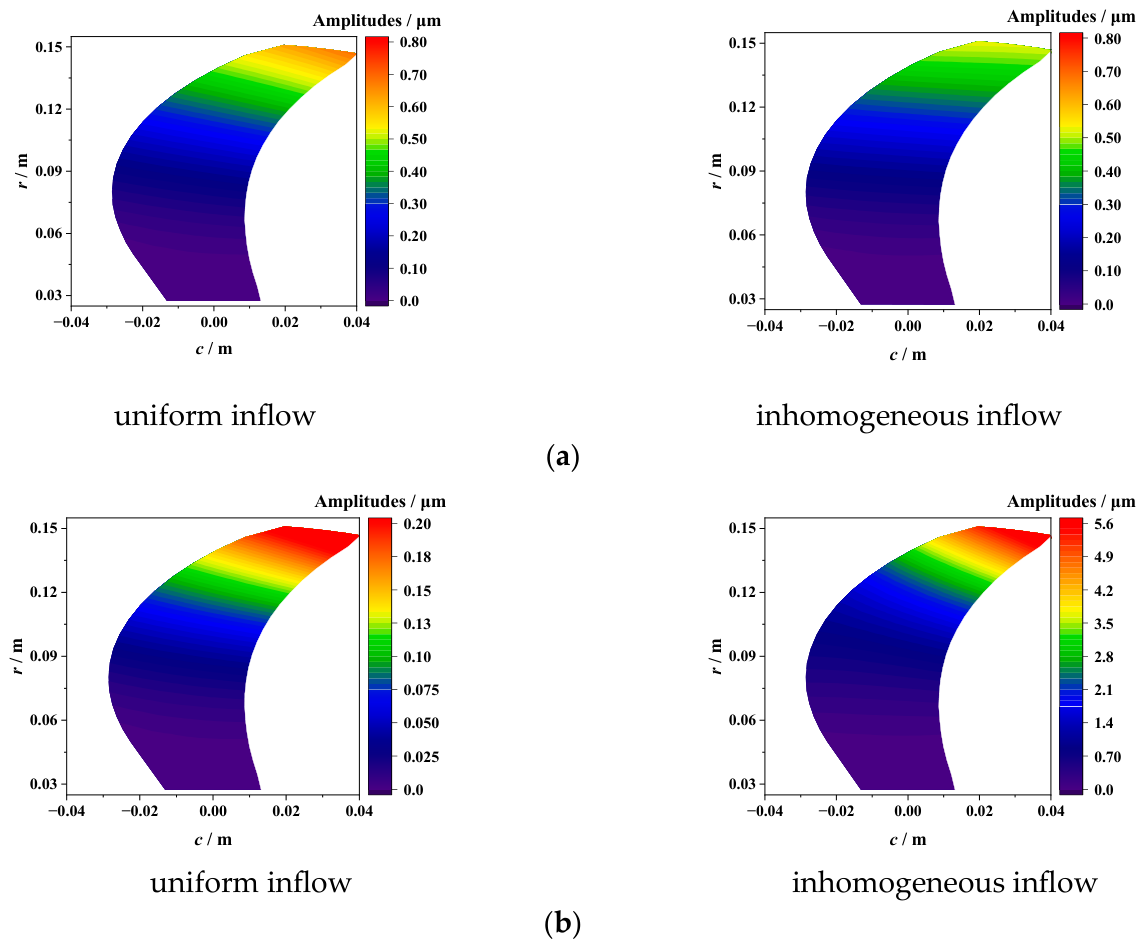
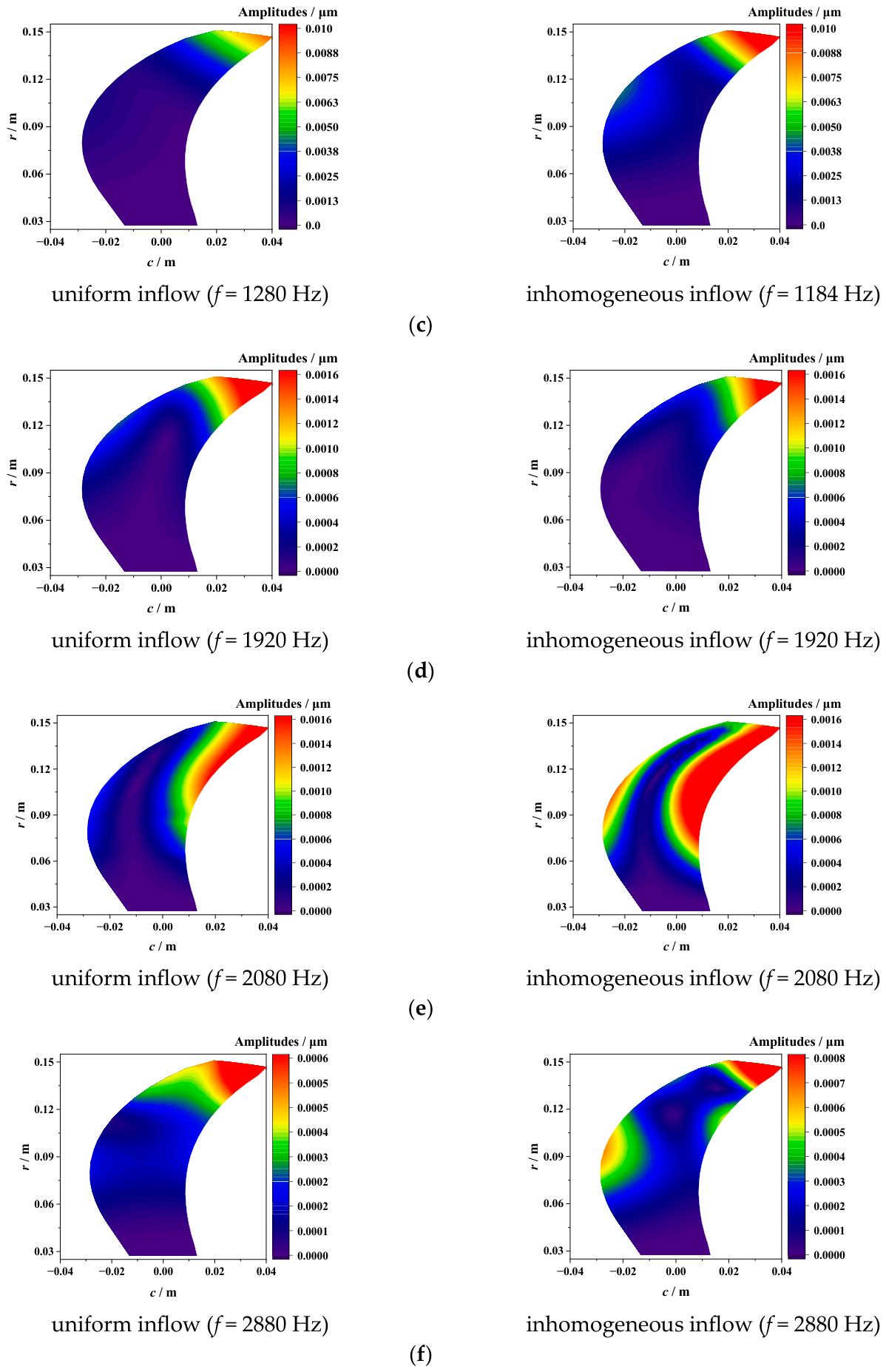
Tonal and broadband vibrations can be observed on the blade. Broadband vibrations are impacted by location, resulting in uniform distribution across the whole blade. Hence, the distributions of vibrations in the vicinities of 4SF, 12SF, fn2, fn3, fn4, and fn5 are shown in Figure 31. In Figure 31a, the distributions of vibrations at 4SF correspond to the primary bending in the spanwise direction. The most intense axial vibrations occur at the TE of blade tips. At 12SF, vibrations of blades are also dominant at the tip. In Figure 25, vibration peaks can be observed in the vicinity of fn2. These peaks can be observed under different rotational speeds in Figure 26 and Figure 27. Hence, the distribution of vibrations in the vicinity of fn2, fn3, fn4, and fn5 is shown in Figure 31c–f. Due to the fact that vibrations occur across a wide range, only the frequency corresponding to the most intense vibrations is considered. In Figure 31c, intense vibrations occur at 0.5 s (where s is the span of the blade) and the blade tip, which results in secondary bending. This distribution of vibrations corresponds to the second natural mode. In Figure 31d, the vibrations of the blade are dominant at the blade tip and LE at 0.8 s. The most intense vibrations occur at the TE of the blade tip, which corresponds to the third natural mode. In Figure 31e, vibrations are dominant at LE at 0.5 s and TE at the outer radius, which corresponds to the fourth natural mode. For distributions of vibrations in the vicinity of fn5 shown in Figure 31f, the most intense vibrations can be observed at the TE of the blade tip. Intense vibrations can also be observed on LE at 0.5 s, which corresponds to the fifth natural mode. In Figure 26, broadband vibrations are more intense in the vicinity of natural frequencies. However, in the pressure of fluctuation results, as listed in Figure 12, there are no intense pressure fluctuation components in the vicinity of natural frequencies. In addition, the distributions of axial deformation at the center frequency of these broadband vibrations are similar to the corresponding natural modes. Hence, these broadband vibrations are induced by natural vibrations caused by the load.
It can be summarized that vibrations in blades occur not only at the frequency of loading fluctuations but also at natural frequencies. According to the distributions of broadband pressure fluctuations, the broadband vibrations result from a combination of transition at the boundary layer, vortex shedding and natural vibrations. The natural vibrations amplify the broadband vibrations and the excited frequencies are quite lower than the natural frequencies. At 4SF, vibrations on blades under uniform inflow are more intense than those on blades operating in inhomogeneous inflow. The interaction between the propeller and inhomogeneous inflow results in more intense tonal vibrations at 12SF and broadband vibrations at fn2, fn4, and fn5.

6. Conclusions

To study the correlation between vibrations in the blade and inflow conditions, uniform inflow and inhomogeneous inflow are considered in the present study. The SST k-ω IDDES model is employed to simulate turbulence in the flow field. Twelve hydrofoils are used to generate an inhomogeneous inflow. This non-uniform inflow field represents the rotor in the stator wake field and the rudder wake field. The loading fluctuations on the propeller are discussed under different inflow conditions. Then the deformations and vibrations of the propeller are numerically researched considering FSI. The main conclusions are summarized as follows:
  • Loading fluctuations on the propeller blade contain tonal fluctuations and broadband fluctuations. The velocity fluctuations in the propeller wake are dominant at harmonics of SF. Inhomogeneous inflow results in pressure fluctuations as a product of space frequency and SF. Inhomogeneous inflow also results in more intense velocity fluctuations in the tip vortex at the SF, 2SF and the blade wake at 12SF.
  • The deformations and vibrations of the blade strengthen as the rotational speed increases. Prominent broadband vibrations of the elastic propeller can be observed in the vicinity of natural frequencies, which also results in more intense broadband components. Amplifying vibrations as a product of space frequency and SF can also be attributed to inhomogeneous inflow. The vibration of the blade is a superposition of excited vibrations and natural vibrations. Approaching the excited frequency and the first natural frequency results in resonance.
The present study aimed to assess whether vibrations benefit the design of the propeller. However, there are still deficiencies in the design of non-uniform inflow fields, and the wake of twelve hydrofoils is essentially a circularly symmetric inflow field. The non-uniform inflow field conditions with non-circular symmetry have not been considered. Impact of the damp ratio on structural response of propellers also needs further study. Hence, a study that considers the actual stern flow field and different damp ratios should be carried out in the future.

Author Contributions

Conceptualization, W.Z. and Q.G.; methodology, W.Z.; software, W.Z. and L.Z.; validation, W.Z. and Q.G.; investigation, W.Z. and J.H.; resources, W.Z.; data curation, Q.G. and Z.C.; writing—original draft preparation, W.Z.; writing—review and editing, S.S. and J.H.; supervision, Z.C.; project administration, Z.C.; funding acquisition, W.Z., J.H. and S.S. All authors have read and agreed to the published version of the manuscript.

Funding

This work was funded by the National Science and Technology Major Project of China (No. 2025ZD1600600), National Natural Science Foundation of China (Grant Nos. 52501381, 52501378), Young Elite Scientists Sponsorship Program by CAST (No. 2024QNRC001), State Key Laboratory of Mechanical System Vibration (No. MSV202606), and State Key Laboratory of Maritime Technology and Safety (No. W26CG000056).

Data Availability Statement

The data presented in this study are available on request from the corresponding author.

Conflicts of Interest

L.Z. was employed by the State Key Laboratory of Maritime Technology and Safety, Shanghai Ship and Shipping Research Institute Co., Ltd. and Key Laboratory of Marine Technology Ministry of Communications, Shanghai Ship and Shipping Research Institute Co., Ltd. The remaining authors declare that the research was conducted in the absence of any commercial or financial relationships that could be construed as potential conflicts of interest.

Abbreviations

The following abbreviations are used in this manuscript:
IDDESImproved delayed detached eddy simulation
SFShaft frequency
BPFBlade passage frequency
DMDDynamic mode decomposition

References

  1. Ducoin, A.; Young, Y.L. Hydroelastic response and stability of a hydrofoil in viscous flow. J. Fluids Struct. 2013, 38, 40–57. [Google Scholar] [CrossRef]
  2. Lin, H.; Lin, J. Nonlinear hydro-elastic behavior of propellers using a finite-element method and lifting surface theory. J. Mar. Sci. Technol. 1996, 1, 114–124. [Google Scholar] [CrossRef]
  3. Young, Y.L. Fluid–structure interaction analysis of flexible composite marine propellers. J. Fluids Struct. 2008, 24, 799–818. [Google Scholar] [CrossRef]
  4. Ghassemi, H.; Saryazdi, M.G.; Ghassabzadeh, M. Influence of the skew angle on the hydroelastic behavior of a composite marine propeller. Proc. Inst. Mech. Eng. Part M J. Eng. Marit. Environ. 2012, 226, 346–359. [Google Scholar] [CrossRef]
  5. Huang, Z.; Xiong, Y.; Yang, G. Fluid-structure Hydroelastic Analysis and Hydrodynamic Cavitation Experiments of Composite Propeller. In Proceedings of the 26th International Ocean and Polar Engineering Conference, Rhodes, Greece, 26 June–1 July 2016. [Google Scholar]
  6. Javanmardi, N.; Ghadimi, P. Hydro-elastic analysis of a semi-submerged propeller using simultaneous solution of Reynolds-averaged Navier–Stokes equations and linear elasticity equations. Proc. Inst. Mech. Eng. Part M J. Eng. Marit. Environ. 2018, 232, 199–211. [Google Scholar] [CrossRef]
  7. Javanmardi, N.; Ghadimi, P. Hydro-elastic analysis of surface-piercing propeller through one-way and two-way coupling approaches. Proc. Inst. Mech. Eng. Part M J. Eng. Marit. Environ. 2019, 233, 844–856. [Google Scholar] [CrossRef]
  8. Zhang, F.; Ma, J. FSI analysis the dynamic performance of composite propeller. In Proceedings of the ASME 2018 37th International Conference on Ocean, Offshore and Arctic Engineering, Madrid, Spain, 17–22 June 2018; p. V002T08A006. [Google Scholar] [CrossRef]
  9. Kim, J.; Ahn, B.; Lee, C.; Kim, G. Numerical Prediction of Hydro-elastic Performance of the Flexible Propeller. In Proceedings of the 28th International Ocean and Polar Engineering Conference, Sapporo, Japan, 10–15 June 2018. [Google Scholar]
  10. Li, J.; Qu, Y.; Zhang, Z.; Hua, H. Parametric analysis on hydroelastic behaviors of hydrofoils and propellers using a strongly coupled finite element/panel method. J. Mar. Sci. Technol. 2020, 25, 148–161. [Google Scholar] [CrossRef]
  11. Tong, X.D.; Chen, Y. Random response of highly skewed propeller-shafting system induced by inflow turbulence. Ocean Eng. 2020, 195, 106750. [Google Scholar] [CrossRef]
  12. Masoomi, M.; Mosavi, A. The one-way FSI method based on RANS-FEM for the open water test of a marine propeller at the different loading conditions. J. Mar. Sci. Eng. 2021, 9, 351. [Google Scholar] [CrossRef]
  13. Krishna, V.R.; Sanaka, S.P.; Pardhasaradhi, N.; Rao, B.R. Hydro-elastic computational analysis of a marine propeller using two-way fluid structure interaction. J. Ocean Eng. Sci. 2022, 7, 280–291. [Google Scholar] [CrossRef]
  14. An, X.; Wang, P.; Ye, M.; He, R.; Li, C.; Lessard, L. Tip clearance influence on hydrodynamic performance and pressure fluctuation of a composite ducted propeller using a two-way FSI method. Ocean Eng. 2023, 282, 114698. [Google Scholar] [CrossRef]
  15. Bushehri, M.P.; Haghighi, M.R.G.; Malekzadeh, P.; Bahmyari, E. Fluid-structure interaction analysis of an elastic surface-piercing propellers. J. Fluids Struct. 2025, 132, 104228. [Google Scholar] [CrossRef]
  16. Smith, S.M.; Venning, J.A.; Pearce, B.W.; Young, Y.L.; Brandner, P.A. The influence of fluid–structure interaction on cloud cavitation about a stiff hydrofoil. Part 1. J. Fluid Mech. 2020, 896, A1. [Google Scholar] [CrossRef]
  17. Smith, S.M.; Venning, J.A.; Pearce, B.W.; Young, Y.L.; Brandner, P.A. The influence of fluid–structure interaction on cloud cavitation about a flexible hydrofoil. Part 2. J. Fluid Mech. 2020, 897, A28. [Google Scholar] [CrossRef]
  18. Zhang, W.; Li, F.; Ma, J.; Ning, X.; Sun, S.; Hu, Y. Fluid-structure interaction analysis of the rudder vibrations in propeller wake. Ocean Eng. 2022, 265, 112673. [Google Scholar] [CrossRef]
  19. Young, Y.L. Time-dependent hydroelastic analysis of cavitating propulsors. J. Fluids Struct. 2007, 23, 269–295. [Google Scholar] [CrossRef]
  20. Tian, J.; Zhang, Z.; Ni, Z.; Hua, H. Flow-induced vibration analysis of elastic propellers in a cyclic inflow: An experimental and numerical study. Appl. Ocean Res. 2017, 65, 47–59. [Google Scholar] [CrossRef]
  21. Li, J.; Qu, Y.; Chen, Y.; Hua, H.; Wu, J. BEM-FEM coupling for the hydroelastic analysis of propeller-shafting systems in non-uniform flows. Ocean Eng. 2022, 247, 110424. [Google Scholar] [CrossRef]
  22. Gaggero, S. Influence of laminar-to-turbulent transition on the model scale propeller performance and induced pressure pulses in an unsteady case of oblique flow. J. Mar. Sci. Appl. 2023, 22, 199–218. [Google Scholar] [CrossRef]
  23. Zarruk, G.A.; Brandner, P.A.; Pearce, B.W.; Phillips, A.W. Experimental study of the steady fluid–structure interaction of flexible hydrofoils. J. Fluids Struct. 2014, 51, 326–343. [Google Scholar] [CrossRef]
  24. Huang, N.E.; Shen, Z.; Long, S.R.; Wu, M.C.; Shih, H.H.; Zheng, Q.; Yen, N.; Tung, C.C.; Liu, H. The empirical mode decomposition and the Hilbert spectrum for nonlinear and non-stationary time series analysis. Proc. R. Soc. London. Ser. A Math. Phys. Eng. Sci. 1998, 454, 903–995. [Google Scholar] [CrossRef]
  25. Sun, C.; Wang, L. Modal analysis of propeller wake dynamics under different inflow conditions. Phys. Fluids 2022, 34, 125109. [Google Scholar] [CrossRef]
  26. Zhi, Y.; Qiu, R.; Huang, R.; Wang, Y. Dynamic mode decomposition and reconstruction of the transient propeller wake under a light loading condition. Ocean Eng. 2023, 269, 113532. [Google Scholar] [CrossRef]
  27. Schmid, P.J.; Sesterhenn, J. Dynamic mode decomposition of numerical and experimental data. In Proceedings of the 61st Annual Meeting of the APS Division of Fluid Dynamics, San Antonio, TX, USA, 23–25 November 2008; American Physical Society: College Park, MD, USA, 2008. [Google Scholar]
  28. Schmid, P.J. Dynamic mode decomposition of numerical and experimental data. J. Fluid Mech. 2010, 656, 5–28. [Google Scholar] [CrossRef]
  29. Brandner, P.; Pearce, B. Experimental Modelling of Steady Hydrofoil Fluid-Structure Interaction. In Proceedings of the 18th Australasian Fluid Mechanics Conference, Launceston, Australia, 3–7 December 2012; pp. 1–4. [Google Scholar]
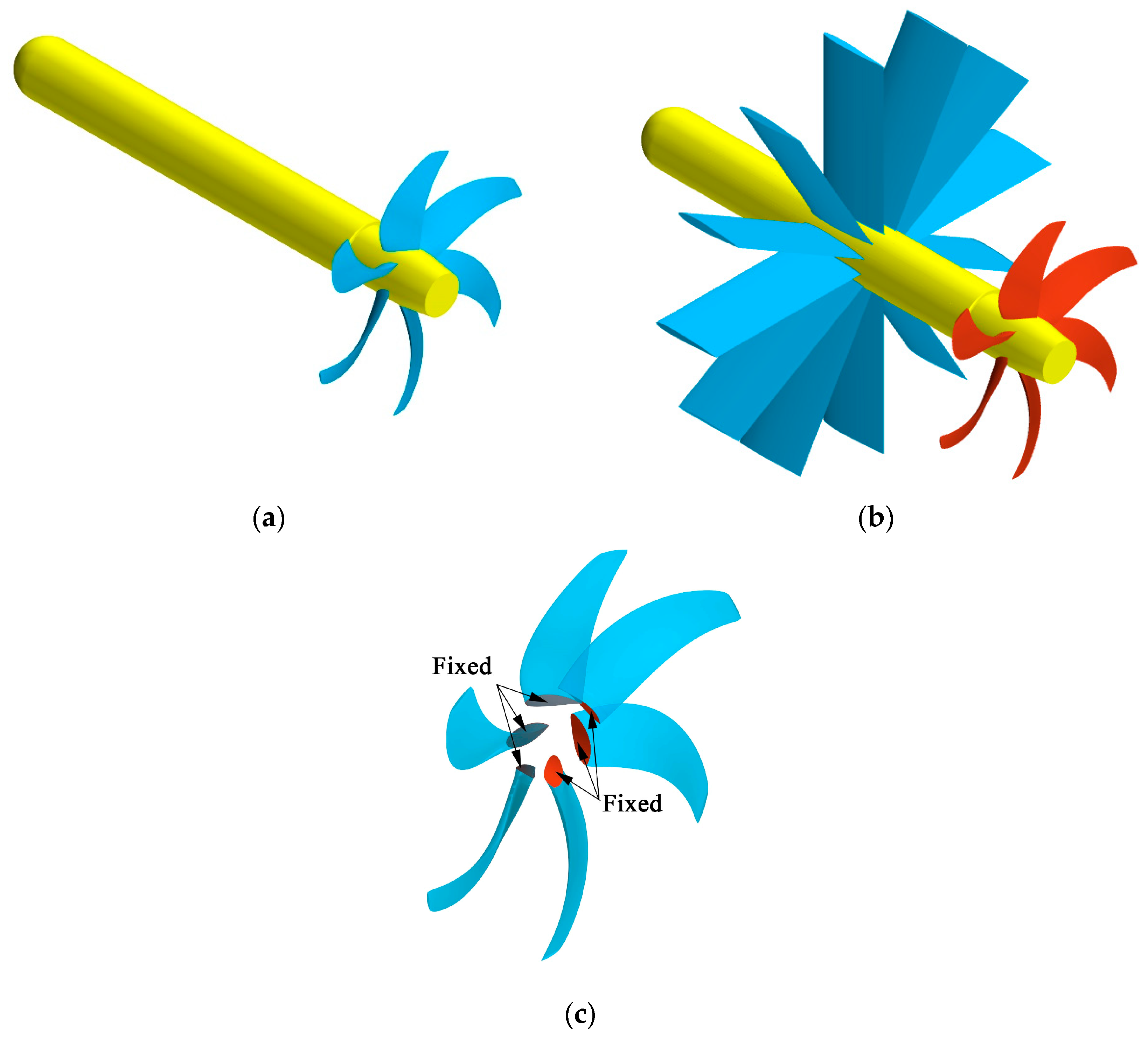
Figure 1. Geometry of propeller: (a) propeller in uniform inflow; (b) propeller in inhomogeneous inflow; (c) constraint of propeller blade.
Processes 14 01922 g001
Figure 2. Computational domains.
Processes 14 01922 g002
Figure 3. Mesh details: (a) mesh details of the flow field; (b) mesh details of the blade domains.
Processes 14 01922 g003
Figure 4. Hydrodynamic performance of propellers [3].
Processes 14 01922 g004
Figure 5. Mesh details and distributions of probes.
Processes 14 01922 g005
Figure 6. Pressure fluctuations on probes: (a) Probe 1; (b) Probe 2; (c) Probe 3 [22].
Processes 14 01922 g006
Figure 7. Distributions of convective Courant numbers.
Processes 14 01922 g007
Figure 8. Thrust fluctuations on a single blade: (a) uniform inflow; (b) inhomogeneous inflow.
Processes 14 01922 g008
Figure 9. First three-order IMFs (n = 40 rps): (a) IMF 1; (b) IMF 2; (c) IMF 3.
Processes 14 01922 g009
Figure 10. Position of blade corresponding to peaks and troughs: (a) Peak 1, θ = 15.3º; (b) Trough 1, θ = 28.8º; (c) Peak 2, θ = 44.1º; (d) Trough 2, θ = 58.5º.
Processes 14 01922 g010
Figure 11. Frequency domain characteristics of thrust fluctuations obtained with different inflow conditions (n = 40 rps): (a) single blade; (b) whole propeller.
Processes 14 01922 g011
Figure 12. Pressure fluctuations on the blade (n = 40 rps): (a) LE at 0.8R; (b) TE at 0.8R; (c) LE at 1.0R; (d) TE at 1.0R.
Processes 14 01922 g012
Figure 13. Distributions of pressure on the suction side (n = 40 rps): (a) uniform inflow (12SF); (b) inhomogeneous inflow (12SF).
Processes 14 01922 g013
Figure 14. Distributions of RMS of pressure fluctuations at 1000–5000 Hz (n = 40 rps): (a) uniform inflow (12SF); (b) inhomogeneous inflow (12SF).
Processes 14 01922 g014
Figure 15. Frequency domain characteristics of pressure fluctuations on the blade tip: (a) LE; (b) TE.
Processes 14 01922 g015
Figure 16. Distributions of axial velocity (n = 50 rps): (a) x = 0.25D; (b) x = 0.50D; (c) x = 0.75D; (d) x = 1.00D.
Processes 14 01922 g016
Figure 17. Distributions of axial velocity.
Processes 14 01922 g017
Figure 18. Distributions of energy.
Processes 14 01922 g018
Figure 19. DMD modes: (a) 1st mode (0 Hz); (b) 2nd mode (SF); (c) 3rd mode (2SF); (d) 4th mode (4SF); (e) 5th mode (BPF); (f) 6th mode (12SF).
Processes 14 01922 g019aProcesses 14 01922 g019b
Figure 20. Time-domain characteristics of deformations of the blade tip.
Processes 14 01922 g020
Figure 21. Time-averaged deformations of blade: (a) uniform inflow (n = 40 rps); (b) inhomogeneous inflow (n = 40 rps); (c) uniform inflow (n = 60 rps); (d) inhomogeneous inflow (n = 60 rps).
Processes 14 01922 g021
Figure 22. Deformations in the middle of the blade tip: (a) axial deformations; (b) dimensionless axial deformations.
Processes 14 01922 g022
Figure 23. Distribution of von Mises stress on the pressure side of blades: (a) uniform inflow (n = 40 rps); (b) inhomogeneous inflow (n = 40 rps); (c) uniform inflow (n = 60 rps); (d) inhomogeneous inflow (n = 60 rps).
Processes 14 01922 g023
Figure 24. Results of modal analysis: (a) 1st natural mode (f n1= 408.6 Hz); (b) 2nd natural mode (f n2 = 1139.0 Hz); (c) 3rd natural mode (f n3 = 2276.2 Hz); (d) 4th natural mode (f n4 = 2558.9 Hz); (e) 5th natural mode (f n5 = 3329.6 Hz); (f) 6th natural mode (f n6 = 4228.3 Hz).
Processes 14 01922 g024
Figure 25. Vibrations of propeller operating in uniform inflow (n = 30 rps): (a) LE; (b) TE.
Processes 14 01922 g025
Figure 26. Vibrations of propeller operating in uniform inflow (LE): (a) r = 0.4R; (b) r = 1.0R.
Processes 14 01922 g026
Figure 27. Vibrations under different inflow conditions (40 rps): (a) 0.8R; (b) 1.0R.
Processes 14 01922 g027
Figure 28. Vibrations of blade for inhomogeneous inflow: (a) TE (0.6R); (b) TE (1.0R).
Processes 14 01922 g028
Figure 29. Vibration amplitudes and excitation frequencies under different rotation speeds: (a) vibration amplitudes; (b) excitation frequencies; (c) Campbell diagram.
Processes 14 01922 g029
Figure 30. Thrust fluctuations on single blades and axial deformation fluctuations (n = 34 rps).
Processes 14 01922 g030
Figure 31. Distributions of axial vibrations: (a) 4SF; (b) 12SF; (c) vicinity of fn2; (d) vicinity of fn3; (e) vicinity of fn4; (f) vicinity of fn5.
Processes 14 01922 g031aProcesses 14 01922 g031b
Table 1. Uncertainty analysis of the mesh.
Cells NumberKTErrors10KQErrorsAxial DeformationErrors
Coarse2.96 M0.08111.63%0.20140.79%207.3 μm7.47%
Medium5.42 M0.07981.28%0.20300.46%222.8 μm1.40%
Fine12.39 M0.0788--0.2040--225.9 μm--
Table 2. Uncertainty analysis of time steps.
KTErrors10KQErrorsAxial DeformationErrors
Δt = 3.125 × 10−50.19950.02%0.36010.14%867.99 μm0.20%
Δt = 6.25 × 10−50.19940.28%0.35960.33%866.23 μm0.82%
Δt = 1.25 × 10−40.1989--0.3584--859.17 μm--
Table 3. Validation of numerical methods.
Numerical ResultsExperimental ResultsDeviations
Re (×106)0.40.4
CL0.50650.48624.18%
dy0.23010.22651.59%
f190.15966.49%
Disclaimer/Publisher’s Note: The statements, opinions and data contained in all publications are solely those of the individual author(s) and contributor(s) and not of MDPI and/or the editor(s). MDPI and/or the editor(s) disclaim responsibility for any injury to people or property resulting from any ideas, methods, instructions or products referred to in the content.