1. Introduction
Global environmental pressures, rising energy demand, and the use of fossil fuels have pushed many countries to adopt cleaner energy systems. Renewable energy sources, especially solar and wind energy, are now important options for reducing fossil-fuel dependence and improving long-term energy security. Solar photovoltaic (PV) technology has grown quickly in recent years. According to the International Energy Agency (IEA), renewable capacity is expected to continue increasing through 2030, with solar PV leading much of this growth. Solar PV and wind are expected to account for 95% of all renewable capacity additions during this period. Global renewable capacity is also expected to increase by more than 5520 GW from 2024 to 2030, and solar PV is expected to account for almost 80% of the expansion in renewable electricity worldwide [
1]. These values show that PV systems will continue to play an important role in future energy development [
2,
3].
As PV systems become more widely used, module design has also changed. The industry has moved toward large-format modules for higher power output, especially in utility-scale projects. Recent module development has been linked to larger wafer formats, such as M10 (182 mm × 182 mm) and G12 (210 mm × 210 mm), which are now common in production [
4]. These larger cell formats have increased the overall module size. They can help improve power output and reduce balance-of-system (BoS) costs at the system level [
5,
6]. They can also reduce the number of modules needed in large PV projects [
5]. These benefits are important for project cost and energy production. At the same time, the larger exposed area of these modules may result in greater structural demand under high wind loading.
Wind loading becomes more important when the module area increases. Under strong wind conditions, large-format modules can transfer higher pressure to the mounting system and support structure. This can increase internal forces and deformation in the system. Previous studies have shown that wind effects on PV systems depend on panel position, tilt angle, and wind direction. Some locations in an array may also experience more critical wind loading than others [
7,
8,
9]. This issue can be more complex in single-axis tracker systems, as they may exhibit more flexible structural behaviour. Field measurements have also shown that tracker-type systems can have bending and torsional response under wind loading [
10]. These dynamic effects are important, but this study focuses on static wind loading. This scope allows the structural demand of different module sizes to be compared under controlled wind conditions.
The growing use of large-format modules raises a practical design question. Wind load assessment and structural requirements developed for smaller modules may not fully represent the behaviour of newer and larger module formats. Many existing studies on PV wind effects have focused on conventional module sizes or typical wind conditions. Structural evaluation of large-format modules under design and extreme wind conditions remains limited [
7,
10]. This gap is important because larger modules may have higher wind-induced demand and lower safety margins under unfavourable loading conditions. Recent studies on extreme weather have also shown that high-wind events can pose serious risks to PV systems, leading to structural damage or performance loss [
11]. Wind tunnel testing can provide more realistic wind pressure information, but it can be expensive and time-consuming. For early-stage engineering assessment, finite element tools such as SAP2000 can provide a practical way to compare structural response under selected wind loading conditions [
7].
This study evaluates the structural response of PV mounting systems with different module sizes under representative Ontario wind loading conditions. The analysis considers wind speed, tilt angle, wind direction, and array configuration. The main response quantities include deformation, internal force, stress, and safety factor. The study uses a linear static SAP2000 model with shell elements for PV panels and frame elements for supporting members. It compares conventional-size and large-format modules under the same modelling framework. It also identifies the main structural components and loading cases that control the safety margin of large-format modules. In this way, the study provides a design-oriented basis for early-stage structural assessment of large-format PV support systems under wind loading.
2. Methodology
2.1. Modelling Assumptions
This study compares the structural response of photovoltaic (PV) mounting systems under selected static wind loading conditions. The comparison focuses on module size, wind speed, tilt angle, and array configuration, since these variables directly affect the demand on the panel and support members.
All main structural members were assumed to be homogeneous, isotropic, and linearly elastic. The PV panel was represented as an equivalent shell component for the purpose of structural comparison. The model did not directly include the layered, composite, or orthotropic behaviour of the actual laminated PV module.
The analysis used a small deformation assumption. Geometric nonlinearity was not included. This setting was considered suitable for comparing relative response trends between cases, but it does not represent possible large deformation behaviour under severe wind events.
Bolted, clamped, and semi-rigid interfaces were idealized as rigid connections. This assumption was used to keep a consistent load-transfer path between the PV panel, purlins, torque tube, and supporting posts. In a real tracker system, connection flexibility may change local stress redistribution and member force demand. This effect should be examined in future connection sensitivity analysis.
Only prescribed static wind loading was considered in this study. Time-dependent wind effects, including turbulence, gust response, and aeroelastic interaction, were not included. Because of this scope, the results should be read as comparative static-response trends, not as a full prediction of field behaviour under extreme transient wind events.
2.2. Finite Element Modelling Framework
A finite element model was developed in SAP2000 to compare the structural response of the PV mounting system under different wind loading and geometric conditions. Wind loading is an important design concern for PV support structures, and previous studies have used finite element analysis to study critical structural behaviour under different installation conditions [
7,
12].
The model included the main structural members of the system, including the PV panels, purlins, torque tube, and supporting posts. The PV panels were modelled using shell elements so that panel bending and out-of-plane displacement could be captured. The purlins, torque tube, and supporting posts were modelled using frame elements because these members mainly carry axial force, shear force, and bending moment.
Small geometric details that were not part of the main load path were simplified. This helped keep the model efficient while still capturing the main behaviour of the panel and support system [
12,
13]. For each analysis case, displacement, stress, internal force, and safety factor were extracted and compared. These outputs were used to evaluate how the structural response changed with module size, wind speed, tilt angle, and array configuration.
2.3. Geometry and Model Configuration
The geometric configuration of the PV support system was defined based on the installation manual of a horizontal single-axis tracker system. According to the manual, the large-format PV module has dimensions of 2384 mm × 1303 mm × 33 mm. The tracker system uses a horizontal module arrangement, with either 20 or 40 modules depending on the layout configuration [
14]. The installation drawings were used to define the numerical model geometry and array layout.
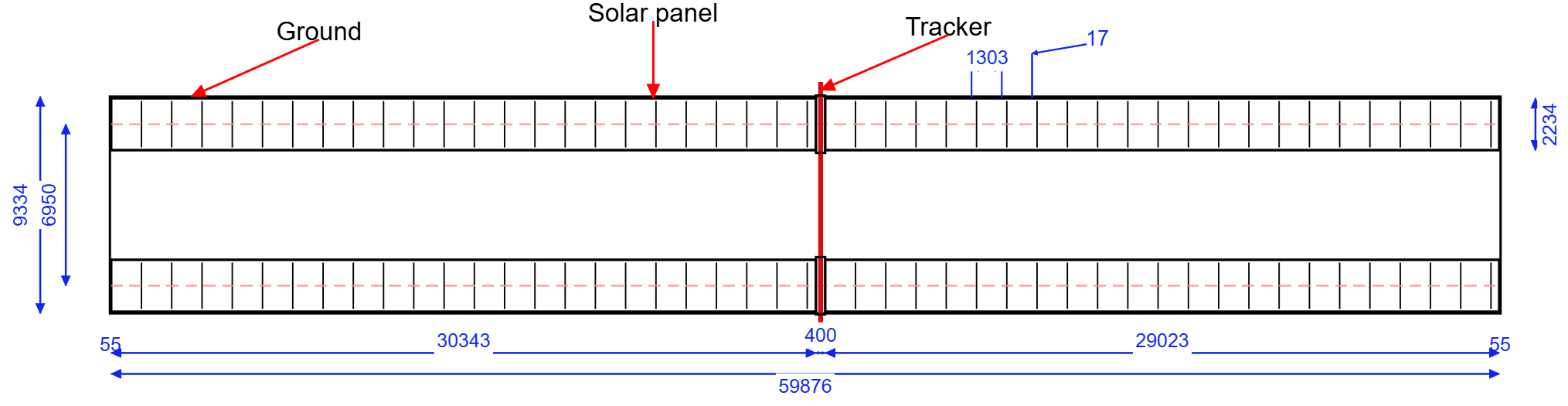
Figure 1 shows the top-view layout of the large-format PV module array used in this study. The figure shows the module arrangement along the tracker row and the main tracker line used to support the modules. In this study, the row direction refers to the long direction of the tracker shown in the top view. The transverse direction refers to the direction perpendicular to the tracker row. The vertical direction was used to evaluate the out-of-plane displacement of the PV modules.
A smaller reference module was also introduced for comparison. The dimensions of this module were taken as 1765 mm × 1048 mm × 40 mm based on a Canadian Solar module datasheet [
15]. This smaller module was used as a conventional-size reference case. It was not intended to represent all conventional PV products, but it provided a consistent baseline for comparing how the larger exposed area of the large-format module affects structural response.
For each module size, two array configurations were considered: a single-row configuration and an 8-row configuration. The single-row model was used to represent an isolated row condition, while the 8-row case was used to represent a multi-row array condition. These geometric cases were used in the later analyses to examine the effects of module size and array arrangement on the structural behaviour of the PV mounting system.
2.4. Material Properties and Structural Idealization
The model focused on the main load-carrying members of the PV support system. These members included the PV modules, purlins, torque tube, and supporting posts. This selection was used to capture the overall structural response of the system. Similar simplified finite element models have also been used in previous studies on tracking PV support systems [
12].
The material properties used in the model are summarized in
Table 1. The PV panel was simplified as an equivalent glass-based shell component. Aluminum was used for the module frame, and steel was used for the supporting structure. The selected density, elastic modulus, and Poisson’s ratio were taken from previous research on single-axis solar arrays [
16].
The detailed layered behaviour of the actual PV laminate, including glass, encapsulant, cells, and backsheet, was not modelled separately. This simplification was used because the study focuses on the overall structural response of the support system rather than local laminate failure. These material properties were used together with the modelling assumptions described in
Section 2.1 to define the main structural components in SAP2000.
2.5. Boundary Conditions and Load Application
The boundary conditions of the structural model were defined to represent the support condition of the photovoltaic tracker system. The supporting posts were fixed at their base in the numerical model. Foundation flexibility and soil–structure interaction were not included. This simplification may lead to lower predicted displacement than a real installation with flexible foundation support, so the results should be interpreted within the adopted boundary condition. Boundary conditions are important in finite element analysis because they can affect the predicted structural response [
13].
Wind loading was treated as the main external load in this study. NBC 2020 was used to obtain regional wind climate information for Kitchener, Ontario [
17]. ASCE 7-16 was then used to define the pressure cases and pressure coefficients for ground-mounted PV arrays [
18]. This approach was adopted because NBC provides local Canadian wind data, while ASCE 7-16 gives more specific guidance for wind pressure distribution on PV panel systems. The selected wind speeds included the normal wind condition, the 10-year return wind condition, and the 50-year return wind condition. These wind speeds were converted into equivalent static design pressures so that the structural demand under different wind levels could be compared on the same basis. Since dynamic effects were not included, the applied pressure should be understood as an equivalent static wind load rather than a full representation of time-dependent wind behaviour [
19].
In SAP2000, wind pressure was applied normal to the PV module surface. The pressure was transferred from the panel to the purlins, then to the torque tube, and finally to the supporting posts. This path represents the main load transfer mechanism of the tracker support system under wind action. Similar pressure-based loading methods have also been used in previous PV structural studies [
7].
The analysis included five panel tilt angles: 0°, 15°, 30°, 45°, and 60°. Two wind directions, 0° and 180°, were also considered. For each wind direction, Load Case A and Load Case B from ASCE 7-16 were used [
18]. These two cases represent different net pressure distributions on the module surface for ground-mounted solar arrays. The corresponding net pressure coefficients,
and
, were selected from the code table according to the panel tilt angle, wind direction, and wind-flow condition [
18]. For the 60° tilt case, ASCE 7-16 does not provide a direct coefficient in the selected table. The 45° coefficient was used as an approximation so that the high-tilt response trend could be compared with the other cases. This case should not be treated as a direct code-prescribed 60° design case. After the analysis, the results from Load Case A and Load Case B were compared, and the more critical response was used as the governing case for final evaluation.
After each analysis, displacement, stress, and internal force were extracted from the model. These results were used to identify critical sections and governing load-carrying members under different loading cases. This process provided a consistent basis for comparing the structural response under different geometric and loading conditions [
7,
13].
2.6. Mesh Sensitivity Analysis
A mesh sensitivity analysis was conducted to determine a suitable mesh density for the numerical model. Three mesh levels were considered, which is coarse mesh (2 × 2), medium mesh (7 × 4), and fine mesh (10 × 7) shell subdivision per panel. All three mesh levels were evaluated under the same representative analysis case, corresponding to a single-row configuration with a tilt angle of 0° and a wind speed of 27 m/s. This case was selected as a baseline configuration for assessing numerical convergence under a controlled loading condition. In finite element modelling, mesh generation and result evaluation are essential steps of the simulation process, and the reliability of the numerical response depends on the adopted discretization together with the modelling assumptions [
13].
To provide a more reliable convergence assessment, three structural response quantities were examined: the maximum vertical displacement of the panel, the maximum panel stress, and the maximum purlin bending moment. The relative error between mesh levels was calculated with respect to the fine mesh result using the following equation:
where
represents the response obtained from the coarse or medium mesh, and
is the corresponding response obtained from the fine mesh. For this comparative structural study, a relative difference below 5% between the medium and fine meshes was considered acceptable. This criterion was adopted because the selected response quantities changed only slightly with further mesh refinement, while the computational cost increased noticeably. The use of multiple structural response quantities is also consistent with finite element assessment approaches for PV structures [
7].
The results are summarized in
Table 2. Compared with the fine mesh, the medium mesh showed relative differences of 1.08% in maximum vertical displacement, 1.48% in maximum panel stress, and 0.08% in maximum purlin bending moment. All three values remained below 5%, indicating that the numerical response had become sufficiently stable at the medium mesh level.
Therefore, the medium mesh was selected for the remaining analyses, as it provides a reasonable balance between computational efficiency and solution accuracy. This balance between required accuracy and computational effort has also been emphasized in the literature [
13].
3. Results
This section presents the numerical results of the wind-induced structural response of the PV support system. The analysis focuses on how module size, wind speed, tilt angle, and array configuration affect the structural demand of the system. The main response quantities considered in this section include displacement, stress, internal force, and safety factors.
3.1. Size Amplification Effect
Under a wind speed of 27 m/s, the large-format PV module developed a higher bending response and larger vertical displacement than the conventional-size module. As listed in
Table 3, the maximum principal shell moment, MMAX, increased from 0.0123 to 0.0414 kN·mm when the module size increased. The maximum out-of-plane displacement, U3, increased from 1.83 mm to 19.3 mm. These values correspond to amplification ratios of 3.37 for MMAX and 10.55 for U3.
The displacement response increased more strongly than the shell moment response. When the maximum displacement was normalized by the module length, the displacement-to-length ratio increased from about 0.104% for the conventional-size module to about 0.810% for the large-format module. This means that the large-format module was not only larger in absolute size, but also more sensitive to deformation under the same wind loading condition.
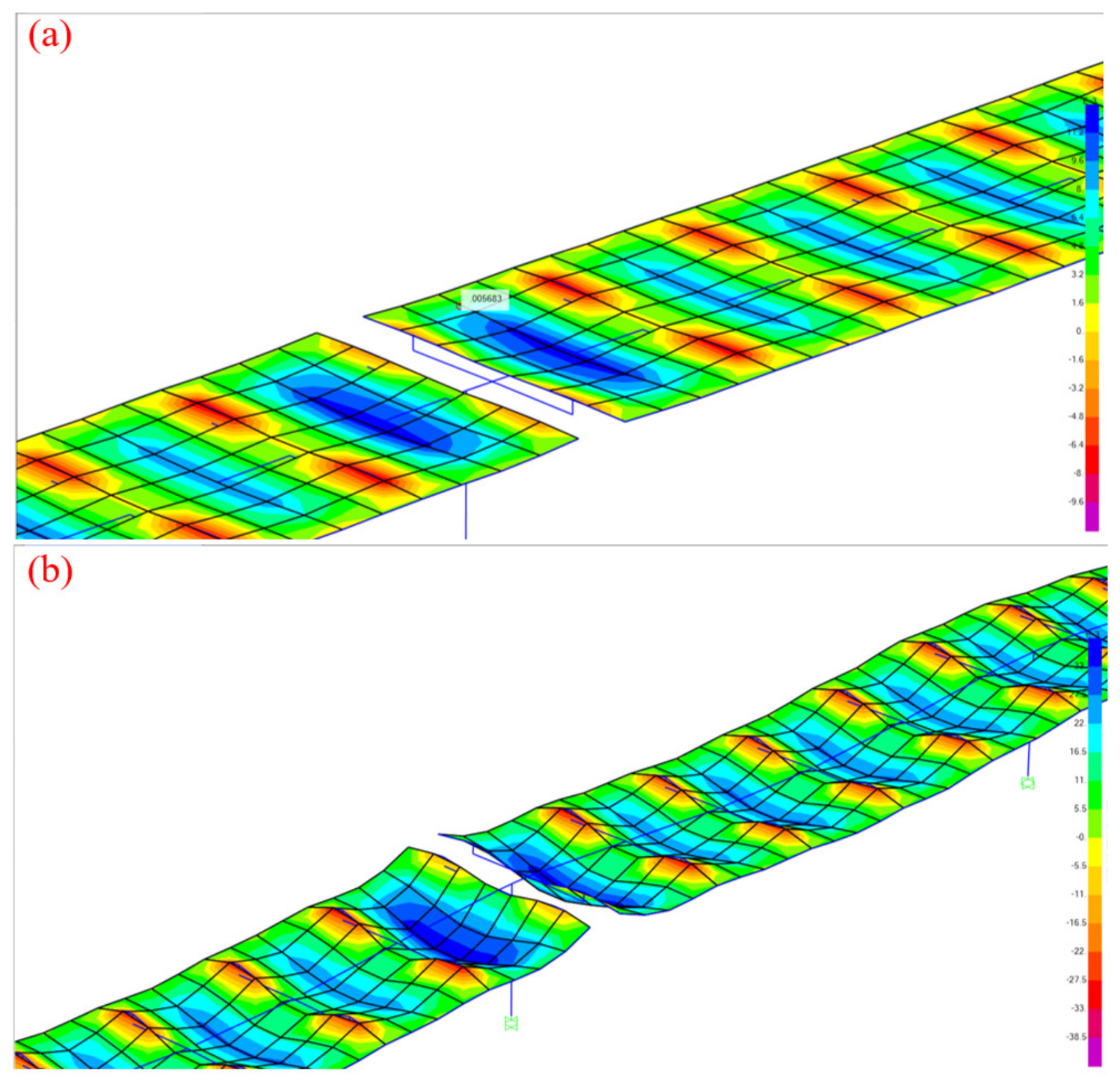
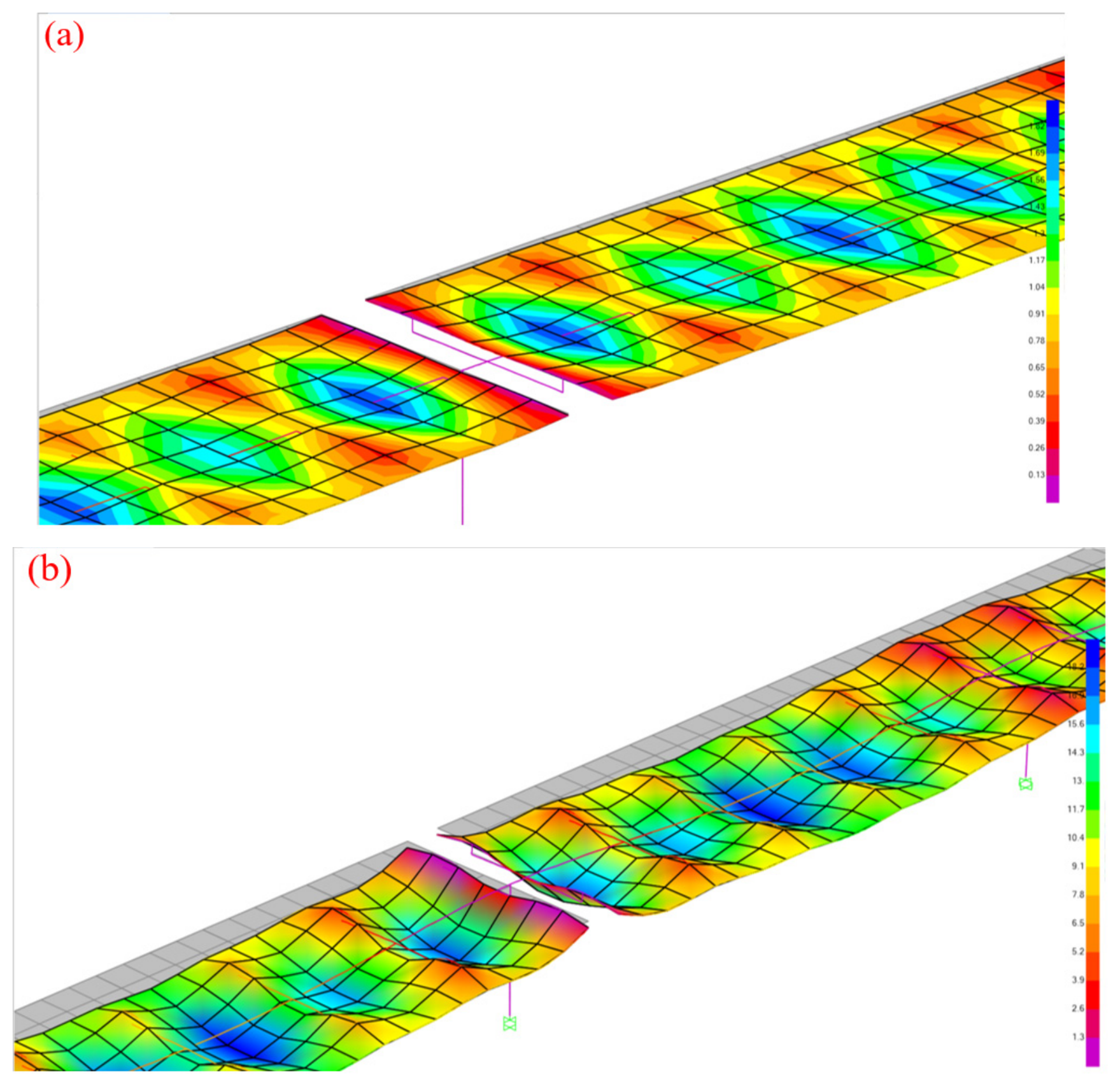
The scaled deformation plots in
Figure 2 shows the same trend. The large-format module has a larger vertical response across the panel surface. The MMAX contours in
Figure 3 also show a stronger bending response in the large-format case. Because the deformation plots are graphically scaled, the figures are used mainly to show the deformation pattern. The numerical comparison is based on the values reported in
Table 3.
3.2. Array Configuration
To examine the effect of array layout, this section compares the isolated single-row case with the front row of the 8-row array under a wind speed of 27 m/s and a tilt angle of 30°. This comparison used pressure coefficients from previous studies. For this reason, it does not represent a same-pressure comparison. It shows how the loading difference between the two array conditions is transferred into the structural response.
A tilt angle of 30° was selected because the effect of array configuration is less clear at very small tilt angles and becomes more visible as the tilt angle increases. Previous studies reported that shielding and interference effects become stronger at larger tilt angles [
9,
20]. Zhao et al. also showed that row number, tilt angle, and wind direction can affect the wind load distribution in solar arrays [
21].
The front row was selected because previous studies showed that it generally experiences the highest wind load in a multi-row array. Rows behind the front row are affected by the sheltering effect of upstream panels [
20,
21]. In this study, the front row was therefore used as the critical row in the 8-row configuration.
The loading input used in this comparison is summarized in
Table 4. The isolated single-row case was assigned a pressure coefficient of 1.02, while the front row of the 8-row array was assigned a value of 0.70. This resulted in applied wind pressures of 0.368 kPa and 0.256 kPa, respectively. Compared with the isolated single-row case, the front row of the 8-row array had about 30.4% lower applied wind pressure.
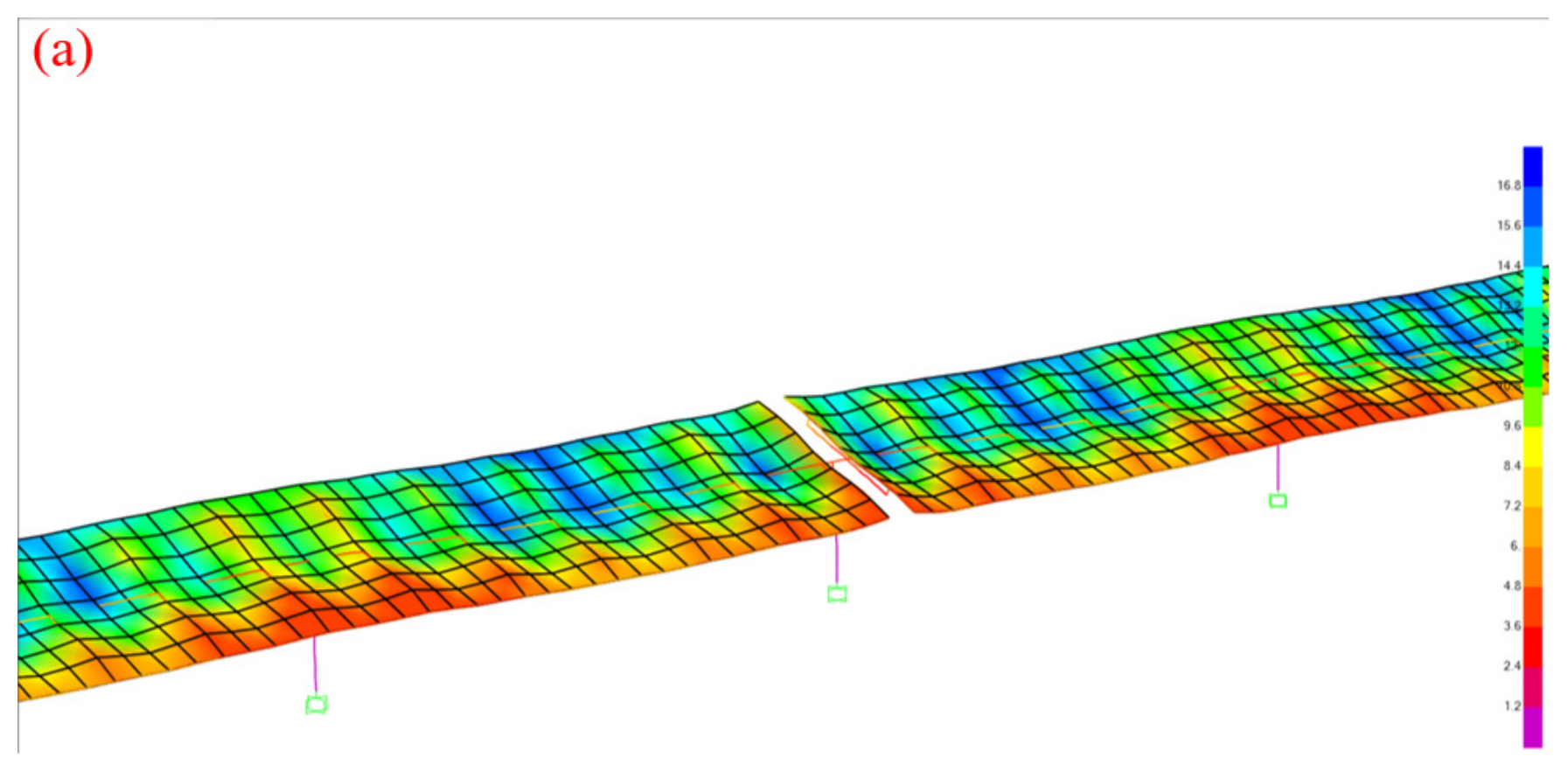
The corresponding structural response is presented in
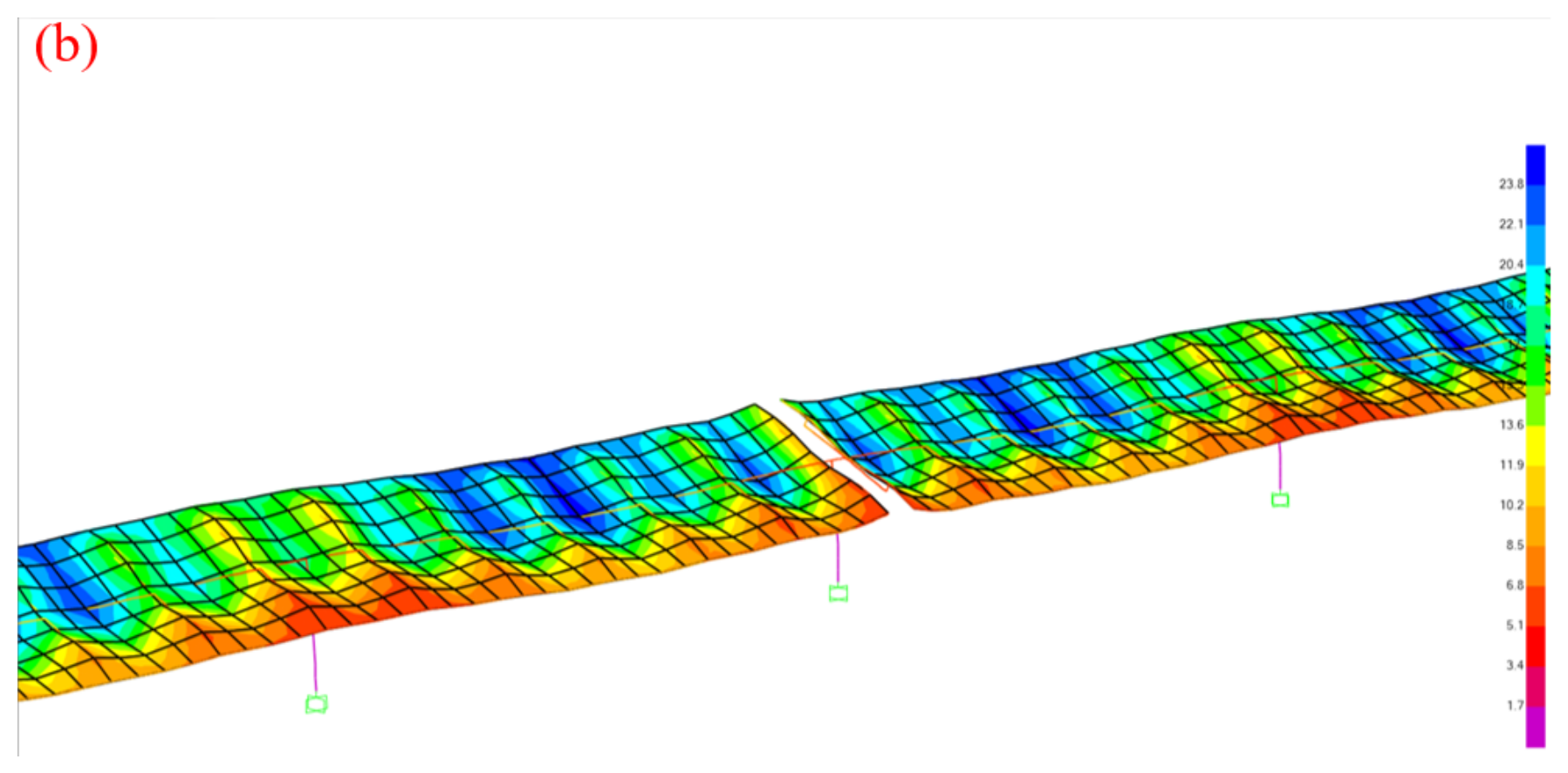
Table 5 and the deformed shapes are shown in
Figure 4. The isolated single-row case developed a critical purlin bending moment of 4.331 kN·m, while the front row of the 8-row array gave a lower value of 2.895 kN·m. This is a reduction of about 33.2%. The maximum displacement also decreased from 18.17 mm to 12.15 mm, which is a reduction of about 33.1%.
Figure 4 shows the same trend. The isolated single-row case has a more pronounced deformation pattern than the front row of the 8-row array.
These results show that the lower pressure coefficient used for the 8-row front-row case reduced both the applied wind pressure and the immediate structural response. The comparison should not be read as a direct simulation of aerodynamic shielding between rows. In this study, SAP2000 was used to calculate structural response under assigned wind pressure. The isolated single-row case and the front-row case were represented by the same one-row structural model. The difference between the two cases came from the pressure coefficients taken from previous studies. This means that the present comparison shows how a change in wind loading input affects the structural response of the support system.
3.3. Wind Speed Amplification Effect
To examine the effect of wind speed alone, the tilt angle and wind direction were both fixed at 0°. This setting kept the loading condition consistent, since wind load on PV systems is also affected by tilt angle and wind direction [
9,
22]. The applied wind pressure was calculated using the ASCE 7-16 loading framework [
18]. The pressures corresponding to 27, 32, and 36 m/s were 0.322, 0.453, and 0.573 kPa, respectively. The main response quantities in this section were maximum axial force, maximum bending moment, and maximum vertical displacement. These quantities were selected because they describe the main wind-induced response of the PV support system [
7,
10,
23].
The results are summarized in
Table 6. For both module sizes, all three response quantities increased as wind speed increased. For the conventional-size module, the maximum axial force increased from 2.000 kN to 3.560 kN. The maximum bending moment increased from 0.753 kN·m to 1.340 kN·m, and the maximum vertical displacement increased from 1.59 mm to 2.83 mm. The large-format module followed the same trend. Its maximum axial force increased from 5.333 kN to 9.489 kN, the maximum bending moment increased from 3.651 kN·m to 6.498 kN·m, and the maximum vertical displacement increased from 16.9 mm to 30.0 mm.
The increase in structural response followed the increase in applied wind pressure. Compared with the 27 m/s case, the applied wind pressure increased by about 1.41 times at 32 m/s and about 1.78 times at 36 m/s. The axial force, bending moment, and vertical displacement showed nearly the same amplification ratios for both module sizes. This trend is expected under the present linear static model, because the structural response increases almost in proportion to the applied pressure.
The large-format module remained more critical than the conventional-size module at all three wind speeds. Its axial force was about 2.67 times higher than that of the conventional-size module. Its bending moment was about 4.85 times higher. The largest difference was found in vertical displacement, which stayed about 10.6 times higher for the large-format module. This result suggests that wind speed mainly increased the response level, while module size controlled the overall response magnitude.
3.4. Structural Safety Margin Evaluation
This section examines the structural safety margin of the glass panel and steel purlin under increasing wind speed. The same loading condition as that in
Section 3.3 was used so that the effect of wind speed could be compared directly. Since wind load on PV systems is affected by both tilt angle and wind direction, these two variables were kept fixed in this section, and only wind speed was changed [
9,
22]. The safety factor was calculated as
where
is the reference stress used for the component and
is the maximum von Mises stress obtained from the numerical model.
As shown in
Table 7, the safety factor decreased with increasing wind speed for both the glass panel and the purlin in the two module types. The reduction was more pronounced in the large-size module. For the glass panel of the large-size module, the safety factor decreased from 2.65 at 27 m/s to 1.49 at 36 m/s, which is a reduction of about 44%. For the purlin, the corresponding value decreased from 5.67 to 3.18, which gives a similar percentage drop but still leaves a much larger remaining margin.
The same pattern was observed in the normal-size module. The glass panel safety factor decreased from 9.20 to 4.73, while the purlin safety factor decreased from 26.92 to 15.15 over the same wind speed range. This means that increasing wind speed reduced the safety margin in both module types, but the large-size module remained in a less favourable condition throughout.
A comparison between the two components shows that the glass panel consistently had a lower safety factor than the purlin under the same wind condition. This difference became most obvious in the large-size module. At 36 m/s, the glass panel safety factor was 1.49, while the purlin safety factor remained 3.18. In other words, the purlin still retained more than twice the safety margin of the glass panel. This indicates that the glass panel, rather than the purlin, governed the structural safety margin under the present loading condition.
The same comparison can also be made between the two module sizes. At each wind speed, the large-size module showed lower safety factors than the normal-size module for both components. However, the size effect was more evident in the glass panel than in the purlin. Within the studied wind speed range, all safety factors remained above 1.0, but the smallest margin was found in the glass panel of the large-size module. From the point of view of structural assessment, this means that panel-level safety became the controlling issue earlier than purlin safety as wind speed increased.
3.5. Safety Factor Evaluation Under Increasing Tilt Angle
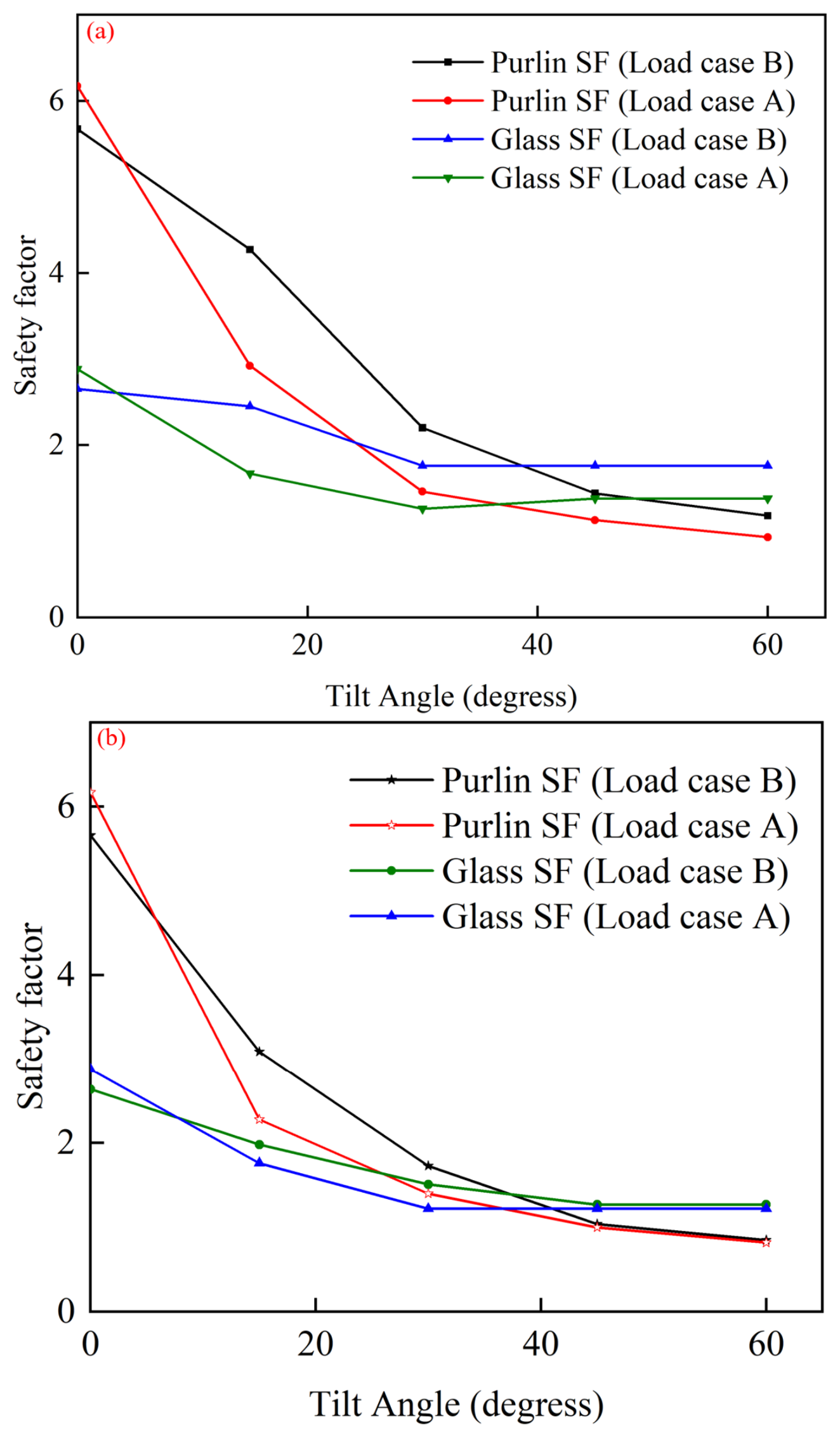
This section examines the effect of tilt angle on the safety factors of glass panels and steel purlins for large-size and normal-size single-row modules. The detailed results are listed in
Table 8,
Table 9,
Table 10 and
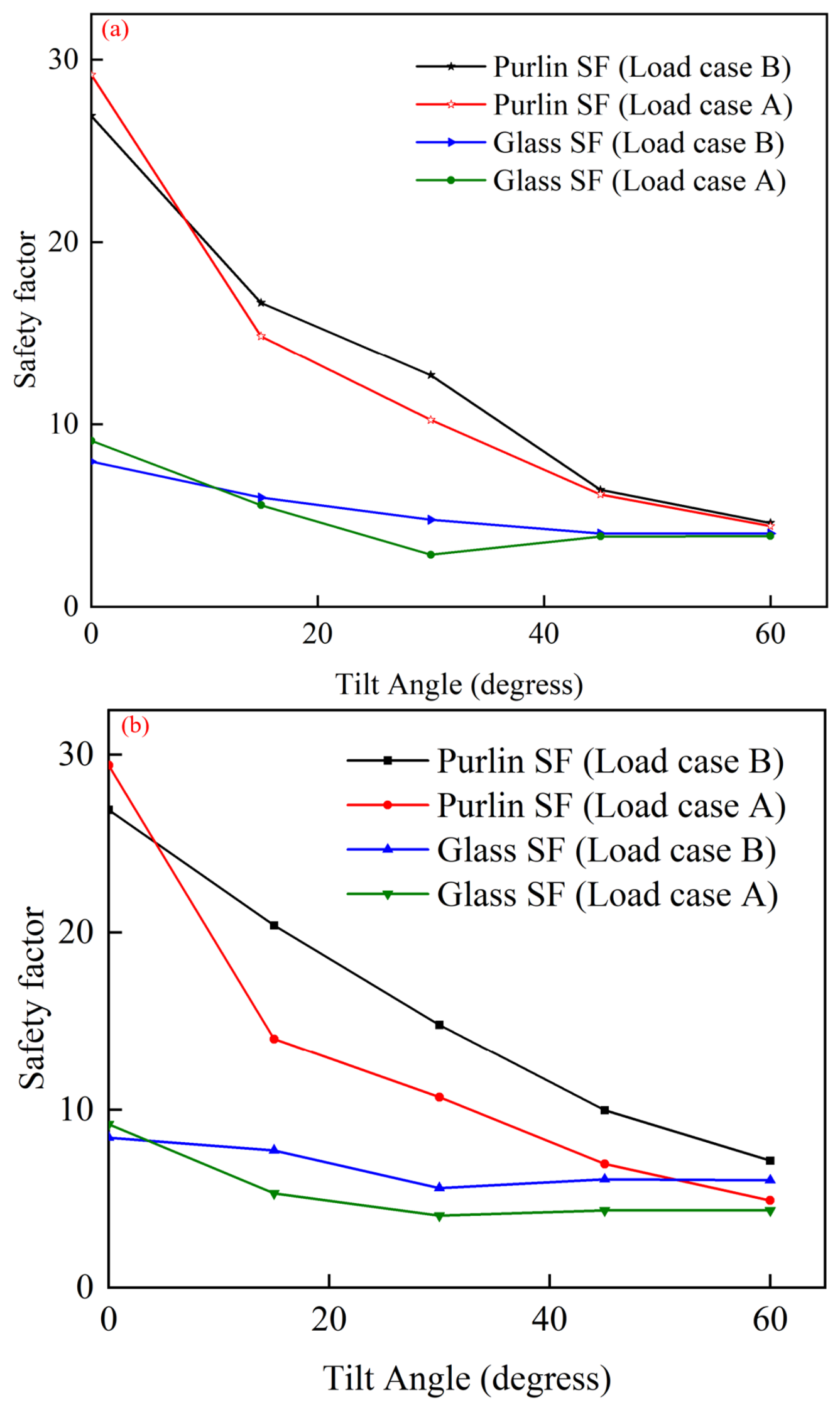
Table 11, and the corresponding trends are shown in
Figure 5 and
Figure 6. Load Cases A and B were defined earlier in
Section 2.5 and are compared here only from the perspective of structural safety.
For the large-size modules, the safety factor generally decreased as the tilt angle increased under both wind directions. The reduction was much more pronounced in the purlins than in the glass panels. Under the 0° wind direction, the glass panel safety factor decreased from 2.65 to 1.76 in Case A and from 2.88 to 1.38 in Case B as the tilt angle increased from 0° to 60°. Over the same range, the purlin safety factor decreased from 5.67 to 1.18 in Case A and from 6.17 to 0.93 in Case B. This shows that the purlin became the more critical component at high tilt angles under the 0° wind direction for large-size modules.
A more severe trend was observed under the 180° wind direction. For the large-size modules, the glass panel safety factor decreased to 1.27 in Case A and 1.22 in Case B at 60°, while the corresponding purlin safety factors dropped to 0.85 and 0.82. At 45°, the purlin safety factor had already reached 1.04 in Case A and 1.00 in Case B. At 60°, both values fell below 1.0. This was the most critical condition in the present section. It shows that under high tilt angles, the large-size module no longer maintains a sufficient safety margin in the purlin, especially under the 180° wind direction.
The normal-size modules showed the same decreasing trend, but the reduction was much smaller. Under a 0° wind direction, the glass panel safety factor ranged from 8.43 to 6.03 in Case A and from 9.19 to 4.34 in Case B. The purlin safety factor decreased from 26.9 to 7.14 in Case A and from 29.4 to 4.90 in Case B. Under the 180° wind direction, the same pattern was observed. The glass panel safety factor ranged from 7.95 to 4.02 in Case A and from 9.09 to 3.87 in Case B, while the purlin safety factor decreased from 26.92 to 4.59 in Case A and from 29.17 to 4.41 in Case B. Although the safety factors declined with increasing tilt angle, all values for the normal-size modules remained above 1.0. This means that the normal-size modules retained a much larger safety margin over the full tilt-angle range.
A comparison between the two module sizes confirms that the large-size modules were much more sensitive to increasing tilt angle than the normal-size modules. This difference was especially clear in the purlins. At 0°, Cases A and B were relatively close, but from 15° onward, Case B generally became more critical, especially for the large-size modules. The effect of wind direction was also important. For the large-size modules, the 180° wind direction produced lower purlin safety factors than the 0° wind direction at medium and high tilt angles.
These results show that increasing tilt angle had a much stronger effect on the structural safety of large-size modules than on normal-size modules, and that the most unfavourable condition occurred in the purlins of the large-size modules under the 180° wind direction at high tilt angles.
4. Discussion and Design Implications
This section further discusses the numerical results and their meaning for the structural assessment of large-size PV support systems. The main findings are first interpreted in terms of module size, array configuration, wind speed, tilt angle, and wind direction. Based on these results, the design implications for large-size modules are then discussed, with particular attention to the supporting members under high-tilt wind loading. The section also outlines the main limitations of the present model and suggests directions for future work.
4.1. Discussion of Main Findings
The results show that the structural behaviour of the PV support system was affected by module size, array condition, wind speed, tilt angle, and wind direction. Module size and tilt angle produced the clearest differences in structural demand. Under the same loading condition, the large-format module consistently developed higher bending moments and larger displacements than the conventional-size module. The increase in module size did not only increase the exposed area. It also made the system more sensitive to deformation under wind loading. This trend agrees with previous studies showing that wind effects on PV systems are strongly influenced by geometric configuration, tilt angle, and wind direction [
8,
21,
22].
In this study, the isolated single-row case produced a larger immediate structural response than the front row of the 8-row array under the selected loading input. This does not mean that the front row is unimportant in practice. In the present study, the difference between the isolated case and the front row was represented through literature-based loading coefficients that account for shielding and row interaction effects, while SAP2000 was used to evaluate the corresponding structural response. Under this loading representation, the front row remained the most exposed row within the multi-row system. Previous studies on ground-mounted solar arrays reported that the first windward row carries the largest load, while downstream rows experience reduced loading because of sheltering from upstream panels [
9,
19,
24]. Warsido et al. found that the largest reduction in wind load occurs in the second row, with smaller reductions in the following rows [
25]. This shows that the front part of the array governs the main transition in wind loading across the system. Based on this interpretation, the isolated case may be treated as a severe reference condition, while the front row remains the practical control row in a real multi-row arrangement.
When wind speed increased under the fixed 0° tilt condition, the main effect was a nearly proportional increase in the overall response. This trend is expected under the present linear static model, because the structural response increases almost in proportion to the applied pressure. Under this loading condition, the glass panel remained the more critical component from the safety factor perspective.
The effect of tilt angle was different from the effect of wind speed. Wind speed mainly raised the response level, but tilt angle changed how the system carried the load and where the controlling structural demand appeared. From a mechanics point of view, a larger tilt angle increases the projected area exposed to wind and increases the effective moment arm of the pressure load. This creates higher bending demand in the purlins. For this reason, the purlin safety factor decreased more quickly than the glass panel safety factor in the high-tilt cases.
This change in the governing component was most evident in the large-format module. In the fixed low-tilt case, the glass panel remained the governing safety component. In the high-tilt cases, the load-bearing demand shifted more strongly to the supporting members, especially the purlin. This trend was most critical under the 180° wind direction. Previous structural assessments of PV systems also identified the support region, rather than only the panel field, as a critical part under unfavourable wind loading [
7].
A safety factor lower than 1.0 means that the predicted stress is higher than the adopted reference stress. In this study, the purlin safety factor dropped below 1.0 in some high-tilt cases for the large-format module. This result indicates that the purlin did not maintain an acceptable safety margin under the assumed static loading condition. These cases should be treated as critical cases that require design modification or further verification.
Load Case B generally became more critical because it represented a more unfavourable pressure distribution on the module surface. This loading pattern increased the demand on the support members, especially at medium and high tilt angles. The difference between Load Case A and Load Case B was more visible in the large-format module because its larger surface area transferred more load to the purlins.
The most unfavourable condition in this study did not arise from wind speed alone. It resulted from the combination of a high tilt angle, an unfavourable wind direction, and a large-format module size. This shows that the system’s structural weakness did not remain the same across different loading conditions. The present results suggest that discussion of PV wind resistance should consider how structural demand is transferred from the module surface to the supporting members, rather than focusing only on panel pressure or panel stress.
4.2. Design Implications and Future Optimization Directions
The present results suggest that future structural improvement for large-format PV systems may need to focus more on the supporting members than on the module surface alone. In the present study, the purlin became the governing component under the more critical high-tilt cases, especially under the 180° wind direction. These results indicate that evaluating the glass panel alone is not sufficient for large-format modules. From a design point of view, more attention should be given to purlin stiffness and to the structural load path through the supporting system.
Based on this observation, future optimization can focus on the stiffness and support condition of the purlins. Increasing the purlin section capacity may help reduce the risk of overstress. Reducing the unsupported span or adjusting the support spacing may also reduce bending demand in the critical high-tilt cases. Similar structural assessments in the literature also suggest that the critical response of PV systems is often associated with support-related components rather than with the panel field itself [
7].
The results also indicate that medium- and high-tilt conditions should be treated as key design checks for large-format modules. In the present study, the lowest safety margins were not due to wind speed alone. They came from the combined effects of large module size, high tilt angle, and more critical wind direction. This means that structural design for large-format tracker systems should not rely only on low-tilt or stow-position checks. High-tilt operating positions should also be included when support-member safety is assessed.
The present results also support a practical operational implication. Since the lowest safety factors were mainly found at high tilt angles, maintaining a large tilt angle during strong wind events may increase structural risk. A lower tilt angle may help improve the available structural safety margin when severe wind is expected. This point should be treated as a design suggestion rather than a confirmed control strategy, because the present study did not include real-time tracking control or aeroelastic response. It is also consistent with previous findings that higher tilt angles can produce stronger aerodynamic effects and more severe design-relevant wind loads [
8].
The present study did not test alternative purlin layouts, revised support spacing, or different connection designs. The design points discussed above should be understood as future optimization directions, not as verified optimized solutions. They still provide a practical basis for deciding which parts of the support system should be studied in more detail.
4.3. Limitations and Future Work
The present study was not validated against wind tunnel measurements or field monitoring data. For this reason, the results should be interpreted as comparative static-response trends rather than direct predictions of full-scale field behaviour. The model still provides useful early-stage information because the wind loading was based on code-based procedures and literature pressure coefficients, and the numerical model included a mesh sensitivity check.
The structural analysis was based on a linear elastic static model. This approach is useful for comparing different module sizes, wind speeds, tilt angles, and array conditions under a controlled framework. At the same time, it still simplifies the actual behaviour of tracker PV systems. Gust effects, aeroelastic response, and other time-dependent wind effects were not included in the present numerical model. Previous studies have shown that wind action on PV systems may involve both static and dynamic response, especially when the supporting structure becomes relatively flexible [
22,
23].
The current SAP2000 model did not explicitly include detailed bolt behaviour, clamp flexibility, local joint deformation, or foundation flexibility. The load path of the system was represented at the level of the main structural members. This approach is suitable for identifying overall trends in internal force, displacement, and safety margin, but it may not fully capture local stress concentration or connection-level response. For this reason, the design implications discussed in the previous section should be understood as structural directions derived from the present model, rather than as fully verified conclusions for detailed connections.
Another limitation concerns the high-tilt loading case. For the 60° tilt angle, no direct net pressure coefficient is provided in the ASCE 7-16 table used in this study. The 45° coefficient was therefore adopted as an approximation for comparative analysis at 60°, as described earlier in
Section 2.5. The 60° results should be interpreted as comparative trend results under an assumed extension of the code-based loading framework, rather than as direct code-based design values. This point is especially important when interpreting the most severe high-tilt cases.
The present study also did not include aerodynamic instability assessment for the tracker system. This is relevant because previous research has shown that single-axis solar trackers may experience aeroelastic problems, such as torsional galloping, under dynamic wind loading. Static criteria alone may not always be sufficient once oscillatory response begins [
26]. Although the present study was intended as a static structural comparison, this limitation should be recognized when extending the results to more flexible tracker systems or to cases involving strong dynamic wind effects.
Future work should include wind tunnel testing or field monitoring to check the numerical response. Dynamic wind effects should also be included, especially gust response, wake effects, and aeroelastic instability. More detailed models should be developed for purlin layout, support spacing, connection stiffness, and foundation flexibility. These extensions would help move the present linear static comparison toward a more complete structural assessment of large-format PV tracker systems. The present findings should be interpreted as comparative results under static loading assumptions, rather than as a complete prediction of actual wind-induced behaviour in field conditions.
5. Conclusions
This study investigated the structural behaviour of large-format PV modules in boundary-free one-directional solar arrays in Ontario under static wind loading. The main purpose was to examine whether the PV module and support system could remain within an acceptable structural safety range after replacing a conventional-size module with a large-format module under representative wind loading conditions.
The results showed that the large-format module was more sensitive to wind loading than the conventional-size module. Under the same loading condition, the large-format module developed higher bending moments and larger displacements. The array comparison also showed that the isolated single-row case can be treated as a severe reference condition. The front row remained the practical control row in the multi-row arrangement when literature-based pressure coefficients were used to represent shielding effects.
The loading condition affected both the response level and the governing component. Under fixed 0° tilt and increasing wind speed, the glass panel remained the governing safety component. Under the fixed 27 m/s wind condition and increasing tilt angle, the governing component shifted to the purlin in the large-format module, especially under the 180° wind direction and the higher tilt cases. This means that the structural weakness of the system did not remain the same across all loading conditions. Based on the safety factor criterion used in this study, the large-format module system showed a clear reduction in safety margin. Some critical high-tilt purlin cases approached or fell below the acceptable limit of 1.0.
From a design point of view, the structural assessment of large-format PV systems should not focus only on the module surface. The supporting members, especially the purlins, also need careful checking under medium- and high-tilt operating conditions. The results also suggest that reducing the tilt angle during strong wind events may help lower structural risk in tracker-type systems. This point should be treated as a design suggestion, since real-time tracker control and dynamic wind response were not modelled in this study.
The conclusions of this study should be understood within the limits of a linear elastic static model. Gust effects, aeroelastic response, detailed connection behaviour, and soil–structure interaction were not included. The 60° loading case was also evaluated using the adopted 45° ASCE coefficient as an approximation. For these reasons, the present findings should be interpreted as comparative results under static loading assumptions, rather than as a complete prediction of actual wind-induced behaviour in field conditions. Future work should include wind tunnel validation, field monitoring, dynamic wind analysis, and more detailed structural refinement of support components in large-format PV systems.
Author Contributions
Writing, H.W., Y.Y. and Y.C.; supervision, T.X., J.W., B.Y. and S.Y. All authors have read and agreed to the published version of the manuscript.
Funding
This research received no external funding.
Data Availability Statement
The data that support the findings of this study are available from the co-authors upon request.
Conflicts of Interest
Authors Yuanjie Yu, Tao Xu, Jun Wang and Bo Yang were employed by the company Canadian Solar Inc. The remaining authors declare that the research was conducted in the absence of any commercial or financial relationships that could be construed as a potential conflict of interest.
References
- International Energy Agency (IEA). Renewables 2024—Electricity; IEA: Paris, France, 2024; Available online: https://www.iea.org/reports/renewables-2024/electricity (accessed on 10 March 2026).
- Su, H.; Chi, L.; Zio, E.; Li, Z.; Fan, L.; Yang, Z.; Liu, Z.; Zhang, J. An Integrated, Systematic Data-Driven Supply-Demand Side Management Method for Smart Integrated Energy Systems. Energy 2021, 235, 121416. [Google Scholar] [CrossRef]
- Wang, G.; Bai, T.; Zou, T.; Chen, Z. Comparative Study of Different Schemes of a Novel Solar Tower Receiver Multigeneration System with S-CO2 Brayton Cycle and ORC. Renew. Energy 2026, 261, 125308. [Google Scholar] [CrossRef]
- Sanathi, R.; Banerjee, S.; Bhowmik, S. A Technical Review of Crystalline Silicon Photovoltaic Module Recycling. Sol. Energy 2024, 281, 112869. [Google Scholar] [CrossRef]
- Xu, T.; Deng, S.; Zhang, G.; Zhang, Z. Research on Hot Spot Risk of High Wattage Solar Modules. Sol. Energy 2021, 230, 583–590. [Google Scholar] [CrossRef]
- Benda, V.; Černá, L. A Note on Limits and Trends in PV Cells and Modules. Appl. Sci. 2022, 12, 3363. [Google Scholar] [CrossRef]
- Wittwer, A.R.; Podestá, J.M.; Castro, H.G.; Mroginski, J.L.; Marighetti, J.O.; De Bortoli, M.E.; Paz, R.R.; Mateo, F. Wind Loading and Its Effects on Photovoltaic Modules: An Experimental–Computational Study to Assess the Stress on Structures. Sol. Energy 2022, 240, 315–328. [Google Scholar] [CrossRef]
- Yemenici, O.; Aksoy, M.O. An Experimental and Numerical Study of Wind Effects on a Ground-Mounted Solar Panel at Different Panel Tilt Angles and Wind Directions. J. Wind Eng. Ind. Aerodyn. 2021, 213, 104630. [Google Scholar] [CrossRef]
- Ma, W.; Zhang, W.; Zhang, X.; Chen, W.; Tan, Q. Experimental Investigations on the Wind Load Interference Effects of Single-Axis Solar Tracker Arrays. Renew. Energy 2023, 202, 566–580. [Google Scholar] [CrossRef]
- Koekemoer, J.H.; Bredell, J.R.; Venter, G.; Reinecke, J. Field Measurements of Wind Load Effects in a Photovoltaic Single-Axis Tracker Mounting Rail. J. Wind Eng. Ind. Aerodyn. 2024, 253, 105876. [Google Scholar] [CrossRef]
- Jordan, D.C.; Perry, K.; White, R.; Deline, C. Extreme Weather and PV Performance. IEEE J. Photovolt. 2023, 13, 830–835. [Google Scholar] [CrossRef]
- Bao, T.; Li, Z.; Pu, O.; Chan, R.W.K.; Zhao, Z.; Pan, Y.; Yang, Y.; Huang, B.; Wu, H. Modal Analysis of Tracking Photovoltaic Support System. Sol. Energy 2023, 265, 112088. [Google Scholar] [CrossRef]
- Nivelle, P.; Tsanakas, J.A.; Poortmans, J.; Daenen, M. Stress and Strain within Photovoltaic Modules Using the Finite Element Method: A Critical Review. Renew. Sustain. Energy Rev. 2021, 145, 111022. [Google Scholar] [CrossRef]
- JSOLAR. Installation Manual of 1P Horizontal Single-Axis Tracker System; JSOLAR: Beijing, China, 2025. [Google Scholar]
- Canadian Solar. HiKu CS3L-MS Photovoltaic Module Datasheet; Canadian Solar Inc.: Guelph, ON, Canada, 2020. [Google Scholar]
- Zhang, W. Study on Wind Load and Wind-Induced Response of the Single-Axis Solar Arrays. Master’s Thesis, Shijiazhuang Tiedao University, Shijiazhuang, China, 2023. [Google Scholar]
- Canadian Commission on Building and Fire Codes. National Building Code of Canada: 2020; National Research Council of Canada: Ottawa, ON, Canada, 2022.
- ASCE/SEI 7-16; Minimum Design Loads and Associated Criteria for Buildings and Other Structures. American Society of Civil Engineers: Reston, VA, USA, 2017.
- Browne, M.T.L.; Taylor, Z.J.; Li, S.; Gamble, S. A wind load design method for ground-mounted multi-row solar arraysbased on a compilation of wind tunnel experiments. J. Wind Eng. Ind. Aerodyn. 2020, 205, 104294. [Google Scholar] [CrossRef]
- Zheng, K.; Dai, Y.; Feng, Y.; Chen, Z.; Wang, P. Experimental and numerical investigation of wind load characteristics on multi-row arrays of solar tracking systems. J. Appl. Fluid Mech. 2026, 19, 482–498. [Google Scholar] [CrossRef]
- Zhao, Y.; Yang, Y.; Zhang, H.; Li, M. Experimental Investigation of Wind Loads on Solar Arrays with Varying Row Configurations and Tilt Angles. Renew. Energy 2025, 242, 122440. [Google Scholar] [CrossRef]
- Nan, B.; Chi, Y.; Jiang, Y.; Bai, Y. Wind Load and Wind-Induced Vibration of Photovoltaic Supports: A Review. Sustainability 2024, 16, 2551. [Google Scholar] [CrossRef]
- Lou, Y.; Zhang, J.; Pan, Y. Static and Dynamic Response Analysis of Flexible Photovoltaic Mounts. Buildings 2024, 14, 2037. [Google Scholar] [CrossRef]
- Jubayer, C.M.; Hangan, H. A Numerical Approach to the Investigation of Wind Loading on an Array of Ground Mounted Solar Photovoltaic (PV) Panels. J. Wind Eng. Ind. Aerodyn. 2016, 153, 60–70. [Google Scholar] [CrossRef]
- Warsido, W.P.; Bitsuamlak, G.T.; Barata, J.; Chowdhury, A.G. Influence of Spacing Parameters on the Wind Loading of Solar Array. J. Fluids Struct. 2014, 48, 295–315. [Google Scholar] [CrossRef]
- Martínez-García, E.; Blanco-Marigorta, E.; Parrondo Gayo, J.; Navarro-Manso, A. Influence of Inertia and Aspect Ratio on the Torsional Galloping of Single-Axis Solar Trackers. Eng. Struct. 2021, 243, 112682. [Google Scholar] [CrossRef]
Figure 1.
Top-view geometric layout of the large-format PV module array used in the numerical model.
Figure 1.
Top-view geometric layout of the large-format PV module array used in the numerical model.
Figure 2.
Scaled deformed shapes of the PV modules under 27 m/s wind loading: (a) conventional-size module; (b) large-format module.
Figure 2.
Scaled deformed shapes of the PV modules under 27 m/s wind loading: (a) conventional-size module; (b) large-format module.
Figure 3.
Maximum principal shell moment (MMAX) contours of the PV modules under 27 m/s wind loading: (a) conventional-size module; (b) large-format module.
Figure 3.
Maximum principal shell moment (MMAX) contours of the PV modules under 27 m/s wind loading: (a) conventional-size module; (b) large-format module.
Figure 4.
Deformed shape comparison between the isolated single row case and the front row of the 8-row array at a tilt angle of 30° under the 27 m/s wind loading. (a) isolated single row (b) front row of the 8-row array.
Figure 4.
Deformed shape comparison between the isolated single row case and the front row of the 8-row array at a tilt angle of 30° under the 27 m/s wind loading. (a) isolated single row (b) front row of the 8-row array.
Figure 5.
Variation in the safety factors of glass panels and steel purlins with increasing tilt angle for large modules under a wind speed of 27 m/s: (a) 0° wind direction; (b) 180° wind direction.
Figure 5.
Variation in the safety factors of glass panels and steel purlins with increasing tilt angle for large modules under a wind speed of 27 m/s: (a) 0° wind direction; (b) 180° wind direction.
Figure 6.
Variation in the safety factors of glass panels and steel purlins with increasing tilt angle for normal modules under a wind speed of 27 m/s: (a) 0° wind direction; (b) 180° wind direction.
Figure 6.
Variation in the safety factors of glass panels and steel purlins with increasing tilt angle for normal modules under a wind speed of 27 m/s: (a) 0° wind direction; (b) 180° wind direction.
Table 1.
Material Properties Used in the Structural Model.
Table 1.
Material Properties Used in the Structural Model.
| Component | Density (kg/m3) | Elastic Modulus (GPa) | Poisson’s Ratio |
|---|
| Glass (Panel) | 2500 | 72 | 0.2 |
| Aluminum (Frame) | 2730 | 69 | 0.33 |
| Steel (Structure) | 7850 | 206 | 0.3 |
Table 2.
Mesh Sensitivity Analysis Results for the PV Support System Model.
Table 2.
Mesh Sensitivity Analysis Results for the PV Support System Model.
| Mesh Level | Shell Subdivision | Max Vertical Displacement (mm) | Max Panel Stress (MPa) | Max Purlin Moment (kN·mm) |
|---|
| Coarse | 2 × 2 | 25.47 | 18.80 | 3654 |
| Medium | 7 × 4 | 16.91 | 21.96 | 3651 |
| Fine | 10 × 7 | 16.73 | 22.29 | 3648 |
Table 3.
Comparison of structural responses between the conventional-size and large-format PV modules under 27 m/s wind loading.
Table 3.
Comparison of structural responses between the conventional-size and large-format PV modules under 27 m/s wind loading.
| Response Quantity | Normal Size | Large Size | Large/Normal |
|---|
| Maximum principal shell moment, MMAX (kN·mm) | 0.0123 | 0.0414 | 3.37 |
| Maximum out-of-plane displacement, U3 (mm) | 1.83 | 19.3 | 10.55 |
Table 4.
Wind loading input for the isolated single-row case and the front row of the 8-row array at 30° tilt angle under 27 m/s wind speed.
Table 4.
Wind loading input for the isolated single-row case and the front row of the 8-row array at 30° tilt angle under 27 m/s wind speed.
| Configuration | Pressure Coefficient, | Applied Wind Pressure (kPa) |
|---|
| Isolated single row | 1.02 | 0.368 |
| 8-row array, front row | 0.70 | 0.256 |
Table 5.
Comparison of critical purlin bending moment and maximum displacement between the isolated single-row case and the front row of the 8-row array at 30° tilt angle under 27 m/s wind speed.
Table 5.
Comparison of critical purlin bending moment and maximum displacement between the isolated single-row case and the front row of the 8-row array at 30° tilt angle under 27 m/s wind speed.
| Configuration | Critical Purlin Maximum Bending Moment (kN·m) | Maximum Displacement (mm) |
|---|
| Isolated single row | 4.331 | 18.17 |
| 8-row array, front row | 2.895 | 12.15 |
Table 6.
Structural response comparison of conventional-size and large-format PV modules under different wind speeds.
Table 6.
Structural response comparison of conventional-size and large-format PV modules under different wind speeds.
| Wind Speed (m/s) | Wind Pressure (kPa) | Normal Max Abs P (kN) | Large Max Abs P (kN) | Normal Max Abs M3 (kN·m) | Large Max Abs M3 (kN·m) | Normal Max U3 (mm) | Large Max U3 (mm) |
|---|
| 27 | 0.322 | 2.000 | 5.333 | 0.753 | 3.651 | 1.59 | 16.9 |
| 32 | 0.453 | 2.815 | 7.502 | 1.059 | 5.137 | 2.24 | 23.7 |
| 36 | 0.573 | 3.560 | 9.489 | 1.340 | 6.498 | 2.83 | 30.0 |
Table 7.
Safety factor evaluation of glass panels and purlins for normal-size and large-size PV modules under different wind speeds.
Table 7.
Safety factor evaluation of glass panels and purlins for normal-size and large-size PV modules under different wind speeds.
| Wind Speed (m/s) | Module Type | Glass Panel Stress (MPa) | Glass Panel Reference
Stress (MPa) | Purlin Stress (MPa) | Purlin Reference
Stress (MPa) | Glass Panel Safety Factor | Purlin Safety Factor |
|---|
| 27 | Large | 26.4 | 70 | 61.7 | 350 | 2.65 | 5.67 |
| 27 | Normal | 7.61 | 70 | 13.0 | 350 | 9.20 | 26.92 |
| 32 | Large | 37.2 | 70 | 86.8 | 350 | 1.88 | 4.03 |
| 32 | Normal | 12.0 | 70 | 18.3 | 350 | 5.83 | 19.13 |
| 36 | Large | 47.0 | 70 | 110 | 350 | 1.49 | 3.18 |
| 36 | Normal | 14.8 | 70 | 23.1 | 350 | 4.73 | 15.15 |
Table 8.
Safety factor (SF) evaluation for glass panels and purlins under increasing tilt angle for single row large modules with 0° wind direction.
Table 8.
Safety factor (SF) evaluation for glass panels and purlins under increasing tilt angle for single row large modules with 0° wind direction.
| Tilt Angle | Load Case | Net Pressure Confection | Glass Von Mises Stress (MPa) | Purlin Von Mises Stress (MPa) | Glass Safety Factor | Purlin Safety Factor |
|---|
| 0 | A | −1.2 | 26.4 | 61.7 | 2.65 | 5.67 |
| 0 | B | −1.1 | 24.3 | 56.7 | 2.88 | 6.17 |
| 15 | A | −1.3 | 28.6 | 81.9 | 2.45 | 4.27 |
| 15 | B | −1.9 | 41.9 | 120 | 1.67 | 2.92 |
| 30 | A | −1.8 | 39.6 | 173 | 1.76 | 2.02 |
| 30 | B | −2.5 | 55.3 | 240 | 1.26 | 1.46 |
| 45 | A | −1.8 | 39.6 | 243 | 1.76 | 1.44 |
| 45 | B | −2.3 | 50.7 | 310 | 1.38 | 1.13 |
| 60 | A | −1.8 | 39.7 | 296 | 1.76 | 1.18 |
| 60 | B | −2.3 | 50.7 | 378 | 1.38 | 0.93 |
Table 9.
Safety factor (SF) evaluation for glass panels and purlins under increasing tilt angle for single row large modules with 180° wind direction.
Table 9.
Safety factor (SF) evaluation for glass panels and purlins under increasing tilt angle for single row large modules with 180° wind direction.
| Tilt Angle | Load Case | Net Pressure Confection | Glass Von Mises Stress (MPa) | Purlin Von Mises Stress (MPa) | Glass Safety Factor | Purlin Safety Factor |
|---|
| 0 | A | 1.2 | 26.5 | 61.8 | 2.64 | 5.66 |
| 0 | B | 1.1 | 24.3 | 56.7 | 2.88 | 6.17 |
| 15 | A | 1.6 | 35.4 | 113.3 | 1.98 | 3.09 |
| 15 | B | 1.8 | 39.8 | 153.4 | 1.76 | 2.28 |
| 30 | A | 2.1 | 46.4 | 202 | 1.51 | 1.73 |
| 30 | B | 2.6 | 57.5 | 250 | 1.22 | 1.40 |
| 45 | A | 2.5 | 55.3 | 337 | 1.27 | 1.04 |
| 45 | B | 2.6 | 57.5 | 350 | 1.22 | 1.00 |
| 60 | A | 2.5 | 55.3 | 410 | 1.27 | 0.85 |
| 60 | B | 2.6 | 57.5 | 427 | 1.22 | 0.82 |
Table 10.
Safety factor (SF) evaluation for glass panels and purlins under increasing tilt angle for single row normal modules with 0° wind direction.
Table 10.
Safety factor (SF) evaluation for glass panels and purlins under increasing tilt angle for single row normal modules with 0° wind direction.
| Tilt Angle | Load Case | Net Pressure Confection | Glass Von Mises Stress (MPa) | Purlin Von Mises Stress (MPa) | Glass Safety Factor | Purlin Safety Factor |
|---|
| 0 | A | −1.2 | 8.30 | 13.0 | 8.43 | 26.9 |
| 0 | B | −1.1 | 7.61 | 11.9 | 9.19 | 29.4 |
| 15 | A | −1.3 | 9.06 | 17.1 | 7.72 | 20.4 |
| 15 | B | −1.9 | 13.2 | 25.0 | 5.30 | 14.0 |
| 30 | A | −1.8 | 12.5 | 23.6 | 5.60 | 14.8 |
| 30 | B | −2.5 | 17.3 | 32.8 | 4.05 | 10.7 |
| 45 | A | −1.8 | 11.5 | 35.1 | 6.09 | 9.97 |
| 45 | B | −2.3 | 16.0 | 50.3 | 4.34 | 6.95 |
| 60 | A | −1.8 | 11.6 | 49.0 | 6.03 | 7.14 |
| 60 | B | −2.3 | 16.1 | 71.4 | 4.34 | 4.90 |
Table 11.
Safety factor (SF) evaluation for glass panels and purlins under increasing tilt angle for single row normal modules with 180° direction.
Table 11.
Safety factor (SF) evaluation for glass panels and purlins under increasing tilt angle for single row normal modules with 180° direction.
| Tilt Angle | Load Case | Net Pressure Confection | Glass Von Mises Stress (MPa) | Purlin Von Mises Stress (MPa) | Glass Safety Factor | Purlin Safety Factor |
|---|
| 0 | A | 1.2 | 8.8 | 13 | 7.95 | 26.92 |
| 0 | B | 1.1 | 7.7 | 12 | 9.09 | 29.17 |
| 15 | A | 1.6 | 11.7 | 21 | 5.98 | 16.67 |
| 15 | B | 1.8 | 12.6 | 23.6 | 5.56 | 14.83 |
| 30 | A | 2.1 | 14.7 | 27.6 | 4.76 | 12.68 |
| 30 | B | 2.6 | 18.2 | 34.2 | 3.85 | 10.23 |
| 45 | A | 2.5 | 17.4 | 54.7 | 4.02 | 6.40 |
| 45 | B | 2.6 | 18.2 | 56.9 | 3.85 | 6.15 |
| 60 | A | 2.5 | 17.4 | 76.2 | 4.02 | 4.59 |
| 60 | B | 2.6 | 18.1 | 79.3 | 3.87 | 4.41 |
| Disclaimer/Publisher’s Note: The statements, opinions and data contained in all publications are solely those of the individual author(s) and contributor(s) and not of MDPI and/or the editor(s). MDPI and/or the editor(s) disclaim responsibility for any injury to people or property resulting from any ideas, methods, instructions or products referred to in the content. |




 ,
,