Article

Optimization of Near-Source Concentrated Smoke Exhaust in Long Subway Station Entrance Passageways Under Concourse Fire Conditions


1
School of Electrical Engineering, Chongqing Industry Polytechnic University, Chongqing 401120, China
2
China Coal Technology and Engineering Group Chongqing Research Institute, Chongqing 400037, China
3
School of Aeronautics, Chongqing Jiaotong University, Chongqing 400074, China
*
Author to whom correspondence should be addressed.
Processes 2026, 14(12), 1878; https://doi.org/10.3390/pr14121878 (registering DOI)
Submission received: 2 May 2026 / Revised: 31 May 2026 / Accepted: 8 June 2026 / Published: 10 June 2026
(This article belongs to the Section Process Safety and Risk Management)

Abstract

Smoke spread from concourse fires into long entrance passageways can threaten evacuation in deep-buried subway stations, especially when smoke moves upward along inclined escalator sections. This study used a 1:8-scale Fire Dynamics Simulator model to investigate smoke control in a concourse connected to two long entrance passageways. Concourse-only smoke exhaust, conventional combined smoke exhaust, different passageway vent configurations, and an optimized near-source concentrated arrangement were compared. The baseline concourse extraction rate failed to prevent smoke from entering the passageways. At a heat release rate of 15.55 kW, smoke was nearly prevented from entering landing I only when the concourse extraction rate was increased to six times the baseline value. Under conventional combined exhaust, the passageway extraction capacity was distributed between landing I and landing II, but smoke still entered escalator section I. When the total extraction rate of each single-side passageway was unchanged, concentrating the extraction capacity at landing I allowed smoke to be extracted before entering escalator section I. The optimized arrangement prevented smoke from entering escalator section I under both centered and right-offset fire source conditions for the tested passageway geometry, heat release rate, and extraction-rate conditions.

1. Introduction

Subway stations are typical confined underground public spaces. In deep-buried stations, entrance passageways are usually long and often include horizontal landings, inclined escalator sections, and turning spaces. In a fire, these passageways serve not only as evacuation routes but also as paths for smoke spread between different station areas. Early smoke control in long entrance passageways is therefore a key issue in smoke exhaust design for deep-buried subway stations.
Previous studies have examined subway station fires from the perspectives of smoke control, stack effect, ventilation arrangement, and life safety assessment. Chen et al. [1] investigated smoke control methods in subway station fires and showed that mechanical smoke exhaust and airflow organization affect smoke layer distribution. Chen et al. [2] analyzed the influence of the stack effect on smoke propagation in subway stations and showed that vertical elevation differences in underground stations can change smoke migration paths. Park et al. [3] numerically predicted smoke movement in a subway station under ventilation conditions. Roh et al. [4] used CFD results to assess life safety in a subway train fire. Li et al. [5] predicted the smoke backflow length and smoke outflow rate in subway station passageways under a weak stack effect and found that insufficient induced airflow in passageways may lead to smoke backflow and leakage at openings.
For concourses, platforms, tunnels, and interchange spaces, further studies have compared the effectiveness of different ventilation and smoke exhaust strategies. Long et al. [6] conducted full-scale fire tests in an underground double-island subway station and found that fire location and ventilation conditions affect smoke layer height, temperature distribution, and smoke front arrival time. Li et al. [7] studied mechanical smoke exhaust strategies in a cross-type interchange subway station using scale experiments and numerical simulations, and showed that different smoke exhaust modes provide different levels of smoke confinement. Wang et al. [8] incorporated ventilation, smoke exhaust, smoke barriers, and information fusion into a collaborative control framework, indicating that coordinated facilities affect fire smoke control in complex subway stations. Long et al. [9] compared emergency ventilation strategies for different fire scenarios in a double-island subway station and found that ventilation organization among the platform, tunnel, and concourse changes smoke migration paths. Gao et al. [10] investigated hybrid ventilation for smoke control in a large transit terminal subway station. Faugier et al. [11] compared on-site measurements with a CFD model and showed that airflow organization in actual subway stations is strongly affected by the as-built environment. Shi et al. [12] conducted full-scale tests in long subway tunnels and showed that longitudinal mechanical ventilation affects the ceiling temperature distribution and smoke spread behavior. These studies mainly focused on concourses, platforms, tunnels, or interchange areas. The combined smoke exhaust organization after concourse smoke enters long entrance passageways has received less attention.
Connecting spaces such as stairways, escalator sections, and passageways can alter smoke migration paths between station areas. Chen et al. [13] investigated airflow characteristics and smoke control conditions in subway station stair areas. They found that airflow near stair openings is spatially non-uniform and time-dependent, and that using average velocity as the control criterion may underestimate the risk of local smoke leakage. Zhang and Han [14] proposed a combined strategy involving platform air curtains, stair air curtains, and mechanical smoke exhaust, showing that flexible blocking facilities can delay smoke spread along evacuation routes. Li and Zhu [15] analyzed the effect of platform screen doors on mechanical smoke exhaust and showed that boundary opening and closing conditions change smoke exchange between the platform and tunnel. These studies indicate that connecting spaces and boundary conditions affect smoke migration paths, but the spatial allocation of extraction capacity in long entrance passageways remains insufficiently examined.
Mechanical smoke exhaust performance depends not only on the extraction rate, but also on the vent location, exhaust-vent opening configuration, make-up air conditions, and smoke layer stability. Chen et al. [16] compared bottom-opening and side-opening exhaust vents in subway stations and found that lateral ventilation can slow horizontal smoke spread and vertical smoke descent. Zhong et al. [17] showed that plug-holing may occur under excessive lateral exhaust velocity, causing fresh air to be directly entrained into the exhaust vent. Liu et al. [18] used multi-scale experiments to analyze the relationship between air entrainment and the heat exhaust coefficient under lateral smoke exhaust, indicating that shear flow near the exhaust vent can change smoke layer stability. From the perspective of overall ventilation duct layout in subway stations, Chen et al. [19] showed that the number and transverse arrangement of ducts affect smoke exhaust efficiency, and that simply increasing the extraction rate or the number of vents does not necessarily improve overall smoke control. Hu et al. [20] found in full-scale underground corridor fire tests that mechanical smoke exhaust efficiency is closely related to make-up air conditions. Gutiérrez-Montes et al. [21] showed in atrium fire studies that different make-up air configurations alter fire-induced flow fields. Chen et al. [22] further found that obstacles such as columns, stairways, and elevators can change local airflow structures and smoke temperature distributions in subway stations. These findings suggest that, when extraction capacity is limited, the spatial organization of exhaust vents and the local smoke-retention conditions may be more important than increasing the extraction rate alone.
Previous studies indicate that smoke movement in subway stations is strongly affected by fire location, elevation difference, boundary openings, ventilation arrangement, and make-up airflow. These factors can change smoke migration paths and the effective use of mechanical smoke exhaust capacity in concourses, platforms, tunnels, and connecting spaces. However, after concourse smoke enters a long entrance passageway, the control role of the first landing before the inclined escalator section has not been sufficiently examined. It remains unclear whether limited passageway extraction capacity should be distributed along the passageway or concentrated at this initial smoke accumulation region. This study therefore focuses on the spatial allocation of passageway extraction capacity after smoke enters from the concourse. A 1:8-scale numerical model of a subway station was developed using Fire Dynamics Simulator (FDS) [23,24]. A complete concourse–double entrance passageway model and a half-concourse–single entrance passageway model were established. By comparing concourse-only smoke exhaust, conventional combined smoke exhaust, passageway exhaust vent configurations, and an optimized combined smoke exhaust arrangement, this study examines whether near-source concentrated smoke exhaust at landing I can intercept smoke before it enters escalator section I without increasing the total passageway extraction rate.

2. Materials and Methods

2.1. Geometry and Numerical Method

The study focuses on the concourse of a deep-buried subway station and its two long entrance passageways. To examine the smoke distribution in the complete concourse–double entrance passageway model and the influence of the exhaust vent configuration in a single-side entrance passageway, two geometric models were established. The first was a complete concourse–double entrance passageway model, which was used to analyze concourse-only smoke exhaust, conventional concourse–passageway combined smoke exhaust, and optimized concourse–passageway combined smoke exhaust. The second was a half-concourse–single entrance passageway model, which was used to compare the effects of vent location, allocation of extraction capacity, exhaust-vent opening configuration, and vent bottom height on smoke control in the passageway. The two models used the same numerical method, fire source model, and extraction-rate scaling method.
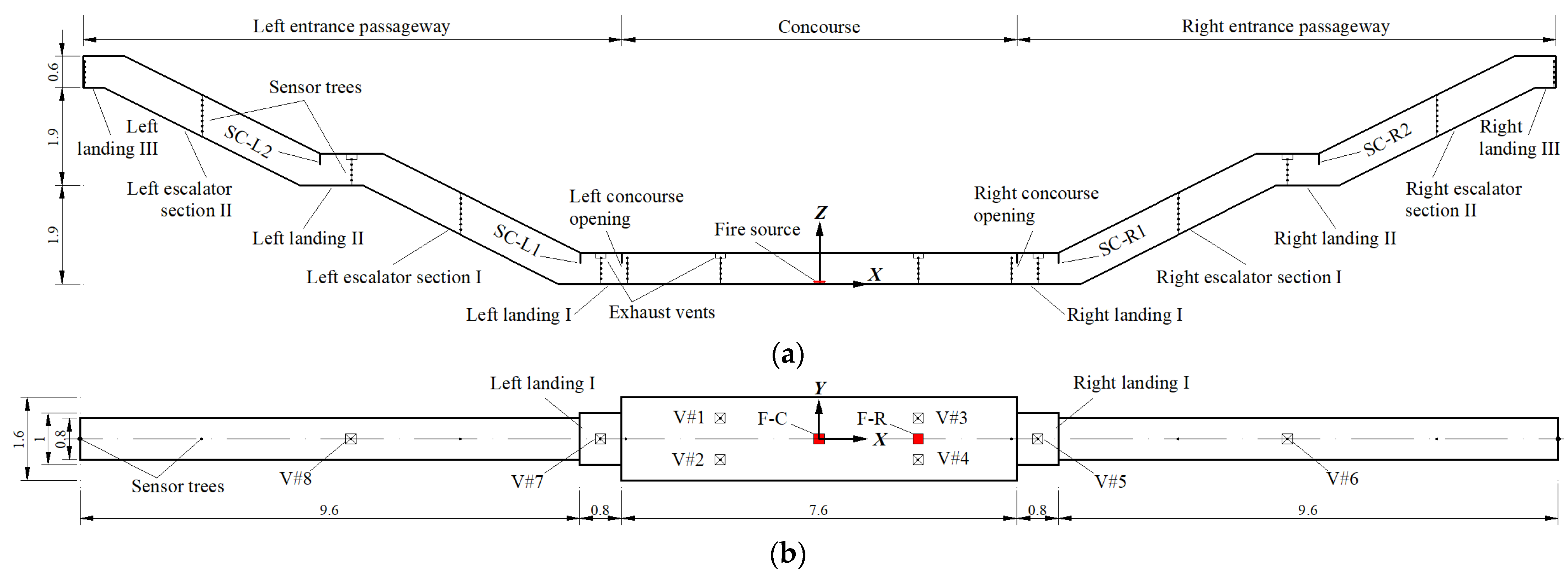
The complete concourse–double entrance passageway model consisted of a concourse, a left entrance passageway, and a right entrance passageway. The two passageways were arranged symmetrically about the central plane of the concourse. Each single-side entrance passageway consisted of landing I, escalator section I, landing II, escalator section II, and landing III. Landing I was directly connected to the concourse opening and was the first horizontal landing encountered by smoke after it entered the long entrance passageway from the concourse. Escalator section I connected landing I and landing II and was the main upward spread region after smoke entered escalator section I, as shown in Figure 1.
The fire-source locations and smoke-control components are labeled in Figure 1. Both fire-source locations were arranged along the concourse centerline. F-C denotes the centered fire-source location, with the fire-source center at x = 0. F-R denotes the right-offset fire-source location, with the fire-source center shifted to x = 1.9 m toward the right entrance passageway. The centered fire source was selected to represent a symmetric smoke-entry condition into the two entrance passageways, whereas the right-offset fire source was selected to examine the smoke control performance under biased smoke entry toward one passageway.
The mechanical exhaust vents are denoted as V#1–V#8. V#1–V#4 are concourse exhaust vents. V#5, V#6, V#7, and V#8 correspond to the exhaust vents at right landing I, right landing II, left landing I, and left landing II, respectively. The smoke curtains in the entrance passageways are denoted as SC-L1, SC-L2, SC-R1, and SC-R2. SC-L1 and SC-R1 are suspended from the ceiling at the landing I–escalator section I junctions, and SC-L2 and SC-R2 at the landing II–escalator section II junctions in the left and right entrance passageways.
The geometric scale ratio was 1:8. The concourse in the scale model was 7.6 m long, 1.6 m wide, and 0.6 m high, with a floor area of 12.16 m2. One concourse opening was arranged on each of the left and right end walls of the concourse, and each opening was 1.0 m × 0.4 m. Landing I was 1.0 m wide and had a length of 0.8 m along the ceiling. The inclination angles of escalator section I and escalator section II were both 27°, and each escalator section had a vertical rise of 1.9 m. The single-side entrance passageway model was 11.3 m long, with a vertical rise of 3.8 m and a floor area of 9.04 m2. These dimensions corresponded to a prototype passageway length of 90.4 m and a vertical rise of 30.4 m. The coordinate origin was set at the center of the concourse floor. The x-direction was defined along the longitudinal direction of the concourse and entrance passageways, the y-direction was the transverse direction of the concourse, and the z-direction was vertical.
The numerical simulations were performed using the Fire Dynamics Simulator (FDS, Version 6.7.6). A three-dimensional large eddy simulation method was adopted, and combustion was described using the Simple Chemistry model [23]. The fire source was a steady surface fire with a size of 0.2 m × 0.2 m and a height of 0.05 m. Methanol was used as the fuel because it can provide a stable and controllable small-scale pool fire and has been widely used in subway-station fire experiments. The use of methanol was also consistent with the validation experiment adopted in this study. The heat of combustion of methanol was 19.93 kJ/g, and the soot and carbon monoxide yields were 1.5% and 0.6%, respectively. Unless otherwise stated, the model-scale heat release rate was 15.55 kW, corresponding to a prototype heat release rate of 2.82 MW according to Froude scaling. This value is within the reported range for typical luggage fires in subway public areas, approximately 1.5–3.0 MW [22].
The ceilings and floors of the concourse and entrance passageways were assigned the properties of thermal insulation board, while the side walls were assigned the properties of fireproof glass. The thermal insulation board had a thickness of 8 mm, with a specific heat of 1.16 kJ/(kg·K), a thermal conductivity of 0.162 W/(m·K), and a density of 1100 kg/m3. The fireproof glass had a thickness of 6 mm, with a specific heat of 0.837 kJ/(kg·K), a thermal conductivity of 1.1 W/(m·K), and a density of 2500 kg/m3. Extended computational domains were arranged outside the outer exits of the two entrance passageways, and their outer boundaries were set as OPEN boundaries. The initial ambient temperature was 26.5 °C, and the initial pressure was 101.325 kPa. At the start of each simulation, the fire source reached the prescribed heat release rate and then remained steady. The concourse exhaust vents were opened at the same time as the fire source was activated.
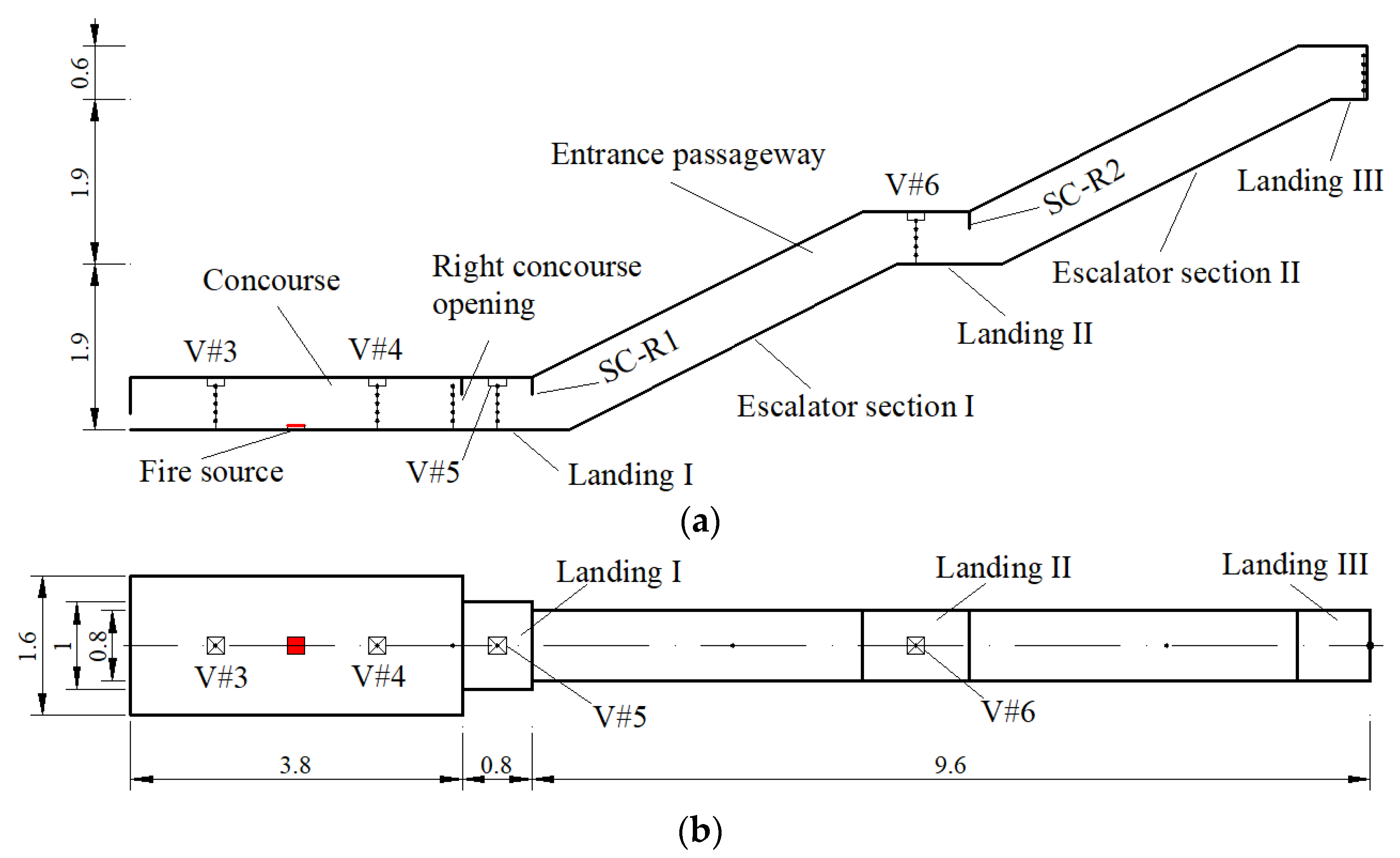
The half-concourse–single entrance passageway model was used as a parametric model for the right entrance passageway, as shown in Figure 2. Its purpose was to provide a stable single-side smoke inflow condition, so that the effects of vent location, extraction-rate allocation, vent opening configuration, and vent bottom height could be compared under the same passageway geometry. The model retained the main smoke spread path from the concourse opening to landing I, escalator section I, landing II, escalator section II, and landing III.
The half-concourse was 3.8 m long, 1.6 m wide, and 0.6 m high, and its right side was connected to a complete entrance passageway. A ceiling-mounted boundary baffle was arranged at the truncated left end of the half-concourse, with a bottom height of 0.2 m, to reduce smoke overflow toward the truncated side. The right side retained the concourse opening connected to the entrance passageway, with an opening height of 0.4 m. This setting allowed smoke to enter the right entrance passageway and provided a stable smoke inflow condition for the passageway parametric cases. To reduce the influence of external boundaries on the flow field, extended computational domains were arranged outside the left and right ends of the half-concourse, and their outer surfaces were set as OPEN boundaries. The detailed exhaust configurations for this model are given in Section 2.2.

2.2. Mechanical Smoke Exhaust System and Case Design

The mechanical smoke extraction rate was determined according to the smoke exhaust requirements for underground long corridors and entrance passageways in reference [25]. The prescribed prototype smoke extraction rate per unit floor area is 60 m3/(m2·h). Since this quantity is equivalent to a velocity, it was scaled using the Froude velocity scale [24], giving a model-scale value of 60 × (1/8)1/2 = 21.21 m3/(m2·h). Based on the model-scale areas, the baseline concourse extraction rate was q1 = 12.16 × 21.21 = 257.9 m3/h, namely 0.0716 m3/s, and the baseline extraction rate for one single-side entrance passageway was q2 = 9.04 × 21.21 = 191.8 m3/h, namely 0.0532 m3/s. The detailed case settings are summarized in Table 1.
In the complete concourse–double entrance passageway model, V#1–V#4 were arranged on the concourse ceiling, and each vent had a size of 0.2 m × 0.2 m. The extraction rate was controlled using the HVAC module. The concourse exhaust vents were opened simultaneously when the fire source was activated.
The simulation cases were designed in four sets. Cases A1–A6 were used to determine whether increasing the concourse extraction rate alone could prevent smoke from entering the long entrance passageways. Cases B1–B2 represented the conventional combined smoke exhaust arrangement, in which the passageway extraction capacity was distributed between landing I and landing II. The two fire-source locations were compared to examine the effect of asymmetric smoke entry into the left and right entrance passageways.
Cases C1–C7 were used as parametric cases for the right entrance passageway in the half-concourse–single entrance passageway model. In these cases, the concourse exhaust configuration was kept unchanged, and the total extraction rate of the single-side passageway was fixed at q2. Only the allocation of extraction capacity, vent opening configuration, and vent bottom height of V#5 and V#6 were changed.
Cases D1–D2 were used to verify the optimized near-source concentrated smoke exhaust arrangement in the complete model. Compared with the conventional combined smoke exhaust arrangement, the optimized arrangement shifted the passageway extraction capacity and smoke-curtain control position forward to landing I without increasing either the concourse extraction rate or the total extraction rate of each single-side passageway.

2.3. Measurement Layout and Evaluation Indicators

Thermocouple trees and velocity-sensor trees were arranged in the concourse and entrance passageways to obtain vertical temperature distributions and airflow directions in the passageways. In the complete concourse–double entrance passageway model, six thermocouple trees were arranged in the concourse, and five thermocouple trees were arranged in each of the left and right entrance passageways. The thermocouple trees were mainly placed near the left and right concourse openings, near the exhaust vents, and at typical locations such as landing I, landing II, and landing III. Their positions are shown in Figure 1. Each thermocouple tree contained 29 thermocouples along the vertical direction, with a vertical spacing of 0.02 m. The top thermocouple was located 0.02 m below the ceiling and was used to record smoke temperature variations at different heights.
The velocity-sensor trees were placed at the same locations as the thermocouple trees and used the same vertical arrangement. The velocity sensors measured the x-direction gas velocity to determine the make-up airflow direction and smoke-overflow path near the concourse openings, landings, and smoke curtains. In the half-concourse–single entrance passageway model, thermocouple trees and velocity-sensor trees were arranged at corresponding locations on the landings, with the same measurement layout as that used in the complete model.
Visibility, CO concentration, occupant-level temperature, and tenability time are important indicators for a complete life-safety assessment in subway station fires. However, the objective of this study was to compare the effect of passageway exhaust-vent allocation on smoke spread before smoke entered escalator section I under the same fire size, fuel, geometry, and extraction-rate conditions, rather than to conduct a full evacuation tenability analysis. Therefore, the smoke spread range was used as the main evaluation indicator. If smoke was confined to landing I and did not enter escalator section I, the smoke-control objective of limiting smoke spread before escalator section I was considered to be achieved. If smoke continued to enter escalator section I, landing II, or landing III, smoke spread was considered not to be effectively limited. The smoke layer thickness and average temperature in landing I were used as supplementary indicators to evaluate the local smoke-retention and extraction state. The smoke layer interface height was determined from the vertical temperature profiles obtained from the thermocouple trees using the total integral ratio method, and the smoke layer thickness was defined as the difference between the local ceiling height and the smoke layer interface height. The activation time of each passageway exhaust vent was defined as the time when smoke entered the corresponding landing and activated the smoke sensor.

2.4. Grid Sensitivity and Model Validation

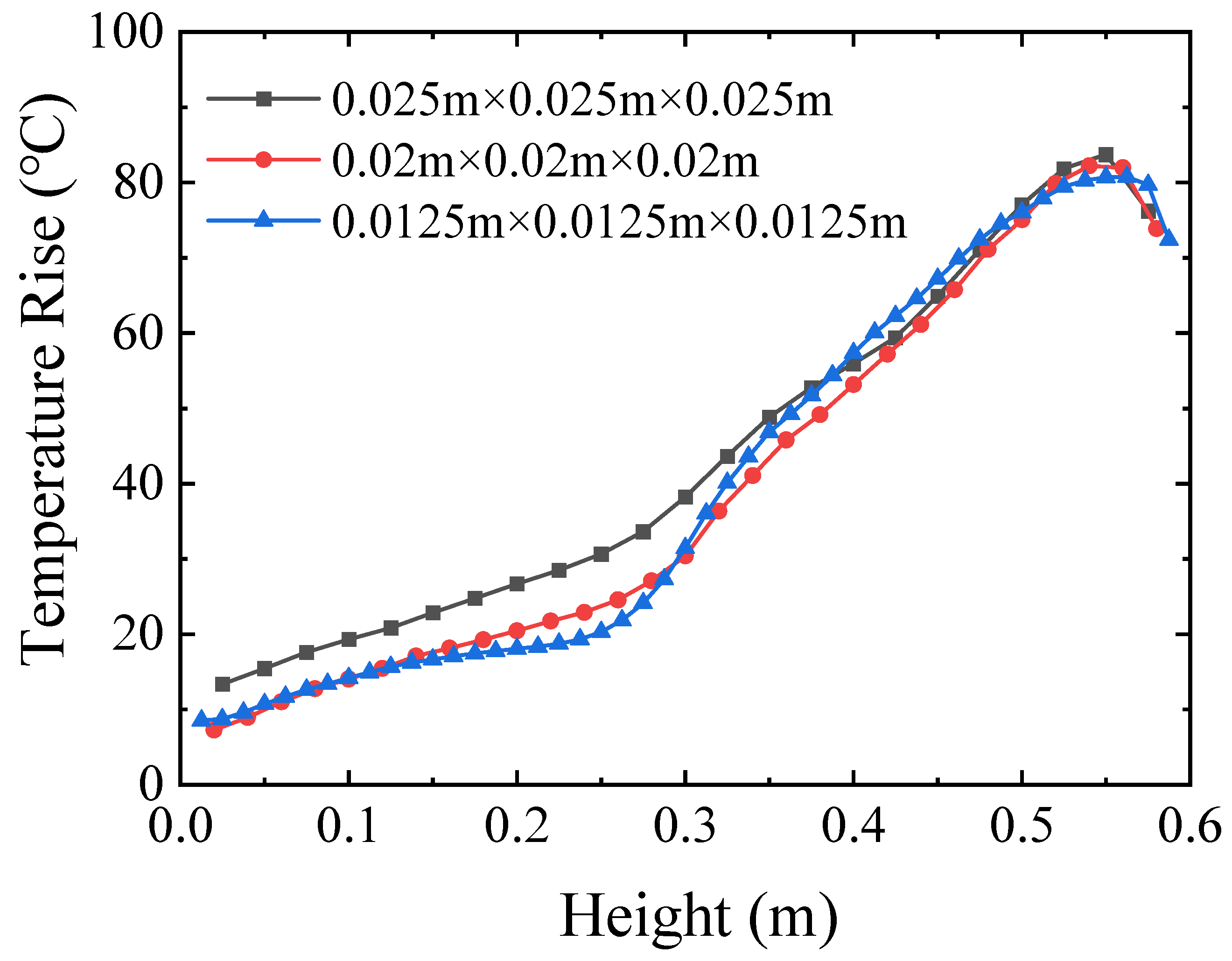
Previous studies have shown that satisfactory numerical accuracy can be obtained when the ratio D*/δx ranges from 4 to 16 [23], where D* is the characteristic fire diameter and δx is the grid size. In this study, grid sensitivity was examined using three uniform mesh sizes of 0.025 m, 0.020 m, and 0.0125 m. The corresponding values of D*/δx were 7.19, 8.99, and 14.38, respectively, all within the recommended range.
The centered-fire case was selected for comparison, and the vertical temperature-rise profile at x = −3 m along the concourse centerline was used as the evaluation parameter. The temperature rise was calculated relative to the initial ambient temperature. As shown in Figure 3, the three mesh sizes produced similar vertical stratification trends. The 0.025 m mesh overpredicted the temperature rise in the lower and transition regions, whereas the results obtained with the 0.020 m and 0.0125 m meshes were close. The peak temperature rise was 83.74 °C for the 0.025 m mesh, 82.20 °C for the 0.020 m mesh, and 80.77 °C for the 0.0125 m mesh. Taking the 0.0125 m mesh as the reference, the peak-temperature-rise deviation of the 0.020 m mesh was 1.43 °C, corresponding to 1.78%. Therefore, considering both numerical accuracy and computational cost, the 0.020 m mesh was adopted for the main simulations. Under this mesh size, the complete concourse–double entrance passageway model contained approximately 4.6 million cells.
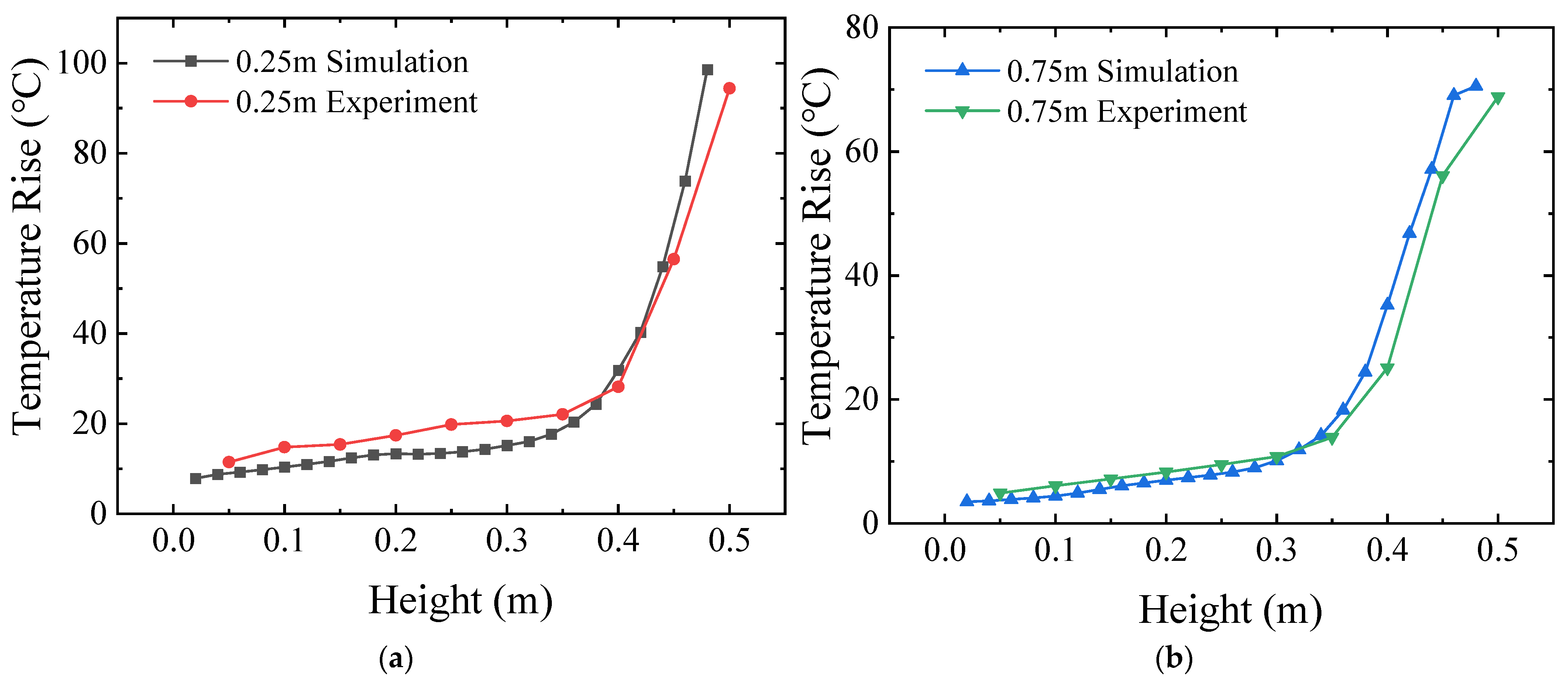
The small-scale subway station fire experiments reported by Chen et al. [22] were used for model validation. The experiments were conducted in a 1:10 subway station model with dimensions of 10 m × 2.2 m × 1.15 m and provided vertical temperature-rise measurements at different distances from the fire source. Among the reported cases, the F3 fire-source location under the no-obstacle condition with a model-scale heat release rate of 4.35 kW was selected because it provides clear vertical temperature-rise data for buoyancy-driven smoke stratification in a subway station space. This case is therefore suitable for evaluating whether the adopted FDS setup can reproduce the vertical smoke-layer structure and temperature-rise distribution that are central to the subsequent analysis of smoke spread and smoke exhaust performance.
Figure 4 compares the simulated and measured vertical temperature-rise profiles at 0.25 m and 0.75 m from the fire source. At both locations, the simulation reproduced the main vertical stratification pattern observed in the experiment, including the low-temperature lower region, the transition region, and the rapid increase in temperature rise in the upper smoke layer. At 0.25 m from the fire source, the measured peak temperature rise was 94.4 °C, while the simulated near-ceiling maximum temperature rise was 98.6 °C. At 0.75 m from the fire source, the corresponding values were 68.8 °C and 70.6 °C, respectively. The differences in the near-ceiling maximum temperature rise were therefore 4.2 °C and 1.8 °C at the two measurement locations. Overall, the comparison indicates that the adopted FDS setup can reasonably reproduce the vertical smoke stratification and near-ceiling temperature-rise distribution relevant to the subsequent smoke-spread analysis.

3. Results and Discussion

3.1. Limitations of Concourse-Only Smoke Exhaust and Conventional Combined Smoke Exhaust

Cases A1–A6 and B1–B2 were used to identify the main difficulty in smoke control for long entrance passageways. Cases A1–A6 examined concourse-only smoke exhaust under different concourse extraction rates, whereas cases B1 and B2 examined conventional combined smoke exhaust under centered and right-offset fire-source conditions, respectively. In all B cases, the concourse extraction rate was q1, and the total extraction rate of each single-side passageway was q2.
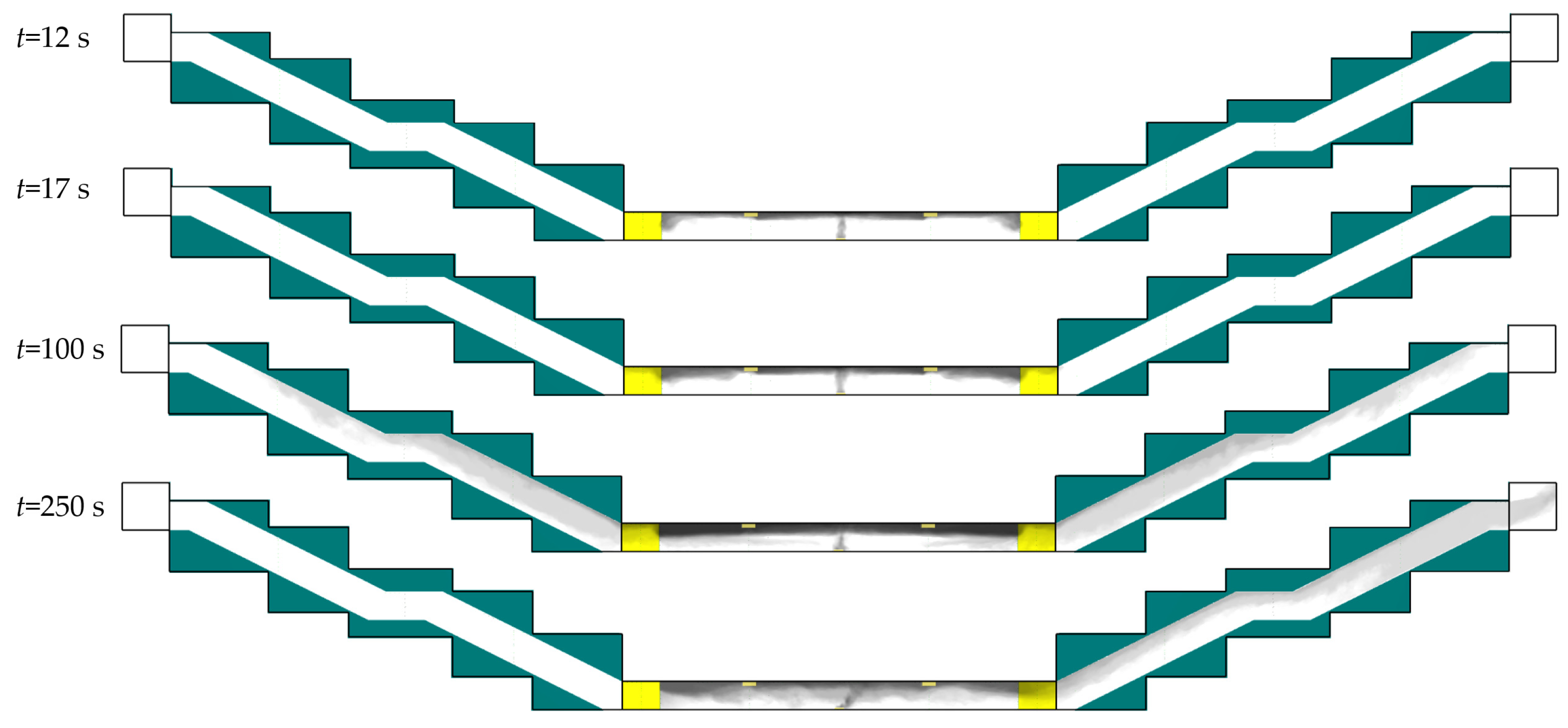
Figure 5 shows the smoke distribution in case A1, with a centered fire source, a heat release rate of 15.55 kW, and a concourse extraction rate of q1. The baseline concourse extraction rate could not confine smoke within the concourse. At approximately 12 s after ignition, smoke entered landing I through the left and right concourse openings. At approximately 17 s, smoke reached the ceiling of escalator section I on both sides and then moved upward along the inclined passageways. As buoyancy-driven flow developed in the passageways, the flow states on the two sides gradually diverged. In the stable stage, one side acted mainly as a make-up air path, while the other side became the main smoke exhaust path. After smoke entered the long entrance passageways, its movement was no longer governed by concourse smoke exhaust alone. The passageway elevation difference, stack effect, and flow redistribution through the two concourse openings jointly changed the smoke migration path.
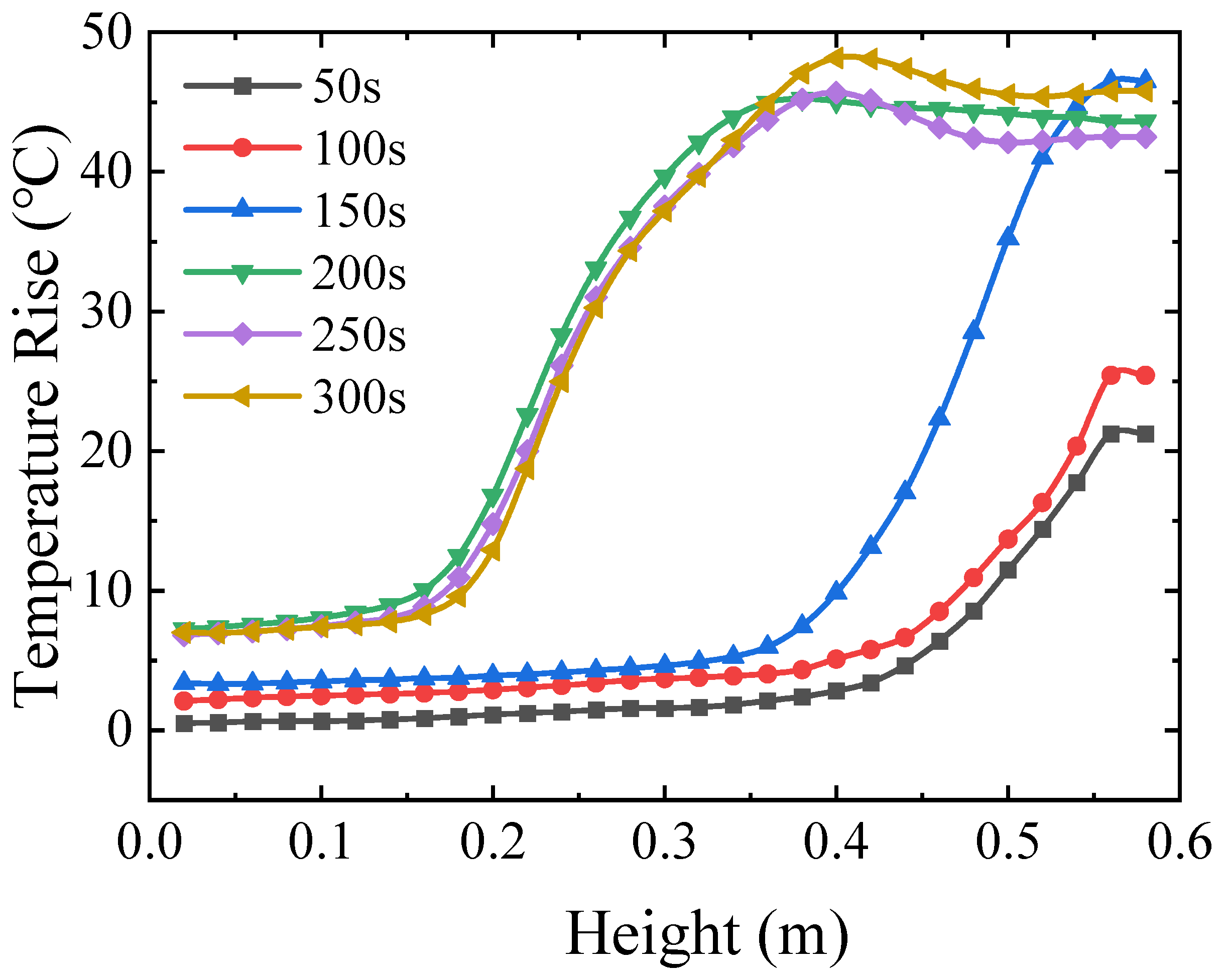
Figure 6 shows the time evolution of the vertical temperature-rise profiles at right landing I under concourse-only smoke exhaust with q1. The smoke-layer interface heights calculated by the total integral ratio method were 0.50, 0.52, 0.46, 0.22, 0.22, and 0.22 m at 50, 100, 150, 200, 250, and 300 s, respectively. At 50–150 s, the hot smoke layer was mainly confined to the upper part of landing I. Between 150 s and 200 s, the interface height decreased rapidly from 0.46 m to 0.22 m, indicating rapid smoke-layer descent and thickening. After 200 s, the interface height remained nearly unchanged, while the upper-layer temperature rise remained at approximately 42–48 °C. These results indicate that smoke first accumulated near the ceiling of landing I and then developed into a stable smoke layer, confirming that landing I is the first major smoke accumulation region after smoke enters the entrance passageway from the concourse.
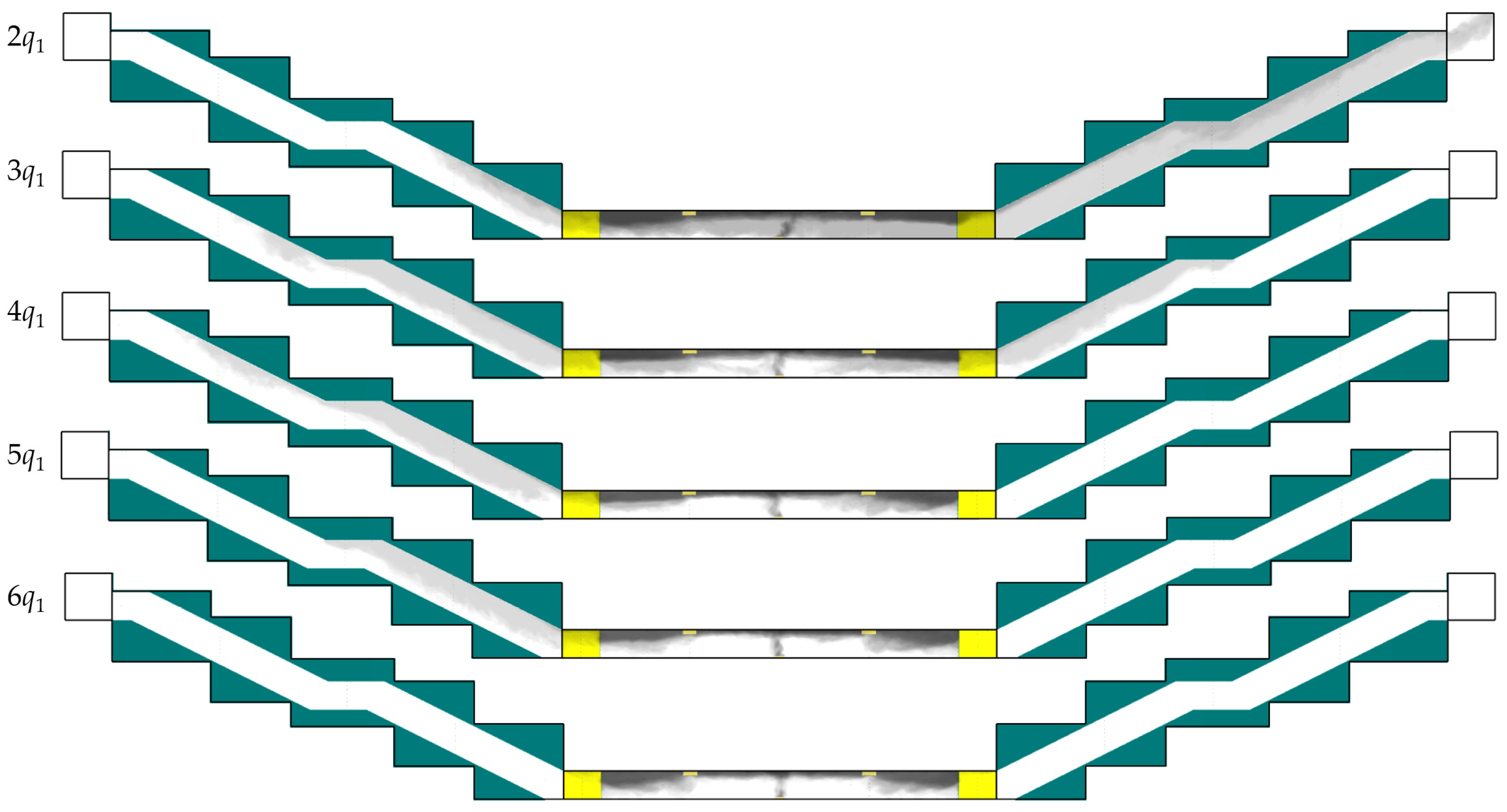
Increasing the concourse extraction rate reduced smoke overflow, but the required extraction capacity was much higher than the baseline value. Figure 7 compares the smoke distribution at 300 s in cases A1–A6, corresponding to concourse extraction rates from q1 to 6q1. When the concourse extraction rate was increased to 5q1, smoke still entered the entrance passageways. Smoke was nearly prevented from entering landing I only when the extraction rate reached 6q1, corresponding to 0.4296 m3/s. Under this condition, make-up airflow from the entrance passageways to the concourse was formed at both concourse openings, with average velocities of 0.517 m/s and 0.513 m/s at the left and right openings, respectively. This indicates that controlling smoke overflow by increasing the concourse extraction rate alone requires a substantially higher extraction capacity and a strong make-up air organization.
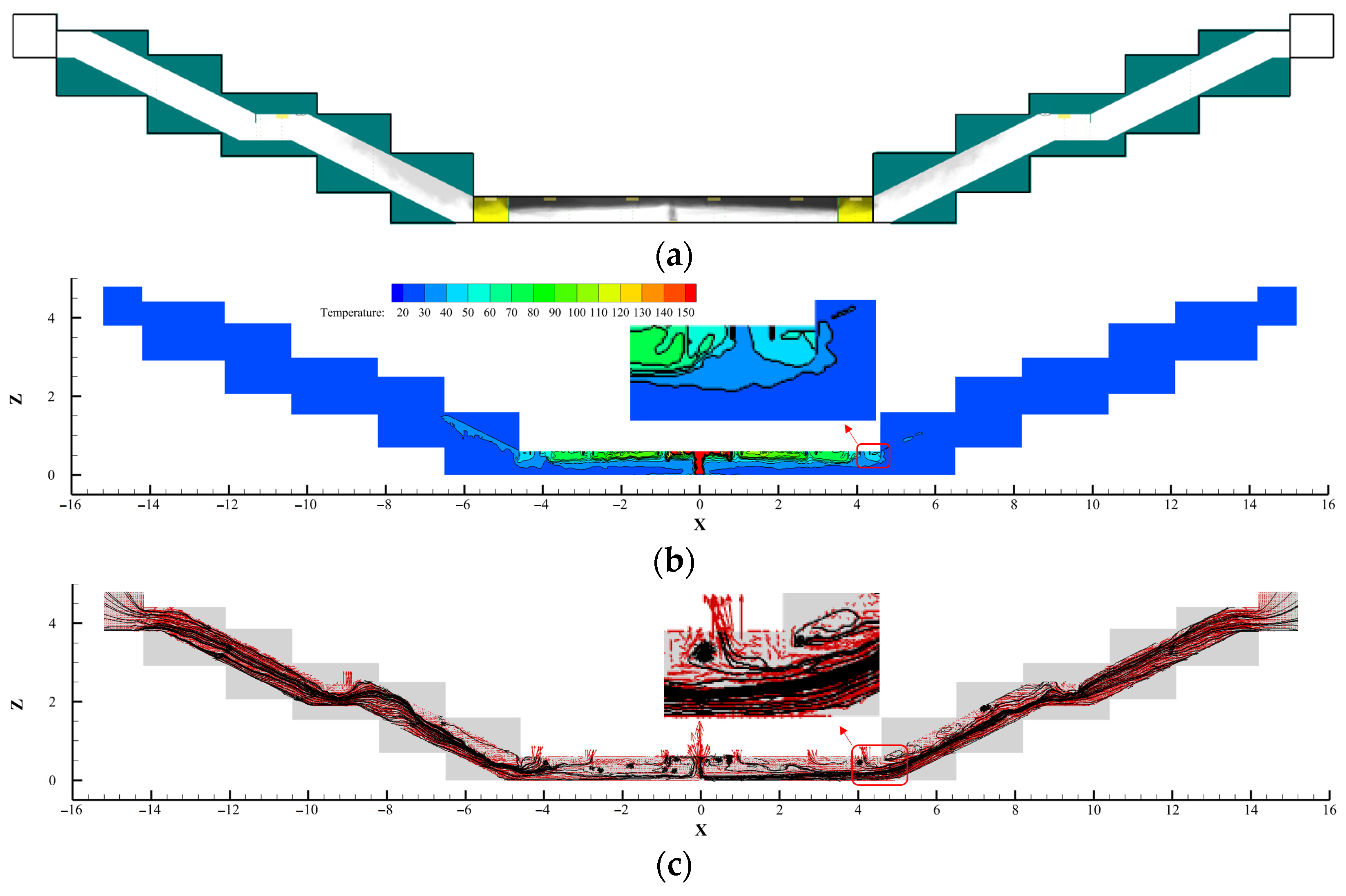
Conventional combined smoke exhaust did not stably prevent smoke from entering escalator section I. In this arrangement, exhaust vents were installed at both landing I and landing II, and the total extraction rate in each single-side passageway was q2. The two vents in each passageway each operated at an extraction rate of 0.5q2. In case B1, the exhaust vents at left and right landing I were activated first. The enlarged views in Figure 8 show that smoke crossed the landing I–escalator section I junction and entered escalator section I. Smoke was not confined to landing I. This result indicates that, when the total passageway extraction rate is fixed, distributing the extraction capacity between landing I and landing II does not ensure that smoke can be intercepted before entering escalator section I.
The right-offset fire source changed the smoke entry time and spread range in the two passageways. In case B2, smoke first entered right landing I and activated the right-side exhaust vents. Smoke then entered the left passageway and continued to spread to left landing I, left escalator section I, and left landing II. In contrast, smoke on the right side was mainly retained in landing I, which is more clearly shown in the enlarged views in Figure 9. This indicates that fire source location changes the flow distribution through the two concourse openings, leading to asymmetric smoke control performance under conventional combined smoke exhaust.
These results show that smoke control in long entrance passageways cannot rely simply on increasing the concourse extraction rate or adding passageway exhaust vents. After entering the passageway, smoke first accumulates in landing I and near the interface between landing I and escalator section I. If smoke is not intercepted and extracted in this region, it enters escalator section I and continues to move upward. Therefore, the following analysis focuses on whether near-source concentrated smoke exhaust at landing I can prevent smoke from entering escalator section I when the total extraction rate in a single-side passageway remains unchanged.

3.2. Control Mechanism of Near-Source Concentrated Smoke Exhaust at Landing I

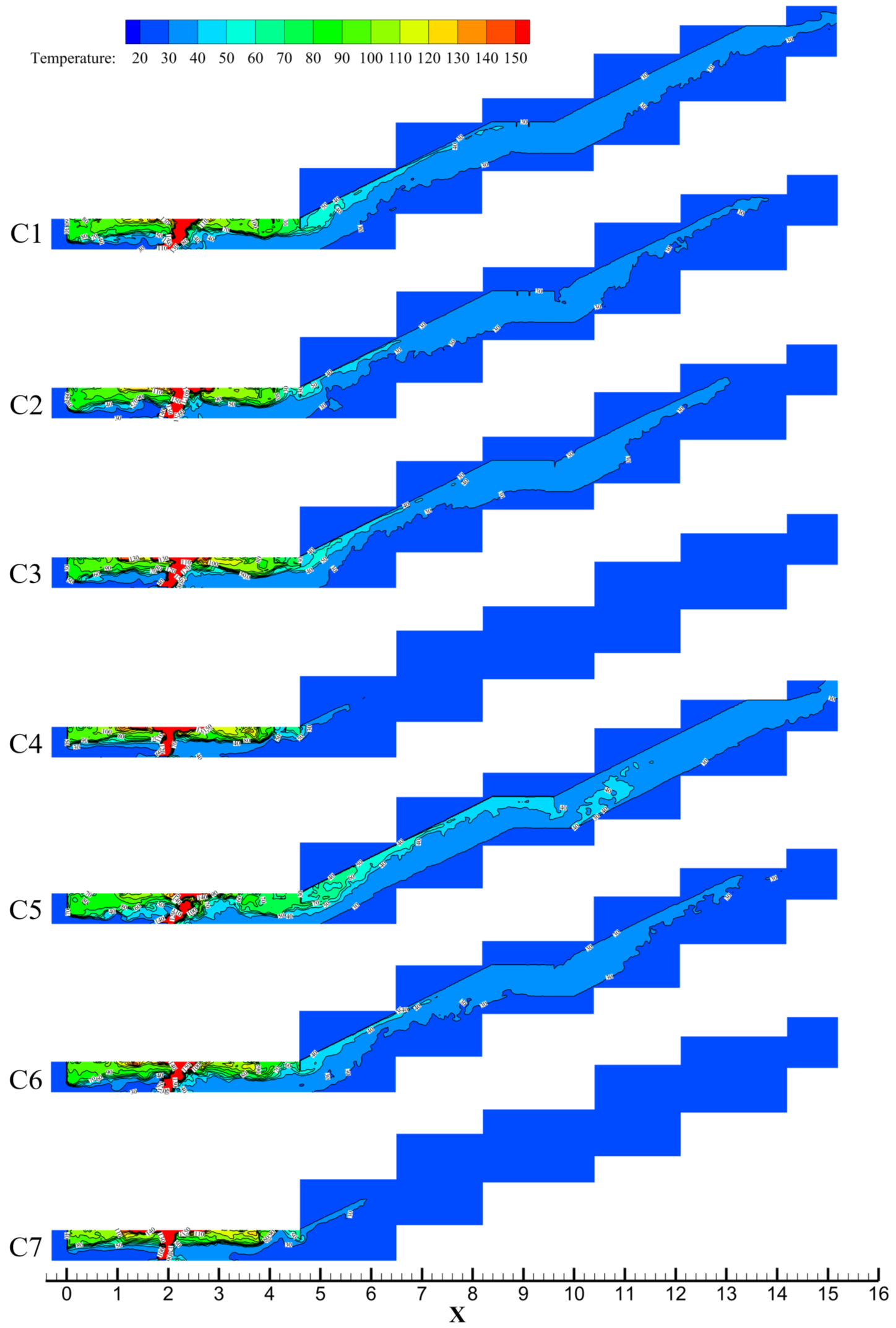
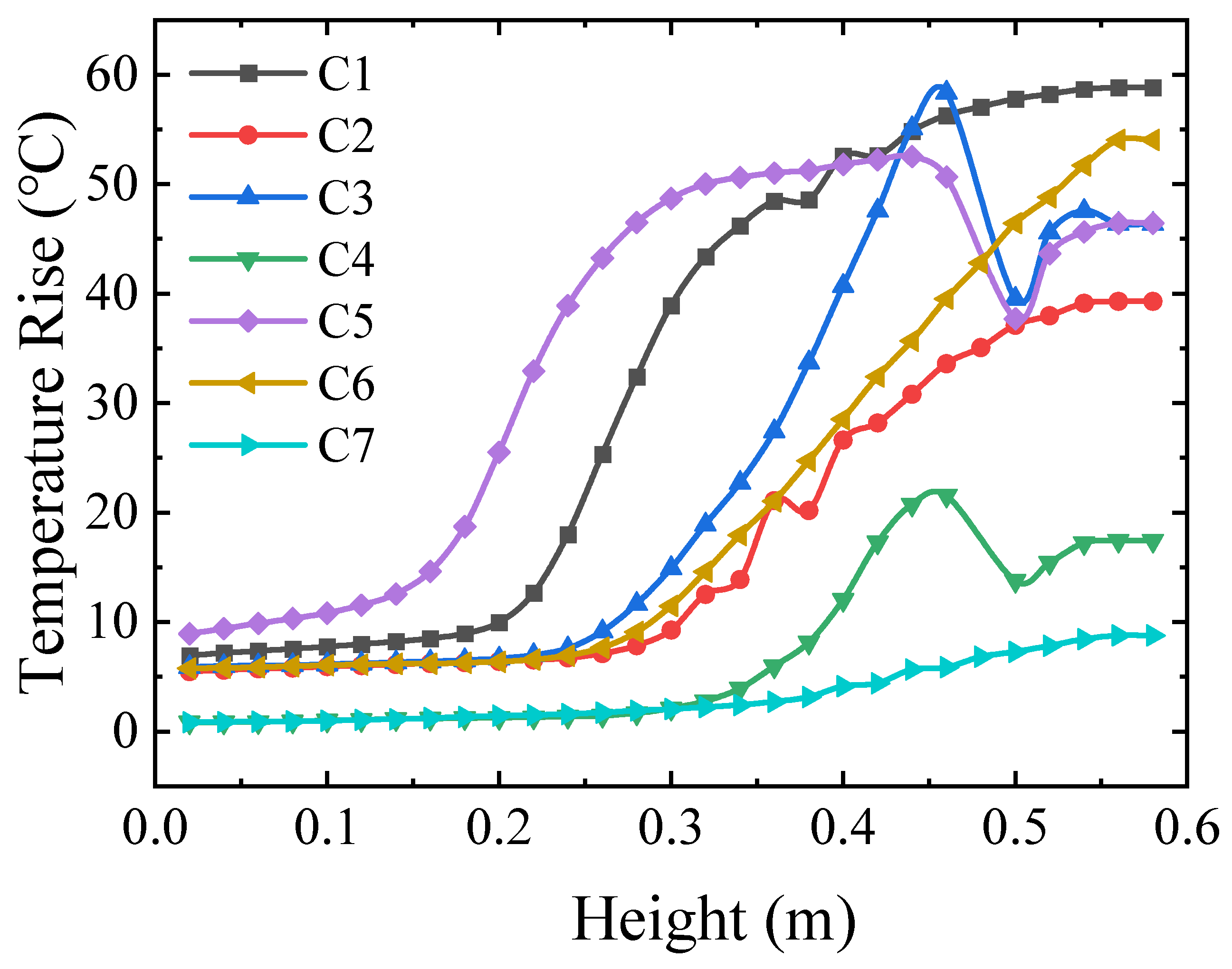
To analyze the effect of spatial allocation of extraction capacity on passageway smoke control, comparative simulations were conducted using the half-concourse–single entrance passageway model. The total extraction rate of the single-side passageway was kept at q2 in all cases, while only the allocation of extraction capacity, exhaust-vent opening configuration, and vent bottom height of V#5 and V#6 were changed. V#5 was located at landing I, and V#6 was located at landing II. Figure 10 shows the temperature distribution at 100 s for different cases. Figure 11 compares the vertical temperature-rise profiles along the centerline of V#5 at right landing I under cases C1–C7. Because the temperature tree was located at the centerline of the landing I exhaust vent, the profiles above the vent bottom height may be affected by local flow inside or near the exhaust vent. Therefore, the comparison mainly focuses on the temperature-rise distribution below and near the vent bottom height and the overall smoke accumulation state in landing I.
Under the same total extraction rate, vent location directly affected the smoke spread range. In C1, the extraction capacity was distributed between V#5 at landing I and V#6 at landing II. Although part of the extraction capacity was assigned to landing I, the elevated-temperature smoke layer still extended into the downstream landings, as shown in Figure 10. In C5, the entire passageway extraction rate was assigned to V#6 at landing II. Under this downstream exhaust condition, smoke accumulated in landing I before reaching the active exhaust vent and then continued to spread downstream. These results indicate that an exhaust vent located at landing II mainly removes smoke after it has already passed through the initial accumulation region and therefore cannot prevent smoke from entering escalator section I.
Near-source concentrated smoke exhaust at landing I more effectively limited smoke spread before smoke entered escalator section I. In C4 and C7, the entire passageway extraction rate was assigned to V#5. The elevated-temperature region was largely confined to landing I, and no obvious smoke extension into landing II or landing III was observed. This result shows that the key control factor is the match between the limited extraction capacity and the initial smoke accumulation region. Because landing I is located between the concourse opening and escalator section I, concentrating extraction at V#5 allows smoke to be intercepted before it enters the inclined escalator section.
The exhaust-vent opening configuration also affected the effective extraction state in landing I. C2 and C4 both used V#5 as the only passageway exhaust vent, with the same vent bottom height of 0.5 m. Compared with the bottom-opening vent in C2, the side-opening vent in C4 reduced the average smoke-layer temperature in landing I from 57.03 °C to 45.39 °C while maintaining the same average smoke layer thickness of 0.20 m. The corresponding temperature-rise profiles in Figure 11 show the same trend, indicating that the side-opening configuration was more effective in extracting the upper smoke layer and reducing ineffective entrainment of lower-temperature air.
The vent bottom height also influenced the local smoke-retention and extraction state. When the bottom-opening vent height increased from 0.5 m in C2 to 0.6 m in C7, the average smoke layer thickness and average smoke-layer temperature in landing I decreased to 0.17 m and 43.80 °C, respectively. A similar improvement was observed between the distributed exhaust cases C1 and C6. These results suggest that a higher vent position helps the exhaust opening act on the upper smoke layer more directly. However, this improvement was most effective when the extraction capacity was also concentrated at V#5 near the initial smoke accumulation region.
These results indicate that the main control principle is the forward shift of extraction and smoke-retention control from landing II to landing I. When V#5 is combined with a side-opening configuration and SC-R1, landing I can function as a local smoke-retention and extraction region before smoke enters right escalator section I. Therefore, the effectiveness of near-source concentrated smoke exhaust depends primarily on matching limited passageway extraction capacity with the first smoke accumulation region, rather than on increasing the number of active exhaust vents or distributing the same extraction capacity farther downstream.

3.3. Verification of the Optimized Combined Smoke Exhaust Strategy

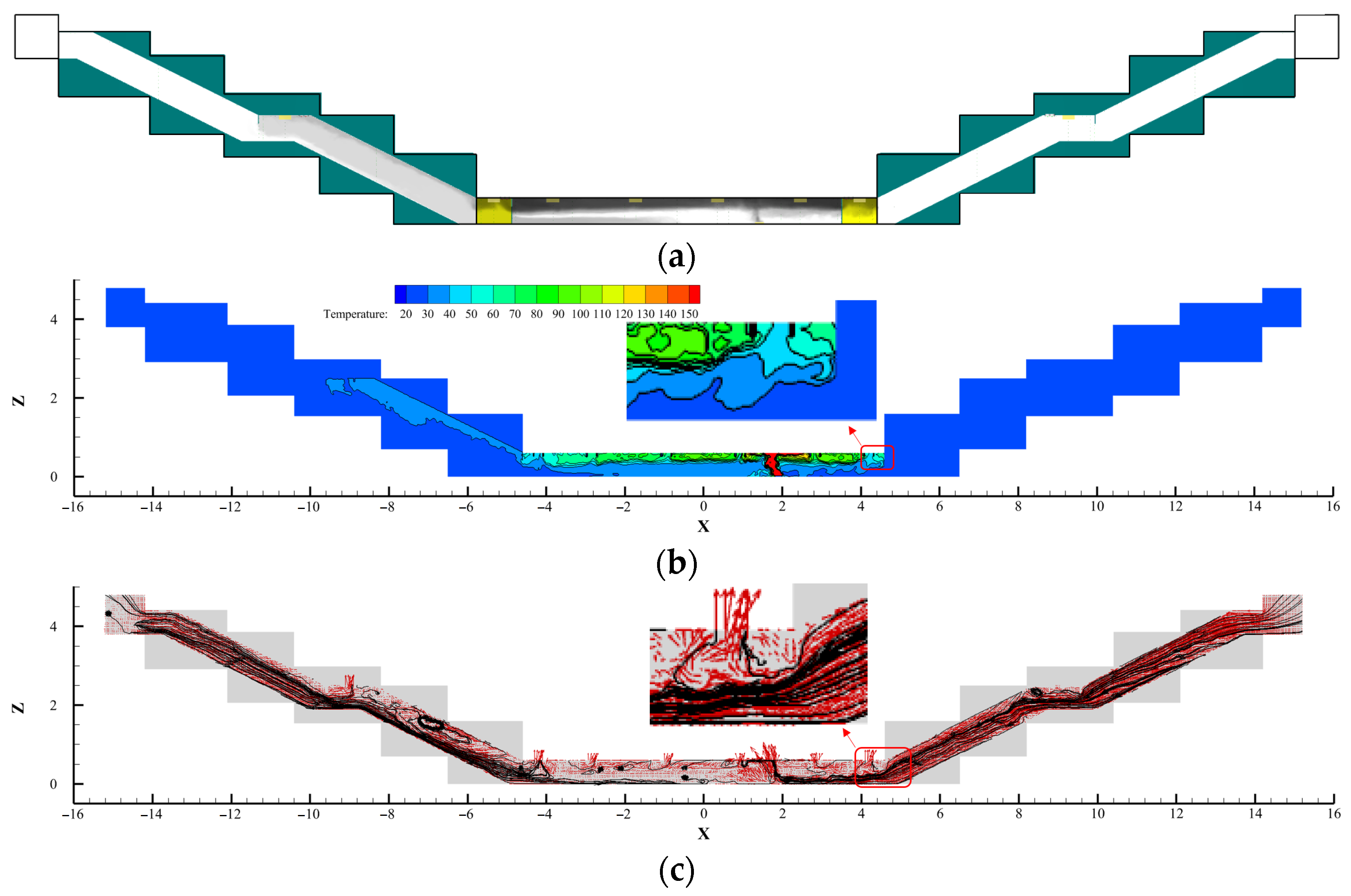
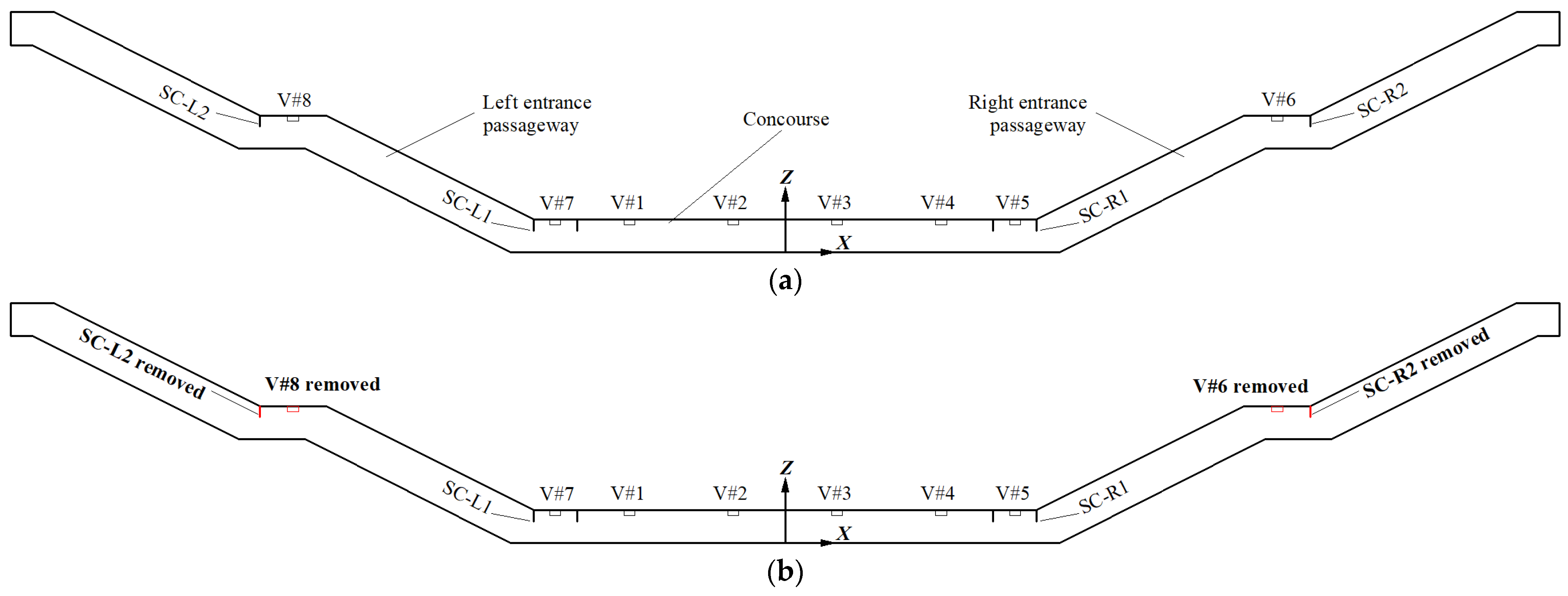
Cases D1 and D2 were used to verify whether the mechanism identified in the half-concourse model could also be maintained in the complete concourse–double entrance passageway model. As shown in Figure 12, the conventional arrangement distributed the passageway extraction capacity between landing I and landing II. In the optimized arrangement, V#6 and V#8 at landing II were removed, while V#5 and V#7 at landing I were retained and each operated at q2. SC-L2 and SC-R2 at the landing II–escalator section II junctions were also removed, while SC-L1 and SC-R1 at the landing I–escalator section I junctions were retained. The landing I vents used side-opening configurations. Therefore, the optimized arrangement shifted both extraction and smoke-retention control from landing II to landing I.
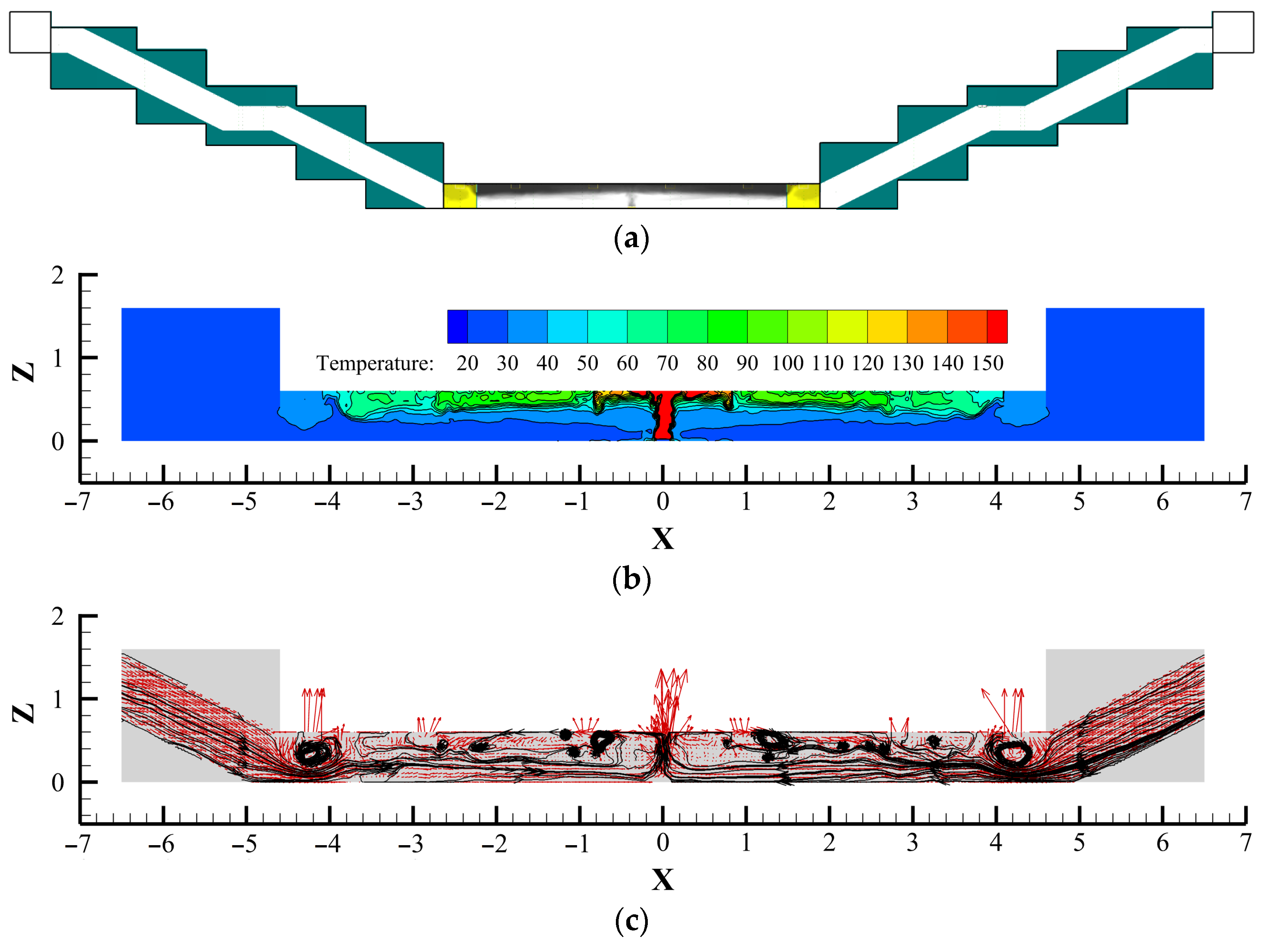
For the centered fire source, smoke entered left and right landing I at approximately 15 s and activated V#7 and V#5, respectively. As shown in Figure 13, smoke was confined to the two landing I regions and did not continue into escalator section I. This behavior differed from the conventional case B1, in which smoke reached left and right escalator section I at 50 s and 45 s, respectively. The farthest smoke-front coordinate was also reduced from −8.02 m and 7.62 m in B1 to −4.60 m and 4.60 m in D1, respectively, as listed in Table 2. These results show that, under symmetric smoke entry, concentrating the passageway extraction capacity at landing I blocked the spread path from landing I to escalator section I.
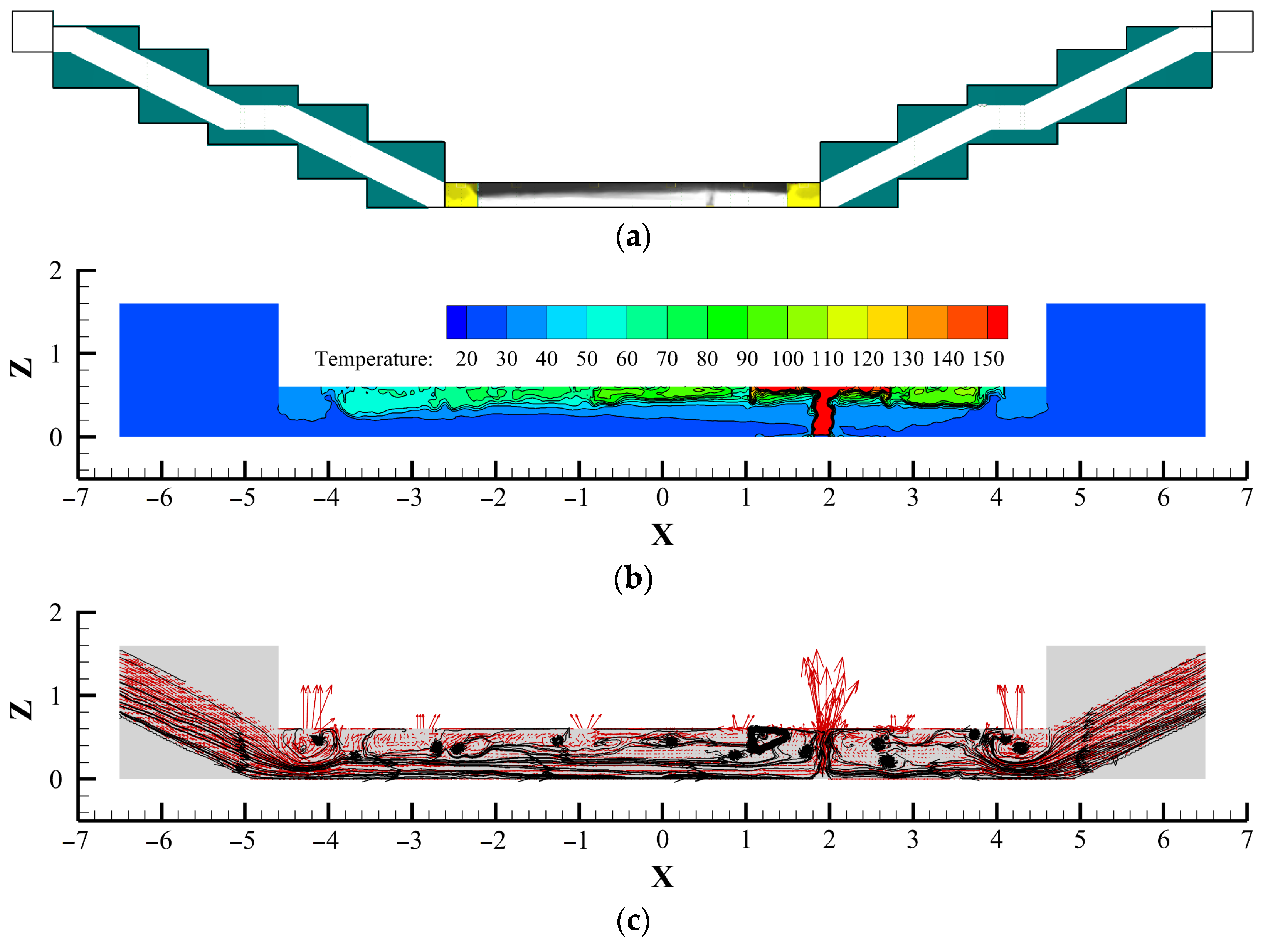
For the right-offset fire source, smoke entered the two passageways at different times. Smoke appeared in right landing I at approximately 9 s and activated V#5, whereas smoke appeared in left landing I at approximately 24 s and activated V#7. As shown in Figure 14, smoke was still confined to left and right landing I and did not continue into escalator section I on either side. In the conventional case B2, smoke spread asymmetrically: it reached left escalator section I at 47 s and left landing II at 122 s, but remained within right landing I and did not reach right escalator section I within the simulated period. Under the optimized arrangement, smoke did not reach escalator section I or landing II on either side. The farthest smoke-front coordinates were limited to −4.60 m and 4.60 m in D2, as shown in Table 2. These results indicate that the optimized arrangement still prevented smoke from entering escalator section I on either side, even under asymmetric smoke entry caused by the right-offset fire source.
Table 2 quantitatively compares the conventional and optimized combined smoke exhaust arrangements under the same concourse extraction rate and the same total extraction rate for each single-side passageway. For the centered fire source, smoke reached escalator section I on both sides in B1, whereas smoke did not reach escalator section I or landing II in D1. For the right-offset fire source, smoke reached left landing II in B2, whereas smoke was confined to landing I on both sides in D2. Although the optimized cases produced a thicker smoke layer in landing I than the conventional cases, the smoke-front penetration distance was shortened and the average smoke-layer temperature in landing I was reduced to approximately 32 °C. This indicates that the optimized arrangement changed the control state from downstream smoke spread to local smoke retention and extraction at landing I.
The improvement was mainly caused by the forward shift of the control position. In the conventional arrangement, part of the passageway extraction capacity was assigned to landing II, where the exhaust vent extracted smoke only after it had passed through landing I and entered the downstream passageway. In the optimized arrangement, the full single-side passageway extraction capacity was assigned to landing I, so that smoke extraction occurred before smoke entered escalator section I. The side-opening vents and smoke curtains further promoted local smoke retention and upper-layer extraction in landing I. Under the tested geometry, heat release rate, and extraction-rate conditions, this arrangement limited smoke spread before escalator section I without increasing the concourse extraction rate or the total passageway extraction rate. Its applicability should be further examined under different passageway slopes, elevation differences, fire sizes, and make-up air conditions.

4. Conclusions

This study examined smoke control after concourse fire smoke enters long entrance passageways. Smoke spread characteristics were compared under concourse-only smoke exhaust, conventional combined smoke exhaust, and near-source concentrated smoke exhaust at landing I. The effects of vent location, exhaust-vent opening configuration, vent bottom height, and smoke curtains on passageway smoke control were analyzed. The main conclusions are as follows.
(1)
The baseline concourse extraction rate was insufficient to prevent smoke from entering the long entrance passageways. At a heat release rate of 15.55 kW, smoke entered landing I through the two concourse openings and continued to spread into escalator section I when the concourse extraction rate was q1. Smoke was nearly prevented from entering landing I only when the concourse extraction rate was increased to 6q1. This indicates that relying only on concourse extraction requires a large increase in extraction capacity and sufficient make-up airflow from the passageways to the concourse.
(2)
For the tested entrance-passageway geometry, landing I was the key region for limiting smoke spread before smoke entered escalator section I. When the total extraction rate of a single-side passageway was kept at q2, concentrating the extraction capacity at landing I more effectively limited smoke spread toward escalator section I than distributed extraction between landing I and landing II or downstream extraction at landing II. Shifting the extraction capacity forward to landing I allowed smoke to be intercepted and extracted before entering escalator section I, thereby limiting its spread toward the downstream landings.
(3)
Near-source concentrated smoke exhaust at landing I, combined with smoke curtains, can form a local smoke-retention and extraction region. Side-opening exhaust vents and higher vent positions improved extraction of the upper smoke layer and reduced ineffective entrainment of lower-temperature air. Under the present model geometry, heat release rate, and extraction-rate conditions, the optimized combined smoke exhaust arrangement prevented smoke from entering escalator section I under both centered and right-offset fire-source conditions.

Author Contributions

Conceptualization, B.L. and T.S.; methodology, B.L.; investigation, B.L.; formal analysis, B.L. and T.S.; data curation, B.L. and Z.X.; visualization, T.Z.; validation, T.Z.; writing—original draft preparation, B.L.; writing—review and editing, T.Z. and Z.X.; funding acquisition, B.L. All authors have read and agreed to the published version of the manuscript.

Funding

This research was funded by the Scientific and Technological Research Program of Chongqing Municipal Education Commission, grant number KJQN202403208, and the Doctoral Fund of Chongqing Industry Polytechnic University, grant number 2024GZYBSZK1-08.

Data Availability Statement

The raw data supporting the conclusions of this article will be made available by the authors on request.

Conflicts of Interest

Authors Tao Zhang and Zheng Xiao were employed by the China Coal Technology and Engineering Group Chongqing Research Institute. The remaining authors declare that the research was conducted in the absence of any commercial or financial relationships that could be construed as a potential conflict of interest.

References

  1. Chen, F.; Guo, S.C.; Chuay, H.Y.; Chien, S.W. Smoke control of fires in subway stations. Theor. Comput. Fluid Dyn. 2003, 16, 349–368. [Google Scholar] [CrossRef]
  2. Chen, F.; Chien, S.W.; Jang, H.M.; Chang, W.J. Stack effects on smoke propagation in subway stations. Contin. Mech. Thermodyn. 2003, 15, 425–440. [Google Scholar] [CrossRef]
  3. Park, W.H.; Kim, D.H.; Chang, H.C. Numerical predictions of smoke movement in a subway station under ventilation. Tunn. Undergr. Space Technol. 2006, 21, 304. [Google Scholar] [CrossRef]
  4. Roh, J.S.; Ryou, H.S.; Park, W.H.; Jang, Y.J. CFD simulation and assessment of life safety in a subway train fire. Tunn. Undergr. Space Technol. 2009, 24, 447–453. [Google Scholar] [CrossRef]
  5. Li, Z.; Yang, H.; Weng, M.; Liu, F. Prediction of smoke backflow length and smoke outflow rate in subway station passageways under weak stack effect. Case Stud. Therm. Eng. 2025, 76, 107339. [Google Scholar] [CrossRef]
  6. Long, Z.; Liu, C.; Yang, Y.; Qiu, P.; Tian, X.; Zhong, M. Full-scale experimental study on fire-induced smoke movement and control in an underground double-island subway station. Tunn. Undergr. Space Technol. 2020, 103, 103508. [Google Scholar] [CrossRef]
  7. Li, J.; Li, Y.; Li, J.; Li, X.; Huang, Y. Study on smoke control under mechanical exhaust strategy in a cross-type interchange subway station. Tunn. Undergr. Space Technol. 2021, 112, 103897. [Google Scholar] [CrossRef]
  8. Wang, K.; Cai, W.; Zhang, Y.; Hao, H.; Wang, Z. Numerical simulation of fire smoke control methods in subway stations and collaborative control system for emergency rescue. Process Saf. Environ. Prot. 2021, 147, 146–161. [Google Scholar] [CrossRef]
  9. Long, Z.; Zhong, M.; Chen, J.; Cheng, H. Study on emergency ventilation strategies for various fire scenarios in a double-island subway station. J. Wind Eng. Ind. Aerodyn. 2023, 235, 105364. [Google Scholar] [CrossRef]
  10. Gao, R.; Li, A.; Hao, X.; Lei, W.; Zhao, Y.; Deng, B. Fire-induced smoke control via hybrid ventilation in a huge transit terminal subway station. Energy Build. 2012, 45, 280–289. [Google Scholar] [CrossRef]
  11. Faugier, L.; Marinus, B.G.; Bosschaerts, W.; Laboureur, D.; Limam, K. CFD model for airflow in a subway station compared to on-site measurements: The challenges of as-built environment. Tunn. Undergr. Space Technol. 2023, 140, 105248. [Google Scholar] [CrossRef]
  12. Shi, C.; Li, J.; Xu, X. Full-scale tests on smoke temperature distribution in long-large subway tunnels with longitudinal mechanical ventilation. Tunn. Undergr. Space Technol. 2021, 109, 103784. [Google Scholar] [CrossRef]
  13. Chen, J.; Li, G.; Pan, R.; Long, Z.; Zhong, M. Numerical study on the airflow characteristics and smoke control condition in stair area of subway stations. J. Build. Eng. 2024, 84, 108577. [Google Scholar] [CrossRef]
  14. Zhang, T.; Han, R. Numerical study on the influence of subway platform air curtains on smoke diffusion. Case Stud. Therm. Eng. 2023, 50, 103439. [Google Scholar] [CrossRef]
  15. Li, D.; Zhu, G. Effect of platform screen doors on mechanical smoke exhaust in subway station fire. Procedia Eng. 2018, 211, 343–352. [Google Scholar] [CrossRef]
  16. Chen, J.; Long, Z.; Liu, C.; Cai, S.; Xu, B.; Cheng, H.; Zhong, M. Investigation of the performance of lateral ventilation in subway station fires. J. Wind Eng. Ind. Aerodyn. 2022, 228, 105133. [Google Scholar] [CrossRef]
  17. Zhong, W.; Sun, C.; Bian, H.; Gao, Z.; Zhao, J. The plug-holing of lateral mechanical exhaust in subway station: Phenomena, analysis, and numerical verification. Tunn. Undergr. Space Technol. 2021, 112, 103914. [Google Scholar] [CrossRef]
  18. Liu, Q.; Xu, Z.; Fan, C.; Zhang, X.; Zhao, J.; Ying, H.; Tao, H. A multi-scale experiment analysis of air entrainment and heat exhaust coefficient under lateral smoke exhaust in tunnel fires. Tunn. Undergr. Space Technol. 2023, 140, 105239. [Google Scholar] [CrossRef]
  19. Chen, J.; Yang, D.; Zhong, M.; Hua, F. Numerical study on ventilation duct layout in subway stations for smoke control performance optimization. J. Wind Eng. Ind. Aerodyn. 2025, 258, 106039. [Google Scholar] [CrossRef]
  20. Hu, L.H.; Li, Y.Z.; Huo, R.; Yi, L.; Chow, W.K. Full-scale experimental studies on mechanical smoke exhaust efficiency in an underground corridor. Build. Environ. 2006, 41, 1622–1630. [Google Scholar] [CrossRef]
  21. Gutiérrez-Montes, C.; Sanmiguel-Rojas, E.; Viedma, A. Influence of different make-up air configurations on the fire-induced conditions in an atrium. Build. Environ. 2010, 45, 2458–2472. [Google Scholar] [CrossRef]
  22. Chen, J.; Liu, J.; Tian, X.; Zhang, L.; Cheng, H.; Zhong, M. Study on the effect of obstacles on smoke diffusion and airflow structure in subway stations. Build. Environ. 2023, 242, 110553. [Google Scholar] [CrossRef]
  23. McGrattan, K.; Hostikka, S.; McDermott, R.; Floyd, J.; Weinschenk, C.; Overholt, K. Fire Dynamics Simulator User’s Guide, 6th ed.; NIST Special Publication 1019; National Institute of Standards and Technology: Gaithersburg, MD, USA; VTT Technical Research Centre of Finland: Espoo, Finland, 2017. [Google Scholar]
  24. Ingason, H.; Li, Y.Z. Model scale tunnel fire tests with longitudinal ventilation. Fire Saf. J. 2010, 45, 371–384. [Google Scholar] [CrossRef]
  25. GB 51298-2018; Standard for Fire Protection Design of Metro. Ministry of Housing and Urban-Rural Development of the People’s Republic of China: Beijing, China; China Planning Press: Beijing, China, 2018.
Figure 1. Complete concourse–double entrance passageway model, fire-source locations, and smoke-control component layout: (a) front view; (b) top view.
Processes 14 01878 g001
Figure 2. Half-concourse–single entrance passageway model: (a) front view; (b) top view.
Processes 14 01878 g002
Figure 3. Grid sensitivity analysis based on vertical temperature-rise profiles at x = −3 m along the concourse centerline.
Processes 14 01878 g003
Figure 4. Comparison between simulated and measured vertical temperature-rise profiles for the F3 fire-source location under the no-obstacle condition reported by Chen et al. [22]: (a) 0.25 m from the fire source; (b) 0.75 m from the fire source.
Processes 14 01878 g004
Figure 5. Smoke spread into the long entrance passageways under concourse-only smoke exhaust in case A1.
Processes 14 01878 g005
Figure 6. Time evolution of vertical temperature-rise profiles at right landing I under concourse-only smoke exhaust with q1.
Processes 14 01878 g006
Figure 7. Smoke distribution at 300 s under different concourse extraction rates in cases A1–A6.
Processes 14 01878 g007
Figure 8. Stable-stage results under conventional combined smoke exhaust with a centered fire source in case B1: (a) smoke distribution; (b) temperature field; (c) streamlines.
Processes 14 01878 g008
Figure 9. Stable-stage results under conventional combined smoke exhaust with a right-offset fire source in case B2: (a) smoke distribution; (b) temperature field; (c) streamlines.
Processes 14 01878 g009
Figure 10. Temperature distribution at 100 s under different passageway exhaust vent configurations.
Processes 14 01878 g010
Figure 11. Vertical temperature-rise profiles along the centerline of V#5 at right landing I under cases C1–C7 at 100 s.
Processes 14 01878 g011
Figure 12. Comparison between conventional and optimized combined smoke exhaust arrangements: (a) conventional; (b) optimized.
Processes 14 01878 g012
Figure 13. Stable smoke control performance under optimized combined smoke exhaust with a centered fire source in case D1: (a) smoke distribution; (b) temperature field; (c) streamlines.
Processes 14 01878 g013
Figure 14. Stable smoke control performance under optimized combined smoke exhaust with a right-offset fire source in case D2: (a) smoke distribution; (b) temperature field; (c) streamlines.
Processes 14 01878 g014
Table 1. Summary of simulation cases.
Case IDModelFire
Location
Concourse Exhaust ConfigurationPassageway Exhaust ConfigurationPassageway Vent Type and hbSmoke Curtain Condition
A1–A6Complete modelF-CV#1–V#4; total extraction rate: q1, 2q1, 3q1, 4q1, 5q1, 6q1NoneNone in passageways
B1–B2Complete modelF-C, F-RV#1–V#4; total extraction rate: q1V#5, V#6, V#7, and V#8; each vent: 0.5 q2BO, hb = 0.5 mSC-L1, SC-L2, SC-R1, and SC-R2
C1Half modelF-RV#3 and V#4; each vent: 0.25 q1V#5 and V#6; each vent: 0.5 q2BO, hb = 0.5 mSC-R1 and SC-R2
C2Half modelF-RV#3 and V#4; each vent: 0.25 q1V#5 only; q2BO, hb = 0.5 mSC-R1 and SC-R2
C3Half modelF-RV#3 and V#4; each vent: 0.25 q1V#5 and V#6; each vent: 0.5 q2SO, hb = 0.5 mSC-R1 and SC-R2
C4Half modelF-RV#3 and V#4; each vent: 0.25 q1V#5 only; q2SO, hb = 0.5 mSC-R1 and SC-R2
C5Half modelF-RV#3 and V#4; each vent: 0.25 q1V#6 only; q2SO, hb = 0.5 mSC-R1 and SC-R2
C6Half modelF-RV#3 and V#4; each vent: 0.25 q1V#5 and V#6; each vent: 0.5 q2BO, hb = 0.6 mSC-R1 and SC-R2
C7Half modelF-RV#3 and V#4; each vent: 0.25 q1V#5 only; q2BO, hb = 0.6 mSC-R1 and SC-R2
D1–D2Complete modelF-C, F-RV#1–V#4; total extraction rate: q1V#5 and V#7; each vent: q2SO, hb = 0.5 mSC-L1 and SC-R1 retained; SC-L2 and SC-R2 removed
Note: A1–A6 correspond to concourse extraction rates of q1, 2q1, 3q1, 4q1, 5q1, and 6q1, respectively. B1 and D1 use the centered fire-source location F-C, whereas B2 and D2 use the right-offset fire-source location F-R. BO and SO denote bottom-opening and side-opening vents, respectively. hb denotes the vent bottom height.
Table 2. Quantitative comparison between conventional and optimized combined smoke exhaust arrangements under the same extraction rates.
CaseFire-Source LocationPassageway SideArrangementtL-I
(s)
tES-I
(s)
tL-II
(s)
Lp
(m)
δs,avg,I
(m)
Tavg,I
(°C)
B1F-CLeftConventional1450NR−8.020.2540.55
B1F-CRightConventional1545NR7.620.3541.26
D1F-CLeftOptimized15NRNR−4.600.4231.68
D1F-CRightOptimized15NRNR4.600.4131.88
B2F-RLeftConventional2247122−9.600.2842.72
B2F-RRightConventional9NRNR4.600.3847.24
D2F-RLeftOptimized24NRNR−4.600.4031.80
D2F-RRightOptimized9NRNR4.600.4032.19
Note: tL-I, tES-I, and tL-II denote the smoke arrival times at landing I, escalator section I, and landing II, respectively. Lp denotes farthest x-coordinate reached by the smoke front within the simulated period. δs,avg,I and Tavg,I denote the average smoke layer thickness and average smoke-layer temperature in landing I during the stable stage, respectively. NR indicates that smoke did not reach the corresponding region within the simulated period.
Disclaimer/Publisher’s Note: The statements, opinions and data contained in all publications are solely those of the individual author(s) and contributor(s) and not of MDPI and/or the editor(s). MDPI and/or the editor(s) disclaim responsibility for any injury to people or property resulting from any ideas, methods, instructions or products referred to in the content.