Article

Optimal Geomechanical Parameter Selection for Enhanced ROP Modeling: A Systematic Field-Based Comparative Study

by
Ahmed S. Alhalboosi
,
Musaed N. J. AlAwad
,
Faisal S. Altawati
,
Mohammed A. Khamis
* and
Mohammed A. Almobarky
Department of Petroleum and Natural Gas Engineering, College of Engineering, King Saud University, Riyadh P.O. Box 800, Saudi Arabia
*
Author to whom correspondence should be addressed.
Processes 2026, 14(10), 1646; https://doi.org/10.3390/pr14101646 (registering DOI)
Submission received: 28 March 2026 / Revised: 1 May 2026 / Accepted: 11 May 2026 / Published: 19 May 2026
(This article belongs to the Special Issue Development of Advanced Drilling Engineering)

Abstract

Accurate prediction of Rate of Penetration (ROP) in carbonate formations remains constrained by the arbitrary selection of geomechanical input parameters in empirical drilling models. This study presents the first systematic field-based evaluation of sixteen geomechanical properties—grouped into three categories: strength parameters (uniaxial compressive strength (UCS), confined compressive strength (CCS), shear strength, thick-walled cylinder strength (TWC), friction angle, and cohesion), elastic moduli (Young’s modulus, shear modulus, bulk modulus, bulk compressibility, dynamic combined modulus (DCM), Poisson’s ratio, brittleness index), and in situ stress parameters (overburden pressure, minimum, and maximum horizontal stresses)—to identify optimal predictors for ROP modeling across PDC bit sizes of 12.25″ and 8.5″. Continuous wireline log data from two vertical carbonate wells in the Middle East (Well A: 1000–3370 m; Well B: 1945 to 3128 m; total intervals of 2370 m and 1183 m, respectively) penetrating formations comprising limestone, dolomite, sandstone, shale, anhydrite, and marly limestone were used. All sixteen geomechanical properties were computed using Interactive Petrophysics (IP) software with lithology-specific empirical correlations and validated against laboratory core measurements (R2 = 0.79–0.95). Pearson and Spearman correlation analyses quantified parameter–ROP relationships, and the Al-Abduljabbar empirical model, recalibrated via multiple nonlinear regression, served as the evaluation framework. DCM consistently exhibited the strongest negative correlation with ROP across both bit sizes and achieved the highest model accuracy (R2 = 0.54, AAPE = 25.33%), significantly outperforming the Bourgoyne and Young model (R2 = 0.26, AAPE = 36.55%). A statistically validated scale-dependent effect was identified: Fisher’s Z-transformation tests confirmed that the correlation reversal between CCS and UCS across bit sizes is statistically significant (CCS: Z = −16.84, p < 0.001; UCS: Z = −6.75, p < 0.001), establishing CCS as the superior predictor at 12.25″ and UCS as the superior predictor at 8.5″—a finding not previously reported in the ROP literature. This reversal is attributed to the larger contact area of the 12.25″ bit, which promotes confinement-dominated rock failure better described by CCS, whereas the smaller bit produces localized stress concentration better represented by UCS. These results establish that (1) optimal geomechanical input selection is bit-size dependent, (2) nonlinear modeling outperforms linear frameworks for strength–ROP relationships, and (3) parameter relevance outweighs coefficient tuning in model robustness. DCM is recommended as the most operationally practical universal input, requiring only conventional compressional sonic and density logs. This study provides a systematic framework for geomechanical parameter selection with direct implications for drilling optimization in heterogeneous carbonate reservoirs.

1. Introduction

Rock drilling is a costly operation used in mining, petroleum, and civil and underground excavation. The drilling process is an essential task as it determines the economic success or failure of operations [1]. In this context, drilling performance assessment must be taken into account when evaluating project feasibility and economics [2].
Drilling is one of the most essential operations in the resource industry, starting from the exploration phase and continuing throughout all the stages of production process to the end of the mine life. Predicting the drillability of rocks is fundamental for efficient planning and operating of the drilling process. Several factors can affect drilling. Among these factors, the most important are the geological and mechanical properties of the formation to be drilled [3,4,5].
Penetration rate is an important factor for project planning and cost calculations. Estimating the drillability value affects the correct choice of drilling equipment and project cost. Drillability is influenced by many controllable and uncontrollable parameters [6].
Drillability is defined as the ability to penetrate the drill bit at a certain time in the rock. Penetration rate is the progression of the drilling bit into the rock in a certain period of time, which is generally expressed as “m/min.” The penetrability of a rock can be defined in numerous ways, such as the penetration rate of the drill bit and the specific energy spent in the drilling operation. Drillability and penetration rate can be considered as similar terms. While the drillability indicates whether the penetration is easy or hard, the penetration rate indicates whether it is fast or slow [7].
Knowledge of rock’s behavior helps in planning efficient drilling operations. The more accurate information available during site investigation, the more efficient the prediction of potential challenges during project implementation [8].
Geomechanics properties have been successfully applied to overcome drilling problems and improve efficiency in the petroleum industry by evaluating mechanical behavior of reservoir rock through mechanical earth models (MEMs) [9,10].
The mechanical properties of rocks are important in drilling operations such as prediction of fracture zone, wellbore stability, and other drilling engineering aspects [11].
An accurate estimation of the drilling rate (ROP) helps to make the planning of the rock excavation (well drilling) projects more effective. The drillability of the rocks is mainly based on operational variables and rock characteristics. Operational variables known as the controllable parameters are rotational speed (RPM), thrust (weight-on-bit, WOB), blow frequency, and flushing (mud circulation rate). Rock properties, in situ stresses, and geological conditions are the uncontrollable characteristics Kahraman et al. [12].
The operational parameters include the drilling method, bit types and shapes, and the technical aspects of the drilling rig used. The geotechnical parameters influence the drilling performance and the wear of bits and include the condition and structure of rock mass and mechanical behavior and mineral composition of rock materials (rock strength). Therefore, when evaluating a rock mass from the perspective of its penetrability, qualitative and quantitative effects of the most important drilling parameters must be examined [13].
A fundamental yet unresolved challenge in rate of penetration (ROP) modeling is the arbitrary and inconsistent selection of geomechanical input parameters. Despite decades of research spanning theoretical, statistical, empirical, and AI-driven approaches, no prior study has systematically compared the predictive value of all available geomechanical parameters or investigated whether the optimal parameter changes with bit size. The following review section documents this gap across the literature evolution of ROP models.
Many researchers have examined the penetration rate relationship with rock properties. Cunningham [14], Walker et al. [15], and Warren [16,17] were the first to experimentally prove that the ROP depends on the WOB, RPM, compressive strength, and pore pressure, among other parameters. Warren [17] proposed a torque model and validated it using laboratory experiments and field data. The Warren’s model included bit hydraulic, fluid type, and formation type. These early approaches, however, did not explicitly consider what we presently know as rock strength (e.g., unconfined compressive strength (UCS) and confined compressive strength (CCS)) and were rather focused on the formation properties [18].
Al-Betairi et al. [19] introduced a model where multiple regression analysis was applied to adjust the drilling parameters based on formation properties. The model addressed optimum ROP, WOB, and RPM. By considering Warren’s formula, Hareland and Hoberock [20] presented an equation for predicting the ROP based on the CCS, in situ stress, WOB, and RPM.
Pandey et al. [21] investigated the correlation between penetration rate values obtained from micro-bit drilling tests and compressive strength, tensile strength, and shear strength, and the Protodyakonov strength index was found to be a logarithmic relationship. Altindag [22] demonstrated that the penetration rate was closely related to rock brittleness. Bilgin and Kahraman [23] correlated the UCS, point load strength, Schmidt hammer (SH) value, and Cerchar hardness. Kahraman, Bilgin, and Feridunoglu [12] carried out a detailed investigation of the rock properties affecting penetration rate of percussive drills. In their study, they correlated penetration rate to rock properties and found UCS, tensile strength, point load strength, and Schmidt hammer values to be the dominant rock properties for penetration rates of percussive drills. Judzis et al. [24] performed a full-scale test at bottom-hole pressure (>10,000 psi), and the results revealed the effect of CCS on the Polycrystalline Diamond Compact (PDC) and roller-cone bits. Yenice et al. [25] correlated drilling rate index (DRI) with mechanical rock properties of marble samples and determined a strong connection between DRI and UCS, tensile strength, and specific destruction energy. Prasad [26] focused on the rock mechanical properties and changed different drilling parameters to analyze their effects on the ROP. Their study results showed that the largest impacts were those of UCS and tensile strength of the rock and the WOB. Yaşar et al. [27] conducted a laboratory study on cement mortar samples to investigate the influence of operational parameters on rock drillability. The authors observed strong correlations between penetration rates, specific energies, and UCSs of the samples. Cheniany, Hasan, Shahriar, and Khademi Hamidi [6] proposed a model called the Specific Rock Mass Drillability (SRMD) index for predicting the penetration rate of rotary drills. They correlated SRMD with various rock properties and concluded UCS and SH values as the most significant factors. Yarali and Soyer [28] Examined the relationship between the DRI and various rock properties and found a decrease in linear relationships between the DRI and UCS, SH, Shore scleroscope hardness, and point load strength. Li et al. [29] investigated the correlation between rock drillability and mechanical properties under various pressure conditions to improve drilling safety and efficiency. The study measured compressive strength, elastic modulus, and Poisson’s ratio under uniaxial (0 MPa), 30 MPa, and 60 MPa confining pressures. They utilized Rollow’s microbit technique to obtain drillability numbers and then conducted a regression analysis. The researchers observed that the correlation between drillability grade (DG) and rock mechanical properties increased as confining pressure increased. The best correlation was between DG and compressive strength under varying confined pressures, compared to the correlation between DG and elastic modulus or Poisson’s ratio under uniaxial conditions. Li et al. [30] studied the impact of horizontal and vertical stresses on a PDC cutter that was superior to that of horizontal stress, as they studied the effects of vertical and horizontal stresses. Kolapo [31] examined the effect of rock mechanical properties on drilling performance using samples from Abuja, Nigeria. Point load tests were used to estimate the UCS and tensile strength, which were then correlated with penetration rate and specific energy. The study concluded that penetration rate decreases as UCS and tensile strength increase, while specific energy increases with increasing rock strength. The author also stated that pre-existing fractures in granite reduced strength, enhancing drillability, and reducing energy demand. Delavar, Ramezanzadeh, and Tokhmechi [18] studied the intricate correlations between geomechanical properties of rock and drilling parameters in carbonate reservoirs. They used advanced artificial intelligence methods (a Bayesian Network with the K2 algorithm and a Multilayer Perceptron (MLP) Artificial Neural Network) to examine the relationship between geomechanical properties such as UCS, internal friction angle, and vertical effective stress with drilling parameters such as rate of penetration (ROP), (WOB), and torque using a 1-D geomechanical model. Their results confirmed that UCS directly affects ROP, but they stated that the internal friction angle and vertically effective stress have a major impact on WOB and torque. The study ultimately allocated ideal ranges for adjustable drilling parameters (WOB and TRQ) in relation to rock characteristics in order to improve drilling effectiveness in the formations studied. The history of research on predicting the rate of penetration (ROP) has seen significant evolution, which can be categorized into three main stages, each addressing the limitations of the preceding one.
As shortcomings in several initial studies, many conventional ROP prediction models did not adequately account for or completely neglected the geomechanical properties of rock formation being drilled. These models were mainly focused on operational parameters (weight on bit, rotational speed, etc.), resulting in a low level of accuracy that was highly sensitive to changes in formation rock type such as the models developed by Graham and Muench [32], Galle and Woods [33], Bingham [34], Eckel [35], and Bourgoyne and Young [36].
In recent years, artificial intelligence (AI) and machine learning (ML) models emerged to overcome the non-linear complexity of the ROP prediction problem, enabling the achievement of correlations with better accuracy than those developed from traditional models. However, the challenge of geomechanical input parameters dispersion persisted and continued to influence performance. Researchers using AI and ML also demonstrated various approaches regarding the primary geomechanical input parameters. Some fed the model with (UCS), others used (CCS), elastic properties, or other combined coefficients. This persistent inconsistency and dispersion in the selection of input geomechanics variables remains the primary reason for the observed fluctuation in the accuracy of even the most advanced AI and ML models for ROP predictions. This highlights a crucial need to identify and validate the most influential and effectiveness of geomechanical input parameters for accurate ROP prediction such as models of Jahanbakhshi et al. [37], Ahmed et al. [38], Lawal et al. [39], Shaker and Hadi [40], Jiao et al. [41], and Huang et al. [42].

1.1. Limitations of the Previous Models

Table 1 presents a comprehensive review of the variation in geomechanical parameter selection across published ROP prediction models. A systematic review of the most prominent studies establishes that no previous study systematically compared geomechanical parameters to identify the optimal input for ROP prediction. Instead, researchers have selected parameters arbitrarily—ranging from UCS alone to complex combinations of elastic properties and stress parameters—without comparative justification or systematic evaluation.
Models are classified by their foundational methodology: theoretical models derive ROP from first-principles physics (e.g., crater-formation theory); statistical models derive ROP from multi-variate regression on operational data without physical derivation; analytical models apply mechanics-based solutions for specific bit–rock interactions; AI/ML models use data-driven algorithmic feature selection.
As is evident from Table 1, parameter selection has been fundamentally arbitrary where most of studies defaulted to use UCS without comparative justification. Others relied on theoretical assumptions that barely validated against alternatives. Other researchers used AI algorithms to select features in a black-box manner while Saad, Taman, Reda, Yehia, Keshinro, Meehan, and Okoroafor [51] attempted systematic comparison, but tested only stress vs. drilling-only parameters, missing UCS, CCS, and DCM. More significantly, none of the previous studies consider whether optimal geomechanical input parameters change along with bit diameter. Even Al-AbdulJabbar, Elkatatny, Mahmoud, Abdelgawad, and Al-Majed [48], whose dataset has 8.5″ to 12.25″ PDC bits, did not validate whether UCS remained optimal across this range of bit sizes.
According to latest ROP modeling research, many critical gaps limit the accuracy of the predictions of these studies. This marked a significant step, aiming to improve predictive correlations accuracy by linking drilling performance directly to rock strength. However, these models suffered from inconsistent mechanical input parameters. Some studies relied heavily on (UCS), while others utilized confined compressive strength (CCS), rock elastic properties, or other specific rock strength indices. This alteration in the choice of key geomechanical input variables resulted in a fluctuation in prediction accuracy, which prevented these models from attaining the desired level of robust reliability.
Furthermore, recent studies that investigated correlations between rock geomechanics properties and ROP have largely depended on microbit laboratory experiments, which fail to capture scale effects, heterogeneous lithology, and actual downhole conditions encountered in field operations across different bit sizes.
Additionally, none of the studies cited above investigate whether the strength of correlations between geomechanical parameters and ROP varies with bit size, despite evidence that bit-rock contact area and interaction volume fundamentally influence which rock properties dominate drilling resistance.

1.2. Study Objectives

The main objective of this study is to evaluate sixteen geomechanical properties derived from the well-log data obtained from two vertical wells with different lithologies in same field. This can be done by identifying these geomechanical properties of drilled rock with actual ROP data at different PDC bit sizes. This will allow for the identification of which parameters possess the highest correlation with ROP, which parameters have highest correlation with ROP at different bits size, and which can be easy to calculate, thus providing a useful input for future predictive ROP models.

2. Methodology

This study employed an integrated approach that combined wireline log-derived geomechanical properties with a modified empirical drilling model to evaluate the impact of in situ rock mechanics on rate of penetration (ROP). Field data from two vertical wells in a carbonate reservoir in the Middle East were used to analyze the performance of PDC bits across both the 12.25″ and 8.5″ hole sections in order to determine the best predictors for drilling efficiency.
To fulfill the objective of this study, the Al-Abduljabbar model was selected as the base empirical framework because it is specifically designed to integrate multiple geomechanical inputs and offers the flexibility to be modified for evaluating individual parameter importance. This model was then run sixteen times, each iteration incorporating a different single geomechanical property as the sole input, while all other parameters remained constant. This modified framework serves as a comparative testing environment for evaluating the predictive accuracy of each of the 16 geomechanical parameters separately. In addition, the study compares the modified model to well-known models such as Maurer [43] the statistical Bourgoyne and Young [36] model, and the original Al-Abduljabbar [48] model. This comparison aims to demonstrate the effectiveness of the modified strategy, as well as to quantify the significant gains in accuracy made by incorporating specific, high-resolution geomechanical variables—such as dynamic combined modulus—that were conspicuously missing from formulations like Bourgoyne and Young [36]. This study aims to identify the parameter that optimally balances predictive accuracy and computational efficiency for use in future rate of penetration (ROP) models.

2.1. Data Collection and Description

This research utilizes the following information:
  • This research utilizes data from two vertical wells (Well A and Well B) located in the same carbonate oil field in the Middle East. Well A covers a depth interval from 1000 to 3370 m (total drilled interval: 2370 m), while Well B covers a depth interval from 1945.5 to 3110.5 m (total drilled interval: 1183). Both wells penetrate a sequence of carbonate and mixed-siliciclastic formations comprising from the top of the drilled intervals downward: dolomite, limestone, sandstone, shale, anhydrite, and marly limestone (LS marl). The lithological column for each well was established through integration of mud logging cuttings descriptions and petrophysical well log analysis (neutron-density and sonic-neutron cross plots) as described in Section 2.2. The stratigraphic ages of the penetrated formations are consistent with Middle Cretaceous to Jurassic sequences typical of the Arabian Platform; however, precise formation names and ages are withheld for confidentiality. Various real-time sensors collect critical drilling variables to enable real-time forecasting of the rate of penetration (ROP). Drilling speed sensors monitor the rate at which the drill bit penetrates the formation (ROP), providing a real-time indication of drilling progress.
  • Operational data including weight on bit (WOB), rotary speed (RPM), torque (TRQ) and bit size (BS) are available.
  • Well log sensors measure the physical characteristics of the formation, such as gamma rays log (GR), density log (RHOB), neutron log (TNPH), PEF log, compressional and shear sonic log (DTCM and DTSM), Spontaneous Potential log (SP), caliper log, formation temperature log, and deep resistivity log (DR).
  • Drilling fluid properties including mudflow sensors continuously monitor the flow rate of the drilling, mud weight (MW) and standpipe pressure (SPP), ensuring borehole cleanliness and preventing issues like wall collapse or stuck drill bits.
Detailed information on all parameters for Well A is provided in Table 2.

2.2. Rock Geomechanical Properties

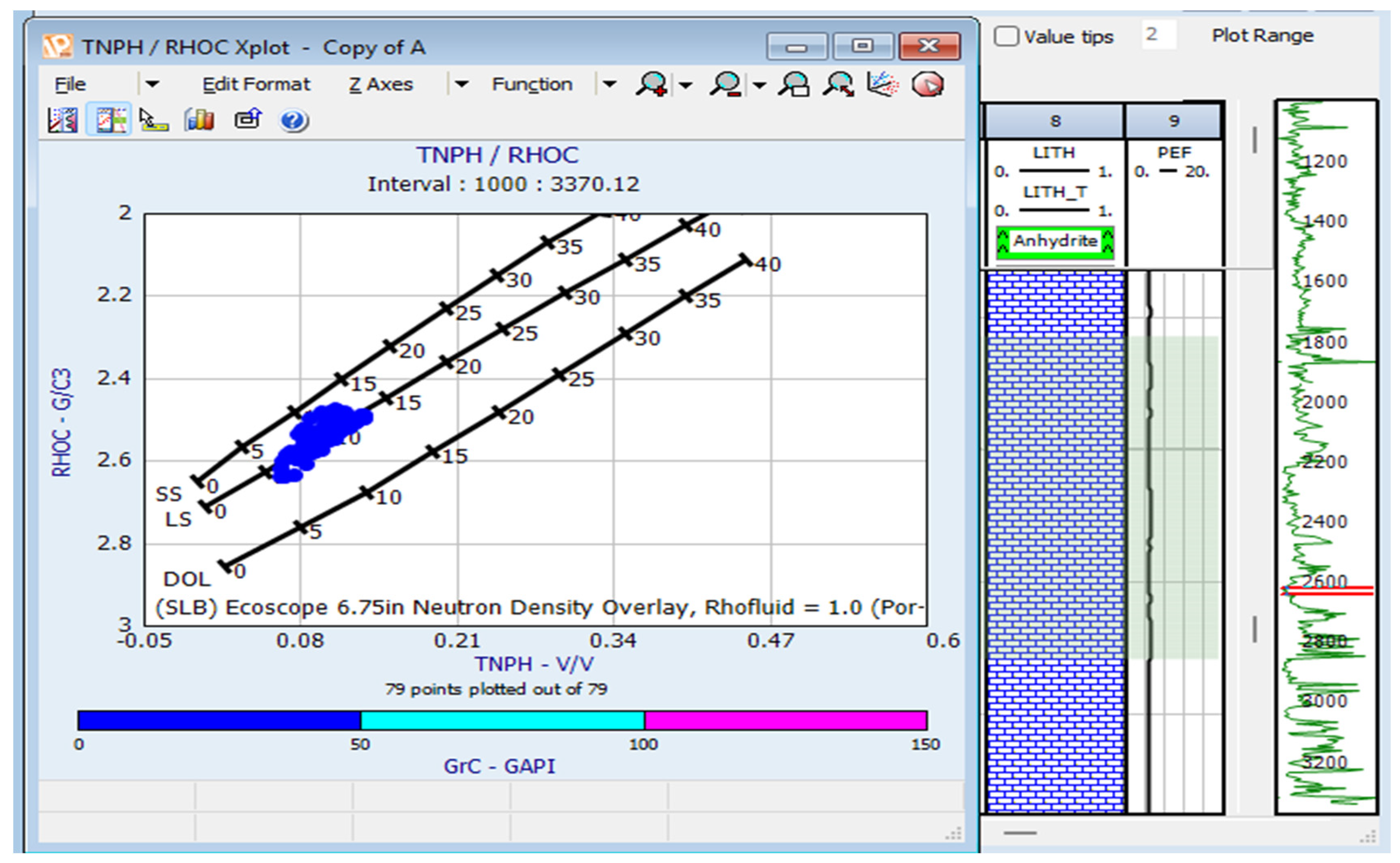
The relationship between drilling parameters, geomechanical characteristics, and rate of penetration (ROP) is complicated, with each element having a unique impact on drilling effectiveness. The behavior of rocks under stress is governed by geomechanical characteristics such as Poisson’s ratio (pr), Young’s modulus (EDYN), dynamic combined modulus (DCM), and confined compressive strength (CCS), which have a direct impact on ROP through bit performance and energy. These characteristics are often calculated from well logs using empirical correlations (e.g., between bulk density and seismic wave velocities). For this study, The IP software 2018 (developed and commercialized by Geoactive Ltd., Aberdeen, UK) was used to estimate all these properties from the available log data. This software can calculate these properties using empirical correlations specifically for each rock type, which gives much more accurate results. The lithology column of two wells was carried out through an incorporated approach, combining mud logging data and petrophysical well log analysis. Mud logging data descriptions, documented cuttings, gas readings, and lithological features of drilled rock were analyzed across all well intervals to provide preliminary lithological classifications. To refine and validate these interpretations depth accuracy, Neutron-density, and sonic-Neutron cross plots are used for each section as shown in Figure 1. Based on these analyses, a lithology column is formed, which is essential for geomechanics rock analysis, especially for unconfined compression strength (UCS) and dynamic elastic properties where the IP software uses different equations to estimate it based on lithology type.
The dynamic shear modulus is calculated based on shear sonic (DTs) and density (RHOB) logs as shown in Equation (1), while the dynamic Poisson’s ratio was calculated based on compressional (DTc) and shear (DTs) sonic logs as shown in Equation (2)
G D Y N = 1.34747 × 10 10 × ( R H O B / D T s 2 )
p r D Y N = 1 2 D T s D T c 2 1 / D T s D T c 2 1
Equation (3) shows the dynamic bulk modulus, which was calculated based on density, compressional (DTc), and shear (DTs) sonic logs. On the other hand, the dynamic bulk compressibility was estimated based on elastic wave propagation theory and based on the dynamic Poisson’s ratio and dynamic Young’s modulus as illustrated in Equation (4).
K D Y N = 1.34747 × 10 10 × R H O B 1 D T c 2 1 3 × D T s 2
B C D Y N = 3 ( 1 2 p r D Y N ) / E D Y N
The dynamic Young’s modulus calculated based on dynamic shear modulus and Poisson’s ratio as shown in Equation (5).
E D Y N = 2 G D Y N ( 1 + p r D Y N )
The dynamic combined modulus (KDYN + (4/3) GDYN) is estimated based on density and compressional when shear sonic (DTs) is unavailable as shown in Equation (6).
D C M = ( K D Y N + ( 4 3 ) G D Y N ) = 1.344747 × 10 4 ( R H O B / D T c 2 )
The Brittleness Index (BI) In this study was calculated using Equation (7), which follows the method proposed by Rickman et al. [52] and combines normalized Young’s modulus and Poisson’s ratio.
B I = E D Y N E D Y N m i n E D Y N m a x E D Y N m i n + p r D Y N p r D Y N m a x p r D Y N m i n p r D Y N m a x / 2
UCS was estimated by using lithology-specific empirical models available for sandstone, shale, carbonate, and dolomite. Each well was divided into multiple zones based on lithological interpretation, and an appropriate UCS correlation was applied to each zone. A composite UCS curve was generated by combining the results from all zones, ensuring continuity across lithological boundaries. Table 3 follows the method proposed by IP software for UCS calculation based on lithology type, where ( Φ ) is the porosity.
The thick-walled cylinder tensile strength (TWC) which is made up of TWC values derived from two models. The TWC models covered in IP include lithology type, then the values combine into a single curve based on that type. The first one is created by upscaling the UCS Composite curve. The upscaling parameters can be changed, and the default values in IP are A = 80.884 and B = 0.57, which are globally applicable values for sandstones as shown in Equation (29).
T W C _ U C S   U p s c a l e r = A     U C S   C o m p o s i t e B
where UCS Composite: unconfined compressive strength composite across all zones in the well (psi); A and B: scaling-up factors (unitless), while the second curve is calculated based on Density and Sonic curves as shown in Equation (30).
T W C _ V e e k e n = ( 1.18 9.29 10 5 R H O B D T c 2 + 0.00226 9.29 10 5 R H O B D T c 2 2 14.5
The friction angle (j) is determined using IP software, where software uses special formulas for each lithology type, and the composite curve is done by combination of the last formulas. Equation (31) is applicable to shales while Equation (32) is for sandstones. On the other hand, Equation (33) is applied to both sandstones and shales, where V c l a y is clay volume and Equation (34) is applied for shale formation.
j = sin 1 304,878 D T 1000 / 304,878 D T + 1000
j = 57.75 105 Φ
j = 26.5 37.4 1 Φ V c l a y + 62.1 1 Φ V c l a y 2
j = 11 304.8 D T 10.2
The shear strength (SS) and confined compressive strength (CCS) is added to IP software, and it calculated using the Mohr–Coulomb failure criterion, where the shear strength is calculated using Equation (35).
S S = c + σ n   tan j
where σn is normally effective stress in (psi) and c is Rock Cohesion (psi). Then, the confined compressive strength (CCS) equation is derived from Mohr–Coulomb failure criterion as shown in Equation (36).
C C S = U C S + σ n × tan 2 45 + j 2
Rock Cohesion (c) can be computed using Equation (37) as a function of the unconfined compressive strength (UCS) and the internal friction angle ( j ), as given by Jaeger et al. [15]:
c = U C S 2 × 1 + ( tan j ) 2 + tan j
The overburden pressure is computed using following formula:
O B P = g × 0 z ρ   D d D
where ρ (D) is density log value at depth D, and g is gravitational constant (unit-adjusted). The pore pressure of both wells was calculated in Interactive Petrophysics (IP) software using Eaton’s sonic method, where the pore pressure gradient is derived from the empirical relationship:
P P D = O B P D O B P D P P n D × t N C T t o b s e r v e d x
where PP/D is pore pressure gradient, (psi/ft), O B P /D is overburden gradient, (psi/ft), P P n /D is normal hydrostatic gradient (e.g., 0.465 psi/ft), t N C T is the acoustic travel time obtained from NCTL at the depth of examination, and t o b s e r v e d is the acoustic travel time from sonic log Exponent x = taken as 3.0.
The minimum horizontal stress is calculated using Eaton [53] equation:
S H M I N P = p r D Y N 1 p r D Y N O B P P P + P P
where S H M I N P is minimum horizontal stress (psi), OBP is overburden pressure (in psi), PP is pore pressure (in psi/ft).
The maximum horizontal stress is also calculated using the Li and Purdy [54] equation:
S H M M A X = ( S H M I N P P P ) p r D Y N O B P + 2 × P P
where SHMMAX is maximum horizontal stress (psi).
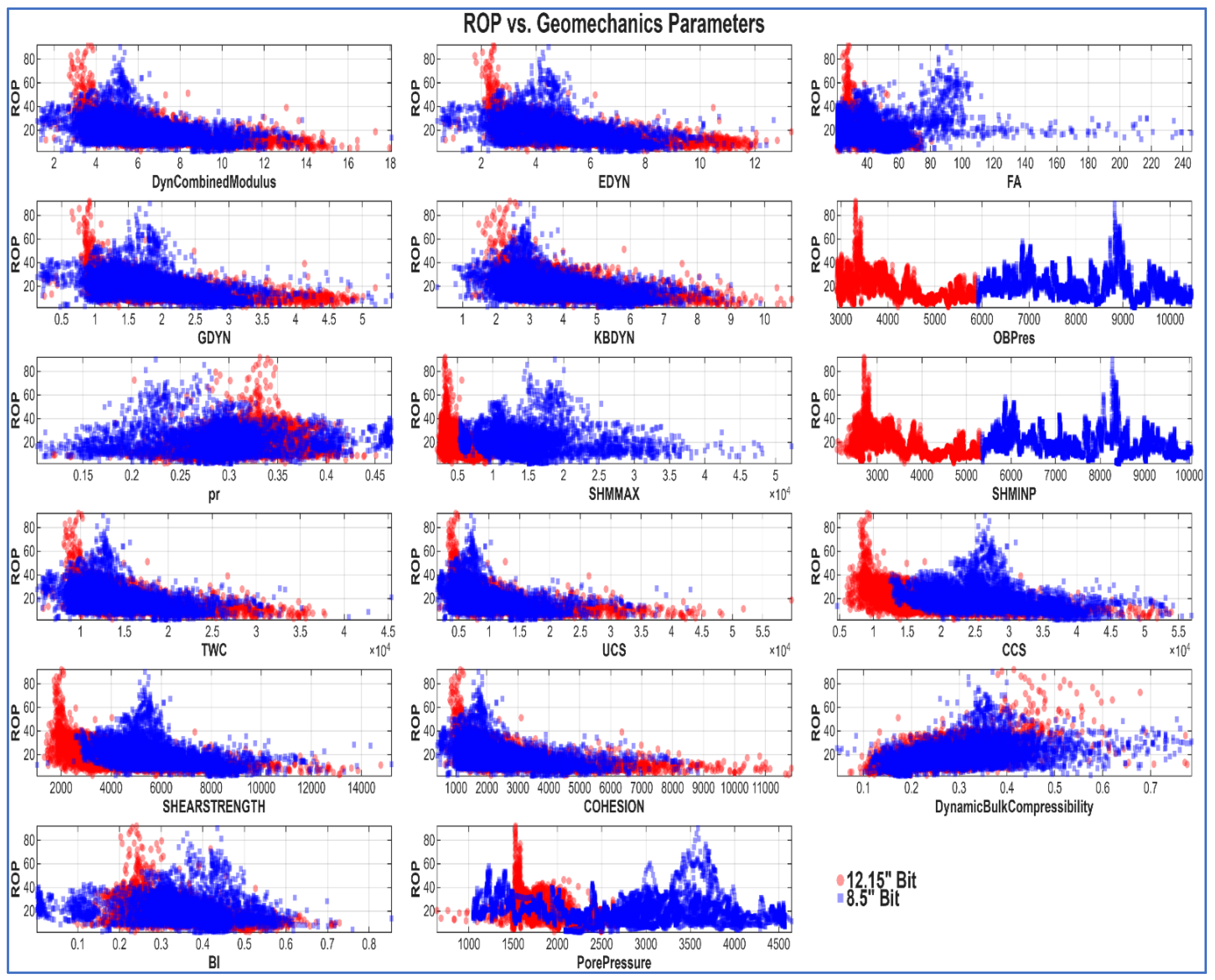
The data set comprises points, and the results are visually represented in their distribution and range in Figure 2.

2.3. Rock Mechanical Properties from Laboratory Tests

Four Laboratory tests (UCS, pr, Young’s modulus, and friction angle) were conducted on core samples retrieved from Well B at depths intervals of 2140 m, 2450 m, 2730 m, and 3077 m, covering limestone, sandstone, and shale lithologies. Two types of standard geomechanical tests were performed in accordance with International Society for Rock Mechanics and Rock Engineering (ISRM) recommended procedures: Triaxial Compression Strength (TCS) tests to determine static elastic parameters and rock failure criteria, using cylindrical specimens of 1 inch diameter and 2 inches length, and Uniaxial Compressive Strength (UCS) tests on specimens of 10 inches diameter and 20 inches length. These static measurements serve as a benchmark for validating log-derived (dynamic) estimates at equivalent depths.
A well-documented discrepancy exists between static (lab-measured) and dynamic (log-derived) elastic parameters. Dynamic parameter values are typically higher due to the influence of microfractures, pores, and bedding planes that are not fully captured in high-frequency sonic measurements. To enable meaningful comparison, dynamic elastic properties must be converted to their static equivalents.
In this study, only Young’s modulus and Poisson’s ratio required conversion. Poisson’s ratio was assumed to be equivalent in both static and dynamic domains (i.e., no conversion applied). For Young’s modulus, lithology-specific empirical correlations were used to transform dynamic to static values: Equation (42) for sandstone, Equation (43) for shale, and Equation (44) for mixed lithologies. These conversions were implemented in the petrophysical workflow to ensure consistency between modelled and laboratory-observed rock behavior.
E s t = 0.0293 E D Y N 2 + 0.4533 E D Y N
E s t = 0.0428 E D Y N 2 + 0.2334 E D Y N
E s t = 0.018 E D Y N 2 + 0.422 E D Y N

2.4. Correlation Analysis

The selection of features is based on a comprehensive correlation analysis in order to clarify the connection between various geomechanics rock properties and the rate of penetration (ROP). In this study, the Pearson correlation coefficient and the Spearman rank correlation coefficient help to evaluate the direction and intensity of the link between variables. The Pearson coefficient is chosen to define the linear relationship between ROP and each geomechanics variable, assuming the data follows a bivariate standard distribution. Additionally, the Spearman coefficient evaluates monotonic relationships, regardless of their linearity. This non-parametric method assigns value to the data before calculating the correlation, which helps to find nonlinear relationship that Pearson’s method might fail to do.

2.5. Model Formulation

Identifying the geomechanical parameter that affects ROP calculation the most requires evaluating all sixteen parameters within the ROP model. The Maurer [43] model—one of the earliest developed for this purpose—was selected as a suitable baseline. Maurer’s model postulates a perfect cleaning theory, in which ROP is governed by crater formation efficiency beneath the bit tooth. However, this model omits several influential parameters, such as torque and hydraulics.
R O P = K R P M W O B 2 B S 2 U C S 2
where K is the formation drillability constant, RPM is revolutions per minute, WOB is weight on bit (Ibf), BS is bit size (in), and UCS is the Uniaxial compression strength (psi). Bourgoyne and Young [36] developed a mathematical model using statistical synthesis of the old drilling data to define eight drilling parameters (xn) and eight exponents (an) that require multiple regressions to calculate the best values for these constants to build a complete ROP model. However, this model ignores the rock properties effects.
R O P = ( f 1 )     ( f 2 )     ( f 3 )       ( f 8 )  
in which
f 1 = e 2303 a 1
f 2 = e 2303 a 2 10,000 D
f 3 = e 2303 a 3 T V D 0.69 g p 9
f 4 = e 2303 a 4 T V D ( g p E C D )
f 5 = W B S W B S t 4 W B S t a 5
f 6 = N 60 a 6
f 7 = e a 7 h
f 8 = F j 1000 a 8
where TVD shows the true vertical depth (ft), D is depth (ft), gp is pore pressure gradient (lbm/gal), ECD expresses the equivalent circulating density (lbf/gal), (WOB/BS)t shows the threshold bit weight per inch of bit size at which the bit begins to drill (lbf/in), h is bit tooth dullness, and Fj is the jet impact force (lbf).
The Al-Abduljabbar model [48] uses data from carbonate reservoirs in the Middle East to build this empirical model. It combined a thorough set of drilling parameters with mud properties and rock properties that are suitable for our objective as it represents the interaction of all these properties to evaluate which rock geomechanics is more effective for ROP predicting. The original formulation employs fixed exponents taken from the author’s particular dataset:
R O P = 16.96   W O B a R P M T R Q S P P   Q B S 2 U C S b ρ P V
where a and b are model coefficients and will be calculated by nonlinear regression (the authors proposed 0.85 and 1.16 for the values of these parameters, respectively), TRQ is torque (klbf-ft), Q is flow rate (gpm), PV is plastic viscosity (cp), SPP is standpipe pressure (psi), and ρ is the mud weight (pcf).
Knowing that fixed exponents sometimes fall when used to different geological formations with varying rock-bit interactions, this study suggests a modified Al-Abduljabbar Model.
This study uses Multiple Nonlinear Regression (MNR) with logarithmic linearization rather than depending on the initial coefficients (a = 0.85, b = 1.16). This statistical method optimizes the exponents for every input parameter concurrently based on the local field data, therefore allowing the model to adapt particularly to the examined formation. The modified general equation is:
R O P = K   W O B a 1 R P M a 2 T R Q a 3 H H P a 4 B S a 5 ρ a 6 Ɓ a 7 G e o P a r a m a 8
where K is the optimized drillability constant, HHP is hydraulic horsepower, GeoParam represents the specific geomechanical parameter being tested (e.g., UCS, CCS, or dynamic combined modulus), and a1, a2, a3, …, a8 are the optimized exponents derived from the regression.
This method allows for a straightforward sensitivity analysis where we can statistically determine which rock property has the greatest impact on drillability by holding drilling parameters constant and changing a number of geomechanics variables.

3. Results and Discussion

3.1. Dynamic Geomechanics Result

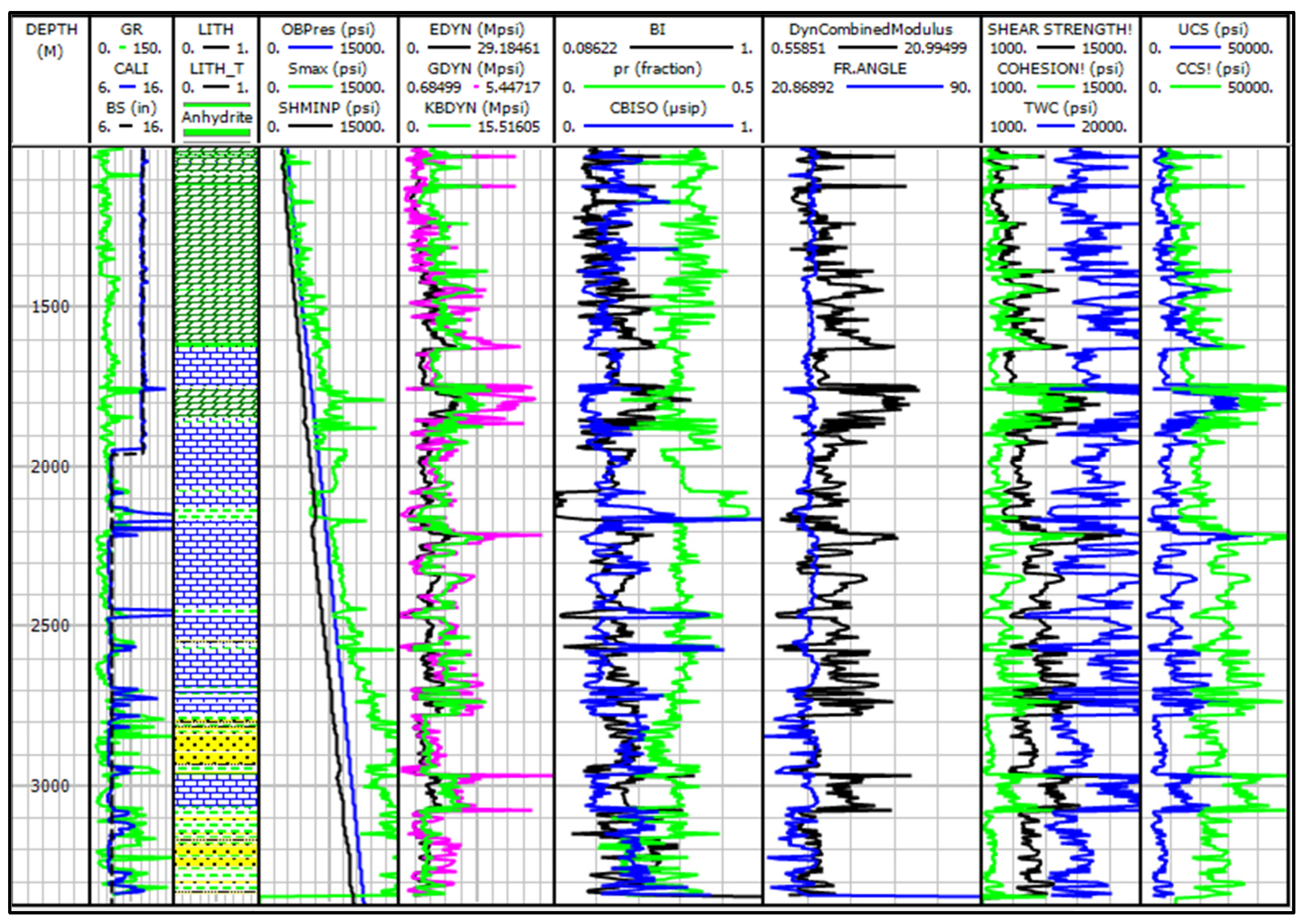
After the lithology column has been estimated, UCS, pore pressure, bulk modulus, TWC, shear modulus, brittleness, Poisson’s ratio, and other geomechanics properties were analyzed and determined against depth for the formations of the studied wells. Figure 3 shows the geomechanics properties of well A. In this study it was found that the prevailing stress state in studied field is a strike–slip faulting according to the results, where it revealed that the highest stress was the maximum horizontal stress (SHMMAX), then the overburden pressure (OBP) and the lowest was the minimum horizontal stress (SHMINP). The result also shows that the carbonate formation like limestone and dolomite have higher strength and elasticity than other formations like sandstone while the shale formation shows weakest strength. Furthermore, the results show that as the depth increases, the strength of formation increases due to the formation being under higher compaction in addition to the increase in the in situ stress with depth which puts the rock under higher confining stress leading to the increase in strength and elastic properties of the rock. In contrast, dynamic bulk compressibility increases in formations such as sandstone and shale while decreasing in carbonate formations. Table 4 and Table 5 show the statistical properties of Wells A and B.

3.2. Comparison Between Data Calculated from Well-Log and from Core Test

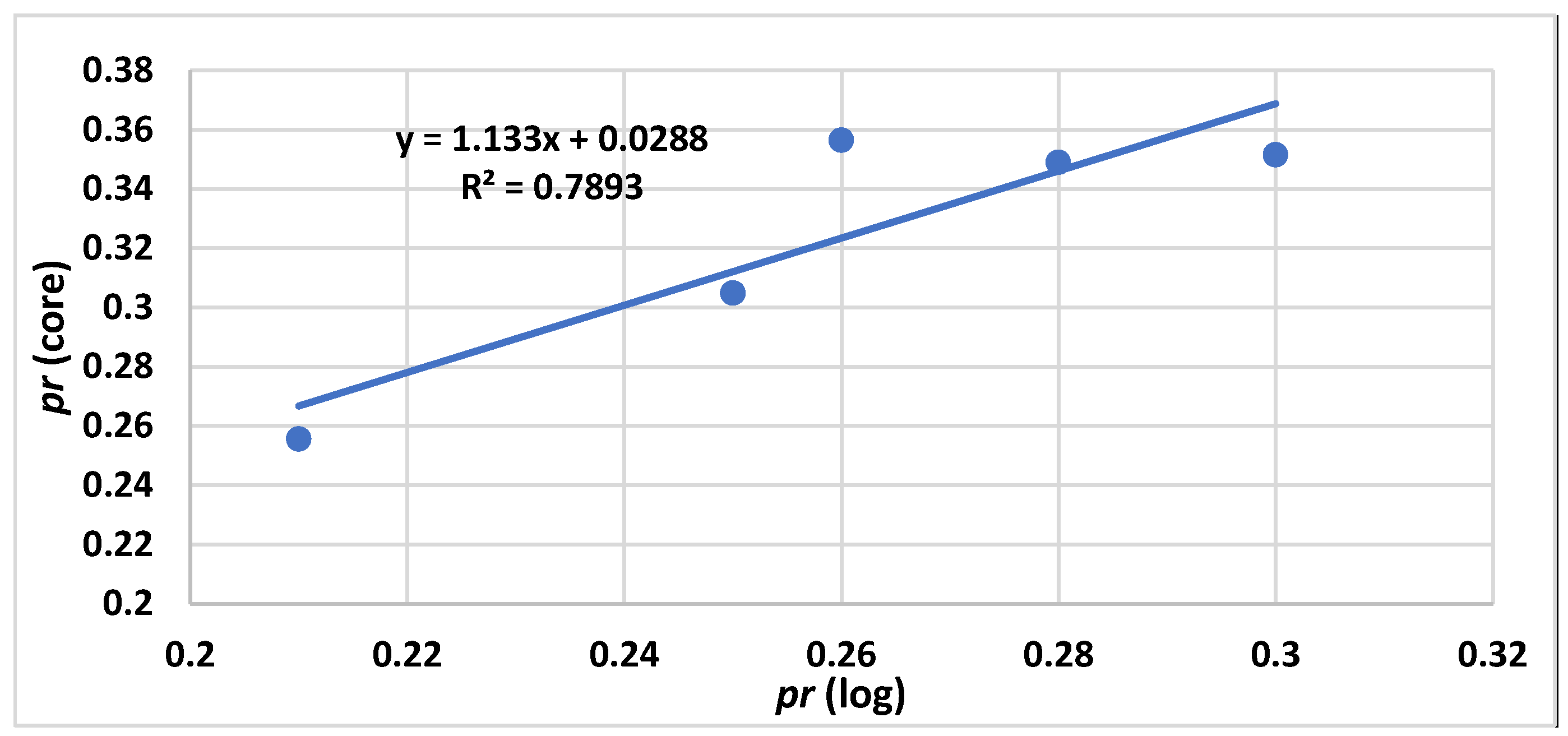
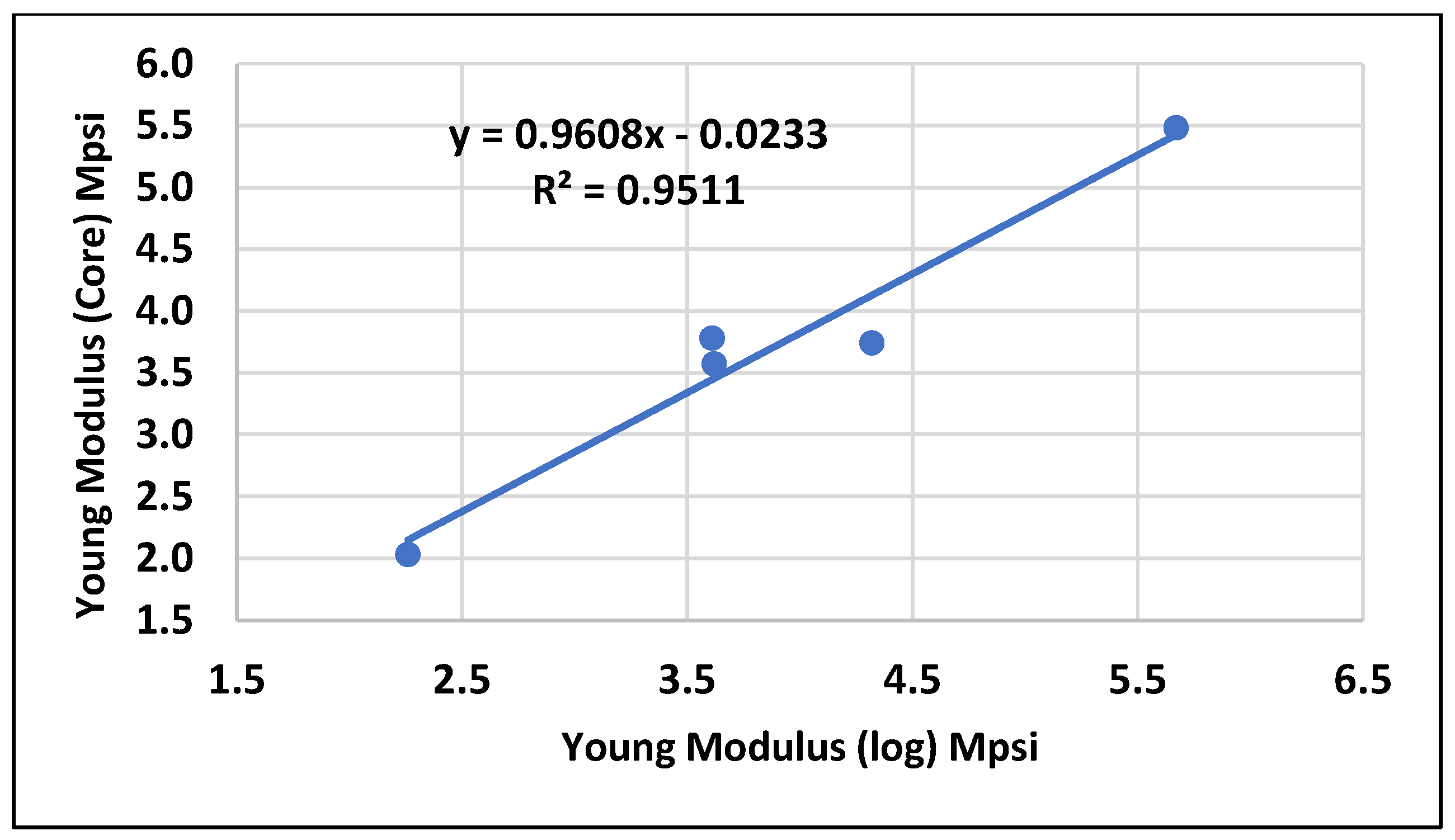
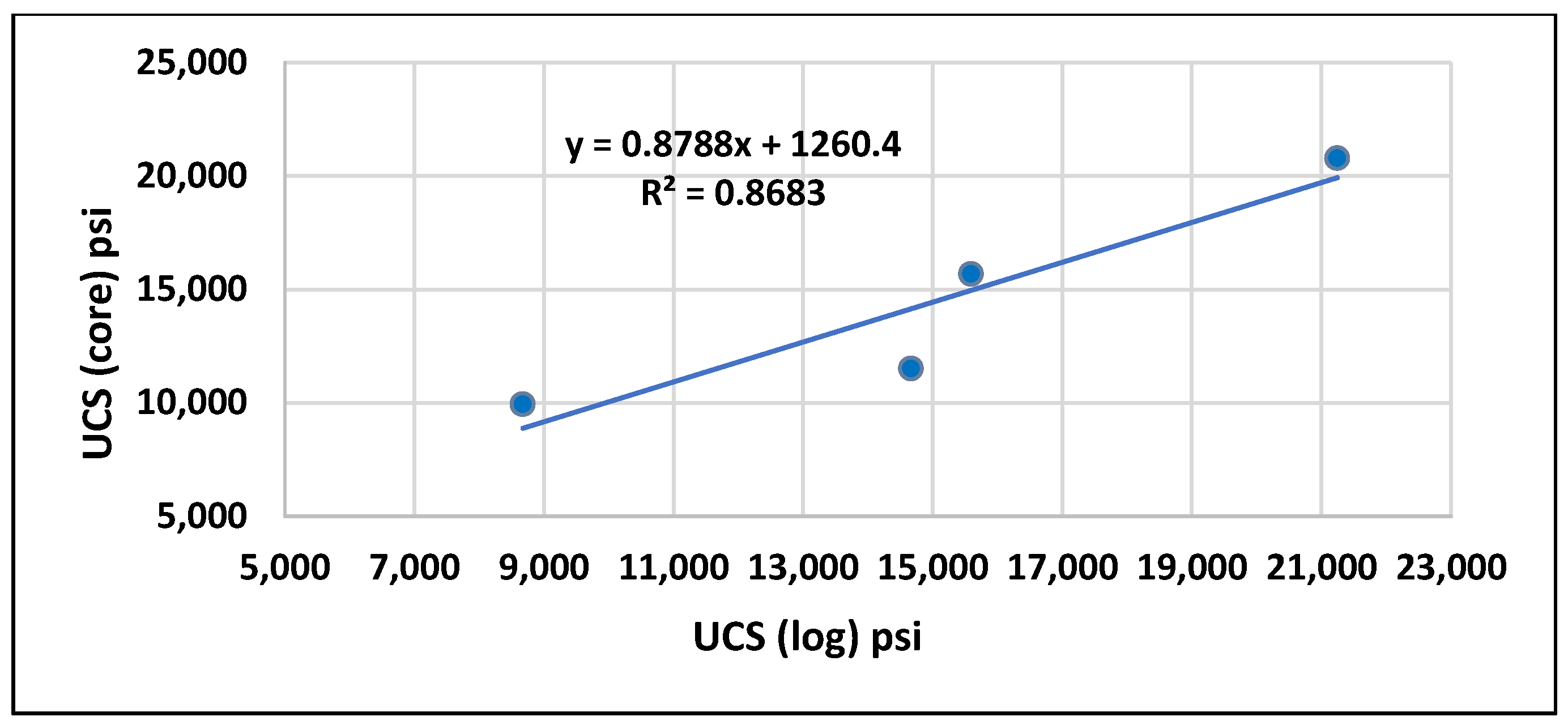
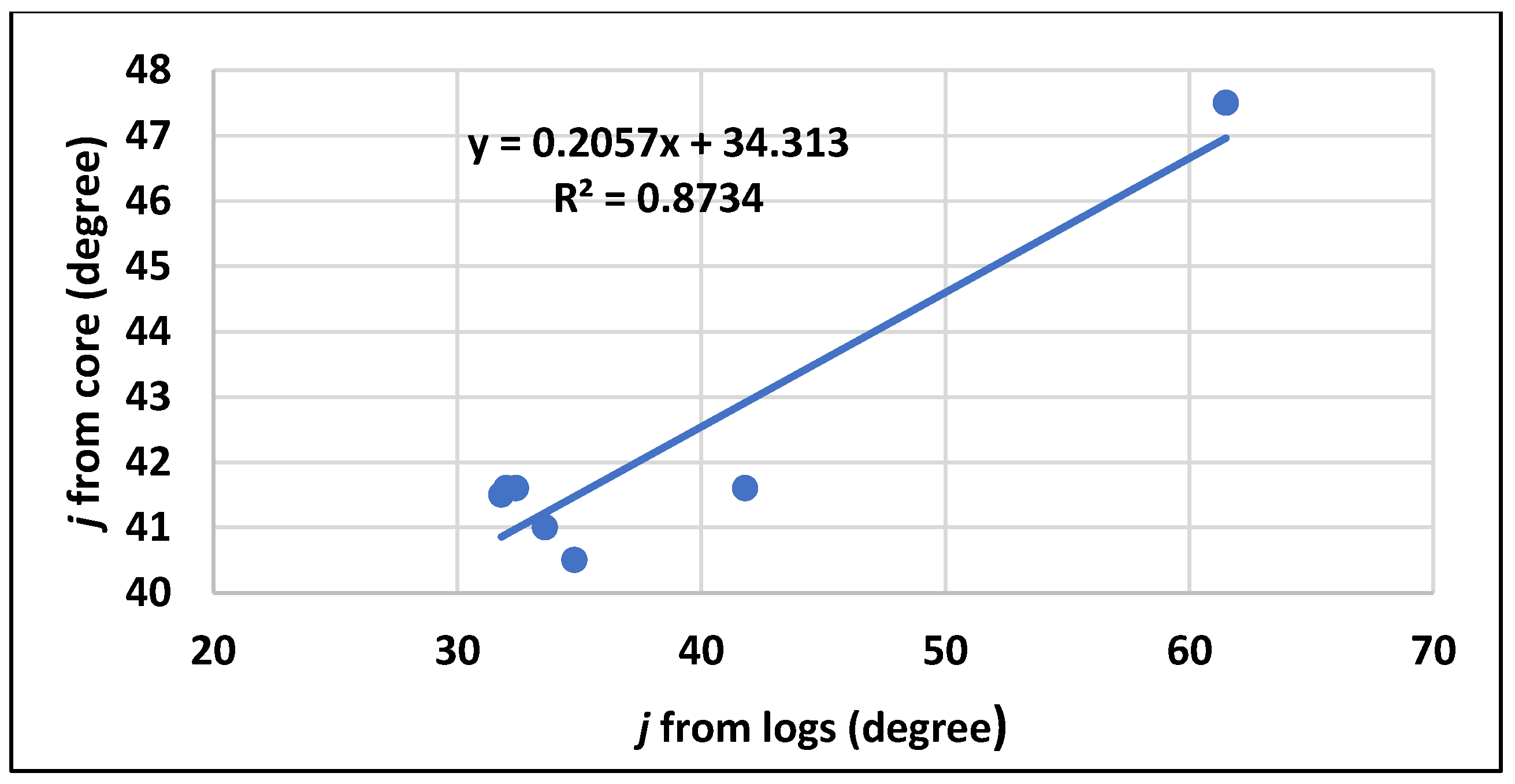
Rock geomechanical properties validation using core-log integration demonstrates strong relationships between laboratory-derived core measures and estimated well log parameters for a variety of rock types. Routine testing of many core samples from various wellbore depths was used to get a complete geomechanical description. For all examined features, the cross-plot analysis reveals strong consistency between the core and log data. Poisson’s ratio relationship is R2 = 0.7893. A strong linear relationship, indicating the reliable predictive power of log-based computations for this crucial elastic characteristic, governs how rock deforms under pressure. The accuracy of the dynamic to static modulus conversions used for sonic log data is supported by the strong association observed in the Young’s modulus comparison (R2 = 0.9511). The Unconfined Compressive Strength (UCS) cross-plot also demonstrates strong association (R2 = 0.8683). The Friction Angle cross-plot also demonstrates strong association (R2 = 0.8734). These high correlation values for geomechanical properties validate the reliability of log-based geomechanical models and provide confidence in their usage for wellbore analysis, strategies for finishing drilling, and design. The methodical validation technique, which uses numerous core samples from different depths, ensures that formation variability is represented in the characterization and creates Robust calibration links that may be confidently used across the whole wellbore interval for comprehensive geomechanically analysis and operational decision-making. Figure 4, Figure 5, Figure 6 and Figure 7 show the cross plot of tested parameters.

3.3. Correlation Results

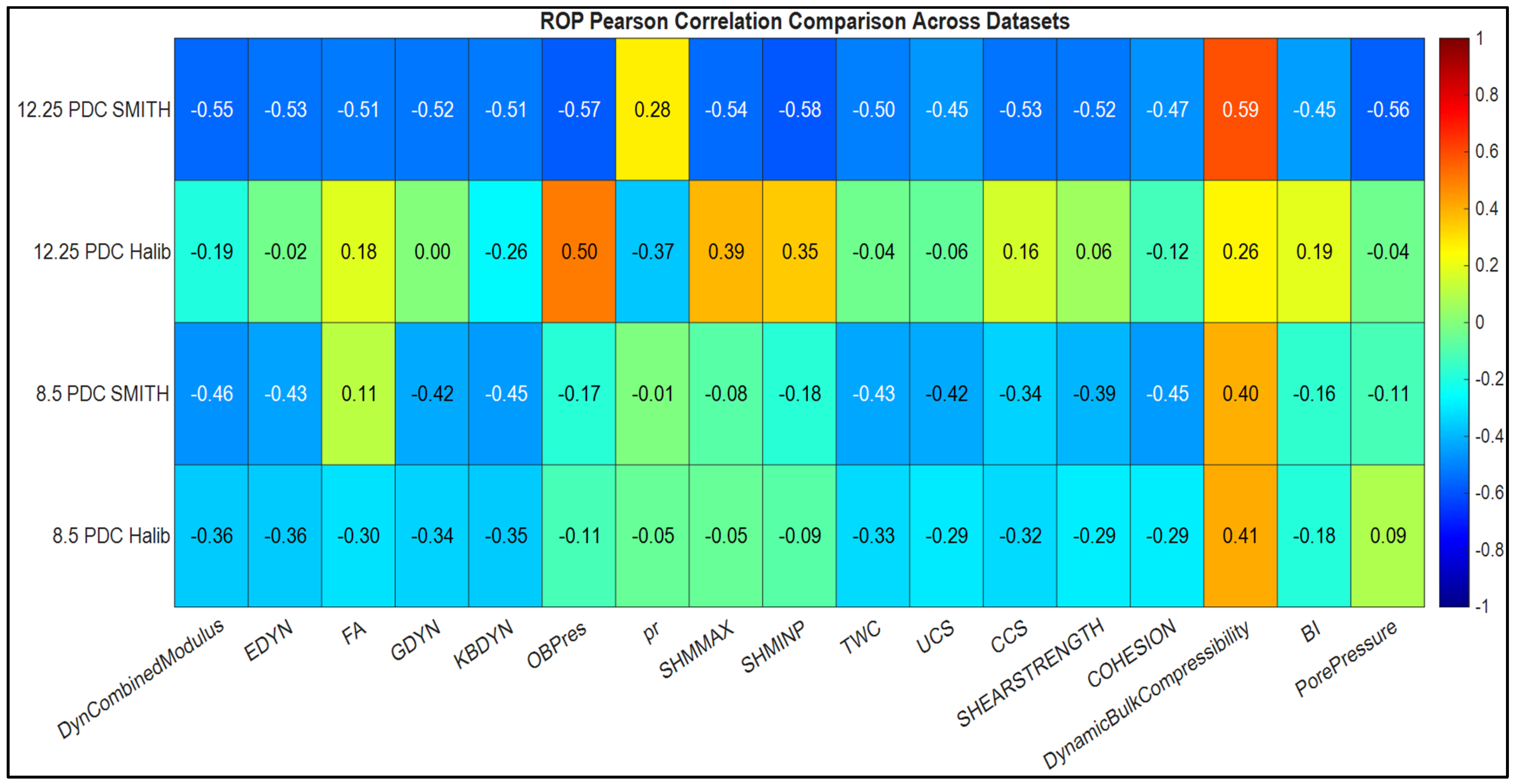
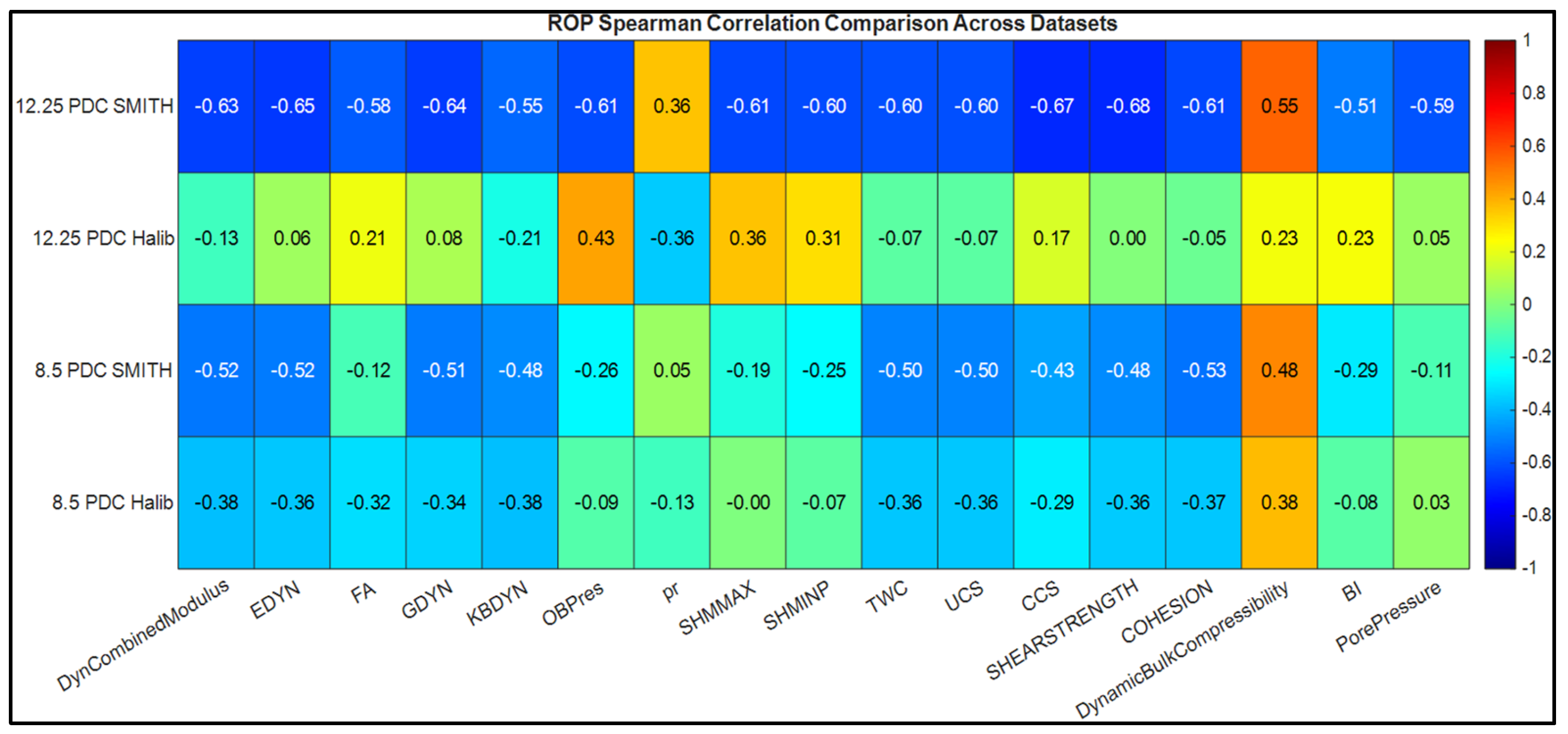
A correlation analysis was conducted to determine the correlation between the rate of penetration (ROP) and an estimated sixteen rock geomechanics parameters. This research quantifies these correlations across two-bit sizes and manufactory bits made by utilizing Pearson (linear) and Spearman (monotonic) coefficients, with the findings shown in Figure 8 and Figure 9. The 12.25″ PDC Haliburton dataset was excluded from this discussion because of its restricted depth range, which makes a representative study impossible. The most remarkable and significant correlations were observed with the 12.25″ PDC SMITH, where a very powerful negative correlation was found between ROP and variables measuring rock strength and stiffness. The highest correlation result was with shear strength (Pearson= −0.52, Spearman= −0.68), CCS (Pearson= −0.53, Spearman= −0.67) and dynamic combined modulus (Pearson= −0.55, Spearman= −0.63). These results confirm the fundamental idea that greater inherent strength and resistance to deformation in rocks makes drilling them more difficult.
In contrast, Dynamic Bulk Compressibility exhibits the strongest positive correlation (Pearson = 0.59, Spearman = 0.55) that indicate the more compressible formations, which are less resistant to volumetric change, facilitate more efficient rock failure, and increase ROP. The correlations observed in the 8.5″ PDC-bit sizes were typically lower than those in the 12.25″ PDC-bit size, despite the fact that the overall trends remained the same.
In general, the difference in correlation strength between the 12.25″ PDC bit size and 8.5″ PDC bit size is likely due to a scale effect where the larger bit contact with a greater area of drilled rock that may make it slightly less effected with geomechanics parameter compared with larger bit size.
Furthermore, a distinct inversion in the influence of compressive strength parameters was observed when reducing the bit size. For the 12.25″ PDC SMITH configuration, CCS exhibited a significantly stronger correlation (Pearson= −0.53, Spearman= −0.67) compared to UCS (Pearson= −0.45, Spearman= −0.60). However, this trend reverses in the 8.5″ PDC SMITH section. Here, the influence of CCS diminishes notably (Pearson= −0.34, Spearman= −0.43), while UCS maintains a stronger monotonic relationship, particularly in the Spearman analysis (Pearson= −0.42, Spearman= −0.50).
Fisher’s Z-transformation tests confirmed that the correlation reversal between CCS and UCS across bit sizes is statistically significant (CCS: Z = −16.84, p < 0.001; UCS: Z = −6.75, p < 0.001), establishing that CCS is the superior predictor at 12.25″. This reversal is physically attributed to the difference in bit-rock contact area: the larger 12.25″ bit generates a broader confinement field beneath the cutters, favoring CCS which accounts for confining stress via the Mohr–Coulomb criterion, whereas the smaller 8.5″ bit produces localized stress concentration beneath individual cutters with minimal bulk confinement, a failure regime more accurately represented by UCS.
This finding has significant implications for ROP predictive modeling: strength parameter selection must account for bit size as an essential design consideration.
Based on comparative analysis across all bit sizes, formations, and correlation methods, the dynamic combined modulus is recommended as the most robust input parameter for ROP predictive modeling. While other parameters such as Shear Strength and CCS exhibit high sensitivity in specific large-bit scenarios, compressive strength parameters demonstrated scale-dependent inversions (CCS vs. UCS).
The dynamic combined modulus maintained a high consistency in both Pearson and Spearman analyses across both the 12.25″ PDC bit and 8.5″ PDC bit. Its ability to represent the elastic stiffness of the rock while maintaining a linear relationship closer to that of the Spearman ideal makes it a reliable, universally applicable feature for drilling optimization models.

3.4. Selection of the Effective Geomechanics Parameter

Three of the most common models for ROP prediction—Maurer [43], Bourgoyne and Young [36], and Al-Abduljabbar [48]—were selected to compare their performance using field data from two wells drilled through heterogeneous formations. The relative performance of the models for both wells is shown in Table 6 and Table 7.
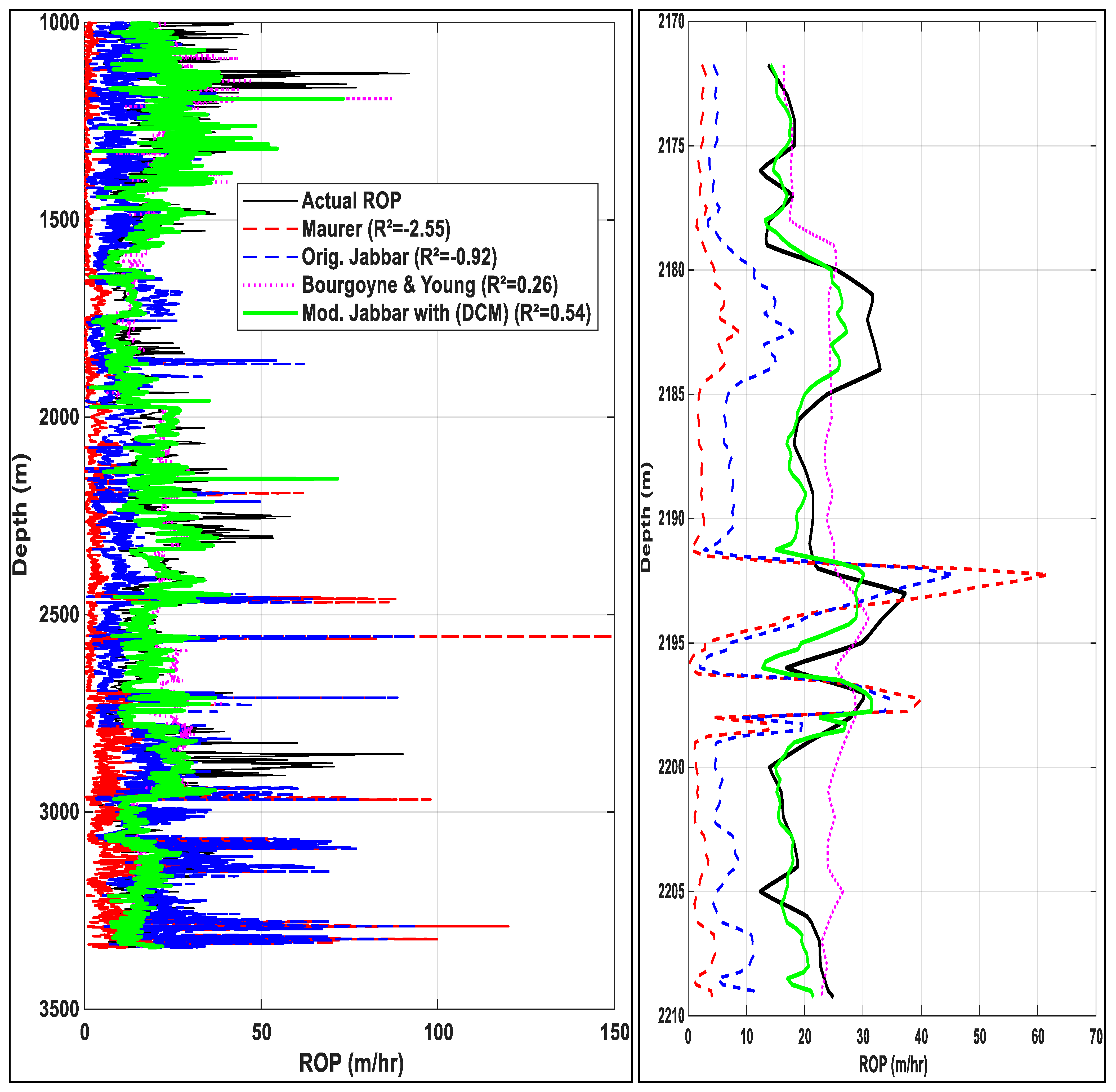
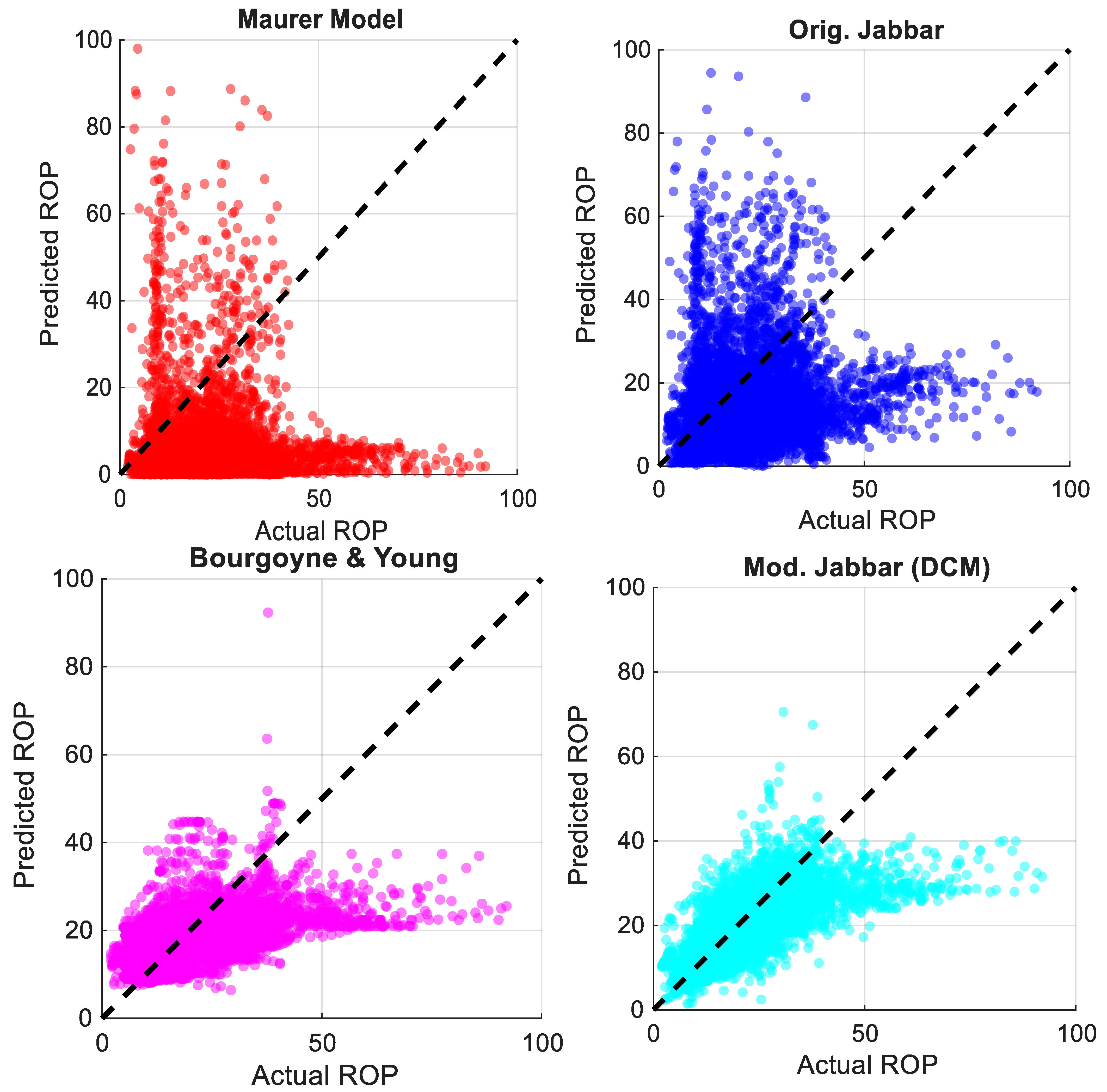
With Well A, a negative coefficient of determination (R2 = −2.55) and the highest error rates (RMSE = 20.27, AAPE = 86.53%), the Maurer model (1962) completely contradicted the field data. This failure is attributed to the model’s rigid reliance on UCS, which unfairly penalizes ROP in harder regions. The Al-Abduljabbar model (2018) also produced a negative correlation (R2 = −0.92) and an AAPE of 60.85%. The fixed exponents taken from a different domain were not appropriate for this well’s unique lithology and drilling conditions, even though the model framework is robust.
The Bourgoyne and Young model (1974) performed better than the fixed theoretical models, achieving a positive R2 = 0.26 and reducing the AAPE to 36.55%. However, this accuracy is still insufficient for exact drilling optimization, emphasizing the necessity of a model that better captures geomechanics properties.
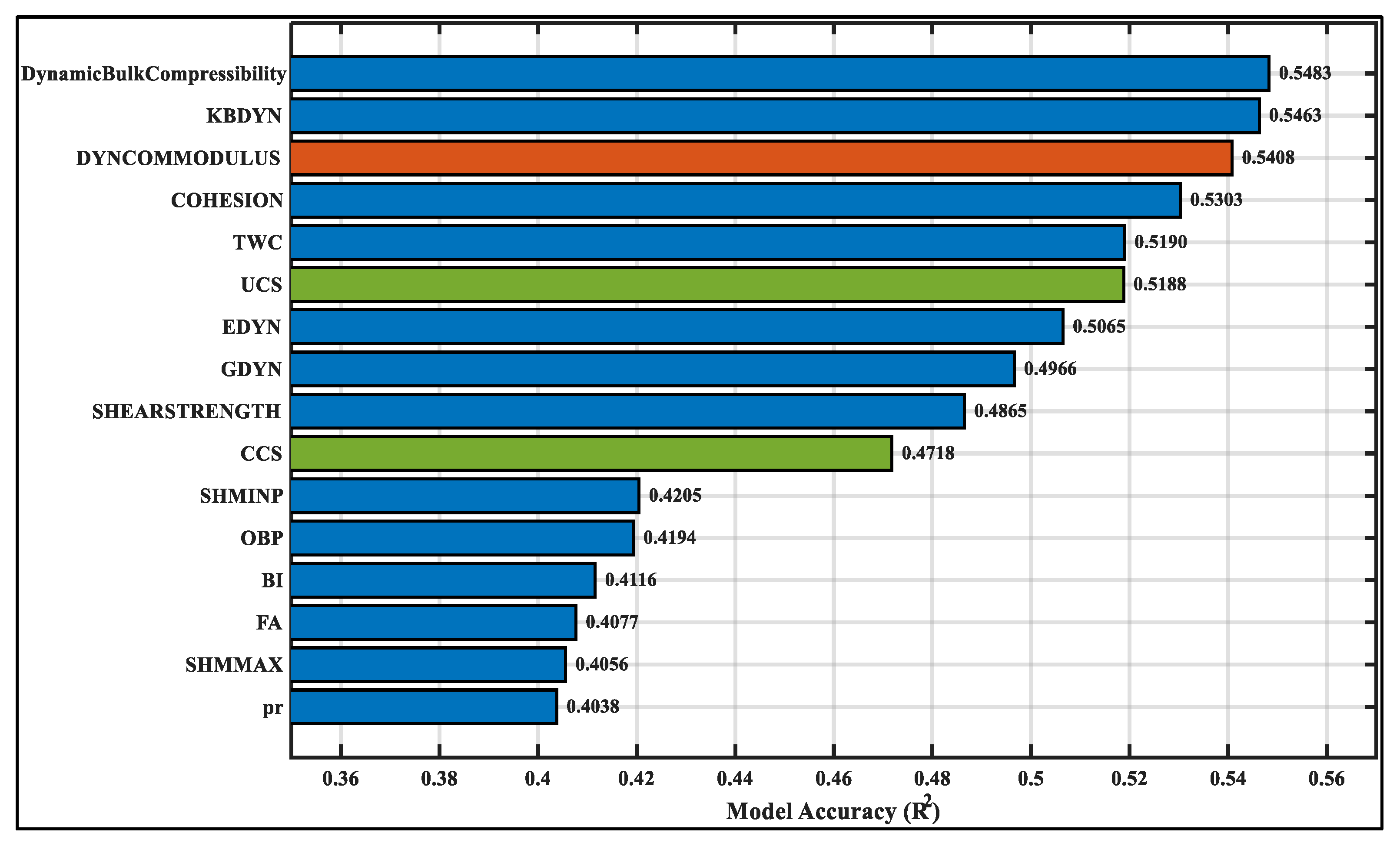
In order to improve prediction accuracy, the modified Al-Abduljabbar model examined sixteen separate geomechanics factors. The aim was to discover the parameter that better captures drillability than the widely used Unconfined Compressive Strength (UCS). Figure 10 lists the statistical ranking of the best predictors.
The suggested modified Al-Abduljabbar model, which was optimized using multiple nonlinear regression and integrated with dynamic combined modulus (DCM), demonstrated superior predictive performance when compared to all compared models’ baselines. The modified model achieved the highest accuracy, with (R2 = 0.54), which doubled the explanatory power of the original Bourgoyne and Young model (R2 = 0.26) and greatly outperformed the Maurer and original Al-Abduljabbar models, which had negative correlations. In addition to a 30% reduction in error compared to the Bourgoyne and Young model and a 70% reduction relative to the Maurer model, this increase in accuracy was coupled with a considerable decrease in error, with the revised model reaching the lowest RMSE = 7.30 and MAE = 4.68, giving the AAPE of 25.33%.
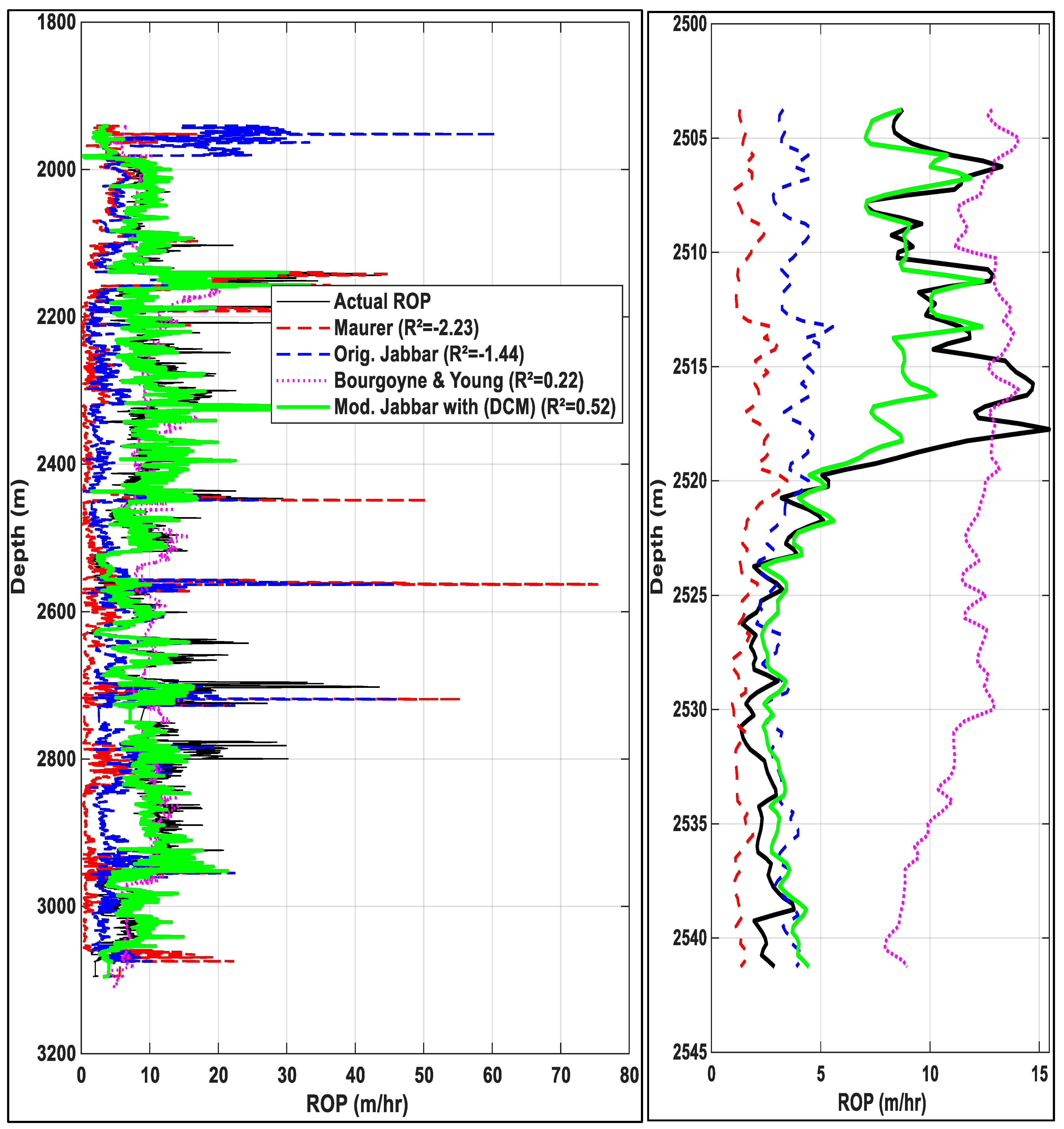
The natural heterogeneity of the drilled carbonate sequences—comprising limestone, dolomite, sandstone, shale, anhydrite, and marly limestone—is the primary explanation for the observed scatter and outliers in ROP predictions. Rapid vertical variations in lithology, porosity, fracture density, and diagenetic alteration produce localized departures between predicted and measured ROP that no single geomechanical parameter can fully capture. This variability is directly reflected in the wide standard deviations of the ROP data: Well A ranges from 1.9 to 92.7 m/hr (mean = 19.6, SD = 10.7 m/hr) and Well B from 1 to 43.8 m/hr (mean = 9.6, SD = 5.1 m/hr). In this context, the R2 = 0.54 achieved by the DCM-modified model represents a practically meaningful result rather than a modeling deficiency.
Quantitative gains are visually confirmed by depth-based validation (Figure 11 and Figure 12), where the modified model (green line) accurately replicates high-frequency ROP oscillations and drilling breaks that the baseline models, particularly the Maurer (red dash line) and original Al-Abduljabbar (blue dash line), were unable to capture. The modified method is now demonstrated to be the most trustworthy approach for predicting ROP in this sector because it can identify subtle variations in drillability that traditional drilling parameters alone cannot capture by incorporating the dynamic elastic response of the rock. Figure 13 show the cross plot of all models.
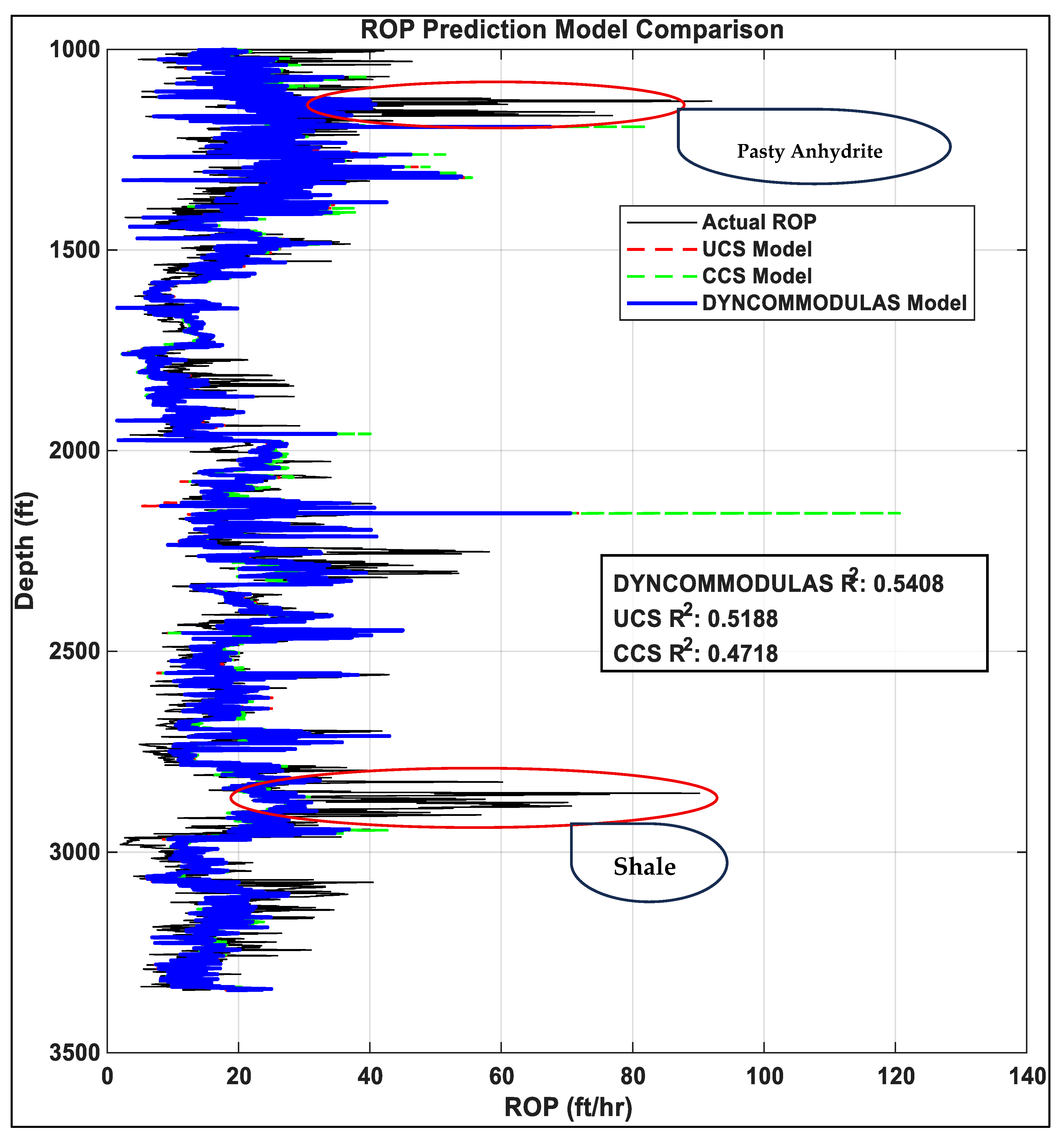
While Dynamic Bulk Compressibility and KDYN achieved the highest statistical accuracy (R2 = 0.548), they face a critical operational limitation where both need Shear Sonic logs (DTSM) for computation. Shear sonic information is specialized and not always included in conventional drilling logging packages. On the other hand, dynamic combined modulus (DCM) produced a far better accuracy of (0.5408), which was about equal, compared to the industry-standard UCS (0.5188) and CCS (0.4718) while other parameters get accuracy with 0.40 such as (pr) which show the importance of select best geomechanics parameters. Importantly, the dynamic combined modulus (DCM) is determined using solely compressional sonic (DTCM) and density (RHOB) logs—common measurements found in practically all modern wells. However, other parameters, such as confined compressive strength (CCS) and shear strength (SS), require more information to be calculated, as they necessitate friction angle (j) and horizontal stress calculation. As a result, the dynamic combined modulus was chosen as the best predictor. It outperforms unconfined compressive strength (UCS) by 4.2% in terms of variance explanation while remaining operationally viable for real-time applications.
Equation (57) presents the final optimized equation for the studied field, considering the dynamic combined modulus (DCM). The regression analysis yielded particular exponents that reflect the physics of the drilling process.
R O P = 37.91 R P M 0.40 × ρ 2.71 × T R Q 1.2 × H H P 0.73   W O B 0.496 × B S 3 × Ɓ 3 × D C M 0.498
The actual relationship confirmed by the negative exponent for (DCM) is approximately (−0.50), which shows that the rate of penetration falls as the rock’s stiffness (DCM) rises. Weight on bit has a negative exponent of −0.50, which suggests that it is more of a reactive operating practice than a physical constraint. Drillers instinctively increase WOB in order to compensate for the increasing hardness of the formation and the natural decline of ROP. This creates a statistical artifact in the data set, where low ROP values are associated with high WOB values, which hides the theoretically advantageous correlation.
Mud weight results in a positive total exponent of (+2.72) because the positive correlation of the 8.5″ well section overcame the expected negative correlation seen in the 12.25″ well intervals resulting in unequal data distribution that skewed the parameter selection for the global model, where the longer 8.5″ well section statistically outperformed the shorter 12.25″ well section. Similarly, even though CCS was the superior predictor in the 12.25″ well size, the volume of data in the 8.5″ section is larger than 12.25″ well section, where UCS had a stronger correlation with ROP, and led to a higher overall accuracy for UCS (R2 = 0.52) than CCS (R2 = 0.47).
The depth-based predictions of the new dynamic combined modulus (DCM) model are compared against the UCS and CCS models in Figure 14. The dynamic combined modulus model (blue line) better captures the high-frequency variations in ROP than the UCS model (red dashed line) when there are rapid lithology changes. The statistical accuracy confirms the hierarchy: DCM (R2 = 0.54); CCS (R2 = 0.47); UCS (R2 = 0.52). The dynamic elastic response of the rock shows that it is a better marker of drillability than fixed strength relationships based on its constant sonic and density log recording.

4. Conclusions

This study evaluated sixteen rock geomechanical properties to identify the most effective input for predicting drilling performance. The key findings of this study are as follows:
  • Increasing rock strength reduces ROP, with shear strength and confined compressive strength (CCS) exhibiting the strongest negative correlations (Spearman = −0.68 and −0.67, respectively). Spearman correlations consistently exceeded Pearson values (e.g., shear strength: −0.68 vs. −0.52), demonstrating that the relationships are predominantly monotonic and nonlinear. This indicates that linear models are insufficient for accurate ROP forecasting, necessitating nonlinear or transformative approaches.
  • Calculated results confirm that the in situ principal stresses and formation pore pressure significantly influence rock strength, indicating the importance of incorporating these factors in the geomechanical analysis for ROP prediction.
  • The confined compressive strength (CCS) showed stronger correlation than unconfined compressive strength (UCS) for 12.25″ bits, while this relationship reversed for 8.5″ bits. This scale effect, attributed to bit–rock interaction volume, highlights that parameter selection for ROP models must include bit size.
  • Dynamic bulk compressibility ( B C D Y N ) emerged as the strongest positive predictor of ROP (Pearson = 0.59, Spearman = 0.55), indicating that formations with greater compressibility facilitate more effective rock failure and higher penetration rates.
  • The modified Al-Abduljabbar model calibrated using multiple nonlinear regression, significantly outperformed industry baselines (R2 = 0.54 vs. R2 < 0.26 for the Bourgoyne and Young model). Its superior performance stems from statistically optimizing exponents for local field conditions rather than relying solely on theoretical assumptions.
  • Among all geomechanical properties evaluated, the dynamic combined modulus (DCM) was determined to be the most useful practical input. DCM generated strong correlations across all bit sizes and achieved the highest model accuracy (R2 = 0.54) while requiring only conventional compressional sonic and density logs, offering a viable alternative to properties that depend on specialized shear sonic data.
  • The contrast between DCM (R2 = 0.54) and less relevant parameters such as friction angle (R2 = 0.40) demonstrates that selecting the appropriate rock attribute is more consequential than mathematical coefficient tuning. This finding underscores that robust ROP modeling depends fundamentally on identifying the most physically relevant inputs.

Author Contributions

Conceptualization, M.A.K. and A.S.A.; methodology, M.A.K., M.N.J.A. and A.S.A.; software, M.A.K. and A.S.A.; validation, M.A.K.; formal analysis, M.A.K.; investigation, M.A.K.; resources, M.A.A.; data curation, M.A.K. and A.S.A.; writing—original draft preparation, M.A.K. and A.S.A.; writing—review and editing, M.A.K. and M.N.J.A.; visualization, M.A.K.; supervision, M.A.A. and F.S.A.; project administration, M.A.A. and F.S.A.; funding acquisition, M.A.A. All authors have read and agreed to the published version of the manuscript.

Funding

This research received no external funding.

Data Availability Statement

The original contributions presented in this study are included in the article. Further inquiries can be directed to the corresponding author.

Acknowledgments

This work was supported by the Ongoing Research Funding program, (ORF-2026-1422), King Saud University, Riyadh, Saudi Arabia. The authors would like to express their gratitude to the Department of Petroleum and Natural Gas Engineering at King Saud University for its assistance and support through this study.

Conflicts of Interest

The authors declare no conflicts of interest.

Nomenclature

Abbreviation/SymbolDefinition
BCDYNDynamic bulk compressibility, μsip
BIBrittleness index, fraction
BSBit size (bit diameter), in
cRock cohesion, psi
CCSConfined compressive strength, psi
DDepth, m
DCMDynamic combined modulus, Mpsi
DTCMCompressional sonic log, μs/ft
DTSMShear sonic log, μs/ft
EDYNDynamic Young’s modulus, Mpsi
EstStatic Young’s modulus, Mpsi
FjJet impact force, lbf
FLOWPUMPSMud flow rate, l/min
GDYNDynamic shear modulus, Mpsi
gpPore pressure gradient, ppg
GRGamma ray log, API
hBit tooth dullness, fraction
HHPHydraulic horsepower, hp
ISRMInternational Society for Rock Mechanics and Rock Engineering
jInternal friction angle (Mohr-Coulomb criterion), degree
KFormation drillability constant
KDYNDynamic bulk modulus, Mpsi
MWMud weight, g/cc (field data; Well logs, Table 2, Table 3, Table 4 and Table 5)
MWinMud weight in (flow-in), g/cc
MWoutMud weight out (return), g/cc
NCTLNormal Compaction Trend Line
NPHINeutron porosity, fraction
OBPOverburden pressure, psi
PDCPolycrystalline Diamond Compact (bit type)
PEFPhotoelectric factor log
ΦPorosity, fraction
PPPore pressure, psi
PPnNormal hydrostatic pressure, psi
prDynamic Poisson’s ratio, fraction
PVPlastic viscosity, cp
QFlow rate, gpm
RDDeep resistivity log, ohm·m (API standard)
RHOBDensity log, g/cc
ROPRate of penetration, m/hr
RPMRotary speed, revolutions per minute
SHMMAXMaximum horizontal stress, psi
SHMINPMinimum horizontal stress, psi
SPSpontaneous potential log, mV
SPPStandpipe pressure, psi
SSShear strength, psi
TEMPFormation temperature log, °C
TNPHThermal neutron porosity log, fraction
TRQTorque, klbf·ft
TVDTrue vertical depth, m
TWCThick-walled cylinder strength, psi
UCSUnconfined compressive strength, psi
VclayClay volume fraction
WOBWeight on bit, ton (field data); lbf (model equations)
(WOB/BS)tThreshold bit weight per inch of bit diameter, psi
t N C T Acoustic travel time from the Normal Compaction Trend Line at depth, μs/ft
t o b s e r v e d Acoustic travel time measured from sonic log, μs/ft
ρ Mud density, pcf—used in Al-Abduljabbar model (Equation (55)) only; see MW for field data units
σnNormal effective stress, psi

References

  1. Messaoud, L. Influence of fluids on the essential parameters of rotary percussive drilling. Lab. Environ. 2009, 14, 1–8. [Google Scholar]
  2. Munoz, H.; Taheri, A.; Chanda, E.K. Rock Drilling Performance Evaluation by an Energy Dissipation Based Rock Brittleness Index. Rock Mech. Rock Eng. 2016, 49, 3343–3355. [Google Scholar] [CrossRef]
  3. Paone, J.; Madson, D.; Bruce, W.E. Drillability Studies-Laboratory Percussive Drilling; US Department of the Interior, Bureau of Mines: Washington, CD, USA, 1969. [Google Scholar]
  4. Tandanand, S.; Unger, H.F. Drillability Determination: A Drillability Index for Percussion Drills; US Department of the Interior, Bureau of Mines: Washington, CD, USA, 1975; Volume 8073. [Google Scholar]
  5. Perrin, V.P.; Mensa-Wilmot, G.; Alexander, W.L. Drilling Index—A New Approach to Bit Performance Evaluation. In Proceedings of the SPE/IADC Drilling Conference, Amsterdam, The Netherlands, 4–6 March 1997; p. SPE-37595-MS. [Google Scholar]
  6. Cheniany, A.; Hasan, K.S.; Shahriar, K.; Khademi Hamidi, J. An estimation of the penetration rate of rotary drills using the Specific Rock Mass Drillability index. Int. J. Min. Sci. Technol. 2012, 22, 187–193. [Google Scholar] [CrossRef]
  7. Bilim, N. Determination of drillability of some natural stones and their association with rock properties. Sci. Res. Essays 2011, 6, 382–387. [Google Scholar]
  8. Copur, H.; Cinar, M.; Okten, G.; Bilgin, N. A case study on the methane explosion in the excavation chamber of an EPB-TBM and lessons learnt including some recent accidents. Tunn. Undergr. Space Technol. 2012, 27, 159–167. [Google Scholar] [CrossRef]
  9. Plumb, R.; Edwards, S.; Pidcock, G.; Lee, D.; Stacey, B. The Mechanical Earth Model Concept and Its Application to High-Risk Well Construction Projects. In Proceedings of the IADC/SPE Drilling Conference, New Orleans, LA, USA, 23–25 February 2000; p. SPE-59128-MS. [Google Scholar]
  10. Zoback, M.D. Reservoir Geomechanics; Cambridge University Press: Cambridge, UK, 2010. [Google Scholar]
  11. Xu, H.; Zhou, W.; Xie, R.; Da, L.; Xiao, C.; Shan, Y.; Zhang, H. Characterization of Rock Mechanical Properties Using Lab Tests and Numerical Interpretation Model of Well Logs. Math. Probl. Eng. 2016, 2016, 5967159. [Google Scholar] [CrossRef]
  12. Kahraman, S.; Bilgin, N.; Feridunoglu, C. Dominant rock properties affecting the penetration rate of percussive drills. Int. J. Rock Mech. Min. Sci. 2003, 40, 711–723. [Google Scholar] [CrossRef]
  13. Yenice, H. Determination of drilling rate index based on rock strength using regression analysis. An. Acad. Bras. Ciênc. 2019, 91, e20181095. [Google Scholar] [CrossRef]
  14. Cunningham, R.A. An Empirical Approach For Relating Drilling Parameters. J. Pet. Technol. 1978, 30, 987–991. [Google Scholar] [CrossRef]
  15. Walker, B.H.; Black, A.D.; Klauber, W.P.; Little, T.; Khodaverdian, M. Roller-Bit Penetration Rate Response as a Function of Rock Properties and Well Depth. In Proceedings of the SPE Annual Technical Conference and Exhibition, New Orleans, LA, USA, 5–8 October 1986; p. SPE-15620-MS. [Google Scholar]
  16. Warren, T.M. Drilling Model for Soft-Formation Bits. J. Pet. Technol. 1981, 33, 963–970. [Google Scholar] [CrossRef]
  17. Warren, T.M. Factors Affecting Torque for a Roller Cone Bit. J. Pet. Technol. 1984, 36, 1500–1508. [Google Scholar] [CrossRef]
  18. Delavar, M.R.; Ramezanzadeh, A.; Tokhmechi, B. An investigation into the effect of geomechanical properties of reservoir rock on drilling parameters—A case study. Arab. J. Geosci. 2021, 14, 1763. [Google Scholar] [CrossRef]
  19. Al-Betairi, E.A.; Moussa, M.M.; Al-Otaibi, S. Multiple Regression Approach To Optimize Drilling Operations in the Arabian Gulf Area. SPE Drill. Eng. 1988, 3, 83–88. [Google Scholar] [CrossRef]
  20. Hareland, G.; Hoberock, L.L. Use of Drilling Parameters to Predict In-Situ Stress Bounds. In Proceedings of the SPE/IADC Drilling Conference, Amsterdam, The Netherlands, 22–25 February 1993; p. SPE-25727-MS. [Google Scholar]
  21. Pandey, A.; Jain, A.; Singh, D. An investigation into rock drilling. Int. J. Surf. Min. Reclam. Environ. 1991, 5, 135–141. [Google Scholar] [CrossRef]
  22. Altindag, R. The evaluation of rock brittleness concept on rotary blast hold drills. J. South. Afr. Inst. Min. Metall. 2002, 102, 61–66. [Google Scholar]
  23. Bilgin, N.; Kahraman, S. Drillability prediction in rotary blast hole drilling. In Proceedings of the 18th International Mining Congress and Exhibition of Turkey, Antalya, Turkey, 10–13 June 2003; pp. 177–182. [Google Scholar]
  24. Judzis, A.; Bland, R.G.; Curry, D.A.; Black, A.D.; Robertson, H.A.; Meiners, M.J.; Grant, T.C. Optimization of Deep-Drilling Performance—Benchmark Testing Drives ROP Improvements for Bits and Drilling Fluids. SPE Drill. Complet. 2009, 24, 25–39. [Google Scholar] [CrossRef]
  25. Yenice, H.; Özfirat, M.; Karaca, Z.; Kahraman, B. Investigation of the parameters effecting Drilling Rate Index (DRI) of Marbles. In Proceedings of the 2nd Mining Machinery Symposium of Turkey, Zonguldak, Turkey, 4–6 November 2009; pp. 4–6. [Google Scholar]
  26. Prasad, U. Drillability of a Rock In Terms of Its Physico-Mechanical And Micro-Structural Properties. In Proceedings of the 43rd U.S. Rock Mechanics Symposium & 4th U.S.-Canada Rock Mechanics Symposium, Asheville, NC, USA, 28 June–1 July 2009; p. ARMA-09-040. [Google Scholar]
  27. Yaşar, E.; Ranjith, P.G.; Viete, D.R. An experimental investigation into the drilling and physico-mechanical properties of a rock-like brittle material. J. Pet. Sci. Eng. 2011, 76, 185–193. [Google Scholar] [CrossRef]
  28. Yarali, O.; Soyer, E. Assessment of relationships between drilling rate index and mechanical properties of rocks. Tunn. Undergr. Space Technol. 2013, 33, 46–53. [Google Scholar] [CrossRef]
  29. Li, G.; Yang, M.; Meng, Y.; Liu, H.; Han, L.; Zhou, F.; Zhang, H. The assessment of correlation between rock drillability and mechanical properties in the laboratory and in the field under different pressure conditions. J. Nat. Gas Sci. Eng. 2016, 30, 405–413. [Google Scholar] [CrossRef]
  30. Li, W.; Ling, X.; Pu, H. Development of a Cutting Force Model for a Single PDC Cutter Based on the Rock Stress State. Rock Mech. Rock Eng. 2020, 53, 185–200. [Google Scholar] [CrossRef]
  31. Kolapo, P. Investigating the Effects of Mechanical Properties of Rocks on Specific Energy and Penetration Rate of Borehole Drilling. Geotech. Geol. Eng. 2021, 39, 1715–1726. [Google Scholar] [CrossRef]
  32. Graham, J.W.; Muench, N.L. Analytical Determination of Optimum Bit Weight and Rotary Speed Combinations. In Proceedings of the Fall Meeting of the Society of Petroleum Engineers of AIME, Dallas, TX, USA, 4–7 October 1959; p. SPE-1349-G. [Google Scholar]
  33. Galle, E.; Woods, H. Best Constant Weight and Potary Speed for Rotary Rock Bits; Hughes Tool Company: Houston, TX, USA, 1963. [Google Scholar]
  34. Bingham, M.G. A New Approach to Interpreting—Rock Drillability; Petroleum Pub. Co.: Tulsa, OK, USA, 1965. [Google Scholar]
  35. Eckel, J.R. Microbit Studies of the Effect of Fluid Properties And Hydraulics on Drilling Rate, II. In Proceedings of the Fall Meeting of the Society of Petroleum Engineers of AIME, Houston, TX, USA, 29 September–2 October 1968; p. SPE-2244-MS. [Google Scholar]
  36. Bourgoyne, A.T., Jr.; Young, F.S., Jr. A Multiple Regression Approach to Optimal Drilling and Abnormal Pressure Detection. Soc. Pet. Eng. J. 1974, 14, 371–384. [Google Scholar] [CrossRef]
  37. Jahanbakhshi, R.; Keshavarzi, R.; Jafarnezhad, A. Real-time Prediction of Rate of Penetration During Drilling Operation In Oil And Gas Wells. In Proceedings of the 46th U.S. Rock Mechanics/Geomechanics Symposium, Chicago, IL, USA, 24–27 June 2012; p. ARMA-2012-2244. [Google Scholar]
  38. Ahmed, O.S.; Adeniran, A.A.; Samsuri, A. Computational intelligence based prediction of drilling rate of penetration: A comparative study. J. Pet. Sci. Eng. 2019, 172, 1–12. [Google Scholar] [CrossRef]
  39. Lawal, A.I.; Kwon, S.; Onifade, M. Prediction of rock penetration rate using a novel antlion optimized ANN and statistical modelling. J. Afr. Earth Sci. 2021, 182, 104287. [Google Scholar] [CrossRef]
  40. Shaker, T.J.; Hadi, F.A. Development of Artificial Intelligence Models for Estimating Rate of Penetration in East Baghdad Field, Middle Iraq. Iraqi Geol. J. 2022, 55, 112–124. [Google Scholar] [CrossRef]
  41. Jiao, S.; Li, W.; Li, Z.; Gai, J.; Zou, L.; Su, Y. Hybrid physics-machine learning models for predicting rate of penetration in the Halahatang oil field, Tarim Basin. Sci. Rep. 2024, 14, 5957. [Google Scholar] [CrossRef]
  42. Huang, G.; Hamzah, S.K.; Patel, P.; Ramachandran, T.; Shankhyan, A.; Karthikeyan, A.; Thatoi, D.N.; Gupta, D.; AbdulAmeer, S.; Alwan, M.; et al. Data-driven prediction of rate of penetration (ROP) in drilling operations using advanced machine learning models. J. Pet. Explor. Prod. Technol. 2025, 15, 121. [Google Scholar] [CrossRef]
  43. Maurer, W.C. The “Perfect-Cleaning” Theory of Rotary Drilling. J. Pet. Technol. 1962, 14, 1270–1274. [Google Scholar] [CrossRef]
  44. Hareland, G.; Rampersad, P.R. Drag-Bit Model Including Wear. In Proceedings of the SPE Latin America/Caribbean Petroleum Engineering Conference, Buenos Aires, Argentina, 27–29 April 1994; p. SPE-26957-MS. [Google Scholar]
  45. Warren, T.M. Penetration-Rate Performance of Roller-Cone Bits. SPE Drill. Eng. 1987, 2, 9–18. [Google Scholar] [CrossRef]
  46. Deng, Y.; Chen, M.; Jin, Y.; Zhang, Y.; Zou, D.; Lu, Y. Theoretical and experimental study on the penetration rate for roller cone bits based on the rock dynamic strength and drilling parameters. J. Nat. Gas Sci. Eng. 2016, 36, 117–123. [Google Scholar] [CrossRef]
  47. Motahhari, H.R.; Hareland, G.; James, J.A. Improved Drilling Efficiency Technique Using Integrated PDM and PDC Bit Parameters. J. Can. Pet. Technol. 2010, 49, 45–52. [Google Scholar] [CrossRef]
  48. Al-AbdulJabbar, A.; Elkatatny, S.; Mahmoud, M.; Abdelgawad, K.; Al-Majed, A. A Robust Rate of Penetration Model for Carbonate Formation. J. Energy Resour. Technol. 2018, 141, 042903. [Google Scholar] [CrossRef]
  49. Mohammadi Behboud, M.; Ramezanzadeh, A.; Tokhmechi, B.; Mehrad, M.; Davoodi, S. Estimation of geomechanical rock characteristics from specific energy data using combination of wavelet transform with ANFIS-PSO algorithm. J. Pet. Explor. Prod. Technol. 2023, 13, 1715–1740. [Google Scholar] [CrossRef]
  50. Delavar, M.R.; Ramezanzadeh, A. Machine learning classification approaches to optimize ROP and TOB using drilling and geomechanical parameters in a carbonate reservoir. J. Pet. Explor. Prod. Technol. 2024, 14, 1–26. [Google Scholar] [CrossRef]
  51. Saad, A.; Taman, A.; Reda, D.; Yehia, T.; Keshinro, O.; Meehan, N.; Okoroafor, E.R. Enhancing Geothermal Drilling Performance: Predicting Rate of Penetration with Machine Learning Utilizing Geomechanical and Petrophysical Data. In Proceedings of the SPE Offshore Europe Conference & Exhibition, Scotland, UK, 2–5 September 2025. [Google Scholar]
  52. Rickman, R.; Mullen, M.; Petre, E.; Grieser, B.; Kundert, D. A Practical Use of Shale Petrophysics for Stimulation Design Optimization: All Shale Plays Are Not Clones of the Barnett Shale. In Proceedings of the SPE Annual Technical Conference and Exhibition, Moscow, Russia, 28–30 October 2008. [Google Scholar]
  53. Eaton, B.A. Fracture Gradient Prediction and Its Application in Oilfield Operations. J. Pet. Technol. 1969, 21, 1353–1360. [Google Scholar] [CrossRef]
  54. Li, S.; Purdy, C. Maximum Horizontal Stress and Wellbore Stability While Drilling: Modeling and Case Study. In Proceedings of the SPE Latin American and Caribbean Petroleum Engineering Conference, Lima, Peru, 1–3 December 2010. [Google Scholar]
Figure 1. Cross plot of Neutron-density log generated using IP software, over lithology clusters and corresponding well depth intervals.
Processes 14 01646 g001
Figure 2. Scatter plot of data points investigated in this study.
Processes 14 01646 g002
Figure 3. Geomechanics properties, BI, j, pr, EDYN, GDYN, KBDYN, dynamic bulk compressibility (CBISO) and dynamic combined modulus of Well A.
Processes 14 01646 g003
Figure 4. Cross plot for Poisson’s ratio calculated from core and log.
Processes 14 01646 g004
Figure 5. Cross plot for Young’s modulus calculated from core and log.
Processes 14 01646 g005
Figure 6. Cross plot for UCS calculated from core and log.
Processes 14 01646 g006
Figure 7. Cross plot friction angle calculated from core and log.
Processes 14 01646 g007
Figure 8. Pearson heatmap correlation for geomechanics properties with ROP.
Processes 14 01646 g008
Figure 9. Spearman heatmap correlation for geomechanics properties with ROP.
Processes 14 01646 g009
Figure 10. List of the statistical ranking of the best predictors.
Processes 14 01646 g010
Figure 11. Comparison result of bast and modified ROP models for Well A.
Processes 14 01646 g011
Figure 12. Comparison result of bast and modified ROP models for Well B.
Processes 14 01646 g012
Figure 13. Cross plot between actual and predicted ROP through all model for Well A.
Processes 14 01646 g013
Figure 14. ROP model accuracy with different geomechanics parameters.
Processes 14 01646 g014
Table 1. Comprehensive review of ROP prediction models and their geomechanical input parameters.
Study CategoryRepresentative Studies (n)Geomechanics Parameter(s) UsedCritical Limitation
Theoretical ModelsMaurer [43], Hareland and Rampersad [44]UCS, CCSNever validated against CCS, elastic properties, or alternatives
No bit size considered in parameter selection
Statistical ModelsBourgoyne and Young [36]None (drilling parameters only)No geomechanical parameters included
Analytical Models (Single Parameter)Warren [45],
Hareland and Hoberock [20], Deng et al. [46]
UCS, CCS, Dynamic strengthCannot claim optimality without testing UCS, elastic modulus, DCM, or other candidates
No bit size considered in parameter selection
Empirical Models (Convention-Based)Motahhari et al. [47], Cheniany, Hasan, Shahriar and Khademi Hamidi [6], Al-AbdulJabbar et al. [48]UCSPerpetuates potentially suboptimal parameter selection
No bit size considered in parameter selection, Al-Abduljabbar used “8.5–12.25″ bits but did not validate parameter across sizes
ExperimentalJudzis, Bland, Curry, Black, Robertson, Meiners and Grant [24], Li, Ling and Pu [30]CCS, Horizontal and vertical stress effectsPerpetuates potentially suboptimal parameter selection
No bit size considered in parameter selection
Laboratory StudiesAltindag [22], Kahraman, Bilgin and Feridunoglu [12], Bilgin and Kahraman [23], Li, Yang, Meng, Liu, Han, Zhou and Zhang [29]UCS, tensile, point load, Schmidt hammer, Brittleness index, Compressive strength, elastic modulus, Poisson’s ratioTested multiple parameters but at microbit scale; lab correlations do not transfer to field; scale effects completely ignored
AI/ML Models (Algorithm-Selected)Jahanbakhshi, Keshavarzi and Jafarnezhad [37], Ahmed, Adeniran and Samsuri [38], Delavar, Ramezanzadeh and Tokhmechi [18], Mohammadi Behboud et al. [49], Delavar and Ramezanzadeh [50], Saad et al. [51]Maximum horizontal stress, minimum horizontal stress, vertical stress, UCS, Young’s modulus, cohesion, Poisson’s ratio, friction angleAlgorithm-selected without physics justification; bit size effect ignored in parameter ranking
This Study 2026Systematically tested 16 parameters: UCS, CCS, DCM, EDYN, KDYN, BCDYN, pr, BI, j, Cohesion, TWC, Shear Strength, OBP, SHMINP, SHMMAX.The current study is limited to two vertical carbonate wells from a single Middle East field; generalizability to other basins, lithologies, or bit types (e.g., roller-cone) is not established.
Table 2. Statistical analysis of the dataset of Well A.
MinMaxSDMeanP10P50P90
TVD (m)10003370.1684.22185123721853133.1
ROP (m/hr)1.992.710.719.68.8117.333.3
SPP (psi)1023.62540257.61931.51647.718822327.3
FLOWPUMPS (L/m)1091.93078.9571.22278.118021843.33014.8
WOB (ton)0.118.92.87.44.4711.6
Torque (Ibf-ft)944.521,686.53072.59139.25938.98633.313,668.7
RPM93.728657.9198.9132224257
BS (in)8.512.251.8108.58.512.2
GR (API)0.318222.636.315.630.467.9
RHOB (g/cc)1.32.90.12.42.22.42.6
NEUTRON−0.0260.70.10.20.060.170.39
CALIPAR (in)624.82.310.38.19.712.3
DTSM (us/ft)62.8421.228.1139.8110.3135.7173.4
DTCM (us/ft)41167.411.873.960.37389.1
PEF1.69.41.023.82.33.64.9
SP−5843.324.9−1.2−31.36.626.1
RD (ohm-meters)0.181449.54.43.60.72.726.5
TEMP (C)5680.16.96858.46877.7
Table 3. The equations used to estimate UCS in IP software.
EquationUse of the EquationEquation No.
( 111.5 × e ( 11.6 × Φ ) × 145.038 Sandstone, porosity > 30%Equation (8)
( 43 ( 140 × Φ ) + ( 63 × Φ 2 ) ) × 145.038 Sandstone, porosity range 20% to 35%Equation (9)
( 43 ( 140 × N P H I ) + ( 63 × N P H I 2 ) ) × 145.038 Sandstone, porosity range 20% to 35%Equation (10)
( 140 ( 2.1 × D T ) + ( 0.0083 × D T 2 ) ) × 145.038 Sandstone, sonic transit time range 90 to 140 µsecs/ftEquation (11)
( 277 × e ( 10 × Φ ) × 145.038 Sandstone, porosity range 0.2% to 33%Equation (12)
( 254 204 V C L ) ( 1 2.7 Φ ) 2 ) × 145.038 Shaly sandstone, porosity < 30%Equation (13)
E S T A × ( 0.008 × V C L + 0.0045 × ( 1 V C L ) ) Sandstone, based on static Young’s modulus and clay volumeEquation (14)
( 0.43 × ( 304.8 / D T ) 3.2 ) × 145.038 Shale, Pliocene, and younger rocks in the Gulf of MexicoEquation (15)
( 1.35 × ( 304.8 / D T ) 2.6 ) × 145.038 Shale, global applicationEquation (16)
( 0.286 × ( Φ 1.762 ) ) × 145.038 Shale, high porosityEquation (17)
( 1.001 × ( Φ 1.143 ) ) × 145.038 Shale, low porosity (typically <10%)Equation (18)
10 × ( 304.8 / D T 1 ) × 145.038 Shale, based on sonic travel timeEquation (19)
( 0.77 × ( 304.8 / D T ) 2.93 ) × 145.038 Shale, high porosity North Sea tertiary shalesEquation (20)
( 2.922 × ( Φ 0.96 ) ) × 145.038 Shale, high porosity North Sea tertiary shalesEquation (21)
0.0232 × E S T A 0.91 Shale, based on static Young’s modulusEquation (22)
10 ( 2.44 + ( 0.9314 / D T ) ) Carbonate, based on sonic travel timeEquation (23)
143 × e ( 6.95 × Φ ) × 145.038 Carbonate, low to moderate porosity (0.05 < Φ < 0.2), high UCS (30 < UCS < 150 MPa)Equation (24)
135.9 × e ( 4.8 × Φ ) × 145.038 Carbonate, low to moderate porosity (0 < Φ < 0.2), high UCS (10 < UCS < 300 MPa)Equation (25)
( 7682 / D T ) 1.82 Carbonate, based on sonic travel timeEquation (26)
40,020 × ( 1 3 × Φ ) 2 Carbonate, based on porosityEquation (27)
64 × E S T A 0.34 Dolomite, UCS range 8700 psi to 14,500 psiEquation (28)
Table 4. Geomechanics properties of Well A.
MinMaxSDMeanP10P50P90
BI00.90.10.30.20.30.5
CCS (psi)4650.156,909.98640.423,088.412,289.222,448.435,025.2
COHESION (psi)384.411,8391504.72655.81256.52214.84615.6
DCM (Mpsi)1.218.12.36.646.29.9
BCDYN (µsip)00.80.10.30.20.30.4
EDYN (Mpsi)0.413.31.94.92.84.67.5
j (degree)20.9245.4194425.240.561.3
GDYN (Mpsi)0.15.40.81.911.82.9
KDYN (Mpsi)0.210.81.54.12.43.96.1
OBP (psi)2918.410,4572178.26630.13638.76601.59674.1
Pore Pressure (psi)638.14643.7800.42497.51552.22416.73667.6
ROP (m/hr)1.992.710.719.68.8117.333.3
SHEARSTRENGTH (psi) 1028.415,2001932.25078.72752.64909.37753
SHMINP (psi)209610,050.52167.4598730275845.29052.7
SHMMAX (psi)2071.852,251.46321.310,440.83685.49280.517,800
TWC (psi)5056.845,372.6477315,133.89933.514,119.921,458.9
UCS (psi)1415.959,717.46060.510,308.646318576.117,905.1
pr0.10.50.10.30.20.30.4
Table 5. Geomechanics properties of Well B.
MinMaxSDMeanP10P50P90
BI00.60.10.30.30.30.4
CCS (psi)2988.256,173.87483.819,874.210,979.419,229.730,138.5
COHESION (psi)418.310,448.11484.53000.214812622.25152.7
DCM (Mpsi)1.618.62.57.24.36.910.6
BCDYN (µsip)0.10.90.10.30.20.20.4
EDYN (Mpsi)1.8111.65.23.24.97.6
j (degree)20.951.26.837.627.538.246.1
GDYN (Mpsi)0.84.20.621.31.92.9
KDYN (Mpsi)0.313.91.84.52.54.46.7
OBP (psi)587910,141.51192.68036.66375.58036.59668
Pore Pressure (psi)359.77211.91165.24491.93097.64263.66231.1
ROP (m/hr)143.85.19.63.49.115
SHEARSTRENGTH (psi) 473.412,506.51562.43252.41618.22872.95469.4
SHMINP (psi)4888.59742.41108.870315378.87099.68370.6
SHMMAX (psi)4457.219,162.82410.39539.56803.89064.113,194.7
TWC (psi)5300.136,961.54641.415,887.310,398.215,227.222,412.2
UCS (psi)1537.145,284.65762.511,159.85015.99796.619,294.5
pr0.10.500.30.30.30.3
Table 6. Statistic metrics of models for Well A.
ModelsR2RMSEMAEAAPE
Maurer (1962) [43]−2.5520.2716.8986.53
Bourgoyne and Young (1974) [36]0.269.266.3736.55
Al-Abduljabbar model (2018) [48]−0.9214.9311.3860.85
Proposed model with (DCM)0.547.304.6825.33
Table 7. Statistic metrics of models for Well B.
ModelsR2RMSEMAEAAPE
Maurer (1962) [43]−2.22719.10837.555383.917
Bourgoyne and Young (1974) [36]0.222824.67673.276457.989
Al-Abduljabbar model (2018) [48]−1.4446 7.9276 6.315280.155
Proposed model with (DCM)0.521513.5073 2.225 24.332
Disclaimer/Publisher’s Note: The statements, opinions and data contained in all publications are solely those of the individual author(s) and contributor(s) and not of MDPI and/or the editor(s). MDPI and/or the editor(s) disclaim responsibility for any injury to people or property resulting from any ideas, methods, instructions or products referred to in the content.