Article

Study of the Biosorption of Cr(III) in Solution Using Orange Peel (Citrus sinensis) and Pineapple Crown (Ananas comosus L.)

by
Fernanda Rosales-Mendoza
1,
Ramon Romero-Chavez
1,
Mercedes Salazar-Hernández
2 and
José A. Hernández
1,*
1
UPIIG, del Instituto Politécnico Nacional, Av. Mineral de Valencia No. 200, Col. Fracc. Industrial Puerto Interior, Silao de la Victoria 36275, Mexico
2
Departamento de Ingeniería en Minas, Metalurgia y Geología, División de Ingenierías, Universidad de Guanajuato, Guanajuato 36020, Mexico
*
Author to whom correspondence should be addressed.
Processes 2026, 14(10), 1622; https://doi.org/10.3390/pr14101622
Submission received: 21 January 2026 / Revised: 8 May 2026 / Accepted: 15 May 2026 / Published: 17 May 2026
(This article belongs to the Section Biological Processes and Systems)

Abstract

At present, human activity is the main source of water pollution. The tanning industry is a primary source of water contamination with Cr(III), which can cause various diseases if ingested. A circular economy approach proposes an effective, low-cost solution. The utilization of waste from the food industry is used for the removal of Cr(III) through biosorption. This study evaluated the adsorption capacity of orange peel (OP) and pineapple crown (PC) pretreated with H2O2 and NaOH was evaluated under different operating conditions. The physicochemical properties of the biosorbents were characterized using techniques such as Fourier transform infrared spectroscopy (FTIR), scanning electron microscopy (SEM), energy-dispersive X-ray spectroscopy (EDS) and X-ray diffraction (XRD). The results show that treatment with NaOH at 60 °C obtained an adsorption capacity of 61.63 mg/g and 64.19 mg/g for OP and PC, respectively. The combined biosorbents resulted in an approximately 50% increase in the adsorption capacity of Cr(III) compared to individual biosorbents. The isotherms that best fit the experimental data were Sips and Redlich–Peterson (RP) models, suggesting heterogeneous adsorption behavior in biosorbents. Thermodynamic parameters indicated that biosorption process was spontaneous and endothermic.

1. Introduction

Water resources are fundamental in human health, ecosystem stability, and industrial development [1]. However, increasing anthropogenic activities have intensified the discharge of pollutants into aquatic environments, generating a global environmental concern [2]. Among these pollutants, heavy metals represent a serious threat due to their persistence [3], non-biodegradability [4], and ability to accumulate in living organisms [5]. Chromium, particularly in its trivalent form (Cr(III)), is widely detected in industrial effluents and can cause health effects such as alterations in erythrocytes [6], irritation [7], and allergic dermatitis when present at elevated concentrations [8]. Although Cr(VI) has been extensively studied due to its high toxicity [7], Cr(III) is more frequently discharged into the environment due to its extensive industrial use, especially in the leather tanning industry [8,9]. Furthermore, Cr(III) can be oxidized to Cr(VI) under certain environmental conditions, increasing its potential environmental risks [9]. Therefore, the effective removal of Cr(III) from contaminated water is essential to prevent environmental and health hazards [8].
Cr(III) contamination is mainly associated with industrial processes from the leather tanning industry, where a significant fraction of chromium remains in wastewater after processing [9,10,11]. Conventional treatment methods, including chemical precipitation, ion exchange, membrane filtration, and chemical reduction, have been widely applied for chromium removal [12]. However, these methods often involve high operational costs [11], generation secondary pollution [12], and complex operational requirements [13], which limit their large-scale application [11]. In this context, biosorption has emerged as an efficient, low-cost, and environmentally sustainable alternative for heavy metal removal [13,14,15]. This approach utilizes agro-industrial residues as biosorbents, which are abundant, renewable, and economically viable materials [16]. Additionally, the use of such residues contributes to waste valorization [17] and supports circular economy strategies by transforming waste into valorization and supports circular economy strategies by transforming waste into value-added materials [17,18]. Treated agro-industrial waste has been reported to have an adsorption capacity of 90% for various metals such as Pb, Cr(VI), Cu, Co, Cr(III), and Ni, among others [18,19].
Among the most studied agro-industrial residues, orange peel (OP) (Citrus sinensis) and pineapple crown (PC) (Ananas comosus L.) have attracted significant attention due to their high content of functional groups capable of binding metal ions [20,21,22,23,24]. Previous studies have demonstrated the effectiveness of these materials individually for the removal of heavy metals from aqueous solutions [20,21,22]. However, most investigations have focused on single biosorbent systems, while the potential synergistic effects of combining different biomaterials remain largely unexplored. The integration of OP and PC may enhance Cr(III) removal due to the presence of diverse functional groups, surface characteristics, and adsorption sites [21], which could promote improved biosorption performance [23]. Despite this potential, limited information is available regarding the combined use of these materials for Cr(III) removal, highlighting a clear research gap [23,24,25]. Therefore, this study aims to evaluate and compare the adsorption capacity of pretreated OP, PC, and a combination of both materials (OP/PC) for the removal of Cr(III) from aqueous solutions. The novelty of this work lies in the assessment of the synergistic potential of OP and PC as mixed biosorbents and providing a detailed analysis of the adsorption mechanisms involved, contributing to the development of efficient and sustainable water treatment strategies.

2. Materials and Methods

2.1. Reagents

All reagents used in this study were analytical grade. Deionized water was used to prepare test solutions at 0–1000 mg/L concentrations of Cr(III). Sodium hydroxide (NaOH ≥ 95% purity, Jalmek, León, Guanajuato, México), hydrochloric acid (HCl, 36–38.5% purity, Karal, León, Guanajuato, México), and hydrogen peroxide (H2O2, 29–32%, purity, Karal, León, Guanajuato, México) were used as received. Cr(III) solutions were prepared using a commercial basic chromium sulfate salt (2Cr(OH)SO4·xNa2SO4), commonly known as Chromosal, which is widely used in the leather tanning industry. The reagent was kindly supplied by Cuero Centro S.A. (, León, Guanajuato, México) and contains approximately 25.5 wt% Cr(III) according to the manufacturer specifications. A stock solution of Cr(III) was prepared by dissolving an appropriate amount of the chromium salt in deionized water and subsequently diluted to obtain the desired working concentrations. The solutions were freshly prepared and stored in polyethylene bottles at 4 °C to minimize hydrolysis and ensure solution stability. Prior to each experiment, the solutions were homogenized to guarantee uniform Cr(III) distribution.

2.2. Obtaining PC, OP, and Their Combination Treated with NaOH and H2O2

PC was collected and dried for 24 h at 85 °C in a forced convection oven (Shel Lab CE5F, PAC, Cornelius, OR, USA) to remove moisture. It was subsequently ground to a particle size of 0.3 mm using sieving equipment (WACO-TYLER RX-29, W.S. Tyler, Mentor, OH, USA). Once ground, it was placed on an aluminum tray for drying in a forced convection oven (Shel Lab CE5F, PAC, Cornelius, OR, USA) at 60 °C for 24 h. OP was collected, washed, and dried at 90 °C for 48 h in a forced convection oven (Shel Lab CE5F, PAC, Cornelius, OR, USA) to remove moisture before being ground. It was subsequently ground to a particle size of 0.3 mm using sieving equipment (WACO-TYLER RX-29, W.S. Tyler, Mentor, OH, USA). After obtaining the PC powder, OP and the combination of both were immersed in a 0.5 M NaOH solution (pH = 13.65) with a ratio of 20 g/L under vigorous stirring for 2 h at room temperature. Then, the shells were filtered and washed until a neutral pH was achieved, for which a 1 M HCl solution (pH = 1.09) [24,25] was used. Subsequently, it was dried at 60 °C in a forced convection oven (Shel Lab CE5F, PAC, Cornelius, OR, USA) for 24 h. The biosorbents were stored for this use. For the treatment with H2O2, a solution with a concentration of 1 M (pH = 5.35) was prepared where 20 g of shell/L solution was immersed under vigorous stirring for 24 h. Next, the shells were filtered and washed until a neutral pH was achieved, for which a 1 M HCl solution (pH = 1.09) [24,25] was used. Finally, they were dried at 60 °C in a forced convection oven (Shel Lab CE5F) for 24 h. The biosorbents were stored for this use. To obtain the combination of PC and OP after the treatments, a mechanical mixture was obtained with a weight percentage (wt%): 25% PC/75% OP, 50% PC/50% OP, and 75% PC/25% OP.

2.3. Biosorption of Cr(III) in PC, OP, and in Mixtures of Both

The Cr(III) adsorption capacity was evaluated using the three types of adsorbents derived from orange peel (OP) and pineapple crown (PC): untreated (natural) materials, NaOH-treated materials, and H2O2-treated materials. For clarity, all biosorbents were labeled according to the applied treatment as follows: WT for untreated (natural) samples, OH for NaOH-treated samples, and HO for H2O2-treated samples. For the biosorption study of Cr(III), an adsorbent dosage 0.5 g/L was adopted as a fixed experimental condition based on values commonly reported for lignocellulosic biosorbents in the literature. The initial Cr(III) concentration ranged from 0 to 1000 mg/L. The pH of the solution was maintained at 2.4 using 0.1 M HCl or 0.1 M NaOH to prevent Cr(III) precipitation and maintain chromium predominantly in soluble ionic form. The contact time was fixed at 12 h to ensure sufficiently long interaction between Cr(III) ions and the biosorbents under near-equilibrium conditions. These conditions were intentionally held constant to focus on the effects of initial Cr(III) concentration and temperature on adsorption performance. The mixtures were shaken in a shaker (ZHWY-200D, Zhicheng, Shanghai, China) at 200 rpm and at 30, 45, and 60 °C for 12 h. Subsequently, the samples were centrifuged (Generic 6-TRPR, Labtron, Camberley, UK) at 6000 rpm for 10 min. The concentration of Cr(III) in the solutions was determined using an Atomic Absorption Spectrometer (Analyst-100, PerkinElmer, Spectralab Scientifi, Inc., Markham, ON, Canada). The instrument was operated at a wavelength of 357.9 nm using an air-acetylene flame, and the lamp current was set to 10 mA. Calibration curves were prepared using Cr(III) standard solutions obtained from commercial Chromosal reagent (approximately 25.5wt% Cr(III), according to manufacturer specifications), prepared gravimetrically and diluted volumetrically with deionized water. Appropriate dilutions of the samples were performed to ensure that the measured absorbance fell within the calibration range. All measurements were performed in triplicate to ensure reproducibility. The Cr(III) adsorption capacity, qe (mg/g), was obtained with the following expression [24,25]:
q e = ( C 0 C e ) V m
where C0 and Ce represent the initial and near-equilibrium concentration of Cr(III) (mg/L), V is the volume of solution (L), and m is the mass of biosorbents (g). The adsorption isotherms models proposed to fit the experimental data are presented in Table 1.
In addition, to using the coefficient of determination the efficiency of the different isotherm models, the standard deviation, Δq%, was calculated [24,25]:
q % = ( q e x p q c a l q e x p ) 2 N 1 × 100
where N is the number of data, and qexp and qcal (mg/g) are the experimental and calculated values of Cr(III) removed, respectively. The removal percentage, %R, was calculated as follows [23,25]:
% R = ( C 0 C e ) C 0 × 100
The different models of the isotherms are shown in Table 1. The regression coefficient was calculated to evaluate the fit of each nonlinear model and the separation factor, RL, which allowed prediction of the affinity between the adsorbent and adsorbate using the following equation [24,25]:
R L = 1 1 + K L C 0
where KL (L/mg) is the constant of the Langmuir model and C0 (mg/L) is the initial concentration of Cr(III). To understand the thermodynamics of the biosorption process, thermodynamic parameters such as the apparent Gibbs free energy (ΔG) were determined:
G = R T ln K C
where KC ≈ qe/Ce, dimensionless [26], R the ideal gas constant, and T is the absolute temperature (K). The values of enthalpy (∆H) and entropy (∆S) were determined by the slope and sorted to the origin of the ΔG chart as a function of 1/T:
G = H T S

2.4. ANOVA of the Influence of the Parameters Involved in the Biosorption Process

The ANOVA statistical analysis was performed using the Jamovi® statistical package (version 2.3.28.0) to determine the influence of temperature, initial Cr ion concentration, and the PC/OP combination.

2.5. Determination of the Point of Zero Charge (pHpzc) of Biosorbents

The point of zero charge (pHpzc) of biosorbents were determined using the mass titration method with a Thermo Scientific pH meter (Orion 4 Star, Waltham, MA, USA). Briefly, 50 mg of OP was suspended in deionized water at room temperature and left for 24 h to reach equilibrium. The pH of the suspension was then measured. Subsequently, additional 20 mg of OP was added to the suspension, and the system was allowed to equilibrate for another 24 h. This procedure was repeated until the measured pH of the suspension remained constant regardless of the amount of added solids. The pH at this point was recorded as the pHpzc of the biosorbent. The obtained pHpzc values were approximately 4.3 for OP and 4.6 for PC, consistent with literature reports [24,27,28]. These values were used to interpret the surface charge behavior of the biosorbents during Cr(III) biosorption.

2.6. Characterization

Attenuated total reflectance–Fourier transform infrared spectroscopy (ATR-FTIR) was used to analyze the biosorbent before and after biosorption. The infrared spectrum was analyzed using a Thermo Scientific Nicolet iS10 analyzer, with a wave number ranging from 4000–400 cm−1. In total, 32 scans were obtained with a resolution of 4 cm−1. In addition, X-ray diffraction (XRD) patterns were obtained using a diffractometer (Ultima IV Rigaku, ParaLab SL, Barcelona, Spain), measuring from 4° to 80° in 2θ, using a step of 0.03°. The scanning electron microscopy images and the energy-dispersive X-ray spectroscopy (SEM-EDS-EDX) were obtained in a JOEL spectrometer (6510 plus, Peabody, MA, USA).

3. Results and Discussion

3.1. Effect of the Initial Cr(III) Concentration on the Biosorption Process

In the Cr(III) biosorption process on biosorbents, key operating parameters such as pH [24], contact time [29], and initial Cr(III) concentration [30] must be systematically analyzed to determine optimal adsorption conditions. The initial Cr(III) concentration was varied to evaluate changes in the biosorption behavior at higher concentration levels [31,32]. Table 2 shows the initial Cr(III) concentration ranges evaluated in previous adsorption studies with different biosorbents. As can be seen, most published studies investigated Cr(III) concentrations between 5 and 1000 mg/L, with adsorption behavior indicating monolayer biosorption at relatively homogeneous active sites. In this context, the concentration range evaluated in the present study (up to 1000 mg/L) falls within the upper limits commonly reported in the literature, allowing for a meaningful comparison of adsorption performance.
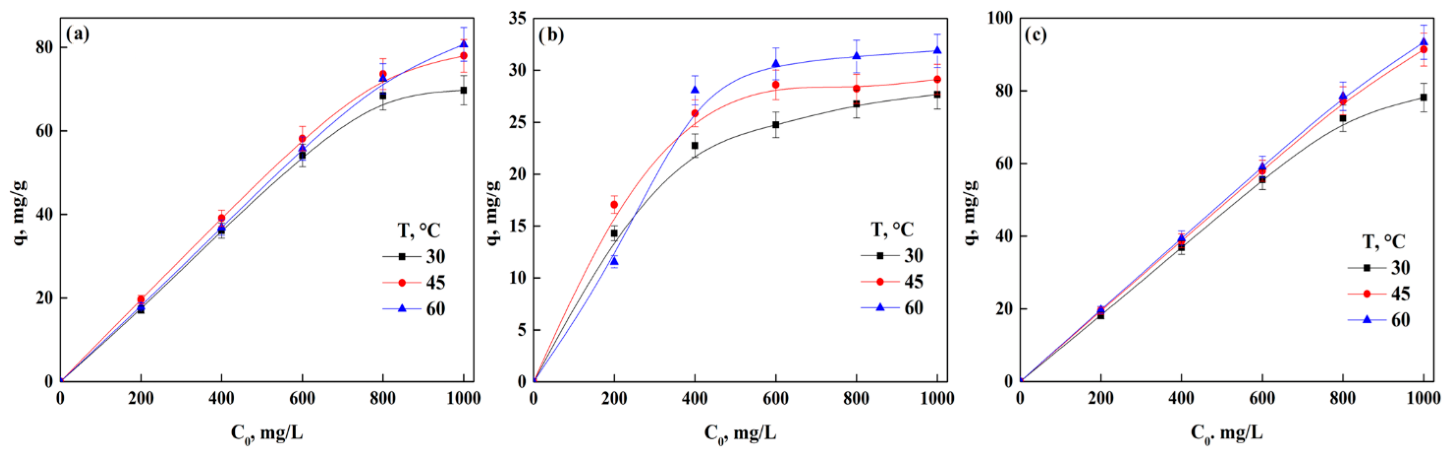
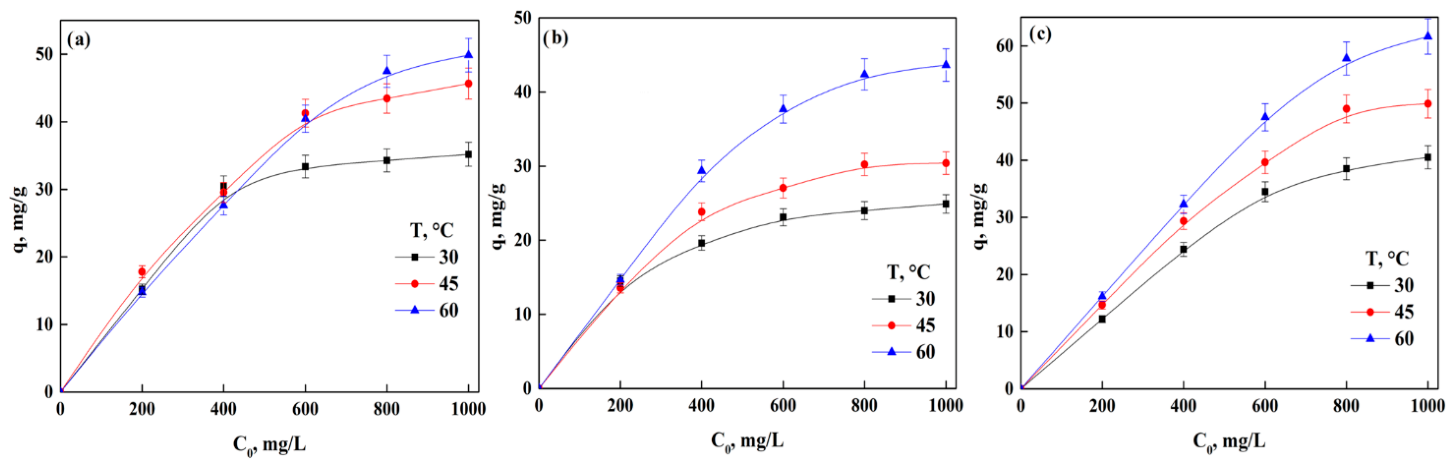
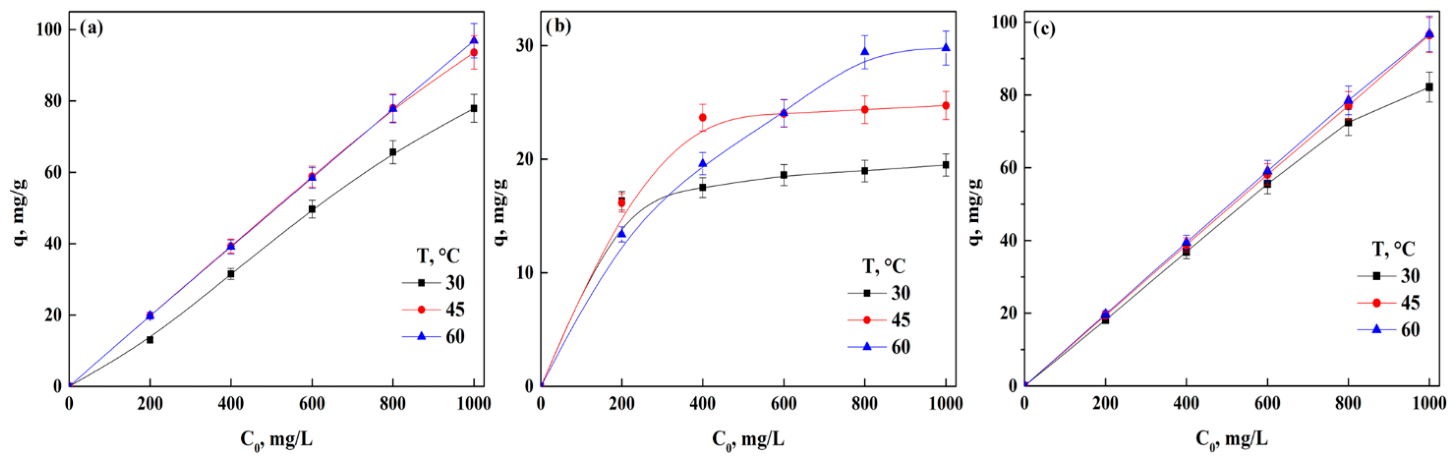
In the biosorption of Cr(III) using PCWT and PCHO, an increase in adsorption capacity was observed with increasing initial Cr(III) concentration at all evaluated temperatures, until a plateau corresponding to adsorption was attained, showing a similar trend (Figure 1a,c). A plateau in adsorption capacity was observed at initial concentration around 600 mg/L under the studied temperature conditions (Figure 1b). The plots of qe versus initial concentration (C0) are presented to illustrate the adsorption behavior under different experimental conditions and should not be interpreted as isotherm models, which were developed based on the final Cr(III) concentration after 12 h of contact time. These results indicate that the adsorption capacity increases with concentration due to an enhanced concentration gradient between the aqueous phase and the biosorbent surface, which acts as the driving force for the biosorption process [32,33].
Table 2. Initial Cr(III) concentration ranges and adsorption isotherm models reported in previous studies.
AdsorbentInitial Cr(III) Concentration (mg/L)Isotherm ModelpHm, gV, mLRefs.
Orange peel (Citrus sinensis)0–1000Freundlich2.720.5025[24]
Bentonite10–300Langmuir4.00.1050[29]
CaCO3-coated bacterial magnetosomes50–2000Langmuir6.00.05100[30]
Pomelo fruit peel10–500Sips4.50.2050[31]
Freeze-dried activated sludge5–500Langmuir4.01.00100[32]
Pectic and lignocellulosic biowastes10–600Langmuir4.01.5075[34]
K2CO3-activated orange peel10–500Freundlich2.01.20150[35]
Surface-modified pineapple crown leaf5–500Langmuir4–56.00100[36]
The adsorption capacities of PC-based biosorbents were strongly influenced by temperature and chemical pretreatment. The results indicate that the adsorption capacity increased with temperature for all PC-based biosorbents (Table 3). Compared to PCWT, PCOH exhibited higher adsorption capacities at all temperatures, with increases of approximately 30%, 45%, and 36% at 30 °C, 45 °C, and 60 °C, respectively. In contrast, PCHO showed lower adsorption capacities than PCWT at 30 °C and 45 °C, with decreases of 15.65% and 12.88%. This behavior may be attributed to the oxidative modification induced by H2O2 treatment, which can alter or reduce the availability of active binding sites at lower temperatures. However, at 60 °C, PCHO exhibited a slight increase in adsorption capacity (7.08%) relative to PCWT. This improvement can be explained by the enhanced diffusion of Cr(III) ions and the activation or greater exposure of oxygen-containing functional groups at higher temperatures, which favor adsorption. This trend is consistent with the endothermic nature of the biosorption process. Overall, these results confirm that alkaline pretreatment significantly enhances adsorption performance, while oxidative treatment may reduce adsorption efficiency at lower temperatures but becomes more favorable at higher temperatures.
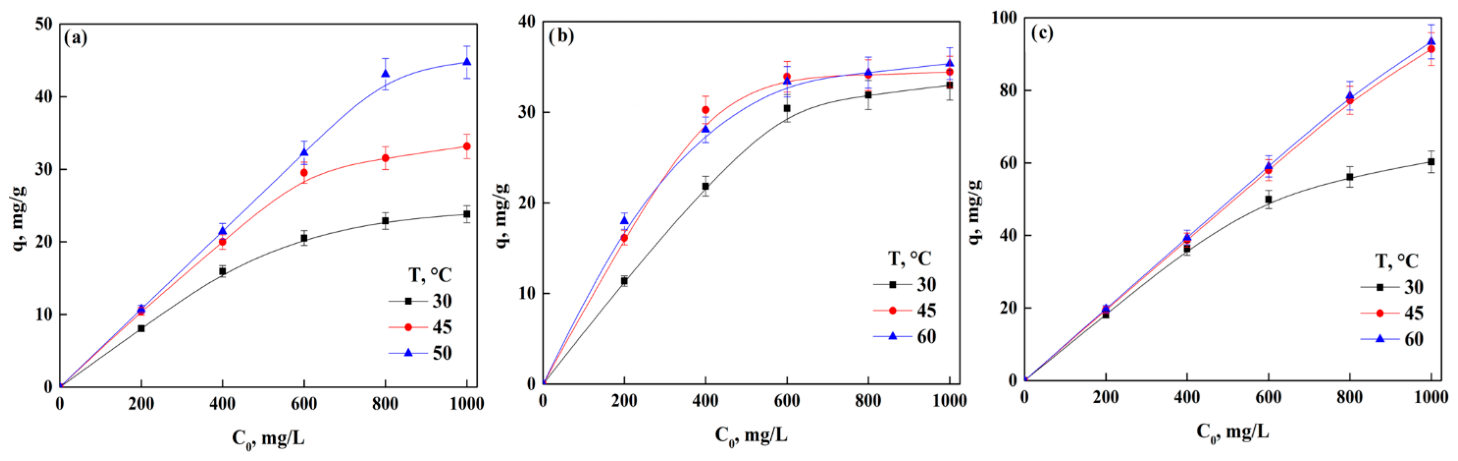
The biosorption of Cr(III) using OP as a biosorbent showed a rapid increase in adsorption capacity was observed with increasing initial Cr(III) concentration, reaching a maximum adsorption capacity at an initial concentration of 800 mg/L for natural OP (WT) as well as OP pretreated with NaOH (OH) and H2O2 (HO) (Figure 2). This behavior is associated with the progressive saturation of the available adsorption sites as equilibrium is approached [34].
The adsorption capacities of OP-based biosorbents were influenced by both temperature and chemical pretreatment. For OPWT, the adsorption capacity increased with temperature, reaching its maximum value at 60 °C. Alkaline pretreatment resulted in higher biosorption capacities at 30 °C and 60 °C, with increases of 15.15% and 23.61%, respectively, while no significant difference was observed at 45 °C (Table 4). In contrast, oxidative pretreatment led to lower adsorption capacities at all temperatures, with decreases of 29.2%, 33.36%, and 12.5% at 30 °C, 45 °C, and 60 °C, respectively. These findings indicate that NaOH treatment improves the availability of active sites, whereas H2O2 treatment may partially degrade functional groups responsible for Cr(III) binding.
In both biosorbents, variations in the Cr(III) removal percentage were observed as the initial metal concentration increased [35]. At lower concentrations, adsorption is governed by the availability of unsaturated active sites on the biosorbent surface [37]. However, at higher concentrations, partial site agglomeration and surface saturation may occur, which can reduce the effective surface area available for adsorption [38,39]. These results suggest that at low concentrations, many active sites remain available, whereas at high concentrations, the available sites progressively became occupied by Cr(III) ions [27].
The adsorption capacity of Cr(III) with a mixture of PC/OP (25%/75%, wt) increases with initial concentration, with the adsorption behavior depending on the applied pretreatment (Figure 3).
The adsorption capacities of PC/OP composite biosorbents increased with temperature, although the magnitude of this effect depended on the pretreatment applied (Table 5). Alkaline pretreatment significantly enhanced adsorption performance at all temperatures, with increases of 62.72%, 65%, and 51.05% at 30 °C, 45 °C, and 60 °C, respectively, indicating a strong synergistic effect between PC and OH-treated OP. In contrast, oxidative pretreatment showed moderate improvements at 30 °C and 45 °C (44.62% and 11.66%, respectively), while a decrease in adsorption capacity (23.93%) was observed at 60 °C, suggesting a possible thermal limitation or reduced availability of active sites at higher temperatures.
These results indicate that the biosorption process depends on the nature of the biosorbents surface. The point of zero charge (pHpzc) of orange peel (OP) and pineapple crown (PC), as determined in Section 2.5, was approximately 4.3 and 4.6 [27,28], while the Cr(III) solution has a pH = 2.4 [30,31]. Under conditions where pHsol < pHpzc, the biosorbent surface becomes positively charged, which may reduce electrostatic attraction for Cr(III) ions due to repulsion [40]. However, other mechanisms, such as including ion exchange and complexation with –COOH and –OH groups, can still dominate Cr(III) biosorption. Therefore, while electrostatic interactions may be partially repulsive, they may still influence the overall Cr(III) adsorption mechanism [24].
The biosorption of Cr(III) concentration using an OP/PC mixture (50%/50%, wt) increased with increasing Cr(III) initial concentration, with a plateau in adsorption capacity observed at approximately 950 mg/L for H2O-treated samples, 800 mg/L for NaOH-treated samples, and 600 mg/L for H2O2-treated samples (Figure 4). It is important to note that a plateau in adsorption capacity was not observed with NaOH-treated sample at 45 °C and 60 °C under the evaluated conditions.
The adsorption capacities of PC/OP composite biosorbents increased with temperature for all evaluated conditions (Table 6). Alkaline pretreatment enhanced adsorption performance at all temperatures, with increases of 24.91% at 30 °C, 15.92% at 45 °C, and 15.71% at 60 °C, indicating a positive effect of OH treatment on the adsorption capacity of the composite system. In contrast, oxidative pretreatment significantly reduced adsorption capacity, with decreases of 59.15% at 30 °C, 64.64% at 45 °C, and 60.88% at 60 °C, suggesting that this treatment negatively affected the availability or effectiveness of active adsorption sites within the composite structure.
The adsorption capacity of Cr(III) for the PC/OP (75%/25% by weight) increased with increasing initial concentration (Figure 5). No plateau was observed within the evaluated concentration range for H2O and NaOH treatments, regardless of temperature, indicating that saturation was not reached under these conditions. In contrast, H2O2-treated samples showed a plateau in adsorption capacity at an initial concentration of approximately 400 mg/L. These results suggest that both chemical pretreatment and temperature influence the adsorption behavior of the composite biosorbent.
A consistent increase in adsorption capacity with temperature was observed for all PC/OP composite biosorbents (Table 7). The adsorption capacity increased with temperature for all PC/OP composite biosorbents. Compared to PC/OPWT, PC/OPOH showed slightly higher adsorption capacities with increases of 5.65% at 30 °C and 1.69% at 45 °C, while similar adsorption capacities were observed at 60 °C, indicating that the NaOH pretreatment had a limited effect at higher temperatures. In contrast, PC/OPHO exhibited a markedly lower adsorption capacity at all temperatures, with decreases of 74.45% at 30 °C, 74.82% at 45 °C, and 69.38% at 60 °C relative to PC/OPWT, suggesting that this pretreatment significantly reduced the availability of effective adsorption sites in the composite biosorbent.
The adsorption behavior of the PC/OP mixture different from that of the individual biosorbents, indicating the presence of synergistic interactions. Slight increases in adsorption capacity at 30 °C and 45 °C (5.65% and 1.69%, respectively) suggest that the combined contribution of functional groups such as pectin carboxyls and cellulose hydroxyls enhances Cr(III) binding [38,39]. In contrast, oxidative treatment resulted in a decrease in adsorption capacity across the evaluated temperature range. At pH values below 7, the protonation of surface functional groups reduces the availability of active binding sites for metal ions [40]. Additionally, acidic conditions may induce partial modification of oxygen-containing functional groups, further decreasing their affinity for Cr(III) ions [41,42,43]. The increase in adsorption capacity with increasing initial Cr(III) concentration observed in this study is consistent with previous reports, where higher concentrations enhance the driving force for mass transfer between the aqueous and solid phases. Moreover, the adsorption trends identified for OP, PC, and OP/PC biosorbents are comparable or higher than those reported for similar agro-industrial residues, confirming the high affinity of the evaluated materials for Cr(III) ions. These results demonstrate that the adsorption behavior of OP, PC, and their mixtures follow established Cr(III) biosorption mechanisms, while also highlighting the enhanced performance achieved through biosorbent combination and chemical pretreatment.

3.2. Isotherm Analysis of Cr(III) Biosorption

The adsorption isotherms of Cr(III) were analyzed by fitting the experimental data to different models using Sigmaplot® (version 16) was used. The regression coefficient (R2) close to 1 and the normalized standard deviation (%∆q) close to 0 were considered criteria for selecting the best fit to the experimental data [24]. A comprehensive comparison of the evaluated isotherm models was performed, and for clarity, only the best-fitting models are presented, while the complete dataset and corresponding isotherm plots (Langmuir, Freundlich, Temkin, Sips, and Dubinin–Radushkevich) are provided in the Supplementary Materials (Figures S1–S5 and Tables S1–S5). For clarity, only the best-fitting models are summarized in Table 8. The results indicate that the Sips and Redlich–Peterson (RP) models consistently provided the best fit, suggesting adsorption on heterogeneous surfaces with sites of different energies. The value of n > 1 in the Freundlich model further indicates favorable adsorption, associated with strong interactions between Cr(III) ions and the biosorbent surface [44,45]. Additionally, Cr(III) removal efficiency increased with temperature for OPWT, with values of 73.86% at 30 °C, 76.13% at 45 °C, and 88.98% at 60 °C. A similar trend was observed for OPOH and OPHO, with removal percentages of 60.98%, 73.38%, and 80.72% for OPOH and 59.61%, 72.46%, and 73.36% for OPHO, confirming the positive effect of temperature on the adsorption process. The adsorption process using PC exhibited behavior similar to that observed for OP (Table 8). The results suggest that adsorption occurs on heterogeneous surfaces with sites of different energies, as supported by the fitting of the Sips, Freundlich, and Redlich–Peterson model. Cr(III) removal efficiency increased with temperature for PCWT was 55.47% at 30 °C, 71.55% at 45 °C, and 75.21% at 60 °C. A similar trend was observed with removal percentages of 53.25%, 68.33%, and 86.23% for PCOH and 64.66%, 78.98%, and 79.80% for PCHO, confirming the positive effect of temperature on the adsorption process. The RL value indicates favorable adsorption (0 < RL < 1) and the value of n > 1 in the Freundlich model confirms strong affinity between Cr(III) ions and the biosorbent surface [46,47]. Previous studies have investigated Cr(III) adsorption using a wide range of biosorbent materials, including algae [39], methylotrophic yeasts [14], citrus peels [40,45], clays [29], activated carbon [30], sawdust [44], and corn leaves [44], among others, with adsorption capacities ranging from 5.28 mg/g to 222 mg/g and removal efficiencies between 62.5% and 100%. These findings are consistent with the present results and support that lignocellulosic biosorbents typically exhibit adsorption dominated by weak interactions such as electrostatic attraction and van der Waals forces, characteristic of physisorption processes [44,45,46]. Furthermore, while Langmuir and Freundlich models, are commonly used to describe adsorption behavior, the Sips model has been reported to provide a better fit in heterogeneous systems, as observed in this study [31,33,40,47,48,49,50]. Overall, these results confirm that the evaluated biosorbents represent a sustainable and competitive alternative for Cr(III) removal.
The use of PC/OP mixture under different pretreatments exhibited behavior consistent with that observed for the individual biosorbents, indicating similar adsorption mechanisms in the Cr(III) removal process (Table 8). The results suggest that the adsorption occurs on heterogeneous surfaces with sites of different energies, primarily governed by physical interactions [48]. A comparative analysis based on R2 and %Δq indicated that the Sips and Redlich–Peterson models provided the best fit, supporting adsorption on heterogeneous surfaces without assuming a single mechanism. Cr(III) removal increased with temperature in all mixtures. For the PC/OP (25%/75%, wt) mixture treated with H2O, removal percentages of 40.33%, 52.26%, and 53.79% at 30 °C, 45 °C, and 60 °C, confirming the positive effect of temperature on adsorption. Increasing the proportion of PC in the mixture significantly enhanced removal efficiency, with values of 90.36%, 92.96%, and 98.16% for the PC/OP (50%/50%, wt) mixture, representing increases of 124.41% at 30 °C, 77.79% at 45 °C, and 82.46% at 60 °C. Similarly, for the PC/OP (75%/25%, wt) mixture, the removal percentages of 91.25%, 94.96%, and 99.16% were obtained, corresponding to increases of 126.25% at 30 °C, 81.70% at 45 °C, and 84.34% at 60 °C. These results demonstrate a strong synergistic effect associated with increasing PC content, leading to enhanced adsorption performance.
The adsorption performance of PC/OP mixture treated with NaOH showed a consistent increase in Cr(III) removal with temperature for all compositions (Table 8). For the PC/OP (25%/75%, wt) mixture, removal efficiencies of 90.82% at 30 °C, 93.57% at 45 °C, and 97.25% at 60 °C confirmed the positive effect of temperature on adsorption increasing the proportion of PC further enhanced removal efficiency, reaching 92.20%, 95.41%, and 98.62% for the PC/OP (50%/50%, wt) mixture, corresponding to increases of 1.53% at 30 °C, 5.49% at 45 °C, and 1.42% at 60 °C. For the PC/OP (75%/25%, wt) mixture, removal percentage of 94.49%, 98.85%, and 99.08% were achieved, representing increases of 4.7%, 5.63%, and 1.88%. These results indicate that alkaline pretreatment combined with higher PC content promotes more efficient adsorption.
In contrast, mixtures treated with H2O2 showed lower adsorption performance (Table 8). For the PC/OP (25%/75%, wt) mixture, removal efficiencies of 56.85%, 80.72% and 89.90% were observed at 30 °C, 45 °C, and 60 °C, respectively. In the case of the PC/OP mixture (50%/50%, wt), the removal percentages were 53.16%, 71.54%, and 85.32%, corresponding to decreases of 6.49% at 30 °C, 11.37% at 45 °C, and 5.1% at 60 °C. For PC/OP (75%/25%, wt) mixture, removal percentages of 51.16%, 66.95% and 80.72% were observed, corresponding to decreases of 10.01% at 30 °C, 17.06% at 45 °C, and 10.21% at 60 °C. Overall, the results obtained with OP and PC mixtures demonstrate a synergistic effect associated with increasing PC content, leading to higher Cr(III) adsorption capacities [49,50]. This behavior may be attributed to the higher availability of functional groups such as cellulose and pectin, as supported by FTIR analysis and consistent with previous studies, contributing to adsorption improvements of up to 33.68% in the case of PC and 36.33% for OP [21,51].
Although six isotherm models were evaluated, the Sips and Redlich–Peterson (RP) models consistently provided the best fit across all biosorbents, indicating that the adsorption process cannot be adequately described by ideal monolayer assumptions. This behavior reflects the intrinsically heterogeneous nature of lignocellulosic biosorbents, which possess a wide distribution of active sites with different affinities and energies [18,40]. The superior performance of the Sips model suggests that the adsorption system exhibits Freundlich-type behavior at low concentrations and gradually approaches Langmuir-type saturation at higher concentrations, highlighting a transition from heterogeneous to quasi-homogeneous adsorption domains [48]. Similarly, the good fit of the RP model supports the presence of non-ideal adsorption behavior, where deviations from Langmuir assumptions arise due to surface irregularities and complex adsorption mechanisms [48]. The observed variations in fitting parameters among the different biosorbents can be attributed to differences in surface chemistry, pore structure, and functional group availability induced by the chemical treatments (H2O2 and NaOH). These modifications alter the distribution and accessibility of adsorption sites, influencing the interaction between Cr(III) ions and the biosorbent surface. In particular, oxidative and alkaline treatments are known to introduce or expose oxygen-containing functional groups (e.g., –OH, –COOH), which enhance metal binding through complexation and electrostatic interactions [28,31]. Therefore, the adsorption behavior of Cr(III) onto these materials is governed by a combination of mechanisms, including surface complexation, ion exchange, and physical adsorption, rather than a single uniform process [39]. This explains why hybrid models such as Sips and RP provide a more accurate representation of the system compared to classical models such as Langmuir. After the adsorption process (12 h), the biosorbents were recovered, dried, and weighed, showing minimal mass loss (~5%) and no visible structural degradation, indicating good stability under the experimental conditions.

3.3. Thermodynamic Analysis of the Cr(III) Adsorption Process Using OP and PC

To understand the nature of the Cr(III) biosorption process using OP and PC waste, thermodynamic parameters were evaluated (Table 9). The results indicate that the process is spontaneous (ΔG < 0) and endothermic (ΔH > 0), with a strong dependence on temperature for all three treatments [41,45]. In addition, an increase in randomness at the solid/liquid interface (ΔS > 0) was observed, suggesting enhanced disorder during the biosorption process [41,45]. Alkaline pretreatment resulted in lower ΔH values, indicating that the adsorbate–adsorbent interaction is thermodynamically favored for both biosorbents [41,45]. Although a higher ΔH value was observed in PC, this parameter alone does not determine adsorption capacity, which is also influenced by surface characteristics and functional group availability [41,45]. In contrast, biosorbents treated with H2O2 exhibited similar ΔH values, suggesting comparable interaction energies between Cr(III) ions and the biosorbent surface [41,44]. The adsorption capacity of both PC and OP can be attributed to the presence of active functional groups, such as pectin carboxyls and cellulose hydroxyls, which are capable of binding metal ions [41,44].
Temperature significantly influenced the biosorption behavior of all evaluated systems. In general, increasing temperature led to higher adsorption capacities, consistent with the endothermic nature of the process (ΔH > 0). This behavior may be attributed to enhanced Cr(III) mobility, improved diffusion, and increased accessibility of active sites at elevated temperatures. The thermodynamic behavior of Cr(III) biosorption using different OP/PC mixtures (Table 8) indicates that the process is spontaneous (ΔG < 0) and is associated with an increase in randomness at the solid/liquid interface (ΔS > 0), regardless of the mixture composition [41,44]. A decrease in ΔH values was observed with increasing PC content in mixtures treated with H2O and NaOH, suggesting that the adsorbate–adsorbent interaction becomes more favorable due to the reorganization of weak interactions and the dominance of attractive forces [41,45]. In contrast, mixtures treated with H2O2 showed an increase in ΔH with decreasing OP content, which may indicate that interactions between Cr(III) ions and the solution become more significant than those with the biosorbent surface [41,45]. These variations can be attributed to changes in the distribution and availability of functional groups involved in Cr(III) binding, resulting from the combination of OP and PC [41,44].

3.4. ANOVA of Cr(III) Adsorption Using PC, OP, and a Mixture of Both Biosorbents

To evaluate the influence of different factors on Cr(III) adsorption, a statistical analysis was performed using Jamovi® (Ver. 2.3.28.0). The adsorption capacity was investigated for OP, PC, and their mixtures, considering biosorbent type, pretreatment, and temperature as variables of both [52,53]. A factorial experimental design was applied, including two qualitative factors (biosorbent and pretreatment) and one quantitative factor (temperature) (Table 10). The ANOVA results indicated that the main factors and their two-way interactions were statistically significant (p < 0.05) confirming their influence on the adsorption process. In particular, the interaction of Biosor–Pret showed a significant effect, highlighting the importance of chemical modification depending on the type of biosorbent. Descriptive analysis of this interaction revealed that the highest mean adsorption capacity was obtained for the NaOH pretreatment in the PC/OP mixture (75%/25%, wt) [53,54].
The highest adsorption capacities were obtained for biosorbents treated with NaOH, particularly for the PC/OP(75%/25%, wt) mixture, as well as for samples treated with H2O. An average adsorption capacity of 91.45 mg/g was achieved at 60 °C confirming the strong influence of temperature on the adsorption process. No significant differences were observed between OP and PC individually under the evaluated pretreatments, indicating comparable adsorption performance for both biosorbents [52,53]. Tukey’s multiple comparison test revealed significant differences among temperature levels, with 60 °C consistently providing higher adsorption capacities across all biosorbent combinations and for both H2O and NaOH treatments [52,53]. The incorporation of OP/PC mixtures with NaOH treatment significantly enhanced Cr(III) adsorption capacity, while H2O2 pretreatment exhibited an unfavorable effect, leading to a reduction in adsorption performance [52,53].

3.5. Characterization of OP and PC

3.5.1. Attenuated Total Reflectance–Fourier Transform Infrared Spectroscopy (ATR-FTIR) of the Biosorbents Before and After Cr(III) Adsorption

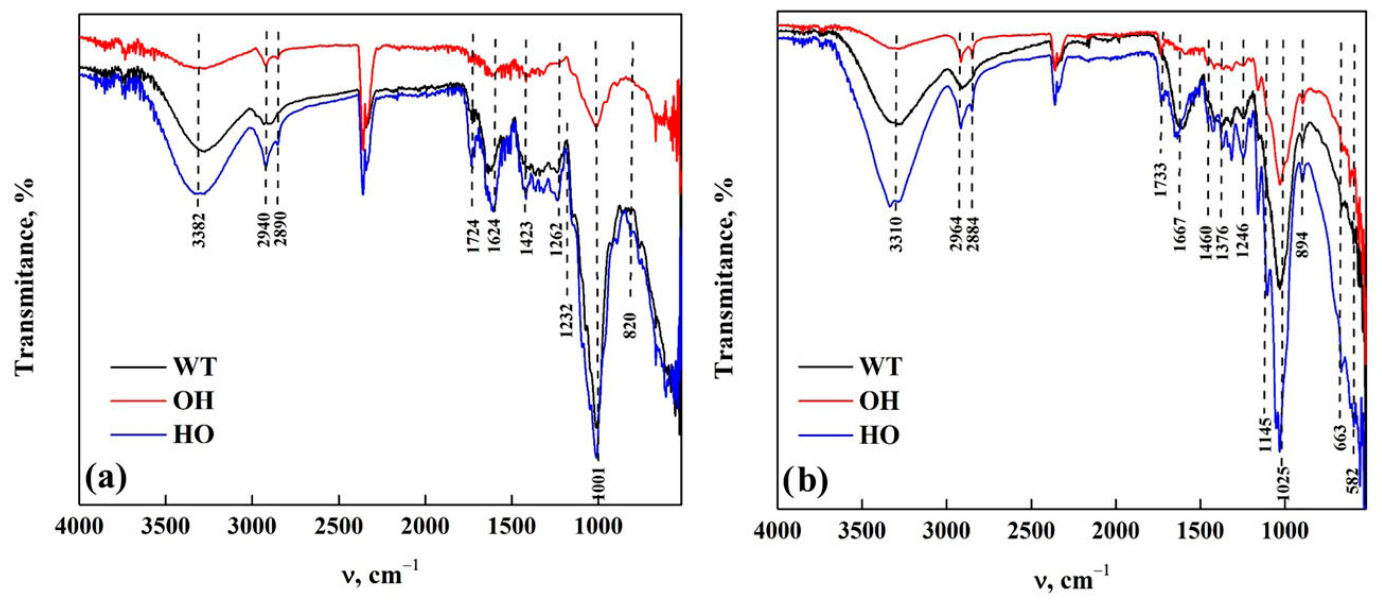
ATR-FTIR spectroscopy was employed to identify the surface functional groups present in OP- and PC-based biosorbents subjected to different chemical pretreatments, as well as in their composite mixtures, and to evaluate their involvement in Cr(III) adsorption. Both materials are mainly composed of lignocellulosic constituents, which provide abundant oxygen-containing functional groups capable of interacting with metal ions. Spectra recorded before and after Cr(III) adsorption were compared to identify changes in band position and intensity associated with metal binding. ATR-FTIR spectra of the pretreated biosorbents before Cr(III) adsorption are shown in Figure 6, while the spectra after adsorption are provided in the Supplementary Materials (Figures S6 and S7). Detailed band assignments for each OP and PC biosorbents are summarized in Table 11.
ATR-FTIR spectroscopy was further applied to investigate the surface chemical characteristics of OP/PC composite biosorbents prepared at different mass ratios (75/25, 50/50, and 25/75 wt%) and subjected to distinct chemical pretreatments (WT, OH, and HO). The combination of OP and PC integrates functional groups from both parent materials, modifying the surface chemistry and influencing Cr(III) adsorption behavior. The spectra recorded after Cr(III) adsorption were analyzed to identify characteristic bands and spectral changes associated with metal binding in the composite systems. The detailed ATR-FTIR band assignments and the effects of pretreatment and composition on the adsorption-related functional groups are summarized in Table 12, while the complete set of spectra is provided in the Supplementary Materials (Figures S8–S10).
The ATR-FTIR spectra of the OP/PC composite biosorbents exhibit combined spectral characteristics of both parent materials. After Cr(III) adsorption, all composite ratios exhibited similar spectral modifications, particularly in bands associated with hydroxyl, carbonyl, and carboxylate groups. These changes indicate that the biosorption mechanism in the composites is primarily governed by oxygen-containing functional groups, consistent with those identified in the individual biosorbents. The presence of Cr–O related bands across all mixtures confirms effective Cr(III) binding, while the comparable spectral behavior among the different OP/PC ratios suggests that the pretreatment influences adsorption performance without altering the fundamental binding mechanism.

3.5.2. Scanning Electron Microscopy (SEM) of the Biosorbents Before and After Cr(III) Adsorption

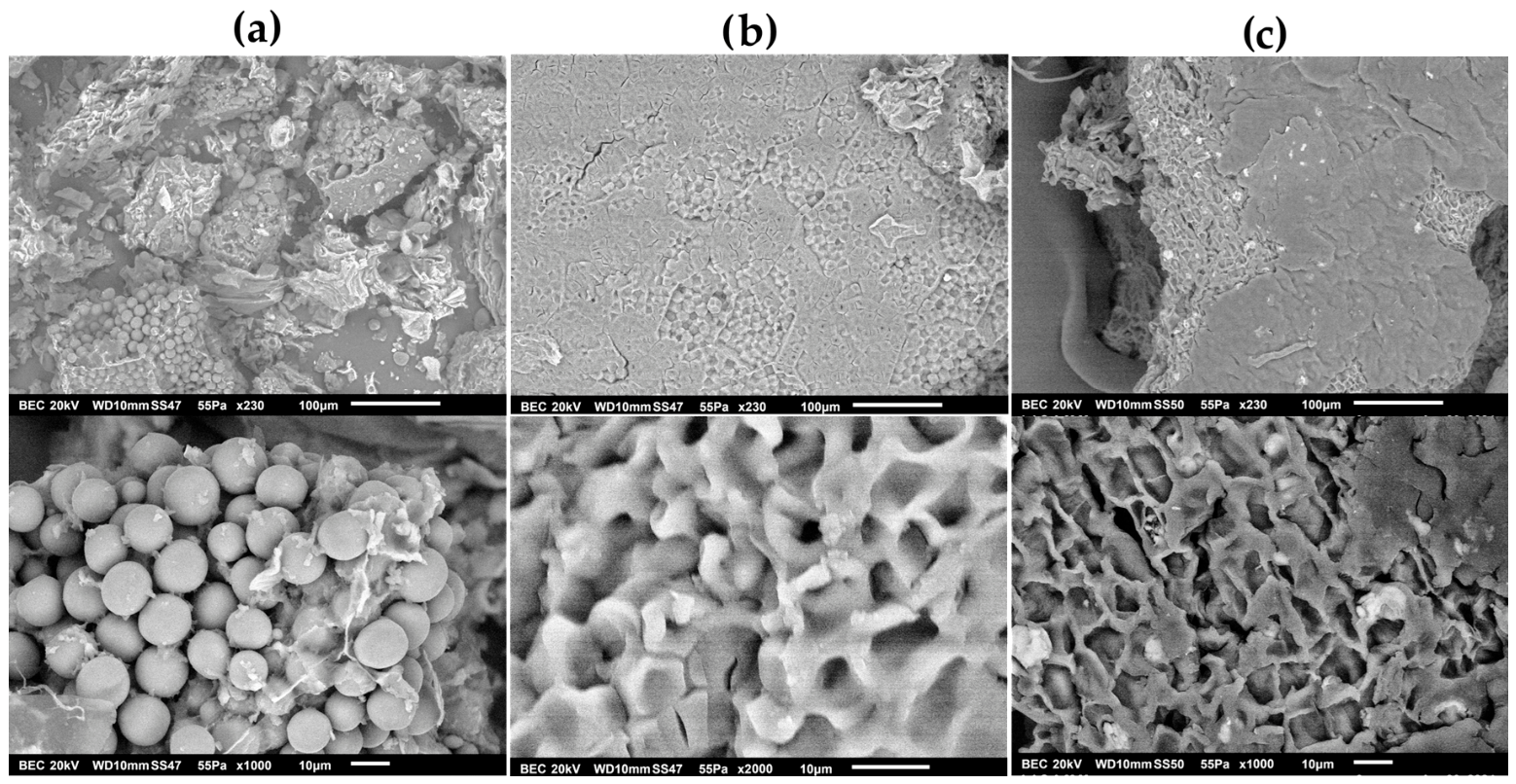
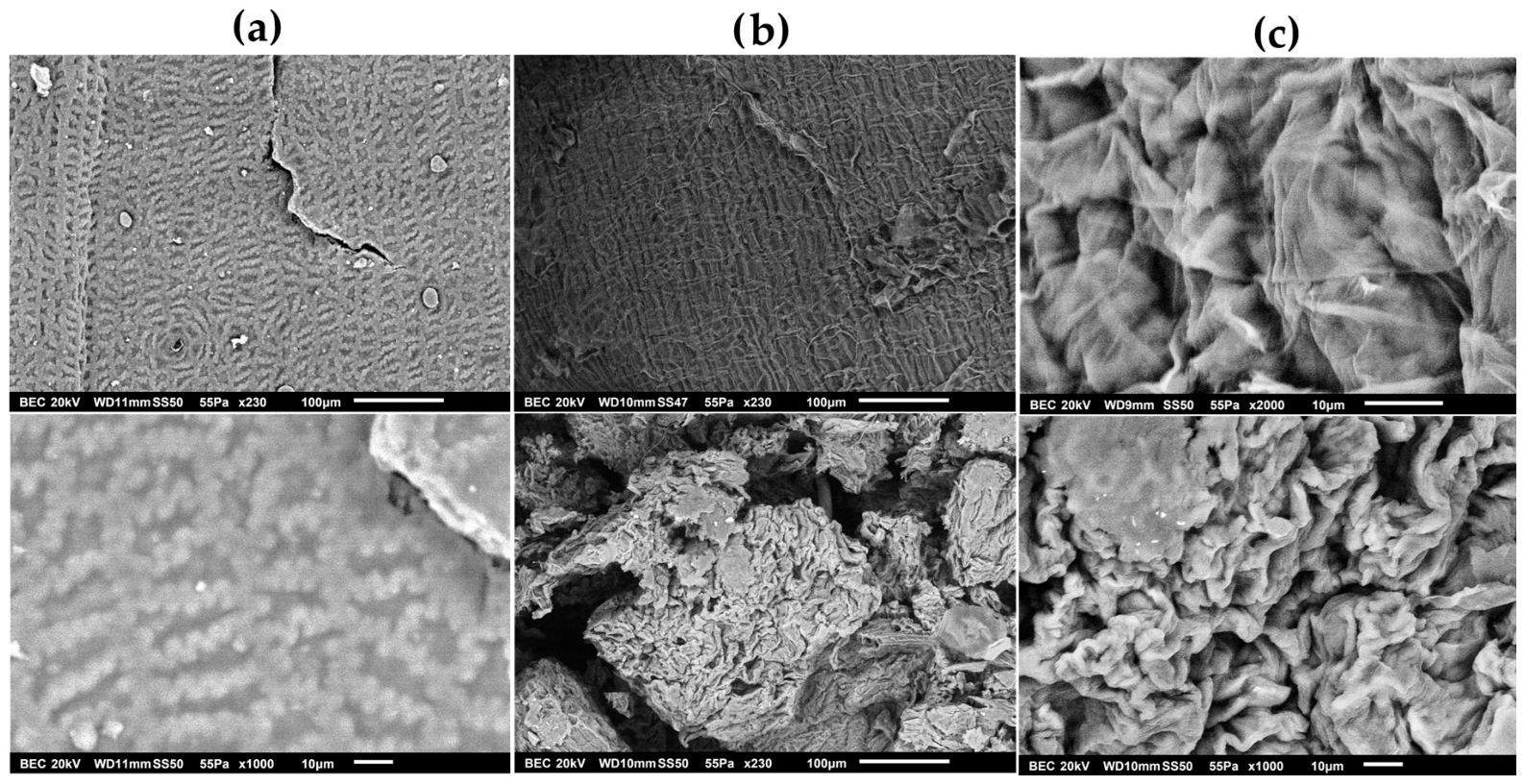
The surface morphology OP biosorbents were notably affected by chemical pretreatment (Figure 7). OPWT exhibited predominantly spherical particles arranged in channel-like structure, while OPOH and OPHO showed significant surface modifications characterized by the development of heterogeneous pores, with OPOH presenting wider pore openings than OPHO. These structural changes influence adsorption performance by modifying the accessibility of active sites and enhancing interaction between the adsorbent surface and dissolved contaminants [51,56]. Similar morphological effects have been reported for lignocellulosic biosorbents in previous studies [69,70,71]. This behavior explains the higher Cr(III) adsorption observed by NaOH-treated biosorbents compared to H2O- and H2O2-treated samples.
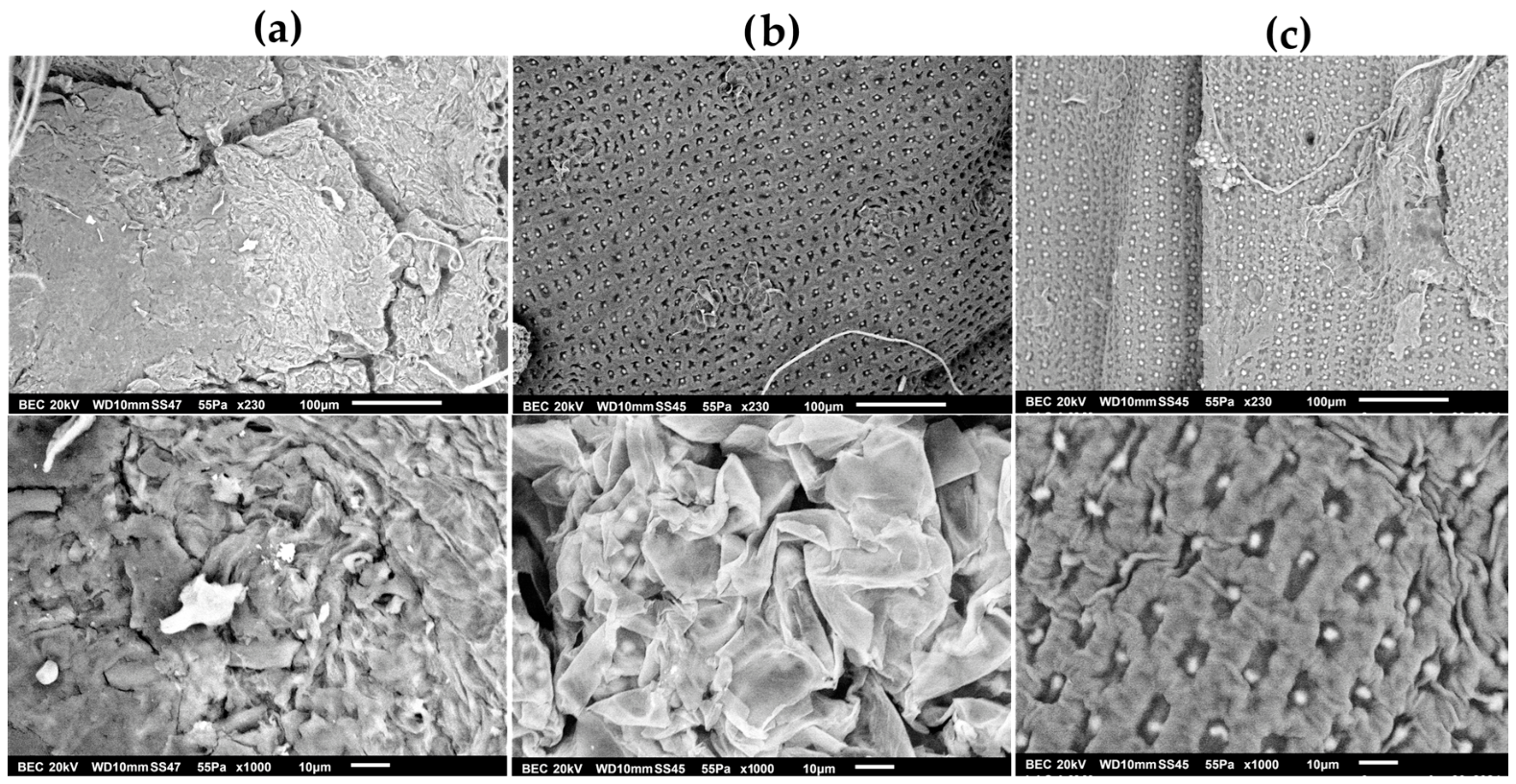
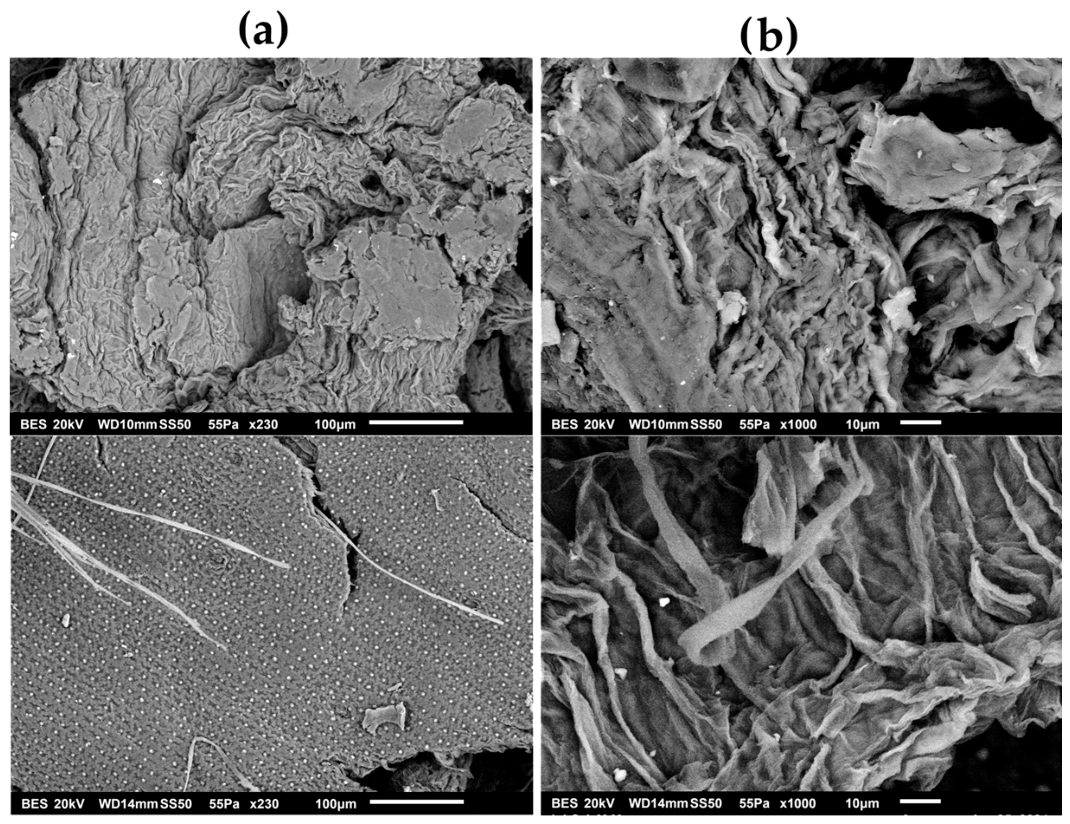
The morphology of PC biosorbents also showed significant changes after chemical treatment (Figure 8). PCWT exhibited cracks and ripples forming microchannels on the surface, while treated biosorbents developed more defined laminar structures (Figure 2b,c). These modifications are associated with the removal of hemicellulose and partial depolymerization lignin, resulting in smoother surfaces and structural rearrangements [61,62,72]. Such features are characteristic of lignocellulosic materials and have been associated with improved adsorption properties due to the formation of fissures and channels that facilitate metal ion diffusion and interaction with active sites [40,63,73].
The biosorbents with the highest Cr(III) adsorption capacity exhibited more developed surface structures, characterized by the presence of dispersed particles within voids formed by fibrous networks and surface channels (Figure 9). These morphological features enhance adsorption by increasing the available surface area and promoting effective interaction between Cr(III) ions and the biosorbent structure [40,62].
The OP/PCOH (25%/75%, wt) mixture showed surface characteristics similar to those of the individual biosorbents, combining porous structures and laminar fibrillar features (Figure 10). The presence of Cr(III) particles on the surface was more evident in samples treated with H2O and NaOH, indicating effective adsorption, whereas the H2O2-treated mixture exhibited less pronounced surface deposition [64,71]. These observations suggest that alkaline pretreatment enhances surface properties favorable for metal binding, while oxidative treatment may reduce the effectiveness of adsorption sites.

3.5.3. Energy-Dispersive X-Ray Spectroscopy (EDS) of the Biosorbents Before and After Cr(III) Adsorption

Elemental analysis of OP, PC, and the mixture after treatment with NaOH before Cr(III) adsorption (Table 13) revealed the presence of C, O, K, S, Ca, and P in all biosorbents, while Mg was detected only in PC and in the composite mixture [40,74]. These elements are characteristic of lignocellulosic materials and are associated with the presence of inorganic constituents and functional groups that can participate in metal adsorption processes.
After Cr(III) adsorption, elemental analysis showed changes in the composition of the biosorbents, particularly due to the incorporation of Cr on the surface (Table 14). A higher Cr content was observed in OP and in the mixture compared to PCOH, indicating a difference in adsorption capacity of ~83% [66,69,75]. These results confirm the effective binding of Cr(III) ions and are consistent with the adsorption performance observed for the evaluated biosorbents.

3.5.4. X-Ray Diffraction (XRD) of Adsorbents

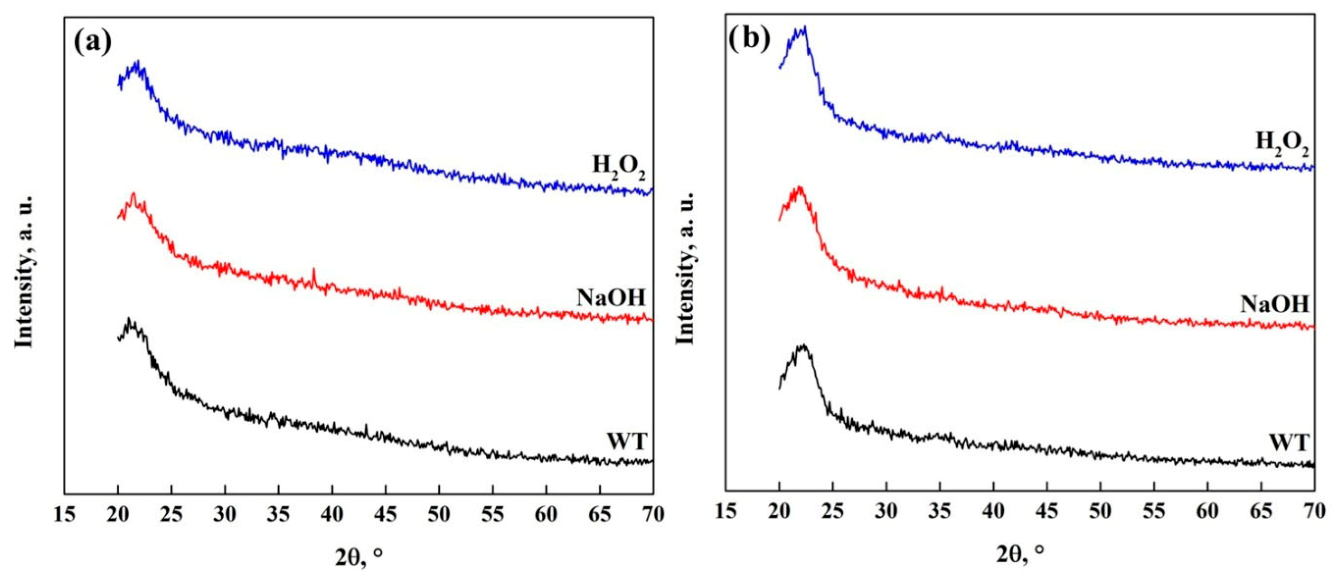
The XRD patterns of PC and OP biosorbents different treatments (Figure 11) showed a broad diffraction peak around 22°, characteristic of the crystalline structure of cellulose in lignocellulosic materials [64,69,74]. The treated biosorbents (WT) exhibited broader and less intense peak, indicating a higher contribution of amorphous components such as lignin and hemicellulose [69,75]. After chemical treatments with NaOH and H2O2, an increase in around 22° was observed, particularly for the H2O2-treated samples, suggesting partial removal of amorphous fractions and a relative increase in the ordered cellulose structure [76,77]. A similar diffraction behavior was observed for both PC and OP, although the OP samples showed slightly higher peak intensity, indicating differences in the structural organization of the cellulose fraction. These changes reflect modifications in the biosorbent matrix after the treatments.
The biosorbents maintained their structural integrity during the 12 h contact time in acidic Cr(III) solution (pH = 2.4). After biosorption, characterization by ATR-FTIR, SEM, EDS, and XRD revealed changes in surface morphology and participation of functional groups in Cr(III) binding. In particular, XRD analysis showed only minor changes in the intensity of a single diffraction peak, indicating slight structural rearrangements due to Cr(III) interaction, without evidence of material degradation or significant leaching of soluble organic compounds. These results confirm the stability of the biosorbents under experimental conditions.

4. Conclusions

In this study, Cr(III) adsorption was evaluated using orange peel (OP), pineapple crown (PC), and their mixture (OP/PC) subjected to different pretreatments. All biosorbents showed significant capacity for Cr(III) removal; therefore, the OP/PC mixture (25/75, w/w) treated with NaOH presented the highest maximum adsorption capacity (96.8 mg/g) and the highest removal efficiency under optimal conditions (>99%). This performance highlights the synergistic effect arising from the integration of both agro-industrial residues and alkaline pretreatment. The adsorption data were best fitted by the Sips and RP isotherm models, indicating a heterogeneous adsorption behavior. Thermodynamic analysis indicated that the biosorption process occurs mainly through physisorption and is favored by increasing temperature, with increased randomness at the solid–liquid interface. Structural characterization revealed a semicrystalline structure associated with cellulose and lignin, while functional groups related to pectin, hydroxyl, and carboxyl groups played a key role in Cr(III) binding, particularly in the NaOH-treated OP/PC mixture due to their higher surface availability. Overall, these results demonstrate that pretreated OP and PC residues, especially their combined form, constitute a low-cost, efficient, and sustainable biosorbent for the removal of Cr(III) from contaminated water. Future studies should focus on evaluating the regeneration and reuse of the biosorbent, assessing its performance in real industrial effluents, and analyzing the feasibility of scaling up the process for continuous water treatment applications.

Supplementary Materials

The following supporting information can be downloaded at: https://www.mdpi.com/article/10.3390/pr14101622/s1, Figure S1. Adsorption isotherms of Cr(III) using OP biosorbents under different pretreatments: (a) WT, (b) HO, and (c) OH; Figure S2. Adsorption isotherms of Cr(III) using PC biosorbents under different pretreatments: (a) WT, (b) HO, and (c) OH; Figure S3. Adsorption isotherms of Cr(III) using PC/OP (25%/75%, wt) biosorbent under different pretreatments: (a) WT, (b) HO, and (c) OH; Figure S4. Adsorption isotherms of Cr(III) using PC/OP (50%/50%, wt) biosorbent under different pretreatments: (a) WT, (b) HO, and (c) OH; Figure S5. Adsorption isotherms of Cr(III) using PC/OP (75%/25%, wt) biosorbent under different pretreatments: (a) WT, (b) HO, and (c) OH; Figure S6. ATR-FTIR of Cr(III) adsorption on OP with different treatments: (a) WT, (b) OH, and HO; Figure S7. ATR-FTIR of Cr(III) adsorption on PC with different treatments: (a) WT, (b) OH, and HO; Figure S8. ATR-FTIR of Cr(III) adsorption on PC/OP (25%/75%, wt) with different treatments: (a) WT, (b) OH, and (c) H2O; Figure S9. ATR-FTIR of Cr(III) adsorption on OP/PC (50%/50%, wt) with different treatments: (a) WT, (b) OH, and (c) H2O; Figure S10. ATR-FTIR of Cr (III) adsorption on OP/PC (25%/75%, wt) with different treatments: (a) WT, (b) OH and (c) HO; Table S1. Parameters of the isothermal models for Cr(III) adsorption in OP; Table S2. Parameters of the isothermal models for Cr(III) adsorption in PC; Table S3. Parameters of the isothermal models for Cr(III) adsorption in OP/PCWT mixture; Table S4. Parameters of the isothermal models for Cr(III) adsorption in OP/PCOH mixture; Table S5. Parameters of the isothermal models for Cr(III) adsorption in OP/PCHO mixture.

Author Contributions

Conceptualization, F.R.-M., R.R.-C. and J.A.H.; methodology, F.R.-M., R.R.-C. and J.A.H.; software; validation, M.S.-H. and J.A.H.; investigation, F.R.-M., R.R.-C., M.S.-H. and J.A.H.; resources, F.R.-M., M.S.-H. and J.A.H.; data curation, M.S.-H., R.R.-C. and J.A.H.; writing—original draft preparation, J.A.H. and M.S.-H.; writing—review and editing, J.A.H. and M.S.-H.; visualization, F.R.-M. and R.R.-C.; supervision, M.S.-H.; project administration, M.S.-H.; funding acquisition, J.A.H. All authors have read and agreed to the published version of the manuscript.

Funding

This research received no external funding.

Data Availability Statement

The original contributions presented in this study are included in the article/Supplementary Materials. Further inquiries can be directed to the corresponding author.

Conflicts of Interest

The authors declare no conflicts of interest.

References

  1. Gavrilas, S.; Burescu, F.-L.; Chereji, B.-D.; Munteanu, F.-D. The Impact of Anthropogenic Activities on the Catchment’s Water Quality Parameters. Water 2025, 17, 1791. [Google Scholar] [CrossRef]
  2. Hao, Y.; Ma, H.; Wang, Q.; Zhu, C.; He, A. Complexation behaviour and removal of organic-Cr(III) complexes from the environment: A review. Ecotoxicol. Environ. Saf. 2022, 240, 113676. [Google Scholar] [CrossRef]
  3. Wen, Y.; Schoups, G.; van de Giesen, N. Organic pollution of rivers: Combined threats of urbanization, livestock farming and global climate change. Sci. Rep. 2017, 7, 43289. [Google Scholar] [CrossRef]
  4. Ray, S.; Vashishth, R. From water to plate: Reviewing the bioaccumulation of heavy metals in fish and unraveling human health risks in the food chain. Emerg. Contam. 2024, 10, 100358. [Google Scholar] [CrossRef]
  5. Shettya, B.R.; Jagadeesha, P.B.; Salmataj, S.A. Heavy metal contamination and its impact on the food chain: Exposure, bioaccumulation, and risk assessment. CyTA J. Food 2025, 23, 2438726. [Google Scholar] [CrossRef]
  6. Shin, D.Y.; Lee, S.M.; Jang, Y.; Lee, J.; Lee, C.M.; Cho, E.-M.; Seo, Y.R. Adverse Human Health Effects of Chromium by Exposure Route: A Comprehensive Review Based on Toxicogenomic Approach. Int. J. Mol. Sci. 2023, 24, 3410. [Google Scholar] [CrossRef]
  7. Zhou, Y.; Ma, J.; Gao, D.; Jia, L.; Guo, K.; Ren, H. Modification of collagen with three novel tannages, sulfonated calix[4]arenes. Int. J. Biol. Macromol. 2018, 116, 1004–1010. [Google Scholar] [CrossRef]
  8. Sreeram, K.J.; Ramasami, T. Sustaining tanning process through conservation, recovery and better utilization of chromium. Resour. Conserv. Recycl. 2003, 38, 185–212. [Google Scholar] [CrossRef]
  9. Alam, N.E.; Mia, A.S.; Ahmad, F.; Rahman, M. An overview of chromium removal techniques from tannery effluent. Appl. Water Sci. 2020, 10, 205. [Google Scholar] [CrossRef]
  10. Aziz, K.H.H.; Mustafa, F.S.; Omer, K.M.; Hama, S.; Hamarawf, R.F.; Rahman, K.O. Heavy metal pollution in the aquatic environment: Efficient and low-cost removal approaches to eliminate their toxicity: A review. RSC Adv. 2023, 13, 17595–17610. [Google Scholar] [CrossRef] [PubMed]
  11. Sombei, D.C.; Mecha, C.A.; Chollom, M.N. A Review of Low-Cost Point-of-Use Water Treatment Solutions Addressing Water Access and Quality in Resource-Limited Settings. Water 2025, 17, 1827. [Google Scholar] [CrossRef]
  12. Islam, M.M.; Mohana, A.A.; Rahman, M.A.; Rahman, M.; Naidu, R.; Rahman, M.M. A Comprehensive Review of the Current Progress of Chromium Removal Methods from Aqueous Solution. Toxics 2023, 11, 252. [Google Scholar] [CrossRef]
  13. Almeida-Naranjo, C.E.; Tejedor, J.; Villamar-Ayala, C.A.; Vizuete, G. Transforming waste into solutions: Raw and modified bioadsorbents for emerging contaminant removal. J. Environ. Chem. Eng. 2025, 13, 116720. [Google Scholar] [CrossRef]
  14. Aslam, A.; Kanwal, F.; Javied, S.; Nisar, N.; Torriero, A.A.J. Microbial biosorption: A sustainable approach for metal removal and environmental remediation. Int. J. Environ. Sci. Technol. 2025, 22, 13245–13276. [Google Scholar] [CrossRef]
  15. Alsulaili, A.; Elsayed, K.; Refaie, A. Utilization of agriculture waste materials as sustainable adsorbents for heavy metal removal: A comprehensive review. J. Eng. Res. 2024, 12, 691–703. [Google Scholar] [CrossRef]
  16. Mathew, B.B.; Jaishankar, M.; Biju, V.G.; Beeregowda, K.N. Role of Bioadsorbents in Reducing Toxic Metals. J. Toxicol. 2016, 13, 4369604. [Google Scholar] [CrossRef] [PubMed]
  17. Karim, A.; Raji, Z.; Karam, A.; Khalloufi, S. Valorization of Fibrous Plant-Based Food Waste as Biosorbents for Remediation of Heavy Metals from Wastewater—A Review. Molecules 2023, 28, 4205. [Google Scholar] [CrossRef]
  18. De Gisi, S.; Lofrano, G.; Grassi, M.; Notarnicola, M. Characteristics and adsorption capacities of low-cost sorbents for wastewater treatment: A review. Sustain. Mater. Technol. 2016, 9, 10–40. [Google Scholar] [CrossRef]
  19. Simón, D.; Palet, C.; Costas, A.; Cristóbal, A. Agro-Industrial Waste as Potential Heavy Metal Adsorbents and Subsequent Safe Disposal of Spent Adsorbents. Water 2022, 14, 3298. [Google Scholar] [CrossRef]
  20. Deewan, R.; Tanboonchuy, V.; Khamdahsag, P.; Yan, D.Y.-S. Utilization of agricultural waste: Mango peels and pineapple crown leaves as precursors for nanomaterial production for arsenate remediation. Environ. Sci. Pollut. Res. 2025, 32, 14508–14526. [Google Scholar] [CrossRef]
  21. Aili Hamzah, A.F.; Hamzah, M.H.; Che Man, H.; Jamali, N.S.; Siajam, S.I.; Ismail, M.H. Recent Updates on the Conversion of Pineapple Waste (Ananas comosus) to Value-Added Products, Future Perspectives and Challenges. Agronomy 2021, 11, 2221. [Google Scholar] [CrossRef]
  22. Saini, R.K.; Khan, M.I.; Kumar, V.; Shang, X.; Lee, J.-H.; Ko, E.-Y. Bioactive Compounds of Agro-Industrial By-Products: Current Trends, Recovery, and Possible Utilization. Antioxidants 2025, 14, 650. [Google Scholar] [CrossRef] [PubMed]
  23. Ketnawa, S.; Chaiwut, P.; Rawdkuen, S. Pineapple wastes: A potential source for bromelain extraction. Food Bioprod. Process. 2012, 9, 385–391. [Google Scholar] [CrossRef]
  24. Patiño-Saldivar, L.; Hernández, J.A.; Ardila, A.; Salazar-Hernández, M.; Talavera, A.; Hernández-Soto, R. Cr (III) Removal Capacity in Aqueous Solution in Relation to the Functional Groups Present in the Orange Peel (Citrus sinensis). Appl. Sci. 2021, 11, 6346. [Google Scholar] [CrossRef]
  25. López-Ahumada, E.; Salazar-Hernández, M.; Talavera-López, A.; Solis-Marcial, O.J.; Hernández-Soto, R.; Ruelas-Leyva, J.P.; Hernández, J.A. Removal of anionic and cationic dyes present in solution using water lily (Eichhornia crassipes) as bioadsorbent. Molecules 2022, 27, 6442. [Google Scholar] [CrossRef]
  26. Wang, X.S.; Zhou, Y.; Jiang, Y.; Sun, C. The removal of basic dyes from aqueous solutions using agricultural by-products. J. Hazard. Mater. 2008, 157, 374–385. [Google Scholar] [CrossRef]
  27. Genduso, M.G.; Guagliano, M.; Finocchio, E.; Cristiani, C.; Dotelli, G.; Santomauro, G. Adsorption of Heavy Metals from Low Concentration Solutions onto Dried Chlamydomonas reinhardtii. Appl. Sci. 2024, 14, 11057. [Google Scholar] [CrossRef]
  28. Li, J.; Yang, Z.-L.; Ding, T.; Song, Y.-J.; Li, H.-C.; Li, D.-Q.; Chen, S.; Xu, F. The role of surface functional groups of pectin and pectin-based materials on the adsorption of heavy metal ions and dyes. Carbohydr. Polym. 2022, 276, 118789. [Google Scholar] [CrossRef] [PubMed]
  29. Castro-Castro, J.D.; Sanabria-González, N.R.; Giraldo-Gómez, G.I. Experimental data of adsorption of Cr(III) from aqueous solution using a bentonite: Optimization by response surface methodology. Data Brief. 2020, 28, 105022. [Google Scholar] [CrossRef]
  30. Jacob, J.J.; Varalakshmi, R.; Gargi, S.; Jayasri, M.A.; Suthindhiran, K. Removal of Cr (III) and Ni (II) from tannery effluent using calcium carbonate coated bacterial magnetosomes. npj Clean Water 2018, 1, 1. [Google Scholar] [CrossRef]
  31. Dinh, V.-P.; Huynh, T.-D.; Le, H.M.; Nguyen, V.-D.; Dao, V.-A.; Hung, N.Q.; Tuyen, L.A.; Lee, S.; Yi, J.; Nguyen, T.D.; et al. Insight into the adsorption mechanisms of methylene blue and chromium(III) from aqueous solution onto pomelo fruit peel. RSC Adv. 2019, 9, 25847–25860. [Google Scholar] [CrossRef]
  32. Yao, Q.; Zhang, H.; Wu, J.; Shao, L.; He, P. Biosorption of Cr(III) from aqueous solution by freeze-dried activated sludge: Equilibrium, kinetic and thermodynamic studies. Front. Environ. Sci. Eng. China 2010, 4, 286–294. [Google Scholar] [CrossRef]
  33. Kotabewatta, P.A.; Lim, L.B.L.; Priyantha, N. Biosorption of Cr(III) and Pb(II) from synthetic wastewater under dynamic conditions –diffusion characteristics. Ceylon J. Sci. 2023, 52, 71–81. [Google Scholar] [CrossRef]
  34. Bellú, S.; Sala, L.; González, J.; García, S.; Frascaroli, M.; Blanes, P.; García, J.; Peregrin, J.S.; Atria, A.; Ferrón, J.; et al. Thermodynamic and Dynamic of Chromium Biosorption by Pectic and Lignocellulocic Biowastes. J. Water Resour. Prot. 2010, 2, 888–897. [Google Scholar] [CrossRef]
  35. Arslan, Y.; Kendüzler, E.; Kabak, B.; Demir, K.; Tomul, F. Determination of Adsorption Characteristics of Orange Peel Activated with Potassium Carbonate for Chromium(III) Removal. J. Turk. Chem. Soc. Sect. A Chem. 2017, 4, 51–64. [Google Scholar] [CrossRef]
  36. Gogoi, S.; Chakraborty, S.; Saikia, M.D. Surface modified pineapple crown leaf for adsorption of Cr (VI) and Cr (III) ions from aqueous solution. J. Environ. Chem. Eng. 2018, 6, 2492–2501. [Google Scholar] [CrossRef]
  37. Khamseh, A.A.G.; Ghorbanian, S.A.; Amini, Y.; Shadman, M.M. Investigation of kinetic, isotherm and adsorption efficacy of thorium by orange peel immobilized on calcium alginate. Sci. Rep. 2023, 13, 8393. [Google Scholar] [CrossRef] [PubMed]
  38. Diephuis, W.R.; Molloy, A.L.; Boltz, L.L.; Porter, T.B.; Aragon Orozco, A.; Duron, R.; Crespo, D.; George, L.J.; Reiffer, A.D.; Escalera, G.; et al. The Effect of Agglomeration on Arsenic Adsorption Using Iron Oxide Nanoparticles. Nanomaterials 2022, 12, 1598. [Google Scholar] [CrossRef] [PubMed]
  39. Saravanan, A.; Karishma, S.; Senthil Kumar, P.; Thamarai, P.; Yaashika, P.R. Recent insights into mechanism of modified bio-adsorbents for the remediation of environmental pollutants. Environ. Pollut. 2023, 339, 122720. [Google Scholar] [CrossRef]
  40. Nyairo, W.; Njewa, J.B.; Shikuku, V.O. Adsorption of heavy metals onto food wastes: A review. Front. Environ. Chem. 2025, 6, 1526366. [Google Scholar] [CrossRef]
  41. Singha, B.; Das, S.K. Biosorption of Cr (VI) ions from aqueous solutions: Kinetics, equilibrium, thermodynamics and desorption studies. Colloids Surf. B Biointerfaces 2011, 84, 221–232. [Google Scholar] [CrossRef] [PubMed]
  42. Overah, L.C. Biosorption of Cr (III) from aqueous solution by the leaf biomass of Calotropis procera–‘Bom bom’. J. Appl. Sci. Environ. Manag. 2011, 15, 87–95. [Google Scholar] [CrossRef]
  43. Deagbara, S.G.; Isehunwa, S.O.; Okereke, N.U.; Nwanwe, O.; Oguama, I.; Kerunwa, A. Adsorptive Removal of Heavy Metals from Oil Well Produced Water Using Citrullus lanatus Peel. S. Afr. J. Chem. Eng. 2022, 39, 19–27. [Google Scholar] [CrossRef]
  44. Afzaal, M.; Hameed, S.; Abbasi, N.A.; Liaqat, I.; Rasheed, R.; Khan, A.A.; Manan, H.A. Removal of Cr (III) from wastewater by using raw and chemically modified sawdust and corn husk. Water Pract. Technol. 2022, 17, 1937–1958. [Google Scholar] [CrossRef]
  45. Ugbe, F.A.; Pam, A.A.; Ikudayis, A.V. Thermodynamic Properties of Chromium(III) Ion Adsorption by Sweet Orange (Citrus sinensis) Peels. Am. J. Anal. Chem. 2014, 5, 666–673. [Google Scholar] [CrossRef]
  46. Hapiz, A.; Jawad, A.H.; Wilson, L.D.; ALOthman, Z.A. High surface area activated carbon from a pineapple (ananas comosus) crown via microwave-ZnCl2 activation for crystal violet and methylene blue dye removal: Adsorption optimization and mechanism. Int. J. Phytoremediat. 2024, 26, 324–338. [Google Scholar] [CrossRef] [PubMed]
  47. Maldonado-Farfán, A.R.; Fernández-Bernaola, U.R.; Vargas-Robles, R.V.; Villasante-Muñoz, J.G.; Trejo-Valdez, M.D. Biosorption of Cr (III) from Polluted Water Using Pennisetum clandestinum Hochst (Kikuyo). Molecules 2025, 30, 682. [Google Scholar] [CrossRef]
  48. Ayawei, N.; Ebelegi, A.N.; Wankasi, D. Modelling and Interpretation of Adsorption Isotherms. J. Chem. 2017, 2017, 3039817. [Google Scholar] [CrossRef]
  49. Sichrova, K.; Cermakova, L.; Novotna, K.; Pivokonska, L.; Zustakova, V.; Pivokonsky, M. Mixed Adsorbents: Synergic Effects Improve Problematic Compounds Removal During Drinking Water Treatment. AWWA Water Sci. 2025, 7, e70011. [Google Scholar] [CrossRef]
  50. Fouda-Mbanga, B.G.; Tywabi-Ngeva, Z. Application of Pineapple Waste to the Removal of Toxic Contaminants: A Review. Toxics 2022, 10, 561. [Google Scholar] [CrossRef]
  51. Bhran, A.A.; Tadepalli, S.; Murthy, K.S.R.; Al-Ghamdi, A.A. Biosorption and Regeneration Studies for Cu (II) and Cd (II) Removal from Industrial Effluents Using Orange Peel and Composite Adsorbents. Processes 2025, 13, 1972. [Google Scholar] [CrossRef]
  52. Carmona, M.E.R.; da Silva, M.A.P.; Leite, S.G.F. Biosorption of chromium using factorial experimental design. Process Biochem. 2005, 40, 779–788. [Google Scholar] [CrossRef]
  53. El Hajam, M.; Kandri, N.I.; Özdemir, S.; Plavan, G.; Ben Hamadi, N.; Boufahja, F.; Zerouale, A. Statistical Design and Optimization of Cr (VI) Adsorption onto Native and HNO3/NaOH Activated Cedar Sawdust Using AAS and a Response Surface Methodology (RSM). Molecules 2023, 28, 7271. [Google Scholar] [CrossRef] [PubMed]
  54. Javier-Astete, R.; Jimenez-Davalos, J.; Zolla, G. Determination of hemicellulose, cellulose, holocellulose and lignin content using FTIR in Calycophyllum spruceanum (Benth.) K. Schum. and Guazuma crinita Lam. PLoS ONE 2021, 16, e0256559. [Google Scholar] [CrossRef]
  55. Dikmetas, D.N.; Devecioglu, D.; Karbancioglu-Guler, F.; Kahveci, D. Sequential Extraction and Characterization of Essential Oil, Flavonoids, and Pectin from Industrial Orange Waste. ACS Omega 2024, 9, 14442−14454. [Google Scholar] [CrossRef] [PubMed]
  56. Michael-Igolima, U.; Abbey, S.J.; Ifelebuegu, A.O.; Eyo, E.U. Modified Orange Peel Waste as a Sustainable Material for Adsorption of Contaminants. Materials 2023, 16, 1092. [Google Scholar] [CrossRef]
  57. Mickky, B.; Elsaka, H.; Abbas, M.; Gebreil, A.; Eldeen, R.S. Orange peel-mediated synthesis of silver nanoparticles with antioxidant and antitumor activities. BMC Biotechnol. 2024, 24, 66. [Google Scholar] [CrossRef]
  58. Adewale, A.N.; Iortsuun, D.N.; Alonge, S.O.; Sambo, G.Y.; Chia, A.M. The phytochemical screening and Fourier Transform Infrared Spectrum analysis (FTIR) of Sweet Orange peels (Citrus sinensis). J. Trop. Biosci. 2018, 13, 1–12. [Google Scholar]
  59. Figueira, O.; Pereira, V.; Castilho, P.C. A Two-Step Approach to Orange Peel Waste Valorization: Consecutive Extraction of Pectin and Hesperidin. Foods 2023, 12, 3834. [Google Scholar] [CrossRef] [PubMed]
  60. Neupane, S.; Ramesh, S.; Gandhimathi, R.; Nidheesh, P. Pineapple leaf (Ananas comosus) powder as a biosorbent for the crystal violet from aqueous solution. Desalin. Water Treat. 2015, 54, 2041–2054. [Google Scholar] [CrossRef]
  61. Ahmad, A.; Khatoon, A.; Mohd-Setapar, S.-H.; Kumar, R.; Rafatullah, M. Chemically oxidized pineapple fruit peel for the biosorption of heavy metals from aqueous solutions. Desalin. Water Treat. 2016, 57, 6432–6442. [Google Scholar] [CrossRef]
  62. Hassan, S.S.; El-Shafie, A.S.; Zaher, N.; El-Azazy, M. Application of Pineapple Leaves as Adsorbents for Removal of Rose Bengal from Wastewater: Process Optimization Operating Face-Centered Central Composite Design (FCCCD). Molecules 2020, 25, 3752. [Google Scholar] [CrossRef]
  63. Kamaru, A.A.; Sani, N.S.; Malek, N.A.N.N. Raw and surfactant-modified pineapple leaf as adsorbent for removal of methylene blue and methyl orange from aqueous solution. Desalin. Water Treat. 2015, 57, 18836–18850. [Google Scholar] [CrossRef]
  64. Hu, X.; Zhao, M.; Huang, H. Modification of Pineapple Peel Fiber as Metal Ion Adsorbent through Reaction with Succinic Anhydride in Pyridine and Dimethyl Sulfoxide Solvents. Water Environ. Res. 2010, 82, 733. [Google Scholar] [CrossRef]
  65. Herlinawati, H.; Sihombing, J.L.; Kembaren, A.; Masdiana. Utilization of pineapple (Ananas comosus L.) leaves plant waste as a natural biosorbent. J. Phys. Conf. Ser. 2022, 2193, 12078. [Google Scholar] [CrossRef]
  66. Daochalermwong, A.; Chanka, N.; Songsrirote, K.; Dittanet, P.; Niamnuy, C.; Seubsai, A. Removal of Heavy Metal Ions Using Modified Celluloses Prepared from Pineapple Leaf Fiber. ACS Omega 2020, 5, 5285−5296. [Google Scholar] [CrossRef] [PubMed]
  67. Abd Ghapar, N.F.; Abu Samah, R.; Abd Rahman, S. Pineapple Peel Waste Adsorbent for Adsorption of Fe(III). IOP Conf. Ser. Mater. Sci. Eng. 2020, 991, 12093. [Google Scholar] [CrossRef]
  68. Ayob, A.; Zamre, N.M.; Izzati, N.; Ariffin, M.; Hidayu, N.; Rani, A.; Mohamad, F. Pineapple Waste as an Adsorbent to Remove Lead from Synthetic Wastewater. Int. J. Latest Res. Eng. Manag. 2020, 4, 1–8. [Google Scholar]
  69. Bigi, F.; Maurizzi, E.; Haghighi, H.; Siesler, H.W.; Licciardello, F.; Pulvirenti, A. Waste Orange Peels as a Source of Cellulose Nanocrystals and Their Use for the Development of Nanocomposite Films. Foods 2023, 12, 960. [Google Scholar] [CrossRef]
  70. Afolabi, I.C.; Popoola, S.I.; Bello, O.S. Modeling pseudo-second-order kinetics of orange peel-paracetamol adsorption process using artificial neural network. Chemom. Intell. Lab. Syst. 2020, 203, 104053. [Google Scholar] [CrossRef]
  71. Devens, K.U.; Neto, S.P.; Oliveira, D.L.D.A.; Gonçalves, M.S. Characterization of biochar from green coconut shell and orange peel wastes. Rev. Virtual Quim. 2018, 10, 288–294. [Google Scholar] [CrossRef]
  72. Herrera, A.; Tejada-Tovar, C.; González-Delgado, Á.D. Enhancement of Cadmium Adsorption Capacities of Agricultural Residues and Industrial Fruit Byproducts by the Incorporation of Al2O3 Nanoparticles. ACS Omega 2020, 5, 23645–23653. [Google Scholar] [CrossRef] [PubMed]
  73. Pereira, P.H.F.; Ornaghi Júnior, H.L.; Coutinho, L.V.; Duchemin, B.; Cioffi, M.O.H. Obtaining cellulose nanocrystals from pineapple crown fibers by free-chlorite hydrolysis with sulfuric acid: Physical, chemical and structural characterization. Cellulose 2020, 27, 5745–5756. [Google Scholar] [CrossRef]
  74. Lugo, V.; Barrera, C.; Ureña, F.; Bilyeu, B.; Linares, I. Biosorption of Cr (III) and Fe (III) in single and binary systems onto pretreated orange peel. J. Environ. Manag. 2012, 112, 120–127. [Google Scholar] [CrossRef]
  75. Yaradoddi, J.S.; Banapurmath, N.R.; Ganachari, S.V.; Soudagar, M.E.M.; Sajjan, A.M.; Kamat, S.; Ali, M.A. Bio-based material from fruit waste of orange peel for industrial applications. J. Mater. Res. Technol. 2022, 17, 3186–3197. [Google Scholar] [CrossRef]
  76. Prado, K.; Spinacé, M. Characterization of fibers from pineapple’s crown, rice husks and cotton textile residues. Mater. Res. 2015, 18, 530–537. [Google Scholar] [CrossRef]
  77. Bolio, G.I.; Ross, R.E.; Veleva, L.; Azamar, J.A.; Barrios, G.C.M.; Hernández, M.M.; Córdova, S.S. Extraction and characterization of cellulose from agroindustrial waste of pineapple (Ananas comosus L. Merrill) crowns. Chem. Sci. Rev. Lett. 2016, 5, 198–204. [Google Scholar]
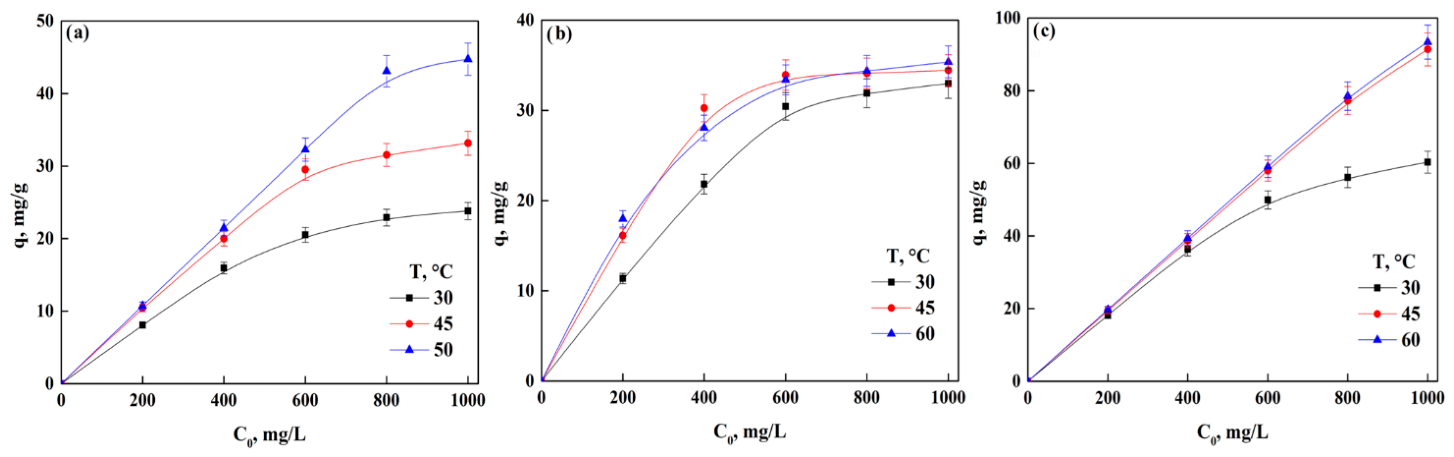
Figure 1. Effect of the initial concentration of Cr(III) on PC: (a) WT, (b) HO, and (c) OH. Experimental conditions: biosorbent dose = 0.025 g, initial Cr(III) concentration = 100 to 1000 mg/L, contact time = 12 h, pH = 2.4, solution volume = 50 mL.
Processes 14 01622 g001
Figure 2. Effect of the initial concentration of Cr(III) in OP: (a) WT, (b) HO, and (c) OH. Experimental conditions: biosorbent dose = 0.025 g, initial Cr(III) concentration = 100 to 1000 mg/L, contact time = 12 h, pH = 2.4, solution volume = 50 mL.
Processes 14 01622 g002
Figure 3. Effect of the initial concentration of Cr(III) in PCO/P (25%/75%, wt): (a) WT, (b) HO, and (c) OH. Experimental conditions: biosorbent dose = 0.025 g, initial Cr(III) concentration = 100 to 1000 mg/L, contact time = 12 h, pH = 2.4, solution volume = 50 mL.
Processes 14 01622 g003
Figure 4. Effect of the initial concentration of Cr(III) in OP/PC (50%/50%, wt): (a) WT, (b) HO, and (c) OH. Experimental conditions: biosorbent dose = 0.025 g, initial Cr(III) concentration = 100 to 1000 mg/L, contact time = 12 h, pH = 2.4, solution volume = 50 mL.
Processes 14 01622 g004
Figure 5. Effect of the initial concentration of Cr(III) in PC/OP (75%/25%, wt): (a) WT, (b) OH, and (c) HO. Experimental conditions: biosorbent dose = 0.025 g, initial Cr(III) concentration = 100 to 1000 mg/L, contact time = 12 h, pH = 2.4, solution volume = 50 mL.
Processes 14 01622 g005
Figure 6. ATR-FTIR spectra of the biosorbents with different treatments: (a) OP and (b) PC.
Processes 14 01622 g006
Figure 7. Micrograph of OP with different treatments: (a) WT, (b) HO, and (c) OH.
Processes 14 01622 g007
Figure 8. Micrograph of PC with different treatments: (a) WT, (b) HO, and (c) OH.
Processes 14 01622 g008
Figure 9. Micrograph of Cr(III) adsorption: (a) OPOH and (b) PCOH.
Processes 14 01622 g009
Figure 10. Micrograph of OP/PC (25–75%, wt) with different treatments: (a) WT, (b) HO, and (c) OH.
Processes 14 01622 g010
Figure 11. XRD pattern of the different treatments: (a) OP and (b) PC.
Processes 14 01622 g011
Table 1. Nonlinear isotherm adsorption models [24,25].
ModelEquationParameters
Langmuir q e = q m K L C e 1 + K L C e qm = maximum adsorption capacity, mg/g
KL = Langmuir constant, L/mg
n = adsorption intensity measurement, dimensionless
KF = Freundlich constant related to adsorption capacity, (mg/g)(L/mg)1/n
A = constant related to the heat of adsorption, mg/g
B = bonding equilibrium constant, mg/g
(maximum binding energy)
qm = maximum adsorption capacity, mg/g
KS = constant related to adsorption energy, (L/mg)ns
ns = Parameter of Sips model, dimensionless
KR = Redlich–Peterson constant, L/g
aR = Redlich–Peterson constant, L/mg
β = model parameter, dimensionless
ε = DR model parameter, J/mol
ε = R T ln ( 1 + 1 C e )
kDR = rate constant, (mol/J)2
E = 1 2 k D R
E = average free energy required to transfer a metal ion to the active site of the adsorbent, kJ/mol
Freundlich q e = K F C e 1 n
Temkin q e = A + B l n ( C e )
Sips q e = q m ( K s C e ) n s 1 + ( K s C e ) n s
Redlich–Peterson
(RP)
q e = K R C e 1 + a R C e β
Dubinin–Radushkevich (DR) q e = q m e x p ( k D R ε 2 )
Table 3. Influence of temperature on the biosorption performance of chemically treated PC biosorbents.
Biosorbent30 °C45 °C60 °C
q, mg/g
PCWT31.7238.4941.06
PCOH37.850.6264.20
PCHO26.3833.5444.20
Table 4. Influence of temperature on the biosorption performance of chemically treated OP biosorbents.
Biosorbent30 °C45 °C60 °C
q, mg/g
OPWT35.1845.6549.86
OPOH40.5149.8861.63
OPHO24.9130.4243.64
Table 5. Influence of temperature on the biosorption performance of chemically treated PC/OP (25%/75%, wt) biosorbents.
Biosorbent30 °C45 °C60 °C
q, mg/g
PC/OPWT22.5031.9044.74
PC/OPOH60.3590.8891.42
PC/OPHO32.5434.9632.62
Table 6. Influence of temperature on the biosorption performance of chemically treated PC/OP (50%/50%, wt) biosorbents.
Biosorbent30 °C45 °C60 °C
q, mg/g
PC/OPWT62.3578.9080.72
PC/OPOH77.8891.0093.40
PC/OPHO25.5027.9031.58
Table 7. Influence of temperature on the biosorption performance of chemically treated PC/OP (75%/25%, wt) biosorbents.
Biosorbent30 °C45 °C60 °C
q, mg/g
PC/OPWT77.9094.9096.33
PC/OPOH82.3096.5096.80
PC/OPHO19.9023.9029.50
Table 8. Best-fitting isotherm models and adsorption parameters (qm, R2, and %Δq) for Cr(III) removal using OP, PC, and OP/PC composite biosorbents under different temperatures and chemical pretreatments.
TreatmentT, °CBest Isotherm Modelqm, mg/gR2%q
OP
WT30Sips32.40.9990.579
45RP37.20.9930.396
60Sips42.90.9971.028
OH30Sips40.90.9991.109
45RP50.60.9931.210
60Sips64.60.9991.000
HO30RP27.60.9990.199
45RP31.50.9970.609
60RP43.70.9991.999
PC
WT30Sips37.70.9970.120
45RP49.70.9841.441
60Sips50.30.9970.560
OH30RP40.90.9871.921
45RP48.80.9951.155
60Sips62.80.9971.255
HO30Sips26.20.9990.162
45Sips34.50.9990.161
60Sips44.60.9991.921
25%PC/75%OP
WT30Sips25.70.9991.993
45Sips32.80.9961.158
60RP54.50.9851.449
OH30RP61.80.9950.061
45RP90.90.9851.028
60RP91.10.9990.315
HO30RP33.60.9990.231
45Sips35.70.9990.048
60Sips36.10.9981.274
50%PC/50%OP
WT30Sips64.00.9990.119
45Sips78.30.9990.411
60Sips82.00.9990.080
OH30Sips78.00.9990.531
45Sips91.70.9930.532
60Sips94.10.9990.496
HO30RP23.60.9990.469
45RP25.80.9990.024
60RP31.10.9990.172
75%PC/25%OP
WT30RP78.00.9910.896
45RP94.30.9950.453
60RP96.90.9994.255
OH30Sips82.50.9971.077
45RP96.00.9990.209
60RP97.10.9970.550
HO30RP20.60.9990.155
45Sips23.50.9990.829
60Sips30.50.9990.160
Table 9. Thermodynamic parameters (ΔG, ΔH, and ΔS) for Cr(III) adsorption onto OP, PC, and OP/PC composite biosorbents under different temperatures and chemical pretreatments.
PCWTOHHO
T; °C−∆G, kJ/mol∆H, kJ/mol∆S, kJ/mol K−∆G, kJ/mol∆H, kJ/mol∆S, kJ/mol K−∆G, kJ/mol∆H, kJ/mol∆S, kJ/mol K
3027.69 25.45 27.74
4527.9030.670.0926.0316.800.0428.2721.980.05
6027.38 26.30 28.30
OPWTOHHO
3025.13 25.45 27.31
4525.5835.100.0526.0316.800.0428.0322.500.03
6025.62 26.30 28.47
WT25%PC/75%OP50%PC/50%OP75%PC/25%OP
3023.01 27.44 6.45
4523.4522.650.0528.774.690.026.593.910.01
6023.54 30.10 6.70
OH25%PC/75%OP50%PC/50%OP75%PC/25%OP
3028.43 32.09 32.30
4528.8019.320.0732.2913.150.1232.553.560.11
6029.33 32.57 33.06
HO25%PC/75%OP50%PC/50%OP75%PC/25%OP
3029.70 27.19 28.71
4529.1327.220.1728.0533.570.0229.7138.820.004
6030.64 28.74 30.58
Table 10. ANOVA analysis of adsorption capacity.
Sum of SquaresDegrees of FreedomRoot Mean SquareFpη2p
Biosor5945.941486.5139.32<0.0010.974
Pret12,317.726158.8577.23<0.0010.987
Tem1297.32648.760.80<0.0010.890
Biosor–Pret6858.38857.380.35<0.0010.977
Biosor–Tem110.5813.81.290.3170.408
Pret–Tem95.1423.82.230.1150.373
Residues160.01510.7
Table 11. ATR-FTIR band assignments of OP- and PC-based biosorbents under different chemical pretreatments before and after Cr(III) adsorption.
OPPC
Wavenumber (cm−1)Functional GroupWTOHHOWTOHHOChange After Cr(III) AdsorptionInterpretationRefer.
3335–3270O–H stretching (cellulose, lignin, H2O)Intensity decrease/shiftInvolvement of hydroxyl groups[55,56,57,58,59,60,61,62]
2987–2912C–H stretching (aliphatic acids)Intensity decreaseOrganic matrix participation
2855–2840C–H stretchingIntensity decreaseSurface interaction
1737–1710C=O stretching (esters, –COOH)Intensity decrease/shiftComplexation with Cr(III)
1667–1620C=C/COO asymmetricIntensity decreaseElectrostatic interaction
1467–1417COO symmetric/CH2 deformationIntensity decreaseCarboxylate involvement
1378–1360–COO stretchingIntensity decreaseCr(III) coordination
1248–1233C–O stretching (lignin)Intensity decreaseOxygen-containing groups
1168–1148Pyranose ringMinor changeStructural
1105–1092C–O stretching (ethers)Minor changeStructural
1057–1018Alcohols/estersIntensity decreaseCr–O interaction
898–888Pectin C–HIntensity decreaseOxygen contribution
774–759Cr–O vibrationAppearanceEvidence of Cr(III) binding
✓ Present in the bioadsorbent.
Table 12. ATR-FTIR band assignments of OP/PC composite biosorbents under different chemical pretreatments before and after Cr(III) adsorption.
25%/75%50%/50%75%/25%
Wavenumber (cm−1)Functional GroupWTOHHOWTOHHOWTOHHOEffect After Cr(III) AdsorptionInterpretationRefer.
3335–3270O–H stretching (cellulose, lignin, H2O)Intensity decrease/shiftInvolvement of hydroxyl groups[63,64,65,66,67,68]
2987–2912C–H stretching (aliphatic acids)Intensity decreaseOrganic matrix interaction
2855–2840C–H stretchingMinor intensity decreaseSurface interaction
1737–1710C=O stretching (esters, carboxylic acids)Shift/intensity decreaseComplexation with Cr(III)
1667–1620COO asymmetric/aromatic C=CIntensity decreaseElectrostatic interaction
1467–1417COO symmetric/CH2 deformationIntensity decreaseCarboxylate involvement
1378–1360–COO stretchingIntensity decreaseIntensity decrease
1248–1233C–O stretching (lignin, phenolic groups)Intensity decreaseIntensity decrease
1168–1148Pyranose ring vibrationMinor changeMinor change
1105–1092C–O stretching (ethers)Minor changeMinor change
1067–1020C–O stretching (ethers, polysaccharides)Intensity decreaseIntensity decrease
1057–1018C–O stretching (alcohols, esters)Intensity decreaseIntensity decrease
898–888C–H deformation (pectin)Intensity decreaseIntensity decrease
774–759Cr–O vibrationBand appearanceEvidence of Cr(III) binding
✓ Present in the bioadsorbent.
Table 13. Elemental analysis of the biosorbents treated with NaOH before Cr(III) adsorption.
BioadsorbentsC, (wt,%)O, (wt,%)S, (wt,%)P, (wt,%)K, (wt,%)Ca, (wt,%)Mg, (wt,%)
OPOH56.0941.740.160.180.980.85
PCOH53.5940.030.260.314.830.460.52
OP/PCOH54.2240.460.240.263.870.560.39
Table 14. Elemental analysis of biosorbents treated with NaOH after Cr(III) adsorption.
BioadsorbentsC, (wt,%)O, (wt,%)S, (wt,%)P, (wt,%)K, (wt,%)Ca, (wt,%)Mg, (wt,%)Cr, (wt,%)
OPOH43.9747.821.460.180.120.086.37
PCOH59.0338.571.120.250.170.440.421.11
OP/PCOH52.9639.840.050.10.140.080.036.84
Disclaimer/Publisher’s Note: The statements, opinions and data contained in all publications are solely those of the individual author(s) and contributor(s) and not of MDPI and/or the editor(s). MDPI and/or the editor(s) disclaim responsibility for any injury to people or property resulting from any ideas, methods, instructions or products referred to in the content.