1. Introduction
Although the productivity of the agricultural and agro-industrial sectors is fundamental to the economy of Mexico, it invariably generates large volumes of residual biomass throughout the production chain. According to the Agricultural Census, Mexico has a cultivated agricultural area of 21,635,876 hectares [
1], from which it is estimated that in 2023, approximately 559 million tons of crops (fruits, vegetables, legumes, grains, and flowers) were produced, generating large quantities of residues [
2].
Due to the composition of agricultural and agro-industrial waste, their improper management and disposal can lead to sanitary and environmental problems. These may include infections caused by pathogenic microorganisms, respiratory conditions, and the transmission of diseases such as cholera, dengue, and amoebiasis, among others. As a result of the lack of separation and/or treatment of the organic fraction prior to its deposition at final disposal sites, its decomposition generates greenhouse gases and leachates, in addition to promoting the proliferation of pests and insects [
3].
Through the application of appropriate valorization technologies, organic waste, rather than representing a problem, can constitute a strategic opportunity as secondary resources, and their utilization could contribute to reducing water pollution, soil degradation, and greenhouse gas emissions [
4]. In addition, the development of infrastructure and knowledge oriented toward the valorization of biowaste not only promotes technological innovation but also supports the creation of green jobs, strengthening circular value chains in the country. Some traditional alternatives for waste utilization, such as composting, vermicomposting, anaerobic digestion, incineration, and, more recently, biodrying, could be applied to the valorization of residues from the agro-industrial sector to obtain economic, environmental, and social benefits [
5].
Biodrying is an aerobic process that removes water from waste mass by utilizing the metabolic heat generated by microbial activity during the degradation of residues, resulting in a reduction in the weight and volume of the waste and thereby facilitating its transport, storage, and final disposal [
6,
7]. As a result of this process, a stabilized biodried material (BM) is obtained, with low moisture content and high calorific value. However, despite its effectiveness as a waste-to-energy preparatory step, BM is currently underutilized.
To date, the application of BM has been restricted to its use as a solid biofuel due to its reduced moisture content and increased calorific value [
8], although alternative valorization pathways are only beginning to be explored. In this context, Contreras-Cisneros et al. assessed the phytotoxicity of aqueous extracts of BM and compost through a lettuce (
Lactuca sativa var. Buttercrunch) seed germination assay. At a low concentration (0.05 g mL
−1), the compost extract promoted a higher germination index (IG 84.4%) than the BM extract, indicating a more favorable effect under dilute conditions. In contrast, at an intermediate concentration (0.2 g mL
−1), the BM extract showed a superior germination response (IG 68%) compared to the compost extract (IG 52.51%). This trend was further confirmed at a higher concentration (0.5 g mL
−1), where the compost extract completely inhibited seed germination, whereas the BM extract caused only a partial inhibition, reducing germination by 61.4% while still allowing a fraction of seeds to germinate. Subsequently, experiments demonstrated that BM application positively affected lettuce seedling growth and improved soil physicochemical properties, although its effects did not surpass those of compost [
9]. Overall, these results suggest that biodrying preserves a fraction of organic matter that remains biologically available and functionally active, exhibiting comparatively lower phytotoxicity at higher extract concentrations. This supports its potential as an alternative or complementary process to composting, particularly in water-scarce regions due to its shorter processing time and lack of external water requirements. In addition, because BM is a microbiologically stabilized product with an undegraded organic fraction, this material can be utilized in a vermicomposting process to convert it into an organic amendment.
On the other hand, composting and vermicomposting have been widely demonstrated to be bioprocesses applied to the treatment of organic waste to produce organic amendments [
10]. Vermicomposting is a process in which the metabolic activity of earthworms (
E. foetida), besides microbial activity, promotes the transformation of organic matter into a nutrient-rich product capable of improving soil properties and supporting plant development [
11]. The production of vermicompost can help reduce the use of synthetic fertilizers; in addition, its application to soils contributes microbial diversity, enzymes, and nutrients, while also reducing the presence of pathogens [
12].
The optimal development of a vermicomposting system depends on various environmental and physicochemical factors such as temperature, moisture, and pH; however, the quality and chemical composition of the degradable substrate used is fundamental, since the components of waste mixtures may interfere with the reproduction and survival of earthworms [
13]. A critical limitation for vermicomposting is the requirement of an appropriate pretreatment of feedstocks, commonly achieved through precomposting, to reduce phytotoxicity and unfavorable physicochemical conditions prior to earthworm inoculation. While precomposting is effective, it is also time- and resource-intensive, and alternative preparatory systems remain underexplored. In this context, biodrying represents a potential alternative to precomposting; however, its suitability as a preparatory step for vermicomposting has not been evaluated. In particular, there is limited experimental evidence regarding the biological performance of
E. foetida when exposed to substrates derived from biodried organic waste intended for subsequent vermicomposting.
Based on the above, the present study aims to evaluate the survival, growth, and reproduction of E. foetida within a vermicomposting system fed with organic waste that had previously undergone a biodrying process, with the broader objective of exploring BM as an alternative substrate to conventional precomposted feedstocks.
2. Materials and Methods
The biodried material (BM) used as substrate for vermicomposting was obtained from a previous study in which a mixture of organic waste—consisting of orange peel, pruning residues (grass, mulch, and leaf litter), and compost as inoculum—was biodried [
14]. The BM presented a pH of 7.8, a moisture content of 9.7%, an organic matter content of 39.42%, and a water retention capacity of 46.07%. The percentage composition of BM was 58.82% orange peel, 14.71% grass, 14.71% mulch, and 5.88% leaf litter, while the remaining fraction corresponded to small fragments of the mixture.
To determine whether BM could have a negative effect on earthworm growth and reproduction, an acute toxicity bioassay was performed using a filter paper contact test with the biodried material extract (BME) for 48 h. The bioassay was conducted in triplicate, following the procedure described in OECD guideline No. 207 [
15]. Prior to the bioassay, the BME was obtained using the modified ASTM D3987-85 method established in NOM-141-SEMARNAT-2003 [
16]. Briefly, after 24 h of agitation (150 rpm) followed by settling of a mixture of 100 g of BM (dry basis) in 1000 mL of distilled water, the filtrate (8–12 µm pore size) was obtained, with a final BME concentration of 0.1 g mL
−1. From the BME, five dilutions were prepared for the exposure of
E. foetida to different concentrations across five treatments (BME1, BME2, BME3, BME4, and BME5), as shown in
Table 1. A positive control (C+) containing 2-chloroacetamide (Sigma-Aldrich Co., St. Louis, Missouri, USA) (0.013 g mL
−1) was included as a reference substance, along with a negative control (C−) consisting of distilled water.
Subsequently, a feasibility test was conducted to evaluate the use of BM in a vermicomposting system with
E. foetida, using BM at different concentrations (100%, 75%, 50%, and 25%) as feed or substrate in experimental units (in triplicate) consisting of plastic boxes with dimensions of 14 cm × 31 cm × 16 cm, and equipped with a leachate collection container. The experimental units consisted of a 5 cm soil layer (1.36 kg) with a moisture content of 60% and a water retention capacity of 31.83%, using 130 clitellated earthworms to achieve a density of 2500 worms m
−2 [
17], and finally, a 0.15 kg substrate layer was incorporated at the start of the experiment and subsequently added weekly.
The substrate preparation added weekly to each treatment consisted of a mixture of BM and FOW, as shown in
Table 2. The FOW used consisted of 50% lettuce residues and 50% carrot bagasse.
Prior to the feeding trial, the FOW was conditioned to promote its degradation for 5 days at room temperature in order to facilitate the subsequent absorption of nutrients by the earthworms, while the BM was conditioned for one week by adding the necessary amount of water to obtain a substrate moisture content of 65%. The vermicomposting process lasted 49 days, during which water was sprayed every three days to maintain adequate moisture throughout the process.
The experimental period (49 days) was selected to encompass earthworm adaptation, initiation of reproductive processes, and stabilization of the vermicomposting system. This is because vermicomposting duration is not fixed and depends on factors such as substrate composition, earthworm species, and processing rate [
18]. As full vermicomposting maturity requires longer processing times, this was outside the scope of this study. During such a period of the vermicomposting process, temperature, moisture, and pH were monitored to assess biological performance and system functionality.
After 49 days of processing, the survival of
E. foetida was evaluated according to the number of earthworms initially introduced (130 worms) in each experimental unit. The reproduction was evaluated based on the number of adult individuals, hatchlings, and cocoons of
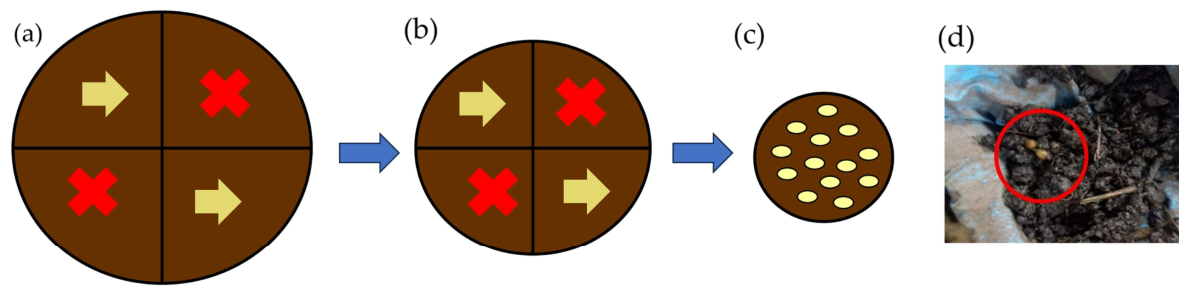
E. foetida manually sorted into humus samples obtained using the quartering method (
Figure 1), according to NOM-021-RECNAT-2000 [
19], from 1 kg of humus samples. Firstly, the humus sample was disposed of in a circular disk, divided into four equal sections, the opposite quarters were discarded, and the remaining two sections were mixed (
Figure 1a). In the next step, the process was repeated with the new mixed reduced sample, and again, a reduced sample was obtained from the mix of opposite quarters (
Figure 1b). Finally, the homogenized sample was used for physicochemical analysis and the counting of earthworm cocoons (
Figure 1c). The cocoons identified visually in the samples (
Figure 1d) were quantified, and any juvenile earthworms that presented a brownish coloration and an approximate length of 2 cm were considered as offspring and counted.
Finally, after the 49-day period had elapsed, the humus produced up to that point in all treatments was characterized in accordance with NMX-FF-109-SCFI-2008 [
20], which establishes the criteria that earthworm humus must meet for commercialization within Mexican territory.
Table 3 presents the physicochemical parameters considered by the standard for humus characterization.
Statistical analyses were conducted in Python (version 3.12.13) using pandas (version 2.2.2), SciPy (version 1.16.3), and statsmodels (version 0.14.6), with significance evaluated at α = 0.05.
Differences in worm survival among treatments were evaluated using Fisher’s exact test, as some treatments exhibited complete survival, resulting in perfect separation that violates the assumptions of standard binomial models.
Reproductive responses (cocoon production and offspring counts) were analyzed using generalized linear models (GLMs) with treatment as the explanatory factor. Cocoon counts were modeled using a Poisson distribution, while offspring counts were analyzed with a negative binomial distribution to account for overdispersion, followed by all pairwise contrasts with Holm correction for multiple comparisons.
The chemical properties of the resulting vermicompost (organic matter and total nitrogen) were analyzed using a one-way analysis of variance (ANOVA) with treatment as the fixed factor. When significant differences were detected, Tukey’s honestly significant difference (HSD) test was used for pairwise comparisons.
The C/N ratio was calculated from the mean carbon and nitrogen concentrations for each treatment. Variability was estimated by propagating the measurement variance from the unaveraged triplicate carbon and nitrogen determinations. Because the ratio corresponds to treatment-level measurements rather than independent biological replicates, C/N values were interpreted descriptively rather than subjected to inferential statistical testing. Results are reported as mean ± standard deviation, and treatments sharing the same letter in Tukey comparisons are not significantly different (p ≥ 0.05).
4. Discussion
4.1. Acute Effect of Biodried Material (BM) on E. foetida
The acute toxicity bioassay revealed that only the highest concentration of the BME caused mortality (33.33%) in E. foetida, whereas all diluted treatments showed no lethal effects. This result indicated low-to-moderate acute toxicity, detectable only under maximum exposure conditions (pure extract 1:10 w/v). It should be noted that, during the aqueous extraction of a solid substrate, components present in the material (soluble salts, polar organic compounds, and other substances resulting from the decomposition of organic matter) are leached into a known volume of liquid, resulting in a sample representative of the readily extractable components of the solid material. Thus, the immediate availability of compounds in the BME allows the toxic potential of the bioavailable components of BM, absorbed through the earthworm’s skin, to be assessed using the acute contact toxicity test.
The results obtained from the acute bioassay constitute a warning signal of chemical stress by BME; however, it cannot be assumed whether its use as a sole substrate represents a risk to E. foetida in a vermicomposting system. In such a case, the solid substrate provides a more realistic assessment of the material’s effects on earthworm survival, as the organisms are exposed to its components not only through the dermal route but also via ingestion. Also, in solid-substrate assays, soil properties such as pH, organic matter content, and texture can significantly modulate the effect of the substrate. In BM, toxic components may adsorb onto organic solid particles, becoming less bioavailable than in BME, where they are fully dissolved and more accessible to earthworms.
4.2. Physical and Chemical Conditions During Vermicomposting System Using BM as Substrate
The feasibility of using BM as a feed substrate for vermicomposting depends largely on its ability to maintain physicochemical conditions compatible with earthworm physiology over extended periods. It is important to note that biodrying itself is designed as a water-free process, in which no external water is added, and moisture reduction occurs through aerobic microbial activity and heat-driven evaporation. In contrast, rehydration of the BM is required prior to vermicomposting, as earthworm-based bioprocesses depend on sufficient moisture to sustain microbial activity and earthworm physiology. In the present study, the evolution of temperature, pH, and moisture content during vermicomposting provided valuable insights into the stability and suitability of BM when blended with FOW.
4.2.1. Temperature Dynamics
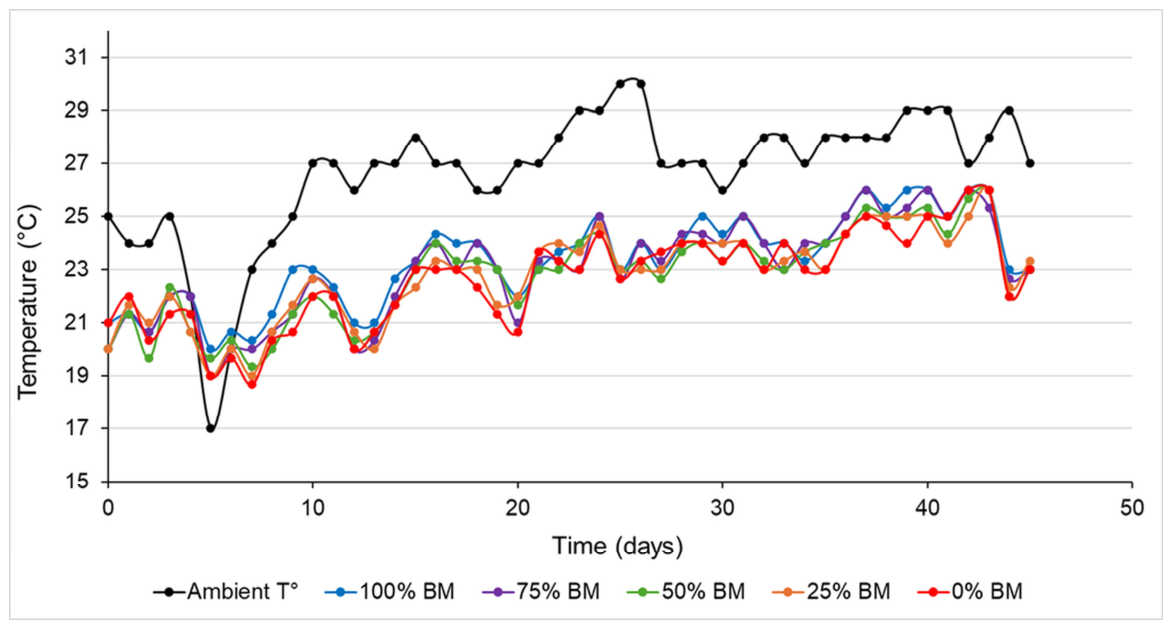
Throughout the 49-day vermicomposting process, system temperature closely followed ambient conditions and remained below 25 °C in all treatments, with no statistically significant differences attributable to BM proportion. This is a favorable outcome, as elevated temperatures are one of the main limiting factors for the direct introduction of earthworms into organic substrates, and temperature increases during vermicomposting, particularly within the thermophilic range (>40 °C), can adversely affect the development of E. foetida. The observed behavior is consistent with previous studies reporting that well-managed vermicomposting systems operate under mesophilic conditions once highly degradable organic fractions have been reduced through pretreatment processes. Unlike conventional composting, which involves a thermophilic phase driven by intense microbial oxidation, vermicomposting relies on moderate microbial activity and earthworm metabolism, both of which function optimally at temperatures below 30 °C.
Earthworms can develop within a temperature range of 15–25 °C, which ensures their survival, growth, and capacity to convert the substrate into humus [
21]. Similar temperature stability has been reported for vermicomposting systems using pretreated or partially stabilized residues [
22], supporting the notion that biodrying can fulfill a preparatory role comparable to precomposting with respect to thermal control.
It is important to note that the substrate used in this study (BM) was obtained from a controlled bio-oxidation and dehydration process, in which diverse microbial communities contributed to temperature increases essential for biodrying. Although BM is microbiologically stabilized due to low water activity (aw), microbial communities (bacteria, yeasts, and fungi) remain in a latent state [
4], becoming active once the material is subjected to the conditions of a new bioprocess such as vermicomposting. Some studies [
23,
24] have reported that the thermophilic phase during precomposting leads to a restructuring of microbial communities by selectively reducing heat-sensitive populations and promoting the establishment of thermotolerant and functionally distinct microorganisms, accompanied by increased enzymatic activity.
4.2.2. pH
During vermicomposting, pH variations commonly occur over a broad range, from slightly acidic to slightly alkaline (pH 6–8), largely depending on substrate composition [
22,
25] and on the predominant microbial populations at each stage of the process [
26]. According to several studies, increases in pH may be associated with the formation of ammonium ions (NH
4+) by ammonifying bacteria during the degradation of nitrogenous organic substrates [
27], whereas decreases may result from the nitrification of ammoniacal compounds into nitrates (NO
3−) and nitrites (NO
2−), as well as from CO
2 production and the formation of organic acids due to the combined activity of earthworms and acidogenic microbial communities [
28,
29].
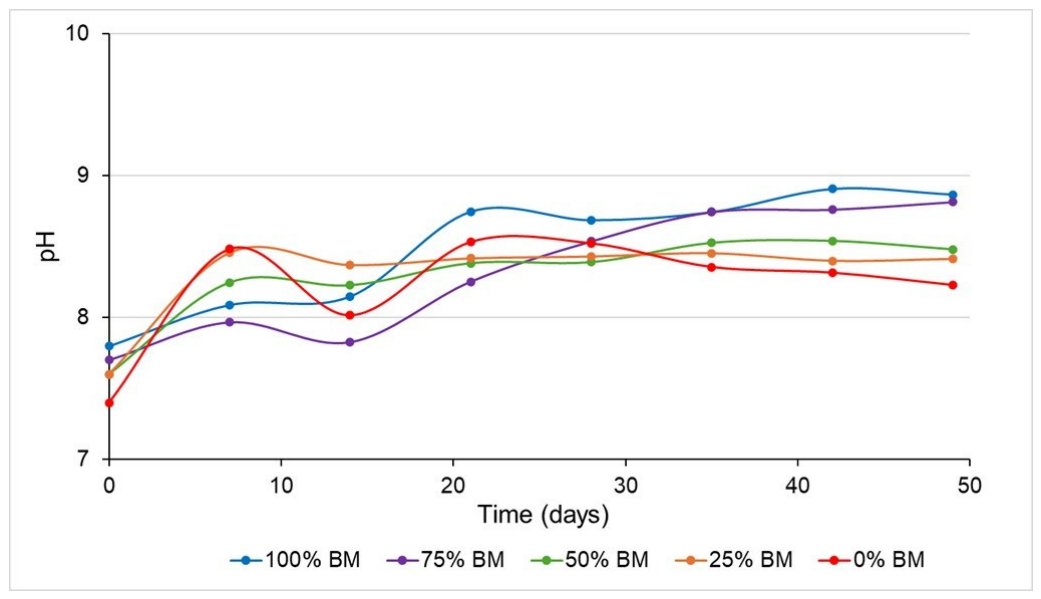
In this study, substrate pH increased from slightly alkaline pH values (7.4–7.8) to values between 8.23 and 8.88 by the end of the vermicomposting process. This trend has been documented in vermicomposting systems dominated by plant-based residues and materials with low nitrogen availability, where the degradation of organic acids and the release of basic cations contribute to alkalinization.
The higher pH values observed in treatments with greater proportions of BM (100% BM and 75% BM) can be attributed primarily to the intrinsic composition of the substrate and to the consumption of organic acids during biodrying. The results of this study are not consistent with those reported by Mago et al. [
30] and Karapantzou et al. [
31], who observed a continuous decrease in pH toward neutrality and slight acidity even after 90 and 120 days, but agreed with a study by Fornes et al. [
32], who found that pH remained alkaline (8.71 on average) during three different processes: composting and precomposting followed by vermicomposting and straight vermicomposting of tomato crop waste raw material and resulting in non-phytotoxic mature material.
Also, the results of this study have some similarity with those reported by De Medina-Salas et al. [
22] for a vermicomposting process using a mixture of orange peel waste, eggshells, and other plant residues. In that study, the waste underwent a six-week precomposting stage to prevent temperature increases that could negatively affect the performance of
E. foetida during vermicomposting. During precomposting, pH increased from 5.83 to 6.09, and once transferred to the vermicomposting system, values remained within a neutral to slightly alkaline range over seven weeks without a subsequent decrease.
pH is a key factor determining the outcome of waste decomposition during vermicomposting because there is an interdependent relationship between pH, microbial communities, and earthworm activity. Although
E. foetida can tolerate a pH range of 5.0–8.0, maintaining a favorable environment between 7.0 and 8.0 ensures optimal activity in the mineralization and stabilization of residues during the process [
33]. Abrupt increases with sustained values above 8.5 are typically detrimental to vermicomposting performance. In the present study, elevated values were not associated with generalized mortality or escape behavior, indicating that alkalinity alone did not constitute a limiting factor. Instead, pH evolution should be interpreted as an indicator of substrate stabilization history rather than as a direct predictor of biological incompatibility.
Although substrate pH reached values higher than 8.5 during vermicomposting, no earthworm mortality was observed. Despite these increases—considered as a characteristic behavior of the vermicomposting process—the earthworms were able to adapt to the prevailing conditions. In this regard, García Sánchez et al. reported that earthworm species commonly used in vermicomposting can tolerate a wide range of environmental conditions and can adapt even when parameters deviate from their optimal ranges [
18]. This can be explained by the buffering capacity of the organic matrix, the absence of ammonia toxicity due to a balanced C/N ratio [
34], and the ability of
E. foetida to regulate internal acid–base balance and behaviorally select favorable microhabitats [
35]. Therefore, elevated pH values under stabilized, well-aerated conditions do not necessarily compromise earthworm survival.
Some authors report that high pH values (as observed in this study) are consistent with the maturation and stabilization stage of the organic substrate, during which microbial communities act in conjunction with
E. foetida to transform waste during the vermicomposting process. Karapantzou et al. [
31] evaluated physicochemical parameter dynamics during the vermicomposting of winery waste and analyzed the associated bacterial community succession. Similarly, Velásquez-Chávez et al. [
26] demonstrated a direct correlation between pH changes and bacterial succession during vermicomposting of cattle manure.
4.2.3. Moisture During Vermicomposting
Moisture monitoring is important because reduced growth rates in
E. foetida are likely under low-moisture conditions, which can delay reproduction, as moisture limitations may affect the development of the clitellum, a structure essential for reproduction [
36].
It is important to note that the conventional vermicomposting process, as reported by De Medina-Salas [
22], involves subjecting waste to a precomposting stage that may last approximately 45 days and results in a non-stabilized material with high moisture content (80.29%) and acidic pH prior to vermicomposting. In contrast, in the process evaluated in this study, the substrate material originates from a biodrying process, which has been reported in several studies [
37,
38], with a duration of 25–30 days, sufficient to obtain a stabilized material with low moisture content and slightly alkaline pH, as described by Orozco-Álvarez et al. [
37]. An additional advantage of this approach is that no leachates are generated, either during the initial biodrying stage [
39] or during vermicomposting.
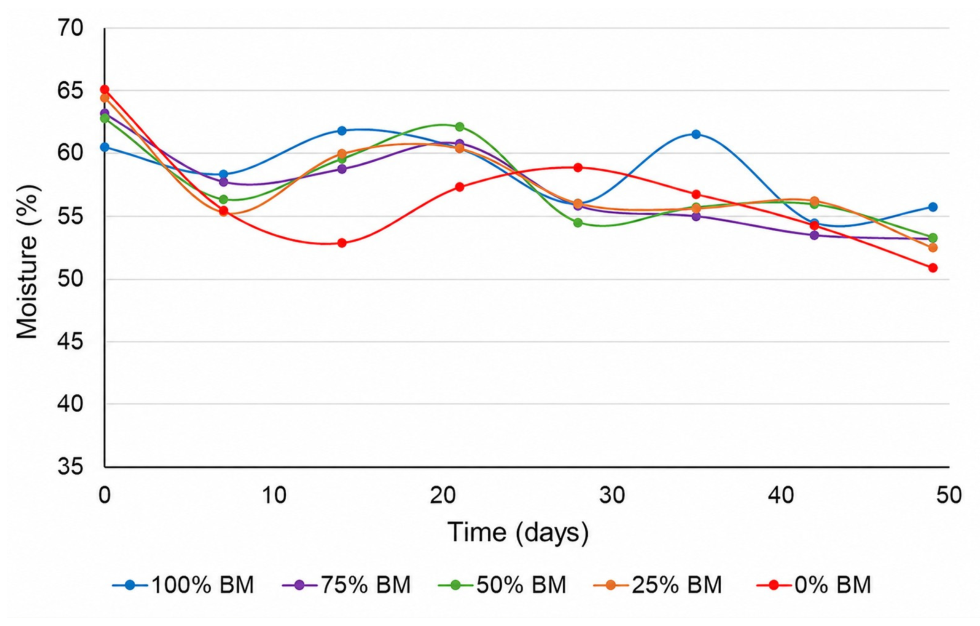
Moisture content was deliberately maintained between 55% and 65%, corresponding to the lower limit of the tolerance range reported by E. foetida. While optimal moisture levels (70–80%) are often recommended to maximize earthworm growth and vermicompost yield, the objective of this study was not productivity but biological feasibility under conservative conditions.
Under the conditions applied in this present study, no leachate generation was observed. Although the feed substrates added weekly exhibited variable moisture contents ranging from 62% to 85.3% (
Table 6), moisture determinations were conducted one day after substrate addition. At that time, moisture levels had equilibrated with the rest of the substrate, remaining within a stable range of 55–65%. Despite the additional application of 25 mL of water every third day to maintain system moisture, no leachate was produced throughout the experimental period, suggesting that most of the added water was retained within the substrate matrix.
Operating at moderate moisture levels reduced the risk of anaerobioses, leachate formation, and excessive microbial proliferation, all of which can negatively affect earthworm survival, particularly when using stabilized substrates as BM. The absence of leachate losses throughout the experiment further indicates that the substrate matrix, including BM, provided adequate water retention despite its lower organic matter content. Furthermore, the system stabilized and maintained constant moisture levels over time. Dominguez and Edwards [
40] reported that epigeic earthworm species are capable of efficiently processing organic substrates even when environmental conditions, such as moisture and temperature, are below optimal levels.
These findings align with reports indicating that E. foetida can survive and reproduce under suboptimal moisture conditions when environmental parameters remain stable and stressors do not act synergistically.
4.3. Survival and Reproduction of Eisenia foetida After the Vermicomposting Process
According to the results obtained, differences in earthworm population dynamics and reproductive performance were observed as a function of substrate composition. In treatments with a higher proportion of BM, a reduction in total earthworm population was recorded; however, these same treatments exhibited higher cocoon viability compared to the control. This behavior can be explained by the characteristics of BM, which contains a higher proportion of lignocellulosic compounds and lower availability of easily degradable organic matter. Previous studies have reported that substrate quality directly influences the survival, growth, and reproduction of
E. foetida, with more stabilized materials being associated with reduced population growth but greater physiological stability of the system [
41].
Also, the discrepancy between relatively stable cocoon counts and the wider range observed in offspring abundance (10.7–61.3 individuals kg−1) can be quantitatively justified by the multiplicative nature of earthworm reproduction. While cocoon production represents a single biological process (oviposition), juvenile abundance results from successive probabilistic stages, including cocoon viability, hatching success, early survival, and recovery during sampling. Variability accumulated across these stages amplifies dispersion in offspring counts, even when cocoon numbers remain similar. Therefore, the observed range in juvenile abundance is quantitatively expected and does not indicate inconsistency between fecundity and reproductive outcomes.
Conversely, treatments with higher proportions of FOW showed greater population stability and a higher presence of juveniles, although fewer cocoons were observed. This phenomenon can be attributed to the high availability of readily degradable compounds in FOW, which enhances microbial activity and accelerates substrate consumption and earthworm reproductive rates [
42]. Recent studies have demonstrated that substrates with higher content of fresh organic matter promote rapid reproduction and population increase in
E. foetida due to enhanced nutrient availability and microbial activity [
43]. In this regard, Rahman et al. [
44] reported that cocoon production and viability strongly depend on the balance between substrate quality and environmental stability, as highly nutrient-rich conditions favor rapid hatching, thereby reducing the number of cocoons observable within the substrate.
All the above results suggest that substrates at different stages of decomposition induce differentiated reproductive strategies in
E. foetida. While FOW favors accelerated reproduction and rapid population growth, BM promotes lower-intensity reproduction but greater cocoon stability and viability. This behavior is consistent with previous reports on vermicomposting systems operated under varying substrate conditions [
41].
Although moisture was maintained below 80%, the treatments with lower BM concentrations promoted the growth and reproduction of E. foetida. This can be interpreted as a relevant finding indicating the robustness of the system when BM is used as a feedstock, where moisture gradually stabilized during the process, allowing E. foetida to adapt to system conditions.
Furthermore, these results suggest that the complementary mixture with FOW supplied readily assimilable nutrients and supported the adaptation of E. foetida, thereby promoting cocoon hatching. Although cocoon production did not differ significantly among treatments (Poisson GLM, p > 0.05), with observed values ranging from 13.4 to 28 cocoons kg−1 humus, offspring production was significantly influenced by BM concentration (negative binomial GLM, p = 0.046). Specifically, offspring production declined with increasing BM concentration, with treatments at 50% through 100% BM yielding significantly fewer offspring (23.3 and 10.7 offspring kg−1 humus, respectively) than the 0% and 25% BM treatments (59.3 and 61.3 offspring kg−1 humus), suggesting that BM concentrations above 25% create less favorable conditions for hatching.
This pattern aligns with the findings of Piña-Guzmán et al. [
45], who reported that BM application over 21 days did not negatively affect
E. foetida survival, with rates reaching 99.74% even at 100% BM. Building on this evidence, the present study extended the duration of the bioprocess to 49 days to further assess whether prolonged exposure influences both survival and reproductive outcomes.
The results indicate that prolonged exposure of
E. foetida to high BM concentrations may negatively affect survival and, consequently, reproduction, as it limits cocoon hatching. Survival varied significantly among treatments (Fisher’s exact test,
p < 0.001), with the 100% BM treatment exhibiting lower survival than all other treatments and the 75% BM treatment showing reduced survival compared to the 0–50% BM treatments. Gobi and Gunasekaran [
46] reported that weight loss, population decline, and minimal or absent cocoon production and hatching in
E. foetida are negative effects associated with physiological resistance to toxic compounds, which implies an energy trade-off that reduces resources available for reproduction and cocoon hatching.
It is well known that toxic compounds could adversely affect the survival, reproduction, or cocoon hatching of
E. foetida. The biological effects observed in this study may be associated with the presence of toxic substances such as citrus-derived compounds, whose potential toxicity has been widely reported [
47], although individual compounds present in orange peel (e.g., terpenes such as
d-limonene) were not analytically quantified in this study.
4.4. Characterization of Vermicompost (Earthworm Humus) After the Vermicomposting Process
According to the results shown in
Table 6, the physicochemical parameters varied among treatments. Regarding moisture, treatments with higher BM content (100% and 75%) exhibited higher moisture levels in the produced humus (51.7% and 52%, respectively) compared to treatments with lower BM content. It is noteworthy that the BM used in the vermicomposting process exhibited a water retention capacity of 46.07%, indicating that the transformation of BM and FOW into humus improves the moisture retention of the final product. Similarly, total nitrogen was affected by treatment (one-way ANOVA,
F (4, 10) = 4.37,
p = 0.027, η
2 = 0.636); however, Tukey’s HSD post hoc test did not identify significant pairwise differences, likely due to its more conservative nature relative to the overall ANOVA.
In the present study, the vermicompost was not produced for immediate commercialization but rather for experimental evaluation and to propose its use as a soil improver. Accordingly, the moisture observed (˃45%) is consistent with a fresh, biologically active vermicompost and does not represent a quality deficiency in terms of stability or functionality. In this context, moisture must be interpreted as a functional attribute linked to microbial activity and water-holding capacity, rather than as a limiting criterion exclusively applicable to commercial products.
The pH of the humus was close to the upper limit established by the standard; however, the application of alkaline amendments to soil can be beneficial, as crops generally respond favorably to pH conditions ranging from slightly acidic to alkaline [
31].
For humus derived from treatments with BM concentrations below 100%, the organic matter (OM) content was high relative to the values established in NOM-021-RECNAT-2000 [
19], while remaining within the range specified by NMX-FF-109-SCFI-2008 [
20]. OM content varied significantly among treatments (one-way ANOVA,
F (4, 10) = 62.44,
p = 4.91 × 10
−7, η
2 = 0.962), with Tukey’s HSD post hoc analysis indicating that the 100% BM treatment (11.83 ± 0.4) had significantly lower OM than all other treatments (23.98–25.78%, CI ranges overlapping), which did not differ from one another. In vermicomposting systems, humus is generally expected to contain 20–40% organic matter to be suitable as a soil amendment. This indicates that vermicompost has undergone maturation and, when applied, can enhance water retention, maintain soil moisture, support microbial nutrient availability, and improve soil structure and aeration. In this study, considering biodrying as a pretreatment process for organic waste, the humus from the 100% BM treatment exhibited the lowest non-standard OM content (11.83%), consistent with findings by Usta and Guven [
48], who reported lower organic matter content in vermicompost derived from precomposted pruning and garden waste.
The C/N ratio is an important parameter in vermicomposting, as it reflects the rate of organic matter decomposition, indicating both the loss of organic carbon through mineralization and the relative increase in nitrogen during organic matter degradation [
49]. During the vermicomposting process, the C/N ratio typically tends to decrease due to the decomposition of organic matter and the consequent reduction in organic carbon. The decrease in organic carbon during vermicomposting is mainly attributed to the respiratory activity of microorganisms and earthworms, along with a simultaneous relative increase in nitrogen resulting from earthworm mucus secretion and nitrogenous excretions [
34].
From a carbon and nitrogen transformation perspective, vermicomposting led to a marked decrease in the C/N ratio across all treatments, indicating effective organic matter stabilization. The initial C/N ratio of BM (23.14) decreased uniformly after seven weeks, reaching the lowest value (5.2) observed in 100% BM treatment. The low C/N ratio observed in the highest proportion of BM was mainly driven by a 6.96% decrease in total organic carbon, reflecting carbon losses through microbial and earthworm respiration. Also, it reflects the combined effect of biodrying and vermicomposting, resulting in a stabilized material characterized by substantial carbon loss and relative nitrogen retention. Ratios below 15 are indicative of mature and stable vermicompost. As established by Mahapatra et al., the maturity and stability of compost are different from each other. Maturity is the extent to which the composting process is complete, but stability refers to a particular state of OM or a specific stage of decomposition of compost [
50].
The results of the characterization of vermicompost confirm that the earthworm humus reached maturity and can be safely applied as an organic amendment without posing risks to plants or negatively affecting soil quality.
4.5. Implications for the Use of Biodried Material in Vermicomposting
Combining all findings, such as the stable temperature profile, moderate alkalinity, and controlled moisture regime observed in this study, demonstrates that the biodried material, when properly conditioned and mixed with fresh organic residues, can sustain an environment compatible with earthworm survival and activity. Unlike conventional precomposting, which emphasizes extensive organic matter decomposition through a prolonged thermophilic phase, biodrying produces a partially stabilized substrate with reduced moisture and labile carbon content. This characteristic appears to facilitate process control and mitigate risks associated with excessive microbial activity upon earthworm introduction.
The physicochemical behavior observed supports the hypothesis that biodrying can function as a biotechnological alternative to precomposting. In this context, the use of adequate proportions of BM favors the maintenance of non-stressful environmental conditions for E. foetida over a prolonged period and constitutes a critical indicator of process feasibility.
5. Conclusions
This study demonstrated that the use of biodried material (BM) in a vermicomposting process is feasible when combined with fresh organic waste at proportions below 75% BM. Under these conditions, E. foetida was able to survive and remain biologically active throughout the experimental period when maintained in conditions of this study (stable mesophilic temperatures, suitable pH conditions, and moisture contents ranging from 55% to 65%). Survival rates, growth patterns, and reproductive indicators collectively indicate that the biodried material, when combined with appropriate conditioning and mixture with fresh organic waste, can generate a substrate compatible with vermicomposting.
On the other hand, although the moisture levels of vermicompost obtained exceed the thresholds established by commercial standards such as the NMX-FF-109-SCFI-2008, the material obtained was not intended for immediate commercialization but for experimental evaluation and direct biological application. In this context, moisture should be interpreted as a functional parameter associated with biological activity and process stability rather than as a regulatory constraint. The absence of leachate generation, together with sustained earthworm activity, indicates that the system operated under controlled and stable conditions. In contrast, biodried material used as an exclusive substrate (100% BM) resulted in increased mortality and reduced reproductive performance, indicating the existence of an upper operational limit for its application as a sole substrate. In addition, vermicompost derived exclusively from biodried material (100% BM treatment) falls outside regulatory specifications for commercial vermicomposting due to its low organic matter content.
These findings support the central premise of this work: biodrying can function not only as a waste-to-energy pretreatment but also as a preparatory step for biological valorization routes, thereby expanding the potential applications of biodried organic matter within circular economy frameworks.




 ,
,