Article

Experimental Study on the Lower Limit of Mobilizable Pore Size for CO2 Invasion During CO2 Pre-Fracturing in Shale Oil of the Ma 51X Well Block

1
Engineering Technology Institute, Petro China Xinjiang Oilfield Company, Karamay 834000, China
2
State Key Laboratory of Petroleum Resources and Engineering, China University of Petroleum, Beijing 102249, China
*
Author to whom correspondence should be addressed.
Processes 2026, 14(10), 1600; https://doi.org/10.3390/pr14101600
Submission received: 9 April 2026 / Revised: 7 May 2026 / Accepted: 12 May 2026 / Published: 14 May 2026
(This article belongs to the Section Petroleum and Low-Carbon Energy Process Engineering)

Abstract

Aiming to investigate the unclear lower limit of microscopic pore mobilization during CO2 pre-fracturing in the shale oil reservoirs of the Ma51X well block, this study integrates high-temperature and high-pressure (110 °C 70 MPa) CO2 huff-n-puff with nuclear magnetic resonance (NMR) experiments. The results demonstrate the following: (1) under high-temperature (110 °C) and ultra-high-pressure (70 MPa) conditions, the lower limit of mobilizable pores for CO2 to displace reservoir crude oil reaches 1.7~2.2 nm; (2) the dominant mobilized pore range for CO2 is 5.1~38.5 nm, and macropore abundance directly dictates the macroscopic sweep coverage of CO2; (3) the modification effect of CO2 on pore structure is primarily concentrated within the mesopore-to-macropore systems, and with an increase in huff-n-puff cycles, crude oil in mesopores progressively migrates toward macropores; and (4) multi-cycle CO2 huff-n-puff exhibits a cyclic performance pattern characterized by dominance in the initial cycle and subsequent attenuation. This study precisely delineates the lower limit of mobilizable pores for crude oil in the shale oil reservoirs of the Ma51X well block, providing a robust theoretical foundation for the efficient development of this formation and analogous ultra-low permeability reservoirs.

1. Introduction

With the increasing depletion of global conventional oil and gas resources, the contradiction between energy supply and demand has become increasingly severe. According to Global Energy Tracker data from 2024 to 2025, global proven oil reserves are approximately 1.77 trillion barrels. Given the current consumption rate of about 37.4 billion barrels per year, existing proven reserves can only sustain global demand for approximately 47 years [1]. Against this background, shale oil and gas resources, which account for nearly two-thirds of China’s proven reserves, have become the absolute driving force for ensuring national energy security and realizing reserve replacement growth [2,3]. Among China’s proven oil and gas resources, low-permeability and tight oil reservoirs account for up to 2/3. Particularly in major oil regions such as Xinjiang, Daqing, and Changqing, the efficient development of these resources is of decisive significance to safeguarding national energy security [4,5,6]. Taking the shale oil of the Fengcheng Formation in the Mahu Sag of the Xinjiang Oilfield as an example, the reservoirs in this region possess favorable accumulation conditions such as large reservoir thickness, high formation pressure, natural fracture development, and low crude oil viscosity. However, their matrix physical properties are extremely poor, with porosities generally less than 5% and permeabilities below 0.01 mD. They belong to typical ultra-tight reservoirs, making fluid mobilization extremely difficult [7,8,9]. Furthermore, the reservoirs of the Fengcheng Formation in the Mahu Sag predominantly develop carbonate and felsic laminae, and these high-frequency alternating thin interbeds result in extremely strong rock heterogeneity [10,11]. The extreme difficulty in microscopic fluid mobilization leads to severe engineering consequences: during the primary elastic depletion development stage, reservoir production declines rapidly, and the ultimate recovery is typically less than 10% [12]. In past development practices, conventional waterflooding not only faced extremely high threshold pressure gradients resulting in injectivity issues but also induced severe clay hydration swelling and water block effects, which completely destroyed flow channels [13,14,15]. Conversely, when conventional continuous gas flooding (such as N2 or natural gas flooding) is applied, the injected gas often flows directly along natural fractures to form high-speed channeling paths. Consequently, a massive amount of crude oil within the matrix rock is bypassed, yielding an extremely low sweep efficiency [16]. To address this challenge, CO2 pre-pad energized fracturing technology has emerged as a key method for the profitable development of such hard-to-mobilize reservoirs, relying on multiple synergistic mechanisms including “swelling and viscosity reduction, extraction-replacement, and energy supplementation” [17,18,19]. In recent years, major domestic oilfields such as Xinjiang, Shengli, and Daqing have deployed this technology on a large scale to overcome the development bottlenecks of heavy oil, low-permeability, and strongly water-sensitive reservoirs [20,21,22]. Field practices have confirmed that this technology achieves synergistic benefits of significant production enhancement and carbon storage, with cumulative oil production in some typical blocks increasing by up to 12 times [23,24].
Although CO2 pre-pad energized fracturing technology demonstrates tremendous advantages in pre-fracturing, energization, and flowback assistance, its core for production enhancement lies in the ability of CO2 to replace and extract crude oil from pores during the soaking phase [25]. This multiphase mass transfer and extraction-replacement process is fundamentally governed by the “lower limit of mobilizable pores” for crude oil under complex pore-throat conditions [26,27]. By comparing the crude oil mobilization effects of waterflooding and CO2 flooding, it is found that waterflooding primarily mobilizes crude oil in macropores, while the mobilization effect in medium and small pores is poor, with the lower limit of mobilizable pores being only 194 nm. In contrast, CO2 flooding can reduce the lower mobilization limit to 20 nm, improving the oil recovery by approximately 40% [28]. For ultra-tight and strongly heterogeneous shale reservoirs, the inability to precisely identify this microscopic mobilization boundary will not only lead to blindness in the design of field pre-pad gas injection volume and soaking time, but also deprive reservoir dynamic numerical simulations of realistic physical constraints, causing systematic distortions in history matching and production forecasting [29,30]. Therefore, quantitatively defining the lower limit of mobilizable pores serves as the critical hub connecting microscopic seepage mechanisms with macroscopic engineering optimization.
Traditional static characterization methods, such as high-pressure mercury injection (HPMI) and nitrogen adsorption, can obtain pore size distributions; however, they possess flaws such as destroying the original pore-throat structure of cores and being unable to simulate the true temperature and pressure environments of formations. Furthermore, they are incapable of dynamically tracking the phase evolution and migration trajectories of multiphase fluids during the development process [31,32]. Currently, Nuclear Magnetic Resonance (NMR) technology has become the core technique for evaluating shale microscopic heterogeneity and fluid mobility, owing to its unique advantages of non-destructive detection, in situ scanning, and the ability to quantitatively distinguish different fluid components [30,33,34]. He Wenjun et al. identified the lower limit of fluid mobilizable pore-throats in conventional reservoirs based on testing methods including NMR transverse relaxation time (T2) spectra, contact angles, and oil–water interfacial tensions, concluding that both the lower limit of fluid mobilizable pores and the lower limit of distinctly mobilizable pore radii decrease as the sediment particle size becomes finer [35]. Han Xiao et al. utilized online NMR technology to in situ track the CO2 huff-n-puff process in shale oil, obtaining a production contribution ratio of roughly 8:3 for crude oil from macropores and micropores, respectively. They also confirmed that the degree of laminae development is the primary controlling factor dictating the microscopic pore mobilization range and the ultimate recovery factor (12.72–39.11%) [36]. Chen Chao et al. investigated the multi-stage pore mobilization law of CO2 flooding in low-permeability conglomerate reservoirs based on combined NMR and HPMI experiments coupled with porous media fractal theory derivation. They concluded that compared to near-miscible flooding, CO2 miscible flooding can further mobilize crude oil within sub-micron pores and mesopores, significantly lowering both the technical lower limit of effective pore mobilization and the lower limit of oil saturation [37]. When delineating the lower limit of microscopic mobilization pore size for CO2 displacing crude oil, it must be recognized that high-pressure huff-n-puff is simultaneously accompanied by an intense rock mechanical fatigue damage process. Recent frontier research in the field of deep unconventional resource development has fully verified the remodeling effect of cyclic loading on the microscopic pore-fracture structure of rocks. Xue et al. pointed out that cyclic thermal stress contrast induces micro-fracture propagation between mineral grains while discussing the brittleness evolution of hot dry rocks (HDR) under cyclic thermal treatments, significantly increasing the pore connectivity and brittleness of rocks [38]. In their study on in situ methane detonation shock fracturing of shale, Cai et al. also demonstrated that non-linear cyclic impact loads can greatly promote the propagation of long fractures and the complication of micro-fracture networks [39]. The research by the aforementioned scholars on the lower limit of fluid mobilizable pore-throats mostly focused on conventional medium-to-high permeability sandstone reservoirs; for shale reservoirs characterized by laminae development, extremely poor physical conditions, and ultra-strong heterogeneity, the evolution law and main controlling factors of the lower limit of microscopic pore mobilization remain unclear.
In recent years, research on the Fengcheng Formation in the Mahu Sag has achieved multiple breakthrough advances. Chen et al. confirmed that the Fengcheng Formation is a globally unique Late Paleozoic alkaline lake depositional system, harboring an extremely high abundance of unconventional shale oil [40]. Mineralogical studies indicate that this reservoir exhibits typical mixed sedimentary characteristics of terrigenous classics, authigenic alkaline minerals, and tuffaceous materials; such complex compositions cause its pore structure to span an extremely broad scale from a few nanometers to hundreds of micrometers [41]. However, research on microscopic fluid–solid coupling and the lower mobilization limits of such mixed sedimentary alkaline lake shales under the action of supercritical CO2 remains limited. Based on this, this paper selects the shale reservoirs of the Ma51X well block in the Fengcheng Formation of the Mahu Sag as the research object, clarifying the basic physical properties of the reservoir based on core porosity/permeability tests and scanning electron microscope (SEM) testing. Targeting the reservoir characteristics of ultra-low permeability and developed fractures in this region, this study abandoned conventional continuous gas flooding and established an experimental scheme of CO2 huff-n-puff. Its core theoretical basis lies in mass transfer dynamics: during continuous displacement, the injected gas will rapidly short-circuit and channel along fractures; whereas the soaking phase in the huff-n-puff process grants supercritical CO2 sufficient time to reversely invade the tight matrix and nanoscale dead pores that traditional pressure differentials cannot sweep, relying on molecular diffusion and capillary imbibition mechanisms [42]. In the subsequent depressurization production stage, the crude oil, under the dual effects of dissolution viscosity reduction and volume expansion, is reversely expelled into the main flow channels utilizing the elastic energy of the solution gas drive [43]. Therefore, huff-n-puff technology possesses incomparable advantages in overcoming the mass transfer barriers of tight media and mitigating gas channeling. On this basis, this paper couples the aforementioned CO2 huff-n-puff experiments with NMR technology to simulate the CO2 acting stage during CO2 pre-fracturing, delineates the lower limit of mobilizable pores for crude oil, and elucidates the mobilization and migration laws of crude oil within the micro–nanoscale pore system, in order to provide a robust theoretical foundation and experimental support for the efficient CO2 development of such complex shale oil reservoirs.

2. Materials and Methods

2.1. Sample Processing

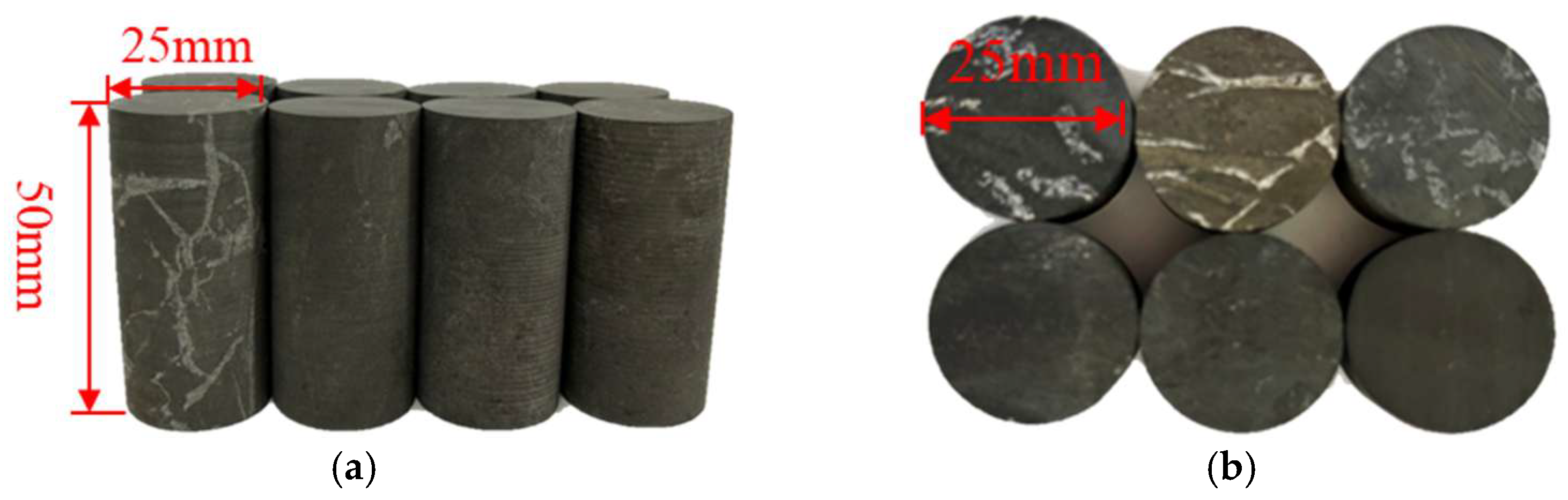
The experimental samples were sourced from the shale oil reservoir of Well X in the second member of the Permian Fengcheng Formation (P1f2) in the Mahu Sag, Xinjiang Oilfield, with a coring interval of 4914.81~5002.15 m. Based on different lithologies and depth distribution characteristics, core samples were optimally selected. Strictly adhering to the international specifications of the American Petroleum Institute’s “Recommended Practices for Core Analysis” (API RP 40) and matching the optimal dimensions of the radio frequency (RF) probe of the nuclear magnetic resonance (NMR) spectrometer, the samples were processed into standard plugs with a diameter of 25 mm and a length of 50 mm using high-precision wire cutting technology, serving as samples for the CO2 huff-n-puff experiments. The remaining cores were processed into samples with a diameter of 25 mm and a length of 10 mm for polarized light microscopy and scanning electron microscopy (SEM) tests.
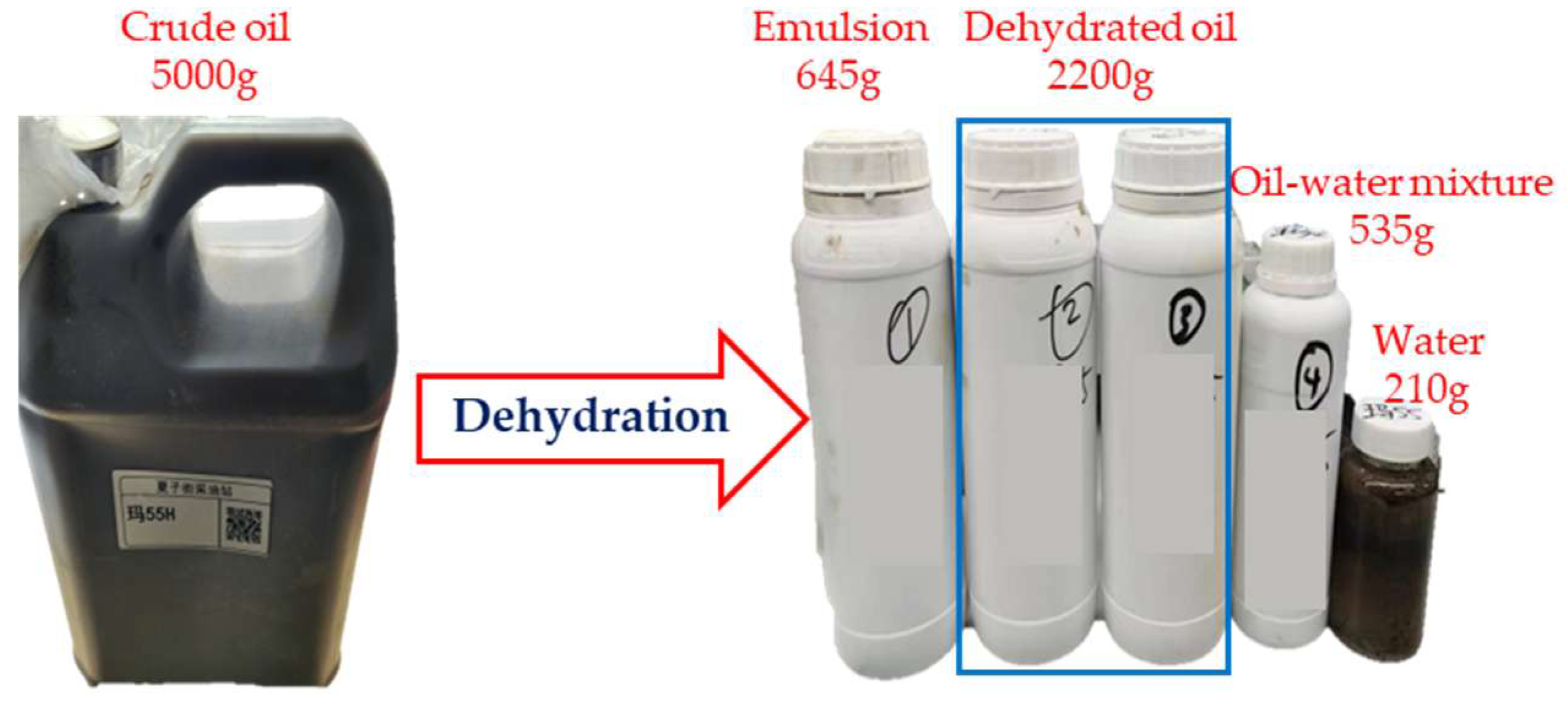
The core samples used for porosity and permeability tests, polarized light microscopy, and SEM tests are shown in Figure 1. Based on elucidating the core porosity and permeability characteristics alongside the microscopic pore structures, the lower limit of mobilizable pores for CO2 to displace reservoir crude oil was further analyzed. Simultaneously, the water-bearing crude oil obtained from the field was subjected to a dehydration treatment (Figure 2), and subsequently, viscosity tests were conducted on the pure oil samples. Constrained by the extremely deep coring depth (4914.81~5002.15 m) of the Fengcheng Formation in the Mahu Sag and the objective geological conditions that tight reservoirs are highly friable during the coring process, standard core plugs suitable for CO2 huff-n-puff experiments under ultra-high-pressure (70 MPa) conditions are extremely scarce. In addition, the reservoir exhibits overall characteristics of ultra-low porosity and ultra-low permeability. To ensure the capture of valid fluid dynamic signals with a high signal-to-noise ratio (SNR) during in situ NMR scanning, this study optimally selected 5 high-quality cores with relatively better physical properties across 4 typical lithologies, among which 1 core served as the control group and the other 4 served as the experimental group. Although the limited number of samples inherently focuses this study on the microscopic fluid–solid coupling analysis of typical lithologies, the revealed physical laws still hold representative theoretical guiding significance for the complex unconventional reservoirs in this region. The basic information of the 5 selected typical core samples is presented in Table 1.

2.2. Experimental Equipment

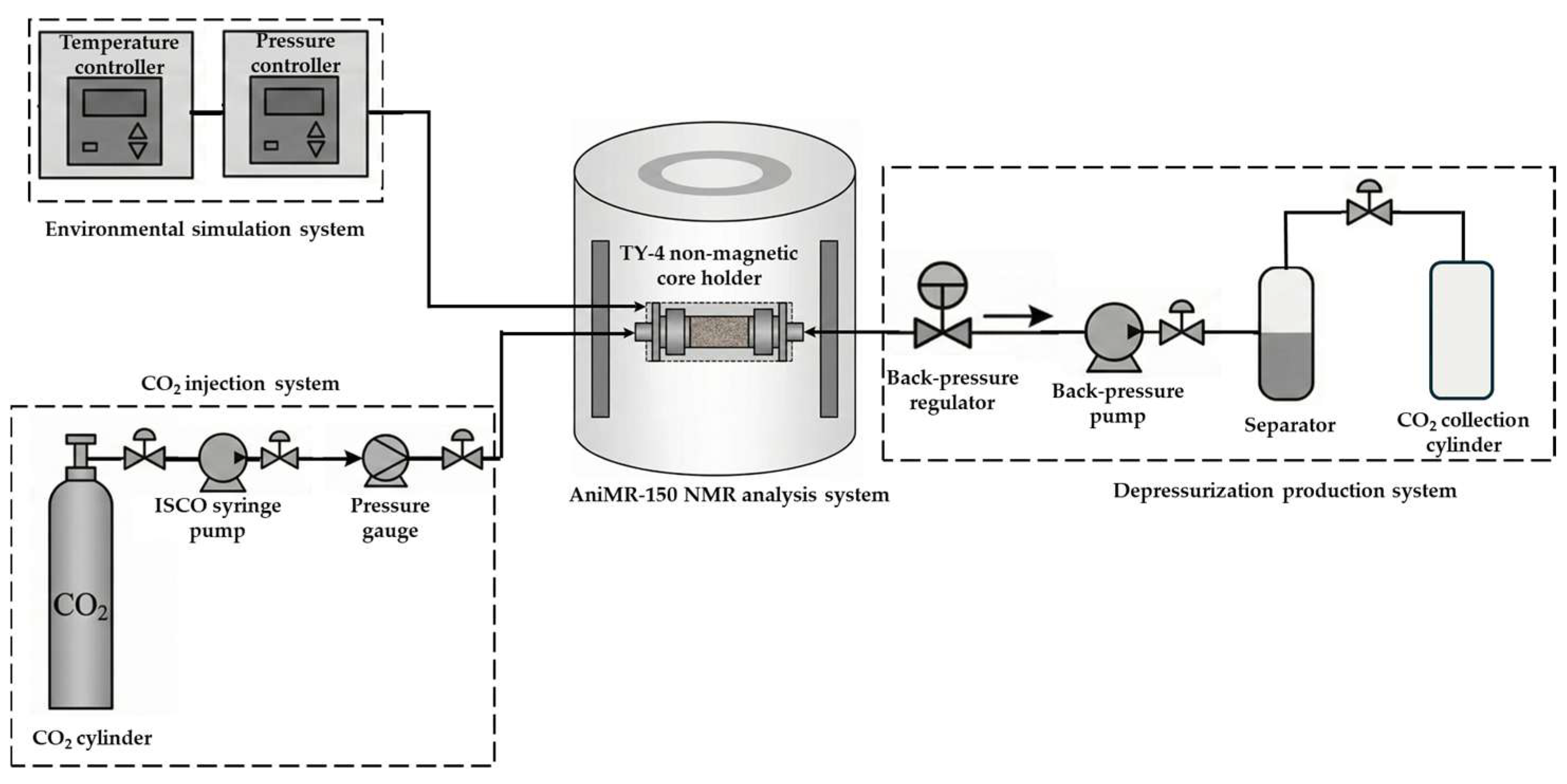
The CO2 huff-n-puff NMR scanning test system consists of a fluid injection system, an environmental simulation system, a TY-4 non-magnetic core holder (Niumag, Suzhou, China), an AniMR-150 Nuclear Magnetic Resonance (NMR) analysis system (Niumag, Suzhou, China), and a depressurization recovery system (Figure 3). The CO2 injection system employs a high-precision ISCO pump to inject CO2 into the core. The TY-4 non-magnetic core holder (upper temperature limit of 150 °C, upper pressure limit of 100 MPa) contains the core sample enveloped in fluorinated oil; the environmental simulation system applies confining pressure to the fluorinated oil to reach the target temperature and pressure (110 °C, 70 MPa). The environmental simulation system heats the fluorinated oil using electric heating wires and pressurizes it via a pressurizing pump, thereby maintaining a constant temperature and pressure within the core holder. After the soaking period, the depressurization recovery system simulates the crude oil recovery process through multi-stage depressurization. The AniMR-150 NMR analysis system utilizes the interaction between atomic nuclei and the magnetic field to detect the hydrogen atoms contained in the fluid filling the pores and analyzes the core pore size based on the signal decay rate (T2 relaxation time).

2.3. Experimental Scheme and Steps

To clarify the microscopic mobilization laws and the lower limit of mobilizable pores in the low-permeability and tight oil reservoirs of the Fengcheng Formation in the Mahu Sag under the action of CO2, four typical original oil-bearing cores from this region (without secondary oil–water saturation treatment, thereby preserving the natural occurrence state of crude oil within the pores) were selected to conduct huff-n-puff experiments under the condition of sufficient fluid injection (10 PV). During the process of CO2 replacing crude oil, 0~24 h is the highly efficient replacement stage, while the increment in replacement efficiency decelerates between 24 and 48 h [44]. Simultaneously, because the cores utilized in this experiment are excessively tight, the diffusion of CO2 into the core pores is highly restricted. Therefore, the single-cycle soaking time for this experiment was set to 72 h, ensuring adequate replacement of crude oil by CO2 while maintaining a requisite replacement efficiency. The control group and experimental group cores were subjected to huff-n-puff experiments comprising a total of 3 cycles, with a single-cycle soaking time of 72 h under the condition of sufficient N2 and CO2 injection (10 PV), respectively. The experimental plan is shown in Table 2. Integrating the experiments with nuclear magnetic resonance (NMR) technology, the T2 spectrum data of the cores at their initial state and after the first, second, and third huff-n-puff cycles were acquired, respectively. By quantitatively analyzing the distribution and evolution characteristics of fluids within the pores at different stages, the lower limit of mobilizable pores for CO2 to displace reservoir crude oil was ultimately determined.
The CO2 huff-n-puff experiments on the four cores were carried out according to the following steps: ① Core pretreatment: The end faces of the cores were cut and polished to eliminate the “end effect” and achieve uniform CO2 injection. ② Core loading: The cores were fixed in a high-temperature and high-pressure (HTHP) non-magnetic core holder (Niumag, Suzhou, China). The environmental simulation system was activated to set the temperature and pressure conditions within the core holder and stabilize them at the target values (110 °C, 70 MPa). ③ Fluid injection: A high-precision ISCO dual-cylinder syringe pump was utilized to quantitatively inject 10 PV of fluid into the core at a constant rate of 0.01 mL/min. ④ Soaking reaction: The inlet and outlet valves were closed, allowing the core to statically react under constant temperature and pressure (110 °C, 70 MPa) conditions for 72 h, enabling sufficient interaction between the injected fluid and the crude oil. ⑤ Depressurization production: This step was cooperatively executed by a high-precision automatic back pressure valve (BPV) accurately controlled by computer software and the dual-cylinder syringe pump. The system was programmed for stepwise depressurization at a constant rate of 0.5 MPa/min to prevent severe gas locking and secondary damage to the pore-throat structure caused by matrix fines migration induced by instantaneous pressure loss. ⑥ NMR scanning: After the completion of each huff-n-puff cycle, the experimental system was allowed to cool and depressurize to ambient temperature and pressure. Subsequently, the AniMR-150 NMR analysis system was employed to perform NMR scanning on the core to acquire the remaining oil distribution data. ⑦ Repeat experimental steps ③–⑥, with each core undergoing a total of 3 huff-n-puff cycles.

3. Results

3.1. Basic Petrophysical Properties and Microstructure of the Fengcheng Formation Shale Oil Reservoir in the Mabei Area

A high-temperature and high-pressure (HTHP) viscometer was used to test the viscosity of the dead oil. Under the designed experimental conditions (110 °C, 70 MPa), the crude oil viscosity was measured at 10.9 mPa·s.
Porosity and permeability tests were conducted on the selected dolomitic shale and dolomite-rich felsic shale from the Fengcheng Formation in the Mahu Sag, and the test results are shown in Table 3. The experimental data indicate that the reservoir overall exhibits characteristics of ultra-low porosity and ultra-low permeability, with an average porosity of 1.10% (0.51–2.04%) and an average permeability of 7.58 × 10⁻⁸ μm2 (1.22 × 10⁻⁸–13.27 × 10⁻⁸ μm2). A comparative analysis reveals that the dolomitic shale presents a distinct “high porosity but low permeability” characteristic: its average porosity (1.26%) is higher than that of the dolomite-rich felsic shale (1.01%), but its permeability (7.47 × 10⁻⁸ μm2) does not increase accordingly, remaining essentially on par with that of the dolomite-rich felsic shale (7.65 × 10⁻⁸ μm2). This is attributed to the fact that the micro-pores in the dolomitic shale are mostly isolated, with tiny pore throats and a low coordination number, which restricts the formation of effective flow channels. Conversely, the relatively higher permeability of the dolomite-rich felsic shale benefits from its superior pore-throat connectivity. The above results indicate that under ultra-low permeability conditions, pore-throat connectivity—rather than the size of the pore space—has become the dominant factor controlling the flow capacity.
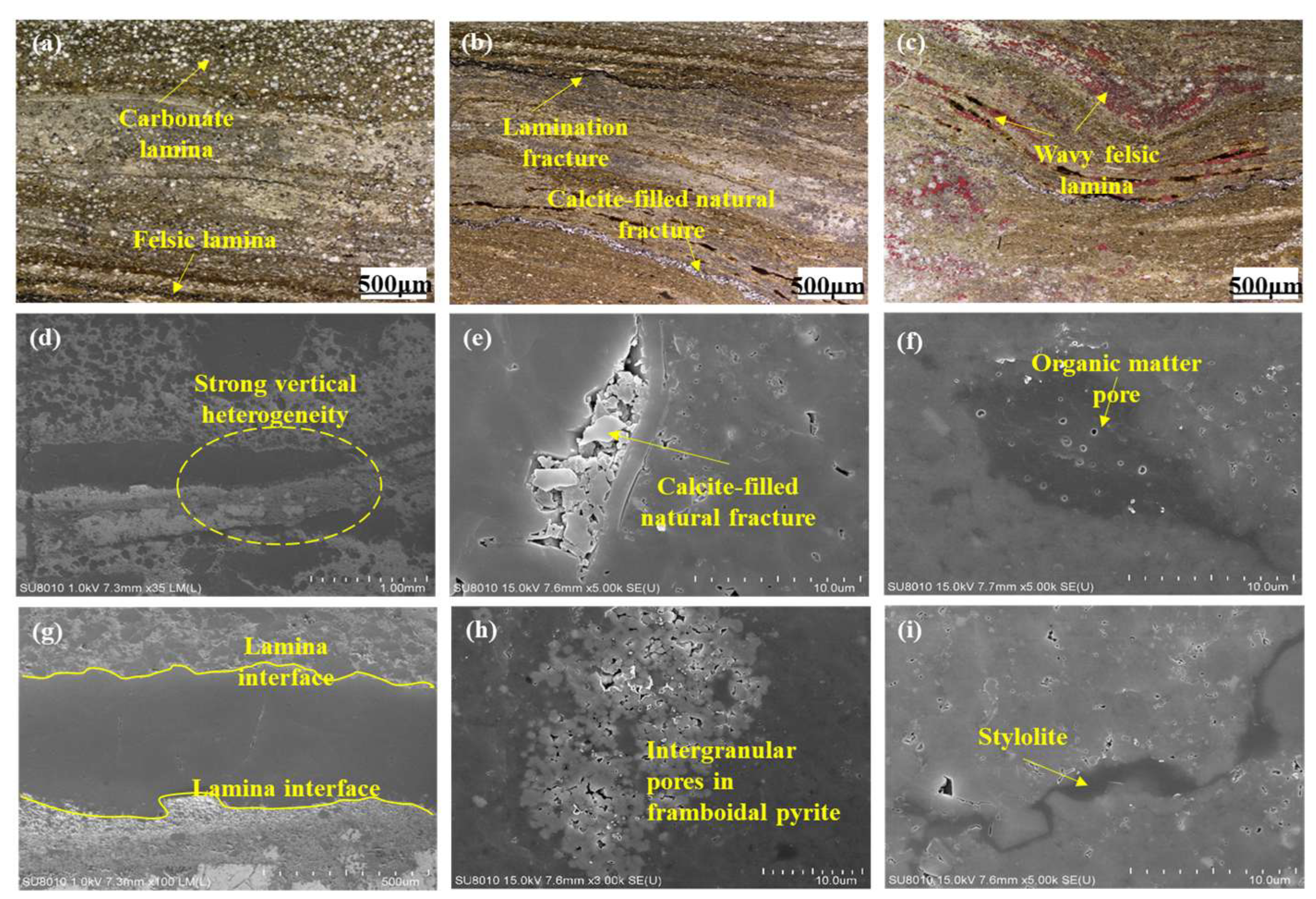
Combined with the microscopic characteristics of the cores (Figure 4), it is found that the shale of the Fengcheng Formation exhibits extreme heterogeneity and ultra-low porosity and permeability characteristics, which are fundamentally rooted in its unique alkaline lake sedimentary evolution history. During the depositional period, frequent volcanic activities and turbulent hydrodynamic conditions led to the high-frequency alternating deposition of volcaniclastic materials, terrigenous felsic particles, and authigenic carbonate minerals (such as dolomite), forming complex laminae structures alternating at the millimeter to micrometer scale at the core scale. Such drastic abrupt changes in mineral composition are the root cause of the strong rock heterogeneity. Meanwhile, during the deep burial process, having experienced intense mechanical compaction and multi-stage carbonate cementation under an alkaline environment, the vast majority of primary intergranular pores were obliterated. The fluid storage and seepage spaces degenerated into isolated secondary dissolution pores and micro–nanoscale intracrystalline micro-fractures, thereby resulting in its extremely poor matrix physical properties.
Under the polarized light microscope (Figure 4a,c), it can be observed that felsic laminae and carbonate laminae exhibit high-frequency millimeter-scale alternations, and carbonate minerals (calcite and dolomite) frequently crystallize in a patchy manner or along the beddings. In the scanning electron microscope (SEM) images (Figure 4d–i), primary intergranular pores within the matrix are extremely rare, and the primary storage spaces are carbonate intracrystalline pores, feldspar dissolution pores, and organic matter shrinkage fractures. Notably, numerous micro–nanoscale tensional micro-fractures selectively develop along the edges of brittle felsic particles or laminae interfaces. These micro-fractures not only provide the primary storage space but also serve as the key channels connecting isolated dissolution pores, which directly corroborates the conclusion from the porosity and permeability tests that lamina density dictates fluid permeability. With an increase in lamina density, the average permeability of dolomitic shale increases from 6.09 × 10⁻⁸ μm2 (5.88 × 10⁻⁸–6.30 × 10⁻⁸ μm2) to 8.84 × 10⁻⁸ μm2 (7.92 × 10⁻⁸–9.75 × 10⁻⁸ μm2), representing an increase of 45.1%. For the dolomite-rich felsic shale, it increases from 3.96 × 10⁻⁸ μm2 (1.22 × 10⁻⁸–6.01 × 10⁻⁸ μm2) to 10.60 × 10⁻⁸ μm2 (8.74 × 10⁻⁸–13.27 × 10⁻⁸ μm2), with an increment of 167.5%. This indicates that in ultra-low permeability tight reservoirs, laminae act as horizontal seepage networks with high flow conductivity, effectively overcoming the limitations of isolated pores and minute throats, and providing efficient pathways for fluid seepage. Notably, dolomite-rich felsic shale is more sensitive to the permeability enhancement induced by laminae. Despite its lower matrix porosity, the macroscopic permeability anisotropy induced by laminae significantly improves its overall seepage capacity. This phenomenon once again corroborates that in tight reservoirs, the effective connectivity of the pore-throat structure determines fluid flow capacity more critically than the magnitude of porosity.

3.2. Analysis Method for Test Results of Crude Oil Mobilization Evaluation

The nuclear magnetic resonance (NMR) T2 spectrum technique can non-destructively and quantitatively characterize the microscopic pore structure and fluid distribution of unconventional reservoirs, serving as a core technology for evaluating the microscopic heterogeneity of shale. Due to the differences in surface relaxation characteristics of fluids in pores of different sizes, the T2 relaxation time distribution can be directly mapped to the relationship between fluid volume and pore size. Utilizing this characteristic, this study quantitatively analyzes the signal amplitude and morphological evolution of T2 spectra by conducting in situ NMR scanning on the cores before and after CO2 huff-n-puff. This method not only accurately determines the mobilization degree of crude oil in pores of various scales but also clarifies the microscopic mobilization potential of crude oil under the extraction, viscosity reduction, and swelling effects of CO2, providing direct physical simulation evidence for elucidating the microscopic mechanisms of CO2-EOR in shale oil.
The T2 relaxation time distribution is converted into the pore-throat radius distribution using the following equation:
r = C × T 2
where r is the pore radius in μm; T2 is the transverse relaxation time in ms; and C is the conversion coefficient, with a value of 0.02 μm/ms. This conversion coefficient was directly provided by the oilfield company based on the extensive historical core HPMI-NMR combined database of the Fengcheng Formation in the Mahu Sag.
Based on the classification boundaries for microscopic pores specified in the GB/T 21650.3-2011 standard [45]—micropores (r ≤ 2 nm), mesopores (2 nm < r < 50 nm), and macropores (r ≥ 50 nm)—the evolution laws of the core pore size distribution were systematically categorized. To quantitatively evaluate the microscopic mobilization characteristics of CO2, this study introduces the 3σ confidence threshold model widely applied in statistics. By extracting the T2 difference spectrum curves before and after huff-n-puff and tracing backwards from macropores to micropores, the corresponding pore size at which the signal attenuation amplitude initially and continuously exceeds three times the standard deviation of the background noise (>3σ) is defined as the absolute lower limit of microscopic pore size for supercritical CO2 to overcome capillary resistance and strip crude oil. This threshold effectively filters out baseline drift, ensuring the physical authenticity of signal identification. After determining the lower limit of mobilization, in order to identify the dominant seepage channels that substantially contribute to the macroscopic recovery factor, the pore size interval where the attenuation amplitude of the pore component continuously exceeds 0.3%—under the premise of satisfying the >3σ noise filtration—is defined as the dominant mobilizable pore size range. This range excludes isolated minute pores that contribute extremely little to production, encompasses the trunk network that accounts for over 80% of the cumulative crude oil mobilization, and directly dictates the macroscopic sweep efficiency.

3.3. Evaluation of Crude Oil Mobilization in Shale Oil of the Fengcheng Formation, Mahu Sag

Under the conditions of 110 °C and 70 MPa, the injected CO2 exhibits a typical supercritical phase. Supercritical CO2 possesses highly advantageous dual physical properties: on the one hand, the high pressure of 70 MPa endows it with a near-liquid density, granting it extremely powerful chemical solvent efficacy to efficiently dissolve and extract light and medium hydrocarbon components in shale oil; on the other hand, its dynamic viscosity remains at the gaseous magnitude, which greatly enhances the molecular diffusion coefficient [46,47] More crucially, under such high pressure, supercritical CO2 is highly prone to achieving multi-contact miscibility with shale oil, thereby reducing the gas-liquid interfacial tension at the solid–liquid interface to near zero. According to the Laplace equation, the elimination of interfacial tension signifies that the tremendous capillary resistance within nanoscale pore-throats is completely dismantled. Benefiting from the synergistic effect of the extremely high diffusion-penetration capability and miscible displacement characteristics of the supercritical phase, the crude oil within the ultra-low-porosity and low-permeability tight cores can be effectively mobilized.
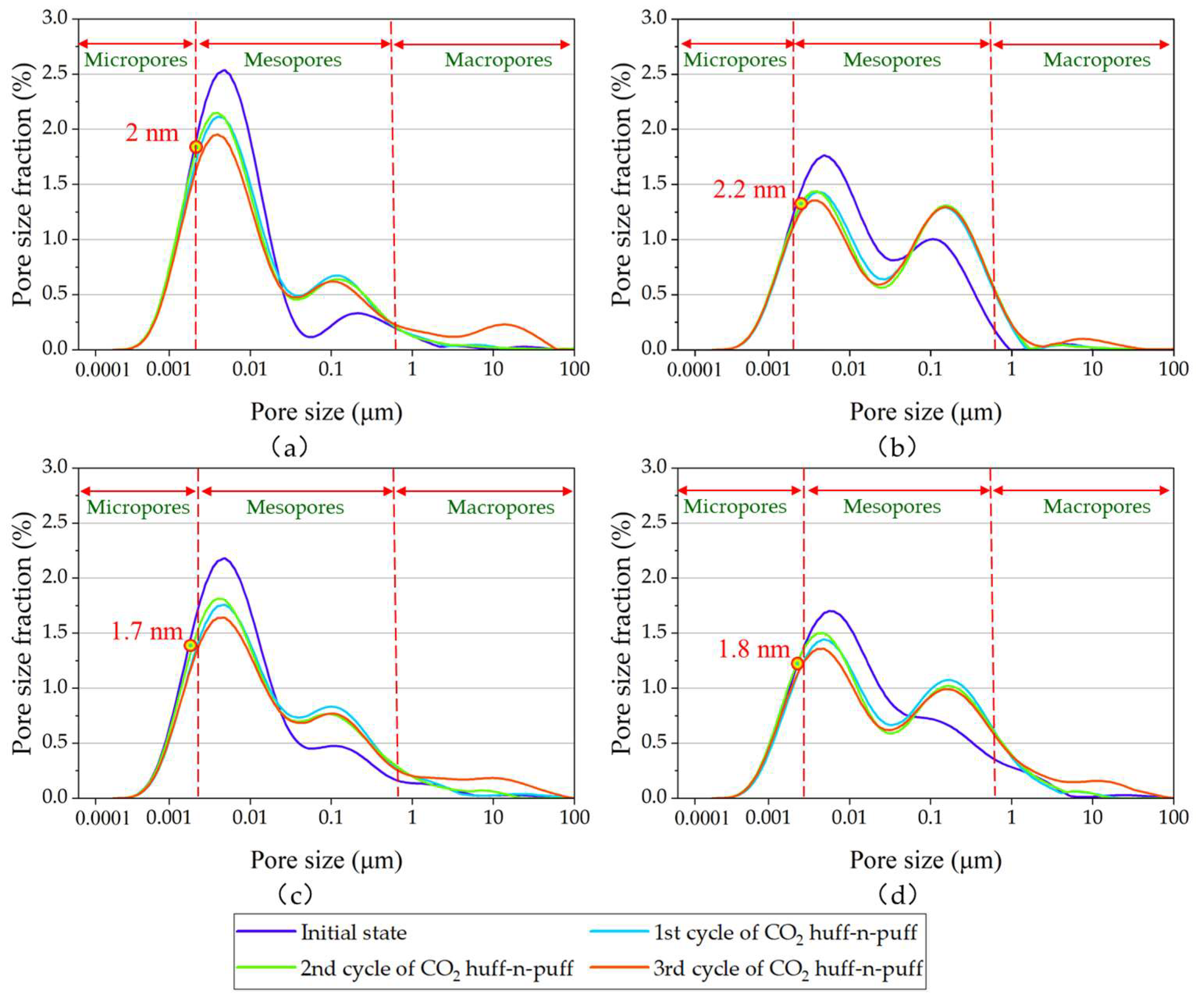
According to the analysis of pore structure evolution during multi-cycle CO2 huff-n-puff, it is found that the microscopic mobilization effect of CO2 on reservoir crude oil exhibits distinct stage-dependent characteristics and heterogeneity. Under initial state conditions, the four rocks with different lithologies are all dominated by mesopores (accounting for ≥60%), followed by macropores (12%~29.1%), with micropores accounting for the smallest proportion (<15%). After the action of CO2 huff-n-puff, the initial cycle dictates the reconstruction process of pore fluids; the mobilization of mesopore fluids is intense (with a decrease of 8.8%~13%), accompanied by a significant enhancement of macropore fluid signals (with an increase of 9.8%~13.2%), whereas the mobilization of micropores is negligible (<1%). Although subsequent cycles (the second and third cycles) continue the evolution path of “mesopore reduction and macropore increase,” the mobilization efficiency exhibits an exponential attenuation. After the cumulative action of three cycles, the proportion of macropores overall increases by 14.7%~16.4%. This evolutionary trajectory confirms that the mobilization of crude oil by CO2 primarily relies on mesopores and macropores as dominant seepage channels; through multi-cycle dissolution expansion and extraction effects, it drives the relay migration of crude oil from medium pores to macropores, thereby effectively improving the microscopic seepage capacity of the reservoir. In addition, as the number of huff-n-puff cycles increases, the geometric center of the main peak noticeably shifts toward the direction of smaller pore sizes. The fundamental reason for this leftward shift of the main peak lies in the selective component extraction mechanism of supercritical CO2. During the multiphase mass transfer process, CO2 preferentially dissolves and extensively extracts the light components in the crude oil, causing the crude oil remaining inside the pores to become heavier and its viscosity to increase. Because the molecular motion of the heavy components in crude oil is restricted and the dipole–dipole interaction between hydrogen nuclei is enhanced, its inherent surface relaxation rate significantly accelerates, leading to an irreversible shortening of the T2 relaxation time. In the inversion model employing a fixed pore size conversion coefficient, this shortening of relaxation time caused by component variations is intuitively manifested on the macroscopic spectrum as a reduction in the equivalent pore size characterization value and a shift of the main peak toward the micropore end.
The phenomenon of crude oil progressively migrating from mesopores to macropores is driven by multiple microscopic physical mechanisms. Firstly, thermodynamics and phase behavior changes: after entering medium pores, supercritical CO2 dissolves massively into the crude oil, substantially reducing its viscosity and triggering volume expansion. When the system enters the depressurization and fluid drainage stage, the pore fluids undergo elastic release and solution gas flashing; the powerful local expansion pressure displaces the crude oil from mesopores into macropores with better connectivity. Secondly, fluid–solid coupling and rock mechanics mechanisms: the cyclic alternating load up to 70 MPa induces mechanical fatigue in the matrix, causing the continuous expansion of the primary microscopic pore structure. This enables a portion of the originally isolated medium and small pores to merge into the macropore flow field, thereby macroscopically manifesting on the NMR spectrum as stepwise migration characteristics characterized by the weakening of mesopore fluid signals and the strengthening of macropore fluid signals.
Combining the analysis of Figure 5 and Table 4, it can be concluded that lithology and lamination structure jointly control the microscopic mobilization characteristics of CO2. Regarding the lower limit of mobilizable pores, the sequence is as follows: dolomite-rich felsic shale with developed laminations (1.7 nm) < dolomite-rich felsic shale with undeveloped laminations (1.8 nm) < dolomitic shale with developed laminations (2.0 nm) < dolomitic shale with undeveloped laminations (2.2 nm). Based on the previous porosity and permeability test results, the pore connectivity of the dolomite-rich felsic shale is superior to that of the dolomitic shale. Accordingly, the lower limit of mobilizable pore-throats for the dolomite-rich felsic shale is consistently lower than that of the dolomitic shale; moreover, under the same lithological conditions, the mobilization lower limit of cores with developed laminations is generally lower than that of cores with undeveloped laminations. Analyzing the flow mechanism, the better pore connectivity of the dolomite-rich felsic shale implies a lower capillary pressure threshold and smaller fluid injection resistance. The presence of laminations further enhances this connectivity advantage, enabling CO2 molecules to overcome resistance and enter even smaller pore spaces. Therefore, lithology and the degree of lamination development jointly determine the lower limit of mobilizable pores for reservoir crude oil by CO2.
Regarding the dominant mobilized pore size range, the dolomite-rich felsic shale with developed laminations exhibits the widest mobilization range (6.3–38.5 nm), while the dolomitic shale with developed laminations has the narrowest (5.8–17.8 nm). An in-depth analysis of the pore size distribution characteristics reveals that the size of the dominant mobilization range is significantly positively correlated with the abundance of macropores. Benefiting from its highest proportion of macropores (29.1%), the dolomite-rich felsic shale with developed laminations achieves effective coverage across a wide pore size domain. Conversely, for rock samples dominated by mesopores (e.g., 71.1% in dolomitic shale with developed laminations and 67% in dolomite-rich felsic shale with undeveloped laminations), the mobilization range is significantly restricted. This indicates that in ultra-low permeability reservoirs, the development degree of macropores directly dictates the main sweep efficiency of CO2 on reservoir crude oil.
A lateral comparison between the lower limit of mobilization (1.7~2.2 nm) defined in this study and previous conventional displacement studies highlights the extreme advantages of the ultra-high-pressure injection stage during CO2 pre-fracturing. Previous studies indicate that conventional waterflooding, owing to the extremely high oil–water capillary resistance, typically exhibits a lower limit of microscopic mobilization as high as 194 nm; even for continuous conventional CO2 miscible flooding, constrained by gas channeling and sweep efficiency limitations, its lower limit of mobilization can only reach 50 nm [28]. In contrast, under the deep supercritical conditions of 110 °C and 70 MPa coupled with 72 h of sufficient soaking, this study successfully extended the lower limit of pore mobilization downward by an order of magnitude. By minimizing the gas-liquid interfacial tension to near zero, the nanoscale capillary resistance was completely dismantled, thereby tremendously unlocking the reserve potential of nanoscale pores.

3.4. Analysis of Crude Oil Recovery

During the depletion process from 70 MPa to atmospheric pressure, the flash expansion of light components within the crude oil and the elastic solution gas drive mechanism inevitably contribute to a portion of the recovery factor. To avoid misjudging the mechanical depressurization effect as the dissolution and extraction capability of CO2, a pure N2 huff-n-puff control experiment was additionally conducted on parallel cores under identical boundary conditions (temperature of 110 °C, pressure of 70 MPa, injected fluid volume of 10 PV, and a single-cycle soaking time of 72 h). Because the solubility of N2 in crude oil is minimal and it cannot achieve miscibility under experimental pressure, its recovery degree purely reflects the mechanical elastic energy of pore fluids and the evaporation of light components. The results indicate that the crude oil recovery degree of N2 huff-n-puff is only 1.3%~2.7%, significantly lower than the 20%~30% recovery factor induced by supercritical CO2. The dissolution-extraction, miscible expansion, and capillary force elimination effects of supercritical CO2 on crude oil dominate over 90% of the total microscopic, mobilized volume. Therefore, this control experiment successfully verifies that the high recovery factor of supercritical CO2 huff-n-puff is not a physical artifact of the depressurization depletion process, but a true reflection of its unique thermodynamic and kinetic effects. It scientifically defines the absolute dominant role of phase miscibility and extraction mechanisms in the microscopic mobilization process of unconventional crude oil.
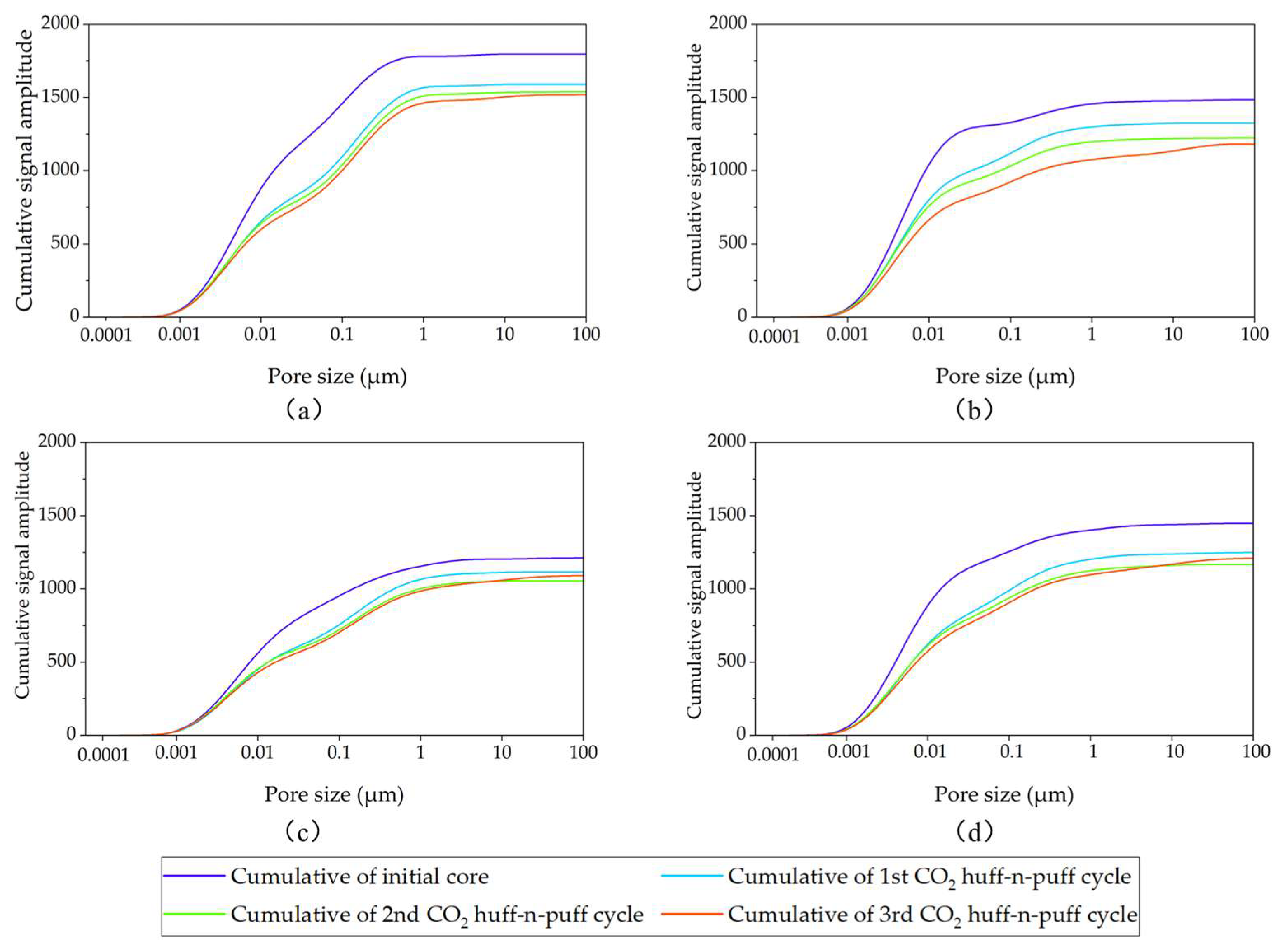
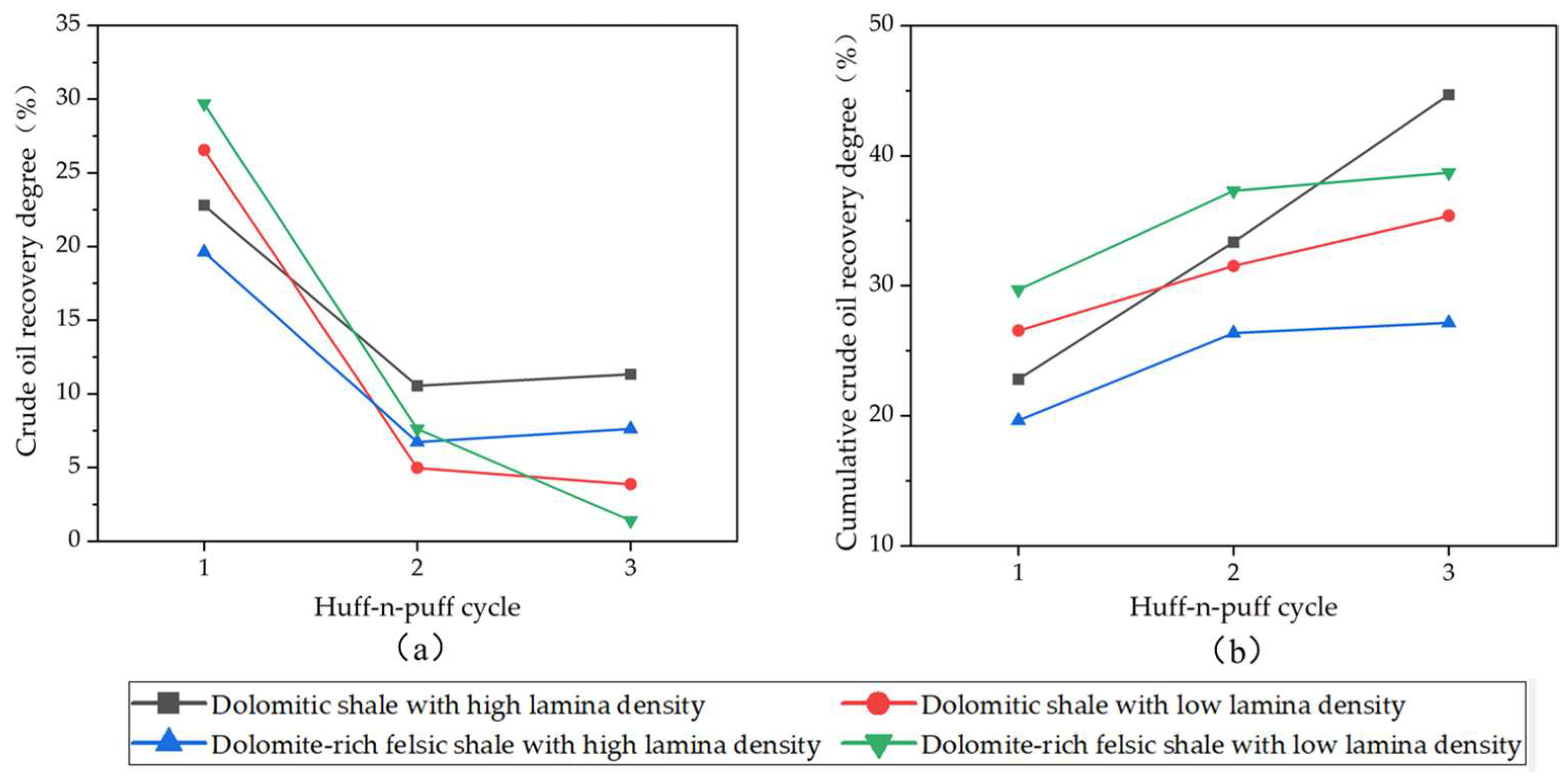
The cumulative NMR signal amplitude variations within the pores at the initial state and after different cycles of CO2 huff-n-puff are shown in Figure 6. The final cumulative amplitude of the signals on the right side of the cumulative curves directly maps the total fluid retention volume within the core pores. The crude oil retention volume within the core experiences the most drastic reduction (decreasing by 8.3%~13.8%) after the initial huff-n-puff cycle. In subsequent cycles, the crude oil retention volume exhibits a stepwise decrement, decreasing by 2.5%~6% in the second cycle and only 1.1%~2.7% in the third cycle. The crude oil recovery degree per cycle (Figure 7a) and the cumulative recovery degree (Figure 7b) were calculated based on the weighing method. Analysis reveals that the crude oil recovery effect of CO2 huff-n-puff is governed by the coupling effect of pore structure and fluid migration mechanisms. In terms of cyclic mobilization characteristics, it presents a universal rule of “initial-cycle dominance and subsequent attenuation,” which aligns with the variation trend of crude oil retention volume within the core. The initial cycle benefits from the highly efficient dissolution-displacement effect of CO2 on the crude oil in macropores under the original high oil saturation. CO2 achieves multi-contact miscibility with shale oil. Under the dual effects of dissolution expansion and extraction-replacement, the crude oil viscosity is substantially reduced, yielding a recovery degree as high as 20~30%. However, along with the selective extraction of light components by CO2, the crude oil components remaining in the pore-throats during subsequent cycles become heavier, and asphaltene precipitation intensifies. This causes crude oil viscosity to rebound, and the resistance to secondary swelling and stripping rises sharply. Simultaneously, the initial cycle depletes the crude oil in micro-fractures and larger pores, forming gas channeling paths. In subsequent huff-n-puff cycles, CO2 preferentially flows along the gas channeling paths, making it difficult to establish sufficient pressure differentials and concentration gradients at the tight matrix interfaces. The combined effects of gas channeling in large channels and the loss of mobility of heavy oil within nanoscale pore-throats lead to the attenuation of sweep volume and a sudden drop in recovery factor in subsequent huff-n-puff cycles. The recovery degree in the second cycle generally drops by over 50%. The contribution of the third huff-n-puff cycle to the crude oil recovery degree is even more marginal; except for the dolomitic shale with high lamina density, whose recovery degree is maintained at around 10%, the recovery degrees of the other cores all decrease to below 4%.
Based on the cumulative crude oil recovery degree, two typical mechanisms can be identified: a short-cycle dissipative type characterized by a strong burst but rapid depletion (dolomitic shale with low lamina density), and a long-term stable production type characterized by moderate initial production but strong continuous-supply capacity (dolomitic shale with high lamina density). Rock samples exhibiting the short-cycle dissipative type have relatively developed macropores, accounting for up to 28.6%. The initial cycle is prone to forming dominant channels with high flow conductivity, resulting in an extremely high initial recovery degree (26.55%). However, due to the massive in the remaining oil and the decreased content of light crude oil components, the expansion, viscosity reduction, diffusion, and extraction effects of CO2 on crude oil weaken. This causes a rapid decline in the overall displacement efficiency and a lack of continued supply in subsequent cycles, with the crude oil recovery dropping by 81.3% after the second huff-n-puff cycle. Rock samples of the long-term stable production type benefit from a pore-throat configuration dominated by mesopores (accounting for 71.1%) with limited macropores (accounting for 12%). Although their initial-cycle mobilization is not drastic, with a crude oil recovery degree of only 22.8%, the vast amount of crude oil stored in mesopores can maintain a stable crude oil supply in subsequent cycles, sustaining a recovery level of approximately 10% even in the late stages of multi-cycle huff-n-puff. Such superior continuous-supply capacity allows its cumulative recovery degree curve to maintain a continuous upward trend and ultimately surpass the former, demonstrating better long-term development potential. Therefore, in tight reservoirs, after three cycles of CO2 huff-n-puff under high-temperature and high-pressure conditions, although dominant macropores are conducive to high initial production, a mesopore-dominated pore structure is more advantageous for maintaining long-term stable production and achieving a higher recovery factor.

4. Conclusions

The key findings of this research are as follows:
(1)
The Fengcheng Formation shale oil reservoir in the Mahu Sag is a typical ultra-low-porosity and ultra-low-permeability tight reservoir. The porosity ranges from approximately 0.51% to 2.04% (averaging 1.10%), and the permeability ranges from approximately 1.22 × 10⁻⁸ to 13.27 × 10⁻⁸ μm2 (averaging 7.58 × 10⁻⁸ μm2). Reservoirs of different lithologies exhibit distinct porosity and permeability characteristics. The dolomitic shale possesses a “high porosity but low permeability” attribute, while the dolomite-rich felsic shale exhibits a “structure-controlled permeability” attribute. Laminations, by forming preferential flow paths and modifying the reservoir pore structure, are the key factors in enhancing reservoir permeability.
(2)
Given sufficient carbon injection volume and reaction time, the main mobilization range of crude oil is concentrated in the mesopore-macropore system, partially reaching the micropores. As the number of cycles increases, the crude oil gradually migrates to the macropores.
(3)
The lower limit of mobilizable pores for crude oil by CO2 huff-n-puff is 1.7–2.2 nm, and the dominant mobilized pore size range is 5.1–38.5 nm. The lower limit of mobilizable pores is jointly determined by the dual factors of lithology and the degree of lamination development, while the abundance of macropores dictates the main sweep efficiency.
(4)
Multi-cycle CO2 huff-n-puff exhibits a cyclic pattern characterized by first-cycle dominance and subsequent attenuation. Benefiting from the advantages of high initial oil saturation and intact crude oil components, the crude oil recovery in the first CO2 huff-n-puff cycle can reach 20–30%. In subsequent cycles, as the remaining oil is distributed in micro-pores and the light components of the crude oil decrease, the swelling, viscosity reduction, diffusion, and extraction effects of CO2 are weakened, leading to a continuous decline in crude oil recovery.
(5)
Future research can incorporate the lower limit of mobilizable pores and the crude oil mobilization laws defined in this study as physical constraints into a field-scale three-dimensional numerical simulation framework, which integrates the geometric morphology of complex hydraulic fracture networks and matrix–fracture coupled mass transfer. Through such scale upscaling, systematic optimization can be conducted targeting actual field engineering operational parameters, thereby transforming microscopic oil displacement mechanisms into engineering application schemes capable of directly guiding the efficient production of shale oil.

Author Contributions

Conceptualization, K.L.; Validation, S.L.; Investigation, Z.L.; Formal analysis, W.Z.; Writing—original draft, L.Y.; Writing—review and editing, Y.Z. All authors have read and agreed to the published version of the manuscript.

Funding

This research received no external funding.

Data Availability Statement

The original contributions presented in this study are included in the article material. Further inquiries can be directed to the corresponding author.

Conflicts of Interest

Authors, Kaixin Liu, Siyu Lai, Zhenhu Lv, and Weijie Zheng are affiliated with Engineering Technology Institute, Petro China Xinjiang Oilfield Company. The remaining authors declare that the research was conducted in the absence of any commercial or financial relationships that could be construed as a potential conflict of interest.

References

  1. Energy Institute. Statistical Review of World Energy 2024; Energy Institute: London, UK, 2024; Available online: https://www.energyinst.org/statistical-review (accessed on 11 May 2026).
  2. Zou, C.; Pan, S.; Jing, Z.; Gao, J.; Yang, Z.; Wu, S.; Zhao, Q. Shale oil and gas revolution and its impact. Acta Pet. Sin. 2020, 41, 1–12. [Google Scholar] [CrossRef]
  3. Hu, W.; Zhang, S.; Xu, S.; Wang, X. Practice, challenges and prospects of oil and gas field development in China. China Pet. Explor. 2024, 29, 1–11. [Google Scholar] [CrossRef]
  4. Wang, Z.; Cao, G.; Bai, Y.; Wang, P.; Wang, X. Development Status and Prospect of EOR Technology in Low-Permeability Reservoirs. Spec. Oil Gas Reserv. 2023, 30, 1–13. [Google Scholar] [CrossRef]
  5. Wang, X.Z.; Yang, H.; Wang, W.; Yao, Z.; Liang, Q.; Liu, Y. CO2 flooding and sequestration technology and practice in low-permeability tight reservoirs. Pet. Geol. Recovery Effic. 2023, 30, 27–35. [Google Scholar] [CrossRef]
  6. Yuan, Z.; Yang, S.; Zhang, Z.; An, X.; Zhu, Y.; Tan, X.; Tan, C. Optimization of CO2 huff and puff fracture parameters in ultra-low permeability reservoir considering time variation of permeability and starting pressure gradient. Sci. Technol. Eng. 2022, 22, 11904–11910. Available online: http://stae.com.cn/jsygc/article/abstract/2200134?st=article_issue (accessed on 11 May 2026).
  7. Shan, X.; Dou, Y.; Yan, Q.; Chen, X.; Peng, B.; Yi, J. Characteristics and Controlling Factors of Tight Oil Reservoirs of Fengcheng Formation in Southern Slope of Mahu Sag. Xinjiang Pet. Geol. 2022, 43, 704–713. [Google Scholar] [CrossRef]
  8. Wang, S.; Wang, G.; Wang, H.; Liu, M.; Huang, L.; Huang, Y.; Wang, Y.; Wang, Z.; Li, S. Logging evaluation of acoustic anisotropy and its relationship with “sweet spots” in lacustrine shale oil reservoirs: The Fengcheng Formation of the Mahu Sag, China. Pet. Sci. 2025, 22, 3133–3151. [Google Scholar] [CrossRef]
  9. Zhu, Y.; Wu, S.; Deng, Y.; Liu, L.; Lei, X.; Niu, Y. Pore Throat Structures and Fluid Occurrences of Reservoirs in Fengcheng Formation, Mahu Sag. Xinjiang Pet. Geol. 2024, 45, 286–295. [Google Scholar] [CrossRef]
  10. Jiang, F.; Huang, R.; Hu, T.; Lü, J.; Huang, L.; Jiang, Z.; Hu, M.; Zhang, C.; Wu, G.; Wu, Y. Geological characteristics and classification evaluation of shale oil in Fengcheng Formation in Mahu sag, Junggar Basin. Acta Pet. Sin. 2022, 43, 899–911. [Google Scholar] [CrossRef]
  11. Tang, Y.; Jia, C.; Chen, F.; He, W.; Zhi, D.; Shan, X.; You, X.; Jiang, L.; Zou, Y.; Wu, T.; et al. Relationship between pore throat structure and crude oil mobility of full particle sequence reservoirs in Permian Fengcheng Formation, Mahu Sag, Junggar Basin, NW China. Pet. Explor. Dev. 2025, 52, 99–111. [Google Scholar] [CrossRef]
  12. Hu, S.; Li, Q.; Huang, W.; Qin, J.; Yan, Y.; Zhang, J.; Ba, Z.; Qin, J.; Zhang, Z.; He, H.; et al. Microstructure and fluid mobilization characteristics of tight sandstone in Fengcheng Formation of southern Mahu sag. Acta Pet. Sin. 2025, 46, 1418–1433. [Google Scholar] [CrossRef]
  13. Chen, S.; Xu, J.; Zhang, X.; Wang, R.; Zhang, L.; Li, H. CO2 Flooding Connectivity Characteristics of the Strong Water-Sensitive Conglomerate Reservoir in Xinjiang Oilfield. Xinjiang Oil Gas 2024, 20, 44–51. [Google Scholar] [CrossRef]
  14. Jin, Z.; Zhu, R.; Liang, X.; Shen, Y. Several issues worthy of attention in current lacustrine shale oil exploration and development. Pet. Explor. Dev. 2021, 48, 1276–1287. [Google Scholar] [CrossRef]
  15. Liu, J.; He, K.; Liu, S.; Meng, S.; Zhang, D.; Sun, W. Water blockage occurrence and evolution dynamics in tight oil reservoirs in post-hydraulic fracturing. J. China Univ. Pet. (Ed. Nat. Sci.) 2025, 49, 152–161. [Google Scholar] [CrossRef]
  16. Zhu, G. Study on mechanical mechanism of starting residual oil in nitrogen flooding of fractured-vuggy reservoirs. J. Xi’an Shiy-Ou Univ. (Nat. Sci. Ed.) 2025, 40, 74–78, 132. [Google Scholar] [CrossRef]
  17. Xiao, W.; Chen, S.; Yi, Y.; Chen, H.; Ren, J. NMR-Based Experiments of Fracturing Fluid Assisted CO2 Huff-n-Puff for Enhancing Shale Oil Recovery. Xinjiang Oil Gas 2024, 20, 83–90. [Google Scholar] [CrossRef]
  18. Li, P.J.; Nie, C.F.; Zhou, R.; Yu, X.R.; Dong, H.X.; Zhang, L.Y.; Li, Y.X.; Chen, Z.X. Research progress on stimulation mechanisms of shale oil enhanced recovery by CO2 injection. Chem. Eng. Oil Gas 2026, 1–19. Available online: https://link.cnki.net/urlid/51.1210.te.20251225.1020.002 (accessed on 11 May 2026).
  19. Mou, J.; Yan, X.; Zhang, S.; Shi, L.; Li, D.; Ma, X. Research on CO2 Matrix Penetration Distance in Tight Reservoirs. Xinjiang Oil Gas 2024, 20, 64–71. [Google Scholar] [CrossRef]
  20. Yang, W.; Wang, Z.; Su, J.; Hu, X.; Huang, Y.; Lai, J.; Wang, G. Occurrence Space and Mobility of Shale Oil in Fengcheng Formation, Mahu Sag, Junggar Basin. Xinjiang Pet. Geol. 2025, 46, 192–200. [Google Scholar] [CrossRef]
  21. Gai, C.; Shi, Y.; Wang, M.; Huang, Y.; Li, C.; Zeng, Y. Replacement potential of shallow CO2 huff and puff in Jidong Oilfield. Pet. Geol. Oilfield Dev. Daqing 2016, 35, 132–135. [Google Scholar] [CrossRef]
  22. He, H.F.; Hu, X.H.; Zhuang, Y.T.; Liu, P.C.; Ma, Y.N.; Wu, W.; Han, Y.; Fang, S. Optimization and application of CO2 flooding injection-production parameters in low-permeability reservoirs: A case study of Block A in Shengli Oilfield. Pet. Geol. Recovery Effic. 2023, 30, 112–121. [Google Scholar] [CrossRef]
  23. Wang, D. Research and field test of CO2 huff and puff technology after large-scale fracturing in tight oil wells of Daqing Oilfield. Oil Prod. Eng. 2024, 26–31, 80. [Google Scholar]
  24. Zhao, K.; Li, Z.; Liu, J.; Hu, K.; Jiang, R.; Wang, W.; Liu, X. Parameter optimization and field practice of CO2 pre-fracturing process in Jimsar shale oilblock. Pet. Reserv. Eval. Dev. 2024, 14, 83–90. [Google Scholar] [CrossRef]
  25. Zhang, L.; Wei, Q.; Liao, G.; Lv, W.; Yang, Y.; Zhao, Y.; Tian, Y. Current Status, Reflections and Prospects of CCUS-EOR Development in China Under the Dual-Carbon Goals. Drill. Prod. Technol. 2025, 48, 10–20. [Google Scholar] [CrossRef]
  26. Li, B.; Hou, J.; Lei, Z.; Zhang, B.; Wang, B.; Chen, J. Evaluation of shale oil extraction by supercritical CO2 and analysis of influencing factors. Pet. Drill. Tech. 2024, 52, 94–103. [Google Scholar] [CrossRef]
  27. Bai, Y.; Ren, H.; Zhang, J.; Chen, S.; Wu, W.; Zhao, X.; Wu, H.; Zou, Y. Component characteristics and mobility assessment of shale oil: A case study of the Permian Fengcheng Formation, Mahu Sag, Junggar Basin. Oil Gas Geol. 2025, 46, 1582–1596. [Google Scholar] [CrossRef]
  28. Wang, J.; Liu, J.; Wang, X.; Shi, L.; Hao, D.; Song, P.; Ren, J.; Xiao, W. Characterization of crude oil mobilization under advanced CO2 injection in tight oil of Chang 8member, Ordos Basin. Pet. Reserv. Eval. Dev. 2026, 16, 107–117. [Google Scholar] [CrossRef]
  29. Cao, R.; Cheng, L.; Du, X.; Shi, J.; Yang, C. Research Progress on Fluids Flow Mechanism and Mathematical Model in Tight Oil Reservoirs. J. S W Pet. Univ. (Sci. Technol. Ed.) 2021, 43, 113–136. [Google Scholar] [CrossRef]
  30. Qi, H.; Yang, G.; Zhu, Y.; Deng, M.; Geng, S.; Tian, W. Study on imbibition mechanisms in tight oil reservoirs based on nuclear magnetic resonance and pore-scale simulation. Pet. Reserv. Eval. Dev. 2025, 15, 824–833. [Google Scholar] [CrossRef]
  31. Wang, X.; Chen, J.; Ren, D. Research progress and prospect of pore structure representation and seepage law of continental shale oil reservoir. Pet. Reserv. Eval. Dev. 2023, 23–30. [Google Scholar] [CrossRef]
  32. Zhou, Z.; Zhang, G.; Cui, C.; Bao, H.; Ren, S.; Wang, J. Methods and Applications for Characterizing Pore Structure and Determining Physical Property Lower Limit in Shale Reservoirs. Spec. Oil Gas Reserv. 2024, 31, 96–102. [Google Scholar] [CrossRef]
  33. Xiao, Q.; Li, J.; Meng, D.; Shi, L.; Shao, P.; Dong, N.; Su, Z. Experimental study on CO2 huff and puff in the Daqing Fuyu tight oil reservoir with online NMR. Heliyon 2024, 10, e40183. [Google Scholar] [CrossRef]
  34. Liu, J.; Li, H.; Tan, Q.; Liu, S.; Zhao, H.; Wang, Z. Quantitative study of CO2 huff-n-puff enhanced oil recovery in tight formation using online NMR technology. J. Pet. Sci. Eng. 2022, 216, 110688. [Google Scholar] [CrossRef]
  35. He, W.; Wang, G.; Chen, F.; Ren, H.; Gao, G.; Zou, Y.; Han, Y.; Liu, X.; Yu, X. Pore-throat structures and lower limits of fluid-movable pore-throat radii in conventional and unconventional reservoirs of Fengcheng Formation in Mahu sag, Junggar Basin. Acta Pet. Sin. 2025, 46, 1327–1341. [Google Scholar] [CrossRef]
  36. Han, X.; Song, Z.; Deng SXian, C.; Li, B.; Li, P.; Song, Y.; Jiang, J.; Lyu, B.; Zhang, L. Diffusion, mass transfer and oil mobilization mechanisms of CO2 huff-n-puff in Gulong shale oil reservoirs. Pet. Explor. Dev. 2025, 52, 1401–1412. [Google Scholar] [CrossRef]
  37. Chen, C.; Zhang, J.; Dong, H.; Xiang, J.; Zhang, W.; Wang, X. Mechanisms of pore-scale oil production and displacement efficiency for CO2 flooding in low-permeability conglomerate reservoirs. Acta Pet. Sin. 2025, 46, 1434–1446. [Google Scholar] [CrossRef]
  38. Xue, Y.; Wu, W. Characterization of brittleness evolution of hot dry rock during cyclic thermal treatment. Acta Geotech. 2026. [Google Scholar] [CrossRef]
  39. Cai, C.; Li, J.; Zhai, C.; Wang, B.; Xue, J.; Dong, Z.; Zhu, Z. Crack Propagation Characteristics in Shale under Cyclic In Situ Methane Detonation Impact Fracturing. Energy Fuels 2026, 40, 6064–6082. [Google Scholar] [CrossRef]
  40. Chen, S.; Zhao, Y.; Zou, Y.; Ren, H.; Chen, F.; Wu, J. Influences of Paleo-Sedimentary Environment on Shale Oil Sweet Spots in the Fengcheng Formation, Mahu Sag, Junggar Basin. Xinjiang Pet. Geol. 2026, 47, 46–56. [Google Scholar] [CrossRef]
  41. Luo, F.; Li, D.; Zhao, Y.; Xie, Z.; Wang, Z.; Yin, H.; Zhong, L.; Zhao, X. Controlling factors and charactersof the mixed shale reservoirs in the Fengcheng Formation, Xia-203 well district, northern Junggar Basin. Chin. J. Geol. 2026, 61, 818–837. [Google Scholar] [CrossRef]
  42. Lei, Q.; Ma, S.; Zhang, L.; Jiao, J.; Xiong, W.; He, Y.; Li, H. Production mechanism of enhanced oil recovery by CO2 huff and puff and storage prospect in interbedded shale oil reservoirs. Oil Drill. Prod. Technol. 2025, 47, 245–254. [Google Scholar] [CrossRef]
  43. Xiong, J.H.; Long, X.Y.; Zhu, L.; Zhang, H.L. Experimental study on enhanced oil recovery by CO2 huff and puff in deep low permeability glutenite reservoir. Sci. Technol. Eng. 2023, 23, 1518–1525. [Google Scholar] [CrossRef]
  44. Li, B.Y. Study on Stimulation Mechanism of CO2 Pre-Pressuring Fracturing in Jimsar Shale Oil Reservoir. Ph.D. Thesis, China University of Petroleum, Beijing, China, 2023. [Google Scholar]
  45. GB/T 21650.3-2011; Pore Size Distribution and Porosity of Solid Materials by Mercury Porosimetry and Gas Adsorption—Part 3: Analysis of Micropores by Gas Adsorption. Standards Press of China: Beijing, China, 2011.
  46. Sun, L.; Sun, H.; Li, Y.; Yu, X.; Wang, Z.; Chen, Y.; Zhao, J.; He, T.; Wei, B.; Pu, W. Influencing factors of supercritical carbon dioxide huff and puff to enhance shale oil recovery. Pet. Geol. Recovery Effic. 2026, 33, 48–58. [Google Scholar] [CrossRef]
  47. Xu, Z.; Zheng, J.; Dou, B.; Tian, H. Research status and development challenges of supercritical CO2 fracturing technology. Contrib. Geol. Miner. Resour. Res. 2026, 41, 39–49. [Google Scholar] [CrossRef]
Figure 1. Porosity and permeability test polarized light test and scanning electron microscope core samples: (a) porosity and permeability test samples (h 50 mm × φ 25 mm); (b) polarized light test, scanning electron microscope samples (h 10 mm × φ 25 mm).
Processes 14 01600 g001
Figure 2. Dehydration treatment of crude oil.
Processes 14 01600 g002
Figure 3. The schematic diagram of CO2 huff-n-puff–nuclear magnetic scanning experimental system.
Processes 14 01600 g003
Figure 4. Microstructural characteristics of the core samples: (ac) polarized light microscopy images; (di) scanning electron microscopy (SEM) images.
Processes 14 01600 g004
Figure 5. Changes in pore-throat radius of the cores after CO2 huff-n-puff: (a) dolomitic shale with high lamina density; (b) dolomitic shale with low lamina density; (c) dolomite-rich felsic shale with high lamina density; (d) dolomite-rich felsic shale with low lamina density.
Processes 14 01600 g005
Figure 6. Cumulative T2 spectra analysis of cores after different CO2 huff-n-puff cycles: (a) dolomitic shale with high lamina density; (b) dolomitic shale with low lamina density; (c) dolomite-rich felsic shale with high lamina density; (d) dolomite-rich felsic shale with low lamina density.
Processes 14 01600 g006
Figure 7. Crude oil recovery degree after different CO2 huff-n-puff cycles: (a) crude oil recovery degree per cycle; (b) cumulative crude oil recovery degree after each cycle.
Processes 14 01600 g007
Table 1. Basic information of cores used in CO2 huff-n-puff experiment.
Serial NumberObjective of the ExperimentLithologyCore Surface CharacteristicsCore Photos
1control groupDolomitic shale with high lamina densityA large amount of dolomitic minerals is filled along the laminaeProcesses 14 01600 i001
2experimental groupDolomitic shale with high lamina densityA small amount of dolomitic minerals is filled along the laminae, and some dolomitic minerals are distributed in blocksProcesses 14 01600 i002
3Dolomitic shale with low lamina densityA small amount of dolomitic minerals is filled, and there is an obvious lithologic interfaceProcesses 14 01600 i003
4Dolomite-rich felsic shale with high lamina densityThere is a large area of randomly distributed dolomitic mineralsProcesses 14 01600 i004
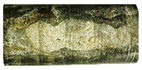
5Dolomite-rich felsic shale with low lamina densityThere are micro-fractures distributed near the lithologic interfaceProcesses 14 01600 i005
Table 2. Experimental scheme design.
Serial NumberLithologyInject FluidInjected CO2 AmountSoaking Time per Cycle (h)Huff-n-Puff CyclesTemperature (℃)Pressure (MPa)
1Dolomitic shale with high lamina densityN2Supersaturated state (10 PV)72311070
2Dolomitic shale with high lamina densityCO2
3Dolomitic shale with low lamina density
4Dolomite-rich felsic shale with high lamina density
5Dolomite-rich felsic shale with low lamina density
Table 3. Porosity and permeability test results.
Serial NumberLithologyPermeability
(×10−8 μm2)
Porosity (%)Pore Volume (mL)
1Dolomitic shale with high lamina density7.92~9.75/8.840.62~1.95/1.230.15~0.46/0.29
2Dolomitic shale with low lamina density5.89~6.30/6.090.72~1.88/1.300.17~0.45/0.31
3Dolomite-rich felsic shale with high lamina density8.74~13.27/10.600.51~1.35/0.810.12~0.32/0.19
4Dolomite-rich felsic shale with low lamina density1.22~6.01/3.960.94~2.04/1.250.22~0.49/0.30
Table 4. Lower limit of mobilizable pore radius and main mobilized pore radius of cores with different lithologies after CO2 huff-n-puff.
Serial NumberLithologyMicropore Fraction (%)Mesopore Fraction (%)Macropore Fraction (%)Lower Limit of Mobilizable Pore Radius (nm)Main Mobilized Pore Radius (nm)
1Dolomitic shale with high lamina density11.971.112.02.05.8~17.8
2Dolomitic shale with low lamina density11.46028.62.25.1~31.4
3Dolomite-rich felsic shale with high lamina density10.360.629.11.76.3~38.5
4Dolomite-rich felsic shale with low lamina density14.96718.11.85.6~21.0
Disclaimer/Publisher’s Note: The statements, opinions and data contained in all publications are solely those of the individual author(s) and contributor(s) and not of MDPI and/or the editor(s). MDPI and/or the editor(s) disclaim responsibility for any injury to people or property resulting from any ideas, methods, instructions or products referred to in the content.