Article

Phenanthrene Degradation by Multi-Site-Derived Mixed Bacterial Consortia in Contaminated Wastewater Under Specific Environmental Conditions: Responses of Community Characteristics

Key Laboratory of Integrated Regulation and Resource Development on Shallow Lake of Ministry of Education, College of Environment, Hohai University, Nanjing 210098, China
*
Author to whom correspondence should be addressed.
Processes 2026, 14(10), 1549; https://doi.org/10.3390/pr14101549
Submission received: 16 April 2026 / Revised: 6 May 2026 / Accepted: 8 May 2026 / Published: 11 May 2026
(This article belongs to the Section Biological Processes and Systems)

Abstract

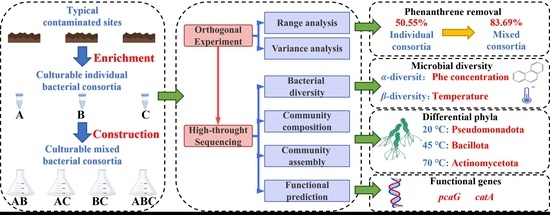
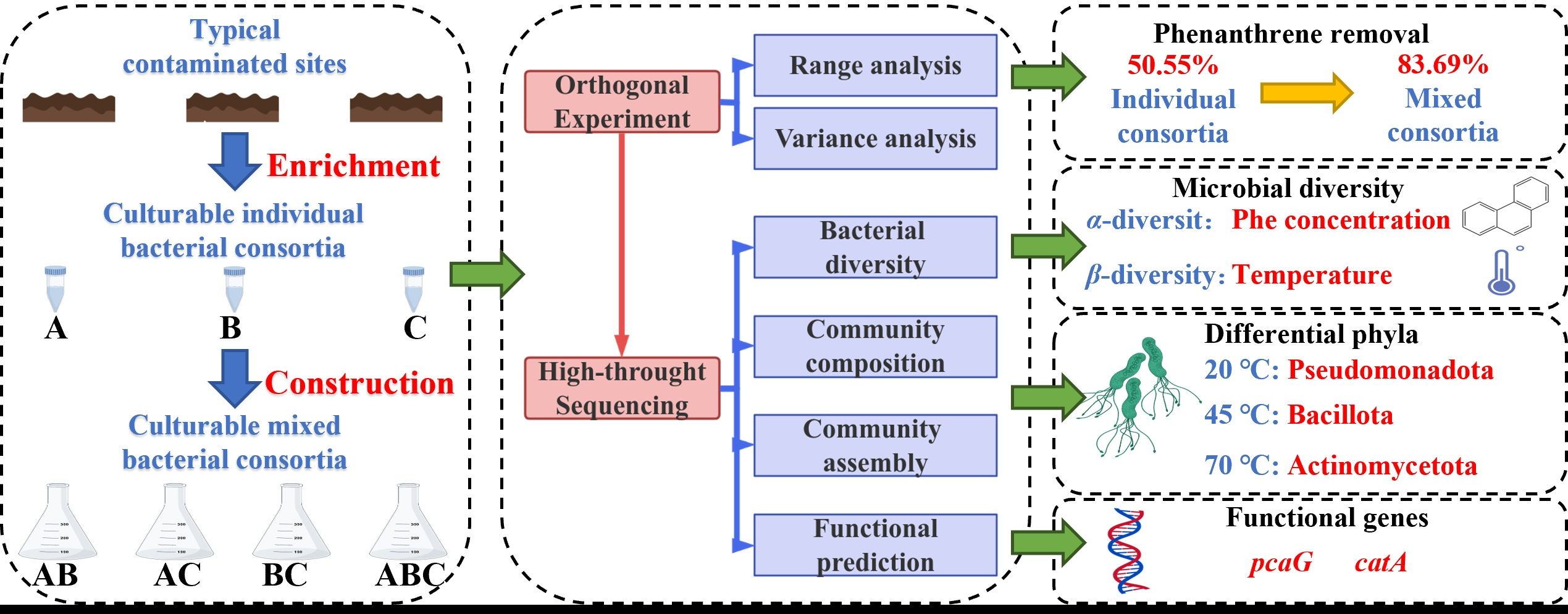
Microbial remediation technologies have emerged as a promising strategy for polycyclic aromatic hydrocarbon (PAH) removal; however, single strains are often constrained by limited metabolic pathways and PAH toxicity, and the response patterns of bacterial consortia to interacting environmental drivers remain poorly elucidated. Herein, culturable individual bacterial consortia were enriched from soils of three typical contaminated sites, and culturable mixed bacterial consortia were constructed via binary and ternary combinations. The phenanthrene (a representative PAH) degradation performance and community characteristics of these consortia under specific environmental conditions were systematically evaluated by orthogonal experimental design; range and variance analyses were employed to identify the primary influencing factors. Results revealed that mixed consortia (83.69%) exhibited stronger phenanthrene degradation efficiency compared to individual consortia (50.55%). Statistical analysis further identified phenanthrene concentration and temperature as primary factors influencing phenanthrene degradation efficiency and bacterial diversity. Meanwhile, elevated phenanthrene concentration increased OTU counts, while phylum-level and genus-level compositions exhibited greater sensitivity to temperature. Functionally, metabolic dominated KEGG pathways of Level 1, with higher temperature inhibiting the abundance of functional genes by phenanthrene degradation. Overall, the culturable mixed bacterial consortia constructed in this study are capable of effectively removing phenanthrene from wastewater under specific environmental conditions, laying a solid theoretical and practical foundation for PAH remediation.

Graphical Abstract

1. Introduction

Polycyclic aromatic hydrocarbons (PAHs) are a class of compounds consisting of two or more aromatic rings, exhibiting toxicity, mutagenicity, and carcinogenicity [1,2]. They enter the environment primarily via direct emissions and the incomplete combustion of fossil fuels, biomass, and other petrogenic materials [3]. As some of the most widespread pollutants globally, PAHs are ubiquitous in both aquatic and terrestrial environments, among which low-molecular-weight (LMW) PAHs predominate in water, while high-molecular-weight (HMW) PAHs are more prevalent in sediment and topsoil [4,5,6]. Furthermore, their persistence and bioaccumulation potential enable them to bioaccumulate and biomagnify along the food chain, exerting biotoxicity on higher aquatic organisms, disrupting aquatic ecosystem stability, and further posing grave threats to environmental security and human health [7,8]. Thus, effectively mitigating these cascading ecological and health risks remains an urgent pivotal challenge in contemporary environmental pollution abatement.
Over the past few decades, various physical, chemical, and biological methods have been developed for PAH removal. Among physical technologies, adsorption removes PAHs and heavy metals via adsorbents economically and efficiently but is prone to secondary pollution; coagulation eliminates PAHs by disrupting the stability of colloidal suspensions, yet is plagued by sludge degradability and high costs; and membrane separation retains PAHs by impeding the migration of fluid components, achieving a 66.6–85.0% PAH removal rate in industrial wastewater treatment, though it requires raw water pretreatment and entails high energy consumption [9,10,11]. Chemical treatments are highly effective for remediating HMW PAHs, which can be implemented through conventional and advanced oxidation processes (AOPs). The former typically employs O3, while the latter commonly uses Fenton’s reagent, which is generally viable and effective. However, the secondary compounds generated during the process, together with their solubility and environmental toxicity, pose potential concerns [12]. For bioremediation, phytoremediation acts as an in situ technology without disrupting the soil profile. This economical and eco-friendly method suits PAH-contaminated site remediation but is hampered by low efficiency and poor adaptability to high-concentration pollution [13]. Thus, there is an urgent need to develop efficient and sustainable remediation technologies.
Microbial remediation technologies have emerged as the preferred approach for PAH removal owing to their cost-effectiveness and non-hazardous degradation characteristics, playing a pivotal role in pollutant elimination and biogeochemical cycling via the metabolic activities of bacterial consortia [14,15,16]. Functionally diverse bacterial consortia govern PAH degradation, among which Pseudomonadota, Bacillota, Actinomycetota, and other taxa are frequently reported as key degraders [17,18]. These taxa harbor genes encoding dioxygenases and downstream enzymes responsible for PAH ring cleavage and metabolite assimilation; for instance, the protocatechuate 3,4-dioxygenase gene and catechol 1,2-dioxygenase gene are core functional genes linked to aromatic pollutant degradation, which catalyze the 1,2-dioxygenolytic cleavage of protocatechuic acid and catechol in the β-ketoadipate pathway, respectively [19,20]. While the degradation capacity of single strains is constrained by limited metabolic pathways and PAH toxicity [21], mixed bacterial consortia have been widely validated to markedly improve PAH degradation performance [22]. In addition, typical factors including substrate concentration and temperature are well documented to exert profound regulatory controls over microbial metabolic activity and PAH degradation efficiency [23,24]. Despite these advances, the response patterns of artificially constructed, multi-site-derived mixed bacterial consortia to interacting environmental drivers remain poorly elucidated [25,26], representing a critical knowledge gap that hinders the rational design and optimization of microbial remediation strategies for PAH-polluted matrices.
The objectives of this study were to (1) enrich and construct culturable mixed bacterial consortia for the effective removal of PAHs from wastewater and (2) investigate the PAH degradation performance and community characteristics of these consortia under specific environmental conditions. To achieve these objectives, phenanthrene was selected as the model PAH owing to its prevalence in coal processing and chemical fiber wastewaters [27] and its suitability as a biochemical proxy for evaluating the catabolic capacity of constructed consortia under environmentally relevant scenarios [28]. The target consortia were obtained by enriching individual consortia from soils at typical contaminated sites under phenanthrene stress, thereby selectively amplifying high-efficiency degraders, and were subsequently mixed into defined consortia. An L18 (37) orthogonal experimental design was then applied to systematically investigate the phenanthrene degradation performance of the target consortia under specific environmental conditions [29]. 16S rRNA gene sequencing was further performed to analyze the alpha/beta diversity, community assembly processes, and taxonomic composition of the target consortia under specific environmental conditions, with functional gene prediction conducted using the KEGG database. This study provides novel mechanistic insights into the optimized assembly strategy for PAH-degrading consortia, particularly how multifactorial environmental pressures shape their degradation performance and community characteristics.

2. Materials and Methods

2.1. Materials

The soil samples were collected from a coal plant (Site A, Nanjing, China), a chemical fiber plant (Site B, Yangzhou, China), and a chlorinated contaminated site (Site C, Nanjing, China). The chemicals used in our study included phenanthrene (J&K Scientific Ltd., Beijing, China), acetonitrile (J&K Scientific Ltd., Beijing, China), Minimal Salt Medium (MSM; Shanghai Aily Biotechnology Co., Ltd., Shanghai, China), glycerol (Nanjing Chemical Reagent Co., Ltd., Nanjing, China), dichloromethane (Shanghai Jiuyi Chemical Reagent Co., Ltd., Shanghai, China), petroleum ether (Shanghai Jiuyi Chemical Reagent Co., Ltd., Shanghai, China), n-hexane (Shanghai Jiuyi Chemical Reagent Co., Ltd., Shanghai, China), potassium ferrate (Shanghai Macklin Biochemical Technology Co., Ltd., Shanghai, China), and sodium persulfate (Sinopharm Chemical Reagent Co., Ltd., Shanghai, China).

2.2. Enrichment of the Culturable Individual Bacterial Consortia

The culturable individual bacterial consortia were enriched following established protocols [30], with modifications detailed in Figure S1. Soil samples (A, B, C) were air-dried, crushed and sieved with 2 mm mesh to remove debris, and 5 g of each homogenized soil was transferred into separate 100 mL of Minimal Salt Medium (MSM) (composition: 0.7 g dipotassium phosphate, 0.2 g monopotassium phosphate, 0.1 g ammonium sulfate, 0.05 g sodium citrate, and 0.01 g magnesium sulfate) supplemented with 10 mg/L phenanthrene as the carbon source and the mixture was incubated in a thermostatic oscillator (Model WHY-2) (30 °C, 150 rpm) [31]. When the cultures appeared turbid after 7 days of incubation, we considered that culturable phenanthrene-degradable microbes were enriched from soli sample. Then, another 4 cycles of incubation were conducted, and for each cycle, 5 mL turbid culture was transferred to 95 mL fresh MSM spiked with elevated phenanthrene, i.e., in sequence: 15, 20, 25, and 30 mg/L phenanthrene. Finally, the microbial cultures (A, B, and C) were successfully enriched and adapted to MSM with 30 mg/L phenanthrene as the carbon source, and each culture was mixed with an equal volume of 30% glycerol (v/v) and stored at −80 °C for subsequent use [32].

2.3. Construction of the Culturable Mixed Bacterial Consortia

The culturable mixed bacterial consortia were constructed via binary and ternary combinations of the culturable individual bacterial consortia (A, B, and C), with details provided in Figure S1. Each mixed consortium was separately inoculated into 100 mL of MSM supplemented with 30 mg/L phenanthrene and incubated in a thermostatic oscillator (30 °C, 150 rpm) for 7 days to activate metabolic activity. Turbidity was observed in all cultured samples, indicating that the community structure had stabilized. Finally, the culturable mixed bacterial consortia (AB, AC, BC, and ABC) were successfully constructed; each consortium was mixed with an equal volume of 30% glycerol (v/v) and stored at −80 °C for subsequent use.

2.4. Orthogonal Experiment Design

Orthogonal experimental design is a classic multi-factor and multi-level statistical method. Through the rational arrangement of experimental combinations, it can efficiently determine the weight coefficients of each factor affecting the target response value with fewer experimental runs. The experimental data were processed by range analysis and variance analysis, and the detailed methods are provided in Supplementary Material [33,34].
In this study, an L18 (37) orthogonal experimental design was adopted to systematically investigate the phenanthrene removal efficiency of mixed bacterial consortia under specific environmental conditions. Herein, “37” denotes that 7 experimental factors were each set at 3 levels (Table 1), and 18 groups of orthogonal experimental treatment levels were formed and used for the following incubation according to the levels of each factor (Table 2).

2.5. Analysis of Phenanthrene Removal

First, the individual bacterial consortia (A, B, C) and mixed bacterial consortia (AB, AC, BC, ABC) were separately inoculated into culture systems under the same conditions and incubated in a thermostatic oscillator (30 °C, 150 rpm) for 7 days. Subsequently, the mixed bacterial consortia were individually inoculated into 18 culture systems designed by the orthogonal experiment and incubated in a thermostatic oscillator (150 rpm) for 7 days. Each treatment was performed in triplicate, yielding 4 × 18 × 3 = 216 experimental groups. After incubation, the samples were extracted three times with an equal volume of mixed solvent (dichloromethane/petroleum ether/n-hexane = 1:2:2, v/v/v). Following mechanical shaking (30 min, 200 rpm), the mixtures were allowed to stand for phase separation (15 min). The organic phases were combined, concentrated to 1 mL using a rotary evaporator (400 mbar, 60 °C), and stored at −20 °C in the dark for subsequent analysis.
The phenanthrene was evaluated by HPLC (Agilent 1260 Infinity, Agilent Technologies, Santa Clara, CA, USA) with fluorescence and UV—adsorption detector [35]. The reversed phase C18 column (Agilent ZORBAX Eclipse XDB-C18 Agilent Technologies, Santa Clara, CA, USA, 250 mm × 4.6 mm × 5 μm) was employed as the stationary phase. The mixed solution of acetonitrile and ultrapure water (75:25, v/v) was regarded as the mobile phase at the speed of 1 mL/min. Phenanthrene was quantified through employing external standard solutions came from Ehrenstorfer in Augsburg, Germany. Detective wavelength with FLD signal (Ex/Em = 257/380 nm). The phenanthrene removal rate was calculated as:
Removal   rate   ( % ) = m 0 - m 1 m 0 × 100 %
where m0 is the initial mass of phenanthrene (mg) and m1 is the residual mass after incubation (mg).

2.6. DNA Extraction and High-Throughput Sequencing

A total of 72 treatment groups (4 mixed bacterial consortia × 18 cultivation systems) from the L18 (37) orthogonal experiment were immediately collected and use for DNA extraction [36,37,38]. The high-throughput sequencing of bacterial 16S rRNA gene was conducted by Majorbio Bio-pharm Technology Co., Ltd. (Shanghai, China).
Total bacterial genomic DNA was extracted using the E.Z.N.A.® Soil DNA Kit (Omega Bio-tek, Norcross, GA, USA). DNA quality, concentration, and purity were determined by 1.0% agarose gel electrophoresis and a NanoDrop2000 spectrophotometer (Thermo Scientific, Waltham, MA, USA). The hypervariable region V3-V4 of the bacterial 16S rRNA gene were amplified with primer pairs 338F (5′-ACTCCTACGGGAGGCAGCAG-3′) and 806R (5′-GGACTACHVGGGTWTCTAAT-3′). Following, the PCR product was extracted from 2.0% agarose gel, purified using the PCR Clean-Up Kit (YuHua, Shanghai, China), quantified using Qubit 4.0 (Thermo Fisher Scientific, Waltham, MA, USA) and paired-end sequenced on an Illumina Nextseq2000 platform (Illumina, San Diego, CA, USA). The raw sequencing reads were deposited into the NCBI Sequence Read Archive (SRA) database. Raw FASTQ files were de-multiplexed using an in-house perl script, and then quality-filtered by fastp (v0.23.4) and merged by FLASH (v1.2.11). The optimized sequences were clustered into operational taxonomic units (OTUs) using UPARSE (v7.1) with 97% sequence similarity level. The taxonomy of each OTU representative sequence was analyzed by RDP Classifier (v2.11) against the Silva (v138) gene database using confidence threshold of 70%. The metagenomic function was predicted by PICRUSt2 (v2.2.0) based on OTU representative sequences. The raw data were deposited into NCBI database with the accession number of SRP618126.

2.7. Statistical Analysis

Bioinformatic analysis of the bacterial consortia was carried out using the Majorbio Cloud platform (https://cloud.majorbio.com, accessed on 15 April 2026). Alpha diversity was calculated using mothur (v1.30.2), whereas Weighted UniFrac distance matrices were computed using Qiime (2020.2.0) and NMDS analyses were performed and visualized using R (v3.3.1) with the vegan package (version 2.4.3). Venn diagrams and community bar plots were generated in R (v3.3.1), while community heatmaps were constructed with the pheatmap package (v1.0.8). LEfSe was applied to perform LDA on samples, stratified by different grouping conditions based on taxonomic compositions. βNTI analysis was implemented via the icamp package (v1.5.12) in the R (v3.3.1). Functional prediction was performed based on PICRUSt2 and the KEGG database, with cross-species annotation achieved through the KEGG Orthology system.
Box plots, bar charts, line graphs, and stacked plots were visualized using Origin 2024, and statistical tests—including range analysis and variance analysis for orthogonal experimental design, one-way ANOVA, independent samples t-test, and LSD, S-N-K, Waller–Duncan multiple comparison tests—were executed using IBM SPSS Statistics 25.

3. Results and Discussion

3.1. Factors Affect the Phenanthrene Degradation Efficiency

3.1.1. Mixed Bacterial Cultures Promoted Phenanthrene Degradation

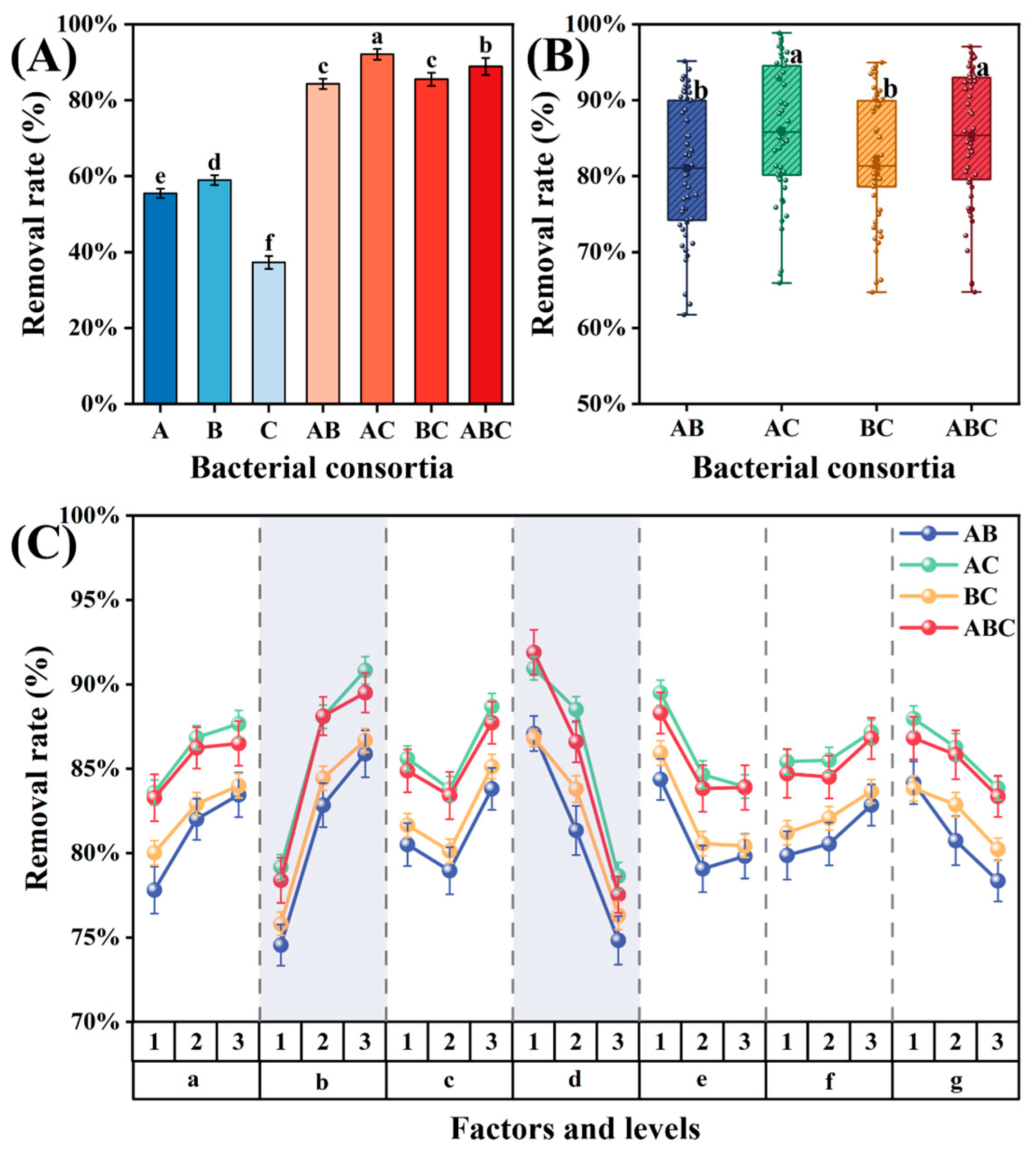
To explore the effects of mixed bacterial cultures on phenanthrene degradation efficiency, this study compared the removal rates of individual and mixed bacterial consortia under different conditions. The results are presented in Figure 1A,B. After incubation at 30 °C for 7 days, the phenanthrene removal rate was significantly (p < 0.05) higher in treatments with mixed bacterial consortia (AB: 84.27% ± 1.36%, AC: 92.09% ± 1.42%, BC: 85.53% ± 1.72%, ABC: 88.91% ± 2.22%) than with individual bacterial consortia (A: 55.47% ± 1.21%, B: 58.93% ± 1.30%, C: 37.26% ± 1.69%) (Figure 1A). The markedly higher phenanthrene removal rates observed in the mixed bacterial cultures indicate enhanced degradation efficiency. This is consistent with Zafra et al. (2016), who showed that mixed microbial consortia achieve faster and higher PAH removal than single strains through metabolic cooperation and functional division of labor [22]. Figure 1B reveals similar phenanthrene degradation characteristics under the orthogonal experimental conditions (AB: 81.09% ± 1.30%, AC: 86.03% ± 0.75%, BC: 82.31% ± 0.70%, ABC: 85.34% ± 0.89%). Among them, AC achieved the highest phenanthrene removal rate, which was significantly (p < 0.05) superior to those of AB and BC. These differential performances may be attributed to the varied inter-consortium interaction strengths [39]. Notably, ABC displayed marginally lower phenanthrene removal rates than AC under both conditions, suggesting that the ternary mixed consortium failed to further enhance phenanthrene degradation efficiency. This result likely stems from dilution of high-efficiency degraders by low PAH-affinity strains from Site B, metabolic interference from incompatible intermediate processing, and intensified intra-consortium competition under resource limitation [39,40,41]. These observations underscore that functional complementarity, rather than simple species richness, governs the degradation efficiency of mixed consortia.

3.1.2. Phenanthrene Concentration and Temperature as Primary Factors Influencing Phenanthrene Degradation Efficiency

To clarify the primary factors affecting phenanthrene degradation and explore the performance of mixed bacterial consortia under specific environmental conditions, an L18 (37) orthogonal experiment was designed. Range analysis (Table S1) and variance analysis (Table S2) were performed based on the phenanthrene removal rates of mixed bacterial consortia under the orthogonal experimental conditions, with the results shown in Figure 1C. The results show that the ranges of phenanthrene concentration (b: AB = 11.33%, AC = 11.65%, BC = 10.87%, ABC = 11.11%) and temperature (d: AB = 12.26%, AC = 12.31%, BC = 10.51%, ABC = 14.35%) were higher than those of other factors across all consortia, demonstrating that they were the primary influencing factors. Specifically, the phenanthrene removal was increased with rising phenanthrene concentration (AC: F = 12.315, p < 0.05; ABC: F = 20.004, p < 0.05) and was 76.98%, 85.87% and 88.22%, respectively, in treatments with 10 mg/L, 30 mg/L, and 60 mg/L phenanthrene. In contrast, it decreased with rising temperature (AC: F = 14.113, p < 0.05; ABC: F = 28.729, p < 0.05) and was 89.19%, 85.07%, and 76.83%, respectively, at 20 °C, 45 °C, and 70 °C. The enhanced phenanthrene degradation at elevated substrate concentrations may be attributed to phenanthrene acting as the carbon and energy source, a pattern that aligns with the mechanistic interpretation for reduced PAH degradation under low substrate availability reported by Velayutham et al. (2019) [23]. However, elevated temperature strongly constrained degradation efficiency, consistent with Zhang et al. (2018), who showed that thermal stress impairs microbial growth and enzymatic activity, thereby limiting phenanthrene biodegradation [24].
Meanwhile, the ranges of bacterial concentration (a, 3.22–5.64%), pH (c, 3.30–5.00%), bio-oxidation (e, 4.47–5.56%), bio-stimulation (f, 1.75–2.98%), and bioventing (g, 3.46–5.81%) were all below 6%, and none were statistically significant in variance analysis (p > 0.05), indicating that these factors exerted relatively limited effects on phenanthrene removal efficiency. Specifically, the phenanthrene removal rate of the mixed bacterial consortia peaked at a bacterial concentration of 6%, which could be owing to the high population density and metabolic activity [40]. And the removal rate was highest at weakly alkaline pH 9, mainly due to the stable conformation of dioxygenases and improved substrate transmembrane transport [42]. For bioaugmentation measures, the phenanthrene degradation performance of the mixed bacterial consortia was maximized in the absence of exogenous oxidants. This outcome may be attributed to oxidative stress induced by reactive oxygen species, which can compromise cell membrane integrity, inhibit intracellular enzyme activity, impair the degradative functions of sensitive strains, and consequently suppress biodegradation [43]. Supplementation with MSM further enhanced degradation performance, likely owing to the provision of essential nutrients (N, P, S) that sustain microbial activity and thereby promote degradation efficiency [41]. And the highest degradation performance was observed under no aeration conditions, likely driven by efficient reductive degradation via anaerobic respiration by functional consortia [44] and enhanced syntrophic interactions within the mixed consortia, especially among heat-tolerant facultative anaerobic Bacillota members [45].
Additionally, the optimal level combination for phenanthrene removal rate among all treatments was identified as treatment with a3 (6% bacterial concentration) + b3 (60 mg/L phenanthrene concentration) + c3 (pH = 9) + d1 (20 °C) + e1 (no bio-oxidation) + f3 (10 mL MSM) + g1 (bioventing with no aeration).

3.2. Phenanthrene and Temperature Co-Regulated Bacterial Diversity

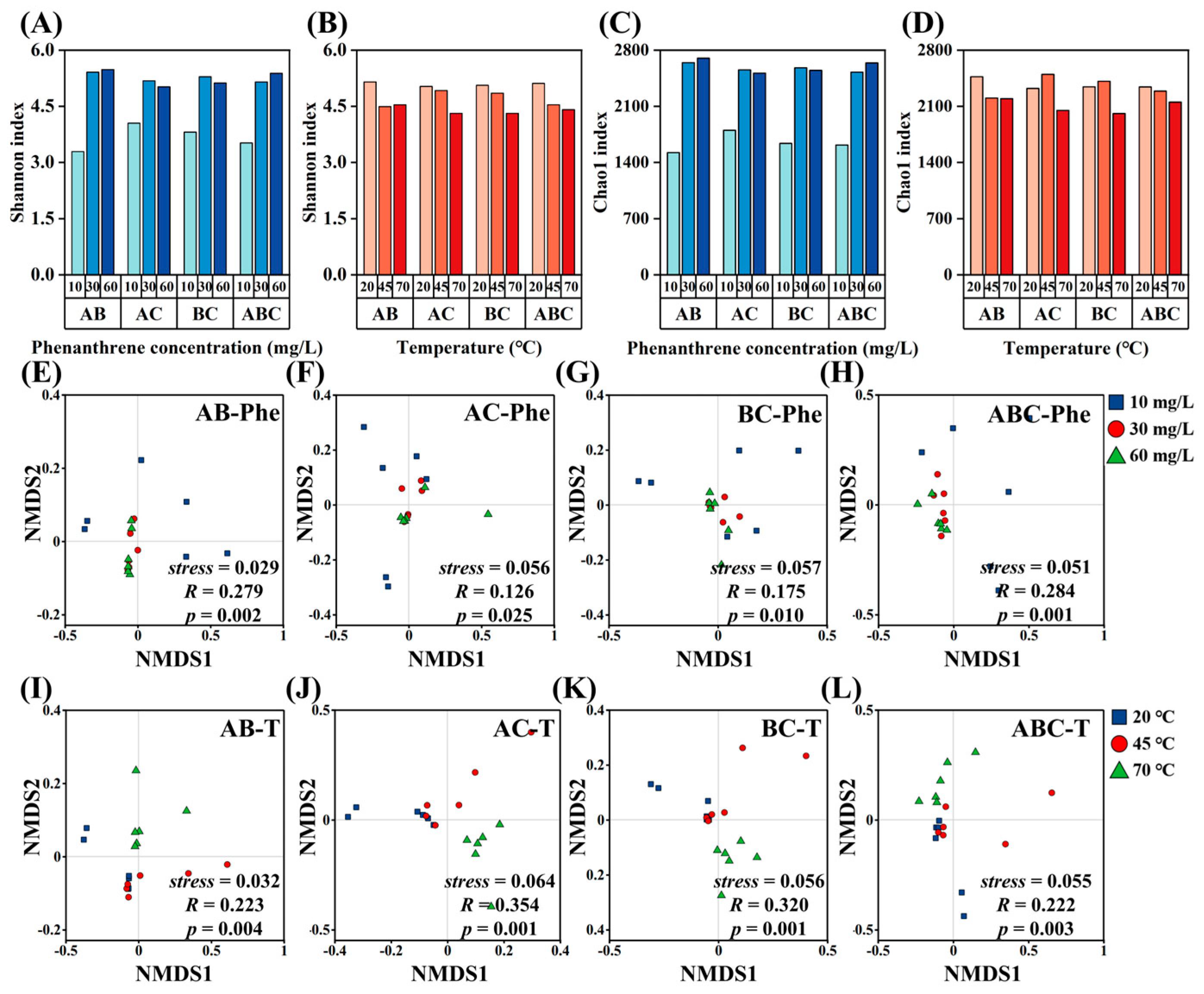
To explore the primary factors shaping α-diversity of mixed bacterial consortia, range analysis (Table S3) and variance analysis (Table S4) were conducted on the Shannon and Chao1 indices under the orthogonal experimental conditions, with the results shown in Figure 2A–D. Results showed that among these factors, phenanthrene concentration exhibits the highest ranges (Shannon index: 1.13–2.19; Chao1 index: 753–1177) and can be considered as the primary factor affecting α-diversity. The Shannon index increased in a phenanthrene concentration-dependent way, and the Shannon index in treatments at 10 mg/L, 30 mg/L, and 60 mg/L was, respectively, 3.29, 5.41, and 5.48 (F = 27.798, p < 0.05) for AB; 4.05, 5.18, and 5.02 for AC; 3.81, 5.29, and 5.12 for BC: (F = 16.814, p < 0.05); and 3.52, 5.15, 5.38 for ABC (F = 38.925, p < 0.01). Meanwhile, the Chao1 index also increased in a phenanthrene concentration-dependent way, and the Chao1 index in treatments at 10 mg/L, 30 mg/L, and 60 mg/L was, respectively, 1522, 2643, and 2699 (F = 42.407, p < 0.01) for AB; 1801, 2554, and 2513 (F = 39.256, p < 0.01) for AC; 1637, 2579, and 2548 (F = 234.053, p < 0.01) for BC; and 1617, 2525, 2640 (F = 38.643, p < 0.01) for ABC. The diversity trends likely reflect substrate limitation effects of insufficient carbon source that restricted bacterial diversity, leading to low species richness and evenness at phenanthrene concentration of 10 mg/L. As reported by Elyamine (2020), the Shannon diversity index and bacterial 16S rRNA gene abundance were negatively correlated with residual phenanthrene concentrations [46]. Notably, the Chao1 index of BC was significantly affected by phenanthrene concentration (b: F = 234.053, p < 0.01), pH (c: F = 33.865, p < 0.01), temperature (d: F = 37.831, p < 0.01) and bio-oxidation (e: F = 20.701, p < 0.05), suggesting that the richness of BC was more sensitive to these factors than other consortia.
To visualize differences in species composition, relative abundance, and phylogenetic relationships of mixed bacterial consortia across different treatments, Non-metric Multidimensional Scaling (NMDS) analysis was performed using the Weighted UniFrac distance matrix (Figure 2E–L). The results show that bacterial consortia incubated under different phenanthrene concentrations (AB: stress < 0.05, p < 0.01; AC: stress < 0.1, p < 0.05; BC: stress < 0.1, p < 0.05; ABC: stress < 0.1, p < 0.01) and different temperatures (AB: stress < 0.05, p < 0.01; AC: stress < 0.1, p < 0.01; BC: stress < 0.1, p < 0.01; ABC: stress < 0.1, p < 0.01) both exhibited significant differences in β-diversity. The ANOSIM R-values ranged from 0.126 to 0.354, quantitatively demonstrating that inter-group compositional dissimilarity far exceeded within-group variation, and thus that community assembly was governed by deterministic processes under thermal stress [47]. Specifically, temperature exerted a stronger driving effect in β-diversity than phenanthrene concentration for consortia AC (temperature: R = 0.354; phenanthrene concentration: R = 0.126) and BC (temperature: R = 0.320; phenanthrene concentration: R = 0.175). The differences in β-diversity may be attributed to bacterial consortium succession under 70 °C, which is consistent with the finding of Shentu et al. (2023), who reported that thermophilic microorganisms gradually became dominant under high temperatures, consequently inducing variations in β-diversity [48].

3.3. Community Structural Characterization and Differential Analysis on Mixed Bacterial Consortia

3.3.1. Analysis of Venn Diagrams on Mixed Bacterial Consortia

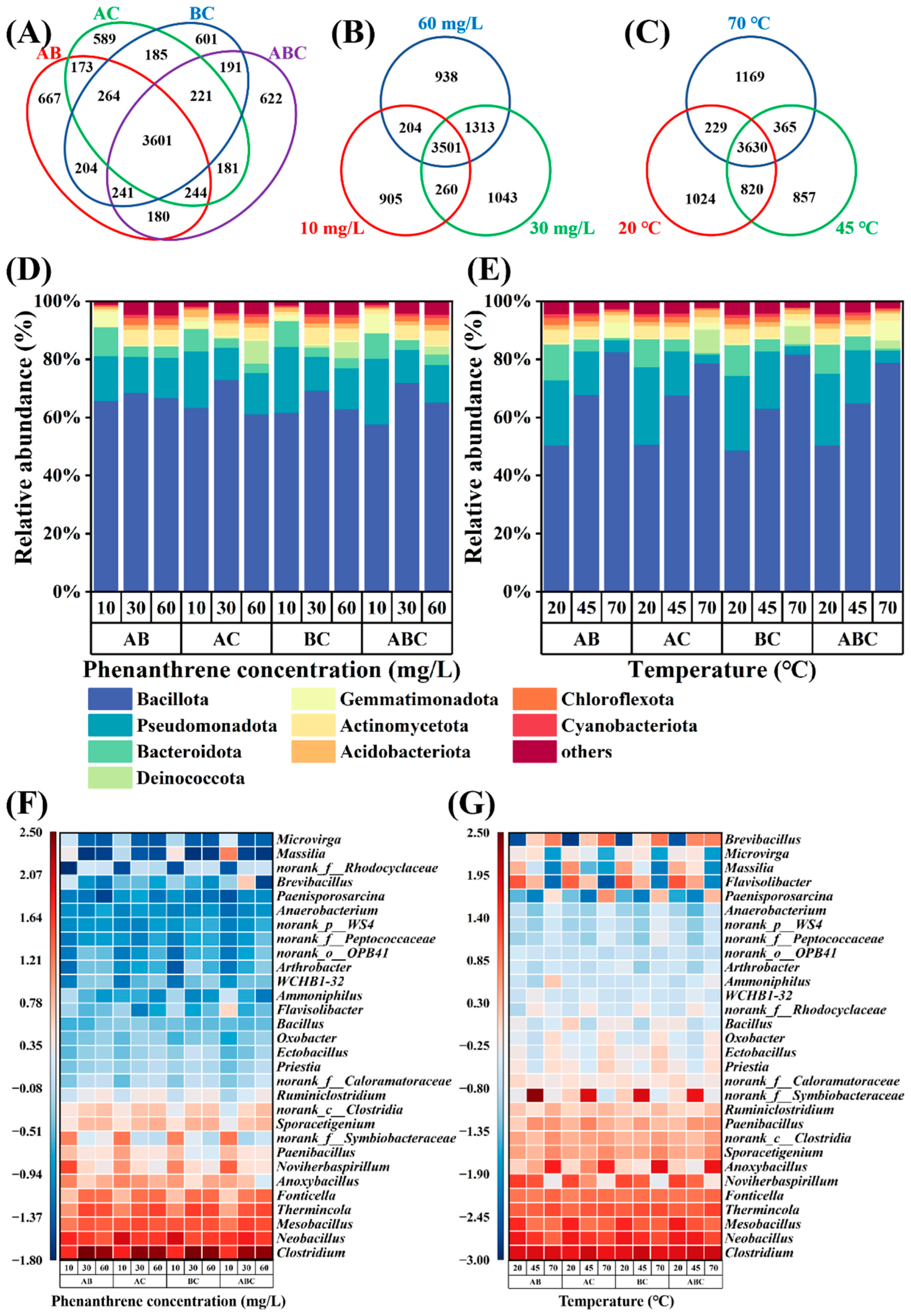
To investigate the bacterial distribution characteristics of mixed bacterial consortia, Venn diagrams were constructed based on a total of 8164 OTUs identified across all samples (Figure 3A–C). The results showed that the 3601 OTUs (44.11% of the total OTUs) were shared by all mixed culture samples, and each mixed culture had a similar number of unique OTUs (AB: 677, AC: 589, BC: 601, ABC: 622). Furthermore, the triple mixed consortium (ABC) shared a comparable number of OTUs with the binary mixed consortia (AB: 180, AC: 181, BC:191), indicating the former did not exhibit a higher OTU count. Specifically, bacterial consortia under phenanthrene concentration gradients harbored 3501 core OTUs (42.88% of the total OTUs), while those under temperature gradients contained 3630 core OTUs (44.46% of the total OTUs). Range analysis (Table S5) and variance analysis (Table S6) were performed for OTU numbers of mixed bacterial consortia under orthogonal experimental conditions. The results revealed that phenanthrene concentration (b) exhibited the highest range among all factors (R = 1138), and the OTU number at phenanthrene concentration of 10 mg/L (2155) was significantly lower than that at 30 mg/L and 60 mg/L (3293 and 3282, respectively; F = 98.595, p < 0.01), which may be attributed to energy limitation under low substrate concentrations [22,23]. Notably, OTU numbers decreased from 3044 at 20 °C to 2964 at 45 °C and 2723 at 70 °C, respectively, suggesting that many bacterial species were sensitive to elevated temperatures [49,50].

3.3.2. Analysis of Community Composition on Mixed Bacterial Consortia

To explore the distribution of dominant bacterial phyla in mixed bacterial consortia under phenanthrene concentration and temperature gradients, a bar chart was generated in Figure 3D,E. The results showed that the dominant phyla included Bacillota (65.57%), Pseudomonadota (15.16%), Bacteroidota (5.25%), Actinomycetota (3.54%), Gemmatimonadota (1.75%), Acidobacteriota (1.52%), Chloroflexota (1.50%) and Deinococcota (1.45%). Overall, Bacillota and Pseudomonadota were widely existed under the specific environmental conditions, which are presumably associated with their hydrocarbon-degrading capabilities and robust environmental tolerance [51].
Range analysis (Table S5) and variance analysis (Table S6) were further conducted to evaluate the variations in phylum relative abundances under orthogonal experimental conditions, and temperature (d) exhibited the highest range among all factors (Bacillota: R = 30.39%; Pseudomonadota: R = 21.29%). Specifically, the relative abundance of Bacillota increased significantly with rising temperature (F = 59.579, p < 0.01) and was 50.18%, 65.97% and 80.57%, respectively, at 20 °C, 45 °C, and 70 °C. By contrast, the relative abundance of Pseudomonadota decreased significantly with rising temperature (F = 33.416, p < 0.01) and was 24.85%, 17.09%, and 3.56%, respectively, at 20 °C, 45 °C, and 70 °C, which suggested that Bacillota dominated phenanthrene removal at higher temperatures, while Pseudomonadota was associated with phenanthrene removal at lower temperatures. This finding is consistent with Zeng et al. (2023), who reported that Bacillota formed distinct communities at high temperature, whereas Pseudomonadota dominated under moderate conditions [17]. Our data further demonstrate that this enrichment results from active proliferation rather than spore persistence [52] and is coupled with the maintenance of key PAH-degrading genes [53], confirming that Bacillota dominance represents an active functional contribution to phenanthrene removal under thermal stress. Additionally, compared with the 20 °C group, the relative abundances of Bacteroidota, Actinomycetota, and Chloroflexota at 70 °C decreased by 10.00%, 2.49%, and 1.58%, respectively, while those of Gemmatimonadota, Acidobacteriota, and Deinococcota increased by 3.69%, 0.39%, and 4.26%, respectively.
It should be noted that the relative abundance of Bacillota reached 62.11%, 70.62%, and 63.98% at phenanthrene concentrations of 10 mg/L, 30 mg/L, and 60 mg/L phenanthrene, respectively. This peak at a phenanthrene concentration of 30 mg/L may be attributed to energy limitation at lower phenanthrene concentrations and toxic inhibition at higher phenanthrene concentrations [22,23]. Meanwhile, compared with the 10 mg/L group, the relative abundances of Pseudomonadota, Bacteroidota, and Gemmatimonadota were, respectively, reduced by 8.33%, 6.65%, and 5.52% at 30 mg/L and by 5.22%, 3.60%, and 3.58% at 60 mg/L phenanthrene. In contrast, the relative abundances of Actinomycetota, Chloroflexota, and Deinococcota increased by 3.67% and 3.31%, 1.61% and 1.73%, 0.27% and 3.99% at the corresponding concentrations, respectively.
To explore the distribution of dominant bacterial genera in mixed bacterial consortia under phenanthrene concentration and temperature gradients, a heatmap was generated in Figure 3F,G. Overall, the relative abundance of Clostridium (Bacillota) was higher than that of other microorganisms. Meanwhile, the relative abundances of Neobacillus (Bacillota), Mesobacillus (Bacillota), Thermincola (Bacillota), Anoxybacillus (Bacillota), Brevibacillus (Bacillota), norank_f__Symbiobacteraceae (Actinomycetota), Noviherbaspirillum (Pseudomonadota) and Massilia (Pseudomonadota) were also high in bacterial consortia. These microorganisms possess robust hydrocarbon degradation ability, which facilitates the degradation of organic pollutants [54,55,56,57]. Furthermore, variations in environmental conditions such as substrate concentration and temperature might influence the abundance of microorganisms [58]. With increasing phenanthrene concentration and temperature, the relative abundances of most Bacillota genera (including Clostridium and Thermincola) increased, indicating that these dominant microorganisms exhibited strong environmental adaptability [48]. Conversely, some microorganisms were unable to thrive under elevated phenanthrene concentration and temperature. For example, Noviherbaspirillum and Massilia showed reduced relative abundances across both phenanthrene and temperature gradients.

3.3.3. LEfSe Analysis on Mixed Bacterial Consortia

To screen differential biomarker taxa from phylum to genus level in mixed bacterial consortia along phenanthrene concentration and temperature gradients, LEfSe analysis was performed (Figure S2). Along phenanthrene concentration gradients, specific biomarkers including the order Bryobacterales, family Bryobacteraceae, and genus Bryobacter (phylum Acidobacteriota) were identified in the 10 mg/L group, while those affiliated with the class Desulfitobacteria and order Desulfitobacteriales (phylum Bacillota) were found in the 60 mg/L group (LDA score > 3.5). Meanwhile, along temperature gradients, 10 distinct specific biomarkers were identified in treatments at 20 °C, 45 °C, and 70 °C (LDA score > 3.5), indicating temperature exerted stronger driving effect on differences in community composition [59]. Specifically, the core biomarkers were the phylum Pseudomonadota (LDA score = 4.98) and its subordinate class Gammaproteobacteria (LDA score = 4.89) in the 20 °C group, the phylum Bacillota (LDA score = 5.17) along with its subordinate order Bacillales (LDA score = 4.93) and family Bacillaceae (LDA score = 4.87) in 45 °C group, and the genus norank_f__Symbiobacteraceae (LDA score = 4.98) within the phylum Actinomycetota in 70 °C group, suggesting that Pseudomonadota, Bacillota, and Actinomycetota with phenanthrene-degrading potential may play key role in phenanthrene removal at 20 °C, 45 °C, and 70 °C, respectively [17,18].

3.4. Community Assembly of Mixed Bacterial Consortia

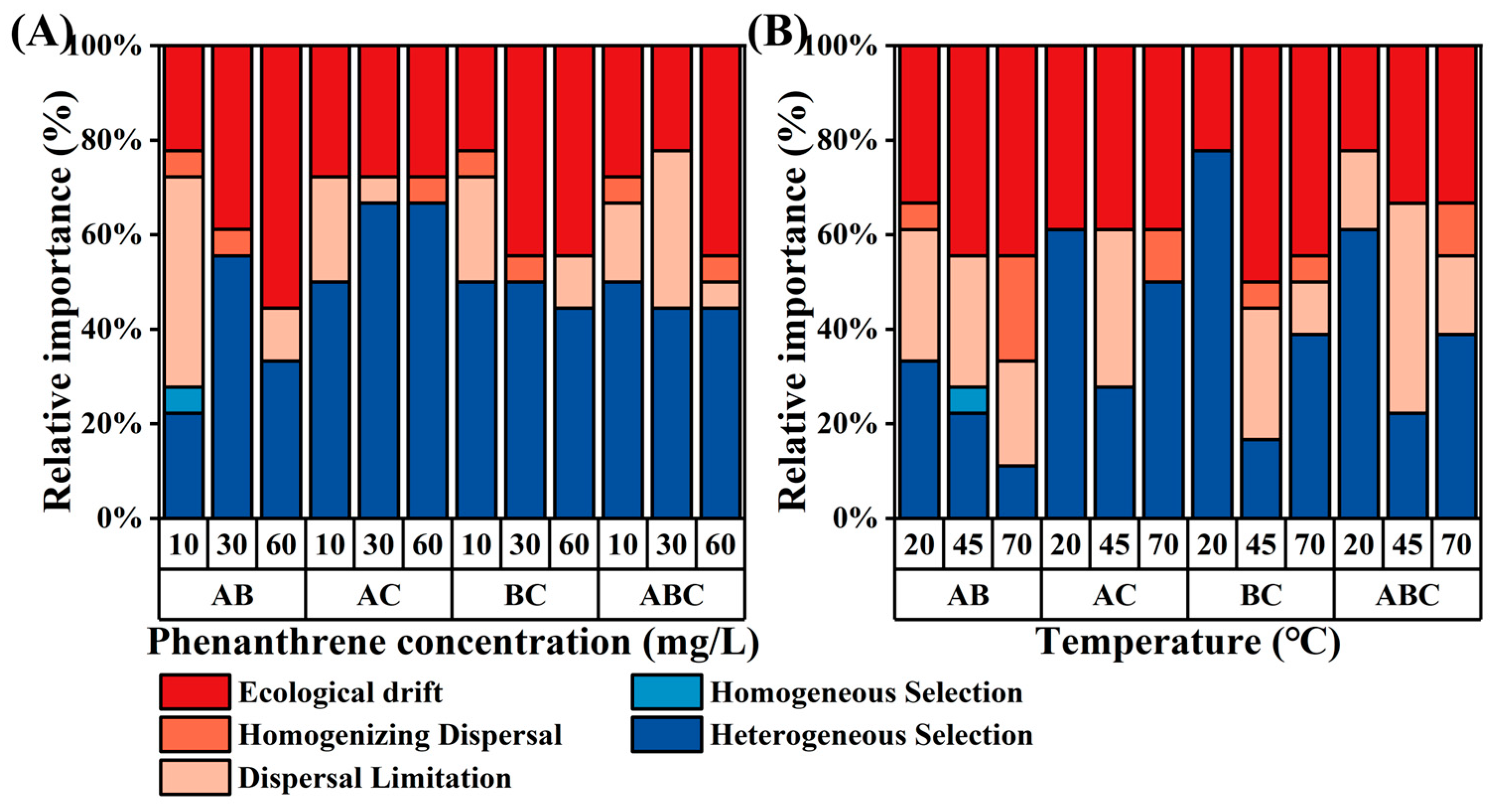
To clarify the community assembly mechanisms in mixed bacterial consortia along phenanthrene concentration and temperature gradients, phylogenetic analysis based on βNTI was performed (Figure 4A,B). Results revealed that community assembly was jointly driven by deterministic selection and stochastic drift under specific environmental conditions [60]. Specifically, heterogeneous selection dominated community turnover across most conditions, with relative importance reaching 43.06%, 54.17%, and 47.22% along the phenanthrene concentration gradient (10, 30, and 60 mg/L) and 58.33%, 22.22%, and 34.75% along the temperature gradient (20, 45, and 70 °C). Ecological drift ranked second, contributing 25.00%, 33.33%, and 43.06% (phenanthrene concentration) and 29.17%, 41.67%, and 40.28% (temperature), respectively.
These data reveal a non-monotonic response of assembly processes to thermal stress. At 20 °C, heterogeneous selection peaked at 58.33%, while ecological drift was only 29.17%, suggesting that deterministic assembly was driven predominantly by biotic interactions, including competition and metabolic syntrophy. At 45 °C, selection decreased sharply to 22.22% while drift increased to 41.67%, indicating that moderate thermal stress allowed stochastic processes to exert greater influence. At 70 °C, strong environmental filtering rebounded selection to 34.75% by enriching thermotolerant taxa; drift remained high at 40.28%, which was attributed to demographic stochasticity under reduced population size [45,61]. Additionally, along the phenanthrene concentration gradient, ecological drift steadily increased from 25.00% at 10 mg/L to 33.33% at 30 mg/L and further to 43.06% at 60 mg/L. Higher substrate loading enhanced stochastic assembly, demonstrating that intensified environmental stress amplifies ecological drift, which supports previous evidence that long-term warming weakens dispersal limitation and strengthens stochastic contributions to microbial community assembly [62].

3.5. Functional Prediction on Mixed Bacterial Consortia

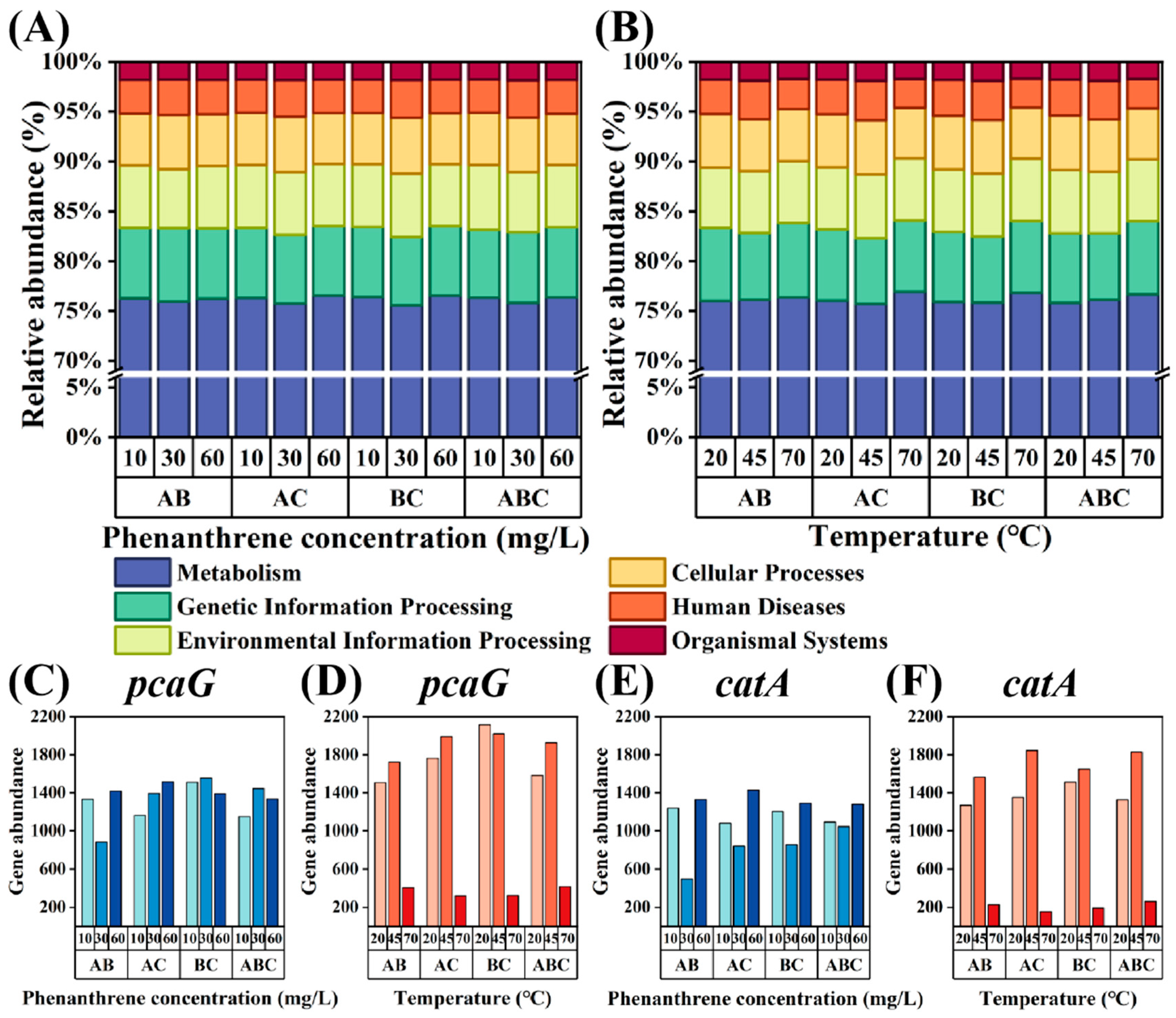
Based on 16S rRNA gene sequences, the functional potential of the mixed bacterial consortia was predicted using PICRUSt2 [38]. The high reliability of these predictions was validated by a low mean weighted NSTI value of 0.070 ± 0.012, confirming that the predicted abundances of pathways and genes were highly accurate [63]. As illustrated in Figure 5, the functional landscape was visualized at KEGG Level 1 to provide a broad metabolic overview, while specific catabolic markers (protocatechuate 3,4-dioxygenase gene (pcaG) and catechol 1,2-dioxygenase gene (catA)) were tracked to assess degradation potential.
The results showed that metabolism predominated with an average relative abundance of 76.18% at pathways of Level 1, far exceeding other functional categories including genetic information processing (7.01%) and environmental information processing (6.25%) (Figure 5A,B). Furthermore, carbohydrate and amino acid metabolism exhibited relatively high abundances within metabolism at pathways of Level 2 [64]. Among them, carbohydrate metabolism was involved in energy acquisition and carbon source utilization [65], while amino acid metabolism not only served as the basis for protein synthesis, but also provided carbon skeletons for the tricarboxylic acid cycle and generated ATP via oxidative phosphorylation [66]. Overall, neither phenanthrene concentration nor temperature exerted a significant effect on the metabolic functions of KEGG pathways (p > 0.05).
Both the gene pcaG and gene catA are functional genes linked to aromatic pollutant degradation, which catalyze the 1,2-dioxygenolytic cleavage of protocatechuic acid and catechol in the β-ketoadipate pathway, respectively [19,20]. Range analysis (Table S7) and variance analysis (Table S8) were conducted on the abundances of these two genes in the mixed bacterial consortia across different treatments, with primary results visualized in Figure 5C–F. The results indicated that temperature (d) exerted the highest range among all factors on the abundances of pcaG (R = 1546) and catA (R = 1513), demonstrating that temperature is the core driving factor governing the abundance of these two genes. Prior studies have established that environmental factors such as temperature can markedly constrain the activity and community composition of hydrocarbon-degrading microbes [67]. In line with these findings, the current study observed a drastic reduction in the abundance of pcaG at 20, 45, and 70 °C with values of 1741, 1913, and 367, as well as a significant reduction (F = 23.944, p < 0.05) in the abundance of catA at the same temperatures with values of 1364, 1721, and 208, respectively. This collapse underscores a temperature-imposed biological threshold that severely limits the degradation capacity of the mixed bacterial consortia [61]. In practical terms, the primary bottleneck for high-temperature bioremediation is therefore enzymatic stability [68], a constraint that can be addressed through the deliberate enrichment of thermo-tolerant degraders, as demonstrated by the Bacillota-dominated consortium identified in this study [69]. In conclusion, temperature had a far greater impact on the abundances of ring-cleavage enzyme genes than phenanthrene concentration, consistent with the restrictive effect of temperature on bacterial degradation functions [24,67].

4. Conclusions

This study systematically investigated the phenanthrene degradation efficiency and community characteristics of the culturable mixed bacterial consortia under specific environmental conditions. The results showed that the degradation efficiency of the mixed consortia was significantly higher than that of the individual consortia, with phenanthrene concentration and temperature identified as the primary master variables. Meanwhile, phenanthrene concentration was the dominant factor influencing α-diversity, whereas β-diversity and taxonomic composition were more sensitive to temperature, which drove a deterministic shift toward thermo-tolerant Bacillota under extreme conditions. Functionally, high temperature inhibited the abundance of key ring-cleavage genes. In summary, the culturable mixed bacterial consortia constructed in this study are capable of effectively removing phenanthrene from wastewater under specific environmental conditions, laying a solid theoretical and practical foundation for PAH remediation. Future research could integrate metagenomic and metatranscriptomic sequencing to further investigate the high-efficiency AC consortium identified here, focusing on its PAH degradation capacity, community characteristics, and underlying degradation mechanisms across more finely resolved substrate concentrations and temperature gradients.

Supplementary Materials

The following supporting information can be downloaded at: https://www.mdpi.com/article/10.3390/pr14101549/s1, Text S1. The research methodologies of range analysis and variance analysis; Table S1. Range analysis of phenanthrene removal rate on culturable mixed bacterial consortia; Table S2. Variance analysis of phenanthrene removal rate on culturable mixed bacterial consortia; Table S3. Range analysis of α-diversity (Shannon index and Chao1 index) on culturable mixed bacterial consortia; Table S4. Variance analysis of α-diversity (Shannon index and Chao1 index) on culturable mixed bacterial consortia; Table S5. Range analysis of community composition on culturable mixed bacterial consortia; Table S6. Variance analysis of community composition on culturable mixed bacterial consortia; Table S7. Range analysis of functional gene abundance (pcaG and catA) on culturable mixed bacterial consortia; Table S8. Variance analysis of functional gene abundance (pcaG and catA) on culturable mixed bacterial consortia; Figure S1. Schematic illustration for the enrichment of culturable individual bacterial consortia and construction of culturable mixed bacterial consortia (MSM: Minimal Salt Medium; Phe: phenanthrene; A, B, and C: culturable individual bacterial consortia; AB, AC, BC, and ABC: culturable mixed bacterial consortia); Figure S2. LEfSe analysis on mixed bacterial consortia (AB, AC, BC, and ABC) under phenanthrene concentration gradients (10, 30, and 60 mg/L) and temperature gradients (20, 45, and 70 °C).

Author Contributions

Y.W.: Conceptualization, Methodology, Investigation, Formal analysis, Visualization, Writing—original draft. Z.Z.: Supervision, Funding acquisition, Resources, Writing—review and editing. L.C.: Conceptualization, Methodology. B.T.: Investigation, Writing—review and editing. Z.Q.: Writing—review and editing. W.Z.: Investigation. J.C.: Investigation. All authors have read and agreed to the published version of the manuscript.

Funding

This work was supported by the National Natural Science Foundation of China (Grants No. 52070072, 51879080, and 51509129), the National Scholarship Council for Scholarly Exchange (File No. 202306710028), the National Key Research and Development Program of China (Grant No. 2019YFC1804303), the Priority Academic Program Development (PAPD) of Jiangsu Higher Education Institutions, and the Top-notch Academic Programs Project (TAPP) of Jiangsu Higher Education Institutions.

Data Availability Statement

Data will be made available on request.

Conflicts of Interest

The authors declare that they have no competing financial interests or personal relationships that could have appeared to influence the work reported in this paper. This article does not contain any studies with human participants performed by any of the authors.

References

  1. Liu, X.; Zhang, G.; Jones, K.C.; Li, X.; Peng, X.; Qi, S. Compositional fractionation of polycyclic aromatic hydrocarbons (PAHs) in mosses (Hypnum plumaeformae WILS.) from the northern slope of Nanling Mountains, South China. Atmos. Environ. 2005, 39, 5490–5499. [Google Scholar] [CrossRef]
  2. Sharma, H.; Jain, V.; Khan, Z.H. Characterization and source identification of polycyclic aromatic hydrocarbons (PAHs) in the urban environment of Delhi. Chemosphere 2007, 66, 302–310. [Google Scholar] [CrossRef] [PubMed]
  3. Zhang, R.; Han, M.; Yu, K.; Kang, Y.; Wang, Y.; Huang, X.; Li, J.; Yang, Y. Distribution, fate and sources of polycyclic aromatic hydrocarbons (PAHs) in atmosphere and surface water of multiple coral reef regions from the South China Sea: A case study in spring-summer. J. Hazard. Mater. 2021, 412, 125214. [Google Scholar] [CrossRef]
  4. Zhang, X.; Zhang, Z.-F.; Zhang, X.; Yang, P.-F.; Li, Y.-F.; Cai, M.; Kallenborn, R. Dissolved polycyclic aromatic hydrocarbons from the Northwestern Pacific to the Southern Ocean: Surface seawater distribution, source apportionment, and air-seawater exchange. Water Res. 2021, 207, 117780. [Google Scholar] [CrossRef]
  5. Jia, H.; Li, J.; Li, Y.; Lu, H.; Liu, J.; Yan, C. The remediation of PAH contaminated sediment with mangrove plant and its derived biochars. J. Environ. Manag. 2020, 268, 110410. [Google Scholar] [CrossRef] [PubMed]
  6. Lan, J.; Sun, Y.; Xiao, S.; Yuan, D. Polycyclic aromatic hydrocarbon contamination in a highly vulnerable underground river system in Chongqing, Southwest China. J. Geochem. Explor. 2016, 168, 65–71. [Google Scholar] [CrossRef]
  7. Cavalcante, R.M.; Sousa, F.W.; Nascimento, R.F.; Silveira, E.R.; Freire, G.S. The impact of urbanization on tropical mangroves (Fortaleza, Brazil): Evidence from PAH distribution in sediments. J. Environ. Manag. 2009, 91, 328–335. [Google Scholar] [CrossRef]
  8. Tepe, Y.; Aydın, H.; Ustaoğlu, F.; Kaya, S. Seasonal distribution and risk assessment of polycyclic aromatic hydrocarbons (PAHs) in surface sediments from the Giresun coast of southeastern Black Sea. Mar. Pollut. Bull. 2022, 178, 113585. [Google Scholar] [CrossRef]
  9. Eeshwarasinghe, D.; Loganathan, P.; Kalaruban, M.; Sounthararajah, D.P.; Kandasamy, J.; Vigneswaran, S. Removing polycyclic aromatic hydrocarbons from water using granular activated carbon: Kinetic and equilibrium adsorption studies. Environ. Sci. Pollut. Res. 2018, 25, 13511–13524. [Google Scholar] [CrossRef]
  10. Ghernaout, D.; Naceur, M.; Ghernaout, B. A review of electrocoagulation as a promising coagulation process for improved organic and inorganic matters removal by electrophoresis and electroflotation. Desalin. Water Treat. 2011, 28, 287–320. [Google Scholar] [CrossRef]
  11. Sambo, G.; Muhammad, S.A.; Pyar, H.; Binhweel, F. Treatment of water contaminated with polycyclic aromatic hydrocarbons (PAHs): A review of various techniques, constraints, and field procedures. Chim. Et Nat. Acta 2022, 10, 33–52. [Google Scholar]
  12. Cheng, M.; Zeng, G.; Huang, D.; Lai, C.; Xu, P.; Zhang, C.; Liu, Y. Hydroxyl radicals based advanced oxidation processes (AOPs) for remediation of soils contaminated with organic compounds: A review. Chem. Eng. J. 2016, 284, 582–598. [Google Scholar] [CrossRef]
  13. Gitipour, S.; Sorial, G.A.; Ghasemi, S.; Bazyari, M. Treatment technologies for PAH-contaminated sites: A critical review. Environ. Monit. Assess. 2018, 190, 546. [Google Scholar] [CrossRef]
  14. Ansari, F.; Ahmad, A.; Rafatullah, M. Review on bioremediation technologies of polycyclic aromatic hydrocarbons (PAHs) from soil: Mechanisms and future perspective. Int. Biodeterior. Biodegrad. 2023, 179, 105582. [Google Scholar] [CrossRef]
  15. Bezza, F.A.; Chirwa, E.M.N. The role of lipopeptide biosurfactant on microbial remediation of aged polycyclic aromatic hydrocarbons (PAHs)-contaminated soil. Chem. Eng. J. 2017, 309, 563–576. [Google Scholar] [CrossRef]
  16. Abatenh, E.; Gizaw, B.; Tsegaye, Z.; Wassie, M. The role of microorganisms in bioremediation—A review. Open J. Environ. Biol. 2017, 2, 038–046. [Google Scholar] [CrossRef]
  17. Zeng, J.; Wu, R.; Peng, T.; Li, Q.; Wang, Q.; Wu, Y.; Song, X.; Lin, X. Low-temperature thermally enhanced bioremediation of polycyclic aromatic hydrocarbon-contaminated soil: Effects on fate, toxicity and bacterial communities. Environ. Pollut. 2023, 335, 122247. [Google Scholar] [CrossRef]
  18. Feng, X.; Deng, M.; Yu, J.; Wang, J.; Jin, W. Highly efficient removing polycyclic aromatic hydrocarbons in coking wastewater by bio-augmentation activated sludge with Nocardioides sp. JWJ-L0 through sodium acetate co-metabolism. J. Water Process Eng. 2024, 58, 104844. [Google Scholar] [CrossRef]
  19. Ladino-Orjuela, G.; Gomes, E.; da Silva, R.; Salt, C.; Parsons, J.R. Metabolic pathways for degradation of aromatic hydrocarbons by bacteria. Rev. Environ. Contam. Toxicol. 2016, 237, 105–121. [Google Scholar]
  20. Chen, K.; Zhu, Q.; Qian, Y.; Song, Y.; Yao, J.; Choi, M.M. Microcalorimetric investigation of the effect of non-ionic surfactant on biodegradation of pyrene by PAH-degrading bacteria Burkholderia cepacia. Ecotoxicol. Environ. Saf. 2013, 98, 361–367. [Google Scholar] [CrossRef] [PubMed]
  21. Wang, M.; Zhang, W.; He, T.; Rong, L.; Yang, Q. Degradation of polycyclic aromatic hydrocarbons in aquatic environments by a symbiotic system consisting of algae and bacteria: Green and sustainable technology. Arch. Microbiol. 2024, 206, 10. [Google Scholar] [CrossRef]
  22. Zafra, G.; Taylor, T.D.; Absalón, A.E.; Cortés-Espinosa, D.V. Comparative metagenomic analysis of PAH degradation in soil by a mixed microbial consortium. J. Hazard. Mater. 2016, 318, 702–710. [Google Scholar] [CrossRef]
  23. Velayutham, T. Biodegradation kinetics of polycyclic aromatic hydrocarbons by pure bacterial culture: Pseudomonas stutzeri. Indian J. Sci. Technol. 2019, 12, 13. [Google Scholar] [CrossRef]
  24. Zhang, G.; Guo, X.; Zhu, Y.; Liu, X.; Han, Z.; Sun, K.; Ji, L.; He, Q.; Han, L. The effects of different biochars on microbial quantity, microbial community shift, enzyme activity, and biodegradation of polycyclic aromatic hydrocarbons in soil. Geoderma 2018, 328, 100–108. [Google Scholar] [CrossRef]
  25. Ismail, N.A.; Kasmuri, N.; Hamzah, N. Microbial bioremediation techniques for polycyclic aromatic hydrocarbon (PAHs)—A review. Water Air Soil Pollut. 2022, 233, 124. [Google Scholar] [CrossRef]
  26. Xu, X.; Liu, W.; Tian, S.; Wang, W.; Qi, Q.; Jiang, P.; Gao, X.; Li, F.; Li, H.; Yu, H. Petroleum hydrocarbon-degrading bacteria for the remediation of oil pollution under aerobic conditions: A perspective analysis. Front. Microbiol. 2018, 9, 2885. [Google Scholar] [CrossRef]
  27. Li, S.; Liu, J.; Fang, P. Biodegradation of Phenanthrene by Mycobacterium sp. TJFP1: Genetic Basis and Environmental Validation. Microorganisms 2025, 13, 1171. [Google Scholar] [CrossRef]
  28. Meckenstock, R.U.; Mouttaki, H. Anaerobic degradation of non-substituted aromatic hydrocarbons. Curr. Opin. Biotechnol. 2011, 22, 406–414. [Google Scholar] [CrossRef] [PubMed]
  29. Darma, U.Z. Biodegradation of Phenanthrene and Pyrene Using Bacteria Isolated from Used Vehicle Lubricantcontaminated Soil. Ph.D. Thesis, Universiti Putra Malaysia, Serdang, Malaysia, 2017. [Google Scholar]
  30. Tao, X.-Q.; Lu, G.-N.; Dang, Z.; Yang, C.; Yi, X.-Y. A phenanthrene-degrading strain Sphingomonas sp. GY2B isolated from contaminated soils. Process Biochem. 2007, 42, 401–408. [Google Scholar] [CrossRef]
  31. Singh, S.; Kumari, B.; Upadhyay, S.K.; Mishra, S.; Kumar, D. Bacterial degradation of pyrene in minimal salt medium mediated by catechol dioxygenases: Enzyme purification and molecular size determination. Bioresour. Technol. 2013, 133, 293–300. [Google Scholar] [CrossRef]
  32. Cai, H.; Sun, L.; Wang, Y.; Song, T.; Bao, M.; Yang, X. Unprecedented efficient degradation of phenanthrene in water by intimately coupling novel ternary composite Mn3O4/MnO2-Ag3PO4 and functional bacteria under visible light irradiation. Chem. Eng. J. 2019, 369, 1078–1092. [Google Scholar] [CrossRef]
  33. Lodhi, B.K.; Agarwal, S. Optimization of machining parameters in WEDM of AISI D3 Steel using Taguchi Technique. Procedia CIRP 2014, 14, 194–199. [Google Scholar] [CrossRef]
  34. Song, C.; Wang, H.; Sun, Z.; Wei, Z.; Yu, H.; Chen, H.; Wang, Y. Optimization of process parameters using the Grey-Taguchi method and experimental validation in TRIP-assisted steel. Mater. Sci. Eng. A 2020, 777, 139084. [Google Scholar] [CrossRef]
  35. Qin, Z.; Zhao, Z.; Jiao, W.; Han, Z.; Xia, L.; Fang, Y.; Wang, S.; Ji, L.; Jiang, Y. Phenanthrene removal and response of bacterial community in the combined system of photocatalysis and PAH-degrading microbial consortium in laboratory system. Bioresour. Technol. 2020, 301, 122736. [Google Scholar] [CrossRef]
  36. Bao, H.; Wang, J.; Zhang, H.; Li, J.; Li, H.; Wu, F. Effects of biochar and organic substrates on biodegradation of polycyclic aromatic hydrocarbons and microbial community structure in PAHs-contaminated soils. J. Hazard. Mater. 2020, 385, 121595. [Google Scholar] [CrossRef]
  37. Ren, W.; Liu, H.; Mao, T.; Teng, Y.; Zhao, R.; Luo, Y. Enhanced remediation of PAHs-contaminated site soil by bioaugmentation with graphene oxide immobilized bacterial pellets. J. Hazard. Mater. 2022, 433, 128793. [Google Scholar] [CrossRef]
  38. Li, J.; Yu, M.; Liu, W.; Zheng, Z.; Liu, J.; Shi, R.; Zeb, A.; Wang, Q.; Wang, J. Effects of compound immobilized bacteria on remediation and bacterial community of PAHs-contaminated soil. J. Hazard. Mater. 2025, 485, 136941. [Google Scholar] [CrossRef]
  39. Ma, X.; Li, X.; Liu, J.; Cheng, Y.; Zou, J.; Zhai, F.; Sun, Z.; Han, L. Soil microbial community succession and interactions during combined plant/white-rot fungus remediation of polycyclic aromatic hydrocarbons. Sci. Total Environ. 2021, 752, 142224. [Google Scholar] [CrossRef]
  40. Xu, X.; Ji, F.; Zhuang, J.; Cui, J.; Huang, T.; Zhang, M.; Wang, B. Enhanced removal of PHE-Cd2+ co-contamination by the mixed bacterial cultures of Pseudomonas putida and Arthrobacter sp.: Performance and mechanism. Biochem. Eng. J. 2024, 210, 109433. [Google Scholar] [CrossRef]
  41. Jia, J.; Zhang, B.; Li, A.; Wang, W.; Xiao, B.; Gao, X.; Yuan, H.; Han, Y.; Zhao, X.; Naidu, R. Optimized bacterial consortium-based strategies for bioremediation of PAHs-contaminated soils: Insights into microbial communities, and functional responses. Environ. Res. 2025, 279, 121718. [Google Scholar] [CrossRef]
  42. Kaur, B.; Verma, P.; Arya, S.K.; Kaur, J.; Shahi, S.K. Advancing pyrene biodegradation via RSM-based optimization and characterization of catechol 1, 2-dioxygenase and 2, 3-dioxygenase in Acinetobacter baumannii BJ5 strain. Biocatal. Agric. Biotechnol. 2025, 68, 103708. [Google Scholar] [CrossRef]
  43. Meng, Q.; Wen, Z.; Sun, K.; Wang, Z.; Wang, M. Promotion of Chemical Oxidation of Polycyclic Aromatic Hydrocarbons in Soil by a Sodium Persulfate/Sodium Percarbonate Double-Oxidation System. Chem. Biodivers. 2025, 22, e01040. [Google Scholar] [CrossRef]
  44. Hadibarata, T.; Syafrudin, M.; Fitriyani, N.L.; Lee, S.W. Advancements in Composting Technologies for Efficient Soil Remediation of Polycyclic Aromatic Hydrocarbons (PAHs): A Mini Review. Sustainability 2025, 17, 5881. [Google Scholar] [CrossRef]
  45. Xue, H.; Shi, Y.; Qiao, J.; Li, X.; Liu, R. Enhancing anaerobic biodegradation of phenanthrene in polluted soil by bioaugmentation and biostimulation: Focus on the distribution of phenanthrene and microbial community analysis. Sustainability 2023, 16, 366. [Google Scholar] [CrossRef]
  46. Elyamine, A.M.; Hu, C. Earthworms and rice straw enhanced soil bacterial diversity and promoted the degradation of phenanthrene. Environ. Sci. Eur. 2020, 32, 124. [Google Scholar] [CrossRef]
  47. Fabri, J.H.T.M.; Rocha, M.C.; Fernandes, C.M.; Persinoti, G.F.; Ries, L.N.A.; Cunha, A.F.d.; Goldman, G.H.; Del Poeta, M.; Malavazi, I. The heat shock transcription factor HsfA is essential for thermotolerance and regulates cell wall integrity in Aspergillus fumigatus. Front. Microbiol. 2021, 12, 656548. [Google Scholar] [CrossRef]
  48. Shentu, J.; Chen, Q.; Cui, Y.; Wang, Y.; Lu, L.; Long, Y.; Zhu, M. Disturbance and restoration of soil microbial communities after in-situ thermal desorption in a chlorinated hydrocarbon contaminated site. J. Hazard. Mater. 2023, 448, 130870. [Google Scholar] [CrossRef]
  49. Barreiro, A.; Díaz-Raviña, M. Fire impacts on soil microorganisms: Mass, activity, and diversity. Curr. Opin. Environ. Sci. Health 2021, 22, 100264. [Google Scholar] [CrossRef]
  50. Sang, Y.; Yu, W.; He, L.; Wang, Z.; Ma, F.; Jiao, W.; Gu, Q. Sustainable remediation of lube oil-contaminated soil by low temperature indirect thermal desorption: Removal behaviors of contaminants, physicochemical properties change and microbial community recolonization in soils. Environ. Pollut. 2021, 287, 117599. [Google Scholar] [CrossRef]
  51. Crisafi, F.; Giuliano, L.; Yakimov, M.M.; Azzaro, M.; Denaro, R. Isolation and degradation potential of a cold-adapted oil/PAH-degrading marine bacterial consortium from Kongsfjorden (Arctic region). Rend. Lincei 2016, 27, 261–270. [Google Scholar] [CrossRef]
  52. Naloka, K.; Kuntaveesuk, A.; Muangchinda, C.; Chavanich, S.; Viyakarn, V.; Chen, B.; Pinyakong, O. Pseudomonas and Pseudarthrobacter are the key players in synergistic phenanthrene biodegradation at low temperatures. Sci. Rep. 2024, 14, 11976. [Google Scholar] [CrossRef]
  53. Nkem, B.M.; Halimoon, N.; Yusoff, F.M.; Johari, W.L.W. Use of Taguchi design for optimization of diesel-oil biodegradation using consortium of Pseudomonas stutzeri, Cellulosimicrobium cellulans, Acinetobacter baumannii and Pseudomonas balearica isolated from tarball in Terengganu Beach, Malaysia. J. Environ. Health Sci. Eng. 2022, 20, 729–747. [Google Scholar] [CrossRef]
  54. Zhang, R.; Gong, C.; Gao, Y.; Chen, Y.; Zhou, L.; Lou, Q.; Zhao, Y.; Zhuang, H.; Zhang, J.; Shan, S. Reducing antibiotic resistance genes in soil: The role of organic materials in reductive soil disinfestation. Environ. Pollut. 2025, 374, 126245. [Google Scholar] [CrossRef]
  55. Rabodonirina, S.; Rasolomampianina, R.; Krier, F.; Drider, D.; Merhaby, D.; Net, S.; Ouddane, B. Degradation of fluorene and phenanthrene in PAHs-contaminated soil using Pseudomonas and Bacillus strains isolated from oil spill sites. J. Environ. Manag. 2019, 232, 1–7. [Google Scholar] [CrossRef]
  56. Deng, X.; Chen, G.; Zhang, C.; Gao, X.; Sun, B.; Shan, B. Manganese-modified biochar for sediment remediation: Effect, microbial community response, and mechanism. Environ. Pollut. 2024, 363, 125175. [Google Scholar] [CrossRef]
  57. Hao, L.; Fan, L.; Chapleur, O.; Guenne, A.; Bize, A.; Bureau, C.; Lü, F.; He, P.; Bouchez, T.; Mazéas, L. Gradual development of ammonia-induced syntrophic acetate-oxidizing activities under mesophilic and thermophilic conditions quantitatively tracked using multiple isotopic approaches. Water Res. 2021, 204, 117586. [Google Scholar] [CrossRef]
  58. Shi, Y.; Fang, H.; Li, Y.-Y.; Wu, H.; Liu, R.; Niu, Q. Single and simultaneous effects of naphthalene and salinity on anaerobic digestion: Response surface methodology, microbial community analysis and potential functions prediction. Environ. Pollut. 2021, 291, 118188. [Google Scholar] [CrossRef]
  59. Chen, H.; Chang, S. Impact of temperatures on microbial community structures of sewage sludge biological hydrolysis. Bioresour. Technol. 2017, 245, 502–510. [Google Scholar] [CrossRef]
  60. Ning, D.; Wang, Y.; Fan, Y.; Wang, J.; Van Nostrand, J.D.; Wu, L.; Zhang, P.; Curtis, D.J.; Tian, R.; Lui, L. Environmental stress mediates groundwater microbial community assembly. Nat. Microbiol. 2024, 9, 490–501. [Google Scholar] [CrossRef]
  61. Sumathi, K.; Manian, R. Degradation and inhibition kinetics of phenanthrene by Alcaligenes ammonioxydans, [VITRPS2] strain isolated from petroleum-contaminated soil. Discov. Appl. Sci. 2024, 6, 255. [Google Scholar] [CrossRef]
  62. Ni, Z.; Zhang, X.; Guo, S.; Pan, H.; Gong, Z. Impact of Temperature Elevation on Microbial Communities and Antibiotic Degradation in Cold Region Soils of Northeast China. Toxics 2024, 12, 667. [Google Scholar] [CrossRef]
  63. Douglas, G.M.; Maffei, V.J.; Zaneveld, J.R.; Yurgel, S.N.; Brown, J.R.; Taylor, C.M.; Huttenhower, C.; Langille, M.G. PICRUSt2 for prediction of metagenome functions. Nat. Biotechnol. 2020, 38, 685–688. [Google Scholar] [CrossRef]
  64. Wu, H.; Du, X.; Zheng, J.; Li, X.; Song, Q.; Yan, Y.; Ma, A.; Xu, A.; Li, J. Top-down enrichment of oil-degrading microbial consortia reveals functional streamlining and novel degraders. Front. Microbiol. 2025, 16, 1656448. [Google Scholar] [CrossRef]
  65. Lv, X.; Zhang, S.; Guo, S.; Hu, X.; Chen, H.; Qiu, Z.; Gao, Y.; Qu, A. Interactions between SDBS and Hydrilla verticillata−epiphytic biofilm in wetland receiving STPs effluents: Nutrients removal and epiphytic microbial assembly. Bioresour. Technol. 2025, 416, 131750. [Google Scholar] [CrossRef]
  66. Cho, S.-Y.; Kwon, Y.-K.; Nam, M.; Vaidya, B.; Kim, S.R.; Lee, S.; Kwon, J.; Kim, D.; Hwang, G.-S. Integrated profiling of global metabolomic and transcriptomic responses to viral hemorrhagic septicemia virus infection in olive flounder. Fish Shellfish Immunol. 2017, 71, 220–229. [Google Scholar] [CrossRef]
  67. Sun, X.; Kostka, J.E. Hydrocarbon-degrading microbial communities are site specific, and their activity is limited by synergies in temperature and nutrient availability in surface ocean waters. Appl. Environ. Microbiol. 2019, 85, e00443. [Google Scholar] [CrossRef]
  68. Nzila, A. Current status of the degradation of aliphatic and aromatic petroleum hydrocarbons by thermophilic microbes and future perspectives. Int. J. Environ. Res. Public Health 2018, 15, 2782. [Google Scholar] [CrossRef]
  69. Feitkenhauer, H.; Müller, R.; Märkl, H. Degradation of polycyclic aromatic hydrocarbons and long chain alkanes at 6070 C by Thermus and Bacillus spp. Biodegradation 2003, 14, 367–372. [Google Scholar] [CrossRef]
Figure 1. (A) Phenanthrene removal rates of individual bacterial consortia (A, B, C) and mixed bacterial consortia (AB, AC, BC, ABC) after incubation at 30 °C for 7 days. (B) Phenanthrene removal rates of mixed bacterial consortia (AB, AC, BC, ABC) under orthogonal experimental conditions. (C) The trends of phenanthrene removal rates for mixed bacterial consortia (AB, AC, BC, ABC) under the orthogonal experimental design of 7 factors with 3 levels (see Table 1 and Table 2 for details) are defined as follows: a. bacterial agent concentration (1, 3, 6%); b. phenanthrene concentration (10, 30, 60 mg/L); c. pH (5, 7, 9); d. temperature (20, 45, 70 °C); e. bio-oxidation (no addition, Fe(VI), SPS + Fe(VI)); f. bio-stimulation (no addition, 5 mL MSM, 10 mL MSM); g. bioventing (no aeration, intermittent aeration, continuous aeration). Data are shown as mean ± SD of triplicate experiments (n = 3).
Processes 14 01549 g001
Figure 2. (AD) Trends of Shannon index and Chao1 index across mixed bacterial consortia (AB, AC, BC, and ABC) under phenanthrene concentration gradients (10, 30, and 60 mg/L) and temperature gradients (20, 45, and 70 °C). (EH) NMDS plots (based on Weighted UniFrac distance) for mixed bacterial consortia (AB, AC, BC, and ABC) at phenanthrene concentrations of 10, 30, and 60 mg/L. (IL) NMDS plots (based on Weighted UniFrac distance) for mixed bacterial consortia (AB, AC, BC, and ABC) at temperatures of 20, 45, and 70 °C.
Processes 14 01549 g002
Figure 3. (A) Venn diagram of mixed bacterial consortia (AB, AC, BC, and ABC) at OTU level. (B,C) Venn diagram of mixed bacterial consortia (AB, AC, BC, and ABC) across phenanthrene concentration gradients (10, 30, and 60 mg/L) and temperature gradients (20, 45, and 70 °C) at OTU level. (D,E) Relative abundance of phyla (>0.01) in mixed bacterial consortia (AB, AC, BC, and ABC) across phenanthrene concentration gradients (10, 30, and 60 mg/L) and temperature gradients (20, 45, and 70 °C). (F,G) Relative abundance of genera (top 30) in mixed bacterial consortia (AB, AC, BC, and ABC) across phenanthrene concentration gradients (10, 30, and 60 mg/L) and temperature gradients (20, 45, and 70 °C).
Processes 14 01549 g003
Figure 4. (A) Phylogenetic analysis based on βNTI across phenanthrene concentrations of 10, 30, and 60 mg/L, based on RCbray. (B) Phylogenetic analysis based on βNTI across temperatures of 20, 45, and 70 °C, based on RCbray.
Processes 14 01549 g004
Figure 5. (A,B) Relative abundance of KEGG Level 1 pathways in bacterial consortia (AB, AC, BC, and ABC) across phenanthrene concentration (10, 30, and 60 mg/L) and temperature (20, 45, and 70 °C) gradient. (CF) Functional gene abundance of pcaG and catA in bacterial consortia (AB, AC, BC, and ABC) across phenanthrene concentration (10, 30, and 60 mg/L) and temperature (20, 45, and 70 °C) gradients.
Processes 14 01549 g005
Table 1. Factors and levels in the orthogonal experimental design.
LevelsFactors
abcdefg
Bacterial
Concentration (%)
Phenanthrene Concentration (mg/L)pHTemperature (°C)Bio-OxidationBio-StimulationBioventing
1110520No additionNo additionNo aeration
2330745Fe (VI)5 mL
MSM
Intermittent aeration
3660970SPS + Fe (VI)10 mL MSMContinuous aeration
Note: The factors and levels of the orthogonal experiment were designed to simulate specific environmental conditions. For Phenanthrene concentration: set at 10, 30, and 60 mg/L to investigate the phenanthrene degradation efficiency of bacterial consortia at different pollution levels. For Temperature: set at 20, 45, and 70 °C to investigate the phenanthrene degradation efficiency of bacterial consortia at different temperatures. For Bio-oxidation, “No addition” refers to no oxidant added; “Fe (VI)” refers to potassium ferrate added, with a molar ratio of phenanthrene to potassium ferrate = 1:2; “SPS + Fe (VI)” refers to sodium persulfate added and activated by potassium ferrate, with a molar ratio of phenanthrene/sodium persulfate/potassium ferrate = 1:2:2. For Bio-stimulation, Minimal Salt Medium (MSM), which contains carbon, nitrogen, and phosphorus sources, was used as the bio-stimulant, “No addition” refers to no MSM added; “5 mL MSM” refers to 5 mL MSM added; “10 mL MSM” refers to 10 mL MSM added. For Bioventing, “No aeration” refers to a sealed condition with no oxygen entry; “Intermittent aeration” refers to intermittent aeration with a 1 h cycle; “Continuous aeration” refers to continuous aeration.
Table 2. Orthogonal experimental conditions.
CaseFactorsExperimental Parameter
abcdefgBacterial
Concentration (%)
Phenanthrene
Concentration
(mg/L)
pHTemperature (°C)Bio-
Oxidation
Bio-
Stimulation
Bioventing
13311222660520Fe (VI)5 mL
MSM
Intermittent aeration
21111111110520No additionNo additionNo aeration
33213113630570No additionNo additionContinuous aeration
42112323310545SPS + Fe (VI)5 mL
MSM
Continuous aeration
53122312610745SPS + Fe (VI)No additionIntermittent aeration
61322121160745No addition5 mL
MSM
No aeration
72313331360570SPS + Fe (VI)10 mL MSMNo aeration
83221331630720SPS + Fe (VI)10 mL MSMNo aeration
91123233110770Fe (VI)10 mL MSMContinuous aeration
101231323130920SPS + Fe (VI)5 mL
MSM
Continuous aeration
113332133660945No addition10 mL MSMContinuous aeration
122131132310920No addition10 mL MSMIntermittent aeration
131333312160970SPS + Fe (VI)No additionIntermittent aeration
143133221610970Fe (VI)5 mL
MSM
No aeration
152232211330945Fe (VI)No additionNo aeration
161212232130545Fe (VI)10 mL MSMIntermittent aeration
172223122330770No addition5 mL
MSM
Intermittent aeration
182321213360720Fe (VI)No additionContinuous aeration
Disclaimer/Publisher’s Note: The statements, opinions and data contained in all publications are solely those of the individual author(s) and contributor(s) and not of MDPI and/or the editor(s). MDPI and/or the editor(s) disclaim responsibility for any injury to people or property resulting from any ideas, methods, instructions or products referred to in the content.