Article

Optimization of Different Methods for the Extraction of Mulberry Leaves and the Effects on Caco-2 Cells


1
Odemis Vocational Training School, Ege University, 35750 Izmir, Türkiye
2
Department of Biology, Faculty of Science, Ege University, 35100 Izmir, Türkiye
3
Department of Dairy Technology, Faculty of Agriculture, Ege University, 35100 Izmir, Türkiye
4
Faculty of Agronomy, Azerbaijan State Agricultural University, 2000 Ganja, Azerbaijan
5
Genc ve Naturel Gıda San. Tic. A.S., 35330 Izmir, Türkiye
6
Tire Vocational School, Ege University, 35900 Izmir, Türkiye
*
Author to whom correspondence should be addressed.
Processes 2026, 14(1), 31; https://doi.org/10.3390/pr14010031 (registering DOI)
Submission received: 27 October 2025 / Revised: 8 December 2025 / Accepted: 17 December 2025 / Published: 21 December 2025

Abstract

Mulberry (Morus nigra Aussie) leaves have traditionally been used in silkworm rearing and as herbal remedies, yet their extracts have recently gained prominence in functional foods due to their rich phenolic composition and associated health benefits, including antioxidant, hypoglycemic, anti-obesity, anti-inflammatory, and potential anticancer effects. Because extraction techniques strongly influence phenolic yields, this study optimized the extraction conditions for conventional, ultrasonic-assisted, and microwave-assisted methods using response surface methodology (RSM). Three independent factors—extraction temperature/power, extraction time, and solvent concentration (ethanol–water mixture, % v/v)—were evaluated for their effects on total phenolic content. The optimum conditions were identified as 60 °C, 60 min, and 56% ethanol for the conventional method; 60 °C, 45 min, and 71% ethanol for the ultrasonic-assisted method; and 471 W, 6 min, and 51% ethanol for the microwave-assisted method. At these optima, the total phenolic contents (TPCs) were 876 mg/kg (conventional), 820 mg/kg (ultrasonic-assisted), and 319 mg/kg (microwave-assisted) on a dry-leaf basis. Ultrasonic-assisted extraction produced phenolic yields comparable to those obtained by the conventional method. Therefore, its potential anticancer activity was assessed using Caco-2 cells. However, the extract inhibited cell viability of only 12% after 24 h, indicating no significant anticancer effect (cell viability remained >70%). These findings highlight optimized green extraction conditions for mulberry leaves while demonstrating that the ultrasonic-assisted extract lacks anticancer activity under the tested conditions.

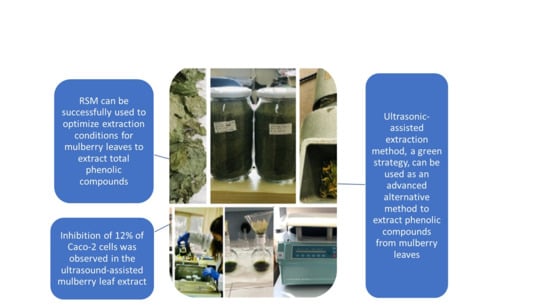
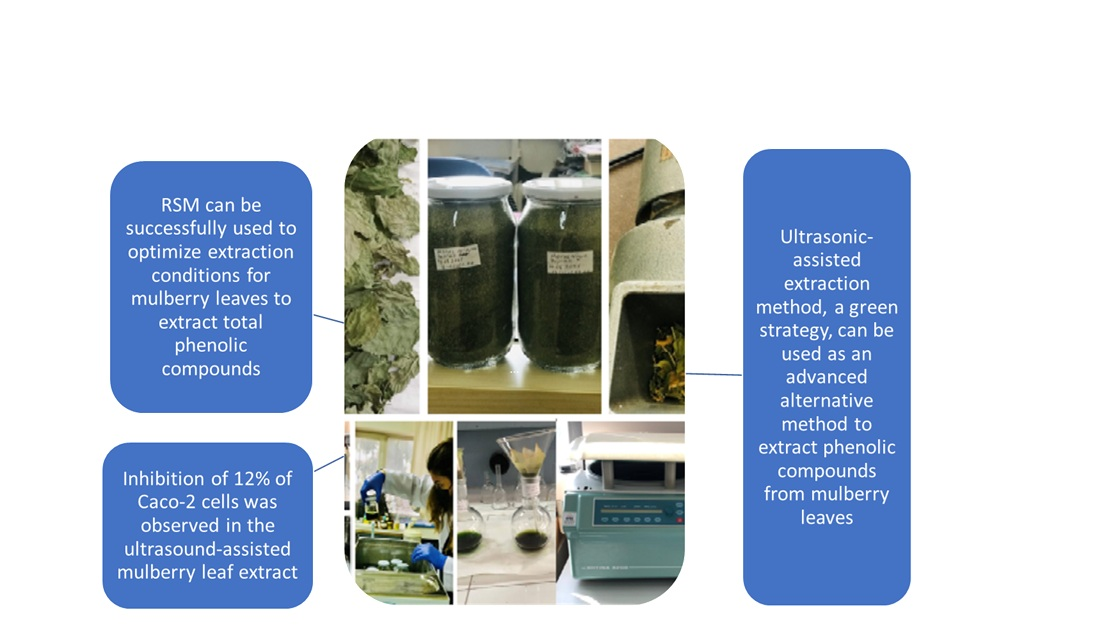
Graphical Abstract

1. Introduction

The leaves of the black mulberry tree (Morus nigra Aussie), which belongs to the Moraceae family and the genus Morus, are the primary food source for silkworm rearing in sericulture [1]. However, this process generates substantial leaf waste. Approximately 25–30 tonnes of leaf biomass and ~15 tonnes of sericultural waste, including leaf residues, low-quality cocoons and caterpillar manure, are produced per hectare of mulberry cultivation annually. The uncontrolled disposal of mulberry leaf waste contributes to greenhouse gas emissions and poses environmental risks [2,3]. Converting this waste into a valuable resource offers strategic opportunities for environmental sustainability and rural development, in line with the principles of a circular economy. In addition, while black mulberry leaves have long been valued in traditional medicine, they have only recently gained popularity due to their health benefits, especially among health-conscious consumers [1]. As well as containing vitamins, minerals and polysaccharides, they have a high concentration of phenolic substances, such as rutin, quercetin, isoquercetin and astragalin, which contribute to their antioxidant, antibacterial, anticancer, anti-inflammatory and antidiabetic properties [4]. Consequently, mulberry leaves exhibit potent therapeutic effects against various human disorders, including diabetes, neurological disorders, cardiovascular diseases and cancer [5,6]. In this framework, to recover the phenolic compounds from mulberry leaves efficiently, a range of extraction techniques are used. Conventional solvent extraction is simple but often limited by long processing times, high energy demand, and low selectivity. In contrast, innovative methods such as ultrasonic-assisted extraction and microwave-assisted extraction enhance cell disruption and solvent penetration, leading to higher yields in shorter times while reducing solvent use and environmental impact. The ultrasonic-assisted extraction method is simple, easy to handle and inexpensive compared with other methods. Moreover, it is a green approach that is environmentally friendly [7]. In plant tissue, acoustic cavitation affects the physical and chemical properties by breaking down membranes and releasing active compounds. Acoustic waves could enhance solubility, diffusivity, solvent penetration, particle size reduction, cell wall degradation, cell contents’ revelation, and mass transport acceleration. Thus, rapid disruption of plant tissue occurs [8].
Microwave-assisted extraction is another potential method for the extraction of phenolic compounds as it is cost-effective and has a higher extraction rate and a shorter extraction time [9]. It uses electromagnetic energy from microwaves. When the microwaves pass through the extraction medium, the electromagnetic field of the medium begins to oscillate and the dipolar molecules in the medium begin to move. So, electromagnetic energy is converted into thermal energy by dipole rotation and ionic conduction. Due to the temperature increase, high pressure is created by the evaporation of the water in the cell, and, as a result, the cell wall ruptures. Thus, many pores are formed in the cell walls, increasing the ability to penetrate and extract bioactive compounds [8,10].
The process efficiency of these methods is becoming increasingly important. It is well known that process parameters such as temperature, solvent concentration, extraction time and power have a significant impact on process efficiency. Therefore, the design of a favorable method and optimum process conditions is very important. Optimization of these parameters increases the yield of phenolic compounds [11]. Response surface methodology (RSM) is a simulation modeling technique widely used to predict process conditions and understand the performance of complex systems. It is also an assessment of the relative importance of different factors which have an impact on the independent variables. The Box–Behnken design, coupled with RSM, is an experimental design used to optimize any type of complex extraction process [8].
Furthermore, studies show that M. nigra and its extract prolong the survival of rats with hepatocellular carcinoma [12] and promote cell death in HT-29 human colon cancer cells [13]. Momeni et al. [5] found that the hydroalcoholic extract of M. nigra reduced the fasting blood glucose level and the hemoglobin A1c% in patients with diabetes. Qadir et al. [14] indicated that M. nigra leaves’ extract possesses anticancer activity and inhibited 89.5–31.99% of cervical cell line. The cytotoxicity of methanol extracts of Morus alba (white mulberry) tissues was ranked as roots, leaves, branches and fruits. As predicted, their phenolic content is a key factor in their health-beneficial properties, including anticancer activity, and it is a known fact that mulberry leaves are rich in phenolic compounds [4]. The human colon carcinoma cell line (Caco-2) is the gold-standard in vitro model for evaluating the biological activity and intestinal absorption of plant extracts. Once differentiated, Caco-2 cells form a polarized monolayer with tight junctions and transporters similar to those of the human small intestine. The Food and Drug Administration recognizes this model as the most suitable for assessing intestinal permeability, nutrient uptake, and the potential cytotoxicity of bioactive compounds due to these characteristics [15]. Thus, in this study, the cytotoxicity test was performed with Caco-2 cells on the mulberry leaf extract obtained by the ultrasonic-assisted extraction method, which is a promising green approach and provides efficiency close to that of the conventional method compared to the microwave-assisted method. However, no study has been found that reveals the effects of total phenolic compounds obtained from mulberry leaves by the ultrasonic-assisted extraction method on Caco-2 cells.
In this study, phenolic compounds were extracted from mulberry leaves using conventional, ultrasonic-assisted, and microwave-assisted extraction methods under various process conditions. The optimum extraction conditions were determined using the Box–Behnken design with RSM, and the desirability function was applied to identify the conditions that provided the maximum total phenolic content for each extraction technique. By integrating all extraction methods within a unified RSM framework, this study aimed to identify an advanced extraction method that could serve as an effective alternative to the conventional approach based on extraction yield, thereby contributing to the valorization of mulberry leaf waste from sericulture. Furthermore, this study sought to evaluate the biological effects of the total phenolic compounds obtained under the optimized advanced extraction conditions on Caco-2 cells, enabling a more comprehensive assessment that connects chemical optimization with biological validation.

2. Materials and Methods

2.1. Materials

Fresh mulberry leaves (M. nigra Aussie) were collected from Ege University Ödemiş Vocational School, İzmir province, Türkiye, and identified by Prof. Dr. Hasan Yıldırım. One specimen (EGE-44560) was deposited in the Herbarium of the Biology Department of the Faculty of Science at Ege University. The leaves were washed with water and dried at room temperature in the shade and in a well-ventilated area to constant weight. The dried leaves were ground to powder using a grinder to obtain a homogeneous sample in the Medicinal and Aromatic Plants Laboratory in the Faculty of Science, Department of Biology, Ege University. Although the exact particle size was not instrumentally measured, the powder corresponded approximately to <250 µm, which is consistent with standard practices. The ground leaves were placed in glass jars and stored in a dark place for extraction processes. All the reagents and chemicals used were of analytical grade. Ethanol was purchased from Merck KGaA (Darmstadt, Germany). The water was supplied by a Millipore Milli-Q system (Bedford, MA, USA). HPLC standards of the phenolic compounds were obtained from Sigma-Aldrich Co. (St. Louis, MO, USA).

2.2. Extraction Methods

Conventional extraction, ultrasonic-assisted extraction and microwave-assisted extraction methods were used to extract total phenolic compounds from M. nigra (black mulberry) leaves. The solvent has a significant effect on extraction efficiency. Ethanol, which has a higher polarity, is reported to be more effective in extracting polar compounds like phenolics from mulberry leaves [4]. Thus, ethanol was chosen as the solvent. Then, 5 g of mulberry leaf powder was extracted by solvents (ethanol–water mixture including 0, 50, 100% ethanol).
Extraction solvents were added to the mulberry leaf powder as 25 mL for ultrasonic-assisted extraction and microwave-assisted extraction, and 50 mL for conventional extraction [16,17].
The obtained extracts were centrifuged (Hettich, Rotina 420R, Tuttlingen, Germany) for 5 min at 5000 rpm and filtered through Whatman No. 1 filter paper, and the supernatant was transferred into falcon tubes. The solvents in supernatants were evaporated in a rotary evaporator (Heidolp Hei-vap, Schwabach, Germany) at 40 °C [4]. For HPLC analysis, 3 mL of ethanol (HPLC grade) was added to the samples in the evaporated glass flask. A sonic bath (Baudelin Elektronik Sonorex Type: PK265, Berlin, Germany) was used to absorb all the extract adhering to the glass flask surface, and then vortexing was used to dissolve the extract. At the end of the process, the samples were collected with a syringe, filtered through a 0.45 μm filter (Minisart Sartorius RC, Gottingen, Germany), and transferred to amber vials. They were stored at −18 °C until analysis. Each experimental run was conducted with three samples (n = 3), and all trials were repeated. The residues were retained for future use.

2.2.1. Conventional Extraction Method

Extraction was performed by solvent extraction method using a shaking water bath (Clifton shaker 1050 W 50–60 Hz, Nickel-Electro Ltd., Weston-super-Mare, UK) according to Xu et al. [18]. The independent variables were selected as temperature (30–45–60 ˚C), extraction time (60–210–360 min) and solvent concentration (0, 50, 100% ethanol). The temperature levels were chosen to cover the optimal kinetic–stability range of mulberry phenolics in ethanol–water systems, representing low, medium, and high settings for response surface modeling while ensuring efficient extraction without causing thermal degradation or excessive solvent loss.

2.2.2. Ultrasonic-Assisted Extraction Method

Extraction was performed using an ultrasonic bath (50 kHz, Everest CleanEx-812, İstanbul, Türkiye) according to Martin-Garcia et al. [17]. The independent variables were selected as temperature (30–45–60 °C), extraction time (15–30–45 min) and solvent concentration (0, 50, 100% ethanol).

2.2.3. Microwave-Assisted Extraction Method

Extraction was performed using a 2450 MHz microwave oven (Sineo MDS–8G, Shanghai, China) according to Li et al. [16]. The ethanol–water mixtures were used as solvents. The independent variables were selected as power (300–500–700 W), extraction time (2–6–10 min) and solvent concentration (0, 50, 100%). Extraction was also performed at 60 °C as it represents the optimal balance between enhancing mass transfer kinetics and minimizing the risk of thermal degradation.

2.3. Experimental Design

Response surface methodology (RSM) coupled with a three-level, three-factor Box–Behnken design (BBD) was employed to investigate the relationship between the extraction conditions (extraction temperature/power, solvent and extraction time) and the total phenolic compounds. The three independent variables for each extraction method and the corresponding levels are given in Table 1. Temperature, time and solvent concentration were selected as independent variables for conventional and ultrasonic-assisted extraction, while power, time and solvent concentration were selected for microwave-assisted extraction.
Equation (1) was fitted to the experimental data using multiple regression analysis, and the important variables in the model were identified using analysis of variance (ANOVA). The statistical program Design Expert Version 12.0 (Stat Ease Inc., Minneapolis, MN, USA) was used to analyze the experimental data statistically.
Y = b 0 + i = 1 i = 3 b i x i + i = 1 i = 3 b i i x i 2 + i = 1 i = 2 j = i + 1 i = 3 b i j x i x j  
where Y is the predicted total phenolic compounds, and b0, bi, bii and bij are the regression coefficients for model intercept, linear, quadratic and interaction terms, with the linear coefficients of temperature/power, time, and solvent concentration. The settings of the independent variables were represented as xi and xj. The design was completed using Design Expert Version 12.0 (Stat Ease Inc., Minneapolis, MN, USA), and 17 experimental points were measured in a randomized order to maximize the response value. The model’s adequacy was assessed using the correlation coefficient (R2), the adjusted correlation coefficient (R2 adj) and the lack-of-fit test. Regression analysis and three-dimensional (3D) response surface plots were used to determine the optimum conditions for the extraction of total phenolic compounds from mulberry leaves.

2.4. Determination of Total Phenolic Compounds

Determination of total phenolic compounds was conducted by HPLC (Termoscientific Dionex Ultimate 3000 HPLC-DAD, Thermo Fisher Scientific, Waltham, MA, USA), using an Agilent Eclipse XDB-C18 column (Agilent, Santa Clara, CA, USA) (5 μm; 250 × 4.6 mm) for the separation. The flow rate of solvents was set at 1.0 mL/min, and the column temperature was maintained at 25 °C. The HPLC chromatograms of mulberry leaf extracts were measured at 280 nm, 330 nm, and 360 nm using a diode array detector (DAD). Subsequently, the best reactions of phenolic compounds were considered. The detection method was modified from the procedures reported by Gundogdu et al. [19] and Hyun et al. [20]. Calibration curves were obtained using rutin hydrate, chlorogenic acid, isoquercitrin, kaempferol and ferulic acid standards, which are the major phenolic compounds found in mulberry leaf extract. The total phenolic compounds were expressed as mg/kg dry leaf, and total phenolic compounds (TPCs) were calculated as the sum of the quantified target analytes.

2.5. Cytotoxicity Test

The cytotoxicity test was performed with Caco-2 cells. Caco-2 cells were cultured in Eagle’s minimal essential medium (EMEM) supplemented with 10% fetal bovine serum (FBS, A0500-3010, Cegrogen Biotech, Ebsdorfergrund, Germany), 0.5% Gentamicin 10 mg/mL (A2712 Merck, Darmstadt, Germany) and sodium pyruvate 100 mM (L0473 Merck, Darmstadt, Germany), and then incubated at 37 °C in a humidified atmosphere of 5% CO2. In order to evaluate the antiproliferative effects, Caco-2 cells were seeded at a density of 1 × 10⁵ cells per mL. After 24 h of incubation, the cell line was treated with 4 different concentrations of M. nigra extracts dissolved in the complete cell medium for a further 24 h. Then, the viability of the cells was assessed by a 3-(4,5-dimethylthiazol-2-yl)-2,5 diphenyltetrazolium bromide (MTT) assay. Untreated cells were used as control and the medium including 1% dimethylsulfoxide as negative control. After 24 h of cells’ exposure to mulberry leaf extract, the medium of each well was removed and MTT was added for 4 h. The absorbance was measured at 570 nm using a spectrophotometer [21]. The cell viability value was calculated as a percentage from the following formula.
C e l l   v i a b i l i t y   ( % ) = A b s o r b a n c e   o f   s a m p l e A b s o r b a n c e   o f   c o n t r o l × 100

2.6. Statistical Analysis

In this study, two experimental replicates were carried out and the analyses were performed in two parallels. The obtained data were processed by the software Design Expert Version 12.0 (Stat Ease Inc., Minneapolis, MN, USA) including a built-in analysis of variance (ANOVA).

3. Results and Discussion

3.1. Model Fitting and Experimental Design

In total, 17 runs for total phenolic compounds extraction from mulberry leaves were optimized using RSM based on 3 independent variables (temperature/power, time, and solvent concentration), and the results are presented in Table 2. The total phenolic compounds’ content of the extracts varied between 5.19 and 939.72 mg/kg dry leaf. After multiple regression analysis was applied to the experimental data, the response and test variables were represented by the following quadratic polynomial equations.
For conventional extraction:
Y = 794.19 + 147.81   C 613.74   C 2
For ultrasonic-assisted extraction:
W = 404.28 + 192.56   A 273.23   C 2
For microwave -assisted extraction:
Z = 317.39 50.72   D 2 47.21   B 2 246.08   C 2
where Y, W, Z are the total phenolic compounds in the extract (mg/kg dry leaf), and A, B, C, D are temperature, extraction time, solvent concentration and power, respectively. The experimental results were analyzed using analysis of variance (ANOVA), and the results are presented in Table 3.
Linear terms describe the direct effect of a single factor (e.g., increasing temperature generally increases solubility and diffusion of phenolics). Interaction terms (e.g., temperature × time) describe situations where the effect of one variable depends on the level of another [22]. For instance, extending extraction time may improve yield at moderate temperatures but cause degradation of phenolics at high temperatures. In this system, most interaction terms were not statistically significant, suggesting that each factor influenced extraction largely independently within the tested range. However, the significant quadratic term for solvent concentration highlights the importance of identifying an intermediate ethanol–water ratio to balance the solubility and stability of phenolic compounds. Quadratic terms capture curvature in the response—meaning that beyond a certain point, further increases in that factor begin to reduce yield [23]. For example, a significant quadratic effect of solvent concentration (p < 0.0001) indicates that extraction efficiency rises as the ethanol concentration increases up to an optimum level, but excessive ethanol reduces phenolic recovery because highly non-polar solvents extract fewer polar phenolics.
As shown in Table 3, the F-value and p-value of the model were 8.18 and 0.0056 for conventional extraction, 4.12 and 0.0375 for ultrasonic-assisted extraction, and 54.99 and 0.0001 for microwave-assisted extraction, which indicates that the models were significant. The proportion of response variance attributable to the model is known as the correlation coefficient (R2). For a model to fit well, R2 must not be below 80% [8]. The correlation coefficients (R2) were 0.9132, 0.8414 and 0.9861 for conventional, ultrasonic-assisted and microwave-assisted extraction, respectively. R2 values were greater than 0.80, indicating that the regression models were appropriate. In addition, the correlation between predicted and actual values for each model was found to be effective as the F tests were not significant (p > 0.05). The p values of lack of fit for each model were greater than 0.05, which indicates that the lack-of-fit values were insignificant compared to pure errors. The results showed that each regression equation fits its model very well and could be used to analyze the experimental results.

3.2. Optimization of Extraction Parameters

Numerical optimization was performed to determine the optimum extraction conditions to obtain the highest total phenolic compounds’ yield from mulberry leaves. The desirability function with values ranging from 0 to 1 was used for numerical optimization. Afterward, it was examined which extraction parameters provided the maximized response. The optimum extraction condition was determined as conventional extraction at 60 °C in 56% solvent concentration for 60 min, with the maximum total phenolic compounds’ amount as 876.042 mg/kg dry leaf and a desirability value of 0.945.
Similarly, Peanparkdee et al. [24] found that 60% ethanol concentration provided a high total phenolic content for the extraction of mulberry (M. alba L.) leaf, while Kostić et al. [25] reported that 80% ethanol with 213.6 min by maceration was the optimum conditions for the extraction of black mulberry. Dong-qing et al. [26] reported that the optimum conditions for the extraction of flavonoids from mulberry leaves were an ethanol concentration of 61% at 72 °C and a solid–solvent ratio of 1:29 g/mL.
For the extraction process of ultrasonic-assisted extraction, the following conditions were found to be optimum: a temperature of 60 °C, extraction time of 45 min and solvent concentration of 71%. At the optimum conditions, the total phenolic compounds for mulberry leaves were predicted to be 820.384 mg/kg dry leaf with a desirability value of 0.873. Ultrasonic-assisted extraction provided an extraction yield close to that of conventional extraction while reducing the extraction time, and it is also a more environmentally friendly method. Ultrasonic-assisted extraction disrupts the solid material’s cell wall by producing shear force, making it easier to penetrate the matrix and increase the mass transfer of bioactive compounds. It reduces processing time compared to the conventional phenolic compounds’ extraction method since it is a faster procedure. In addition, it minimizes the degradation of heat-sensitive compounds [27]. Similarly, Da Porto et al. [28] found that ultrasonic-assisted extraction shortened the extraction time compared to classical extraction.
Microwave-assisted extraction gave the following optimum process conditions for mulberry leaf extraction: microwave power of 471 W, extraction time of 6 min and solvent concentration of 51%. At the optimum conditions, total phenolic compounds for mulberry leaves were predicted to be 319.410 mg/kg dry leaf with a desirability value of 0.905. In parallel with the study results, Rodsamran and Sothornvit [9] found that ultrasonic-assisted extraction was the more effective method to extract the total phenolics from plant waste compared to the microwave-assisted method.
After performing three validation experiments at the optimum extraction process conditions, the total phenolic compounds values of the obtained samples were found to be insignificant (p > 0.05) from the predictive values determined by the Design Expert Version 12.0 statistical software. The results are presented in Table 4.
When the total phenolic compounds’ amount of the extracts obtained by each method under optimum extraction conditions was compared, it was found that the highest total phenolic compounds amount belonged to the conventional method. This was followed by the ultrasonic-assisted and microwave-assisted extraction methods, respectively.

3.3. Validation of the Model Equation

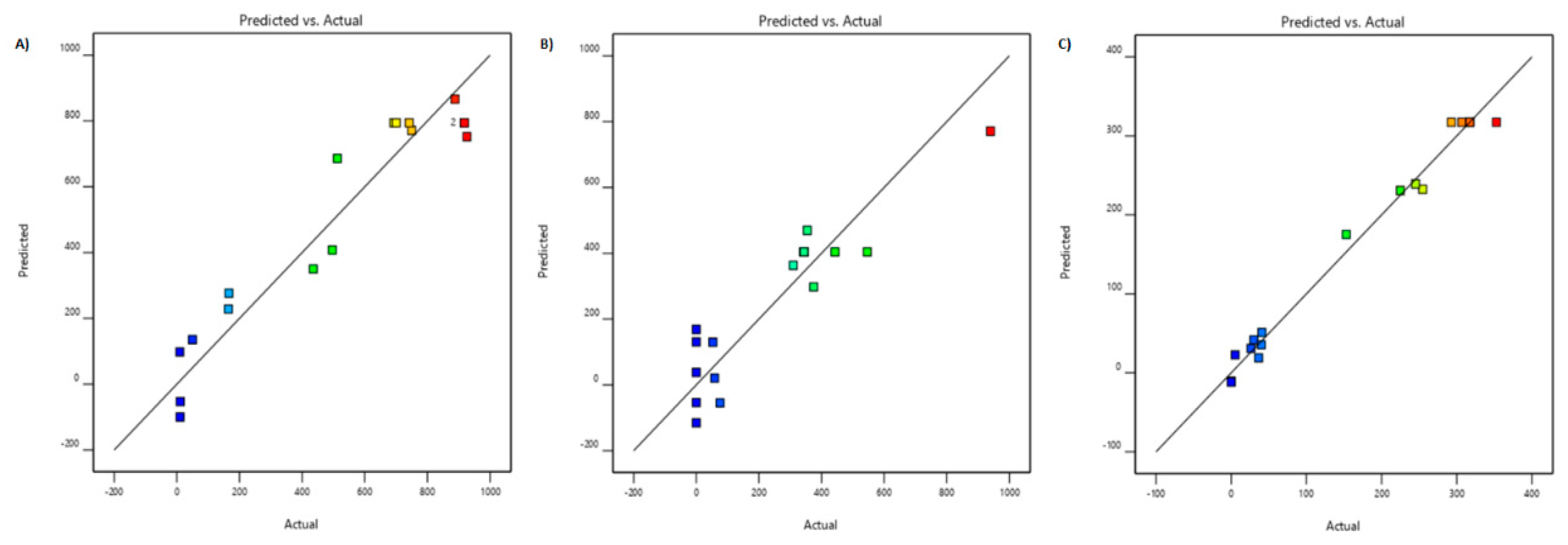
Extraction conditions were optimized for maximum total phenolic compounds in the extract from mulberry leaves. The experimental results were obtained under optimum extraction conditions. The RSM method was used to compare the actual and predicted values of the responses to ensure that the model was adequate. The results are presented in Figure 1 and no significant differences (p > 0.05) were found between the actual and predicted values. Hence, the accuracy and adequacy of the RSM models for the optimization of extraction conditions were proved by the good correlation between the actual and predicted values.

3.4. Analysis of the Response Surface

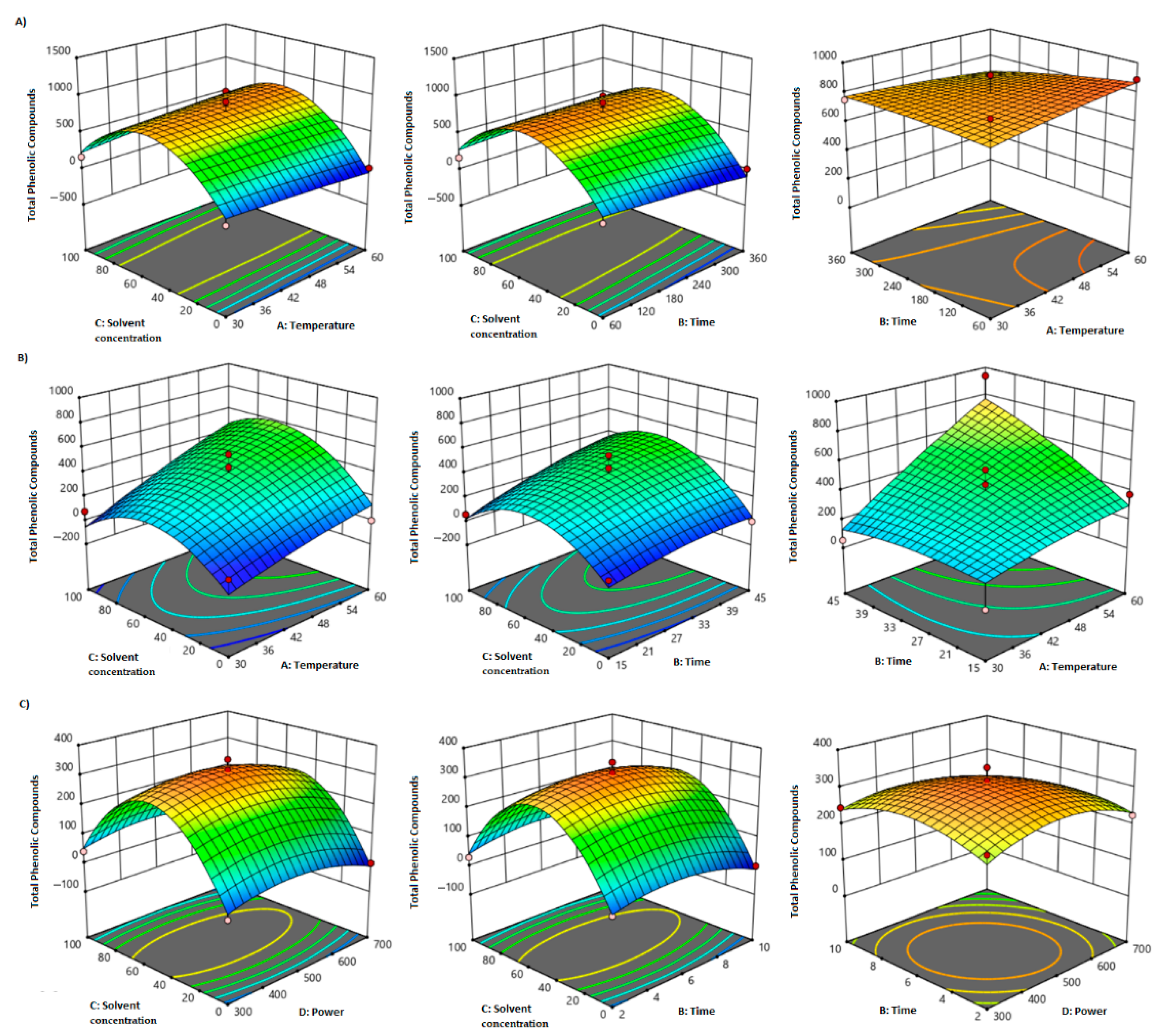
The effect of the extraction process variables on the yield of total phenolic compounds was analyzed using three-dimensional (3D) response surface plots developed from equations (Equations (3)–(5)). The interaction between two independent variables was explored in each plot, while the other variable was kept constant. The results are presented in Figure 2.
In conventional extraction, the maximum yield (926.15 mg/kg, Exp. No.: 12) was obtained when 30 °C temperature, 60 min extraction time, and 50% solvent concentration were used (Table 2). Temperature and extraction time had quadratic effects on conventional extraction, but the solvent concentration had a linear effect (p < 0.05) (Table 3). Also, the interactive effects of the independent variables on conventional extraction are shown in Figure 2A. The extraction yield increased as the temperature increased and the extraction time decreased. The yield of extraction first increased rapidly with the increase in solvent concentration but decreased after reaching a peak value.
In ultrasonic-assisted extraction, the maximum yield (939.72 mg/kg, Exp. No.: 12) was determined under conditions of a temperature of 60 °C, 45 min of extraction time, and 50% solvent concentration (Table 2). Solvent concentration and extraction time had quadratic effects on ultrasonic-assisted extraction, but the temperature had a linear effect (p < 0.05) (Table 3). Figure 2B shows the interactive effects of the independent variables on ultrasonic-assisted extraction. The extraction yield increased as the temperature and extraction time increased. The yield of extraction first increased with the increase in solvent concentration but decreased after reaching a peak value. Ultrasonication disrupts the plant tissues and improves mass transfer; thus, the solvent can reach the cell components easily [29]. Solvent concentration was an important factor in the amount of the total phenolic compounds. Similarly, Jovanovic et al. [30] and Živković et al. [31] found that the total phenolic compounds and polyphenolics were affected by the solvent concentration during ultrasonic-assisted extraction. In contrast, Vu et al. [32] found that the total phenolic compounds were not affected by solvent concentration. Similar to this study’s results, Kazemi et al. [33], Ghafoor et al. [34] and Ghafoor and Choi [35] found that the total phenolic compounds increased with the increasing ultrasound time. However, Jovanovic et al. [30] found that extraction time was not significant in the ultrasonic-assisted extraction of total phenolic compounds. On the other hand, Vu et al. [32] found that the total phenolic compounds decreased when the extraction time was increased. Temperature is also important for the extraction of phenolic compounds. Higher temperature provides higher extraction yield due to increased diffusion and reduced solvent surface tension and solvent viscosity. Kazemi et al. [33], Ghafoor et al. [34] and Ghafoor and Choi [35] found similar results to those of this study, while Vu et al. [32] and Wu et al. [29] found that total phenolic compounds first increased with temperature during ultrasonic-assisted extraction and then decreased with increasing temperature. This may be due to the heat sensitivity of phenolic compounds.
In the microwave-assisted extraction, the highest yield (352.77 mg/kg, Exp. No.: 5) was achieved at 500 W, 6 min of extraction time, and 50% solvent concentration (Table 2). The interactive effects of the independent variables on microwave-assisted extraction are shown in Figure 2C. All variables showed quadratic effects on microwave-assisted extraction (p > 0.05) (Table 3). Increases in microwave power, extraction time, and solvent concentration to approximately midpoints of the boundary conditions increased the extraction yield. Subsequent increases caused the extraction yield to decrease. Similar results were observed by Bansod et al. [11], Radojkovic et al. [36] and Vo et al. [8]. The microwave-assisted extraction method rapidly heats the sample–solvent mixture [36]. The water inside the cells was evaporated by temperature increase creating high pressure. This high pressure ruptures the cell walls, creating pores in the cell walls. This improves the ability to extract bioactive compounds [8]. The solvent temperature increases by the heat generated from microwave energy absorption, leading to the dissolution of total phenolic compounds for a certain time. However, excessive microwave radiation leads to a decrease in extraction performance, probably due to the decomposition of phenolic compounds resulting from prolonged microwave exposure [11].
In comparison, the highest total phenolic compounds were obtained by the conventional extraction method. It is followed by ultrasonic-assisted and microwave-assisted extraction. In parallel with this study’s results, Stanisavljevic et al. [37] found that the conventional extraction provided a higher amount of phenolics from echinacea. These results may be due to the degradation of phenolic compounds by interacting with highly reactive hydroxyl radicals formed during sonication, and the degradation of bioactive compounds by excessive microwave energy.
However, there are different results indicating that ultrasonic-assisted [9,38,39] or microwave-assisted [8,36] extraction methods provided higher total phenolic compounds compared to each other or the conventional extraction method. This could be due to different extraction conditions.
Meanwhile, the amount of total phenolic compounds obtained by the ultrasonic-assisted method was close to the amount of the conventional method, while the amount of the microwave-assisted method was much lower than that of these two methods. Similarly, Rodsamran and Sothornvit [9] found that the ultrasonic-assisted method had higher total phenolic compounds than the microwave-assisted extraction method. This might be because the ultrasound waves promote the penetration of the solvent into the food sample and consequently increase the mass transfer rate of total phenolic compounds into the extraction solvent. Thus, the ultrasonic-assisted extraction method emerges as a remarkable method due to its advantages, such as being an environmentally friendly advanced method and reducing the extraction time, as well as its efficiency, which is close to that of the conventional method. In addition, the conventional solvent extraction method, using ethanol or methanol, provides higher yields of bioactive compounds when combined with the ultrasonic-assisted extraction method [7].

3.5. Cytotoxic Activity of Ultrasonic-Assisted Extract of Mulberry Leaves on Caco-2 Cells

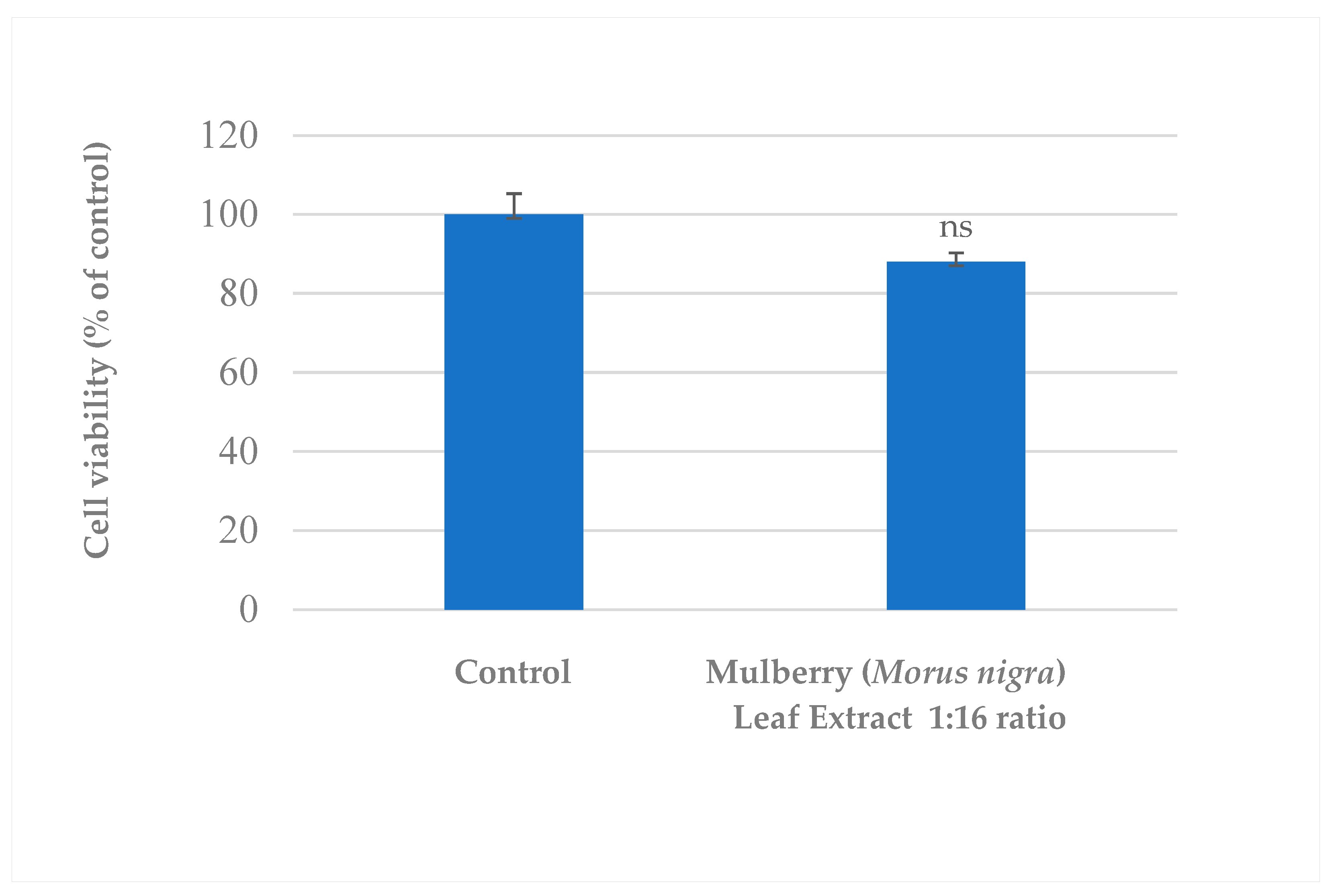
The results of the MTT assay after treatment of Caco-2 cells with mulberry leaf extract for 24 h are shown in Figure 3. Nevertheless, the cytotoxicity inhibition rate was 12% for 24 h incubation. Since cell viability is higher than 70%, it cannot be stated that the ultrasonic-assisted extract of mulberry leaves showed an anticancer effect.
Inhibitory effects of mulberry (M. alba) leaf extract and mulberry (M. alba) extract on the proliferation of several cancer cell lines such as the colon cancer cell line [40,41], the hepatocarcinoma cell line [42] and breast cancer cell line [40] have been previously detected. In addition, Qadir et al. [14] found inhibitory effects of M. nigra leaf extract on the human cervical cancer cell line. Efenberger-Szmechtyk et al. [15] indicated different leaf extracts showed anticancer activity on the human colon adenocarcinoma cell line Caco-2. Contrary to these results, the findings of this study did not support the anticancer effect of the ultrasonic-assisted extract of mulberry leaves.
Cell death of leaf extracts, including mulberry, is attributed to its ability to promote apoptosis. Bioactive compounds, especially polyphenols, exert a cytotoxic effect by the induction of reactive oxygen species’ generation. In addition, it is stated that plant leaf extracts could cause DNA damage in Caco-2 cells in a concentration-dependent manner [15]. In contrast, phenolic compounds at appropriate concentrations could induce DNA repair and reduce DNA damage in Caco-2 cells by acting as antioxidants and cytoprotective agents [43]. Thus, the results of the present study could be attributed to the concentration and composition of the extract. In addition, the measured total phenolic compounds may contain small amounts of specific bioactive molecules that kill or inhibit Caco-2 cells. In this study, a single cell line was used, and individual phenolic compound analyses could not be performed. For future studies, it is planned to utilize multiple cancer cell lines and perform compound-specific analyses.

4. Conclusions

The optimization of conventional, ultrasonic-assisted, and microwave-assisted extraction conditions for total phenolic compounds and extraction yield was successfully achieved using response surface methodology (RSM). The close agreement between the experimental and predicted values confirmed the adequacy and precision of the RSM model. Overall, the findings indicated that both conventional and ultrasonic-assisted extractions are effective techniques for recovering phenolic compounds from mulberry leaves. Although the conventional method yielded the highest total phenolic content, the ultrasonic-assisted method provided a substantial time advantage with only a slight reduction in phenolic yield, supporting its applicability as a green and efficient alternative.
It should be noted that this study was conducted exclusively on leaves of a single M. nigra Aussie genotype. Phenolic quantity and chemotype can vary significantly depending on genotype, geographical origin, climate, harvest time, and plant age. Therefore, future studies should evaluate optimal extraction conditions—particularly ultrasonic-assisted extraction—using leaves from diverse M. nigra genotypes grown under different environmental conditions. Additionally, extracts should be subjected to comprehensive in vitro assays employing established cancer cell lines to assess potential cytotoxicity. Following the independent evaluation of conventional solvent extraction (CSE), ultrasonic-assisted extraction (UAE), and microwave-assisted extraction (MAE), investigating potential synergistic combinations of these techniques is strongly recommended. Integrating the advantages of short extraction times and high phenolic recovery could enable the development of a more efficient, sustainable, and industrially scalable hybrid extraction protocol.

Author Contributions

Conceptualization, N.D.; methodology, S.F., Z.I.Y.K., E.F. and N.D.; software, S.F., V.A. and E.F.; validation, V.A. and E.F.; formal analysis, S.F. and Z.I.Y.K.; investigation, S.F. and V.A., resources, N.D.; data curation, S.F., V.A. and E.F.; writing—original draft preparation, V.A.; writing—review and editing, V.A. and N.D.; visualization, S.F. and N.D.; supervision, S.F., Z.I.Y.K. and N.D.; project administration, N.D.; funding acquisition, N.D. All authors have read and agreed to the published version of the manuscript.

Funding

This research was a part of the DAINME-SME project and was supported by the PRIMA programme (HORIZON 2020) under grant agreement No. 1833, project Dairy Innovation for Mediterranean-SME (DAINME-SME).

Data Availability Statement

The datasets used and/or analyzed during the current study are available from the corresponding author on reasonable request.

Conflicts of Interest

Author Esra Fırat was employed by the company Genc ve Naturel. The remaining authors declare that the research was conducted in the absence of any commercial or financial relationships that could be construed as a potential conflict of interest.

References

  1. Gao, M.-Z.; Cui, Q.; Wang, L.T.; Meng, Y.; Yu, L.; Li, Y.Y.; Fu, Y.J. A green and integrated strategy for enhanced phenolic compounds extraction from mulberry (Morus alba L.) leaves by deep eutectic solvent. Microchem. J. 2020, 154, 104598. [Google Scholar] [CrossRef]
  2. Saini, P.; Rohela, G.K.; Kumar, J.S.; Shabnam, A.A.; Kumar, A. Cultivation, Utilization, and Economic Benefits of Mulberry. In The Mulberry Genome; Gnanesh, B.N., Vijayan, K., Eds.; Springer: Cham, Switzerland, 2023; Chapter 2; pp. 13–56. [Google Scholar]
  3. Jadhav, Y.T.; Babu, B.K.K.; Chavan, A.D.; Tambave, K.N. Mulberry and its waste utilization an important socio-economic status in sericulture. Int. J Plant Prot. 2020, 13, 125–130. [Google Scholar] [CrossRef]
  4. Wang, Z.; Tang, C.; Dai, F.; Xiao, G.; Luo, G. HPLC determination of phenolic compounds in different solvent extracts of mulberry leaves and antioxidant capacity of extracts. Int. J. Food Prop. 2021, 24, 544–552. [Google Scholar] [CrossRef]
  5. Momeni, H.; Salehi, A.; Absalan, A.; Akbari, M. Hydro-alcoholic extract of Morus nigra reduces fasting blood glucose and HbA1c% in diabetic patients, probably via competitive and allosteric interaction with alpha-glucosidase enzyme; a clinical trial and in silico analysis. J. Complement. Integr. Med. 2022, 19, 763–769. [Google Scholar] [CrossRef]
  6. Singh, S.V.; Manhas, A.; Singh, S.P.; Mishra, S.; Tiwari, N.; Kumar, P.; Shanker, K.; Srivastava, K.; Sashidhara, K.V.; Pal, A. A phenolic glycoside from Flacourtia indica induces heme mediated oxidative stress in Plasmodium falciparum and attenuates malaria pathogenesis in mice. Phytomedicine 2017, 30, 1–9. [Google Scholar] [CrossRef] [PubMed]
  7. Chen, X.; Li, X.; Zhu, X.; Wang, G.; Zhuang, K.; Wang, Y.; Ding, W. Optimization of extrusion and ultrasonic-assisted extraction of phenolic compounds from Jizi439 black wheat bran. Processes 2020, 8, 1153. [Google Scholar] [CrossRef]
  8. Vo, T.P.; Ha, N.M.H.; Ho, T.A.T.; Nguyen, D.Q. Optimizing the microwave-assisted extraction and ultrasonic-assisted processes to acquire flavonoid and phenolic compounds from watermelon rinds using natural deep eutectic solvents. Chem. Eng. Commun. 2024, 212, 260–275. [Google Scholar] [CrossRef]
  9. Rodsamran, P.; Sothornvit, R. Extraction of phenolic compounds from lime peel waste using ultrasonic-assisted and microwave-assisted extractions. Food Biosci. 2019, 28, 66–73. [Google Scholar] [CrossRef]
  10. Mishra, S.; Singh, S.; Ali, A.; Gupta, A.C.; Shanker, K.; Bawankule, D.U.; Luqman, S. Microwave-assisted Single Step Cinnamic Acid Derivatization and Evaluation for Cytotoxic Potential. Curr. Pharm. Biotechnol. 2020, 21, 236–243. [Google Scholar] [CrossRef]
  11. Bansod, S.P.; Parikh, J.K.; Sarangi, P.K. Pineapple peel waste valorization for extraction of bio-active compounds and protein: Microwave assisted method and Box Behnken design optimization. Environ. Res. 2023, 221, 115237. [Google Scholar] [CrossRef]
  12. Hooshmand, S.; Mahdinezhad, M.R.; Taraz Jamshidi, S.; Soukhtanloo, M.; Mirzavi, F.; Iranshahi, M.; Hasanpour, M.; Ghorbani, A. Morus nigra L. extract prolongs survival of rats with hepatocellular carcinoma. Phytother. Res. 2021, 35, 3365–3376. [Google Scholar] [CrossRef] [PubMed]
  13. Erden, Y. Sour black mulberry (Morus nigra L.) causes cell death by decreasing mutant p53 expression in HT-29 human coloncancer cells. Food Biosci. 2021, 42, 101113. [Google Scholar] [CrossRef]
  14. Qadir, M.I.; Ali, M.; Ibrahim, Z. Anti-cancer activity of Morus nigra leaves extract. Bangladesh J. Pharmacol. 2014, 9, 496–497. [Google Scholar] [CrossRef]
  15. Efenberger-Szmechtyk, M.; Nowak, A.; Nowak, A. Cytotoxic and DNA-damaging effects of Aronia melanocarpa, Cornus mas, and Chaenomeles superba leaf extracts on the human colon adenocarcinoma cell line Caco-2. Antioxidants 2020, 9, 1030. [Google Scholar] [CrossRef]
  16. Li, Y.; Li, S.; Lin, S.J.; Zhang, J.J.; Zhao, C.N.; Li, H.B. Microwave-assisted extraction of natural antioxidants from the exotic Gordonia axillaris fruit: Optimization and identification of phenolic compounds. Molecules 2017, 22, 1481. [Google Scholar] [CrossRef]
  17. Martin-Garcia, B.; Aznar-Ramos, M.; Verardo, V.; Gómez-Caravaca, A. The establishment of ultrasonic-assisted extraction forthe recovery of phenolic compounds and evaluation of their antioxidant activity from Morus alba leaves. Foods 2022, 11, 314. [Google Scholar] [CrossRef]
  18. Xu, K.; Wang, Y.; Huang, Y.; Li, N.; Wen, Q. A green deep eutectic solvent-based aqueous two-phase system for protein extracting Analytica Chimica Acta A greendeep eutectic solvent-based aqueous two-phase system for protein extracting. Anal. Chim. Acta 2018, 864, 9–20. [Google Scholar] [CrossRef] [PubMed]
  19. Gundogdu, M.; Canan, I.; Gecer, M.K.; Kan, T.; Ercisli, S. Phenolic Compounds, Bioactive Content and Antioxidant Capacity of the Fruits of Mulberry (Morus spp.) Germplasm in Turkey. Folia Hortic. 2017, 29, 251–262. [Google Scholar] [CrossRef]
  20. Hyun, E.J.; Vu Thi, P.; Cai, L.; Yan, Z.; Li, H.; Yang, S.; Kim, Y.; Kim, S.; Cho, H.; Bao, H.; et al. Development of HPLC Method for Differentiation of Three Parts of Mulberry Tree. Anal. Sci. Technol. 2017, 30, 130–137. [Google Scholar]
  21. ISO 10993-5:2009; Biological Evaluation of Medical Devices—Part 5: Tests for In Vitro Cytotoxicity. International Organization for Standardization (ISO): Geneva, Switzerland, 2009.
  22. Myers, R.H.; Montgomery, D.C.; Anderson-Cook, C.M. Response Surface Methodology: Process and Product Optimization Using Designed Experiments, 4th ed.; John Wiley & Sons: Hoboken, NJ, USA, 2016. [Google Scholar]
  23. Bezerra, M.A.; Santelli, R.E.; Oliveira, E.P.; Villar, L.S.; Escaleira, L.A. Response surface methodology (RSM) as a tool for optimization in analytical chemistry. Talanta 2008, 76, 965–977. [Google Scholar] [CrossRef]
  24. Peanparkdee, M.; Iwamoto, S.; Borompichaichartkul, C.; Duangmal, K.; Yamauchi, R. Microencapsulation of bioactive compounds from mulberry (Morus alba L.) leaf extracts by protein–polysaccharide interactions. Int. J. Food Sci. Technol. 2016, 51, 649–655. [Google Scholar] [CrossRef]
  25. Kostić, E.; Arsić, B.; MitiĆ, M.; DimitrijeviĆ, D.; Marinkovic, E.P. Optimization of the solid-liquid extraction process of phenolic compounds from mulberry fruit. Not. bot Horti Agrobot. Cluj-Napoca 2019, 47, 629–633. [Google Scholar] [CrossRef]
  26. Wu, D.; Ren, X.; Lin, M.; Xu, X.; An, H. Optimization of extraction technique of flavonoids from Morus alba L. by response surface methodology. Food Res. Dev. 2012, 2, 47–51. (In Chinese) [Google Scholar]
  27. Insang, S.; Kijpatanasilp, I.; Jafari, S.; Assatarakul, K. Ultrasonic-assisted extraction of functional compound from mulberry (Morus alba L.) leaf using response surface methodology and effect of microencapsulation by spray drying on quality of optimized extract. Ultrason. Sonochem 2022, 82, 105806. [Google Scholar] [CrossRef]
  28. Da Porto, C.; Porretto, E.; Decorti, D. Comparison of ultrasonic-assisted extraction with conventional extraction methods of oil and polyphenols from grape (Vitis vinifera L.) seeds. Ultrason. Sonochem 2013, 20, 1076–1080. [Google Scholar] [CrossRef]
  29. Wu, L.; Li, L.; Chen, S.; Wang, L.; Lin, X. Deep eutectic solvent-based ultrasonic-assisted extraction of phenolic compounds from Moringa oleifera L. leaves: Optimization, comparison and antioxidant activity. Sep. Purif. Technol. 2020, 247, 117014. [Google Scholar] [CrossRef]
  30. Jovanovic, A.A.; Dordevic, V.B.; Zdunic, G.M.; Pljevljakusic, D.S.; Savikin, K.P.; Godevac, D.M.; Bugarski, B.M. Optimization of the extraction process of polyphenols from Thymus serpyllum L. herb using maceration, heat- and ultrasonic-assisted techniques. Sep. Purif. Technol. 2017, 179, 369–380. [Google Scholar] [CrossRef]
  31. Živković, J.; Šavikin, K.; Janković, T.; Ćujić, N.; Menković, N. Optimization of ultrasonic-assisted extraction of polyphenolic compounds from pomegranate peel using response surface methodology. Sep. Purif. Technol. 2018, 194, 40–47. [Google Scholar] [CrossRef]
  32. Vu, H.T.; Scarlett, C.J.; Vuong, Q.V. Optimization of ultrasonic-assisted extraction conditions for recovery of phenolic compounds and antioxidant capacity from banana (Musa cavendish) peel. J. Food Process Preserv. 2017, 41, e13148. [Google Scholar] [CrossRef]
  33. Kazemi, M.; Karim, R.; Mirhosseini, H.; Hamid, A.A. Optimization of pulsed ultrasonic-assisted technique for extraction of phenolics from pomegranate peel of Malas variety: Punicalagin and hydroxybenzoic acids. Food Chem. 2016, 206, 156–166. [Google Scholar] [CrossRef] [PubMed]
  34. Ghafoor, K.; Choi, Y.H.; Jeon, J.Y.; Jo, I.H. Optimization of ultrasonic-assisted extraction of phenolic compounds, antioxidants, and anthocyanins from grape (Vitis vinifera) seeds. J. Agric. Food Chem. 2009, 57, 4988–4994. [Google Scholar] [CrossRef]
  35. Ghafoor, K.; Choi, Y.H. Optimization of ultrasound assisted extraction of phenolic compoundsand antioxidants from grape peel through response surface methodology. J. Korean Soc. Appl. Biol. Chem. 2009, 52, 295–300. [Google Scholar] [CrossRef]
  36. Radojković, M.; Moreira, M.M.; Soares, C.; Barroso, M.F.; Cvetanović, A.; Švarc-Gajić, J.; Morais, S.; Delerue-Matos, C. Microwave-assisted extraction of phenolic compounds from Morus nigra leaves: Optimization and characterization of the antioxidant activity and phenolic composition. J. Chem. Technol. Biotechnol. 2018, 93, 1684–1693. [Google Scholar] [CrossRef]
  37. Stanisavljevic, I.; Stojicevic, S.; Velickovic, D.; Veljkovic, V.; Lazic, M. Antioxidant and antimicrobial activities of echinacea (Echinacea purpurea L.) extracts obtained by classical and ultrasound extraction. Chin. J. Chem. Eng. 2009, 17, 478–483. [Google Scholar] [CrossRef]
  38. Abbas, Z.; Tong, Y.; Wang, J.; Zhang, J.; Wei, X.; Si, D.; Zhang, R. Potential role and mechanism of mulberry extract in immune modulation: Focus on chemical compositions, mechanistic insights, and extraction techniques. Int. J. Mol. Sci. 2024, 25, 5333. [Google Scholar] [CrossRef] [PubMed]
  39. Both, S.; Chemat, F.; Strube, J. Extraction of polyphenols from black tea—Conventional and ultrasound assisted extraction. Ultrason. Sonochem 2014, 21, 1030–1034. [Google Scholar] [CrossRef]
  40. Deepa, M.; Sureshkumar, T.; Satheeshkumar, P.K.; Priya, S. Antioxidant rich Morus alba leaf extract induces apoptosis in human colon and breast cancer cells by the down-regulation of nitric oxide produced by inducible nitric oxide synthase. Nutr. Cancer 2013, 65, 305–310. [Google Scholar] [CrossRef]
  41. Cui, H.; Lu, T.; Wang, M.; Zou, X.; Zhang, Y.; Yang, X.; Dong, Y.; Zhou, H. Flavonoids from Morus alba L. leaves: Optimization of extraction by response surface methodology and comprehensive evaluation of their antioxidant, antimicrobial, and inhibition of α-amylase activities through analytical hierarchy process. Molecules 2019, 24, 2398. [Google Scholar] [CrossRef]
  42. Yang, M.Y.; Wu, C.H.; Hung, T.W.; Wang, C.J. Endoplasmic reticulum stress-induced resistance to doxorubicin is reversed by mulberry leaf polyphenol extract in hepatocellular carcinoma through inhibition of COX-2. Antioxidants 2020, 9, 26. [Google Scholar] [CrossRef]
  43. Zaklos-Szyda, M.; Pawlik, N.; Polka, D.; Nowak, A.; Koziołkiewicz, M.; Podsedek, A. Viburnum opulus fruit phenolic compounds as cytoprotective agents able to decrease free fatty acids and glucose uptake by Caco-2 cells. Antioxidants 2019, 8, 262. [Google Scholar] [CrossRef]
Figure 1. Comparison of total phenolic compounds in mulberry leaf extracts between actual and predicted values. (A) Conventional extraction; (B) ultrasonic-assisted extraction; (C) microwave-assisted extraction.
Processes 14 00031 g001
Figure 2. Response surface 3D plots showing the effects of process variables on total phenolic compounds with different extraction methods. (A) Conventional extraction; (B) ultrasonic-assisted extraction; (C) microwave-assisted extraction.
Processes 14 00031 g002
Figure 3. Cell viability of Caco-2 cells treated by ultrasonic-assisted extract of mulberry leaf (ns: not significant).
Processes 14 00031 g003
Table 1. Process variables and their factor levels.
Extraction MethodIndependent VariableUnitFactor Level
−10+1
ConventionalTemperature (A)°C304560
Time (B)min60210360
Solvent concentration (C)%050100
Ultrasonic-assistedTemperature (A)°C304560
Time (B)min153045
Solvent concentration (C)%050100
Microwave-assistedPower (D)W300500700
Time (B)min2610
Solvent concentration (C)%050100
Table 2. Box–Behnken design and response values for total phenolic compounds’ extraction from mulberry leaves.
Extraction MethodRunTemperature/PowerExtraction Time (min)Solvent Concentration (%)Total Phenolic Compounds (mg/kg Dry Leaf)
Conventional Extraction160 °C6050888.11
245 °C21050917.73
345 °C21050700.81
445 °C21050741.81
530 °C36050749.75
630 °C210100164.53
760 °C210010.96
860 °C210100496.34
945 °C60049.79
1045 °C21050917.73
1130 °C21009.46
1230 °C6050926.15
1345 °C60100166.4
1445 °C21050692.87
1545 °C360010.2
1645 °C360100435.59
1760 °C36050512.41
Ultrasonic-assisted145 °C1510058.68
260 °C300ND
330 °C455052.82
460 °C1550374.94
545 °C450ND
660 °C30100354.5
745 °C3050345.59
830 °C300ND
945 °C3050443.06
1045 °C3050546.15
1145 °C150ND
1260 °C4550939.72
1345 °C3050342.18
1430 °C1550ND
1545 °C45100309.79
1645 °C3050344.44
1730 °C3010075.84
Microwave-assisted1500 W650352.77
2500 W100ND
3300 W605.19
4700 W610036.49
5700 W250224.90
6700 W1050153.10
7700 W60ND
8500 W210030.07
9500 W650180.58
10500 W1010040.05
11300 W610040.69
12300 W1050245.24
13500 W2026.32
14500 W650188.87
15300 W250254.64
16500 W650201.90
17500 W650275.56
ND: Not detected.
Table 3. ANOVA for the regression model of total phenolic compounds’ extraction.
Extraction MethodSourceSum of SquaresDegrees of FreedomMean SquaresF Valuep-Value
Conventional ExtractionModel1.853 × 10692.059 × 1058.180.0056 *
A (Temperature)419.491419.490.01670.9009
B (Extraction time)13,000.78113,000.780.51660.4956
C (Solvent concentration)1.748 × 10511.748 × 1056.940.0337
AB9930.1219930.120.39460.5498
AC27,276.17127,276.171.080.3325
BC23,836.27123,836.270.94720.3629
A2431.961431.960.01720.8994
B2941.851941.850.03740.8521
C21.586 × 10611.586 × 10663.02<0.0001
Residual1.762 × 105725,165.69
Lack-of-fit1.239 × 105341,302.123.160.1476 **
Pure error52,253.49413,063.37
Cor total2.029 × 10616
R20.9132
R2-adj0.8016
C.V.%32.14
PRESS2.064 × 106
Adeq Precision7.9421
Ultrasonic-assistedModel9.048 × 10591.005 × 1054.120.0375 *
A (Temperature)2.966 × 10512.966 × 10512.170.0101
B (Extraction time)94,332.13194,332.133.870.0898
C (Solvent concentration)79,762.18179,762.183.270.1134
AB65,525.76165,525.762.690.1451
AC19,412.85119,412.850.79650.4018
BC15,764.06115,764.060.64680.4477
A22319.9712319.970.09520.7667
B26384.7716384.770.26200.6245
C23.143 × 10513.143 × 10512.900.0088
Residual1.706 × 105724,372.99
Lack-of-fit1.381 × 105346,032.745.660.0636 **
Pure error32,512.7448128.18
Cor total1.075 × 10616
R20.8414
R2-adj0.6374
C.V.%63.38
PRESS2.260 × 106
Adeq Precision7.4010
Microwave-assistedModel2.956 × 105932,843.0954.99<0.0001 *
D (Power)2153.9812153.983.610.0993
B (Extraction time)1189.2611189.261.990.2011
C (Solvent concentration)1676.4911676.492.810.1378
DB973.131973.131.630.2425
DC0.240110.24010.00040.9846
BC329.241329.240.55120.4820
D210,832.72110,832.7218.140.0038
B29382.3719382.3715.710.0054
C22.550 × 10512.550 × 105426.88<0.0001
Residual4180.927597.27
Lack-of-fit2207.823735.941.490.3446 **
Pure error1973.104493.27
Cor total2.998 × 10516
R20.9861
R2-adj0.9681
C.V.%15.72
PRESS38,408.14
Adeq Precision17.5535
* Significant; ** not significant
Table 4. Statistical results of validation experiments.
Extraction MethodPredicted Values
(mg/kg)
Average of Experiments
(mg/kg)
p-Value of t-Test
Conventional Extraction876.042877.6140.116
Ultrasonic-assisted Extraction820.384821.7240.193
Microwave-assisted Extraction319.410320.4540.151
Disclaimer/Publisher’s Note: The statements, opinions and data contained in all publications are solely those of the individual author(s) and contributor(s) and not of MDPI and/or the editor(s). MDPI and/or the editor(s) disclaim responsibility for any injury to people or property resulting from any ideas, methods, instructions or products referred to in the content.