
Article

Remediation of Heavy Metals (Arsenic, Cadmium, and Lead) from Wastewater Utilizing Cellulose from Pineapple Leaves

Department of Biomedical Sciences, College of Clinical Pharmacy, King Faisal University, Al-Ahsa 31982, Saudi Arabia
Processes 2026, 14(1), 159; https://doi.org/10.3390/pr14010159 (registering DOI)
Submission received: 4 December 2025 / Revised: 28 December 2025 / Accepted: 29 December 2025 / Published: 2 January 2026

Abstract

Heavy metals (arsenic, cadmium, and lead) remain one of the most common and complex environmental problems worldwide. Accordingly, there is a growing need for eco-friendly and affordable materials derived from agricultural waste for the removal of heavy metals from contaminated water. This study aims to demonstrate how biodegradable pineapple leaf cellulose (PLC) can be used effectively in the remediation of heavy metals. The PLC adsorbent was prepared by treating it with ethyl alcohol (EtOH, 99.5%), calcium chloride (CaCl2), and 0.8 M sodium hydroxide. A scanning electron microscope equipped with energy-dispersive X-ray spectroscopy (SEM-EDS) and Fourier transform infrared spectroscopy (FT-IR) was used to investigate the surface of the adsorbent. Inductively coupled plasma mass spectrometry (ICP-MS) was employed to measure the concentration of metals before and after adsorption. Removal of metal ions (As5+, Cd2+, and Pb2+) by PLC was investigated under varying conditions, including pH, contact time, and adsorbent dosage. The analysis of cellulose composite revealed significant potential for adsorption of heavy metals such as As5+, Cd2+, and Pb2+. The highest removal efficiency of heavy metal ions was detected at a pH ranging from 3 to 7. The biosorption order of PLC at pH 6 was Pb2+ > Cd2+ > As5+ with 99.53% (63.45 mg/g), 98.44% (37.23 mg/g), and 42.40% (16.27 mg/g), respectively. After 120 min, the equilibrium of the adsorption process was reached for As5+, Cd2+, and Pb2+. FT-IR characterization discovered an increased abundance of functional groups on the adsorbent. The SEM-EDS analysis confirmed the occurrence of elements on the surface of PLC. The study revealed that the use of PLC is an innovative method for removing heavy metals from aquatic milieus, a potential resource for eco-friendly and affordable wastewater treatment.

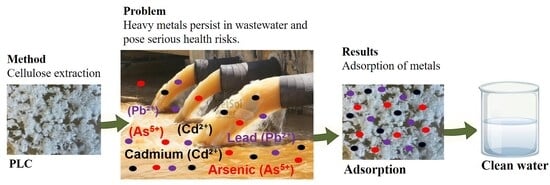
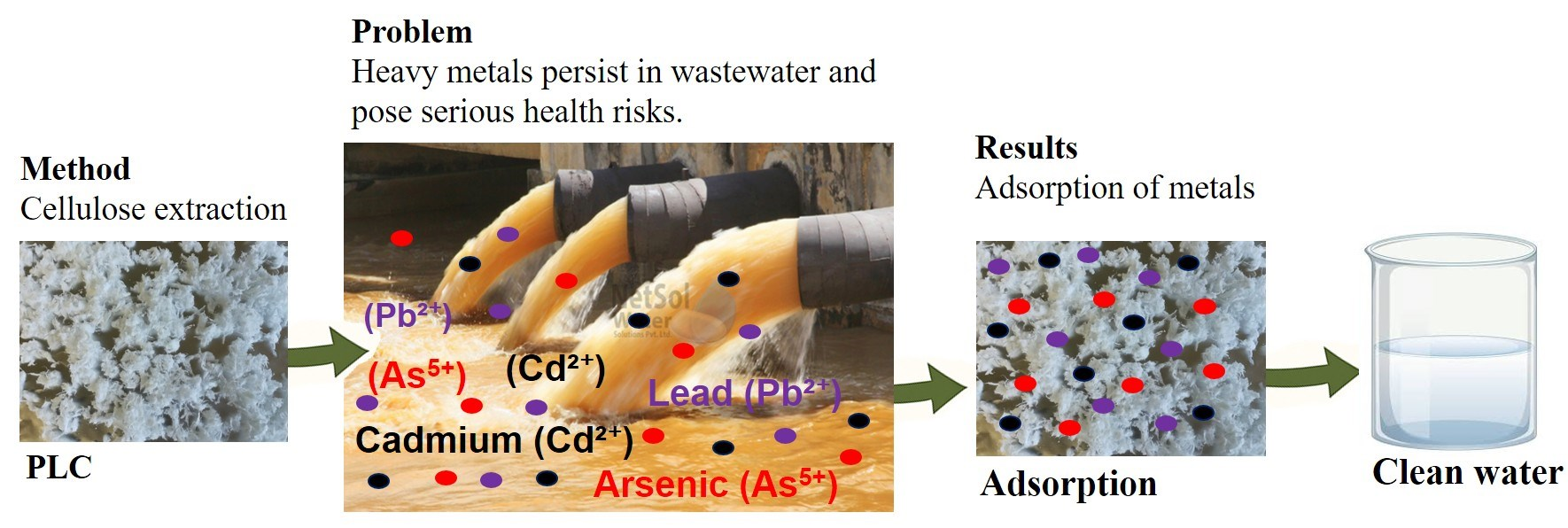
Graphical Abstract

1. Introduction

The advent of industrialization, one of the major factors in the development of economies across the world, has unfortunately resulted in significant increases in heavy metal contamination of water resources [1]. The release of heavy metals from industrial activities is a major source of the most prevalent environmental pollutants. These heavy metals have the potential to pollute our ecosystems, such as water, soil, and air. Water pollution is indeed a major and persistent global problem exacerbated by human population growth [2]. Furthermore, the industrial effluents containing diverse derivatives of heavy metals, such as arsenic (As), cadmium (Cd), chromium (Cr), copper (Cu), cobalt (Co), mercury (Hg), nickel (Ni), lead (Pb), and zinc (Zn), among others are continuously being discharged to the aquatic ecosystem, creating a toxic environment. Heavy metal toxicity, even in trace amounts, is a matter of great concern due to its poisonous nature and adverse effects on human health [3,4]. Cd and Pb are the most toxic heavy metals and pose serious risks to the health of humans, even at low levels of exposure. Chronic exposure can lead to skin lesions, hyperpigmented spots, cardiovascular disease, neurotoxicity, and cancers of the skin, lung, bladder, and liver, which are more likely to develop with chronic exposure to arsenic, primarily through contaminated drinking water. Cd has a long biological half-life and collects in the kidney and liver, causing renal dysfunction, bone demineralization, osteoporosis, and Itai-Itai disease. Cd is also a human carcinogen associated with lung and prostate cancer [5,6]. The effects of Pb on different organ systems are detrimental among children, resulting in cognitive impairment, behavioral disorders, and low IQ; whereas, in adults, it leads to hypertension, kidney damage, reproductive toxicity, and anemia [7]. Cd and Pb have high persistence, bioaccumulation, and extreme toxicity, highlighting the urgent need to develop effective removal measures for these substances in polluted water bodies and the environment. Without sweeping action, it is highly likely that population growth, along with urbanization, will outpace the reduction in waste generated from household and industrial activities [7]. Water reuse, along with the extraction of pollutants from waste, may be the way to mitigate environmental and resource challenges. Therefore, effective tactics are urgently needed to remove heavy metals from wastewater before it enters the environment. However, the ecological and sustainable remediation techniques for heavy metals in polluted water have become a significant issue in the scientific community. Several approaches for removing pollutants, such as heavy metals from industrial wastewater, have been studied, such as bioaccumulation, chemical precipitation, coagulation, electro-floatation, electrocoagulation, electrodialysis, electrodeposition, evaporation, ion exchange, phytoremediation, membrane filtration, microbial degradation, reverse osmosis, and solvent extraction [8,9,10]. However, these methods have several disadvantages, including the production of secondary waste, incomplete removal of trace-level heavy metals, the formation of large quantities of sludge, the consumption of large volumes of chemical reagents, the production of toxic byproducts that require further treatment, and high operational costs [11]. The removal of these heavy metals by adsorption using materials derived from agricultural waste, such as PLC, offers several advantages, as they are renewable, highly efficient, readily available, low-cost, have large surface areas, various surface groups, and are eco-friendly. Consequently, large-scale and abandoned agricultural wastes may be recognized as potential sources for producing bioadsorbents for heavy metal remediation [12,13,14].
Agricultural wastes are mainly made up of cellulose, hemicellulose, lipids, lignin, proteins, hydrocarbons, and starch, comprising various functional groups like aldehydes, alcohols, carboxylic acids, and ketones, with the possibility of sequestration of many pollutants [15,16,17,18]. Hence, it is essential to search for agricultural byproducts that can be effectively transformed into bioadsorbents for their proven capabilities of removing significant quantities of heavy metals.
Over the wide range of crops, pineapple is one of the most cultivated tropical fruits, grown worldwide in over 82 countries [19]. Pineapple leaves are abundant, readily available, low-cost, biodegradable, environment-friendly, and suitable adsorbents [20]. The unique composition of pineapple leaves, including lignin (13.05%), cellulose (41.15%), and hemicellulose (21.02%) [21,22,23], provides the fibrous structure with high mechanical and chemical resistance properties. In addition, the leaves contain various functional groups, such as carboxyl, hydroxyl, and amide, among others, making it an attractive material for binding heavy metal ions from aqueous solutions [23,24,25]. These functional groups exchange hydrogen ions or donate electron pairs to form complexes with the metal ion [26,27]. The principal mechanism of the adsorption refers to the accumulation of solute molecules or ions on the surfaces of an adsorbent [28]. A substantial portion (~75%) of a pineapple fruit (crown, leaves, stem, and peel) is considered a by-product after processing [20,29] and is discarded worldwide as useless material, causing significant disposal challenges [21,25]. It was hypothesized that the disposal issue could be solved by altering it into an advantage, whereby pineapple leaves could be used as an essential and effective candidate to remove heavy metals from contaminated aquatic environments. Therefore, in this study, we have described the use of pineapple leaf cellulose (PLC), a sustainable bioadsorbent, to remove heavy metals such as arsenic, cadmium, and lead from wastewater. Additionally, we presented a comprehensive exploration of the adsorption kinetics, thermodynamics, and mechanisms, providing valuable insights into the feasibility and efficacy of this eco-friendly approach for the removal of heavy metals [30,31]. The research bridges the gap between the use of agricultural waste and water quality enhancement, highlighting the potential of PLC as an efficient and sustainable adsorbent in the quest to achieve cleaner and healthier water resources.

2. Materials and Methods

2.1. Reagents

Unless indicated otherwise, the chemicals utilized in this study were acquired from FUJIFILM Wako Pure Chemical Corporation, located in Osaka, Japan. The ACS-grade chemicals were used directly as they were provided without any further purification. The cellulose was filtered using Whatman filter paper (45 µm), 110 mm (Advantec Toyo, Tokyo, Japan). The 1 M stock solutions of As5+, Cd2+, and Pb2+ were prepared from the respective chemicals and kept at 4 °C until subsequent analysis. Using Milli Q water, ʊ at 18.2, the stock standard solution was diluted to create 100 mM standard working solutions, which were then further diluted to 1.0 mM. Either 0.1 M HCl or 0.1 M NaOH was used to change the pH of the metal solutions. Every adsorption experiment was conducted at room temperature (28 ± 1 °C) as previously described [32].

2.2. Extraction of Cellulose from Pineapple Leaves

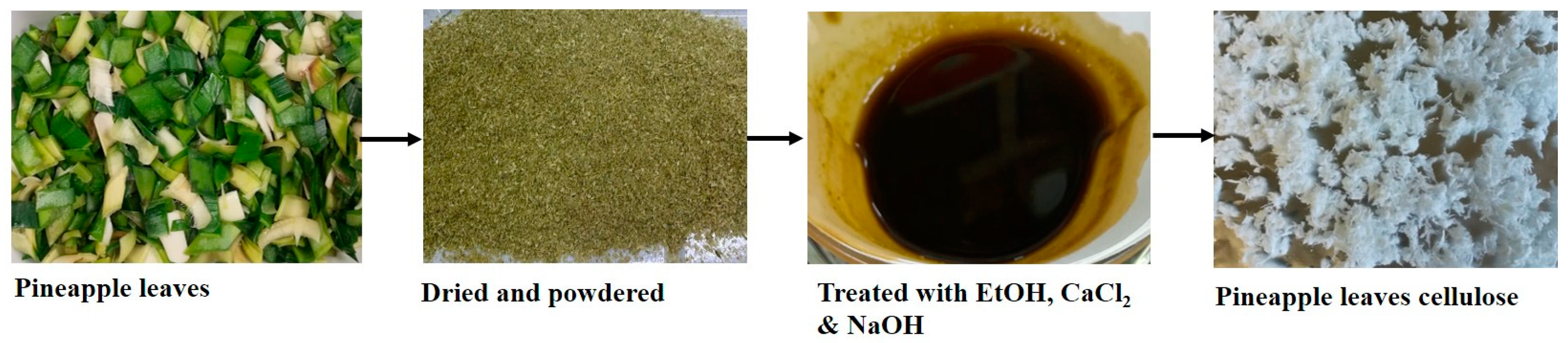
The pineapple leaves were purchased from the local market. The leaves were washed with running tap water, then with deionized water. The leaves were then cut into small pieces (approximately 1.0 square cm). Additional particles were further removed from the leaves by washing them in deionized water. The cut leaves were then soaked for 30 min in hot water in a beaker to remove additional organic materials. After washing, the leaves were dried for 24 h at 70 °C in an air oven. The dried leaves were ground to a fine powder using a mechanical blender and sorted into particles of less than 240 μm. Pineapple leaf fibers were extracted from the powdered sample as described previously [33]. In brief, 30 g of powder was soaked with 150 mL of ethyl alcohol (EtOH, 99.5%), 75 mL of 0.8 M calcium chloride (CaCl2), and 75 mL of 0.8 M sodium hydroxide (NaOH).
The solution was left to incubate at room temperature for 20 h. The fiber was then filtered, washed several times with distilled water to reach a neutral pH, air-dried, and the PLCs obtained were stored in a zip-locked bag at room temperature until further use for wastewater treatment. The schematic diagram of the PLC preparation process is illustrated in Figure 1.

2.3. Functional Group Analysis by Fourier Transform Infrared (FT-IR) Spectroscopy

The FT-IR spectroscopy was performed to investigate the surface functional groups of the PLC to identify the possible interactions involved in heavy metal adsorption. Absorbance mode was used in obtaining FT-IR spectra with a VERTEX 70v spectrometer (Bruker Optics GmbH, Ettlingen, Germany) in the 400–4000 cm−1 range. The scan was carried out at a resolution of 4 cm−1, and the Attenuated Total Reflectance (ATR) mode was applied with an average of 32 scans per sample to enhance the noise of the signal. The samples of the heavy metal-treated and untreated adsorbent PLC were treated to monitor the possible variation in the peaks that represent the functional groups that bind the metals. The obtained spectra were analyzed to determine the major functional groups, such as carboxyl (–COOH), hydroxyl (–OH), and amine (–NH2), which may play a crucial role in the heavy metal ion adsorption [34].

2.4. Scanning Electron Microscopy and Energy Dispersive Spectroscopy (SEM-EDS)

The SEM-EDS was performed under high vacuum conditions at an accelerating voltage of 15–25 kV. The surface morphology and elemental composition of the adsorbent (PLC) were analyzed both prior to and following metal adsorption using SEM coupled with EDS (SEM Hitachi 3400N) manufactured by Hitachi High-Tech Corporation (Hitachi High-Tech, Tokyo, Japan). The PLCs were treated with a 1.0 mM mixture of the three metals (As5+, Cd2+, and Pb2+) for 180 min at room temperature and constantly agitated at 160 rpm. The PLCs were collected, washed thoroughly with deionized water, dried, and then carefully mounted onto aluminum stubs using double-sided carbon tape to ensure conductivity and stability. A low-level coating of gold or platinum was then sputtered onto the samples using a vacuum magnetron sputter apparatus (Magnetron Sputter, RT1195006, R-TECH Co., Tokyo, Japan) to avoid charging in the electron beam. Micrographs were taken at different magnifications to examine surface texture, porosity, and structural variation, following the adsorption of metal ions. EDS was performed concurrently to establish the elemental composition of the adsorbent surface and confirm the existence of metal ions after the adsorption process. AVANTAGE software (Thermo Fisher Scientific, Waltham, MA, USA) was used to analyze high-resolution spectra and quantify results. The EDS spectra have been recorded by placing the electron beam on the areas of the adsorbent of interest, and the characteristic peaks of the target metal ions (e.g., As5+, Cd2+, Pb2+, etc.) have been identified. Any other components were omitted in the EDS analysis, while oxygen (O) and carbon (C) were used as background signals. A comparative EDS spectra analysis before and after adsorption was performed to provide evidence of successful heavy-metal attachment onto the adsorbent surface. Image mapping was performed using 64 images of the respective metals, each consisting of 256 pixels, to assess the existence of metal ions on the surface layers of PLC. Each analysis of SEM and EDS was repeated at various random positions so that reliable and representative data could be obtained.

2.5. ICP-MS Analysis

The concentration of heavy metal ions in aqueous solutions before and after adsorption of heavy metals by PLCs was determined using ICP-MS (Agilent Technologies, Santa Clara, CA, USA). Elemental analysis was performed using an Agilent 7900 quadrupole ICP-MS, equipped with a collision cell to reduce interferences and ensure high sensitivity. The PLCs were exposed to a mixture of three metal ions (As5+, Cd2+, and Pb2+) for 120 min with constant shaking at 160 rpm at 28 ± 1 °C. The control samples were subjected to shaking similarly, but without the PLCs. The suspension was then centrifuged at 8000 rpm by a high-speed refrigerated centrifuge to separate the PLC adsorbents from the aqueous phase. The cellulose-free liquid was subsequently filtered through a 0.45 μm membrane to remove small particles. All solutions were acidified with suprapure 2 M nitric acid (HNO3) and stored at 4 °C until subsequent analysis. The samples were adjusted to a fixed volume before injection to determine the metal contents.
All glassware and sample containers used in the study were rinsed with ultrapure deionized water and were soaked overnight in 10% (v/v) nitric acid to avoid contamination. Certified standard solutions of each metal ion (As5+, Cd2+, Pb2+) (1000 mg/L, Agilent Technologies, Santa Clara, CA, USA) were prepared as calibration standards and diluted with ultrapure water. Multi-element calibration was developed for all metals. Control samples were added to each batch to ensure accuracy and reproducibility. The ICP-MS samples were injected through a peristaltic pump and a nebulizer, and the spectroscopy was run through optimal conditions as suggested by the manufacturer. Each experiment was analyzed three times, and the average concentrations were noted. The information is given in the form of the mean and its standard errors (mean ± SEM).
The removal efficiency percentages (%) of metal ions were calculated using the following equations, as previously described [35,36]:
Cad = C0 − Ct
Adsorption   % = C a d C 0 × 100
where C0 represents the primary concentration, Ct represents the concentration at a time ‘t’ (ppm), and Cad is the concentration absorbed (ppm).
The adsorption capacity qe (mg/g) after equilibrium was calculated using the following equation:
q e   =   C a d W ( g ) . V ( m L ) 1000
where W represents the mass of PLC used (g), V represents the volume of the metal solution (mL), and qe represents the adsorption at equilibrium.
Adsorption isotherms give information on the adsorption capacity, surface characteristics, and binding affinity, which help understand the mechanism of interaction between the adsorbate and the adsorbent [37]. The equilibrium adsorption characteristics of PLC in the uptake of metals were also tested in this study based on the Langmuir isotherm model:
q e = q m a x K L C e 1 + K L C e
where qmax is the maximum adsorption capacity (mg/g), and KL represents the Langmuir isotherm constant that shows the strength of interaction between metals and PLC.
The isotherm constants may be determined as the slope and intercept of Langmuir plots, which are linearized. The linear equation of the Langmuir isotherm is given in the form:
1 q e = 1 K L q m a x . 1 C e + 1 q m a x
The separation factor (RL) was calculated using the Equation below:
R L = 1 1 + C i K L
where RL specifies the nature of adsorption: favorable (0 < RL < 1), unfavorable (RL > 1), linear (RL = 1), or irreversible (RL = 0) [38].
Furthermore, solution-phase adsorption data are commonly interpreted using the Freundlich isotherm, which can be represented in its linear logarithmic form as calculated using the following Equation, as previously described:
l n q e = 1 n ln c e + ln K F
Here, KF (mg g−1) denotes the Freundlich constant related to the adsorption capacity, and n represents the intensity of adsorption. Adsorption is deemed to be desirable when 1/n is within 0.1–1.0 [39].

2.6. Influences of pH on Adsorption

The influence of initial pH solution on heavy metal adsorption by PLC was investigated at different pH levels of the metal solution to determine the optimum pH for maximum adsorption. A series of batch adsorption experiments was carried out at varying pH levels of 1.0, 2.0, 3.0, 4.0, 5.0, 6.0, and 7.0 ± 0.1, each performed individually, to determine the adsorption capacity. Each metal ion solution was first maintained at the desired pH either with 0.1 M HCl or 0.1 M NaOH as needed, and the pH was then measured using a calibrated digital pH meter (Mettler Toledo International Inc., Columbus, OH, USA). Approximately 10 ± 1 mg PLCs were added per 10 mL cocktail containing 1.0 mM concentration each of the three metal ions (As5+, Cd2+, and Pb2+) in a 15 mL tube. The preliminary equilibrium studies led to the adsorption being conducted at 28 ± 1 °C for 180 min under constant shaking of 160 rpm. The PLC and metal solution were then separated by centrifugation, and the solution was filtered using a 0.45 μm membrane filter (Advantec Toyo, Tokyo, Japan). The concentration of metal ions in the filtrates was measured using ICP-MS. The pH-dependent adsorption behavior of PLCs was analyzed to find the optimum pH for biosorption. The optimum pH was then used for subsequent adsorption isotherm and kinetics experiments.

2.7. Influences of Contact Time on Adsorption

The effects of contact time on the heavy metal adsorption were investigated using batch adsorption experiments at predetermined time intervals. Approximately 10 ± 1 mg of PLCs was added per 10 mL cocktail containing 1.0 mM concentration each of the three metal ions (As5+, Cd2+, and Pb2+). The solution pH was maintained at the previously optimized value of 6.0 ± 0.1. The contact time of PLC for each adsorption was carried out for 0, 30, 60, 90, 120, 150, and 180 min with constant shaking at 160 rpm using a temperature-controlled orbital shaker set at 28 ± 1 °C. At each time point, the samples were filtered through a 0.45 µm membrane, and the concentration of metal ions was determined using ICP-MS.

2.8. Influences of Adsorbent Dosage on Adsorption

Biosorbent dosage was tested under batch conditions, and its effect on the heavy metal ions’ adsorption efficiency was assessed. Experiments were performed with an increasing dosage of PLCs ranging from 2.5 mg to 12.5 mg per 10 mL cocktail, containing a 1.0 mM concentration of each of the three metal ions (As5+, Cd2+, and Pb2+). The solutions were prepared with the metal and adjusted to the already optimized value at pH 6.0 ± 0.1. The tubes were shaken at 160 rpm in an orbital shaker at 28 ± 1 °C for 180 min to reach the equilibrium. Following incubation, the suspensions were filtered through a 0.45 μm membrane filter, and the metal concentrations were determined using ICP-MS.

2.9. Statistical Analysis

Each experiment was carried out three times, and the findings were reported as the mean (n = 3) value with error bars showing the standard deviation. The statistical analysis was performed using OriginPro 2021 software and a one-way ANOVA with a Bonferroni Post Hoc test.

3. Results and Discussions

Agricultural waste material, PLC, has a high potential for adsorption because of its fibrous nature, which offers a vast number of surfaces on which metal ions can be attached. The surface functionality with hydroxyl and carboxyl groups on the surface augments the ability to adsorb metal ions. The present study examined the adsorption of selected heavy metal ions by the PLC employing batch experiments. Overall, the adsorption performance of the PLC was influenced by several factors, such as contact time, biosorbent dosage, and pH. Compared with similar biosorbents reported in the literature, PLC demonstrated a competitive advantage in adsorption capacity for metal ions [40]. To this end, the use of agricultural waste-derived materials as adsorbents has gained prominence, offering a two-fold advantage of waste management and heavy metal pollutant remediation at reduced cost [41].

3.1. Elemental Analysis Using SEM-EDS

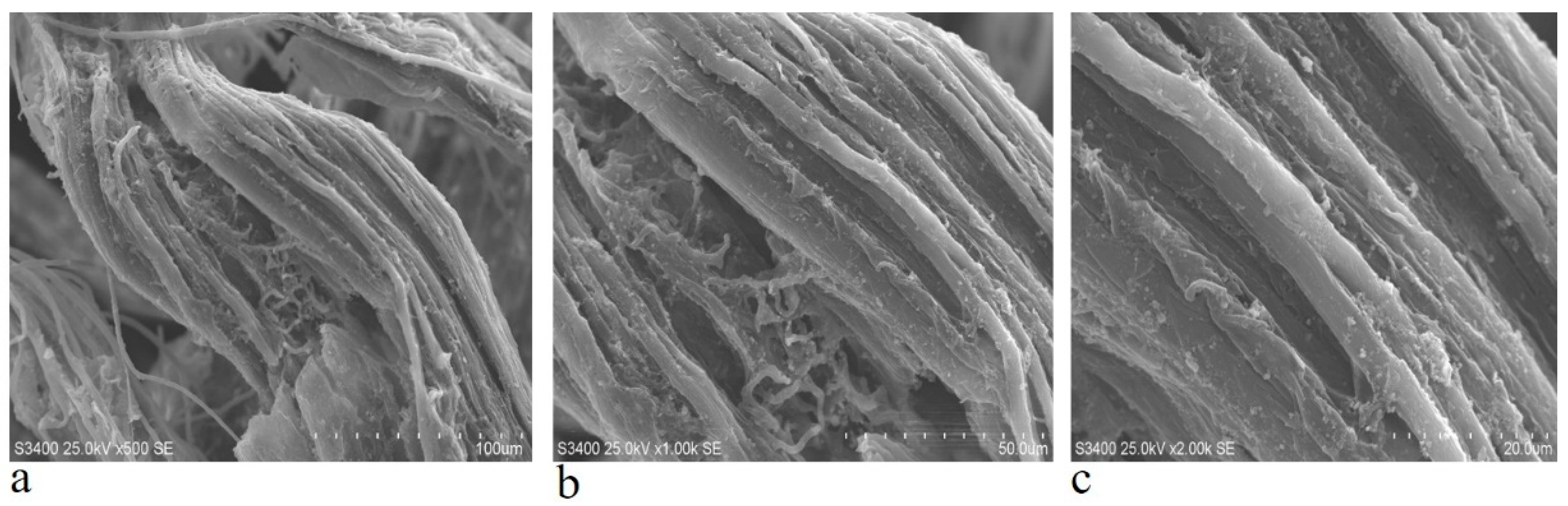
The surface morphology and elemental composition of the PLC were observed by using SEM-EDS before and after exposure to the cocktail of the three heavy metal ions (As5+, Pb2+, and Cd2+). In scanning electron micrograph images at higher magnifications of 500×, 1000×, and 2000×, the PLC exhibited more small chips and uneven surface, many small hills, and irregular shapes, in the presence of the metals (Figure 2a–c). These changes indicate that there is an exchange between metal ions and the biosorbent matrix in the adsorption process. The heterogeneous surface of the PLC exposed to the metal ions could be attributed to the enhanced adsorption performance of this cellulose compared to that of smooth cellulose [42]. After exposure to the solution of metal ions for 180 min, the PLC seemed enflamed and larger at 2000× magnification (Figure 2c).
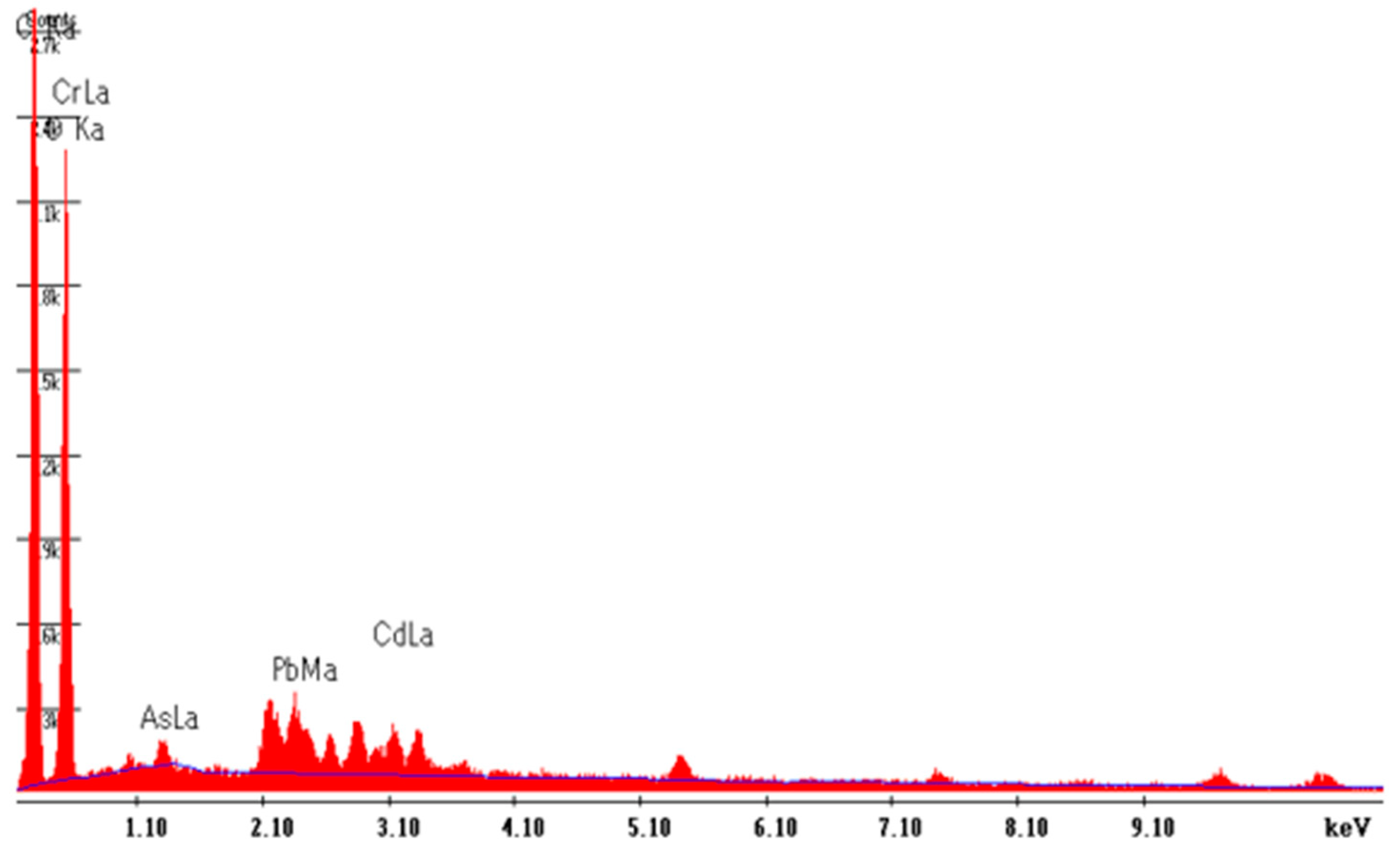
Figure 3 presents the EDS elemental analysis of PLC, indicating the presence of carbon (C), oxygen (O), arsenic (As), cadmium (Cd), and lead (Pb). The results showed that carbon and oxygen were the most common elements on the surface of all cellulose samples. Following exposure to metal solutions, EDS spectra showed the emergence of peaks corresponding to As5+, Pb2+, and Cd2+ on the surface of the biosorbent, indicating successful adsorption.
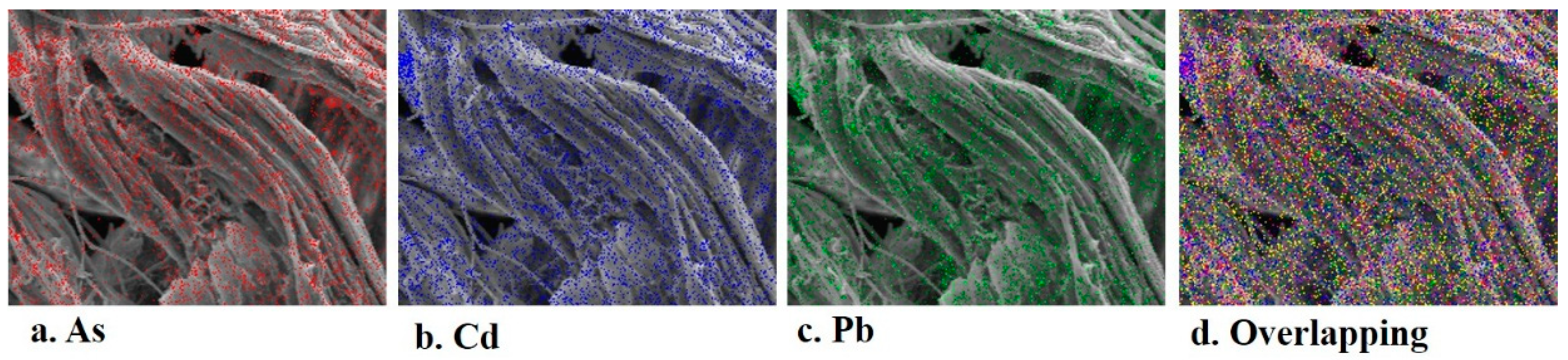
EDS elemental mapping and overlay analysis were carried out to confirm how the metal ions (As5+, Cd2+, and Pb2+) were distributed on the PLC surface. Analysis with mapping showed that these metal ions were spread quite evenly on the PLC surface (Figure 4a–d). The analysis demonstrated that different metal ions appeared in distinct colors, as defined by the EDS settings. Moreover, EDS examination revealed that the PLC was covered with all three metal ions on the surface, and the intensity was uniform throughout the whole mapping region. Analysis of the EDS spectra identified As5+ ions with significantly greater intensity (Figure 4a). However, the biosorption values determined by ICP-MS were lower. Thus, EDS spectra complemented with good qualitative data, however, cannot be used to assess the biosorption efficiency quantitatively. The overlapped mapping with all three metal ions is shown in Figure 4d. The PLC was treated with a metal-free solution, which served as the control where no metal ions were detected.

3.2. Fourier Transform Infrared (FT-IR) Spectroscopy Analysis

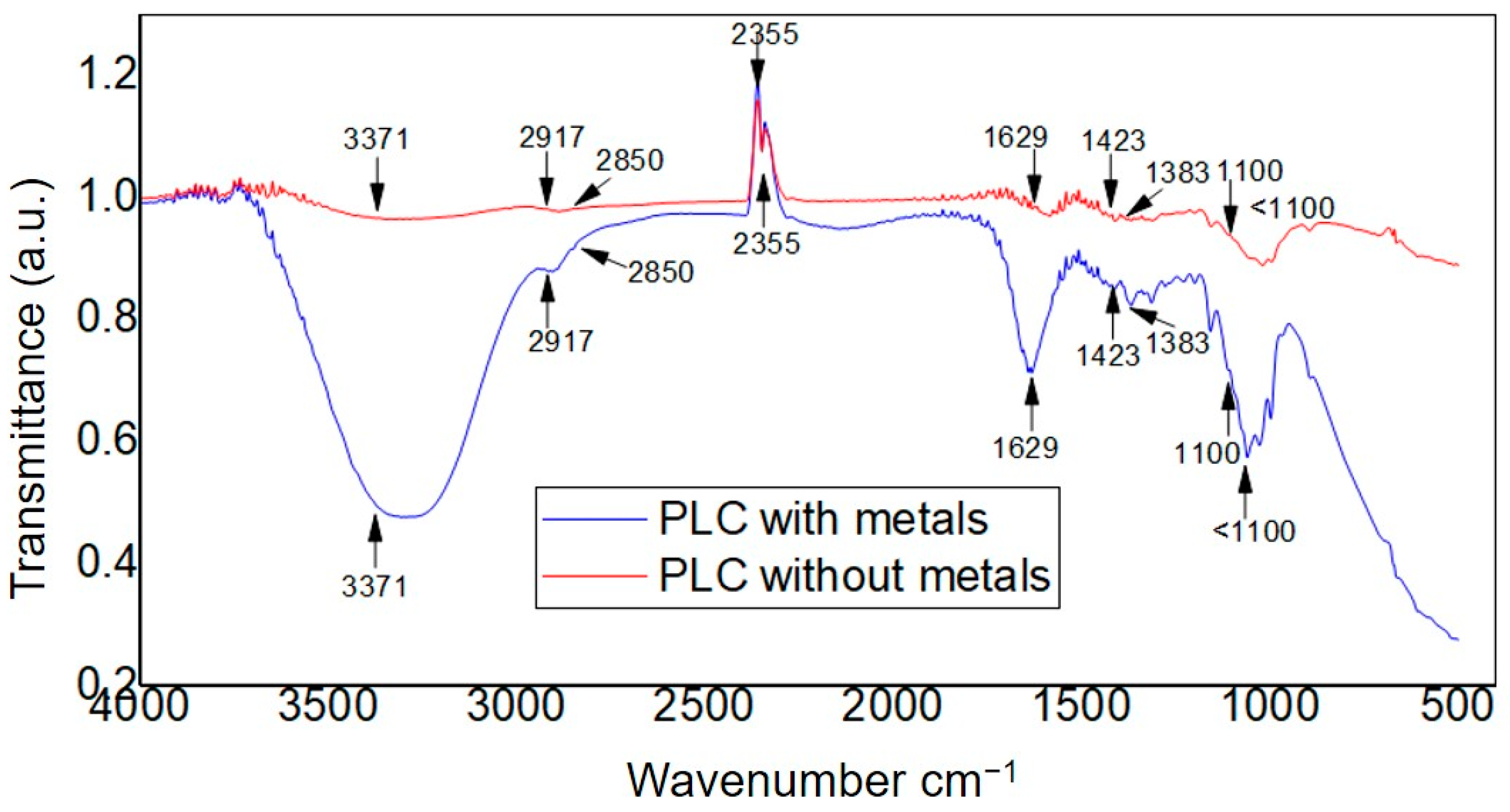
Cellulose has functional groups like hydroxyl, carboxyl, and amide, which make it an attractive material for binding heavy metal ions in the solutions [43]. The functional groups on the surface of PLC were identified using FT-IR spectroscopy, and their roles in the adsorption of As5+, Pb2+, and Cd2+ ions were examined. The FT-IR spectra of PLCs were noted earlier and after exposure to a mixture of metal ions, showing several distinctive peaks linked to functional groups that are known to be associated with metal adsorption (Figure 5).
A weak absorption band was detected before the adsorption process at the range of 3330–3350 cm−1, which is related to the O-H stretching vibration of the hydroxyl groups, which characterizes structures of cellulose and hemicellulose [44]. The peak near 2900 cm−1 was assigned to the C–H stretching of aliphatic groups [45]. The absorption band at 1629 cm−1 is consistent with the asymmetric stretching vibration of carboxylate (COO) groups, suggesting the presence of carboxylate anions [7]. Peaks in the 1000–1100 cm−1 range were linked to the C–O–C stretching of ethers and alcohols, which is characteristic of the backbones of cellulose [46].
Following the adsorption of the metal ions (As5+, Pb2+, and Cd2+), a noticeable shift in peak positions and intensity changes was observed in the functional groups. The wide O-H region also moved slightly down to lower wavenumbers, between 3340 and 1 cm−1 and 3310–1 cm−1, which further indicated that the hydroxyl groups were either hydrogen-bonded or chelating the metals [47]. There was also a slight change and a reduction in intensity of the carbonyl peak at around 1720 cm−1 as evidence of coordination or electrostatic attraction of metal ions. The intensities of C=O and C–O bands changed noticeably in the case of As5+ adsorption, which possibly indicates that complexation or electrostatic interaction with chromate ions occurred [44]. Both the O–H and C–O–C peaks showed more noticeable changes for both the metal ions, Pb2+ and Cd2+, which is consistent with the creation of bonds with oxygen. The analysis of FT-IR spectroscopy data revealed the areas referred to as the “fingerprint region” [46], either ranging from 950 cm−1 to 1200 cm−1, or below 1100 cm−1, or ranging from ~400 cm−1 to ~1100 cm−1. However, fingerprint regions are intricate and difficult to identify due to multiple series of absorptions, including numerous significant functional group vibrations [45]. The wavenumber region, 1000 cm−1–1100 cm−1, involved in C–O stretching may contain ethers and carboxylic functional groups, while the region, 950 cm−1–700 cm−1, associated with C–H bending may contain alkenes.
Additionally, the wavenumber region, 600 cm−1–400 cm−1 involved in metal complexes with inorganic compounds [45,46,48]. These spectral changes confirm the active involvement of hydroxyl, carbonyl, and ether groups on the surface of PLC in the biosorption of heavy metal ions. The interaction is likely performed via ion exchange, surface complexation, and hydrogen bonding mechanisms, which may differ a little based on the ionic nature and the size of the metal ions.

3.3. ICP-MS Analyses

The removal effectiveness of As5+, Pb2+, and Cd2+ ions from contaminated solutions by PLC was quantitatively assessed by ICP-MS. Analyses of batch adsorption studies under ideal conditions, including pH, contact time, and adsorbent dosage, confirmed a significant decrease in the concentration of all three metal ions relative to their starting values, confirming the potential effectiveness of PLC in the adsorption of the heavy metal ions.

3.3.1. Effect of pH

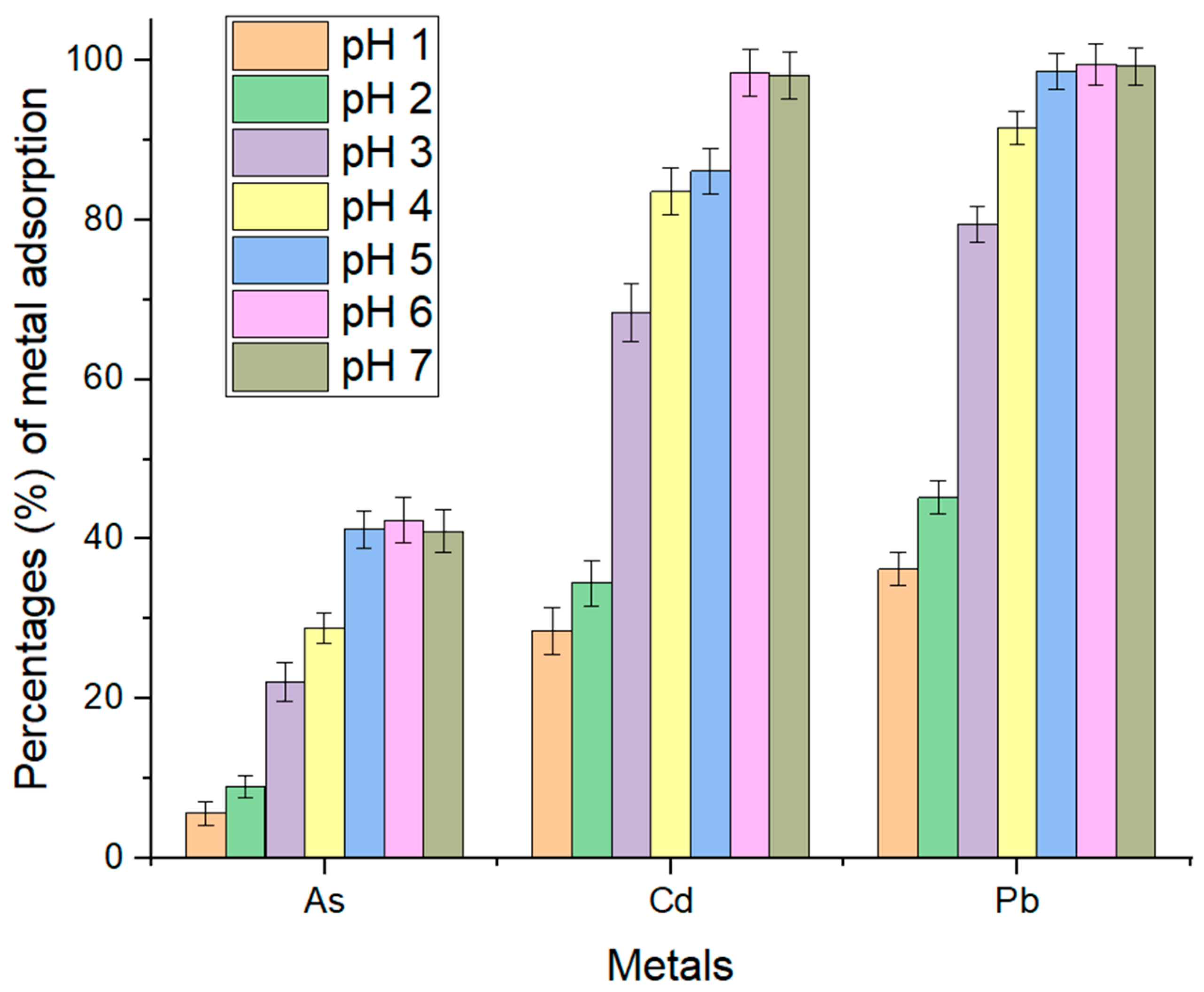
The initial pH of the metal solution is one of the most important factors influencing the adsorption capacity, as well as the adsorption process, which impacts the protonation of functional groups [39,49,50]. Given that certain metals precipitate under alkaline conditions [51], we have, therefore, conducted our investigations at different pH levels between 1 and 7 (Figure 6). It was observed that heavy metals were adsorbed by the PLC, mainly at pH 3 to 7. There was a strong decrease in adsorption at pH 1 and 2 and a linear increase between pH 3 and 7, presumably because more favorable electrostatic interactions were possible and increased binding sites were accessible on the surface of the PLC.
Maximum removal of arsenic was observed at pH 6–7, whereas the maximum Pb2+ and Cd2+ ions removal was observed at a pH of 3 to 5 and 4 to 7, respectively (Figure 6). The highest adsorption by the PLC was observed at pH 6.0 for all the metal ions (As5+, Pb2+, and Cd2+) used in this study. The electronegative functional groups on the surface were protonated under acidic conditions, transforming the celluloses into positively charged anion-binding objects [35,52]. The adsorption of the metal ions showed no significant variation over the pH range 4–7. The highest adsorption was observed at pH 6.0 for all the metals used in this study. In a similar study by Sukprom et al., adsorption using modified pineapple leaves cellulose showed that the highest Pb2+ adsorption was achieved at pH 3, when modified pineapple leaves cellulose was used [53]. Another study demonstrated that the Pb2+ biosorption capacity from synthetic wastewater increased sharply at pH values ranging from 2 to 4. However, a slight decrease in biosorption was observed at pH 6.0 due to the formation of soluble hydroxyl complexes [54]. It has been demonstrated that the adsorption of Pb2+ and Cd2+ by modified pineapple leaves was reduced with reducing pH values from 1 to 3 [40]. The difference in adsorption performance is due to the change in sample preparation methods, in contrast to those used in the present work. The research conducted by Thakur and Gupta (2024) proved that pineapple residue was capable of adsorbing Pb2+ to the maximum at pH 4 [55]. The relatively lower reduction rate of As5+ may be due to a weaker chemical affinity between PLC and As5+ ions (Figure 6), leading to reduced adsorption, which may exhibit lower affinity compared to other metal ions. Conversely, PLC is also highly likely to establish stronger surface complexes with the Pb2+ and Cd2+ ions, hence achieving higher adsorption rates with these metals.

3.3.2. Influence of Adsorbent Dosage on Adsorption

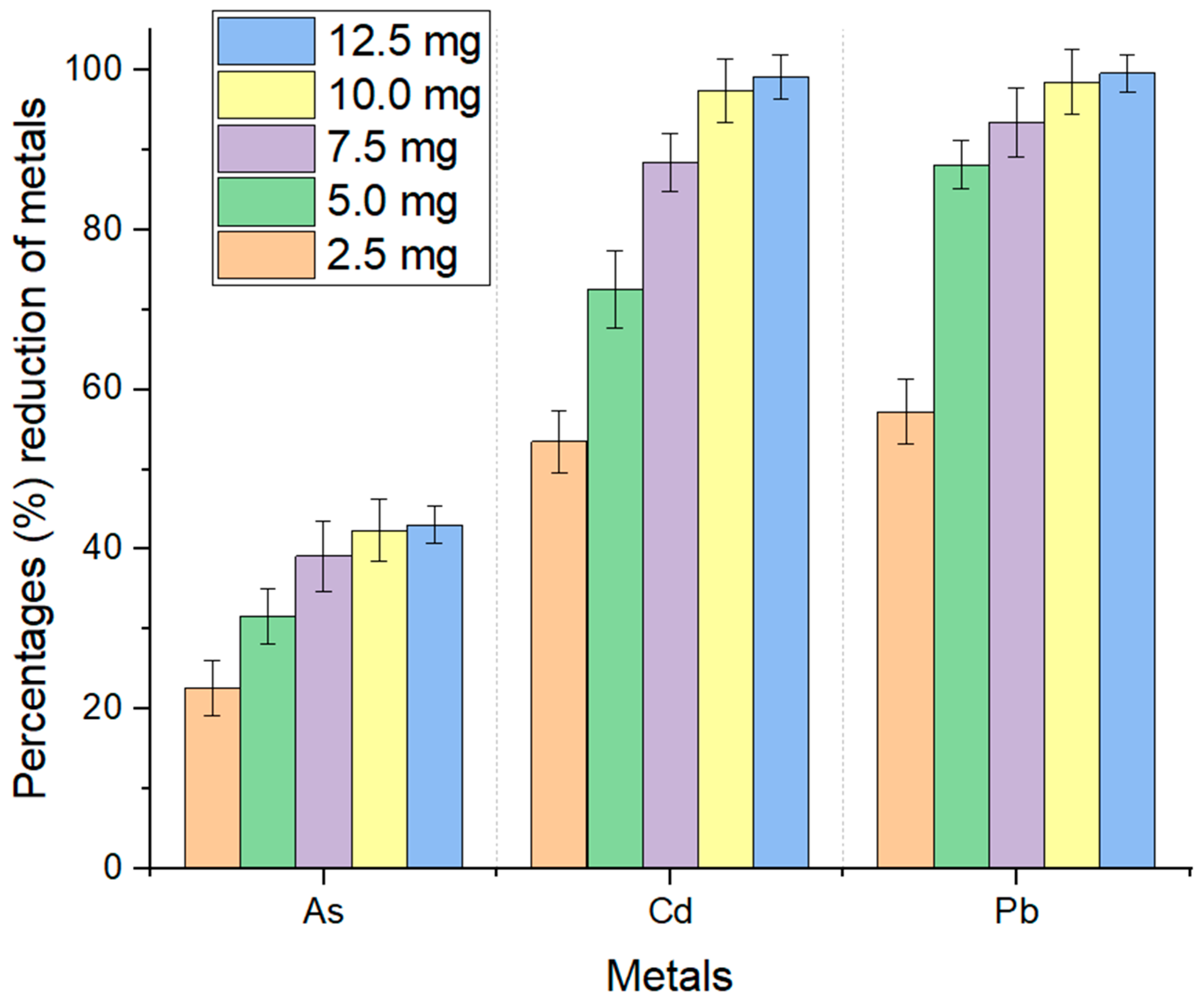
The initial dosage plays a crucial role in determining the removal efficiency, adsorption process, and adsorption capacity, among other parameters under investigation. The results of adsorbent (PLC) dosage revealed that the biosorption of all metal ions progressively increased as the dosage was raised from 2.5 to 12.5 mg/10 mL (Figure 7). The adsorption reached 43.03%, 99.15%, and 99.65% removal of As5+, Cd2+, and Pb2+, respectively, at a PLC concentration of 12.5 mg/10 mL. The removal of heavy metals by cellulose involves several mechanisms, such as complexation, flocculation, electrostatic interactions, physical adsorption, and chemical adsorption [56,57]. At a low dosage of the adsorbents, the amount of available functional active sites of the adsorbents was minor, hence the capacity of the heavy metals adsorbed by the adsorbents was limited. The removal rate was enhanced sharply by increasing the dosage of the PLC from 2.5 to 12.5 mg/10 mL (Figure 7). Owing to its surface characteristics and strong affinity for metal ions, PLC exhibited effective adsorption capacity. Similarly, several studies demonstrated that an increase in the dosage of adsorbent obtained from different fruit waste improved the metal removal efficiency [35,52,58]. Moreover, increasing the adsorbent dosage provided a greater number of surfaces rich in functional groups, thereby enhancing the overall adsorption of metal ions [59].
With increasing PLC dosages (2.5/10 mL to 12.5 mg/10 mL), the adsorption ability of As5+, Cd2+, and Pb2+ increased from 22.63 to 43.03%, 53.50 to 99.15%, and 57.20 to 99.65%, respectively (Figure 7). Furthermore, with a constant adsorbent mass, higher solution or effluent concentrations result in a reduced volume that can be effectively treated [60]. Therefore, 10 mg of PLC per 10 mL was chosen to be the optimal dosage for metal-ion removal from the solutions. Previous studies have also reported that increasing the adsorbent dose enhances metal removal efficiency [35,61,62,63,64]. This is due to the increased available surface area and the increase in functional groups on the adsorbent with increasing dosage. The adsorption capacity of PLC, hence the metal removal efficiency, is directly proportional to its surface area, exposing the binding sites for metals to interact with metal ions.
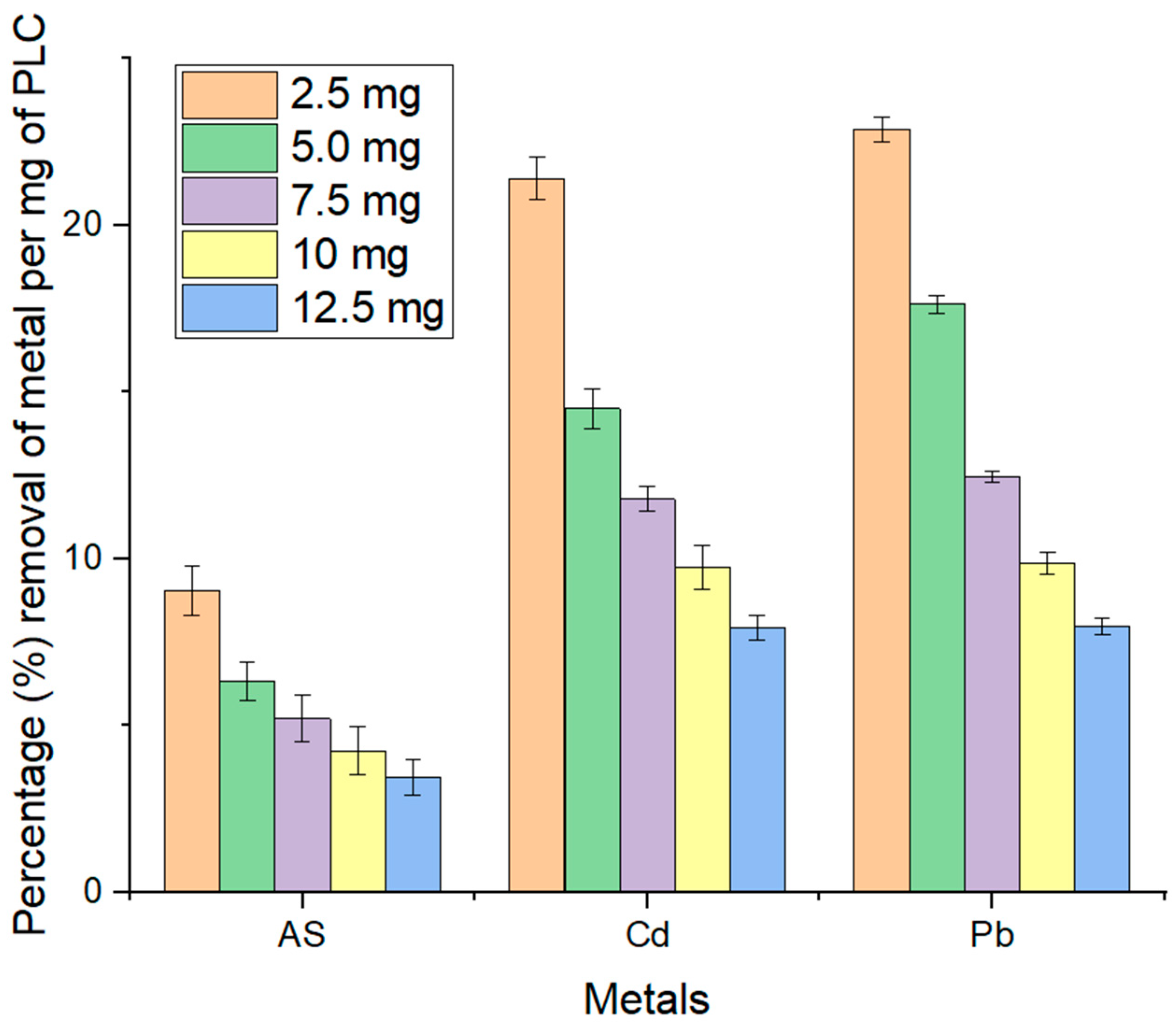
The adsorption rate of metal ions was quantified according to the amount of adsorbent applied. The higher the dosage of the adsorbents, the lower the unit adsorption. In certain instances, the decrease in adsorption capacity as the adsorbent dosage increased was attributed to possible aggregation or saturation of active sites. (Figure 8). The results demonstrated that unit adsorption of As5+ declined from 9.05 to 3.44 mg/g as the adsorbent dose increased from 2.5 to 12.5 mg/10 mL. A similar trend was observed for Cd2+ and Pb2+ (Figure 8). It is important to note that the adsorption attained almost maximum levels using only small quantities of adsorbent. The decreasing unit adsorption values at increasing dosages are probably due to aggregation of surface sites that interact with metal ions in solution. This implies that the lower unit adsorption values might have resulted from a decrease in the availability of metal ions as additional adsorbent was added.

3.3.3. Influence of Contact Time on Adsorption

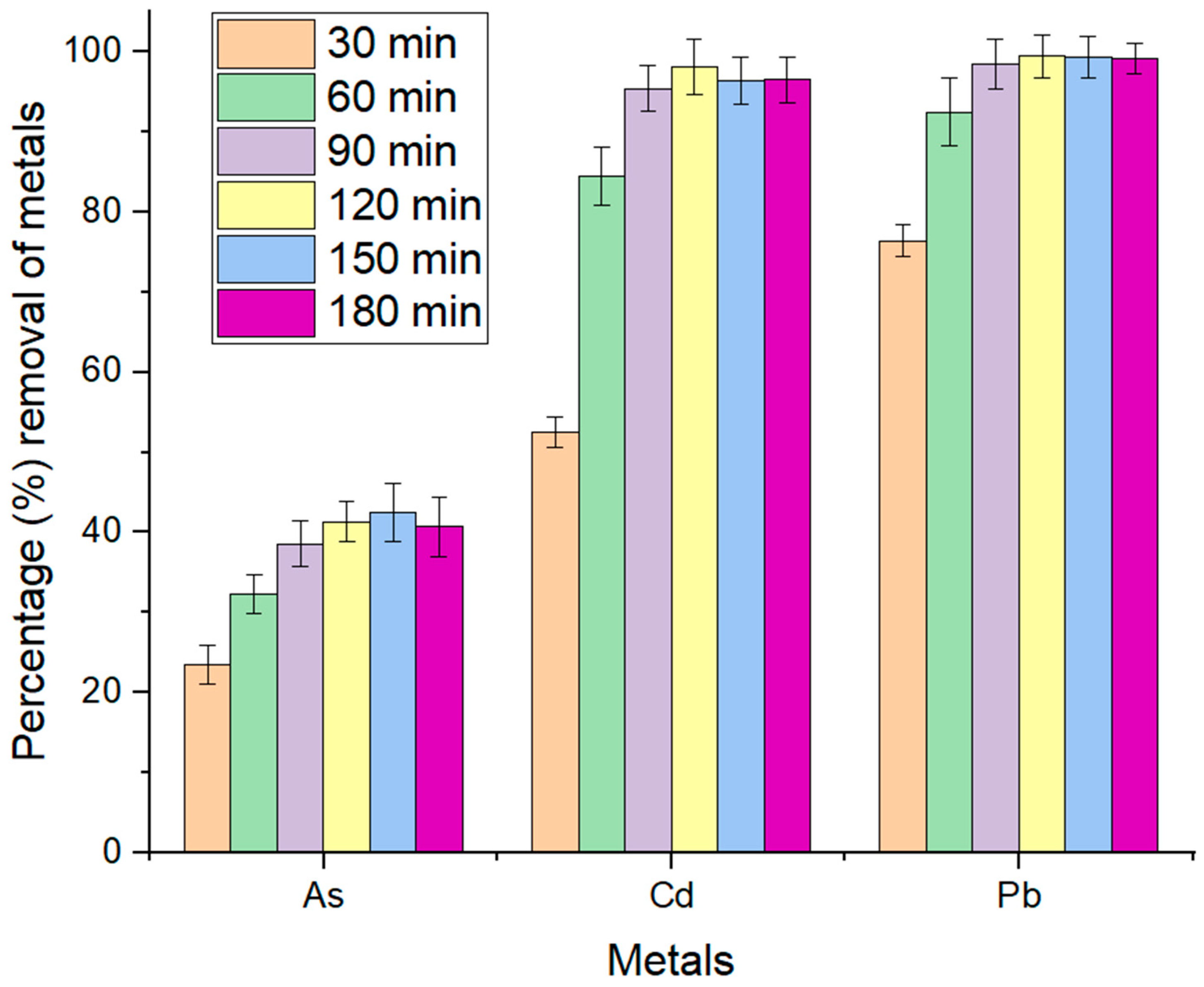
The influence of interacting time on metal adsorption is the most crucial factor for the efficient remediation of metals from the aquatic environment. The amount of solute or sorbate removed may be decreased as the contact time increases due to saturation of the cellulose surface. A decrease in contact time longer than the preferred level would also mean an incomplete interaction between the adsorbent surface and the metal ions. The influence of contact time on the adsorption of As5+, Cd2+, and Pb2+ by PLC was examined under optimum conditions. As demonstrated in Figure 9, the adsorption of metal ions was enhanced sharply within the first 30 min and then gradually elevated up to 90 min, followed by a rate that remained almost constant until 180 min. The adsorption of Cd2+ and Pb2+ was found to be the same throughout the duration of the contact time (Figure 9). The optimum adsorption of As5+ was recorded at a time point of 150 min, whereas the optimum adsorption of Cd2+ and Pb2+ was recorded at 120 min. Recently, it has been demonstrated that the equilibrium adsorption of Pb2+ was achieved in approximately 30 min [55]. Using activated carbon of pineapple leaf, 92.67% adsorption of Pb2+ was achieved in approximately 120 min [65], in agreement with the observations reported in this study. In another study using pineapple core activated carbon, the adsorption of 51.47% of Pb2+ was achieved by 24 h [66]. Using modified pineapple waste, an adsorption of 85.88% for lead ions was reached by 60 min [54]. Daochalermwong et al. demonstrated that the optimum time for Cd2+ and Pb2+ removal was 90 min using modified pineapple leaf waste [40]. Mopoung and Kengkhetkit investigated the efficiency of NaOH-modified pineapple waste for the adsorption of cadmium and lead from aqueous solution [67]. The study reported that Pb2+ reached adsorption equilibrium after 30 min, and Cd2+ reached equilibrium after 60 min on treated pineapple waste. Several other studies have shown that the highest As5+ adsorption capability of pineapple peel is 5.48 mg/g after 120 min [68]. It was observed that the adsorption rate was higher during the initial stages, indicating that the adsorbent had a high affinity for metal ions, hence the ions rapidly occupied the surface of the adsorbent [15,69]. The present study demonstrated that 60 min appeared to be the optimum contact time for removing As5+, Cd2+, and Pb2+ using PLC in an aqueous solution (Figure 9).
As anticipated, using different adsorbents, each metal ion exhibited a different maximum adsorption capacity in the aquatic environment within the optimized experimental conditions. The PLC adsorbents, which contain lignin, cellulose, and hemicellulose, would exhibit distinct adsorption mechanisms for various metal ions. The mechanism might be involved in the complex formation between heavy metal ions and the functional groups (phenolic, hydroxyl, and carboxylic) present on the surface of the adsorbents [32]. It is challenging to stabilize lead, cadmium, and arsenic simultaneously in the contaminated sources because their physical and chemical properties differ [70]. Such variation was attributed to several factors, including the nature of the bioadsorbent employed, the metal ions studied, and their respective concentrations. Contrary to the findings of the current study, a kiwi peel bead has been demonstrated to exhibit adsorption efficiency in the order Cd2+ > Pb2+ > Cr3+, corresponding to removal rates of about 92%, 67%, and 34%, respectively, under simultaneous ion removal conditions [35,36].

3.4. Analysis of Kinetic Adsorption

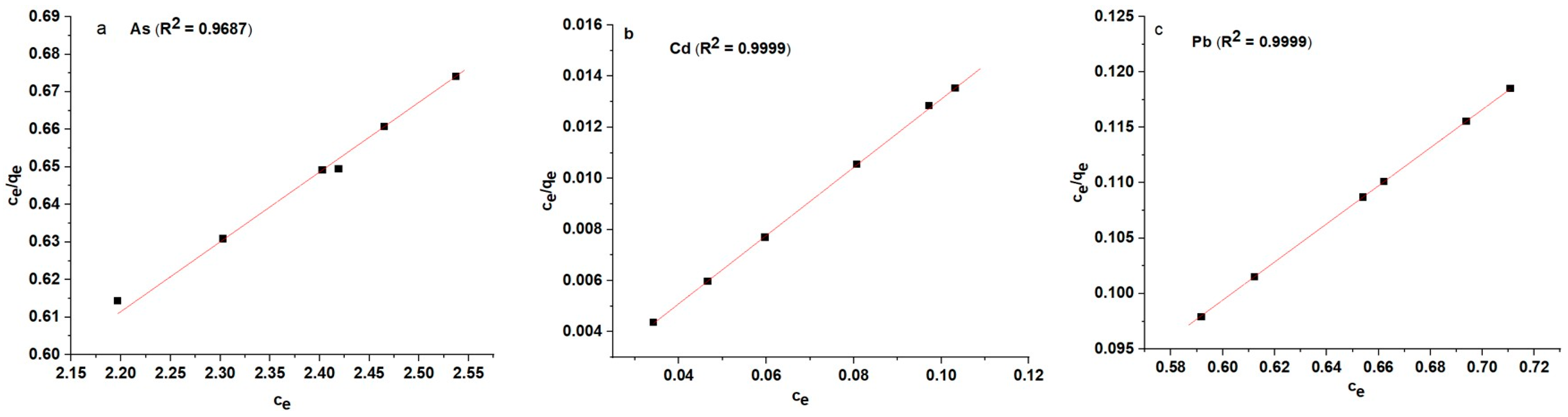
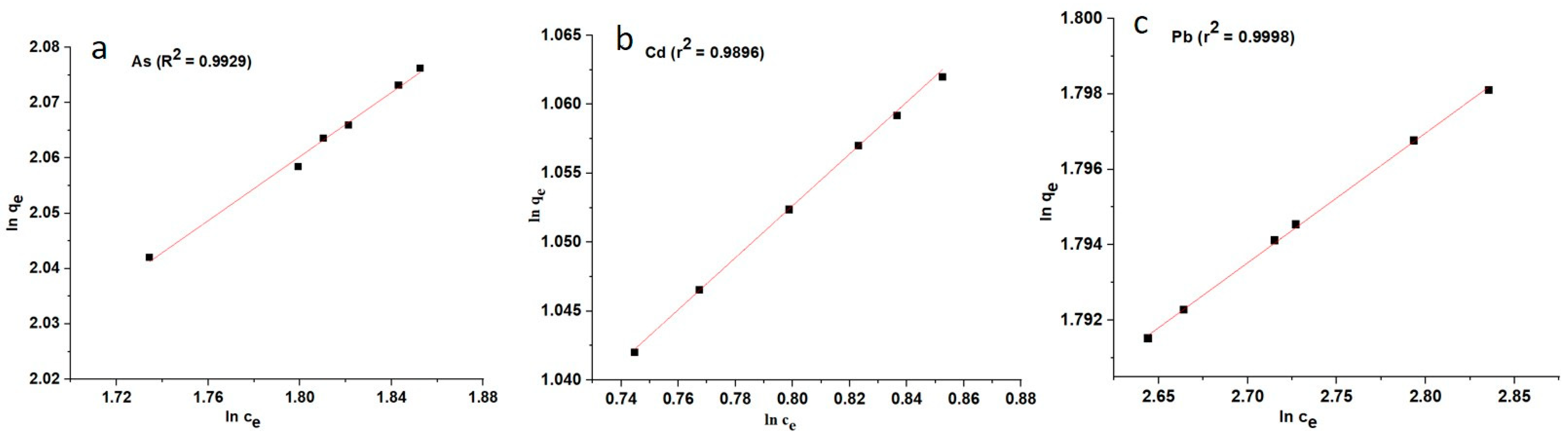
The Langmuir model is used when the adsorption is on a homogeneous surface, which is covered with a monolayer, whereas the Freundlich model takes into consideration the multiple-layer adsorption of the adsorbent on a heterogeneous surface [36]. Both of these isotherms are common in modeling sorption data in aqueous solutions. The equilibrium values were well fit by the Langmuir and the Freundlich isotherm models. Fitting curves of the Langmuir and the Freundlich isotherm models are plotted in Figure 10a–c and Figure 11a–c, respectively.
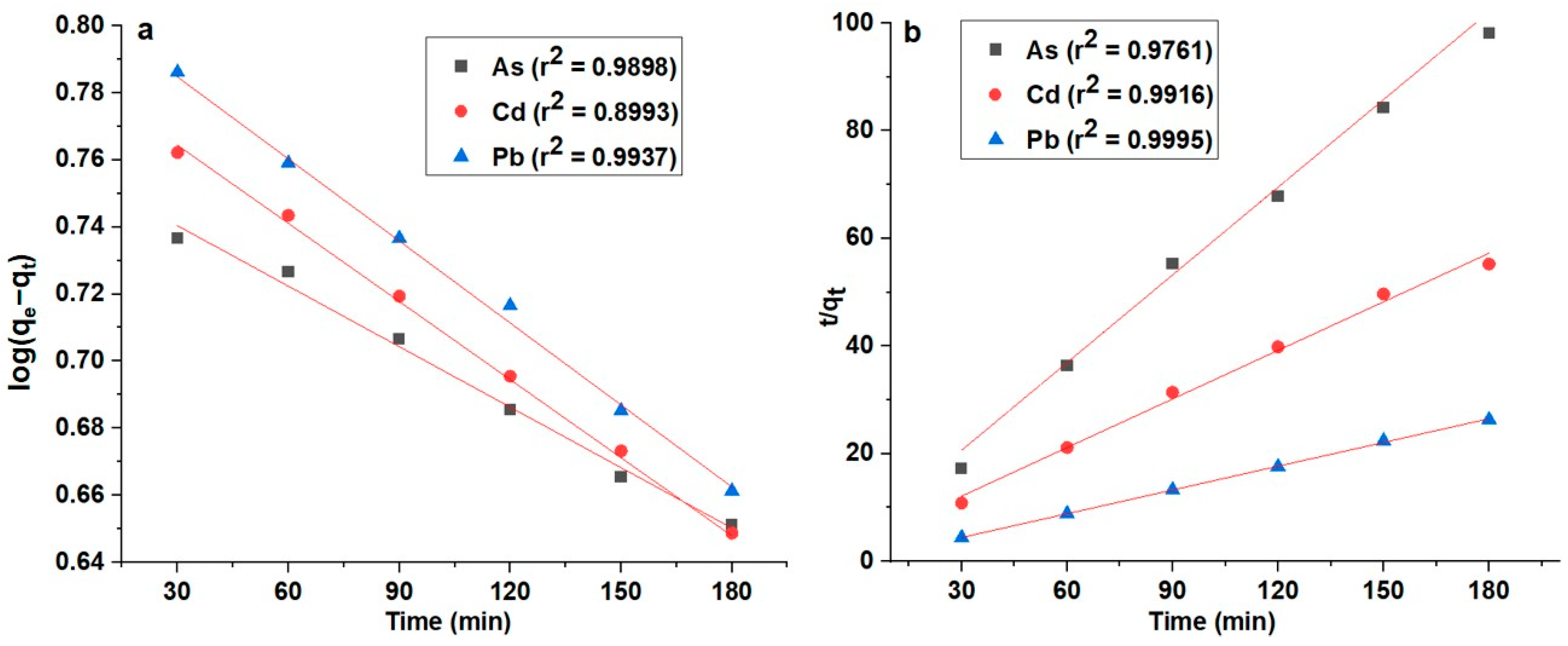
Figure 10 presents the Langmuir parameters, and Figure 11 presents the Freundlich isotherm models along with their corresponding linear regression coefficients (R2). The R2 values were calculated in order to test the statistical significance of the experimental linear correlations. The relevant adsorption parameters are summarized in Table 1. The kinetic study of PLC for each metal ion adsorption was carried out by fitting the experimental data into two common models: pseudo-first-order and pseudo-second-order. The most suitable and best-fit model for metal adsorption onto PLC appeared to be pseudo-second-order kinetics (Figure 12). The corresponding adsorption parameters are presented in Table 1. Thus, it is clear that the rate-limiting step in the adsorption process could be chemisorption via valence forces, involving electron exchange between the adsorbent and the heavy metal ions. The better agreement of experimental data with the pseudo-second-order equation confirms our assertion that the chemisorption model was involved in the current study. The results could be ranked as follows for the experimental metal ions: Pb2+ > Cd2+> As5+.
The maximum adsorption performance of materials based on pineapple cellulose for the removal of lead, cadmium, and arsenic from aqueous environments is summarized in Table 2 along with the respective references. Adsorption capacities reported in the literature are spread extensively, being dependent on the type of heavy metals used, the experimental conditions, and the method of cellulose modification. The use of pineapple waste in arsenic remediation is lacking, and the literature indicates relatively low to moderate adsorption efficiency of arsenic. On the other hand, other reports show enhanced cadmium and lead uptake using pineapple cellulose. These variations may be explained by the modification of cellulose matrix binding affinities of certain metal ions, porosity, and surface functional groups. The variety of results proves the promise of pineapple-based cellulose as an environmentally friendly biosorbent; however, it also makes it clear that it is necessary to adjust its chemical and structural composition to achieve the most advantages in eliminating target pollutants. The cited publications provide a positive basis for the establishment of pineapple cellulose-based sorbents to be used in environmental remediation and treatment of wastewater. In the present study, cellulose was used in its raw form without being fabricated into beads or membranes, which limits its mechanical stability and practical reusability. Therefore, reuse experiments were not included in this work.
Based on the FT-IR and SEM-EDS analyses, as well as the pH-dependent adsorption behavior, the adsorption mechanism of heavy metals onto PLC is mainly attributed to surface complexation, electrostatic attraction, and ion-exchange processes. The FT-IR spectra revealed the presence and enhancement of oxygen-containing functional groups, such as hydroxyl (–OH), carboxyl (–COOH), and ether (–C–O–C) groups on the PLC surface after chemical treatment. These functional groups serve as active metal-ion binding sites.
Deprotonation of surface functional groups at the optimum pH enhances the density of negative charge on the PLC, which facilitates the electrostatic attraction between the functional groups and positively charged Cd2+ and Pb2+ ions. The removal of Pb2+ and Cd2+ was relatively more efficient than that of As5+, attributed to their stronger affinity for these functional groups and their broader ionic radii with which to form complexes. In the case of As5+, adsorption is primarily controlled by ligand exchange and surface complexation processes; the arsenate species are found primarily as oxyanions. Hydrogen bonding and inner-sphere complex formation between these species and the surface hydroxyl groups on the PLC surface led to relatively reduced adsorption efficiency.

4. Conclusions

In this study, cellulose derived from pineapple leaf waste was employed as an efficient biosorbent for metal ions in wastewater. The data revealed that a natural and sustainable cellulose material could be used for practical applications in wastewater treatment for heavy metals at a low cost, potentially providing long-term and widespread environmental benefits and, consequently, improving human health. In addition, the remediation of heavy metals from wastewater using PLC, an agricultural waste by-product with high metal adsorption capacity and ease of collection, could provide an eco-friendly solution. PLC is suitable for future adsorption studies on heavy metal ions in aqueous solutions of both single and multi-component systems, and we expect its practical application in natural environmental settings. Nevertheless, for the PLC material, an increase in temperature or an extended reaction time will generate more –COOH, –OH, and –NH2 functional groups, which might exhibit higher adsorption capacity, especially for cation adsorption. In addition, the synthesis procedure was followed by hydrothermal treatment, which led to significant enhancement of the –COOH, –OH, and –NH2 functional groups, establishing a unique morphology with a higher surface area and better mechanical strength. These superior and favorable characteristics make PLC a strong candidate for future research in large-scale applications, remediating heavy metals from the aquatic environment. A limitation of the current study is that zeta potential measurements were not used due to a lack of corresponding instrumentation, as such measurements would have given more information regarding the nature of the surface charges and the adsorbent-adsorbate interactions.

Funding

The author appreciates the funding from the Deanship of Scientific Research, Vice Presidency for Graduate Studies and Scientific Research, King Faisal University, Al-Ahsa 31982, Saudi Arabia (Ambitious Researcher Track, KFU254704).

Data Availability Statement

The data used in this study are available from the corresponding author upon reasonable request.

Acknowledgments

The author is grateful to The Japan Society for the Promotion of Science (JSPS, ID. P20766) and Genta Kobayashi for the resources. The author used Mendeley Desktop (version 1.19.8) for reference management. In addition, the author used Grammarly Premium (cloud-based) and QuillBot Premium (cloud-based) software to improve the English language quality.

Conflicts of Interest

The author declares no conflicts of interest.

References

  1. Oladimeji, T.E.; Oyedemi, M.; Emetere, M.E.; Agboola, O.; Adeoye, J.B. Heliyon Review on the Impact of Heavy Metals from Industrial Wastewater Effluent and Removal Technologies. Heliyon 2024, 10, e40370. [Google Scholar] [CrossRef] [PubMed]
  2. du Plessis, A. Persistent Degradation: Global Water Quality Challenges and Required Actions. One Earth 2022, 5, 129–131. [Google Scholar] [CrossRef]
  3. Jaishankar, M.; Tseten, T.; Anbalagan, N.; Mathew, B.B.; Beeregowda, K.N. Toxicity, Mechanism and Health Effects of Some Heavy Metals. Interdiscip. Toxicol. 2014, 7, 60–72. [Google Scholar] [CrossRef] [PubMed]
  4. Briffa, J.; Sinagra, E.; Blundell, R. Heavy Metal Pollution in the Environment and Their Toxicological Effects on Humans. Heliyon 2020, 6, e04691. [Google Scholar] [CrossRef]
  5. Himeno, S.; Aoshima, K. Cadmium Toxicity Introduction; Springer: Berlin/Heidelberg, Germany, 2019; ISBN 9789811336294. [Google Scholar]
  6. Charkiewicz, A.E.; Omeljaniuk, W.J.; Nowak, K.; Garley, M. Cadmium Toxicity and Health Effects—A Brief Summary. Molecules 2023, 28, 6620. [Google Scholar] [CrossRef]
  7. Rahman, A. Promising and Environmentally Friendly Removal of Copper, Zinc, Cadmium, and Lead from Wastewater Using Modified Shrimp-Based Chitosan. Water 2024, 16, 184. [Google Scholar] [CrossRef]
  8. Badmus, S.O.; Oyehan, T.A.; Saleh, T.A. Synthesis of a Novel Polymer-Assisted AlNiMn Nanomaterial for Efficient Removal of Sulfate Ions from Contaminated Water. J. Polym. Environ. 2021, 29, 2840–2854. [Google Scholar] [CrossRef]
  9. Elbana, T.A.; Magdi Selim, H.; Akrami, N.; Newman, A.; Shaheen, S.M.; Rinklebe, J. Freundlich Sorption Parameters for Cadmium, Copper, Nickel, Lead, and Zinc for Different Soils: Influence of Kinetics. Geoderma 2018, 324, 80–88. [Google Scholar] [CrossRef]
  10. Saleh, T.A. Protocols for Synthesis of Nanomaterials, Polymers, and Green Materials as Adsorbents for Water Treatment Technologies. Environ. Technol. Innov. 2021, 24, 101821. [Google Scholar] [CrossRef]
  11. Abdel Salam, O.E.; Reiad, N.A.; ElShafei, M.M. A Study of the Removal Characteristics of Heavy Metals from Wastewater by Low-Cost Adsorbents. J. Adv. Res. 2011, 2, 297–303. [Google Scholar] [CrossRef]
  12. He, J.; Chen, J.P. A Comprehensive Review on Biosorption of Heavy Metals by Algal Biomass: Materials, Performances, Chemistry, and Modeling Simulation Tools. Bioresour. Technol. 2014, 160, 67–78. [Google Scholar] [CrossRef]
  13. Khademian, E.; Salehi, E.; Sanaeepur, H.; Galiano, F.; Figoli, A. A Systematic Review on Carbohydrate Biopolymers for Adsorptive Remediation of Copper Ions from Aqueous Environments-Part A: Classification and Modification Strategies. Sci. Total Environ. 2020, 738, 139829. [Google Scholar] [CrossRef]
  14. Salehi, E.; Daraei, P.; Arabi Shamsabadi, A. A Review on Chitosan-Based Adsorptive Membranes. Carbohydr. Polym. 2016, 152, 419–432. [Google Scholar] [CrossRef]
  15. Basu, M.; Guha, A.K.; Ray, L. Adsorption of Cadmium on Cucumber Peel: Kinetics, Isotherm and Co-Ion Effect. Indian Chem. Eng. 2018, 60, 179–195. [Google Scholar] [CrossRef]
  16. Basu, S.; Dutta, A.; Mukherjee, S.K.; Hossain, S.T. Isolation and Characterization of an As(III) Oxidizing Bacterium, Acinetobacter Sp. TMKU4 from Paddy Field for Possible Arsenic Decontamination. J. Hazard. Mater. Adv. 2023, 10, 100289. [Google Scholar] [CrossRef]
  17. Kanamarlapudi, S.L.R.K.; Chintalpudi, V.K.; Muddada, S. Application of Biosorption for Removal of Heavy Metals from Wastewater. Biosorption 2018, 18, 69. [Google Scholar] [CrossRef]
  18. Sundararaman, S.; Dhanasekaran, S.; Vickram, A.S.; Kumar, J.A.; Priya, M.Y.; Sahana; Soosai, M.R.; Santhanakrishnana, A.; Jangir, P.; Khishe, M.; et al. Strategic Engineering and Functional Mechanism Elucidation of Advanced Materials in Detoxification of Contaminated Water Matrices. Results Eng. 2025, 26, 104851. [Google Scholar] [CrossRef]
  19. Hossain, M.F. World Pineapple Production: An Overview. Afr. J. Food Agric. Nutr. Dev. 2016, 16, 11443–11456. [Google Scholar] [CrossRef]
  20. Mandal, D.; Lalhruaitluangi, N. Utilization of Pineapple Leaf: An Alternative for Paper and Textile Industries. J. Postharvest Technol. 2024, 12, 1–10. [Google Scholar]
  21. Hamzah, A.F.A.; Hamzah, M.H.; Man, H.C.; Jamali, N.S.; Siajam, S.I.; Ismail, M.H. Recent Updates on the Conversion of Pineapple Waste (Ananas comosus) to Value-Added Products, Future Perspectives and Challenges. Agronomy 2021, 6, 1630. [Google Scholar]
  22. Banerjee, R.; Chintagunta, A.D.; Ray, S. A Cleaner and Eco-Friendly Bioprocess for Enhancing Reducing Sugar Production from Pineapple Leaf Waste. J. Clean. Prod. 2017, 149, 387–395. [Google Scholar] [CrossRef]
  23. Asim, M.; Abdan, K.; Jawaid, M.; Nasir, M.; Dashtizadeh, Z.; Ishak, M.R.; Hoque, M.E.; Deng, Y. A Review on Pineapple Leaves Fibre and Its Composites. Int. J. Polym. Sci. 2015, 2015, 950567. [Google Scholar] [CrossRef]
  24. Chittappa, H.C.; Preetham, T. A Review of the Pineapple Leaf Fiber Variants, Structure, Physical Properties and Chemical Composition. Int. J. Eng. Res. Technol. 2023, 12, 11. [Google Scholar]
  25. Meena, L.; Sengar, A.S.; Neog, R.; Sunil, C.K. Pineapple Processing Waste (PPW): Bioactive Compounds, Their Extraction, and Utilisation: A Review. J. Food Sci. Technol. 2021, 59, 4152–4164. [Google Scholar] [CrossRef] [PubMed]
  26. Motaghi, M.; Ziarati, P. Adsorptive Removal of Cadmium and Lead from Oryza Sativa Rice by Banana Peel as Bio-Sorbent. Biomed. Pharmacol. J. 2016, 9, 739–749. [Google Scholar] [CrossRef]
  27. Na, Y.; Lee, J.; Lee, S.H.; Kumar, P.; Kim, J.H.; Patel, R. Removal of Heavy Metals by Polysaccharide: A Review. Polym. Technol. Mater. 2020, 59, 1770–1790. [Google Scholar] [CrossRef]
  28. Akhtar, M.S.; Ali, S.; Zaman, W. Innovative Adsorbents for Pollutant Removal: Exploring the Latest Research and Applications. Molecules 2024, 29, 4317. [Google Scholar] [CrossRef] [PubMed]
  29. Ramli, A.N.M.; Manas, N.H.A.; Hamid, A.A.A.; Hamid, H.A.; Illias, R.M. Comparative Structural Analysis of Fruit and Stem Bromelain from Ananas comosus. Food Chem. 2018, 266, 183–191. [Google Scholar] [CrossRef]
  30. Ali, R.M.; Hamad, H.A.; Hussein, M.M.; Malash, G.F. Potential of Using Green Adsorbent of Heavy Metal Removal from Aqueous Solutions: Adsorption Kinetics, Isotherm, Thermodynamic, Mechanism and Economic Analysis. Ecol. Eng. 2016, 91, 317–332. [Google Scholar] [CrossRef]
  31. Lingamdinne, L.P.; Angaru, G.K.R.; Pal, C.A.; Koduru, J.R.; Karri, R.R.; Mubarak, N.M.; Chang, Y.Y. Insights into Kinetics, Thermodynamics, and Mechanisms of Chemically Activated Sunflower Stem Biochar for Removal of Phenol and Bisphenol-A from Wastewater. Sci. Rep. 2024, 14, 4267. [Google Scholar] [CrossRef]
  32. Rahman, A.; Yoshida, K.; Islam, M.M.; Kobayashi, G. Investigation of Efficient Adsorption of Toxic Heavy Metals (Chromium, Lead, Cadmium) from Aquatic Environment Using Orange Peel Cellulose as Adsorbent. Sustainability 2023, 15, 4470. [Google Scholar] [CrossRef]
  33. Feng, N.C.; Guo, X.Y. Characterization of Adsorptive Capacity and Mechanisms on Adsorption of Copper, Lead and Zinc by Modified Orange Peel. Trans. Nonferrous Met. Soc. China 2012, 22, 1224–1231. [Google Scholar] [CrossRef]
  34. Nguyen, T.P.; Nguyen, V.D.; Trinh, M.T.; Han, P.L.; Nguyen, T.H.; Nguyen, M.T.; Vu, A.T. Effective Biosorptive Removal of Pb2+ Ions from Wastewater Using Modified Lettuce Leaves: A Novel Sustainable and Eco-Friendly Biosorbent. J. Hazard. Mater. Adv. 2025, 19, 100770. [Google Scholar] [CrossRef]
  35. Nathan, R.J.; Barr, D.; Rosengren, R.J. Six Fruit and Vegetable Peel Beads for the Simultaneous Removal of Heavy Metals by Biosorption. Environ. Technol. 2020, 43, 1935–1952. [Google Scholar] [CrossRef]
  36. Al-Qahtani, K.M. Water Purification Using Different Waste Fruit Cortexes for the Removal of Heavy Metals. J. Taibah Univ. Sci. 2016, 10, 700–708. [Google Scholar] [CrossRef]
  37. Ayub, A.; Irfan, M.; Rizwan, M.; Irfan, A. Development of Sustainable Magnetic Chitosan Biosorbent Beads for Kinetic Remediation of Arsenic Contaminated Water. Int. J. Biol. Macromol. 2020, 163, 603–617. [Google Scholar] [CrossRef]
  38. Ashfaq, A.; Nadeem, R.; Bibi, S.; Rashid, U.; Hanif, A.; Jahan, N.; Ashfaq, Z.; Ahmed, Z.; Adil, M.; Naz, M. Efficient Adsorption of Lead Ions from Synthetic Wastewater Using Agrowaste-Based Mixed Biomass (Potato Peels and Banana Peels). Water 2021, 13, 3344. [Google Scholar] [CrossRef]
  39. He, C.; Lin, H.; Dai, L.; Qiu, R.; Tang, Y.; Wang, Y.; Duan, P.G.; Ok, Y.S. Waste Shrimp Shell-Derived Hydrochar as an Emergent Material for Methyl Orange Removal in Aqueous Solutions. Environ. Int. 2020, 134, 105340. [Google Scholar] [CrossRef] [PubMed]
  40. Daochalermwong, A.; Chanka, N.; Songsrirote, K.; Dittanet, P.; Niamnuy, C.; Seubsai, A. Removal of Heavy Metal Ions Using Modified Celluloses Prepared from Pineapple Leaf Fiber. ACS Omega 2020, 5, 5285–5296. [Google Scholar] [CrossRef]
  41. Kainth, S.; Sharma, P.; Pandey, O.P. Green Sorbents from Agricultural Wastes: A Review of Sustainable Adsorption Materials. Appl. Surf. Sci. Adv. 2024, 19, 100562. [Google Scholar] [CrossRef]
  42. Panahi, S.; Ghaemi, A.; Rahimpour, F. A Sustainable Aminated Cellulose-Based Adsorbent for CO2 Capture: Synthesis, Characterization, and Adsorption Performance. J. Hazard. Mater. Adv. 2025, 19, 100812. [Google Scholar] [CrossRef]
  43. El Mahdaoui, A.; Radi, S.; Elidrissi, A.; Faustino, M.A.F.; Neves, M.G.P.M.S.; Moura, N.M.M. Progress in the Modification of Cellulose-Based Adsorbents for the Removal of Toxic Heavy Metal Ions. J. Environ. Chem. Eng. 2024, 12, 113870. [Google Scholar] [CrossRef]
  44. Kim, Y.; Jeong, D.; Park, K.H.; Yu, J.H.; Jung, S. Efficient Adsorption on Benzoyl and Stearoyl Cellulose to Remove Phenanthrene and Pyrene from Aqueous Solution. Polymers 2018, 10, 1042. [Google Scholar] [CrossRef] [PubMed]
  45. Zhuang, J.; Li, M.; Pu, Y.; Ragauskas, A.J.; Yoo, C.G. Observation of Potential Contaminants in Processed Biomass Using Fourier Transform Infrared Spectroscopy. Appl. Sci. 2020, 10, 4345. [Google Scholar] [CrossRef]
  46. Bouramdane, Y.; Fellak, S.; El Mansouri, F.; Boukir, A. Impact of Natural Degradation on the Aged Lignocellulose Fibers of Moroccan Cedar Softwood: Structural Elucidation by Infrared Spectroscopy (ATR-FTIR) and X-Ray Diffraction (XRD). Fermentation 2022, 8, 698. [Google Scholar] [CrossRef]
  47. Dai, F.; Zhuang, Q.; Huang, G.; Deng, H.; Zhang, X. Infrared Spectrum Characteristics and Quantification of OH Groups in Coal. ACS Omega 2023, 8, 17064–17076. [Google Scholar] [CrossRef]
  48. Lehto, J.; Louhelainen, J.; Kłosińska, T.; Drożdżek, M.; Alén, R. Characterization of Alkali-Extracted Wood by FTIR-ATR Spectroscopy. Biomass Convers. Biorefin. 2018, 8, 847–855. [Google Scholar] [CrossRef]
  49. Iamsaard, K.; Weng, C.H.; Yen, L.T.; Tzeng, J.H.; Poonpakdee, C.; Lin, Y.T. Adsorption of Metal on Pineapple Leaf Biochar: Key Affecting Factors, Mechanism Identification, and Regeneration Evaluation. Bioresour. Technol. 2022, 344, 126131. [Google Scholar] [CrossRef]
  50. Sohail, A.; Javed, S.; Khan, M.U.; Umar, A. Biosorption of Heavy Metals onto the Bark of Prosopis Spicigira: A Kinetic Study for the Removal of Water Toxicity. Am. Eurasian J. Toxicol. Sci. 2015, 7, 300–315. [Google Scholar]
  51. Król, A.; Mizerna, K.; Bożym, M. An Assessment of PH-Dependent Release and Mobility of Heavy Metals from Metallurgical Slag. J. Hazard. Mater. 2020, 384, 121502. [Google Scholar] [CrossRef]
  52. Fouda-Mbanga, B.G.; Tywabi-Ngeva, Z. Application of Pineapple Waste to the Removal of Toxic Contaminants: A Review. Toxics 2022, 10, 561. [Google Scholar] [CrossRef]
  53. Sukprom, T.; Chanklang, S.; Roddecha, S.; Niamnuy, C.; Prapainainar, P.; Seubsai, A. Lead Ions Removal Using Pineapple Leaf-Based Modified Celluloses. Appl. Sci. Eng. Prog. 2023, 16, 6002. [Google Scholar] [CrossRef]
  54. Ayob, A.; Zamre, N.M.; Izzati, N.; Ariffin, M.; Hidayu, N.; Rani, A.; Mohamad, F. Pineapple Waste as an Adsorbent to Remove Lead from Synthetic Wastewater. Int. J. Latest Res. Eng. Manag. 2020, 4, 1–8. [Google Scholar] [CrossRef]
  55. Thakur, H.; Gupta, V. Assessing the Lead Removal Potential of Pineapple Waste Hydrochar in Simulated Wastewater Treatment. Int. J. Sustain. Appl. Sci. 2024, 2, 341–352. [Google Scholar] [CrossRef]
  56. Khanzada, A.K.; Al-Hazmi, H.E.; Kurniawan, T.A.; Majtacz, J.; Piechota, G.; Kumar, G.; Ezzati, P.; Saeb, M.R.; Rabiee, N.; Karimi-Maleh, H.; et al. Hydrochar as a Bio-Based Adsorbent for Heavy Metals Removal: A Review of Production Processes, Adsorption Mechanisms, Kinetic Models, Regeneration and Reusability. Sci. Total Environ. 2024, 945, 173972. [Google Scholar] [CrossRef] [PubMed]
  57. Raji, Z.; Karim, A.; Karam, A.; Khalloufi, S. Adsorption of Heavy Metals: Mechanisms, Kinetics, and Applications of Various Adsorbents in Wastewater Remediation—A Review. Waste 2023, 1, 775–805. [Google Scholar] [CrossRef]
  58. Vivian Loh, Z.T.; Ping, T.Y.; Abdullah, A.H. Removal of Pb(II) from Aqueous Solution by Pineapple Plant Stem. Malays. J. Anal. Sci. 2019, 23, 219–228. [Google Scholar] [CrossRef]
  59. Turkmen Koc, S.N.; Kipcak, A.S.; Moroydor Derun, E.; Tugrul, N. Removal of Zinc from Wastewater Using Orange, Pineapple and Pomegranate Peels. Int. J. Environ. Sci. Technol. 2021, 18, 2781–2792. [Google Scholar] [CrossRef]
  60. Ali, M.H.H.; Abdel-Satar, A.M. Removal of Some Heavy Metals from Aqueous Solutions Using Natural Wastes Orange Peel Activated Carbon. IJRDO-J. Appl. Sci. 2017, 3, 13–30. [Google Scholar]
  61. Akinhanmi, T.F.; Ofudje, E.A.; Adeogun, A.I.; Aina, P.; Joseph, I.M. Orange Peel as Low-Cost Adsorbent in the Elimination of Cd(II) Ion: Kinetics, Isotherm, Thermodynamic and Optimization Evaluations. Bioresour. Bioprocess. 2020, 7, 34. [Google Scholar] [CrossRef]
  62. Singh, R.J.; Martin, C.E.; Barr, D.; Rosengren, R.J. Immobilised Apple Peel Bead Biosorbent for the Simultaneous Removal of Heavy Metals from Cocktail Solution. Cogent Environ. Sci. 2019, 5, 1673116. [Google Scholar] [CrossRef]
  63. Tejada-Tovar, C.; Gonzalez-Delgado, A.D.; Villabona-Ortiz, A. Removal of Cr (VI) from Aqueous Solution Using Orange Peel-Based Biosorbents. Indian J. Sci. Technol. 2018, 11, 1–13. [Google Scholar] [CrossRef]
  64. Gönen, F.; Serin, D.S. Adsorption Study on Orange Peel: Removal of Ni(II) Ions from Aqueous Solution. Afr. J. Biotechnol. 2012, 11, 1250–1258. [Google Scholar] [CrossRef]
  65. Khumnuan, C.; Moung-On, A.; Mougin, K.; Amornsakchai, P. Effect of Preparation Conditions on Heavy Metal Adsorption Characteristics of Activated Carbon Prepared from Non-Fibrous Material of Pineapple Leaves. Key Eng. Mater. 2019, 824, 114–120. [Google Scholar] [CrossRef]
  66. Subki, N.S.; Hashim, R.; Muslim, N.Z.M. Heavy Metals Adsorption by Pineapple Wastes Activated Carbon: KOH and ZnCl2 Activation. AIP Conf. Proc. 2019, 2068, 020035. [Google Scholar] [CrossRef]
  67. Mopoung, R.; Kengkhetkit, N. Lead and Cadmium Removal Efficiency from Aqueous Solution by NaOH Treated Pineapple Waste. Int. J. Appl. Chem. 2016, 12, 23–35. [Google Scholar]
  68. Deewan, R.; Tanboonchuy, V.; Khamdahsag, P.; Yan, D.Y.S. Utilization of Agricultural Waste: Mango Peels and Pineapple Crown Leaves as Precursors for Nanomaterial Production for Arsenate Remediation. Environ. Sci. Pollut. Res. 2025, 32, 14508–14526. [Google Scholar] [CrossRef] [PubMed]
  69. Xia, Z.; Zhang, S.; Cao, Y.; Zhong, Q.; Wang, G.; Li, T.; Xu, X. Remediation of Cadmium, Lead and Zinc in Contaminated Soil with CETSA and MA/AA. J. Hazard. Mater. 2019, 366, 177–183. [Google Scholar] [CrossRef]
  70. Ouyang, K.; Li, K.; Tang, Y.; Yang, H.; Chen, X.; Li, Q.; You, P.; Zhou, R.; Ning, P.; Bao, S. Sustainable Immobilization of Cadmium, Lead, and Arsenic in Contaminated Soils Using Iron–Phosphorus–Thiol-Functionalized Trachycarpus Fortunei Hydrochar. Sustainability 2025, 17, 2759. [Google Scholar] [CrossRef]
  71. Ahmad, A.; Khatoon, A.; Mohd-Setapar, S.H.; Kumar, R.; Rafatullah, M. Chemically Oxidized Pineapple Fruit Peel for the Biosorption of Heavy Metals from Aqueous Solutions. Desalin. Water Treat. 2016, 57, 6432–6442. [Google Scholar] [CrossRef]
  72. García-Rosales, G.; Longoria-Gándara, L.C.; Cruz-Cruz, G.J.; Olayo-González, M.G.; Mejía-Cuero, R.; Pérez, P.Á. Fe-TiOx Nanoparticles on Pineapple Peel: Synthesis, Characterization and As(V) Sorption. Environ. Nanotechnol. Monit. Manag. 2018, 9, 112–121. [Google Scholar] [CrossRef]
Figure 1. A schematic diagram of pineapple leaf cellulose (PLC) adsorbent preparation.
Processes 14 00159 g001
Figure 2. Scanning electron microscopic (SEM) images of the top surface of PLC after bio-adsorption of lead, cadmium, and arsenic. (a) Micrograph at 500× magnification, (b) micrograph at 1000× magnification, and (c) micrograph at 2000× magnification.
Processes 14 00159 g002
Figure 3. Energy-dispersive spectroscopy (EDS) spectrum of PLC at 500× magnification after exposure to metal ions on the PLC surface.
Processes 14 00159 g003
Figure 4. SEM-EDS elemental mapping of PLC following metal ion adsorption. Metallic distribution along the cellulose surface is presented, where the different colors represent each of the metals separately: (a) arsenic (As), (b) cadmium (Cd), (c) lead (Pb), and (d) the combined overlay of all three metals.
Processes 14 00159 g004
Figure 5. FT-IR spectra of pineapple leaf cellulose (PLC) recorded before and after adsorption of a mixed solution containing arsenic (As5+), cadmium (Cd2+), and lead (Pb2+) ions.
Processes 14 00159 g005
Figure 6. Influence of pH on the adsorption efficiency (%) of arsenic (As5+), cadmium (Cd2+), and lead (Pb2+) ions by Pineapple Leaf Cellulose (PLC). Error bars are an indication of mean ± SE of three independent replicates.
Processes 14 00159 g006
Figure 7. Effect of initial dosages of pineapple leaf cellulose (PLC) on the adsorption of arsenic (As5+), cadmium (Cd2+), and lead (Pb2+) ions. Error bars are an indication of mean ± SE of three independent replicates.
Processes 14 00159 g007
Figure 8. The uptake of metals is indicated in terms of the quantity adsorbed per milligram of PLC. Error bars are used to indicate mean ± SE of three independent replicates.
Processes 14 00159 g008
Figure 9. Influence of contact time on the adsorption efficiency (%) of arsenic (As5+), cadmium (Cd2+), and lead (Pb2+) ions by pineapple leaf cellulose (PLC). Error bars are a mean ± SE of three replicates.
Processes 14 00159 g009
Figure 10. Models of adsorption on metal ion uptake on pineapple leaf cellulose (PLC). Figures of Langmuir plots were presented for (a) As, (b) Cd, and (c) Pb.
Processes 14 00159 g010
Figure 11. Models of adsorption on metal ion uptake on pineapple leaf cellulose (PLC). Figures of the Freundlich plots were presented for (a) As, (b) Cd, and (c) Pb.
Processes 14 00159 g011
Figure 12. Kinetic modeling of arsenic (As5+), cadmium (Cd2+), and lead (Pb2+) adsorption onto pineapple leaf cellulose (PLC): (a) pseudo-first-order and (b) pseudo-second-order fitting curves.
Processes 14 00159 g012
Table 1. The Langmuir and the Freundlich isotherm parameters describing the adsorption of arsenic (As5+), cadmium (Cd2+), and lead (Pb2+) ions onto pineapple leaf cellulose (PLC).
ModelsParametersAs5+Cd2+Pb2+
Langmuirqmax (mg/g)16.2737.2363.45
KL (L/mg)0.39630.29490.3221
RL0.61260.39510.4132
R20.96870.99990.9999
FreundlichKF (mg/g)14.3625.6969.63
1/n0.44230.30410.4851
R20.99290.98960.9998
Pseudo-first orderqe,cal (mg/g)1.93212.12912.1568
k1 (min−1)3.05 × 10−45.20 × 10−45.32 × 10⁻⁴
r20.98980.89930.9937
Pseudo-second orderqe,cal (mg/g)4.11324.85626.5264
k2 (g mg−1 min−1)0.09250.05630.0825
r20.97610.99160.9995
Table 2. Comparative overview of the type of adsorbent, target metal ions, and maximum percentage removal and/or adsorption capacity (mg/g) with the relevant references.
BiosorbentsAs5+ Cd2+ Pb2+ Optical Conditions Reference
Pineapple waste biocharNANA55.68%Time: 60 min; pH: 4.0
Temperature: 60 °C
[55]
Pineapple wasteNA>95%>95%Time: 30–60 min; pH: 4.0
Temperature: 30–60 °C
[67]
Activated carbon of pineapple leafNANA92.67%Time: 120 min; pH: 6.0
Adsorbent mass: 100 mg
Carbonization temperature: 500 °C
[65]
Pineapple core activated carbon NANA51.47%Time: 24 h
pH: 6.0–8.0
Temperature: 30 °C
[66]
Modified pineapple wasteNANA85.88% Time: 60 min; pH: 4.0
Temperature: 60 °C
[54]
Pineapple leaves modified with EDTA NA33.2 mg/g41.2 mg/gTime: 90 min; pH: 6.
Temperature: 25 °C
[40]
Pineapple leaves modified with carboxymethylNA23.0 mg/g63.4 mg/gTime: 90 min; pH: 6.
Temperature: 25 °C
[40]
Chemically oxidized pineapple
fruit peel
NA42.10 mg/g28.55 mg/gTime: 30 min; pH: 4.0
Temperature: 25 °C
[71]
Natural pineapple plant stem NANA14.25 mg/gTime: 60 min; pH: 5.0
Temperature: 25 °C
[58]
Oxylic acid pineapple plant stem NANA30.47 mg/gTime: 60 min; pH: 4.0
Temperature: 25 °C
[58]
Fe-TiOx magnetic nanoparticles of pineapple peel40 mg/gNANATime: 900 min; pH: 5.5
Temperature: 20 °C
[72]
Pineapple leaves cellulose5.48 mg/gNANALower pH, higher adsorbent dose, and lower initial arsenate concentration enhanced removal efficiency [68]
Pineapple leaves cellulose 42.40%
(16.27 mg/g)
98.44%
(37.23 mg/g)
99.53%
(63.45 mg/g)
Time: 120 min; pH: 6.0
Temperature: 28 ± 1 °C
This study
Note: NA: not available. Adsorption capacities vary depending on adsorbent preparation, experimental setup, and initial concentration of metals.
Disclaimer/Publisher’s Note: The statements, opinions and data contained in all publications are solely those of the individual author(s) and contributor(s) and not of MDPI and/or the editor(s). MDPI and/or the editor(s) disclaim responsibility for any injury to people or property resulting from any ideas, methods, instructions or products referred to in the content.