
This is an early access version, the complete PDF, HTML, and XML versions will be available soon.
Article

Cydonia oblonga Mill. (Quince) Peel as a Functional Food Ingredient in Gluten-Free Sorghum Muffins: Effects on Nutritional, Technological, and Sensory Properties

by
Dilek Demirbuker Kavak
1,*,
Bilge Akdeniz
2 and
Betül Aslan Yılmaz
1
1
Food Engineering Department, Engineering Faculty, Afyon Kocatepe University, ANS Campus, Afyonkarahisar 03200, Afyonkarahisar, Türkiye
2
Food Technology Department, Şuhut Vocational School, Afyon Kocatepe University, Afyon Street, Şuhut 03800, Afyonkarahisar, Türkiye
*
Author to whom correspondence should be addressed.
Processes 2025, 13(12), 3915; https://doi.org/10.3390/pr13123915
Submission received: 17 November 2025 / Revised: 1 December 2025 / Accepted: 3 December 2025 / Published: 3 December 2025
(This article belongs to the Special Issue The Advances in Food Processing and Functional Food)

Abstract

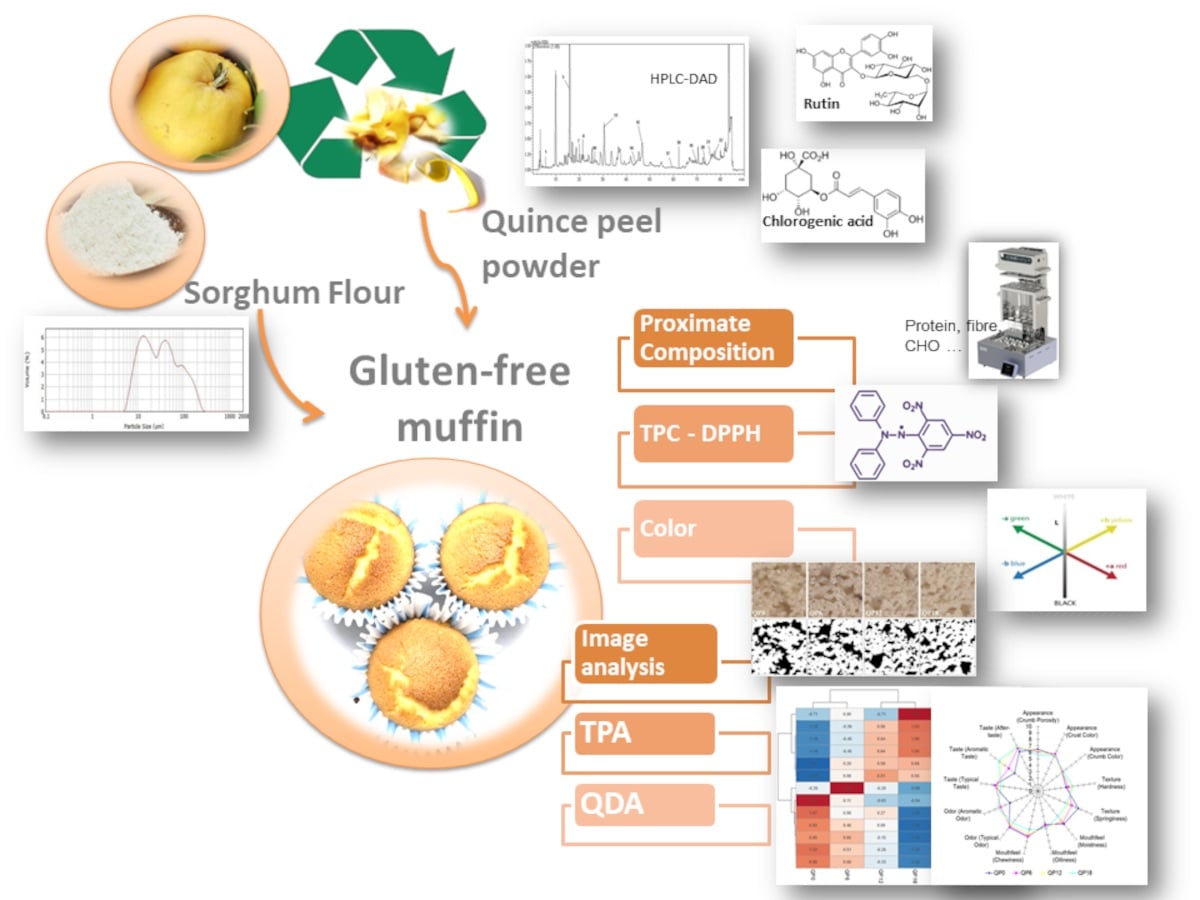
The technological limitations of gluten-free flours, including weak structure and low elasticity, negatively impact the sensory quality and consumer acceptance of the final product. Incorporating quince peel, a source of fiber and bioactive compounds, may enhance the nutritional and textural profile while improving key sensory attributes such as flavor and mouthfeel. This study aimed to valorize quince peel powder (QP), a fruit-processing by-product, by incorporating it (0%, 6%, 12%, 18%) into gluten-free sorghum muffins to enhance their nutritional profile and assess its impact on their technological and sensory properties. Phenolic characterization revealed that QP was rich in phenolics (337.1 μg/g), predominantly chlorogenic acid (54.5%). The 18% QP formulation increased the dietary fiber content by 80.8% and improved antioxidant activity by 23.3% relative to the control muffins. Image processing analysis of the crumb structure showed that QP created a uniform texture while moderately reducing air cell volume. Texture profile analysis revealed that increasing QP levels resulted in higher hardness and lower springiness. Quantitative descriptive analysis combined with multivariate analysis indicated that the 6–12% QP formulations were the most acceptable in terms of key sensory attributes. These results demonstrate the successful valorization of quince peel as a functional ingredient in sorghum muffins, enhancing nutritional and textural properties while maintaining structural integrity.
Keywords: quince; sorghum; gluten-free muffin; fruit by-product; valorization; functional ingredient; principle component analysis quince; sorghum; gluten-free muffin; fruit by-product; valorization; functional ingredient; principle component analysis
Graphical Abstract