4.2. Performance Analysis
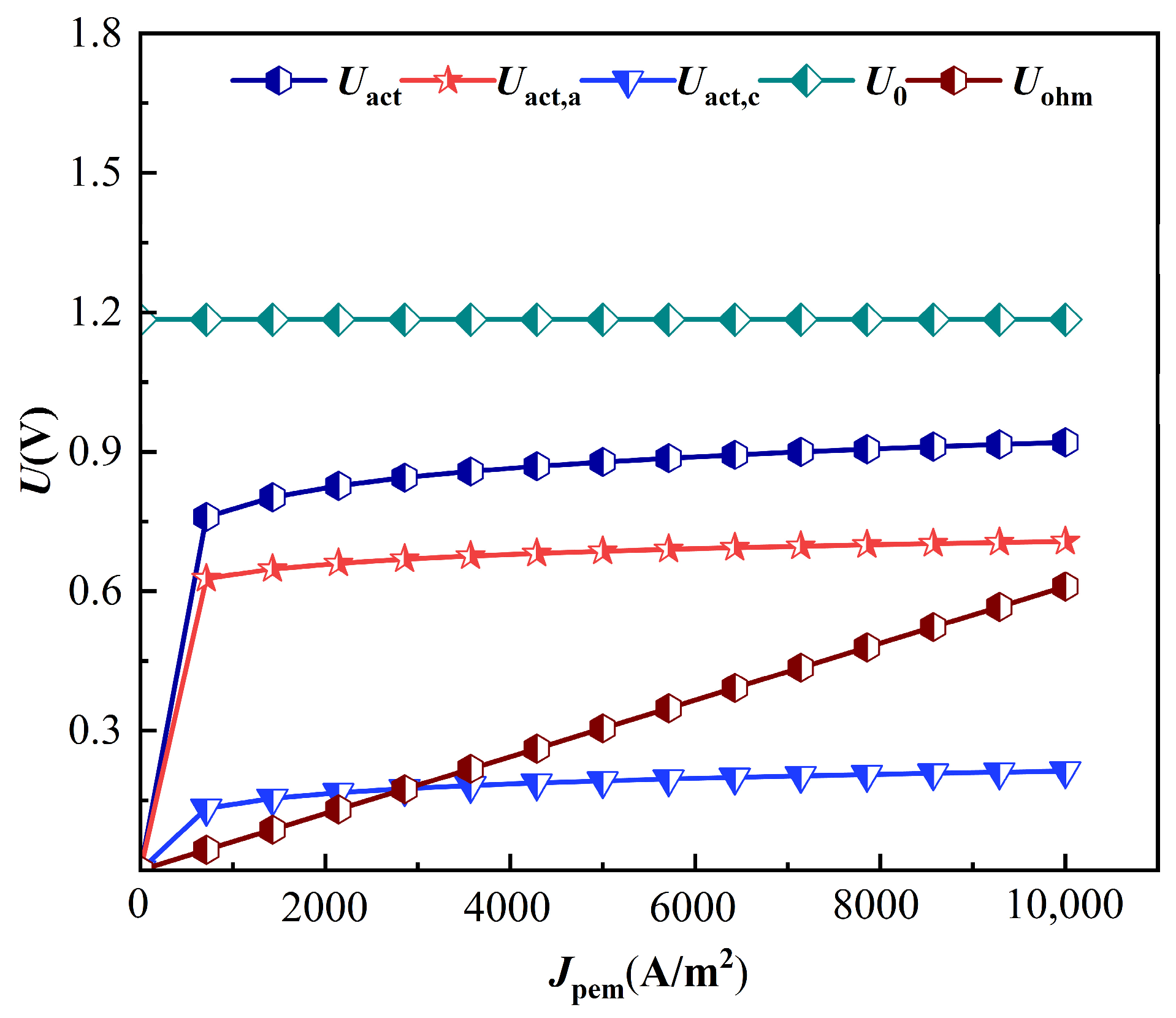
In order to better study the PEMEC operating characteristics, the polarization curve of the PEMEC was studied as shown in
Figure 4. Due to the existence of various irreversible factors inside the PEMEC, polarization loss voltage and ohmic loss voltage are generated. With an increasing current density, the ohmic loss voltage shows a linear increasing trend, while the polarization loss voltage shows a rapid increasing trend followed by a slow increasing trend. The overall effect shows that the actual operating voltage of the PEMEC unit increases with the increase in current density.
The effects of TCPC evaporator outlet temperature
T3 and the basic ammonia solution concentration
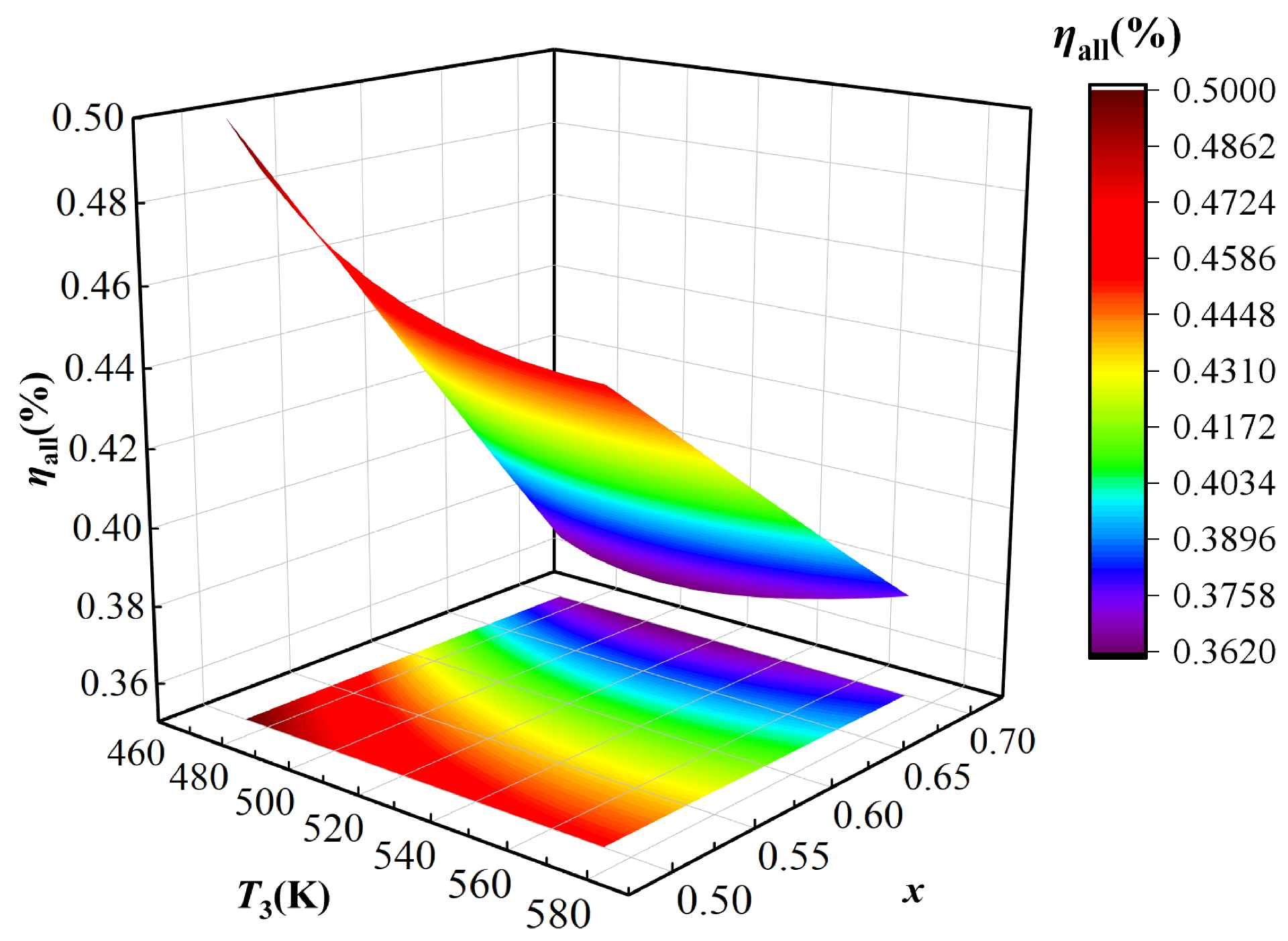
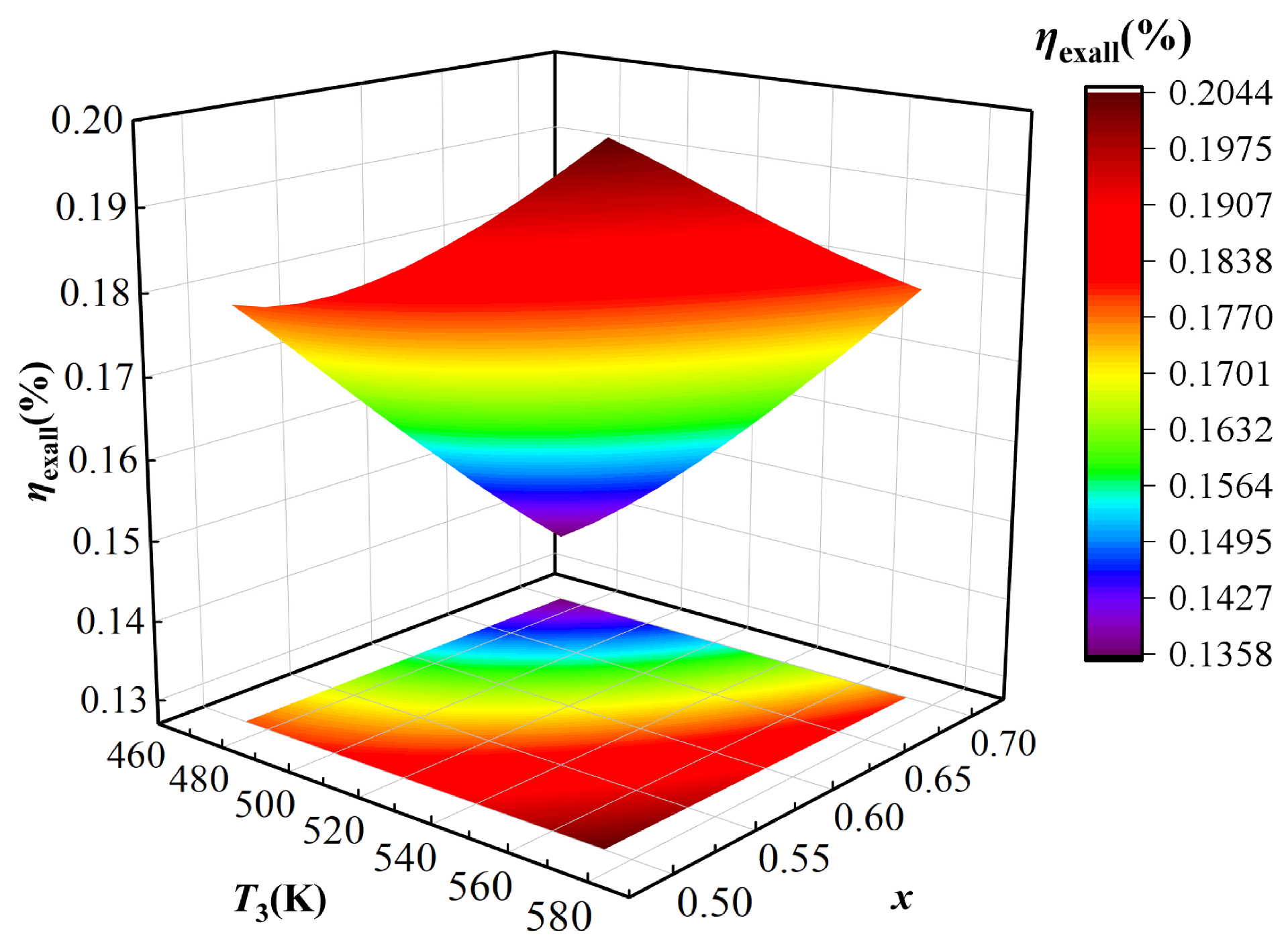
x of KC on the energy and the exergy efficiency of the IES are shown in
Figure 5 and
Figure 6. As shown in
Figure 5, with the increase of
T3, the energy efficiency of the IES continuously decreases when
x is less than 0.54, and the energy efficiency of the IES first decreases and then increases when the basic ammonia solution concentration
x is greater than 0.54. When
T3 increases, the heat absorption of the PTSC increases, then the input heat of the IES increases; when
T3 increases, the temperature of supercritical CO
2 entering turbine I increases so it leads to the increase in the power generation of turbine I and TCPC, and the power output and hydrogen production of the IES increases. When
x < 0.54, the increase rate of energy output from the IES is lower than the increase rate of energy input. When
T3 is kept constant, the energy efficiency of the IES exhibits a consistently decreasing trend with an increasing
x. This occurs because, although the power generation of the KC and the hydrogen production of the IES increase slightly, the heat load of the heat exchanger III decreases significantly. As a result, the heat supply decreases more obviously, so the energy efficiency of the IES shows a decreasing trend.
As shown in
Figure 6, the IES exergy efficiency increases with the outlet temperature of the TCPC evaporator (
T3), demonstrating that higher evaporator outlet temperatures strengthen the system thermodynamic performance. With an increase in
T3 enhances power generation, hydrogen production, and thermal exergy supplied to the user, thereby improving overall exergy output, which consistently surpasses the IES input exergy. In addition, when the concentration of basic ammonia solution (
x) increases, the IES exergy efficiency is showing a decreasing trend, which is consistent with the change trend of the IES energy efficiency. This change is attributed to the enhanced heat absorption of the KC at a higher
x, which lowers the generator outlet temperature and significantly decreases the heat load of heat exchanger III, ultimately leading to a reduction in overall IES efficiency. Overall,
Figure 6 highlights the crucial role of optimizing both
T3 and
x to maximize system exergy efficiency. Specifically, a higher
T3 improves power, hydrogen, and heat cogeneration, while excessive
x deteriorates system performance by weakening thermal matching in the KC subsystem. These results provide valuable guidance for selecting appropriate operating conditions in practical IES applications.
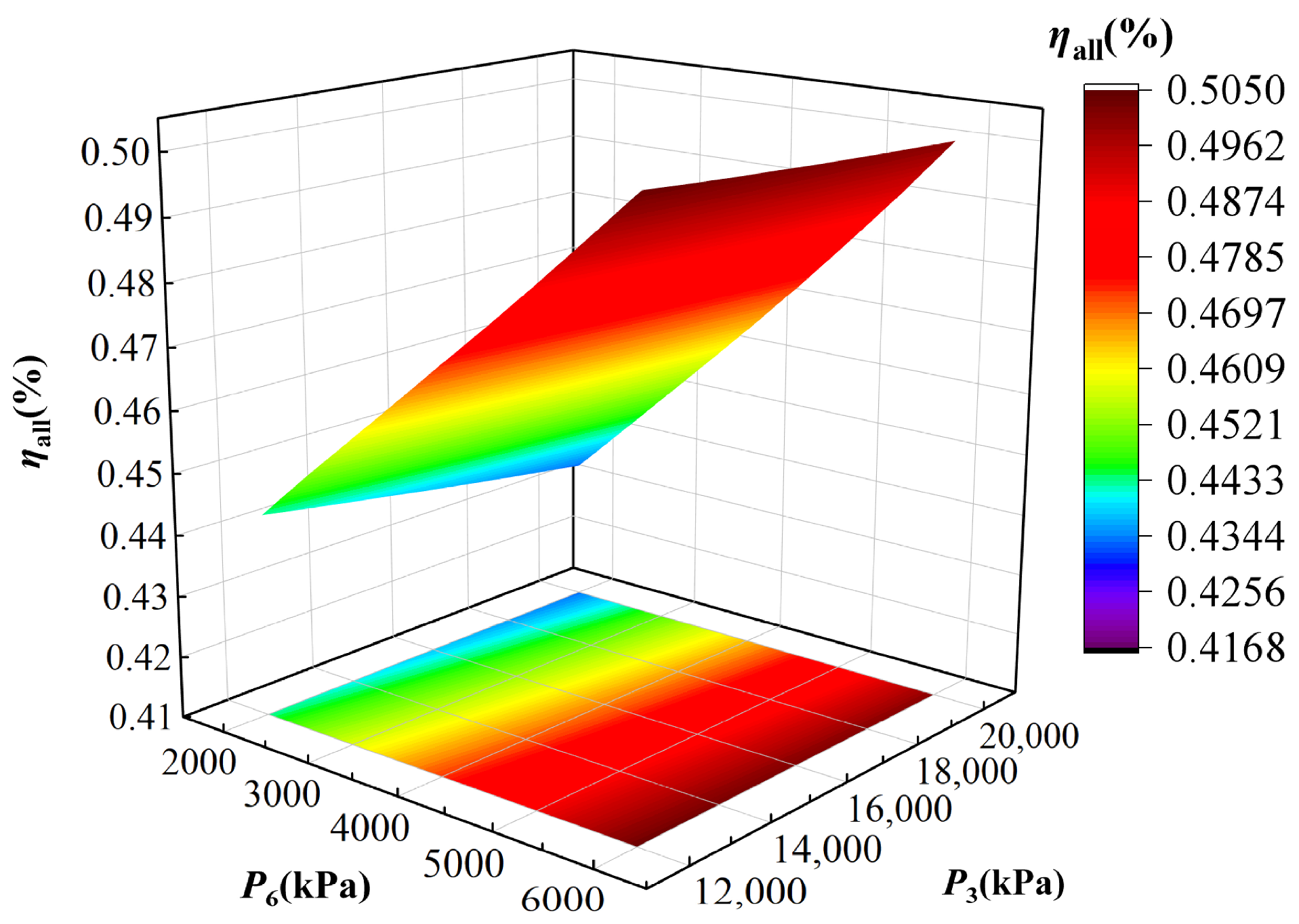
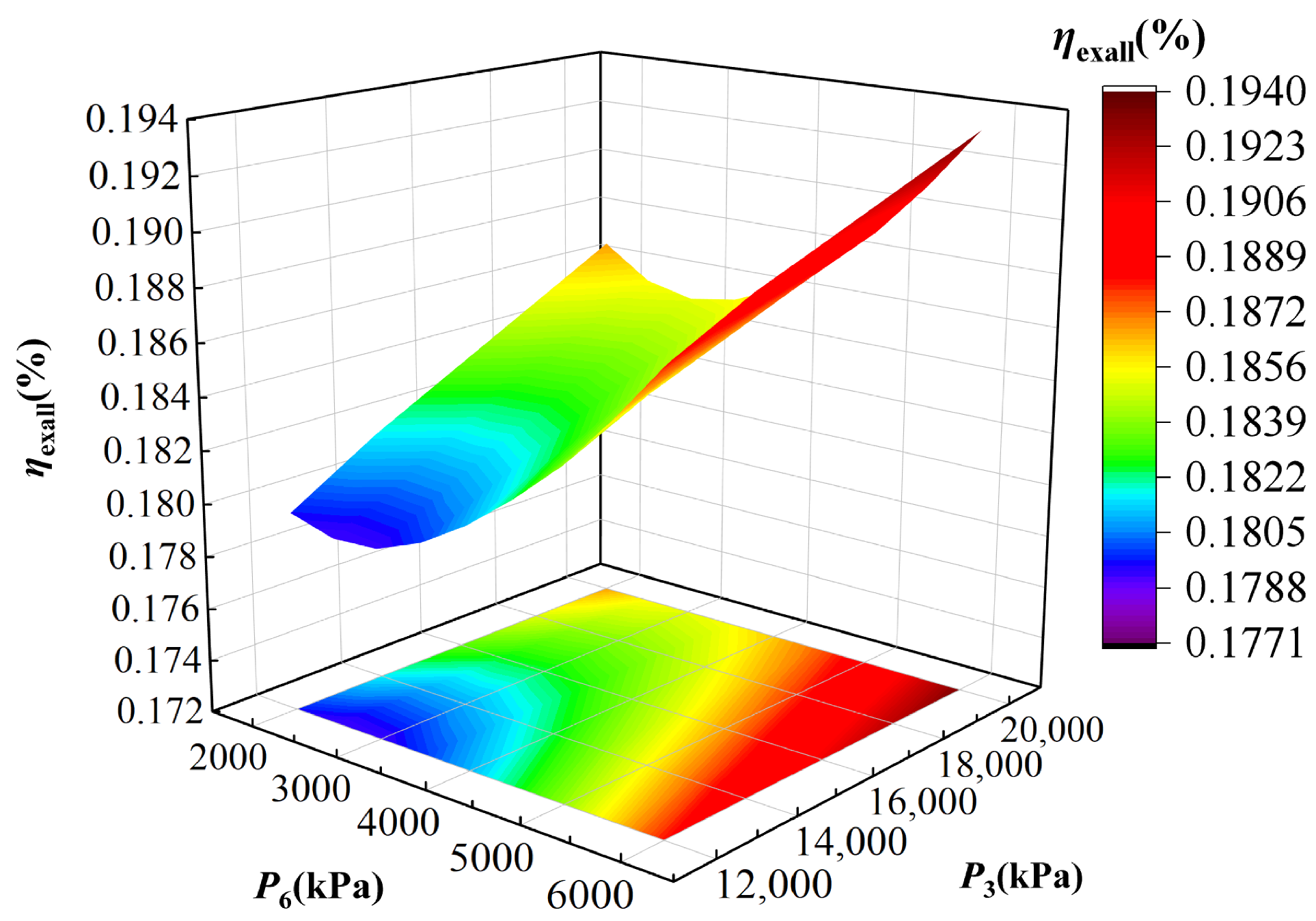
Figure 7 and
Figure 8 reveal the effect of high pressure (
P3) and low pressure (
P6) of the TCPC on IES energy and exergy efficiency. As shown in
Figure 7, the energy efficiency exhibits a slight decline when increasing high pressure
P3 of the TCPC. Although higher
P3 enhances power generation and hydrogen production, it simultaneously increases the condenser I cold load and decreases the heat load of heat exchanger, which makes the heat released into the low temperature heat source increase while causes the external heat supply decrease, leading to a net reduction in total energy output under constant input, thereby lowering the energy efficiency. When
P3 keeps constant, the energy efficiency consistently increases when rising
P6. At a higher
P6, the increase in back pressure of turbine I leads to a decrease in power generation and hydrogen production. However, an elevated outlet temperature of turbine I increases the external heat supply of heat exchanger II, and this gain outweighs the losses in power generation and hydrogen production, resulting in an overall improvement in system efficiency. Overall, although an increasing
P3 favors power generation, it compromises energy efficiency by reducing heat recovery. These conclusions are valuable for identifying optimal pressure ranges in the practical IES operation, balancing cogeneration performance, and system efficiency.
As shown in
Figure 8, the exergy efficiency of the IES exhibits a slight upward trend with increasing
P3, in contrast to the decreasing trend observed for energy efficiency. The reason is that although a higher
P3 reduces the heat load of heat exchanger II, it simultaneously increases its average temperature, thereby yielding a gradual improvement in overall exergy efficiency. As
P6 increases, the exergy efficiency of the IES first decreases and then increases, reaching a minimum at
P6 of 2500 kPa. When
P6 is less than 2500 kPa, the lower outlet temperature of turbine I reduces the thermal exergy output of heat exchanger II, while the output power and hydrogen production also decline, leading to a downward trend in exergy efficiency. When
P6 is greater than 2500 kPa, the rising outlet temperature of turbine I enhances the thermal exergy output of heat exchanger II at a rate that outweighs the reductions in power and hydrogen production, resulting in an increase in exergy efficiency. Overall, while increasing
P3 improves thermodynamic quality of heat utilization, the nonlinear response of exergy efficiency to
P6 indicates the existence of a worst operating condition around 2500 kPa. These findings could provide practical guidance for tuning TCPC pressures to balance energy and exergy performance in IES operation.
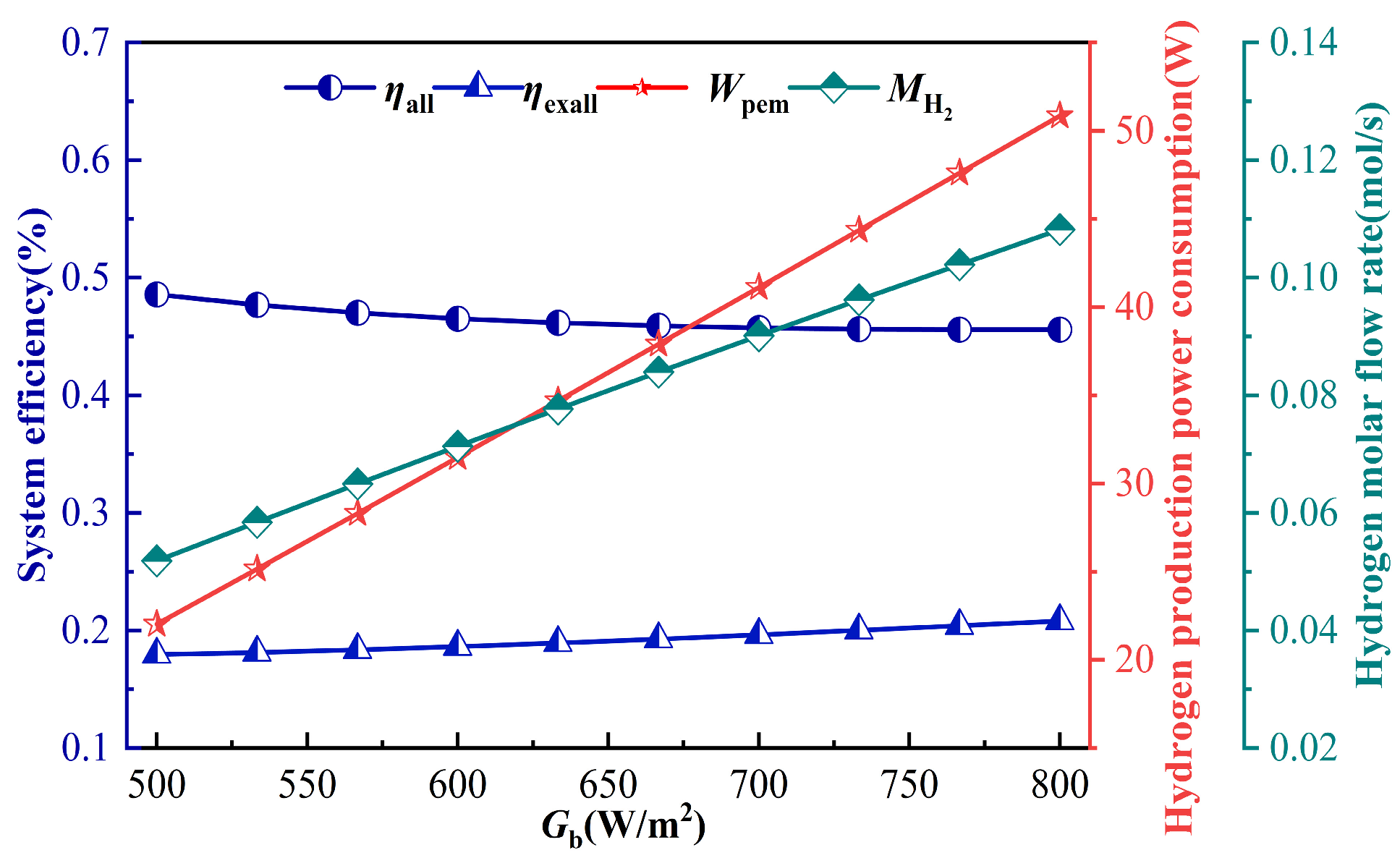
Figure 9 shows the effect of solar irradiance
Gb on the IES performance, when
Gb increases, the PTSC absorbs more heat, thereby increasing the total input energy. This elevates the solar collector outlet temperature and enthalpy, which in turn enhances system power generation and increases the power supplied to the PEMEC. Then the current density of PEMEC increases, which makes the increase of hydrogen production. Since an increase in
Gb leads to an increase in
T3, the trend of the energy and exergy efficiency are consistent with the trend of the IES efficiency with
T3 shown in
Figure 4 and
Figure 5. Overall,
Figure 9 highlights the dual effect of solar irradiance: while a greater irradiance improves system output in terms of power and hydrogen production, it simultaneously lowers the energy efficiency. These findings underscore the importance of matching solar resource variability with electrolyzer operating conditions to achieve balanced system performance in practical applications.
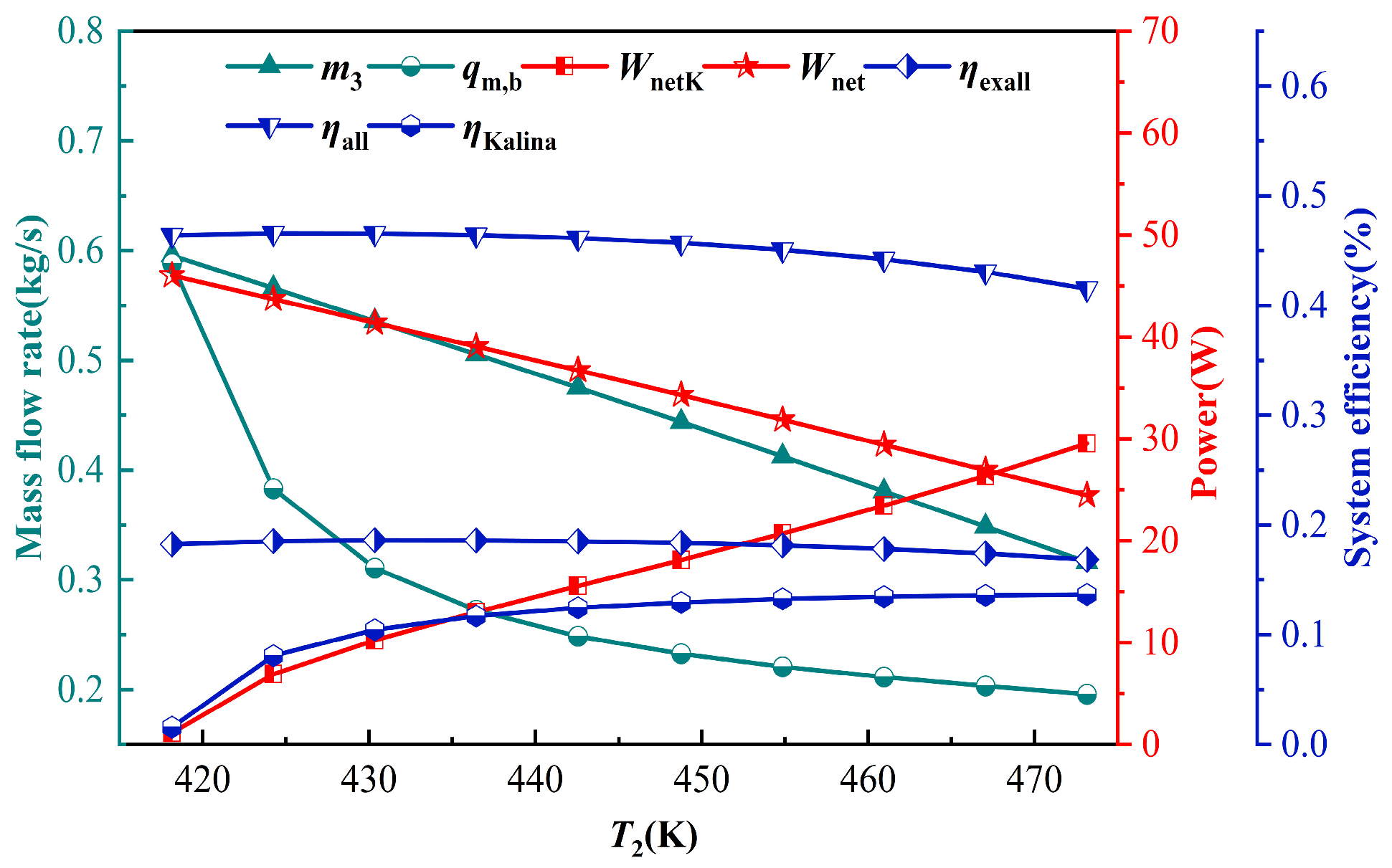
Figure 10 shows the effect of the TCPC evaporator outlet temperature
T2 (KC generator inlet) on the IES performance. As
T2 increases, the heat absorption of the TCPC evaporator decreases, leading to a reduction in the mass flow rate, and the net external power output of the TCPC decreases, all other conditions being constant. When
T2 increases, the heat absorption of the KC generator increases, the enthalpy difference in the ammonia-water solution across the generator increases, causing the mass flow rate of the KC to decrease, but the temperature of the ammonia rich vapor increases, making the net power of the external output of the KC increase and the electrical efficiency of the KC system rise higher. As shown in
Figure 10, with an increasing
T2, the power generation of the TCPC gradually decreases, while that of the KC gradually increases. Since the power output of the TCPC is larger than KC system, the energy efficiency and the exergy efficiency of the IES show a trend of first increasing and then decreasing, and when
T2 = 430.35 K, the energy efficiency and the exergy efficiency of the IES reach the maximum value of 46.52% and 18.62%, respectively, and while it is figured up that the hydrogen production flow rate is of the IES is 0.5136 kg/h.