


Abstract
Soil organic carbon (SOC) and its active fractions—labile organic carbon (Lab-C), dissolved organic carbon (DOC), and microbial biomass carbon (MBC)—govern soil carbon stability and climate feedback mechanisms. To investigate the distribution patterns and regulatory mechanisms of SOC and those active fractions along elevational gradients in the riparian zone of the Three Gorges Reservoir Area (subjected to intense waterlogging stress), soil sampling and analysis were conducted across four zones of the Longtanping: below 160 m, 160–170 m, 170–180 m, and above 180 m in early September 2021. Results indicated that as elevation increases, the content of SOC and active components exhibited a unimodal distribution pattern showing initial increases followed by decreases; moreover, this pattern can be attributed to the pH-riven changes in bacterial abundance under varying inundation stress conditions. The peak values occurred at elevations of 160–170 m, with the overall distribution pattern being as follows: 160–170 m > 170–180 m > above 180 m > below 160 m. Correlation analysis revealed significant positive correlations among SOC, DOC, MBC, Lab-C, pH, TN, and bacterial abundance (p < 0.05). Lab-C demonstrated the strongest explanatory power for SOC variations, serving as a sensitive indicator of SOC turnover and persistence dynamics. This study provides critical insights into the carbon cycling mechanism and regional carbon sink assessment in reservoir riparian ecosystems.
1. Introduction
The riparian zone formed by the impoundment and flood discharge of large artificial reservoirs is one of the most biogeochemically active areas within a watershed and a focal point for carbon emission research [1]. Taking the Three Gorges Reservoir Area as an example, periodic hydrological operations result in significant water-level fluctuations, creating a drawdown zone with a vertical range of 30 m and a total area of approximately 349 km2 [2]. This frequent alternation between wet and dry conditions profoundly influences soil organic carbon (SOC)—the core component of soil organic matter [3]. As a critical carrier of global carbon cycle, climate change, and soil ecosystem health, the dynamic changes in SOC are crucial for carbon sequestration management. However, the high background value of SOC often leads to a delayed response to minor environmental changes, limiting its utility as an early warning indicator [4]. In contrast, active components such as labile organic carbon (Lab-C), microbial biomass carbon (MBC), and dissolved organic carbon (DOC), which are directly involved in biochemical transformations and highly sensitivity to environmental disturbances [5], have become effective indicators for reflecting changes in SOC. Elevation, as a key environmental factor, influences the processes of soil carbon cycling through variations in hydrothermal conditions, vegetation distribution, and other factors [6]. Therefore, elucidating the distribution and transformation patterns of SOC and the active components along different elevation gradients is essential for understanding soil carbon transformation pathways in the riparian zone and optimizing carbon sink and sustainability within the Three Gorges Reservoir Area.
As representative artificial infrastructure, reservoir riparian zones—particularly concerning soil erosion, elemental cycling, and carbon sequestration—have become a focus of current research [7,8]. Previous studies indicate that the impact of periodic flooding on SOC is influenced by soil type in the riparian zone of the Three Gorges Reservoir. For instance, the SOC content and density increase in calcareous soil and purple soils but decrease in yellow soil, suggesting that soil type differentiates the response of carbon pools, and waterlogging stress is the common dominant factor influencing SOC content and density [9]. The flooding–drying cycle promotes the loss of soil organic matter, leading to significantly lower SOC within the riparian zone compared to the reservoir shore soil [10,11,12]. At the same time, flooding may also increase the input of organic carbon through the drowning of native vegetation [13]. Jia et al. [14] further highlighted, from the perspective of elevation, that the soil carbon component characteristics in the riparian zone are aggravated by litter loss, leaching, and microbial habitat degradation through the elevation gradient differences (such as the long-term flooded area at low elevations), among which MBC is the most sensitive component responding to elevation changes. Despite these advances, current research predominantly focuses on total change in SOC, and there is still a lack of systematic analysis of the transformation mechanisms of active components at different elevations (e.g., the driving of environmental factors).
This study utilized soil samples collected across various elevation gradients in the riparian zone of the Three Gorges Reservoir. Our objectives were to investigate the transformation and distribution patterns of SOC and its active components—including Lab-C, MBC, and DOC—during the inundation process. Moreover, we sought to identify the most sensitive active components that serve as indicators of the SOC dynamics along the elevation gradient in the riparian zone. This research provides a theoretical basis for the soil carbon cycle model in the riparian zone. It also makes a significant contribution to supporting ecological sustainability in the Three Gorges Reservoir region.
2. Study Location and Methods
2.1. Study Location
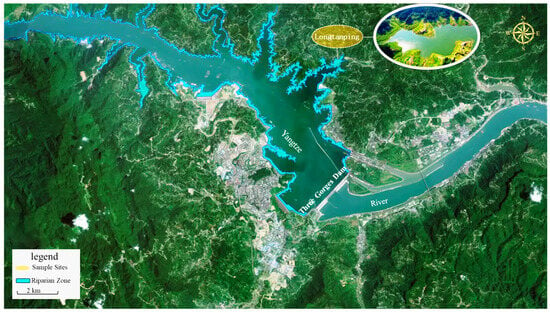
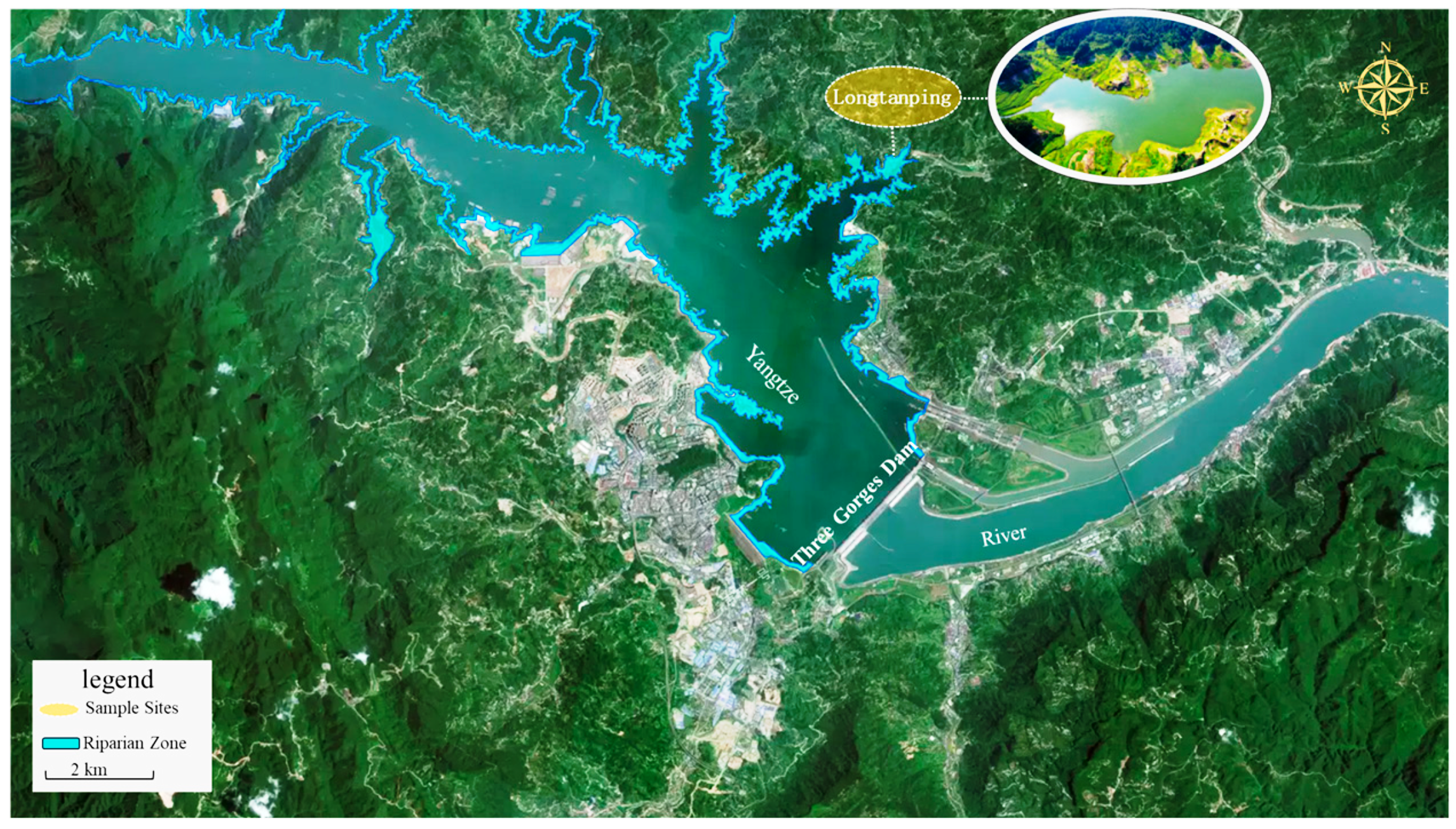
The study site was located within the riparian zone of the Three Gorges Reservoir at Longtanping (Figure 1), in Longtanping Village, Taipingxi Town, Yiling District, Yichang City, Hubei Province, China (111°00″ E, 30°52″ N). The area experiences a subtropical monsoon climate characterized by four distinct seasons, mild temperatures, and hot summer rainfall typical of the microclimatic conditions found in the Three Gorges valley. The mean annual temperature is 18 °C, and the average annual precipitation reaches 1235 mm. The predominant soil types are yellow loam and yellow brown loam.
Figure 1.
Geographical location of the study area.
2.2. Sample Collection
Subject to reservoir dispatch control, the water level had already dropped to the flood control level of 145 m before the flood season (before 9 June) [15]. The sampling time was in early September 2021, when the plants were growing vigorously, just before the Three Gorges Reservoir area began to flood all the soil with water in the subsidence zone, during which the water level of the Three Gorges was around 167 m. Typical riparian zones were selected and divided into different elevation sections according to the degree of flooding. Specifically, four representative plots were selected along different elevation gradients, including the never-flooded area (control group, above 180 m), the lightly flooded area (170–180 m), the moderately flooded area (160–170 m), and the heavily flooded area (below 160 m); each plot was set up with six repetitions. The characteristics of the soil in each sample plot are shown in Table 1.
Table 1.
Characteristics of the sample plot at different elevations of the Three Gorges Reservoir riparian zone.
First, the researchers investigated the soil texture of the riparian zone in each fixed sample strip and randomly sampled plots with the same texture. A 20 m long sampling square was set up at each gradient, according to the “S” shape method, and 5 points of 0–20 cm surface soil samples were randomly taken from each plot. To reduce spatial heterogeneity, impurities were removed and mixed into one soil sample, resulting in a total of 24 samples. The fresh soil samples were sealed in plastic bags and promptly sent back to the laboratory for processing. Stones and dead branches and leaves were removed, mixed thoroughly, and sieved through a 2 mm sieve, and a portion was frozen in the refrigerator (−20 °C) for analysis of MBC and DOC. The other part was placed on a sample tray and spread flat to air dry for analysis of SOC and Lab-C.
2.3. Determination and Analysis
Measurement method: SOC was determined using semi-constant element analysis [16]. Specifically, 3 g of air-dried soil sample was ground, treated with 3% hydrochloric acid, rinsed with deionized water until neutral, and dried in an oven at 60 °C. A precise amount of the pretreated sample was then wrapped in a tin capsule, and analyzed with the semi-micro elemental analyzer; Lab-C was extracted using the sulfuric acid oxidation method and measured using a TOC analyzer [17]. DOC was extracted via salt solution extraction and measured with a total organic carbon analyzer [18]; MBC was measured using chloroform fumigation and a TOC automatic organic carbon analyzer. The calculation was performed as follows: MBC = (value after fumigation − value before fumigation) × (60 + soil moisture content)/dry soil weight/0.45 [19].
Data processing and analysis: SPSS 22.0 one-way ANOVA was used to analyze the differences between different elevation data groups (p < 0.05); all parameters were first tested for normal distribution and homogeneity of variances using the Shapiro–Wilk test and Levene test, respectively. Parameters with non-normal or unequal variances were transformed using the Box–Cox method. Redundancy Analysis (RDA) was conducted using Canoco 5 to identify key driving factors influencing changes in community composition. Tables and figures were prepared using Excel and Origin 9.0.
3. The Elevational Distribution Pattern of SOC and Active Fractions
3.1. Comparison of Content at Different Elevation Gradients
- SOC
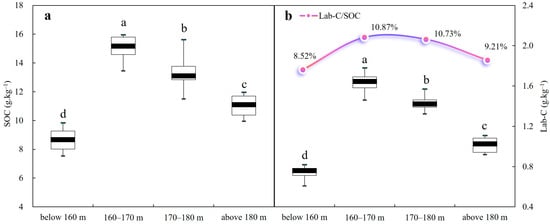
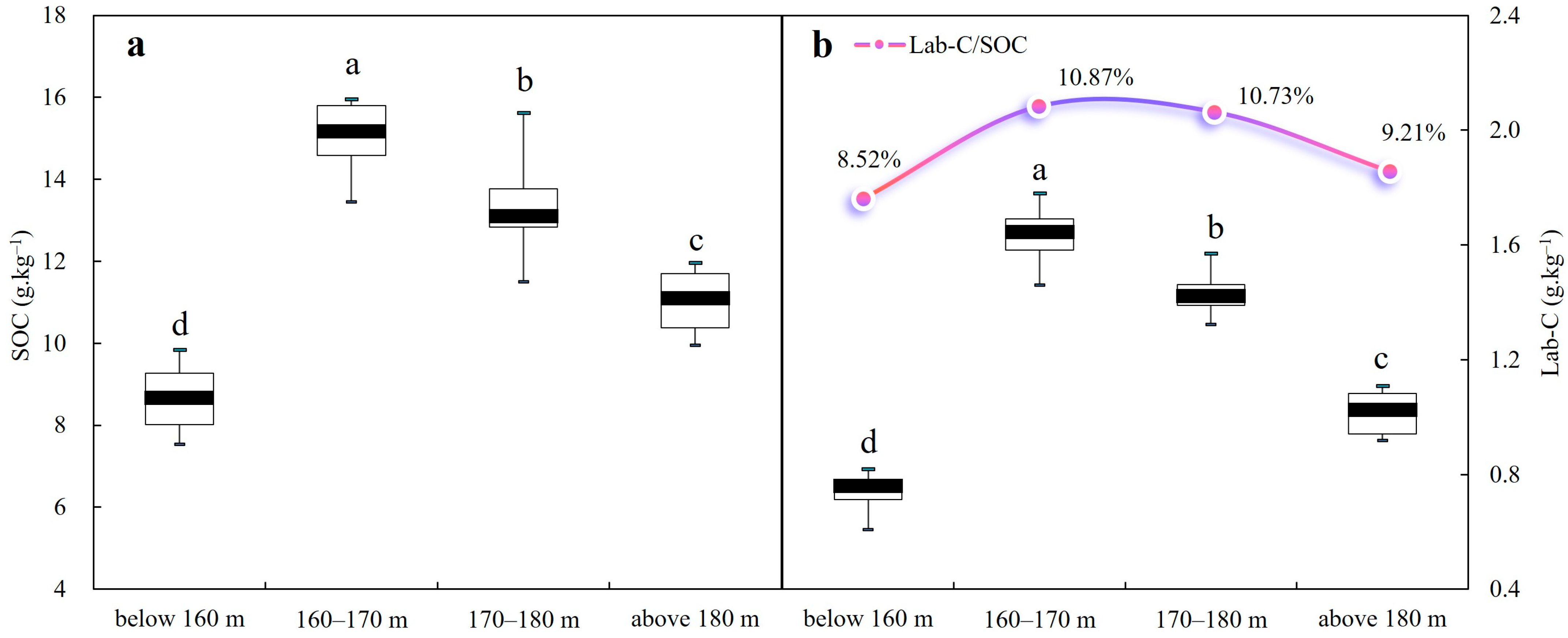
As shown in Table 2 and Figure 2a, compared with the control group, the area with moderate inundation exhibited the highest SOC (15.02 g/kg). The SOC content across elevations showed the following pattern: 160–170 m > 170–180 m > above 180 m > below 160 m, indicating a unimodal distribution. In the ML and HL groups (moderate to mild flooding), SOC levels ranged from 13.34 to 15.02 g/kg, representing increases of 36.3% and 21.0%, respectively, compared to the control group (p < 0.05). In addition, heavily flooded areas below 160 m had an SOC content of 8.66 g/kg, a 21.4% decrease (p < 0.05) compared to the non-flooded control group.
Table 2.
The content of SOC and its active components at different elevations of the Three Gorges Reservoir riparian zone.
Figure 2.
The contents of SOC (a), Lab-C (b), and the ratios of Lab-C in sample plots at different elevations.
- Lab-C
Lab-C represents the organic carbon in soil that is highly available, easily decomposed by microorganisms, and directly supplies nutrients to plants [20]. Based on our measurement (Figure 2b), the Lab-C content across elevation gradients exhibited the following order: 160–170 m > 170–180 m > above 180 m > below 160 m. Compared with the control group, Lab-C at 160–170 m and 170–180 m increased by 60.9% and 41.0%, respectively, without significant difference (p < 0.05). The lowest Lab-C content (0.74 mg/kg) was found in the below 160 m group, which decreased by 27.3% compared to the control group. This pattern corresponded to the variation in SOC content with elevation, though the magnitude of change was substantially greater for Lab-C.
- DOC
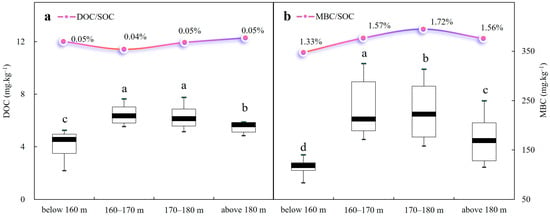
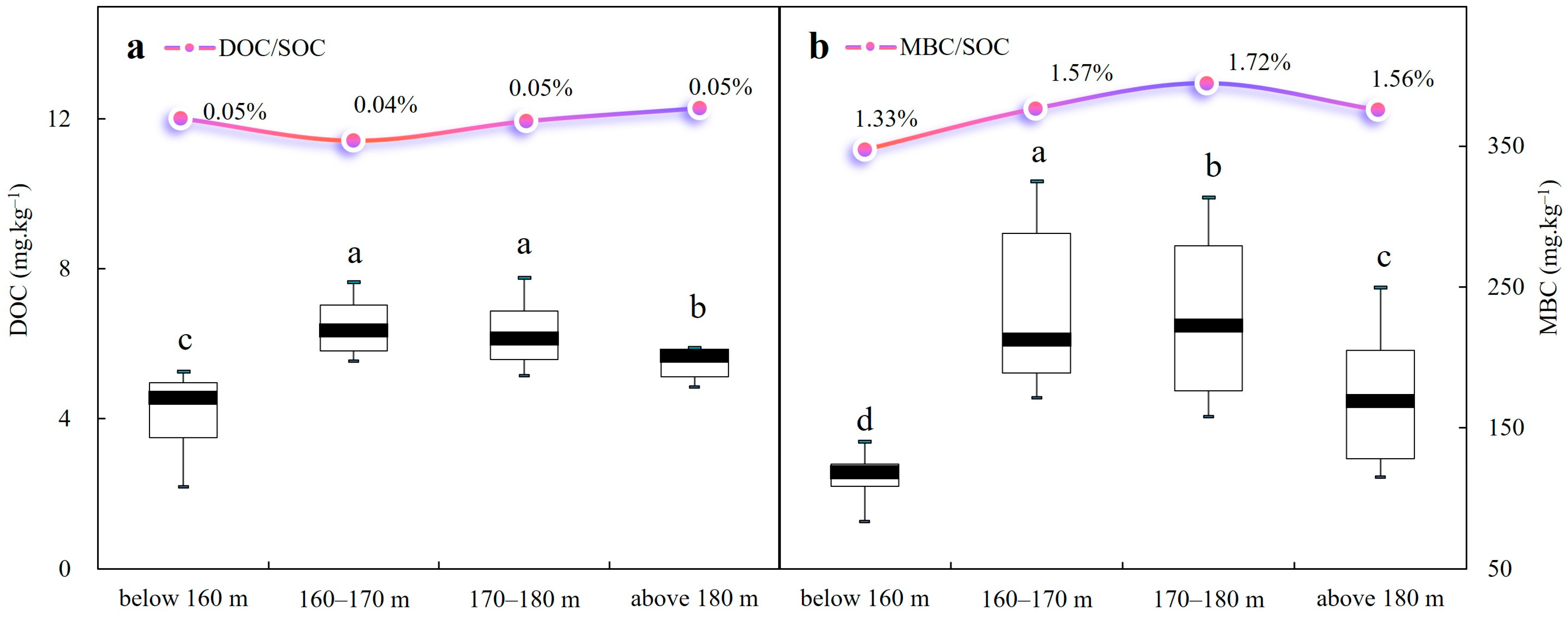
It is generally believed that DOC is composed of carbohydrates, long-chain fatty acid compounds, and proteins that are dissolved in soil water [21]. According to the measurements, the DOC content in the soil at an elevation of 160–170 m was the highest in our study, reaching 6.46 mg/kg. Compared to the control group, the DOC content in the soil at elevations of 160–170 m and 170–180 m increased by 17.8% and 14.5% respectively, with no significant difference. Conversely, samples from below 160 m recorded the lowest DOC content (4.13 mg/kg), which was significantly reduced by 1.36 mg/kg compared to the control group. The overall trend in DOC content across elevations was as follows: 160–170 m > 170–180 m > above 180 m > below 160 m (Figure 3a).
Figure 3.
The contents of soil DOC (a), MBC (b), and their ratios to SOC in sample plots at different elevations.
- MBC
MBC is an important indicator for characterizing soil microbial activity and soil health, and its dynamic changes have significant impacts on soil carbon cycling, nutrient transformation, and ecosystem functions [22]. In this study, the soil MBC in the riparian zone of Three Gorges Reservoir showed a trend of 160–170 m > 170–180 m > above 180 > below 160 m at different elevations (Figure 3b); that is, it first increased and then decreased with the increase in elevation. This was consistent with the distribution characteristics of MBC content at different elevation scales in the Xiaolangdi Reservoir area by Zhang et al. [23].
The MBC content in the soil of the moderately flooded and lightly flooded areas was 235.98 mg/kg and 229.29 mg/kg, respectively, representing a significant increase compared to the control group (172.33 mg/kg) (36.9% and 33.1%, respectively). The MBC content in the soil of the heavily flooded areas was 115.31 mg/kg, which was significantly decreased by 33.1% compared to the control group.
3.2. Analysis of Active Component Distribution Ratio
- Lab-C/SOC
The Lab-C/SOC ratio is commonly used to evaluate the activity and microbial availability of the soil carbon pool. The higher the ratio, the higher the soil carbon pool activity. In this study, the Lab-C/SOC ratio curve (Figure 2b) revealed higher oxidative activity of SOC at 160–180 m, ranging from 10.73% to 10.87%, an increase of 1.52% to 1.66% compared to the control group. The group below 160 m decreased by 0.69% compared to the control group. The variation trend in the distribution proportion of Lab-C across elevation intervals was consistent with that of Lab-C content along the elevation gradient; both showed a unimodal distribution pattern of first increasing and then decreasing, with a peak value observed at an elevation of 160–170 m.
- DOC/SOC
The DOC/SOC ratio is an important indicator for measuring the quality of the soil carbon pool, which can intuitively reflect the decomposition activity and effectiveness of SOC [24]. In this study, the amplitude variation in DOC/SOC under different elevation gradients was relatively small (Figure 3a). The DOC/SOC was generally maintained at 0.043~0.050%, and the ratio of DOC/SOC in the riparian zone at elevations of 160–170 m was the lowest, which was 0.043% (p < 0.05). The allocation ratio of DOC to SOC in non-flooded areas was the highest, at 0.050%.
- MBC/SOC
The MBC/SOC ratio represents the amount of soil effective substrates and total soil carbon retained in microbial cells, also named microbial entropy; it is an index that measures the usefulness of soil organic matter [25]. In this study, soil samples from the 160–170 m and 170–180 m elevation areas exhibited slight increases in microbial entropy of 0.01% and 0.16%, respectively, compared with the control group. Conversely, the heavily flooded area exhibited a 0.23% reduction in microbial entropy (p < 0.05). Analysis of the trend revealed that microbial entropy displayed a unimodal (humped) pattern, initially increasing and subsequently decreasing with rising elevation (Figure 3b).
4. Correlation Analysis Results
4.1. Correlation Analysis Results Among SOC and Its Active Components
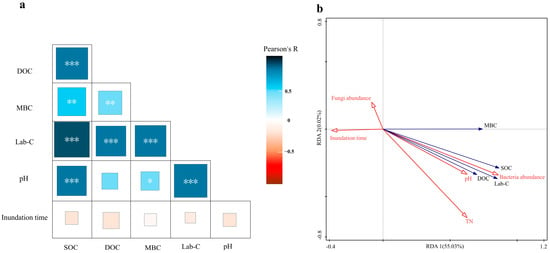
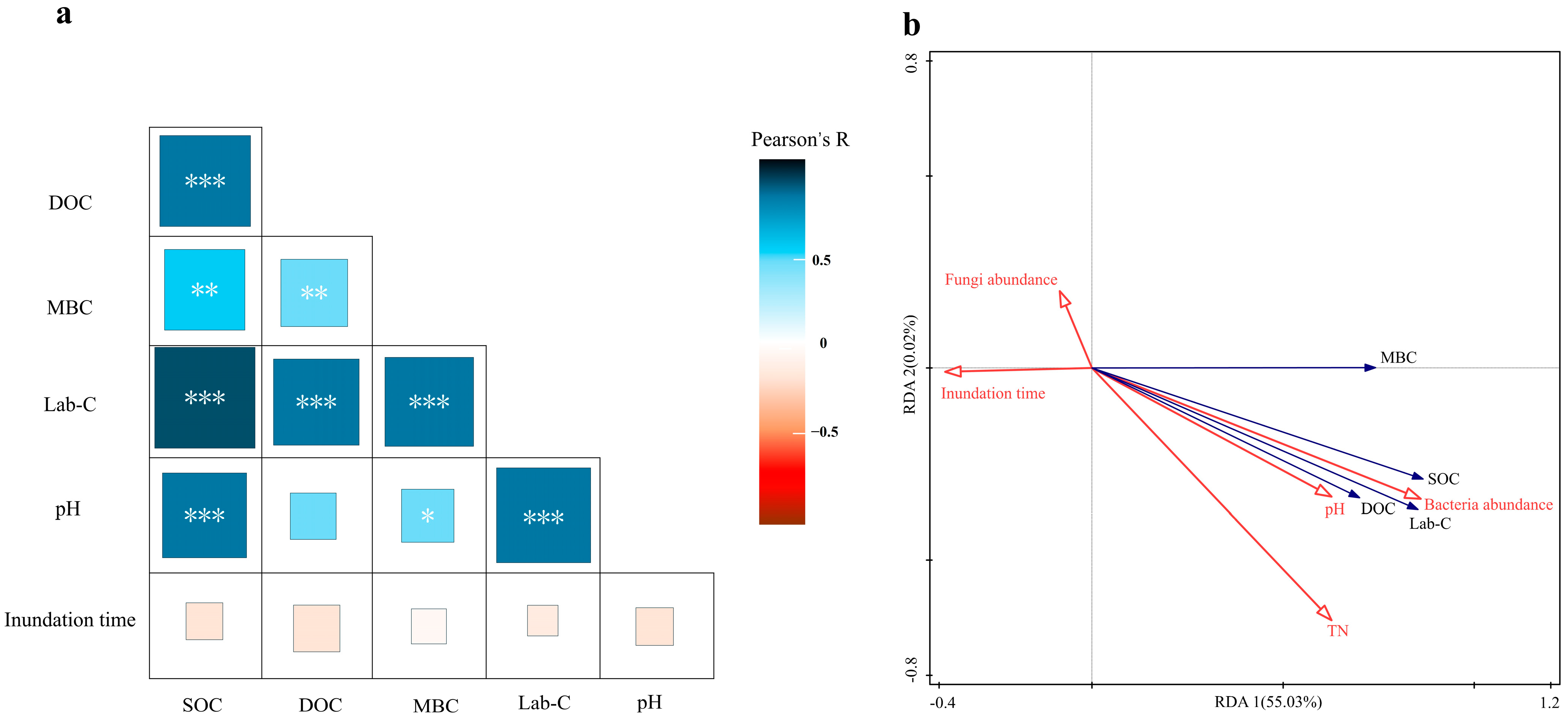
Based on correlation analysis (Figure 4a), fungal abundance showed a significant positive correlation with inundation time (p < 0.001), indicating that fungal abundance increases with prolonged inundation. However, neither variable was significantly correlated with other indicators (p > 0.05). Significant positive correlations were observed among SOC, DOC, MBC, Lab-C, pH, TN, and bacterial abundance (p < 0.05). Notably, Lab-C was identified as the primary factor driving changes in SOC, a finding further supported by stepwise multiple regression analysis.
Figure 4.
Correlation heat map of the carbon pool (a) in the fluctuating zone and redundancy analysis (RDA, (b)). The asterisks represent the levels of significance: ** p < 0.01, * p < 0.05, *** p < 0.001.
Redundancy analysis (RDA, Figure 4b) results showed that the first two axes accounted for 55.04% of the total variance in carbon pool variables, with environmental factors explaining 55.2% of the variance. Specifically, bacterial abundance, TN, inundation time, pH, and fungal abundance contributed 40.7%, 5.8%, 5.3%, 1.9%, and 1.5% to the explained variance, with corresponding contribution rates of 73.9%, 10.5%, 9.6%, 3.4%, and 2.7%, respectively.
4.2. The Indicative Role of Lab-C in SOC Dynamics
To further investigate the indicative capacity of active components, multiple stepwise regression analysis was conducted across elevation gradients. SOC displayed highly significant positive correlations with all active components (p < 0.01). Critically, the strongest association was observed between SOC and Lab-C (R2 = 0.91, p < 0.001), significantly exceeding correlations with DOC (R2 = 0.74, p < 0.01) and MBC (R2 = 0.66, p < 0.01). The indicative efficacy ranking for soil carbon pool dynamics was Lab-C > DOC > MBC. These findings collectively demonstrate that Lab-C exhibits superior sensitivity to SOC changes compared to other active components, establishing it as a core indicator for characterizing SOC turnover and retention mechanisms in the Three Gorges Reservoir riparian zone.
Compared to DOC, Lab-C exhibits greater spatial stability and analytical reproducibility, avoiding the drawbacks of dissolved carbon, which is susceptible to sampling timing and hydrological conditions (particularly water table fluctuations). Whereas MBC depends strongly on microbial community composition, Lab-C more effectively reflects the overall carbon availability in soils.
The results of this correlation analysis indicate that the total stock of SOC is primarily governed by variations in Lab-C. This finding aligns with the conclusion of Ge et al. [26], who studied the relationship between SOC and the storage of various active components and soil carbon sequestration by continuously returning corn stalks to the field. They posited that Lab-C contributed significantly to SOC sequestration. However, Jia et al. [14] proposed that soil carbon storage depends more heavily on MBC. What dominates the changes in SOC primarily depends on factors such as soil types, decomposable substrates, and microbial community structures [27]. By quantifying the explanatory power of Lab-C for SOC variability, we propose an oxidizable carbon-centered indicator system for assessing carbon pool lability.
5. Discussion
- SOC
The results of this study show that the highest SOC content in the samples from the moderately and mildly flooded areas is mainly attributed to the following reasons. First, during the flood season (from June to September), the Three Gorges Reservoir has been operating at a low water level. Compared with the area below 160 m, the water stress pressure in the elevation range of 160 to 180 m is lower, which is more conducive to plant growth and reproduction; other studies on the Three Gorges Reservoir Area also found the coverage of plant communities, species abundance, and community structure more stable and higher [28]. Moreover, this study also found that vegetation types were more diverse in the 160–180 elevation range; the soil can accumulate a large amount of SOC through plant photosynthesis [12]. Secondly, the microorganisms enhance the decomposition and conversion rate of substrates such as surface litter and root exudates in summer, which can create a favorable biological basis for the accumulation of SOC [29].
The SOC in the heavily flooded area below 160 m elevation was the lowest among all elevation gradients. This can be attributed to the relatively sparse vegetation under heavy inundation conditions [30], relatively weak photosynthesis, and the limited carbon source supply of the SOC pool. In addition, the heavily flooded soil at low elevations is in an anaerobic environment, where the destruction and exposure of soil aggregate structure [31] are metabolized and decomposed by anaerobic microorganisms. All of these factors intensified the mineralization of the original stock of organic carbon [32].
In this study, TN, bacterial abundance, and pH demonstrated distribution patterns consistent with SOC. The observed positive correlations among these four parameters suggested that the mid-elevation gradient was characterized by higher nutrient content; moderate flooding stress can enhance bacterial abundance within the microbial community by increasing pH, thereby stimulating Lab-C content and subsequently promoting carbon and nitrogen storage. In summary, it can be concluded that both mild and moderate waterlogging stress are more conducive to soil carbon storage, which provides a scientific basis for understanding and assessing the carbon sink capacity of large reservoir drawdown areas.
- Lab-C
The variation pattern of Lab-C content across elevation gradients is consistent with that of SOC, while the amplitude of variation is greater. The reasons for this outcome were as follows: under conditions characterized by a relatively low intensity of disturbance, the vegetation conditions and soil nutrients in the elevation range of 160–180 m are sufficient, and a large amount of effective carbon sources can accumulate. The carbon components in soil organic carbon that are of low stability (easily oxidizable) had high activity and were rapidly decomposed by microorganisms into Lab-C; therefore, the content of Lab-C accumulated in the soil. This was consistent with the conclusion that there is a significant correlation between Lab-C in soil and total organic carbon in soil [33,34]. Additionally, the consistent distribution pattern between pH and Lab-C, along with their positive correlation, indicated that moderate flooding stress stimulated Lab-C content by increasing pH.
The curve of the Lab-C/SOC ratio indicates that the soil organic carbon in the 160–180 m elevation range has relatively high oxidative activity, which is consistent with the research conclusion by Yu et al. [35] that flooding conditions are unfavorable to the decomposition of soil organic carbon. Based on the analysis of the Lab-C content and the Lab-C/SOC ratio curve, the peak Lab-C/SOC ratio observed within the 160–170 m elevational zone demonstrates that under mild and moderate flooding conditions, especially moderate flooding, the soil carbon storage and renewal capacity is the strongest.
- DOC
In this study, the DOC content across different elevations shows a unimodal distribution pattern of first increasing and then decreasing, with a decrease observed below 160 m elevation. The possible reasons for this result may be that, due to the fact that the water level in the reservoir remained at a relatively low level (below 160 m) during the flood season, the riparian zone at elevations from 160 m to 180 m experiences relatively low flooding intensity. This, combined with the relatively favorable environmental conditions—such as the still elevated temperatures typical of early September—contributes to a distinct ecological microenvironment in this altitudinal range. These changes were more conducive to the survival and metabolism of soil microorganisms; through the decomposition and transformation of litter and root exudates, a large amount of DOC was released. On the other hand, the physical and chemical properties of the soil in the riparian zone (such as water content and structure) have been improved during the process of water level fluctuation and wet dry alternation, which is conducive to the retention of water-soluble organic matter [36]. A large amount of DOC will be fixed through soil adsorption, chelation, and integration reactions. Therefore, the content of DOC remaining in the soil has increased [37].
The plots below an elevation of 160 m have longer flooding times, with a small amount of water-tolerant herbaceous plants as the main vegetation. The root respiration rate of the plants is low, and the DOC released into the soil by the roots is reduced. On the other hand, low elevation areas are affected by water movement, resulting in leaching and loss of some organic nutrients that have already dissolved in water [38]. Wang et al. [39] found that flooding treatment can increase the leaching loss of SOC in soil and reduce the content of DOC.
In the analysis of the DOC/SOC ratio, the area at 160–170 m elevation exhibits the lowest DOC/SOC ratio. This indicates that within this zone, not only is the background SOC content the highest, but it also experiences the most rapid DOC consumption. The likely cause is the inherently high bioavailability of the DOC in this zone. Favorable hydrothermal conditions combined with an aerobic environment facilitate rapid microbial proliferation, leading to the substantial conversion of DOC into CO2 or other carbon forms, which are subsequently released back into the environment [40]. In contrast, the non-flooded area at 180 m elevation exhibited the highest DOC/SOC ratio. This suggests that DOC allocation efficiency is likely controlled by vegetation type and land-use practices. These findings further support the enhanced carbon sequestration capacity of forested land observed in this study, which aligns with the conclusions reported by Li Yalin [41]. Their study of DOC/SOC ratios under different land-use types (cropland, forest, and grassland) in a subtropical monsoon climate region demonstrated that forest soils exhibit the highest DOC allocation efficiency.
- MBC
In this study, MBC exhibited a unimodal pattern, initially increasing and then decreasing with rising elevation. This pattern aligns with the distribution characteristics of MBC content across different elevation scales in the riparian zone of the Xiaolangdi Reservoir reported by Zhang et al. [23]. Furthermore, the abundance of bacteria—which constituted the dominant group in the microbial community—also exhibited this trend, a result of the community’s adaptability to mild and moderate flooding conditions. The observed increase in MBC content within the 160–180 m elevation range may be attributed to the recovery of vegetation growth during spring and summer within this section of the riparian zone. Root exudates from plants provide a substantial carbon source and energy for soil microorganisms, resulting in sufficient available carbon substrates. Moreover, existing research has revealed a unimodal trend in both species richness and community height across the elevation gradient within the hydro-fluctuation zone of the Three Gorges Reservoir, with values initially increasing before declining [42]. It was also observed that Cynodon dactylon—a species noted for its high adaptability—displayed increased stolon length, dry mass, and dry-to-fresh mass ratio in ramets at elevations between 160 and 165 m compared to those below 160 m [43]. These morphological responses imply improved microbial substrate availability and elevated microbial activity under moderate inundation conditions. Furthermore, enhanced microbial metabolic activity accelerates SOC turnover. This process, coupled with significant microbial proliferation and subsequent mortality, inevitably leads to an increase in soil MBC.
Analysis suggested that in the long-term submerged soils at lower elevations, the availability of microbially utilizable substrates is limited, and the environment is predominantly anoxic. These conditions result in low microbial activity, manifesting as the lowest MBC content. This finding is consistent with the conclusions of Xi et al. [44], who demonstrated that the geometric mean of MBC in sites experiencing prolonged submergence was lower than in sites subjected to annual drainage or shorter inundation periods. Collectively, these results indicate a significant decline in carbon metabolic capacity within riparian zone soils under long-term flooded conditions.
Chai et al. [45] found in their study that both MBC and microbial moisture at elevations of 175 m and 165 m in the Three Gorges Reservoir Area have increased, while the SOC, MBC, and microbial moisture at elevation 155 m are significantly lower than the control (180 m elevation). This study also revealed that the variation pattern of microbial entropy (MBC/SOC ratio) with elevation showed increases across the 160–180 m elevation range relative to the control. Soils experiencing mildly flooded conditions exhibit higher overall carbon sequestration efficiency.
6. Conclusions
Affected by the periodic fluctuations in the Three Gorges Reservoir area, the organic carbon pool in the riparian zone with different elevation gradients undergoes significant changes. The soil in the 160–180 m range is affected by many factors such as root respiration, microbial respiration, and soil pH properties. SOC and its active components such as Lab-C, DOC, and MBC are all increased compared to the non-flooded area, reaching their peak in the moderately flooded area (160–170 m), which suggests that the riparian zone within this elevation range is the area exhibiting the most potent carbon sink effect. However, the soil carbon sink function under heavily flooded conditions is significantly weakened, showing an overall trend of 160–170 m > 170–180 m > above 180 m > below 160 m. Correlation analysis shows that Lab-C mainly drives the dynamic changes in SOC under water level changes. This study further reveals the adaptation of soil carbon storage to changes in hydrological conditions in the riparian zone and its intrinsic laws. Furthermore, this study possesses both theoretical and practical value. It contributes to a deeper understanding of carbon cycling in large reservoir ecosystems, offers a scientific foundation for quantifying the carbon sink potential of the fluctuating zone in the Three Gorges Reservoir, and supports subsequent investigations into carbon dynamics under environmental change or following ecological restoration initiatives. The insights derived can also inform water-level management strategies, enhance climate change adaptation efforts, and facilitate global carbon neutrality goals alongside the sustainable management of reservoir ecosystems.
Author Contributions
Methodology, H.Z.; Software, B.J.; Formal Analysis, Z.G.; Resources, S.C.; Data Curation, J.Z.; Writing—Original Draft, P.X.; Writing—Review and Editing, Z.L.; Methodology, Writing—Review, Editing, and Supervision, Z.H. All authors have read and agreed to the published version of the manuscript.
Funding
This research was funded by the National Key Research and Development Program of China (No. 2022YFE0117000), Hubei Province Key Research and Development Program Project (No. 2023EHA007), Fundamental Research Fund for Central Public Welfare Research Institutes (No. CKSF20241025/TG8 and CKSF2025533/TG8), research Project of the Three Gorges Follow-up Work of the Ministry of Water Resources (No. 12621400000021J001), and research fund from Mid-route Source of South-to-North Water Transfer Corp. Ltd. (No. ZSY/YG-ZX(2024)045).
Data Availability Statement
The original contributions presented in this study are included in the article. Further inquiries can be directed to the corresponding author.
Conflicts of Interest
Authors Ping Xie and Zheng Li were employed by the Changjiang River Scientific Research Institute, Changjiang Water Resources Commission and Wuhan Changjiang Kechuang Technology Development Co., Ltd. Authors Haiqin Zhu, Baojie Jia, and Jinlong Zhang were employed by the company Wuhan Changjiang Kechuang Technology Development Co., Ltd. The remaining authors declare that the research was conducted in the absence of any commercial or financial relationships that could be construed as a potential conflict of interest. The Wuhan Changjiang Kechuang Technology Development Co., Ltd. and Mid-route Source of South-to-North Water Transfer Corp. Ltd. had no role in the design of the study; in the collection, analyses, or interpretation of data; in the writing of the manuscript, or in the decision to publish the results.
References
- Liu, J.; Lin, F.; Shi, S.; Ayi, Q.; Liu, S.; Zeng, B. Effects of water level regulation on the seed germination and production of annual plant Xanthium sibiricum in the water-level-fluctuating-zone of Three Gorges Reservoir. Sci. Rep. 2017, 7, 5056. [Google Scholar] [CrossRef] [Scilit]
- Zhang, S.J.; Tang, Q.; Bao, Y.H.; He, X.; Tian, F.; Lü, F.; Wang, M.; Anjum, R. Effects of seasonal water-level fluctuation on soil pore structure in the Three Gorges Reservoir, China. J. Mt. Sci. 2018, 15, 2192–2206. [Google Scholar] [CrossRef] [Scilit]
- Gregorich, E.G.; Carter, M.R.; Ellert, B.H. Towards a minimum data set to assess soil organic matter quality in agricultural soils. Can. J. Soil Sci. 1994, 74, 367–385. [Google Scholar] [CrossRef] [Scilit]
- Li, Z.; Zhang, Z.; Lin, C. Soil-air greenhouse gas fluxes influenced by farming practices in reservoir drawdown area: A case at the Three Gorges Reservoir in China. J. Environ. Manag. 2016, 181, 64–73. [Google Scholar] [CrossRef] [Scilit]
- Shen, H.; Cao, Z.; Hu, Z. Characteristics and ecological effects of the active organic carbon in soil. Chin. J. Ecol. 1999, 18, 32–38. Available online: https://www.cje.net.cn/EN/Y1999/V/I3/32 (accessed on 10 June 1999).
- Ran, F.L.; Zhou, C.N.; Wang, J.K. Distribution characteristics of soil active organic carbon at different elevations and its effects on microbial communities in southeast Tibet. Front. Microbiol. 2024, 15, 1458750. [Google Scholar] [CrossRef] [Scilit] [PubMed]
- Ye, C.; Chen, C.; Butler, O.M.; Rashti, M.R.; Esfandbod, M.; Du, M.; Zhang, Q. Spatial and temporal dynamics of nutrients in riparian soils after nine years of operation of the Three Gorges Reservoir, China. Sci. Total Environ. 2019, 664, 841–850. [Google Scholar] [CrossRef] [Scilit]
- Wang, C.; Guo, J.; Zhang, W.; Jiang, Y. Drying-rewetting changes soil phosphorus status and enzymatically hydrolysable organic phosphorus fractions in the water-level fluctuation zone of Three Gorges Reservoir. CATENA 2021, 204, 261–267. [Google Scholar] [CrossRef] [Scilit]
- Wang, P.; Ran, Y.G.; Mei, Y.; Ma, M.; Huang, P.; Wu, S. Effect of periodic water-level fluctuations on Soil Organic Carbon content and density in riparian zone of Three Gorges Reservoir. Soils 2024, 56, 672–680. (In Chinese) [Google Scholar] [CrossRef]
- Jia, B.; Niu, Z.Q.; Wu, Y.N.; Kuzyakov, Y.; Li, X. Waterlogging increases organic carbon decomposition in grassland soils. Soil Biol. Biochem. 2020, 148, 107927. [Google Scholar] [CrossRef] [Scilit]
- Zhu, K.W.; Chen, Y.C.; Zhang, S.; Lei, B. Vegetation of the water-level fluctuation zone in the Three Gorges Reservoir at the initial impoundment stage. Glob. Ecol. Conserv. 2020, 21, e00866. [Google Scholar] [CrossRef] [Scilit]
- Zheng, J.; Arif, M.; Zhang, S.; Yuan, Z.; Zhang, L.; Li, J.; Ding, D.; Li, C. Dam inundation simplifies the plant community composition. Sci. Total Environ. 2021, 801, 149827. [Google Scholar] [CrossRef] [Scilit] [PubMed]
- Shah, A.; Shah, S.; Shah, V. Impact of flooding on the soil microbiota. Environ. Chall. 2021, 4, 100134. [Google Scholar] [CrossRef] [Scilit]
- Jia, G.M.; Niu, J.T.; Xi, Y. Characteristics of soil organic carbon and its components in the riparian zone of the Three Gorges Reservoir. Soils 2015, 47, 926–931. (In Chinese) [Google Scholar] [CrossRef]
- Yao, J.Z.; Cheng, H.Y. Annual Report on Hydrology and Sedimentation of the Three Gorges Project on the Yangtze River (2021); China Three Gorges Publishing House: Beijing, China, 2022; p. 2. [Google Scholar]
- Wang, Q.; Yu, Y.; He, T.; Wang, Y. Aboveground and belowground litter have equal contributions to soil CO2 emission: An evidence from a 4-year measurement in a subtropical forest. Plant Soil 2017, 421, 7–17. [Google Scholar] [CrossRef] [Scilit]
- Rovira, P.; Vallejo, V.R. Labile and recalcitrant pools of carbon and nitrogen in organic matter decomposing at different depths in soil: An acid hydrolysis approach. Geoderma 2002, 107, 109–141. [Google Scholar] [CrossRef] [Scilit]
- Peng, Y.; Song, S.; Li, Z.; Li, S.; Chen, G.; Hu, H.; Xie, J.; Chen, G.; Xiao, Y.; Liu, L.; et al. Influences of nitrogen addition and aboveground litter-input manipulations on soil respiration and biochemical properties in a subtropical forest. Soil Biol. Biochem. 2020, 142, 107694. [Google Scholar] [CrossRef] [Scilit]
- Shi, L.; Feng, W.; Jing, X.; Zang, H.; Mortimer, P.; Zou, X. Contrasting responses of soil fungal communities and soil respiration to the above- and below-ground plant C inputs in a subtropical forest. Eur. J. Soil Sci. 2019, 70, 751–764. [Google Scholar] [CrossRef] [Scilit]
- Haynes, R.J. Labile organic matter fractions as central components of the quality of agricultural soils: An Overview. Adv. Agron. 2005, 85, 221–268. [Google Scholar] [CrossRef] [Scilit]
- Kalbitz, K.; Solinger, S.; Park, J.-H.; Michalzik, B.; Matzner, E. Controls on the dynamics of dissolved organic matter in soil: A review. Soil Sci. 2000, 165, 277–304. [Google Scholar] [CrossRef] [Scilit]
- Lundquist, E.J.; Jackson, L.E.; Scow, K.M. Changes in microbial biomass and community composition, and soil carbon and nitrogen pools after incorporation of rye into three California agricultural soils. Soil Biol. Biochem. 1999, 31, 221–236. [Google Scholar] [CrossRef] [Scilit]
- Zhang, X.L.; Qi, Q.C.; Li, C.F.; Pei, Y.; Wang, Y. Distribution characteristics of soil microbial biomass carbon in hydro-fluctuation belt at different altitudes during the drying period of the Xiaolangdi Reservoir. Chin. J. Soil Sci. 2022, 53, 1395–1403. (In Chinese) [Google Scholar] [CrossRef]
- Jiang, S.; Zhao, Y.G.; Zang, S.Y.; Shao, Z. Effect of drainage on dissolved organic carbon and available nitrogen and phosphorus in the wetland forests of Xiaoxing’an Mountains. Acta Ecol. Sin. 2017, 37, 1401–1408. (In Chinese) [Google Scholar] [CrossRef] [Scilit]
- Anderson, T.-H.; Domsch, K.H. Carbon link between microbial biomass and soil organic matter. In Proceedings of the Fourth International Symposium on Microbial Ecology, Ljubljana, Slovenia, 24–29 August 1986; Megusar, F., Gantar, M., Eds.; Society for Microbial Lujbljana: Ljubljana, Slovenia; pp. 467–471. [Google Scholar]
- Ge, X.L.; Yang, H.S.; Yang, X.Z.; Zhang, R.; Liu, J.; Li, Y. Characteristics and influencing factors of soil organic carbon sequestration for different maize straw returning years under shallow buried drip irrigation. Chin. J. Eco-Agric. 2024, 32, 1689–1700. [Google Scholar] [CrossRef]
- Angst, G.; Messinger, J.; Maria, G.; Häusler, W.; Hertel, D.; Kirfel, K. Soil organic carbon stocks in topsoil and subsoil controlled by parent material, carbon input in the rhizosphere, and microbial-derived compounds. Soil Biol. Biochem. 2018, 122, 19–30. [Google Scholar] [CrossRef] [Scilit]
- Li, Z.; Cao, S.L.; Zhu, H.Q.; Xie, P.; Jia, B. Study on CO2 emissions in the subsidence area of the Three Gorges Reservoir near the dam section under water level change. J. Yangtze River Sci. Res. Inst. 2025. (In Chinese) Available online: https://kns.cnki.net/kcms2/article/abstract?v=2t0iREynv6l37J8bvNk1CcZ13llbOc8Ib0TG7B1325DdbIU534g_K0rVswMrzqzox8RU8-bhD8PnUJsEDL2LJoRoQKWcAwZFUvJmVt_x23a5LJd5opaAxpNTGs_mqdmoy_D59a8DElbtKfJrc5o832Dl8F-3lpszaRvXyjRenxzo6q3pub-yzQ==&uniplatform=NZKPT&language=CHS (accessed on 1 April 2025).
- Han, H.Y.; Zeng, L.X.; Lei, J.P.; Wu, B.; Xiao, W.F.; Zhang, T.; Wang, P.C. Soil respiration and its components partitioning of three types of forests in Lanlingxi small watershed of Three Gorges Reservoir Area. J. Northeast For. Univ. 2014, 42, 73–76. (In Chinese) [Google Scholar] [CrossRef]
- Van, G.G.J.; Wolters, H.; Roozen, F.C.J.M.; Roijcacker, R.M.M.; Buijse, A.D.; Scheffer, M. Water-level fluctuations affect macrophyte richness in floodplain lakes. Hydrobiologia 2005, 539, 239–248. [Google Scholar] [CrossRef] [Scilit]
- Ran, Y.G.; Wu, S.J.; Zhu, K.; Li, W.; Liu, Z.; Huang, P. Soil types differentiated their responses of aggregate stability to hydrological stresses at the riparian zones of the Three Gorges Reservoir. J. Soils Sediments 2020, 20, 951–962. [Google Scholar] [CrossRef] [Scilit]
- Lal, R. Soil erosion and gaseous emissions. Appl. Sci. 2020, 10, 2784. [Google Scholar] [CrossRef] [Scilit]
- Dimassi, B.; Mary, B.; Fontaine, S.; Perveen, N.; Revaillot, S.; Cohan, J.P. Effect of nutrients availability and long-term tillage on priming effect and soil Cmineralization. Soil Biol. Biochem. 2014, 78, 332–339. [Google Scholar] [CrossRef] [Scilit]
- Liang, B.C.; MacKenzie, A.F.; Schnitzer, M.; Monreal, C.M.; Voroney, P.R.; Beyaert, R.P. Management-induced change in labile soil organic matter under continuous corn in eastern Canadian soils. Biol. Fertil. Soils 1998, 26, 88–94. [Google Scholar] [CrossRef] [Scilit]
- Yu, W.S.; Li, G.H.; Wang, B.S.; Wu, H.; Zhao, Y.; Meng, F.; Lu, C. Component characteristics of soil labile and recalcitrant carbon under long-term different fertilization systems in eastern China. J. Plant Nutr. Fertil. 2015, 21, 675–683. (In Chinese) [Google Scholar] [CrossRef]
- Lin, S.; Wang, W.; Vancov, T.; Lai, Y. Soil carbon, nutrients and their stoichiometry decrement in relation to paddy field degradation: Investigation in a subtropical region. CATENA 2022, 217, 106484. [Google Scholar] [CrossRef] [Scilit]
- Chi, G.Y.; Wang, J.; Chen, X.; Shi, Y. Dynamic changes of soil organic carbon of different land use types in Sanjiang Plain. Soils 2006, 38, 755–761. (In Chinese) [Google Scholar] [CrossRef]
- Bao, Y.; Gao, P.; He, X. The water-level fluctuation zone of Three Gorges Reservoir-A unique geomorphological unit. Earth Sci. Rev. 2015, 150, 14–24. [Google Scholar] [CrossRef] [Scilit]
- Wang, F.L.; Bettany, J.R. Influence of freeze-thaw and flooding on the loss of soluble organic carbon and carbon dioxide from soil. J. Environ. Qual. 1993, 22, 709–714. [Google Scholar] [CrossRef] [Scilit]
- Zhang, C.G.; Gao, Y.; Wang, G.S.; Li, S. The effects of wet dry alternation and exogenous nitrogen on the release of CO2 and N2O from farmland soil. J. Agric. Environ. Sci. 2018, 37, 2079–2090. [Google Scholar] [CrossRef]
- Li, Y.L.; Lian, J.S.; Ren, F.L. Differences in dissolved organic carbon under different land use patterns and climate regions. J. Environ. Eng. Technol. 2024, 14, 1427–1435. [Google Scholar] [CrossRef]
- Zhang, D.J.; Xu, C.; Qiu, L.W.; Li, H.; Li, Z. Characteristics of plant community in water-level-fluctuating zone near dam section of Three Gorges Reservoir. Yangze River 2022, 53, 42–46. [Google Scholar] [CrossRef]
- Li, Q.; Ding, W.Q.; Wang, S.M.; Zhu, Q.H.; Yang, J.; Ke, S.Q.; Qin, L.; Yang, L.J.; Zheng, J.Y.; Meng, Y.W. Influence of multi-year high water level running on growth recovery of Cynodon dactylon population in water-level-fluctuating zone of the Three Gorges Reservoir. Acta Ecol. Sin. 2020, 40, 985–992. [Google Scholar] [CrossRef] [Scilit]
- Xi, Y. Characteristics of Soil Microbial Biomass and Enzyme Activity at Different Altitude Gradients in the Riparian Zone of the Three Gorges Reservoir. Ph.D. Thesis, Three Gorges University, Yichang, China, 2016. (In Chinese) [Google Scholar] [CrossRef]
- Chai, X.S.; Lei, L.G.; Jiang, C.S.; Huang, Z.; Fan, Z.; Hao, Q. Characteristics and influencing factors of soil microbial biomass carbon and nitrogen in drawdown area in the Three Gorges Reservoir. Environ. Sci. 2016, 37, 2979–2988. (In Chinese) [Google Scholar] [CrossRef]

Disclaimer/Publisher’s Note: The statements, opinions and data contained in all publications are solely those of the individual author(s) and contributor(s) and not of MDPI and/or the editor(s). MDPI and/or the editor(s) disclaim responsibility for any injury to people or property resulting from any ideas, methods, instructions or products referred to in the content. |
© 2025 by the authors. Licensee MDPI, Basel, Switzerland. This article is an open access article distributed under the terms and conditions of the Creative Commons Attribution (CC BY) license (https://creativecommons.org/licenses/by/4.0/).