Review

Recent Development and Future Prospective of Tiwari and Das Mathematical Model in Nanofluid Flow for Different Geometries: A Review


1
Department of Fundamental and Applied Sciences, Universiti Teknologi PETRONAS, Bandar Seri Iskandar 32610, Perak, Malaysia
2
Centre for Research in Enhanced Oil Recovery, Universiti Teknologi PETRONAS, Bandar Seri Iskandar 32610, Perak, Malaysia
3
Laboratory on Convective Heat and Mass Transfer, Tomsk State University, 634050 Tomsk, Russia
4
Department of Petroleum Engineering, Universiti Teknologi PETRONAS, Bandar Seri Iskandar 32610, Perak, Malaysia
5
Department of Mathematical Sciences, Faculty of Science and Technology, Universiti Kebangsaan Malaysia, (UKM) Bangi 43600, Selangor, Malaysia
6
Institute of Hydrocarbon Recovery, Universiti Teknologi PETRONAS, Bandar Seri Iskandar 32610, Perak, Malaysia
7
Electrical Engineering Department, College of Engineering, Najran University, Najran 61441, Saudi Arabia
8
Sustainable and Renewable Energy Engineering College of Engineering, University of Sharjah, Sharjah 27272, United Arab Emirates
9
U.S.-Pakistan Centre for Advanced Studies in Energy (USPCAS-E), National University of Sciences and Technology (NUST), H-12, Islamabad 44000, Pakistan
10
Department of Industrial and Mechanical Engineering, Lebanese American University (LAU), Byblos P.O. Box 13-5053, Lebanon
11
Department of Humanities and Basic Sciences, MCS, National University of Sciences and Technology (NUST), Islamabad 44000, Pakistan
*
Author to whom correspondence should be addressed.
Processes 2023, 11(3), 834; https://doi.org/10.3390/pr11030834
Submission received: 11 November 2022 / Revised: 8 December 2022 / Accepted: 27 December 2022 / Published: 10 March 2023

Abstract

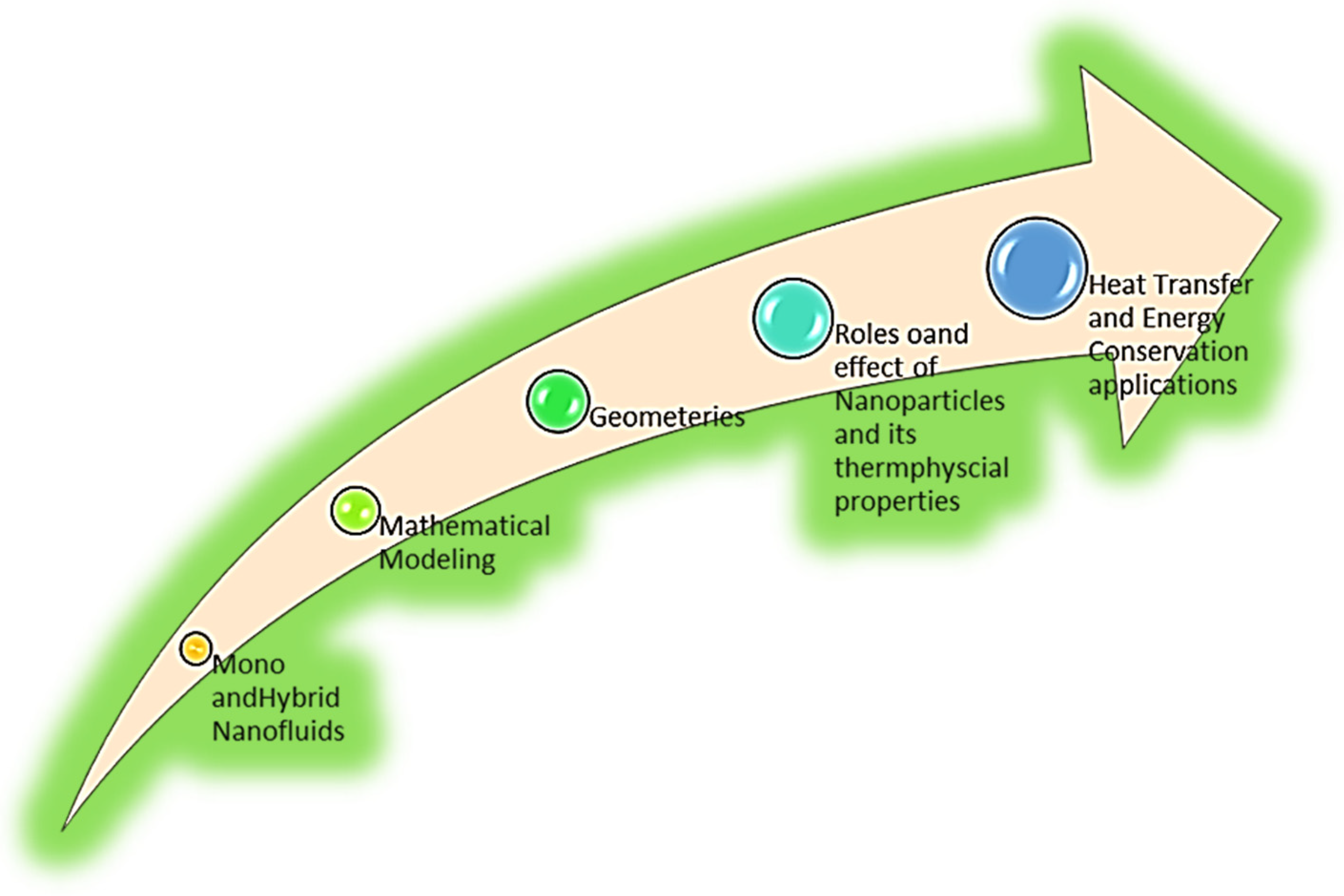
The rapid changes in nanotechnology over the last ten years have given scientists and engineers a lot of new things to study. The nanofluid constitutes one of the most significant advantages that has come out of all these improvements. Nanofluids, colloid suspensions of metallic and nonmetallic nanoparticles in common base fluids, are known for their astonishing ability to transfer heat. Previous research has focused on developing mathematical models and using varied geometries in nanofluids to boost heat transfer rates. However, an accurate mathematical model is another important factor that must be considered because it dramatically affects how heat flows. As a result, before using nanofluids for real-world heat transfer applications, a mathematical model should be used. This article provides a brief overview of the Tiwari and Das nanofluid models. Moreover, the effects of different geometries, nanoparticles, and their physical properties, such as viscosity, thermal conductivity, and heat capacity, as well as the role of cavities in entropy generation, are studied. The review also discusses the correlations used to predict nanofluids’ thermophysical properties. The main goal of this review was to look at the different shapes used in convective heat transfer in more detail. It is observed that aluminium and copper nanoparticles provide better heat transfer rates in the cavity using the Tiwari and the Das nanofluid model. When compared to the base fluid, the Al2O3/water nanofluid’s performance is improved by 6.09%. The inclination angle of the cavity as well as the periodic thermal boundary conditions can be used to effectively manage the parameters for heat and fluid flow inside the cavity.
Keywords: nanofluids; hybrid nanofluids; mathematical modeling geometries; convective heat transfer; entropy generation nanofluids; hybrid nanofluids; mathematical modeling geometries; convective heat transfer; entropy generation