Flexibility of Epichlorohydrin Production—Increasing Profitability by Demand Response for Electricity and Balancing Market

Abstract
1. Introduction
2. Methodology
2.1. Plant Model
2.1.1. Chlor-Alkali Electrolysis
2.1.2. Allyl Chloride Reactor
2.1.3. Hydrochlorination
2.1.4. Saponification
2.2. Model Equations and Parameters in EES
2.3. Optimisation and Sensitivity Analysis in GAMS
- (1)
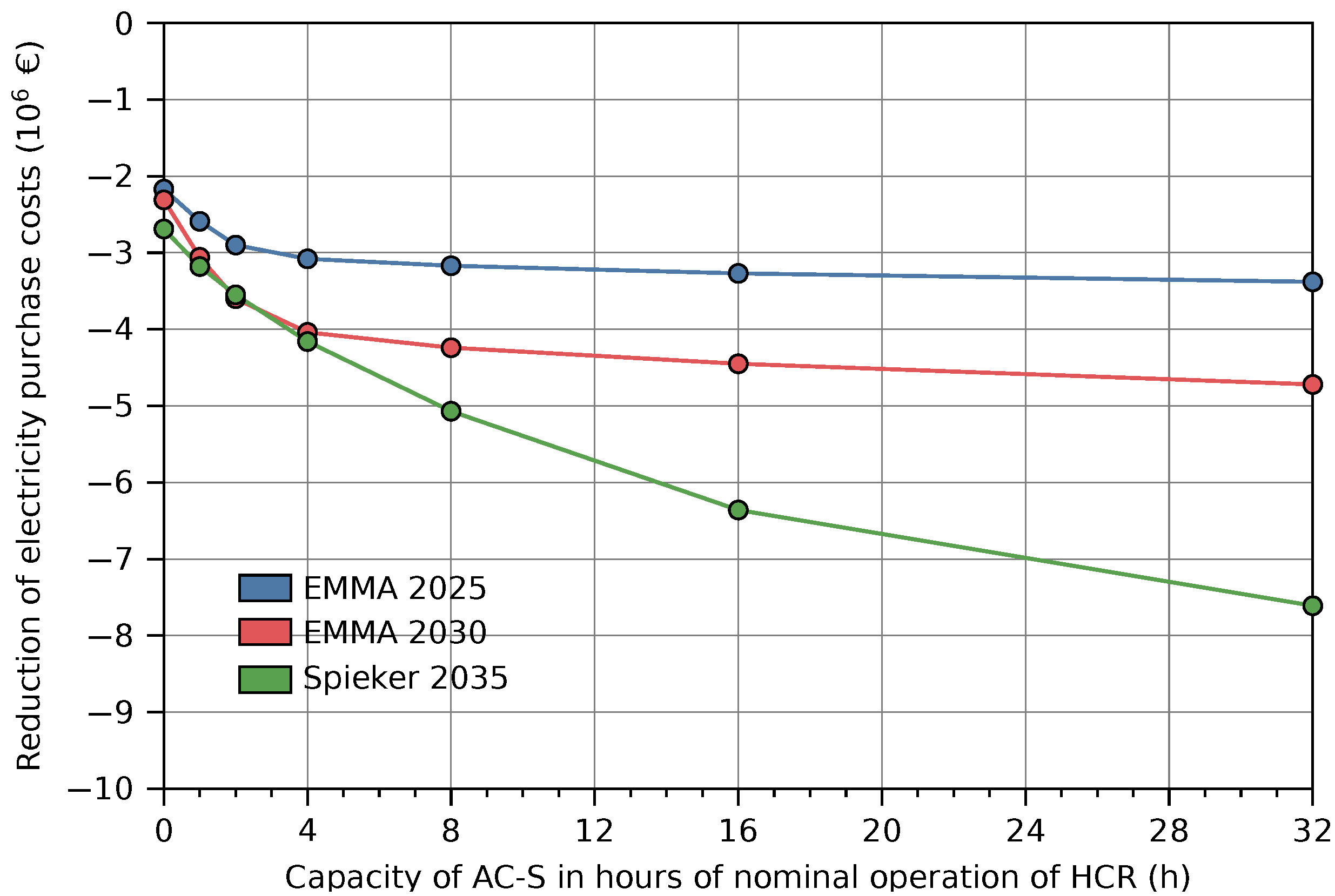
- The model called Electricity Market Model (EMMA) for 2025 and 2030, which takes into account the goals of the German government to increase the share of renewable energies in the gross energy consumption to 40–45% by 2030 [42], prices carbon dioxide at 57 €/t and gives spot prices in hourly resolution [43]. In the model, the share of renewable energies in the grid has an impact on the price level—more renewables decrease the electricity price in the model for the reference year 2016. The assumption that the energy demand can be covered from the supply side at all times reduces the overall price volatility. Still, scarcity prices can occur in order to cover the supply. The modelled average hourly spot price for 2025 is 50 €/MWh with a standard deviation of 37 €/MWh and for 2030 53 €/MWh with a standard deviation of 53 €/MWh.
- (2)
- The model of Kopiske et al. for the year 2035, which estimates prices based on higher shares of lignite and hard coal (20 GW) and a lower share of renewables (190 GW) than aimed by the German government by that year. The average hourly spot price for 2035 is 63 €/MWh with a standard deviation of 36 €/MWh.
2.4. Parallelisation
| Algorithm 1: routine to run all scenarios in parallel mode |
 |
| Algorithm 2: GAMS call for each scenario |
Data: Transferred parameter a from Algorithm 1 Result: calls GAMS code within each directory created in Algorithm 1 1 Open directory with name corresponding to value of a; 2 Run GAMS script with parameters stored in the inc file in the corresponding directory created in Algorithm 1 |
3. Results
3.1. Computation Time
3.2. Economic Benefits
4. Conclusions
Author Contributions
Funding
Data Availability Statement
Conflicts of Interest
Nomenclature
| Abbreviations | |
| AC | Allyl chloride |
| ACR | Allyl chloride reactor |
| aFRR | Automatic frequency restoration reserves |
| BP | Balancing power |
| CAE | Chlor-alkali electrolysis |
| CC | Chlorine compressor |
| CT | Chlorine treatment |
| DR | Demand response |
| DSM | Demand side management |
| E | Electricity |
| ECH | Epichlorohydrin |
| EDC | Ethylene dichloride |
| EEG | Erneuerbare-Energien-Gesetz (Renewable Energy Sources Act) |
| EES | Engineering Equation Solver |
| EMMA | European Electricity Market Model |
| FCR | Frequency containment reserves |
| HCR | Hydrochlorination reactor |
| mFRR | Manual frequency restoration reserves |
| MIP | Mixed integer linear problem |
| R | Ramping |
| RAM | Random access memory |
| S | Storage tank |
| SAP | Saponification |
| VRE | Variable renewable energy sources |
| Latin symbols | |
| a | Array, – |
| A | Area, m2 |
| b | bid factor, – |
| c | Specific costs, |
| C | Total costs, € |
| h | Incrementer |
| H | Enthalpy, |
| I | Current, |
| i | Incrementer |
| j | Incrementer |
| k | Additional power based on reference power, – |
| Mole flow rate, | |
| N | Number, – |
| Objective function, | |
| s | Storage volume, |
| t | time, hour |
| U | Voltage, |
| V | Volume, |
| Power, | |
| Y | Binary variable, 0 or 1 |
| Greek symbols | |
| Fixed time step width, 1h | |
| Energetic efficiency, – | |
| Standard deviation, | |
| Subscripts and superscripts | |
| 0 | Reference state |
| add | Additional |
| comp | Compressor |
| grid | Electric grid |
| m | Membrane |
| max | Maximum |
| min | Minimum |
| total | Power after installation of extra CAE stacks |
| ref | Reference |
| req | Required |
| stacks | Electrolysis stacks |
| transform | Transformer |
References
- Kondziella, H.; Bruckner, T. Flexibility requirements of renewable energy based electricity systems—A review of research results and methodologies. Renew. Sustain. Energy Rev. 2016, 53, 10–22. [Google Scholar] [CrossRef] [Scilit]
- Torriti, J. Peak Energy Demand and Demand Side Response; Volume I: Fundamentals; Routledge: New York, NY, USA, 2016. [Google Scholar]
- Electric Power Research Institute (EPRI). Demand Side Management Glossary; TR-101158 Project 1940-25 Final Report; McGraw-Hill Co.: Palo Alto, CA, USA, 1992. [Google Scholar]
- U.S. Department of Energy. Benefits of Demand Response in Electricity Markets and Recommendations for Achieving Them; Report to the United States Congress: Washington, DC, USA, 2006.
- Electric Power Research Institute (EPRI). New Principles for Demand Response Planning. In Proceedings of the 2013 IEEE Power & Energy Society General Meeting, Palo Alto, CA, USA, 21–25 July 2013. [Google Scholar]
- North American Electric Reliability Corporation (NERC). Demand Response Availability Data System (DADS): Phase I & II; Final Report; Department of Civil and Environmental Engineering, University of South Florida: Tampa, FL, USA, 2011. [Google Scholar]
- Paterakis, N.G.; Erdinç, O.; Catalão, J.P. An overview of Demand Response: Key-elements and international experience. Renew. Sustain. Energy Rev. 2017, 69, 871–891. [Google Scholar] [CrossRef] [Scilit]
- Babu, C.A.; Ashok, S. Peak Load Management in Electrolytic Process Industries. IEEE Trans. Power Syst. 2008, 23, 399–405. [Google Scholar] [CrossRef] [Scilit]
- Otashu, J.I.; Seo, K.; Baldea, M. Cooperative optimal power flow with flexible chemical process loads. AIChE J. 2021, 67, e17159. [Google Scholar] [CrossRef] [Scilit]
- Ausfelder, F.; Seitz, A.; von Roon, S. Flexibilitätsoptionen in der Grundstoffindustrie. In Bericht des AP V.6 Flexibilitätsoptionen und Perspektiven in der Grundstoffindustrie im Kopernikus-Projekt SynErgie; Dechema: Frankfurt am Main, Germany, 2018. (In German) [Google Scholar]
- Schimmel, M.; Achtelik, C.; Rhiemeier, J.M. Energiewende in der Industrie—Potenziale und Wechselwirkungen mit dem Energiesektor. In Abschlussbericht zum Arbeitspaket 1: BMWi: I C 4 80 14 38/42; Projekt-Nr. 42/17; Navigant: Berlin, Germany, 2019. (In German) [Google Scholar]
- Arnold, K.; Janßen, T.; Echternacht, L.; Höller, S.; Voss, T.; Perrey, K. Flexibilisation of Industries Enables Sustainable Energy Systems; Report, Wuppertal Institute: Wuppertal, Germany, 2016. [Google Scholar]
- Hoffmann, C.; Hübner, J.; Klaucke, F.; Milojević, N.; Müller, R.; Neumann, M.; Weigert, J.; Esche, E.; Hofmann, M.; Repke, J.U.; et al. Assessing the realizable flexibility potential of electrochemical processes. Ind. Eng. Chem. Res. 2021, 60, 13637–13660. [Google Scholar] [CrossRef] [Scilit]
- Otashu, J.I.; Baldea, M. Demand response-oriented dynamic modeling and operational optimization of membrane-based chlor-alkali plants. Comput. Chem. Eng. 2019, 121, 396–408. [Google Scholar] [CrossRef] [Scilit]
- Wang, X.; Teichgräber, H.; Palazoglu, A.; El-Farra, N.H. An economic receding horizon optimization approach for energy management in the chlor-alkali process with hybrid renewable energy generation. J. Process Contr. 2014, 24, 1318–1327. [Google Scholar] [CrossRef] [Scilit]
- Chen, S.; Kumar, A.; Wong, W.C.; Chiu, M.S.; Wang, X. Hydrogen value chain and fuel cells within hybrid renewable energy systems: Advanced operation and control strategies. Appl. Energy 2019, 233–234, 321–337. [Google Scholar] [CrossRef] [Scilit]
- Baetens, J.; Kooning, J.; Eetvelde, G.V.; Vandevelde, L. A Two-Stage Stochastic Optimisation Methodology for the Operation of a Chlor-Alkali Electrolyser under Variable DAM and FCR Market Prices. Energies 2020, 13, 5675. [Google Scholar] [CrossRef] [Scilit]
- Teichgraeber, H.; Brandt, A.R. Optimal design of an electricity-intensive industrial facility subject to electricity price uncertainty: Stochastic optimization and scenario reduction. Chem. Eng. Res. Des. 2020, 163, 204–216. [Google Scholar] [CrossRef] [Scilit]
- Richstein, J.C.; Hosseinioun, S.S. Industrial demand response: How network tariffs and regulation (do not) impact flexibility provision in electricity markets and reserves. Appl. Energy 2020, 278, 115431. [Google Scholar] [CrossRef] [Scilit]
- Klaucke, F.; Hoffmann, C.; Hofmann, M.; Tsatsaronis, G. Impact of the chlorine value chain on the demand response potential of the chloralkali process. Appl. Energy 2020, 276, 115366. [Google Scholar] [CrossRef] [Scilit]
- Hofmann, M.; Müller, R.; Christidis, A.; Fischer, P.; Klauke, F.; Vomberg, S.; Tsatsaronis, G. Flexible and economical operation of chlor-alkali process with subsequent polyvinyl chloride production. AIChE J. 2022, 68, e17480. [Google Scholar] [CrossRef] [Scilit]
- Geres, R.; Kohn, A.; Lenz, S.; Ausfelder, F.; Bazzanella, A.; Möller, A. Roadmap Chemie 2050; Report Prepared by Dechema and FutureCamp for VCI. Munich, Germany, 2019. Available online: https://geomodeling.njnu.edu.cn/modelItem/eaf8a0d7-afd8-48c0-bcd9-6d6ed8d169ed (accessed on 20 March 2022). (In German)
- Bruns, B.; Herrmann, F.; Polyakova, M.; Grünewald, M.; Riese, J. A systematic approach to define flexibility in chemical engineering. J. Adv. Manuf. Process. 2020, 2, e10063. [Google Scholar] [CrossRef] [Scilit]
- Lahrsen, I.M.; Hofmann, M.; Müller, R. Models for the analysis of the flexible and economical operation of chlor-alkali process with subsequent epichlorohydrin production. AIChE J. 2022, 68, e17480. [Google Scholar] [CrossRef]
- Hirth, L. The European Electricity Market Model EMMA; Model Documentation, Version 2017-07-12; Pergamon Press Ltd.: London, UK, 2017. [Google Scholar]
- Kopiske, J.; Spieker, S.; Tsatsaronis, G. Value of power plant flexibility in power systems with high shares of variable renewables: A scenario outlook for Germany 2035. Energy 2017, 137, 823–833. [Google Scholar] [CrossRef] [Scilit]
- Klein, S.A. EES—Engineering Equation Solver, F-Chart Software, Version 10.836; 2020. Available online: https://link.springer.com/chapter/10.1007/978-1-4613-0215-5_8 (accessed on 20 March 2022).
- GAMS Development Corporation. General Algebraic Modeling System (GAMS), Release 32.1.0; Bantam Books, Inc.: New York, NY, USA, 2020. [Google Scholar]
- GAMS Development Corporation. CPLEX; Version 12; Bantam Books, Inc.: New York, NY, USA, 2020. [Google Scholar]
- Condon, M. Chemical Profile: Europe Epichlorohydrin. 2018. Available online: https://m.chemicalbook.com/ChemicalProductProperty_EN_CB8381781.htm (accessed on 20 March 2022).
- Peters, M.; Ahrens, A. Auswirkungen des REACH-Verfahrens auf die Herstellung von Epichlorhydrin Sowie die Anwendung Seiner Folgeprodukte als Kleber in der Automobilindustrie; Research report; Niedersächsisches Umweltministerium: Hannover, Germany, 2006. (In German) [Google Scholar]
- Euro Chlor. Chlor-Alkali Industry Review 2018/2019. 2019. Available online: https://www.chlorineindustryreview.com/ (accessed on 20 March 2022).
- Schmittinger, P. Chlorine: Principles and Industrial Practice; Wiley-VCH: Weinheim, Germany, 2000; ISBN 9783527613380. [Google Scholar] [CrossRef] [Scilit]
- O’Brien, T.F.; Bommaraju, T.V.; Hine, F. Overview of the Chlor-Alkali Industry. In Handbook of Chlor-Alkali Technology; Springer: Boston, MA, USA, 2005; pp. 37–74. [Google Scholar] [CrossRef] [Scilit]
- Federal Institute for Occupational Safety and Health. Ortsfeste Druckanlagen für Gase; TRGS 746; Springer: Berlin/Heidelberg, Germany, 2016. (In German) [Google Scholar]
- Gerrath, C. Recent Developments in Chlorine Processing. In Proceedings of the 55th Munich Technology Security Conference, Munich, Germany, 18–20 February 1999. [Google Scholar]
- Krähling, L.; Krey, J.; Jakobson, G.; Grolig, J.; Miksche, L. Allyl Compounds. In Ullmann’s Encyclopedia of Industrial Chemistry; Wiley-VCH: Weinheim, Germany, 2012; pp. 447–469. [Google Scholar] [CrossRef] [Scilit]
- Johnson, G.F. Production of dichlorohydrin from allyl chloride. U.S. Patent 2,714,123a, 26 July 1955. [Google Scholar]
- Liu, G.Y.T.; Richey, W.F.; Betso, J.E. Chlorohydrins. In Ullmann’s Encyclopedia of Industrial Chemistry; Wiley-VCH: Weinheim, Germany, 2000. [Google Scholar] [CrossRef] [Scilit]
- Kneupper, C.D.; Basile, P.S.; Noormann, S. Process and Apparatus for Producing and Purifying Epichlorohydrins. U.S. Patent 8,298,500, 30 December 2012. [Google Scholar]
- Brée, L.C.; Perrey, K.; Bulan, A.; Mitsos, A. Demand side management and operational mode switching in chlorine production. AIChE J. 2019, 65, e16352. [Google Scholar] [CrossRef] [Scilit]
- Klimaschutzprogramm 2030 der Bundesregierung zur Umsetzung des Klimaschutzplans 2050; Drucksache 19/13900; Federal Government: Stuttgart, Germany, 2019. (In German)
- Ruhnau, O.; Bucksteeg, M.; Ritter, D.; Schmitz, R.; Böttger, D.; Koch, M.; Pöstges, A.; Wiedmann, M.; Hirth, L. Why Electricity Market Models Yield Different Results: Carbon Pricing in a Model-Comparison Experiment; Working Paper; Kiel: Hamburg, Germany, 2021. [Google Scholar]
- Marktdaten. Dataset, Bundesnetzagentur. 2017–2019. Available online: https://www.researchgate.net/publication/220174356_Marktwirtschaftlicher_Datenschutz (accessed on 20 March 2022).
- Internetplattform zur Vergabe von Regelleistung. Dataset, Regelleistung.net. 2017–2019. Available online: https://www.vde-verlag.de/proceedings-en/453336006.html (accessed on 20 March 2022).



| Parameter | Symbol | Unit | Value |
|---|---|---|---|
| Additional power | - | 0, 0.05, 0.1, 0.2, 0.4 | |
| Additional storage volume | - | 0, 1, 2, 4, 8, 16, 32, 64, 128 | |
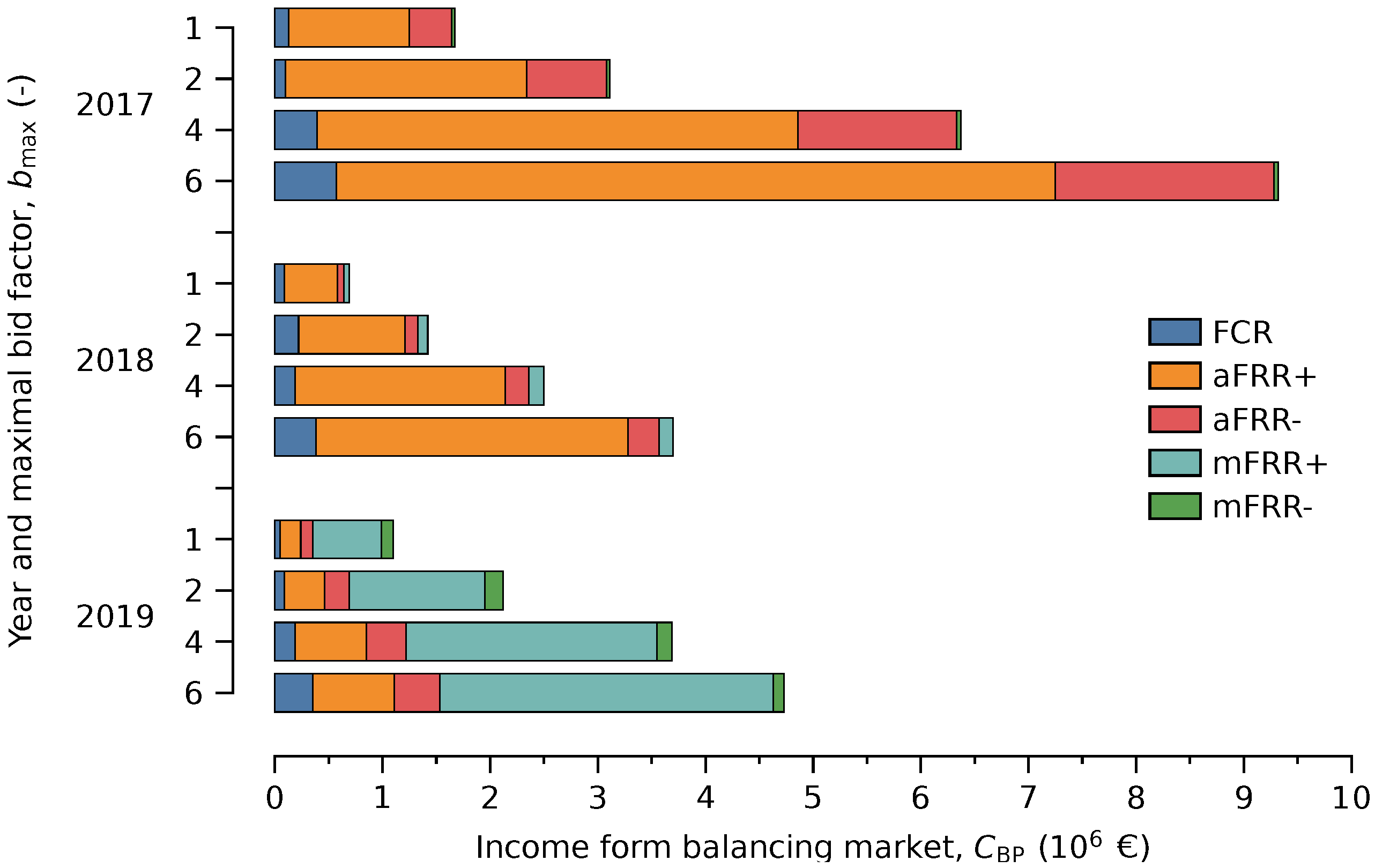
| Maximum bid factor a | - | 0, 1, 2, 4, 6 |
| Year | 2017 | 2018 | 2019 | |||
|---|---|---|---|---|---|---|
| Average | Average | Average | ||||
| 34.19 | 17.66 | 41.73 | 16.61 | 37.67 | 15.52 | |
| Year | 2017 | 2018 | 2019 | |||
|---|---|---|---|---|---|---|
| Average | Average | Average | ||||
| FCR | 14.61 | 2.44 | 12.66 | 3.14 | 8.84 | 2.47 |
| aFRR+ | 23.25 | 19.75 | 10.69 | 11.55 | 3.76 | 6.84 |
| aFRR− | 21.57 | 21.00 | 1.89 | 5.30 | 3.62 | 4.75 |
| mFRR+ | 0.06 | 0.65 | 4.18 | 6.98 | 6.14 | 36.95 |
| mFRR− | 0.70 | 2.62 | 0.94 | 3.27 | 2.32 | 4.88 |
Publisher’s Note: MDPI stays neutral with regard to jurisdictional claims in published maps and institutional affiliations. |
© 2022 by the authors. Licensee MDPI, Basel, Switzerland. This article is an open access article distributed under the terms and conditions of the Creative Commons Attribution (CC BY) license (https://creativecommons.org/licenses/by/4.0/).
Share and Cite
Lahrsen, I.-M.; Hofmann, M.; Müller, R. Flexibility of Epichlorohydrin Production—Increasing Profitability by Demand Response for Electricity and Balancing Market. Processes 2022, 10, 761. https://doi.org/10.3390/pr10040761
Lahrsen I-M, Hofmann M, Müller R. Flexibility of Epichlorohydrin Production—Increasing Profitability by Demand Response for Electricity and Balancing Market. Processes. 2022; 10(4):761. https://doi.org/10.3390/pr10040761
Chicago/Turabian StyleLahrsen, Inga-Marie, Mathias Hofmann, and Robert Müller. 2022. "Flexibility of Epichlorohydrin Production—Increasing Profitability by Demand Response for Electricity and Balancing Market" Processes 10, no. 4: 761. https://doi.org/10.3390/pr10040761
APA StyleLahrsen, I.-M., Hofmann, M., & Müller, R. (2022). Flexibility of Epichlorohydrin Production—Increasing Profitability by Demand Response for Electricity and Balancing Market. Processes, 10(4), 761. https://doi.org/10.3390/pr10040761