Article

Risk-Adjusted Performance of ESG and Non-ESG ETFs Across Market Regimes

by
Dacio Villarreal-Samaniego
1,
Luis Jacob Escobar-Saldívar
2,* and
Roberto J. Santillán-Salgado
2
1
Department of Economics and Managerial Sciences, National Technological Institute of Mexico, Parral Campus, Av. Tecnologico 57, Hidalgo del Parral 33850, CH, Mexico
2
Tecnologico de Monterrey, EGADE Business School, Av. Rufino Tamayo y Av. Eugenio Garza Lagüera, San Pedro Garza García 66269, NL, Mexico
*
Author to whom correspondence should be addressed.
Risks 2026, 14(6), 135; https://doi.org/10.3390/risks14060135 (registering DOI)
Submission received: 21 April 2026 / Revised: 8 June 2026 / Accepted: 9 June 2026 / Published: 12 June 2026

Abstract

The rapid growth of environmental, social, and governance (ESG) investing has intensified the debate regarding whether ESG-oriented investment strategies exhibit performance patterns that differ from those of conventional investments, particularly during periods of market disruption. This study examines the risk-adjusted performance of ESG-oriented and non-ESG exchange-traded funds (ETFs) across market regimes surrounding the COVID-19 shock. The analysis classifies 28 passively managed ETFs into four sustainability-based categories and evaluates their performance using factor-based asset pricing models derived from the Fama–French framework. Additional analyses assess benchmark-relative performance using the S&P 500 and MSCI World indices and consider alternative ETF classifications based on investment mandates. The study estimates regime-specific regressions for the pre-COVID, COVID, and post-COVID periods. The results indicate that performance patterns vary across market regimes and ETF categories. Non-ESG ETFs tend to underperform on a risk-adjusted basis during the pre-COVID period, although this effect disappears thereafter. ESG-oriented ETFs generally exhibit limited evidence of abnormal performance, while factor exposures vary across regimes, reflecting changes in sector composition and macro-financial conditions. The findings suggest that, in addition to ESG orientation, market regimes and sectoral exposures play an important role in explaining differences in ETF performance.

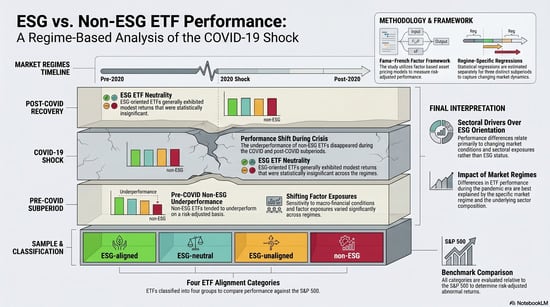
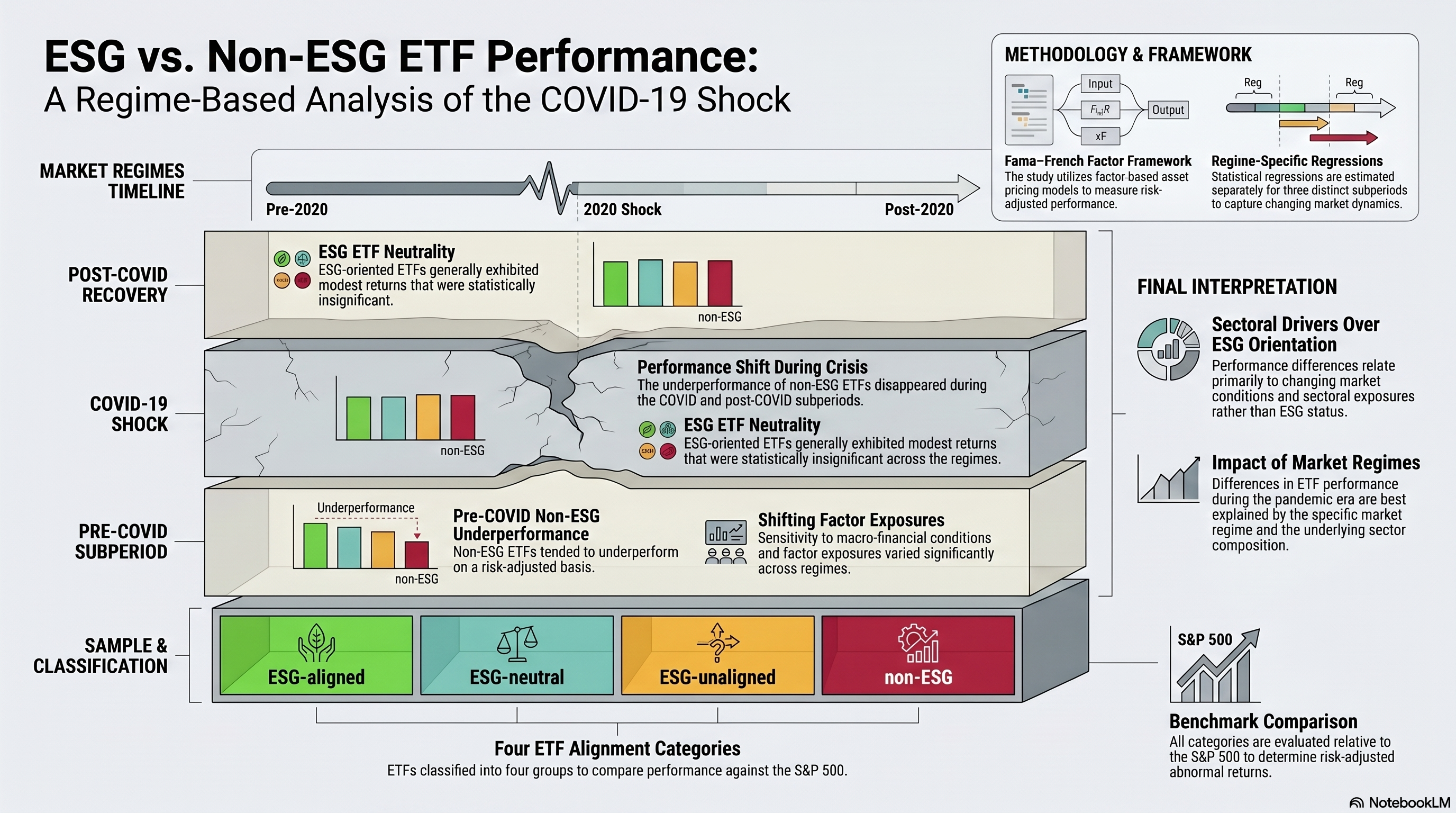
Graphical Abstract

1. Introduction

The rapid expansion of environmental, social, and governance (ESG) investing has generated growing interest among practitioners and academics in socially responsible investing (SRI). While SRI has existed in various forms for several decades, the United Nations Global Compact report provides formal guidance on integrating ESG considerations into asset management and investment decision-making (United Nations 2004). Modern Portfolio Theory (Markowitz 1952) and Post-Modern Portfolio Theory (Rom and Ferguson 1993; Sortino and van der Meer 1991) have long guided portfolio construction and investment decisions. However, these frameworks focus primarily on financial metrics such as expected returns and risk and do not explicitly incorporate non-financial considerations such as ESG criteria.
While ESG investing aims to offer benefits from a societal perspective, the broad integration of ESG criteria into investment decision-making remains puzzling, as it is unclear whether ESG strategies deliver favorable outcomes from an investor’s perspective. Specifically, it remains an open question whether investors who incorporate social responsibility considerations and restrict their investment choices must accept lower financial performance relative to those who do not. Some studies show that the returns of ESG-related exchange-traded funds (ETFs) outperform their non-socially responsible counterparts (ElBannan 2024; Meziani 2020; Rompotis 2023; Supatgiat et al. 2025; Vasiliauskaitė et al. 2025), while others arrive at opposing conclusions (Baklaci et al. 2024; Milonas et al. 2022; Rompotis 2022).
Meehan and Corbet (2025) argue that crises such as the COVID-19 pandemic have raised important questions regarding the performance and resilience of investment vehicles, particularly ETFs. In this context, the studies by ElBannan (2024), Gheorghe et al. (2025), and Supatgiat et al. (2025) report the favorable performance of ESG ETFs during the COVID-19 crisis. Nevertheless, this evidence is not supported by the findings of Folger-Laronde et al. (2022), Pavlova and de Boyrie (2022), and Vasiliauskaitė et al. (2025).
Framing these conflicting results, in the U.S., the influence of a broader social and political context needs consideration. In recent years, there has been a surge of anti-ESG pressures associated with political initiatives that may influence the selection of ESG-related investments. For example, Danyu-Zhang (2023) suggests that since fiduciary responsibilities are determined by politically motivated judges, retirement plan managers have good reasons to retreat from potential ESG asset choices to minimize legal liability risk. Tang et al. (2024) study the market reaction to anti-ESG regulations introduced in eighteen states between 2021 and 2023 and report that energy-related firms experienced cumulative abnormal returns between 0.8% and 3.5% around the regulation approval dates. The market’s response suggests that, in the absence of restrictive regulations, ESG investments are preferred substitutes for energy related securities. (Curtis 2025) and Harmes (2025) also report that a backlash has emerged against the use of ESG criteria by asset managers, in response to several states adopting measures to limit the inclusion of ESG investments in public pension funds. Moreover, the U.S. Department of Labor (DOL)’s guidance on fiduciary duties issued under the Employee Retirement Income Security Act (ERISA) in 2020 emphasized that fiduciaries must base investment decisions on economic risk and return, and prohibited them from sacrificing returns or taking on additional risk to promote non-financial or environmental, social, and governance (ESG) goals, making clear that ESG factors may be considered only to the extent they are expected to have a material effect on risk or return. While the initial guidance was relaxed later, it had an impact on portfolio managers’ asset selection (Department of Labor 2020).
Collectively, the existing evidence provides no clear consensus on the financial performance of ESG-oriented investment strategies. Prior studies report conflicting results across markets, asset classes, and periods of market stress, suggesting that the relationship between ESG orientation and investment performance may depend on broader economic and financial conditions. As noted by Joshi and Dash (2024), the performance implications of ESG investing remain relatively underexplored, particularly across different market regimes. The present study contributes to the ongoing discussion on ESG-related exchange-traded fund performance (ESG-ETFs). It provides a comprehensive evaluation of raw and risk-adjusted excess return differentials relative to the S&P 500 for a sample of 28 passively managed ETFs across distinct phases of the COVID-19 pandemic. The empirical framework also employs one- to six-factor asset pricing models (Carhart 1997; Fama and French 1993, 2015; Sharpe 1964) to distinguish abnormal performance from compensation for underlying risk exposures. The analysis spans the (1) pre-pandemic period from 3 January 2017, to 23 March 2020, (2) the pandemic period from 24 March 2020, to 12 July 2021, and (3) the post-COVID macro-financial adjustment period from 13 July 2021, to 31 December 2024. This subperiod approach allows a regime-based evaluation of the ETFs’ performance. ETFs are classified into four groups based on Morningstar sustainability ratings, namely ESG-aligned, ESG-neutral, ESG-unaligned, and non-ESG, enabling a systematic comparison across ESG orientations. In addition, four equally weighted portfolios are constructed for each ESG classification to facilitate a consistent comparison of performance dynamics across market regimes. This framework enables an examination of whether differences in ESG orientation are associated with systematically different risk-adjusted performance outcomes across periods of market stability, stress, and subsequent normalization.
By jointly examining ESG-aligned, ESG-neutral, ESG-unaligned, and anti-ESG ETFs within a unified empirical framework across pandemic-related market regimes, this study provides new evidence on how ESG orientation interacts with macro-financial conditions to influence ETF risk-adjusted performance.
The remainder of the article is organized as follows. Section 2 presents the theoretical basis of the study and a brief review of the empirical literature. Section 3 describes the data and outlines the research methodology. Section 4 presents the empirical findings, and Section 5 discusses the findings and concludes the paper.

2. Literature Review

2.1. Theoretical Basis

The relationship between asset returns and ESG performance can be interpreted through several complementary theoretical frameworks that account for heterogeneous market responses to ESG information. Del Gesso and Lodhi (2025) identify five dominant approaches, namely stakeholder, legitimacy, institutional, agency, and signaling theories, which are often combined within an integrated theoretical framework.
Stakeholder theory emphasizes that ESG initiatives may enhance firm value by strengthening relationships with key stakeholders and mitigating non-financial risks, supporting sustainable long-term performance rather than short-term gains (Freeman 1984). In the context of the present study, stakeholder theory would predict ESG-ETFs’ resilience to the COVID pandemic “stress” phase, while it would also explain a dampened response during the recovery phase, when cyclical, non-ESG funds typically thrive. By contrast, investment strategies that emphasize ESG-excluded sectors may offer higher expected returns as compensation for regulatory, reputational, and litigation risks, particularly during periods of economic expansion or sectoral rotation.
Legitimacy theory postulates that ESG practices are influenced by prevailing social norms and institutional contexts (Suchman 1995), while institutional theory explains how organizations perceive and respond to social change and institutional pressures (DiMaggio and Powell 1983; Meyer and Rowan 1977). Both theories suggest that the financial effects of ESG performance on ETF returns are likely to differ over time and across regions, something that may be empirically validated by observing the different ETF groups considered in this study through the pre-, post-, and COVID phases.
Agency theory further suggests that information disclosure reduces information asymmetry and agency costs (Jensen and Meckling 1976), so that greater ESG-related disclosure is expected to strengthen transparency and governance, as well as enhance monitoring mechanisms, potentially supporting improved financial outcomes over time (Carnini et al. 2022). In the context of the present study and consistent with stakeholder theory, agency theory suggests that improved ESG performance should be associated with better ETF performance during the more uncertain phases of the pandemic.
Finally, according to signaling theory, ESG disclosures, ratings, and changes in ESG performance may convey information about firm quality, risk management, and long-term orientation in settings characterized by information asymmetry, leading investors to reassess valuations and portfolio allocations (Spence 1973). The signaling theory related anticipation would be supportive of better ESG performance being reflected in better ETFs’ financial market performance.
While stakeholder and signaling theories imply that ESG-oriented firms and assets may benefit from greater resilience and investor support during periods of market stress, agency considerations also point to potential opportunity costs associated with ESG screening. Moreover, managers of firms and funds are expected to adjust to evolving social and institutional pressures over time. These theoretical perspectives imply that ESG performance may mitigate downside risk, although the costs associated with ESG may weigh on ETF performance during the recovery phase. Conversely, investment strategies that emphasize ESG-excluded sectors may offer higher expected returns as compensation for regulatory, reputational, and litigation risks, particularly during periods of economic expansion or sectoral rotation.
The empirical analysis of the different ETF groups’ performance during the three subperiods of the COVID pandemic offers an opportunity to corroborate the adequacy of the theoretical predictions proposed by these theories.

2.2. Review of Empirical Studies

A review of recent studies that report empirical evidence on ESG-ETFs’ market performance identified seven general topics, which may be used as a guide to organize this analysis. According to their findings, the studies may be grouped as follows: (1) ESG ETFs outperform conventional ETFs or benchmarks, (2) higher-ESG-graded ETFs outperform lower-ESG-rated ETFs, (3) ESG-ETFs exhibit distinctive stability during periods of uncertainty, (4) ESG ETFs do not generate a significant alpha or outperform conventional ETFs, (5) ESG ETFs underperform conventional ETFs, (6) anti-ESG funds outperform market benchmarks, and (7) anti-ESG funds underperform market benchmarks.
Studies reporting that ESG ETFs outperform conventional ETFs or other benchmarks include ElBannan (2024), which examines the role of ESG performance in explaining ETF returns and volatility during the market downturn associated with the COVID-19 pandemic; using a diversified sample of 160 iShares MSCI ESG/SRI, this study finds that they were resilient during the COVID pandemic-induced market crash and that they outperformed their conventional counterparts. Similarly, Rompotis (2023) reports that, on average, U.S. ESG ETFs outperform the S&P 500 in terms of raw returns, although this finding is not uniform across funds, as only a small subset of the ETFs examined displays positive and statistically significant alphas.
In their analysis of the role of ESG ratings in shaping market behavior, Supatgiat et al. (2025) report that higher-rated ESG ETFs outperform lower-rated counterparts, exhibiting higher or comparable returns, lower volatility, and smaller price jumps, particularly during periods of market stress such as the COVID-19 pandemic and the Russia–Ukraine conflict.
Gheorghe et al. (2025) analyze the regime-dependent and non-linear behavior of ESG and AI-themed ETFs and conclude that ESG ETFs display relatively stronger stability during periods of heightened uncertainty, particularly in terms of downside risk.
Studies reporting no significant alpha or outperformance of ESG ETFs relative to conventional benchmarks include Rompotis (2022), which examines 49 ESG ETFs in the United Kingdom and finds that, although these funds outperform the FTSE 100, they do not generate statistically significant alpha or differences in Sharpe and Treynor ratios relative to the benchmark. Similarly, Pavlova and de Boyrie (2022) evaluate the risk-adjusted performance of ESG ETFs before and during the COVID-19 market crash and report no significant differences in risk-adjusted performance across ESG rating groups during the pandemic-related downturn.
Additional evidence of ESG ETF underperformance appears in Meziani (2020), which finds that, despite some improvements in performance metrics, ESG ETFs continue to underperform conventional funds. Relatedly, Vasiliauskaitė et al. (2025) compare eight ETFs from the United States and Europe, including both ESG and conventional funds, and report that traditional U.S. ETFs achieve the highest returns and risk-adjusted performance, while European ESG ETFs exhibit the lowest downside risk. Their findings also indicate that ESG ETFs in the U.S. perform comparably to conventional funds, suggesting that ESG integration does not necessarily lead to inferior financial outcomes.
A segment of the capital markets industry provides investment vehicles and advisory strategies tailored to investors who question the need for firms to engage in ESG-related initiatives or oppose such expenditures on financial grounds. These approaches are commonly referred to as anti-ESG, and the literature has examined their performance to a more limited extent. Within this category, some studies report outperformance relative to conventional benchmarks. Hong and Kacperczyk (2009) show that so-called sin stocks earn higher returns than comparable firms even after controlling for standard risk factors, despite being avoided by norm-constrained investors and facing greater legal risk. Similarly, Chang and Krueger (2013) analyze the VICEX fund, which invests in anti-ESG firms, and find that it outperforms the S&P 500 over the 2003–2012 period.
Finally, some studies report that anti-ESG investments underperform their benchmarks. Meehan and Corbet (2025) examine the performance dynamics of socially responsible investment (SRI) and anti-ESG ETFs in the United States during the COVID-19 episode and present evidence that challenges earlier claims of an anti-ESG performance advantage, instead documenting greater resilience, particularly among SRI ETFs. Similarly, Rompotis (2024) compares 18 U.S. anti-ESG ETFs with the iShares ESG Aware MSCI USA ETF and the S&P 500 and finds that most anti-ESG ETFs underperform both the broad market and the selected ESG ETF in terms of absolute and risk-adjusted returns.
In summary, the empirical literature on the subject provides mixed and sometimes conflicting evidence on the performance of ESG-oriented and anti-ESG investment strategies. While some studies document enhanced resilience and favorable risk-adjusted performance of ESG ETFs during periods of heightened market stress, others find only limited or no differences at all in their risk-return performance, relative to conventional ETFs or benchmark portfolios. Furthermore, evidence on anti-ESG ETFs remains relatively limited and largely restricted to specific samples or time periods.
Few studies jointly analyze ESG-aligned, ESG-neutral, ESG-unaligned, and anti-ESG ETFs within a unified empirical framework that explicitly accounts for regime-dependent dynamics and risk-adjusted performance. This study contributes to the literature from a methodological perspective by employing widely used factor models to estimate risk-adjusted abnormal performance for both individual ETFs and equally weighted portfolios. Furthermore, the analysis evaluates raw and risk-adjusted excess return differentials and considers the distinct market regimes associated with different phases of the COVID-19 pandemic to examine the evolution of risk and return across the sample. The study further classifies ETFs according to both sustainability ratings and stated investment mandates, allowing a comparison of performance patterns across alternative classification schemes. These features provide a systematic assessment of ESG-oriented and non-ESG investment strategies across different market environments. Considering these gaps, the present study evaluates two related research hypotheses concerning the performance of ESG-oriented and non-ESG ETFs:
H1: 
ESG-oriented ETFs exhibit risk-adjusted performance that differs from that of non-ESG ETFs and the market benchmark.
H2: 
The risk-adjusted performance of ESG and non-ESG ETFs differs across market regimes, specifically across the pre-COVID, COVID, and post-COVID periods.
The hypotheses are evaluated using subperiod factor regressions to estimate abnormal returns (alphas) for each ETF category, followed by Wald tests that assess whether performance differs across regimes.

3. Data and Methodological Issues

3.1. Data

The selection of ETFs is based on the following criteria: (1) given the ongoing debate on whether managers add value in this asset class (e.g., Carneiro et al. 2022; Crane and Crotty 2018; Fox and Hammond 2022), the analysis focuses exclusively on passively managed funds; (2) price data are available from December 2016 onward; (3) the funds are traded on a U.S. exchange; (4) except for non-ESG ETFs, as defined in the following paragraph, the remaining funds are included in Liu (2020) classification; and (5) all ETFs are listed on ETFdb.com. The latter two criteria generally align the sample construction with the approach adopted by Pavlova and de Boyrie (2022). Application of these criteria resulted in a final sample of 28 ETFs spanning a broad range of sustainability-oriented and conventional investment strategies. Table 1 presents the selected funds, which represent the complete set of ETFs meeting the study’s selection criteria at the time of sample construction.
We classify the ETFs in our sample based on Morningstar Sustainability Globe ratings. This rating follows a five-globe scale and reflects a fund’s ESG risk relative to other funds within the same Morningstar Global Category. ETFs receiving four or five Globes are classified as ESG-aligned, indicating lower ESG risk exposure relative to category peers. ETFs with three Globes are classified as ESG-neutral, reflecting sustainability characteristics broadly in line with peer-group averages. Funds receiving one or two Globes are classified as ESG-unaligned, indicating relatively higher ESG risk exposure. ETFs without explicit ESG screening or sustainability mandates are classified as non-ESG, including so-called sin funds.
Table 1 reports selected characteristics of the ETFs in the sample. Historical Sustainability Globe ratings for the full sample of the study were not available in publicly accessible databases. The classification is therefore treated as structural and cross-sectional rather than time varying. Because the ETFs in the ESG categories were launched with sustainability-oriented mandates, their core investment objectives remained stable throughout the sample period. However, the use of end-of-sample ratings introduces a potential look-ahead bias, which should be considered when interpreting the results.
To assess whether the use of end-of-sample Morningstar Sustainability Globe ratings could lead to misclassification, we reviewed historical prospectuses and registration filings for all ETFs in the sample using the EDGAR database of the U.S. Securities and Exchange Commission, complemented by ETF provider websites to verify subsequent mandates. The review indicates that the primary investment strategy of the ETFs remained broadly stable throughout the sample period. Most funds retained the same benchmark index, while a small number (e.g., SHE and SMOG) experienced benchmark changes without altering their core investment themes.
Therefore, from a mandate-based perspective and to further assess robustness, we conducted an additional analysis using an alternative ETF classification based on stated investment mandates and sectoral exposures rather than Morningstar ratings. Specifically, as shown in Table 1, we group ETFs into four categories: ESG-Screened or Exclusionary (ESG-S), Environmental or Thematic (THEM), Energy (ENER), and Defense (DEF). This classification relies on ex-ante fund objectives and provides a clearer separation between ESG orientation and sector-specific exposures.
The full sample spans eight years, from 3 January 2017, to 31 December 2024. Given the objective of examining ETF performance across distinct phases of the COVID-19 episode, the sample is divided into pre-COVID, COVID, and post-COVID market regimes. This classification is motivated by the COVID-19 finance literature and major macro-financial developments during the sample period. The first breakpoint corresponds to the March 2020 market trough and the abrupt increase in market volatility associated with the COVID-19 shock (Baker et al. 2020; Zaremba et al. 2021; Zhang et al. 2020). The second breakpoint captures the transition from the vaccine-driven recovery phase toward a post-COVID macro-financial environment characterized by economic reopening, sector rotation, rising inflation pressures, and expectations of monetary-policy normalization (BIS 2022; Board of Governors of the Federal Reserve System 2022; Gräb et al. 2021). Based on these considerations, the sample is divided into three regimes: pre-COVID (3 January 2017, to 23 March 2020), COVID (24 March 2020, to 12 July 2021), and post-COVID (13 July 2021, to 31 December 2024).
As a diagnostic check, we applied Bai and Perron’s (2003) multiple structural break methodology to the logarithmic daily returns of the S&P 500 Index. Three versions of the test are considered: global information criteria, sequential F-tests of L + 1 versus L breaks, and global F-tests allowing for up to M breaks. Although the tests do not identify statistically significant structural breaks at the 5% level, the estimated breakpoints cluster around the economically motivated dates described above. Thus, while the Bai–Perron results do not provide formal statistical evidence supporting the selected breakpoints, they are broadly consistent with the timing of major market transitions associated with the COVID-19 period.
To further assess whether the proposed regime classification captures meaningful differences in return dynamics, we conducted the Chow (1960) breakpoint test using 23 March 2020, and 12 July 2021, as break dates. The joint Chow test rejects the null hypothesis of constant coefficients at the 5% level, indicating that regression parameters differ across the three subperiods. Thus, the economic motivation, the clustering of Bai–Perron estimated breakpoints around the selected dates, and the statistically significant Chow test provide support for the use of the proposed regime classification in the empirical analysis. All the analyses in the study were conducted using R (version 4.5.1) and EViews 9.

3.2. Factor Models

Following prior studies (e.g., ElBannan 2024; Pavlova and de Boyrie 2022; Rompotis 2024; Sabbaghi 2025) we employ several factor models to assess the risk-adjusted abnormal performance of the ETFs and equally weighted portfolios: (1) the CAPM (Sharpe 1964), (2) the Fama–French three-factor model (Fama and French 1993), (3) the Carhart (1997) four-factor model, (4) the (Fama and French 2015) five-factor model, and (5) the Fama–French five-factor and momentum factor model.
R i , t R f , t = α B D B , t + α D D D , t + α A D A , t + β 1 R m , t R f , t + ε t
R i , t R f , t = α B D B , t + α D D D , t + α A D A , t + β 1 R m , t R f , t + β 2 S M B t + β 3 H M L t + ε t
R i , t R f , t = α B D B , t + α D D D , t + α A D A , t + β 1 R m , t R f , t + β 2 S M B t + β 3 H M L t + β 6 W M L t + ε t
R i , t R f , t = α B D B , t + α D D D , t + α A D A , t + β 1 R m , t R f , t + β 2 S M B t + β 3 H M L t + β 4 R M W t + β 5 C M A t + ε t
R i , t R f , t = α B D B , t + α D D D , t + α A D A , t + β 1 R m , t R f , t + β 2 S M B t + β 3 H M L t + β 4 R M W t + β 5 C M A t + β 6 W M L t + ε t
where Ri,t is the return of the asset on day t, Rf,t is the risk-free rate, Ri,tRf,t is the asset excess return, and Rm,tRf,t is the market excess return. SMBt and HMLt correspond to the size and value factors, respectively. WMLt represents the momentum factor, while RMWt and CMAt capture the profitability and investment factors, defined as the return differentials between portfolios of firms with robust versus weak profitability and low versus high investment. DB,t, DD,t, and DA,t are dummy variables that take the value of one in the pre-COVID, COVID, and post-COVID periods, respectively, and zero otherwise1. The analysis estimates standard errors using the Newey–West HAC procedure. We use t-tests on the dummy coefficients to assess whether the average abnormal return (alpha) in each subperiod differs statistically from zero.
Risk-adjusted performance is evaluated relative to the S&P 500 and standard U.S. equity risk factors. Although several ETFs in the sample track global or thematic indices, the S&P 500 provides a consistent and widely used benchmark from the perspective of U.S.-based investors. The use of Fama–French–Carhart factors also controls for common systematic risk exposures affecting a broad set of equity investments. Since the study focuses on comparing ESG-oriented and non-ESG ETFs within a unified framework, employing a single benchmark and factor structure ensures methodological consistency across categories. However, some ETFs have mandates extending beyond the U.S. market, which may introduce additional variation in factor exposures.
We compute Variance Inflation Factors (VIF) to assess multicollinearity. VIF values of 5 or higher indicate elevated multicollinearity and are considered problematic, whereas values below 5 suggest moderate multicollinearity and are regarded as acceptable within the model (Chawarura et al. 2025). In addition, following Haggard and Witte (2012), we evaluate regime dependence using Wald tests of equality across subperiod dummy parameters. Specifically, we first test the joint hypothesis that αB = αD = αA; if this null hypothesis is rejected, we then examine each pairwise equality restriction. As a robustness check, we also assess all pairwise equality restrictions for the ETF equally weighted portfolios, irrespective of the outcome of the joint test.
After the estimation of models (1) through (5), we compute two alternative risk-adjusted return measures. The first one is the Sharpe ratio (SRi) shown in Equation (6):
S R i R i , t R f , t σ i
The second risk-adjusted return measure is the Treynor ratio (TRi), as defined in Equation (7):
T R i R i , t R f , t β i
In Equation (6) σi is the standard deviation of the asset’s excess return, while βi in Equation (7) represents the asset’s market risk. The definitions of Ri,t, Rf,t, and Ri,tRf,t in both equations are the same as above. Consistent with prior research (Daniel et al. 2020; Ong and Herremans 2023), we use a 126-day rolling window (approximately six months) to compute daily Sharpe ratio values based on annualized excess return differentials, following Omura et al. (2021). Similarly, to compute the Treynor ratio, we estimate 126-day rolling beta coefficients by regressing each asset’s excess return differentials on market excess return differentials, as suggested by Daniel et al. (2020) and Harris et al. (2019).

4. Results

4.1. Descriptive Statistics

Table 2 reports the descriptive statistics for the equally weighted portfolios constructed according to the four ESG-related ETF classifications. During the pre-COVID subsample, the non-ESG portfolio records negative average daily returns, whereas the remaining categories exhibit average returns close to zero. In contrast, during the post-pandemic subperiod, the pattern reverses for the non-ESG portfolio, while the ESG-neutral and ESG-unaligned portfolios show negative average returns. All portfolios generate positive returns during the COVID-19 subsample. Volatility, measured by the standard deviation, increases across all categories during the COVID-19 episode relative to the pre-pandemic period, with the ESG-unaligned portfolio exhibiting the largest increase. In the post-COVID subperiod, the standard deviation declines for all four portfolios compared to the pandemic subsample; however, the non-ESG portfolio records the largest reduction, while the ESG-neutral portfolio shows the smallest decrease. Finally, return distributions remain non-normal across subperiods, characterized by persistent excess kurtosis and statistically significant departures from normality, supporting the use of heteroskedasticity- and autocorrelation-robust inference in subsequent regressions.
The descriptive statistics for individual ETFs are broadly consistent with the portfolio-level results2. During the COVID-19 subsample, average returns are uniformly positive across all ETFs, indicating that this period coincides with a broad market rebound rather than category-specific gains.

4.2. Factor Model Results

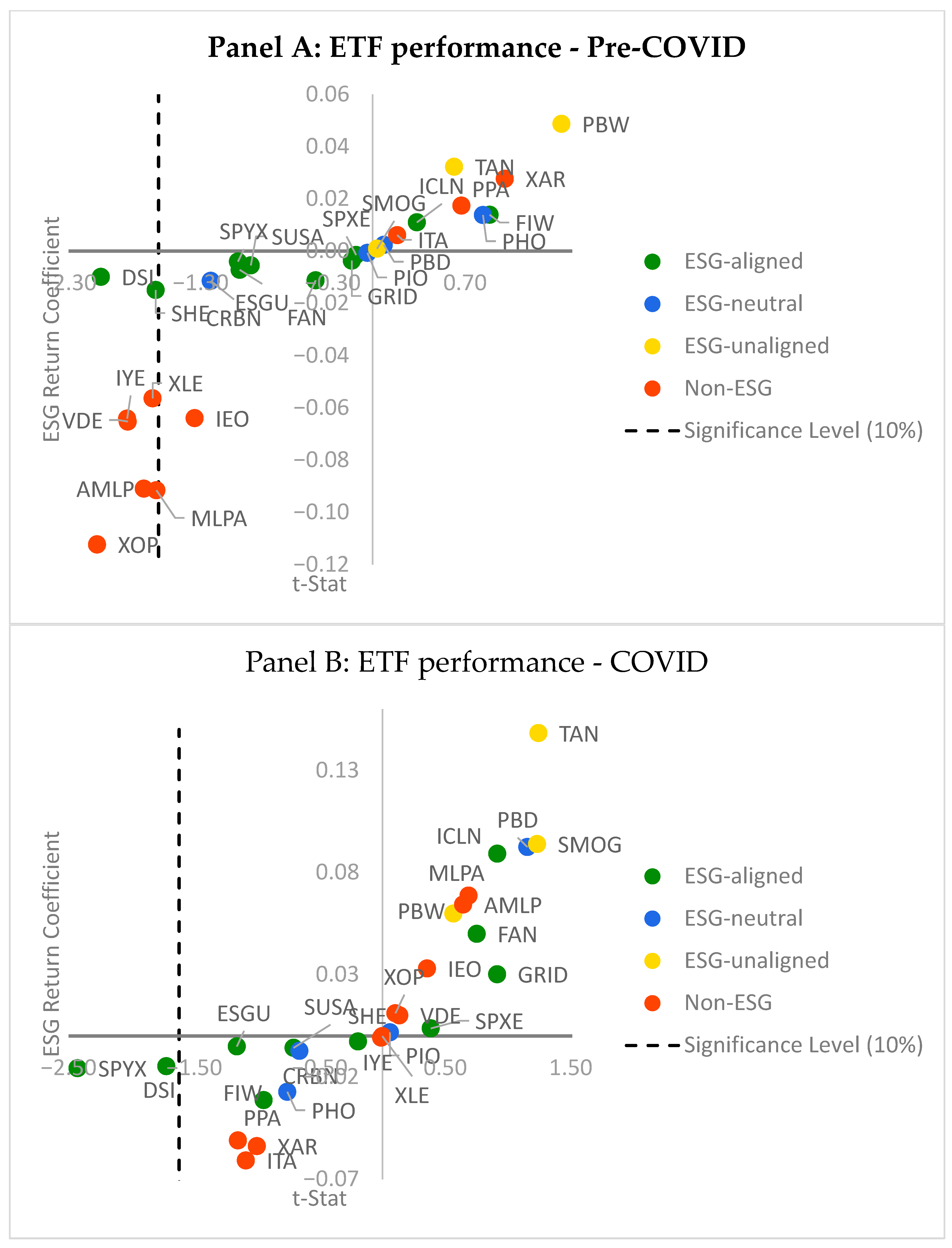
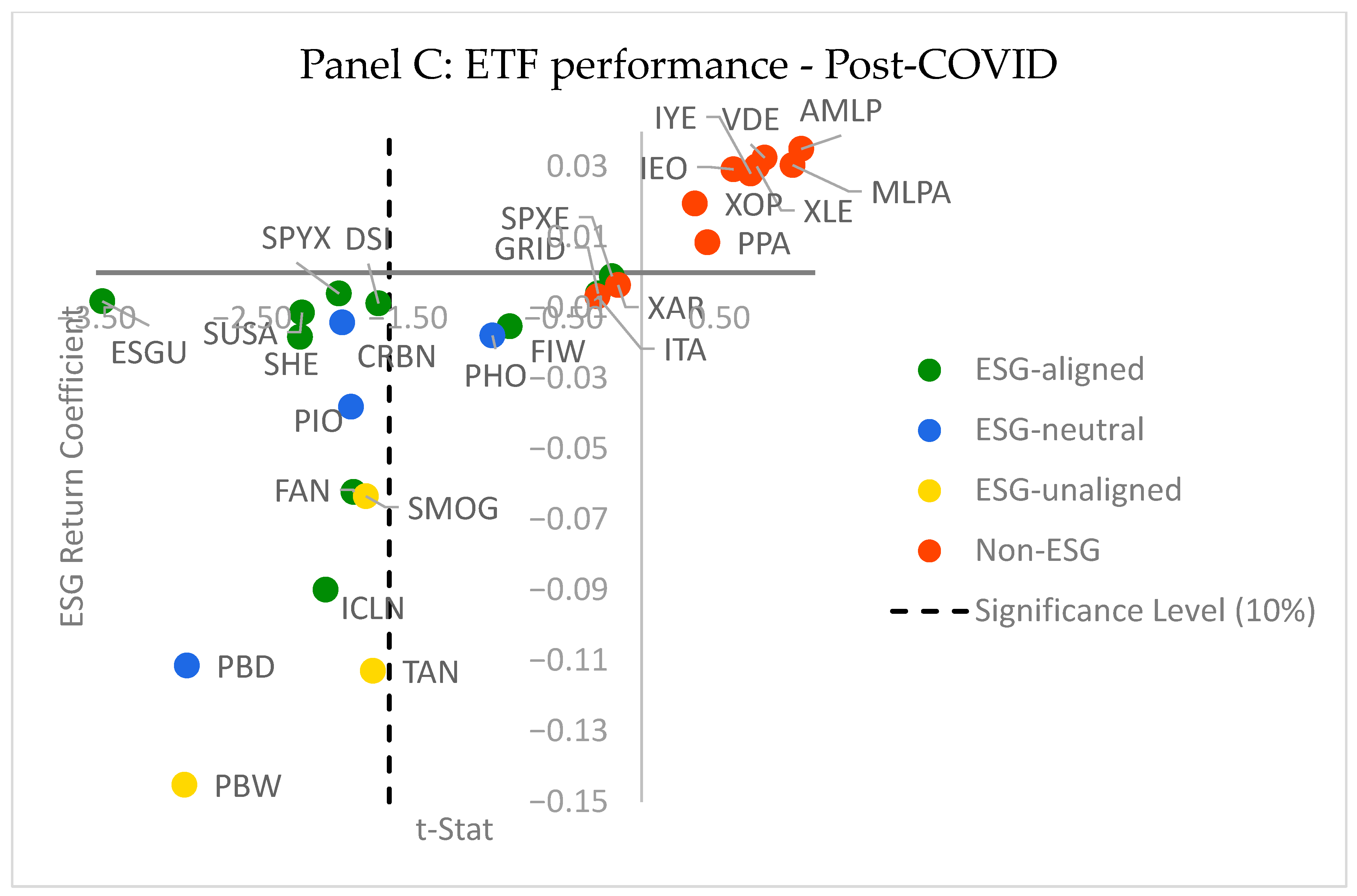
Figure 1 presents the results of the Fama–French five-factor model augmented with the momentum factor for ESG-aligned, ESG-neutral, ESG-unaligned, and non-ESG ETFs across the pre-COVID (Panel A), COVID (Panel B), and post-COVID (Panel C) subperiods. The results indicate that the relationship between ESG orientation and risk-adjusted performance varies across market regimes.
For ESG-aligned ETFs, the factor model estimates provide limited evidence of abnormal performance during the pre-COVID and COVID subperiods. By contrast, in the post-COVID period, a considerable subset of ESG-oriented ETFs exhibits statistically significant negative coefficients, particularly funds with exposure to clean energy and renewable sectors. The magnitude and consistency of these estimates across alternative factor specifications indicate a deterioration in relative performance during the post-COVID macro-financial adjustment period.
A similar pattern emerges for ESG-neutral and ESG-unaligned ETFs, which also exhibit statistically significant negative coefficients in the post-COVID subperiod, while showing no robust evidence of abnormal performance in earlier regimes. These findings indicate that the post-pandemic underperformance is not confined to narrowly defined sustainability categories but extends across a broader range of ESG-oriented investment strategies. Although the CAPM, the Fama–French three-factor and five-factor models, and the Fama–French three-factor model expanded with momentum are not reported for reasons of brevity, their results remain qualitatively consistent with those presented earlier.
Conversely, non-ESG ETFs exhibit a distinctly different regime-dependent pattern. The estimates indicate statistically significant underperformance during the pre-COVID subperiod, particularly for funds with considerable exposure to traditional energy sectors. This pattern does not persist during the COVID and post-COVID periods, in which the estimated coefficients are generally small and statistically indistinguishable from zero across specifications.
Table 3 reports the factor model estimates for the equally weighted portfolios constructed according to sustainability and mandate classifications and largely corroborates the ETF-level findings. In particular, the ESG-aligned, ESG-neutral, ESG-unaligned, ESG-screened, and thematic portfolios exhibit statistically insignificant coefficients during the pre-COVID and COVID subperiods but record significantly negative coefficients in the post-COVID period. By contrast, the non-ESG and energy portfolios underperform primarily in the pre-COVID subperiod, while the defense portfolio coefficients remain statistically insignificant throughout the three subperiods.
Furthermore, the Wald test results based on the Fama–French five-factor and momentum factor model indicate that the ESG-neutral and ESG-unaligned portfolios, as well as the thematic portfolio, exhibit significant regime shifts, specifically between the pre- and post-COVID subperiods and between the COVID and post-COVID subperiods, but not between the pre-COVID and COVID subsamples. However, although the joint F-test does not reject equality across all subperiods for ETFs classified either as non-ESG or energy portfolios, the pairwise tests suggest limited evidence of a shift between the pre-COVID and post-COVID subperiods at the 10% significance level. At the individual ETF level, a similar pattern emerges for ICLN (ESG-aligned/thematic), PBD (ESG-neutral/thematic), and TAN and PBW (ESG-unaligned/thematic). In contrast, the non-ESG/energy midstream energy MLP ETFs AMLP and MLPA display evidence of regime change between the pre-COVID and COVID subperiods3.
In brief, the factor model evidence indicates that ESG-related ETFs, particularly thematic sustainability portfolios with substantial exposure to clean energy and other long-duration sectors, as well as ESG-screened portfolios, exhibit adverse risk-adjusted performance during the post-COVID macro-financial adjustment period. By contrast, energy-related non-ESG ETFs underperform primarily during the pre-pandemic period, with no robust evidence of abnormal performance thereafter, while the defense portfolio does not exhibit statistically significant abnormal returns across subperiods. These findings remain consistent across alternative factor specifications, supporting the robustness of the observed regime-dependent effects.

4.3. Raw and Risk-Adjusted Excess Return Differentials

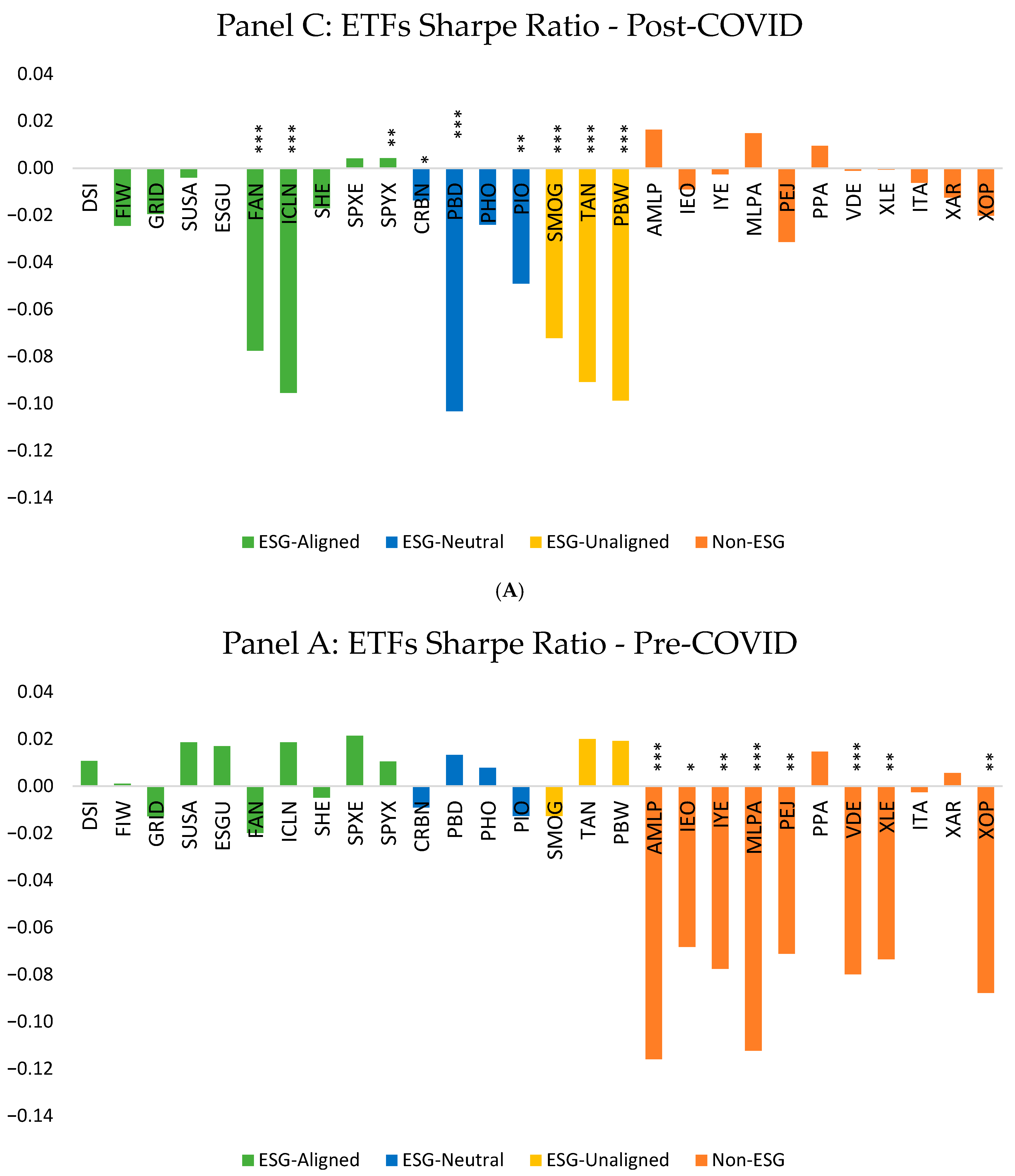
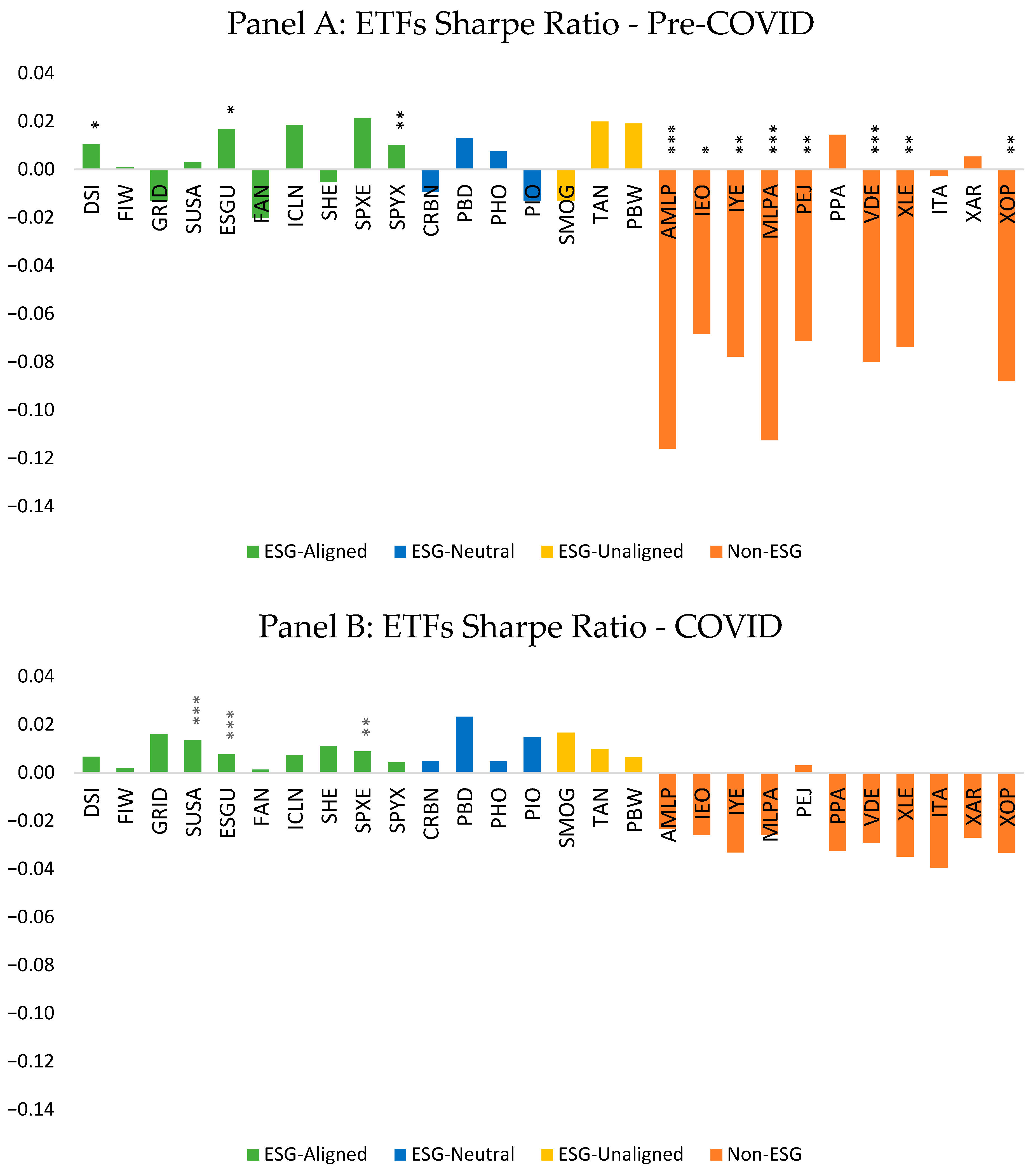
Panels A through C of Figure 2A report the Sharpe ratio-based excess return differentials of the sample ETFs relative to the S&P 500 during the pre-COVID, COVID, and post-COVID subperiods, respectively4. Although raw return differentials and Treynor-based risk-adjusted measures are omitted for brevity, the corresponding results are qualitatively similar. Overall, the findings confirm the patterns identified in the factor model analysis and provide additional insight into the benchmark-relative performance of ESG-related and sector-specific investment strategies.
ESG-aligned ETFs exhibit mixed benchmark-relative performance across subperiods. While several ESG-oriented funds, particularly broad U.S. large- and mid-cap ESG-screened equity ETFs, outperform the S&P 500 during the pre-COVID and COVID subperiods, this pattern does not persist in the post-COVID macro-financial adjustment period. By contrast, ETFs within the ESG-aligned category with substantial exposure to clean energy and renewable sectors display significantly negative excess return differentials during the post-COVID period, indicating a deterioration in benchmark-relative performance.
ESG-neutral and ESG-unaligned ETFs, which primarily consist of thematic sustainability funds (i.e., clean energy and renewable sectors), exhibit excess return differentials that are statistically indistinguishable from zero during the pre-COVID and COVID subperiods but become significantly negative for several ETFs in the post-COVID period across the performance measures considered. The consistency of these results across both raw and risk-adjusted metrics indicates that the observed underperformance is not driven solely by differences in systematic risk exposure or volatility.
In contrast, non-ESG ETFs exhibit significant underperformance relative to the S&P 500 during the pre-COVID subperiod, whereas their performance during the COVID and post-COVID periods is, in general, statistically indistinguishable from that of the index. These results reveal a reduction in relative underperformance rather than the emergence of systematic outperformance. This attenuation of underperformance in the later subperiod coincides with a macro-financial environment characterized by higher energy prices, Federal Reserve monetary tightening, and geopolitical tensions following the Russia–Ukraine conflict. It also corresponds to a period of increased political scrutiny of ESG investing in the United States, which may have contributed to changes in investor sentiment toward ESG-oriented assets.
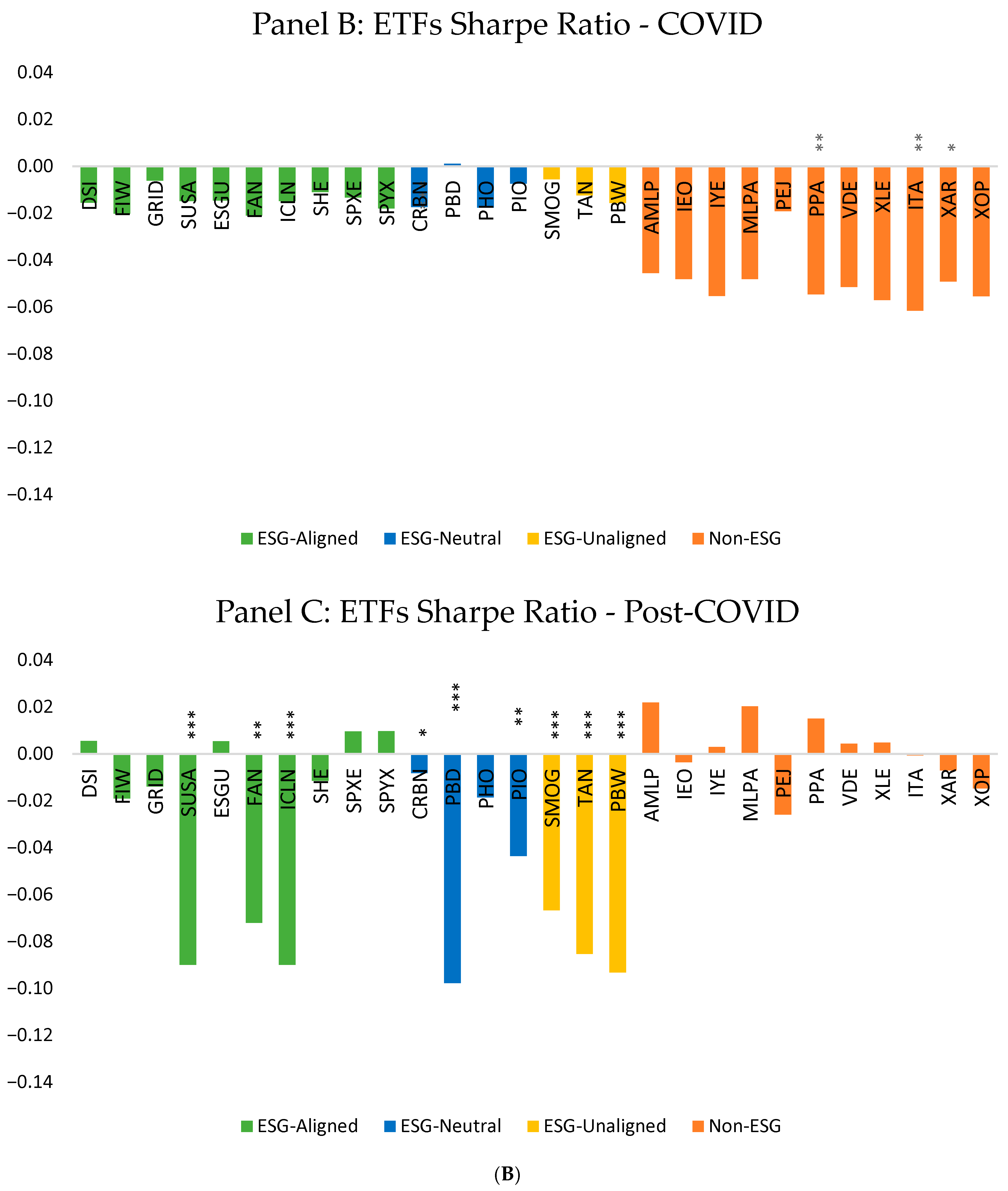
Panels A, B, and C of Figure 2B report the Sharpe ratio-based excess return differentials of the individual ETFs relative to the MSCI World Index during the pre-COVID, COVID, and post-COVID subperiods, respectively. Overall, these results are qualitatively consistent with those reported in Figure 2A. During the pre-COVID and COVID subperiods, the returns of ESG-aligned, ESG-neutral, and ESG-unaligned ETFs, which primarily comprise ESG-screened and thematic portfolios, were generally statistically indistinguishable from the index returns. Nevertheless, several ETFs within these categories, particularly those classified as thematic sustainability funds, exhibited significantly negative Sharpe ratio differentials during the post-COVID period. Similarly, with a few exceptions, the returns of non-ESG ETFs, comprising energy- and defense-related portfolios, were statistically indistinguishable from the index during the COVID and post-COVID subperiods but displayed significantly negative Sharpe ratio differentials during the pre-COVID phase.
As Panel A of Table 4 shows, the raw and risk-adjusted excess return differentials of the equally weighted ETF portfolios relative to the S&P 500 are broadly consistent with the patterns observed at the individual fund level. The ESG-aligned, ESG-neutral, and ESG-unaligned portfolios, which primarily capture ESG-screened and thematic sustainability exposures, exhibit excess return differentials that are statistically indistinguishable from those of the S&P 500 during the pre-COVID and COVID subperiods but record significantly negative raw and risk-adjusted excess return differentials in the post-COVID subperiod. By contrast, the non-ESG portfolio underperforms the benchmark in the pre-COVID subperiod, while its performance during the COVID and post-COVID periods is not statistically different from that of the index. The results in Panel B of Table 4, which present the raw and risk-adjusted excess return differentials of the equally weighted ETF portfolios relative to the MSCI World Index, are very similar to the outcomes in Panel A. These portfolio-level results are therefore consistent with the regime-sensitive performance dynamics documented in the individual ETF analysis.
Additional analyses based on the mandate-oriented portfolio classifications produce qualitatively consistent raw and risk-adjusted results under both the S&P 500 and MSCI World benchmarks. Specifically, thematic sustainability portfolios exhibit significantly weaker benchmark-relative performance during the post-COVID period, whereas energy-related portfolios underperform primarily during the pre-COVID subperiod. Moreover, defense-related portfolios generally do not display statistically significant abnormal performance across subperiods. However, the ESG-screened portfolio shows some evidence of positive benchmark-relative performance during the COVID episode relative to the S&P 500 and based on Sharpe- and Treynor-adjusted measures. This result suggests that broadly diversified ESG-screened equity strategies exhibited greater resilience during the pandemic shock. The evidence is less consistent when the MSCI World Index serves as the benchmark. Table A1 and Table A2 in Appendix A report the detailed results of these analyses.
In short, the benchmark-relative performance analysis reinforces the regime-sensitive nature of ESG-related and sector-specific investment performance. The consistency of the evidence from factor-based models and excess return differentials suggests that sectoral exposures contribute to differences in relative performance across market environments, although ESG orientation and sector composition remain closely intertwined.

5. Discussion and Conclusions

The findings suggest that the performance of ESG and non-ESG exchange-traded funds varies across the pre-COVID, COVID, and post-COVID market regimes. Across factor-model specifications and benchmark-relative performance measures, ESG-related ETFs generally do not exhibit statistically significant abnormal performance during the pre-COVID and COVID subperiods but exhibit underperformance during the post-COVID period. By contrast, non-ESG ETFs underperformed primarily before the pandemic, while their performance is largely indistinguishable from that of the benchmark indices thereafter. Additional robustness analyses based on alternative ETF classifications and benchmark indices are consistent with these findings and suggest that performance differences are closely associated with the interaction between sectoral exposures and changing macro-financial conditions.
The regime-dependent results should be interpreted in light of the distinct macro-financial conditions prevailing across the sample. The pre-COVID period was characterized by generally favorable equity-market conditions despite episodes of trade-related uncertainty and monetary-policy adjustment (Board of Governors of the Federal Reserve System 2018, 2019, 2020). The COVID subperiod combined an unprecedented market shock with exceptional fiscal and monetary support, a rapid financial-market recovery, and persistently low interest rates (Board of Governors of the Federal Reserve System 2021). By contrast, the post-COVID period was characterized by rising inflation, monetary tightening, higher discount rates, elevated energy prices, and geopolitical tensions following Russia’s invasion of Ukraine (Bernanke and Blanchard 2023). The period also coincided with increased political and regulatory scrutiny of ESG investing in the United States, including changes in the interpretation of fiduciary responsibilities under ERISA (Department of Labor 2020) and broader debates regarding the role of ESG considerations in investment decision-making. These conditions help explain the weak performance of thematic sustainability portfolios during the post-COVID period, particularly those with substantial exposure to clean energy and renewable sectors, while energy-related non-ESG portfolios recovered from their earlier underperformance.
Viewed through the theoretical perspectives discussed in this study, the findings provide mixed support for competing explanations of ESG-related investment performance. Stakeholder, signaling, and agency theories suggest that ESG-oriented investments may benefit from stronger stakeholder relationships, enhanced transparency, and superior governance practices during periods of increased uncertainty. Consistent with these arguments, the mandate-based robustness analysis provides limited evidence that broadly diversified ESG-screened portfolios exhibited greater resilience during the COVID episode. However, the absence of widespread abnormal performance among ESG-related ETFs during the pre-COVID and COVID subperiods, together with the post-COVID underperformance observed across several sustainability-oriented portfolios, suggests that ESG orientation alone does not fully explain performance differences. Instead, the results suggest that ETF performance across market regimes is influenced by macro-financial conditions and sectoral exposures, particularly for portfolios concentrated in thematic sustainability sectors.
From a practical investment perspective, the findings suggest that investors may benefit from distinguishing among ESG-related ETFs rather than treating them as a homogeneous asset class. The results indicate that broad ESG-screened portfolios and thematic sustainability portfolios exhibit different performance patterns across market regimes. While broad ESG-screened portfolios display some evidence of resilience during the COVID episode, particularly under benchmark-relative measures based on the S&P 500 Index, thematic sustainability portfolios appear more sensitive to changes in macro-financial conditions, including rising interest rates and higher discount rates. More generally, the evidence suggests that portfolio composition and sectoral exposures are important factors shaping benchmark-relative performance, alongside ESG classification. Consequently, investors evaluating ESG-related investment strategies should consider the underlying economic exposures of ETF portfolios in addition to sustainability classifications and ratings.
From a policy perspective, the findings indicate that ESG labels alone do not necessarily identify investment strategies that exhibit superior financial performance. Rather, the results highlight the importance of underlying sectoral exposures and investment mandates. At the same time, the absence of systematic abnormal returns should not be interpreted as evidence against the broader relevance of sustainability considerations in financial markets. Instead, the findings suggest that the financial implications of ESG investing depend on market regimes, sectoral exposures, and investor objectives.
This study contributes to the literature on sustainable investing by examining the performance of ESG and non-ESG ETFs across distinct market regimes using factor-model and benchmark-relative performance analyses. By combining sustainability-based classifications with mandate-oriented robustness tests and alternative benchmark indices, the analysis provides additional evidence on the determinants of ETF performance under different economic and financial conditions.
Several limitations should be acknowledged. The analysis focuses on U.S.-listed ETFs and relies, in part, on end-of-sample sustainability classifications, although the robustness analyses indicate that the main conclusions do not depend on this choice. In addition, the empirical models do not directly incorporate macro-financial variables such as interest rates, oil prices, or market uncertainty. Consequently, the discussion of these factors is intended to provide economic context for the observed performance patterns rather than to establish direct causal relationships. Future research could extend the analysis to other markets, actively managed ETFs, alternative ESG classification methodologies, and additional crisis episodes.

Author Contributions

Conceptualization, D.V.-S. and L.J.E.-S.; methodology, D.V.-S.; software, D.V.-S.; validation, D.V.-S., L.J.E.-S. and R.J.S.-S.; formal analysis, D.V.-S. and L.J.E.-S.; investigation, D.V.-S., L.J.E.-S. and R.J.S.-S.; resources, D.V.-S., L.J.E.-S. and R.J.S.-S.; data curation, D.V.-S.; writing—original draft preparation, D.V.-S., L.J.E.-S. and R.J.S.-S.; writing—review and editing, D.V.-S., L.J.E.-S. and R.J.S.-S.; visualization, D.V.-S. and L.J.E.-S.; supervision, R.J.S.-S.; project administration, D.V.-S.; funding acquisition, L.J.E.-S. All authors have read and agreed to the published version of the manuscript.

Funding

This research received no external funding. The APC was funded by EGADE Business School.

Data Availability Statement

The data presented in this study are available from publicly accessible repositories and databases. ETF historical prices and S&P 500 index data were obtained from Yahoo Finance, https://finance.yahoo.com/ (accessed on 19 March 2025). Fama–French and momentum factor data were obtained from the Kenneth R. French Data Library, https://mba.tuck.dartmouth.edu/pages/faculty/ken.french/data_library.html (accessed on 3 June 2025). ETF characteristics and classification support were obtained from ETFdb, https://etfdb.com/ (accessed on 15 October 2025). Historical prospectuses and registration filings used to verify ETF investment mandates were obtained from the EDGAR database of the U.S. Securities and Exchange Commission, https://www.sec.gov/edgar/search/ (accessed on 15 February 2026). Morningstar Sustainability Globe ratings were used for ETF ESG classification, https://www.morningstar.com/ (accessed on 4 April 2025). MSCI World Index data series were obtained directly from MSCI and are subject to licensing restrictions. Further processed data supporting the findings of this study are available from the corresponding author on reasonable request.

Conflicts of Interest

The authors declare no conflicts of interest.

Appendix A

Table A1. Raw and Risk-Adjusted Return Differentials Relative to the S&P 500 for Equally Weighted ETF Portfolios Classified by Mandate Category.
Diff. Raw ReturnDiff. SharpeDiff. Treynor
PortfolioPeriodCoeff.t-Stat. Coeff.t-Stat. Coeff.t-Stat.
ESG-ScreenedPre-COVID1.65092.024**0.01331.904*2.11301.524
COVID2.09801.683*0.00952.272**4.29223.075***
Post-COVID−0.5933−0.877 −0.0038−1.276 −0.6299−0.901
ThematicPre-COVID2.88250.537 0.00900.337 2.93220.441
COVID24.45141.425 0.01350.352 19.89641.297
Post-COVID−20.1971−2.566***−0.0807−3.425***−20.3118−2.880***
EnergyPre-COVID−36.7423−2.725***−0.0913−2.767***−25.7612−2.247**
COVID23.37290.773 −0.0265−0.627 7.49170.309
Post-COVID7.77720.600 −0.0023−0.060 9.58580.503
Defense/LeisurePre-COVID−5.4972−0.806 −0.0117−0.455 −5.4245−0.720
COVID3.80010.226 −0.0196−0.624 −0.2624−0.017
Post-COVID−0.9427−0.163 −0.0098−0.418 −0.0645−0.010
Source: Authors’ own. *** p < 0.01, ** p < 0.05, * p < 0.1.
Table A2. Raw and Risk-Adjusted Return Differentials Relative to the MSCI World Index for Equally Weighted ETF Portfolios Classified by Mandate Category.
Diff. Raw ReturnDiff. SharpeDiff. Treynor
PortfolioPeriodCoeff.t-Stat. Coeff.t-Stat. Coeff.t-Stat.
ESG-ScreenedPre-COVID1.93911.221 0.01351.253 2.77260.945
COVID1.78640.699 −0.0127−1.527 −7.0649−1.979**
Post-COVID0.42930.290 0.00170.243 −0.0183−0.009
ThematicPre-COVID3.17080.669 0.00910.340 3.59180.647
COVID24.13981.447 −0.0087−0.238 8.53930.591
Post-COVID−19.1745−2.595***−0.0752−3.337***−19.7003−3.014***
EnergyPre-COVID−36.4540−2.803***−0.0912−2.691***−25.1016−2.476***
COVID23.06120.776 −0.0487−1.156 −3.8653−0.162
Post-COVID8.79980.692 0.00320.081 10.19740.540
Defense/LeisurePre-COVID−5.2089−0.785 −0.0115−0.409 −4.7649−0.729
COVID3.48850.222 −0.0418−1.468 −11.6195−0.876
Post-COVID0.07990.014 −0.0043−0.179 0.54710.085
Source: Authors’ own. *** p < 0.01, ** p < 0.05.

Notes

1
We obtained daily data for the Fama and French three- and five-factor models, the momentum factor, and the risk-free rate (one-month T-bills) from Kenneth French’s data library, https://mba.tuck.dartmouth.edu/pages/faculty/ken.french/data_library.html#Research (accessed on 3 June 2025).
2
All results not reported in the paper for reasons of brevity are available upon request.
3
The Wald test results at the individual ETF level are available upon request.
4
To facilitate comparison across subperiods, the charts use a common return scale (Y-axis).

References

  1. Bai, Jushan, and Pierre Perron. 2003. Computation and Analysis of Multiple Structural Change Models. Journal of Applied Econometrics 18: 1–22. [Google Scholar] [CrossRef]
  2. Baker, Scott R., Nicholas Bloom, Steven J. Davis, Kyle Kost, Marco Sammon, and Tasaneeya Viratyosin. 2020. The Unprecedented Stock Market Reaction to COVID-19. The Review of Asset Pricing Studies 10: 742–58. [Google Scholar] [CrossRef]
  3. Baklaci, Hasan F., William I-Wei Cheng, and Jianing Zhang. 2024. Performance Attributes of Environmental, Social, and Governance Exchange-Traded Funds. Asia-Pacific Financial Markets 31: 307–34. [Google Scholar] [CrossRef]
  4. Bernanke, Ben, and Olivier Blanchard. 2023. What Caused the US Pandemic-Era Inflation? Available online: http://www.brookings.edu/wp-content/uploads/2023/06/WP86-Bernanke-Blanchard_6.13.pdf (accessed on 1 November 2025).
  5. BIS. 2022. Annual Economic Report 2022. Basel: Bank for International Settlements. Available online: https://www.bis.org/publ/arpdf/ar2022e.pdf (accessed on 25 May 2026).
  6. Board of Governors of the Federal Reserve System. 2018. 104th Annual Report: Calendar Year 2017. Washington, DC: Board of Governors of the Federal Reserve System. Available online: https://www.federalreserve.gov/publications/files/2017-annual-report.pdf (accessed on 26 October 2025).
  7. Board of Governors of the Federal Reserve System. 2019. 105th Annual Report: Calendar Year 2018; Washington, DC: Board of Governors of the Federal Reserve System. Available online: https://www.federalreserve.gov/publications/files/2018-annual-report.pdf (accessed on 26 October 2025).
  8. Board of Governors of the Federal Reserve System. 2020. 106th Annual Report: Calendar Year 2019; Washington, DC: Board of Governors of the Federal Reserve System. Available online: https://www.federalreserve.gov/publications/files/2019-annual-report.pdf (accessed on 26 October 2025).
  9. Board of Governors of the Federal Reserve System. 2021. 107th Annual Report: Calendar Year 2020; Washington, DC: Board of Governors of the Federal Reserve System. Available online: https://www.federalreserve.gov/publications/files/2020-annual-report.pdf (accessed on 26 October 2025).
  10. Board of Governors of the Federal Reserve System. 2022. 108th Annual Report: Calendar Year 2021; Washington, DC: Board of Governors of the Federal Reserve System. Available online: https://www.federalreserve.gov/publications/files/2021-annual-report.pdf (accessed on 26 October 2025).
  11. Carhart, Mark M. 1997. On Persistence in Mutual Fund Performance. The Journal of Finance 52: 57–82. [Google Scholar] [CrossRef]
  12. Carneiro, Livia Mendes, William Eid Junior, and Claudia Emiko Yoshinaga. 2022. The Implications of Passive Investments for Active Fund Management: International Evidence. Global Finance Journal 53: 100623. [Google Scholar] [CrossRef]
  13. Carnini, Silvia, Mirella Ciaburri, Barbara Sveva Magnanelli, and Luigi Nasta. 2022. Does ESG Disclosure Influence Firm Performance? Sustainability 14: 7595. [Google Scholar] [CrossRef]
  14. Chang, C. Edward, and Thomas M. Krueger. 2013. The VICEX Fund: Recent Shortcomings of a Long-Run Success Story. Journal of Management and Sustainability 3: 131–41. [Google Scholar] [CrossRef]
  15. Chawarura, Wilfreda Indira, Mabutho Sibanda, and Kuziva Mamvura. 2025. The Impact of ESG on the Financial Performance of Johannesburg Stock Exchange-Listed Companies. Risks 13: 114. [Google Scholar] [CrossRef]
  16. Chow, Gregory C. 1960. Tests of Equality Between Sets of Coefficients in Two Linear Regressions. Econometrica 28: 591–605. [Google Scholar] [CrossRef]
  17. Crane, Alan D., and Kevin Crotty. 2018. Passive versus Active Fund Performance: Do Index Funds Have Skill? Journal of Financial and Quantitative Analysis 53: 33–64. [Google Scholar] [CrossRef]
  18. Curtis, Quinn. 2025. The ESG Backlash and the Demand for ESG Mutual Funds (ECGI Working Paper Series in Law). Journal of Empirical Legal Studies 22: 690–706. [Google Scholar] [CrossRef]
  19. Daniel, Kent, Lira Mota, Simon Rottke, and Tano Santos. 2020. The Cross-Section of Risk and Returns. Review of Financial Studies 33: 1927–79. [Google Scholar] [CrossRef]
  20. Danyu-Zhang, Jane. 2023. How Anti-ESG Pressure Affects Investment: Evidence from Retirement Savings. SSRN Electronic Journal. [Google Scholar] [CrossRef]
  21. Del Gesso, Carla, and Rab Nawaz Lodhi. 2025. Theories Underlying Environmental, Social and Governance (ESG) Disclosure: A Systematic Review of Accounting Studies. Journal of Accounting Literature 47: 433–61. [Google Scholar] [CrossRef]
  22. Department of Labor. 2020. Financial Factors in Selecting Plan Investments. Federal Register 85: 72846–85. Available online: https://www.federalregister.gov/documents/2020/11/13/2020-24515/financial-factors-in-selecting-plan-investments (accessed on 1 November 2025).
  23. DiMaggio, Paul J., and Walter W. Powell. 1983. The Iron Cage Revisited: Institutional Isomorphism in Organizational Fields. American Sociological Review 48: 147–60. [Google Scholar] [CrossRef]
  24. ElBannan, Mona A. 2024. Returns Behavior of ESG ETFs in the COVID-19 Market Crash: Are Green Funds More Resilient? Journal of Corporate Accounting & Finance 35: 187–223. [Google Scholar] [CrossRef]
  25. Fama, Eugene F., and Kenneth R. French. 1993. Common Risk Factors in the Returns on Stocks and Bonds. Journal of Financial Economics 33: 3–56. [Google Scholar] [CrossRef]
  26. Fama, Eugene F., and Kenneth R. French. 2015. A Five-Factor Asset Pricing Model. Journal of Financial Economics 116: 1–22. [Google Scholar] [CrossRef]
  27. Folger-Laronde, Zachary, Sep Pashang, Leah Feor, and Amr ElAlfy. 2022. ESG Ratings and Financial Performance of Exchange-Traded Funds During the COVID-19 Pandemic. Journal of Sustainable Finance & Investment 12: 490–96. [Google Scholar] [CrossRef]
  28. Fox, Steve, and Paul Brett Hammond. 2022. The Better-of-Two Strategy for Active Versus Passive Management: The Option Value of Active Through Time. The Journal of Portfolio Management 48: 63–86. [Google Scholar] [CrossRef]
  29. Freeman, R. Edward. 1984. Strategic Management: A Stakeholder Approach. Glasgow: Pitman. [Google Scholar]
  30. Gheorghe, Catalin, Oana Panazan, Hind Alnafisah, and Ahmed Jeribi. 2025. ETF Resilience to Uncertainty Shocks: A Cross-Asset Nonlinear Analysis of AI and ESG Strategies. Risks 13: 161. [Google Scholar] [CrossRef]
  31. Gräb, Johannes, Moritz Kellers, and Helena Le Mezo. 2021. Rotation Towards Normality—The Impact of COVID-19 Vaccine-Related News on Global Financial Markets. Available online: https://www.ecb.europa.eu/press/economic-bulletin/focus/2021/html/ecb.ebbox202101_02~f0960a5b38.en.html (accessed on 25 May 2026).
  32. Haggard, K. Stephen, and H. Douglas Witte. 2012. Subperiod Robustness Checks: Testing for Effect Mean Stationarity. Managerial Finance 38: 530–42. [Google Scholar] [CrossRef]
  33. Harmes, Adam. 2025. The Anti-ESG Backlash and Asset Manager Capitalism. Politics & Society 53: 603–29. [Google Scholar] [CrossRef]
  34. Harris, Richard D. F., Xuguang Li, and Fang Qiao. 2019. Option-Implied Betas and the Cross-Section of Stock Returns. Journal of Futures Markets 39: 94–108. [Google Scholar] [CrossRef]
  35. Hong, Harrison, and Marcin Kacperczyk. 2009. The Price of Sin: The Effects of Social Norms on Markets. Journal of Financial Economics 93: 15–36. [Google Scholar] [CrossRef]
  36. Jensen, Michael C., and William H. Meckling. 1976. Theory of the Firm: Managerial Behavior, Agency Costs and Ownership Structure. Journal of Financial Economics 3: 305–60. [Google Scholar] [CrossRef]
  37. Joshi, Girish, and Ranjan Kumar Dash. 2024. Exchange-Traded Funds and the Future of Passive Investments: A Bibliometric Review and Future Research Agenda. Future Business Journal 10: 17. [Google Scholar] [CrossRef]
  38. Liu, Jess. 2020. Morningstar’s Quintessential List of Sustainable Funds. Available online: https://www.morningstar.com/sustainable-investing/morningstars-quintessential-list-sustainable-funds (accessed on 5 March 2025).
  39. Markowitz, Harry. 1952. Portfolio Selection. Journal of Finance 7: 77–91. [Google Scholar] [CrossRef]
  40. Meehan, David, and Shaen Corbet. 2025. Comparing the Resilience of Socially Responsible and Sin Investment During the COVID-19 Pandemic. Research in International Business and Finance 73: 102537. [Google Scholar] [CrossRef]
  41. Meyer, John W., and Brian Rowan. 1977. Institutional Organizations: Formal Structures as Myth and Ceremony. American Journal of Sociology 83: 340–63. [Google Scholar] [CrossRef] [PubMed]
  42. Meziani, A. Seddik. 2020. It Is Still Not Easy Being Green for Exchange-Traded Funds. The Journal of Index Investing 10: 6–23. [Google Scholar] [CrossRef]
  43. Milonas, Nikolaos, Gerasimos Rompotis, and Christos Moutzouris. 2022. The Performance of ESG Funds vis-à-vis Non-ESG Funds. The Journal of Impact and ESG Investing 2: 96–115. [Google Scholar] [CrossRef]
  44. Omura, Akihiro, Eduardo Roca, and Miwa Nakai. 2021. Does Responsible Investing Pay During Economic Downturns: Evidence From the COVID-19 Pandemic. Finance Research Letters 42: 101914. [Google Scholar] [CrossRef]
  45. Ong, Joel, and Dorien Herremans. 2023. Constructing Time-Series Momentum Portfolios with Deep Multi-Task Learning. Expert Systems with Applications 230: 120587. [Google Scholar] [CrossRef]
  46. Pavlova, Ivelina, and Maria E. de Boyrie. 2022. ESG ETFs and the COVID-19 Stock Market Crash of 2020: Did Clean Funds Fare Better? Finance Research Letters 44: 102051. [Google Scholar] [CrossRef]
  47. Rom, Brian M., and Kathleen W. Ferguson. 1993. Post-Modern Portfolio Theory Comes of Age. The Journal of Investing 2: 27–33. [Google Scholar] [CrossRef]
  48. Rompotis, Gerasimos G. 2022. The ESG ETFs in the UK. Journal of Asset Management 23: 114–29. [Google Scholar] [CrossRef]
  49. Rompotis, Gerasimos G. 2023. The Performance of ESG ETFs in the U.S. Capital Markets Review 31: 89–101. Available online: https://www.mfa.com.my/wp-content/uploads/2023/09/v31_i2_a5_pg89-101.pdf (accessed on 17 January 2026).
  50. Rompotis, Gerasimos G. 2024. The Performance of Anti-ESG ETFs in the United States. Journal of Asset Management 25: 700–13. [Google Scholar] [CrossRef]
  51. Sabbaghi, Omid. 2025. ESG Risk and Idiosyncratic Risk: Recent Evidence. Sustainable Finance Review 1: 67–82. [Google Scholar] [CrossRef]
  52. Sharpe, William F. 1964. Capital Asset Prices: A Theory of Market Equilibrium Under Conditions of Risk. The Journal of Finance 19: 425–42. [Google Scholar] [CrossRef] [PubMed]
  53. Sortino, Frank A., and Robert van der Meer. 1991. Downside Risk. The Journal of Portfolio Management 17: 27–31. [Google Scholar] [CrossRef]
  54. Spence, Michael. 1973. Job Market Signaling. The Quarterly Journal of Economics 87: 355–74. [Google Scholar] [CrossRef]
  55. Suchman, Mark C. 1995. Managing Legitimacy: Strategic and Institutional Approaches. Academy of Management Review 20: 571–610. [Google Scholar] [CrossRef]
  56. Supatgiat, Chonawee, Piyachart Phiromswad, Olgun Fuat Sahin, and Pattarake Sarajoti. 2025. Investigating the Impact of ESG Ratings on ETF Performance During Market Disruptions: Evidence From the COVID-19 Pandemic and Russian (Full-Scale) Invasion of Ukraine. Research in International Business and Finance 77: 102904. [Google Scholar] [CrossRef]
  57. Tang, Oupin, Xiaomeng Shi, and Lili Jiu. 2024. Value Creation or Political Trick? An Event Study on Anti-ESG Regulations. Finance Research Letters 65: 105530. [Google Scholar] [CrossRef]
  58. United Nations. 2004. Who Cares Wins. Washington, DC: International Finance Corporation. Available online: https://documents.worldbank.org/en/publication/documents-reports/documentdetail/280911488968799581/who-cares-wins-connecting-financial-markets-to-a-changing-world (accessed on 14 March 2023).
  59. Vasiliauskaitė, Deimantė, Viltė Šabaniauskaitė, Dominyka Šimėnaitė, Kamilė Varžgalytė, and Wenting Meng. 2025. Market Risk in Sustainable and Traditional Exchange-Traded Funds during Global Uncertainty. IETI Transactions on Data Analysis and Forecasting (ITDAF) 3: 4–20. [Google Scholar] [CrossRef]
  60. Zaremba, Adam, David Y. Aharon, Ender Demir, Renatas Kizys, and Dariusz Zawadka. 2021. COVID-19, Government Policy Responses, and Stock Market Liquidity Around the World: A Note. Research in International Business and Finance 56: 101359. [Google Scholar] [CrossRef]
  61. Zhang, Dayong, Min Hu, and Qiang Ji. 2020. Financial Markets Under the Global Pandemic of COVID-19. Finance Research Letters 36: 101528. [Google Scholar] [CrossRef]
Figure 1. Fama–French 5-Factor Plus Momentum Results for Individual ETFs. Source: Authors’ own.
Risks 14 00135 g001aRisks 14 00135 g001b
Figure 2. (A) ETFs’ Sharpe Risk-Adjusted Excess Return Differentials Relative to the S&P 500. (B) ETFs’ Sharpe Risk-Adjusted Excess Return Differentials Relative to the MSCI World Index. *** p < 0.01, ** p < 0.05, * p < 0.1. Source: Authors’ own.
Risks 14 00135 g002aRisks 14 00135 g002bRisks 14 00135 g002c
Table 1. Characteristics of the ETFs in the sample.
TickerNameCore StrategyInception DateMorningstar GlobesESG ClassificationMandate Category
DSIiShares MSCI KLD 400 Social ETFU.S. social ESG index14 November 20065ESG-alignedESG-S
FIWFirst Trust Water ETFU.S. water management thematic8 May 20075ESG-alignedTHEM
GRIDFirst Trust NASDAQ Clean Edge Smart Grid ETFSmart-grid infrastructure theme16 November 20095ESG-alignedTHEM
SUSAiShares MSCI USA ESG Select ETFESG-screened U.S. large/mid caps24 January 20055ESG-alignedESG-S
ESGUiShares ESG Aware MSCI USA ETFCore U.S. equity exposure with integrated ESG optimization1 December 20164ESG-alignedESG-S
FANFirst Trust Global Wind Energy ETFGlobal wind energy thematic16 June 20084ESG-alignedTHEM
ICLNiShares Global Clean Energy ETFGlobal renewable energy exposure24 June 20084ESG-alignedTHEM
SHESPDR MSCI USA Gender Diversity ETFU.S. gender-diverse companies7 March 20164ESG-alignedESG-S
SPXEProShares S&P 500 ex-EnergyU.S. large- and mid-cap stocks, excluding the energy sector22 September 20154ESG-alignedESG-S
SPYXSPDR S&P 500 Fossil Fuel Reserves Free ETFS&P 500 excluding fossil fuel reserve firms30 November 20154ESG-alignedESG-S
CRBNiShares MSCI ACWI Low Carbon Target ETFGlobal low-carbon index; screens coal/oil8 December 20143ESG-neutralESG-S
PBDInvesco Global Clean Energy ETFGlobal clean energy equities13 June 20073ESG-neutralTHEM
PHOInvesco Water Resources ETFU.S. water infrastructure & purification companies6 December 20053ESG-neutralTHEM
PIOInvesco Global Water ETFGlobal water infrastructure equities13 June 20073ESG-neutralTHEM
SMOGVanEck Low Carbon Energy ETFLow-carbon energy focus3 May 20072ESG-unalignedTHEM
TANInvesco Solar ETFGlobal solar energy thematic15 April 20082ESG-unalignedTHEM
PBWInvesco WilderHill Clean Energy ETFGlobal clean energy thematic (solar, wind, etc.)3 March 20051ESG-unalignedTHEM
AMLPAlerian MLP ETFMidstream energy MLPs24 August 20102Non-ESGENER
IEOiShares U.S. Oil & Gas E&P ETFU.S. E&P sector1 May 20062Non-ESGENER
IYEiShares U.S. Energy ETFLarge-cap U.S. energy12 June 20002Non-ESGENER
MLPAGlobal X MLP ETFMidstream energy master limited partnerships (MLPs)18 April 20122Non-ESGENER
PEJInvesco Dynamic Leisure & Entertainment ETFU.S. leisure & gambling sectors23 June 20052Non-ESGDEF
PPAInvesco Aerospace & Defense ETFAerospace and defense sector26 October 20052Non-ESGDEF
VDEVanguard Energy ETFBroad U.S. energy sector23 September 20042Non-ESGENER
XLEEnergy Select Sector SPDR FundU.S. energy sector (oil, gas, consumable fuels)16 December 19982Non-ESGENER
ITAiShares U.S. Aerospace & Defense ETFAerospace & defense equities1 May 20061Non-ESGDEF
XARSPDR S&P Aerospace & Defense ETFU.S. aerospace & defense sector28 September 20111Non-ESGDEF
XOPSPDR S&P Oil & Gas E&P ETFOil & gas exploration & production19 June 20061Non-ESGENER
Source: Authors’ own.
Table 2. ETFs Equally Weighted Portfolios Descriptive Statistics.
Full Sample Pre-COVID
ESG-AlignedESG-NeutralESG-UnalignedNon-ESGESG-AlignedESG-NeutralESG-UnalignedNon-ESG
Mean0.0380.0270.0240.018−0.001−0.0010.019−0.107
Median0.0510.0630.0740.0580.0570.0780.1250.032
Maximum9.3938.79012.86310.8477.5137.6805.6518.651
Minimum−11.483−13.330−13.759−22.641−11.483−13.330−13.759−22.641
Std. Dev.1.1751.2082.1061.6661.1291.1381.5711.672
Skewness−0.863−0.982−0.242−1.812−3.008−3.557−2.765−4.923
Kurtosis17.80718.6177.41629.98635.75843.63225.20360.474
Jarque-Bera18,629.2120,770.401654.11062,153.9337,439.0057,427.1017,669.14114,758.40
Jarque-Bera p-value0.0000.0000.0000.0000.0000.0000.0000.000
Sum77.43054.65047.51235.747−0.595−0.99415.304−86.702
Sum Sq. Dev.2775.3312935.1758920.1345582.5171030.4221048.5641995.6002260.975
Observations2012201220122012810810810810
COVID Post-COVID
ESG-AlignedESG-NeutralESG-UnalignedNon-ESGESG-AlignedESG-NeutralESG-UnalignedNon-ESG
Mean0.2370.2430.3980.2700.000−0.027−0.1130.039
Median0.2790.2970.5290.072−0.024−0.027−0.2350.084
Maximum9.3938.79012.86310.8475.7756.2378.5963.986
Minimum−6.246−5.901−7.520−9.458−4.234−4.242−8.090−7.173
Std. Dev.1.4451.4312.7632.3481.0951.1722.2361.304
Skewness0.5400.4660.0960.441−0.0130.1180.251−0.377
Kurtosis10.1458.9724.6785.8874.5674.3683.5784.951
Jarque-Bera713.6821499.236838.98099124.585889.4238570.1655321.33243159.3096
Jarque-Bera p-value0.0000.0000.0000.0000.0000.0000.0000.000
Sum77.63279.576130.69288.4000.393−23.932−98.48434.049
Sum Sq. Dev.682.760669.8382497.2631802.3341046.7541198.2944364.9321485.411
Observations328328328328874874874874
Source: Authors’ own.
Table 3. Factor Model t-Test and F-Test Results for Equally Weighted ETF Portfolios.
Panel A: Sustainability Globes Classification
CAPMFF-3MomentumFF-5FF-5 + MomentumF-Stat.F-Stat.
PortfolioPeriodαt-Stat. αt-Stat. αt-Stat. αt-Stat. αt-Stat. αB = αD = αA αi = αj
ESG-AlignedPre-COVID−0.0074−0.764 −0.0037−0.397 −0.0035−0.372 −0.0036−0.383 −0.0033−0.347 0.362
COVID0.01580.765 0.01150.575 0.01060.533 0.01120.561 0.00970.489 1.559 2.048
Post-COVID−0.0258−2.529***−0.0238−2.358**−0.0232−2.315**−0.0235−2.329**−0.0226−2.275** 2.131
ESG-NeutralPre-COVID−0.0078−0.551 −0.0001−0.005 0.00030.024 0.00040.030 0.00100.071 0.460
COVID0.02610.859 0.01680.587 0.01500.523 0.01790.634 0.01490.526 3.283**2.291**
Post-COVID−0.0531−3.047***−0.0484−2.973***−0.0471−2.938***−0.0472−2.902***−0.0453−2.857*** 3.525*
ESG-UnalignedPre-COVID0.01910.549 0.02750.797 0.02810.810 0.03280.992 0.03351.006 0.596
COVID0.10050.881 0.07130.744 0.06880.715 0.10431.119 0.10081.077 3.334**5.228**
Post-COVID−0.1422−2.787***−0.1103−2.380**−0.1084−2.348**−0.0964−2.125**−0.0942−2.090** 3.749**
Non-ESGPre-COVID−0.1142−2.775***−0.0542−1.802*−0.0536−1.775*−0.0509−1.704*−0.0499−1.651* 0.745
COVID0.03390.369 −0.0081−0.139 −0.0107−0.189 0.00670.117 0.00150.027 1.468 2.829*
Post-COVID0.01100.294 0.00410.151 0.00610.220 0.01250.480 0.01580.598 0.058
Panel B: ETF Mandate Classification
CAPMFF-3MomentumFF-5FF-5 + MomentumF-Stat.F-Stat.
PortfolioPeriodαt-Stat. αt-Stat. αt-Stat. αt-Stat. αt-Stat. αB = αD = αA αi = αj
ESG-ScreenedPre-COVID−0.0064−1.246 −0.0077−1.609 −0.0075−1.536 −0.0080−1.677*−0.0078−1.587 0.018
COVID−0.0057−0.865 −0.0033−0.621 −0.0043−0.851 −0.0055−1.054 −0.0068−1.364 0.141 0.105
Post-COVID−0.0077−2.365**−0.0096−3.240***−0.0089−3.104***−0.0105−3.516***−0.0096−3.395*** 0.237
ThematicPre-COVID−0.0022−0.103 0.00810.381 0.00840.395 0.01020.491 0.01070.511 0.470
COVID0.06030.961 0.04180.744 0.04020.712 0.05340.973 0.05070.919 3.338**5.318**
Post-COVID−0.0882−2.973***−0.0734−2.703***−0.0722−2.676***−0.0679−2.519**−0.0662−2.485** 3.651*
EnergyPre-COVID−0.1594−2.947***−0.0844−2.100**−0.0837−2.083**−0.0792−2.002**−0.0778−1.963** 1.423
COVID0.05960.493 0.00930.109 0.00600.071 0.03360.399 0.02660.331 2.191 3.963**
Post-COVID0.02330.450 0.01150.293 0.01410.353 0.02480.654 0.02930.758 0.001
Defense/LeisurePre-COVID−0.0352−1.228 −0.0014−0.053 −0.0011−0.042 −0.0015−0.056 −0.0010−0.040 0.616
COVID−0.0111−0.169 −0.0387−0.827 −0.0399−0.865 −0.0405−0.855 −0.0426−0.912 0.312 0.047
Post-COVID−0.0105−0.482 −0.0089−0.501 −0.0079−0.443 −0.0091−0.522 −0.0078−0.445 0.486
Source: Authors’ own. *** p < 0.01, ** p < 0.05, * p < 0.1. Where applicable, the last two columns present the F-statistic values and significance levels of αB = αD, αB = αA, and αD = αA, respectively.
Table 4. Raw and Risk-Adjusted Return Differentials for Equally Weighted ETF Portfolios Classified by Sustainability Category Relative to Alternative Benchmark Indices.
A. Raw and Risk-Adjusted Return Differentials Relative to the S&P 500 for Equally Weighted ETF Portfolios Classified by Sustainability Category.
Diff. Raw ReturnDiff. SharpeDiff. Treynor
PortfolioPeriodCoeff.t-Stat. Coeff.t-Stat. Coeff.t-Stat.
ESG-AlignedPre-COVID1.40870.686 0.00850.698 2.00940.722
COVID7.98191.369 0.01020.563 8.19451.365
Post-COVID−5.0978−1.892*−0.0315−2.804***−6.1190−2.187**
ESG-NeutralPre-COVID1.28450.412 0.00420.237 1.41720.278
COVID9.47581.136 0.01310.515 11.85611.610
Post-COVID−12.1116−2.631***−0.0614−3.443***−13.5979−3.015***
ESG-UnalignedPre-COVID7.05200.750 0.01270.368 4.40830.477
COVID47.15961.523 0.01500.332 31.45921.484
Post-COVID−35.5664−2.593***−0.0933−3.340***−27.1811−2.875***
Non-ESGPre-COVID−25.3804−2.502***−0.0717−2.537***−18.8886−2.169**
COVID16.25550.701 −0.0194−0.511 5.10830.265
Post-COVID4.60630.488 −0.0005−0.015 6.18180.522
*** p < 0.01, ** p < 0.05, * p < 0.1
B. Raw and Risk-Adjusted Return Differentials Relative to the MSCI World Index for Equally Weighted ETF Portfolios Classified by Sustainability Category
Diff. Raw ReturnDiff. SharpeDiff. Treynor
PortfolioPeriodCoeff.t-Stat. Coeff.t-Stat. Coeff.t-Stat.
ESG-AlignedPre-COVID1.69700.970 0.00860.659 2.66900.984
COVID7.67021.365 −0.0120−0.705 −3.1625−0.556
Post-COVID−4.0752−1.664*−0.0260−2.408**−5.5074−1.986**
ESG-NeutralPre-COVID1.57280.636 0.00440.256 2.07680.588
COVID9.16411.235 −0.0091−0.396 0.49900.062
Post-COVID−11.0890−2.801***−0.0560−3.637***−12.9863−3.261***
ESG-UnalignedPre-COVID7.34030.820 0.01290.352 5.06790.608
COVID46.84791.524 −0.0072−0.160 20.10220.974
Post-COVID−34.5438−2.580***−0.0878−3.147***−26.5695−2.905***
Non-ESGPre-COVID−25.0921−2.589***−0.0715−2.554***−18.2290−2.519***
COVID15.94390.709 −0.0416−1.127 −6.2488−0.338
Post-COVID5.62890.614 0.00500.150 6.79340.580
Source: Authors’ own. *** p < 0.01, ** p < 0.05, * p < 0.1.
Disclaimer/Publisher’s Note: The statements, opinions and data contained in all publications are solely those of the individual author(s) and contributor(s) and not of MDPI and/or the editor(s). MDPI and/or the editor(s) disclaim responsibility for any injury to people or property resulting from any ideas, methods, instructions or products referred to in the content.