


Abstract
This study presents an exploratory methodological framework for examining structural changes in regulatory risk disclosure using sentence embeddings, multivariate anomaly detection, and explainable artificial intelligence. Prior research typically relies on dictionary-based word frequencies, tone indicators, or topic proportions to quantify risk disclosure. While these measures capture disclosure intensity, they do not directly assess whether the internal semantic organization of risk narratives has shifted relative to historical patterns. We propose a structural semantic deviation framework that represents each company–year disclosure using thematic shares and embedding-based dispersion statistics and evaluates deviations from a historical baseline through unsupervised anomaly detection. Using Item 1A Risk Factors from Wells Fargo and JPMorgan Chase surrounding the 2016 regulatory shock as a focused two-firm case study, we show that traditional lexical metrics do not clearly isolate structural breaks, whereas embedding-based semantic trajectories reveal substantial narrative reconfiguration. Isolation-based modeling provides stable and discriminative anomaly scores in this setting, and SHAP decomposition highlights semantic distance, litigation emphasis, and disclosure contraction as important drivers of deviation in 2025 out-of-sample disclosures. These findings should be interpreted as methodological evidence rather than broad population-level claims. The study demonstrates how structural semantic modeling can be operationalized in regulatory disclosure analysis and provides a transparent framework that can be extended to larger panels and cross-industry settings in future research.
1. Introduction
Public companies in the United States are required to disclose material risks in the Risk Factors section of Form 10-K filings. These disclosures are intended to inform investors about operational, regulatory, legal, and governance exposures that may affect future performance. Over the past two decades, the length and complexity of these sections have increased substantially, raising concerns about information overload and the diminishing marginal informativeness of additional disclosure text. Prior research has documented both the expansion and the strategic use of risk language in corporate filings, suggesting that risk disclosure serves not only an informational role but also a defensive and reputational function (Campbell et al. 2014; Kravet and Muslu 2013).
The 2016 Wells Fargo unauthorized accounts scandal marked a critical moment in the governance landscape of large U.S. banks. Following regulatory investigations, consent orders, and intensified supervisory oversight, financial institutions faced heightened scrutiny regarding compliance, internal controls, and conduct risk. Empirical studies show that firms often respond to regulatory shocks and litigation exposure by increasing the volume and specificity of risk disclosures (Beatty et al. 2010; Houston et al. 2019). In the banking sector, post-crisis disclosure patterns frequently reflect shifts in regulatory emphasis and legal vulnerability (Acharya et al. 2012).
Traditional approaches to measuring financial risk disclosure have relied heavily on dictionary-based word counts, sentiment indicators, and topic modeling techniques. The use of domain-specific dictionaries, particularly the financial sentiment lexicon developed by Loughran and McDonald, has become standard practice in accounting and finance research (Loughran and McDonald 2011). Other studies employ topic modeling to identify shifts in thematic emphasis within risk factor sections (Huang et al. 2014) or track changes in uncertainty and negative tone over time (Li 2010). While these methods provide valuable high-level indicators, they treat text primarily as collections of words or topics. As a result, they are limited in their ability to capture structural reorganization within the semantic space of disclosures.
In practice, two firms may exhibit similar levels of negative or uncertainty-related vocabulary while differing substantially in how risk narratives are structured and interconnected. A shift in semantic centrality, dispersion, or narrative emphasis may signal bigger institutional change than incremental increases in word frequency. Recent advances in sentence embedding models enable the representation of disclosure text in continuous semantic space, allowing for the measurement of distributional properties beyond surface-level word counts (Reimers and Gurevych 2019). At the same time, anomaly detection techniques have been increasingly applied in financial contexts to identify unusual patterns relative to historical baselines (Chandola et al. 2009). However, the integration of semantic distribution metrics with explainable anomaly detection remains underexplored in the analysis of regulatory risk disclosure.
This study proposes a framework that combines topic share features, semantic dispersion metrics derived from sentence embeddings, and anomaly detection methods to identify structural deviations in risk narratives. Rather than focusing solely on disclosure intensity, we model baseline stability over rolling historical windows and assess whether subsequent filings represent incremental evolution or structural reframing. To enhance interpretability, we apply feature-level explanation methods to decompose anomaly scores into economically meaningful components.
Using annual 10-K filings from Wells Fargo and JPMorgan Chase surrounding the 2016 regulatory shock, we conduct a comparative analysis of disclosure trajectories. Although both institutions exhibit increases in risk-related language over time, we find substantial differences in semantic dispersion and structural deviation. The results suggest that elevated anomaly scores are more strongly associated with shifts in semantic centrality and litigation emphasis than with raw increases in negative wording.
This paper makes three methodological contributions. First, it extends the literature on financial risk disclosure by introducing semantic dispersion indicators that capture internal distributional change within annual filings. Second, it demonstrates the value of baseline stability testing in text-based anomaly detection under limited-sample conditions. Third, it provides an interpretable decomposition of anomaly scores in a regulatory-sensitive setting, offering a transparent bridge between machine learning outputs and economically meaningful disclosure features.
At the same time, the empirical design is intentionally narrow. The analysis focuses on two large U.S. banks over a limited time window surrounding a salient regulatory shock, and the findings should therefore be interpreted as exploratory rather than broadly generalizable. The purpose of this study is not to claim population-level regularities across all firms or industries, but to show how structural semantic deviation can be operationalized, stress-tested, and interpreted in a focused disclosure setting. By reframing risk disclosure analysis as a problem of structural semantic deviation rather than simple word accumulation, this study offers a proof-of-concept framework that can be extended to larger samples, longer panels, and cross-industry applications in future research.
2. Related Work
2.1. Dictionary-Based Risk and Tone Measures
A substantial body of literature measures financial disclosure risk using dictionary-based word frequency methods. The most influential contribution in this domain is the financial sentiment dictionary developed by Loughran and McDonald (2011), which demonstrated that general-purpose sentiment lexicons are poorly suited for financial texts and introduced domain-specific negative, uncertainty, and litigation word categories. Their work established a foundation for quantifying tone in 10-K filings using word intensity metrics.
Subsequent research has applied dictionary-based measures to examine the information content of risk disclosures. Campbell et al. (2014) document that mandatory risk factor disclosures contain incremental information for investors. Kravet and Muslu (2013) show that textual risk disclosures are associated with investor perceptions of firm-level risk. Li (2010) examines forward-looking statements and demonstrates that textual tone conveys economically meaningful information. These studies typically operationalize risk disclosure intensity through counts or proportions of predefined word categories.
Although dictionary-based approaches are transparent and easy to implement, they rely on the assumption that individual word frequencies sufficiently capture disclosure dynamics. They do not account for contextual relationships between sentences, shifts in semantic emphasis, or changes in narrative structure. As a result, firms that maintain similar word intensity levels but reorganize risk narratives in structurally meaningful ways may not be distinguished. This limitation is especially important in regulatory risk disclosure, where narrative reorganization may occur even when aggregate lexical intensity remains relatively stable.
2.2. Topic Modeling and Thematic Analysis
Topic modeling techniques have been widely adopted to explore thematic patterns in corporate disclosures. Latent Dirichlet Allocation, introduced by Blei et al. (2003), provides a probabilistic framework for identifying latent topics within large text corpora. In financial applications, topic modeling has been used to detect changes in disclosure emphasis across time and industries (Hoberg and Phillips 2016).
Huang et al. (2014) examine tone management strategies and show that firms adjust disclosure emphasis in response to performance outcomes. Other studies use topic distributions to evaluate regulatory focus and litigation exposure in risk factor sections (Houston et al. 2019). Topic proportions are often interpreted as indicators of strategic disclosure adjustments.
While topic modeling allows for a higher-level view of thematic composition compared with dictionary methods, it remains fundamentally based on word co-occurrence patterns. Topic distributions capture the relative prevalence of themes but do not directly measure the internal semantic dispersion or structural cohesion of annual filings. Two filings with similar topic proportions may nonetheless differ in how sentences cluster or deviate within the embedding space. Accordingly, thematic prevalence and structural organization should be viewed as complementary rather than interchangeable dimensions of disclosure analysis.
2.3. Sentiment Dynamics and Linguistic Uncertainty
Another stream of literature focuses on sentiment dynamics and linguistic uncertainty as proxies for risk perception. Studies have linked uncertainty-related language to macroeconomic conditions and firm-level volatility (Tetlock 2007). Baker et al. (2016) developed an economic policy uncertainty index based on news text frequency measures, illustrating the broader relevance of uncertainty language.
In accounting research, negative tone and uncertainty measures are commonly associated with future returns, volatility, and litigation risk (Loughran and McDonald 2016). These metrics typically rely on aggregated counts per thousand words, allowing for cross-firm comparison. The appeal of such measures lies in their interpretability and established validation in capital markets research.
However, sentiment and uncertainty indicators remain surface-level statistics. They do not capture whether risk narratives have become more fragmented, more centralized, or structurally rebalanced across themes. Consequently, they are well-suited for measuring intensity but less suited for detecting structural reframing. For this reason, they provide an informative benchmark in the present study, but not a sufficient representation of disclosure structure on their own.
2.4. Semantic Representation and Anomaly Detection in Financial Text
Recent advances in natural language processing enable richer representations of financial disclosures. Contextual embedding models such as BERT (Devlin et al. 2019) and its sentence-level variants (Reimers and Gurevych 2019) represent text in a continuous semantic space, allowing for similarity measurement beyond bag-of-words assumptions. These representations have been applied to earnings call transcripts, financial news, and regulatory filings to capture nuanced language patterns (Du et al. 2025). More recent studies have further demonstrated the usefulness of contextualized transformer representations in finance. For example, Kölbel et al. (2024) use BERT-based text modeling to quantify regulatory climate-risk disclosure and relate it to the CDS term structure, while Hájek and Munk (2024) apply BERT-based contextualized embeddings to the risk-related sections of annual reports in financial distress prediction. These studies reinforce the broader value of context-sensitive semantic representation for financial text beyond dictionary-based counting schemes.
Parallel to advances in representation learning, anomaly detection methods have been increasingly adopted in financial applications. Chandola et al. (2009) provide a comprehensive survey of anomaly detection techniques, including isolation-based and density-based approaches. In financial risk monitoring, unsupervised anomaly detection has been used to identify unusual trading patterns, fraud indicators, and abnormal disclosure behavior (Bolton and Hand 2002).
Despite these developments, limited research integrates semantic dispersion metrics with anomaly detection in the context of regulatory risk disclosure. Most existing studies either focus on frequency-based textual indicators or apply anomaly detection to structured financial variables. The question of whether risk factor sections exhibit structural semantic deviations relative to historical baselines remains insufficiently examined. This gap motivates the present study’s emphasis on sentence-level semantic geometry and company–year structural deviation rather than on isolated term frequencies alone.
2.5. Explainable AI in Financial Text Modeling
As machine learning models become increasingly complex, explainability has emerged as a central concern in financial and regulatory applications. Black-box models may achieve strong predictive performance, yet their opacity raises concerns regarding trust, governance, and accountability. This issue is particularly salient in risk disclosure analysis, where interpretability is essential for regulatory relevance and academic rigor.
Recent research has systematically examined the foundations and practical implementations of explainable artificial intelligence. Liu et al. (2025) provide a comprehensive review of XAI methodologies, distinguishing between intrinsic interpretability and post hoc explanation techniques. The authors emphasize that explainability is not merely a technical add-on but a structural requirement for trustworthy AI systems, especially in high-stakes domains. More recent finance-focused reviews further stress the importance of transparent, model-agnostic, and governance-aware explanations in financial AI systems. Yeo et al. (2025) survey explainability methods in finance, while Khan et al. (2025) review model-agnostic XAI techniques with attention to their practical applicability, limitations, and transparency trade-offs.
In the context of financial reporting, Chen et al. (2026) propose a privacy-centric and auditable framework for evaluating large language models in automated financial analysis. Their work highlights the importance of transparent model behavior, feature attribution, and reproducible auditing mechanisms. Similarly, Liao et al. (2025) discuss governance-aware AI deployment in security and compliance settings, stressing that explainability mechanisms are necessary to align model outputs with institutional accountability standards.
Despite these advances, the integration of explainable AI with structural anomaly detection in regulatory disclosure analysis remains limited. Most existing XAI applications focus on classification or prediction tasks, such as sentiment labeling or risk forecasting. Relatively less attention has been paid to explaining unsupervised anomaly scores derived from semantic representations.
In disclosure risk assessment, anomaly detection alone is insufficient without interpretability. A high anomaly score must be decomposed into feature-level contributions in order to distinguish between changes in thematic emphasis, semantic dispersion, or disclosure length. Feature attribution methods such as SHAP provide a principled way to decompose model outputs into additive contributions, enabling transparent comparison across firms and years. At the same time, such attributions should be interpreted as explanations of model behavior rather than as evidence of causal mechanisms in disclosure formation.
By embedding explainability directly into the anomaly detection pipeline, the present study aligns semantic modeling with governance-aware AI principles. This integration ensures that structural deviation is not only detected but also interpretable in terms of concrete linguistic and semantic drivers.
2.6. Positioning of This Study
The present study builds upon prior work in three ways. First, it retains interpretable topic share and word intensity features to maintain continuity with established disclosure metrics. Second, it introduces semantic dispersion measures derived from sentence embeddings to capture internal distributional properties of annual filings. Third, it applies baseline-calibrated anomaly detection combined with feature-level explanation to distinguish incremental disclosure growth from structural semantic deviation.
By bridging dictionary methods, topic modeling, and embedding-based representation within an explainable anomaly detection framework, this study addresses a gap between surface-level textual indicators and deeper structural analysis of regulatory risk narratives.
3. Methodology
3.1. Conceptual Overview
Prior research typically measures risk disclosure using word frequencies, dictionary-based tone indicators, or topic proportions. These approaches quantify how much risk language appears in a filing and which themes dominate, but they do not directly evaluate whether the internal structure of a disclosure has shifted relative to its historical pattern.
The central premise of this study is that meaningful changes in risk communication often manifest as structural semantic deviations rather than simple increases in word intensity. If a firm substantially reframes its risk narrative, this shift should be observable in the distributional properties of its disclosure text when compared with its own historical baseline.
To operationalize this idea, we construct a structured representation for each company–year and evaluate deviations using an unsupervised anomaly detection framework. We then apply explainable artificial intelligence techniques to decompose anomaly scores into economically interpretable components.
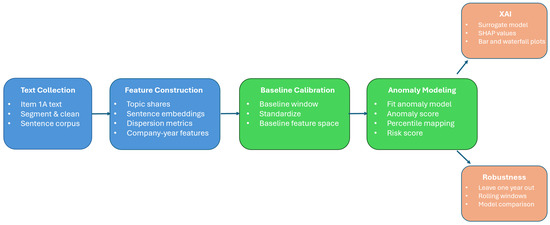
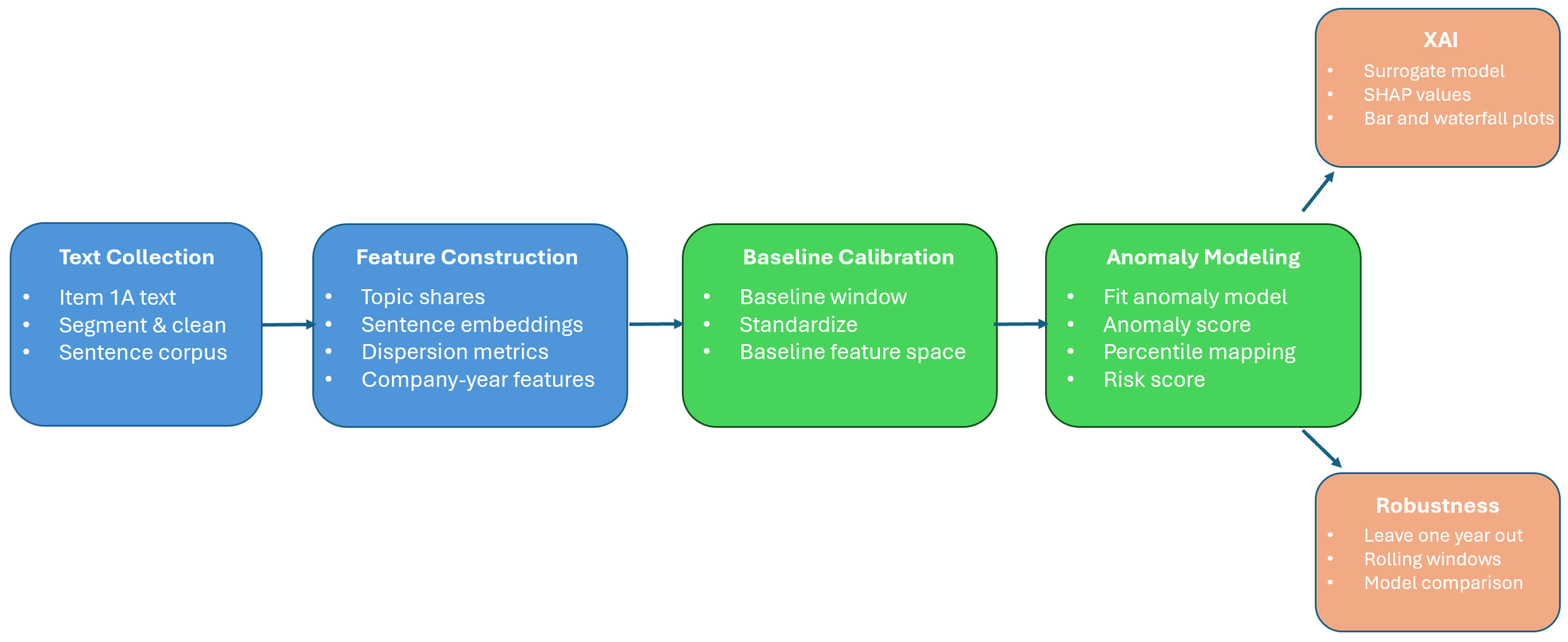
Figure 1 presents the overall analytical pipeline. The framework consists of five sequential modules. First, Item 1A Risk Factors text is collected and segmented into sentence-level observations to form a clean corpus. Second, structured features are constructed by combining interpretable thematic shares, transformer-based sentence embeddings, and embedding-derived dispersion statistics. These features form a company–year representation that captures both topical emphasis and internal semantic geometry. Third, a historical baseline window is selected, and features are standardized to construct a stable reference feature space. Fourth, structural deviation is quantified using unsupervised anomaly modeling, and raw anomaly scores are transformed into percentile-calibrated risk scores for cross-year comparability. Finally, an explainable AI layer trains a surrogate regressor and applies SHAP decomposition to attribute structural deviation to specific thematic and semantic drivers.
Figure 1.
Workflow of the structural semantic risk assessment framework.
In addition to the core scoring pipeline, the framework incorporates two validation branches. A baseline internal stability test evaluates model sensitivity using leave-one-year-out scoring and rolling window re-estimation. An out-of-sample evaluation applies the baseline-calibrated model to 2025 disclosures and interprets deviations using SHAP-based feature attribution. Together, these components form a unified and interpretable structural semantic risk assessment framework.
3.2. Topic Share Features
To preserve continuity with established disclosure research, we first construct interpretable topic-based features. Using transparent rule-based keyword rules, we assign sentence-level binary indicators for four non-mutually exclusive categories: regulatory exposure, litigation risk, conduct-related issues, and internal control or governance matters. Representative patterns include terms related to regulators, compliance, consent orders, enforcement, legal proceedings, claims, misconduct, ethics, internal control, governance, and remediation. For each company–year, we compute the proportion of sentences belonging to each category.
Because the thematic indicators are generated through explicit sentence-level pattern matching rather than latent topic discovery, each dimension has a clear economic interpretation and can be reproduced directly from the documented rule set. These variables, therefore, provide a transparent bridge between traditional disclosure analysis and the semantic anomaly framework.
3.3. Semantic Dispersion Metrics
While topic shares measure thematic prevalence, they do not capture how sentences are distributed within the broader semantic space of the document. To represent sentence meaning in a contextualized way, we use a pretrained Sentence-Transformers encoder. The main specification employs sentence-transformers/all-mpnet-base-v2, an MPNet-based sentence embedding model with 768-dimensional output vectors. For robustness analysis, we additionally compare sentence-transformers/all-MiniLM-L6-v2, which produces 384-dimensional embeddings, and sentence-transformers/paraphrase-mpnet-base-v2, another MPNet-family encoder with 768-dimensional output. Embeddings are L2-normalized prior to annual aggregation. Each annual filing is thus treated as a collection of vectors in a continuous semantic space.
For each company–year, we compute the centroid of sentence embeddings and evaluate the distribution of distances between individual sentences and this centroid. From this distribution, we extract three summary statistics: the mean distance, the 95th percentile distance, and the standard deviation of distances.
Table 1 summarizes all structural features used as inputs to the anomaly detection framework.
Table 1.
Summary of structural features used in the anomaly detection framework.
3.4. Baseline Calibration and Anomaly Detection
To determine whether a given company–year represents a structural deviation, we define a historical baseline using prior observations. Rather than comparing individual years directly, we train an unsupervised anomaly detection model on baseline feature vectors. This model learns the joint distribution of topic shares and semantic dispersion metrics under normal historical conditions.
Each company–year is assigned an anomaly score based on its deviation from this learned distribution. To improve interpretability, anomaly scores are transformed into percentile-based risk scores relative to the baseline sample. A score of 90 indicates that the observation is more anomalous than 90% of baseline years.
This baseline-calibrated framework differs from supervised classification models, which require labeled event data. Instead of prespecifying scandal years, deviations are identified relative to internal historical stability. This allows the method to detect structural changes without relying on external event labels.
Together, these variables capture disclosure length, interpretable thematic exposure, and the internal semantic dispersion of annual risk narratives.
3.5. Stability Testing
Unsupervised anomaly detection may be sensitive to sample composition, baseline definition, and feature representation. To improve methodological transparency, we therefore conduct three complementary robustness checks. First, we evaluate sensitivity to the choice of baseline window by recomputing anomaly scores under rolling windows of length . Second, we assess dependence on the selected sentence encoder by reconstructing the semantic dispersion features using multiple pretrained embedding models. Third, we compare the qualitative ranking behavior of alternative anomaly detectors, including Isolation Forest, shrinkage Mahalanobis distance, and an autoencoder-based reconstruction model.
These robustness checks are not intended as formal large-sample statistical tests, since the present study is based on a compact two-firm setting. Instead, they are designed to assess whether the substantive interpretation of structural deviation remains directionally stable under reasonable specification changes. This procedure reduces the likelihood that the reported anomaly signals are driven by arbitrary modeling choices rather than persistent structural differences in disclosure organization.
3.6. Explainable Artificial Intelligence Layer
Anomaly scores alone do not indicate which features drive deviations. To interpret results in economically meaningful terms, we introduce an explainable artificial intelligence layer based on SHAP values.
Because the isolation-based anomaly model does not directly provide additive feature contributions, we train a tree-based surrogate regression model to approximate the mapping between standardized feature vectors and anomaly scores. Once this approximation is established, SHAP values are computed to decompose each anomaly score into contributions from individual features.
This decomposition allows us to identify whether deviations are primarily driven by changes in thematic emphasis, shifts in semantic dispersion, or variations in the disclosure scale. For example, a high anomaly score may reflect increased litigation-related disclosure, expanded regulatory emphasis, or a structural redistribution of sentence embeddings within the document.
The XAI component is essential for distinguishing incremental disclosure growth from structural reframing. It also enables transparent comparison across firms and years by showing how different feature combinations contribute to similar or divergent anomaly outcomes.
It is important to emphasize that SHAP values in this study explain model-assigned anomaly behavior rather than causal mechanisms in disclosure formation. Because the underlying anomaly detector is unsupervised and the surrogate model is fitted to approximate its scoring function, the resulting feature attributions should be interpreted as explanations of how the model represents structural deviation, not as evidence that a given feature causally produced the observed disclosure shift.
4. Results
4.1. Data and Sample Construction
The empirical analysis is based on annual Form 10-K filings submitted to the U.S. Securities and Exchange Commission. Specifically, we extract the Risk Factors section, which corresponds to Item 1A under Regulation S-K of the Securities Act reporting framework (Campbell et al. 2014). Regulation S-K establishes disclosure requirements for publicly traded firms, including mandatory discussion of material risk factors that may affect financial condition and operations.
The sample focuses on two large U.S. banking institutions, Wells Fargo and JPMorgan Chase. These firms operate under comparable regulatory regimes and are designated as systemically important financial institutions. The 2016 Wells Fargo unauthorized accounts scandal provides a salient regulatory shock within the observation window, allowing comparative analysis of disclosure responses under similar macroeconomic conditions.
We collect annual filings for the years 2014 through 2018 and 2025. The period 2014 to 2018 serves as the historical baseline window for modeling structural stability prior to and immediately following the 2016 regulatory shock. The year 2025 is evaluated relative to this baseline to assess longer-term structural deviation in risk narratives.
For each filing, the Risk Factors section is extracted as plain text and segmented into sentences. Formatting artifacts and excessive whitespace are removed to ensure consistency across years. Sentence-level observations are then aggregated into company–year feature representations for subsequent analysis.
Table 2 reports disclosure length and thematic composition for the Risk Factors sections of Wells Fargo, USA and JPMorgan Chase, USA from 2014 to 2018 and 2025. Table 3 presents embedding-based semantic dispersion statistics for the same company–year observations. After extracting Item 1A Risk Factors as plain text, we segment each filing into sentence-level observations and remove empty or non-informative fragments generated by formatting artifacts. Duplicate sentence rows within the same company–year are dropped. Each remaining sentence is treated as the basic unit for both rule-based thematic tagging and embedding-based semantic representation. The resulting sentence-level corpus is then aggregated to the company–year level through thematic shares, thematic counts, and embedding-dispersion statistics.
Table 2.
Disclosure length and thematic composition in Item 1A risk factor disclosures.
Table 3.
Semantic dispersion statistics derived from sentence embeddings.
4.1.1. Disclosure Length
Clear cross-firm differences are visible in disclosure scale. During 2014 to 2018, WFC averaged 492 sentences per year, compared with 314 for JPM. In 2018, WFC reported 529 sentences, while JPM reported 443. In 2025, JPM contracts sharply to 121 sentences, representing a reduction of more than 60% relative to its baseline average. WFC, by contrast, remains at 421 sentences in 2025, indicating no comparable structural contraction.
Average sentence length further highlights stylistic differences. JPM reaches 44.76 words per sentence in 2016, whereas WFC remains within a narrower band between 34 and 36 words across most years.
4.1.2. Thematic Composition
Thematic shares reveal structural shifts in narrative emphasis. For JPM, regulatory content peaks at 30.5% in 2016 before declining to 21.2% in 2018 and returning to 27.3% in 2025. Litigation shares remain between 11% and 15% across years.
For WFC, litigation content remains below 5% during the baseline period but rises to 6.9% in 2025. Conduct content increases from 7.8% in 2014 to 11.4% in 2025, while control-related language nearly doubles from 6.5% to 12.1%.
These patterns indicate that WFC’s 2025 disclosure reflects a governance-oriented rebalancing, whereas JPM’s thematic proportions in 2025 resemble earlier baseline patterns despite large changes in overall length.
4.1.3. Semantic Dispersion
Embedding-based dispersion measures in Table 3 reveal internal structural differences not captured by raw counts. JPM’s mean dispersion declines from approximately 0.38 during 2014 to 2016 to 0.31 in 2017 and 2018, while variability increases sharply. Standard deviation rises from 0.0965 in 2016 to above 0.15 in 2017 and 2018. This combination suggests concentration of core narrative themes alongside expansion of semantically extreme sentences.
WFC exhibits consistently higher mean dispersion around 0.46 during the baseline period. In 2025, mean dispersion declines modestly to 0.4295 while variability remains stable. This pattern suggests semantic consolidation rather than fragmentation.
4.2. Traditional Risk Word Metrics
To establish a benchmark against conventional disclosure analysis, we begin with frequency-based risk word measures. These metrics follow the standard dictionary counting approach widely used in accounting and finance research. For each company–year, we compute two statistics. The first is raw risk word count, defined as the total number of occurrences of predefined risk-related terms within the Risk Factors section. The second is risk word intensity, defined as the number of risk words per 1000 words of disclosure text. The dictionary includes negative, uncertain, and litigious terms commonly used in prior disclosure studies.
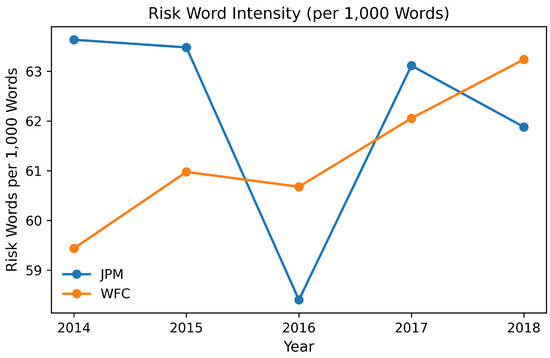
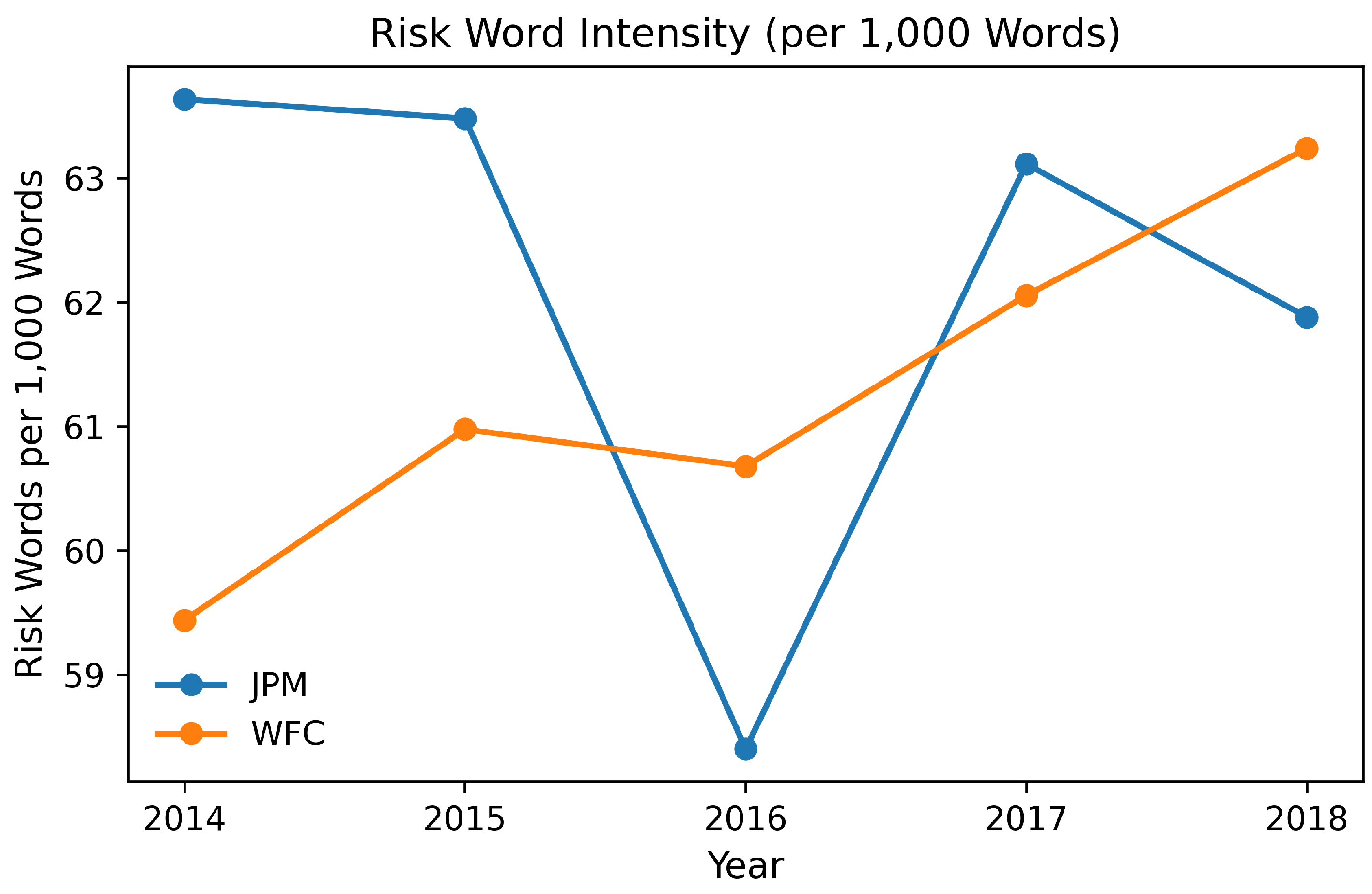
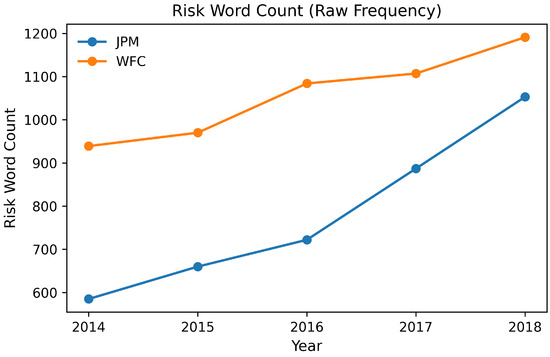
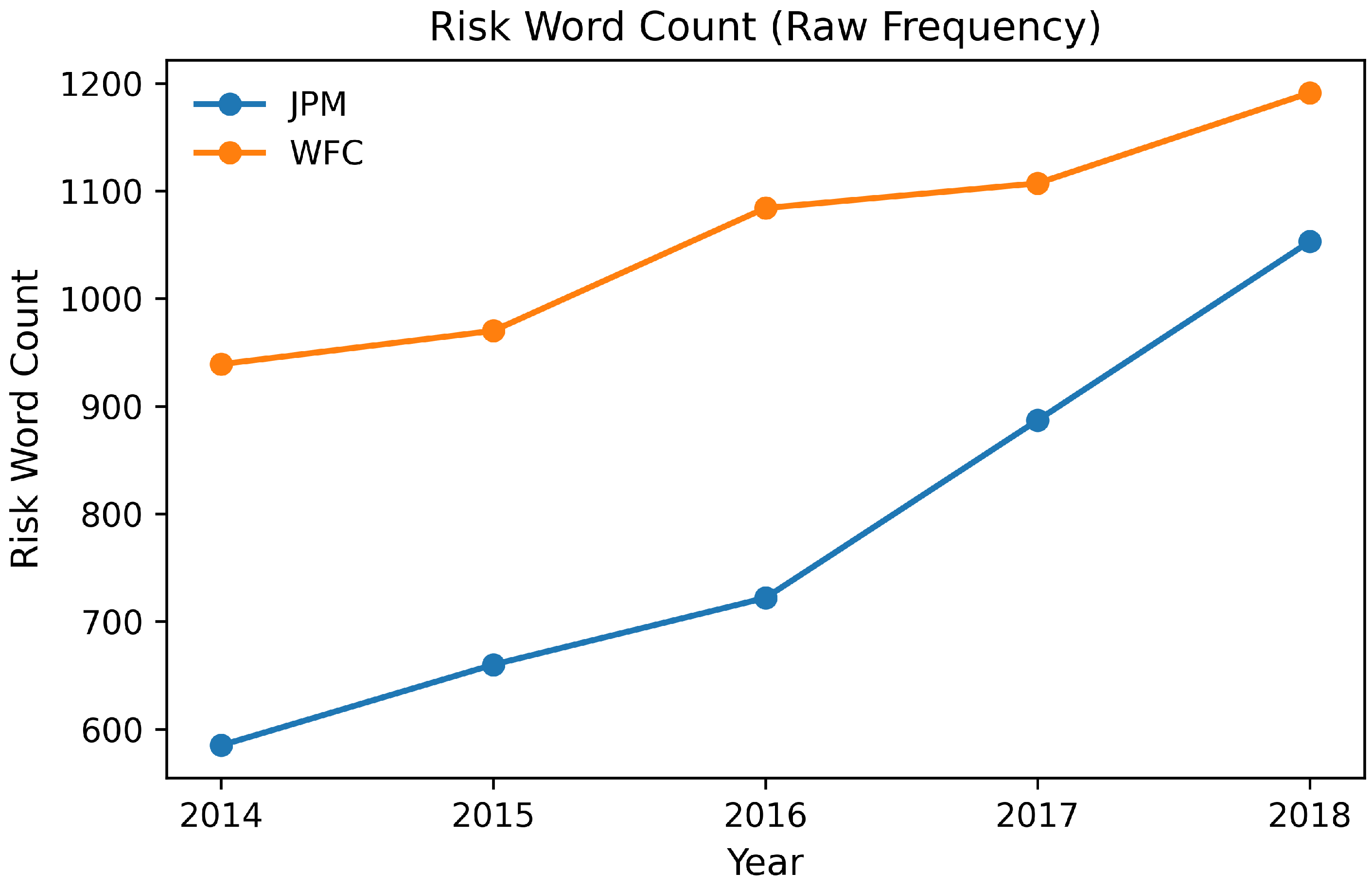
Figure 2 presents risk word intensity from 2014 to 2018. Figure 3 presents raw frequency counts over the same period.
Figure 2.
Risk word intensity (per 1000 words), 2014–2018.
Figure 3.
Raw risk word counts, 2014–2018.
4.2.1. Risk Word Intensity
Figure 2 shows that JPMorgan exhibits relatively stable risk word intensity between 2014 and 2018. The measure fluctuates between approximately 58 and 64 words per 1000 words. Notably, the year 2016 does not display an abnormal spike. Instead, risk intensity for JPMorgan declines from 63.4 in 2015 to 58.4 in 2016, before increasing again in 2017.
Wells Fargo exhibits a gradual upward trend in intensity, increasing from approximately 59.4 in 2014 to 63.3 in 2018. However, this increase appears smooth and incremental rather than discontinuous.
Importantly, neither firm shows a distinct structural break in 2016 under this metric. The year widely recognized as a major regulatory shock does not emerge as an outlier when measured solely by normalized word frequency.
4.2.2. Raw Risk Word Counts
Figure 3 shows raw counts of risk-related words. For both firms, counts increase over time. JPMorgan’s total risk words rose from 587 in 2014 to 1053 in 2018. Wells Fargo increased from 940 to 1190 over the same period.
However, these increases track expansion in overall disclosure length, as documented in Table 2. When disclosure sections grow longer, raw counts mechanically rise as well. The increase, therefore, reflects scale rather than structural change in narrative composition.
In 2016, raw risk word counts do not exhibit a disproportionate increase relative to adjacent years. The pattern is gradual and continuous.
4.2.3. Why Traditional Metrics Are Insufficient
These results highlight an important limitation of frequency-based methods. First, raw counts are sensitive to document length. As firms expand their disclosures, counts increase even if thematic structure remains unchanged. Second, normalized intensity measures reduce length bias but still treat all words independently. They do not capture shifts in semantic organization, contextual framing, or internal narrative coherence.
Most notably, the 2016 Wells Fargo scandal, which is widely recognized as a material event in the banking sector, does not produce a clear structural discontinuity in either raw counts or normalized intensity. The metrics suggest incremental variation rather than narrative reconfiguration.
This motivates the need for higher-dimensional semantic modeling. Rather than counting isolated words, embedding-based approaches allow us to examine how sentence meanings reorganize within each year. The following sections, therefore, move beyond frequency counts and examine structural dispersion and anomaly signals derived from sentence-level embeddings.
4.3. Category-Specific Risk Word Intensity
To further examine whether more granular lexical categories capture structural changes in disclosure, we decompose risk words into three commonly used dimensions: negative tone, uncertainty, and litigious language. These categories are derived from established financial disclosure dictionaries. For each company–year, intensity is measured as the number of category-specific words per 1000 words of disclosure text.
4.3.1. Negative Word Intensity
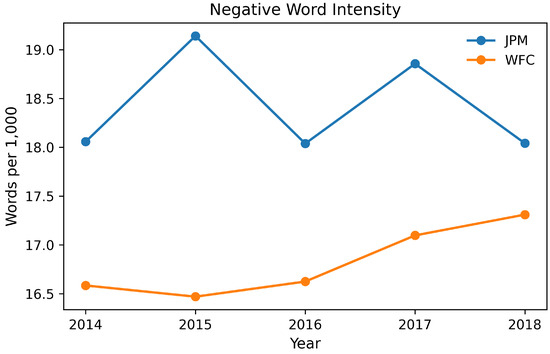
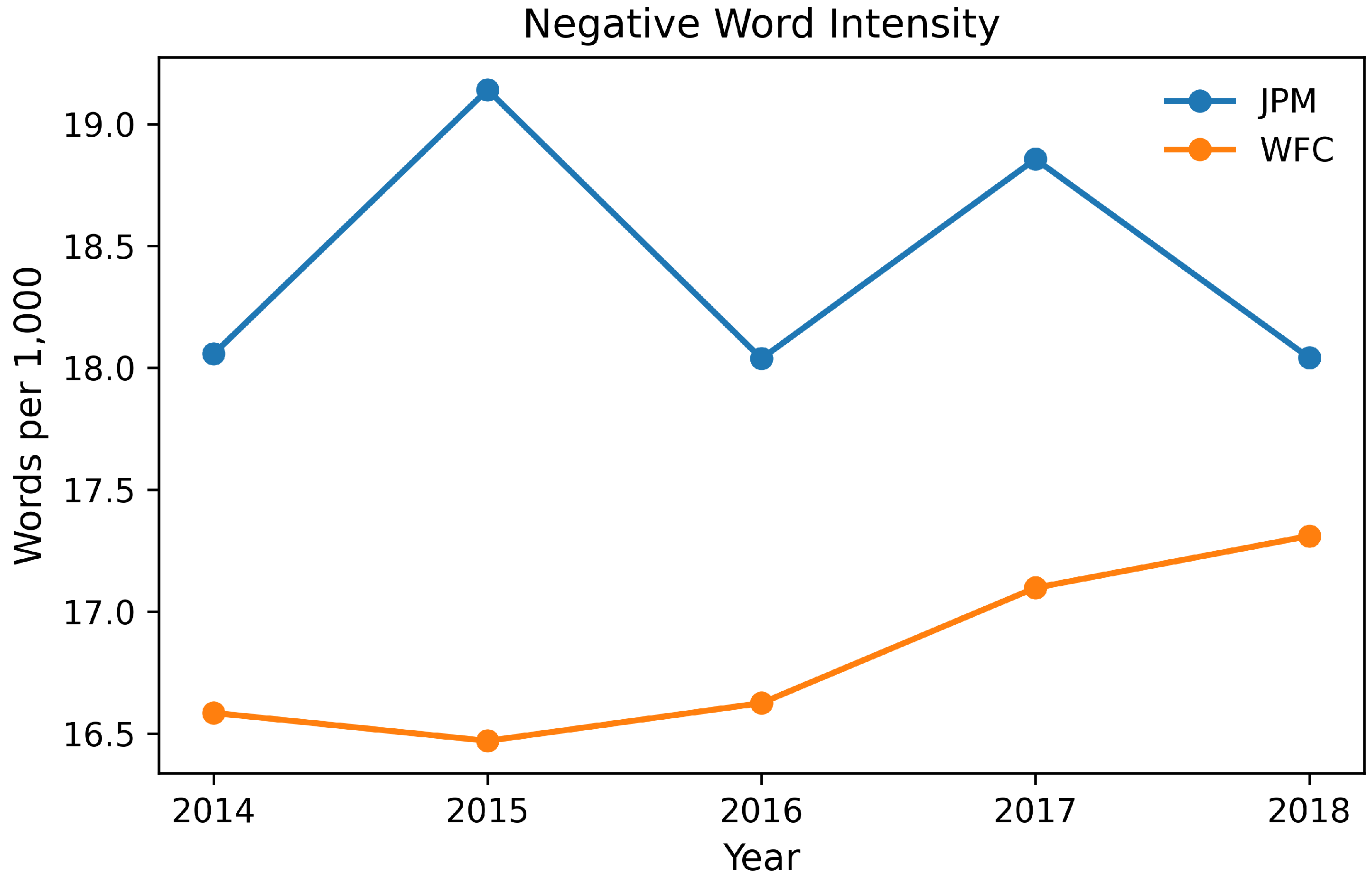
Negative word intensity remains relatively stable for both firms across the baseline period. As shown is Figure 4, for JPMorgan, the measure fluctuates between 18.0 and 19.1 words per 1000 words. The value declines from 19.1 in 2015 to 18.0 in 2016, followed by a moderate increase to 18.9 in 2017 and a return to 18.0 in 2018. The variation remains within a narrow band of approximately one word per 1000 words.
Figure 4.
Negative word intensity (per 1000 words), 2014–2018.
Wells Fargo shows a gradual upward trend, increasing from 16.6 in 2014 to 17.3 in 2018. However, this change appears incremental rather than discontinuous. The year 2016 does not display an abnormal spike or break relative to adjacent years.
4.3.2. Uncertainty Word Intensity
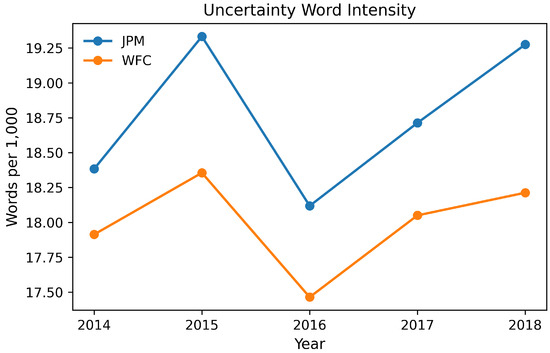
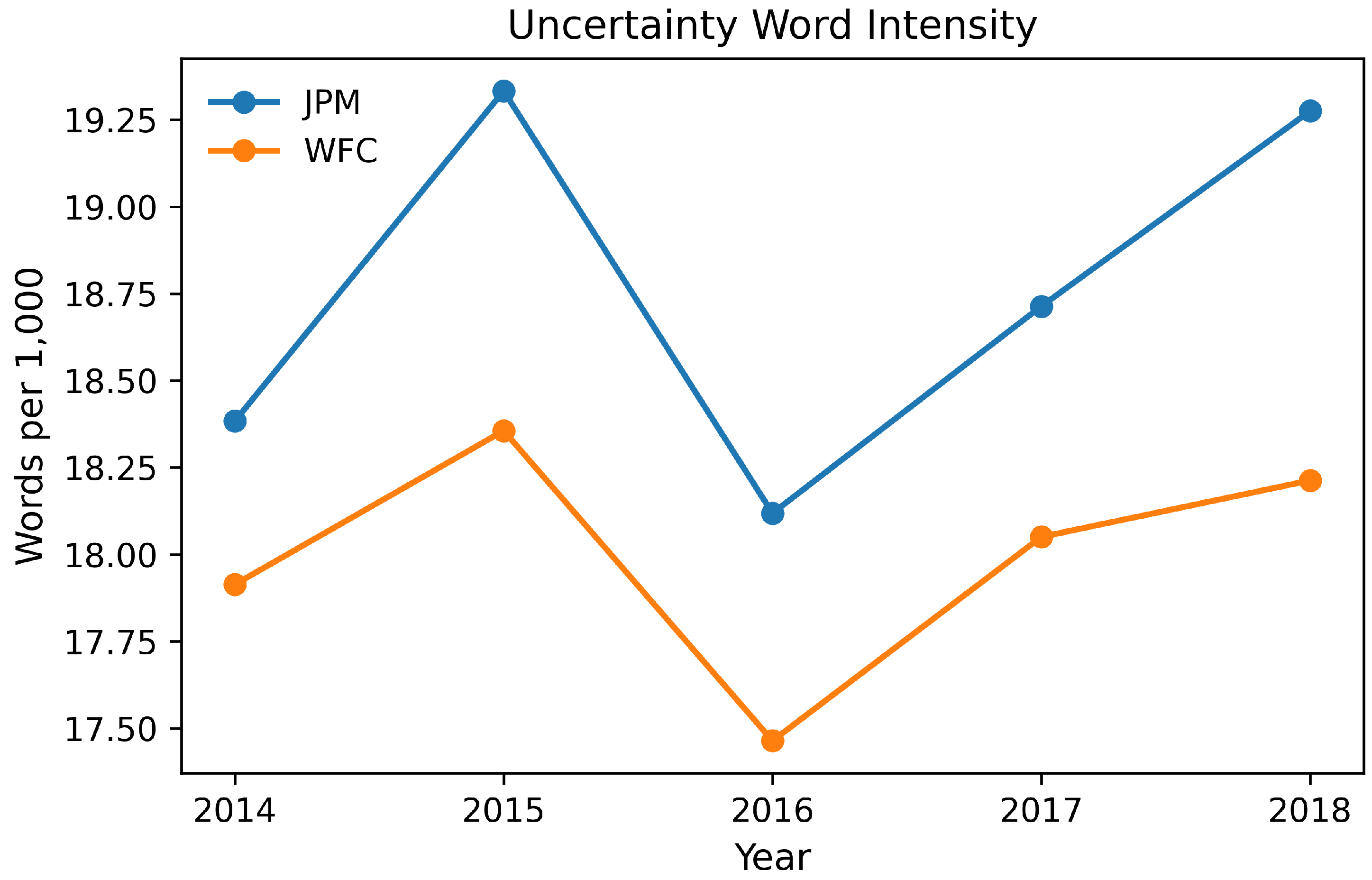
Uncertainty-related language exhibits a similar pattern. For JPMorgan, intensity peaks in 2015 at 19.3 words per 1000 words, declines in 2016 to 18.1, and then increases again in 2017 and 2018. Wells Fargo experiences a modest dip in 2016, from 18.3 in 2015 to 17.5 in 2016, followed by gradual increases thereafter, as shown in Figure 5.
Figure 5.
Uncertainty word intensity (per 1000 words), 2014–2018.
Again, 2016 does not emerge as an outlier for either institution. Observed variation remains within historical fluctuation ranges.
4.3.3. Litigious Word Intensity
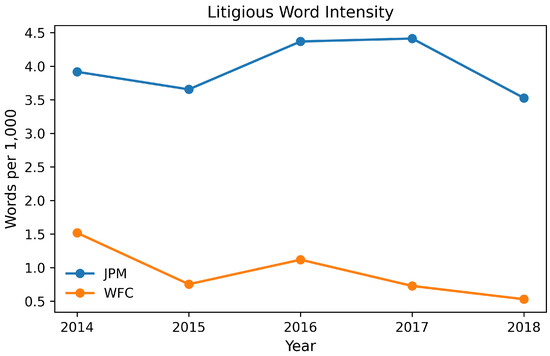
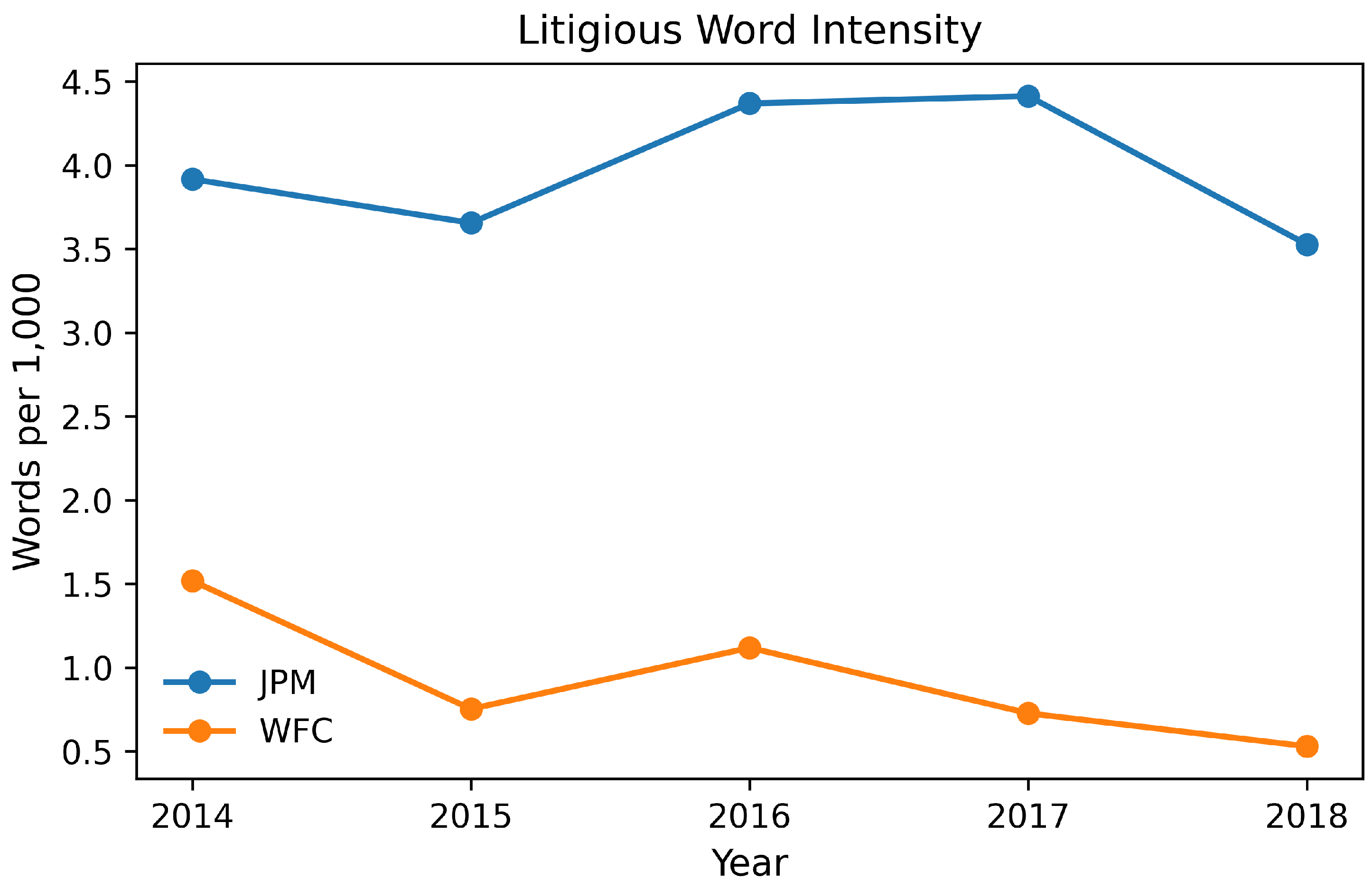
Litigious language also fails to produce a distinct structural break. As shown in Figure 6, JPMorgan’s intensity ranges between 3.5 and 4.4 words per 1000 words from 2014 to 2018. Although 2016 records 4.4 words per 1000 words, slightly above 2015, the magnitude of change is modest and does not exceed prior variation.
Figure 6.
Litigious word intensity (per 1000 words), 2014–2018.
Wells Fargo maintains substantially lower levels of litigious intensity, remaining below 1.5 words per 1000 words throughout the period and declining after 2016.
4.3.4. Interpretation
Across all three lexical dimensions, changes appear smooth and incremental rather than abrupt. The year 2016, widely recognized as a major regulatory event following the Wells Fargo unauthorized accounts scandal and subsequent enforcement actions by federal regulators, does not stand out as a structural outlier under these dictionary-based measures (Consumer Financial Protection Bureau et al. 2016).
This pattern suggests that frequency-based lexical analysis, even when disaggregated into tone-specific categories, may fail to detect deeper narrative restructuring. Structural shifts in disclosure may occur at the level of semantic organization rather than isolated word usage.
5. Structural Semantic Anomaly Modeling
The preceding section demonstrates that traditional lexical metrics, including raw risk word counts and dictionary-based intensity measures, do not reliably capture structural discontinuities associated with major regulatory events. Although such methods provide useful descriptive insights, they operate at the level of isolated word frequencies and fail to account for multivariate interactions and semantic configuration.
To address this limitation, we propose a structural semantic anomaly modeling framework that evaluates disclosure shifts in a multidimensional feature space. Rather than focusing on individual word categories, our approach models the joint distribution of thematic shares and semantic dispersion patterns and identifies deviations from a learned historical baseline.
This section introduces the theoretical foundation, implementation details, and empirical performance of the proposed framework.
5.1. Conceptual Framework
We conceptualize risk disclosure not as a collection of independent word frequencies but as a structured semantic system. Each company year is represented as a feature vector combining thematic composition and embedding-based dispersion statistics.
Formally, let
denote the structural representation of a disclosure in year t. The baseline period defines a reference distribution in this feature space. Structural risk emerges when an observation deviates from this historical manifold.
This representation integrates three components: thematic proportions reflecting regulatory, litigation, conduct, and control emphasis; embedding-based semantic dispersion capturing internal heterogeneity of sentences; and disclosure scale variables controlling for text length effects.
By modeling the joint configuration of these dimensions, the framework captures structural reorganization that lexical metrics overlook.
5.2. Model Specification
Let denote the structural feature vector of a company–year disclosure, where features include thematic shares, semantic dispersion statistics, and disclosure scale controls. The baseline set corresponds to historical observations from 2014 to 2018.
All features are standardized prior to model fitting. Anomaly detection models are trained exclusively on the baseline distribution and subsequently used to evaluate deviations of target years.
5.2.1. Autoencoder Reconstruction Deviation
The autoencoder captures nonlinear structural dependencies among features. It consists of an encoder function and a decoder function such that
The model is trained by minimizing reconstruction loss over the baseline sample:
The anomaly score for a target observation is defined as
A large reconstruction error indicates that the observation lies outside the nonlinear structural manifold learned from the baseline distribution (Sakurada and Yairi 2014).
5.2.2. Isolation-Based Structural Deviation
Isolation Forest identifies anomalies through recursive random partitioning (Liu et al. 2008). Let denote the path length required to isolate observation within a tree. The expected path length across trees is .
The normalization term is
where is the harmonic number and n is the subsample size.
The anomaly score is defined as
Observations that require fewer partitions to isolate receive higher anomaly scores. Unlike distance-based methods, Isolation Forest does not impose distributional assumptions (Liu et al. 2008).
5.2.3. Covariance-Adjusted Distance Deviation
Mahalanobis distance evaluates deviation from the baseline centroid while accounting for feature covariance. Let
denote the baseline mean vector.
To stabilize covariance estimation under limited sample size, we apply the Ledoit–Wolf shrinkage estimator (Ledoit and Wolf 2004):
where is the sample covariance, is a structured target matrix, and is the shrinkage intensity.
The structural distance is
This formulation provides a parametric benchmark under approximate elliptical structure (Ledoit and Wolf 2004).
5.2.4. Model Explainability via SHAP
To attribute structural deviation to individual features, we apply SHAP values (Lundberg and Lee 2017). For a fitted scoring function , SHAP represents the prediction as
where measures the marginal contribution of feature j to the anomaly score.
This enables identification of which thematic or semantic dimensions drive structural deviation in target years (Lundberg and Lee 2017).
5.3. Structural Feature Patterns Prior to Anomaly Modeling
Table 4 summarizes semantic dispersion statistics derived from sentence embeddings, and Table 5 reports thematic composition for Item 1A disclosures.
Table 4.
Semantic dispersion statistics derived from sentence embeddings prior to anomaly modeling.
Table 5.
Thematic composition statistics of Item 1A disclosures.
Thematic shares further illustrate differentiated structural adjustments. For JPMorgan, ShareRegulatory peaks in 2016 at 0.327 and then declines in subsequent years. ShareLitigation remains elevated in 2014–2016 and declines slightly afterward, while ShareControls decreases after 2016. This pattern indicates heightened regulatory emphasis in 2016 followed by thematic normalization.
For Wells Fargo, ShareRegulatory increases steadily from 0.224 in 2014 to approximately 0.263 in 2016–2018. ShareConduct and ShareControls both trend upward through 2018, while ShareLitigation remains relatively low but increases gradually. Unlike JPMorgan’s temporary spike, Wells Fargo exhibits a sustained reweighting of disclosure themes following 2016.
5.4. Semantic Structural Modeling and Baseline Stability
The limitations of traditional dictionary-based metrics become particularly evident when examining structural changes around major regulatory events. As shown in Section 4, risk word intensity and category-level lexical shares exhibit only modest variation around 2016. Although 2016 is widely recognized as a critical regulatory year, dictionary-based statistics do not clearly isolate it as a structural break. This suggests that purely lexical counting fails to capture deeper semantic reorganization within disclosures.
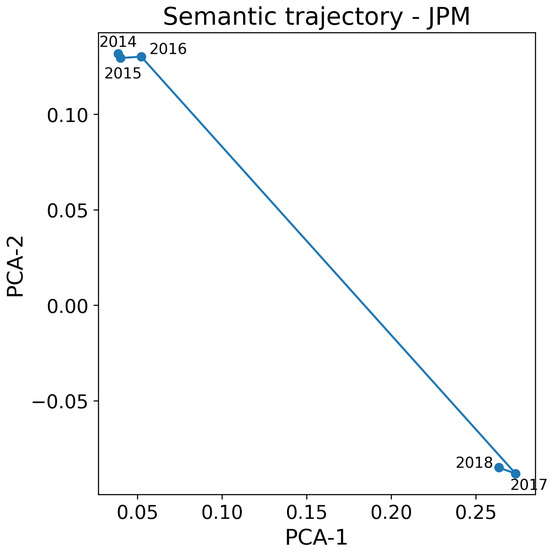
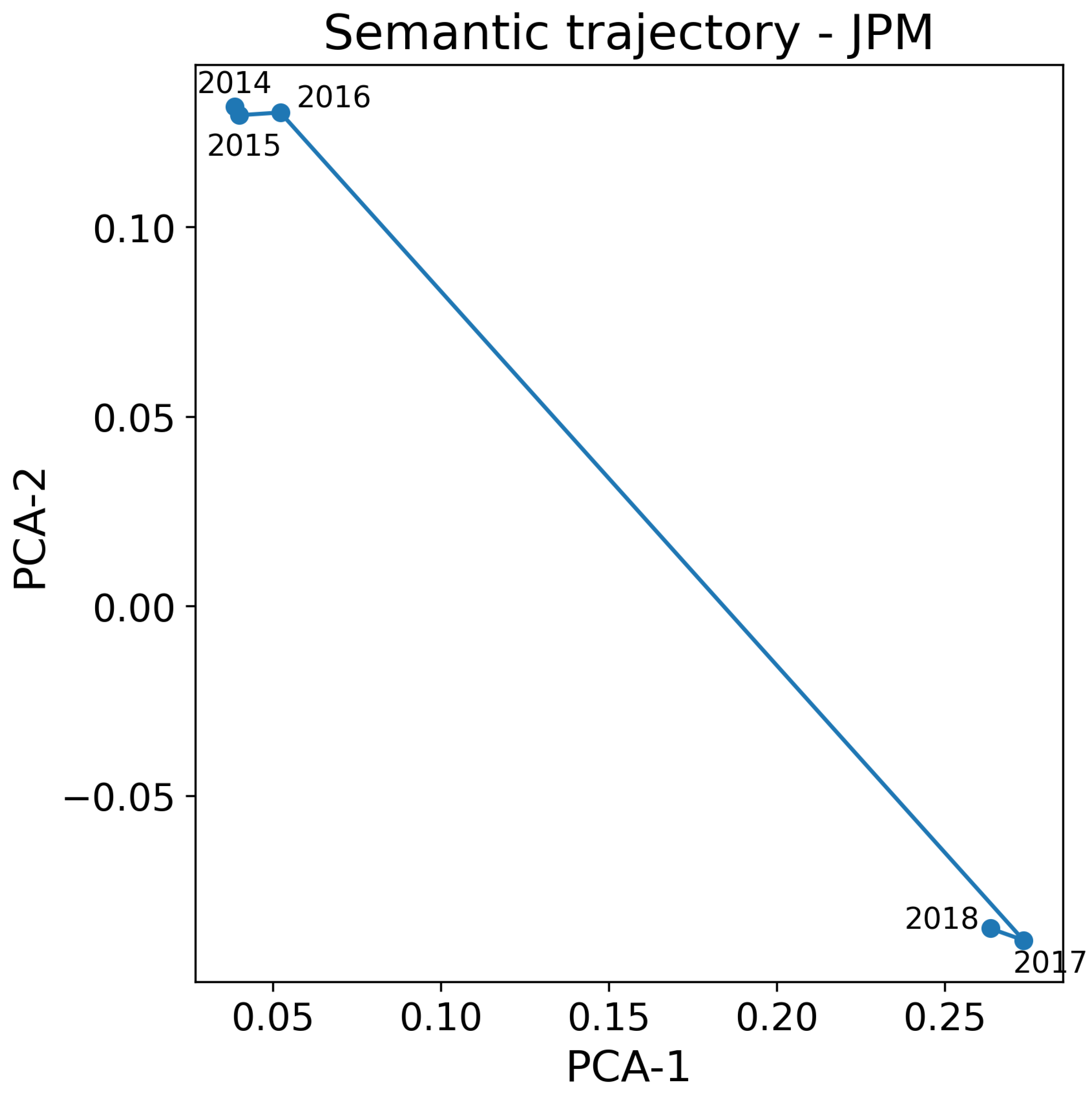
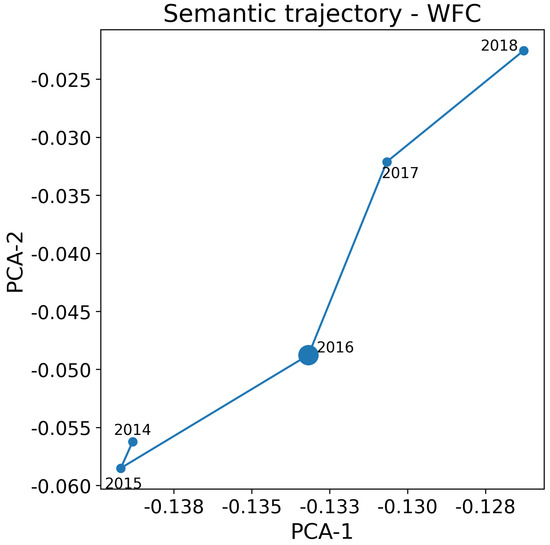
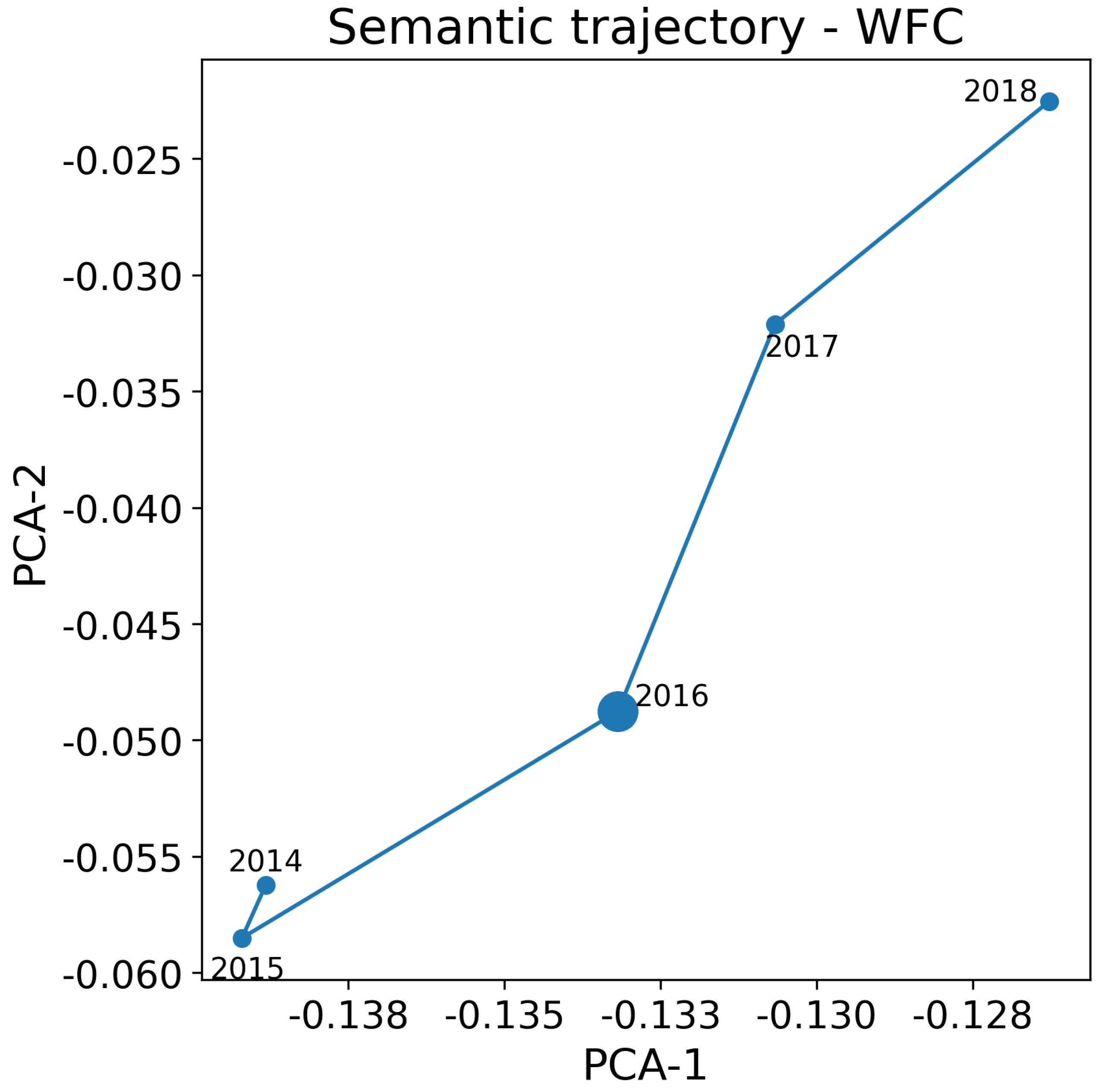
To overcome this limitation, we construct annual semantic representations using sentence-level embeddings derived from a pretrained transformer model. For each company year, sentence embeddings are aggregated to form a year-level semantic vector. These high-dimensional representations are then projected onto the first two principal components in order to visualize the temporal evolution of disclosure structure.
Figure 7 and Figure 8 present the resulting semantic trajectories for JPMorgan and Wells Fargo. Each point corresponds to a company year, and arrows indicate chronological progression. For JPMorgan in Figure 7, baseline years 2014 to 2016 cluster tightly in one region of the projection space. In contrast, 2017 and 2018 move sharply toward a distinct region along the first principal component. The displacement between 2016 and 2017 is substantially larger than the variation among earlier baseline years, indicating a structural semantic reorganization following the regulatory shock period.
Figure 7.
Semantic trajectory projection for JPMorgan (2014–2018).
Figure 8.
Semantic trajectory projection for Wells Fargo (2014–2018).
For Wells Fargo, the trajectory displays a smoother but persistent directional shift from 2014 through 2018, as shown in Figure 8. The transition from 2015 to 2016 is clearly visible, and subsequent years continue along a coherent semantic path rather than reverting to the pre-event region. Unlike dictionary-based intensity measures, the embedding space reveals systematic narrative realignment that is consistent with governance and compliance restructuring during this period.
While semantic trajectories provide geometric evidence of structural change, anomaly detection requires a stable and discriminative scoring mechanism. Before interpreting post-event deviations, we therefore evaluate the internal stability of candidate detectors within the baseline years. This internal stability assessment serves two purposes. First, it verifies that the scoring function is not dominated by random fluctuations induced by limited sample size. Second, it identifies the detector whose baseline behavior provides sufficient resolution for downstream event analysis.
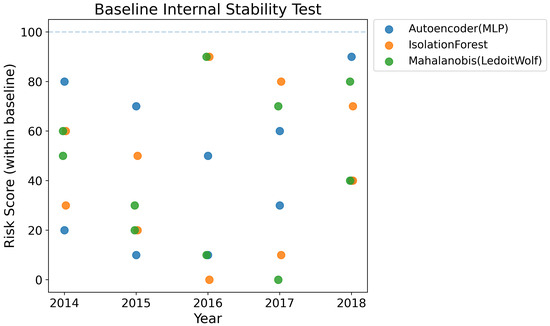
Figure 9 reports baseline risk scores under three anomaly detectors: an autoencoder-based reconstruction model, Isolation Forest, and Mahalanobis distance with shrinkage covariance. For each baseline year, the detector is trained on the remaining baseline observations, and the held-out year is scored. Scores are transformed into percentile-based risk scores relative to the fitted baseline distribution.
Figure 9.
Baseline risk scores across detectors (leave-one-year-out within baseline).
Across baseline years, the autoencoder and shrinkage Mahalanobis model frequently produce saturated or near-saturated scores for multiple years. This indicates score compression, where several baseline observations are treated as similarly extreme. Such compression reduces the ability of the model to distinguish subtle structural variation among baseline disclosures. In contrast, Isolation Forest produces graded and well-distributed scores, preserving useful ranking information across years.
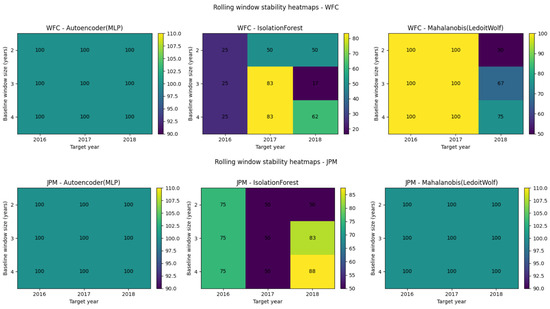
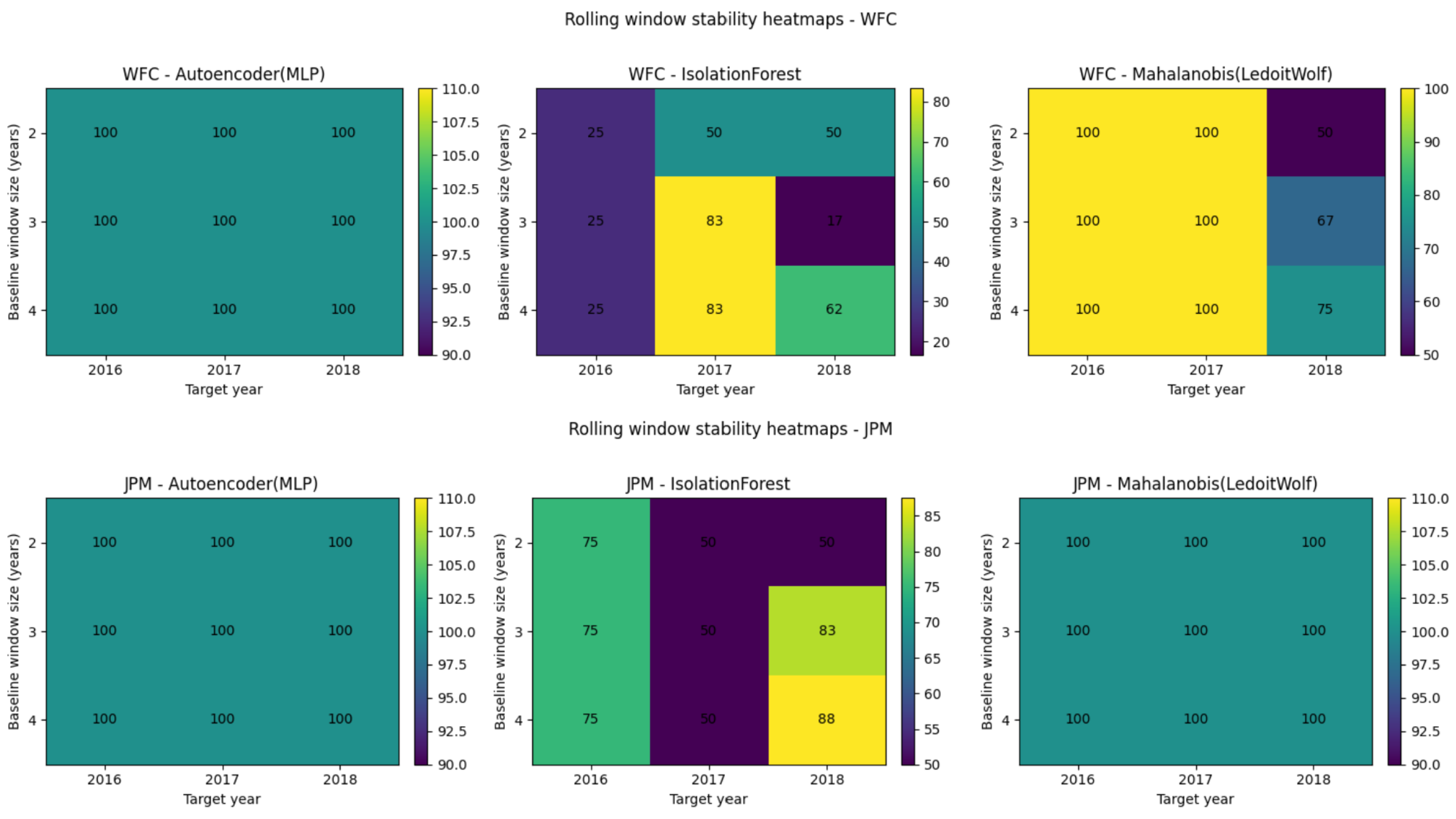
To further assess robustness to baseline selection, we conduct a rolling-window stability analysis. Let the baseline window size be . For each target year , we construct a baseline set using the w most recent years prior to t, fit the detector on that window, and then score the target year. Scores are again converted into percentile-based risk measures within each window. Figure 10 summarizes these results as heatmaps, with rows corresponding to window sizes and columns corresponding to target years.
Figure 10.
Rolling-window stability heatmaps of baseline risk scores.
The rolling window analysis reinforces the earlier conclusion. The autoencoder yields nearly constant scores across window sizes and target years, indicating limited sensitivity under the current configuration. The shrinkage Mahalanobis model shows moderate stability but still exhibits score compression in several settings. Isolation Forest provides nontrivial variation across both window size and target year, without collapsing observations into uniform scores. This behavior reflects a desirable balance between stability and responsiveness to structural change.
Taken together, the semantic trajectory analysis and the baseline stability evaluation demonstrate two key points. First, embedding-based representations capture structural reorientation that lexical metrics overlook. Second, among the tested detectors, Isolation Forest offers the most discriminative and stable anomaly scoring framework for identifying disclosure shifts associated with regulatory stress.
5.5. Robustness to Baseline Choice, Embedding Model, and Detector Specification
To further assess methodological robustness, we conducted three additional sensitivity analyses. First, we examined the effect of baseline-window choice by recomputing 2018 anomaly scores using trailing windows of length 2, 3, and 4 years. Second, we assessed dependence on the selected sentence embedding model by reconstructing the annual semantic-dispersion features using multiple pretrained encoders. Third, we compared detector behavior across Isolation Forest, shrinkage Mahalanobis distance, and an autoencoder-based reconstruction model. These checks are not intended as formal large-sample statistical tests, given the compact two-firm setting, but rather as targeted robustness analyses designed to evaluate whether the substantive interpretation of structural deviation remains stable under reasonable specification changes.
The baseline-window sensitivity results indicate that shrinkage Mahalanobis distance and autoencoder-based reconstruction error remain fully stable across all tested windows for both firms in the 2018 comparison setting. By contrast, Isolation Forest exhibits moderate sensitivity to the calibration window. For JPMorgan, the percentile-based risk score changes from 100 to 80 when the baseline expands from a two-year to a four-year window. For Wells Fargo, the corresponding score varies from 100 to 50 and then to 60. This pattern suggests that tree-based unsupervised partitioning is more responsive to small changes in baseline composition, while the overall interpretation of 2018 as structurally unusual remains qualitatively intact. Table 6 summarizes these baseline-window sensitivity results.
Table 6.
Robustness checks for baseline-window sensitivity in the 2018 comparison setting.
We next assessed dependence on the selected sentence embedding model by reconstructing the annual semantic-dispersion features using three pretrained encoders: sentence-transformers/all-mpnet-base-v2, sentence-transformers/all-MiniLM-L6-v2, and sentence-transformers/paraphrase-mpnet-base-v2. As expected, the absolute magnitudes of semantic-distance statistics vary across encoders because each model induces a different embedding geometry. However, the thematic share and count features remain unchanged across encoders, since they are generated through explicit rule-based sentence tagging rather than embedding inference. More importantly, the substantive interpretation remains directionally stable in the present sample. Under Isolation Forest, JPMorgan consistently receives a higher percentile-based anomaly score than Wells Fargo in the 2018 comparison setting, while Mahalanobis distance and the autoencoder-based model continue to classify both firms as highly anomalous relative to their historical baselines. Table 7 summarizes these embedding-model robustness results.
Table 7.
Embedding-model robustness summary for the 2018 comparison setting.
Finally, the detector comparison highlights an important trade-off between stability and ranking resolution in this compact sample. Shrinkage Mahalanobis distance and the autoencoder-based model are highly stable across the tested windows and encoder specifications, but they also tend to produce saturated percentile scores, limiting their ability to differentiate relative anomaly intensity across firms. Isolation Forest, by contrast, preserves more useful score variation while remaining qualitatively consistent under alternative baseline windows and encoder settings. For this reason, we retain Isolation Forest as the primary detector for out-of-sample structural assessment, while reporting Mahalanobis distance and the autoencoder-based model as robustness references rather than competing final specifications.
5.5.1. Overall Structural Deviation
The percentile-based risk score places JPMorgan in the upper decile of deviation relative to its historical disclosure distribution, while Wells Fargo remains in the upper-middle range. Importantly, this ranking emerges from multivariate structural comparison rather than single-feature differences.
The raw anomaly score further illustrates the magnitude of deviation. JPM’s anomaly score exceeds that of WFC by more than a factor of three. This difference cannot be attributed to a single variable. Instead, it reflects joint movement across semantic dispersion, thematic composition, and disclosure length.
One striking feature is the sharp contraction in JPM’s sentence count. With only 121 sentences, its 2025 disclosure is structurally compressed relative to its historical baseline. In contrast, WFC maintains 421 sentences, much closer to its prior disclosure volume. This structural compression changes the proportional distribution of semantic and thematic signals in the embedding space.
5.5.2. Feature-Level Explanation via SHAP
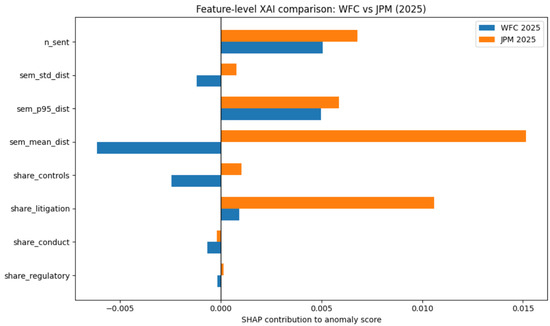
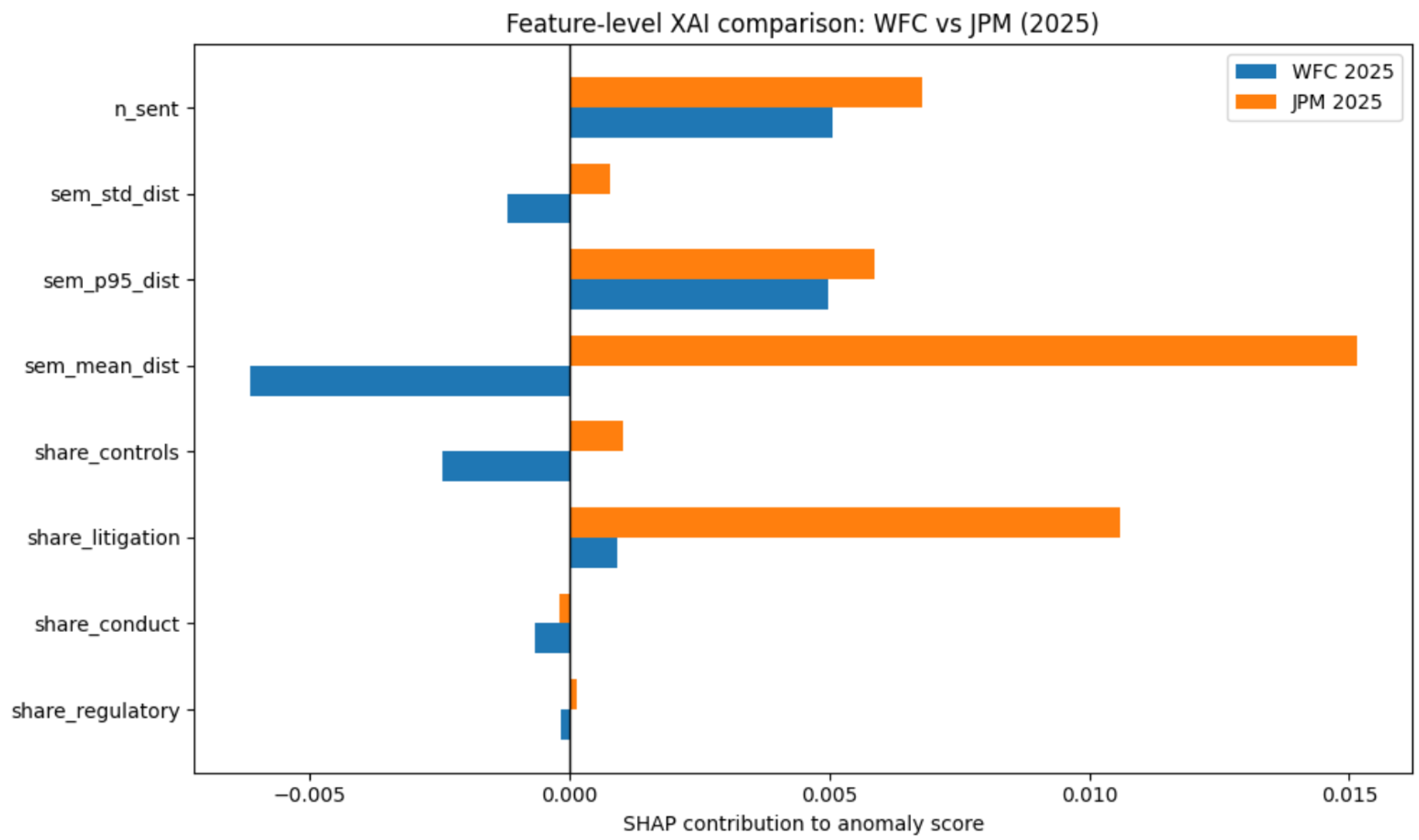
To interpret these anomaly scores, we compute SHAP values for the Isolation Forest model. Figure 11 presents feature-level contributions for both firms.
Figure 11.
SHAP-based feature contributions for JPMorgan and Wells Fargo (2025).
For JPMorgan, the dominant positive contributors to anomaly are semantic mean distance, litigation share, upper-tail semantic dispersion, and sentence count contraction. The SHAP value for semantic mean distance is the largest contributor, indicating that JPM’s 2025 disclosure lies geometrically farther from its historical embedding centroid. This implies narrative reconfiguration rather than incremental lexical adjustment. The elevated litigation share further increases deviation, suggesting stronger legal framing relative to historical norms. The positive SHAP contribution of upper-tail semantic dispersion indicates greater heterogeneity among sentences, meaning that certain portions of the disclosure deviate strongly from the historical semantic center. This pattern is consistent with selective emphasis or reframing in specific risk domains.
In contrast, Wells Fargo exhibits a more balanced SHAP profile. While regulatory share and control-related language contribute positively to anomaly, semantic mean distance contributes less dramatically. The overall structure remains closer to its baseline manifold. Importantly, the absence of a dominant single feature suggests incremental structural adjustment rather than abrupt narrative transformation.
5.5.3. Comparative Interpretation
Based on the reported data and Figure 11, there are three important insights.
First, anomaly magnitude differs substantially between firms even when thematic shares appear superficially similar. Both firms exhibit comparable regulatory share, yet JPM receives a much higher structural risk score. This demonstrates that frequency-based metrics alone cannot explain the divergence.
Second, semantic distance measures play a central role in differentiating firms. Embedding-based dispersion captures shifts in framing, emphasis, and contextualization that are not observable through word counting.
Third, the interaction between disclosure length and thematic concentration amplifies structural deviation. JPM’s shortened disclosure alters proportional weighting across semantic features, leading to a compounded anomaly effect.
Taken together, these findings confirm that the proposed semantic anomaly framework provides interpretable and economically meaningful structural risk assessment. The model not only assigns differential risk scores but also identifies the precise structural drivers underlying each firm’s deviation from historical norms.
6. Conclusions
This study develops an exploratory methodological framework for analyzing structural variation in risk disclosure using sentence-level embeddings, anomaly detection, and explainable artificial intelligence. We begin by evaluating traditional dictionary-based metrics and show that risk word intensity and category-level frequency statistics provide limited sensitivity to structural shifts around major regulatory events. Although 2016 is widely recognized as a pivotal year, lexical metrics alone do not clearly isolate it as a structural break.
To address this limitation, we construct year-level semantic representations using transformer-based sentence embeddings and combine them with thematic share features in a multivariate anomaly detection framework. Semantic trajectory analysis reveals geometric displacement in embedding space following periods of regulatory stress, suggesting that disclosure change may occur through narrative reorganization rather than simple increases in risk-related vocabulary. Baseline stability analysis further shows that Isolation Forest provides the most useful balance between discrimination and robustness in the present setting.
Applied to 2025 disclosures, the framework identifies heterogeneous structural deviation across the two firms. JPMorgan exhibits stronger deviation from its historical baseline, while Wells Fargo shows a more moderate and thematically balanced adjustment. SHAP-based decomposition further improves interpretability by identifying semantic distance, litigation emphasis, and disclosure length contraction as important contributors to anomaly scores.
These findings should be interpreted in light of several important limitations. First, the empirical analysis is restricted to two firms within a single sector, and the time horizon is relatively short. The resulting sample is therefore better suited to a focused methodological demonstration than to broad cross-firm or cross-industry inference. Second, the anomaly detection framework is unsupervised. It is designed to identify deviations from a historical structural baseline, but it does not by itself establish causal mechanisms, validate the economic materiality of each anomaly score, or distinguish whether an observed deviation is beneficial, precautionary, or adverse in market terms. Third, the current analysis does not directly link structural deviation scores to external outcomes such as stock-market reactions, realized volatility, litigation incidence, or enforcement actions. Accordingly, the present results should be interpreted as exploratory evidence of detectable structural change in disclosure organization rather than as a direct test of economic consequences.
These limitations also define several promising directions for future research. The proposed framework can be extended to larger firm panels, longer historical windows, and cross-industry applications in order to assess whether structural semantic deviation behaves differently across disclosure regimes and regulatory environments. Future work may also connect the anomaly scores developed here to market-based and legal outcomes, including return volatility, filing-period market reactions, litigation exposure, and enforcement intensity. Such extensions would help determine not only whether structural deviation is detectable, but also whether it has predictive, disciplinary, or economically consequential significance beyond the present methodological setting.
Despite these limitations, the study demonstrates that structural semantic deviation can be operationalized in a transparent and interpretable way using regulatory filings. More broadly, it provides a replicable framework for combining contextual semantic representation, unsupervised anomaly detection, and explainable AI in disclosure analysis.
Author Contributions
Conceptualization, F.S. and Q.L.; Methodology, F.S.; Software, F.S., S.H. and R.W.; Validation, F.S. and R.W.; Formal analysis, F.S., S.H., R.W. and H.S.; Investigation, L.K.; Resources, Q.L.; Writing—original draft, F.S., S.H., R.W., L.K., H.S. and Q.L.; Writing—review and editing, F.S., S.H., R.W., L.K., H.S. and Q.L.; Visualization, L.K.; Supervision, Q.L.; Project administration, Q.L. All authors have read and agreed to the published version of the manuscript.
Funding
This research received no external funding.
Data Availability Statement
The original contributions presented in this study are included in the article. Further inquiries can be directed to the corresponding author.
Conflicts of Interest
The authors declare no conflicts of interest.
References
- Acharya, Viral, Robert Engle, and Matthew Richardson. 2012. Capital shortfall: A new approach to ranking and regulating systemic risks. American Economic Review 102: 59–64. [Google Scholar] [CrossRef] [Scilit]
- Baker, Scott R., Nicholas Bloom, and Steven J. Davis. 2016. Measuring economic policy uncertainty. The Quarterly Journal of Economics 131: 1593–636. [Google Scholar] [CrossRef] [Scilit]
- Beatty, Anne, Scott Liao, and Joseph Weber. 2010. The effect of private information and monitoring on the role of accounting quality in investment decisions. Contemporary Accounting Research 27: 17–47. [Google Scholar] [CrossRef] [Scilit]
- Blei, David M., Andrew Y. Ng, and Michael I. Jordan. 2003. Latent Dirichlet allocation. Journal of Machine Learning Research 3: 993–1022. [Google Scholar]
- Bolton, Richard J., and David J. Hand. 2002. Statistical fraud detection: A review. Statistical Science 17: 235–55. [Google Scholar] [CrossRef] [Scilit]
- Campbell, John L., Hsinchun Chen, Dan S. Dhaliwal, Hsin-min Lu, and Logan B. Steele. 2014. The information content of mandatory risk factor disclosures in corporate filings. Review of Accounting Studies 19: 396–455. [Google Scholar] [CrossRef] [Scilit]
- Chandola, Varun, Arindam Banerjee, and Vipin Kumar. 2009. Anomaly detection: A survey. ACM Computing Surveys 41: 1–58. [Google Scholar] [CrossRef] [Scilit]
- Chen, Yue, Litong Song, Ziwei Liu, Jingyu Yao, Kaichen Liu, and Qiuyue Liao. 2026. TrustLLM-Fin: A Privacy-Centric and Auditable Impact Assessment Framework for Large Language Models in Automated Financial Reporting. Preprints, 2026011596. [Google Scholar] [CrossRef] [Scilit]
- Consumer Financial Protection Bureau, Office of the Comptroller of the Currency, and Office of the Los Angeles City Attorney. 2016. Wells Fargo Bank, N.A. Consent Order and Stipulation and Consent to the Issuance of a Consent Order; CFPB Administrative Proceeding No. 2016-CFPB-0015. Washington: Consumer Financial Protection Bureau.
- Devlin, Jacob, Ming-Wei Chang, Kenton Lee, and Kristina Toutanova. 2019. BERT: Pre-training of deep bidirectional transformers for language understanding. Paper presented at NAACL HLT 2019, Minneapolis, MN, USA, June 2–7; pp. 4171–86. [Google Scholar]
- Du, Kelvin, Yazhi Zhao, Rui Mao, Frank Xing, and Erik Cambria. 2025. Natural language processing in finance: A survey. Information Fusion 115: 102755. [Google Scholar] [CrossRef] [Scilit]
- Hájek, Petr, and Michal Munk. 2024. Corporate financial distress prediction using the risk-related information content of annual reports. Information Processing & Management 61: 103820. [Google Scholar] [CrossRef] [Scilit]
- Hoberg, Gerard, and Gordon Phillips. 2016. Text-based network industries and endogenous product differentiation. Journal of Political Economy 124: 1423–65. [Google Scholar] [CrossRef] [Scilit]
- Houston, Joel F., Chen Lin, Sibo Liu, and Lai Wei. 2019. Litigation risk and voluntary disclosure: Evidence from legal changes. The Accounting Review 94: 247–72. [Google Scholar] [CrossRef] [Scilit]
- Huang, Xuan, Siew Hong Teoh, and Yinglei Zhang. 2014. Tone management. Accounting Review 89: 1083–113. [Google Scholar] [CrossRef] [Scilit]
- Khan, Farhina Sardar, Syed Shahid Mazhar, Kashif Mazhar, Dhoha A. AlSaleh, and Amir Mazhar. 2025. Model-agnostic explainable artificial intelligence methods in finance: A systematic review, recent developments, limitations, challenges and future directions. Artificial Intelligence Review 58: 232. [Google Scholar] [CrossRef] [Scilit]
- Kölbel, Julian F, Markus Leippold, Jordy Rillaerts, and Qian Wang. 2024. Ask BERT: How regulatory disclosure of transition and physical climate risks affects the CDS term structure. Journal of Financial Econometrics 22: 30–69. [Google Scholar] [CrossRef] [Scilit]
- Kravet, Todd, and Volkan Muslu. 2013. Textual risk disclosures and investors’ risk perceptions. Review of Accounting Studies 18: 1088–122. [Google Scholar] [CrossRef] [Scilit]
- Ledoit, Olivier, and Michael Wolf. 2004. A well-conditioned estimator for large-dimensional covariance matrices. Journal of Multivariate Analysis 88: 365–411. [Google Scholar] [CrossRef] [Scilit]
- Li, Feng. 2010. The information content of forward-looking statements in corporate filings. Journal of Accounting Research 48: 1049–102. [Google Scholar] [CrossRef] [Scilit]
- Liao, Qiuyue, Yue Chen, Shuangjiang He, Ruiqi Wang, Wei Xu, and Weishen Chu. 2025. Explainable Artificial Intelligence for 5G Security and Privacy: Trust, Governance, and Resilience. Preprints, 2025120667. [Google Scholar] [CrossRef] [Scilit]
- Liu, Fei Tony, Kai Ming Ting, and Zhi-Hua Zhou. 2008. Isolation Forest. In Proceedings of the 2008 IEEE International Conference on Data Mining. New York: IEEE, pp. 413–22. [Google Scholar]
- Liu, Xi, David Huang, Jian Yao, J. Dong, Li-Cheng Song, He Wang, Sheldon C. Yao, and W. Chu. 2025. From Black Box to Glass Box: A Practical Review of Explainable Artificial Intelligence (XAI). AI 6: 285. [Google Scholar] [CrossRef] [Scilit]
- Loughran, Tim, and Bill McDonald. 2011. When is a liability not a liability? Textual analysis, dictionaries, and 10-K filings. Journal of Finance 66: 35–65. [Google Scholar] [CrossRef] [Scilit]
- Loughran, Tim, and Bill McDonald. 2016. Textual analysis in accounting and finance: A survey. Journal of Accounting Research 54: 1187–230. [Google Scholar] [CrossRef] [Scilit]
- Lundberg, Scott M., and Su-In Lee. 2017. A unified approach to interpreting model predictions. In Advances in Neural Information Processing Systems. Red Hook: Curran Associates, Inc., pp. 4765–74. [Google Scholar]
- Reimers, Nils, and Iryna Gurevych. 2019. Sentence BERT: Sentence embeddings using Siamese BERT networks. Paper presented at 2019 Conference on Empirical Methods in Natural Language Processing, Hong Kong, China, November 3–7; pp. 3982–92. [Google Scholar]
- Sakurada, Mayu, and Takehisa Yairi. 2014. Anomaly Detection Using Autoencoders with Nonlinear Dimensionality Reduction. In Proceedings of the 2nd Workshop on Machine Learning for Sensory Data Analysis. New York: ACM, pp. 4–11. [Google Scholar]
- Tetlock, Paul C. 2007. Giving content to investor sentiment: The role of media in the stock market. Journal of Finance 62: 1139–68. [Google Scholar] [CrossRef] [Scilit]
- Yeo, Wei Jie, Wynand van der Heever, Rui Mao, Erik Cambria, Ranjan Satapathy, and Gianluca Mengaldo. 2025. A comprehensive review on financial explainable AI. Artificial Intelligence Review 58: 189. [Google Scholar] [CrossRef] [Scilit]

Disclaimer/Publisher’s Note: The statements, opinions and data contained in all publications are solely those of the individual author(s) and contributor(s) and not of MDPI and/or the editor(s). MDPI and/or the editor(s) disclaim responsibility for any injury to people or property resulting from any ideas, methods, instructions or products referred to in the content. |
© 2026 by the authors. Licensee MDPI, Basel, Switzerland. This article is an open access article distributed under the terms and conditions of the Creative Commons Attribution (CC BY) license.