Article

Investigating the Systematically Important Equity Sectors in Extreme Conditions: A Case of Johannesburg Stock Exchange


by
Babatunde Lawrence
1,
Anurag Chaturvedi
2,
Adefemi A. Obalade
3,* and
Mishelle Doorasamy
1
1
School of Commerce, College of Law and Management Studies, University of KwaZulu-Natal, Durban 4001, South Africa
2
University School of Management and Entrepreneurship, Delhi Technological University, Delhi 10042, India
3
Department of Finance, Faculty of Economics and Management Sciences, University of the Western Cape, Cape Town 7535, South Africa
*
Author to whom correspondence should be addressed.
Risks 2026, 14(3), 65; https://doi.org/10.3390/risks14030065
Submission received: 3 April 2025 / Revised: 10 February 2026 / Accepted: 27 February 2026 / Published: 13 March 2026

Abstract

This study examined the ‘too central to fail’ concept in the South African equity sector. We employed the Granger causality framework and PageRank algorithm to generate the centrality scores of the sectors on the Johannesburg Stock Exchange under extreme market conditions. Using the realized volatilities of sectoral returns for the full sample period (3 January 2006–31 December 2021), as well as during the global financial crisis (GFC), European debt crisis (EDC), COVID-19 pandemic, and US–China trade war sub-periods, we analyzed the sectors’ interconnections and calculated each sector’s centrality score across the entire sample and under different extreme market conditions. This allowed us to rank sectors relative to their centrality scores. The results indicate that, in the full sample, the insurance sector has the highest PageRank centrality score, suggesting it is too central to fail. This implies that the insurance sector acts as a systemic receiver of risks and provides stability within the network of sectors. However, the sub-period analyses reveal that General Industrial and Automobiles emerged as the key sectors with the highest PageRank centrality scores, and shocks from other sectors can disproportionately affect these industries during crisis periods. Underperformance in these sectors could have destabilizing effects on the South African economy. The findings have significant implications for regulators and policymakers, portfolio and fund managers, local and international investors, and researchers in the field of finance.

1. Introduction

The frequency and severity of financial crises have increased over the past few decades. Additionally, crises from one region swiftly spread to another due to globalisation and the financial interconnectedness of economies. Due to their size and business practices, “too-big-to-fail (TBTF)” institutions played a significant part in the Global Financial Crisis (GFC) of 2007–2008 in aggravating the situation. The “TBTF” methodology was employed to identify systemically important financial institutions (SIFIs) following the 2008 financial crisis (Yun et al. 2019). The identification of SIFIs post-GFC also relied on the “TBTF” methodology as shocks were exacerbated and spread by many smaller institutions due to their intricate credit intermediation and maturity transformation processes.
Yun et al. (2019) differentiate TBTF from “too-connected-to-fail (TCTF)” and “too-central-to-fail (TCF)” institutions as the latter pose a more significant systemic risk than the former. Comparing TBTF to TCTF, an institution or organisation might have substantial assets or market share, but be less closely connected with other financial institutions in the system. TCTF focuses on the relationships between financial institutions and explains a firm’s extensive interconnections with other firms, regardless of its size (Yun et al. 2019). Lastly, TCF explains the criticality and indispensability of a firm’s function as opposed to size and connectivity.
The investigation of TBTF, TCTF, and TCF is often limited to financial institutions, including banking and non-banking financial institutions (Mulinacci 2017; Labonte 2018). However, due to the propagation of risk across international markets, there is an increase in the literature on risk contagion and connectedness of stock markets (Lawrence et al. 2024b), foreign exchange (Wen and Wang 2020), and other markets in recent years. These studies offer insights into the potential for system risk and the concepts of TCTF. In this context, Wen and Wang (2020) support the determination of the systemically important financial markets through the study of network connectedness and volatility transmission system, which is capable of uncovering TCTF. However, the investigation of the concept of TCF remains to be seen in areas of the financial system beyond financial institutions. Due to its ability to uncover the intricate indispensability and criticality of a firm within a system, which can become critical in distress, studies (Yun et al. 2019) suggest that TCT is deserving of more attention than TBTF and TCTF.
This study investigated the TCF economic sectors on the Johannesburg Stock Exchange (JSE) during different crises. The extant studies have investigated the connectedness and risk transmission among the JSE equity sectors. Lawrence et al. (2024a) have proved that certain sectors, such as the financial and energy sectors, are of systemic importance due to their interdependence and connectedness with other sectors. However, an empirical gap exists for the determination of TCF sector(s) on the JSE and across international stock markets as TCTF does not connote TCF sectors. Thus, we contribute to the literature on systemic risk management by determining TCF sectors in the stock market as opposed to financial institutions. Unlike existing studies of TCF, we examined different crisis periods to determine the tendency of the TCF sector to switch roles during various crisis events. This aligns with the argument of Lo (2017) that risk factors tend to change in response to changing market conditions.
South Africa has faced numerous crises in recent years. Hence, this study examined the TCF equity sectors during different crisis periods, such as the Global Financial Crisis (GFC), the European debt crisis (EDC), the US–China trade war (US-China TDW), and the COVID-19 pandemic (COVID-19) periods, within the South African context. Investigating systemically important sectors in South Africa during crises is crucial for several reasons. South Africa, with its unique economic structure and challenges, has experienced various financial crises, including the 2008 Global Financial Crisis (Ngandu et al. 2010), and the recent COVID-19 pandemic-induced downturn. These crises often lead to disruptions in key sectors that are vital for the economy’s stability, employment, and overall growth (Arndt et al. 2020).
By examining these sectors such as finance, telecommunications, energy and others, sectoral policymakers can identify which sectors are too-central-to-fail. Understanding these dynamics can help policymakers and other stakeholders devise more targeted strategies for mitigating the effects of future crises. This investigation also contributes to structural reforms, planning, and resource allocation, ensuring that support is directed to priority sectors, enhancing the effectiveness of government interventions, improving crisis management strategies, and fostering a better understanding of South Africa’s evolving economic landscape.
Therefore, the objective of this study was to apply the PageRank algorithm approach of Page et al. (1999) and the pairwise Granger causality test of Billio et al. (2012) to construct the complex network of super sectors to examine the systemic risk and centrality of economic super-sectors on the Johannesburg Stock Exchange in South Africa. The Granger-causal network has been utilized by Mensah and Premaratne (2017), Zhang and Broadstock (2020), and Lai and Hu (2021) to examine the interconnectedness and systemic risk of financial institutions. This study has computed the PageRank centrality score using Page et al. (1999), which has also been adopted by Yun et al. (2019) and Chaturvedi and Singh (2022). PageRank captures network topology better than alternative measures like Covariance (CoVaR) and Marginal Expected Shortfall (MES) (Chaturvedi and Singh 2022).
This study applied the PageRank algorithm approach, alongside the Granger causality framework, in examining the centrality scores of South African economic sectors. Thus, we present the first application of the PageRank centrality measure to study the critical sectors of systemic importance in South Africa. By doing so, we isolated and categorized economic sectors based on their centrality role, thereby revealing their contributions to systemic risk and the stability of the equity sector on the JSE. We become the first article to rank sectors on the JSE market based on their centrality scores, thereby contributing to the very scarce and limited body of literature on the South African terrain. In addition, this paper helps detect and measure the extent of risk building up in financial networks, and importantly, their interlinkages with the real economy. The remainder of this article is organized as follows: Section 2 provides both the theoretical and empirical review of literature, Section 3 presents the methodology and data, Section 4 presents the empirical results, and the conclusion is presented in Section 5.

2. Literature Review

2.1. Theory of Centrality Measure

The theory and concept of centrality measure can be explained with the graph theory. Graph theory provides an understanding of how things are connected through nodes (locations where different paths meet) or edges (paths connecting the nodes). The most well-known varieties of graphs are digraphs (directed graphs in which A may lead to B but the reverse may not be true), and undirected graphs (in which there is no implicit directionality). The study of networks is one of its main applications and when graph theory is used to study complicated networks, the insights it yields can resemble more magic than math. The semantic relationships between various entities are stored and retrieved by Google using a graph representation, and these are referred to as the Knowledge Graph. Google also employs the graph-theoretic PageRank algorithm to show users the most relevant webpages for their search. For example, friendship links between distinct groups within social networks may be more sporadic and comprise closely knit circles of friends (Shetty and Bhattacharjee 2022). Therefore, centrality measures typically aim to generate a ranking that identifies the network’s most influential nodes, assuming that highly influential nodes are those that have the maximum total of a particular kind of walk (Borgatti and Everett 2006; Estrada 2010). The most frequently employed measures of centrality analysis, which identify the most crucial node in a network, are closeness centrality, degree centrality, and betweenness centrality. The following details these centrality measures:

2.1.1. Closeness Centrality

The closeness of one entity to other network members may be another factor of interest in network analysis. Information can reach other entities much faster through one entity than through others within a network, whereas others may require several steps if information needs to travel across the network (Hansen et al. 2010). Therefore, closeness centrality is the measure of the average shortest distance from each vertex to each other vertex. It is specifically the opposite of the typical shortest distance between the vertex and all other network nodes (Hansen et al. 2010). The closeness centrality is shown as:
Closeness   centrality   =   1 A v e r a g e   D i s t a n c e   t o   a l l   O t h e r   V e r t i c e s
Higher closeness centrality corresponds to a higher centrality score that is more desirable (i.e., has a shorter average distance to other vertices), using the inverse.

2.1.2. Degree Centrality

In a network graph, the total number of direct linkages between each node is known as the degree centrality. Equation (2) expresses the formula for degree centrality (Bolland 1988).
  C D e N o i =   j = 1 n X i j   ( i = j )
The equation also accommodates the size of the network with time, which may increase or decrease. Hence, standardising Equations (2) and (3) is derived:
C D e N o i =   j = 1 n X i , j   ( i = j ) n 1 ( n 2 )   i j
This illustrates that the number of links directly connected with node N o and n means the total number of the nodes in focal network (Nieminen 1974).

2.1.3. Betweenness Centrality

Higher closeness centrality corresponds to a higher centrality score that is more desirable (i.e., has a shorter average distance to other vertices), using the inverse. One node would be significant and most likely have a high betweenness centrality if it serves as the only point of connection, transportation, or transaction for other nodes (Freeman 1977). It can also be referred to as a metric that quantifies the importance of an entity to the flow of information within a network. Technically, it determines the percentage of the shortest paths that must pass through a specific node. It is critical to understand that betweenness evaluates a node’s importance to the information flow via a network (Golbeck 2015).
The degree to which a specific vertex is located on the shortest paths connecting other vertices is captured by the measure of betweenness centrality, which represents a fundamentally distinct kind of significance. Hence, it aids in locating people who act in a “bridge-spanning” capacity inside a network (Hansen et al. 2010). Eigenvector centrality is employed to estimate the level of influence a node has within a network. Every node within the network will be given a score or value: the higher the score, the greater the level of influence within the network. This score is relative to the number of connections a node has with other nodes. Hence, the score of a node is increased by links to high-scoring eigenvector centrality nodes compared to low-scoring nodes on an equal basis (Shaw et al. 2020).

2.2. Empirical Literature

The earliest research (Danielsson and de Vries 2000; Chan-Lau et al. 2009) is based on historical data and often identifies “too-big-to-fail” institutions. They work best when systemic risk is well represented by historic data and does not consider the simultaneous losses experienced by newly connected parts due to rapid financial innovations. The modern financial system is a complex network of interconnected institutions at many levels. Therefore, the complex network-based systemic risk measures like Billio et al. (2012) PCAS and Granger-causal network; Diebold and Yilmaz (2014) variance decomposition; Battiston et al. (2012) and Härdle et al. (2016) TENET (Tail Event-driven NETwork) have gained importance as they can capture and simulate time-varying intricate relationships between financial institutions and based on the “too-interconnected-to-fail” hypothesis. However, the theoretical literature is inconclusive whether dense interconnection makes financial networks more resilient to shocks or makes it more fragile by amplifying a large negative shock.
Billio et al. (2012) used Eigenvector and closeness centrality measures to study systemic institutions during GFC. Applying Granger-causality networks and principal-component analysis to monthly returns of hedge funds, banks, broker/dealers, and insurance companies, the authors found that all four sectors have grown increasingly interconnected, which probably raises the level of systemic risk in the insurance and banking sectors through a complicated web of relationships that change over time. These metrics appear to have predictive potential in out-of-sample experiments and can also detect and evaluate periods of financial crisis. Meanwhile, using a simple agent-based model, which is a modified version of the Katz centrality model, Thurner and Poledna (2013) demonstrate that systemic risk in financial networks can be significantly reduced by increasing transparency. The model does not reduce the efficiency of the financial network, but rather fosters a more homogeneous risk distribution within the system in a self-organised critical manner. The authors revealed that the reduction of systemic risk is due to a significant decrease in cascading failures within the transparent system. To determine systemically important financial institutions in Turkey, Kuzubaş et al. (2014) calculated a centrality measure for the overnight money market with respect to the banking crisis of 2000. The authors used a variety of network analysis tools, including volume, transactions, linkages, connectedness, and reciprocity better to understand the network architecture of the interbank market and examine Demir bank’s primary borrower role in the banking system catastrophe. It was established that centrality metrics are effective in identifying and tracking systemically important financial institutions, which offer valuable insights for financial regulation, according to this ex-post examination of the crisis. Focusing on “too-central-to-fail”, Yun et al. (2019) applied the PageRank algorithm from the centrality perspective, comparing it with marginal expected shortfall and the conditional value at risk. Using daily stock prices and quarterly balance sheet data from samples of US financial institutions, the authors revealed that the centrality Rank of PageRank captures the network structure among financial institutions better than CoVar and MES, further demonstrating non-procyclical or countercyclical properties1. By determining systemic risk among insurance, banks, and non-depositories, classifying them as SIFI, the study shows policymakers and regulators the implications of monitoring risk from the network perspective.
Wang and Huang (2021) used network centrality measures to study the tail dependence of the Chinese financial network from 2009 to 2018. The study focused on the lower tail dependence networks constructed by combining the Clayton copula model and the planar maximally filtered graph method. Considering the correlations of different centrality measures, the authors obtained a comprehensive centrality index of systemic importance through principal component analysis. The centrality measures can capture cross-sectional differences and time-series variations of systemic importance. Financial institutions with higher leverage, a lower price-to-earnings ratio, a lower total assets turnover rate, and a lower return on equity tend to have higher systemic importance based on tail dependence. Xu and Corbett (2020) calculated FIRank, a measure of interconnectedness based on the PageRank algorithm, to rank countries according to their financial interconnectedness within the global bank-lending network. The measure reveals that the global network remains skewed after the global financial crisis. The authors further established that the PageRank index captures the interconnectedness of countries in the global banking network, and the interconnectedness of the global banking network has a nonlinear effect on output volatility. Yun et al. (2019) used the PageRank algorithm to quantify the network relationship between financial institutions from a ‘too-central-to-fail’ perspective. The authors proposed a method called Rank and compared it with the well-known systemic risk measures CoVar and MES. It was concluded that Rank better captures network structure than CoVar and MES. Recently, to measure the connectivity and systemic risk spillover in 24 economic sectors in China, Zhang et al. (2020) used weekly returns of these sectors from the period 4 January 2007 to 31 December 2018, to construct a tail risk network through the novel TENET framework of Härdle et al. (2016) and PageRank model to determine the transmission mechanism of the systemic risk spillovers of the sectors and centrality of the sectors respectively. The study found positive implications for market participants and policymakers dealing with investment diversification and tracing the paths of risk shock transmission.
Identifying systemically important sectors allows for deeper insights into the structure and health of the national economy. Sectors such as financial services, energy, and telecommunications are key drivers of economic growth, and their stability or instability reveal important trends about the economy as a whole. Additionally, for sectoral monitoring and intervention, once sectors are ranked in terms of their systemic importance, targeted monitoring can be implemented. In times of economic turbulence, these sectors can be prioritised for intervention or support, ensuring that any systemic failures can be addressed proactively before they spiral into broader economic or financial crises. However, it is quite clear from the above literature that there is limited empirical evidence on the use of PageRank centrality in ranking entities, especially in sectors, even in the South African context as an emerging economy. Hence, the need for this study. Thus, using the PageRank centrality measure, this study identified critical nodes to determine the systemic importance of the sectoral network.

3. Data and Methodology

3.1. Data Collection and Sampling

Based on the Industry Classification Benchmark (ICB), this study examined the daily opening and closing prices of nine JSE sectors: automobile and parts, financial, technology, industrial, energy, insurance, chemical, health, and telecommunication, for the period from 3 January 2006 to 31 December 2021. ICB is a detailed and comprehensive structure for sector and industry analysis, facilitating the comparison of companies across four levels of classification and national boundaries. The classification system assigns companies to the subsector whose definition most closely describes the nature of their business, as determined by the source of their revenue or the source of the majority of their revenue. The ICB divided the South African industry into 20 super-sectors. The sample period was informed by data availability and accounts for regional and international extreme economic and market events, thereby allowing for a better understanding of the centrality measure of sectoral returns on the JSE. The daily data was obtained from the IRESS (former McGregor BFA) database.
The daily return of each sector is computed from its price indices following Lawrence et al. (2024a), and the return formula is expressed as:
P R i , t =   P t i P t o P t o
where P t 0 is the opening price, P t i is the closing price, and P R   i , t is the daily super sector returns. Having estimated the daily sector returns, the daily realised volatility for each index was calculated using Garman and Klass’ (1980) volatility model, as shown in Equation (5), which was also employed by Lawrence et al. (2024a) in estimating the realised volatility of sectoral returns.
V G K i t = 0.511 ( h i t l i t ) 2 0.019 c i t o i t h i t l i t 2 o i t 2 h i t o i t l i t o i t 0.383 ( c i t o i t ) 2
Garman–Klass estimator is employed because it provides an efficient, range-based measure of daily volatility using OHLC data—the highest-frequency information available for JSE sector indices—while remaining robust to moderate jump activity and offering substantially lower estimation error than close-to-close volatility measures (Garman and Klass 1980; Andersen and Bollerslev 1998; Alizadeh et al. 2002).

3.2. Granger Causality Network

Following the estimation of the daily return and realised volatility from the price in Section 3.1 and Section 3.2, respectively, the study employed the pairwise Granger causality test of Billio et al. (2012), which measures the dynamic propagation of shocks to the super sector. Using a rolling window (sub-periods) of 52 weeks, the study performed the Granger-causality tests and built the network parameters.
Let r t i and r t j   be the two stationary log return time series of the super-sectors, assumed to have zero mean. If r t j   contains information that helps in predicting r t i beyond the information that is contained in lagged values of r t j   alone then r t j   is said to be “granger-cause” r t i . Hence, Equations (6) and (7) below were obtained:
r t + 1 i =   a i r t i +   b i j r t j + e t + 1 j
r t + 1 j =   a j r t j +   b j i r t i + e t + 1 i
where e t + 1 j , e t + 1 i are uncorrelated residual series assumed to be white noise and a i , b i j ,   a j , b j i are coefficients of the model, then r t j Granger-causes r t i if b i j is different from zero. The Akaike Information Criterion (AIC) was used to determine the optimal number of lags in the model. Note: Control for Heteroscedasticity and Volatility Autocorrelations was carried out.

3.3. PageRank Centrality Measure

PageRank algorithm (Page et al. 1999) as used by Yun et al. (2019) ranks the financial institution based on relative importance.
Yun et al. (2019) used PageRank to measure the centrality of financial institutions from a “too-central-to-fail” perspective. Based on the same method, we calculated the effect matrix whose entity ( ω i j t ) uses F-values of the Granger causality network to account for the wider variations. We defined the effect weight of each sector as an entity of the effect matrix ( ω i j t ) . The use of F-statistics, rather than p-values, enabled us to be more specific by accounting for wider variations (Yun et al. 2019).
We defined the effect weight of each super-sector as: E i j t = ω i j t j i ω i , j , t   ω i j t and E i j t denotes the extent of the effect and effect weight respectively by super-sector i on super-sector j at time t to obtain the PageRank:
R a n k i t = 1 d N + d   i = 1 N E i j t R a n k j t
As the damping factor is denoted as d (generally set to 0.85) (Page et al. 1999), E i j t is the effect weight on sector j by sector i at time t.   R a n k i t is the rank of sector i and its value is always positive. Higher value of P R i s implies that sector i contributes more to the systemic risk of network. This would help to rank the sectors in order of their importance in contribution to systemic risk. In this study we followed Yun et al. (2019) and Zhang et al. (2020) who adopted Page et al. (1999) to rank economic sectors in China. Applying the PageRank model alongside the Granger causality framework on the sectors on the JSE would reveal a complex network of nodes and edges. The nodes are the sectors, while the edges are the Granger-causal connections. The size of the nodes (sectors) represents its degree, i.e., a larger node connects to more networks (or other sectors), and hence the higher the centrality score of such nodes (sectors).

3.4. Graphical Representation of Sectoral Interconnectedness

The graphical representation of sectoral interconnectedness is constructed directly from the binary Granger-causality relationships among the super-sectors. Each sector is represented as a node, and the presence of a statistically significant Granger-causal transmission of volatility from sector i to sector j results in a directed edge between the two. Formally, the adjacency matrix W = w i j   , is defined such that
w i j = { 1 ,   i f   s e c t o r   i   G r a n g e r   c a u s e s   j 0 ,   o t h e r w i s e
No normalisation is imposed; thus, the network fully reflects the raw structure of significant spillover linkages as detected in the empirical model. Once the adjacency matrix is obtained, the degree centrality of each sector is computed to quantify its direct connectedness within the network. The network graph colours each node according to its degree centrality, with darker nodes representing sectors that are the most interconnected—either as major transmitters or major receivers of volatility—and lighter nodes representing sectors with few direct connections. This colour gradient allows a visual interpretation of how concentrated or diffuse the system’s volatility channels are in each period. By overlaying directed edges on these colour-coded nodes, the graphs provide an intuitive, structural depiction of the pathways through which shocks propagate across the South African sectoral system.

4. Empirical Result

4.1. Descriptive Statistics and Pearson Correlation

Table 1 shows the descriptive statistics of the sectoral returns. The insurance sector has the highest median, while the chemical sector has values of 0.501 and −0.061, respectively. The energy and financial sectors have maximum and minimum values of 0.609 and −0.061, respectively, in the realised volatility index. It is interesting to note that the energy sector has the highest mean, at 0.609, and the financial sector has the least, at −0.211. Moreover, the energy sector has the highest standard deviation, at 37.433, while the general industrial sector has the lowest standard deviation, with a value of 20.1. This indicates that the returns of these two sectors are not clustered around their mean. Again, this illustrates that the energy sector adheres to the principle that higher risk (higher standard deviation) corresponds to higher returns (higher mean return). The stationarity of sectoral volatilities are tested using Augmented Dickey–Fuller (ADF) and KPSS tests as presented in Table 1. Based on the ADF p-values (<5%) and KPSS p-values (>), we rejected the null for ADF and accept the null hypothesis for KPSS. The FIN, ENE and HEC are near the rejection boundary at 5% for the KPSS, which could reflect structural volatility clustering rather than pure drift. Hence, we concluded that all the sectoral volatility series are stationary.
The statistics also show the kurtosis and skewness coefficients, which indicate that the realized volatilities of the series are far from a normal distribution, all at a 1% significance level. This condition is formally confirmed by the Jarque–Bera test statistic, which is also significant at the 1% confidence level. Table 2 shows the pairwise Pearson correlation coefficients of the volatility of the nine sectors. In general, the correlations are both positive and negative, varying from the lowest value of −0.005 between chemical and insurance, to 0.524 between insurance and general industrial sectors, with the highest correlation respectively.

4.2. Results of Systematically Important Sectors

The PageRank algorithm was applied to the realized volatilities of the Johannesburg Stock Exchange (JSE) super-sectors to determine their systemic centrality across the full sample period and four distinct subperiods—namely, the Global Financial Crisis (GFC), European Debt Crisis (EDC), US–China trade war, and COVID-19 pandemic. The PageRank centrality score in Table 3 represents the ability of each sector to receive volatility shocks from other interconnected industries, and therefore acts as a proxy for systemic vulnerability. In this framework, a higher PageRank score corresponds to a sector that is more frequently influenced by shocks emanating from the network, analogous to web pages receiving more inbound references in the Google PageRank algorithm.
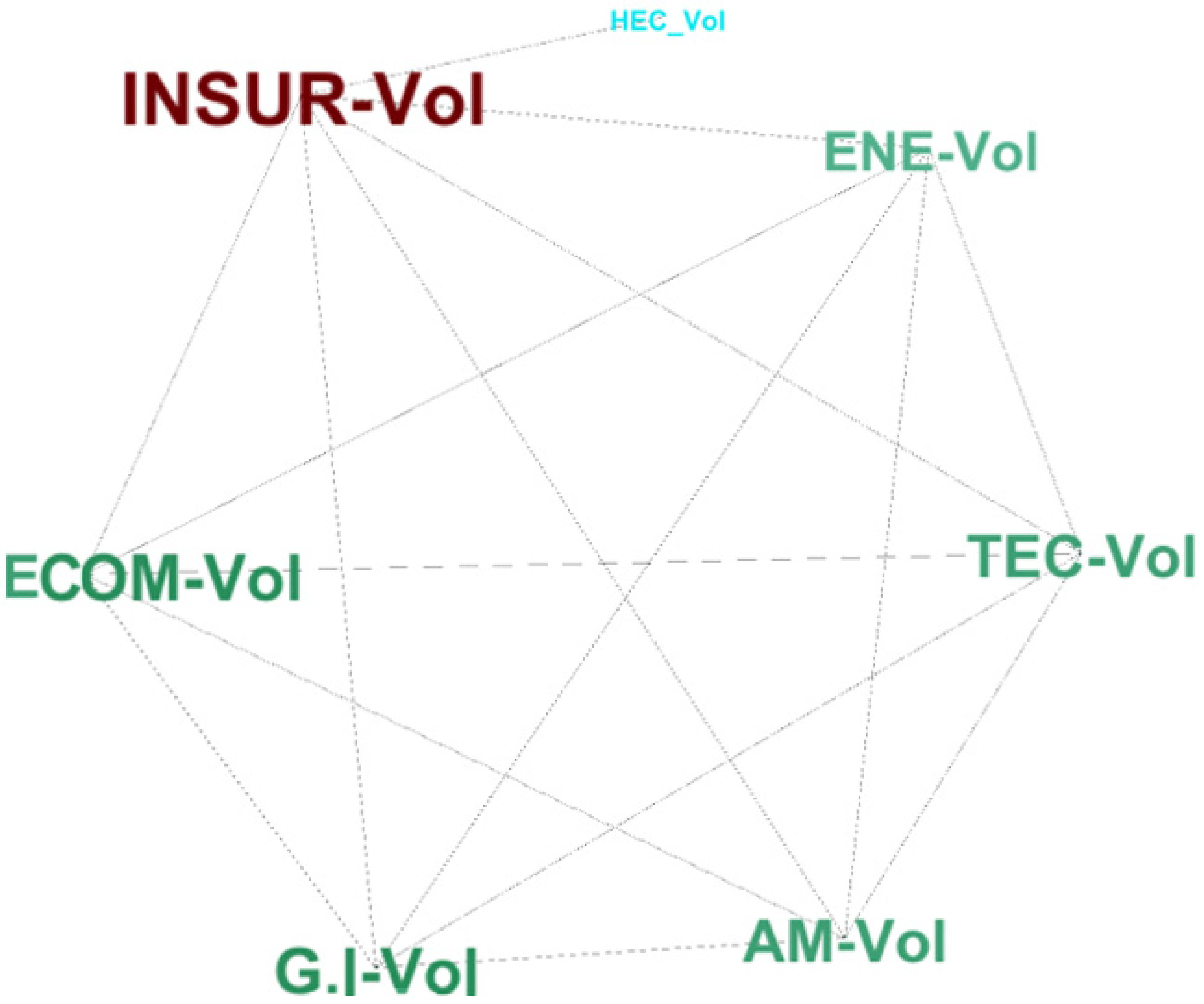
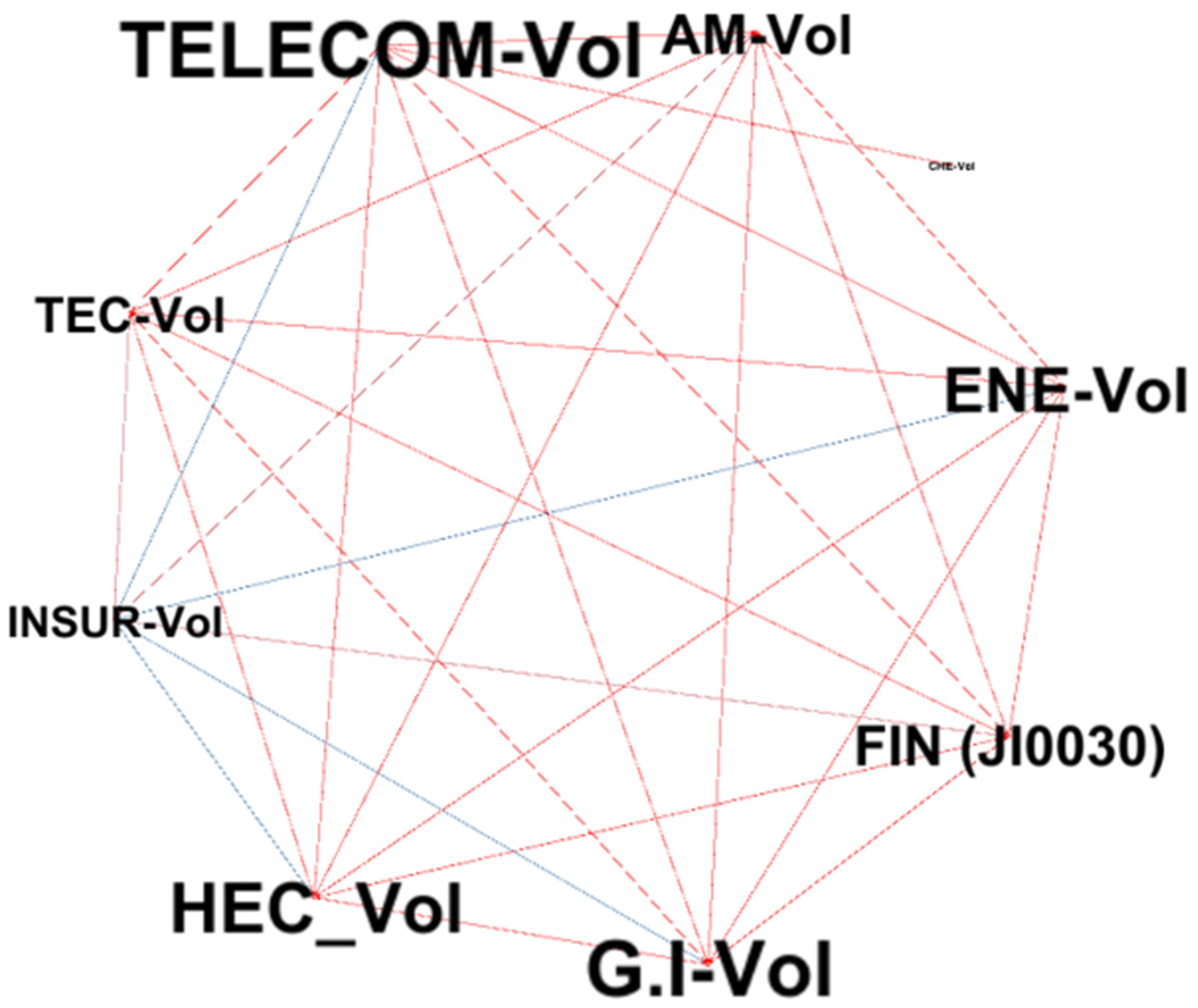
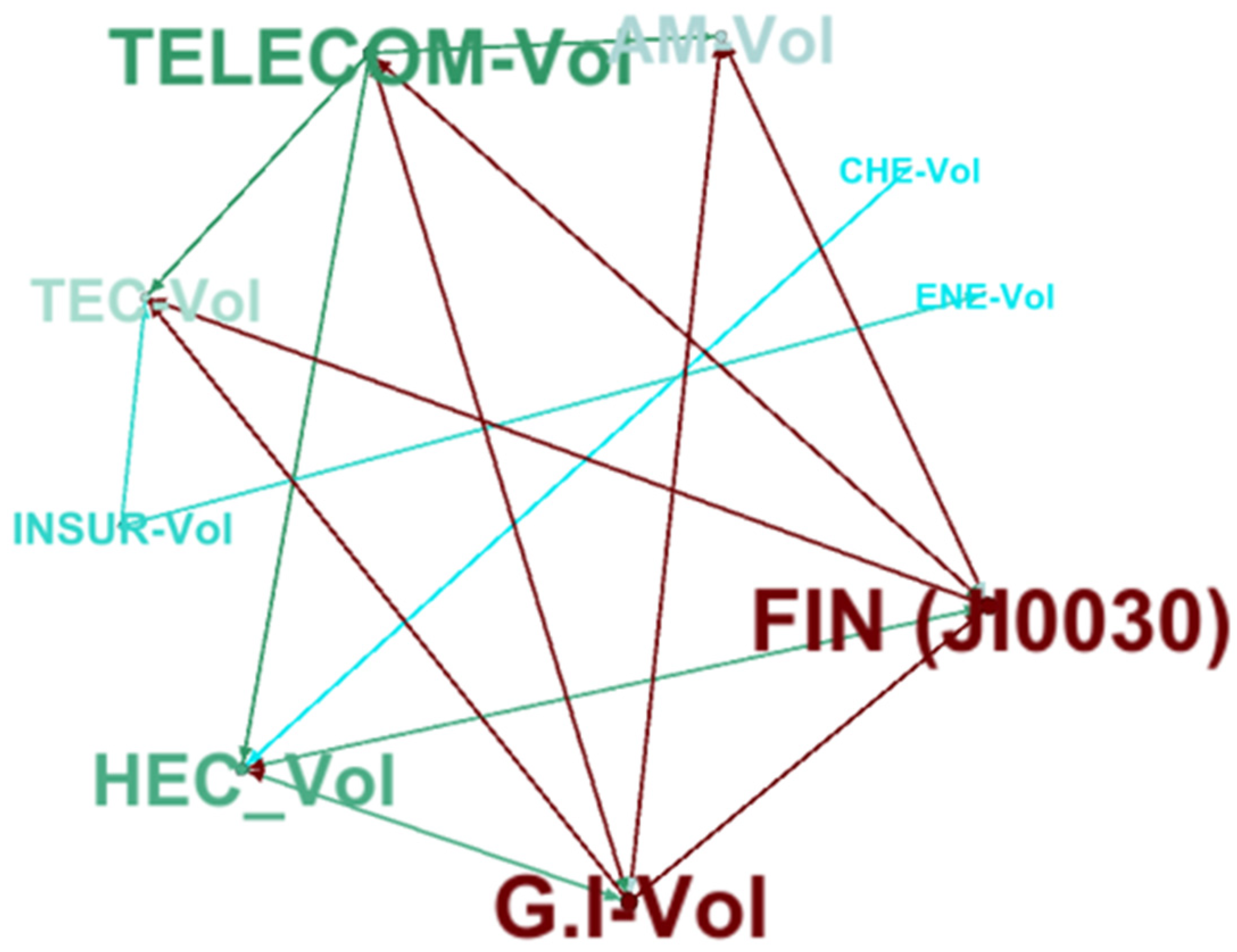
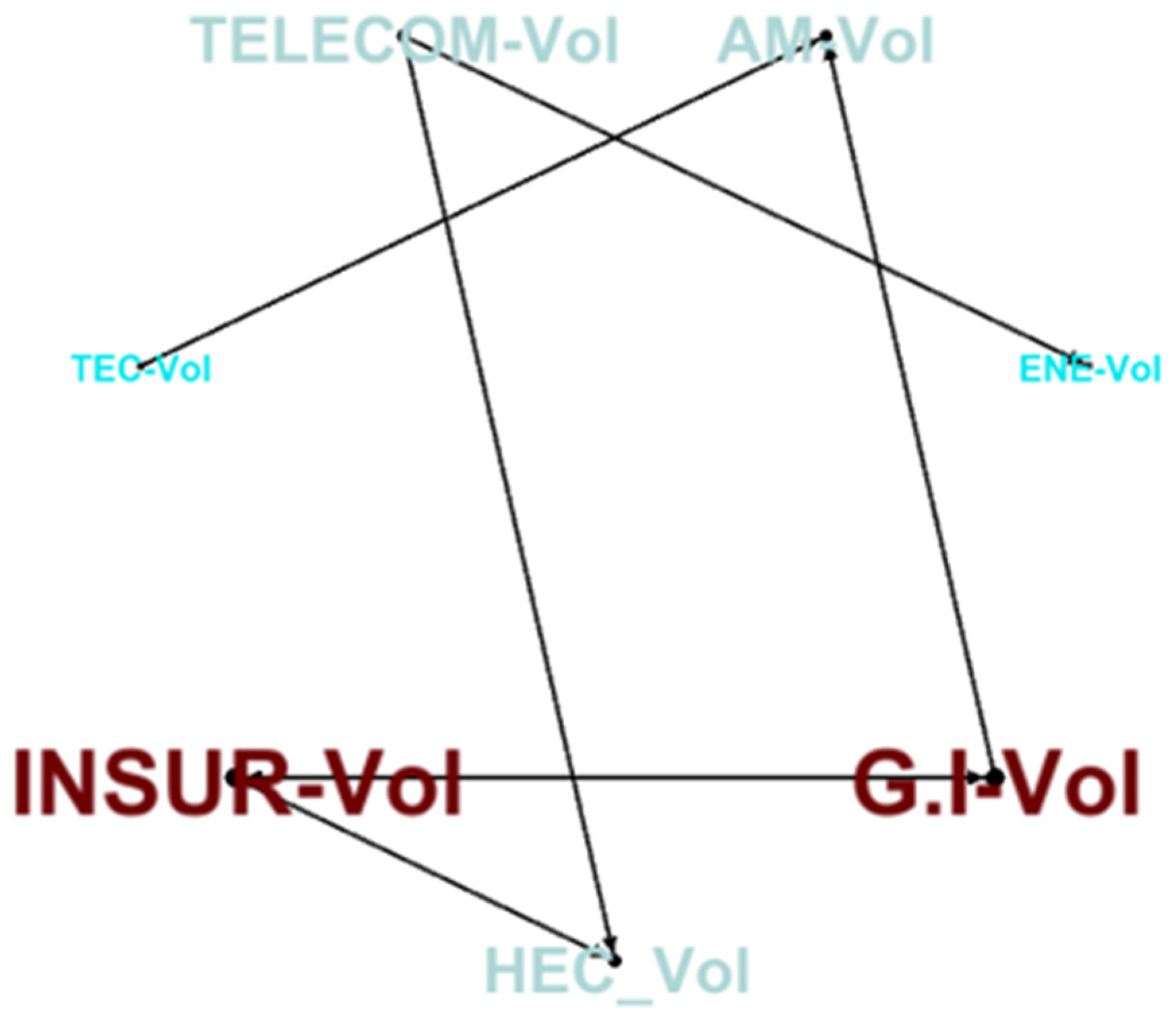
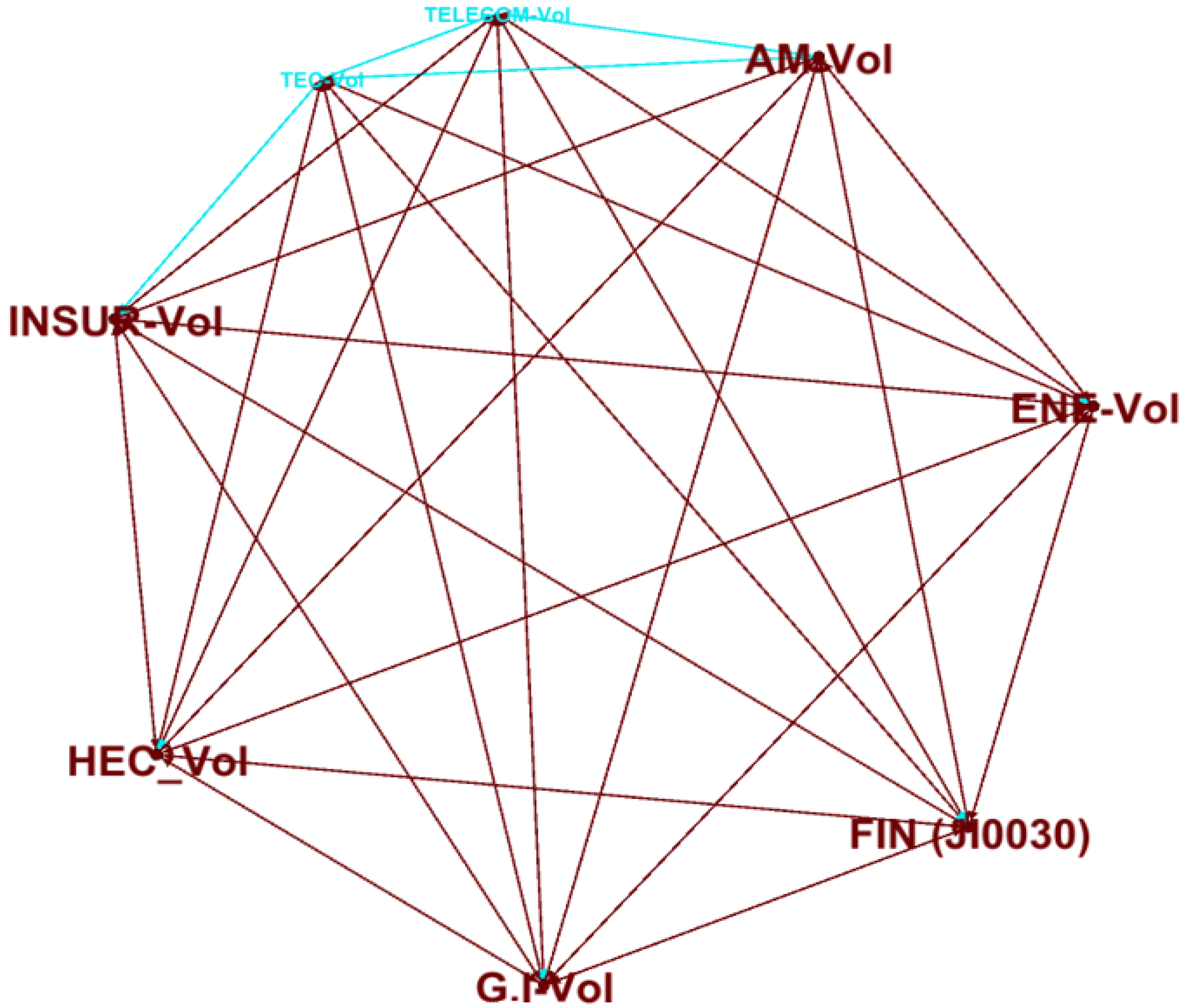
Figure 1, Figure 2, Figure 3, Figure 4 and Figure 5 illustrate the network topologies for each period, where the nodes represent the super-sectors and edges denote Granger-causal linkages between them. The colour gradient of the nodes provides a visual measure of degree centrality: light-coloured nodes correspond to sectors with the lowest degree centrality, implying limited interconnectedness and reduced influence within the volatility network; in contrast, dark-coloured nodes denote sectors with high degree centrality, signalling greater exposure either as transmitters or receivers of systemic risk. Hence, darker nodes identify those sectors that play dominant roles in the propagation and absorption of shocks. The size of each node further reflects its total number of connections—larger nodes indicate a higher density of volatility linkages. Collectively, these graphical representations reveal the dynamic reconfiguration of South Africa’s sectoral network structure across different states of the global economy.
In the full sample network (Figure 1), the insurance, telecommunication, and general industrial sectors emerge as the most prominent dark nodes, corresponding to PageRank scores of 0.203, 0.162, and 0.162, respectively. These sectors act as major receivers of volatility shocks, implying systemic dependence on fluctuations elsewhere in the network. Conversely, the financial and chemical sectors appear as light nodes with negligible scores, suggesting insulation from incoming shocks and a potential role as risk transmitters.
During the Global Financial Crisis (Figure 2), the network topology exhibits pronounced concentration around the real-economy sectors. The general industrial sector recorded the highest PageRank score (0.145), followed by the telecommunication sector (0.138) and the automobile and parts sector (0.135). The darker nodes in this period are primarily clustered around manufacturing, communication, and transport, indicating that contagion spread through production and demand channels rather than financial intermediaries.
In the European Debt Crisis (Figure 3), the network reveals a distinct configuration, with telecommunication (0.1636), general industrial (0.1618), and financial (0.1597) sectors forming the most central dark nodes. The strong presence of telecommunications as a systemic receiver reflects its informational role and cross-sectoral connectivity. At the same time, the reappearance of financials among the top ranks indicates exposure to global funding shocks transmitted through credit linkages with Europe.
The US–China trade-war network (Figure 4) demonstrates that the telecommunication (0.2342) and automobile and parts (0.222) sectors are the most systemically exposed, followed by the health (0.186) and insurance (0.149) sectors. These findings reveal that export- and import-dependent industries absorbed most of the volatility during this geopolitical conflict, consistent with South Africa’s trade sensitivity and integration into global supply chains.
Finally, the COVID-19 pandemic network (Figure 5) exhibits a nearly uniform distribution of dark nodes across the entire system. The telecommunication (0.2827), general industrial (0.2081), and insurance (0.1604) sectors are again the most central, but other major industries—financial, energy, automobile, and health—display similar colour intensity and node size, suggesting widespread systemic vulnerability. The homogeneity of the COVID-19 network signifies a state of complete contagion, where all key sectors function simultaneously as transmitters and receivers of risk due to the global and multi-channel nature of the pandemic shock.
Overall, the visual and quantitative analyses of Figure 1, Figure 2, Figure 3, Figure 4 and Figure 5 confirm that network density and colour intensity increase during crisis periods, indicating a rise in contagion pathways and sectoral dependence. The results highlight the persistent systemic prominence of the insurance, telecommunication, and industrial sectors across all periods, consistent with their roles as critical nodes in the South African volatility network.

4.3. Discussion of Findings

The empirical results derived from the PageRank analysis provide substantial evidence on the structure, dynamics, and evolution of systemic vulnerability within South Africa’s sectoral network. As demonstrated in Section 4.2 and illustrated by Figure 1, Figure 2, Figure 3, Figure 4 and Figure 5, sectoral interdependencies vary significantly across periods of market calm and systemic stress, confirming that the topology of financial contagion in the South African economy is state-dependent, non-linear, and endogenously evolving. The PageRank algorithm, in this context, serves as a robust diagnostic instrument for identifying sectors that are most exposed to cross-sectoral volatility transmission. Unlike traditional size-based risk indicators, PageRank centrality quantifies a sector’s capacity to receive volatility spillovers from its neighbours, thereby capturing the directional flow of systemic pressure and the concentration of risk absorption in the network (Chaturvedi and Singh 2022; Xu and Corbett 2020).
The interpretation of PageRank scores as a measure of inbound vulnerability rather than outward influence implies that sectors with higher centrality are those that absorb the greatest proportion of shocks from the system. This reconceptualises the “too-central-to-fail” (TCF) framework proposed by Yun et al. (2019) to encompass not only financial institutions but also real and service-sector nodes that anchor the South African economy. High PageRank values, analogous to frequently cited web pages in the Google algorithm, signify that these sectors are referenced—or shocked—most often by others. Thus, systemic risk in this framework is cumulative and endogenous: the more an industry is affected by shocks from other highly central sectors, the more it becomes a conduit for further contagion.
The dominance of the insurance, telecommunication, and general industrial sectors across nearly all subperiods suggests that these sectors constitute the core of systemic vulnerability in the South African market. Their persistently high centrality underscores their exposure to volatility transmission through both financial and real-economy linkages. The insurance sector’s systemic importance stems from its dual role as a financial intermediary and risk absorber. Given its exposure to financial markets, household wealth, and corporate liabilities, disturbances in any connected sector rapidly translate into valuation and liquidity shocks within insurance balance sheets. This finding is consistent with the “volatility receiver” hypothesis advanced by Glasserman and Young (2016), which posits that sectors with extensive bilateral exposures and contingent claims structures amplify systemic risk under stress.
Similarly, the telecommunication sector emerges as a consistently high-centrality node across all periods. Its informational role and pervasive linkages with both consumption and production sectors render it uniquely susceptible to global and domestic uncertainty. During crisis episodes—particularly the EDC, trade war, and COVID-19 periods—the telecommunication sector’s PageRank score increased sharply, indicating that it became a principal absorber of volatility spillovers. This observation corroborates the findings of Lawrence et al. (2024a), who demonstrate that digital and information-intensive sectors in emerging markets act as accelerants of financial contagion due to the high velocity of data and transaction networks.
The general industrial sector represents another key node of vulnerability, especially during the GFC and EDC periods. Its high centrality reflects South Africa’s structural dependence on manufacturing, resource extraction, and export-oriented industries. External demand contractions during the GFC and sovereign funding disruptions during the EDC directly impacted industrial output, causing elevated volatility that propagated into other sectors. This pattern resonates with the argument of Acemoglu et al. (2015), who emphasize that in tightly coupled production networks, idiosyncratic shocks to large or highly connected nodes can generate aggregate fluctuations and amplify systemic risk.
The behaviour of the financial sector across subperiods provides an instructive contrast. Despite its size and regulatory significance, the industry frequently records relatively low PageRank values, indicating that it functions more as a volatility transmitter than a receiver. This observation is consistent with domestic evidence that South African banks and financial institutions were well-capitalized and resilient during both the GFC and EDC, owing to prudent regulation, conservative balance-sheet management, and limited exposure to foreign structured products. However, during the EDC, the financial sector’s moderate increase in centrality (0.1597) reveals partial sensitivity to global liquidity strains, highlighting the channel through which international shocks can still enter domestic credit systems even in a robust regulatory environment.
The results during the US–China trade dispute period reveal a sectoral reconfiguration of systemic exposure. The automobile and parts, telecommunication, and insurance sectors display the highest centrality values, reflecting the predominance of trade-related and globally integrated sectors in absorbing volatility. These findings corroborate earlier studies (Bhorat et al. 2014; Lawrence et al. 2024a), which show that South Africa’s export-oriented industries are particularly vulnerable to exogenous trade shocks and currency fluctuations. The low vulnerability of the financial and energy sectors in this subperiod further emphasises that the contagion was transmitted primarily through the real economy rather than through financial linkages.
The COVID-19 pandemic generated a qualitatively different network topology. Unlike earlier crises, which produced selective contagion concentrated in certain sectors, the pandemic induced systemic synchronisation (Lai and Hu 2021), where almost every major industry became simultaneously exposed. The uniform distribution of PageRank scores—ranging between 0.125 and 0.282—indicates a near-complete collapse of inter-sectoral differentiation. In this regime, all sectors operated as both transmitters and receivers of volatility, reflecting the pervasive economic shutdowns, demand contractions, and capital flow reversals induced by the pandemic. The finding that the health sector, despite being directly affected by the crisis, ranked only fifth (0.0719) in centrality suggests that it remained relatively insulated from financial contagion, even as it absorbed operational and logistical stress. This divergence between real-sector strain and financial vulnerability highlights the distinction between sectoral stress and systemic centrality within the volatility network.
Synthesising the results across all periods, a coherent structural narrative emerges. In tranquil times, contagion is concentrated within a narrow cluster of informational and service sectors—namely, insurance, telecommunications, and industrials—indicating a targeted systemic dependence. In crisis periods, however, the network expands into a dense and highly correlated architecture, producing distributed systemic vulnerability where risk becomes endogenous to the entire economic system. This transition from concentrated to distributed contagion highlights the non-linear dynamics of systemic risk in emerging markets (Battiston et al. 2012; Billio et al. 2012). The South African economy thus oscillates between regimes of sectoral fragility and economy-wide synchronisation, depending on the scale and nature of external shocks.
From a theoretical standpoint, these findings support the argument that network centrality—not merely sectoral size—determines systemic importance (Glasserman and Young 2016; Yun et al. 2019). Sectors with high PageRank are not necessarily the largest by market capitalisation, but those whose interconnected exposures render them unavoidable recipients of systemic shocks. The insurance, telecommunication, and industrial sectors, therefore, represent the too-central-to-fail core of the South African market—nodes whose failure would propagate volatility through multiple feedback channels.
From a policy perspective, these results have several implications. First, monitoring time-varying PageRank centrality provides regulators with a forward-looking indicator of systemic stress, enabling early detection of shifts in contagion pathways. Second, macroprudential frameworks should incorporate sectoral network analysis alongside traditional capital adequacy and liquidity metrics to capture non-linear interdependencies beyond the banking sector. Finally, investors and policymakers should recognise that diversification strategies premised solely on sectoral separation may prove ineffective during high-connectivity regimes, such as the COVID-19 pandemic, when all sectors converge into a single contagion structure.
Overall, the findings affirm that systemic risk in South Africa is both structurally embedded and dynamically contingent. The evolution of the volatility network from selective vulnerability to system-wide contagion reflects the interplay between external global shocks and domestic inter-sectoral linkages. As such, the identification of persistently central sectors—such as insurance, telecommunications, and general industries—provides a crucial empirical foundation for designing targeted resilience mechanisms and advancing the broader understanding of too-central-to-fail dynamics in emerging financial markets.

5. Conclusions

The network-based analysis presented in this study demonstrates that the combined use of directed volatility networks and PageRank centrality provides a rigorous and forward-looking framework for identifying systemic risk within the South African economy. The graphical representations in Figure 1, Figure 2, Figure 3, Figure 4 and Figure 5 and the quantitative results in Table 3 jointly reveal that the structure of sectoral interdependence is highly dynamic and responsive to episodes of financial stress. The network graphs clearly show that node colour intensity and size—representing degree centrality and connection density become more pronounced during crisis periods, indicating greater contagion pathways and systemic clustering. Table 3 confirms that sectors with persistently high PageRank scores, such as insurance, telecommunications, and general industries, are those most consistently exposed to volatility spillovers, thus functioning as the core receivers of systemic shocks. The convergence of dark, densely connected nodes across the COVID-19 period illustrates the transition from sector-specific fragility to economy-wide contagion, underscoring the non-linear and state-dependent nature of systemic vulnerability in emerging markets.
These findings highlight that PageRank centrality, when applied to a dynamic sectoral network, functions effectively as an ex-ante indicator of systemic stress. Unlike size-based or purely statistical risk metrics, the network-based approach captures both directionality and intensity of contagion, offering early warnings of structural shifts in vulnerability before conventional market indicators respond. The strategy identifies not only the sectors that initiate shocks but, more crucially, those that accumulate and absorb them, thereby pinpointing the “too-central-to-fail” nodes whose destabilisation could trigger broad financial and economic dislocation. The evidence that these sectors, particularly telecommunications, insurance, and general industries, retain high centrality across diverse crises suggests that they form the structural backbone of systemic dependence in South Africa.
The methodological and empirical insights of this analysis align closely with the evolving supervisory architecture of South Africa’s financial system, which increasingly emphasises system-wide monitoring and forward-looking identification of risk concentrations. The use of PageRank and network visualisation offers regulators a tractable means of integrating complex intersectoral information into macroprudential surveillance. In practice, these measures can augment existing stress-testing frameworks by highlighting where vulnerabilities are intensifying, how contagion channels are evolving, and when the system transitions from a concentrated to a fully synchronized contagion regime. Incorporating network-based diagnostics into the national financial stability toolkit would enhance early warning capacity, promote sector-specific resilience strategies, and support a more adaptive macroprudential policy stance.
From a policy perspective, several actionable recommendations emerge from this study. First, financial regulators should institutionalize network-based systemic-risk monitoring by embedding PageRank centrality and volatility-spillover maps within the South African Reserve Bank’s financial stability dashboard. This would enable continuous observation of shifts in systemic importance across sectors. Second, macroprudential authorities could adopt sectoral stress-testing frameworks that prioritise those sectors identified as high-centrality nodes—particularly insurance, telecommunications, and general industries—to assess their capacity to absorb shocks and mitigate contagion. Third, the Prudential Authority and the Financial Sector Conduct Authority should consider cross-sectoral data-sharing protocols to enhance the granularity of interconnectedness data and enable real-time recalibration of systemic indicators. Fourth, policymakers should develop contingency liquidity facilities and countercyclical buffers targeting non-bank financial and service sectors that consistently exhibit high PageRank values. Finally, integrating these analytical tools into supervisory practice would advance a proactive regulatory regime—one capable of detecting the emergence of systemic fragility before it evolves into full-scale contagion, thereby reinforcing the resilience of South Africa’s financial system and safeguarding long-term economic stability.

Author Contributions

Conceptualization, B.L., M.D. and A.A.O.; methodology, B.L. and A.C.; software, B.L. and A.C.; validation, A.A.O. and M.D.; formal analysis, B.L. and A.C.; investigation, B.L., A.C., A.A.O. and M.D.; resources, B.L., A.C. and A.A.O.; data curation, B.L.; writing—original draft preparation, B.L.; writing—review and editing, A.C., A.A.O. and M.D.; visualization, A.A.O., A.C. and M.D.; supervision, A.A.O. and M.D.; project administration, A.A.O. All authors have read and agreed to the published version of the manuscript.

Funding

This research received no external funding.

Data Availability Statement

The original contributions presented in this study are included in the article. Further inquiries can be directed to the corresponding author.

Conflicts of Interest

The authors declare no conflict of interest.

Note

1
Non-polycyclic or countercyclical properties are those properties or (economic quantity) that has a negative correlation with the status of the economy as a whole (Abel and Bernanke 2001).

References

  1. Abel, Andrew B., and Ben S. Bernanke. 2001. Macroeconomics, 4th ed. Boston: Addison-Wesley. [Google Scholar]
  2. Acemoglu, Daron, Asuman Ozdaglar, and Alireza Tahbaz-Salehi. 2015. Systemic Risk and Stability in Financial Networks. American Economic Review 105: 564–608. [Google Scholar] [CrossRef]
  3. Alizadeh, Sassan, Michael W. Brandt, and Francis X. Diebold. 2002. Range-Based Estimation of Stochastic Volatility Models. Journal of Finance 57: 1047–91. [Google Scholar] [CrossRef]
  4. Andersen, Torben G., and Tim Bollerslev. 1998. Answering the Skeptics: Yes, Standard Volatility Models Do Provide Accurate Forecasts. International Economic Review 39: 885–905. [Google Scholar] [CrossRef]
  5. Arndt, Channing, Christopher Loewald, and Konstantin Makrelov. 2020. Climate Change and Its Implications for Central Banks in Emerging and Developing Economies. Pretoria: Economic Research and Statistics Department, South African Reserve Bank. [Google Scholar]
  6. Battiston, Stefano, Mauro Puliga, Rahul Kaushik, Paolo Tasca, and Guido Caldarelli. 2012. DebtRank: Too Central to Fail? Financial Networks, the Fed and Systemic Risk. Scientific Reports 2: 541. [Google Scholar] [CrossRef]
  7. Bhorat, Haroon, Alan Hirsch, Ravi Kanbur, and Mthuli Ncube, eds. 2014. The Oxford Companion to the Economics of South Africa. Oxford: Oxford University Press. [Google Scholar]
  8. Billio, Monica, Mila Getmansky, Andrew W. Lo, and Loriana Pelizzon. 2012. Econometric Measures of Connectedness and Systemic Risk in the Finance and Insurance Sectors. Journal of Financial Economics 104: 535–59. [Google Scholar] [CrossRef]
  9. Bolland, John M. 1988. Sorting Out Centrality: An Analysis of the Performance of Four Centrality Models in Real and Simulated Networks. Social Networks 10: 233–53. [Google Scholar] [CrossRef]
  10. Borgatti, Stephen P., and Martin G. Everett. 2006. A Graph-Theoretic Perspective on Centrality. Social Networks 28: 466–84. [Google Scholar] [CrossRef]
  11. Chan-Lau, Jorge, Marco Espinosa, and Juan Solé. 2009. Co-Risk Measures to Assess Systemic Financial Linkages. IMF Working Paper No. 09/38. Washington, DC: International Monetary Fund. [Google Scholar]
  12. Chaturvedi, Anshul, and Amanpreet Singh. 2022. Examining Systemic Risk Using Google PageRank Algorithm: An Application to Indian Non-Bank Financial Companies (NBFCs) Crisis. International Journal of Mathematical, Engineering and Management Sciences 7: 575–88. [Google Scholar] [CrossRef]
  13. Danielsson, Jón, and Casper G. de Vries. 2000. Value-at-Risk and Extreme Returns. Annales d’Économie et de Statistique, 239–70. [Google Scholar] [CrossRef]
  14. Diebold, Francis X., and Kamil Yilmaz. 2014. On the Network Topology of Variance Decompositions: Measuring the Connectedness of Financial Firms. Journal of Econometrics 182: 119–34. [Google Scholar] [CrossRef]
  15. Estrada, Ernesto. 2010. Generalized Walks-Based Centrality Measures for Complex Biological Networks. Journal of Theoretical Biology 263: 556–65. [Google Scholar] [CrossRef]
  16. Freeman, Linton C. 1977. A Set of Measures of Centrality Based on Betweenness. Sociometry 40: 35–41. [Google Scholar] [CrossRef]
  17. Garman, Mark B., and Michael J. Klass. 1980. On the Estimation of Security Price Volatilities from Historical Data. Journal of Business 53: 67–78. [Google Scholar] [CrossRef]
  18. Glasserman, Paul, and H. Peyton Young. 2016. Contagion in Financial Networks. Journal of Economic Literature 54: 779–831. [Google Scholar] [CrossRef]
  19. Golbeck, Jennifer. 2015. Introduction to Social Media Investigation: A Hands-On Approach. Waltham: Syngress. [Google Scholar]
  20. Hansen, Derek, Ben Shneiderman, and Marc A. Smith. 2010. Analyzing Social Media Networks with NodeXL: Insights from a Connected World. Burlington: Morgan Kaufmann. [Google Scholar]
  21. Härdle, Wolfgang Karl, Weining Wang, and Lining Yu. 2016. TENET: Tail-Event Driven Network Risk. Journal of Econometrics 192: 499–513. [Google Scholar] [CrossRef]
  22. Kuzubaş, Tuğrul U., İsmail Ömercikoğlu, and Bülent Saltoğlu. 2014. Network Centrality Measures and Systemic Risk: An Application to the Turkish Financial Crisis. Physica A: Statistical Mechanics and Its Applications 405: 203–15. [Google Scholar] [CrossRef]
  23. Labonte, Marc. 2018. Systemically Important or ‘Too Big to Fail’ Financial Institutions. Washington, DC: Congressional Research Service. [Google Scholar]
  24. Lai, Ying, and Yang Hu. 2021. A Study of Systemic Risk of Global Stock Markets under COVID-19 Based on Complex Financial Networks. Physica A: Statistical Mechanics and Its Applications 566: 125613. [Google Scholar] [CrossRef]
  25. Lawrence, Babatunde S., Adefemi Obalade, and Mishelle Doorasamy. 2024a. Connectedness and Shock Propagation in South African Equity Sectors during Extreme Market Conditions. Journal of Risk and Financial Management 17: 441. [Google Scholar] [CrossRef]
  26. Lawrence, Babatunde S., Adefemi Obalade, Anthanasius Tita, and Joseph French. 2024b. Stock Market Connectedness during an Energy Crisis: Evidence from South Africa. Emerging Markets Review 63: 101194. [Google Scholar] [CrossRef]
  27. Lo, Andrew W. 2017. Adaptive Markets: Financial Evolution at the Speed of Thought. Princeton: Princeton University Press. [Google Scholar]
  28. Mensah, Justice Osei, and Gamini Premaratne. 2017. Systemic Interconnectedness among Asian Banks. Japan and the World Economy 41: 17–33. [Google Scholar] [CrossRef]
  29. Mulinacci, Simone. 2017. A Systemic Shock Model for Too Big to Fail Financial Institutions. arXiv arXiv:1704.02160. [Google Scholar] [CrossRef]
  30. Ngandu, Stewart, Miriam Altman, Catherine Cross, Peter Jacobs, Tim Hart, and Innocent Matshe. 2010. The Socio-Economic Impact of the Global Downturn on South Africa: Responses and Policy Implications. Pretoria: Oxfam South Africa/HSRC. [Google Scholar]
  31. Nieminen, Juhani. 1974. On the Centrality in a Graph. Scandinavian Journal of Psychology 15: 332–36. [Google Scholar] [CrossRef] [PubMed]
  32. Page, Lawrence, Sergey Brin, Rajeev Motwani, and Terry Winograd. 1999. The PageRank Citation Ranking: Bringing Order to the Web. Stanford: Stanford InfoLab. [Google Scholar]
  33. Shaw, George T. W., Angela C. Liu, Chia-Yu Weng, Yi-Chun Chen, Cheng-Yu Chen, Francis Cheng-Hsuan Weng, Daryi Wang, and Chu-Yang Chou. 2020. A Network-Based Approach to Deciphering a Dynamic Microbiome’s Response to a Subtle Perturbation. Scientific Reports 10: 19530. [Google Scholar]
  34. Shetty, Ramya D., and Shrutilipi Bhattacharjee. 2022. A weighted hybrid centrality for identifying influential individuals in contact networks. In 2022 IEEE International Conference on Electronics, Computing and Communication Technologies (CONECCT). Piscataway: IEEE, pp. 1–6. [Google Scholar]
  35. Thurner, Stefan, and Sebastian Poledna. 2013. DebtRank-Transparency: Controlling Systemic Risk in Financial Networks. Scientific Reports 3: 1888. [Google Scholar] [CrossRef]
  36. Wang, Di, and Wei-Qiang Huang. 2021. Centrality-Based Measures of Financial Institutions’ Systemic Importance: A Tail Dependence Network View. Physica A: Statistical Mechanics and Its Applications 562: 125345. [Google Scholar] [CrossRef]
  37. Wen, Ting, and Guo-Jiang Wang. 2020. Volatility Connectedness in Global Foreign Exchange Markets. Journal of Multinational Financial Management 54: 100617. [Google Scholar] [CrossRef]
  38. Xu, Yang, and Jenny Corbett. 2020. What a Network Measure Can Tell Us about Financial Interconnectedness and Output Volatility. Journal of the Japanese and International Economies 58: 101105. [Google Scholar] [CrossRef]
  39. Yun, Tae Seung, Daeho Jeong, and Seung Park. 2019. ‘Too Central to Fail’ Systemic Risk Measure Using PageRank Algorithm. Journal of Economic Behavior & Organization 162: 251–72. [Google Scholar]
  40. Zhang, Dayong, and David C. Broadstock. 2020. Global Financial Crisis and Rising Connectedness in the International Commodity Markets. International Review of Financial Analysis 68: 101239. [Google Scholar] [CrossRef]
  41. Zhang, Wei, Xiaofeng Zhuang, Jun Wang, and Yudong Lu. 2020. Connectedness and Systemic Risk Spillovers Analysis of Chinese Sectors Based on Tail Risk Network. North American Journal of Economics and Finance 54: 101248. [Google Scholar] [CrossRef]
Figure 1. Full Sample Network Graph.
Risks 14 00065 g001
Figure 2. GFC Network Graph.
Risks 14 00065 g002
Figure 3. EDC Network Graph.
Risks 14 00065 g003
Figure 4. US-China Trade War Network Graph.
Risks 14 00065 g004
Figure 5. COVID Network Graph.
Risks 14 00065 g005
Table 1. Descriptive statistics for sector returns.
AM CHEENEFING.IHECINSURTECHTELECOM
Mean0.0330.0660.609−0.2110.024−0.0420.1480.1970.147
Median0−0.06100.4820.3950.4120.5010.4950.268
Maximum0.5790.3550.3870.0780.0790.0620.0750.1630.144
Minimum−1−1−1−1−1−1−1−1−1
Std. Dev.30.04328.35637.43326.23120.10625.39320.79523.01825.52
Skewness−7.455 ***−11.590 ***−7.229 ***−27.753 ***−30.795 ***−26.37034 ***−27.839 ***−20.565 ***−15.061 ***
0.000000.000000.000000.000000.000000.000000.000000.000000.00000
Kurtosis364.348 ***417.884 ***217.719 ***1057.330 ***1532.461 ***994.016 ***1340.116 ***895.601 ***593.606 ***
Jarque–Bera21,788,165 ***28,763,280 ***7,715,039 ***186,000,000 ***390,000,000 ***164,000,000 ***298,000,000 ***133,000,000 ***58,257,887 ***
Probability0.000000.000000.000000.000000.000000.000000.000000.000000.00000
Sum1.3170.2622.436−0.8420.095−0.1670.5910.7880.588
Sum Sq. Dev.3.6083.2145.6002.7491.6162.5781.7282.1182.603
Q (10)99.00637.57126.2163.8173.5833.3236.0555.29611.519
0.0001.5359.5260.6950.7320.7720.3590.4620.034
Q2 (10)12.856 **1.5359.526 *0.0020.0010.0010.0010.0020.003
0.0170.9720.087111111
Observations399839983998399739983998399839983998
ADF stat (prob)−8.72 (0.00)−6.63 (0.00)−32.455 (0.00)−66.32 (0.00)−8.45 (0.00)−63.23 (0.00)−8.05 (0.00)−9.75 (0.00)−6.39 (0.00)
KPSS stat (prob)0.08 (0.644)0.03 (0.98)0.14 (0.05)0.50 (0.041)0.01 (0.99)0.50 (0.05)0.03 (0.99)0.02 (0.99)0.02 (0.98)
StationarityYesYesYesYesYesYesYesYesYes
Source: Authors’ estimation (2023). Note: Figures are multiplied by 1000. significant at 1% (***), significant at 5% (**), significant at 10% (*).
Table 2. Correlation of Sectorial Volatility.
AM-VOLCHE-VOLENE-VOLFIN-VOLG-I VOLHEC-VOLINSUR-VOLTEC-VOLTELECOM-VOL
AM-VOL10.0060.0320.0030.1130.0040.1290.0890.119
CHE-VOL0.00610.026−0.0000.0060.001−0.005−0.0010.000
ENE-VOL0.0320.02710.0000.1020.0020.0480.0770.136
FIN-VOL0.003−0.00040.00010.0110.0000.0070.0250.005
G-I-VOL0.1130.0060.1020.0111−0.0010.5250.3340.524
HEC-VOL0.0040.0010.0020.000−0.00110.0000.0090.005
INSUR-VOL0.129−0.0050.050.0070.5250.00010.3240.483
TEC-VOL0.089−0.0010.0770.0250.3340.0090.32410.318
TELECOM-VOL0.1190.00030.1360.0050.5250.0050.4830.3171
Source: Authors’ estimation (2023).
Table 3. Centrality score and PageRank of the sectors.
Full SampleGFCUS-China TD
NodesPageRank ScoresRankNodesPageRank ScoresRankNodesPageRank ScoresRank
INSUR-Vol0.2031G.I-Vol0.1451AM-Vol0.2221
TELECOM-Vol0.1622TELECOM-Vol0.1382HEC_Vol0.1862
G.I-Vol0.1622AM-Vol0.1353INSUR-Vol0.1493
AM-Vol0.1563HEC_Vol0.1334G.I-Vol0.1494
TEC-Vol0.1384ENE-Vol0.1185ENE-Vol0.1225
ENE-Vol0.1295TEC-Vol0.1116TELECOM-Vol0.0866
HEC_Vol0.0506FIN (JI0030)0.1087TEC-Vol0.0866
FIN (JI0030)0.0007INSUR-Vol0.0828FIN (JI0030)0.0007
CHE-Vol0.0007CHE-Vol0.0319CHE-Vol0.0007
EDCCOVID
NodesPageRank ScoresRankNodesPageRank ScoresRank
G.I-Vol0.1951AM-Vol0.1271
FIN (JI0030)0.1951INSUR-Vol0.1271
HEC_Vol0.1462G.I-Vol0.1271
TEC-Vol0.1313FIN (JI0030)0.1271
AM-Vol0.1174ENE-Vol0.1271
TELECOM-Vol0.1005HEC_Vol0.1271
ENE-Vol0.0486TELECOM-Vol0.1252
INSUR-Vol0.0347TEC-Vol0.1113
CHE-Vol0.0348CHE04
Authors’ estimations (2023).
Disclaimer/Publisher’s Note: The statements, opinions and data contained in all publications are solely those of the individual author(s) and contributor(s) and not of MDPI and/or the editor(s). MDPI and/or the editor(s) disclaim responsibility for any injury to people or property resulting from any ideas, methods, instructions or products referred to in the content.