1. Introduction
Global real estate markets have grown more interconnected with macroeconomic conditions, geopolitical changes, and larger financial systems in recent decades. Understanding the factors that influence property returns has become crucial for investors, policy makers, and regulators since real estate assets make up a significant portion of household wealth, institutional portfolios, and national economic activity (
Case and Shiller 1989;
Ghent and Owyang 2010). Growing research indicates that geopolitical uncertainty has emerged as a significant non-economic force influencing asset prices and market behaviour, despite traditional studies emphasising interest rates, income growth, inflation, and financial market conditions as the main drivers of property returns (
Caldara and Iacoviello 2022;
Pástor and Veronesi 2013).
Following significant global events like the global financial crisis, the US–China trade disputes, the COVID-19 pandemic and the Russia–Ukraine war, the significance of geopolitical uncertainty has increased. According to
Bloom (
2014) and
Bekaert et al. (
2014), these incidents have increased political risk, interrupted global supply chains, changed capital flows and raised uncertainty in the real asset and financial markets. Even though they are sometimes thought of as relatively stable and inflation-hedging investments, real estate markets are susceptible to these kinds of shocks. Changes in investor attitude, financial conditions, construction activity and cross-border capital allocation are some of the ways that rising uncertainty might impact property returns (
Ling et al. 2018;
Pankratz 2023).
The BRICS economies—Brazil, Russia, India, China, and South Africa—constitute a particularly important and underexplored setting for analysing the interaction between geopolitical uncertainty and property market returns. Collectively, these countries account for a substantial share of global population growth, urban expansion, and real estate development, making their property markets systemically relevant not only domestically but also internationally (
UN-Habitat 2020;
World Bank 2022). At the same time, BRICS countries exhibit pronounced heterogeneity in political systems, institutional quality, financial development, and exposure to geopolitical tensions, ranging from international conflicts and strategic rivalries to domestic political instability (
Bekaert et al. 2014;
Antonakakis et al. 2022).
This combination of scale, diversity, and heightened exposure to uncertainty positions the BRICS bloc as a natural laboratory for examining how geopolitical risk transmits to property markets under different institutional and market conditions. Unlike developed economies, where real estate markets are relatively mature and stable, BRICS property markets are characterised by rapid growth, evolving regulatory frameworks, and stronger linkages to macro-financial cycles (
Hoesli and Oikarinen 2012;
Ling and Naranjo 2015). Consequently, geopolitical shocks are more likely to generate asymmetric, regime-dependent, and cross-country spillover effects within this group, particularly through channels of capital flows, credit conditions, and investor risk perception (
Balcilar et al. 2018;
Aysan et al. 2019).
The current level of knowledge is still largely biased toward equities, bonds, and commodities markets, despite the growing body of research on geopolitical risk and financial markets. Geopolitical uncertainty has been shown to have an impact on exchange rates, oil prices, and international capital flows (
Balcilar et al. 2018;
Kang and Ratti 2013), as well as stock returns, volatility, and cross-market spillovers (
Caldara and Iacoviello 2022;
Das et al. 2019). On the other hand, there is still little empirical data about the connection between property market returns and geopolitical uncertainty, especially in emerging economies. Current research on real estate frequently concentrates on developed markets and uses linear modelling frameworks that are unable to account for regime-dependent dynamics (
Ling and Naranjo 2015;
Hoesli and Oikarinen 2012).
Despite the increasing recognition that geopolitical uncertainty affects a broad range of asset classes, the transmission of such uncertainty to property markets remains theoretically and empirically underdeveloped. This omission is particularly striking given that real estate assets are capital-intensive, highly leveraged, and inherently immobile, characteristics that make them especially sensitive to prolonged uncertainty, policy instability, and shifts in investor confidence. Unlike equities, where price discovery is rapid and liquidity is high, property markets adjust slowly, implying that the effects of geopolitical shocks may be persistent, nonlinear, and contingent on prevailing market conditions.
More significantly, the few studies that do take into account how uncertainty affects real estate markets usually make the assumption that the market is stable, so ignoring the possibility that the effects of geopolitical risk can vary across bull and bear market regimes. Given that financial and real estate markets are known to display nonlinear behaviour, regime transitions, and asymmetric shock reactions, this absence is crucial (
Hamilton 1989;
Ang and Timmermann 2012). Ignoring these characteristics could result in false conclusions about the extent, direction, and durability of the effects of geopolitical risk on property returns.
Accordingly, a clear and consequential research gap emerges. While geopolitical uncertainty has been extensively studied in relation to equities, bonds, and commodities, there is limited empirical evidence on its effects on property market returns, particularly in emerging economies. More importantly, almost no study examines whether these effects are state-dependent, varying across bull and bear market regimes. This gap is especially critical in the context of the BRICS economies, where property markets are simultaneously exposed to heightened geopolitical risk, structural transformation, and increasing global financial integration.
Moreover, existing studies implicitly assume that the relationship between uncertainty and asset returns is stable across time and market states. This assumption is particularly problematic for property markets, which are known to exhibit cyclical behaviour, regime persistence, and asymmetric responses to shocks. During expansionary phases, accommodative credit conditions and optimistic expectations may dampen the adverse effects of uncertainty, whereas in contractionary phases, the same shocks may be amplified through tighter financial constraints and heightened risk aversion. Failure to account for these regime-dependent dynamics risks obscuring the true magnitude and direction of geopolitical uncertainty’s impact on property returns.
In light of this, the study’s research problem is dual. It first aims to ascertain whether geopolitical unpredictability has a substantial impact on property market returns in the BRICS nations. Second, it investigates whether this link varies across bull and bear market regimes depending on the state. Accurately determining risk exposure, creating successful diversification plans, and developing legislative solutions targeted at preserving market stability all depend on solving this issue.
The primary objective of this study is therefore to examine the effect of geopolitical uncertainty on BRICS property market returns under different market conditions. Specifically, the study aims to first assess the impact of country-specific geopolitical risk on domestic and cross-country property returns; second, identify whether these effects differ between bull and bear market regimes; and third, evaluate the persistence and dominance of market regimes in BRICS property markets. To achieve these objectives, the study employs a Markov regime-switching model, which allows for endogenous identification of regime shifts and captures nonlinear dynamics that conventional linear models overlook.
This study makes three contributions. First, by offering fresh empirical data from the BRICS real estate markets, an area that has non’t gotten much scholarly attention, it expands the body of literature on geopolitical risk. Second, the paper provides fresh perspectives on the state-dependent character of geopolitical uncertainty by using a regime-switching paradigm to show how it affects property returns differently depending on market conditions. Third, the results have significant ramifications for investors and policy makers, emphasiszing the necessity of integrated regulatory frameworks and regime-aware investment strategies to reduce negative spillover effects within the BRICS bloc.
Given these structural characteristics and methodological limitations in the existing literature, a more targeted and innovative empirical approach is required to fully understand how geopolitical uncertainty influences property market returns in emerging economies.
This study makes several novel contributions to the literature on geopolitical risk, real estate economics, and emerging market finance. First, unlike the existing body of work that predominantly examines equities, bonds, or commodities in developed economies, this study focuses explicitly on property market returns in the BRICS countries. The BRICS property markets exhibit unique structural characteristics, including rapid urbanisation, high leverage, evolving regulatory frameworks, and strong dependence on domestic credit conditions that differentiate them fundamentally from real estate markets in advanced economies. These features imply that geopolitical uncertainty is more likely to generate persistent, nonlinear, and regime-dependent effects on property returns, a dimension that has been largely overlooked in prior studies.
Second, the study introduces a comparative BRICS-wide perspective that allows for the examination of both domestic and cross-country spillover effects of geopolitical uncertainty within a group of economically integrated yet institutionally heterogeneous emerging markets. While earlier studies typically analyse countries in isolation or focus on global aggregates, this research explicitly captures how country-specific geopolitical shocks transmit across BRICS property markets. This approach is particularly innovative in the context of real estate, where cross-border spillovers are rarely examined despite growing international capital mobility and portfolio diversification across emerging markets.
Third, and most importantly, this study advances the methodological frontier by employing a Markov regime-switching framework to model the impact of geopolitical uncertainty on property returns under changing market conditions. Existing studies on geopolitical risk and real estate predominantly rely on linear models that assume constant relationships over time. By contrast, the regime-switching approach adopted here endogenously identifies bull and bear market states and allows the effects of geopolitical uncertainty to vary across regimes. This innovation enables the study to uncover asymmetric and state-dependent dynamics that linear models are unable to detect, thereby providing a more realistic representation of how property markets respond to uncertainty during periods of expansion and stress.
Through this combination of a novel empirical setting, a comparative emerging-market perspective, and an explicitly nonlinear modelling framework, the study offers new insights into the transmission of geopolitical risk to property markets. These contributions not only extend the geopolitical risk literature beyond traditional financial assets but also enhance understanding of real estate market behaviour in systemically important emerging economies.
The remainder of the paper is structured as follows.
Section 2 reviews the theoretical and empirical literature on geopolitical risk, market dynamics, and property returns.
Section 3 outlines the data and methodology, including the Markov regime-switching model.
Section 4 presents the empirical results and robustness checks.
Section 5 discusses the findings in light of existing literature, while
Section 6 concludes with policy implications, investment insights, limitations, and directions for future research.
2. Literature Review
2.1. Integrated Theoretical Framework
This study adopts an integrated theoretical framework that combines asset pricing theory, real estate economics, and political uncertainty theory to explain how geopolitical uncertainty affects property market returns under changing market conditions. Each theoretical strand contributes a distinct yet complementary mechanism, and together they provide a coherent foundation for the empirical model employed in this study.
Asset pricing theory establishes the baseline mechanism through which risk is priced into expected returns. According to this framework, investors require higher compensation for exposure to systematic risk, implying that uncertainty, particularly when it is non-diversifiable, raises risk premia and influences asset returns (
Sharpe 1964;
Merton 1973). In the context of this study, geopolitical uncertainty is conceptualised as a source of systematic risk that cannot be fully diversified away, especially within geographically concentrated property markets.
Real estate economics extends this framework by highlighting the structural characteristics of property markets that differentiate them from other financial assets. Property returns are shaped not only by discount rates and expected cash flows, but also by illiquidity, leverage, regulatory constraints, and location-specific factors (
Hoesli and Oikarinen 2012;
Ling and Naranjo 2015). These features imply that real estate markets adjust more slowly to shocks and are therefore more susceptible to persistent and regime-dependent effects of uncertainty.
Political uncertainty theory complements these perspectives by explaining how geopolitical risk alters economic behaviour through changes in expectations, policy credibility, and investment timing. Heightened geopolitical uncertainty increases risk aversion, delays irreversible investment decisions, and disrupts capital allocation, thereby affecting both asset demand and valuation (
Pástor and Veronesi 2013;
Caldara and Iacoviello 2022). When applied to property markets, these mechanisms operate through credit availability, construction activity, and cross-border real estate investment flows.
Importantly, the interaction of these theories implies that the impact of geopolitical uncertainty on property returns is unlikely to be constant over time. Instead, its effects are expected to vary across market regimes, strengthening during downturns when financial constraints bind and weaken during expansionary phases when liquidity and investor confidence are abundant. This theoretical synthesis directly motivates the use of a regime-switching framework to empirically capture state-dependent dynamics in BRICS property markets.
2.1.1. Property Returns and Market Dynamics
According to standard asset pricing theory, investors are compensated for the time value of money and systematic risk exposure by expected returns on assets (
Sharpe 1964;
Merton 1973). Income returns (rental yields) and capital appreciation are the two main components of returns in real estate markets, and both are influenced by macroeconomic factors like interest rates, inflation, income growth, and credit conditions (
Ling and Archer 2015). Property valuations are impacted by changes in market dynamics, including changes in liquidity, investor mood, and capital flows, which have an impact on discount rates and predicted cash flows.
Beyond standard macroeconomic fundamentals, a more complete view of property price and return determination emphasises several interacting channels that operate through discount rates, expected cash flows, and financing constraints. First, interest rates and monetary policy influence property prices directly via the cost of mortgage and development finance and indirectly through required rates of return used to discount future rental income (
Ling and Archer 2015;
Hoesli and Oikarinen 2012). Second, credit availability and lending standards shape both housing demand and construction activity; when credit conditions tighten, transaction volumes fall and prices adjust downward, especially in markets where real estate finance is bank-dependent. Third, labour market conditions and household income dynamics affect affordability and demand for housing services, linking property prices to the business cycle. Fourth, inflation interacts with real estate through both nominal rent growth and discount-rate adjustments, meaning the inflation-hedging role of property is conditional rather than guaranteed.
In addition, property market outcomes are influenced by market-specific frictions and institutional features such as liquidity constraints, transaction costs, regulatory regimes, land-use restrictions, and differences in tenure systems. These factors slow down price discovery and create persistence in returns relative to liquid financial assets. Consequently, shocks may transmit to real estate markets with lags and may be amplified when financing constraints bind, implying that average linear relationships may mask important state-dependent effects (
Ghent and Owyang 2010;
Ling and Naranjo 2015).
Due to increased volatility, changing institutional frameworks, and increased susceptibility to external shocks, property markets in emerging and developing economies, including the BRICS nations, are more vulnerable to macro-financial conditions (
Hoesli and Oikarinen 2012). Property returns may react asymmetrically to financial and economic shocks across various market states because market dynamics in these economies are frequently characterised by cycles of fast expansion and collapse.
2.1.2. Geopolitical Uncertainty as a Source of Systematic Risk
A unique type of systemic risk resulting from political tensions, conflicts, policy instability, and international interactions is known as geopolitical uncertainty (
Caldara and Iacoviello 2022). Political uncertainty theory states that increased geopolitical risk raises risk premia and decreases investment activity by creating uncertainty about future economic conditions, policy actions, and institutional stability (
Pástor and Veronesi 2013).
Geopolitical unpredictability can have a variety of effects on property returns from a real estate standpoint. First, more uncertainty limits credit availability and increases financing costs, especially in the bank-dependent real estate markets that are typical of the BRICS economies. Second, uncertainty can reduce business demand and development activity, which can have an impact on occupancy rates and rental income. Third, property prices and investment flows may be impacted by geopolitical shocks that cause capital flight or cross-border reallocation (
Bekaert et al. 2014;
Ling et al. 2018).
Unlike equities, property assets are relatively illiquid and location-specific, making them more exposed to prolonged periods of uncertainty. Consequently, geopolitical risk may exert persistent and regime-dependent effects on property returns rather than short-lived reactions.
2.1.3. Regime Dependence and Nonlinear Market Behaviour
It is commonly known that nonlinear dynamics, regime shifts, and asymmetric shock reactions are present in the financial and real estate markets (
Hamilton 1989;
Ang and Timmermann 2012). The detrimental impacts of uncertainty may be mitigated during expansionary (bull) regimes by investor confidence, plentiful liquidity, and favourable credit conditions. On the other hand, increased risk aversion and limited financing can exacerbate the negative effects of geopolitical uncertainty on asset returns during contractionary (bear) regimes.
According to this theoretical understanding, there is little chance that the correlation between property returns and geopolitical uncertainty will remain consistent over time. Rather, it depends on the current market regimes. Ignoring such regime dependence could result in skewed estimates and a lack of knowledge about how uncertainty affects real estate markets, especially in nations that are frequently hit by political and economic shocks.
These mechanisms suggest that market conditions are not merely background features but key state variables governing how shocks affect property returns. During expansionary regimes, easier credit, higher liquidity, and stronger income expectations can cushion adverse shocks. In contractionary regimes, tighter credit and elevated risk premia amplify shocks, causing sharper return responses. This regime-dependent sensitivity is particularly relevant for emerging markets where real estate cycles tend to be more credit-driven and institutional settings evolve over time. Hence, modelling property returns without allowing for regime shifts risks understating the role of uncertainty-related shocks and mischaracterising the persistence of their effects (
Hamilton 1989;
Ang and Timmermann 2012).
2.1.4. Comparative Perspective Within the BRICS Context
Because of their diverse political systems, varying degrees of financial growth, and susceptibility to geopolitical risk, the BRICS nations offer a unique laboratory for investigating these theoretical links. Each of the BRICS nations has unique geopolitical problems that may have varying effects on domestic real estate markets, despite their shared emerging market features. Geopolitical uncertainty may have different effects on property returns in different national contexts, according to cross-country variations in institutional quality, financial depth, and policy credibility. Theoretically, this variability suggests that geopolitical uncertainty functions as a source of cross-market spillovers within the BRICS bloc as well as a country-specific risk factor. Thus, comparative analysis improves knowledge of how market and institutional frameworks moderate the relationship between uncertainty and property return.
2.1.5. Conceptual Framework and Empirical Implications
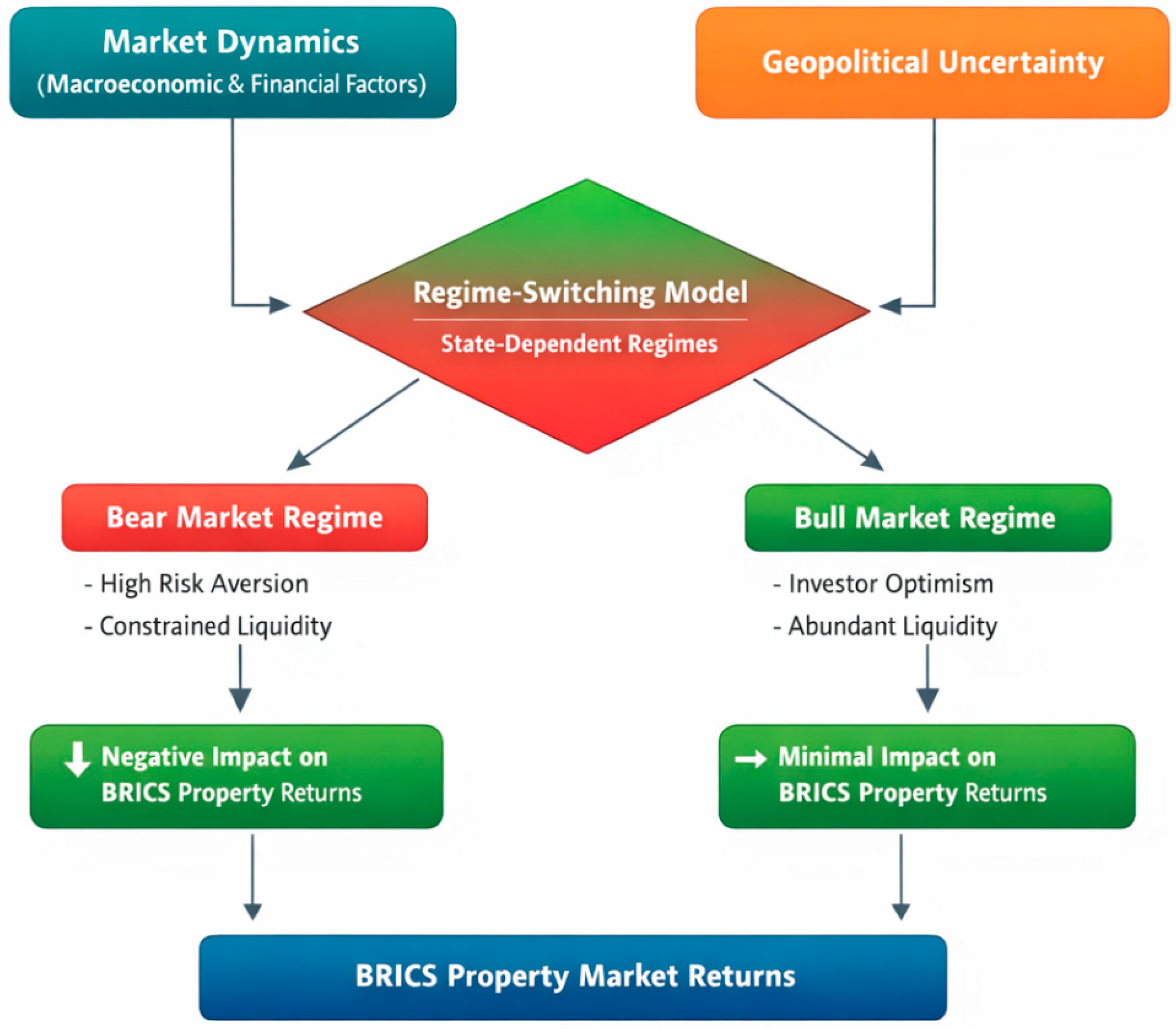
By combining these theoretical findings, this study conceptualizes property returns in the BRICS nations as a function of geopolitical uncertainty and market dynamics, with state-dependent regimes controlling the relationship. It is anticipated that during bad market periods, when risk aversion and financial restrictions are high, geopolitical uncertainty will have a greater detrimental impact on real estate returns, whereas during bull market periods, it would have a less or negligible impact. The application of a Markov regime-switching model, which permits market regimes to be endogenously determined and captures nonlinear reactions to geopolitical uncertainty, is directly motivated by this theoretical framework. The study contributes to a more realistic and sophisticated understanding of property market behaviour in emerging economies by including geopolitical risk into a regime-dependent asset pricing methodology. The study’s conceptual framework is depicted in the
Figure 1 below.
2.2. Empirical Review
To provide a systematic overview of the empirical literature, this section is structured around three interconnected strands: (i) studies examining market dynamics and property returns, (ii) studies analysing uncertainty and geopolitical risk in financial markets, and (iii) emerging evidence on nonlinear and regime-dependent asset return behaviour. This structure allows for a clearer identification of the specific gaps addressed by the present study.
Macroeconomic and financial market fundamentals, including interest rates, inflation, income growth, credit availability, and stock market performance, have historically been the focus of empirical studies on the factors influencing property market returns. The procyclical nature of real estate markets is shown by early research demonstrating a substantial correlation between property returns and financial circumstances and economic cycle fluctuations (
Case and Shiller 1989;
Ghent and Owyang 2010). This line of investigation is furthered by subsequent empirical research, which shows that capital market integration, liquidity conditions, and monetary policy shocks have a major impact on property prices and returns, especially in financially developed economies (
Ling and Naranjo 2015;
Hoesli and Oikarinen 2012).
Empirical evidence consistently supports the role of macro-financial variables as primary drivers of property prices and returns. Early work documents strong links between housing market performance and income growth, interest rates, and broader financial conditions, highlighting the procyclical nature of real estate markets (
Case and Shiller 1989;
Ghent and Owyang 2010). More recent studies reinforce that credit growth and monetary policy shocks are central transmission mechanisms, particularly because real estate is typically purchased with leverage and is sensitive to financing costs. In addition, the integration of real estate with capital markets implies that liquidity conditions, risk appetite, and cross-asset reallocations can influence property returns through changing discount rates and required risk premia (
Hoesli and Oikarinen 2012;
Ling and Naranjo 2015).
However, the strength and timing of these relationships vary across countries and market states, reflecting heterogeneity in mortgage market designs, regulatory settings, and exposure to external capital flows. This evidence supports the view that real estate return dynamics are nonlinear and that the marginal effect of shocks, particularly uncertainty-related shocks, may differ across bull and bear regimes. These insights justify the study’s focus on changing market conditions and motivate the use of a regime-switching empirical framework to capture state-dependent effects.
Broader metrics of uncertainty have been included in asset pricing models in more recent empirical research. Increased uncertainty has a detrimental impact on investment, asset returns, and market liquidity, according to research on economic policy uncertainty (EPU) (
Bloom 2014;
Baker et al. 2016). According to
Ling et al. (
2018), uncertainty shocks have an impact on public real estate markets by altering risk premia and anticipated cash flows. However, a large portion of this information is still focused on publicly traded real estate investment trusts (REITs) and developed markets, which limits its applicability to developing real estate markets.
The influence of geopolitical risk (GPR) in financial markets has been the subject of an increasing amount of empirical research in parallel with the literature on uncertainty.
Caldara and Iacoviello (
2022) created a popular geopolitical risk index and demonstrated that macroeconomic activity, stock returns, and volatility are all significantly and persistently impacted by geopolitical shocks. Further empirical research shows that geopolitical risk affects international capital flows, bond yields, oil prices, and exchange rates, frequently through routes of increased risk aversion and policy uncertainty (
Kang and Ratti 2013;
Balcilar et al. 2018;
Antonakakis et al. 2022).
Despite these developments, there is still a dearth of empirical data regarding how geopolitical uncertainty affects real estate markets. The few studies that are available use linear modelling methodologies and primarily concentrate on developed economies, implicitly assuming that geopolitical risk and property return have a stable connection throughout time. For instance,
Hoesli et al. (
2017) show that political risk affects international real estate investment flows, whereas
Pankratz (
2023) indicates that climate-related uncertainty impacts company performance. Nevertheless, neither regime-dependent behaviour nor emergent property markets are specifically examined in these studies.
More recent studies further underscore the importance of incorporating uncertainty and nonlinear dynamics into asset pricing models. For instance,
Lu et al. (
2020) show that geopolitical risk significantly affects investment activity and asset returns in emerging markets, with effects that intensify during periods of financial stress. Similarly,
Chatziantoniou et al. (
2022) demonstrate that geopolitical risk spillovers across international financial markets are time-varying and asymmetric, highlighting the inadequacy of linear modelling approaches.
In the context of real estate and related assets,
Bouri et al. (
2019) provide evidence that uncertainty shocks exert heterogeneous effects across asset classes and market states, reinforcing the relevance of regime-dependent modelling. More recently,
Huynh and Khoa (
2026) document that geopolitical risk has persistent and nonlinear effects on asset returns in emerging economies, particularly during downturns. Despite these advances, the application of such insights to property markets, especially within the BRICS economies, remains extremely limited.
Empirical findings across related studies reveal both common patterns and notable divergences in how uncertainty and geopolitical risk affect asset returns. A consistent result in the literature is that heightened geopolitical risk is generally associated with lower asset returns and higher volatility, particularly in equities and exchange rate markets (
Caldara and Iacoviello 2022;
Balcilar et al. 2018;
Antonakakis et al. 2022). These studies commonly report that geopolitical shocks increase risk premia and induce capital reallocation away from affected markets, leading to short- to medium-term declines in returns.
However, the magnitude, persistence, and direction of these effects vary considerably across countries and asset classes. Some studies document asymmetric responses, where certain markets experience positive spillovers as investors rebalance portfolios toward perceived safe or alternative destinations (
Bekaert et al. 2014;
Aysan et al. 2019). Others find that emerging markets are disproportionately affected due to weaker institutional frameworks and higher exposure to external shocks, resulting in more pronounced and persistent return responses (
Lu et al. 2020;
Huynh and Khoa 2026).
In contrast to the extensive evidence on financial assets, empirical results for real estate markets are comparatively limited and less conclusive. Studies focusing on developed real estate markets generally find that uncertainty shocks negatively affect property returns by increasing discount rates and reducing expected cash flows, although these effects tend to materialise more slowly due to market illiquidity (
Ling et al. 2018;
Hoesli et al. 2017). Importantly, a small subset of studies suggests that property market responses are state-dependent, with stronger negative effects observed during downturns than during expansionary periods (
Ghent and Owyang 2010;
Hoesli et al. 2015).
Nevertheless, these findings are largely confined to advanced economies and do not explicitly account for geopolitical risk as a distinct source of uncertainty. Moreover, existing studies rarely examine cross-country spillovers in property markets, despite the growing internationalisation of real estate investments. As a result, empirical evidence on how geopolitical uncertainty interacts with market regimes to shape property returns, particularly in emerging economies, remains limited.
In the context of the BRICS economies, where real estate markets are marked by increased volatility, changing institutional frameworks, and increased susceptibility to political and geopolitical shocks, this restriction is especially problematic. Strong spillover effects from geopolitical risk and global uncertainty are found in empirical studies on BRICS asset markets, which mostly concentrate on stocks and exchange rates (
Das et al. 2019;
Aysan et al. 2019). In contrast, despite their increasing significance for both domestic wealth generation and global portfolio diversification, the property markets in the BRICS nations are still relatively unexplored.
Methodological limitations are a significant flaw in the current literature. Most empirical research uses Generalized Autoregressive Conditional Heteroskedasticity (GARCH)-type models, linear regression, or vector autoregression (VAR) models, which presume stable correlations throughout time and market conditions. Although these methods offer helpful average impacts, they are unable to account for regime transitions and nonlinear dynamics that are well-documented in the financial and real estate markets (
Hamilton 1989;
Ang and Timmermann 2012). Research indicates that during times of market stress, as opposed to expansionary phases, asset returns react asymmetrically to shocks, suggesting that uncertainty effects can be state-dependent (
Balcilar et al. 2018;
Antonakakis et al. 2022).
Regime-switching frameworks are employed in a limited number of studies to analyse real estate markets. For example,
Ghent and Owyang (
2010) demonstrate how housing markets react differently during different stages of the business cycle using regime-switching models. In a similar vein,
Hoesli et al. (
2015) show that boom and bust regimes have different property return patterns. Nevertheless, neither geopolitical uncertainty nor rising market environments like the BRICS nations are included in this research as explanatory variables.
Collectively, the empirical literature indicates that while geopolitical uncertainty is an important determinant of asset returns, its effects are heterogeneous, asymmetric, and sensitive to market conditions. Existing studies provide valuable insights into average or linear effects, but they offer limited guidance on how these relationships evolve across different market regimes and asset classes. In particular, there is little empirical evidence on whether property markets in emerging economies respond differently to geopolitical uncertainty during periods of expansion and contraction, or how such effects transmit across economically interconnected countries.
This study positions itself at the intersection of these unresolved empirical issues by providing a comparative analysis of BRICS property markets using a regime-switching framework. By explicitly modelling market states and cross-country interactions, the study extends existing findings and offers new empirical evidence on the nonlinear and regime-dependent transmission of geopolitical risk to property returns.
As a result, a distinct gap appears at the nexus of nonlinear modelling, rising economies, property market returns, and geopolitical uncertainty. In particular, there is very little empirical data on whether geopolitical risk influences property returns differently in bull and bear market regimes, and there is almost no comparative study that uses regime-switching approaches to focus on the BRICS property markets.
This study aims to bridge this gap in a number of significant ways. First, by offering fresh empirical evidence on real estate markets rather than stocks or commodities, it expands the geopolitical risk literature and increases the scope of the consequences of geopolitical uncertainty for asset prices. Second, the study fills a significant institutional and geographical gap in the literature by concentrating on the BRICS nations, providing insights into how geopolitical risk functions in developing and systemically significant economies.
Third, and perhaps most significantly, the study uses a Markov regime-switching methodology that captures nonlinear, state-dependent correlations between geopolitical uncertainty and property returns for endogenous identification of market regimes. This method immediately addresses the methodological shortcomings of earlier research and is especially useful for analysing markets with asymmetric shock reactions, regime persistence, and volatility clustering.
According to the political uncertainty theory and behavioural finance models, the study can determine if geopolitical uncertainty has a more detrimental impact during times of market stress by explicitly modelling bull and bear regimes (
Pástor and Veronesi 2013;
Bloom 2014). A deeper understanding of the diversity of the BRICS real estate markets is provided by the regime-switching paradigm, which also makes it possible to compare regime persistence and transition probabilities across national borders.
In conclusion, the empirical literature shows that market dynamics and uncertainty are important for asset returns, but it is unable to explain how geopolitical uncertainty affects real estate markets in emerging economies when market conditions change. This study adds significantly to the literature and provides a more complex understanding of property return dynamics under uncertainty by incorporating geopolitical risk into a regime-switching paradigm and applying it to BRICS real estate markets.
5. Discussion of Results
This section interprets the empirical findings in light of existing theoretical and empirical literature, focusing on the mechanisms through which geopolitical uncertainty influences property market returns across different market regimes. Rather than restating the results, the discussion emphasizes how the findings extend, qualify, or contrast with previous studies, and explores the sources of heterogeneity observed across BRICS countries.
The findings of this study broadly align with the growing literature showing that geopolitical uncertainty negatively affects asset returns by increasing risk premia and discouraging investment (
Caldara and Iacoviello 2022;
Balcilar et al. 2018). Consistent with studies on equities and exchange rates, the results indicate that heightened geopolitical risk is generally associated with lower property returns, particularly during periods of market stress. However, the present study extends this literature by demonstrating that these effects are not uniform over time, but instead depend critically on prevailing market regimes.
While prior research largely relies on linear frameworks and reports average effects, the regime-switching evidence presented here reveals that geopolitical uncertainty exerts asymmetric and state-dependent influences on property returns. This finding supports the arguments of
Ang and Timmermann (
2012) and
Hamilton (
1989), who emphasise that financial and real asset markets respond differently to shocks across expansionary and contractionary phases.
The stronger and more significant effects of geopolitical uncertainty observed during bear market regimes are consistent with the political uncertainty theory, which posits that uncertainty amplifies risk aversion and delays irreversible investment when financial constraints are binding (
Pástor and Veronesi 2013;
Bloom 2014). In downturns, property markets are particularly vulnerable due to tighter credit conditions, reduced liquidity, and declining investor confidence. As a result, geopolitical shocks are more likely to translate into lower returns and heightened volatility during these periods.
Conversely, during bull market regimes, favourable macro-financial conditions, abundant liquidity, and optimistic expectations appear to partially absorb the adverse effects of geopolitical uncertainty. This explains why several geopolitical risk coefficients become weaker or insignificant in expansionary phases, reinforcing the argument that real estate markets exhibit regime-dependent resilience rather than uniform sensitivity to uncertainty.
The heterogeneity observed across BRICS countries reflects differences in institutional quality, financial depth, geopolitical exposure, and market structure. For example, Russia’s pronounced sensitivity to geopolitical uncertainty is consistent with its elevated exposure to international sanctions and armed conflict, which intensifies capital outflows and disrupts domestic investment (
Antonakakis et al. 2022). In contrast, China’s comparatively muted or even positive responses in certain regimes may be attributed to stronger state involvement, deeper domestic capital markets, and its perceived role as a relatively safe haven within the BRICS bloc during periods of global uncertainty.
Similarly, the differing responses of Brazil, India, and South Africa can be linked to variations in regulatory stability, credit market development, and openness to foreign real estate investment. Countries with weaker institutional frameworks or higher reliance on external financing are more susceptible to uncertainty-driven shocks, resulting in stronger negative effects on property returns. These findings are consistent with evidence from emerging market studies showing that institutional strength moderates the transmission of geopolitical risk to asset prices (
Bekaert et al. 2014;
Aysan et al. 2019).
There is significant variation in property returns and geopolitical uncertainty among the BRICS nations, according to the descriptive data (
Section 4.1.1). Due to its increased vulnerability to structural instability and geopolitical shocks, Russia has the highest average returns but also the highest volatility. South Africa, on the other hand, exhibits more consistent returns and comparatively low volatility. These variations align with other research indicating that institutional quality and financial depth determine how emerging real estate markets react to political risk (
Hoesli and Oikarinen 2012;
Ling and Naranjo 2015). The BDS test results (
Section 4.1.2) further justify the adoption of nonlinear modelling due to the non-normal distribution of returns and geopolitical risk.
Both domestically and within the BRICS nations, the unconditional correlations (
Section 4.2.1) show primarily negative linear relationships between geopolitical uncertainty and property returns. These results are consistent with the research on geopolitical risk, which demonstrates that increased uncertainty tends to reduce asset returns by raising risk premia and deterring investment (
Caldara and Iacoviello 2022;
Pástor and Veronesi 2013). Nonetheless, the existence of certain positive correlations, such as Brazil’s geopolitical unpredictability favourably influencing Russian returns, raises the possibility of portfolio reallocation and substitution effects since investors might move money between BRICS markets in reaction to shocks unique to each nation (
Bekaert et al. 2014). Crucially, a regime-based study is required because these linear correlations are unable to account for how these impacts differ depending on market conditions.
The regime classification and transition probability results (
Section 4.2.2) reveal that bear market regimes dominate BRICS property returns over the sample period. This finding is particularly significant because it shows that the BRICS real estate markets are not resilient to changing geopolitical uncertainty, despite their inherent hedging properties during volatile markets. This non-resilient nature is seen to contradict empirical research suggesting that, because real estate assets generate income and have a lengthy investment horizon, they may act as partial hedges against uncertainty (
Ling et al. 2018). Collectively, the dominant bear market conditions highlight the openness of BRICS markets to geopolitical shocks.
The Markov regime-switching results (
Section 4.2.3), which show distinct regime-specific consequences of geopolitical uncertainty, are the study’s main contribution. Brazil’s geopolitical unpredictability has a positive impact on its own real estate returns during bull markets; Russia’s geopolitical uncertainty has a negative effect on Brazil’s returns. The political uncertainty theory, which holds that uncertainty raises domestic risk aversion while simultaneously rerouting foreign capital flows toward alternative markets thought to offer higher short-term returns, is supported by this asymmetry (
Pástor and Veronesi 2013;
Bloom 2014). This study expands the evidence to include property markets in emerging economies, while similar findings have been reported in equity markets.
The findings show that during adverse market periods, Brazil’s geopolitical unpredictability has a favourable effect on its own real estate returns, while Russia’s geopolitical uncertainty has a negative impact on Brazil’s and its own returns. The spillover and contagion mechanisms described in the geopolitical risk literature (
Antonakakis et al. 2022;
Balcilar et al. 2018) are reflected in this trend. The detrimental effects on the other BRICS markets highlight how intertwined these economies are, especially in terms of trade and investment. It is also noteworthy that during a down market, China’s property returns are adversely impacted by India’s geopolitical unpredictability. This finding implies that, particularly in times of market stress, regional geopolitical conflicts may spread through channels of competitive investment. These patterns are consistent with evidence showing that, depending on the strategic and economic ties between nations, geopolitical shocks can produce asymmetric reactions (
Aysan et al. 2019). This emphasizes how crucial it is to take into account both bilateral and multilateral linkages when evaluating the transmission of geopolitical risk in real estate markets.
Despite these negative spillover effects, average property returns in the majority of BRICS nations are consistently found to be positive, even in downturn markets. This bolsters the claim that, despite their sensitivity to uncertainty, real estate markets do not completely collapse in reaction to geopolitical shocks. Rather, market systems mediate the impacts, which are conditional and selective. This finding supports earlier research by
Ghent and Owyang (
2010) and
Hoesli et al. (
2015), which demonstrates that real estate markets adapt differently throughout boom and slump periods.
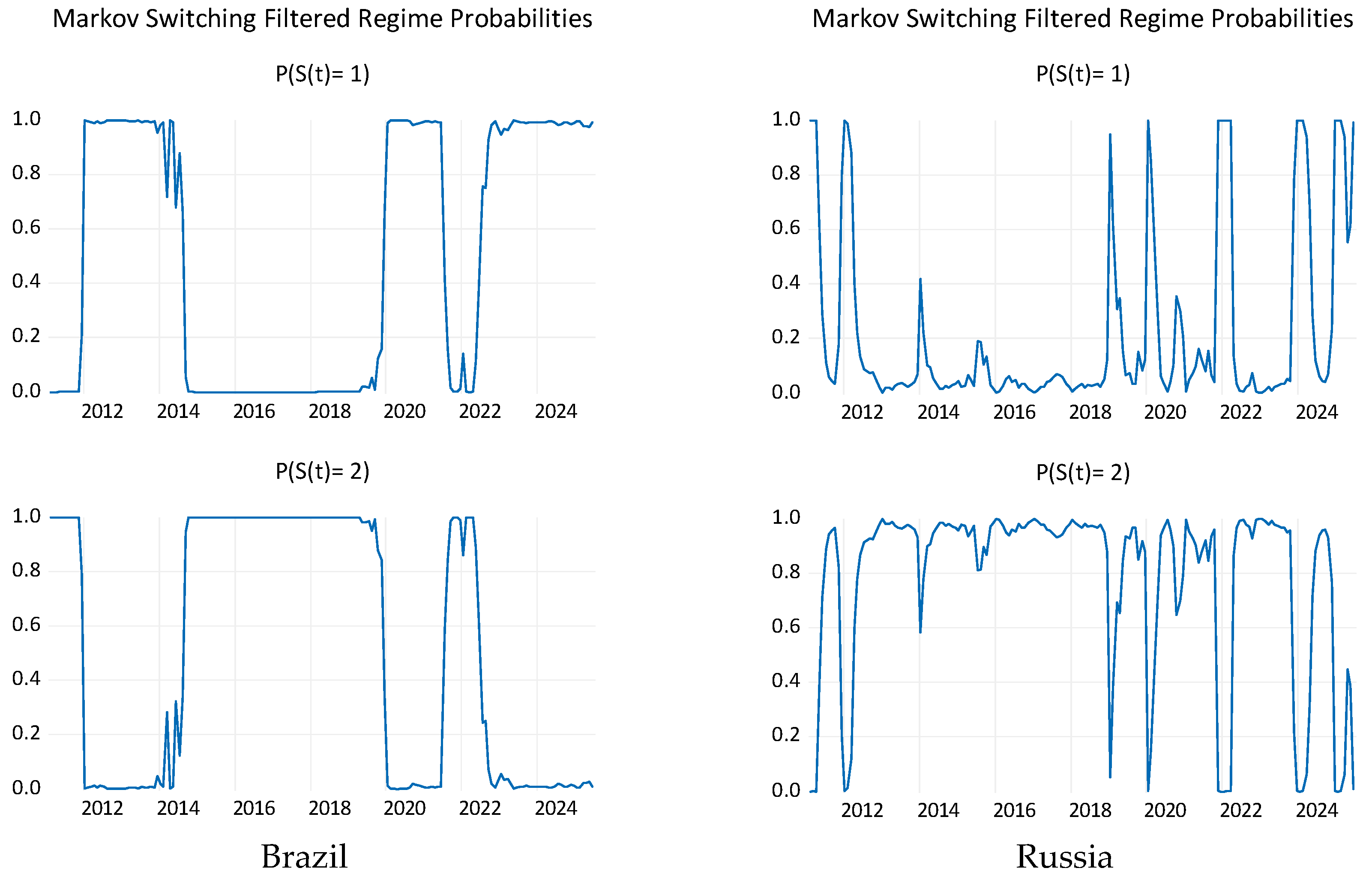
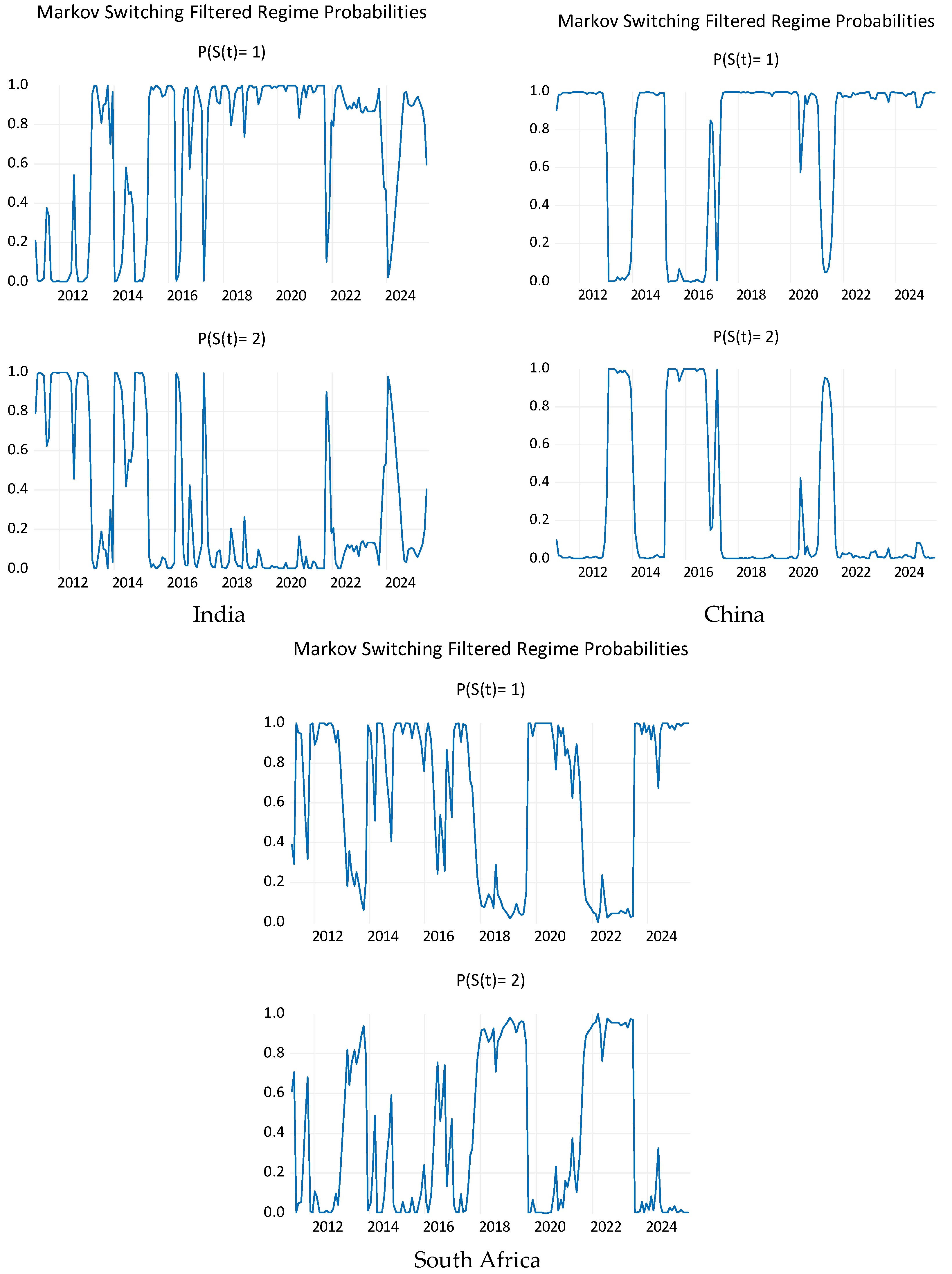
The validity of these results is further supported by the robustness analysis employing filtered regime probabilities (
Section 4.3). Rapid regime changes after significant geopolitical events, followed by quick recoveries, point to adaptive behaviour rather than protracted distress in the BRICS real estate markets. This dynamic reaction is in line with findings of regime-switching in financial markets, where shocks typically affect returns temporarily rather than permanently (
Ang and Timmermann 2012). Moreover, the model selection criteria further support the estimation of a two-regime model, which confirms the robustness of this study’s findings.
The presence of cross-country spillover effects within the BRICS bloc highlights the growing integration of these property markets through trade, financial linkages, and international investment flows. The finding that geopolitical uncertainty in one BRICS country can influence property returns in others supports the portfolio reallocation and contagion mechanisms identified in earlier financial market studies (
Bekaert et al. 2014;
Balcilar et al. 2018). Importantly, this study shows that such spillovers are also regime-dependent, intensifying during periods of market stress.
This result underscores the importance of adopting a comparative and multilateral perspective when analysing emerging property markets, as country-specific shocks may have broader regional implications. It also reinforces the relevance of regime-aware investment and policy strategies aimed at mitigating the transmission of geopolitical risk across interconnected markets.
Overall, the discussion highlights that the impact of geopolitical uncertainty on BRICS property markets is neither uniform nor time-invariant. Instead, it depends on market regimes, country-specific characteristics, and cross-border linkages. By explicitly accounting for these factors, the study advances the empirical literature beyond average effects and provides a more nuanced understanding of how uncertainty shapes property returns in emerging economies. These insights form a critical foundation for the policy and investment implications discussed in the following section.
6. Conclusions and Implications
At the commencement of this research article, the aim was to examine the effect of geopolitical uncertainty on property market returns under changing market conditions in BRICS countries. In doing so, the study used monthly data for the period of February 2011 to June 2025. The dependent variables consisted of property market proxies for BRICS countries, namely the real residential property price index returns, whereas the independent variable consisted of the geopolitical risk index of Dario Caldara and Matteo Iacoviello. Similarly, the control variables included inflation, GDP and interest rates. The research article implemented a variety of nonlinear tests, such as the BDS test, ADF test, ADF break-point test, and VIF tests, to ensure the properties of a nonlinear model were met. Once such was established, the Markov regime-switching model with constant transition probabilities and expected duration was estimated to achieve the desired objective. The study further tested the robustness of the model results by considering the filtered probability graphs and a three regime Markov regime-switching model.
The findings revealed a nuanced effect that is regime-specific and alternates with market conditions. For example, in a bull regime, Brazil’s property market returns are affected positively by South Africa’s and its own geopolitical uncertainty. However, China’s geopolitical uncertainty has a significant negative effect on Brazil’s property market returns. Similarly, Russia’s geopolitical uncertainty has a negative (positive) significant effect on India’s and South Africa’s (its own) property market returns. However, in a bear regime, Russia’s geopolitical uncertainty has a significant negative effect on Brazil’s and its own property market returns, whereas India’s geopolitical uncertainty has a significant negative effect on China’s property returns. Moreover, it was found that bear market conditions dominated BRICS returns, suggesting that market uncertainty causes returns to fall over time. The findings were confirmed by the filtered probability graphs, which enhanced the robustness of the model output. Collectively, these key findings possess important implications for investors and policy makers.
Firstly, if investors want to diversify their holdings by investing in BRICS property markets, they must consider the state of the financial market and the level of geopolitical risk associated with each BRICS partner. That being said, market conditions and the level of geopolitical uncertainty could either increase or decrease investors’ returns, which determines the level of return investors will receive. For instance, when the market condition is stable, China’s geopolitical risk has a negative effect on Brazil’s property market returns. Thus, investors should not consider investing in Brazil’s property market during a stable market condition and when China is entangled in heightened geopolitical tension, like the US–China trade war and tariffs. If they do, it will decrease their returns and expose their portfolios to heightened volatility. Similarly, if investors already have Brazil’s property market returns in their portfolio and they foresee the market is stable, but China is engaged in geopolitical tension, they should conduct portfolio rebalancing to ensure Brazil’s property market returns are removed from their portfolios. On the contrary, Brazil’s property market returns are resilient to changes in South Africa’s geopolitical uncertainty, such that it will increase their returns. To this extent, investors are encouraged to factor in Brazil’s property market returns in their portfolio only when China’s geopolitical tension is stable, and the market condition is not volatile, irrespective of South Africa being engaged in heightened geopolitical tensions.
Collectively, financial market conditions and the level of geopolitical uncertainty should not be looked at in isolation. These should be considered simultaneously, as both are important determinants of investor returns. Although the market could express favourable conditions, it does not ensure favourable returns due to heightened geopolitical uncertainty. Moreover, where the market condition is unfavourable, it will not necessarily indicate adverse returns due to low levels of geopolitical uncertainty. Accordingly, investors wishing to enhance return perspective and reduce return volatility must consider the findings of this study in detail and factor geopolitical risk and market conditions into their investment strategies.
Secondly, the findings impose serious implications for policy makers as it reveals that geopolitical uncertainty attributed to countries within the BRICS bloc determines their property market returns. These are alarming observations as the enhanced tension of one nation may drive the performance of the property market of the BRICS nations. Consequently, policy makers must develop new robust policies that must limit this identified spillover effect. It is suggested that the trade agreements among each nation within the BRICS bloc must be revisited, such that there are additional clauses instated to limit countries’ geopolitical tension. This will not only curtail the spillover effect but will also ensure financial market stability among BRICS nations. Moreover, policy makers can also practice active non-alignment by not engaging with those BRICS nations that are entangled in geopolitical tension, as it assists in saving their sovereignty and stopping geopolitical tension, which stabilises their financial markets. It is further suggested that policy makers should engage third-party mediators prior to geopolitical tensions arising, as it will not only mediate disputes early before escalation, but it will also generate trust among the BRICS nations, as it will demonstrate active loyalty and encourage safeguarding investors’ interests.
Despite the nuanced findings and important implications, the study is not without limitations. Firstly, the study isolates the analysis to BRICS countries, given the non-existent empirical literature surrounding the objective of this study. Future research can enhance the analysis by implementing the same methodology but incorporating the additional members’ property market returns that form part of the BRICS Plus countries. These include Egypt, Ethiopia, Iran, Saudi Arabia, the United Arab Emirates and Indonesia. This will assist in comparing the findings of this study and providing more practical contributions to investors and policy makers. Moreover, this study does not extend the analysis to determine the spillover effects, as it falls outside the scope of this study. Academics can enhance this analysis by considering the co-movement of the BRICS countries’ property market and determining if geopolitical risk uncertainty is a determinant of such co-movement. This can be done by complementing the Markov regime-switching model with other methodologies, such as the Time-Varying Parameter Vector Autoregression (TVP-VAR), Multivariate Generalised Autoregressive Conditional Heteroskedasticity–Asymmetric Dynamic Conditional Correlation (MGARCH-ADCC), and Wavelet. This will provide a more detailed analysis of the spillover effect and the nature of their co-movement.
Collectively, this study presents nuanced findings that have important implications for BRICS nations’ investors and policy markets. Given the limited literature in this regard, the study is not only unique but essential, given the growing levels of geopolitical tension among nations, especially those that fall within the BRICS umbrella. These findings are important for the enhancement of the empirical literature as it introduces new empirical evidence and control the trajectory of future research, which otherwise would be non-existent.