1. Introduction
Volatility and variance swaps are forward-style derivatives written on the annualized realized volatility or variance of an underlying asset. These instruments enable market participants to trade future realized volatility levels against prevailing implied market expectations. In a standard contract, the long position pays a fixed delivery rate at maturity and receives the realized annualized volatility or variance over the contract horizon, while the short position assumes the opposite payoff. Over the past three decades, the rapid growth of trading activity in volatility-linked derivatives has made the development of accurate and tractable pricing methodologies a central topic in quantitative finance.
Early foundational contributions include
Demeterfi et al. (
1999) and
Carr and Madan (
1998), who proposed replication-based pricing frameworks for continuously sampled variance swaps using static portfolios of European options. Subsequent studies, such as
Swishchuk (
2004) and
Swishchuk (
2006), extended these approaches to single-factor and multi-factor stochastic volatility (SV) models with time-delay effects. Despite their analytical appeal, continuously sampled contracts do not reflect standard market conventions, where volatility and variance are observed discretely. As documented by
Elliott and Lian (
2013);
Little and Pant (
2001) and
Bernard and Cui (
2014), the use of continuous-time approximations may introduce non-negligible pricing biases, thereby motivating the development of pricing frameworks that explicitly account for discrete sampling.
Within the classical Heston SV model (
Heston 1993), closed-form pricing formulas for variance swaps have been derived in
Zhu and Lian (
2011) and
Rujivan and Zhu (
2012), while analytical pricing results for volatility swaps have been established by
Zhu and Lian (
2015). Beyond the Heston framework,
Goard (
2011) developed analytical pricing formulas for both variance and volatility swaps under the 3/2 SV model (
Heston 1997), and
Yuen et al. (
2015) extended these results to exotic discretely sampled variance swaps. Further advancements include analytical pricing under joint SV and stochastic interest rate models (
He and Zhu 2018), variance swaps with stochastic long-run variance mean (
Yoon et al. 2022), and variance and volatility swaps in SV interest rate settings (
He and Zhu 2022). More recently,
Lin and He (
2023,
2024) derived closed-form pricing formulas for volatility-linked derivatives under models incorporating SV, stochastic equilibrium levels, regime switching, and stochastic liquidity risks.
Despite this growing body of literature, analytical pricing results for discretely sampled volatility swaps under SV models that simultaneously capture both affine and inverse-affine volatility effects remain limited. In particular, while the 4/2 SV model introduced by
Grasselli (
2017) has been shown to offer superior flexibility and empirical performance compared to classical SV specifications, its analytical tractability for volatility-linked derivatives under discrete sampling has not been fully explored.
In this paper, we develop an analytical pricing framework for discretely sampled volatility-average swaps under the 4/2 SV model. In this model, the instantaneous volatility of the asset price
is specified as
where
a and
b are nonzero constants representing, respectively, the contributions of the volatility and inverse-volatility components, and the variance process
follows Cox–Ingersoll–Ross (CIR) dynamics. This formulation unifies the structural features of the Heston and 3/2 SV models as special cases and enables the model to capture a broad range of volatility behaviors, including volatility clustering, sharp spikes, skewness, and excess kurtosis. These characteristics make the 4/2 SV model particularly suitable for pricing volatility-sensitive derivatives observed in equity and volatility markets.
From a theoretical perspective, the proposed framework relies on closed-form expressions for the conditional complex moments of the asset price, which serve as fundamental building blocks for deriving analytical pricing formulas under discrete sampling. From a practical standpoint, the availability of explicit pricing formulas enhances computational efficiency, facilitates model calibration, and provides valuable insights into the effects of model parameters on fair strike levels—features that are essential for trading, hedging, and risk management applications.
The main contributions of this paper are summarized as follows:
- 1.
We develop a rigorous analytical framework for pricing discretely sampled volatility-average swaps under the 4/2 SV model. In particular, we derive closed-form expressions for the conditional complex moments of the asset price and establish their validity within the admissible parameter space of the model. These results lead to explicit analytical pricing formulas for volatility-average swaps under discrete sampling. Moreover, Monte Carlo (MC) simulations are conducted to assess the accuracy and computational efficiency of the proposed approach.
- 2.
Through numerical experiments, we demonstrate that discretely sampled prices converge non-monotonically to their continuous-time counterparts as the sampling frequency increases, revealing important practical implications for the valuation and risk management of volatility-linked derivatives.
- 3.
We perform a comprehensive sensitivity analysis to quantify the impact of the volatility and inverse-volatility components on fair strike prices, thereby highlighting the structural flexibility and practical advantages of the 4/2 SV model.
The remainder of the paper is organized as follows.
Section 2 introduces the 4/2 SV model and its admissible parameter space.
Section 3 defines volatility swaps and their corresponding fair strike values.
Section 4 derives closed-form expressions for the conditional complex moments of
and presents the analytical pricing formulas for volatility swaps.
Section 5 validates the proposed formulas via MC simulations and provides numerical illustrations. Finally,
Section 6 concludes the paper. All proofs and technical validity discussions are relegated to
Appendix A and
Appendix B, respectively.
2. The 4/2 SV Model
The 4/2 SV model, introduced by
Grasselli (
2017), provides a flexible and analytically tractable framework for modeling the joint dynamics of an asset price and its volatility. This model extends classical SV specifications by incorporating both affine and inverse-affine components in the diffusion coefficient of the asset price. The designation “4/2” reflects the powers of the variance and its reciprocal appearing in the volatility structure, which enables the model to capture a wide range of empirically observed market phenomena, including volatility clustering, asymmetric return distributions, and leverage effects.
A key feature of the 4/2 SV model is that it nests several well-known SV models as special cases. In particular, the Heston model and the 3/2 SV model can be recovered through appropriate parameter restrictions. As a result, the 4/2 SV model offers greater structural flexibility while retaining analytical tractability. In what follows, we present the mathematical formulation of the model and highlight its key properties relevant for derivative pricing.
Following the framework of
Grasselli (
2017), under a risk-neutral probability measure
, the asset price process
and the instantaneous variance process
are defined on a filtered probability space
with filtration
and satisfy the system of stochastic differential equations
for
, with initial conditions
and
. The Brownian motions
and
are correlated according to
Equation (
1) describes the asset price dynamics under SV, where
denotes the constant risk-free interest rate. The parameters
a and
b are nonzero constants governing the contributions of the volatility and inverse-volatility components, respectively. The variance process
in (2) follows Cox–Ingersoll–Ross (CIR) dynamics with mean-reversion speed
, long-run mean
, and volatility of volatility
.
To ensure that the variance process remains well defined and strictly positive, the following conditions proposed by
Grasselli (
2017) are imposed. First, the classical Feller condition for the CIR process holds:
In addition, the parameters
,
,
,
, and
b satisfy the extended Feller condition
The conditions (
3) and (
4) ensure that the variance process
remains strictly positive almost surely under both the risk-neutral probability measure
and the historical probability measure, respectively. These conditions therefore preserve the mathematical well-posedness of the model and maintain its financial plausibility.
The 4/2 SV model plays an important role in both theoretical and applied quantitative finance. From a modeling perspective, the presence of both and terms allows the model to accommodate moderate volatility fluctuations as well as extreme volatility spikes, which are commonly observed during periods of market stress. This dual structure offers richer volatility dynamics than classical affine models while preserving analytical tractability.
From a theoretical standpoint, the 4/2 SV model admits closed-form expressions for key transform-based quantities, such as characteristic functions and complex moments, under suitable parameter conditions. These properties are particularly valuable for the analytical pricing of volatility-linked derivatives, especially in discrete observation settings where continuous-time approximations may lead to systematic pricing biases.
From a practical perspective, the enhanced flexibility of the 4/2 SV model improves calibration performance across equity and volatility markets and provides traders and risk managers with more accurate tools for pricing, hedging, and risk assessment. In the context of volatility-average swaps, the ability of the model to capture asymmetric volatility responses and heavy-tailed return behavior is especially important for accurately determining fair strike prices under realistic market conditions. These features make the 4/2 SV model a natural and powerful framework for the analytical pricing methodology developed in this paper.
3. Volatility Swaps
Volatility and variance swaps are forward-style contracts that allow market participants to trade future realized volatility or variance against a fixed delivery price. In such contracts, one counterparty pays a notional amount multiplied by the difference between a fixed strike and the realized level of volatility or variance over the contract horizon. These instruments are widely used for volatility trading, hedging, and risk transfer in equity and volatility markets.
In the case of a variance swap, the fixed level is referred to as the
variance strike, whereas for a volatility swap, it is referred to as the
volatility strike. Let
L denote the notional amount. The payoff of a variance swap at maturity
T is given by
where
denotes the annualized realized variance over
, and
is the variance strike. Similarly, the payoff of a volatility swap is
where
represents the annualized realized volatility, and
denotes the volatility strike.
The specification of realized variance plays a crucial role in both pricing and hedging volatility-linked derivatives. We therefore review several commonly used definitions in discrete time.
3.1. Realized Variance
3.1.1. Realized Variance Based on Log Returns
A widely adopted measure of realized variance is based on squared log returns, as employed by the Chicago Board Options Exchange. It is defined as
where
denotes the asset price at time
,
N is the number of observations, and
. The annualization factor is
under equally spaced sampling.
As shown by
Jacod and Protter (
1998), as the sampling frequency increases, the discretely sampled realized variance converges to its continuous-time counterpart:
where
denotes the instantaneous volatility.
3.1.2. Realized Variance Based on Actual Returns
An alternative definition uses squared actual returns:
This measure coincides with (
8) in the continuous-time limit.
3.1.3. Comparison of Realized Variance Measures
Both
and
provide consistent estimates of integrated variance at high sampling frequencies. However, differences may arise at lower frequencies or during periods of large price movements. The log-return-based measure is scale-invariant and additive over time, making it more suitable for continuous-time modeling, while the actual-return-based measure may yield higher values in the presence of large jumps. Empirical studies such as
Andersen et al. (
2003) indicate that these differences are typically small for high-frequency data but become more pronounced otherwise.
3.2. Definitions of Volatility Swaps
Under the risk-neutral measure, the time-t value of a volatility swap is the discounted expectation of its payoff. Based on the realized variance definitions above, we distinguish between different volatility swap specifications.
3.2.1. Volatility Swaps Based on Log Returns
Using (
7), the time-
t value of a volatility swap is
and its fair volatility strike satisfies
3.2.2. Volatility Swaps Based on Actual Returns
Analogously, based on (
9),
with fair strike
3.2.3. Volatility-Average Swaps
A closely related contract is the volatility-average swap, in which realized volatility is defined as the time average of absolute returns (
Barndorff-Nielsen and Shephard 2003):
This definition differs fundamentally from taking the square root of averaged squared returns and has been shown to provide a robust measure of realized volatility (
Howison et al. 2004).
The time-
t value of a volatility-average swap is
with fair strike
3.3. Contributions of This Paper
The pricing of discretely sampled volatility swaps based on log or actual returns, as in (
11) and (
13), is analytically challenging due to the nonlinear square-root structure of realized volatility and the dependence across discrete observations. These features generally preclude closed-form evaluation of the corresponding expectations, leading existing approaches to rely on continuous-time approximations or numerical methods.
This paper addresses this challenge by exploiting the structure of volatility-average swaps. By working with the realized volatility definition in (
14), the pricing problem becomes analytically tractable under the 4/2 SV model. In particular, the fair volatility strike can be expressed in terms of conditional complex moments of the asset price, which admit closed-form representations.
As a result, we derive explicit analytical formulas for the right-hand side of (
16), providing closed-form fair strikes for discretely sampled volatility-average swaps. Moreover, we obtain the corresponding continuous-time expression, which serves as a natural benchmark for assessing discretization effects. This framework establishes a direct analytical link between discrete and continuous volatility contracts and enables a systematic investigation of convergence behavior under realistic sampling frequencies.
From a theoretical perspective, the results extend the analytical tractability of the 4/2 SV model to a new class of nonlinear volatility payoffs under discrete observation. From a practical standpoint, the availability of closed-form pricing formulas significantly reduces computational cost, facilitates calibration, and provides practitioners with efficient and reliable tools for pricing and risk management of volatility-linked derivatives traded over the counter.
4. Our Closed-Form Pricing Formulas
This section presents the analytical core of the paper and develops the closed-form pricing formulas underlying our valuation framework for volatility-average swaps under the 4/2 SV model. To preserve clarity and readability, we focus in the main text on the key structural results and their role in the pricing construction, while detailed technical derivations, definitions of auxiliary parametric functions, and validity discussions are collected in
Appendix A and
Appendix B, respectively.
The section proceeds as follows. We first establish a closed-form expression for the conditional complex moment of the asset price process, which serves as the fundamental building block of the framework. We then derive additional auxiliary results required for pricing, including expectations related to the CIR variance process and the conditional characteristic function of log returns. These ingredients are subsequently combined to obtain explicit pricing formulas in both discrete- and continuous-time settings.
4.1. A Closed-Form Expression for the Conditional Complex Moment of
We begin by deriving an analytical formula for the conditional complex moment of the asset price process
, where
satisfies the stochastic differential Equations (
1) and (
2) under the risk-neutral measure
.
For
, the conditional complex moment of
is defined by
for
,
, and
.
The following theorem provides an analytical closed-form expression for .
Theorem 1.
Under the conditions (3) and (4), the conditional complex moment satisfiesfor , , and , where the function is defined in (A9) in Appendix A.4. The validity of the expression (18) is discussed in Appendix B.1. 4.2. Other Closed-Form Expressions
This subsection presents two auxiliary results that play a fundamental role in the subsequent pricing analysis.
We first derive a closed-form expression for the conditional expectation of the form , where follows the CIR process (2).
Theorem 2.
Assume that condition (4) holds, and let . Then,for , , and , where is defined in (A10) in Appendix A.4. The validity of (19) is discussed in Appendix B.2. Next, we derive a closed-form expression for the conditional characteristic function of the log-return
It is defined as
for
,
,
, and
.
Theorem 3.
Under conditions (3) and (4), the characteristic function admits the representationwhere is defined in (A10) in Appendix A.4. 4.3. Closed-Form Pricing of Discrete Volatility-Average Swaps
We now apply Theorem 3 to derive an analytical pricing formula for the fair strike
defined in (
16).
Theorem 4.
The fair strike price of the discretely sampled volatility-average swap satisfieswhere , and is defined in (21). The validity of (22) is discussed in Appendix B.3. Proof. The result follows by expressing the expected absolute returns in (
16) via the distribution of log returns and applying Fourier inversion techniques using the characteristic function derived in Theorem 3. The detailed derivation is given above. □
4.4. The Continuous-Time Pricing Formula of Volatility Swaps
In the continuous-sampling setting, the fair strike of a volatility swap is given by
where
Theorem 5.
The fair strike price of the continuous-time volatility swap is given bywhere Φ is defined in (A23) in Appendix A.5. Proof. The proof follows from the Laplace transform representation of the square-root functional and the explicit evaluation of the exponential functional of the CIR process given in
Grasselli (
2017). □
In the numerical analysis, we demonstrate that the discretely sampled volatility swap prices converge to their continuous-time counterparts as the sampling frequency increases.
5. Numerical Results and Discussions
This section presents a comprehensive numerical investigation of the closed-form pricing formulas developed in
Section 4 for discretely sampled and continuously sampled volatility swaps under the 4/2 SV model. The numerical analysis is designed to achieve four main objectives: (i) to validate the accuracy of the proposed analytical pricing formulas through comparison with MC simulations; (ii) to assess their computational efficiency relative to simulation-based methods; (iii) to examine the convergence behavior of discrete-time pricing formulas toward their continuous-time counterparts as the sampling frequency increases; and (iv) to conduct a sensitivity analysis with respect to key model parameters, in particular the volatility and inverse-volatility coefficients
a and
b, in order to quantify their impact on fair strike prices.
The numerical experiments are organized into two representative examples. In Example 1, we evaluate the numerical accuracy and computational efficiency of the closed-form pricing formula for discretely sampled volatility-average swaps and conduct a sensitivity analysis with respect to the key model parameters a and b to assess their impact on fair strike prices. In Example 2, we investigate the convergence behavior of discretely sampled volatility swap prices toward their continuous-time counterparts as the sampling frequency increases, thereby quantifying discretization effects and the discrepancy between discrete-time and continuous-time valuations.
To ensure the theoretical consistency of all numerical results, model parameters are chosen to satisfy the admissibility and validity conditions derived in
Appendix B. The baseline parameter configuration is adapted from the calibration settings of the 3/2 SV model reported in
Yuen et al. (
2015), which allows for meaningful comparison with existing results in the literature. Specifically, the parameters are set as follows: initial variance
, risk-free interest rate
, mean-reversion speed
, long-run variance level
, volatility-of-variance parameter
, and correlation coefficient
between the asset price and variance processes.
The simulation horizon is fixed at one year (), which is divided into equally spaced observation dates corresponding to monthly sampling intervals, yielding a time step of . MC benchmarks are generated using simulated paths, which ensures high statistical accuracy and reduces simulation error to a negligible level for comparison purposes. This sampling scheme reflects standard market conventions for volatility-linked derivatives while maintaining a balance between numerical precision and computational tractability.
All numerical computations and graphical illustrations were implemented in Mathematica. The simulations were executed on a workstation equipped with an Apple M1 processor featuring an 8-core CPU running at 3.2 GHz and 8 GB of unified memory under macOS. This computational environment provides sufficient performance for large-scale MC simulations and ensures the reproducibility of the reported numerical results.
5.1. Accuracy, Efficiency, and Parameter Sensitivity of the Closed-Form Pricing Formula for Volatility-Average Swaps
Example 1.
This example evaluates the numerical accuracy, computational efficiency, and parameter sensitivity of the closed-form pricing formula for volatility-average swaps developed in Theorem 4.
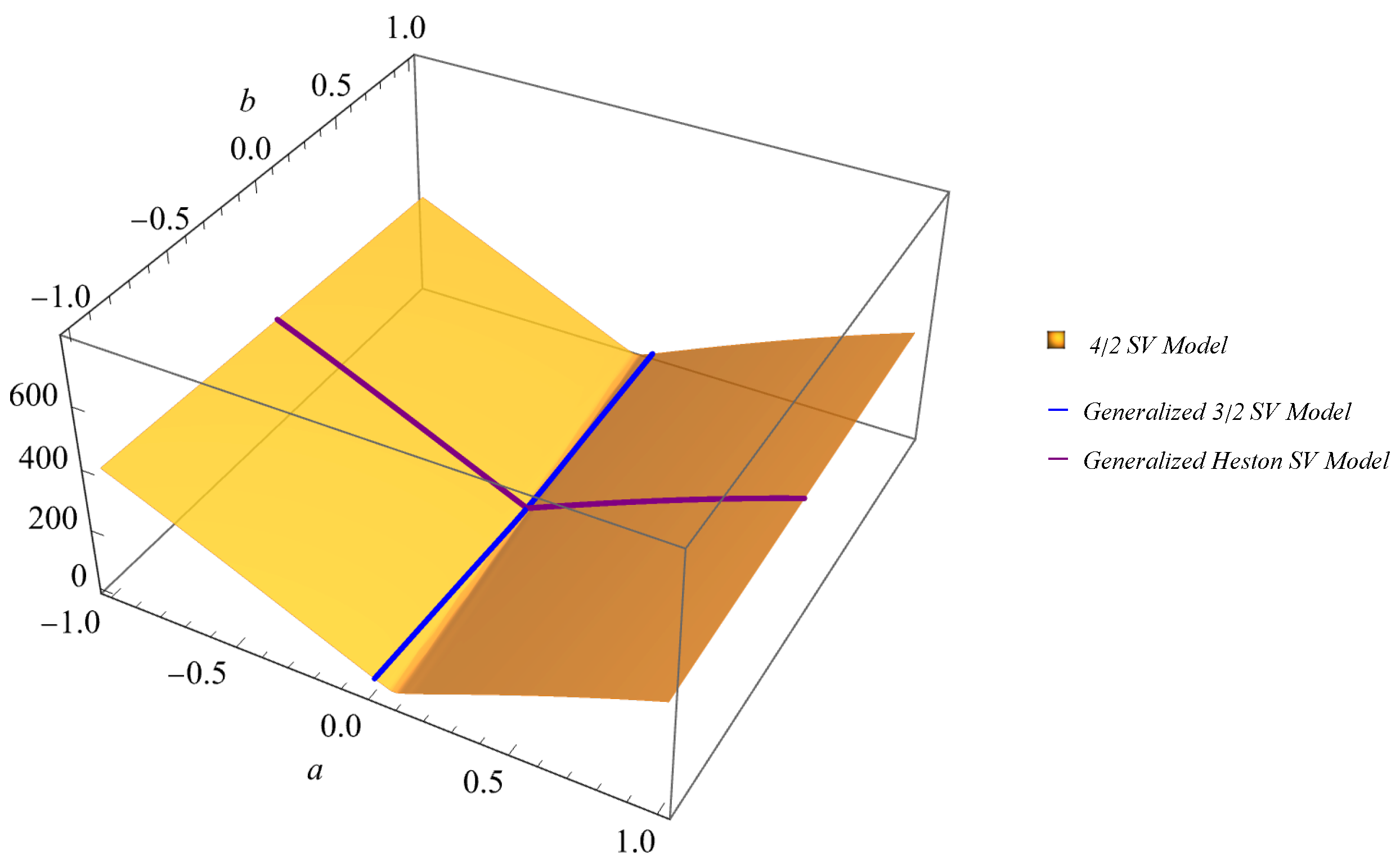
To ensure generality, fair strike prices are computed over the parameter domainThis domain encompasses a broad range of volatility specifications, including the generalized Heston-type regime (), the generalized 3/2-type regime (), and intermediate hybrid configurations that are specific to the 4/2 SV model. Figure 1 reports three-dimensional surface plots of the fair volatility-average swap strikes across Ω, where the vertical axis represents the strike level. The reference curves corresponding to the generalized Heston and generalized 3/2 SV limits illustrate how the 4/2 SV model interpolates smoothly between these classical regimes while retaining additional flexibility through the simultaneous presence of the and volatility components. Beyond interpolation, the surfaces in Figure 1 provide a detailed sensitivity map of the fair strikes with respect to the structural parameters a and b. Recall that the instantaneous volatility takes the formwhere a amplifies the standard Heston-type volatility channel, and b controls the inverse-volatility channel. Since the volatility-average payoff in (14) depends on absolute returns, the fair strike is primarily driven by the magnitude of price fluctuations. Consequently, responds strongly to the overall scale of and therefore to joint variations in a and b. A first sensitivity feature evident from Figure 1 is the pronounced asymmetry of the strike surface across the four quadrants of the plane. Regions where a and b share the same sign are associated with markedly higher strike levels, whereas mixed-sign configurations lead to lower and flatter regions of the surface. This behavior reflects the interaction structure inwhere the constant interaction term shifts the effective volatility level upward when and downward when . As a result, the effect of a and b on the fair strike is inherently non-symmetric, even though the diffusion coefficient enters quadratically in the variance accumulation. This interaction-driven deformation of the strike surface is a distinctive structural feature of the 4/2 SV model and is absent in the pure Heston () and pure 3/2 () limits. A second implication concerns the relative dominance of the two volatility channels. As observed along the coordinate axes in Figure 1, the surface varies smoothly with a along the generalized Heston boundary (), exhibiting moderate curvature. Along the generalized 3/2 boundary (), the surface exhibits a pronounced variation with respect to b, particularly for negative values. This reflects the economic role of the inverse-volatility component , which becomes more influential when the variance process attains low levels. Under the strongly mean-reverting variance dynamics considered here, this mechanism materially affects short-horizon return fluctuations and, in turn, the level of discretely sampled realized volatility. Figure 1 further reveals a ridge–valley structure in the strike surface. Ridge-like regions appear along directions where , indicating amplified volatility magnitude and heightened sensitivity of the fair strike, while valley-like regions arise when , where the two volatility channels partially offset each other and reduce sensitivity. This geometry confirms that the 4/2 SV model can generate substantially different volatility dynamics and strike sensitivities even for comparable marginal parameter magnitudes. From a calibration and risk-management perspective, these observations indicate that is sensitive to joint variations in a and b, rather than to each parameter in isolation. Different combinations may therefore produce similar strike levels in certain regions of Ω, while implying materially different local sensitivities and tail behavior. Consequently, hedging performance may differ significantly between parameterizations located near the generalized Heston boundary and those closer to the generalized 3/2 boundary, even when calibrated prices are comparable.
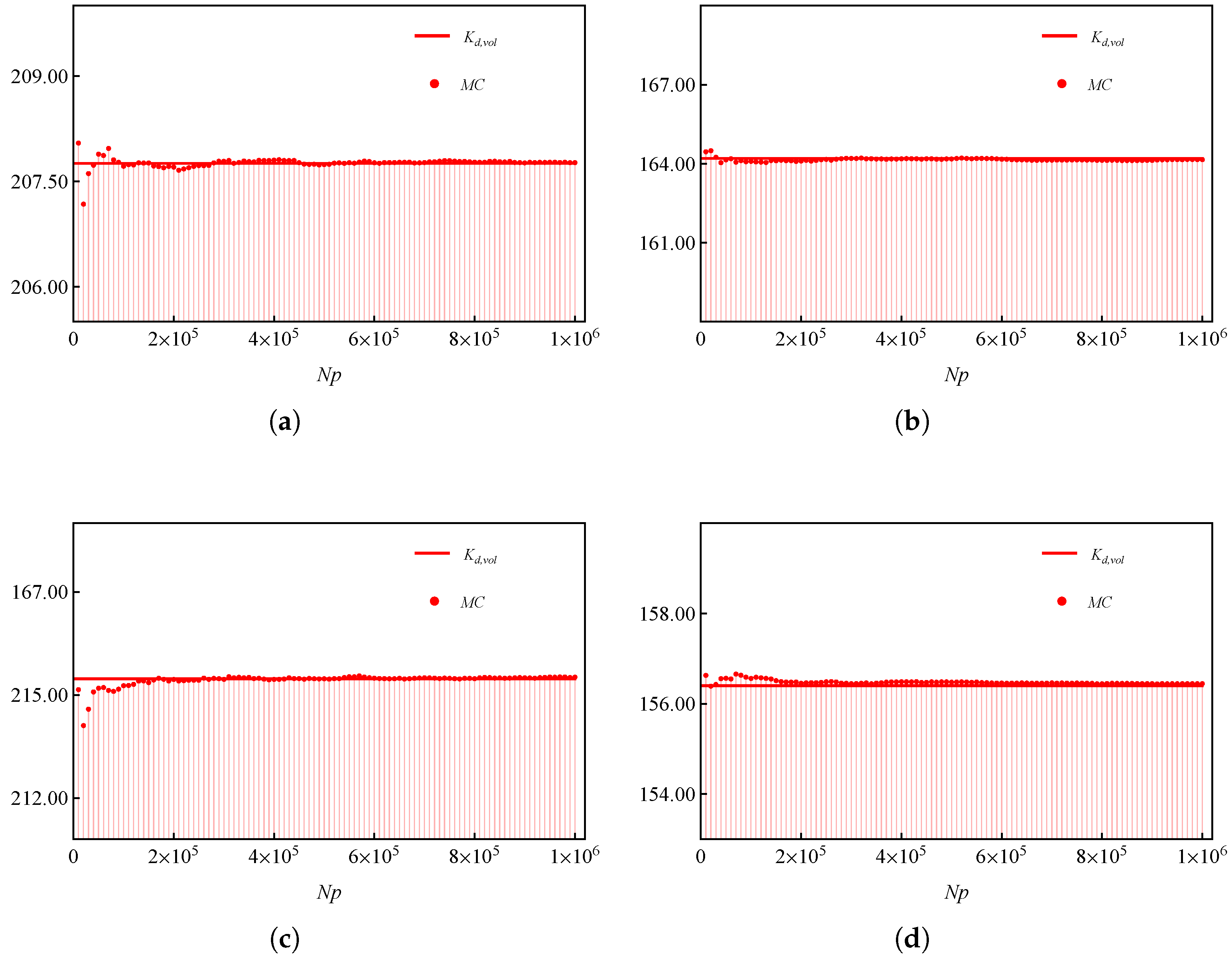
For quantitative validation, we selected four representative parameter configurations,to examine convergence behavior in detail. While these points are used for illustration, numerical evaluations have been conducted across the entire domain Ω. Figure 2a shows the convergence of MC estimates to the analytical benchmark for , while Figure 2b–d provide the corresponding results for , , and , respectively. In all cases, the MC estimates converge to the closed-form values as the number of simulated paths increases, confirming the numerical accuracy and stability of the proposed analytical formula. Beyond accuracy, the computational efficiency is evaluated in Table 1. To achieve a mean percentage relative error below ,the closed-form method requires an average computation time of approximately s per evaluation, whereas MC simulation is substantially more expensive. For example, when , the analytical approach yields a speed-up factor of approximately 7102 per evaluation. Overall, this example demonstrates the dual advantage of the proposed framework: analytical precision that matches high-fidelity MC benchmarks and substantial computational gains that are particularly valuable for calibration, real-time valuation, and large-scale risk-management applications.
5.2. Comparisons Between the Fair Strike Prices of Volatility Swaps
Example 2.
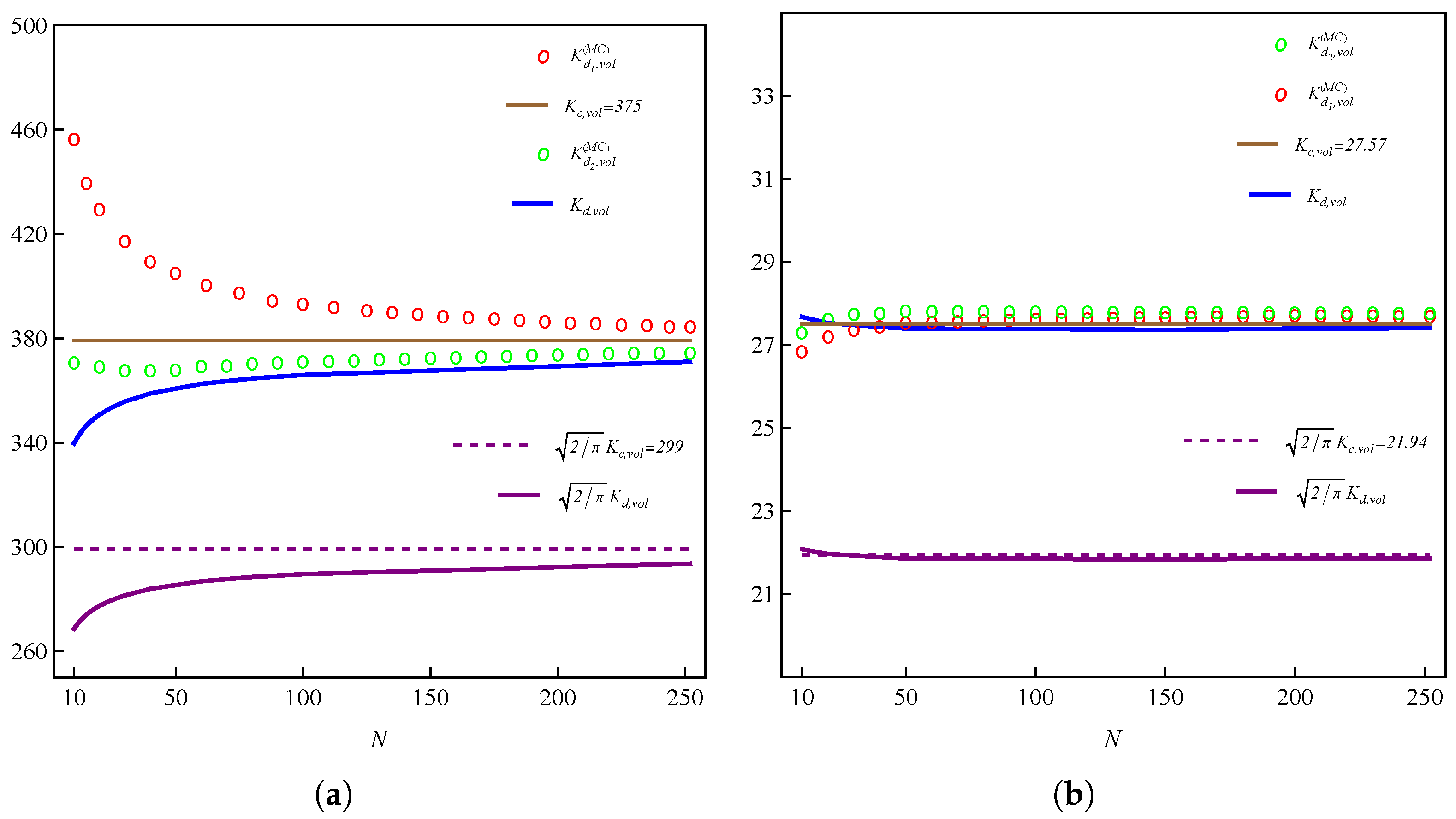
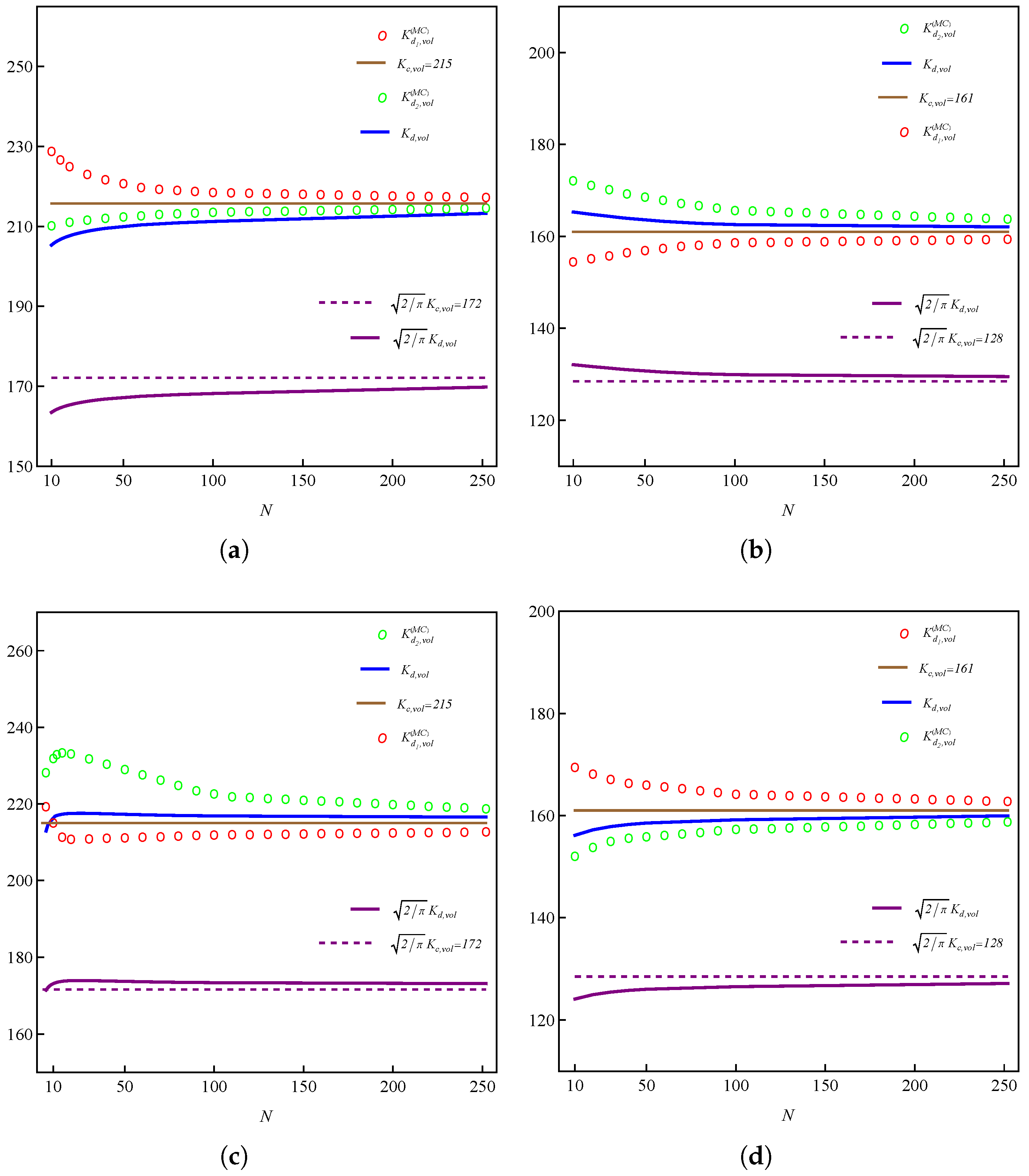
This example compares the fair strike prices of volatility swaps constructed from log returns (11) and actual returns (13), both computed via MC simulations, with the fair strike prices of volatility-average swaps obtained from the closed-form expression (22). These discretely sampled prices are further compared with their continuous-time counterparts given by (24). The analysis is conducted for various combinations of the parameters a and b as the number of sampling points N increases, with the objective of examining convergence behavior, identifying discretization effects, and assessing the robustness of the proposed analytical benchmark. Figure 3a reports the fair delivery prices of volatility swaps under the Heston SV model, corresponding to the parameter choice and . In this setting, the MC-based fair strikes computed from log returns, denoted by , converge monotonically from above toward their continuous-time limits. By contrast, the MC-based fair strikes computed from actual returns, , exhibit non-monotonic convergence. The fair strike prices of volatility-average swaps, , obtained from the closed-form formula (22) converge monotonically from below. Importantly, all discretely sampled prices remain strictly above the lower bound , which is consistent with the theoretical results established in Zhu and Lian (2015). Figure 3b presents the corresponding results under the 3/2 SV model, obtained by setting and . In this case, the discretely sampled fair strike prices , , and all converge to their continuous-time limits in a non-monotonic manner. As in the Heston case, all prices remain above the lower bound , confirming the robustness of this theoretical constraint across classical SV specifications. The heterogeneous convergence patterns observed in Figure 3 and Figure 4 can be attributed to the structural composition of the 4/2 SV model. Specifically, the instantaneous volatility written in (25) introduces two interacting channels through which variance dynamics influence short-horizon asset returns. When only one component is active, as in the Heston or 3/2 limits, discretization effects tend to follow relatively regular patterns, resulting in monotonic or mildly oscillatory convergence. When both components are present, however, the interaction between the volatility and inverse-volatility terms amplifies sensitivity to sampling frequency and can generate pronounced non-monotonic convergence behavior. Figure 4 illustrates this phenomenon for several representative nonzero combinations of a and b. In panel (a), with and , the MC-based prices from log returns converge monotonically from above, while those based on actual returns converge monotonically from below, with lying between the two. Panel (b), corresponding to and , exhibits a reversal in monotonicity between the two MC-based estimators. In panel (c), where and , all three discretely sampled prices display non-monotonic convergence, reflecting a strong interaction between the two volatility channels. Finally, panel (d), with and , shows monotonic convergence of from above and from below while preserving the lower bound property in all cases. Overall, this example yields several important insights. First, the closed-form volatility-average swap price serves as a stable and reliable analytical benchmark that consistently lies above the theoretical lower bound and converges to the continuous-time limit as the sampling frequency increases. Second, the convergence behavior of discretely sampled volatility swap prices is highly model-dependent and may be monotonic or non-monotonic, depending on the relative magnitudes and signs of the parameters a and b. Third, the observed non-monotonic convergence patterns highlight the limitations of continuous-time approximations in discretely sampled markets, particularly under hybrid volatility dynamics. From a practical standpoint, these findings underscore the importance of closed-form discrete-time pricing formulas for accurately capturing sampling effects and for supporting calibration, hedging, and risk management decisions in volatility-linked derivative markets.
6. Conclusions
This paper has developed a unified analytical framework for pricing discretely sampled volatility swaps under the 4/2 SV model. The main challenge in this setting has arisen from the nonlinear structure of the conditional expectations involved in the standard definitions of realized volatility based on log returns and actual returns, which has generally precluded closed-form valuation. By introducing the notion of a volatility-average swap and exploiting its alternative realized volatility definition, this study has derived an explicit closed-form expression for the fair delivery price of discretely sampled volatility swaps within the 4/2 SV framework.
Theoretical results have established closed-form expressions for the conditional complex moments of the asset price, the conditional characteristic function of log returns, and related auxiliary expectations under admissible parameter conditions. These analytical building blocks have enabled the derivation of tractable pricing formulas for both discretely sampled and continuously sampled volatility swaps. The validity of the proposed formulas has been rigorously justified within the model’s parameter space, ensuring mathematical consistency and financial realism.
Extensive numerical experiments have confirmed the accuracy and computational efficiency of the proposed closed-form pricing formulas when compared with MC simulations. In particular, the numerical analysis has demonstrated that the analytical approach achieves substantial reductions in computational time while maintaining high numerical precision, even for large sample sizes. Moreover, the convergence behavior of discretely sampled volatility swap prices toward their continuous-time counterparts has been thoroughly examined. The results have revealed that such convergence may be monotonic or non-monotonic, depending on the structure of the volatility dynamics and the interaction between the volatility and inverse-volatility components of the 4/2 model.
A detailed sensitivity analysis has further shown that the fair strike prices of volatility swaps have been strongly influenced by the parameters governing the volatility and inverse-volatility channels. The interaction between these components has been shown to play a crucial role in shaping discretization effects and convergence patterns, highlighting the structural flexibility of the 4/2 SV model relative to classical Heston and 3/2 specifications. These findings have underscored the importance of accounting explicitly for discrete sampling effects in volatility-linked derivatives and have illustrated the limitations of relying solely on continuous-time approximations in practical applications.
From a practical perspective, the analytical tractability and computational efficiency of the proposed framework have made it well suited for real-time pricing, calibration, and risk management of volatility-linked derivatives. The availability of explicit discrete-time pricing formulas has provided practitioners with a reliable and efficient alternative to simulation-based methods, particularly in environments where volatility swaps are actively traded and rapid valuation is required.
It is important to emphasize that the present framework has been formulated at the level of a continuous-time SV model with discretely sampled contractual payoffs. Market microstructure effects, such as bid–ask bounce, irregular sampling, and intraday frictions, arise primarily at the data level and have not been explicitly incorporated into the theoretical pricing structure developed herein. This modeling choice has been deliberate, as the objective of the paper has been to derive analytically tractable and structurally transparent valuation formulas under the 4/2 SV paradigm. Nevertheless, integrating microstructure-adjusted realized volatility estimators or noise-corrected high-frequency measures into the present analytical framework represents a meaningful and practically relevant direction for future research. Such extensions would allow for a closer alignment between model-implied volatility measures and empirical high-frequency data while preserving the analytical advantages established in this study.
Several directions for future research have naturally emerged from this work. The proposed framework has been readily extendable to other classes of volatility-linked derivatives, including capped and floored volatility swaps, volatility options, and corridor-style contracts. In addition, incorporating stochastic interest rates, jumps, or regime-switching dynamics into the 4/2 SV framework has represented a promising avenue for further investigation. Finally, extending the present analysis to multivariate settings and studying the joint pricing of volatility derivatives across multiple assets have constituted important topics for future research.
Author Contributions
Conceptualization, S.R. and S.L.; methodology, S.R. and S.L.; software, S.L.; validation, S.R., S.L., N.T., and A.E.M.; formal analysis, S.R., S.L., and N.T.; writing—original draft preparation, S.R., S.L., and N.T.; writing—review and editing, S.R., S.L., N.T., and A.E.M.; visualization, S.L.; supervision, S.R. and N.T. All authors have read and agreed to the published version of the manuscript.
Funding
The Walailak University Graduate Scholarship under contract number CGS-PE 10/2022.
Data Availability Statement
The data presented in this study are available on reasonable request from the corresponding author. The data are not publicly available due to their very large size, as they are generated from extensive Monte Carlo simulations involving millions of sample paths.
Acknowledgments
We extend our gratitude for the financial support received from the Walailak University Graduate Scholarship under contract number CGS-PE 10/2022 for their financial support and the resources provided, which were essential for the successful completion of this research and the dissemination of its findings. The authors also sincerely thank the anonymous reviewers for their valuable comments and constructive suggestions, which have significantly improved the clarity and quality of this manuscript.
Conflicts of Interest
The authors declare no conflicts of interest.
Abbreviations
The following abbreviations are used in this manuscript:
| SV | Stochastic Volatility |
| MC | Monte Carlo |
| CIR | Cox–Ingersoll–Ross |
| SDE | Stochastic Differential Equation |
| RHS | Right-Hand Side |
Appendix A. The Proofs and the Parameter Functions
Appendix A.1. The Proof of Theorem 1
Proof. From (3.3) in
Grasselli (
2017), we can show that
and by using the fact that the confluent hypergeometric function in (
A1) can be written as
where
is given in (
A21). Then, multiply both sides of (
A2) by
. We get
Inserting the RHS of (
A3) into the RHS of (
A1) and using the parameter function setting (
A9) with
yields (
18). □
Appendix A.2. The Proof of Theorem 2
Proof. From (A.8) in
Grasselli (
2017), we can write
where
, and
.
Next, by expanding the hypergeometric function on the RHS of (
A4) as an infinite series, we obtain
where
is defined by (
A22). This completes the proof, as the RHS of (
A5) is exactly the expression for
, as given by (
A10). □
Appendix A.3. The Proof of Theorem 3
Proof. By using (
18), we can show that
Taking the conditional expectation to both sides of (
A6) yields
Next, we apply (
19) to compute the conditional expectations on the RHS of (
A7) as
provided that
, and
. Inserting the RHS of (
A8) into the RHS of (
A7), we immediately obtain (
21) as desired. □
Appendix A.4. The Parameter Functions in Theorems 1 and 2
The parameter functions in (
18) and (
19) are shown as follows.
where
for all
, and the symbol
in (
A21) denotes the Pochhammer coefficients, which are given by
for
and
.
Appendix A.5. The Parameter Functions in Theorem 5
The parameter functions in (
24) are shown as follows.
where
for all
.
Appendix B. Validity of Our Closed-Form Expressions
Appendix B.1. Validity of the Closed-Form Expression in Theorem 1
The closed-form expression for the conditional complex moment of
, given in (
18), is valid provided that the RHS of (
A9) is well defined. We define the parameter space as
To ensure that the RHS of (
A9) is well defined, the parameters
must satisfy conditions (
3) and (
4). Moreover, according to Proposition 3.1 of
Grasselli (
2017), the following conditions are required:
Fortunately, all these inequalities are automatically satisfied under the parameter space defined above.
Appendix B.2. Validity of the Closed-Form Expression in Theorem 2
The closed-form expression for the conditional expectation of
, as given in (2), is valid if the RHS of (
A10) is well defined. For this to hold, the parameter set
must satisfy condition (
3). Additionally, for
, the quantity
must be well defined. According to (
A22),
is well defined if for all
,
, where these ensure
and
, respectively.
Appendix B.3. Validity of the Closed-Form Expression in Theorem 4
The closed-form expression for the fair strike of the volatility-average swap, given in (
22), is valid provided that the parameters
satisfy conditions (
3) and (
4) and the following conditions hold:
Fortunately, these inequalities are automatically satisfied under the admissible parameter space. In addition, the following conditions must be fulfilled:
and
Appendix B.4. Validity of the Closed-Form Expression in Theorem 5
The closed-form expression for the fair strike of the continuous-time volatility swap, given in (
24), is valid provided that the parameters
satisfy conditions (
3) and the following conditions hold:
for all
. Fortunately, these inequalities are automatically satisfied under the admissible parameter space.
References
- Andersen, Torben G., Tim Bollerslev, Francis X. Diebold, and Paul Labys. 2003. Modeling and Forecasting Realized Volatility. Econometrica 71: 579–625. [Google Scholar] [CrossRef]
- Barndorff-Nielsen, Ole E., and Neil Shephard. 2003. Realized Power Variation and Stochastic Volatility Models. Bernoulli 9: 243–65. [Google Scholar] [CrossRef]
- Bernard, Carole, and Zhenyu Cui. 2014. Prices and Asymptotics for Discrete Variance Swaps. Applied Mathematical Finance 21: 140–73. [Google Scholar] [CrossRef]
- Carr, Peter, and Dilip Madan. 1998. Towards a Theory of Volatility Trading. Volatility: New Estimation Techniques for Pricing Derivatives 29: 417–27. [Google Scholar]
- Demeterfi, Kresimir, Emanuel Derman, and Michael Kamal. 1999. A Guide to Volatility and Variance Swaps. Journal of Derivatives 6: 9–32. [Google Scholar] [CrossRef]
- Elliott, Robert J., and Guang-Hua Lian. 2013. Pricing Variance and Volatility Swaps in a Stochastic Volatility Model with Regime Switching. Quantitative Finance 13: 687–98. [Google Scholar] [CrossRef]
- Goard, Joanna. 2011. Pricing of Volatility Derivatives Using 3/2-Stochastic Models. Proceedings of the World Congress on Engineering 1: 443–38. [Google Scholar]
- Grasselli, Martino. 2017. The 4/2 Stochastic Volatility Model: A Unified Approach for the Heston and the 3/2 Model. Mathematical Finance 27: 1013–34. [Google Scholar] [CrossRef]
- He, Xin-Jiang, and Song-Ping Zhu. 2018. A Series-Form Solution for Pricing Variance and Volatility Swaps with Stochastic Volatility and Stochastic Interest Rate. Computers & Mathematics with Applications 76: 2223–34. [Google Scholar] [CrossRef]
- He, Xin-Jiang, and Song-Ping Zhu. 2022. Analytical Pricing Formulae for Variance and Volatility Swaps with a New Stochastic Volatility and Interest Rate Model. Expert Systems with Applications 206: 117880. [Google Scholar] [CrossRef]
- Heston, Steven L. 1993. A Closed-Form Solution for Options with Stochastic Volatility. Review of Financial Studies 6: 327–43. [Google Scholar] [CrossRef]
- Heston, Steven L. 1997. A Simple New Formula for Options with Stochastic Volatility. Technical Report. Washington: Washington University of St. Louis. [Google Scholar]
- Howison, Sam, Avraam Rafailidis, and Henrik Rasmussen. 2004. On the Pricing and Hedging of Volatility Derivatives. Applied Mathematical Finance 11: 317–46. [Google Scholar] [CrossRef]
- Jacod, Jean, and Philip Protter. 1998. Asymptotic Error Distributions for the Euler Method. The Annals of Probability 26: 267–307. [Google Scholar] [CrossRef]
- Lin, Sha, and Xin-Jiang He. 2023. Analytically Pricing Variance and Volatility Swaps with Stochastic Volatility, Stochastic Equilibrium Level and Regime Switching. Expert Systems with Applications 217: 119592. [Google Scholar] [CrossRef]
- Lin, Sha, and Xin-Jiang He. 2024. Closed-Form Formulae for Variance and Volatility Swaps Under Stochastic Volatility with Stochastic Liquidity Risks. Journal of Futures Markets 44: 1447–61. [Google Scholar] [CrossRef]
- Little, Thomas, and Vijay Pant. 2001. A Finite Difference Method for the Valuation of Variance Swaps. In Quantitative Analysis in Financial Markets. Singapore: World Scientific, pp. 275–295. [Google Scholar]
- Rujivan, Sanae, and Song-Ping Zhu. 2012. A Simplified Analytical Approach for Pricing Discretely-Sampled Variance Swaps. Applied Mathematics Letters 25: 1644–50. [Google Scholar] [CrossRef]
- Swishchuk, Anatoliy. 2004. Modeling of Variance and Volatility Swaps. Wilmott Magazine 2: 64–72. [Google Scholar]
- Swishchuk, Anatoliy. 2006. Modeling and Pricing of Variance Swaps for Multi-Factor Stochastic Volatilities. Canadian Applied Mathematics Quarterly 14: 439–67. [Google Scholar]
- Yoon, Youngin, Jun-Ho Seo, and Jeong-Hoon Kim. 2022. Closed-Form Pricing Formulas for Variance Swaps in the Heston Model with Stochastic Long-Run Mean of Variance. Computational and Applied Mathematics 41: 235. [Google Scholar] [CrossRef]
- Yuen, Chi Hung, Wendong Zheng, and Yue Kuen Kwok. 2015. Pricing Exotic Discrete Variance Swaps under the 3/2-Stochastic Volatility Models. Applied Mathematical Finance 22: 421–49. [Google Scholar] [CrossRef]
- Zhu, Song-Ping, and Guang-Hua Lian. 2011. A Closed-Form Exact Solution for Pricing Variance Swaps with Stochastic Volatility. Mathematical Finance 21: 233–56. [Google Scholar] [CrossRef]
- Zhu, Song-Ping, and Guang-Hua Lian. 2015. Analytically Pricing Volatility Swaps under Stochastic Volatility. Journal of Computational and Applied Mathematics 288: 332–40. [Google Scholar] [CrossRef]
| Disclaimer/Publisher’s Note: The statements, opinions and data contained in all publications are solely those of the individual author(s) and contributor(s) and not of MDPI and/or the editor(s). MDPI and/or the editor(s) disclaim responsibility for any injury to people or property resulting from any ideas, methods, instructions or products referred to in the content. |