


Abstract
Motivated by the coexistence of retail and wholesale banks with distinct risk profiles under uniform capital regulation, and by the lack of quantitative evidence on whether differentiated capital requirements can reduce bank runs and interbank frictions in low-income monetary unions, this paper aims to determine a capital ratio for retail banks that can reduce the likelihood of bank runs in the WAEMU area. The study also compares the impact of imposing capital requirements on retail banks versus implementing the same level of regulation for wholesale banks. The key findings are as follows: A capital ratio of 10 percent for retail banks is found to be sufficient to reduce the probability of bank runs and mitigate interbank market frictions in the WAEMU area. Similarly, applying the same requirements to wholesale banks also reduces the likelihood of bank runs. Implementing capital requirements on retail banks does not significantly affect interbank lending costs, whereas imposing the same requirements on wholesale banks leads to an increase in these costs. Consequently, regulating retail banks tends to shift assets towards wholesale banks, while regulating wholesale banks reallocates assets towards retail banks. The calculated capital ratio of 10 percent for retail banks maximizes welfare, surpassing the welfare achieved when the same requirements are imposed on wholesale banks. Therefore, the same capital ratio offers greater stability benefits for retail banks than wholesale banks, highlighting the mismatch between uniform capital regulations and heterogeneous banking models.
1. Introduction
The global financial crisis of 2008 and the financial turmoil in March 2023 highlighted the importance of preventing bank failures, leading financial institutions such as the Bank for International Settlements and the Federal Reserve to tighten regulatory policies to ensure financial stability. Specifically, minimum capital requirement regulations mandate that banks hold a minimum amount of capital relative to their total risk-adjusted assets.
In response to these concerns, the monetary and supervisory authorities of the West African Economic and Monetary Union (WAEMU) strengthened their regulatory framework through the Central Bank (BCEAO) and the Banking Commission. Following the global financial turbulence of 2023, the Council of Ministers of WAEMU decided to increase the minimum share capital of the Union’s banks from XOF 10 to 20 billion, effective 1 January 2024. Additionally, a minimum capital ratio of 8.5% was set for the same year, which was met by 111 credit institutions, representing 86.0% of the institutions and accounting for 90.5% of total assets and 91.4% of risk-weighted assets in the banking system. According to the banking commission statistics, the WAEMU banking system comprises around 135 licensed banks, essentially commercial banks, complemented by about 25 banking-type financial institutions, bringing the total to nearly 160 credit institutions. Retail banks are the backbone of financial intermediation in WAEMU. Their activities are mainly focused on households and small and medium-sized enterprises (SMEs), with a significant portion of lending targeted towards salary-earners and formal sector firms. Customer deposits are the primary source of funding for retail banks, making up the majority of their liabilities (Central Bank of West Africa States (BCEAO) 2022). On the asset side, credit risk is heightened by the prevalence of SMEs and the high degree of informality in the economy. In parallel, the microfinance sector plays a significant role, with close to 500 microfinance institutions (MFIs) operating across the Union. They cater to low-income households, informal workers, and micro-entrepreneurs who are usually overlooked by traditional banks. MFIs focus on providing small-scale loans, often using relationship-based approaches, group lending, and social collateral to manage borrower risk. They depend on member savings, donor support, development finance, and, in some instances, limited deposit mobilization. The system also includes investment and development banks, which primarily operate as wholesale banks, such as the West African Development Bank (BOAD) and the ECOWAS Bank for Investment and Development (EBID). These banks play a more limited but systemically important role in WAEMU. Their operations are based on serving large corporates, public enterprises, governments, and financial institutions, including other banks through the interbank market. Compared to retail banks, they typically deal with larger loan sizes and have more concentrated credit portfolios. On the liability side, they depend less on retail deposits and rely more on short-term wholesale funding, such as interbank borrowing and central bank refinancing. As a result, wholesale banks are primarily exposed to liquidity risk rather than traditional retail credit risk.
Thus, this present work is motivated by the structural duality of the banking system between retail and wholesale banks, which are subject to uniform regulatory capital requirements despite differing risk profiles, and the lack of quantitative evidence on whether differentiated capital regulation can effectively reduce the likelihood of bank runs and interbank market frictions in low-income monetary unions.
Numerous studies have shown the importance of macroprudential policies for financial stability. For example, Van den Heuvel (2008) found that a uniform capital requirement set at 10 percent can prevent banks from engaging in inefficient risk-taking. On the one hand, recent studies in advanced economies have emphasized the need for higher capital requirements to discourage excessive risk-taking, with estimates ranging from 12 to 20 percent. These requirements not only reduce funding costs for banks but also enhance monitoring incentives and overall efficiency in banking activities. For instance, Collard et al. (2017) estimated that a Ramsey optimal capital requirement of 12 percent is sufficient to deter inefficient risk-taking by banks. Begenau (2020) showed that an increased capital requirement from 9.25 percent to 12.38 percent for large banks can decrease funding costs for banks and stimulate lending. Higher capital requirements also enhance banks’ monitoring incentives, leading to greater efficiency in their operations. Another set of relevant studies analyzed the effects of capital requirements for financial stability (Christiano and Ikeda 2014; Martinez-Miera and Suarez 2014; Nguyen 2014; Chari and Kehoe 2016; Corbae and D’Erasmo 2018; Gertler et al. 2016). Most of these studies reported on how imposing leverage constraints on banks can internalize credit externalities and decrease social costs. Gertler et al. (2020) concluded that a capital requirement of 10 percent is sufficient to prevent the probability of bank runs. Nevertheless, their model does not make clear the distinction between commercial and shadow banks. By differentiating commercial (regulated) from shadow (unregulated) banks, Begenau and Landvoigt (2022) found that an optimal capital requirement of about 20 percent for commercial banks makes both bank types safer. It directly strengthens commercial banks by reducing leverage and indirectly stabilizes shadow banks by influencing the valuation of intermediated assets. On the other hand, empirical studies on macroprudential policy and banking stability in the WAEMU region focused on the crucial role of capital and liquidity requirements in reducing banks’ vulnerability and mitigating the risk of bank runs. Séraphin (2025) further highlighted the importance of capital and liquidity buffers, identifying thresholds of 10.96 percent and 13.87 percent, respectively, beyond which banking stability improved, although these thresholds were not directly linked to the probability of bank failures. Similarly, Babo Amadou Ba (2021), using macroprudential stress tests related to the COVID-19 crisis, found that WAEMU banks maintained capital ratios above regulatory requirements, demonstrating resilience to macroeconomic shocks, yet the study did not assess the impact on bank runs. Kone and Djan (2023) noted that while regulatory measures could enhance stability, they might also affect liquidity risk and operational performance, illustrating a trade-off between stability and efficiency. Research on systemic risk and banking structure, including studies by Saidane et al. (2021) and Kanga et al. (2021), underscored the interconnectedness of banks and the structural fragility of the system, reinforcing the need for effective macroprudential oversight. Finally, IMF analyses by Ayvazyan (2024, 2025) indicated that aligning with international prudential standards and implementing macroprudential frameworks enhanced the overall resilience of the WAEMU banking system, though they did not provide quantitative modeling of bank run probabilities. Overall, the literature consistently suggests that macroprudential policies particularly capital and liquidity requirements strengthen retail banking stability and reduce conditions conducive to bank failures, even if direct empirical evidence of reduced failures remains limited.
In this paper, we aim to determine capital requirements for retail banks in the WAEMU region to prevent the probability of bank runs. By recalibrating a model economy with recent data from WAEMU banks, we also seek to compare the impact of implementing these capital requirements on retail banks versus imposing the same level of regulation for wholesale banks. This study makes two main contributions to the economic literature. First, we use more recent data, providing updated empirical evidence on the relationship between macroprudential policy and financial stability, unlike the above studies in advanced economies, which have focused on US banks data. Second, we examine WAEMU region, which has received limited attention in the previous literature and offering new insights into the relevance of existing findings. Our analysis is based on the model developed by Gertler et al. (2016), which focuses on banking and bank runs in the context of recent credit expansion and financial crises, and also distinguishes between retail and wholesale banks. Their infinite horizon macroeconomic model of banking and bank runs was initially developed in Gertler and Kiyotaki (2015).
2. Framework
2.1. Key Features
The model features four types of agents: households, retail and wholesale banks, and a regulator that sets a prudential policy. There are two goods in the model, nondurable goods and durable assets, i.e., capital. There is no capital depreciation, and the total supply of capital stock is normalized to unity. Wholesale and retail banks acquire capital through borrowed funds and their own equity. Households lend to banks and hold capital directly.
where , and are the total capital held by wholesale banks, retail banks, and households, respectively.
Goods expenditure in relation to time , provides the associated management costs in relation to evaluating investment projects. In retail banking, these costs may depict varying regulatory requirements. To this extent, we assume that management costs operate both linearly and nonlinearly in relation to total capital. Accordingly, the quadratic formula is given by:
where and represents wholesale banks, retail banks, and households, respectively. The marginal cost of providing management services is denoted by
In addition, we assume the management cost to be zero for wholesale banks and highest for households (holding the level of capital constant).
Assumption 1:
This assumption implies that wholesale bankers have an advantage over the other agents in managing capital. Retail banks, in turn, have a comparative advantage over households.
2.2. Households
Households allocate their consumption and savings by either lending funds to banks or holding capital directly in a competitive market. They can choose to place their deposits in either retail or wholesale banks. In addition to returns on their portfolios, households also receive an exogenous endowment of goods in each period, which varies in proportion to the aggregate productivity shock .
Deposits placed in a bank between periods to take the form of one-period bonds that offer a non-contingent gross return provided if there is no depositor run. In case of a run, depositors can only recover a fraction of the promised payoff, where represents the liquidation value of retail banks’ assets per unit of promised deposit liabilities.
As a consequence, the household’s return on deposits is expressed as follows:
where
If a deposit run occurs, all depositors receive the same pro rata share of liquidated assets.
Household utility is given by
where is the household’s consumption and
The household chooses consumption, bank deposits and direct capital holdings to maximize expected utility subject to budget constraints:
Consumption, savings, and management costs are funded by the endowment , which includes the returns on savings and profits earned from providing management services to retail banks. is the market price of capital.
A household makes consumption and savings decisions based on the assumption that the actual return on deposits, will match the promised return and that asset prices correspond to the capital trading prices in the absence of a bank run. (See Appendix B for the first-order conditions).
Moreover, the innovation shock follows an model as follows:
where is the autoregressive parameter, the perturbation term, and is the NIID process with a variance of .
2.3. Banks
There are two types of bankers: retail and wholesale, each operating as a distinct type of financial intermediary. Banks finance capital investments (i.e., nonfinancial loans) by issuing deposits to households, borrowing from other banks in the interbank market, and utilizing their own equity. They may also serve as lenders in the interbank market.
Banks are at risk of facing runs in the interbank market, where creditor banks suddenly stop renewing interbank loans. In the event of such a run, creditor banks may only recover a fraction represented by of the promised return on interbank credit. This fraction indicates the total liquidation value of the debtor bank’s assets per unit of outstanding debt. Thus, the creditor bank’s return on interbank loans is as follows:
where . If an interbank run occurs, all creditor banks receive the same pro rata share of liquidated assets. Due to financial market frictions, banks may encounter limitations in raising external funds. When faced with these constraints, they seek to alleviate them by accumulating retained earnings, thereby moving towards full (100 percent) equity financing. To eliminate this possibility, we assume that banks have a finite expected lifetime. Specifically, each bank of type ( has an probability of surviving until the next period and a probability of exiting.
Every period, new banks of type enter with an endowment which is received only in the first period of their lifetime. This initial endowment can be interpreted as the start-up equity of a new bank. The number of entering banks equals the number of exiting banks, so the total number of banks remains constant over time.
To promote the utilization of wholesale funding in conjunction with retail funding, we posit that a bank’s ability to redirect funds is contingent on both the source and the purpose of the funding. A bank can redirect a portion of non-financial loans funded by retained earnings or funds raised from households, where . By contrast, only a fraction of non-financial loans funded through interbank borrowing can be redirected, with . This assumption reflects the idea that banks engaging in wholesale lending are more adept at monitoring borrower banks compared to households depositing funds in the retail market.
For banks that provide credit to other banks, we assume that interbank loans are harder to divert compared to loans to the nonfinancial sector. Specifically, a bank can only divert a fraction of its interbank lending, where . The parameters and collectively determine the extent of moral hazard in the interbank market.
The bank’s decision at time involves comparing the bank’s franchise value , defined as the present discounted value of future payouts from continued honest operation with the one-time gain from diverting funds. Rational lenders anticipate this trade-off and will refuse to provide financing whenever the bank has an incentive to cheat. Consequently, any financial arrangement between the bank and its lenders must satisfy the following incentive compatibility constraints:
Two fundamental factors govern the existence and relative size of the interbank market. First, wholesale banks benefit from a cost advantage in managing nonfinancial loans, as stated in Assumption 1. Second, the size of the parameters and which govern the comparative advantage that retail banks have over households in lending to wholesale banks, is as shown by Assumption 2.
Assumption 2:
.
This implies that and can be chosen to be sufficiently small to allow for an empirically plausible level of interbank lending.
The bank’s evolution of net worth is thus
where is the rate of return on nonfinancial loans, given by
The stochastic discount factor , which banks use to value is a probability-weighted average of the discounted marginal value of net worth for exiting banks and that for continuing banks at .
where is Tobin’s Q ratio.
The bank’s optimization problem then is to choose each period to maximize the franchise value subject to the incentive constraint and the balance sheet constraints and Equation (11).
2.3.1. Wholesale Banks
Wholesale banks typically raise funds from other banks or households. The model specifically examines equilibria in wholesale funding markets that meet the conditions outlined in Lemma 1.
Lemma 1:
, and the incentive constraint is binding if and only if
Given Lemma 1, the evolution of bank net worth is
where the multiple leverage ratio is given by
In turn, the wholesale bank optimization problem is to choose the leverage multiple to solve
subject to the incentive constraint
Since the incentive constraint is binding according to Lemma 1, combining it with the objective results in the following solution for
where rises with and falls with . Intuitively, the franchise value increases when returns on assets are higher and decreases when the cost of funding asset purchases rises, as indicated by Equation (14). Increases in loosen the incentive constraint, making lenders willing to supply more credit.
Similarly, decreases as either , the diversion rate on nonfinancial loans financed by net worth, or , the parameter governing the relative ease of diverting nonfinancial loans funded through interbank borrowing compared to other sources, increases. Higher values of either parameter tighten the incentive constraint, prompting lenders to supply less credit.
Lastly, from Equation (14), an expression of the franchise value per unit of net worth or the shadow value of wholesale bank net worth, which we call , is set as
where is given by Equation (16). The shadow value of net worth represents the marginal value (or Lagrange multiplier) associated with wholesale banks’ net worth constraint. It indicates the importance of an additional unit of net worth in easing balance-sheet constraints, boosting leverage, and maintaining lending capacity. The shadow value exceeds 1 because additional net worth allows the bank to borrow more and invest in assets that generate excess returns.
2.3.2. Retail Banks
Similarly to wholesale banks, the model adopts a parameterization in which the incentive constraint binds. It specifically focuses on the scenario where retail banks hold both nonfinancial and interbank loans. In particular, the model considers a parametrization where Lemma 2 is satisfied in equilibrium.
Lemma 2:
and the incentive constraint is binding if and only if
For a retail bank to be indifferent between holding nonfinancial loans and making interbank loans, the interbank rate must be lower than the rate earned on nonfinancial loans in a way that satisfies the conditions of the lemma. Intuitively, the retail bank’s potential gain from issuing an interbank loan arises because households are willing to provide more funding per unit of net worth to the bank than they would for a nonfinancial loan. Therefore, to render the retail bank indifferent, the interbank loan rate must fall below the rate earned on nonfinancial loans .
Let denote a retail bank’s effective leverage multiple, defined as the ratio of assets to net worth, where assets are weighted according to their relative ease of diversion as follows:
The weight on represents the proportion of interbank loans that a retail bank can divert relative to nonfinancial loans. Following the constraints in Lemma 2, we use a similar approach as for wholesale banks to express the retail bank’s optimization problem as choosing to solve
subject to
Given Lemma 2, imposing that the incentive constraint binds, which implies
Similarly to the leverage ratio for wholesale banks, increases with the expected returns on the bank’s portfolio and decreases as the diversion parameter rises.
Ultimately, from Equation (19) an expression for the franchise value per unit of net worth can be derived as follows:
As with wholesale banks, the shadow value of a unit of net worth exceeds unity and depends only on aggregate variables.
2.3.3. Recessions and Runs
This section deals with scenarios in which the economy goes into recession, which involves a drop in , making a bank run equilibrium possible. In this instance, the run variable is defined as
where is the recovery rate on wholesale debt. It indicates the percentage of a loan or asset’s face value that creditors can recover in case of default or liquidation. A higher recovery rate implies that creditors can retrieve a larger portion of their claims, thereby minimizing losses and risk. Therefore, a run occurs only if the run variable is positive or the recovery rate is below unity, i.e., (see Appendix C for the proof)
where is the return on bank assets conditional on a run at and is the liquation price expressed as
Gertler and Kiyotaki (2015), show that, at each time , the probability of transitioning into a state marked by a run on wholesale banks is a decreasing function of the expected recovery rate as follows:
This formulation makes it possible to capture the idea that, as wholesale bank balance sheet positions weaken, the likelihood of a run rises. In the numerical simulations, is set to .
2.4. Macroprudential Policy
Banks may encounter a moral hazard problem, where they must decide to operate honestly or to divert assets for personal use, with the latter option affecting their ability to raise funds. If they choose to divert, the consequence for the bank is that the creditors can push the debtors into bankruptcy at the start of the subsequent period. As a consequence of this, bank runs can arise from either a deposit run or the inability of a bank to meet its obligations. To rule out the probability of bank runs, the financial regulator imposes capital requirements on banks. Specifically, banks are subject to Basel III-type capital requirements. Under the Basel III accords, banks are required to hold a set proportion of their risk-weighted assets in equity.
The time-varying capital requirement for retail banks is then as follows:
Equation (26) shows that an increase in the shadow value of net worth decreases the ban’s capital requirement, making the financial sector more fragile with possible bank runs. The capital requirement also increases in the diversion rate . In response to shocks that heighten risk-taking by banks, the regulator should increase the level of capital ratio. The model is not intended to replicate the exact regulatory formulas of the BCEAO or Basel III, but rather to capture the economic mechanism underlying capital regulation as implemented in the WAEMU. In this sense, the capital requirement in the model should be interpreted as a reduced-form representation of regulatory constraints faced by banks, inspired by WAEMU reforms and Basel III principles (namely higher minimum capital ratios and countercyclical buffers).
Appendix A depicts the market clearing conditions.
3. Numerical Results
This section presents the parameter values used to solve the model and produce the numerical findings resulting from the integration of capital requirements. The model is solved nonlinearly, using perturbation methods. An advantage of selecting a nonstationary model is that it is possible to control the level of technology. Since Maih’s perturbation method is suitable for estimating regime-switching DSGE, constant-parameters DSGE and RBC models, the solution of the model is based on this type of perturbation. All numerical results were obtained using RISE software (RISE_Tbx_Beta).
3.1. Parameter Values
We calibrated the model to incorporate 2023 WAEMU bank data. This period is marked not only by weak banking regulations and the persistent inflationary tensions observed in 2022, but also by the financial turmoil of March 2023, which mainly occurred due to incentive measures taken in WAEMU economies and beyond following the COVID-19 crisis. Indeed, the households’ discount factor was set at the conventional value . The endowment was equal to , , and for households, retail banks, and wholesale banks, respectively, while the persistence parameter of the AR(1) process equaled , as in Gertler et al. (2016), and a standard error was included to account for innovation. Based on financial soundness indicators from the International Monetary Funds (2023), the average funding cost and interest margins were around 2% and 5.1%, respectively, indicating that WAEMU’s retail banks maintained a net interest margin of roughly 3.1% in 2023. This leads to the managerial costs associated with intermediating capital for households and retail banks and for the spread between the deposit rate and the retail banks’ returns on loans, as well as the difference between wholesale banks’ and retail banks’ returns on loans being, respectively, 0.2% and 0.3% annually in a steady state.1 The estimated averages of the divertible proportion of assets of retail and wholesale banks in 2023 are based on triangulated data and from reports, such as BCEAO’s annual report (Central Bank of West Africa States (BCEAO) 2024) and its statistical database, the Banking Commission Report, and IMF-WAEMU FSAP2 reports. This leads to and . This difference reflects the functional specialization since wholesale banks are designed for interbank and capital market operations, whereas retail banks for deposit-taking and household lending. From the same data sources, the fraction of divertible interbank loans is set to 0.70, resulting in steady-state annualized spread of 0.14% between deposit and interbank rates. Since the condition ω + γ > 1 plays a critical role in the modeling of interbank lending behavior and therefore warrants further validation, then the values ω and γ were chosen to reflect a regime in which endogenous interbank amplification dominates exogenous liquidity effects, consistent with the theoretical structure of the model. To test robustness, we conducted a sensitivity analysis by varying both parameters independently within a ±10 percent range around their baseline values. The results of this analysis show that the main qualitative findings of the model remain unchanged across the tested parameter ranges. Quantitative effects vary smoothly with changes in ω and γ, but no threshold reversals or regime changes are observed as long as ω + γ > 1 holds. As of 2023, the survival probability of retail banks in the WAEMU area was generally high compared to wholesale banks, though variable depending on the country and the size/type of bank. By using country-specific bank data mainly from the Banking Commission Annual Report (2015–2023), we computed the average estimated one-year survival probability for retail and wholesale banks as being and , respectively. Comparative empirical studies on bank survival in emerging markets report annual survival probabilities ranging from approximately 0.85 to 0.98, depending on bank characteristics and funding structures. Deposit-funded and well-capitalized banks typically exhibit low annual failure rates (2–5 percent), implying survival probabilities close to 0.95–0.98, whereas wholesale-oriented and riskier banks face higher failure probabilities, particularly during stress episodes (8–12 percent), corresponding to survival rates of about 0.88–0.92 (Beck et al. 2006; Godlewski 2007; Kočenda and Iwasaki 2018, 2021). Table 1 displays all of the parameters of the model.
Table 1.
Parameter values.
3.2. Long-Run Implications of Capital Requirements
This section discusses the model properties under macroprudential regulation, further exhibiting the impulse response functions.
3.2.1. Model Properties Under Capital Requirements
Table 2 presents the key variables before and after the implementation of the capital requirement (old regime vs. new regime) along with the corresponding percentage changes. In Block 1, the second column shows the steady-state values under capital requirements for retail banks, while in Block 2, the second column displays the steady-state values for wholesale banks. The third column in each block indicates the percentage change between the new and old regimes. For our calibration, we find that the steady-state value of to be 10% for retail banks.
Table 2.
Steady-state values under capital requirements k* = 10%.
Households prefer the new regime in Block 1, leading to a significant increase in consumption (+9.09% compared to +8.82% in Block 2). This higher consumption level results in a 1.27% reduction in the equilibrium level of deposits (compared to a 12.05% decrease in Block 2).
Keeping the interbank lending rate stable under the new regime enables retail banks to sustain the credit supply in Block 1. This stability leads to an unchanged allocation of assets between both types of banks, keeping the banks’ returns on assets consistent in the transition from the old to the new regime. Conversely, a 0.05% increase in the interbank rate in Block 2 makes lending less profitable for retail banks, prompting a 53.13% decrease in credit provision and a shift in asset allocation. This reduction increases retail banks’ capital by over 100% and decreases wholesale banks’ capital by 45.90%, resulting in a 0.07% increase in retail banks’ returns on assets and a 0.13% decrease in wholesale banks’ returns on assets.
The policy-induced rise in asset prices, of 6.14% in Block 1 and 1.96% in Block 2, has general equilibrium effects on banks’ balance sheets, leading to improved capitalization and increased net worth. In Block 1, net worth increases by 11.87% for wholesale banks and 17.41% for retail banks, while in Block 2, the increases are 0.90% for wholesale banks and 4.21% for retail banks, reducing leverage in both banking sectors. Consequently, output increases by approximately 11.45% in Block 1 and 6.43% in Block 2.
We followed Begenau and Landvoigt (2022) in calculating the induced welfare for a capital requirement level of , which was first implemented on retail banks and then on wholesale banks, as shown in Table 2. We simulated the model over multiple periods to obtain moments of the simulated variables. Welfare was measured as the percentage change in the mean and standard deviation of the household value function relative to the unregulated economy in each scenario, as presented in Table 3. Cases 1 and 3 in column 2 show the unconditional moments of key variables in the unregulated economy, while Cases 2 and 4 in column 3 represent their counterparts in the regulated economy. The results indicate that imposing a 10% capital ratio on retail banks (Case 2) leads to greater welfare gains (10%) and lower volatility (−17.46%) compared to applying the same requirements on wholesale banks (Case 4), where welfare improves by 7.38% and volatility increases by 16.67%.
Table 3.
Moments of simulated consumption and welfare for our selected capital ratio.
3.2.2. Impulse Responses Under Capital Requirements
This section examines the effects of applying capital requirements on retail banks compared to the effects of implementing the same requirements on wholesale banks. The derived capital ratio for retail banks is in the steady state. The model is designed to capture qualitative mechanisms rather than to replicate the exact magnitude of historical responses.
Effects of Implementing Capital Requirements Placed on Retail Banks
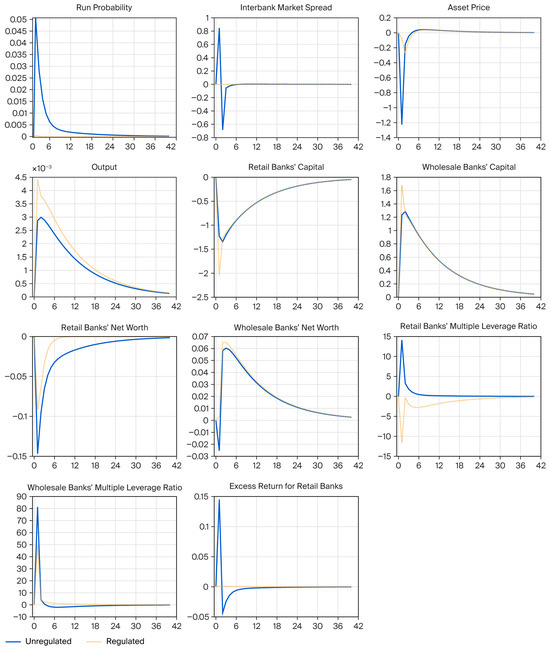
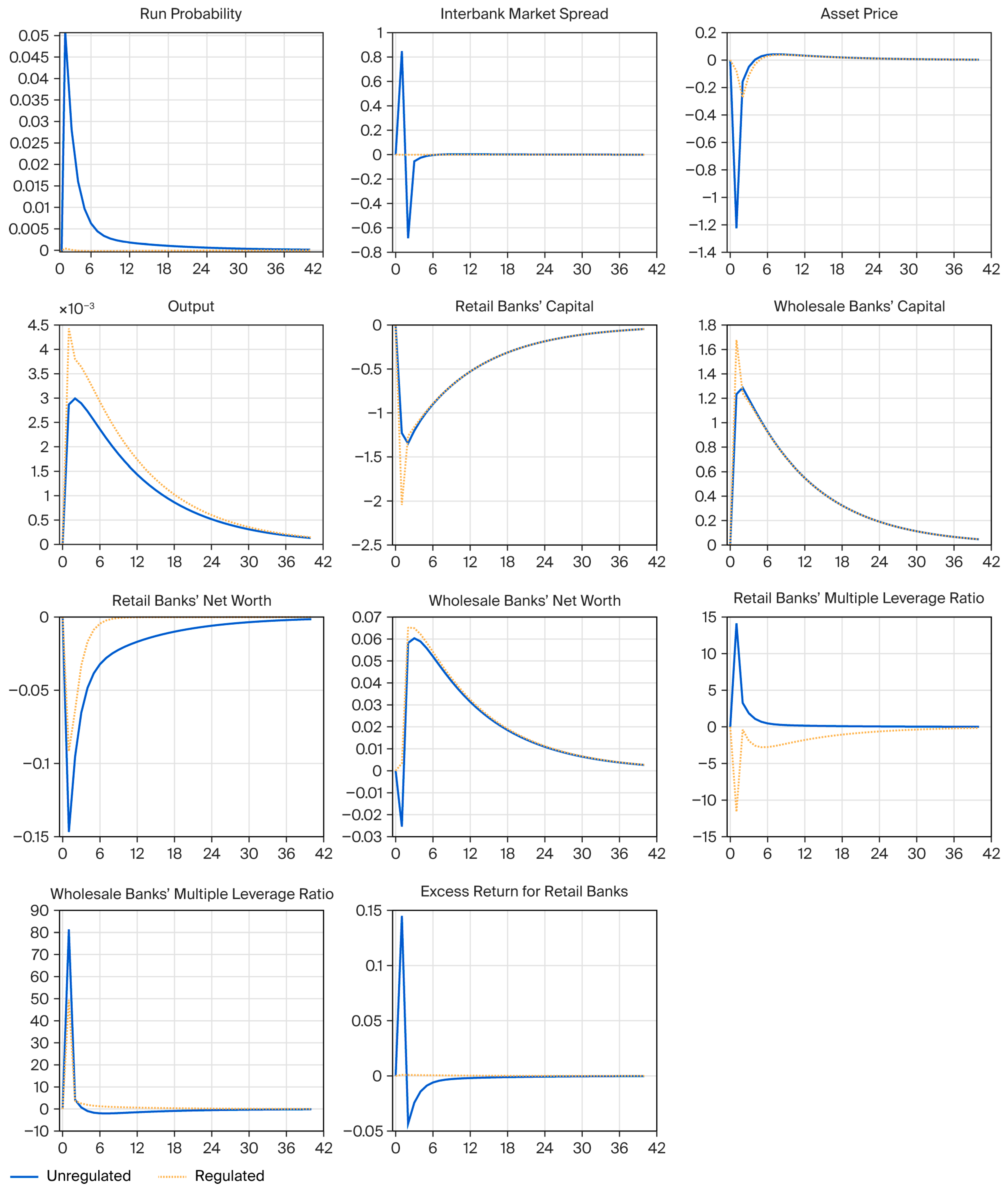
Figure 1 displays the impulse response functions of the economy in response to a negative 6% shock to productivity with and without anticipated bank runs, and with and without macroprudential regulation. The solid line represents the unregulated economy, while the dotted line represents the economy where the regulator enforces capital requirements on retail banks. The results show that capital requirements for retail banks eliminate the probability of a bank run by reducing interbank market frictions and lowering the banks’ leverage. In contrast, in the unregulated economy, the probability of a bank run remains high for several years, reaching about 5% in the first year of the recession, leading to increased leverage and exacerbating interbank market volatility. Furthermore, the policy has a significant stimulative effect on asset prices, with an increase of approximately 6.14% within the first two years of the recession. This rise in asset prices boosts banks’ net worth, impacting output, which increases by 11.45% compared to the unregulated economy. Additionally, the regulation leads to a reallocation of assets towards wholesale banks, resulting in losses on retail banks’ capital investments in favor of wholesale banks.
Figure 1.
Transition dynamics with capital requirements () placed on retail banks. Note: the blue line represents the unregulated economy, whereas the dotted yellow line depicts the regulated economy. In the unregulated regime, weak leverage and liquidity constraints allow for aggressive balance-sheet expansion, especially by wholesale banks relying on short-term funding. This leads to increased interbank interconnectedness and amplifies the leverage-funding-risk feedback loop, resulting in more significant fluctuations in credit, funding spreads, and run probabilities following shocks. However, the regulated regime enforces stricter and more targeted capital requirements, which restrict excessive risk-taking during upswings, enhance banks’ ability to absorb losses, and stabilize expectations in interbank market. These mechanisms account for the smoother dynamics and reduced systemic risk observed in Figure 1 under regulation.
Effects of Implementing Capital Requirements Placed on Wholesale Banks
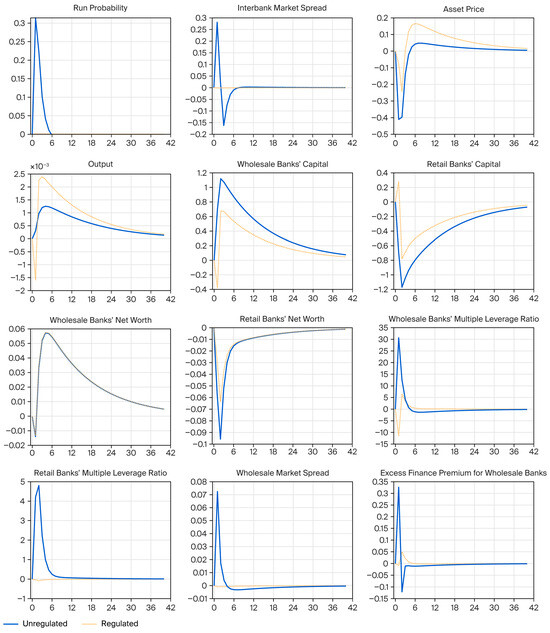
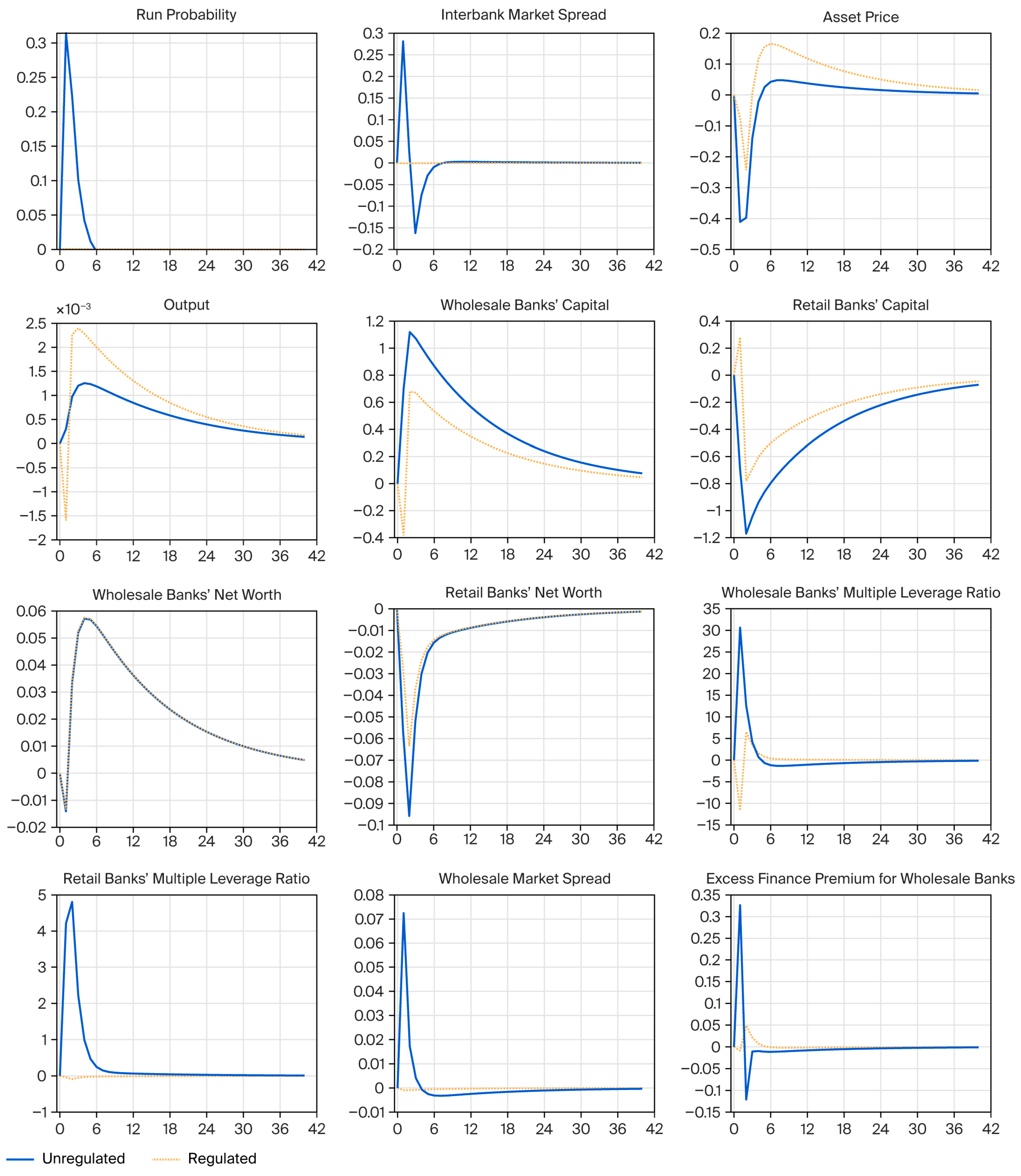
Figure 2 displays the impulse response functions of the economy with anticipated bank runs in response to a negative 6% shock to productivity with and without macroprudential regulation. The solid line represents the unregulated economy, while the dotted line illustrates the economy under which a capital ratio of 10% is imposed on wholesale banks by the regulator. The results suggest that applying the same capital ratio to wholesale banks as retail banks prevents the probability of a bank run and reduces financial frictions in the interbank market, while also controlling the banks’ leverage. However, in an unregulated economy and over time, the probability of a bank run remains high, exceeding 30%, indicating persistent instability in the interbank market. With regulation, asset prices experience a significant increase of approximately 1.96% within the first two years of the recession, mitigating the drop in output by around 6.43%, which is lower than in the regulated economy shown in Figure 1. In contrast to Figure 1, implementing the same capital ratio on wholesale banks leads to a reallocation of assets towards retail banks, resulting in losses for wholesale banks’ capital investments due to higher funding costs in the regulated economy (see Table 2).
Figure 2.
Transition dynamics with capital requirements placed on wholesale banks. Note: the blue line represents the unregulated economy, whereas the dotted yellow line describes the regulated economy. In the unregulated regime, weak leverage and liquidity constraints allow for aggressive balance-sheet expansion, especially by wholesale banks relying on short-term funding. This leads to increased interbank interconnectedness and amplifies the leverage-funding-risk feedback loop, resulting in more significant fluctuations in credit, funding spreads, and run probabilities following shocks. However, the regulated regime enforces stricter and more targeted capital requirements, which restrict excessive risk-taking during upswings, enhance banks’ ability to absorb losses, and stabilize expectations in interbank market. These mechanisms account for the smoother dynamics and reduced systemic risk observed in Figure 2 under regulation.
4. Discussion
We established a capital ratio for retail banks to mitigate the likelihood of bank runs in the WAEMU area. We also compared the impact of imposing this capital requirement on retail banks versus wholesale banks. Our analysis shows that a 10 percent capital ratio effectively reduces the likelihood of bank runs, minimizes interbank market frictions, and limits banks’ leverage. This indicates that even a modest capital requirement of 10 percent can enhance financial system resilience and discourage risky behavior by banks in the WAEMU area. Previous studies using US data have also demonstrated that a 10 percent risk-based capital ratio is sufficient to prevent bank runs (Van den Heuvel 2008; Gertler et al. 2020). Implementing the policy on retail banks leads to higher asset prices, improved capitalization, and a more significant impact on output compared to applying the policy to wholesale banks (refer to Table 2 and Figure 1 and Figure 2). Additionally, imposing macroprudential regulations on retail banks results in a slight shift in assets towards wholesale banks. This policy maintains the interbank rate at its current level in the unregulated economy, encouraging retail banks to maintain the credit supply and enabling wholesale banks to protect their capital investments. Conversely, applying the same policy to wholesale banks redirects assets towards retail banks by increasing the interbank rate relative to its level in the unregulated economy, making lending less profitable for retail banks and prompting them to reduce credit provision. Consequently, wholesale banks decrease their capital investments in favor of retail banks (refer to Table 2, Figure 1 and Figure 2). The study suggests that imposing the same level of capital requirements on retail and wholesale banks influences a shift in the asset allocation between the two types of banks. Research has shown that tightening capital requirements for commercial banks from the current 10% level prompts households to shift from commercial bank liquidity to shadow bank liquidity (Begenau and Landvoigt 2022). Furthermore, the analysis reveals that implementing capital requirements for retail banks leads to higher consumption and welfare compared to applying the same requirements to wholesale banks (refer to Table 3). This indicates that implementing capital requirements on retail banks is more beneficial in terms of welfare than imposing them on wholesale banks. Studies using US commercial bank data have consistently shown that varying levels of capital requirements can maximize welfare (Begenau and Landvoigt 2022; Begenau 2020; Collard et al. 2017; Van den Heuvel 2008).
5. Conclusions
This study focuses on deriving capital requirements for WAEMU area retail banks to prevent bank failures. Moreover, it compares the effects of implementing capital requirements on retail banks vs. introducing the same level of regulation for wholesale banks. The findings show that setting a capital ratio for retail banks can prevent bank runs and mitigate recessionary effects. Similarly, applying the same capital ratio to wholesale banks produces similar results. The allocation of assets between retail and wholesale banks is influenced by the capital ratio for retail banks. As shown by results, a 10 percent capital ratio is more advantageous for retail banks compared to wholesale banks due to the differences in their risk profiles and funding structures. Retail banks primarily rely on insured and stable deposits, with diversified retail loans that have lower rollover and run risks. A 10 percent capital buffer aligns well with their risk profile, providing adequate loss-absorbing capacity without overly restricting lending and supporting depositors’ confidence and financial stability. However, wholesale banks heavily rely on short-term market funding and are vulnerable to interbank runs and liquidity issues. Their assets are often more leveraged and sensitive to market conditions. A uniform 10 percent capital ratio is less effective for them, as it does not adequately address higher systemic and liquidity risks, leaving them exposed to funding freezes and limiting balance-sheet expansion. Future research could explore setting different risk-based capital ratios for wholesale banks compared to retail banks in the WAEMU area. We also think that the amplification effects may be influenced by modeling assumptions. In particular, the absence of capital depreciation and other real rigidities (e.g., investment adjustment costs, nominal rigidities, or gradual capital accumulation) can contribute to stronger general equilibrium responses. To address this concern, we highlight how introducing capital depreciation or additional real frictions would smooth the adjustment path and reduce the magnitude of the impulse responses without altering the core transmission mechanisms. We view this as a promising extension for future work and note it explicitly as a limitation of the current framework.
Author Contributions
Conceptualization, T.T.A.; methodology, T.T.A.; software, T.T.A.; validation, T.T.A. and T.S.J.; formal analysis, O.Z.M.; investigation, T.S.J.; resources, O.Z.M.; data curation, K.Y.T.K.; writing—original draft preparation, K.Y.T.K.; writing—review and editing, O.Z.M.; visualization, K.Y.T.K.; supervision, T.S.J.; project administration, T.T.A.; funding acquisition, T.T.A., O.Z.M., K.Y.T.K. and T.S.J. All authors have read and agreed to the published version of the manuscript.
Funding
This research received no external funding.
Data Availability Statement
Data are derived from public domain resources. The data presented in this study are available. These data were derived from the following resources available in the public domain: [financial soundness indicators of IMF, BCEAO’s annual reports, Banking commission’s annual reports as mentioned in parameter values section].
Conflicts of Interest
The authors declare no conflict of interest.
Appendix A. Aggregate
Once the conditions in Lemmas 1 and 2 are satisfied, the following aggregation is made across banks to obtain relations between total assets and net worth for both the wholesale and retail banking sectors. Let and denote the total stock of non-financial loans held by wholesale and retail banks, respectively. Let represent retail bank deposits, total interbank debt, and and the aggregate net worth of the wholesale and retail banking sectors.
We get:
with
and
(A5) implies that, at the margin, the retail bank is indifferent between holding nonfinancial loans and interbank loans (Lemma 2).
Aggregating over both incumbent and entering banks yields the following law of motion for :
where is the total endowment of entering banks. The first component corresponds to the accumulated net worth of banks who operated at time and survived until , which equals the survival rate multiplied by net earnings on bank assets.
The total bank consumption is given by the sum of the net worth of exiting banks in each sector:
Total gross output is the sum of output from capital, household endowment and bank endowment and :
Net output which is assimilated to as output equals gross output minus managerial costs:
(A10) captures the role of asset intermediation by wholesale banks in enhancing overall efficiency. Finally, output is allocated to consumption by households and banks:
The recursive competitive equilibrium in the absence of bank runs is characterized by a set of aggregate quantities,
prices
and banks’ variables
expressed in terms of the state variables .
Appendix B. Household’s Optimization Problem
Appendix B presents household’s utility maximization problem. Thereby, the Lagrangian is denoted by:
F.O.C:
Given that the household assigns probability zero to a bank run, the first-order condition with respect to is as follows:
where the stochastic discount factor satisfies
The first-order condition with respect to banks’ deposits
The first-order condition with respect to households’ capital holdings :
where
where and is the household’s gross marginal rate of return from direct capital holdings.
Appendix C. Conditions for a Wholesale Bank Run Equilibrium
The existence of a bank run equilibrium requires that the recovery rate be less than one, i.e.,
Notes
| 1 | Philippon (2015) calculated the interest rate spreads charged by US financial institutions to be around 200 basis points (equivalent to 2%), while Gertler et al. (2016) estimated the spread between the deposit rate and retail bank returns on loans to be equal to 1.2% annually in the steady state. |
| 2 | FSAP: Financial Stability Assessment Program. |
References
- Ayvazyan, Knarik. 2024. Key Banking System Risks in the WAEMU. Washington, DC: International Monetary Fund. Available online: https://www.elibrary.imf.org/downloadpdf/view/journals/018/2024/014/article-A000-en.pdf (accessed on 6 January 2026).
- Ayvazyan, Knarik. 2025. Model-Driven Macrofinancial Policy Analysis in the WAEMU. Washington, DC: International Monetary Fund. Available online: https://www.imf.org/en/publications/selected-issues-papers/issues/2025/06/06/model-driven-macrofinancial-policy-analysis-in-the-waemu-waemu-567510 (accessed on 6 January 2026).
- Ba, Babo Amadou. 2021. La Résilience des Banques Africaines Face à la Crise de la COVID-19: Stress Test Macroprudentiel des Banques de la Zone UEMOA. Morocco: Revue CCA. Available online: https://www.revuecca.com/index.php/home/article/view/769 (accessed on 6 January 2026).
- Beck, Thorsten, Asli Demirgüç-Kunt, and Ross Levine. 2006. Bank concentration, competition, and crises: First results. Journal of Banking & Finance 30: 1581–603. [Google Scholar] [CrossRef] [Scilit]
- Begenau, Juliane. 2020. Capital Requirements, Risk Choice, and Liquidity Provision in a Business-Cycle Model. Journal of Financial Economics 136: 355–78. [Google Scholar] [CrossRef] [Scilit]
- Begenau, Juliane, and Tim Landvoigt. 2022. Financial regulation in a quantitative model of the modern banking system. The Review of Economic Studies 89: 1748–84. [Google Scholar] [CrossRef] [Scilit]
- Central Bank of West Africa States (BCEAO). 2022. Annual Report. Dakar: BCEAO. [Google Scholar]
- Central Bank of West Africa States (BCEAO). 2024. Report on Banking Conditions in WAEMU 2023. Dakar: BCEAO. [Google Scholar]
- Chari, Varadarajan Venkata, and Patrick J. Kehoe. 2016. Bailouts, time inconsistency, and optimal regulation: A macroeconomic view. American Economic Review 106: 2458–93. [Google Scholar] [CrossRef] [Scilit]
- Christiano, Lawrence, and Daisuke Ikeda. 2014. Leverage Restrictions in A Business Cycle Model. In Macroeconomic and Financial Stability: Challenges for Monetary Policy. Cambridge, MA: National Bureau of Economic Research. [Google Scholar]
- Collard, Fabrice, Harris Dellas, Behzad Diba, and Olivier Loisel. 2017. Optimal Monetary and Prudential Policies. American Economic Journal: Macroeconomics 9: 40–87. [Google Scholar] [CrossRef] [Scilit]
- Corbae, Dean, and Pablo D’Erasmo. 2018. Capital Requirements in a Quantitative Model of Banking Industry Dynamics. Cambridge, MA: National Bureau of Economic Research. [Google Scholar]
- Gertler, Mark, and Nobuhiro Kiyotaki. 2015. Banking, Liquidity and Bank Runs in an Infinite Horizon Economy. American Economic Review 105: 2011–43. [Google Scholar] [CrossRef] [Scilit]
- Gertler, Mark, Nobuhiro Kiyotaki, and Andrea Prestipino. 2016. Wholesale Banking and Bank Runs in Macroeconomic Modeling of Financial Crises. In Handbook of Macroeconomy. Amsterdam: Elsevier. [Google Scholar]
- Gertler, Mark, Nobuhiro Kiyotaki, and Andrea Prestipino. 2020. Credit Booms, Financial Crises, and Macroprudential Policy. Review of Economic Dynamics 37: S8–S33. [Google Scholar] [CrossRef] [Scilit]
- Godlewski, Christophe J. 2007. Are ratings consistent with default probabilities? Evidence from emerging market banks. Emerging Markets Finance and Trade 43: 5–23. Available online: https://ideas.repec.org/a/mes/emfitr/v43y2007i4p5-23.html (accessed on 6 January 2026). [CrossRef] [Scilit]
- International Monetary Funds. 2023. WAEMU’s Financial Soundness Indicators, 2016-23. IMF Country Reports, No 25/110. Washington, DC: IMF. [Google Scholar]
- Kanga, Désiré, Victor Murinde, and Issouf Soumaré. 2021. How Has the Rise of Pan-African Banks Impacted Bank Stability in WAEMU? St. Louis: Ideas RePEc. Available online: https://ideas.repec.org/a/eee/intfin/v73y2021ics1042443121000834.html (accessed on 6 January 2026).
- Kočenda, Evžen, and Ichiro Iwasaki. 2018. Bank survival in European emerging markets. Discussion Paper Series from Institute of Economic Research, Hitotsubashi University, No 675. Available online: https://hit-u.repo.nii.ac.jp/record/2058035/files/DP675.pdf (accessed on 6 January 2026).
- Kočenda, Evžen, and Ichiro Iwasaki. 2021. Bank survival around the world: A meta-analytic review. Journal of Economic Surveys 35: 1468–505. [Google Scholar] [CrossRef] [Scilit]
- Kone, Amani Kouassi, and Adjoa Amponsah Djan. 2023. Liquidity Risk in the WAEMU Banking Sector: Assessing the Role of Regulatory Measures. Top Journal of Economics and Finance 6: 43–59. Available online: https://topjournals.org/index.php/TJEF/article/view/562 (accessed on 6 January 2026).
- Martinez-Miera, David, and Javier Suarez. 2014. Banks’ Endogenous Systemic Risk Taking. Unpublished Working paper. Madrid: Center for Monetary and Financial Studies (CEMFI). [Google Scholar]
- Nguyen, Thien T. 2014. Bank capital requirements: A quantitative analysis. Technical Report. Paper presented at the Carnegie-Rochester Conference Series on Public Policy, Forthcoming, November 15–16. [Google Scholar]
- Philippon, Thomas. 2015. Has the US Finance Industry Become Less Efficient? On the Theory and Measurement of Financial Intermediation. American Economic Review 105: 1408–38. [Google Scholar] [CrossRef] [Scilit]
- Saidane, Dhafer, Babacar Sène, and Kouamé Désiré Kanga. 2021. Pan-African Banks, Banking Interconnectivity: A New Systemic Risk Measure in WAEMU. St. Louis: Ideas RePEc. Available online: https://ideas.repec.org/a/eee/intfin/v74y2021ics1042443121001220.html (accessed on 6 January 2026).
- Séraphin, Prao Yao. 2025. Economic Policy Uncertainty and Banking Stability in the WAEMU Area: Are Bank Size, Capital and Liquidity Relevant? Journal of Applied Business and Economics 27: 51–69. [Google Scholar] [CrossRef] [Scilit]
- Van den Heuvel, Skander J. 2008. The welfare cost of bank capital requirements. Journal of Monetary Economics 55: 298–320. [Google Scholar] [CrossRef] [Scilit]

Disclaimer/Publisher’s Note: The statements, opinions and data contained in all publications are solely those of the individual author(s) and contributor(s) and not of MDPI and/or the editor(s). MDPI and/or the editor(s) disclaim responsibility for any injury to people or property resulting from any ideas, methods, instructions or products referred to in the content. |
© 2026 by the authors. Licensee MDPI, Basel, Switzerland. This article is an open access article distributed under the terms and conditions of the Creative Commons Attribution (CC BY) license.