1. Introduction
Agricultural commodity shocks transmit broadly through input costs, supply chain frictions, and investor rebalancing, creating measurable transmissions (also referred to as “contagion” or “spillovers”) to equity markets. A large literature studies these commodity–equity interactions, yet studies typically utilize equities as a homogeneous aggregate and do not ask whether ESG risk segmentation of equity portfolios systematically alters the strength and direction of those transmissions. We address this gap by showing that the degree of integration between agricultural commodities and equities depends on the ESG risk exposure of the equity portfolios involved. Importantly, the emphasis on sustainability in capital markets reflects a secular shift rather than a cyclical fad: courts and regulators increasingly integrate sustainability into fiduciary duty and supervisory expectations, reinforcing the materiality of ESG risks for directors, managers, and intermediaries (
de Mariz et al. 2025;
Altavilla et al. 2024). In parallel, firms use labeled instruments such as corporate green bonds to credibly signal environmental investments and reduce financing frictions (
Flammer 2021), and recent meta-evidence suggests a growing consensus that sustainability practices correlate with risk, consistent with our risk-segmentation approach (
Cippiciani et al. 2025). The focus on risk—rather than ESG labels—therefore matters because climate and sustainability risks are priced and shape investor clientele and capital allocation (
Bolton and Kacperczyk 2021,
2023;
Pástor et al. 2021,
2022;
Pedersen et al. 2021).
Two classes of mechanisms imply that ESG risk should systematically modulate commodity–equity transmissions. First, agricultural commodities are directly exposed to physical and transition risks associated with climate change; these shocks plausibly map into firms’ cash flows and discount rates through input cost and supply chain dependencies, with effects that differ systematically by ESG risk exposure. In equilibrium, carbon and transition risks are priced and shape expected returns and covariances (
Bolton and Kacperczyk 2021,
2023), climate news shocks are hedgeable and show up in return dynamics (
Engle et al. 2020), and downside tail risks are more pronounced for carbon-intensive firms (
Ilhan et al. 2021). Moreover, beyond climate, emerging “nature-finance” research documents that corporations and banks find it difficult to measure nature dependencies and that robust measurement, reporting, and verification are increasingly required to connect natural and financial capital (
Sayn-Wittgenstein et al. 2025). These strands jointly motivate the examination of whether commodity–equity transmissions differ across ESG risk segments. Second, investor clientele and financing conditions provide complementary amplification or dampening. Sustainable preferences and constraints affect flows, ownership, and comovement in equilibrium (
Pástor et al. 2021,
2022;
Pedersen et al. 2021). Disclosure improves resilience and facilitates capital allocation toward lower-risk profiles (
Ilhan et al. 2023). On the financing side, recent evidence from the euro area indicates that bank lending rates increasingly reflect firms’ climate risk, with cheaper funding associated with greener profiles (
Altavilla et al. 2024), while firms’ adoption of credible green-bond financing elicits favorable investor responses, especially for first-time or certified issuers (
Flammer 2021). These mechanisms imply that cross-asset transmissions, i.e., contagion or spillovers, should be weaker for low-ESG-risk portfolios and stronger for high-ESG-risk portfolios.
We operationalize these ideas by constructing capitalization-weighted portfolios of diversified U.S. equity funds sorted into ESG-risk quartiles using Morningstar’s ESG Risk Exposure scores and by examining their dynamic interactions with spot price indexes for cocoa, coffee, corn, cotton, livestock, soybeans, sugar, and wheat, while controlling for the S&P 500. The sample consists of daily data from 1 February 2016 to 30 April 2024. This design lets us ask whether price and volatility transmissions differ systematically between high- and low-ESG-risk portfolios.
A significant contribution of this study is methodological. Price- and volatility-spillover inference in commodity–equity systems is highly sensitive to structural breaks that are frequent in the last decade (policy regime shifts, supply shocks, extreme weather, and pandemic-era disruptions). Standard VAR/GARCH approaches risk spurious integration and biased transmission measures when breaks are gradual (smooth) rather than abrupt. We therefore estimate Fourier-augmented VAR (Fourier Toda–Yamamoto) for mean spillovers and LM-GARCH with a Fourier component for volatility spillovers—frameworks that jointly accommodate unknown numbers, timings, magnitudes, and forms of permanent breaks, including gradual or smooth shifts. Importantly, preliminary diagnostics in our data—F-trig tests on each series—reject the null of no trigonometric terms at the 1% level, indicating pervasive smooth breaks and directly motivating these estimators. Thus, our empirical strategy is not only appropriate; it also offers a novel perspective on commodity–equity interactions precisely because it allows the transmission structure itself to evolve smoothly over time rather than forcing discrete jumps or stability. Furthermore, to our knowledge, this is the first study to apply econometric techniques capable of capturing gradual structural shifts in an ESG-segmented commodity–equity setting, allowing us to uncover transmission patterns that conventional models overlook.
Relative to the prior literature on commodity–equity integration, we contribute in three ways. First, we provide a risk-based segmentation—ESG risk exposure—grounded in asset-pricing theory and institutional evidence rather than labels. Second, we explicitly link investor clientele and flow pressure mechanisms to cross-asset transmissions. Third, our structural-break-robust price and volatility spillover estimators address a known inferential pitfall in this setting—particularly gradual regime changes that conventional models ignore—thereby sharpening identification and interpretation of dynamic integration.
Finally, because ESG rating signals can diverge across providers, we deliberately fix the measurement by sorting funds on a single, risk-focused source (Morningstar ESG Risk Exposure). This choice reduces cross-provider noise and aligns the empirical construct with the theory we test—namely, that risk (not labels) drives heterogeneity in transmission.
These mechanisms yield the following testable hypotheses:
H1. (Price transmissions). Agricultural commodity price shocks transmit more strongly to high-ESG-risk equity portfolios than to low-ESG-risk portfolios, after controlling for aggregate market movements.
H2. (Volatility transmissions). Bidirectional volatility spillovers between commodities and equities are stronger and more symmetrical for high-ESG-risk portfolios, reflecting their greater exposure to climate-sensitive input cost and supply chain risks.
Our results largely support these hypotheses. After controlling for the market, high-ESG-risk funds display significant commodity-to-equity price transmissions—notably from corn, cotton, livestock, and soybeans—while low-ESG-risk funds are largely insulated. Volatility transmissions are pervasive for high-ESG-risk funds, with bidirectional volatility integration with coffee, corn, cotton, livestock, and soybeans; by contrast, volatility spillovers to low-ESG-risk funds are limited and often unidirectional.
3. Data
In order to create portfolios of equity funds characterized by their ESG risk exposure, we utilize the Morningstar database. All diversified U.S. equity funds for which Morningstar reports an ESG Risk Exposure score are considered. After filtering for data availability, we arrive at a sample of 880 funds. We sort all funds by their reported ESG Risk Exposure scores and divide them into four quartiles. To ensure standardized comparability across funds, we implement the classification using cross-sectional percentile ranks of Morningstar’s ESG Risk Exposure at portfolio formation dates: funds in the bottom quartile (0–25th percentile) are labeled low ESG risk, and those in the top quartile (75–100th percentile) are labeled high ESG risk. We then construct capitalization-weighted portfolio price indexes for these two quartiles with a base value of 100. It is worth noting that these are diversified U.S. equity funds, not sector funds. Our identification targets the aggregate sensitivity of ESG-segmented portfolios to agricultural commodity shocks that affect firms’ cash flows through input cost and supply chain channels, as well as discount rates through investor perception and climate news dynamics—channels that operate even when direct agriculture- or food-sector weights are modest
3. In this sense, our tests measure cross-market transmission or contagion in the time series rather than sector concentration effects, consistent with evidence that climate news loads on equity returns (
Engle et al. 2020) and that sustainability preferences and financing frictions shape covariances and flows (
Pástor et al. 2021,
2022;
Ceccarelli et al. 2024;
Gantchev et al. 2024).
Percentile-based grouping is a standard asset-pricing practice for mapping continuous characteristics into portfolios and is widely used in sustainable finance applications (e.g., carbon intensity or “green versus brown” sorts) (
Bolton and Kacperczyk 2021;
Pástor et al. 2021,
2022;
Pedersen et al. 2021). Related mutual fund studies likewise rely on ratings- or characteristics-based portfolio formation and percentile breakpoints to separate sustainability exposures (
Ceccarelli et al. 2024;
Gantchev et al. 2024). Using quartile balance granularity with group size for time-series estimation fixes the rule on relative ranks rather than arbitrary score levels, which is the essence of standardization in cross-sectional sorts. Finally, relying on a single, risk-focused provider for the underlying measure limits cross-provider divergence that could otherwise blur classification (
Berg et al. 2022).
In order to test these two portfolios against agricultural commodity prices, we utilize S&P GSCI Spot Price Indexes for cocoa, coffee, corn, cotton, livestock, soybeans, sugar, and wheat. In addition, we use the S&P 500 Index to control for equity market dynamics. All commodity data, as well as the S&P 500 index data, are obtained from the Morningstar database. Due to limitations related to the ESG Risk Scores reported by Morningstar, the sample consists of daily observations from 1 February 2016 to 30 April 2024.
The Morningstar/Sustainalytics framework provides a transparent, widely used, and professionally curated assessment of unmanaged ESG risk, allowing for consistent fund-level comparisons and reducing cross-provider noise that would otherwise confound our segmentation. It is also closely aligned with our theoretical construct, which emphasizes risk exposure rather than labels or self-identification.
Table 1 presents the statistical characteristics of the data and
Table 2 shows the unit root tests. Since the null hypothesis of having unit roots cannot be rejected, suggest the data is not stationary and include structural breaks. Furthermore, we also test whether gradual structural breaks exist based on the regression model
using the F-test (F
trig) for the null hypothesis of
. By employing one frequency, the null hypothesis is rejected at one percent for all series, supporting the significance of breaks
4. This further supports the appropriateness of our econometric methodologies, which accounts for all types of permanent breaks regardless of their type or size.
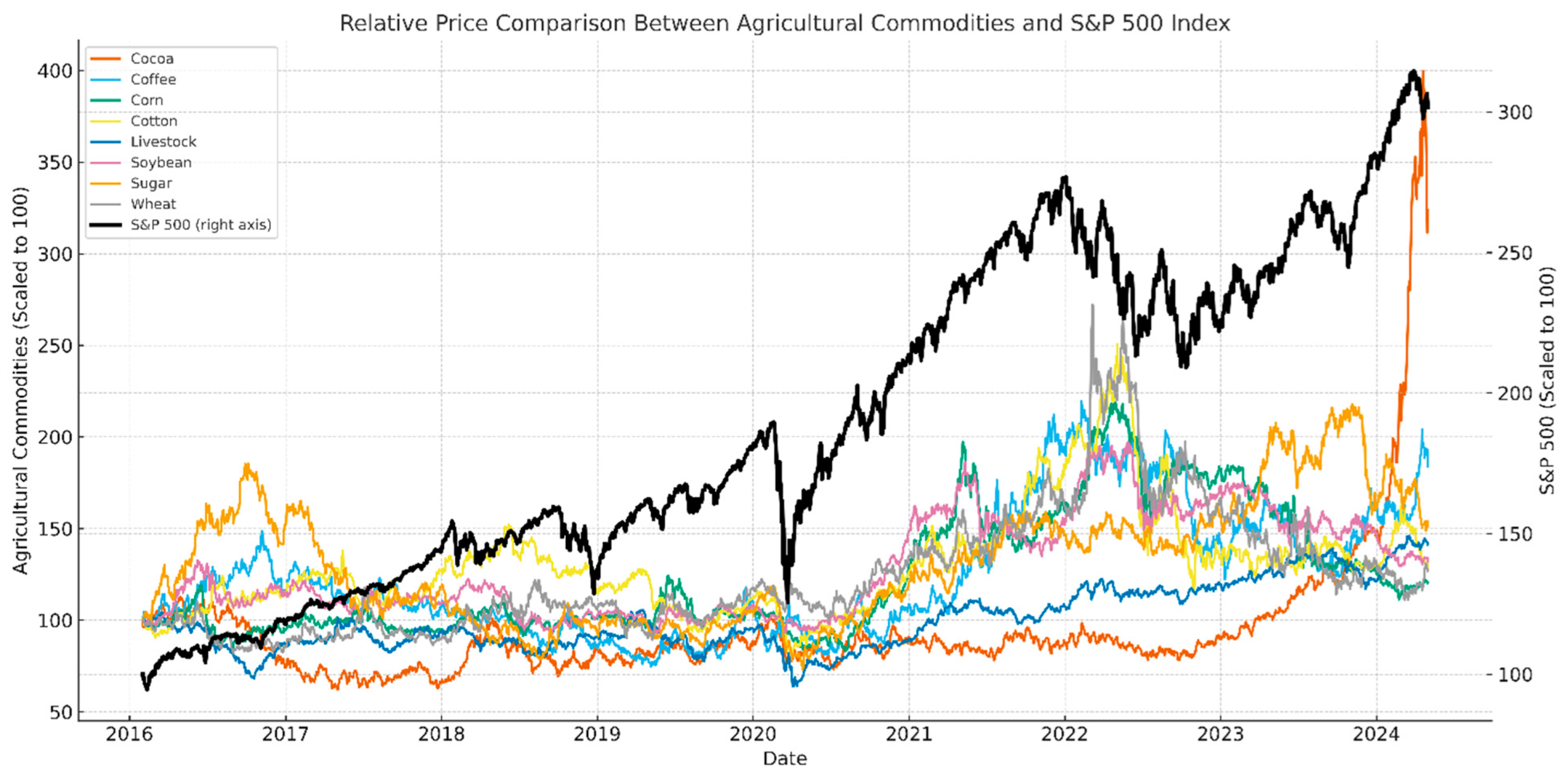
Figure 1 provides an overview of the scaled prices for the S&P 500 and various agricultural commodities, including cocoa, coffee, corn, cotton, livestock, soybeans, sugar, and wheat. The x-axis represents time (years), while the y-axis shows relative prices. The S&P 500 is plotted on the right axis, and the commodity series are plotted on the left; all series are scaled to 100 at the start of the sample. Each line reflects the percentage change relative to its starting value, allowing for a comparison of trends across all series. We observe that most agricultural commodity prices move closely together, except for cocoa. The divergence of cocoa from other commodities can be attributed to factors unique to this market, including supply side constraints in major producing countries, increased global demand, relatively inelastic demand due to limited substitutes in its primary uses, and market dynamics specific to the cocoa industry.
4. Results
We start our analysis by evaluating the price integration between agricultural commodities and low-ESG-risk funds. The results are presented in
Table 3. The observation that there is generally no price transmission from agricultural commodities to low-ESG-risk equity funds—except for a weak transmission from these funds to sugar and a transmission from cotton to the funds—can be explained by several interrelated factors. Firms with strong ESG profiles tend to have better risk management strategies, including effective hedging against commodity price fluctuations and climate-related exposures; during periods of market stress, such firms and portfolios exhibit greater resilience and lower downside sensitivity (
Albuquerque et al. 2020;
Ilhan et al. 2021). These mechanisms are consistent with evidence that climate risk is priced and that disclosure and investor monitoring improve information quality and capital allocation toward lower-risk firms (
Engle et al. 2020;
Ilhan et al. 2023). Such companies also diversify supply chains and sourcing, mitigating reliance on any single commodity or supplier; in equilibrium, lower carbon and transition risk exposures translate into attenuated covariance with climate-sensitive shocks (
Bolton and Kacperczyk 2021,
2023;
Pástor et al. 2022). This diversification minimizes the impact of price changes in any particular agricultural commodity on their overall costs and profitability. Thus, our finding of weak commodity-to-equity transmissions for low-ESG-risk portfolios reflects not an absence of sectoral links, but attenuated portfolio-level sensitivity to agricultural shocks—consistent with stronger risk management and lower climate news loadings in these portfolios (
Engle et al. 2020;
Ilhan et al. 2023).
The comparatively weak transmission from low-ESG-risk funds to sugar prices can be attributed to specific corporate influences on demand. Companies within low-ESG-risk funds may be significant consumers of sugar, particularly if they operate in industries such as food and beverages. If these companies adopt healthier product lines with reduced sugar content due to health and sustainability initiatives, their reduced demand could marginally affect sugar prices. Alternatively, firms with strong ESG commitments might shift toward certified or sustainably sourced inputs, which can alter demand dynamics in particular market segments; credible sustainability commitments and financing instruments (e.g., green bonds) are known to signal and support such shifts, with measurable capital market responses (
Flammer 2021;
Ceccarelli et al. 2024). This shift might not significantly impact global sugar prices but could generate weak price transmissions.
The observed price transmission from cotton to low-ESG-risk funds can be attributed to supply constraints for sustainably produced cotton and increased susceptibility of supply to adverse global factors. In other words, events affecting global cotton supply—such as extreme weather, pest infestations, or geopolitical tensions—can lead to price spikes. When firms commit to specific sourcing standards or face tighter operational constraints, fewer supplier options can amplify and pass through to costs. Such patterns are consistent with evidence that transition and physical risks carry priced exposures across sectors and geographies and that climate news shocks propagate into asset prices (
Bolton and Kacperczyk 2023;
Engle et al. 2020;
Pástor et al. 2022).
Replicating the approach, we next evaluate funds with high-ESG risk exposure under the price transmission framework. As the results presented in
Table 4 show, these funds are comparatively more susceptible to price shocks from agricultural commodities. This pattern is consistent with transition-risk exposures: carbon-intensive and sustainability-laggard firms command higher expected returns and exhibit stronger sensitivity to climate and transition shocks (
Bolton and Kacperczyk 2021,
2023). High-ESG-risk equity funds often comprise companies that are less attentive to ESG practices. These companies may operate in industries that are heavily reliant on agricultural commodities as key inputs. For example, such firms may have less diversified supply chains and rely on single sources or regions for their agricultural inputs. This makes them more susceptible to disruptions caused by weather events, geopolitical issues, or pandemics that affect commodity supplies. Elevated downside sensitivity among carbon-intensive firms (
Ilhan et al. 2021) and stronger return responses to climate news shocks (
Engle et al. 2020) provide a coherent mechanism for the stronger commodity-to-equity transmissions as we observe for corn, cotton, livestock, and soybeans. Without a focus on sustainability, high-ESG-risk companies may not invest in resource-efficient technologies, making their operations more sensitive to increases in commodity prices; this dovetails with evidence that environmental and social strengths are associated with greater market resilience during downturns (
Albuquerque et al. 2020). In addition, these companies often operate on thinner margins due to less efficient operations and may therefore be more affected by commodity price changes. A significant portion of their costs is tied to raw materials. When prices of commodities such as corn, cotton, livestock, and soybeans rise, these companies face higher input costs that directly reduce profitability. Moreover, such companies may face heightened risks from changing regulations aimed at environmental protection or social responsibility, which can affect commodity prices and availability; the global pricing of transition risk suggests that such regulatory shifts are material for valuations (
Bolton and Kacperczyk 2023;
Pástor et al. 2022).
The results in
Table 4 also show bidirectional transmission between high-ESG-risk funds and commodities such as corn and livestock, suggesting a feedback loop. One plausible channel is that rising commodity prices increase operational costs for high-ESG-risk companies, depressing performance and prompting rebalancing or flow-driven trading that further affects commodity exposures; related evidence indicates that sustainability-tilted investor demand and product design can reallocate capital and shape comovement (
Ceccarelli et al. 2024;
Gantchev et al. 2024;
Pástor et al. 2022). Declines in the performance of these companies can lead to reduced investment and production in sectors dependent on corn and livestock, potentially affecting demand and prices for these commodities. While our framework is intentionally agnostic about the microstructure of the feedback, the estimated two-way transmissions are consistent with a combination of transition-risk fundamentals and clientele-driven propagation documented in recent top-tier finance research.
In the next section, we test the volatility integration between low- and high-ESG-risk equity funds and agricultural commodities. As
Table 5 shows, there is minimal volatility transmission to low-ESG-risk funds. We attribute this pattern to effective risk management initiatives. Low-ESG-risk companies typically exhibit strong ESG practices and, in turn, robust risk management frameworks. These companies proactively manage environmental and social risks, including those related to commodity price volatility. Firms within the low-ESG-risk category also tend to have diversified operations and supply chains, reducing their reliance on any single commodity. In addition, they often emphasize resource efficiency, innovation, and sustainable sourcing, which buffer them against input cost fluctuations. Moreover, firms with strong ESG profiles may prioritize long-term sustainability over short-term gains. This orientation is consistent with evidence that portfolios tilted toward stronger ESG characteristics display greater resilience during downturns and lower downside sensitivity to climate-related shocks (
Albuquerque et al. 2020;
Ilhan et al. 2021), as well as with findings that climate-risk disclosure improves information quality and capital allocation toward lower-risk firms (
Ilhan et al. 2023). Collectively, these mechanisms help rationalize the limited volatility transmission from agricultural commodities to low-ESG-risk funds.
Table 5 also shows volatility spillovers from low-ESG-risk funds to several agricultural commodities, including corn, livestock, soybean, sugar, and wheat. We interpret these findings from the perspective of market dynamics. Low-ESG-risk funds often comprise firms that are market leaders and trendsetters; increased volatility in these firms can signal shifts in economic conditions, corporate performance, or investor confidence. When volatility rises in low-ESG-risk funds, investors may reassess their portfolios and reallocate between equities and commodities, generating the integration observed in the data. This interpretation aligns with equilibrium models in which sustainability characteristics shape investor demand, the cost of capital, and comovement (
Pástor et al. 2021,
2022), as well as with evidence that disclosure and product design influence flows and portfolio tilts (
Ilhan et al. 2023;
Ceccarelli et al. 2024;
Gantchev et al. 2024). Increases in volatility among traditionally stable, lower-risk equities can heighten risk aversion and prompt rotation toward commodity exposures perceived as hedges, thereby amplifying spillovers to grain and soft markets.
We also propose that the financialization of commodities is an additional factor underlying these results. As commodities are increasingly used for diversification, hedging, and speculative purposes, equity market volatility can spill over to commodity markets through cross-asset allocation rules and rebalancing, including the actions of institutions employing index products and systematic strategies. From a cash-flow perspective, large asset managers may move funds between asset classes in response to volatility shocks, thereby affecting commodity prices. Such reallocations are consistent with evidence that climate news risk loads on equity returns and that sustainability preferences shape cross-asset covariances (
Engle et al. 2020;
Pástor et al. 2022). In our setting, these dynamics provide a plausible channel for the observed equity-to-commodity volatility spillovers from low-ESG-risk funds to corn, livestock, soybean, sugar, and wheat.
In the final part of our analysis, we evaluate volatility transmission involving high-ESG-risk funds (
Table 6). Our findings clearly show that these equities are highly susceptible to volatility in all agricultural commodities examined. This pattern is consistent with the view that firms with higher transition and physical risk exposures exhibit greater downside risk and volatility sensitivity when sustainability-related shocks materialize, and that such exposures are priced in equilibrium (
Bolton and Kacperczyk 2021,
2023;
Ilhan et al. 2021). High-ESG-risk companies may also be less likely to deploy effective hedges against climate-sensitive input costs or to benefit from transparency premia; climate news shocks load on returns and generate time-varying covariances (
Engle et al. 2020), while improved disclosure is associated with better information quality and capital allocation toward lower-risk profiles (
Ilhan et al. 2023). A lack of diversification and resilience in supply chains can further heighten exposure to disruptions such as extreme weather events or geopolitical constraints that affect commodity availability; in such settings, transition-risk repricing and operational sensitivity reinforce elevated volatility pass-through (
Bolton and Kacperczyk 2023).
Moreover, the feedback loops observed with commodities such as coffee, corn, cotton, livestock, and soybeans are consistent with both fundamental and investor-flow channels. Volatility in high-ESG-risk equities can prompt rebalancing and product-level flows that reshape exposures across assets, while commodity-side volatility increases input costs and compresses margins, thereby amplifying equity volatility in return. Recent evidence indicates that sustainability preferences and product design influence flows and portfolio tilts, with implications for comovement and propagation across markets (
Pástor et al. 2022;
Ceccarelli et al. 2024;
Gantchev et al. 2024). In other words, negative expectations about high-ESG-risk companies during episodes of commodity volatility can trigger reallocations that raise trading intensity and volatility on both sides of the equity–commodity interface, consistent with the bidirectional transmissions estimated in
Table 6.
5. Conclusions
This study examines the integration between diversified U.S. equity funds, categorized by their environmental, social, and governance (ESG) risk scores, and major agricultural commodity markets. It focuses on how price and volatility are transmitted between these financial assets and agricultural commodities such as cocoa, coffee, corn, cotton, livestock, soybeans, sugar, and wheat. Utilizing methods that account for all types of structural breaks, the research offers valuable insights into the integration and shock susceptibility of equities to agricultural markets.
Our study shows that agricultural commodity shocks transmit unevenly across equities when portfolios are segmented by ESG risk exposure. Using capitalization-weighted portfolios of diversified U.S. equity funds and daily agricultural spot indexes, we document that low-ESG-risk portfolios are generally insulated from commodity-to-equity price and volatility spillovers, whereas high-ESG-risk portfolios exhibit pronounced and, in many cases, bidirectional transmissions—especially with coffee, corn, cotton, livestock, and soybeans. These patterns remain after conditioning on broad market movements and are consistent with the notion that ESG risk proxies for firms’ exposure to transition and supply chain vulnerabilities are salient in agricultural markets. The evidence of feedback between high-ESG-risk equities and key commodities strengthens the interpretation that linkages operate through both cash flow and trading channels.
Our findings align with and extend recent asset-pricing research, showing that sustainability characteristics are priced and shape covariances. In equilibrium, investor tastes and hedging demands imply that greener assets carry lower expected returns but can experience high realized performance when sustainability concerns increase (
Pástor et al. 2021,
2022). We add that the propagation of commodity shocks is itself heterogeneous across ESG risk segments, consistent with transition-risk premia linked to emissions exposure (
Bolton and Kacperczyk 2021;
Bolton and Kacperczyk 2023) and with tail-risk asymmetries in climate-sensitive firms (
Ilhan et al. 2021). Moreover, our results resonate with evidence that climate-risk disclosure and investor ownership structure affect resilience (
Ilhan et al. 2023) and with work showing that product labels and carbon-risk metrics reallocate flows and induce portfolio tilts (
Ceccarelli et al. 2024;
Gantchev et al. 2024). By documenting stronger and more symmetric spillovers in high-ESG-risk equities even after controlling for market conditions, we provide time-series evidence on a distinct channel through which sustainability-related risks shape cross-asset comovement.
Methodologically, our contribution is to measure price and volatility transmissions using estimators that are explicitly robust to unknown numbers, timings, magnitudes, and—crucially—forms of structural breaks. Preliminary F-trig diagnostics reject the absence of trigonometric terms at the 1% level for all series, indicating pervasive smooth breaks and directly motivating our Fourier-augmented VAR (Toda–Yamamoto) and LM-GARCH-Fourier specifications. Allowing the transmission structure to evolve smoothly is not merely a technical refinement; it changes the economic interpretation. Without this flexibility, gradual shifts associated with climate policy, supply disruptions, and investor clientele rotation risk being misclassified as stability or discrete jumps, leading to biased inference about commodity–equity integration. Accordingly, our evidence that high-ESG-risk portfolios are tightly linked to agricultural commodities while low-ESG-risk portfolios are comparatively insulated rests on identification choices that the data themselves validate.
Importantly, the contribution here is not a simple reconfirmation of prior commodity–equity results. First, we focus on ESG risk exposure rather than ESG names or labels, thereby sidestepping the measurement and incentive issues highlighted by recent top-tier studies on rating divergence and manager incentives (
Berg et al. 2022;
Gantchev et al. 2024). Second, by examining cross-market propagation instead of cross-sectional average returns, we speak directly to how sustainability risk shapes dynamic resilience to commodity shocks—a dimension not adjudicated by debates on the carbon premium per se (
Aswani et al. 2024). Third, the documented bidirectional volatility transmissions between high-ESG-risk equities and several commodities provide new evidence on potential feedback loops, which is consistent with the financialization of commodities and with flow-pressure mechanisms among sustainability-oriented investors.
Policy and practitioner implications follow directly. For policymakers and supervisors, heterogeneous and time-varying spillovers imply that climate-related stress tests and macroprudential surveillance should incorporate sectoral ESG risk segmentation and cross-asset channels, not just firm-level exposures. Our results support policies that improve the comparability and credibility of climate disclosures—areas in which institutional investors already express demand—because clearer information lowers the risk of destabilizing reallocations when commodity shocks occur (
Ilhan et al. 2023). For market participants, integrating ESG risk into commodity risk management is consequential: low-ESG-risk portfolios appear to offer natural partial hedges against agricultural shocks, while high-ESG-risk portfolios warrant tighter risk budgets, dynamic hedging of input cost exposure, and liquidity management calibrated to the stronger and more symmetric volatility linkages we document. For asset managers marketing sustainability products, our results suggest that transparent alignment between stated mandates and portfolio construction is essential, given the flow–performance trade-offs documented in the recent literature (
Ceccarelli et al. 2024;
Gantchev et al. 2024).
Taken together, the evidence shows that ESG risk exposure is a first-order determinant of how agricultural commodity shocks propagate to equities. By combining a theoretically motivated segmentation with structural-break-robust econometrics, we uncover pricing and volatility linkages that conventional models miss. These findings broaden the agenda for sustainable asset pricing by highlighting a cross-asset mechanism through which transition and supply chain risks reach equity investors and by demonstrating that allowing for gradual regime change is essential to measuring those mechanisms reliably.
While the study provides new evidence on the heterogeneous transmission of agricultural commodity shocks across ESG-risk-segmented equity portfolios, some limitations should be acknowledged. First, our measurement of ESG risk relies entirely on Morningstar’s ESG Risk Exposure scores, which are sourced “as-is” rather than constructed or validated independently. As highlighted in recent research on ESG rating divergence, provider methodologies can vary substantially, potentially affecting the stability, comparability, and informational content of the underlying scores (
Berg et al. 2022). Second, although we sort funds by Morningstar’s unmanaged-risk framework, we do not observe fund-level ESG integration practices or the extent to which the reported scores reflect true portfolio exposures. Third, our results are based on U.S. diversified equity mutual funds and eight major agricultural commodities; thus, caution is warranted when generalizing to other asset classes, international markets, or broader commodity categories such as energy or metals. Finally, while we document cross-market dynamics at the portfolio or fund level, the study does not disentangle specific firm-level channels or structural supply chain linkages that may drive these aggregate effects.