Next Article in Journal
Why Do Family Firms Hold Cash? Agency Conflicts and Valuation Perspectives
Previous Article in Journal
ESG and Its Components: Impact on Stock Returns Across Firm Sizes in Europe and the United States
error_outline You can access the new MDPI.com website here. Explore and share your feedback with us.
 
 
Article

Legal Dimensions of Global AML Risk Assessment: A Machine Learning Approach

1
Department of Theory of Law and Constitutionalism, West Ukrainian National University, 46009 Ternopil, Ukraine
2
Department of Computer Science and Automatics, University of Bielsko-Biala, 43-309 Bielsko-Biala, Poland
3
Department of Computer Science, West Ukrainian National University, 46009 Ternopil, Ukraine
4
Department of Criminal Law and Process, West Ukrainian National University, 46009 Ternopil, Ukraine
5
Department of Law and Humanities, Vinnytsia Education and Research Institute of Economics, West Ukrainian National University, 46009 Ternopil, Ukraine
6
Department of Administrative Law and Judicial Procedure, West Ukrainian National University, 46009 Ternopil, Ukraine
7
Department of Public Law, Yuriy Fedkovych Chernivtsi National University, 58012 Chernivtsi, Ukraine
*
Authors to whom correspondence should be addressed.
Submission received: 2 October 2025 / Revised: 13 December 2025 / Accepted: 23 December 2025 / Published: 3 January 2026

Abstract

Money laundering poses a serious threat to financial stability and requires effective national frameworks for prevention. This study investigates how the quality of legal and institutional frameworks affects the effectiveness of national anti-money laundering (AML) systems and their implications for financial risk management. We conducted an empirical analysis of 132 jurisdictions in 2024 using the Basel AML Index (AMLI) and the WJP Rule of Law Index (RLI). The Random Forest method was employed to model the relationship between rule-of-law indicators and AML risk levels. Findings reveal a significant inverse relationship between rule-of-law indicators and AML risk levels, with an overall classification accuracy of 69.6%. The model performed best for low-risk countries (precision 75%, recall 92.31%), moderately for medium-risk countries (precision 65.22%, recall 78.95%), but failed to identify high-risk jurisdictions, suggesting a legal institutional “threshold” necessary for effective AML functioning. Key predictors included protection of fundamental rights and mechanisms for civil oversight, with strong negative correlations between AML risk and criminal justice impartiality (−0.35), civil justice fairness (−0.35), and equality before the law (−0.41). These results show that legal factors strongly affect AML risk and can guide regulators in improving risk-based standards, enhancing regulatory certainty, and managing financial risk.

1. Introduction

In today’s globalized financial environment, AML has become one of the most critical challenges for national economies and international financial stability. According to the United Nations Office on Drugs and Crime, the volume of money laundered annually worldwide represents 2–5% of global GDP, or between 800 billion and 2 trillion US dollars (United Nations 2025). This phenomenon not only undermines the economic stability of individual states but also introduces systemic financial risks. At the same time, compliance costs have reached critical proportions: fintech companies and banks spend approximately 206 billion dollars annually on financial crime compliance (FinTech 2025). The originality of this study lies in introducing a quantitative machine learning approach to assess the predictive power of legal-institutional quality for AML system performance at a global level, bridging the gap between rule-of-law theory and empirical financial risk modeling. This figure is particularly striking given that, despite stringent regulatory measures, law enforcement agencies recover only a small fraction of these illicit transactions, indicating the low effectiveness of existing control mechanisms (Basel Institute on Governance 2025).
The international response to this challenge has been shaped through the establishment of a comprehensive system of standards and technical guidance. The Financial Action Task Force (FATF) has developed 40 Recommendations (latest update June 2025), forming the international standard for national AML and countering the financing of terrorism (CFT) (FATF 2025b). These recommendations cover seven key areas, including policy coordination and international cooperation. Implementation occurs through Mutual Evaluation processes, which assess technical compliance and effectiveness of national systems (FATF 2023). The Organisation for Economic Co-operation and Development complements this architecture through the Common Reporting Standard (updated in 2023 and incorporated into the International Standards for Automatic Exchange of Information in Tax Matters), which establishes standards for automatic exchange of financial information between tax authorities, as well as through the Crypto-Asset Reporting Framework for tracking crypto-asset transactions (OECD 2023). The Bank for International Settlements, through the Basel Committee on Banking Supervision, sets prudential standards for the banking sector, including requirements for Customer Due Diligence and financial crime risk management (BCBS 2022). At the European Union level, the European Banking Authority develops binding Regulatory Technical Standards (Open Banking 2025) and guidance for competent authorities on the application of the Sixth AML Directive, which together with the AML Regulation (EUR-Lex 2024a, 2024b) and the new Authority for AML/CFT (UNICEF 2022) forms a comprehensive EU AML/CFT package (EBA 2025). National regulators transform these international standards into specific supervisory requirements and enforcement practices.
At the same time, the regulatory and legal framework architecture is not limited solely to top-level standards and directives. The European Banking Authority systematically publishes Implementing Technical Standards, which elaborate on the procedural aspects of regulatory compliance, particularly regarding reporting formats, risk assessment methodologies, and criteria for customer classification by risk level (Huertas 2025). These technical standards have direct legal force in all EU Member States following their adoption by the European Commission, ensuring uniformity of supervisory practices. Competent authorities of Member States, in turn, develop their own corpus of methodological materials, including thematic reviews, reports on supervisory inspection results, clarifications on the interpretation of regulatory norms, and industry best practices. National financial sector regulators, such as the Federal Financial Supervisory Authority in Germany (BaFin 2025), the Prudential Supervision and Resolution Authority in France (ACPR 2025), and the Financial Conduct Authority in the United Kingdom (FCA 2025), publish regular reports on financial crime trends, typological studies of money laundering schemes, and statistics on enforcement measures, which constitute an important source of empirical data for risk assessment.
Additionally, international financial institutions, notably the International Monetary Fund (IMF 2025), conduct assessments of national AML/CFT systems within the framework of the Financial Sector Assessment Program and publish detailed technical reports analyzing the strengths and weaknesses of regulatory regimes in individual jurisdictions (IMF 2024). This multi-layered documentary base, ranging from international principles to national guidelines, creates a complex regulatory ecosystem that requires financial institutions not only to achieve formal compliance but also to develop a substantive understanding of regulatory logic and the capacity to transform abstract regulatory requirements into specific operational procedures for risk assessment and management.
However, despite the developed regulatory and technical architecture, there exists a fundamental gap between the volume of regulatory instruments and their practical effectiveness. Notwithstanding the exponential growth of compliance costs and the strengthening of regulatory requirements through the implementation of the FATF 40 Recommendations (EUR-Lex 2024a, 2024b; FATF 2004), and Basel Committee guidelines (UNEPFI 2022), the effectiveness of detecting and preventing money laundering operations remains critically low. According to FATF Mutual Evaluation Reports, even in countries with formally high levels of technical compliance ratings, significant discrepancies are observed in the effectiveness ratings of national AML/CFT systems (AlQudah et al. 2025). This gives rise to a fundamental research question: what factors determine the success of national AML systems beyond formal compliance with international technical standards?
The quality of legal regulation, traditionally measured through various rule-of-law indices, should theoretically correlate with AML system effectiveness; yet empirical studies of this relationship remain fragmented and methodologically limited (Cotoc et al. 2021). The global nature of modern financial crimes and the need for harmonized approaches to assessing national financial risks make this issue particularly relevant (Adamyk et al. 2025a, 2025b, Kovalchuk et al. 2024, Chen et al. 2024). Existing AML risk assessment methodologies, particularly the AMLI, incorporate legal environment indicators as one component of a comprehensive evaluation (Basel Institute on Governance 2025).
The existing literature focuses predominantly on the analysis of technical compliance with the FATF 40 Recommendations (Hoffman et al. 2024; Masunda and Barot 2025), whereas the systemic impact of legal institutional quality on the effectiveness of AML systems remains insufficiently explored (Cotoc et al. 2021; Schiavo 2022). Its creating a significant gap in scientific understanding of the factors that determine national AML system effectiveness.
The quality of legal regulation, measured through various rule of law indices, particularly the RLI (World Justice Project 2025), should theoretically correlate with the effectiveness of AML systems; however, empirical studies of this relationship are fragmentary and methodologically limited.
The central research question of this study is: To what extent does the quality of legal institutions determine the effectiveness of national AML systems, and which specific components of the legal environment have the greatest predictive impact on the formation of AML risks across different jurisdictions?
This question arises from the observed dichotomy between technical compliance conformity—the formal implementation of FATF Recommendations (FATF 2004), EU AML Directives (EUR-Lex 2024a, 2024b), Basel Committee guidelines, and national regulatory requirements—and enforcement effectiveness—the actual capacity of national systems to detect, investigate, and prevent money laundering operations.
Existing methodologies for international assessment of AML risks, particularly the AMLI, integrate indicators of the legal environment as one of five domains of comprehensive evaluation. The AMLI, published annually by the Basel Institute on Governance since 2012, assesses jurisdictional vulnerability to money laundering based on 17 publicly available indicators, including data from FATF, Transparency International, and the Global Initiative against Transnational Organized Crime (Basel Institute on Governance 2025). However, the mechanisms and degree of influence of various aspects of legal regulation on the formation of AML risks remain insufficiently studied. Unlike FATF Mutual Evaluation Reports, which assess technical compliance and effectiveness of national AML/CFT systems through qualitative expert analysis (FATF 2025b), the AMLI offers a quantitative, cross-jurisdictionally comparable risk metric (Basel Institute on Governance 2025). This makes the AMLI particularly valuable for empirical investigation of AML risk determinants in a global context.
The hypotheses of this study are grounded in the integration of institutional economic theory, research on legal system effectiveness, and empirical observations regarding national AML/CFT practices:
H0. 
There exists a statistically significant inverse relationship between the quality of legal institutions, measured through the RLI, and the level of AML risks, measured through the AMLI. Countries with higher rule of law indicators demonstrate lower levels of vulnerability to money laundering. Institutional theory posits that the quality of legal institutions affects the transaction costs of financial crimes and the probability of detection/punishment of offenders. Strong legal institutions increase risks for criminals and reduce the attractiveness of a jurisdiction for money laundering.
H1. 
Different components of the RLI (constraints on government powers, absence of corruption, order and security, fundamental rights, open government, regulatory enforcement, civil justice, criminal justice) have differentiated impacts on the formation of AML risks. The effectiveness of AML systems depends on various aspects of the legal environment to varying degrees. For instance, absence of corruption may have a greater impact on AML regulatory enforcement than civil justice indicators. Identification of the most influential components can provide an empirical basis for prioritizing technical assistance in accordance with the FATF technical compliance framework.
H2. 
The effectiveness of predicting AML risks based on legal indicators varies depending on the risk level. Legal factors have different predictive capacities for countries with high, medium, and low levels of AML risks. In countries with high AML risk (often jurisdictions with weak institutions), legal factors may be dominant determinants, whereas in low-risk countries, variations may be explained by other factors (technological infrastructure, international cooperation, etc.).
H3. 
Legal factors alone cannot fully explain the formation of AML risks due to the multifactorial nature of this phenomenon, which includes economic, technological, geopolitical, and other determinants. The AMLI integrates five domains (Quality of AML/CFT Framework, Corruption and Bribery Risk, Financial Transparency and Standards, Public Transparency and Accountability, Legal and Political Risk) (Basel Institute on Governance 2025), of which legal factors (RLI is part of the Legal and Political Risk domain) constitute only one component. Empirical verification of the explanatory capacity of legal factors will enable assessment of their relative importance in the overall system of AML risk determinants.
The objective of this study is to determine the nature and degree of influence of legal institutional quality on the effectiveness of national AML systems through quantitative analysis of relationships between the AMLI and components of the RLI for various jurisdictions worldwide using machine learning (ML) methods.
The study focuses on the following research questions (RQs):
RT1: Conduct a comprehensive statistical analysis of empirical data from the AMLI and RLI for 2024 to identify correlational patterns between indicators of legal regulation quality and levels of AML risks in a global context.
RT2: Perform classification of countries by AML risk levels (high, medium, low) using the Random Forest method to reveal the predictive capacity of RLI indicators and compare with alternative classification methods.
RT3: Identify the most influential components of legal institutions in the formation of AML risks through analysis of feature importance and SHAP values.
RT4: Assess the effectiveness of using rule of law indicators for predicting AML risks at different levels and identify limitations of this approach in the context of the multifactorial nature of the money laundering phenomenon.
RT5: Develop scientifically grounded recommendations for optimizing methodologies of international AML risk monitoring, particularly for improving the AMLI methodology and FATF Mutual Evaluation processes, taking into account the empirically established role of legal factors.
To accomplish these tasks, the study applied a qualitative and quantitative research design, combining institutional-legal analysis, empirical modeling, and ML methods to identify and quantify the impact of legal institutional quality on the level of AML risks in a global context. This approach enables the establishment of statistical associations between indicators and reveals causal relationships and mechanisms of institutional quality’s influence on the effectiveness of AML/CFT systems. The integration of quantitative methods with institutional-legal analysis allows for simultaneous assessment of both the overall predictive capacity of legal indicators and the specific contribution of individual institutional components to the formation of AML risks at different levels.
The practical significance of the study lies in the possibility of using its results by international financial institutions to improve country-specific methodologies for assessing AML risks when making decisions regarding correspondent relationships, and by researchers to further develop empirical methodologies for evaluating the effectiveness of national AML/CFT systems. Moreover, the results provide an empirical foundation for justifying priorities of technical assistance and capacity-building programs in the context of implementing FATF standards.
The structure of the remaining part of the paper is as follows: Section 2 provides a literature review. Section 4 describes the comprehensive research methodology used to identify and quantify the relationship between legal institutional quality and the effectiveness of national AML systems. Section 3 is dedicated to highlighting the verification of the relationship between legal institutional quality and the effectiveness of national AML systems. The Section 5 provides the conclusions of this study.

2. Related Work

Despite the growing relevance of AML issues on a global financial scale, scientific research on the relationships between institutional-legal factors and quantitative AML risk assessment methodologies remains episodic and does not form a coherent theoretical concept. This section synthesizes contemporary AML research by examining the interplay between methodological challenges in risk assessment, the disruptive influence of digital and AI-driven financial technologies, and the evolving international regulatory frameworks, highlighting how legal-institutional factors shape both risk evaluation and the practical effectiveness of AML systems.

2.1. Methodological Challenges in AML Risk Assessment

A fundamental problem in the field of AML risk management is the absence of a universal assessment methodology, which is conditioned by the uniqueness of each organization’s business context Miliauskas (2024). Nugiantari A. R. examined the role of legal risk assessment in international business transactions, identifying eight key risk criteria from disparities in legal systems to regulatory compliance issues. The author proposed an adaptive, unified legal risk assessment framework that can be applied across different sectors to ensure both legal compliance and effective financial risk management (Nugiantari 2025).
Alongside methodological challenges, a significant problem remains the human factor in the decision-making process regarding AML risks. H. Ogbeide et al. studied the cognitive characteristics of experts and novices during AML risk assessment, particularly susceptibility to biases and judgment errors. The authors found that both experts and novices demonstrate overconfidence effects, manifesting in a tendency to favor false-positive results over false-negative ones, which may generate inaccurate financial risk evaluations (Ogbeide et al. 2023).
At the global level, there is an uneven distribution of AML risks across jurisdictions, which requires differentiated approaches to their assessment and management. Osman A. H. examined the effectiveness of the AMLI as a tool for quantitative measurement and analysis of money laundering risks across different countries and territories. He identified substantial differences between jurisdictions in financial risk levels, regulatory effectiveness, and implementation challenges for countermeasures, determining the need for targeted reforms and precision interventions to address gaps in global financial risk monitoring systems (Osman 2025).
These jurisdictional disparities underscore the importance of understanding the underlying institutional factors that shape AML performance—a connection that becomes increasingly relevant as financial systems undergo digital transformation.

2.2. Digital Transformation and Technological Innovation in AML

The methodological challenges identified above are further complicated by rapid technological change in the financial sector. The evolution of digital financial technologies, particularly cryptocurrencies, has created fundamentally new dimensions of AML risks that require rethinking of existing approaches to their assessment. A. Rejeb and co-authors investigated the evolution of scientific knowledge about Bitcoin by analyzing over 4000 scientific articles and identifying key themes such as market efficiency, digital currencies, and privacy. Their work traced the development of scientific discourse from analyzing Bitcoin’s structure and anonymity to its role in the global economy and financial markets, creating an important conceptual bridge between digital financial innovations and new challenges in AML (Rejeb et al. 2023).
W. Gaviyau and A. B. Sibindi conducted a bibliometric review and meta-analysis of contemporary developments in Customer Due Diligence in the era of financial technologies, analyzing the Scopus database to identify key research themes and geographical features of scientific discourse (Gaviyau and Sibindi 2023a).
Yi. Haiying investigated the application of information technologies in implementing AML measures in cross-border payment systems, analyzing the use of big data, artificial intelligence, and blockchain. The author found that these technologies significantly increase the ability of financial institutions to identify and prevent money laundering operations; however, their implementation is accompanied by challenges regarding data privacy protection, technical compatibility, and security (Haiying 2024).
While technological solutions offer enhanced detection capabilities, their effectiveness ultimately depends on the strength of the legal and regulatory frameworks within which they operate, highlighting the need for coherent international standards.

2.3. Artificial Intelligence and Explainability in Financial Fraud Detection

While technological solutions offer enhanced detection capabilities, their effectiveness ultimately depends on the sophistication of AI models and their interpretability—challenges that have become central to contemporary AML research.
L. Moura et al. reviewed AI applications in financial fraud prevention through bibliometric analysis of 137 peer-reviewed articles published between 2015 and 2025. The authors systematically revealed three main research themes: AI-based fraud detection models, blockchain and fintech integration, and big data analytics, with research interest surging since 2019, primarily led by China and India, though the study found limited international collaboration and insufficient focus on ethical, regulatory, and organizational dimensions of AI implementation in fraud prevention (Moura et al. 2025).
K.-C. Yao et al. investigated the application of generative AI in financial risk forecasting to assess its potential in enhancing predictive accuracy and model interpretability. The results showed that generative AI significantly improves both accuracy and interpretability of financial risk models through data augmentation and feature extraction, though the study identified challenges, including data quality, model training costs, and regulatory compliance, that require careful management for successful implementation (Yao et al. 2025).
S.K. Aljunaid et al. proposed an explainable federated learning model for financial fraud detection that integrates explainable AI techniques with federated learning to address privacy concerns and interpretability limitations in traditional AI-based fraud detection systems. The results demonstrated that the model achieved 99.95% accuracy with a miss rate of 0.05% using SHAP and LIME for interpretability, effectively reducing false positives while maintaining data privacy and regulatory compliance, proving the effectiveness of combining privacy-preserving federated learning with explainability for enhanced fraud detection in banking systems (Aljunaid et al. 2025).
P. Giudici et al. developed an explainable AI method for time series data by extending the Shapley–Lorenz approach to neural networks and recurrent neural networks, accounting for temporal dependencies. The results demonstrated that recurrent neural networks outperformed classic neural networks in accuracy and robustness. Bitcoin prices were primarily influenced by their lagged values with limited explainability through classical financial assets, and recurrent neural networks effectively captured the contribution of classical assets to Bitcoin price prediction despite their limited magnitude (Giudici et al. 2024).
F. Ertam proposed an AI-based framework using XGBoost, LightGBM, and CatBoost to detect suspicious Ethereum wallets involved in illicit activities such as fraud and money laundering. The author developed high detection accuracy between 95.83% and 96.46%, with the system capable of near real-time predictions for wallet addresses, and SHAP visualizations provided interpretability by highlighting feature contributions, confirming the effectiveness of AI-driven methods in monitoring and securing blockchain transactions against fraudulent activities (Ertam 2025).
L. Rodríguez Valencia and co-authors conducted a systematic review examining the integration of AI in compliance frameworks for cryptocurrency fraud detection between 2014 and 2025, analyzing 353 peer-reviewed studies using bibliometric methods. The results identified key trends including the adoption of machine learning, deep learning, natural language processing, and generative AI to improve fraud detection efficiency, while highlighting persistent challenges such as limited AI model transparency, regulatory fragmentation, insufficient access to quality data, and underexplored long-term real-world effectiveness of AI tools, emphasizing the need to bridge the gap between theoretical research and practical implementation in cryptocurrency fraud detection (Rodríguez Valencia et al. 2025).
These advances in AI-driven fraud detection, while promising, underscore a critical reality: technological capabilities can only be fully realized within robust legal and regulatory frameworks that ensure their proper implementation and oversight.

2.4. International Regulatory Frameworks and Implementation Gaps

Recognizing that neither methodological innovations nor technological advancements can succeed in isolation from robust legal foundations, an adaptive framework at the level of international regulatory mechanisms was proposed by S. S. Yeh. The author developed 19 model recommendations for the FATF, grounded in the provisions of the Anti-Corruption Protocol to the UN Convention against Corruption, aimed at addressing significant gaps in the international legal and regulatory system. Yeh substantiated the necessity of creating independent international anti-corruption mechanisms, including specialized courts, a UN inspector system, and strengthened requirements for the disclosure of beneficial ownership information (Yeh 2022a, 2022b). The researcher further analyzed the implementation possibilities for international requirements on beneficial ownership transparency, translating key provisions of the protocol into recommendations for the Organization for Security and Co-operation in Europe.
M. Grabowski conducted a legal analysis of European Union regulations and soft law acts concerning the application of AML/CFT measures by third-party payment initiation service providers and account information service providers introduced under the Second Payment Services Directive. The author established that, although third-party service providers are obliged entities under AML/CFT legislation, the extent to which customer due diligence measures are applied varies depending on the service provision model, leading to the formulation of de lege ferenda proposals for clarifying these provisions in future EU regulations (Grabowski 2024).
W. Gaviyau and Sibindi conducted a qualitative analysis of global AML/CFT regulations, their application, and evolution in a dynamic environment, investigating documents from various jurisdictions. The authors found that the implementation of global AML/CFT regulations differs significantly between countries due to political and economic factors, and that the main shortcomings of the existing system are related to the practical application of regulations, technological innovations, cyberattacks, and data privacy issues, necessitating research to update FATF Recommendations to reflect the dynamic nature of risks (Gaviyau and Sibindi 2023a).
These regulatory implementation challenges raise important questions about the actual effectiveness of AML systems on the ground, which requires empirical erification through quantitative performance indicators.

2.5. Empirical Analysis of AML System Effectiveness

Building on the regulatory framework analysis, empirical studies have attempted to measure the actual performance of AML systems across different jurisdictions.
C.-N. Cotoc et al. analyzed the effectiveness of AML measures in EU countries using data on suspicious transactions reported to Financial Intelligence Units. The study found an increase in both the quantity and quality of suspicious transaction reports and improved information exchange between EU countries; however, case referrals to law enforcement agencies showed no consistent trend, highlighting the need for stronger international coordination and cooperation (Cotoc et al. 2021).
V. Levchenko et al. studied cyclical patterns of money laundering risk as a global threat to economic and financial stability. They identified theoretical and methodological approaches to modeling this process and revealed peaks, declines, and the duration of money laundering cycles in developed and transition economies, highlighting the importance of predictive modeling in financial risk management (Levchenko et al. 2019).
In determining the AMLI 2024, the calculation methodology was modified (Basel Institute on Governance 2025). The introduction of new indicators (financial crimes and cyber-dependent crimes) directly reflects the strengthening role of legal regulation in mitigating financial and operational risks. AMLI is increasingly influenced by the quality of legislative mechanisms aimed at criminalizing such acts, defining investigation procedures, and the effectiveness of judicial prosecution. Moving the Financial Secrecy Index indicator to the financial transparency block emphasizes the importance of legal norms regarding access to beneficial ownership information, corporate structure transparency, and international cooperation in data exchange. The index methodology update confirms that legal factors, including the criminalization of new forms of crime, regulation of financial transparency, and alignment of national systems with international FATF standards, increasingly determine the overall financial risk assessment in individual jurisdictions.
This evolution of the AMLI methodology toward incorporating legal-institutional factors provides a foundation for systematic quantitative analysis of the relationship between rule of law quality and AML effectiveness.

2.6. Research Gap

The preceding review reveals that existing research has examined methodological frameworks, technological solutions, and regulatory compliance largely as separate domains. Research evidence indicates a conceptual gap in studying the legal determinants of AML related financial risks through the lens of modern computational methodologies. While existing studies address individual aspects of AML effectiveness, such as methodological frameworks, technological solutions, regulatory compliance, or empirical trends, there is a lack of comprehensive quantitative analysis that directly links legal institutional quality, measured through rule of law indicators, with national AML system performance across diverse jurisdictions.
This study addresses this gap by applying ML methods to integrate the RLI with the AMLI, enabling the first systematic quantitative assessment of how specific legal institutional components predict AML risk levels globally. By bridging the methodological, technological, and regulatory dimensions identified in this review, unlike previous qualitative or single-jurisdiction studies, this research provides empirically derived threshold values and predictive models that can inform both regulatory policy and financial risk management practices across 132 countries worldwide.

3. Results and Discussion

To verify the hypothesis regarding the relationship between the robustness of legal institutions and the efficiency of national AML frameworks, the Random Forest ML method was applied, using RLI components as predictor variables to classify countries by AML risk levels (high, medium, low). The obtained estimates provide evidence of a statistically significant link between RLI indicators and AML risks, with an overall classification accuracy of 69.6%. This finding directly addresses RT1 and provides empirical support for H0, confirming that statistically significant correlations exist between legal regulation quality indicators and AML risk levels across 132 analyzed jurisdictions.
The results of the Random Forest model are presented in Table 1.
Findings from the Random Forest model indicate varying levels of effectiveness in classifying countries by AML risk. The most reliable results were observed for the low-risk group, with a precision of 75.00% and recall of 92.31%. This means the model can correctly identify most countries with genuinely low money laundering risk. This has practical significance for due diligence procedures (Küçükçolak et al. 2025) and risk management in the international banking sector, as it allows the relatively confident exclusion of low-risk jurisdictions from in-depth verification. For national regulators of low-risk countries, these results create an empirical basis for justifying the prioritization of investments in strengthening legal institutions as an effective mechanism for reducing jurisdictional reputational risks. For compliance units of financial institutions, high accuracy indicators allow for the optimization of limited supervisory resource allocation, focusing attention on jurisdictions with higher risks. The high classification quality in this category also confirms a close relationship between the level of legal regulation and AML system effectiveness.
For the medium-risk category, the model demonstrates moderate performance: precision is 65.22% and recall is 78.95%. Legal factors are significant but not decisive for assigning countries to this group. In other words, while legal indicators can identify medium risk in most cases, additional variables, such as institutional and macroeconomic characteristics, should be considered to improve classification accuracy. These results fulfill RT2 and partially validate H1, demonstrating that RLI indicators possess strong predictive capacity for low-risk countries (75% precision) and moderate capacity for medium-risk countries (65.22% precision), but are insufficient for high-risk classification. The differentiated predictive performance across risk categories supports H2. From a regulatory policy perspective, these results substantiate the necessity of a differentiated approach to medium-risk countries, where regulators should develop additional assessment criteria that consider not only formal legal indicators but also the effectiveness of their practical application and the institutional capacity of supervisory authorities.
The greatest limitations occurred when classifying high-risk countries: the model failed to identify this group entirely (precision and recall = 0%). Among the 132 analyzed countries, only 21 were high-risk, creating a significant class imbalance. Consequently, the model had a limited number of training examples, which hindered stable pattern formation and reduced classification accuracy. This reflects the classic class imbalance problem common in socio-economic data analysis (Transparency International 2025). Beyond statistical limitations, the failure to predict high-risk levels also highlights the multifactorial nature of AML risks, which depend not only on legal factors but also on economic, political, and institutional conditions. This aligns with the AMLI methodology, which incorporates corruption levels, governance quality, economic stability, compliance with financial standards, and other factors. This outcome directly addresses RT4 and substantiates H3, revealing a critical limitation: rule-of-law indicators alone cannot predict high AML risk levels, indicating that extreme risks are driven by factors beyond legal institutional quality. The model’s inability to identify high-risk jurisdictions based solely on legal indicators has critical implications for shaping international financial monitoring policy. It signals to regulators and international organizations the need to develop comprehensive intervention programs that combine legal reforms with political stabilization, anti-corruption efforts, and institutional development. For financial institutions, this means that when working with high-risk jurisdictions, enhanced due diligence procedures must be applied, extending beyond the analysis of formal legal norms.
Legal regulation in AML combines international standards (particularly FATF Recommendations), regional initiatives, and national legislation (Global Initiative 2025). It encompasses norms regarding financial monitoring, beneficial ownership transparency, information exchange between authorities, and the application of sanctions for non-compliance. High-quality regulation involves both the formal adoption of laws and their practical implementation, institutional effectiveness, and the capacity to enforce real control over financial operations. The distinction between formal and actual implementation largely explains the variability in model results.
In high-risk countries, formally strong legal norms often coexist with low practical effectiveness (Gaviyau and Sibindi 2023a; Salman et al. 2024). Institutional weakness, corruption, or political influence limits law enforcement and financial regulators’ ability to apply formal requirements (e.g., beneficial ownership transparency or penalties) (FATF 2025b; Hou et al. 2025). Such discrepancies explain the model’s inability to identify high-risk countries. While these countries may have appropriate legal norms on paper, enforcement is weak or inconsistent.
The analysis confirms the importance of legal factors in classifying low- and medium-risk countries while highlighting the limitations of relying solely on legal indicators for predicting high-risk jurisdictions. In answer to the central research question and addressing RT4, the empirical evidence supports H0 for low- and medium-risk categories while confirming H2 and H3, legal institutional quality demonstrates strong predictive power for identifying low-risk jurisdictions (explaining approximately 75% of variance) and moderate power for medium-risk countries (65%), but proves insufficient for high-risk classification, where political, economic, and enforcement factors dominate.
To identify key patterns in the influence of different RLI components on AML risk prediction, attribute weights in the Random Forest model were analyzed (Table 2).
These weights highlight which specific elements of the rule of law are most influential in classifying countries by AML risk level. This approach increases the interpretability of the constructed ML model and provides a deeper understanding of the structural factors that drive differences between countries.
The attribute weights reflect the relative importance of different RLI components in predicting AML risks. The magnitude of each weight indicates its contribution to the model’s performance. The most influential factors are 4.8 Fundamental labor rights are effectively guaranteed (0.16); 4.2 The right to life and security of the person is effectively guaranteed (0.10); 4.1 Equal treatment and absence of discrimination (0.09); and 1.5 Government powers are subject to non-governmental checks (0.09). This finding addresses RT3 and validates H1, identifying the most influential components of legal institutions in AML risk formation: fundamental rights protection (particularly personal security with a weight of 0.10), judicial independence (civil justice indicators with weights 0.07–0.08), and governmental accountability mechanisms (weight 0.09). The differentiated impact of RLI components confirms the hypothesis that different aspects of legal institutions have varying degrees of influence on AML effectiveness. High weights for these variables show that the protection of basic rights and freedoms, along with mechanisms for controlling government power, are crucial for explaining AML risks. Countries with systematic violations of fundamental rights typically have weaker institutions and higher vulnerability to money laundering.
Civil justice attributes (7.4 Civil justice is free of improper government influence; 7.6 Civil justice is effectively enforced; 7.5 Civil justice is not subject to unreasonable delay) have weights ranging from 0.07 to 0.08. This indicates that the effectiveness and independence of the judicial system are significant predictors of AML risks. In countries with corrupt or dependent courts, financial crimes often remain unpunished. Attributes related to due process (notably 8.7 rights of the accused, 6.4 administrative procedures, and 4.3 rule enforcement) also have significance between 0.04 and 0.07, underscoring the importance of fair and predictable law enforcement. Attributes related to government officials not using public office for private gain (across branches of government, judiciary, police, and military) have smaller but noticeable weights (0.02–0.06), indicating that systemic corruption directly increases AML risks. Less influential but relevant factors include civic participation, protection against arbitrary interference with privacy, and administrative delays (0.02–0.04), which form a general environment of trust and transparency.
The constructed Random Forest model identifies as most significant those RLI characteristics reflecting the protection of fundamental human rights, judicial independence and effectiveness, and the government’s ability to operate under societal oversight. This indicates that AML risks are linked not only to formal legal frameworks but also to the real-world functioning of rule of law institutions. For regulators, this means that investments in strengthening precisely these aspects of the legal system will have the greatest effect on reducing AML risks. Technical assistance programs should focus on ensuring personal security and protection of fundamental rights, reforming the judicial system with emphasis on independence and effectiveness, and creating effective mechanisms for civil oversight of government. The estimates confirm the complex relationship between legal institutions and AML risks, where fundamental rights, judicial independence, and civic oversight have the greatest significance. These results provide a foundation for developing targeted recommendations to strengthen legal and institutional aspects of AML efforts.
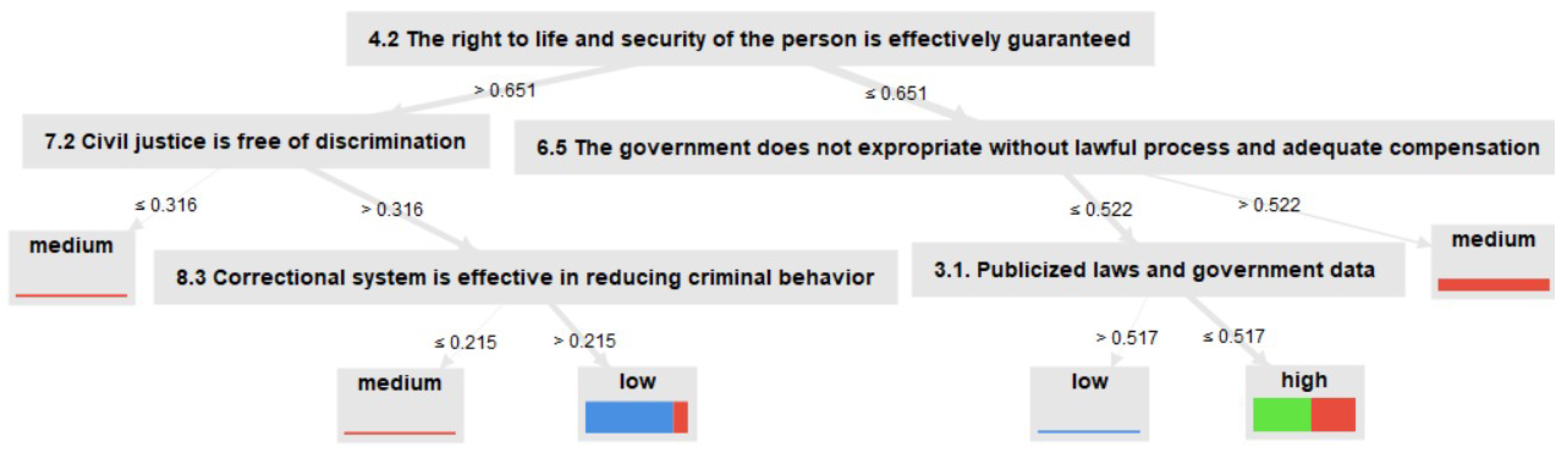
The application of the Random Forest model (Figure 1) enabled identification of the most significant predictors of AML risk among RLI indicators and the determination of specific threshold values for country classification.
From the initial 44 indicators, the algorithm selected six most informative predictors, demonstrating the ML method’s ability to identify key determinants of AML effectiveness among many potential factors.
The most influential predictor is 4.2 “The right to life and security of the person is effectively guaranteed” with a threshold value of 0.651. This result has theoretical justification, as weak personal security often correlates with high levels of organized crime, a primary source of funds requiring laundering. Countries below this threshold are classified as high AML risk, highlighting the critical importance of state security functions for effective financial crime control. The second most important predictor is 7.2 “Civil justice is free of discrimination” with a threshold of 0.316. Judicial fairness and impartiality are fundamental for prosecuting financial crimes effectively, as discriminatory practices can create loopholes.
An interesting result is the inclusion of 8.3 “Correctional system is effective in reducing criminal behavior” with a threshold of 0.215, despite its relatively low weight in the overall ranking. This suggests that effective criminal rehabilitation plays a role in preventing financial crime recidivism and reducing overall criminality (Berezka et al. 2022). Indicators 6.5 “Government does not expropriate without lawful process and adequate compensation” and 3.1 “Published laws and government data” were also included, emphasizing the importance of property rights protection and transparency for AML effectiveness (Dobrowolski and Sułkowski 2020). These results align with theoretical expectations regarding the connection between institutional environment quality and a country’s capacity to combat financial crimes (Taylor et al. 2022). Interestingly, 4.8 “Fundamental labor rights are effectively guaranteed”, the highest-weight attribute (0.16) in the overall analysis, was not included in the final Random Forest model, indicating complex interrelationships between different rule of law aspects. The ML model revealed that other indicators provide better discriminatory power for AML risk classification. The identified thresholds provide operational tools for regulators. Specifically, a personal security threshold of 0.651 and a civil justice discrimination threshold of 0.316 can serve as early warning indicators for jurisdictional AML risk assessment. Countries with a personal security indicator below 0.651 should be placed under enhanced supervision, enabling more efficient allocation of resources for detailed analysis.
To verify the relationships between RLI indicators and AML risk levels, separate correlation matrices were constructed for the low (Table 3) and medium (Table 4) risk levels.
Analysis of the correlation matrix between RLI indicators and AML risk levels revealed several important patterns, which allow for a better understanding of the relationships between the quality of legal institutions and the effectiveness of AML systems.
The most pronounced positive correlations for the low AML risk level are observed with indicators related to personal security and fundamental rights. The strongest relationship (0.69) was found with the guarantee of the right to life and personal security, which is logical, as effective AML mechanisms contribute to the overall security of the financial system and society. High correlations are also observed with due process and the rights of the accused (0.65), absence of discrimination (0.62), and the inability of government officials in police and military structures to use public office for private gain (0.63). Interestingly, alternative dispute resolution mechanisms demonstrate one of the highest correlations (0.64), which may indicate the importance of flexible legal instruments in combating money laundering. At the same time, some indicators traditionally important for law enforcement activities show relatively lower correlations—particularly the effectiveness of criminal investigations (0.45) and timeliness of criminal proceedings (0.48). A particularly weak relationship is observed with limiting civil conflicts (0.29), suggesting that AML measures are more related to institutional stability than to resolving social conflicts.
For the medium AML risk level, the picture changes dramatically: almost all correlations become negative, confirming the inverse relationship between the deterioration of the rule of law and the increase in money laundering risks. The largest negative correlations in absolute value are observed with effective enforcement of government regulations (−0.60) and their application without improper influence (−0.50), highlighting the critical role of regulatory effectiveness.
The ML model confirmed the strongest correlational relationships identified in the analysis: for low AML risk, the highest positive correlations were with the right to life and personal security (0.69), due process (0.65), and alternative dispute resolution mechanisms (0.64). For the medium risk level, the model also confirmed the strongest negative correlations with government regulation effectiveness (−0.60) and its application without improper influence (−0.50), indicating the reliability of these relationships as predictors of AML risks. The correlation matrix explains discrepancies between the individual weight coefficients of indicators and their inclusion in Random Forest models. High individual correlations may not translate into high classification ability due to multicollinearity, making some indicators redundant for ML purposes.
The obtained outcomes hold considerable theoretical and practical significance in addressing RT5. First, they empirically confirm the hypothesis H0 regarding the inverse relationship between legal institution quality and AML risks, with important caveats concerning the nonlinear nature of this relationship. Second, the identified limitations of legal indicators for predicting high risks substantiate H3 highlight the need to develop multifactor models that integrate economic, political, and institutional variables.
For international financial institutions, the study provides the following evidence-based recommendations: (1) increase the weight of RLI components in composite AML risk indices for low- and medium-risk countries from the current 3.33% to approximately 10–15%, given their demonstrated predictive capacity of 75% and 65% respectively; (2) develop separate methodological frameworks for high-risk jurisdictions that prioritize indicators of organized crime, political stability, and enforcement capacity over formal legal metrics; (3) incorporate the identified threshold values (personal security > 0.651, civil justice discrimination > 0.316) as screening criteria in simplified due diligence procedures. Banks and international payment systems can simplify due diligence procedures for counterparties from jurisdictions demonstrating strong legal institutional indicators, particularly regarding personal security and judicial independence. This also raises the issue of revising weight coefficients of legal components in international AML risk ratings and developing more nuanced methodologies that consider the contextual features of different country groups. For low- and medium-risk countries, it is advisable to increase the weight of legal indicators in composite indices, whereas for high-risk jurisdictions, it is necessary to enhance the weight of organized crime indicators, political instability, and actual enforcement effectiveness. These recommendations are grounded in the empirical finding that RLI indicators, despite constituting only 0.33% of the overall AMLI weight, demonstrate disproportionately high predictive power for specific risk categories, suggesting systematic undervaluation of legal institutional factors in current methodologies. The conducted research reveals fundamentally important patterns in the interaction between legal institutions and AML systems, which are crucial for understanding the mechanisms of AML risk formation at the global level.
A key finding is that the RLI, which constitutes only 3.33% of the total weight of the fifth domain of the AMLI "Political and Legal Risks" and approximately 0.33% of the overall index, demonstrates statistically significant predictive capacity for classifying countries by AML risk levels. This indicates a disproportionately high impact of legal institution quality compared to their formal weight in the AMLI methodology and suggests possible underestimation of legal factors in existing composite indices. The identified asymmetric model effectiveness depending on risk level reveals the complex nature of the relationships between legal institutions and AML systems. High accuracy in identifying low-risk countries (precision 75%, recall 92.31%) while simultaneously being unable to predict high risk indicates the existence of a “legal threshold”—a minimum level of legal institution quality necessary for effective AML system functioning, but insufficient to explain extreme risks. Attribute importance analysis shows that the most influential indicators come from Factor 4 (Fundamental Rights), particularly guaranteeing the right to life and personal security, emphasizing the critical role of basic state functions in ensuring AML effectiveness. Meanwhile, Factor 8 (Criminal Justice) indicators, which theoretically should correlate most closely with AML risks, show less influence in the constructed models, suggesting complex nonlinear interactions between different aspects of the legal system. The model’s inability to identify countries with high AML risk based solely on RLI indicators has important methodological implications. This confirms the validity of the AMLI structure, where legal risks constitute only 10% of the total weight, with the main emphasis placed on AML/CFT legal framework quality (50%) and corruption and fraud risks (17.5%). The results indicate that extreme AML risks are driven by specific factors not captured by the general rule of law indicator.
The systemic nature of the rule of law, confirmed by high correlations between RLI factors, creates methodological challenges for identifying the most critical legal determinants of AML effectiveness. This raises the question of an optimal balance between comprehensive assessment of legal institutions and the practical need for parsimonious predictive models for risk management purposes. The obtained results have strategic implications for the development of international AML risk monitoring methodologies. They justify the feasibility of increasing the weight of legal components in composite indices for low and medium-risk countries, while simultaneously emphasizing the need to develop alternative approaches for assessing high-risk jurisdictions, which require the integration of specific indicators of organized crime, political instability, and institutional collapse.
In summary, the study provides explicit answers to all five RT and validates the research hypotheses with important qualifications: (1) H0 is confirmed for low- and medium-risk countries—statistically significant correlations between RLI and AML risk levels were confirmed with overall model accuracy of 69.6%; (2) Random Forest classification demonstrated strong predictive capacity for low-risk (75% precision) and moderate capacity for medium-risk countries (65.22%), but failed for high-risk classification; (3) H1 is substantiated—the most influential legal components were identified as personal security guarantees (weight 0.10, correlation 0.69), judicial independence (weights 0.07–0.08), and governmental accountability (weight 0.09); (4) H3 is confirmed—effectiveness evaluation revealed that rule-of-law indicators reliably predict low and medium AML risk but cannot identify high-risk jurisdictions, where political and enforcement factors dominate; (5) scientifically grounded recommendations include increasing RLI weight in composite indices to 10–15% for low/medium-risk countries, developing separate high-risk assessment frameworks, and implementing identified threshold values in screening procedures.

4. Materials and Methods

To determine the statistical significance of the relationship between legal institutional quality and the effectiveness of national AML systems in mitigating financial risks, a comprehensive methodology was applied, combining quantitative analysis of international indices, visual analysis of correlational dependencies, and ML methods. The applied research was conducted using RapidMiner Studio Developer 9.10, enabling robust statistical modeling and predictive analytics.

4.1. Data Sources

The study is based on an analysis of empirical AMLI (Basel Institute on Governance 2025) and RLI (World Justice Project 2025) data for 2024 across 132 global jurisdictions included in both rankings. This approach to sample formation is determined by several methodological considerations. First, the inclusion of only countries with complete data in both indices eliminates the problem of missing values and ensures the correctness of statistical comparison. Second, the obtained sample demonstrates a high level of representativeness, covering jurisdictions from different geographical regions (Europe, Asia, Africa, North and South America, Oceania), different levels of economic development (from low-income countries to highly developed economies), and different legal traditions (common law, civil law, Islamic law, mixed systems). Third, the sample size (n = 132) is statistically sufficient for applying ML methods and ensures the reliability of the obtained results.
The relevance of the formed sample for the research objective is confirmed by the fact that it includes both leading countries in AML (Switzerland, New Zealand, Scandinavian countries) and jurisdictions with high AML risks (Mozambique, Democratic Republic of the Congo, Myanmar), which allows for the identification of systemic patterns of legal factors; influence across the entire spectrum of AML risks.

Basel AML Index

The AMLI is an internationally recognized composite indicator developed by the Basel Institute on Governance, an independent Swiss organization specializing in combating financial crime and corruption. It provides a comprehensive assessment of a country’s vulnerability to money laundering and related financial crimes, taking into account the country’s capacity to counter these threats (FinTech 2025).
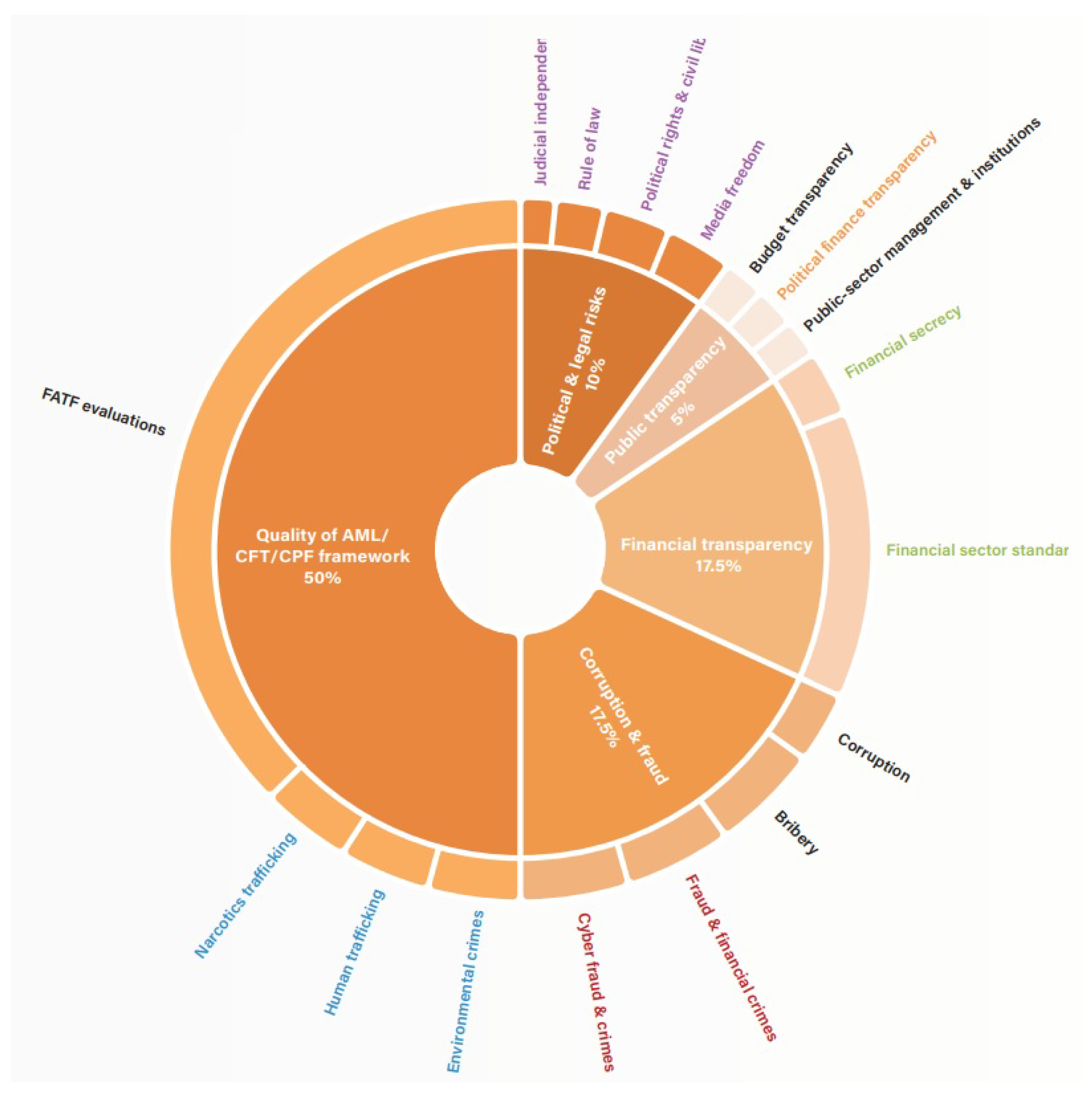
The reliability of the AMLI is ensured by the methodological transparency of its calculation and the use of exclusively verified public data sources. The index methodology is based on 17 indicators aggregated from data of authoritative international organizations, FATF, Transparency International, Global Initiative against Transnational Organized Crime, World Bank, World Economic Forum, and others (Basel Institute on Governance 2025; Escandon-Barbosa et al. 2019; FATF 2025a; Gaviyau and Sibindi 2023b). Each indicator is normalized on a scale of 0–10, where 10 indicates the highest level of risk (Figure 2), and is then aggregated into a single composite indicator through a system of expert weights.
All indicators are aggregated into a single composite indicator through a system of expert weights. This ensures a comprehensive assessment of national AML risks from the perspective of regulatory, institutional, and legal factors. AMLI consists of five main domains representing diverse aspects of money laundering and terrorist financing risks. The AMLI structure includes: Domain 1 “Quality of AML/CFT/CPF framework” (50%), Domain 2 “Corruption and fraud risks” (17.5%), Domain 3 “Financial transparency and standards” (17.5%), Domain 4 “Public transparency and accountability” (5%), and Domain 5 “Political and legal risks” (10%) (Basel Institute on Governance 2025).
Particularly important for this study is Domain 5, “Political and Legal Risks,” which directly includes the RLI as one of its components, accounting for 3.33% of the total index. This provides a methodological basis for analyzing the influence of legal factors on AML risks, as the RLI is embedded in the AMLI structure but is not its dominant component. Identifying a statistically significant influence of RLI components on the overall AMLI level would indicate a systemic relationship between legal institutional quality and AML system effectiveness, extending beyond the direct inclusion of the RLI in the AMLI calculation. Table 5 presents the structure of the RLI.
The choice of the RLI components as independent variables in this study is justified by the index’s status as the most comprehensive and methodologically grounded instrument for assessing the quality of legal institutions globally. Developed by the World Justice Project, an independent international organization, the RLI has systematically measured the rule of law worldwide since 2011 (Basel Institute on Governance 2025). Its calculation methodology involves collecting, processing, and aggregating data from two main sources: the General Population Poll, a representative survey of the general population in the three largest cities of each country (sample of 1000+ respondents), and Qualified Respondents’ Questionnaires, completed by lawyers, judges, and academics to provide professional assessments of legal institutions (Basel Institute on Governance 2025; World Justice Project 2025).
The RLI’s comprehensive structure, encompassing eight main factors and 44 sub-factors measured on a 0–1 scale, allows assessment of overall rule of law quality and the identification of specific legal determinants of AML risks. Its relevance to AML is underscored by conceptual links between RLI factors and the AMLI: Factor 2, “Absence of Corruption,” corresponds to Domain 2; Factor 6, “Regulatory Enforcement,” reflects the state’s capacity to implement AML regulations; and Factor 8, “Criminal Justice,” characterizes the effectiveness of criminal prosecution for money laundering offenses.

4.2. Methods

The first stage of our research involved a preliminary visual analysis of the potential impact of legal regulation on AML risk levels. Figure 3 presents a bubble chart showing the relationship between RLI and AMLI for 132 countries worldwide for which both indices have been calculated.
The results suggest an inverse correlation between the studied indicators: countries with higher RLI values tend to have lower AML risk levels. This pattern indicates the systemic nature of the impact of legal institution quality on the effectiveness of national AML systems. The observed estimates provide valuable insight, given that the AMLI calculation methodology, in addition to RLI, incorporates numerous other indicators (Basel Institute on Governance 2025). These findings justify proceeding to the next phase of the study, which focuses on determining the key RLI components affecting AML risks worldwide.
The obtained visual assessments represent an interesting methodological insight, considering the fact that the RLI constitutes only 3.33% of the total weight of the AMLI (Basel Institute on Governance 2025). The identification of a strong visual relationship despite the relatively small direct weight of the RLI in the AMLI calculation indicates a potential indirect (mediated) influence of legal institutional quality on other components of the AMLI. This provides grounds for conducting the next stage of the research—quantitative analysis using ML methods to identify the most influential RLI components in the formation of AML risks at the global level.
To determine the statistical significance of this relationship and identify the most influential factors, we applied Random Forest, an ensemble ML method belonging to the class of decision tree-based algorithms (Lubinga and Mazenda 2024). The method creates multiple decision trees and combines their predictions to obtain more accurate and stable results. Random Forest uses the bootstrap aggregating (bagging) technique to create diverse subsets from the original dataset and builds a separate decision tree for each subset. At each node of a tree, a subset of features is randomly selected for consideration (in our case, RLI factors and sub-factors), which increases diversity among trees in the ensemble and reduces the correlation of their errors.
The choice of Random Forest is justified by its ability to handle complex legal and economic data in AML risk classification. The method captures nonlinear relationships between predictors and the dependent variable, which is important because the effects of legal factors on AML risks may appear only after certain thresholds are reached. It is robust to multicollinearity, allowing effective modeling even when RLI factors are correlated, and resilient to outliers, which is critical for datasets including both low-risk and high-risk countries. Random Forest also provides automatic feature importance metrics, enabling identification of the most influential RLI factors and sub-factors, while requiring no prior data scaling. Additionally, it ensures high accuracy in multi-class classification, allows out-of-bag error estimation without a separate test set, accommodates class imbalances, and offers interpretability through feature importance and partial dependence plots, making it possible to translate ML results into the context of legal regulation.
At the same time, the method is not without limitations. Random Forest can be prone to overfitting on small samples, which requires careful tuning of hyperparameters, such as the number of trees, maximum tree depth, and minimum number of observations per leaf node. To minimize this risk, our study applies cross-validation and out-of-bag error estimation.
To apply Random Forest, countries were divided into groups by AML risk level. We used a uniform division of the AMLI value range (min = 3.07, max = 8.17) into three equal intervals: low risk (≤4.77), medium risk (4.78–6.47), and high risk (≥6.48). As a result, the following country groups were identified:
  • Low-risk group: 47 countries, dominated by European states including Scandinavian countries (Finland, Denmark, Sweden, Norway), Baltic states (Estonia, Lithuania, Latvia), Western European economies (Germany, France, the United Kingdom, Netherlands), and several Central European countries (the Czech Republic, Slovenia, Poland). The group also includes developed non-European economies (Australia, Canada, Japan, Singapore) and some Caribbean island states. In ascending order of AML risk: Finland (3.07), Estonia (3.16), Sweden (3.45), Denmark (3.50), Lithuania (3.54), Slovenia (3.54), Greece (3.66), New Zealand (3.68), Norway (3.76), Czech Republic (3.85), France (3.86), Luxembourg (3.99), Australia (4.04), Saint Vincent and the Grenadines (4.07), Chile (4.08), Latvia (4.08), Portugal (4.09), Antigua and Barbuda (4.10), Uruguay (4.11), United Kingdom (4.14), Trinidad and Tobago (4.19), Dominica (4.21), North Macedonia (4.24), Spain (4.29), Poland (4.34), Albania (4.35), Austria (4.35), Botswana (4.36), Slovakia (4.39), South Korea (4.42), Saint Lucia (4.46), Canada (4.47), Belgium (4.48), Netherlands (4.52), Croatia (4.53), Barbados (4.58), Costa Rica (4.61), Mauritius (4.61), Germany (4.63), Georgia (4.64), Kazakhstan (4.65), Moldova (4.65), Singapore (4.70), Grenada (4.72), Japan (4.77), Peru (4.77), Tunisia (4.77).
  • Medium-risk group: 64 countries, including the USA, several European countries (Italy, Cyprus), major Asian economies (India, Indonesia, Malaysia), Latin American countries (Brazil, Mexico), African economies, and post-Soviet states (Ukraine, Belarus, Uzbekistan). Countries in ascending order of AML risk: Jamaica (4.79), Italy (4.80), Cyprus (4.81), Jordan (4.81), USA (4.81), Serbia (4.82), Namibia (4.89), Colombia (4.92), Morocco (4.94), Dominican Republic (4.96), Mongolia (4.98), Bulgaria (4.99), Romania (4.99), Paraguay (5.00), Ecuador (5.06), Hungary (5.06), Egypt (5.08), Bahrain (5.17), Malta (5.18), Bahamas (5.21), Ukraine (5.26), Uzbekistan (5.27), Ghana (5.28), Sri Lanka (5.28), Indonesia (5.33), Zambia (5.34), Hong Kong (5.34), Brazil (5.36), Bolivia (5.44), Mexico (5.44), Guatemala (5.45), Malawi (5.45), India (5.49), Malaysia (5.50), El Salvador (5.51), Senegal (5.53), Gambia (5.56), Pakistan (5.56), Bangladesh (5.62), Turkey (5.63), Saint Kitts and Nevis (5.64), Ethiopia (5.66), Honduras (5.66), Belarus (5.67), South Africa (5.70), Uganda (5.71), Lebanon (5.81), Philippines (5.84), Panama (5.90), Rwanda (5.94), Zimbabwe (5.98), Nepal (6.01), Tanzania (6.08), Suriname (6.09), Thailand (6.16), UAE (6.18), Kuwait (6.27), Mauritania (6.28), Nicaragua (6.40), Côte d’Ivoire (6.42), Guinea (6.44), Benin (6.44).
  • High-risk group: 21 countries, predominantly African countries and states with unstable political systems. This group also includes China and several sub-Saharan African countries. Countries with high AML risk levels: Togo (6.48), Burkina Faso (6.48), Sierra Leone (6.49), Angola (6.71), Cambodia (6.75), Madagascar (6.76), Mali (6.81), Niger (6.83), Nigeria (6.85), Kenya (6.87), Vietnam (6.90), Algeria (6.92), Liberia (7.11), Mozambique (7.15), China (7.27), Republic of the Congo (7.28), Gabon (7.48), Venezuela (7.59), Democratic Republic of the Congo (7.73), Haiti (7.92), Myanmar (8.17), with Myanmar showing the highest risk, reflecting the ongoing political crisis.
The obtained distribution demonstrates clear differentiation of countries by AML risk levels, creating a foundation for applying the Random Forest method. Preliminary observations regarding the concentration of countries with developed legal systems in the low-risk group and the presence of states with institutional problems in the high-risk group suggest a potential correlation between the quality of legal institutions and AML system effectiveness. At the same time, the presence of a significant number of countries in the medium-risk group (64 countries) reflects the complexity and diversity of factors influencing AML risk formation, which necessitates the application of ML methods to identify hidden patterns and nonlinear dependencies between RLI and AMLI indicators. Further quantitative analysis will support the examination of hypotheses related to the predictive performance of legal regulation indicators and determination of the statistical significance of the observed relationships in financial risk contexts.

5. Conclusions

This study advances the empirical and theoretical understanding of AML system effectiveness by providing the first quantitative ML assessment of the predictive capacity of Rule of Law indicators. We demonstrate a statistically significant relationship between legal-institutional quality and the effectiveness of national AML systems, highlighting the central role of institutional quality in mitigating financial risks.
Correlation analysis highlighted the strongest associations between low AML risk and indicators related to personal security, due process, and integrity of public officials, emphasizing that AML system performance depends primarily on institutional and regulatory quality rather than general societal stability. Although legal factors formally constitute only 0.33% of the Basel AML Index, they demonstrate substantial predictive power, underscoring their underappreciated significance in global risk assessment frameworks.
The Random Forest model achieved an overall classification accuracy of 69.6% for differentiating countries by AML risk levels (low, medium, high), confirming the substantial predictive value of rule of law indicators. Model performance was highest for low-risk jurisdictions (precision 75%, recall 92.31%), moderate for medium-risk countries (precision 65.22%, recall 78.95%), and limited for high-risk cases. These findings suggest the existence of a legal threshold—a minimum level of institutional quality required for AML systems to function effectively, though insufficient to explain extreme financial risk conditions.
From a policy perspective, the results underscore the critical importance of strengthening judicial independence, safeguarding personal security, and enhancing civil oversight mechanisms as priority reform areas for national regulators. For international institutions, the findings support differentiated AML monitoring strategies that must assign greater weight to legal indicators in low and medium-risk countries, while integrating complementary measures of political, economic, and criminal instability for high-risk jurisdictions
Research limitations include the use of cross-sectional data for 2024 due to methodological changes in the AMLI and limited retrospective availability of consistent WJP indicators, as well as class imbalance resulting from the global AML risk distribution. Nevertheless, the focus on current data provides relevant insights into institutional priorities under contemporary financial governance conditions.
Future research should expand the analytical framework to include indicators of organized crime, political stability, and macroeconomic factors, as well as employ longitudinal and advanced ML methods to further examine the dynamic relationship between legal institutions and AML-related financial risks.

Author Contributions

Conceptualization, O.K. and R.S.; methodology, O.K. and S.B.; software, O.K.; validation, O.K., R.S. and N.H.; formal analysis, R.S. and S.B.; investigation, O.K., N.H., M.V. and O.L.; resources, O.K., R.S. and S.B.; data curation, O.K., M.V. and O.L.; writing—original draft preparation, O.K. and R.S.; writing—review and editing, O.K. and R.S.; visualization, O.K.; supervision, R.S.; project administration, O.K.; funding acquisition, O.K. All authors have read and agreed to the published version of the manuscript.

Funding

This work was supported by the European Union’s Horizon 2024 research and innovation program under the Marie Skłodowska-Curie grant agreement No. 101235440—FORCE. This publication reflects only the author’s view, and the REA is not responsible for any use that may be made of the information it contains.

Institutional Review Board Statement

Not applicable.

Informed Consent Statement

Not applicable.

Data Availability Statement

All original data analyzed in this study are publicly accessible: (https://baselgovernance.org/basel-aml-index, Basel AML Index (accessed on 22 October 2025) and (https://worldjusticeproject.org/rule-of-law-index/, WJP Rule of Law Index (accessed on 22 October 2025). The specific datasets derived from these sources and used to support the findings of this study are available from the authors upon request.

Conflicts of Interest

The authors declare no conflicts of interest.

Abbreviations

The following abbreviations are used in this manuscript:
AMLAnti-Money Laundering
AMLIBasel AML Index
RLIWJP Rule of Law Index
MLMachine learning
FATFFinancial Action Task Force

References

  1. ACPR. 2025. Combating Money Laundering. Available online: https://acpr.banque-france.fr/en/nos-missions/combating-money-laundering (accessed on 21 October 2025).
  2. Adamyk, Bogdan, Vladlena Benson, Oksana Adamyk, and Oksana Liashenko. 2025a. Risk Management in DeFi: Analyses of the Innovative Tools and Platforms for Tracking DeFi Transactions. Journal of Risk and Financial Management 18: 38. [Google Scholar] [CrossRef]
  3. Adamyk, Bogdan, Vladlena Benson, Oksana Adamyk, Ruslan Shevchuk, Haider Al-Khateeb, and Bożena Fraczek. 2025b. Enhancing European Cyber Forensics: A Computational Intelligence Approach for Detecting Illicit Money Flows. Paper presented at the 15th International Conference on Advanced Computer Information Technologies (ACIT), Šibenik, Croatia, September 17–19. [Google Scholar] [CrossRef]
  4. Aljunaid, Saif Khalifa, Saif Jasim Almheiri, Hussain Dawood, and Muhammad Adnan Khan. 2025. Secure and Transparent Banking: Explainable AI-Driven Federated Learning Model for Financial Fraud Detection. Journal of Risk and Financial Management 18: 179. [Google Scholar] [CrossRef]
  5. AlQudah, Anas, Mahmoud Hailat, and Dana Setabouha. 2025. Money Laundering in Global Economies: How Economic Openness and Governance Affect Money Laundering in the EU, G20, BRICS, and CIVETS. Journal of Risk and Financial Management 18: 319. [Google Scholar] [CrossRef]
  6. BaFin. 2025. Prevention of Money Laundering and Terrorist Financing. Available online: https://www.bafin.de/EN/Aufsicht/Geldwaeschepraevention/geldwaeschepraevention_node_en.html (accessed on 21 October 2025).
  7. Basel Committee on Banking Supervision. 2022. Sound Management of Risks Related to Money Laundering and Financing of Terrorism. Basel: Bank for International Settlements. Available online: https://www.bis.org/bcbs/publ/d353.pdf (accessed on 22 October 2025).
  8. Basel Institute on Governance. 2025. Basel AML Index 2024: 13th Public Edition Ranking Money Laundering Risks around the World. Basel: Basel Institute on Governance. Available online: https://index.baselgovernance.org/ (accessed on 7 September 2025).
  9. Berezka, Kateryna M., Olha Ya. Kovalchuk, Serhiy V. Banakh, Stanislav V. Zlyvko, and Roksolana Hrechaniuk. 2022. A Binary Logistic Regression Model for Support Decision Making in Criminal Justice. Folia Oeconomica Stetinensia 22: 1–17. [Google Scholar] [CrossRef]
  10. Chen, Jieying, Weihong Li, Yaxing Li, and Yebin Chen. 2024. Integrated Assessment of Security Risk Considering Police Resources. ISPRS International Journal of Geo-Information 13: 415. [Google Scholar] [CrossRef]
  11. Cotoc, Corina-Narcisa, Maria Nițu, Mircea Constantin Șcheau, and Adeline-Cristina Cozma. 2021. Efficiency of Money Laundering Countermeasures: Case Studies from European Union Member States. Risks 9: 120. [Google Scholar] [CrossRef]
  12. Dobrowolski, Zbysław, and Łukasz Sułkowski. 2020. Implementing a Sustainable Model for Anti-Money Laundering in the United Nations Development Goals. Sustainability 12: 44. [Google Scholar] [CrossRef]
  13. Ertam, Fatih. 2025. Near Real-Time Ethereum Fraud Detection Using Explainable AI in Blockchain Networks. Applied Sciences 15: 10841. [Google Scholar] [CrossRef]
  14. Escandon-Barbosa, Diana, David Urbano-Pulido, and Andrea Hurtado-Ayala. 2019. Exploring the Relationship Between Formal and Informal Institutions, Social Capital, and Entrepreneurial Activity in Developing and Developed Countries. Sustainability 11: 550. [Google Scholar] [CrossRef]
  15. EUR-Lex. 2024a. Directive (EU) 2024/1640 of the European Parliament and of the Council of 31 May 2024 on the Mechanisms to Be Put in Place by Member States for the Prevention of the Use of the Financial System for the Purposes of Money Laundering or Terrorist Financing, Amending Directive (EU) 2019/1937, and Amending and Repealing Directive (EU) 2015/849. Available online: https://eur-lex.europa.eu/eli/dir/2024/1640/oj/eng (accessed on 23 October 2025).
  16. EUR-Lex. 2024b. Regulation (EU) 2024/1624 of the European Parliament and of the Council of 31 May 2024 on the Prevention of the Use of the Financial System for the Purposes of Money Laundering or Terrorist Financing. Available online: https://eur-lex.europa.eu/eli/reg/2024/1624/oj/eng (accessed on 23 October 2025).
  17. European Banking Authority. 2025. Consultation Paper—Proposed Regulatory Technical Standards in the Context of the EBA’s Response to the European Commission’s Call for Advice on New AMLA Mandates (EBA/CP/2025/04). Available online: https://service.betterregulation.com/document/783757 (accessed on 20 October 2025).
  18. FATF. 2004. The 40 Recommendations, Published October 2004. Available online: https://www.fatf-gafi.org/en/publications/Fatfrecommendations/The40recommendationspublishedoctober2004.html (accessed on 25 October 2025).
  19. FATF. 2023. Methodology for Assessing Technical Compliance with the FATF Recommendations and the Effectiveness of AML/CFT Systems (Updated June 2023). Paris: FATF/OECD. Available online: https://www.fatf-gafi.org/content/dam/fatf-gafi/methodology/FATF-Assessment-Methodology-2022.pdf.coredownload.inline.pdf (accessed on 21 October 2025).
  20. FATF. 2025a. FATF Launches National Risk Assessment Toolkit to Help Countries Identify Greatest Money Laundering Risks. Available online: https://www.fatf-gafi.org/en/publications/Fatfgeneral/FATF-launches-National-Risk-Assessment-toolkit-to-help-countries-identify-greatest-money-laundering-risks.html (accessed on 27 September 2025).
  21. FATF. 2025b. The FATF Recommendations. Available online: https://www.fatf-gafi.org/en/publications/Fatfrecommendations/Fatf-recommendations.html (accessed on 27 September 2025).
  22. Financial Conduct Authority. 2025. Government’s Decision on Reforming Anti-Money Laundering and Counter-Terrorism Financing Supervision. Available online: https://www.fca.org.uk/news/statements/governments-decision-reforming-anti-money-laundering-and-counter-terrorism-financing-supervision (accessed on 23 October 2025).
  23. FinTech. 2025. The High Price of Non-Compliance in Financial Services. Available online: https://fintech.global/2025/03/31/the-high-price-of-non-compliance-in-financial-services/ (accessed on 2 September 2025).
  24. Gaviyau, William, and Athenia Bongani Sibindi. 2023a. Customer Due Diligence in the FinTech Era: A Bibliometric Analysis. Risks 11: 11. [Google Scholar] [CrossRef]
  25. Gaviyau, William, and Athenia Bongani Sibindi. 2023b. Global Anti-Money Laundering and Combating Terrorism Financing Regulatory Framework: A Critique. Journal of Risk and Financial Management 16: 313. [Google Scholar] [CrossRef]
  26. Giudici, Paolo, Alessandro Piergallini, Maria Cristina Recchioni, and Emanuela Raffinetti. 2024. Explainable Artificial Intelligence methods for financial time series. Physica A: Statistical Mechanics and its Applications 655: 130176. [Google Scholar] [CrossRef]
  27. Global Initiative Against Transnational Organized Crime. 2025. A Network to Counter Networks. Available online: https://globalinitiative.net (accessed on 2 September 2025).
  28. Grabowski, Michał. 2024. Account Information and Payment Initiation Services and the Related AML Obligations in the Law of the European Union. FinTech 3: 173–83. [Google Scholar] [CrossRef]
  29. Hoffman, Bernardette Naa, Johnson Okeniyi, and Sunday Eneojo Samuel. 2024. Antecedents of Compliance with Anti-Money Laundering Regulations in the Banking Sector of Ghana. Journal of Risk and Financial Management 17: 373. [Google Scholar] [CrossRef]
  30. Hou, Guodong, Dong Ling Tong, Soung Yue Liew, and Peng Yin Choo. 2025. Comparative Analysis of Resampling Techniques for Class Imbalance in Financial Distress Prediction Using XGBoost. Mathematics 13: 2186. [Google Scholar] [CrossRef]
  31. Huertas, Michael. 2025. EBA Releases 2024 Annual Report—Key Developments, Regulatory Initiatives and Strategic Priorities. PWC. Available online: https://legal.pwc.de/en/news/articles/eba-releases-2024-annual-report-key-developments-regulatory-initiatives-and-strategic-priorities (accessed on 24 October 2025).
  32. International Monetary Fund. 2024. Financial Sector Assessment Program (FSAP). Available online: https://www.imf.org/en/Publications/fssa (accessed on 21 October 2025).
  33. International Monetary Fund. 2025. Anti-Money Laundering and Combating the Financing of Terrorism (AML/CFT). Available online: https://www.imf.org/en/Topics/Financial-Integrity/amlcft (accessed on 22 October 2025).
  34. Kovalchuk, Olha, Ruslan Shevchuk, and Serhiy Banakh. 2024. Cryptocurrency Crime Risks Modeling: Environment, E-Commerce, and Cybersecurity Issue. IEEE Access 12: 50673–88. [Google Scholar] [CrossRef]
  35. Küçükçolak, Recep Ali, Gözde Bozkurt, Necla İlter Küçükçolak, Adnan Veysel Ertemel, and Sami Küçükoğlu. 2025. Corruption Control as a Catalyst for Financial Development: A Global Comparative Study. Journal of Risk and Financial Management 18: 79. [Google Scholar] [CrossRef]
  36. Levchenko, Valentyna, Anton Boyko, Victoria Bozhenko, and Serhii Mynenko. 2019. Money Laundering Risk in Developing and Transitive Economies: Analysis of Cyclic Component of Time Series. Business: Theory and Practice 20: 492–508. [Google Scholar] [CrossRef]
  37. Lubinga, Moses Herbert, and Adrino Mazenda. 2024. Empirical Analysis of the Effect of Institutional Governance Indicators on Climate Financing. Economies 12: 29. [Google Scholar] [CrossRef]
  38. Masunda, Michael, and Haresh Barot. 2025. Disruption in Southern Africa’s Money Laundering Activity by Artificial Intelligence Technologies. Journal of Risk and Financial Management 18: 441. [Google Scholar] [CrossRef]
  39. Miliauskas, Mažvydas. 2024. AML Risk Scoring: Understanding the Essence. Amlyze. Available online: https://amlyze.com/aml-risk-scoring/ (accessed on 27 September 2025).
  40. Moura, Luiz, Andre Barcaui, and Renan Payer. 2025. AI and Financial Fraud Prevention: Mapping the Trends and Challenges Through a Bibliometric Lens. Journal of Risk and Financial Management 18: 323. [Google Scholar] [CrossRef]
  41. Nugiantari, Ayu Rosita. 2025. Legal Risk Assessment in Cross-Border Business Agreements Between Regulatory Compliance and Profit Optimization. Journal of Law, Politics and Humanities 5: 4509–19. [Google Scholar] [CrossRef]
  42. OECD. 2023. International Standards for Automatic Exchange of Information in Tax Matters: Crypto-Asset Reporting Framework and 2023 update to the Common Reporting Standard. Paris: OECD Publishing. [Google Scholar] [CrossRef]
  43. Ogbeide, Henry, Mary Elizabeth Thomson, Mustafa Sinan Gonul, Andrew Castairs Pollock, Sanjay Bhowmick, and Abdullahi Usman Bello. 2023. The Anti-Money Laundering Risk Assessment: A Probabilistic Approach. Journal of Business Research 162: 113820. [Google Scholar] [CrossRef]
  44. Open Banking. 2025. European Banking Authority Regulatory Technical Standards. Available online: https://www.openbanking.org.uk/glossary/european-banking-authority-regulatory-technical-standards/ (accessed on 22 October 2025).
  45. Osman, Ahmed H. 2025. Global Money Laundering Risks: A Quantitative Analysis of the Basel AML Index. BNP Paribas WM. Available online: https://www.linkedin.com/pulse/global-money-laundering-risks-quantitative-analysis-basel-osman-xi2wf/ (accessed on 27 September 2025).
  46. Rejeb, Abderahman, Karim Rejeb, Khalil Alnabulsi, and Suhaiza Zailani. 2023. Tracing Knowledge Diffusion Trajectories in Scholarly Bitcoin Research: Co-Word and Main Path Analyses. Journal of Risk and Financial Management 16: 355. [Google Scholar] [CrossRef]
  47. Rodríguez Valencia, Leslie, Maicol Jesús Ochoa Arellano, Santos Andrés Gutiérrez Figueroa, Carlos Mur Nuño, Borja Monsalve Piqueras, Ana del Valle Corrales Paredes, Sergio Bemposta Rosende, José Manuel López López, Enrique Puertas Sanz, and Asaf Levi Alfaroviz. 2025. A Systematic Review of Artificial Intelligence Applied to Compliance: Fraud Detection in Cryptocurrency Transactions. Journal of Risk and Financial Management 18: 612. [Google Scholar] [CrossRef]
  48. Salman, Hasan Ahmed, Ali Kalakech, and Amani Steiti. 2024. Random Forest Algorithm Overview. Babylonian Journal of Machine Learning 2024: 69–79. [Google Scholar] [CrossRef] [PubMed]
  49. Schiavo, Gianni Lo. 2022. The Single Supervisory Mechanism (SSM) and the EU Anti-Money Laundering framework compared: Governance, rules, challenges and opportunities. Journal of Banking Regulation 23: 91–105. [Google Scholar] [CrossRef]
  50. Taylor, Ivan W., Muhammad Aman Ullah, Saroj Koul, and Mark Sandoval Ulloa. 2022. Evaluating the Impact of Institutional Improvement on Control of Corruption—A System Dynamics Approach. Systems 10: 64. [Google Scholar] [CrossRef]
  51. Transparency International. 2025. CPI 2024: Highlights and Insights. Available online: https://www.transparency.org/en/news/cpi-2024-highlights-insights-corruption-climate-crisis (accessed on 12 September 2025).
  52. UNICEF. 2022. UNICEF Anti-Money Laundering and Countering the Financing of Terrorism (AML/CFT) Policy. Available online: https://www.unicef.org/supply/documents/unicef-anti-money-laundering-and-countering-financing-terrorism-amlcft-policy (accessed on 22 October 2025).
  53. United Nations. 2025. Money Laundering. Available online: https://www.unodc.org/unodc/en/money-laundering/overview.html (accessed on 7 September 2025).
  54. United Nations Environment Programme Finance Initiative. 2022. The Basel Committee on Banking Supervision (BCBS). Available online: https://www.unepfi.org/wordpress/wp-content/uploads/2022/02/BCBS-UNEP-FI-consultation-Feb-2022.pdf (accessed on 23 October 2025).
  55. World Justice Project. 2025. The 2024 WJP Rule of Law Index. Available online: https://worldjusticeproject.org/rule-of-law-index/ (accessed on 27 September 2025).
  56. Yao, Kai-Chao, Hsiu-Chu Hung, Ching-Hsin Wang, Wei-Lun Huang, Hui-Ting Liang, Tzu-Hsin Chu, Bo-Siang Chen, and Wei-Sho Ho. 2025. Application of Generative AI in Financial Risk Prediction: Enhancing Model Accuracy and Interpretability. Information 16: 857. [Google Scholar] [CrossRef]
  57. Yeh, Stuart S. 2022a. New Financial Action Task Force Recommendations to Fight Corruption and Money Laundering. Laws 11: 8. [Google Scholar] [CrossRef]
  58. Yeh, Stuart S. 2022b. New OSCE Recommendations to Combat Corruption, Money Laundering, and the Financing of Terrorism. Laws 11: 23. [Google Scholar] [CrossRef]
  59. Yi, Haiying. 2024. Anti-Money Laundering (AML) Information Technology Strategies in Cross-Border Payment Systems. Law and Economy 3: 43–53. Available online: https://www.paradigmpress.org/le/article/view/1317 (accessed on 29 September 2025). [CrossRef]
Figure 1. Random Forest model (Note: blue—low AML risk, red—medium AML risk, green—high AML risk).
Risks 14 00005 g001
Figure 2. Basel AML Index structure (Basel Institute on Governance 2025).
Risks 14 00005 g002
Figure 3. Relationship between AML Index and RLI.
Risks 14 00005 g003
Table 1. Confusion Matrix of AML risk prediction.
PredictedLowMediumHighClass Precision
Pred. Low124075.00%
Pred. Medium115765.22%
Pred. High0000.00%
Class Recall92.31%78.95%0.00%
Table 2. Attribute weights.
AttributeWeight
4.8. Fundamental labor rights are effectively guaranteed0.16
4.2. The right to life and security of the person is effectively guaranteed0.10
4.1. Equal treatment and absence of discrimination0.09
1.5. Government powers are subject to non-governmental checks0.09
7.4. Civil justice is free of improper government influence0.08
7.6. Civil justice is effectively enforced0.07
7.7. Alternative dispute resolution mechanisms are accessible, impartial, and effective0.07
8.7. Due process of the law and rights of the accused0.07
6.5. The government does not expropriate without lawful process and adequate compensation0.07
7.5. Civil justice is not subject to unreasonable delay0.07
4.7. Freedom of assembly and association is effectively guaranteed0.06
2.2. Government officials in the judicial branch do not use public office for private gain0.06
4.5. Freedom of belief and religion is effectively guaranteed0.05
7.2. Civil justice is free of discrimination0.05
8.5. Criminal system is free of corruption0.05
6.2. Government regulations are applied and enforced without improper influence0.05
6.4. Due process is respected in administrative proceedings0.05
4.4. Freedom of opinion and expression is effectively guaranteed0.05
1.1. Government powers are effectively limited by the legislature0.05
8.4. Criminal system is impartial0.05
5.1. Crime is effectively controlled0.05
1.6. Transition of power is subject to the law0.05
8.3. Correctional system is effective in reducing criminal behavior0.05
3.4. Complaint mechanisms0.04
1.2. Government powers are effectively limited by the judiciary0.04
1.3. Government powers are effectively limited by independent auditing and review0.04
3.2. Right to information0.04
6.1. Government regulations are effectively enforced0.04
4.6. Freedom from arbitrary interference with privacy is effectively guaranteed0.04
4.3. Due process of the law and rights of the accused0.04
5.3. People do not resort to violence to redress personal grievances0.04
3.1. Publicized laws and government data0.04
8.1. Criminal investigation system is effective0.03
2.3. Government officials in the police and the military do not use public office for private gain0.03
8.2. Criminal adjudication system is timely and effective0.03
7.1. People can access and afford civil justice0.03
5.2. Civil conflict is effectively limited0.03
2.4. Government officials in the legislative branch do not use public office for private gain0.03
1.4. Government officials are sanctioned for misconduct0.02
6.3. Administrative proceedings are conducted without unreasonable delay0.02
2.1. Government officials in the executive branch do not use public office for private gain0.02
7.3. Civil justice is free of corruption0.02
8.6. Criminal system is free of improper government influence0.02
3.3. Civic participation0.02
Table 3. Correlation indicators of AML low risk level with RLI components.
RLI ComponentCorrelation
1.1. Government powers are effectively limited by the legislature0.47
1.2. Government powers are effectively limited by the judiciary0.52
1.3. Government powers are effectively limited by independent auditing and review0.59
1.4. Government officials are sanctioned for misconduct0.52
1.5. Government powers are subject to non-governmental checks0.55
1.6. Transition of power is subject to the law0.60
2.1. Government officials in the executive branch do not use public office for private gain0.62
2.2. Government officials in the judicial branch do not use public office for private gain0.61
2.3. Government officials in the police and the military do not use public office for private gain0.63
2.4. Government officials in the legislative branch do not use public office for private gain0.49
3.1. Publicized laws and government data0.56
3.2. Right to information0.57
3.3. Civic participation0.56
3.4. Complaint mechanisms0.51
4.1. Equal treatment and absence of discrimination0.62
4.2. The right to life and security of the person is effectively guaranteed0.69
4.3. Due process of the law and rights of the accused0.65
4.4. Freedom of opinion and expression is effectively guaranteed0.55
4.5. Freedom of belief and religion is effectively guaranteed0.49
4.6. Freedom from arbitrary interference with privacy is effectively guaranteed0.62
4.7. Freedom of assembly and association is effectively guaranteed0.54
4.8. Fundamental labor rights are effectively guaranteed0.58
5.1. Crime is effectively controlled0.52
5.2. Civil conflict is effectively limited0.29
5.3. People do not resort to violence to redress personal grievances0.44
6.1. Government regulations are effectively enforced0.57
6.2. Government regulations are applied and enforced without improper influence0.60
6.3. Administrative proceedings are conducted without unreasonable delay0.54
6.4. Due process is respected in administrative proceedings0.49
6.5. The government does not expropriate without lawful process and adequate compensation0.55
7.1. People can access and afford civil justice0.58
7.2. Civil justice is free of discrimination0.59
7.3. Civil justice is free of corruption0.56
7.4. Civil justice is free of improper government influence0.58
7.5. Civil justice is not subject to unreasonable delay0.34
7.6. Civil justice is effectively enforced0.50
7.7. Alternative dispute resolution mechanisms are accessible, impartial, and effective0.64
8.1. Criminal investigation system is effective0.45
8.2. Criminal adjudication system is timely and effective0.48
8.3. Correctional system is effective in reducing criminal behavior0.52
8.4. Criminal system is impartial0.53
8.5. Criminal system is free of corruption0.57
8.6. Criminal system is free of improper government influence0.54
8.7. Due process of the law and rights of the accused0.65
Table 4. Correlation indicators of AML medium risk level with RLI components.
RLI ComponentCorrelation
1.1. Government powers are effectively limited by the legislature−0.19
1.2. Government powers are effectively limited by the judiciary−0.18
1.3. Government powers are effectively limited by independent auditing and review−0.31
1.4. Government officials are sanctioned for misconduct−0.26
1.5. Government powers are subject to non-governmental checks−0.22
1.6. Transition of power is subject to the law−0.22
2.1. Government officials in the executive branch do not use public office for private gain−0.30
2.2. Government officials in the judicial branch do not use public office for private gain−0.22
2.3. Government officials in the police and the military do not use public office for private gain−0.25
2.4. Government officials in the legislative branch do not use public office for private gain−0.31
3.1. Publicized laws and government data−0.22
3.2. Right to information−0.21
3.3. Civic participation−0.23
3.4. Complaint mechanisms−0.26
4.1. Equal treatment and absence of discrimination−0.41
4.2. The right to life and security of the person is effectively guaranteed−0.31
4.3. Due process of the law and rights of the accused−0.33
4.4. Freedom of opinion and expression is effectively guaranteed−0.22
4.5. Freedom of belief and religion is effectively guaranteed−0.24
4.6. Freedom from arbitrary interference with privacy is effectively guaranteed−0.27
4.7. Freedom of assembly and association is effectively guaranteed−0.22
4.8. Fundamental labor rights are effectively guaranteed−0.31
5.1. Crime is effectively controlled−0.20
5.2. Civil conflict is effectively limited0.06
5.3. People do not resort to violence to redress personal grievances−0.22
6.1. Government regulations are effectively enforced−0.60
6.2. Government regulations are applied and enforced without improper influence−0.50
6.3. Administrative proceedings are conducted without unreasonable delay−0.30
6.4. Due process is respected in administrative proceedings−0.27
6.5. The government does not expropriate without lawful process and adequate compensation−0.22
7.1. People can access and afford civil justice−0.27
7.2. Civil justice is free of discrimination−0.35
7.3. Civil justice is free of corruption−0.18
7.4. Civil justice is free of improper government influence−0.20
7.5. Civil justice is not subject to unreasonable delay−0.28
7.6. Civil justice is effectively enforced−0.26
7.7. Alternative dispute resolution mechanisms are accessible, impartial, and effective−0.28
8.1. Criminal investigation system is effective−0.19
8.2. Criminal adjudication system is timely and effective−0.22
8.3. Correctional system is effective in reducing criminal behavior−0.27
8.4. Criminal system is impartial−0.35
8.5. Criminal system is free of corruption−0.21
8.6. Criminal system is free of improper government influence−0.20
Table 5. Components of the RLI (World Justice Project 2025).
FactorSubfactors
Factor 1: Constraints on Government Powers
(Evaluates the boundaries of government authority and the effectiveness of checks and balances mechanisms)
1.1. Government powers are effectively limited by the legislature
1.2. Government powers are effectively limited by the judiciary
1.3. Government powers are effectively limited by independent auditing and review
1.4. Government officials are sanctioned for misconduct
1.5. Government powers are subject to non-governmental checks
1.6. Transition of power is subject to the law
Factor 2: Absence of Corruption
(Assesses the prevalence of corruption in governmental bodies and public institutions)
2.1. Government officials in the executive branch do not use public office for private gain
2.2. Government officials in the judicial branch do not use public office for private gain
2.3. Government officials in the police and military do not use public office for private gain
2.4. Government officials in the legislative branch do not use public office for private gain
Factor 3: Open Government
(Analyzes government process transparency, information accessibility, and civil society participation)
3.1. Publicized laws and government data
3.2. Right to information
3.3. Civic participation
3.4. Complaint mechanisms
Factor 4: Fundamental Rights
(Measures the extent to which fundamental human rights are upheld)
4.1. Equal treatment and absence of discrimination
4.2. The right to life and personal security is effectively guaranteed
4.3. Due process of law and rights of the accused
4.4. Freedom of opinion and expression is effectively guaranteed
4.5. Freedom of belief and religion is effectively guaranteed
4.6. Freedom from arbitrary interference with privacy is effectively guaranteed
4.7. Freedom of assembly and association is effectively guaranteed
4.8. Fundamental labor rights are effectively guaranteed
Factor 5: Order and Security
(Examines the extent of security and order within society)
5.1. Crime is effectively controlled
5.2. Civil conflict is effectively limited
5.3. People do not resort to violence to redress personal grievances
Factor 6: Regulatory Enforcement
(Measures the effectiveness of regulatory compliance and law enforcement)
6.1. Government regulations are effectively enforced
6.2. Government regulations are applied and enforced without improper influence
6.3. Administrative proceedings are conducted without unreasonable delay
6.4. Due process is respected in administrative proceedings
6.5. The government does not expropriate without lawful process and adequate compensation
Factor 7: Civil Justice
(Analyzes the accessibility, effectiveness, and fairness of the civil justice system)
7.1. People can access and afford civil justice
7.2. Civil justice is free of discrimination
7.3. Civil justice is free of corruption
7.4. Civil justice is free of improper government influence
7.5. Civil justice is not subject to unreasonable delay
7.6. Civil justice is effectively enforced
7.7. Alternative dispute resolution mechanisms are accessible, impartial, and effective
Factor 8: Criminal Justice
(Evaluates the functioning of the criminal justice system, including the effectiveness of crime investigation and the fairness of judicial proceedings)
8.1. Criminal investigation system is effective
8.2. Criminal adjudication system is timely and effective
8.3. Correctional system is effective in reducing criminal behavior
8.4. Criminal system is impartial
8.5. Criminal system is free of corruption
8.6. Criminal system is free of improper government influence
8.7. Due process of law and rights of the accused
Disclaimer/Publisher’s Note: The statements, opinions and data contained in all publications are solely those of the individual author(s) and contributor(s) and not of MDPI and/or the editor(s). MDPI and/or the editor(s) disclaim responsibility for any injury to people or property resulting from any ideas, methods, instructions or products referred to in the content.