Article

Quantitative Modeling of Financial Contagion: Unraveling Market Dynamics and Bubble Detection Mechanisms


Department of Economic Informatics and Cybernetics, Bucharest University of Economic Studies, 0105552 Bucharest, Romania
*
Author to whom correspondence should be addressed.
Risks 2024, 12(2), 36; https://doi.org/10.3390/risks12020036
Submission received: 13 December 2023 / Revised: 23 January 2024 / Accepted: 6 February 2024 / Published: 8 February 2024

Abstract

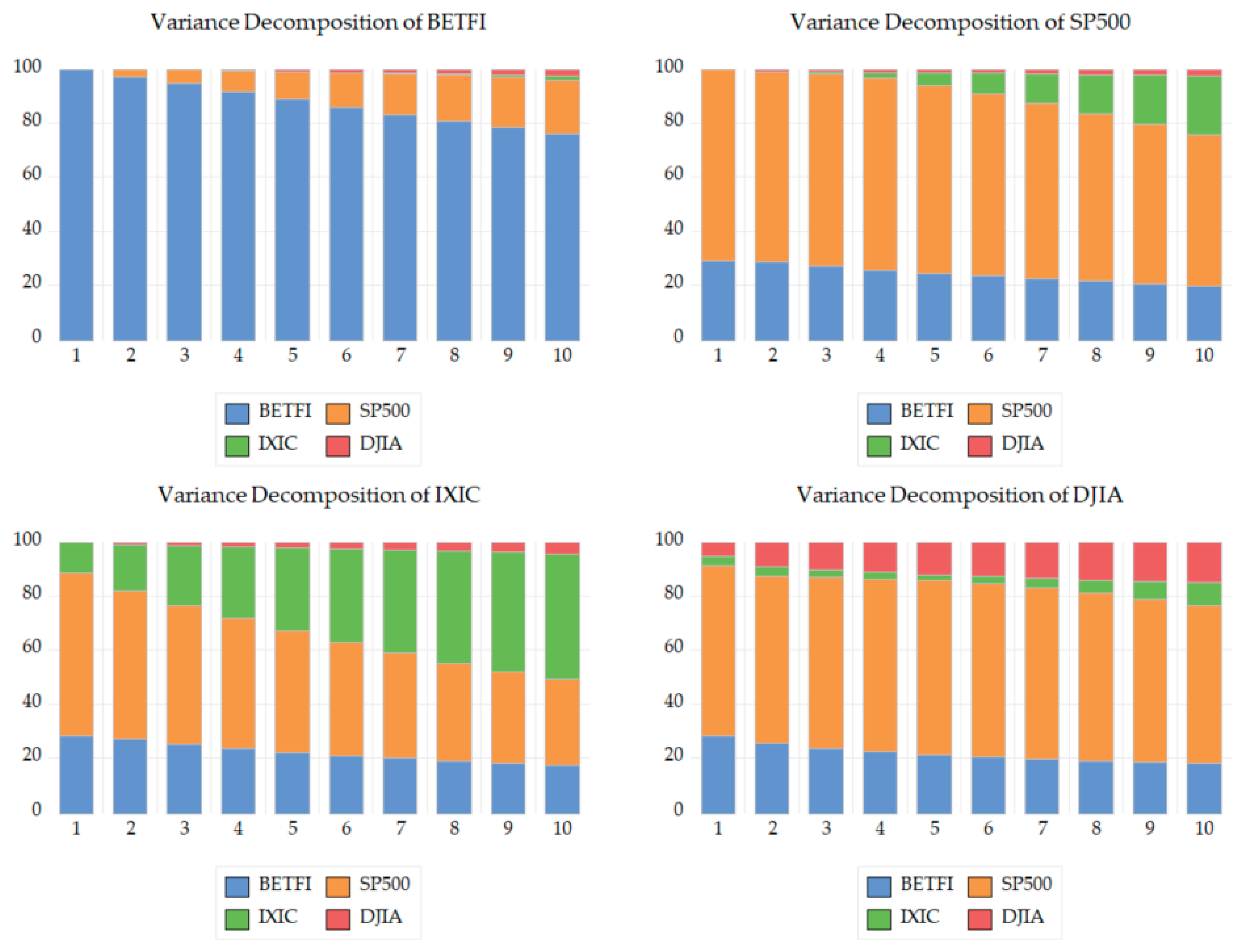
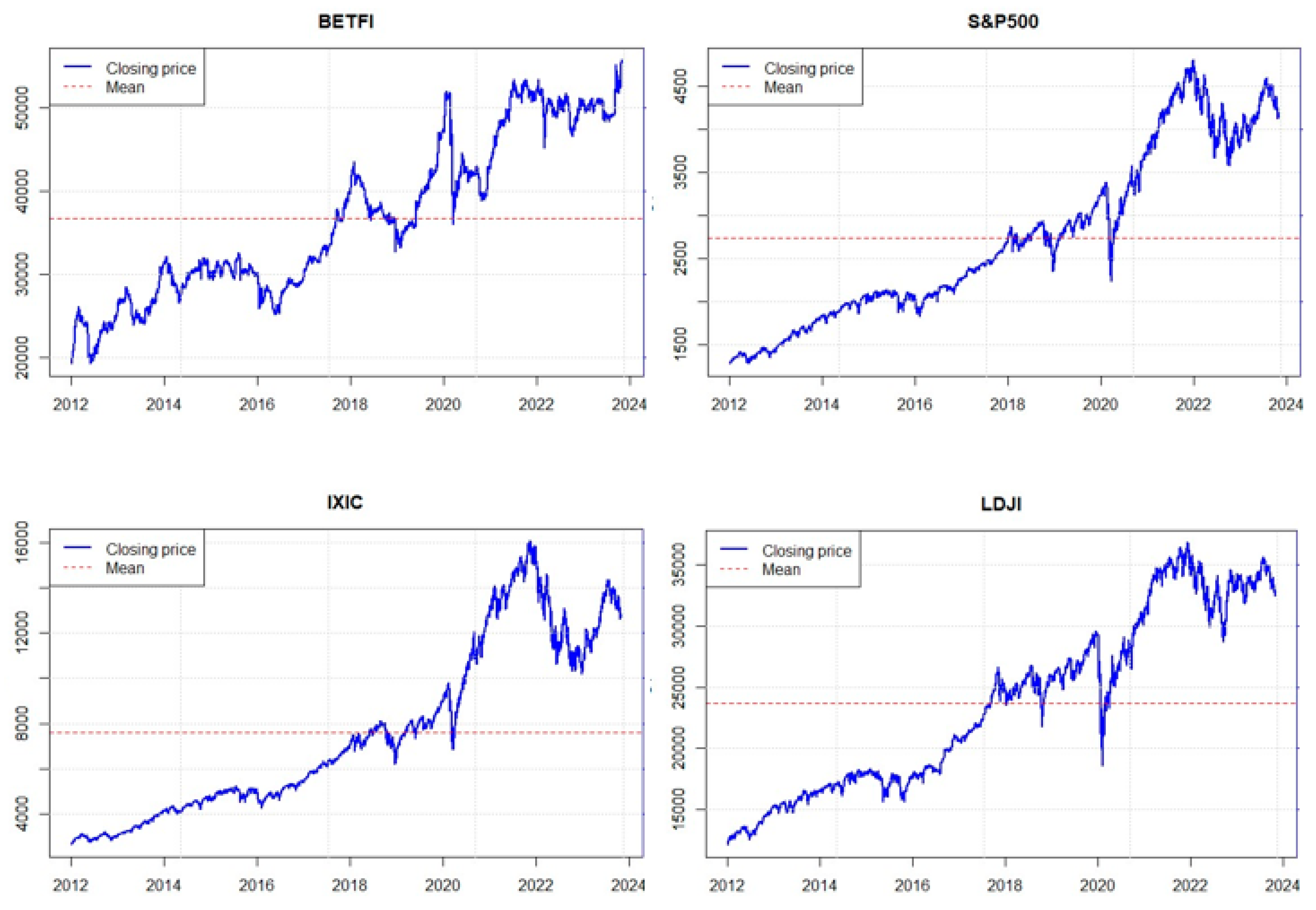
This study explored the complex interplay and potential risk of financial contagion across major financial indices, focusing on the Bucharest Exchange Trading Investment Funds Index (BET-FI), along with global indices like the S&P 500, Nasdaq Composite (IXIC), and Dow Jones Industrial Average (DJIA). Our analysis covered an extensive period from 2012 to 2023, with a particular emphasis on Romania’s financial market. We employed Autoregressive Distributed Lag (ARDL) modeling to examine the interrelations among these indices, treating the BET-FI index as our primary variable. Our research also integrated Exponential Curve Fitting (EXCF) and Generalized Supremum Augmented Dickey–Fuller (GSADF) models to identify and scrutinize potential price bubbles in these indices. We analyzed moments of high volatility and deviations from typical market trends, influenced by diverse factors like government policies, presidential elections, tech sector performance, the COVID-19 pandemic, and geopolitical tensions, specifically the Russia–Ukraine conflict. The ARDL model revealed a stable long-term relationship among the variables, indicating their interconnectedness. Our study also highlights the significance of short-term market shifts leading to long-term equilibrium, as shown in the Error Correction Model (ECM). This suggests the existence of contagion effects, where small, short-term incidents can trigger long-term, domino-like impacts on the financial markets. Furthermore, our variance decomposition examined the evolving contributions of different factors over time, shedding light on their changing interactions and impact. The Cholesky factors demonstrated the interdependence between indices, essential for understanding financial contagion effects. Our research thus uncovered the nuanced dynamics of financial contagion, offering insights into market variations, the effectiveness of our models, and strategies for detecting financial bubbles. This study contributes valuable knowledge to the academic field and offers practical insights for investors in turbulent financial environments.
Keywords: financial contagion; bubble detection mechanism; financial risk modeling; exponential curve fitting; generalized supremum augmented Dickey–Fuller; ARDL model financial contagion; bubble detection mechanism; financial risk modeling; exponential curve fitting; generalized supremum augmented Dickey–Fuller; ARDL model