Article

Assessment of Oral Skills in Adolescents
1
Communication, Oral Language and Diversity Research Group (CLOD), Department of Cognition, Development and Psychology of Development, Faculty of Psychology, University of Barcelona, 08035 Barcelona, Spain
2
Cognitive Psychology, Measurement and Modelisation of Processes Research Team, Department of Psychobiology and Behavioral Sciences Methods, Faculty of Psychology, Campus of Somosaguas, 28223 Madrid, Spain
3
Cognitive Psychology, Measurement and Modelisation of Processes Research Team, Department of Experimental Psychology, Cognitive Processes and Speech and Language Therapy, Faculty of Psychology, Campus of Somosaguas, 28223 Madrid, Spain
*
Author to whom correspondence should be addressed.
Children 2021, 8(12), 1136; https://doi.org/10.3390/children8121136

Submission received: 8 October 2021 / Revised: 24 November 2021 / Accepted: 1 December 2021 / Published: 4 December 2021

Abstract

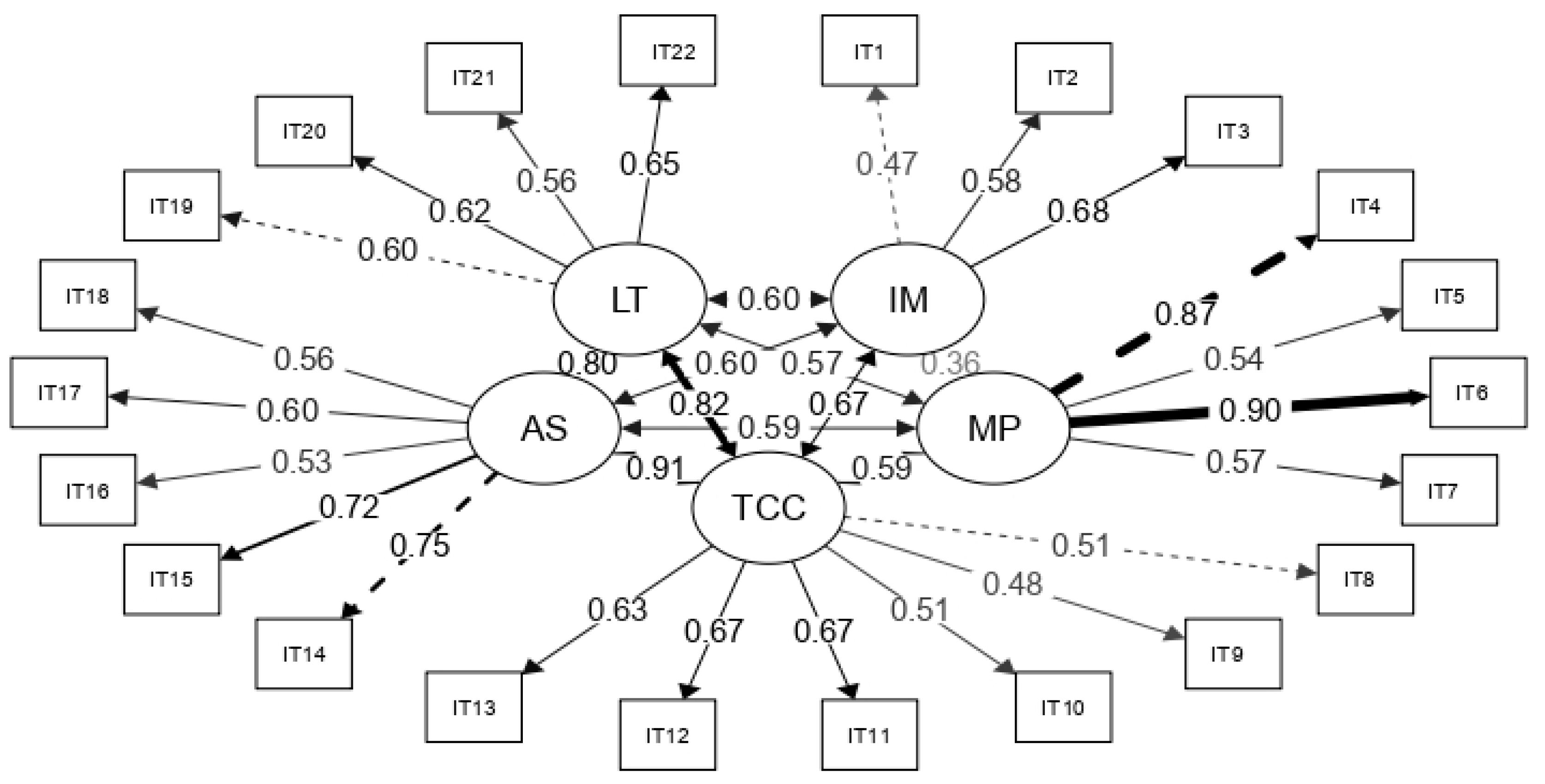
There is broad consensus on the need to foster oral skills in middle school due to their inherent importance and because they serve as a tool for learning and acquiring other competences. In order to facilitate the assessment of communicative competence, we hereby propose a model which establishes five key dimensions for effective oral communication: interaction management; multimodality and prosody; textual coherence and cohesion; argumentative strategies; and lexicon and terminology. Based on this model, we developed indicators to measure the proposed dimensions, thus generating a self-report tool to assess oral communication in middle school. Following an initial study conducted with 168 students (mean age = 12.47 years, SD = 0.41), we selected 22 items with the highest discriminant power, while in a second study carried out with a sample of 960 students (mean age 14.11 years, SD = 0.97), we obtained evidence concerning factorial validity and the relationships between oral skills, emotional intelligence and metacognitive strategies related to metacomprehension. We concluded that the proposed model and its derived measure constitute an instrument with good psychometric properties for a reliable and valid assessment of students’ oral competence in middle school.
Keywords: oral skills; oral competence; self-report; middle school; assessment model oral skills; oral competence; self-report; middle school; assessment model