Neuromorphological Alterations in the Somatosensory System of Adolescent Idiopathic Scoliosis: A Systematic Review of Magnetic Resonance Imaging Studies
 ,
,
Abstract
1. Introduction
2. Materials and Methods
2.1. Study Protocol and Registration
2.2. Search Strategy
2.3. Eligibility Criteria
2.4. Study Selection
2.5. Data Extraction
2.6. Quality Assessment
2.7. Data Synthesis
3. Results
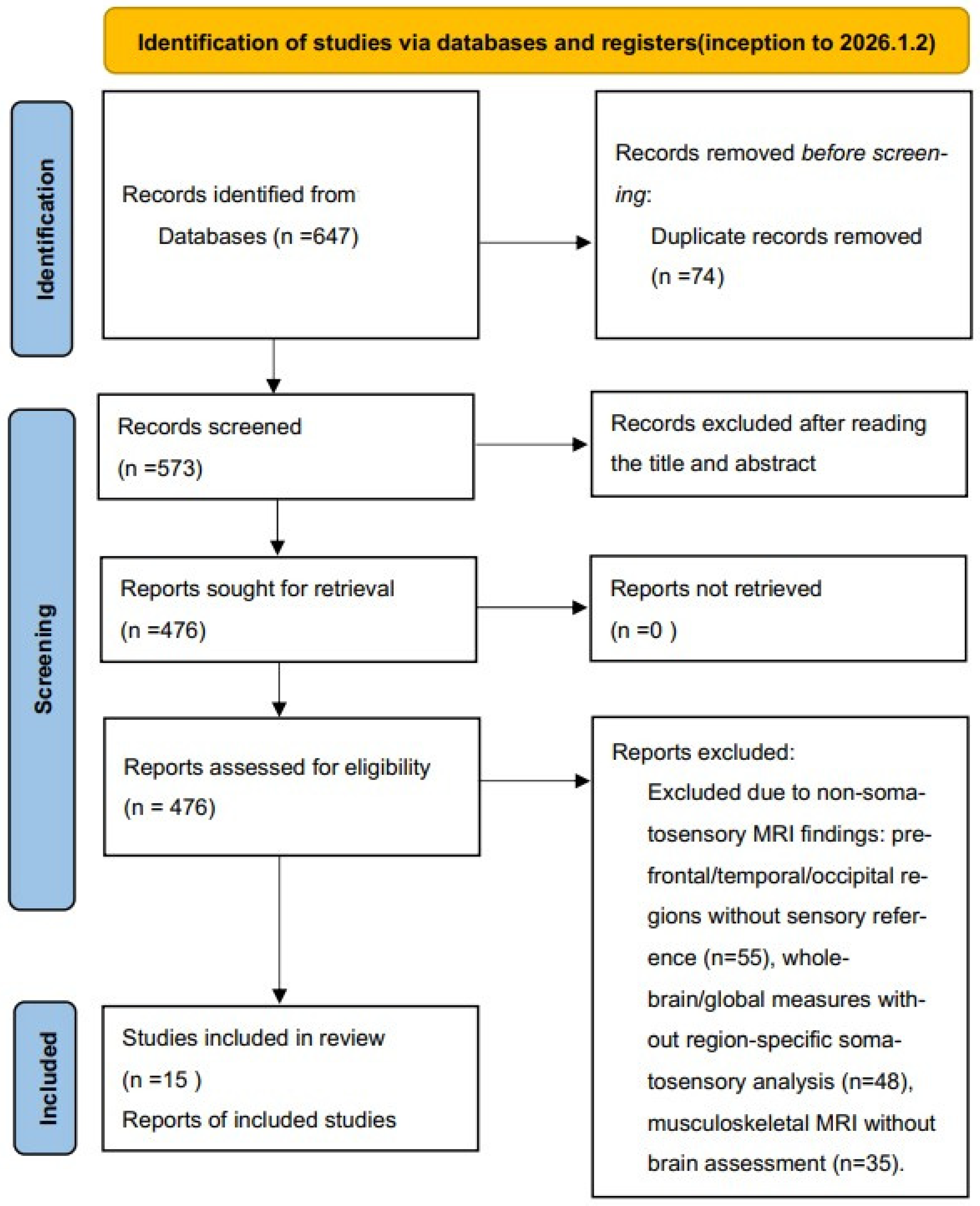
3.1. Study Results
3.2. Study Characteristics
3.3. Differences in Somatosensory Systems Related to Neuromorphology Comparing AIS Patients to Controls
3.3.1. Cerebellar Tonsillar Level
3.3.2. Cerebral Cortex
3.3.3. White Matter
3.3.4. Vestibular System
3.4. Quality Appraisal
4. Discussion
5. Conclusions
Supplementary Materials
Author Contributions
Funding
Institutional Review Board Statement
Informed Consent Statement
Data Availability Statement
Conflicts of Interest
Abbreviations
| AIS | Adolescent idiopathic scoliosis |
| MRI | Magnetic resonance imaging |
| SEPs | Somatosensory-evoked potentials |
| DTI | Diffusion tensor imaging |
| NOS | Newcastle–Ottawa Scale |
References
- Negrini, S.; Donzelli, S.; Aulisa, A.G.; Czaprowski, D.; Schreiber, S.; De Mauroy, J.C.; Diers, H.; Grivas, T.B.; Knott, P.; Kotwicki, T.; et al. 2016 SOSORT guidelines: Orthopaedic and rehabilitation treatment of idiopathic scoliosis during growth. Scoliosis Spinal Disord. 2018, 13, 3. [Google Scholar] [CrossRef] [PubMed]
- Weinstein, S.L.; Dolan, L.A.; Cheng, J.C.; Danielsson, A.; Morcuende, J.A. Adolescent idiopathic scoliosis. Lancet 2008, 371, 1527–1537. [Google Scholar] [CrossRef]
- Konieczny, M.R.; Senyurt, H.; Krauspe, R. Epidemiology of adolescent idiopathic scoliosis. J. Child. Orthop. 2013, 7, 3–9. [Google Scholar] [CrossRef]
- Dalleau, G.; Allard, M.S.; Beaulieu, M.; Rivard, C.-H.; Allard, P. Free moment contribution to quiet standing in able-bodied and scoliotic girls. Eur. Spine J. 2007, 16, 1593–1599. [Google Scholar] [CrossRef][Green Version]
- Nault, M.-L.; Allard, P.; Hinse, S.; Le Blanc, R.; Caron, O.; Labelle, H.; Sadeghi, H. Relations Between Standing Stability and Body Posture Parameters in Adolescent Idiopathic Scoliosis. Spine 2002, 27, 1911–1917. [Google Scholar] [CrossRef]
- Simoneau, M.; Richer, N.; Mercier, P.; Allard, P.; Teasdale, N. Sensory deprivation and balance control in idiopathic scoliosis adolescent. Exp. Brain Res. 2005, 170, 576–582. [Google Scholar] [CrossRef]
- Simoneau, M.; Mercier, P.; Blouin, J.; Allard, P.; Teasdale, N. Altered sensory-weighting mechanisms is observed in adolescents with idiopathic scoliosis. BMC Neurosci. 2006, 7, 68. [Google Scholar] [CrossRef] [PubMed]
- Kuo, F.-C.; Wang, N.-H.; Hong, C.-Z. Impact of Visual and Somatosensory Deprivation on Dynamic Balance in Adolescent Idiopathic Scoliosis. Spine 2010, 35, 2084–2090. [Google Scholar] [CrossRef] [PubMed]
- Morningstar, M.W.; Pettibon, B.R.; Schlappi, H.; Schlappi, M.; Ireland, T.V. Reflex control of the spine and posture: A review of the literature from a chiropractic perspective. Chiropr. Man. Ther. 2005, 13, 16. [Google Scholar] [CrossRef]
- Cheng, J.C.Y.; Guo, X.; Sher, A.H.L.; Chan, Y.-L.; Metreweli, C. Correlation Between Curve Severity, Somatosensory Evoked Potentials, and Magnetic Resonance Imaging in Adolescent Idiopathic Scoliosis. Spine 1999, 24, 1679–1684. [Google Scholar] [CrossRef]
- Bertuccelli, M.; Cantele, F.; Masiero, S. Body Image and Body Schema in Adolescents with Idiopathic Scoliosis: A Scoping Review. Adolesc. Res. Rev. 2023, 8, 97–115. [Google Scholar] [CrossRef]
- Chen, B.Z.; Soh, R.C.C.; Hartono, S.; Ann, C.N.; Wen, M.C.; Lee, W.; Lim, S.L.; Gan, J.; Lo, Y.L.; Chan, L.L.; et al. A multi-modal MRI study of the central nervous system in adolescent idiopathic scoliosis. Neuroimage Clin. 2017, 15, 563–569. [Google Scholar]
- Liu, T.; Chu, W.C.; Young, G.; Li, K.; Yeung, B.H.; Guo, L.; Man, G.C.; Lam, W.W.; Wong, S.T.; Cheng, J.C. MR analysis of regional brain volume in adolescent idiopathic scoliosis: Neurological manifestation of a systemic disease. J. Magn. Reson. Imaging 2008, 27, 732–736. [Google Scholar] [CrossRef]
- Maiocco, B.; Deeney, V.F.; Coulon, R.; Parks, P.F., Jr. Adolescent Idiopathic Scoliosis and the Presence of Spinal Cord Abnormalities: Preoperative Magnetic Resonance Imaging Analysis. Spine 1997, 22, 2537–2541. [Google Scholar] [CrossRef]
- Domenech, J.; García-Martí, G.; Martí-Bonmatí, L.; Barrios, C.; Tormos, J.M.; Pascual-Leone, A. Abnormal activation of the motor cortical network in idiopathic scoliosis demonstrated by functional MRI. Eur. Spine J. 2011, 20, 1069–1078. [Google Scholar] [CrossRef] [PubMed]
- Page, M.J.; McKenzie, J.E.; Bossuyt, P.M.; Boutron, I.; Hoffmann, T.C.; Mulrow, C.D.; Shamseer, L.; Tetzlaff, J.M.; Akl, E.A.; Brennan, S.E.; et al. The PRISMA 2020 statement: An updated guideline for reporting systematic reviews. BMJ 2021, 372, n71. [Google Scholar] [CrossRef]
- Higgins, J.P.T.; Green, S. (Eds.) Cochrane Handbook for Systematic Reviews of Interventions, 5th ed.; updated March 2011; The Cochrane Collaboration: London, UK, 2011. [Google Scholar]
- Wells, G.A.; Shea, B.; O’Connell, D.; Peterson, J.; Welch, V.; Losos, M.; Petersen, J.A. The Newcastle-Ottawa Scale (NOS) for Assessing the Quality of Nonrandomised Studies in Meta-Analyses; Ottawa Hospital Research Institute: Ottawa, ON, Canada, 2019. [Google Scholar]
- Chu, W.C.W.; Man, G.C.W.; Lam, W.W.M.; Yeung, B.H.Y.; Chau, W.-W.; Ng, B.K.W.; Lam, T.-P.; Lee, K.-M.; Cheng, J.C.Y. A detailed morphologic and functional magnetic resonance imaging study of the craniocervical junction in adolescent idiopathic scoliosis. Spine 2007, 32, 1667–1674. [Google Scholar] [CrossRef]
- Sun, X.; Sun, X.; Qiu, Y.; Zhu, Z.; Zhu, F.; Wang, B.; Yu, Y.; Qian, B. Variations of the position of the cerebellar tonsil in idiopathic scoliotic adolescents with a cobb angle >40 degrees: A magnetic resonance imaging study. Spine 2007, 32, 1680–1686. [Google Scholar] [CrossRef]
- Lee, R.K.L.; Griffith, J.F.; Leung, J.H.Y.; Chu, W.C.W.; Lam, T.P.; Ng, B.K.W.; Cheng, J.C.Y. Effect of upright position on tonsillar level in adolescent idiopathic scoliosis. Eur. Radiol. 2015, 25, 2397–2402. [Google Scholar] [CrossRef]
- Noriega-Gonzalez, D.C.; Crespo, J.; Ardura, F.; Campo, J.C.-D.; Alberola-Lopez, C.; de Luis-García, R.; Caballero-García, A.; Córdova, A. Cerebral White Matter Connectivity in Adolescent Idiopathic Scoliosis: A Diffusion Magnetic Resonance Imaging Study. Children 2022, 9, 1023. [Google Scholar] [CrossRef]
- Xue, C.; Shi, L.; Hui, S.; Wang, D.; Lam, T.; Ip, C.-B.; Ng, B.; Cheng, J.; Chu, W. Altered White Matter Microstructure in the Corpus Callosum and Its Cerebral Interhemispheric Tracts in Adolescent Idiopathic Scoliosis: Diffusion Tensor Imaging Analysis. Am. J. Neuroradiol. 2018, 39, 1177–1184. [Google Scholar] [CrossRef] [PubMed]
- Shi, L.; Wang, D.; Chu, W.; Burwell, R.; Freeman, B.; Heng, P.; Cheng, J. Volume-Based Morphometry of Brain MR Images in Adolescent Idiopathic Scoliosis and Healthy Control Subjects. Am. J. Neuroradiol. 2009, 30, 1302–1307. [Google Scholar] [CrossRef]
- Kong, Y.; Shi, L.; Hui, S.C.N.; Wang, D.; Deng, M.; Chu, W.C.W.; Cheng, J.C.Y. Variation in Anisotropy and Diffusivity along the Medulla Oblongata and the Whole Spinal Cord in Adolescent Idiopathic Scoliosis: A Pilot Study Using Diffusion Tensor Imaging. Am. J. Neuroradiol. 2014, 35, 1621–1627. [Google Scholar] [CrossRef]
- Hitier, M.; Hamon, M.; Denise, P.; Lacoudre, J.; Thenint, M.-A.; Mallet, J.-F.; Moreau, S.; Quarck, G. Lateral Semicircular Canal Asymmetry in Idiopathic Scoliosis: An Early Link between Biomechanical, Hormonal and Neurosensory Theories? PLoS ONE 2015, 10, e0131120. [Google Scholar] [CrossRef]
- Carry, P.M.; Duke, V.R.; Brazell, C.J.; Stence, N.; Scholes, M.; Rousie, D.L.; Miller, N.H. Lateral semi-circular canal asymmetry in females with idiopathic scoliosis. PLoS ONE 2020, 15, e0232417. [Google Scholar] [CrossRef]
- Shi, L.; Wang, D.; Chu, W.C.; Burwell, G.R.; Wong, T.-T.; Heng, P.A.; Cheng, J.C. Automatic MRI segmentation and morphoanatomy analysis of the vestibular system in adolescent idiopathic scoliosis. NeuroImage 2010, 54, S180–S188. [Google Scholar] [CrossRef]
- Chau, W.W.M.; Chu, W.C.M.; Lam, T.P.M.; Ng, B.K.M.; Fu, L.L.M.; Cheng, J.C.F. Anatomical Origin of Abnormal Somatosensory-Evoked Potential (SEP) in Adolescent Idiopathic Scoliosis with Different Curve Severity and Correlation with Cerebellar Tonsillar Level Determined by MRI. Spine 2016, 41, E598–E604. [Google Scholar] [CrossRef][Green Version]
- Dieterich, M.; Brandt, T. The bilateral central vestibular system: Its pathways, functions, and disorders. Ann. N. Y. Acad. Sci. 2015, 1343, 10–26. [Google Scholar] [CrossRef] [PubMed]
- Giedd, J.N.; Rapoport, J.L. Structural MRI of pediatric brain development: What have we learned and where are we going? Neuron 2010, 67, 728–734. [Google Scholar] [CrossRef] [PubMed]
- Moseley, G.L.; Flor, H. Targeting cortical representations in the treatment of chronic pain: A review. Neurorehabil. Neural Repair 2012, 26, 646–652. [Google Scholar] [CrossRef]
- Angelaki, D.E.; Cullen, K.E. Vestibular system: The many facets of a multimodal sense. Annu. Rev. Neurosci. 2008, 31, 125–150. [Google Scholar] [CrossRef]
- Cheng, J.C.; Castelein, R.M.; Chu, W.C.; Danielsson, A.J.; Dobbs, M.B.; Grivas, T.B.; Gurnett, C.A.; Luk, K.D.; Moreau, A.; Newton, P.O.; et al. Adolescent idiopathic scoliosis. Nat. Rev. Dis. Primers. 2015, 1, 15030. [Google Scholar] [CrossRef]
- Wong, A.Y.; Chiu, T.S. Physiotherapy management of adolescent idiopathic scoliosis. J. Physiother. 2025, 71, 229–238. [Google Scholar] [CrossRef] [PubMed]
- Burwell, R.G.; Aujla, R.K.; Grevitt, M.P.; Dangerfield, P.H.; Moulton, A.; Randell, T.L.; I Anderson, S. Pathogenesis of adolescent idiopathic scoliosis in girls—A double neuro-osseous theory involving disharmony between two nervous systems, somatic and autonomic expressed in the spine and trunk: Possible dependency on sympathetic nervous system and hormones with implications for medical therapy. Scoliosis 2009, 4, 24. [Google Scholar] [PubMed]
- Abul-Kasim, K.; Overgaard, A.; Karlsson, M.K.; Ohlin, A. Tonsillar ectopia in idiopathic scoliosis: Does it play a role in the pathogenesis and prognosis or is it only an incidental finding? Scoliosis 2009, 4, 25. [Google Scholar] [CrossRef] [PubMed]
- Wang, D.; Shi, L.; Chu, W.C.; Burwell, R.G.; Cheng, J.C.; Ahuja, A.T. Abnormal cerebral cortical thinning pattern in adolescent girls with idiopathic scoliosis. Neuroimage 2012, 59, 935–942. [Google Scholar] [CrossRef]
- Makino, T.; Kaito, T.; Sakai, Y.; Takenaka, S.; Yoshikawa, H. Health-related Quality of Life and Postural Changes of Spinal Alignment in Female Adolescents Associated with Back Pain in Adolescent Idiopathic Scoliosis: A Prospective Cross-sectional Study. Spine 2019, 44, E833–E840. [Google Scholar] [CrossRef]
- Paramento, M.; Passarotto, E.; Maccarone, M.C.; Agostini, M.; Contessa, P.; Rubega, M.; Formaggio, E.; Masiero, S. Neurophysiological, balance and motion evidence in adolescent idiopathic scoliosis: A systematic review. PLoS ONE 2024, 19, e0303086. [Google Scholar] [CrossRef]


| Category | Inclusion Criteria | Exclusion Criteria |
|---|---|---|
| Study Design | Case–control studies | Non-case–control designs (e.g., reviews, case reports, animal studies) |
| Participants | Adolescents aged 10–18 years | Participants outside the 10–18 age range |
| Exposure/Condition | Clinical diagnosis of Adolescent Idiopathic Scoliosis | Non-idiopathic scoliosis (e.g., congenital, neuromuscular) or comorbid major neurological/developmental disorders |
| Control Group | Healthy controls, matched to cases for age and sex | Unhealthy controls; controls not matched for age and/or sex |
| Outcome and Measures | MRI-based assessment of neuromorphology in brain or vestibular structures linked to somatosensory function | Studies not using MRI, or MRI not targeting somatosensory-related brain/vestibular morphology |
| Author, Year | No. of Participants (% Male) | Age (y), Median/ Mean (SD) | Type of Curve | Cobb Angle (°), Median/ Mean (SD) | Outcome Measures |
|---|---|---|---|---|---|
| Noriega et al., 2022 [22] | AIS: 22 (22.7) Control: 18 (55.5) | AIS: 14.73 (3.03) Control: 12.33 (2.43) | not reported | not reported | FA (fractional anisotropy) the number of streamlines |
| Carry et al., 2020 [27] | AIS: 20 (0) Control: 19 (0) | AIS: 14.6 (1.9) Control: 22.0 (7.8) | right thoracic (n = 10) right lumbar (n = 2) biphasic * (n = 8) | right thoracic: 48.4 (10.0) right lumbar: 55.0 (7.1) biphasic: 46.1 (10.2) | the morphoanatomy of vestibular system |
| Xue et al., 2018 [23] | AIS: 69 (0) Control: 40 (0) | AIS: 14.5 (2.2) Control: 14.6 (1.04) | right thoracic (n = 65) right thoracolumbar (n = 4) | 33.55 (13.9) | 1. microstructural changes in the corpus callosum 2. microstructural changes in interhemispheric white matter fiber tracts interconnecting both cerebral hemispheres |
| Chau et al., 2016 [29] | AIS: 91 (0) Control: 49 (0) | AIS: NA Control: 14.6 (NA) | right thoracic (n = 91) | severe: 56.4 (11.6) moderate: 25.8 (11.1) mild: 14.3 (5.0) | 1. somatosensory-evoked potential 2. cerebellar tonsillar level |
| Hitier et al., 2015 [26] | AIS: 17 (23.5) Control: 9 (33.3) | AIS: 15.47 (1.84) Control: 16.7 (1.50) | thoracic (n = 8) lumbar (n = 5) thoracolumbar (n = 4) | 26.7 (8.3) | 1. orientation of the lateral semicircular canal in the parasagittal and the frontal plane 2. position of the three semicircular canals 3. morphologic asymmetry between the right and left vestibule 4. function of the lateral semicircular canal |
| Lee et al., 2015 [21] | AIS: 25 (0) Control: 18 (0) | AIS: 14.9 (2.3) Control: 18.7 (4.5) | thoracic (n = 9) lumbar (n = 2) thoracolumbar (n = 14) | Range (15–63) mean 26.3 ± 11.4 | cerebellar tonsillar position |
| Kong et al., 2014 [25] | AIS: 13 (0) Control: 13 (0) | AIS: 13.6 (11–16) Control: 13.9 (12–15) | right thoracic (n = 13) | 24.7 (16–37) | mean values of fractional anisotropy mean diffusivity |
| Wang et al., 2012 [14] | AIS: 50 (0) Control: 40 (0) | AIS: 14.46 (12–17) Control: 14.53 (12–17) | right thoracic (n = 50) | 48.7 (20–90) | thickness of cerebral cortex |
| Shi et al., 2010 [28] | AIS: 20 (0) Control: 20 (0) | AIS: 14.7 (1.8) Control: 15.1 (2.4) | right thoracic (n = 20) | 32.6 (19.1) | the morphoanatomy of vestibular system |
| Domenech et al., 2011 [15] | AIS: 10 (20) Control: 10 (30) | AIS: 15.2 (14–16) Control: 14.7 (14–16) | right thoracic (n = 6) right thoracolumbar (n = 2) left thoracic (n = 1) left lumbar (n = 1) | 35 (27–55) | cortical activation |
| Shi et al., 2009 [24] | AIS: 29 (0) Control: 28 (0) | AIS with left thoracic curve: 14 (11–16) AIS with right thoracic curve: 15 (13–17) Control: NA | left thoracic (n = 9) right thoracic (n = 20) | Not reported | corpus callosum volume |
| Liu et al., 2008 [13] | AIS: 20 (0) Control: 26 (0) | AIS: 14.1 (11–18) Control:14.8 (11–18) | right thoracic (n = 20) | 53 (37–68) | volumes of 99 preselected neuroanatomical regions |
| Sun et al., 2007 [20] | AIS: 203 (13.3) Control: 86 (50) | AIS: 15.7 (1.8) Control: 14.6 (1.6) | not reported | >40 | cerebellar tonsillar level |
| Chu et al., 2007 [19] | AIS: 69 (0) Control: 36 (0) | 15 (11–18) | thoracic curve (n = 40) lumbar curve (n = 27) thoracolumbar curve (n = 2) | 36 (26–52) | 1. cerebellar tonsillar level 2. the anteroposterior diameter and area of the foramen magnum 3. the peak velocity of cerebrospinal fluid flow through the foramen magnum 4. somatosensory-evoked potential |
| Cheng et al., 1999 [10] | AIS: 164 (13.4) Control: 36 (58.3) | AIS: group II 14.2 (10–20) Group III 13.6 (10–20) Control: group I 12 | thoracic curve (n = 40) lumbar curve (n = 27) thoracolumbar curve (n = 2) | group II (10–45) group III (45–105) | results of abnormal findings
|
| Author, Year | Level of Adjustment | Device | MR Imaging Scanner, Sequence, Parameter | Imaging Targets |
|---|---|---|---|---|
| Noriega et al., 2022 [22] | age-matched | Achieva 3T MRI; Philips Healthcare, Best, the Netherlands |
| cervical area and whole brain |
| Carry et al., 2020 [27] | gender-matched | Siemens |
| vestibular system (semicircular canals) |
| Xue et al., 2018 [23] | age- and gender-matched | Achieva TX series; Philip Healthcare, Best, the Netherlands | DTI:
| Corpus callosum, interhemispheric white matter fiber tracts interconnecting both cerebral hemispheres |
| Chau et al., 2016 [29] | age- and gender-matched | Gyroscan ASC NT; Philips Medical System, Best, the Netherlands |
| cerebellar tonsillar |
| Hitier et al., 2015 [26] | school environment-matched | General Electric |
| vestibular system (semicircular canal) |
| Lee et al., 2015 [21] | Age-gender-matched | G-scan; Esaote SpA, Genoa, Italy |
| cerebellar tonsillar |
| Kong et al., 2014 [25] | Age-gender-matched | Achieva TX series; Philips Healthcare, Best, the Netherlands |
| brain, spinal cord |
| Wang et al., 2012 [14] | age-matched | Sonata, Siemens, Erlanger, Germany |
| cerebral cortex |
| Shi et al., 2010 [28] | age- and gender-matched | Sonata, Siemens, Erlangen, Germany |
| vestibular system |
| Domenech et al., 2011 [15] | age-matched | Philips Intera, Best, The Netherlands |
| motor cortical network |
| Shi et al., 2009 [24] | age- and gender-matched | Sonata, Siemens, Erlangen, Germany |
| white matter, gray matter, and cerebrospinal fluid |
| Liu et al., 2008 [13] | age- and gender-matched | Sonata, Siemens, Erlanger, Germany |
| 99 anatomical regions of brain |
| Sun et al., 2007 [20] | age-matched | Gyroscan Intera, Philips Medical Systems, Best, the Netherlands |
| brain, brainstem, cerebella, spinal cord, the posterior fossa, foramen magnum, and cervical spine |
| Chu et al., 2007 [19] | age- and gender-matched | Sonata, Siemens, Erlanger, Germany |
| cerebellar tonsil, foramen magnum, cerebrospinal fluid |
| Cheng et al., 1999 [10] | age-matched | Gyroscan ASC NT; Philips Medical System, Best, the Netherlands |
| the whole spine |
| Article, Year | Selection | Comparability | Exposure | ||||||
|---|---|---|---|---|---|---|---|---|---|
| (1) Case Definition is Adequate | (2) Representativeness of the Cases | (3) Selection of Controls | (4) Definition of Controls | (5) Comparability of Cases and Controls | (6) Ascertainment of Exposure | (7) Same Method of Ascertainment for Cases and Controls | (8) Non-Response Rate | (9) Total Score | |
| Noriega et al., 2022 [22] | ★ | — | ★ | ★ | ★ | — | ★ | — | 5 |
| Carry et al., 2020 [27] | ★ | ★ | — | — | ★ | ★ | — | — | 4 |
| Xue et al., 2018 [23] | ★ | ★ | ★ | ★ | ★ | ★ | ★ | — | 7 |
| Chau et al., 2016 [29] | ★ | ★ | ★ | ★ | ★★ | ★ | ★ | — | 8 |
| Hitier et al., 2015 [26] | ★ | — | ★ | ★ | ★ | ★ | ★ | — | 6 |
| Lee et al., 2015 [21] | ★ | ★ | ★ | ★ | ★ | ★★ | ★ | — | 8 |
| Kong et al., 2014 [25] | ★ | ★ | ★ | ★ | ★★ | ★★ | — | — | 8 |
| Wang et al., 2012 [14] | ★ | — | ★ | ★ | ★ | ★ | ★ | — | 6 |
| Shi et al., 2010 [28] | ★ | ★ | — | — | ★ | ★ | — | — | 4 |
| Domenech et al., 2011 [15] | ★ | — | ★ | ★ | ★ | ★ | ★ | — | 6 |
| Shi et al., 2009 [24] | ★ | ★ | ★ | — | — | ★ | — | — | 4 |
| Liu et al., 2008 [13] | ★ | — | ★ | ★ | ★ | ★ | — | — | 5 |
| Sun et al., 2007 [20] | ★ | ★ | ★ | ★ | ★ | ★ | ★ | — | 7 |
| Chu et al., 2007 [19] | ★ | ★ | ★ | ★ | ★ | ★ | ★ | — | 7 |
| Cheng et al., 1999 [10] | ★ | ★ | ★ | ★ | ★ | — | ★ | — | 6 |
Disclaimer/Publisher’s Note: The statements, opinions and data contained in all publications are solely those of the individual author(s) and contributor(s) and not of MDPI and/or the editor(s). MDPI and/or the editor(s) disclaim responsibility for any injury to people or property resulting from any ideas, methods, instructions or products referred to in the content. |
© 2026 by the authors. Licensee MDPI, Basel, Switzerland. This article is an open access article distributed under the terms and conditions of the Creative Commons Attribution (CC BY) license.
Share and Cite
Wu, Q.; Chen, Z.; Chen, K.; Li, X.; Guo, H.; Zhou, X.; Liang, J.; Du, Q. Neuromorphological Alterations in the Somatosensory System of Adolescent Idiopathic Scoliosis: A Systematic Review of Magnetic Resonance Imaging Studies. Children 2026, 13, 499. https://doi.org/10.3390/children13040499
Wu Q, Chen Z, Chen K, Li X, Guo H, Zhou X, Liang J, Du Q. Neuromorphological Alterations in the Somatosensory System of Adolescent Idiopathic Scoliosis: A Systematic Review of Magnetic Resonance Imaging Studies. Children. 2026; 13(4):499. https://doi.org/10.3390/children13040499
Chicago/Turabian StyleWu, Qikai, Zhengquan Chen, Kang Chen, Xin Li, Haibin Guo, Xiangyue Zhou, Juping Liang, and Qing Du. 2026. "Neuromorphological Alterations in the Somatosensory System of Adolescent Idiopathic Scoliosis: A Systematic Review of Magnetic Resonance Imaging Studies" Children 13, no. 4: 499. https://doi.org/10.3390/children13040499
APA StyleWu, Q., Chen, Z., Chen, K., Li, X., Guo, H., Zhou, X., Liang, J., & Du, Q. (2026). Neuromorphological Alterations in the Somatosensory System of Adolescent Idiopathic Scoliosis: A Systematic Review of Magnetic Resonance Imaging Studies. Children, 13(4), 499. https://doi.org/10.3390/children13040499