

A Clinical Practice Example of Smith–Magenis Syndrome in the Neuropediatric Clinic: Etiology, Clinical Presentation, Diagnostics and Therapeutic Approaches—A Case Report
Highlights
- Smith–Magenis syndrome (SMS) presents with a characteristic constellation of neurodevelopmental, behavioral, and sleep–wake disturbances, making early clinical recognition essential for accurate diagnosis.
- A multidisciplinary diagnostic approach—including genetic testing (deletion 17p11.2 or RAI1 mutations), developmental evaluation, and behavioral assessment—is crucial for establishing the diagnosis and guiding individualized therapy.
- Early identification of SMS allows for a timely initiation of targeted therapeutic interventions (behavioral management, sleep regulation, parent support), which can significantly improve the quality of life for patients and families.
- The case report underscores the importance of collaboration among neuropediatricians, geneticists, psychologists, and sleep specialists to meet the complex clinical needs of individuals with SMS.
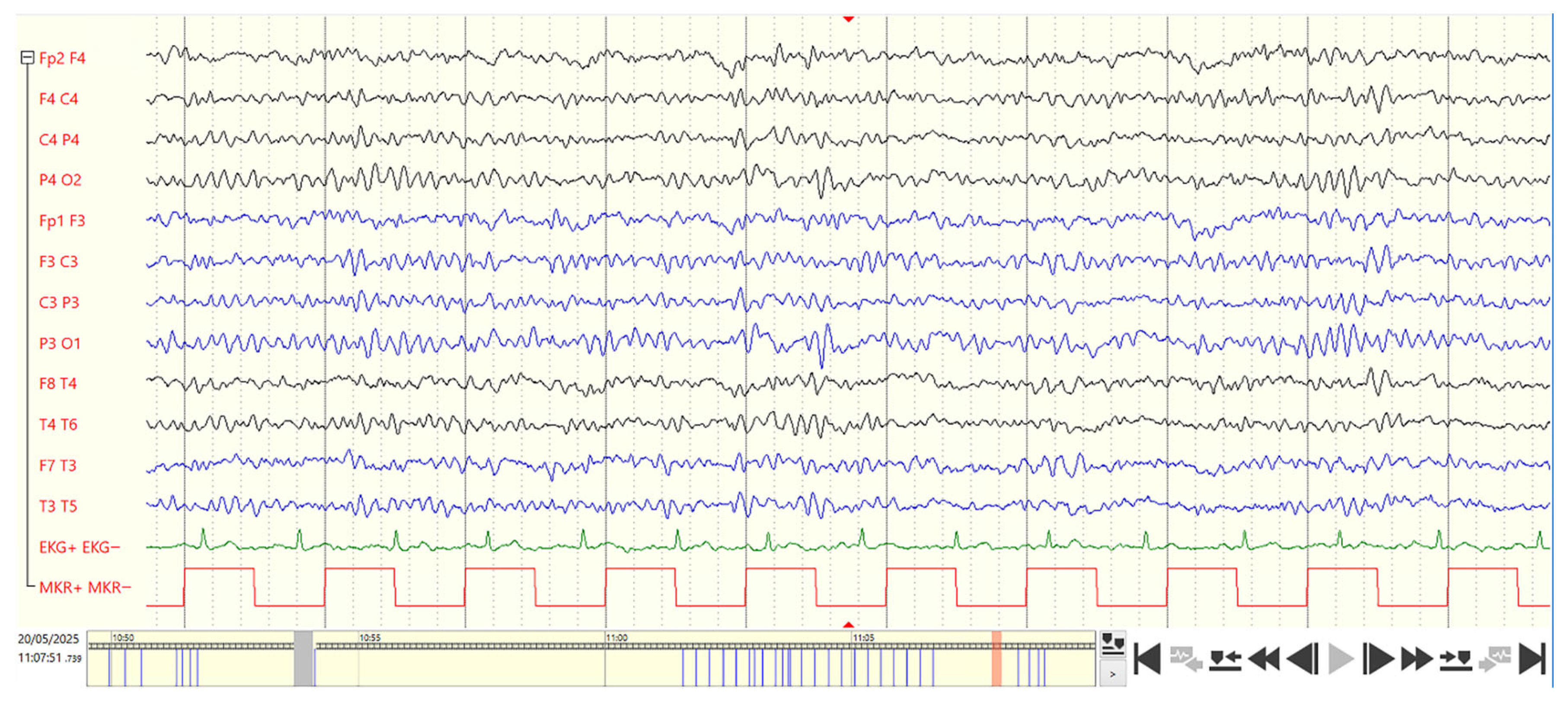
- “Rolando-type” spike-and-sharp wave complexes (benign epilepsy-type potentials of childhood, BEPC) in the EEG are a specific marker of brain immaturity in children and have two main causes: a genetic predisposition with congenital impairment of brain maturation, and organic lesions of the central nervous system. In this case (Smith–Magenis syndrome (SMS)), there is also a congenital disorder of brain maturation, manifested by the presence of benign epilepsy-type potentials of childhood (BEPC, “Rolando-type” spike-and-sharp waves) in the EEG. This study (paper) presents and describes “Rolando-type” spike-and-sharp wave complexes on the EEG in Smith–Magenis syndrome for the first time.
Abstract
1. Introduction
2. Etiology and Genetics: Genotype–Phenotype Correlations
3. Prevalence and Epidemiology
4. Paradoxical Melatonin Secretion and Light Responses in Smith–Magenis Syndrome
- -
- Haploinsufficiency of RAI1 and/or other genes in 17p11.2 that influence circadian regulatory mechanisms. Haploinsufficiency disorders are genetic conditions caused by reduced gene expression and lead to developmental, metabolic, and tumor-related abnormalities. The dosage-sensitive Retinoic Acid Induced 1 (RAI1) gene, located in the 17p11.2 region, is central to the core features of Smith–Magenis syndrome [27].
- -
- Impairment of melatonin production, secretion, or metabolism [12].
- -
- Absent or reduced response to daylight or disturbed light/dark synchronization [28].
5. Clinical and Neurological Manifestations
6. Diagnostics
6.1. Genetic Diagnostics
- -
- Array-CGH or MLPA to detect a 17p11.2 deletion;
- -
- Sequencing of the RAI1 gene if no deletion is detectable;
- -
- Confirmation by FISH or SNP array in unclear cases.
6.2. EEG Findings
- -
- Intermittent frontocentral slowing;
- -
- Absence of epileptiform activity despite behavioral abnormalities;
- -
- In approximately 10–20% of cases, generalized or focal epileptiform potentials may occur [32].
6.3. Sleep Diagnostics
- -
- Value > 0.33 → Suspicion of OSA (Obstructive Sleep Apnea);
- -
- Value < 0.33 → No suspicion of OSA (Obstructive Sleep Apnea).
- -
- “What do you do when you cannot fall asleep?” → “I bring my pet into bed.”
- -
- “What do you do when you wake up at night?” → “I wake up because I am hungry or thirsty.”
- -
- “Do you take a nap during the day?” → “Yes.”
7. Conclusions
Funding
Institutional Review Board Statement
Informed Consent Statement
Data Availability Statement
Acknowledgments
Conflicts of Interest
References
- Smith, A.C.; Magenis, R.E. Two patients with facial clefts and deletion of the short arm of chromosome 17. Am. J. Med. Genet. 1982, 12, 437–442. [Google Scholar]
- Smith, A.C.; McGavran, L.; Robinson, J.; Waldstein, G.; Macfarlane, J.; Zonona, J.; Reiss, J.; Lahr, M.; Allen, L.; Magenis, E.; et al. Interstitial deletion of (17)(p11.2p11.2) in nine patients. Am. J. Med. Genet. 1986, 24, 393–414. [Google Scholar] [CrossRef] [PubMed]
- Patil, S.R.; Bartley, J.A. Interstitial deletion of the short arm of chromosome 17. Hum. Genet. 1984, 67, 237–238. [Google Scholar] [CrossRef] [PubMed]
- Colley, A.F.; Leversha, M.A.; Voullaire, L.E.; Rogers, J.G. Five cases demonstrating the distinctive behavioural features of chromosome deletion 17(p11.2p11.2) (Smith-Magenis syndrome). J. Paediatr. Child Health 1990, 26, 17–21. [Google Scholar] [CrossRef]
- Greenberg, F.; Guzzetta, V.; Montes de Oca-Luna, R.; Magenis, R.E.; Smith, A.; Richter, S.; Kondo, I.; Dobyns, W.; Patel, P.; Lupski, J.R. Molecular analysis of the Smith-Magenis syndrome: A possible contiguous-gene syndrome associated with del(17)(p11.2). Am. J. Hum. Genet. 1991, 49, 1207–1218. [Google Scholar]
- Walz, K.; Caratini-Rivera, S.; Bi, W.; Fonseca, P.; Mansouri, D.L.; Lynch, J.; Vogel, H.; Noebels, J.L.; Bradley, A.; Lupski, J.R. Modeling del(17)(p11.2p11.2) and dup(17)(p11.2p11.2) Contiguous Gene Syndromes by Chromosome Engineering in Mice: Phenotypic Consequences of Gene Dosage Imbalance. Mol. Cell. Biol. 2003, 23, 3646–3655. [Google Scholar] [CrossRef]
- De Leersnyder, H.; De Blois, M.C.; Claustrat, B.; Romana, S.; Albrecht, U.; von Kleist-Retzow, J.C.; Delobel, B.; Viot, G.; Lyonnet, S.; MD Vekemans, M.; et al. Inversion of the circadian rhythm of melatonin in the Smith-Magenis syndrome. J. Pediatr. 2001, 139, 111–116. [Google Scholar] [CrossRef]
- Mure, L.S.; Hatori, M.; Zhu, Q.; Demas, J.; Kim, I.M.; Nayak, S.K.; Panda, S. Melanopsin-Encoded Response Properties of Intrinsically Photosensitive Retinal Ganglion Cells. Neuron 2016, 90, 1016–1027. [Google Scholar] [CrossRef]
- Do, M.T.H. Melanopsin and the Intrinsically Photosensitive Retinal Ganglion Cells: Biophysics to Behavior. Neuron 2019, 104, 205–226. [Google Scholar] [CrossRef]
- Lucio-Enríquez, K.R.; Rubio-Valles, M.; Ramos-Jiménez, A.; Pérez-León, J.A. Human melanopsin (OPN4) gene polymorphisms: A systematic review. Front. Neurosci. 2025, 19, 1581266. [Google Scholar] [CrossRef]
- Greenberg, F.; Lewis, R.A.; Potocki, L.; Glaze, D.; Parke, J.; Killian, J.; Murphy, M.A.; Williamson, D.; Brown, F.; Dutton, R.; et al. Multidisciplinary clinical study of Smith-Magenis syndrome (deletion 17p11.2). Am. J. Med. Genet. 1996, 62, 247–254. [Google Scholar] [CrossRef]
- Potocki, L.; Shaw, C.J.; Stankiewicz, P.; Lupski, J.R. Variability in clinical phenotype despite common chromosomal deletion in Smith-Magenis syndrome. Genet. Med. 2000, 2, 318–327. [Google Scholar]
- Rinaldi, B.; Villa, R.; Sironi, A.; Garavelli, L.; Finelli, P.; Bedeschi, M.F. Smith-Magenis Syndrome-Clinical Review, Biological Background and Related Disorders. Genes 2022, 13, 335. [Google Scholar] [CrossRef] [PubMed]
- Girirajan, S.; Vlangos, C.N.; Szomju, B.B.; Edelman, E.; Trevors, C.D.; Dupuis, L.; Nezarati, M.; Bunyan, D.J.; Elsea, S.H. Genotype-phenotype correlation in Smith-Magenis syndrome: Evidence that multiple genes in 17p11.2 contribute to the clinical spectrum. Genet. Med. 2006, 8, 417–427. [Google Scholar] [CrossRef]
- Edelman, E.A.; Girirajan, S.; Finucane, B.; Patel, P.; Lupski, J.; Smith, A.; Elsea, S. Gender, genotype, and phenotype differences in Smith-Magenis syndrome: A meta-analysis of 105 cases. Clin. Genet. 2007, 71, 540–550. [Google Scholar] [CrossRef]
- Linders, C.C.; van Eeghen, A.M.; Zinkstok, J.R.; Boogaard, M.-J.v.D.; Boot, E. Intellectual and Behavioral Phenotypes of Smith-Magenis Syndrome: Comparisons between Individuals with a 17p11.2 Deletion and Pathogenic RAI1 Variant. Genes 2023, 14, 1514. [Google Scholar] [CrossRef] [PubMed] [PubMed Central]
- Houben, M.L. An exploratory study on Smith Magenis syndrome: Differences in weight and lipid profiles between patients with a 17p11.2 deletion and patients with a RAI1 gene mutation. Tijdschr. Artsen Verstand. Gehandicap. 2020, 38, 145–150. [Google Scholar]
- Jirtle, R.; Skinner, M. Environmental epigenomics and disease susceptibility. Nat. Rev. Genet. 2007, 8, 253–262. [Google Scholar] [CrossRef]
- Jubair, H. Epigenetics and Environmental Exposures in Early Neurodevelopment: Implications for Pediatric Neurological Disorders. Sage Open Pediatr. 2025, 12, 30502225251380331. [Google Scholar] [CrossRef] [PubMed] [PubMed Central]
- Kundakovic, M.; Jaric, I. The Epigenetic Link between Prenatal Adverse Environments and Neurodevelopmental Disorders. Genes 2017, 8, 104. [Google Scholar] [CrossRef] [PubMed] [PubMed Central]
- Smith, A.C.M.; Berens, J.; Boyd, K.E.; Brennan, C.; Gropman, A.; Haas-Givler, B.; Vlangos, C.; Foster, R.; Franciskovich, R.; Girirajan, S.; et al. Smith-Magenis Syndrome; 2001 Oct 22 [Updated 2025 May 29]. In GeneReviews® [Internet]; Adam, M.P., Bick, S., Mirzaa, G.M., Pagon, R.A., Wallace, S.E., Amemiya, A., Eds.; University of Washington: Seattle, WA, USA, 2026. Available online: https://www.ncbi.nlm.nih.gov/books/NBK1310/?utm_source=chatgpt.com (accessed on 25 January 2026).
- Vieira, G.H.; Rodriguez, J.D.; Carmona-Mora, P.; Cao, L.; Gamba, B.F.; Carvalho, D.R.; Duarte, A.d.R.; Santos, S.R.; de Souza, D.H.; DuPont, B.R.; et al. Detection of classical 17p11.2 deletions, an atypical deletion and RAI1 alterations in patients with features suggestive of Smith-Magenis syndrome. Eur. J. Hum. Genet. 2012, 20, 148–154. [Google Scholar] [CrossRef] [PubMed] [PubMed Central]
- Elsea, S.H.; Girirajan, S. Smith-Magenis syndrome. Eur. J. Hum. Genet. 2008, 16, 412–421. [Google Scholar] [CrossRef] [PubMed]
- Gropman, A.L.; Elsea, S.; Duncan, W.C.; Smith, A.C. New developments in Smith-Magenis syndrome (del 17p11.2). Curr. Opin. Neurol. 2020, 33, 583–590. [Google Scholar] [CrossRef] [PubMed]
- Laje, G.; Morse, R.; Richter, W.; Ball, J.; Pao, M.; Smith, A.C. Autism spectrum features in Smith-Magenis syndrome. Am. J. Med. Genet. C Semin. Med. Genet. 2010, 154, 456–462. [Google Scholar] [CrossRef]
- De Leersnyder, H.; Bresson, J.L.; de Blois, M.C.; Souberbielle, J.-C.; Mogenet, A.; Delhotal-Landes, B.; Salefranque, F.; Munnich, A. Beta 1-adrenergic antagonists and melatonin reset the clock and restore sleep in a circadian disorder, Smith-Magenis syndrome. J. Med. Genet. 2003, 40, 74–78. [Google Scholar] [CrossRef]
- Covarelli, J.; Vinciarelli, E.; Mirarchi, A.; Prontera, P.; Arcuri, C. Retinoic Acid Induced 1 and Smith-Magenis Syndrome: From Genetics to Biology and Possible Therapeutic Strategies. Int. J. Mol. Sci. 2025, 26, 6667. [Google Scholar] [CrossRef] [PubMed] [PubMed Central]
- Boudreau, E.A.; Johnson, K.P.; Jackman, A.R.; Blancato, J.; Huizing, M.; Bendavid, C.; Jones, M.; Chandrasekharappa, S.C.; Lewy, A.J.; Smith, A.C.; et al. Review of disrupted sleep patterns in Smith-Magenis syndrome and normal melatonin secretion in a patient with an atypical interstitial 17p11.2 deletion. Am. J. Med. Genet. A 2009, 149A, 1382–1391. [Google Scholar] [CrossRef]
- Poisson, A.; Nicolas, A.; Bousquet, I.; Raverot, V.; Gronfier, C.; Demily, C. Smith-Magenis Syndrome: Molecular Basis of a Genetic-Driven Melatonin Circadian Secretion Disorder. Int. J. Mol. Sci. 2019, 20, 3533. [Google Scholar] [CrossRef]
- Barboni, M.T.S.; Bueno, C.; Nagy, B.V.; Maia, P.L.; Vidal, K.S.M.; Alves, R.C.; Reiter, R.J.; Amaral, F.G.D.; Cipolla-Neto, J.; Ventura, D.F. Melanopsin System Dysfunction in Smith-Magenis Syndrome Patients. Invest. Ophthalmol. Vis. Sci. 2018, 59, 362–369. [Google Scholar] [CrossRef] [PubMed]
- Gropman, A.L.; Duncan, W.C.; Smith, A.C. Neurologic and Developmental Features of the Smith-Magenis Syndrome (del 17p11.2). Pediatr. Neurol. 2006, 34, 337–350. [Google Scholar] [CrossRef]
- Finucane, B.M. Neurologic findings in Smith–Magenis syndrome. Am. J. Med. Genet A 2016, 170, 3144–3154. [Google Scholar]
- Gropman, A.L.; Duncan, W.C.; Smith, A.C. Neurologic and sleep disturbances in Smith-Magenis syndrome: Integrating circadian rhythm and neurobehavioral phenotypes. Curr. Opin. Psychiatry 2022, 35, 95–104. [Google Scholar]
- Chervin, R.D.; Hedger, K.; Dillon, J.E.; Pituch, K.J. Pediatric sleep questionnaire (PSQ): Validity and reliability of scales for sleep-disordered breathing, snoring, sleepiness, and behavioral problems. Sleep Med. 2000, 1, 21–32. [Google Scholar] [CrossRef]
- Wiater, A.; Lehmkuhl, G. Handbuch des Kinderschlafs: Grundlagen, Diagnostik und Therapie Organischer und Nicht Organischer Schlafstörungen; Schattauer: Wagrain, Austria, 2011. [Google Scholar]
- Sagheri, D.; Wiater, A. Kinderärztlicher Schlaffragebogen (PSQ-DE), Version 1.0 (German version); Clinical Instrument: Tuttlingen, Germany, 2009. [Google Scholar]
- Wessolleck, E.; Dockter, S.; Eyth, C.P.; Lang, S.; Stuck, B.A. Der Subtest PSQ-SRBD in einer pädaudiologischen Ambulanz. Somnologie 2016, 20, 182–188. [Google Scholar] [CrossRef]
- Schwerdtle, B.; Kanis, J.; Kübler, A.; Schlarb, A.A. The Children’s Sleep Comic: Psychometrics of a Self-rating Instrument for Childhood Insomnia. Child Psychiatry Hum. Dev. 2016, 47, 57–66. [Google Scholar] [CrossRef]


| Parameter | Typical Findings |
|---|---|
| Cognition/Development | Moderate to severe intellectual disability; delayed speech development (receptive > expressive); hypotonia in infancy |
| Behavior | Sleep disturbances, self-injurious behavior (e.g., nail biting, self-hitting), hyperactivity, impulsive mood swings, social disinhibition |
| Sleep | Reversed melatonin rhythm (increased daytime secretion, reduced nighttime secretion). Nighttime sleep is light, characterized by frequent awakenings and early morning waking. During the day, there is pronounced sleepiness and short episodes of drowsiness. The inability to maintain an active wake state in the early evening is associated with irritability and temper outbursts. Thus, the disturbance of circadian rhythms does not correlate with the size of the deletion but appears to be directly related to the dysregulation of RAI1-dependent genes involved in the transcription of circadian clock genes (e.g., CLOCK, PER2, BMAL1) [7,24,25]. |
| Facial dysmorphisms | Brachycephaly, broad forehead, deep-set eyes, short nose, wide upper lip, distinctive midface, upward-turned mouth corners, prominent chin |
| Neurological features | Motor development is delayed, and hypotonia in infancy as well as gross motor coordination disorders are common. Fine motor deficits are also present. Characteristic features include reduced pain sensitivity and diminished temperature perception. Epileptic seizures occur rarely. |
| Other features | Recurrent and prolonged rhinitis and sinusitis, as well as otitis, are characteristic. Hearing impairment (conductive and sensorineural hearing loss), myopia, scoliosis, and heart and kidney anomalies (including duplication of the renal pelvis and calyces) are observed. Congenital heart defects occur in approximately 37% of patients. In most cases, these involve atrial and ventricular septal defects, mitral valve prolapse, stenosis or regurgitation of the tricuspid and mitral valves, supravalvular pulmonary stenosis, and subvalvular aortic stenosis [11,12]. |
| Component | Score | Interpretation |
|---|---|---|
| 1. Subjective sleep quality | 2 | poor |
| 2. Sleep latency | 1 | - |
| 3. Sleep duration | 1 | - |
| 4. Sleep efficiency | 2 | poor |
| 5. Sleep disturbances | 1 | - |
| 6. Use of sleep medication | 0 | none |
| 7. Daytime dysfunction | 3 | poor |
Disclaimer/Publisher’s Note: The statements, opinions and data contained in all publications are solely those of the individual author(s) and contributor(s) and not of MDPI and/or the editor(s). MDPI and/or the editor(s) disclaim responsibility for any injury to people or property resulting from any ideas, methods, instructions or products referred to in the content. |
© 2026 by the author. Licensee MDPI, Basel, Switzerland. This article is an open access article distributed under the terms and conditions of the Creative Commons Attribution (CC BY) license.
Share and Cite
Shevchenko, O. A Clinical Practice Example of Smith–Magenis Syndrome in the Neuropediatric Clinic: Etiology, Clinical Presentation, Diagnostics and Therapeutic Approaches—A Case Report. Children 2026, 13, 179. https://doi.org/10.3390/children13020179
Shevchenko O. A Clinical Practice Example of Smith–Magenis Syndrome in the Neuropediatric Clinic: Etiology, Clinical Presentation, Diagnostics and Therapeutic Approaches—A Case Report. Children. 2026; 13(2):179. https://doi.org/10.3390/children13020179
Chicago/Turabian StyleShevchenko, Oleksandr. 2026. "A Clinical Practice Example of Smith–Magenis Syndrome in the Neuropediatric Clinic: Etiology, Clinical Presentation, Diagnostics and Therapeutic Approaches—A Case Report" Children 13, no. 2: 179. https://doi.org/10.3390/children13020179
APA StyleShevchenko, O. (2026). A Clinical Practice Example of Smith–Magenis Syndrome in the Neuropediatric Clinic: Etiology, Clinical Presentation, Diagnostics and Therapeutic Approaches—A Case Report. Children, 13(2), 179. https://doi.org/10.3390/children13020179