Social Media Use and Sleep Quality in Adolescents and Young Adults: A Scoping Review of Reviews

Abstract
1. Introduction
2. Methodology
2.1. Identifying the Research Question
2.2. Gathering Relevant Studies
2.3. Selecting the Articles
2.4. Data Charting and Extraction
2.5. Organizing, Summarizing, and Reporting the Results
3. Results
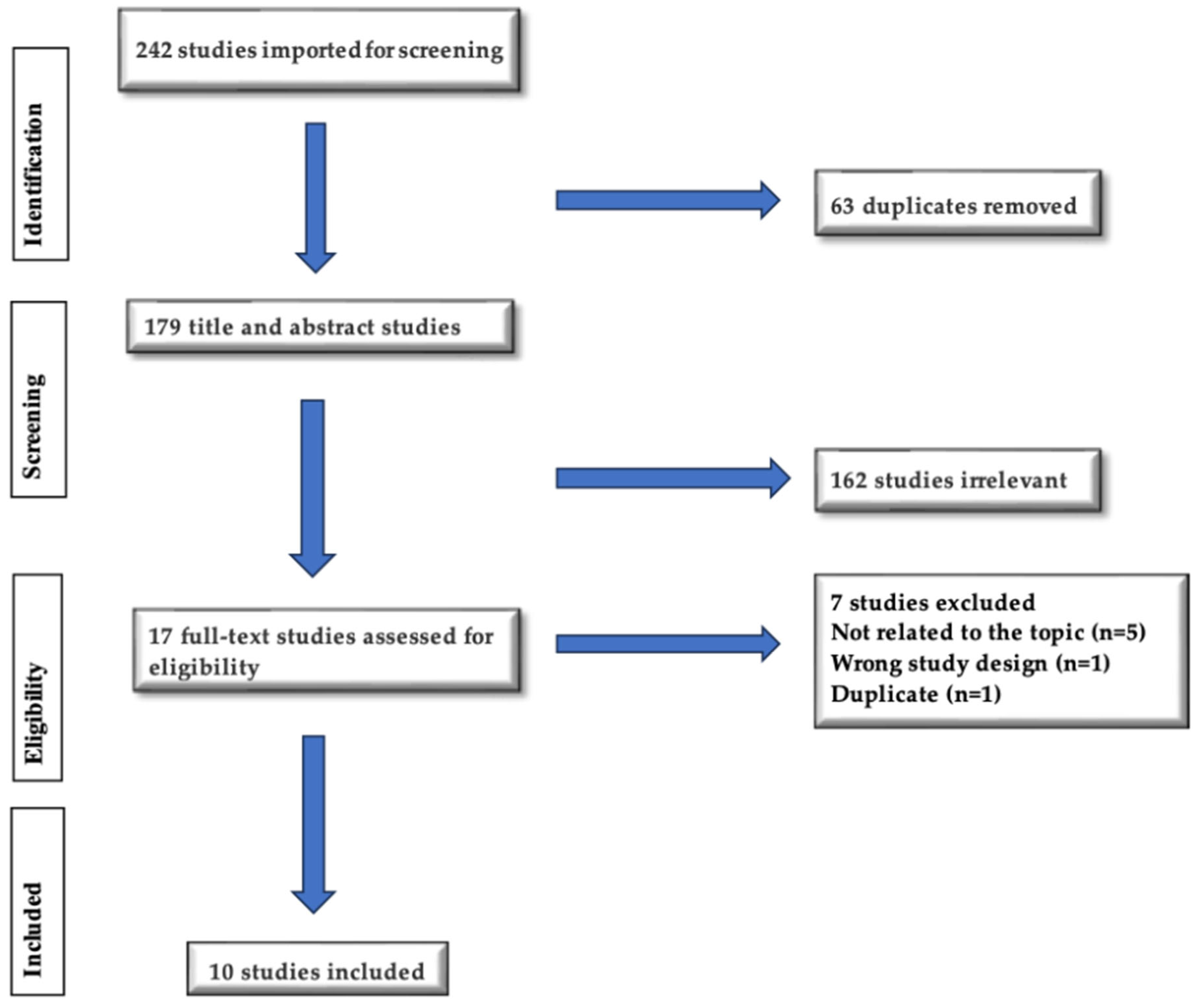
3.1. Article Search Selection
3.2. General Review Articles Characteristics
3.3. Key Findings
3.4. Recommendations
4. Discussion
4.1. Overview
4.2. Social Media vs. Problematic Social Media
4.3. Mental Health Regarding Sleep Quality and Social Media
4.4. Social Media Use During COVID-19
4.5. Positive Effects
4.6. Social Media and Dependency
4.7. Limitations and Future Recommendations
4.8. Practical Implications and Policies
5. Conclusions
Supplementary Materials
Author Contributions
Funding
Institutional Review Board Statement
Informed Consent Statement
Data Availability Statement
Conflicts of Interest
References
- Magis-Weinberg, L.; Ballonoff Suleiman, A.; Dahl, R.E. Context, Development, and Digital Media: Implications for Very Young Adolescents in LMICs. Front. Psychol. 2021, 12, 2021. [Google Scholar] [CrossRef]
- Boer, M.; van den Eijnden, R.; Boniel-Nissim, M.; Wong, S.L.; Inchley, J.C.; Badura, P.; Craig, W.M.; Gobina, I.; Kleszczewska, D.; Klanšček, H.J.; et al. Adolescents’ Intense and Problematic Social Media Use and Their Well-Being in 29 Countries. J. Adolesc. Health 2020, 66, S89–S99. [Google Scholar] [CrossRef]
- Koh, G.K.; Ow Yong, J.Q.Y.; Lee, A.R.Y.B.; Ong, B.S.Y.; Yau, C.E.; Ho, C.S.H.; Goh, Y.S. Social media use and its impact on adults’ mental health and well-being: A scoping review. Worldviews Evid. Based Nurs. 2024, 21, 345–394. [Google Scholar] [CrossRef] [PubMed]
- Bauducco, S.; Pillion, M.; Bartel, K.; Reynolds, C.; Kahn, M.; Gradisar, M. A bidirectional model of sleep and technology use: A theoretical review of How much, for whom, and which mechanisms. Sleep Med. Rev. 2024, 76, 101933. [Google Scholar] [CrossRef]
- Merino, M.; Tornero-Aguilera, J.F.; Rubio-Zarapuz, A.; Villanueva-Tobaldo, C.V.; Martín-Rodríguez, A.; Clemente-Suárez, V.J. Body Perceptions and Psychological Well-Being: A Review of the Impact of Social Media and Physical Measurements on Self-Esteem and Mental Health with a Focus on Body Image Satisfaction and Its Relationship with Cultural and Gender Factors. Healthcare 2024, 12, 1396. [Google Scholar] [CrossRef] [PubMed]
- Kline, C.E. Sleep Quality. In Encyclopedia of Behavioral Medicine; Gellman, M., Ed.; Springer: New York, NY, USA, 2019; pp. 1–3. [Google Scholar] [CrossRef]
- Brautsch, L.A.; Lund, L.; Andersen, M.M.; Jennum, P.J.; Folker, A.P.; Andersen, S. Digital media use and sleep in late adolescence and young adulthood: A systematic review. Sleep Med. Rev. 2023, 68, 101742. [Google Scholar] [CrossRef] [PubMed]
- Bhat, S.; Pinto-Zipp, G.; Upadhyay, H.; Polos, P.G. “To sleep, perchance to tweet”: In-bed electronic social media use and its associations with insomnia, daytime sleepiness, mood, and sleep duration in adults. Sleep Health J. Natl. Sleep Found. 2018, 4, 166–173. [Google Scholar] [CrossRef]
- Li, X.; Buxton, O.M.; Lee, S.; Chang, A.-M.; Berger, L.M.; Hale, L. Sleep mediates the association between adolescent screen time and depressive symptoms. Sleep Med. 2019, 57, 51–60. [Google Scholar] [CrossRef]
- Przybylski, A.K.; Murayama, K.; DeHaan, C.R.; Gladwell, V. Motivational, emotional, and behavioral correlates of fear of missing out. Comput. Hum. Behav. 2013, 29, 1841–1848. [Google Scholar] [CrossRef]
- Abrams, R.M. Sleep Deprivation. Obstet. Gynecol. Clin. 2015, 42, 493–506. [Google Scholar] [CrossRef]
- Garbarino, S.; Lanteri, P.; Bragazzi, N.L.; Magnavita, N.; Scoditti, E. Role of sleep deprivation in immune-related disease risk and outcomes. Commun. Biol. 2021, 4, 1304. [Google Scholar] [CrossRef] [PubMed]
- Agyapong-Opoku, F.; Agyapong-Opoku, N.; Agyapong, B. Examining the Effects of Sleep Deprivation on Decision-Making: A Scoping Review. Behav. Sci. 2025, 15, 823. [Google Scholar] [CrossRef]
- Anastasiades, P.G.; de Vivo, L.; Bellesi, M.; Jones, M.W. Adolescent sleep and the foundations of prefrontal cortical development and dysfunction. Prog. Neurobiol. 2022, 218, 102338. [Google Scholar] [CrossRef]
- Behera, N.; Khuntia, S.; Pandey, K.; Shankar, S. Impact of Social Media Use on Physical, Mental, Social, and Emotional Health, Sleep Quality, Body Image, and Mood: Evidence from 21 Countries-A Systematic Literature Review with Narrative Synthesis. Int. J. Behav. Med. 2025; ahead of print. [Google Scholar] [CrossRef]
- Arksey, H.; O’Malley, L. Scoping studies: Towards a methodological framework. Int. J. Soc. Res. Methodol. 2005, 8, 19–32. [Google Scholar] [CrossRef]
- Tricco, A.C.; Lillie, E.; Zarin, W.; O’Brien, K.K.; Colquhoun, H.; Levac, D.; Moher, D.; Peters, M.D.J.; Horsley, T.; Weeks, L.; et al. PRISMA Extension for Scoping Reviews (PRISMA-ScR): Checklist and Explanation. Ann Intern Med 2018, 169, 467–473. [Google Scholar] [CrossRef]
- Ahmed, O.; Walsh, E.I.; Dawel, A.; Alateeq, K.; Oyarce, D.A.E.; Cherbuin, N. Social media use, mental health and sleep: A systematic review with meta-analyses. J. Affect. Disord. 2024, 367, 701–712. [Google Scholar] [CrossRef]
- Alonzo, R.; Hussain, J.; Stranges, S.; Anderson, K.K. Interplay between social media use, sleep quality, and mental health in youth: A systematic review. Sleep Med. Rev. 2021, 56, 101414. [Google Scholar] [CrossRef]
- Chen, Y.; Li, S.Y.; Tian, Y.; Li, D.; Yin, H.Z. Problematic Social Media Use may be Ruining Our Sleep: A Meta-Analysis on the Relationship Between Problematic Social Media Use and Sleep Quality. Int. J. Ment. Health Addict 2024. [Google Scholar] [CrossRef]
- Dibben, G.O.; Martin, A.; Shore, C.B.; Johnstone, A.; McMellon, C.; Palmer, V.; Pugmire, J.; Riddell, J.; Skivington, K.; Wells, V.; et al. Adolescents’ interactive electronic device use, sleep and mental health: A systematic review of prospective studies. J. Sleep Res. 2023, 32, e13899. [Google Scholar] [CrossRef] [PubMed]
- Han, X.N.; Zhou, E.Z.; Liu, D. Electronic Media Use and Sleep Quality: Updated Systematic Review and Meta-Analysis. J. Med. Internet Res. 2024, 26, e48356. [Google Scholar] [CrossRef]
- Lund, L.; Solvhoj, I.N.; Danielsen, D.; Andersen, S. Electronic media use and sleep in children and adolescents in western countries: A systematic review. BMC Public Health 2021, 21, 1598. [Google Scholar] [CrossRef]
- Pagano, M.; Bacaro, V.; Crocetti, E. “Using digital media or sleeping... that is the question”. A meta-analysis on digital media use and unhealthy sleep in adolescence. Comput. Hum. Behav. 2023, 146, 107813. [Google Scholar] [CrossRef]
- Kaur, P.; Dhir, A.; Alkhalifa, A.K.; Tandon, A. Social media platforms and sleep problems: A systematic literature review, synthesis and framework for future research. Internet Res. 2021, 31, 1121–1152. [Google Scholar] [CrossRef]
- Cheng, C.; Chen, S.; Chen, S. Impact of National Lockdown Measures on the Association Between Social Media Use and Sleep Disturbance During COVID-19: A Meta-Analysis of 21 Nations. Cyberpsychol. Behav. Soc. Netw. 2024, 27, 527–538. [Google Scholar] [CrossRef] [PubMed]
- Bányai, F.; Zsila, Á.; Király, O.; Maraz, A.; Elekes, Z.; Griffiths, M.D.; Andreassen, C.S.; Demetrovics, Z. Problematic social media use: Results from a large-scale nationally representative adolescent sample. PLoS ONE 2017, 12, e0169839. [Google Scholar] [CrossRef]
- Shannon, H.; Bush, K.; Villeneuve, P.J.; Hellemans, K.G.; Guimond, S. Problematic Social Media Use in Adolescents and Young Adults: Systematic Review and Meta-analysis. JMIR Ment. Health 2022, 9, e33450. [Google Scholar] [CrossRef]
- Kelly, Y.; Zilanawala, A.; Booker, C.; Sacker, A. Social Media Use and Adolescent Mental Health: Findings from the UK Millennium Cohort Study. EClinicalMedicine 2018, 6, 59–68. [Google Scholar] [CrossRef] [PubMed]
- De, R.; Pandey, N.; Pal, A. Impact of digital surge during COVID-19 pandemic: A viewpoint on research and practice. Int. J. Inf. Manag. 2020, 55, 102171. [Google Scholar] [CrossRef] [PubMed]
- Sawyer, S.M.; Azzopardi, P.S.; Wickremarathne, D.; Patton, G.C. The age of adolescence. Lancet Child Adolesc. Health 2018, 2, 223–228. [Google Scholar] [CrossRef]
- Pérez-Torres, V. Social media: A digital social mirror for identity development during adolescence. Curr. Psychol. 2024, 43, 22170–22180. [Google Scholar] [CrossRef]
- Skogen, J.C.; Hjetland, G.J.; Bøe, T.; Hella, R.T.; Knudsen, A.K. Through the Looking Glass of Social Media. Focus on Self-Presentation and Association with Mental Health and Quality of Life. A Cross-Sectional Survey-Based Study. Int. J. Environ. Res. Public Health 2021, 18, 3319. [Google Scholar] [CrossRef] [PubMed]
- Heath, M.; Sutherland, C.; Bartel, K.; Gradisar, M.; Williamson, P.; Lovato, N.; Micic, G. Does one hour of bright or short-wavelength filtered tablet screenlight have a meaningful effect on adolescents’ pre-bedtime alertness, sleep, and daytime functioning? Chronobiol. Int. 2014, 31, 496–505. [Google Scholar] [CrossRef]
- Plackett, R.; Blyth, A.; Schartau, P. The Impact of Social Media Use Interventions on Mental Well-Being: Systematic Review. J. Med. Internet Res. 2023, 25, e44922. [Google Scholar] [CrossRef] [PubMed]


| Author/Date | Time Period Investigated | Continent/Countries of Primary Articles | Total Number of Included Articles/Review Types | Aim of Review | Sample Size/Characteristics | Risk of Bias Assessment | Type of Social Media Used | Key Findings on Impact on Sleep Quality | Recommendation for Future Research |
|---|---|---|---|---|---|---|---|---|---|
| Ahmed et al. 2024 [18] | Up to 2024 | Asia, Europe, North America, Oceania | 58 studies | To systematically assess the existing research and conduct a meta-analysis of the association between social media use and its potential negative effects on mental health and sleep concerning adolescents and young adults as well as to identify gaps and limitations from previous studies. | Social media use and sleep quality: 545,375 participants, weighted mean average 15 years old, female participants 50.7%. Problematic social media and sleep quality: 18,072 participants, weighted mean average 17 years old, female participants around 56%. | They took several steps to control and check any publication bias. Funnel plots were examined, and a statistical test, Egger Regression Test, was completed. They ran sensitivity analyses and used a covariance ratio to spot “influential studies” that might be skewing the results. They used the trim-and-fill method to estimate how missing extreme studies might change the results of the meta-analysis. | Facebook, Instagram, Twitter, and other social media platforms (WeChat, Snapchat, WhatsApp, YouTube, Google+, Vine, Tumblr, Pinterest, LinkedIn, and BlackBerry Messenger) |
| The recommendations for future research are that studies should consistently report participant details (age, gender, sample size, and statistical measures), investigate how different social media platforms uniquely affect sleep quality and mental health, and also conduct more longitudinal research with repeated measurements to clarify the direction of relationships between social media use and sleep. Exploring psychological factors such as motives for social media is recommended to examine how sleep mediates the relationship between problematic social media use and mental health outcomes. |
| Alonzo, Rea. 2021 [19] | Past 1990, up to 2024 | 27 studies from Asia, 9 from Europe, 3 from North America, 1 from Australia, and 1 spanned multiple continents | 42 | This review examines existing research on how active social media use relates to sleep quality and associates with common mental health issues among youth. | Age group of interest was age group 16–25 years; they included studies that used an age range of 12–30 years. | Most of the 42 studies showed low-to-moderate risk of bias. For the 6 cohort studies, most chose participants fairly, but some had issues with measuring social media use and sleep outcomes accurately. Three studies already had sleep or mental health problems present at the start, which could affect the results. Also, follow-up was not always complete, which might lead to bias. Most of the 36 cross-sectional studies recruited participants from schools or universities, so the results might not apply to all youth. Some studies had good participation and used trustworthy surveys, but many did not explain missing data well. Around half used poor methods to measure social media use, which could affect accuracy. | Interactive, active social media (e.g., Facebook) |
| Include studies that explore social use among different genders, assess the relationship between technologically populated groups, use consistent and objective measures to obtain more accurate results, and use long-term studies with diverse youth groups to further develop how social media use and sleep quality are connected. |
| Brautsch et al. 2023 [7] | Examined studies published from 1 January 2010 to 31 April 2021 | Western countries include all EU member states along with Andorra, Iceland, Liechtenstein, Monaco, Norway, San Marino, Switzerland, Vatican City, Canada, the United States, Australia, and New Zealand | 42 studies | The aim is to examine how digital media affects sleep given the rapid growth of digital technology. While previous research has documented the effects of digital media on children’s sleep, this study is investigating if similar effects occur in young adults (16–25 years). | The population studied consisted of individuals aged 16 to 25 years. | Many limitations were involved due to bias. It was reported that many of the studies sampled college students and self-referred participants, without showing clear age ranges. The studies in the review were quite different in their design, so it was not possible to combine their results in a meta-analysis. Most of the studies used self-reported data for digital media use and sleep, which may not be reliable due to memory errors or people wanting to give socially acceptable answers. Since many studies were cross-sectional, it is hard to say whether digital media use causes poor sleep. Also, a significant amount of the research did not look at what time of day media was used, which makes it difficult to understand how timing affects sleep. Few studies used objective tools to measure sleep or looked at gender differences, which are important areas for future research. | Digital media; (general communicative social media) | The studies found that social media is linked to shorter sleep duration and poorer sleep quality. | Use stronger experimental or longitudinal studies to clarify if digital media causes sleep changes, including effects of light and content on circadian rhythms. Apply objective sleep measures and validated tools for tracking media use. Study a wider range of media activities and how content activates or relaxes users. Examine how timing of media use affects sleep across the day and night. Investigate gender differences and other factors that may influence this relationship. |
| Chen et al. 2024 [20] | Up to 18 February 2024 | Not stated | 40 studies | To examine the overall relationship between problematic social media use (PSMU) and sleep quality and to assess how factors like age, gender, culture, and social media platform type may influence this relationship. | Total of 34,441 participants (no specific age range stated). Inconsistent characteristics of population (age, gender, and individualism/collectivism). | Many tests were taken to limit publication bias: funnel plots, Egger’s Regression Test, trim-fill method, and the class fail – safe N. Based on these tests, it concluded that the publication bias did not greatly influence the study’s results. | Online platforms (including Facebook, Instagram, Twitter, etc.) |
| Future recommendations included investigating clinical populations, studying social features in games and streaming media, validating measurement scales for PSMU, using objective sleep measures, and accounting for temporal and geographical factors. |
| O. Dibben et al. 2023 [21] | Reviewed in October 2022 | 7 studies in Europe, 8 in North America, 8 in Oceania, and 5 in Asia | 28 studies included | To combine longitudinal and experimental findings on how device use affects adolescents’ sleep and their mental health. |
| Risk of bias assessment was assessed in several categories, including high risk bias, selection bias, performative bias, detection bias, and attrition bias. | Software accessible through IED (ex: social media), passive or active | Many of the results did not find a clear correlation between social media use and poor sleep —there were inconsistent findings. | Further research should examine IED and social media use on sleep compared to passive screen activities, explore how diverse population factors modify sleep effects, and investigate the impact of screen brightness and length of device use on sleep outcomes. |
| Han et al. 2024 [22] | January 2018 to October 2023 | Europe, Asia, Arabia, Oceania, North America, Africa, South America | 55 | To compare and analyze different types of digital media (phones, games, and social media) on sleep quality. | 41,716 participants. Age range of general media used and sleep quality: 9.9 to 44 years (21,594). | Funnel plots were used to check for result imbalances, and a p-curve test was conducted to detect potential p-hacking. Both methods help measure and restrict publication bias. | General social media; specifically stated were Facebook and Twitter |
| More long-term and experimental research is needed to understand how electronic media use affects sleep quality, including cultural differences that might affect this relationship. |
| Lund et al. 2021 [23] | 1 January 2009 to 31 August 2019 | Western countries | 49 | To systematically review existing research on how electronic media use affects sleep in children and adolescents. | Children aged 0–15 years without any diagnoses or diseases. | The Effective Public Health Practice Project was used to assess risk of bias across 5 domains: selection bias, study design, confounders, data collection methods, and withdrawals and dropouts. | General social media | An association with social media and poor sleep quality was found, with the most between ages 13 and 15 years. | Investigate how sociodemographic factors impact media use on sleep in children and adolescents. |
| Pagano et al. 2023 [24] | Up to 28 January 2023 | 43.3% of the studies in Europe, 30.4% in North America, 4.4% in Asia (Korea, Kuwait, Iran, Taiwan), and 8.7% in Asia (China) | 23 | The aim is to explore how various digital media use is linked to sleep health. | 116,431 participants; 52% were female, and the average age was 13.4 years. | To evaluate publication bias, funnel Plot and Egger’s Regression Test were conducted. | General social media | Results showed that social media has a small but negative effect on teen sleep. Apps like Twitter and Facebook were linked to shorter sleep duration, later bedtimes, and poorer sleep quality but not nearly to the same extent as traditional media. | Recommendations include long-term studies with multiple check-ins to understand how social media affects sleep and what factors influence this relationship. Future research should identify which teenagers are most at risk for poor sleep, especially considering things like their sleep patterns and how their parents manage their social media use. |
| Kaur et al. 2021 [25] | Not stated | 21 countries across 7 geographical regions, data missing from Australasia and South America (specific countries/continents not stated) | 43 studies | To investigate the link between social media use and sleep disturbances during the pandemic as well as factors that may influence this relationship. | 68,247 residents. Across the included studies, participants had a mean age of 26.4 years, with males comprising 36% of the sample. In total, the studies represented 21 countries spanning seven geographical regions. | Publication bias was assessed using meta-regression, the R-index for replicability, and Egger’s test for small-study bias, and p-curve analysis for evidential value and potential p-hacking. | Types of social media mentioned are general, information focused, and compulsive social media | Compulsive social media use had a stronger association with sleep disturbances during and after the lockdown. Information-focused use had a positive association with sleep disturbances only during lockdown and not after. General use was linked to sleep disturbances after but not during lockdown. | Future recommendations include considering age-specific effects, comparing effects during versus after events like pandemics to capture changing patterns of use and sleep outcomes, and studying challenges during COVID-19 to improve future health emergencies. |
| Cheng et al. 2024 [26] | 2013–2019 | Australia, USA, UK, Bangladesh, China, Indonesia, The Netherlands, Estonia, Finland, Iran, Peru, Saudi Arabia, Scotland, Singapore | 45 | This review aims to examine how social media use at night effects sleep and related problems. | Examined adolescents (11–15 years) and young adults (16–32). Reviewed studies that included predominantly female participants. | The risks included are self-reported data, only cross-sectional data, convenience sampling, generalizability limits, and a lack of moderating variables. | Social media platforms (not specifically stated which type) | Social media users reported poor sleep, problematic sleep, and negative effects on individual health and performance efficiency. | Future research should explore how social media affects sleep through factors that influence the relationship, diversify research design, and include a wider range of participants. |
Disclaimer/Publisher’s Note: The statements, opinions and data contained in all publications are solely those of the individual author(s) and contributor(s) and not of MDPI and/or the editor(s). MDPI and/or the editor(s) disclaim responsibility for any injury to people or property resulting from any ideas, methods, instructions or products referred to in the content. |
© 2025 by the authors. Licensee MDPI, Basel, Switzerland. This article is an open access article distributed under the terms and conditions of the Creative Commons Attribution (CC BY) license.
Share and Cite
Ndubisi, A.; Agyapong-Opoku, F.; Agyapong, B. Social Media Use and Sleep Quality in Adolescents and Young Adults: A Scoping Review of Reviews. Children 2026, 13, 51. https://doi.org/10.3390/children13010051
Ndubisi A, Agyapong-Opoku F, Agyapong B. Social Media Use and Sleep Quality in Adolescents and Young Adults: A Scoping Review of Reviews. Children. 2026; 13(1):51. https://doi.org/10.3390/children13010051
Chicago/Turabian StyleNdubisi, Awele, Felix Agyapong-Opoku, and Belinda Agyapong. 2026. "Social Media Use and Sleep Quality in Adolescents and Young Adults: A Scoping Review of Reviews" Children 13, no. 1: 51. https://doi.org/10.3390/children13010051
APA StyleNdubisi, A., Agyapong-Opoku, F., & Agyapong, B. (2026). Social Media Use and Sleep Quality in Adolescents and Young Adults: A Scoping Review of Reviews. Children, 13(1), 51. https://doi.org/10.3390/children13010051